Daily
Herald
the Brown
vol. cxxii, no. 4
Monday, January 30, 2012
Since 1891
Paper dolls Applications fall slightly, despite larger int’l pool inspire human emotions By james Rattner Senior Staff Writer
By Alexa Pugh Staff Writer
Put away your Muppets lunch box and say goodbye to Kermit — there is a new kind of puppetry in town.
Arts & Culture The Puppet Summit, hosted at the Perry and Marty Granoff Center for the Creative Arts Jan. 26-29, showcased four plays that explored a lot more than the woes of being green — namely, the emotional responses, or lack thereof, to genocide. “Puppets have been given a bad rap because they’ve been infantilized and co-opted by dogooders, but historically puppetry is much more morally ambiguous and capable of a deeper range of expressions,” said Erik Ehn, head of the graduate playwriting program and professor of theatre arts and performance studies, who wrote all four plays. Their ability to push the boundaries of empathy, he said, is part of why puppets are so well-suited to the difficult subject of genocide addressed in his four plays. The four segments previewed at the summit are part of a commemorative cycle of 17 plays by continued on page 5
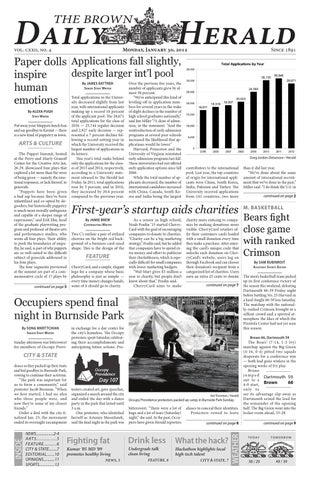
Total applications to the University decreased slightly from last year, with international applicants making up a record 16 percent of the applicant pool. The 28,671 total applications for the class of 2016 — 25,744 regular decision and 2,927 early decision — represented a 7 percent decline following a record-setting year in which the University received the largest number of applications in its history. This year’s total ranks behind only the applications for the classes of 2015 and 2014, respectively, according to a University statement released to The Herald last Friday. In 2011, total applications rose by 3 percent, and in 2010, they increased by 20.6 percent compared to the previous year.
Over the previous five years, the number of applicants grew by almost 50 percent. “We’ve anticipated this kind of leveling-off in application numbers for several years in the wake of slight declines in the number of high school graduates nationally,” said Jim Miller ’73, dean of admission, in the statement. “And the reintroduction of early admission programs at several peer schools increased the likelihood that applications would be lower.” Harvard, Princeton and the University of Virginia reinstated early admission programs last fall. These universities had not offered early application options since fall 2006. While the total number of applicants decreased, the number of international candidates increased with China, Canada, South Korea and India being the largest
Greg Jordan-Detamore / Herald
contributors to the international pool. Last year, the top countries of origin for international applicants were China, South Korea, India, Pakistan and Turkey. The University received applications from 141 countries, two more
Sunday afternoon was bittersweet for members of Occupy Provi-
By Jamie Brew Contributing Writer
Two C’s outline a pair of stylized cherries on the bright red background of a business card-sized shape. This is the design of the
Feature CherryCard, and a simple, elegant logo for a company whose basic philosophy is just as simple— every time money changes hands, some of it should go to charity.
As a senior in high school, Noah Fradin ’15 started CherryCard with the goal of encouraging companies to donate to charities. “Charity can be a big marketing strategy,” Fradin said, but he added that companies have to spend extra money and effort to publicize their charitableness, which is especially difficult for small companies with lower marketing budgets. “Wal-Mart gives $3 million a year to charity, but people don’t know about that,” Fradin said. CherryCard aims to make
charity more enticing to companies by making donations more visible. CherryCard retailers offer their customers cards loaded with a small donation every time they make a purchase. After entering the card’s unique code that unlocks each donation on CherryCard’s website, users log on through Facebook and can choose their donation’s recipient from a categorized list of charities. Users earn an extra 25 cents to donate continued on page 7
in exchange for a day center for the city’s homeless. The Occupy protesters spent Saturday celebrating their accomplishments and anticipating future actions. Pro-
The men’s basketball team picked up its first conference victory of the season this weekend, defeating Dartmouth 66-59 Friday night before battling No. 23 Harvard in a hard-fought 68-59 loss Saturday. The matchup with the nationally-ranked Crimson brought in a sellout crowd and a spirited atmosphere the likes of which the Pizzitola Center had not yet seen this season.
aliases to conceal their identities. Protesters vowed to leave continued on page 8
continued on page 9
Kat Thornton / Herald
Occupy Providence protestors packed up camp in Burnside Park Sunday.
bittersweet. “There were a lot of hugs and a lot of tears (Saturday) night,” she said. In the past, Occupiers have given Herald reporters
Fighting fat
Drink less
What the hack?
Kumar ’05 MD ’09 promotes healthy living
Undergrads talk clean living
Hackathon highlights local high-tech talent
News, 3
By sam rubinroit Assistant Sports Editor
Brown 66, Dartmouth 59
Feature, 6
City & State, 7
weather
inside
news....................2-4 A r t s ...............5 feature...........6 city & state.........7 editorial.......10 Opinions.............11 SPORTS..................12
testers created art, gave speeches, organized a march around the city and ended the day with a dance party in the park that lasted until 3 a.m. One protester, who identified herself as Artemis Moonhawk, said the final night in the park was
Bears fight close game with ranked Crimson
The Bears’ (7-14, 1-3 Ivy) matchup against the Big Green (4-16, 0-4) pitted two squads desperate for a conference win — both had gone winless in the opening weeks of Ivy play. Bruno j u m p e d Dartmouth 59 out to a 66 4-0 start, Brown on ly t o see its advantage slip away as Dartmouth seized the lead for the remainder of the opening half. The Big Green went into the locker room ahead, 33-28.
city & state dence as they packed up their tents and bid goodbye to Burnside Park, vowing to continue their activism. “The park was important for us to form a community,” said protester Jacob Brennan. “When we first started, I had no idea who these people were, and now they’re some of my closest friends.” Under a deal with the city finalized Jan. 23, the movement ended its overnight encampment
continued on page 2
First-year’s startup aids charities M. Basketball
Occupiers spend final night in Burnside Park By Sona mkrttchian Senior Staff Writer
than it did last year. “We’ve done about the same amount of international recruitment that we’ve done in the past,” Miller said. “I do think the U.S. in
t o d ay
tomorrow
38 / 29
49 / 39
2 Campus News
The Brown Daily Herald Monday, January 30, 2012
calendar Today
January 30
4:00 P.M.
ToMORROW
January 31
12:00 P.M.
Physics Colloqium: Juan Collar
Brown in Cuba Info Session
Barus & Holley, 168
J. Walter Wilson, 440
7:00 P.M.
7:00 P.M.
“Shaun of the Dead” Film Screening
Telescope Observing Night,
Granoff Center
Ladd Observatory
menu SHARPE REFECTORY
VERNEy-WOOLLEY DINING HALL LUNCH
Stir-Fry Vegetarian Chinese with Lo-Mein Noodles, Savory Chicken Stew, Vegan Bean-Pepper Casserole
Tuna Salad, Mexican Salad Bar, Italian Marinated Chicken, Zucchini & Onion Saute
DINNER Vegan Garden Chili, Stir Fry - Pasta with Beef, Vegetable Egg Rolls, Cucumber Chickpea Salad
Chicken & Broccoli Szechu, Vegetarian Japanese Noodle Soup, African Honey Bread
Sudoku
Julia Shube / Herald
App numbers vary across top colleges continued from page 1
Crossword
general, and Brown in particular, continues to be perceived overseas as a very valuable experience, and I think for a lot of international students American higher education is really a gold standard.” Miller said the acceptance rate for international students tends to be slightly below that of the entire class, in part because Brown is still only need-aware to international applicants. Brown is not the only school to experience a drop in applications this year. Columbia, Harvard and Penn all received fewer applications, though only Columbia’s decline was greater than Brown’s. Harvard, which reinstated its early action program this year, received 34,285 total applications, a drop of 1.9 percent, according to an article published in the Harvard Crimson. Princeton, which also suspended early applications after the fall 2006 round, has not yet released its numbers for regular decision applications. It accepted 726 of its 3,443 early action applicants in December. The University of Virginia saw
Daily
the Brown
its applicant pool increase by 17.6 percent. Meanwhile, the number of applicants increased at Cornell, Dartmouth, Duke University, Stanford University and Yale, according to the New York Times. These schools saw their applications increase by 3.53 percent, 2.98 percent, 6.13 percent, 6.98 percent and 5.05 percent, respectively. Bruce Breimer, director of college guidance at the Collegiate School in New York City from 1970 until 2007, called this year’s drop in applications a deviation from the norm. “I don’t see it being a trend,” he said. Breimer cited the drop in Princeton’s applicant pool for the class of 2008 as an example of how one year may not mean very much, as the number of applicants increased the following year. “Everybody was panicking (about) one year aberrations,” Breimer said. Breimer emphasized that a decline in the number of applicants is not inherently bad. “You have to find out … what the 7 percent decline represents. In other words, is it a higher percentage of mar-
Herald
www.browndailyherald.com 195 Angell St., Providence, R.I.
Claire Peracchio, President Rebecca Ballhaus, Vice President
Danielle Marshak, Treasurer Siena DeLisser, Secretary
The Brown Daily Herald (USPS 067.740) is an independent newspaper serving the Brown University community daily since 1891. It is published Monday through Friday during the academic year, excluding vacations, once during Commencement and once during Orientation by The Brown Daily Herald, Inc. Single copy free for each member of the community. POSTMASTER please send corrections to P.O. Box 2538, Providence, RI 02906. Periodicals postage paid at Providence, R.I. Subscription prices: $280 one year daily, $140 one semester daily. Copyright 2011 by The Brown Daily Herald, Inc. All rights reserved. editorial
(401) 351-3372 herald@browndailyherald.com
Business
(401) 351-3260 gm@browndailyherald.com
ginally qualified people decided not apply? That’s probably a good thing,” Breimer said. “Any Ivy League school that’s experienced 7 percent decline can still fill its class three times over without diluting the quality.” Breimer, like Miller, said demographers predicted a drop in the number of high school graduates around this time. The percentage of applicants seeking financial aid rose from 67 percent to 68 percent. Director of Financial Aid Jim Tilton said in the past five years a consistent two-thirds of applicants applied for aid. Miller estimated that applications to the Brown/Rhode Island School of Design Dual Degree Program are down from last year, while applications to the Program in Liberal Medical Education have increased. The University received 504 applications for the dual degree program and 2,493 for PLME. Miller said the proportion of accepted students who will matriculate may increase due to the fact that high school students had the option of applying early to Harvard, Princeton and the University of Virginia.
Campus News 3
The Brown Daily Herald Monday, January 30, 2012
Herald file photo
Shape Up R.I. aims to fight obesity through exercise and education about healthy lifestyle choices.
Brown community teams, shapes up By Aparaajit Sriram Senior Staff Writer
With the national debate on health care and rising obesity in the U.S. raging on, Rajiv Kumar ’05 MD’11 has decided to “disrupt the health care system” on his own terms. In 2006, Kumar started the program Shape Up Rhode Island with the nebulous goal to “find a way to help my patients achieve their health goals, whatever they were,” he said. Then a first-year medical student, Kumar decided to change traditional lifestyles after seeing his patients struggle to improve their health. Since the program’s inception, Brown has encouraged employees to participate. But this year, the University’s participation numbers are down. While there were 423 employees last year on 62 teams — a number consistent with the average since 2006, when Brown began participating — this year only 266 people have signed up, on 43 teams. Shape Up R.I. looks to harness the social power of the Internet to encourage collaboration. “I noticed that most people were failing (at achieving their health goals), but those who weren’t were doing so by leveraging their trusted social network — their friends, their family and their colleagues.” Kumar concluded that one of the keys to improved health was working alongside others. Due to the “accountability, motivation and social support” that come with exercising with a buddy or dieting with a friend, he said he believed the best way to get healthier was to get people working together. So Shape Up R.I. took shape. With more specific goals in mind — “to help people lose weight, increase their exercise and stem the obesity epidemic we’ve been seeing nationwide” by using online social media — Kumar set to work structuring a statewide program that would best implement his vision. Shape Up R.I. is predominantly sponsored by participating employers, who cover the $20 participation fee for their employees.
The majority of participants in the program come from companies or institutions, including Brown, which cover their fees. “The numbers are down throughout the state. We are trying to do some more publicity to get our numbers back up,” said Drew Murphy, director of benefits for human resources. In an effort to boost participation, the University’s Human Resources department is encouraging employees to set up teams with non-employees. “If people just don’t feel comfortable competing or losing weight on a team with colleagues, then they can do it in that more friendly environment of their family and friends,” Murphy said. Brown will not cover the cost of those not employed by the University. Teams of at least five take part in an annual competition to determine which teams have lost the most weight, walked the most steps and exercised the most minutes over a 12-week period every spring. Teams are rewarded based on their performance in any or all of the three divisions, depending on which ones they choose. According to the Shape Up R.I. website, more than 48,500 Rhode Islanders have taken part in the program since its inception. In 2011, there were 12,892 program participants who lost an average of 7.4 pounds, exercised about 6.1 hours a week and walked about 10,237 steps per day, according to the website. Murphy, who has himself been a team captain and participated in the program for the last six years, now takes the stairs up to his office and walks more everyday. During the 12-week program, he would send emails to co-workers and teammates to join him on lunchtime walks to Wayland Square or Wickenden Street. Kim Almeida, a Brown employee who has been on the same team as Murphy since 2006, had only praise for the program. “It’s been very effective. It’s motivated me to get out and do some walking in the time of year when you generally wouldn’t get out and walk,” she said. “You get out of
your office, take a break, go for a walk, get some steps in during the lunch hour. It’s truly motivated me to make a lot of lifestyle changes.” The social element has also elicited results. “You don’t want to let your team members down. You know they’re counting on you not to be the person who drags the numbers down for the team,” Almeida said. But she added, “It’s not like you’ll get kicked off the team if you’re not walking enough. It’s more of a motivating factor.” Past Brown teams have included Brown Campus Life, Brown Geology, Brown Financial Aid for Fitness and Brown Bears from the Square. Shape Up R.I. also sponsors fitness events and discounts at stores for its participants. Partnering with gyms and health foods stores, the program blasts emails to participants throughout the year with information about deals. Kumar is focused on improving the program, most importantly by trying to eliminate the fee. “Any cost is a barrier,” he said. He plans to continue cultivating relationships with sponsors in order to help reduce costs. Kumar is also developing Shape Up For Kids, a program that will apply the same behavior-changing principles proven to work in the adult program — “goal setting, progress tracking, friendly competition and social rewards” — to a children’s program. “We’re really excited about this,” said Kumar, who will be teaming up with the first lady of Rhode Island, Stephanie Chafee P’14, to co-lead this program, which is slated to launch in 2013. The youth program will have five goals — to increase physical activity, spur healthy eating, encourage reading, foster environmental conservation and promote good deeds among children. Registration for Shape Up R.I. is open until Feb. 6, though the deadline may be pushed back a week to promote more participation.
Morgan Johnson / Herald
Canvas will replace MyCourses by spring 2013.
Professors replace MyCourses with Canvas By Morgan Johnson Senior Staff Writer
More than 3,000 students this semester will use Canvas, Brown’s new online course management system, before its slated replacement of MyCourses in spring 2013. Canvas, officially selected last spring after receiving positive feedback from student and faculty surveys and focus groups, had its first testing phase last fall when it was used in nine undergraduate courses and by first- and second-year medical students, according to the project’s recently launched website. All faculty members were invited via email to participate in the second phase of testing this spring. “We received a very healthy number of responses,” said Dean of the College Katherine Bergeron of this semester’s volunteers. Sixty faculty members elected to adopt Canvas, which will be used in roughly 70 courses, Bergeron said. Another voluntary phase is planned for next fall, before all faculty members are asked to switch to Canvas the following spring. MyCourses will still be available for use until summer 2013, according to Brown’s Computing and Information Services website. “I just thought it was clunky,” said William Allen, adjunct lecturer in public policy, of MyCourses. After six years of using MyCourses to teach his seminar, PPAI1700V: “Nonprofit Organizations,” Allen switched to Canvas this semester. “It was almost intuitive how to use it,” Allen said of Canvas after receiving basic training in the program. “I did not find it a radical change.” “MyCourses has a rigid design structure and a complicated interface for faculty,” said Robert Self, associate professor of history. Self will use Canvas in his lecture course, HIST1755: “The Intimate State: The Politics of Gender, Sex, and Family in the U.S., 1873-Present.” Self, who designed the course and is teaching it for the first time this semester, opted to use Canvas while creating the class rather than
having to switch course materials from MyCourses to a new course management system next year. Despite having no experience with Canvas before making his decision, Self did not regret his choice. “It’s not bad software,” he said of MyCourses, “but it appears that Canvas is simply better.” In addition to a cleaner layout, Canvas allows instructors to upload files faster and organize readings and materials by date. “It deals with videos and other visual images better,” Self said. The new program also supports a greater variety of content. “You can view full page articles without having to go to e-reserves,” said Chris Moynihan ’14, who is using it in HIST1900: “American Empire Since 1890.” But MyCourses does have some features that Canvas lacks. Allen, who has used MyCourses’ forum feature in past years to print student blog posts and comments in one combined report, has not yet found an equivalent feature on Canvas. “I’m still working with it,” he said. “I don’t think it’s that big of an issue.” Though Allen and Self have yet to encounter technical difficulties with Canvas, Moynihan said the transition to Canvas has been “kind of a rough experience.” In addition to being timed out, Moynihan has had trouble uploading PDF files onto Canvas in the correct format. Students who do not register for a class that uses Canvas will still have an opportunity to try the new program before shopping period ends. Instructors can publish a public, reduced-access course page that allows students to view upcoming assignments and course documents while disabling homework submission and grade-viewing features. Self said the switch will likely be well-received. “I don’t believe the transition will be long or difficult,” he said. “I’m convinced it’s a better platform for both faculty and students.” Moynihan is more wary of the upcoming switch to Canvas. “I’ve used MyCourses for over a year,” he said. “I’m comfortable with it, and it’s easy to use.”
4 Campus News
The Brown Daily Herald Monday, January 30, 2012
Songstress lights up otherwise dark night By Katherine Long Senior Staff Writer
Canadian pop starlet Lights — nee Valerie Poxleitner — has come a long way since her sugary first LP dropped in 2009. Her high-energy performance at The Met Friday night, mainly featuring tracks from her sophomore effort, “Siberia,” was more grit than girly.
Arts & Culture
Herald file photo
Julia Shube / Herald
The School of Engineering plans to prioritize diversity when hiring new faculty.
U. seeks diversity in engineering faculty By alexander kaplan Contributing Writer
As the School of Engineering expands, racial and gender diversity will be a priority in hiring new faculty, said Lawrence Larson, dean of the school of engineering. Part of this effort will involve collaboration with the Diversity Advisory Board, he said.
Of the 51 current faculty members, around 78 percent are white and around 90 percent are male, he said. The School of Engineering plans to add 12 new faculty members over the next decade, The Herald reported Oct. 13. “We are especially open and welcoming to recruiting new faculty members from historically un-
derrepresented areas in science and engineering,” Larson said. He said he and the Diversity Advisory Board are pursuing ways to “ensure that the diversity of (the) engineering faculty mirrors the diversity of society.” Larson said he will meet with the Diversity Advisory Board in early February to discuss issues concerning faculty, graduate student and post-
doctoral student diversity plans. Last summer, he met with Jabbar Bennett, assistant dean of recruiting and professional development, to discuss the same topics. Larson said he hopes the meetings with the Diversity Advisory Board during this upcoming hiring season will “ensure a strong and diverse set of faculty candidates.”
Got something to say? Leave a comment online!
Blasts of surprisingly raw dub backed her keening vocals. Omnipresent strobe illuminated her dozens of tattoos. At times, she seemed to go into a trance, bent backward over her synthesizer. None of this, though, could save the show from rising above run-ofthe-mill. The dubstep, which features prominently on “Siberia” courtesy of electrofunk collaborators Holy F— , is an imaginative touch and a signal that the genre is making inroads into the mainstream. But a half-dozen dub clips do not a spectacle make. Halfway through, the concert took a redoubtable turn for the Taylor Swift, with a saccharinesweet solo keyboard rendition of the melodramatic “Heavy Rope,” some cutesy facial tics and a ballad duet with band member Aaron Fink. Even during this interlude, it was clear that Lights’ voice has matured beyond the breathy simper characteristic of her debut, “The Listening,” which garnered her the Juno Award for Best New Artist. Perhaps the most remarkable thing about the otherwise rather unremarkable show was not simply the diversity of the small crowd but the intensity of its fanship, especially for an artist who receives almost no stateside airplay. Most of the crowd — which ranged from shrieking middle school girls and their grudging parents to fraternity brothers and middle-aged couples — had discovered Lights’ 2008 EP online and followed her ever since. A remarkable number of concertgoers had driven for hours to attend. One couple had danced to “Drive My Soul” at their wedding. “In the (United States), people don’t see you on TV or hear your songs on the radio. Whether it’s word of mouth or going online and watching music videos and finding your songs — they feel like they’ve discovered you,” Lights told The Herald. “There’s real investment (among fans) in the U.S.” Up-and-coming Brooklyn group Savoir Adore opened the show. The five-piece outfit, while technically sound, was sonically unconvincing: an unadventurous and at times gimmicky indie effort borrowing without shame from more successful ventures. But Lights — whose chameleon nature avoids such cliched musical tropes — may be a woman to watch.
Arts & Culture 5
The Brown Daily Herald Monday, January 30, 2012
Exhibit obscures popular cultural images Chinese By Casey Bleho Contributing Writer
Walking into the David Winton Bell Gallery, located in the lobby of the List Art Center, visitors are immediately confronted by a barrage of brightly colored pop-art pieces, photorealist prints and politically relevant montages. These pieces make up the featured exhibition, “Optical Noise: American and British Prints/Films from the 1960s-1970s.” The exhibition, which opened officially Jan. 27 and will be on display through Feb. 21, was conceived and created collaboratively by Monica Bravo GS, Alexandra Collins GS, Sara Hayat GS, Amy Huang GS, Sarah Rovang GS and Rebecca Szantyr GS, all first- and second-year graduate students in the History of Art and Architecture department. The exhibition features works representative of the main art movements, themes and images
that defined the 1960s and 1970s. The works of well-known artists such as Andy Warhol, Roy Lichtenstein, Robert Rauschenberg and Bruce Conner are featured. The overarching commonality between the works is not rooted in the time period itself, but rather in their shared illustration of the idea of “optical noise,” which is the primary focus of the exhibition, according to the exhibition’s pamphlet. Termed by American art critic Leo Steinberg, “optical noise” refers to the manipulation, reproduction and decontextualization of widely recognized images drawn from popular culture, according to the pamphlet. Though some of these images have become so ingrained in contemporary society as to be perceived almost as peripheral white noise, a combination of fragmentation, layering and montage renders them new by de-familiarizing and obscuring them, the pamphlet ex-
plains. As such, the pieces exhibited in “Optical Noise” come to both embody and critique popular culture and its accessibility. This idea is not something that pertains exclusively to the art movements of the 1960s and 1970s, according to the curators of the exhibition. They saw the idea of “optical noise” as something that maintains resonance within today’s society. The art movements embodied in the exhibit can be perceived as the movements that inaugurated our modern lifestyle, defined by a constant bombardment of noise, information and images, Bravo said. In keeping with the ideas behind “optical noise,” the exhibition breaks from traditional presentation norms. “Part of what makes the exhibition different is its unconventional hanging style,” Rovang said, referring to the lack of painting labels on the walls and the busy presentation of the visual installation. In organizing the
works as such, the focus is placed more on the visual components of the art instead of the details of when the work was created and by whom. This capacity to display the works in a way consistent with their content and purpose is one of the great strengths of the exhibition, said Assistant Professor of History of Art and Architecture Herve Vanel, who oversaw the creation of the exhibit with Catherine Zerner, professor of the same department. “What is great about the exhibition is that you have big names being displayed, but it is not about that,” Vanel said. “Visually, you create an inclusion or common ground, where Warhol is no more or less important than artists like Mel Ramos.” Instead, they all work together to create a coherent ensemble that embodies the quote printed at the entrance —“Noise hovers on the periphery of sensory perception.”
Workshops teach the art of puppetry continued from page 1 Ehn entitled “Soulographie: Our Genocides,” which aims to “enlarge a meditative space around the perpetrators and victims of genocide” and open a discourse about how these atrocities have shaped the modern world. “Genocide is not an emotional uproar,” he said in a Q&A after Sunday’s final performance. “It’s very systematic and often has an economic purpose.” “The thesis of Soulographie is that we need to improve our witness — we need to be more present to each other and not turn away,” Ehn told The Herald. “We’ve been conditioned to not care about people killing each other,” said Laurie O’Brien, a professional puppeteer involved in
designing and staging the show. It’s often easier to empathize with puppets than it is with humans, she said, which makes puppets an ideal medium for eliciting empathy. “If we go with the idea that a puppet is an object with which we take great care and to which we pay close attention, then that object can be anything,” Ehn said. The wide variety of puppets at the summit included dogs made of compressed newspaper, papiermache hands, a colorful paper doll and shadows projected onto sheets. Ehn’s plays also feature more conventional puppets, but they bear little resemblance to the fuzzy friends of popular children’s shows. Controlled with rods running through their bodies and attached to their arms, the puppets’
black marble eyes and sculpted faces are haunting. But artfully manipulated by the puppeteers, they create moments both eerily sinister and vulnerably tender. Faculty and students had a chance to share in the creative process in workshops on Jan. 26 and 27, as well as in a preview performance on Jan. 28. Several Theatre Arts and Performance Studies students presented a segment about a Salvadorian nurse at a bus stop, who tells the tragic story of her life by alluding to the tales of Yerma and Medea, two famous literary antiheroines. The segment was created to pay tribute to the homeless women involuntarily sterilized by the Salvadorian government. Kym Moore, assistant professor of theater arts and performance
studies, encouraged her TAPS students to participate in the summit. Moore hopes to bring “Soulographie” to the Main Stage at Sock and Buskin next fall, said Chantel Whittle ’12. “I would love to see Brown become a puppet powerhouse,” Ehn said. Select classes in the TAPS department, such as the Solo Opera class he will be teaching next fall, already include elements of puppetry, but he said he would like to see Brown develop a clear and independent puppet track. In the meantime, Ehn said he was happy to have the input from the workshops, which were instrumental to the development of the final performance of “Soulographie.” It will premiere later this year at La MaMa Experimental Theatre in New York.
arts troupe impresses with 11-act performance By liz kelley Contributing writer
The internationally acclaimed Zhejiang Wenqin Arts Troupe held its Chinese New Year performance Jan. 28 to celebrate the Year of the Dragon in the Rhode Island School of Design Auditorium. The troupe, which is composed of symphony and keyboard orchestras as well as vocal, dance, drama and traditional Chinese music teams, put on an 11-act performance, including a particularly impressive calligraphy demonstration. The troupe showcased both contemporary and traditional songs and dances. The strong sound of percussion instruments pervaded each musical performance with complicated, synchronized drum rhythms, and the drummers’ hands moved in unison at impressive speed and with great force. The performers’ costumes were beguiling. Singers and dancers wore traditional Chinese kimonos stitched with intricate designs and details in vibrant colors. They carried parasols that twirled in time with the music. The dancers’ coordination coupled with the fantastic costumes transported the audience to another world. “I felt like I was in China,” said Emily Simmons ’12. The troupe’s performance — a Year of China event — was part of its tour of the northeast and sought to showcase important aspects of Chinese culture. “I am a Chinese American, so it is great to be here,” Providence local Kimberly Cheng said. “I am glad schools like Brown foster these cultural exchanges.”
6 Feature
The Brown Daily Herald Monday, January 30, 2012
Student group promotes responsible drinking By Jordan Hendricks Senior Staff Writer
mon on most college campuses — alcohol.
The feeling is all too common — an overwhelming sense of dizziness, compounded by an inability to place one foot in front of the other without stumbling. While this experience is typically induced by heavy drinking, students could mimic the effects of high blood alcohol content using special “beer goggles” at an event Friday sponsored by Students for a Sensible Drug Policy, Health Services and the Greek Council. On a given day, the 15 to 20 members of Brown’s chapter of SSDP may be found on the Main Green passing out flyers about the negative effects of government anti-drug efforts, at the Rhode Island State House protesting decisions they believe unfairly discriminate against drug users or in the basement of the Stephen Robert ’62 Campus Center educating students on the dangers of alcohol abuse. The group changes its leadership and focuses on new areas of drug policy each semester. Friday’s event marked a turning point for the group, which until now has almost exclusively focused on issues surrounding illegal drugs. Now it is moving to address a legal substance com-
Emergency Medical Services received 10 calls about dangerously inebriated first-year students during their orientation last semester, the highest number of calls since 2007, according to a Sept. 9 article in The Herald. SSDP’s workshop last week was in response to these figures, said Oliver Torres ’13, who was copresident of the group last fall. Entitled “Think Responsibly” — a play on the phrase “drink responsibly” — the event featured four activities. Participants could play a modified version of “flip cup,” traditionally a drinking game, where instead of drinking, players were required to answer questions about alcohol abuse. Other activities included learning how to approximate the volume of a shot of liquor in a Solo cup and calculating blood alcohol content based on weight, gender, number of drinks and time spent drinking. After completing all of the activities, participants received food and a t-shirt. Shannon Whittaker ’14 praised the event’s creativity and effectiveness. “Branching out beyond (educating about) drugs is a good decision, especially considering
A joint effort
the seriousness of drinking too much,” she said. Jordan Evans ’14 said that even though he does not drink, he appreciated the experience of wearing the beer goggles. Brown’s SSDP chapter also asserts that it does not promote drug use but seeks to reduce harm for individuals who choose to do so. “We are firm believers that if you are going to consume any substance, you need to be safe about it,” Torres said. Dollars and sense
Founded nearly a decade ago, Brown’s chapter of SSDP is one of many similar grassroots organizations around the world. SSDP is a Category III student group, meaning it receives a baseline amount of $200 from the University. It is also granted an annual budget determined by the Undergraduate Finance Board and can apply for supplementary funding separately. Current officers declined to disclose this year’s annual budget, and a representative from UFB would not comment without the group’s permission. SSDP received $2,672 in supplementary funding last semester to send members to a conference, according to UFB’s Sept. 15 minutes.
The funding is used to promote the group’s two-pronged mission — reducing harms associated with drug use and the promotion of reasonable drug legislation. As an international organization, SSDP does not list any official endorsement of specific drug policies. Brown’s chapter of SSDP has several different goals. The group has initiated efforts toward the legalization and decriminalization of marijuana. “Everyone’s opinions differ, and we’re just looking for something sensible,” said Natalie Van Houten ’14, who served as SSDP treasurer last semester. To account for their differences, members typically propose projects they are interested in, and members with similar interests will volunteer to help, Van Houten said. On a roll
Recently, the chapter organized silent protests on the Main Green, held themed “action weeks” and provided kits to students during Spring Weekend to check the purity of ecstasy pills. They also protested the decision by Gov. Lincoln Chafee ’75 P’14 to halt plans for medical marijuana compassion centers last semester by handing out flyers and encouraging members of the community to call the State House. Several members of the group believe that their activism in the fall played a part in Chafee’s formal recommendation in November to reduce marijuana to a Schedule II substance, which would allow the federal government to recognize its medical value. Many former members of the group continue to advocate for SSDP’s goals. Jesse Stout ’06 authored legislation to legalize medical marijuana in Rhode Island and currently serves on the SSDP National Board of Directors. Despite these efforts, the group has been criticized as “just a bunch of activists” and “lazy stoners,” Torres said. The group
is not taken as seriously as activists supporting other causes, Van Houten said. “I think that people don’t really understand the magnitude of the problem that the drug war really is.” “This isn’t about just the right to consume,” Torres said, adding that the power drug lords acquire under the current substance prohibition laws and the disenfranchisement of minorities under drug policies are some of the main issues in SSDP’s protests. Drug problems
Students join the group for a variety of reasons. “We have a lot of very passionate and very loud members who come from all different backgrounds,” said Jarred Jones ’15, current treasurer of the group. He said he found his passion in drug policy activism through his father, who has a neurological disorder. The pain from the disorder was eased by the use of medical marijuana, but because his home state of Kentucky has not legalized medical marijuana, his father cannot use it legally. “It’s a medicine that I think a lot of people ignore and have bad feelings about,” Jones said. Current president Kaz Wesley ’14.5 joined the group during his first year at Brown because he felt “current drug policies are harmful to society in a lot of ways,” and drug policy was something important he “could actually make a difference in,” he said. Laws currently allow “statesanctioned discrimination,” when the law should be designed to protect people, Wesley said. “Drugs really need to be handled as a public health issue rather than a criminal issue.” SSDP seeks to spread awareness about drug policy issues and targets the problems that broad prohibitive measures induce, Torres said. “When someone can look at prohibition and realize there’s much more to it than they originally thought,” he said, “I feel like that in itself has the possibility to become the greatest victory.”
Letters, please! letters@browndailyherald.com
City & State 7
The Brown Daily Herald Monday, January 30, 2012
CherryCard seeks future expansion Hackathon taps into continued from page 1 to the charity of their choice for signing up through Facebook. Donations still move directly from the retailer to the charity, but CherryCard retailers can enjoy the added publicity while customers get direct control over which charities they support. Through the link with Facebook, customers can choose to show their friends where they have shopped and the charities that have received their donations. Leaderboards on the CherryCard website keep track of which users and companies have donated the most, as well as which charities have received the most through the organization, which turns the experience of donating into something like a game, Fradin said. He recounted a story of two customers who were tied at the top of the international CherryCard user leaderboard and spent several weeks frequenting CherryCard businesses, jockeying for position. Planting the seed
Fradin said the idea for CherryCard grew from his interest in the humanitarian power of both the Internet and marketing, citing companies like LiveStrong, TOMS Shoes and Ethos Water as his inspiration. While building the CherryCard website in 2010, Fradin posted a programming question to Aardvark, a social search engine, and received a response from Will Cosgrove, another high school senior and programmer from Texas — halfway across the country from Fradin’s home in California. Cosgrove, who now orchestrates the company’s card-code system, called the connection “very random.” With the website finished, Fradin set about contacting merchants and charities possibly interested in participating. He quickly found support, eventually ensuring participation from 39 charities. CherryCard customers can choose from a diverse list of causes, including environmentalist groups such as GreenPeace and the Nature Conservancy and disaster relief efforts like the American Red Cross and Doctors Without Borders.
Since its launch in February 2011, CherryCard has distributed more than 50,000 cards to retailers ranging from large companies like NBC Universal and the Milwaukee Brewers to much smaller companies, some about as young as CherryCard itself. As of Sunday night,the Milwaukee Brewers and Share-Aloha, a Hawaii-based bracelet maker, topped the retailer leaderboard with donation totals of $178.50 and $112, respectively. The remaining retailers are far behind with totals of $10 or less. Near and far
Providence Coffee Roasters, which recently arrived on campus in the form of a food truck that serves coffee and pastries, will soon join the ranks of CherryCard retailers. Founded last year in East Providence, Providence Coffee Roasters was originally conceived as “coffee-based, but conscious about social justice and fair trade,” co-owner Jevon Chan said. After introducing a mobile unit that frequented College Hill last semester, Chan said he started talking about CherryCard with Fradin, a regular Providence Coffee Roasters customer. CherryCard “piqued my interest because some of the ethos of our company is about giving back to the community,” Chan said. “It puts the impetus back in the hands of the customer. I think it’s a very tangible way to get customers involved in charity.” Providence Coffee Roasters already supports local soup kitchens and homeless shelters and ensures that all of its coffee follows fair trade practices, but Chan noted that “normally no one really sees that.” Starting this week, Providence Coffee Roasters will begin handing out CherryCards worth 10 cents to customers who purchase a coffee at either the mobile unit or the stationary East Providence shop. Chan said he is not yet sure what system will govern the distribution of the cards — whether they will be given at some regular interval or simply as “random acts of kindness” by the barista. But he anticipated the first shipment of 300 cards will be gone by the end of the week.
Another CherryCard partner is based a quarter of the way around the world in Hawaii. Lynn Haff is a co-founder of Share-Aloha, which sends out CherryCards worth $1 with each shipment. Haff said the company’s goal since it started in 2011 has been “to do something where a portion of each purchase went to charity.” Share-Aloha chose CherryCard after a “60 Minutes” investigation into their original choice, author Greg Mortenson’s Central Asia Institute. Haff said she and her colleagues contacted Fradin partly because they admired his young entrepreneurial spirit and partly because they liked the flexibility that CherryCard affords. ShareAloha appreciates “the fact that we don’t have to stand behind any particular charity,” she said. CherryCard also happened to be a perfect fit for Share-Aloha, literally. “Our packaging is already about the size of a business card, so the CherryCard fits absolutely perfectly,” Haff said. Cherry blossoms
Fradin’s long-term vision for CherryCard involves more than just cards. Noting that some 20 trillion credit card transactions occurred in 2010, he said he imagines a world where all monetary transactions involve charity. In line with this plan, Fradin said, “a lot of our innovations moving forward will focus on making things easier for customers and consumers.” In the meantime, Fradin is embracing his life as a student by taking introductory courses in engineering and computer science. He said he has not yet decided on a concentration. Though he said he realizes his role as a full-time student limits the amount of time he can devote to CherryCard, he finds the tradeoff to be worth it. “Being in college is what’s best for me right now,” he said. Besides, Fradin said he believes Providence is an ideal place for CherryCard to grow. “Providence is a small market where everybody knows everybody, and CherryCard works best when you see it all the time,” he said.
www.browndailyherald.com
city’s tech talent By Adam TOOBIN Senior Staff Writer
Scores of techies and self-declared geeks gathered to share ideas and practice hacking at the Providence Hackathon in the Jewelry District this past weekend. The event, called Digital Meets Physical: A Hardware Hackathon, highlighted the growing presence of the technology industry in Providence. The hackathon, hosted by Betaspring — a startup accelerator and a recent arrival in the Jewelry District — did not feature hacking in the colloquial sense of the word. The hackers who attended took a regular object and modified it, thereby changing its function. Matt Gillooly ’04, for example, hacked the children’s game Hungry Hungry Hippos — which featyres four hippos facing each other in an arena filled with plastic balls, each trying to swallow as many as possible — by attaching the controls of one hippo to his computer. “I want to be able to hit my spacebar to make a hippo bite,” Gillooly explained. The game, called Hungrypotamus, won the event’s grand prize. The event featured a number of hackers from outside of Providence, including representatives from New York, Connecticut and Massachusetts. Joe Flaherty, who drove down from New Hampshire to attend the event, caused a particular sensation with a previously purchased 3-D printer he brought. The printer uses a spool of plastic rope as ink and can print anything Flaherty designs on his computer. “You could always print photographs,” Flaherty said. “Now you can print the frame.” Flaherty is currently printing a heart for his wife for Valentine’s Day. “She let me buy a $1,000 3-D printer so I thought I should give her something back,” he said. The price, though it might seem steep, is vastly cheaper than the $50,000 he would have spent on a similar printer a few years ago, Flaherty said. He stressed that though he uses his machine for fun, a reduced-price 3-D printer also allows small businesses to create cheaper prototypes, which aids faster innovation. Hackathons have recently become more common throughout the technology community. This one was unique for its combination of the digital and physical realms. Often hackathons consist of writing com-
puter code and creating programs, but at this weekend’s event every project had a physical component. Betaspring wants to promote physical technology, said Melissa Withers, director of marketing for Betaspring. Considering the major success of technology like the iPod, the general lack of investment in the field of innovative technology is surprising, she added. Betaspring promotes high-tech industries in Providence. They accept companies in their nascent stages that only have a basic product or idea and give them funding and support. The company has recently expanded, prompting its move to a new location in the Jewelry District. From their new 9,000-square-foot office, they will welcome 17 different start-ups to Providence from around the country Feb. 6, and once again in the fall. These young companies will spend 12 weeks in Providence improving their product with Betaspring and seeking investors. After the program ends, Betaspring encourages the companies to remain in Providence. Several local organizations partnered with Betaspring for the event. Chris Walker attended the event to promote Netduino, an open-source electronics platform that translates a computer’s coded instructions into physical action. Hackers also worked with KippKitts, another open-source platform, which allows users to write code that can heat, measure and move objects remotely. GreenGoose — an alum of Betaspring’s development program — also helped sponsor the event. GreenGoose produces a sensor that allows a user to see online if an object has moved. The sensor could help people remember if they have taken their pills or monitor the amount of exercise household pets are doing, Withers said. AS220 Labs — a subset of a non-profit organization that works to bolster the presence of the arts in Providence — also opened its labs as additional “hackerspaces” during the event. Providence endorsed Betaspring, singling out the investment company as one that will significantly revitalize the city. “This is tomorrow’s economy, and we want to encourage these businesses and jobs right here, in Providence,” said James S. Bennett, director of economic development for the city of Providence, in a press release.
8 Campus News
The Brown Daily Herald Monday, January 30, 2012
New semester brings trio of changes to Thayer St. By Will Janover BlogDailyHerald
A new semester means new friends, new classes and, sadly, a reminder of the harsh reality of capitalism. Some businesses, no matter how close they may be to our hearts, must fail. Our winter break has given us three changes to the Thayer Street food scene, all of which will have to prove their worth to students in the near future. To many students’ complete lack of surprise, Toledo — or its brief successor, Thayer Pita Pockets — has closed its doors. Though I only once got to enjoy one of their infamous “pizza cones” — albeit in their brief second life as “pita pockets” — Thayer Street will surely miss this unique delicacy, and I will miss the classic challenge of preventing cheese from oozing out the bottom of the cone. Indeed, it’s tough being the third pizza restaurant in a two-pizzeria market. Expect (only slightly) longer lines at Antonio’s and Nice Slice. Toledo had not nurtured a particularly enthusiastic fan base. “I never ate there,” said Eva Jacobs ’13. Others noted that they had predicted Toledo’s demise. “I just thought it was a business that wasn’t going to last,” said Chris Holter ’13. In another, perhaps more jarring departure, Phonatic has closed its doors above the English Seller Alehouse after over four years. Good Vietnamese food is pretty scarce in Providence, so there are
some who will miss this restaurant. A sign is up under one of the pa-
News from Blog Daily Herald blogdailyherald.com pered-over windows promising the eventual arrival of Coco Pazzo, a pizza/tapas bar/restaurant (pizza/ tapas is well on its way to becoming the Mediterranean equivalent of Tex-Mex). Maybe the slightly more upscale pizza option, along with some Spanish small plates, will help Coco Pazzo succeed where Toledo failed. Perhaps the biggest change on Thayer for the 21+ crowd is the arrival of Irish pub Hercules Mulligan’s. This new bar right above Soban — the former home of Marley’s — has Heineken, Narragansett, Coors Light and more on tap. Hercules Mulligan’s also promises to deliver a good meal with a menu featuring options like the “Mulligan burger” and “Jameson honey BBQ wings.” Tasteful wood furnishings and just the right number of Guinness signs adorn the pub, which seems to prove there is always room for one more bar on Thayer Street. Moral of the story: We broke even on pizza, 1+ on alcohol and iconic namesakes. — With additional reporting by Mathias Heller
Courtesy of CareerLAB
A three-day extravaganza educated students about networking and career opportunities.
Inaugural JanLab connects students and alums By Hannah Kerman Senior Staff Writer
Life after Brown may seem daunting, but alums who have braved this frontier returned to campus earlier this month to lend a hand to students starting their careers. The January Career Laboratory was a three-and-a-half-day extravaganza of networking and career opportunities that ran Jan. 19–22— a contrast from CareerLAB’s shorter routine workshops. And unlike most CareerLAB opportunities, JanLab — as the program was nicknamed—had an application process and a fee of $130. The fee was used both to defray the costs of JanLab and to ensure student commitment, though financial aid was available for students needing it, said Andrew Simmons, director of CareerLAB. The idea for JanLab began when Corporation trustee Lauren Kolodny ’08 thought it would be helpful to connect current and
former students. Other schools have similar programs, but Simmons said the Brown version was not based on any specific model. “It was engineered uniquely for Brown,” he said. “The long January break really provides the opportunity to do something significant.” Through the efforts of CareerLAB staff, JanLab brought 150 students and 100 alums together despite the snowstorm that raged on Saturday, the busiest day of the conference. “We definitely had some (alumni) no-shows because of the snow,” Simmons said. “But other people volunteered lastminute, and it worked out fine.” JanLab focused on teaching students about networking, career fields and ways to market themselves to potential employers. Activities included career field panels, networking in a speed dating format and a lecture on interpersonal communication by Barbara Tannenbaum, senior lecturer in theatre arts and performance studies.
Alumni participants came from a range of employers, including Facebook, Google, Goldman Sachs and the White House. Alums working in medicine, media and entertainment, the arts and activism also participated. Students who attended the event responded positively. Aiden Schore ’15 wrote in an email to The Herald that he would “like to see more variety in the panelists” but felt even after the first day he had made some useful contacts. Atilio Barreda ’12, standing in his business casual attire — the required dress for the event — said he also felt JanLab had been a worthwhile venture. About two-thirds of attendees were juniors and seniors, but the event was useful for all, Simmons said. Simmons said he looks forward to JanLab becoming an annual event, helping students prepare for the transition to life after college. “It was a complex planning process, but it paid off well,” he said.
Protesters debate success of Occupation continued from page 1
the park in good condition. The movement has donors who plan to reseed the ground once the weather becomes warmer, Moonhawk said. While many of the protesters described the deal with the city as a victory, not everyone agreed with the decision to leave Burnside Park. Meleiny McDonough, a protester, said he did not agree with the deal but felt obligated to vote for the measure. He had been prepared to stay in the park “indefinitely,” he added.
browndailyherald.com/flyerboard
Protester Floyd Waters said he believed the agreement was an unnecessary sacrifice, explaining that there are already many homeless shelters in the city, and one more is not necessary. But protesters generally viewed the day center agreement as a victory. “It represents an actual, physical accomplishment for some of the most disadvantaged in the state,” Brennan said. Many said the movement is ready to address concerns in the state like taxation, foreclosures and budgetary concerns. “This is going to liberate us to branch out in Rhode Island,” said
protester Phile Stein. Occupy protesters also have plans to apply to the city to officially change the name of Burnside Park to the People’s Park. The movement will continue to occupy the park during the day — including twice-weekly General Assembly meetings — but will vacate at night at least until the spring, Occupiers said. But they added that there are no definite plans to continue the full-time occupation in the future. “As long as there’s crazy injustice going on, there will be Occupy,” said protester Ishmael Wiggins.
Sports Monday 9
The Brown Daily Herald Monday, January 30, 2012
Bears top Dartmouth for first Ivy win continued from page 1 In the second half, the Big Green stretched its lead to as many as eight points, but with 7:33 remaining in the game, the Bears roared back with a 20-5 run to secure the seven-point victory. After suffering a number of close losses and going 1-6 over the winter break, the Bears were relieved to finally pick up a win in league play. “Sometimes you live in bad luck, sometimes you live in good luck,” said Head Coach Jesse Agel. “We just made one more play (Friday night), made one more shot.” Forward Andrew McCarthy ’13, who has emerged as one of Bruno’s most reliable forces on both ends of the court, was a major factor in the victory. McCarthy scored a game-high 19 points, grabbed 11 rebounds and set a new single-game school record with seven blocked shots. “He’s got a tremendous natural ability,” Agel said. “I don’t think Drew is a secret. He’s being active and going out and getting stuff done, and that’s the mark of someone who’s having a great year.” But McCarthy relinquished most of the credit for his performance to point guard Sean McGonagill ’14. Despite not scoring in the opening half, McGonagill, the team’s point leader, finished with
11 points and 10 assists and orchestrated the key late-game run. “Considering he was the rookie of the year last year, teams are really focusing in on him,” McCarthy said. “Every time I set a ball screen, they were hedging out on him. He was able to dish the ball, and once I got it in my hands, I just tried to do the best I could.” Harvard 68, Brown 59
The Bears knew they were in for a challenge the following night facing H a r - Harvard 68 v a r d Brown 59 (18-2, 4-0). The Crimson came into the weekend with a 16-2 record, including wins over Florida State, Utah and Boston College. The previous Saturday, Harvard held Dartmouth to only 38 points in a 16-point victory. Nonetheless, Brown entered the game with confidence, buoyed by back-to-back wins and steeled by the knowledge of the teams’ past two meetings. Despite losing both games last year, the Bears held double-digit leads at halftime in both matchups. “We knew coming in we could play with these guys,” said Matt Sullivan ’13. “It’s virtually the same Harvard team as last year where we were up (22) at halftime at their place and (11) at our place.”
The two teams were neck-andneck in the opening half Saturday night, and the Crimson held a slim 31-27 lead at halftime. But in the second half, the Bears were unable to handle Harvard’s offense. The Crimson led by as many as 15 points before sealing a nine-point victory. Bruno displayed a balanced scoring effort, with all five starters finishing in double figures in points. McCarthy and Stephen Albrecht ’12.5 led the team with 13 points apiece, and McGonagill and Dockery Walker ’14 each pulled down seven rebounds. One of the Bears’ weaknesses was free throw shooting, as they finished just 11 of 20 from the charity stripe. “We talked about defending the lines,” said Harvard Head Coach Tommy Amaker. “We were lucky they didn’t shoot free throws better.” The Bears will look to avenge their loss as they host two conference games this weekend. Bruno will square off against Princeton (10-8, 1-1) Friday at 7 p.m. and take on Penn (10-9, 2-0) the following night at 6 p.m.
Sam Rubinroit / Herald
Andrew McCarthy ’13 battles inside in front of a packed house Saturday.
comics Dreadful Cosmology | Oirad Macmit
Fraternity of Evil | Eshan Mitra, Brendan Hainline and Hector Ramirez
The Unicomic | Eva Chen and Dan Sack
10 Editorial & Letter Editorial
Editorial cartoon by j u l i a s t r e u l i
Place higher ed on the agenda In his State of the Union address last Tuesday, President Obama highlighted the importance of supporting higher education. Days later, he outlined a series of promising proposals to provide more financial aid to efficient and innovative schools. We hope the president will make good on his word to prioritize higher education and that state and federal governments alike will realize they are long overdue in addressing unreasonable costs of higher education. After a decade of rapidly increasing tuition costs that crippled many students with student loan debt, we applaud Obama’s plan to support college students, many of whom feverishly supported him in 2008. Citing the incredible statistic that student loan debt has actually surpassed credit card debt, the president said openly in his address what has long been known: The current system is unsustainable and damaging, particularly in the long term. We wholeheartedly support his plans to increase federal financial aid from $1 billion to $8 billion and to incentivize state universities to decrease their tuition in order to receive this aid. That said, we will not be satisfied with empty platitudes and grandiose plans until we see real change on the ground. Politicians have often talked tough on higher education, yet they have done little to combat the rapidly worsening conditions of public colleges and universities. One need not look further than Rhode Island, which has seen drastic tuition increases in the last decade. The Rhode Island Board of Governors for Higher Education recommended another tuition hike in November for the state’s three public colleges — most notably a 9.5 percent increase at the University of Rhode Island. While Rhode Island public colleges have seen an almost 30 percent decrease in state funding over the last half-decade, they have increased tuition by up to 47 percent over the same period. There isn’t anyone in particular to blame. States, and Rhode Island in particular, have been hit extremely hard by the recession. With rising costs and shrinking revenue — state governments, unlike the federal government, have to balance their budgets — many have been forced to cut back. But as Rhode Island abrogates its responsibility to support higher education, it sticks students with a greater share of the bill. Students in Rhode Island and around the country are increasingly saddled with overwhelming debt, many struggling with hundreds of thousands of dollars in bills. And, of course, loans are far harder to pay back when graduates do not have jobs — a particular problem given that unemployment in Rhode Island is over 9 percent. Moreover, because higher tuition at public colleges and universities has begun to price out more and more students, states are educating a smaller and more homogeneous segment of their population. And as public universities continue to dissuade middle and working class instate applicants from applying, states diminish these citizens’ possibility for upward mobility, setting the stage for a gloomy economic future. Education experts suggest that tuition increases will continue to be par for the course until the U.S. economy improves significantly. That is, unless Obama follows through on his pledge by taking urgent and bold action, prioritizing student loan forgiveness and increased financial aid. Editorials are written by The Herald’s editorial page board. Send comments to editorials@browndailyherald.com.
t h e b r ow n da i ly h e r a l d Editor-in-Chief
Managing Editors
Senior Editors
Claire Peracchio
Rebecca Ballhaus Nicole Boucher
Tony Bakshi Natalie Villacorta
editorial
Business
Arts & Culture Editor Sarah Mancone Arts & Culture Editor Emma Wohl City & State Editor Elizabeth Carr City & State Editor Kat Thornton Features Editor Aparna Bansal Features Editor Katrina Phillips News Editor David Chung News Editor Lucy Feldman News Editor Greg Jordan-Detamore News Editor Shefali Luthra Sports Editor Ethan McCoy Sports Editor Ashley McDonnell Assistant Sports Editor Sam Rubinroit Editorial Page Editor Jonathan Topaz Opinions Editor Charles Lebovitz Opinions Editor Jared Moffat Science Editor Sahil Luthra Graphics & Photos Eva Chen Emily Gilbert Rachel Kaplan Glenn Lutzky Jesse Schwimmer
Graphics Editor Photo Editor Photo Editor Assistant Photo Editor Sports Photo Editor
Production Olivia Conetta Kyle McNamara Julia Shube Neal Poole
Copy Desk Chief Design Editor Design Editor Web Producer
General Managers Siena DeLisser Danielle Marshak
Office Manager Shawn Reilly
Directors Julia Kuwahara Samuel Plotner Nikita Khadloya Angel Lee
Sales Finance Alumni Relations Business Development Managers
Justin Lee Kaivan Shroff Gregory Chatzinoff Mahima Chawla Matthew Hill Alison Pruzan Elizabeth Gordon David Winer
Human Resources Research & Development Collections Collections Finance Operations Alumni Engagement Fundraising Social Media & Marketing
Post- magazine Sam Knowles
Editor-in-Chief
BLOG DAILY HERALD Jennifer Bloom Matt Klimerman
The Brown Daily Herald Monday, January 30, 2012
Editor-in-Chief Managing Editor
letters to the editor
Egg donor ad may mark new trend To the Editor: Browsing The Herald after the first day of our semester, I was startled by the small advertisement in Courier font looking for an “Asian Egg Donation.” Now, I am not personally offended in an emotional or moral way by this advertisement. I also would not disdain someone who takes up the offer, specifically a “happy, intelligent, attractive and healthy woman with athletic abilities between the ages of 21 and 27,” because such a population does exist on campus. Forty thousand dollars for a haploid cell is quite a
good deal. I simply want to note that, as always, small decisions and shifts are agents of change in society. Is this advertisement just the first on a frontier? Could The Herald do a follow up report on fertility advertisements at other colleges? Are we ready to enter an era where Ivy League students are not only desired for their potential in the work force but also for their genetic potential for generations to come? Joseph DiZoglio Clinical Assistant Professor, Warren Alpert Medical School of Brown University
Obama cartoon goes beyond satire To the Editor: As a longtime supporter and admirer of The Brown Daily Herald, a publication that I have read since I first arrived at Brown 30 years ago, I am deeply saddened and disgusted by the cartoon by Andrew Antar that was published in The Herald on Thursday, January 26, 2012. No president is above satire. However, the portrayal of President Barack Obama using “urban colloquialisms” such as “baby” and “boom” is insult rather than satire.
The president, who holds two Ivy League degrees, has always expressed himself using the King’s English and deserves, at the least, a more sophisticated lampooning that I am sure the also Ivy League-educated Herald editors are capable of. The oh-so-subtle slang (read Black; read ghetto) references were easily recognized and despicable. The Herald is not, and should not resemble, the Dartmouth Review. Gideon Leaks ‘85
quote of the day
“I want to be able to hit my spacebar to make a hippo bite.” — Matt Gillooly ’04
See Hackathon on page 7.
C O R R E C T I O N S P olicy The Brown Daily Herald is committed to providing the Brown University community with the most accurate information possible. Corrections may be submitted up to seven calendar days after publication. C ommentary P O L I C Y The editorial is the majority opinion of the editorial page board of The Brown Daily Herald. The editorial viewpoint does not necessarily reflect the views of The Brown Daily Herald, Inc. Columns, letters and comics reflect the opinions of their authors only. L etters to the E ditor P olicy Send letters to letters@browndailyherald.com. Include a telephone number with all letters. The Herald reserves the right to edit all letters for length and clarity and cannot assure the publication of any letter. Please limit letters to 250 words. Under special circumstances writers may request anonymity, but no letter will be printed if the author’s identity is unknown to the editors. Announcements of events will not be printed. advertising P olicy The Brown Daily Herald, Inc. reserves the right to accept or decline any advertisement at its discretion.
Opinions 11
The Brown Daily Herald Monday, January 30, 2012
The holiday hangover By Nikhil Kalyanpur Opinions Columnist
A new year is in full swing, and as we feel the blistery bite of Providence weather, the next four months on College Hill occupy our thoughts. With the start of a new semester, we are often filled with a blend of excitement and anxiety that is best exemplified by shopping period. It is a time to experiment and a time to take advantage of the many resources at our disposal. Shopping period is intoxicating, but it can often be overwhelming. Falling prey to this exhaustion is a symptom of what is frequently labeled the “holiday hangover.” As we search for renewed purpose in our classes, the transition from couch potato to academic doesn’t kick in quickly enough, and we end up settling for easier, safer options. Brown has an astoundingly long break that dwarfs those of most universities. Five or six weeks at home away from problem sets and libraries is an enthralling thought once you reach mid-December. After the intense first week of family bonding, climaxing with Christmas, the next couple of weeks are quite active as you meet up with friends from high school and hit all your old, favorite spots. It is only in mid-January that a true comatose state is frequently reached as you
spend more time on your own, happily cooped in your room catching up on all the television orgo deprived you of. In the last few days, the joy of being reunited with your Brown friends once again starts to creep in, but are you honestly ready to take up many new intellectual and academic pursuits? I hardly need to romanticize the advantages of shopping period. As a Brown student, you understand them. Shopping period is not only meant to be a time to
nal cut. This makes sense from a psychological perspective. When pre-registration period initially comes around, we are right in the middle of our second phase of midterms, so searching for courses can be a salvation and give us hope. Adding to your cart can even be feigned as real productivity and not substantial procrastination as it often is for me. There is hardly anything wrong with spending hours on Banner, because it helps us exercise our intellectual curiosity.
As we search for renewed purpose in our classes, the transition from couch potato to academic does not kick in quick enough, so we end up settling for easier, safer options.
tickle your various fancies. It is also a nice transition back into the grind. Workloads tend to be lighter, and it provides a plethora of excuses for failing to complete an assignment. The lethargy of the holiday hangover only gives us more justification to slack off in those first few days of classes. Many of us have maybe two or three classes that we are set on taking, but there are at least three or four in our cart prior to our arrival that compete to make the fi-
But, the pressing issue here is how many of those classes do we end up attending? In this weather, you barely blame yourself for skipping a trip to the other end of campus for a 50 minute lecture that has only a slim chance of actually making it into your final schedule. We can make these rationalizations in a heartbeat and even subconsciously while the lethargy of our prolonged vacation triumphs. Although most of us have a strong idea of what intrigues us at this point, many of
us chose Brown for the options the Open Curriculum affords. Our noble intentions of assessing what we may learn from a course can persist in the first couple of days of school, but after the first weekend of going out, we regress into taking the trouble-free path a course may give us. We start to go after the ones that challenge us less, and the nonchalant state of mind that we develop over break catalyzes this laziness. Fresh off conversations with parents, internships and our GPA still plague our mind, so we seek the easy classes that will give us more free time and satisfy us with a nice pat on the back rather than a brain-picking. We look for lax professors instead of ones who aim to push us out of our comfort zone, because our need for safety supersedes the curiosity that landed us at Brown in the first place. I am not saying that taking a relatively light course is a mistake if it balances out a schedule. What I am trying to do is remind you of the reasons we have shopping period in the first place. The effects of the holiday hangover are understandable — who doesn’t enjoy mother’s room service? We should recognize these pitfalls before we choose classes that give us security over stimulation. Nikhil Kalyanpur ‘13 is an Environmental Studies concentrator who wants to see the good in people. He can be reached at nik.kalyanpur@gmail.com.
Silent racial discourse By Helen mcdonald Opinions Columnist
In 2010, Newsweek rated Brown the second most diverse university in America, losing only to University of Pennsylvania. According to the magazine, “Forty-five percent of Brown’s student body is white, while the rest are African American, Latino or Asian.” The magazine further noted, “The most diverse college campuses are also the most gay-friendly.” We Brunonians may be able to pride ourselves on a community with a majority of minority students, but numbers and academia aside, do we really embrace the diversity of our campus? Are we creating environments where we can converse with others from different backgrounds? Despite the reported number of minority students, as a student of color I often find myself feeling a bit isolated from other non-white students, particularly from African American students. Outside of the Third World Center-sponsored events, I struggle to find classmates and peers who share my racial identity. In the academic arena, I often find myself the sole black student — and almost always the only black female student — in classes taken outside of the Africana Studies Department. And even in the aforementioned department, diversity is not guaranteed. Out of the eight Ivy League institutions, Brown University historically has had the
lowest admission rate for black students. The Journal of Blacks in Higher Education compares the enrollment trends of the Ivies from 1992 to 2007. Over this 16-year time frame, Brown’s enrollment trend remained mostly even while every other Ivy League institution’s numbers trended upwards. According to the Journal, admitted black students simply aren’t enrolling. I do think that the black community and other minority groups deserve more acknowledgement. At the fall Queer Alliance events in
sentiment expressed by students of color highlighted a silencing of the needs of minority groups. African American, Latino, Asian and mixed raced students explained that race, along with class, gender and sexuality all play large roles in their experience as minority students, but they said they don’t always feel that these perspectives are validated or even welcomed in environments not explicitly designed by and for students of color. As students privileged enough to receive Brown’s liberal education, we should
According to the Journal, admitted black students simply aren’t enrolling. I do think that the black community and other minority groups deserve more acknowledgement.
2011, Race and Desirability in the Queer Community and Under the Pan-Queer Umbrella, black students and other students of color met with white students to discuss how race, sexuality, gender and class intersect and influenced the way that they interacted with their peers. Though the workshops strove to confront issues that shape and at times hinder the development of the queer community at Brown, many of the discussions revealed insecurities some students felt in the context of the Brown community as a whole. A general
remember not to limit our learning simply to textbooks. We initiate these conversations, but the discussions are far from complete. Student groups must continue to create platforms where students of color can meet with others to be included and to discuss the needs of their respective communities. These student groups can work in conjunction with organizations like the TWC and even specific ethnic-based groups to make sure that students from all backgrounds understand that their participation is necessary and important. Vari-
ous student groups can also offer more resources and options for financial assistance so that more students can afford to attend sponsored events. Furthermore, students of color must take the initiative to make their voices heard in groups that do not cater inherently to specific ethnicities. By talking to my peers who are white and non-white, I have discovered that I am not the only person who notices that some groups and activities are not as diverse as they could and perhaps should be. George Mead, an American philosopher and sociologist, once professed, “Society is unity in diversity.” My favorite thing about Brown is that on a sunny day on the Main Green, I can encounter over 12 different kinds of people in three seconds. At events like the Third World Transition Program, I am constantly amazed by the representation of different backgrounds present at our University and the solidarity that groups so diverse can stimulate. Minority groups cannot solely partake in this brand of unity, especially when we could all learn more by asking even more questions, by examining privilege and by inviting different peoples to join the conversation. There are no fundamentally segregated spaces at the University, and there should not be any silenced voices. In this manner, may Brown students continue to foster sincere racial discourse. Helen McDonald ’14 is a Literary Arts and Brazilian Studies concentrator and can be reached at helen_mcdonald@brown.edu.
Daily Herald Sports Monday the Brown
Monday, January 30, 2012
W. Ice Hockey
Double trouble against ranked teams By sam wickham Sports Staff Writer
It was a difficult weekend at Meehan Auditorium for the women’s hockey team, as the squad only managed to score one goal between losses to Eastern Collegiate Athletic Conference foes No. 10 Dartmouth and No. 8/9 Harvard. Bruno (7-9-7, 4-8-4 ECAC) got out to an early lead against the Big Green (14-6-2, 10-4-2) but could not keep pace with the highpowered Dartmouth offense. The following afternoon, a strong defensive display from the Crimson (14-6-1, 11-4-1) kept the Bears scoreless for the first time in five games. Despite the pair of defeats, Bruno still holds a league playoff spot with six games to play in the season. Dartmouth 3, Brown 1
Bruno got off to a promising start against the Big Green, scoring within the first three Dartmouth 3 minutes of Brown 1 play. Alena Polenska ’13 took a feed from cocaptain Katelyn Landry ’12 and slotted her shot past the goaltender to put Bruno up 1-0. “We’ve found this season that we can come out slower than we’d like to at the start,” said co-captain Paige Pyett ’12. “I think the biggest thing in the Dartmouth game is that we came out from the start — from the first puck drop — and played hard. It was nice to get on the board right away.” But the Big Green responded quickly, netting an equalizer five
minutes later courtesy of defender Sasha Nanji. The junior scored her second just four minutes later, and Dartmouth commanded a 2-1 lead at the end of the first period. Dartmouth continued to pressure the Bears’ defense in the second, firing twelve shots to Bruno’s five. But neither team could find another goal, and the 12 saves from Katie Jamieson ’13 kept Bruno in the hunt. Despite outshooting the Big Green in the third period, the Bears could not find the tying goal they needed, even after pulling Jamieson for the six-on-five advantage. The Big Green added one more on an empty net in the final two minutes to hand the Bears their first loss in four games. Harvard 3, Brown 0
A strong goaltending performance from Aubree Moore ’14 was not enough to keep a potent Harvard team at bay Saturday. Moore recorded 3 33 saves Harvard i n t h e Brown 0 loss, but the Crimson’s two goals within a minute of each other in the first period put Harvard on the path to victory. Midway through the first period, Crimson forward Kaitlin Spurling put home a centered pass to grab the lead. Just 50 seconds later, defender Sarah Edney doubled her team’s lead. Bruno got off eight shots in the period but could not solve Harvard’s goalie. “The Harvard game was a tough one because, unfortunately,
Jesse Schwimmer / Herald
Captain Katelyn Landry ’12 assisted on the Bears’ only goal of the weekend in a 3-1 loss to Dartmouth Friday.
we couldn’t put the puck in the net,” Pyett said. “It’s a little trying mentally going into the game that they’re ranked top ten in the country, but it’s nice to see we can play against teams ranked so high.” Spurling scored her second goal of the game midway through the second period. A shot from
the blue line was deflected and skipped past Moore into the net to give the Crimson a three-goal advantage that Bruno could not recover from. Bruno travels next weekend to face another pair of ECAC opponents, Clarkson (16-7-5, 10-4-2) and St. Lawrence (15-8-4, 9-5-2).
The last few games of the season will be crucial for the Bears to stay in the playoff picture. “We need to jump on them right away, especially in their home building,” Moore said. “If we can get a goal or two right off the bat, it will set them back, and we can catch them off guard.”
M. Ice Hockey
Bears get icy reception on road, drop in standings By connor grealy Sports Staff Writer
In a weekend where the men’s hockey team could have made a jump into third place in the Eastern Collegiate Athletic Conference standings, the team instead slipped to ninth place after coming away empty-handed in its pair of away games. In the first game Friday, Brown (8-10-3, 5-7-2 ECAC) received an early and rude awakening. Dartmouth (9-8-2, 6-5-1) tallied three goals in the first period, prompting Head Coach Brendan Whittet ’94 to pull Marco De Filippo ’14 in goal in favor of Mike Clemente ’12.
“We felt we were ready against Dartmouth and just a couple mistakes in the first period put us in a hole early,” said captain Jack Maclellan ’12. Though Chris Zaires ’13 and Maclellan lit the lamp in the second period, Bruno couldn’t close the gap, only pulling within two goals. The game ended 6-2 after Dartmouth tacked on an empty-net goal in the closing moments. “We pushed back, and we had chances,” Maclellan said. “You can’t put yourself in that situation.” After the lopsided game on Friday, Brown looked to bounce back against Harvard (6-6-8, 5-46), who was playing strong hockey
coming off a convincing 4-3 win against Yale (9-10-2, 6-7-1) the night before. As has been the trend this season, the Bears again responded following a loss. Brown came out aggressive Saturday and compiled an 8-3 shooting advantage in the first period. Clemente kept the game scoreless through the first period, including a great stop on a Crimson breakaway. Bruno then struck pay dirt in the second period when a shot from Francis Drolet ’13 was deflected and fell to the stick of Jarred Smith ’12, who cleaned it up to give Brown a 1-0 lead. But Harvard tied the game and
later seized the lead in the third period — and didn’t look back. Harvard finished with three goals in the final period, the last of which was scored after Clemente had been pulled. “Things didn’t fall for us on Saturday against Harvard,” Maclellan said. “We were happy how we were playing after two periods. There were just a couple mistakes. You can’t expect a win when you only score one goal.” Maclellan said the defense played very well but also said that as a whole, the team needs to be “hungrier around the net.” The weekend performance hurts the Bears’ playoff positioning — the
current rankings would force the team on the road for the entirety of its playoff run. “We have to get as many points as we can to ensure we get a home game and maybe a bye,” Maclellan said. “We have to approach every game like it’s the difference between home ice and being on the road.” This upcoming weekend, Bruno will be playing a pair of home games against Clarkson (12-11-5, 6-5-3) and last-place St. Lawrence (8-15-3, 4-9-1). In the Bears’ trip to upstate New York earlier in the season, Brown grabbed three points, tying the Golden Knights 2-2 in overtime and defeating the Saints 4-1.