Daily Herald the Brown
vol. cxlv, no. 74 | Tuesday, September 21, 2010 | Serving the community daily since 1891
Ambassador talks past and present Korea-U.S. relations Community supports flood victims
By Fei Cai Senior Staff Writer
Both the history and current state of trade relations between the U.S. and South Korea point toward a strong friendship, Ambassador Han Duk-Soo told a full Pembroke Hall on Monday. With the G20 meeting to be held in Seoul in November and the Korean-US Free Trade Agreement on the verge of approval, Han’s talk came at an important time. Part of the Chong Wook Lee and Vartan Gregorian Distinguished Lecture series, Han’s lecture began with introductions by Director of the Watson Institute for International Studies Michael Kennedy and Professor-at-Large William Rhodes. “We have no better friend in Asia than Korea, and it has been proved again and again and again,”
Rhodes said, stressing the importance of the U.S.-South Korea relationship. Han, who has ser ved as both South Korea’s minister of finance and its prime minister during his career, began his lecture with a bit of merriment. “As this is Brown,” he said, “I want to assure everyone here that my speech was printed on recycled paper and that no animals were harmed in the writing of it.” The first part of his lecture was devoted to the history between the United States and Korea. Communication first began between North Americans and Koreans 250 years ago in the ginseng trade. Ginseng was thought to have medicinal properties in East Asia and grew in abundance in North America. By 1860, Americans had invited ginseng growers from Korea to continued on page 3
By Shanoor Seervai Contributing Writer
carloads of people who are going to lobby Congress on Wednesday and walked around asking students to make video testimonials. To qualify under the act, students must have earned a high school diploma or its equivalent, according to the bill. Additionally, they must acquire a college degree, complete two years of college education or serve two years in the Armed Services within six years of obtaining residence in the U.S. The act will make it possible for undocumented students to qualify for some financial aid
The devastating floods that struck Pakistan in late July and early August have spurred campus-wide efforts to fundraise for the flood victims and simultaneously increase awareness about Pakistan. Several student groups have come together to form the Pakistan Flood Relief Committee, including Pakistani Students at Brown, the Muslim Students’ Association, the South Asian Students Associations from Brown and Rhode Island School of Design and the Brown International Organization. President Ruth Simmons sent out a campus-wide e-mail on Sept. 8, informing students that responding to the floods in Pakistan would be on the agenda at the Brown University Community Council meeting on Tuesday, Sept. 14. At the meeting, Matthew Gutmann, vice president of international affairs, addressed the council, drawing attention to “the context of tremendous inequality” in which the floods are taking place. Areebah Ajani ’11 and Farrukh Malik ’11, co-presidents of Pakistani Students at Brown, addressed the council about the upcoming fundraising and educational events. Flood relief efforts include a fundraiser on Oct. 1, featuring student talent and the screening of a Brown student’s documentary footage of
continued on page 3
continued on page 2
Glenn Lutzky / Herald
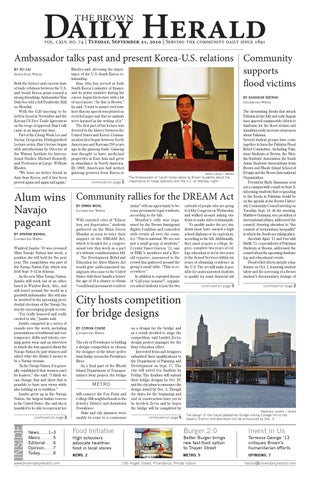
The Ambassador of South Korea spoke to Brown students about the importance of trade relations with the U.S. on Monday night.
Alum wins Community rallies for the DREAM Act Navajo pageant By Emma Wohl Contributing Writer
By Aparna Bansal Contributing Writer
Winifred Jumbo ’10 was crowned Miss Navajo Nation last week, a position she will hold for the next year. The competition was part of the Navajo Nation Fair, which was held Sept. 9–12 in Arizona. As the new Miss Navajo Nation, Jumbo will work out of an office based in Window Rock, Ariz., and will travel around the world as a goodwill ambassador. She will also be involved in the upcoming presidential elections of the Navajo Nation by encouraging people to vote. “I’m really honored and really excited to win,” Jumbo said. Jumbo competed in a series of rounds over the week, including presentations of traditional and contemporary skills and talents, evening gown wear and an interview in which she was quizzed about the Navajo Nation by past winners and asked what she thinks it means to be a Navajo woman. “In the Navajo Nation, it is generally established that women can’t be leaders,” she said. “I think we can change that and show that is possible to have new views while also holding on to tradition.” Jumbo grew up in the Navajo Nation, the largest Indian reserve in the United States. She said she is humbled to be able to represent her
inside
continued on page 3
News.......1–3 Metro..........5 Editorial......6 Opinion.......7 Today..........8
www.browndailyherald.com
With repeated cries of “Education, not deportation,” students gathered on the Main Green Monday at noon to voice their suppor t of the DREAM Act, which is headed for a congressional vote this week as a part of a defense reauthorization bill. The Development, Relief and Education for Alien Minors Act would give undocumented immigrants who came to the United States with their families before the age of 16 a chance to obtain “conditional permanent resident
status” with an opportunity to become permanent legal residents, according to the bill. Monday’s rally was organized by the Brown Immigrant Rights Coalition and coincided with events all over the country. “This is national. We are not just a small group of students,” Cr ystal Vance-Guerra ’11, one of BIRC’s members and a Herald reporter, announced to the crowd that gathered around the group’s small table. “This is ever ywhere.” In addition to repeated shouts of “Call your senator!”, organizers asked students to join the two
City hosts competition for bridge designs By Corina Chase Contributing Writer
The city of Providence is holding a design competition to choose the designer of the future pedestrian bridge across the Providence River. As a final part of the Rhode Island Department of Transportation’s Iway project, the bridge
METRO will connect the Fox Point and College Hill neighborhoods to the Jewelry District and downtown Providence. State and city planners were unable to come to a consensus
on a design for the bridge and as a result decided to stage the competition, said Lambri Zerva, design project manager for the Iway relocation effort. Interested firms and designers submitted their qualifications to the Department of Planning and Development on Sept. 17. The city will select ten finalists by Friday. The finalists will submit their bridge designs by Oct. 29, and the city plans to announce the design award by Dec. 3. Though the dates for the beginning and end of construction have yet to be decided, Zerva said he hopes the bridge will be completed by continued on page 5
Stephanie London / Herald
The design of the future pedestrian bridge linking College Hill to the Jewelry District and downtown will be announced by Dec. 3.
Food Initiative
Burger 2.0
Invest in Us
High schoolers advocate healthier food in local stores
Better Burger brings new fast-food option to Thayer Street
Terrence George ’13 critiques Brown’s humanitarian efforts
NewS, 2
metro, 5
Opinions, 7
195 Angell Street, Providence, Rhode Island
herald@browndailyherald.com
Page 2
THE BROWN DAILY HERALD
C ampus N EWS
Tuesday, September 21, 2010
“Everyone in Providence should be able to … find healthy options.” — High school student Heaven Medina
Teach-in, other events to Profs. present ‘the immigrant paradox’ educate U. about Pakistan By Natalie Villacorta Contributing Writer
continued from page 1 affected regions, Ajani said. The committee hopes to set up an art installation on the Main Green in early October, which will also sell Pakistani crafts and T-shirts to raise money for the victims. “People always talk about crisis fatigue, but we are trying to make this an opportunity for them to learn and give back in a creative way,” Ajani said. Ajani said that the Flood Relief Committee “wants to get as many students aware of the magnitude of the floods, and also give people and idea of what the country is in its full breadth.” Malik added that door-to-door collections have been launched in residence halls. The committee is currently screening relief organizations to determine whom they will give the funds to. They are looking for organizations with a long history of working in Pakistan, Ajani said. They are also reaching out to several other departments and groups, collaborating with Pakistani doctors in the New England area, as well as the Brown women’s basketball team. Their first event is a teach-in on Sept. 24, spearheaded by Vazira Zamindar, associate professor of histor y. The two main goals of the teach-in are to educate people about Pakistan and to encourage students to think about global citizenship within the context of climate change, according to Zamindar. “There have been two types of reporting on Pakistan in U.S. media — the War on Terror
and violence against women. People are not aware of its linguistic and cultural diversity. The teach-in is an opportunity to raise awareness about the millions of people in rural Pakistan who have been affected by the floods,” Zamindar said. Furthermore, the floods are another indication that climate change takes the biggest toll on poor people in countries with authoritarian regimes, which are least equipped to deal with natural disasters, she added. Faculty from a diverse range of departments have come forward to help with the teach-in, initiating a cross-disciplinary conversation which tests the challenges of global citizenship and the concept of a shared humanity, Zamindar said. The Flood Relief Committee hopes to organize another teach-in later this semester and to sustain efforts to raise awareness about Pakistan, Zamindar said. She is also working with the Choices Program, a Watson Institute for International Studies initiative, which provides teaching resources to schools nationwide to empower students to engage with international issues. Along with the opportunity for education, the flood relief efforts are an opportunity for South Asian students to work together, learn from each other and build civil society leadership in the region, Zamindar added “The goal is to depoliticize these floods,” Malik said. “Ultimately, a lot of poor people are dying, starving and homeless and they are the ones we are trying to help.”
sudoku
Daily Herald the Brown
Editorial Phone: 401.351.3372 | Business Phone: 401.351.3260 George Miller, President Claire Kiely, Vice President
Katie Koh, Treasurer Chaz Kelsh, Secretary
The Brown Daily Herald (USPS 067.740) is an independent newspaper serving the Brown University community daily since 1891. It is published Monday through Friday during the academic year, excluding vacations, once during Commencement, once during Orientation and once in July by The Brown Daily Herald, Inc. Single copy free for each member of the community. POSTMASTER please send corrections to P.O. Box 2538, Providence, RI 02906. Periodicals postage paid at Providence, R.I. Offices are located at 195 Angell St., Providence, R.I. E-mail herald@browndailyherald.com. World Wide Web: http://www.browndailyherald.com. Subscription prices: $319 one year daily, $139 one semester daily. Copyright 2010 by The Brown Daily Herald, Inc. All rights reserved.
New research shows that immigrant children are performing well both in school and in the community — a phenomenon coined the “Immigrant Paradox” by Professor of Education Cynthia Garcia Coll. Garcia Coll teamed up with Professor of Histor y Evelyn Hu-DeHart from the Center for the Study of Race and Ethnicity in America to report these findings in “The Immigrant Paradox in Children’s Education and Behavior: Evidence from New Research.” Garcia Coll and Hu-DeHar t also presented their findings at the Rhode Island Foundation on Sept. 16. In their report, the professors stated that their goal is to change how immigrant children are viewed. They said they hope that these new data will incite policymakers and educators to provide these children with the support they need to successfully integrate into American society. The findings of this report were compiled from several studies at a conference held at Brown last spring. The conference looked at first-, second- and third-generation immigrants, focusing on Hispanic and Asian children.
The researchers found that first-generation immigrant children are outperforming the more acculturated second- and thirdgeneration children academically and behaviorally. The study shows that although first-generation immigrant children are often behind American-born peers in school, they catch up or even surpass them by the late-elementary years. First-generation children also have better attitudes toward school than second- and third-generation children, which has manifested in higher standardized test scores and GPAs for some groups. They also demonstrated lower levels of delinquency and involvement in risk behaviors. Both Garcia Coll and Hu-DeHart attribute this drop-off in performance of later generations to Americanization. By the second immigrant generation, children have often lost their family’s language and culture. Garcia Coll said she believes that these language and cultural ties are important because they “maintain connections with family, which serves as a buffer to influences of American culture.” Garcia Coll said that immigrant children are pressured to assimilate quickly, which requires them to learn English, thereby creating
both a generation and language gap between the children and their parents, who do not acculturate as quickly. Garcia Coll said she has observed that Asian and Hispanic parents value education above all else and often have high moral standards. She sees a major need for ESL programs to teach these parents English so that they can communicate these values to their children. Garcia Coll is currently working with President Ruth Simmons to start a program in an existing preschool that serves both immigrant children and their mothers. Brown students, who made up the majority of the audience at the presentation on Thursday, can help to foster the love of learning found in immigrant children by volunteering in schools and teaching English as a second language, the professors said. Hu-DeHart said she hopes this research will give the Providence community “a newfound understanding and respect for Brown” because it demonstrates that Brown cares about community issues such as education. She said she also hopes the research will incite educators and policymakers to change their attitudes toward immigrant children.
Project puts healthy food in Prov. stores By Joseph Rosales Contributing Writer
An environmental group has spearheaded an initiative to make healthier foods available at neighborhood grocery stores, in cooperation with a Brown summer program for high school students. The Environmental Justice League of Rhode Island is putting the finishing touches on the Providence Healthy Corner Store Initiative, which added a healthier variety of food to markets in Providence neighborhoods. Together with the University’s Community Environmental College summer program, the environmental league has worked since January to provide families with healthier foods. In the project’s first phase, the environmental league discussed potential markets and surveyed customers about the changes they most wanted in their stores, according to the league’s website. The Community Environmental College became involved during the project’s more hands-on second phase. The college was an eight-week summer program for Providence
high school students that was dedicated to teaching about environmental issues and what can be done to solve them, said Allison Waters ’11, one of the program’s instructors. “Our hope with this program was to not only give them knowledge, but get them engaged in these issues,” Waters said. Together with four other Brown students and Amelia Rose, the environmental league’s director and lead organizer, Waters helped teach 30 high school students about the issues that organizations like the league are trying to combat. In classes like “Environmental Justice 101” and “Food Justice,” the students were taught the basics of environmental issues during a fourweek period, Waters said. For the second half of the program, the students brainstormed ways to get involved in their community, eventually settling on helping with the Corner Store Initiative. Together with members from the environmental league and other volunteers, students and faculty from the environmental college traveled to two different markets in South Providence — Mi Quisqueya and New Battambang — and reorga-
nized the market layout, putting the more healthy options near the front of the store and leaving the junk food toward the back, according to a Providence Journal article. “Everyone in Providence should be able to walk into a corner store in their neighborhood and find healthy options,” high school student and program participant Heaven Medina told Rhode Island Environmental News. The initiative is currently in its third and final stage, an analysis and evaluation of the program, according to the environmental league’s website. People involved with the program are proud of the results, not only with the boost in local grocer business, but also with the environmentally-friendly mindset that the students involved with the program gained, said Phil Brown, professor of sociology and environmental studies. Brown is also the outreach leader for the Superfund Research Program, the organization that funds programs like the environmental college. “Once you’ve been involved in helping your environment, you begin to see other problems,” Brown said.
Tuesday, September 21, 2010
THE BROWN DAILY HERALD
C ampus N EWS
Page 3
“The more things change, the more they stay the same.” — South Korean Ambassador Han Duk-Soo
Modern U.S., South Korea relations reflect history continued from page 1
Emma Wohl / Herald
Students gathered to express support for the DREAM act, which is going to congressional vote this week.
Students advocate immigrant bill continued from page 1
and student loans. The organization of the rally was a hectic process, said My Dang ’13, another member of BIRC. “We found out the bill was going to be introduced Thursday, and we started organizing Friday.” “So many people, even if they’ve heard of the DREAM Act, don’t know it’s going to be voted on this week,” said Madisen Obiedo ’12, who is a member of BIRC. BIRC organizers asked passersby to make phone calls to a long list of senators either opposed to or on the fence about the act. “People don’t realize that phone calls to your senator really make a differ-
ence,” said Vyvy Trinh ’11, another BIRC member who helped coordinate the rally. At the rally, organizers also told the stor y of Tam Tran GS, who helped start BIRC in spring 2008. Tram, who was killed in a car accident last May, was herself an undocumented immigrant and an advocate for immigrant reform. She was an “amazing organizer,” Trinh said. Tran’s death inspired members of BIRC to continue her work to honor her memory, Trinh added. “Tomorrow is a ver y important day for 2.2 million youth in America,” called out Antonio Albizures-Lopez, a Rhode Island native and recent high school graduate
who came to the U.S. at age one. Albizures-Lopez began working with a youth coalition affiliated with BIRC after meeting Tran last year, he said. The rally ended with a familiar song, specially tailored for the occasion. “We are the dreamers, the mighty, mighty dreamers,” the crowd called out. “Fighting for justice and the DREAM Act!” BIRC’s efforts will continue regardless of how the vote turns out, said the rally’s organizers. According to Trinh, there will be a teach-in on Oct. 3 to discuss immigration histor y and policy. “BIRC knows that even afterwards, there’s so much more we hope to get done,” Dang said.
cultivate it. Han also addressed U.S. aid during the Korean War and subsequent economic growth in postwar South Korea. “Today, Korea is a prosperous, developed democracy with the world’s 15th largest economy and a per capita income close to $20,000,” he said with pride. South Korea had a per capita income of less than $100 at the end of the Korean War in 1953. Ultimately, Han steered his lecture toward the modern alliance between the U.S. and Korea and Nor th-South Korean relations. He informed listeners about the 2009 joint vision that Presidents Barack Obama and Lee Myung-bak signed, reaffirming South Korea’s security against its northern neighbor. To emphasize the urgency of the situation, Han also spoke about the March 2010 North Korean attack on a South Korean naval vessel, which ultimately killed 46. He reminded the crowd of the Six-Party Talks initiative, which aimed to peacefully resolve the North Korean nuclear weapon situation, that Kim Jong Il abandoned last year. Han said a resumption of the talks is still
a goal of Seoul. The end of Han’s lecture highlighted the importance of the upcoming G20 meeting and the pending FTA approval by the U.S. The bilateral free trade agreement was negotiated during former President Bush’s second term and signed in 2007. The KORUS FTA, as Han called it, was about three things: “jobs,” “economic growth” and “security and shared values.” He said the Depar tment of Commerce estimated the creation of 70,000 new jobs if the FTA is implemented. But if the agreement is not approved, the U.S. will lose more than 345,000 jobs to the European Union and Canada. The U.S. International Trade Commission has estimated that the passage of the FTA will increase U.S. manufactured good exports by $11 billion, reduce the trade deficit by $4 billion and add $12 billion to U.S. GDP. Han urged the U.S. to approve the agreement. “The more things change, the more they stay the same,” he said in conclusion. “It was trade that brought our two countries together some 250 years ago and it is trade that we are counting on to help keep us together for another 250 years.”
Jumbo ’10 to represent Navajos continued from page 1 people and her land. As Miss Navajo Nation, she said that she aims to encourage more Native American students to pursue higher education, as well as prevent global indigenous language loss by working toward preserving, documenting and revitalizing the Navajo language. Jumbo will visit local high schools around the Navajo nation and said she also hopes to visit China later this year, though no travel arrangements outside the United States have so far been set. At Brown, Jumbo was a double concentrator in ethnic studies and anthropology. She was also head of Native Americans of Brown last year. “Being part of NAB gave me a new perspective on what it means to be Native American,” she said. Jumbo also said she is grateful for the strong support system that the group provided.
Courtesy of Lorraine Gould
Last week Winifred Jumbo ’10 was crowned Miss Navajo Nation.
Why can’t we be friends?
facebook.com/browndailyherald
Metro The Brown Daily Herald
“It’s not just some hippie thing. This is real.” — Erin Smithers, Warwick resident Tuesday, September 21, 2010 | Page 5
Burger restaurant brings ‘Better’ quality to Thayer St. Day of Peace comes to Providence By Leonardo Moauro Staff Writer
After much anticipation, Better Burger Co. finally opened its doors for business on Sept. 11. The fast-food restaurant is the second burger joint to come to Thayer Street, following Johnny Rockets, which opened in 2000. Better Burger Co. aims to combine quality ingredients and low prices, said George Panagos, the store’s manager. “If you look at our product list, it’s all the best we could use, without any compromises for the taste.” All meat served is free of hormones, antibiotics and gluten, he said. He added that the company is environmentally conscious. “All our paper work is biodegradable and compostable,” he said. Plans to open the Better Burger Co. go back several years, Panagos said. “This (storefront) is two stores made in one — we got the first one and then had to wait 15 months for the other to empty out,” he added. The managers were only able to start working on the restaurant after the second store was vacated, Panagos said. Constr uction “didn’t really start” until Januar y of this year, when the wall dividing the two stores was torn down, Panagos said. He said the restaurant was ready to open during the summer, but managers chose to wait until the fall for business reasons. “Since we lost a season in June we decided to open in September — summers are pretty slow usually,” he said. The interior of the restaurant is decorated by a series of murals portraying landmarks of College Hill and Providence’s East Side. Andreas Mitrelis, owner of the restaurant, is not new to the busi-
By Anne Artley Staff Writer
Glenn Lutsky / Herald
Better Burger Co. opened its doors Sept. 11, becoming the second burger joint on Thayer Street.
ness. He opened his first burger restaurant in 1962, he said, and already owns other Thayer Street establishments, such as Spats and Andreas, a Greek restaurant. Like Panagos, Mitrelis stressed the quality of the product served at Better Burger Co. “Everybody gets Black Angus, but ours is certified,” he said. “We fry our french fries in olive oil — it costs an extra seven cents to make, but it’s worth it,” he added. The bustle of Thayer Street is not something to be ignored, Panagos said. “Thayer Street is ver y competitive, it isn’t like 20 years ago.” But he said he believes the Better Burger Co. fits a previously-unoccupied niche in the neighborhood. “This has to be the most unique fast food restaurant in Rhode Island, maybe in New England,” he said. Better Burger Co. and Johnny
Rockets are the only two restaurants on Thayer Street known for their burgers. But Jason Sugerman, owner of Johnny Rockets, is not afraid of competition. “If there is more than one pizza place on Thayer, there can be more than one burger place,” he said. Johnny Rockets is a familyowned franchise established in 1986 by Sugerman’s father. “People know who we are, I think we’re doing well and will continue to do well,” Sugerman said. He also remarked that Johnny Rockets has more than burgers to offer. “Ever ybody loves our milkshakes,” he said. Though the Thayer Street location is the first to carr y the Better Burger Co. name, managers already have long-term plans to expand in New England, even in sub-optimal economic times. “We think that this is recession-
proof — because of the prices. We don’t target the high-end restaurant crowd,” Panagos said, adding that Massachusetts is their next “target.” For now, though, the main source of business for the restaurant is college students, Panagos said. “There will be student promotions very soon,” he added. Students who have already started frequenting the new restaurant have had mostly positive experiences. “The food was good,” said Max Lewin ’12. “The prices were reasonable, definitely not out of line for Thayer Street.” But Nareg Aslanian ’11 said he was disappointed by his meal. “It was highly priced and I made a better burger at home,” he said. Aslanian said he enjoyed the interior, which “was nice — a good atmosphere.”
Iway project more than a bridge: ‘urban design’ continued from page 1 the end of 2013. Zerva said the project planners hope the design competition will allow them to explore as many ideas as possible. After the highway is pulled down, “we want the area that remains to be something,” he said. While project planners were considering the demolition of the old I-195 river crossing, they realized completely demolishing the bridge would cost about as much as constructing a new pedestrian bridge atop the five existing granite supports, Zerva said. In its request for design services, the city of Providence named a number of restrictions and suggestions for bridge designers. For example, the 450-foot bridge must include the five existing granite support piers as a central design element, provide adequate seating and gathering areas, and be wide enough for pedestrians, bicyclists, runners and
strollers to use at the same time. Designers are also encouraged to consider environmentally-friendly design elements in their planning. A July 29 Providence Journal opinions column named three groups interested in submitting designs for the bridge: William D. Warner Architects and Planners, the Maguire Group and architects Jay Litman and Michael van Hamel. Litman said that his firm, Litman Architecture, submitted a letter of interest to the competition. Though he said the firm will not fully begin work on a design unless selected as one of the 10 finalists, he said he imagined creating an urban streetscape that would “become a destination” to residents of Providence and beyond. He sees the pedestrian bridge as “an amazing opportunity” to create an extraordinary new architectural feature in Providence. He named the Ponte Vecchio — a bridge over the Arno River in Florence — as a possible inspira-
tion. The Ponte Vecchio consists of an entire city street built over the water, and the 450-foot span of the Providence River Pedestrian Bridge might give designers enough room to construct a similar area, he said. Litman described the city of Providence’s competition as less of a bridge design than an urban design competition. RIDOT decided that the old interchange between I-95 and I-195 should be relocated south of Providence, following research and studies conducted between the mid’80s and late ’90s. Zerva described a number of problems with the old interstate: traffic congestion, weaving, numerous and closely spaced on- and off-ramps, and deficiencies with existing bridge structures. The old interstate, Zerva said, was “well past its service life and design life.” RIDOT then conceived of the Iway project, a series of 16 projects that would move the interchange of I-95 and I-195 to the south. Ac-
cording to the RIDOT website, all of the completed ramps in the I-95 and I-195 interchange will enter roadways from the right hand side, in accordance with modern highway standards. In 1999, designs were finalized and work on the Iway project began. After almost a decade of construction, Zerva said all the major milestones of the project have been reached. “The benefits are already being realized and have been realized for some time,” he said.
Last Sunday, Kennedy Plaza welcomed a host of international dance groups and humanitarian organizations for the seventh annual Celebration of the United Nations International Day of Peace. The festival commemorates the opening session of the United Nations General Assembly, though the U.N. passed a resolution in 2001 to name Sept. 21 the official day of peace. Attendees also had the opportunity to visit with representatives from Habitat for Humanity, the American Friends Services Committee and the Institute for the Study and Practice of Nonviolence. Guests also tie-dyed T-shirts and created peace flags and peace pinwheels. At 5:00 p.m., participants took part in a silent walking meditation around Burnside Park, and the event ended with prayers from clergy of many faiths. Ginny Fox, the event coordinator, said the event was established to promote an environment of peace in people’s lives and work, as opposed to protest war. Through Fox’s dedication, the International Day of Peace grew from a small gathering at Providence Friends Meeting, a Quaker meeting house, to a month-long celebration across the city. Fox collaborated in the Peace Art Project, an exhibit at the University of Rhode Island running until Sept. 30, and the peacethemed exhibition at Providence Art Windows, a community project that displays art year-round in empty retail areas. She also helped organize the youth show for Rhode Island for Community and Justice to honor Sept. 11. Fox said she has found that Rhode Island residents are responsive to her work in creating a positive environment. “I’ve been here (to the festival) three times now,” said Erin Smithers, who lives in Warwick. “I’m a Quaker, and this is what we do. We all live in one world. It’s not just some hippie thing. This is real.” “These days there is so much venomous rhetoric,” said Jan SeymourFord, a representative of Standing on the Side of Love, a Unitarian Universalist group that works against identity-based violence. “And it’s important to have these events that stand for peace and dignity, and to be around people who feel the same way.”
Editorial & Letters The Brown Daily Herald
Page 6 | Tuesday, September 21, 2010
l e t t e r to t h e e d i to r
Editorial mischaracterized Banner opposition To the Editor: The Herald’s editorial celebrating Banner (“How we learned to stop worrying and love Banner,” Sept. 20) seriously misconstrues the aims of student activists like myself who invested time and energy to protect Brown’s unique curriculum from the threat of accidental trampling by what should have been a simple administrative update. I can only hope that future students will not be discouraged by the editorial’s uninformed account. In many respects, I led the “opposition” to Banner. Our activism had nothing to do with Ludditism or an obsession with the status quo as a “cherished rite of passage.” We wanted online course registration as much as anyone else. However, it could have been implemented in a way that mimicked the existing system, which had supported shopping period and other aspects of the New Curriculum for many years. Even a cursory examination of the resolution unanimously passed by the Undergraduate Council of Students would make it clear that we were seeking exactly this sort of online-but-supportive system. I take offense at the idea that our activism is an example of how “stu-
dents just like (you) can get it wrong sometimes” — especially since the editorial seems to hold the very same views that motivated us. It enumerates, as if they were original, some of the same changes that we suggested prior to Banner’s implementation: preregistration syllabus distribution and steps to facilitate shopping of multiple courses meeting at the same time. The editorial notes that course overrides are “frequently granted,” reducing concerns about enrollment caps and prerequisites, but we would have kept caps and prerequisites out altogether. They had never been implemented before (outside of some very specific contexts), and there was no reason to implement them under the guise of technological progress. How is shopping period better off with generous overrides than with no need for overrides at all? Finally, the editorial asserts that “Banner has no doubt improved the broader shopping and course selection experience,” but offers no support for that claim. I expect better-reasoned and better-informed editorials from The Herald. Matt Gelfand ’08 Sept. 20
t h e b r o w n d a i ly h e r a l d Editor-in-Chief
Managing Editor
Deputy Managing Editors
Senior Editors
George Miller
Chaz Kelsh
Emmy Liss Joanna Wohlmuth
Ben Hyman Seth Motel
editorial
Business
Arts & Culture Editor Anne Speyer Arts & Culture Editor Suzannah Weiss Features Editor Sara Luxenberg Features Editor Brian Mastroianni Metro Editor Brigitta Greene Metro Editor Ben Schreckinger News Editor Sydney Ember Sports Editor Zack Bahr Sports Editor Tony Bakshi Asst. Sports Editor Ashley McDonnell Asst. Sports Editor Erika Mueller Graphics & Photos Graphics Editor Stephen Lichenstein Graphics Editor Alex Yuly Photo Editor Stephanie London Photo Editor Max Monn Photo Editor Hilary Rosenthal Jonathan Bateman Sports Photo Editor Jesse Morgan Asst. Sports Photo Editor Production Copy Desk Chief Kelly Mallahan Asst. Copy Desk Chief Joe Milner Asst. Copy Desk Chief Dan Towne Design Editor Julien Ouellet Asst. Design Editor Gili Kliger Asst. Design Editor Leor Shtull-Leber Asst. Design Editor Katie Wilson Web Editor Neal Poole Post- magazine Editor-in-Chief Sam Carter Editor-in-Chief Kate Doyle Editor-in-Chief Marshall Katheder
General Managers Claire Kiely Katie Koh
Office Manager Shawn Reilly
Directors Sales Kelly Wess Finance Matthew Burrows Client Relations Margaret Watson Christiana Stephenson Alumni Relations Managers Local Sales Isha Gulati Local Sales Arjun Vaidya National Sales Rajiv Iyengar University Sales Aditi Bhatia University Sales Jared Davis Recruiter Sales Trenten Nelson-Rivers Maximilian Barrows Business Operations Business Analytics Jilyn Chao Danielle Marshak Credit and Collections Special Projects Alexander Carrere Staff Kathy Bui Opinions Opinions Editor Michael Fitzpatrick Opinions Editor Alyssa Ratledge Editorial Page Editor Matt Aks BLOG DAILY HERALD Managing Editor Matt Klimerman Managing Editor Anne Simons Managing Editor David Winer
Julien Ouellet, Designer Nicole Grabel, Sahil Luthra, Katie MacDougald, Copy Editors Rebecca Ballhaus, Sarah Mancone, Mark Raymond, Night Editor Senior Staff Writers Ana Alvarez, Ashley Aydin, Rebecca Ballhaus, Alexander Bell, Nicole Boucher, Fei Cai, Alicia Chen, Kristina Fazzalaro, Sarah Mancone, Claire Peracchio, Lindor Qunaj, Mark Raymond, Luisa Robledo, Caitlin Trujillo, Alexandra Ulmer Staff Writers Anna Andreeva, Anne Artley, Shara Azad, Anita Badejo, Casey Bleho, Sofia Castello, Amy Chen, Sarah Forman, Miriam Furst, Max Godnick, Thomas Jarus, Sarah Julian, Julia Kim, Emily Rosen, Bradley Silverman, Anne Simons, Qian Yin Senior Sales Executives Katie Galvin, Liana Nisimova, Isha Gulati, Samantha Wong Sales Associates Roshni Assomull, Brady Caspar, Anna Cook, Siena deLisser, Begum Ersan, Tommy Fink, Ryan Fleming, Evan Gill, Debbie Lai, Jason Lee, Katie Lynch, Sean Maroongroge, Zahra Merchant, Edjola Ruci, Webber Xu Senior Finance Associates Jason Beckman, Lauren Bosso, Mae Cadao, Margot Grinberg, Adam Fern Finance Associates Lisa Berlin, Mahima Chawla, Mark Hu, Jason Lee, Nicholas Robbins, Daniel Slutsky, Emily Zheng Design Staff Caleigh Forbes, Jessica Kirschner, Leor Shtull-Leber Web Staff Andrew Chen, Warren Jin, Claire Kwong, Adam Zethraeus Photo Staff Qidong Chen, Janine Cheng, Alex DePaoli, Frederic Lu, Quinn Savit Copy Editors Nicole Boucher, Zoe Chaves, Greg Conyers, Claire Gianotti, Aida Haile-Mariam, Victoria Hartman, Tiffany Hsu, Christine Joyce, Mrinal Kapoor, Abby Kerson, Juhee Kwon, Matthew Lim, Alexandra McFarlane, Joe Milner, Rajan Mittal, Lindor Qunaj, Kate-Lyn Scott, Carmen Shulman, Rebecca Specking, Dan Towne, Carolina Veltri Editorial Page Board Staff Anita Mathews, Tyler Rosenbaum, Melissa Shube, Gaurie Tilak
ale x y ul y
e d i to r i a l
Sleep tight Your parents may have warned you about bedbugs before wishing you sweet dreams as a child, but it turns out that recently, the threat of bedbugs has become a veritable nightmare. At Brown, no case of bedbugs has been reported on campus this year, according to Senior Associate Dean of Residential and Dining Services Richard Bova. But members of the editorial page board have heard stories of bedbugs in off-campus housing. And since most victims of bedbug bites describe the ordeal as torturous, it’s worth discussing what we can do to keep our residence halls and apartments free from those terrible pests. Bedbugs are tiny insects that feed on the blood of humans and tend to strike at night. During the day, they hide out in “cracks and crevices in mattresses, cushions, bed frames, in the folds of curtains, behind loose wallpaper or baseboards, and in clothing or other items on the floor,” Director of Health Services Edward Wheeler wrote in an e-mail to the editorial page board. The bite is painless at the time but a reaction — usually a series of swollen, red, itchy bumps — occurs the following day, he wrote. Bedbugs are receiving a great deal of publicity these days, as reports of infestations have risen sharply in several cities, including New York and Chicago. Inside Higher Ed reported bedbugs on the campuses of the University of Colorado at Boulder, Wake Forest University, Pennsylvania State University and New York University. Concerned about a large influx of students who tend to share and reuse old furniture, the city of Boston moved to action. During student move-in days in September, city workers stuck warning tags that cautioned of bedbugs to furniture
left in the streets, the New York Times reported. So what can we do here? To prevent bedbugs, we recommend that students exercise extreme caution when buying used clothing, mattresses and furniture. While bedbugs can remain unseen, it is possible to check for signs of the insects by scanning items for tiny, dark bloodstains. Moreover, students who travel to major cities or other college campuses should make an effort to do laundry as soon as possible upon returning. This might seem like a hassle, but trust us when we say it’s a relatively minor precaution compared to the potential risks. Once they invade, bedbugs are notoriously difficult to exterminate. According to Wheeler, one sign of bedbugs is that the bites tend to occur in rows. If you think you have bedbugs, Health Services advises that you wash and dry clothing and bedding on high heat. This will help kill the bugs, but you’ll likely need an exterminator to get rid of them entirely, Wheeler wrote. Students living in residence halls should contact the Office of Residential Life immediately if they think their rooms might be infested. Even though the classic nighttime phrase seems innocuous, don’t be fooled — bedbugs are a very serious problem. As one traumatized victim told the Chicago Tribune about her experience, “It’s horrible. I haven’t slept in weeks.” The anecdotal reports we’ve heard indicate that this is probably an understatement. Let’s all do our part to keep this campus and this city bedbug-free. Editorials are written by The Herald’s editorial page board. Send comments to editorials@browndailyherald.com.
corrections An article in Monday’s Herald (“Alum recognized for creative nonfiction,” September 20) incorrectly stated that Elizabeth Taylor is a professor of English. In fact, Taylor is a senior lecturer. An article in Friday’s Herald (“Kathryn Schulz ’96: wrong is the new right,” September 17) misquoted Kathryn Schulz ’96. In fact, she said, “There are lots of complexities and nuances in our lives.” The Herald regrets the errors.
C O R R E C T I O N S P olic y The Brown Daily Herald is committed to providing the Brown University community with the most accurate information possible. Corrections may be submitted up to seven calendar days after publication. C ommentar y P O L I C Y The editorial is the majority opinion of the editorial page board of The Brown Daily Herald. The editorial viewpoint does not necessarily reflect the views of The Brown Daily Herald, Inc. Columns, letters and comics reflect the opinions of their authors only. L etters to the E ditor P olic y Send letters to letters@browndailyherald.com. Include a telephone number with all letters. The Herald reserves the right to edit all letters for length and clarity and cannot assure the publication of any letter. Please limit letters to 250 words. Under special circumstances writers may request anonymity, but no letter will be printed if the author’s identity is unknown to the editors. Announcements of events will not be printed. advertising P olic y The Brown Daily Herald, Inc. reserves the right to accept or decline any advertisement at its discretion.
Opinions The Brown Daily Herald
Tuesday, September 21, 2010 | Page 7
God and man at Brown BY DAVID SHEFFIELD Opinions Columnist In 1764, a group of Baptists founded the College in the English Colony of Rhode Island and Providence Plantations. Two and a half centuries later, we’ve changed the name and have few remaining vestiges of our former religious affiliation. The location of commencement, our motto and our seal are among the benign relics from earlier, more pious times. This is for the better. Of course, the college’s name had to change. Those of you who have taken HIST 0510: “American History to 1877” will be aware of the obscure falling out between England and its American colonies. This would have made the name a bit awkward by 1777. The eventual name of Brown University just sounds much better than the College of Rhode Island (as the original name had been shortened). Of course, this is just cosmetic. The real improvement was the move toward secularism. It was not as required by circumstances, but it was necessary for Brown to reach its full potential. Many of Brown’s peers have the same dubious distinction of being founded by religious sects. Calvinists and Anglicans founded most of the other Ivy League schools. These colleges, like Brown, have since shrugged off their religious affiliations. A religious university is conflicted on a fundamental level. On one hand, a university is an institution of learning. Its primary goal should always be to discover new, unknown things about the world. It also serves two
other major purposes by teaching others to become the next generation to continue the endeavor (i.e. graduate school) and educating the public (i.e. undergraduates). On the other hand, religions are inherently based on dogma. They already have their fundamental knowledge. Religions will adapt to new knowledge to various extents, but if some result should contradict a core element of the religion, it will be ignored or dismissed. Religious institutions range widely in quality. The universities and colleges that allow for greater academic freedom tend to be better, and the ones that do not tend to be worse.
the Chronicle of Higher Education required a “Ph.D. and compatibility with a youngearth creationist philosophy” for candidates. Other religious schools are far less comical. Georgetown is a Jesuit university, which despite its religious affiliation, is a decent school. This is because the religious administration does not intrude into academic life as much as Liberty’s does. The Catholic Church has given up its position that the sun revolves around the earth and that God created Adam a few millennia after yet-to-exist humans had already domesticated sheep. It has yet to give all of its ground to scientific evidence (what would be left?), but it has relinquished its most untenable beliefs.
A religious university is conflicted on a fundamental level.
Liberty University is one example of an institution where religion is paramount and allowed to color everything on campus. Founded by Jerry Falwell, Liberty is the largest evangelical university in the world. Unsurprisingly, it teaches creationism and had one of the world’s most prominent climate-change deniers give last year’s commencement address. Reality is of no concern to them. The university wishes to promote evangelical Christianity; the rest is just incidental. An ad for open biology positions in
Nevertheless, this does not mean that more academic institutions are free from religion’s oppressive policies. They may realize that alums would be openly mocked without the separation of their religion from the academic side of the university, but they continue to interfere in the rest. For Brown students who spend their first year with a ready supply of 15-cent condoms on every RC’s door, it might be a shock to learn that Georgetown gives no such consideration to students’ sexual health. Outside of sub-Sa-
haran brothels, there are few places more in need of condoms than large universities. Unfortunately for both, the Catholic Church prohibits condoms and other forms of contraceptives and protection. Brigham Young University is another religious school, the flagship university of the Mormon Church. Over the summer, a student submitted a letter to the editor of the school’s newspaper. In it, the author pointed out the disconnect between what Mormons said to garner support for California’s Proposition 8 prior to the 2008 election and the evidence that proponents of the proposition gave during the trial. He called on Mormon supporters of “Prop 8 to be honest about their reasons for supporting the amendment.” It was at first rejected, then printed in an edited form, and finally withdrawn by the paper shortly after publication for being “offensive.” I can assure you that the content of the letter was far tamer and more reverent than this column. This is the insidious nature of religious control over universities. The religious administration might allow for academic freedom so long as it does not obviously conflict with its dogma, but if it does, you are in trouble. I am glad that Brown and its peer institutions have, over time, decided to separate themselves from religions and become proper institutions of learning.
David Sheffield ’11 is a math-physics concentrator who hopes that Brunonians have thicker skin than BYU students. He can be contacted at david_sheffield@brown.edu.
A lesson in responsibility BY TERRENCE GEORGE Opinions Columnist I started saving for college when I was three years old. Granted, I had no clue what college was for, nor did I know where I wanted to matriculate, but I wanted to go to college. I was a toddler on a mission, and dollar by dollar, I knew I was drawing closer to my goal. Sixteen years later, my goal-oriented thinking is helping me afford my education at Brown. I have found that only focus and dedication allow for the realization of dreams. Brown turned out to be the realization of my dream, but of what does Brown dream? Moreover, have these dreams been realized? For guidance, I turn to the Charter of Brown University. The Charter clearly states that institutions of liberal education, such as Brown, are to benefit society by “preserving in the community a succession of men duly qualified for discharging the offices of life with usefulness and reputation.” Given our many prestigious alums, I must conclude that the University has erstwhile achieved its goal. But as the poorest and lowest ranked Ivy, I doubt it has been successful to the best of its ability. Brown, like the rest of the country, has fallen on hard times. The recession caused the University’s endowment to lose $740 million in twelve months, which resulted in a $95 million dollar budget deficit. Predictably, the need to close the deficit has re-
sulted in wide ranging cuts. University programs have suffered, a faculty and staff salary freeze had to be implemented, cuts to varsity sports have been considered and the University was forced to terminate 90 employees in the last 18 months. Talk of cuts to athletics programs threatens to drive down prospective student interest in the University; cuts to programs and salary freezes make Brown less competitive with its peers and staff cuts leave students
Following the unfortunate Rhode Island flooding this past spring, the University hastily cobbled together a “multifaceted relief effort.” Included in this were the issuance of extra money to affected employees upon their request and the donation of $50,000 in University funds to the Rhode Island Flood Recovery Fund. In the aftermath of the earthquake that struck Haiti this past January, a committee was created “to coordinate the University’s
The opportunity cost of these humanitarian initiatives greatly outweighs any benefit.
with access to fewer and less effective services. This, coupled with a five percent hike to our already high tuition, means that Brunonians are left paying the price for the down economy. Amid complaints about aged, crumbling infrastructure, inadequate trash clean up, a lack of living space and a “critically underresourced” international relations program, the University has chosen to deviate from the tenants of commonsense money management by donating to and soliciting donations to causes that have nothing to do with its students’ educations.
ongoing response.” Why is this bad? Because despite the good our dollars can do to relieve these dire situations, it comes at an even greater cost to the University. The tens of thousands of dollars spent on the Rhode Island flood cleanup could have been better spent on financial aid, paying a fired employee’s salary for a year, funding a fellowship or supplementing other initiatives germane to students’ education. In the case of our Haiti response, the money and time spent establishing a committee and fundraising for the effort would have been better spent finding ways to re-
dress student complaints about campus life. Our donors are not bottomless piggy banks and asking them to give money to Haiti in the name of Old Brown will not only divert their money from important educational initiatives but will sap their inclination to donate to Brown in the future. In short, the opportunity cost of these humanitarian initiatives greatly outweighs any benefit. Though you may believe the University’s actions were just and even helped to teach students the importance of giving, you must admit that these actions came at no measurable benefit to the University. Our efforts to be beneficent “global citizens” over the years have not been enough to stop the generation of anti-Brown measures, such as last year’s proposed student tax, nor will students not yet bitten by the charity bug be taught a lesson by the University’s magnanimity. Mind you, my heart is not made of stone. I feel deeply for the victims of natural disasters and I hope that private individuals who can afford to donate do so. However, we must realize that the role of global humanitarian is not the role a university should fill, especially at the expense of its students’ educations. As we prepare our response to the Pakistani floods, it is time the University looks back at the Charter and refocuses on its goals. As I knew as a three-year old, pursuit of one’s goals is golden; perhaps Brown has forgotten with old age.
Terrence George ’13 knows a penny saved is a penny earned.
Today The Brown Daily Herald
2
Professors discuss immigrant paradox
5
comics
1 SeptemBER 21
12:00 P.M.
ToMORROW
Cabernet Voltaire | Abe Pressman SeptemBER 22
12:00 P.M.
Health Professions Scholarship
Deaf Deaf World, Hillel
Program Luncheon, Hillel 8:00 P.M.
7:30 P.M.
Brown Democrats General Body
HKSA/CSA Mooncake Festival,
Meeting, Wilson Hall 309
Wriston Quad
menu SHARPE REFECTORY
VERNEy-WOOLLEY DINING HALL
Dot Comic | Eshan Mitra and Brendan Hainline
LUNCH Vegan Taco, Green Chili Chicken Enchilada, Corn and Sweet Pepper Saute, Magic Bars
Chinese Chicken Wings, Linguini with Tomato and Basil, Cranberry and White Chip Cookies
DINNER Acorn Squash with Curried Rice and Chickpeas, Orange Turkey, Chocolate Pudding
71 / 57
80 / 63
Tuesday, September 21, 2010
Bat & Gaz | Sofia Ortiz
Today
to m o r r o w
Providence celebrates Day of Peace
t h e n e w s i n i m ag e s
c a l e n da r
to day
Meat Tortellini with Sauce, Artichoke and Red Pepper Frittata, Oatmeal Bread, Raspberry Bars
crossword Fruitopia | Andy Kim
The Adventures of Team Vag | Wendy Kwartin
Dr. Bear | Mat Becker
Page 8