Daily Herald the Brown
vol. cxlv, no. 38 | Tuesday, March 23, 2010 | Serving the community daily since 1891
news in brief
U. announces 60 staff layoffs
A z tec madness
Spring Weekend tickets tomorrow Tickets for this year’s Spring Weekend concerts featuring Snoop Dogg and MGMT will be available Wednesday morning at 8 a.m. on Brown Student Agency’s online store at http://bsa.brown.edu, according to Abigail Schreiber ’11, Brown Concert Agency’s hospitality chair. Tickets will cost $18 for each concert for Brown and Rhode Island School of Design students, who will be allowed to purchase up to two tickets per show. BSA will sell 3,000 tickets for each concert on Wednesday. Currently, BSA can only sell tickets up to the capacity of Meehan Auditorium. Weather permitting, both concerts will be held on the Main Green, and BSA will sell 1,500 more tickets on April 22, the Thursday before the concerts. Schreiber said she does not expect students to encounter any problems on BSA’s Web site when purchasing tickets, despite the expected high traffic. Unlike last year, reducedprice packages will not be available. According to Schreiber this is partly to allow for a portion of tickets to be offered at reduced prices for students who qualify for financial aid. — Ana Alvarez
By Alex Bell Senior Staff Writer
the Moose will be $200,000. But it will increase to $500,000 if he gets called up to the NHL. He will receive half of the $200,000 signing bonus this year and half of it next season. Volpatti — who finished his senior season Saturday — led the Bears with 17 goals this year, including a team-high six power-play and three game-winning goals. He also set the Brown record for penalty minutes in a season, reaching 115 minutes on a game misconduct Saturday. The signing didn’t come as a surprise. Head Coach Brendan Whittet ’94 predicted it a month and a half ago in an interview with
The University will lay off approximately 60 staff members in June, administrators announced to employees via e-mail message Monday morning. This figure does not include the 139 staff members who have opted for voluntary early retirement packages. Executive Vice President for Finance and Administration Beppie Huidekoper said in an interview with The Herald shortly after the e-mail was sent out that the elimination of these currently filled positions was based on the February report from the Organizational Review Committee. The committee was tasked with finding $14 million of savings in Brown’s budget for the 2010–11 fiscal year. “As we have stressed throughout this process, in addition to improving efficiencies while protecting our academic programs and student life experiences, the plans are focused on limiting the number of layoffs that will become effective on July 1, 2010 and providing support for those whose jobs are being eliminated,” Provost David Kertzer ’69 P’95 P’98 and Huidekoper wrote in their e-mail to employees. According to the e-mail, these employees’ severance packages will provide four weeks of compensation for every year worked at Brown, up to 40 weeks. The packages will also provide health coverage during the severance period. The message emphasized services the University will provide to the employees whose positions are being eliminated, including training programs, career counseling, financial planning, outplacement support and “placement wherever possible in alternative positions at Brown.” Though the review committee report recommended the elimination of certain positions, the University will also create some new jobs and merge other existing positions. Some positions vacated by retirees will be refilled. Huidekoper said the training programs would not be geared toward obtaining other jobs at Brown, but the skills employees could learn through them would be helpful to finding future employment. She said she cannot be certain yet how many of the 60 terminated employees will seek or obtain alternative positions at Brown. “We want to make sure the individuals are fully supported,” Huidekoper told The Herald. Huidekoper said last year’s 31 terminated employees were offered similar outplacement and support
continued on page 3
continued on page 3
Fred Milgrim / Herald
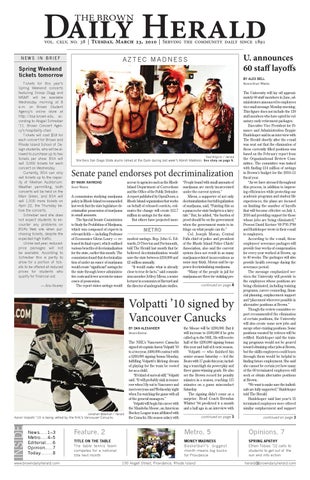
Shirtless San Diego State alums rallied at the Dunk during last week’s March Madness. See story on page 5.
Senate panel endorses pot decriminalization By Mark Raymond Staff Writer
A commission studying marijuana policy in Rhode Island recommended last week that the state legislature decriminalize possession of marijuana in small amounts. The Special Senate Commission to Study the Prohibition of Marijuana, which was composed of experts in relevant fields — including Professor of Economics Glenn Loury — released its final report, which outlined various benefits of decriminalization for the state, earlier this month. The commission found that decriminalization of under an ounce of marijuana would create “significant” savings for the state through lower administrative costs and fewer arrests for minor cases of possession. The report states savings would
accrue to agencies such as the Rhode Island Department of Corrections and the Office of the Public Defender. A report published by OpenDoors, a Rhode Island organization that works on behalf of released convicts, estimates the change will create $12.7 million in savings for the state. But others have projected more
METRO modest savings. Rep. John G. Edwards, D-Tiverton and Portsmouth, told The Herald last month that he believed decriminalization would save the state between $250,000 and $2 million annually. “It would make what is already close to true de facto,” said commission member Jeffrey Miron, a senior lecturer in economics at Harvard and the director of undergraduate studies.
“People found with small amounts of marijuana are rarely incarcerated under the current system.” Miron, a supporter of not only decriminalization but full legalization of marijuana, said, “Painting this as a panacea for state budgets is a fairy tale.” But, he added, “the burden of proof should be on the government when the government wants to infringe on what people can do.” Col. Joseph Moran, Central Falls chief of police and president of the Rhode Island Police Chiefs’ Association, also said the current system does not result in as many marijuana-related incarcerations as some may think. Moran said he opposes decriminalizing marijuana. “Many of the people in jail for marijuana are there for violating procontinued on page 4
Volpatti ’10 signed by Vancouver Canucks By Dan Alexander Sports Editor
Jonathan Bateman / Herald
inside
Aaron Volpatti ’10 is being vetted by the NHL’s Vancouver Canucks.
News.....1–3 Metro.....4–5 Editorial.....6 Opinion.....7 Today........8
www.browndailyherald.com
The NHL’s Vancouver Canucks signed tri-captain Aaron Volpatti ’10 to a two-year, $400,000 contract with a $200,000 signing bonus Monday, fulfilling Volpatti’s lifelong dream of playing for the team he rooted for as a child. “It’s kind of surreal still,” Volpatti said. “It will probably sink in tomorrow when I fly out to Vancouver and meet everyone and Wednesday night when I’m watching the game with all of the general managers.” Volpatti will begin his career with the Manitoba Moose, an American Hockey League team affiliated with the Canucks. His season salary with
Feature, 2
Metro, 5
Opinions, 7
title on the table The table tennis team competes for a national title next month
money madness Basketball’s biggest month means big bucks for Providence
spring apathy Ethan Tobias ’12 calls to students to get out of the sun and into action
195 Angell Street, Providence, Rhode Island
herald@browndailyherald.com
Page 2
F eature
THE BROWN DAILY HERALD
Tuesday, March 23, 2010
“You learn if you’re a fighter or not.” — Jurica Bulovic ’13, member of the table tennis team
From abroad to Andrews, table tennis shows off skills By Brielle Friedman Contributing Writer
As students filter into the Rockefeller Library on a Sunday night and prepare to start the work they’ve put off all weekend, a group of dedicated team members convene on the other side of campus. The team sets up equipment, transforming the dimly lit Andrews Dining Hall into a suitable table tennis practice room. Over a series of warm-up drills, excited chatter about the team’s recent accomplishment fills the air — in February, the team claimed the New England Division Table Tennis championship title for the second consecutive year. In April, they will send five members to Waukesha, Wis., for the National Collegiate Table Tennis Tournament. An orange ping pong ball flies back and forth between rubber paddles as the team’s two best players, Yanqiang Tan ’13 and Jurica Bulovic ’13, rally. They back farther and farther away from the edge of the table, hitting the ball with a variety of offensive and defensive strokes. In table tennis, there isn’t a lot of time to respond to a shot, so each second matters. Maintaining focus is essential, and it’s something Tan and Bulovic are incredibly good at doing. Despite cheers from a group of teammates at the next table, the two never break their concentration. Finally Bulovic responds with a
strong spin that sends the ball flying over Tan’s reach. It drops softly onto the carpeted floor. Warm-up is over. It’s time to play a match. A well-kept secret Unless students wander into the Olney-Margolies Athletic Center during the activities fair, they probably won’t hear much about the table tennis club. The team may be one of the University’s best-kept secrets. Not every student organization can boast New England Division championship titles three of the past four years, nor can most student organizations claim members who played semi-professionally before coming to college. Tan and Bulovic, two first-year players, have made “the team much stronger this year than it’s been, I think, ever,” said Andrew Tarr ’11, the club’s president. The club’s members are more actively improving their individual skills by trying to add more structure to their practices and working with a coach from the Rhode Island Table Tennis Association who attends the team’s practices three or four times a semester. Additionally, the team may try to apply for status as a club sport. “It will really depend on how much effort people are willing to put in,” Yuan said. Club status will give the team better access to University funding and practice spaces on campus.
A taste of professional life Tarr said the first time he saw Tan and Bulovic play he was blown away. “They were able to do a lot of looping at each other without dropping the ball,” a technique he said signals experience. “We had never seen anything like that here,” he said. Tan, an international student from Singapore, said he started playing table tennis when he was nine. He played on the Singapore National Youth Team and even represented Singapore regionally once. At age 16, Tan stopped playing professionally in order to concentrate on his other interests, though he continued playing for fun. Tan said he started playing again before coming to Brown “in anticipation of joining the team, should there be one.” Bulovic, who is from Croatia, also started playing at age nine. “My father bought a table tennis table and we played in the basement,” Bulovic said. “Then I found out there was a way I could play in school.” Almost immediately, Bulovic’s school encouraged him to join one of the capital city’s several table tennis clubs. Soon Bulovic was playing between six and nine times a week, often practicing before school and again after classes finished. “I didn’t have much time outside of practicing,” Bulovic said. “Whenever I would have free time, I would probably study. I mean, if you have tournaments and training every day, you can’t go out
every day and every weekend.” The lack of free time was a sacrifice Bulovic said he was willing to make to play at such an intense and competitive level, especially for a sport to which he said he feels strong attachment. “You start playing and you have tournaments and then you always have higher goals to achieve,” Bulovic said. By age 12, he was playing with the best table tennis club in Croatia. Bulovic said playing a sport at such a high level helped him learn a lot about himself. “You learn if you’re a fighter or not, how far are you ready to go to achieve some goals, how strong and determined you are,” Bulovic wrote in an e-mail to The Herald. Bulovic was named the eighth-best player in Croatia for his age group and even earned a bronze medal at one of the international table tennis tournaments held in Croatia. After injuring both of his knees — a common occurrence among table tennis players — as well as his shoulder, Bulovic began to seriously consider taking a break. “I would see the specialist and go to therapy but the injury would never go completely away,” Bulovic said. Even today, he said, these injuries often bother him if he plays for an extended period of time. But his education was the biggest factor in his decision to stop playing professionally. His parents felt education was more important than his potential table tennis career, and enrolled Bulovic in the city’s most rigorous high school, a choice that meant he could no longer continue to play at
the same level. “I’m still in contact with some of the people that played with me,” he said. Now these players are traveling around the world and earning money, Bulovic said, but “it’s not like soccer or a different sport. You really can’t make a living.” “I am really happy this is the path I chose,” Bulovic said. “Playing table tennis for all those years was amazing and an unforgettable experience, but also a lot of sacrifice and hard work. Eight years, that was enough.” A worldly sport It is difficult for the average college student — whose only interaction with a ping pong table usually involves red Solo cups and spilled beer — to imagine what an intensely fast-paced game table tennis can be. Overall, the sport is relatively unknown in the United States, often regarded as little more than a recreational activity. The table tennis club is mainly comprised of international students, something Yuan said “just happens to be that way.” “Maybe because ping pong is a more organized and respected team sport in other countries,” he said. Club member Kaijian Gao ’13 is from China, where table tennis is the national sport. He said he feels like table tennis is hardly recognized in the United States. “In China, there’s all this media attention devoted to table tennis,” he said, comparing it to the way the “U.S. looks at Michael Phelps.” Though Bulovic said table tennis is not as popular in Croatia either, he said people in Europe are definitely more familiar with table tennis than they are in the United States. continued on page 3
sudoku
Daily Herald the Brown
Editorial Phone: 401.351.3372 | Business Phone: 401.351.3260 George Miller, President Claire Kiely, Vice President
Katie Koh, Treasurer Chaz Kelsh, Secretary
The Brown Daily Herald (USPS 067.740) is an independent newspaper serving the Brown University community daily since 1891. It is published Monday through Friday during the academic year, excluding vacations, once during Commencement, once during Orientation and once in July by The Brown Daily Herald, Inc. Single copy free for each member of the community. POSTMASTER please send corrections to P.O. Box 2538, Providence, RI 02906. Periodicals postage paid at Providence, R.I. Offices are located at 195 Angell St., Providence, R.I. E-mail herald@browndailyherald.com. World Wide Web: http://www.browndailyherald.com. Subscription prices: $319 one year daily, $139 one semester daily. Copyright 2010 by The Brown Daily Herald, Inc. All rights reserved.
Tuesday, March 23, 2010
THE BROWN DAILY HERALD
C ampus N EWS awesome blossoms
“Nationals is gonna be really weird.” —Jurica Bulovic ’13, member of the table tennis team
Competitive table tennis causes a racket continued from page 2 Gao stressed the fact that table tennis is an Olympic sport that is very technical and involves “a lot of footwork.” He said the game is much more complicated than most people imagine. Gearing up for Nationals The team is excited about the national tournament later this spring and though the players agreed they do not
Nick Sinnott-Armstrong / Herald
Numerous bottles turned up around campus on bushes and trees, presumably in protest of bottled beverages.
U. to support terminated employees in job search continued from page 1 services, but less “in-house training.” Also new this year, employees with more than 10 years of service will be given additional compensation, but Huidekoper said she could not disclose more details on this bonus. According to Huidekoper, the layoffs are spread evenly throughout all 12 areas of the Organizational Review Committee’s focus. She said most employees will be informed of their terminations in person over
the next few weeks. “Our goal is to complete this process as soon as possible but with as much care as needed,” Huidekoper said in a press release issued Monday morning. “These are enormously challenging times for our entire community,” Kertzer said in the same statement. “The economic downturn has forced the University to review and rethink the way we operate in order to reduce budget deficits while maintaining academic excellence in teaching and research.”
Page 3
have any strong expectations, placing somewhere in the top 10 would improve on their performance last year. “We have really dedicated players who are willing to give it their all,” Tan said. “Nationals is gonna be really weird,” Bulovic said. He said he’s heard of four or five colleges that are so good that it’s virtually impossible to compete with them. One of these schools, Texas-Wesleyan University, has ranked first in the National Col-
legiate Table Tennis Tournament for the past eight years, according to the team’s Web site. “They have world class table tennis players,” Bulovic said. Texas-Wesleyan even offers a table tennis scholarship to attract players. Princeton is the nation’s other table tennis powerhouse. “I’m really looking forward to playing one of the top two schools,” Bulovic said, smiling as he adds, “I want to see how good they really are.”
Volpatti headed home for NHL play in Canada continued from page 1 The Herald. “He’s the type of kid that can make a living playing hockey — and I don’t mean in some lower minors — I mean in the National Hockey League,” Whittet said on Feb. 6. “He’s such a good hockey player. And when I stress ‘hockey player,’ I mean in all aspects — defensively, you know physicality, you know offensively obviously he’s been chipping in, and he’s a good leader.” What did come as a pleasant surprise for Volpatti was that he landed with his hometown team after a bidding war between eight NHL organizations. But he won’t get to play back home quite yet. He will probably close out the last month of this season with Manitoba but hopes to be with the
Canucks by the start of next season. Depending on injuries, he could get the call to the NHL by the end of this season, Volpatti said. “I’ll probably be at a couple of camps this summer with them. And if that works out well, then I could start out in Vancouver,” he said. Volpatti said his Brown teammates and coaches were “pumped” about the news. He said his success — in
addition to the team’s recent run in the ECAC playoffs — will open doors for his teammates when they try to play professionally and will also make Brown more appealing to recruits. But he can’t celebrate much yet. When asked what he was going to do tonight, Volpatti laughed. “I got to start packing. I’ve got to leave tomorrow.” He has a job to do.
Metro The Brown Daily Herald
“We’re specializing in the European thing.” — Umberto Sorbo, owner of Liquid Lounge Tuesday, March 23, 2010 | Page 4
State Sen. Laport advocates for decriminalizing pot continued from page 1
CC Chiang / Herald
The English Cellar Alehouse will feature a selection of European liquors and traditional English dishes.
On this side of the pond, Liquid goes British By CC Chiang Contributing Writer
After 13 years, Liquid Lounge will be closing its doors for good. On April 1, the English Cellar Alehouse will open in its place under the same ownership. According to owner Umberto Sorbo, who also operates bars in Cranston and Fort Lauderdale, Fla., the decision to close down Liquid Lounge was partly due to its age. “It’s ran its course after 13 years and it needed renovations and a facelift,” he said. Sorbo also revealed that “business has decreased over the last couple of years due to the economy.” “But you have to remember as well that the Liquid Lounge was more of a watering hole. Once you have food, it rounds off the whole business well,” he added. The Alehouse, modeled after a classic English pub, features brick walls and a replica red telephone booth. “I
knew I had a very old building to begin with,” Sorbo said, “so I wanted to make this as authentic as possible.” According to Sorbo, the main attraction of the English Cellar Alehouse will be its extensive liquor selection, English cuisine and a wide range of games and entertainment. “We’re going to have a lot of craft beers, such as Dog Fish,” Sorbo said. The Alehouse will feature over 180 varieties of liquor, with an emphasis on European and English brands. The lunch and dinner menus will include English dishes such as shepherd’s pie and fish and chips. Sorbo also said the Alehouse will organize a Cellar Dweller Beer Club that offers tiered prizes to aficionados who sample more than 25 brands of foreign beers. A section of the pub is dedicated to billiards and darts with weekly league competitions. Televisions will broadcast the Soccer Network and the Rugby Network. “We’re specializing in the Euro-
pean thing,” Sorbo said. To Sorbo, opening a pub in the midst of a slow economic recovery is a calculated risk. “In general, the market is doing pretty well with pubs that are not overpriced,” he said. “Highend restaurants are the market that is getting hit hardest in this economy, but an appetizer and beer for $10 will always do well.” Sorbo considers the Alehouse’s location in the heart of Brown’s campus to be a competitive advantage. “We’re going to get college and graduate students, as well as local professionals,” he said. “There are Brown students from across the world, and they make the neighborhood very cultural.” “I appreciate the quality and uniqueness of the East Side,” Sorbo said. Theo Spiridis, manager of Spats, Viva and Paragon, welcomed the new competition. “The more people in the continued on page 5
visions of probations,” Moran said. “We can all manipulate statistics to say what we want them to say.” Moran, one of two opponents of decriminalization on the commission, claimed that decriminalization would not only fail to cure state budgets but also called marijuana a “dangerous drug.” “It can open up the horizon for use of more dangerous drugs,” he said. Mischa Steiner ’10, treasurer of the national board of directors of Students for Sensible Drug Policy and former president of the Brown chapter, praised the commission’s decision. “It doesn’t make sense economically, socially or politically for marijuana to be criminalized,” Steiner said. “Officers are spending their time arresting people for marijuana possession when they could be dealing with far more serious crimes.” David Lewis, professor emeritus of community health and medicine at Brown, said both sides exaggerate their cases, but he still believes marijuana should be decriminalized. “Proponents of legalization or decriminalization oftentimes overlook some of the health risks of marijuana, while opponents oftentimes exaggerate the risks,” Lewis said. But he added that marijuana should still be treated as a potentially dangerous substance, though it is less harmful than tobacco and
alcohol. “Any substance that has risks needs to be regulated in one way or another,” Lewis said. “If we decriminalize or ever legalize marijuana, it will need to be stringently regulated.” Steiner said he believes decriminalization and even legalization are bound to occur. He said the inertia of state governments will be the factor holding back policy changes. “Not only will decriminalization become a reality, but full legalization with taxation is inevitable,” Steiner said. “It is just a matter of how quickly the state government can move.” “My guess is that within a year or two, marijuana will be decriminalized in Rhode Island,” Lewis said. Despite the growing sense of inevitability, Moran believes that not much will change if and when marijuana is decriminalized in small amounts. “We’re still going to have to seize the drugs and file reports,” Moran said. “It’s still going to take lots of time and energy, and I don’t see a windfall of money coming into the state as a result of this policy.” But Steiner said he believes significant change is within sight. “Support for marijuana legalization in our generation is extremely high and it continues to grow across the entire population,” Steiner said. “I think that once a state fully legalizes marijuana, it will be a major turning point.”
Page 5
THE BROWN DAILY HERALD
M etro
“Working an NCAA basketball tournament is a thrill.” — Chris Humm, director of sports information at Brown
Upset City: Providence hosts bracket busters By Fred Milgrim Sports Staff Writer
March Madness in Providence. It doesn’t get any better than the first and second rounds of college basketball’s unique playoff system. And the Dunkin’ Donuts Center was home to some of the most thrilling games and notable upsets so far this tournament.
SPORTS The upstart town was pulling for the upstart teams. The crowd erupted every time the underdog, the Ohio Bobcats, made one of their many circus shot three-pointers. Robert Morris and Saint Mary’s also felt the local energy as they tried to dethrone the Villanova Wildcats. ’Nova barely survived an OT thriller in the first game, but lost in the second. Each squad brought its share of wacky fans, who provided their teams with a spark of energy. The San Diego State posse had some of the wildest, almost pushing their underdog Aztecs to an upset of Tennessee. Four alums decided to make the trip together — two from New York and two from California. They said they barely had enough cash for the trip, but the shirtless quartet, who sported colorful wigs as accessories and had “SDSU” painted across their chests, made it well worth it as their spirit was visible from around the arena. With Providence College running the event on behalf of the NCAA, the school asked media relations professionals in the Providence area to volunteer to run the two days of basketball. Brown’s Director of Sports Information Chris Humm, along with Lindsey Maurer, assistant sports information director, and Isaac Goodling, sports information coordinator, volunteered. Humm was the moderator for all of the press conferences, while Goodling and Maurer helped in photo support. “It’s tiring,” Humm said, “but for those of us in the athletic communications profession, working an NCAA basketball tournament is a thrill.” Even some of Brown’s players were able to attend the action last week. Tri-captain Adrian Williams ’11 said he knows two players on the University of Richmond team and was able to get tickets through them. “There is really nothing like the atmosphere of college basketball, especially during March Madness,” Williams said. He felt Brown’s squad could hang with some of the tournament teams, especially after watching Cornell’s run. “Both of our Cornell games, we felt like
In case you missed it, here’s a quick recap of the action down the hill: The action tipped off early Thursday afternoon, with No. 2 seed Villanova being tested by a tough Robert Morris team — there was some questionable officiating toward the end of regulation, which allowed ’Nova to send the game to OT, when they were able to pull ahead. No. 10 seed Saint Mary’s then took down the No. 7 Richmond Spiders. In the night action, a lightning quick Ohio team seeded No. 14 in the region ran circles around the larger (and heavily favored) No. 3 Georgetown team. Even when the Bobcats missed, they managed to pull down an offensive rebound. Shortly thereafter, in a much closer game, Tennessee held off San Diego State. But by the second game, many of the fans from the GeorgetownOhio game had left to party downtown, or cry in their hotel room. On Saturday, another Big East team fell, when Saint Mary’s dispatched of Villanova. Afterwards, Ohio’s improbable dream of the sweet sixteen ended at the hands of the Tennessee Volunteers. —Fred Milgrim
we really competed for an extended period of time and had a chance,” he said. “Cornell is a sweet sixteen team, which speaks volumes about our league.” Tri-captain Peter Sullivan ’11 has been watching the games and also was happy to see Brown’s Ivy League opponent enjoying success. It “is great for the Ivy League because of all the positive publicity they have received, and they have been really fun to watch, especially because we have played them so many times,” he said. “I hope they continue to be successful, and I will be rooting for them the rest of the tournament.” Both Williams and Sullivan are unofficially bracket-busted. Each thought Kansas would win the National Championship. “The tournament definitely isn’t turning out how I thought it would,” Williams said. “But does it ever?”
Liquid gets a little British continued from page 4 area, the more customers we have,” he said. “There’s enough business for everybody.” “Business is good in Providence,” said Sarah Chase, manager of Abe’s. At present, there are no plans to offer exclusive discounts to members of the Brown community. At least two Brown students were receptive to Sorbo’s concept. “I’ll go
Tuesday, March 23, 2010
if it’s an actual English experience,” said Chris Catoya ’13. An English pub “sounds awesome,” said Adrik Mcllroy ’11. “There’s no English food around here, like fish and chips, so it’d be great if they have that.”a Mcllroy did not express dismay over the closing of Liquid Lounge. “You mean that shady place under the Vietnamese restaurant?” Mcllroy asked of the soon-to-be defunct bar.
Madness means money for Providence By Fred Milgrim Sports Staff Writer
The white tents plastered in Guinness, Coors Light and WBRU posters and droves of out-of-town buses at the Dunkin’ Donuts Center last week did not only indicate the kickoff of basketball’s best month of the year, it also meant big bucks for the state’s struggling economy. Providence College’s basketball arena was rocking for three days while local businesses were raking in tourists’ dollars. College basketball fans from New England swarmed to Providence for the NCAA March Madness basketball tournament. The Dunk was sold out for all six games, and the sports bars in the surrounding area packed their tables, according to Fred Goodwin, the owner of Bravo Brasserie on Empire Street. Fans pouring in from the rest of the country — including San Diego, Tennessee and Ohio — were expected to bring the real boost, however. According to Martha Sheridan, president of the Providence/Warwick Convention and Visitors Bureau, conservative estimates predict about $3 million in direct spending. This figure is based on hotel reservations and restaurant patterns, but she said this number is modest in comparison to estimated figures from other host cities. The city of Providence secured this year’s event in 2006 and Sheridan began planning for it in September. There were 10 official hotels in the downtown area sponsoring the event, eight of which hosted individual teams and their traveling fans, she said. “When they arrived Tuesday night, each team was greeted with a chocolate cake and Autocrat coffee syrup,” Sheridan said, providing a little taste of Lil’ Rhody’s finest. Visitors’ tables and information centers also gave fans recommendations for sites to visit and explore around Providence. Reservations at the local hotels began to pick up after the tournament teams were announced the Sunday prior, said Patrick Jordan, general manager of Hotel Providence. “The city looks like a well-
Fred Milgrim / Herald
Fans swarmed to the Dunkin’ Donuts Center for NCAA March Madness basketball games, bringing a boost to the Rhode Island economy.
oiled machine,” he said. He expects that the tournament will provide immediate profit for Providence, as well as paying dividends through the spring and summer tourist seasons. “The amount of exposure we get — not only from the universities coming here, but also when the national television audience sees cuts of Providence — it’s a great vehicle for people to know that we’re a regional destination as well,” he said. The Convention and Visitors Bureau worked closely with the office of Mayor David Cicilline ’83 to ensure that things ran smoothly and to plan for a special Slam Dunk WaterFire, held Friday night. The WaterFire event was especially important to Cicilline, according to his press secretary, Karen Southern. He spent most of the night walking around, introducing himself to visitors and talking about their stay in his city, she said. The event came “during a time that’s typically slow economically,” Southern said, “right before tourist season.” Cicilline also recently secured a 10-year contract with the Big East, a collegiate athletic conference that includes Providence College. The conference was headquartered in Providence’s Jewelry District until
Brown’s planned expansion forced it out of the neighborhood. Cicilline intervened to secure new office space for the Big East elsewhere in the city, Southern said. One avid University of Tennessee fan, Trey White, wearing orange-and-white checkered golf pants, displayed enthusiasm for his team in the Dunk on Thursday night. He checked into the Providence Crowne Plaza Hotel on the previous Tuesday, dined out around the city and was planning to visit Newport the next day. Since his Vols won, White planned to stay through their second game on Saturday before returning home or moving on to root for his team in the next city. White was not the only fan planning to enjoy the rest of the state during his visit. One large contingent of Tennessee fans planned an excursion to Narragansett, and a group from Villanova University was planning a trip to Newport, Sheridan said. Inside the arena, one local said, “This is way more packed than a PC game. PC security is a joke compared to this.” An attendant at a fried dough stand inside said, “This is probably the most crowded event we’ve ever had.”
Editorial & Letters The Brown Daily Herald
Page 6 | Tuesday, March 23, 2010
l e t t e r to t h e e d i to r
Hipsters’ attire is scrupulously selected To the Editor: While I was amused by the vaguely Swiftian whimsy and diction of the quixotic Sean Quigley’s ’10 recent opinion column (“Appropriate for the occasion,” March 17), I am a bit concerned for his welfare. He seems to be in a mild existential crisis, a modern-day Sartre Resartus stuck in a fin-de-siecle Zeitgeist. Ironically for a Brown student, he ignores the massive hipster subculture, which focuses heavily on clothing and any
other sort of sartorial individuality. Many may wear a standard jeans and tee, but is this not just as conformist as an ensemble suit in an earlier era? Nay, I prefer to save my dapperness for the occasions when they matter most, making it all the more contrastive. So what, precisely, did I take away from all this cockpuffery? To wit: with petty topics come pithy aphorisms. Guy Tabachnik ’13 March 19
erik stayton and evan donahue
e d i to r i a l
Oh the agony
t h e b r o w n d a i ly h e r a l d Editor-in-Chief
Managing Editor Chaz Kelsh
George Miller
Deputy Managing Editors Sophia Li Emmy Liss
editorial Anne Speyer Suzannah Weiss Brian Mastroianni Hannah Moser Brigitta Greene Ben Schreckinger Sydney Ember Nicole Friedman Dan Alexander Zack Bahr Andrew Braca Han Cui
Arts & Culture Editor Arts & Culture Editor Features Editor Features Editor Metro Editor Metro Editor News Editor News Editor Sports Editor Asst. Sports Editor Asst. Sports Editor Asst. Sports Editor
Graphics & Photos Graphics Editor Stephen Lichenstein Graphics Editor Alex Yuly Photo Editor Nick Sinnott-Armstrong Asst. Photo Editor Max Monn Sports Photo Editor Jonathan Bateman Production Copy Desk Chief Kelly Mallahan Design Editor Marlee Bruning Asst. Design Editor Anna Migliaccio Asst. Design Editor Julien Ouellet Web Editor Neal Poole Post- magazine Editor-in-Chief Marshall Katheder
Senior Editors Ellen Cushing Seth Motel Joanna Wohlmuth
Business Office Manager General Managers Shawn Reilly Claire Kiely Katie Koh Directors Sales Kelly Wess Finance Matthew Burrows Client Relations Margaret Watson Alumni Relations Christiana Stephenson Managers Local Sales Arjun Vaidya National Sales Marco deLeon University Sales Aditi Bhatia University Sales Jared Davis Recruiter Sales Trenten Nelson-Rivers Maximillian Barrows Business Operations Business Analytics Jilyn Chao Credit and Collections Danielle Marshak Special Projects Alexander Carrere Staff Kathy Bui Opinions Opinions Editor Michael Fitzpatrick Opinions Editor Alyssa Ratledge Editorial Page Board Matt Aks Editorial Page Editor Debbie Lehmann Board member William Martin Board member Melissa Shube Board member Gaurie Tilak Board member Jonathan Topaz Board member
As Professor of History Ken Sacks told The Herald last week, writing a senior thesis “is agony.” Indeed, in some departments a stunning one-third of students who begin the process drop out. The Herald’s recent report on thesis attrition should signal to all departments that they might want to take another look at how they’re preparing students for the thesis-writing process. Most students sign up to write a thesis without knowing what to expect. This is particularly true in data-oriented fields. In the Department of Economics, most students who dropped their theses this year did so because they discovered they did not have the statistics skills necessary for data analysis. In one particularly awkward case, a biology concentrator told The Herald that she dropped her thesis because she realized — only after completing her research — that she would need to learn both computer programming and computational biology in order to run the numbers. Students have an obligation to prepare themselves for some aspects of the thesis process. They must come up with an interesting and relevant topic and be ready for laborious research, tight deadlines and long hours in the library. But the University has an obligation to give students the tools they need to complete their research. It is counterproductive to usher students through the thesis-writing process when they do not have the skills they need to finish. It is also unfair to students, who may sink time and resources into a project only to find that they are unable to see it through. Some departments could take a lot of agony out of the thesis process simply by clarifying statistics requirements. Departments like psychology, economics, political science and sociology already require concentrators to take a statistics class, but the basic statistics courses that meet the requirement do not necessarily
give students the tools to analyze real data. Data-oriented departments should require thesis writers to take a more rigorous statistics class before senior year. In departments where concentrators can choose from several courses to fulfill the statistics requirement, advisors should be clear early on about which course is a prerequisite for writing a thesis. All departments should also make more of an effort to introduce students to the thesis-writing process before they embark on their research. Thesis classes for seniors provide morale-boosting camaraderie and some guidance during the research and writing phases, but much of this comes too late. Students should know what they’re getting into before they even pick a research focus. A thorough understanding of what goes into academic research in a given field will help students decide whether they want to pursue a thesis. An introduction to research methods and current research themes will also help students come up with viable topics for undergraduate projects. A number of concentrations, such as development studies and environmental studies, offer a thesis preparation class for juniors. Other departments should do the same. And the Department of History, which will make its junior thesis class optional next year, should make sure students who do not enroll still begin the thesiswriting process with realistic expectations. Let’s not forget that, even for students who come in prepared, writing a thesis is hard work. To all you seniors who are typing away in the Rockefeller Library — keep sticking it out, spring break is only four days away.
Editorials are written by The Herald’s editorial page board. Send comments to editorials@browndailyherald.com.
correction
Anna Migliaccio, Designer Claire Gianotti, Abby Kerson, Carolina Veltri, Copy Editors Ana Alvarez, Alex Bell, Nicole Boucher, Ben Schreckinger, Night Editors Senior Staff Writers Ana Alvarez, Ashley Aydin, Alexander Bell, Nicole Boucher, Alicia Chen, Kristina Fazzalaro, Sarah Forman, Talia Kagan, Sara Luxenberg, Sarah Mancone, Heeyoung Min, Claire Peracchio, Goda Thangada, Caitlin Trujillo Staff Writers Anna Andreeva, Shara Azad, Rebecca Ballhaus, Fei Cai, Miriam Furst, Max Godnick, Anish Gonchigar, Sarah Julian, Julia Kim, Anita Mathews, Mark Raymond, Luisa Robledo, Emily Rosen, Bradley Silverman, Anne Simons, Qian Yin Senior Sales Staff Katie Galvin, Liana Nisimova, Isha Gulati, Alex Neff, Michael Ejike, Samantha Wong Senior Finance Associates Jason Beckman, Lauren Bosso, Mae Cadao, Margot Grinberg, Sajjad Hasan, Adam Fern Finance Associates Lisa Berlin, Mahima Chawla, Mark Hu, Jason Lee, Nicholas Robbins, Daniel Slutsky, Emily Zheng Design Staff Caleigh Forbes, Jessica Kirschner, Gili Kliger, Leor Shtull-Leber, Katie Wilson Web Staff Andrew Chen, Warren Jin, Claire Kwong, Michael Marttila, Jeffrey Matteis, Ethan Richman Photo Staff Qidong Chen, Janine Cheng, Alex DePaoli, Frederic Lu, Quinn Savit Copy Editors Nicole Boucher, Zoe Chaves, Greg Conyers, Sarah Forman, Claire Gianotti, Aida HaileMariam, Victoria Hartman, Tiffany Hsu, Christine Joyce, Mrinal Kapoor, Abby Kerson, Matthew Lim, Sara Luxenberg, Alexandra McFarlane, Joe Milner, Rajan Mittal, Lindor Qunaj, Kate-Lyn Scott, Carmen Shulman, Rebecca Specking, Dan Towne, Carolina Veltri
An article in Monday’s Herald (“Jabberwocks, Higher Keys compete at MIT,” Mar. 22) incorrectly stated that the Higher Keys had never been to the semifinals in the International Championship of Collegiate A Cappella. In fact, the Higher Keys competed in the semifinals three years ago. The Herald regrets the error.
C O R R E C T I O N S P olicy The Brown Daily Herald is committed to providing the Brown University community with the most accurate information possible. Corrections may be submitted up to seven calendar days after publication. C ommentary P O L I C Y The editorial is the majority opinion of the editorial page board of The Brown Daily Herald. The editorial viewpoint does not necessarily reflect the views of The Brown Daily Herald, Inc. Columns, letters and comics reflect the opinions of their authors only. L etters to the E ditor P olicy Send letters to letters@browndailyherald.com. Include a telephone number with all letters. The Herald reserves the right to edit all letters for length and clarity and cannot assure the publication of any letter. Please limit letters to 250 words. Under special circumstances writers may request anonymity, but no letter will be printed if the author’s identity is unknown to the editors. Announcements of events will not be printed. advertising P olicy The Brown Daily Herald, Inc. reserves the right to accept or decline any advertisement at its discretion.
Opinions The Brown Daily Herald
Tuesday, March 23, 2010 | Page 7
Spring into action ETHAN TOBIAS Opinions Columnist
Where was everyone? Last Thursday, after what has been, in her own words, “an exceedingly difficult year for the Brown community,” President Ruth Simmons delivered the first State of Brown address in four years to a mostly empty Salomon 101. To make matters worse, those few students who showed up started trickling out from the very beginning, with the floodgates finally unleashed during the question and answer session. By the end, hardly anyone was left. It seemed that nobody wanted to be there. At times, even Simmons could be seen checking her watch or inquiring about the time. Spring fever had arrived and the entire University forgot about 2010’s major issues and changes. As Undergraduate Council of Students President Clay Wertheimer ’10 explained, they just couldn’t compete with the beautiful spring weather. How could it be that spring just happens to come along and cause such bad amnesia? How quickly everyone forgot about that $740million hole in the endowment or that charming 4.5 percent tuition hike. Where were the faculty and staff who had their salaries frozen or their friends and co-workers laid off? Ever ywhere I go on campus, student
groups always seem ready with a cause and a petition. The Herald’s pages are generally filled with the voices of many passionate and opinionated students. Where did all these people go when the President of the University set aside a full hour and a half to speak directly to the Brown community? There appears to be a disconnect between the zeal on campus for these many causes and the general apathy of the student body. While many students have their own pet issues, they missed an excellent opportunity to
“absolutely not be an option.” She specifically did not rule out any tuition increases and instead left herself leeway in the interpretation of what constitutes a “large” tuition increase. I understand that Brown doesn’t come cheap, but this reach into our already turned-out pockets should at least get students excited enough to turn out to hear why this is happening. Therefore, it is time to demand full accountability from ourselves and from our school. Simmons said that the funds for the
While many students have their own pet issues, they missed an excellent opportunity to express themselves. It is time that students shed this indifference, put down the Frisbee and start caring. express themselves. It is time that students shed this indifference, put down the Frisbee and start caring. Let’s be clear: The University is raising tuition by a comparatively large margin during the worst economic crisis in decades. However, these tuition hikes will not even be enough to plug the budget gap. The University is at the same time seeking budget cuts and cost savings measures. Simmons chose her words very carefully when she promised that large tuition increases would
new construction were contributed specifically for those projects and could not be used elsewhere. We should demand to see the books and ensure for ourselves that more flexible funds did not go into those projects. More importantly, we should insist that those in development do their best to obtain open-ended donations that can go straight into lowering tuition and providing financial aid. A quick glance at the Organizational Review Committee Report should inspire some outrage. While many students are seeing cuts
to things like athletics, the folks who attend the Faculty Club — whoever they are — are getting a big break. The ORC recommended that the Faculty Club receive over $200,000 despite the fact that the Faculty Club operates at a deficit. Surely, there are better ways to spend this money. At the same time, we need to make our values known as the University has to make tough choices. At the address, Simmons mentioned the great debate about athletics at Brown – whether it is better to spread the funding over more teams or field fewer teams and fund them more. I would be very curious what a poll of students — especially athletes — would turn up. Sadly, the University is not conducting such a poll, and the students are not rising up to voice their opinions. I think that a shift in attitude is in order. I know that students are extremely passionate about various issues — why not this? Indifference is not an option when your money and values are at stake. The warm weather will be around for the rest of this semester, but the chance to voice your opinion directly to the University President is gone. Hopefully, you won’t have to wait another four years before an opportunity like that arises again.
Ethan Tobias ’12 feels very passionate that other students should feel very passionate. He can be reached at ethan_ tobias@brown.edu.
Stop promoting pseudoscience DAVID SHEFFIELD Opinions Columnist Over the weekend, the Haitian Students Association held an event for dowsers. It had two purposes. The first was to raise money for water filtration systems in Haiti. The second was to provide classes on dowsing (also known as divining or water witching). Playing with dowsing rods on Pembroke Green is one thing, but doing it in Haiti and other countries with problematic water supplies is another. Dowsing has repeatedly been shown to not work, and it should not be used in disaster areas where it has the potential to impede efforts that could actually help people. It’s fine for a group to raise money for water filters, but they should not give implicit support to pseudoscientific practices along the way. For those of you not familiar with dowsing, users claim that they can find water or pretty much anything else (gold, oil, etc.) with what’s called a dowsing rod. At one point or another, you have probably seen a depiction in popular culture of someone using a traditional Y-shaped branch to look for underground water. Dowsers now use anything from bent coat hangers to pendulums. The problem is that dowsing does not work. When subjected to scientific scrutiny, dowsers are unable to divine the location of objects hidden from their view. They are unable to find where to dig for wells unless they already know where the water is. The James Randi Educational Foundation
offers a million-dollar prize to anyone who can demonstrate a paranormal or supernatural ability under proper observing conditions. Randi has offered the prize since the 1960s — originally at only one thousand dollars — and no one has claimed the money yet. The Foundation has tested psychics, astrologers, and breatharians among others (look up breatharians, they’re hilarious). However, dowsers are by far the most common applicants. Still, after all this time, not even one has passed the preliminary test. If dowsers want to help Haiti, they should win Randi’s million-dollar prize
some word. If you blindfold the participants, the Ouija board no longer works. Without seeing the board, the participants can no longer unconsciously move the planchette to the correct locations. The same thing happens in dowsing. If a dowser knows that there is a water pipe running along the street, the rods will cross to indicate the presence of water as the dowser passes the spot. If, however, the dowser has no knowledge of where the pipe is, he or she will be no more successful than random chance. The dowser might as well have walked to
If dowsers want to help Haiti, they should win Randi’s million-dollar prize with their paranormal abilities and donate it toward clean drinking water.
with their paranormal abilities and donate it toward clean drinking water. If dowsing doesn’t work, then what is really happening? Dowsers move their rods through the ideomotor effect, a phenomenon where people make unconscious movements. The most familiar example of this is the Ouija board. It would appear that the planchette, a small wooden pointer, mysteriously moves around the board, spelling out words and answering questions. In reality, people are unconsciously pulling and pushing the indicator to the letter they want in order to spell out
an arbitrary spot and proclaimed that water lies below. The most disturbing application of dowsing is the detection of explosives and weapons. The Iraqi government has bought thousands of glorified dowsing rod devices for tens of thousands of dollars each. They use them at security checkpoints in an attempt to stop bombers from reaching their target. Unfortunately for the ensuing victims, dowsing rods detect bombs no better than they detect water. But have no fear. Jim McCormick told the London Times that his company, which
sells these devices, is making improvements: “We have been dealing with doubters for ten years. One of the problems we have is that the machine does look a little primitive. We are working on a new model that has flashing lights.” They might not stop bombs, but at least they’ll look cool. You’ll be pleased to know that McCormick was arrested for fraud in January. These devices are also used in the United States by law enforcement. Because they do not actually detect explosives — instead relying on the user’s biases — they are perfect for disguising otherwise-unacceptable profiling. All the user needs to do is consciously or unconsciously move his or her wrist slightly and the device will flag someone the officer thinks is suspicious. Pseudoscience is not harmless fun. No matter whether you have good intentions like the dowsers at last weekend’s event or questionable ones like McCormick, dowsers are all operating in a world divorced from reality. The Haitian Students Association should have just stuck to raising money for the water filters. They should not be lending any credibility to demonstrably false claims, and they should not be tacitly encouraging dowsing in a disaster zone. Instead, the dowsers should have been told that if they really want to help Haiti, they should stick to effective efforts only.
David Sheffield ’11 is a math-physics concentrator, whose subconscious refused to move the dowsing rods for him on Saturday. He can be contacted at david_sheffield@brown.edu
Today The Brown Daily Herald
4
Liquid Lounge gets a new look
5
to day
to m o r r o w
52 / 41
50 / 36
Providence hosts NCAA tournament
Tuesday, March 23, 2010
Page 8
t h e n e w s i n i m ag e s
1
4
5
c a l e n da r Today, MARCH 23
tomorrow, march 24
4:00 P.M. — Settling In: Life After Trafficking into Forced Labor in the United States, Smith-Buonanno 201 7:00 P.M. — Press Freedom in Israel/ Palestine: The Right to Media and the Right to Politics, Lecture by Jared Malsin, Foxboro Auditorium
12:00 P.M. — Treasures of the Earth: Need, Greed and a Sustainable Future, Watson Institute 6:00 P.M. — What Do Bollywood, Kentucky Tobacco Farms, and Radical Black Feminists Have in Common?, Smith-Buonanno 201
comics Dot Comic | Eshan Mitra and Brendan Hainline
menu Sharpe Refectory
Verney-Woolley Dining Hall
Lunch — Grilled Santa Fe Chicken, Vegan Butternut Soup, Kielbasa
Lunch — Steamed Vegetable Melange, Grilled Cajun Chicken, French Bread Pepperoni Pizza
Dinner — Bourbon BBQ Chicken, Roasted Rosemary Potatoes, Stir Fry Carrots with Lemon and Dill
Fruitopia | Andy Kim
Dinner — Pacific Chicken and Vegetable Stir Fry, Sauteed Zucchini with Onions
crossword Excelsior | Kevin Grubb
Hippomaniac | Mat Becker
Never miss a day. comics.browndailyherald.com