Daily Herald the Brown
vol. cxlv, no. 35 | Thursday, March 18, 2010 | Serving the community daily since 1891
Races underway for both R.I. House seats By Claire Peracchio Senior Staf f Writer
While Patrick Kennedy has shaken up the race for Rhode Island’s First District by announcing his retirement, U.S. Rep. Jim Langevin faces
METRO a contentious race to defend his seat in the state’s Second District. His opponents include Democrat Betsy Dennigan and Republicans Michael Gardiner and Mark Zaccaria.
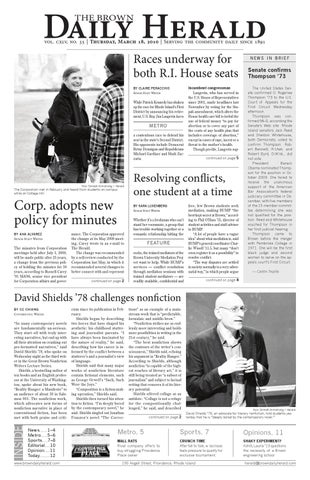
Nick Sinnott-Armstrong / Herald
The Corporation met in February and heard from students on campus while on College Hill.
Corp. adopts new policy for minutes By Ana Alvarez Senior Staf f Writer
The minutes from Corporation meetings held after July 1, 2009, will be made public after 25 years, a change from the previous policy of holding the minutes for 50 years, according to Russell Carey ’91 MA’06, senior vice president for Corporation affairs and gover-
continued on page 2
continued on page 5
Resolving conflicts, one student at a time By Sara Luxenberg Senior Staff Writer
nance. The Corporation approved the change at its May 2009 meeting, Carey wrote in an e-mail to The Herald. The change was recommended by a self-review conducted by the Corporation last May, in which it recommended several changes to better connect with and represent
Incumbent congressman Langevin, who has served in the U.S. House of Representatives since 2001, made headlines last November by voting for the Stupak amendment, which alters the House health care bill to forbid the use of federal money “to pay for abortion or to cover any part of the costs of any health plan that includes coverage of abortion,” except in cases of rape, incest or a threat to the mother’s health. Though pro-life, Langevin sup-
Whether it’s a freshman who can’t stand her roommate, a group that has trouble working together or a romantic relationship hitting the
FEATURE rocks, the trained mediators of the Brown University Mediation Project want to help. While BUMP’s ser vices — conflict resolution through mediation sessions with trained student mediators — are readily available, confidential and
free, few Brown students seek mediation, making BUMP “the best-kept secret at Brown,” according to Phil O’Hara ’55, director of student activities and staff adviser to BUMP. “A lot of people have a vague idea” about what mediation is, said BUMP’s general coordinator Charlie Wisoff ’11.5, but many “don’t even register it as a possibility” to resolve conflict. “The way disputes are settled in society normally is a very adversarial way,” in which people argue
news in brief
Senate confirms Thompson ’73 The United States Senate confirmed O. Rogeriee Thompson ’73 to the U.S. Court of Appeals for the First Circuit Wednesday afternoon. Thompson was confirmed 98–0, according the Senate’s Web site. Rhode Island senators Jack Reed and Sheldon Whitehouse, both Democrats, voted to confirm Thompson. Robert Bennett, R-Utah, and Robert Byrd, D-W.Va., did not vote. President Barack Obama nominated Thompson for the position in October 2009. She failed to receive the unanimous support of the American Bar Association’s federal judiciary committee in December, with five members of the 15-member committee determining she was not qualified for the position. Reed and Whitehouse vouched for Thompson in her first judicial hearing. Thompson came to Brown before the merger with Pembroke College in 1971. She will be the first black judge and second woman to serve on the appeals court’s First Circuit. — Caitlin Trujillo
continued on page 4
David Shields ’78 challenges nonfiction By CC Chiang C ontributing Writer
inside
“So many contemporar y novels are fundamentally un-serious. They star t of f with tr uly interesting narratives, but end up with all their attention on cranking out pre-formatted narratives,” said David Shields ’78, who spoke on Wednesday night as the third writer in the Great Brown Nonfiction Writers Lecture Series. Shields, a bestselling author of ten books and an English professor at the University of Washington, spoke about his new book, “Reality Hunger: a Manifesto” to an audience of about 30 in Salomon 001. The nonfiction work, which advocates new forms of nonfiction narrative in place of conventional fiction, has been met with both praise and criti-
News.....1–4 Metro....5–6 Sports....7–8 Editorial....10 Opinion....11 Today........12
www.browndailyherald.com
cism since its publication in Februar y. Shields began by describing two forces that have shaped his aesthetic: his childhood stuttering and jour nalist parents. “I have always been fascinated by the nature of reality,” he said, describing how his career is informed by the conflict between a stutterer’s and a journalist’s view of language. Shields said that many major works of nonfiction literature contain fictional elements, such as George Or well’s “Such, Such Were the Joys.” “Composition is a fiction-making operation,” Shields said. Shields then turned his attention to fiction. “I’m deeply bored by the contemporar y novel,” he said. Shields singled out Jonathan Franzen’s novel “The Cor rec-
tions” as an example of a mainstream work that is “predictable, formulaic and middle-brow.” “Nonfiction strikes me as endlessly more interesting and holds more possibilities in writing in the 21st centur y,” he said. “The best nonfiction shows the contours of the writer’s consciousness,” Shields said, echoing his argument in “Reality Hunger.” According to Shields, although nonfiction “is capable of the highest reaches of literar y ar t,” it is still being treated as “a subset of journalism” and subject to factual vetting that removes it of its literar y potential. Shields of fered collage as an antidote. “Collage is not a refuge for the compositionally challenged,” he said, and described continued on page 2
Nick Sinnott-Armstrong / Herald
David Shields ’78, an advocate for literary nonfiction, told students yesterday that he is “deeply bored by the contemporary novel.”
Metro, 5
Sports, 7
Opinions, 11
MALL RATS Rival company offers to buy struggling Providence Place owner
crunch time After fall to Yale, w. lacrosse feels pressure to qualify for exclusive tournament
shaky experiment? Kshitij Lauria ’13 questions the necessity of a Brown engineering school
195 Angell Street, Providence, Rhode Island
herald@browndailyherald.com
Page 2
THE BROWN DAILY HERALD
C ampus N EWS crossword
Thursday, March 18, 2010
“Most contemporary writers ... sacrifice everything on the altar of plot.” — author David Shields ’78
Corporation reflects, considers changes continued from page 1
the University. The review’s most significant recommendation was the creation of the “young alumni trustee” position currently held by Lauren Kolodny ’08. Other recommended changes included appointing a Corporation member to the Brown University Community Council and committing to a regular cycle of self-assessment. Chancellor Thomas Tisch ’76 P’07 said in a statement that the review “gave us an oppor tunity to reflect on our governance and operations, to hear input from the community, and to make improvements that will have a lasting and positive impact on our work and the University.” Tisch and the Corporation’s other four of ficers led the selfreview, which Carey said was prompted by a need for a “healthy checkup” and a response to “questions and concerns from the campus.” While the Corporation’s last comprehensive review, conducted in 2003, focused on ensuring the Corporation was working “as effectively as a governance body as it possibly can,” this most recent review focused on improving
the Corporation’s representation and enabling greater interaction with students, faculty and staf f, according to the review’s working paper. The review consisted of research about the policies of gover ning bodies at similar peer institutions and a sur vey of the Corporation’s members. The review found that most other universities wait between 25 and 50 years before releasing their minutes, recommending that the Corporation set its holding period for minutes to 25 years. Minutes from meetings before July 1, 2009 will still be held for 50 years, Carey said. The review found that while few peer institutions had created a young alum trustee position, “it is a model that exists and has value in several institutions,” according to the review’s working paper. The review did not specify a set number of young alum trustee positions, but Carey said that the Corporation is considering admitting more young alums. “We are continuing through the trustee vacancy process to think ver y deliberately about representation and diversity on all levels, but specifically recent closeness
to graduation,” he said. Carey added that Kolodny has already had “significant impact on the Corporation.” He also said the Corporation is “committed to tr ying to have more opportunities to interact with students and staff.” The greatest step towards this was appointing Corporation trustee William Twaddell ’63 to the BUCC, Carey said. The Corporation also made sure to interact with the students, staff and faculty on the University Resources Committee when members were on campus during the Corporation weekend in February, Carey said. While tr ying to respond to recent concerns over transparency, the review did not address investment transparency or the possibility of conducting open meetings, two main student concerns. Carey said that possibly opening Corporation meetings was discussed with Tisch at a BUCC meeting, but ultimately, “there wasn’t support in the Corporation” for changing the closed nature of meetings. He also said that investment policy was not part of the review, even though a Corporation committee does oversee the University’s investments.
Author Shields ’78 speaks on nonfiction
sudoku
continued from page 1
Daily Herald the Brown
Editorial Phone: 401.351.3372 | Business Phone: 401.351.3260 George Miller, President Claire Kiely, Vice President
Katie Koh, Treasurer Chaz Kelsh, Secretary
The Brown Daily Herald (USPS 067.740) is an independent newspaper serving the Brown University community daily since 1891. It is published Monday through Friday during the academic year, excluding vacations, once during Commencement, once during Orientation and once in July by The Brown Daily Herald, Inc. Single copy free for each member of the community. POSTMASTER please send corrections to P.O. Box 2538, Providence, RI 02906. Periodicals postage paid at Providence, R.I. Offices are located at 195 Angell St., Providence, R.I. E-mail herald@browndailyherald.com. World Wide Web: http://www.browndailyherald.com. Subscription prices: $319 one year daily, $139 one semester daily. Copyright 2010 by The Brown Daily Herald, Inc. All rights reserved.
www.blogdailyherald.com
Read Share Recycle
how a mix of voices without a linear narrative inspires the reader to reflect. “I want the reader to be productively unsure as to who the speaker was,” Shields said. Luke Epplin GS challenged Shields by pointing out that there are several contemporar y novelists whose works blur the dichotomy between fiction and nonfiction, such as David Foster Wallace. Shields agreed, but argued that “most contemporar y writers give too much ground to narrative and sacrifice ever ything on the altar of plot.” He also countered that Wallace’s best works were in fact nonfiction. In an inter view with The Herald, Shields said that Brown’s interdisciplinar y nature left an indelible mark on him as a fledging writer. “Brown urges you to undermine the or thodox and think against the grain,” he said. When asked what advice he had for aspiring writers at Brown, Shields said, “Find a form that releases your best intelligences. Don’t be afraid of your own material, and be willing to exist in your own voice.”
Thursday, March 18, 2010
THE BROWN DAILY HERALD
C ampus N EWS
Page 3
“The vote is important. But the hard thing is what we do the next day after that vote.” — Rosa Clemente
Med School to host HIV conference Hip hop politico opens week on Puerto Rico By Nicole Boucher Senior Staf f Writer
The Alpert Medical School will co-host a conference designed to address HIV prevention and treatment at the Pontificia Universidad Catolica del Ecuador in Quito, Ecuador, on Thursday and Friday. Jointly sponsored with Rhode Island College, the conference will bring together Ecuadorian medical students, doctors, nongovernment organizations and members of the local community to learn about addressing the HIV crisis from local and international experts. The conception for the conference came from the findings of a study done by RIC Assistant Professor of Sociology Jill Harrison concerning the primary problems faced by women in the El Inca prison in Ecuador. A sur vey of inmates revealed that the prison was not adequately addressing medical treatment, Harrison wrote in an e-mail to The Herald. One particular health issue resulted from the prison’s “use as a brothel (unofficially), where one might expect greater transmission of sexually transmitted infections and HIV,” she
wrote. After documenting the prevalence of HIV transmission in prisons, Harrison brought the issue of inadequate education about HIV prevention and treatment options to Bradford Briggs, the program manager of the Brown AIDS Project. Last year, Harrison and Briggs coordinated with Ken Mayer, director of the project and professor of medicine and community health, to bring doctors to speak. The conference addresses “the health element” of Harrison’s study and working to improve treatment of HIV given the need, Briggs said. At the conference, four Brown doctors will ser ve as keynote speakers covering topics ranging from prevention to new treatment options, according to Briggs. Mayer will address prevention methods and how to take a patient’s sexual histor y, Briggs said. E. Jane Carter, associate professor of medicine at Brown, will also give two lectures discussing virulent strains of tuberculosis and the latest treatments for patients with both HIV and tuberculosis, Briggs said. Roland Merchant,
assistant professor of emergency medicine, will primarily talk about the risk associated with needlesticks. Karen Tashima, an associate professor of medicine and the associate director of the AIDS Project, will talk about the latest treatments for HIV and issues of co-morbidity. Briggs added that local experts will be joining in the discussion to make the ef for t a more collaborative event. “I think, culturally, it is kind of weird for just Americans to come and spill their knowledge,” Briggs said. But the Ecuadorians “have done a good job interjecting” and providing a “great blend of experts.” Harrison wrote that the main goal of the conference is to pass on information and inform medical professionals in Ecuador about improved treatment options and prevention of HIV. In addition to the educational goal of the conference, Briggs said he hopes the conference will help develop future relations with the medical community in Ecuador. “From an altruistic point of view,” Briggs said, “if patients are able to get a better quality of life or care, that would also be the goal.”
Financial aid director updates UCS By Nicole Boucher S enior S taf f Writer
Director of Financial Aid Jim Tilton spoke at Wednesday’s general body meeting of the Undergraduate Council of Students about the positive impact of financial aid initiatives introduced by the Corporation in the 2008–09 academic year. These changes have decreased loans and parental contributions in financial aid packages by filling this need with scholarships, he said. Tilton cited a jump from 6 percent of students who have no loans in their financial aid package in the 2007–08 academic year to 62 percent in the 2009–10 academic year. The percentage of students whose parents are not required to make any contribution from income rose from 12 percent of students in 2007–08 to 37 percent of students in 2009– 10. Tilton said the University is continually working to provide students with the best re-
sources to meet their needs. “I think one of the things that is ver y special about Brown is the University continues to make a commitment to financial need,” he said. Their goal for next year will be to maintain those initiatives, taking into account that a larger percentage of families may need aid next year because of the recession, he said. UCS “is an impor tant forum for undergrads to get information about policies that af fect them,” UCS President Clay Wertheimer ’10 told The Herald, adding that Tilton’s presentation would increase awareness and allow undergraduates to provide potential feedback and suggestions. The council also voted 27 to 2 against the Undergraduate Finance Board’s proposal to change their constitution. Among the proposed constitutional amendments was a provision that would allow the finance board to appoint their own members to the board, pending UCS approval of their choice.
“All we are asking for is a say in our af fairs,” said UFB Secretar y Tyler Rosenbaum ’11, who chaired the UFB committee that drafted the proposal. While many UCS members agreed that collaborative efforts between the two boards needed to increase, they said they did not feel these amendments were the correct means. UCS Campus Life Chair Ben Farber ’12 said even though these measures would create collaboration, they would also give the finance board cer tain “superiority” over UCS. Several UCS members pointed out that the proposal underscored issues in understanding the oversight responsibilities of each body and encouraged further discussion of each group’s role in a dif ferent forum. Wer theimer also brought up the President Ruth Simmons’ State of the Brown address, scheduled to be delivered tomorrow. He said the speech will be filmed and made available to undergraduates on the UCS Web site.
By Casey Bleho Contributing Writer
For Rosa Clemente, 2008 vice-presidential nominee for the Green Party and an active community organizer and hip-hop activist running for a seat in the New York State Senate, radicalism is the means through which to obtain change. Clemente stressed a radical approach during her emotional opening convocation lecture for Puerto Rican Identity Week, as students, professors and community members gathered to hear her speak on politics, race and gender in Salomon 101 on Wednesday night. “The trajectory of American history is institutional racism,” Clemente said. “The only reason we are here today is because people took over buildings. People didn’t act in a comfortable manner. People weren’t civil.” To Clemente, the history of the Puerto Rican people is one of the factors that led to this radicalism and explains their current situation, she said. “You begin to read this histor y, and you begin to get angr y,” she said. It is essentially through “knowing the histor y of my people being tortured, imprisoned, terrorized and sterilized” that movements for freedom and change are enacted, she said. “If young people know that histor y, it’s empowering.” This is what pushes people to strive for revolution and independence in Puer to Rico and Latin America, Clemente said. There is a misconception that Puerto Ricans are “non-resistors,” she said. “The people of Puerto Rico need to be allowed to have an independent
nation.” The discussion brought up a vast range of controversial social, political and economic issues plaguing both Puerto Rican communities and American politics. An important feature is what she describes as “interethnic conflict” and problems with identity that currently affect society and politics in Latino communities in the United States. “Elected officials who increasingly look like us are more detrimental than any previous white elected of ficial that could have been racist,” she said. “We’re dealing with elected officials that have sold out their communities.” Clemente considered a range of concerns — including the current health care debate, immigration policy, the political response to Hurricane Katrina and Puerto Rican independence — through gender and racial lenses. “We, as women of color, have to always understand that race, class and gender are always going to interact in the political system,” she said. The key to change is moving beyond this and consider these issues honestly. “Unless we hold elected officials — especially those who say they represent us — accountable, we don’t get any victories,” Clemente said. “All power does not come from a ballot. The vote is important. But the hard thing is what we do the next day after that vote.” To conclude the lecture, Clemente quoted Pedro Albizu Campos, a leader of the Puerto Rican independence movement in the early 20th centur y, “When tyranny is law, revolution is order.”
Page 4
THE BROWN DAILY HERALD
C ampus N EWS
Thursday, March 18, 2010
“People think they can handle (student conflicts) on their own.” — Steven Davis ’11, co-president of BUMP
BUMP mediators ready and looking for conflicts to resolve continued from page 1
against each other to determine a winner and loser, Wisoff said. Mediation, on the other hand “is much more collaborative,” he said. Mediation works by bringing together ever yone involved in a conflict. They sit down together with “a third party, the mediator, to try to find some resolution to their dispute,” said Steven Davis ’11, copresident of BUMP. This mediator “is just there as a facilitator to the discussion,” he said, and “isn’t there to make a decision.” “The parties have total control over the process, over any resolution that comes out of the process,” Davis said. The mediator is there to draw out each party’s interests and bring about creative solutions, he added. “It’s not give-and-take, it’s not zero-sum,” he added. “It’s collaborating to make a solution that works for everybody.” Students who want to meet with a mediator e-mail the organization and BUMP contacts the other parties in the dispute. If everyone is on board, the parties sit down for a two-hour session with a BUMP mediator who has no conflict of interest with either party. Mediators will arrange more sessions if the parties desire. “The point of mediation isn’t necessarily the agreement, the resolution,” Davis said. “It’s really the process of bringing people closer together.” “Even if people leave hating each other,” he added, “at least they know why. And they have some way to deal with their relationship going forward.” Molding mediators BUMP was founded in 1993 by the Office of Student Life and the
Office of the Chaplains and Religious Life “to afford students an alternative route to dispute resolution,” O’Hara said. “We only had one format back in those days” for solving conflict, he added, “and that was through the dean’s office.” A few years after it was created, the students involved decided to change the group from a departmental to student organization, O’Hara said. It was during this transition that O’Hara — a trained mediator himself — became the staff adviser to the group. He added that somewhere between 200 and 250 students have become trained mediators through BUMP, which offers free training sessions for interested students and faculty once a year during the spring semester. This year, mediation training drew about as many participants as in previous years. Davis said 20 new mediators — 17 students and three University employees — completed the more than 30 hours of training at the beginning of this semester. The Community Mediation Center of Rhode Island handled the BUMP training this year, said co-president Susan Restrepo ’11. “We’ve really been trying to revamp,” she said. Before this year, BUMP had “been dormant for about five years.” Involving the Community Mediation Center was one way Restrepo hoped to revive the group. “I really wanted to get involved with them because they’re so active in the community.” This year’s BUMP trainees “were absolutely eager and excited,” said Victoria Moreno-Jackson, program director at the center, who conducted the training along with Executive Director Abbie Jones-Herriott. “They were really turning the concepts over in their minds and seeking to understand how they work,” she added.
The training session “was an introduction to mediation skills” that taught all the components of mediation, including active listening, impartiality, helping parties listen to one another and understand their deeper interests, asking open-ended questions and encouraging the development of a solution, MorenoJackson said. BUMP mediators go through the training with the goal of mediating Brown students as well as building skills they can use in their own lives, Restrepo said. Wissof added that meditation skills such as communication and dispute resolution are “valuable in so many career paths.” Moreno-Jackson also noted the group’s enthusiasm with the prospect of volunteering and further training opportunities. Currently, both Restrepo and Davis are interns at the Community Mediation Center. Restrepo works with the center’s eviction prevention program. “It’s been a really eye-opening experience into downtown Providence and really what many Americans are going through right now,” she said. The internship has also helped her realize “the good will … that can exist between landlords and tenants. People really are willing to communicate.” Davis works in local small claims and housings courts, helping to resolve disputes before parties go in front of a judge. “What people generally find is that mediated decisions are more satisfying to the parties and are upheld more often,” he said. Wisoff has also been involved in mediation in the greater Providence community through the center. In February, he participated in a conference about sustainable farming attended by government officials, interest groups and farmers.
BUMP’s work off of College Hill has not gone unnoticed. In May, Rhode Island’s Fund for Community Progress will be giving BUMP the Susan Welin Award for Nonviolence. The award is given for promoting “peaceful conflict resolution in the state of Rhode Island,” MorenoJackson said. The Community Mediation Center nominated BUMP and O’Hara, “who has really kept the program alive,” Restrepo said. “He’s just a tremendous member of the community, a mediator himself, and someone who genuinely believes in the process of mediation.” A BUMPy road While people in the greater Providence community may be willing to communicate through mediation, “BUMPers” have been disappointed with a lack of participation on Brown’s campus. “We haven’t been able to get any sustained interest on behalf of the students,” O’Hara said. “It’s been very difficult to convince people to reach out to BUMP instead of going to the deans,” Restrepo said. Part of the problem, she added, might be that BUMP is completely voluntary. “It’s difficult because with most successful mediation programs, students are mandated to go through mediation before they talk to a dean.” At the same time, she added, “I think that it goes along with the Brown culture that it be voluntary,” even if it means fewer students are signing up to be mediated. Often, “people think they can handle it on their own,” Davis said of student conflicts. Or they think that they “can suffer through it” and that “after this semester, it’ll all be fine.” “We want people to understand that they don’t have to suffer through
conflict,” he said. “That does not lead to greater understanding,” she added. Some students also might worry about discussing their issues with peers. But BUMP’s mediators do not even discuss mediation sessions with each other and destroy their notes at the end of the mediation, O’Hara said. In regards to roommate conflicts, Wisoff said, given “the choice between moving out of your room, and all that stress, versus talking it out with someone — I would like to think that sitting down and talking it out for two hours would be more productive.” BUMP has been in negotiations with the Office of Residential Life about offering mediation training to incoming students and Residential Peer Leaders. “Our goal is to lessen their overflow of student conflicts,” Restrepo said. Building this partnership, however, has been “a slow process,” she added. “We consistently work with outreaches to ResLife and to Student Life, so it isn’t that they’re not aware of us and aware of the potential,” O’Hara said. BUMP is also increasing its outreach to students through advertising and new office hours, Davis said. The group is also “building a leadership team right now that will probably take over by the end of the semester,” Restrepo said. “We have a really energetic and great group of people right now,” she added, and “it’s our effort to ensure that the momentum continues.” Spreading the concepts of open communication and positive-sum results to conflict are important on college campuses, Moreno-Jackson said. By mediating in the Brown community, BUMP is “introducing these concepts to our future leaders.”
Metro The Brown Daily Herald
metro in brief
City Plan Commission chairs reelected The Providence City Plan Commission voted Tuesday to reelect Stephen Durkee and Harrison Bilodeau to the Commission’s chair and vice-chair positions, respectively, according to Robert Azar, director of current planning for the Department of Planning and Development. Durkee, who was reappointed by Mayor David Cicilline ’83 in January, was reelected chair by a unanimous Commission vote. He has served on the Commission for 15 years. His reelection comes at a “very busy time” for the Commission, he said. “It’s an exciting time in the city, and there’s a lot going on,” Durkee said, referring to issues like the downtown neighborhood plan and the waterfront. “It’s important that we participate in that.” Bilodeau has been with the Commission since around 2001, taking a leave of absence in 2002 to run for City Council and returning in 2003. He is looking forward to continuing the maintenance of Providence and its “natural and built environment,” he said. Seven members serve on the Commission, five of whom the mayor appoints and two who act as ex officio representatives for both the mayor and the City Council president. Commission members are appointed for five-year terms, with one expiring each year. — Caitlin Trujillo
Congressional race heats up in District 2 continued from page 1 ports family planning and embryonic stem cell research. “Representative Langevin’s pro-life views are very personal,” said Joy Fox, Langevin’s campaign spokesperson. But another priority for Langevin is “access to quality and affordable health care,” an issue that he has emphasized since first running in 2000, Fox said. Yet Langevin’s pro-life stance puts him in a difficult position regarding health care reform given that the final bill may not contain the strict language of the Stupak amendment. Despite his pro-life convictions, Fox said abortion language would not necessarily determine Langevin’s vote on the final version of the bill. “Representative Langevin had long stated that no one issue will derail health care,” she said. Langevin is currently working on the House Budget Committee during the reconciliation process, though his position on the final bill is still uncertain, Fox said. A challenge from the left Betsy Dennigan served in the General Assembly for 13 years — as
a representative from Pawtucket — before resigning last October to run for Congress. Dennigan has worked as a lawyer and an emergency room nurse, and she founded a non-profit called Books are Wings, an organization that hosts educational book parties for under-privileged children. At her Providence of fice on Broad Street, Dennigan talked about her “passion for policy.” She highlighted her work as a state legislator to promote “clean government” and health care issues like safe needle sticks and latex safety for health professionals. Her advocacy on the latter issues stems from her experience as a nurse, she said. Dennigan also cited her involvement in promoting the Green Buildings Act, a law passed by the General Assembly last October, as a model for making buildings more environmentally friendly while creating green jobs. The legislation requires new building projects to comply with stricter standards for energy-efficient construction, specifically the Leadership in Energy and Environmental Design rating system. continued on page 6
“That’s creating a little bit of a problem for competition.” — Jeff Green, Real Estate Analyst Thursday, March 18, 2010 | Page 5
Mall operator considers buyout By Suzannah Weiss Ar ts & Culture Editor
General Growth Properties, Inc., owner of over 220 U.S. shopping centers including Providence Place Mall, received an unsolicited $10 billion bid last month from rival company Simon Property Group, Inc., according to David Keating, senior director of corporate communications at General Growth. Simon, the most successful mall operator in the countr y, has discussed the possibility of increasing its offer since the initial bid, said Jeff Green, a retail real estate analyst. General Growth filed the countr y’s largest-ever real estate bankruptcy last April to pay off more than $25 billion in debt, The Herald reported last April. The company is currently in an “exclusivity period,” during which its leadership is “certainly reviewing all proposals that are sent our way” but not responding to any offers, Keating said. He declined to speculate “what-ifs or hypothetical situations” in regard to how accepting the bid might affect Providence Place and General Growth’s other properties. But Green said that Simon buying off General Growth would negatively affect retailers as well as the industr y. “My hope is that Simon does not buy General Growth,” he said.
Kim Perley / Herald file photo
Facing heavy debt, General Growth Properties, Inc. — owner of Providence Place — received an unsolicited bid from a rival mall operator.
“That’s creating a little bit of a problem for competition.” If the countr y’s largest retail real estate company were to buy General Growth, its largest competition, Green said, “it’s almost that they would create a monopo-
ly, because the more centers you have, the more leasing power you have.” He added that “if they own the number one company and continued on page 6
Page 6
M etro
THE BROWN DAILY HERALD
Thursday, March 18, 2010
“Who’s (U.S. Rep. Jim Langevin) more afraid of — Nancy Pelosi or losing Catholic support?” — Michael Gardiner, his opponent
Mall company merger R.I. House candidates on the issues could reduce competition continued from page 5
continued from page 5 the number two company, they’ll basically be running the whole mall industr y in the U.S.” This possibility also has dangerous implications for owners of Providence Place shops, Green said, as Simon could “use the leverage of owning so many malls” to pressure retailers to open stores in less favorable locations. “It’s much better for the retail community that there’s not a monopoly in the mall business,” he said. The best outcome would be for General Growth to continue as an independent company with the help of private investors, he said. Major investors such as Brookfield Asset Management and Pershing Square Capital Management have offered to lend General Growth money until the company can pay off the debt, Green said.
Green said General Growth could refinance its debt by its April deadline with this help, adding that “their properties are strong” and “they have talented people.” Providence Place in particular is “extremely successful,” he said. Sales have decreased by about five percent since the economic downturn, a statistic that is “not bad in our economy.” General Growth considered selling Providence Place in December 2008, but Keating said the mall operator has since dropped the idea. “That was several lifetimes ago,” Keating said. “Providence Place Mall is not up for sale. It’s something that we’re keeping.” Providence Place “has been business as usual, and our bankruptcy filing has had absolutely no impact on our malls,” he added. “Nothing has changed. We’re quite proud of that.”
Today we have two crosswords in the BDH. Can you handle it? See pages 2 and 12.
Regarding what sets her apart from the incumbent Langevin, Dennigan pointed to her pro-choice record, crediting her time as a public servant for leading her to the view that “full access to reproductive health is very important.” Dennigan also said she would be a more vocal supporter of marriage equality and in repealing the military’s “Don’t Ask, Don’t Tell” policy. Fixing health care the GOP way Mark Zaccaria, who ran against Langevin in 2008, said the main motivation for his current candidacy is the nation’s financial health. “I was offended by the Bush deficits, but I’m appalled by the deficits now,” Zaccaria said. Zaccaria said he is “categorically opposed” to the health care reform legislation due to the additional cost he believes it would add to the system. Instead, Zaccaria advocates individual health savings accounts, which people would pay into throughout their lives. The account would be portable, and Zaccaria believes this system would increase individual accountability because consumers would be forced to justify health care costs when money is extracted
from their accounts. Zaccaria’s primary challenger, Michael Gardiner, also opposes the version of health care reform being debated by Congress, Gardiner said. Gardiner said he supports setting a “uniform health code” that would apply nationwide and require all insurers to provide minimum health care requirements standardized across state lines. This would allow every insurer to compete in every state and Gardiner believes it would remedy the problems created by monopoly control that characterize health care markets in many states. Like Zaccaria, Gardiner is prolife. While he called abortion “a secondary issue” for voters concerned with the poor economy, Gardiner challenged the rationale behind Langevin’s Stupak vote. “Who’s he more afraid of — Nancy Pelosi or losing Catholic support?” Gardiner said.
The abortion issue Langevin’s vote on the Stupak amendment has caused consternation on both sides of the abortion debate. “It’s no secret that the pro-life movement was behind Langevin in 2000,” said Barth Bracy, executive director of Rhode Island Right to Life.
Bracy also cited Langevin’s support for embryonic stem cell research as a point of divergence with many in the state’s pro-life community, which is shaped by the existence of a large Catholic population in Rhode Island. Carolyn Mark, president of Rhode Island National Organization for Women and chair of Rhode Island NOW Political Action Committee, finds Langevin’s positions on abortion issues disconcerting. The national NOW PAC has endorsed Betsy Dennigan. “Representative Langevin is not the advocate we feel is going to protect women’s rights in Rhode Island and around the country,” Mark said. Langevin’s Stupak vote is especially problematic because many women could lose their coverage under reform, and states could decide abortion coverage will not be permitted in the exchanges that are created, Mark said. But according to Associate Professor of Political Science and Public Policy Wendy Schiller, the abortion issue will only become problematic for Langevin if his prolife stance is a rationale for a “no” vote on the final health care bill. A bigger issue for Langevin is proving to voters that he can be an effective advocate for Rhode Islanders, Schiller said.
SportsThursday The Brown Daily Herald
Thursday, March 18, 2010 | Page 7
s p o rt s i n b r i e f
Ivy basketball moves into postseason Postseason basketball takes the Ivy League by storm this week, as five teams from the Ancient Eight compete in tournaments large and small. In the NCAA Tournament, the Cornell men were named the No. 12 seed in the East Region and will square off against No. 5 seed Temple on Friday at 12:30 p.m. in Jacksonville, Fla. Cornell finished the regular season with a 27-4 record and led the nation in three-point shooting at 43.4 percent, but the No. 17 Atlantic-10 champion Owls could be a tough matchup, finishing the season with a 29-5 record after winning their last ten games and placing fourth in the nation in defending threes. The winner will face Wisconsin or Wofford on Sunday. On the women’s side, Princeton was named a No. 11 seed, the highest-ever NCAA seed an Ivy League team has received. The Tigers (26-2) will face No. 6 seed St. John’s (24-6 and ranked No. 15) on Saturday in Tallahassee, Fla. The winner will face Florida State or Louisiana Tech on Monday. The Princeton men have also found their way to the postseason, but not to the bright lights of the Big Dance. The Tigers beat Duquesne, 65-51, on their home court to advance to the quarterfinals of the College Basketball Invitational against Indiana University-Purdue University Indianapolis on Monday. Harvard was not so lucky, falling to Appalachian State, 93-71, in the opening round of the CollegeInsider. com Tournament. This is the first time the Ivy League has sent three teams to the postseason since 2002. The Harvard women will hope to avoid a similar result in first round Women’s National Invitational Tournament action. The Crimson (20-8) square off against Syracuse (22-10) on Thursday evening in upstate New York. Providence hosts NCAA games Rhode Island also has a big week of postseason basketball. Providence hosts six first- and secondround NCAA Tournament men’s games this week at the Dunkin’ Donuts Center. On Thursday, No. 2 seed Villanova (24-7) faces No. 15 at Robert Morris (23-11) at 12:30, followed by No. 7 Richmond (26-8) against No. 10 St. Mary’s of California (26-5) at 2:50. In the evening session, No. 3 Georgetown (23-10) takes on No. 14 Ohio (21-14) at 7:25, followed by No. 6 Tennessee (25-8) against No. 11 San Diego State (25-8) at 9:45. On Saturday, second-round games will pit first the afternoon winners and then the evening winners. Meanwhile, the University of Rhode Island is moving on to the second round of the National Invitational Tournament after a 76-64 victory over Northwestern Wednesday evening. The No. 2 seed Rams will host No. 6 Nevada in second-round action. Cornell w. hockey heads to Frozen Four The Cornell women’s hockey team is headed to the Frozen Four. After overpowering No. 4 seed Harvard, 6-2, last Friday, the Big Red (20-8-6) will face No. 1 Mercyhurst (30-2-3) Friday evening in Minneapolis. The winner will play the winner of Friday night’s contest pitting No. 2 Minnesota Duluth (29-8-2) against the No. 3 Minnesota Golden Gophers (26-8-5) for the National Championship. Minnesota eliminated ECAC Hockey’s third representative, Clarkson. M. hockey enters final rounds of ECAC tournament ECAC Hockey will crown a men’s champion this weekend, with the semifinals on Friday and the finals on Saturday at the Times Union Center in Albany, N.Y. No. 2 seed Cornell will face No. 11 Brown at 4 p.m., while No. 3 seed Union squares off against No. 5 seed St. Lawrence at 7 p.m. — Andrew Braca
Jonathan Bateman / Herald
Goalie Michael Clemente ’12 is The Herald’s Athlete of the Week.
ATHLETE OF THE WEEK
Clemente helps block Yale from semifinals By Dan Alexander Spor ts Editor
Goalie Michael Clemente ’12 held No. 6 Yale, the top-scoring team in the ECAC Hockey, to just two goals for the first time since Januar y on Friday night in the men’s hockey team’s three-game playoff series. And after a rough Saturday night, he bounced back and shut out the Bulldogs on Sunday, preser ving Brown’s 1-0 lead until the final buzzer sounded, sending the Bears into the ECAC semifinals. Clemente and the rest of the Bears will take on No. 9 Cornell in the ECAC semifinals at 4 p.m. Fri-
day night. For his shut-out performance which kept the team’s season alive, The Herald has named Clemente Athlete of the Week. Herald: Last year, you upset Har vard in the playof fs. This year, you did it against Yale. Which one was more fun? Clemente: I would probably have to say the Yale one because of the adversity — the struggle we went through on Saturday. In the Har vard series, ever ything went right, from the drop of the puck to the end of the series. Nothing bad happened. But in this series against Yale, there were ups and
downs. It’s kind of cool that our team has grown enough to handle those issues and respond. After the win over Yale and RPI, do you guys head into the final four with more confidence? All of our playoff games have been decided in the last seconds. Or not the last seconds — but at the end of the game, it has been a one-goal game. We all now have the confidence to say ‘We have a twogoal lead,’ ‘We’re going to close this out’ or ‘Hey, we’re down, we’ve got to get one,’ which is going to continued on page 8
W. lacrosse
Seconds from overtime, Bears fall, 8-7 By Tory Elmore Spor ts Staf f Writer
With the clock ticking down in the last minute, the women’s lacrosse team was tied at seven. Brown got the ball, approached the goal and a foul was called, giving the Bears a penalty shot. But Yale’s goalie saved it and sent it up to her teammates, who had one final shot on goal with nine seconds remaining. It went in. Just seconds from over time play, the women’s lacrosse team conceded a goal and fell to Yale, 8-7. With their hopes set on qualifying for the first-ever Ivy Women’s Lacrosse Tournament, another loss puts the Bears one step further away from their Ivy ambitions. Brown will have to secure results against at least one of several Ivy League teams ranked higher nationally than Brown, as only four of eight qualify. “We have some adjustments to make,” said midfielder Alexa Caldwell ’11. “We have to own how good we are and bring it to the games.”
As they had the previous two games, the Bears went ahead quickly, with leading-scorer Paris Waterman ’11 scoring twice and tricaptain Bethany Buzzell ’10 putting one away before Yale could make any serious attempts on goal. But a three-goal run put Yale back in the game, with Devon Rhodes paving the way to the Bulldogs’ comeback. Neck-and-neck in the second half, a late goal by Yale’s Kaitlyn Flatley handed Brown its second
Ivy League defeat of the season. The Bears continued to look to offensive standout Waterman, who had five of her team’s seven goals, and Caldwell forced turnovers and ground balls. “Who goes to the tournament is ver y open,” Caldwell said. “This game was a huge disappointment for us, but if we can just finish in the next five Ivy League games, we know we can.” They have ten days to prepare for a road game against Har vard.
Page 8
THE BROWN DAILY HERALD
S ports t hursday
Thursday, March 18, 2010
“I have 28 best friends.” — Michael Clemente ’12 on the men’s hockey team
Athlete of the Week on team culture continued from page 7
www.browndailyherald.com
be huge against Cornell because they’re a team that doesn’t make many mistakes. Yale lost its top scorer and the third-highest scorer in the nation, Sean Backman, to injur y. Looking back on it now, how big was Backman’s absence in last weekend’s series? I honestly noticed ver y little difference in Yale playing with or without him, but, I mean, we played so much better and we were so detailed and so good — the team defense and the offense did their job so well that I don’t know whether he would have made a difference in the series or not. I just don’t know. It’s really hard to tell. I mean, he’s a great player, but my teammates took care of business out front. What’s the dif ference between the team’s attitude now and at the beginning of the season? In November, we were really adjusting. I would say the excitement was there, but we hadn’t experienced a lot of success. Our coaches were confident in us that we could be successful, but we didn’t know how to do it yet. We didn’t know how to close out games. Now, we know we can take care of business.
There’s a little bit of a buzz on campus about the men’s hockey team. Do you guys feel that vibe? It’s been cool, the first series, there were a couple of fans around. And then Yale, we were skating onto the ice, and you know, their band is playing and people were yelling stuf f at us. And they announce the starting lineup and we hear a cheer — and it’s not a parents’ cheer, it’s kids. And I was like, ‘Yes! This is awesome.’ There’s nothing better than playing in front of your classmates and friends and having them support you. Coach (Brendan) Whittet (’94) has done a good job of changing the culture and trying to build support around the men’s hockey team. What do you do when you’re not playing hockey? Well, we’ve got N64 up in Harkness (House). So for a while, I was dominating everyone in NFL Blitz. But my reign ended when we decided to switch games to Mario Kart — it’s been a rough transition for me. We play eliminator because we only have three controllers, so if you lose, you’re out. Do you live with some hockey guys? Yeah, I live with six hockey guys and one former sophomore. We all went into the housing lot-
ter y and really lucked out by getting a pretty nice suite. We were all close when we moved in at the beginning of the year, but we’ve definitely become a lot closer. I drive them crazy a little bit because I leave things out in the common room. But I’m trying to do my best to keep things clean for them. They hide my things, and when I come out, my computer is stolen — and my phone charger and my iPod. When I come out, they’re all gone and they won’t tell me where they are and I have to play the hot-cold game to find them. And it’s really not fun, so I’ve learned to make messes just on my side of the double. Who’s your roommate? Jeff Buvinow (’12). He’s a defenseman on our team. He gets mad at me for leaving my side a mess. Do you think he ever lets a guy slip by him and get to you in a game as payback for your messes? I hope not. No, I mean, we just like to give each other crap. It’s the best part of our team ...we can really make fun of each other and no one takes it too seriously, which is good because it keeps things light. The cool thing about this team is that there’s a lot of camaraderie on it. … I have 28 best friends.
World & Nation The Brown Daily Herald
Thursday, March 18, 2010 | Page 9
College finds anti-gay lesson violated policy By Tracy Correa McClatchy Newspapers
Irfan Khan / Los Angeles Times
Kayla Eland, 20, and Lindon Pronto, 21, are not boyfriend and girlfriend — just pals sharing a room.
In college dorms, a ‘post-gender world’ By Larry Gordon Los Angeles T imes
LOS ANGELES — They weren’t looking to make a political statement or to be pioneers of gender liberation. Each just wanted a familiar, decent roommate rather than a stranger after their original roommates left to study abroad. That’s how Pitzer College sophomores Kayla Eland, female, and Lindon Pronto, male, began sharing a room this semester on Holden Hall’s second floor. They are not a couple and neither is gay. They are just compatible roommates in a new, sometimes controversial, dormitory option known as genderneutral housing that is gaining support at some colleges across the nation. Eland, a biology major who hopes to become a doctor, said that a roommate’s personality and study habits are more important than gender. “This might not be right for ever yone,” she said of sharing the small, cinder blockwalled room with a man. “But I think it’s important to have the right to choose where you want to live, how you want to live and who you want to live with.” Pronto, an environmental studies major who works each summer as a forest firefighter, agreed. Apart from remembering to lower the toilet seat, he said, living with a woman friend is not much different from rooming with a man. “As far as I’m concerned, a roommate is a roommate,” he said. Although the number of participants remains small, gender-neutral housing has gained attention as the final step in the integration of student housing. In the 1970s, many United States colleges moved from having only single-sex dormitories to providing coed residence halls, with male and female students typically housed on alternating floors or wings. Then came coed hallways and bathrooms, further shocking traditionalists. Now, some colleges allow undergraduates of opposite sexes to
share a room. Pitzer, which began its program in the fall of 2008, is among about 50 U.S. schools with the housing choice, according to Jeffrey Chang, who co-founded the National Student Genderblind Campaign in 2006 to encourage gender-mixed rooms. Participating schools include UC Riverside, UC Berkeley, Stanford, Cornell, Dartmouth, Sarah Lawrence, Haverford, Wesleyan and the University of Michigan. College officials say the movement began mainly as a way to accommodate gay, bisexual and transgender students who may feel more comfortable living with a member of the opposite sex. Most schools say they discourage couples from participating, citing emotional and logistical problems of breakups. Officials say most heterosexuals in the programs are platonic friends. “College students are adults,” said Chang, who is gay and is now a law student at Rutgers University in New Jersey. “They have every single right to choose the person they feel most comfortable living with.” He estimates that at schools where the option exists, only 1 percent to 3 percent of students living on campus choose a roommate of the opposite sex. Officials at the Association of College & University Housing Officers-International say the trend has accelerated, but they don’t expect most schools to adopt it. Experts note that most students prefer a same-sex roommate, and some colleges are reluctant to antagonize parents, legislators and donors who view the option as immoral or even dangerous. Pepperdine University in Malibu, Calif., which is affiliated with the Churches of Christ, maintains separate dorm wings and apartments for men and women. Asked whether it would consider going gender neutral, Sue Gamboa, a housing department office manager, said: “Not in the wildest dream would Pepperdine move in that direction.”
Harvey Mudd College, next to Pitzer in the Claremont Colleges, began gender-neutral housing last fall mainly as an option for gay and transgender students, said Guy Gerbick, dean of residential life. Seven students joined; among them are a man and two women, all straight, who share a triple room. Parents cannot veto such a decision at Harvey Mudd, but Gerbick asks students to discuss it with their families ahead of time. He also asks applicants whether they are romantically involved; all of this year’s participants said no. But if they were, the school could not forbid them from rooming together. “If we are going into a postgender world, then the regulation of private behavior is just not practical,” he said. Several years ago, an earlier proposal for gender-neutral housing was killed at Harvey Mudd by skeptical administrators and older, more conservative trustees, Gerbick recalled. More recently, 74 percent of Harvey Mudd students voted in a survey to allow the option and, to Gerbick’s satisfaction, a new administration agreed. UC Berkeley senior Rose DeLeon-Foote, who has a male roommate, laughed at fears that genderneutral housing might promote promiscuity. In fact, she said, the opposite is true when roommates see each other “all gnarly in the morning.” “It’s not sexual, it’s just not,” said DeLeon-Foote, 19, of Sacramento. Many schools restrict the option to upperclassmen, to certain floors or to residence halls with gay themes. Pitzer, which has about a dozen students participating this year, avoids such limits out of concern that they may marginalize students, said Chris Brunelle, director of residence life. Pitzer housing applications ask whether students prefer a roommate to be woman, man, “other,” or have no preference. Or students can request to live together, as Eland and Pronto did after losing their original roommates.
FRESNO, Calif. — Fresno City College officials said they plan to take action against an instructor accused of presenting religiousbased and anti-gay views as fact in a health class. But school officials declined to say what action they will take. In a March 8 letter to three students who complained, the school said its investigation found that instructor Bradley Lopez violated district policy and engaged in conduct that could create a hostile learning environment. The students were part of a complaint filed by the American Civil Liberties Union in Februar y. The letter from Christopher M. Villa, Fresno City College’s vice president of student services, said that Lopez’s conduct could have unreasonably interfered with students’ learning by making insulting comments directed at homosexuals. A copy of the letter was posted on the Web site of the college’s student newspaper, The Rampage. Lopez, who didn’t return telephone calls Wednesday, has vehemently denied the allegations. His attorney, Charles Magill, said Lopez has done nothing wrong: “We completely disagree with the findings.” Magill also said that Lopez, who teaches health science, has not been reprimanded or notified of any pending disciplinar y action. He said Lopez continues to teach at Fresno City College and is not going to change the way he teaches. The two-page letter from Villa said Lopez described homosexuals as “suffering from a mental disorder and advising psychological counseling as a remedy.” Doing so, the letter said, violated district policy prohibiting comments based on sexual orientation. Lopez also was found to have
violated district policy by teaching religious material, which is inconsistent with Fresno City College as a public institution. Villa said the instructor was not required to hide his religious belief, but should not have engaged in religious indoctrination as he did by assigning readings from the Bible. The school also concluded that Lopez’s actions are not protected by academic freedom— a principle that allows instructors to teach controversial ideas without fear of punishment. The idea of academic freedom is that healthy exchanges with students can lead to thought-provoking discussions. The college said it would “take appropriate action to address the violations policy and regulations and prevent them from recurring in the future.” School officials aren’t discussing what action might be taken, calling it a personnel matter. A written statement from Fresno City College President Cynthia Azari said the school is committed to its anti-discrimination and harassment policies. She added: “The situation is being handled appropriately.” Jacqueline Mahaffey, 24, one of the students who complained, said she felt vindicated. “It makes me feel good to know that the college is acknowledging this and they are going to do something about it,” she said. However, she said she wants to make sure action is taken and that the letter “is not just a device to placate us.” Elizabeth Gill, a staf f attorney with the ACLU of Northern California, called the findings “a great first step” but is still waiting to see what action is taken against Lopez. “My agenda is that the school make sure that all their health science classes are teaching medically accurate and unbiased information. It’s the school’s responsibility to make sure that happens,” Gill said.
Attention student groups: See this blank space? Your ad could be here! The Herald is now offering prices as low as $15 to student groups. For more information, e-mail studentgroups@browndailyherald.com
Editorial & Letters The Brown Daily Herald
Page 10 | Thursday, March 18, 2010
l e t t e r to t h e e d i to r
Examine motto in new lens To the Editor: In response to her opinions column (“Not content to hope in God,” March 16), I would like to encourage Emily Breslin ’10 to examine the University’s motto through a different lens. “In Deo Speramus” represents a collection of values establishers desired would shape and strengthen the University. Their ideas illustrate the robust traits Brown community members hold, and seek to encourage us when circumstances lead us to lose confidence. Breslin acknowledges that hope provides fuel for many individuals’ pursuits, but overlooks a significant truth: hoping is not easy. Hope requires an individual’s willingness and self-determination to maintain. Hope obliges people to overcome their doubts, fears and emotional struggles so that they may look ahead and mobilize themselves toward a brighter future. Hope demands from individuals qualities such as strength, perseverance and stability.
“In Deo Speramus” also exemplifies another trait that I find sets our University apart: humbleness. Though mentioning God could tie itself to specific religious practices, I feel it serves a broader symbolic role within our motto. The concept speaks to those aspirations that lie beyond ourselves and reach into the infinite. It is this quality, and the humility inherent in not making ourselves our only hope, that gives worth to this motto for humanists, whether from a faith tradition or not. It is important to respect the work of this University’s leaders, whose act of establishing the motto is in itself a reflection of the values it symbolizes. Even if we disagree on certain beliefs, we can still honor the spirit of their enterprise in creating an institution they hoped would last long after they were gone and knew they had no power in themselves to perpetuate. Irene Nemesio ’12 March 17
An article in Wednesday’s Herald (“UFB will end funding for tableslips after break,” March 17) incorrectly identified Aida Manduley ’11 as vice chair of the Brown University Activities Council. In fact, Manduley is the BUAC’s secretary and the representative for service, political, and social action groups. The Herald regrets the error.
t h e b r o w n d a i ly h e r a l d Editor-in-Chief
Managing Editor Chaz Kelsh
Deputy Managing Editors Sophia Li Emmy Liss
editorial Anne Speyer Suzannah Weiss Brian Mastroianni Hannah Moser Brigitta Greene Ben Schreckinger Sydney Ember Nicole Friedman Dan Alexander Zack Bahr Andrew Braca Han Cui
Arts & Culture Editor Arts & Culture Editor Features Editor Features Editor Metro Editor Metro Editor News Editor News Editor Sports Editor Asst. Sports Editor Asst. Sports Editor Asst. Sports Editor
Graphics & Photos Graphics Editor Stephen Lichenstein Graphics Editor Alex Yuly Photo Editor Nick Sinnott-Armstrong Asst. Photo Editor Max Monn Sports Photo Editor Jonathan Bateman Production Copy Desk Chief Kelly Mallahan Design Editor Marlee Bruning Asst. Design Editor Anna Migliaccio Asst. Design Editor Julien Ouellet Web Editor Neal Poole Post- magazine Editor-in-Chief Marshall Katheder
e d i to r i a l
All aboard
correction
George Miller
R ichard S tein and P aul T ran
Senior Editors Ellen Cushing Seth Motel Joanna Wohlmuth
Business Office Manager General Managers Shawn Reilly Claire Kiely Katie Koh Directors Sales Kelly Wess Finance Matthew Burrows Client Relations Margaret Watson Alumni Relations Christiana Stephenson Managers Local Sales Arjun Vaidya National Sales Marco deLeon University Sales Aditi Bhatia University Sales Jared Davis Recruiter Sales Trenten Nelson-Rivers Maximillian Barrows Business Operations Business Analytics Jilyn Chao Credit and Collections Danielle Marshak Special Projects Alexander Carrere Staff Kathy Bui Opinions Opinions Editor Michael Fitzpatrick Opinions Editor Alyssa Ratledge Editorial Page Board Matt Aks Editorial Page Editor Debbie Lehmann Board member William Martin Board member Melissa Shube Board member Gaurie Tilak Board member Jonathan Topaz Board member
Anna Migliaccio, Designer
It currently takes Amtrak trains six to seven hours to get from Providence to Washington — roughly equivalent to driving and sluggish compared to flying. Amtrak has long sought to reduce travel times along the northeast corridor. As America continues to fall behind other countries in developing highspeed rail, now is the time for Brown to unite with other northeast universities to push for making this goal a reality. Despite increased federal funding, Amtrak continues to struggle: It lost $1.1 billion in 2008. That year, Congress allocated $2 billion per annum for the government-owned corporation over the next five years. Amtrak officials have said that this authorization was a positive step, but not enough to develop the kind of bullet trains seen in other countries. And while President Obama’s stimulus package allotted $8 billion for investment in high-speed passenger rail, this sum was split among 31 states and so will not have a transformative impact. Meanwhile, China plans to open around 40 highspeed rail lines between now and 2012. Were China’s fastest bullet train located along the eastern coast of the United States, it could travel from Boston to Virginia in the time it takes Amtrak’s fastest line, the Acela, to go from Boston to New York. Around the world, advanced rail technology links Madrid to Barcelona, Paris to Lyon, Tokyo to Osaka. Put simply, the United States is far behind. The more we continue to lag, the more we lose out on the positive economic externalities associated with efficient infrastructure. A recent op-ed in the New York Times made the case that the northeast corridor would be the best location for a large investment in high-speed rail. Despite slow train speeds, Amtrak has still managed to carve out a surprisingly large share of the market for
travel along the east coast. If Amtrak sharply reduced travel times, it could spur regional economic growth and secure its own long-term sustainability. We encourage Brown and the scores of other northeast universities to take up this case and lobby for it. Bullet trains would allow for increased collaboration between students and professors in cities along the northeast corridor and would facilitate interschool research projects. Train modernization would also help strengthen the connection between the institutions of higher education in the northeast and our nation’s capital — a boon both to politically-active students and policy-oriented professors. While we hope all northeast schools recognize the potential here, it is worth noting that this project could be hugely significant for the Ivy League. Five of the Ancient Eight are located in cities along Amtrak’s northeast corridor. We urge the Ivy Council — an organization comprised of student representatives from all the Ivy League universities — to focus some of its efforts on the possibility of high-speed rail in the northeast. Although the northeast corridor is currently home to Amtrak’s Acela — the only train in America that even resembles a high-speed line — it has not yet been designated a “high-speed rail corridor.” This designation would make the northeast eligible for more federal funding opportunities. Last week, a bipartisan group in the House of Representatives introduced legislation correcting this problem and designating the northeast appropriately. We hope all northeastern universities will unite in pushing for the passage of this legislation — a small but important step towards a worthwhile goal. Editorials are written by The Herald’s editorial page board. Send comments to editorials@browndailyherald.com.
Victoria Hartman, Sara Luxenberg, Lindor Qunaj, Copy Editors Brigitta Greene, Talia Kagan, Hannah Moser, Caitlin Trujillo, Night Editors Senior Staff Writers Ana Alvarez, Ashley Aydin, Alexander Bell, Nicole Boucher, Alicia Chen, Kristina Fazzalaro, Sarah Forman, Talia Kagan, Sara Luxenberg, Sarah Mancone, Heeyoung Min, Claire Peracchio, Goda Thangada, Caitlin Trujillo Staff Writers Anna Andreeva, Shara Azad, Rebecca Ballhaus, Fei Cai, Miriam Furst, Max Godnick, Anish Gonchigar, Sarah Julian, Julia Kim, Anita Mathews, Mark Raymond, Luisa Robledo, Emily Rosen, Bradley Silverman, Anne Simons, Qian Yin Senior Sales Staff Katie Galvin, Liana Nisimova, Isha Gulati, Alex Neff, Michael Ejike, Samantha Wong Senior Finance Associates Jason Beckman, Lauren Bosso, Mae Cadao, Margot Grinberg, Sajjad Hasan, Adam Fern Finance Associates Lisa Berlin, Mahima Chawla, Mark Hu, Jason Lee, Nicholas Robbins, Daniel Slutsky, Emily Zheng Design Staff Caleigh Forbes, Jessica Kirschner, Gili Kliger, Leor Shtull-Leber, Katie Wilson Web Staff Andrew Chen, Warren Jin, Claire Kwong, Michael Marttila, Jeffrey Matteis, Ethan Richman Photo Staff Qidong Chen, Janine Cheng, Alex DePaoli, Frederic Lu, Quinn Savit Copy Editors Nicole Boucher, Zoe Chaves, Greg Conyers, Sarah Forman, Claire Gianotti, Aida HaileMariam, Victoria Hartman, Tiffany Hsu, Christine Joyce, Mrinal Kapoor, Abby Kerson, Matthew Lim, Sara Luxenberg, Alexandra McFarlane, Joe Milner, Rajan Mittal, Lindor Qunaj, Kate-Lyn Scott, Carmen Shulman, Rebecca Specking, Dan Towne, Carolina Veltri
C O R R E C T I O N S P olicy The Brown Daily Herald is committed to providing the Brown University community with the most accurate information possible. Corrections may be submitted up to seven calendar days after publication. C ommentary P O L I C Y The editorial is the majority opinion of the editorial page board of The Brown Daily Herald. The editorial viewpoint does not necessarily reflect the views of The Brown Daily Herald, Inc. Columns, letters and comics reflect the opinions of their authors only. L etters to the E ditor P olicy Send letters to letters@browndailyherald.com. Include a telephone number with all letters. The Herald reserves the right to edit all letters for length and clarity and cannot assure the publication of any letter. Please limit letters to 250 words. Under special circumstances writers may request anonymity, but no letter will be printed if the author’s identity is unknown to the editors. Announcements of events will not be printed. advertising P olicy The Brown Daily Herald, Inc. reserves the right to accept or decline any advertisement at its discretion.
Opinions The Brown Daily Herald
Thursday, March 18, 2010 | Page 11
The language of Brown’s Israeli-Palestinian exchange ANTHONY BADAMI Opinions Columnist The quandary of Israel and Palestine is nearly inescapable for Brown students. Because of a personal connection, I have been witness to plentiful dialogue efforts, lectures, panels and even had the opportunity to dispute current Israeli security policy through a Janus student debate. The assorted and relevant campus organizations — Hillel, Common Ground, Brown Students for Israel, Brown Students for Justice in Palestine, Puzzle Peace, etc. — ensure no decline in the coverage of this issue in the coming years. However, I write this column not to comment on the substance of these disagreements. Instead, I would like to remark on the forums, the arenas of language, in which these disputes take place. To make headway on the IsraelPalestine matter, we must be cognizant of the way we converse. If my endeavor seems unclear, refer to Roberta Goldman’s ’13 recent guest column (“Brown students for Palestine (and Israel),” March 4). One component of the IsraelPalestine question is the lexicon one uses to engage others. For Goldman, the grievance lies in the use of the term “apartheid.” Now, while I agree with the conclusion she states, I take great issue with the line of argumentation she uses.
Her general thrust seems to be this: “All students are entitled to advocate their personal beliefs, but not to the extent that they trample upon fellow students’ beliefs.” In other words, individuals are free to express their opinions, as long as those opinions do not affront others. I do not mean to be snide, but this seems to me to be a serious misreading of free speech, a value imperative to political discourse. As Salman Rushdie emphasized in his recent
word “apartheid” proscribed from the public dialogue? I have no trouble believing that it offends many, but that is why free speech is necessary. It is up to those participating in the discussion to delineate useful and constructive reasoning from harmful and unproductive quarrel. But, by disallowing the use of the term “apartheid,” you effectively limit an individual’s ability to contribute. You assert a conclusion without having been exposed to the pertinent
To make headway on the Israel-Palestine question, we must be cognizant of the way we converse.
lecture to Brown undergraduates, the right to free speech begins with speech that is offensive — speech that is, in Goldman’s words, trampling. In fact, when speech is restricted, it can be more compelling. Rushdie pointed out that banned speech does not dissipate; it goes underground. At this point, its taboo message becomes even more alluring and attractive. This logic mirrors closely my objection to Goldman’s argument. Why try to get the
information. The conception of free speech theory rests on John Stuart Mill’s formulation of the “marketplace of ideas.” This model argues for a many-sided meeting of opinions and arguments in the hope that the most valid points will rise to the top. It assumes that all people (or at least those partaking) are capable of rational and reasonable conversation. I make this assumption too. If Goldman believes that “apartheid” is a fruitless expres-
sion in the context of this dilemma, then I assume she probably has some very convincing reasons as to why that is the case. But, if the expression “apartheid” is stricken from the general dialogue, then Goldman’s argument will be absent as well. Thus, we lose out on a better understanding of the word’s implications. Yes, “[t]he cheapening of words is a great moral danger.” But, a greater moral danger is the exclusion of words before they can reach the discerning light of cogent deliberation. The controversy surrounding Israel and Palestine encompasses the usage of innumerable, hotly contentious phrases (apartheid, occupation, cantonization, Zionism, etc.). Some of these terms possess legitimacy; some do not. However, we cannot distinguish between them if we allow some and bar others. Moreover, it may be true that one or more of these words becomes applicable later. In this case, why ban today what we can utilize tomorrow? So, use the word “apartheid.” Use it freely and prodigiously. Tie it to trees, paint it on banners and proclaim it from podiums. You have every right to do so. I, as a conscious and intelligent individual, will decide whether or not I take issue with it. And, if I do, you better believe that I will be contesting your view just as vociferously.
Anthony Badami ‘11 is a political theory concentrator from Kansas City, MO. He can be reached at anthony_badami@ brown.edu.
Engine of change KSHITIJ LAURIA Opinions Columnist On April 6, Brown faculty will vote on a twoyear-old proposal to dignify Brown’s Division of Engineering with the title “School” and other ancillary benefits. If this happens — and the Corporation backs it up with its cash and blessing — Brown Engineering will get 12 new faculty members, a new building (or 35 percent thereof) and, best of all, lots of new toys to play with (even better than what the physics guys have). This would follow the establishment of new schools of engineering at Yale and Harvard in 2007 and 2008, and interim Dean of the Division of Engineering Rodney Clifton even cited these events in his pitch to the faculty forum that met on March 9 to discuss the issue. Given the circumstances, the Brown community needs to examine the reasons for this change and make sure it goes beyond being a costly game of keeping up with the Joneses. In the absence of other solid reasons for the move, I suggest that the price tag is a little too high. Between five and seven percent of Brown undergraduates are engineers, although engineering was listed as the top prospective concentration among the admitted class of 2013, with 155 (about ten percent) students declaring it their first choice. Immediately we notice the very high attrition rate, attributable largely to the demanding schedule of an
engineering major. At least in this regard, an infrastructure upgrade is a very good idea: it helps people who are at the margin of decision make a better choice and improves the quality of life of engineering students. As engineering becomes a more attractive choice for Brown students, we might expect not only a greater proportion of engineers among Brown undergraduates, but a greater proportion of prospective engineers among applicants to Brown. Some people who have been on the fence about going to Brown to become engineers would be convinced, and
critical mass, we would have gained hugely from a comparatively small expenditure of resources. Engineering is also a high-visibility field that gets big grants and political attention; pushing it beyond critical mass could turn it into a money-maker for the University and benefit every department. Since engineering is interdisciplinary by its nature, the trickledown benefits would go beyond mere funding: collaboration between engineers and other departments could lead to research in related fields like applied math, physics, and computer
Engineering is unique among academic disciplines in that it consists of several closelyrelated but essentially distinct departments.
admissions, in their endless task of social engineering, would have a better pool with which to work. Conducting research in the sciences in general, and engineering in particular, has a powerful “critical mass” effect: there comes a point when a department is large and varied enough that the volume and quality of highly collaborative research takes off, which increases its standing and thus attracts even more faculty and students. If the proposed upgrade pushes Brown engineering beyond this
science. Of course, none of this is a particularly strong argument for turning the Division of Engineering into a school, instead of just increasing the Division’s budget. Engineering is unique among academic disciplines in that it consists of several closely-related but essentially distinct departments. Indeed, most schools have separate departments for electrical, mechanical, chemical, civil, aerospace and other forms of engineering. One immediate benefit of having separate engineering de-
partments would be saner, more streamlined concentration requirements for each branch. Another is that each department is taken more seriously by both funding institutions and industry, and students that are particularly interested in a specific branch can make more informed choices. However, there are downsides. The first casualty of a badly planned upgrade could be the integrity of the open curriculum and the academic atmosphere it fosters. Math-oriented students can be insular in their course choices (as a math person, I can testify that I’m not immune to the temptation) and a separate school of engineering lends legitimacy to that tendency. Distribution requirements are evil and must be avoided at all costs, but the problem they set out to solve is real. By consolidating engineering into a school, we also consolidate political and financial clout, although whether this is good or bad is debatable. It puts institutional resources into courses and infrastructure that are largely inaccessible to non-engineers. This is why it would be great if administrators kept this in mind and compensated by introducing courses that even non-engineers can enjoy. I like the idea of engineering. Being useful is the point of engineering, and I think it’s a good idea for Brown to do more of it, even given the financial situation. Wouldn’t you want a Brown grad designing your computers, bridges and spacecraft?
Kshitij Lauria ’13 thinks math is cooler than engineering, though.
Today The Brown Daily Herald
3
Med School plans HIV conference
tomorrow, marcH 19
4:00 P.M. — State of Brown address with President Simmons, Salomon 101
12:00 P.M. — China Care Brown Charity Fashion Sale, Salomon Upper Lobby
7:00 P.M. — Samaritans Sound Off: A Concert for a Cause, Salomon 101
7:00 P.M. — Nashaa, SASA’s Annual Cultural Show, Salomon 101
Verney-Woolley Dining Hall
Lunch — Chicken Fingers with Dipping Sauces, Bruschetta Mozzarella,
Lunch — Ginger Chicken & Pasta, Cheesy Zucchini Casserole, Asian Vegetable Blend
S’mores Bars Dinner — Braised Beef Tips, Pasta Primavera, Cherry Kuchen Cake
59 / 41 Page 12
inside
In today’s postA dark side of Brown’s happiness — forced medical leave — explored. Learn to speak in accents, cure your hangover and sound snobbier than you are (not quite as hard as you think). Plus, decide what the hell to eat when you’re drunk.
comics Cabernet Voltaire | Abe Pressman
Dinner — Roasted Honey & Chili Chicken, Vegan Roasted Vegetable Stew, Anadama Bread
Dot Comic | Eshan Mitra and Brendan Hainline
a c r o s s to b e a r Introducing “Across to Bear,” a new weekly feature by Jonah Kagan ’13 and Natan Last ’12 — crosswords made by Brown students for Brown students. Send ideas, comments or complaints to brownpuzzles@gmail.com, and check blogdailyherald.com for solutions. Look for “Across to Bear” Thursdays in this space. Today’s Tribune crossword is on page 2. ACROSS by Jonah Kagan by Jonah Kagan’13 ‘13 Jab Jamaican Jab aaJamaican 1 Pokémon you might 1 2 3 4 5 6 7 8 9 10 11 12 13 find on the back of an envelope? 14 15 16 5 Go to hell, perhaps 8 State of confusion 17 18 14 Type of exposure? 19 20 16 Disorderly 17 Pokémon that 21 22 23 24 25 26 27 28 29 30 results from a speedy 31 32 33 34 35 flamethrower attack? 36 37 38 18 Checkers exclamation 39 40 41 19 “Because freedom can’t protect itself” 42 43 44 45 46 47 48 49 org. 20 Bunker bunk 50 51 52 21 Snookie’s is fake 24 Response to “Do 53 54 55 56 you really want to 57 58 59 60 61 do this?” 28 Brit. bombing brig. 64 65 66 67 68 31 Pokémon you might 62 63 ride on? 69 70 34 Pokémon that an eagle might use for 72 73 a precarious nest? 71 36 “Peace out” 69 “It’s worthless at this 13 Looker 43 Finger day at the 37 Director whose point...” 15 Brown facility VDub name sounds like 70 Any member of that shares its 44 What a nosy something to wait in Rage Against the acronym with the Pokémon might 38 You might find them Machine, vis-à-vis federal infectious do? on a wet campus funk disease org. 47 “Treasure Island” 39 Pokémon that 71 Alternative to 21 Daly show of the monogram resembles a Bosley Natural Hair 90’s 48 Just dandy Salinger short story Restoration 22 “Eureka!” 49 See 1-Down collection? 72 MJ hit 23 Publisher of 51 Latest group to 42 Overheard at 73 Trash raft much better unionize? Brown: “Oh yeah, crosswords, for 52 Rent payer well I know more DOWN short 55 Phillies slugger digits __ than you!” 1 Honorific that’s 25 Pokémon that Chase 45 Massage parlor an anagram of its might cut a bitch? 58 Certain ship deck sounds (pre-happy Indian counterpart 26 Radii neighbors 60 Luau instrument ending) at 49-Down 27 Stagger, as out of 61 Makes “it” 46 Pokémon in 2 Bambi’s aunt Fishco 62 Channel for a Trojan War 3 Use of automated “Men of a Certain reenactment? methods to handle 29 Class with a big lottery for Age” 50 Pokémon that can info: abbr. freshmen 63 __-hoo only be divided by 1 4 She incestuously 30 Class with a small 64 Marriage related and a gorilla? kisses Luke in size for freshmen word that sounds 52 Kanye interruptee Episode V 32 Previously hip like a horse 53 Water-__ (oral 5 Wheelin’ jacket fabric 65 Dadaist Jean hygiene product) compadre? 33 It means “to fold” 66 Intended 54 Tiger-like 6 “To recap...” in Japanese recipient of 56 Emulate Lindsey 7 Suffix associated 35 Test one’s metal Vanessa’s nude Vonn with the iceman 37 Jumped (up) pics 57 March follower, for 8 Miry Pokémon? 40 Kabob and Curry 67 Hubbub short 9 Trick or treat org. side 68 Pokémon you 59 Letter shaped 10 Disagreeable Bond 41 Green gov. group might mistake for fastener villain 42 “You down a purring kitty? 62 “Roller Coaster __” 11 Three-piece with __? Yeah, 65 Pokémon that does Pokémon band that Solutions and you know me!” things like the main is liked by beatniks? Solutions and archive can bearchive found (Naughty by character from a 12 Advanced Advanced atty.’s atty.’s 12 can online be found online at at www. Nature lyric) Shaq blockbuster? degree degree blogdailyherald.com browndailyherald.com
62 / 39
Thursday, March 18, 2010
menu Sharpe Refectory
to m o r r o w
Clemente ’12 is Athlete of the Week
c a l e n da r Today, March 18
7
to day
Fruitopia | Andy Kim
Excelsior | Kevin Grubb
Hippomaniac | Mat Becker