Daily Herald the Brown
vol. cxlv, no. 21 | Monday, March 1, 2010 | Serving the community daily since 1891
Corporation balances budget, raises tuition Building projects approved
By Sydney Ember and Nicole Friedman News Editors
The Corporation approved a $786.6 million budget for the next fiscal year, authorized construction for capital projects and voted to reappoint two of its top members for second terms at its meeting Saturday. The University will also lay off employees at the end of this fiscal year. In order to eliminate a projected $30 million deficit, the University’s highest governing body approved a number of administrative changes recommended by the Organizational Review Committee — including reducing outside purchases and consolidating administrative resources — and raised undergraduate tuition and fees by 4.5 percent to $51,360, which includes a new, mandatory $64 student fee for access to recreational facilities. Tuition for the Graduate School will increase by 4.9 percent and medical student tuition by 5 percent. President Ruth Simmons an-
Nick Sinnott-Armstrong / Herald
The University’s trustees descended on campus this weekend for the Corporation meeting, at which the University’s budget was decided.
nounced in an e-mail to the campus community that she will remain at Brown “beyond the 2010–11 academic year,” which will be her 10th year as president. Next year’s budget expands undergraduate financial aid by 6.5
percent, according to Simmons’ email. The Grad School’s financial aid budget will rise 14.4 percent while the Alpert Medical School’s financial aid budget will increase 16.3 percent. The University will also increase
faculty and staff salaries by 4 percent and 3 percent, respectively, and add staff members in key areas such as its new supercomputer center. The University will also increase undergraduate enrollment to 5,895, adding 30 students to the current enrollment allotment by accepting more transfer students. The Corporation, which meets in Februar y, May and October, approves the University’s annual budget, makes other key strategic decisions and oversees the University’s administration, including Simmons. “There was quite a bit of reflection at the meeting,” said Chancellor Thomas Tisch ’76 P’07, who was elected to his second three-year term as the University’s highest officer. “Brown has been able to build on the foundations that were laid at the early years of the Plan (for Academic Enrichment) and make forward progress on many of the initiatives.” He said the capital projects are on a “faster track forward” than
“young alumni trustee,” a role she assumed in the fall. She was in town this weekend for the second time as a member of the Corporation, rubbing shoulders with some of Brown’s most powerful and well-connected alums as the University’s highest governing body reviewed budgets, set tuition increases and heard
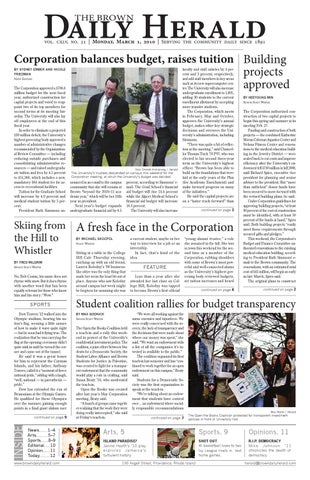
The Corporation authorized construction of two capital projects to begin this spring and summer at its meeting Feb. 27. Funding and construction of both projects — the combined Katherine Moran Coleman Aquatics Center and Nelson Fitness Center and renovations to the medical education building in the Jewelry District — were scaled back to cut costs and improve efficiency after the University’s endowment fell $740 million in fall 2008, said Richard Spies, executive vice president for planning and senior adviser to the president. But “more than sufficient” donor funds have been secured to move forward with the revised building plans, he said. Under Corporation guidelines for approving building projects, “at least 90 percent of the cost of construction must be identified, with at least 50 percent of the funds at hand,” Spies said. Both building projects “easily meet those requirements through secured gifts and pledges.” This weekend, the Corporation’s Budget and Finance Committee authorized renovations to the existing medical education building, according to President Ruth Simmons’ email to the Brown community. The renovations, with an estimated total cost of $45 million, will begin as early as late March, Spies said. The original plans to construct
continued on page 4
continued on page 2
continued on page 3
Skiing from A fresh face in the Corporation the Hill to Whistler By Michael Skocpol Staf f Writer
By Fred Milgrim Sports Staff Writer
No, Bob Costas, his name does not rhyme with snow. But it does rhyme with another word that has been equally relevant for those who know him and his story: “Wow.”
SPORTS Dow Travers ’12 walked into the Olympic stadium, bearing his nation’s flag, seeming a little unsure of how to make it wave quite right — but he soon had it flying true. The realization that he was carrying the flag at the opening ceremony didn’t quite sink in until he turned the corner and came out of the tunnel. He said it was a great honor for him to represent the Cayman Islands, and his father, Anthony Travers, called it a “moment of fierce national pride,” adding with a laugh, “well, national — in parenthesis — pride.” Dow has extended the run of Brunonians at the Olympic Games. He qualified for these Olympics over the summer, gaining enough points in a final giant slalom race
inside
continued on page 9
News......1–4 Arts.........5–7 Sports......8–9 Editorial.....10 Opinion......11 Today........12
www.browndailyherald.com
Sitting at a table in the College Hill Cafe Thursday evening, catching up with an old friend, Lauren Kolodny’s ’08 businesslike attire was the only thing that made her seem the least bit out of place. Anyone who saw Kolodny around campus last week might be forgiven for assuming she was
a current student, maybe on her way to inter view for a job or an internship. In fact, that’s kind of the idea.
FEATURE Less than a year after she attended her last class on College Hill, Kolodny was tapped to become Brown’s first official
By Heeyoung Min Senior Staff Writer
Student coalition rallies for budget transparency By Max Godnick Senior Staf f Writer
The Open the Books Coalition held a teach-in and a rally this weekend in protest of the University’s confidential investment policy. The coalition, a joint effort between Students for a Democratic Society, the Student Labor Alliance and Brown Students for Justice in Palestine, was created to fight for a transparent endowment that the community would play a role in crafting, said Susan Beaty ’10, who moderated the teach-in. Open the Books was created after last year’s May Corporation meeting, Beaty said. “A bunch of groups came together realizing that the work they were doing really intercepted,” she said at Friday’s teach-in.
“We were all working against the same enemies and injustices. We were really concerned with the secrecy, the lack of transparency and the decisions that were made about where our money was spent,” she said. “We want an endowment with a list of all the companies it’s invested in available to the public.” The coalition organized its first teach-in last semester and has “continued to work together for an open endowment on this campus,” Beaty said. Students for a Democratic Society was the first organization to speak at the teach-in. “We’re talking about an endowment that students have control over ... an endowment where socially responsible recommendations Max Monn / Herald
continued on page 3
The Open the Books Coalition protested for transparent investment policies in front of University Hall.
Arts, 5
Sports, 9
Opinions, 11
island paradise? Janine Heath’s ’10 play ex p l o re s Ja m a i c a ’s turbulent history
shot out W. basketball loses to two Ivy League rivals in last home games
r.i.p. democracy M i ke J o h n s o n ’ 1 1 chronicles the death of democracy
195 Angell Street, Providence, Rhode Island
herald@browndailyherald.com
Page 2
THE BROWN DAILY HERALD
C ampus N EWS news in brief
Professor creates culturally adapted smoking treatment Latino smokers respond better to a specially adapted smoking cessation program that is “culturally appropriate,” according to a new study from Belinda Borrelli, professor of psychiatry and human behavior. No other studies have focused on Latino smokers who are caregivers to children with asthma, though asthma is particularly prevalent among Latino children, Borrelli said. Latinos — the largest minority group in the United States — have received the least education about smoking, and parents of asthmatic children smoke as much as the rest of the Latino population, according to her study. Borrelli called the study “a double whammy, because it has an effect on both parent smoking and child asthma.” The study gave about half of the participants a culturally adapted smoking cessation treatment, Borrelli said. This intervention took an approach “consistent with Latino values” and “focused on the family.” For this group, the study placed nicotine monitors on asthmatic children of Latino caregivers and in their homes to measure smoke levels. After a week, caregivers were told about the negative effects of the smoking. The warnings took the form, “It is as if little Maria smoked x number of cigarettes,” Borrelli said. Caregivers also received information on the effects of secondhand smoke on asthma, and how quitting could alleviate these dangers, according to the study. The other half received a treatment that was not specially adapted and followed “clinical guidelines” for smoking cessation, according to the study. These participants did not receive nicotine monitors. “Latinos responded and quit smoking more with a culturally adapted intervention,” Borrelli said. After three months, 28.2 percent of caregivers that received the specially adapted treatment had completely stopped smoking, as compared to 17.7 percent of caregivers who had received the standard treatment, according to the study. Borrelli said the research, which took about three years to complete, has resulted in “one treatment that affects two health conditions.”
— Sofia Castello
sudoku
Monday, March 1, 2010
“We are sitting on top of what used to be a neighborhood.” — Samantha DeAndrade ’12
TWC sponsors Cape Verdean culture event By Ashley Aydin Contributing Writer
Claire Andrade-Watkins grew up minutes away from Brown’s campus. Andrade-Watkins, an associate professor at Emerson College and a visiting scholar at Brown’s Center for the Study of Race and Ethnicity in America, lived in Providence’s Fox Point neighborhood — an experience she shared at the opening convocation of Cape Verdean Heritage Weekend, which celebrated Cape Verdean culture in the local community. “Cape Verdeans make up a large part of Brown’s working community, and it usually goes unnoticed,” said Samantha DeAndrade ’12, the convocation’s programmer. The weekend is one of many series the Third World Center sponsors annually. The weekend’s aim was to “promote the awareness and presence” of Cape Verdean culture, DeAndrade said. The weekend held four main events: an opening convocation, a Cape Verdean student and alumni mixer, a presentation and discussion about local Cape Verdean
communities and a workshop on styles of traditional Cape Verdean dance. The weekend’s opening convocation focused on a specific issue that hits close to home for the local Cape Verdean community — the gentrification of nearby Fox Point. It is important to understand that “Brown sits on Cape Verdean territory,” DeAndrade said. She said that as Brown expanded, it took over the Cape Verdean community. “We are sitting on top of what used to be a neighborhood,” she said. In Andrade-Watkins’s speech in Andrews Dining Hall, which drew around 170 attendees, including faculty, students and local residents, she described a once-vibrant Cape Verdean community in Fox Point. But as the years went by, she witnessed the incremental destruction of her neighborhood — symbolized by a house becoming a parking lot. “Things were torn down, and people were getting scared,” she said, calling what happened to the neighborhood a case of “urban genocide.” Andrade-Watkins said that, as
a little girl, she prayed for the destruction of her community to end. “What happened, Mr. Brown?” she said. “Why do you still have your house, and I don’t?” Gavriel Cutipa-Zorn ’12 said it is important to recognize the history that Brown has with the Cape Verdean community. “We should encourage that in the community of color, Cape Verdean culture is respected,” CutipaZorn said. The convocation, which was organized by the Cape Verdean Steering Committee, also included a musical performance by the band Fidjus di Fazenda and a performance by Victorious Dance Group, which incorporated different styles of traditional Cape Verdean dance. Drummer Tony Fonseca also performed, inviting guests to form a circle and participate in making Afro-Caribbean beats with tambourines and cowbells. The convocation concluded with samples of Cape Verdean food and an exhibit featuring the works of local artists. “This is what histor y’s about. If you don’t catch it, it’s gone,” Andrade-Watkins said.
UCS continues to work on advising By Roberto Ferdman Contributing Writer
When the Undergraduate Council of Students released its 2009–10 agenda, it highlighted the goal of reviewing advising at Brown. Following its pledge, UCS delivered an “Advising Review” report to the Office of the Dean of the College at the end of last semester. In a brief list of recommendations, the repor t touched upon objectives ranging from expanding online advising resources to the University’s continued commitment to class-specific programs, such as the new Matched Advising
Program for Sophomores, said Taj Moore ’11, former UCS academic and administrative af fairs chair. “It’s about getting our ideas on paper, saying, ‘This is what we would like to see,’ ” he said. Many of the recommendations made in the report are either currently being implemented or are in the works, said Dean of the College Katherine Bergeron. “We are impressed with the thoughtfulness of the ideas and suggestions. We are also pleased that a number of issues raised point to things that we are now doing,” she said. In order to produce the report, UCS researched advising at Brown and other peer institutions such
as Cornell and Yale, said Jennifer Bloom ’12, current chair of the Academic and Administrative Affairs Committee. “It’s about taking the best from ever y school we investigated and seeing how we can adapt it to Brown,” Moore said. The Office of Dean of the College has yet to issue an of ficial response to the report, but UCS is pleased to have laid out the results of their research, said UCS Vice President Diane Mokoro ’11. Bergeron said she expects both sides to meet on the matter shortly. “As soon as we have our next meeting, I imagine that we will discuss next steps,” she said.
Aquatics and fitness center design approved continued from page 1
Daily Herald the Brown
Editorial Phone: 401.351.3372 | Business Phone: 401.351.3260 George Miller, President Claire Kiely, Vice President
Katie Koh, Treasurer Chaz Kelsh, Secretary
The Brown Daily Herald (USPS 067.740) is an independent newspaper serving the Brown University community daily since 1891. It is published Monday through Friday during the academic year, excluding vacations, once during Commencement, once during Orientation and once in July by The Brown Daily Herald, Inc. Single copy free for each member of the community. POSTMASTER please send corrections to P.O. Box 2538, Providence, RI 02906. Periodicals postage paid at Providence, R.I. Offices are located at 195 Angell St., Providence, R.I. E-mail herald@browndailyherald.com. World Wide Web: http://www.browndailyherald.com. Subscription prices: $319 one year daily, $139 one semester daily. Copyright 2010 by The Brown Daily Herald, Inc. All rights reserved.
“an entirely new medical building at a cost of $80 million” were reevaluated after the financial crisis, Spies said. While renovations “won’t be as visible to people as a new building,” the new additions will establish a central hub for medical students, he said. “It’s the first time that the medical school will have a visible home that will meet the higher caliber of its students.” Like the medical education building, other capital projects in the next five to seven years will focus on improvements to existing buildings and maintenance, said Executive Vice President for Finance and Administration Beppie Huidekoper. There will be an audit beginning this year of all improvements that need to be made to existing buildings, and those will be proposed to
the Corporation Facilities and Design Committee as the next capital projects, Huidekoper said. “What’s coming in the next five to seven years is a combination of the conditions study and things that we want to do,” Huidekoper said. “There have been a lot of good projects, and there are still things we’d like to do.” The Budget and Finance Committee also approved the design for the new aquatics and fitness centers, according to Simmons’ e-mail. The committee authorized the construction of the combined center to begin during the summer, Spies said, and it is on schedule for completion in fall 2011. The total budget — including the development of a green quadrangle to replace the existing parking lot at the athletics complex — is $46.6 million, he said. “We originally planned on the aquatics and fitness centers to be two
separate buildings,” Spies said, but after last year’s endowment losses, “we went back and came up with projects that were more efficient,” Spies said. Each center is smaller than originally conceived, he added, “because they will share common infrastructures like lobbies and bathrooms.” The combined center will feature exercise areas and a 56-meter pool for all students as well as conditioning facilities for intercollegiate athletes, according to Simmons’ e-mail. The Stephen Robert ’62 Campus Center and the Perry and Marty Granoff Center for the Creative Arts are on schedule for completion in September and December of the 2010–11 academic year, respectively, Spies said. — With additional reporting by Sydney Ember and Nicole Friedman
Monday, March 1, 2010
THE BROWN DAILY HERALD
C ampus N EWS
Page 3
“The school belongs to those who live here.” — Will Lambek ’10
Simmons plans to remain president past next year continued from page 1
A merging of minds: cognitive sciences and psychology departments to join
60,000
50,000 Tuition ($)
40,000
Year
and increasing revenue. “The other two budgets are expected to come out even or create a small surplus,” Huidekoper said. The University now plans to spend $100 million less in the fiveyear period that began in July than it projected in 2008, she said. Huidekoper said the budget reductions will also include layoffs for University employees. Plans for the cuts will be determined “in the next couple of weeks,” she said, adding that the University will try to find other vacant positions within the University for those who are laid off. Those who cannot be hired elsewhere will receive severance packages similar to those announced last year, she said. Simmons wrote that the budget is now “balanced both financially and programmatically.” Despite the reductions, “we’re not short-shrifting the programs
2010–11
2009–10
2008–09
2007–08
2006–07
2005–06
2004–05
2003–04
2002–03
2001–02
30,000 2000–01
initially expected, putting them in a position to impact current students. The Corporation expressed a desire to build upon the Plan despite the financial climate, Tisch said. “There is also still a great degree of caution about the overall economic environment,” he said. “There was a tone of, in many cases, building caution, optimism and prudence.” The Corporation also asked Simmons to stay beyond the 2010–11 academic year, he said. Her agreeing to remain Brown’s president means she will “be at Brown for more than ten years,” he said. “It will ensure that there is no low in a transition that coincides very much with the end of the campaign.” The newly approved operating budget — which includes the general budget as well as those for the Division of Biology and Medicine and auxiliary services such as the Office of Residential Life and Brown Dining Services — is 3.9 percent bigger than this year’s budget. Before the University endowment fell by $740 million to just over $2 billion at the end of 2008, budgets were projected to increase by 5 percent each year over the next five years. “The biggest cuts really came from the Organization Review Committee recommendations,” said Executive Vice President for Finance and Administration Beppie Huidekoper. She said the proposals, which were unveiled in a report released Feb. 2, outlined $14 million in total budget reductions including streamlining administration in key areas
Undergraduate Tuition and Total Fees
Marlee Bruning / Herald
in order get to a balanced budget,” Huidekoper said. By increasing financial aid and faculty and staff salaries, the University is not “sacrificing programs” to reduce the deficit, she said. The budget also emphasized academic initiatives such as graduate partnerships with other institutions. “Where we have national or international quality partners in other institutions, we can build strength in ways that we can’t just do directly,” said Provost David Kertzer ’69 P’95 P’98. The Corporation also approved the merging of the Cognitive and Linguistic Sciences and Psychology departments and authorized the University to begin construction on the new aquatics and fitness center and medical education building. It also reelected Jerome Vascellaro ’74 P’07 as its vice chancellor.
The Corporation approved the merging of the Department of Cognitive and Linguistic Sciences and the Department of Psychology into a single department at its meeting Feb. 27. While the two departments will merge when the next fiscal year begins July 1, they will not move into the renovated Metcalf Chemistry and Research Laboratory until fall 2011. This merge has been a “long time in the making,” said Provost David Kertzer ’69 P’95 P’98. Though the Department of Cognitive and Linguistic Sciences broke off from the Department of Psychology in 1986, the divide had downsides for both departments, Kertzer said. “If you take (cognitive and linguistic science) out of the psychology department, you have a department that is by nature weakened,” he said. Furthermore, both departments had difficulty attracting top faculty members, who “couldn’t understand why the departments were split,” he said. The University originally planned to build a Mind Brain Behavior Building to house the new department, but those plans were scrapped last year in favor of renovating Metcalf, saving around $30 million, The Herald reported in July. While the Corporation has not yet authorized construction on Metcalf, the University has raised more than half of the money needed for the renovation and is “confident” the Corporation will give the go-ahead at its May meeting, Kertzer said. During the 2010–11 academic year, most of the Department of Cognitive and Linguistic Sciences will be relocated to Wayland Square, while psychology faculty members will remain in Hunter Laboratory. The physical division of the newly merged department next year “shouldn’t impact the student experience,” Kertzer said. At the Feb. 2 faculty meeting, faculty members raised concerns about creating common standards for the new department regarding graduate student admissions and faculty evaluation for promotion, since each department currently has its own procedures and criteria. The faculty will decide upon common guidelines by the time of the merger in July, Kertzer said. He added that “the differences tend to be rather modest” because all departments operate under University guidelines. — Nicole Friedman
As Corporation meets, student groups press for open investments continued from page 1 are enforced,” SDS member Haley Kossek ’13 said at the teach-in. “You can look online, you can look in Morning Mail, you can look in the (Undergraduate Council of Students) minutes, on Google, on J-Stor, you can go down to the investment office on Ship Street if you’re so inclined and ask for a copy of all the companies that Brown is invested in, YouTube it,” Kossek said. “But you won’t find it because it’s not there.” She also said most of the University’s endowment is handled and invested by external money managers who have non-disclosure policies. Other peer institutions such as Wesleyan University, Columbia and Cornell have developed more transparent investment policies in which students can access a list of their university’s investments on password-protected Web sites, she said. The University’s Advisory Committee on Corporate Responsibility in Investment Policy, or ACCRIP, is responsible for making recommen-
dations about where the University should invest. This body is inefficient in its efforts because only two of its 11 members are undergraduate students and the committee has little enforcement power, SDS member Julie Pittman ’12 said at the teach-in. “ACCRIP can only make recommendations about investment policy,” she said. “They cannot actually enforce anything.” “We want to reform ACCRIP so it has actual enforcement power over its decisions,” she added. SDS called for open ACCRIP meetings that followed a “community-set agenda” in which all students have voting power, Kossek said. “We pay tuition here. We have a right to have a say in these issues,” she said. “The open curriculum says we are empowered enough to make our own academic decisions and the same should be said about our endowment,” she added. Members from the Student Labor Alliance spoke at the teach-in against investing in companies with unjust labor policies.
“We are focusing on the way in which money that’s associated with us, as students at this University, is being used towards companies that aren’t using fair labor practices,” said SLA member Olivia Singer ’12. “If we don’t know who we are investing in, how can we know if they are implicated in bad labor practices?” she asked. SLA members said they recently learned that Brown invests in HEI Hotels and Resorts, a hotel management company that has been accused of worker harassment and unfair labor policies. “There is a good chance we are invested in lots of other labor companies that have the same horrible labor practices,” said SLA member Jesse Strecker ’10. The third group involved in the coalition, Brown Students for Justice in Palestine, called for “Brown to divest from companies that profit from the illegal occupation of the Palestinian territories,” Ruhan Nagra ’10 said. Nagra referred to the “Boycott, Divestment and Sanctions” movement that was launched by a coali-
tion of Palestinian NGOs in 2005 to stop funding of “Israel’s human rights violations.” “We feel that we can most effectively respond to the call for (divestment) by ending our complicity as Brown students in violations of human rights and international law in the occupied territories,” she said. “Our campaign here at Brown is part of a global struggle for injustice in Palestine.” The organization pointed to several large companies, including General Electric and Caterpillar, as being involved in Israel’s efforts against Palestine and urged Brown to divest from them. Because of the University’s confidential investment policy, the group does not know if the University invests in these companies. The coalition held a rally in front of University Hall where the Corporation was holding its Saturday meeting. Although the rally was planned for 11 a.m., some members of the coalition were outside the building at 7 a.m. to confront Corporation members as they entered the meeting. “We had some really good con-
www.blogdailyherald.com
versations and some not good conversations,” said Will Lambek ’10, a member of the coalition. In his address to the protestors, Lambek referenced a conversation with a Corporation member. The member said, “When you’re on a plane, you let the pilot fly and you sit in the back,” according to Lambek. “We have to reject the notion that other people know better than we do what sort of values this University has and how those should be represented by our endowment and investment,” Lambek said to the protesters. “The school belongs to those who live here, those who work here, those who study here — that means students, faculty and staff,” he said. “Pretty much everybody except the people up there,” he added, referring to the Corporation. The protesters spent about half an hour circling University Hall while chanting calls for an open investment policy, before directly confronting the Corporation members as they exited the building.
Page 4
F eature
THE BROWN DAILY HERALD
Monday, March 1, 2010
“Everyone was so welcoming, and so receptive.” — Lauren Kolodny ’08 on being the first young alumni trustee
Young alumni trustee finds Corporation welcoming, open continued from page 1
reports from top administrators. Kolodny, 24, is not exactly new to this world. She was an active member of the Undergraduate Council of Students during her time at Brown and interacted regularly with administrators and Corporation members, first as UCS’s Corporation liaison and later as its vice president. But ser ving on the board is still heady stuf f — not many twenty-somethings can say that Ruth Simmons repor ts directly to them, after all. Was she intimidated? “Not intimidated,” Kolodny said. “Impressed.” “Obviously I was a little nervous coming into it,” she said. “But they were really welcoming, ever yone was so welcoming, and so receptive, and really excited about having a young alum on the Corporation and getting that perspective.” Kolodny has been “ver y, ver y, ver y warmly received by the Corporation, both for who she is and what she has to contribute,” said Chancellor Thomas Tisch ’76 P’07, who was actively involved in creating the young alumni trustee position and choosing Kolodny to fill it. Kolodny’s appointment is part of a larger effort undertaken by
the Corporation under Tisch’s leadership to temper its reputation for opacity and any sense that its members — almost all of whom graduated at least two decades ago — are far removed from the concerns of student life. Though she is the first young alumni trustee, the Corporation intends to add more soon, said Tisch. But, for now, Kolodny is the sole young alum charged with injecting that youthful perspective and representing the student body’s interests. It’s a big responsibility and a “tremendous opportunity,” she said. “I don’t mind feeling like I’m the young one,” Kolodny said. “I’m fine with that. I think that’s kind of cool.” “What I care about is being respected and being taken seriously,” she added. “So far, I am.” ‘A trustee as anyone else is’ It was 2 a.m. last April, and Kolodny was on a bus headed for a whitewater rafting expedition on the Ganges River when she got word — by way of an e-mail from Tisch — that the Corporation wanted her to fill the position. Kolodny, who spent 2009 living and working in New Delhi to promote solar energy for the Clinton Climate Foundation, knew of the
campaign to create such a position through her work on UCS, but she said she had no idea she was being considered for it. She spoke to Tisch by phone a few days later and accepted the job. She was “thrilled” and “incredibly honored” by the appointment, she said. Now that she’s stepped into the role, she said she was struck by how welcoming Corporation members were right off the bat. “Of course, there’s going to be a level of, am I kind of a token member?” Kolodny said. “But no, I’ve been told time and time again that I’m a trustee as anyone else is.” “I was surprised how I often I was called upon to answer questions about different things,” she added, and even Simmons reached out to her several times in the first meeting. “She’d be like, ‘Students are kind of feeling like this — wait, Lauren, is this how students are feeling?’” Kolodny said. Catching up Though Kolodny’s first visit was something of a whirlwind — she flew back from India for her first Corporation meeting in October, diving straight into meetings fresh of f a 24-hour journey and thoroughly jet-lagged, she said — she
arrived on campus a day early this time around and spent much of Wednesday and Thursday meeting with students and professors. (That old friend in the bookstore cafe? UCS President Clay Wertheimer ’10. Kolodny said the conversation was about half business and half a chance to catch up.) Though embodying the full perspective of the student body in a single person is a tall order, Kolodny said she’s tr ying hard to listen to others and gauge the campus mood in order to represent students’ views faithfully. She noted that she has experience with that “same process” from her time on UCS. “You get a sense of where the campus is leaning,” she said. “I think I’m good at hearing that.” She intends to strike a balance between being a voice of student opinion more broadly and advocating for issues she cares about and has experience with personally, she said. At the Corporation’s meeting this weekend, Tisch said, Kolodny offered her take on expanding Brown’s student body with more transfer students to bring in new revenue. Kolodny, a San Diego native who transferred to Brown from the University of California at Los Angeles before sophomore year, stressed the impor tance of “being sure that we had suf ficient support and ser vices for transfer students, particularly around advice and counseling,” Tisch said. “The fact that Lauren could speak to those as someone who was a transfer student at Brown was very helpful.” Kolodny, who spearheaded the “Brown is Green” ef for t to encourage closer collaboration among environmental advocates on campus, said she hopes to use her position on the Corporation to continue promoting environmental awareness and collaboration. The international relations concentrator launched a nonprofit to provide alternative-fuel cooking stoves to women in rural Tanzania while at Brown, and she said she is interested in promoting entrepreneurship while on the Corporation. Coming full circle Professors and others who knew her at Brown said Kolodny is well-suited to hold her own on the Corporation. Clinical Professor of Engineering Josef Mittlemann, who taught Kolodny in ENGN 1930F: “Entrepreneurship and Good Work” during her last semester on campus, said Kolodny is “able to think on both sides of an issue” and has a “full complement of social skills as well as intellectual skills” that she can use to “argue convincingly for those things that she believes in.” Professor Emeritus of Engineering Barrett Hazeltine, who also worked with Kolodny, praised her as “determined” and “willing
to think for herself.” “She’ll earn the trust and respect of people quickly,” he said, calling her “gracious and sensitive.” Melea Atkins ’10, a UCS representative who worked with Kolodny when she was at Brown and spearheaded UCS’s effort to lobby for a young alum on the Corporation, said Kolodny is well-suited for the role. Because of her experiences on UCS, “Lauren knew what she was getting into a lot better than anyone else in her position could have,” Atkins said. “She’s really proactive about making sure that she gets student input,” she added. Tisch echoed many of those qualities in explaining why the Corporation tapped her to pioneer the young alumni trustee role. Corporation members’ familiarity with her work on UCS made them comfortable selecting her, he said. “She clearly has a very collegial way of working with others,” he said. “She’s ver y balanced and a good listener.” He and other Corporation members have been pleased with the role she’s played in her first two meetings, he said. “There’s been just excitement about what it does to our deliberation,” he said. “She has helped to solidify the importance of the position for the Corporation.” A two-way bridge Having recent graduates on the Corporation is an important part of the ef for t to ground the Corporation’s discussions in a better understanding of how students and young alums see the University, Tisch said, a goal Kolodny shares. But Kolodny sees her role as twofold — she wants to “demystify” the Corporation for students as well. “If I am going to be a bridge here, I need to be a bridge for the students, but I should also do the opposite,” she said. “I want to help students understand how they can better be heard by Corporation members, because I think they’re willing to listen when students take the right avenues.” The Corporation is not the shadowy body that some perceive it to be, she said. The light and open atmosphere of the meetings surprised her. “There’s just this really nice rapport,” she said. “You can tell that people really like each other, that they’re friends. People are making jokes all the time — not all the time, but they’re making jokes.” “It feels a lot more casual — it’s not stuf fy and pretentious,” she said. “It’s people who care about something, who are sitting around tr ying to figure out how to make it work the best it possibly can.” That’s an atmosphere she’s glad to be a par t of, even if, for now, she’s the junior of ever yone else in the room by more than a decade.
Arts & Culture The Brown Daily Herald
Monday, March 1, 2010 | Page 5
Student’s play examines Jamaica’s history By Kristina Fazzalaro Staf f Writer
Courtesy of Allen Look
Rites and Reason performed “Our Hands Are Sore from Praying.”
Jamaica is an island paradise both idyllic and charming — for foreigners, maybe. For Jamaicans, paradise is a concept lost to years of oppression and fighting. In “Our Hands Are Sore From Praying,” playwright Janine Heath ’10 explores Jamaica’s exploited past, turbulent present and unsure future. Rites and Reason Theatre, together with the Depar tment of Africana Studies, presented the one-act play Feb. 26–28. The show began with director Connie Crawford, adjunct lecturer
Alums honored for arts achievements By Sarah Mancone Senior Staf f Writer
The Rhode Island State Council on the Arts recognized Visiting Lecturer in English Michael Stewart MFA’07 for fiction and poetr y and Jamie Jewett PhD’08 for choreography and film this year. Stewart was featured in the 2010 RISCA Fellowship Exhibition at the Imago Galler y in Warren. Jewett, the director of a multimedia dance theater company, received the 2010 Fellowship Merit Award in Choreography as well as a 2010 Project Grant for his film project, “Melt.” Receiving this award feels “wonderful,” Stewart said. It is a “big award,” he added. It is nice to “get recognition within the state,” he said. “The state’s ver y supportive.” Stewart started his reading at the Fellowship Exhibition on Feb. 19 with narrative fiction and then progressed into poetr y to provide “a mixture of the two,” he said.
Stewar t combines prose and poetry because he likes the reader to not be sure how to read his work and to have to pay close attention, he said. In his writing, Stewart likes to focus on topics with a “fair y tale view,” he said. He uses themes such as the “histor y of stage magic” and “parallels between spells and cookbooks,” he said, adding that he also is willing to write about topics usually reserved for women. His writing is meant to convey a “sense of wonder” and a “loose distance from realism,” he said. This includes working on a common object and finding it not so common, he added, and making ever yday things seem unfamiliar. Cur rently, Stewar t teaches classes at Brown in creative nonfiction. Stewart said he liked the program because it “really puts an emphasis on research.” “I really like the attitude that students come in with,” he said. In addition to teaching, Stewart
is writing a book based on the life of a man who studies Egyptian hieroglyphics, he said. Stewart said he has been and plans to continue writing about Kyoto, Japan. He plans on traveling to Kyoto and spending a few months there while he writes about southern Japanese superstitions and beliefs, he said. The inspiration for his writing comes from “ever ything,” Stewart said, including “childhood experiences and dreams.” Working at Brown has definitely helped to improve his writing, Stewart said. Colleagues showed him how to tighten his lines and advised him, “don’t pause, just keep pushing further and further.” Stewart said he also benefits from students’ comments on their assigned readings. Each time he brings a piece of literature into the classroom, his students help to “open it up in a way that wouldn’t have been possible” by just using his own perceptions, he said.
Deadly Syndrome features ’04 alum By Sara Chimene-Weiss Contributing Writer
As an undergraduate at Brown, Michael Hughes ’04 concentrated in histor y and took classes on topics as varied as visual art and colonial Latin America. These days, he’s in a band called The Deadly Syndrome, which will release its second album, “Nolens Volens,” on March 23. Hughes and bandmate Jesse Hoy first began playing and writing songs together about four years ago, when Hoy’s girlfriend at the time — now his fiancee — introduced them, Hughes wrote in an e-mail to The Herald. Hughes credits Hoy as the band’s organizer — he had written songs with guitarist Will Etling when they were at the University of California at Santa Barbara together, and the band’s fourth member, Chris Richard, was Hoy’s co-worker. “Before we knew it, we were all in a ‘band,’ ” Hughes wrote.
“If (Hoy) hadn’t come along, I’d still be making songs on my laptop, for no one,” he wrote, “or I’d be a stock broker or some terrible thing, and have millions of dollars.” Originally, the band signed with Dim Mak Records and released its first album, “The Ortolan,” in 2007. The record received positive reviews from a variety of newspapers and music magazines, including the Los Angeles Times and Pitchfork Media. It was even reviewed positively by Les InRockuptibles, a French music magazine. Over the past four years, they’ve toured parts of the countr y with bands such as Hot Hot Heat and Edward Sharpe and the Magnetic Zeros. Hughes described the band’s influences as wide-ranging, including rock, classic rock, punk and “glitchy electronica.” “Whatever serves the songs we are tr ying to write at the time … it’s important not to feel limited by
defining yourself within a specific ‘genre,’ ” he wrote. He also described the band’s stylistic evolution over time. Initially, their sound was largely influenced by folk music, but over time, they “began incorporating more electronics, ambient textures and harsher tones,” he wrote. Hughes credited a computer music class he took with Barr y Moon, a former visiting professor, with first inspiring his love for music. Most recently, the band played a show Feb. 19 at the Beauty Bar in San Diego. According to Hughes, the stage at the Beauty Bar is outdoors, and the cloth covering the stage is not completely waterproof. It rained during the show, which caused their equipment to become wet during the opening act, Hughes wrote. “We dried it off as best we could, turned it all on, played the show and didn’t get shocked and die, which I think … makes the night a success.”
in theatre arts and performance studies, taking the stage to welcome the audience. Immediately the pulsing beats of Jamaican music began to drown her out. “I said not yet, guys!” she said with a laugh. The music got louder as the cast rushed on stage from all directions and shouted at the audience, “Shut off them cell phones!” The play tells the stor y of two young Jamaican men. George Gayle, played by Providence actor Jo-’an Peralta, is a first-generation American citizen working to redeem his nation. Mocho George, played by Bradley Toney ’10, is a Jamaican immigrant to New York, failing to make his way as a writer
in the face of prejudice. The link between the two is Sophie, played by Nkecki Eze ’12, a young Jamaican woman who used to date Mocho before he left for America. When George Gayle comes to the island full of naive hope, she is instantly drawn to him and the potential escape he represents for her and her little brother, played by Steven Kouame, a local middle schooler. George Gayle is equally attracted to Sophie and, as he learns the depth of Jamaica’s problems, becomes determined to get her and her brother far away from the continued on page 6
Page 6
THE BROWN DAILY HERALD
A rts &C ulture
Monday, March 1, 2010
“We hope tonight will help us get closer to our fellow Caribbeans in Haiti.” — Yanely Espinal ’11
From personal experience, an experimental play continued from page 5 danger the current political regime is imposing on its people. In contrast, Mocho is deported from the United States after getting arrested for dealing drugs. Back in Jamaica, Mocho is determined to get Sophie back, but she is not interested. George Gayle is not at all impressed by Mocho and tells him, “Men like you should be saving this countr y, not killing it.” Narrating this stor y and one of their own are the Chief and Nanny of the Maroons — the characters Heath said she feels most connected with — played by Matthew Thanabalan ’10 and L ynsey Ford ’10. The Maroons were a group of runaway slaves who established free settlements throughout Jamaica in the 18th centur y. The term is still used today for their modern descendents. The Chief and Nanny give audience members a look into the Jamaica’s past while
simultaneously guiding us through the lives of George Gayle, Mocho and Sophie. The play actually started out as a single spoken word piece between the two and grew from there, Heath said. Heath has been a spoken word artist for several years, but “Our Hands Are Sore From Praying” was her first venture into theater, she said. She was inspired to write the play after a professor during her junior year said Jamaica was considered a failed state, she said. Coming from a Jamaican family, this statement upset Heath but also got her thinking about her role in her countr y’s experiences, like George Gayle does in the play. “It started as a personal examination of my place in the dialogue,” she said. Researching information for the play, Heath spent a good portion of time speaking with family mem-
bers and others about both life in Jamaica and life in America, she said. “Our Hands” is essentially the stor y of any immigrant losing his or her foundations and not being able to reclaim them, Heath said. In addition to speaking with family, Heath also delved into Jamaica’s culture and histor y and incorporated much of what she found into the play. For example, Heath included characters such as the British queen, the American king and the devils from the Junkanoo band, a Jamaican tradition, she said. The devils in “Our Hands” are played by Alexandra Bernson ’12 and Kiana Alzate ’10. The two represent a loss of hope, togetherness and virtue as they try to control the characters’ situations. “They represent the dark, internal voices we have,” Heath said. “It’s not clear if they actually exist or if they are just in each of the characters’ minds.”
The devils taunt Mocho and push him to work as a drug dealer, mock Sophie’s dreams of leaving Jamaica and ridicule George for being a “black man with a white man’s burden” since he has come to Jamaica to “educate the savages.” Despite the obvious animosity among the characters, the cast and crew have a wonderful off-screen chemistr y. “The actors did such an amazing job,” Heath said. “I just wrote words, but they made it whole.” The interactions between cast and crew were also great, as can be seen in the mutual praise Heath and Eze have for each other. “Nkechi is ver y impressive,” Heath said. “She got the accent on the first day and she’s not Jamaican.” Heath also said that she had to thank Crawford for getting the ball rolling and interpreting the script. The play is also a result of Rites
www.blogdailyherald.com
and Reason Theatre’s Researchto-Perform Method, in which students’ plays are developed based on research and a thesis. The entire cast and crew had a chance to interpret the material and help shape the final project. “I loved working with the Rites and Reason Theatre because they emphasize research and personal responsibility,” Eze wrote in an email to The Herald. “As a result, mutual respect was developed in the course of the rehearsals and it is an experience I will never forget.” The overall result was a fastpaced and thoroughly entertaining play that got audience members thinking about a nation known usually as an island retreat in an entirely new light. “It was an interesting and different experience,” Carolyn Lee ’10 said after viewing the production. “It was a more interactive way of putting on a play.”
Page 7
THE BROWN DAILY HERALD
A rts &C ulture Charity showcase raises funds for Haiti relief By Fei Cai Contributing Writer
The screen went dark, the small crowd in Salomon 101 hushed and the video began. “The recent earthquakes in Haiti have killed over 230,000 victims,” it read. The haunting words from Cuban artist Above’s work, “Help Thy Neighbor,” started off the Saturday night Caribbean Heritage Week event, Applause for a Cause: Haiti Relief Charity Showcase. Student groups, including Brown Badmaash, Divine Rhythm, Mezcla and Juggling Club, as well as individual spoken word performers, showed off their talents while raising money for Haiti. Proceeds from Applause for a Cause, one of Caribbean Heritage Week’s six events, will go toward Ann EDER, a U.S.-based organization founded in 2009. The organization was formed to help children of impoverished rural families receive an education. Recently, it has also provided aid to rural Haitians who were affected by the earthquake but are too poor to get to Red Cross centers, which are usually stationed in cities. Event co-coordinators Yahellah Best ’11 and Yanely Espinal ’11
hosted the show. “These shows usually run well,” said Camilla Spinola ’10, a member of Mezcla. “We hope tonight will help us get closer to our fellow Caribbeans in Haiti,” said Espinal during the show. Best said she wanted Brown students to understand that though they are not physically connected to the Caribbean, those of Caribbean heritages still hold on strongly to their identities. “When people think of the Caribbean, they think of Jamaica and vacations,” Best added. “They don’t always know about the problems. We are focusing on diaspora, the relation between the Caribbean peoples in the U.S. and those in the Caribbean.” The performances did not all reflect Caribbean culture. Though Mezcla danced to a Puerto Rican song, “El Ritmo No Perdona” by Daddy Yankee, Juggling Club came out in unicycles and wowed the crowd by tossing bowling pins and knives back and forth. Upcoming events for Caribbean Heritage Week include a Caribbean movie night and a panel on self-identity.
www.diamondsandcoal.com
Monday, March 1, 2010
“We hope tonight will help us get closer to our fellow Caribbeans in Haiti.” — Yanely Espinal ’11
F ro z en fla g
Sofia Castello / Herald
The American flag on the Main Green waves at half mast in the winter wind.
SportsMonday The Brown Daily Herald
Scoreboard
Monday, March 1, 2010 | Page 8
W. basketball
M. Basketball
M. hockey
M. Track
Brown 54 Harvard 65
Brown 71 Harvard 91
Brown 3 Quinnipiac 8
W. Track
Brown 29 Dartmouth 51
Brown 76 Darmouth 57
Brown 3 Princeton 7
6th out of eight
5th out of eight
Gymnastics 2nd out of four
M. HOCKEY
Bears routed in weekend games By Dan Alexander Spor ts Editor
Jonathan Bateman / Herald
Tri-captain Aaron Volpatti ’10 said his team may have come out with too much energy against Quinnipiac.
All season, the men’s hockey team talked about finishing in the top eight in the Eastern College Athletic Conference standings, which would have given the Bears home ice in the first round of the ECAC Tournament. After countless hours of practice, four months and 27 games, it all came down to last weekend. But the Bears were blown out in both road games over the weekend — first by Quinnipiac, 8-3, on Friday and then by Princeton, 7-3, the following day. The losses erased any hopes of home ice in the playoffs and dropped Brown into 11th place in the ECAC standings. “It almost feels like we worked and came so far this season for nothing, really, to finish in 11th like we finished,” said forward Jack Maclellan ’12. “With all of the fan support we’ve been getting lately and how well we’ve been playing at home, it’s definitely disappointing to not be there for the playoffs.” The wins by Princeton and Quinnipiac helped both teams claim the last two spots for home ice in the playoffs. Brown, however, will have to travel to Rensselaer for a threegame series with the Engineers for the opening round of the tourna-
ment March 5 through 7. Quinnipiac 8, Brown 3 Maclellan said the Bears knew they had to win both games on the weekend to guarantee home ice in the playoffs, and tri-captain Aaron Volpatti ’10 said his team may have come out with a little too much energy. “We were pretty jacked up to go,” Volpatti said. “I don’t know if that affected how we played. It must have, because we came out pretty badly.” The Bears and Bobcats traded goals in the first nine minutes of the opening period, but then Quinnipiac rattled off five unanswered goals, gaining a 6-1 lead midway through the second period. “If they score a goal, you’ve just got to bounce back,” Maclellan said. “And if you don’t, then they’re just going to keep rolling and keep scoring. And before you know it, you’re in too deep of a hole to get yourself out of.” Francis Drolet ’13 stopped the bleeding when he scored 13:27 into the second period. But the Bobcats reopened the wound in the third by scoring two more before Brown got its final goal with less than four minutes left, making the final score 8-3.
Princeton 7, Brown 3 It didn’t get much prettier for the Bears the next night. Princeton leapt out to a 4-0 lead midway through the second period behind the leadership of forward Mark Magnowski, who had two goals and two assists on the day. “We wanted to come out strong against Brown,” Magnowski said. “They are a hard-working team, so we wanted to get an early jump on them and we did.” The 4-0 lead crippled the Bears, who are just 1-14-2 on the season in games when their opponent has scored the first goal. Volpatti called the early 4-0 deficit “deflating.” “When we get up a goal, we’re a different team,” he added. Maclellan and Jesse Fratkin ’11 scored a pair of goals for Brown two-and-a-half minutes apar t in the middle of the second period to narrow the Tigers’ lead to 4-2. But Princeton responded with three third-period goals to Brown’s one. “It was a frustrating weekend,” Maclellan said. But “dwelling on it is not going to help us either, so we’re just looking forward to next weekend and seeing how we’re going to beat (Rensselaer).”
W. BASKETBALL
Bruno falls to other Ivies in weekend games By Zack Bahr Spor ts Staf f Writer
In a league where players don’t play for scholarships but rather for love of the game, it’s almost certain that emotions are going to run high. On their final home stand, the women’s basketball team left it all on the court as they fought for the upset against the Ivy League’s secondranked Har vard and a determined Dartmouth. But the Bears still couldn’t come up with a win, falling to Har vard, 65-54, on Friday night and Dartmouth, 51-29, the next night. Har vard 65, Brown 54 Bruno put the Crimson on their heels early in the game, leading by nine points with 7:02 left in the first half. Brown was able to force 11 turnovers and box Harvard into taking tough shots. “They are the underdog with nothing to lose,” said Har vard Head Coach Kathy Delaney-Smith. “They are deep, young and athletic. They played strong — exactly how
we thought they would.” With five minutes left in the half, Harvard settled into the game and went on a run to cut the Brown lead to just two. Bruno called a time out at 1:39 to tr y and stop the Crimson’s momentum. But it didn’t phase Har vard, as the visitors continued to roll and ended the half with a five-point lead. Brown came out of the locker room and regained the lead in the early minutes, at one point leading by as much as six. It wasn’t without mishaps, though. Just eight minutes into the half, tri-captain Natalie Bonds ’10 fell to the floor holding her ankle. She had to be helped off the court, but eventually returned to the game favoring her other ankle. Emotions flared with four minutes left as a technical foul was called against Bonds after she ran into a Har vard player who was throwing her elbows. “I’m the most aggressive on the team,” Bonds said. “I play better when I’m mad.” Brown finished the game shoot-
ing 32 percent from the field and 71 percent from the line. Aileen Daniels ’12 led the Bears with 17 points. Dartmouth 51, Brown 29 Saturday evening, Bruno had a chance to move up in the Ivy League standings when they hosted the Big Green. But instead, the Bears were blown out after an uncharacteristically poor performance. Brown missed all 15 attempts from three-point range, and shot just 19 percent from the field. The Bears — who normally shoot over 70 percent from the line — made just 42 percent of their free throws. The leading scorer for the Bears was tri-captain Christina Johnson ’10, who had eight points. Dartmouth led by as many as 31 points, and placed four players in double-digit figures. The ladies travel to Cornell Friday night and Columbia Saturday for 7 p.m. tip-offs, their final ones of the season.
Jonathan Bateman / Herald
The women’s basketball team led Harvard by nine points at one time, but ended up losing.
Page 9
THE BROWN DAILY HERALD
S ports M onday
Monday, March 1, 2010
“It was bulletproof ice.” — Olympian Dow Travers ’12, on the ski course
Skier today, rugger tomorrow: Brunolympian Dow Travers ’12 continued from page 1
in Chile. The wait for race day in Vancouver was a long one, as the temperamental conditions at Whistler were less than favorable leading up to the games. As a result, Travers and the other skiers simply couldn’t put down as many training runs as they wanted. But Travers still enjoyed the practice runs he did get. “I’ve got to say (the coolest part) was free skiing on the race course on the day before because that was my first time on a World Cup–treated course,” said Travers. The course was injected with water so it froze overnight. “It was bulletproof ice,” he said. When he crossed the finish line for the first time, he couldn’t stop smiling. And he got his wish the next day. He was the 101st competitor to start out of the gates, leaping to 75th after his first run and 69th after his second. Gene Bridgewater, his coach, told him before the race to go out there, “and give it everything you’ve got — see what happens in the end,” Bridgewater said. “On the day of, there were a little bit of nerves, but I managed to find my own zone. I can’t be thinking about what everyone else is doing,” Travers said. “In the start gate, I can only control the aspects of my racing, and let the rest come after that.” In the end, he crossed the finish line to see a contingent of Islanders, who had traveled thousands of miles to Vancouver, waving the flag and screaming his name. “This was my first time on an Olympic course, and all I had hoped was to put down two clean runs and
Courtesy of Dow Travers
Dow Travers ’12 skis underwater. The skier and rugger represented the Cayman Islands in the Vancouver Olympics.
make my country proud. I’m pretty happy with that.” More than just skiing though, Travers got to partake in the full Olympic experience. In addition to carrying the Cayman flag, he was constantly surrounded by his role models and skiing idols. “I sat next to (Swiss downhiller) Didier Cush on the bus, and since then I sat next to a few other names.” But he didn’t get to talk to them too much. “They all seemed to be pretty zoned in — I didn’t want to interrupt them.” Travers, his father and his coach
all called the Olympic Village incredible. “The atmosphere has been amazing. I was surprised by how friendly everyone was,” Travers said. “I thought some people would look down on and not be good to small nations.” Au contraire, Canada. “The people have been extremely friendly. The media is all very interested in the Cayman Islands story — a lot of press for the Caymans and for Dow himself,” Bridgewater said. Having spent so much time with the media, Travers wasn’t able to see as many other events as he would
have liked. He constantly had other athletes coming up to him, asking to trade pins with him, a tradition at the games. If all goes well, Travers could have a chance to be swapping pins at the 2016 Rio Summer Games. The International Olympic Committee just made the decision to add rugby as an Olympic sport. That’s right — the dedicated skier is also a bonafide rugger. During his first year at Brown, the freshman made Bruno’s starting rugby squad. And when Brown just so happened to be
touring the Islands, Travers faced his home country’s national team. The coach immediately recognized his talent. Since then, Travers has been playing for and starting on the Cayman team in World Cup qualifiers and North American and Caribbean championships. At his prep school in England, he both started the ski club and played for the rugby team. “He’s a fierce tackler, and he’s developed extra strength and training from skiing,” Travers’ father said. Don’t forget the name Travers — it seems Anthony, the father of Dow, 22, Dillon, 18, and Dean, 13, is striving to make it indelible. The family often drove many miles through Europe to attend competitions. Dillon’s ski career peaked at a younger age in Europe, but Dean, the youngest, has been training in Aspen, Colo., for two years and has already won a gold medal at the Junior Olympics and a bronze at the Whistler Cup. The Travers brothers could be competing side-by-side in years to come. “My little brother is following fast in my footsteps,” Travers said. Having also attended the closing ceremonies late Sunday night, what did he mention he would miss most about leaving Olympic life and the village? “I’ve been spoiled. All Coke and Powerade products are free,” he said. “I’m going to have to buy Coke after I leave.” Check out Vanity Fair’s “Faces of the Games” slideshow online. Travers is the third athlete pictured, right behind American figure skater Evan Lysacek and snowboarder Gretchen Bleiler.
Canadian men win hockey gold in OT By Jean-Jacques Taylor The Dallas Morning News
VANCOUVER, British Columbia — Sidney Crosby is the world’s best hockey player. Or the second-best, if you prefer Alexander Ovechkin. But Crosby didn’t play like it during the first 60 minutes of the men’s gold medal hockey game Sunday afternoon at Hockey Canada Place. Actually, Crosby looked more like the 100th best player. Maybe the 200th best. He was virtually invisible unless you count the third-period breakaway he flubbed that would’ve given Canada a two-goal lead with about three minutes left. “It wasn’t a good feeling at all,” Crosby said. No worries. Sid the Kid showed up in overtime. Crosby’s fabulous effort and the goal it produced 7:40 into overtime made sure he’ll be an iconic Canadian figure for the rest of his life, while providing his country with a mesmerizing, 3-2 overtime win over the United States. Canada, where modern hockey was invented by a group of students at Montreal’s McGill University more
than 100 years ago, has now won eight Olympic gold medals in men’s hockey. Crosby’s overtime play is what separates the great players from the good players. With the game on the line, great players can exert their will and determine a game’s outcome because they have a superior skill set. It’s really that simple. It’s the reason Crosby, who signed a $43.5 million extension in 2008, has an eight-digit annual income. Zach Parise, the U.S.’s best player in the medal round, tied the score at 2-2 with 24.4 seconds left, when he whacked in a loose puck after Patrick Kane’s shot from right wing deflected off Jamie Langenbrunner’s skate. At that point, Crosby’s flubbed breakaway seemed huge. The raucous throng of red-clad Canadian fans stood in silence. They couldn’t believe it. So close to euphoria. Then Parise and the U.S. snatched it away. During the intermission before the 20-minute, 4-on-4 sudden-death overtime, Canada coach Mike Babcock decided playing the struggling Crosby even more was the best way
to win the game. He was right. A little more than seven minutes into the period, Crosby came streaking into the U.S. zone and tried to split defensemen Ryan Suter and Brian Rafalski with a nifty move most other players can’t imagine trying in practice let alone a gold medal game. The move didn’t work because Suter and Rafalski held up Crosby as he neared the goal. The puck slid into the corner, and Crosby never stopped moving. Jarome Iginla, falling to the ground as Rafalski checked him, slid a pass to Crosby, who was moving toward the net, creating a perfect give-and-go. Crosby snapped a wrist shot between goalie Ryan Miller’s pads as the crowd erupted and hockey sticks and gloves began littering the ice like confetti. Crosby, bouncing up and down in the corner, quickly found himself buried under a pile of 22 teammates shrieking like schoolgirls. Think Miles Austin and the Cowboys after their overtime win over Kansas City, then multiply it by a thousand. “A great player made a great
John Lok / Seattle Times
Team USA’s Zach Parise and Bobby Ryan tangle with Canada’s Duncan Keith during the second period of the gold medal match.
play,” said U.S. coach Ron Wilson, “and found a way to finish us off.” Crosby doesn’t just score magnificent goals and rack up ridiculous point totals for the Pittsburgh Penguins. He’s more than just an All-Star with a flashy game built for SportsCenter. At age 22, he’s a winner. Last season, Crosby led Pittsburgh to a Stanley Cup championship, a year after losing in the finals. Now, he’s earned a gold medal. As officials presented each member of Team Canada with his gold
medal, the crowd cheered. As officials approached Crosby, the roar grew louder with each step. As Crosby bent over for the medal to be draped around his neck, the crowd serenaded him, drowning out the public address announcer — “Cros-by! Cros-by! Cros-by!” “We wanted to go after it,” Crosby said of Canada’s overtime approach. “We didn’t want to have any regrets.” Canada rules the hockey world again. It can thank Sidney Crosby, the world’s best player.
Editorial & Letters The Brown Daily Herald
Page 10 | Monday, March 1, 2010
l e t t e r to t h e e d i to r
Universities are about more than facts To the Editor: In his excellently written opinion piece (“What could Brown do for you?,” Feb. 25), David Sheffield ’11 does not share my holistic view of higher learning. Where he seems to view education as the mere acquisition of facts, my own learning at Brown is fed by what I get from my classes, but takes on meaning when I am able to metabolize this knowledge — to find the connections that allow the discovery of new mean-
ings. This is accomplished through class discussions, conversations with professors and engagement with fellow students also trying to make sense of this embarrassment of intellectual riches. An online university would excel at overloading the student with facts, and falter in providing him with a sense of what to do with them. Alex Rosenberg ’11 Feb. 26
A be pressman
e d i to r i a l
Cut it out
t h e b r o w n d a i ly h e r a l d Editor-in-Chief George Miller
Managing Editor Chaz Kelsh
Deputy Managing Editors Sophia Li Emmy Liss
editorial Arts & Culture Editor Anne Speyer Suzannah Weiss Arts & Culture Editor Features Editor Brian Mastroianni Features Editor Hannah Moser Metro Editor Brigitta Greene Metro Editor Ben Schreckinger News Editor Sydney Ember News Editor Nicole Friedman Sports Editor Dan Alexander Asst. Sports Editor Andrew Braca Asst. Sports Editor Han Cui Graphics & Photos Graphics Editor Stephen Lichenstein Alex Yuly Graphics Editor Nick Sinnott-Armstrong Photo Editor Max Monn Asst. Photo Editor Jonathan Bateman Sports Photo Editor production Copy Desk Chief Kelly Mallahan Jordan Mainzer Asst. Copy Desk Chief Marlee Bruning Design Editor Anna Migliaccio Asst. Design Editor Julien Ouellet Asst. Design Editor Neal Poole Web Editor Post- magazine Editor-in-Chief Marshall Katheder
Senior Editors Ellen Cushing Seth Motel Joanna Wohlmuth
Business General Managers Office Manager Shawn Reilly Claire Kiely Katie Koh Directors Sales Kelly Wess Finance Matthew Burrows Client Relations Margaret Watson Alumni Relations Christiana Stephenson Managers Arjun Vaidya Marco deLeon Aditi Bhatia Jared Davis Trenten Nelson-Rivers Alexander Carrere Kathy Bui
Local Sales National Sales University Sales University Sales Recruiter Sales Special Projects Staff
Opinions Opinions Editor Michael Fitzpatrick Opinions Editor Alyssa Ratledge Editorial Page Board Matt Aks Editorial Page Editor Debbie Lehmann Board member William Martin Board member Melissa Shube Board member Gaurie Tilak Board member Jonathan Topaz Board member
Last week, the Center for Studies in Higher Education at the University of California at Berkeley, released a report that analyzed funding for higher education from a comparative international perspective. According to the report, the United States is an outlier in that it has responded to the current economic recession by sharply cutting public funding for colleges and universities. The authors of the report note that public colleges and universities in the United States depend heavily on cash-strapped state governments. By contrast, other countries’ central governments have made a strong commitment to education. As a result, “most nations have not thus far resorted to uncoordinated cutting of funding for higher education that we generally see in U.S. state systems.” The researchers at Berkeley have pointed out a disconcerting systemic problem. In the United States, education seems among the first on the chopping block when times get tough — it is a sector especially prone to frequent and sizeable cuts. This trend is as unfortunate as it is illogical. By scaling back funding for education, our country jeopardizes its prospects for a long-term economic recovery and its economic competitiveness in the international community. Consider what other countries are doing. Most European nations have delayed cutting public university budgets. The report noted that even at this stage of the recession, governments in England, France and the Netherlands have avoided major reductions in funding for higher education. While cuts are anticipated this coming year, the Netherlands has already taken the unique step of establishing a fund for educational institutions to offset future funding shortfalls. And as one now might come to expect, China’s spending on higher education has continued to grow.
Signs of the United States’ trajectory can be seen right here in Rhode Island. Amidst the state’s fiscal crisis, Governor Donald Carcieri ’65 in December cut $40 million from Rhode Island’s education budget, including $20.5 million in aid to public schools. While we recognize how difficult the recession has been on other sectors within Rhode Island, such a drastic cut — particularly one that disproportionately affects poorer, urban school districts — typifies the view that education funds can be reduced without serious consequences. This problem is particularly pressing given that federal stimulus funding runs out in 2011. Thus far, this funding has been largely responsible for propping up educational institutions at all levels amidst widespread cuts. While the Obama administration’s Race to the Top initiative seeks to make tremendous improvements, our country still needs a long-term plan to secure access to education for future generations. The recent report is also a call to political action for young people. If we lag at the polls, politicians will continue to neglect our concerns and interests. The upcoming midterms are an opportunity to make our voices heard. Ultimately, we hope that these findings will bring about a long overdue, national conversation concerning our country’s budget priorities. The coming years might very well bring across-the-board reductions in spending on many public goods. As such, policymakers must remain keenly aware of the extreme importance of education, and of the steps other countries are taking to improve their competitiveness into the 21st century.
Editorials are written by The Herald’s editorial page board. Send comments to editorials@browndailyherald.com.
Marlee Bruning, Leor Shtull-Leber, Designers Sarah Forman, Aida Haile-Mariam, Christine Joyce, Kelly Mallahan, Dan Towne, Copy Editors Ana Alvarez, Nicole Friedman, Talia Kagan, Heeyoung Min, Suzannah Weiss, Night Editors Senior Staff Writers Ana Alvarez, Alexander Bell, Alicia Chen, Max Godnick, Talia Kagan, Sarah Mancone, Heeyoung Min, Kate Monks, Claire Peracchio, Goda Thangada, Caitlin Trujillo Staff Writers Shara Azad, Nicole Boucher, Kristina Fazzalaro, Miriam Furst, Anish Gonchigar, Sarah Julian, Matthew Klebanoff, Sara Luxenberg, Anita Mathews, Luisa Robledo, Emily Rosen, Bradley Silverman, Anne Simons, Sara Sunshine Senior Sales Staff Katie Galvin, Liana Nisimova, Isha Gulati, Alex Neff, Michael Ejike, Samantha Wong Design Staff Caleigh Forbes, Jessica Kirschner, Gili Kliger, Leor Shtull-Leber, Katie Wilson Web Staff Andrew Chen, Warren Jin, Claire Kwong, Michael Marttila, Ethan Richman Photo Staff Qidong Chen, Janine Cheng, Alex DePaoli, Frederic Lu, Quinn Savit Copy Editors Nicole Boucher, Sarah Forman, Claire Gianotti, Christine Joyce, Sara Luxenberg, Abigail Kersen, Alexandra Macfarlane, Joe Milner, Lindor Qunaj, Carmen Shulman, Carolina Veltri
C O R R E C T I O N S P olicy The Brown Daily Herald is committed to providing the Brown University community with the most accurate information possible. Corrections may be submitted up to seven calendar days after publication. C ommentary P O L I C Y The editorial is the majority opinion of the editorial page board of The Brown Daily Herald. The editorial viewpoint does not necessarily reflect the views of The Brown Daily Herald, Inc. Columns, letters and comics reflect the opinions of their authors only. L etters to the E ditor P olicy Send letters to letters@browndailyherald.com. Include a telephone number with all letters. The Herald reserves the right to edit all letters for length and clarity and cannot assure the publication of any letter. Please limit letters to 250 words. Under special circumstances writers may request anonymity, but no letter will be printed if the author’s identity is unknown to the editors. Announcements of events will not be printed. advertising P olicy The Brown Daily Herald, Inc. reserves the right to accept or decline any advertisement at its discretion.
Opinions The Brown Daily Herald
Monday, March 1, 2010 | Page 11
The death of democracy MIKE JOHNSON Opinions Columnist Senator Evan Bayh’s recent decision to retire instead of seek re-election is an indicator of a larger trend in American government today — democracy is slowly dying. It’s not a pretty death; rather, it’s more like the long, protracted, gruesome death of a Western movie character. Shane isn’t turning around; he’s dead on his horse. The U.S. Senate is supposed to be the prestigious, deliberative body that rightly slows the legislative process. Instead, it has become the playground for partisan zealots on a constant campaign, so devoted to party politics that if their group controls fewer than 50 seats, it’s time to walk out of the chamber. Those with over 50 seats constantly call for cooperation without offering any of their own, and the precious few who dare walk the fine line between liberal and conservative are bullied and coerced until they choose a side. Majority rule has already gone the way of the dodo in the Senate, an assassination that was remarkably undocumented until the public realized that they might need to actually pass a law every now and then. The only things that aren’t filibustered nowadays are massive spending bills that run up trilliondollar deficits. When a bill shockingly looks to trim the deficit, the minority party shouts
it down and the majority party balks in view of the latest CNN poll. For 12 years, all I heard on the news were conservative voices calling liberals “the party of no,” without any meaningful alternatives. For the past two, all I’ve heard are the same voices shouting “no” even louder. From the far right comes the “Tea Party,” a group founded on anti-establishment emotions and anti-government rhetoric, advocating a complete lack of government control, including taxes. If that isn’t a group of people founded on the word “no,” I don’t know what is. But it isn’t
It was effectively a punt, footing the bill of an inevitable war to later Americans who bled for it. Yet can anyone really say for certain if Presidents Millard Fillmore, James Buchanan or Franklin Pierce would have kept the Union together, as Lincoln did ten years later? That deal was brokered in the Senate by a bipartisan effort from two moderates: a Whig, the precursors to Lincoln’s Republicans, and a Democrat. Senator Henry Clay ignored the clamoring of the South to expand slavery, while Senator Stephen Douglas ignored the abolitionists’ demands to eliminate the practice
The perpetual campaign will kill American democracy.
just conservatives. The Speaker of the House of Representatives and the Senate Majority Leader are two of the most liberal members of their respective bodies. As a result, the middle is evaporating— the most deliberative body on the planet is losing its deliberators. The Bayhs, the McCains, the Snowes and the Dodds of the Senate either won’t run or face steep odds for re-election. Some may cite them as being “out of touch” with their constituents, and they may be right — but is that really such a bad thing? The Compromise of 1850 saved the nation.
forever. They were decidedly “out of touch,” but they saved the United States. But in the era of instant media and constant polling, senators and congressmen have to campaign for their jobs every time they raise their voices to vote. The freedom of information in today’s society allows anyone with access to Google to pull up voting records and immediately start slinging mud. The only reason “parties of no” exist is because we allow them to. We like rock star politicians who wink at us and with whom we think we’d like to have a beer. We like politi-
cians with spunk. We like people who take a stand and stick to it no matter what. We like men and women of determined action. As a result, we’ll have a 54–46 split of the votes, and nothing will pass, save everballooning defense spending and Medicare bills, overtaxed by the costs of building bigger weapons and the ever-aging population of the nation. Rather than debating legislation, senators will sit in their offices six days a week, walking the minimum to the chamber to vote on a heavily earmarked bill. The perpetual campaign will kill American democracy. Rather than deliberating over problems, the men and women we elect will be content to scream at each other, spouting names like “baby-killer,” “hawk,” “tree-hugger” and “fear-monger.” They will do this because that’s what we’ll elect them to do. For as long as we as voters respond to 24-hour political coverage by networks, and as long as we vote for whom Rush, Glenn, Keith and Rachel tell us to, the Senate will become more and more impotent. We all stand to lose with the loss of the middle. American prosperity and progress have been built on the backs and in the minds of that middle, the unsung moderate who is willing to sacrifice nights and holidays to ensure the safety of this nation. But as long as we vote for the partisan who screams the loudest, democracy dies to the sound of our thunderous applause.
Mike Johnson ’11 is waiting for Order 66.
A labyrinth for on-campus job seekers YUE WANG Opinions Columnist It is a typical Kafkaesque situation where one can never figure out where the chain of hierarchy ends and who is accountable for making a fateful verdict. The world is neither understandable nor escapable, indeed a boundless labyrinth. As unreal and dreamlike as it sounds, that labyrinthine situation befalls many Brown students who look for on-campus job opportunities. The technical process of on-campus student employment is simple enough. You go to the Student Employment Office Web site, fill out the online application for the listed positions for which you are qualified and interested in and wait for the replies from the employers. The fairness of the process is also important because on-campus employment constitutes a significant part of the financial aid package for many Brown students. The online job application system is meant to serve the purpose of both simplicity and fairness, especially the latter. According to the Student Employment Office Web site, “In order to ensure students fair and equal access on jobs, all on-campus student employment opportunities must be posted via the Student Employment web site. All student job opportunities are posted for a minimum of two business days. The pre-selection of
candidates is prohibited.” Is the promise of fairness in on-campus employment really fulfilled? Stories abound and vary, but most are filled with confusion. In numerous conversations I have had with on-campus job applicants, there were a couple of success stories in which the students were able to land a job after sending merely one or two applications, but most job-seekers recounted far more torturous experiences: A large proportion of applicants would be
But apart from those conjectures, two anecdotes caught my attention. One student got a library job after his friend, a current library employee, introduced him to his super visors. The other concerns a job advertised online that required the applicants to have taken specific courses. Yet, the position had already been promised to one student, and the subsequent online posting of the position only created empty hopes for those who may also be qualified and applied for the position
As long as hiring officers voluntarily choose to precede and supplant the online recruiting process, the fairness that the current system could impose on the employers will be limited at best. lucky if they could get one position after applying to more than a dozen administrative offices or departments, some of which simply never responded (which is surely the most frustrating part for the applicants and is in clear violation of school guidelines). Different explanations circulate among the frustrated job-seeking students who are more or less equally confused by the system. Some believe that upperclassmen are preferred over underclassmen; some were convinced that merely applying online is far from enough to get a job and daily phone calls and office visits are necessary.
in earnest. In effect, the latter’s applications were solicited only to create the illusion and appearance of open and fair competition. All those incidents suggest that something is going awry with the procedures governing the on-campus employment. The first and most obvious lesson we can draw is that hiring offices and departments should inform rejected applicants in a timely manner. The second and graver problem we need to address in order to restore equality and fairness to the on-campus employment system is the potential for violation of the online application rule, which undermines transparency
and formality in on-campus hiring. As long as hiring of ficers voluntarily choose to precede and supplant the online recruiting process, the fairness that the current system could impose on the employers will be limited at best. Otherwise, even with this online system which is purported to promote greater fairness and transparency for students in need of on-campus jobs, at the end of day it will only cause job applicants more difficulty and frustration while consuming more of their time, energy and hope. Of course, the idea that on-campus job opportunities should be advertised online was meant to alleviate students’ fear of an opaque and unfair hiring process, which matters to many financially. But we see now that just as people may push for bureaucratic transparency, the bureaucracy pushes back and shrewdly co-opts the idea for its own convenience. Here what spurred the birth of an online employment system ran into a deeper bureaucratic inertia that accepts the formality of online recruitment without subscribing to its underlying principles. In this sense, further improvement should be made to on-campus hiring practices to make sure that we conform not just to the formality of an online system but to its spirit of equal opportunities.
Yue Wang ’12 is a political science and German studies concentrator from Shanghai. She can be contacted at yue_wang@brown.edu.
Today The Brown Daily Herald
5
Alum’s band releases second album
8
comics
Dot Comic | Eshan Mitra and Brendan Hainline
c a l e n da r tomorrow, march 2
5:30 p.m. — “Global Economic Future and the Role of Indian IT,” Narayana Murthy, MacMillan 117
7 P.M. — “Egalite For All: Toussaint Louverture and the Haitian Revolution” film, Smith-Buonanno 106
6 P.M. — “Politics of Black Studies and the Black Freedom Movement,” Churchill House Lower Level Lounge
8 P.M. — “A Land Twice Promised,” performance by Noa Baum, List 120
menu Sharpe Refectory
Verney-Woolley Dining Hall
Lunch — Lentil Croquettes with Spicy Raita, BBQ Boneless Pork Cubes, Paprika Potatoes
Lunch — Meat Tortellini with Sauce, Cheesy Zucchini Casserole, Italian Marinated Chicken, Spicy Fries
Dinner — Peas with Pearl Onions, Carrots in Parsley Sauce, Vegan Garden Chili, Tomato Rice Pilaf
Dinner — Chicken Broccoli Szechuan, Sweet & Sour Tofu, Chinese Fried Rice, Dutch Cherry Cake
44 / 31
44 / 28
Monday, March 1, 2010
Cabernet Voltaire | Abe Pressman
Today, March 1
to m o r r o w
M. icers finish season in 11th
t h e n e w s i n i m ag e s
5
to day
Fruitopia | Andy Kim
crossword Hippomaniac | Mat Becker
Island Republic | Kevin Grubb
STW | Jintao Huang
Page 12