The Brown Daily Herald T hursday, S eptember 11, 2008
Volume CXLIII, No. 68
Since 1866, Daily Since 1891
TA shortage means new course caps
Grad School: Int’l students need mentors
By Jenna Stark Senior Staf f Writer
by Gaurie Tilak Senior Staf f Writer
With too few teaching assistants in many departments and a lack of large lecture halls, student and professors alike are frustrated by the need to place course caps on previously unlimited-enrollment classes. “The primar y issue of implementation of limited enrollment is probably because of limitation of teaching assistants,” Registrar Michael Pesta said. The political science department is struggling with a shortage of TAs, said Associate Professor of Political Science Peter Andreas. Andreas, who is teaching POLS 1020: “Politics of the Illicit Global Economy,” said that he capped enrollment in the summer after discovering that his two TAs would not be sufficient to handle the large number of preregistered students. “It’s a very frustrating system for students and far from ideal from a professor’s perspective,” Andreas said. “I want to be able to take as many people as want to take the course, but we have a severe TA shortage in political science, and I had no choice but to (cap the course).” The political science doctoral program currently has 38 enrolled students, Dean of the Graduate School Sheila Bonde wrote in an e-mail to The Herald. The program is the largest in at least a decade, surpassing 2006 when there were 35 students. However, the department ad-
“(Salomon 101) is a tradition — it’s what people know it as,” said Daniela Rodriguez DaSilva ’10, when told about the change. The new name, she suggested, “could be subtitled.” At the beginning of shopping period, some students who saw “Salomon DECI” appear on their schedules weren’t sure where their classes were supposed to meet, said Mary Martino, assistant to the registrar. “There was some confusion as to whether or not it was Salomon 101,” she said. “I think people have got it now though.” “We sacrifice a little bit of clarity and ease of finding a classroom,” said Marcello Sachs ’10. “On the other hand, it’s a small sacrifice to make for extra money to the school.”
After a recent internal report cautioned that international graduate students were failing to complete programs at a high rate, the Graduate School is exploring a way to create an “Early Start” program to help those students adjust to life at Brown. The program, which was recommended in a May report from the Working Group on Graduate Education, would incorporate English training for international students and technical training for students coming from non-research institutions, said Sheila Bonde, dean of the Graduate School. While Bonde said that it is too soon to know what the program will look like because no funding has yet been secured, she said she hoped it would expand on an existing program targeted at incoming international students who plan to serve as teaching assistants. Ideally, Bonde said, the program would be open “to all students.” In the repor t, the working group of 12 faculty members and two graduate students noted that in a review of program completion data, it was “struck by the patterns of attrition among minority and international students.” The group recommended the creation of a multi-faceted “orientation to the American higher education system,” including cultural immersion and language training. Such a program, the group wrote in its report, would not only help more students complete their degrees on time, but also “send a powerful signal about Brown’s commitment to diversity.” One of the difficulties in understanding trends in degree completion comes from the fact that the Graduate School has not kept data on why students fail to complete their degrees, Bonde said. Furthermore, there has been no way to distinguish between “positive” and “negative” attrition for a given year, Bonde said — that is, between students who drop out and those who go on a maternity or other temporary leave. Students who enrolled in a doctoral degree program and left after completing a master’s degree were also counted in the attrition figure. “We really didn’t understand the reasons for leave-taking as fully as we might,” Bonde said. Consequently, the Graduate School will now record the reasons that students take leave in order to look for trends and ultimately to intervene to help a student make the right decision, she said. The Graduate School currently has a grant to participate in a 10-year study examining doctoral
continued on page 4
continued on page 4
continued on page 4
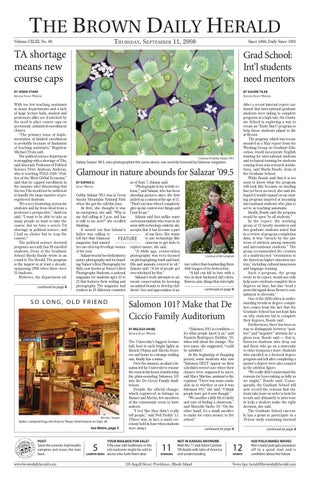
Courtesy of Gabby Salazar ’09.5
Gabby Salazar ’09.5, who photographed the scene above, was recently honored by Glamour magazine.
Glamour in nature abounds for Salazar ’09.5 as of Sept. 7, Salazar said. “Photography is my artistic release,” said Salazar, who has been Gabby Salazar ’09.5 was in Great shooting pictures since she first Smoky Mountains National Park picked up a camera at the age of 11. when she got the call this June. “That’s my time when I completely At first, she thought it was give up my control over things and an emergency, she said. “Why is I just let go.” my dad calling at 3 p.m. and has Salazar said that unlike some to talk to me now?” she recalled environmentalists who want to do thinking. away with technology entirely, she It turned out that Salazar’s accepts that it has become a part father was calling to of our lives. She wants tell her that Glamour to use technology like FEATURE magazine had named cameras to get kids to her one of its top-10 college women explore nature, she said. of the year. “A while ago, conser vation Salazar won for her dedication to photography was very focused nature photography and for found- on photographing trash and landing Nature’s Best Photography for fills and animals covered in oil,” Kids, now known as Nature’s Best Salazar said. “A lot of people get Photography Students, a national overwhelmed by that.” magazine for students ages 12 to Salazar’s work attempts to ad21 that features their writing and vocate conservation by focusing photography. The magazine had on natural beauty to develop chilreaders in 19 different countries drens’ love and appreciation of naBy Sophia Li Staff Writer
S o L o n g , Ol d F r i e n d
Min Wu / Herald
U
E
See Metro, page 3
VO
LU
ME
9
IS
S
PostSaves the summer, bad mouths vampires and mows the man lawn
www.browndailyherald.com
5
CAMPUS NEWS
ture rather than bombarding them with images of its destruction. “A kid can fall in love with a tree in their backyard, fall colors, flowers, ants, things that exist right continued on page 4
Salomon 101? Make that De Ciccio Family Auditorium by Melissa Shube Senior Staff Writer
Spike’s Junkyard Dogs will close its Thayer Street branch on Sept. 28.
Courtesy of Bill Campbell
The University’s biggest lecture hall, host to such bright lights as Barack Obama and Martin Scorsese and home to a strange smiling sun, finally has a name. Over the summer, an alum’s donation led the University to rename the room in his honor, transforming the plain-sounding Salomon 101 into the De Ciccio Family Auditorium. Despite the official change, which registered in listings on Banner and Mocha, few members of the community seem to have noticed. “I feel like they didn’t really tell people,” said Neil Parikh ’11. (There was, in fact, a small ceremony held in June when students were away.)
Your Mailbox for sale? Fifty-year-old mailboxes in the old mailroom might be sold to alums who hold them dear
11
OPINIONS
Not in Kansas Anymore Matt Aks ‘11 and Adam Cambier ‘09 dazzle with tales of America and understanding
195 Angell Street, Providence, Rhode Island
12 SPORTS
h20 polo makes waves Men’s water polo gets preseason off to a good start and is confident about the future
News tips: herald@browndailyherald.com
T oday Page 2
Thursday, September 11, 2008
THE BROWN DAILY HERALD
We a t h e r
Vagina Dentata | Soojean Kim
TODAY
TOMORROW
partly cloudy 63 / 51
partly cloudy 73 / 60
Menu Sharpe Refectory
Verney-Woolley Dining Hall
Lunch — Baked Vegan Nuggets, Cheddar Mashed Potatoes, Chicken Fingers with Dipping Sauces
Lunch — Gourmet Roast Turkey Sandwich, Tofu Raviolis with Sauce, Peanut Butter & Jelly Bar
Dinner — Vegetarian Tamale Pie, Red Potatoes with Chive Sauce, Chicken Cacciatore
Dinner — Gnocchi ala Sorrentina, Antipasto Bar, French Style Green Beans with Tomatoes, Apple Fritters
Free Variation | Jeremy Kuhn
Sudoku Fill in the grid so that every row, every column and every 3x3 box contains the digits 1 through 9.
Epitmetheos | Samuel Holzman
Enigma Twist | Dustin Foley
RELEASE DATE– Thursday, January © Puzzles31, by2008 Pappocom
Los Angeles Times Puzzle C r o sDaily s w oCrossword rd Edited by Rich Norris and Joyce Nichols Lewis
ACROSS 1 Early Yucatán settler 5 Capital SSW of Tangier 10 Home seller’s datum: Abbr. 14 It’s hot in here 15 Emerged 16 Subtle emanation 17 Dr. James Naismith’s invention 19 Votes for 20 Sellers, for instance 21 Belgian treaty city 22 Silly Putty holder 25 Physics, e.g. 28 Shoptalk 30 Like some hair 31 Morlock victims 32 Signal interference 34 Portfolio part 37 Space-saving device 41 Kite with a driver 42 “The First __ Club” 43 Salt, to a chemist 44 Pacific flier 45 Specter’s group 47 National parks, e.g. 52 They’re all in the family 53 Avant’s opposite 54 Massey of old movies 56 __ trip 57 Christmastime staple, with “The” 62 Botanical angle 63 Doff a derby 64 Refuse to grant 65 .00001 newtons 66 Benefits 67 Word that can follow the starts of this puzzle’s five longest answers DOWN 1 Tough crowd 2 She played Julie in “Show Boat” (1951) 3 Approval 4 “Diana” songwriter 5 Caning material 6 Protected area 7 Get in
8 Manual transmissions?: Abbr. 9 __ Aviv 10 The __ Kid: Willie Mays’s nickname 11 Result of a promotion, perhaps 12 Swiss bread 13 Sense of style 18 Return to sender? 21 Taken for granted 22 DVD player button 23 Modesto-based vintner 24 Stable worker 26 Thirst-quenching units 27 Hombre’s home 29 Enlistees 32 Fresh 33 Source of iron 34 Walton who wrote “The Compleat Angler” 35 Linear lead-in 36 “Stormy Weather” songwriter 38 Pretty pitchers
39 Brown of publishing 40 Holiday establishment? 44 Razz 45 Quick drinks 46 “Show Boat” novelist Ferber 47 Unit of capacitance 48 Modeling aid 49 Place to see a snake
50 Printing process, briefly 51 Its southern end is at Dawson Creek, British Columbia 55 Flexible, in a way 57 Gist 58 Mattel card game 59 Mauna __ 60 Running trio? 61 Pumpernickel alternative
Alien Weather Forecast | Stephen Lichenstein and Adam Wagner
ANSWER TO PREVIOUS PUZZLE:
Nightmarishly Elastic | Adam Robbins
xwordeditor@aol.com
1/31/08
T he B rown D aily H erald Editorial Phone: 401.351.3372 Business Phone: 401.351.3260
University community since 1891. It is published Monday through Friday during the aca-
Simmi Aujla, President
once in July by The Brown Daily Herald, Inc. POSTMASTER please send corrections to
Ross Frazier, Vice President Mandeep Gill, Treasurer Darren Ball, Secretary By Barry C. Silk (c)2008 Tribune Media Services, Inc.
1/31/08
The Brown Daily Herald (USPS 067.740) is an independent newspaper serving the Brown demic year, excluding vacations, once during Commencement, once during Orientation and P.O. Box 2538, Providence, RI 02906. Periodicals postage paid at Providence, R.I. Offices are located at 195 Angell St., Providence, R.I. E-mail herald@browndailyherald.com. World Wide Web: http://www.browndailyherald.com. Subscription prices: $319 one year daily, $139 one semester daily. Copyright 2007 by The Brown Daily Herald, Inc. All rights reserved.
M etro Thursday, September 11, 2008
Page 3
THE BROWN DAILY HERALD
In this district, policing is about knowing the people By Nandini Jayakrishna Metro Editor
At about 3:30 p.m. on Wednesday, Lt. John Ryan heard a car’s tires screech loudly as he drove past in his unmarked police car down Hope Street. “Hey, check what car was that. Grab them, will ya?” he called out to one of his patrol officers who happened to be biking down the street at that moment. Minutes later, the police had caught and ticketed the delinquent driver at the corner of Thayer and Angell streets. “You gotta go easy around here,” Ryan told him. And then, turning to this Herald reporter, he said, “It’s a bit of education for him. He’s not going to be flying around here now.” “We hope,” he added, softly. It is a typical occurrence on a typical day for Ryan, who in January took over as commander of Providence Police District 9, which includes Brown, the Rhode Island School of Design and much of the East Side. In collaboration with Brown and RISD police, Ryan has worked hard for the past eight months addressing community concerns such as loud noises and graffiti as well as catching rash drivers and preventing local break-ins. As another school year begins, bringing both new and old students back to College Hill, Ryan and his 25 sergeants and patrol officers at the Brook Street substation are becoming busier. Ryan, who has lately received several complaints from residents regarding noise and loud music, said college students should have fun but without compromising the safety and comfort of those around them. “I went to college. College days are fun,” said the University of Rhode Island graduate. “We just tr y to keep problems with the neighbors at a minimum.” Ryan is on the road for seven of the eight hours he works every day, driving around with his front windows rolled down as he tries to see, hear and learn as much as he can about his district. His eyes dart from one side of the street to
the other, to his rearview and side mirrors, as he looks for suspicious activity at every corner. He waves to passersby and stops to say hello to other police officers. In an effort to reach out to his younger constituents, Ryan goes to Hope High School every afternoon, building relationships with the students there and letting the potential troublemakers know that he is around to keep an eye on them. “If I drive down and they’re doing something (wrong), they know I know them,” he said. “I don’t have to say anything. I just look at them.” Ryan acknowledges that his job sometimes becomes monotonous and routine, even during the school year when the streets are bustling with activity. But his love of being around people keeps him going. “I like people, so I meet people every day,” he said. “You see them at their best; you see them at their worst.” Or sometimes at their silliest. Last week Ryan said he responded to an urgent call that a Brown student at the corner of Power and Governor streets was carrying a gun. When he reached the intersection, Ryan found that the person, a Brown graduate student, did have a gun — a water gun. Another night, as he drove down a campus street he said that he saw a Brown student standing in the middle of the road, refusing to get out of the way of passing cars. “Some of those practical jokes can turn bad,” Ryan said. During his time in the district, Ryan said he has learned to interact better with different kinds of people — from students of all ages to business owners and angry neighbors. The Warwick resident said he also tries to be more involved in the East Side community. He goes to concerts at the Brown Street Park and attends almost ever y basketball game at Hope High School. “That’s the whole thing behind community policing ... you’re right there with the people.”
Min Wu / Herald
Spike’s Junkyard Dogs, whose challenges are the stuff of Thayer Street legend, will close shop on Sept. 28.
Another one bites the dust: Spikes to close By Scott Lowenstein Metro Editor
Spike’s Junkyard Dogs, long a Thayer Street institution and the first of a 10-store chain of restaurants selling hot dogs, pizza and sandwiches, is closing its Thayer Street location on Sept. 28. Gareth Mundy, who owns the restaurant, said he did not want to disclose the specifics behind the restaurant’s closure, but said the reality of owning a business on Thayer, with high taxes and rising property values, makes business difficult. “The street has changed so much lately — it’s just not worth being here,” he said. Famous for creatively themed fare and the six-dogs-in-90-minutes
challenge for a free t-shirt and a picture on the wall, the store has been a staple of Thayer Street dining for more than 15 years, and has expanded to nine other locations in Rhode Island, Massachusetts and Connecticut. News of the store’s closing has been received particularly poorly in Providence’s well-established blogosphere. Under the heading “RIP Thayer Street,” Matthew Lawrence, a staff assistant at the Brown Bookstore who blogs for the Providence Daily Dose, wrote that the street is “once and for all dead,” calling Spike’s “the one place that could unite Thayer’s disparate population of college students, Eurotrash, bikers and teenagers.” Customers in the store also de-
cried the loss of the once-vaunted Thayer Street spot. “It will definitely be missed,” said Mike Ewing, who has been going to Spike’s for years. Ewing said that he was unaware that the restaurant was shutting down until informed by The Herald, but that he might visit the store’s other location on Branch Avenue occasionally. Devin Sutcliffe ‘10, who visits Spike’s “ever y once and a while” also said he was unaware of the restaurant’s impending closure. Sutcliffe, whose favorite Spike’s meal is the Cheddar Chili Dog, said he was “disappointed” with the loss of the eaterie. “I think it was an excellent place to get a hot dog on Thayer,” he said.
Page 4
Salazar ’09.5 honored by Glamour magazine continued from page 1 around them,” Salazar said. By cultivating an appreciation for nature, children would be more likely to be emotionally invested in the issue and take a stand if a bill is proposed to develop an area, she said. Although the magazine was founded in 2007 as a print publication for children, Salazar and Nature’s Best have had to refine its format and direction. In the past nine months the magazine had not been selling well as a print magazine, Salazar said, since many schools did not have room in their budgets to subscribe. On Aug. 15, the magazine redesigned its Web site, www. naturesbeststudents.com, to be a free online magazine, eliminating the need for a version printed at the expense of the environment. Issues are released six times a year, and the format of the site allows readers to turn the pages virtually, thereby maintaining the feel of a print magazine. The online magazine is highly interactive, allowing readers to submit their writing and photos online and featuring student blogs and videos of Salazar and other contributors. Salazar applied to Glamour magazine’s contest after she saw an issue in the Brown admissions office and joked with one of her professors about applying. “It’s a great way to get your cause recognized by a broader audience,” Salazar said. Laughing, she added that the prospect of the $3,000 scholarship didn’t hurt either. All of Glamour magazine’s winners have an “incredible connection and passion” for their work, said Wendy Naugle, health deputy editor at Glamour magazine. Now 21 years old, Salazar serves as a role model for other youths as the founder and editor of a national magazine, Naugle said. “We are always passionately inspired by the women we select,” Naugle said. “We’re awestruck by how much they’ve already done by the age of 20, 21, 22. It really makes you want to strive to do a little bit better.” Salazar spent this past weekend
Thursday, September 11, 2008
THE BROWN DAILY HERALD
in New York City at Glamour magazine with the other winners. Naugle said the winners explored the city and attended conferences with a network of professionals. “They (spent) time with top people in a variety of fields — business, politics, medicine, science, journalism.” Salazar said she appreciated the opportunity to come together and talk about women’s issues. Some of the presenters discussed balancing career and family, Salazar said. “We all really want to have high-power careers and have change in the world,” she said. “I think what we came away with was, you can have it all but you can’t have it all at the same time.” Salazar chose to take time off from school last semester to focus on the magazine, working at the magazine’s office in Washington, D.C. and traveling to Honduras, Ecuador and Costa Rica, but for now she is editing the magazine from her room off-campus. She plans to continue working with the magazine after graduation, but not past the age of 23, she said, because she wants the magazine’s editor to have a connection with the magazine’s young audience. Salazar said that when she decides to leave, the magazine will hire another young editor, probably also a college student. As for herself, Salazar said she would like to work abroad and explore some of her other interests, particularly issues relating to maternal health. “It really hit me how much of an environmental issue (maternal health) is,” Salazar said, a connection she realized when she and the other winners visited the United Nations Population Fund during their weekend in New York. Naugle said that in the 51-year history of the magazine’s contest, many of its winners, whose ranks include Martha Stewart and Kate White, the editor-in-chief of Cosmopolitan, have gone on to pursue successful careers. “We believe these are the women who will be leading in the next 10, 15, 20 years,” Naugle said. “It’s clear that they don’t take ‘No’ for an answer and are going to continue with their trailblazing and make the world a better place for all of us.”
New grad school policy fuels shortage continued from page 1 mitted a large first-year class to augment the size of the program — only four people entered the program last year, Andreas said. These first-year students as well as students who have received fellowships cannot serve as TAs. Course caps are approved when the professor first proposes the class to the College Curriculum Council, Pesta said. If the professor later chooses to decrease the number of students or install a limited enrollment on an already existing course, the CCC must again approve the decision. However, because the Graduate School’s recent and costly guarantee of five years of financial support for its students has limited the number of TAs, a professor can now introduce a course cap if there are not enough TAs available to properly teach the course, Pesta said. Interdisciplinary programs have had an unusually hard time finding TAs, in part because of a new Grad School policy, implemented last year, requiring that graduate students teach only in their departments. Andreas, also the director of the international relations program, said that the program has had difficulties finding TAs for courses like INTL 1700: “International Law” because it does not have its own graduate department and, consequently, must borrow TAs from
others. “We have to go begging from department to department, seeing whether there are any TAs that haven’t been taken,” said Claudia Elliott, assistant director of academic programs for the Watson Institute for International Studies. But the issue “goes both ways,” Elliott said, in that international relations students take many courses in other departments, increasing the need for TAs in those classes as well. Other courses that are now facing limited enrollment include some classes highly popular among freshmen, including CHEM 0330: “Equilibrium, Rate and Structure” and ENGL 0400A:“Introduction to Shakespeare.” The University has been aware of the potential ill effects of a TA shortage on students’ ability to get into classes but decided to move forward with the new Grad School financial aid plan, The Herald reported Oct. 12, 2007. Dean of the College Katherine Bergeron told The Herald then that she would be willing to limit course enrollment to help deal with a TA shortage. “I’m not utterly opposed to what might be called ‘sensible enrollment management,’” she said. Some professors say they may also need to limit enrollment given the scarcity of large lecture halls. Associate Professor of Political Science Wendy Schiller said she
does not plan to set a cap on her class POLS 0820: “Philosophy of the American Founding,” but is struggling with the lack of space. “There is a serious issue of larger classroom space at Brown,” Schiller said. “Kids come into the class and they can’t get a seat.” The registrar will reassign classroom space only after shopping period is completed. In the meantime, some professors are pressed for space and may choose to cap their course in case they do not end up being relocated. “We do everything to move the class, but I’ve already sent out a memo to department managers telling them that hours I, J and K are maxed out,” Pesta said. “If we can’t move the class, it’s because there’s no place large enough or appropriate enough.” Students said they were irritated by their inability to get into classes that had open enrollment in previous years, and many are now scrambling to find new classes. Emily Arai ’11 was unable to get into POLS 1410: “Global Security after the Cold War” because the professor closed the class to all firstyears and sophomores, before letting some of them in. “I was annoyed because I wanted to take it, and I think in previous years it was easier to get in,” she said, adding that she “wasn’t prepared to find another class and should have shopped more.”
Int’l grad students could get more support continued from page 1 program completion in-depth nationally, Bonde said, and the results from that study will help the administration better understand patterns of attrition at Brown. Since the project is long-term, and since attrition figures cannot fully be calculated until the last student from a cohort (or class) has either completed a degree or withdrawn, full information will not be available for a number of years and the current graduate classes will only have partial data available for them, Bonde said. “In data terms that’s unsatisfactory, but in terms of being able to intervene to help a student, I think it’s worth doing,” she said. The language classes, known as English for International Teaching Assistants, focus on improving speaking and listening skills and developing familiarity with slang words and phrases that students may use in the classroom, said Jill Scott, an instructor in the program. After an intensive welcome program in August, any graduate student whose first language is not
English is evaluated for English proficiency, said Barbara Gourlay, the program’s coordinator. Students are then placed in appropriate-level, semester-long English classes, and are re-evaluated after each semester. The classes are not necessarily sequential since placement is determined each semester by evaluation. Students in lower-level classes are assigned to an undergraduate student, called an ITA consultant, whom they meet with for one hour a week outside of class, Gourlay said. The undergraduates work oneon-one with the ITAs as conversation partners and report back to the teachers about their partners’ improvement.The undergraduate consultants and ITAs have the freedom to do whatever they want during their weekly meetings, Gourlay said. She said the purpose of the meetings is not only language support, but to help the ITAs understand different aspects of the culture. “We once had a wonderful Vietnamese student who wanted to order food but was overwhelmed by the choices,” she said, so during a weekly meeting his undergraduate
consultant helped him navigate a menu. “You know, describing abstract thought is not easy,” wrote Joey Lee GS, a Ph.D. candidate in the Department of Mathematics from South Korea, in an e-mail to The Herald. “Sometimes even though I got a solid idea, I couldn’t find the word to explain.” Lee was part of the ITA consultant program for over two years. “I think that it’s absolutely helpful,” he said. “It’s the only chance of correcting my intonation and pronunciation.” Lee also said the program helped him better understand American culture. There are 83 graduate students currently enrolled in the English for ITA program, 30 of whom have undergraduate consultants, but Gourlay said she often receives requests from international graduate students not enrolled in the lowerlevel English classes who also want undergraduate consultants. Budget restrictions, unfortunately, often prevent her from hiring more. “Ideally,” Bonde said, “there would be English language support for any student who needs it.”
Donor recalls taking classes in Salomon continued from page 1 Kevin Chen ’11 said he did not think the change was particularly confusing. “Don’t they have the name on top right there?” he asked. Donald Richard De Ciccio ’55, the donor, said in an interview that he chose the naming of Salomon 101 from among other opportunities. “Several projects were presented to me and I liked that particular auditorium — its location and venue, everything about it,” he said. De Ciccio, a botany concentrator, also
remembered that he “used to take a lot of classes in that building.” The Salomon Center for Teaching, built in 1862, was originally known as the Chemical Laboratory. It was renamed Rogers Hall in 1900, and was renamed again for former University Chancellor Richard Salomon ’32 in 1989. While the room is still numbered 101, gold lettering with the auditorium’s new name has been added above the doors on both sides. De Ciccio called his years spent at Brown as “excellent,” and said that
when he graduated he signed a pact with his friends to meet up at the Brown-Harvard football game every year. “And we’ve been doing that,” he said, adding that he has missed two games or so in the last 53 years. De Ciccio said he wanted to donate to Brown because of the scholarships and opportunities provided by the University. “It’s time for me to give back and show my appreciation for Brown having confidence in me, and providing the education it did, and the wonderful friendships I made,” he said.
C ampus n ews Thursday, September 11, 2008
Page 5
THE BROWN DAILY HERALD
News
C H EER U P , T H A Y ER
Min Wu / Herald
New dean has sophomores on her agenda Ann Gaylin, the new dean responsible for first-year and sophomore students, is committed to reviving Brown’s sophomore advising and has already made changes to bring students and faculty together outside the classroom more often. In an interview Tuesday, Gaylin said she was generally pleased with the first-year Meiklejohn and faculty advising programs. She said she plans to immediately focus on amending the sophomore advising program that before last year did not require second-year students to have advisers. Above all, she said, she was concerned with improving communication between sophomores, their advisers and the administration. “Sophomores can feel they’re cut adrift,” said Gaylin, the associate dean for first-year and sophomore studies. “We want to let them know there is help, there is advising ... (their) path is less obvious than others’.” Deputy Dean of the College Stephen Lassonde, who took primary responsibility for those students in an interim role last year, his first at Brown, said Gaylin’s arrival will allow the University to better document and utilize information about each sophomore’s advising situation.
Last year, the Office of the Dean of the College was unable to fully tend to all sophomores’ advising needs, Lassonde said. “Now we have the personnel to do follow-up.” “It’s a relief,” he added. “I feel like I have a new power tool.” Gaylin said interactions between sophomores and their advisers should constitute “intellectual relations and conversations that are substantial and meaningful.” In order to better establish such relationships, Gaylin and others have improved the Faculty Fellows Advising Program, which sponsors regular “study breaks” at the residences of various professors around campus. In addition to study breaks and advising seminars, FFAP residences will host lectures, talent shows and other events several times a month. “(The study breaks) weren’t enough,” Gaylin said. “Now it’s more than just something to come out, get food and leave.” Sophomores also received a booklet on academic planning and were invited to an ice cream social advising party, which Gaylin said was attended by more than 600 students. There will be several more such events this year, she added. Gaylin said she is committed to establishing a more personal feel to advising relationships that first-years can carry through graduation.
“We are making sure students are aware they can approach faculty,” said Gaylin, adding that “most faculty would be delighted” to meet with first-years and sophomores more often. “I was very lucky to be at a small place and work one-on-one with faculty,” said Gaylin, who graduated with a B.A. in comparative literature from Brandeis University in 1984. Gaylin received her Ph.D. in comparative literature from Princeton in 1995 and was an associate professor in comparative literature and director of undergraduate studies for literature majors at Yale before coming to Brown in July. Gaylin, who cited her rich experience working closely with professors at Brandeis and later with students at Yale, suggested that intellectually motivated Brown students deserve more from their advising program. “Students here are fantastic people, people with really interesting ideas outside the classroom,” Gaylin said. “I’m trying (to develop advising) in a more holistic way ... developing mentors for students ... relationships that they can carry with them.” Gaylin joins Lassonde and Assistant Dean of the College for First Year and Sophomore Studies Tahia Reynaga as former Yale staff to arrive in the dean of the College’s office in the past calendar year.
Swearer fair draws those looking to serve By Sara Sunshine Senior Staff Writer
Sayles Hall bustled Wednesday night with Brown students eager to better the world. The Community Service Opportunities Fair, held at the beginning of each semester by the Swearer Center for Public Service, drew a large crowd. The fair hosted about 64 service groups, including groups dedicated to adult literacy, advocacy, environment and youth issues. A panel discussion, entitled “How I Found My Way to Community Work,” preceded the fair. The panel, a new addition to the fair, included five Brown students who coordinate various community service groups. Hannah Watson ’08 MD’12 led the discussion and encouraged the panelists to share what work they did, how they got involved and what connections to the community they made. “The goal (of the panel) was to have a bit of discussion and hear some perspectives in an informal set-
Brief
Six new classrooms available in New Dorm
High school girls from LaSalle Academy offered free hugs to passersby on Thayer Street yesterday.
By Simon van Zuylen-Wood Senior Staff Writer
i n
Six newly updated classrooms are now available in Vartan Gregorian Quad Building A for classes, conferences and seminars. The project, completed over the summer, involved converting an open space into six distinct rooms and updating them technologically and decoratively, said Julie Haworth, director of conBart Dessaint / Herald ference services. The classrooms New classrooms in Vartan Gregorian A used to be a large lounge space that was underused, she added. “The need for classroom space became well known, so this helped to answer that need,” she said. Facilities Management oversaw the project, which had been “seriously” discussed since last winter and was completed in late August, she said. The space was designed by an architect who was “very cognizant of student flow, classroom usage, technology and light.” The rooms all have tables and chairs on wheels, so the setup can be easily rearranged. They each have large windows that create an open feel. There are also windows over the doors to the hallway, so that natural light can reach to the interior. Haworth praised the design of the rooms, calling it “simple and clean.” Also, thanks to the mobile furniture, she added, they’re “very flexible.” Media technology has been ordered for three of the rooms, but has not yet been installed because of delivery delays, Haworth said. One room is slated to have “high-end video-conferencing capabilities.” So far, the space has mainly been used for “staff-related meetings,” Haworth said, because few students know about it. There are also a few classes held in the rooms, including Africana Studies and anthropology classes, she said. Haworth said usage has been increasing as more people have become aware of the classrooms. The Scheduling Office is working on a “marketing campaign” to advertise the rooms, she said. The office will also be hosting presentations for various academic and administrative departments to encourage usage, she added. The classrooms can be booked through the Scheduling Office by staff and students. —Anne Simons
Old mailboxes may go to alums While students struggle with the combinations for their new mailboxes in J. Walter Wilson, University officials are figuring out what to do with the old mailboxes in Faunce House. The mailboxes, which were installed in 1952, are pieces of Brown’s history that hold sentimental value for Brown alums, said Elizabeth Gentry, assistant vice president of financial and administrative services. Administrators are considering selling the boxes to alumni instead of simply discarding them, she said. Gentry said she recalled watching a mother leading her daughter through the Faunce mailboxes last semester in search of her old mailbox. “For some people, the mailboxes are very special — they are part of their history at college,” she added. Gentry initially brought the idea of marketing the old mailboxes as a fundraising idea to administrators at Alumni Relations, who turned down the project. She next approached Brown Bookstore Director Manuel Cunard, who she said had worked on similar programs at other colleges. “Some of those boxes used to belong to some really interesting people — it would be fun to see who had used the boxes in the past, to offer alumni their old school mailboxes,” Cunard said. The project is in its early stages and does not have a deadline for sale. Facilities Management is still assessing the cost of dismantling the mailboxes in Faunce, while Bookstore staffers are brainstorming ways to distribute and clean the mailboxes, Gentry said. —Brian Mastroianni
Min Wu / Herald
Students learned about opportunities in the Providence public schools at yesterday’s Community Service Opportunity Fair.
ting,” Watson said. The panelists spoke enthusiastically about their involvement with community service at Brown. They also emphasized the importance of building a sustainable program that will continue long after its volunteers have graduated.
It’s important to recognize that the Providence community exists year-round, beyond when Brown is in session, said Christina Rodrigues ’10, a coordinator of Algebra In Motion. The program’s participants teach continued on page 8
Join The Herald Sunday, 8:30 p.m. at 195 Angell St.
Page 6
Top Episcopal bishops oppose gay marriage By Duke Helfand Los Angeles T imes
California’s six most senior Episcopal bishops Wednesday unanimously declared their opposition to a constitutional amendment on the statewide November ballot that would ban same-sex marriage. The bishops argued that preser ving the right of gays and lesbians to marry would enhance the “Christian values” of monogamy, love and commitment. “We believe that continued access to civil marriage for all, regardless of sexual orientation, is consistent with the best principles of our constitutional rights,” said the Rt. Rev. J. Jon Bruno, bishop of the Episcopal Diocese of Los Angeles. Bruno, flanked at a news conference by fellow clergy members and gay and straight couples, added: “We do not believe that marriage of heterosexuals is threatened by same-sex marriage.” By going on the record against Proposition 8 — which would reverse the California Supreme Court’s decision in May to allow same-sex marriage -- the bishops waded into a controversy that is political and religious dynamite. Gay marriage has strained the Episcopalians’ international body, the Anglican Communion, with hundreds of bishops from Africa and elsewhere threatening to break away over attempts to change church doctrine and practice. The issue has created theological fissures for other Protestant denominations, including Presbyterians and United Methodists, with some Methodist ministers in California pledging to perform marriages in defiance of their na-
Thursday, September 11, 2008
THE BROWN DAILY HERALD
tional church. Proposition 8 supporters, intent on protecting what they call a 5,000-year-old tradition codified in the Bible, are mobilizing forces across several religious groups. The Protect Marriage Coalition announced plans last month for 1 million Christians, Jews, Muslims, Sikhs and Hindus to plant 1 million “Yes on Proposition 8” lawn signs in their front yards. In addition, the coalition is sending volunteers door to door to speak with voters and planning an advertising campaign, to begin as early as the end of this month. “Marriage is an institution for a man and a woman,” said Jeff Flint, the campaign’s co-chairman. “The institution of marriage around which society is constructed means less when it’s not the traditional definition.” But in a joint statement issued Wednesday at the diocese headquarters in Los Angeles, the six bishops said that “society is strengthened when two people who love each other choose to enter into marriage, engaged in a lifetime of disciplined relationship building that ser ves as a witness to the importance of love and commitment.” The statement was signed by Bruno and Bishops Marc Handley Andrus, Barr y L. Beisner, Mar y Gray-Reeves, Jerr y A. Lamb and James R. Mathes. (Three assistant bishops — Chester L. Talton, Sergio Carranza and Steven Charleston — also signed.) The bishops concluded: “We believe that this continued access (to marriage) promotes Jesus’ ethic of love, giving and hope.” While the Episcopal leaders agreed on the need to preser ve
the right of gay and lesbian couples to wed, they disagreed over how, and if, to conduct weddings, in light of the church’s Book of Common Prayer, which defines marriage as between a man and a woman. According to the joint statement, some of the six bishops believe it is appropriate for priests to officiate at marriage ceremonies and pronounce blessings, while others want to wait to hear from the Episcopal Church’s governing body, the General Convention. It meets next in Anaheim, Calif., in July 2009. Andrus, bishop of the Episcopal Diocese of California, said he encourages all couples — straight and gay — to marr y in civil ceremonies and then seek a church blessing. The compromise stops shor t of priests performing the rites of marriage for same-sex couples. Andrus, whose diocese covers the San Francisco Bay Area, said this practice allows him to honor the rights of gay and lesbian couples while keeping his diocese tethered to the Anglican fold. The conflict over Proposition 8 is unfolding amid a wrenching dispute over homosexuality in the Anglican Communion, which has 77 million members worldwide. Conser vative bishops from Africa, Asia and elsewhere have balked at reform efforts by more liberal leaders, primarily from North America. The election of an openly gay bishop, V. Gene Robinson, to the Episcopal Diocese of New Hampshire in 2003, intensified the conflict. Several hundred conser vative bishops and archbishops boycotted the once-a-decade Lambeth Conference of Anglicans, held in July.
Particle accelerator speeds into an age of ‘New Physics’ By William Booth Washington Post
MEYRIN, Switzerland — It is the biggest machine ever built. Everyone says it looks like a movie set for a corny James Bond villain. They are correct. The machine is attended by brainiacs wearing hard hats and running around on catwalks. They are looking for the answer to the question: Where does everything in the universe come from? Price tag: $8 billion plus. The world’s largest particle accelerator is buried deep in the earth beneath herds of placid dairy cows grazing on the Swiss-French border. The thing has been under construction for years, like the pyramids. Its centerpiece is a circular 17-mile tunnel that contains a pipe swaddled in supermagnets refrigerated to crazy-low temperatures, colder than deep space. The idea is to set two beams of protons traveling in opposite directions around the tunnel, redlining at the speed of light, generating wicked energy that will mimic the cataclysmic conditions at the beginning of time, then smashing into each other in a furious re-creation of the Big Bang — this time recorded by giant digital cameras. On Wednesday, they fired this sucker up. It will be months before the proton beams reach full power and produce the kinds of exotic collisions that may herald an age of “new physics.” But if the machine works — this most ambitious, expensive, technologically advanced civilian scientific experiment in history — it would be a happening for humanity. “I think we may have to rewrite our textbooks,” said Fabiola Gianotti, a project leader for ATLAS, one of the four huge detectors that will record and analyze the collisions. “There must be something more than we have seen. There is something missing from the puzzle.” The Large Hadron Collider, as it is called by the 8,000 scientists, engineers and technicians from 85 countries who dote on it, will probe the most fundamental mysteries. From the fireballs, there might spring forth black holes and the elusive thing that gives matter its mass. Or not! There might be particles called “strangelets” and evidence of “dark matter” and signs of “supersymmetry” and maybe a little antimatter. Oh, and they might find some extra dimensions. But this is the delicious part. They. Don’t. Exactly. Know. That accounts for the last-minute legal challenges by opponents who worry that the Large Hadron Collider — hadrons, by the way, are collections of quarks, which are the particles inside protons and neutrons, which form the nucleus of the atom — might spark a chain reaction of runaway events that could destroy the planet. Their greatest concern is that the black holes, the stuff of a hundred “Star Trek” subplots, could grow and suck, grow and suck, which is what black holes do. A retired radiation safety expert in Hawaii sought a restraining order in a U.S. court but was denied. Another group filed its doomsday appeal with the European Court of Human Rights, which also declined to act.
To calm public anxiety, the proton smashers investigated safety concerns and said any black holes “would be entirely benign” and would decay almost instantly. They would be “mini black holes,” just like the ones that occur (the theorists say) whenever a couple of cosmic rays collide in space. Nature has already conducted experiments just like this, the report concludes, “and the planet still exists.” So make your plans accordingly. The Large Hadron Collider was built by the European Organization for Nuclear Research, known as CERN, which on the surface looks like a slightly down-at-theheels state college in the middle of a cow pasture in the dull suburbs of Geneva. CERN, however, is now the mecca for international physics, where the streets are named for Einstein, Newton and Curie. It is the place where they invented the World Wide Web. The cafeteria also serves wine with lunch. After the United States stopped construction of the Superconducting Super Collider in 1993, after spending $2 billion and digging 14 miles of a 54-mile tunnel, the center of action for particle physics shifted to Europe. To see what the excitement is about, you have to put on a hard hat and get into one of the elevator shafts and travel 300 feet below the Earth’s surface to the tunnel, which was possible earlier this summer, before they closed the doors. You drop into towering caverns lined with thick slabs of concrete that hold the detectors. The detectors look like building-size barrels, honeycombed with wafers of silicon and doughnut-shaped magnets. They are crawling, Medusa-like, with blue, red, green cables, like arteries and veins. They look muscular, beautiful, alive. The tunnel itself is like a subterranean racetrack. Protons stripped from hydrogen atoms will be accelerated to high energies and whizzed around and around the tunnel, through an ordinary-looking blue pipe, which is not ordinary at all but quite extraordinary — because it is coiled with thousands of superconducting magnets, which bend the proton beam so it can travel in circles. The magnets are superconducting because they are supercooled by superfluid helium, which is superstrange. “A completely novel engineering material,” is how Lyn Evans, the project manager of the collider, describes supercold helium. “For example, if you were to put it into a beaker? It could crawl out.” This is how they talk at CERN. If you stop them, and say, “What do you mean, crawl out?,” they might go to a blackboard and begin with the math. You do not want them to do this. Instead you say: Why underground? “Cheaper,” Evans said. It would cost a fortune to acquire the land in France and Switzerland to build the racetrack on the surface. And why here? CERN was born in the rubble of postwar European physics. “Switzerland was neutral, and believe it or not, it was cheap,” Evans said. “It is still neutral.” These protons whizzing through continued on page 8
C ampus n ews Thursday, September 11, 2008
Page 7
THE BROWN DAILY HERALD
South Korean intel: Kim likely suffered non-critical brain hemorrhage By Blaine Harden Washington Post
Bill O’Leary / Washington Post
The Pentagon Sept. 11 memorial, seen here at night, officially opens on Thursday the 11th.
Families took lead in funding Pentagon memorial By Nick Miroff Washington Post
WASHINGTON — Jim Laychak arrived at the corporate headquarters of Anheuser-Busch on a windy afternoon in April, thinking through his pitch. A company photographer snapped his picture beside a giant bronze eagle in the lobby, and executive Laura Reeves invited him upstairs. He had come to ask for a million dollars. It was not an unreasonable sum. After all, the St. Louis brewing giant had helped the Pentagon Memorial Fund get started five years earlier with a $1 million donation. Laychak sat down at a wooden table in a suite with Reeves, senior director of the company’s charitable foundation, and took out his promotional materials. As Laychak started in, Reeves politely stopped him. “I hope you’re not here to ask for money,” she said. The air went out of the room. But as Reeves explained that the company’s sales were slowing and money was tight, Laychak quickly recalibrated. Five minutes later, he asked for the money anyway. Laychak came out of the meeting with little more than a free brewery tour, but the episode was as telling a moment as any in the seven-year effort to build the country’s first major Sept. 11 memorial, which will be dedicated Thursday morning at the Pentagon and open to the public at 7 p.m. tonight. Its completion has not been the result of some large-scale government endeavor, but of one led by a small, determined group of victims’ family members, such as Laychak, who have channeled their sorrow into a ceaseless fundraising campaign. Money had been little more than an afterthought when the idea for a memorial to the victims of the Sept. 11, 2001, terrorist attack on the Pentagon was proposed. Private donors would give quickly, the assumption went, and the country’s outpouring of grief would merge into a river of cash. The money would supplement about $13 million left over from countries’ donations to help pay for the Persian Gulf War, which Congress could allocate for construction. The plan seemed solid. But by summer 2003, with the project advancing toward its construction phase, the funding assumptions looked shaky. The pointed memories of Sept. 11 were beginning to
dull for many. The country was at war, and the government needed the $13 million for other things. Soon it was clear that the memorial’s $22 million construction cost and $10 million endowment would have to be raised primarily by the families of the victims. They set up a nonprofit organization, the Pentagon Memorial Fund, and enlisted a professional fundraiser. But when the money still did not come fast enough, Laychak, whose younger brother David Laychak was killed at his desk in the attack, decided on a more personal approach. “If someone is going to say no to us,” Laychak said, “then let them say no to me.” Since then, Laychak, the fund’s director, has been traveling across the country to corporate boardrooms and the offices of philanthropists, making his pitch as if it were a business proposition or investment opportunity. Affable, easygoing and forthright, he has eschewed sentimentality in favor of a simple, direct appeal, applying skills developed in his career as a senior executive with the large consulting firm Accenture. In time, Laychak, 49, came to absorb the stories of the other families he spoke for, carrying them into meetings with his own sense of loss. He learned that if he wanted big donors to give big sums, he had to “make the ask” without fear of rejection, as he did with Reeves at Anheuser-Busch. “If you’re not willing to make an ask, why would they be willing to give?” Laychak said. And give they did, in small amounts and big bundles. Donors included AT&T, Boeing and the government of Taiwan. The state of Maryland gave, as did Fairfax
County, Va., former defense secretary Donald Rumsfeld and his wife, Joyce, and the Philip L. Graham Fund of The Washington Post. Much of the money was gathered through large corporate gifts. Partly because of the fundraising effort, the Pentagon Memorial has been completed several years ahead of the country’s other two permanent memorial projects, in Lower Manhattan and Shanksville, Pa., the crash site of United Airlines Flight 93. Construction is underway on the $610 million National September 11 Memorial and Museum at the World Trade Center site, but its planners said recently that they are aiming for a 2011 opening. The National Park Service is leading the creation of a memorial for the victims of Flight 93 in Shanksville, but construction has not begun. Some victims’ relatives have raised concerns that the proposed design, which includes a grove of trees planted in an arc, resembles an Islamic crescent. For at least several years, then, the Pentagon Memorial will probably be the emotional center of the country’s Sept. 11 observance. It has cost more and taken longer to build than planned, but in its completion, there is hope among the builders, donors and family members who have created the memorial that its evocative design will challenge the indelibly dark memories of Sept. 11 with a new set of images: flowing water, polished steel and light. From a window near her desk, Kathy Dillaber has watched the construction crews come and go at the memorial site. A personnel manager for the Army, she was at work at the Pentagon on the morning American Airlines Flight 77 hit continued on page 8
TOKYO — The chief of the South Korean National Intelligence Service said Wednesday that North Korean leader Kim Jong Il probably suffered a cerebral hemorrhage last month but that his condition is not critical and there is “no power vacuum” in the communist North. Briefing a parliamentary committee in Seoul, the intelligence chief, Kim Sung-ho, said that Kim Jong Il’s condition is “manageable” and that he can be expected to recover, according to Won Hye-young, a member of the assembly who listened to the briefing. “Although he is not in a state to walk around, he is conscious. ... We understand that he can control the situation and he is not in an unstable condition,” the intelligence chief told the lawmakers, according to Won. The National Intelligence Service also reported to the committee that it obtained reports showing Kim recently had surgery for an unspecified circulator y problem and his condition had much improved, an unnamed intelligence official told the Associated Press. U.S. intelligence sources said Tuesday that Kim, who is either 66 or 67, had a stroke in mid-August and might be seriously ill. Kim’s noshow on Tuesday night at an important anniversary parade in the North Korean capital of Pyongyang raised concerns around the world about his health, the stability of his totalitarian government and the fate of stalled negotiations to end the country’s nuclear weapons program. The No. 2 leader in North Korea told a Japanese news agency on Wednesday that Kim is fine, and a top North Korean diplomat characterized reports of Kim’s ill health as a “conspiracy plot.” In South Korea, where there are legions of government, academic and journalistic observers of North Korea, a consensus emerged on Wednesday: Kim, who has a history of heart ailments, probably had a serious health setback in August, but the worst seems to be over and he is apparently lucid. The South Korean government said it was on “high alert” as it tried to figure out what had happened to the leader of the totalitarian state that has repeatedly threatened to reduce its neighbors to ashes. The South, though, reported no unusual movement of troops in the North or increased military radio traffic
that would suggest a dictatorship in disarray. “The starting point on all this should be that we don’t know diddly about what is going on inside that closed countr y,” said Brad Glosserman, executive director of the Pacific Forum of the Center for Strategic and International Studies in Honolulu. “Kim has a tendency to drop out of sight when there is a tough decision to make.” What is known with certainty is that Kim does face tough decisions about allowing outside verification that his government, which two years ago exploded a small nuclear device, is indeed abandoning its nuclear ambitions. It is also known that North Korea’s on-again, off-again cooperation with the United States, Japan, China, Russia and South Korea in the denuclearization process are off track. It began lurching that way after Kim’s reported stroke. On Aug. 14, North Korea halted work on disabling its Yongbyon nuclear and workers have since begun to reassemble the plant. Less well known is another major diplomatic reversal that straddles the date of Kim’s reputed illness. A day before Kim’s reported stroke, North Korea made a longawaited commitment to Japan to resolve the single most important impediment to normal relations between the two neighboring countries. North Korea said it would establish an authority with the power to reinvestigate the abduction of Japanese citizens in the 1970s, a festering issue that has profound political significance inside Japan. The Japanese government, in turn, promised to ease sanctions on North Korea and allow its citizens to visit Japan. Last week, however, North Korea backed out of that deal, even though substantive progress on the abductee issue could lead to the release of up to $10 billion that Japan has pledged as reparations to the impoverished countr y for colonial occupation between 1910 and 1945. These reversals have fueled speculation by U.S. officials that there might be a power struggle inside Kim’s government, with the North Korean militar y opposing nuclear disarmament and diplomatic engagement — and taking advantage of their leader’s ill health as a way to derail both.
Page 8
Thursday, September 11, 2008
THE BROWN DAILY HERALD
Pentagon memorial ready after years of fundraising continued from page 7 the building like a bomb. Her youngest sister, Patricia Mickley, working as a budget analyst one floor below, was killed, along with two dozen of Dillaber’s colleagues. Over the years, Dillaber has seen the bulldozers clear the site, the excavators prepare its foundation and the 184 stainless steel memorial benches lowered into place, one for each of the dead. Just as she has observed the construction process from above, she will now look out on the completed memorial and its visitors. It will never be an easy view for her. “I have a love-hate relationship with it,” she said. “It’s a beautiful memorial, and I’m very grateful. But I wish it wasn’t there. I wish it didn’t have to be there in the first place.” For several years, Dillaber has organized fundraisers for the memorial through her community theater in Alexandria, Va., collecting $17,000. “It’s been a kind of therapy for me,” she said. “But I can’t tell you how many good people we lost.” Even as rescuers and recov-
er y crews combed through the rubble of the Pentagon site after the crash, family members began asking how the victims would be honored. Ideas for a memorial first turned up in a suggestion box at a family assistance center set up by the Pentagon immediately after the attack. One was from Laychak. “In those horrible dark days, he was already writing suggestions for how to memorialize the people we lost,” recalled Meg Falk, former director of the Pentagon’s Office of Family Policy, who set up the center and is now retired. In 2002, after Congress authorized the Pentagon to build the memorial, the U.S. Army Corps of Engineers announced a worldwide design competition. The agency asked Falk to form a group with a dozen or so victims’ family members who could advise and guide the project. Laychak was the first person Falk called. “It was one of the hardest things I’ve had to do,” she said. “Here were all of these people who were still so raw, still grieving, and I had to call them to ask them to get involved.” To a person, they all agreed.
Soon, the group was meeting monthly with officials from the Pentagon Renovation Program, the agency in charge of the rebuilding. Four or five locations for the memorial were proposed, Falk recalled, including one adjacent to the Metro station, which would be especially convenient for visitors. “Some were nice spots,” Falk said. “But the families said 9/11 had picked the site.” They insisted that the memorial should rise on the grounds of the building’s western side, exactly where the plane hit. By February 2003, an 11-member jury of design professionals, scholars, Pentagon officials and victims’ family members selected the winning plan from 1,126 entries. It was drafted by a young couple, Keith Kaseman and Julie Beckman, who proposed a parklike space with shade, trickling pools of water and rows of arcing, cantilevered “light” benches that would set the site aglow at night. The Pentagon donated the land, but the construction cost of Kaseman and Beckman’s project soon rose to $22 million. For legal and strategic reasons, the Pentagon Memorial Fund was created not long
after that, with nine family members as its board of directors. Having raised the money to build the memorial, the fund is developing a $10 million endowment to cover maintenance and other expenses. Lisa Dolan, one of the fund’s board members, said the families’ work will not end when the memorial is finished. She plans to work on an initiative to encourage teachers to incorporate the site into their history lessons. “I’ll still be out there working to keep the whole thing alive, so people don’t forget,” said Dolan, whose husband, Navy Capt. Robert Edward Dolan Jr., was killed in the attack. “I don’t think the public thinks much about 9/11 now.” Laychak, who lives in Alexandria, also plans to continue in his role. Recently, Falk said that when Laychak called her, the two discussed what he would do once the memorial was open. At the end of the conversation, Falk said Laychak thanked her for picking him as someone who could get the site built. “He said, ‘You changed my life,’” Falk recalled. “And I told him: ‘No, you picked yourself.’”
Particle accelerator may uncover ‘strangelets’ continued from page 8 the pipe and around the track? They travel in bunches. These bunches are inches long and half the width of a human hair. Each bunch contains 100 billion protons, give or take a few. Each beam carries about 3,000 bunches. They travel at 99.9999991 percent the speed of light. So they are able to complete 11,245 laps a second. In 10 hours of operation, the beam could travel to Neptune and back. At four major intersections along the way, the parallel beams will cross one another and collide. The crash sites are the business end of the machine. That is where they put the detectors. “Think of oranges,” Evans said. “You collide two oranges together, you get a lot of pulp. We’re not so interested in the pulp. What we want to do is see what happens when the pips — the seeds — hit each other.”
Community service fair offers new opportunities continued from page 5 algebra at Hope High School. The panelists also stressed the relationships formed during community service. “The students are really willing to reach out to you and open up,” said Jakina Debnam ’09, who is involved with CityGirls and CityBrothers. Vicky Wang ’10 of Olneyville ESOL said she felt the same way. “One of the most rewarding aspects is that it gives Brown students a chance to help people in the community and get to know them.” Brown students in the program teach English to adults in Olneyville. Some of the panelists had discov-
ered an “intersection between community and academic work,” Watson said. Debnam said her community service had helped counteract the “Ivy Tower effect.” “I had had a previous perception of people in Providence,” she said, which changed after getting involved. It also added dimension to her studies, she added, by showing how the policies she learned about in her economics class affected people in real life. But in the end, service needs to be about the community, the panelists said. “It’s about trying to collaborate with the learners so they can meet their goal,” Wang said.
Trudeau ’09: Corporate life easy as ‘swoosh’ continued from page 12 while wearing flip flops, basketball shorts and a Kobe Bryant shirt. As a company, Nike is a rare mix of a “type A” personality, perfectionists with the drive to always be the absolute best, with simultaneous endorsement of a laid back attitude, allowing for creative freedom and innovative thinking. Perhaps more relevant to the other young adults at Brown who are worried about the implications of pursuing careers in big corporations, Nike is evidence that the corporate world doesn’t have to involve a suit and boring, drear y work. I know, because I just did it. Swoosh.
Tom Trudeau ’09 would like to apologize for the last line of this column, but not for cheering when Brady’s ACL died.
Thursday, September 11, 2008
THE BROWN DAILY HERALD
Cross-country developing a young team continued from page 12 year’s 7th place at the Ivy championships and 11th in the region. I definitely plan on going to nationals,” Wright said. Unfortunately, Ridgway is out for the season with a stress fracture in her fibula, but she still looks to have a positive influence on the teams. “As one of the team captains, I am hoping to be as supportive as possible and provide leadership and guidance for my younger teammates,” Ridgway said. Along with the 15 returning veterans, the Bears will be integrating 14 new members into the line up. With such a young team the returning runners are looking to provide a good platform for the freshmen to build on. “We are trying to instill a sense of dedication and hard work so that we can build a stronger program and compete with other nationally ranked teams,” Ridgway said. “The women’s squad does not have a senior on the roster, which means this young Brown team will need to mature quickly in order to finish above their fifth place finish a year ago. Lake expects the freshmen to make an immediate impact on the team.” For the women, Lake said the team will be counting on Eliza Webber ’12, Ari Garber ’12, Caitlin Stone ’12 and hopefully, Jocelyn Richards ’12 (who is currently out with a groin strain). The upperclassmen are excited about having the up and coming Bruno runners as well. “It’s really exciting having such
a young team, there’s so much excitement and love for the sport right now.” Wright said. “The incoming class has so much potential, and it’s awesome to know we’re all in it for the long run, and will return every runner next year.” Despite their relative youth, the women still have high expectations for the season. “Our team goals are to place as high as we can at Heps and make it to nationals,” Ridgway said. “We were only a few points shy of qualifying out of the Northeast Region last year.” On the men’s side, the Bears look ahead to the upcoming season, counting on two senior co-captains, Steve Chaloner ’09 and Brian Schmidt ’09, to help their own young cross-country squad prepare for a challenging fall. In addition to the 13 retuning runners, Bruno will welcome 14 new members to the team. “This is a big and rather young team. Setting a good example and remaining positive at all times will be crucial,” Schmidt said. “I think we have started to get there nicely already, so I am certain we can keep things moving in a positive direction.”
As with the women, the freshmen men will prove to play a pivotal role in its team’s success this coming year. Graduating from last year was stand out Ari Zamir ’08, who earned all-regional honors as well as all-Academic Ivy honors last fall. “We lost a lot of good runners last year and so we have to keep focused right now,” Schmidt said. “Getting in the extra things like sleep, eating healthy, icing properly, etc., will help give us a step over other teams when we take the line at the end of the season in our championship races.” The men’s team is going to rely on certain returning athletes, such as Duriel Hardy ’10, to strengthen the core of the team, and with the addition of new talents, the men are as ambitious this season as ever. “We obviously want to improve on last year’s finish at Heps as we did two weeks later at the Regional meet — having bested Harvard, Dartmouth and Columbia there,” Lake said. “We know we have the talent and ability to finish towards the top of the league.” Both teams are opening the season in Hanover, N.H., at the Dartmouth Invitational this Saturday.
Page 9
E ditorial & L etters Page 10
Thursday, September 11, 2008
THE BROWN DAILY HERALD
Staf f Editorial
Commendable condoms Brown’s campus is a place ironically characterized, in some ways, by stasis. Yes, we do have a student body that is remarkably liberal (and not just politically) and aware — of the University, the city, the state, the nation and the world — but there’s so much that, despite our best intentions, remains unexamined and unchanged. With so much attention on issues of a larger, even global scope, we may tend not to sweat the small stuff. And it’s often the smallest-seeming aspects of life at Brown that slip by, with no thought given to how they could be improved. So it is in this light that the decision by the University’s health educators, reported in The Herald yesterday, to make condoms, dental dams, lube and even latex gloves available at reduced prices to students in a new vending machine on campus is particularly welcome. Every freshman knows that condoms and other related accessories are available from their Residential Peer Leaders — and most can hardly enter or exit their hall without constant reminders of this — but the University’s method of distributing condoms has long overlooked upperclassmen, particularly those living off campus. Condoms and other accessories are already available at reduced prices at Health Ser vices, and at full prices at a handful of convenience stores. And the expectation that sexually active students be responsible enough to purchase their own condoms is certainly not unreasonable. But the new vending machine makes a few key improvements in students’ lives — by providing at atmosphere of privacy for students who may prefer it, by being available to more students at more hours of the day, and by putting the visible reminders of the importance of safe sex back into the lives of students who don’t live in first-year dorms. Maybe the vending machine in Faunce House won’t draw students from all over campus or by itself help a large number of them, but it represents the beginning of what we hope is a trend toward more practical, accessible ser vices for student health. The Community Ser vice Opportunities Fair in Sayles Hall last night exemplifies Brown students’ dedication to helping better the lives of others — and we commend all students who strive to make a difference in the city and beyond. But it’s important to pay attention to lives right here on College Hill too. And where sexually transmitted infections and pregnancy are at stake, let’s not forget to think of our own health.
T he B rown D aily H erald Editors-in-Chief Simmi Aujla Ross Frazier
Executive Editors Taylor Barnes Chris Gang
Senior Editors Irene Chen Lindsey Meyers
editorial Ben Hyman Hannah Levintova Matthew Varley Alex Roehrkasse Chaz Firestone Nandini Jayakrishna Scott Lowenstein Michael Bechek Isabel Gottlieb Franklin Kanin Michael Skocpol Ben Bernstein James Shapiro Benjy Asher Amy Ehrhart Megan McCahill Andrew Braca Han Cui Katie Wood
Arts & Culture Editor Arts & Culture Editor Higher Ed Editor Higher Ed Editor Features Editor Metro Editor Metro Editor News Editor News Editor News Editor News Editor Opinions Editor Opinions Editor Sports Editor Sports Editor Sports Editor Asst. Sports Editor Asst. Sports Editor Asst. Sports Editor
production Production & Design Editor Steve DeLucia Asst. Design Editor Chaz Kelsh Copy Desk Chief Kathryn Delaney Copy Desk Chief Seth Motel Graphics Editor Adam Robbins
Business Darren Ball General Manager Mandeep Gill General Manager Shawn Reilly Office Manager Alex Hughes Sales Manager Lily Tran Sales Manager Emilie Aries Public Relations Director Jon Spector Accounting Director Claire Kiely National Account Manager Ellen DaSilva University Account Manager Philip Maynard Recruiter Account Manager Katelyn Koh Credit Manager Ingrid Pangandoyon Technology Director
franny choi
L e tt e r s Why Palin is not perfect To the Editor: After reading today’s column by Anish Mitra (“Why Palin is perfect,” Sept. 10), the case for Sarah Palin still seems to be short on substance and heavy on false talking points. For example, on the “experience” issue, the author states that Obama “has failed to author any notable, popular and relevant pieces of legislation.” Does this mean that the “Lugar-Obama nonproliferation initiative” which was written to secure unguarded weapons in foreign countries is not “relevant?” The main problem with Palin isn’t that she has only run a small town and a small state, or that she has lied repeatedly about her positions as Governor. The problem is that up until two weeks ago, Palin had never
paid any serious attention to affairs outside of Alaska. In a March 2007 interview, Palin stated that she had been so focused on state government that she hadn’t really been paying attention to the Iraq War. Had Palin actually run in the primaries herself, one might believe that she was serious about running this country and not just Alaska. However, based on the lack of substance in her convention speech, and her refusal thus far to meet with the press, it is quite clear that Palin was rushed into this. How long the McCain campaign can manage to cover for her obvious shortcomings as a candidate will be the key.
Glenn Donovan GS Sept. 10
photo Meara Sharma Min Wu
Photo Editor Photo Editor
post- magazine Matt Hill Rajiv Jayadevan Arthur Matuszewski Colleen Brogan Monica Huang Kristen Olds Matt Surka
Managing Editor Managing Editor Features Editor Features Editor Layout Editor Layout Editor Photo Editor
Steve DeLucia, Designer Ayelet Brinn, Riva Shah, Rachel Starr, Copy Editors Mitra Anoushiravani, Isabel Gottlieb, Caroline Sedano, Sara Sunshine, Night Editors Senior Staff Writers Colin Chazen, Sara Sunshine, Melissa Shube, Anne Simons, Gaurie Tilak, Mitra Anoushiravani, Chaz Kelsh, Emmy Liss, Max Mankin, Brian Mastroianni, George Miller, Caroline Sedano, Jenna Stark, Joanna Wohlmuth, Simon van Zuylen-Wood Staff Writers Sam Byker, Debbie Lehmann, Sophia Li, Noura Choudhury, Joy Chua, Cameron Lee, Christian Martell, Anna Millman, Evan Pelz, Eli Piette, Leslie Primack, Marielle Segarra, Catherine Straut, Allison Wentz, Kyla Wilkes Sports Staff Writers Peter Cipparone, Han Cui, Lara Southern, Nicole Stock, Katie Wood Business Staff Stephanie Cheung, Veronica Yu, Jay Guan, Jennifer Chang, Jamie Phinney, Anna Reisetter, Kartika Chourdhury, Serena Ho, Akshay Rathod, Galen Cho, Maryrose Mesa, Van Le, Maura Lynch, Grant LeBeau, Jacqueline Goldman, Dana Feuchtbaum, Geraldo Guanaes, Lauren Presant, Lindsay Walls, Lucy Wang, Ruyi Jiang, Saul Lustgarten, Diego Gomez, Laura Sammartino, Ava Amini, Charley Chen, Lee Chau, Rory Stanton, Oliver Bowers, Katherine Richards, Alison Greenberg, Lilia Royanova Design Staff Jessica Calihan, Serena Ho, Rachel Isaacs, Andrea Krukowski, Joe Larios, Joanna Lee, Alex Unger, Aditya Voleti Photo Staff Oona Curley, Alex DePaoli, Kim Perley, Quinn Savit Copy Editors Ria Ali, Paula Armstrong, Kim Arredondo, Ayelet Brinn, Aubrey Cann, Rafael Chaiken, Stephanie Craton, Erin Cummings, Julianne Fenn, Jake Frank, Anne Fuller, Josh Garcia, Jennifer Grayson, Rachel Isaacs, Joyce Ji, Jenn Kim, Tarah Knaresboro, Ted Lamm, Alex Mazerov, Lisa Qing, Alex Rosenberg, Madeleine Rosenberg, Elena Weissman, Jason Yum
C O R R E C T I O N S P olicy The Brown Daily Herald is committed to providing the Brown University community with the most accurate information possible. Corrections may be submitted up to seven calendar days after publication. C ommentary P O L I C Y The staff editorial is the majority opinion of the editorial board of The Brown Daily Herald. The editorial viewpoint does not necessarily reflect the views of The Brown Daily Herald, Inc. Columns, letters and comics reflect the opinions of their authors only. L etters to the E ditor P olicy Send letters to letters@browndailyherald.com. Include a telephone number with all letters. The Herald reserves the right to edit all letters for length and cannot assure the publication of any letter. Please limit letters to 250 words. Under special circumstances writers may request anonymity, but no letter will be printed if the author’s identity is unknown to the editors. Announcements of events will not be printed. advertising P olicy The Brown Daily Herald, Inc. reserves the right to accept or decline any advertisement at its discretion.
O pinions Thursday, September 11, 2008
THE BROWN DAILY HERALD
Wagih and me adam cambier Opinions Columnist Have you ever wondered what it would be like to watch Muqtada al-Sadr’s doppelganger buy a $50 luggage set at a Target deep in the heart of the Midwest? I used to wonder, but thanks to my job this past summer, I am left to wonder no more. This past summer, I was an intern at the International Visitors Council of Greater Kansas City. Although at first glance it might sound like a travel agency aimed at serving the international jetset who somehow wound up on the wrong plane and landed in the middle of nowhere, the Council is actually a non-profit organization associated with the State Department’s International Visitors Leadership Program. The IVLP is designed to bring up-andcoming future leaders from countries all over the world to the United States on fact-finding missions in their respective fields of interest. These fact-finding missions show visitors how things are done in this country, and the visitors universally return home with positive changed impressions of the United States. Past alumni of the IVLP have gone on to lead their respective nations; the group includes such luminaries as Margaret Thatcher, Anwar Sadat, Indira Gandhi, Gerhard Schroeder, Tony Blair and F.W. de Klerk. The KCIVC ser ves to bring these visitors through Kansas City during their stays in America, organizing their
accommodations and setting up appointments with the movers and shakers of the greater Kansas City area. Since its inception in 1964, the KCIVC has brought over 5,000 visitors to the metro area. It was through this program that I met my al-Sadr look-alike. His name was Wagih Saad Hassan Hassan, and he was an Egyptian national who had moved to Italy and was serving as an imam at a mosque in the northern Italian town of Reggio Emilia. He was accompanied by El Hassan Sadiq, a Moroccan living outside Milan and working as the president of his mosque. Neither man spoke a word of English, so they were accompanied by an Arabic-speaking State Depar tment interpreter. They were traversing the United States to learn about the role of religion and community activism in a democratic society. Because neither of them knew their way around town and because I am a religious studies major with a vested interest in the topic of their program, I volunteered to serve as a local guide as they attended their meetings in town. When I met the visitors the morning after their arrival at their hotel, I didn’t know quite what I was getting myself into — in the summer and a half that I had worked at the KCIVC, I had never accompanied a group for an entire program. The imam was heavyset, had a severely cropped haircut and wore a bushy, jet-black beard sprinkled with streaks of gray, while the mosque president had longer, wavier hair and a few days’ worth of stubble on his chin. We introduced ourselves and set out for our two solid days of appointments. We met with a former Pakistani city
administrator who had helped to lead a protest when a prominent conservative radio host spoke out against Islam, followed by another meeting with leaders of Kansas City’s thriving interfaith community. We visited an African-American mosque and spoke with the head of a refugee resettlement program originally founded to help Jews immigrating to America after the Holocaust but now serving people from all over the world. We wrapped up their whirlwind visit by meeting with a prominent religious columnist from Kansas City’s biggest paper and by dropping in to a foundation founded by refugees from Somalia to help their fellow countrymen adjust to life in America. At each of these meetings the imam and mosque president spoke eloquently about their religion and its relationship with its counterparts, and I learned a great deal about both the theory and practice of interfaith work in my hometown. The most poignant moments of their visit, though, came during some of the unscripted moments outside the context of religion. All too often we forget that those we often demonize are a lot like us, and it was easy to see our common ground when the two Muslim leaders compared the costs of various luggage sets at Target or warmly shook the hand of their female host after a dinner party thrown in their honor. Their visit showed that as long as the differences between us can be embraced rather than made into fodder for fear mongering, we can truly bring disparate peoples together.
Adam Cambier ’09 is overjoyed at the return of the byline period.
Brown down South MATT AKS Opinions Columnist For two weeks this summer, I worked as an instructor at a program for high school debaters. The program was located in Denton, Texas, at the University of North Texas. Denton is a typical college town complete with bars, fast food restaurants and pizza dives. A few old friends were also on the program’s staff, and we enjoyed each other’s company. If you’re willing to overlook the fact that the temperature was over 90 degrees for six or seven hours each day, you could say that this lifelong New Yorker adjusted rather well to life in Denton. However, I hadn’t come this far just to the American south to allow myself to be entirely sheltered from culture shock. A few days into the workshop, several of my fellow staff members told me that they were planning to take a trip to a casino just over the border into Oklahoma. I had never set foot in a casino before, and I was immediately intrigued (more by the people-watching than the gambling). The highway to the WinStar Casino in Thackerville, Okla. was flat and barren, with the exception of a few gas stations and an adult video store. Soon enough, a large neon sign and a mammoth building emerged on the horizon. When we pulled up, the parking lot was packed — I guessed that there were well over a thousand cars. I later learned that the crowd was unusually large for a Thursday night because Willie Nelson was performing.
As we approached the front door, I had no idea what to expect inside. Would I be the only Jew? Democrat? Ivy Leaguer? My friend Gary, a native Texan, sensed that I was feeling a little out of place. “You should hold an Obama rally here,” he said to me. The scene inside the casino struck me as depressing. The main room was filled with white people, and at least half of them were holding lit cigarettes. Everyone seemed rather pleased to be breathing in each other’s secondhand smoke and risking their hard-earned money on games of chance. The room buzzed with the sounds of chips clacking and slot machines ringing, but hardly any talking. My friends are far more experienced gamblers than I am, and ventured off to the poker tables. I decided to try my hand at blackjack, figuring it wouldn’t be too hard for me to count to 21. However, I was quickly intimidated. Another player who looked roughly my age slapped two crisp $100 bills on the table. I was not prepared to gamble anywhere near that amount. My mind wandered as I began to think of the things I’d rather do with that money. I have certainly seen my fair share of ostentatious displays of wealth, but those displays usually came in the form of cars or houses — not stacks of poker chips. I played a series of hands, never wagering more than a few dollars. The first few hands offered a mild rush of excitement, but soon my luck, and my chips, ran out. When we left the casino that night, my eyes and throat itched from all the smoke. I wanted nothing more than a cold shower, a clean set of clothes and some Visine. As the five of us walked
towards the car, I looked back at the WinStar Casino, doubting I would ever again set foot in it (or any place like it) and feeling utterly alienated from the rest of its clientele. We neared the car, and Gary tapped me on the shoulder. “Look at that,” he said to me, gesturing to his left. On the rear bumper of the car parked directly next to ours was a Brown University bumper sticker. I froze in my tracks and blinked several times, hardly believing my eyes. I never found the other Brunonian at the WinStar Casino that night (though if you’re reading this, drop me a line). At first, it took me a while to get over the sheer improbability of the sighting — what are the odds that two Brunonians would park right next to each other on the same night at a casino in Oklahoma? But after a while, I came to see the bumper sticker as strangely symbolic. From the moment I set foot in the casino, I had looked down upon the rest of the people there, certain I could never relate to or fit in with any of them. I had taken refuge in elitism and anthropological curiosity. But at least one of “them” was a fellow Brunonian. This school is truly a special institution — it stands ready to jolt your assumptions when you least expect it. I can’t wait to find out what my second year at Brown has in store, and I wish all of my fellow Brunonians a happy, healthy and enlightening school year.
Matt Aks ’11 hopes that an Oklahoman casino will hook him up with an internship next summer.
Page 11
‘The Wire’ and its message DAN DAVIDSON Opinions Columnist As the fall television season gets underway, there will be a great void in HBO’s lineup. “The Wire,” after five seasons of critical acclaim (but mediocre ratings) will not be returning to television. Some call “The Wire” the best television show ever. At the very least, it is widely regarded as one of the most realistic and honest depictions of the American city ever made. David Simon, acclaimed journalist and the major force behind the show, surrounded himself with a creative team that vigilantly researched the subject matter and gave the show an authenticity unheard of in television. Furthermore, the show refused to pull punches. In spite of poor ratings it remained committed to its original goal — revealing to Americans the institutional dysfunction that cripples many of our greatest cities. Instead of contriving phony scenarios in order to make a point, The Wire allowed themes, symbols and motifs to develop naturally, as they would in real life. While critics heaped acclaim on the show, rarely did they acknowledge it as a powerful learning tool. “The Wire” is often disheartening — its brutally honest picture of Baltimore’s dismal situation doesn’t lend itself to happy endings. But by exploring various social plights from all angles with the utmost realism and clarity, “The Wire” provides valuable insight into the problems affecting cities across America. The show may take place in Baltimore, but the issues it tackles are being confronted in cities like Washington, Newark and here in Providence. Anyone who wants to solve problems like drug abuse, poverty, violent crime and corruption must first understand how and why these things happen. Short of first-hand experience, almost nothing can enlighten someone to the realities of the city better than “The Wire.” The creative team was made up of people who lived the lives portrayed on the show. As a result, the show’s explorations are all colored by a strong human element. Like great literature, “The Wire” shows and does not tell. Viewers come to understand situations through the characters, not by being told what Baltimore’s problems are textbook-style. Just what are these problems? There are too many to expound on in great length here, but “The Wire’s” five seasons made clear to me that two of the most important city issues our generation will confront are education and the criminal justice system. In cities like Baltimore, education is the key to making dramatic social changes. But monolithic school boards, mired in bureaucracy and weighed down by internal politics, are poorly equipped to take the steps needed to overhaul school systems. Stats are key, and therefore standardized testing takes precedence over everything else. Like most other city departments, the education system often becomes a political tool. Cities only care about it insofar as it helps the leadership stay in power. Since rising test scores are great press for city officials, the actual state of the system isn’t as high a priority as finding ways to maintain good numbers. A city’s fate is also tied to the strength of its criminal justice system. What the police need most when dealing with violent crime is witnesses. Without them, convictions are less likely and police struggle to infiltrate gangs and drug organizations. In federal investigations, witness protection is often a priority. In cities, however, the situation is vastly different. City Hall only has so much money, and frequently priorities lie elsewhere. Crimes go unsolved and criminals go free because no one feels secure coming forward. Just as in international conflict resolution, security is an essential prerequisite for social change at home. The biggest problem facing our cities is not what to do. People with energy, ideas and dedication are ready to take on the same challenges their fictional counterparts handle on TV. As “The Wire” demonstrated with disillusioning clarity, these are beset on all sides by corruption, tangled bureaucracy and a disturbingly unprofessional media. Will cities like Baltimore ever regain their former prominence? It’s impossible to say for sure. What is certain is that aspiring civic leaders should look to “The Wire” not just for entertainment, but for a window into worlds with which they may not be familiar.
Dan Davidson ’11 aspires to write for the Baltimore Sun.
S ports T hursday THE BROWN DAILY HERALD
Thursday, September 11, 2008
No. 19 m. water polo back in action
Cross-country looks to build young team
Page 12
Just did it: My summer with Nike “You look like an 80’s rapper.” Those were the first words my older brother and Brown legend, Ross Trudeau ’06, said to me upon my return from three months in Por tland, Ore. I wanted to protest, but my multicolored Nike 6.0 Dunks, bright Tom Trudeau shir t and Tru Story backwards purple Air-Jordan hat made any comeback attempt impossible. In addition to turning me into a shoe slut and a color-coordinating poser, my internship with Nike opened me up to the possibilities of how fun the corporate world can be. I had a feeling that Nike was no ordinar y super-company as soon as I saw its World Headquarters (WHQ), which is appropriately referred to as “Campus.” It did have all the familiar features of a college campus. There was a perfect blend of youthful exuberance and veteran expertise. There were statues, athletic fields, trees, plenty of grass (not that grass) and buildings named after past greats. And then there were the people. Everyone dressed much more like the peers I walk to class with every day at Brown than the employees of a company with tens of billions of dollars in annual revenue. I spent my first afternoon on Campus enjoying a wave of inspirational videos and speeches from Nike executives, who treated all the interns as if we were valuable assets rather than wide-eyed kids. I spent my second day in my own room at a five-star hotel in Santa Clara, Calif., where the Paul Pierce Skills Academy is held. In the morning I interviewed NBA coaches, top prep athletes and former NBA Rookie of the Year Brandon Roy. On my first Thursday I attended Nike’s weekly “Thirst Thursday” Campus party, where a dozen of Nike’s top BMX riders were performing tricks for hundreds of beer-drinking employees. It might have seemed over the top, except that it paled in comparison to the 600,000 pounds of snow that Nike had shipped to WHQ to set the stage for Nike-endorsed snowboarders who put on a three-hour show doing jumps into the lake that same day. The next Thursday, Nike built a temporar y basketball court for LeBron James to play “PIG” against employees. My buddy got ’Bron to P-I before losing on an off-thebackboard reverse dunk. One hour later, King James was on the drums playing Rock Band with interns. Even at the time I couldn’t help but laugh at how unusual work days at Nike were. Fridays were often equally unproductive because every Nike employee (except for me and my boss, apparently) enjoys summer hours, and Campus becomes a ghost town at noon. Yes, the corporate world includes meetings with VPs — some of the most successful and influential men and women in sports —
By Anne Deggelman Spor ts Staf f Writer
Team? Check. Coach? Check. Pool? Check. The men’s water polo team is back in town and ready for the competitive season ahead. Last year, the team entered its season with a brand-new coach and a condemned pool. After months of traveling for ever y practice and game, the men finished the season 20-11, placing sixth at the Eastern Championships and finishing at No. 20 in the national ranking. This year the men are back, ranking in at No. 19 in preseason, with six of their seven starters returning, a working pool and their toughest game schedule yet. “We’ve been training harder than I think I’ve ever trained in my life,” Mike Gartner ’09 said. “Our goal is to win Easterns.” Gartner, who scored 74 goals last year to become the Bears’ top scorer, plans to lead this year’s team with fellow seniors Nico Fort ’09, Grant LeBeau ’09 and Hank Weintraub ’09. “It’s really nice because Grant, Hank, Nico and I have been playing together for so long now,” Gartner said. “We don’t really need to talk to each other in the pool; we just know when someone wants the ball or where they will be. We have great chemistr y.” Head Coach Felix Mercado said he is also excited to see what his seniors can do. “All four of our seniors are looking to leave ever ything out there and finish up their college careers with a bang,” Mercado said. In addition to their stellar senior lineup, the Bears picked up seven new freshmen, including Gartner’s younger brother Marcus Gartner ’12.
By Nicole Stock Sports Staff Writer
Courtesy of dspics.com
Mike Gartner ’09 looks out for men’s water polo. The team also boasts a starstudded sophomore class, with big scorers Gordon Hood ’11 and Corey Schwartz ’11. “I am most excited probably about our schedule,” Goalie Kent Holland ’10 said. “We have a really dif ficult schedule but I think we are up for the challenge.” Some of the highlights of this schedule include a matchup against No. 3 Stanford this Sunday at the Princeton Invitational and a trip out to California in the middle of October to face No. 4 UCLA and No. 5 UC Ir vine. In addition to taking on big teams from out West, the Bears will face No. 10 Navy and No.
Sports
i n
12 St. Francis, two schools they came ver y close to beating last year. The Bears also have a few “home games” at Wheaton College on the horizon, where they plan to bring bus-loads of fans. “This year is a huge opportunity to set a standard for the future,” Gartner said. “Hopefully that will carr y on after I graduate,” he added. The Bears will open their season this Friday against No. 17 Cal Baptist at MIT and then head to the Princeton Invitational for the rest of the weekend to take on No. 15 Santa Clara, No. 20 Princeton, No. 3 Stanford and Johns Hopkins.
Brief
continued on page 9
Bruno’s five grade-A tennis players honored Men’s tennis garners academic awards Chris Lee ’09, Jonathan Pearlman ’11, Charlie Posner ’11, Basu Ratnam ’09 and Cody Simmons ’10 earned spots on the Intercollegiate Tennis Association’s AllAcademic Team as ITA Scholar Athletes, which is awarded to upperclassmen varsity tennis athletes with GPAs of 3.50 or higher. They also helped Bruno receive the team award-given to teams with an average GPA of 3.20 or higher. The five Bears were part of the select group of 23 Ivy athletes to earn GPAs of 3.50 or higher while competing in one or more varsity matches. Out of the eight Ivies, Brown was one of six to earn the team award. They kept up the high academic standards while finishing second in the league last year. Ratnam earned First Team All-Ivy honors in doubles, and Second Team All-Ivy honors in singles, along with Lee. Ashley Hess / Herald File Photo
continued on page 8
Both the men’s and women’s crosscountry teams will look to build on their finishes from last year, which, for these two young teams, will start with a strong preseason. The women’s team finished last season grabbing fifth place at the NCAA Northeast Regional meet, while the men’s team ended the season finishing fourth. Both teams have graduated key runners from last season, but that has not affected their mind-set heading into this year’s competition. “The team dynamics have changed drastically since last year,” said Head Coach Craig Lake, speaking about both teams. “We are a very young group at this point with more underclassmen than upperclassmen. Our preseason camp was phenomenal. The team is more excited and more dedicated than ever.” But Lake also acknowledged the fact that the team is “a little inexperienced ... as well.” The women’s team graduated six seniors this past May. Among them was the Bear’s top runner, Smita Gupta ‘08, who earned a spot to run in the women’s NCAA Division I championships and placed 69th overall. Despite such losses, the Bears will be welcoming back 15 runners from last season, including co-captains Ariel Wright ’10 and Jenna Ridgway ’10. Both runners earned All-Regional honors at the end of last season. For Wright, it was her second consecutive All-Regional honor, and she jumped 10 spots from her previous finish at the regional championships. She will be looking to improve even more this season. “I’d love to improve upon last
Chris Lee ’09 and four teammates were honored for their academic performance by the Intercollegiate Tennis Association.
— Sports Staff Reports