The Brown Daily Herald T uesday, A pril 22, 2008
Volume CXLIII, No. 56
Brokaw airs a generational analysis
Since 1866, Daily Since 1891
Leaving professors deprive several depts. of star power History’s Wood, classics’ Putnam to retire; Vogel will take leave
Be good citizens, former anchor encourages by Jenna Stark Senior Staf f Writer
By Sophia Li Senior Staff Writer
What do Tufts, Princeton, the Massachusetts Institute of Technology and Brown have in common? Having lectured at those universities in recent weeks, Tom Brokaw says he would not have been accepted into any of them. But the former NBC News anchor didn’t joke for long with his audience in Salomon 101 Monday, as he addressed the legacy of the 1960s in context of today’s political environment. Brokaw said he wanted to create a “conversation” with the audience about the state of American society as a political system by contrasting the current climate with the racial, economic and political issues of the 1960s. Before beginning his lecture, Brokaw asked the audience to “take
The retirements of two long-time professors and another’s leave of absence will leave three departments without their biggest stars next fall. Professor of Histor y Gordon Wood and Professor of Classics and Comparative Literature Michael Putnam are retiring at the end of the semester. Paula Vogel, professor of literary arts and director of Brown’s playwriting program, will take a one-year leave of absence before deciding whether her departure will be permanent, said the chair of the literary arts department. Wood and Putnam have been at Brown longer than nearly all members of the incoming class of 2012 have been alive. Putnam has been teaching at Brown since 1960, and Wood since 1969, the same year the New Curriculum was implemented.
continued on page 9
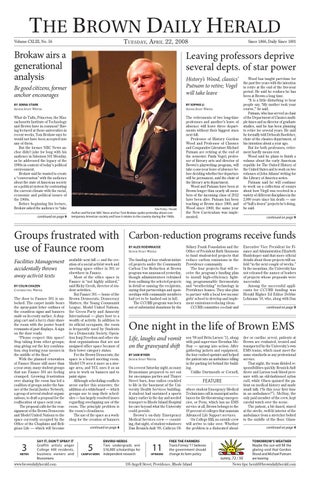
Kim Perley / Herald
Author and former NBC News anchor Tom Brokaw spoke yesterday about contemporary American society and how it relates to the country during the 1960s.
Wood has taught part-time for the past five years with the intention to retire at the end of the five-year period. He said he realizes he has been at Brown a long time. “It is a little disturbing to hear people say, ‘My mother took your course,’” he said. Putnam, who has served as chair of the Department of Classics multiple times and as director of graduate studies, said he has been planning to retire for several years. He said he formally told Deborah Boedeker, chair of the classics department, of his intention about a year ago. But for both professors, retirement hardly means rest. Wood said he plans to finish a volume about the early American republic for The Oxford History of the United States and to work on two volumes of John Adams’ writing for the Library of America series. Putnam said he will continue to work on a collection of essays about how Virgil was received in a variety of different disciplines in the 2,000 years since his death — one of “half a dozen” projects he’s doing, he said. continued on page 9
Groups frustrated with Carbon-reduction programs receive funds use of Faunce room By Alex Roehrkasse Senior Staf f Writer
Facilities Management accidentally throws away activist texts By Colin Chazen Contributing Writer
The door to Faunce 301 is unlocked. The carpet inside bears the spray-paint letter outlines of the countless signs and banners made on its crusty surface. A shopping cart and a furry chair share the room with the poster board remnants of past displays. A sign on the door reads: “Please respect this space! Stop taking from other groups; stop giving out the key combination; stop leaving your messes in the middle of the floor.” With the planned renovation of Faunce House still more than a year away, many student groups that use Faunce 301 are feeling cramped. Growing frustration over sharing the room has led a coalition of groups under the banner of the Social Justice Network, a group of several student organizations, to draft a proposal for the reallocation of space next year. The proposal calls for the reassignment of the Brown Democrats and Model United Nations to the space currently occupied by the Office of the Chaplains and Religious Life — which will become
3
METRO
available next fall — and the creation of a social activist work and meeting space either in 301 or elsewhere in Faunce. Most of the office space in Faunce is “not highly utilized,” said Ricky Gresh, director of student activities. But Faunce 301 — home of the Brown Democrats, Democracy Matters, the Young Communist League, Model United Nations, the Green Party and Amnesty International — plays host to a wealth of activity. In addition to its official occupants, the room is frequently used by Students for a Democratic Society, Operation Iraqi Freedom and other student organizations that are not assigned office space because of their lower category status. For the Brown Democrats, the space is a board meeting room. Model UN sees it more as a storage area, and YCL uses it as an area to work on banners and to paint signs. Although scheduling conflicts arose earlier this semester, the addition of a whiteboard — which groups use to map their schedules — has largely resolved issues regarding overlapping use of the room. The principle problem is the room’s cleanliness. The use of the space as a workshop for the creation of banners
say it, don’t spray it Graffiti artists anger College Hill residents, business owners and Brunonians
www.browndailyherald.com
continued on page 4
5
CAMPUS NEWS
The funding of four student-initiated projects under the Community Carbon Use Reduction at Brown program was announced yesterday, though administrators refrained from outlining the selected projects in detail or naming the recipients, saying that partnerships and sponsorships with community members had yet to be hashed out in full. The CCURB program was born out of substantial donations by the
Sidney Frank Foundation and the Office of President Ruth Simmons to fund student-led projects that reduce carbon emissions in the Providence community. The four projects that will receive the program’s funding plan to install high-ef ficiency lighting, programmable thermostats and “weatherizing” technology in Providence homes. They also plan to partner with a local low-income girls’ school to develop and implement emissions-reducing ideas. CCURB committee co-chair and
Executive Vice President for Finance and Administration Elizabeth Huidekoper said that more official details about those projects will unfold “in the next couple of weeks.” In the meantime, the University has not released the names of leaders of projects whose proposals were successful. Among the successful applicants for CCURB funding was Herald Higher Ed Editor Debbie Lehmann ’10, who, along with Dan continued on page 9
One night in the life of Brown EMS Life, laughs and vomit on the graveyard shift By Sam Byker Senior Staf f Writer
On a recent Saturday night, as many Brunonians prepared to set out for on-campus parties and Thayer Street bars, four radios crackled to life in the basement of the University Health Services building. A student had sustained a sports injury earlier in the day and needed transport to Rhode Island Hospital for care beyond what the University could provide. Brown’s on-duty Emergency Medical Services crew — consisting, that night, of student volunteers Dan Resnick-Ault ’09, Cathryn Ol-
enviro-nerds Two undergrads win $16,000 scholarships for independent research
11
OPINIONS
sen ’09 and Brita Larson ’11, along with paid supervisor Brendan McStay — sprang into action. After gathering jackets and equipment, the four rushed upstairs and helped the patient into an ambulance idling in the parking lot behind the building. Unlike Dartmouth or Cornell,
FEATURE where student Emergency Medical Technicians call in municipal ambulances for life-threatening emergencies, or Penn, which has no EMS service at all, Brown belongs to the 10 percent of colleges that maintain Advanced Life Support services. On College Hill, no outside crew will arrive to take over. Whether the problem is a dislocated shoul-
free the farmers Travis Forney ‘11 believes the government should change its farm policy
sunny, 72 / 50 195 Angell Street, Providence, Rhode Island
der or cardiac arrest, patients at Brown are evaluated, treated and transported by the University’s own EMS teams, which must meet the same standards as any professional service. That night, the team divided responsibilities quickly. Resnick-Ault drove and Larson took blood pressure with an old-fashioned nylon cuff, while Olsen quizzed the patient on medical history and made small talk (“Is this your first time in an ambulance?”). McStay, the only paid member of the crew, kept careful watch over the scene. The patient, a bit dazed, stared at the sterile, well-lit interior of the ambulance from a stretcher bolted to the middle of the floor. Glasscontinued on page 4
tomorrow’s weather Maybe the sun will fill the glaring void that Gordon Wood and Michael Putnam are leaving
News tips: herald@browndailyherald.com
T oday Page 2
Tuesday, April 22, 2008
THE BROWN DAILY HERALD
Menu
But Seriously | Charlie Custer and Stephen Barlow
Sharpe Refectory
Verney-Woolley Dining Hall
Lunch — Fried Fish Sandwich with Tartar Sauce, Quinoa and Veggies, Asparagus Spears, Philly Cheesesteak Calzone
Lunch — Buffalo Wings with Bleu Cheese Dressing, Shiitake and Leek Quiche, Stewed Tomatoes, Nacho Bar
Dinner — Fiery Beef, Vegetable Frittata, Ginger Sugar Snap Peas and Carrots, Ice Cream Sundae Bar
Dinner — Chicken Florentine, Vegan BBQ Tempeh, Mashed Potatoes with Garlic, Wax Beans, Broccoli
Aibohphobia | Roxanne Palmer
Sudoku Fill in the grid so that every row, every column and every 3x3 box contains the digits 1 through 9.
Enigma Twist | Dustin Foley
© Puzzles by Pappocom
RELEASE DATE– Tuesday, April 22, 2008
Los Angeles Times Puzzle C r o sDaily s w oCrossword rd
Gus vs. Them | Zachary McCune and Evan Penn
Edited by Rich Norris and Joyce Nichols Lewis
ACROSS 1 Hidden complication 6 Wild (over) 10 Not all that close 14 Kick around 15 “I agree!” 16 Isle where Macbeth is buried 17 Goings-on at the precinct 19 Rice-A-__ 20 Monopoly foursome: Abbr. 21 Clucks of disapproval 22 Written in a column, as “to-do” things 24 Slanted letters 26 Oman neighbor 27 Oskar’s “Oh!” 28 Subterranean burial site 31 Outlying area, briefly 34 Coup d’__ 36 Sweetie pie 37 Suffix with switch 38 Assortment around the surge protector 40 Lessee’s payment 41 Seaweed gelatins 43 Facility 44 Sister of Osiris 45 Garibaldi follower 47 Founded: Abbr. 49 Amazes 50 Imitator 54 Shrub with pink or white flowers 56 Inventory evaluation meth. 57 Gardner of “The Killers” 58 Cabriolet automaker 59 Combine efforts, and puzzle title reflected in 17Across and 10and 25-Down 62 Long march 63 Pianist Templeton 64 Dreads 65 Otherwise 66 Fit securely 67 “Jes’ imagine, Jeb ...”
DOWN 1 Italian isle 2 Scrub, as a mission 3 Home of the Drillers of the Texas League 4 Emmy-winning forensic drama 5 Frenzied 6 Stares conspicuously 7 Old Testament prophet 8 Essen’s country: Abbr. 9 Short sock 10 Post-9/11 concern 11 Page-bottom references 12 Oscar winner Baxter 13 Vice squad surprise 18 Stay clear of 23 Popular Apple 25 Wildcatters’ action 26 “The Dresser” director Peter 28 Jeweler’s weight 29 Skirt length 30 Stakes
31 Market pessimist 32 Hankering 33 Rest stop areas 35 Stadium sections 39 Wave to from the pier 42 Elisabeth of “Leaving Las Vegas” 46 In need of bailing out, perhaps 48 Parodies
50 Hardly a problem 51 Chocolate bean 52 States as fact 53 Cannes cup 54 Fill and then some 55 Stitched loop 56 Prevaricates 60 Bullring “Bravo!” 61 Sales force member, for short
ANSWER TO PREVIOUS PUZZLE:
Free Variation | Dustin Foley
xwordeditor@aol.com
04/22/08
Vagina Dentata | Soojean Kim
T he B rown D aily H erald By Norm Guggenbiller (c)2008 Tribune Media Services, Inc.
04/22/08
If you do one thing on College Hill today… See Thomas Friedman’s lecture, “Green is the New Red, White and Blue,” Salomon 101 at 6 p.m.
Editorial Phone: 401.351.3372
The Brown Daily Herald (USPS 067.740) is an independent newspaper serving the Brown
Business Phone: 401.351.3260
University community since 1891. It is published Monday through Friday during the aca-
Simmi Aujla, President
once in July by The Brown Daily Herald, Inc. POSTMASTER please send corrections to
Ross Frazier, Vice President Mandeep Gill, Treasurer Darren Ball, Secretary
demic year, excluding vacations, once during Commencement, once during Orientation and P.O. Box 2538, Providence, RI 02906. Periodicals postage paid at Providence, R.I. Offices are located at 195 Angell St., Providence, R.I. E-mail herald@browndailyherald.com. World Wide Web: http://www.browndailyherald.com. Subscription prices: $319 one year daily, $139 one semester daily. Copyright 2007 by The Brown Daily Herald, Inc. All rights reserved.
M etro Tuesday, April 22, 2008
THE BROWN DAILY HERALD
Min Wu / Herald
The College Hill Neighborhood Association has a task force to tackle what they believe is a growing graffiti problem. A University official estimates there are 10 to 15 graffiti incidents on Brown’s campus every month.
College Hill unites against graffiti By Nandini Jayakrishna and Scott Lowenstein Senior Staff Writer and Metro Editor
When it comes to Thayer Street politics, it isn’t often that the University, business owners and College Hill residents agree publicly. But one issue has riled up East Side neighbors, businesses and Brunonians alike: graffiti. Several Brown buildings and area businesses have been marked recently. Historic East Side institutions like the Providence Athenaeum, the Stephen Hopkins House Museum and the statue in Prospect Park have been hit. And once old brick has been the target of graffiti, it never looks the same, even after being cleaned, said Susan Hardy, co-chair of the College Hill Neighborhood Association’s graffiti task force. Despite a unified campaign against the vandalism and a citywide task force formed by Mayor David Cicilline ’83 to combat “tagging,” as graffiti artists call it, East Side residents and business owners say they are still fighting an uphill battle. “People see it as harmless selfexpression, but it ends up damaging people’s property,” Hardy said. She added that the CHNA task force is especially concerned with the tagging of historic buildings. Hardy said defenders of graffiti believe “graffiti is Americana, but when historic buildings that are American, that are part of our legacy (are being destroyed), that’s ironic.” Steven Heck, the other CHNA task force co-chair, said that graffiti stands out as a flaw on the East Side. Heck said that some College Hill visitors have told him the East Side “is such a neat area. Too bad (there is) so much graffiti.” So far, the city’s task force has organized efforts both to catch graffiti artists in the act of tagging and to clean up graffiti where it has occurred, but they “can’t be everywhere all the time,” Hardy said. “Brown has done an excellent job (of removing graffiti) on their property. They do make an effort,” Heck said. “On the periphery though, there’s another story.” There are about 10 to 15 graffiti incidents on Brown’s campus every month, said Stephen Maiorisi, vice president for Facilities Management,
in an interview last month, after two local college students were arrested and charged with malicious mischief after tagging a Brown building. Maiorisi estimated that Brown spends an average of $10,000 a year in graffiti removal. The Thayer Street District Management Authority — composed of Thayer Street business and property owners — intends to remove graffiti, but has not done much thus far because a certain temperature is needed “for chemicals to be able to penetrate the material,” said Kenneth Dulgarian, director of the DMA and owner of the Avon Cinema and other Thayer Street buildings. Still, Hardy said the DMA could be taking a more active role in cleaning graffiti, and added that it may have missed opportunities to remove graffiti before the winter chill. Hardy said prompt cleanup is especially important because graffiti
sends the message that an area is neglected, which only encourages more vandalism. Heck said businesses like Ben and Jerry’s on Meeting Street and City Sports on Thayer are not doing enough to promptly remove graffiti from their buildings. To improve cleanup efforts on the East Side, Heck said he wants more people to participate in an “adopt-aspot” program, in which College Hill residents tend to a spot and “try to keep it graffiti-free.” Hardy said she would like the Thayer Street landlords to “be more responsible” and seek to educate the public about the fact that graffiti and tagging are crimes. She also said that Brown students should take a more active role in cleaning up graffiti on College Hill. Brown students “should be just as outraged as the rest of us are,” she said. “It is their community as well.”
Page 3
Page 4
Tuesday, April 22, 2008
THE BROWN DAILY HERALD
Aboard ambulances, EMTs bring humor and romance continued from page 1 fronted cupboards filled with supplies lined the walls, along which the EMTs sat on cushioned, benchstyle seats. An external defibrillator hung from one wall, wires protruding in all directions. Soon, the team arrived at Rhode Island Hospital. McStay and Resnick-Ault wheeled the patient in through a set of glass double doors reserved for patients arriving by ambulance. A nurse took over and began entering medical information into a computer console. When the ambulance pulled away several minutes later, the patient had been transferred to a bed and had joined the queue of others awaiting treatment. About EMS Overall, there was little to distinguish this Saturday from any other Saturday that Brown EMS covers each year. With 115 volunteers, each of whom works a total of 24 hours per month, the organization is one of Brown’s most popular extracurricular activities. Brown also maintains a paid staff of five, led by EMT Amy Sanderson. “It started as a volunteer organization and, eventually, it became clear that we needed a paid supervisory staff because an EMS service is a lot of work to run,” said Sanderson, who also works as a volunteer EMT for her hometown fire department in Warren. Many of EMS’s volunteers come from its 10-week summer course, which meets on campus four times a week and qualifies its students for Basic EMT certification. Others arrive at Brown already certified. EMS maintains a speedy fiveminute average response time for its 900 annual calls, McStay said. The day after a patient is taken to the hospital, a nurse from Health
Ser vices will call to see how the stay went, offer advice and schedule a follow-up appointment, McStay said. Before the crew leaves a patient at the hospital, it provides a cab voucher for transport back up College Hill. “The care’s not going to stop when you walk out the door of the hospital,” McStay said. “It’s going to continue when you get back to Brown.” Back in the office ... After the hospital trip, Brown’s EMS crew settled into a more typical nighttime routine in the threadbare but homey office that serves as its headquarters in the Health Services building. Its first priority was dinner, which had been procured earlier in the night during a trip to Thayer Street — in the ambulance, of course — but abandoned once the first call came in. After the meal, McStay surfed EMT blogs at an aging desktop computer, while the others chatted about their reasons for joining the service. “I read a book called ‘Rescue 471’ by a guy who was a paramedic in Hartford,” Resnick-Ault said. “It was a little bit romanticized ... but it got me into it.” Resnick-Ault took a night class at Northeastern University during his senior year of high school and took the certification exam soon after he turned 18. Now, in addition to his work at Brown, Resnick-Ault works up to 20 hours a week in other EMS services: a private company in Rhode Island and Sanderson’s volunteer department in Warren. “After having a few really good medical calls at Brown I decided that I wanted to work somewhere where the population was a little bit more at risk for more health problems,” he said. Among other things, ResnickAult said his outside work has taught him the value of humor.
Tai Ho Shin / Herald File Photo
Brown Emergency Medical Services has a staff of 115 volunteers who work 24 hours in a month. “When you have a 27-year-old guy with testicular torsion, you cannot provide adequate care without joking around with him,” he added. “It’s part of the care because if that’s something the patient is uncomfortable with, you have to find a way to make them comfortable.” Olsen said that during freshman year, she was debating whether to attend medical school or go into research after Brown. She enrolled in the EMS summer course to get a taste of real-world medical work. “It was really one of the best decisions I’ve made at Brown,” she said. Now, Olsen is planning on attending med school. She’s also dating Resnick-Ault, after the two met in an ambulance. “I sniped a shift from someone so that I could work with her and ask her out,” Resnick-Ault said. “We have a lot of fun together.” In addition to several couches and bunk beds, on-call EMTs can take advantage of an aging bigscreen television and a sizable video library with titles as diverse as “Indiana Jones,” “King Kong vs. Godzilla” and “Sister Act 2: Back in the Habit.”
“I bring work sometimes,” Larson said. “Generally, though, I assume it won’t get done. ... I take the time here as a break in the week to relax.” ... and out again At 2 a.m., the team’s radios buzzed to life once more. An inebriated student was vomiting at an off-campus residence, and one of his friends had called the Department of Public Safety. Again, the crew set off, followed closely by a DPS officer in another vehicle. When they arrived, the patient was leaning on a porch railing, semi-conscious. Larson, as the least experienced member of the team, volunteered to question the patient about the location of his Brown ID (eventually found by a friend) and how much alcohol he had consumed (“too much”). The patient was lowered onto a stretcher and carried down the stairs into the ambulance. As they set off toward the hospital, the crew members took turns questioning the patient as he drifted in and out of consciousness. “Can you open your eyes for
me?” Olsen asked, ready to check their dilation. The patient opened his mouth. “No, your eyes. There you go.” “Did you do any drugs tonight?” McStay inquired. “We don’t care if you did, we just need to know.” Somehow, their combined efforts resulted in a University mailbox number and an age, which Larson recorded. By the time they’d arrived at the hospital, she’d gotten a good start on the standardized form that the team must fill out for every call. Upon leaving the ambulance, the patient resumed vomiting, and a man in green scrubs rushed up with a pink plastic bucket. The EMTs shared his information with one nurse, while another gave the patient a breathalyzer test. As the ambulance pulled into the Health Services parking lot for the last time that night, the team members seemed content with the night’s work. “It’s definitely a community,” Olsen said of EMS. “We’re a family in a lot of ways. We spend a lot of time together — and, you know, we’re family. We have our little fights, our little drama, but we’re close.”
Campus groups: Clean your (Faunce) room! continued from page 1 and posters has often drawn the ire of those that use it as a meeting place. A representative of YCL admits that there have been times when YCL created a mess and “didn’t cover the floor well enough,” while creating banners and signs. The representative asked not to be named because he did want to be associated with a communist organization in print. YCL also used the room for a time to store wooden stakes used by OIF in a display marking the fourth anniversary of the Iraq war. Following the protest, OIF wanted to keep the stakes, which the YCL representative said cost about $300, but had no place to store it. YCL offered to keep it in Faunce 301, the YCL representative said. Frustration over the room’s cleanliness reached a pinnacle shortly before spring break. After receiving several complaints from students, the Student Activities Office agreed to have Facilities Management employees enter the
room to clean the carpet and remove mouse pellets, among other debris, Gresh said. “The room was pretty dirty and disgusting,” said Gabriel Kussin ’09, president of the Brown Democrats. “We were told that if we moved everything into the hallway, they would clean the carpet,” he said. But because of a miscommunication, Facilities Management disposed of the items placed in the hallway, Gresh said. Among the objects thrown away were several books and pamphlets on activism, said Donata Secondo ’10, a member of the Social Justice Network. The loss of the texts “was a loss to institutional memory,” she said, and the mistake “showed the need for student control of the space.” YCL sustained the most significant losses, and has since been reimbursed by the SAO, Gresh said. Secondo views the proposal by the Social Justice Network as an opportunity to create a shared workspace available to many groups currently without offices. “Nobody should have to jump
through hoops to do the work they have decided to undertake,” Secondo said. Part of the problem is that offices that would normally have been reallocated to student groups this year were not, Gresh said. That would have resolved conflicts that had arisen since the previous reallocations two years ago. But the allocations will not be changed because the Faunce renovations will be happening soon anyway, he said. The renovations are scheduled to begin in summer 2009. Gresh, who has not yet seen the SJN proposal, said he plans to consider the students’ recommendations as plans for a renovated Faunce House are drawn up. The renovated building may include a large, shared work area as well as smaller offices, he added. Vice President of Model UN Anish Mitra ’10, who said his group largely uses Faunce 301 for storage, had a more simple solution. “If I had my way, I would just eliminate all the activist groups altogether,” said Mitra, who is also a Herald opinions columnist.
Clean your room. Recycle this paper.
C ampus n ews Tuesday, April 22, 2008
News
Page 5
THE BROWN DAILY HERALD
i n
Brief
Students take advantage of free HIV tests Sixty students took advantage of free HIV testing sponsored by the Brown chapter of the Global Alliance to Immunize Against AIDS in Leung Gallery on Monday. GAIA organized and ran the event with financial support from Queer Alliance, the Office of the President, Health Services, the Department of Community Health and the Department of Africana Studies. The tests were administered by volunteers from AIDS Care Ocean State. “Our goal is to have HIV testing become a routine part of yearly medical checkups,” said GAIA President Jeanne Tong ’10. Health Services also offers such testing, but charges a fee, which makes students less likely to get tested, she said. “Once we sent out all the e-mails to the various departments and offices, it was relatively easy to get funding,” Tong said. GAIA began holding a free testing day each semester starting in the fall of 2006, Tong said, adding that the testings have drawn an average of 100 students. One hundred tests were ordered for Monday’s event, though fewer than that participated. The remaining tests will be used in the fall. “I was a little worried that we didn’t publicize as much as we usually do,” Tong said. “But the students who really needed the service came.” To cut costs, this year’s tests were performed using blood from a finger prick, which is cheaper than the the oral swab method that was previously used. The total budget for this semester’s event was $1,100, or $11 per test, Tong said. To be tested, students had to fill out confidential paperwork and were asked to use their first name or a pseudonym to identify themselves. After the blood sample was taken, the results were available in about 15 minutes, Tong said. If a student tests positive, Tong said, “we provide brochures on psychiatric services through Brown and places in Providence where they can get help.” “We try to provide them with a resource,” she said. —Joanna Wohlmuth
Two undergrads win generous green grants By Juliana Friend Contributing Writer
Two Brown students have won $16,000 scholarships from the National Oceanic and Atmospheric Administration, which announced its 100 undergraduate award winners earlier this month. Both Brown recipients said they were surprised to receive the congratulatory phone call. “It was like, ‘Oh, wow, I didn’t expect that!’” said Kyle Poyar ’10, after hearing that he had received the award at 4 p.m. on the last possible notification date. Kelsey Lane ’09.5 said she was also resigned to not receiving the scholarship after she received an ambiguous voicemail message. However unexpected, the call from NOAA brought good news to the two undergraduates. As Ernest F. Hollings Undergraduate Scholars, Poyar and Lane will each receive $8,000 per year during their junior and senior years. In the summer before their senior years, the two students will have the opportunity to choose a 10-week summer internship from a diverse list of research options around the country, according to NOAA’s Web site. The internships will pay $650 per week. This summer, Poyar will work on sustainability issues for the city of Cleveland and Lane will do coastal ecology research on salt marshes. Both students said they were drawn to NOAA’s emphasis on merg-
ing environmental research with public policy. Double concentrating in environmental science and economics, Poyar said the organization fit his goal of analyzing the changes in how society values the environment. And even if Lane, a geologybiology concentrator, decides not to pursue public policy, she said gaining an understanding of the organization and making connections within the federal system will be very valuable. NOAA “is the federal agency to go to,” said Lane, who is considering becoming a marine ecologist. The summer of independent research is one of the key benefits of the scholarship, said Poyar, who hopes to study natural resource extraction at NOAA’s research facility in Boulder, Colo., in 2009. The Hollings Scholarship selected award recipients with the research opportunity in mind, “looking to train the next generation of scientists who will consider NOAA’s mission and the greater environmental issues we face,” said Jacqueline Rousseau, program director of the Educational Partnership within NOAA’s Office of Education. The program has also become extremely competitive, Rousseau said. She said the program received more than 600 applicants and no competitive applicant had a GPA below 3.3. Lane and Poyar aren’t the only Brunonians to receive the Hollings Scholarship in recent years. Adam Greenbaum ’08 received the scholarship in 2006, followed by Shane
Min Wu / Herald
Kyle Poyar ‘10, a new Ernest F. Hollings Undergraduate Scholar
Schoepfer ’09 in 2007. Greenbaum worked in Boulder last summer, applying his mechanical engineering expertise to measuring the effects of aerosol on radiation. He happily recalled the chance to work with an electrical engineer who did drag racing on the side — “one of the coolest people I ever met,” he said. He encouraged this year’s recipients to make the most out of the opportunity. “That was probably the best summer of my life,” Greenbaum said, “and the money doesn’t hurt.” Poyar and Greenbaum said they only wish that Brown had better publicized the program, which is only in its fourth year. “It’s very obscure,” Poyar said. Added Greenbaum, who found out about the scholarship just a week and a half before the deadline: “I would have applied a lot sooner if Brown had advertised.”
W orld & N ation Tuesday, april 22, 2008
Page 7
THE BROWN DAILY HERALD
For many American women, life expectancy is on the decrease By David Brown Washington Post
For the first time since the Spanish influenza of 1918, life expectancy is falling for a significant number of American women. In nearly 1,000 counties that together are home to about 12 percent of the nation’s women, life expectancy is now shorter than it was in the early 1980s, according to a study published Tuesday. The downward trend is evident in places in the Deep South, Appalachia, the lower Midwest and in one county in Maine. It is not limited to one race or ethnicity but it is more common in rural and low-income areas. The most dramatic change occurred in two areas in southwestern Virginia (Radford City and Pulaski County), where women’s life expectancy has decreased by more than five years since 1983. The trend appears to be driven by increases in death from diabetes, lung cancer, emphysema and kidney failure. It reflects the long-term consequences of smoking, a habit that women took up in large numbers decades after men did, and the slowing of the historic decline in heart disease deaths. It may also represent the leading edge of the obesity epidemic. If so, women’s life expectancy could decline broadly across the United States in coming years, ending a nearly unbroken rise that dates to the mid-1800s. “I think this is a harbinger. This is not going to be isolated to this set of counties, is my guess,” said Christopher Murray, a physician and epidemiologist at the University of Washington who led the study. It is being published in PLoS Medicine, an open-access journal of the Public Library of Science. Said Elizabeth Nabel, director of the National Heart, Lung and Blood Institute of the National Institutes of Health, “The data demonstrate a very alarming and deeply concerning increase in health disparities in the United States.” The study found a smaller decline, in far fewer places, in the life expectancy of men in this country. In all, longevity is declining for about 4 percent of males. The phenomenon appears to be not only new but distinctly American. “If you look in Western Europe, Australia, Japan, New Zealand, we don’t see this,” Murray said. About half of all deaths in the United States are attributable to a small number of “modifiable” behaviors and exposures, such as smoking, poor diet and lack of exercise. Although it is impossible to know exactly what is going on in the 1,000 counties, Murray thinks it “would be a reasonably obvious strategy” to target them for aggressive public health campaigns. Life expectancy is not a direct measure of how long people live. Instead, it is a prediction of how long the average person would live if the death rates at the time of his or her birth lasted a lifetime. For that reason, life expectancy can dip or rise abruptly. The death rate from the Spanish flu was so high, especially among the young, that life expectancy fell by about seven years in 1918. But it rebounded quickly when the epidemic was over. In general, though, it takes huge forces to drive down life expectancy
over longer periods. The AIDS epidemic has done so in some African countries. In the early 1990s, the social disruption following the collapse of the Soviet Union decreased life expectancy of Russian men by six years and of women by three years — an unprecedented decline in a modern industrialized nation. In the study, Murray and collaborators at the Harvard School of Public Health examined mortality and cause-of-death data for the United States from 1961 through 1999. They divided the country into 2,068 units, including cities, counties or combinations of counties. Across that four-decade period, average life expectancy nationwide increased from 66.9 years to 74.1 years for men, and from 73.5 years to 79.6 years for women. From 1961 to 1983, life expectancy went up everywhere for both sexes. This was largely because the death rate from heart attacks, which had been rising for half a century, began to fall in the late 1960s. There were two reasons. Huge numbers of people lowered their chances of having a heart attack by modifying “risk factors,” such as smoking, hypertension and high cholesterol. Improvements in medicine — coronary care units, use of aspirin and beta-blocker drugs, and various surgical procedures — greatly increased survival in patients with heart disease. About two-thirds of the longevity gained over the past four decades has come from the decrease in cardiovascular deaths. These changes were so dramatic that even the poorest and least healthy groups benefited. In fact, counties with low life expectancy in 1961 had steeper rises over the next dozen years than counties that started out with high life expectancy. Overall, the drop in heart attack deaths more than offset rising mortality from cancer, emphysema and diabetes during this period. By the early 1980s, however,
the rapid gains were coming to an end. The low-hanging fruit on the tree of heart-attack prevention and treatment had been picked. Further strides tended to happen mostly in places where people were already healthy and long-lived. As a consequence, the rise in longevity began to stagnate in places with the least-healthy people. In those counties, life expectancy increased by only one year (from 74.5 to 75.5) between 1983 and 1999, while in the healthiest places the life expectancy of women had reached
83.
It was during this interval that women’s life expectancy fell in nearly 1,000 counties. If one adds counties where it rose only insignificantly, then 19 percent of American women — nearly 1 in 5 — are now experiencing stagnating or falling life expectancy. The trend was far less pronounced for men. That is because they entered the 1980s with higher death rates from heart attacks than women, and thus gained more from better prevention and better treat-
ment. In the 1990s, however, AIDS and homicide began to take large tolls, depressing male life expectancy in some places. Murray’s team, which also included Ari Friedman of Harvard and Sandeep Kulkarni of the University of California at San Francisco, used Internal Revenue Service data to check whether high levels of migration, or migration of people with particularly high or low incomes, might explain the discrepancy between the continued on page 9
Page 8
Tuesday, April 22, 2008
THE BROWN DAILY HERALD
For m. tennis, tears after No. 20 w. water polo shuts out Harvard losing shot at Ivy title continued from page 12
continued from page 12 falling 8-5. The lone victor y of the day came at No. 2 doubles, as Garland and Gardner came from behind, catching a break with the score 5-2. They won the next six games and then the match, 8-5. “We have lost a lot of doubles points in Ivy play this year, so we were just ready to get out and grab the wins in singles,” Harris wrote. “We had been there before, so we knew we could go out and get it done again if we wanted to.” The 7-0 sweep was the quickest match of the season for the Bears, as they fell in all singles matches, losing in straight sets on all six courts. Gardner and Garland couldn’t keep their momentum from their doubles win, as both dropped their matches at No. 4 and 5 singles, respectively. At No. 6 singles, Au fell 6-1, 6-3. Lee followed him with a 6-3, 6-1 loss at No. 2 singles, and Kohli lost at No. 1 singles, 6-2, 6-4. The Crimson players began cheering for each other, urging teammates to “grab a broom” for the sweep. Pearlman tried to prevent that at No. 3 singles, but
ultimately fell 6-3, 6-4. “Basically, Harvard outplayed us and we didn’t play to our potential,” Kohli said. After the game, several players were in tears, as the Bears lost their chance at the Ivy title. But Br uno has to make a quick turn around, as they have one more match on their schedule. For Kohli, it will be his last collegiate match. “Obviously, this was very emotional, but I can’t let the emotions get the better of me because we still have another match,” Kohli said. “I am sure after the Yale match, the emotions will really hit me.” Kohli’s teammates said they are determined to finish this hard fought season with a win, for the lone senior’s sake. “We may not be playing for the Ivy title, but we are playing for something just as important,” Garland said. “We owe our best effort for Saurabh. He’s given the team four incredible years and his talent, enthusiasm, and personality will be greatly missed.” The Bears will finish their Ivy season at home against Yale at 2 p.m. on Wednesday, on the outdoor courts behind the OlneyMargolies Athletic Center.
count Executive Ror y Stanton ’09 fouled out in the second half, the remaining starters “weren’t getting the rest we needed.” Playing in their second game of the day, the nine Bears that were left were not as fresh as the 16 Hawks on the other side of the pool. “It was frustrating when they got back in the game, and then to lose by three,” Presant added. Laing is confident that the smaller size of the team won’t be a factor at the eight-team Eastern championships, since the Bears will be playing only one game each day. Brown and Har twick will be joined by No. 11 Michigan and No. 18 Indiana from the Western division, and Princeton and Bucknell from the Southern division in Ann Arbor, Mich., this weekend. The two wild card spots will be filled
by either Har vard, Mar yland or Mercyhurst. The winner of Easterns will go on to the NCAA National Championship Tournament in Palo Alto, Calif., from May 9 to 11. After overwhelming Utica, 12-4, and Connecticut College, 16-5, on Saturday, the Bears had to beat Ivy League rival Har vard before their rematch with the Hawks. The rivalr y has been lopsided the past few years, with consecutive Brown blowouts. Sunday’s first game was no exception, as Bruno blanked the Crimson, 9-0. “We had no doubts,” Presant said of the three wins it took to earn a spot in the championship game. “We knew we would be playing Hartwick.” Up 6-0 at the half, the Bears played their trademark defense while Laing earned her second career shutout with eight saves in net. “It felt good. ... It was nice see-
ing the looks of horrible, horrible defeat on (Harvard players’) faces,” Laing said. Blaxberg led all scorers with four, while Presant had three and Stanton and Herald Senior Staff Writer Joanna Wohlmuth ’11 chipped in one apiece. The Bears spread the wealth on Saturday, outscoring their opponents 28-9. Nine players scored against Utica in the first game, in which Bruno sealed the deal by taking a 10-2 halftime lead. Glick and Blaxberg scored three goals each to pace Bruno in its second Saturday win against the Camels. “Since spring break, we have come out strong, really attacking, and playing four solid quarters,” Laing said. “This weekend is pretty much a toss-up between teams, but we want (to win Easterns) more than anyone.”
Softball comes back to win in extra innings continued from page 12 scored three runs in the first inning. The Bears didn’t score its first run of the game — and of the weekend — until the fourth inning. Andrea Browne ’10 doubled to left field to bring home Baxter, who had walked. That cut Bruno’s deficit to two, as Harvard led 3-1 midway through the fourth. In the bottom of the fourth, Harvard scored two more runs to increase its lead to four. Brown answered immediately with a run in the fifth, when pinch runner Danielle Comissiong ’11 came home after Wilson was hit by a pitch with the bases loaded. But in the bottom of the fifth, the Crimson got the run back with Jennifer Francis’ second home run of the day. The Bears were down 6-2 going into the seventh inning. With the rally caps on, Brown went to work hoping to get back in the game. Lindsay Rice ’11 started the comeback for Brown with a one-out single to second base. Baxter followed with a walk, and Wilson singled to right field to score Rice from second base,
bringing the Bears within three. Chaddock then walked to load the bases. Browne came through again for the Bears, hitting a single to score two more runs. With the help of an error on the play from Harvard’s center fielder, the tying run came to the plate. Brown forced the game into extra innings after holding Harvard scoreless in the bottom of the seventh, then capped off the comeback in the eighth. Brittany Lavine ’10 singled up the middle and advanced to second on a bunt. Baxter singled to bring Lavine home and win the game for the Bears, 7-6. “I was trying not to overthink and just put the ball in play. They pitched to me outside all game and I was really focusing on hitting the ball to the right side of the field to move the runner,” Baxter said. This finished the best comeback of the season for Bruno. Moses saved the game for the Bears, while Chaddock got the win. “We were pleased with our comeback effort. We came back after going down early in the game. They could have easily packed it in
and they didn’t. I was hoping they had the fight in them,” EnabenterOmidiji said. “I am very happy that they got to experience that type of comeback effort against the team that won the Ivy’s last year and had a chance, with one more win, to clinch the North Division for the second year in a row.” But the momentum from game one did not carry over into the second. Harvard scored again in the first inning taking an early lead. The Crimson was able to tack on five more runs in the third inning and eventually won 6-0. Moses pitched six innings for Brown and gave up all six runs. She allowed nine hits while striking out nine. Brown will host Yale this Saturday in a doubleheader and then will travel to New Haven, Conn., on Sunday to finish the four-game series. “We hope we are able to just carry that fighting spirit into this weekend. These games have a lot of importance for a team in transition,” Enabenter-Omidiji said.“The other side of this is that it will be emotional for our seniors, Baxter and Anderson. We want to play well for them.”
Tuesday, April 22, 2008
Page 9
THE BROWN DAILY HERALD
Vogel leaves door open Brokaw calls on youth to be good citizens for return to Brown continued from page 1
continued from page 1 Boedeker said Putnam has been respected and loved by his students and colleagues. “This sounds really sappy, but he’s a very special person,” she said. “He has a great capacity to appreciate as well as to analyze literature and to convey that appreciation. People know that he loves Virgil when you get into class with him.” Boris Shoshitaishvili ’10 is one of those people. Shoshitaishvili said Putnam was a guest lecturer for a classics course in epic poetry that he took his freshman year. Putnam made such an impression on him that he took a month-long intensive Latin grammar course last summer to be ready to take LATN 1040: “Virgil: Aeneid” this spring. Shoshitaishvili, who had not taken Latin since he was in eighth grade, said he thought the hard work was worth it. He called Putnam’s class “one of those courses where, every time you come, you get a little bit blown away.” Both departments were able to prepare for Putnam’s and Wood’s departures. “The department and the University have been working for five years to assure continuity in the field,” said Kenneth Sacks, professor of history and chair of the department. The history department hired Assistant Professor of History Seth Rockman in 2004, and the department will soon begin a search to make a second appointment, he said. Boedeker said the search for Putnam’s replacement began in the fall. “We’re nearing the final stage,” she said. Each professor will give a final lecture in upcoming days. Wood will give the final lecture of HIST 1710: “Era of the American Revolution,” on Thursday, April 24, at 9 a.m. in List 120. Putnam’s farewell lecture — not part of a specific class — will be on Tuesday, April 29, at 4:30 p.m. in Salomon 001. He will lecture about Jacopo Sannazaro, an Italian Renaissance poet, he said. Vogel takes leave The flurr y of big-name pro-
fessors leaving at the end of the semester also includes Vogel, a Pulitzer Prize-winning playwright. But Vogel’s decision is not definite — she is taking a leave of absence, said Brian Evenson, professor of literary arts and chair of the department. “She is keeping the door open, for whatever reason,” Evenson said. But he added: “For all intents and purposes, we’re moving forward as if she’s not coming back.” Vogel declined to comment for this story. When Vogel wrote to the department on Jan. 16 that she would be taking the position of chair of the Department of Playwriting and the Eugene O’Neill professor of playwriting at the Yale School of Drama, she requested a leave of absence, Evenson said. Vogel was granted one year for her leave. In the middle of the year, she will let Brown know if she is returning or if she will stay at Yale for the remainder of her five-year appointment, Evenson said. Steven Padla, press director at Yale School of Drama, said he had not heard that Vogel was taking a leave of absence instead of resigning from Brown. “We cannot comment on what her relationship with Brown will be, but she’s certainly coming to Yale,” he said. In the meantime, the literary arts department cannot search for a permanent replacement for Vogel because she has not officially resigned, Evenson said. But an external search is currently underway for a one-year replacement. Dean of the Faculty Rajiv Vohra P’07 said he hoped to name the replacement in the next few weeks. If Vogel decides not to return to Brown, a search for a permanent replacement will commence. Evenson said the department has already started preparing for that possibility. The department has taken this as an opportunity to evaluate the future of the playwriting program and how it relates to other organizations and groups at Brown, Evenson said. “We’ve admired the way Paula has structured the program,” Evenson said. “But it’s not perfect.”
Study finds declining life expectancy for women continued from page 7 1,000 counties and their neighbors. They found no evidence for it. Unlike some European countries, the United States does not collect health information other than birth and death statistics at the local level. Instead, there are national, state and regional surveys of people’s health, behavior and access to medical care. Trends those studies have picked up shed light on what is happening in the 1,000 counties. Obesity has risen markedly in the past two decades, with women more affected than men. About 33 percent of women are now obese, compared with 31 percent of men. Extreme obesity is twice as common in women (7 percent) as in men (3 percent). Being overweight greatly increases the risk of developing
Type 2, or “adult-onset,” diabetes. A national survey in 2002 found that 85 percent of diabetics were overweight or obese. In recent years, the prevalence of high blood pressure has been increasing in women, as well — partly the result of weight gain. In 1990, 42 percent of women older than 60 had hypertension; by 2000 it was 51 percent. (In men, the trend is still dropping, as it has been for several decades.) “This is a story about smoking, blood pressure and obesity,” said Majid Ezzati, of the Harvard Initiative for Global Health, a co-author of the paper.
stock of what our individual dreams and hopes are,” so that by the end of the lecture, “we will think more robustly about what our role is in this particular time.” Throughout the lecture, Brokaw continued to ask the audience to consider their role in the Iraq War and the upcoming elections. The lecture, which he titled “The Call of Citizenship,” drew a diverse crowd of Brown students and Providence residents. Brokaw’s lecture maintained a story-telling quality as he led the audience through the turmoil of the Vietnam War and Martin Luther King Jr.’s marches against segregation. Beginning his lecture during the time of Lyndon Johnson’s presidency in the wake of the Tet Offensive, Brokaw described the hopelessness that many Americans were feeling. “The psychological effects on this countr y were electrifying,” Brokaw said. “It was a year in which 16,000 young Americans died in Vietnam, and the Tet Offensive seemed to say there is no hope.” In the aftermath of the Tet Offensive, the baby boomers were coming of age and their counterculture was sweeping the nation, “rejecting everything their parents stood for,” Brokaw said. “They challenged the marriage contract, institutional loyalty and they were disdainful of the idea of the military service.”
Brokaw interwove the untimely assassinations of King and thenpresidential candidate Robert Kennedy, saying, “The stage was set for a titanic clash, and it came in August of that year (1968) in the streets of Chicago” when hundreds of protesters flooded the city’s streets. The event polarized the Democratic party and allowed Richard Nixon to win the presidential election. Brokaw then fast-for warded 40 years to the present day, asking the audience to “take stock of what’s worth keeping since 1968 and what’s not.” Such a reflection is especially necessary because this election is the “most important” since 1968, he said. Brokaw, who became one of the country’s most recognizable television news anchors, called attention to the fact that the soldiers fighting in Iraq come mainly from workingclass families and small towns. “We are two societies: civilian and uniform,” Brokaw said. “This is unacceptable in a democratic republic. You can hate this war for every good reason, but you cannot dishonor those who have served at the ground level.” A journalist for many years, Brokaw said the most memorable people he inter viewed were not named Kennedy, Golda Meir or Michael Jordan. Instead, they were average Americans, such as a doctor from Tulsa who saved a Somali child from shrapnel and a young black woman who marched
with King despite her fear of being killed. “These are the people, for me as a journalist and just a member of humankind, who leave the most lasting impression on me,” he said. Brokaw ended his lecture with a hopeful story: that of the first trip to the moon, and his belief that “what’s more important is what unites us, not what divides us.” “I believe in my heart and my mind that we have no greater obligation than to re-enlist as citizens in this country,” he said, “to leave our mark this year and beyond, so that 100 years from now historians can say that this, too, was a great generation,” he concluded. Brokaw received a standing ovation from the crowd and drew praise from attendees of all ages. “I thought it was really good and really inspiring,” Scott Warren ’09 said. “He connects with an older generation, but at the same time his message connected with the youth.” Warren said he appreciated Brokaw’s call to action. “I’m involved in a lot of movements and I liked to hear someone tell us about a time when people were more involved and ask us to get involved,” he added. Henr y Sharpe ’45, a former Herald editor, said he thought the lecture was “wonderful.” “It’s a reminder that your generation has a hell of a challenge in front of them,” he said.
Projects to receive funding to reduce emissions continued from page 1 MacCombie ’08, will lead a project to install programmable thermostats in low-income households in Providence. Lehmann said the project is designed to help those who leave their thermostats on while they are out of the house or asleep, compounding skyrocketing utility bills and leading to unnecessar y carbon emissions. Studies say that fewer that half of people adjust their thermostats when they go out, she said. “It’s a huge financial problem, and it’s also a waste of energy” Lehmann said. She added that she is pleased the University has chosen to tackle climate issues directly by taking action locally, and that she feels her project is a great opportunity to do just that. Lehmann said she plans to use the CCURB funds to purchase the thermostats and partner with Providence community organizations that already do work in improving home energy efficiency to install the devices. The details of those partnerships, as well as how much money her project will receive, will be worked out as the project progresses, Lehmann said. An e-mail to Lehmann from CCURB co-chair and Environmental Stewardship Initiatives Manager Kurt Teichert asked what types of support she thought she would need as the project moves forward. The e-mail also said the CCURB committee was thinking about hiring a part-time employee or a consultant to advise and offer support
to funded projects. Members of the committee, which notified program applicants of their funding decisions in recent weeks, said they garnered a variety of exciting and creative ideas. The final picks, they said, were made on the basis of the projects’ clearly articulated plans to achieve substantial cuts in carbon emissions. CCURB committee member Michael Glassman ’09 said the committee hopes to engage those projects that did not receive funding but still display strong potential. “The CCURB project isn’t just meant to be a source of funding. It’s meant to really accomplish a goal, which is reducing carbon emissions in local communities and doing it in a bunch of different (ingenious) ways,” said Glassman, who is also president of the Undergraduate Council of Students. Proposals that did not receive funding can still be part of realizing that goal, he said. “These projects — to get them at a really high quality level — do take a lot of research and planning,” Glassman added. Glassman himself is part of a project selected for CCURB funding that was touted as the program’s pilot. That project involves the distribution of energy-saving compact fluorescent lamps, or CFLs, to low-income Providence households and, unlike the other projects, is already underway. The CFLs and other funding for the pilot project have been thus far provided by the Wal-Mart Foundation, Glassman said. “It’s cool. Wal-Mart is really ex-
cited about our project,” he said. The company will continue to be a partner in the project, he said, but he would not specify the financial nature of the relationship. Andrea Gaines ’10 submitted a proposal to build greenhouses to reduce Brown Dining Services’ dependence on purchasing energyintensive non-local foods. The notice from Teichert that her project would not receive funding included an invitation to fur ther discuss the project’s potential, pending research on the efficacy of local food production and distribution on carbon emissions. Gaines said she was frustrated that the program’s stringent guidelines on quantifying carbon emissions reduction meant her project didn’t get funding. But she added that she expects her project to move for ward nevertheless, with or without any CCURB funds. Like Gaines’ project, the financial future of the CCURB program itself is not altogether clear, committee members said. The committee does not expect that the four projects approved for funding will exhaust the original $350,000 in donations that jumpstarted the program, and it hopes to use the rest of that money to sustain approved projects or take more on, Huidekoper said. But Huidekoper added that the CCURB program funds were a one-time donation and neither the University nor the Sidney Frank Foundation have yet expressed any intention to put up more funds to make the program a permanent program.
Studies show life expectancy increases with Herald reading.
E ditorial & L etters Page 10
Tuesday, April 22, 2008
THE BROWN DAILY HERALD
Staf f Editorial
A Newer Curriculum In yesterday’s editorial, we mentioned the possibility of making more advising meetings mandatory, but we didn’t address a related, larger question: Just why is it that Brunonians so dreadfully fear the mere mention of the word “mandatory” in connection with seemingly any policy or plan? And is that fear misplaced? We’re told that Brown’s identity today is based on a fundamental, literal interpretation of the Gospel of Ira. The New Curriculum, so deified as to require capitalization, is the final and definitive word on our open, unrepressed, completely individualized system of education. Don’t question it. But wait. The curriculum on which Brown operates today isn’t the same one that was proposed almost 40 years ago. Ours lacks the “modes of thought” courses in the original design, includes entirely new (and perhaps unimagined in 1969) disciplines like modern culture and media and ethnic studies and attempts to fit the needs a student body whose economic, ethnic and national makeup is radically different — in a radically different time. So if we’ve already strayed from the original plan, why do we so adamantly resist change? Why have we equated a liberal approach to curricular structure with the complete absence of rules? Suspend, if you can, your visceral repulsion to the idea of having more mandatory elements of the Brown curriculum, and read on. Brown should enforce a writing requirement — not just the one we have now, but a real, meaningful writing requirement. A student should have to take at least a few writing-intensive courses, and to demonstrate not just competency, but excellence, before earning a degree from a prestigious school. Brown should require some sort of international experience — fulfilled through language or international relations courses, study or work abroad or international residency prior to attending. The globalized (or, if you prefer, “internationalized”) world demands greater understanding of the world beyond the U.S. than it did 40 years ago. Brown should require public service, defined broadly. The majority of students here already get involved in helping the community — in Providence schools, in environmental advocacy, in nonprofit scientific research — and a Brown degree should connote not just high academic achievement but also an awareness of a modern society’s needs. Nearly all students meet these requirements already; we are an active, aware and well-adjusted group of people. But requirements are designed to affect those who might otherwise leave College Hill with a lacking education. These mandates would not represent a great burden or a great imposition of values. And they would not change the character of Brown. While we await more final recommendations from the Task Force on Undergraduate Education, we urge Brown students to be a bit more openminded. We can learn not to be so afraid of the mandatory as to ignore it as a valid option. Then, we might come to see that Brown needs an update — a slightly Newer Curriculum.
T he B rown D aily H erald Editors-in-Chief Simmi Aujla Ross Frazier editorial Robin Steele Arts & Culture Editor Andrea Savdie Asst. Arts & Culture Editor Debbie Lehmann Higher Ed Editor Chaz Firestone Features Editor Olivia Hoffman Asst. Features Editor Rachel Arndt Metro Editor Scott Lowenstein Metro Editor Michael Bechek News Editor Isabel Gottlieb News Editor Franklin Kanin News Editor Michael Skocpol News Editor Karla Bertrand Opinions Editor James Shapiro Opinions Editor Whitney Clark Sports Editor Amy Ehrhart Sports Editor Jason Harris Sports Editor Benjy Asher Asst. Sports Editor Andrew Braca Asst. Sports Editor Megan McCahill Asst. Sports Editor
Senior Editors Taylor Barnes Chris Gang Stu Woo Business Darren Ball General Manager Mandeep Gill General Manager Susan Dansereau Office Manager Alex Hughes Sales Manager Lily Tran Sales Manager Emilie Aries Public Relations Director Jon Spector Accounting Director Claire Kiely National Account Manager Ellen DaSilva University Account Manager Philip Maynard Recruiter Account Manager Katelyn Koh Credit Manager Ingrid Pangandoyon Technology Director
roxanne palmer
L e tt e r s Task Force examining advising continuity To the Editor: I was pleased to read your recent editorial (“Advice for the unwilling,” April 21), and your suggestions for how Brown might improve its current system of academic advising. As you know, one of the goals expressed by the Task Force on Undergraduate Education was to improve not just the quality but the continuity of advising over the four years. Your suggestion about requiring advising appointments was discussed at more than one task force meeting, and, though it met with some resistance when raised at student focus groups, it deserves further thought and attention. For next year, we would like to begin implementing one of the recommendations of the task force by trying to sustain the connection between first-year students
and advisers into the sophomore year. Members of the class of 2011 will be hearing from our office about these arrangements, and about new plans for sophomore advising, before the end of the semester. The task force will be meeting again on April 29 to discuss the very rich feedback we have received so far, and you can be sure your suggestions will be taken on board. If members of the community have other ideas they would like the task force to consider, they should contact us soon. In the meantime, my thanks to The Herald for keeping this conversation alive. Katherine Bergeron Dean of the College April 22
photo Rahul Keerthi Meara Sharma Min Wu Ashley Hess
Photo Editor Asst. Photo Editor Asst. Photo Editor Sports Photo Editor
post- magazine production Steve DeLucia Production & Design Editor Chaz Kelsh Asst. Design Editor Catherine Cullen Copy Desk Chief Adam Robbins Graphics Editor
Matt Hill Rajiv Jayadevan Sonia Kim Allison Zimmer Colleen Brogan Arthur Matuszewski Kimberly Stickels
Managing Editor Managing Editor Features Editor Features Editor Associate Editor Associate Editor Associate Editor
Alex Unger, Chaz Kelsh, Allison Kwong, Designers Paula Armstrong, Ayelet Brinn, Joyce Ji, Jenn Kim, Copy Editors Michael Bechek, Chaz Kelsh, George Miller, Joanna Wohlmuth, Night Editors Senior Staff Writers Sam Byker, Nandini Jayakrishna, Chaz Kelsh, Sophia Li, Emmy Liss, Max Mankin, Brian Mastroianni, George Miller, Alex Roehrkasse, Caroline Sedano, Jenna Stark, Joanna Wohlmuth, Simon van Zuylen-Wood
Staff Writers Stefanie Angstadt, Marisa Calleja, Colin Chazen, Noura Choudhury, Joy Chua, Ben Hyman, Cameron Lee, Ben Leubsdorf, Christian Martell, Anna Millman, Seth Motel, Evan Pelz, Eli Piette, Lauren Pischel, Leslie Primack, Alex Seitz-Wald, Marielle Segarra, Melissa Shube, Catherine Straut, Sara Sunshine, Gaurie Tilak, Matthew Varley, Meha Verghese, Allison Wentz, Connie Zheng Sports Staff Writers Peter Cipparone, Han Cui, Meagan Garza, Lara Southern, Nicole Stock, Katie Wood Business Staff Stephanie Cheung, Veronica Yu, Jay Guan, Jennifer Chang, Jamie Phinney, Anna Reisetter, Kartika Chourdhury, Serena Ho, Akshay Rathod, Galen Cho, Maryrose Mesa, Van Le, Maura Lynch, Grant LeBeau, Jacqueline Goldman, Dana Feuchtbaum, Geraldo Guanaes, Lauren Presant, Lindsay Walls, Lucy Wang, Ruyi Jiang, Saul Lustgarten, Diego Gomez, Laura Sammartino, Ava Amini, Charley Chen, Lee Chau, Rory Stanton, Oliver Bowers, Katherine Richards, Alison Greenberg, Lilia Royanova Design Staff Jessica Calihan, Serena Ho, Rachel Isaacs, Andrea Krukowski, Joe Larios, Joanna Lee, Alex Unger, Aditya Voleti Photo Staff Oona Curley, Alex DePaoli, Erik Maser, Kim Perley, Quinn Savit Copy Editors Ria Ali, Paula Armstrong, Kim Arredondo, Ayelet Brinn, Aubrey Cann, Rafael Chaiken, Stephanie Craton, Erin Cummings, Katie Delaney, Julianne Fenn, Jake Frank, Anne Fuller, Josh Garcia, Jennifer Grayson, Rachel Isaacs, Joyce Ji, Jenn Kim, Tarah Knaresboro, Ted Lamm, Alex Mazerov, Seth Motel, Lisa Qing, Alex Rosenberg, Madeleine Rosenberg, Elena Weissman, Jason Yum
Clarification An editorial cartoon published in the March 3 issue of The Herald depicted Chelsea Clinton standing outside Paragon on Thayer Street. Flanked by two bodyguards, Clinton says, “Mom, this place sucks, can I please go now?” Chelsea Clinton had campaigned for her mother, presidential candidate Hillary Clinton, in Paragon on Feb. 29. The artist of the cartoon intended to mock the fact that Chelsea Clinton was stumping for her mother, presidential candidate Hillary Clinton, in restaurants and bars. He did not intend to disparage Paragon in particular. The Herald sincerely regrets any confusion the cartoon may have caused. C O R R E C T I O N S P olicy The Brown Daily Herald is committed to providing the Brown University community with the most accurate information possible. Corrections may be submitted up to seven calendar days after publication. C ommentary P O L I C Y The staff editorial is the majority opinion of the editorial board of The Brown Daily Herald. The editorial viewpoint does not necessarily reflect the views of The Brown Daily Herald, Inc. Columns, letters and comics reflect the opinions of their authors only. L etters to the E ditor P olicy Send letters to letters@browndailyherald.com. Include a telephone number with all letters. The Herald reserves the right to edit all letters for length and cannot assure the publication of any letter. Please limit letters to 250 words. Under special circumstances writers may request anonymity, but no letter will be printed if the author’s identity is unknown to the editors. Announcements of events will not be printed. advertising P olicy The Brown Daily Herald, Inc. reserves the right to accept or decline any advertisement at its discretion.
O pinions Tuesday, April 22, 2008
THE BROWN DAILY HERALD
Page 11
Reclaiming the ivory tower Maha atal Opinions Columnist By most standards, Pope Benedict XVI presented a more liberal vision of Catholicism on his recent U.S. tour than that which His Holiness has historically espoused. He apologized for priestly sexual abuses, visited a synagogue and performed mass with a secular choir in Yankee Stadium. But one reactionary set of remarks undermines the goodwill of these progressive gestures. Speaking at Catholic University in Washington, D.C., the pope praised Catholic educators who infuse all aspects of their teaching with religious doctrine. That, as one might expect, means no performances of “The Vagina Monologues” or “The Laramie Project” on campus, and no courses in evolutionary biology. But the pope framed this ideologically restrictive ideal in the language of academic freedom. “Academic freedom,” he said, compels us “to search for truth wherever evidence leads,” so long as we do not “appeal to academic freedom to justify positions that contradict the faith.” For Benedict, freedom and truth exist only in Christian doctrine. Shockingly, mainstream media outlets endorsed this dangerous and paradoxical link between the suppression of theological dissent and the search for objective realities. Catholic academics told newspapers how pleased they were to have the Pope defend their search for God’s truth, while those in secular academe were rarely asked to comment at all.
Time Magazine thus triumphantly proclaimed, “Both advocates of untrammeled academic freedom and obedience to orthodoxy could claim a victory.” Yet there is something decidedly trammeled about the way Benedict defines freedom and truth. A similar contradiction emerges among liberal academe in a tenure battle at Columbia. Barnard College anthropologist Nadia Abu ElHaj came under fire from fellow professors for her supposedly anti-Semitic work: In her first book, Abu El-Haj explored the historical and
the language of “academic freedom” to pervert it. Academic freedom protects the whole spectrum of opinion, because it refers to the pursuit and rational analysis of evidence and to the rigorous scrutiny of bias itself. This is precisely what Abu El-Haj sought to do — to historicize and interrogate ideology. The tension her work might create for students is precisely the sort of encounter education should aim to facilitate. “Daring to know,” as the philosophes called it, requires us to question and reconsider our own beliefs.
We, as a society, are coming to accept a selective definition of objectivity applying only to those whose views we approve. We accuse ideological opponents of bias and invoke freedom of opinion to protect our allies. social roots of Zionism and its ties to Israeli identity and politics. In arguing that she should be denied tenure on the basis of her controversial work, her opponents invoked the principle of academic freedom. They argued in blog posts and e-mail petitions that Abu El-Haj’s academic conclusions suppressed the intellectual liberty of her Jewish students by challenging their political beliefs. Like the pope’s speech, the petitions usurp
That scholars at an institution of Columbia’s caliber invoke “academic freedom” to thwart the pedagogical process is an embarrassment and a cause for alarm. It suggests that we, as a society, are coming to accept a selective definition of objectivity applying only to those whose views we approve. We accuse ideological opponents of bias and invoke freedom of opinion to protect our allies. MSNBC and Fox News anchors routinely accuse each other of being slanted,
while they attempt to position themselves as the objective voices. The irony is that this is the hyperlinked Information Age where any segment of reality including the “bias” of our ideological foes should be impossible to suppress. But in fact, as the Columbia petitioners remind us, the Web can just as easily serve to restrict truth. On a more universal level, think of how easily we can customize online news sites to show us only the reality we want to know. Combine this with the postmodern rejection of objective truths and the pope’s claims suddenly seem justifiable. According to Time magazine, the pope was simply articulating a 21st-century definition of reality as inherently subjective: “It’s time to reconsider what you mean by truth.” To the extent that it encourages us to pay attention to bias and be skeptical of language, this postmodern ethic is valuable. But the moment it becomes an “all-truth-is-subjective” alibi for an assault on any one viewpoint, this ethic flips on itself, turning academic freedom into shackled academe. Commentators on the changing intellectual landscape of the 21st century often wonder what role academics can play in the web of self-taught online experts. The answer lies in reclaiming objectivity, turning academic freedom and intellectual liberty to the development of society’s critical mind. Academia’s goal should be, as it has been since the Enlightenment, to search for truth wherever evidence leads, especially when it leads us to question ourselves.
Maha Atal ’08 will be continuing her musings after Commencement at instantcappuccino.blogspot.com
The need for Farm Bill reform BY TRAVIS FORNEY Guest Columnist American agriculture has been declining in scale and domestic importance for decades. In fact, it has practically disappeared from the public eye. As the number of farmers in America has decreased, so has the public’s interest in the policies that regulate and control agricultural practices. In 2002, the U.S. Congress passed the current U.S. Farm Bill, a comprehensive piece of legislature affecting everything from subsidies for commodity farmers to food stamps and international trade. The farm bill is disturbingly antiquated. Many of the bill’s programs are based on conditions that existed over half a century ago during the Great Depression. At this period in time, farmers accounted for 20 percent of America’s population; they now comprise less than 2 percent. The government has an obligation to revise and repurpose the bill to better serve today’s farmers and the modern society of which they are a part. This nation is no longer one of family farms. Homesteads and rural communities have been replaced by corporate farming operations and urban and suburban neighborhoods. The new Farm Bill (currently under consideration in Congress) should reflect these developments. Commodity subsidies are the most outdated, ineffective and infamous set of Farm Bill programs. Subsidies were first introduced during the Depression as a way to stymie overproduction and supplement farmers’ incomes during periods of economic hardship through either direct payments or loans. Since then, subsidies have evolved into a tool used by corporate farmers who grow commodities such as wheat, corn and cotton to increase their wealth and force
smaller farmers out of the market. Because subsidies are based on the volume of commodity production and not on the economic situation of the farms they are supporting, the agriculture subsidy program has engendered a great deal of inequality: The top 10 percent of farms (in terms of size) receive 75 percent of all subsidy payments. These wealthy farmers use their gains to raise land prices and force smaller farmers off of their land, causing the commodities market to become increasingly smaller. Commodities subsidies also have a profound effect on developing countries, where weak
diametrically opposed to America’s supposed humanitarian aspirations. They also happen to violate World Trade Organization regulations. There are many reforms that Congress should enact to improve the efficacy and equity of commodity subsidies. First, the government should cut loan interest rates and shift the savings to direct payments or other programs that can better benefit hungry people and rural areas that may not be able to afford the high interest rates associated with loans. A risk management or farmer savings plan should also be established to reduce reliance
Homesteads and rural communities have been replaced by corporate farming operations and urban and suburban neighborhoods. The new Farm Bill should reflect these developments. economies make it difficult for local farmers to compete with the low prices (backed by government subsidies) that American producers can offer. Government subsidies encourage U.S. farmers to produce more than they would in an unsubsidized market, leading these farmers to dump surplus goods on the international market at prices lower than that of production. Many other governments do not subsidize agriculture to the degree that the United States does. Consequently, small farmers in foreign countries are unable to compete with their American counterparts, widening the gap between the developed and developing world. Such actions are morally reprehensible and
on the government during natural disasters or sudden price decreases and to allow for more self-regulation of the agriculture industry. In addition, programs that distribute loans to farmers or insure farmers for the difference between current prices and a target price should be discontinued and replaced by direct payments. This would remove the incentive to overproduce. Finally, subsidy regulations should be revised to provide a more equitable distribution of aid to farmers. The Farm Bill consumes a considerable portion of the government budget, with government spending on the bill averaging about $84 billion per year between 2002 and 2005 and reaching $100 billion in 2005. A full 52 percent
of this spending goes to food and nutrition programs such as food stamps and nutritious school lunches. The rest is divided between commodity programs (the second largest program), conservation, research, rural development and other programs. The spending on commodity programs is incommensurate to its benefits, particularly in comparison to spending on programs meant to provide funds to aid in the development of rural communities and the conservation of natural resources. If commodity spending were to decrease, it would be possible to allocate the extra funds to these programs, as well as to the food stamp program. To put things into perspective, food stamps aid 26 million people as compared to the commodity program’s 2 million. The decrease in commodity subsidies would allow for the creation of new subsidies paid to farmers who conserve land, a program that would be able to aid both farmers and the environment. In addition, conservation subsidies should not entice farmers to produce more. This would prevent market distortions and satisfy WTO regulations. Though the Farm Bill is in dire need of reform, it has some merit. The bill benefits some small farmers, aids in conservation and provides food aid to millions of impoverished people. Ultimately these features are negated by the inefficacy of many Farm Bill programs, particularly commodity subsidies. If Congress does not take the actions necessary to create a more fair and efficient Farm Bill this month, then we will be subjected to another five years of ineffective agrarian policy. Another five years under the current Farm Bill would be disastrous for both the domestic and world economies and must not be allowed to occur.
Travis Forney ’11 is a member of Oxfam at Brown
S ports T UESDAY Page 12
Tuesday, April 22, 2008
THE BROWN DAILY HERALD
Harvard sweeps m. tennis, takes Ivy crown No. 20 w. water polo wins 3 in N.Y. to prep for Easterns By Meagan Garza Spor ts Staf f Writer
With each victor y, the men’s tennis team (13-14, 4-2 Ivy League) inched closer to grabbing its third Ivy title in four years. A dominating 6-1 win over Dartmouth (8-12, 1-5 Ivy) on Fri6 day brought Brown Dartmouth 1 Bruno to the match they 7 had been anHarvard 0 ticipating all Brown year. But Sunday’s match against No. 44 Har vard (14-6, 6-0 Ivy) proved to be anti-climactic, as the Crimson swept the Bears, 7-0, to claim the 2008 championship. “We didn’t talk about Har vard because we had to beat Dartmouth first,” said co-captain Saurabh Kohli ’08. “But in the back of our minds, we knew that Har vard was the big one.” Bruno appeared to be all business, leaving Thursday afternoon at 5 p.m., a day before the Dartmouth match, to have extra time to focus on another must-win match. The extra day seemed to help. The Bears took care of business in a quick victory over Dartmouth, dropping only one singles match in the meeting. Brown’s doubles play has been unpredictable all season, but the Bears managed to pull out the point against the Big Green. At No. 1 doubles, Kohli and Basu Ratnam ’09 grabbed a 8-6 win, and they were followed by another 8-6 win at No. 2 doubles, with the pairing of Sam Garland ’09 and Noah Gardner ’09. Brown fell at No. 3 doubles, 8-6. With a quick loss at No. 1 singles by Kohli 6-0, 6-0, the Bears kicked into high gear, grabbing the rest of the singles matches. Jon Pearlman ’11 at No. 2 singles, coming off an injury last weekend, was apparently recovered, as he won in straight sets, 7-5, 6-1. Chris Lee ’09 followed him at No. 3 singles, winning 3-6, 6-3, 6-3. The streak continued as Ratnam won 6-3, 6-4, followed by Garland
By Amy Ehrhart Spor ts Editor
The No. 20 women’s water polo team (14-14) advanced to the Eastern Championships by finishing in the top two spots in the Collegiate Water Polo Association Northern Division Championship tournament this weekend in Utica, N.Y. But first place eluded the team again, as the Bears lost to No. 14 Hartwick in the Northern championship game, 16-13. “The score was pretty close” compared to 18-10 and 20-8 losses to Hartwick earlier this season, said Sarah Glick ’10. “It’s a signal that we definitely have the potential to beat them,” she added. In their closest loss to the Hawks in four years, the Bears jumped out to a 5-2 lead in the first quar ter of the champion-
Sports
ship game, and they were up 8-6 at the half before Hartwick made its comeback. “We made really big mistakes in the second half that lead to counterattacks back-to-back from them,” said Lauren Presant ’10, who scored three goals for Bruno. The Hawks made a 6-2 run in the third quar ter and never looked back, riding the wave of a game-high seven goals from Kirsten Hudson. “Hartwick capitalized on a few of our silly mistakes,” said goalie Stephanie Laing ’10. “We played solidly aside from a few blips.” Co-captain Alexis Blaxberg ’08 led Brown with five goals while Sarah Glick ’10 and Kat Stanton ’11 posted two goals apiece. Glick pointed out that when starters Presant and Herald Accontinued on page 8
i n
Brief
Ashley Hess / Herald File Photo
Sam Garland ‘09 won at No. 2 doubles and at No. 4 singles against Dartmouth on Friday. He also won at No. 2 doubles against Harvard on Sunday.
Women’s crew wins all six Charles races
with a 6-2, 6-3 win at No. 4 and 5 singles, respectively. Closing the match for the Bears, Kendrick Au ’11 redeemed himself from the No. 3 doubles loss and won 6-1, 6-2 at No. 6. With a dominating win over Dartmouth, the Bears were finally prepared to take on the biggest match of the season: Har vard. “Out attitude was great coming out of Friday’s match,” Garland said. “We were excited about the opportunity we worked so hard to get. We had been thinking about this possible matchup since Sept. 1.” The matchup between the Bears and the Crimson has been historically competitive, so Brown fans packed the stands in Providence. But Bruno never really showed up to play. As Head Coach
Jay Harris introduced his players to the crowd in his usual sportsannouncer voice, the Bruno players seemed quiet and introverted and did not appear to feed off the fans’ energy. “Not only were we disconnected to our fans, but we also failed to really get connected within the team,” Harris wrote in an e-mail. “We just got too focused on ourselves and forgot to involve the entire team in each match, which we’ve done such a great job of doing — Har vard gave us a taste of our own medicine so to speak.” At No. 1 doubles, Kohli and Ratnam had spurts of energy, but fell 8-4 in the end. At No. 3 doubles, Charlie Posner ’11 and Lee at No. 3 followed with a loss of their own,
The women’s crew team pulled off yet another victory in the Charles River Challenge on Saturday. The Bears won all six of their races despite strong winds. Bruno’s varsity eight cruised in at 6:25.70, followed at some distance by Gonzaga at 6:34.70 and BU at 6:35.30. The second varsity eight won by even larger margins, finishing with a time of 6:33.20 — almost 12 seconds before the next boat finished. The second varsity boats from Gonzaga and BU took away times of 6:45.00 and 6:46.40, respectively. In the third varsity four “A” race, Bruno once again beat out Gonzaga and BU, scoring a time of 7:16.30, while in the third varsity four “B,” the Bears did just as well, finishing ahead of Notre Dame and BU in 7:25.20. Brown’s novice eight took first place easily, beating Notre Dame by nearly 20 seconds, with the Huskies and Terriers even further behind. Rounding out the day, the second novice four also won, defeating rowers from Texas and Northeastern with a time of 7:46.90. Brown is currently ranked No. 11 in the nation by Collegiate Rowing Coaches Association/US Rowing Top-20. The Bears’ next competition will be Cornell and Columbia, whom they face on Saturday in Ithaca, N.Y.
continued on page 8
—Whitney Clark
Softball shut out in 3 of 4 weekend games By Nicole Stock Sports Staff Writer
Ashley Hess / Herald
In the Bears’ sole win of the weekend, Amy Baxter ‘08 singled home the winning run in the top of the eighth inning to beat Harvard, 7-6.
The softball team (7-23, 2-14 Ivy League) met another formidable league opponent this weekend in Harvard (21-18, 12-4 Ivy). The Crimson took it to Brown in Cambridge, Mass., on Saturday, winning the first game in just five innings with a 13-0 blowout. Game two of the weekend ended in a 2-0 loss, though the Bears had a much better showing. But the Bears bounced back in the Sunday doubleheader, stealing the first game of the afternoon with a 7-6 extra-inning win. In the fourth and final game, Harvard came back with their third shutout of the Bears offense in four games. Brown was outscored 28-6 on the weekend. In the first game of the Saturday doubleheader, Harvard jumped on the Bears early and never turned back. In the second inning, the Crimson scored seven runs off of starting pitcher Jessica Iwasaki ’10. Harvard tacked on two more in the third to end Iwasaki’s day at the mound.
Iwasaki pitched only 2 1-3 innings, giving up nine runs. Emily Chaddock ’11 came in relief of Iwasaki, but she gave up four more Harvard runs. The Crimson bats proved to be too much for Brown. Harvard made out with 15 hits, while Brown mustered only six in a game that was shortened because of the mercy rule. The Bears matched their number of hits with errors as well. This was the first time that the Bears lost in five innings this season. “What we saw in the first game was unfortunately a recurring theme, and that is if we are not ready to compete, we are a step late, indecisive, non-aggressive and fearful,” said Head Coach DeeDee EnabenterOmidiji. Although the first game was a struggle, the Bears hung tough with the Crimson in the doubleheader’s second game. Michelle Moses ’09 had a strong showing on the mound. She pitched all six innings for the Bears and allowed only seven hits and two runs. But Harvard pitcher Dana Roberts pitched a seven-inning
shutout against the Bears, allowing only three hits while striking out five. Brown was held scoreless the entire afternoon, but they did have a close call in the top of the fifth inning. Kelsey Wilson ’09 got on base, followed by a Linnea Anderson ’08 single to right. But they were both stranded. Harvard scored one run in each of the fifth and sixth innings. In the fifth, Danielle Kerper doubled to left field and was brought home by a Caitlin Bowers singled to right field. In the sixth, Lauren Murphy hit a home run to add an insurance run. The Bears ended up losing 2-0. “We knew that we didn’t play up to our potential on Saturday and a lot the things that went wrong weren’t characteristic of us,” said Amy Baxter ’08. “We were looking to forget what happened on Saturday, move on and believe that we could beat them on Sunday.” In Sunday’s first game, the Bears went down early as the Crimson continued on page 8