THE BROWN DAILY HERALD TUESDAY, JANUARY 31, 2006
Volume CXLI, No. 5 LIGHTING UP IN LIL’ RHODY Recent Rhode Island bill allows doctors to prescribe marijuana to qualified patients METRO 3
www.browndailyherald.com
An independent newspaper serving the Brown community since 1891 WALK OF FAME Kaizer ’94 becomes first American to walk 50 kilometers in all 50 states in under 100 days FEATURES 5
OIL, EH? Laura Martin ’06: Canadian oilfields might make our northern neighbors the new Middle East OPINIONS 11
TODAY
TOMORROW
showers 40 / 29
showers 43 / 33
More than just money
26 Brown students travel to Gulf Coast region over break BY JANE PORTER STAFF WRITER
Lindsay Harrison / Herald
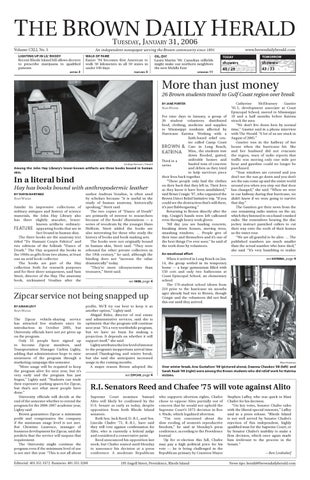
Among the John Hay Library’s lesser-known artifacts are three books bound in human skin.
In a literal bind Hay has books bound with anthropodermic leather BY TARYN MARTINEZ STAFF WRITER
Amidst its impressive collections of military antiques and history of science materials, the John Hay Library also has three slightly macabre, lesserknown artifacts: ordinaryFEATURE appearing books that are in fact bound in human skin. The three books are the anatomy text titled “De Humani Corpis Fabrica” and two editions of the folktale “Dance of Death.” The Hay acquired the books in the 1960s as gifts from two alums, at least one an avid book-collector. The books are part of the Hay collection both for research purposes and for their sheer uniqueness, said Sam Streit, director of the Hay. The anatomy book, nicknamed Vesalius after the
author Andreas Vesalius, is often used by scholars because “it is useful in the study of human anatomy, historically speaking,” Streit said. The two copies of “Dance of Death” are primarily of interest to researchers because of the books’ illustrations — a series of woodcuts by the younger Hans Holbein. Streit added the books are also interesting for those who study the history of books and book-making arts. The books were not originally bound in human skin, Streit said. “They were rebound for other private collectors in the 19th century,” he said, although the binding does not “increase the value dramatically” today. “They’re more idiosyncrasies than treasures,” Streit said. see SKIN, page 4
Zipcar service not being snapped up BY AIDAN LEVY STAFF WRITER
The Zipcar vehicle-sharing service has attracted few students since its introduction in October 2005, but University officials have not yet given up on the program. Only 55 people have signed up to become Zipcar members, said Transportation Manager Carleia Lighty, adding that administrators hope to raise awareness of the program through a marketing campaign this semester. “More usage will be required to keep the program alive for next year, but it’s very early and the program has just begun,” Lighty said. “Students can trade their expensive parking spaces for Zipcar, but that’s not what most people have done.” University officials will decide at the end of the semester whether to extend the program for the 2006-2007 academic year, Lighty said. Brown guarantees Zipcar a minimum profit and compensates the company if the minimum usage level is not met. But Christine Laurence, manager of business development for Zipcar, said she predicts that the service will surpass that requirement. The University might continue the program even if the minimum level of use is not met this year. “This is not all about
profits. We’ll try our best to keep it as another option,” Lighty said. Abigail Rider, director of real estate and administrative services, said she is optimistic that the program will continue next year. “It’s a very worthwhile program, but we have no basis for making a projection. It depends on whether it will support itself,” she said. Lighty attributes the low level of interest to the program’s inopportune arrival time around Thanksgiving and winter break, but she said she anticipates increased usage in the coming months. A major reason Brown adopted the
Editorial: 401.351.3372 Business: 401.351.3260
see ZIPCAR, page 4
For nine days in January, a group of 26 student volunteers distributed food, clothing, medicine and supplies to Mississippi residents affected by Hurricane Katrina. Working with a faith-based relief center called Camp Coast BROWN & Care in Long Beach, KATRINA Miss., the students tore down flooded, gutted, unlivable homes and Third in a hauled tons of concrete series and debris as they tried to help survivors piece their lives back together. “These people only had the clothes on their back that they left in. Their lives as they know it have been annihilated,” said Brian Craigie ’07, who organized the Brown Direct Relief Initiative trip. “If you could see the destruction that’s still there, it’s just flabbergasting.” Returning to Brown directly after the trip, Craigie’s hands were left calloused even through heavy work gloves. “All day you are hauling concrete, breaking down houses, moving trees, smashing windows. … People give of their time and themselves and it’s one of the best things I’ve ever seen,” he said of the work done by volunteers. An emotional effort When it arrived in Long Beach on Jan. 14, the group settled in its temporary home — a large gymnasium filled with 150 cots and only two bathrooms at Coast Episcopal School, an elementary school. The 170-student school (down from 210 prior to the hurricane six months ago) already had ties to Brown, though Craigie and the volunteers did not find this out until they arrived.
Catherine McElearney Gautier ’01.5, development associate at Coast Episcopal School, moved to Mississippi 10 and a half months before Katrina struck the area. “We don’t live down here by normal time,” Gautier said in a phone interview with The Herald. “A lot of us are stuck in August of 2005.” Gautier was in the hallway of her house when the hurricane hit. She and her husband did not evacuate the region, wary of radio reports that traffic was moving only one mile per hour and gasoline could no longer be purchased. “Your windows are covered and you don’t see the sun go down and you don’t see the sun come up and the entire world around you when you step out that door has changed,” she said. “When we were in our hallway during that hurricane, we didn’t know if we were going to survive that day.” The Gautiers got their news from the one remaining radio station on the air, which they listened to on a hand-cranked radio. She remembers hearing the disc jockey instruct panicked callers to cut their way onto the roofs of their homes as the water rose. “We are all grateful to be alive. … The published numbers are much smaller than the actual number who have died,” she said. “It’s very humbling to realize see KATRINA, page 4
Blair Hickman
Over winter break, Ana Gustafson ‘08 (pictured alone), Deanna Chaukos ‘08 (left) and Sarah Raab ‘08 (right) were among the Brown students who did relief work for Katrina victims.
R.I. Senators Reed and Chafee ’75 will vote against Alito Supreme Court nominee Samuel Alito will likely be confirmed by the U.S. Senate as early as today, despite opposition from both Rhode Island senators. Both Sen. Jack Reed, D.-R.I., and Sen. Lincoln Chafee ’75, R.-R.I., have said they will vote against confirmation for Alito, who is currently a federal judge and considered a conservative jurist. Reed announced his opposition last week, but Chafee waited until Monday to announce his decision at a press conference. A moderate Republican
who supports abortion rights, Chafee chose to oppose Alito partially out of concern that he would not uphold the Supreme Court’s 1973 decision in Roe v. Wade, which legalized abortion. “I’m very concerned about the slow eroding of women’s reproductive freedom,” he said at Monday’s press conference, according to the Providence Journal. Up for re-election this fall, Chafee may pay a high political price for his vote — he is being challenged in the Republican primary by Cranston Mayor
195 Angell Street, Providence, Rhode Island
Stephen Laffey, who was quick to blast Chafee for his decision. “On key votes, Senator Chafee sides with the liberal special interests,” Laffey said in a press release. “Rhode Island is not well served by Senator Chafee’s rejection of this independent, highly qualified man for the Supreme Court, or by Senator Chafee’s inability to make a firm decision, which once again made him irrelevant to the process in the Senate.” —Ben Leubsdorf News tips: herald@browndailyherald.com
THIS MORNING THE BROWN DAILY HERALD · TUESDAY, JANUARY 31, 2006 · PAGE 2 Jero Matt Vascellaro
TO D AY ’ S E V E N TS WBRU OPEN HOUSE 11 a.m., (88 Benevolent St.) — Learn about the ins and outs of running a commercial radio station.
at Boston University, will discuss her father’s assassination and her political activism. THE HERALD OPEN HOUSE 7 p.m., (195 Angell) — Learn about how you can join the fifth-oldest college daily in the nation as a reporter, photographer, business manager and more.
HOW TO FIND AND FUND AN INTERNSHIP 12 p.m., (Pembroke Hall, Third Floor) — Learn all about finding and funding an internship. “THE ASSASSINATION OF MY FATHER IN BANGLADESH: MORAL SHOCKS, ACTIVISM AND SOCIOLOGICAL WRITING” 4 p.m., (Joukowsky Forum) — Nazli Kibria, a professor of sociology
MPC INFO. SESSION 7 p.m., (Third World Center) — Find out about the new MPC program and pick up an application.
MENU SHARPE REFECTORY
Chocolate Covered Cotton Mark Brinker
Deo Daniel Perez
VERNEY-WOOLLEY DINING HALL
LUNCH — Tuna Noodle Casserole, Parslied Rice, Stewed Tomatoes, Pancakes, French Toast, Cajun Potatoes, Grilled Sausage Patties, Hard Boiled Eggs, Fudge Bars, Raspberry Yogurt Pie
LUNCH — Vegetarian Roasted Butternut Soup with Apples, Chicken Vegetable Soup, Hot Ham on Bulky Roll, Vegetarian Pot Pie, Spinach with Lemon, Fudge Bars
DINNER — Curry Chicken and Coconut, Basmati Rice Pilaf, Indian Green Beans, Whole Kernel Corn, Onion and Dill Rolls, Chocolate Pudding, New York Style Cheesecake
DINNER — Vegetarian Roasted Butternut Soup with Apples, Chicken Vegetable Soup, Shepherd’s Pie, Vegan Vegetable Couscous, Baked Sweet Potatoes, Italian Vegetable Saute, Fresh Sliced Carrots, Onion and Dill Rolls, New York Style Cheesecake
Cappuccino Monday Christine Sunu
RELEASE DATE– Tuesday, January 31, 2006
CR O S Daily SWO RD Los Angeles Times Crossword Puzzle Edited by Rich Norris and Joyce Nichols Lewis
ACROSS 1 Fill the tank 6 Fiber source 10 Plod (through) 14 Bowl for a game, e.g. 15 Monthly budget item 16 Clever comment 17 Hearty ha-ha 19 Forearm bone 20 Trombone part 21 Locker room motivators 23 Bell sound 25 Rousing crowd support 26 Magazine revenue source 29 It may be pitched 31 Inflicts 35 Reason to close the window 37 Drum partner 39 Skip over 40 She gets what she wants 41 Small engine 42 TV’s “Nick at __” 43 Nobelist Pavlov 44 Like Death Valley 45 Desert bordering the Sinai Peninsula 46 Chaos 48 __ contendere: court plea 50 Source of iron 51 Coup d’__ 53 Moreno of “West Side Story” 55 “Hold on!” 59 Social outcasts 62 Tons 63 30-40, say, in a tennis game 66 Classroom drilling 67 Scandinavian capital 68 It merged with BP in 1998 69 Bartlett, for one 70 Shout 71 A kind of one begins 17- and 63-Across and 10- and 36Down
DOWN 1 Yak 2 War god 3 Auction off 4 Turned off 5 Mother lode 6 Bikini part 7 Enlist once more 8 Steam up 9 Utmost extent 10 Place to go back to 11 Pause in the action 12 Sow’s squeal 13 Coll. performance barometers 18 Late-night host 22 Roofer’s supply 24 Take a shot at 26 Off-the-cuff 27 Took the car 28 Bowl of greens 30 What 59-Across don’t do 32 Mexican friend 33 Check falsifier 34 Jobs in computers? 1
2
3
4
6
9
10
27
28
24 29
41
43
44
46
31 38
34
42
48
51
33
39
45
47
56
32
25
37
40
13
22
30
36
12
19 21
35
11
16
18
23
62
8
15
20
55
7
Homebodies Mirele Davis
1/31/06
xwordeditor@aol.com
5
17
Goldfish Dreams Allison Moore
ANSWER TO PREVIOUS PUZZLE: O U S T H A B I T H U A C A N T E I R A N I E N D O F I R S T D R A F T A V O W C U T I E E L I D E C O D E S F I R E D R I L L B R E D U R N E E L E D S N L I F I D O A S S E S R O O S E V E L T O G D E N E X A M S C A B F E R M I E R S N O R A F R E E Z E D R Y H E N R Y A D E L E M A U V E J I M I F A N C Y D R E S S U L E E I N E R T A N T I T E D S N E A T H L E S T
14
26
55 Kind of speed, in “Star Trek” 56 Soothing plant 57 Teeny bit 58 Prisoner’s room 60 Singer Celine 61 ’60s civil rights org. 64 Earthlink competitor, familiarly 65 Little piggy
36 Mail to a star 38 Big name in travel guides 41 Sissy 45 Steno’s book 47 One-time connector 49 Web site connection 52 Not wordy 54 Inviting smell
52
57
49 53
58 63
54 59
60
64
61
Editorial Phone: 401.351.3372
The Brown Daily Herald (USPS 067.740) is published Monday through Friday dur-
Business Phone: 401.351.3260
ing the academic year, excluding vacations, once during Commencement, once
Robbie Corey-Boulet, President
please send corrections to P.O. Box 2538, Providence, RI 02906. Periodicals postage
during Orientation and once in July by The Brown Daily Herald, Inc. POSTMASTER
65
66
67
68
69
70
71
By Marjorie Berg (c)2006 Tribune Media Services, Inc.
THE BROWN DAILY HERALD
50
Justin Elliott, Vice President Ryan Shewcraft, Treasurer
1/31/06
David Ranken, Secretary
paid at Providence, R.I. Offices are located at 195 Angell St., Providence, R.I. E-mail herald@browndailyherald.com. World Wide Web: http://www.browndailyherald.com. Subscription prices: $179 one year daily, $139 one semester daily. Copyright 2005 by The Brown Daily Herald, Inc. All rights reserved.
METRO
THE BROWN DAILY HERALD · TUESDAY, JANUARY 31, 2006 · PAGE 3
GTECH bought by Italian firm BY SIMMI AUJLA SENIOR STAFF WRITER
GTECH Holdings Corporation, a Rhode Island-based gaming services company building a new headquarters in downtown Providence, was bought earlier this month by Lottomatica, an Italian gaming company. Announced Jan. 10, the sale will create a company with approximately 6,300 employees operating in over 50 countries. Though GTECH will become a wholly-owned subsidiary of Lottomatica, the sale has not affected plans to move GTECH’s headquarters to Providence once its building is completed, said Robert Vincent, GTECH vice president for corporate communications. There will be little change in the company’s everyday operations, said Donald Stanford ’72 GS’77, adjunct professor of computer science, a former GTECH employee and current advisor to the corporation. “In the short term, there will be no change for jobholders in Rhode Island,” Stanford said. “In this case, there’s not a lot of duplication (in the operations of each company), so there won’t be jobs that need to be cut out.” GTECH, which has a 20-year contract with Rhode Island to run the state lottery, decided to move its headquarters from West Greenwich, R.I. to Providence in 2004 in exchange for tax breaks from the city and state. Its headquarters are currently under construction across from the Providence Place Mall. Vincent emphasized there would be few changes for GTECH employees in Rhode Island. “There is no mission or location overlap here. GTECH is a technology company and Lottomatica is an operating company. There will be no job cuts or anything.” He noted the most visible change in Providence would be increased traffic into the city because of the influx of personnel from abroad. Governor Donald Carcieri ’65 said he believes the sale would bring more business to Rhode Island. “I was pleased to learn that GTECH will continue to play an important role in Rhode Island, and that no job losses are anticipated,” said Carcieri in a Jan. 10 statement. “By making GTECH part of the largest lottery company in the world, I hope that this sale will provide opportunities for expansion and more jobs in Rhode Island.” Mayor David Cicilline ’83 echoed the governor’s sentiments. see GTECH, page 6
www.browndailyherald.com
Medical marijuana bill to provide relief for terminally ill in Rhode Island BY CAROLINE SILVERMAN SENIOR STAFF WRITER
On Jan. 3, Rhode Island became the eleventh state to legalize medical marijuana, overriding a June 2005 veto by Governor Donald Carcieri ’65. The new legislation “provides an alternative option for those men and women who have clinical pain and who are dealing with a terminal illness (like cancer),” said District 3 State Sen. Rhoda Perry P’91, the Senate’s main sponsor of the bill, who has supported similar measures for the past seven years. Under the bill, doctors will be able to recommend that patients be issued medical marijuana registration cards by the state. These registration cards will protect patients from arrest under state law for possession of up to 12 marijuana plants, or 2.5 ounces of the drug. “Our law has made possession of marijuana in small doses by properly enrolled patients and caregivers legal in the state of Rhode Island,” Perry said. “On a federal level it is still illegal.” Carcieri has noted this as a major problem with the legislation, as noted in a Jan. 4 press release by Jeff Neal, the governor’s press secretary. “Rhode Islanders who rely on state law can still be prosecuted criminally by the federal government,” Neal wrote in the release. “This is also a victory in the conversation about marijuana on a national level,” said Nathaniel Lepp ’06,
a member of Brown’s Students for Sensible Drug Policy. “The Rhode Island bill will accelerate the pace at which the federal government considers medical marijuana.” Perry stressed that while she has been a big proponent for medical marijuana, she is not in favor of legalizing the drug for purposes other than medicine. “That is a far broader endorsement,” she said. Lepp said he believes the legislation represents a major success for student political activity. “My main reflection on the medical marijuana campaign is that students have the capacity to initiate real change,” Lepp said. Perry agreed that activism from students at Brown and the University of Rhode Island was “helpful and meaningful.” Dr. Tom Bledsoe, clinical associate professor of medicine and interim director for the Center of Biomedial Ethics at the Brown Medical School, said he would prescribe marijuana if he encountered a patient whom he felt “might benefit” from its use. “This is a relatively cheap, available and effective treatment,” Bledsoe said. Marijuana is defined by the federal Drug Enforcement Agency as a Schedule 1 drug, meaning it has no “therapeutic value,” Bledsoe said. This classification pairs marijuana with often-abused drugs like heroin instead of drugs with recognized medical properties, see MARIJUANA, page 5
R.I. bill aims to force large companies to pay for health care BY CHLOE LUTTS SENIOR STAFF WRITER
A bill introduced in the Rhode Island General Assembly this month would require companies with over 1,000 employees in the state to spend at least 8 percent of their payroll on health care. The bill’s sponsor, Rep. Amy Rice, D.-District 72, said the goal of the bill is “to get employers to pay ... their fair share” of health care costs. Companies affected by the bill would have the option of either upping their health care spending to eight percent, the national average, or depositing the difference in a state “Fair Share Health Care” fund, which would be used to provide health care for uninsured
Rhode Islanders. Rice estimated there are 38 companies in the state with over 1,000 employees. Only six or fewer of the 38 spend less than the required 8 percent on health care, she said. The Rhode Island bill does not contain an exception or lower requirement for non-profit groups, Rice said. Brown employs over 3,000 individuals, but it is unclear if the University would be affected. Molly de Ramel, director of media relations, said she was not familiar with the legislation. A similar bill became law earlier this month in Maryland, where the Democratic-controlled state legislature overrode Republican Governor Bob Ehrlich’s veto, which he used last year when the legislature see HEALTH CARE, page 6
PAGE 4 THE BROWN DAILY HERALD TUESDAY, JANUARY 31, 2006
Katrina continued from page 1 you lived.” Fortunately for them, the Gautiers’ home stands at one of the highest elevations in the area, a fact that saved it from major destruction. But Gautier said most people in the region were not so lucky: nearly 70 percent of the area was destroyed. “I work with people who have lost just about everything,” she said. Gautier served briefly as Camp Coast Care’s first site director when the relief effort first began with the donation of supplies piled into an 18-wheeler that arrived from Toronto. For Gautier the Brown volunteers in particular were a gift. “Brown was an extremely special place to me. Just seeing them show up was so special to me.” The students were amazed at just how grateful locals were for every bit of help they received. “You wouldn’t believe how many people would love a can of dried beans,” said Ana Gustafson ’08. “It was just astounding — just to see the fragility of human possessions. You’d walk into a house and see … human possessions just scattered.” Gustafson and other volunteers were shocked at what they perceived as little progress made over the past six months. “I was really surprised that everything had been untouched,” she said. Blair Hickman ’08 has a folder on her laptop filled with photographs from the trip — containing images of school buses and cars run off the sides of roads and spray-painted messages people left each other on the sides of homes. “Where U at JR? I am ok,” reads one graffiti -marked house. The photos bear images of Mardi Gras beads caked in mud and mangled in debris, along with furniture parts, photo albums, teddy bears and countless other household possessions. Once brightly colored blankets hang from tree limbs, their patterns faded from months of outdoor exposure. “There is something about seeing so much chaos and then cleaning it out,” Hickman said,
describing the experience as very therapeutic. The group cleared out the home of a couple in their 80s who walked around with water up to their necks on the second level of their home when it was flooded and destroyed. In just one day the students took down the house, which Craigie said would otherwise have taken months and thousands of dollars to clear away. “We had people come to tears sometimes from the work we did,” he said of grateful locals. Looking ahead Gautier anticipates that it will take years to clear away the damage done by Katrina. In 2000, St. Louis finally finished recovering from Hurricane Camille, which devastated the area in 1969. Keeping a steady flow of volunteers is critical and very challenging, she said. “People aren’t thinking of coming down to the coast,” she said. “There’s going to be an ongoing need for years for people to come down. … Volunteers have been absolutely crucial in more ways than they’ve realized.” Many of the volunteers are middle-aged or elderly members of faith-based groups. “Most volunteers are retired and can’t do heavy-duty labor,” said Meredith Halsey ’06.5. Growing up in Miami, Halsey lived through the destruction of Hurricane Andrew in 1992. The site of hurricane damage is not new to her, and she said she is disappointed the government has not done more to help. “Nothing is happening. That’s really disturbing to me,” she said. Halsey and other volunteers had a hard time leaving the area and returning to Brown. “I come here and spend $300 on books when three days ago I was cleaning out all of a man’s belongings,” Hickman said a day after returning to campus. “It just doesn’t seem right.” Craigie hopes the group will return to the area during spring break and in the summer. “I’m always thinking of how to do it bigger and better,” he said of Brown’s role in the relief effort. “I wish they would keep pounding people’s heads to go down there. This is ongoing and it won’t go away without sweat and blood and tears.”
Fill in the grid so that every row, every column and every 3x3 box contains the digits 1 through 9.
Solution, tips and computer program at www.sudoku.com.
Skin continued from page 1 “There are some big ethical issues that come to the fore here,” said Jay Baruch, clinical assistant professor of emergency medicine at Brown and director of the Ocean State Ethics Network. “One is the notion is that the body is sacred. Does using body parts in such a way somewhat cheapen our conception of the body?” he asked. Another concern is informed consent, something that “is on the minds of people, with organ donation and stem cell research,” Baruch said, particularly considering “the situation by which the skin was taken.” Streit agreed that there are general ethical questions associated with owning books with anthropodermic binding, but also said that the books were bound in a different era and things that are shocking now were less disturbing back then. “It was also a romantic notion and kind of an intellectual tie-in to the content of the books,” Streit said. Laura Hartman, a rare book cataloguer in the history of medicine division of the
Zipcar continued from page 1 program was to curb traffic, but there is no evidence that congestion has been alleviated yet, Lighty said, adding that it may take more than just the two Zipcars currently offered to reduce traffic problems. “I’d say it’s gotten rid of a little traffic. It’s been such a short time that it’s hard for us to say accurately that it’s made a big dent in the traffic for the parking situation,” Lighty said. Currently, two low-emission, satellite radio-equipped vehicles — a red Mazda 3 named Maxcy and a blue Toyota Matrix called Meiklejohn — are based in the parking lot behind Minden Hall. More cars may
National Library of Medicine, used to tend five books bound in human leather — part of the collection of John Stockton Hough, a Philadelphia-trained physician and book collector of the late 19th century — at the College of Physicians of Philadelphia. Hartman theorized that “the small trend among physicians to have their books bound in human leather” originally stems from respectful intentions. “It could have been those physicians’ tribute to these patients for their contribution to medical research,” Hartman said. “Trichinosis was discovered from one of Stockton’s patients.” Nonetheless, the unusual bindings on the books in the Hay continue to disgust and fascinate modern readers and bibliophiles. “One of the things that has made people uneasy about the books is the Nazis,” Streit said, referring to the Nazi practice of flaying their victims and putting their skin to various uses. But none of the books date from World War II-era Germany. The older edition of “Dance of Death” was rebound in London by a well-known bookbinder in 1893, while the later edition was done in Chicago in 1898. The identities of the people whose skins are now bindings
are unknown. Streit said that skin for bindings often came from paupers — “people without families whose bodies were often sold to medical schools and skin sold to binders.” For Baruch, the origin of the bindings raises questions regarding abuses of power and the treatment of “vulnerable populations.” “The fact the human skin was used for the books is an occasion for inquiry,” Baruch said. “If Brown makes efforts to find the story behind this, that could indicate a sign of respect.” But determining these identities could be both costly and damaging to the books. “I don’t think we could, nor would we want to, go through the trouble and expense of finding out,” Streit said. “The tanning process destroys much of the DNA.” Like Streit, Baruch also saw the merits of not pursuing the identities out of “respect for the dead” and to avoid raising descendants’ anxieties. Binding books in human skin was never a widespread practice, Hartman said, Although “for physicians, it could have been something very clinical. … It’s very bizarre and I think it leaves us all a bit squeamish today,” Hartman said.
be added to the Zipcar fleet if demand increases in the future, Lighty said. To rent a car, Brunonians over 21 with a good driving record must sign up on the company’s Web site, www. zipcar.com/brown to receive a ZipCard, which allows them to reserve a car for several hours or for the day. At the designated time, the user swipes the ZipCard in front of a sensor on the windshield and the car’s doors unlock. The driver must refill the tank before returning the car to the Minden parking lot, but Zipcar covers the cost of gas. A Membership costs $30 a year, and each rental costs $8 per hour or $60 for the day, which also covers gas and insurance. The driver is allotted 125 miles
per rental, with a $0.20 fee for each additional mile. Drivers incur a $25 per hour late fee on top of regular hourly charges. Brown handles upkeep, wash and vacuum, but both cars have remained intact and clean, so far, Lighty said. Laurence said she expects student interest to increase. “If you don’t want to bring a car, it gives you a lot more freedom. Even if you drive your own car, you may want to take another car, and if you have to go to the grocery store or see to a medical emergency, you can just rush off without the expense or the hassle,” she said. Beth Adler ’06, who lives offcampus and shares a car with three friends, said she thinks that the service may be more useful to younger students. “We all use the car for grocery shopping, so (using the Zipcar service) for me is not really a necessity in any way,” she said. “I know a lot of my friends are in the same position, but as an underclassmen, I might have invested in the service more because having a car on campus is really difficult.” However, many underclassmen are too young to use the service. Rider told The Herald that the service will not be extended to students below 21 due to the high cost of insurance. Some students, though, see the benefit of Zipcar. “It seems really convenient. You don’t have to worry about a lot of things you have to worry about when you have a car. It seems possible that it might be troublesome if you calculate how much money one would spend,” said Tebukozza Babumba ’06.
Happy Birthday Stephanie
CAMPUS NEWS THE BROWN DAILY HERALD · TUESDAY, JANUARY 31, 2006 · PAGE 5
Keizer ’94 first to hike 50k in all 50 states BY EMILY SILVERMAN CONTRIBUTING WRITER
While most Americans spend skiing vacations in plush lodges adorned with fireFEATURE places, Ted Keizer ’94 chose a more unconventional domicile: the inside of a rock cave. Undaunted by temperatures that sometimes dipped below negative 20 degrees, he spent a couple of months during the winter of 1995-96 huddled with two sleeping bags, goggles and a ski mask to avoid the high rents of resort towns. In addition to providing a cheaper getaway, his tolerance also led to a nickname: The Cave Dog. Over the past few months, Keizer’s adventuresome nature led him out of the cave in pursuit of a new challenge, as he strove to become the first person to hike 50 kilometers in each of the 50 states in under 100 days. Keizer’s 75-day journey began Sept. 15 in Oregon and ended Nov. 29 in New York. He not only set a new record, but also used the trip to promote environmental awareness across the country and to create a television series. A history of risk-taking Keizer gained a love for the outdoors at a young age. His parents were very active, and family vacations typically involved skiing, hiking and other outdoor activities. Throughout his youth, he was exposed to the many of the country’s terrains through road trips; by the time he graduated from college, he had
Marijuana continued from page 3 like morphine. The medical profession’s response to the law involves a tenuous “grey zone,” Bledsoe said. Practitioners might be prosecuted by the federal government for issuing licenses to possess marijuana, even while trying to do what is best for their patients, he said. Another potential problem in prescribing marijuana involves doubts about dose strengths and impurities. In obtaining the drug off the street, the true content of the substance is unreliable, he said. Carcieri’s administration also considers this issue to be a major concern with the legislation. “This bill will encourage criminal activity because it does not provide any means for the legal purchase of medical marijuana,” Neal said in the press release. The law mandates that patients grow the marijuana plants indoors, on the theory that this is the safest way to obtain the drug. Perry said this was a “concession” which aided the bill’s passage. “There was too much controversy about growing the plants outside,” she said. A sunset provision in the law poses the next challenge for activists, as the medical marijuana statute will expire in July 2007. This was another concession “required to get more
driven from coast to coast more than eight times. Soon Keizer was ready for more serious challenges, such as a one-month solo in Montana’s Glacier National Park, known as the capital of the world for grizzly bear attacks. To prepare himself, he read six books on the bears. “It’s amazing how huge they are,” he said. “But I would just call out so they wouldn’t get surprised.” In harsh winter conditions he snowshoed across the landscape, using an ice axe to break the surface of the frozen lakes to obtain water. His next big undertaking involved kayaking up the Maine coast. He followed that with an ambitious attempt to break the record for climbing the Colorado Fourteeners, a group of 55 summits that surpass 14,000 feet. Keizer spent two and a half years training by reading books on endurance eating and watching videos on how to run large support crews. In 2000, his climb clocked in at 10 days, 20 hours and 26 minutes, beating the previous record by 43 hours. This achievement brought him much recognition. “People who climbed Everest were calling me and inviting me over. It was fantastic,” he said. Before these and other adventures, Keizer studied those who came before him. “When I go for a record, I think it’s important to research the people that came before you in order to understand the ethos or ethic by which they made their own attempt,” he said. 50k in 50 states While researching in 2001, he
people to vote for the bill,” Perry added, noting, “we would have lost meaningful votes without it.” The program itself until will not begin until April 3, 90 days after the law’s passage. The Rhode Island Department of Health is still drawing up regulations to govern the program. In other states, there have been few problems with the implementation phase of the medical marijuana program, according to Perry, who hopes that a similar situation in Rhode Island over the next year will encourage the General Assembly to extend it beyond 2007. “There are claims that marijuana laws will increase drug use amongst young people, but data of the last 10 years shows that the use of marijuana by young people mirrors national trends (even in states with medical marijuana laws),” Lepp said. When SSDP held its first meeting in the fall of 2002, the 20 or so members agreed that one of their long-term goals was to “make sure Rhode Island had a medical marijuana law by the time the youngest people there graduated,” said Lepp, who was among these youngest students. “This is really an issue of compassion for people in need,” Lepp said. “If that wasn’t the cause, I don’t think the Senate would have overridden the governor’s veto. This is a situation of tremendous political will and that comes from a place of compassion.”
came across information on Bob Marshall, a cult hero of the conservation and environmental movement. Born in 1900, Marshall focused much of his time and energy on wilderness preservation. He was a member of the U.S. Forest Service, cofounder of the Wilderness Society and a major player in the creation of the National Park System. As an environmental activist, Marshall’s work included inspection of National Forest land all over the country, leading him to set a goal to hike 30 miles in each of the 48 states that existed at the time. He had only a few states remaining when he passed away in 1939. Keizer was inspired by Marshall’s story. “I thought, what better way to do a tribute to someone to whom we have a great debt of gratitude towards for his accomplishments in preserving our wild land than to do what he loved most, which is also what I love.” Thus began Keizer’s campaign to complete a 50-kilometer-long day hike in each of the 50 states. During his journey, Keizer hit some of the crown jewels of America, such as Paul Revere’s route in Massachusetts and the Oregon Trail. Keizer invited people to hike with him in every state, but by the afternoon most of the people would filter off and he could pick up the pace. With the exception of Hawaii and Alaska, Keizer tra-veled from state to state in his fully loaded Duofold RV with a driver, cameraman and a support person.
Courtesty of Ted Keizer ‘94
Ted Keizer ‘94 hiked through 50 states in 100 days. One of Keizer’s favorite states was Colorado. “It was amazing, hiking across the Great Sand Dunes National Monument. … You felt like you were in the Sahara, every sand dune has a different shape, casts a different shadow. … It’s really beautiful,” he said. Other highlights included walking along glaciers in Alaska and hiking in a dense tropical jungle in Hawaii. “The guava grew into the trail, so you would reach up and eat if off the tree. It was great,” he said. Keizer’s swift movement from state to state provided for a great contrast of scenery. “It was a celebration of the diversity of landscapes in America,” he said. Compared to his prior hiking experiences, this challenge was longer but less extreme. Previously, his longest trip had been 11 days, but this one lasted 75. “It has its own difficulties. … It’s just day after day, working extremely hard, pushing your body to the limit,” he said, adding, though, that the
trip “wasn’t nearly as intense as the others, which were day and night, 24 hours, with no sleep.” While hiking the 50 states, Keizer took photos and film footage, gave media interviews and talked at stops along the way. This provided Keizer with a platform to discuss wilderness preservation. The documentary footage was used to create a three-episode television show called “Live Your Passion.” The show has run four times, and the last episode will air on the Outdoor Life Network this afternoon at 4 p.m. Keizer’s experience at Brown, especially his geology and biology classes, have influenced the way he views nature. “You have a much deeper appreciation for the wild when you understand why it is the way it is,” he said. As for the future, Keizer does not have any plans. “But these things can come up pretty quickly,” he said. “There’s no end to what you can do. You’re really only limited by your own imagination.”
PAGE 6 THE BROWN DAILY HERALD TUESDAY, JANUARY 31, 2006
Health care continued from page 3 passed the bill. The Maryland law set the threshold at 10,000 employees, instead of the 1,000 in the Rhode Island legislation. There are four companies in Maryland with over 10,000 employees. Grocery chain Giant Food and military contractor Northrup Grumman both meet the 8 percent requirement, and the third, The Johns Hopkins University, spends the 6 percent required for non-profits in the Maryland bill. The fourth, Wal-Mart, was the only company affected by the Maryland bill. It spends just shy of 8 percent on health care in Maryland. “Wal-Mart employees along with others are now being forced into the Medicaid market ... and the uncompensated system” of emergency care for the uninsured, said Democratic State Sen. Gloria Lawlah, the sponsor of the Maryland bill. Kelly Hobbs, a spokesperson for Wal-Mart, said the Rhode Island legislation “won’t improve access to health care or control the soaring cost of health coverage in Rhode Island (and is) designed to impose mandates on large employers only.” She said the legislation is unfriendly to business and could damage the state economy. Hobbs criticized the legislation, calling it a “special interest bill” that “fails to address health care issues.” Though Lawlah noted the Maryland bill could be seen as an attack on Wal-Mart, Rice emphasized this “should not be called a Wal-Mart bill in Rhode Island” because it affects several other companies, though she does have “serious questions about WalMart’s practices.” Wal-Mart employs 2,117 people in Rhode Island at nine locations and in 2004 paid more than $4.1 million in state and local taxes and collected more than $18.3 million in sales taxes,
according to their Web site. It was not clear if Wal-Mart was one of the companies that would be affected by the legislation in Rhode Island. The bill has run into opposition from local business. “We do not believe any mandated health care policy is the answer,” said Bethany Costello, director of public relations at the Greater Providence Chamber of Commerce. She said the chamber is “still studying the logistics” of the bill. Rice drafted a version of the bill last year, but this year had help from Americans for Health Care, a project of the Service Employee’s International Union. Ann Rhodes, director of Rhode Island for Health Care, the local arm of Americans for Health Care, said the organization is currently involved in similar campaigns in eight states. Americans for Health Care “worked closely” with the Maryland legislature and is now helping Rice with her campaign, she said. Similar bills were defeated in Indiana and Wisconsin, according to Hobbs. Rhodes said she believes it is “important to have employer responsibility” for health care. “We don’t feel that it’s appropriate for businesses to externalize their costs,” by forcing employees to turn to government programs or emergency rooms, she added. Hobbs said Wal-Mart is “working with lawmakers across the state to educate them about what we are doing for our associates and the coverage we do provide,” Hobbs said. Of 1.3 million Wal-Mart associates, over three-quarters have health care, either through a company plan, a spouse’s plan or Medicare or Medicaid, she said. Rice said she hopes her bill will become law, but that more needs to be done about the state of health care in the United States. “I think we can do better than this bill,” she said.
No easy answers on Iran for Russia, China BY KIM MURPHY AND MARK MAGNIER LOS ANGELES TIMES
MOSCOW — The prospect of U.N. sanctions against Iran for breaking a moratorium on enriching nuclear fuel places Russia and China in one of the last places either country wants to be: forced to choose between their own economic interests and the wider concerns of the global community. The showdown could cost Russia a $1 billion nuclear power plant nearing completion in Iran and undermine the leverage that allows the Kremlin to remain a power broker in the Middle East. Fourteen percent of China’s oil imports come from Iran, and China soon is expected to be Iran’s largest trading partner. As European Union powers have negotiated with Tehran to stop its nuclear program, Russia and China, both vetoholding permanent members of the U.N. Security Council, have urged caution. Now that the EU effort seems to have failed, the Russians and Chinese appear to be the best hope for brokering a compromise. The U.N. nuclear watchdog, the International Atomic Energy Agency, will meet Thursday to discuss the dispute. European and U.S. officials have made clear they will push for a U.N. vote that could include sanctions if Iran does not provide guarantees that it is engaged in only peaceful nuclear research, not in seeking to build a bomb. European foreign ministers reported no progress Monday in a meeting with Iran’s deputy negotiator on nuclear issues. In Washington, President Bush says referring Iran to the Security Council remains an option. Diplomats from Russia and China are promoting a Russian plan that would allow Iran to enrich uranium on Russian soil. The plan, which Bush supports, would prevent Iran from developing fuel for a nuclear bomb.
Russia fears that U.N. sanctions could force it to abandon its nearly completed 1,000-megawatt nuclear plant at Bushehr and halt negotiations over future plant construction worth up to $5 billion. The Iranian nuclear program employs tens of thousands of workers at numerous companies across Russia. Russia has up to $1.5 billion in military contracts with Iran, including one concluded in December for up to 30 Tor M-1 anti-aircraft missiles worth $700 million. In the past, senior Russian officials repeatedly have said they believed Iran was pursuing a peaceful nuclear program limited to energy generation. Those statements are noticeably absent now, and former Atomic Energy Minister Viktor Mikhailov said he has few illusions about Iran’s intentions. “If you ask me whether the Iranians want to (develop nuclear weapons), the answer is, of course they want to. Who doesn’t want to?” he said. “When the policies of the United States are what they are, I think that perhaps any country that ... has some independent line, and views of their own about the future development of the planet, will be relegated by the Americans to the category of countries that need to be ‘fixed.’” China’s interests in Iran are mainly focused on energy for its rapidly developing economy. But they also include a desire to expand its influence in the region, analysts say. In late 2004, China agreed to buy oil and natural gas and help develop Iran’s huge Yadavaran oil field. The 25-year deal, worth up to $100 billion, is the largest China has ever signed with a foreign country. Iran has been one of China’s largest overseas markets for construction and infrastructure projects since the early 1980s, including highway networks and $400 million in contracts to help
GTECH continued from page 3 “I have been assured that the new, global company is just as committed to Providence and Rhode Island. The downtown building is on schedule, and we look forward to an even brighter future for the company, its workers and its impact on our city’s economy,” Cicilline said in a Jan. 10 statement. Vincent said GTECH’s sale is not a sign of Rhode Island companies heading overseas. “This is only an industryrelated phenomenon, not a Rhode Island phenomenon,” he said. “There’s a lot of consolidation going on in the lottery industry and in the gaming
build the Tehran subway system. Experts say China also has supplied weapons over several decades, including surface-tosurface cruise missiles and the anti-ship Silkworm missile. China’s ambassador to Iran said this month that two-way trade exceeds $10 billion, with China expected to become Iran’s largest trading partner. Yet China, like Russia, is walking a fine line. It also has a huge stake in maintaining a good relationship with the United States. Last year, Congress threatened a 27.5 percent tariff on Chinese imports if Beijing didn’t revalue its currency. It also applied pressure that helped kill oil firm CNOOC’s bid for Unocal. “A confrontation would not be good for Sino-Iran relations nor Sino-U.S. relations,” said Ji Kaiyun, a professor with Southwest Normal University. “That’s why China in a sense has to sit on the fence, to take this vague policy.” China “doesn’t want to be seen as supporting problem countries, but it doesn’t want to be seen as an ally with the United States,” said Yin Gang, a research fellow with the Chinese Academy of Social Sciences. “It’s a very difficult balance.” For Russia and China, relations with Iran are more than a matter of economics. A political or military conflagration in Iran could dangerously upset Muslim populations in Central Asia, inside Russia and around the oilrich Caspian Sea. Both countries see themselves as counterweights to U.S. domination of global affairs. Russia in particular has prided itself on being the go-to state for brokering compromises with wayward nations. “The theory is that we have these deep relations with rogue states, and so now that we are part of the civilized world, that gives us a lot of opportunities on the level of personal connections see IRAN, page 8
industry.” The merger is unique, Vincent added, because GTECH, the company being bought, will take over leadership of the company that is buying it. “Lottomatica was looking not only to invest in a company but also to get a management team, so GTECH is going to take over the management,” Vincent said. The deal will not close until June. GTECH’s investors, major clients and the federal Securities and Exchange Commission must first approve the merger. “Every company is looking to do what’s good for its investors,” Stanford said. “When a buyer showed up who was willing to pay enough, and to make a good deal for GTECH sale owners, the company made their decision.”
WORLD & NATION THE BROWN DAILY HERALD · TUESDAY, JANUARY 31, 2006 · PAGE 7
Jury chosen for Lay, Skilling BY CARRIE JOHNSON THE WASHINGTON POST
HOUSTON — A federal judge seated a jury of eight women and four men Monday to decide the fate of former Enron Corp. Chairman Kenneth Lay and former Chief Executive Jeffrey Skilling, on the first day of a trial that might define the era of corporate fraud that started with Enron’s collapse. Lay, 63, and his hand-picked protege, Skilling, 52, sat at adjacent defense tables, smiling and whispering to their separate teams of lawyers and high-priced jury consultants as the process got underway. They face fraud and conspiracy charges that could send them to prison for the remainder of their lives. Skilling had fought to have the trial transferred from Houston, arguing that too many potential jurors were biased against the former executives. Enron’s filing for bankruptcy protection and its painful aftermath remain a sore spot for many residents, some of whom used terms such as “crooks” and “a snake in the grass” to describe the two men in extensive juror questionnaires. Lay’s defense lawyer Michael Ramsey had told reporters that it would be a challenge to find jurors with the “courage” to deliver what would surely be an “unpopular” not-guilty verdict in this city, where more than 4,000 people lost their jobs with Enron’s bankruptcy filing. But by the end of the day, Lay pronounced himself “pleased” with the panel. “My fate and Mr. Skilling’s fate is in their hands,” he said. The jury included two Hispanics and one Asian American. The rest of the members of the jury are white. Four alternates also were chosen. Ramsey said the jurors, whose identities remain under seal, were “better educated than most.” The Justice Department’s Enron Task Force will deliver two hours of opening statements
Tuesday. The defense will split six hours. Jurors could begin to hear evidence, including testimony from key insiders who pleaded guilty to crimes, as early as Wednesday. Kathryn Ruemmler, the deputy director of the task force, declined comment on the process other than to say the team is ready for trial. Years in the making, the trial marks the end of an era. Former WorldCom Inc. chief executive Bernard Ebbers and Adelphia Communications Corp. founder John Rigas have been sentenced to prison terms of 25 and 15 years, respectively, for financial misconduct. HealthSouth Corp.’s Richard Scrushy was acquitted by a Birmingham jury last year. Lay and Skilling, once celebrated as superstar managers, are the last of the 1990s imperial chief executives to have their day in court. U.S. District Judge Sim Lake told prospective jurors that “this will be one of the most interesting and important cases ever tried.” He stressed that “we are not looking for people who ... seek vengeance against Enron’s former officers.” During the wait of more than six hours, several jurors rested their eyes, a few chatted quietly, one did crossword puzzles and another read Patricia Cornwell’s novel “Predator.” Before Monday’s marathon session, the judge had culled more than 100 potential jurors from the pool because of bias or economic hardship. Last week, the judge rejected efforts by defense lawyers to move the trial to Phoenix or Denver, where, they said, residents manifested far less antipathy toward the company. “There are so many deepseated feelings here,” said Howard Varinsky, a jury consultant who has worked with prosecutors in cases involving domestic entrepreneur Martha Stewart and investment banker Frank Quattrone, among others. “The defense is really working against a tremendous burden.”
Senate opens door to Alito confirmation BY CHARLES BABINGTON THE WASHINGTON POST
WASHINGTON — Republican senators, aided by 19 Democrats, cleared the path Monday for Samuel Alito to join the Supreme Court and for President Bush to put his stamp firmly on the nine-member bench. The Senate voted 72 to 25 to end debate on Alito’s nomination and to allow a roll call on his confirmation Tuesday, shortly before noon. Alito’s supporters garnered a dozen more votes than the 60 they needed to choke off a Democratic filibuster effort, which would have allowed debate to continue indefinitely. Leaders of both parties said Alito, 55, will comfortably win confirmation Tuesday, although not by the 78 to 22 margin that Chief Justice John Roberts received last fall. Legal analysts say Alito’s 15-year record as an appellate court judge suggests he may be more consistently conservative than Roberts. Moreover, they say, Alito is poised to make a larger impact on the court because he will replace Sandra Day O’Connor, the deciding vote in numerous 5-to-4 decisions over the years. Roberts succeeded a fellow conservative, the late William Rehnquist. “I am pleased that a strong, bipartisan majority in the Senate decisively rejected attempts to obstruct and filibuster an up-or-down vote on Judge Sam Alito’s nomination,” Bush said in a statement. “Judge Alito is extraordinarily well-qualified to serve on our nation’s highest court.”
The attempted filibuster was more symbolic than serious from the start, as Alito’s opponents realized they were almost certain to lose Monday’s “cloture” vote. But liberal groups pressed their Senate allies to use the nomination process to underscore concerns that Alito will try to restrict abortion rights, expand presidential powers and limit access to courts for environmentalists and others hoping to overturn state policies. Democratic Sens. Edward Kennedy and John Kerry of Massachusetts took up the liberal cause last week, forcing Majority Leader Bill Frist, RTenn., to schedule Monday’s cloture vote so Tuesday’s confirmation vote could take place. The debate was largely unremarkable until Kennedy delivered a thundering, adlibbed speech in which he warned that the Alito vote “is going to have echoes for years and years to come.” “If you are concerned and you want a justice that is going to stand for the working men and women in this country, it’s not going to be Judge Alito,” Kennedy roared, as tourists in the visitors’ gallery leaned forward for a better view. But Frist got the last word. “The sword of the filibuster has been sheathed,” he told his colleagues moments before the roll call began. He scolded Democrats who pursued the stalling tactic on behalf of “the liberal activist agenda,” and he warned that top lawyers may decline judicial nominations if they fear the confirmation process has become too brutal
and partisan. Unlike Roberts, Alito will have at least one Republican vote against him. Sen. Lincoln Chafee, facing a tough reelection battle in Democraticleaning Rhode Island, announced he will vote against Alito’s confirmation even though Chafee voted to end debate Monday. Within minutes of Monday’s vote, conservatives cheered and liberals lamented. “This vote is painful proof that a majority of senators will not stand up for women’s rights, civil rights and our right to privacy when it counts the most,” Debra Ness, president of the National Partnership for Women & Families, said in a statement. But Jan LaRue, chief counsel of Concerned Women for America, said: “The idea of filibustering a fine nominee like Judge Alito is beyond ridiculous. It’s an abuse of the advice-andconsent process and defies the will of the American people.” All 53 GOP senators who were in the chamber Monday voted to cut off debate. Most of the 19 Democrats who joined them are from states that Bush carried in 2000 and 2004. The Democratic caucus’s split reflects the belief among many members that mounting a hopeless battle against Alito is less productive than confronting Republicans on issues such as ethics and Bush’s domestic surveillance practices. The only successful filibuster of a Supreme Court nominee was in 1968, when unimpeded debate kept Justice Abe Fortas’ bid to become chief justice from reaching a confirmation vote.
PAGE 8 THE BROWN DAILY HERALD TUESDAY, JANUARY 31, 2006
M. icers continued from page 12 in the standings,” Ihnacak said. “We have to be level-headed and we’re always going in as the underdog.” Cornell jumped out to a 1-0 lead just 4:30 into the first period, exploiting a man-advantage with Sean Dersch ’07 in the penalty box for roughing. That goal seemed to galvanize the Bears, as they held their own for the rest of a back-and-forth first period. At the 16:32 mark, Pete LeCain ’06 knotted the game at one with his second goal of the season, knocking home a loose rebound from a Matt Vokes ’09 shot. With LeCain’s tally, the momentum shifted the way of the visitors. At the 1:06 mark of the next period, the Bears took their first lead of the night when Eric Slais ’09 converted on a two-onone breakaway, with teammate Jeff Prough ’08 getting credit for the assist. Brown expanded its lead to 3-1 less than six minutes later, when Prough crashed the net to put home another loose rebound off Cornell’s all-world netminder David McKee. But immediately after Prough’s goal, the momentum shifted back to the hosts. With Sean Hurley ’08 in the box for interference, the Big Red went on the attack on the ensuing power play. Just as Hurley’s penalty ended, Cornell’s Sasha Pokulok cut Brown’s lead in half with a slap shot from the left point. The Big Red drew even at 16:22 of the period, converting at the end of another power play. The two teams played to a stalemate in the third period and the game went to overtime. After Brown failed to convert on two game-winning opportunities — one by Hurley and another by Prough — Cornell took advantage of a three-on-two rush, handing the Bears their third overtime loss of the season. “It’s been one of those years where we’re playing everybody really tight,” Grillo said. “We’re just struggling to get over the hump.” The heartbreaking ending
to the Cornell game seemed to throw Brown for a loop, as the Bears came out flat the following night, falling behind 3-0. Contrary to the scoreboard, Grillo was quite pleased with how his team played against the Raiders. “I thought we really battled hard and we carried the flow of the game,” he said. “We just couldn’t get that key goal we needed and gave up some tough goals. It’s really a bizarre situation where if you looked at our box scores from afar you ask what’s going on. If you see us playing live, the scoreboard doesn’t indicate how we really played.” Even after digging itself a hole it would not get out of, Brown continued to battle. With six minutes left in the opening period, Dersch converted on a power play opportunity to draw Brown within two at 3-1, but that would be as close as the Bears would come. Colgate outscored the Bears 2-0 in the second period to make it 5-1 and effectively put the game away. Slais ended his strong weekend with a goal at the 19:48 mark of the third period for the final 5-2 margin. With just eight games to build momentum and string some wins together in preparation for the ECACHL playoffs, the Bears do not have much time to come together. “We’re starting to score some more and the power play is coming together more. Now we’ve got to get our penalty kill straightened out and we can do some damage down the stretch,” Grillo said. “We can’t be giving up nine goals on a weekend. That isn’t going to get it done. (When) we score five or six on a weekend we should be able to pull out points.” Brown’s first opportunity to take a step in the right direction comes this weekend with a pair of bragging-rights games against Harvard and Dartmouth at Meehan Auditorium. “Anytime you play another Ivy League team it cranks up for sure,” Grillo said. “Our student body can identify with it more.” The puck drops at 7 p.m. on both Friday and Saturday.
Iran continued from page 6 to influence these states, to move them without wars, without conflicts, step-bystep, to a more or less normal level,” Moscow military analyst Alexander Golts said. But that has never worked, he said, because Russia’s position often diverges from those of Western countries, and rogue states know how to exploit the differences. Tehran’s confidence that the United States is too bogged down in Iraq and Afghanistan to launch a military attack against it has substantially undermined Russia’s influence, said Alexei Malashenko of the Moscow Carnegie Center. “Iran is much more important for Russia than Russia for Iran,” he said. Both Russia and China would be prepared to act decisively in the face of clear evidence to prevent Iran from building a nuclear bomb, analysts say. Short of that, if the IAEA fails to resolve the crisis and the world is pressing for U.N. action, Russia might be prepared to approve token sanctions such as a travel ban for Iranian officials. Analysts add that, if pushed, China might elect to abstain from a U.N. vote, thereby allowing sanctions to be imposed. If it were pushed that hard, however, China probably would seek to soften the blow by helping Iran in other ways, including support for pet infrastructure projects and favorable trade terms.
M. tennis continued from page 12 played by Charm, Kohli and co-captain Luke Tedaldi ’06 at third, fourth and sixth singles, respectively. Charm gave up his match 6-4, 6-4 to Jenkins, while Kohli and Tedaldi also dropped their matches 6-4, 6-4 to Young and Twente. Meanwhile, Lee lost at fifth singles 6-2, 6-2 to Clint Boling. According to Kohli, the Bears needed to focus on winning critical points. “We compete very hard,” he said. “We just need to play the bigger points better.” The Bears fared much better on Sunday, when they battled the Black Knights. This time, winning the doubles point was no problem for the team. Charm and Hanegby took the first doubles match 8-3, while Thomas and Scott Blumenkranz ’08 did the same with an 8-3 win at third doubles. Kohli and Lee
W. track continued from page 12 fifth place. While several Bears placed high in the meet, Nicole Burns ’09 had a breakthrough performance in the 400-meter run with a time of 57.09, finishing second. “Nicole Burns has a ton of potential,” Lake wrote. “She will undoubtedly go under 57 (seconds) this season.
Federal mine agency considers new rules to improve safety BY JOBY WARRICK WASHINGTON POST
WASHINGTON — After one of the deadliest months for coal mining in years, federal mine regulators last week began formally considering safety improvements to help miners survive underground fires and explosions. Among the proposals: mandatory caches of oxygen tanks and breathing masks inside every coal mine. The idea may have struck some miners as familiar, because it was. A similar proposal was put forward by the same regulators six years ago, only to be scrapped by the Bush administration shortly after it took office. And the oxygen caches were not the only proposed safety improvement to be withdrawn. In all, the Bush administration abandoned or delayed implementation of 18 proposed safety rules that were in the federal Mine Safety and Health Administration’s regulatory pipeline in early 2001, a review of agency
M. track continued from page 12 said. More second-place honors came on the infield from Ray Bobrownicki ’06 in the high jump and Grant Bowen ’07 in the pole vault. Middle distance standouts Jordan Kinley ’06 and Christian Tabib
records shows. At least two of the dropped proposals have now been resurrected in the aftermath of deadly accidents at the Sago and Alma mines in West Virginia. In addition to the proposal to require caches of oxygen tanks, MSHA also is again considering expanding the number of mine rescue teams available to respond to disasters. A similar proposal to beef up rescue teams was scrapped by the agency in 2002, agency records show. The cause of the two mine disasters has not been determined. But mine-safety experts have identified inadequate oxygen supplies and a slow rescue response as possible factors in the deaths of 12 miners in the Sago Mine explosion on Jan. 2. The Alma accident, which killed two miners, occurred when a coal conveyor belt caught fire. Four years earlier, in 2002, the Bush administration abandoned a proposal to explore ways to see MINES, page 9
’07 also took the runner-up spots in the 1,000-meter and 800-meter runs, respectively. Kinley clocked 2:29.10, Tabib 1:54.81. The Bears will take their top athletes next weekend to the highly competitive Collegiate Invitational at the Armory in New York City to pursue top marks and fast times.
won the second doubles match 8-5. “We were the stronger team,” Kohli said of the easier doubles victories. Charm agreed, noting, “We were able to wear them down mentally.” The Bears’ mental advantage over the Black Knights was especially crucial during the singles play that followed. Although some of the matches were close, this time they went in Brown’s favor as the Bears took three of their singles matches in third set breakers. At first singles, Hanegby narrowly dropped his first set to Carl Fisher and was down 43 in the second when he rallied to take it 6-4. Hanegby won the third set breaker for a final score of 6-7, 6-4, 10-7. Charm won two tiebreakers of his own at third singles. After losing the first set to Michael Good, Charm was forced to play tiebreakers for the second and third sets, but he won both for a score of 3-6, 7-6, 10-4. Another
third set breaker was required in the fourth singles match, in which Kohli defeated Phil Muhawi 6-4, 4-6, 10-7. The rest of the singles matches progressed smoothly. At second singles, Thomas had an easy 6-2, 6-0 victory over Eddie Kang, while at fifth and sixth singles, Basu Ratnam ’09 defeated Sean Harris 6-1, 62 and Tedaldi defeated David Collins 7-6, 6-4. “You could see a lot of growth, especially among the younger guys,” Charm said of the improved play. The Bears are hoping that this improvement persists throughout the rest of the season. “It was a good building experience for us as a group,” Charm said. “We’ll put in more hard work and sweat, and hopefully that will pay off next time we face the top teams.” The Bears’ next matches will take place Feb. 12, when they host Stony Brook University and the University of Rhode Island.
Immediately she will be a scorer for us and (a) huge part of our 4x400-meter relay. Nicole has already established herself as one of the top 400-meter runners in the league.” High jumper Erin Meschter ’06 feels that while this weekend was a great start for both her and the team, there is much more to come. Meschter tied her personal record in the high jump with a leap of 5 feet, 7 inches. For Meschter though, jumping 5-9 is just a jolt of adrenaline and a
larger crowd away. “It’s easier to PR at the bigger meets such as the Heps,” Meschter said. “The fact that people are able to PR now is a really good sign that we’re setting ourselves up to do better at the bigger meets, and improve our performances. … This (meet was) just a preview.” With winter training and a solid meet behind them, the Bears return to the track Feb. 3 at the Collegiate Invitational held in New York City at the Armory.
WORLD & NATION THE BROWN DAILY HERALD · TUESDAY, JANUARY 31, 2006 · PAGE 9
ABC co-anchor, cameraman recovering from blast BY MATEA GOLD LOS ANGELES TIMES
NEW YORK — ABC News anchor Bob Woodruff and cameraman Doug Vogt showed improvement Monday, a day after a roadside explosion rocked their vehicle as they traveled through Iraq, spraying shrapnel that left them both with severe head injuries. The two journalists, who were airlifted to a U.S. military medical center in Landstuhl, Germany, on Sunday night, remained in serious but stable condition. ABC News President David Westin said that doctors there reported that the two men showed signs of improvement, although Woodruff — who sustained upper body injuries, as well — had more extensive wounds. Both could be transported to the United States for treatment as soon as Tuesday. “We have a long way to go,” Westin said in a statement Monday. “But it appears that we may have also come some distance from yesterday.” Woodruff on Monday responded to stimuli on his hands and feet and briefly opened his eyes, ABC correspondent Jim Sciutto reported on “World News Tonight.” Vogt was awake and joking, which “gave us a chance to smile today,” Sciutto said.
Mines continued from page 8 make the conveyor belts fireresistant. At the time, MSHA explained its decision by noting a decline in serious accidents caused by conveyor belts catching fire. “In the absence of a need for rulemaking, MSHA is withdrawing the proposed rule,” the agency said in a July 2002 document justifying the withdrawal. The mine safety agency in the past has acknowledged dropping Clinton-era safety proposals to pursue its own regulatory agenda, but an agency spokesman said Monday that the commitment to safety has not diminished. “MSHA’s aggressive enforcement actions have increased against mine operators during this administration,” agency spokesman Dirk Fillpot said, “and this strong enforcement has led to record-low coal fatalities in 2005. Building on this strong record, MSHA continues to pursue ways to improve the safety of mines.” The agency’s decisions are drawing renewed scrutiny in the wake of the 14 coal-mining deaths. Rep. George Miller, D-Calif., a frequent critic of MSHA, said the agency’s actions had served the interest of coal companies while “placing miners in greater jeopardy.” “There is no question that
Vogt’s wife, Vivian, and Woodruff’s wife, Lee, along with his brother and sister-in-law, waited at Landstuhl Regional Medical Center for updates about their condition. They were joined by Melanie Bloom, a close friend of the Woodruff family and the widow of former NBC correspondent David Bloom, who died in Iraq in 2003. “Having seen him, we think he’s going to recover eventually,” Woodruff’s brother David told ABC. “It’s going to be a long road, but I think he’s a strong guy and he’s going to make it. ... We want to see him recover and return to what he loves to do.” Landstuhl chief surgeon Guillermo Tellez noted that patients with similar injuries “in most cases, whether they are severe or not, many times do heal.” “It takes time,” he told Reuters Television. “It takes a tremendous amount of patience, not only on the part of the patients but the family, surgeons and rehabilitation specialists to get these patients back to as good a life as possible.” Former NBC anchor Tom Brokaw, a friend of Woodruff, said Woodruff’s family was encouraged to learn that the swelling in his brain had gone down after doctors removed part of his skull on Sunday. The
ABC newsman also has a broken collarbone and broken ribs, and doctors had not yet determined whether shrapnel had penetrated his brain, Brokaw said. “These are the wages of war, and it’s a painful way to be reminded of just how dangerous that situation is,” Brokaw said on NBC’s “Today” show. Woodruff, co-anchor of “World News Tonight,” and Vogt, a veteran television cameraman, were traveling Sunday in an Iraqi military vehicle attached to the U.S. Army’s 4th Infantry Division as part of a routine convoy near Taji, 12 miles north of Baghdad, when they hit a roadside bomb. At the time, both men — who were wearing body armor and Kevlar helmets — were standing up in the back hatch of the lead vehicle, taping a video of the patrol. After the explosion, insurgents began firing from three directions, ABC reported. “Immediately after the explosion, he turned to his producer and said, ‘Am I alive?’ and ‘Don’t tell Lee,’ and then he began to cry out in excruciating pain,” Brokaw said. Woodruff and Vogt, who both sustained shrapnel wounds to their heads, were transported by helicopter to a U.S. military hospital in Balad, where they underwent surgery. Hours later, they were flown to Germany.
they dropped the ball when it comes to protecting the safety of mineworkers,” said Miller, the senior Democrat on the House Committee on Education and the Workforce. “What makes it so tragic is that it was deliberate. They didn’t drop the regulations because they had better ideas. Their ‘better idea’ was that the regs shouldn’t exist.” The committee’s Democratic staff, in a report set for release Tuesday, cites the scrapping of proposed safety rules as a hallmark of an agency that has openly advocated a more cooperative approach to enforcement under President Bush. The report documents substantial cuts in the agency’s workforce — including a 9 percent reduction in the number of coal-mining enforcement personnel — and sharp reductions in the number of criminal prosecutions and major fines. The report also notes the influx of former mining industry executives to MSHA’s management and advisory boards during the Bush administration. Of the four members of the agency’s Federal Mine Safety and Health Review Commission — a panel that settles disputes involving the federal Mine Act — three are former top executives of mining companies or trade associations. MSHA “has rolled back proposed safety and health regulations, while implementing industry-favored changes,” a draft of the report states. MSHA contends that the Bush
administration has increased overall spending on mine safety in the past five years. While the number of MSHA jobs has declined, most of the cuts were in the administrative ranks, allowing the agency to put more of its resources in enforcement, officials said. Whether any of the dropped regulations would have saved the lives of Sago or Alma miners is impossible to say. In the Sago disaster, investigators believe that all but one of the 12 victims survived the initial explosion, only to succumb later to rising levels of poisonous carbon monoxide in the portion of the mine where they were trapped. Under long-standing safety rules, each miner was equipped with a “self-contained selfrescuer” device, essentially a breathing apparatus and a tank containing an hour’s worth of oxygen. Under a proposed rule first put forward in 1999, MSHA pushed for additional safety equipment, including emergency caches of oxygen to be placed at intervals throughout a mine. Similar caches and “safe rooms” may have helped 72 miners who were rescued Monday after being trapped for 30 hours inside a potash mine in western Canada. The idea of special caches was formally abandoned by MSHA in September 2001. The agency’s explanation: “MSHA is withdrawing this entry from the agenda in the light of resource constraints and changing safety and health regulatory priorities.”
www.browndailyherald.com
Al-Jazeera shows video of kidnapped American reporter BY SOLOMON MOORE LOS ANGELES TIMES
BAGHDAD, Iraq — A tearful Jill Carroll appeared in a video aired by the Al-Jazeera satellite channel Monday, and according to the network the American journalist made a plea for the release of all female detainees in Iraq. The images of her were the first to be broadcast since a video shown 10 days after her Jan. 7 kidnapping. Looking wan and distraught, Carroll spoke tearfully into the camera, though most of what she said was unintelligible. In the video, Carroll was wearing a white veil and appeared before an ornamental red and yellow background. The video was dated Saturday. Dave Cook, foreign editor of the Christian Science Monitor, for which Carroll had been working on a freelance basis, said the publication was “still in the midst of trying to determine whether it is legitimate and what are its contents.” A U.S. official who works closely with the Hostage Working Group, a team of U.S. investigators and negotiators from intelligence and law enforcement agencies, said the group was attempting to confirm the date of the video and determine whether it held any clues to Carroll’s whereabouts. Carroll disappeared earlier this month after attempting to interview an Iraqi politician in Baghdad. On Jan. 17, AlJazeera broadcast a silent video of Carroll speaking into the camera. In that video, Carroll wore a high-collared gray or white sweatshirt. She appeared to be exhausted and her eyes seemed to shut involuntarily as she spoke impassively. The corner of the screen was marked with the caption, “Brigades of Vengeance.” The latest video comes amid a surge in abductions in Iraq. Last week, the kidnappers of four Western peace activists released a new video of their captives, and on Friday, two German engineers captured in
northern Iraq pleaded for their lives on a video broadcast by Al-Jazeera. Also kidnapped were two Kenyan engineers, though no video was released of them. The two disappeared after a Jan. 18 ambush in Baghdad. The U.S. official, who requested anonymity because he is not allowed to speak to the media, said he could not be sure that Carroll was still alive. The official said that the Hostage Working Group was actively pursuing leads and questioning sources that might lead to Carroll’s rescue or release. “We’re working these things all the time,” the official said. “This is all we do.” A source with extensive knowledge of the working group said the secretive team is staffed by FBI officials and at times includes National Security Agency and the Central Intelligence Agency staffers. The team is closely monitored by U.S. Ambassador to Iraq Zalmay Khalilzad. The source, who spoke on condition of anonymity, said the team uses each abduction investigation to add to a detailed database of informants and kidnapping networks. Prior patterns have helped the group determine how some criminal organizations are linked to insurgent groups. The U.S. official acknowledged that the team also uses electronic surveillance techniques to track kidnappers. Once investigators determine who is behind a kidnapping and the motivation, they are better able to respond to demands or negotiate through media campaigns or by sending messages through informant networks. “They try to get the message across that they might have something more to gain by keeping her alive than by killing her,” the source said. “At the same time, you are trying to find out whether a rescue or release is possible.” The U.S. official credited Iraqi informants for most hostage releases or rescues.
Join The Herald Open House Today 7-9 p.m. 195 Angell
EDITORIAL/LETTERS THE BROWN DAILY HERALD · TUESDAY, JANUARY 31, 2006 · PAGE 10
STAFF EDITORIAL
Making the most of January Whether they traveled the world or never left Providence, many Brown students will admit to having glanced at the calendar once or twice over winter break. Though a welcome change at first, the comforts of home and experiences abroad start to lose their appeal around the second week of January, leaving many students longing for the return to College Hill. Administrators have long reported hearing comments and thinly veiled complaints about why Brown’s winter break dwarfs that of many other schools. Last January, one Herald columnist referred to the period (which exceeds a month for many students) as “a wasteland in the midst of formal academic pursuit.” When asked about the potential for a University-sponsored winter term during her Spring Semester Opening Address last February, President Ruth Simmons rightfully asserted that the implementation of such a term could only take place after a lengthy process of assessment and approval, including hearing student opinion. One year later, concerns over the break remain. The Undergraduate Council of Students formed a committee to research winter break activities toward the end of last semester, but the committee’s stated goal for the year only includes researching other schools’ programs and creating a Web site compiling the information on existing offerings. Still, the student opinion Simmons requested has become more apparent. This month, 26 Brown volunteers used the break to contribute to the Hurricane Katrina relief effort, traveling to Mississippi to assist in the devastated Gulf Coast region. Such an effort demonstrates students’ concerted interest in making the most of January. Moreover, they further the University’s philanthropic mission, giving it a human face that is, arguably, unrivaled by any number of checks Brown can provide. Though the Swearer Center’s breaks projects have been offered for over 20 years, those in charge of the program concede that such opportunities can be enhanced, both in terms of student awareness and the types of programs available. We do not believe the University should hastily put together an unorganized academic winter term just to ease agitated students and parents. We acknowledge that such an initiative takes time, and we welcome the University’s effort to consider it thoroughly. However, in the meantime, students should be provided more diverse outlets for their creative, activist and intellectual impulses — so students are not left counting down the days.
THE BROWN DAILY HERALD EDITORIAL Robbie Corey-Boulet, Editor-in-Chief Justin Elliott, Executive Editor Ben Miller, Executive Editor Stephanie Clark, Senior Editor Katie Lamm, Senior Editor Jonathan Sidhu, Arts & Culture Editor Jane Tanimura, Arts & Culture Editor Stu Woo, Campus Watch Editor Mary-Catherine Lader, Features Editor Ben Leubsdorf, Metro Editor Anne Wootton, Metro Editor Eric Beck, News Editor Patrick Harrison, Opinions Editor Nicholas Swisher, Opinions Editor Stephen Colelli, Sports Editor Christopher Hatfield, Sports Editor Justin Goldman, Asst. Sports Editor Jilane Rodgers, Asst. Sports Editor Charlie Vallely, Asst. Sports Editor PRODUCTION Allison Kwong, Design Editor Taryn Martinez, Copy Desk Chief Lela Spielberg, Copy Desk Chief Mark Brinker, Graphics Editor Joe Nagle, Graphics Editor
Jean Yves Chainon, Photo Editor Jacob Melrose, Photo Editor Ashley Hess, Sports Photo Editor Kori Schulman, Sports Photo Editor BUSINESS Ryan Shewcraft, General Manager Lisa Poon, Executive Manager David Ranken, Executive Manager Mitch Schwartz, Account Manager Laurie-Ann Paliotti, Sr. Advertising Manager Susan Dansereau, Office Manager POST- MAGAZINE Sonia Saraiya, Editor-in-Chief Taryn Martinez, Associate Editor Ben Bernstein, Features Editor Matt Prewitt, Features Editor Elissa Barba, Design Editor Lindsay Harrison, Graphics Editor Constantine Haghighi, Film Editor Paul Levande, Film Editor Jesse Adams, Music Editor Katherine Chan, Music Editor Hillary Dixler, Off-the-Hill Editor Abigail Newman, Theater Editor
ROX A N N E PA L M E R
LETTERS Add pluses but subtract minuses To the Editor: If Brown’s grading policy must be changed, I propose a compromise. Let’s use A-plus and A (or just A); B-plus and B; C-plus and C. In order to satisfy everyone, the application of pluses will lend distinction to those in the higher end of the range. This will satisfy the students who have achieved a certain level of
distinction and the teachers who want to issue the distinction, thereby solving borderline grade inflation without compromising the happiness of the students. Andrew Aziz ’07 Jan. 30
Voting nay To the Editor: Though I was correctly quoted in the Jan. 30 article “Curriculum council to discuss pluses and minuses tomorrow,” I was not completely quoted. I would like to add that despite my personal views in favor of the proposal, I will be voting against the measure at the CCC meeting and I will be urging my fellow undergraduate
members to do the same. We have not forgotten our role as student representatives and I personally will do my best to convey the strong emotions that have been voiced against this proposal. Shyam Sundaram ’08 Jan. 30
CO R R E C T I O N An article in yesterday’s Herald (“Curriculum council to discuss pluses and minuses tomorrow”) incorrectly described the process by which changes can be made to the grading system. Though the Faculty Executive Committee will review any changes recommended by the College Curriculum Council, the FEC only has the power to set the agenda for faculty meetings, according to Dean of the College Paul Armstrong. In order to amend the faculty rules and regulations, proposals must be considered by the full faculty. An article in yesterday’s Herald (“Coaching turnover continues as new m. distance coach Bourgeois ’93 leaves”) incorrectly identified former men’s track coach Sean Bourgeois ’93 as the assistant men’s distance coach. His official title, according to BrownBears.com, was assistant distance coach/ manager of track and field operations. In the same article, Bourgeois was incorrectly referred to as a replacement for former assistant men’s cross country and distance coach John Gregorek. According to Director of Track and Field Craig Lake, Bourgeois was hired to be the director of operations in the track office and to assist with the men’s and women’s distance squads.
Allison Kwong, Adam Kroll, Night Editors Katie McComas, Lela Spielberg Copy Editor Senior Staff Writers Simmi Aujla, Stephanie Bernhard, Melanie Duch, Ross Frazier, Jonathan Herman, Rebecca Jacobson, Chloe Lutts, Caroline Silverman Staff Writers Anna Abramson, Justin Amoah, Alissa Cerny, Stewart Dearing, Gabriella Doob, Phillip Gara, Hannah Miller, Aidan Levy, Jill Luxenberg, Taryn Martinez, Ari Rockland-Miller, Jane Porter, Chelsea Rudman, Sonia Saraiya, Kam Sripada, Robin Steele, Kim Stickels, Nicole Summers, Laura Supkoff, Spencer Trice, Ila Tyagi, Sara Walter Sports Staff Writers Zaneta Balantac, Erin Frauenhofer, Kate Klonick, Madeleine Marecki, George Mesthos, Matt Nicholson, Eric Perlmutter, Marco Santini, Brian Schmidt, Tom Trudeau Account Administrators Lisa Poon, Scott Dunn, Robert McCartney, Alexandra Annuziato, Steven Butschi, Rukesh Samarasekera, Ashfia Rahman Design Staff Ross Frazier, Adam Kroll, Andrew Kuo, Jason Lee, Gabriela Scarritt Photo Staff CJ Adams, Chris Bennett, Meg Boudreau, Tobias Cohen, Lindsay Harrison, Matthew Lent, Christopher Schmitt, Oliver Schulze, Min Wu Copy Editors Anastasia Aguiar, Simmi Aujla, Aubry Bracco, Jacob Frank, Christopher Gang, Elizabeth Inglese, Sonia Saraiya, Alice Winslow
CORRECTIONS POLICY The Brown Daily Herald is committed to providing the Brown University community with the most accurate information possible. Corrections may be submitted up to seven calendar days after publication. C O M M E N TA R Y P O L I C Y The staff editorial is the majority opinion of the editorial board of The Brown Daily Herald. The editorial viewpoint does not necessarily reflect the views of The Brown Daily Herald, Inc. Columns, letters and comics reflect the opinions of their authors only. LET TERS TO THE EDITOR POLICY Send letters to letters@browndailyherald.com. Include a telephone number with all letters. The Herald reserves the right to edit all letters for length and cannot assure the publication of any letter. Please limit letters to 250 words. Under special circumstances writers may request anonymity, but no letter will be printed if the author’s identity is unknown to the editors. Announcements of events will not be printed. A DV E RT I S I N G P O L I C Y The Brown Daily Herald, Inc. reserves the right to accept or decline any advertisement at its discretion.
OPINIONS
THE BROWN DAILY HERALD · TUESDAY, JANUARY 31, 2006 · PAGE 11
The dirty truth about Canada’s oil sands BY LAURA MARTIN OPINIONS COLUMNIST
Say goodbye to the momentum of the environmental movement for the next 100 years. According to “60 Minutes,” geologists have determined that there is enough oil in Alberta, Canada to “solve America’s energy needs for the next century” — a statement which will pose an enormous obstacle for environmental activists in coming years. The report concerns the oil sands of Fort McMurray, Alberta, located approximately 600 miles north of Montana. There are at least 175 billion barrels of proven oil reserves in the area, an amount second only to Saudi Arabia’s 260 billion barrels. It is not yet known how many more barrels of oil are untapped in reserves beneath Alberta. However, there is a big difference between Saudi Arabia and Alberta, Canada: as opposed to Saudi Arabia’s underground oil reserves, Alberta has oil sands — sand infused with crude bitumen that can be refined into oil products. In order to extract these oil resources, the land must be strip-mined. The environmental impacts of such practices will be devastating. In order to extract the oil sands, not only will oil companies have to rip up the entire forest, but the actual sand has to be transported away from the site. Once the sand is removed, its absence impacts the environment immensely. Processing oil sands requires a huge amount of energy — an amount that will severely
spike greenhouse gas emissions. Strip-mining will affect more than simply the number of trees in the area; it will affect water flow and soil organisms, displace animal populations, exacerbate erosion and decrease carbon sequestration. The area of forest and sand which will be displaced is the approximate size of Florida. Oil companies involved in the project have stated that 10 years is enough to restore the boreal forests of Alberta. Rick George, president and CEO of Suncor Energy, insists that visitors 10 years from now will not even be able to tell a mine was once there. He goes so far as to say that the landscape will be “pretty” and that in 10 years, his company will be “minin’ at a different location.” It’s a funny fact that the mining industry has been in Fort McMurray for 30 years, yet not a single inch of forest has yet been restored. Even if the mining industry suddenly were to begin restoring the forests, it’s highly doubtful that they would finish such a monumental job within 10 years, leaving the ecosystem destroyed for an indefinite number of years. These are just the primary effects of harvesting oil sands in Canada. The secondary effect — allowing the United States at least 100 more years to continue on its path of careless
consumption and oil dependency — could prove devastating for the earth. Even if you are one of the few who do not believe in global warming, there are other convincing reasons to be against oil dependency. Pollution is the obvious, proven cause of many public health problems. For every barrel of synthetic oil produced in Alberta, more than 80 kilograms of greenhouse gases are
Beyond environmental implications, the recent announcement of Alberta’s reserves has enormous political implications. The reserves have been known about for almost 30 years, but nobody cared — the price of refining oil sands seemed too high. But now with oil prices at approximately $67 a barrel, and with new technology, the technique of refining oil sands has become reasonable. Is Canada going to be the next world superpower, manipulating the United States with its vast oil reserves? Is this America’s ticket out of the Middle East? Only time will tell. Yesterday, it may have seemed unlikely that Canada could be a huge world power, but today it seems a little more feasible. And perhaps tomorrow we’ll forget about Middle Eastern foreign affairs, as we turn to exploit our neighbor’s land. It seems impossible to stop the extraction of Alberta’s oil sands, especially since it is expected that U.S. companies will invest $100 billion dollars in Fort McMurray within the next 10 years. However, the environmental impacts can be mitigated if we continue to press forward the sustainable development movement. We can avert crisis if citizens begin to think about the consequences of personal consumption.
The area of forest and sand which will be displaced is the approximate size of Florida. released and approximately five barrels of waste water are dumped into tailing ponds. We need clean air, clean water and clean soil in order to have a food source. It’s that simple. Recent sustainable development movements have been striving to find a way to continue development in an environmentally friendly way. But the new estimates of Alberta’s reserves will prove to be a crippling blow to the environmental movement. Now that we have secured an oil supply for the next century, we will neglect long-needed energy reforms, thereby dooming future generations.
Laura Martin ’06 thinks bogs are awesome.
The Democrats’ judicial amnesia BY MICHAEL RAMOSLYNCH OPINIONS COLUMNIST
This past Tuesday, the Senate Judiciary Committee recommended Samuel Alito for nomination to the Supreme Court. Alito must now receive the acceptance of the full Senate in order to sit on the bench. The Senate will most likely hold its vote before the end of this week, perhaps today. Most anticipate the vote to go along party lines. In the Judiciary Committee vote, all eight Democrats voted against Alito and all 10 Republicans voted for him. Much of the criticism surrounding Alito’s ability to be a principled Supreme Court justice stems from his dedication to conservatism. Alito’s detractors have had a field day by referencing a quote from 1985, in which Alito argued that the Constitution does not protect the right to an abortion. The Democrats’ entire case is based upon dubious, outof-date quotes such as this one. Much more recently, as reported by CNN on Jan. 4, the nonpartisan American Bar Association’s Standing Committee on Federal Judiciary unanimously rated Alito
as “well-qualified” to fill the Associate justice position. I have more faith in the ABA than I do in Democratic senators, who are concerned more with placating liberal interest groups and gaining reelection than with correctly interpreting judicial precedent. Democrats fear that Alito will slant the
Schumer’s comment is an example of the irrational fear and ignorance that fuels the Democratic evaluation of Alito. First, Schumer is plainly wrong in arguing that Alito’s supposed views are unpopular. Recent presidential elections clearly show that America is undergoing a conservative realignment. And a CBS News/New York Times Poll taken in December 2005 reported that 39 percent of people polled would like to see stricter limits on abortion, while 20 percent would like abortion to not be permitted at all, with only 38 percent reporting that they would like abortion to be “generally available.” And second, the popularity of Alito’s views is a non-issue; as a jurist, he does not need to pacify voters to achieve reelection. He must neutrally interpret the rule of law to the best of his ability, as the ABA found he has done in the past. If Democrats like Schumer are concerned about the court overturning fixed precedent, they should have paid attention to other recently overturned
It is abundantly clear that Democrats would like to ignore and acknowledge precedent selectively, thereby disrespecting the notion of an independent judiciary. Court to the right and overturn certain cases, and nearly all of them worry that Alito will negate Roe v. Wade, specifically. Sen. Charles Schumer, D-New York, recently declared, “Alito still believes that the Constitution does not protect a right to an abortion, but does not want to tell the American people because he knows how unpopular that view is.”
cases. Democrats should have been upset about the Supreme Court overturning Bowers v. Hardwick in 2003. It is obvious that the majority of Democrats are not interested in stare decisis, but rather, a politically liberal country. In 2003, the court overturned Bowers v. Hardwick (1986) in Lawrence v. Texas (2003). The decision essentially gave homosexuals more rights, as the Supreme Court agreed that consensual sexual conduct was part of the liberty protected by substantive due process under the Fourteenth Amendment. If precedent is so all-important, as Democrats argue with Roe v. Wade, then you should have heard outcries against the Court’s ruling in Lawrence. But Democrats didn’t utter a word. Obviously, Democrats care more about politics than having a sound judiciary. Precedent has great value in our court system, but not when it is incorrectly decided. It is abundantly clear that Democrats would like to ignore and acknowledge precedent selectively to suit their politics, thereby disrespecting the notion of an independent judiciary. Samuel Alito surely wouldn’t commit the Democrats’ mistakes. He has shown in the past to be above political squabbling, honorably interpreting the law despite his politics. Shouldn’t this be the type of Supreme Court justice America wants? Micahel Ramos-Lynch ’09 is radically moderate.
SPORTS TUESDAY THE BROWN DAILY HERALD · JANUARY 31, 2006 · PAGE 12
Mixed results in pair of sweeps for m. tennis BY ERIN FRAUENHOFER SPORTS STAFF WRITER
It might seem like last weekend was one of extreme highs and lows for the men’s tennis team. On Saturday, the 41st-ranked Bears fell 7-0 to No. 27 Clemson University. On Sunday, the Bears rebounded for a 7-0 shutout over the United States Military Academy. But despite the convincing numbers, both matches were much closer than their final scores suggest. The Bears started off their weekend by almost winning the doubles point against Clemson. Co-captain Phil Charm ’06 and Dan Hanegby ’07 dropped the first doubles match 8-6 to Jarmaine Jenkins and Ryan Young, but Eric Thomas ’07 and Sam Garland ’09 dominated Brett Twente and Paul Koenke with an 8-1 win at third doubles. At second doubles,
Saurabh Kohli ’08 and Chris Lee ’09 barely gave up the victory to Clement Reix and Sander Koning, with a score of 9-8. “We had the upper hand for most of the match, but in the end we lost it,” Kohli said. He added that after losing the doubles point, the Bears were a little discouraged, while Clemson “gained a lot of confidence as a team.” The Bears still put up a good fight against the Tigers in singles play, but they came away with no victories. At first singles, Hanegby dropped his first set to Koning 6-1 but came back stronger in the second, losing that set by a much smaller margin of 6-4. At second singles, Thomas fought hard from the start, but Reix eventually took the match 6-4, 6-3. More close matches were see M. TENNIS, page 8
HAIL TO HAYLEY
M. track takes advantage of weakened Cornell lineup to upset Ivy powerhouse BY JILANE RODGERS ASSISTANT SPORTS EDITOR
CAMBRIDGE, Mass. — The men’s track and field team emerged with a victory in its first Ivy League match-up of the season. In a fierce team battle that came down to the last events, the Bears defeated last year’s Heptagonal champion, Cornell, by one point in the annual BrownHarvard-Cornell triangular meet on Saturday. Bruno edged the Big Red 73-72, while the host Crimson tallied a distant 25. Though Goliath Cornell did not field its full team, the Bears still entered the meet as underdogs, as the Big Red’s depth loomed as a large hurdle for the Bears to clear. “I thought the meet was phenomenal,” said Director of Track and Field Craig Lake. “There were some stellar performances.” The men tallied victory points from every event group, including a clean sweep of the throwing events. “We’ve been practicing really well. It was a little bit of a surprise to go as big as we did,” said Kent Walls ’06. “(Throws) Coach (Michelle Eisenreich) really got us ready for this meet. We really wanted to do well here.” Co-captain Jake Golenor ’06 hit 52 feet 5 inches in his shot put win, keeping him atop the Ivies in the event. Mathieu Frankel ’08 followed in second with a mark of 50-4. Walls, who is among the top throwers in the Ivy League, set a personal record en route to winning the weight throw. His 55-5 1/2 throw was a threefoot best. Rookie David Howard ’09 continued to climb the Ivy standings as well, setting a fivefoot personal best of his own with
Dan Grossman ’71
Paul Raymond ’08, a wideout on the football team, made his track debut at Saturday’s tri-meet. In his first ever collegiate race, Raymond finished the 60-meter dash in 6. 99 seconds, good for second place. his runner-up effort of 54-8 1/4. “Right now in the league, Jake is number one (in the shot put) and David and I are two and three (in the weight throw),” Walls said. “We can do a lot of damage and surprise some people.” As the day unfolded, the Bears continued to rack up wins in pairs. Harriers Ozzie Myers ’08 and Nick Neely ’07 scored impressive victories in the distance events with Myers, who raced the mile, establishing himself in the front pack from the gun. As the race wore on, Myers began to push the pace and his effort resulted in a personal best of 4:14. “It went out evenly paced,” Myers said. “I hit the splits Coach (Lake) had set for me, and I was able to race in the end when it counted.” Neely, conversely, ran a patient race in the 3,000-meter event,
starting off behind the leaders and moving up steadily to grab the victory in a final time of 8:23. Proven sprinters Mike Pruzinsky ’07 and Dallas Dissmore ’06 lived up to their reputations with their wins in the 400-meter and 500-meter runs, respectively. Pruzinsky nabbed his win with an aggressive race, clocking 49.15, and Dissmore ran a seasonal best 1:04.07. In the short sprints, newcomer Paul Raymond ’08 grabbed runner-up points for Brown in the 60-meter dash with a time of 6.99. Raymond, also a wide receiver for the football team, will be making waves in the Ivies as he converts his football speed and agility to fast times on the track. “It’s good to see now that we have men taking points in the shorter sprints as well,” Lake see M. TRACK, page 8
Ashley Hess / Herald
Forward Hayley Moore ’08 was named ECACHL Player of the Week for her efforts in the women’s ice hockey team’s three games last week, tallying two goals and an assist.
M. icers’ best still not enough to topple top teams on N.Y. trip BY CHRIS MAHR SPORTS STAFF WRITER Road trips are always tough in the ECACHL. This past weekend, the men’s ice hockey team experienced the most difficult of those yearly trips, traveling to upstate New York for a pair of games against No. 5 Cornell and No. 18 Colgate University. After a heartbreaking, 4-3 overtime loss to the Big Red on Friday night, the Bears came out flat the following evening, falling behind 3-0 early in the first period en route to a 52 loss. The two losses dropped the Bears to 2-9-3 in the ECACHL (313-5 overall), meaning they will BROWN SPORTS RESULTS SATURDAY, JANUARY 28 M. FENCING: 2-2 record at NFC meet 2 W. FENCING: 5-0 record at NFC meet 2 M. TENNIS: No. 27 Clemson 7, No. 41 Brown 0 SUNDAY , JANUARY 29 M. TENNIS: No. 41 Brown 7, Army 0
remain in last place for at least another week. “I think we competed and battled for 120 minutes as well as we have all year,” said Head Coach Roger Grillo. “I’m pleased with the consistent effort, but there are things we need to clean up and get better at.” While at times displaying the ability to play with college hockey’s best, the Bears were unable to sustain it for a full 60 minutes either night, a problem that has plagued them throughout their difficult season. “We need to focus on playing consistently through three periods,” said Brian Ihnacak ’07. “If we play like that there’s not a team that can beat us, but we’re yet to do that.” Brown was well aware that both Cornell and Colgate would be heavy favorites, something that the Bears tried to use as a motivational tactic in their favor. “At this point in the season most teams are better than us see M. ICERS, page 8
Strong jumps help w. track land in second at tri-meet, edging Harvard BY GEORGE MESTHOS SPORTS STAFF WRITER
One might say the women’s track team arrived ahead of schedule with a second-place finish at the annual BrownCornell-Harvard tri-meet Saturday. With the season still in its early stages, several Bears met or surpassed their personal records and one school record was broken. Co-captain Brittany Grovey ’06 won the triple jump, setting a new school record at 12.88 meters. Additionally, her 5.78meter effort in the long jump was good for second. Director of Track and Field Craig Lake was pleased with the veteran’s performance. “Brittany had a fantastic day,” Lake wrote in an e-mail to The Herald. “Brittany is an incredible talent, and I have no doubt (she) will continue to step it up. She is a true competitor for our team and will enormously impact our program.” Lake also pointed out that Grovey is just now adding the
long jump to her arsenal of track events. The hope is that utilizing her talent in more events will lead to better results at the Heptagonal Championships in late February. For Grovey, though, setting the school record was not just a sign of what is to come, but what is behind her. “It was a relief,” Grovey said. “When it came together it made me feel more confident in my abilities because over the past three years I’ve been really plagued with injuries. I wasn’t sure if my body could handle (competition) any more.” Grovey was not the only member of the team to stand out at Saturday’s meet. Akilah King ’08 won the 200-meter run with a half-second to spare at 25.05. King’s performance landed her in seventh on Brown’s all-time indoor list. Lauren Hale ’07 joined King in the scorers’ column in the 200 meters, placing fourth. Hale also placed fourth in the 60meter dash with a time of 7.95 seconds.
Anna Willard ’06 was a second away from winning the mile run, finishing behind only Harvard’s three-time AllAmerican Lindsey Scherf, with a personal-best time of 4:50.41. Willard’s time was also good enough to make Brown’s alltime indoor performances in see W. TRACK, page 8
Dan Grossman ’71
Brittany Grovey ’06 recorded a 12.88 meter long jump to win the event for the Bears in Saturday’s tri-meet.