T U E S D A Y FEBRUARY 1, 2005
THE BROWN DAILY HERALD Volume CXL, No. 5
WINTER SEASON SPECIAL
SPORTS EXTRA
8 - PA G E P U L L - O U T INSIDE
DON’T MONKEY AROUND Michal Zapendowski ’07: Who’s dumber? Bush or the Radical-Left Bush-bashers? OPINIONS
7
TODAY
TOMORROW
mostly sunny 36 / 17
mostly sunny 37 / 21
Some Class F parties move back to lounges BY STEPHANIE CLARK FEATURES EDITOR
After the nearly complete removal of Class F parties from fraternity houses at the beginning of last semester, more fraternities are taking steps to enforce University policy and state law more diligently in order to bring their parties back to Wriston Quadrangle. The stricter enforcement of fire codes, which began last semester, caused many Class F parties that were formerly held in fraternity house lounges to be moved to campus spaces such as Sayles Hall or Leung Gallery. Better preparation and more diligent party management have enabled some Class F parties to move back into lounge spaces. A Class F party is one that serves alcohol and charges admission. These events generally attract more attendees than other types of parties. While the University’s policy has not changed significantly since the beginning of the fall semester, fraternities are finding ways to follow the strict occupancy rules in their smaller lounge spaces. Phi Kappa Psi threw a successful Class F party in Sears House Friday night, according to former president and current social chair Xander Boutelle ’05. By preparing thoroughly, increasing security and keeping a strict head count during the party, the fraternity was able to throw an in-house Class F party in accordance with all Rhode Island law as well as University policy, Boutelle said. The Department of Public Safety was a big help in managing the crowd and keeping things under control, he said. In the past, DPS only came to fraternity parties in problem situations, whereas officers are now available as a source of support to the fraternity if needed, according to Boutelle. The primary reason Class F parties were moved to other campus buildings was a laxity in enforcing occupancy limits. Party attendance cannot legally exceed the post-
www.browndailyherald.com
An independent newspaper serving the Brown community since 1891
ed occupancy limit at any given time, which is around 125 in most fraternity houses. When throwing any type of party, “It’s every house’s responsibility to make sure the party is kept at capacity,” said Chris Guhin ’05, Greek Council Chair and a member of Alpha Delta Phi. The brothers of Phi Kappa Psi did not make as much money on Friday night as they have with previous Class F parties, because they had to turn away a large number of people at the door, Boutelle said. “But it was by far worth it to have (the party) in the house,” even with the lower revenue, he said. According to Boutelle, as long as students adopt an “energetic and professional” attitude towards throwing parties, they will continue to thrive. Friday’s party made use of a coatroom so partygoers would not have to stand outside in the cold while waiting to enter. It is this sort of “innovative approach” that will enable Class F parties to remain in
fraternity houses, Boutelle said. Many fraternity and sorority parties are small and invitation-only. Alpha Epsilon Pi organizers usually prefer these to larger Class F parties, said AEPi president Rob Lazerow. “It’s more fun for us to throw smaller parties with our friends,” he said. “They’re easier to manage.” AEPi held its annual Class F party “Body Chemistry” earlier this year in Sayles Hall for the first time, a change that necessitated some extra planning, Lazerow said. The fraternity is planning on having the party according to schedule next year as well. “If we’re able to throw it in our building, that’s our preference,” Lazerow said, but if they are unable to do so, they will refine planning strategies from this year and hold it in a campus building again. In the meantime, the fraternity will continue to hold invitational parties that don’t see CLASS F, page 5
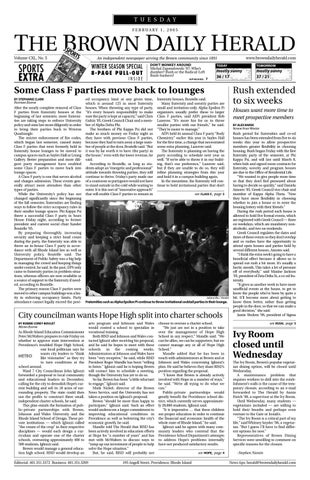
Juliana Wu / Herald
Fraternities such as Alpha Epsilon Pi continue to throw invitational cocktail parties in their lounge.
City councilman wants Hope High split into charter schools BY ROBBIE COREY-BOULET METRO EDITOR
As Rhode Island Education Commissioner Peter McWalters prepares to rule Friday on whether to approve state intervention at Providence’s troubled Hope High School, one local politician says he wants city leaders to “think METRO like visionaries” as they try to turn conditions at the school around. Ward 7 City Councilman John Igliozzi forwarded a proposal to local community and educational leaders in December, calling for the city to demolish Hope’s current building and sell its 18 acres of surrounding property. The state could then use the profits to construct three small, independent charter schools, he said. This plan entails the formation of public-private partnerships with Brown, Johnson and Wales University and the Rhode Island School of Design. These private institutions — which Igliozzi called “the cream of the crop” in their respective disciplines — would each design a curriculum and operate one of the charter schools, overseeing approximately 400 to 500 students, Igliozzi said. Brown would manage a general education high school, RISD would develop an Editorial: 401.351.3372 Business: 401.351.3269
arts program and Johnson and Wales would control a school to specialize in vocational training. Both RISD and Johnson and Wales contacted Igliozzi after receiving his proposal, and he said he hopes to meet with these schools in the coming weeks. Administrators at Johnson and Wales have been “very receptive,” he said, while RISD President Roger Mandle has been “willing to listen.” Igliozzi said he is hoping Brown will contact him to schedule a meeting, though the University has yet to do so. So far, Brown has been “a little reluctant to engage,” Igliozzi said. Mark Nickel, director of the Brown News Service, said the University has not taken a position on Igliozzi’s proposal. Brown “should be more than happy to participate,” Igliozzi said. Such an effort would underscore a larger commitment to improving educational conditions in Providence as well as bolstering the city’s economic growth, he said. Mandle told The Herald that RISD has been actively involved in education efforts at Hope for “a number of years” and has met with McWalters to discuss ways to “ramp up our investment of people to help solve the Hope situation.” But, he said, RISD will probably not
choose to oversee a charter school. “We just are not in a position to take over the management of Hope High School in any respect,” Mandle said. “We can be allies, we can be supporters, but we cannot manage any or all of Hope High School.” Mandle added that he has been in touch with administrators at Brown and at Johnson and Wales concerning Igliozzi’s plan. He said he believes they share RISD’s position regarding the proposal. “I know that Brown is already actively involved with Hope in a number of ways,” he said. “We’re all trying to do what we can.” Public-private partnerships would greatly benefit the Providence school district, which currently serves approximately 28,000 students, Igliozzi said. “It is imperative … that these children see proper education in order to continue the financial and economic health of the whole state of Rhode Island,” he said. Igliozzi said he agrees with many community leaders who contend that the Providence School Department’s attempts to address Hope’s problems internally have not produced satisfactory results.
195 Angell Street, Providence, Rhode Island
see HOPE, page 4
Rush extended to six weeks Houses want more time to meet prospective members BY ALEX BARSK SENIOR STAFF WRITER
Rush period for fraternities and co-ed houses has been extended from five to six weeks this year to allow prospective members greater flexibility in choosing housing. Rush began Friday with the first fraternity party of the semester, at Phi Kappa Psi, and will last until March 8, when bids and signed room contracts for fraternity, sorority and program houses are due to the Office of Residential Life. “We wanted to give people more time so that they don’t feel pressured about having to decide so quickly,” said Daniela Amores ’05, Greek Council vice chair and member of Kappa Alpha Theta. “Now they have more flexibility in choosing whether to join a house or to enter the housing lottery with their friends.” During the rush period each house is allowed to hold five formal events, which are registered with Greek Council — three on weekdays, which are mandatory nonalcoholic, and two on weekends. Greek Council regulates the dates and times of these events so they don’t overlap and so rushes have the opportunity to attend open houses and parties held by several different houses, Amores said. “I think the extra week’s going to have a beneficial effect because it allows us to spread out rush a bit more. It’s usually a hectic month. This takes a lot of pressure off of everybody,” said Maxine Jackson ’05, president of Zeta Delta Xi, a co-ed fraternity. “It gives us another week to have more unofficial events at the house, to get to know the people who’ve been by quite a bit. It’ll become more about getting to know them better, rather than getting people in the door, so that we can make a good decision,” she said. Jamie Sholem ’06, president of Sigma see RUSH, page 5
Ivy Room closed until Wednesday The Ivy Room, Brown’s popular vegetarian dining option, will be closed until Wednesday. A maintenance problem that requires workers to drill into the establishment’s walls is the cause of the temporary closure, according to an e-mail forwarded to The Herald by Annie Hatch ’06, a supervisor at the Ivy Room. Until Wednesday, many students — vegetarians included — are willing to hold their breaths and perhaps even venture to the Gate or Josiah’s. “The Ivy Room is a critical part of my life,” said Whitney Snyder ’08, a vegetarian. “But I guess I’ll have to find different options for now.” Representatives of Brown Dining Services were unwilling to comment on specific reasons for the closure. -Stephen Narain News tips: herald@browndailyherald.com
THE BROWN DAILY HERALD
THIS MORNING TUESDAY, FEBRUARY 1, 2005 · PAGE 2 Coreacracy Eddie Ahn
WORLD IN BRIEF Allawi calls for unity, promises inclusion for Sunnis THE WASHINGTON POST
BAGHDAD, Iraq — A day after Iraq’s first free election in half a century, interim Prime Minister Ayad Allawi called on his countrymen to unite and promised to reach out to the country’s alienated Sunni Arab minority. Perhaps as early as Tuesday, the
commission will begin releasing results. But it will take at least 10 days to know the entire outcome, said Adil Lami, a top official with the Independent Electoral Commission. Sensing victory, the United Iraqi Alliance has attempted to reach out to Sunni leaders in past weeks, but many Sunnis, in sentiments often expressed bluntly, said they feared the alliance would relegate them to second-class status and serve as a cover for the interests of the Islamic government in predominantly Shiite Iran.
Jero Matt Vascellaro
TO D AY ’ S E V E N TS SPRING SEMESTER ADDRESS 7:30 p.m. (Salomon 101) — President Simmons will speak on the state of the University.
MOVIE SCREENIING: BLACK IS, BLACK AIN’T 7:00-9:00 p.m. (Smith-Buonano 106) — Part of Black History Month, sponsored by the Third World Center.
Penguiner Haan Lee
MENU SHARPE REFECTORY LUNCH — Fried Fish Sandwich with Tartar Sauce, Parslied Rice, Fresh Vegetable Artichoke Melange, Chocolate Cake with White Frosting, Cherry Tarts, Grilled Chicken Sandwich.
VERNEY-WOOLLEY DINING HALL LUNCH — Vegetarian Spinach & Mushroom Soup, Chicken & Rice Soup, Beef Stew, Tomato Quiche, Mexican Succotash, Cherry Tarts.
DINNER — Spanish Steak, Sticky Rice, Ginger Sugar Snap Peas & Carrots, Whole Beets, Cheese Biscuit Bread, Ice Cream Sundae Bar.
DINNER — Vegetarian Spinach & Mushroom Soup, Chicken & Rice Soup, Orange Turkey, Vegan BBQ Tempeh, Rice Pilaf with Zucchini, Broccoli Cuts, Italian Vegetable Saute, Cheese Biscuit Bread, Chocolate Cake with White Frosting
Chocolate Covered Cotton Mark Brinker
CROSSWORD ACROSS 1 Imminent 7 Sapporo sashes 11 Turnpike sight 14 Rotary phone user 15 Farm storage area 16 Latin I word 17 She played 43Across 19 Lake maker 20 Mountain nymph 21 Sushi fish 22 __ carotene 23 Payment method 24 She played 43Across 27 “Big” London landmark 28 Lee and Teasdale 29 43-Across creator 34 More affluent 37 Writer __ Rogers St. Johns 38 Pub spigot 40 River past Notre Dame 41 Most sage 43 Show that premiered on Broadway in 1905 45 __ salts 47 Word before mot or vivant 48 She played 43Across 51 Pool table material 55 Spills the beans (on) 56 Abner adjective 57 Impish fairy 58 Sch. with a Providence campus 59 She played 43Across 62 Put on 63 Not new 64 “Murder on the __ Express” 65 School subj. 66 Diversify 67 Magnetic induction units
DOWN 1 For a specific purpose 2 Jeweled crown 3 President after Grant 4 God of Islam 5 Requirement 6 Arid 7 Basketry material 8 Idol and Joel 9 Under the weather 10 “Mayday!” 11 Academy student’s stint 12 Valuable violin 13 Neither a friend nor a countryman? 18 Be dead serious 22 Stiff drink 24 Sea, to Sartre 25 Spoil 26 Up and about 27 Like trombone music 29 Knockout punch target 30 1501, to a 13Down 31 Attacking 1
2
3
4
5
32 Hebrew alphabet openers 33 “The Raven” monogram 35 Bambi’s aunt 36 Stimpy’s cartoon buddy 39 Full of small stones 42 Rocky peak 44 Kind of poodle 46 Martin of “Route 66”
7
17
18
20
21
9
10
11
31
35
36
53
54
19
25
26
28
32
33
37
38
41
13
16
24
30
12
22
27
42 45
48
8
Raw Prawn Kea Johnston
02/01/05
xwordeditor@aol.com 6
15
23
Homebodies Mirele Davis
ANSWER TO PREVIOUS PUZZLE: H A M M A T L A S C L O T E Q U I L E E C H R I L E F U L L L E N G T H M O V I E T A L K I N T O Y O Y O S N E O L A R K I D T A G L E E R P M S N A R R O W W I D T H S H O E D R A T A A R O N T A B U I N D E P T H A N A L Y S I S A S E R E O S A X E L S M I R O W A N A P R O N K I C K S O F F G O O D T I M E C H A R L I E E R L E R O Y C E T E A S S T E M V I S A S A G T S
14
29
48 Not refined 49 Slugger Hank 50 Lightheaded 51 Cannes conclusion 52 Do very well 53 Climbing vine 54 Bedouin homes 57 Unadulterated 59 Popular family wheels 60 Big-house link 61 Com preceder
34 39
43 46
49
40 44
47 50
55
51
56 60
52
57
The Brown Daily Herald (USPS 067.740) is published Monday through Friday during the aca-
Business Phone: 401.351.3260
demic year, excluding vacations, once during Commencement, once during Orientation and
Jonathan Ellis, President
once in July by The Brown Daily Herald, Inc. POSTMASTER please send corrections to P.O. Box
58
59
62
63
64
Sara Perkins, Vice President
2538, Providence, RI 02906. Periodicals postage paid at Providence, R.I. Offices are located at 195
65
66
67
Ian Halvorsen, Treasurer
Angell St., Providence, R.I. E-mail herald@browndailyherald.com. World Wide Web:
Daniel Goldberg, Secretary
http://www.browndailyherald.com. Subscription prices: $179 one year daily, $139 one semester
By Alan Olschwang (c)2005 Tribune Media Services, Inc.
61
THE BROWN DAILY HERALD, INC. Editorial Phone: 401.351.3372
02/01/05
daily. Copyright 2005 by The Brown Daily Herald, Inc. All rights reserved.
THE BROWN DAILY HERALD
METRO TUESDAY, FEBRUARY 1, 2005 · PAGE 3
R.I. Rx program defies federal law BY BEN LEUBSDORF SENIOR STAFF WRITER
In a move that violates a federal ban on drug importation, Rhode Island recently initiated two programs to help residents purchase prescription drugs from pharmacies in Canada, where their cost is relatively low. But there remain serious concerns about the safety of imported drugs, according to local and federal policymakers. The state legislature passed a law in 2004 requiring the Department of Health to begin licensing pharmacies in Canadian provinces — just as it does pharmacies in other states. This would allow Rhode Island residents to fill their prescriptions by mail order from licensed Canadian pharmacies. Although two pharmacies in Canada have expressed interest, none have yet applied for a license, said Dr. Patricia Nolan, director of the Department of Health and a clinical assistant professor of community health. The federal government bans the import of most prescription drugs under the Federal Food, Drug and Cosmetic Act, and Rhode Island may face legal challenges as a result of its new policy. The Food and Drug Administration sent Rhode Island Attorney General Patrick Lynch a letter on Jan. 28 warning that the state’s actions violate federal law. But Rhode Island Secretary of State Matthew Brown did not seem concerned about federal action. “They haven’t done anything so far” to other states with similar programs, he said. “It’s very hard to argue” against a program that cuts costs for prescription drugs. Last week, Brown also announced a new program called RIMeds that connects residents through the Internet and phone with CanaRX, a prescription drugs wholesaler representing 60 pharmacies in Canada and the United Kingdom. Similar programs have been implemented in Illinois, Kansas, Missouri, Wisconsin and parts of Massachusetts. Driving these actions is the rising cost of prescription drugs and insufficient insurance coverage for Americans. “I’ve met hundreds of Rhode Islanders across the state, senior citizens especially, who can no longer afford prescription drugs,” said Brown, who added that he believes the government must “do everything we can” to help. Canada, through its national health care plan, negotiates with drug companies for lower prices when buying drugs in bulk. U.S.
health insurance companies do the same for their clients. As a result, drug prices are lower in Canada and for Americans with insurance. But federal law, specifically the Medicare Modernization Act of 2003, forbids the government from negotiating for lower drug prices for citizens on Medicare and Medicaid, according to James Morone, professor of political science. People without any coverage must also pay full price, he said. Morone blamed Republican ties to pharmaceutical corporations for raising costs for uninsured consumers. “If you don’t have drug coverage — and a lot of people don’t — you’re screwed,” he said. In the absence of federal action addressing drug prices, individual states have launched programs to help residents import cheaper drugs from Canada on the Internet. Rhode Island has gone further in allowing Canadian pharmacies the same licenses offered to out-of-state domestic pharmacies. Nolan said that college students living in Rhode Island would be able to participate in the program. The proposal has been met with concern regarding the safety of imported drugs. Jack Hutson, executive director of the Rhode Island Pharmacists’ Association, said “people need to look past the sound bites” at the safety issues involved, adding that there is no way to ensure the safety of imported drugs. The Rhode Island Board of Pharmacy, which oversees licenssee DRUGS, page 5
IN BRIEF
Subway to open on Waterman St. Students will soon be able to add international sandwich chain Subway to the list of dining options near Thayer Street. The restaurant, whose future location is 114 Waterman St. — former home of Harvey’s Ltd., a men’s fine clothing store — will be one of 26,800 Subway franchises in 80 countries. “We’re hoping for four to five weeks,” coowner Steve Souza said of the projected opening for the store. He and co-owner Chuck Smith have always had interest in opening a store on or near Thayer Street. They briefly considered moving into a space on Meeting Street, behind Johnny Rockets, but opted for the Waterman Street location in the end. “The layout wasn’t conducive” on Meeting Street, Souza said. He and Smith each own another Subway franchise in Rhode Island. Contractors began work on the Waterman Street space last week, and a placard in the window advertises employment opportunities. Souza said he would “absolutely” be interested in hiring college students to work part time at the store. Some locally run establishments in the Thayer Street area are less than thrilled about the sandwich chain’s arrival. “They have lower cost options, but it’s lower quality,” said Jeff Devito, assistant manager of Ocean Coffee Roasters, which is located just west of the future Subway. Lower cost can make all the difference for the cash-strapped college students that compose a large portion of these restaurants’ clientele, so Ocean is doing what it can to improve its menu, especially in light of recent low sales. “With Subway opening, we need to be able to compete,” Devito said. Ocean recently introduced eight new sandwiches — “more specialty than just deli sandwiches,” according to Devito — and new salads, like Asian chicken or spinach and bacon. The café also increased all sandwich portion sizes to include six ounces of meat and cheese. Devito said he hoped these changes would improve quality enough to make Ocean’s prices more cost-efficient for students. “What? They’re opening next to Ocean’s?” lamented Sanaa Rahman ’08 when she heard
of Subway’s arrival. “The reason we go to Ocean’s is because it’s unique to Rhode Island.” — Anne Wootton
Shell station here until 2006 Despite previous indications that the Shell gas station on Angell Street would be demolished to expedite construction on Sidney Frank Hall, the University has opted to allow the station to remain until its lease expires in the summer of 2006. Brown had previously hoped that construction on Frank Hall could begin earlier than scheduled, but has since abandoned that goal, according to Richard Spies, executive vice president for planning and senior advisor to President Ruth Simmons. “We thought we might be able to short-circuit the process, but it doesn’t look like we’ll be able to right now,” Spies said. Spies told The Herald in July that administrators were considering negotiations with the station’s owners to terminate its lease prematurely. The University, which owns the property, ultimately decided the plan would be unnecessary and impractical, he said. “To try to speed up things didn’t make sense,” Spies said. “Between doing it quickly versus doing it well, we choose doing it well.” The construction of Sidney Frank Hall will probably begin in the summer or fall of 2006, he said. Spies also said the University is in the final stages of architect selection for the project, and much planning and design work is still needed for the building. Frank Hall, named after the Jägermeister importer who donated $20 million of the estimated $30 million construction cost, will house the Department of Cognitive and Linguistic Science, the Brain Science Program, a 350-seat auditorium and classrooms. In Brown’s Master Plan, Frank Hall is a centerpiece of “The Walk,” a landscaped pathway connecting the Pembroke campus to Lincoln Field. — Stu Woo
PAGE 4 THE BROWN DAILY HERALD TUESDAY, FEBRUARY 1, 2005
Hope continued from page 1 “We’re two years into the action plan and the results are negative, not positive,” he said, referring to improvement efforts that district superintendent Melody Johnson said began following McWalters’ first intervention in 2001. These efforts should not be permitted to continue, Igliozzi said. Igliozzi is one of several politicians and community leaders calling for state intervention. At a public hearing Dec. 15, the Providence Educational Excellence Coalition — which features members from a variety of local youth and faith-based organizations — recommended McWalters shut down the school, which consistently tests far below state and national standards and has the highest dropout rate among Providence high schools. Igliozzi said he is skeptical of state intervention proposals that support keeping Hope at its current location. “What we’re talking about is having the same old, same old,” he said of such proposals. “I’m trying to provide the next step.” Igliozzi described Hope’s current building as “antiquated,” and “in a constant state of disrepair,” saying efforts to improve the structure would prove too costly for the city. One estimate placed the cost of necessary repairs between $45 and $55 million, he said. Though the building itself suffers from neglect, Igliozzi said the site’s property could be a major asset to the city, particularly given its “beautiful” view of the Providence skyline. If the property were sold or leased, the city could raise approximately $60 million, he estimated. Officials could also opt to keep four or five acres upon which to construct one of the charter schools, he said. “The economics work,” Igliozzi said. “That’s the easiest part.” A larger challenge lies in con-
vincing leaders “to be humble enough to ask for help” from private institutions, he said. Engaging private universities in the welfare of Providence public schools will allow the district to pursue education initiatives politicians “talk about but rarely achieve,” he said. The creation of “neighborhood schools” would cut down on average transportation time, Igliozzi said, because the charter schools would be located closer to residential districts. Hope’s current location forces many students to spend more than one hour riding a school bus each day, a process he said eats into valuable instruction time. Alykhan Karim ’06, who founded Students Teaching Students last year to organize tutoring efforts at Hope, agreed “it’s really hard for kids to get (to school).” A more pressing problem facing Hope is the “deplorable” lack of parental involvement, something Igliozzi said he hopes “neighborhood schools” and smaller class sizes will help address. But Mandle said he opposed relocating Hope, calling the school’s current location “an important asset to the East Side.” Mary Sylvia Harrison, a member of the Providence Educational Excellence Coalition that recommended state intervention, said smaller schools may effectively foster more “personalization” among students, teachers and parents. But Harrison called the promotion of small schools a potentially “dangerous” strategy if they do not generate “more earnest, volitional actors” to support students. Karim argued that the creation of “neighborhood schools” might not have a dramatic effect on parental involvement. “Location is not the only problem,” he said. Many parents in the district are first-generation immigrants, for example, and may adopt less proactive approaches to their students’ education, Karim said. “For them, it’s a very different attitude,” he said. Igliozzi said he believes his plan
would reduce the school’s current 52 percent dropout rate. The different programs offered by three charter schools would provide students with an alternative to the current curriculum, which merely “teaches to the test,” he said. “The present curriculum isn’t interesting enough for students to stay,” Igliozzi said. But Karim said closing Hope and building smaller schools might temporarily increase the dropout rate. In the short term, closing Hope would be a “bad thing” for students presently enrolled. “You might just have a lot of kids drop out who are not that interested in going to school in the first place,” he said. In addition to educational leaders’ reluctance to embrace a plan Igliozzi himself called “unconventional,” the proposal also faces a legislative hurdle limiting the number of charter schools in any Rhode Island municipality to four. Providence already operates four charter schools. But Igliozzi said he does not view this legislation as a significant problem, adding that the importance of a child’s education should overcome such political obstacles. Elliott Krieger, a spokesperson for the education department, said McWalters “supports expanding charter schools, especially in urban areas.” Brian Fong ’02 GS ’03, who taught at Hope during the 20032004 academic year, said he believes constructing charter schools would resolve space issues created by Hope’s large student body. “There’s too many students crammed into a small school,” he said. “All of the teachers shared rooms together, so none of us had stable homerooms to call our own. I moved through three different classrooms in the course of a day.” Having smaller schools, even if they are not charter schools, would “give students a chance to bond with their teachers,” Fong said. “The smaller the school, the better they are for the students.”
TUESDAY, FEBRUARY 1, 2005 THE BROWN DAILY HERALD PAGE 5
Drugs continued from page 3 ing, criticized the program as “not being the best public policy” prior to its implementation, Nolan said. But the health department is “obligated to go forward … as the statute is actually quite instructive,” and the department will do everything it can to ensure the safety of imported drugs, she said. Vincent Mor, chairman of the Department of Community Health, said concerns about Internet pharmacies are legitimate, but fears of Canadian pharmacies licensed by the Canadian government are less well-founded. For Internet orders, “You don’t have a clue where that stuff’s coming from,” he said. But Canadian pharmacies are regulated by provincial authorities — just as American pharmacies are regulated by states — and most of the drugs Americans import from Canada are “exactly the same as the drugs coming into an American pharmacy,” Mor said. If the pharmacy is licensed by its province and by Rhode Island, the safety issues should be minimal, he said. But Hutson said Health Canada, the equivalent of the Food and Drug Administration, is only mandated to regulate drugs for Canadian consumption. There is no legal oversight of drugs that might be earmarked for export to the U.S., he said, and there is no way to determine the actual source of such drugs. He cited the ongoing case of one Internet pharmacy in Canada which kept inspectors out of its
warehouse during an investigation by showing the drugs were intended for export to the U.S. and would not reach Canadian consumers. As for the MedRI program, Brown said that the pharmacies used by CanaRX have been inspected and approved by Illinois state officials as part of their ISaveRx program. But the first step to enrolling in the program is signing a legal liability release acknowledging “certain unavoidable risks” and agreeing that “prescription drugs purchased from other countries fall outside of the regulatory system for prescription drugs purchased in the United States,” according to the I-SaveRX program Web site. “If it’s so safe, why would you need to sign a waiver you wouldn’t need to sign in any Rhode Island pharmacy?” Hutson said. Nolan said drug imports from Canada are not a long-term solution to the rising cost of pharmaceuticals. She referred to the program as a “stop-gap” solution and said the federal government should address drug pricing in the longterm. Morone said he believes Rhode Island’s actions could provoke federal action. “I would see this as a negotiative process,” he said, adding that he believes Rhode Island’s actions will trigger one of several responses from the government. Federal policymakers may choose to fight an unpopular legal battle with the states, redefine the issue to address the problem of prescription drug pricing or “look the other way.” “It’s easy to overlook a Web site,” Morone said. “It’s very hard to overlook what Rhode Island is doing.”
Rush continued from page 1 Chi, said a longer rush period will allow more time to get to know each prospective member. “It always gets a little stressful for both the fraternities and the rushes near the end, and this just means it’s going to take another week to kick into high gear. We still look at things from the perspective of how long till the deadline,” he said. According to Amores, the rush period has not been extended for sororities because they are governed by the Pan Hellenic System, by which all national sororities have to abide, rather than only by University and Greek Council rules. Brown’s two sororities, Kappa Alpha Theta and Alpha Chi Omega, held a joint “rush kickoff” event Sunday, during which sisters introduced rushes to sorority life in general but were prevented from revealing which sorority they belong to. According to Heidi Wilder ’06, president of Kappa Alpha Theta, about 20 girls attended the event. “This is the hardest of the events because we can’t share our personal experience,” said Alida Kinney ’05 of Kappa Alpha Theta. “Once the rush parties start up, it’ll be easier for the girls to figure out which crowd they’re more attracted to,” she said. During the two-week rush period, each sorority house will individually host four parties, the last of which will be by invitation only. Lucy Raulston ’06 said she had never thought of joining a sorority until talking to friends at Brown who had already. “I didn’t want to
be involved in anything too hardcore, but this seems more relaxed and low-key,” she said. The presidents of all the houses said they do not go into rush with a predetermined number of new members to accept. “It depends on who shows up. We let them see what our brotherhood’s about and see if it’s something they want to become a part of, see if that meshes with who they are and their values,” said Rob Lazerow ’06, president of Alpha Epsilon Pi. But according to Chip Virnig ’06, president of Delta Phi, brothers often go into the process with potential new members already in mind. “We always have an idea of kids who we think we’d like in the house — kids that brothers know through sports teams, from their
Class F continued from page 1 exceed the occupancy limits of its lounge, according to Lazerow. More people have been coming to these parties, an increase he said is not because policy enforcement has decreased the popularity of the Class F parties. Instead, he credited the fraternity’s social chair for making the smaller parties more appealing. “I just think we’re throwing better parties,” he said. People prefer parties thrown in fraternity house lounges because they are familiar and offer a more intimate environment, Lazerow said. “Parties in University buildings are different, and change scares people,” he
home towns, younger siblings. … We start out with personal connections and the list expands from the core group of kids,” he said. According to Evan Hammer ’05, co-rush chair for Phi Kappa Psi, many rushes do not come to Brown with the intention of joining a fraternity. “It’s pretty much split,” he said, explaining that “there are certain people that are choosing between different houses, and certain people deciding if they’re going to do it (at) all — they’re interested because of the people they know in the house, and otherwise wouldn’t be interested.” “Mostly kids seem to make the decision last minute,” said Virnig, including himself. “I wasn’t planning on being in a frat and now I’m the president of one.” said. While the policy enforcement has created some challenges for student groups, it by no means creates insurmountable obstacles to throwing parties, Boutelle said. “There are a lot of options; although the changes make it hard, it’s still possible to throw a great party,” he said. He mentioned the possibility of a joint party with another campus group to be held in a building such as Sayles Hall as a way to increase the variety of parties on campus. As for what can be done about the difficulties of throwing parties at Brown, Boutelle said, “I would like to see students taking the initiative to prepare and plan good, wellcontrolled parties so that Brown University can have a good time on a Friday night.”
THE BROWN DAILY HERALD
EDITORIAL/LETTERS TUESDAY, FEBRUARY 1, 2005 · PAGE 6 S T A F F
E D I T O R I A L
Stop the silent treatment On the one hand, Brown has neither the will nor the resources to get into the business of secondary education anytime soon. On the other hand, Brown has had toes in the high school waters for a long time. Since the first University chair of didactics was appointed in 1851 (an ephemeral project which evolved into the Department of Education), Providence and Rhode Island schools have benefited from the University’s strong institutional reach. The positive effect Brown has had Providence schools has been incalculable, heroic and, apparently, insufficient. Hope High School is a failing school. It is impossible to argue that incremental measures have done enough to improve it over the last few years. We sympathize with Ward 7 City Councilman John Igliozzi’s impulse to just bulldoze the thing and start over. His proposal to throw responsibility for a third of the unmanageably large school to each of the three strong institutions within the city limits is flattering and surprisingly thoughtful. We know there is no room in the University’s mission — much less its campus — for a charter school. But for the amount of energy and manpower pouring out of the Department of Education, the Swearer Center and the student body into Hope High School in the form of advice, projects, programs and volunteers, the University should be getting more of a benefit. It is in everyone’s interest that Brown make a strong, well-organized commitment now to guide the process of transforming Hope. RISD President Roger Mandle told The Herald that his institution will politely decline Igliozzi’s offer while at the same time “ramping up” its dedication to Hope High. Johnson and Wales has responded as well. Moreover, McWalters reached out to Brown and RISD to improve education at Hope during his hearings on the school. That Brown as a whole remains silent, perhaps waiting for McWalters’ final ruling, is unfortunate and standoffish. The high school was a pilot site for Professor Emeritus of Education Ted Sizer’s Coalition of Essential Schools 20 years ago. The past several years have illustrated that Hope’s improvement has the potential to improve the safety of our campus, boost our regional economy and improve our student body. Whatever happens to Hope High, Brown as a whole institution should be involved and vocal in its direction from this moment on.
THE BROWN DAILY HERALD EDITORIAL Jonathan Ellis, Editor-in-Chief Sara Perkins, Executive Editor Dana Goldstein, Senior Editor Christopher Hatfield, Senior Editor Lisa Mandle, Senior Editor Meryl Rothstein, Arts & Culture Editor Melanie Wolfgang, Arts & Culture Editor Justin Elliott, Campus Watch Editor Robbie Corey-Boulet, Metro Editor Stephanie Clark, Features Editor Kira Lesley, Features Editor Te-Ping Chen, Opinions Editor Ari Savitzky, Opinions Editor Chris Mahr, Sports Editor Ben Miller, Sports Editor PRODUCTION Peter Henderson, Design Editor Katie Lamm, Copy Desk Chief Lela Spielberg, Copy Desk Chief Matt Vascellaro, Graphics Editor Ashley Hess, Photo Editor Juliana Wu, Photo Editor
SHANE WILKERSON
LETTERS Alum sees J-term success at Mount Holyoke To the editor: I agree wholeheartedly with columnist Joshua Lerner's proposal to start J-term courses at Brown (“A winter break J-term?”, January 31). I remember watching a lot of HBO at my parents' house during winter breaks at Brown. Sure, I needed a break, but Brown's break seemed long to me even then. It surprised me to learn that this hasn't changed in the past 15 years. I am now a member of the staff at Mount Holyoke College, which has a thriving Januaryterm program. Students love the opportunity to take risks, learn about something outside the reg-
ular curriculum, and expand their view of the world. Whether they learn about advertising from an industry pro or join the crew of a squarerig tall ship, students benefit greatly from the experience and return to campus with minds ablaze. Such a program would be a natural fit for Brown, and I hope the faculty and administration give it the attention it deserves. Bill Denneen '89 Director of Internet Marketing Mount Holyoke College January 31
LETTERS@
BUSINESS Ian Halvorsen, General Manager Daniel Goldberg, Executive Manager Mark Goldberg, Senior Financial Officer Lisa Poon, Marketing Manager Abigail Ronck, Senior Accounts Manager Kathleen Timmins, Senior Accounts Manager Laird Bennion, Senior Project Manager Elias Roman, Senior Project Manager Jungdo Yu, Senior Project Manager Laurie-Ann Paliotti, Sr. Advertising Rep. Susan Dansereau, Office Manager
BROWN
POST- MAGAZINE Fritz Brantley, Editor-in-Chief Adrian Muniz, Executive Editor Sarah Gordon, Calendar Editor Abigail Newman, Theater Editor Josh Cohen, Design Editor Marissa Hauptman, Photo Editor Ruthie Baron, Features Editor Jeremy Beck, Film Editor Paul Levande, Assistant Film Editor Jesse Adams, Music Editor
.COM
Raima Sen, Night Editor Katie Lamm, Lela Spielberg, Copy Editors Senior Staff Writers Camden Avery, Alexandra Barsk, Eric Beck, Mary-Catherine Lader, Ben Leubsdorf, Jane Porter, Stu Woo Staff Writers Marshall Agnew, Kathy Babcock, Zaneta Balantac, Zachary Barter, Hannah Bascom, Danielle Cerny, Christopher Chon, Stephen Colelli, Lexi Costello, Ian Cropp, Stewart Dearing, Gabriella Doob, James Feldman, Amy Hall Goins, Dana Goldstein, Bernard Gordon, Kate Gorman, Krista Hachey, Chris Hatfield, Jonathan Herman, Leslie Kaufmann, Kate Klonick, Allison Lombardo, Chris Mahr, Ben Miller, Eric Perlmutter, Meryl Rothstein, Marco Santini, Jen Sopchockchai, Jonathan Sidhu, Lela Spielberg, Stefan Talman, Jessica Weisberg, Brooke Wolfe, Melanie Wolfgang, Anne Wootton Accounts Managers Steven Butschi, Rob McCartney, John Nagler, David Ranken, Joel Rozen, Rukesh Samarasekera, Ryan Shewcraft Project Managers In Young Park, Libbie Fritz Design Staff Eric Demafeliz, Deepa Galaiya, Allison Kwong, Jason Lee Photo Staff Marissa Hauptman, Ashley Hess, Matthew Lent, Bill Pijewski, Kori Schulman, Sorleen Trevino, Juliana Wu Copy Editors Chessy Brady, Jonathan Corcoran, Eric Demafeliz, Leora Fridman, Allison Kwong, Katie Lamm, Suchi Mathur, Cristina Salvato, Sonia Saraiya, Lela Spielberg, Zachary Townsend, Jenna Young
D A I LY HERALD
we welcome your comments our job is covering the Brown community. let us know how we’re doing. herald@browndailyherald.com 401.351.3372
CORRECTIONS POLICY The Brown Daily Herald is committed to providing the Brown University community with the most accurate information possible. Corrections may be submitted up to seven calendar days after publication. CO M M E N TA RY P O L I C Y The staff editorial is the majority opinion of the editorial board of The Brown Daily Herald. The editorial viewpoint does not necessarily reflect the views of The Brown Daily Herald, Inc. Columns, letters and comics reflect the opinions of their authors only. LETTERS TO THE EDITOR POLICY Send letters to letters@browndailyherald.com. Include a telephone number with all letters. The Herald reserves the right to edit all letters for length and cannot assure the publication of any letter. Please limit letters to 250 words. Under special circumstances writers may request anonymity, but no letter will be printed if the author’s identity is unknown to the editors. Announcements of events will not be printed. ADVERTISING POLICY The Brown Daily Herald, Inc. reserves the right to accept or decline any advertisement at its discretion.
THE BROWN DAILY HERALD
OPINIONS TUESDAY, FEBRUARY 1, 2005 · PAGE 7
MARJON CARLOS
JOEL SILBERMAN
Get me a glass of Cristal and a copy of Us Weekly
The rhetoric gap
I saw it coming. While getting my hair done just a few days before the fateful Jan. 7, I was reading an article out loud to my hairstylist about the mysterious absence of Jennifer Aniston’s wedding ring. My hairstylist sucked her teeth, shaking her head with visible disdain over hearing the personal details of another’s marriage. “Do you want me to stop?” I asked. “Oh, no, no, babe! Keep reading! I mean, it’s sad, but no, keep reading.” As I obliged, I discovered that Brad had spent his 41st birthday apart from Jen, his wife of four years — and that I had no morals. I was becoming the unapologetic product of a culture submerged in the lives of others. Cultural theorists reason that America’s fascination with celebrities is due to our lack of an active monarchy to admire — or ruthlessly pick apart. Thus, we dream of dancing on tables with Paris Hilton or boning the entire cast of “That ’70s Show” — because, seemingly, our democratic governmental system wouldn’t have it any other way. But I beg to differ: I believe that the rapid pace at which entertainment news is fed to us nowadays is what beats pop culture into our heads and amplifies its significance to disproportionate heights. Which explains why I think I need a Flavor Flav ring tone or a play-by-play of the food Mary-Kate has consumed in the past week. Media produces and manipulates consumers’ desires that vanish as quickly as they do come. Why make the kids of Laguna Beach celebrities? Why zoom in on Beyonce’s taut abdomen and Versace dress in a video? Why gasp when we see Britney walk into a gas station bathroom barefoot? Simply put, it really is all about the “bling-bling.” At one time, we could simply rely on E! to provide us salacious details of celebs’ indiscretions, but almost every TV network has milked that proverbial cow. Once the home of videos for the middleage/John Mellencamp fanbase, VH1 now appeals to the common man’s desire to be a rock star. I mean, what exactly is the purpose of marathons of the show “The Fabulous Life of…” if not to simply lend a measure of significance to otherwise superficial aims? But our fascination with the lives of glossy strangers holds semiotic value that is often overlooked. I say this not to justify the barrage of Us Weeklys scattered about my apartment, but rather to point out that if we look closer, pop phenomenons such as “Bennifer” are bred from a greater void in our own lives. With a shaky economy, a dubious ass for a president, and a debased war raging on, who wants to acknowledge reality? Why not exist, if only for a moment, in a world where the parties never stop, the champagne flows heavy, and rarely anyone’s out of work? Though everyone in his or her right mind knows this world to be a mere façade, one fundamentally constructed upon the idea of projecting phoniness, we still cling to it. We familiarize ourselves with the factoids, the opulence, and the drama — so much so that the lives of entertainers no longer feel foreign, but are familiar to us. Which is why the demise of Brad and Jen’s perfect marriage affected us so strongly: it’s like, “If Brad and Jen can’t make it, then, well, damn….” As one friend puts it, our interest reflects a microcosm of human relations. As she reasons, pop culture is, if anything, the female equivalent to watching sports: there is nothing really in it for the viewer, but you still root for certain folks and wish the failure of others. So don’t be embarrassed by taking sides in the Brad-Jen-Angelina love triangle — but then again, don’t be too surprised if your kids one day ask you the age-old question, “Where were you when Brad and Jen broke up?” Marjon Carlos ’05 needs a soldier.
I have a dirty little secret to share. Are you ready for this? Are you sitting down? Okay. Here goes: I love conservatives. Now keep in mind, I don’t love them for their “pro-family” policy stances or their smoldering good looks (though I will admit, that guy who beat Tom Daschle is quite the sizzlin’ hunk of man beef ). I love them because I admire them, and I admire them because they have the balls of steel that Democrats so sorely lack. Allow me to illustrate. When liberals throw a national convention, we marvel at “the audacity of hope.” When right-wingers throw the same event, they proudly discuss beating our faces in with rifles. See the difference? Conservatives never fear firing at will, and we liberals could learn a lot from them. In fact, I’d go so far as to say we have to. Democrats are afraid to attack with the venom of a Bill O’Reilly or a Rush Limbaugh. We believe it is beneath us. We don’t want to get in bed with the “nasties,” much less be nasty ourselves. We detest Sean Hannity as much for his style as for his substance. We want to take the high road. We think that if we keep our heads above the fray, eventually people will realize that we’re right. Wrong. Last August a bunch of so-called Swift Boat Veterans for Truth attacked John Kerry, claiming the he’d lied to get his Vietnam medals and betrayed the country with his antiwar protests. Just about all of the charges were certifiably
false. Kerry wanted to strike back hard and fast, but his advisers didn’t want him to “dignify (the allegations) with a response.” By the time the Democrats finally did respond, the damage had been done. Contrast that with the conservative response to a CBS story alleging that George W. Bush was AWOL during his National Guard service. Republicans didn’t just make sure everyone knew the charges were false — they shredded CBS and butchered Dan Rather. I have friends who still think John Kerry lied about his medals. Those
Conservatives never fear firing at will, and we liberals could learn a lot from them. friends might well have voted for him had they known that the charges were disproved. And I believe that Kerry could have won the election if he’d fought back harder and more swiftly against the Swifties. As it was, the Dems were too afraid to throw punches and the Republicans won with a dirty trick. But what does all this mean for us, the students who supported John Kerry last fall? Obviously, we can’t change what’s happening in the upper echelons of the Democratic party — at least, we can’t just yet. But there is still reason for
us to feel empowered. Because right now, as we eat our Ratty sticky rice and prepare to join the world, we are incubating our generation. And a generation isn’t just a group of people who were born around the same time. It’s a set of ideals and values that we carry with us all our lives. Over the course of this semester, I will be writing a series of columns suggesting ways to make our idealism effective, to help us forge our generation, to transform it into what we want it to be, what we know it can be. For the moment though, I have but one plea: stand tough. Don’t let yourself be one of those liberals who is too sweet-natured to stand up for herself. Or himself. Don’t bite your tongue for fear of offending others. Don’t pull any punches. It’s time to let our opponents know that debate is welcome, but if they can’t back up their own point of view, they should prepare to start defecating out of three orifices — minimum. Yes, my friends, we have two choices. We can be rolled over like those in our parents’ generation who let Kerry get decimated by the Swift Boat Vets without any just recourse. Or we can study the stylings of Karl Rove and Dick Cheney, fighting harder, stronger and meaner than any right-wing chowderhead would ever dare imagine. Personally, I’m choosing Option B. Who’s with me? Joel Silberman ’05 will discuss why Michael Moore is the worst possible model for a more aggressive liberal in his next column.
MICHAL ZAPENDOWSKI
Sit down, you rabid hatemongers Brown students who went home to New York City this break might be aware that the Big Apple was graced by an enormous monkey-head collage of President George W. Bush. The presidential portrait of primates, painted by Pennsylvanian Chris Savido, was seen by 400,000 commuters every day as they cruised in and out of Holland Tunnel. I wonder how I would react if a bunch of right-wing nutcases were to make a giant portrait of Bill Clinton out of, say, hundreds of pairs of unzipped pants. Or, for that matter, how I would react if they were to march chanting through the streets, burning or hanging or comparing him to Hitler in effigy. I remember Rush Limbaugh calling the president’s daughter, Chelsea, the “new White House dog.” I’m no fan of our former president, but the rightwing hate cult that developed around him kind of frightened me. At worst, it was scary, and at best it struck me as pretty stupid and tasteless. Why should people on the opposite side of the political spectrum react any differently to primitive Bush-bashing? I’ve heard a lot of people say that the left in America needs to “go beyond” bashing Bush. If you ask me, we should do away with it altogether. Criticizing the president’s policies is one thing but demonizing him fanatically is immature and ineffective. I’d be willing to bet a fair number of people voted for Dubya on Nov. 2 in large part because the most visible opposition to
him takes the form of Savido’s artwork, or similarly Paleolithic personal insults. Worst of all, rabid Bush-bashing erases whatever moral high ground the left would otherwise gain by campaigning against googly-eyed Biblebangers and gay-and-homeless-bashers. Next time you find yourself on a streetcorner, lighting a huge Bush dummy on fire while the NYPD picks
Next time you’re lighting a Bush dummy on fire while the NYPD picks off your minority friends with rubber bullets... off your minority friends with rubber bullets, I suggest you look at your reflection in the window of the nearby fashion boutique and ask yourself: who comes across as dumber here, me or Bush? Whose eyes are really staring ominously out of that monkey face? Are they the president’s, or are they the hate-filled eyes of the Radical Left? Many good lawyers know that one way to win a case in front of a jury is to
subtly infuriate your opponent until they explode and disintegrate into a self-destructive, ugly frenzy. Effective politicians also know that one way to unite a movement is to make it feel frightened and victimized, like it is being ruthlessly and unfairly attacked. We the American Left need to avoid acting as the source of such offensives. We should hold together, self-disciplined and civilized, and deny the leaders of the right the opportunities they seek. I feel as strongly as anyone about the political situation in this country. My family lives a few hours away from Bush’s ranch; the movie theatre I used to work at played “Passion of the Christ” on all 24 of its screens, and if a giant billboard demonizing Bill Clinton were ever hung up by some wealthy Republicans, I have a feeling it would haunt a busy thoroughfare someplace near my parents’ home in Dallas. Nonetheless, Bush is not Hitler, nor is he a monkey, nor is he (officially) a hereditary monarch. And if he is a monkey, he is a monkey of which I stand in awe, for it has reached the presidency. In either case, I disagree with Republicans very strongly, but I don’t hold them in contempt. Hate shouldn’t be the foundation of any political movement, no matter how noble its purpose.
Michal Zapendowski ’07 is the new White House dog.
THE BROWN DAILY HERALD
SPORTS TUESDAY FEBRUARY 1, 2005 · PAGE 8
W. icers return home, tie Yale and fall to Princeton BY HELEN LURYI SPORTS STAFF WRITER
Returning to Meehan Auditorium was not enough to end a month-long slump for the women’s ice hockey team. The Bears came out of the weekend with a tie against Yale and a loss to Princeton, two teams that players and coaches said they thought they were ready to beat. With the loss to the Tigers, Brown’s record fell to 7-6-1 in the ECACHL and 10-9-2 overall. “We played well enough to win both games, but we just came up short,” said Head Coach Digit Murphy. “But I saw a lot of positive things come out of this weekend even though we didn’t win.” Friday evening marked the first time in 17 years that Yale won a point against the Bears. The 3-3 score broke Brown’s 35-game win streak against the Bulldogs, which dated back to Feb. 10, 1988, when the teams last tied. The result could be seen as a manifestation of Bruno’s recent slump, but it is also true that this season’s Bulldogs are not the same team of even two or three years ago that used to lose to Brown by scores such as 9-0. While Yale’s team is still inconsistent — it fell the next night to Harvard 11-2 — it has improved its play and climbed to third in the ECACHL standings. After Yale’s Nicole Symington opened the scoring three minutes into the first period, the Bears quickly rebounded and scored three unanswered goals before the buzzer sounded, giving them a 3-1 edge heading into the locker room. Jessica Link ’05 played a part in all three goals, scoring two and assisting on the third. After the break, Yale came back with the intensity of a determined team. The play was fast and physical, and the Bulldogs used their fire to score one goal in each remaining period. The first goal, early in the second, was a shorthander that came from in front of Brown goalie Stacy Silverman ’08. Their second came with 3:35 left in the game, when a frenzied Christina Sharun, who was playing her first game as a forward, got her own rebound past Silverman. Coach Murphy was quick to point out the game’s positive aspects. “I saw Jess Link step up and actually get some points. I saw some good energy and some good team
play that we just have to build on,” she said. Brown’s all-time record against Princeton is 26-28-1, a parity — with a slight edge in Princeton’s favor — that has been evident lately. Saturday’s 4-3 loss could have gone either way, but with two goals late in the third period, the Tigers came out on top. It was another intensely physical game with a large number of penalties by Princeton’s forwards and Brown’s defensemen. The Tigers scored on two of their power plays, and Brown on one. “The ref made some bad calls against both teams, especially near the end of the game,” said Myria Heinhuis ’06, who was called for three out of Bruno’s seven penalties. Coach Murphy echoed her statement: “The third goal was a high stick. It shouldn’t have been a goal. I think we need to be smart and stay out of the box.” But she added, “I don’t think the penalties are the difference. I think the difference was that we didn’t get the bounces and hopefully next weekend we will.” After a scoreless first period, the goals started coming quickly. Neither team was ever ahead by more than one goal, and the momentum shifted several times. Princeton opened the scoring early in the second period, but Kathryn Moos ’07 had a retaliatory goal halfway through. Moos played well on a line with prolific scorers Link and Keaton Zucker ’06, in the spot usually occupied by the injured Krissy McManus ’05. Princeton scored again to make the score 2-1 heading into the third period, but Brown pulled ahead with goals from Kerry Nugent ’05 and Link. Nugent is second on the team in goals scored. For a few minutes, it looked like the Bears might win, but Princeton pounded goalie O’Hara Shipe ’08 and scored two heartbreaking goals in the second half of the period. With a couple of minutes left, Coach Murphy called a timeout and Bruno attacked the Tigers’ net with a previously unseen fervor. A few of Brown’s shots almost went in, but Princeton managed to hold on to its 4-3 lead and win the game. Next weekend will bring two difficult road games against No. 1 Dartmouth and the University of Vermont.
Two top 25 teams prove too much for wrestling to handle BY BERNIE GORDON SPORTS STAFF WRITER
The wrestling team competed against two of the best teams in the country last weekend, dropping a nail-biter to No. 25 Army, 19-18, on Friday before falling to No. 5 Lehigh 27-10 on Saturday. The Bears have consistently sought out top-ranked teams to prepare for the Ivy schedule as well as the Eastern Interscholastic Wrestling Association and national tournaments. “To reach the goals that the kids have, you need to wrestle the best competition we have,” said Head Coach David Amato, who added that facing weaker teams to boost the team’s winloss record does nothing to improve the team. The Bears were led by co-captain Mike Pedro ’06 and rookie standout Jeff Schell ’08. Schell had a pin and a major decision to improve to 18-4 on the season. Coach Amato praised Pedro’s abilities, not only on the mat but as a leader as well. “He’s been wrestling great, he’s won five in a row,” Amato said. “Off the mat, he’s great, he’s a leader, and everyone seems to gravitate to him.” The Army match was a back-andforth battle, with Army only gaining the victory with a last-second pin. After Army got out to an early lead off of a 108 decision over Mike Savino ’08, the Bears countered by winning five of the next six matches, including Pedro’s key 6-1 victory at the 174-pound weight class and Schell’s pin at 125 pounds to give Brown a big 18-6 lead heading into the final three matches. “That was an emotional rollercoaster,” said Pedro of the seesaw match. “It allowed us to realize that we can compete with the best teams in the country.” Army started its comeback when Tony Severo squeezed by Dan Apello ’06, 2-1, to cut the lead to nine. Next, Ross Johnson ’08, filling in for injured Mark Savino ’06, lost a 23-8 major decision to Patrick Simpson. This left the Bears with a 5-point lead going into the final match, usually enough to ensure
victory. However, Army All-American Phillip Simpson pinned Sean Cully ’06 with just 17 seconds to go in the match, giving Army a 1-point win. “It was disappointing, but we came out, we wrestled hard … and there were a lot of things that could have, should have, would have gone our way, and they didn’t,” said co-captain David Saadeh ’06. “It was encouraging in the end (to do well against a top team).” The next day, Brown faced a stiffer challenge in Lehigh, a perennial powerhouse and last year’s EIWA champion. In front of a crowd of nearly 2,000 fans, the Bears once again proved their toughness against a strong opponent, wrestling a close match not reflected in the 27-10 score. “Lehigh has a tradition that we don’t have, but guys stepped it up and wrestled hard,” Saadeh said. Schell was first among those who stepped up against Lehigh. In the final bout of the day with the result no longer in doubt, Schell took the mat against senior Andrew Rizzi and thoroughly dominated en route to a 12-2 major decision. “He’s been doing great,” Amato said. “(He has) an amazing record for a freshman.” The Mountain Hawks took the first five matches before Pedro put the Bears on the board with a 6-2 decision over Bryan Bernal. Doran Heist ’06 continued his standout season for the Bears with a 5-3 decision over Matt Cassidy. “I think everyone … has been impressed by Doran,” Saadeh said. “He’s stepped it up since last year.” The Bears’ charge stopped there, unfortunately, as the Mountain Hawks recorded wins at 197 pounds and heavyweight to put the match out of reach before Schell recorded his major decision. The Bears open the Ivy League season this weekend with trips to the University of Pennsylvania and Princeton before coming home to face Cornell and Columbia the following weekend.
Shunning the Pats for the warmth of the Sox hot stove It’s a mere six days until the Patriots attempt to form a dynasty with a win in Super Bowl XXXIX, an accomplishment that, hypothetically speaking, should be considered one of CHRIS MAHR MAHRTIAN the most ENCOUNTERS amazing feats in sports history. In an era filled with free agency and perpetually shuffling rosters, I should be thrilled at the possibility. I should be decked out in a Rodney Harrison jersey on a daily basis, spewing nothing but football from here until Sunday, absolutely bubbling about the joys of rooting for New England. Yet I do none of this. For starters I am an admitted fairweather Patriots fan, one who didn’t get on the bandwagon until some guy named Brady came into the picture. There is no mention of
good tidings toward the Pats on Sunday in my Instant Messenger profile, as some of my friends have done recently or had since the start of the season. What you will find is a countdown toward pitchers and catchers, which now stands at 16 days. The great Rogers Hornsby once said that he spent all winter looking out the window waiting for it to be spring again, and I find myself relating to a dead guy. Ever since Keith Foulke snared Edgar Renteria’s one-hopper to end the World Series, I have looked forward to Opening Day 2005 with a 10-year-old’s enthusiasm. The Patriots piled up win after win, breaking NFL records and establishing a new precedent for running a professional sports team. And where was I? Scouring redsox.com and bostondirtdogs.com, digging up the latest info on contract negotiations with Jason Varitek and Matt Clement. And so, in the year-old tradition
of Mahrtian Encounters, I will list my reasons for my apathy of the Patriots’ winning ways and great zeal over the Red Sox hot stove like the huge sports dork that I am. As fun as it is to see the Patriots win, it has admittedly gotten slightly boring over the last two seasons. They will always find a way to pull it out, whether it is putting up a lot of points, shutting down a seemingly unstoppable offense or forcing the team into turnovers that they themselves would never commit. Compared to the 0-3 deficit from the 2004 ALCS, the dearth of drama in Pats games is something to yawn at. Just once I’d like to see them struggle for a win instead of putting their playoff games away with a quarter and a half to go. On the topic of tackling adversity, the Sox are preparing for their first season since 1996 where neither Nomar Garciaparra nor Pedro Martinez is on the Opening Day
roster, a reality Red Sox Nation has fully realized ever since Petey bolted for the beauty of Shea Stadium. To call this an important offseason would be an understatement. Not only are we trying to augment the talent we already possess, but we are also trying to replace the components we have lost. Where there was once Nomar there stands Edgar; Pistol Petey has been replaced by the Hefty Lefty. Will the changeover leave the Sox in tatters, or will the Boy Wonder Theo Epstein maintain his genius status? There’s an inherent drama to this that has kept me glued to Red Sox message boards since November. We’re trying to repeat. Duh. As a direct result all of Red Sox Nation, including this citizen, is closely watching and cuddling their new World Champions like Gollum and the One Ring (our one … our only … our precious). And like Gollum, we can’t stand to be away from our precious for one minute.
We need to pay heed to it before someone steals it away. The long-awaited World Series victory gave us New Englanders a warm feeling we haven’t had in generations. We don’t want the warmth generated from that title to be blown away by the winter winds, so what do we do? We wait for the snow and ice to thaw so that perpetual warmth never dies. Don’t get me wrong, I wish the Pats the best of luck on Sunday. I’ll just be shunning a pro-Pats stance for my borderline obsessive eagerness toward pitchers and catchers. Nothing could be finer than thinking about the Red Sox in February. If it makes any sense, the Pats going for a third Super Bowl in four years runs a close second. Sports Editor Chris Mahr ’07 has half a dozen Red Sox chat room sites bookmarked on his computer and visits each of them at least three times a week.