M O N D A Y JANUARY 31, 2005
THE BROWN DAILY HERALD Volume CXL, No. 4 A THEATER FEAST Cannibalism, men in dresses, and really long words: Sock & Buskin, P.W. will “Measure” up this season A R T S & C U LT U R E 3
WINTER OF OUR BOREDOM Joshua Lerner ’07: Brown should give its students something to learn in January OPINIONS
11
CAGERS IN SYNC In first full Ivy weekend, m. and w. basketball teams both beat back the Tigers but drop the Penn S P O R T S 12
TODAY
TOMORROW
mostly sunny 33/ 12
sunny 36 / 15
Rubida ’05 ‘Never Quit’
Ben Folds to play Spring Weekend, BCA confirms
BY BEN MILLER SPORTS EDITOR
Lawrence William Rubida ’05 passed away at 2:30 a.m. on Saturday after a nine-month battle with an aggressive form of bone cancer. He was 23 years old. “He had a lot of friends and loved life,” said football Head Coach Phil Estes. “He really was one of the guys that loved to stick up for the little guy. He really felt that if he believed in something, he would stand up for what his values were.” “On the field, if you could have 11 Lawrence Rubidas on either side of the ball you would win every game,” said former teammate Brent Grinna ’04. “He didn’t allow you to ever take a day off. He was no-nonsense all the time. He never lost that drive to win.” Rubida’s drive and determination helped him both on the football field, where he earned second team All-Ivy status in 2002, and in the classroom, where he concentrated in political science and psychology. He was also a loyal friend — always honest, upfront and willing to do anything for those to whom he was close. “One of the biggest things to me was the kind of friend he was,” said former teammate Dan Startsman ’02.5. “The spring break of his junior year … Lawrence just popped in his car and drove out to see me (in Ohio). That’s one of those things that just touch me. He gave up his spring break and came out here just because he hadn’t seen me in a while.” Startsman spent nearly two weeks in January with Rubida at his home in Arlington, Va. The two ate Chinese food and Egg McMuffins, both of which Rubida loved, and just hung out, playing video games, watching movies, but most importantly, playing cards. “We were just doing the things he liked to do,” Startsman said. “We played rummy for hours at a time.” Rubida was diagnosed with Ewing’s sarcoma, a rare form of bone cancer, in May
www.browndailyherald.com
An independent newspaper serving the Brown community since 1891
Nick Neeley / Herald
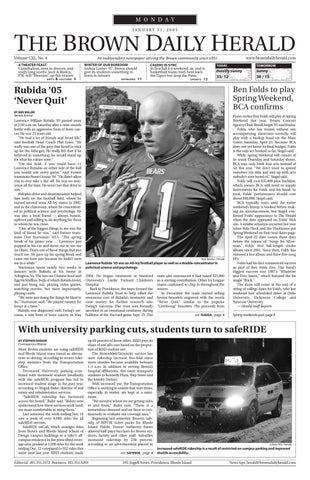
Lawrence Rubida ’05 was an All-Ivy football player as well as a double-concentrator in policitcal science and psychology. 2004. He began treatment at Stanford University’s Lucile Packard Children’s Hospital. Back in Providence, the team formed the Lawrence Rubida Trust to help offset the enormous cost of Rubida’s treatment and raise money for further research into Ewing’s sarcoma. The trust was formally unveiled in an emotional ceremony during halftime of the Harvard game Sept. 25. The
team also announced it had raised $25,000 as a starting contribution. Other Ivy League teams continued to chip in throughout the season. In December the team started selling brown bracelets engraved with the words “Never Quit,” similar to the popular “LiveStrong” bracelets. The proceeds from see RUBIDA, page 4
Piano rocker Ben Folds will play at Spring Weekend this year, Brown Concert Agency Chair Randi Siegel ’05 said Friday. Folds, who has toured without any accompanying musicians recently, will play with a backup band on the Main Green Saturday, April 23. Because BCA does not yet know its final budget, Folds is the only act booked so far, Siegel said. While Spring Weekend will consist of its usual Thursday and Saturday shows, BCA may only book four acts instead of six this year. “We don’t want to spread ourselves too thin and end up with acts nobody’s ever heard of,” Siegel said. Folds will cost $35,000 plus backline, which means BCA will need to supply instruments for Folds and his band. In total, Folds’ performance should cost about $40,000, Siegel said. BCA typically waits until the entire weekend’s lineup is booked before making an announcement, but Siegel confirmed Folds’ appearance to The Herald when the date appeared on Folds’ Web site. A similar situation occurred last year when Bela Fleck and the Flecktones put Spring Weekend on their tour dates page. The April 23 date comes three days before the release of “Songs for Silverman,” Folds’ first full-length studio album since 2001. Since then, Folds has released a live album and three five-song EPs. Folds had his first commercial success as part of Ben Folds Five. The band’s biggest success was 1997’s “Whatever and Ever Amen,” which featured the hit single “Brick.” The show will come at the end of a string of college dates for Folds, who last weekend had scheduled dates at Duke University, Dickinson College and Syracuse University. — Herald Staff Reports Spring weekends past, page 4
With university parking cuts, students turn to safeRIDE BY STEPHEN NARAIN CONTRIBUTING WRITER
More Brown students are using safeRIDE and Rhode Island mass transit as alternatives to driving, according to recent ridership statistics from the Transportation Office. Decreased University parking combined with increased student familiarity with the safeRIDE program has led to increased student usage in the past year, according to Abigail Rider, director of real estate and administrative services. “SafeRIDE ridership has increased across the board,” Rider said. “Riders now understand how these services work (and) are more comfortable in using them.” Last semester, the week ending Nov. 14 saw a peak of over 6,000 rides for all safeRIDE services. SafeRIDE onCall, which arranges rides from Brown and Rhode Island School of Design campus buildings to a rider’s offcampus residence in the prescribed coverage area, peaked at 1,698 rides for the week ending Dec. 12 compared to 932 rides that same time last year. RISD students made
up 60 percent of those riders. RISD pays its share of onCall’s cost based on the proportion of RISD student use. The BrownMed/Downcity service has seen ridership increase five-fold since more shuttles became available between 1-3 a.m. In addition to serving Brown’s hospital affiliations, this route transports students to Kennedy Plaza, Ship Street and the Jewelry District. With increased use, the Transportation Office is working to ensure that wait times, especially in winter, are kept at a minimum. “We monitor where we are getting rides to and from,” Rider said. “There is a tremendous demand and we have to continuously re-evaluate our coverage area.” Beginning last semester, Brown’s subsidy of RIPTIK ticket packs for Rhode Island Public Transit Authority buses allowed half-price bus fares for Brown students, faculty and other staff. Subsidies increased ridership by 250 percent, according to an advertisement placed in
Juliana Wu / Herald
see SAFERIDE, page 4
Increased safeRIDE ridership is a result of restricted on-campus parking and improved shuttle accessibility.
Editorial: 401.351.3372 Business: 401.351.3269
195 Angell Street, Providence, Rhode Island
News tips: herald@browndailyherald.com
THE BROWN DAILY HERALD
THIS MORNING MONDAY, JANUARY 31, 2005 · PAGE 2 Coreacracy Eddie Ahn
WORLD IN BRIEF Outlook brightens in Iraq, but no quick fix also said,“There’s more distance to travel on the road to democracy.” Despite the exhilaration, the election may do little to win international support, assure development of a friendly government in Baghdad and prevent the spread of civil strife. World leaders usually look to the United Nations to help them make sense of elections in troubled parts of the world. The U.N. election team for Iraq is already making clear that it considers the balloting fair — even though Iraq was too dangerous to permit the presence of international observers. “They’re voting for the day when they’re going to take their destiny in hand,” U.N. Secretary-General Kofi Annan said. Such judgments could serve to soften public opposition in Europe and the Middle East to the U.S. presence in Iraq.
THE LOS ANGELES TIMES WASHINGTON — Election day in Iraq brought a rare dose of favorable news for the Bush administration’s efforts there, but left unanswered whether other such days will follow. At home, where support for the war has fallen to fewer than half of Americans, the image of Iraqis risking their lives to cast ballots was likely to increase public sympathy. Abroad, where the U.S.-led effort has been widely questioned, there were signs that allies would judge the election positively, possibly providing international legitimacy that has been a top goal for the United States. But U.S. officials stopped short Sunday of calling the vote a turning point, perhaps remembering how the jubilation that followed the capture of Saddam Hussein in December 2003 melted in a few months as the insurgency raged on. While exulting in the election turnout Sunday, President Bush
Jero Matt Vascellaro
For more on the Iraqi election page 6.
Penguiner Haan Lee
TO D AY ’ S E V E N TS ISRAELI AND INTERNATIONAL FOLK DANCING 7:30 p.m. - 9 p.m. (Hillel House, 80 Brown Street) — Israeli and international folk dances taught -- for beginners through advanced
"WHAT’S IN A WORD? 'FEDE' AND ITS DOUBLES BETWEEN MACHIAVELLI AND LUTHER." 3 p.m. - 6 p.m. (Annmary Brown Memorial)— Albert Ascoli, Gladys Arata Professor of Italian Studies at UC Berkeley, will speak on his research into Early Modern faith and ideology, with a subsquent discussion centered on cantos 21 and 44-46 of Ariosto’s Orlando furioso.
Chocolate Covered Cotton Mark Brinker
CROSSWORD ACROSS 1 Soccer great Mia 5 Book of maps 10 Coagulate 14 Prefix with distant 15 Bloodsucker 16 Tick off 17 Hardly a short film 20 Convince of 21 Toys on strings 22 Classic opener? 23 Merry escapade 25 It’ll help you find a lost dog’s owner 29 Sly look 30 Tony Blair and others, briefly 33 A or AA, in footwear 37 “Confound it!” 38 Burr who dueled Hamilton 39 Cologne that sounds forbidding 40 “60 Minutes” piece, e.g. 43 Enzyme ending 44 Vintage cars 45 Lipinski leaps 46 Spanish artist Joan 47 Pale 49 Chef protector 52 Starts the football game 57 Fun-loving fellow 60 Author __ Stanley Gardner 61 Rolls’s partner 62 Afternoon socials 63 Pipe part 64 MasterCard alternatives 65 Ten percenters: Abbr. DOWN 1 Test the weight of 2 Turquoise relative 3 Ponder 4 Vitamin D source 5 Coeur d’__
6 6:50, vis-à-vis 35 “Yippee!” 52 Florida isles 7:00 36 River of Hades 53 Caracas lass: 7 Toy blocks brand 41 Crime scene Abbr. 8 “It’s all an __” smudge, maybe 54 Designer 9 “No talking!” 42 Sri __ Cassini 10 Swindler 46 Computer 55 Royal decree 11 Ancient Roman device 56 Come clean, historian 47 Good witchcraft with “up” 58 Sportscaster 12 Miscellany 48 Feels sore 13 Golfer’s 49 Quite a while Cross pocketful 50 Coastal city 59 Miss Piggy, to 18 Legalese is one 51 Part in a play Miss Piggy 19 Biblical resin ANSWER TO PREVIOUS PUZZLE: 23 Strung along 24 State Farm S E W S G I A N T P A N D A competitor A V O N O N Y O U R F E E T 25 Gandhi’s nation D E M O O N E A N O T H E R 26 Stitches I N B R E D S H E P I R A 27 Sports page E S T E E M S S I M S news T O R N O U T N E T T L E 28 “Laugh-In” comedian B E T Y O D E L N O H O W Johnson A V O W D A N E S P E T E 29 Turkish coins R E M A P N O V E L R U R 30 Moon stage E N B L O C R E V E R E S 31 It merged with T R A M R E D A T E S Exxon S O W S C A B N A T H A N 32 Horton the T R E N C H C O A T T E T E Elephant’s A L L T H E R A G E A R E A creator 34 Give the plants B Y T H E D O Z E N N E R D a drink 01/31/05 xwordeditor@aol.com 1
2
3
4
5
14
6
7
8
9
17
18
13
30
31
32
54
55
56
21
26
27
23
28
24
29
33
34
37
35
36
38
40
39
41
43
42
44
45
46 50
47
51
52
57
58
60
61
63
12
19
22
49
11
Raw Prawn Kea Johnston
16
20
25
10
15
Homebodies Mirele Davis
THE BROWN DAILY HERALD, INC.
48 53
59
64
By Lila Cherry (c)2005 Tribune Media Services, Inc.
62 65
01/31/05
Editorial Phone: 401.351.3372
The Brown Daily Herald (USPS 067.740) is published Monday through Friday during the aca-
Business Phone: 401.351.3260
demic year, excluding vacations, once during Commencement, once during Orientation and
Jonathan Ellis, President
once in July by The Brown Daily Herald, Inc. POSTMASTER please send corrections to P.O. Box
Sara Perkins, Vice President
2538, Providence, RI 02906. Periodicals postage paid at Providence, R.I. Offices are located at 195
Ian Halvorsen, Treasurer
Angell St., Providence, R.I. E-mail herald@browndailyherald.com. World Wide Web:
Daniel Goldberg, Secretary
http://www.browndailyherald.com. Subscription prices: $179 one year daily, $139 one semester daily. Copyright 2005 by The Brown Daily Herald, Inc. All rights reserved.
THE BROWN DAILY HERALD
ARTS & CULTURE MONDAY, JANUARY 31, 2005 · PAGE 3
Artist Long creates ‘playful’ exhibit BY LISHAN SOH STAFF WRITER
One sunny afternoon in December 2004, Charles Long and his assistant dragged one of his sculptures through a river on a shopping cart, then sat on the grass, had a picnic and watched the birds poop on it. “And it was finished,” Long said. The piece is now on display in the David Winton Bell Gallery, part of “More Like a Dream Than a Scheme,” an exhibit featuring the latest works from the Los Angeles, Calif. native and professor of art at the University of California — Riverside. Students, faculty and members of the public packed the List Art Center auditorium Friday evening to hear Long speak at the opening of the exhibition. The 47-yearold artist was pleasantly surprised by the favorable response, opening his lecture with an admission that he “had only expected no more than 12 people to show up.” Long said his earlier pieces were more evocative of the body, flesh and sensory pleasures, often created while he was “wrapped up in mind games” and complex psychology. He described his latest work as the product of “real experience,” making them more “intuitive and poetic.” The collection — a series of 23 freestanding assemblages and suspended sculptures — seeks to create a spatial environment in which the play of light and shadows elicits the feeling of a magical otherworld. The sculptures that hang from the ceiling and walls are made of plaster, wire and light bulbs; those on the ground are constructed of junk, steel, plaster and papier-mâché. The junk used in the pieces was scavenged from the Los Angeles River behind Long’s home. Calling there a “source of sustenance,” Long said he often wades in the river in search of discarded articles to use in his sculptures. Packing foam, a shopping cart, coconut fiber and various containers, most covered with white plaster, feature widely in the exhibition. Before his lecture, the audience was treated to footage of Long dragging his piece,
“We Wait a Long Time to See You, to Beat You,” through the river. The bare lights from suspended pieces throughout the gallery are strategically placed to “penetrate the other pieces,” Long said. Describing the play of light and shadows as “irresponsible” and “playful,” Long emphasized the need for viewer involvement with his work and for visitors to interact and be creative with their interpretations of his art. Citing the writing of 13th-century Persian poet Rumi as well as the drawings of his 9-year-old son as inspiration, Long replicates his son’s scribbles in some of his art. He disclosed a particular fondness for a metal sculpture resembling satellites, which hangs near the gallery entrance. Called “The Good Friend of Forever,” after a line from a poem by Rumi, it is modeled after one of his son’s pictures. Much of Long’s work in “More Like a Dream Than a Scheme” is metaphorical. The stark whiteness of the plaster that coats most of his work, coupled with his very sporadic use of color, gives the exhibition an ethereal feel. This is one of Long’s aims in the piece “The Slave Chemist,” which features 32 miniature figures stuck to steel rods emerging from a broad, round table base. The figures encircle an amorphous mass of papier-mâché. “The physicality of this world is represented by the table base,” Long said, “and the figures are elevated to another level, the world of the pretend, the makebelieve.” Even the title of the exhibition is metaphorical. “More Like a Dream Than a Scheme” not only describes the physical appearance of the gallery and Long’s art, but also refers to his pieces, which are unpremeditated and completely open to viewer interpretation. “I just want my viewers to have fun, live passionately and think creatively,” Long said. “More Like a Dream Than a Scheme” will be on display at the David Winton Bell Gallery through March 6.
Spring theater preview BY LAURA SUPKOFF CONTRIBUTING WRITER
This semester’s theater lineup features everything from Trey Parker’s take on cannibalism to gender construction in William Shakespeare. Four plays of special note are the Sock and Buskin productions “Measure for Measure,” “Compleat Female Stage Beauty” and “bobrauschenbergamerica,” and the Production Workshop performance “Cannibal: The Musical.” Sock and Buskin Much goes into selecting the plays that will be featured each semester. After the long process of reading through hundreds of plays, the Sock and Buskin committee, made up of both students and faculty, decides upon six to produce. “It’s probably the most exciting season I’ve seen in my four years,” said Allison Posner ’05, chair of the Sock and Buskin board. Two of the Sock and Buskin plays will be directed by faculty members, and the third, “Measure for Measure,” will be directed by Adam Immerwahr ’05. Immerwahr presented his production idea to the board and was chosen to fill the senior slot, a production reserved each year for a member of the senior class. “It’s about some really contemporary issues,” Immerwahr said. It is concerned with “how women’s bodies are constructed in society, sexual harassment, the role of morality and how society legislates interpersonal issues.” This adaptation incorporates dance, which Immerwahr explained was intended to further the see THEATER, page 4
PAGE 4 THE BROWN DAILY HERALD MONDAY, JANUARY 31, 2005
Theater continued from page 3 story and fill in what contemporary viewers would deem gaps in Shakespeare’s original. “Measure for Measure” will be playing at Leeds Theater from Feb. 24-26 at 8 p.m. and on Feb. 27 at 3 p.m. “Compleat Female Stage Beauty,” directed by Connie Crawford, adjunct lecturer in theater, speech and dance, focuses on a time when women began to fill female roles previously occupied by male actors. The relatively new play focuses on Ned Kynaston, an actor famous for his portrayals of women in London in 1661. Written by Jeffrey Hatcher, a
Rubida continued from page 1 the sales went toward the trust. In the meantime Rubida had responded well to treatment, and doctors eliminated the initial tumor on his hip. But on Nov. 6, the doctors discovered another tumor, this one above the knee on his right leg. In a few days it had grown tenfold. The news got worse in mid-December when tumors
contemporary playwright and screenplay creator, this look into a historical change in theater will be playing this March at Stuart Theater. Performances will be from March 10-19 at 8 p.m. and on March 20 at 3 p.m. Visiting Professor of Theater, Speech and Dance Steve Buescher will direct the final Sock and Buskin play. “Bobrauschenbergamerica” is a play created in the style of artist Robert Rauschenberg, who continues to create unconventional pieces, taking real objects out of their normal context. Charles Mee’s play presents ideas about “interpersonal relations, the relationships between thought and action, how materials interrelate, past to present, people and place,” according to a Sock and Buskin press release.
were discovered in his lungs. Rubida ended his treatment and moved back to Virginia to be with his family. “He wanted to go home,” Startsman said. “He wanted to be in his own bed in his own bedroom.” Rubida was especially hurt by the death of his good friend Ricky Whelan ’04, who passed away Jan. 11. Although he was in a great deal of pain, Rubida made the trip up to Merion, Pa., to attend the serv-
These contrasts can be viewed at Leeds Theater, April 14-23 at 8 p.m. and April 24 at 3 p.m. Production Workshop Student-adapted and -directed “Cannibal: the Musical” was created from the screenplay written by Trey Parker, co-creator of South Park. Director Benji Samit ’06 pitched the show to Production Workshop after receiving the rights to turn Parker’s screenplay into a script for the theater. The play is a spoof on the true story of the only person convicted of cannibalism in the United States. “What you see here is very, very faithful to the movie,” Samit said. The first PW play of the semester, “Cannibal” will show at T.F. Green Hall from Feb. 11-14.
SPRING WEEKENDS PAST 2004:
Bela Fleck and the Flecktones, Blackalicious, Reel Big Fish, Jurassic 5, Sleater-Kinney, Sue Generis
2003:
Luna, The Donnas, Joan Jett and the Blackhearts, Lisa Loeb ’90, Ozomatli, The Wallflowers
2002:
Saves the Day, The Get Up Kids, DJ Spooky, Rufus Wainwright, Dar Williams, The Roots
2001:
Violent Femmes, They Might Be Giants, M. Doughty, Ben Harper & The Innocent Criminals, Jurassic 5
2000:
Wyclef Jean, Kelis, Product, G. Love & Special Sauce, The Samples, Melissa Ferrick, MC Paul Barman
1999:
Busta Rhymes, Common, Wilco, Vic Chesnutt, Black Star, DJ Maseo
1998:
KRS-One, Rakim, Grandmaster Flash, Sonic Youth, Yo La Tengo, Luna
1997:
Bob Dylan, Bo Diddley, The Toasters, Jazz Mandolin Project Source: Brown Concert Agency
ice. “He fought this thing for eight months and he never anticipated going to one of his friend’s funerals,” Grinna said. “He took it extremely difficultly.” The next weekend Rubida attended the NFC championship game at Philadelphia’s Lincoln Financial Field. Lawrence, along with his girlfriend Kim Highlund ’04, his father, Kirk Rubida, and a few former teammates sat in a luxury box provided by Richard Dresdale ’78. According to an email sent out to friends and teammates by Tim Goobic ’04, Rubida shouted “Do it for Ricky” when the Eagles ran onto the field. The next day, Rubida’s health took a turn for the worse. The tumors in his lungs had grown to the point where he was having difficulty breathing. He checked into the Halquist Memorial Hospice
near his home in Arlington. Later in the week, Estes and Offensive Line Coach Frank Sheehan flew down to Virginia. “He looked as well as you could hope,” Estes said. “They had him upright to help him breathe. He was able to open his eyes and smile. He mumbled a few things. I am glad that we were able to say goodbye to Lawrence and tell him that he fought a good fight.” “I’m proud that I was one of the guys that he wanted to say goodbye to,” Sheehan said. “He was in and out of consciousness, but he knew we were there. He cracked a smile. He said he knew we were coming, and he was going to wait for us.” Rubida did not make it through the night. He passed away at 2:30 a.m., surrounded by his family and Highlund. “All I can do about Lawrence is
try to get through the grief and remember all he taught me,” Sheehan said. “He taught me a lot about myself and about coaching. I thanked him for allowing me to coach him, but he was more than a player to me.” Even though he was in a lot of pain, Rubida still never put himself first. “The last impression that I have of Lawrence is how at the end he continued to care for how people were feeling,” Grinna said. “He was in a lot of pain, but he always wanted to know how you were doing. His ability to care stuck with him.” Rubida is survived by his father Kirk, his mother Sara and his sister Katherine. Services are being planned for this coming weekend in Virginia with a memorial service to be held at Brown in the next few weeks.
safeRIDE
tives for commuter employees, staff and visitors. In addition to support for carpooling, the “Guaranteed Ride Home” program ensures employees who use mass transit can take a taxi in case of emergency. In response to the city’s con-
cerns about congestion on College Hill, Brown reduced the number of available overnight parking spaces in 2000 and 2004. The remaining 500 parking spaces allotted to undergraduates are assigned by a seniority-based lottery every April. Brown is in the process of finding ways to replace lost parking capacity over the long-term, Rider said. But with limited space available on campus to create parking lots, future parking spaces for students may end up in remote areas. More centrally-located facilities have been planned for guests and visitors to the University. Benchmark figures for parking garages hover around $20,000 per space, she said. She said plans for resolving parking issues, especially for undergraduates, will focus on reducing the demand for spaces by immediately providing transportation alternatives while also increasing the supply of parking spaces over the longer term.
continued from page 1 The Herald by Brown and RIPTA. The University has also launched transportation initia-
THE BROWN DAILY HERALD
CAMPUS NEWS MONDAY, JANUARY 31, 2005 · PAGE 5
Black History Month kicks off BY CAMDEN AVERY SENIOR STAFF WRITER
Blacks need to shed stereotypes and work more as a community, keynote speaker Brenda Verner. said at Friday’s Black History Month convocation in Salomon 101. More than 100 students congregated for event, BLACK HISTORY the MONTH 2005 which a d d re s s e d the theme of this year’s Black History Month — “What is Black? Addressing Our Divisions, Embracing Our Identities — Unifying Our People!” Verner spoke about her research on stereotyping in the media industry with earnestness and a sense of humor that kept the audience in hysterics. Introducing herself, Verner said, “I’m a media researcher, I specialize in stereotyping research, and I’s black.” Her concern with black identity is linked to the stereotypes represented in pop culture, she said. “My goal is to extract you from the grip of American popular culture,” she added. Citing television shows like “Amos and Andy,” Verner said that a generation of young black people has consumed a dishonest cultural stereotype, and has begun to “regurgitate” that stereotype’s image through their actions. She cited a statistic that about 80 percent of black children are born out of wedlock, demonstrating that the lives of blacks have come to reflect the stereotypes that misrepresent them in the media. The struggle, she said, lies in deciding whether to embrace the cultural image or to chase after the American dream. Stereotypes, Verner added, “are at the core of why we have problems coming together as a community.” She criticized the behavior of the black community for seeking validation as disparate groups: “If we cannot tolerate difference among us, then we really do not want progress.” She said that blacks need to embrace the “fight for humanity” through calm rationale instead of anger. “I think it’s time we stop sulking in the corner over our maltreatment, and start making an influence,” she said. “We have to be able to see what we do wrong, and fix it. “We do have the authority to change things,” she said. The evening opened with an
introduction by Chandra Singh ’05 and Basirat Ottun ’05, who laid the groundwork for the theme of black identity. “Racial identity is a really complex concept that symbolizes different things for different people,” Ottun said. She added that the evening was devoted to inspiring “conversations and dialogues” about confronting racial identity. “We see the potential of us coming together and working on these issues” to promote change, she said. Both Ottun and Singh, like the speakers who followed them, emphasized the continued need to work for progress, which they said can be achieved by constructing a more widely encompassing concept of what it means to be black. Ottun ended her opening statement by urging, “Let us not become complacent with the way things are.” The convocation’s introduction was followed by the Black National Anthem performed by Shades of Brown, then by comments by a first-year and a senior speaker. Graham Browne ’08 focused his comments on how one begins to identify as black and what makes someone black. He asked, “Is it about feeling black, or thinking black? Is it about being seen as black by others?” Ultimately, Browne said, “I hope that others, too, will examine themselves this year, this month and this evening,” in order to confront their racial identity. Lynnette Freeman ’05, the evening’s senior speaker, opened with a reading about black identity from Jamaican poet Mutabaruka. She went on to express the struggle of coming to conclusions about racial identity, and of “being torn between who we are, and who we are expected to be,” specifically in reference to her experience of identifying as both Jamaican and African. Freeman, like the speakers before her, commented on the constructive quality of identifying a broader range of people as black — even as differences among blacks are celebrated — saying that no individual in the diaspora is “blacker” than another. She added, however, that while a connective thread does link people identifying as black, this should not pressure them to depart from another kind of identity. Our children, she said, “will (eventually) no longer have to
ask themselves who they are, but only who they want to be. … What my college experience has taught me is, the only person I can be is me.” Joseph Edmonds Jr. ’00 expanded on the theme of avoiding complacency with the status quo of blacks’ position in society. “I am convinced,” Edmonds said, “that I was called here to nourish discontentment (and) disgust with this status quo.” He later pleaded with the audience to “usher in new moments of dissonance.” Edmonds quoted a president of Morehouse College, saying, “There is discarded genius everywhere.” The black community, he said, “must move beyond the malaise of mediocrity … (and) forge new identities” to refuse being subsumed by complacency. The ceremony ended with a musical selection by Johnny Braithwaite, including songs performed before a photomontage backdrop displaying images of lynchings, chain gangs, freedom marches and Tommie Smith and John Carlos raising black-gloved fists at the 1968 Olympics.
Brown researchers discover cancer ‘on-off switch’ BY ALLISON WHITNEY CONTRIBUTING WRITER
A team of Brown University researchers recently created a stir in the field of molecular biology by discovering a new way that a cancer-causing molecule is activated. This finding explains why current cancer treatments are not always effective and opens the way for creating better drugs to fight the disease. The molecule, STAT3, is a protein normally found dormant in adult cells. However, in prostate and breast cancers, it is unusually active. Like a machine whose power switch is jammed in the on position, the protein in many patients is always turned on, allowing cells to divide uncontrollably. Chemotherapy drugs used to treat these cancers attempt to control STAT3’s activity by turning it off but are not always successful. This is because scientists were unaware of a second way in which the molecule can be turned on. A recent paper published in Science, one of the world’s most prestigious scientific journals, describes the way in which Brown researchers discovered the second pathway.
With this new discovery, drugs targeting both STAT3 pathways can be developed, which will more efficiently deactivate the protein, improving cancer treatment. Eugene Chin, an assistant professor of surgery who headed the research team, said that many scientists had believed there was a second on-off switch, but were unable to find conclusive evidence for it. He and Paul Yuan, a post-doctoral research fellow in Chin’s lab, persevered and finally discovered a single amino acid in the protein which was reversibly tagged when STAT3 was turned on and off. Proteins are made of chains of hundreds of amino acids joined end-to-end. Yuan identified the amino acid by painstakingly mutating a series of 19 individual links in the chain until he found the one mutant in which the on-off switch was missing. “Paul … he has magic hands. That’s all I can say,” Chin said. “Faculty, professors … have the idea, and students and postdocs have very nice hands.” According to Chin, their findsee CANCER, page 6
PAGE 6 THE BROWN DAILY HERALD MONDAY, JANUARY 31, 2005
Millions vote in historic election, but at least 44 killed BY PATRICK J. MCDONNELL LOS ANGELES TIMES
BAGHDAD, Iraq — Millions of Iraqis defied violence, calls for a boycott, and a legacy of despotism to cast ballots Sunday in the nation’s first multi-party elections in half a century. Some Iraqis traveled long distances to get to their polling booths, enduring multiple checkpoints and several searches by U.S. and Iraqi troops. They waved fingers dipped in blue ink after casting ballots for a 275-seat parliament that will be entrusted with forming a transitional government and writing a constitution by year’s end. Election officials expect preliminary poll results in a week and final results in about 10 days. Some voters said they saw the election as an act of liberation. Others said the vote represented their opposition to the insurgency gripping large swaths of the country. A few voters said they hoped their ballots would speed a U.S. pullout from Iraq. At least 44 people were killed in nine suicide blasts and insurgents’ mortar attacks, but it was not the nationwide bloodbath that many feared. About 10 British troops died when a
British C-130 military transport plane crashed north of Baghdad, scattering wreckage over a large area. Authorities have not determined the cause of the crash, which occurred about 30 minutes after polls closed. A U.S.-enforced lockdown of the capital and other areas succeeded in averting the kind of high-casualty strikes that could have scared off voters and doomed the entire effort. Election officials estimated that 60 percent of the 14 million registered voters participated in the poll, but it remained unclear if turnout would reach the 50 percent mark widely regarded as the standard of success. As expected, Shiite Muslims and Kurds turned out in overwhelming numbers, while Sunni Arabs who ruled the country before Saddam Hussein’s ouster largely stayed away. Voters in three predominantly Sunni Arab provinces — Al Anbar, Salahuddin and Nineveh, the latter including the city of Mosul — appeared certain to be underrepresented in the final count. Kurds and Shiites proudly displayed their ink-stained index fingers, proof that they had been part of a day many
considered momentous. In Shiite Najaf and the Kurdish north, the challenge was finding someone who had not voted. “Today is a day of celebration that makes me forget the sons that I lost,’’ declared Sayyid Abbas Shubbar, who wept as he cast his ballot inside a middle school in Najaf’s Judayda neighborhood. The 65-year-old said Saddam’s government executed his four grown sons. Some voters broke into song and dance that seemed to overshadow, at least for the moment, this nation’s recent history of mass murder, executions, a shattered infrastructure and chronic shortages of gasoline and power. “This is a historic day for Iraq,’’ declared Abdul Munaim Abdul-Karim, a 63-year-old engineer and secular Shiite who wore a Russian fur hat and said he and his wife trekked six miles to find their polling place in Baghdad’s middle-class Karrada neighborhood. “We feel we are really doing something good.’’ President Bush hailed the election as a “resounding success.’’ “The world is hearing the voice of freedom from the center of the Middle East,’’ Bush
said in televised comments from the White House. “By participating in free elections, the Iraqi people have firmly rejected the anti-democratic ideology of the terrorists.’’ The Bush administration is hopeful that the transition process will eventually sap support from the insurgency and allow for a substantial reduction of the 150,000 U.S. troops stationed here. U.N. Secretary-General Kofi Annan, who has clashed with the Bush administration over Iraq, released a statement saying the “success of the election augurs well for the transition process.’’ U.N. officials helped organize the election and Annan on Sunday offered more U.N. help in future elections and the writing of the Iraqi constitution, saying that “this is a time for reconciliation on all sides.’’ Slates representing the nation’s Kurdish and Shiite leadership are certain to have garnered many votes, analysts say. There was also widespread
Sophs continued from page 7 their advisor, Randall Counselors, sophomore deans, Advising Coordinator Sheilah Coleman, and departmental concentration advisors. Additionally, the Career Development Office is offering
Cancer continued from page 5 ing is so startling because it unites two processes that were previously believed to be separate. STAT3 has two jobs in the cell — it carries messages from the surface of a cell to the nucleus and turns on genes in the nucleus. While both of these functions were previously known, the newly discovered onoff switch was never before associated with a molecule that carries messages. Chin said that this may mean other messenger proteins could be activated by this mechanism. The discovery has brought Chin and Brown attention. “We received more than 100 e-mails from the whole world,” Chin said. Wendy Lawton, the senior science writer for the Brown News Service, often handles the media coverage for Brown researchers’ discoveries. She said that while
agreement that the slate headed by interim Prime Minister Ayad Allawi did well. The banning of most vehicles on the streets denied insurgents their most sensational weapon, the car bomb. Scores of checkpoints, barricaded roads and heavy troop deployments curbed insurgents’ mobility, especially in the capital. Large-scale roundups of suspected insurgents in recent weeks, including the arrests of several purported leaders of the network of Abu Musab alZarqawi, the Jordanian militant, may have weakened the rebels’ ability to strike. Voters were told to open their jackets, a precaution against suicide vests, before approaching the first line of police officers. Most polling places were in schools. About 150,000 Iraqi forces were deployed near the polling booths, with U.S. troops patrolling farther back. U.S. fighter jets and helicopters buzzed overhead. two two-part workshops on career planning for sophomores starting Feb. 4 and Feb. 10. Sophomore year can be a time of anxiety but most students have put the experience in perspective. Caroline Mailloux ’07 summed up the sentiment of many who participated in the conference: “It’s nice to be able to sit back and think, I’m 20; I’m still a baby in the world.”
there have been no articles in major newspapers or magazines about the research, the news release has received attention in a large number of science-related blogs. Chin said he hopes to collaborate with drug maker Pfizer to develop a new drug that targets both STAT3 switches. In addition to developing the drug, Chin said his lab will also look into STAT3’s effect on cancer metastasis, the process by which a cancer migrates from one organ in the body to another. He also recently received a grant to study anti-cancer compounds found in the soybean. Chin, originally trained in traditional Chinese medicine, sees the on-off switches of STAT3 as representations of the yin and yang. “According to Chinese traditional philosophy, the whole world is balanced. And this is very true of molecular biology,” Chin said. “I think it would be perfect for my lab to study alternative medicine, especially in cancer.”
THE BROWN DAILY HERALD
CAMPUS NEWS MONDAY, JANUARY 31, 2005 · PAGE 7
Former Harvard dean to liaise with faculty BY JONATHAN SIDHU STAFF WRITER
Elizabeth Doherty, a former associate dean of Harvard College, came to campus last week following her appointment as director of faculty affairs at the start of the semester. Though the responsibilities of her position have not yet been clearly defined, Doherty said, she looks forward to working “directly with faculty members and with academic departments.” Doherty served at Harvard for more than 10 years in a number of administrative and faculty roles: assistant dean of freshmen, assistant dean of the Faculty of Arts and Sciences for academic affairs, director of the freshman seminar program and associate dean of Harvard College. Mark Nickel, director of the Brown News Service, told the Harvard Crimson in December that Doherty will serve as an interface between the faculty and the Office of the Dean of the College, overseeing appointments of new faculty and tenure issues. Last week, Nickel declined to comment to The Herald on her specific responsibilities at Brown. Doherty said she is “looking forward to getting to know a broad range of members of the faculty as I work with them on specific issues or meet them through work with faculty committees.” Citing her previous experience in working with faculty at Harvard, Doherty said she intends to meet with department chairs and hopes ultimately to reach out to faculty in each department. “The strong relationships that I’ve formed with faculty have been one of the real pleasures of my time at Harvard, and I’m eager to get to know my new colleagues at Brown,” she said. “I enjoyed what I was doing at the office of academic affairs (at Harvard) and wasn’t explicitly thinking of moving until I learned of the position (here),” she said. She said the University’s undergraduate focus motivated her move. “I’ve always been interested in Brown. It is more focused on undergraduate education and less on professional schools than Harvard is. Once I started talking to people, it became clear that Brown was an exciting place to be,” she said. At Harvard, Doherty has been credited with expanding the freshman seminar program significantly, in addition to teaching in the program. “I don’t honestly know whether, or to what extent, I’ll be interacting with students,” she said. In light of the Plan for Academic Enrichment’s faculty expansion initiative, Doherty hopes to play a significant role in appointing new faculty. “There’s no more interesting role for an administrator than to feel that one is playing a key role in the institution, and making excellent faculty appointments is central to the strength of any college or university,” she said. “When I saw the opportunity to move to Brown to work on just these issues, and at a time when Brown is making such a remarkable effort to expand its faculty, the position of director of faculty affairs was instantly appealing to me,” she said. Dean of the Faculty Rajiv Vohra P’07 and Associate Dean of the Faculty Eric Suuberg could not be reached to comment on Doherty’s position.
Herald Open H ouses
195 Angell Street
— coming soon —
Career paths need not be linear, U. shows sophomores BY KIM STICKELS CONTRIBUTING WRITER
Eric Leung graduated from Brown in 1977 with an A.B. in history. He went on to become an analyst for the CIA specializing in the Middle East, decided to go to law school at Northeastern, later became a computer technical consultant and is currently a structural software engineer for a Providencebased company. His was just one of the many stories recounted in “Sophomore Explorations,” a pilot advising program designed to help sophomores explore possible concentrations and careers. The fluidity and diversity of Leung’s career was held up as an example for sophomores who may feel anxious about the connection between their possible concentrations and their later paths. “It used to be that people got one job; they were company people. Now, people move from career to career, and you have to be flexible,” said Ari Matusiak ’99, who majored in political science and now works at the Rhode Island Foundation, a center for philanthropy. According to Andrea O’Leary, assistant director of the Career Development Center, the goal of the program was to help sophomores gain “a better understanding of yourself, your strengths and the variety of academic and future options available.” Program organizers sought to lessen the rigidity that some students feel accompanies the choice of a concentration and a career. “We want to dispel the myth that what you want to do as a career is what you should concentrate in at Brown,” said Jonathan Waage, professor of biology and associate dean of the college, who co-chaired the event. “Students at Brown are encouraged to be architects of their experience,” said Kimberly Delgizzo, associate dean and director of career development, the other event co-chair. According to Waage, “Students have to become good advice seekers … when you need us, we’re here.” Approximately 80 sophomores attended the program, a joint effort of the Office of the Dean of the College and the Career Development Office, on Saturday. Originally scheduled for Jan. 24, the event was postponed due to the weekend’s snowstorm. The program was anchored by two workshops, “Where are you?” and “Where do you go from
here?” and featured a faculty and alumni panel and a reception. “Where are you?” focused on self-reflection and brainstorming in small groups. Each student presented his or her talents, interests and values and then other students suggested possible options and opportunities at Brown and beyond. Students agreed that the suggestions of the other students and facilitators were useful. Some sophomores even learned about new opportunities from their peers. “I heard Pixar is coming (to Brown), and that coincides with my interests,” said Justin Fabrikant ’07. The afternoon workshop, “Where do you go from here?” focused on helping students develop ideas for courses and concentrations, discover co-curricular activities and formulate an action plan. Panel participants echoed the idea of exercising flexibility in one’s decisions regarding careers and concentrations. “Life comes at you, and you just have to be ready to go with it,” said Elizabeth Taylor, director of Brown’s expository writing program. “Spend time articulating and thinking about the questions that keep you up at night, and in some way they will propel you in a certain direction,” Matusiak advised. Students, alumni and faculty also reflected on Brown’s educational opportunities and its philosophy of a liberal education. Eugene Mahr ’77 said the greatest asset of Brown students is their “ability to sort from many different options and to be able to constantly reinvent themselves and chart a new path.” “Brown is one of the most interdisciplinary universities in the country because students have made it that way,” Waage said. He cited as an example the environmental studies concentration, which started out as an independent study project. Steven Cornish, associate dean of the college, characterized a liberal education as “preparation for appointments not yet made.” With the creation of the “Sophomore Explorations” program, the Dean’s Office and Career Development center hope to address the perceived weakness in sophomore advising. Current resources available to sophomores include see SOPHS, page 6
PAGE 8 THE BROWN DAILY HERALD MONDAY, JANUARY 31, 2005
Study looks at students’ view of race BY STUART SILVERSTEIN LOS ANGELES TIMES
LOS ANGELES — University of California - Los Angeles freshman Karina Hernandez doesn’t recall ever encountering discrimination as a Hispanic woman, and says she isn’t especially concerned with the issue of race and ethnic relations. “For me, the racial boundaries are not there,’’ said Hernandez, an 18-year-old planning to major in aerospace engineering. Hernandez provides one explanation for a key conclusion drawn from a new survey of U.S. college freshmen: They are less preoccupied with race and ethnicity. The survey, being released Monday by UCLA researchers, found that a record high 22.7 percent of freshmen said racial discrimination is no longer a major problem in America. UCLA researchers said freshmen who have had encouraging experiences such as Hernandez’s — growing up with friends of different racial and ethnic backgrounds — partly explain the diminished concern about racial issues. “Their comfort level has developed with people who are different from them, and they
W. hoops continued from page 12 scored six straight points, including a layup off a nice lob pass from the top of the key by Jackie Vocell ’06, to tie the score at 43all with 1:39 remaining. The Bears had a good chance to take the lead after a steal by Kelly, but a layup attempt by Robertson was off the mark. The Quakers didn’t miss as they worked the ball into center Jennifer Fleischer, who hit a short jumper to retake the lead with 22 seconds left. Fleischer was a differencemaker all game for the Quakers, grabbing 16 rebounds and 13
carry those relationships into college,’’ said Sylvia Hurtado, director of UCLA’s Higher Education Research Institute and a coauthor of the survey report. But Hurtado said a dramatically different factor also appears to play a major, and probably even more important, role in the survey findings. She said many freshmen who attended largely segregated high schools, particularly whites, haven’t been exposed to racial inequities that could generate greater concern about race relations. On balance, Hurtado said, the freshman views on race were troubling. “There are different groups in society experiencing life differently in the United States, and that’s always historically been the case,’’ she said. “If they don’t see these issues as important, we won’t be able to change that.’’ Student leaders and other undergraduates offered varying reactions to the results. Diana Flynn, editor in chief of the student newspaper at the flagship campus of the University of Connecticut, said undergraduates feel less apprehensive than their parents did about dealing with people of
other races and ethnicities. “Our comfort level has increased, so race is something we’re not as conscious of anymore,’’ said Flynn, who is white. However, the UCLA survey also found that the percentage of entering freshmen who indicated that chances were “very good’’ that they would socialize with someone of a different racial or ethnic background during college had declined to 63.1 percent. That was down from 66.2 percent a year earlier, and was the lowest level since UCLA’s poll started including the question in 2000. In addition, opinions differed significantly between whites and minorities on racerelated questions. For instance, though 23.5 percent of white freshmen characterized helping to promote racial understanding as essential or very important, 54.8 percent of blacks and 43.6 percent of Hispanics felt that way. Amber White-Davidson, a junior at Emory University in Atlanta who is vice president of the campus’ Black Student Alliance, said she was shocked at the rising percentage of students who believe that racial discrimination is no longer a problem.
points. Her defensive rebounding helped limit the Bears to only one shot each possession. “She totally destroyed our inside game, especially on the boards,” Burr said of Fleischer. “We got outplayed on the boards.” After calling timeout with 10.9 seconds left, the Bears inbounded the ball to Sarah Hayes ’06, who had a good look at the basket but was unable to bury the short jumper. Fleischer grabbed the rebound, and Penn called timeout. Brown then fouled Monica Naltner, who sank two free throws to put the game out of reach. Although the Bears played stellar defense in limiting the Quakers to just 47 points, what
ultimately did them in was poor shooting. Brown made just 29.1 percent of its field goals and only 16.7 percent of its three-point attempts. “Shots just were not falling. That happens sometimes,” Hayes said. “Our defense was still strong. That has been our bread and butter all year. Tonight they made a couple more shots than we did.” While Burr was not happy with her team’s offensive production, she did find the defensive play heartening. “We played tremendously consistent D,” Burr said. “That’s a sign of a championship team. As much as we struggled offensively, we never let down on defense.”
M. hoops
The Bears were able to fight back and close to 12 points with just over 13 minutes remaining, but the deficit was too great, and Penn eventually pushed the lead back over 20. When asked whether he felt playing the top two teams in the league on the road and on backto-back nights might have contributed to the loss to Penn, Ruscoe said it made no difference. “It is difficult playing two tough teams on the road on back-toback nights, but that’s no excuse at all,” he said. “Fatigue sets in, but they’re tired as well because they played the night before like we did. We just didn’t play well — it was very disappointing.” Despite the tough loss, the Bears returned home fairly pleased with the results of the weekend. With a 1-1 Ivy League record and a victory over Princeton on the road in hand, Bruno is very much in the running for the Ivy League championship. “We’re definitely happy with a split,” Ruscoe said. “1-1 is a good result. We wanted to get at least one win, and hopefully when Penn has to come up here in February, it will be a different story.”
continued from page 12 shot the ball well the entire game and made plays.” Unfortunately for the Bears, the tables were turned the following night against Penn. Forte led the Bears with 15 points, while the only other Bear in double figures was forward P.J. Flaherty ’07 with 11. As well as they had shot one night before, the Bears seemingly lost their touch somewhere between New Jersey and Pennsylvania. They shot only 38.6 percent from the field, with Forte and Ruscoe combining to go 7-for25. “We played horrible,” Ruscoe said. “Not to take anything away from them, they played very well, but we just didn’t come to play at all. Of course, it didn’t help that they shot 76 percent in the first half, but we just did not play well.” Sophomore forward Steve Danley led Penn with a careerhigh 22 points, making all seven shots he took in the first half. The Quakers took a 44-23 lead into halftime and never looked back.
THE BROWN DAILY HERALD
EDITORIAL/LETTERS MONDAY, JANUARY 31, 2005 · PAGE 10 S T A F F
E D I T O R I A L
Lawrence Rubida ’05 This weekend, Brown University lost another member of its community much too soon. Those who knew Lawrence Rubida ’05 remember him as one of the hardest-working members of the football team: always prepared and always loyal. Though Rubida didn’t play a single down of football his junior season due to an ACL injury, his teammates had enough respect for him to name him a captain the following spring. It is human nature to ask, “Why him?” after losing someone of Rubida’s character. But those kinds of questions are useless to ask. Instead we need to look at what lessons we can take from his life. Rubida compared his odds of beating cancer to his odds of getting into Brown, saying if he could beat the 10-percent odds to get into the University, he could beat his 15-percent odds to live. Rubida was not delusional — he realized that once the cancer spread to his lungs he needed to enjoy the time he had left — but his outlook on fighting a disease that had an enormous head start by the time it was diagnosed is awe-inspiring. On road trips, Rubida’s teammates said he would often be off watching film on the next day’s opponent while they were relaxing and watching movies on Friday nights. If you want to see the face of a focused man, find a picture of Rubida on game day. This focus helped Rubida earn All-Ivy honors as a sophomore. It also must have helped him get through an arduous treatment schedule that successfully eradicated the original tumor. After Rubida was diagnosed with Ewing’s sarcoma, his teammates and friends wasted no time in setting up the Lawrence Rubida Trust to help pay Rubida’s enormous medical bills, which amounted to about $100,000 a month. They organized a bench-press-a-thon during intense summer workouts, raising $25,000. They sold and wore proudly the “Never Quit” bracelets you’ve seen around campus. These friends should be lauded for their efforts. Certainly seeing that outpouring of support made Lawrence’s last months less difficult. That Rubida moved those around him to such levels of support is further evidence of his importance to those who knew him. After the death of Rubida’s friend Ricky Whelan ’04 on Jan. 11, Rubida was understandably shaken. When he attended the NFC championship game in Philadelphia, he apparently spent the entire game happily talking about Ricky with friends. That he could spend time talking about Whelan while his time was running so short shows what kind of friend he was. Unfortunately, Rubida rejoined Ricky on Saturday morning. To those who knew Lawrence, now is a time to remember the times you had, much like he did that day in Philadelphia. And even for those who did not have that privilege, we can all learn a thing or two about determination from Lawrence.
DANIEL L AWLOR
LETTERS
time’s running out...
THE BROWN DAILY HERALD EDITORIAL Jonathan Ellis, Editor-in-Chief Sara Perkins, Executive Editor Dana Goldstein, Senior Editor Christopher Hatfield, Senior Editor Lisa Mandle, Senior Editor Meryl Rothstein, Arts & Culture Editor Melanie Wolfgang, Arts & Culture Editor Justin Elliott, Campus Watch Editor Robbie Corey-Boulet, Metro Editor Stephanie Clark, Features Editor Kira Lesley, Features Editor Te-Ping Chen, Opinions Editor Ari Savitzky, Opinions Editor Chris Mahr, Sports Editor Ben Miller, Sports Editor PRODUCTION Peter Henderson, Design Editor Katie Lamm, Copy Desk Chief Lela Spielberg, Copy Desk Chief Matt Vascellaro, Graphics Editor Ashley Hess, Photo Editor Juliana Wu, Photo Editor
BUSINESS Ian Halvorsen, General Manager Daniel Goldberg, Executive Manager Mark Goldberg, Senior Financial Officer Lisa Poon, Marketing Manager Abigail Ronck, Senior Accounts Manager Kathleen Timmins, Senior Accounts Manager Laird Bennion, Senior Project Manager Elias Roman, Senior Project Manager Jungdo Yu, Senior Project Manager Laurie-Ann Paliotti, Sr. Advertising Rep. Susan Dansereau, Office Manager POST- MAGAZINE Fritz Brantley, Editor-in-Chief Adrian Muniz, Executive Editor Sarah Gordon, Calendar Editor Abigail Newman, Theater Editor Josh Cohen, Design Editor Marissa Hauptman, Photo Editor Ruthie Baron, Features Editor Jeremy Beck, Film Editor Paul Levande, Assistant Film Editor Jesse Adams, Music Editor
Jason Lee, Night Editor Allison Kwong, Sonia Saraiya, Copy Editors Senior Staff Writers Camden Avery, Alexandra Barsk, Eric Beck, Mary-Catherine Lader, Ben Leubsdorf, Jane Porter, Stu Woo Staff Writers Marshall Agnew, Kathy Babcock, Zaneta Balantac, Zachary Barter, Hannah Bascom, Danielle Cerny, Christopher Chon, Stephen Colelli, Lexi Costello, Ian Cropp, Stewart Dearing, Gabriella Doob, James Feldman, Amy Hall Goins, Dana Goldstein, Bernard Gordon, Kate Gorman, Krista Hachey, Chris Hatfield, Jonathan Herman, Leslie Kaufmann, Kate Klonick, Allison Lombardo, Chris Mahr, Ben Miller, Eric Perlmutter, Meryl Rothstein, Marco Santini, Jen Sopchockchai, Jonathan Sidhu, Lela Spielberg, Stefan Talman, Jessica Weisberg, Brooke Wolfe, Melanie Wolfgang, Anne Wootton Accounts Managers Steven Butschi, Rob McCartney, John Nagler, David Ranken, Joel Rozen, Rukesh Samarasekera, Ryan Shewcraft Project Managers In Young Park, Libbie Fritz Design Staff Eric Demafeliz, Deepa Galaiya, Allison Kwong, Jason Lee Photo Staff Marissa Hauptman, Ashley Hess, Matthew Lent, Bill Pijewski, Kori Schulman, Sorleen Trevino, Juliana Wu Copy Editors Chessy Brady, Jonathan Corcoran, Eric Demafeliz, Leora Fridman, Allison Kwong, Katie Lamm, Suchi Mathur, Cristina Salvato, Sonia Saraiya, Lela Spielberg, Zachary Townsend, Jenna Young
write letters we welcome your comments our job is covering the Brown community. let us know how we’re doing. herald@browndailyherald.com 401.351.3372
C O R R E C T I O N An article in Thursday’s Herald misstated the previous early admission policy of the Office of Admission. The Class of 2005 was admitted under a multiple-choice early action policy. CORRECTIONS POLICY The Brown Daily Herald is committed to providing the Brown University community with the most accurate information possible. Corrections may be submitted up to seven calendar days after publication. CO M M E N TA RY P O L I C Y The staff editorial is the majority opinion of the editorial board of The Brown Daily Herald. The editorial viewpoint does not necessarily reflect the views of The Brown Daily Herald, Inc. Columns, letters and comics reflect the opinions of their authors only. LETTERS TO THE EDITOR POLICY Send letters to letters@browndailyherald.com. Include a telephone number with all letters. The Herald reserves the right to edit all letters for length and cannot assure the publication of any letter. Please limit letters to 250 words. Under special circumstances writers may request anonymity, but no letter will be printed if the author’s identity is unknown to the editors. Announcements of events will not be printed. ADVERTISING POLICY The Brown Daily Herald, Inc. reserves the right to accept or decline any advertisement at its discretion.
THE BROWN DAILY HERALD
OPINIONS MONDAY, JANUARY 31, 2005 · PAGE 11
JOSHUA LERNER
A winter break J-term? I think general sentiment around this campus is that Brown’s winter vacation is incredibly long. Many other colleges and universities offer opportunities for travel and continuing education during the protracted January weeks, yet Brown makes little effort. The University offers one of the longest winter breaks around, but fails to adequately support its students in finding productive programs to fill that space. Some find productive ways to fill the expanse of time. Others don’t. This school prides itself on having a liberal undergraduate curriculum, which is great. Here, “liberal” translates into “freedom for students.” There are no requirements, besides those necessary to complete a concentration; faculty advisors are only required for the first year, after which students can choose to go at their remaining three years alone. As a result of this dedication to liberal policy, students often develop a great deal of personal motivation and resourcefulness in order to navigate their way through their own education. Motivation and resourcefulness are, of course, wonderful attributes to have. But within Brown’s liberal policy, a fine line develops: to what extent should the school interfere by providing guidance to its students, and to what extent should it leave things up to the students to make the best of their time here? Whatever the answer, it’s dangerous to lose sight of the fact that a good school should provide consistent support for its students — support that includes opportunities for education throughout the whole of the academic calendar. That means January, too. Here’s what an optional January term might look like
at Brown. Departments could offer educationally themed abroad trips for two- or three-week stints: Psychology might sponsor animal research in Australia, while Classics could investigate ancient Greece. Or students could set up their own travels through the University — a shorter alternative to a semester abroad. Domestically, Brown could sponsor one- or twoweek-long intensive seminars in special topics. I’m sure there are at least a few professors out there who wouldn’t mind instructing a small team of dedicated students on a subject of particular interest. Or students could
Brown needs to offer its students more options. return in January for short, independent projects of their own creation: a sort of J-term GISP for those who can’t fit one into later semesters. To pay for these events, Brown would have to enact a policy similar to those in place at many other colleges and universities: students would, of course, have to pay to go on a trip abroad, or pay for short-term housing if they were to take a course during January. Ideally, efforts would be made to reduce the price tags on these trips through fund raising, grant proposals or donations. And, of course, scholarships would be made available. Setting up an effective J-term would only be fair if all students had the means to attend.
To be sure, Brown does offer some activities over the January break, but they are not well-publicized and are limited in selection. For example, there is “Winter Break in Hawai’i,” a week-and-a-half-long trip to study coral reefs on the Big Island. More locally, the Swearer Center organizes the long-running Breaks Projects, a service and learning week held in Providence. I took part in the Breaks Project this year for the first time. During the week, I heard many city officials and nonprofit members remark on how dedicated we were, sacrificing free time over winter vacation to engage in such a project. What these people didn’t know is that most of us were thinking how good it was to be back from the January abyss. We didn’t deserve so much credit for not liking boredom, and finding a way to combat it. It’s up to the students to spend their break the way they want to — Brown shouldn’t be a January baby sitter. If all I want to do over January is sit in a dark room and watch old John Cusack comedies for five weeks, I can’t hold the University responsible. In the end, that’s my choice. But what I can do is request that this school set up a program to further enrich the educational experience of its students — because that should always be its goal. Winter break currently stands as a wasteland in the midst of formal academic pursuit, and Brown should be taking steps to change that. Ultimately, Brown should not feel obligated to set up an optional J-term program; it should want to. It’s time to make January count. Joshua Lerner ’07 looks like John Cusack.
DONALD TETTO
Flouting international law at Guantanamo Bay With little fanfare earlier this month, the Bush administration floated potential solutions to what one could call the “detainee problem” — that is, what to do with the hundreds of prisoners of war being held indefinitely at Guantanamo Bay in open violation of international law since 2002. Largely from Afghanistan, these prisoners are comprised of alleged members of the Taliban or al-Qaida, and other suspected terrorists captured in the ongoing War on Terror. According to the Third Geneva Convention, any captured enemy soldier or civilian who spontaneously took up arms in the protection of his or her home is classified as a prisoner of war. By its fifth article, any prisoner of war must be afforded certain protections, including freedom from violence and intimidation, “until such time as their status has been determined by a competent tribunal.” Yet the Bush administration flouted these decrees with rhetorical slight-of-hand, classifying the inmates at Guantanamo Bay not as prisoners of war, but “enemy combatants,” a category afforded fewer protections than prisoners of war. This decision took place without the tribunals required by the Geneva Convention to make such a judgment. Though the Bush administration argued that the constitution has no jurisdiction over the Guantanamo prisoners, who are located in Cuba, the Supreme Court ruled in June that detainees have rights to the U.S. court system. This ultimately led to the creation of the Combatant Status Review Tribunals in order to classify the prisoners under the Geneva Conventions. Though the last of these tribunals was held last week, the internees at Guantanamo Bay remain classified as enemy combatants under rulings of dubious nature — rulings based, for instance, on “secret evidence” to which the prisoners were denied access.
In fact, of Guantanamo’s 545 prisoners, many who have been interned for more than three years, only four have actually faced criminal charges — and even those trials are on hold pending an appeal of a November U.S. District Court decision, which ruled that the military tribunals at Guantanamo Bay fail to meet American standards for justice. But let us suspend our disbelief for a moment, and assume that the prisoners truly do not qualify for prisoner of war protections, and that their trials — replete, again, with secret evidence — were entirely fair. Still, that leaves hundreds of “enemy combatants” who have been imprisoned for years without a charge levied
The Pentagon’s solution to the “detainee problem.” against them — which brings me back to the “detainee problem.” The current impetus for change comes not from the Supreme Court, concern for international law, or from the Red Cross report that found practices at Guantanamo that are “tantamount to torture.” It comes instead from the Pentagon and CIA, which have jointly pressured the White House to attempt to reach a longterm solution to the day-to-day problem. “Since global war on terror is a long-term effort, it makes sense for us to be looking at solutions for longterm problems,” a Pentagon spokesman told the Washington Post. “(W)e are at a point in time where we have to say, “‘How do you deal with them in the long term?’”
Unfortunately for those interned, the answer is more of the same. Much more. One proposed solution would see the transfer of Afghan, Yemeni, and Saudi prisoners to new U.S.-built facilities located in and operated by their home nations. Another, backed by the CIA, would send the detainees to general facilities located in Egypt, Jordan, and Afghanistan. And then, most frighteningly, there is the Pentagon’s proposal: the creation of Camp 6, a $25 million state-ofthe-art detention facility constructed specifically for the internment of Guantanamo prisoners. Modeled on U.S. prisons, the proposal claims that Camp 6 is in the detainees’ best interest, allowing for inmate socialization and offering more comfort and freedoms, while ensuring adherence to international human rights standards. This ostensible concern for human rights, however, is laughable in the face of Camp 6’s reality: the facility is to be set aside for those prisoners that the United States does not have enough evidence to try. According to the Bush administration, the solution to the “detainee problem” — the indefinite detention of prisoners — is to permanently detain them with or without just cause. It is clichéd at this point, of course, to compare the current administration to a certain historical movement, or to a certain dystopian novel, or a certain recently disposed regime. The subversion of international law and our own constitutional protections speak for themselves. So I won’t say what I think this proposal is, but only what I know it is not: it is not representative of a nation — or an administration — that has any concern for liberty and justice. Donald Tetto ’06 is a poet, not a punk.
THE BROWN DAILY HERALD
SPORTS MONDAY JANUARY 31, 2005 · PAGE 12
Two close games result in weekend split for w. hoops BY BEN MILLER SPORTS EDITOR
The women’s basketball team split two close games this weekend, defeating Princeton, 63-62, on Friday night but falling to the University of Pennsylvania the next night, 47-43. The loss to Penn snapped a five-game winning streak for the Bears (11-6 overall) and dropped them to 3-1 in the Ivy League. On Friday night the Bears were anchored by inspired play from Colleen Kelly ’06. Kelly had been playing limited minutes as she continued to recover from a knee injury, but there was no sign of any weakness against the Tigers. Kelly was deadly from behind the arc, connecting on five of seven shots. She also had four assists and two steals to go along with her game-high 21 points. “It was so good to have her back,” said co-captain Andrea Conrad ’05. “She hasn’t missed a beat. Her poise was remarkable. The team feeds off of her energy.” At the outset Bruno seemed ready to run the Tigers right out of the Pizzitola Center. Brown initially dominated the boards on the offensive end and shut Princeton down defensively. Kelly started out hot, pouring in 11 points in the first 11 minutes. A free throw by Holly Robertson ’05 gave the team its biggest lead of the night, 26-10, with just over seven minutes remaining in the first half. The Tigers, however, got hot from three-point range and ended the half with an 11-0 run
to cut the deficit to two, 29-27. The second half seemed to mimic the first as the Bears jumped out in front, only to have Princeton come back and tie the game, 43-43, with 13:01 left. Brown managed to push the lead to five with less than four minutes remaining, but Princeton came back to tie it at 62 with 8.2 seconds left. With the clock winding down, Ashley KingBischof ’07 caught the ball at midcourt, drove toward the basket and dished it off to Conrad, who was fouled with 2.4 seconds left. Conrad hit the first free throw and missed the second, but Kelly was there to scoop up the rebound and seal the victory. “I felt a little pressure, but my teammates gave me words of wisdom and told me to relax,” Conrad said. Head Coach Jean Marie Burr was pleased with the win, despite her team’s 17 turnovers. “We did the little things well,” Burr said. “We did turn it over, but when we did, we did not let it rattle us. Then, once we got things going, we executed well.” The next night featured a meeting of two teams that had both won their last five games. It was again a defensive battle, as neither team was able to get into a rhythm of offense. The Bears trailed for most of the game, but Penn was never able to go up by more than seven points. Trailing 43-37 with just over six minutes to go, Bruno turned to Robertson. The senior center see W. HOOPS, page 8
M. hoops earns road win over Princeton, downed by Quakers BY STEPHEN COLELLI SPORTS STAFF WRITER
The men’s basketball team played two games on the road this weekend and let the Ivy League know that Brown plans on fighting for the league title this season. On Friday night, the Bears upset preseason Ivy League favorite Princeton, 57-52, with 17 points and six rebounds from co-captain Jason Forte ’05. Saturday night, in Brown’s seventh straight road contest, the Bears succumbed to the University of Pennsylvania at the Palestra in Philadelphia, 8360. Brown has not played at the Pizzitola Center since a Dec. 21 loss to Holy Cross. Since then, Bruno has gone 4-3, including the big win over Princeton. “It’s not the ideal way to start out, but that’s how it is,” said cocaptain Luke Ruscoe ’06. “It’s tough to be on the bus for so long, but you can’t do anything about it.” In the Princeton game, the Ivy League opener for both teams, Forte and Ruscoe combined to break open a close game early in the second half, as Brown opened up a seven-point lead to start the period. Princeton cut the lead to one, 42-41, with 10 minutes remaining, but Brown was able to pull away again and hold off a late Princeton rally. “We had a good game plan for (Princeton),” Ruscoe said. “They have a great system in place, and they play it extremely well, but we knew they haven’t been shooting that well, so we wanted to avoid
Judy He / Herald
Jason Forte ‘05 keyed Brown’s second road win against Princeton in three seasons with 17 points and six rebounds. letting them run their offense and get easy layups.” Princeton’s shooting woes continued — they shot only 42.6 percent from the field — and the Bears’ hot shooting carried them through to victory. Brown went a sizzling 22-of-37 from the field, including 6-of-12 from behind the arc. Princeton struggled to run its patented offense against Brown’s stingy defense. “Our team defense was solid,” Ruscoe said. “We played more of a sagging defense, trying to help each other out and close off the
Nash has suns running ahead of the pack BY MIKE ANTHONY THE HARTFORD COURANT
Lacing up his shoes Friday before the Suns-Celtics game at the FleetCenter, Amare Stoudemire was asked about offense. “It’s all about defense,” he said. “We’re only going to go as far as our defense takes us. We’ve got to be able to shut guys down.” Stoudemire made seven of his first eight shots and scored 42 points in the Sun’s 128-119 victory. He had 16 of his team’s 40 points in the first quarter. Steve Nash finished with 15 assists, 10 in the first half. Quentin Richardson made 7 of 9 threepointers and had 23 points. Six Suns scored in the latest showcase of one of the most potent offenses in recent history, one that averages 109.4 points and has scored at least 120 in its last three games.
By the time the Celtics gathered their wits, Nash and Co. had breezed to a 74-48 halftime lead. It didn’t stop in the second. Phoenix scored 54 more points. But the Celtics, using a small lineup that gave Suns Coach Mike D’Antoni fits — “I didn’t even know where to put guys,” he said — slowly found their own way to the basket, scoring 71 points to make the game closer than it should have been. “The first half was about the best we can play,” D’Antoni said. “That’s what happens. We faltered down the stretch. I was more nervous at halftime than I normally would be if we were up five points. I knew it was going to be a dogfight in the second. I can handle winning, but we still have to learn from it. We have to concentrate.” If Phoenix aspires to more
than being remembered as a flashy offense that came of age with the departure of Stephon Marbury and the signing of Nash, players understand a little more is required without the ball. With the way Phoenix scores — a 15-second shot clock wouldn’t rattle this team — it’s no wonder opponents are averaging 101 points, second-highest in the league. They simply get the ball back enough. Nash says that isn’t necessarily a sign of defensive struggles, even if there is room for improvement. “Our goal is never to keep opponents under 100 points,” he said. “We just have to do a better job keeping field goal percentages down, picking up the open man and rebounding.” All in all, the Suns (35-10) are flying after going 29-53 last season. They won 31 of their first 35
games before a six-game losing streak that Nash missed half of with a thigh bruise and back spasms. Their 47.7 shooting percentage is second in the league to Miami’s 48.4 percent, and Nash and Stoudemire are MVP candidates, their partnership becoming the face in what has been the NBA’s season of scoring. “He passes first,” Stoudemire said of Nash, who averages 15.6 points and 11.0 assists. “That’s it. That’s all it is. It’s a mentality.” His passing options are Richardson, Stoudemire, Shawn Marion, Joe Johnson and sixth man Jim Jackson. Every starter averages more than 15 points, led by Stoudemire’s 26.1. “I knew we would have a chance to win some games this year,” Stoudemire said.
passing lanes. We felt that we could do that against them.” The defensive intensity gave the Tigers their first loss in an Ivy League opener since 1996. The loss also matched Princeton’s Ivy League total for all of last season. “You have to give Brown credit,” said Princeton Head Coach Joe Scott. “They have some confidence in this building after winning here two years ago and playing well here last year, and they see M. HOOPS, page 8
B ROW N S P O RTS S CO R E B OA R D
Friday, January 28 Men’s Ice Hockey: Brown 5, Yale 3 Men’s Basketball: Brown 57, Princeton 52 Women’s Basketball: Brown 63, Princeton 62 Men’s Squash: Brown 7, Williams 2 Women’s Squash: Brown 5, Williams 4 Wrestling: Army 19, Brown 18 Saturday, January 29 Men’s Tennis: Brown 7, Hartford 0; Brown 7, Lehigh 0 Men’s Ice Hockey: Brown 4, Princeton 2 Women’s Ice Hockey: Princeton 4, Brown 3 Men’s Basketball: Penn 83, Brown 60 Women’s Basketball: Penn 47, Brown 43 Women’s Swimming: Brown 196, Cornell 107; Brown 169, Columbia 129 Gymnastics: Yale 191.25, Brown 184.25 Men’s Track: 2nd of 3 (Cambridge, Mass.) Women’s Track: 2nd of 3 (Cambridge, Mass.) Wrestling: Lehigh 27, Brown 10 Sunday, January 30 Men’s Squash: Trinity 8, Brown 1; Brown 9, Bowdoin 0 Women’s Squash: Trinity 8, Brown 1; Brown 8, Bowdoin 1
see NASH, page <#>
Want to write sports? Come to the Winter Sports Meeting, 7 p.m. tonight at 195 Angell Street