

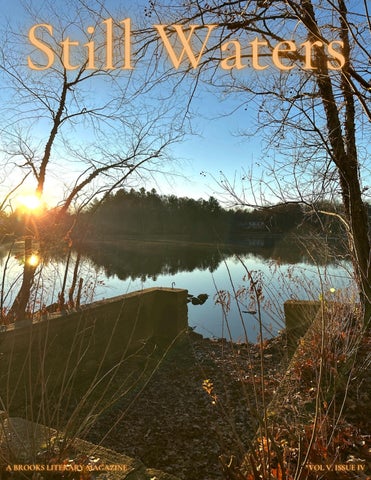
VOL V, ISSUE IV
Dean Charpentier, English Faculty
Ximing Gong 25'
Daniel Jiang 26'
Abigail Nam 26'
Kaden Almaraz 26' PUBLICATIONS
Jennifer O’Neill, Director of Digital Communications
Emily Williams, Director of Editorial and Multimedia Services
Still Waters is committed to publishing original, exciting material from a diverse collection of Brooks student writers.
While we actively pursue short fiction, poetry, and memoir, we will consider any form of writing submitted
There are no restrictions on word count, and authors may submit multiple submissions at a time
“Start writing, no matter what. The water does not flow until the faucet is turned on. ”
Louis L’Amour
Pages 3 - 35
Emma Nagle
Aiden Crott
Stanley Zhang
Brooks Hawkins
Matt Grauer
Emily Haley

Pages 1 - 2
Pages 36 - 43
Abigail Nam
Maanya Tailam
Harrison O’Connor
Sam Lubick
Chris Caiazzo
Maddy Byrnes
Kayla Gutkoski
Mithaniel Diaz
Aiden Crott
Pages 44 - 45
“Writing is an exploration. You start from nothing and learn as you go. ”
E. L. Doctorow
Dear Reader,
Conflict is the catalyst for story. Conflict, by definition, places a character in a position of jeopardy— potential danger. Harm. Even trauma.
In the old days, that danger might come to life as a mythical creature like a cyclops, or something supernatural like the ghost of a murdered Danish king, for instance. Eventually, as humans began to think more abstractly, the danger in a story may have been a more obvious stand-in for humanity’s darkness: Dracula, or Mr. Hyde. Then Joseph Campbell came along and said, Yes! All these stories? That monster we don’t want to face? The supreme ordeal we must overcome on The Hero’s Journey? Those are our own fears, our own weaknesses.
The desire to tell stories is one of the most fundamental human desires—it might be what separates us from other animals. And we do it in a number of ways: fiction, poetry, memoir. In all of these forms, we explore what we fear most, and this results in—full circle—depictions of danger and potential harm.
These days, rightly so, we offer up trigger warnings to readers. Hey, just so you know, we say, this story touches on…and this allows readers to make their own decisions about whether they want to read on. No spoilers, and the warnings don’t detract from the effectiveness of the storytelling.
Teenagers lives are pretty much by definition mini Hero’s Journeys. They face obstacles, challenges, inner demons, ordeals, and the unknown just by waking up every day. So, what you will find in this collection is a whole host of characters in jeopardy, facing potential harm, perhaps even trauma. Some of the jeopardy is metaphorical, some of it feels real and tangible and in your face.
But all of it is handled adeptly and maturely by this collection of thoughtful high school writers.
Enjoy.
Dean Charpentier Faculty Editor, Still Waters
“There is no greater agony than bearing an untold story inside you. ”
– Maya Angelou
by Emma Nagle
Lunacy (n.): the state of being a lunatic.
Hopefully you were able to figure that one out on your own.
If you are reading this, it means several things:
1 You think yourself crazy, mental, psychopathic, or at the very least abnormal.
2 You dislike the fact that the first statement describes you.
Answer (unapproved by the APA or CDC): In most cases, yes. The strange beget the strange. Most people are only capable of learning, not of unlearning. Therein lies the dilemma.
In cars, in hospital waiting rooms. Through meetings and lectures and wars. Dreams are just that. They are safe and impossible and you never remember them. Sleeping is an important break.
First, close your eyes. Seems obvious, but most lunatics are ceiling-starers who’s hamartia begins and ends in thinking, so allow us to save time by skipping to where you will inevitably arrive.
In your younger years, it was the middle of the Caribbean, a parrot on your shoulder, one leg resting proudly on the prow of your ship. Or perhaps a ballroom—spinning dresses, bubbling champagne, faces indecently handsome.
Lately, it is your childhood bedroom. You recollect the glow of light from the hallway and imagine the innocence that must have coursed through your veins. Back then, you think. That’s when the world was still beautiful. Why, then, did you used to believe in someplace better?
Think instead about how you snapped at your mother this morning because you needed someone to snap at, and she is the one who will love you anyways and always, and, really, now that you are thinking about it, she is the last person in the world who deserves to be shouted at by her baby. There are cracks in everything morally upright.
Then the last thoughts: the majority of which are so unimportant, so trivial, such selfish little thoughts. Due dates and timetables, lists and daily regrets. Here and there are the same questions that have been asked since the beginning of time: Where am I going? Why do I bother? What is love?
For those wondering what it is normal people do to fall asleep, do not be fooled by the age old platitude of counting sheep. This tactic rarely works outside of cartoons, and you’d be a real lunatic for trying.
What normal people actually use are sleeping pills. Is not manufactured sleep just as pure? It’s just as effective come morning. Is a manufactured smile simply a lie? Small smiles are as fickle as the weather. If one hasn’t been taking sleeping pills, one thinks away the night, and during the day one is tired, living for the sake of going through the motions, not for any true value. How are we supposed to find meaning on a stage of actors and props that hide their lack of depth in a convincing two dimensional facade?
But we are getting away from ourselves here.
For the Waking Hours.
Try not to think too hard. Don’t take things so seriously. This is called getting by. It comes quite naturally to some. Just try to hide yourself. This is not a cure for lunacy; it merely masks the symptoms.
As you might already know or have guessed, there is no real cure. No magical tablet or vaccine compels you to a state of inner peace. We exist among the shambles and the byproducts. You stretch for the Caribbean stars only to feel the pillow jerk out from underneath you.
I am sorry if I have disappointed you, but the truth must be stated aloud. This guide will not change you. If the outside world hasn’t done that by now, nothing will. I am very proud of you.
When getting by gets to be too much. You know what you ought to do, but it is very difficult. You try to smile but your face weighs a thousand pounds. Selfishness is a sin; put others before yourself; be good, God damn it, be good. Do it for your mother, who is caught in a trap, dying little by little every moment your misery lasts. She is stronger than you, she is doing right. Do it for yourself, so all this guilt will go away.
Reminder: If you feel guilty, you probably deserve it.
There needs to be some kind of question and some kind of answer in here for this to constitute an exercise, so here goes: given the pathway to lunacy outlined above, were you happier before the madness started? Or is it just the human psyche, a trick of memory? Or did misery just find an excuse?
Let us return to the definition presented at the beginning of this “guide.” What is a lunatic?
A lunatic takes a brick and bashes it against their own head because they possess a sense of duty, and they wonder why they feel miserable.
A lunatic can see both horizon and heaven in their infinite state, yet can’t grasp what is dangling just beyond the tip of their nose.
A lunatic is compulsive and walks with her head down, following a compass in a dense forest while smacking into a tree with the force of reality.
If I have given the impression that getting by is a coping mechanism for the weak, a capitulation in disguise, I assure you that was not my intention. Getting by is an important and necessary skill. It takes a lot out of a person—leaves gouges in chests and lumps on the sides of heads.
Here Is How It’s Generally Done:
If you open your mouth, muffle the words. Keep sarcasm on the tip of your tongue. Swallow the rage so that it sits, acidic and fizzing, somewhere in your rib cage. The sharpness dulls after a while, just like everything else: your ambition, your vitality, your will.
Try not to look too hard at other people. They give you the wrong idea. This world has plenty of magicians who are able to twist themselves till they have no shadows.
If someone looks at you too closely, break eye contact first.
Tie a pink ribbon in your hair. Everything is happier.
Go ask your mother about her day.
Exercise for Comprehension (Part 2):
Too much. What do you do when your mother is calling you and you get up and go to her and your eyes start swelling till they are a murky brown ocean? And when she kisses the top of your head, something rises in your throat, lumpy and warm and scratchy, forcing the ocean to flood. Your mouth is clamped shut. What do you do then?
Take note.
The premise of this guide is flawed—there are no normal people. Thus, there are no lunatics.
Aiden Crott
Feeling unusual or abnormal in any way? Talk to a professional today, free of charge! Text or Call: (249) 720-9291
A recent dissatisfaction with your life situation
An itch to break free from the cycle providing you security
Impatience or consistent frustration with one’s friends or family
Linda first reported feeling an unusual itch to strive for more than what she was achieving. She talked with our professionals about her recent dissatisfaction with her workplace environment, as well as the repetitiveness of her schedule. Linda had been working in her current position for seven years before she was struck by the sudden realization that she might be destined for more than the 36 square foot cubicle where she spent 40 hours each week. Although our company strongly encourages individuals to push for excellence, we provide a service in which balance and security are prioritized. After a couple of sessions with Linda, we decided that our blocking treatment would be most appropriate for her situation. The mindset that she had fallen into would have prevented her from finding satisfaction in her work-life balance, which is crucial to being a functioning member of society. After a final session with one of our professionals, Linda underwent surgery to have the CorpoBlock™ chip implant, which is a new cutting edge technology capable of altering brain wavelength frequency. This allowed us to make significant progress with Linda in the weeks following the surgery, ultimately resulting in a successful reintegration to her work-life and a reported increase in fulfillment and happiness.
92% of CorpoBlock™ clients report increased job satisfaction within the first month of treatment.
The CorpoBlock™ chip implant is a new-age technology that fine-tunes brain wavelength frequency to optimize mood related issues.
Surgery is quick, low-risk, and affordable, making CorpoBlock™ accessible to professionals at any career stage.
Our treatment is scientifically designed to enhance contentment while maintaining ambition and productivity.
Q:HowdoesCorpoBlock™ensurejobsatisfaction?
A:Ourprofessionalsassesscustomerdissatisfactionandprovidetargetedblockingtreatmentsto aligntheirmindsetwithastableandfulfillingwork-lifebalance.
Q:IstheCorpoBlock™chipsafe?
A:Absolutely!Theprocedureislow-risk,andthetechnologyisdesignedtoseamlesslyintegrate withnaturalbrainfunction.
Q:WillIlosemyambition?
A:Notatall!CorpoBlock™helpseliminatedisruptivethoughtstomaintainmotivationnecessaryfor steadypersonalgrowth.
Q:Howlongdoesittaketoseeresults?
A:Manyclientsreportednoticeableimprovementinjustafewweeks,withcontinuedsatisfaction overtime.
by Stanley Zhang
9:12 AM – Mom (11)
9:22 AM – Mom (12)
10:03 AM – Emily (Sister)
10:14 AM – Work
11:17 AM – Dad (8)
11:59 AM – Unknown Number
12:01 AM – Unknown Number (2)
2:42 PM – Ben (2)
2:44 PM – Ben (3) – Voicemail
4:15 PM – Mom (13)
4:30 PM – Mom (14)
4:31 PM – Emily (2)
5:00 PM – Unknown Number (3)
The phone vibrates against the wooden cafe table, but he barely glances at it. His coffee has gone cold, but he doesn’t bother to finish it. Sunlight filters through the window, casting long afternoon shadows across his phone screen. He scrolls through social media instead: a picture of someone’s dog, a video of a street musician, a blurry black and white childhood baby photo of someone with the caption “RIP”.
The phone buzzes again.
5:01 PM – Mom (15)
He silences it with a swipe, probably just another check-in. She calls too much.
Outside, the streets hum with the usual rhythm—honking cars, snippets of conversation, the occasional laughter drifting from open cafe doors. Life moves forward.
6:22 PM – Unknown Number (4)
6:23 PM – Emily (3)
6:24 PM – Dad (9) – Voicemail
He flips the screen face down. It’s probably nothing again.
The sun dips lower, the cafe’s warmth turns stale, and suddenly, he feels restless. There’s a tightness in his chest. He stands abruptly, leaving his half-empty coffee behind. By the time he reaches his apartment, the feeling hasn’t faded—if anything, it lingers like an itch beneath his skin, an unshakable sense that he’s missing something.
His phone buzzes again.
7:15 PM – Unknown Number (5)
His fingers tighten around the phone, a hesitation. Then, he shoves it into his pocket and steps outside.
The train ride home feels slower than usual. He watches city lights blur past the window, his reflection dim against the glass. When he turns the corner onto his childhood street, he sees the cars first, lined along the curb, and parked in the driveway. Then, the house. The front door is open. The porch light flickers, struggling against the evening dark. Familiar and unfamiliar figures stand outside, talking in hushed voices. A gust of wind carries the scent of incense. His steps falter.
Through the doorway, he catches a glimpse inside—black-clad figures, a framed photograph on the table surrounded by candles, and a wreath of white lilies. His breath comes shallow, and his mind goes blank.
The phone vibrates in his hand.
8:46 PM – Mom (16)
His fingers tremble as he lifts the screen. The name flickers under his thumb.
He edits the contact: Mom (Dad).
The phone buzzes again.
He doesn’t answer.
by Brooks Hawkins
The screen slid open. A deep breath. A silence that stretched.
“Bless me, Father, for I have sinned.”
“When was your last confession?”
“I don’t know. A year? Maybe longer.”
“And what is it you seek absolution for?”
“I cheated on my wife.”
A pause. The priest exhaled, folding his hands.
“Adultery is a grave sin.”
“I know.”
“And yet you did it.”
“And yet I did it.”
Another pause. The weight of it hung in the air.
“Do you regret it?”
“Of course.”
“Why?”
“Because it was wrong. Because I broke my vows. Because it is a sin against God's will.” He stopped.
The priest waited, but the silence stayed empty.
“You haven’t mentioned your wife.”
“What?”
“You’ve told me it was a sin. That it broke your vows. That it was wrong before God. But not once have you said her name.”
“I—”
“Tell me, are you here because you betrayed your wife? Or because you betrayed God?”
He stared at the dark lattice of the screen. His fingers tightened in his lap.
“Does it matter?”
“It matters more than you think.”
Silence. The priest exhaled, reached out, and slid the screen fully open. The man’s breath caught. Suddenly, they were looking at each other.
“You aren’t supposed to do that.”
“And you weren’t supposed to do what you did. But here we are.”
Here we are.
A beat. The priest watched him, and something in the man’s posture shifted—subtle, but there.
“Sin is easy to confess. Because it feels like something between you and God, something you can erase with the right words. But hurt doesn’t work that way. Your wife isn’t a priest. She can’t absolve you in one conversation. She isn’t waiting behind a screen, ready to offer a penance and send you on your way.”
“I know that.”
“Do you? Because right now, it seems like you only care about being clean before God. Not about the woman who has to live with what you’ve done.”
He said nothing. His jaw was tight, his hands clenched together. He didn’t deny it.
“My brother died last year,” he said.
“I’m sorry,” said the priest.
“Don’t be. He was an addict. And gay.”
The priest did not react—not outwardly.
“He needed help. I thought maybe…I thought you could give it to him. You told him to pray.”
The priest’s fingers tightened around the wooden armrest of the booth.
“You wouldn’t let him stay with you. He needed rehab, and you told him to pray.”
“I—I thought it would help.”
“You thought his being gay mattered more than the needle in his arm.”
The priest closed his eyes. The silence was long, thick.
“If I could, I would have tried to save him. Maybe he would’ve forgiven me…”
For the first time, the priest looked away. The man watched him.
“I know I messed up. I know that—how I…. how I dealt with your brother's situation… was wrong. But that's why I know this. I know you need to worry less about what's wrong and right with God, and more about the people around you. How it really affects them. Here. Now. Not in heaven.”
A silence filled the wooden box. Dust stirred in the air as they uncomfortably shifted in their seats. Then the priest opened his mouth again.
“People aren’t good or bad. Actions aren’t, either. We like to believe they are because it’s easier. But life is not a confession booth. You can’t slide open a screen and expect to walk away new.”
“So what do I do now?”
The priest looked at him, something unreadable in his expression. Then, slowly, he slid the screen shut between them.
“Now, you do the hard part.”
by Aiden Crott
The speakers blared, “Final call for the 11:45 to Westford. Doors closing in two minutes.”
“You mind if I sit here?” James asked the girl.
“Fine by me.”
“Thanks. Long night?” he prompted, although he could sense some hesitation from her.
“You could say that. You?”
“Just missed the earlier train. Bad luck.”
“Or good luck,” she replied, her character seeming to soften. “Maybe this is the train you were meant to take.”
“Huh. Never thought of it that way.”
“Most people don’t.”
“You sound like you know something I don’t.”
“Maybe I do,” she said..
“Okay, well now you've got my attention.”
“What if I told you I take this train every night, but never get home.”
“That’s…a weird thing to say.” James was intrigued by this girl. He had only just met her moments ago, but there was something about her that seemed oddly familiar.
“It’s a weirder thing to live, trust me.”
“Alright, I'll bite. What do you mean?” He was now fully invested..
“I get on. I ride. I get off. And yet, every night, I’m right back here. Same train. Same seat. Same conversation.”
“That's impossible,” he responded, a little taken aback by what she had said.
“So is meeting the same stranger on the same train at the same time, over and over. But here we are.”
He couldn’t tell if she was joking. There was a certainty in her voice, but at the same time she spoke about such odd events lightheartedly.
“We've never met before,” James said aloud as if trying to convince himself.
“Not in a way you’d remember.”
“This is some kind of joke, right?” he asked.
“I used to think so, too. But every night, I watch the doors close. I listen to the train hum along the tracks. I feel the cold air at my stop. And yet…”
“And yet?”
“And yet, I wake up right back here.” Now he could tell she wasn’t joking.
“So, what? You're stuck?”
“Seems that way.”
“And I'm supposed to believe that?”
“You will,” she said.
“Why?”
“Because the doors just closed. And now, you’re stuck too.”
“What?”
“Welcome to the last train home.”
by Stanley Zhang
The waiting room was as bright and sterile as any doctor’s office, but the air carried a strange, humming stillness. The chairs, arranged in perfect rows, were stiff but tolerable. A vending machine in the corner blinked its neon Welcome, though the dust on the machine showed no one was interested in using it. The receptionist, a middle-aged woman with her hair twisted into a bun that had begun to unravel, kept her eyes on the computer screen, her fingers motionless on the keyboard, and her face fixed in a smiling posture.
Alex shifted in his seat, glancing at the people around him. A man in a navy suit scrolled through his phone, expression unchanged; an older woman flipped through a magazine with glossy, yellowing pages; a couple whispered to each other in hushed tones, their faces serene.
A woman beside Alex turned and smiled, “You’re new.”
Alex blinked, “I…I don’t think so.”
The woman laughed, “Everyone says that at first.”
The receptionist called a name. No one reacted.
“Did you hear that?” Alex frowned.
The woman nodded, “Of course.” She smoothed the fabric of her blouse. “They will go when they are ready.”
Alex rubbed his fingers, trying to recall how long he had been waiting. Minutes? Hours? The simple black-rimmed clock above the receptionist’s desk had stopped at some indistinct hour, its second hand frozen in mid-tick, and hadn’t moved since he first sat down.
Across the room, a man chuckled, nudging the lady beside him, “Why don’t skeletons fight each other?”
The woman sighed, “Because they don’t have guts.”
The man clapped. “Still funny.”
A moment later, he turned to the man on his other side. “Hey, why don’t skeletons fight each other?”
Alex watched quietly, his stomach twisting. Then he turned back to the woman next to him and asked, “How long have you been here waiting?”
She tilted her head, eyes rolled up, thinking, “Emm…Oh, a while.”
The fluorescent lights buzzed faintly overhead. Alex scanned the room again, the vending machine was stocked with brands he didn’t recognize. The potted plant by the receptionist’s desk was completely still, not a single leaf shifting. A woman in the far corner was knitting, her fingers working a long, endless stretch of fabric. It pooled at her feet in thick coils, enough to wrap a house in.
Alex turned back to the woman, swallowing hard. “I think something is wrong.”
She smiled. “Nothing’s wrong, you’re adjusting.”
The receptionist called another name. Silence. The man in the suit scrolled his phone, but the screen was dark. The magazine pages turned, though there was no wind. Alex stood abruptly, the legs of his chair scraping against the floor— the first real sound he had heard since sitting down. No one looked up.
He took a step toward the receptionist. “Excuse me,” he said, his own voice sounding foreign. “What exactly are we waiting here for?”
The receptionist beamed, eyes bright and vacant. “Oh, you don’t have to wait. You can leave whenever you want.”
Alex turned toward the door. It was right there, plain and unremarkable. His fingers twitched at his sides. “Then why doesn’t anyone leave?”
The receptionist’s smile never wavered. “Because they don’t want to.”
A long pause, and then Alex looked back at the rows of chairs, the frozen clock, and the endless scarf pooling at the knitter’s feet. The was laughing at his skeleton joke again; the woman next to him watched Alex with quiet amusement as if she already knew what would happen next.
Alex swallowed, his hands clenched, then he relaxed suddenly, letting out a slow breath.
Then he sat back down.
The receptionist called another name. No one stood up.
by Emma Nagle
The string is there to make everything clear. To draw straight lines, to tighten connections, to clarify.
I don’t have to think, I just open my eyes, even though I don’t even have to, and feel my way to the bathroom using the rope running from my bedpost to the towel rack. When I’m finished, I am guided to the stove and breakfast.
The trouble is, I can no longer open the refrigerator door. It’s difficult to find a seat in order to eat, and I know now the pain of forgetting the salt and pepper in the cabinet. Everything is such a nuisance when you get tangled in your own house.
The map of my everyday paths is always adjusting. I am always cutting and tying knots and modifying. Sometimes I get carried away and end up trapping myself in a cocoon of intentions. If I don’t have my scissors with me, well…It's a bit of a predicament that can require gymnastic skills beyond my natural scope to escape from. I usually just take my phone out of my back pocket and call my mother. Between my father and I, she’s gotten quite used to this sort of thing. She likes to say, though she doesn’t look proud when she does, that she married a spider and raised another.
I call her today—I have no choice—and when she opens the front door, there is a small, smooth hand in her larger, wrinkled one. “This is my neighbor’s daughter. I babysit her after school.”
The girl holds a balloon in her other hand. I close my eyes because I can’t stand balloons. Balloons are so twitchy, always trying to escape their restraints because they’re deluded and believe there is something better somewhere else. They always bring their strings with them though, out of habit I suppose, but it's a useless effort—they’re not coming back. A child will never hold them again. Why am I like this? I get so worked up over small, small things.
“Where are the scissors?” My mother’s lips are rolled into a stern line.
“Upstairs.”
She stomps up the stairs with irregular footsteps, dodging the obstacles.
As one might imagine, I don’t have guests very often; people usually grumble, “To each their own,” and decline future visits. The girl, however, seems to take everything in stride. She perches herself on a stool and hums to herself. Then she asks me with great solemnity, “Why is everything in your house on a leash?”
I tell her the only thing in my house on a leash is me.
“And my balloon.”
“And your balloon,” I amend.
“My class caught caterpillars last week, and we put them in a cage with some leaves and things. But this morning there were no caterpillars, only these green droplets dangling from a stick.”
I don’t say anything.
“My teacher told us the caterpillars are in the green droplets and that when they come out again, they will be butterflies. Is that what you are trying to do in that cocoon? Grow wings?”
“No.” But I’m not sure.
The girl nods seriously. “You don’t need wings to fly anyways,” she says, bouncing her balloon. “Can I watch TV?”
Soon Charlie Brown is upside down in the Kite-Eating Tree. His round moon face reddens in shame. “Ha,” the girl shrieks, “he looks like you.”
I like this girl and her exuberant pigtails. Half an hour later, the door slams behind her and my mother, but there is a string stretching from her wrist to mine. The girl examines it admiringly, as if it is a pretty, new bracelet.
I tug on the string all the time to feel the pinch against my skin. The walls keep muttering—I know I’m cracking up. I am the predator, and I am the prey. Living in a web like a spider, spinning webs like a spider, but rubbing my hands together in worry like a fly.
I imagine a balloon getting its wish, centimeters away from a cloud, its string extending down, down, down to the hand of a crying child.
My dog trots up to tie me on a leash. Time for a walk. But I don’t have a dog, and I already have a leash. I told somebody that. Who? Oh right, the girl.
I see the girl balancing on the rope in front of me like an acrobat, arms sticking out, balloon bobbing, TV remote in the pocket of her overalls. “Look,” she giggles. “Easy as pie!”
My father tripped and fell and died over a cable on his way to the kitchen.
Charlie Brown blinks at me from his tree.
“You even have a rope tied to the ceiling, for God’s sake!” My mother is back. She makes a snip, leaving the end attached to the chandelier, and the girl, out of nowhere, leaps and latches onto the rope. She swings alarmingly, spinning at a dizzying rate, and, next second, she goes sailing out the window.
I feel a tug on my wrist, and out I fly after her.
by Matt Grauer
Aw, man. ten words? How is that even possible?
“Come on, Quinn! You’re going to be late for school!”
“Coming!” I shout back before seeing the number above me click to nine. “Shit!” Eight. I slap myself across the face. What a great start to the day. I have had some low word counts, but none of this magnitude. After quickly getting ready for school, I see my mother waiting by the car in the garage.
“Good morning, Quinn! How’s it going?” I point at my mouth and shake my head in disappointment. “Oh, I’m sorry, bubba. Just get in the car, it’ll be fine.”
After a quick car ride to school, I wave goodbye to my mother before taking a deep breath and I approach the front door.
“Quinner!”
“How’s it going, man?”
“My guy!”
Of course, today is the day when I’m Mr. Popular. I smile back at everyone greeting me, giving them a subtle wave, and then instantly dart to my first class down the hall, History with Mr. Frigginstein, where I see my best friend, Erik, sitting in his seat.
“Quinner! Why the frowny face?”
I hold up eight fingers and then point at my mouth.
“Man, I’m sorry. I’ll back you up if you need any help.”
I nod and grin. I’ve always liked Erik. He is one of the only people who have ever understood me. I’ve always had low word counts due to my family’s economic status, which has turned many people away, but Erik has stood by my side through the thick of it.
“Alright, class, let’s start by telling each other what we did this past weekend. How about you, Quinn?” Frigginstein has always had it out for me, holding a grudge against people like me. Before I could even point at my mouth, Erik jumped in.
“Me and Quinn went to the Knicks game yesterday. Was a great time.” Phew.
“Okay, guys.” Friggenstein chuckles, a smug look on his face.
I carry on with the rest of my day, Erik by my side. Though I slip up a few times, I am still holding strong with five words remaining heading into my last class. I plan to keep my head down and push through until I get home, where I will instantly go to bed.
Time is ticking. Almost there. I am in the final stretch. All is looking good.
Oh no. The emergency bell. The whole class jolts out of their seats and into the hallway. I follow, curious about what has happened. I push through the crowd of people to see a young kid, a freshman, passed out on the ground.
“He ran out of words and just…just collapsed.” His friend starts tearing up. This has never happened in our school before. No one really knew what would happen if you ran out. But with only five words left, I feel like I am going to explode.
by Aiden Crott
Jim was very fond of his job. He woke up every day grateful for the little world he had built for himself. Jim’s routine provided him with security and fulfillment. It allowed him to spend his evenings at home with his wife, in their little one-bedroom, one-bathroom apartment on the south side of Chicago. It was only a five minute walk from their apartment to the balloon shop, where Jim sat stationed behind a smooth wooden counter top from nine to four, Monday through friday. He sold balloons of various shapes, sizes, and colors, ranging from a deep indigo to canary yellow. Jim was aware of the fact that to an outsider, his obsession with balloons would be seen as irregular or even frowned upon, but he knew that what he saw in his career sparked a passion that could only be understood on a deeper level. There was a certain magic in his balloons. Like a wizard with his wand, Jim used the balloons as a tool to change emotion, and he was pretty good at it. There was a balloon in his shop for every customer that crossed the threshold, yet the difficulty arose in matching the wizard to the wand, as they say. Jim saw it as finding the right puzzle piece, and once the piece clicked into place, a tapestry of emotion was painted across the customer's face.
Despite his own satisfaction day in and day out, Jim began to feel a shift in his relationship with his wife. As weeks grew into months, the smile Jim received from his wife when he came home from work lost its sincerity. He suspected that the fantasy he had created was not the one his wife had imagined. Nevertheless, Jim resided in the balloon of comfort he had grown accustomed to, scared of confrontation or that his suspicions might be true. They enjoyed occasional dates, nights on the sofa ordering in cheap pizza. Money was never a conversation because their needs had never exceeded their lifestyle. Except Jim could not shake the feeling that there was something his wife wasn’t telling him. He remembered how deep her words had cut the last time they argued. She had gone completely cold and told him that he was no longer the same person she married, that he had grown ambitionless and hesitant to change. Jim struggled to stomach these words, but when morning came and she promptly apologized for her cruelty, Jim accepted. Now he could feel the same blizzard coming on by the atmosphere of their relationship. This time Jim wouldn’t let it get that far, so he came up with a plan to show his wife the magic that he worked.
That day, just before clocking out of work early, Jim hand selected a dozen balloons he saw fit for his wife. Each balloon represented a quality he appreciated in her: compassion, confidence, her sense of humor, her intelligence, and even her reliability. He had created the perfect bouquet and couldn’t wait to witness the effect it would have. The balloons squeaked against one another as he pulled them out the door of the shop, closing the door behind him and locking the shop up for the day. He had only one person enter the store today, they had bought the typical birthday balloons and had been on their way. Jim thought about all the lives he was changing, the smiles that he had the privilege of bringing to the faces of children.
As he walked home he counted his gratitudes, feeling a little lighter with every one he counted off. He was practically weightless by the time he turned onto his street, finally counting off the last two gratitudes. “I am grateful for the roof I have over my head, and I am grateful for my beautiful wife.” The instant Jim spoke the words into being, he felt his feet start to lift from the ground. He gasped, heart pounding. His hands clenched the balloon strings as if they were the only thing tethering him to reality. Completely weightless now, the balloons pulled him up through the air in an inevitable ascent, until he was overlooking the block in awe, no choice but to continue on his journey upwards.
From up above, Jim saw a strange car pull onto the street and park in front of his house. The passenger door cracked open and out climbed the unmistakable figure of his wife. She walked up the stairs with a certain careful grace, her posture straighter than usual, her chin slightly lifted—like a performer stepping onto a stage. Jim hung frozen in the air, no longer gaining altitude. The excitement he had felt moments before solidified in the certainty that his sneaking suspicion was true. The pressure of this realization sent a shock through his body. Fixated on the scene below, a deafening pop shattered the silence from above. The pull of the balloons lessened. Jim’s breath caught in his throat as he felt something begin to shift.
by Stanley Zhang
The streets hum with warmth. A couple shares a sandwich, giggling between bites and landing eyes on each other. A man leans against a lamppost, tossing back his head in laughter, his friends around him echoing the sounds. Children squeal as they chase each other past a cafe, where a waitress beams while pouring steaming coffee into a customer’s cup.
The laughter never stops.
As I walk, I catch glimpses of the billboards looming above. Smile More, Live Longer! one reads, accompanied by the wide grin of a grizzled old man with impossibly bright eyes. Another digital screen flickers to another ad, a mother and daughter grinning in a park: Happiness is Health. Frown Less! On the next block, a man missteps off the curb, sending his coffee splashing across another’s crisp blue suit. The suited man stiffens, his lips pulling wider, teeth bared, eyes crinkling at the corners. The first man, still gripping tight his empty cup, mirrors the smile.
“No worries,” the suited man chuckles, voice light as he brushes at the stain with his palm.
“All good, all good,” the other replied, their laughter rippling outward, catching the attention of passing strangers who also sends smiles towards the two gentlemen.
I swallow.
Across the street, a fight breaks out. Two men circle each other, their shirts wrinkled from where they have grabbed and pushed. One throws a punch, knuckle severely creasing the white fabric on the other’s shirt; he stumbles but doesn’t fall. Instead, he grins—red leaking between his teeth, painting them bright pink. His opponent, fists raised, chuckles. Though missing a tooth, his smile stays fixed. Pedestrians whistle and clap but no one tries to stop them.
Further down, a well lit TV shop flashes into my sight, a flamboyant sign in the window lit up even during the day. Its light penetrates the stainless glass down to the concrete road and inks another layer of brightness on top of the sunlight A jumbotron above the shop displays a live UFC match. Two fighters grapple, one slams the other to the mat with a sickening thud, the impact echoing through giant speakers. The fighter on the ground lets out a tight breath, rolling to his knees, and his lips stretch wide. The one above him, dripping sweat, grins back before driving an elbow into his ribs, and the crowd cheers. I turn away, the sound dizzying.
Near the edge of town, the laughter softens. The air feels heavier, yet everyone is still smiling. I pass by a gated complex, its iron bars polished to a gleam, and a sign swings gently in the breeze: Longevity Retirement Home. Through the glass windows, rows of chairs line the common room. Elderly figures sit in perfect stillness, their backs pressed against the cushions, their hands folded neatly in their laps. Their faces wear identical smiles: wide and unmoving. A woman, paper-thin skin stretched over her bones, slumping in a chair, her lips parted just enough to reveal a slip of her gums. A man in a hospital bed breathes through an oxygen mask, his eyes dull, sunk deep into his skull. But the mask doesn’t hide his grin.
A nurse adjusts a blanket over one of the residents, her own smile gentle, practiced. I catch her eye through the glass, and she pauses.
I realize too late that my lips have parted, that my face is neutral.
Her expression doesn’t falter, but something shifts in her eyes. A quiet sort of recognition.
I force my lips to curl, my teeth to show, and my cheeks tremble with the effort.
The nurse nods approvingly, then moves on.
I turn, walking quickly back toward the city. A shopkeeper hands a child an ice cream cone, their faces beaming; a group of friends laugh in a bar, their shoulders shaking; the street performers, the joggers, the couples on benches, all smiling.
I press my lips together, ponder for just a second.
A woman across stops mid-step, looking directly at me.
I stretch my mouth back into a grin, forcing my teeth to show.
Her shoulders relax and she keeps walking.
I don’t know what happens to those who forget to smile. I don’t want to find out.
by Aiden Crott
On a warm autumn day, a car drove through the rolling hills of Amana, Iowa. As the sun began to dip below the horizon, golden rays of brilliance shone through the cornfields, painting a tapestry of light on David's windshield. Long stretches of road and landscape called for hasty driving, yet today David drove slowly on his way home from work. Every turn and feature in the road looked the same, but David could have driven this route with his eyes closed. Wind blew in through the driver’s side window, whistling as if it was being held trapped in the backseat of the car. The familiarity of the road allowed David to subconsciously drift elsewhere, drowning out his usual eagerness to get home and strip down into more comfortable clothing for a night of relaxation.
Drowsiness washed over his body, pulling his head into the headrest and relaxing the grip David had just now realized was firm on the steering wheel, as if the wheel was responsible for the events that had unraveled days prior. He felt no need to hurry home because he knew that there was no company waiting on his arrival, just another sleepless night filled with restless thoughts. He knew he was not to blame for what happened—what kept him awake was the image of Allen’s face almost burned into the back of his irises.
They had been sitting across from each other at the dining room table, playing a hand of cards while listening to whatever news was on the television. Allen was in a cheerful mood, telling David about a girl he had started to see and his ideas for the future. Aspirations of re-enrolling in college to complete the degree that Allen had given up on many years ago were now only an arm’s reach away, but what Allen had left out of the conversation was the unopened bottle of Carbamazepine sitting on his nightstand. For three months now, David had reminded his twin brother to take his medication. But over this period of time, warped thoughts had wormed themselves into Allen's head, compelling him to question the small red and white pill that he routinely swallowed morning and night. That's when Allen decided that he would no longer wait for a change in his life—he yearned to be free from the shackles that confined him to a life of mediocrity and decided the pill was the problem.
David had glanced down at his unfavorable hand, considering his odds of winning, but when he looked up, any significance that the game of cards had was evaporated by the peculiarity of the expression on Allen’s face. David was used to Allen’s episodes, where his eyes would roll up and he would convulse, uncontrollable, all while foaming at the mouth. What was happening now was not one of the episodes. It looked as if the left side of Allen’s face was melting, but his eyes stared at David straight on, begging David to make it right, to do something, but empty at the same time. Allen’s face had looked alien, like the person he was beneath his flesh was no longer present at the table. Then
Allen had toppled over onto the hardwood floor, left arm rigid in the air all while still holding the cards, frozen in that moment.
David’s front tire struck a pothole, jolting him back to the reality of the road stretching ahead of him. He had lost all interest in where he was going, his thoughts clouded by the pounding behind his eyes, as if the image itself was causing a headache. Nausea overcame him and he pulled off the road, sluggishly popping the car door open only to throw up moments after his foot touched the ground. He crumpled to the ground under the weight of what had happened days ago.
He could no longer ignore the truth of the situation, and now David too could see the crown on his own head, the crown which had driven Allen’s rash decisions. Allen had wanted a crown like his, a crown worn by the healthy that only the sick can see.
by Emily Haley
The season was summer when the heat grew and the grass in the field thinned and became patchy, and despair took over as the intense green blades turned a pale yellow. The birds chirped restlessly in the thick forest that covered the perimeter. The pines held firm to their needles as if their lives depended on it. Squirrels were burgling acorns from the ground and each other like miniature criminals. The lively colors of the earth circulated through the woods as the sun peeked through the trees, interrupting the shaded areas—the river rang loudly, the rapids violent and intimidating. Under the surface, the fish were relieved from the unbearable heat but were in danger of being hunted. They follow one path, and that is the way of the water. The water will lead them somewhere; it is inevitable. The drilling of the woodpeckers echoed through the forest.
But the forest sounds could not be heard in the field. The meadow, although wilting, was tall and wide. No colors or flowers here, just the mix of sad greens and pale yellows once again.
That is where the girl lay.
She was still, staring at the blue sky with only a few clouds. She saw a dog in one of the clouds, but when her gaze shifted, it looked more firetruck-like. Breaking her stillness, she reached up to her face, her fingers meeting the warm liquid and a sinking stomach that the bleeding hadn't stopped. Her legs ached, and she longed to rest. She was a sitting duck. She gazed down at the scrapes on her thighs and shins, reminding her of her sprint through the tall pines, the low branches and thorns painting lines of red across her skin as if trying to get her to slow her pace. She would not let him catch her. Remembering this, she lay still.
Hunters can smell the blood of their prey. She lay still in the meadow, almost awaiting his company; she could not leave. The sun shone warm on her skin, returning her to her hometown pool with her friends, and she let the rays soak into her skin, tinting it. She listened to her siblings bicker and smelled the burgers on the grill. She wondered why she wasn’t frightened; she wondered why her heart, which was once in her stomach, was calmly beating as if nothing was wrong. She gazed up to the sky one last time, took a deep breath, and closed her eyes. Her deep calmness distracted her from the rustling in the meadow a few feet away.
She felt a hand on her arm.
by Brooks Hawkins
The night sky deepened as the last traces of light retreated to the edges of the horizon, the dark expanse swallowing the city in its firm embrace. Gulls glided above the rooftops, their wings cutting through the air as they drifted toward the harbor. In the distance, Lady Liberty stood tall, her torch reaching up toward the night sky, and the broken chains lay at her feet. Two identical towers climbed proud in the middle of the cityscape. Below, the city moved at full speed, cars honked, voices mixed in the streets, and bright signs flashed along busy avenues. The river reflected the city lights, its surface shifting with each passing wave, carrying the energy of the restless city.
In a building, a man stepped onto an elevator, his stiff suit creasing as he reached for the button. The elevator walls were shiny, made of stainless steel. A green carpet sat on the floor, and a large mirror covered the expanse of the ceiling.
“You going up too?” asked a young man already standing in the corner.
“What does it look like I’m doing?”
The man in the suit gazed firmly at his reflection in the steel, only stopping to glance down at his watch. The elevator sped to cruising speed in its smooth electric fashion. The near silence rang through the elevator to the point where the only recognizable sounds were the fast exhalations of the man in the suit and the persistent whoosh of the elevator. The elevator began to vibrate, then shake, and eventually it screeched to a halt as the lights flickered out of order.
Without conversation, the young man pulled a flashlight out of his backpack. As he set it on the floor facing upwards, the light reflected off the mirror and illuminated the small steel box.
“Can you fix it?” grunted the man in the suit.
“Fix it?” The young man leaned into the corner and crossed his arms. “How would I know how to fix it?”
“Aren't you some kind of repairman?” The man gestured to the flashlight, and the large work bag with an open hand. “Do your job for once.”
“I don't know how to fix it,” the young man replied. He slid down the wall into a squat, the oversized bag still on his back. The elevator plunged back into silence.
The man in the suit pressed the button with an emblem of a phone on it. “Hello, I'm stuck.” He adjusted his collar. “I'm stuck in the elevator god damn it, I have a meeting at 1:30. Get me out of here.” His spit began to cover the circle of small holes that made up the speaker built into the console. No one responded to the man's belligerent shouts. As they waited, the man in the suit became visibly irritated. He tapped his foot with increasing frequency, and the veins in his neck seemed more pronounced.
“Why don't you just call someone on that pager?” the young man asked from his seat on the floor.
“That's not how these work, dumbass. I only get messages, I can't send any.”
The elevator remained still, suspended in a void of silence. The young man reached into his pocket and pulled out a flask. He took a swig, exhaling with a satisfied sigh. The sharp scent of whiskey mixed with the stale air, mingling with the lingering traces of cigarettes and weed clinging to his clothes. The man in the suit wrinkled his nose.
“You reek,” he muttered, glancing down at his watch for the fifth time in as many minutes. 1:12 AM.
“Yeah, well, you smell like cheap cologne and anxiety,” the young man shot back, smirking as he tucked his flask away.
The man in the suit ignored him, straightening his tie and adjusting the cuffs of his white shirt.
“This is a nightmare. I have an international meeting, and I am not going to miss it because some third-rate maintenance crew doesn’t know how to run an elevator.” He jabbed the emergency button again, but the speaker remained silent.
The young man tilted his head to the side, letting it rest against the cold steel wall. “You have a meeting? Now?”
“Yes I have a meeting. My clients are from China, so at 1 AM here it's 2—Why am I even explaining this to you?” The man turned away.
“You ever just… let go?” the young man asked, his voice slow and deliberate.
The man in the suit scoffed. “Let go of what?”
“Control.” The young man stretched his arms over his head. “You’re wound so tight, I can hear you creaking. What’s the worst that happens if you miss your little meeting? Think the world’s gonna stop spinning?”
“I don't expect you to understand. You clearly don’t care about anything.”
The young man put his head between his knees. “God, I need a cig right now.”
The man's jaw clenched. He checked his watch again. 1:21 AM. His pulse quickened. He could already picture the boardroom full of men in dark suits, exchanging glances as they realized he wasn’t coming. His absence would be noted, and his reputation questioned. And all because he was stuck in an elevator with this guy.
He turned to face the young man again, watching as he rifled through his oversized bag. "What the hell do you even have in there?"
"Everything I need," the young man replied casually. Then, with a flick of his wrist, he pulled out a tightly packed parachute.
The man in the suit blinked. "Is that—?"
The young man grinned, tossing the straps over his shoulders. He didn’t say it. He didn’t have to.
The man's mind raced. The pieces fell into place. This guy hadn’t come here for work. He wasn’t visiting anyone. He had been planning to jump—from the top of the tower.
"You’re pathetic," the man muttered. "You don't care about anything? Not even your life?"
The young man tightened the straps of the parachute and leaned his head back against the wall again. "No" he said.. "I just care about different things than you do, and I'm not about to take life advice from a man with no family who is working at one in the morning.”
The suit exhaled sharply and straightened his posture. “What makes you think I don’t have a family?”
“No ring.” The young man rolled over onto his other shoulder. “And you're stuck in an elevator and haven't mentioned anyone being worried about you once…. except the people from your meeting.”
“Neither did you,” the man in the suit responded.
The two remained silent for a while, and their breathing echoed through the many mirrored versions of them covering the reflective walls and ceiling. The young man, slumped against the elevator wall, pulling his parachute close like a makeshift blanket.
“Why don't you lay down? I don't think we'll be out till morning,” the young man said from beneath his parachute.
The man remained standing, he didn't want to ruin his freshly pressed suit. Within minutes, the young man’s breathing slowed. He had fallen asleep, or been put to sleep from the whiskey, either equally probable.
The man in the suit remained standing, stiff as ever, his watch ticking away the lost time.
by Emma Nagle
The snow came down as thick and fast as lies. There were sirens and there was music, and by the night’s end, there were two angels, buried in the white.
All those young hearts, crammed into a gymnasium. All those young hearts up high, high in the place of dreams. The music rolled and jerked. Feet were frantic, tap, tap, tapping like spilled beads. Skirts swished and skipped and slapped. Every color of light shone, but somehow it was still dim. There was that proper haze of invincibility. The whole scene was absurd, heedless and charming, just as it ought to be.
Steam fled from under every boy’s collar, from under every girl’s dress. There was something hot and spiky and sticky inside each of them, and they had to dance it out.
A boy and a girl crawled through the window of a third floor classroom. They held hands as they lay on the slanted roof, listening to the music tremble out from under the gymnasium doors. The stars were brighter from the roof. So were each other’s eyes, but that was about it. Ice was black. Danger was invisible. And, of course, it didn’t help that they were young.
“It’s not cold!”
the boy called to the stars.
“Yeah, not even a little,” the girl echoed. They had been expecting more.
Right on cue, snow began to fall from the sky. The pair of them stuck out their tongues. Red punch had made a fire in their bellies, a warm fire and a defiant one. “Come on, let’s dance. Right here, on the roof.” The boy rolled over onto his stomach and propped himself up on his hands and knees. The girl sat up and tucked her knees in towards her chest till she was in a squatting position. They rose shakily, precariously, their hands on each other’s shoulders.
The band was still playing, the world was still dancing. The angels lost their footing and found they could not fly.
There was a scream when they were discovered, lying, ever so innocently, in garlands of snow. The girl who found them aged twenty years in the span of seconds. Her shoulders grew heavy as a boy alighted on one, and a girl perched on another. They blew kisses in her ear.
After the scream, the gym doors were flung permanently open, and all the people, all the heat, all the youth came flooding out to stare. Chaperones began shouting, and soon after the sirens began to wail. Everyone was sent back into the gym to wait, but it was too cold for dancing now. The band slunk out through the back door.
Two angels fell from a cloud and broke their necks. No. No, that’s not true. They fell from the school roof.
“A word after a word after a word is power.”
Margaret Atwood
by Abigail Nam
Halmi’s warm embrace envelops me, her knitted gloves patting my back softly, tap tap tap.
Halbe catches up, his gait steady but clipped, step pause step pause. Halmi releases me, hurriedly finds my brother, her chin just atop his head She squeezes him, notices how much he’s grown, something a camera can never pick up I move to Halbe, shaping my arms into a hug. Aigoo, aigoo, aigoo, he says, a smile reaching the ends of his face. As they rush to my father, crowd over him in joy, I notice it for the first time the deeper lines drawn on Halbe’s face, the finer hints of white in Halmi’s hair, the clothes that mirror mine, loose and baggy, swish swish swish They smile, teeth on show, and their faces, worn and soft, exclaim joy joy joy.
by Abigail Nam
1
I once saw a girl held in the loving arms of childhood She wore her hair as straight as the pine needles she collected, a bow clipped tight on the right side. Always the right side. She wore the funniest clothes this girl, dressed like a grown up in dresses and jeans with a sweater to match. Yet her feet danced in glitter, the sparkle on her shoes illuminated her youth: bliss and love. It didn’t take much to make her smile, her lips curling up, perfect baby teeth on display 2
I once saw a girl in the tight grasp of youth where she touched everything she could. Each toy on the shelves every hidden piece of candy nudged by a curious hand. She liked to touch danger, test all the limits, jump when told not to, swallow a dime, always a beat shy of injury.
by Maanya Tailam
The door shuts, the lock clicks, silence settles like dust. Echoes of voices linger, laughter trailing up the stairs, footsteps fading into walls
In the kitchen, a half-empty cup of tea gone cold on the counter A chair pushed back, just slightly, as if someone means to sit again.
Upstairs, the bed still rumpled, the imprint of a body left behind, the scent of shampoo, of warmth, a whisper of someone who was just here.
Outside, a car turns the corner, taillights disappear into the distance. The house stands, waiting, listening to its own mute.
At the doorway, a deep breath Hands press against the wood, feeling for something a heartbeat, a memory And then, one step forward, into the hush, into the hollow space where absence hums like a song.
Maanya Tailam
The train hums against the tracks, a steady rhythm, soft and low
Outside, the world rushes past blurred trees, golden fields, a farmhouse with its porch light glowing, a child waving from a backyard swing. Inside, the air is thick with murmured voices, the rustle of newspapers, the clink of spoons against tiny porcelain cups.
A woman reads with her head against the window, her reflection layered over the passing sky. A man writes in a notebook. The conductor calls the next stop, but I stay. The train keeps going, carrying all of us somewhere
The cold comes in like an unwelcome guest, slipping through cracks, pressing against my ribs, whispering of long nights and hollowed-out days. The trees stand brittle, stripped to their bones, and I, too, feel the weight of their emptiness. Yet laughter spills down the icy hills, carved by sled tracks and ski trails, rosy-cheeked joy bursting against the wind. For a moment, I almost forget The sting of frost, the ache of grey mornings, the way the sky folds in too early
So I retreat where the fire hums low, hands wrapped around a hot ceramic mug, steam rising like something gentle, something kind
The flames crackle, gilding my skin, and for now, the cold stays outside Winter is both sorrow and light.
by Harrison O’Connor
Rain cascades off the burnt shingles, pools on the charred deck, cools the melted glass, destroys the ruined books
For the soothing it gives me I smile, but only for a moment.
Pets and wild animals live on in memory alone, their ashes and sludge washed away.
Across the street the same scene unfolds across the whole countryside, perhaps the whole country. Surely not across the globe?
But who can know?
The horizon hides behind a wall of ash and storm My limbs ache dully, and each move upsets my peeling skin
Nothing to do but trek on. Search.
Food the first step, but not far off, medicine. Infection waits in line behind hunger, a queue of deadly ailments.
Despite myself, I dream, imagine a warm bowl of clam chowder. Maybe that bowl is out there, somewhere beyond the dusty horizon.
And with it a kind family of strangers, unaware of the destruction
Yes I’m sure they’re somewhere I can almost smell the creamy soup
The emptiness is crushing but finite
If everything were gone, I would be too Well one thing’s for sure, Thank god for the rain.
by Harrison O’Connor
A droning foghorn cuts the air and waves crash, raucous and erosional.
The man sings, a siren less than fair, his sailor’s hymn far from devotional.
Distantly, grey sky meets gray ocean and dusk comes in with the tide. The fathoms writhe, ever in motion, the sun falls, hoping to hide
Salty spray explodes, filling his nose with the taste of Davy Jones' locker He clears his throat as sunlight goes, then suddenly spies his stalker.
From the infinite depths she rises slowly and extends her hand in greeting. He touches her fingers, entranced wholly, she smiles a sea ' s sweeting.
Then in a flash she pulls him under, descends them into the abyss of dark. He cannot fight, in a state of bewonder and he drowns as she sings like an angel, Hark!
by Harrison O’Connor
Late one night I watched the moon rise, And saw its pale mirror on the lake. The water sat still; I could even see the stars, Mapping the cosmos on this natural reservoir I stood for a while, seeing the heavens below me, And began to wonder about the nature of reflection Perhaps the universe below me was the real one, And somewhere the real me looked up at it. Perhaps when he moved I would disappear. This thought held me still for hours, Till the day returned with its sensibilities
by Sam Lubick
Cool to the touch
Green as the first breath of spring
They lie
Thin-skinned and silent
A neat knife slice
Reveals a pale heart
Seeds lined in rows as soft teeth
Row upon row
They taste of salty rain
They taste of buried roots
They hold no secrets
Only the echo
Of water’s journey
A clean truth
You can bite into
by Chris Caiazzo
The squeaky door
Whispers like old car brakes
In the abandoned house
The door swings open
Like a leaf in the wind
How long has it been
The door like wet paper
Still stands there
Swings back and forth
In the deep dark forest
by Sam Lubick
Thirteen I pack my whole life into a suitcase
Buffalo’s skyline fades into the rearview mirror of a car probably too old to drive and the lake winds whisper their goodbyes snowflakes latch on to me as if begging for me to stay
This new place feels foreign, too polished the air is too clean and the streets too quiet I miss the hum of the factories the way the city lights make the dark not all that frightening
At night I lie in my dorm room tracing the outline of a home in my head I can smell the cheerios from the mill in the wind I can hear the Bills fans cheering faint in the distance
Here, everything is new:
Books stacked high and everyone’s words are heavier
Expectant faces I am not confident I can meet I’m just a Buffalo kid trying to find myself in a world that doesn’t yet know my name
Seasons pass without a proper winter Snow is just a whisper I adapt and I carry Buffalo in my pocket
In the quiet moments
When no one is looking I write letters to the town that raised me promising to return
by Kayla Gutkoski
Bodies crammed together like water droplets, too close to overflowing The maze of beds and flash of lights no end in sight. Time has no meaning here.
The cries of machines and babies drown out blaring alarms incessant calls, countless conversations unheard over the noise of your worries.
Anticipation born into the racing of a heart, the ticking of a clock, like bugs crawling over skin and still you wait
The people-storm around you never slows never stops it never stops this competition for who is the worst off.
by Maddy Byrnes
Used to be draped in orange silk like royalty
Now find peace in my own skin
Never felt so free
Tears run like colorado
Run through rock
I take living seriously
Not nearly enough
I find peace in pretending but when the lightning shoots and that bridge it comes a-crumbling who will you run home to?
I find peace in the mountains
Sway with the tree
But if you see me just know im fleeing
Only get a glimpse of me
A rare sight to see Baby, im a free woman, up and coming
by Mithaniel Diaz
I look around, frantic nothing to be seen. My eyes dart to unfamiliar places, making it clear I don’t belong.
Fidgeting in my pockets, I squeeze my hands tight Like the fear I hold onto the blood rushes back to my palms the instant I let go
I hear the crows scream around me, laughing at my uncertainty. The sound of whipping wind pierces me. I need it to take me.
Everything is different, and it feels as if nothing can change that.
Aiden Crott ‘25 was a relative newcomer to writing short stories when he arrived as a student in the English Department’s Fiction Writing class. Right away, he impressed with his range and ability to craft unique and surprising stories. His willingness to experiment with form, structure, and style led to original and memorable pieces. Three of Aiden’s stories appear in this issue of Still Waters. We sat down with Aiden last spring to get his thoughts on writing, the process, and seeing his work in print. Aiden is now a first year student at Boston University.
SW: What is it about writing stories that appeals to you?
AIDEN: It was something that I did a little bit as a kid, but I recently got back into it because of my creative writing class. I think it is fun and rewarding to write these stories. When you know where you’re going and it’s easy to write, it’s actually very enjoyable. Then when you've got a complete product, it’s very rewarding to have created something you are proud of.
SW: Do you have a deliberate writing process when writing stories, or do you just let it happen?
AIDEN: I like to think about the basics like characters, setting, and conflict, but from there I let the story write itself. My Fiction Writing class has impacted my approach by providing me with a vague direction for each story, which allows me to envision a goal but still gives me all the creative freedom to reach that goal in a way I choose. I think that writing can't be forced. Occasionally, I have found myself struggling to begin my stories, but eventually something will come to me. I don't have any specific authors that inspire me, but I have taken a lot of inspiration for story structure from contemporary short stories, from flash fiction.
SW: You have three stories in this issue of Still Waters. Do you see any connection between them, either thematically, or in their inspiration?
AIDEN: These stories are all drastically different because they were all prompted by a different goal. I had different ideas in mind for the structure or type or story. I also chose to explore different themes with each story to keep it interesting for me.
SW: Do you have any advice for young people, or maybe Brooks students specifically, who may be interested in writing but don't quite know how to get started?
AIDEN: My advice would be to just think about what you want to achieve in your writing, then brainstorm how you’re going to get there. What’s beautiful about writing is once you have an idea, the story can kind of write itself.
“One day I will find the right words, and they will be simple.”
Jack Kerouac