TheAgenticEditingShift
HowConversationalAIIsRewritingShort-FormVideoProduction
ExecutiveSummary
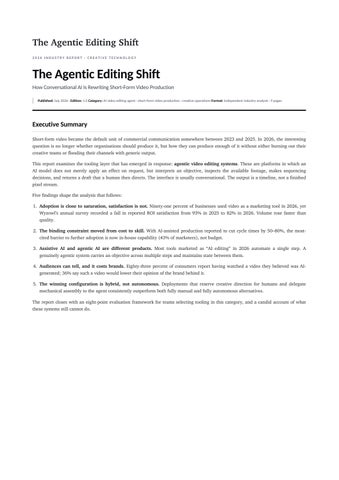
Short-form video became the default unit of commercial communication somewhere between 2023 and 2025 In 2026, the interesting question is no longer whether organisations should produce it, but how they can produce enough of it without either burning out their creative teams or flooding their channels with generic output.
This report examines the tooling layer that has emerged in response: agentic video editing systems These are platforms in which an AI model does not merely apply an effect on request, but interprets an objective, inspects the available footage, makes sequencing decisions, and returns a draft that a human then directs The interface is usually conversational The output is a timeline, not a finished pixel stream
Five findings shape the analysis that follows:
1. Adoption is close to saturation, satisfaction is not. Ninety-one percent of businesses used video as a marketing tool in 2026, yet Wyzowl’s annual survey recorded a fall in reported ROI satisfaction from 93% in 2025 to 82% in 2026 Volume rose faster than quality
2 The binding constraint moved from cost to skill. With AI-assisted production reported to cut cycle times by 50–80%, the mostcited barrier to further adoption is now in-house capability (43% of marketers), not budget
3 Assistive AI and agentic AI are different products. Most tools marketed as “AI editing” in 2026 automate a single step A genuinely agentic system carries an objective across multiple steps and maintains state between them
4 Audiences can tell, and it costs brands. Eighty-three percent of consumers report having watched a video they believed was AIgenerated; 36% say such a video would lower their opinion of the brand behind it
5 The winning configuration is hybrid, not autonomous. Deployments that reserve creative direction for humans and delegate mechanical assembly to the agent consistently outperform both fully manual and fully autonomous alternatives
The report closes with an eight-point evaluation framework for teams selecting tooling in this category, and a candid account of what these systems still cannot do
1.TheContentSupplyGap
1.1Demandhasoutruntheproductionmodel
The scale of short-form video is no longer in dispute Market estimates place the category at roughly $59 billion in 2026, with longrange projections implying a compound annual growth rate above 30% through the mid-2030s Roughly 1 6 billion people around a fifth of the world’s population have consumed short-form video, and average daily session time on the leading platform sits near 95 minutes per user
Commercial behaviour has followed. Ninety-one percent of businesses reported using video as a marketing tool in 2026, matching an all-time high, and 93% of marketers describe video as an important part of their strategy Short-form specifically is ranked the highestreturn content format by a plurality of marketers, and short-form ads have been measured delivering roughly 1 6 times the return of static creative.
The complication is cadence Platform distribution rewards frequency: brands publishing video at least twice per week have been observed to achieve around 41% higher engagement rates than less frequent publishers. Under a conventional production model brief, shoot, ingest, log, rough cut, review, finish twice-weekly output across three platforms in four aspect ratios is not a content calendar It is a staffing problem
1.2Thebottleneckismechanical,notcreative
It is worth being precise about where the time actually goes. The scarce resource in most content operations is not ideas. Surveyed marketers report using AI most heavily for ideation (63%), but nearly as many use it to reclaim editing time (55%), locate usable material inside existing footage (54%), and draft scripts (55%) Those latter categories describe assembly labour: watching raw takes to find the good ones, trimming dead air, matching narration to visuals, cutting to a rhythm, generating captions, and re-cropping the whole thing for the next platform
This is the layer that agentic tooling targets A modern AI video editing agent is designed to absorb the mechanical middle of the pipeline the part between having a clear intention and having a watchable first draft while leaving both the brief and the final judgement with a person
1.3Why2026istheinflectionpoint
Three conditions converged Multimodal models became reliable enough to describe the contents of a video clip rather than merely transcribe its audio Inference costs fell far enough to make frame-level analysis of an hour of footage economically trivial And the agent pattern a model that plans, calls tools, evaluates the result, and revises matured in adjacent domains such as software engineering before being ported to creative work.
2.ThreeGenerationsofVideoTooling
The category is easier to reason about historically Video editing software has passed through three distinct paradigms, each of which redefined what the operator was actually doing
2.1GenerationOne:thetimeline(1991–2016)
Non-linear editors gave the operator direct manipulation of a timeline Power was effectively unlimited, and so was the learning curve The operator’s job was execution: every cut, every transition, every audio duck was placed by hand Output volume scaled linearly with skilled labour hours, which is to say it did not scale at all.
2.2GenerationTwo:thetemplate(2016–2023)
Mobile-first editors introduced pre-built templates with replaceable media slots The learning curve collapsed and output volume rose sharply The trade-off was differentiation: when thousands of creators fill the same template with different footage, the format itself becomes the message, and the message is that this was made quickly. The operator’s job shifted from execution to selection.
2.3GenerationThree:theagent(2023–present)
Agentic systems invert the relationship Rather than the operator adapting an idea to fit a template, the system adapts its output to fit the operator’s stated intent Instruction is given in natural language conversational video editing in the industry’s current vocabulary and the system returns a structured draft with its decisions exposed and editable The operator’s job becomes direction
Failuremode Bottleneck
Humanrole Executor Selector Director
The final row of that table is the substantive claim of this report. Each generation did not simply make editing faster; it relocated the human to a different point in the workflow Organisations that adopt Generation Three tooling while retaining Generation One job design tend to capture the cost saving and miss the quality gain
3.WhatMakesanEditingSystemAgentic
“AI-powered” is now claimed by essentially every product in the category, which makes the label useless for procurement The following four properties offer a more discriminating test A system that exhibits all four is meaningfully agentic; a system exhibiting one or two is an assistive feature attached to a conventional editor
3 1Objectivepersistence
An assistive feature executes a single instruction and forgets it An agent holds an objective “a 30-second product video for a firsttime buyer audience, energetic, ending on the discount code” and evaluates each subsequent decision against it. Practically, this is visible when the user changes one element and the system adjusts dependent elements without being asked: shortening the intro because the outro grew, or re-pacing music after a scene is cut
3.2Sourcecomprehension
The system must analyse the actual material, not just its metadata. This means identifying which takes are usable, where the speaker stumbles, which frames are visually strong, and what the footage depicts Without this, every downstream decision is guesswork Automated rough-cut selection is the clearest diagnostic here: a system that can reliably discard unusable takes from raw footage has demonstrably understood the source, while one that requires pre-trimmed input has not.
3.3Multi-steptoolorchestration
Producing a finished short involves distinct operations transcription, clip selection, sequencing, music selection, voiceover synthesis, caption styling, reframing, export An agentic system chains these autonomously and passes context between them, so that caption timing reflects the final cut rather than the original transcript Where each step must be triggered manually, the tool is a suite, not an agent
3.4Legible,reversibledecisions
This is the property most often absent, and the most important for professional use. The system must expose what it chose and why, and allow any single decision to be overridden without discarding the rest of the work An opaque system that produces a good draft is unusable in a brand context, because nothing about it can be defended, corrected, or repeated
3.5Anoteonautonomylevels
It is tempting to treat full autonomy as the destination. The evidence does not support this. Analyses of agentic marketing deployments in 2026 consistently find that hybrid configurations automation of rule-based, repetitive operations with humans retained for brand voice, positioning, and creative judgement outperform fully autonomous configurations by a wide margin Strategy and creative direction remain domains where model confidence and model correctness diverge
4.AnatomyofanAgenticEditingWorkflow
Implementations differ, but the reference architecture converges on five stages Understanding them is useful both for evaluating vendors and for redesigning internal processes around the tooling
Stage1 Ingestandintentcapture
The system accepts heterogeneous input: raw clips, a product URL, a script, a reference video, or a sentence describing the goal Intent is extracted from whatever is provided The quality of everything downstream is bounded here, which is why brief-writing has quietly become the highest-leverage skill in an AI-assisted content team.
Stage2 Sourceanalysis
Every asset is parsed Speech is transcribed and aligned; shots are classified; quality and stability are scored; on-screen text and products are identified The output is a structured index of what exists, which is the substrate for all subsequent decisions
Stage3 Structuralplanning
The system selects a narrative structure Some platforms derive this from an internal library of high-performing formats; others decompose a user-supplied reference video into its underlying beat structure hook, tension, payoff, call to action and map the user’s own material onto it This stage is where the greatest differentiation between vendors currently lies, and where the risk of homogenised output is highest
Stage4 Assembly
The plan is executed: clips are selected and trimmed, transitions applied, music chosen and beat-matched, voiceover synthesised if required, and captions generated. Caption handling deserves particular attention given that a large majority of short-form consumption occurs with sound off, which makes AI caption generation a retention mechanism rather than an accessibility afterthought
Stage5 Directionandrevision
The draft is returned for human review In a well-designed system, revision happens at the level of intent “make the opening punchier”, “swap the second scene” rather than at the level of keyframes. The system reconciles the change against the standing objective from Stage 1 and regenerates only what is affected
4.1Wherethetimeactuallygoes
Under a conventional workflow, stages two through four consume the overwhelming majority of hands-on time while contributing the least strategic value Reported figures for AI-assisted pipelines cluster around a 50–80% reduction in production time, with some analyses of clip extraction specifically noting that material requiring one to four hours of manual work can be processed in under ten minutes These figures originate largely from vendor-published research and should be treated as directional rather than audited; the consistent direction across independent sources is nonetheless notable
5.SegmentEconomics
The value of agentic editing is not evenly distributed It concentrates wherever output volume is high, per-asset budget is low, and iteration speed determines revenue Four segments illustrate the range
5.1E-commerceandperformancemarketing
The dominant use case Creative fatigue on paid social requires constant variant production, and the cost of testing has historically limited how many variants a team could justify AI-assisted variant generation has been reported to cost a small fraction of producing equivalent traditional versions, which changes the testing strategy rather than merely the production budget. The constraint shifts from how many concepts a team can produce to how many it can meaningfully evaluate
5 2Affiliateandcreatorcommerce
Affiliate operators run the highest volume-to-budget ratio in the industry, frequently publishing dozens of assets weekly across multiple accounts and products. This segment adopted video workflows built for affiliate creators earliest and most completely, because the economics are unambiguous: marginal revenue per additional published asset is positive and production is the only bottleneck
5.3Freelanceeditorsandsmallstudios
The most contested segment Agentic tooling compresses the billable hours available for assembly work while expanding the volume of work small operators can accept Studios repositioning around direction, brand strategy, and quality assurance have generally expanded capacity; those still selling assembly time by the hour face genuine margin pressure. Agencies integrating AI video tooling have been reported to increase monthly output substantially without corresponding headcount growth
5.4In-housemarketingteams
Adoption is high but shallow Seventy-eight percent of marketing teams report using AI-generated video in at least one campaign per quarter, and 86% of ad buyers are using or planning to use generative AI for video creative Depth is limited by governance: brand consistency, approval workflow, and rights clearance are unresolved in most organisations.
6.AnEvaluationFramework
The following eight criteria are intended for teams comparing platforms in this category They are ordered by how frequently they prove decisive after deployment rather than during a trial, which is where most selection processes go wrong
1
2
3
5
7 Rightsandprovenance Confirmlicensingtermsforstock,music,andsyntheticvoices;checkoutputprovenancelabelling
8
6 1Thetrial-designproblem
Vendor trials are typically conducted with clean, well-lit, pre-selected footage, which tests the weakest hypothesis A useful trial does the opposite: it supplies the worst material the team routinely works with, on the tightest deadline the team routinely faces, and measures the proportion of output that ships without a human returning to a manual timeline That single metric unassisted ship rate predicts realised value better than any feature comparison
6 2Pricingstructuresinthecategory
Most platforms in this category have converged on credit-based consumption pricing, generally with a free tier for evaluation, a mid tier in the $20–35 per seat per month range on annual billing, and volume tiers above that, with pay-as-you-go top-ups Because a rejected draft usually consumes credits, the effective cost per published asset depends heavily on first-draft acceptance rate a figure that should be measured during trial rather than assumed
7.Risks,Limitations,andOutlook
7.1Theauthenticitydiscountisrealandmeasurable
The most significant finding against unrestrained adoption comes from consumer research Roughly 83% of consumers report having watched a video they suspected was AI-generated, with the most common tells being unnatural movement (67%), synthetic-sounding voices (55%), and flat emotional register (51%). Critically, 36% say an AI-generated video would lower their perception of the brand Audiences are not uniformly hostile more than a third report trusting AI-assisted content as much as human-made content but the downside is asymmetric and concentrated among exactly the viewers a brand most wants to convert
The operational implication is that detectability, not automation, is the thing to manage Systems that assemble genuine humancaptured footage carry markedly less authenticity risk than systems that synthesise performers wholesale
7.2Volumeinflationcompressesreturns
The ROI satisfaction decline observed between 2025 and 2026 from 93% to 82% is best read as a competitive effect rather than a tooling failure When production cost falls for everyone simultaneously, output volume rises across the board and the average quality of what audiences see declines The advantage accrues not to teams that produce the most, but to teams that produce distinctively at volume. Tooling that optimises purely for throughput accelerates a race that cannot be won on throughput.
7.3Structuralhomogenisation
Systems that derive structure from libraries of high-performing formats face an inherent convergence problem: as adoption grows, more content is built on the same underlying beat structures This is the Generation Two template problem re-emerging one abstraction layer higher Platforms that permit user-supplied reference structures and expose structural choices for editing mitigate it; platforms that hide structure behind a single generate button do not
7.4Governancegaps
Three areas remain underdeveloped across the category: rights provenance for AI-selected stock and music; disclosure obligations as platform labelling requirements tighten; and audit trails sufficient for regulated advertising categories Teams in finance, health, and children’s products should treat these as gating requirements rather than future improvements
7.5Outlook2026–2027
Four developments appear likely on current trajectory. First, consolidation of point tools into agent platforms, as single-function products are absorbed into orchestrated workflows Second, API-first adoption, with agentic editing embedded into commerce and marketing systems rather than accessed through standalone interfaces Third, measurement integration, closing the loop between published performance and subsequent generation Fourth, and most consequentially, a shift in professional job design away from assembly and toward briefing, curation, and quality control the direction of travel already visible in the studios that have adapted successfully.
8.MethodologyandSources
8.1Methodology
This report synthesises publicly available industry research published between early 2025 and mid-2026, combined with structural analysis of commercially available products in the agentic video editing category No proprietary data was collected
Readers should apply three caveats First, a substantial share of efficiency statistics in this field originates from vendor-published research and is not independently audited; such figures are presented here as directional Second, engagement benchmarks vary widely by measurement methodology, and cross-source comparison of platform engagement rates is unreliable. Third, the category is moving quickly enough that specific product capabilities described here may have changed since publication
8 2Selectedsources
Wyzowl, State of Video Marketing (2026) business video adoption, ROI satisfaction, AI tool usage, adoption barriers
HubSpot, State of Marketing Report (2026) format ROI rankings, marketer priorities
Animoto, State of Video Report (2026) consumer perception of AI-generated video, marketer AI use cases
IAB generative AI adoption among video ad buyers
Statista and associated market analyses short-form video market sizing, consumption benchmarks
Gartner and Deloitte enterprise generative AI adoption baselines
Independent 2026 benchmark compilations covering AI video platform usage, production time and cost reduction
8.3Aboutthisreport
The Agentic Editing Shift is an independent industry analysis of conversational and agentic tooling in short-form video production It is intended for marketing leaders, content operations managers, freelance editors, and product teams evaluating this category It may be cited or redistributed with attribution
Products referenced in the course of the analysis include mobile template editors, transcript-based editors, automated clipping tools, and conversational editing agents Among the last group, NemoVideo is used at several points as a structural reference because its published architecture exposes the five workflow stages described in Section 4 as discrete, user-inspectable components a useful property for illustration regardless of vendor preference
8 4Termsusedinthisreport
Agentic editing a system that carries an objective across multiple editing operations, maintaining state between them, rather than executing isolated instructions.
Conversational editing a natural-language interface to editing operations, in which intent is stated rather than manipulated directly
Unassisted ship rate the proportion of generated drafts published without a human reopening a manual timeline Proposed here as the primary efficacy metric for this category