September 2023
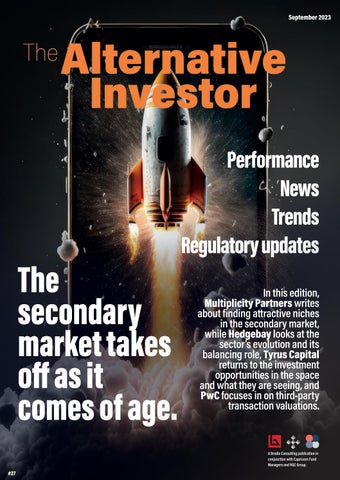
The secondary market takes off as it comes of age.
Performance News Trends Regulatory updates In this edition, Multiplicity Partners writes about finding attractive niches in the secondary market, while Hedgebay looks at the sector’s evolution and its balancing role, Tyrus Capital returns to the investment opportunities in the space and what they are seeing, and PwC focuses in on third-party transaction valuations.
A Brodie Consulting publication in conjunction with Capricorn Fund Managers and RQC Group.
#27
September 2023
EVENT DRIVEN STANDS OUT IN AUGUST
August was a tricky month for hedge funds, with Event Driven being the standout strategy and by close, the HFRX Fund Weighted Composite was down -0.5%. This was a month that saw further signs of China’s slowdown, flip-flopping views on US interest rates and crypto volatility; yet markets remained relatively subdued, with the VIX sitting at 13.6, way down on its long-term average. To see full market review click here.
Equity managers had mixed performances and largely fell into negative territory. The HFRI Equity Hedge Index was -1.2%, with tech leading the drop, -3.1%, off the back of some impressive prior months. Growth generally failed to get any traction, with the HFRX Fundamental Growth -1.9%. Bucking the trend was Energy/ Basic Materials, +0.4%, primarily driven by rising energy prices as OPEC+ tightened supply, and MultiStrategy also had an excellent month, +1.1%. Event Driven was the leading performer, +0.4%, although this underplays some of the more impressive underlying numbers. Within the strategy, Activists struggled, -2.2%, while Merger Arbitrage enjoyed a better time, +2.0% and Credit Arbitrage +1.3%. Relative Value also had a good month, with the index +0.3%. The RV: Volatility index performed best, +1.0%, followed by Fixed Income Asset Backed, +0.6%. Macro was down in August, -0.5%, with trendfollowing systematic and CTA managers’ performances weighing on the sector, while the more discretionary proved better placed. Systematic Directional was -0.9% and Commodity Index -0.4%. Discretionary and Directional indices were up +0.3% apiece, and Active Trading +0.6%. Regionally, only one market covered itself in glory, which was India, +2.5%. LATAM, however, struggled, not helped by the stronger USD, -4.3%. MENA was likewise down -3.8%. Given these moves, the more Western-focused performances were passable, with North America -0.3% and Western/ pan Europe +0.4%.
INDUSTRY EVENTS 20-21 September Investor Relations, Marketing & Communications (PEI) San Francisco 20-22 September Women’s Private Equity Summit Europe 2023 27-28 September Investor Relations, Marketing & Communications (PEI) Europe Click here to see all the listings
$2bn $200bn
Assets raised for Ilex Capital - this year’s biggest hedge fund launch
Secondary funds’ dry powder sitting on the side lines
Source: Bloomberg
Source: Multiplicity
CVC CLOSES 5TH SECONDARIES FUND
CVC Glendower has announced that it has closed its fifth secondary fundraise at $8.5 billion. This business is a strategic partnership between CVC, which manages more than $150 billion today, and Glendower, the specialist secondaries managers. Today, the partnership’s assets under management total $13 billion, with this fund being its largest raise to date, with over 230 limited partners. Target investments are mid-market private equity managed by 'high-quality GPs.'
€26BN FUND RAISE IN ONLY 8 MONTHS
CVC has clearly been busy lately. Not content with their secondaries fund raise, they have raised €26 billion fund for their ninth Europe/ Americas private equity fund. This is a few billion euros more than its previous fund, CVC Capital Partners VIII, which closed at €22.3 billion in 2020. The size of this fund is a fantastic feat in this environment, not only because it is more than the targeted €25 billion, but also because they only started the process in January of this year. It is again evidence that investors are following the brands.
TACTICAL RECORD
These markets may not be the easiest for fund raising, but there do appear to be plenty of 'record funds'. Another 'record' is at Blackstone, which has closed its fourth Tactical Opportunities Fund, amassing $5.2 billion of capital commitments. They have also teamed-up with single investors, which combined takes the fund to just shy of $10 billion. The firm's Tactical Opportunities strategy, in total, has assets of $34 billion, investing outside traditional private equity and private credit.
HAYFIN HITS €6BN
A noteworthy fund raise comes from London-based Hayfin Capital Management's for its direct lending fund, which is now above the €6 billion target and is set to hit €7 billion by the end of the year. This is Hayfin’s fourth fund, which will provide direct lending fund origination, structures and invest in performing senior secured loans to European mid-market companies. They have good institutional backing, including the likes of San Antonio Fire & Police Pension Fund.
BLACKSTONE TOP FUND RAISER
Research from Statista shows Blackstone to have been the biggest private equity asset gatherer over the past five years. According to their research, Blackstone has raised $125.6 billion over the period, followed by KKR, with $103.7 billion, then EQT $101.7 billion, Thoma Bravo $74.1 billion and The Carlyle Group $69.7 billion. Eight of the top ten managers are US-based, with only EQT (Sweden) and Hg (UK) the outliers
This newsletter is a selection of the previous month’s sector news, trends, regulatory developments and best practices. Any opinions expressed are those of the author only and the newsletter does not constitute personal advise or a personal recommendation. We always seek to maintain tight editorial standards. If you have any comments on this content, please do not hesitate to get in touch with the team.
2
September 2023
UPDATES (CONT) CVC TARGETS INFRASTRUCTURE
COULD MACRO REALLY BE BACK?
Given the headline, you may laugh; how often have we said macro is back? On CVC has acquired a majority stake this side, we love macro and think as an in DIF Capital Partners, the Dutchbased infrastructure-focused manager, investment strategy, it makes sense, but we are constantly frustrated by the false in a deal worth €1 billion. DIF manages dawns. €16 billion in infrastructure mid-market After last year's successes, the first half assets, broadening CVC's investment of this year has been a tough nut to offerings and follows the 2021 crack for most macro funds, but trying acquisition of Glendower Capital. to ignore Haider's painful returns this This move is seen as a play ahead of year, we finally started to see some an expected IPO later this year. decent returns in July and even in
August when looking at discretionary numbers. These have the potential to be fertile grounds for these managers, with plenty of macro moves as central banks tightening tops out. One manager who appears back on form is Chris Rokos, having turned around a poor year and is once more in positive territory. Rokos still has a long way to go to make this a good year, but you must start somewhere.
A ‘BILLIONS’ SPIN OFF SHOW? Having agreed to be acquired by Rithm Capital Corp, the real estate and financial services asset manager, Sculptor Capital Management, the US hedge fund once called Och Ziff, has since received a revised offer from Boaz Weinstein. This would be relatively straightforward situation if not for a vicious shareholder fight and the nature of its convoluted ownership structure being aired in public. During the sale process, Sculptor talked to 70 potential names - beyond Weinstein - including Bill Ackman and Marc Lasry. But Rithm's offer was not the highest, leading Dan Och - still a sizable shareholder - to claim that the agreement needed to
be in the best interests of shareholders; Rob Shafir, former CEO, likewise agrees. In a letter to the Special Committee of the Board of Directors, Och writes that this deal 'undervalues' the company, 'breaches fiduciary duty and lack of proper oversight' and potential bidders were 'excluded from the process.' As the Financial Times notes, this messy situation 'surpasses the plot twist of Billions.' There has long been a history of bad blood between Och and Jimmy Levin, Sculptor's CEO, who at one point was Och's "protege." There have been plenty of claims and counterclaims, with more to come.
CHANGING STRIPES Over the past month, one of the more interesting moves was a Financial Times story that Tiger Global has been building a sizeable stake in Apollo. This development comes from a mid-year investor letter and is far removed from Tiger's more usual technology focus. It also shows that the business, which was badly burnt when tech went sour, is looking to diversify. This is clearly a significant shift and comes at a time when tech valuations have rallied back.
SHIFTING SANDS US value manager Engine No. 1, which in only a few years has made a name for itself - punching well above its weight, given its relatively small size - has said that it is now looking beyond activism and into the world of private credit. Having ruffled ExxonMobil feathers, the founder and CIO of Engine No. 1, Chris James (ex-Louis Bacon), speaking to the Financial
Times, said that activism is only the "tool of last resort." Whether this is because Charlie Penner, ex-Jana Partners and highly experienced activist who somewhat acrimoniously left the firm, is not clear; what is clear is that plenty of time and effort within the firm is focused on building out the private capital capabilities.
This newsletter is a selection of the previous month’s sector news, trends, regulatory developments and best practices. Any opinions expressed are those of the author only and the newsletter does not constitute personal advise or a personal recommendation. We always seek to maintain tight editorial standards. If you have any comments on this content, please do not hesitate to get in touch with the team.
3
September 2023
UPDATES (CONT)
A SECONDARY RENAISSANCE Secondary funds are again in the spotlight, with some big fund launches this year. From where we sit, there is particular interest from many of the large institutional investors and family offices. While the secondary market is not new, it caught the eye in the post-GFC period, when investors were looking to offload positions, many at significant discounts. Since then, the sector has matured, and today, there is a far higher degree of professionalism than in those early years. We now see dedicated vehicles and firms whose sole focus is acquiring and managing these investments. Back in the day, many of these were more ad hoc, often carveouts of existing fund businesses. This evolution
has made the secondary market a vital part of the toolbox for managing institutional portfolios as investors look to re-weight portfolios and tweak duration, which is not always possible with incumbent, legacy investments on the books. Some are distressed illiquid investments that cost just a few cents in the dollar, but many more are with brand firms in the middle of the harvest period that are more like 80-90 cents and don't have a place in their portfolios. The increased institutionalisation of the secondary market has proved a boon for sector liquidity, encouraging greater portfolio efficiencies.
GAM’S SPOT OF BOTHER With the failure of Liontrust's £96 million bid for GAM, the Swiss manager is living very much hand to mouth. Trust is an essential asset in this space and is currently lacking at GAM. Why would you hand over your money to a business that cannot look after its own house? After the latest debacle, the board has
said it will step down with a new slate of candidates proposed by activist investors. Until there is stability, clients and employees will continue to depart GAM, but at the same time, it needs lifeblood funding that, short-term, has come from NewGAMe, which has a 9.6% stake in the firm and has put
forward Randel Freeman as the chief executive. Silchester, GAM's largest investor, may have backed the failed takeover, but it never had market backing, ultimately costing Liontrust $14 million. News that the bid had died saw Liontrust's shares rise by more than 11% says it all.
ALL ABOUT THE BRAND With a decent pedigree and a strong track record can come some big assets - even in these tough fund raising conditions. Two former Citadel traders have proved this, with a $2 billion fund raise for an equity long-short fund. The fund, Ilex Capital Partners, has stopped accepting further investments. This launch, first reported by Bloomberg's Nishant Kumar - who impressively, along with his colleague Kathy Burton, get the bulk of the big sector launch stories - is the largest this year.
This newsletter is a selection of the previous month’s sector news, trends, regulatory developments and best practices. Any opinions expressed are those of the author only and the newsletter does not constitute personal advise or a personal recommendation. We always seek to maintain tight editorial standards. If you have any comments on this content, please do not hesitate to get in touch with the team.
4
Money Maze Podcast
Inspiring interviews with global business and finance leaders Top 1% of all podcasts Source: Listen Notes
If M&A is not happening and IPOs aren’t happening, then secondary market liquidity is kind of the only game in town. And so I think that’s pretty much the most active part of our business right now, working with venture capitalists to create liquidity in their portfolios. Tom Callahan, CEO of Nasdaq Private Market
www.moneymazepodcast.com
September 2023
UPDATES (CONT) THE GREAT COMMODITY PULLBACK Spurred on by fast-rising commodities prices, one of the most significant trends from last year was for hedge funds and investment banks to rebuild their commodity teams in the space. Unfortunately, with this side of the market somewhat subdued dragged down by China and the global slowdown - this now appears to be in reverse.
A big name to depart is Jeff Currie, Goldman Sachs' influential commodity head, leaving after almost three decades. During this time, Jeff made some pretty punchy calls over the years - not all correct - but he did predict the commodities supercycle. Unless we see a significant change to the macro picture this year, funds and investment banks will only continue to step back from the space.
TCI'S LARGESSE There are very few hedge funds that have a genuine philanthropic bent. But TCI is one and showed its true colours last year, when it pledged $491million to charitable activities in 2022. This is down from the $828 million in 2021, but that followed record performance and 2022 was the firm's first down year in over a decade. According to The Times, TCI ‘booked a net investment loss of $487 million for last year,' with makes Chris Hohn’s largesse all the more impressive.
MULTI-MANAGERS HAVE FURTHER TO GROW A lengthy article in the Financial Times questions the future of the multi-manager hedge fund due to high fees.
Performance this year from these funds may have lagged the broader market, but many managers and strategies have shared this pain.
Behind this story is a Goldman Sachs report that found a 'slight increase' in investors looking to reduce exposure, and the SEC concerned about such funds impacting financial stability. The article alludes to the multi-manager cycle peaking.
Yes, some teams have been trimmed, as evidenced at Weiss in recent weeks, but at the same time, new teams and strategies are also being added. Prominent managers have always been ruthless in removing unsuccessful teams and seeding new strategies - if it doesn't work, you cut.
Over here we think this is somewhat tenuous, with multi-manager funds in for the long haul. While most other sectors are seeing outflows, this has been the fastestgrowing sector in alternatives and has a history of success. As the Financial Times notes, leading multi-strategy manager Citadel is, according to LCH numbers, now the most successful fund of all time.
These managers continue to build their businesses and are more than just a single strategy, making them the ultimate sector chameleon, meaning they can continually evolve in this fast-changing landscape. While multi-manager funds are responsible for the largest number of assets, there are not many true multi-
manager funds in the marketplace - smaller funds may claim to be in this space, but few are. These funds only work when you have extensive teams covering several strategies. Being a jack of all trades has never been an attractive investor trait, and those funds that shift from one strategy to another are ultimately red-flagged as style drifters. When multi-manager funds have run out of ideas, then the cycle may have run its course, but that is not the case today. Expansion into private credit is undoubtedly one of the exciting trends we see. Another is a move to lock up investors for longer as the big managers expand their focus to longer-duration investments and protect their portfolios from shortterm volatility.
This newsletter is a selection of the previous month’s sector news, trends, regulatory developments and best practices. Any opinions expressed are those of the author only and the newsletter does not constitute personal advise or a personal recommendation. We always seek to maintain tight editorial standards. If you have any comments on this content, please do not hesitate to get in touch with the team.
6
September 2023
UPDATES (CONT) BUILDING FAMILY OFFICE FOCUSED ARMS
PRIVATE CREDIT REMAINS THE TOP DRAW
A few months ago, we wrote about many of the most significant funds and investment banks building out their family office arms. There is further to go on this trend, as we see and hear new family office divisions and services launching weekly.
With interest rates high, private credit continues to be where the interest lies and will be a focus for the Alternative Investor later this year.
This move is partly the growth of family offices, which now total around 10,000, according to estimates, but also the long-term economics and desire to broaden investment offerings by better-aligning fund offerings and services with these investors. Given the challenging fundraising environment, the ability to offer more relevant value-adding services across the asset management industry makes sense. Furthermore, once in with family offices - a relationship based on professionalism and trust - the chances are it is a long haul deal. Apollo is just one of many in the space to have made this move, having recently announced a standalone family office servicing unit that also includes an educational hub.
Private debt fundraising totaled $71 billion in the second quarter, according to Preqin data. There were 34 new funds, double that of the previous year. Europe accounted for $33.8 billion, just shy of the US total, with Asia's contribution still comparatively small. According to Bloomberg, the Middle East has a robust appetite for private credit, with Apollo and Jefferies seeing significant funds from the Abu Dhabi Investment Authority. Indeed, private credit, which amounts to around $1.5 trillion, is filling the gap left by traditional lenders and is where many of the larger alternative managers are paying attention. This trend is also backed by investors, with Preqin finding 51% of investors looking to increase their allocation to this space. The longer-term concern has to be the quality of the loans, an area the EU is looking closely at as it tightens rules on leverage.
A WAR FOR TALENT IN TECH AND TRADING The investment management industry has always been competitive in sourcing the best talent. But what used to be mainly about star managers and toprated analysts has increasingly turned to tech and trading strategies. We have seen this in hedge and private equity perhaps not surprising given the proprietary nature of many trading strategies and algorithms, where code is gold and secrecy is paramount. The latter has resulted in some fruity cases over the past few years. Goldman Sachs has always been hot on this front, with a well-publicised case last year when the bank accused two employees of accessing 'sensitive code'.
its business and actively hiring. These two firms have acrimonious history on this front, with a previous case settled in 2021 that included a hiring ban on Balyasny from Citadel's fixed-income team. This ban lasted through to earlier this year, which timing-wise ties in with the latest case, with Citadel accusing former employees of 'misappropriating' confidential information and then joining Balyasny. Having said that, there are still enormous incentives for top talent to join hedge funds, with Bloomberg describing the fees and other rewards as "no different from the bidding war for Premier League or NBA players."
More recently, Bloomberg has reported on Citadel's 'dispute' with Balyasny, which has been fast diversifying
This newsletter is a selection of the previous month’s sector news, trends, regulatory developments and best practices. Any opinions expressed are those of the author only and the newsletter does not constitute personal advise or a personal recommendation. We always seek to maintain tight editorial standards. If you have any comments on this content, please do not hesitate to get in touch with the team.
7
September 2023
LETTER FROM AMERICA
What’s in a Name? What’s in a name? That which we call a rose by any other name would smell just as sweet. Romeo and Juliet, Act 2, Scene 2
With apologies to William Shakespeare for bringing Juliet’s famous soliloquy into a current American taxonomy debate, apparently a lot seems at stake in the more than multitrillion-dollar market of ESG investments. Those three letters, which we all know is shorthand for environment, social and governance, is causing quite a feud in America among those opposed to an ESG framework as a guide for making investment decisions and those in favor of this approach as a way to identify risk and create long-term value.
• Focus less on the labels and more on the initiatives and actionable progress: Climate and the energy transition are leading the conversation and driving the news cycle. Blackstone just raised its largest green energy credit fund at $7.1 billion. KKR has been expanding in climate investing by adding to its leadership team and its commitments in energy-renewable partnerships. And Carlyle, as a co-chair continues to push forward its ESG Data Convergence Initiative to drive convergence around meaningful ESG metrics for the private equity industry, with more than 325 GPs and LPs representing over $27 trillion in assets. • Demonstrate good governance: Running a tight ship with a carefully designed leadership structure and succession plan, among other elements, has never gone out of favor.
...it seems that responsible investing in the United States is becoming the preferred talent way to describe investment • Celebrate and understand strategies focused on your constituencies: Winning teams reflect climate, governance and their stakeholders and communities. Illustrate stories people.
The debate intensified and took a semantic turn when Larry Fink, the Chairman and Chief Executive Officer of BlackRock, this summer said that the term ESG itself was not the right way to talk about investment strategies. As expected, big headlines and a chorus of supporters and haters followed. The good news? A real reckoning is underway (at last!) and one in the final analysis needs to focus on what matters at the core: practicing transparency and risk management, creating resilience in a fast-evolving macro environment and conducting good business. This might all seem like marketing to some extent, but precise language backed by actions is important in any messaging especially when a firm’s narrative must reach a large and diverse group of stakeholders. As a communicator, I get asked by private market clients what is the best way to describe their ESG programs, which until recently have been a positive element of their branding. Some even wonder whether they should talk about it at all or avoid the ESG terms altogether.
on entrepreneurship and innovation, both inside and outside the firm especially as they relate to the issues your stakeholders care about.
Since the term ESG surfaced in the early 2000s, packaging what is really responsible and good business into an acronym has led to confusion and opacity, exactly the opposite of its intent. Right now, it seems that responsible investing in the United States is becoming the preferred way to describe investment strategies focused on climate, governance and people. That does not mean the term ESG has been completely discarded as the move to more sustainable investments continues to advance. But at some point, we will likely ask -- ESG, wherefore arte thou -- without ever forsaking a focus on good business. Mark Kollar Partner, Prosek Partners
So, yes, simply put: Talk about it but find the right balance between promotion and transparency:
This newsletter is a selection of the previous month’s sector news, trends, regulatory developments and best practices. Any opinions expressed are those of the author only and the newsletter does not constitute personal advise or a personal recommendation. We always seek to maintain tight editorial standards. If you have any comments on this content, please do not hesitate to get in touch with the team.
8
The Long-Short Podcast
Seth Fischer CIO and Founder Oasis Management
aima.org
Ken Tropin Chairman and Founder Graham Capital Management
PERSPECTIVES Industry leaders on the future of the hedge fund industry
Robert Koenigsberger Founder, CIO and Managing Partner Gramercy Funds Management Anthony Todd CEO and Co-Founder Aspect Capital
Mark Wong Co-CEO, COO and CRO Dymon Asia
September 2023
GUEST ARTICLES (cont.)
Finding niches in the secondary market: six essential factors to consider
I
Andres Hefti, Partner, Multiplicity Partners
n the realm of secondary market investing, competition is a prevailing force. As per our estimate, dedicated secondary funds currently sit on more than $200 billion of “dry powder”. As investors navigate this landscape, the search for less contested opportunities becomes a strategic pursuit. A process of elimination centred around six pivotal factors can guide investors toward such untapped potential. 1. Asset Classes: The asset class is a key determinant of competition levels. Private equity (PE) commands more than 80% of secondary deal volume, resulting in fierce rivalry. However, PE’s dominance doesn’t correlate with its share in total assets under management (AUM), pointing to intensified competition within this sector. Secondary market capital in sizable asset classes such as real estate, private debt, infrastructure and niche alternatives is much scarcer. 2. Geography: Geographical dynamics play a vital role, with nearly two-thirds of 2022 secondary
transactions originating from the US. So exploring less trodden markets in the “Rest of World“, e.g. in emerging markets, can unveil opportunities with diminished competition. 3. Fund Age: Middle-aged funds (4-6 years old) witness the highest transaction volumes due to their proximity to full investment and potential value appreciation. In contrast, tail-end funds present a road less travelled for astute investors seeking attractive shorter-term profit potential. 4. Target Multiples: Most secondary investors target a 1.5-1.7x multiple on invested capital (MOIC) for a balanced risk-reward ratio. However, overlooked deals with lower MOICs but higher certainty and shorter horizons, or higher-risk prospects with 3-5x potential, can add diversity to a portfolio’s risk profile. 5. Deal Sizes: Secondary funds’ bite size has increased in line with their ever increasing size of AUM. In today’s market, deals above $50 million attract most interest from secondary buyers, leaving smaller
... exploring less trodden markets in the “Rest of World“, e.g. in emerging markets, can unveil opportunities with diminished competition. Andres Hefti, Multiplicity Partners
This newsletter is a selection of the previous month’s sector news, trends, regulatory developments and best practices. Any opinions expressed are those of the author only and the newsletter does not constitute personal advise or a personal recommendation. We always seek to maintain tight editorial standards. If you have any comments on this content, please do not hesitate to get in touch with the team.
10
September 2023
GUEST ARTICLES (cont.)
...considering asset class, geography, fund age, target multiples, deal size, and shifting focus from saturated growth funds to overlooked assets, investors can avoid overheated markets... Andres Hefti, Multiplicity Partners
opportunities relatively unnoticed. In particular, deals under $10 million are less competitive and hence offer better bargaining power for buyers willing to put in a lot of work for a smaller amount of capital deployed. 6. Quality and Growth: Historically, the winning strategy of the secondaries investor community has been to buy good funds and rather small discounts to NAV. Hence, most investors today gravitate toward quality funds with growth potential, saturating the market for top-quartile funds. An alternative strategy involves exploring underperforming funds with substantial discounts, revealing untapped value. In this competitive landscape, employing these six strategies can be instrumental. By considering asset class, geography, fund age, target multiples, deal size, and shifting focus from saturated growth funds to overlooked assets, investors can
avoid overheated markets and identify overlooked opportunities. Andres Hefti, Partner, Multiplicity Partners Multiplicity Partners is an investment boutique specialized in providing liquidity to holders of private market funds and distressed assets. The firm also offers a range of advisory and governance solutions across alternative assets. Andres Hefti is a partner of Multiplicity Partners and the Portfolio Manager of the LTO Fund family. He joined the firm in 2013 and built up its capabilities to identify, analyse and execute investment opportunities in hard-to-value assets. He oversees the firm’s secondary investments in tail-end portfolios and niche strategies and is responsible for deal origination. Andres has more than 20 years of experience in private markets, distressed investing and portfolio management.
This newsletter is a selection of the previous month’s sector news, trends, regulatory developments and best practices. Any opinions expressed are those of the author only and the newsletter does not constitute personal advise or a personal recommendation. We always seek to maintain tight editorial standards. If you have any comments on this content, please do not hesitate to get in touch with the team.
11
September 2023
GUEST ARTICLES (cont.)
Embracing the secondary market Andrew Kurian, CFO/ COO Hedgebay Securities
G
eneral Partners need not fear the Secondary Market. The realm of secondary trading for illiquid alternative investments has evolved from obscurity into a well-established arena involving sophisticated, well-funded firms, some exclusively dedicated to secondaries. The days of GPs resisting investor demands for liquidity are fading, giving way to a more LP-friendly approach. However, it's important to note that secondary trading is still perceived by some as a somewhat unregulated frontier, with not all participants registered for securities transactions. Having been part of this industry for over two decades, Hedgebay has witnessed significant progress in the market for these assets. Yet, there's still work to be done for the industry to fully embrace the reality that being investor-friendly often leads to better primary fund-raising results, generally resulting in higher market prices. Resistance from GPs, who sometimes view secondary trades below par as a sign of weakness rather than friendliness, still exists. We firmly believe that assisting limited partners with their liquidity needs demonstrates strength rather than weakness. Recently, we've observed a growing number of transactions in the private company space. Investors are sometimes driven by a "Fear of Missing Out" mentality for the next transformative idea, such as Artificial Intelligence, for instance. However, private company trades can be fraught with risks when conducted by non-registered entities, leading to
negative experiences for buyers and sellers. This trend has become more prevalent as the space expands to include numerous companies, attracting unscrupulous traders posing as brokers. Both GPs and LPs should recognize that the secondary market is not only here to stay but is gradually becoming a standard practice with industry-wide acceptance. As this market transitions from traditional brokerage to the era of electronic exchanges, transaction costs will decrease, drawing more participants into the fold. While we champion this progress and celebrate its maturation, we must also remain cautious. Individuals can easily claim expertise in secondary trading without the necessary registration or regulation. Buyers and sellers should be vigilant, wary of unregistered and non-regulated actors. Secondary market trading for illiquid and alternative assets fosters equilibrium, allowing sellers in need of liquidity to connect with buyers seeking alpha or the next unicorn for their portfolios. There's no need for apprehension—embrace this evolving market. Andrew Kurian, CFO/ COO Hedgebay Securities Founded in 1999, Hedgebay is a technology enabled preeminent provider of secondary liquidity across a wide spectrum of illiquid assets. FINRA registered, we have been successful in sourcing and settling billions of dollars of transactions across multiple asset classes servicing a global client base.
... the secondary market is not only here to stay but is gradually becoming a standard practice with industry-wide acceptance.
This newsletter is a selection of the previous month’s sector news, trends, regulatory developments and best practices. Any opinions expressed are those of the author only and the newsletter does not constitute personal advise or a personal recommendation. We always seek to maintain tight editorial standards. If you have any comments on this content, please do not hesitate to get in touch with the team.
12
September 2023
GUEST ARTICLES (cont.)
The current status of the PE secondary market Gunter Waldner, Co-CIO and Head of Private Equity, Tyrus Capital SAM Status Quo
L
ooking back over the last 12 to 18 months, it is important to realise what did not happen: Despite a sharp fall in public markets, a historic increase in interest rates driven by soaring inflation and other macro headwinds, the ongoing war in Ukraine, an energy crisis, geopolitical issues and a mini banking crisis in the US, PE valuations did not collapse, as was predicted by some market participants and parts of the financial press. In fact, what we are seeing is arguably the most attractive environment for secondary buyers since the GFC. After the usual initial imbalances between sellers and buyers in H2 2022, we have experienced a resurgence in deal activity and a rebound in PE valuations in Q1, further accelerating in Q2 2023. Outlook: Worst behind us, plain sailing ahead? While, unlike in the GFC, there are few distressed sellers in the market today, market activity is driven by (i) overallocation to PE (the denominator effect), (ii) liquidity crunch due to the drop in distributions to LPs, (iii) a general increase in active portfolio management, trimming legacy portfolios and the number of GP
relationships and (iv) a near record amount of dry powder of $220 billion held by dedicated secondary buyers chasing opportunities (over 2x the annual market volume). Although H1 secondary volumes were down by ca. 22% year-on-year to approx. $42 billion according to Evercore, it is widely expected that H2 volume of $60-70 billion will result in potentially the biggest secondary year ever bar 2021 with approx. $134 billion. We predict that most secondary buyers will continue to prioritize more diversified LP portfolios (after the almost unhealthy frenzy over GP-leds over the last years), higher quality and generally younger assets, more buyout focused
...what we are seeing is arguably the most attractive environment for secondary buyers since the GFC. Gunter Waldner, Tyrus Capital
This newsletter is a selection of the previous month’s sector news, trends, regulatory developments and best practices. Any opinions expressed are those of the author only and the newsletter does not constitute personal advise or a personal recommendation. We always seek to maintain tight editorial standards. If you have any comments on this content, please do not hesitate to get in touch with the team.
13
September 2023
GUEST ARTICLES (cont.) assets (we still see VC valuation declines ahead) and a preference of developed over emerging markets. As such, we expect the traditional side of the market dominated by the large secondary players to remain very competitive and prices to improve further. While we are generally optimistic, barring any dramatic public market movements or unexpected macroeconomic shocks, we remain cognizant of risks especially related to higher interest rate environment and the expected looming “refinancing wall” facing many highly levered PE-backed companies in one or two years from now. Opportunities and Our Approach We are particularly bullish for our segment of the secondary market, on the more mature to tail-end of the spectrum. This niche remains significantly less crowded and we face limited competition from traditional secondary buyers, who often struggle to compete in this segment on a money multiple basis, resulting in highly attractive discounts. Our focus on sometimes partially de-risked assets with shorter duration (average 2-3 years), significant cash generation (historically 20-30% cash generation p.a.), acquired at very attractive discounts (10-year average
in the low 20s, currently often 30-40%), combined with our ability to re-invest that liquidity seamlessly in an open-ended fund structure results in highly attractive risk adjusted returns. Gunter Waldner, Co-CIO and Head of Private Equity, Tyrus Capital SAM Gunter joined Tyrus Capital in August 2012 as Head of Private Equity. Prior to Tyrus Capital, Gunter spent five years in senior positions in AlpInvest Partners (subsequently acquired by The Carlyle Group), where he was responsible amongst others, for deal sourcing, structuring and execution of secondary private equity transactions, portfolio management, as well as developing and raising AlpInvest’s first co-mingled secondaries fund. His previous experience includes 10 years in investment banking at Lehman Brothers, advising corporates on M&A transactions and capital market activities. Gunter holds a master’s degree in Business Administration and Economics from the Vienna University of Economics and Business Administration.
We are particularly bullish for our segment of the secondary market, on the more mature to tail-end of the spectrum. This niche remains significantly less crowded... Gunter Waldner, Tyrus Capital
This newsletter is a selection of the previous month’s sector news, trends, regulatory developments and best practices. Any opinions expressed are those of the author only and the newsletter does not constitute personal advise or a personal recommendation. We always seek to maintain tight editorial standards. If you have any comments on this content, please do not hesitate to get in touch with the team.
14
September 2023
GUEST ARTICLES (cont.)
Private Market Focus - Valuations take centre stage The SEC’s hotly-anticipated new mandate has been published. PwC’s David Seldon, Albertha Charles, Jeremy Evans and Nick Jones question whether these new US private fund regulations make third party valuations a staple requirement for UK-based, GP-led secondary transactions?
T
he exponential growth in the private funds industry, now estimated to be worth over $25 trillion1, is capturing the attention of governments and regulators worldwide. The UK government’s recent Mansion House Reforms aim to channel private assets to fund high-growth UK businesses. The Financial Conduct Authority (FCA) recently widened retail and pensions access to Long Term Asset Funds (LTAF), designed to encourage investment in longer-term, less-liquid assets to support economic growth and the transition to a low-carbon economy. Meanwhile, in the US, the Securities and Exchange Commission’s (SEC) Private Fund Adviser Rules (adopted on August 23rd) introduced sweeping
changes to improve transparency, governance and manage potential conflicts in the sector, but provoked strong reactions both in favour and against, including triggering a lawsuit from the sector within days of the announcement. The “Adviser-led secondaries rule” is one of five new SEC rules, covering transactions initiated by the GP/fund adviser and offering investors in an existing private fund the option to either sell their fund interests, or roll it forward into a new continuation fund vehicle managed by the same GP (or potentially a hybrid of both).
Albertha Charles, PwC
Such GP-led continuation fund transactions have become far more commonplace as volatile public markets contribute to a challenging environment for fundraising, exits and distributions, while institutional
The “Adviser-led secondaries rule” is one of five new SEC rules, covering transactions initiated by the GP/fund adviser and offering investors in an existing private fund the option to either sell their fund interests, or roll it forward...
1
According to SEC statistics
This newsletter is a selection of the previous month’s sector news, trends, regulatory developments and best practices. Any opinions expressed are those of the author only and the newsletter does not constitute personal advise or a personal recommendation. We always seek to maintain tight editorial standards. If you have any comments on this content, please do not hesitate to get in touch with the team.
15
September 2023
GUEST ARTICLES (cont.)
...these transactions may involve a range of valuation complexities and/ or perceived conflicts of interest, given the same GP/fund adviser sits on both sides of the transaction.
investors sought liquidity to rebalance their asset allocations. However, these transactions may involve a range of valuation complexities and/or perceived conflicts of interest, given the same GP/fund adviser sits on both sides of the transaction. To address this potential conflict of interest, the SEC has mandated that GPs must now obtain an independent fairness opinion or valuation opinion for any fund interests/assets that transact via GP-led deals involving US-registered advisors / GPs. The GP / fund adviser is also required to issue a summary of material business relationships with the valuer over the last Nick Jones, PwC two years.
Key valuation questions: 1.
How to choose between a fairness opinion vs. a valuation opinion?
The SEC softened the initial proposed rules from mandating a fairness opinion to offering a choice between a fairness opinion and a valuation opinion. The SEC defines a fairness opinion as a written opinion stating, “that the price being offered to the private fund... is fair”, and a valuation opinion as an opinion as to the “value (as a single amount or a range) of any assets being sold”. While these definitions are broadly consistent with market interpretation, and the typical valuation approaches applied are similar, the detailed scope of work and the liability exposure is generally higher for fairness opinions. The right choice between these options should depend on the specific circumstances of each transaction and will need to be assessed by those
This newsletter is a selection of the previous month’s sector news, trends, regulatory developments and best practices. Any opinions expressed are those of the author only and the newsletter does not constitute personal advise or a personal recommendation. We always seek to maintain tight editorial standards. If you have any comments on this content, please do not hesitate to get in touch with the team.
16
September 2023
charged with arranging the valuation on a case-bycase basis. This may even become a negotiation between the GP / fund adviser and the investors in the fund.
a requirement to obtain a fairness or valuation opinion), and may induce other GPs / fund advisers to introduce similar drafting into their fund documentation for the first time.
But the rules provide no guidance regarding how to select between the two options, and if not properly managed this may lead to multiple ad hoc and suboptimal negotiations that could potentially undermine the goals of the regulations. An appropriately drafted valuation policy and governance framework, built into the partnership agreement upfront and allowing for the inherently bespoke nature of continuation fund transactions, can however mitigate these potential downsides.
Under a fund partnership agreement, a committee of limited partners (often referred to as an LPAC) is often required to approve certain conflicts of interest that might arise during the fund’s lifetime. Whilst the SEC rules do not necessarily alter or expand the LPAC’s role, this may be a space to watch as GPs / fund advisers and investors alike determine how to adapt to the new landscape..
Impacts on Fund Partnership Agreements Many GPs / fund advisers already include provisions in their partnership agreements explicitly addressing continuation transactions. The SEC rules may lead to an expansion of such provisions (e.g., by adding
Jeremy Evans, PwC
2.
What about recent market transaction price points? Whilst recent pricing points may be informative, particularly when they meet the arm’s length criterion, they are not always a viable basis for circumventing the independent valuation checks required for either a fairness or valuation opinion due to a number of limitations:
An appropriately drafted valuation policy and governance framework, built into the partnership agreement upfront and allowing for the inherently bespoke nature of continuation fund transactions, can however mitigate... potential downsides.
This newsletter is a selection of the previous month’s sector news, trends, regulatory developments and best practices. Any opinions expressed are those of the author only and the newsletter does not constitute personal advise or a personal recommendation. We always seek to maintain tight editorial standards. If you have any comments on this content, please do not hesitate to get in touch with the team.
17
September 2023
•
Recent transaction valuations become rapidly out of date during highly volatile market conditions, as was evidenced during the pandemic and more recently during the harsh macroeconomic and geopolitical headwinds of 2022.
The FCA has displayed growing interest in illiquid private asset valuations, and have published a number of consultation papers covering the topic over the last few years. We would therefore expect a degree of curiosity about the impact of the SEC rules.
Ultimately, the momentum towards increasing transaction, specifically valuation, transparency and independence is building. Whilst the pace of change will depend on what happens with • Transactions in a recent senior class the lawsuits, whether we see a investment often do not provide protracted process or a swift a simple read-across to a resolution that supports the private junior class share value if fund groups, either revolution there is a preferential return, or a more deliberate evolution particularly during volatile David Selden, PwC aimed at enhancing investor and market conditions. market confidence in ‘advisor-led secondary’ transactions appears inevitable. 3. A catalyst for the UK and European private fund markets? Fairness opinions or valuation opinions for GP-led Authors continuation fund deals have increasingly been seen David Selden - Alternative Investment Funds Legal Leader as good practice in the US. Unsurprisingly, this was PwC U.K. & Partner starting to take root in the UK too, albeit at a slower Albertha Charles - Asset & Wealth Management Leader PwC pace, primarily driven by the recent influx of US GPs U.K. & Valuations Partner entering the UK private fund market to capitalise on “cheap” UK valuations, and often requesting valuation Nick Jones - Asset & Wealth Management & PE Valuations practices aligned to their local US governance Director requirements. Now, as a significant number of UK GPs Jeremy Evans - Alternative Investment Funds Legal Senior are SEC-registered, they are mandated to comply with Associate the rules. •
There remains significant limitations in using minority transaction valuations in order to value a controlling stake in a GP-led secondary transaction.
Ultimately, the momentum towards increasing transaction, specifically valuation, transparency and independence is building.
This newsletter is a selection of the previous month’s sector news, trends, regulatory developments and best practices. Any opinions expressed are those of the author only and the newsletter does not constitute personal advise or a personal recommendation. We always seek to maintain tight editorial standards. If you have any comments on this content, please do not hesitate to get in touch with the team.
18
September 2023
REGULATION
Presented by
SEC ADOPTS PROPOSED RULES RELATING TO PRIVATE FUND ADVISERS On 23 August 2023, the SEC adopted proposed rules relating to advisers of private funds. These rules impact both registered investment advisers (“RIAs”) and exempt reporting advisers (“ERAs”). The SEC’s stated purpose of the rules is to enhance the regulation of private fund advisers by facilitating transparency, promoting more efficient capital markets, and encouraging capital formation. The requirements will have a potentially material impact on the way in which firms conduct certain aspects of their fund related activities. The rules impact 6 different areas, of which 4 are applicable only to RIAs:
NEW RULES FOR RIAS 1. Quarterly Statement Rule RIAs will be required to provide investors with quarterly statements disclosing an enumerated list of fundlevel information regarding standardized performance reporting, fees and expenses paid by, and allocated to, the private fund, and certain compensation paid to the adviser. 2. Private Fund Audit Rule RIAs will be required to obtain an independent annual financial statement audit of each of the private funds they advise that meets the requirements of the audit provision in the Custody Rule. 3. Advisor-led Secondaries Rule RIAs conducting an adviser-led secondary transaction will be required to obtain either a fairness or a valuation opinion from an independent provider with respect to the transaction. The adviser must also provide investors with a written summary of any recent material business relationships between the adviser and the independent opinion provider. 4. Compliance Rule RIAs will be required to document in writing the annual review of their compliance policies and procedures, as well as the effectiveness of such policies and procedures.
NEW RULES FOR ALL PRIVATE FUND ADVISERS 5. Restricted Activities Rule Places a restriction on all private fund advisers, regardless of registration status, from engaging in certain sales practices, conflicts of interest, and compensation schemes unless disclosure is made and, in certain cases, investor consent is obtained. Restricted activities with disclosure-based exceptions: •
Regulatory, compliance, and examination expenses
•
Adviser clawbacks for taxes
•
Certain non-pro rata cost allocations
Restricted activities with certain investor consent exceptions: •
Investigation expenses
•
Borrowing from the private fund
6. Preferential Treatment Rule Prohibits all private fund advisers, regardless of registration status, from providing certain kinds of preferential treatment (i.e., redemption rights, information rights, other preferential treatment) to any investor in a private fund, unless the adviser satisfies certain disclosure obligations. The bulk of the requirements will take effect either 12 months or 18 months following publication in the Federal Register. Note that not all requirements will apply to the non-U.S. private fund clients of an SEC-registered offshore adviser. Unregistered advisers relying on the foreign private adviser exemption and advising U.S. funds should consider these rules in the context of their activities focused on U.S. investors. For further information, click here for the article on this topic on the RQC Group website
This newsletter is a selection of the previous month’s sector news, trends, regulatory developments and best practices. Any opinions expressed are those of the author only and the newsletter does not constitute personal advise or a personal recommendation. We always seek to maintain tight editorial standards. If you have any comments on this content, please do not hesitate to get in touch with the team.
19
September 2023
REGULATION (cont.)
Presented by
SEC CHARGES INVESTMENT ADVISER FOR MISREPRESENTING HYPOTHETICAL PERFORMANCE OF INVESTMENTS Marking the first violation of its amended Marketing Rule, the SEC on 21 August 2023 announced charges against Titan Global Capital Management USA LLC (“Titan”) for using in advertisements hypothetical performance metrics that were misleading. Titan was also charged with multiple compliance failures that resulted in:
projections assumed that performance in the first three weeks would continue for an entire year. The order further finds that Titan violated the SEC’s Marketing Rule by advertising hypothetical performance metrics without having adopted and implemented required policies and procedures or taking other steps required by the Rule.
•
Misleading disclosures about custody of clients’ crypto assets;
The SEC’s order included additional violations, finding that Titan:
•
The use of improper “hedge clauses” in client agreements;
•
Made conflicting disclosures to clients about how crypto assets were custodied;
•
The unauthorized use of client signatures; and
•
•
Failure to adopt policies concerning crypto asset trading by employees.
Included in its client advisory agreements liability disclaimer language that created the false impression that clients had waived non-waivable causes of action; and
•
Failed to adopt policies and procedures concerning employee personal trading in crypto assets, despite representations to the contrary.
Titan offers multiple complex strategies to retail investors through a mobile trading app. According to the SEC’s order, Titan made misleading statements on its website regarding hypothetical performance, including the advertising of “annualized” performance results as high as 2,700% for its Titan Crypto strategy. The SEC’s order alleges that Titan’s advertisements were misleading because they failed to include material information, specifically that its hypothetical performance
Titan consented to the entry of the SEC’s order finding that it violated the Advisers Act. Without admitting or denying the SEC’s findings, Titan agreed to a cease-and-desist order, a censure, and to pay $192,454 in disgorgement, prejudgment interest and an $850,000 civil penalty.
CFTC CHARGES UNREGISTERED COMMODITY POOL OPERATOR WITH FRAUD AND MISAPPROPRIATION The CFTC on 23 August 2023 filed a civil enforcement action against Cambridge Financial Advisors, LLC (“Cambridge”) and its owner Walter Dunning Larrick, III (“Larrick”). The complaint alleges that Larrick and Cambridge fraudulently induced at least 70 people to invest over $3.6 million in a purported commodity pool and then misappropriated most of the pool funds. The CFTC’s complaint alleges that the defendants solicited and pooled at least $3.6 million from approximately 70 pool participants for the purported purpose of trading futures
contracts and options on futures contracts. The defendants made multiple fraudulent and material misrepresentations and omissions, including that: •
Cambridge had been in business for over 20 years with a history of providing profitable returns;
•
Cambridge was a US-based company and pool participants’ funds would be maintained in a US bank account; Continued over page...
This newsletter is a selection of the previous month’s sector news, trends, regulatory developments and best practices. Any opinions expressed are those of the author only and the newsletter does not constitute personal advise or a personal recommendation. We always seek to maintain tight editorial standards. If you have any comments on this content, please do not hesitate to get in touch with the team.
20
September 2023
REGULATION (cont.) Continued from previous page....
•
Pool participants’ funds would be used to trade futures and options in large “blocks” and at a discounted rate;
•
Cambridge employed a hedging strategy that ensured the profitability of its trading;
•
Cambridge would receive a 15% commission on trading profits; and
•
Pool participants could withdraw their funds at any time.
Presented by
misappropriated the pool participants’ money, including transferring funds to offshore bank accounts and paying for various personal expenses for Larrick. To conceal their misappropriation, the defendants created and issued false account statements that misrepresented trading returns pool participants purportedly earned. When pool participants requested their funds, the defendants either ignored their requests or engaged in conduct designed to delay payouts for as long as possible.
Instead of trading the funds as promised, the defendants
SEC AND CFTC CHARGE MULTIPLE WALL STREET FIRMS WITH WIDESPREAD RECORDKEEPING FAILURES The SEC on 8 August 2023 announced charges against 10 firms in their capacity as broker-dealers and one dually registered broker-dealer and investment adviser, for widespread and longstanding failures to maintain and preserve electronic communications. All firms, including Wells Fargo, BNP Paribas, SG Americas and Mizuho, acknowledged that their conduct violated recordkeeping provisions of the federal securities laws and agreed to pay combined penalties of $289 million. The SEC’s investigation uncovered longstanding “offchannel” communications at all 11 firms. The firms admitted that from at least 2019, employees communicated business matters through various messaging platforms on personal devices, including iMessage, WhatsApp, and Signal. The majority of said off-channel communications were not preserved or maintained, in violation of the federal securities laws. The SEC’s charges noted that failure to maintain and preserve these required records likely deprived it of these communications in various investigations. The SEC noted further that the failures involved employees at multiple levels
of authority, including supervisors and senior executives. All 11 firms were ordered to cease and desist from future violations of the relevant recordkeeping provisions and were censured. The firms also agreed to retain independent compliance consultants to conduct comprehensive reviews of their policies and procedures relating to the retention of electronic communications. Separately, the CFTC issued orders simultaneously filing and settling charges totaling $260 million against four financial institutions for failing to maintain, preserve, or produce records that were required to be kept under CFTC recordkeeping requirements, and failing to diligently supervise matters related to their businesses as CFTC registrants. BNP Paribas, Wells Fargo, and Société Générale affiliates each agreed to a $75 million penalty, while the Bank of Montreal agreed to a $35 million penalty.
This newsletter is a selection of the previous month’s sector news, trends, regulatory developments and best practices. Any opinions expressed are those of the author only and the newsletter does not constitute personal advise or a personal recommendation. We always seek to maintain tight editorial standards. If you have any comments on this content, please do not hesitate to get in touch with the team.
21
September 2023
REGULATION (cont.)
Presented by
FUND ADMINISTRATOR CHARGED FOR MISSING RED FLAGS The SEC on 7 August 2023 announced charges against Theorem Fund Services LLC (“Theorem”), a Florida-based fund administrator, for failing to respond to red flags relating to a fraud against a private fund and its investors. According to the order, Theorem provided administration services to a private fund managed by EIA All Weather Alpha Fund Partners and Andrew M. Middlebrooks (collectively, “EIA”), both of whom the SEC charged in May 2022 with fraud for engaging in a scheme that included the misappropriation and misuse of investors’ funds.
calculated the fund’s Net Asset Value while not recognizing these losses, and issued investor statements that materially overstated the value of the investments. The SEC’s order finds that Theorem was a cause of certain of EIA’s violations of the Securities Act and of the Advisers Act and Rule 206(4)-8(a)(1) thereunder. Theorem agreed, without admitting or denying the SEC’s findings, to a ceaseand-desist order and to pay a civil penalty of $100,000. In addition, it agreed to pay disgorgement of $18,000 and prejudgment interest of $4,271.
The fund suffered significant trading losses during Theorem’s engagement. At the direction of EIA, Theorem
UK INVESTMENT RESEARCH REVIEW On 10 July 2023, the UK Investment Research Review was published. The Review was Chaired by Rachel Kent, a lawyer at Hogan Lovells International LLP, upon the request of the UK Chancellor, Jeremy Hunt. The recommended actions are aimed at improving investment research in the UK, so that it can contribute fully to supporting the UK’s position as an attractive venue for new listings. A key recommendation is to amend regulations governing how investment research is paid for, to allow clients and their managers greater choice. By way of background MiFID II, introduced in 2018, introduced inducements provisions that include a prohibition on accepting minor non-monetary benefits, except in certain defined situations. As a result, research that could hitherto be provided for free had to be paid for, either by the recipient or by its clients. This led to issues regarding the quantity of research, contributing to certain companies’ decisions to seek a listing outside of the UK. Last year, the FCA relaxed the prohibition for research on smaller companies and certain non-equity asset classes including fixed income. The current proposals would further unwind the MiFID II requirements.
•
Permit asset managers to pay for research on a ‘bundled’ basis (i.e., bundled with execution costs); and
•
Ensure that UK asset managers remain able to procure research from elsewhere in the world, especially the U.S. (which follows a ‘bundled’ model for the purchase of research).
The other recommendations include: •
The establishment of a Research Platform that will provide a central facility for the promotion, sourcing and dissemination of research – in particular, in relation to smaller companies;
•
Review the current regulatory regime in relation to investment research, to make it more streamlined and efficient; and
•
Harness the knowledge and experience within universities to assist in the provision of research on innovative companies and sectors and to help train the next generation of research analysis.
Separately, the EU – which also adopted MiFID II in 2018 – is looking at ways of revising the research framework. There is no definitive timetable for implementing the proposals. If adopted, the changes are likely to be enacted no earlier than 2024.
Under the proposals, additional optionality regarding payment for research will be introduced, in order to:
This newsletter is a selection of the previous month’s sector news, trends, regulatory developments and best practices. Any opinions expressed are those of the author only and the newsletter does not constitute personal advise or a personal recommendation. We always seek to maintain tight editorial standards. If you have any comments on this content, please do not hesitate to get in touch with the team.
22
September 2023
REGULATION (cont.)
Presented by
THE FCA (AND THE PRA) CONSULT ON THEIR RULES ON THE SECURITISATION MARKETS Announced on 7 August, FCA Consultation, CP23/17, sets out the regulator’s proposed rules to replace the firm-facing provisions from the UK Securitisation Regulation (“UK SR”) which are being transferred into the Handbook. UK SR, which replaced the EU equivalent at the end of the Brexit transition period on 31 December 2020, aims to address harms identified following the 2008 financial crisis. These included inadequate disclosure and misalignment of interests between manufacturers (such as originators, original lenders and sponsors) and investors. As part of the repeal and replacement of retained EU law, HM Treasury plans that some provisions of the UK SR will be brought into new UK legislation. However, most firm-facing provisions will be covered by new FCA rules and PRA rules (since supervisory responsibility is shared between the two regulators). Supervisory responsibility for the regulation is presently shared between the FCA and the Prudential Regulation Authority (PRA). The PRA has published its own CP, which is aligned with the FCA’s proposals.
The FCA is required to ‘have regard’ to the coherence of the overall framework for the regulation of securitisation, including with respect to risk retention and disclosure. The FCA must also make general rules requiring a relevant institutional investor to carry out appropriate due diligence before and whilst holding a securitisation position. Among other things, the FCA is consulting on rules to: •
Clarify what kind of information UK institutional investors require to fulfil their due diligence obligations;
•
Amend and clarify risk retention provisions, with particular reference to changes to facilitate nonperforming exposures securitisation; and
•
Make a number of clarificatory changes to other areas of the regulation based on market feedback, such as the geographical scope of the UK SR and the criteria for homogeneity in simple, transparent and standardised (“STS”) securitisations.
The consultation closes on 30 October 2023 with the final rules to be published in Q2, 2024.
FCA must also make general rules requiring a relevant institutional investor to carry out appropriate due diligence before and whilst holding a securitisation position.
This newsletter is a selection of the previous month’s sector news, trends, regulatory developments and best practices. Any opinions expressed are those of the author only and the newsletter does not constitute personal advise or a personal recommendation. We always seek to maintain tight editorial standards. If you have any comments on this content, please do not hesitate to get in touch with the team.
23
September 2023
REGULATION (cont.)
Presented by
WHATSAPP? THE RISKS OF NON-FIRM-APPROVED MESSAGING PLATFORMS On 23 August 2023, Morgan Stanley & Co International Plc (“MSIP”) was fined £5.41m by Ofgem, Great Britain’s independent energy regulator, for failing to record and retain electronic trading communications.
In January 2021, the FCA published a ‘Market Watch’ issue focussing on its expectations for firms, in the context of Covid-19, with regard to recording telephone conversations and electronic communications.
MSIP co-operated fully with Ofgem and the fine included a 30% discount for settling.
In the early days of COVID 19, out of band communications apps and other private messaging solutions were seen as necessary to ensure business continuity in a workplace that changed dramatically overnight. However, firms should now have fully integrated systems and controls in place to allow for staff to communicate both internally and externally in a remote or hybrid working environment. In view of the increased regulatory scrutiny in this area, this is especially important.
The Rules, under the REMIT Enforcement Regulations, are intended to protect consumers and to ensure market transparency by providing Ofgem the powers to investigate and sanction market manipulation and insider trading. Ofgem found that MSIP had policies forbidding the use of WhatsApp for trading communications but did not take sufficient care to ensure traders complied with its own policies, and the regulations. Whilst most investment firms do not fall into Ofgem’s remit, inappropriate policies, processes and practices concerning electronic communications could attract the attention of the UK’s financial services regulators.
Click here to subscribe to The Alternative Investor; or if you have a question about the publication or a suggestion for a guest article send an email to the editorial team acrabbe@brodiecg.com
Brodie Consulting Group is an international marketing and communications consultancy, focused largely on the financial services sector. Launched in 2019 by Alastair Crabbe, the former head of marketing and communications at Permal, the Brodie team has extensive experience advising funds on all aspects of their brand, marketing and communications. Alastair Crabbe Director Brodie Consulting Group +44 (0) 778 526 8282 acrabbe@brodiecg.com www.brodiecg.com
Capricorn Fund Managers Limited is an investment management and regulatory hosting business that provides regulatory infrastructure and institutional quality operational, compliance and risk oversight. CFM is part of the Capricorn Group, an international family office, which has been involved in alternative assets since 1995.
Founded in London in 2007 and with a dedicated office in New York, RQC Group is an industry-leading cross-border compliance consultancy specializing in FCA, SEC and CFTC/NFA Compliance and Regulatory Hosting services, servicing clients with AUM in excess of $295 billion.
Jonty Campion Director Capricorn Fund Managers +44 (0) 207 958 9127 jcampion@capricornfundmanagers.com www.capricornfundmanagers.com
United Kingdom: +44 (0) 207 958 9127 contact-uk@rqcgroup.com United States: +1 (646) 751 8726 contact-us@rqcgroup.com www.rqcgroup.com
Capricorn Fund Managers and RQC Group are proud members of
This newsletter is a selection of the previous month’s sector news, trends, regulatory developments and best practices. Any opinions expressed are those of the author only and the newsletter does not constitute personal advise or a personal recommendation. We always seek to maintain tight editorial standards. If you have any comments on this content, please do not hesitate to get in touch with the team.
24
Editorial Board Alastair Crabbe acrabbe@brodiecg.com
Darryl Noik dnoik@capricornfundmanagers.com Jonty Campion jcampion@capricornfundmanagers.com Lynda Stoelker lstoelker@capricornfundmanagers.com
A Brodie Consulting publication in conjunction with Capricorn Fund Managers and RQC Group. Click here to subscribe to all future copies.