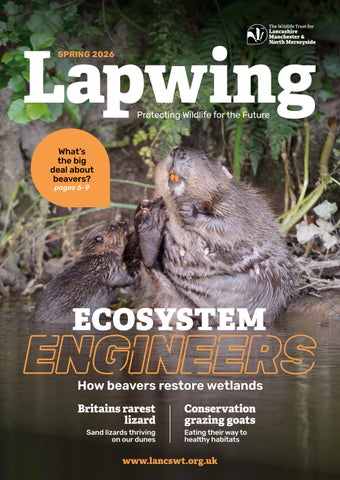
Lapwing Magazine | Spring 2026

Page 1


Spreading the news

I have to admit that the winter issue of Lapwing blew me away, and we have received a lot of comments about its ‘new look’.

Our aim in Lapwing is to inform, educate and excite you about the wildlife of Lancashire, Manchester and North Merseyside. At the same time, we want to tell you about opportunities where you can get involved by volunteering, helping with fundraising and appeals, or by visiting our reserves.

Hopefully you will want to share your copy with family and friends. You, our members, are key in telling people about the wonderful wildlife around us and how we can all help to protect it.

So, its hats off to Jenny, our editor, and Matt Owen, who designs the mag. Matt is also a huge wildlife enthusiast, he loves to help us tell our stories by creating a look as enticing as the words. Everyone else who contributes to Lapwing proves their passion with tales from all over the region.

To add to this excitement, we have recently launched our Conservation Chronicles podcast, where you can dive in depth into the work we do. I was chuffed to feature in the first episode, and we will be adding even more episodes to our YouTube channel during spring and summer.

This issue also includes an update on sand lizards on the Fylde Sand Dunes. I really love the success of these amazing creatures, not least because I was there for the initial release, just after I started at the Trust.

We are also looking at bluebells, sand martins, cotton grass and many other signs that spring is well and truly here.

106

Male sand lizard © Jack Horton

6-9

Get in touch

We’d love to hear from you, whether sharing your thoughts on the magazine or your adventures in nature.

@Lancashirewildlifetrust

@Lancashirewildlifetrust lancswt.org.uk

info@lancswt.org.uk 01772 324129

The Barn, Berkeley Drive, Bamber Bridge, Preston, PR5 6BY

Editor: Jenny Bennion

Sub Editors: Alan Wright, Lydia German, Amy Shakeshaft

Contact the editorial team: jbennion@lancswt.org.uk

Design: nectarcreative.com

Registered charity no. 229325

Registered company no. 731548

You can change the way we contact you, or update your details by speaking to our membership team: E: membership@lancswt.org.uk T: (01772) 324129

On the cover Beaver mother and kit © Nick Upton

Wild but true... Beavers can swim at speeds of up to five miles per hour. That is more than double the speed of the average human!

Beaver © Nick Upton, Cornwall Wildlife Trust

senses Spring will tickle all your

Spring may be coming earlier every year, but what are your favourite sentinels of the warmer seasons?

While daffodils and fritillaries are brightening up my garden, I am always on the lookout for some darker greens in my local woodland. These are the green shoots of wild garlic.

Wild garlic has shiny leaves, which give that lovely whiff when you break them. Their garlicky aroma fills woodlands in spring, and the plants are topped with balls of white flowers. The path from Belmont into Longworth Clough is a garden of wild garlic, capturing every one of your senses, so be careful to concentrate on those steep steps.

Tip: Breathe in as you wander through your local woodland and enjoy the scent of spring

White fluffy flowers are also part of the spring and early summer scenery on our peatlands. Astley Moss becomes a sea of cotton wool, with the wind making waves along the surface of hare’s tail cotton grass. You will also find common cotton grass, which is Manchester’s county flower.

Cotton grass is a wonderful food plant for the caterpillars of our rare Manchester argus (also known as large heath) butterflies, so it won’t be long before they are flying in the sunshine.

Tip: Run your hand over a cottongrass plant and feel the softness on your palm

Wild garlic in Wigan © Julia Dixon
Cotton grass at Astley Moss © A.J.Critch Wildlife

Early orchids at Heysham Nature Reserve

Brown hares boxing on meadows around Little Woolden Moss

Great crested grebes in dances of love at Wigan Flashes

When I am at Brockholes in spring, I am on the lookout for sand martins, flying low above Meadow Lake. Many of these tiny visitors nest in riverbanks, but others have taken advantage of the tenement accommodation built by the side of two of the lakes.

Having returned from wintering in Africa, sand martins certainly add some motion to the already busy waters on our amazing nature reserve, even if their brown and white coats are regarded as boring among their cousins; swifts, swallows and house martins.

Tip: Count how long a sand martin stays in its nesting hole, it may be feeding young

Tells us about your spring sightings for a chance to be featured in our monthly sightings blog on our website or the summer edition of Lapwing

Nature’s greatest orchestra, robins, wrens, blackbirds, thrushes and tits will be warming up for some oomph as they defend territories and look for love in the dawn chorus.

If you wander along a reed bed (or inside one, on the boardwalk at Brockholes), reed warblers and reed buntings are a wonderfully noisy addition, but it is hard to beat the beautiful piping swirl of the blackbird singing from the top of a tree or telegraph pole.

Tip: Open your bedroom window and you will have a natural alarm clock as the dawn bursts into life on sunny days.

Reed warbler and young at Lunt Meadows © Peter Smith
Blackbird at Brockholes © Tracy Robinson
Sand martins at Brockholes © Chris Mc
Boxing brown hares © Russell Savory

B Working the night shift

Ecosystem engineers. Wetland makers. Landscape shapers. Beavers are back in the UK, and whilst many of us clock off, they are hard at work restoring wetlands.

Restoring beavers to restore wetlands

eavers are known as ecosystem engineers for a reason. When a watercourse doesn’t meet their needs, they change it, creating wetlands by damming flows, building lodges, and coppicing trees. Many of the rivers, tributaries and streams that we see in the UK are the result of hundreds of years of human intervention. Re-routing river channels, clearing vegetation from banks, and many other activities have tamed our waterways to provide land for agriculture and development, or power for past industries. Often, this has come at a huge cost for both nature and people.

A beaver-made wetland has a complexity now largely missing. Damming forms slow-moving or still water which is able to connect to the flood-plain, with channels linking wetlands, used by other species, including our fastest-declining mammal, the water vole.

Trees and vegetation are diversified in height and form. Taller trees cast shade for fish, whilst beaver-coppiced trees allow light to filter in, increasing plant diversity and benefiting wildlife.

Felled and standing deadwood add to this diverse range of features, providing a messiness often missing in habitats which suits a host of unseen life and special species, such as our fastestdeclining resident bird, the willow tit. Beavers can also bring amazing benefits to our communities through natural flood mitigation and water filtration. Beaver habitats can slow the flow of water running through them, reducing downstream flooding. Silt and debris naturally build up in areas of slow or still water, which research has shown can help filter the water, improving its quality for both people and wildlife.

In fact, much of our nature restoration work, such as installing woody dams and enhancing wet woodland habitats, is essentially mimicking (at significant cost and often not as effectively) the work of beavers.

Dr Matt McMullen
Beaver © Nick Upton, Cornwall Wildlife Trust
Beavers can also bring amazing benefits to our communities through natural flood mitigation and water filtration. Beaver habitats can slow the flow of water running through them, reducing downstream flooding

FOUR FACTS ABOUT

Beavers

The Eurasian beaver is native to the UK and was common until the 16th century when they were hunted into extinction.

Beavers can weigh up to 30kg and measure over 1m from head to tail.

Beavers don't eat fish, they are herbivores with a diet which includes a wide range of plant species.

Beavers are crepuscular, meaning they are active from dawn to dusk

What about beavers and Lancashire, Manchester and North Merseyside?

Beavers could provide a significant ecological benefit to numerous river catchment and wetland landscapes within our region, supporting many of the species we strive to recover.

Restoration of beavers on our patch would depend on landowner and stakeholder engagement, feasibility studies and planning for their long-term monitoring and management.

If you are a landowner and interested in finding out more about beavers, please contact our team on info@lancswt.org.uk

Beaver © Russell Savory
Beaver grooming © Elliot McCandless, Beaver Trust

Beaver success stories

For over 20 years beavers have been slowly making the UK home again, but up until February 2025 reintroductions in England had to be into enclosures. Initial releases into enclosures allowed the Government, conservation organisations, landowners and other stakeholders to monitor the effect that beavers had on the landscape, allowing valuable data on their impacts to be collected, building a better understanding of their role in the British landscape.

Since then, wild beaver restoration is now possible under licence from Natural England, allowing the species to live freely once again and their restorative activity shared.

With beavers now permitted to live wild, there is huge potential for the advantages demonstrated at Cheshire to be experienced more widely.

Case study: Hatchmere beaversCheshire Wildlife Trust

In 2020 Cheshire Wildlife Trust released a pair of Eurasian beavers, called Rowan and Willow, into a 10-acre enclosure which bordered Hatchmere Nature Reserve on the edge of Delamere Forest. What was once largely grassland and woodland has now been transformed into a thriving wetland, criss-crossed with beaver- built canals and dams.

The beaver’s enclosure is sited on one of the main water inflows into Hatchmere Nature Reserve, and the nutrient- enriched water that was flowing into the reserve from the surrounding catchment was damaging the sensitive habitats within the reserve. However, now that the beavers have got to work, the water flowing into the reserve has slowed down and is being naturally filtered.

By 2022 Rowan and Willow had become parents, with the family making the enclosure theirs – creating a wetland home that is also improving the wider environment.

Alice Buller, Living Landscape Officer who leads the Delamere Beaver Project said: "Now that our licence has been extended for another five years, the beavers can continue to play a vital role in improving water quality in Hatchmere Site of Special Scientific Interest, while further data collection and analysis will strengthen our understanding of their long-term impacts. This next phase will also allow the enclosure to stabilise, following the initial five years of significant change and adjustment."

With beavers now permitted to live wild, there is huge potential for the advantages demonstrated at Cheshire to be experienced more widely.

Scan the QR code to watch the beavers at work on the Cheshire Wildlife Trust YouTube channel

Alice Butler
Beaver footprints at Hatchmere © Megan Kelsall

Case study: River Otter beavers - Devon Wildlife Trust

Devon Wildlife Trust perhaps have some of the most significant experience of working with beavers of any Wildlife Trust. A wild population had been living on the River Otter in Devon since around 2008. No-one was really sure where they first came from, but by 2014 there was evidence of them breeding.

The Government at the time proposed catching and removing the beavers, but Devon Wildlife Trust and their partners successfully campaigned for them to be allowed to stay and their effects on an agricultural landscape to be monitored over a five year period. The River Otter Beaver Trial was born, with an additional five beavers introduced between 2016 and 2019 to improve the populations’ genetic stability.

Between 2015 and 2020 numerous positive impacts of beavers going about their natural behaviour were observed on the River Otter and its tributaries. As these water courses, which had been shaped by hundreds of years of human intervention, began to slowly re-naturalise, dynamism was returned to parts of the river.

Kingfishers stalk newly created pools colonised by salmon and trout, and the gravel beds that are created after dams have been washed out become the perfect place for fish to spawn. A sequence of beaver dams constructed upstream of a village which had properties at risk of flooding has seen a reduction in peak water flows.

August 2020 saw the end of the trial and the Government announced that the beavers could stay and continue to naturally spread throughout Devon’s rivers. There are now wild beavers in the catchments of the River’s Tamar, Taw and Exe too.

Watch a short film about the River Otter Beaver Trial by scanning the QR code

Supported by a charitable donation from the Ecological Restoration Foundation

Butler undertaking a beaver tour
Hatchmere beaver enclosure © Megan Kelsall
Hatchmere beaver enclosure © Karl Horne
Beaver being released © Elliot McCandless, Beaver Trust

How an innovative sponge meadow in Manchester is helping to protect a much-loved park from regular flooding

You know what they say: when it rains, it pours.

In the case of Chorlton Park in Manchester, when it pours, it floods!

Until recently, heavy showers would leave footpaths to the local primary school and playground underwater, forcing children and families to walk along busy, traffic-heavy streets instead of through the park.

This flooding has been occurring for years, with one resident saying they had been witnessing it for over 30 years. Worryingly, it was starting to become more frequent and more of a nuisance, as the UK’s changing climate shifts towards longer, wetter winters.

The local community group, Friends of Chorlton Park, realised that not only did this present logistical and safety issues for families, but it was also causing a loss of connection between residents and this important urban green space.

The answer? To create a sponge meadow: a seasonally adaptable habitat that works with nature, not against it, to collect excess water and help it gradually soak into the ground.

The group used money from Greater Manchester’s Green Spaces Fund to re-landscape part of the field in 2025, digging out a 50-metre shallow basin that can hold lots of rainwater.

The Green Spaces Fund, launched by the Mayor of Greater Manchester, Andy Burnham, and distributed by the Greater Manchester Environment Trust, helps community groups increase the amount of accessible, nature-rich green space where people need it most. Since its launch in 2022, the fund has invested £3.5 million into 122 projects across the city region, including orchards, green alleyways, allotments and community gardens.

“These plants and flowers are not only lovely for us to look at, but will also help bees, butterflies, and other pollinators and wildlife to thrive in our park.”

The soil excavated from the basin was used to form a series of mounds around the edges, where native trees, shrubs and wildflowers have been carefully planted. About 150 people, including school children, came together to get involved with the planting. They sowed a variety of seeds, including tufted vetch, common knapweed and yellow rattle. This sponge meadow is a great example of a Sustainable Drainage System, also known as SuDS, which are a natural approach to managing rainwater drainage in urban areas.

So, does it actually work?

It’s early days for the sponge meadow, having only seen one winter, but the signs are looking good so far. Despite heavy rain in December 2025, the footpaths have not flooded since work was completed.

Previously, the park has flooded at least once a year, but this time the basin filled up, with significant capacity remaining, and the paths remained dry.

SuDS help to slow the flow of urban runoff from extensive rainfall, helping to reduce flood risk. Rather than water in the park spilling out over pathways, it’s now being held in the central green patch and slowly being absorbed back into the ground.

Kieron McGlasson, Sow the City

you might see at the sponge meadow
Ragged
A new SuDS in the city
© Dylan Fisher
Community seed sowing, March 2025
© Friends of Chorlton Park
Wickett, Friends of Chorlton Park

A remarkable return

Last year we cared for orphaned red squirrel Houdini. Here’s how one determined little kit found his way back to the treetops.

Meet Houdini

Species: Red squirrel (Sciurus vulgaris)

Gender: Male

Release date: 19 September 2025

Favourite food: Hazelnuts

Personality: Alert, energetic, curious

Want to help your local wildlife? Support the Red Squirrel Survival Fund today

Houdini’s story began in Formby, where the red squirrel kit was found alone and vulnerable in a garden. The kind homeowner contacted Formby Village Vets, who liaised with our Red Squirrel Officers Molly and Melissa to ensure the youngster received specialised care.

With his eyes still shut and a long, straight tail, Houdini was estimated to be just three weeks old: too young to survive alone.

Many kits before him found comfort in the warmth of a cat carrier and being syringe-fed kitten milk every three hours to prevent bloating.

Houdini, however, had other plans. Houdini treated the cat carrier as his personal climbing frame. With remarkable determination for one so small, he scaled the bars and wriggled his way out. Each successful escape ended with a triumphant nap directly beside the carrier, as though he was rewarding himself for his mischief.

His boldness, curiosity, and refusal to be contained earned him his name early on. Even at just a few weeks old, Houdini was testing boundaries and demonstrating strong wild instincts which would serve him well later.

Why it matters

Red squirrels face pressure from habitat loss, grey squirrel competition, and the spread of squirrel pox – a virus carried without symptom by grey squirrels, but fatal to reds. Every rehabilitation, managed habitat, or population monitored helps support healthier woodland ecosystems.

Houdini goes viral

As Houdini grew, his diet expanded to calcium enriched nuts and seeds, alongside fresh fruit and green pinecones. Plenty of sticks helped keep his teeth healthy, and a move to a larger dog crate filled with branches developed his agility and coordination.

By this stage, Houdini was confidently racing around the living room and climbing up Melissa’s back, returning to his crate only when hunger struck. He was quick to make his feelings known, vocally announcing when he required milk or wasn’t quite ready to wake up.

After 10 weeks of progress, Houdini was ready for his next steps in Formby’s soft-release pen. This outdoor enclosure offers higher branches for climbing and gentle exposure to wind and rain for a sheltered introduction to natural conditions.

Houdini adapted quickly and became cautious around Red Squirrel Officers and volunteers during food and water checks, which is a necessity for a wild squirrel.

A short video of the determined Houdini quickly caught attention on social media. Over 120,000 people followed his progress, leaving encouraging comments and asking important questions. His story is a powerful reminder of the support behind red squirrel conservation, and how these stories can help people reconnect with nature.

Houdini, three weeks old © A.J.Critch Wildlife

Houdini in the soft release pen © A.J.Critch Wildlife

Hand rearing red squirrel kits should always be a last resort, and the ultimate goal is to create healthy habitats where red squirrels can thrive without human interaction.

When it was clear Houdini was ready, the soft-release pen door opened. With one final leap, he disappeared into the treetops.

Saying goodbye is always bittersweet, but the goal is never to raise tame animals. Houdini was ready to thrive back where he belonged.

The Red Squirrel Recovery Network is made possible by the National Lottery Heritage Fund, with thanks to National Lottery players.

Mission goat-possible

Meet the newest four-legged recruits to our conservation team, working to create healthy habitats

A herd of 17 rare breed Cheviot goats has joined our conservation grazing team. These hardy native animals have come from a feral herd that roams the Cheviot Hills in Northumberland. Every year a census of the wild population is taken and if necessary a few animals are removed to help manage numbers and ensure a healthy gene pool. The goats arrived in November 2025 and are already busy at work eating gorse and other vegetation that could become dominant and risk outcompeting a whole range of other native plants and wildflowers.

How does livestock help to manage land for nature?

Hard at work on a number of our nature reserves there is a band of four-legged lawnmowers, quietly at work creating a range of healthy natural habitats. Cattle, sheep, ponies and goats are all part of our conservation grazing project.

Whilst to the animals it may seem that they are just living a wonderful natural lifestyle, eating a wide range of delicious natural food, we know that they are, in fact, doing an amazing job helping to create healthy habitats.

In a truly natural landscape, a range of wild herbivores would graze on vegetation that could otherwise take over. Many of these herbivores such as aurochs, ancestors of our domestic cattle, have now been lost from our landscapes, and that is where our conservation grazing livestock come in.

Cattle, sheep, goats and ponies all graze very differently – but the goats’ habit of eating a broad range of vegetation, and especially tackling areas of gorse and scrub birch, is ideal for numerous of our nature reserves where these species could become dominant.

In fact, the goats can tackle a thicket of gorse much more efficiently than even the bravest band of volunteers, creating the opportunity for a range of other plants and the wildlife they support to flourish.

In 2017 only 150 Cheviot goats remained in the wild

Cheviot goat kid © Lucy O'Reilly
The new Cheviot goats © Lucy O'Reilly

How you can help

Do not feed livestock – this could lead to serious digestive issues and unwanted behavioural change.

Always keep dogs on short leads around livestock. Keep calm and quiet around animals, give them the peace and space they need to be themselves.

Helping ensure the survival of this rare breed

Cheviot goats are one of the oldest remaining examples of the British primitive goat. Legend has it that the herd stems from goats owned by the monks of Lindisfarne Island. When the monks abandoned the island in 875, they herded the goats with them onto the mainland, finally abandoning them in the Cheviot Hills due to their capricious nature.

Although it is also possible that the ancestors of today's goats escaped from farms back in Neolithic times, approximately 7,000 years ago – around the same time the wheel was being invented.

There are records of Cheviot goats in the Northumberland hills at least as far back as 1860, so ensuring the continuation of this rare and important breed is extremely important. By providing the herd a home with us and allowing them to breed we are playing our part in supporting their future.

Rare Breeds Survival Trust (RBST) Chief Executive Christopher Price said:

“The Cheviot goat was added to the RBST Watchlist, which shows which of the UK’s native livestock and equine breeds are most endangered, in 2024.

“The goats of the Cheviot Hills have a fantastic, unique history. As well as their cultural significance, Cheviot goats are extremely important genetically, providing a crucial link to the UK’s original primitive goats from the Bronze and Iron Ages.

“Cheviot goats are excellent for conservation grazing that supports biodiversity and soil health. Using their skills in this way and expanding their geographic concentration are important parts of the effort to bring these irreplaceable goats back to a secure position and a thriving future.”

3 FACTS ABOUT

Cheviot goats

1 2

Cheviot goats are a small, stocky breed, much smaller than many modern domesticated goats.

The male's horns can grow up to 0.5m long.

3

The goats vary in colour with white, grey, black or brown shaggy coats, with high levels of cashmere that keep them warm outside all year long.

Cheviot goats, Jan 2026
© Lucy O'Reilly

Rare treasures

in the sand

Female sand lizards are a sandy-brown colour, with rows of dark blotches along the back; males have green flanks that are at their brightest during the breeding season, making them easier to spot.

Sand lizards are the UK’s rarest lizard, but they are back and flourishing on the Fylde Sand Dunes.

You will have heard about our Fylde Sand Dunes project and how we are using recycled Christmas trees to create more of this wonderful habitat that has been lost to erosion over the past century.

Yet how many people know that the UK’s rarest lizard is benefitting from all the work being done by Fylde and Blackpool Councils, Lancashire Wildlife Trust, the Amphibian and Reptile Trust, and hundreds of volunteers?

There are unconfirmed reports that sand lizards were present on the dunes in the 1960s but they could have been confused with common lizards, who also do well in the sandy habitat. Sand lizards are pickier about where they live, and any reintroduction would need more diverse habitats, such as a good mix of open sandy areas for basking and laying eggs, and vegetated areas for foraging habitat.

The frontal dunes are dynamic, moving sand around, forming sandy ridges and promoting marram grass growth, which is enhanced by the annual Christmas tree planting and chestnut palling (fencing) catching sand and forming wider dunes.

Adult male sand lizard on the Fylde Sand Dunes © Andrew Hampson

We also create open sandy areas on vegetated south-facing slopes on the landward side of the dunes to try and encourage the reptiles into that area.

The Fylde population is England’s most northernly population of sand lizards.

We realised we could create a new population and expand the range of sand lizards, so between 2018 and 2021 a total of 412 sand lizards were released. They were bred in vivariums by ARC Trust volunteers Paul Hudson and Ray Lynch having been licenced by Natural England.

Surveying started in 2021 with Ray and myself leading the surveys, but we have also been supported by other licenced surveyors from Lancaster University and other members of the team.

Interestingly the sand lizards have moved away from their original release sites and are now closer to the frontal dunes (further west). We also had one female who managed to cross Clifton Drive and breed on the Local Nature Reserve.

Last year we had a record 106 sightings and found two sloughs (discarded lizard skins) which are very hard to come by. This was our best year yet for records, which could be down to a warm sunny year, a better understanding of where the lizards are, and their numbers increasing. We are also seeing more and more juveniles which is a good sign that the population is on the up.

Releasing sand lizards on the dunes

© Alan Wright

Sand lizards are pickier about where they live, and any reintroduction would need more diverse habitats, such as a good mix of open sandy areas for basking and laying eggs, and vegetated areas for foraging habitat.

Sand lizard on the Fylde Sand Dunes
© Andy Singleton-Mills
Recycled Christmas tree are 'planted' in the sand to create more dune habitat
© A.J.Critch Wildlife
Fylde Sand Dunes © Lancashire Wildlife Trust

barriers down the

The Greenhouse Project in Blackburn aims to improve health and wellbeing by connecting people to the nature around them.

AMen’s Monthly Walking Group is introducing members of the asylum and refugee community to nature on their doorstep.

Andy Mather, Community Engagement Officer at The Greenhouse Project, is a man on a mission: to bring the healing power of nature to everyone in Blackburn and Darwen - and beyond. The new walking group is aimed at providing safe and welcoming opportunities for men from the local asylum and refugee community to experience Lancashire’s wild, green and open spaces.

The Men’s Monthly Walking Group is funded by the ARC (Asylum and Refugee Community) in Blackburn. ARC supports people seeking asylum and refugees with the tools, resources, and opportunities they need to integrate into life in Blackburn with Darwen, helping them feel part of the community and find a sense of belonging. The walks are also supported by two local mental health charities: TALK OURSLEVES WELL and Offload Northwest.

I was privileged to be invited to attend the most recent walk, meeting everyone and finding out how important these sessions are.

Men's Walking Group © Laura Hacking Vile

Some of the group members didn’t have clothes and footwear suitable to go walking, especially in the wind and rain that the Great British weather treats us to. Andy had arranged for boots to be donated so the walk was possible. I’m in awe of how our Nature and Wellbeing Community Engagement Officers really do go above and beyond to care for the people attending any of our wellbeing sessions.

Thirteen men from six different countries; Afghanistan, Cameroon, England, Eritrea, Guinea-Conakry, Kuwait and Spain came together with the common goal of walking together to have fun, learn about the local landscape and environment, and most importantly to improve their wellbeing.

The language barrier didn’t matter, as they bantered about steak pies, Wigan kebabs and likening Darwen Tower to a beacon in The Lord of the Rings. It didn’t matter about anybody’s story before that day, although everybody was very open to sharing, the day was about where they were going together.

“Nature is

Walking above Calf Hey Resevoir © Laura Hacking Vile

The group learning about the local history © Laura Hacking Vile

“It’s amazing seeing the world. I’m grateful Andy’s put us there. The path to healing starts with embracing recovery.”
Sid, Founder of Offload Northwest

Whilst the walks aim to improve the men’s wellbeing, it’s also about introducing migrants and locals to the beautiful green spaces around the borough and having future access to their cultural and natural heritage. Each month a new location is visited so that the group members can begin to build a knowledge of the area together, and all the walks are easily accessible, meaning that they can return whenever they like, building their connection to the amazing landscape.

The impact of the growing walking men’s community is inspirational and I’m grateful that I’ve had the opportunity to have an insight into what this means for those attending.

of the upmost importance for mental health and

wellbeing. It has the power

to take or give life. In a world of madness, nature provides the antidote, it enriches the mind, body, soul and spirit. Nature is the creator.”

Si Donnelly, TALK OURSELVES WELL
“Nature

is a form of escape for me. Finding time to have a chat with no judgement and warmth goes a long way. Thoroughly enjoyed the session. Thank you.”

Sahjeeb Rehman, Offload Northwest
Snacks at the top © Laura Hacking Vile

We’ve been working with our local bat group to monitor bat populations throughout the work to ensure our hibernating bats haven’t been disturbed.

This mixture of woodland, lakes, meadow and heathland is an oasis for people and wildlife.

Star Species

Visit Mere Sands Wood Holmeswood Road, Rufford, L40 1TG

Car park open 24hrs a day, £4 parking charge

Visitor centre and cafe open Wednesday - Sunday, 10am – 4pm. Toilets available in the Field Studies Centre next to the car park, Mondays and Tuesdays, 10am – 3pm

Dogs on leads are welcome, poo bin available in the car park

Clouded yellow butterfly

Tawny owl

Danny spotted a tawny owl one evening perched on the bridge by the Visitors Centre as he left work and darkness was falling.

Last year we were treated to a kaleidoscope of these stunning insects in our heathland so it will be interesting to see if they make a return this year.

Clouded yellow butterfly © Vicky Nall
Tawny Owl © Jon Hawkins - Surrey Hills Photography
Mere Sands Wood © Sean Higson

Improvements at Mere Sands Wood

Paths

We love welcoming people to explore the paths around Mere Sands Wood, but as regular visitors will know, many of them were becoming muddy and difficult to pass especially for prams and wheelchair users. We have been working hard to upgrade:

• A desire line into a proper path through the pine woodland.

• The meadow path – the perfect place to spot butterflies and orchids – making it wider, firmer and more accessible to all.

• The path along the southern boundary, making it more accessible and reducing winter waterlogging.

Bittern

Our trail camera recently spotted one on an island which we have been clearing of scrub. This has given chance for the reedbeds to flourish, and by leaving the cleared brash partially submerged, has provided the perfect habitat for the bittern to fish in.

Woodland management

In the process of the path improvement works we have felled some of the plantation Scots pine trees. These trees were due to be felled as part of our ongoing woodland management. They were all the same age and so needed to be thinned to allow light to penetrate the woodland floor, allowing native understorey plant species to flourish and the next generations of trees to grow.

Fencing

The fencing around our meadows has been replaced, and a livestock handling pen built. This ensures that our conservation grazing Hebridean sheep are safe and allows us to manage them more easily. This is especially important when it comes to shearing and treating any issues.

Becky’s favourite spot

“I’d have to choose our pine woodland as my favourite spot. It sets all my senses off, being able to smell the pine, see the trees sway side to side in the breeze, and listen to the rustling sound of birds flittering beneath the undergrowth. I particularly enjoy seeing the light shine through the pine trees, especially around sunset. This light is also an encouraging sign as it shows our woodland management is working.”

Danny’s favourite spot

Fungi

Come autumn, Mere Sands Wood is a fungi haven, look out for collared earth stars speckling the woodland floor.

“I can't choose between Fletcher Hide and End Lake Platform! End Lake Platform is particularly peaceful on a sunny evening, watching ducks dabbling and fish swimming in the calm clear water. Fletcher Hide overlooks the lake and surrounding woodland, and in spring when the birds are in full song, it becomes an amphitheatre of natural sounds. This is also the best place to spot a kingfisher; I've watched one here several times happily fishing from the depth gauge in full view of the hide. Perfect.”

End Lake Platform © Danny Myers
New livestock handling pen © Becky Rimmer
Bittern © David Tipling 2020VISION.

How The Wildlife Trust for Lancashire, Manchester and North Merseyside and the National Trust are working together to restore areas of peatland around historic Dunham Massey.

If you have ever visited Dunham Massey, you will probably have walked around the gardens, visited the deer park and looked around Dunham House, not really considering that there’s anything interesting past those areas.

The National Trust site is however much larger than you would think, including pockets of woodland and farms, and it's bisected by the Trans-Pennine Trail.

In 2025, the National Trust, through the Government’s Peatland Grant Scheme, were starting to look at restoring some of the peat on their land, in two woodlands neighbouring the farms.

This was a new area of work for the Dunham team though, so Natural England who administer the fund, put them in touch with our experienced peat team, beginning an exciting collaboration between the organisations.

Seamon’s Moss Wood and Black Moss Covert are two little patches of woodland to the North East of the main Dunham Massey site that have grown on top of lowland peatland (mossland) that had become degraded.

It's a small area but with a lot of potential for wildlife as well as the additional benefits that restored and re-wet peat provides – storing carbon.

“The Wildlife Trust for Lancashire, Manchester and North Merseyside and the National Trust are passionate about restoring and protecting our peat soils. The Dunham Massey project has been a great collaboration, allowing us to support and deliver an exciting restoration project on the Dunham Massey estate for the first time. We hope that this will be the start of a long-term relationship that will lead to bigger and more exciting peat projects.”

7 species

that will love the new wet woodland habitat

The project began with creating deep-trench bunding – a waterproof barrier of compressed peat that acts both above and below ground to keep water in the area that’s being re-wet.

Alongside the bunding, some of the trees in the woodland were felled. Management of trees is vitally important for a project like this, helping to bring light through to the understorey plants, improving the habitat for a range of wildlife, but also stopping tree roots from absorbing too much water from the peat. Although it currently looks like a muddy, messy bunch of strange lines criss-crossing the woodland, in just a short time the area will be covered with vegetation, and hopefully we’ll see plants that have been lying dormant in the seed bank start coming back to life with the additional water and daylight that the work has brought back to the woodlands. This partnership has been a great start, and we can’t wait to see what the two organisations can do together in the future.

How bunds are created

Bugs, bugs, bugs!

Soldier beetles are just one of the thousands of invertebrates that will love the new damp conditions.

Willow tit
Marsh marigold
Common toad
Meadowsweet
Redcurrant
Great spotted woodpecker
Water retaining bund at Seamon's Moss Wood © Beth Brown
Species photos by Adam Jones, Richard Burkmar, John Hawkins, Lizzie Wilberforce, Szabolcs Molnar and Tom Marshall

perfect Picture

Now that spring is here, our photo competition entrants have been out and about across our nature reserves to capture our local wildlife in all its glory.

Spoonbills were extinct in the UK for over 300 years, until a breeding colony established in Norfolk in 2010

Tranquil spoonbill © Robert Jess

Our photography competition gives you the chance to show us your photography skills and share the incredible nature moments you experience when exploring the region. Take a look below at some of our winners from the past few months and their stunning snapshots of nature at its finest.

September

Our winner for September was Robert Jess with this beautiful spoonbill.

The way he captured the ripple of the water, highlighting the merest movement, contrasts beautifully with the perfectly still spoonbill with its white plumage and distinctive beak. Voters loved this photograph, with one exclaiming that: “the calm and stillness of this image is incredible.” Another voter added that it is: “A truly exquisite spoonbill, what a fantastic shot.”

October

“I just love red squirrels and had gone to Freshfield Dune Heath hoping to see them. I had been there for a couple of hours with no luck, when I heard a scrabbling in the tree next to me. I looked up and this cutest little squirrel was looking down at me! I managed about half a dozen photos before he scampered up and away. To say he made my day is a huge understatement.”

Pat Aitchison

November

Taken at Brockholes Nature Reserve, this beautiful roe deer strolling amongst the ancient woodland was the winner of November’s photography competition.

The composition of this image was wonderful, focussing our attention on the star of the shot. One voter agreed that this photograph is “beautiful”, whilst another said that they “love this shot of the deer foraging in the autumn woodland.”

December

"My lovely robin photo was taken at Mere Sands Wood in December. I’d bought myself my first professional camera and was out on my first outing when I caught the gorgeous robin following me from branch to branch. I managed to get a lovely photo of it and later that night I saw the cut off was approaching at midnight for the photo competition, so I entered it. Never for a minute did I think it would win, but I was delighted and it put a spring in my step. I will keep visiting all the Lancashire Wildlife Trust spots and snapping more wildlife shots - I have fallen in love with my new hobby!"

If these incredible images have inspired you to get out in the natural world and capture some wildlife shots, why not enter our competition?

Take a look at this month’s theme and find out how to enter at

Hello, down there! © Pat Aitchison
Robin © Ashleigh Tuddenham
Kid in the forest © Martyn Goodwin

Carpets of spring ringing in bluebells

At the edge of the West Pennine Moors we have to wait a little longer than those of you closer to town for our bluebells to appear every year, but when they do…

Good grief, what a show!

This phenological lag means you can visit places like Brockholes in March to see bluebells blooming in Boilton Wood, but then wander uphill around the West Pennine Moors in April and the woods are still full of this wonderful flower.

So, bluebell season lasts longer if you are willing to travel as spring flows gently into summer, like the Goit stream in Brinscall Woods near Chorley, which will be lined with bluebells into late March.

I know, living in Lancashire, that this is one of the county’s most popular flowers – it is the unmistakeable sign of spring but it is also a plant of great beauty with its long, drooping leaf fronds and flower stems bowing with the weight of the blue and purple bell-shaped flowers.

Inside those flowers, turning up around their edges as spring heads into summer, are white stamen. Look inside a bluebell to see how the white stands out beautifully against the blue.

These sweet-smelling flowers attract insects in spring, including early butterflies like the brimstone, orange-tip and pearl-bordered fritillary. Watching orange-tips on bluebells is a particular spring delight.

I can honestly say that seeing a carpet of bluebells in the dappled sunlight, through branches of trees still waiting for their first leaves of summer, is one of the most dreamy sights of spring. It’s like peeking into a kingdom of dancing fairies warmed by that early sunshine.

places to see bluebells

1 Aughton Woods, near Carnforth

2 Boilton Wood, Brockholes Nature Reserve, Preston

3 Borsdane Wood, Hindley

4 Seven Acres Country Park, Bolton

5 Mere Sands Wood, Rufford

6 Clinkham and Red Brow Wood, St Helens

British or Spanish bluebells?

You can spot our native bluebell, the common bluebell, as it bows to you when you wander past it on your woodland walk. Its reverence is so different to the invasive Spanish bluebell that has escaped from many gardens. The native plant has flowers favouring one side, causing that leaning pose, while flowers grow all around the Spanish invader, allowing it to stand, proudly, upright.

My friend and Lancashire Wildlife Trust Wigan Projects Manager, Mark Champion, is concerned:

The UK is home to half the world’s population of common bluebells with the majority of the rest residing in northern France and Belgium. Native bluebells are protected by the Wildlife and Countryside Act and it is illegal to dig them up.

“While native bluebells grow in woodlands, these Spanish bluebells are more likely to grow out in the open. However, bees are attracted to both plants and this leads to hybridisation so it is affecting the native bluebell population. It is a big problem.

“Spanish bluebells and the hybrids tend to be thicker and stand up straight while native bluebells have the lovely curve at the top where the flowers are too heavy for the stem. I had hybrids in my garden but I dug them up.”

Native bluebells © Jonathan Fry
Spanish bluebells © Richard Burkmar
Bluebells in Aughton Woods © John Lamb

Choosing the Wild Life

Can flourishing nature and economic growth really sit hand in hand?

It’s no surprise to anyone that knows me, that of all of Lancashire’s special places, I love Morecambe Bay the most. It is the third most important place for overwintering waterfowl and wading birds in the country, but the most important place for me personally, as it's where I go to when I need the kind of healing that only nature can provide.

Overlooking Half Moon Bay in Heysham is a sculpture called Ship by Anna Gillespie, brought to the area by the Morecambe Bay Partnership. A figure sits at each prow: one faces the port and the nuclear power station; the other faces out across the Bay to the Lakeland fells.

The sculpture reminds me somehow of a worrying narrative that the current government seems to be trying to establish - that we as humans are faced with a binary choice between nature and economic growth.

Theirs is an alarming rhetoric that blames the housing shortage on protected areas for rare spiders and newts; HS2 overspend on bats; and fish (discos) for the failure to build new nuclear reactors. From the 2025 Planning and Infrastructure Act to the flawed Fingleton (Nuclear Regulatory) Review, this way of thinking quickly leads to the abolition of the very protections that our natural world has relied on since just after the Second World War.

Ship by Anna Gillespie © Robin Zahler

But look just beyond the Half Moon Bay Ship and you might see something else: a huge colony of knot and dunlin roosting on the harbour wall. You might see our Heysham Nature Reserve. And over on the other side of the Bay the draw of the Lakeland fells, farms and waters underpins a thriving £3billion tourist economy.

The binary choice between nature and economy is a false one. The two are intertwined. They support each other. Our economy is underpinned by a thriving, healthy natural world. On 20 January 2026 the UK government even released an assessment on how biodiversity loss is a threat to our national security.

Back in February I attended the Intergovernmental Science-Policy Platform on Biodiversity and Ecosystem Services (IPBES12) conference in Manchester. Around the site visits to our work at Bickershaw and the Wigan Greenheart, the talk was of the need to rewire global financial systems.

I heard of investment in nature and natural systems: supporting healthy soils and pollinator populations for food production; healthy catchments providing enough water for both drinking and industry; companies financing habitat restoration to enable supply chain resilience; energy and transport infrastructure needing nature-based solutions to protect them from flooding, erosion, and wildfire.

Nature can fix so many of our problems; and usually do it more cheaply, more equitably and with a wider range of community benefits.

Fortunately, you and I are part of something deeply special here in the Wildlife Trusts movement. Your support means that we can champion nature both here on your doorstep and through the hallways of power.

We campaign on legal and policy issues. We talk to local MPs to make sure that the government is held to account. We demonstrate how nature can be restored through sensible project design and good old fashioned hard work. We work to protect nature through the planning system. Our science informs national policy.

Our peatland restoration helps mitigate climate change and reduces wildfire risk. Our work in Leigh and Darwen is reducing flood risk. On the Fylde Sand Dunes we are reducing flood and erosion risk to nearly 1,000 homes. The list goes on...

And with you, our members, by our side we will keep working to ensure that we can all choose the Wild Life.

Volunteers don't grow on trees

This winter, more than 70 new volunteers came together to plant 7,500 trees at Brockholes Nature Reserve.

Thanks to The Tree Council’s ‘Trees Outside Woodlands’ grant, this New Year saw a whopping 7,500 young trees delivered to Brockholes.

Destined to create 1.5km of new hedgerows and multiple small woodland copses, we knew that the old adage ‘many hands make light work’ was never going to be so pertinent.

Brockholes is already blessed with around 45 regular conservation volunteers, but on top of everything else they already do on the reserve, we knew we needed to boost their numbers – and also saw an opportunity to open volunteering up to the wider community, visitors and social media followers.

Three-hour volunteering sessions on weekdays and weekends were created, and people were invited to come along for as many sessions as they fancied or could fit around their other commitments. With 76 volunteers having signed up for planting sessions in January alone, it became apparent that there is a high demand for one-off or low-commitment volunteering opportunities.

I had a great time at one of the weekday tree planting sessions, meeting both our regular and 12 new volunteers. I met people with a range of ages, skills and motivations for giving back – including volunteers making use of their employee volunteer days, students, emergency service workers, teachers and civil servants.

If you feel inspired and want to find out more about future volunteer opportunities, take a look at our website: www.lancswt.org.uk/ volunteer

Volunteer Sam, now an established member of the weekly conservation volunteer team, had found out about volunteering when she participated in the Brockholes Bimble Half Marathon and happened to see a poster.

“It was exactly what I was looking for. I love the reserve and know it well having run around it numerous times. The team at Brockholes are just brilliant. We're all like-minded people who love being outside in all weathers. I know that all the volunteers here would agree that we get so much out of it; physically, mentally and socially. Anyone interested shouldn't hesitate to apply as it's just a joy on many levels.”

Star Species

25

Following a difficult year after losing his mum, Jonathan was volunteering around his busy job but wanted to get involved as both a memorial to his mum, who loved nature, and a way of improving the environment for everyone.

“I really enjoyed just being outside. I think it is so important, and especially so at this, the darkest, coldest time of year. Fortunately, the weather behaved and it was a gloriously sunny day. I work as a teacher, so my work is all indoors and can be mentally challenging, exhausting even at times so I find physical activity quite meditative. I enjoyed the day at Brockholes so much that I’ve volunteered to help out at another session later this month and then to go and plant some sphagnum moss in a bog later in the year.”

A variety of disease-resistant elm, just perfect for our white-letter hairstreak butterflies

species of native trees have been planted at Brockholes including: Guelder rose
Hawthorn
Hazel
Hornbeam
Tree planting volunteers at Brockholes © Emma Ironfield
Spotted by our tree planting volunteers
Volunteer Zoe getting stuck in © Emma Ironfield
© Vaughn Matthews
© Chris Lawrence
Jon Hawkins - Surrey Hills Photography
© minka2507, Pixabay
© Petra, Pixabay

Financing a greener future

Green finance: What is it and why is it important?

Ijoined the Trust at the tail end of last year, having worked for several years with public sector supply chains where environmental management and carbon reduction planning is mandatory.

It’s critical to design and deliver these plans in a considered and educated way, because otherwise companies can run the risk of accusations of ‘greenwashing’ - where organisations say they are taking environmental action which isn’t validated.

Scan the QR code to watch CEO Tom’s short video summary of why it’s so important for us as a Trust to engage with businesses, and for businesses to engage with nature.

Environmentally, ethically and legislatively, it’s not OK to simply pay to offset your carbon emissions. It must be at the end of a structured process to minimise your impact, taking every action you can to stop emitting carbon, and then finally offsetting what you can’t avoid producing.

The Green Finance market is a way to offset biodiversity, nutrient, flood and carbon impact caused by business activities, including developing land. There are voluntary and mandatory markets for this.

Mandatory, or ‘compliance’ markets occur when an organisation has been told (usually through legislation) that they must invest in climate or nature-based activities.

An example of this is the Biodiversity Net Gain (BNG) requirement, where a developer will need to ensure that they increase the biodiversity value of the land which they develop by a minimum of 10 per cent.

A developer can deliver this gain by enhancing retained land within their development footprint, or by purchasing BNG units from other legally protected sites.

How can you help?

If you agree with us that green finance is important, please help us by:

Watching out for our Birch House Farm appeal and supporting our bold plans to buy and restore an important piece of land in our nature recovery strategy.

Lending us your voice in supporting campaigns to protect green finance legislation. Help us be nature’s advocate, and together we can make sure that we can safeguard land for nature, forever.

In response, some developers are ring-fencing areas of their own land for BNG and are approaching the Trust to ask us to manage the biodiversity improvement, i.e. to be the land manager over several decades. This is an excellent opportunity for us to create amazingly biodiversity rich (and importantly, legally protected) sites for the future.

Voluntary green finance is fascinating and encouraging. Organisations are choosing to make nature-based investments for diverse reasons, with an increasing drivers around business risk. Large organisations are beginning to understand their reliance on nature for business operations.

An example of this is railway operators recognising natural flood management as vital to being able to run consistent train services during the winter months (it’s predicted that winters will be 30 per cent wetter by 2070).

At the beginning of February this year an international biodiversity conference (IPBES12) was hosted in Manchester, and thousands of business representatives convened to discuss how to place nature at the heart of UK economic resilience.

The green finance market is a critical tool that will help us acquire land, legally protect it for the future, and fund us to improve that landscape for nature. Green finance can underpin our nature recovery strategy and build our financial resilience for the future.

The Trust now has a registered BNG unit site, at Cutacre, near Tyldesley in Wigan. It’s a complex process, which has involved getting the site ‘covenanted’, which means it is legally protected for nature recovery. When a developer buys a BNG unit from the Trust, we have a legal obligation to create and maintain a particular type of biodiversity improvement on that parcel of land until 2056 - although, of course, we intend to maintain created habitats into perpetuity.

Right now, we’re making green finance ‘sales’ that will not only affect our children’s future on the planet, but also the LWT land managers who will follow us.

Which leads me to our exciting plans to acquire a peatland site, Birch House Farm, which sits very close to Winmarleigh Moss SSSI and our carbon farm. We’ll transform the site into a home for wildlife and a carbon store, protecting this site for the future.

The green finance market is a critical tool that will help us acquire land, legally protect it for the future, and fund us to improve that landscape for nature.

Stepping into the UK’s first

national river walk

The UK’s first National River Walk has been launched, and we are delighted to be involved in enhancing habitats along the Mersey Valley Way.

The 21km path will run from Stockport, through Manchester and into Trafford, the first of nine riverside paths across the UK funded by the Department of the Environment, Food and Rural Affairs, and part of the Government’s manifesto pledge to create the new paths, one for each region of England.

The Mersey Rivers Trust will be the lead delivery partner on the Mersey Valley Way, working with Stockport Council, City of Trees, The Wildlife Trust for Lancashire, Manchester and North Merseyside, The Conservation Volunteers, Groundwork Greater Manchester and supported by Manchester City Council and Trafford Council.

1. Chorlton Ees, Mersey Rd, Sale M33 6HL

We will be involved in wetland creation and restoration at Chorlton Ees Nature Reserve, where we will restore a reedbed, pond and wetland scrape, and create a fish-free pond for amphibians, along with an improving the ditch network and undertaking tree safety work. This will provide habitat for species like the common toad, as well as dragonflies and bees.

We have been asked to work on four sites along the route, being chosen after our successful My Wild City project which encouraged Mancunians to create nature-friendly gardens and to explore wild areas in their neighbourhood.

2. Barlow Eye, Chorlton (next to Chorlton Water Park)

Fen, wet grassland and wet woodland restoration at Barlow Eye in Chorlton will benefit smaller birds, willow tit, grasshopper warbler and reed bunting. Song thrush will add music to the landscape. Brown hawker dragonflies, rare holly blue butterflies and bufftailed bumblebees will add a buzz to marshy grassland, sedge fen and scrub.

3. Kenworthy Woods, Fairy Lane, Manchester, M33 2JU

Kenworthy Woods in Manchester will see work to enhance its wet woodlands and ponds, increasing numbers of frogs and toads and provide a habitat for the rare willow tit, pipistrelle bats and orange-tip butterflies.

Common toad

Banded demoiselle damselfly

4. Fletcher Moss Gardens, Wilmslow Road, Didsbury, Manchester, M20 2SW

We will also manage areas of fen, pond and reedbed at Fletcher Moss Gardens in Didsbury, to improve numbers of common toad and common frog, banded demoiselle, mining bees and bumblebees. This will also lead to more tawny owls, swifts and pipistrelle bats in the area.

Buff-tailed bumblebee

“These

improvements will breathe new life into this vital wildlife corridor, helping everything from butterflies and dragonflies to the rare willow tit to thrive.”

Willow tit
New ponds have been created at Chorlton Ees
© D Barlow, Manchester City Council
Work underway at Fletcher Moss Gardens © Steve Cowell
© Adam Jones
© Richard Steel 2020VISION
© Nick Upton 2020VISION
© Mark Hamblin 2020VISION
© Nick Upton

From the to the field mic

Our new podcast, The Conservation Chronicles, is bringing our stories to life through longer-form discussion and behind the scenes insights.

We are excited to finally be able to share our new podcast with you, The Conservation Chronicles. Several episodes are now live on our YouTube channel, with more to come over the coming months.

The idea for a podcast was formed during discussions around making our communications more accessible. Not everyone learns best by reading, so we wanted to create our own longer conversations that take a deep dive into various topics.

Watch our podcast now: scan the QR code below or look us up on YouTube

It’s also an opportunity to hear directly from our staff about their passions and why they chose their career path. Some of my favourite anecdotes have come from this.

For example, in our Brockholes episode, Senior Reserve Officer Lorna shares that working in this field can be tough sometimes, whether that’s due to dealing with injured wildlife or vandalism on site.

Yet she tells us about how, after a particularly difficult day, she was cycling home and a barn owl flew so close over her head that she could feel its wings, reminding her how important it is to keep going, even on the hardest of days. That clip gives me goosebumps no matter how many times I watch it.

I’m proud to take turns hosting our 12 episodes with Jenny, my fellow Senior Communications Officer and your editor of Lapwing. We have a Meet the Hosts bonus episode where we discuss our own connection with wildlife and why we set the podcast up, so keep an eye out for that.

We’ve worked with experts at The Podcast Foundry to produce, film and edit each episode. Eagle-eyed viewers might be able to recognise the three locations we shot episodes at: The Greenhouse Project (Witton Park, Blackburn), Brockholes and Lunt Meadows nature reserves. We also filmed episodes dedicated to each location, describing what makes them so special and what exciting species visitors should look out for.

The idea for a podcast was formed during discussions around making our communications more accessible. Not everyone learns best by reading, so we wanted to create our own longer conversations that take a deep dive into various topics.

Episode topics focus on:

The big picture for nature with our CEO, Dr Tom Burditt

Red squirrel conservation

Urban nature

Conservation grazing

How corporates can support the environment

Peatlands

Nature and wellbeing

The Fylde Sand Dunes Project

The Greenhouse Project

Brockholes

Lunt Meadows

Meet the hosts (bonus episode)

...and an entire episode dedicated to Wigan!

It’s hard to pick a favourite podcast, but I loved filming the episode with our Red Squirrel Project Officers, Molly and Melissa. At the time of filming, the two of them were looking after orphaned red squirrel kit, Houdini.

As orphaned kits require round-theclock care in those vital first few weeks, he was brought to our filming set and is in the background of the episode in his crate. He made a load of racket when we started filming, but when we started discussing him and it was officially his time to shine, he’d fallen fast asleep!

We have had some great feedback so far, so do get in touch with us if there are other topics you’d like us to potentially record episodes about.

Watch this space.

Jenny and Tom recording our CEO overview episode © The Podcast Foundry.
Lydia having a great time with the clapperboard © The Podcast Foundry Behind the scenes of the nature and wellbeing episode © The Podcast Foundry

Thank you for supporting our wildlife this winter

This winter, you chose to give in a way that made a real difference for wildlife.

Through our £1 appeal, launched at Christmas and continued through the winter months, our supporters came together to help wildlife through one of the most challenging times of year. Some people gave £1, others were able to give more and many shared the appeal with friends and family. Every gift, whatever its size, played a part in that collective care. Winter is becoming increasingly unpredictable for nature. Erratically shifting temperatures, flooding and storms can all affect how wildlife feeds, shelters and survives. During these months our teams and volunteers continue working quietly across our nature reserves, making sure these places remain safe havens when wildlife needs them most.

Your support helped make that work possible.

Every pound given contributed to practical care on the ground. Across our reserves this winter, teams planted trees and new hedgerows, managed water levels in lakes and wetlands, cleared overgrown ponds, refreshed reedbeds to support species like bittern, and created shelters for hedgehogs, great crested newts, and other wildlife. We kept feeding stations full (and made sure they were safe and clean) to help birds through the coldest periods.

What made this appeal especially powerful was the number of people who took part. This appeal had the highest number of individual donations we’ve ever received, showing that everyone can be part of making a genuine difference for wildlife.

As winter gives way to spring, wildlife across our nature reserves is already benefiting from this work. From healthier wetlands to safer nesting areas, your generosity is helping nature begin the season in a stronger position.

From everyone at your Wildlife Trust, thank you for standing alongside wildlife this winter.

This appeal had the highest number of individual donations we’ve ever received, showing that everyone can be part of making a genuine difference for wildlife

Robin © Mark Hamblin 2020VISION

In memory

This winter has seen the sad passing of some of our most amazing supporters.

Graham Roberts

Graham volunteered at Lunt Meadows Nature Reserve for many years.

He had a wealth of knowledge about wildlife and was very popular among visitors – he relished telling everyone about the rhythms of the wildlife found on the nature reserve and many visitors will sadly miss his presence.

Graham was always happy to get stuck into everything going on at Lunt; conservation tasks, guided bird walks, owl pellet dissection, bat walks and star gazing, and letting us use his brilliant photos in our publications. He’d always let us know about the wildlife he'd spotted and even helped us search for a once missing (now happily found) cow!

His enthusiasm for all things outdoors was contagious. Thank you Graham.

Chris Tynan

Family, friends and work colleagues are mourning the passing of a conservation legend in the North West. Chris Tynan headed up Green Sefton’s Natural Alternatives programme for those with additional needs and worked for Sefton Council on the protected Sefton Coast for 20 years up until 2025. He was a hugely influential figure in conservation and an RSPB group leader for Liverpool for three decades. In 2018 Chris received the charity’s prestigious President’s Award.

Chris’ commitment to conservation and passion for raising awareness of wildlife and habitats through his job and long-running Radio Merseyside “Naturewatch” broadcasts were evident to all.

Lord Clitheroe

We were sorry to hear of the passing of Lord Clitheroe, a former president of the Lancashire Wildlife Trust. Ralph John Assheton died peacefully at home at the age of 96.

Former LWT Chairman Ted Jackson said: “Ralph was undoubtedly a significant figure within the Trust. He was a considerable landowner with a family history going back at least until the 13th century.

Remember your loved ones on our Memory Tree

A lasting tribute in their name. Scan the QR code to find out more.

“I invited him to become President following the death of Michael Fitzherbert Brockholes in 1998. He attended almost every Council meeting during this time and contributed widely to discussions. I was also fortunate to meet with him on numerous occasions at Downham Hall.”

Barn owl © Mark Harder

Home on the wing

"To hear the iconic R2-D2 calls of lapwing sealed it all for me; to know they'd found somewhere to call home and raise their family in the landscape, a little blue-green paradise for these wonderful birds."

LWT News

Introducing Claire Louise Chapman

Last autumn, we welcomed our new Director of Development and Income Generation, Claire Louise Chapman, to Lancashire Wildlife Trust. Claire Louise has come on board to shape the direction of our Development team and has made a huge impact already, with exciting plans for a new consultancy offering and supporter Pledge Fund.

Hedgelaying champion

There’s always so much going on at your Wildlife Trust –here's just a few of the things we’ve been up to recently...

Christmas tree ‘planting’ on the Fylde Sand Dunes

Our annual tree planting event on the Fylde Sand Dunes was another great success this year. With 2,000 trees donated and 650 volunteers from all over the county including businesses, schools, volunteer groups and local people, this amazing project is an example of the power of community effort in safeguarding our coastline. The trees were kindly donated by the public, raising vital funds for Trinity Hospice, and partially buried in trenches along the coast to create new dunes providing flood defence for the town, protecting the existing dunes, and providing wildlife habitats.

Our very own Stephen Cartwright, Senior Project Officer for Greater Manchester, is a hedgelaying champion once again. Stephen brought home the novice class title from the Arnside and Silverdale competition in December.

Pictured with Stephen is Ann Shaw, one of our amazing volunteers. Over the last five years alongside another volunteer Francis Williams, Ann has dedicated thousands of hours to teaching Stephen and LWT volunteers how to lay a hedge in the traditional Lancashire and Westmorland style. This is particularly useful at our Cutacre Nature Reserve where we have four miles of hedge to maintain in a positive condition for wildlife, including breeding grey partridge.

Stephen said: “I was very proud to represent LWT, and Ann, at the recent Arnside and Silverdale National Landscape Hedgelaying Competition and look forward to continuing to learn the craft. If anybody else wants to give it a go, please get in touch and we'll gladly start you off on the hedgelaying journey too.”

Taking learning outside

The Education team have received funding for the third consecutive year for the Adventures Away from Home programme. Funded by the Department for Culture, Media and Sport, via UK Youth, the programme provides opportunities for disadvantaged and under-represented young people to access meaningful outdoor learning experiences.

The Education team have used this funding to build new relationships with secondary SEN schools, who would not normally consider bringing their pupils to a nature reserve. By working with the schools to break down barriers and making use of our fully accessible outdoor classroom at Brockholes, we have been able to provide new experiences and opportunities to spend time in, and connect with, nature that these young people might not otherwise get.

Follow us on social media to keep up to date with all of our news

Growing at The Greenhouses

We have been growing sphagnum moss plugs at The Greenhouse Project in Blackburn. We are happy to report that seven different species of sphagnum are growing well, with some species thriving better than others, which is to be expected. Several trays of sphagnum moss have already been harvested and planted on a number of our peatland restoration sites.

The bog myrtle is currently dormant over the winter, but we are expecting it to start growing again soon. The cotton grass is nearly ready for planting, with huge thanks to the volunteers at The Greenhouse Project who have been caring for it and separating the shoots out into separate pots.

We are waiting to see if the bog asphodel will sprout this spring, but it needs a winter outside before it will germinate as temperatures rise again. The sundew has also sprouted, and we eagerly await its success rate.

English longhorn cows on the moo-ve

After spending the winter grazing on sand dune habitats along the Merseyside coast, our herds of conservation grazing rare breed English longhorn cattle are set to make a return to our nature reserves for their summer grazing.

Conservation Grazing Officer Lucy said: "One of our herds of cattle have been enjoying their winter holiday on the Formby coastline. The herd of eight have done a fantastic job grazing their way through the National Trust owned Ravenmeols Local Nature Reserve. This is the first time we have used virtual fencing alone as a form of containment, enabling us to graze a truly extensive area of sand dune habitat. We are excited to continue this relationship with National Trust and appreciate the impact of the cattle on the Sefton coast for years to come."

Find out more about our conservation grazing project at lancswt.org.uk/conservation-grazing

Images by Jenny Bennion, Lois Clark and Amy Pennington

What’s On

Experience the wonder of spring at our reserves as they burst into life with birdsong and spring flowers starting to bloom. Take a guided walk to learn more about our wonderful wildlife, delve deeper into our projects, or make some nature-themed crafts with the kids.

Experience the dawn chorus at Lunt Meadows

Are you an early riser? Head over to Lunt Meadows on an early morning guided walk to discover the melodious sounds of the dawn chorus. This is a fantastic opportunity to brush up on your bird song knowledge with our experienced guide.

Learn about wildflowers

Join one of our guided walks to discover the wildflowers of Brockholes or the Fylde Coast. Learn about how these plants survive in varying environments and the vital role they play in supporting local wildlife.

Whether you’re a keen botanist, a wildflower enthusiast or just curious about the natural world, there is lots to learn and discover.

The Hive at Moss Bank Park returns

Based within Bolton’s iconic Moss Bank Park, The Hive is a unique space made up of a series of gardens adorned with natural play equipment. There’s lots to keep the little ones entertained including a mud kitchen, water play, activity trails and more!

Join the Wyre Sea Watch

Help us protect our local marine life by getting involved with the Wyre Sea Watch. Join our local expert at the top of Rossall Point Tower to search for whales, dolphins, porpoises, seals and seabirds.

Discover The Greenhouse Project

Learn more about the work that our wonderful team has carried out as we celebrate the fifth birthday of the project. Take part in a range of nature-based workshops and have a go at making your own stool or bird box. Find out how you can support wildlife in your own garden or community growing space.

Discover a new outdoor hobby or look for new or pre-loved equipment. Explore numerous stalls themed around everything outdoors including optics, photography equipment, outdoor clothing and more.

Are you receiving our monthly members’ e-newsletter?

Get all the info about what’s going on at LWT - the work that your membership directly supports, and get exclusive access to members’ only events, straight to your inbox every month.

Scan the QR code to update your email preferences and stay connected.

Brockholes

summer events

Join us for a spectacular summer at Brockholes!

We’ve got something for everyone at Brockholes over the summer months. Here’s a taste of what you can expect to see. Keep an eye on our website for more information.

Wild Play Week

Embark on your own wild adventure at Brockholes with a nature trail, join a familyfriendly tour of the reserve or have a go at making your very own wild creation at one of our nature craft workshops.

Dinosaur Week

Take a step back in time and walk amongst the dinosaurs at Brockholes as the reserve is visited by some very special prehistoric guests. Join us for a week of dinosaur-themed activities for all the family including crafts, guided walks and perhaps even a baby dinosaur!

Magic Week

Calling all witches and wizards! Dig out your finest cloak and head over to Brockholes for a week of magic. Join one of our spellbinding walks or have a go at making your own potion.

Science and Nature Week

Delve into the weird and wonderful world of wildlife at Brockholes with our science and nature week.

Get involved in some naturebased experiments at our science workshops or learn something new at one of our science shows.

Makers’ Markets

Our makers' markets return this summer with a focus on crafting, upcycling and pre-loved items. Have a go at making your own crafts or take a look at some of our wonderful local makers’ stalls.

Brockholes Summer Fete returns with a Roman twist!

Polish off your armour and prepare to march into battle through our Visitor Village as Brockholes is set to be taken over this summer by The Roman Military Research Society.

More details coming soon!

Thank

you

to all our current business supporters, we couldn’t do what we do without you!
for

businesses

vital work to support nature recovery across our region, but you’ll also receive lots of other benefits that help you show your commitment to the environment.

Our new membership is set in to two tiers with added extras available depending on your budget and needs.

our logo, gain recognition, networking events, guidance, and engagement opportunities, helping drive biodiversity impact, connect with audiences, and support nature recovery.

Conservation day for up to 10 people

£250+VAT

· Additional Corporate Conservation Days starting at £600+VAT membership

YOUR business”

Turn static files into dynamic content formats.

Create a flipbook
Lapwing Magazine | Spring 2026 by Lancashire Wildlife Trust - Issuu