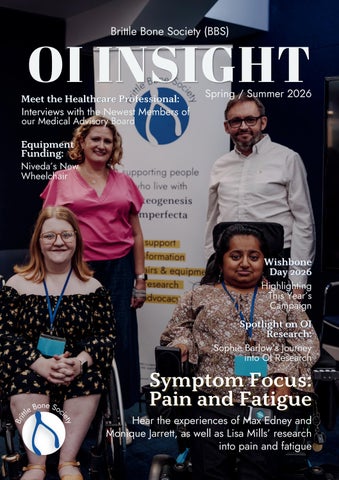
Brittle Bone Society (BBS)
OI INSIGHT
Meet the Healthcare Professional:
Spring / Summer 2026
Interviews with the Newest Members of our Medical Advisory Board
Equipment Funding: Niveda’s New Wheelchair
Wishbone Day 2026 Highlighting This Year’s Campaign Spotlight on OI Research: Sophie Barlow’s Journey into OI Research
Symptom Focus: Pain and Fatigue Hear the experiences of Max Edney and Monique Jarrett, as well as Lisa Mills’ research into pain and fatigue
Welcome to the First Edition of our Magazine Welcome to the very first issue of our new style magazine where we will bring together a range of articles, updates and perspectives from across the Osteogenesis lmperfecta (OI) community. The magazine highlights current developments in research, healthcare and support services, alongside personal experiences that reflect different aspects ofliving with OI. Created by Caroline, our Communications Officer, this has been designed to provide a different way of sharing news, information and stories from across the OI community. Bringing together a wide range of features, interviews and updates, it reflects our commitment to keeping members informed and connected while highlighting the people, projects and developments that matter most. This edition features introductions to the three newest members of our Medical Advisory Board. We also speak with researcher Sophie Barlow about the value of patient involvement in research and how lived experience can help shape future studies and healthcare priorities. A key focus of this issue is pain and fatigue, with expert guidance from occupational therapist Lisa Mills and contributions from Max and Monique who share their own experiences of managing these often significant aspects of OI. We also explore the practical impact of mobility equipment through Niveda's story, demonstrating how access to the right support can enhance independence and participation in everyday life. Alongside these features, you'll find charity news, community updates and information about the services and resources available through the Brittle Bone Society. We hope this issue provides useful information, insight and opportunities to stay connected with the wider OI community.
In This Issue... 04
News Snapshot
06
Highlights from our 2026 Annual Conference
08
Retirement of Chief Executive Patricia Osborne
09
Meet the Healthcare Professional
12
Research Spotlight
14
Symptom Focus: Pain and Fatigue
17
Meet our New Trustee: Prof Faisal Ahmed
18
BBS Equipment Funding
20
Wishbone Day 2026
21
Strategic Plan 2027/31
22
BBS Events Calendar
23
Fundraiser Focus
A quick look at what’s happening at the BBS and in the wider OI community. Catch up on the key moments from our recent Annual Conference and AGM.
Read the announcement of the retirement of our CEO Patricia, following more than 16 years of dedicated leadership Interviews with the three newest members of our Medical Advisory Board. Highlighting the publication of the TOPaZ Trial results, and showcasing Sophie Barlow’s journey into OI research. Hear the experiences of Max Edney and Monique Jarrett, as well as Lisa Mills’ research into pain and fatigue. An interview with our newly elected Trustee, Professor Faisal Ahmed, Consultant Endocrinologist from Glasgow. After years of coping with an unreliable wheelchair, Niveda highlights the impact of the BBS Wheelchair Grant. A summary of this year’s Wishbone Day social media campaign. Preview our soon-to-be-published Strategic Plan and help influence its direction by sharing your feedback. Find out what’s happening at the BBS in the months ahead. Find out how our amazing supporters are making a difference through recent and upcoming fundraising events.
www.brittlebone.org
|
admin@brittlebone.org
|
01382 204446
Brittle Bone Society (BBS), a registered charity (SCO50854) and company limited by guarantee (SC677346), supporting the OI community throughout the United Kingdom and in Ireland.
tessttt Latte L
w
BBBSS News B BBS Neewss N
January January
January saw the BBS travel to Cardiff to host one of our Family Fun Days. Held at the science centre, the event provided families with an opportunity to enjoy interactive activities, explore exhibits, and connect with others, pictured third left. BBS also took its 'What You Need to Know About My OI' roadshow to the University of Stirling, where Support Development Officer Coreen, alongside BBS member Jamie Abbott, delivered a presentation to students from the Paramedic Society, raising awareness and understanding of OI, pictured top left. We launched the consultation for our new strategic plan and continued our important policy and advocacy work, while planning parliamentary engagement activities to help ensure the voices of people living with OI are heard.
February February
We marked Rare Disease Day by sharing the 'More Than You Can Imagine' campaign message, which resonated strongly across our social media channels, generating more than 105,000 views. The Trustee Board also met to discuss BBS activities for 2026, strategic priorities and future fundraising plans. We continued to provide support through our equipment funding initiative.
We also promoted a range of important research projects and opportunities for the OI community to get involved in, including Sophie Barlow's rehabilitation study and McGill University's virtual reality research project.
March March Our CEO, Patricia, attended a Parliamentary Roundtable at the House of Lords, which focused on the inequalities in care experienced by people living with OI and explored opportunities to improve access to support and services. The meeting is pictured fourth left. We hosted our second Women's Health Webinar, which covered topics including cervical screening, mammograms, and menopause. We continued our 'What You Need to Know About My OI' roadshow. BBS members Steven Hastings and David Queen met with paramedic students at Glasgow Caledonian University, pictured sixth left. Yvonne Grant, Jamie Abbott, and Mark Ross spoke with dental therapy students at the University of Dundee, pictured bottom left. Coreen also travelled to the London Academy of Music and Dramatic Art (LAMDA) to work with students on the Hospital of No Surprises project, pictured fifth left.
April April
We launched another round of our research grant scheme. Patricia attended the All-Party Parliamentary Group for Wheelchair Users at the House of Commons, contributing to ongoing discussions on accessibility. Fundraising activity was in full swing, with supporters taking on challenges ranging from the London Marathon to the Great Limerick Run. One of our fundraisers Patrick Gallagher is pictured top right. We hosted our dental webinar with topics including orthodontics, research and adult and paediatric dentistry.
May May
May was a busy month, centred around our Wishbone Day celebrations. Our social media campaign made a significant impact, reaching an incredible 362,667 views. We are grateful to everyone who supported and engaged with the campaign. We also hosted an OI CAN Outdoor Activity Weekend at Calvert Kielder, pictured second right. Attendees enjoyed accessible activities while connecting with the OI community. We launched a new round of applications for the Gareth Cumming Adventure Memorial Award and continued our Wheels, Walks and Wanders fundraising campaign.
June June
Patricia attended the annual NHS Highly Specialised Services (HSS) meeting in Bristol, hosted by Dr Toby Candler, where the previous year’s activity and achievements were reviewed, pictured third right.
Coreen attended the annual Paediatric OI National Team (POINT) meeting in Birmingham, where UK children’s allied healthcare professionals shared updates. We travelled to Glasgow to sponsor and exhibit at the British Society of Paediatric Dentistry Study Day, providing an opportunity to raise awareness of OI among dental professionals, pictured sixth right. Later in the month, we headed to Ireland to host a mini conference, featuring talks on adult services, spinal surgery and the latest research developments, pictured fourth and fifth right.
July July
July saw Patricia travel to the U.S to attend the OI Foundation's National Conference in Florida, alongside Trustee Liz Robertson and members of our Medical Advisory Board, Dr Judith Bubbear and Dr Catherine DeVile, who gave presentations at the event, pictured bottom right. The conference was an important opportunity to strengthen international connections and learn about the latest developments in OI research and care. We also continued sending out hospital packs for children attending appointments, treatments, and check-ups. As July drew to a close, preparations were well underway for our Annual Conference and AGM.
From Research to Real Life: Highlights from Conference 2026
Our Annual Conference and AGM welcomed individuals and families with OI, healthcare professionals, and supporters for a day of information sharing, discussion, and mutual support. Read on for a roundup of the day’s sessions, discussions, and highlights.
Held at the Jones Day offices in London on 8 August, the conference featured a diverse programme of presentations on the latest developments in clinical care, research, and treatment.
Our second session, chaired by Prof Richard Keen, featured talks from Prof Stuart Ralston from University of Edinburgh, who gave an important update on the results of the TOPaZ trial, Prof Nick Bishop who delivered a briefing on recent research updates and Sophie Barlow from RNOH, who spoke about her personal research journey.
Our first session, chaired by Prof Nick Bishop from University of Sheffield, included talks from Dr Catherine DeVile and Dr Belinda Crowe from Great Ormond Street Hospital (GOSH), who gave an overview of international paediatric care in OI, Dr Louisa Petts from London Academy of Dramatic Arts (LAMDA) who spoke about the ongoing work and relations between LAMDA and the BBS, Professor Richard Keen from the Royal National Orthopaedic Hospital (RNOH) who delivered a talk detailing how new therapies reach adults with OI beyond clinical trials and Miss Jasmine Mintoff and Miss Fatimah Alsayer from Eastman Dental Hospital, who gave us an insight into the dental implications of OI.
A particular highlight of the day was the Real Lived Experience Panel, featuring Niveda Kiridaran, Jane Errington, and Holly Girven. Niveda shared her journey into advocacy and championing the rare disease community. Jane spoke about her experience growing up with OI and navigating parenthood as a mother of a child with the condition. Holly gave an insight into her job as a barrister and how she handles the barriers that come with being a wheelchair user in her career.
The session concluded with a Q&A, chaired by Stephen Ryan from Narration, exploring the panellists’ experiences in greater depth. The AGM business was covered including approval of accounts and annual review. Chairman Elaine Healey welcomed the reelection of Trustee Dom Hyams and the return to the Board of Prof. Faisal Ahmed. Also covered in the AGM was our thanks to all those who have fundraised for us – and an appeal for more members to pick up the challenge and raise funds for the BBS.
We would also like to thank Angitia, Mereo BioPharma, and Kyowa Kirin for their grant funding, Narration for technical support, and Jumping Stars for providing activities for children throughout the day. Most importantly, thank you to everyone who attended, both in person and online. Your participation helped make this year's conference an informative, supportive, and successful event.
We are grateful to our Vice Chair, John Phillips, for making the Jones Day venue available to the BBS, and to the Jones Day team for their support in ensuring the event ran smoothly.
2026 Annual Conference and AGM
Retirement of Chief Executive Patricia Osborne Following more than 16 years of dedicated leadership, the BBS has announced that its Chief Executive, Patricia Osborne, will retire from her role at the end of December 2026. Since joining BBS as Chief Executive in 2010, Patricia has played a key role in shaping the charity and strengthening support for people with OI. During her tenure, Patricia successfully led the organisation through three strategic plans and oversaw several significant developments. Most notably, she was instrumental in establishing the Medical Advisory Board and introducing the Research Grant Programme which supports vital research into OI. Patricia also ensured the continued delivery of the Society's core support services, including the provision of funded mobility equipment. She played a key role in delivering events and activities that helped the OI community stay informed, connected and supported. Patricia has raised the profile of OI care at Parliamentary level and led the engagement with policymakers, delivering events at the Scottish Parliament and
Westminster that highlighted gaps in rare disease care and amplified the voices of people with OI. Reflecting on her time with the charity, Patricia said: "It has been the greatest privilege of my professional life to help carry out the mission of the Brittle Bone Society. I've enjoyed the support of an amazing Board of Trustees and the commitment of exceptional, hard-working staff. I will really miss the warmth and encouragement of everyone in the OI community" You can read the full press release on our website here. Pictured from top to bottom: (1) Patricia with BBS founder Dr Margaret Grant MBE, (2) Patricia with the Medical Advisory Board in 2013, (3) Celebrating 50 years of the BBS, (4) Patricia with Coreen at the Kilt Walk, (5) Patricia at the History Bones Launch and (6) Patricia with BBS Chairman Elaine Healey
Meet The Healthcare Professional
In this edition, we bring you interviews with the three newest members of our Medical Advisory Board: Dr Toby Candler, Prof Rachel Crowley and Dr Helen McDevitt
Meet Dr Toby Candler, Consultant Paediatric Endocrinologist & Diabetologist at Bristol Royal Hospital for Children Could you tell us a bit about yourself and your professional background? I am a paediatric endocrinologist with a specialist interest in metabolic bone diseases, and I have spent much of my career working with children, young people, and families affected by a range of bone health conditions including bone fragility conditions such as OI. I did my specialist training in Bristol (under Dr Christine Burren who worked with the BBS for many years) and Cardiff but spent time in New Zealand, Ethiopia, Kenya during my training. I spent 3 years in the MRC unit in The Gambia with my family whilst I did my PhD and worked on aspects of bone-related research with Prof Ann Prentice (University of Cambridge) and Prof Kate Ward (University of Southampton). I am currently Clinical Lead for Paediatric Complex OI Service in Bristol. Why did you choose to work in Metabolic Bone? I was drawn to metabolic bone medicine because it is a field where you can make a meaningful difference to people's lives over the long term. The specialty combines complex science, clinical problem-solving, and the opportunity to build lasting relationships with patients and families. I have always found it rewarding to help people better understand their condition and work together to achieve the best possible outcomes. It is an exciting field with the treatment landscape rapidly developing. What has your experience of supporting people with OI been like so far? I have had the privilege of meeting individuals and families who demonstrate remarkable resilience, determination, and adaptability in the face of significant challenges. These experiences have reinforced the importance of listening
carefully to patients' lived experiences and recognising that successful care extends beyond medical treatment alone to encompass education, independence, wellbeing, and quality of life. We adopt a holistic and team approach and it’s a privilege to work with a dedicated and experienced team including physicians, surgeon, nurse specialist, physiotherapists, occupational therapists, social workers and psychologists.
What does being part of the BBS Medical Advisory Board mean to you personally and professionally? It is a real privilege and honour to be part of the Brittle Bone Society's Medical Advisory Board. Professionally, it provides an opportunity to contribute to improving care, education, and awareness for people living with OI. Personally, it allows me to learn from and work with patients, families, and colleagues across the OI community and to support the Society's important work.
What are you most looking forward to in your work with the BBS? I am most looking forward to contributing to initiatives that improve support, education, guidelines and awareness. The BBS plays a vital role in bringing people together, and I am excited to be part of efforts that help advance care, share knowledge, and make a positive difference in the lives of those with OI.
Meet The Healthcare Professional
In this edition, we bring you interviews with the three newest members of our Medical Advisory Board: Dr Toby Candler, Prof Rachel Crowley and Dr Helen McDevitt
Meet Professor Rachel Crowley, Consultant Endocrinologist at St Vincent’s Hospital in Dublin, Ireland
Could you tell us a bit about yourself and your professional background? I did my general medical and endocrinology training in Ireland and then went to the University of Birmingham for 2 years to work as a research fellow and consultant at University Hospital Birmingham. Now I am based at St Vincent’s University Hospital and University College Dublin, and I lead a number of rare disease research infrastructure groups that are wider than bone. Why did you choose to work in Metabolic Bone? As a trainee I worked with Malachi McKenna who was delivering a service for patients with rare bone disease in Ireland, since recognised as the national centre for adults living with rare bone disease. He taught me a lot and supported me to go to a Fellows’ meeting at the American Society of Bone and Mineral Research in the USA, that had a faculty of world-class experts teaching us about bone for a day. From my pituitary training at Beaumont with Chris Thompson I had seen a lot of patients with electrolyte disorders and I suppose this combined experience was useful to the team at Birmingham when I went there; it led to an opportunity to design a trial in osteopenia and I learned a lot about research governance and ethics that informed later leadership roles I took.
that answer questions that change daily life for them and their families, so they’re keen partners. I find patients living with OI to be resilient and hopeful, and this is very admirable. It can be hard when you’re trying to find services to meet their needs, and that service just doesn’t exist, or it’s in a different part of the country and not accessible for frequent visits.
What is one thing you have learned that would enable more people to understand OI or rare conditions? I think you should ask what would make people’s lives better – they have thought about this and they can give you an answer you wouldn’t reach if you go through the guideline topics of what should be covered in a clinic visit. This is true for all rare diseases. In answering this they tell you things about their day, or their home, or their work, that let you have a little more insight.
What does being part of the BBS Medical Advisory Board mean to you personally and professionally? It was nice to be identified as someone who wants to help – when we can’t it’s not usually from lack of will. So I felt that makes up for the days when you think you’re not helping. I want things to get better for each generation as it comes, so this is an opportunity to influence and make a difference.
What has your experience of supporting people with OI been like so far?
What are you most looking forward to in your work with the BBS?
I like working with patients on questions that are of interest to them; and the OI patient cohort also show interest in this. They want to design improved services and design research projects
I’m looking forward to partnership in service design, new research and broadening my working community!
Meet The Healthcare Professional
In this edition, we bring you interviews with the three newest members of our Medical Advisory Board: Dr Toby Candler, Prof Rachel Crowley and Dr Helen McDevitt
Meet Dr Helen McDevitt, Consultant Neonatologist and Paediatrician at Royal Hospital for Children, Glasgow
Could you tell us a bit about yourself and your professional background? I am a Consultant Neonatologist and Paediatrician at the Royal Hospital for Children in Glasgow, with a clinical and academic interest in bone health. My work spans neonatal intensive care and paediatric metabolic bone disease, including the management of infants and children with rare skeletal conditions. Alongside clinical work, I am involved in teaching, research, and service development, with a focus on improving care pathways and access to specialist expertise across Scotland. Why did you choose to work in Metabolic Bone? I was drawn to metabolic bone disease because I value the multidisciplinary approach, working closely with colleagues across specialties. Many of these conditions are rare, which presents challenges but also opportunities to develop knowledge and improve care through collaboration and research. What has your experience of supporting people with OI been like so far? Supporting individuals and families affected by osteogenesis imperfecta has been both challenging and rewarding. It has taught me the value of holistic, patient-centred care, addressing not only bone health but also mobility, pain, independence, and wellbeing. Families themselves develop considerable expertise in OI, and partnership working is essential. Looking after children coping with a chronic disease is humbling.
What is one thing you have learned that would enable more people to understand OI or rare conditions? Rarity often means there is a lack of awareness of the condition in the general medical community, as well as in the public domain. For those affected, OI has a significant impact on daily life, and that is poorly understood. Even small improvements in recognition and access to care can make a meaningful difference.
What does being part of the BBS Medical Advisory Board mean to you personally and professionally? It is both a privilege and a responsibility to contribute at a national level. The role provides an opportunity to support collaboration, share expertise, and promote best practice. I am excited to work with other health professionals who look after families with rare bone conditions. What are you most looking forward to in your work with the BBS? I am looking forward to working more closely with the OI community and supporting initiatives that improve awareness, education, and access to care.
Research Spotlight We spoke to Sophie Barlow, a Specialist Physiotherapist at the Royal National Orthopaedic Hospital (RNOH, about her research, the impact of BBS-funded research, and why patient voices are vital to improving care. Tell us about yourself and your professional background. I graduated from St George’s, University of London in 2008 and began my career in a rotational post at East and North Hertfordshire NHS Trust During this time, I developed a strong interest in patient-centred care and recognised the importance of building and maintaining therapeutic relationships with patients. This passion made a specialist centre a natural fit for me, and in 2011 I joined RNOH, where I have continued to develop my clinical and research interests since. What led you to become interested in research connected to OI? While working within a pain management programme for people living with long-term health conditions, I had the privilege of supporting several patients with rare bone diseases. I was struck by their resilience, adaptability, and remarkable ability to problemsolve in the face of significant challenges. Working alongside these individuals was both inspiring and rewarding, and it prompted me to learn more about rare bone conditions. This experience sparked a lasting interest in OI and other rare bone disorders, which has continued to shape my clinical and research work. What have you worked on as a result of the BBS grant awarded to Dr Bubbear and what was your role in the project? The research project exploring the musculoskeletal needs of people living with OI was a pivotal moment in my career. Under Dr Bubbear’s guidance, and with the support of our
@brittlebonesociety
@brittlebonesociety
Research and Development team, I was responsible for establishing and delivering two complementary research projects. This involved collecting and analysing clinical data within our service, as well as recruiting participants and facilitating two patient focus groups. These focus groups provided a valuable opportunity to gain deeper insights into the experiences, priorities, and perspectives of individuals living with OI, ensuring that the research was informed by those with direct lived experience of the condition. Both projects have been published in peer reviewed journals and I have presented the results across several international conferences to raise awareness of therapeutic needs of adults with OI.
Have there been any key milestones or achievements so far? One of the most rewarding milestones was successfully setting up and delivering the two different projects looking at the therapy needs of adults with OI. Bringing together clinical data with insights from people living with OI helped us build a much richer understanding of their musculoskeletal needs. Professionally, the project gave me invaluable experience in research design, data collection and patient involvement, and it reinforced the importance of ensuring that research is shaped by those with lived experience. Following these projects I have then had opportunities to deliver talks at the OIFE conference, visit the TRS centre in Norway who are driving research in rare conditions and connect with other clinicians and researchers internationally which can only strengthen relationship and potential research collaborations in the future.
@brittlebonesociety
@brittlebonesociety
@BrittleBoneUK
Why is research like this important for the OI community? OI is a rare condition, and as a result there are still many unanswered questions about how best to support people throughout their lives. Research helps us move beyond assumptions and better understand the challenges that people with OI face on a day-to-day basis. By exploring and listening to patients' experiences, we can identify gaps in care, improve services and ultimately help people maintain their independence, mobility and quality of life. Most importantly, research gives the OI community a voice and helps ensure that future care is guided by what matters most to them.
What are the next steps for your research and how can people with OI get involved? I am currently building on this work through an NIHR pre-doctoral fellowship analysing the existing research on rehabilitation for people with rare bone conditions with a view to apply for further funding to explore exercise in this patient population. Future research will benefit from ongoing collaboration with patients, families and healthcare professionals to ensure that the questions we are asking are relevant and meaningful. People with OI can get involved by taking part in research studies, contributing to patient focus groups, completing surveys and sharing their experiences. Their insights are essential in helping us shape future research priorities and improve care for the wider OI community.
In Other Research News... Results from the TOPaZ trial have now been published. Find out what they mean for people living with OI in BBS's latest update and Medical Advisory Board statement below. The TOPaZ trial, led by Professor Stuart Ralston, involved 350 adults across 27 UK and European centres and compared standard care with teriparatide followed by zoledronate. This is the first and largest trial in adults with OI. While the treatment improved bone density, it unfortunately did not reduce fracture rates, including spinal fractures. Prof Ralston, from the University of Edinburgh, said: The results of this study will fundamentally change clinical practice with regard to the treatment of OI. We have been using drugs to increase bone density for decades in the hope that they might prevent fractures but the TOPAZ trial clearly shows that these medicines simply do not work in adults. We now need to focus efforts on finding new drugs that can target the defects in bone collagen to improve the strength of bone and reduce fracture risk in this rare but serious disease.
@brittlebonesociety
@brittlebonesociety
The BBS Medical Advisory Board has reviewed the findings and confirmed they have important implications for those living with OI. They have produced a document detailing the new findings and what this means for both children and adults. You can download this document via the QR code or this link. At our Athlone Mini Conference, Prof Ralston gave a talk on the latest developments in OI research, in particular, the recent publication of the TOPaZ trial results. You can watch his talk by clicking here or scanning the QR code.
@brittlebonesociety
@brittlebonesociety
@BrittleBoneUK
Pain and Fatigue In this interview, Max Edney talks about the realities of living with OI, managing pain and fatigue, and finding confidence through the people and activities he loves. Pain and fatigue are part of many people's experience of OI, but they look and feel different for everyone. Can you describe your experience for us? In my experience of having Brittle Bones, the impacts can range from daily fatigue and chronic pain to broken bones once a week, or once a year. For me, the effects go in peaks and troughs. For months, the condition could be just a small hindrance but sometimes for days to weeks, it could do the opposite, too. Pain usually goes hand in hand with growth spurts, lots of physical activity or long days out. What would you like people without OI to understand about living with OI? If there was one thing above all that I would want someone without OI to know about living with OI, it would be the varying effects of pain. If someone with OI just knocks themselves even gently on a table, chair, or other hard surface, it can mean more pain than the average 'oww'. It can possibly even mean broken bones. I would say that it depends on the person in terms of experiencing pain, but for me, sometimes I can’t even think straight or keep focused because of the pain. What are some of the things you have incorporated in your routine to combat pain and fatigue? I have incorporated many things into my routine to combat pain, such as using fidget toys at school (to try and focus on
something other than the pain), or by using heat or cold packs. These can be placed on the body, at the main site of the pain, and most of the time, they work wonders to relieve pain. Also, I find that distractions can help to take my mind off the pain. These can consist of learning the alphabet backwards, learning the periodic table (still in and learning progress!) ‘supercalifragilisticexpialidocious’ backwards. Mindful activities such as reading, colouring, or listening to an audiobook work, too. One of the other things I find that helps is regular physiotherapy, to strengthen my muscles which provides more support to my bones. I also have things I can do if the previous steps don't work, such as taking medication.
What is the best thing that has ever happened to you? I think that the best thing that has happened to me would be being part of the Gang Show. It is a show that Scouts, Cubs, and Guides can take part in, and it is a really safe environment for me. I can be myself without feeling judged, or left out. It also combines many things that I love: Drama, friendship, and Scouts. I feel really included at the Gang Show, and it reminds me that even though I have OI, I can still be myself, and do what I love.
Monique shares her experience of living with chronic pain and fatigue, discussing the daily challenges she faces, the strategies that help her manage her energy, and the opportunities that have shaped her life and career. Pain and fatigue are part of many people's experience of OI, but they look and feel different for everyone. Can you describe your experience for us? For me, pain is a constant dull ache in my joints, neck and spine, it’s there when I wake up through to when I go to sleep, more like a permanent post‐workout soreness than the sharp pain of a fracture. Because it’s always there, I’ve normalised a lot of it and only really register it when it flares or combines with exhaustion, or bone pain due to my metal rods. Fatigue is much more disruptive, it dictates how much I can work, travel, socialise or even manage basic things like showering and cooking. I have to plan my days and weeks around that fatigue, building in rest and recovery just to maintain any kind of ‘normal’ routine. What would you like people without OI to understand about living with OI?
I’d like people without OI to understand that it affects far more than just bones and fractures. It impacts joints, muscles, fatigue, digestion, sleep and recovery time, and those effects build up over years. It also doesn’t look the same on everyone: some of us are wheelchair users, some walk, some fracture often, others barely at all but live with chronic pain and fatigue. Most of the barriers I face come from inaccessible environments and systems, not from my disability itself.
What are some of the things you have incorporated in your routine to combat pain and fatigue? I plan my weeks around my energy, not just my diary. If I have a teaching day, travel or a performance, I deliberately block out quieter days before and after so I can recover. I’m a full‐time wheelchair user with a high spec chair that moves and adjusts to aid my pain and always carry pain medication with me. I break tasks into smaller chunks, and rely on technology like a robot hoover, voice activated lights and more, deliveries and support where I can, so I’m not wasting limited energy on things that don’t need me physically present. Rest and recovery are scheduled in as essentials, not an optional extra. What is the best thing that has ever happened to you?
Being hired, and then trusted to tour, with Stopgap Dance Company, a world‐renowned inclusive dance company. I didn’t come through a traditional conservatoire, or arts school route, so being brought in at that level felt huge. It was a clear message that my work, perspective and disabled body were wanted in the room, not just tolerated. That opportunity has taken me around the world, given me long‐term collaborators, and proved that disabled artists who haven’t followed a conventional training path still belong front and centre of the arts.
We spoke to Occupational Therapist Lisa Mills about supporting children with OI to manage pain, fatigue and everyday activities through practical tools and strategies. Could you tell us a bit about yourself and your professional background? I’m an Occupational Therapist (OT). My role is to support children and young people to overcome challenges and build independence in everyday activities like getting dressed, going to school, and joining in with family and social life. For the past 13 years, I have been the lead OT at Bristol Children’s Hospital, working with children and young people with OI. I am also a member of the BBS’s medical advisory board and value working with colleagues nationally and internationally to improve the lives of people with OI. I originally trained and worked in the Midlands both in community and hospital roles. I also spent time living and working in New Zealand, which is a wonderful place if you ever get to visit! Outside of work I love traveling and am usually planning my next holiday! I also enjoy being active, walking my dogs and growing veggies at my allotment.
Can you explain the Marble Jars? The Marble Jar is a story or exercise designed to teach children about energy & fatigue. It helps children visualise energy as a resource they can manage throughout their day, enabling them to do the activities they enjoy. Each day begins with a full jar of marbles, where each marble represents a small amount of energy. Marbles can be used for daily tasks like getting dressed, learning at school, exercising, and playing. Some activities require more marbles than others, depending on the effort involved. Rest, sleep, and eating help to replenish energy by adding marbles back into the jar. If too many marbles are used without enough recovery, the jar can become empty, resulting in tiredness and exhaustion. The marble jar can help children communicate their energy levels and plan, prioritise, and balance activities and rest, so they can do the things they want to do without running out of energy.
Are there other tools that can assist children with pain and energy levels? Spoons theory is another commonly used approach to fatigue management, although it is often better understood by older children. The NHS pain toolkit is also a useful resource. Children’s experiences of pain and fatigue are influenced by lots of things, meaning there is no single strategy that will suit everyone and it's not something we can 'fix' completely. Supporting children to communicate how they feel is a key first step. From there, as a team we help them develop a better understanding of their pain and fatigue, identifying strategies that work best for them. We encourage children and parents to incorporate a range of tools that can be used at different times. These may include sensory strategies (e.g. heat/ice/compression), managing difficult thoughts and emotions, distraction (e.g. music, colouring, watching a film), modifying activities, improving relaxation and sleep routines and graded exercise alongside activity pacing and, where appropriate, medication.
Can you tell us why you chose to run pain workshops for children? Children and young people with OI often tell us that pain and fatigue interfere with their life, including joining in at school and with friends. In Bristol we already run therapy groups to help children enjoy staying active. We thought this approach would also be a good way to help children learn about pain and fatigue. We used interactive games, discussion and role play to help them talk about their experiences, share ideas and learn from each other as well as the therapists. Some families found this easier and less intense than one-to-one sessions and found the opportunity to meet others with similar experiences valuable. We got some really helpful feedback and hope to run these therapy groups again for more children in the future.
Meett o Mee our ur Ne New w Trustee, Tr ustee, Professor Professor Faisal Ahmed Faisal Ahmed!!
In this interview, newly elected Trustee Prof Faisal Ahmed shares insights into his professional background, his experience in metabolic bone health and OI care, and his aspirations for his role as a Trustee with the BBS. Could you tell us a bit about yourself and your professional background? I hold the Samson Gemmell Chair of Child Health at the University of Glasgow which is the oldest university professorship in paediatrics in the UK. As a clinician, I have been working since 2000 as a consultant in paediatric endocrinology, initially at Yorkhill and now at the Royal Hospital for Children in Glasgow.
Why did you choose to work in Metabolic Bone? I have had a clinical and research interest in the field of metabolic bone since the early 1990s when I was working as a trainee and research fellow in Edinburgh and London. The 1990’s was an exciting time when our scientific understanding of genetic conditions as well as how bone health should be assessed and managed increased dramatically. It is great to see that this understanding is now being translated into advances in therapies. What has your experience of supporting people with OI been like so far? I have worked with children and families with OI for over 25 years when I founded the children’s
metabolic bone service in Glasgow and this has been a very satisfying and enjoyable experience. For several years I have also enjoyed interacting with families with OI in other settings organised by the BBS such as Annual Meetings, VOICE, and of course the Medics on the March!
What is one thing you have learned that would enable more people to understand OI or rare conditions? There is no magic formula for caring with people with OI given that it is such a variable condition and the needs of one individual with OI may be very different to another. Thinking holistically about the person in their own environment and relying on the help of a group of experts with complementary skills has been the key. What does being part of the BBS Trustee Board mean to you personally and professionally? I find the opportunity to provide clinical and academic expertise and combining this with advocacy for a group of people with rare conditions professionally stimulating and personally rewarding. Rather than just managing people with OI in a clinic setting, I believe that a clinician trustee is in a good position to ask the bigger questions from the perspective of the person with OI such as are patients receiving the right care? Which research questions matter most? How can we improve transition from paediatric to adult care? How can patients have a stronger voice in research and service design? What are you most looking forward to in your work with the BBS? I am really looking forward to interacting with people with OI as well as the wider clinical and research community in the OI field.
Equipment Funding At the BBS, Equipment Funding is one of our main priorities, with over £1 million of funding being granted over the past ten years. We spoke to Niveda, one of our grant recipients, about the challenges she faced with her previous wheelchair and the life-changing difference a new chair has made. Could you tell us a little bit about yourself? I really enjoy being active and spending time exploring different places, especially around London. I love socialising with my friends, going on little adventures, and making the most of being out and about in everyday life. I value my independence a lot. Being able to go out into the world, see friends and family, and take part in everyday activities means a great deal to me and is a really important part of who I am. Were there any challenges you faced with your previous wheelchair? My previous wheelchair kept breaking down, including a major breakdown in 2024 that significantly affected my independence. I had to rely heavily on my parents and friends and couldn’t go to work, which made me worry about losing my job. I later realised my chair had been discontinued and I wasn’t aware of the five-year wheelchair review process. Even after repairs, it continued to fail unpredictably, causing anxiety and cancelling my plans. I became fearful of going out, stopped seeing friends at times, and often had to carefully limit what I could do. I also needed someone with me for reassurance, especially travelling long distances, which reduced my independence further.
How has the new wheelchair provided by the BBS changed your day-to-day life? My new wheelchair has made a huge difference to my day-to-day life. I’m now able to go out, travel, and work safely every day, including moving between libraries, which I previously had to pause due to the risk of breakdowns. Before, I limited myself to staying close to home because I was worried about getting stranded. The new wheelchair also has features that make me much more comfortable and independent. It has significantly better back support, which helps with my scoliosis and allows me to relax into the chair without experiencing constant pain. It also enables me to do back stretches, which really helps throughout the day. Additionally, it has a table attachment, which allows me to carry books more easily at work and reduces strain on my arms. Overall, it has improved both my comfort and independence. What did it mean to you to be awarded support for a new wheelchair? Being supported by BBS to receive a grant for a new wheelchair meant the world to me. It truly felt like I got my life back. I can now go out, see
friends (pictured right with best friend Beth), and enjoy life without constantly worrying about breakdowns. Before, every breakdown felt distressing and limiting, but now I have freedom and confidence again. I no longer have to cancel plans or live with that constant anxiety. It has given me independence, reassurance, and the ability to enjoy everyday life much more fully. Why do you think funding like the BBS Wheelchair Grant is so important for people living with OI? Funding like this is vital for people living with OI because getting the right equipment can be extremely difficult. In my experience, the process was long, frustrating, and full of rejections. I had to constantly advocate for myself with little success locally. Without BBS supporting me through the grant process, I don’t think I would have been able to access a suitable wheelchair. The reassurance that I would get support and a clear outcome made a huge difference to my wellbeing. It’s not just about funding—it’s about being believed in and given the chance to regain independence.
What are you most looking forward to now with your new wheelchair? I’m most looking forward to travelling more freely and possibly taking my wheelchair abroad to places like Germany, France, or Brussels. I want to experience life outside the UK as a way of maintaining my independence. I’m also excited to finally pursue learning how to drive, which I had to pause before due to uncertainty about whether my old wheelchair was crash-tested and its age. Now, with my new wheelchair, these goals feel achievable again. Overall, I’m looking forward to having more freedom, independence, and opportunities to explore the world.
Interested in BBS Equipment Funding? Thanks to the incredible support of Motability Foundation and other long-term funders, over the past ten years period, we have coordinated over £1 million in funding to provide individuals with life-changing mobility equipment. The impact has been transformational. From returning to education and work, to reconnecting with community life - this support is restoring freedom, confidence and opportunity. One grant recipient said:
I can go out without fear that my wheels will give way, especially in winter. I’m social again and can attend work more regularly. My life has completely opened back up. The Brittle Bone Society can fund manual and powered wheelchairs, trikes, buggies and other types of equipment. For full details and to apply for funding visit our website here, or scan the QR code. If you would like to contact us for more information, if you need assistance with getting an assessment, or you would like an update on the progress of your application, please contact us on 01382 204446 or email us via admin@brittlebone.org !
W
2026 Campaign
ay
n o e b D h isA Spotlight on our
This year's awareness campaign focused on the realities of life with OI, highlighting the key priorities of our Patient Charter, including diagnosis, care and treatment, informed choice and quality of life. A community survey sat at the heart of the campaign, giving people with OI the opportunity to share their experiences. Their insights helped shape authentic, impactful messages that placed lived experience at the centre of the conversation and reinforced the importance of patient-centred care. The campaign achieved 362,667 views across Facebook, Instagram and LinkedIn, alongside 6,590 engagements and 2,615 shares. Reach was more than three times higher than last year's campaign (110,500 views) and more than seven times greater than the 2024 campaign (49,200 views). These figures represent more than strong social media performance. They reflect thousands of opportunities to increase understanding of OI, challenge misconceptions and amplify the voices of those living with the condition. The campaign's success demonstrates the value of listening to lived experience and putting community voices first. It is a testament to the strength of the OI community and the growing appetite for greater awareness, helping to create a future in which OI is better recognised, understood and supported.
@brittlebonesociety
@brittlebonesociety
@brittlebonesociety
@brittlebonesociety
@BrittleBoneUK
Our Next Strategic Plan Preview our soon-to-be-published Strategic Plan and help influence its direction by sharing your feedback.
At BBS HQ, we have been hard at work preparing our new strategic plan for 2027 to 2031, and we can’t wait to unveil this to our members. Following extensive consultations with our membership and the wider OI community in UK and Ireland, we have taken account of your thoughts and views, and in turn, curated our focus for the next four years, including our values, purpose, vision and mission, as well as our priorities and success meaures. There is still time to have your say on what we included in the next strategic plan. You can submit your views via our survey which is linked here. Alternatively, scan the QR code on the right to take part. Stay tuned for further updates!
@brittlebonesociety
@brittlebonesociety
@brittlebonesociety
@brittlebonesociety
@BrittleBoneUK
Events Calendar
ber September to Decem
Glasgow, Scotland
Family Fun Day
Get ready for a day filled with laughter, excitement, and unforgettable memories! Open to all members of the OI Community, this event brings OI families together for a day full of fun activities. Click here for more information.
November
14 2026
London, England
Medical & Scientific Advisory Board Meeting
November
20
A meeting of our Medical and Scientific Boards, compromising of the leading British and Irish OI healthcare professionals (HCPs). Open to HCPs only.
2026
London, England
RDCN Annual Review
The fourth annual event of the Adult Rare Bone Network, which sees healthcare proffesionals across rare bone come together to discuss the work and advancements of the NHS network. Open to HCPs only.
@brittlebonesociety
@brittlebonesociety
@brittlebonesociety
November
@brittlebonesociety
20 2026
@BrittleBoneUK
Fundraiser Focus Here is a snapshot of some of our recent fundraisers: Patrick Gallagher
Antoinette Halpin
Patrick ran the Manchester Marathon the Bristol Half Marathon earlier this year, raising over £3,700! Patrick decided to to fundraise for the BBS, as his son (Sonny) is living with OI. Thank you for your fundraising!
Thank you to Antoinette, family and friends for taking part in the Great Limerick Run. They raised €3,089. Antoinette's son has OI, and as he approaches his 18th birthday, they decided to give back to those who have supported them. Thank you all!
Marco and Laura Bisceglia
Aveneet Kaur
Thanks to Marco and Laura, who ran the London Marathon! We’re proud to have been one of their chosen charities. They raised over £550! Congratulations and thanks to you both!
Aveneet and her team of fundraisers took on a hiking challenge in the Peak District! They chose to support BBS as Aveneet’s daughter was born with OI. They raised over £650! Thank you so much for your fundraising!
Steven Greenhalgh A massive thank you to Steven who organised a charity football match and raffle for the BBS! They raised £1,453.02. Steven chose to fundraise for us as his son is living with OI.
Kian Rogers Kian has fundraised for us for many years, as his little sister, Amelia-Rose, lives with OI. He completed another fundraiser this year, where he fundraised £580! Thank you Kian for your continuous support!
Highlighting some of our upcoming fundraisers: Robert Gordon
Steven Greenhalgh
BBS treasurer Robert Gordon, whose daughter has Type 1 OI, will take on the challenge of trekking to Everest Base Camp this September alongside friends Andy and Thomas. Thank you, Robert, Andy and Thomas and good luck! Visit their JustGiving page here, or scan the QR code.
Following on from his recent successful fundraiser, Steven has generously chosen to fundraise again, by taking part in the Great Eastern Run in Peterborough this October. Good luck Steven, all the best! Visit his JustGiving page here, or scan the QR code.
@brittlebonesociety
@brittlebonesociety
@brittlebonesociety
@brittlebonesociety
@BrittleBoneUK
www.brittlebone.org | admin@brittlebone.org | 01382 204446 @brittlebonesociety
@BrittleBoneUK
@brittlebonesociety
@brittlebonesociety
@BrittleBoneUK
@brittlebonesociety
Brittle Bone Society (BBS), a registered charity (SCO50854) and company limited by guarantee (SC677346), supporting the OI community throughout the United Kingdom and in Ireland.