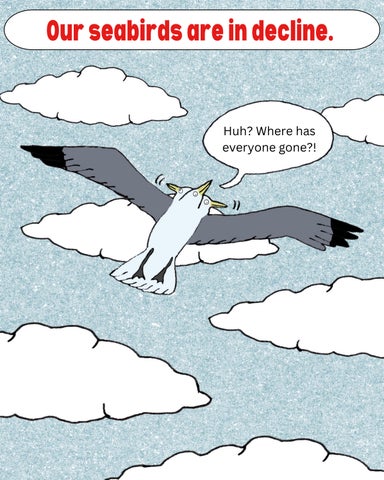
Our seabirds are in decline.
Huh? Where has everyone gone?!
With the temperature of the sea on the rise due to climate change, the diet of seabirds can be badly affected, due to fewer, smaller and poorer quality fish.
Before
After
The lack of available or poor-quality prey can have a negative impact on breeding success.
I’m afraid we will once again have to share a can of fish tonight children.
But we’re so so hungry!
Not again!! Nooooooo
That’s why finding out more about what seabirds eat can help us predict some of these changes and find solutions to help counter their declines.
Fish populations in 2025
Thank you for joining this urgent meeting
Many studies on what seabirds eat look at the remnants of prey found in birds’ regurgitations or pellets, which can be difficult and time-consuming.
Burp! e Pardon m
A new BTO pilot project takes on a different approach to find out more about seabird diet, by looking at prey DNA contained in…
I beg your pardon?!
The study focused on two species of birds that can be found on the west coast of Scotland, where the research took place:
European Shag Gulosus aristotelis
More like ‘European star!’
out What ab me?!
Hello! I’m here too
I’m right here
&
Shag always w steals the sho
Kittiwake
Rissa tridactyla
The first way of collecting poo samples was directly from the beach where the birds frequently roost, after a high tide. Samples were collected 1–2 metres apart to avoid contamination.
Oh yes that was me
Another way was to scrape the poo off waterproof clothing during ringing. Both these methods meant minimal disturbance of the birds. Special delivery!
Noooooooooo no more please!
To ensure that samples contain good quality prey DNA, the collection process was key:
3.
1.
A new disposable wooden spatula was used for each poo sample collection.
2.
A pea-size sample of ideally fresh and wet poo was collected.
The sample was then placed in a tube filled with solution which keeps the DNA intact without freezing the sample. This was very useful when collecting in the field where there were no fridges!
All samples were then sent to UHI’s Institute for Biodiversity and Freshwater Conservation where they were kept refrigerated until the DNA gets extracted.
Bon voyage my friends!
The samples were then analysed in the lab using a process called ‘DNA metabarcoding’, to detect the different types of prey consumed by the birds.
34 different types of fish and some marine invertebrates like squid were identified from DNA in the poo. By looking at the DNA it was easier to identify the exact type of prey eaten compared to looking at regurgitates or pellets.
Sandeel
Cod
Squid
Sprat
Herring
The downside of this method is that it doesn’t give us any indication of the size and quality of the prey that was consumed. The DNA can also get damaged when the poo is exposed to sunlight, which is why fresh samples were important.
L O R T A P O O P
We’re making sure the sun doesn’t catch this one
No sun rays under my watch
Why did I sign up for this job?!
This study successfully showed that this method can be used during relatively short visits to a seabird colony and could potentially be used all year round. We’ll keep you posted on our adventures!
Here we go again ...
… BTO crew is back for more!
Illustrations & Design by Anna Dupont-Crabtree O’Hanlon, N.J., Jardine, D.C., Lennon, J., Svobodova, D., Swann, R.L., Ward, R.M., Humphreys, E.M. and Morrissey, B.J. 2025. Diet analysis of Kittiwake and Shag using DNA metabarcoding of faeces. Seabird, 37.
Thank you to Mark Constantine for funding this project, and to David Agombar for facilitating this process. Thanks to everyone who helped collect faecal samples in the field including members of Highland Ringing Group on Canna and members of the Treshnish Isles Auk Ringing Group and Shiants Seabird Research Group.
Scan the QR Code to read the paper.