Brisbane Girls Grammar School Gazette Issue 1, 2026
04 Primary colours Day one at the Junior School
10 Brave new world Senior Drama tackles a disconnected future
1, 2026
22 Cricket reaches 130 not out
Celebrating BGGS’s greatest hits
On the cover
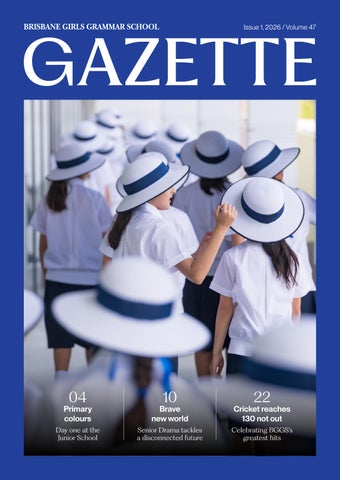
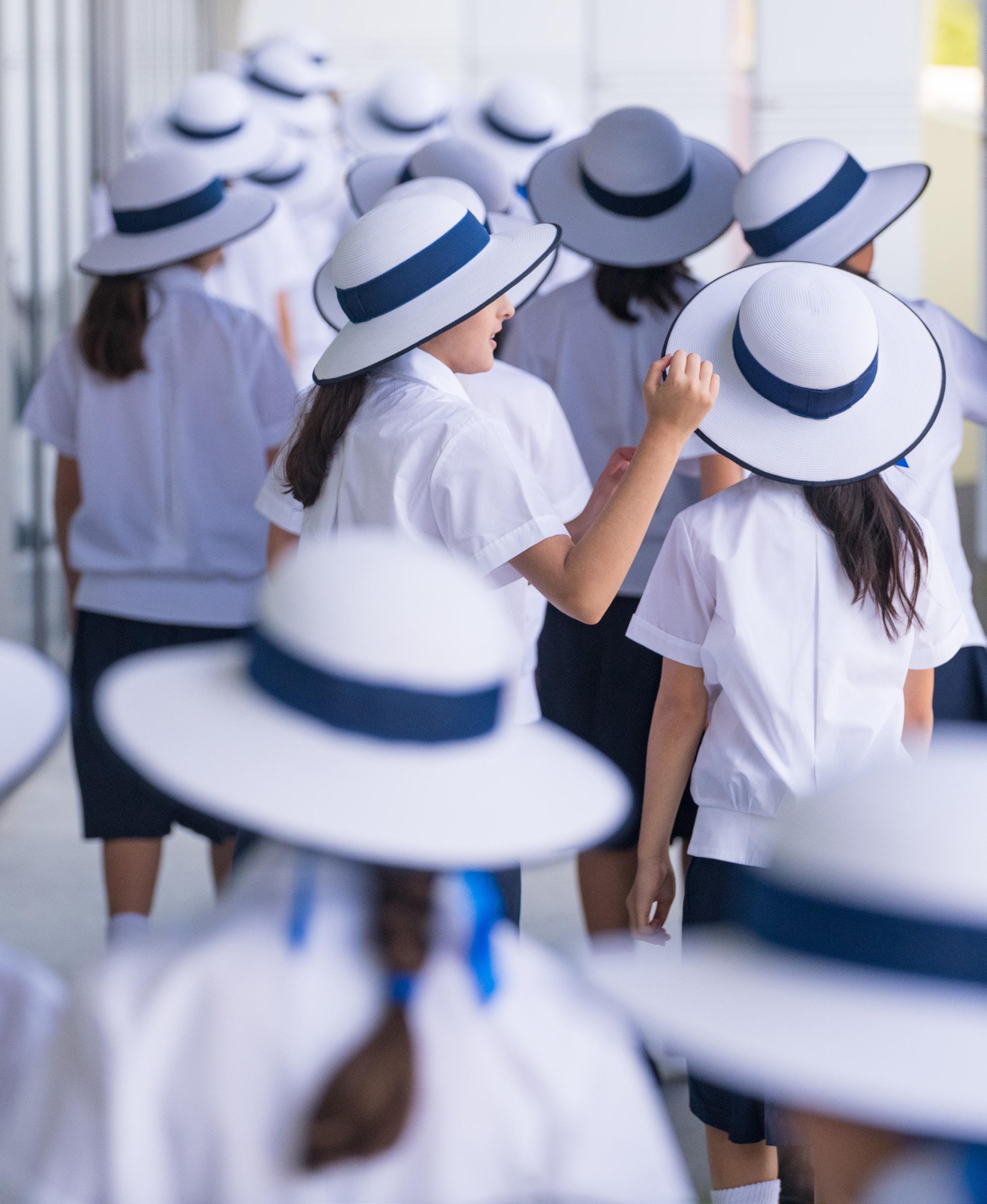
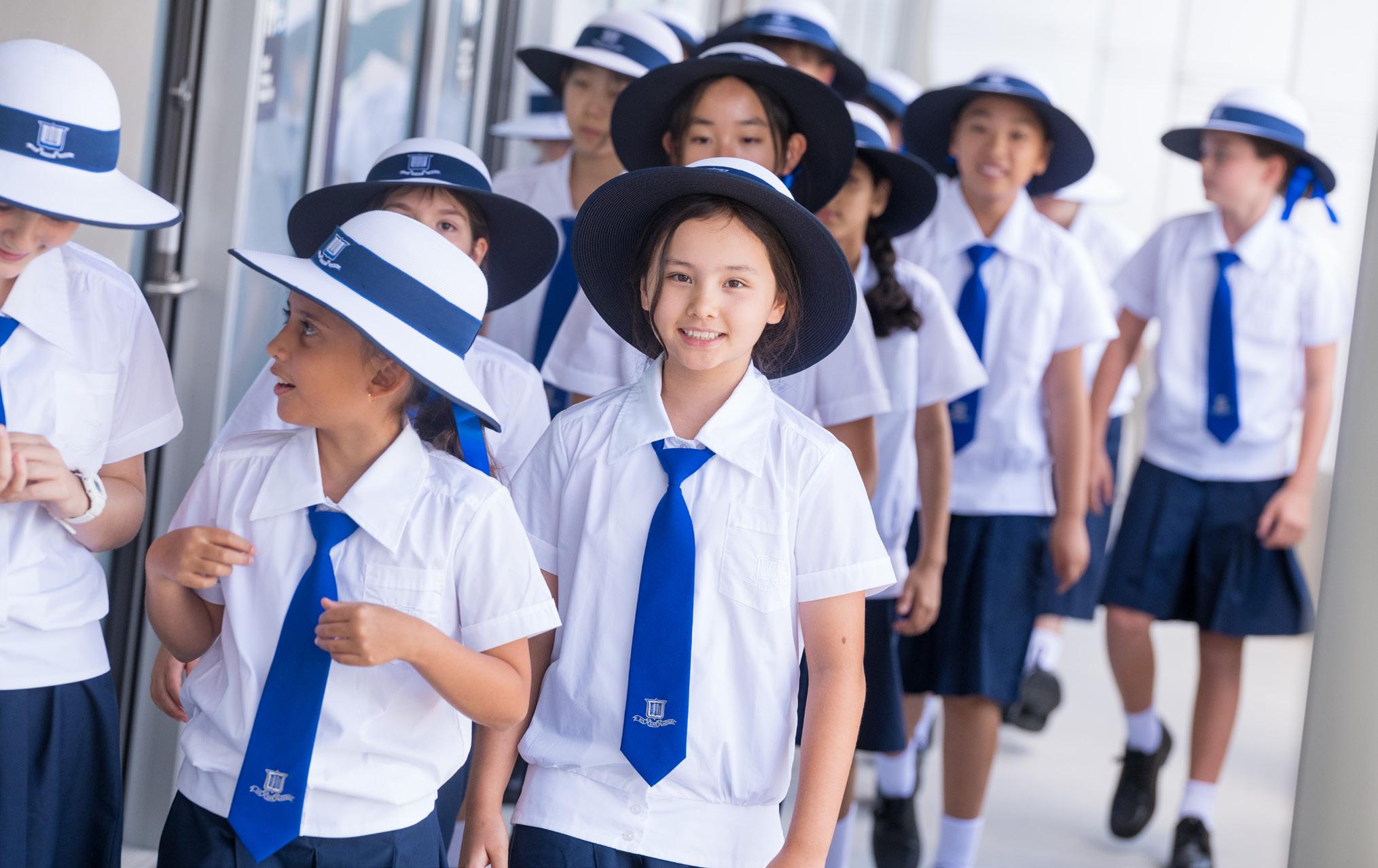
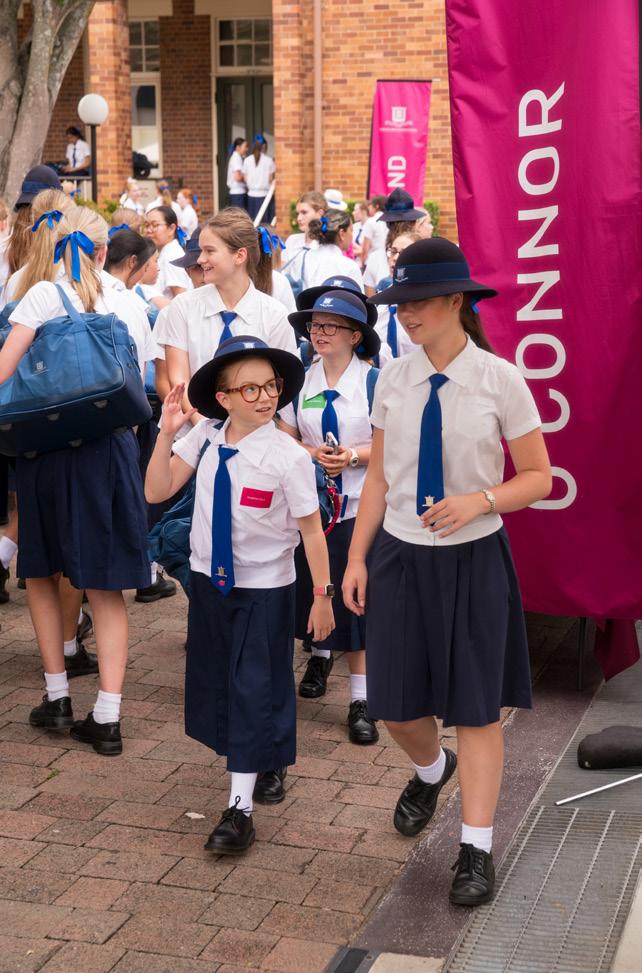
Students explore the new Junior School on the first day of the 2026 school year
Grammar Gazette ISSUE 1, 2026 / VOLUME 47
Managing Editor: Ms Lucy Ernst (Carne, 1998), Director of Communications and Engagement
Editor: Ms Catriona Mathewson, Senior Communications Writer
For Gazette enquiries and comments: T +61 7 3332 1300 E communications@bggs.qld.edu.au
To change your subscription to the Gazette from printed to electronic, please email communications@bggs.qld.edu.au.
ACKNOWLEDGEMENT OF COUNTRY
In the spirit of reconciliation, Brisbane Girls Grammar School acknowledges the traditional custodians of the lands on which our campuses stand, the Turrbal, Jagera and Kabi Kabi Peoples, and all Indigenous people in our School community. We honour and respect their Elders past and present, and recognise that these lands have always been places of teaching and learning. We are grateful for thousands of generations of care for Country and seek to walk in solidarity with the First Peoples of our nation for reconciliation, justice and healing.
Printed in Brisbane on environmentally responsible paper.
02 From the Principal (Acting)
Opening the door to a new chapter in Girls Grammar history
03 From the Head Girls
On passion, authenticity and sisterhood
04 New beginnings
First day at the Junior School
08 Healing history
The indomitable Grammar Woman who opened a hospital on the site of the Junior School nearly a century ago
09
Female foundations Queensland’s fourth female governor, Her Excellency the Honourable Dr Jeannette Young AC PSM officially opens Girls Grammar’s Junior School
10
Survive + ctrl + del Sellout performances of BGGS and BGS’s co-production, Common Ground, delve into a world where AI teenagers roam among us
18 A trip beyond Khmer Students discover adventure and service in Cambodia
22 130 not out
Cricket marks a milestone. Plus, an update on our highest-capped cricketer Josie Dooley (2017) and her plans for 2032
24 Teacher reflection
Guiding students to use AI with a critical eye
25 Fly me to the moon
Inspired by the Artemis II mission, Junior Astronomy Club launches rockets and sends their names into space
26 Great Ocean Gold Duke of Edinburgh Award pushes students to spectacular limits
28 Going global BGGS students appear on the BBC as Australia leads social media change
31 The Sun Queen rises Dr Tarita Botsman (1988) aims to take her new musical about a swordfighting soprano to Broadway
33 Australia Day Address
Migration lawyer Sarv Singh (Head Girl, 2014) reflects on Australian identity in 2026
34 Frond memories
School portraits mark the passing of time and trees, as the last painting of the School’s iconic twin palms is completed
37 Awards and Achievements Staff, students and alumnae successes
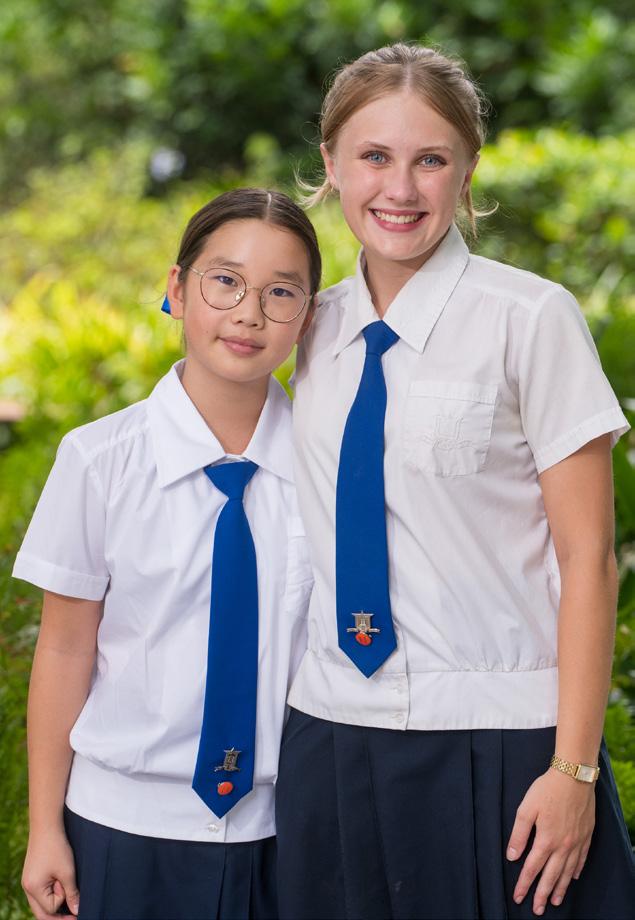
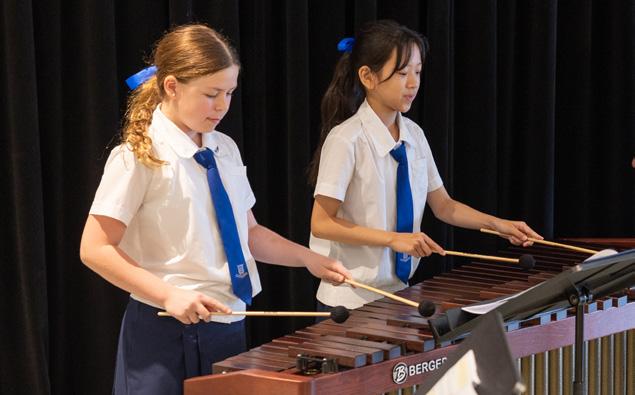
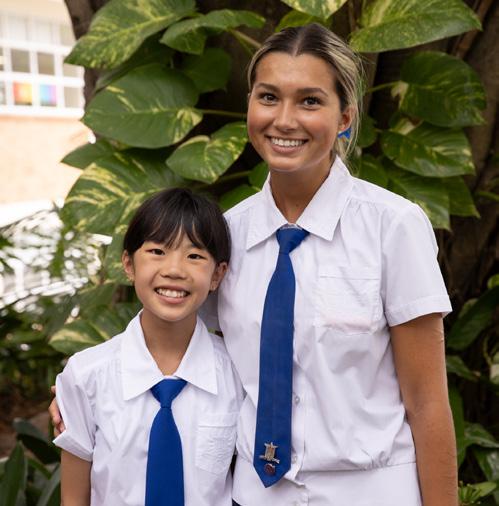
Below Buddies Jessica Ding (7H) and Lucy Dobinson (12H)
From the Principal (Acting)
A new wave of Grammar girls
It’s been a busy and exciting start to 2026 as we opened the door to a new chapter in Girls Grammar history, welcoming the Junior School into our community.
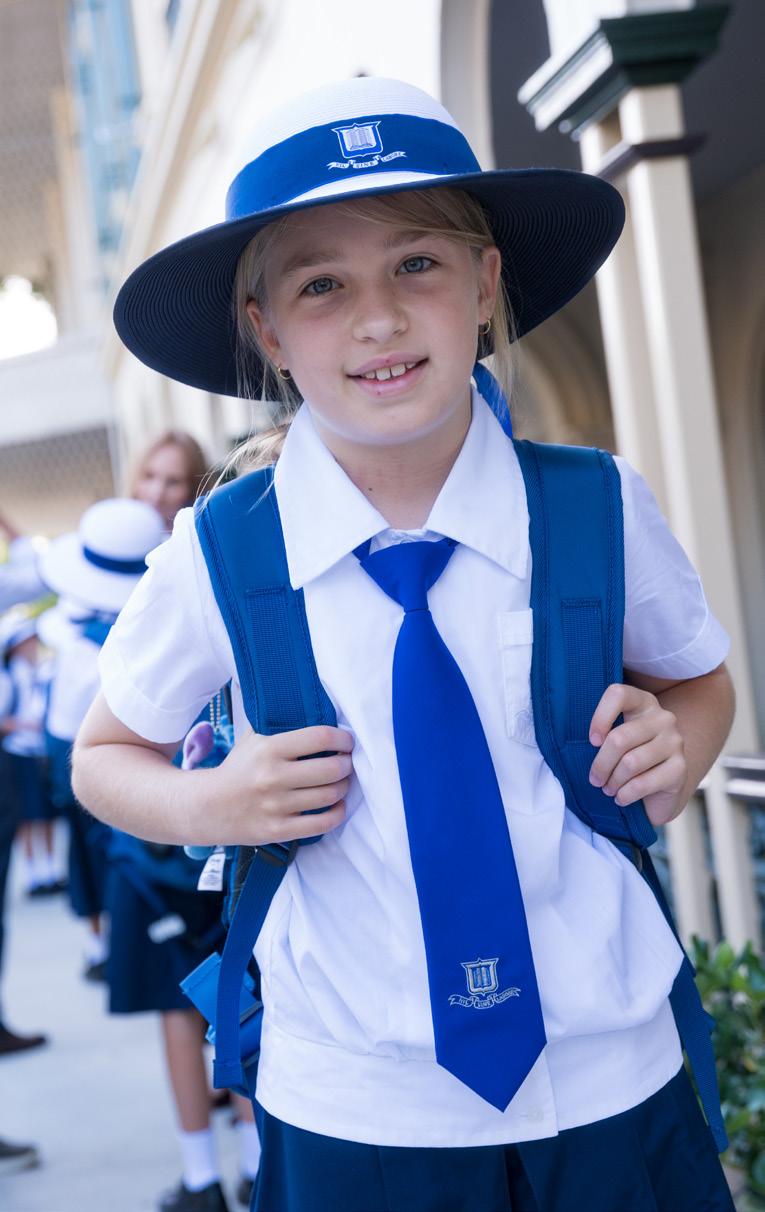
At times it has felt not so much like opening a door, as a door bursting open. While we expected adding primary years would bring new energy to the School, even we underestimated the infectious joy and enthusiasm that quickly spread across Gregory Terrace as our Years 5 and 6 students made their presence felt—whether it was the white hats bobbing across the road, or the bursts of energetic waving from the Junior School verandahs.
I note that along with expanding the School, we have also continued to expand our girls’ vocabularies. In 2025 the word of the year was sesquicentenary. In 2026, it seems to
Above Principal (Acting)
Mrs Anne Ingram
be inaugural. And there’s a wonderful symmetry to this, ending a year that honoured the past, only to begin one that’s very much focused on a future of firsts.
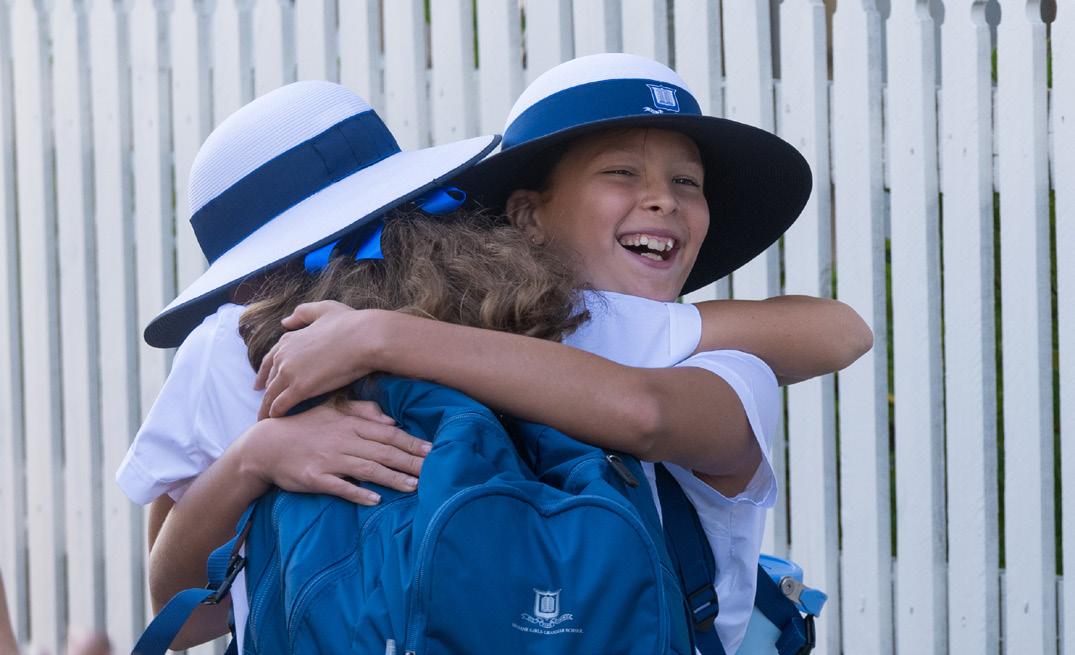
On pages 6 and 7 of this issue of Gazette, we share some delightful reflections from our Junior girls on their experiences of ‘being inaugural’. Please take time to watch the linked video on page 7 for a lovely insight into their first Semester at BGGS and what it has meant for these girls to join our community. It has been truly gratifying to see the big sister-little sister bonds naturally develop between our Junior and Senior girls in recent months and we look forward to seeing these connections deepen and endure.
It has been a busy Semester in the Senior School too, where AI has been a common theme across fact and fiction, reflecting a conversation taking place at almost every level of society. On page 24, Head of Literature & English Extension Ms Meghan Parry
shares an intriguing insight into how Year 12 Literature students have been experimenting with generative AI as a feedback tool. Surprisingly, learning its limitations, as much as its capabilities, has stimulated enormous discussion and insight, preparing them for a world where critical thinking will be more important than ever.
Meanwhile, in Drama, the School’s biennial co-production with BGS delved into a technology-driven future where ‘AI teenagers’ walk among us (pages 10 and 11). Students had the opportunity to work directly with playwright David Burton on the script for the sell-out show Common Ground. And with a theme that revolves around the importance of human connection, it’s been interesting to hear cast members reflect on the value of face-to-face interactions.
In a changing world, we would never want to stand still, but I’m proud our girls still see the happiness and sense of belonging that can spring from making real-world connections, even those as simple as a smile and a wave.
Principal Jacinda Euler Welsh was on leave Term 2, returning Term 3.
From the Head Girls Power of sisterhood shines bright
It feels like just yesterday when we walked through the famous white picket fence on our first day as Grammar girls in 2021. Our uniforms felt three sizes too big and stomachs full of butterflies.
But it wasn’t long before we were embraced by the community, building friendships to last well beyond high school, throwing ourselves into the many sports and co-curricular activities.
We met each other through Swimming and Water Polo in Year 7 and shared a memorable Marrapatta camp together in Year 8. Covid restrictions meant there were no sharing secrets late into the night, as we all had to sleep socially distanced in separate tents. We still bonded over muddy hikes, star gazing and a storm that tested the construction skills of many campers, including ourselves.
Now here we are, side by side, in Year 12, ticking off the bittersweet list of lasts: last first day, our last Galentine’s Day, last Foundation Day cake.
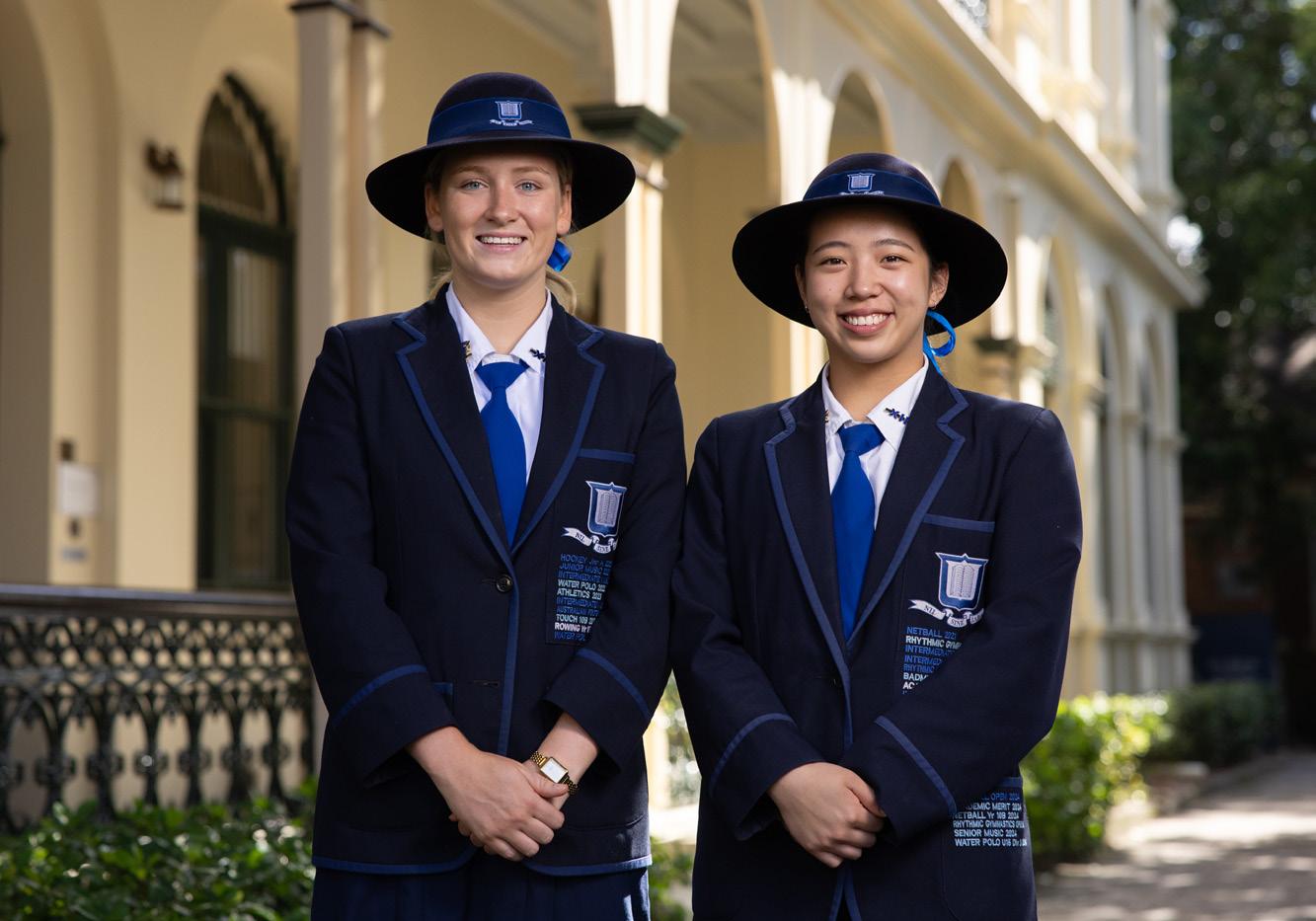
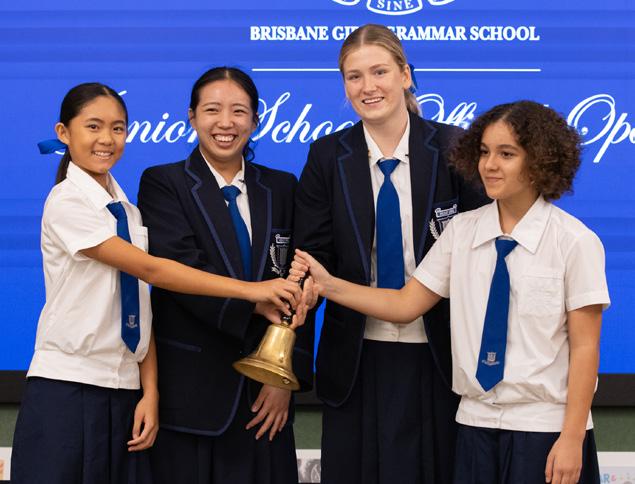
After years of looking up to our School leaders, it is truly an honour to be among them and to play a role in giving back and inspiring others. It was particularly special to be part of the historic Junior School opening this year, ringing the bell alongside the inaugural Year 6 Captains Charlotte Chao (6G) and Chloe Chakrabarti (6P) to officially open our ‘little sister’ School across Gregory Terrace.
One of the first, and most exciting, tasks for our Year 12 leadership group was collaborating at the Student Council retreat to shape our 2026 School motto: Spark the blue, let our sisterhood shine true #Bluminate
In this motto, we aim to capture three of Year 12’s most deeply held values:
• Passion
• Authenticity
• Sisterhood
The first value, passion, is embodied in ‘Spark the blue’. It evokes the power and instant illumination of just one spark to signify our spirit of support for one another. It’s a passion we aim to ignite at every School event, showing up for ourselves and our Grammar sisters to ensure our community is always a bright, memorable and energised force.
The second value is authenticity When we ‘shine true’ we embrace our individuality, because what makes us
unique is as important as what we have in common. Authenticity requires courage and confidence, two qualities nurtured at Girls Grammar. Being true to ourselves allows us all to lead with purpose and integrity, celebrating the diverse attributes everyone brings to the School.
Our third value is sisterhood, highlighting what it means to be part of the Girls Grammar community. When we ‘let our sisterhood shine true’, we commit to lifting up those around us to contribute to something bigger than ourselves.
Finally, our hashtag #Bluminate reminds us to always light the way for our Grammar sisters with pride and passion.
We hope everyone in our community— from our new Year 5s through to our fellow Year 12s—have had a rewarding start to the year. We look forward with excitement and a touch of sadness to our final semester ever as Grammar girls.
Above Emma Bond (12L) and Cadence Chang (12H)
New beginnings Girls Grammar welcomes a little sister to the family
as the Junior School opens
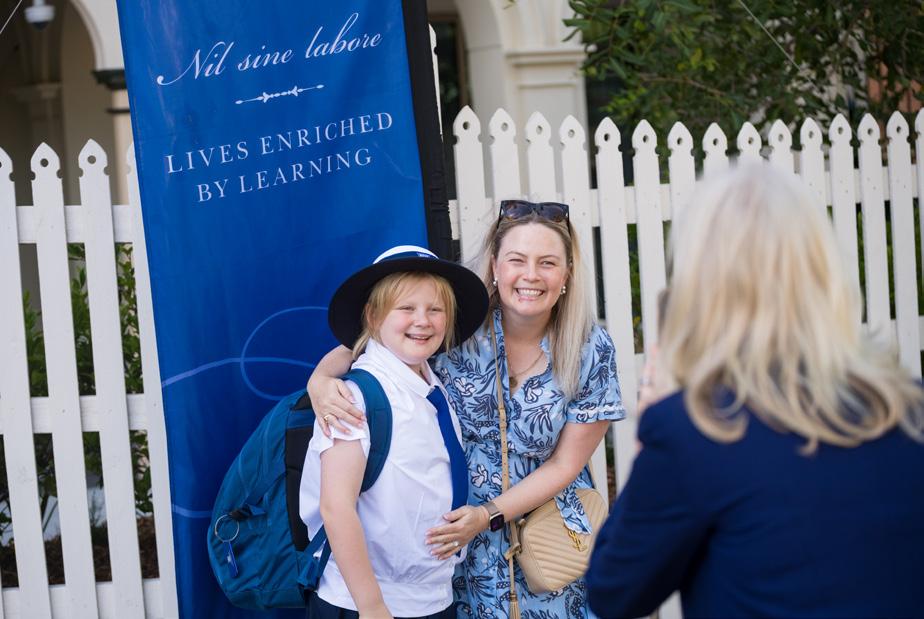
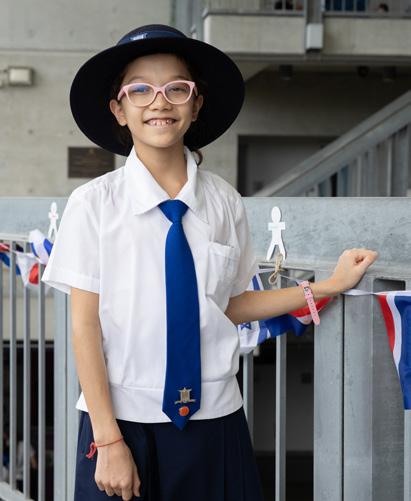
Gregory Terrace was a bustle of excitement, energy and white hats as the inaugural Junior School students arrived for their first day on Wednesday 28 January.
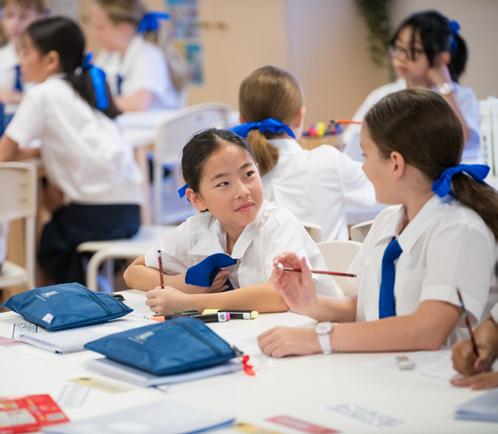
After years of planning and anticipation, 200 Years 5 and 6 students were eager to settle into their new classrooms, explore the School and meet new teachers and friends. Equally, Grammar girls in Years 7 to 12 were curious and keen to welcome their new ‘little sisters’ with many waves exchanged across Gregory Terrace.
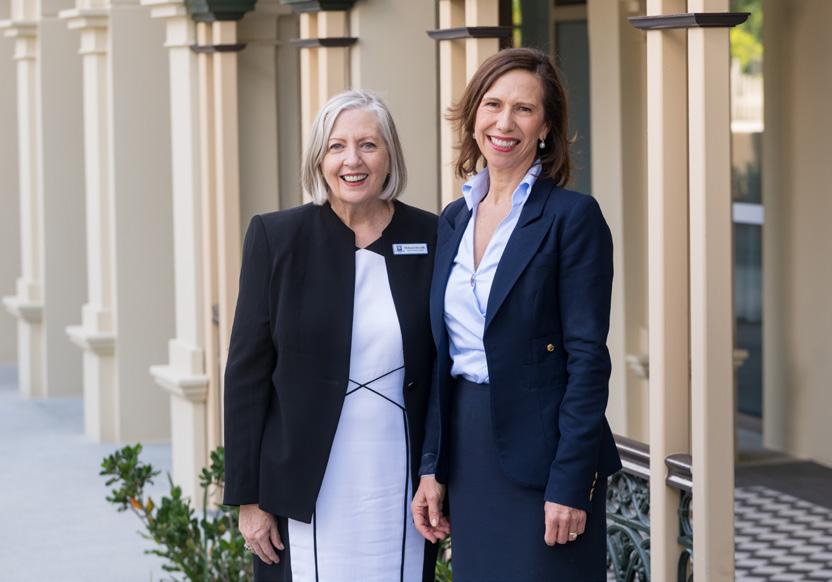
Girls Grammar Principal Ms Jacinda Euler Welsh and Head of Junior School Ms Karen McArdle were on
hand to greet students and parents as they arrived for the first day, with Girls Grammar Ambassadors guiding newcomers around facilities.
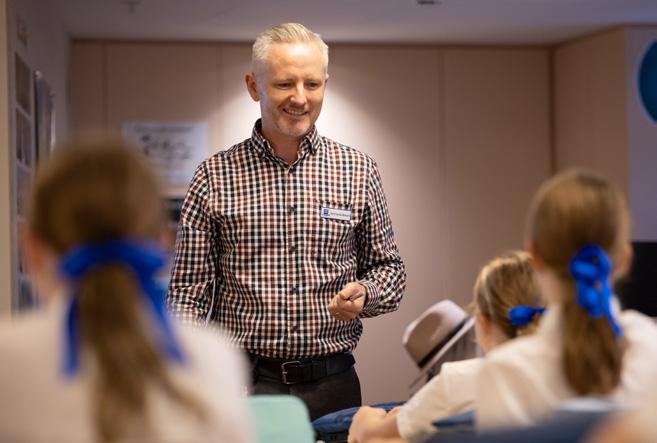
‘The word we heard most often on that first day was ‘joy’,’ Ms McArdle said. ‘And I think that really captures the excitement and delight felt not just by students, but by our staff who had been preparing for many months to welcome the girls.’
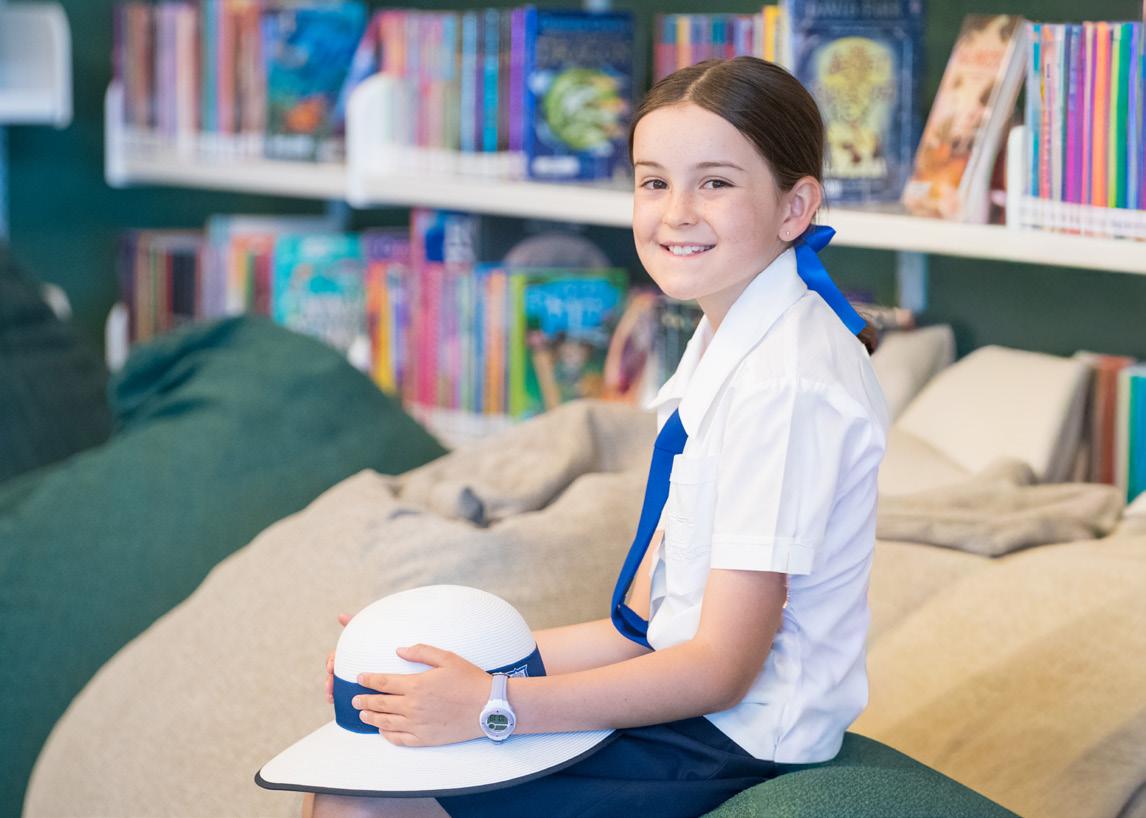
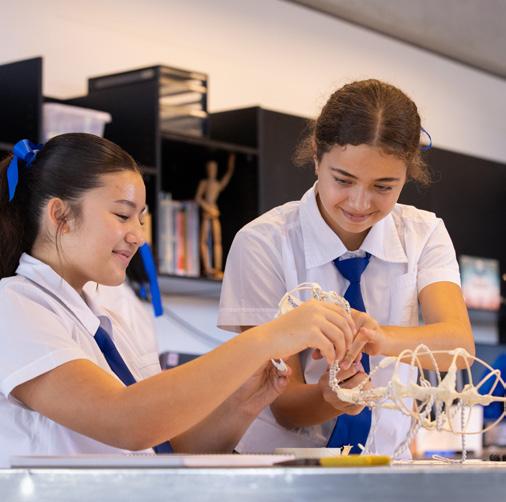
Students spent their first day settling into new classrooms and exploring specialist learning areas for Science, Drama and Music. The Junior School Library proved to be a hit, with the extensive collection of books, whimsical
cloud lighting and beanbags winning many fans.
Both the building and curriculum aim to nurture students’ natural sense of curiosity, wonder and delight in their final years of primary school.
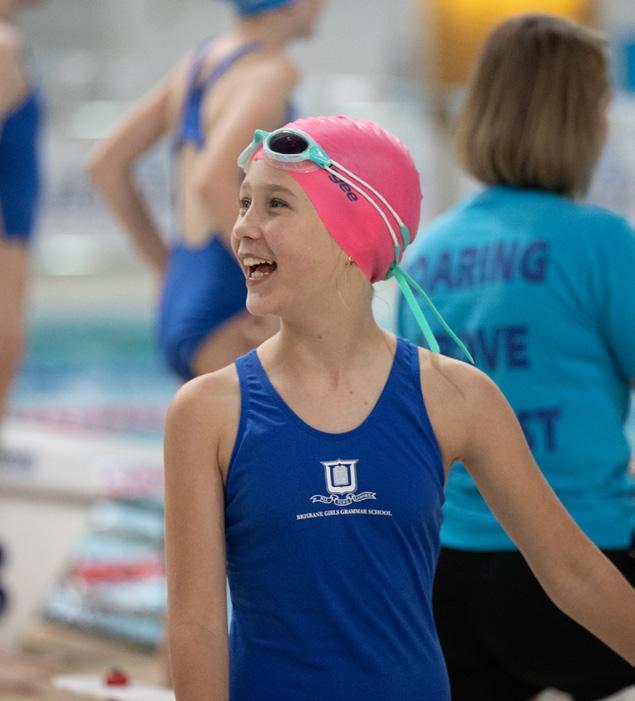
Although part of BGGS, the Junior School has its own distinct house structure, with girls divided into: Jacaranda, Magnolia, Myrtle and Wattle houses. And to ensure challenging interschool competition, Girls Grammar spearheaded the formation of a Junior Girls Sport Alliance, in which Years 5 and 6 students from seven Brisbane primary schools compete for the Fortissima Cup in Swimming, Cross Country and Athletics.
‘The word we heard most often on that first day was ‘joy’ ’
Ms Karen McArdle, Head of Junior School
FROM THE STUDENTS
A
first time for everything
Years 5 and 6 students reflect on Term 1, exploring a new building, making lasting friendships and taking on fresh challenges
Constance Fenwick (5T)
In my first term of being a Grammar girl, I expected the School would hold amazing opportunities. I was right. I was excited about new friends and teachers, the building and all the sports and activities.
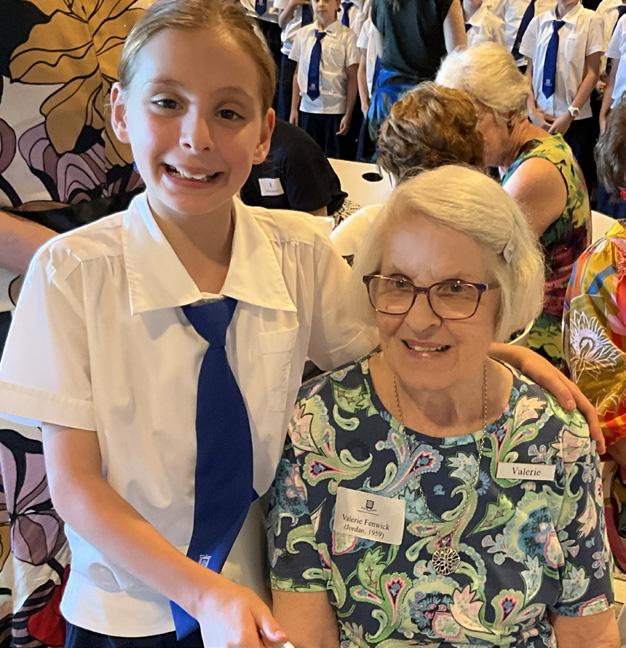
My grandma went to Girls Grammar more than 50 years ago and told me to make the most of every day and to enjoy it, because she said that you are not in school forever. At the Foundation Day Alumnae Afternoon Tea, I sang in a choir to my grandma and all the Girls Grammar Old Girls. I saw my grandma laughing and joking with her friends, telling stories about when they were at the School and seeing that made my heart glow.
Some of my highlights in Term 1 have been making new friends and having fun with them. I have loved playing my trumpet in Grevillia Band and singing in the Kingfisher Choir. The sport carnivals and co-curricular activities like Cricket and Tennis have kept my body and mind healthy and fit. Finding my strengths and even my weaknesses has taught me to reflect on what I do well and what I can do better.
I am looking forward to moving to the Senior School and meeting the new Year 7 girls in my grade, joining my House Group and trying an even wider range of sports and music.
‘I saw my grandma laughing and joking with her friends, telling stories about when they were at School’
Constance Fenwick (5T)
Brisbane Girls Grammar School
Arina Wen (6P)
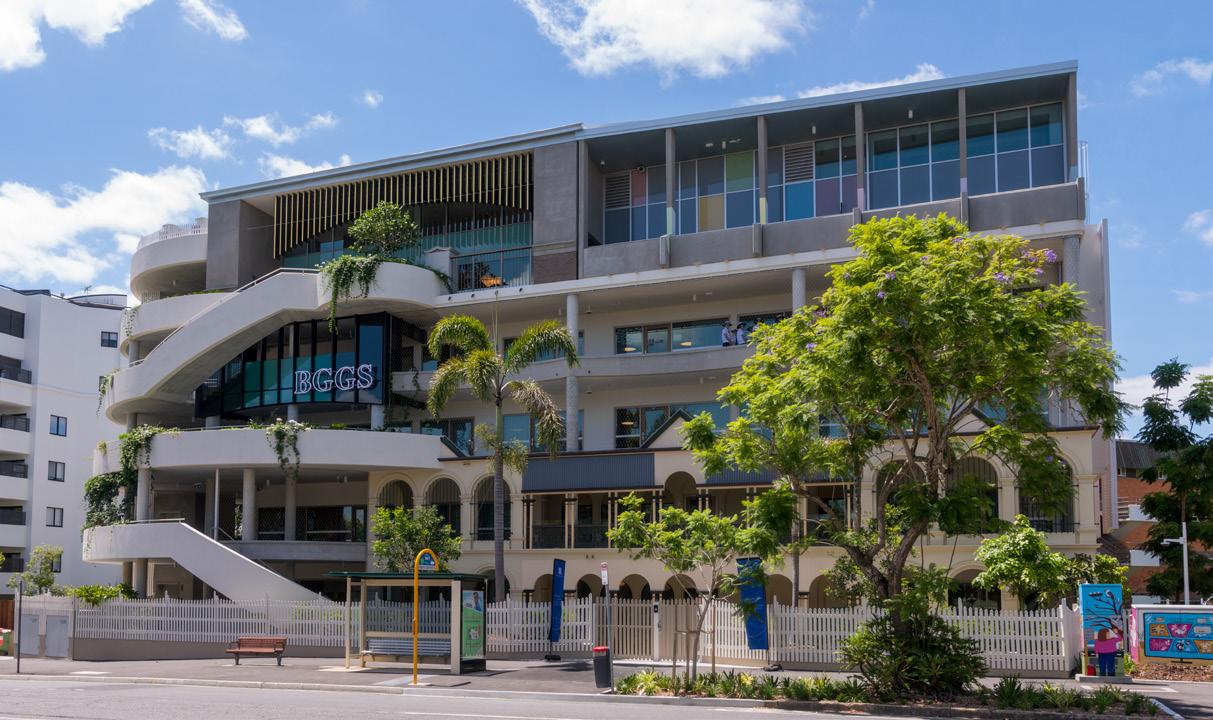
One week before school started, I was peering outside the car window at the marble white, five-storey building, with vines swaying idyllically in the breeze. A wave of euphoria washed over me as I realised that soon, I would be walking through those doors as one of the inaugural Year 6 students.
Excitement bubbled inside me, but was slightly quelled by the unknowns— would I find where I truly belong?
Fast forward two weeks, I was waking up and buttoning on my tie at 6.30 am, getting ready for a before-school Music rehearsal. Early mornings were
no longer so daunting, and the once unfamiliar classrooms were places of comfort. With every challenge and every word of support from my teachers and peers, I grew more confident.
Lunchtimes brought a different kind of joy as the breezeway, library and playground filled with laughter and conversations. Friendships blossomed naturally, and the School began to feel like home.
As Term 1 unfolded, I embraced every opportunity, from Debating to Cross Country, and the Reader’s Cup to the Da Vinci Decathlon.
Looking back, it has been more than just a beginning—it has been a journey of growth, courage and connection that I will always treasure as a Grammar girl.
Jasmine Alcock (5P)
When I first arrived at Brisbane Girls Grammar Junior School, I didn’t know many girls in my grade. Now I have many strong connections I will carry in my heart to Senior School and beyond.
A few of the many highlights so far have been the great range of physical activities, particularly the co-curricular sports such as Netball and Tennis. My stamina has strengthened both physically and mentally since I’ve started. The wonderful teachers and staff always make everyone feel safe and comfortable, encouraging us to be resilient and to keep striving to do our best.
One thing I really enjoy about our School is how well-stocked the library is. Whether it’s non-fiction or fiction, traditional books or graphics novels, the library is guaranteed to have the right book for everyone.
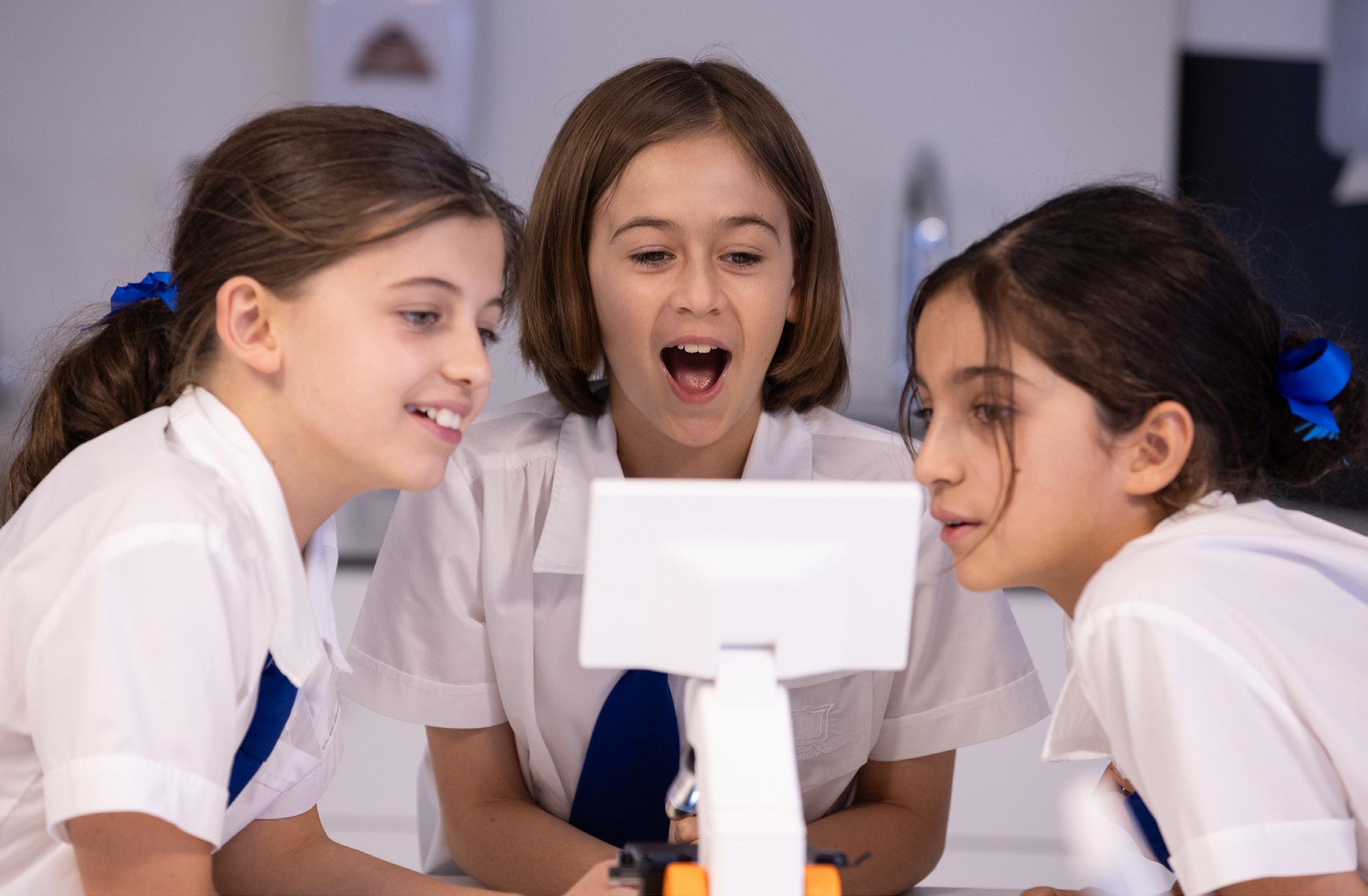
Another thing that has impressed me is the Science room where we get the opportunity to take part in fun and exciting experiments.
My experience so far at Brisbane Girls Grammar Junior School has been a privilege and I look forward to many exciting events to come, such as Year 6 camp next year.
Hear more Junior School students share their experiences
Female foundations
The Grammar Woman who forged a tradition of service and care on the site of the Junior School
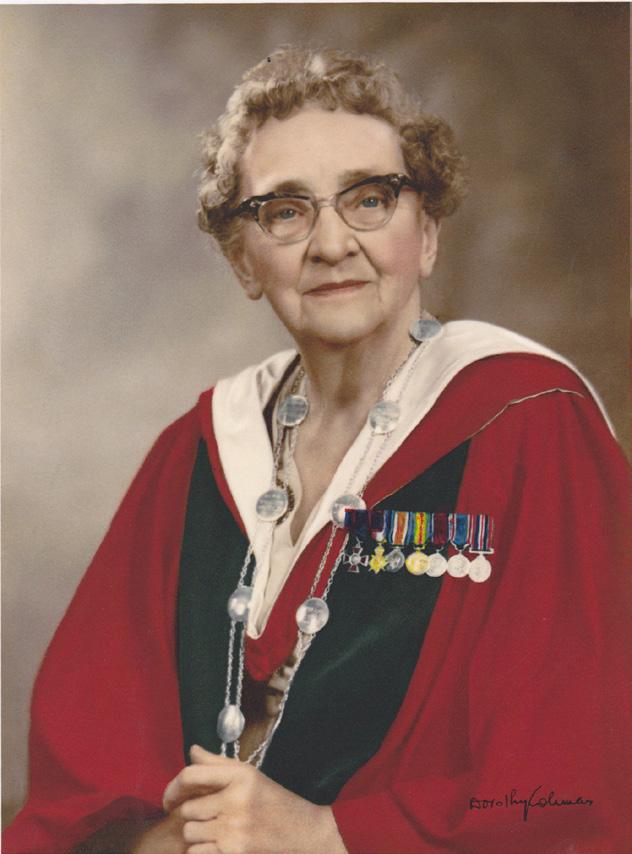
The echoes of remarkable women who have lived and worked on the site of the Junior School were recalled at the official opening in March. None more so than celebrated war nurse and Grammar alumna Eunice Paten MBE (1901) (1883-1973), who owned and operated a private hospital on the site from 1920 to 1936.
While many are aware of the Junior School’s history as headquarters for the Queensland Country Women’s Association—which advocated for the rights of women and families—fewer know it was also once the site of Holyrood Private Hospital, established and run by Eunice, who served in both WWI and WWII, reaching the rank of Lt Col.
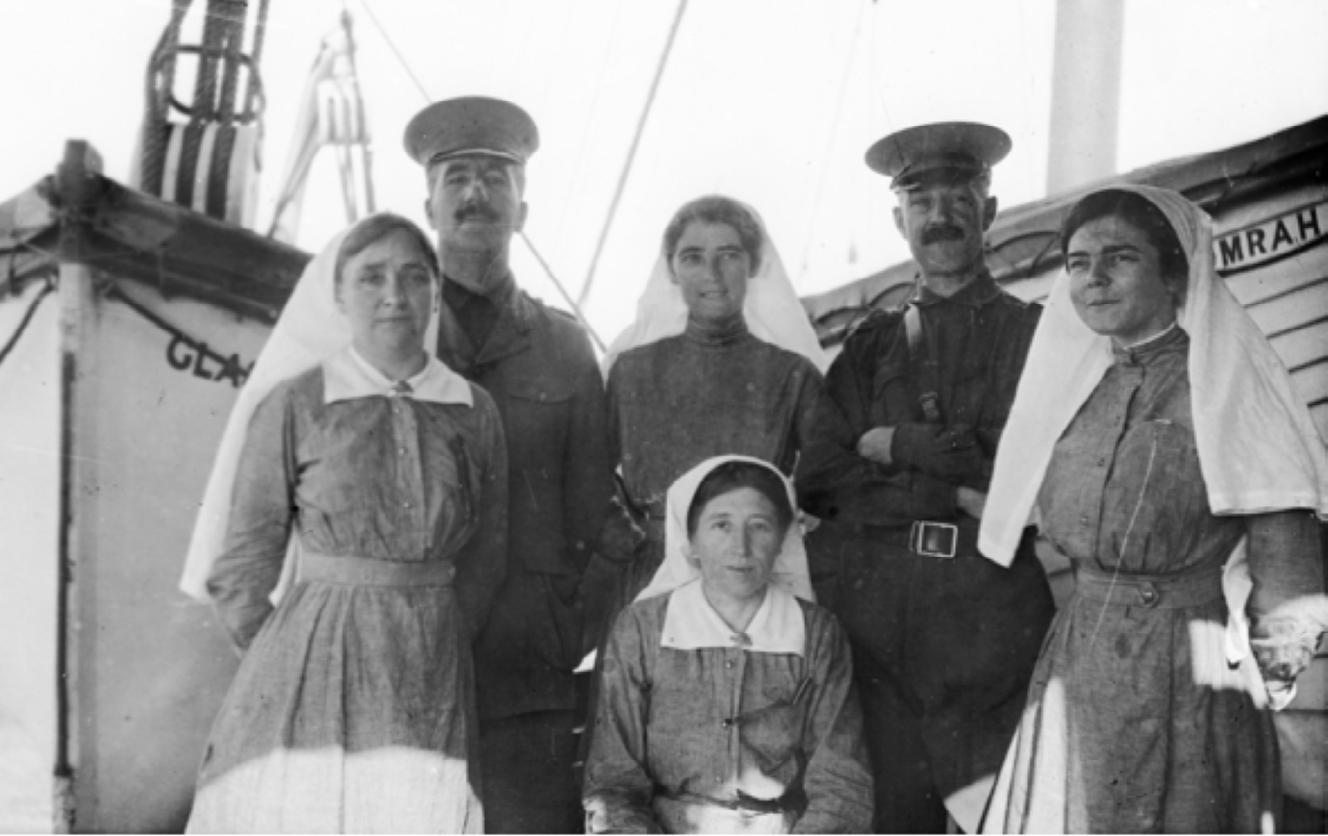
Eunice was born and raised in The Gap and attended Girls Grammar from 1898, going on to train in nursing and midwifery. When WWI was declared, she enlisted and was among the first four Queensland nurses to sail for Europe aboard the HMAT Omrah, which left Brisbane in September 1914, carrying the Australian Imperial Force’s 9th Battalion.
Stationed at the 1st Australian General Hospital in Cairo, Eunice treated the wounded evacuated from Gallipoli in 1915.
One of her descendants, Andrew Trewin, later wrote of Eunice, or Ness, as the family called her: ‘She would have nursed so many young men who were dying. Whenever I think of her, I imagine her being the last person a young man ever saw. I think she was hurt from all the losses she endured.’
Both her brother and brother-in-law were killed in WWI. After returning to Brisbane, Eunice bought a sprawling Queenslander
on Gregory Terrace, opposite Main Building, and opened Holyrood Hospital with fellow war nurse Tessa Thomas,
Described as ‘indomitable but kind’, Paten was a good businesswoman with a keen sense of humour. She closed Holyrood after the death of her mother in 1936 and the building was purchased by the Queensland Country Women’s Association in 1943.
When WWII was declared, Eunice re-enlisted at the age of 57, serving as Principal Matron for Australia’s 1st Military District (Northern Command) and in 1959 was made a Member of the Order of the British Empire (MBE) for her significant contribution to the military and nursing.
Holyrood House was demolished in 1971, with the building that replaced it later transformed into the Junior School.
Above Girls Grammar alumna Eunice Paten MBE (1901) (1883-1973), and far left in main photo, before boarding HMAT Omrah
History set in stone Opening expands on a promise to girls’ education
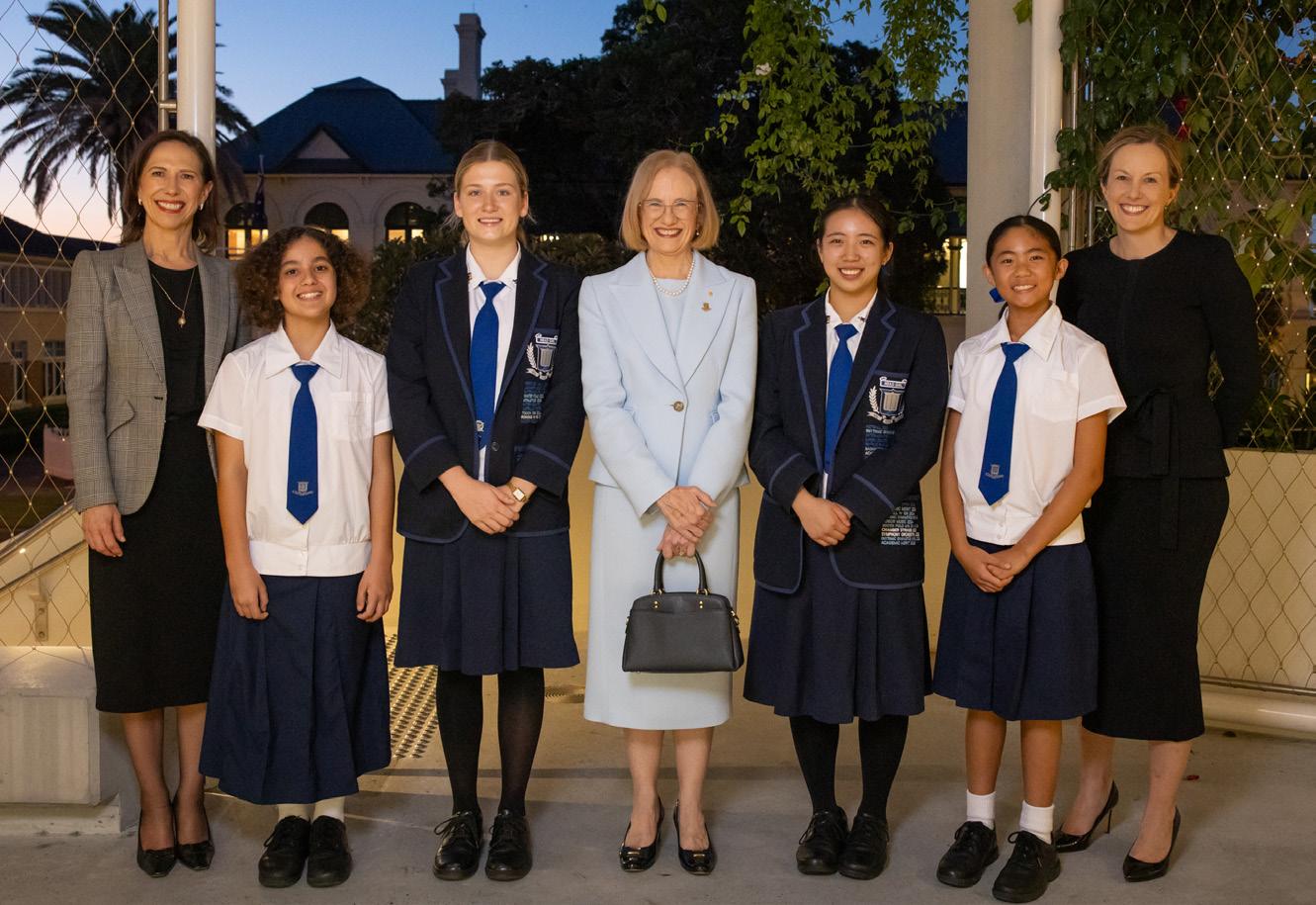
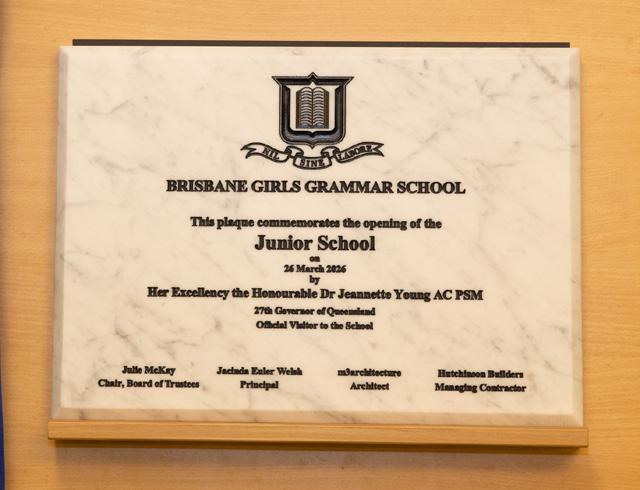
Queensland’s 27th Governor—the fourth female to hold the position— Her Excellency the Honourable Dr Jeannette Young AC PSM, officially opened the Junior School during an evening ceremony in March.
In a speech before 150 invited guests in the Junior School Library, Dr Young paid tribute to the expansion of BGGS’s promise to female education, welcoming girls in their formative primary years.
‘The admission, for the first time in 151 years, of primary-aged students represents a change to both the physical and the historical landscape of your School, but what remains the same, is the proven and enduring commitment to a broad, liberal education for girls—a foundational promise you have, quite spectacularly, delivered on,’ Dr Young told the BGGS community.
‘The outstanding results this School achieves, year on year, belie its broader remit—to spark curiosity about the world
and build strength of character, enabling students to go out into the world as confident, independent young women.’
After declaring the Junior School officially open, Dr Young concluded with a wish for the School’s future: ‘May it continue to shape generations to come.’
After Dr Young unveiled the Junior School foundation stone, Head Girls Cadence Chang (12H) and Emma Bond (12L) joined inaugural Year 6 Captains Charlotte Chao (6G) and Chloe Chakrabarti (6P) in a ceremonial ringing of the new Junior School bell.
During the ceremony Principal Jacinda Euler Welsh noted the significant history of female leadership connected to the Junior School site, which had previously been the headquarters of the Queensland Country Women’s Association (QCWA), and the site of a private hospital run by BGGS alumna and celebrated war nurse Eunice Paten MBE (1901).
The five-storey QCWA building was re-imagined by the School’s longtime collaborators, m3architecture, and brought to life by Hutchinson Builders. Deliberate architectural echoes of iconic features of BGGS, but in miniature—from the columns and arches of Main Building to the green glass of the Science Learning Centre—help position it as the ‘little sister’ School, where students can grow and learn in their primary years before crossing the terrace for Years 7 to 12.
Captions 1 Her Excellency the Honourable Dr Jeannette Young AC PSM Governor of Queensland and Official Visitor to the School, centre, with Chair, Board of Trustees, Julie McKay (2000), on right, Principal Ms Jacinda Euler Welsh, on left, Head Girls Emma Bond (12L) and Cadence Chang (12H) and Year 6 Captains Chloe Chakrabarti (6P) and Charlotte Chao (6G) 2 The Junior School Foundation Stone 3 Head Girls and Year 6 Captains ring the bell
FROM THE STUDENTS
Survive + ctrl + delete
Original BGGS and BGS co-production, Common Ground, plunges students into a brave new world
Estella Mitchell (11R)
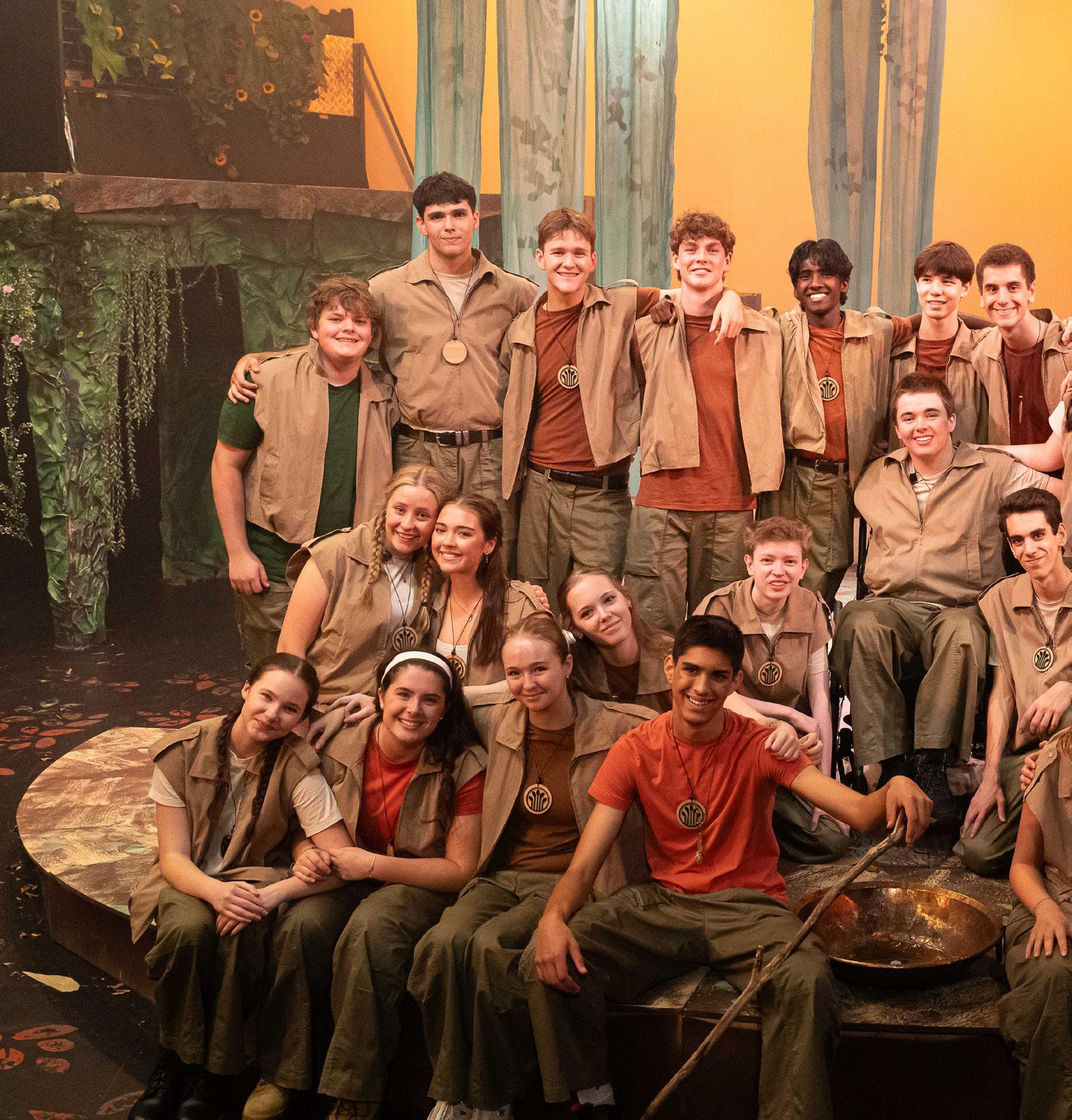
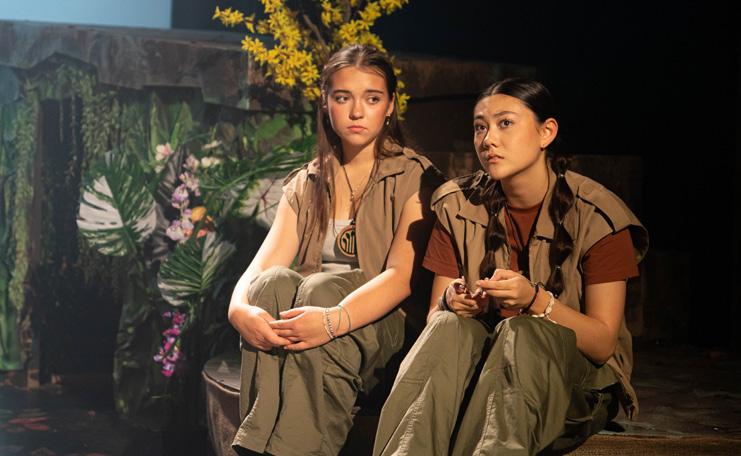
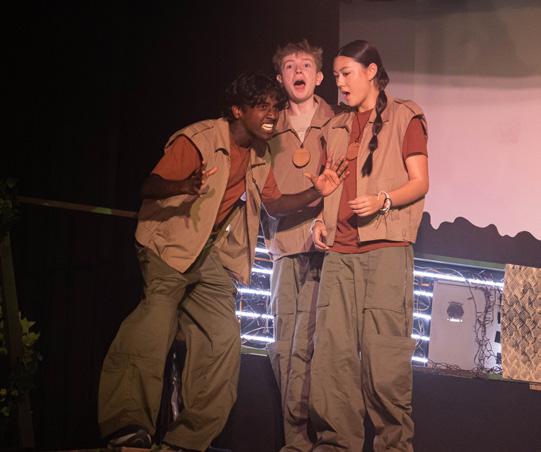
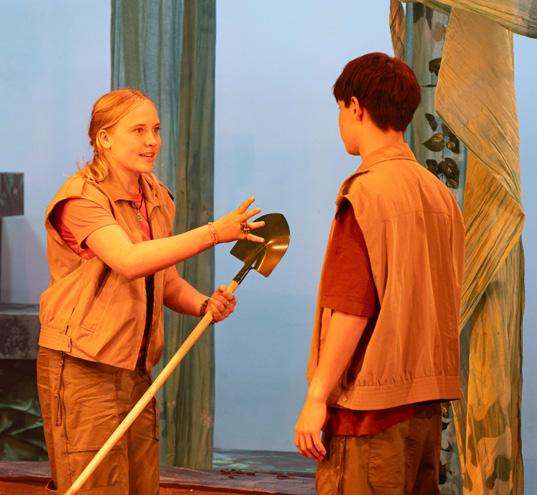
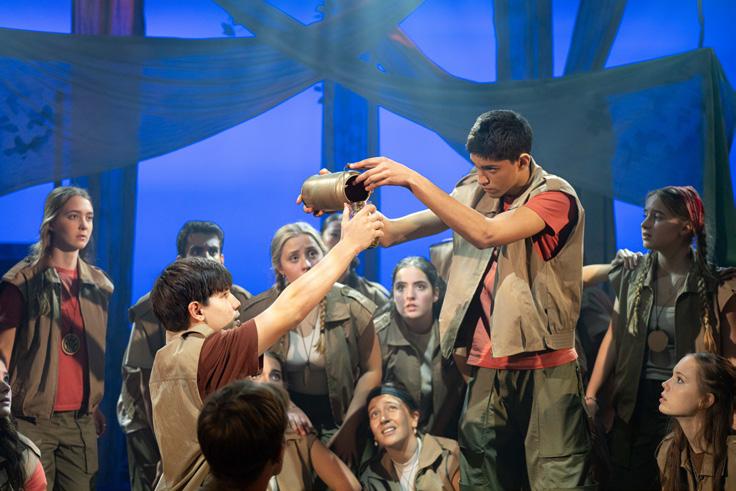
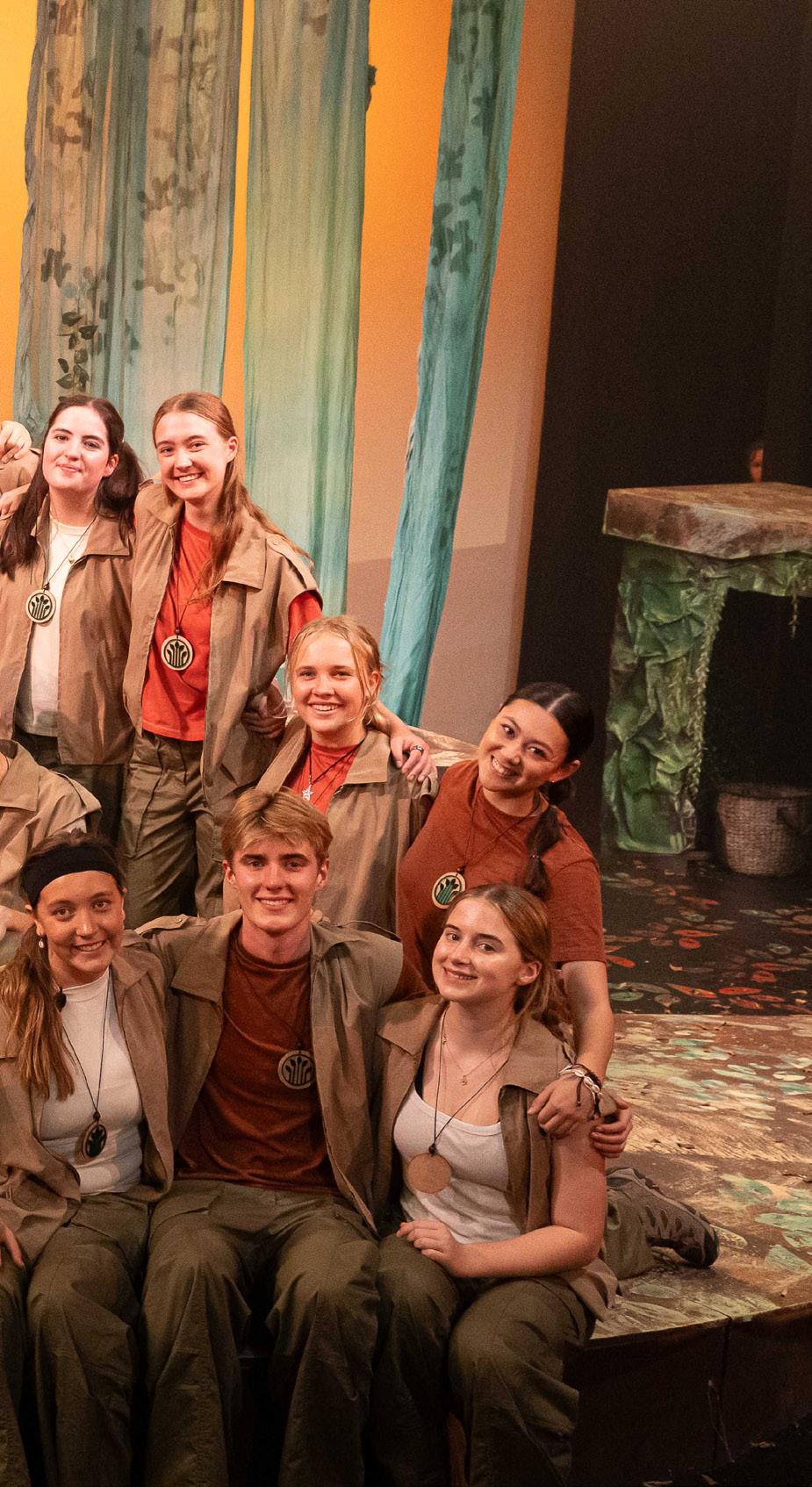
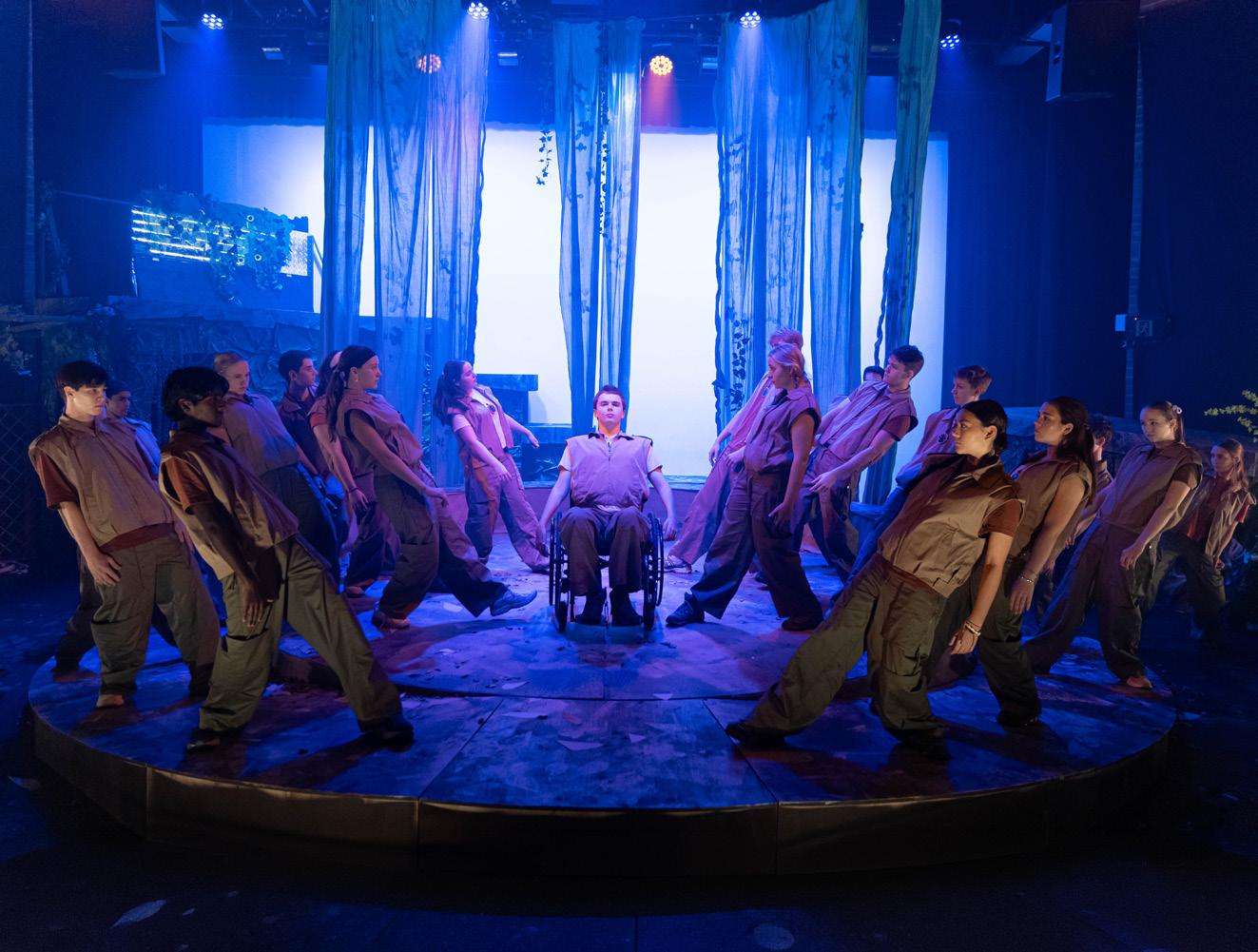
Common Ground follows 25 teenagers from the future, forced to survive in the wilderness for a year—but all is not what it seems.
The play is an original work by David Burton, with input from BGGS and BGS students, that explores themes of connection, surveillance and leadership through the eyes of teenagers living in a technologically advanced future.
The storyline follows them as they are thrown into an unknown new world. Tensions rise as they clash and form alliances, ultimately discovering that what they thought was ‘nature’ is an artificial world—complete with a server and AI bots in the guise of their fellow teens.
From leaders Clara and Eli, sweethearts Saff and Ari, or enemies Nic and Leo, Common Ground covers it all, exploring a range of relationships. Working directly with playwright David Burton to shape this script was an amazing experience for all involved. During the development process he visited BGGS and BGS separately to gain insight into all things ‘teenage’.
One detail I remember, in particular, was when he asked the boys to describe an ‘ideal boyfriend’, and they responded by listing physical traits. In response to the same question, the girls had answered with ‘kind and smart’. Both schools were equally surprised by the other’s responses. From relationships to technology, the two schools’ answers were compared to spark David Burton’s big idea: How do we connect without our screens?
There was a real feeling of being ‘seen’ as we saw our input and feedback incorporated into David’s subsequent
drafts of the script. The responsibility of bringing a completely original work to the stage was daunting but also inspiring. It was a rare privilege to be able to take the story in the direction we chose and we were all grateful for the generous insight into the writing process.
We performed four sold-out shows at the Gehrmann Theatre from June 18 to 23. The Monday student preview was the best crowd I think I’ve ever performed in front of. Before the show, the entire cast and crew were nervous, yet the minute we stepped on stage, into the lights and the audience cheered, every nerve seemed to vanish. The crowd’s energy was contagious, and it gave everyone the much-needed confidence to perform.
By closing night—with time to tweak performances, cues, lighting and sound—it was the best show we had delivered. The perfect send-off as months of hard work paid off.
Playing an ‘AI’ character, alongside Hamish Lilley (BGS) and Molly Lynch (12M), was definitely a challenge because it was really two roles in one: an AI playing the part of a regular teenager. We had to keep conflicting character motivations in mind, letting the
human masks ‘slip’ occasionally to give the audience subtle hints we may not be quite what we seemed, before the twist was revealed at the end.
Our AI characters—Chris, Cal and Tiff— remind us all that artificial intelligence has a growing influence in our world today, no longer just on a screen, but in relationships and conversations as it become more pervasive.
Common Ground delivers a message that’s important to teenagers everywhere—after all, it was written for us, about us and (a little bit) by us. It encourages us to push through the hard times and occasional awkwardness of face-to-face interactions, because real connection with other humans is worth it. The show also made us aware we have one very human thing in common: when it comes to connection, everyone is just as scared as you.
As the cast and crew departed Gehrmann Lane together after closing night, we took a moment to reflect on what this show meant to us. Not just a performance, a message we wanted to share with our parents, friends and teachers in the crowd. That message is slightly different for each of us, but at its heart we all wanted the same thing —to encourage connection in a world that seems to divide us. It is safe to say that BGGS and BGS found that Common Ground
I am heartbroken the play has closed, but many thanks must be given to the staff, particularly our directors, Drama teacher Ms Belinda Lindsay and Director of Creative Arts (Acting) Ms Katrina Riveros, assistant director, BGS Head of Drama Mr Ben Newth, producer, Coordinator of Cocurricular Drama Ms Emma Churchland, and Principal Ms Jacinda Euler Welsh for facilitating such a unique and wonderful production on our School grounds.
SCHOOL LIFE
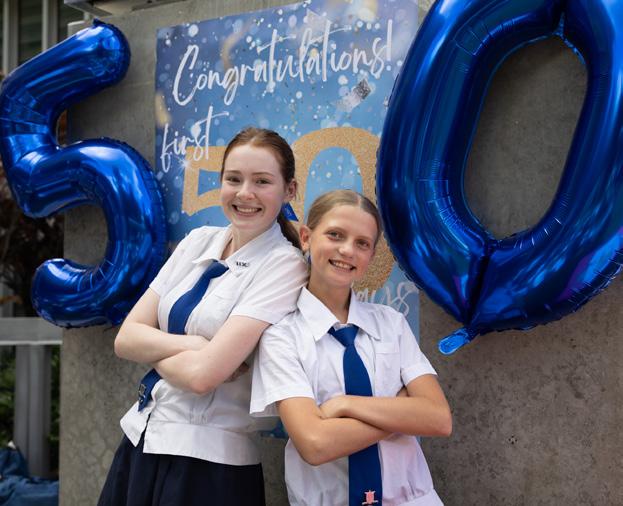
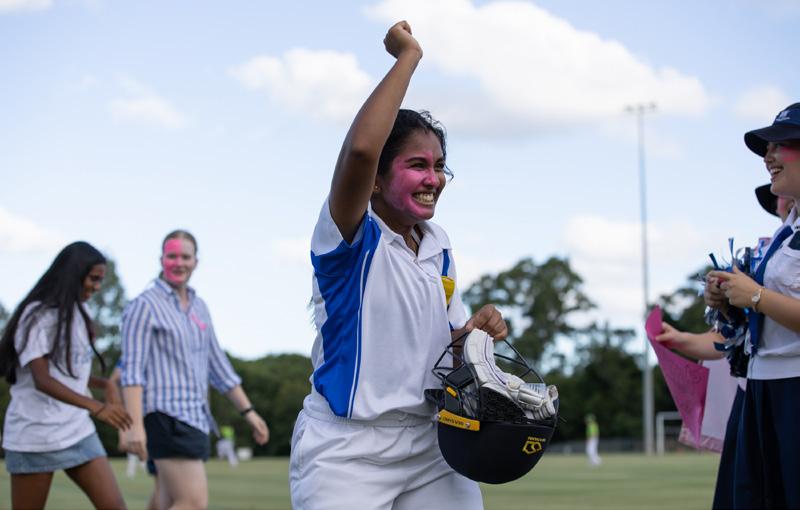
1. Students mark the first 50 days of the 2026 School year
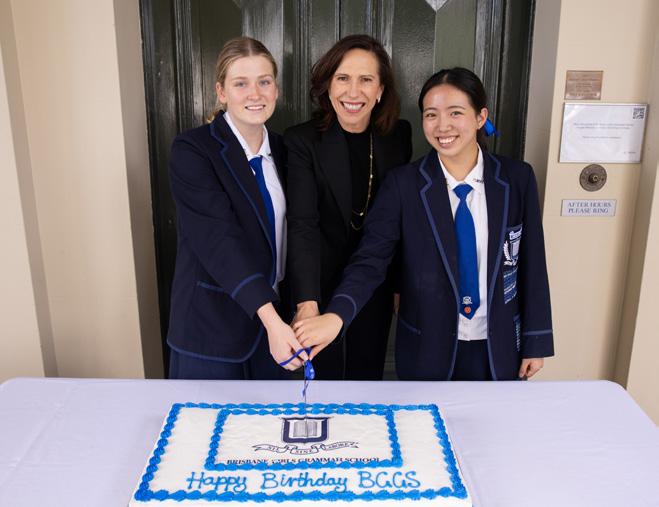
2. Head Girls Emma Bond (12L) and Cadence Chang (12H) join Principal Jacinda Euler Welsh in cutting the Foundation Day cake in March, marking 151 years since BGGS first opened its doors
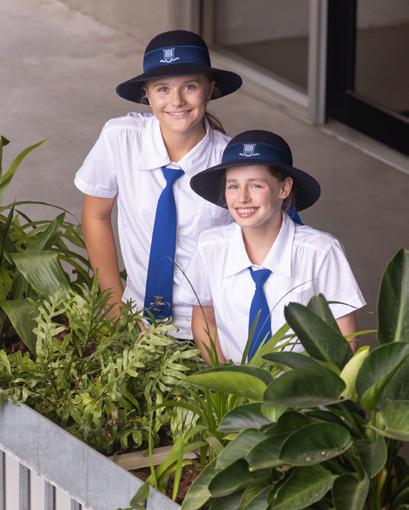
3. Girls Grammar’s Fathers Group funded the installation of hundreds of plants in a project to green the CLC over the summer break
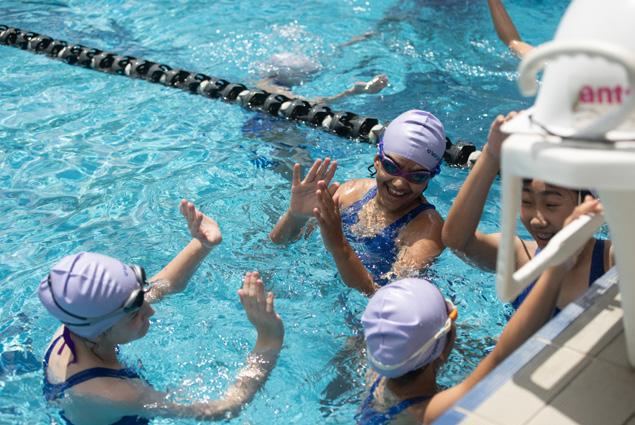
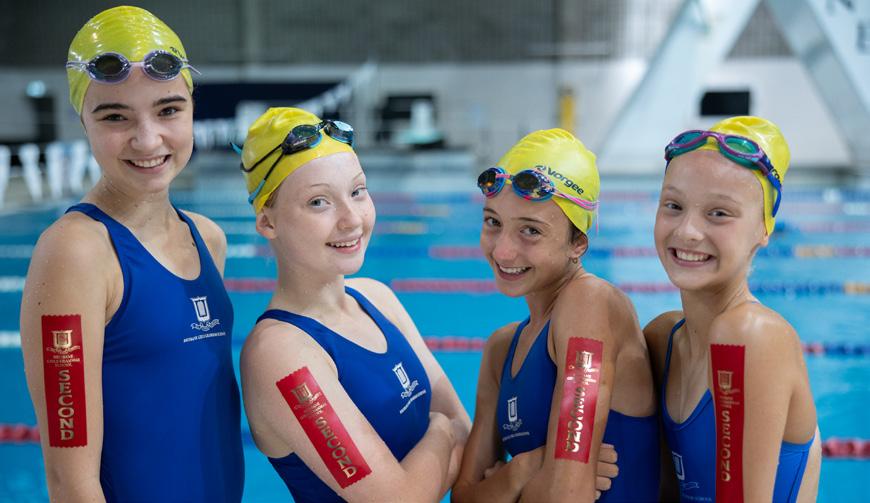
4. Relay ribbons at the Years 7 to 12 Interhouse Swimming Carnival
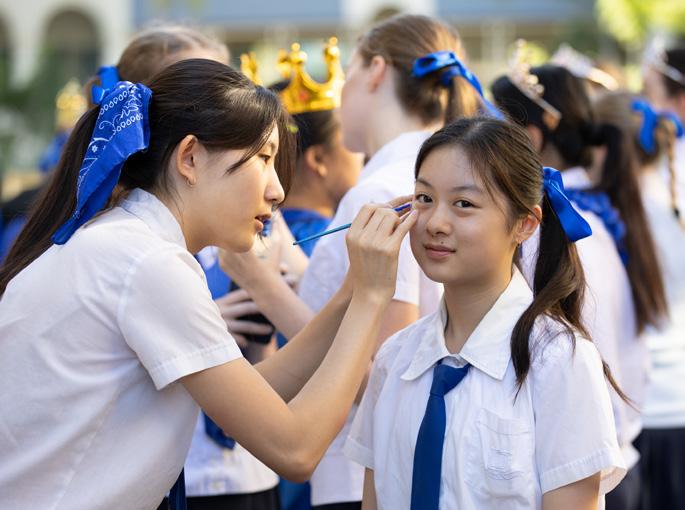
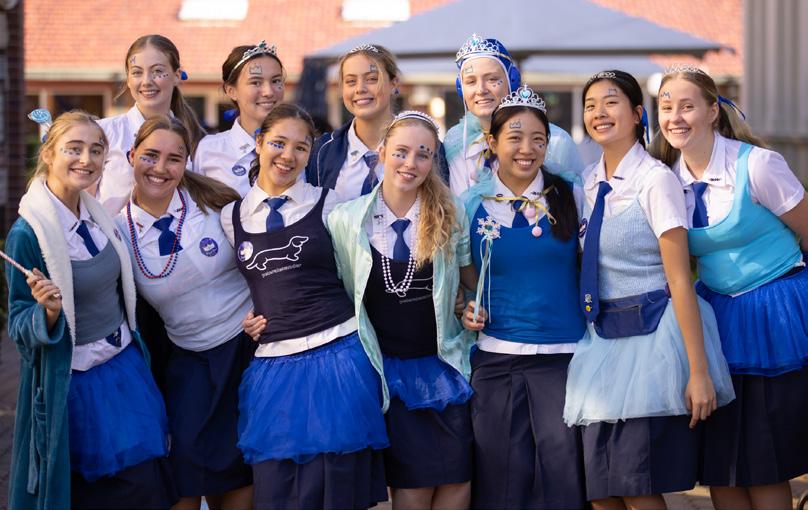
5. Students celebrate Blue Day
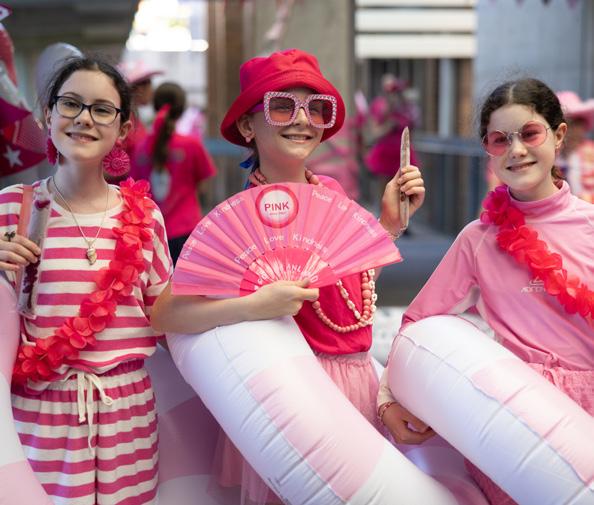
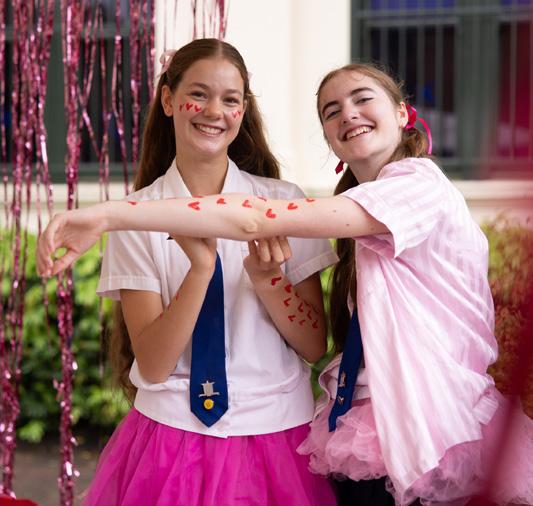
6. House parties spread colour and joy in Term 1
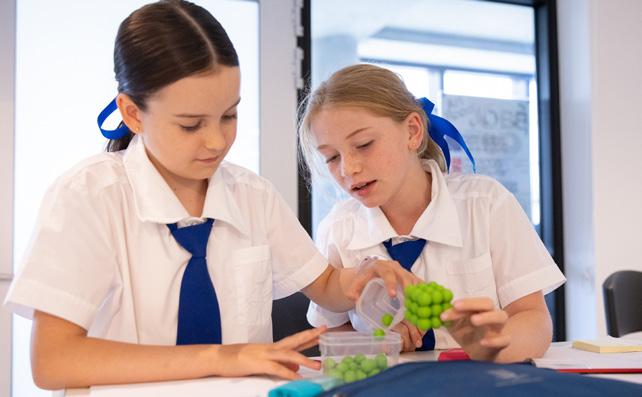
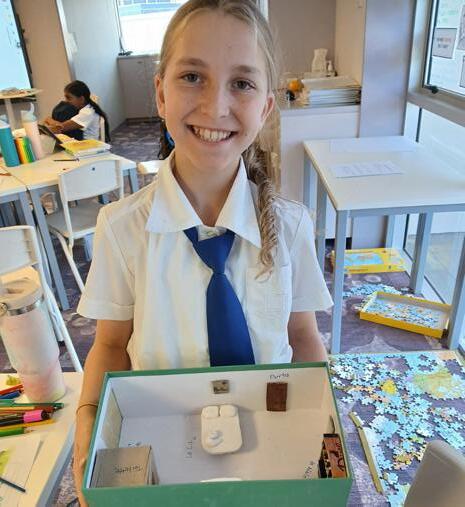
7. Year 5 students explore the structure of molecules
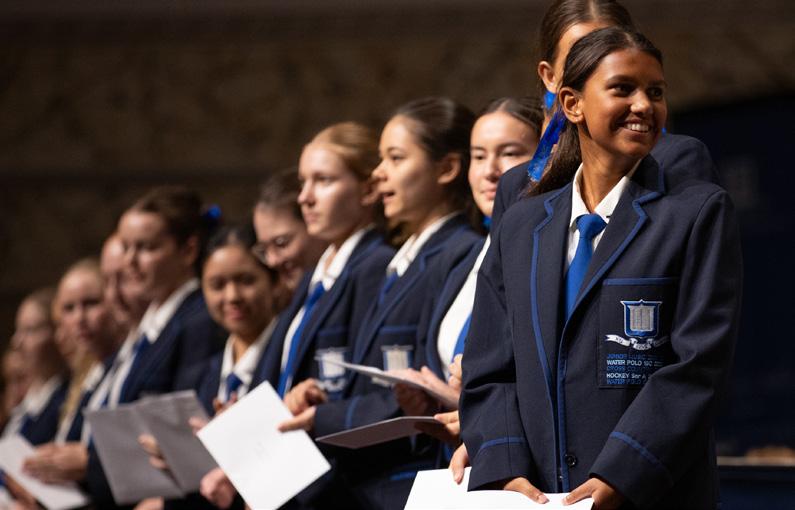
8. The Senior Leadership Assembly moved to City Hall for the first time, welcoming parents of Year 12 students to join the celebration
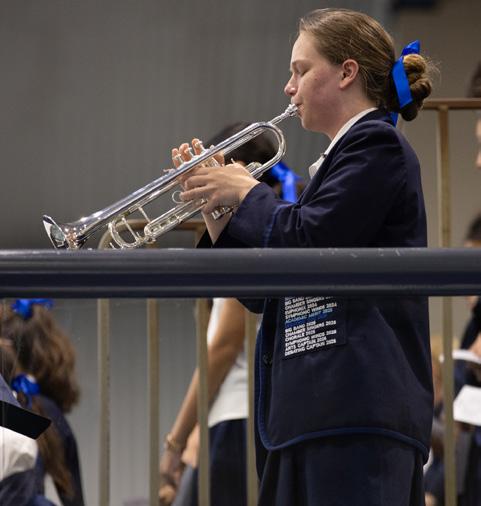
9. Clare Dooley (12E) plays The Last Post at the Anzac Day Assembly
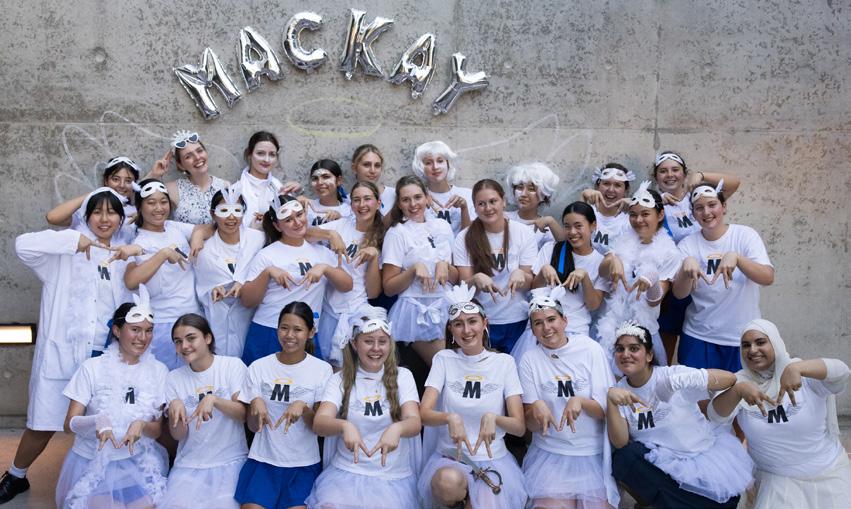
10. Mackay House Angels signal their allegiance
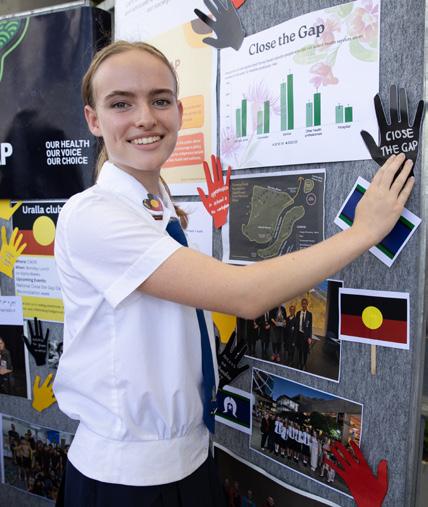
11. Uralla Club marked National Close the Gap Day in March, drawing attention to inequitable health outcomes for Indigenous Australians
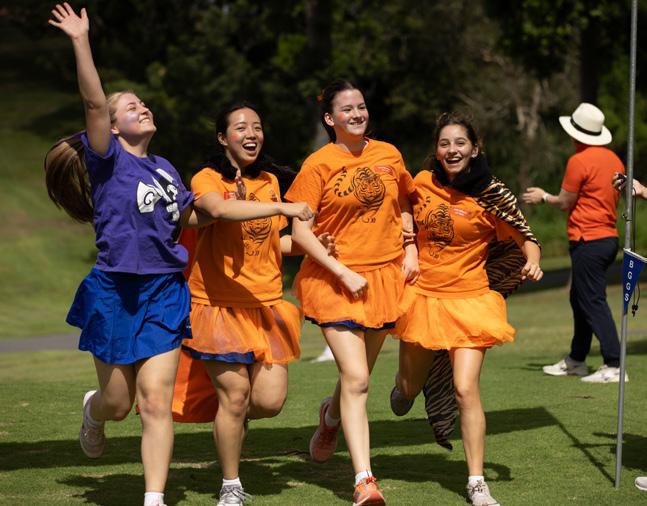
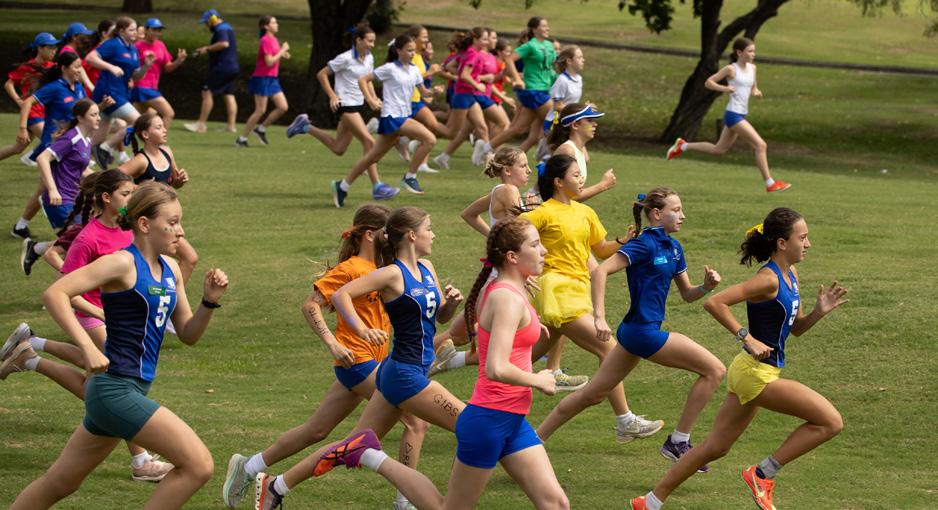
12. Students from the Junior and Senior Schools came together for the wholeof-school Interhouse Cross Country in Victoria Park (Barrambin)
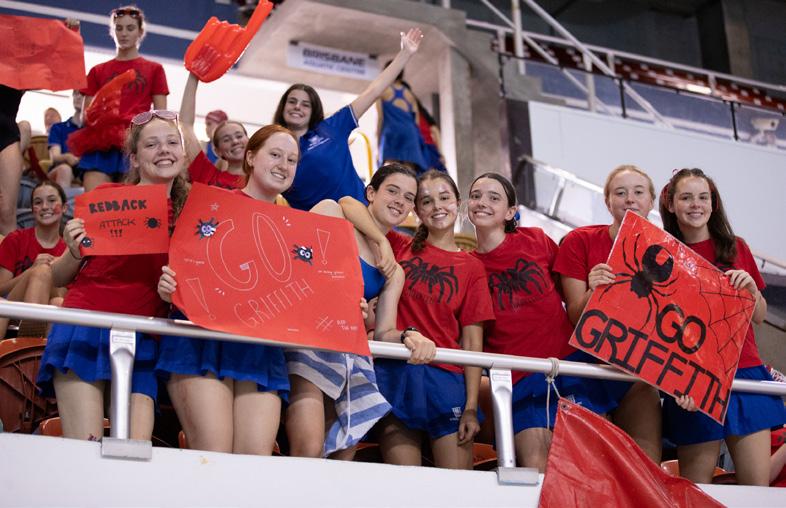
13. Griffith House cheers on swimmers at the Interhouse Swimming Carnival at Chandler in February
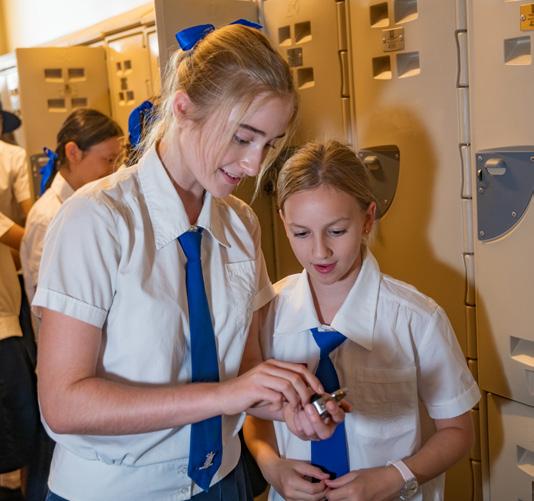
14. Amelia Chen (7G) and buddy Maya Panchapakesan (12G) on the first day of School
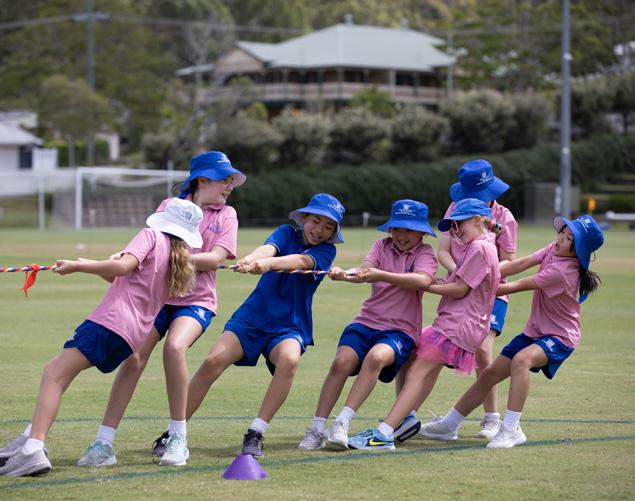
15. Years 5 and 6 Tabloid Sports Day at Rangakarra
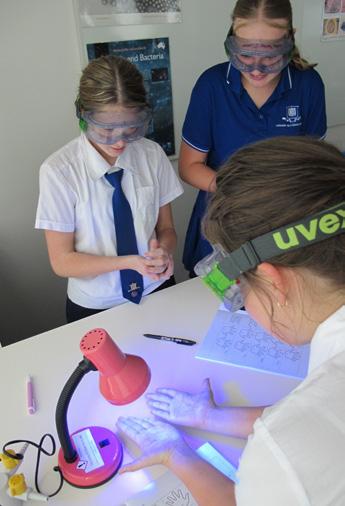
16. Science students investigate germ theory and the efficacy of handwashing
17. Interhouse Cross Country
18. Years 7 to 12 Interhouse Swimming Carnival
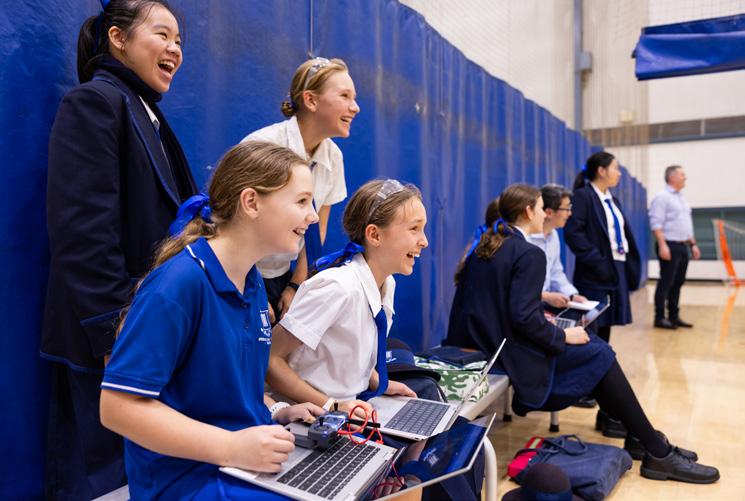
19. Students take part in a lunchtime autonomous drone flying competition as an extension of Robotics Club activities
20. Celebrating sisterhood on Galentine’s Day
21. Harmony Day
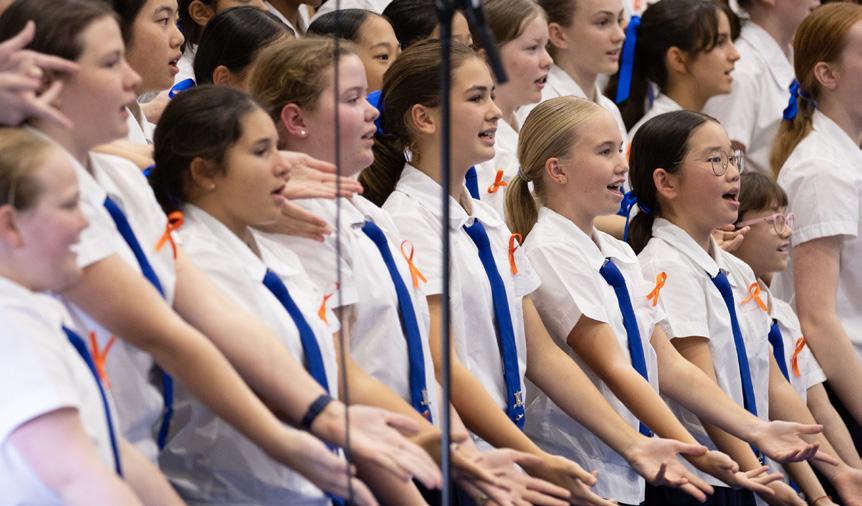
22. Interhouse Choir
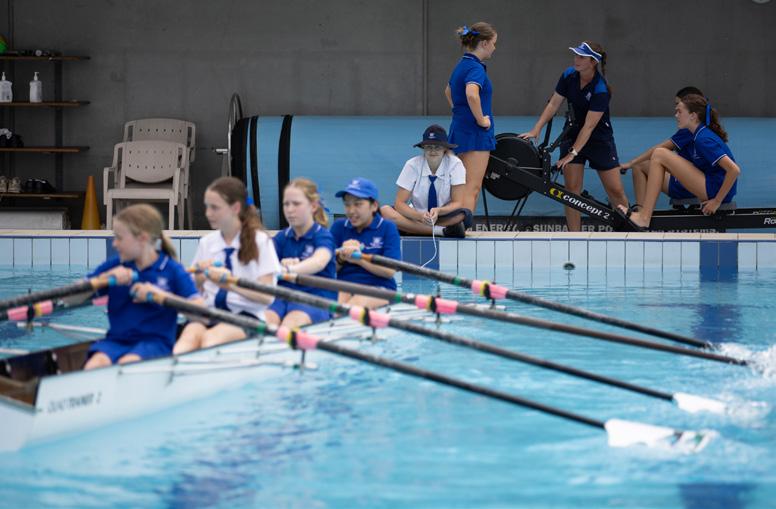
23. Boats take over the BGGS swimming pool for a Try Rowing session in Term 1
24. Zara Wong (8B) and Frances Lincoln (8B) work on hybrid animal sculptures in Visual Art
Brisbane Girls Grammar School
30.
31.
Wong
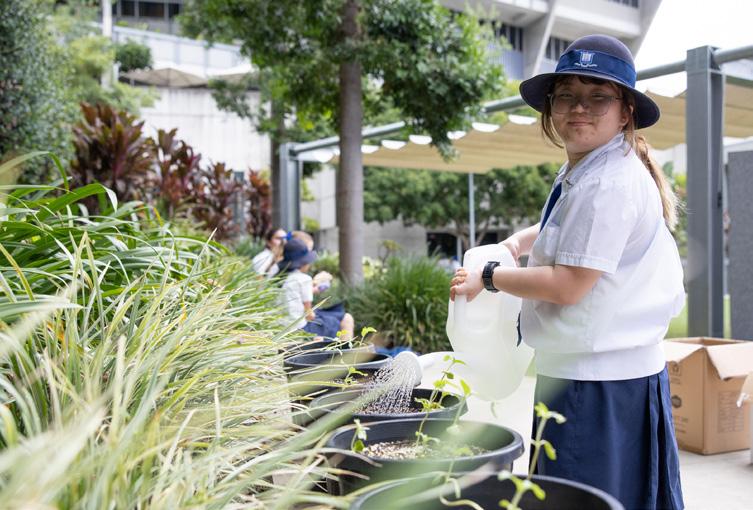
waters sunflowers planted by GECO for the University of Queensland’s Sunflower Competition
25. BGGS’s victorious International Young Physicists Tournament team heading to Zurich in July are Lucy Petersen (11B), Tiffany Yuen (12R), Astrid Selwa (12G) and Chantell Lam (11B), pictured with Head of Physics Alan Allinson
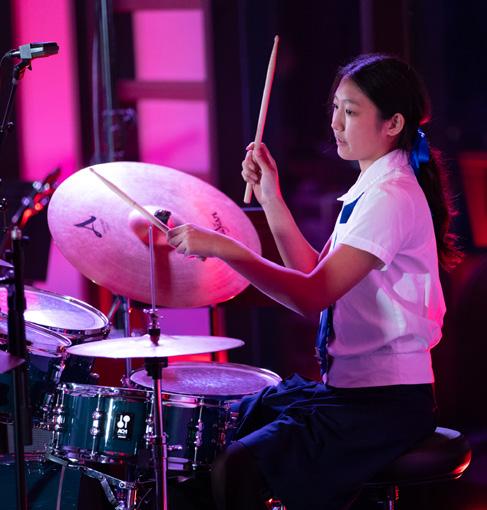
26. The annual Jazz Concert transformed the LMR into an intimate music club
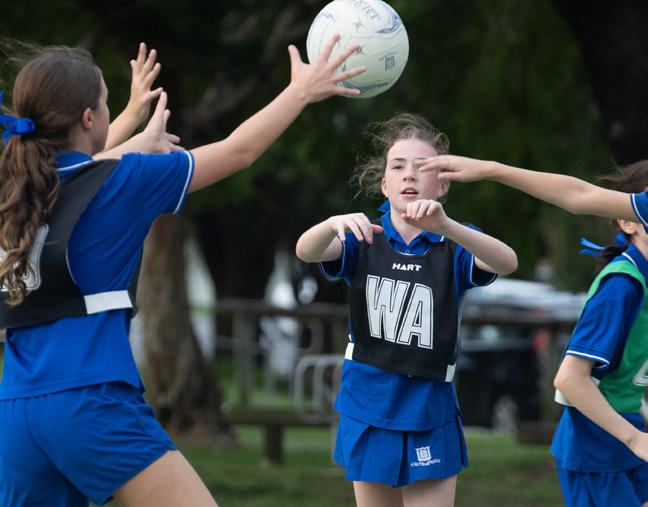
27. Netball training
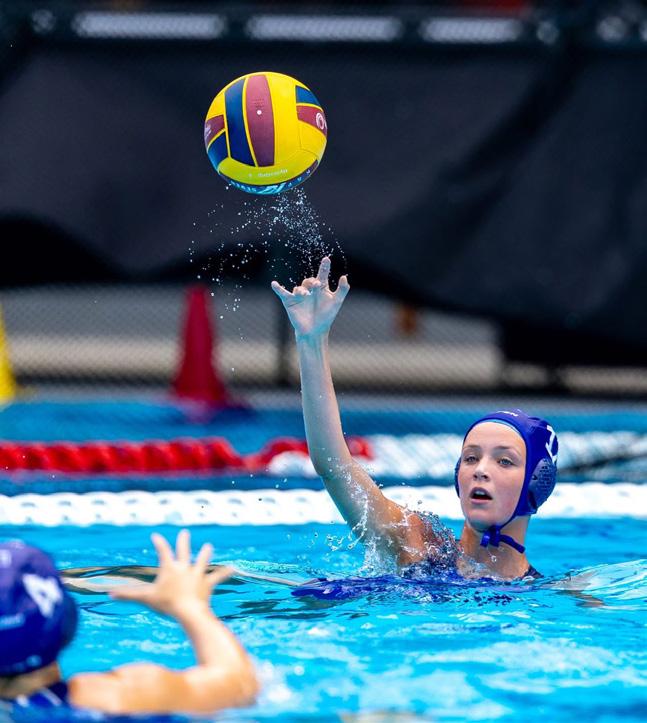
28. Water Polo
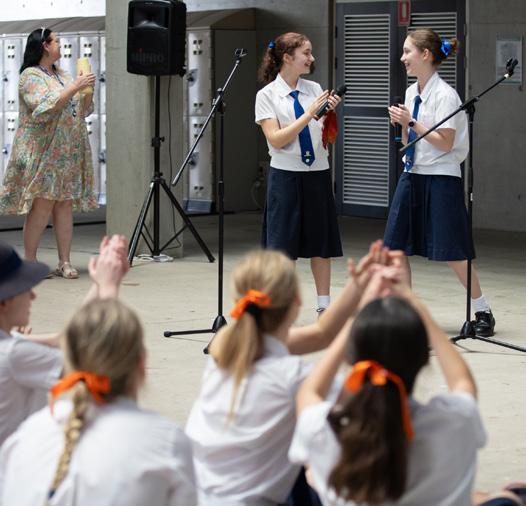
29. German karaoke at Harmony Day
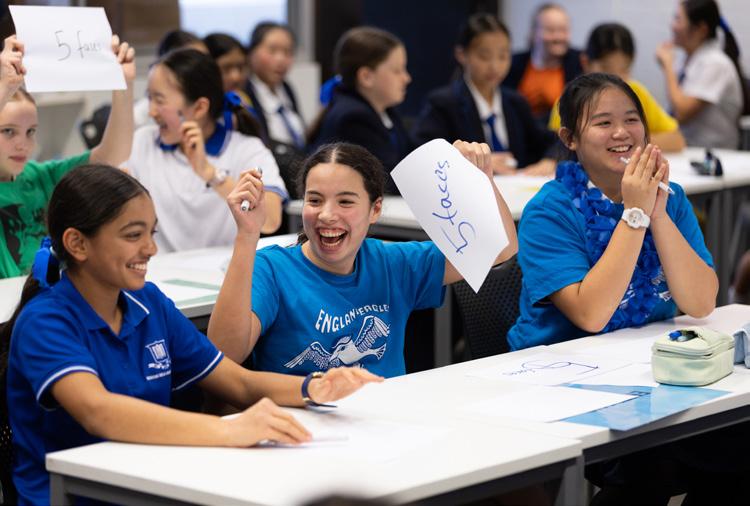
Interhouse Maths Quiz
Charmaine
(12H)
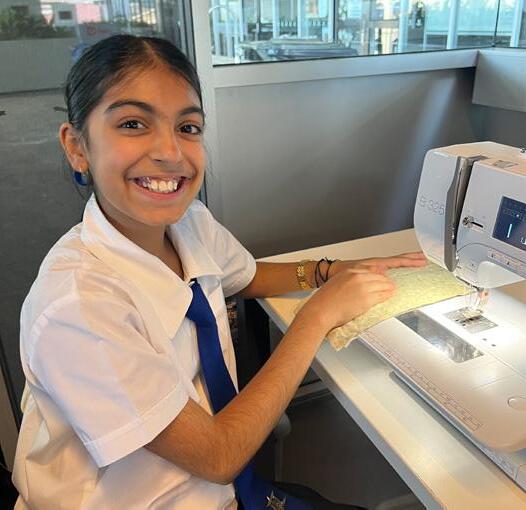
32. Mahika Dhingra (7G) in Textiles Innovation Club
33. White Blouse Day linked with the Push Up Challenge to raise awareness of mental health
34. Blue Day
35. Cricket Co-Captain Deepika Bogahawatta (12W) 36. Celebrating Grandparents and Friends Day
SCHOOL LIFE
37. Mother’s Day Breakfast at the Junior School
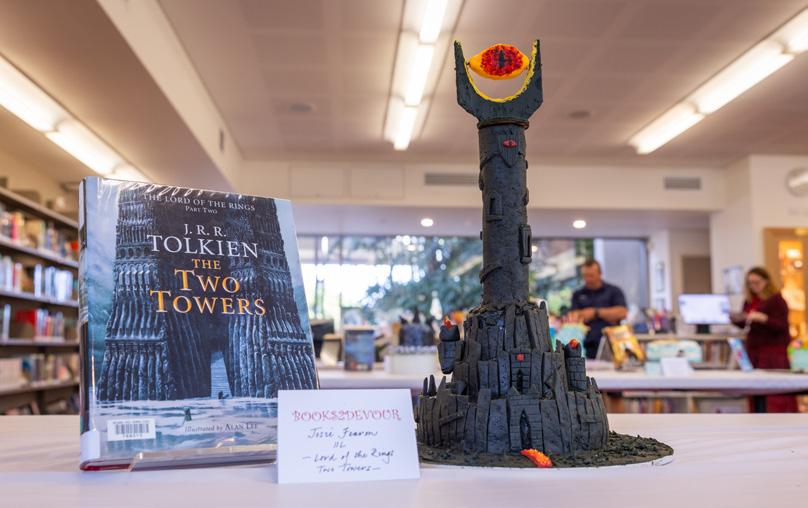
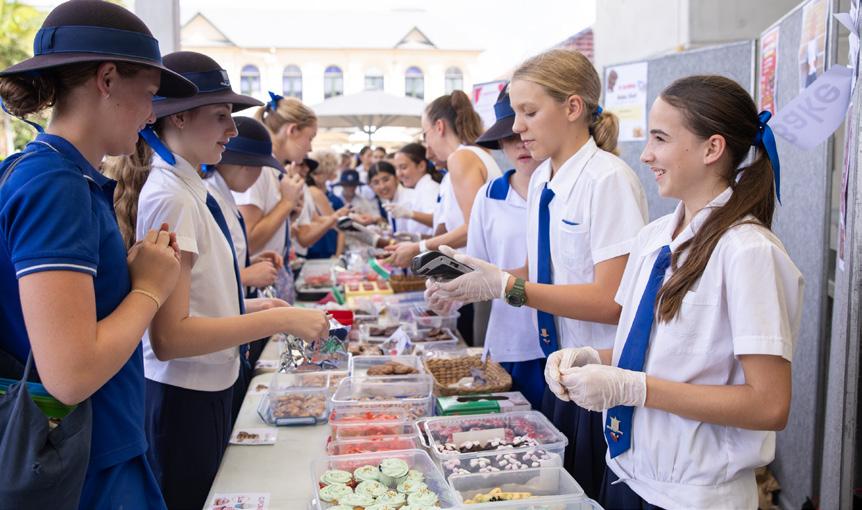
38. Lord of the cakes at the 2026 Books2Devour
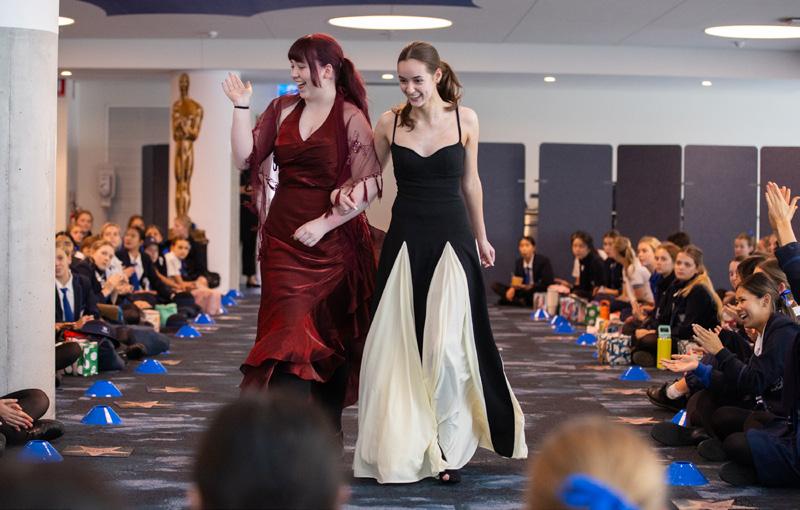
39. Year 12s share their formal outfits with the School
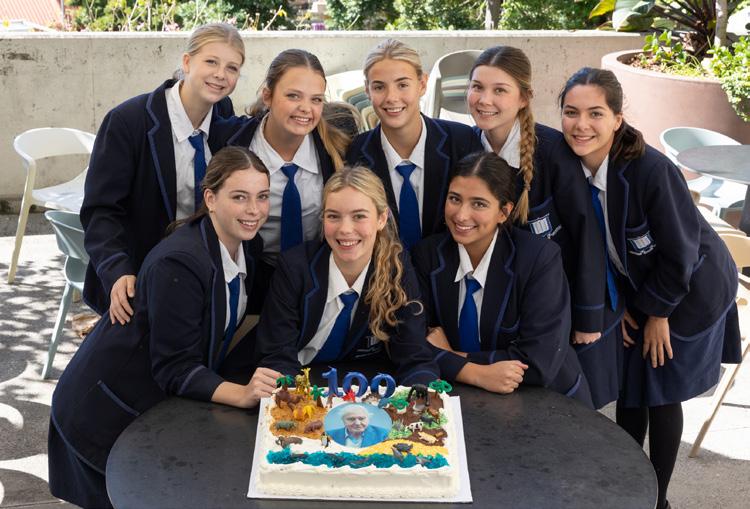
Geography student Bella Quirk (11L) baked a cake to celebrate her idol Sir David Attenborough’s 100th Birthday
Brisbane Girls Grammar School
When questions become the answer
Girls Grammar’s Dr Bruce Addison and Dr Susan Garson reflect on a journey to embed curiosity in teaching and learning at BGGS, contributing to a new book for educators
It’s rare for professional development days to be so impactful, students immediately ask: ‘What’s happened to the teachers?’
But that was the case in 2018 when BGGS teachers returned from a twoday staff conference that introduced them to Cultures of Thinking—a teaching and learning approach that challenges educators to rethink the way they deliver lessons, from how much they talk versus listen, to seeking questions as much as answers.
One of the first, and most simple, new techniques embraced by teachers eight years ago were ‘catch and pass’ questions aimed at deepening student thinking. Dr Addison remembers putting dozens of prompts on teachers’ desks in classrooms around the School as they dipped their toes into the Cultures of Thinking world. They immediately began to bounce them off students:
• What makes you say that?
• What is the counterargument for this?
• How do you know you’re right?
‘I do remember very clearly a lot of comment being made, because this training happened over the holidays,’ Dr Addison explained. ‘So, when everyone came back into the classrooms the girls were saying, ‘‘What’s happened to the teachers?’’.’
The fact it was such a noticeable change underlines what Dr Addison calls ‘the magic’ of BGGS: ‘Here, you have very experienced staff, who are prepared to do something different.’
It was a significant shift but based on a simple principle: students learn more deeply when thinking is valued and visible; when they are encouraged to question, connect, and explain ideas in dynamic classrooms—a philosophy based on the research of celebrated Harvard Project Zero researcher, Dr Ron Richhart.
But the approach has proved just as transformative for teachers, because it wasn’t just about asking questions of students, it was about teachers asking questions of themselves.
‘It’s really asking those interior questions of a teacher as to how they’re delivering their lessons,’ explains BGGS Director of Professional Practice Dr Susan Garson.
‘Am I performing too much? Is there enough time for student thinking?’
Initial staff training proved inspirational— delivered with impact by educators
Simon Brooks and Ryan Gill, members of the Project Zero Australia Network aligned with the Harvard Graduate School of Education.
‘Older staff said to me, “I’ve really started to think about how much I talk in class. Am I actually hearing the student voice enough?”,’ Dr Garson remembers.
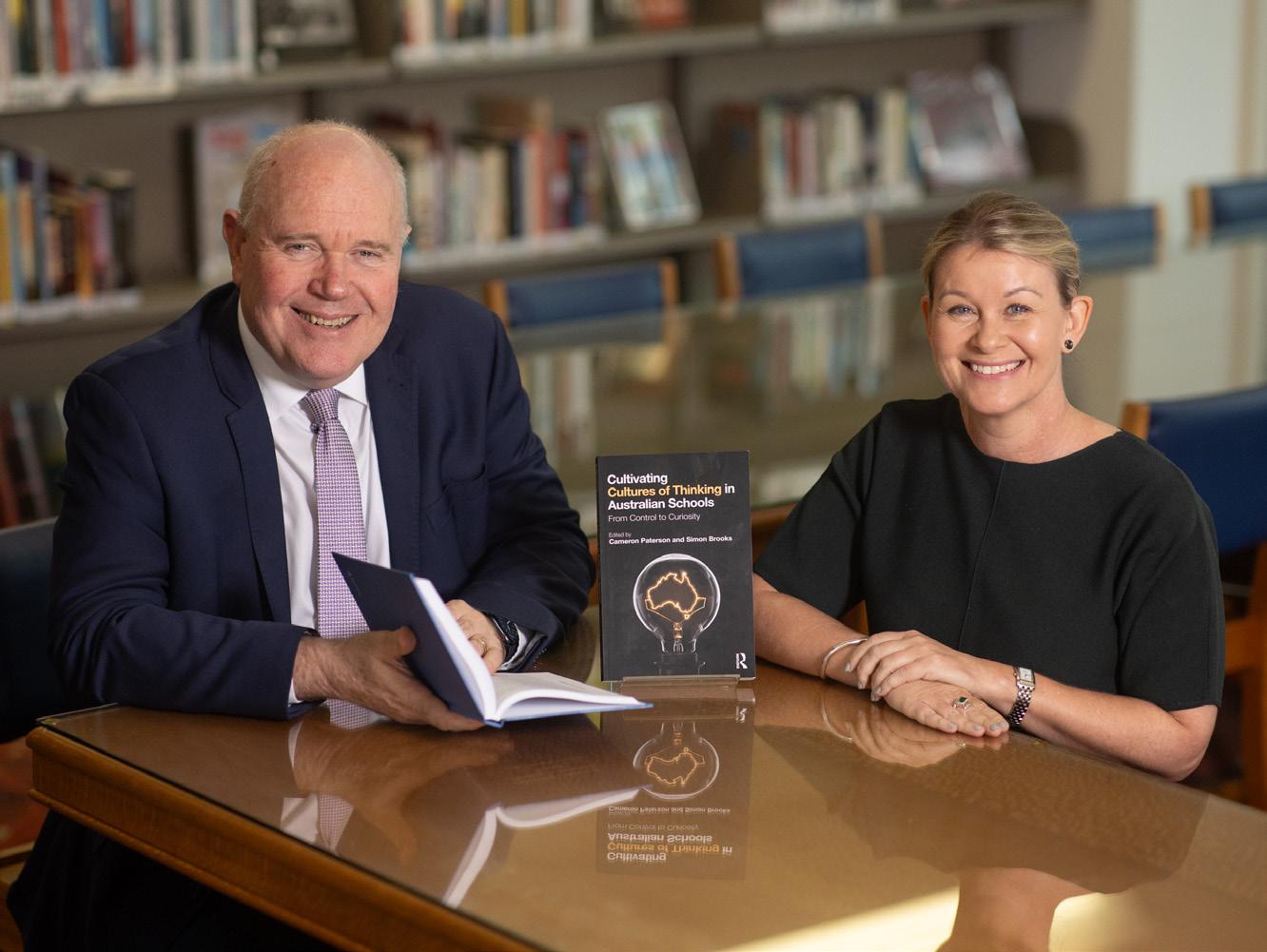
Captions 1 Dr Bruce Addison and Dr Susan Garson
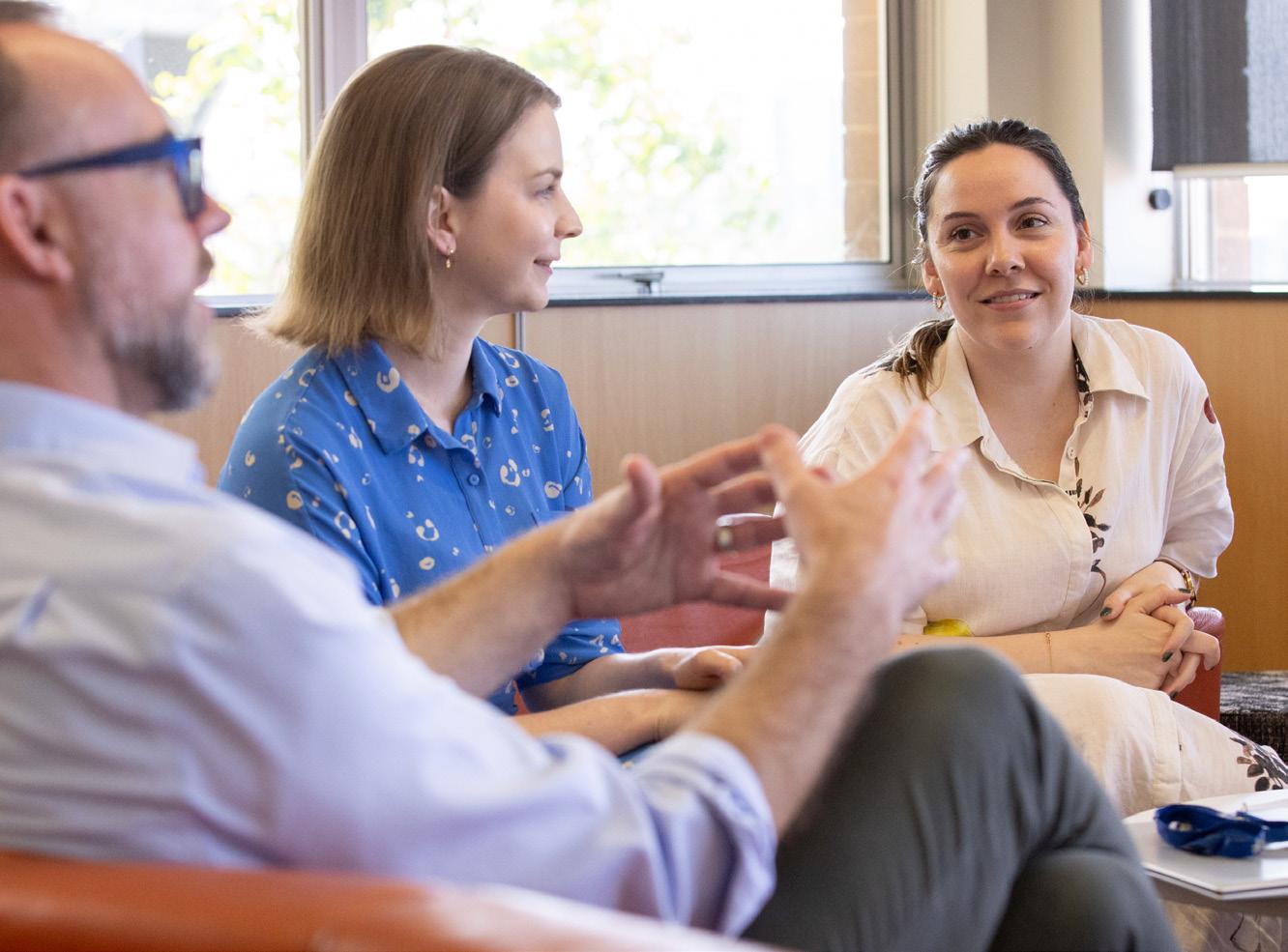
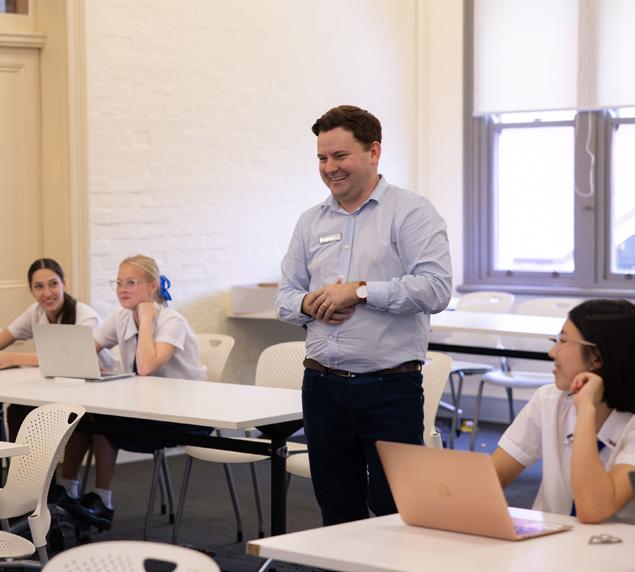
2 Sharing ideas: Director of Creative Futures Mr Andrew Pennay with Head of Literature & English and Literature Extension Head of Literature & English and Literature Extension Ms Meghan Parry and German teacher Ms Matilda Walsh 3 Head of English Curriculum Development Mr David Rawson
Making thinking routine
Along with strategic questioning, Cultures of Thinking also advocates the adoption of ‘thinking routines’— quick, repeatable exercises to expand understanding. For example, Science students may be challenged to create a simile to explain a new concept; or a History class may compose a headline to summarise an era. Another routine asks students to consider three questions in the face of new information: What do I see? What is happening? What does it make me wonder?
Since introducing Cultures of Thinking, BGGS has seen a rise in already high traditional academic measures. However, Dr Addison is careful not to overstate a connection.
‘It is one factor, among many, that has helped students to be better thinkers and better learners. But we’re cautiously optimistic that it’s a contributing factor,’ he says.
The logic is straightforward, Dr Garson says. ‘If they can grapple with ideas; if they can reason with evidence; if they can make connections in their thinking—they’re going to be better able to manage a standardised test or high-stakes assessment.’
Importantly, the School’s approach didn’t diminish explicit teaching or the role of the teacher as expert, Dr Addison stresses. That was, and remains, key in a high-performing school that celebrates ‘concentrated expertise’ in distinct disciplines. Instead, it asks educators to consider how they create balance, encouraging students to be active participants in learning, rather than just absorbing information.
Timing is everything
Looking back, Dr Addison believes the Cultures of Thinking approach landed at exactly the right moment. Queensland was preparing to transition to the new ATAR system, and many teachers were uncertain what that would mean.
‘There was this sense of organisational yearning for learning,’ he says. At the same time, there was a feeling—not necessarily at BGGS but more broadly in education—that ‘NAPLAN-isation’ had sapped agency and creativity from the profession.
‘What they saw through that training was unashamed excellence in practice, and the School being prepared to invest in it, not from an authoritarian perspective, but from a collegial, ground-up perspective.’
That ‘ground-up’ element—or ‘seeping’—of practice proved so crucial, Dr Addison and Dr Garson titled their chapter in the new book: Seeping Upwards and Across: Embedding Cultures of Thinking at Brisbane Girls Grammar School
Rather than imposing a framework from above, the School wanted new practice to spread organically, investing in allowing teachers time to participate in training, coaching and classroombased inquiry projects. Part of this flexible approach is recognising and celebrating the varied ‘pedagogical gifts’, or core passions, individual teacher brings to each classroom.
In many ways, the approach to supporting teachers’ professional development mirrors the qualities the School seeks to nurture in students: openness, adaptability and a willingness to keep learning.
As one BGGS teacher reflected: ‘We want our students to be inquisitive and take risks. We need to do the same.’ Another described teaching as ‘an ongoing adventure’, adding: ‘We should not stop exploring and learning about better and more engaging ways of delivering curriculum and knowledge to our students. It’s a two-way street; both sides benefit.’
Cultivating Cultures of Thinking in Australian Schools: From Control to Curiosity, edited by Cameron Paterson and Simon Brooks (Routledge, 2026)
A trip beyond Khmer
Cambodia journey immerses Girls Grammar students in culture, service and adventure
Charlotte Royle (10R) and Georgia King (10R)
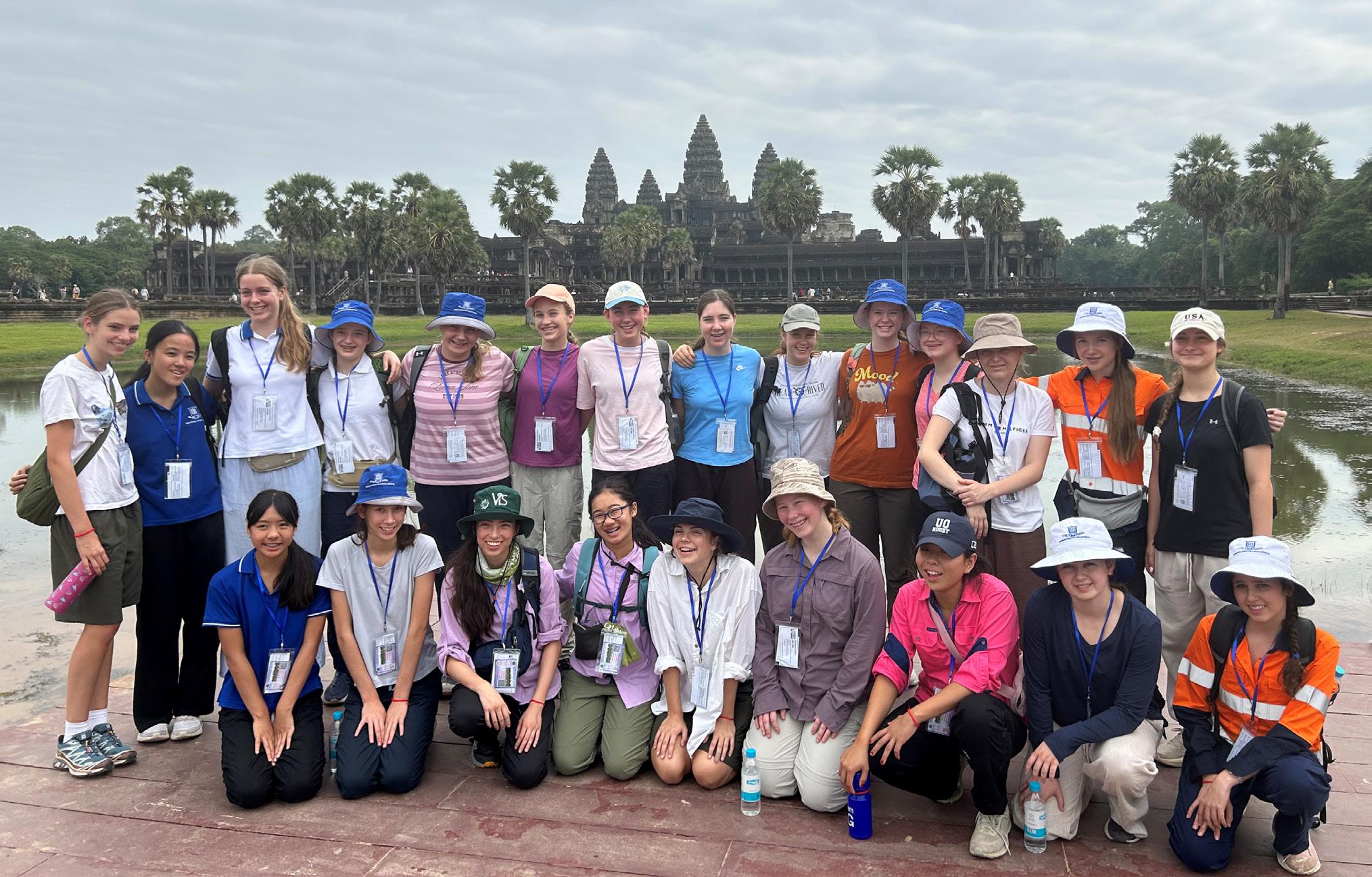
Our time in Cambodia in December 2025 was incredible, providing opportunities for learning, service and cultural immersion, alongside adventure, group bonding and exploring a very different society.
Shortly after arriving, we watched a performance by the amazing Phare cultural circus in the city of Siem Reap. We saw performers soar through the air, balance precariously on tall structures, and act out unique stories.
We also had the opportunity to visit the local night markets close to our hotel. In small groups we were able to safely wander through the markets, eagerly taking in the bright colours and unique items for sale. We had an amazing time interacting with the stall owners and, after some helpful lessons
in respectful bartering, we were able to join in and negotiate a few souvenirs for ourselves, such as hammocks, bags and small tokens.
Our tour guide Nak was incredible, as he explained Cambodian customs and helped us learn some common Khmer phrases, such as Thank you: Aw kun, and Hello: Susadei
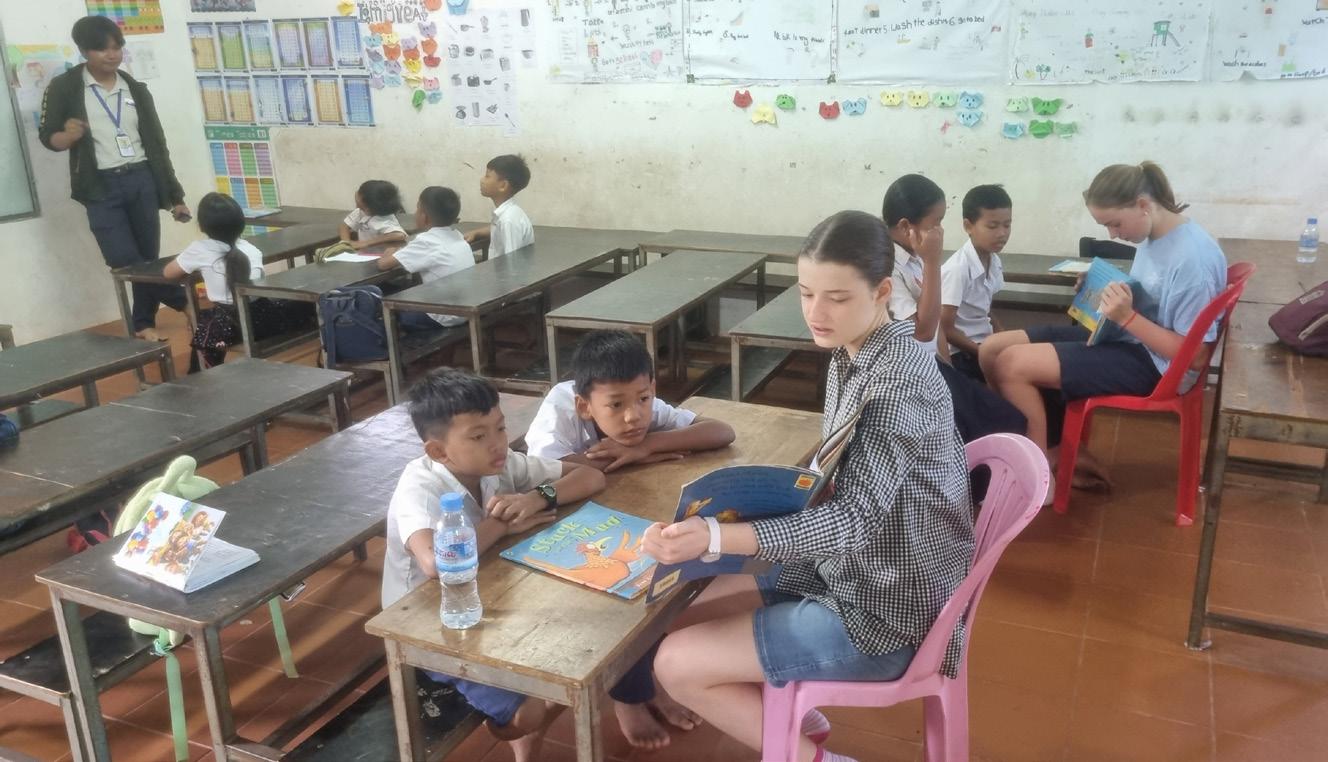
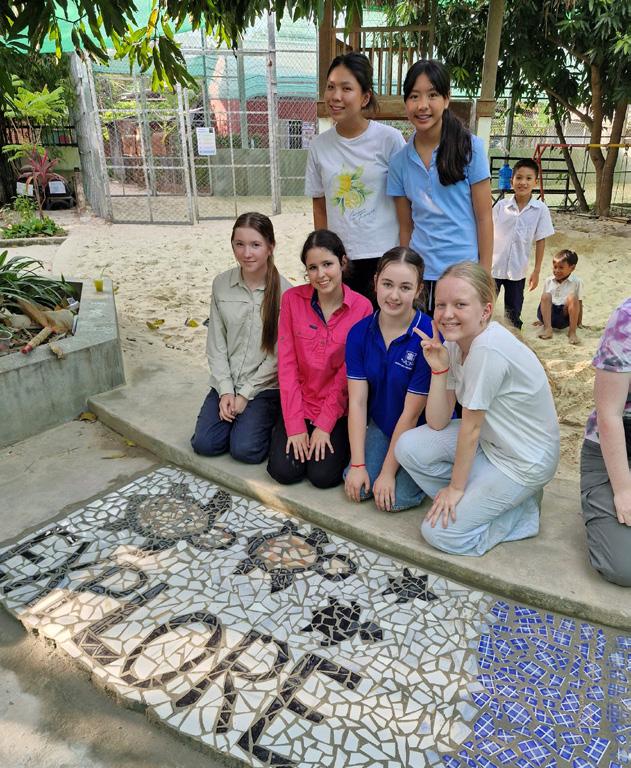
Many of us found that the most rewarding part of the trip was volunteering at the Treak Community Centre School, where we worked with local teachers to help children improve their English through activities like sight words and fun games. We also played outdoors with students and helped create an inspiring tile mosaic in the playground, a lasting marker of our visit.
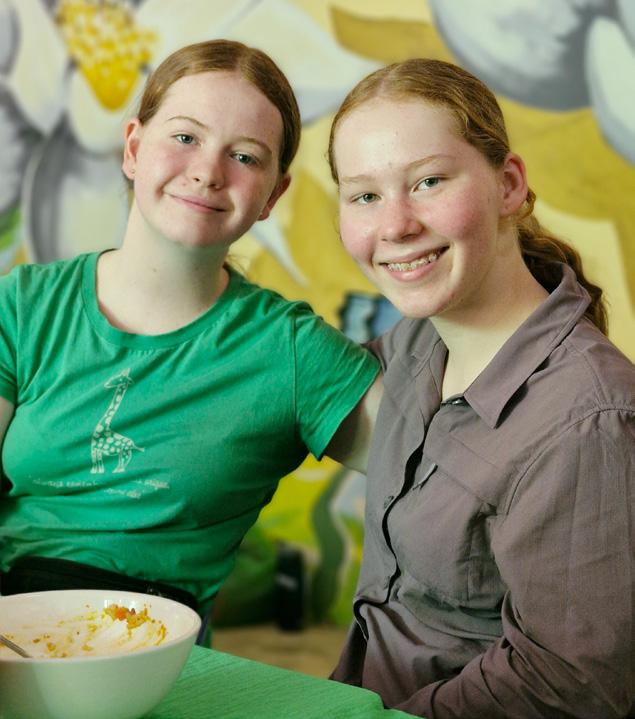
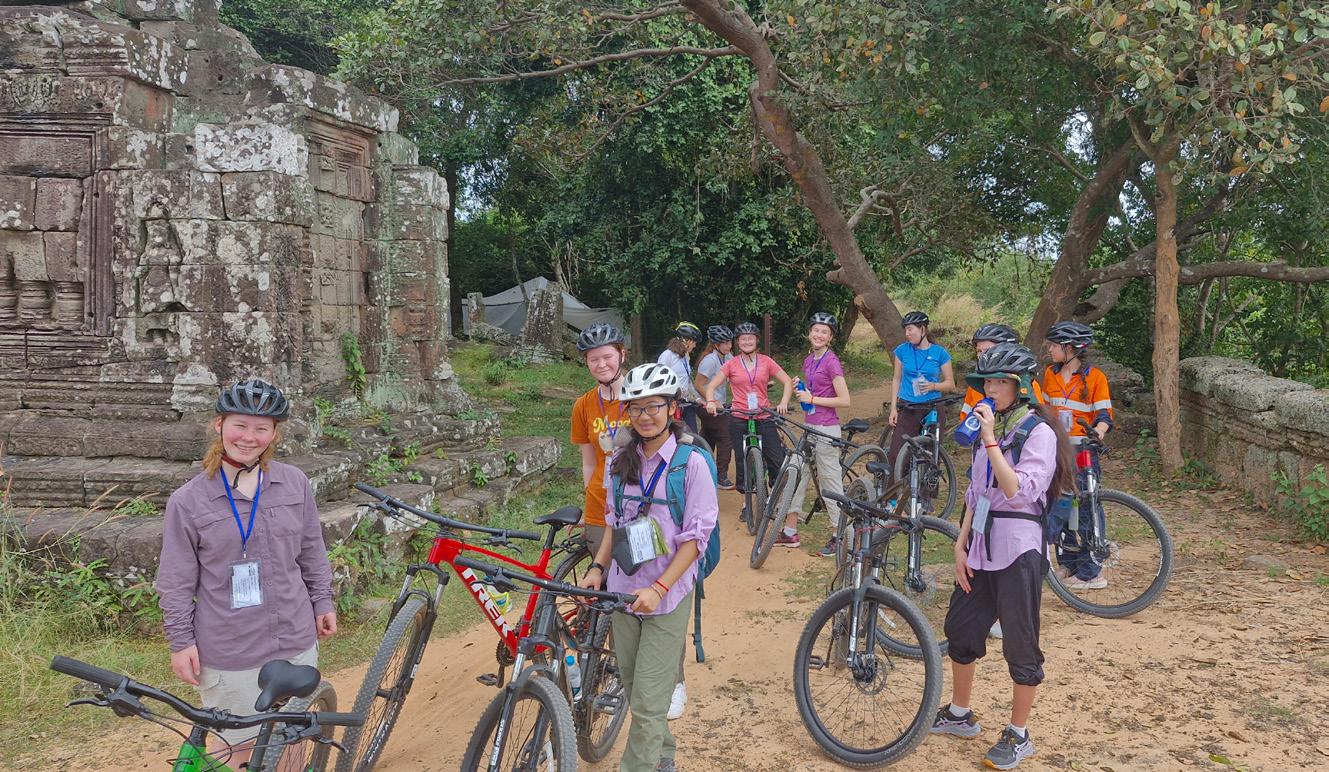
Captions 1 Angkor Wat in Siem Reap 2 Our authors Georgia King (10R) and Charlotte Royle (10R) 3 Cycling to Angkor Thom 4 Leaving a mark at Treak Community Centre School 5 Reading with local students
Working with the owners of the Treak Community Centre helped us build strong connections within the community and our group. While at Treak, we also got the chance to visit their village store, selling garments made by those in the community.
Our own Associate Dean of Students, Ms Stephanie Thomas, was able to get hands-on, harnessing her textile skills to cut and sew an entire dress which will be sold at the Treak shop to benefit the local community. We were able to purchase some lovely clothes ourselves with the bonus of knowing all the money we spent will go straight back into supporting the Treak community.
During the time of our visit, we experienced Cambodia’s cool dry
season. Due to Cambodia’s geographical location, December is an ideal time to visit to avoid high humidity and rain. However, the lack of wind created an ideal environment for mosquitoes and bugs, so layers of sunscreen and mozzie repellent were needed to avoid the bugs that flew our way.
As it was not too hot, we participated in many challenging but rewarding physical activities—riding bikes to Angkor Wat, Angkor Thom and Ta Prohm, then hiking Kulen Mountain to explore extraordinary ancient temple complexes and the Kulen waterfall.
The hike allowed us to experience overgrown rainforests, requiring us to climb over logs, scale rocky surfaces and complete 1.5 km of stairs. Although
the hike was challenging for us all, we were also able to enjoy the incredible acoustics of Cambodian rainforests as we participated in multiple singalongs.
We also kayaked through mangroves and visited a stilt village on Tonle Sap lake, where houses perched high over the water and locals commute by boat. We learned many residents live a nomadic life to account for the dramatic seasonal changes in water level, moving either their entire house, or just the interior, leaving behind a stick structure.
We would highly recommend this trip to any other Grammar girls interested in community service and embracing new cultures.
The Cambodia trip brought all of us together, creating unforgettable bonds as we came to rely on each other like family, checking in to make sure everyone was having a good time—and reminding each other to brush our teeth with safe water.
Additionally, we were immersed in a very different way of life from our own, pushing us out of our comfort zone. But with support and encouragement from the local community, teachers and friends, we were all able to try new foods, traditions and activities that we’d never do in our everyday lives.
FROM THE STUDENTS
Storming the Bastille
From Hot Cross Buns at home, to ‘serious piano’ at Opéra Bastille in Paris and Carnegie Hall in New York
Emma Shan (9R)
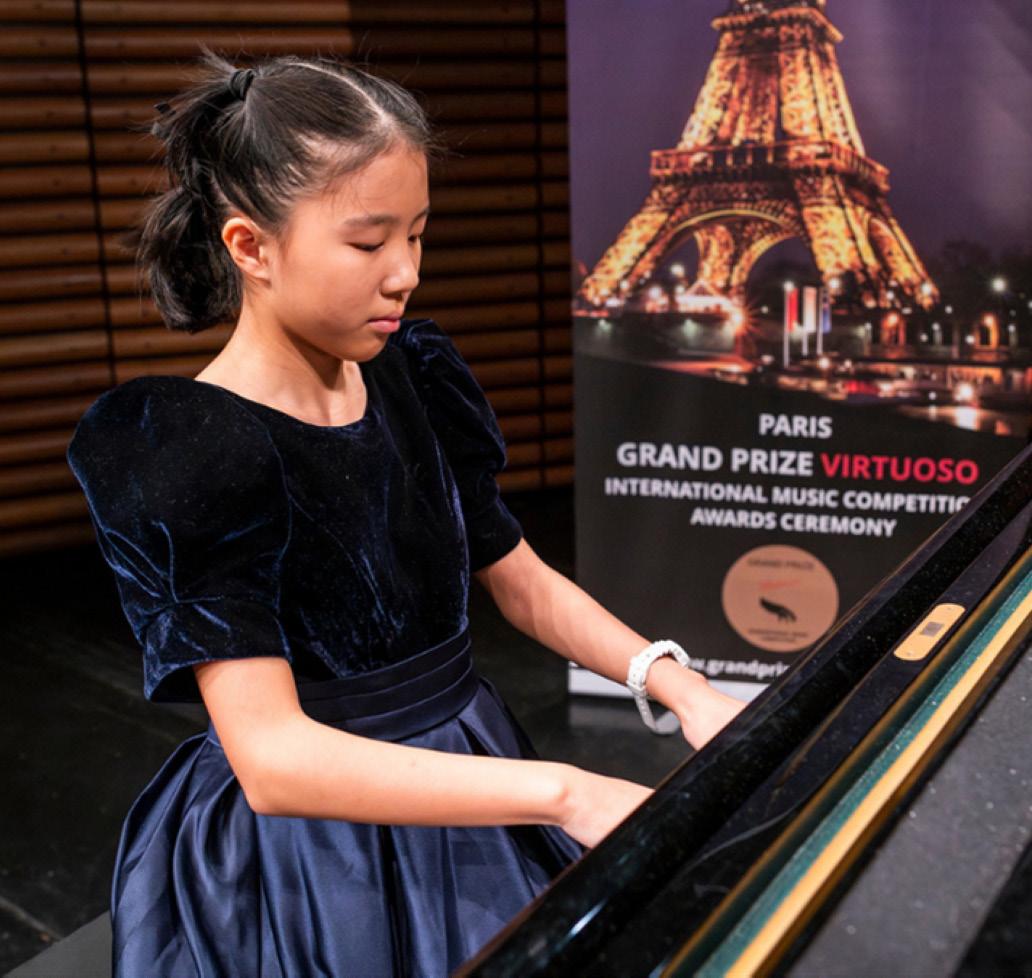
I have been playing piano for as long as I can remember—more specifically, from the age of three. My earliest memories are trivial, but vivid: colourcoding scales and playing Hot Cross Buns to a backing track, holding up sparkly hot pink socks in a modest concert hall at the age of five while smiling so much my eyes disappeared.
At the age of five I switched teachers and felt the difference immediately. For two years, I had been playing ‘wrong’. My new teacher called it ‘serious piano’. Reluctantly I started from the beginning, rebuilding my technique from the ground up. My playing wasn’t just about hitting the notes and rhythms anymore. Getting through a piece without mistakes wasn’t enough; I had to think about what I was playing: the sound, the tone, the phrasing, and how it would make others feel. Scales were no longer something I could rush through to get to the ‘fun’ part of practising.
At five, I resented the extra effort. Eight years later, I have come to value and appreciate the art of ‘serious piano’. Through the very practices I despised as a young child, I developed my
technique and my musicality. At the end of 2024, my teacher offered me an opportunity to perform at Carnegie Hall in New York City. To qualify, I had to submit a video performance. I recorded it, sent it off, and waited. When the invitation came, it felt unreal.
Walking into Carnegie Hall was surreal. This was a space shaped by generations of legendary performers and no matter how small my place in the Hall’s history was, I could consider myself part of that lineage. Vladimir Horowitz, Elton John, Lang Lang, all sat at the same place my piano stool was placed, as my hands, trembling from the excitement, pressed down on the keys for the first time. The Hall itself was breathtaking as well, a beautiful blend of modernity and history.
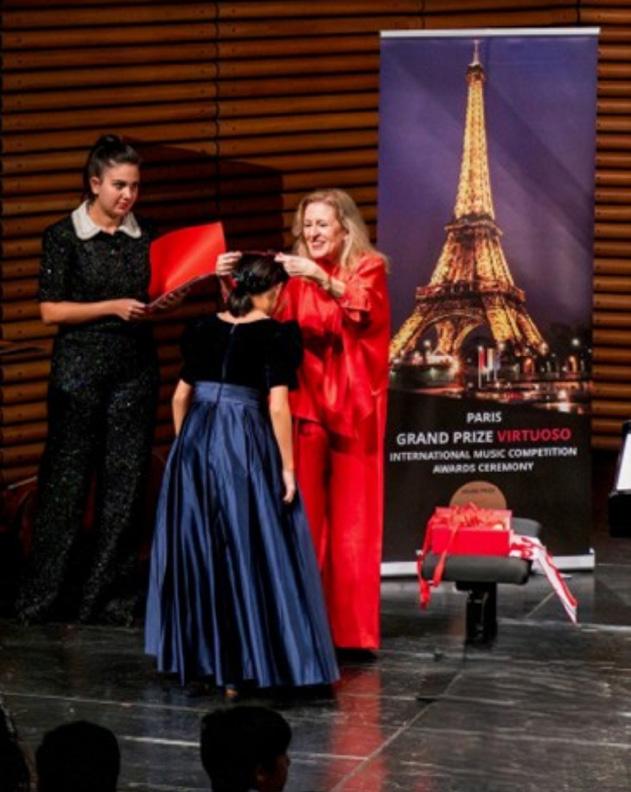
The same can be said for the Opéra Bastille, which I performed in exactly a year later, in December 2025. These performance opportunities at the Opera Bastille and Carnegie Hall reshaped my view on competitions. I am incredibly lucky and grateful that I was able to access such great piano education and have opportunities I would never have dreamed of at the age of five.
My ultimate ambition is to succeed in school and university, and possibly take up computer engineering. Whether or not I will continue piano is the question when exams and externals start rolling in. But no matter what, piano will always have a special place in my heart, and I will always treasure Carnegie Hall and the Opéra.
Give Her Best 2026
Become part of the future at BGGS
Service and philanthropy have long been hallmarks of the Brisbane Girls Grammar community.
From our experimental beginnings in 1875 in a small red-brick schoolhouse on George Street, to the exceptional teaching and learning programs we offer at our Spring Hill campus today, every milestone has been shaped by the generosity and support of parents, alumnae, and friends who understood investing in girls’ education means investing in a brighter future for us all.
But excellence is never static. To honour this legacy while preparing our students for a rapidly changing world, we must continue to evolve by deepening our teaching practices, renewing our
learning environments, and nurturing the curiosity and ambition of every girl in our care.
This evolution requires partnership across our community. Together, we can create exceptional opportunities for thousands of young women to pursue their ambitions without limits, and our 2026 Give Her Best appeal is your opportunity to be part of this movement.
What does ‘her best’ look like? It is access to knowledge. It is the right learning environment in which to explore and create. It is opportunities for promising students, regardless of personal circumstances. It is sports programs that build teamwork and resilience. These are the areas that
define excellence in girls’ education, and the support of our community has never been more important.
I invite you to help shape BGGS's future by scanning the QR code below to learn more, or by calling our Development Team on 07 3337 1630 for a confidential discussion. I extend my deepest gratitude to all our benefactors whose gifts, large or small, are an invaluable investment in the lasting impact of a Girls Grammar education.
Scan the QR Code or visit bggs.qld.edu.au/ giving/donate
130 not out Cricket marks a milestone at Girls Grammar
The earliest account of Girls Grammar playing cricket was in 1896 and judging by a newspaper report of the match, the only way was up.
In a game against All Hallows’, the Brisbane Courier reported BGGS’s first innings featured ‘no less than 9 ducks’ for a total of 6 runs. Needless to say, All Hallows’ won comfortably.
But from these humble beginnings 130 years ago, Girls Grammar went on to become a powerhouse, helping lead the establishment of schoolgirl cricket in the 1980s and turning history on its head 100 years after that first reported drubbing. In 1996, when All Hallows’ and Girls Grammar celebrated a joint centenary of cricket with a historic rematch, BGGS emerged the victors.
But, in truth, it was never about results. Girls Grammar’s early head mistresses all championed female participation in team sports at a time when teaching women to bat and bowl was every bit as outrageous as teaching them Science. To these visionary leaders, becoming fine sportswomen was essential to a well-rounded female education.
In Girls Grammar’s Annual Report of 1908, Head Mistress Milisent Wilkinson wrote work had started on a cricket pitch in the Spring Hill grounds, addressing naysayers writing:
‘The fact of our having a cricket pitch has caused much amusement. “Whatever do girls want to play cricket for?” has been asked of me over and over again … it seems to me that whatever benefits cricket confers on boys, it confers on girls.’
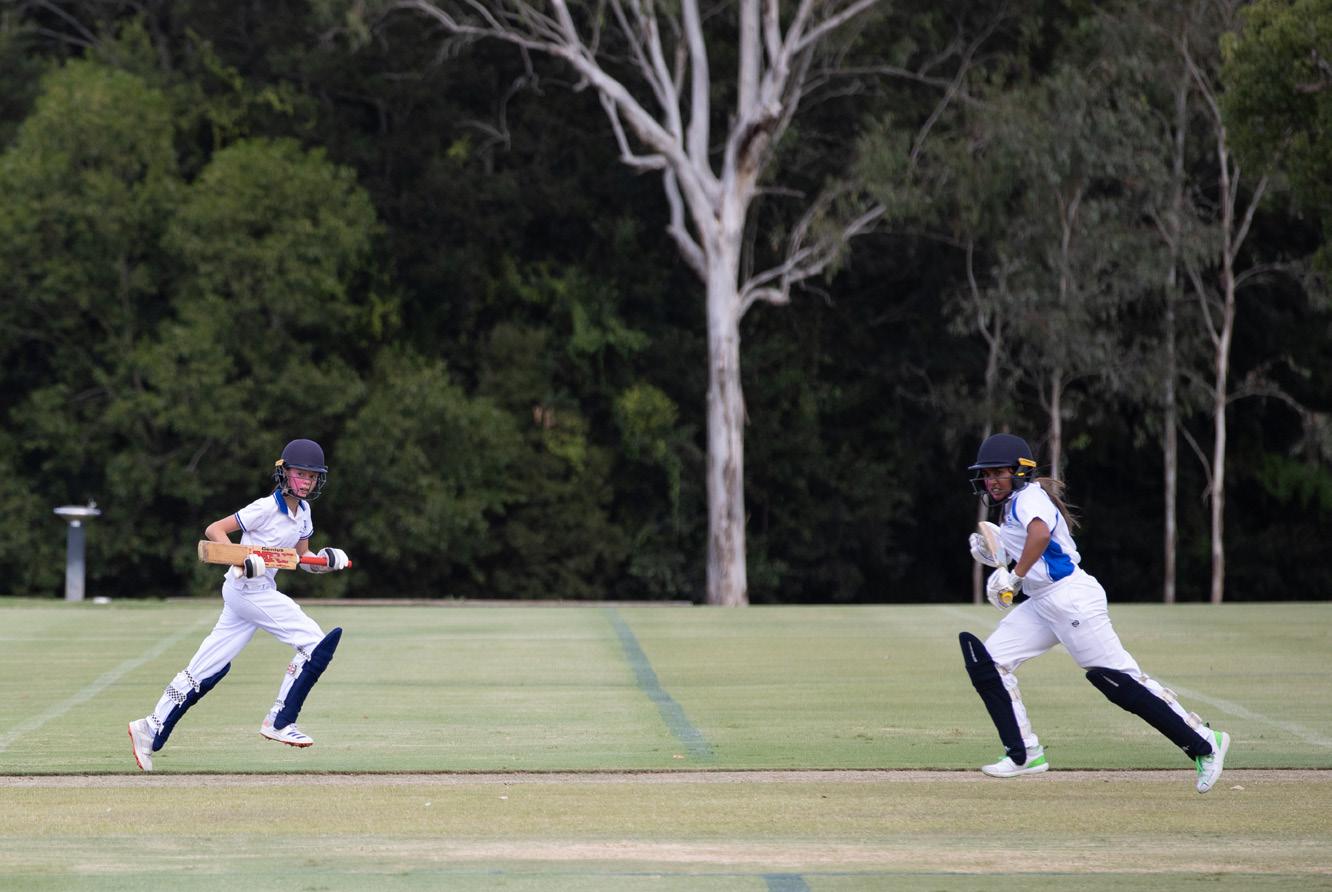
More than a century later, the ‘benefits cricket confers’ are self-evident: a sense of leadership, lasting bonds of friendship, and a grit and determination to support teammates on and off the field. These benefits continue to enrich the lives of Grammar girls.
Although Cricket at Girls Grammar marks 130 years this year, some may notice a rather large gap in the records from around 1906 to 1981. Its return in
the ‘80s was championed by Maths teacher Greg Giese, father Roger Warren and then Head of Physical Education, Pauline Harvey-Short OAM (Harvey, 1971), whose father ‘Mick’ was a Test umpire and state player, and uncles Mervyn and Neil both represented Australia. For Pauline, it was about reintroducing a sport that offered genuine pathways for women.
In the modern era, Girls Grammar’s most outstanding cricketers include Josie Dooley (2017), who played at state and national levels; Kirby Short (2003), who captained Queensland Fire and the Brisbane Heat and Alice Nicklin (2007), who played Queensland U19s.
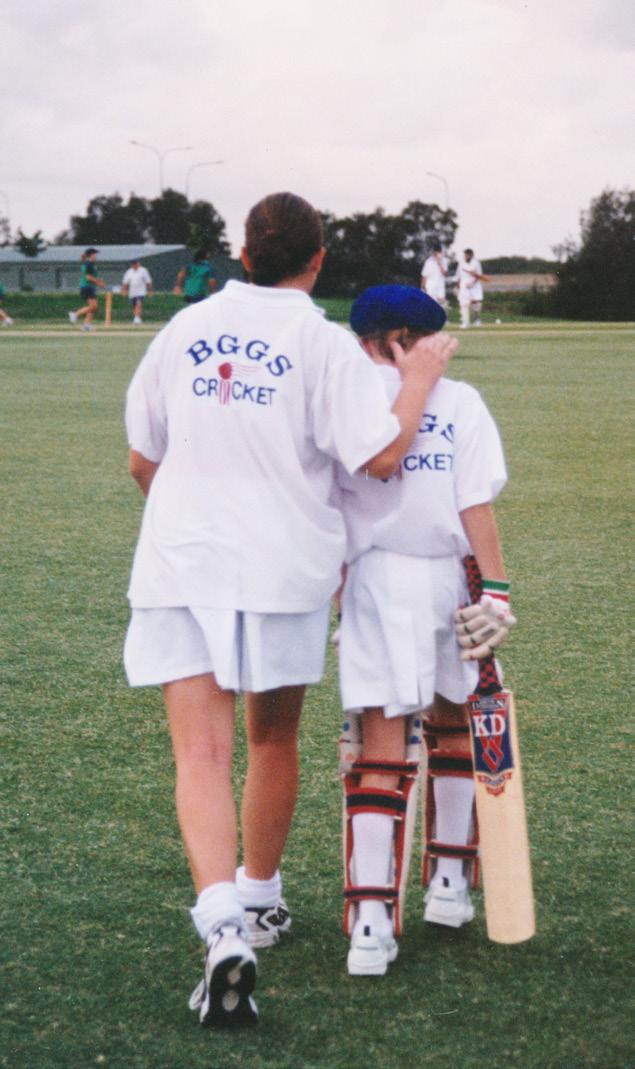
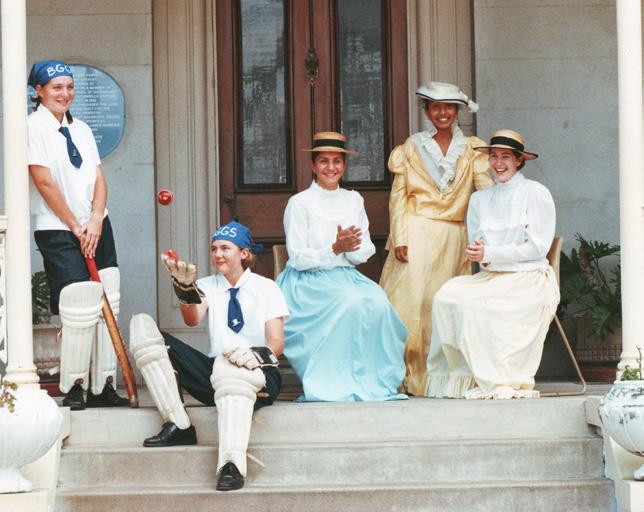
Captions 1 Pink Stumps Day at Rangakarra 2 2000
First XI Captain Kate Clarkson (2000) sends a young Kirby Short (2003) to the crease 3 Kate Wensley (1997) and Sally Brand (1999) with All Hallows’ students to promote the 1996 Centennial match
The Brisbane Courier records a match between All Hallows’ and Brisbane Girls Grammar School, with All Hallows’ winning convincingly.
BGGS Head Mistress Milisent Wilkinson reports work has started on a cricket pitch at Spring Hill, writing that ‘whatever benefits cricket confers on boys, it confers on girls’.
Sadly, there is a large gap in records until the game was reintroduced in the modern era.
The Brisbane Schoolgirls Cricket Association (BSCA) is formed, spearheaded by another BGGS Maths teacher, Gary Bromiley, with Roger Warren and Mt St Michael’s John Passmore. The six founding members are BGGS, Mt St Michael’s, St Margaret’s, Clayfield College, St Aidan’s and St John Fisher. Teams played for the Roger Warren Cup.
True Grit of a Champion
Girls Grammar’s highest-capped cricketer Josie Dooley (2017) was already an inspirational athlete and has only become more so as she recovers from a life-threatening stroke, setting her sights on a new goal: the Brisbane 2032 Paralympic Games.
Back in April 2024, Josie was serving as keeper-batter for the South Australian and Melbourne Renegades teams when a benign, undiagnosed brain tumour triggered a devastating stroke while she was on an end-of-season surf trip to Kauai in Hawaii.
A perilous evacuation flight to Honolulu’s Queen’s Medical Centre ultimately saved her life, but it would be the start of a gruelling journey to regain the strength and co-ordination to do everything from breathing to walking again. All up, Josie would spend 92 days in hospital as family and friends rallied to help her tackle a new reality with trademark humour, optimism and courage.
Details of Josie’s condition were kept private for many months, until family entrusted former teammate and fellow Girls Grammar alumna Kirby Short to share her story in a warm, raw and award-winning feature for Cricket.com.au: It comes in waves: The fall—and rise—of Josie Dooley
champion team in Brisbane.
from
A display in the foyer of the McCrae Grassie Sports Centre marks 130 Years of Cricket at BGGS.
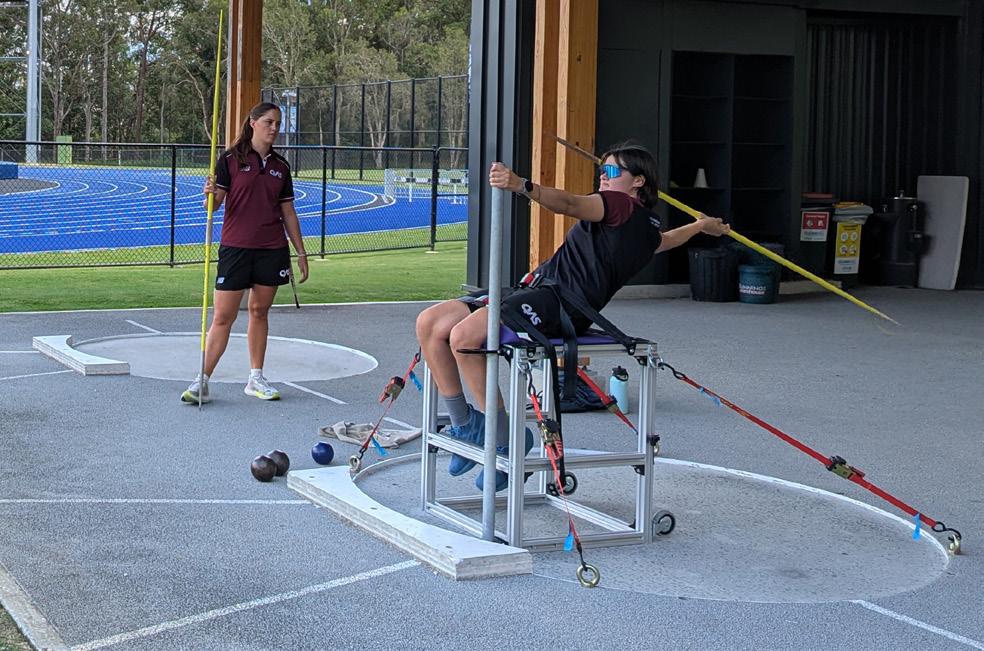
In June last year, Josie embarked on a new challenge, training three days a week at the Queensland Academy of Sport’s new Para Sport Unit at Nathan, with the aim of qualifying to represent Australia in shot put and javelin at the 2032 Paralympics. At the end of 2025 she competed in her first Para Athletics meet, posting a shot put throw that would have claimed Bronze at the last World Championships.
Speaking for an RBWH Foundation fundraiser earlier this year, Josie said: ‘I’m loving… training with so many incredible athletes who have a shared experience, going through something quite traumatic. It’s been really cool to be part of a high-performance program again.’
QGSSSA introduce Cricket, with girls’ uniforms updated
culottes to traditional cricketing whites.
BGGS enter a team in the Queensland Women’s Cricket Association’s Division 2 competition, under the stewardship of Girls Grammar father Roger Warren and Maths teacher Greg Giese.
Growing teams numbers see the competition split into Metropolitan North and South.
The Gary Bromiley Shield is introduced for the BSCA
Photo: RBWH Foundation
STAFF REFLECTION
An AI for detail
Literature students explore how more complex prompts can harness technology for nuanced feedback
Meghan Parry Head of Literature & English and Literature Extension
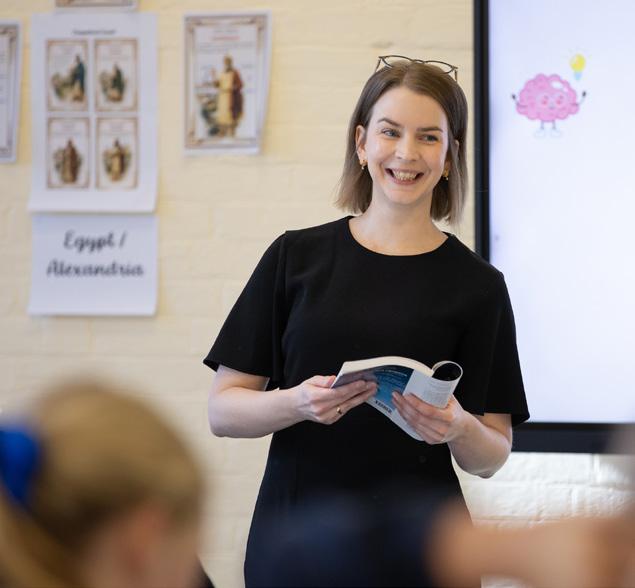
There has been considerable debate about the place of Generative AI in classrooms, particularly in Senior Literature subjects where originality, interpretation, and analytical writing sit at the heart of learning. In Year 11 and 12 Literature, students develop voice, control arguments, and produce lucid responses under pressure. At first glance, AI seems incompatible with these purposes.
However, AI is already shaping the world students are entering, and Literature classrooms have always existed not simply to analyse imagined worlds, but to allow students to rehearse for the realities of the one they will inherit. The habits of thinking fostered through Literature (questioning, interpreting, dissecting, and analysing) remain essential beyond school, which is precisely why the Year 12 Literature classroom was deliberately chosen as a space to experiment with AI. These students possess both the maturity and analytical creativity to engage with the technology thoughtfully, while also being among those most likely to enter AI-transformed industries. Ignoring AI altogether would therefore be as limiting as accepting it uncritically.
This is where prompt engineering—a serious intellectual skill in its own right— came in. Many students initially assume that AI works best with short or vague instructions, but quickly discover the opposite. In our classrooms, students learn frameworks such as COSTAR (Context, Objective, Style, Tone, Audience, and Response) to help them build detailed and purposeful prompts. This requires them to think carefully about what they are asking, why they are asking it, and what kind of response would actually be useful. In many
ways, prompt writing becomes its own intellectual exercise.
Alongside this, students are taught a crucial truth about how AI works. AI does not understand literature. It predicts language patterns based on its training data. That distinction matters as much as the lesson that comes from it: authority cannot be assumed, it must be tested. For senior Literature students, this reinforces a key literary and lifelong learning habit. Similarly, students learn to question outputs, seek second opinions, and interrogate whether or not AI has got it ‘right.’
Here’s a classroom moment to consider. In Year 12, students create multimodal monologues inspired by concepts from poetry, including works by Christina Rossetti and notable Grammar Women poets. Students begin the process ‘traditionally’: discussing ideas with classmates and teachers, pitching concepts, and refining characterisation through feedback. These skills are all human, all done in the ‘old fashioned’ way, and all valuable parts of their learning that we retain.
Last year, after the draft was written (and seeing the rise of AI in the world), the
Senior Literature teachers worked with students to create prompts to analyse aspects of their drafts. Rather than accepting the AI analysis as ‘correct’, students were often intrigued when feedback felt inaccurate or incomplete. Some questioned why the AI interpreted their monologue differently from how they intended it. Others debated whether suggested changes would actually improve the monologue.
These conversations became valuable opportunities for reflection. Students spoke to each other about the pacing, audience positioning, and the purpose of different sections of their work. In other words, the technology prompted deeper engagement with writing, rather than passive acceptance. This transparency also allowed teachers to guide students toward ethical and purposeful practices while having honest conversations with these young women about their creativity, imagination, and integrity. The key part is, as authors and directors, the students were still doing the work, and they were thinking in new ways too. This is why AI doesn’t have to be the monster hiding under the bed, or the portrait of sins hidden in the attic. By showing students that AI isn’t a shortcut, but a tool for thinking, the dynamic shifts entirely.
If we return to a foundational theory of learning in Vygotsky’s assertion that ‘children grow into the intellectual life of those around them’ perhaps the challenge of contemporary education becomes clearer. The goal is not to teach students how to use AI tools. It is to teach them how to keep thinking in a changing world. The students who will thrive in the future will be those who can question, direct, and critique AI, just like any other text, with precision and discernment.
Fly me to the Moon
Junior Astronomy Club
was all about Artemis II as students built rockets and sent their names into space
Daisy Zhou (8W)
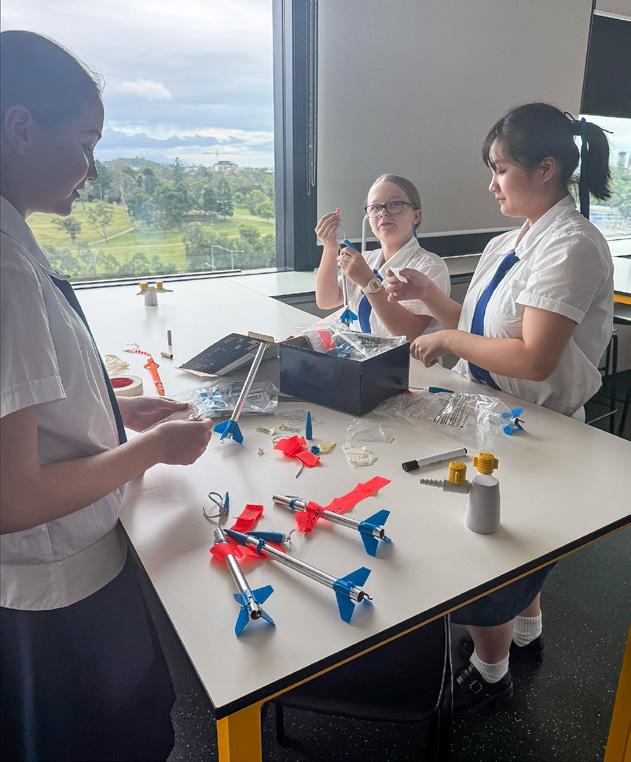
The Junior Astronomy Club recently took on an exciting and hands-on challenge: creating and launching miniature rockets.
Using cardboard straws as the main body, we added fins and a pointed top to allow the rocket to launch successfully through wind pressures. We analysed real rockets to help us understand how these worked to stabilise craft.
One of the most important features was a parachute, which had to be designed and attached in a way that would deploy effectively after launch. However, club members decided to replace the parachute with a strip line that worked just as effectively.
To launch, students had to consider how thrust would be produced. A small engine was added to each rocket, which generated an upward force strong enough to overcome gravity acting on the weight of the rocket. Students needed to ensure their rockets were sturdy enough to withstand the launch forces.
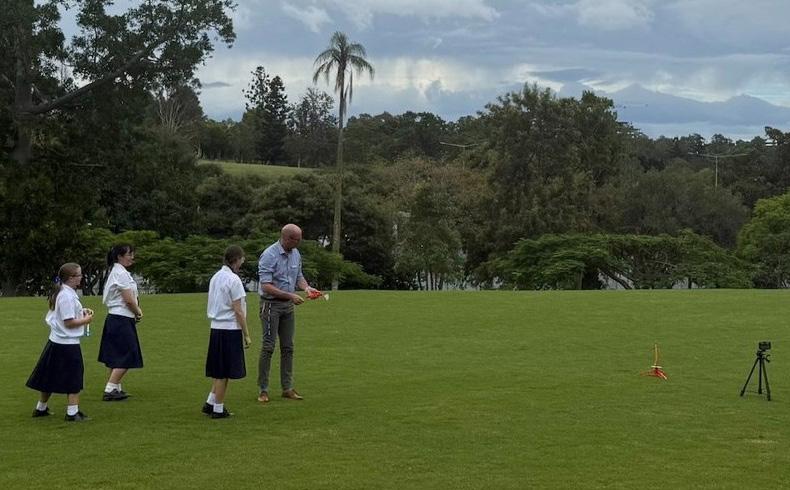
After the build was complete, club members moved outside for the most anticipated part of the activity: the launch.
Excitement built as each rocket was prepared and placed carefully for take-off. Several soared metres into the sky, demonstrating the success of the students’ designs. Watching the strip lines deploy and guide the rockets safely back to the ground was a rewarding moment for everyone.
The activity allowed students to explore basic principles of physics and aerodynamics, with members supporting each other at every stage— even when we lost a rocket in the trees.
The Astronomy Club continues to be a place where students can explore space and rocket science in different engaging ways. With more creative experiments planned, the club is sure to keep inspiring curiosity and innovation among its members.
NASA’s first crewed mission to the Moon in more than 50 years launched in April and travelling with them, in name at least, were members of the Girls Grammar Junior Astronomy Club.
As part of Term 1 activities, students signed up for Artemis II mission ‘boarding passes’, which saw their names uploaded to an SD card, along with 5.6 million others, and sewn into a toy mascot, Rise, that accompanied astronauts on the voyage.
Rise was made in NASA's Thermal Blanket Lab to meet strict safety standards.
Great Ocean Gold
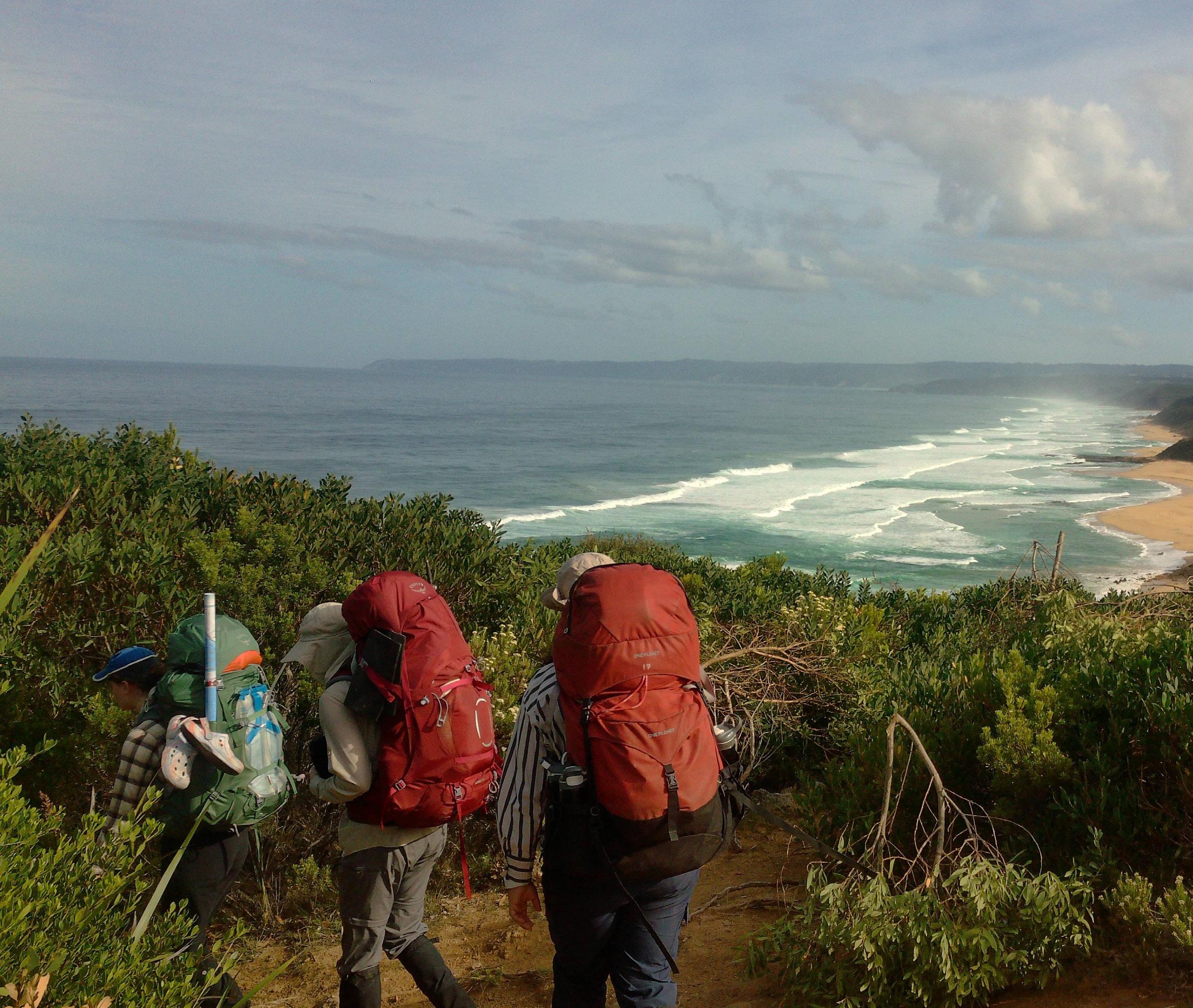
In April, BGGS’s Duke of Edinburgh ‘Gold Girls’ tackled an epic hike across bush trails and exhaustingly soft sand
Astrid Selwa (12G)
The Great Ocean Road runs along Victoria’s south-west coast, tracing tall limestone cliffs overlooking a slate-blue ocean. Our Great Ocean Walk traced
an 80-kilometre path much closer to the shore, through national parks, forests, and beaches. On foot, we could observe the landscape from within. Our views were earned in fragments—a gap in the trees, a hurried queue of girls peeking cameras through the foliage, convincing ourselves that this photo was completely different to the one taken ten minutes earlier.
As Gold Girls, we’d done plenty of Duke of Ed hikes together, so we knew this type of walking well, and there was a
comfortable familiarity in returning to our rhythm. The trip spanned nine days, with seven days of walking and one very necessary rest day squeezed in the middle. After an early flight to Melbourne and a three-hour scenic drive with a brief refuelling stopover, we arrived at Blanket Bay and pitched our tents with a beachfront view, and the sounds of lapping waves as we slept.
We set off the next morning with enough chocolate to sink a small naval fleet and spirits high (perhaps the two
were correlated). The opening stretch was picturesque: sunlight filtering through manna gum trees, salty air carried on cool gentle breezes, and coastal shrubbery dusting the dramatic escarpments we traversed. We’d often reach camp early, dedicating our afternoons to tent time, and our evenings to card and detective games—then we attempted sleep with the overly creative stories.
Midweek, we met the beaches, which were beautiful from above, but
‘What’s most memorable isn’t a single moment, but the accumulation of them’
1
significantly less so when your twentykilogram heavier self is wading through an unending path of sinking sand. The rest day that followed was deeply appreciated.
Then came the weather. Wind, rain, and a balmy one-degree midday on day five. Rain arrived with impeccable timing— coinciding with the exact moment layers came off. Still, this added something special. The forests turned damp and lush, dotted with mushrooms and prickly bushes carrying appetising blackberries (we can confirm their tastiness). We found Ryan’s Den nestled in a lush fern gully and ate lunch while reading the copious poetry inscribed on its walls— ‘My scroggin1 pouch is empty, and my heart is full’ being a standout. Our final
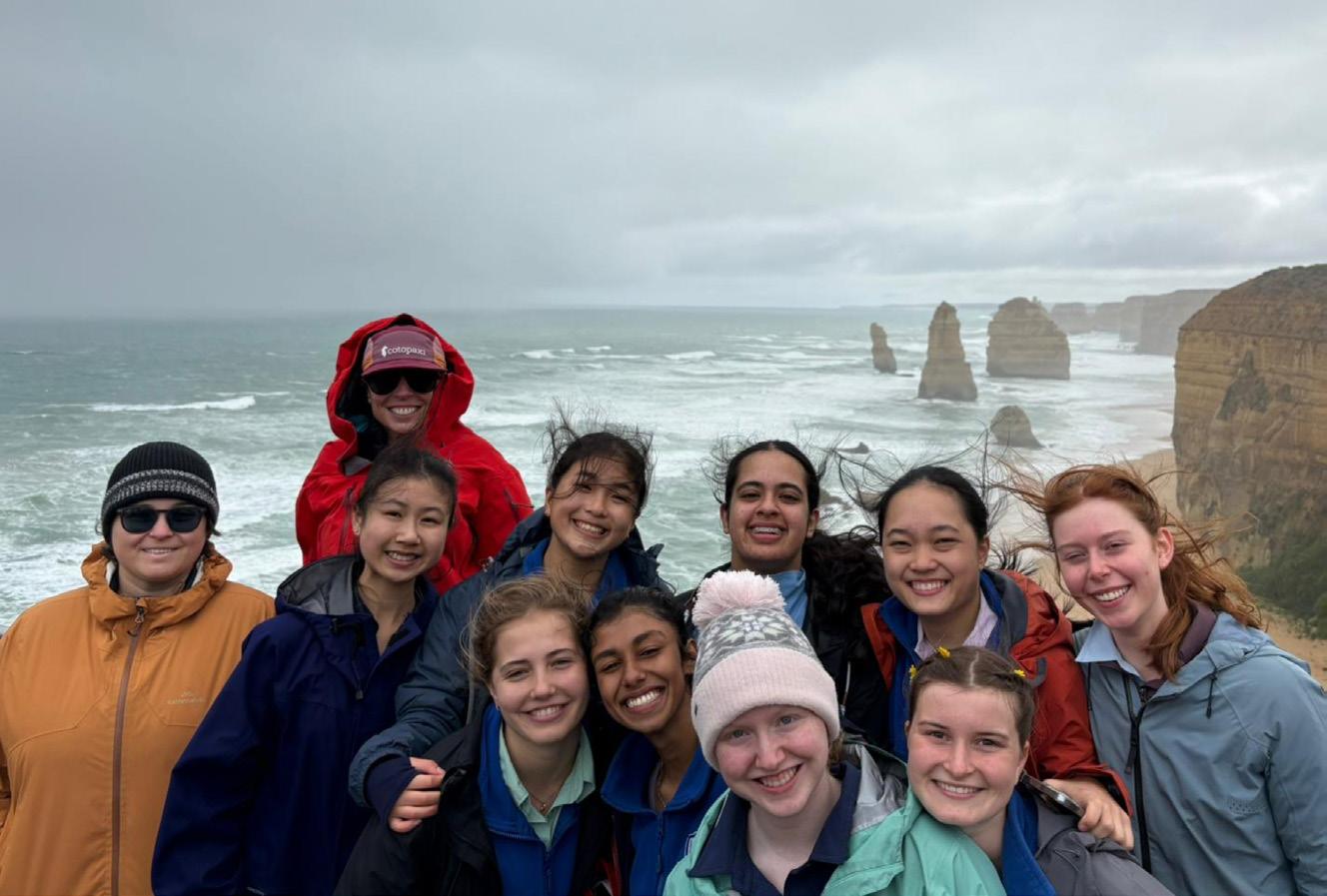
day ended at the Twelve Apostles— slightly fewer than advertised but promises of warm showers and yummy pizza made up for it.
Looking back, the journey can’t be summarised with one great culminative moment, or even a reasonably protracted account. As is the nature of a ‘big big hike’, what’s most memorable isn’t a single moment, but the accumulation of them—the shared exhaustion, the quiet coordination of a group moving together, and the simple, collective decision, made again and again, to keep going.
For information about the Duke of Edinburgh’s International Award program visit the BGGS Minerva page.
For the non-hikers, scroggin is a high-energy trail mix of nuts and dried fruit
Global audience for social change Girls Grammar students spoke to the world as Australia introduced new online safety laws
International interest was focused on Australia during the summer break, as new social media laws lifted the minimum age of access for many online platforms to 16.
Was it workable? How would teenagers react? Would it actually change anything? As questions swirled, international news organisation, the BBC, visited BGGS to interview
Prior to the Online Safety Amendment, Sophia said her primary social platform was Snapchat, estimating she spent about 40 minutes a day texting and calling friends.
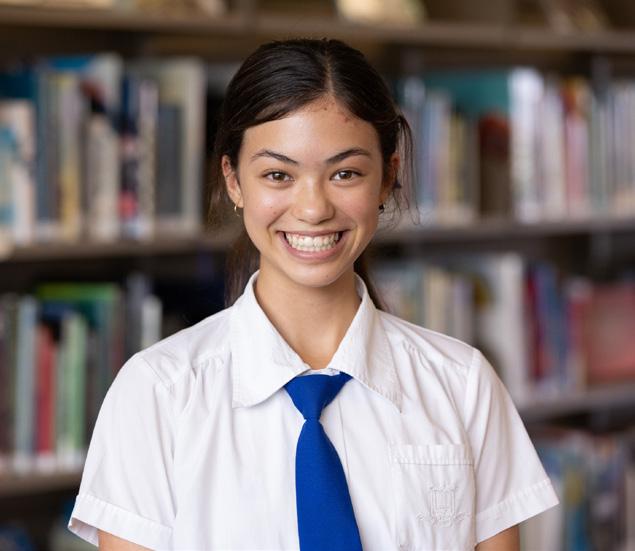
Sophia Young (10G)
When I first heard about the pending social media ban for under 16s, I immediately assumed that would mean more outdoor time, less Snapchatting and a break from how dependant we have become on our phones.
In reality, the change was almost unnoticeable, contrary to seeing news headlines that millions of young Australians were banned. In my social
Principal Ms Jacinda Euler Welsh (pictured right) and several students.
They shared their thoughts with a global audience on television, radio and in an online blog as Australia’s Online Safety Amendment Act 2024 came into effect on 10 December, 2025. Now, six months into the change, two students reflect on the impact.
circle, approximately only 1 in 40 experienced banning. We prepared for Armageddon, with our whole grade collecting telephone numbers, yet nothing major happened, well almost.
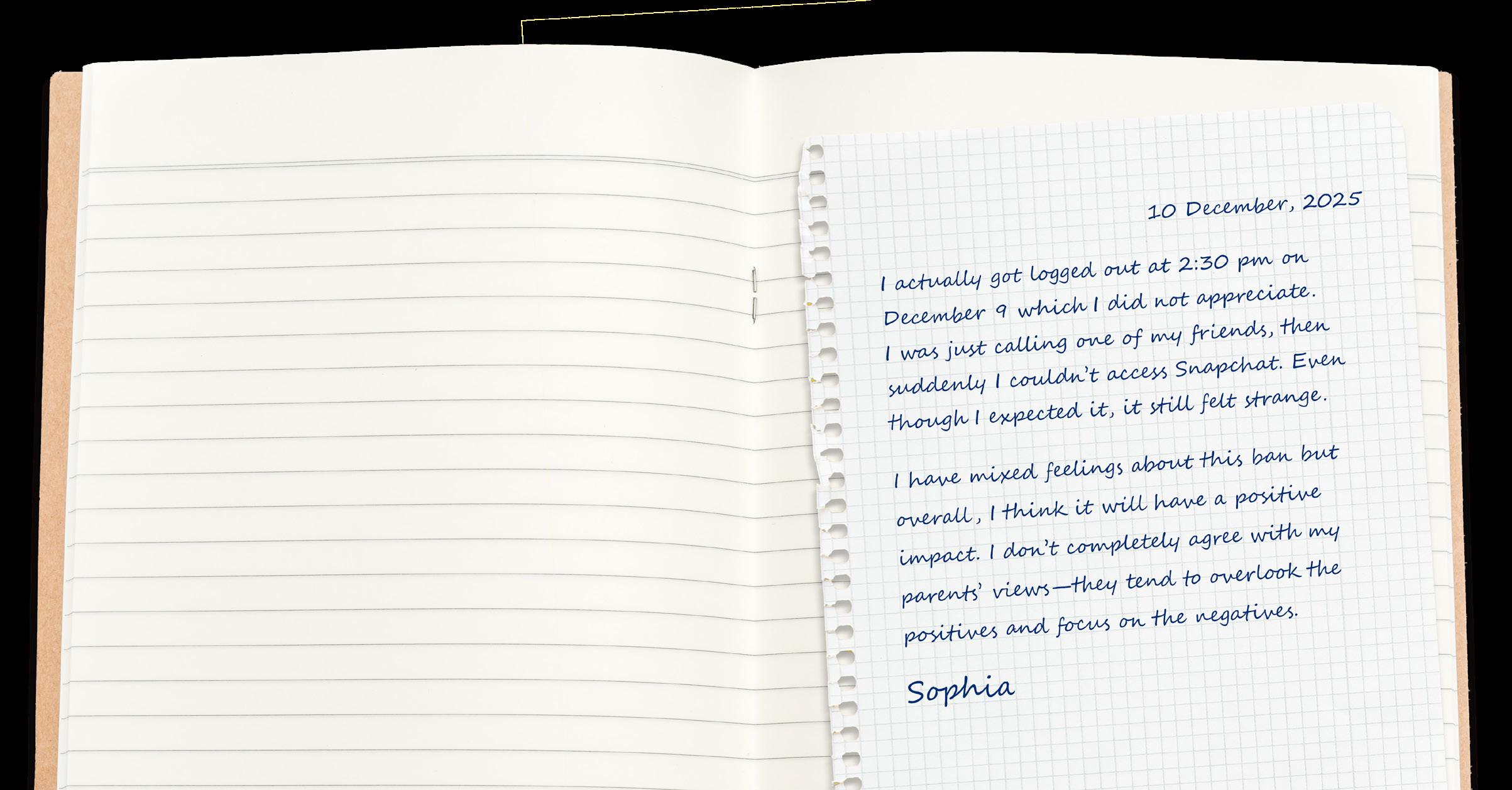
Ironically, at 2.30 pm on December 9 last year—a full day before the ban was supposed to start—I got booted from Snapchat while I was on a call to a friend, which I didn’t appreciate. The next couple of days felt oddly isolating because no one else I knew had been banned yet.
After three days, I realised I was alone in being blocked and like most people my age, I tried to work around it and find a loophole. I attempted the facial scan multiple times, and eventually, after 5 tries, I reopened my account. Everything was exactly how I’d left it—all my data and saved chats were there.
Time lapsed, and I thought I was in the clear, completely forgetting about the so-called ban. Fast forward to Wednesday 29 April this year. I awoke to find my thumb reciting its usual routine, navigating itself to Snapchat but failing. I had been locked out again.
As expected, I arrived at School in a sulky mood, but at least I wasn’t alone this time. The majority of my friends had also suddenly been banned that morning.
This time I think I will stay a law-abiding citizen and remain off social media until I am sixteen. The negative impacts of social media are supported by studies. Tech companies should be forced to change algorithms that take advantage of young minds to prevent future generations being negatively impacted.
When the ban came in last year, I had the chance to share my experience on a BBC radio interview, which was truly fascinating and a bit nerve-wracking, especially knowing that my relatives could hear me talking while driving the streets of London. The international interest on the topic is understandable seeing that more and more countries are considering this ban. This shows it truly is a global problem for adolescents like me.
I am surprised that the “island Down Under” was the first to initiate this and hopefully, given the failings of the Australian rollout, other countries should be able to learn from our mistakes.
Providing
a different perspective,
Francesca has never used social media, but was hopeful widespread limits would create positive social change around her.
Francesca Chin (9E)
In the lead up to the social media ban, it was obvious that things weren’t going to go back to the old days where kids played outside all day. Times have changed and so have teenagers. And when you take something away, it makes people want it even more, so I was curious to see what would happen.
The biggest change I’ve noticed since the ban came in, is that people seem to chat with each other more. Whereas before, as they'd walk to the bus, many just looked at their phone, now lots more are chatting. People also seem less distracted somehow.
Messaging is definitely used more now to contact friends, which is a good thing because it’s social media minus the algorithms to get you addicted and no endless scrolling.
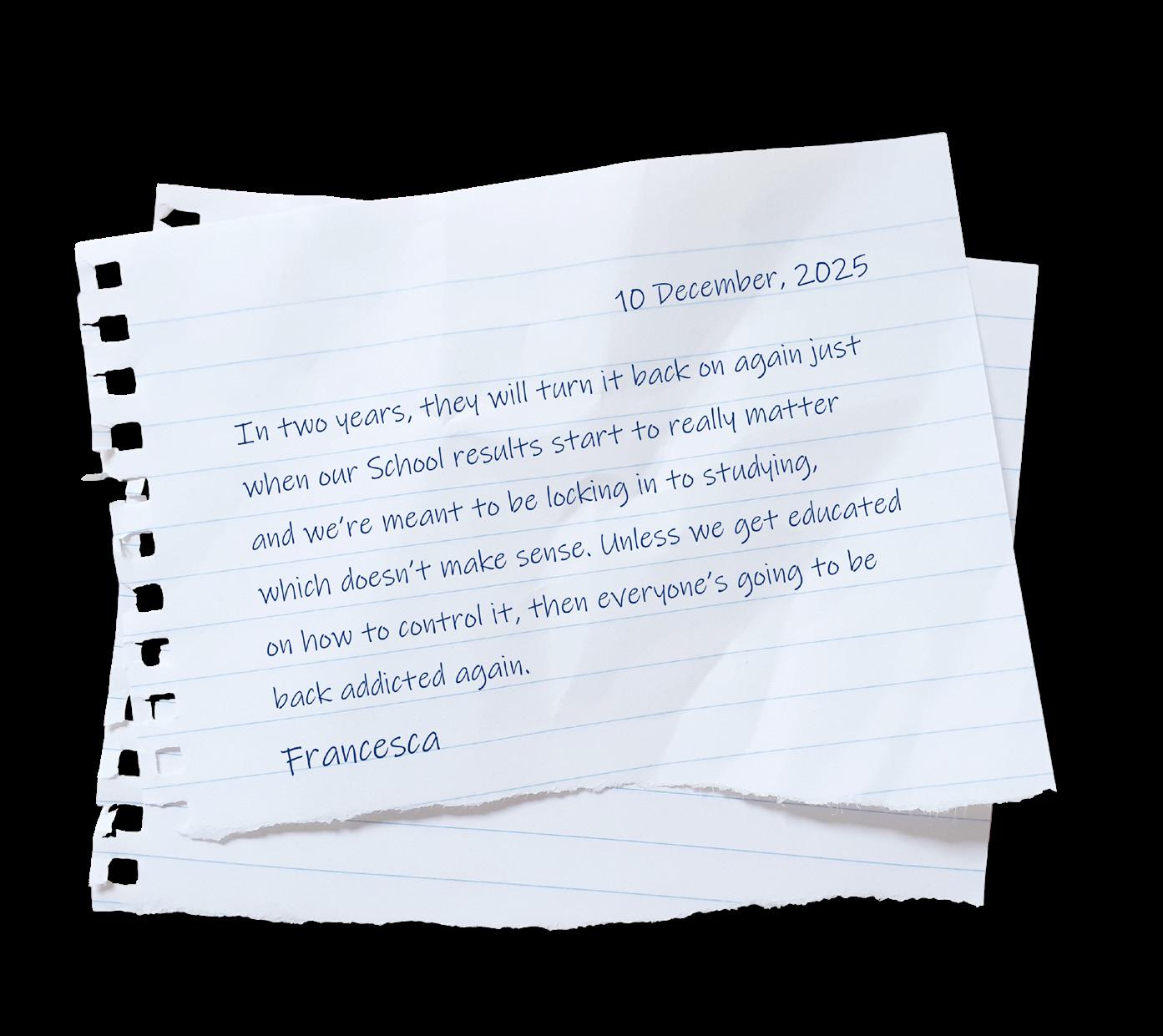
The ban will be very positive for younger teens and kids because it stops them getting addicted in the first place. But it’s hardest for my age group, because they have already experienced social media, then it was banned, then in two years we get it back again and the social media companies will be waiting. I think there should be support to help our age group learn how to control social media, instead of it controlling us.
When the ban first came in, it was in the news all over the world, with many countries watching Australia to see what happened. Often, we follow other
countries, but since our ban, at least eight other countries are now planning restrictions of their own. Australia has led the way!
For someone who didn’t use social media, the ban’s been positive. At a period in our life where fitting in matters most, social media was the expectation. Our generation didn’t ask ‘What’s your number?’ they asked ‘What’s your Snap?’ It was hard not having social media at first, but I’m glad now. I didn’t have to go on camp worrying about my Snapchat streaks, instead I just worried about losing my Duolingo streak.
While this ban has been hard for many teens, over time I truly believe it will end up being one of the best things that could have happened for younger kids, not only now, but for generations to come.
Cathedral Concert A celebration of women in music
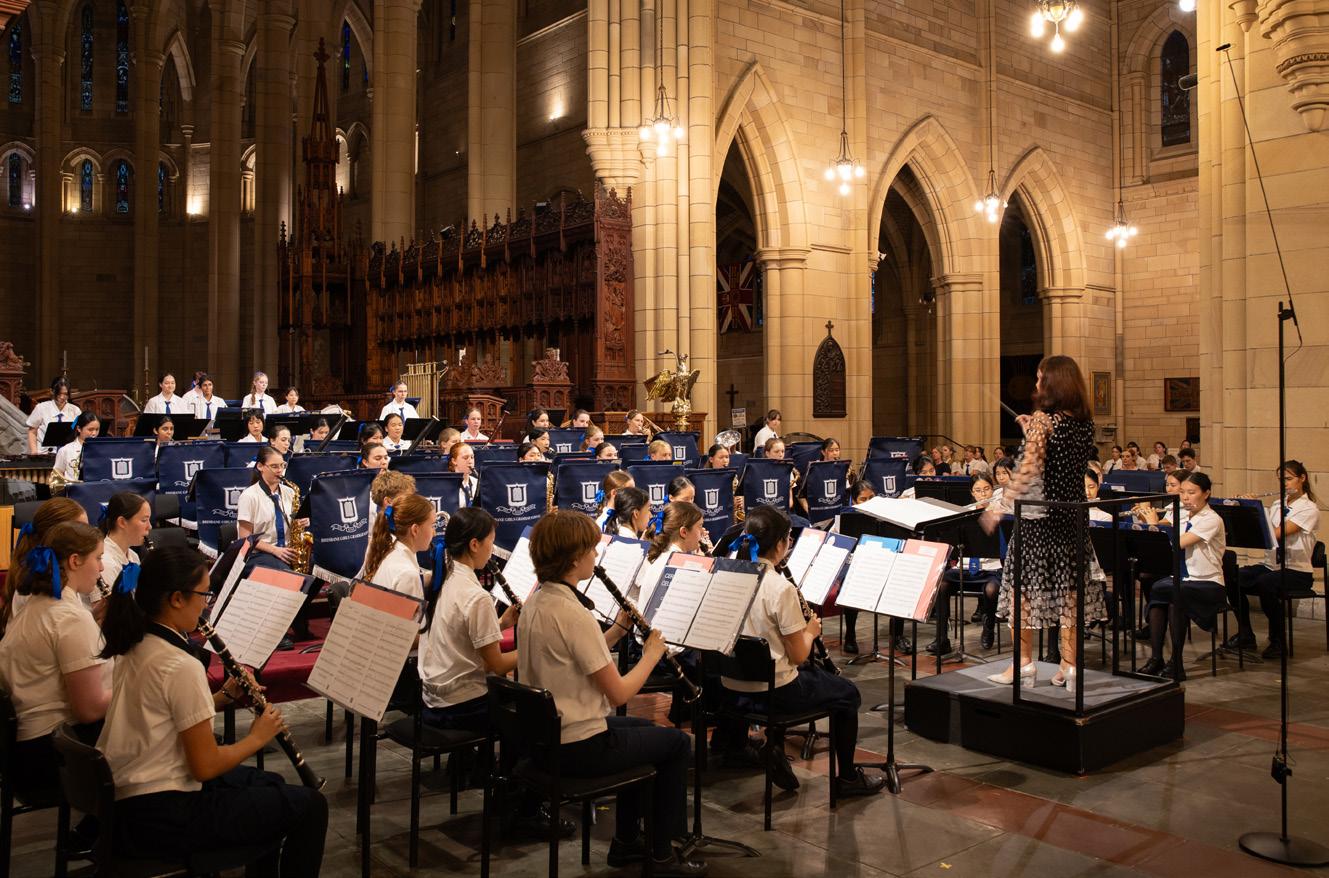
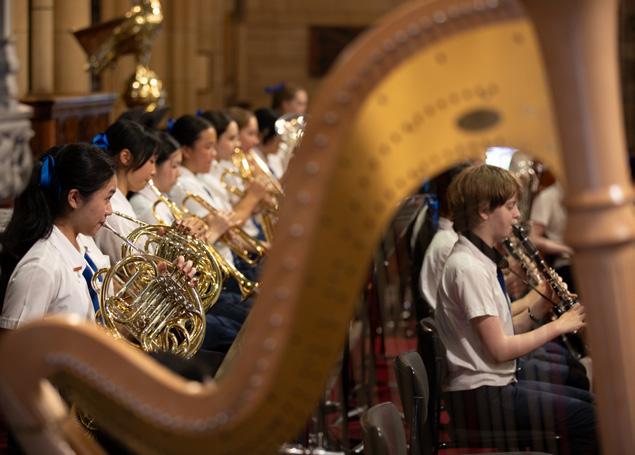
The voices, contribution and creativity of female musicians were celebrated in the soaring surrounds of St John’s Cathedral in March, at Brisbane Girls Grammar School’s marquee Senior Music event.
The 2026 Cathedral Concert, A Celebration of Women in Music, not only showcased the talent and dedication of students but platformed female composers and musicians across generations and genres. In doing so, it highlighted the understated but powerful role Music programs play in celebrating representation and inspiring students to see themselves as both composers and performers.
From quiet reflective moments to vibrant ensemble pieces, the repertoire spanned styles as diverse as the women it honoured, including orchestral, choral, percussion and chamber pieces.
The Girls Grammar Symphony Orchestra performed Adoration, by Florence B Price, who, in 1933, became the first African American woman to have
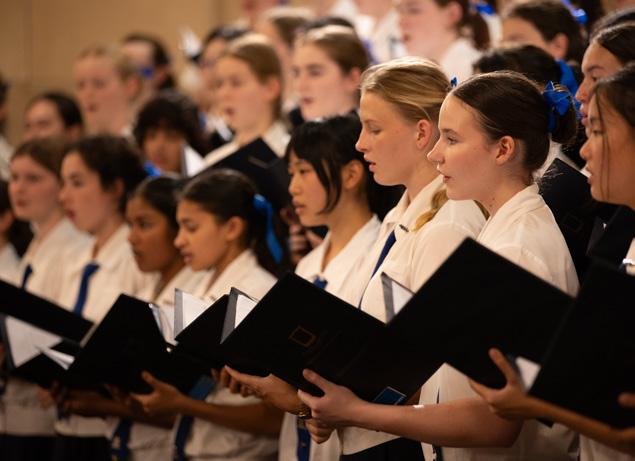
her work performed by a major orchestra in the US. And BGGS’s own awardwinning composer, Lizzy Harman (12L), performed her original piece, Seasons of Seeing, which took out the 2025 String Orchestra Composing Competition. Another highlight was the Grammar Singers, led by soloist Samyra Phutela (12O), who delivered an uplifting and inspiring performance of Dolly Parton’s hymn-like Light of a Clear Blue Day
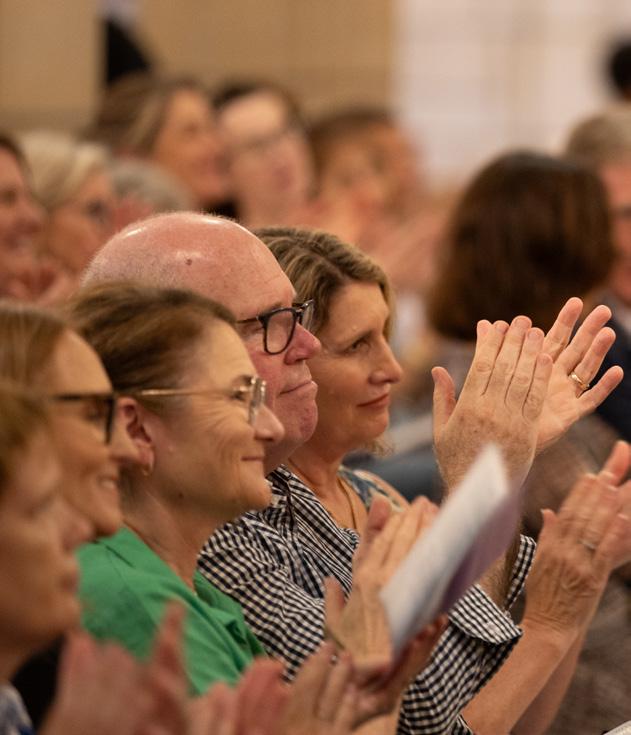
The annual Cathedral Concert provides Senior ensembles and choirs with meaningful performance experience early in the year, and a joyous afternoon of music for the School community.
Brisbane Girls Grammar School
The Sun Queen rises
Meet the Grammar Woman aiming to bring a sword-fighting female icon to the world stage
Opera singer, composer, writer and director Dr Tarita Botsman (1988) is on the cusp of becoming the first Australian woman—and only the seventh in history—to script and score a major international musical.
Her swashbuckling operatic drama
The Sun Queen showcased in London in May, with a view to booking a UK premiere in 2027. With a cast of 19, a rollicking story, and a lush orchestral sound that straddles opera, baroque and musical theatre, it’s hoped the show will head to Australia and Asia before setting its sights on the US and a coveted Broadway run.
The Sun Queen is based on the almost unbelievable true-life story of Julie d’Aubigny, a sword-fighting, operasinging libertine who both scandalised and captivated 17th century Paris.
Thought to be the illegitimate daughter of Sun King, Louis XIV, d’Aubigny received an academic and physical education usually reserved for males. Thanks to this early training, she became an accomplished swordswoman who went on to challenge and defeat several noblemen in duels over women, while also becoming the toast of the Parisian opera world as a self-taught singer.
‘I discovered her story as a young Conservatorium of Music student,’ Tarita says. ‘I was writing an assignment on French baroque opera and I ended up writing the entire assignment about her.’
The story percolated in the back of Tarita’s mind for decades—while her own international opera career bloomed, then expanded to writing. When an opportunity arose to bring the story to the stage, she swooped.
Before jetting off to London for the showcase, Tarita joined us to discuss The Sun Queen and her time at Girls Grammar. Find out why former principal Judith Hancock gave her a Friday detention and what we can all learn from d’Aubigny.
Watch Tarita’s story here: click or scan the QR code
Success is more art than science Former Head Girl Sally Brand delivered a Foundation Day Address that reflected on competing career paths
At School, Sally Brand (Head Girl, 1999) was a true Renaissance woman, representing Australia at the International Young Physicists’ Tournament in Vienna and picking up the Minister for Education’s Award for Excellence in Art.
She continued to pursue both Science and Art at university until an epiphany in a physics lab prompted a singular focus.
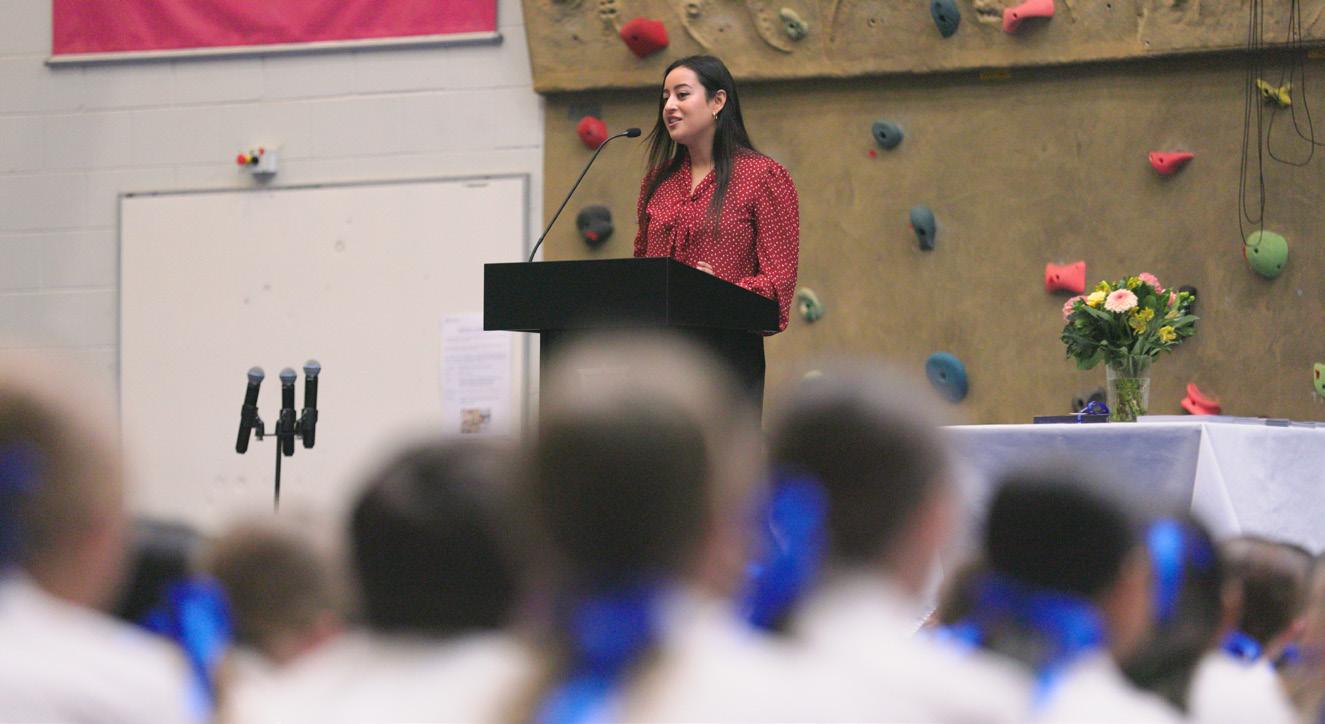
Returning to Girls Grammar to deliver the 2026 Foundation Day Address, Sally shared how she ultimately chose between disparate passions, reflecting on the great opportunity and great responsibility that came with the privilege of a Girls Grammar education.
‘When I was a Grammar girl, I embodied the motto nil sine labore,’ she told the assembly. ‘My sisters and I were always encouraged to pursue our own interests, which is one of the reasons my parents sent us here to Girls Grammar.’
She made the most of every opportunity to challenge herself across incredibly diverse fields.
‘In my final years here, I studied two Maths, Chemistry, Physics, English and Art. I was Head Girl, played in the Big Band, represented the School, and Australia, at the International Young
Physicists’ Tournament in Vienna, and won the Art prize for my year.’
Unable to separate twin passions, she went on to study dual Arts and Science degrees at the University of Queensland, until one day she had a moment of insight in a physics laboratory—perhaps not one that changed the world, but one that changed her world.
‘What I found when I looked around the physics lab—with only two other young women in my class—was that I was not with my people; the people I really connected with; who I wanted to spend my time with; who I could share and build upon ideas with.’
Despite the fact she was excelling in Science, Sally got her parents’ blessing to focus solely on Art. She never looked back, making life-long friends during her degree and going on to build an outstanding career in the art world that has spanned private and public galleries, including the National Gallery of Australia. Last year she returned to Brisbane for the first time in decades to take up a ‘dream job’ as Curatorial Manager of Australian Art at the Queensland Art Gallery’s Gallery of Modern Art (GOMA).
Sally said she regularly draws upon her strong understanding of Science and Maths, explaining: ‘Major artistic projects don’t happen outside the rules of gravity, or without complex budgets, or managing the statistical probabilities of risk.’
Illustrating the point are groundbreaking exhibitions she helped bring to the public while at the National Gallery, including Patricia Piccinini’s hot air balloons Skywhales: Every Heart Sings and Jordan Wolfson’s animatronic collection, Body Sculpture
Sally maintains a passionate belief in the power of art and artists to shift the public narrative.
‘I love how art can knock you off your feet and change the way you think about the world while also being able to offer a helping hand and provide respite in hard times.’
Being part of the process that brings this art to a public stage was incredibly rewarding and she encouraged students to visit GOMA's internationalaward winning kith and kin installation by Kamilaroi and Bigambul artist Archie Moore, on until October 2026.
She also urged Grammar girls, themselves the benefactors of a heritage that advocated for equity, to continue to pay this legacy forward.
‘With this inheritance we have responsibilities to know and recognise our history and keep working to make this country a fairer, more equitable place for every person.’
Australia Day Address
Migration lawyer and former Head Girl Sarv Singh (2014) returned to Girls Grammar to deliver a heartfelt reflection on what it means to be an Australian in 2026
What does an ‘Aussie’ actually look like?
It’s a question Sarv Singh, a migration lawyer and Senior Associate at Mullins Lawyers, had never really thought about … until this year.
With rising international tensions and increasingly divisive domestic debate around immigration, a caustic comment on social media gave her pause for thought. Under a video of New Year’s Eve celebrations at South Bank, in Brisbane, one user had posted: ‘spot the Aussie’.
It attracted a concerning number of likes, Sarv told the assembly, but also raised a simple but important question: ‘What does an Aussie look like?’
‘As someone born in Brisbane, this past year has been the first time I have truly paused to reflect on this question and my place in my own country, and that is deeply confronting,’ she said.
In her work as a migration lawyer— and more personally as the proud grandchild of migrants—Sarv has seen the significant contributions of those from other countries and urged Grammar girls to advocate for respectful debate during times of heightened tensions.
‘In a healthy democracy, open debate and criticism of government policy is essential. Australia’s immigration laws are not without flaws and should rightly be subject to scrutiny.’
But it was important to challenge ideas, not individuals.
‘In my work, I see firsthand how migrant nurses, aged-care workers, engineers, hospitality staff, and tradespeople sustain our communities, keep essential services running, and enable local businesses, particularly in regional Australia, to thrive.’
Australia’s humanitarian program too has provided safe harbour and a fresh start for those fleeing conflict from WWII to Vietnam, Afghanistan and more recently, Ukraine.
‘These individuals have not only found safety here, but have enriched Australian society with food, culture, language, and entrepreneurship.’
At the core of a diverse country, there still sits an ethos of a fair go for all, Sarv said, ‘Not as a cliché but a guiding principle.’
As a passionate advocate for the marginalised, Sarv has helped women flee family violence and secured emergency humanitarian visas for Afghanis escaping the Taliban regime. In this video story, she shares how the role of Head Girl helped shape her commitment to becoming a voice for others.
Watch Sarv's story here: click or scan the QR code
Frond memories
School portraits mark the passing of time and trees
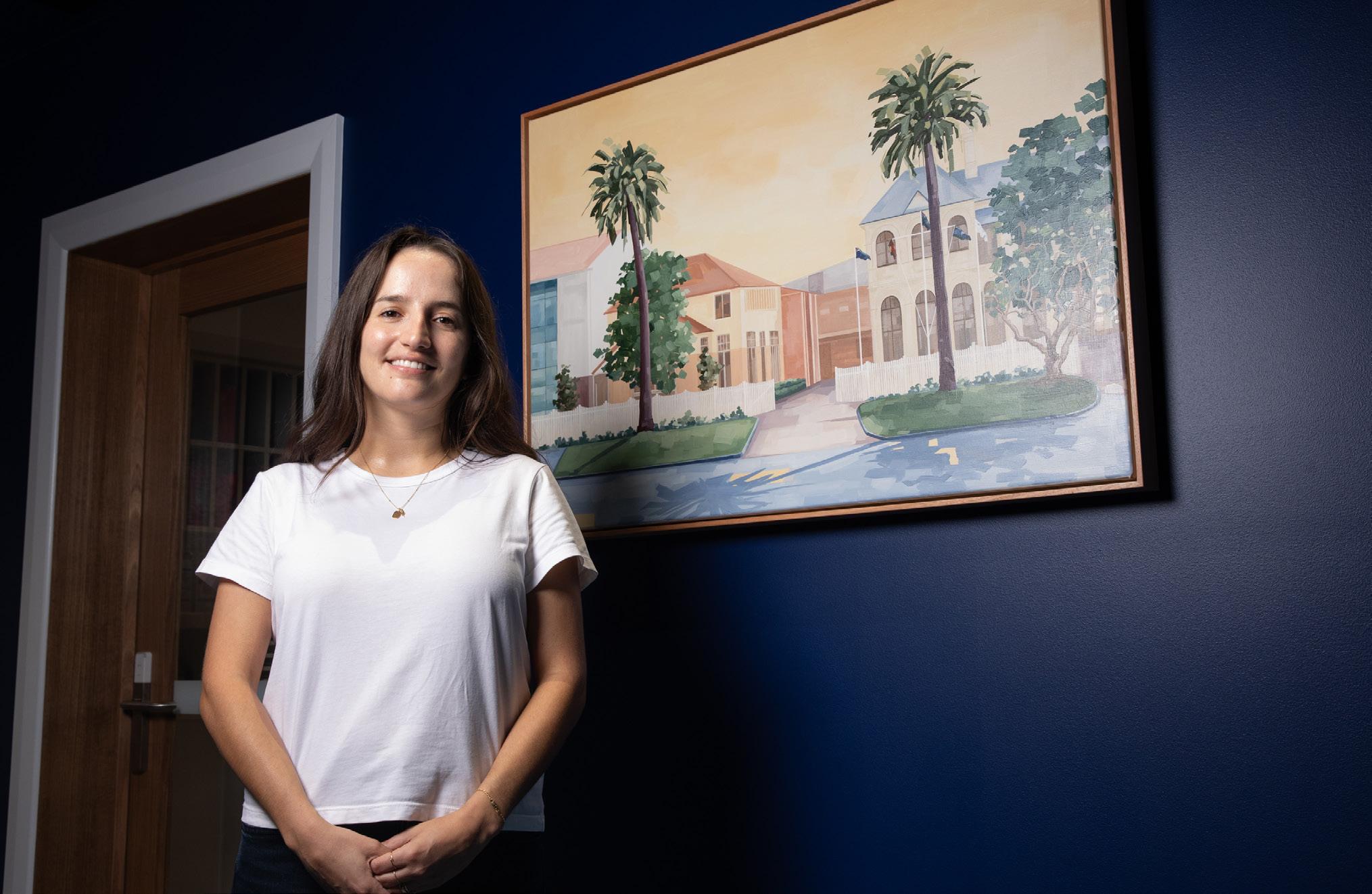
A new painting of Girls Grammar commissioned to mark the opening of the Junior School has become the last to feature iconic twin palm trees that framed the white picket gate entrance.
In early 2026, shortly after the oil on canvas work was completed, one of the palms died—believed to be a result of ibis nesting on the crown—and was removed by Brisbane City Council.
The memory of the tree lives on, however, in the portrait by alumna Julia Sirianni (2010), which joins a growing body of artwork chronicling the changing face of Main Building from 1875 to the present day, with 30 portraits of the School now in the collection.
The latest work was commissioned and gifted to Girls Grammar by Hutchinson Builders, who completed construction of the Junior School, which looks across to Main Building. The portrait of this outlook now hangs in the entrance of the Junior School.
‘I was very art driven and the art facilities at Girls Grammar were incredible’ Julia Sirianni
For artist Julia, the loss of one of the signature palms was sad news as she found inspiration in the play of light and shade cast by the palm fronds.
‘I just love the shadow they create at the entryway. It’s such a shame because they’re so grand. It’s a beautiful statement.’
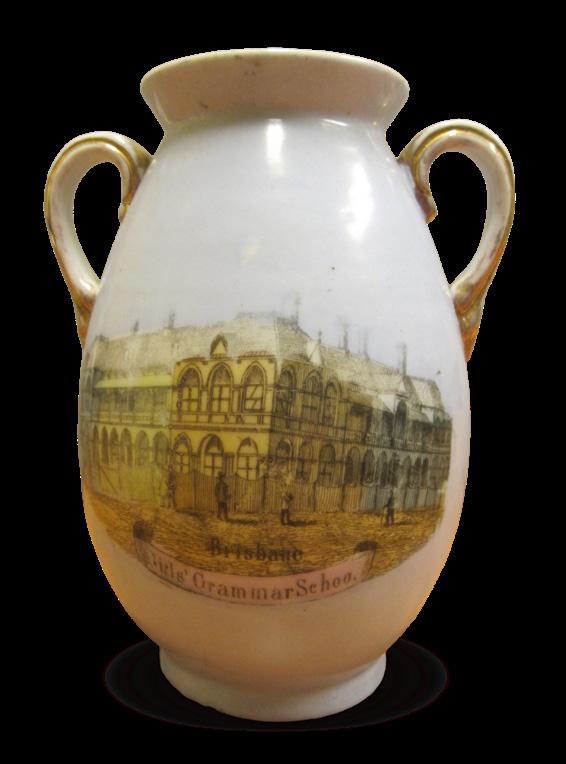
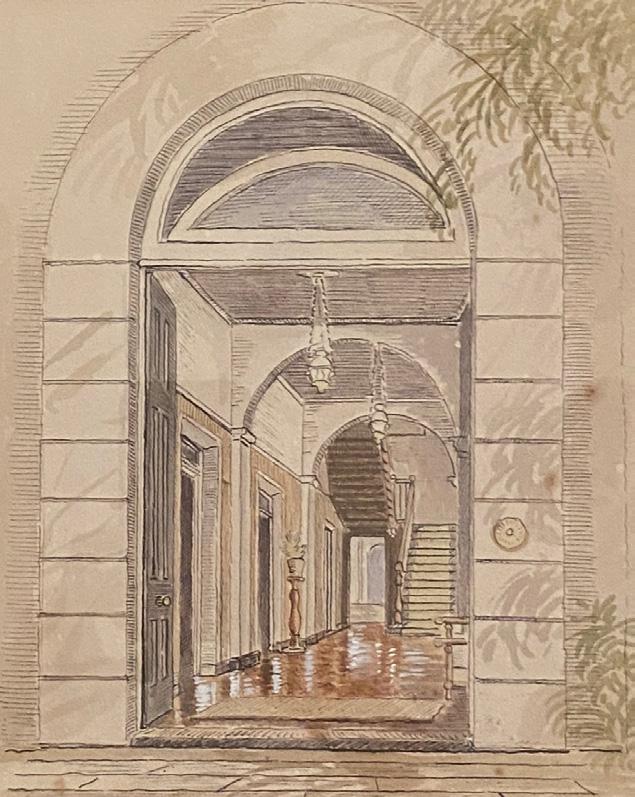
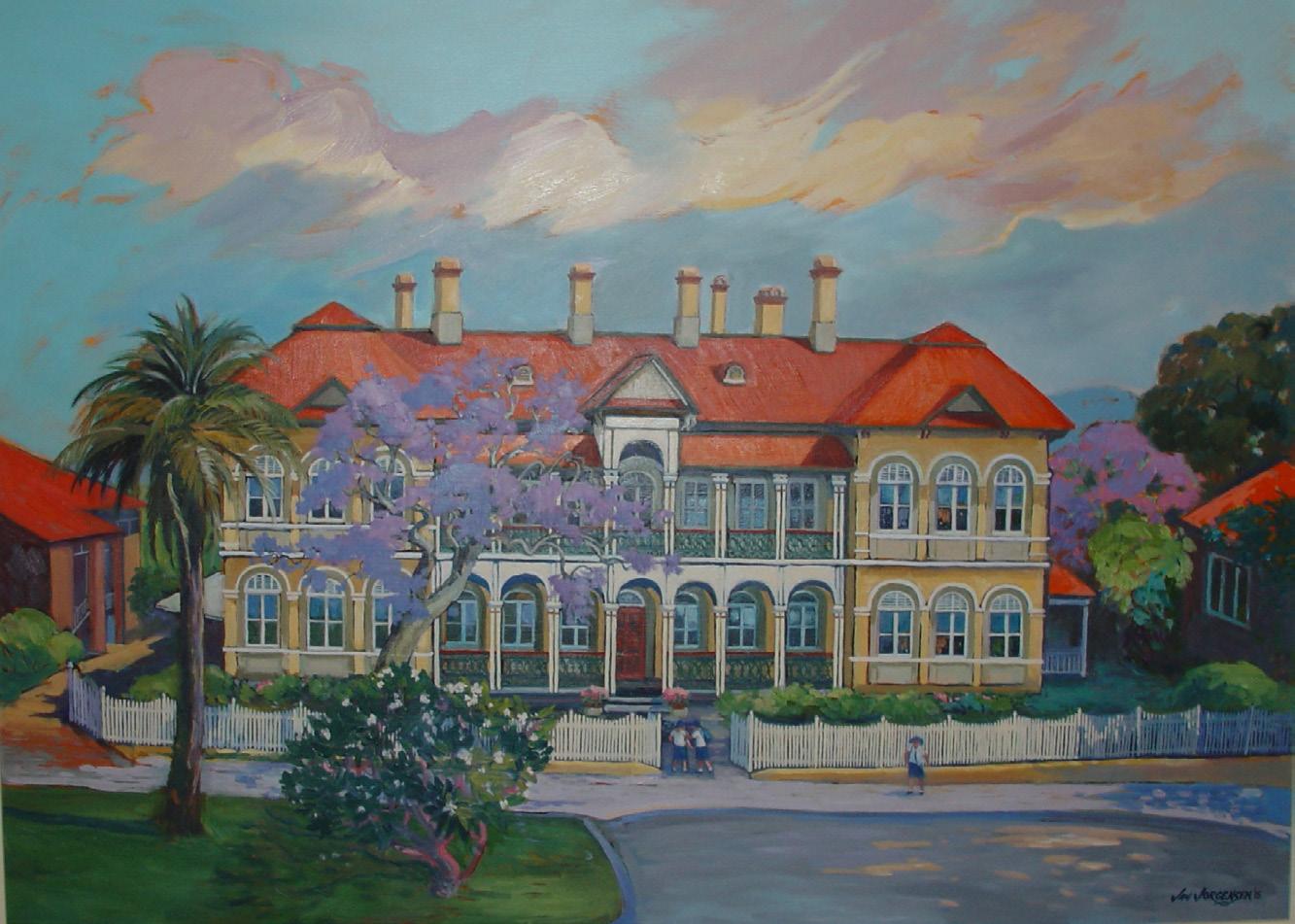
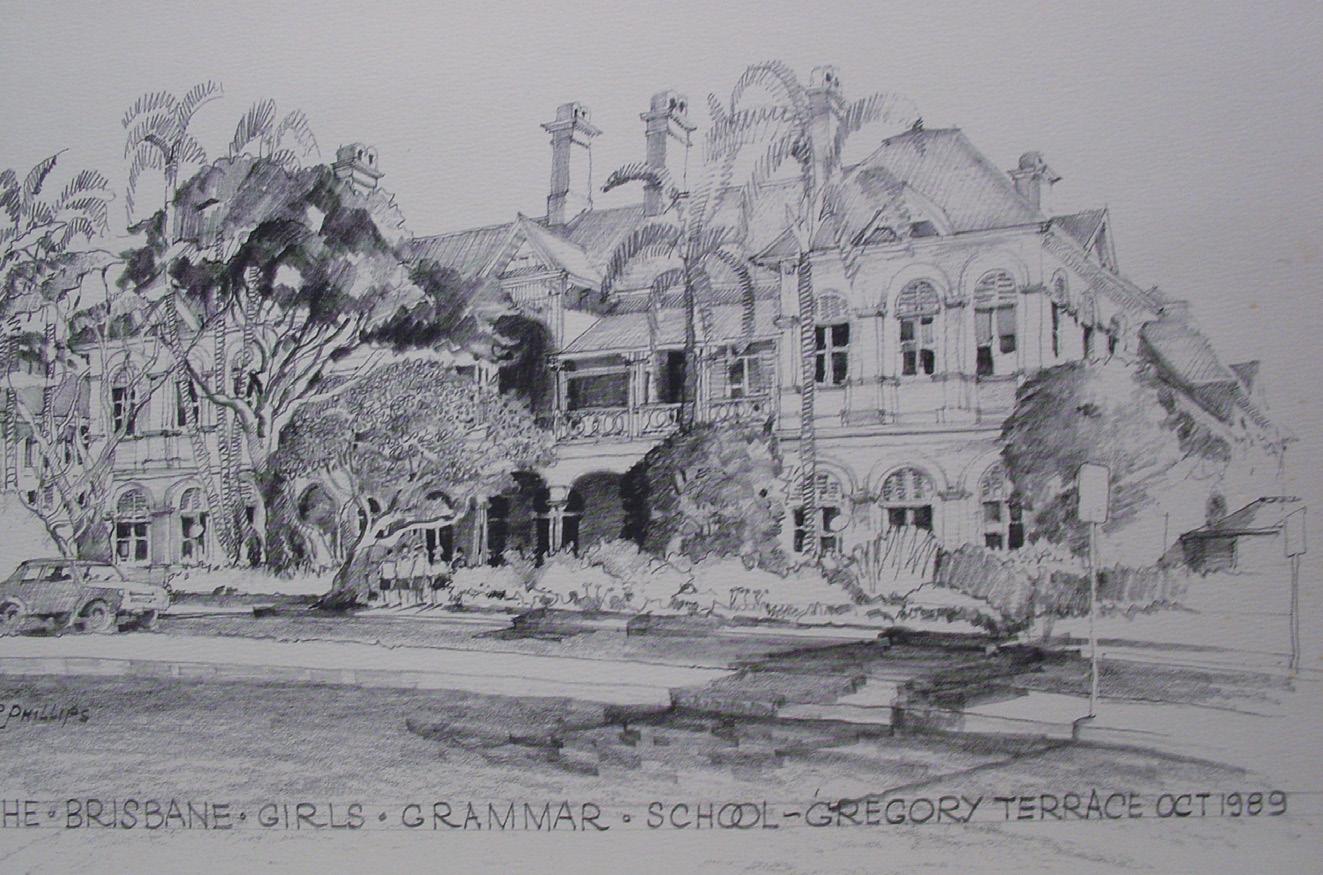
Captions 1 Julia Sirianni (2010) with the most recent School portrait painted in 2025 2 An intriguing image of the School on a vase dated 1884 3 Reg Trebilco, 1980 4 Jan Jorgensen, 2015 5 David Phillips, 1989
Despite her own success, including the 2019 People’s Choice Award at Sydney’s Macquarie Group Emerging Art Prize, Julia said it was an honour to have her work sit alongside so many exquisite pieces and talented artists in the wider Girls Grammar Fine Arts Collection.
Within the category of School portraits, trees framing the historic buildings along Gregory Terrace have long been a focus for artists.
In 1989, noted architect and artist David Phillips sketched the School ‘en plein air’ and waxed lyrical not about the palms, but about twin frangipani trees. ‘Those two frangipanis outside the Grammar
School are to live for,’ he said in an oral history held in the Queensland State Library. David’s 40 x 25 cm pencil sketch of Girls Grammar was donated to the School Fine Arts Collection by his cousin Margaret Peel.
Other works have been commissioned by the School to mark significant anniversaries. In 1975, English-born artist Reg Trebilco (1915-2017) completed three works in pen and watercolour to mark Girls Grammar’s 100th anniversary. These works, depicting the exterior and interior of Main Building, now hang in the downstairs
boardroom of Main Building.Reg Trebilco was inspired by heritage architecture and is represented in several galleries and private collections in Australia.
The collection also includes several works by Grammar Women, including renowned artist Jan Jorgensen (Goeldner, 1960), who painted a large acrylic on canvas work to mark the School’s 140th anniversary. Former student Linden Seale (1976) also completed a watercolour of Main Building, donated to BGGS in 1989.
The School’s extensive collection of artworks featuring buildings, students and motifs, spans a variety of media, including oil, watercolour, pen and pencil sketches, and a screenprint. But perhaps the most intriguing and mysterious object is a vase dated to 1884 that features a painted image of Main Building. Little is known about the donated artwork, other than the fact the vase was manufactured in Germany by AW and Co.
Fine Arts Collections Manager
Ms Lorraine Thornquist details more portraits of the School in an online booklet available through the Beanland Memorial Library page of Minerva.
AWARDS AND ACHIEVEMENTS
Congratulations to staff, students and alumnae on their recent achievements
STAFF
Director of Professional Practice, Dr Susan Garson, was awarded her PhD from QUT in January. Her thesis was entitled Making Middle Leadership Visible: Representations of Identity and Influence in Australian Independent Secondary Schools.
Deputy Principal (Academic), Dr Bruce Addison, was a keynote speaker at ACEL’s Early Career Teacher breakfast held at Alan Border Oval. The keynote was called: Some Reflections on the Three R’s: Relationship, Relationship and Relationship
Dr Garson and Dr Addison coauthored a chapter, Seeping Upwards and Across: Embedding Cultures of Thinking at Brisbane Girls Grammar School, to a new book: Cultivating Cultures of Thinking in Australian Schools—From Control to Curiosity, edited by Cameron Paterson and Simon Brooks (Routledge, 2026)
Ms Gerri Bernard, Head of Department, Science Curriculum Development, was appointed peer reviewer, for the Journal of Double Star Observations
Mr Stephen Fogarty, Director of Health and Physical Education, was recognised as an Inspiring Teacher of Influence by the University of Queensland’s pre-service program in Health, Sport and Physical Education.
STUDENTS
Kayla Tin (11M) made history in February when she was part of a team (with Tiana Roberts and Zara Djamirze) that won Australia’s first ever medal in Women’s Sabre at the Asian Cadet and Junior Fencing Championship in Jakarta, taking Bronze.
Charlotte Kane (12R), won the senior girls individual event at the Queensland Representative School Sport Triathlon and Aquathon State Championships in Hervey Bay in February, going on to place third at the School Sport Australia (SSA) National Triathlon Championships. Also in triathlon, Ella Dorey (9H) won the U15 event at the Gold Coast Triathlon, making her the National Sprint Champion.
Grace Zhao (11L) was selected as part of a four-person team to represent Queensland at the National Schools Debating Championships in Term 2.
Girls Grammar won the Australian stage of the International Young Physicists’ Tournament, held in Melbourne in February. The victorious team of Lucy Petersen (11B), Tiffany Yuen (12R), Astrid Selwa (12G), and Chantelle Lam (11B) will travel to Zurich in July to represent Australia.
Along with competing in national Physics tournaments, Tiffany Yuen (12R) was awarded the Licentiate in Music, Australia (LMusA) in Piano, one of the highest performance qualifications offered by AMEB.
Beatrice Tallis (10L) and Emily Edwards (11H) were named in the 16U Australian Squads for Water Polo.
Girls Grammar gymnasts recorded two perfect 10s at the QGSSSA
Championships. Melody Chambers (8L) earned a 10 on Bars in the Open Division, while Eliza Bell (9R) was also awarded a 10 on Floor in B Grade. Melody was named Interschool Artistic Gymnastics Champion.
Brisbane Lions AFL Academy player Libby Robinson (10L) recently competed in the AFL National Development Championships and was named on the tournament’s U16 All Australian Team.
At the end of 2025, several Year 12 students won prestigious writing awards. Charlotte Serisier (12B 2025) won first prize in the Roly Sussex Short Story Competition—Secondary School Division, while Emily Smith (12E 2025) received a judges’ commendation. Meanwhile, Valerie Yu (12M 2025) won the Kill Your Darlings School Writing Prize.
In December 2025 Annabelle Fu (12R in 2025) was named among only 40 students statewide to receive a Queensland Government Creative Generation Excellence Award for Visual Arts. As part of the award, Annabelle’s winning piece will be exhibited at QAGOMA until 13 September 2026.
ALUMNAE
Abigail Lui (2020) was awarded best contemporary classical work at the 2026 Queensland Music Awards for her collaboration with Queensland’s Chamber Orchestra, Camerata, entitled Memory in the Distant Hills
Mia Boe (2014) was named as a finalist in the 2026 Archibald Prize for her portrait of Yolngu musician Terry Guyula, Drifting cloud
In February, Josie Dooley (2017) won the Australian Cricketers’ Association Community Impact Award for her work to inspire, and raise funds and awareness for fellow stroke survivors, in particular, through wave2recovery