In the spirit of reconciliation, Brisbane Girls Grammar School acknowledges the traditional custodians of the lands on which our campuses stand, the Turrbal, Jagera and Kabi Kabi Peoples, and all Indigenous people in our School community. We honour and respect their Elders past, present, and emerging, and recognise that these lands have always been places of teaching and learning. We are grateful for thousands of generations of care for Country and seek to walk in solidarity with the First Peoples of our nation for reconciliation, justice and healing.
From t he Chair
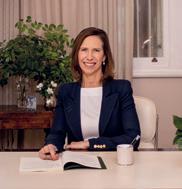
Ms Julie McKay (2000) Chair, Board of Trustees
It has been a rare privilege for the Board of Trustees and I to join the past year of celebrations marking 150 years since Brisbane Girls Grammar School was founded in March 1875.
Across 2025, many memories were shared and new ones created at joyful gatherings, spanning Brisbane, Europe and the US. We told the stories of graduates who broke new ground in the 1900s— becoming Queensland’s first doctors, lawyers and stockbrokers—and of those who continue to lead the way today, across the globe and in their community, for a new generation of women in fields as diverse as diplomacy, technology, engineering and business.
Our sesquicentenary year has been a powerful reminder not only of the enduring strength of connections at the School, but also of the generational impact of investing in girls’ education. It has deepened our commitment to the gender equity at the heart of the BGGS vision, and we reaffirm this foundational goal in 2026 with the opening of our new Junior School, for Years 5 and 6. It is Brisbane’s first independent, secular school for girls in these primary years, matching educational opportunities already available to boys.
‘Our sesquicentenary year has been a powerful reminder not only of the enduring strength of connections at the School, but also of the generational impact of investing in girls’ education.’—Julie McKay (2000)
Watching the Junior School Building take shape across Gregory Terrace from Main Building throughout our sesquicentenary was a powerful visual reminder that while we look back on the past with gratitude, the School is always striving to move forward.
The welcoming of Years 5 and 6 significantly expands the Girls Grammar community, offering greater opportunities for our girls to lead and mentor, to learn from each other, and imbibe the belief that they can change the world, as they have seen many Grammar Women do before them.
Among the numerous highlights of 2025, one event that felt particularly special was the 150 Year Anniversary reception for BGGS hosted by Her Excellency the Honourable Dr Jeannette Young AC PSM, Governor of Queensland, in the grounds of Government House in November. It is hard to imagine, even for our forwardthinking founder Sir Charles Lilley, that the School would one day be embraced and celebrated in such a fashion. My fellow Trustees and I were honoured to join alumnae, long-standing and former staff, and significant members of the Girls Grammar community for a memorable evening.
On behalf of the Board of Trustees, I thank our exceptional 16th Principal Jacinda Euler Welsh, who has continued to lead the School with care and respect for its heritage, while ensuring it stays at the leading edge of education in times of significant change.
In 2025, the School continued to excel academically, posting a median ATAR of 96.45, with four of our students awarded the highest possible score of 99.95.
Underpinning this noteworthy academic achievement is a philosophy grounded in nurturing the whole girl—both mind and body—offering cultural, musical, servicebased and sporting opportunities to pursue interests beyond the classroom. To build on this commitment, our 2026 capital priority is the construction of a new Fitness Centre, designed to support both sporting excellence and the overall health and wellbeing of our girls.
As we enter a new era for Girls Grammar, we honour those who came before us and renew our commitment to those who follow, so that each Grammar girl may reach her fullest potential guided by ‘wisdom, imagination and integrity’.
From t he Principal
Ms Jacinda Euler Welsh Principal
Who would have thought that when Brisbane Girls Grammar School first opened its doors in 1875 that it would go on to become Queensland’s leading independent secondary school? Certainly not the naysayers who considered educating girls to be, at best, a novelty, and, at worst, a waste of time and money.
It seems fitting that in 2025—the year that marked our 150th anniversary— that Girls Grammar was recognised as Queensland’s leading independent school and achieved our highest ever median ATAR.
The School’s sustained academic achievement is a testament to the generations of pioneers who paved the way, and to the incredible community of leaders, teachers and parents who continue to drive our School forward. Above all, it reflects our girls who strive not only to reach their full potential but to lift those around them.
Yet, we know education is about much more than rankings. It is particularly pertinent that all four of our highestachieving students—who received the highest possible ATAR of 99.95—
studied a language (either French or Latin) through to Year 12, and were involved in either our instrumental music, sports or service programs.
At Girls Grammar, we have long understood an education that expands beyond traditional academics, helps produce confident, well-rounded and self-aware young women. Our rigorous academic curriculum is complemented by an extensive range of co-curricular activities from drama and team sports to educational travel opportunities to areas such as Central Australia and Cambodia.
A tradition of service sits at the heart of BGGS culture, helping build the gratitude, care and self-belief for which Grammar girls are known. Paradoxically, few things engender self-belief as much as acts of service—understanding that you can and should contribute meaningfully to the world around you. Throughout the year our girls have given back to each other, the environment and the local community.
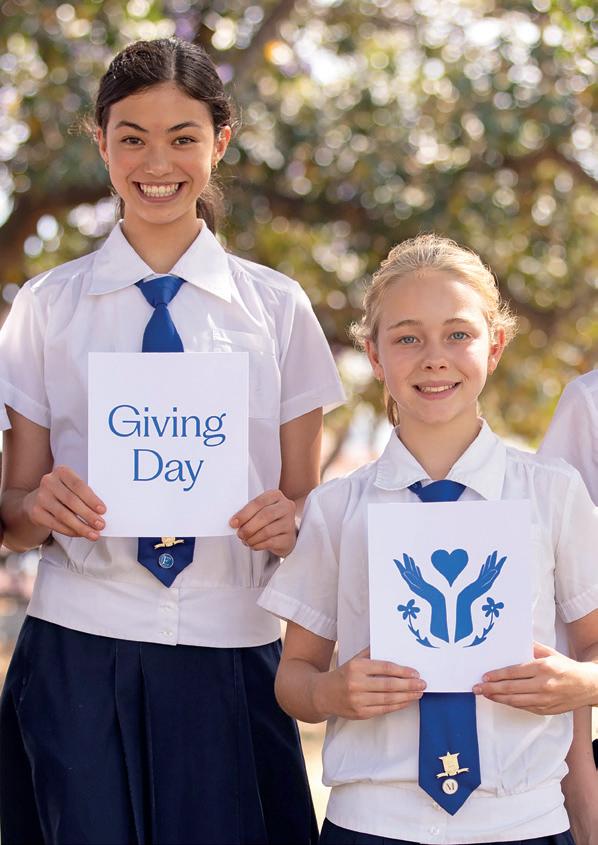
Our School community has continued this essence of generosity, building on a long history of philanthropy, to raise $488 000 on Giving Day in August,
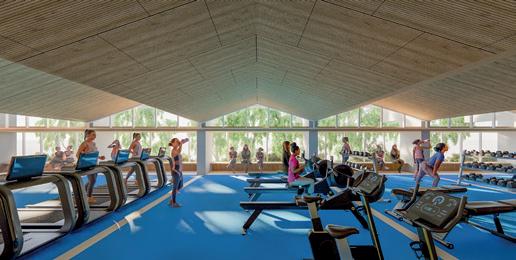
to support our means-tested bursary program and the construction of a new Fitness Centre in 2026. Acknowledging the important link between physical and mental health, this Fitness Centre will support wellbeing alongside sporting excellence.
Throughout 2025, we marked our sesquicentenary with legacy projects, including the launch of our hardcover history book, Wisdom, Imagination and Integrity: Brisbane Girls Grammar School 1875-2025, and a series of local and international reunions that brought together hundreds of alumnae leading their fields in global capitals of Singapore, London, Paris, New York and San Francisco.
As our sesquicentenary comes to a close, Brisbane Girls Grammar is immensely proud to be opening a fresh chapter in our history, welcoming Years 5 and 6 students to our new purpose-built Junior School building on Gregory Terrace at the start of the 2026 school year.
We look forward to an exciting future where many more Grammar Women will continue to take their place in the world.
‘The School’s sustained academic achievement is a testament to the generations of pioneers who paved the way, and to the incredible community of leaders, teachers and parents who continue to drive our School forward.’—Jacinda Euler Welsh
Board of Trustees
Brisbane
Girls Grammar School
Brisbane Girls Grammar School’s Board of Trustees each bring extensive experience, knowledge and skills to their role of guiding the School to ensure the continued delivery of the broad, liberal education for which Girls Grammar is renowned.
Ms Julie McKay (2000)
Chair of the Board of Trustees; Chair of the Development and Philanthropy Committee; Trustee since 2016 BA, BBusMan, Fellow in Ethical Leadership, EMBA, MPP
Julie McKay is an independent consultant, advising some of Australia’s largest and most complex organisations on building safe and respectful workplaces and fostering inclusion as a foundation for high-performing cultures.
Ms McKay has previously held an Executive Board role at one of Australia’s largest consulting firms, served as Gender Advisor to the Chief of the Australian Defence Force, and as Executive Director of UN Women Australia for nearly a decade.
Ms McKay is on the Board of the Campaign for Female Education (CAMFED) and in 2023 was named as one of the top 10 diversity and inclusion leaders globally by Sustainability Magazine. She was the ACT Young Australian of the Year (2013), and Chair of Council at the Women’s College at the University of Sydney (2016 to 2019).
Ms McKay is a past student of the School (2000).
Ms Kerryn Newton
Deputy Chair of the Board of Trustees; Trustee since 2018 LLB, LLM, MBA, MA, GradDip(Applied Finance and Investment), FAICD, FGIA, FIML Kerryn Newton has more than 30 years’ experience in legal, management, and commercial roles across the private and public sectors. She is currently Chief Executive Officer at Directors Australia, a national board and governance advisory firm.
Ms Newton has served on the boards of private, public, and not-for-profit companies and advises boards and companies in an extensive range of industries. She is a regular speaker, facilitator, and commentator on board and governance-related topics and is a member of Chief Executive Women.
Ms Newton is a past parent of the School.
Ms Sophie Moore (1991)
Chair of the Audit, Risk and Compliance Committee; Trustee since 2019 BBus, CA, FFin
Sophie Moore is Chief Financial Officer at Eagers Automotive Limited. Leading the company’s accounting, taxation, payroll, treasury and internal audit functions, Sophie is also an Executive Director of Eagers Automotive Limited, Australia’s oldest and largest listed automotive retail group.
With more than 25 years’ experience as a Chartered Accountant, Ms Moore has previously held the positions of General Manager (Global Corporate Finance) at Flight Centre and Associate Director (Advisory/Transaction Services) at PwC.
Ms Moore is a past student of the School (1991).
Mr Berkeley Cox Trustee since 2023
B.LLB (Hons)
Berkeley Cox was previously a Partner at King & Wood Mallesons and the Australian firm’s Chief Executive Partner (2017 to 2022). He has extensive experience in financial services and business, including digital transformation, and performance and development.
Mr Cox has a deep interest in respectfully and actively supporting First Nations communities. He is a member of the First Nations Working Group of ACT for Kids (an Australian charity that provides free therapy and support services to children and families who have experienced, or are at risk of, child abuse and neglect) and served eight years on their Board. He is also a Director of Workplace Giving Australia.
Mr Cox is a past parent of the School.
Professor Maher Gandhi Trustee since 2023
MBChB, FRCP, FRCPath, FRACP, PhD, GAICD
Maher Gandhi is the Chief Executive Officer of the Translational Research Institute (TRI). He is also a pre-eminent senior staff haematologist with a particular interest in lymphoma and immunotherapy. He was previously Executive Director, Mater Research and Director of Mater Research Institute-UQ and the previous Leukaemia Foundation chair of Blood Cancer Research. Professor Gandhi is a member of the Federal Government-appointed National Blood Cancer Task Force steering committee that aims to improve access to blood cancer services across Australia.
He is a prior Chair of the Australasian Leukaemia Lymphoma Group Scientific Sub-Committee and of the Metro South Human Research Ethics Committee.
Professor Gandhi is a past parent of the School.
Mr Andrew King
Trustee since 2014 (until 25 November 2025)
Andrew King possesses more than 35 years’ experience in the Australian corporate property and funds management arena. Over this period of time, Mr King has created countless enduring relationships within the corporate community both locally, nationally, and internationally.
Mr King has held various directorships over many years of both not-for-profit and for-profit organisations, together with various advisory boards and committees at all levels of government.
Mr King is a past parent of the School.
Ms Diana Lohrisch (1989) Trustee since 2019 (and from 2013 to 2016) BComm, LLB, FGIA
Diana Lohrisch is a legal, governance, and strategic consultant and independent non-executive company director for a number of organisations. Ms Lohrisch was a corporate and commercial partner at a leading independent law firm and has more than 25 years of legal experience advising on capital markets, commercial transactions, mergers and acquisitions, and corporate governance across multiple market sectors.
Ms Lohrisch works with start-ups, SMEs, listed companies and well-established businesses, and corporate groups.
Ms Lohrisch is a past student of the School (Head Girl, 1989).
Professor James Nicklin
Trustee since 2018
MBBS, FRANZCOG, CGO
James Nicklin is a Visiting Gynaecological Oncologist at Wesley Hospital. Professor Nicklin completed his specialty training in obstetrics and gynaecology in Queensland, followed by sub-specialty training in Sydney and the USA.
Professor Nicklin is a Professor of Gynaecologic Oncology at The University of Queensland, and has previously served as Chairman, Australian Society of Gynaecologic Oncologists.
Professor Nicklin is a past parent of the School.
Professor Deborah Terry AO
Trustee since 2023
BA(Hons), PhD ANU, HonLLD Aberd., FASSA
Deborah Terry is Vice Chancellor and President of The University of Queensland.
Professor Terry is a highly experienced leader in the Australian university sector, and an internationally recognised scholar in psychology. She is a Fellow and past President of the Academy of Social Sciences in Australia, and an appointed member of the Australian Research Council Advisory Council. She also currently serves on the Board of the Australia and New Zealand School of Government, and the National Schools Resourcing Board. She is a former Chair of the Board of Universities Australia and a member of the Universitas 21 Executive Committee.
THE SCHOOL
Established in 1875, Brisbane Girls Grammar School is one of Australia’s leading girls’ schools and one of Queensland’s original Grammar schools.
Through diverse opportunities and experiences, Girls Grammar students are encouraged to embrace the unexpected, bravely pursue their dreams, and inspire the creation of a more just world.
In 2025 the School celebrated its sesquicentenary—150 years of providing an exemplary broad, liberal education to girls and young women.
Identity and History
On 15 March 1875, six years before women were admitted to universities in Sydney and Melbourne, Brisbane Girls Grammar School was established— initially as a branch of Brisbane Grammar School— to provide girls the same educational opportunities as their brothers.
The School opened in a two-storey house, located on George Street, catering for 50 students under the leadership of Lady Principal, Mrs Janet O’Connor. Within six months, the School outgrew these premises, and relocated to Wickham Terrace.
In 1882, the decision was made to separate from Brisbane Grammar School and operate independently under the Grammar Schools Act. Two years later, in 1884, the School relocated to its current site on Gregory Terrace.
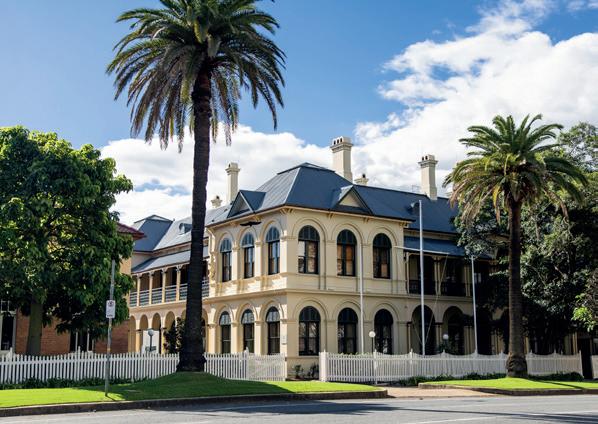
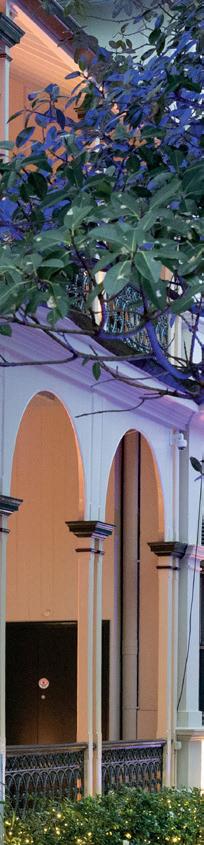
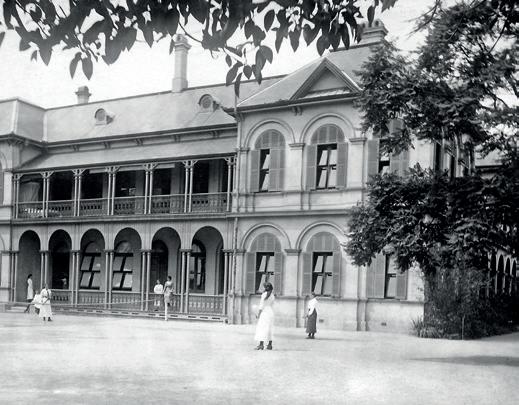
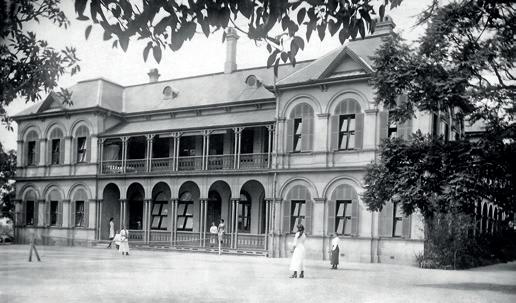
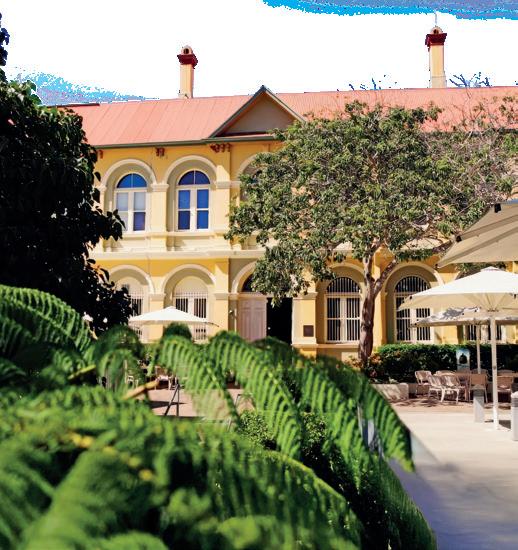
The original Main Building still stands proudly in Spring Hill, symbolising Girls Grammar’s unique heritage, and its unwavering commitment for more than 150 years to establishing the educational foundation for girls and young women to contribute confidently to their world with wisdom, imagination and integrity.
Above West side of Main Building, 1912
HISTORICAL TIMELINE
1875—Brisbane Girls Grammar School is established in a two-storey house on George Street.
1877—Sir Charles Lilley is appointed Chair of the Board of Trustees; Sarah Cargill is appointed Lady Principal.
1878—Mary Mackinlay is appointed Lady Principal.
1882—Sophia Beanland is appointed Lady Principal; Girls Grammar separates from Brisbane Grammar School.
1884—The School relocates to what remains its current Main Campus on Gregory Terrace.
1887—Sir Samuel Walker Griffith is appointed Chair of the Board of Trustees.
1889—Charlotte Pells is appointed Lady Principal.
1896—Eliza Fewings is appointed Lady Principal.
1899—The Old Girls Association is established.
1900—Milisent Wilkinson is appointed Lady Principal.
1904—Sir Hugh Nelson becomes Chair of the Board of Trustees, succeeded by John Laskey Woolcock in 1906.
1913—Mary Atkinson Williams is appointed Headmistress, succeeded by Jane Walker in 1914; the first School Magazine is published.
1915—Margaret Annie Mackay is appointed Headmistress; the West Wing opens as a single-storey building, housing an art room and three classrooms.
1925—Kathleen Lilley is appointed Headmistress; the first School uniform is introduced.
1952—Louise Crooks is appointed Headmistress; John England is appointed Chair of the Board of Trustees; the Parents and Friends Association is established.
1958—The Kathleen Lilley Library is opened.
1964—Year 8 students commence secondary schooling, known as Form II; the House system is introduced.
1968—Yvonne Bain becomes the first woman Trustee.
1971—Nancy Shaw is appointed Headmistress.
1975—The School celebrates its centenary.
1976—Dr August Shaw Gerhmann is appointed Chair of the Board of Trustees.
1977—Judith Hancock is appointed Principal; the Fathers Group is established.
1986—The Gerhmann Theatre is built.
1987—Dr McCrae Grassie is appointed Chair of the Board of Trustees; the Marrapatta Memorial Outdoor Education Centre is opened at Imbil.
1995—The McCrae Grassie Sports Centre is opened.
1996—Dr Cherrell Hirst is appointed Chair of the Board of Trustees.
2000—The School song, Nile Sine Labore, is introduced.
2002—Amanda Bell is appointed Principal; the Boarding House is closed.
2007—Elizabeth Jameson is appointed Chair of the Board of Trustees; the Cherrell Hirst Creative Learning Centre is opened.
2013—Jacinda Euler is appointed Principal; the School unveils the Rangakarra Recreational and Environmental Education Centre at Fig Tree Pocket.
2015—Year 7 is introduced to the School and the Research Learning Centre is opened.
2017—The Dorothy Hill Observatory commences operation at the School’s Marrapatta campus.
2019—Julie McKay is appointed Chair of the Board of Trustees.
2020—The Science Learning Centre is opened.
2021—The Floreamus Centre, the School’s central location for student wellbeing, is opened.
2023—The School announced the introduction of Years 5 and 6 from 2026.
2024—Construction commences on the new Junior School Building and Karen McArdle is appointed Head of Junior School.
2025—The School celebrates its sesquicentenary—150 years of providing an exemplary broad, liberal education to girls and young women; construction is completed on the new Junior School Building.
Honouring 150 Years
Celebrations near and far for a School that
helped redefine female education
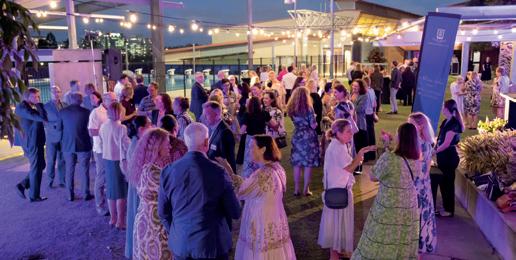
Brisbane Girls Grammar School marked its sesquicentenary with events spanning Spring Hill to San Francisco in 2025. As the year drew to a close, Her Excellency the Honourable Dr Jeannette Young AC PSM, Governor of Queensland, hosted a reception on the lawns of Government House, acknowledging the important role Girls Grammar has played in lifting Queensland women for a century and a half. The memorable event—which included long-standing staff, distinguished alumnae, BGGS trustees, and loyal friends—was a significant tribute to the School’s journey from educational outlier to Queensland institution. It capped off a huge year of gatherings that began in March with a 150 Year Anniversary Ball at City Hall, followed the next day by Foundation Day celebrations at the School.
The afternoon of entertainment, food and lively panel discussions ended with fireworks bursting from the roof of the Science Learning Centre and Creative Learning Centre, and a spontaneous chorus of ‘Happy Birthday Girls Grammar’ from students.
A Boarders’ Brunch reunion, also in March, drew about 200 former boarders back to their one-time home and became the catalyst for a new Speech Day prize honouring their legacy.
At Open Day in August, School-wide ephemeral art project Barrambin Blooming took centre stage as 4000 paper-plate flowers lined the atrium of the Cherrell Hirst Creative Learning Centre. The project embraced both Girls Grammar’s 150-year history and the broader history of the site— which sits on the edge of First Nations gathering site Barrambin (Victoria Park).
In the September holidays, a series of international reunions held in Singapore, London, Paris, New York and San Francisco underlined the School’s role as a launchpad to the world, including expat alumnae in celebrations. More than 200 Grammar Women attended, representing disparate fields such as law, international diplomacy, forensic science, business and AI. One alumna said the events ‘reminded us all how valued we are as alumnae and how connected we remain to the life of the School’.
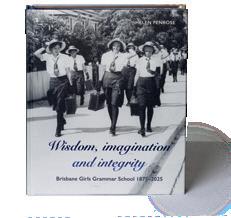
To permanently mark this milestone year, in October BGGS launched the commemorative hardcover history book by Helen Penrose Wisdom, imagination and integrity: Brisbane Girls Grammar School 1875-2025. Taking several years to research and write, the book is a legacy document only made possible by the School’s meticulous curation and preservation of historic documents and artefacts for future generations.
History book Wisdom, imagination and integrity: Brisbane Girls Grammar School 1875-2025
Our purpose
ASPIRATION
Lives Enriched by Learning
MOTTO
Nil Sine Labore—nothing without hard work
INTENT
Proud of our Girls Grammar tradition, we are a school that establishes the educational foundation for girls and young women to contribute confidently to their world with wisdom, imagination and integrity.
GUIDING PRINCIPLES
Systematic curiosity in teaching, learning and research
Judicious and ethical action
Life-wide learning
Stewardship and sustainability
Belonging and wellbeing
Purposeful community engagement
A GRAMMAR GIRL IS ...
CURIOUS
Seeks diverse experiences and different perspectives, and thrives in a vibrant environment that fosters deep and inquisitive learning
PRINCIPLED
Engages ethically, respectfully and purposefully with the world and its people
ADVENTUROUS
Embraces the unexpected, bravely pursuing her dreams
BALANCED
Balances self-awareness with external demands, to develop a sense of wholeness and lead an authentic life
INDEPENDENT
A confident, independent young woman who actively inspires the creation of a more just world.
PERFORMANCE
Through 2025, the School continued to deliver strong academic results including significant measurable and intangible outcomes across academic achievement, co-curricular accomplishments, service, supportive student care, and the responsible management of its resources.
The following reports provide an insight into the performance of the School during 2025.
Performance
The School is exceptionally proud of its students’ academic achievements and the valuable contributions Girls Grammar alumnae make to their professions and communities beyond School.
In 2025, the School’s dedicated, caring, and expert staff once again supported students to maximise their individual learning potential. The School was ranked Queensland’s top independent school, and fifth in Australia. The inaugural list* was based on over 20 metrics, including facilities, student-teacher ratio, breadth of subjects and co-curricular activities, sports programs and academic results.
The School’s students continued to receive strong results in the National Assessment Program—Literacy and Numeracy (NAPLAN), and Queensland Curriculum and Assessment Authority (QCAA) senior assessment. The 2025 Year 12 cohort achieved the School’s highest median Tertiary Admission Rank (ATAR), at 96.45.
Girls Grammar is academically nonselective in its main year of entry (Year 7), with places offered in strict date order of application. The School offers no scholarships and is one of the few schools in Queensland whose entire Year 12 cohort is ATAR-eligible.
2025 TERTIARY OFFERS
Places Offered
YEAR 12 2025 AUSTRALIAN TERTIARY ADMISSION RANK RESULTS
The 2025 Year 12 cohort attained outstanding results in the ATAR system. These results continued the School’s history of strong performance.
ATAR RANGE
2025 NAPLAN
Year 7
Year 9
Queensland Girls Secondary School Sports Association (QGSSSA) Premiership 2025
SPORT TEAMS
Artistic Gymnastics
Australian Football
Badminton
Basketball
Cricket
Cross Country
Football
Netball
Rhythmic Gymnastics
Tennis
Touch
Volleyball
Year 7(i), Year 7 (ii)
Junior C
Open, Senior C, 9B, 7A, 7B
Senior B, 9B
Div 2
15 Years, 12 Years
Open, Senior A White, Junior A, Junior B Blue
10B, 10C, 9B, 8C
A Grade, B Grade, Open Pairs
Senior C
Senior B, 9B, 7B
Senior B, 10B, 9B, 7B
Finance
Summary of financial performance
In accordance with the Strategic Design 2023-2025, the School’s financial management must deliver appropriate, sustainable, transparent and empowering fiscal management that balances the surplus requirement for future reinvestment with immediate educational program priorities.
Annual Financial Statements (Annexure C) for 2025 highlight the School’s strong asset base including the completion of the Junior School building and reflect strategic decisions which have positioned the School for long term sustainability and strong financial performance.
The annual operating surplus of $188 000 (2024: $3.98M) is lower than previous years due to key investments such as the establishment of the Junior School which was completed in 2025, as well as the 150 Years celebrations, which have brought together the Brisbane Girls Grammar School community and alumnae. The 2025 results also include:
• tuition fees were increased by 6.75 per cent
• a strong return on the School’s investments and interest income
• continued strong philanthropic support, with contributions received towards the School’s Bursary and Building Funds
• consistent and strong operational and financial delivery.
The School has also recorded other comprehensive income of $16.68M with an increase to the asset revaluation surplus as a result of a full valuation of the School’s land, buildings and artworks. This revaluation is in line with policy which states that a full valuation should be completed every three years.
The main revenue source of the School is tuition fees, comprising 76 per cent of total revenue (2024: 73 per cent). The Board remains committed to keeping the School’s annual increase in tuition fees as low as possible for the broad and deep offerings sought and expected by our families, and to ensuring a consistent and reliable approach when setting fees. This includes maintaining a longstanding policy of an all-inclusive fee, with no additional levies, while addressing a decline in real terms of government funding from both State and Federal Governments.
Three of the most significant categories of expenditure in delivering the exceptional education for which Girls Grammar is renowned are:
• employing the best teachers and other professional staff it is possible to secure and remunerating them fairly and appropriately, representing around 63 per cent (2024: 64 per cent) of our annual expenditure
• delivering excellent academic programs
• providing the resources required to deliver the current quality and standard of a Brisbane Girls Grammar School student experience and, additionally, the School’s physical resourcing requirements into the future.
The ongoing growth, liquidity and financial stability of the School is supported by the ongoing careful review of the School’s procurement and efficiency opportunities to find sustainable cost and productivity savings without reducing or impacting on the experience of its students, families and staff.
Capital programs and infrastructure
The construction of the new purposedesigned, five-storey Junior School building was completed in 2025 for the commencement of teaching in 2026.
In 2025 the School continued investment in IT infrastructure and systems across the Spring Hill and Marrapatta campuses, with a continuing focus on cybersecurity.
The School also continued to invest in improved amenities on the Spring Hill campus throughout 2025. This included greening of spaces to allow increased use and enjoyment of areas.
Monitoring of financial performance and effectiveness
Management and the Board of Trustees, with support from its Audit, Risk and Compliance Committee, continually monitor the School’s financial performance and effectiveness. This is undertaken through monthly financial reporting, a robust budget process and annual review of the School’s 10 year strategic forecasting.
GOVERNMENT ASSISTANCE
The School acknowledges the contributions made by the State and Commonwealth Governments in the form of grant allocations. The grants received and approved in 2025 included:
• Recurrent State and Commonwealth Government Grants, including Indigenous assistance:
– Commonwealth Grants—$5 858 220
– State Government Grants—$3 757 247
• Queensland State Endowment Grant provided to Grammar Schools in Queensland to assist with the additional cost of complying with State Government legislation for Statutory Bodies—$21 500
PHILANTHROPY
Since foundation in 1875, Brisbane Girls Grammar School’s loyal community of parents, alumnae and friends have supported our vision for exceptional scholarship and leadership, equipping girls with the best possible education. The School is eternally grateful for their ongoing commitment to our shared purpose.
Philanthropy
The remarkable generosity and unwavering support of the Brisbane Girls Grammar School community has long shaped the future of Grammar girls.
In 2025, a legacy of giving was woven throughout the new Junior School building and grounds, with artworks, play equipment, honour boards and significant donor projects acknowledging those who helped realise this milestone extension to the School’s offering and physical footprint.
As the build drew to a close, the focus of the School’s fourth annual Giving Day in October turned to plans for a new Fitness Centre. With growing awareness of the strong link between physical and mental wellbeing, a review of the School’s Strategic Plan had identified the current gym, which has not been updated since the 1990s, was lagging.
A fitness-focussed Giving Day 2025 raised $488 000, with generous community donations matched by the
Parents and Friends (P&F) Association, the Fathers Group and YFG Shopping Centres. These funds will not only support construction of a planned new Fitness Centre in 2026, but they also sustain the School’s impactful Bursary Program, extending the opportunity of a Girls Grammar education to students who could not otherwise attend.
It’s particularly meaningful that Giving Day will enable the Fitness Centre project, as it echoes the philanthropy behind BGGS’s very first gymnasium in the 1880s. Back then, the School’s fourth principal, Sophia Beanland, had lobbied the State Government to fund construction of a gym for female students.
Her campaign drew nothing but derision from then-president of the Queensland Legislative Council Sir Arthur Palmer, who bemoaned the School’s priorities, saying: ‘I would much rather that the young girls were taught how they could best become good wives for young Queenslanders.’
Thankfully, one constant throughout the School’s history has been the shared vision and steadfast support of the Girls Grammar community. Nearly 140 years ago they backed Sophia Beanland, contributing to a building fund which saw the gym completed in 1888. In 2025 they backed plans for a modern Fitness Centre to support sporting excellence and general wellbeing.
Designed by longtime collaborators m3architecture, the Centre will harness underutilised space beneath the pool on the Main Campus, with floor to ceiling windows making it an inviting and inspiring space to train.
This collective generosity reflects the transformative power of a united community, agile and supportive of new initiatives designed to strengthen the School’s foundation and reinforcing the delivery of an exceptional education for young women.
2025 Highlights
Junior School
A legacy of philanthropy has been written into the story of the Junior School, with thoughtful donor projects enriching the connection of current students to the community and significant alumnae. A Sisterhood sculpture from BGGS Old Girls’ Association sits in the School foyer, while classrooms have been named in honour of trailblazing alumnae. A whimsical Bookcase of Gifts installation outside the library allows donors to make a favourite line from children’s literature a permanent part of the School.
Bursary
Girls Grammar fosters a climate of opportunity, grounded in a history of educating girls from diverse backgrounds. Through means-tested bursaries, the School is committed to providing the life-changing experience of a Girls Grammar education to girls who could not otherwise attend. Bursaries are awarded to students who embody the core qualities of a Grammar girl, and who posses the willingness and enthusiasm to actively engage in a wide range of educational and School-related activities, enriching both their own development and our community.
Rowing
Girls Grammar parents play an extraordinary role in supporting their girls’ commitment, enjoyment and performance across a range of co-curricular activities each and every year. In 2025, the Oobla Rowing Support Group, led by Warwick Agnew, set a particularly ambitious fundraising goal to buy a new lightweight VIII boat. Across the season their Herculean efforts delivered $55 000, allowing the School to order a Sykes Elite VIII. The new boat, specifically engineered for female rowers, is expected to be delivered in time for the start of the new rowing season in 2026.
Above Volunteer Thank You Reception
Brisbane Girls Grammar School
Thank you
The Board of Trustees and the Principal, on behalf of the School, thank members of the Girls Grammar community for their generous support in 2025.
Donors
The Addis Family
Ajvadi Family
Nishad & Dinar Alani
Michael & Geetanjali
Anthonisz
Alexandra Anthony
Dr Nathan Anthony & Ms Kirani Heeremans
Arias Lohrisch Family
Michael Aspinall
The Hon Roslyn
Atkinson AO
Dr Catherine Barnett
Gay Barnett
Pamela Joan Barnett
Eugene Barry
Laura Bartholomew
Drs Lilantha & Renu
Basnayake
Beckingsale Family
Dr A Bell AM
Dr Brendan Bell & Vanessa Bell
Justin Bindman
& Anna Wagstaff
Corinne Bolton
S Boo & M Hong
The Bowden Family
Joe Branigan
Kay Brassil
J Bremhorst & A Waugh
Lee Brentzell
Brittain Family
Joelle Brittain
Dr Reagan Brosnan
& Dr Leigh Winston
Brown Family
Ian & Janelle Brown
Kate Brunello
Keryn Bryce
Dr Bruce Addison
Bucknill Family
David & Peta Bunce
Dr Barbara Burge
The Burke Family
Suzanne Cali
Louise Campbell
Marg Campbell
The Campbell Family
Cardell Family
Cardell-Ree Family
Rhys Casey
Ann & Tony Caston
Julie Caton
Sammy Caton
Celeste Properties
Lyn Chakravorty
Chambers Family
Chang Family
Chang & Ku Family
Brett & Lauren
Charrington
Chen Family
Dr Michael & Linda Chen
Y Chen & S Zhang
Cheng Family
K Cheng & Dr F Tang
Dr V Cheng & Dr W Tang
Dr Norris Chern & Chiew-Sek Liaw
Chesterman Family
Anne Chidgey
Chiu Family
Chow Family
Rachael
Christopherson
Clark Family
Damian Clothier & Sarah Greer
Collins Family
The Collins Family
Sally Condon
The Connor Family
Leigh & Sarah Cooper
Jill Corrigan
Tatiana Coulter
Bianca Craven
Tennille Cummings
Laura Cunning
Anthony Cupitt
Katherine Darch
Dr Glenn Davies & Cynthia Davies
Lesley Davies
Alana De Ambrosis
Wilson & Bronwyn
Del Socorro
Michelle & James Dingle
Monica Djaja
Donaghy-Lowrey Family
Donnelly Family
Marion Dowling
Jason & Kylie Dunk
Brooke Dunlop
Marla Edwards
Wendy Edwards
Melinda Egan
Kylie Elkington
Lucy Ernst
Jacinda Euler Welsh
Nova Evans
Mark & Kate Farrar
Fernando Family
Finch Family
Stephanie Finemore
Fitzgerald Family
Jody Forbes
Karen Forster
David & Judy Fraser
Gaffney Family
Sean & Dana Galligan
Gambaro Family
Gandhi Family
Jo Genders
Brooke & Patrick George
Mark & Jacinda Geritz
The Gianduzzo Family
Susie Gladman
Gomes Family
Dr Ruth Gough & Dr Ian Gough AM
Emily Granger
The Grant-Uhr Family
Kirstin Griffith
YishaGu
Jane Hailes
Ms J Hammer AM
Janet Hanscomb
Stella Haralampou
Julian Harburg
Harman Family
Pauline Harvey-Short OAM
Heather Hawkins
Ian Hazzard Family
Heinemann Family
J Hennessey
S Hennessy & M McCauley
Ashleigh Hextall
Kellie Himstedt
Dr Cherrell Hirst AO
Gary Ho
Hodge Family
Genevieve Hoey
Meera & Terry Honan
Lisa Honeychurch
Van Riel
Mr Scott & Ms Hoole
James Hosking & Rosemary Foster
Hoyling Family
Belinda Hsueh
Geoff Huang & JiaoWang
Hunter Family
Hurcum Family
G Ida & F Schellin Ida
Savindra & Palika
llangamage
Anne Ingram
The Isbel Family
Alison Jack
Elizabeth Jameson AM & Dr Abbe Anderson
Yong Jang & Mi Joo
Maryam Jarahi
Wen Ji
Vanessa Johansen
Edward &
Anna Johnson
Hyun-ju Johnson Kim
Hannah Jones
Pamela Jones
The Jowsey Family
Kassulke Family
Janet Keefe
Mina & John Keenan
Margaret Kelly
Melissa & Andrew Kerr
Alice Khursandi
Catherine Khursandi
Isobel Khursandi
Jan Kildey
Megan Kimbell
Knox Family
Kentaro Koido
Aleksandra Skaljak
Kovacevic
J Kruger & L Tang
Ki Kyoung & Na Lee
Thuy & Natasha Lam
Dr S Lambert & Dr S Mapp
The Rev Dr C Lander
AM
Sonia LaPenna
Lee Family
Linda Lee
Dr P Lennox & S Lennox
Janene Leslie
Jonathan & Susie Levy
Melinda Lewis
Ailin Li & Wenjie Zhou
YuanYuan Li
Liang Family
Vincent & Ayaka Liang
Lightfoot Family
The Lin Family
Ying Lin, Peiheng Hu & Sunnie Lin
The Liu & Chen Family
Lloyd Family
Jeanette Lockey OAM
The Hon Justice
Logan AM & Janice Logan
Diana Lohrisch
Dr Christine Lonergan
Sean & Bridget Lowry
Sean & Maggie Loye
Lu Family
DLu&LLi
The Lui Family
Kylie & Kristian Lundqvist
Lynch Family
Fiona Macfarlane
Emily Mackenzie
MacKenzie Family
Clare Maguire
Kathryn Mainstone
David & Louise Mann
Jane Martel
Karen McArdle
Bill & Kate Mccredie
Ben & Sarah
McGeachie
Frances Mcinerney & Sean Martin
J McKay
Dr S McKay & H McKay
McLaughlin Family
McMurdo Family Fund
T & J McPhillips
Saxon Mew
John & Judy Mewing
Paul & Melanie Mitchell
Dr C Mittelheuser AM
The Moody Family
Andrew & Sophie Mooney
Rebecca & Michael Moore
Sarah Morris & David Costa
Heidi Morrison
Timothy & Lyndall & Savannah Munro
Prof D Murray
Myers Family
Rebecca Nardi
Kerryn Newton
Hieu Nguyen & Charmaine Kai
Jim & Jill Nicklin
C Noble & P Szonert
Catherine Noonan
Bee Obarzanski
Susan O’Hare
Kylie & Joshua Paffey
Panchapakesan
Family
S Pandey & S Khanal Pandey
Sarath & Lasanthi
Paranavitha
Park Family
Lara Parker
Emma & Nick Parr
Meghan Parry
Tiffany Partington
Margaret Annette
& Catherine Peel
Amber & David Pennell
Frederique Pentecost
Perry Family
Ela & Peter Perry
Lucy & Zoe Peters
The Phua Wu Family
Pollard Family
Dr Glenda Powell AM
Prof C Praeger AC
Prasad Family
Sandhir Prasad & Sandhya Kisun
Maurice Prendergast & Family
Susan Pritchard
David & Emily Pryor
Grace Qiu
Richard Qiu &
Connie Shen
Sanjeev Ranjan & Nirmal Saraswat
Ian & Tressa Reddie
Violet Ross
Dr Matthew Russell
Himabindu Samardhi
The Savage Family
M & E Schablon
Crissi Schmidt
Janine Schmidt AM
Dr Michael Schuetz
& Dr Dominique
Commentz
L Schwarten
Dr Cameron Scott
Naomi Seibel
KimSelwa
Elaine Serisier
The Shaw Family
Karla Shaw
Jinghuan Shi
Dr Diana Shogren
Jaclyn & Edward Sia
Louise Siganto
Jasjeet Sihota
The Skene Family
Shane Skillen
H Smerdon AM & S Smerdon
Smith Family
Charlotte Smith
Sommerfeld Family
Dr Tony Son & Jenny Lee
Paul & Roberta Spezza
Ann Stark
John Statham
Tricia & Jason Steer
Stevens Family
Melissa Stevenson & Tom Granger
Dr Kay Stewart
Dr Saj Sumanasekera & Donna Sumanasekera
Gavin Sun & Sophia Su
Masatoshi Suzuki & Xia Wang
Swayne Family
Swindells Family
Katherine Swindon
Taheri Family
Jasmin Tavella
Renae Taylor
Christian & Leah Telford
Paul & Gina Telford
Brendon & Kerrin Thomas
Lorraine Thornquist
Emily Tiang & Nicholas Ting
Dr Steven Ting & Anne Ting
Luke & Michelle Titus
Quy Anh To
Tran Family
Trappett Family
April & Harry Tynan
Susan & Luke Uhlmann
Dr Jatheesh Valappil & Vidya Jatheesh
Mei-yun Valdivia a l’Onions
Dr S Vasani & S Vasani
The Vella Family
Nikola Vidakovic
Diane & Geoff Voller
Lili Wackwitz
Louise Walls
Terry Walton
Elaine Wan
Kwok Ming Wan
Wang Family
C Wang & M Liu
Wei Wang & Zhaohui Li
Ward Family
Ann Waterford
Rev P Wetherell
Wille Family
Robin Williams
Wong Family
H & R Wong
Y Wong & A Chung
Retha Wood
Woodward Family
A/Prof Daniel Worthley & Dr Liza Phillips
David Wright & Emily Cross
lvyWu
K Wu & F Wang
Tracey Wyatt
L & Dr P Wysocki
Lulu Xiao
YFG Shopping Centres
Chang Yoo & Lucy Huang
Siu Yuen
Linping Zeng
Qingshan Zhang
Shengnan Zhang
The Zhang Family
Zhao Family
Jun Zhao
Zhe Zhao & Xingzhi Fang
Zheng Family
The Zhou Family
Peng Zhou & Shu Liu
Gang Zhu
Zhenzhen Zou
90 Anonymous
Donors
Thank you
Sophia Beanland Circle
Mrs Kay Brassil (1959)
Dr Barbara Burge (1950)
Mrs Ann Caston (1958)
Mrs Julie Caton (1981)
Mrs Tatiana Coulter (1994)
Dr Jonathan Davies & Mrs Helen Davies (1962)
Mrs Lesley Davies (1959)
Mrs Jenny Everett (1961)
Ms Julie Hennessey
Ms Linda Lee
Mrs Jeanette Lockey OAM (1952)
11 Anonymous Members
Thank you to the School’s Support Groups for their important contribution and service throughout the year
Parents and Friends Association
P&F Uniform Shop
Old Girls Association
Fathers Group
Music Support Group
Oobla Rowing Support Group
Water Polo Support Group
Grammar Women Mentors
Grammar Women
Girls Grammar Goes Global: 150 Years. Five cities. One Grammar spirit.
150 Years celebrations extended worldwide to include overseasbased alumnae in the historic milestone.
In 2025 alumnae united to honour Brisbane Girls Grammar School’s 150th anniversary. Grammar Women celebrated not only a School, but a legacy that continues to reach far beyond Brisbane. The Girls Grammar community extended across continents, with more than 200 alumnae gathering at international reunions around the world.
These special international reunions were not only a celebration of the School’s rich history and tradition but also a meaningful recognition of the significant impact Grammar Women continue to have on the world stage. For many, it was also a welcome opportunity to connect with expat sisters they may not have otherwise met.
Five events in Singapore, London, Paris, New York and San Francisco brought together Grammar Women working in vastly different fields, from finance and fashion to AI and law enforcement.
Each gathering had its own unique character, highlighting the diversity, reach and influence of the Girls Grammar sisterhood, with attendees spanning graduating classes from 1957 to 2024.
The first reunion in Singapore, was cohosted by Principal Jacinda Euler Welsh and Libby Amelia (2001), President of Tiffany & Co South Asia Pacific. Alumnae from across finance, business and education came together to share an afternoon in the heart of the thriving Asian capital.
The London event, co-hosted by Sarah-Jane Dobson (2006), partner at global law firm Ashurst LLP, was the largest reunion, with almost 100 alumnae in attendance, including three graduates from the Class of 1957. Next, a lively Parisian gathering in the heart of the French capital’s historic district was co-hosted by Australian diplomat Rachael Wakely (2000), with alumnae travelling from the Netherlands, Sweden, Switzerland and regional France to attend.
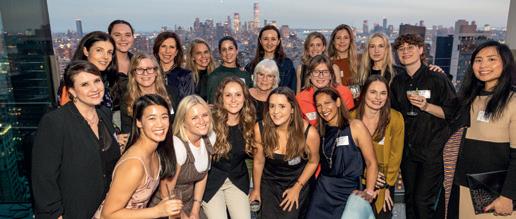
In the Big Apple, Grammar Women gathered to celebrate before a breathtaking view of the New York skyline, with past student Hemali (1992) taking on co-hosting duties alongside Ms Euler. Hemali has carved an impressive career with the recently-renamed US Department of War, after moving to the US to pursue her passion for criminal forensics.
The final international reunion took place in San Francisco, a city renowned for its innovation—from AI and robotics to startups and driverless cars.
San Francisco, with its progressive values, inclusion and forward-thinking spirit was the perfect setting to celebrate Grammar Women who are not only at the forefront of technology, but also passionate about shaping a more equitable and sustainable future.
Beyond the impressive professional achievements, the reunions offered powerful reminders of the enduring values and spirit instilled during a Girls Grammar education.
STAFF
The staff of Brisbane Girls Grammar School delivers the broad, liberal education for which the School is renowned.
The School’s teachers are central to its culture of deep learning, possessing extensive knowledge of their discipline, an unending passion for discovery, and the ability to nurture creativity and a sense of possibility in the minds of students.
Girls Grammar formally farewells and celebrates the achievements of the Year 12 cohort at the annual Valedictory Dinner. The following day, at the Annual Speech Day and Distribution of Prizes, the School acknowledges the academic and co-curricular achievements of Grammar girls across all Year levels.
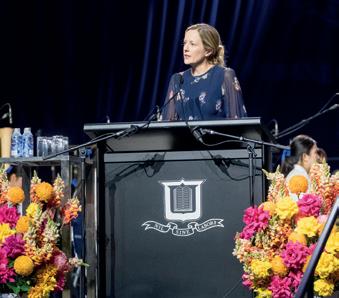
Chair’s Address
Thursday
20 November 2025
Ms
Julie McKay (2000)
Chair, Board of Trustees
Ms Julie McKay, Chair, Board of Trustees, delivered the following address at the School’s Annual Speech Day and Distribution of Prizes 2025.
Former Chairs of the Board of Trustees, Dr Cherrell Hirst and Elizabeth Jameson, Trustees past and present, Principal, Ms Jacinda Euler Welsh, and past principal, Dr Judith Hancock, staff, families and most importantly, girls. I acknowledge Uncle Billy’s performance as part of our Acknowledgement of Country today.
This year, we have celebrated the 150th anniversary of the School—150 years of continuous education for girls and young women at Brisbane Girls Grammar School. It has been a year of celebration and reflection; a year that has reminded us what it is to be part of a community that has backed girls’ education generation after generation. And yet this kind of backing is far from universal.
Just this week, we have seen horrifying reports from Nigeria of schoolgirls abducted at gunpoint from their school. Afghanistan continues to tighten the rules around girls’ access to education, now completely banning secondary education for all girls—a ban that reverses nearly 20 years of educational progress. Around the world, girls’ education is fragile, it’s contested and it’s too often declined.
I don’t share this to cast a shadow over today. I share it to remind each and every one of us how extraordinary it is to be here together as part of a School that has not only endured but has thrived, a School supported by families, by government, by philanthropy and by a community that believes deeply that educating girls changes everything.
Across our sesquicentenary year, I have had the privilege of meeting Grammar Women from almost every decade. They have held leadership roles in government,
business, science, education, media, the arts, the community sector and of course, in households. They studied under different principals. They faced different barriers to gender inequality. They graduated into vastly different worlds. But what they shared was striking: gratitude for the teachers who supported them, a passion for celebrating other women, and resilience.
Let me start with our teachers.
Grammar Women spoke so often about their educators who saw their potential before they did, who coached them through setbacks, celebrated their successes and quietly raised the bar. But alongside these stories of encouragement came laughter and smiles about the home truths that our teachers also delivered, not to discourage us, but to help us grow.
For me, it was the day in Year 8, my first year at School, when I was told that I wasn’t going to make it into one of the six flute-only ensembles, which, to be clear, was for the flautists who hadn’t made it into one of the many bands. I was gently nudged towards percussion, specifically the triangle and the cymbal on a `play only when the conductor points at you’ basis. And there I remained a happy part of the Instrumental Music Program for five years.
And last night, while procrastinating on these remarks, I had a look through some of my old Year 12 photos of then-Principal, Mrs. Hancock, leading the celebrations of the School’s 125th anniversary. I found two pieces of hand-written feedback about a debate in my Senior year. One, read: `You’re a smart girl, maybe try and show it.’ Another: `Stop swaying. You’re making people sick.’
At the time, I thought I was destined for debating greatness, but it turns out I had a fair bit of work to do. But that’s what educators do. They inspire, they challenge, but most importantly, they give us honest feedback, not to diminish us, but to help us become who we are capable of being. To Ms Euler Welsh and the entire staff team, thank you for what you do each and every day to support our current students and to honour the legacy of all of the staff who have gone before.
The second theme was a passion for celebrating the success of other women and opening doors for one another. When Grammar Women reflect on their time at school, they speak about the culture that shaped them—a culture that shaped them to notice, to include and to back each other. From House spirit to group assignments to the stage to the sports fields, there was a clear understanding across generations that success means more when it’s shared.
One recent graduate told me about her first year at university and how she was struggling to fit in and connect with her peers, until a fellow Grammar Woman two years ahead, invited her into a study group where she found friends and a mentor. That small gesture changed her confidence, her results and her sense of belonging. For me, it’s something I have seen in both the quiet acts of kindness of Grammar girls and the deliberate acts of sponsorship of Grammar Women.
I spent half of Year 11 on crutches, and every morning, one of my House Group would be waiting in the drop off area to help me out of the car and carry my bag.
‘To graduate in our 150th year connects you to a larger story—a legacy of girls’ education that is uninterrupted, unapologetic and deeply proud.’
—Ms Julie McKay (2000)
Long before the days of mobile phones where you could text: `I’m just five minutes away’, she sat and waited. She never made a fuss. She just showed up. And I’m honestly not sure if I would have completed Year 11 without her.
Years later, when I was invited to join the Board of Trustees, it was Elizabeth Jameson, my predecessor as Chair, who sponsored me into the role. She didn’t just hand over the reins. She backed me, and she ensured I was surrounded by Trustees who would challenge and support me in equal measure. One of those Trustees is Andrew King, and he’s stepping down this week after 11 years of service to our School. Andrew, thank you for your enormous contribution to Brisbane Girls Grammar School and your unwavering support of women’s leadership. It has been a privilege to serve alongside you.
The third theme, resilience, is one I saw in every Grammar Woman who came back to the School this year. But nowhere has that resilience been more evident than in our graduating class. To the class of 2025, you began your time at Brisbane Girls Grammar School just weeks before the world changed. A global health emergency
unfolded on a scale unlike anything we had ever seen. You watched the adults around you navigate uncertainty, navigate stress and loss. You formed friendships through screens. You missed out on camps, concerts and a whole bunch of other early high school activities. But what matters more girls is what you did next. You adapted. You found humor and connection in unexpected places. You learned to read the room, even when the room looked a lot like a computer screen. You became more self-aware, empathetic and more agile. And that’s resilience. And it will shape how you go into the world.
Girls, I encourage you to find a quiet moment over the next couple of days to thank your parents and the teachers who’ve walked alongside you; who’ve backed you; who’ve challenged you and who have believed in you. But I, on behalf of the Board of Trustees, also want to thank each of you, our Covid Class. Thank you for the way you approached those early moments at Brisbane Girls Grammar School; for the way you turned what could have been a fearful, disconnected start into something that became part of the spirit of your cohort.
You’ve carried that spirit quietly consistently for six years, and you’ve led with it this year. To graduate in our 150th year connects you to a larger story—a legacy of girls’ education that is uninterrupted, unapologetic and deeply proud. Tomorrow, you will leave the gates for the last time, and step into that legacy. And you carry with you the same threads that I have seen in all Grammar Women through generations: gratitude for those who have shaped you, a passion for celebrating each other and resilience that will serve you well wherever your life takes you next.
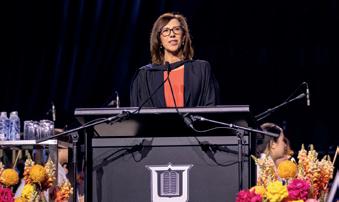
Principal’s Address
Thursday 20 November 2025
Ms Jacinda Euler Welsh Principal
Ms Jacinda Euler Welsh, Principal, delivered the following address at the School’s Annual Speech Day and Distribution of Prizes 2025.
Julie McKay, Chair of the Board; Trustees —past and present; Honoured guests— including Past Chairs, Dr Cherrell Hirst and Elizabeth Jameson; Former Principal, Dr Judith Hancock; Federal Member for Brisbane, Madonna Jarrett MP, and Councillor Vicki Howard, today representing the Lord Mayor of Brisbane; Guest Speaker, Lenore Taylor; President of the P&F, Lisa Cooper; Julie Caton, President of the Old Girls Association; Teachers and staff; parents, Grammar girls and particularly the young women of Year 12 2025.
The Role of Institutions in a World Obsessed with the New
In a world that idolises the new and shiny—where we fete agile start-ups that pivot, scale and disrupt—institutions like ours with histories stretching back over a century (150 years) can feel anachronistic, some might say quite unfashionable. But they have never been more important. In these times of rapid change and uncertainty on every level—political, social, economic—people seek out stability and that increasingly rare quality: trust.
There’s perhaps quite a heartening lesson for us if we consider the evolution of one of the original disruptors: Facebook.
Back in 2006, Facebook was new and cool …. before it became the social media of choice for Mums and Dads.
They burst onto the scene with a very edgy internal mantra: `Move fast and break things.’
Now, that’s obviously not the kind of motto that would ever fly in education, at Girls Grammar—not even in Latin.
What’s interesting … within a decade Facebook had quietly revised that motto to: `Move fast, with stable infrastructure.’ Not quite as edgy. Not even sure what that means. But for those of us who are fans of Utopia …
But this small change tells us, perhaps, about what endures.
It says there is value in moving with care and memory of NOT breaking things of valuing stability of respecting history of embracing tradition.
‘Put simply— Girls Grammar is more than just a school.’
—Ms Jacinda Euler Welsh
Institutions are organic
But let’s not forget that when it first opened back in 1875, Girls Grammar was a disruptor.
It was a pretty outrageous concept—the idea of offering girls a rigorous, classical, broad liberal education—this `bold experiment’.
What the School has managed to do over time is make this very rare transition—and one of which we are incredibly proud—from organisation to institution.
Put simply—Girls Grammar is more than just a school.
Education and society changes, human needs stay the same
We have done this by staying true to our purpose which has remained constant: to provide an excellent education for girls.
How we do this, however, is constantly evolving.
We have always been at the forefront of change.
• From being the first girls’ school in Queensland to employ a full-time PE teacher in 1944, to navigating the implications of AI and the next iteration of ATAR.
• The way we teach, and what we teach is constantly evolving.
Institutions – places of bricks and mortar, relationship and community – are important in a world where the ground is constantly shifting beneath our feet.
They provide a sense of purpose and identity—of belonging to something larger than ourselves.
And we teach this through our traditions.
• Strong academic traditions
But, equally, through smaller rituals.
• House parties, buddies
• The wearing of a blue ribbon
• The rivalry of Interhouse Choir
• QGSSSA competitions
Through our mottos: Cherish the royal blue: past, present and new
These seemingly simple rituals are often the first way students find out they are part of a larger story.
The upside of anchors
There is a tendency to talk about tradition, as a dead weight—an anchor that weighs us down, prevents us from moving forward. How can you move fast; make an agile pivot with an anchor attached?
But, without these anchors, we are lost. They hold us steady when all around is chaos. Make sure we aren’t just drifting with the strongest current—or likely to be dashed against the rocks in a storm.
That sense of being anchored is a deep, comforting sense of continuity and identity that comes from knowing where you fit in and what’s expected. In uncertain times, that kind of clarity and emotional security is gold.
I hope that it gives our Grammar girls the confidence to venture beyond their comfort zones, to take risks; to be bold, knowing they have a safe and solid base from which to launch and, when needed, to return.
Change agents
We would never advocate for living in the past or standing still. How dull. Institutions should be vibrant places where we encourage curiosity, bold thinking and rigorous examination of the status quo.
Anchors, after all, are not immovable. They’re designed to be lifted and repositioned if we feel we’re drifting off course. Traditions, too, should evolve.
The very best institutions—those that can keep reasserting their relevance—do more than just interpret change—they are agents of change.
There is something deeply satisfying about a girls’ school, once so controversial, becoming an iconic institution. For 150 years, this School has nurtured the talents and inspired the ambitions of young women. It is a powerful example of how institutions can shape a better, fairer, more exciting future—for all.
This year, in our 150th year, Girls Grammar was ranked Queensland’s # 1 independent school, and fifth nationally.
It stands for a belief in the power of education to shape the world.
It has been a place of learning—in the fullest sense—since the beginning.
And so to the young women of Year 12, as you embark upon this next exciting stage of your life, I hope you know that you will always be part of something that is bigger than yourselves.
A place of excellence and pioneering drive.
A School you have all contributed to, and been such an important part of.
Brisbane Girls Grammar School.
Thank you.
Head Girls’ Address
Thursday 20 November 2025
Abigail Buck (12H) and Zoe McElwaine (12G)
In their last formal address as Head Girls in 2025, Abigail Buck and Zoe McElwaine, delivered the following address at the School’s Annual Speech Day and Distribution of Prizes 2025.
Good afternoon, Chair, Board of Trustees, Ms Julie McKay, Principal, Ms Euler, esteemed members of the Board of Trustees, Occasional Speaker, Ms Lenore Taylor, special guests, Federal Member for Brisbane, Madonna Jarrett MP, and Councillor Vicki Howard, today representing the Lord Mayor of Brisbane, distinguished guests, family and friends of the School, staff, and students.
My name is Zoe McElwaine, and I’m Abby Buck, and we are the Head Girls of 2025.
We thank you for joining us today. Speech Day is a time to celebrate the achievements of Grammar girls and to share the moments that have made 2025 a year to remember.
We would like to start by extending a sincere thanks to Ms Lenore Taylor, for delivering the Occasional Address today. You have reminded us of the importance of our excellent education in this rapidly changing world. AI certainly couldn’t inspire us like you just have.
Thank you also for sharing about Helen and reminding us to cherish our Girls Grammar sisters.
‘You have brains in your head. You have feet in your shoes. You can steer yourself any direction you choose.’ Dr Seuss was right. For me it was cross country, athletics, a brief dabble in debating.
For me it was AFL, hockey, a bit of flute and a failed javelin career.
We steered ourselves over six years and somehow have wound up here, at our last Speech Day, our last speech, our second last day as a Grammar Girl. What a remarkable chapter it has been.
We started Year 7 in the depths of COVID, eventually made our way out and somehow wound up here. It still feels surreal to be the Head Girls, and even more so to be speaking at Speech Day, but we could not be more grateful. You spend a lot of time thinking about just how much time you have left at School, so what do you do once there is no more time? I think we have to start by looking back at the year that has been—the bingo word was certainly sesquicentenary, and this year was pretty sesquisensational.
With much deliberation, the Student Council created the motto “Cherish the royal blue: past present and new”. Our motto was inspired by three words; gratitude, pride and connections, and these about summed up our vision for the year. We wanted 2025 to be a year of not just celebrating, but reflecting and cherishing. And as we stand here today, looking back, we can confidently say that everyone went above and beyond to fulfil each word. So, here is our take on gratitude, pride and connections.
We are grateful—deeply grateful—for the energy and enthusiasm that filled this year. From Blue Days that turned the whole School into a sea of royal blue,
‘We are grateful— deeply grateful— for the energy and enthusiasm that filled this year.’
—Abigail Buck and Zoe McElwaine
to Galentine’s Day, where love hearts, facepaint and laughter ruled the School. This year has been one of spirit. We’re grateful for the incredible support we’ve felt—from staff, students, and the entire Grammar community. It’s hard to put into words how much it means to be part of something where everyone is genuinely invested in lifting each other up. And, of course, we can’t talk about gratitude without mentioning the fact that Taylor Swift got engaged the morning of our planned ‘Tay Tay’ assembly—talk about great timing. There’s always so much talk about legacy, but honestly, we just hope you enjoyed our speeches—I know we did all too well. We’re also grateful for the ways we have been able to give back, like Locks for Love, where so many students literally gave a piece of themselves to support others, and we couldn’t be more thankful for the turn out at True Blue and the Coronation of Both Queen Gs.
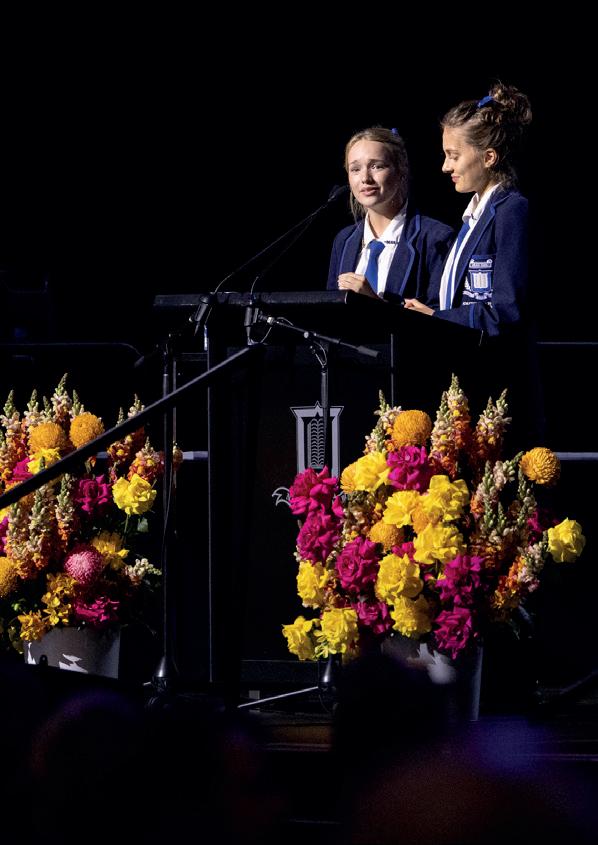
Right Zoe McElwaine (12G) and Abigail Buck (12H)
Head Girls’ Address
Thursday 20 November 2025
We are proud of what Girls Grammar has achieved this year. From the rich tradition of Foundation Day, to the energy and elegance of Open Day, every event was a reflection of who we are as a School— proud of our past, yet excited for our future. And of course, a beautiful 150th celebration, starting with a march and ending with fireworks and our Nil Sine Labore trap music—pride is not the word we are looking for, we are simply honoured to be a part of such a rich legacy. We are proud of our athletes, musicians, and artists, whose dedication and brilliance have filled this year with so much life. Whether on stage, on the field, or in the classroom, Grammar girls have reminded us how special it is to be part of this inspiring School. And yes, when we have so many student presentations at each assembly, it’s impossible not to feel awe at just how much talent we have in our community.
And finally, connections—perhaps the most meaningful of all. The connections we’ve built this year are what makes Grammar feel like home. The bond within each cohort—a sisterhood built on laughter, late-night study sessions, and quiet moments of support—has been something truly special. We’ve also seen connections between Year 7s and their buddies grow into genuine friendshipsproof that Grammar spirit isn’t something you inherit when you reach the top of the School; it’s something that grows from the moment you arrive. From the screaming at the side line, the sea of blue outnumbering all other uniforms at QG, to every seat filled at Gerhmann, the overwhelming participation and support at events show just how entwined the support and connections are between each girl. Each cohort and each girl come together when it’s needed most, showing us that Girls Grammar isn’t just a place we pass through, but a family we belong to.
And while it’s hard to imagine not walking these hallways every day, we know the connections we’ve made here will last long after we leave.
This year in particular we have learnt to value the opportunities we’ve been given, and recognise that our education is both a privilege and a responsibility. We’ve learnt that to be part of the royal blue is to strive to do our best, lift others up, and contribute meaningfully to something greater than ourselves. Strength lies in unity, and our connections to one another are what make this place truly special, we are so grateful to have been part of the Girls Grammar community, and we are proud that it will always be a part of us. So yes, Abby and I do think that this year we cherished the royal blue, past, present and new.
And what has made 2025 as incredible as it has been, has been the people. We would like to express our gratitude to our incredible Principal, Ms Euler. We can speak on behalf of the School when we say your impressive and eloquent words leaves us not only awe-struck, but empowered - you are a role model that perfectly encapsulates what it means to be a leader and a Grammar girl. To all other staff and teachers, your unwavering support and going above and beyond, has made every event, and the year as a whole, the best it could be. You are the glue that holds everything together, so thank you for all your effort and encouragement.
For as long as we can remember our loved ones have shown us unconditional support—watching and encouraging all of our sports, music and hobbies, celebrating every little win with us. So to all parents and families, you are our rocks, and we thank you for everything. We simply would not be here without you, you are the reason we can do what we do, and we love you so much.
And of course, we saved one of the most important for last, to every girl sitting in the audience today, thank you. Thank you for your laughter, for showing up to each event, and for dressing up on Blue Days... Thank you for helping each other out, for trying your hardest and for your constant support. We could not be more grateful for you all.
It was an absolute honour to be your Head Girls this year. As exciting as it is to embrace the ’new’, we can’t help but be sad that we don’t get to see two of the most deserving, inspiring girls take the reins. Head Girls Elect, Emma and Cadence, as with all Year 11s, you are going to lead this School incredibly well and we hope that you learn and grow just as much as we have. So, our only advice is to enjoy yourself, stay in the present, and soak up every moment. Clichéd yes, but the School is in such safe hands, and we wish you both all the best.
To the graduating class of 2025 – we did it. It feels like these past six years have gone in the blink of an eye, but we couldn’t be more grateful and proud to have done it with all of you. We have made it through COVID-19, questionable hair style phases and tough exam blocks, and here we are with only one day left at BGGS. We know how incredible and capable our cohort is, and we simply cannot wait to hear all about the amazing things you do. So year 12s, thank you for making our last year so special, we will miss you so much and we wish you the absolute best.
Now to finish how we began with some more Dr Seuss—‘Sometimes you will never know the value of a moment until it becomes a memory. But I think we know the value of this moment.’ Our last Speech Day, our last speech, our second last day as a Grammar girl—it reminds us of how unbelievably lucky we are. So, thank you to our friends, family and teachers, who have given us so many incredible moments, that we can’t help but be sad for them to become memories. Thank you.
Occasional Address
Thursday 20 November 2025
Lenore Taylor (1981) Former Editor, Guardian Australia
One of Australia’s most respected journalists and media leaders, Lenore Taylor (1981), delivered the following Occasional Address at the School’s annual Speech Day and Distribution of Prizes 2025.
As you reach the end of another year of learning here at Girls Grammar and celebrate your achievements, it’s interesting to consider the fact that the Oxford University Press word of the year last year was `brain rot’.
We all know what that means, and most of us know how it feels to lose track of time scrolling through mindless online content, memes, funny pointless videos, and ads.
All day long we have in our hand something that can provide us with endless amounts of important information, useful information, connect us with exactly the person or the place or the fact that we need to find, and so often we use it to look at things that are dumb, or completely unrelated to what we started out looking for, or to connect with someone or something unimportant, that we’ll forget about five seconds later.
In large part this is because the platforms on our digital devices were never designed to present us with important or relevant information, they were designed to hold our attention in order to serve us with ads. And they do that incredibly well.
But there is a growing body of research suggesting that being constantly distracted and stimulated by endless snippets of information, having our attention splintered, is harming our ability to concentrate, to hold a train of thought, to think.
And now, layered on top of all of this, is the rapid deployment of AI.
We all know that large language models, intelligent machines, are transforming almost every industry in the world. We’ve seen how amazingly quickly they can find information, digest and summarise huge amounts of data, how they can help detect
cancer and do all manner of tasks, potentially freeing us up to do more meaningful creative things. I’m told they may have even been used to write assignments.
As the Productivity Commission said in its recent report `Emerging technologies like artificial intelligence, which can extract useful insights from massive datasets in a fraction of a second, could transform the global economy and speed up productivity growth’ and add billions to Australia’s economic output.
But AI can also add to the brain rot problem, because it doesn’t just splinter our attention, it offers a dangerously seductive option of outsourcing thinking itself.
AI can certainly summarise a weighty report for example, but it can’t read it with curiosity or scepticism. It can’t remember to compare its findings to the last report on the same subject, unless a human remembers that, and prompts it to. It can solve problems, but it can’t apply human ingenuity.
In a recent article in The Guardian we quoted Michael Gerlich, the head of the Centre for Strategic Corporate Foresight and Sustainability at the Swiss Business School, who began studying the impact of generative AI on critical thinking because he had noticed a decline in the quality of classroom discussions.
Like many researchers, he thinks that, used in the right way, AI can make us cleverer and more creative—but one of his concerns is that its answers make us less likely to consider alternative approaches, to think critically, or to imagine different answers.
He says, `I always use the example: imagine a candle. Now, AI can help you improve the candle. It will be the brightest ever, burn the
‘I do know that an excellent education— an education that teaches you to analyse and interrogate information— is more essential than ever...’
—Lenore Taylor (1981)
longest, be very cheap and amazing looking, but it will never develop the lightbulb.’
To get from the candle to a lightbulb you need a human who is good at critical thinking, someone who might take a chaotic, unstructured, unpredictable approach to problem solving. When, as has happened in many workplaces, companies roll out AI tools without offering decent AI training, they risk producing teams of passable candlemakers in a world that demands highefficiency lightbulbs.
The promise and the problems of the digital world, and of the emerging AI world, are starkly evident in my profession of journalism. My career as a journalist actually began before the internet. That makes me feel terribly old.
My interest was always political journalism, so I applied to every capital city newspaper and eventually accepted a cadetship at The Canberra Times because I thought it
would be the fastest way to the press gallery, which proved right. I found myself in the parliamentary press gallery in 1988 when I was still a cadet, just before parliament moved to the new building up the hill.
Back then, the media—what would now be called the mainstream media—was the only place for public discussion and debate. I think there are some quite legitimate criticism of how that gatekeeping role was used, but it did mean policies and opinions were mostly based on a set of agreed facts and reported by organisations which, mostly, had as their goal finding out the best obtainable version of the truth. They were able to be held accountable, through regulators, press councils, codes of conduct or, in the extreme, defamation laws.
I’m not suggesting the good old days were perfect, but there was at least a shared understanding that news needed to be based in fact; that differing opinions were the whole point of politics; that political debate could and should be held without personal animus or vitriol. And there was an acceptance of the role of the media in a democracy to scrutinise those in power, inform the public, and act as a kind of `town square’.
I continued my career, moving around publications to The Australian, The Australian Financial Review, and The Sydney Morning Herald. I had a stint as a foreign correspondent in London and a few periods of parental leave when I had my children.
As internet usage became more widespread in the 2000s people started to get their news on Facebook, or via a Google search. That threatened the power of the old publishers because it punched big holes in their revenue, with the digital platforms hoovering up a lot of the advertising revenue they once took for granted.
But for journalism, it also felt exciting. Facebook and Twitter were useful places to get information, to talk to people who would otherwise be out of our view, to find new readers, and to feel part of a global conversation. We were still hopeful about this new town square. Being factchecked and challenged in real time, facing competition from bloggers and startups— that seemed like a potentially positive kind of shake-up.
But as I said before, the platforms were designed to hold our attention for advertisers, not to promote reliable
information. And it turned out online interaction was turbocharged by outrage, the algorithms favoured emotional extremes, and some news sites followed this logic and tried to monetise rageclicks. It all formed a cycle—a kind of centrifugal force—that pushed online debate towards ever more toxic extremes and an increasingly polarised readership. Civilised disagreement was swamped by divisiveness and anger and eventually some people entered closed-loop information systems absolutely impervious to alternative ideas or opinions. Some politicians fomented and capitalised on the whole mess and the polarisation corroded trust, that essential glue in a democracy, including trust in the press. (Some parts of the media might have contributed to that as well.)
Now we regularly see people dismiss scientific evidence. We see people convinced not to believe things they have actually experienced or seen. Much of the time, discussion in the town square is no longer even founded on facts.
And now AI has arrived. For us it can also be a tool, a very useful tool. But it also presents new threats.
As you would all know, when you search for something on Google you increasingly get an AI summary. If AI mode becomes the default, that‘s what you will always get. And sometimes those summaries are really useful, but sometimes they are wrong, and often they are missing context, and usually they do not link back to the original articles and research used to form the summary. That’s particularly galling for us, given that many of the large language models were trained on journalism that was initially hoovered up for free.
But the real problem for us is that search has been a very important way for us to find readers and for readers to find us. Without it, it becomes harder for us to do our work and run our business, and, if readers come to rely only on the AI summaries, they will get narrower, less contextualised sources of information.
Recently I typed `AI and the future of journalism’ into Google’s search bar then tapped the `AI mode’ button. T large language model spent a few minutes `thinking’, then gave an answer that began: `The prevailing view is that AI will augment, not replace, human journalists’ with a small print rider at the bottom: `AI can make
mistakes, so double-check responses.’ I definitely will be doing that, because to my mind it is a bit like the candle makers and the lightbulbs.
AI summaries are useful, but AI cannot replace human journalists because it cannot do our job. It cannot replace skilled reporting. It cannot be held to account for mistakes. (It is of course on us to make sure our reporting is high quality, and trustworthy and as far as possible does not contain mistakes.)
AI cannot uncover Robodebt, as my team did, or political corruption. It cannot talk to people about the impact of global heating or call out injustice or ask questions at an AGM.
It can’t celebrate brilliant Australian authors or unearth new music or revel in the competitive joy of sport.
Just as you can’t outsource critical thinking, you can’t outsource journalism. For readers—the news consumers— and for us—the news producers—the lessons are the same: to maintain our intellectual independence, our scepticism, our critical faculties, our very human imagination and creativity, and to be vigilant about the algorithms that threaten to rot our brains.
I cannot possibly imagine the changes that will happen throughout your working lives; what the world will look like in 40 years when one of you might be up here giving this speech. I do know that an excellent education—an education that teaches you to analyse and interrogate information—is more essential than ever to help you steer a career path through a world of enormous change.
I’d like to end this speech on a personal note. I was one of the young women in the Christmas Creek bus accident in April 1979. As I’m sure you all know, it claimed four precious lives. One of them was my friend Helen. We’d stayed awake late in our tent the night before the crash, talking about what we wanted to do with our lives, and I still think about her often—about how very quickly things can change, and how lucky I am to have had so many opportunities and chances. One of those opportunities was the education I got here at Girls Grammar and for that, and all the others, I am very grateful.
Thank you
Valedictory Address
Wednesday 19 November 2025
Ms Kate Wensley
(1997)
Performance Psychologist
At the School’s annual Valedictory Dinner, alumna, Kate Wensley (1997) delivered the following Address.
Principal, Ms Jacinda Euler Welsh, President of the Old Girls Association, Ms Julie Caton, President of the P&F Association, Mrs Lisa Cooper, distinguished staff, proud families, and most importantly, the Class of 2025.
What an honour it is to stand before you tonight.
I graduated from Grammar at a time when a lucky few had Motorola flip phones, the Spice Girls were everywhere, and Leonardo DiCaprio was a heartthrob— although, truth be told, I was more taken by Demi Moore in GI Jane. Looking at who they’ve become, I think we can all agree that I made the right choice.
I loved school but my passion was football. There were not many girls playing at the
‘What I have learnt is that achievement and accolades alone, do not make people happy or content.’
—Ms Kate Wensley (1997)
time and Girls Grammar was still years away from establishing a team. The Matildas—now considered Australia’s favourite sporting team—were virtually unknown, and even posed for a nude calendar just to raise enough money to keep playing.
A lot has changed since then.
I remember sitting where you are now— that mix of excitement and uncertainty about what came next.
I could never have imagined where I would end up.
Today, I’m a performance psychologist working with some of Australia’s top athletes and teams. People who are at the pinnacle of their fields.
But here’s the controversial part: I would not call all of them truly successful. I’ve sat with athletes who have everything they thought they wanted—the medals, the money, the recognition—and watched them struggle with the question: ‘Now what?’
What I have learnt is that achievement and accolades alone, do not make people happy or content.
We often believe success is an outcome. You’re successful when you score a top ATAR. But when we chase outcomes alone, when success is only about what we accomplish, it can feel empty.
So tonight, I want to share with you five lessons from my journey, and challenge you to consider, what does true success look like for you.
Lesson 1: Truly successful people are brave enough to run their own race
As you get ready to leave school, you may feel you should follow a particular path.
But people who thrive are those who have the courage to pursue what genuinely matters to them.
After School, I didn’t know what I wanted to do. I went to university because it sounded fun. I got an undergraduate psychology degree because someone suggested I might like it.
I did, but after graduating, I distinctly remember saying I could never see myself as an actual psychologist.
So, I went travelling. I got to know myself. I discovered what kind of work felt meaningful; what I wanted to spend my time doing. I ended up in the south of France, working at an outdoor adventure centre. Abseiling, zip lining, mountain biking, canoeing—teaching teenagers to step out of their comfort zones.
I realised I was deeply fulfilled working with young people. And I was good at it.
After many years, I found my way back to psychology. This time with clarity: I wanted to be an adolescent psychologist.
As I was finishing my Masters, the Australian Institute of Sport (AIS) advertised a position supporting young athletes. It combined my love of psychology with my passion for sport.
That was my first job as a psychologist. It took me 14 years from finishing school to get there.
And here’s the critical part: I didn’t get there by chasing a specific outcome. I didn’t even know this job existed.
I got there by pursuing what I loved and letting those values guide my decisions.
When you live aligned with your values, you experience greater happiness, stronger relationships, and better performance.
Be brave enough to find your own path.
Real success isn’t about impressive outcomes. It’s about spending time on what truly lights you up.
Lesson 2: Truly successful people know when to say yes… and when to say no
I arrived at the AIS feeling out of my depth, surrounded by people at the top of their fields. So I decided to say yes to everything—to learn, and to prove myself. I worked long days and weekends. Some tasks were unglamorous—washing water bottles, making sandwiches, carrying kit. Others were incredible—like going to the World Junior Athletics Championships with future Olympic medallists Nina Kennedy and Matt Denny.
Saying yes led to many incredible opportunities.
December 2016: I’d just returned from a long work trip and had a six-month-old at home. I was counting down to Christmas leave when the Young Matildas requested a psychologist for a one-off workshop. I wanted to say no. But I loved football, and these openings were rare. So I said yes. I spent hours preparing that presentation— far more than necessary. The session went well. Word got back to the Matildas’ Head Coach, who happened to be exploring hiring a psychologist for the first time. In early 2017, I became the Matildas’ Team Psychologist.
That single yes opened the door to three years with the team, including a World Cup in France, and occasionally being mistaken for Matildas’ star striker Michelle Heyman.
One of the early highlights—and honestly, a surreal experience—was opening the paper to see my name in a profile about Sam Kerr, in which Sam reflected on our work together at the Tournament of Nations. You might find this hard to believe, but Sam had struggled with scoring for Australia. As she put it at the time: ‘I always played really well for my club, but not great for the national team. I didn’t score. And I’d started thinking that maybe my teammates thought I was bad when I didn’t.’
Sam and I worked together on getting her back to just having fun—playing without the weight of expectation. Just before facing Japan, Caitlin Foord asked Sam, ‘Are you going to score today?’ Sam replied, ‘I’m going to score three.’ She did —the third capped off with her signature back flip.
So, saying yes led to some great experiences. But some years later, I learned an even more important lesson: the ability to say no.
As women, we’re often taught that our value comes from being helpful—that saying no is selfish. But saying yes to everything comes at a cost. When a new boss was openly resistant to my role, pushing through stopped serving me. For the first time, I had to draw a line and prioritise my wellbeing. It was time to walk away.
Real success means taking care of yourself—physically and mentally. As I often remind athletes, good mental health is the foundation of sustained high performance.
So yes—say yes to opportunities that stretch you, that align with your values. But also learn to say no to what depletes you. That is not being difficult or selfish—it’s protecting your capacity to say yes to what matters.
That is sustainable success.
Lesson 3: Truly successful people invest in real relationships
Build professional connections—not just as contacts on LinkedIn, but as genuine relationships. This will shape your career.
As a psychologist, I have become pretty good at building relationships. I ask questions. I listen. I learn from colleagues. I show up for people. I say when I need help.
One Thursday in 2014, an Australian paraathlete was critically injured in Europe. Someone needed to go to support the athlete and their family immediately.
They asked me.
I was the most junior member of the psychology team. But I had built trust. They believed in me. A few hours later, I was on a flight to Spain.
Nothing in my training had prepared me for what I encountered. The complexity, the weight of responsibility, the grief and fear in that hospital—it was beyond anything I had experienced.
But I stayed grounded. I drew on every skill I had. And I leant on my colleagues for guidance, calling them late at night from a hospital corridor.
And together, we navigated this most challenging experience of my early career.
Real relationships are built on trust, vulnerability, and showing up—in good times and tough ones.
The people who believed in me enough to send me to Spain became the same people who, a year later, offered me the role of Lead Psychologist for the 2016 Rio Paralympic Games.
But professional relationships alone won’t sustain you.
Life is difficult. You will face challenges. You will experience loss. Things will not go according to plan.
In 2017, my beautiful baby boy, William, died as a result of a catastrophic medical mistake.
It broke me.
My professional network sent flowers and messages. They were kind. But it wasn’t them who kept me going.
It was my family and my closest friends— many of them Grammar girls, who carried me through.
I cannot emphasise this enough—find your people—the ones who are always in your corner. And nurture these relationships.
The quality of our connections is the single best predictor of health, happiness, and longevity.
So invest in them. Build genuine professional connections. And protect your personal relationships fiercely.
You’ll need both to truly succeed.
Lesson 4: Truly successful people use
their privilege
We are Grammar girls. That’s a privilege. A significant one.
We have networks, resources, and opportunities that many people will never have access to.
Do not carry that as guilt.
Carry it as responsibility.
If you want to feel truly successful, help someone else succeed.
We know that helping others is associated with greater life satisfaction.
Some of my proudest moments have been watching people I’ve worked with go on to do amazing things.
And I would take this a step further—there is particular power in elevating other women.
Let’s be honest: the gender disparity exists. While we’ve made progress, men still significantly outnumber women in leadership roles, high-paying jobs, and positions of power.
Unbelievably, earlier this year, I had to argue to be paid the same as a male psychologist to do exactly the same job. Be fierce champions and advocates for each other.
Lift each other up. And when you get opportunities, bring other women along. That’s sustainable success. Not just for you, but for all of us.
Lesson 5: Truly successful people know their self-worth is not tied to achievement
This is perhaps the most important lesson. You are worthy without any accolades or accomplishments.
In high-achieving environments, many of us tie our identity so tightly to outcomes that setbacks feel like personal failures.
We confuse ‘I didn’t perform well’ with ‘I’m not good enough.’
This lesson is beautifully exemplified by Matildas’ defender, Clare Hunt. For much of her early career, Clare felt like every match was a referendum on whether she was ‘good enough.’ Her harshest critic— like many high achievers—was not the media, nor the fans—but rather her own voice.
When Clare began separating her selfworth from her performance, something shifted. She stopped playing to prove herself and started playing with freedom. Now, she’s not only consistently playing
great football and enjoying it, but I view her as one of the most resilient athletes that I have had the privilege of working with.
So please remember this: What you achieve does not determine your value— you are valuable no matter what happens.
The girl who doesn’t make the team is just as worthy as the captain. The student who gets an average ATAR is just as worthy as the one who tops the cohort. You, exactly as you are right now, are enough. And you always will be.
Knowing this is the foundation of real success.
Class of 2025, true success is about much more than what you accomplish— it’s about choosing what fulfills you, protecting what sustains you, investing in people who matter, and using your privilege to lift others.
And remember—you are worthy, regardless of any outcome.
So now, as you leave the white picket fence of Girls Grammar for the last time, I challenge you to consider, what does true success look like for you.