BRIO. is a student-founded publication that combines literary criticism with fctive works and visual art. In an efort to represent the wide spectrum of discourses that serve as the foundation of comparative study, the journal accepts submissions from any sources and in any language.
The discipline of Comparative
Literature is based on the assumption that the study of single texts and cultures is enriched by a knowledge of the texts and cultures surrounding them. It views literature from a broad and inclusive perspective in which philosophy, anthropology, history, language, and literary theory come together, and where the visual arts, theater, and modern media suggest crucial comparisons. This journal aspires to embody those ideas.
A Note from the Team
The frst sentence in the classic historical fction Romance of the Three Kingdoms goes: “It is said that the ways of the world, after a long period of division, must unite; after a long period of unity, must divide.” This was the philosophical observation that the author led with as he wrote about some of the most tumultuous years in ancient Chinese history: the span of 60 years between the Han and the Jin Dynasties during which the old establishment unraveled and a new one was born from the ruins.
This quote is especially pertinent to our theme this semester, “decomposition.” And while it is relevant in history, it is also everywhere in our vicinity: the fall leaves slowly coming apart on the ground, the familiar shops and neighborhoods in our hometowns gradually changing to something unrecognizable, our adolescent lives fading behind us as we venture into adulthood… The only constant is change, and at BRIO, we wanted to use this opportunity to recognize the beauty and subtlety that is revealed when things come apart.
In this issue, you will come across writings and artworks that examine the changing environment around us and events in past lives that still linger on today. We, at BRIO, hope that they can invite you to also examine your own perceptions, savoring the bittersweet taste of freedom as the whole breaks into parts, as the totality dissolves into fragments.
With Thanks, The BRIO Team
Crystal Lee Decomposition
the skin we shed
by Amy Shin
i am drawn to the still life of an empty cicada shell brittle yet persistent claws of memory latched to the bark of an old deciduous tree suspended midclimb mid-breath its husk of paper skin split open like an overripe papaya sunlit sugar drizzling down your fngertips and resting upon the soft dimples of my tailbone the cicada tearing itself free down the midline of its thorax reemerges after seven teen years of burial life nourished from rupture the new cicada blinks beside its exoskeleton all cute and sexy as fresh blood pumps through wet iridescent wings futtering into four weeks of life above ground busy
ravenous cicada nymphs grab what they can extracting liquifed memories from the xylem sap of tree roots female mothers splintering baby twigs to nestle her eggs a line of pearls embedded within a wooden wound
why were we so unnecessarily beautiful barefoot dancing on sprinkler-showered grass mufed laughter pressed into soil surrounded by a family of cicadas little vibrating abdomens pulsating odes of longing or joy? our death so soft so polite i forgot we ended
ground littered with corpses like confetti have you found where we are? an ant nibbles on a severed wing dismantling the possibility of fight dehydrated lovers fall like maple leaves against the autumn breeze so sweet crunched beneath a toddler’s frst step.
朽葉色四十八色を拙訳 (kuchibairo yonjyūiro wo setsuyaku) a failed translation of the forty-eight colors of rotting leaves
朽葉色 (kuchibairo) ~ color of rotting leaves
in the heian period there were fourty-eight dyes a courtesan could clothe herself in the soonsoil soot upon an adam’s apple & a hankering
i. 緑朽葉色 (aokuchibairo) ~ color of newmolt leaves
raising little cousins, familiarity of sunburn on soft wrappings —nerve nosegay, bloodways bundle—still unfnished births, unsautered tongues
teaching children to swim, closing our fngertips in like brûlée upon meringue
ii. 淡朽葉色 (usukuchibairo) ~ color of shallow sunbraised leaves handing down recipes nailed to the back of a farmhouse door heard of—never opened
october, trees: molasses moans: fulvous is a phasmid—part of speech; a verb pretending to be an adjective—meaning when light hooks the eye of october; soil ion tapestry—membrane letting in salt by Charles Stephens
iii. 赤朽葉色 (akakuchibairo) ~ color of tawnytint leaves
iv. 黄朽葉色 (kikuchibairo) ~ color of yolkbrushed leaves
list of stone fruits lightbulb eyeball
spring plum maple whorl
crow’s foot in a dusty road tracing cracks in an old face pulling up life like a grass whistle—splayed into song
v. 紅朽葉色 (benikuchibairo) ~ color of rainrouged leaves
in the heian period there were fourty-eight dyes a courtesan could clothe herself in
color ran quickly then past the aperture like a pale horse both blue & green & old in ways of wine
John Singer Sargent, 1856 - 1925
Moss
Riding the greyhound down the interstate —my right leg, crossed over my left, encroaches on the aisle— surrounded by the indigo-ish twilight as the road eclipses the Kentucky Bluegrass I keep thinking about how, for decades, they let those John Singer Sargent murals —the ones they built the museum around, the ones that make you think maybe the geniuses aren’t all dead— collect grime on the ceiling until those deep dark lines meant to be deciphered all the way from the ground are blurry with debris
I keep thinking the low clouds are mountains but they aren’t, and nothing looms above me —except, in the museum, John Singer Sargent, but he’s dead now—
just the asphalt beneath these rubber tires tires made to choke the whales for millenia after no one is left to look up by Piper
Acts of God
by Abbie Allison
“And all you can do–” says the resigned voice of James Spann, through the tinny sound of our old box TV, “–is pray for those people.”
The sky is green. I remember that, now – above anything else from that day. The sky is green, and my Minnie Mouse shirt sticks to my skin. The horses have left the pasture hours ago, equine bodies stif with unease. The sky is green and we’re lucky because our house is still standing in the afternoon.
‘House’ is a funny word, considering what he says next. Something about mobile homes and safe places and certain death. How the sticky air pulls at the seams of sheet-rock construction, how trees break roofs into shredded dust. The sky is green, and I’ve learned that our house isn’t a house on days like today.
There is something in the wailing sound of a tornado siren that instantly makes me childish again. When I tell this story, the one I keep carefully censored, I leave out how I couldn’t eat Chickfl-A sandwiches for years because it was what the church on the corner handed out to the survivors without power. How sometimes, on the most mundane of spring afternoons, the humidity still smells like pine sap and yellow insulation. How I can’t lay in the backseat of a car without seeing the shadows cast on the fabric, without feeling the swerve of tires around debris.
It’s not the lash of rain against windows or the sound of lightning cracking against the ground that makes me tense – no, I just can’t stand the swirl of hot air on a cool spring day. I just can’t help feeling cagey when the power goes out for more than an hour, taking too long remembering how my dad would warm up pots of water on the grill so we could bathe. I’m sorry, but I just have to sit fully dressed in front of the TV, watching the red-blotched weather reports until they eventually turn back to The Wheel of Fortune.
The courthouse smells like mud and Lysol. The marble-laminated foor is cold against my thighs – it’s still dark outside, and the inky black of the sky is coated with the mottled grey of storm clouds. My brother is in Birmingham, but my parents and I are here. I keep drifting in and out of sleep, laying down to press my chubby cheek against the tile.
That afternoon, an EF-4 tornado would rip the marble slabs from the ground, shred the exterior until it looked like wooden foss. By the time the sun dipped over the pastures outside of my window, there was no downtown anymore.
The worst part is, I don’t even remember exactly when it happened. **
My recollections have muddled into one big swirl of dark air and thin wailing sirens. I still feel sticky with fear, thirteen years later – like my body is in a loop of attempting to disperse the adrenaline, veins running with it, contracting it into the shape of my six year old self. We came back from the basement of a church that afternoon to our mobile home still standing, branches and leaves cracked around it, cast in darkness that would last for three weeks, but nonetheless –it was there.
So many others weren’t. Collapsed. Desecrated. Gone. We were lucky, weren’t we?
No FEMA check, no handshake with the president, no memories left intact – I push myself to think: what happened frst, second, third. Nothing comes out except a bone-deep dread that only reappears when the springtime rolls back around. My sinkhole stomach, my Ziploc-bagged crayons, a Disney princess coloring book on the stained carpet of a church. Do I get to grieve? Did I earn it, the same way the ladies crying on TV did?
Now, it looks like nothing’s ever changed. Everyone’s buried, everyone’s rebuilt. The town wears new paint over the same fault lines.
I try not to think about it. I’ll go pray about it, instead.
Series
Trinity
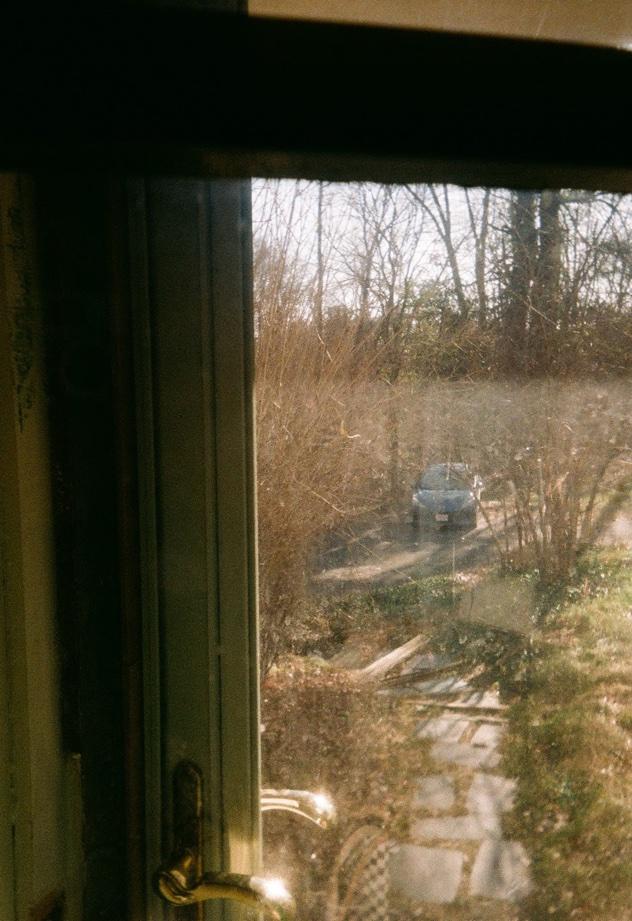
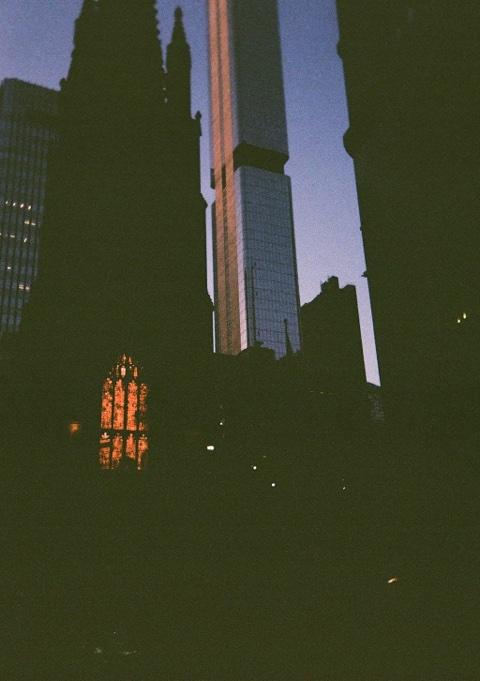
“Both of these pieces were accidents in their own right. Trinity was taken at the Trinity Church in FiDi and I had originally intended to capture the glow that came through the stained glass from inside. The image is underexposed and has lost a lot of detail, but it’s neat to see the glow come through on the silhouette of the church. 6 Series was just taken as a quick burner shot to make sure the flm was fully loaded into the camera and past the part that had been exposed while the back of the camera was open. It’s not particularly riveting, but it captures the home that I know in a very casual way- the way it should be.”
Ethan Anderson
Skinned
by Morgan Jang Lee
It has been a while since I have missed someone before they were gone. A long-gone friend one wondered if each time she said I love you it cheapened the phrase. I love you I love you I love you printed on newly minted bills, falling. Overstuf your pockets and the price of love rises. Perhaps I ran out— of seashells, wheat, cattle, fabric, gold, coins, cents, dollars, credit, or sheer fortune. Perhaps I spent all my closeness on those other lives.
But I love you I love you I love you when I miss my skinned knees of childhood, the scabs that crisp like buttered bread in a pan, make noise like dry leaves when you scratch them. Someone asks if I am hungry, no, but once, my mother fed me apples without the skin. They were naked, and I was too young to worry about the unnatural whiteness of their fesh.
Once, I was soft and foolish and buoyant and I loved clouds, the color orange, watching the delicacy of a mosquito bite me, and I might still love some of those things but what I’m really saying is: I had a pet goldfsh and she died. My father was going to fush her down the toilet but I put her body—so light, I could barely feel it— into an empty soap box and walked my goldfsh to Riverside Park where I tucked her in her grave goodnight I love you and frst learned to miss someone before they are gone.
Agastya Jhaveri Comes the Gust of Wind, and I Too Shall Go.
Static by Austen Thomas
The sunlight drips down her spine as she walks; glints in glaring brightness of the pewter colored asphalt. Sometimes, at this time of year, it gets swallowed down by the fog creeping in of the coast, but today the harsh yellow light won over, and the thick clouds hang low on the waves. The sky is so blue it hurts.
She is close to the highway now, and she makes sure to step in every pothole of the last hundred-yard stretch, letting her bare feet get eaten up by the shadows for a swift second before continuing forwards. Where the highway collapses into dirt, there are thick bushes that push against the edges of the road, the rooted bases hard on one side and the thorny vines curl over, a foaming wave reaching for the grey.
They are blackberry bushes, except, this summer, there are no blackberries. The pale petals had opened in May, like they always did, distending into hard green nubs through June and July. And now it is half-way through August, and she has been here everyday since the start of summer, but the green still has not darkened to black.
Usually, they ripened slowly, one or two in a bunch blushing into red and then purple, she would pick them by the handful, even the ones not fully ripe. The tart sweetness would food her out, fll her up, all through the remainder of the summer.
She stands next to the bush—not waiting, necessarily, but not moving forwards, either. Cars roar past, lifting spindly threads of hair of her cheeks. She stands until the heat settles over her, thick and heavy as a blanket, and she knows the asphalt will be nearly too warm to walk on barefoot. And then she treks the halfmile home.
“Maybe they’re just late this year.” Atticus sits in the driver’s seat of her car, legs crossed and one arm hanging out the window in an attempt to escape the heat. The car is not moving—hasn’t since she lost the keys in June and refused to tell her parents. “Maybe it’s, like, a climate change thing. That happens, right?”
“I don’t know. Maybe.” She lifts the frayed ends of her bracelet to her mouth—hesitates, lowers her hand back down.
Atticus watches her, brows crinkled, before smoothing them out and rolling her eyes. “We should just get you a chew toy, and that way you can stop torturing yourself. Or one of those things for babies—a teether.”
She can’t tell whether Atticus is talking about the blackberries or her ragged bracelet, and doesn’t respond. Outside the window the landscape is unmoving. They are somewhere between both of their houses; an empty, packed dirt parking lot with a trail that carves through the muddy green hills and eventually leads to the ocean. The keys, in theory, went missing somewhere along it, but she suspects that Atticus dropped them in the water. She doesn’t know the story she told to her parents about why the car hasn’t moved in two months; Atticus is a convincing liar when she wants to be. It isn’t even that her parents would be mad, really. More like when they were kids and one summer the fog rolled through for weeks on end, so that the sky was blurred out and shrouded, and Atticus threw out all her books about constellations. She wasn’t sad about it, just inconsolably matter-of-fact.
“I should head home soon.” It is more a statement of reality than it is a call to action, and neither of them moves.
“What? Curfew?” Atticus lowers her legs to the foor, stretching so that she takes up the whole space. She thinks it makes her look like a boy.
“Don’t be mean.” Also something that makes Atticus feel like a boy—or, at least, less like a girl.
“Wasn’t trying to be.” Atticus reaches up to put her hands fat on the roof of the car.
“There are blackberry bushes closer to the clifs, you know.”
“I already checked there. They’re bare.” She’d checked all the accessible bushes between their houses, her legs uneven with the paper-thin crosshatches to prove it.
“Should have guessed,” Atticus repeats. She feels no relief in this kind of being known—they are both clear as panes of glass.
A moment of quiet, and then the hollow click of the car door being opened;, Atticus is already halfway outside. “Where are you going?” In her head, she imagines walking home, entering a house empty except for her parents—her mother, realistically. She imagines passing the bushes on the highway; imagines that it is still July, and the waiting hasn’t turned hollow and acidic.
“We,” Atticus walks around the front to her side of the car, opens the door and holds it gaping, “are going to the grocery store.”
“That’ll take us an hour.” She doesn’t say that if they had a car it would be much faster than that, doesn’t have to. Atticus bares an exaggerated, toothy grin, her white blond hair almost glowing, the sun casting her in gold. The hesitation is all for show and they both know it. There is no decision being made—she’ll follow Atticus an hour through the heat.
The local grocery story is small, and glaringly organic. She waits outside in the parking lot while Atticus goes in, sitting on the curb and letting the heat soak through her jeans. Tries not to feel like a dog left in the car, even though she’s the one who chose to sit outside.
Atticus emerges with a paper bag held close to her chest. She joins her on the curb, placing the bag between them and removing its contents: a singular carton of blackberries, the plastic already smudged in bloody smears from being jostled around.
“It’s not the same,” Atticus starts, popping open the plastic and setting it down in front of them, “but at least it’s something. Maybe it’ll help. While you wait.”
The store-bought blackberries are bigger than anything growing on the bushes she frequents. Some are still early, dusted in lighter shades of purple, while others are overripe, busted open and leaking a vicious red. Her mouth waters even as a vague nausea hollows out her stomach.
Atticus doesn’t say anything else, just unfurls her legs and tilts her head back to the sky, eyes open and watching. Her eyes are green, so green it’s almost painful to look at.
It is easy for her to forget— how beautiful her friend is.
She turns away quickly, and reaches for a blackberry, one of the bleeding ones. When she bites into it her throat shuts involuntarily, the sweetness overwhelmed by disgust. It’s like eating something too soon after brushing your teeth in the morning, the favors twisted out and revolting. She turns away and spits onto the sidewalk, desperation gnawing at her, the stain of crimson shiny, and vulgar.
She can feel Atticus watching her, but all she says is, “It was worth a try.” She wishes there was some kind of shock in her voice.
“Let’s go back.”
Neither one of them moves.
“We could go swimming tomorrow. If you wanted.” There is no sharpness in the words. She pictures jumping into water so cold it reorders everything around her. She pictures Atticus, body half-obscured by the swirling, grey-green Pacifc.
“Let’s go back.”
“Okay.”
This time, they both stand, starting back along the road. They leave the blackberries, and the crumpled paper bag.
Most of the walk is along the highway, and they have to shout to be heard over the noise of passing cars. They talk about going back to school, about looking for Atticus’s car keys again, about
By the time they make it to the start of the road leading up to her house, the worst of the day’s heat is over, and a steady fog is rolling in of the coast.
“I’ll see you tomorrow.” It’s not a question but she nods anyway.
As Atticus walks away, the urge to call her back knocks the air from her lungs. She wonders if it would make a diference for Atticus to come with her and fll the empty space of her house. Knows it probably wouldn’t.
She waits until she’s out of sight, and then walks to the climbing bushes eating at the edge of the pavement. Wades through the bristles, to a patch of green right in the middle. The unripe fruits don’t come of easily, and her fngertips turn bloody from grasping at thorns. She puts three in her mouth, iron and a harsh bitterness fooding her. She chews until they’re paste, and then swallows them down.
South Hero, VT
by Piper Moss
Violet and I
—we’re only sixteen— are following a bike path around the island and we pass a graveyard
Some of the headstones are upright and some are just sunken plaques all the names are half-covered in dirt and ivy and, worried about being remembered, I call my mother and ask when I die, you’ll get me one of those nice stand-up headstones, not one of the fat ones set in the ground, right? She says never ask me that again and hangs up.
On the way home I fall of the bike
Violet’s mother says you put the shortest kid on the biggest bike?
Now my bruises match the ones Violet always had before she moved out of her father’s house
Violet and I fght about the summer mosquitoes and whether we listen to each other well enough I don’t see her the rest of the summer but in July I still bake a cake for her birthday I try to write her name in frosting but I run out of space so it reads VIOLE
Teeth
by Shayana Foroutan
How do we make sense of the infants trapped in wars they didn’t start, being born with tumors the likes of which doctors have never seen before, growing out the side of their ribs, double the size of their small, precious bodies, caused by white phosphorous that coats and flls their small, precious lungs, and drain any hint of rosiness from their soft, precious faces?
We gorge on movies, where the tumor comes to life, grows legs and runs of the side of the baby; it grows fangs and bites down on the men and women who watched it grow and swell and pump with a pulse full of pus and blood and an agony the child doesn’t have the language for, until it sheds the baby’s corpse like a useless snakeskin, like its only purpose is to give us the opportunity to proudly share over expensive wine at dimly lit dinner parties:
Yeah, I’m a horror junkie— I can watch just about anything and be okay.
Isidro Borges Relic
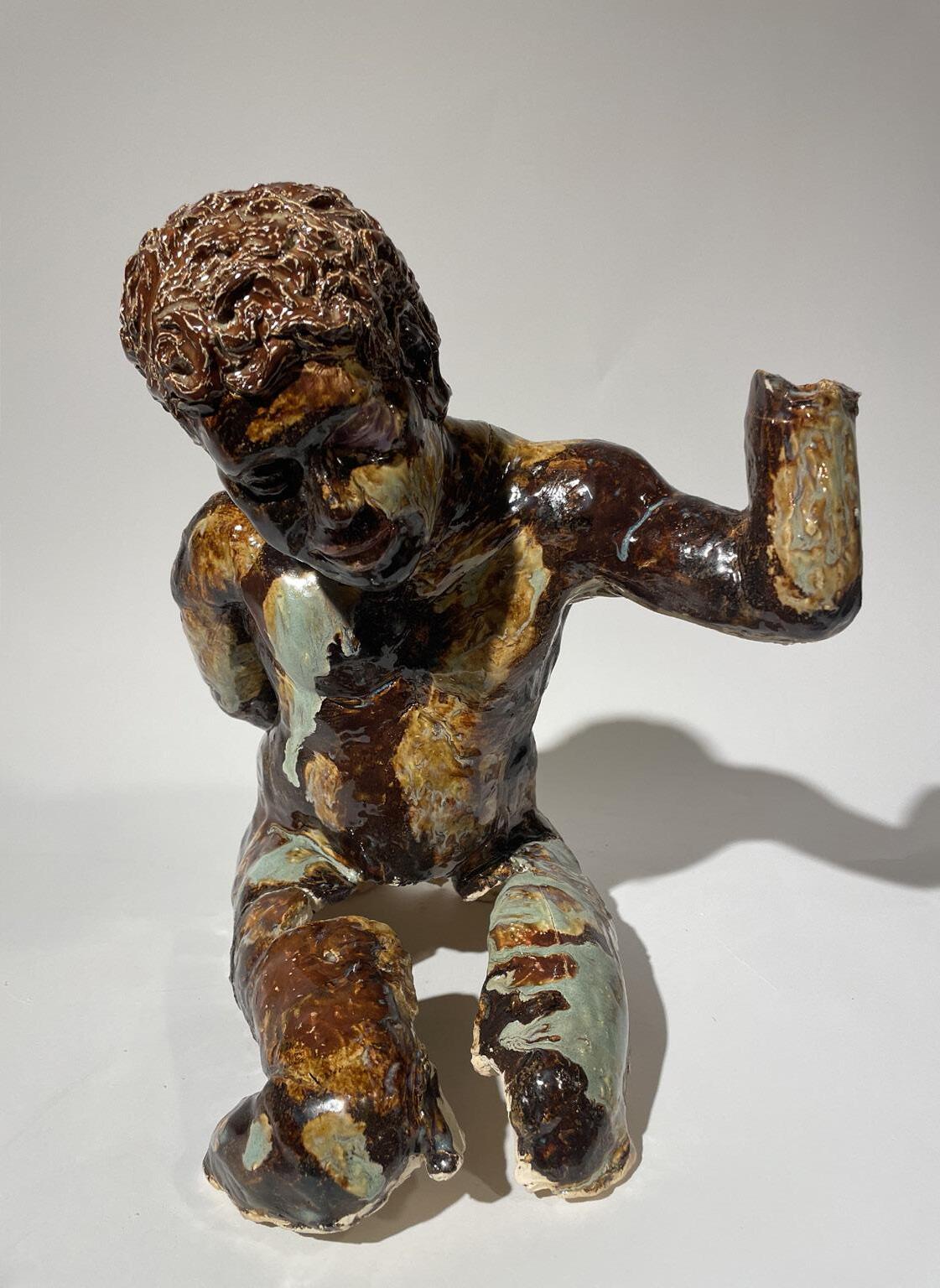
“As bisqueware, this piece was knocked into and shattered. The missing left hand, which used to be the centerpiece, disappeared. It was meticulously put back together and glazed to be reminiscent of a rusting, forgotten sculpture at the bottom of the sea. It is large and heavy. The glaze is in splotches, pools, and mixes. There is a large hole in the bottom, where it could not be repaired. Its slight grin and bruised eye are emotions we all have experienced at some point in our lives.”
Chicago
by Jack Miller
When I return, the land is dying, or at least hibernating.
Out of the plane window, the muddy complexion of the earth greets the prickle of my cortisol.
(my acting professor talks about how trauma is stored up in the body. I don’t think I know trauma. This is a blessing I forget. My shoulder muscles tighten).
The water here is translucent green-blue, the land withered, yellowed. Some trees have become leafess and bony.
(I wonder if my shoulders have always carried this kind of tension).
And there are neat rows of houses, the gray of the city a dusty, dirty scene laid out like a basement blanket.
When I return,
I’m listening to Noah over bluetooth headphones, seventeen again-waking up early on Saturdays to an orange stretch of sky, eating Mom’s dinner out the oven, croaking out folk to bad strumming, chucking up basketball shots, gathering around the frepit, swimming, sinning & praying in the desperation of night
My knees know this carpet foor here. My hands know this dirt’s worms. This cold can melt your lungs Can’t it?
The plane pulls in to land, smooths itself out on the concrete and rumbles over to the gate Gray sky stretches out for miles like this land exists in its own space and time.
(Some days, posture matters less; some days, I slouch into the couch and talk to my father and mother without stress).
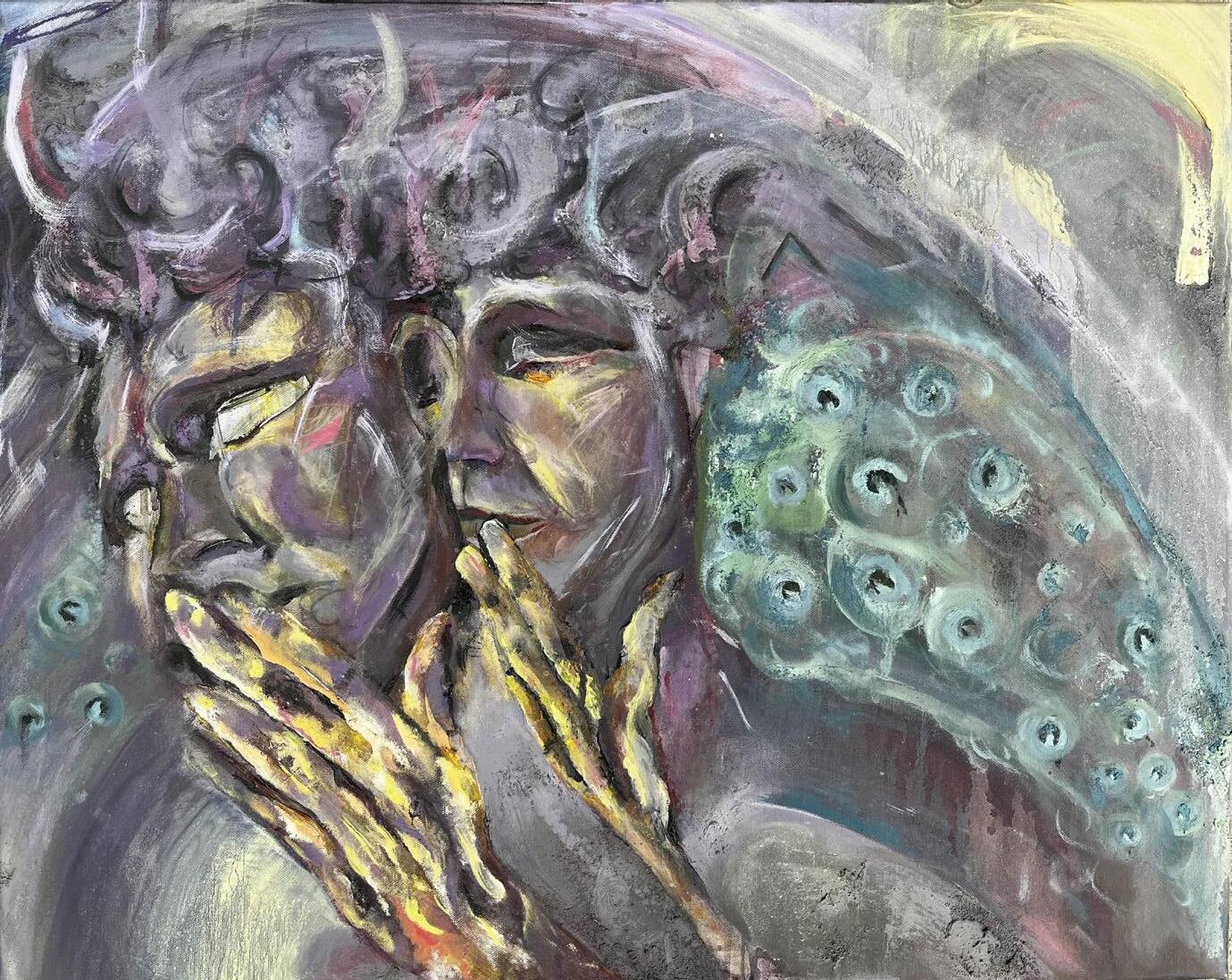
“ is piece was created during one of the most painful years of my life. It served as a vessel for me to express an abandonment from my facticities and environment; to overcome what was harming me and transcend through my essence. “Disintegration” is what I named it, but I feel as though the process I went through during this time was more akin to decomposing—I did not disappear, I became something new.”
Dorian Skelton
Disintegration
Hold On
by Jefrey Bichovsky
As a boy, he twirled his mother’s hair
Twisted the straight blonde silk
Between his fngers
Until it turned curly
His mother lingered at his side
Pulling a blanket over him
Caressing, smiling gently
Older now, he grabbed onto twisted hair
Draping over a vast gray clif
A mountainside which he would tumble down
If not for the rope, holding him steady
There was no climbing up
No chance to rise above his
Need for serenity
The desire for a maternal return
There was only the possibility Of the fall through the clouds
So, he held on His hands tightening and sore His sweaty face red with anguish
His eyes empty and alone
He held on until the hair started falling out
That was the worst part, according to her He scofed that of as playful exaggeration
The worst part was nearly there
Total loss, the fnal permanence
But for her, that was nothing
She wouldn’t have to sufer anymore
No, that sleep was peaceful and serene
And he wanted it too
To be with her
To be soothed
Any Time of Day
by Malaika Kamau
It’s the week after I got back from my summer pilgrimage in Italy, solivagant I was—still am. We’re cruising down Mulholland Drive with the windows rolled down, an invitation for the breeze. We will spend the rest of our lives in the front seats of that rattletrap Volkswagen vanagon of mine, the Lemon Twigs and Todd Rundgren winging through a fried speaker that I’ll never bother to repair. We’re going to wherever-the-hell-we-want Boulevard. As always. On the wheel, I croak a gurgle of a laugh at some stupid thing I said, pitchfork creases branching out from the corner of my eyes. Your lithe frame bounces with the giggles, and I make myself break down into hysterics, thinking I might hear you start to rattle like a skeleton. Your rolling belly fashes out from a crop top, and it’s a sobering sight. Not too long ago, you admitted to me how in middle school, you’d used your own refection as a means of torment. Xylophone rib cage and keloid scar stitched into your hip, tracing your fngers across the length of your collarbone. Watching you then, carrying a confdence previously unseen, I realized you were more ‘you’ than you’d ever allowed yourself to be. I began to overlap past and present to conceptualize the diference—and what a diference at that.
Though… I do miss my old friend sometimes—that longgone ‘you’ from way back when. But there’s no plane ticket to where he lives, I’m afraid. The small boy whose fragrance was (is) bare feet rubbed green with thyme, cheeks christened by silt, and hands which on the daily kissed dafodils. Who looked up to the Earth due to his stature, due to how much he feared it, how much he hated it, how much he admired it. On occasions, I get to hold him, when you spring awake in the dead of midnight. When the sky is ultramarine, supernal, and silent, and you think I’m fast asleep. You fear rousing me from slumber, so you stife yourself. Your back, hunched over with wracking sobs—a gutting—the desolation wants to eat you
When you fnally notice me sitting up, your breath hitches in your throat. These bygone days will come again. They always do. I bring you into me and I thread my fngers through the long strands of your hair. You taught me how to do this and I’ve practiced diligently. Other times, the boy you were appears as a mist of sadness that’s perched beneath your long lashes. Cow-eyed disappointment, expected, and for that, all the more regrettable to see.
The girl I was, well. I take care of that girl. If I’m quiet enough, I hear her, feel her on the side of a translucent membrane within one of the chambers in my heart. Her grievances and anxieties, her happiness, her gap-toothed smile. The others are there too. A 20-year-old nursing heartbreak with Lady Gaga. A 9-year-old learning to wean of an accent. A 15-year-old, her head exploding with quadratic equations, and her small attempts at fathoming the cosmic horror of having a body. Every time I blow out the candles and everyone’s done caterwauling the merry song, I archive another iteration of lil’ ol’ me. Our child selves, they don’t go of to die. They are preserved, wounded or otherwise, within these compartments.
In my salad days, I fell into the repeated mistake of thinking I had to betray my nature to escape The Spiral. The veritable cyclone of self-recrimination and war waged against me, myself, and I. In the name of hate, of disgust. Of shame. You know it too. Forgiving my innumerable selves—settling the blood feud—I’ll keep trying. I’m still trying. And trying and trying and trying and trying. You’ve been ringside for all of it, you tough, beautiful bastard.
The only way we’ve lasted this long is through a “Perpetual Learning”. The active and fervid education one ordinarily undertakes when it’s a new person veering into your gravitational sphere. I make the deliberate choice to clear shelf space in my closet for each novel rendition of you. Not always quite there for every second of your many renaissances, I’m proactive in cracking open the required reading to keep on the bleeding edge—only if you continue to let me, that is.
The unspoken secret of us: you know how these things of life go. A circumstance. An opportunity. A reason, one or the other. This is our way, though every time you hate to hear me say it. The natural orbit of us, the perennially wanderlust-stricken pair, is we part. Despite it, we’ve never exchanged a proper Midwest goodbye. I suspect, and I intuit it’s the same for you, it’s because it’d play as kinda frivolous. We’ll eclipse one another eventually and when we do, share the circus that’s been the past year apart: ‘some lack-love loser tried to mug me on Valentine’s Day with a water gun in Chelsea.’
These discussions of ours, huh. Whether under the protection of dark, where I can only parse the white of your eyes, or greasy-fngered over a Wendy’s 4-for-4 deal. A two-person conclave, where we exchange the happenings of our internal worlds. Sometimes foolish—debating bizarre theories on love—sometimes a parallel play of rumination, not a word uttered aloud. There have been a thousand like these and there will be a thousand more.
Today, in bed, not a pint of drowsiness to pass between the two of us, I divulge a tender morsel, a profession that’s a whisper, a hypnotic hum in my chest, “My dad used to call me an alien as a kid.”
And I was thinking, maybe part of my being an extraterrestrial is that I’m host to otherworldly abilities. Case in point: Prophetic dreams, such as the one I had when I dozed of on the recliner this afternoon.
Picture: We’ve been pruned by age, wrinkles annotating the living we’ve done, and twinning, as always, rocking platinum locks. I’ve been on the losing end of the disease for 9 years now. The hospice unit is a torture room kind of white and I loathe the food so you smuggle me packed lunches. Home-cooked Tom Yum soup is the best palliative care. Your trained hatred of hospitals doesn’t deter you from sitting in that chair near the window and spending half the day playing cards with me or grousing about the last flm you saw in theaters. It’s a dream, so I just know these things. A Thursday when the devil is beating his wife is my last. The nurses and the doctors know. And you—you recognize this period before
I like to think that the I with you there, withered yet vigorous in spirit, somehow exists right here, as the me now, snuggled with you under the comforter, in this episode of our lives, which is really a memory. Time travel mumbo-jumbo, witchcraft or what have you, I’m here again—a visitor, telling you this vista of the future while drenched in the aureate glow of a table lamp you bought on sale for college ffteen years ago. Back then, I could scarcely think of how I’d celebrate a 30th birthday—how I’d make it to a 30th birthday. If I could. And then each year came, dominoes collapsing, one after the other. I’m teasing with the idea that being here with you now, is my second, or maybe third time around. Either reliving it all or truthfully just remembering. But reliving and remembering… They truthfully are the same thing.
As I begin to surge from the face of this mortal coil, the dying note of a bell dissipating into unity, you’ll hold my hand and hold my gaze. In this solitary experience, I’m alone with you. Being old sorcerers at this point, we’ve mastered communication via telepathy—the secret is it’s all in the eyes. And I say, “My good friend, my darling, my rival, my favorite one. I’ll be seeing you. I’ll see you! It will be so soon, you’ll think time has favored our story and folded in on itself so we might meet once more. As always. Just across a serene stream like the ones we gamboled in as children, across an intersection—like in the cities of light we spent our adolescence, past all the heartrending prime-time television soap opera fascos that the humdrum day-to-day never failed to churn. In heaven, in purgatory, in Valhalla, or wherever you believe, it will be through a gateway that once you cross, you’ll see me parked illegally somewhere on Main, with the shotgun door open, legs propped and crossed on the dash wearing my cowboy boots, and Beach Boys assuaging the air. Someone sure took their sweet time.
three Walkings to farside
by Charles Stephens
i. Botanizing
fowerbook dreambook
walking on an outline of a thin red guardrail waxpaper permafrost sleepy primal spores
Naming is to deadhead & elope from this world.
Naming: dream cyanotype, Becoming well read is Memorizing nomenclature: Loving is to fatten a corpse between leaves. latin wilted from worlds, brittle bodied muse. unarrived, unstill lyric life, undeath is soon.
ii. Clockmaking
there are so many lives in a day! dead trees / gentle grottos, all are bent by life’s weight to be arcs arcs arcs! the deer leaps / the deer dies, its sleek spine then contorts into arcs arcs arcs! a sundial rots / a distant clock chimes, time decays & it sprouts into arcs arcs arcs! a fairy ring / an ancient tree stump mushroom caps feast within arcs arcs arcs! ! without burden of time ! walking / dreaming lucidity a defance of time & the climaterot: world of arcs arcs arcs! the rot is in vogue! trees / deer / decay within arcs arcs arcs!
it is said she burned up in the indigo i saw her silhouette wilt in the sunroom while letting Cézanne out of his coop: was it Junie or May? the balmy blue food of featherwax Grandma May or Aunt Junie? little life of ballast, bluet peachfuzz carved into the pitstones only two of everything survives moons for names May & June are when Cézanne shakes of sleep a porous bloomsite sipping on a stone & cries out to Taixu cross the way blush & look away before the farside of the blanched feld a well of death. rouge upon the foodwall like a rain against hollow linoleum her silhouette no diferent than runof.
everything we eat is still alive by
Amy Shin
a dead baby shark swims in my mouth, searching for his mother amongst strands of egg white and sea cucumber submerged in a hundred dollar soup. Umma says swallow because to stay alive is to ingest what isn’t mine, so i swallow him whole; baby shark-turned-into-bite-sizedpieces-wedged-between-molars-slippingalong-the-throat-into-collageninto-korean-glass-skininto-good-girl-compliments, squelching down my stomach just in time to meet his digested mother; the taste of death so luxurious i say give me more and grab my brother’s porcelain bowl, extra salty from the tears that have fallen into it.
later that afternoon, my buddhist grandma beckons me onto her leather couch, fve sharks circling inside our stomachs.
let me tell you the story of Daojin, she whispers, in the northern liang dynasty, when famine hollowed the earth, a monk by the name of Daojin fed the famished by slicing and salting his own fesh in a remote cave where the hungry had gathered. swallow. i give myself as food for all of you, so swallow he declared, scraping the meat of his thighs nice and clean. the ruler, moved by Daojin’s charity, cremated him north of the city walls, smokes and fames crackling for seven days into the ravenous sky. when the fre died, his tongue remained unburned. grandma’s eyes flled with pride.
i gasp for O2 as he gasps for H2O, his intestines bursting open beneath my right heel, a destructed piñata, splattering half-digested breakfast onto the living room foor. tail fip-fopping, scales shattering into shards of glass, nemo, my beloved pet goldfsh, has just turned 2D under my squirming foot, blood vessels branching out of milky eyes and staining me crimson.
poor nemo, what world did you want to see when you plunged out of your bowl, teaching me, at age fve, how to crush a life with the gentle push and slide of a heel.
Umma fushes nemo’s leftovers down the toilet with a whirling scream, his diluted gaze seeping into the stained fabric of my skin, befriending a shark as he watches me from within.
after the many lives that i have killed, there is something about a cemetery that makes me feel at home like how my frst school feld trip was an excursion to the Chinese Christian cemetery, a fve minute walk from our classroom. with pencil and clipboard in hand, we were tasked to fnd the grave of someone who shared the same birthday as us, write their name down and calculate the length of their lives: an interdisciplinary, morbid approach to mathematics. i wanted to fnd my twin so bad i raced up and down the studded hill sweat crawling down my ass crack. thirty minutes in, i stumbled upon Chan Mei Ling, welcoming me to her grave. i sat by Ms. Chan’s side and subtracted 1926 from 1997.
71 years old. that’s enough living, i thought to myself. i polished Ms. Chan’s tombstone with babywipes Umma had packed me so she could still be pretty under the sun, only to catch my refection within her gaze, and all the lives i’ve swallowed circling behind it.
Notes from Girlhood, On Mt. Atago
by Charles Stephens
beneath time my body buckles & caws out through its bones in a childish mimicry of those trees that sigh out the rings of their years— the old women hiked their girlhoods wicking the springwater from their breasts tracing it like a light loves silver salts upon a glass plate. her bodies like a map—no like a cairn, leading the crow of me through the lives sewn by our mothers— a single slack thread in the wind & the broken blue pots by the well ah, that was it… we turned back before we made it to the ruins of her elementary school i left my glasses on the well near her naval.
a sprint leapt out of them— the pear grove of my ribs they’re stirring up a song like a fock of dandelions—before the breeze! the cicada of my marrow slings a song on its summer back—like a bindle— my aches seem to sing like with river i saw with the fshingpole girls age leaving its rouge on them as momentary grooves
i ask her to swaddle me & as she craned her neck gathering me in her gaze she teaches me the rings of my body while tilling our soil with her evergreen fngers her rings seem to sigh out her lastbreaths
A Theology of Beauty Without God: Mishima
and the Carnal Ascent
by Ohary Ahedo
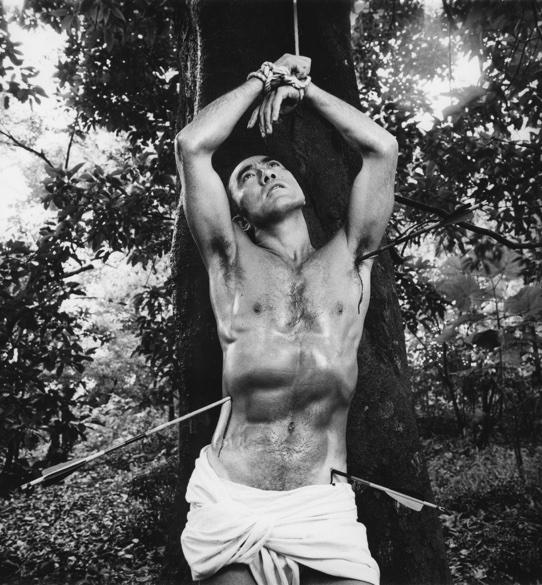
Beauty begins wherever consolation ends. It does not soothe, but rather it cuts and pierces the veil of appearances until form itself begins to fray, revealing the mortality it had tried to conceal. All beauty is touched by disappearance. What moves us most deeply does so because it has begun to fall out of being. Yukio Mishima, the mid-twentieth-century Japanese novelist and nationalist who ended his life in ritual seppuku in 1970, understood this with an intensity that was fatal. In his fction and in his meticulously staged public persona, beauty becomes the fnal measure of meaning in a world from which transcendence has withdrawn. His work makes clear that he does not seek merely to depict beauty. He longs to become it. Throughout his career, from Confessions of a Mask to Sun and Steel, and even his body through pumping iron toward an ideal that demands not representation but embodiment, an ideal he increasingly believed could be fulflled only through the dissolution of the self.
This is the primary danger of aesthetic absolutism. The desire to erase the distance between symbols and being allowed to step inside of the image and live there until the body can no longer sustain the burden. Mishima could not bear the gap between form and life. He felt words thinning reality and thus making them spectral, abstract, and corroded. He confesses so in Sun and Steel, and writes, “words are a medium that reduces reality to abstraction” Words, for him dissolved the world, the body, through discipline, could restore its density. So he turned to the fesh as his corrective. He began to lift weights and sculpt his body, not toward strength alone but toward an ideal of form he believed only death could seal. His bodybuilding, his martial training, his fxation on ritualized violence: these were not hobbies but the concrete means by which he tried to enter the image he had created, to live inside beauty rather than merely depict it.
For Mishima, language decomposed and rotted the world, but the body could redeem it. The gymnasium became a sanctuary where the fesh reclaimed the solidity that words had stripped away. Repetition, strain, and breath became the new discipline, and thus the liturgy. The body learned through pain what the mind, in its abstractions, could only spoil. As he recalls, “The steel taught me many diferent things. It gave me an utterly new kind of knowledge, a knowledge that neither books nor worldly experience can impart” (Mishima 18). If the world was to be restored to thickness and truth, the self would have to descend into the fesh, to endure the purifying labor that turns muscle into a kind of prayer. Punishment is then the form. The only way to come to perfection is thorough perishability. As Mishima believed, the disciplined body does not express vitality, it expresses willingness to vanish. Here, in this theater of the body, Mishima invents a theology without God. The
word that once became fesh is now withdrawn, leaving fesh to bear divinity alone. Transcendence does not descend, it must be forged in the musculature. Survival is then betrayal. Death is what completes the form.
This belief was not confned to his essays, as he’d been staging it long before in his fction. Runaway Horses is the clearest mirror of the ritual he would later enact upon himself. Isao, the young fanatic in the novel, lives within an ideal so incandescent it burns through him. He doesn’t seek victory but only consummation. The novel has the aura of a rite already concluded. Isao moves through it as if he were a revenant. His entire being is organized around a purity he understands as sacrifcial, telling typo how so? how so? his companions “I think he is someone who will give us a chance to die” (Mishima 113). What he moves to is the only perfection the world allows, the perfection of an image fulflled only in death. Beauty is cataclysmic in the way it destroys whatever it touches. As Isao decomposed into the ideal, Mishima soon followed.
Before Mishima rehearsed his forthcoming oblivion, St. John of the Cross had run parallel to him but with a distinct conclusion. St. John writes of the soul stripped of its senses, the intellect unseated, and the will undone. All this so that it might pass into the darkness where God dwells in a blinding brilliance. The night is a purgation and a decomposition of the faculties. For St. John, silence is not the end but the threshold. What feels like desolation is preparation and what feels like absence is the prelude to union. Negation then leads to fullness, the wound becomes the opening through which God enters.
Mishima inherits the architecture of St. John’s night but not its horizon. He undergoes the stripping, the discipline, and the refusal of the senses, but fnds no beloved in the void. His night has no dawn, what for the mystic is passage becomes for Mishima culmination. The form of sanctity remains intact, but the center has collapsed. Mishima is the fallen mystic after the death of God. In place of the divine, he installs the body, radiant, mortal, and solitary.
At this juncture, Fr. Hans Urs von Balthasar comes in and insists that beauty is the radiance of form, and that every true form gestures beyond itself toward the divine plenitude from which it springs. Beauty calls, it never culminates in itself and existence is dramatic because God is the one who writes it. In Fr. Balthasar’s logic of Theo-Drama, the human person is both actor and ofering. The drama is meaningful because it is a divine presence which gives it shape.
In Fr. Balthasar’s vision, the self does not decompose for its own sake, it gives itself away to God because it is summoned into a play authored by love itself. This pattern is christological. The self-gift, not self-erasure, surrender, not obliteration. Mishima preserves the silhouette of this drama but empties it of transcendence. He becomes the tragic double of Fr. Balthasar’s conceptual actor. Mishima performs a martyrdom without a God to receive the sacrifce. He retains the form of the sacred but removes its fullness, leaving only the aesthetic husk, luminous and collapsing.
Yet, the resemblance remains uncanny. Mishima, like the actor, knows that beauty demands response, as well as that form requires devotion. But without the Logos, or Word of God, the devotion turns inward and downward. The only thing left to ofer is the body, the only altar is the mirror, the only union is with the image one destroys oneself to inhabit. What Fr. Balthasar names as divine radiance becomes, in Mishima, the radiance of the fesh as it burns.
In the end, Mishima’s art reveals what remains of the sacred after its departure. His beauty is the ghost of theology, the afterimage of transcendence lingering in a world that has forgotten how to see it. What he inherits is only the scafolding of sanctity. Purifcation exists in Mishima along with discipline and consummation, yet the presence that once justifed them has withdrawn. What is left is a ritual without revelation, God has indeed fed. This is decay on the level of spirit. The self dissolves into form, the form rots into gesture, and the gesture collapses into death.
As he enters the night and nds only the body, luminous for a moment before its total fade. e mystic moves through negation toward higher completion. Mishima remains loyal to the wound itself. He accepts the trial without the reward, the ascetic path with God absent. is delity to the body and the void only gives Mishima’s corpus terrible grandeur. It is a delity to the ordeal that tests the spirit against the real. Mishima obeys the ideal of beauty as if it were a law handed down from an abandoned heaven.
e coup that ended his life was less a political gesture and much more like the nal movement in a long work of art. Every penstroke and torn muscle led to this. e body was prepared for this consummation. Death served as the signature at the bottom of the form he had spent years constructing. If St. John describes the soul slipping out to meet its Beloved, Mishima seeks the same passage through the only portal le to him. He enters the night not for union but for veri cation. Mishima’s disappearance into the void marks the limit of aesthetic extremity. e wound shines even a er the light has ed. What remains is beauty as the last name for the sacred, the nal power that can undo us even when it can no longer save us.
by Liepa Januskaite
I remember the frst rainfall, blades of grass, earthworms, tree bark.
It was my honor to witness, in the foliage of what humans now call sengirė, the frst spore of vovėraites. It latched and grew under the arms of a shrub - small and misshapen, and orange. It was the frst time I ever saw that orange. Similar to that of crystallized sap washed up on my Baltic shore that the wind whispered about in passing, yet eccentric. Timid.
Colonies of them grew over time, next to baravykai and mėlynės, in the hair of samanos. When the time came, they were scavenged by men hidden in trees, crunchy ice leaves, frozen words, silenced language. I was there. They dared not speak čia mano žemė, kurioje aš užaugau, kurios balsą garbinsiu.
So I spoke for them. I etched words into the hesitant sounds of their footsteps, into the weight of the illegal books in their bags, into the ornamented juostą hidden on the inner wrists of their sleeves, into the I remember.
I remember green choir chairs, folk songs loud and clear like sparrows, interwoven into golden braids and church pews. They discussed Dievo kūnas, Catholic exceptionalism, disrespect and ignorance towards the žemė that raised them. Preached Jėzus Kristus, o ne Perkūnas nei Laumė nei
I remember endless saturated skies of seeping stars – Paukščių Takas, the sweetness of unwashed carrots, red hat white polka dot poisonous pretty musmirė.
They forget to remember that their eyes come from insects enveloped in amber, fsh scales, Čiurlionio paintings, puddles of rain, the warmth of fre, softness of wood.
They forget they were forged from žeme.
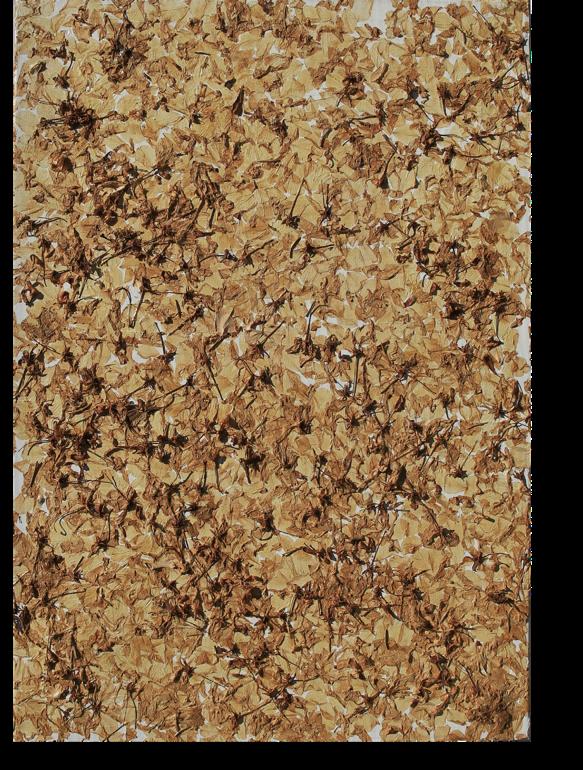
Rose, Impatiens
18” x 24” Oil and organic materials
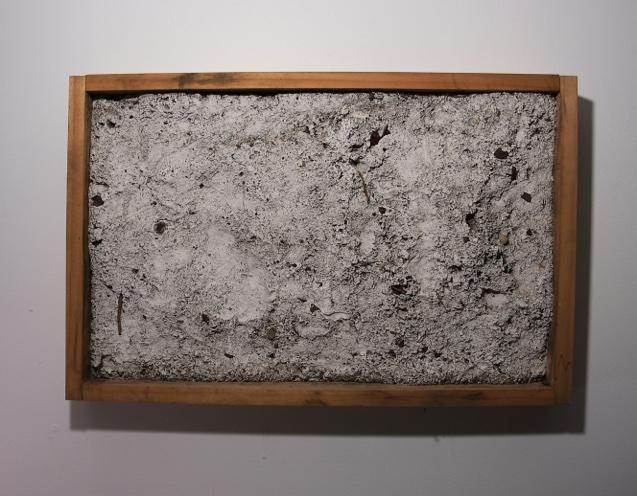
Muf’s Grave
13” x 21” Plaster and organic materials
“Muf’s Grave is an imprint of the plot of land I had buried my dog in. The land in which her body would become part of.”
Brian Guterding
K. Cherry
18” x 24” Acrylic and organic materials
cross-pollination
by Charles Stephens
a squirrel pup scatters scraps of its mossyolk coat carrying the bone of a tree in its mouth like a schoolboy running home with a tinplate sweetsbox to papa across the telephone wire draped between an old fnger & a prune tree
well light into plum-colored pools fertile breasts & artisan inks alight on the black breeze before honey & soy powder as if cooing to spring:
“take your stork-shaped scissors & open this when you miss me” consider the footfalls the bruises on fruitfesh we live just to ripen the world
Thomas Ye Spider’s Bridge
Cole Oldham Reading Up
whalefall
by Charles Stephens
delphiniums have anchor roots & little bellbonnets they catch a green ebb like a blueshift fowing like a pinafore before playing house as if there was someone left to teach us about home
Taira no Tomomori wrapped an anchor like a skirt before leaping into the ocean into his ancestors sewn into the fitting crests like the larkspur in a feld like red fecks in the seafoam
delphiniums have roots in The Aegean Sea about to fedge from the spine of a dolphin
the dinner bell rings at the bottom of the sea well-loved fossils are thick with freshing fat the crabs gather eyes low with fearsome masks dim bioluminescence praying before a meal
the best philosophers think through music
Nietzsche plays the piano a thousand bars of pressure at the seafoor greenwood cemetery sits at the bottom of the mariana trench informing every future garden of how it might spill onto the sidewalk
blind hungry mouths suck a carcass clean the invisible pollinators turning blubber into marmalade
grandma may & aunt junie are sitting with the hagfsh!
lest we forget the cadaver of history let us feast
The Undertaker and the Whore
by Juno Tagore
The undertaker lived three blocks from the freight yard, in a one story house, and he never locked the door, and everyone thought it was because no one would steal from a man who dressed the dead, but the truth was, he’d lost the key sometime in ’88 and never thought to have another cut. His name was Warren, and everyone called him Mr. Crane. He owned two suits, both black, and one hat that kept its shape no matter how it rained. The suit he wore for work had a faint smell of formaldehyde, and the other was for town meetings, which he attended, but rarely ever spoke.
The whore’s name was Alma, she had come from somewhere west, way past Nevada, and the men who saw her said she charged a fat rate and never haggled. She kept a room above the laundromat with a view of the bus depot, and her curtains were always closed.
They met on a Sunday morning when the streets were empty. Alma was walking with her shoes in her hand, a cigarette behind her ear. Warren was on his way back from the river, carrying a box with two dead pigeons inside. He had found them near the bank, their feathers wet and pressed fat. They stopped where the sidewalk buckled over the roots of an elm, she asked what was in the box, he said, just a pair of birds, and she asked if he planned to bury them, and he said yes.
After that, she came to his house on Tuesdays. Sometimes she stayed an hour, sometimes half the night. She never asked for money, they didn’t touch much. Mostly they sat at the kitchen table and drank cofee. Once she brought him a deck of cards with the corners worn round and they played rummy until the lamp burned out.
The town took notice, though no one spoke to them about it. Men at the feed store said it was unnatural, women at the diner said it
In March, a boy was found dead behind the school. No one knew his name, and he had no wallet, no shoes. Warren was called to take the body. Alma came that night and sat with Warren while he worked. She smoked two cigarettes without speaking, then asked if he wanted help. He told her no, though later he handed her a small tin of oil and asked her to shine the boy’s shoes.
By April, Alma stopped coming on Tuesdays. Warren walked past the laundromat once and saw the upstairs window open and the curtains were gone.
Summer came in dry and stayed that way. Warren took fewer jobs, people were living longer that year. The boy from March had been buried without a stone. Warren had kept the tin of oil, sitting on the shelf by the back door.
One night in late August, Warren woke to the sound of someone knocking. When he opened the door, Alma stood there barefoot, her dress torn at the hem. She said she was only passing through. He ofered cofee, but she refused. They stood in the doorway until the streetlight clicked of. She told him she had been to Alaska and back, and he asked her why, and she failed to say why. She said she had something for him and placed a folded slip of paper in his palm, told him not to open it now.
She left before the sun came up. He watched her walk until she was gone past the bend. The paper stayed folded on the table for three days, and when he fnally opened it, there was only a short list written in block letters. He put the paper in the box with the pigeons’ bones.
No one ever saw the whore again. The undertaker lived another nine years. When they cleared his house, they found the box in the back of the closet. Inside, the bones were still clean, and the paper was still folded.
A Dissection of the Rights of Women
by Hanna Liang
They say:—
“The mother of Man is lesser.”
Man is 60% of human, meaning, three-ffths of an upright homo sapien being, a person, Individual. Before “wo-” was placed before “-man” there was “wif-” before “-man” because catching a whif of a married man’s pits could tell you whether he had three-quarters of a wife, or was widowed for the stench under his arm.
Why must wife be woman? Appraised by three cents of perfume and her ability to mask cologne with fresh linen?
wife is so unlike husband from “hus-” as in “house” and “-band” from “bondi,” an owner of land, property, power. His value?
Material instead of maternal.
But what is a “house” without a woman to light the hearth?
Husband then is merely “bondi,” a bond to a lowercase i, because a man with out someone to wed is a boy not yet upper class, lowered just in case he isn’t ready for manhood yet. An i does not own a place in the womb of a girl waiting to play mother.
An i does not dare to stretch his stench over the shoulders of a girl he calls:
“Wife”
who knows that
To be Woman is to be Water.
To be Woman is to feed the fre in his hearth with her breath, oxygenized and igniting carbon dioxide. Carb- as in the macro nutrient they say she can’t eat, because micro- suits her better. Di- as in two, -oxide since one ox’s hide is not enough for a winter coat. –ide is a sufx for a binary compound, a man and a working wife.
To be Woman is to be River.
To be Woman is to be Water to rekindle and douse simultaneously, to sigh and breathe Words to melt bone and abrade stone hearts. To be Woman is to be Water: running and Wild but bottled for less than a dog’s fur pelt per gallon.
To be Woman is to be
Mammalian in Mandarin, where 我 们 means “we,” two bodies beating, two ventricles sounding a whole. Apart, they stand
Individual : 我
meaning “I” and 们, a door with 人 guarding its gaping throat.
To be Woman, then,
is to be both door and guard to a body, blemished and bro/ken in two by a cleft cleaving cardiac hands, one organ with two lives and “Man” in between.
To be Woman is to guard the open door to oneself with a radical, to stitch her bisection with the sound of a siren in winter, a keening biped surfacing to spill: a warning.
“Before I let you in, you must acknowledge my self, my 我 before quenching your thirst in my stream.”
On Wanting, Washing Hair
by Elisa Edgar Her
coming in
Come in a warm breath sigh
You soft thing as in ashes fall from skies
soft thing as in thoughts after rum a soft thing when
A sun kiss leaves a burn bruise
Escúchame: every one wants aloe vera love
breath sigh.
Come close house breeze
Close to me Closer
house breeze
droopy green living just past the tatters and water pool past window air
air thick with salt like hot red tears
sludge mud air
lizard runs a sun bath (die burn up)
little speckled gecko Girl white fower church dress sticky mango hands mango sweat stuck to Her forehead while another Tender woman slaps oil, gunk, egg, olive, green, goop, gel, mash, earth, mess, modge, podge, family fngers, tangle Her (scalp) and tangled stems surround the house
stir mulch, mush, compost memory
Put your little head down one touch face fush one touch from and fngers from air gentle breeze makes red fowers red stitch fowers red thing as in red stitch tears
red things as in man made
Careful fngers fowers on Her white dress dance sway side to side pick eat petals foat down throat down stream
I keep having dreams about babies. It is strange, it is the frst time I’ve thought of children in my mind without fear. Even if it was only in my sleep. Last night, I saw myself, I was just a baby, I knew it was me, yes I knew.
Ever since Brooklyn, I’ve been noticing the years inside my fngertips and at the back of my bones – They’ve got a little ache. I don’t want a bandaid or a kiss. Aloe Vera, VapoRub I don’t want a baby, I’ll try and shake them of.
Tiny hands – That’s me with tiny hands, sitting at a bench, Waiting
That’s me with my head shoved down in the kitchen clutter. Closely related women in coral colors, coral batas, they titter titter, stick their hands in my hair, call me tender headed, Waiting for the reasons why I’m such a cry baby.
I am too tender to be soft today instead I am stif like my fst open with force tender like afection
please stop pulling on my hair
I found soft bodies and turned away. I don’t care to care, to tend to them or their thin bone breaks I don’t care to care, to be tender
Mis manos son mías.
I have black oil root hairs coarse wire arms mustache unibrow fur matted which I learned very quickly should be sliced to civility. I have tiny hot eye pricks, brown eyes with black rims and now that I’m a woman I said I won’t shave for him. I have lemon sweet mango, I have denim stitch knees. He had a soggy cigar pinched between his wolf grin. Patchy attempts at chest hair. Patchy attempts at courtmanship, romance; paper cup sink water
Slamming fsts to foreheads
Naked children in the grass
In interest of civility, slicing, organized society: lovers lie like no tomorrow
no everlasting, no lemon sweet mango, no panels at skinny tables sucking on microphones, no wobbling white stars. No mobs of applause and old men in blue button shirts and ballerinas on the black telephone cords.
Slamming fsts to foreheads
Naked children in the grass
in ways that are weak I crush flters on concrete argue back leave chips where they fall in this way I am tender.
Leaving things where they belong then turning to tense jaws back pain neck sprains from sleeping funny but I am durable despite so with a hard heart rip meat of the bone leave it where it falls where it may order it tender eat like murder order it rare
eat like murder murder murder Dark Pink Red Bloom in the Center of the Flesh.
Mira mi boca
Mira mi boca que llora por un alivio de
¿Que?
¿Por que?
¿Why did I look like that?
¿Why did I look like that?
When did my fngertips
Swell
Get so grotesque?
Oh, I can’t remember what we were talking of –
Titter titter, mira mira,
Mira mi boca
Mira mi boca que llora por un alivio de ¿Que? Aunque no sepa…
No sé de qué hablo. Está pegado a mi lengua, que es la de mi madre.
Oh God, this is too much.
Mi boca es como mi mamá.
Tiny pink slippers in a box in the basement Colors some Colors some the In the wrong place
Just some wrong
Some colors in the wrong place.
I was sitting on the stoop outside, I was talking with girls who look like they skipped the swelling stage, girls who think of babies with a smile. My pretty, nerveless friend, she tells a story and we lean in, in, in, in, hungry for some drama we have not been told already.
She licks Hibiscus lips and starts-
“It was pouring Saturday morning. He was like, ‘Great day for a Yankees game!’ (because that’s the only thing we have in common) Later that day, I got a text: ‘You have a fan, he couldn’t stop talking about you!’”
Oh my god, I love that
“I saw him Saturday and Sunday. Last time I saw him, he was Unsure.”
I
feel the crying bench I think of all the tears I’ve spent On boys who are Unsure.
“And on Friday, he canceled: ‘I’m so sorry, I’m just so stressed about this project, I need to just go go Just go and watch a movie’”
I’ve never heard of him…I’m skeptical. It’s nice, to hear beginnings. About firting and some Nerves.
I hate that I’m a pessimist. And already, I imagine how she’ll tell us, Weeks or months from now, Of the center of her stomach. The way He makes it ache.
I imagine how they’ll stretch
Stretch out sweating on the mattress
After empty, lifeless sex
The type of sex you do while you are staring at the ceiling.
Forgiveness, Prayer (Recite Before Bed):
Forgive us for our trespasses, sins, for those who sinned against us, for forgiving means forgetting means forgetfulness, recognition means missing, for recognizing the shape of the sound of the song without a name, for forgetting the meaning but knowing the noise, Father–no, Mother, forgive my transgressions, forgive my ingratitude, forgive me for forgetting the lullaby you sang to me night after night, for hearing the tune in a crowd and feeling a tug, my inability to recognize your hands, pulling me toward you, I recognize your song but I cannot put a name to it. Forgive me for I will not put a name to it. Forgive me for washing the fruit from my hands
—forgiveness for I,
Misunderstand the diference between unstained and clean— forgetting the value of skin stuck to skin, Mother, forgiveness is a soft thing in your mouth, so forgive us for the way our fngers have swelled. How boring the supermarkets, apartments, and streets have become.
(La oración está pegada a mi lengua, que es la de mi mamá.)
Hibiscus petals fve of them
Her fve-pointed star red stars
Her favorite
color Flor de Maga “closely related” to the “common” Hibiscus
dark pink red bloom and stain lipstick steals its signature blush gold circle ear rings green goop gel
Hibiscus lips like closely related common women wear watching
fowers bloom til fve petals and girls til red lipstick
I haven’t smelled you since you were this big
Mis manos son mías. Mi boca es como mi mamá. Pero nos peinamos juntas.
I see the baby in my dream, And I stroke her soft clean hair.
Cole Oldham Incessant Perception
Everything Old is New Again: The Neblivka Hypothesis
Dirt is dirt is dirt is dirt except this one is not. This one is special. This one has a name. Chernozem. Чорнозем. Chornozem. Black soil. The black soil of Ukraine.
Land is land is land is land except this one is not. This one is haunted. This one has a name. The bloodlands. Криваві землі. Kryvavi zemli. A swath of land not quite east and not quite west fghting for its life.
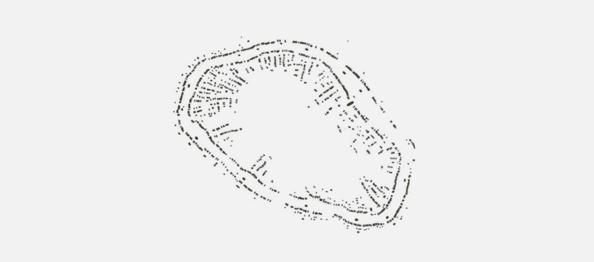
Rendered image of the Nebelivka settlement (c. 4,000 BCE), which is around 260-300 hectares in size, and was believed to be home to 15,000-17,000 inhabitants.
Let us start with the earth. The soil in Ukraine, the black earth, is among the richest soils in the world. From the ancient Greeks, to the Mongols, into the 20th century horrors of Stalin and Hitler, through to the contemporary, full-scale invasion by Russia, men have fought, killed, and died for this land. The morbid irony of so many lives lost for such a life-giving force. The Nebelivka hypothesis posits that the rich, spongy soil over which such blood has been shed might be an anthrosol: a man-made soil. Nebelivka is the 21st century name given to a monumental, ancient archaeological site. The construction of this urban society - physically and socially - produced a large-scale settlement that enriched its environment rather by Claire Killian
Somehow, the design of this city, a ring cloistering a rich, earthy center, encultured a dynamic between land and city that was generative. The anthrosol is a gift from a long lost civilization. The Nebelivka hypothesis is based on ongoing archaeological excavations in Ukraine of an ancient civilization, which radically reimagines everything we know about cities and their ecology.
The Nebelivka hypothesis is a question posed 6,000 years ago, waiting for an answer. Lying buried beneath the soil, it was rediscovered in 1964 by a Soviet air force pilot named Konstantin Shyshkin. Flying over Kirovograd, Ukraine, Shyshkin observed the faint outline of structures marked into the soil. The memory of something long forgotten by people, still held in the land. Throughout the 1960s and 1970s, Shyshkin and others would fnd 250 sites belonging to the Tryptillian culture, an ancient, expansive group of humans spread between the Carpathian mountains and the Dnirpo river between c. 5050-2950 BCE.
The Tryptillians belong to old Europe. A Europe which has long since sunk into moss and stones. Of the Trypillians, scholars know very little. They were masters of early pottery, producing swirling, painted vases and attentive fgurines. Indeed, nine pottery kilns were found at Nebelivka. They farmed cereals and practiced metallurgy. Most Tryptillian settlements did not reach the size or longevity of Nebelivka, which spanned around one square mile and was continuously inhabited for 200 years. The Trypillians are known to have burned their inhabited settlements after 50-80 years, the span of a generation. Why? Why burn your home to the ground? Why build a world just to destroy it within a lifecycle? To think about Nebelivka and her Tryptillian inhabitants, we must let go of everything we know not just about the earth or about civilizations, but about what it means to be human, to commune. We must imagine a time before up was up and down was down. The world inhabited by Nebelivka was oriented around fundamentally diferent poles. Their relationship with the earth, with each other, with life and with death, moved to a very diferent rhythm than ours does now. To think about Nebelivka and the Tryptillians, we must be more expansive, more imaginative in our understanding of
culture and civilization. As humans, we have developed a hierarchy of knowledge which places written records at the top, and resigns all other methods of record keeping to the bottom. This epistemology is limiting, it does not account for the rich multiplicity of ways in which diferent cultures preserved their knowledge, identities, and stories across generations. The archaeologists working at Nebelivka radically push against the constraints of written history by presenting the earth itself as an archive. Studying the progress of Nebelivka means accepting not just the architectural remains as an archaeological artifact, but the very earth as well.
Of 250 Tryptallian sites identifed by Shyshkin and his contemporaries, only a handful are on an urban scale. When scholars say urban, they mean urban. Nebelivka is approximately the same size as its far more famous contemporary: Uruk. Uruk of Gilgamesh. Uruk of Mesopotamia. Uruk of Inanna. Uruk over which oceans and oceans of ink have been spilled. Uruk, the proto-city, the ur-city. To talk about Nebelivka is to destabilize everything we know about a city. It is to reimagine the very word. Nebelivka is often called a ‘mega-site.’ To qualify as a city, you may not realize, requires certain things. A city must have an administrative center, which Nebelivka does not. It must have a ruling class, which Nebelivka does not. It must have written history, which Nebelivka does not. And yet and yet and yet and yet, there is the undeniable truth of Nebelivka written into the land, encoded into the soil.
Nebelivka is a settlement of approximately 250-300 hectares. Studies have identifed 1,445 house-like structures, all approximately 60m2 in size, dated to be approximately 5,000 years old. These houses were arranged into nebulous neighborhoods, which formed two concentric rings around an empty center. Or rather, empty to us. To the people of Nebelivka, this space was the beating heart of their society. In the absolute most literal sense, they placed the earth at the very center of their world. Did they envision the earth as a citizen, as a structure, as a relative? Was the relationship between the inhabitants of Nebelivka and their land a partnership? One of reverence? There is a harmony to Nebelivka, even if the song has been lost. What is absent from the rhythm, as far as scholars
can tell, is any semblance of hierarchy - economic, political, or social. There are no great temples or palaces. It is believed that Nebelivka was an egalitarian society, perhaps communally governed. We have based what we know of cities and societies on Uruk - a highly advanced and vibrant culture about which far more is known, to be sure - but also a society that enslaved, that had an absolute monarchy, and one which imposed itself on its environment. How does our understanding of what it means to be human expand when we put down Uruk for a moment and pick up Nebelivka? Human history is riddled with forks in the road, moments of cleavage where history could have spun of in a completely diferent direction. In an epoch defned by the climate crisis, Nebelivka ofers urgently needed ways of reconceiving urbanism in a way that is mutually benefcial to the land, that views the earth as being as much a part of the city as its people. Perhaps even more critically, living in a moment marked with despair about the fate of humanity, Nebelivka shows that on some fundamental level, we are capable of large-scale egalitarian life. Nebelivka shows us that we, as humans, are capable of far more than we previously thought. We are an imaginative species, one which has envisioned near infnite ways of life. Nebelivka proves that humans are capable of something as extraordinary as an ecologically generative city, that we can create structures and societies that value our relationships with each other as much as our relationship with the earth.
Nebelivka is a modern name. What the people who lived there might have called it - what they might have called each other - is known only to the black soil which cradles their bodies. Nebelivka overturns every assumption of what a city is, could, or should be. We do not know how the people of Nebelivka prayed (if they even prayed to begin with) or to whom. We do not know if they feared the frost or reveled in the snow. We do not know how they governed themselves, if they governed at all. All we have is soil and char. The black earth is an archive, a memory, the call of an ancient people echoing through the years. The chernozem is the dead giving back to the living. Nebelivka gives us more than just an anthrosol, it gives us a way of imagining a future, a precedent,
organized around diferent values. It shows us that human civilization is capable of far more imaginative, respectful, generative ways of living than we previously knew.
Notes
1. David Wengrow, The Nebelivka Hypothesis (Forensic Architecture 2023): 18-19. https://content. forensic-architecture.org/wp-content/uploads/2023/04/The-Nebelivka-Hypothesis_FA-Wengrow_Book. pdf.
2. Sebastian Dötterl, “Waging a War for Land and Soil.” ETH News, July 10th, 2024. https://ethz.ch/ en/news-and-events/eth-news/news/2024/07/blog-waging-a-war-for-land-and-soil.html.
3. David Wengrow, 7.
4. The Nebelivka Hypothesis, Forensic Architecture, 2023. Accessed December 5, 2025. https://forensic-architecture.org/investigation/the-nebelivka-hypothesis.
5. Aleksandr Diachenko and Francesco Menotti, “Proto-Cities or Non-Proto-Cities? On the Nature of Cucuteni-Tryptillia Mega-Sites,” Journal of World Prehistory 30, no. 3 (2017): 207-219. http://www. jstor.org/stable/44984517.
6. David Wengrow, 40.
7. Oleksandr Naumenko, The Wonderland of the cucuteni-Tryptillia Culture,” Google Arts and Culture, 2025. https://artsandculture.google.com/story/the-wonderland-of-the-cucuteni-trypillia-culture-national-museum-of-the-history-of-ukraine/MwWhDX1ENQSGog?hl=en.
8. David Wengrow, 18-19.
9. David Wengrow, 28-29.
10. Jason A. Ur, “Cycles of Civilization in Northern Mesopotamia, 4400—2000 BC.” Journal of Archaeological Research 18, no. 4 (2010): 387–431. http://www.jstor.org/stable/23018402.
“A layer of micron pen life, submerged in wet watercolor, then time, then a layer of micron pen life, submerged again. Echoes and traces of life through layers of fuid, now still”
Kovid Pal Odouard Ancient Life
Winter Rain (Decay)
by Rhodes M. Martinez
Greasy headlights in the fog
A shadowless and clouded dawn
Fractured bones and broken homes await
Stars will fall down from high heaven
Earth will crack and pull me down
en maybe you’ll see
What you’ve brought me to
I’ll fade away
Into the green of a sunset
I will walk between the water in the rain
I’ll fade away
Slip through the cracks in the pavement
Seep into the soil
And decay
What’s the use,
If it ain’t you?
Days will fall like winter rain
Cold and aching
Out of place
Feeding owers that will never grow
Why’d you have to hold out on me honey
Just need your heart, I don’t want your money
It ain’t right to steal the soul and leave the bones
I’ll fade away
Into the green of a sunset
I will walk between the water in the rain
I’ll fade away
Slip through the cracks in the pavement
Seep into the soil And decay
What’s the use, If it ain’t you?
Oxygen will turn to ash And all that’s good will fade to black
Just listen one more time Before I go
I’ll fade away
Into the green of a sunset
I will walk between the water in the rain
I’ll fade away
Slip through the cracks in the pavement
Seep into the soil And decay
What’s the use, If it ain’t you?
Pranay Sanwal
Still from the flm The Mark of Birth
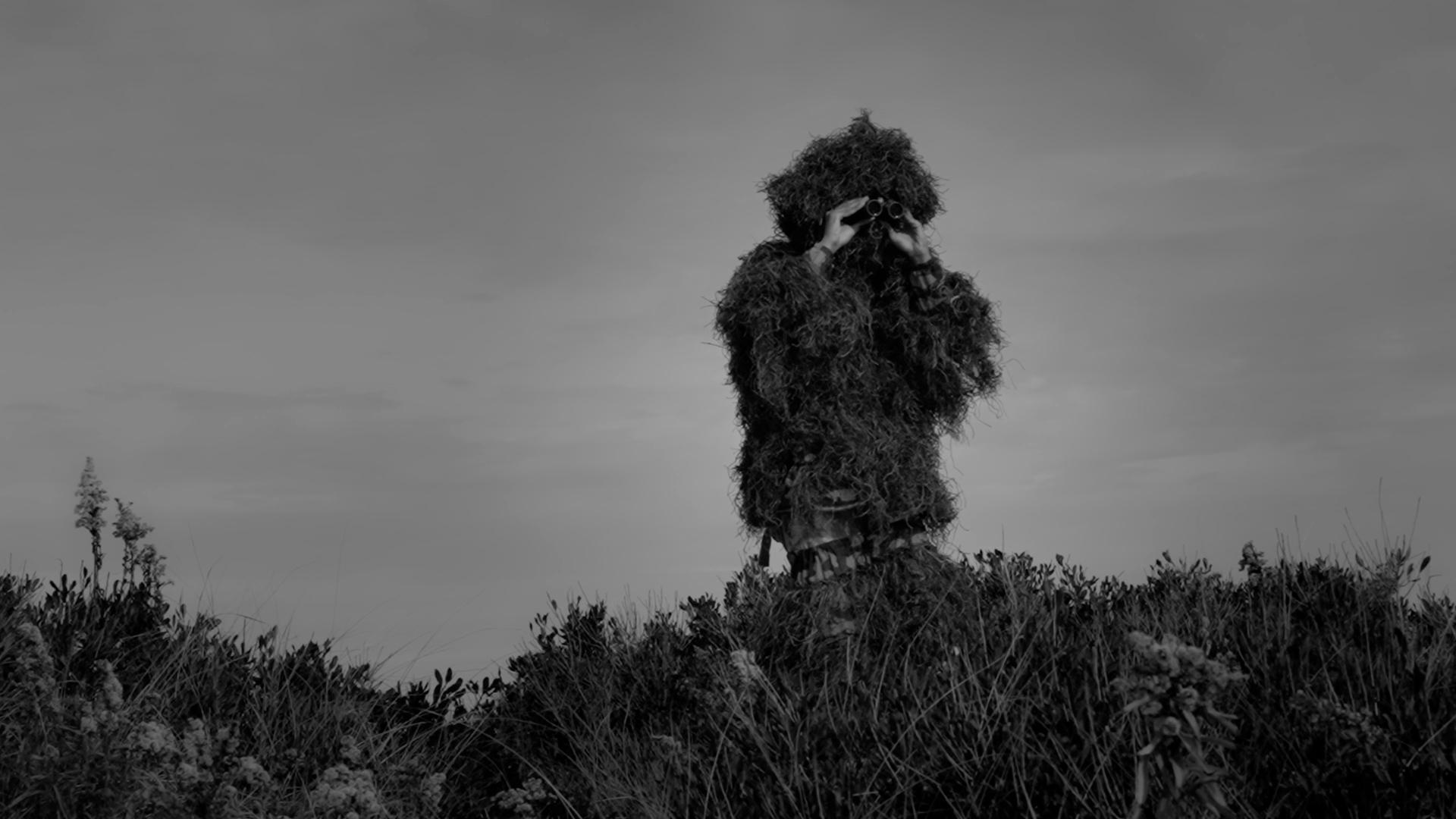
“Originally from a rural town in the state of Delaware, I am an aspiring experiential flmmaker interested in pushing both form and substance in my search for the cinematic chords that can strike the complexities of our times. My piece is a doc-fction short flm structured around the ill-defned memories that begin to haunt a man’s perception as he investigates the environmental tapestry of his past in a search for meaning. I began working on this piece in my intermediate experimental flm class at NYU. My teacher-turned-guru, Chitra Neogy, really pushed me towards making a flm that would explore my why as a flmmaker. This process of self-decomposition opened and healed many buried wounds that were eating away parasitically at my sense of self. What yielded cinematically was a meditation on estrangement that I hope can provide mutual solace within its images and sounds. I will end with a quote from one of my favorite writers, Nirmal Verma.”
“Listen, I think one should be given a chance to dissect oneself before one dies. Peel of the past like an onion. You’d be surprised to fnd how everyone—your parents, friends, husband—comes claiming his share, until you’re left with nothing more than dried up stalk which is either cremated or buried after you’re dead. It’s often said that one dies alone. I don’t agree. One dies with all those who were inside one, hated or loved. One goes with a whole world within. That’s why you’re sad when someone dies. It’s being rather selfsh though, for you mourn the part of you that will disappear forever with his depth” - Nirmal Verma, A Splinter of the Sun
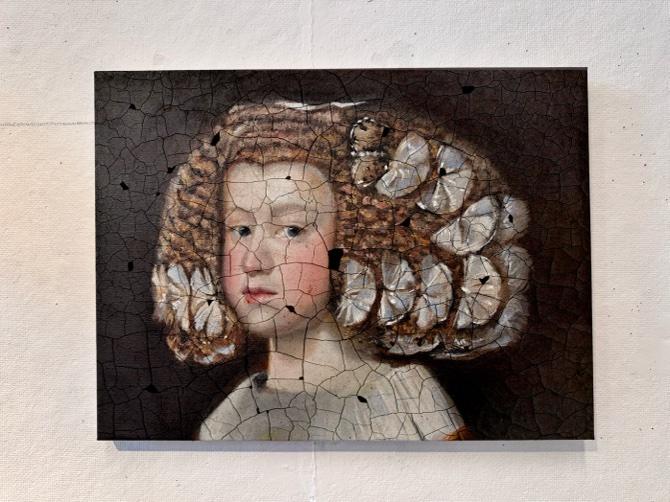
Crystal Lee Maria Teresa (1638-1683), Infanta of Spain