Board of Visitors Day continued from page 81
classroom to narrow down the choices from twelve to two. Students created voter registration cards and election posters, and some even campaigned for their favorite name. When you combine bold thinking and authentic learning, compassionate, global-minded community members follow naturally. While learning about voting as a civic duty, students are learning about the importance of their voice—that their thoughts and ideas can influence a classroom and a community at large. Because of the sand table, students were able to practice collaborative skills, use appropriate communication, and show care and kindness when disagreeing. They became emboldened to change the landscape of their classroom setting, recognizing that even at ages four and five, they have creative and innovative ideas to share. Our hope for our youngest learners is that they continue through their Brimmer
community reflecting our Core Values in action, making Respect, Responsibility, Kindness, Honesty, and Equity integral parts of their identity as they change and grow. Our goal is that they walk through their Brimmer experience as innovators and collaborators while sharing their interests, thoughts, and the foundations of who they are. Authentic learning is going apple picking with a fifth-grade Buddy and then using said apples to explore measurement and sorting. It is taking the initiative to teach classmates about an important topic by leading a discussion, like one student did when sharing the story of how she got her name: “I was named after my great-grandmother. Her name was the same as mine, but they called her Honey!” The second big question we ask students to explore is, “What is your role in your community?” PK students have been exploring the difference between wants and needs and helping fill backpacks full of school supplies for students just like them in the Greater Boston area. To inspire students
to design with great imagination and skill, we paired them with our ninth-grade Geometry students to design birdhouses for the Brimmer Organic Garden. Through Family Share, where students and parents share important aspects of their culture and family dynamics, students build compassion, empathy, and understanding for their classmates and the various cultural differences that come together to make our beautiful Brimmer community. In PK, we believe in setting the foundation for what it means to be a student and a learner, not just within the walls of Brimmer but out in the world as global ambassadors for change. We see them reaching Middle School and joining the play or musical, feeling confident on stage; trying a sport that feels unfamiliar; or adding their background knowledge of engineering and coding to the Robotics Team. We see them reaching twelfth grade with a greater understanding of who they are as they start the College Counseling process. We see them one day becoming the engineers, scientists, artists, and teachers they said they were at age four. ■
Leaving a Legacy By Dan Birdsall, Associate Director of College Counseling, Director of US Leadership Programs As with the start to their Brimmer experience, students begin their work with the College Counseling team—the first formal step in their extended exit interview from high school—by considering who they are, what they value, and how this might translate into a university experience. By the time they reach us, the exercise is lighter on finger paint, Play-Doh, and crayons and more oriented toward online surveys and college database platforms, though the core task is remarkably similar. As we regularly remind students and families, there are approximately 2,000 four-year colleges and universities in the United States! This means both that there is somewhere for everyone in the American college landscape and that there
82
Spring 2025
Brimmer Magazine
is a great deal of variety to consider. This is where knowing oneself comes in. While the college process is heavily oriented toward forward-thinking, as students conclude their time at Brimmer they are also tasked with considering their legacies at the School through the 12th Grade Project. This flexibly defined requirement asks students to contemplate how they would like to be remembered as they prepare to depart the student body—and join the alumni community—and conceive of a project that distills and captures that essence for display in a community-wide symposium at the end of the academic year. The students who fully engage with this project consistently produce results that align with their personalities and activities and astonish with their creativity, vision, and passion. Many students also take advantage of opportunities at Brimmer to build and strengthen their leadership skills. The Gator Aide Program sees seniors selected to be mentors to ninth-grade students, meeting periodically in small groups and individual settings to provide support and guidance to students as they acclimate to the demands of high school. For seniors, it’s an opportunity to reflect upon and practice role modeling, as well as a sometimes-bracing experience in managing group dynamics and leading discussions in a classroom setting during group meetings. The monthly Leadership Institute is a colloquium-style discussion series where students may begin to think about and develop a variety of professional and leadership skills. The workshops—required for Gator Aide Mentors, members of the Upper School Student Senate, and sports team captains, though open to anyone—cover topics including résumé and cover letter writing, public speaking, approaching challenging conversations, and effective networking. They are designed to be a useful starting point and hopefully a springboard for students to continue sharpening these skills as they approach adulthood.
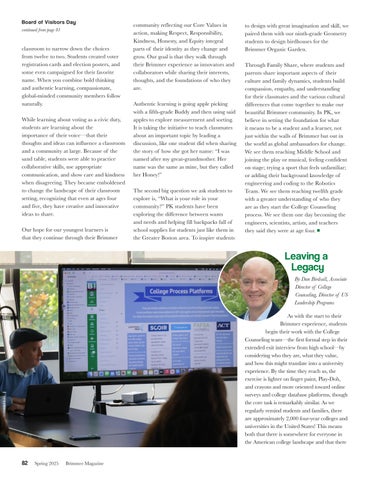
Opposite Left: Associate Director of College Counseling Dan Birdsall leads Brimmer seniors through the college application process
Upper School students are required to apply their education beyond the walls of Brimmer, as well. By graduation, students must demonstrate a minimum of 40 hours of approved community service, typically with a local organization of their choice, requiring them to put to practice what they are learning in the classroom, to explore new potential areas of academic or professional interest, and to contemplate how they might harness the privileges that many of them enjoy for the benefit of others. I’d like to share with you a bit of a closer look at how students’ final years at Brimmer challenge them to demonstrate their authenticity, their boldness, and their sense of compassion, which are the themes of this academic year. Authentic Learning A Brimmer education encourages, and requires, students to consider both who they are and who they aspire to be. Our Core Values—Respect, Responsibility, Kindness, Honesty, and Equity—speak not only to institutional expectations of how we will treat one another at school but also how we inhabit the world and live our lives beyond our time at Brimmer. The formal start of the College Counseling program partway through junior year is far from the first time a Brimmer student will have been asked to consider their values and identity or to embody them daily. We expect students to be comfortable with selfreflection by the time they reach us. The College Counseling office prides itself on focusing upon the idea of “fit” as the guiding principle in researching colleges. Fit encompasses many considerations. Some are measurable metrics: location, student body size, academic offerings, extracurriculars, and, yes, weather. Others are more abstract: student culture, campus energy, “vibes.” One student recently even had this impression of a school: “too institutiony.” Weighing the relative importance of all of these requires students to be in touch with their authentic selves and to know in what kind of intellectual and social environment they are most likely to thrive. The relative mix of factors that constitute fit is different for every student.
The notion of authentic learning requires students to understand their own learning styles and how to best position themselves for academic success. It requires students to develop priorities and chart an academic path at Brimmer that emphasizes their mental and emotional well-being as much as more traditional markers of raw achievement such as number of APs, Honors Distinctions, and test scores, and to understand the inextricable linkages between health and success. Such an emphasis on honest self-reflection extends beyond the halls of Brimmer. As a visiting university admissions representative recently underscored to students: “We are interested in: ‘Do you know yourself ? Do you know how much is too much?’” In an era of record applications and enrollment, colleges and universities are intent on building student bodies that display more than a collective capacity to grind toward surface indicators of excellence. Brimmer nurtures classroom excellence, but it also encourages experiential learning through the community service requirement. In the College Counseling office, as we familiarize ourselves with students’ academic and extracurricular profiles to write their college letters of recommendation, it’s striking to see the number of students who go beyond the required 40-hour minimum. It is a marker of students who are discovering the different things that drive them and finding joy in their work. It is also a perfect distillation of the idea of authentic learning. Bold Thinking A community as small and intimate as Brimmer makes it extremely difficult for any student to hide, to fall through cracks, or to escape the attention of faculty, administrators, or other students. In an environment where it can be a challenge to find a quiet study space or an unoccupied corner to make a private phone call or Zoom appointment, students are rarely, if ever, physically alone. Yet the college application process is, for many students, simultaneously solitary and social. It demands boldness and fortitude. continued on page 84 Brimmer Magazine
Spring 2025
83
Board of Visitors Day continued from page 83
Today’s high school students face a higher education landscape radically different from the one most of us in this room navigated. The cost of attendance of some colleges now approaches that of home ownership; institutions traditionally thought of as something of a backstop, open to most students with a reasonably successful high school record, now boast elite reported levels of selectivity; the imperatives on institutions to deliver a sharply defined ROI trickle down to students, pressuring them to identify— and, sometimes, to commit to—a career path before they have even had their first job; cottage industries in test preparation, internship and summer academic enrichment, and college and pre-professional advising market themselves aggressively, implicitly implying that students risk being left behind in a hypercompetitive world before they have even entered it. If this weren’t enough to contemplate, today’s students negotiate all the above in a panopticon in which they are both observer and observed. At their disposal are reams of data about various admissions rates, career outcomes, starting salaries, strengths of academic programs, average net costs and debt loads, and overall alumni satisfaction, all of which may be true or spun to varying degrees, depending on the source. They are flooded with social media accounts of their peers’ successes and failures, advantages and disadvantages in the college process, and (often half-baked) “inside information” about institutions. And, at Brimmer, where there is quite literally nowhere to hide, even our more introverted or private students go through a college process that is difficult to shield from prying eyes, either of their teachers or peers. It is not for the faint of heart! Yet somehow, every year, all our students pull it off. What more apt descriptor than bold can we use to describe the high-achieving student who applies to an elite institution, knowing that all the accolades that distinguish them at Brimmer likely place them in an ocean of similarly accomplished candidates, knowing
84
Spring 2025
Brimmer Magazine
that the statistical chances of rejection outweigh those of success by a factor of 10 or more? How better to describe the student aspiring to be the first in their family to attend college, navigating all these challenges without a generational familiarity with higher education? Is there a better word than bold to categorize the more marginal academic performer—surrounded by greater classroom achievement or ambition in a school that prides itself on an annual 100% matriculation rate to four-year colleges—who embraces a possibly lesser-known institution that fits their learning needs and academic background? There is boldness in authenticity! To move in one’s own direction when many others may be moving in another requires the confidence and genuineness that Brimmer seeks to instill in all its students. It also requires comfort with falling short—or, at the very least, a grudging acceptance of its possibility. If I may paraphrase a captioned picture that’s posted in the College Counseling office of Jean-Luc Picard, Captain of the Starship Enterprise, which I will remind you boldly goes where none have gone before: It is possible to commit no mistakes and still lose. That is not a weakness; that is life. Compassionate Community A recently overheard exchange between two seniors in the College Counseling office, whom I will refer to as “Student A” and “Student B”: STUDENT A: I’m nervous about my list of schools. I think they might be too selective. Honestly, I don’t know if I’ll get in anywhere. STUDENT B [stands up in front of Student A, adopts an indignant tone]: Student A! Your grades are slay! [I learned some contemporary teenage slang here; “Slay” is good.] You have an amazing list of activities, you’re a great writer, you’re one of the nicest people at Brimmer, any college is going to want you, and if they don’t, that’s their problem! STUDENT A: I love you. While compassion at Brimmer doesn’t always manifest itself quite so…aggressively, the fundamental attitude of this exchange permeates the community. Brimmer students
are inclined to lift one another up and to consider all students as peers worthy of their support, not just those in their own classroom or grade. Witness the number of Upper School students who volunteer at Brimmer summer camps, in Lower School classrooms, as Peer Tutors or Gator Aide Mentors. Brimmer has an institutional understanding of success as a collective concept, whereby individual achievement reflects positively on all members of the community, and the success of others is to be encouraged and celebrated as if it were one’s own. Similarly, falling short of one’s goals is not to be thought of as failure (remember Jean-Luc Picard?) but as a setback that brings with it an opportunity to learn and try anew. The college application process has an impersonal and quasi-bullying quality that can make students feel that their entire lives up to that point are being summarily judged by a distant and faceless admissions committee that will deem them worthy or unworthy based on a few pages of data and writing. Students are pressured to find ever more creative ways to “stand out” but also to avoid oversharing or coming across as needy, desperate, unbalanced, or just plain weird. It’s a process that is not best navigated alone, though letting others in is itself a vector for judgment, criticism, and implicit competition. Should I apply to more schools? Fewer? Is my list unrealistic? Does SHE really think she can get in there? Then maybe I could, too? Wow, he hasn’t finished his personal statement yet? Does that mean I rushed through mine? Can I afford to go there even if I do get in? One way or another, the college process leaves students exposed to the scrutiny of their peers in ways they may have been previously able to avoid. Our students largely know where their classmates are applying. They also often know when they are applying. The frequency with which Brimmer students (and students in general) apply via binding Early Decision (ED) implicitly underscores a degree of privilege, showcasing an ability to commit to enrollment without regard to the financial terms. While maintaining financial flexibility and bargaining power certainly isn’t the only reason a student
might decline to apply ED, on average the variety of available application deadlines often has the crude side effect of sorting students into groups of haves and haves-lesses. It can reflect not only on students themselves but on their entire families. Negotiating these delicate truths requires an exquisite sensitivity, a level of emotional maturity that is nurtured in a setting such as Brimmer, where successes are celebrated and setbacks are commiserated in a context of support and care. It’s hard to make it to Brimmer’s Upper School without a deeply ingrained sense of authenticity, boldness, and compassion. We assume this of our students by the time we begin working with them on our end, and we put these qualities to the test perhaps to a greater degree than they have ever experienced. It’s also important to underscore our students’ individual journeys and the varying ways they come to embody this academic year’s theme. For some, identifying examples of their authenticity, boldness, and compassion is indeed as easy as ABC. Others, though,
Above: The Class of 2024 in their college sweatshirts.
come to demonstrate these qualities gradually, indirectly, or in their own unique and surprising ways. I’ll close by sharing the story of one such recent student who Taylor and I both know well. Moni Thomas transferred to Brimmer partway through high school and came from an educational setting that could hardly be more different than ours: a large urban public school with several thousand students. Perhaps not accustomed to the degree of individual attention all Brimmer students receive, Moni could be hesitant around adults, and many teachers would likely have described him as quiet and not likely to take the first step in reaching out for help or support when needed. Moni’s authenticity, his boldness, and his compassion didn’t manifest in the classroom as saliently as some students, but he found himself through his 12th Grade Project work perhaps more than any student in his class. Spend enough time around Moni and you will learn that he has a natural gift for connecting with kids, and his role as a classroom aide in Taylor’s class during the month of May couldn’t have fit him better. Around these five-year-olds, Moni was both a kid himself— unguarded, at ease—and one of the coolest
adults they’d ever met. During the 12th Grade Project symposium, many of Moni’s classmates learned for the first time what he did for his project when they saw the photo display and report he presented on his month in the Lower School classroom. Anyone who didn’t make it to his booth quickly caught up when Taylor and her entire class came to see his presentation, and the Dining Commons erupted in delighted squeals of “MONI! MON-EEEEEEEEEE!” The entire class flocked around him as if he were a celebrity signing autographs, queuing up for hugs and high-fives. It was a beautiful confluence of the beginning and the close of the Brimmer student journey, a snapshot of the most seemingly distant members of our student community opening themselves up to one another, finding a way to learn from each other and grow together despite being separated by more than a decade. It was a perfect illustration of the authentic learning, bold thinking, and compassion that permeate the Brimmer community and why these notions underpin this academic year. ■
Brimmer Magazine
Spring 2025
85