B B
MIDDLE & UPPER SCHOOL
Curriculum and General Information Guide
2026-2027
Curriculum and General Information Guide
2026-2027
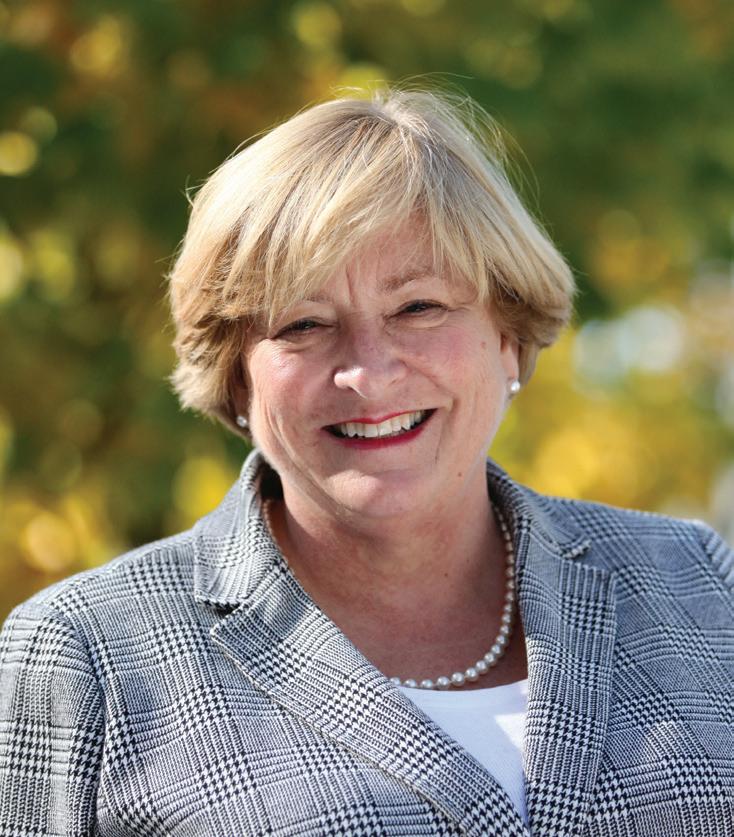
This Curriculum Guide offers several new courses and programs for the 20262027 academic year. Our courses aptly reflect the many societal changes while complementing the established curriculum essential for success. Teachers at Brimmer equip students with the content, skills, and understanding they will need to be competent and contributing members of a global society.
The teachers who offer this rich and carefully developed curriculum do so in a small classroom environment. An average class size of 12 allows for personalized instruction and student-centered learning. With 80% of the faculty holding advanced degrees, the quality of instruction and the teachers’ ability to engage students make learning meaningful. Our faculty continually adjust their pedagogies and implement innovative ways to deliver an effective and personalized education.
Students can experiment with their ideas and develop their voices in faculty-curated learning environments. The myriad of electronic resources for learning and researching allows our students to use the School’s library collection and access information available to them through our extensive online resources. The skilled and supportive faculty and librarians guide their research and analysis. In addition, the STEAM Lab, Makerspace, science labs, and Innovation Space offer our students a learning environment where they engage in inventive projects, inquiry and research, and complex problems that need solving. The School’s Digital Media Center provides a state-of-the-art newsroom and journalism center for video production, writing, and editing. This provides students with a learning environment where they can experiment with their ideas and develop their voice.
Our vibrant arts program infuses the curriculum, and students explore and develop their creativity not only in their arts courses and programs but also throughout the general curriculum. The faculty encourages students to explore originality as they demonstrate understanding of the content being taught. Many of our students win local and national awards and recognition for their work.
Several of the programs expand learning beyond the classrooms. The co-curricular experiential learning programs and global studies enrich students’ global competence. Students experience the perspectives of other people and learn how culture, new technologies, and standards of living impact viewpoints. Using
what they have learned from an interdisciplinary-focused curriculum helps them understand the world from various points of view. Likewise, the School’s commitment to diversity, equity, and belonging is reflected in the courses taught and resources used. We take an active approach to using an anti-bias, anti-racist lens to select the texts, content, and materials we use.
I hope you enjoy reading about the curriculum and programs. Our objective is to develop informed, engaged, and ethical citizens and leaders in our diverse world.
Judith Guild Head of School
The sixth, seventh, and eighth grade years are a time of transition; more importantly, these years are a time of significant growth. It is in these crucial years that students experience a broadening of their intellectual powers as they learn to think abstractly and to synthesize information and ideas.
Brimmer’s Middle School Curriculum provides students with knowledge of historical contexts
and literary works, an appreciation of ancient and modern cultures, skills in computation and communication, techniques in problem-solving and reporting on scientific topics, proficiency in English grammar and writing skills, a solid foundation in a modern world language, and exposure to the arts. In addition, students participate in physical education or interscholastic sports, creative arts productions, and an Outdoor Education Program.
On Monday afternoons from 3:30 to 4:15 p.m. in the fall and winter, students have an opportunity to participate in activities such as creative technology, math and science clubs, Makerspace Club, photography, dance, chess, book clubs, culture clubs, and others. Faculty leaders advise these groups, but students are encouraged to develop activities from among their interests, assume leadership roles, pursue personal interests, and explore new areas. Students can change their activity selection for each activity period. Participation in activities and clubs is optional.
Each year following the opening days, grades 6-8 spend two days at camp. Students are housed in cabins and spend the days getting to know their peers and their teachers as they participate in a variety of activities, including outdoor initiatives, ropes course elements, sporting events, field games, collaborative challenges, and class meetings. This is a time for individuals and classes to set goals for the upcoming year and to gain a level of comfort and familiarity with risk-taking and collaborative learning. Middle School faculty members chaperone the trip and the camp provides staffing.
The Middle School camp trip has several specific goals:
• To begin to build healthy, safe, and trusting relationships among students and between students and faculty;
• To provide students with an opportunity to take risks and challenge themselves in a supportive environment;
• To provide individual students and class groups with an opportunity to reflect upon their previous experiences and their hopes and expectations in order to set goals for the coming school year;
• To enjoy an active, fun, and unanxious start to the new school year for all Middle School students;
• To celebrate the eighth grade’s culmination of Middle School and to promote a sense of leadership, responsibility, and reflection in individuals and within the class.
To nurture a sense of social responsibility and promote a commitment to others through service, Brimmer’s Middle School has Community Service Days throughout the academic year. The goal is to have students experience the joy and satisfaction of moving beyond their own personal, immediate needs to meeting the needs of others in their community and the world.
Providing our students with structured opportunities to be global citizens is essential in creating and maintaining a community service program in the School—one with depth and meaning is of utmost importance. Students work with charitable organizations including Cradles to Crayons.
The 8th grade Honors Program is a program for our current 8th grade students. This program
is designed to offer students an intellectual extension to the required classwork with additional focus on creative problem-solving, independent thinking, extended research skills, and application of learned content and is offered in Algebra, English, History, Science, and World Languages. The offerings require reading, projects, and the exploration of additional material. This work is done individually, and the teacher acts as a coach. To qualify, a student must have earned a B+ or higher in both the first and second quarters of this year. The student, their parent or guardian, and the teacher are all required to sign the enrollment form for each class in which the student plans to do Honors work. We recommend that students do not enroll in the Honors Program for more than two subjects, and we do not allow for more than three. This is an exciting opportunity for students to delve deeper into a subject, and it has proved to be a rewarding experience for our eighth graders in the past.
Exploration Week is a signature Middle School experience designed to take learning beyond the classroom walls. Through experiential learning focused on a particular city, students engage directly with the historical, cultural, scientific, and artistic resources available in our region and beyond. The week is intentionally structured to be developmentally appropriate, building students’ independence and confidence as they progress from local day-based exploration in Grade 6 to extended travel opportunities in Grades 7 and 8. This continuum of experiences also prepares students for future school travel programs in Upper School, such as the domestic and international Winterim offerings.
Grade 6 students engage in a week of experiential learning and field trips in and around the Boston area. This Exploration Week program is designed to introduce students to navigating and understanding a major city while keeping the experience accessible and without requiring overnight travel. Students participate in interdisciplinary activities that allow them to make authentic connections across subjects as they explore Boston’s neighborhoods, museums, cultural landmarks, and natural spaces.
Each year, students in grade 7 Humanities study U.S. history and American literature. To augment their studies and provide them with an experiential learning opportunity, the School plans a four-day trip to Washington, D.C. Students explore the historical, cultural, and social aspects of our nation’s capital in order to highlight many of the themes of the seventh-grade humanities program. All students in the class attend this wonderful learning and social experience. In addition, four teacher chaperones accompany the students, and a tour guide provides insight into the city’s historical sites. The group flies from Boston to Baltimore, and the tour company provides a bus for transportation on the ground, as well as evening security guards at the hotel where the students and faculty stay. On recent trips students have visited the White House; the Senate; the House of Representatives; the Library of Congress; the Lincoln, Jefferson, FDR, World War II, Vietnam War, and Korean War Memorials; the National Archives; the Smithsonian Institute museums; the Kennedy Center; Arlington National Cemetery; Mount Vernon, and Harper’s Ferry. The trip presents students with an
opportunity to learn about U.S. government and culture and to develop self-confidence and selfdiscipline during this unique group experience.
Students in grade 8 will travel to New York City on a trip that augments their studies across content areas and provides another experiential learning opportunity. The trip, which serves as a culmination of the student’s academic journey in the Middle School, includes experiences tied to all academic disciplines including visits to the Museum of Jewish Heritage and the 9/11 Memorial (history), the American Museum of Natural History (science), and the Metropolitan Museum of Art (art), as well as attending a Broadway show (drama). All students in the class attend this wonderful learning and social experience. Five faculty chaperones will accompany students on the trip.
Inspiration speeches are a presentations given by every eighth-grade student of a topic or person that inspires the student and creates passion in his or her life. Inspiration Speeches are a chance to come together as a community to celebrate the lives of the eighth graders, support the commitment to character education, and interact with the Core Values that we teach. Inspiration Speeches are a special experience for eighth graders as they move toward a more developed sense of identity. It allows for creativity, reflection on what is important to the individual, a structured public-speakingexperience, and an opportunity to showcase technology integration skills. In preparation, students study speech writing, rhetoric and the art of public speaking. Family
members and the individual who is the subject of the Inspiration often attend. The supportive atmosphere created by the audience is uplifting and another example of how a sense of community is built in the Middle School.
The Middle School Outdoor Education Program has several goals: to provide students with personal and group challenges outside the classroom, to integrate fitness and problem-solving with outdoor educational experience, to provide students an alternate arena for appropriate and safe risk-taking, and to develop student leadership skills. The Outdoor Education Program commences with the trip to camp at the beginning of the year and continues throughout the year. One full school day three times a year is dedicated to activities that encompass either individual grades or the entire Middle School. Activities include, but are not limited to, camping, canoeing, cycling (on and off road), hiking, orienteering, rafting, rock climbing, snowshoeing, and cross-country skiing.
Social and cultural programs are an integral part of the school year. Whether an activity takes place at Brimmer or is held elsewhere, students are expected to always comply with the standards of Brimmer. The Middle School Dean and the Middle School Student Life Director, with the Head of Middle School, promote and schedule appropriate social activities for Middle School students. The School provides chaperones for School-sponsored events. The Middle School Parents Committee, a sub-committee of the Parents Association, also organizes and
supports social activities for Middle School students. Some activities offered include, but are not limited to, open gym nights, cultural events nights, astronomy nights, and dances.
Middle School Creative Arts classes focus on exploration: developing individual skills, building self-confidence, and cultivating a creative voice. A wide variety of media and concepts are introduced and become vehicles for each student’s discovery and artistic growth. Students in grades 6 and 7 attend classes in Music, Drama, and Visual Art each week throughout the school year. Grade eight students concentrate in depth on one subject each quarter, preparing them for the rigor and engagement of Upper School arts classes. In all grades, collaboration within the arts and with other disciplines further enhances the curriculum.
May Chorale is a mixed-grade chorus, open to singers in grades 6 through 8. This ensemble is an elective course that has a yearlong commitment. May Chorale rehearses two times per week as an entire group and primarily performs three-part works. Singers develop vocal technique and study sight-reading, solfege, and music theory. Performances include the Thanksgiving, Holiday, and Spring Concerts, and appearances at several School functions. Attendance at all rehearsals and concerts is required.
Students in grades 6 and 7 must participate in either May Chorale or the Middle School Band. See Middle School Band prerequisites below.
Prerequisite: Students must be able to read music or currently be taking private instrument lessons.
The Middle School Band focuses on developing ensemble skills for those students committed to learning one of the standard band or orchestra instruments. Students learn and perform a wide range of pieces taken from the classical, jazz, and pop repertoires. The Middle School Band performs in a concert at the end of each semester, as well as in occasional in-School performances during the academic year.
Within the first few weeks of each new year, students audition to participate in the fall play. Auditions are open to students in grades six, seven, and eight. Each student who auditions is cast in a role that suits both their availability and the production’s needs. The rehearsal schedule is constructed not to conflict with Athletics and other after-school Brimmer opportunities. Students work with professional sound, lighting, and costume designers, and the opportunity to work backstage is available to students who show interest. The production is performed in early December.
At the end of January, students may choose to participate in the spring musical. Auditions are open to grades six, seven, and eight. Each student who auditions is cast in a role that suits both their availability and the production’s needs. Students who are interested in working backstage are given responsibilities commensurate with their experience and commitment. The rehearsal schedule begins after March break and is designed
in coordination with the Athletic calendar and other Brimmer after-school opportunities. The production is performed in late May.
In English, sixth-grade students begin to transform from passive readers enjoying a text into active, analytical readers who understand how writers create meaning in their work. Students explore texts across cultures and genres to appreciate not only the differences between styles of writing and the perspectives of authors but also what similarities unite them. Students read poetry, prose, and graphic novels whose authors reflect Brimmer’s commitment to diversity, equity, and inclusion. To develop personal agency, sixth graders select independent reading books for creative and analytical assignments. To build a strong foundation for later grades and beyond, classes also continue to develop their understanding of grammar and expand their vocabularies.
Texts include New Kid (Craft), One Crazy Summer (Williams-Garcia), Mulan: Before the Sword (Lin), and an adaptation of The Odyssey.
In history, sixth graders study ancient civilizations of China, Mesopotamia, and Greece and the origins of the major world religions. Parallel themes across the different civilizations are emphasized throughout the year.
The year culminates with an indepth unit on Ancient Greece. Throughout the course, students explore government structure, religion, and culture. Students also examine how ancient civilizations have influenced modern society. Geography and map skills are emphasized throughout the year. Certain units of this class are integrated with English reading assignments, creative arts projects, science, and math. Throughout the year, students have opportunities to participate in a variety of exhibitions to demonstrate their mastery of content and skills.
Students in Math 6 use the Illustrative Mathematics Accelerated curriculum, which develops a deep understanding of important ideas and helps students grow in their ability to reason effectively. Math 6 provides ongoing practice and assessment of important concepts, skills, and algorithms. Major course topics include area, ratio, rates, percentages, operations with fractions and decimals, and prealgebra. Collaboration and group work are highly emphasized.
Grade 6 Accelerated Pre-Algebra (Optional)
Accelerated Pre-Algebra is an optional two-period-perweek course taken alongside Math 6 for students seeking an advanced math pathway. The course introduces key pre-algebra concepts at an accelerated pace, emphasizing algebraic reasoning, problem-solving, and readiness for Algebra 1. Placement is based on demonstrated readiness, and students must maintain strong performance in both math courses and earn a B or higher on the final assessment to continue in the accelerated sequence.
Science 6 explores the theme of rivers from the perspectives of earth, physical, and life sciences. The course begins with a unit on the physics and engineering of bridges and includes a STEAM project where students design, build, and stress test a bridge. The second unit of the year explores geology, including soil formation, erosion, and the geomorphology of rivers. The geology unit culminates with a STEAM project, which requires students to design an erosion control system that they then build and test in a stream table model, replicating the complex processes of river erosion in a laboratory classroom setting. The final unit focuses on ecology of river ecosystems, including microscopic aquatic organisms and the other animals that make rivers their home. Throughout the course, students learn how to collect data using various laboratory and field techniques, explore data through charts and graphs, and make effective written and verbal evidence-based arguments.
In Drama 6, students work to recognize connections between theater and the world in which they live. Students use ensemble building, story creation, and elements of performance to practice collaboration and presentation skills and accomplish project-based learning assignments. Sixth grade drama culminates in a cross-curricular exhibition with Art, English, History, and Math known as Greek Fest.
Students begin Music 6 by learning what makes a piece of music effective, answering the question “What are basic elements of a song?” Students learn to read Western musical notation through
engaging activities designed to develop musical literacy. Students apply their skills.to piano, guitar, ukulele, and songwriting units.
Art 6 provides creative opportunities for students to explore various media such as drawing, painting, print making, and sculpture. Projects are designed to introduce foundational skills and concepts in visual art to help each student find success in their own creativity and selfexpression.
This course helps students develop essential skills as they transition to Middle School. It starts by helping students to understand their unique learning profiles, then delves into various study and organizational techniques tailored to their individual strengths. Additionally, the course covers interpersonal skills, including online communication, teamwork, and advocating for oneself and peers. It also encourages students to recognize and address their own biases and the biases of others in the media and texts. Finally, the course concludes with a focused unit on public speaking, refining students’ ability to communicate effectively in various contexts.
Tech 6 is a bi-weekly course that spans the entire year. This course equips students with essential technology skills for success in other academic courses and beyond. Students learn skills in a range of different areas, such as email composition, word processing, spreadsheets, file organization, keyboarding, and coding. Additionally, the course covers generative AI, exploring both how it works and the importance of responsible use. Students will also explore
tech companies, gaining insights into the technology industry’s landscape. The goal of the course is to build a diverse range of digital skills that students can apply in their other classes and further develop in Tech 7 and Tech 8 courses.
Students in grade 6 elect the language they would like to study for the year. The options are French, Spanish, or Mandarin.
6th Grade French: Topics in Culture and Communication
This course introduces students to the French language and Francophone cultures. The emphasis of the course is on developing listening, oral communication, reading, and writing skills on a basic level. Students learn greetings, introductions, and ways to describe themselves and others. Current events and cultural topics of interest in the target regions are introduced, explored, and reinforced. The course serves as a precursor to a more formalized study of the language, which will foster the development of writing skills in the following year.
6th Grade Mandarin: Topics in Culture and Communication
This is an introductory-level course of Chinese, which engages the students in the study of both the language and culture. The emphasis is on developing listening and oral communication skills at a novice level. This course uses the textbook Traveling in
China (Chinese in Focus) with supplementary materials. In addition to using the textbook, students will be exposed to some selected authentic materials such as songs, poems, rhymes, stories, cartoons, and movies to explore the language and culture. The course serves as a precursor to a more formalized study of the language, which will foster the development of writing skills in the following year.
of English-—history and English. As students become increasingly adept at approaching and successfully completing projects, the ELS classroom becomes a place for enrichment —where students read short stories and novels, usually with a cultural focus, and where regular writing practice, vocabulary skill-building, and grammar are stressed alongside active participation in discussions and the development of presentation skills. Students are strongly encouraged to use the Writing Center.
Communication
Spanish 6 initiates students into the study of a new language. The course helps students develop a sense of the Spanish language in their initial studies, combining investigation of cultural topics with lessons on language mechanics. Students will build a basic vocabulary, understand basic linguistic structures, and learn about and appreciate the culture of the countries where the target language is spoken. An equally important goal is the acquisition of the skills necessary for effective reading and writing in Spanish by learning about types of words. Student participation, both in and out of class, is emphasized.
This course provides students with a solid foundation for success in a mainstream classroom setting by developing their writing, reading, speaking, and listening skills. The ELS teacher works closely with humanities teachers to provide ELS students with the support to best understand, organize, and follow through on assignments in the subject areas that are most difficult for nonnative speakers
Students in grade 6 participate in a PE class that meets weekly during the school day. Students are required to wear appropriate sneakers. Students in grade 6 also have the option but are not required to participate in the Middle School sports program for each of the three seasons (fall, winter, and spring). If students choose to participate in the Middle School sports program, they are required to attend practices and games. Practice is from 2:30 to 4:15 p.m. Tuesday through Friday throughout the season. Games are scheduled Tuesday through Friday, have various start and end times, and are played at a variety of locations.
soccer, cross country, recreational tennis, volleyball,and fitness
Winter
basketball, yoga, recreational skiing/snowboarding, and fitness
Spring softball, baseball, recreational lacrosse, ultimate frisbee, and fitness
Students participating in interscholastic sports must commit to attend all practices and games and maintain good academic standing. Students must provide appropriate equipment (cleats, softball or baseball glove, basketball sneakers, etc.) for each interscholastic sport. Students may choose, but are not required, to participate in one, two, or three seasons of interscholastic sports.
English 7
Students in English 7 work to develop the ability to access layers of meaning in texts across different genres and mediums. English is a living language, and the meanings of words, styles of literature, and conventions of communication change dramatically over time and vary greatly by context. With this understanding in mind, students explore texts collectively in class and through independent reading to understand the techniques writers use to affect their audiences. They also develop their voices as both analytical and creative writers.
In addition to creative writing assignments, students work on crafting thesis statements and incorporating textual evidence in analytical essays.
In an interdisciplinary exhibition through History, English, Art, Science and English, seventhgrade students research the past and present states of Indigenous
societies, explore archaeological ethics, and create their own folktale stories.
Texts include When You Trap a Tiger (Keller), Brown Girl Dreaming (Woodson), American Born Chinese (Yang), and Nimona (Stevenson).
Students in History 7 explore the themes of democracy, citizenship and civics, freedom and oppression, justice and injustice, race and racism, individual and group identity, and activism through a series of case studies from American history. Students act as historians, analyzing primary and secondary sources, developing guiding research questions, and forming their own thesis statements, which they back up with textual evidence and cogent reasoning. They examine a variety of historical texts, working to hone their reading comprehension, active reading, annotating, research, and writing skills. Students keep a writing portfolio throughout the year, as they practice skills that will enable them to compose their own written, original historical analyses. They share their findings through several types of class discussions, individual and group projects, structured historical simulations, exhibitions, interdisciplinary work, and formal essays. Throughout the year, students explore the myriad links between history and other academic subjects, as they seek to understand how the world they live in has been and continues to be shaped. These connections help students think critically about the way they read and write history and the importance of considering multiple perspectives and voices left out of traditional narratives to improve our understanding of the past and strive for a better future.
7
Students in Math 7 utilize the Illustrative Mathematics Accelerated curriculum which develops a deep understanding of important ideas and helps students grow in their ability to reason effectively. Math 7 provides ongoing practice and assessment of important concepts, skills, and algorithms. The major course topics explored are scale, similarity and slope, equations and inequalities, linear functions, and exponents. Throughout the year, students are encouraged to collaborate effectively, to adopt a disciplined approach to their work, and to seek support when necessary.
Grade 7 Accelerated Algebra 1 (Optional)
Accelerated Algebra I is an optional course taken alongside Grade 7 Pre-Algebra for students pursuing an advanced math pathway toward Geometry in 8th grade. The course covers the full Algebra I curriculum at an accelerated pace, including linear equations, systems of equations, and quadratic relationships, with an emphasis on algebraic reasoning and problem solving. Placement is based on demonstrated readiness, and students must maintain strong performance in both math courses and earn a B or higher on the final assessment to continue in the accelerated sequence.
The seventh-grade science course takes an inquiry-based approach to learning about the diversity of life in the natural world, as well as new frontiers of engineering design. Through a combination of handson experimentation and projectbased learning, students engage in topics such as the definition of life, evolution, genetics and
inheritance, archaeology, and plants and hydroponics, while learning about the scientific method, lab techniques, and report writing. The course also includes a STEAM design unit using biomimicry to develop potential solutions to climate change, as well as a unit exploring the engineering design process culminating in a robotics unit using VEX IQ robots.
Drama 7 explores improvisation in all its forms. Students develop and hone basic drama skills, including risk-taking, listening, accepting, following, and initiating inside improvisational exercises. Shortand long-form improvisations are introduced as students expand their ensemble skills and learn to develop stories and characters in the moment and build upon their skills in cooperation, collaboration, and negotiation.
Music 7 sees students continue to explore the art form from a variety of perspectives. Students learn rhythm fundamentals by forming a bucket drumming ensemble and piano skills by taking up keyboards. Students are introduced to and explore many different music traditions including Western classical, Indian classical, qawwali, gagaku, and gamelan music. They also learn how the complex history of the United States shaped the development of jazz and hip-hop.
Art 7 continues to engage students with a variety of visual art media, techniques, and artistic styles. Students continue to develop and articulate their understanding of visual concepts through more advanced techniques. The emphasis of this course is to help each student to find success in their own creativity and selfexpression.
Growth Education 7 is a weekly course that spans the entire year. The class delves into essential social themes, such as antibias practices and strategies for navigating peer relationships and social media dynamics. Students engage in discussions and activities aimed at fostering a deeper understanding of social issues while promoting positive interactions.
Tech 7 is a bi-weekly course that spans the entire year. This class focuses on enhancing digital literacy skills, with an emphasis on practical applications such as CAD modeling, augmented reality, and coding. Through hands-on exercises, students explore digital tools and technologies essential for utilizing makerspace equipment, including 3D printers and laser cutters.
Middle School students have three choices for modern language study: French, Mandarin, or Spanish. Students are placed in course levels and sections based on their assessed ability through placement testing and/or previous study at Brimmer or another school. Within the first month of the academic year, students may be moved among the levels dependent upon their demonstrated ability within a course.
MS French 1A serves as a formal introduction to the French
language and Francophone cultures. Students learn to conjugate regular and irregular verbs, use more advanced vocabulary in a wide range of activities, and increase their listening and reading comprehension. Students also begin to learn helpful rules for pronunciation in French, to create sentences verbally and in written format, and to have simple conversations in French.
Middle School Mandarin 1A
This introductory-level Chinese course engages students in the study of both language and culture, with an emphasis on developing listening, speaking, reading, and writing skills. Students are introduced to topics such as greetings, families, school, countries and nationalities, food, daily routines, sports, and personal introductions. Through a variety of activities, students expand their vocabulary, begin forming more complex sentences, and improve their comprehension.
Middle School Spanish 1A
Spanish 1A is a formal introduction to the language and cultures of the Spanish-speaking world. Students build on basic, highfrequency structures to develop proficiency in producing and interpreting both written and spoken Spanish. Students expand their vocabulary and enhance their skills by engaging in a variety of interactive and communicative activities with a real-world focus. Reading comprehension skills are developed via a short Spanish novel. Students also begin interacting with authentic, target language resources such as articles, infographics, music, and videos.
This course provides students with a solid foundation for success in a mainstream classroom setting by developing their writing, reading, speaking, and listening skills. The ELS teacher works closely with humanities teachers to provide ELS students with the support to best understand, organize, and follow through on assignments in the subject areas that are most difficult for nonnative speakers of English— history and English. As students become increasingly adept at approaching and successfully completing projects, the ELS classroom becomes a place for enrichment, where students read short stories and novels, usually with a cultural focus, and where regular writing practice, vocabulary skill-building, and grammar are stressed alongside active participation in discussions and the development of presentation skills. Students are strongly encouraged to use the Writing Center.
The sports requirement for seventh and eighth grade is a minimum of one season of a team sport. If students play only one season of a team sport, they must choose an activity for the other two seasons. If they play two seasons of a team sport, they may take one season off.
The Middle School sports program requires practice from 2:30 to 4:15 p.m. Tuesday through Friday throughout the season, and participation in interscholastic
games. Games are scheduled Tuesday through Friday, have various start and end times, and are played at a variety of locations.
Students participating in interscholastic sports must commit to attend all practices and games and maintain good academic standing. Students must provide appropriate equipment (cleats, softball or baseball glove, basketball sneakers, etc.) for each interscholastic sport.
Please see the listing at the end of the eighth-grade section for athletic offerings.
In conjunction with the History curriculum, students in English consider the critical choices individuals make and how the decisions of communities and nations can affect entire populations. Class discussions explore how writers share and create perspectives in an effort to better understand our own views of the world. Texts include Macbeth (Shakespeare), Night (Weisel) and Aristotle and Dante Discover the Secrets of the Universe (Saenz). These texts continue the theme of exploring identity that is prominent throughout the Middle School English curriculum. Students study speech writing, rhetoric, the art of presentation, and writing formal analytical essays that incorporate textual evidence using MLA formatting. Weekly routines include writing workshops and vocabulary and grammar lessons.
The year’s culminating assessment is a multi-genre project in which students demonstrate skills
gleaned from their year’s work to highlight an important social changemaker.
The Humanities 8 curriculum focuses on essential questions concerning identity, othering, leadership, responsibility, and power dynamics. Using these questions as a guide, students explore the Holocaust, the Cultural Revolution in China, and the British Raj in India. Through these lenses, students examine how leaders of these events in history obtained, abused, and lost power; how the people in these societies reconciled who they were as individuals with the sociopolitical context in which they lived; and how power dynamics have impacted and continue to impact culture and history.
Students in History 8 use various resources to explore these historical time periods and make connections between present-day events and those that happened decades ago. Assessments, thesis-driven essays, and various discussion formats allow for opportunities to practice extracting pertinent themes from history and making connections between the events discussed.
Algebra I is the heart of the sequence of the School’s secondary mathematics curriculum. The curriculum follows a traditional course sequence of Algebra I, Geometry, Algebra II, Precalculus, and Calculus. The topics covered in Algebra I include solving equations and inequalities; graphing lines and inequalities; solving systems of equations; adding, subtracting, and multiplying polynomials; and finding zeros of quadratic equations by factoring and using the quadratic formula. Problem-
solving techniques are also emphasized throughout the course through real-life applications and projects.
Science 8 is the final year in a threeyear sequence of science classes that integrates physical, life, and earth sciences. Students explore matter and energy, examining how these two phenomena help explain the universe across a range of scales from subatomic particles to the structure of planets and stars, and build on previous years through laboratory experiments, report writing, and project-based learning. The year begins with an experimental design project, providing students with a holistic understanding of the scientific method and the habits of mind required for scientific inquiry. Through this project, students learn how to ask testable questions, identify independent and dependent variables, establish controls, collect and analyze data, and draw evidence-based conclusions. Next, students engage in a physical science unit that is a laboratory-based introduction to chemistry, in which students learn about the atomic theory of matter. The following unit explores the physics of several types of energy. The earth science unit builds on the material from the previous two units to examine how matter and energy help explain the composition of stars, the formation and internal structure of the earth, and plate tectonics. In each of the three units, students learn how to use laboratory equipment to conduct experiments and collect data that they analyze through graphs, charts, and written lab reports.
Students in eighth-grade Drama work to understand the elements of what makes a good story,
inspired by Aristotle’s Poetics By exploring thought, diction, character, plot, technical theater, and spectacle in various modalities, including performance and projectbased learning, students connect to the world of theater. Through projects like tableaux exploration, character creation, and technical theater study, students have the opportunity to express and better understand themselves as artists through exploring ideas that are motivated by choice.
Students in Music 8 continue to strengthen their understanding of Western musical notation and apply their skills to more challenging piano exercises and compositions. Lessons also explore non-Western cultures and the central role that music plays in everyday life around the globe.
Students in Art 8 explore a variety of media and techniques with an emphasis on observation, exploration, and skill development. Diverse historical references, advanced visual concepts, and critiques provide the framework for each student’s development while preparing them for the Upper School. In the fourth quarter, the class explores cross-curricular collaboration.
Education 8
In this course, students continue to build the essential digital and interpersonal skills that will help them find success as they transition to Upper School. The course also examines topics such as securing personal data online, recognizing biases in the media, and navigating online and in-person peer relationships. Students also explore strategies for maintaining a healthy balance in their use of technology and managing stress.
8
Tech 8 is a bi-weekly course that spans the entire year. Building on the skills learned in Tech 7, students apply their digital literacy skills by creating projects that complement the eighthgrade curriculum. These projects incorporate 3D printing, vinyl cutting, laser cutting, augmented reality, and AI, allowing students to expand on their work in Humanities and Science classes.
Middle School students have three choices for modern language study: French, Mandarin, or Spanish. Students are placed in course levels and sections based on their assessed ability through placement testing and/ or previous study at Brimmer or another school. Within the first month of the academic year, students may be moved among the levels dependent upon their demonstrated ability within a course.
Middle School French 1B
Students continue to hone and expand their knowledge of grammar and vocabulary. Proficiency in speaking and writing is emphasized, and reading comprehension is further developed through dialogues and short cultural readings. Students who complete this course continue with Upper School French II.
Middle School Mandarin 1B
Students continue to hone and expand their knowledge of
grammar and vocabulary. Upon completion of the textbook and workbook in the spring, students will engage in a capstone project where they bring their language skills together to create a Chinese museum. Students will have a field trip to the Peabody Essex Museum to learn about Asian art and how galleries and exhibits are put together. Proficiency in speaking and writing is emphasized, and reading comprehension is further developed by reading a short, leveled reader. Students who complete this course continue with Upper School Mandarin II.
Students deepen and strengthen their knowledge of the language, working to make their speech and writing more fluid. Students will work towards maintaining 90% of the class in the Spanish language. Students expand their knowledge of grammar and vocabulary and work to improve their proficiency with speaking and writing through classroom activities and various projects. Reading comprehension skills are developed via a short Spanish novel. Students who complete this course successfully continue to Upper School Spanish II.
This course provides students with a solid foundation for success in a mainstream classroom setting by further developing writing, reading, speaking, and listening skills. The ELS teacher works closely with humanities teachers to provide students with the support to best understand, organize, and follow through on assignments in the subject areas that are most difficult for
nonnative speakers of English––history and English. As students become increasingly adept at approaching and successfully completing projects, the ELS classroom becomes a place for enrichment—where students read short stories and novels, usually with a cultural focus, and where regular writing practice, vocabulary skill-building, and grammar are stressed alongside active participation in discussions and honing presentation skills. Students are strongly encouraged to use the Writing Center.
Fall
soccer, cross country, volleyball
Activities: recreational tennis, and fitness
Winter basketball
Activities: recreational skiing/ snowboarding, and fitness
Spring
lacrosse, softball, baseball, and tennis (varsity level with tryouts)
Activities: ultimate frisbee, fitness
*Programs must meet minimum enrollment to run.
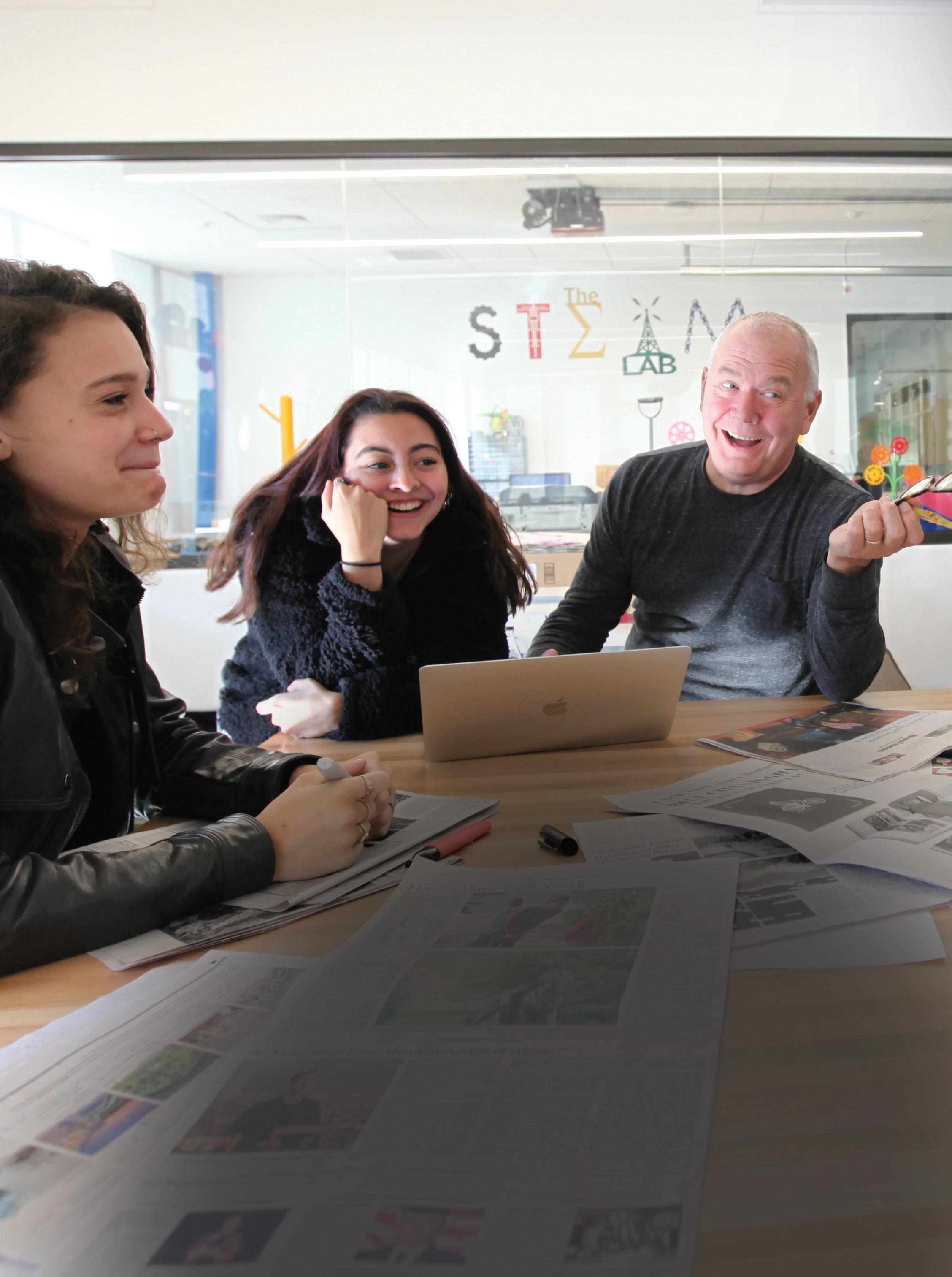
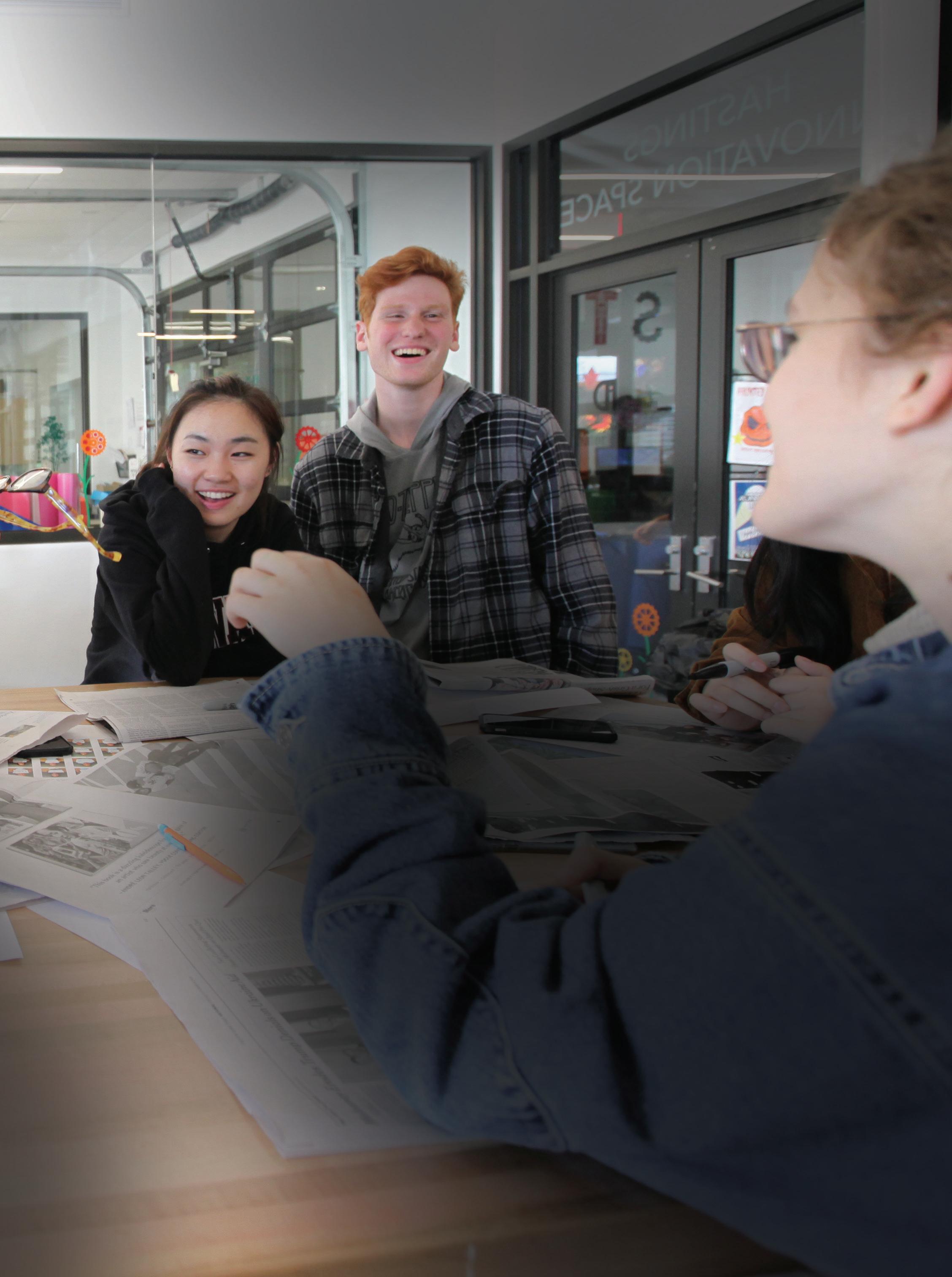
Our Upper School program presents a challenging and engaging curriculum that balances specific course requirements with a wide range of electives and global and travel experiences, which gives students increasing choices as they prepare for post-secondary study. The program offers ways for students to grow intellectually, focuses on local and global issues, and supports students’ growth as adolescents through Wellness offerings. Students are given an opportunity to pursue their interests and passions through courses, clubs and activities, and after-school programming such as athletics and theater productions.
Upper School students are expected to take the equivalent of five fullcredit academic courses each year.
A total of 22 credits is required for graduation, although most students earn more.
The four-year course of study for students in grades 9 through 12 must include the following credits:
• English (4 credits)
• History (3 credits)
• Mathematics (3 credits)
• Science (3 credits)
• World Languages (3 consecutive credits)
• Creative Arts (2 credits)
• Technology (1 credit)
• Community Service (40 hours)
• Athletics/Physical Education (4 years)
An additional 3 credits are obtained by enrolling in classes (offered in various departments) that are above and beyond the required course of study.
A minimum number of students may be necessary for a course to be offered. Some courses have limited enrollment. Courses are subject to change by departmental decisions. If a course cannot be offered due to student enrollment, students may have the option to take a similar course through One Schoolhouse (refer to the One Schoolhouse section for more information).
Students who transfer into the Upper School after grade 9 may meet the requirements with comparable courses or may have proportionately reduced elective requirements.
Brimmer and May Upper School provides students with the opportunity to pursue excellence through three Signature Diploma Programs: Creative Arts, Global Studies, and STEAM. These programs are designed to offer a rigorous curriculum paired with the intellectual and creative freedom for students to delve deeply into areas they are passionate about.
Through intensive and rewarding coursework, students engage in advanced, hands-on learning experiences that prepare them for success in college and beyond. Graduates of these programs earn a specialized diploma, a prestigious academic distinction that sets them apart in the college admissions process.
The Creative Arts Diploma Program provides students who demonstrate a determined interest in the arts with the opportunity to focus on a chosen art form, the tools to create a portfolio documenting their work, cultural connections to the Boston arts community, and a venue for participants to share their talents with the larger community. A minimum two-year commitment is required, including participation in the 12th Grade Seminar. There is a field trip fee for this course.
The Creative Arts Diploma Program is composed of students in grades 10-12 who have a deep commitment to visual arts, music, dance, theater, video, or creative writing; have already developed
considerable skill in that area (called a “concentration”); and have a strong inner drive to pursue further study.
Each CAP Diploma student works out a personal program with the Creative Arts Chair and members of the Creative Arts Department yearly. These plans vary widely and are tailored to each student’s interests and needs.
Upper School students may apply for admission to the CAP Program toward the end of their ninth or tenth grade year. The application materials are released shortly after Winter Break each year. Completed applications are due on the first of May. Application materials are reviewed by the Director of the CAP Diploma Program and members of the Creative Arts Department. Upon review, applicants are interviewed by the Director and appropriate members of the Creative Arts Department.
All Creative Arts Diploma students must:
• maintain a minimum B average in all CAP-related courses.
• document a minimum of 7-10 hours a week of work in the chosen concentration, beyond school time, in their CAP journal. This can consist of lessons, practice time, rehearsal, studio time, research, viewing, reading, meeting with a mentor, journal keeping, etc. Bi-weekly CAP lunches are held to share and review journal progress with Creative Arts faculty and the CAP cohort.
• participate in all master classes and field trips arranged for CAP Diploma students, unless excused due to illness or other School commitments. This is
approximately 12 events per year, distributed across all concentrations, both at Brimmer and in the Boston metropolitan area.
• prepare and participate in CAP juries each semester, outlining achievements and future goals in the chosen concentration and defending work to Creative Arts faculty and the CAP Director.
• participate in the yearlong 12th Grade CAP Seminar, culminating in planning for and performing in the CAP Exhibition in April.
• demonstrate a commitment to sharing work with the School community with increasing frequency and complexity as students move through the program. CAP students must initiate and complete five hours of Community Connections each year they participate in the program. (See Concentrations below for suggestions.)
CAP Concentrations & Requirements
Students must select a concentration when applying to CAP. A concentration is a focus of study that can be individually tailored to suit specific student interests. Common concentrations are below:
Studio Arts Concentration
Required Courses:
• Drawing or Painting (1/2 credit)
• Advanced Drawing and Painting (1/2 credit)
• AP® Studio Art (1 credit)
Community Connection Suggestions:
• Curate an exhibit
• Review an exhibit
• Shadow an arts professional
• Participate in Admissions events
Photography Concentration
Required Courses:
• Drawing or Painting (1/2 credit)
• Darkoom Photography (1 credit)
• Digital Photography (1/2 credit)
• Digital Photography II (1/2 credit)
• AP® 2-D Design (1 credit)
Community Connection
Suggestions:
• Curate an exhibit
• Review an exhibit
• Shadow an arts professional
• Participate in Admissions events
3D Concentration
Required Courses:
• Drawing or Painting (1/2 credit)
• Ceramics (1/2 credit)
• Sculpture (1/2 credit)
• Advanced Ceramics (1/2 credit)
Community Connection
Suggestions:
• Curate an exhibit
• Review an exhibit
• Shadow an arts professional
• Participate in Admissions events
Music Performance Concentration
Required Courses:
• The Gator Scales or Greenline (2 credits)
• Two Music Electives (1 credit)
Strongly Encouraged:
• Weekly lessons
Community Connection
Suggestions:
• Organize and execute a recital or public performance
• Perform with an outside group
• Offer lessons
• Shadow an arts professional
• Participate in Admissions events
Theater Concentration
Required Courses:
• Digital Cinema (1/2 credit)
• Acting or Improvisation (1/2 credit)
• Stagecraft or Production (1/2 credit)
• Additional Theater Elective (1/2 credit)
• Participation in 2-3 US productions annually
Community Connection
Suggestions:
• Direct Student Directed Play
• Perform with an outside group
• Offer lessons
• Shadow an arts professional
• Participate in Admissions events
Musical Theater Concentration
Required Courses:
• Greenline (2 credits)
• Acting or Improvisation (1/2 credit)
• Additional Music Elective (1/2 credit)
• Participation in US Musical and US choral concerts
Community Connection
Suggestions:
• Direct Student Directed Play
• Perform with an outside group
• Offer lessons
• Shadow an arts professional
• Participate in Admissions events
Digital Cinema Concentration
Required Courses:
• Digital Cinema I & II (1 credit)
• Adv. Digital Cinema I & II (1 credit)
• Darkoom Photography (1 credit)
• Acting or Improvisation (1/2 credit)
• Independent Study in Digital Cinema (1/2 credit)
Community Connection
Suggestions:
• Organize and execute a screening
• Attend a film festival
• Shadow an arts professional
• Participate in Admissions events
Requirements for Earning a Creative Arts Diploma with Distinction
In addition to completing the coursework required, students who seek to graduate from the program with distinction must demonstrate:
• Consistent grade of A in each grading period
• Proof of consistent leadership in the Creative Arts Department
• Participation above and beyond the program requirements
• Excellence in both performance/ execution and scholarship in chosen concentration
• Creative Arts Department faculty vote of earned distinction
This Signature Diploma Program is specifically designed to engage students intellectually in international and global studies and prepare them to be informed, involved, ethical citizens in a global society. The program entails concentrated and advanced coursework in history, geography, world politics, economics, art, culture, world languages, media,
ECONOMICS GRADE 10
English II
World History II
Physics/Science Electives
Math
World Language
Foundations Elective
Principles of Economics
Art or Tech Electives
POLITICAL GRADE 10
SCIENCE English II
World History II
Physics/Science Electives
Math
World Language
Foundations Electives
SCIENCE GRADE 10
English II
World History II
Physics/Science Electives
Math
World Language
Foundations Electives
Art or Tech Electives
WORLD GRADE 10
LANGUAGES English II
World History II
Physics/Science Electives
Math
World Language 1
World Language 2
Foundations Electives
GRADE 11
English Elective/AP® English
U.S. History
GRADE 12
English Elective/AP® English
AP® Economics
Chemistry/Science Electives Science Electives
Math Statistics or Math Elective
World Language
AP® Economics
Foundations Elective
Art or Tech Electives
GRADE 11
English Elective/AP® English
U.S. History
Chemistry/Science Elective
Math
World Language
World Language
Humanities Elective
Art or Tech Electives
GRADE 12
English Elective/AP® English
Global Studies Pol. Sci. Elective
Science Elective
Math Electives
World Language
Global Studies Pol. Sci. Electives Art or Tech Electives
Art or Tech Electives
GRADE 11
English Elective/AP® English
U.S. History
Chemistry/Science Electives
Math
World Language
GRADE 12
English Elective/AP® English
Global Studies Pol. Sci. Electives
Global Studies Science Course
Math: AP® Statistics
World Language
Global Studies Science Course Art or Tech Electives
AP® Environmental Science
GRADE 11
English Elective/AP® English
U.S. History
Chemistry/Science Electives
Math
World Language 1
World Language 2
Art or Tech Electives
GRADE 12
English Elective/AP® English
Elective Course
Foundations Elective
Math Elective
World Language 1
World Language 2
and science. Offering experiential learning opportunities and community engagement, the program promotes students travel, public speaking, and community service opportunities and features learning experiences outside the classroom through university lectures, author book talks, gallery and museum exhibitions, and independent study.
Upper School students may apply for admission to the Global Studies Program at the end of ninth or tenth grade. Students submit an application and a plan of study for their tenth, eleventh, and twelfth grade years. Applications are reviewed by the Global Studies Program Supervisory Board, composed of the Director of Global Studies, several Upper School faculty members and Department Heads, and the Head of Upper School as needed. The Supervisory Board reviews student status in the program at the end of each year.
In their application into the program, students choose a major and minor concentration in combination among these five disciplines: Economics, Journalism, Political Science/History, Science, World Languages. To receive a Global Studies Program Diploma students must meet all the following criteria:
• Complete all required coursework (see below)
• Earn 3.5 credits in concentration/ minor coursework
• Earn a total of 650 points through co-curricular activities, including one Winterim Trip abroad
• Maintain a B average in all Global Studies course work
• Complete the Senior Capstone Project
Program courses cover a broad range of global education topics from Marine Science to Global Art History to International Relations. Throughout the program, students earn points in three key categories: Global Action, Cultural Engagement, and Student Choice (see below). The program culminates with the program’s Senior Capstone Project, where students write a self-reflection essay on their experiences in the program and share their thoughts in a presentation to their fellow students in the Upper School.
Program Requirements
General Coursework Requirements (7 credits)
• World History I (1 credit)
• World History II (1 credit)
• US History (1 credit)
• World Language (4 credits)
For World Languages, 4 years of study in one world language is required: Spanish, French, or Mandarin (4 credits). Exceptions may be made for international students who study English as a second language and take an additional language. Also, students may petition the Board to pursue a language not offered at the school. Options for diversified coursework may be made for students who reach the AP® level of a language by eleventh grade and students who are language-exempt. Global Diplomacy (1/2 credit)
Concentration Requirements (2.5 credits)
• Economics: Principles of Economics, AP® Microeconomics, AP® Macroeconomics
• Journalism: 5 semesters of Journalism*
• Political Science/History: International Relations + 1.5 GSP Political Science/History Credits
• Science: AP® Environmental Science + 1.5 GSP Science credits
• World Languages: 3 years of study in a second language or two years (2 credits) and a summer course or immersion program
+*Additionally, Journalism concentration students will focus on globalized content each
Minor Requirements (1 credit)
1 full credit or 2 half credits in a non-concentration discipline
+Students may appeal to pursue this credit in multiple disciplines.
Global Studies Course List
Note: Some courses may be pursued to meet requirements in more than one concentration.
Economics: Principles of Economics; AP® Microeconomics; AP® Macroeconomics; (International Business and Cultural Intelligence, AP® Statistics, Calculus or AP® Calculus recommended but not required)
Journalism: Journalism I and II; Current Events
Political Science/History: 20th Century: Resistance and Imprisonment; AP® Human Geography; AP® US Government; The Cold War; Current Events; Global Diplomacy; Global Art History; Global Social Justice; International Business and Cultural Intelligence; International Relations; Latin American History; The Middle East; Women’s Studies: A Global Perspective; World Religions
Science: AP® Environmental Science; AP® Human Geography;
Marine Science (AP® Statistics, Calculus or AP® Calculus recommended but not required)
World Languages: French I – AP® French Language and Culture; Mandarin I – AP® Chinese Language and Culture; Spanish I – AP® Spanish Language and Culture
Additional Requirements
In addition to coursework, students must earn 650 credit points toward the Global Studies Diploma once accepted into the program. Credit points are required in the following categories:
• Global Action —200 credit points—global travel, service learning either internationally or domestically with a global focus, or other global activities (may include Winterim travel abroad, Model UN, international exchange programs, global leadership conferences, volunteering with the local chapter of a global NGO, etc.)
• Cultural Engagement—200 credit points—experiences that are not necessarily service- or travel-related but that contain a global focus (may include activities such as movies, museum exhibits, lectures, plays, etc.)
• Student Choice—200 credit points—may include community activities such as planning a trip, taking a leadership role in planning and running an assembly, taking Global Studies courses above and beyond their concentration requirements, completing Honors work in a Global Studies course, etc.
• Senior Capstone Project (required for all 12th grade students before completing the program)—50 credit points
Point values earned for activities
within the Global Action, Cultural Engagement, and Student Choice categories vary depending on the length of time involved, degree of student preparedness, and overall commitment level. Point values are determined and approved by the Global Studies Director and/or Global Studies Program Supervisory Board.
Requirements for Earning a Global Studies Diploma with Distinction
In addition to completing the required coursework, students who seek to graduate from the program with distinction are required to earn at least 850 credit points. Distinction is considered for, but not limited to, the following options:
• Grade of A- or higher or a score of 4 or higher on AP® Exams in all Global Studies Program coursework
• Proof of consistent leadership in the Global Studies Program
• Participation above and beyond the program requirements
• Global Studies Program Supervisory Board vote of earned distinction
Once accepted into the program, students are assigned a Global Studies Program advisor who provides guidance and monitors each student’s progress.
MATH (STEAM) DIPLOMA PROGRAM
The STEAM Diploma Program provides students with the opportunity to participate in interdisciplinary coursework, drawing together its five core subject areas. The primary
objective of the program is to inspire students and prepare them for the rigor of following a demanding program in a STEAM field in college. Students are challenged to draw on their knowledge of all core disciplines and to synthesize innovative solutions to problems. Completion of the program leads to a special STEAM Diploma.
Upper School students may apply for admission into the STEAM Program at the end of their ninth or tenth grade year. The application materials are released prior to March break each year. Applications are reviewed by the STEAM Diploma Supervisory Board, composed of the Director of the STEAM Diploma Program, the Director of Innovation and Design, and members of the Science, Technology, and Math Departments. The Supervisory Board reviews student status in the program at the end of each year. Students who do not meet these academic requirements may be placed on probation or may no longer be eligible for the program.
Students must:
• maintain a B average in all STEAM-related courses.
• complete at least two AP® courses in science, technology, art, or mathematics.
• complete four years of science and math.
• achieve Honors or take an additional AP® class within the STEAM discipline.
• complete at least one engineering course.
• take STEAM Lab during twelfth grade.
BIOMEDICAL GRADE 10
& LIFE English II
SCIENCES World History II
Physics
Algebra II (Honors)
World Language
Digital Fabrication
Art or Tech Electives
ARCHITECTURE GRADE 10
& INDUSTRIAL English II
DESIGN World History II
Physics
Algebra II (Honors)
World Language
Digital Fabrication
Architectural CAD Modeling
TECHNOLOGY GRADE 10
& ROBOTICS English II
World History II
Physics (Advanced)
Algebra II (Honors)
World Language
AP® Computer Science
Art Elective
ENGINEERING GRADE 10
& PHYSICAL English II
SCIENCES World History II
Physics (Advanced)
Algebra II (Honors)
World Language
Digital Fabrication
Art or Tech Elective
GRADE 11
English Elective/AP® English
U.S. History
Chemistry (Honors)
Precalculus
World Language
Anatomy & Physiology
Art or Tech Electives
GRADE 11
English Elective/AP® English
U.S. History
Chemistry/Science Electives
Precalculus
World Language
Problem Solving I & II
GRADE 12
English Elective/AP® English
Marine Science
AP® Biology
AP® Statistics
World Language
STEAM Lab
Science of Food
GRADE 12
English Elective/AP® English
AP® 2-D Design
Science Electives
AP® Calculus
World Language
STEAM Lab
GRADE 11
English Elective/AP® English
U.S. History
Chemistry/Science Electives
Precalculus
World Language
Engineering: Robotics
GRADE 12
English Elective/AP® English
Elective Course
AP® Physics 2
AP® Calculus
World Language
App Development
Introduction to Artificial Intelligence STEAM Lab
GRADE 11
GRADE 12
English Elective/AP® English English Elective/AP® English
U.S. History
Chemistry (Honors)
Precalculus
World Language
Elective Course
AP® Physics 2
AP® Calculus
World Language
Engineering I STEAM Lab
Art or Tech Elective
• select a concentration in either Biomedical and Life Sciences, Architectural and Industrial Design, Technology and Robotics, or Engineering and Physical Sciences and complete at least 3 credits in the chosen concentration.
Coursework in Biomedical and Life Sciences Concentration (at least 3 credits required):
• AP® Biology (1 credit)
• AP® Environmental Science (1 credit)
• Anatomy & Physiology (1 credit)
• Biotechnology (1 credit)
• Chemistry (1 credit)
• Marine Science (1 credit)
• Neuropsychology (1 credit)
• Statistics or AP® Statistics (1 credit)
Coursework in Architectural and Industrial Design Concentration (at least 3 credits required):
• AP® 2-D Design (1 credit)
• AP® Studio Art (1 credit)
• Architectural CAD Modeling (1/2 credit)
• Advanced Architectural CAD Modeling (1/2 credit)
• Digital Fabrication (1/2 credit)
• Fashion Design (1/2 credit)
• Graphic Art (1/2 credit)
• Problem Solving Through Design I & II (1/2 credit each)
• Stagecraft or Production (1/2 credit)
Coursework in Technology and Robotics Concentration (at least 3 credits required):
• AP® Computer Science Principles (1 credit)
• AP ® Computer Science A (1 credit)
• Computer Science: App Development (1/2 credit)
• Computer Science: Introduction to Artificial Intelligence (½ credit)
• Computer Science: Programming I (1/2 credit)
• Engineering: Robotics (1/2 credit)
• VEX Robotics Team (1/2 credit - non-transcript program credit) (after-school/weekend activity)
Coursework in Engineering and Physical Sciences Concentration (at least 3 credits required):
• AP® Calculus (1 credit)
• AP® Physics 2 (1 credit)
• Architectural CAD Modeling (1/2 credit)
• Advanced Architectural CAD Modeling (1/2 credit)
• Chemistry (1 credit)
• Digital Fabrication (1/2 credit)
• Engineering I (1/2 credit)
• Engineering II (1/2 credit)
Additional Requirements
• Students must complete one college-level online course within their STEAM concentration. It must be approved by the Director of the STEAM Diploma Program.
• Students must complete one internship (40 hours minimum) in a STEAM field. It is strongly recommended that students do an internship in the summer prior to their twelfth grade. It must be approved by the Director of the STEAM Diploma Program.
• Students must participate in Admissions events specific to the STEAM Diploma Program.
The Honors Program is designed to offer students an intellectual extension to the required classwork with an additional focus on creative problem-solving, independent thinking, extended research skills, and the application of learned
content and skills. The teachers offering this program do not offer one-on-one instructional support and expect students not to engage a tutor to complete the work assigned.
Each teacher participating in the Honors Program requires quarterly projects and additional material for the students to learn. Honors work may differ across departments, but students should expect a similar experience within a specific academic department. The quarterly Honors work correlates to approximately 8-10 hours of additional work outside of the regular class, which is just over an hour of additional work weekly.
A student must have earned a grade of B or higher in the previous year’s course or gained the permission of the instructor in order to enroll in the Honors Program for a chosen discipline. In addition, the student must demonstrate a high level of independence in accomplishing assignments and classwork outside of the scheduled class time.
Throughout the year, students must achieve a B or above in the required coursework and a B or above in the Honors work for the semester. Semester grades that meet this grading standard are required in order to receive Honors distinction for the course. Honors status is indicated on a student’s transcript at the conclusion of the school year. Withdrawing from the Honors Program incurs no penalty at any time; no partial distinction is conferred. Honors Program information is shared during the spring course sign-up and at the start of each school year.
Program Supervision
The Honors Program is overseen by the Head of Upper School.
The Scholar Society comprises 12th grade students who have maintained a high academic average, have a history of academic interest and scholarship, and are actively involved in the life of Brimmer and May. Membership is by application, and members are determined by a vote of the Scholar Society Committee, which is made up of Department Chairs, Director of College Counseling, and administrators. Students who apply to the Scholar Society are evaluated on academic achievement, contributions to Brimmer and May, and their adherence to Brimmer and May’s Code of Ethics. Violation of the Code of Ethics or disciplinary action taken by the Judicial Board will cause a student’s status in the Scholar Society to come under Committee review.
Students are invited to apply in February of their 11th-grade year, and the inductees are announced at Opening Convocation of the next school year. Students who are not selected or are not eligible have the opportunity to apply in September of their 12th-grade year. 11th grade transfer students must wait until the September application cycle to apply.
Eligibility Requirements
Academic: Students who are interested in applying for membership in the Scholars Society must have an unweighted GPA of 3.66 and must maintain that GPA in order to stay in good standing.
School Involvement: Students must be actively involved in the School community, which looks different for each student.
Each year Brimmer recognizes exceptional student work in the academic program, athletic program, and creative arts program. Faculty nominate and determine academic and community involvement honors to be awarded at Honors Convocation and Commencement. These include endowed scholarships; University and College Book Awards such as the Harvard, Yale, Columbia, and Williams Book Awards; and Brimmer Departmental Awards. Student-athletes are recognized during end-of-season and end-ofyear Athletic awards assemblies. Athletic awards are determined by coaches, faculty, and the Athletic Department. Creative Arts awardees are nominated by the Creative Arts Department and honored during the annual Brimmer Academy Awards. Student awards are determined by members of the Brimmer Academy, which comprises faculty, staff, parents, and students who have attended the specified performances.
1/2 CREDIT PER SEMESTER
Independent Study is available to eleventh and twelfth graders in specific subject areas. A student who is interested in pursuing such a project should discuss the proposal with the appropriate member of the faculty and then present a written proposal of the plan to the Head of Upper School for consideration. Students with GPAs of 3.33 or higher and a B+ average in the discipline of the proposed independent study are given the greatest consideration in their applications. Students may choose to do an online class for a course that is not offered at Brimmer. This must be approved by the Department Chair and Head of Upper School.
Schoolhouse/Online
Brimmer has developed a relationship with an online school, One Schoolhouse, to provide asynchronous classes. Students may enroll in a One Schoolhouse course through Brimmer in the following ways:
• Interest in an additional course that is not offered at Brimmer. There is a course fee associated with this option.
• A Brimmer course is unable to run due to low enrollment and the One Schoolhouse course is provided as an option for students who require the course for specific diploma program or graduation requirement. Depending on the circumstances, the School may cover the cost or portion of the cost of the course in this case.
If a student drops a course that has been paid for by the School, they may be required to pay the course fees that cannot be refunded.
Completion of a One Schoolhouse course is reflected on a student’s Brimmer transcript.
The goal of our program is to support students in their academic pursuits. Students have a significant amount of choice in their courses of study, and the advisor program helps students determine which courses meet their needs during their Brimmer academic career.
In order to promote student success, the School has established certain requirements to ensure that students are fully focused on their courses while supporting their overall wellness. For this reason, students may not take more than a total of seven academic and elective courses in any given semester. For students
pursuing AP® coursework, the School recommends that students take up to a total of five AP® courses during their eleventh and twelfth grade years. The College Counselors provide this information to colleges to provide a clear understanding of the School’s objectives and policies, which seek to reduce student pressure to take on too much academically. Additionally, the number of academic courses a student takes may be restricted based on the number of AP® courses they are enrolled in in a given year. If a student would like to petition to take an additional AP® course, they must meet with the Head of Upper School to discuss their request.
In the late winter and early spring, twelfth graders in English electives and AP® English classes delve into a single author’s wriiting. Students form their own theses based on individual reading and research and write papers in which they present evidence for their theses from both primary and secondary sources.
After completing their research papers, all twelfth-grade students present their semester’s work to four faculty members and two students, each of whom have read the paper. During a 20-minute presentation period, the panel assesses each student’s thesis defense according to a comprehensive rubric. In this time, students explain their theses, support their arguments with the evidence found during the research process, and leave time for questions from the panel. Students are graded in their respective courses for their work on both the written and oral portions of this task.
During the final four weeks of the second semester, twelfth graders participate in the 12th Grade Project. Students have the option to develop an independent project or secure an internship that allows them to explore occupational fields of interest. They work for 2 hours a week under the direction of an on-site supervisor and are also monitored by faculty advisors. The 12th Grade Projects are also monitored by the 12th Grade Project Director. Students return to campus regularly for meetings with their advisors, and they are required to share their work experiences at a special exhibition at the end of the project period.
Winterim is an Upper School program that takes place every other year (odd years) during March and allows students the opportunity to travel both abroad and domestically and learn about people, cultures, customs, history, language, science, and the environment. Each Winterim, new travel opportunities are introduced to students. Past travel locations include: China, Costa Rica, Dominican Republic, England, France, Germany, India, Italy, Panama,and Spain. Domestic program offerings have included visits to Los Angeles, the American Southwest, and Puerto Rico; a week of local day trips in Boston is always offered as well. All programs offer a variety of activities that enhance students’ learning from several angles, whether they be from a multidisciplinary examination of a theme, a service-learning program, or an opportunity to help them attain goals toward graduation or Diploma program requirements. All Upper School students are required to participate in a Winterim program. More information about Winterim, including the program’s
Mission Statement, may be found on the webpage, www.brimmer.org/ winterim
Upper School students spend two days at the beginning of each academic year at an outdoor camp. This overnight trip allows Upper School students and faculty to get to know each other, learn how to work together effectively, and have some fun. The School trips provide an excellent introduction to the school year. The programming for the camp is designed by student leaders with the support of the US Student Life Coordinator and Head of Upper School. The camp experience is a tradition at Brimmer and is designed to facilitate community building. (In years when religious or other holidays fall during the annual camp trip, alternate programming may be scheduled.) All Upper School students are required to attend camp.
Upper School students participate in wellness programs designed to support their social, emotional, and physical well-being. Brimmer strives to develop students who go on to be successful in the world and educate them in areas that allow them to be prepared to make informed decisions when faced with challenging situations. 9th and 11th grade students participate in the monthlong Sexual Health and Education program with the IMPACT curriculum. 9th-11th grade students work with the Wellness Collaborative over the course of a month to learn about stress management techniques and substance use and abuse. 9th and 10th grade students take 9th Grade Wellness and 10th Grade Wellness classes. When possible, the School offers parent workshops as well.
Brimmer’s Creative Arts program develops students as thoughtful artists and confident performers, with offerings in the visual arts, theater arts, media arts, and music. Students explore technique and craft, practice critique and reflection, and learn to take creative risks as they bring ideas from concept to finished work. For graduation, students complete four semesters of Creative Arts. Many take additional credits and continue into advanced electives and portfolio-based pathways.
Students new to the School wishing to pursue the visual arts are encouraged to take one semester of either Drawing or Painting in their ninth-grade year, as it is a prerequisite for many visual arts classes.
Serious students of visual arts should consider the following course path:
• Drawing, Painting, Advanced Drawing and Painting, AP® Studio Art
Serious students of photography should consider the following course path:
• Darkroom Photography (full year), Digital Photography I or Digital Photography II, AP® 2-D Art and Design: Photography
Drawing
SEMESTERS I AND II, 1/2 CREDIT
This course is designed for students who want to explore personal vision through the medium of drawing. The course explores various tools and processes of drawing and
encourages students to experiment with how to convey ideas through mark-making and drawing applications. Projects emphasize the importance of observation, expression, and imagination through a series of skill-building projects. In addition, students are introduced to the skills of foreshortening, portraiture, value, and perspective. Students also study relevant art history and learn and practice art criticism techniques.
SEMESTER I, 1/2 CREDIT
This course is designed for students who want to explore personal vision through the medium of painting. The course explores the theory of color and encourages students to experiment with how to convey ideas through mark-making and the processes of painting. Projects emphasize the importance of observation, expression, and imagination through a series of skill-building projects. In addition, students are introduced to the skills of foreshortening, portraiture, value, and perspective. Students also study relevant art history and learn and practice art criticism techniques.
SEMESTER II, 1/2 CREDIT
Prerequisite: Drawing or Painting or permission of the department.
This course is designed for students who would like to further develop their drawing and painting skills. Students refine their understanding of working through observation, expression, and imagination. Building on foundational skills, projects are designed with expanded creative choice and expression, as students develop their skills of foreshortening, portraiture, value, perspective, and color theory. Various ways of seeing the subject
are introduced as well as thematic development of a visual subject. Students also study relevant art history and practice art criticism techniques. Students may also repeat this course to continue their study of the studio arts.
GRADES 11 AND 12, FULL YEAR, 1 CREDIT
Prerequisites: Drawing, Painting, and Advanced Drawing and Painting as well as permission of the department.
This full-year course is designed for eleventh and twelfth graders who wish to focus on their art and develop their technique for postsecondary study. Following the guidelines for assignments set by the College Board, students create an extensive portfolio of 16 pieces of art. Students explore different materials and techniques to develop their artistic voice and develop a series of works exploring a single theme called a Sustained Investigation. During this course, students showcase their portfolio, exhibiting and sharing their work in a professional manner. In the spring semester, this digital portfolio is submitted to the College Board for Advanced Placement® scoring.
Advanced Studio Art Seminar
GRADE 12, FULL YEAR, 1 CREDIT
Prerequisites: Completion of AP® Studio Art, as well as permission of the department.
This full-year course is designed for students who have completed AP® Studio Art and wish to add to their portfolio with advanced independent work. Students in this course can create large-scale, long-term, or in-depth projects building on their artistic style preferences. Presentation and the development of an online presence are emphasized. The first semester focuses on studentproposed project work as well as portfolio preparation for college
applications. The second semester focuses their art practice on community engagement through installation and exhibition of their work in public settings.
Darkroom Photography
FULL YEAR, 1 CREDIT
Students use the camera as a tool to increase their observational skills and work toward developing personal imagery in their photographs. They study blackand-white photography by developing and printing their own film and prints. Camera orientation and darkroom techniques are introduced. Regular class critiques and written assignments help further develop students’ critical observations and photographic vision.
Digital Photography I
SEMESTER I, 1/2 CREDIT
Digital photography may seem like a snap when we post photos on social media, but there’s a lot more to it! In this semester-long course, students are introduced to the technical and aesthetic aspects of digital photography. Building on the principles and elements of design, students learn how to operate a digital camera and manipulate images using Adobe® editing software. Assignments aim to introduce students to the fundamentals of visual literacy so that making photos becomes an extension of their expression and communication.
Digital Photography II
SEMESTER II, 1/2 CREDIT
Digital Photography II builds the technical and aesthetic skills of digital photography, such as camera settings, image composition, image quality, and using the camera as a tool for the expression of ideas. This course will have four segments: documentary
photography, landscape photography, portrait photography, and a personal photography project. Students review (or learn) how to operate a digital camera and edit and share their images using Adobe® editing software. Assignments aim to build visual literacy so that making photos becomes a creative extension of expression and communication.
AP® Studio Art:
2-D Design Concentration in
Photography
FULL YEAR, 1 CREDIT
Prerequisites: Darkroom Photography, Digital Photography, as well as permission of the department.
This full-year course is designed for students who wish to focus on their photography and develop their craft for post-secondary study. Following the guidelines for assignments set by the College Board, students create an extensive portfolio of 15 pieces of art guided by inquiry and exploration. During this course, students also create and maintain a website showcasing their portfolio development. A final digital portfolio is submitted to the College Board for Advanced Placement® scoring in the spring semester.
Advanced Photography Seminar NEW IN 2026-2027
GRADE 12, FULL YEAR, 1 CREDIT
Prerequisites: AP® Studio 2-D Design as well as permission of the department.
This full-year course is designed for students who have completed the AP® 2-D Design and wish to add to their portfolio with advanced independent work. Students in this course can create large-scale, long-term, or in-depth projects building on their photographic style and preferences. Presentation and the development of an online presence are required. The first semester focuses on student-
proposed project work as well as portfolio preparation for college applications. The second semester focuses their art practice on community engagement through the exhibition of their work in public settings.
SEMESTER I, 1/2 CREDIT
From idea to modeling, this course moves students through a full design sequence. An emphasis is placed on the creative thought process involved in conceptualizing architectural form in new and innovative ways. Moving from idea to concrete structure design, students acquire advanced modeling skills through the use of computer aided design (CAD). The course concludes with a final project that encompasses all the concepts covered throughout the year along with augmented reality integration using Apple Vision Pro.
SEMESTER I, 1/2 CREDIT
Prerequisites: Architectural CAD Modeling and permission of the instructor.
In this advanced course, students will further their understanding of 3-D modeling as it relates to architecture and engineering. Students enrolled in this class must demonstrate a high proficiency with Onshape®, providing the structure for independent exploration and project development. With each project, students will be encouraged to explore their own modeling objectives within a provided framework. This projectbased course will utilize 3-D printing and augmented reality.
SEMESTER II, 1/2 CREDIT
Prerequisite: Drawing or Painting. This course applies the concepts of the design process to the
exploration of fashion and textile construction. The course covers sewing and fabrication techniques, which include patterning and the use of sewing machines, laser cutting, and embroidery machines. Students work both individually and in small groups to design original garments and collections and then execute their vision through the variety of fabrication methods within the Sewing Studio. Drawing and design skills are emphasized throughout the course in the form of sketches and vision boards. Exploration of notable fashion designers and iconic designs are woven into the curriculum as sources of inspiration.
SEMESTER II, 1/2 CREDIT
Prerequisite: Fashion Design I and permission from the instructor.
This course continues to develop the design skills and sewing techniques introduced in Fashion Design I. Students develop a deeper understanding of their own artistic vision as well as more sophisticated fabrication methods as they work to create a collection of garments. Drawing and design skills continue to be emphasized throughout the course in the form of sketches and vision boards.
Exploration of notable fashion designers and iconic designs are woven into the curriculum as sources of inspiration.
SEMESTER II, 1/2 CREDIT
Prerequisite: Drawing or Painting or permission of the department.
Credit: Art or Technology.
This course explores the concepts of graphic design, digital illustration, and 3D modeling. The elements of design are emphasized through the use of Adobe Illustrator® and Blender® as the primary means of creating original
digital graphics. Additional focus is placed on the various applications of these digital skills, including website design and augmented reality with the use of Apple Vision Pro.
Problem Solving Through Design I
SEMESTER I, 1/2 CREDIT
Credit: Art or Technology.
This course explores the concepts of design and innovation by helping to find creative solutions to real-life problems and needs. The class aims to create a job-like environment where project solutions are the result of collaborative brainstorming and research, experimentation, design, and fabrication. Projects bridge technology and creative thinking through the use of 3-D rendering software and various methods of construction, including 3-D printing. Concepts of industrial design and product design are also incorporated into the curriculum.
Problem Solving Through Design II
SEMESTER I, 1/2 CREDIT
Prerequisite: Problem Solving Through Design I and permission of the instructor
Credit: Art or Technology.
This course continues to develop the design habits of mind introduced in Problem Solving Through Design I. Students develop a deeper understanding of their design solutions with an emphasis on marketing across a variety of mediums, ranging from print material to web design. Topics are not limited to physical products but also include the creation of intangible designs.
SEMESTER I, 1/2 CREDIT
This course explores the various methods of creating functional and sculptural ceramic pieces through
hand-building and wheel-throwing techniques. Students also become well acquainted with the ceramics equipment and materials ranging from clay’s properties to the decorative applications of glaze and texture. Regular class discussions and critiques help further develop students’ understanding of threedimensional design and fuel each student’s personal exploration.
SEMESTER I, 1/2 CREDIT
Prerequisite: Ceramics and permission of the instructor
This course meets at the same time as the Ceramics class. Advanced Ceramics students will develop independent projects using both wheel working and handbuilding techniques to further their exploration and practice of the craft. They will do more complex work, research construction and glaze methods, do a presentation on a Ceramic artist, and submit a selection of their work to both Scholastic and SISAL competitions. Advanced Ceramics students will have extended access to the Ceramics studio and be trained in aspects of its management. There is limited space in Advanced Ceramics.
SEMESTER II, 1/2 CREDIT
This course explores the principles of design through the construction of three-dimensional sculptures. Projects explore the physical properties of various materials in the construction of assembled, modeled, or shaped artworks. Students are introduced to different techniques and tools of sculptural artmaking, including the processes of addition or subtraction of visual space. The course also addresses installation and how an object’s placement and context affect its meaning. Projects emphasize creative
problem-solving as the foundation for exploring students’ own creative vision. Regular discussions and critiques help further develop spatial understandings and critical observations.
SEMESTER II, 1/2 CREDIT
Prerequisite: Sculpture and permission of the instructor
This course meets at the same time as the Sculpture class. Advanced Sculpture students will participate in class projects with the option to adapt assignments to be more challenging and satisfying to their goals. Over the semester, they will develop independent projects using materials and tools used in Sculpture, as well as research methods to build their envisioned work. A presentation on a material, method, or artist will be made to the class, and selections of each student’s work will be submitted to competitions. This is a class for “self-directed creators.” There is limited space in Advanced Sculpture.
Stagecraft
SEMESTER I, 1/2 CREDIT
This hands-on course explores the basics of theater technology and the process of creating the physical environment of a play. The course focuses on scenery construction and theatrical lighting. Costumes, sound, props, and other aspects of technical theater are discussed. The course includes a practicum in which students are assigned responsibilities for the theater’s fall season.
Production SEMESTER II, 1/2 CREDIT
The Production class works on two projects. First, the students produce the Upper School Musical in March.
They research the play and where it fits in the genre of the American musical. Working with guest artists in costuming, lighting, set design, set construction, and sound design, students experience the production process as both dramaturges and technicians. In the second portion of the class, students work from a script and design a play production of their own.
Improvisation
OFFERED IN 2027-2028
SEMESTER I, 1/2 CREDIT
Students in this class explore the key ingredients to successful improvisational comedy. Students begin the year by getting to know one another as performers and collaborators while they learn the basic rules of improv, as well as the challenge of quickly and clearly establishing the who, what, where, and when in an improvised scene. Students then segue into specifically exploring Short Form improv, consisting of hilarious and quick games and scene prompts focused on achieving immediate goals. Finally, they dive into the world of Long Form, a more advanced and open-ended brand of improv comedy.
and
OFFERED IN 2027-2028
SEMESTER II, 1/2 CREDIT
Students gain the tools to analyze, rehearse, and present scenes while exploring an eclectic variety of characters. Students begin the semester building trust with one another and learning to feel comfortable with risk-taking within the ensemble through improv games. Students then segue into exploring contemporary realistic scenes. After being assigned scenes from full-length plays, students use techniques adapted from Stanislavski, Meisner, and other schools of naturalistic acting to build
the psychological and physical world of their characters. Students present their scenes to the class three times for feedback, and the class offers supportive and critical comments. In the second half of the semester, students tackle characters and situations more removed from their own experiences, either studying and performing contemporary farce or classic scenes from Shakespeare’s plays. Either of those units is prefaced with a brief “style boot camp” where they do exercises that address the intricacies and specific difficulties of performing in these heightened theatrical forms.
Digital Cinema I
SEMESTER I, 1/2 CREDIT
Credit: Art or Technology.
This course begins with a practical series of class activities and starter assignments designed to introduce students to cameras, sound recording systems, and editing software in Brimmer’s Digital Media Center. Students also view an eclectic selection of screened materials and are tasked with learning the vocabulary and basic techniques that filmmakers use in practice. Over the course of one semester, students learn to use Final Cut Pro®. They will also create an original video project, write a short screenplay, or work in small groups to experiment with the creation of fictional narratives, documentaries, and experimental works. Digital Cinema may be taken as a technology credit based on the prior approval of the Creative Arts and Technology Departments.
Digital Cinema II
SEMESTER II, 1/2 CREDIT
Credit: Art or Technology.
The second semester of Digital Cinema builds on class activities and starter assignments designed
to introduce students to cameras, sound recording systems, and editing software. Each of these areas becomes more sophisticated as students take on an intermediate level of complexity in both production practice and their criticism of an eclectic selection of screened materials. Over the course of one semester, students refine their skills in Final Cut Pro® , learning key editing techniques. Students also create or continue with original video projects, short film screenwriting, and work in small groups to collaborate and produce fictional narratives, documentaries, and experimental works.
Advanced Digital Cinema
SEMESTERS I AND II, 1/2 CREDIT
Prerequisites: Digital Cinema I and II and permission of the instructor.
This project-based course assumes successful completion of both Digital Cinema courses. It is an opportunity for students to produce short films, with an emphasis on process, screenwriting, editing, color correction, and sound design. This course functions much like an independent study, as students are expected to work independently and bring progress reports to weekly workshop meetings. Films created in this class are screened for the Brimmer community and may be submitted to competitions and festivals. There is limited space available in this class.
The Gator Scales
SEMESTERS I AND II, 1/2 CREDIT PER SEMESTER
Prerequisite: Students must be able to read music and play an instrument at an intermediate or advanced level.
The Gator Scales, Brimmer’s Upper School Instrumental Ensemble, offers an opportunity for students to develop their musical skills as members of a band. The Scales
meets three times per week to rehearse and perform music drawn from a variety of styles, including jazz, rock, and pop, among others. Ensemble members are expected to play from sheet music and by ear. In addition, students are challenged to improvise, to work together as a team, and to develop their instrumental technique. Students have several opportunities to perform over the course of the year, including appearances in formal concerts, School events, and outside gigs.
Greenline (Choral Ensemble)
SEMESTERS I AND II, 1/2 CREDIT PER SEMESTER
Greenline, Brimmer’s Upper School Choral Ensemble, teaches music literacy, healthy singing technique, and choral ensemble etiquette through daily vocal warm-ups, aural skills training, and rehearsal of repertoire. Musical selections span a variety of styles, from Renaissance polyphony to contemporary arrangements, while being vocally appropriate and musically fulfilling. Greenline performs at several School programs and concerts throughout the year in which participation is required. Although Greenline is offered as a semester course, students are strongly encouraged to participate in both semesters. No prior musical experience is necessary.
SEMESTER I, 1/2 CREDIT
This class examines the music of video games, from golden age arcade classics like Donkey Kong to major modern titles like The Legend of Zelda: Breath of the Wild. Students learn about music appreciation paradigms and apply them to video game music, all while surveying how advancements in music technology have changed the medium. Students read scholarly articles on ludomusicology (the study of game music) and play
games themselves while applying analytical play techniques. Through the lens of video game music, students learn about the history of music technology, traditional music from Japan, India, and the Middle East, popular music of all genres, and much more. No prior knowledge of music or experience playing games is required.
SEMESTERS I AND II, 1/2 CREDIT PER COURSE
Prerequisite: Permission of the department required. Berklee courses entail an additional fee.
Brimmer is pleased to join with the Berklee College of Music in offering online courses at a discounted rate to Brimmer students. Course offerings include classes in guitar, bass, drums, and voice, as well as arranging, music theory, harmony, and ear training, among others. Consult the Berklee online catalog for more details: https://online. berklee.edu/.To register for courses, speak to the Creative Arts Department Chair.
SEMESTER I, 1/2 CREDIT
CREDIT: ART OR TECHNOLOGY
Music Technology is a projectbased course in which students will learn the basics of audio editing and music composition in a Digital Audio Workstation (DAW) and recording techniques for voices and instruments. Students will compose loops and beats, create soundscapes with captured audio, and participate in listening sessions of each other’s work. The DAW used for this course will be Logic Pro, a Mac-only software, but the fundamental skills of audio production can be applied to other platforms (FL Studio, Cubase, ProTools, etc.) with ease.
Humanities courses help students become powerful readers, writers, and discussion leaders while exploring enduring questions about culture, identity, power, and change. Through literature, historical inquiry, research, and evidence-based argument, students learn to analyze complex ideas and express their thinking with clarity and purpose. Students also deepen their understanding of the world by taking additional electives in the Humanities in both history and English. For graduation, students complete four credits of English and three credits of History, World History I, World History II, and US History, though most students take at least four credits in History.
English I: World Literature I GRADE 9, REQUIRED, FULL YEAR, 1 CREDIT
OFFERED WITH HONORS
In ninth grade, students study several works of European literature in conjunction with their World History I class. As they encounter European readings such as Beowulf, excerpts from The Canterbury Tales, Romeo and Juliet, and Cyrano de Bergerac, students also examine more modern literature with similar themes such as Born a Crime. Reading, discussing, and writing about each work, they also take into consideration the role and influence of the text’s historical background and setting, pondering such issues as connections between the Christian and Muslim worlds and the revolutionary consequences of Enlightenment ideas. Students approach their many writing assignments—which include journals, book reviews, analytical essays, reflective essays,
and assorted creative writing assignments—as a process involving pre-writing, drafting, revising, evaluating, and peer editing. Students are expected to develop listening skills and leadership ability in discussions. Students also participate in an intensive vocabulary and grammar study in an effort to build a stronger foundation for their high school years.
Students wishing to explore more literature may opt into the Honors Program for English I. Honors is connected to extra-credit independent reading. Students are required to read a book from a selected list in a time-bound period (usually four weeks) and then do a different assignment with each book, such as a book talk, a short essay, or a creative project.
GRADE 10, REQUIRED, FULL YEAR, 1 CREDIT OFFERED WITH HONORS
In this course, students ask essential questions: What is education? What should I be learning in school? Why do we have both reason and imagination? Why do our imaginations sometimes conflict with our reason? How do we learn to do the right thing? Students consider answers to these questions as they appear in works by William Shakespeare, Margaret Atwood, Alain Mabanckou, Chris Soule, and a variety of other writers. Students in English II continue to develop their academic voices through essays, structured Harkness discussions, and project-based exploration of the texts.
Students wishing to deepen their learning in tenth grade English may enroll in the Honors Program. Students engage in extra independent thinking and reading on issues that the class is considering and present that thinking in one-on-one discussions with the instructor.
AP® English Language and Composition
GRADES 11 AND 12, ELECTIVE, FULL YEAR, 1 CREDIT
Students must have earned a year grade of B+ or better in English II or have the permission of the instructor.
The Advanced Placement® English Language and Composition course approaches reading and writing from a rhetorical rather than a literary perspective. Students in AP® English Language read and analyze a wide variety of texts, much of it nonfiction, from a variety of genres and disciplines. The aim of the course is to familiarize students with writing situations and purposes. Students practice textual analysis using three simple questions: who is writing, to whom, and for what purpose? Students write regularly and revise intensively, paying strict attention not only to content but to grammar and style. One central focus of the class is developing an effective and authentic voice in, as the College Board describes it, “Standard Written English, the preferred dialect for academic discourse.”
AP® English Literature and Composition
GRADE 12, ELECTIVE, FULL YEAR, 1 CREDIT
AP® English Literature and Composition is an alternative course for all twelfth graders who qualify. Students must have earned a year grade of Aor better in eleventh grade English or have the permission of the instructor.
Advanced Placement® English Literature and Composition is an intensive study of literature and is intended to be the equivalent of a college-level English course. Students engage in significant amounts of reading, writing, critical thinking, and discussion as they confront important works of fiction, nonfiction, poetry, and drama. Students investigate the thematic and structural connections within literature such as Paradise Lost,
Angels in America, and Frankenstein
In the second semester, students write the Major Author Study Paper, an independent research paper in which students analyze in depth the work of a particular writer.
Academic English for Nonnative Speakers I
FULL YEAR, 1 CREDIT
This course provides students with a strong foundation for success in a mainstream classroom setting by helping students develop their writing, reading, speaking, and listening skills. The ELS teacher works closely with humanities teachers to provide ELS students with the support to best understand course content, organize their time, and follow through on assignments in these subject areas that are most difficult for nonnative speakers of English––history and English classes. As students become adept at approaching and successfully completing projects, the ELS classroom becomes a place for enrichment where students read short stories and novels, usually with a cultural focus, and where regular writing practice, vocabulary skillbuilding, and grammar are stressed alongside active participation in discussions and the development of presentation skills. Students are strongly encouraged to use the Writing Center.
Academic English for Nonnative Speakers II, III
FULL YEAR, 1 CREDIT
This course, for advanced students in ELS, focuses on further developing English language skills to ensure success in the mainstream classroom. It is for students who still need to build upon their developing English language skills to find success in a rigorous mainstream humanities program. Special attention is given to improving academic language in written and oral work and to careful reading of texts.
The teacher works closely with humanities teachers to provide nonnative English-speaking students with the support to best understand assignments, organize their time, and follow through on assignments in the subject areas that are most difficult for nonnative speakers of English––history and English classes.
In grades 11 and 12, students must take a full-year English elective or AP® English course.
Asking the Big Questions
GRADES 11 AND 12, ELECTIVE, FULL YEAR, 1 CREDIT
OFFERED WITH HONORS
We will ask some of the big questions (what is the good? if there is a God, why is there evil? what is the best way to live my life? what does it mean to know something? does the moral arc of the universe bend toward justice?) and look at some of the big answers by writing in a variety of genres, doing projects, and reading some philosophy, some religion, and a lot of literature along the way.
Possible texts include: The Prime of Miss Jean Brodie, Muriel Spark; The Phantom Tollbooth, Norton Juster; Song of Solomon, Toni Morrison; Candide, Voltaire; Erasure, Percival Everett; and assorted poems, essays, and excerpts.
NEW IN 2026–2027
GRADES 11 AND 12, ELECTIVE, FULL YEAR, 1 CREDIT
OFFERED WITH HONORS
This course will investigate the history and literature of New York as it became the global financial capital from 1880-1980. Along the way, we will consider wealth and its enjoyments, entrapments, and consequences. The literature we read and movies we watch will
consider various aspects of wealth and money, for example, old money versus new money in The Great Gatsby and the movie Quiz Show or the pernicious effects of class, race, and status distinctions in Quicksand and The Street.
Possible texts include: The Great Gatsby, F. Scott Fitzgerald; Jazz, Toni Morrison; The Street, Ann Petry; Passing, Nella Larsen; Quiz Show, dir. Robert Redford; Death of a Salesman, Arthur Miller; Ripley’s Game, Patricia Highsmith; “Bartleby the Scrivener,” Herman Melville; and variou ds essays, poems, and historical documents.
These Violent Delights: How Literature Defines and Depicts Violence
NEW IN 2026-2027
OFFERED WITH HONORS
GRADES 11 AND 12, ELECTIVE, FULL YEAR, 1
CREDIT
This class will be a study of how violence is depicted in literature as both a physical response to danger and a means of oppression perpetuated through systems. Most importantly, we will inquire why people seem inexorably drawn towards violence as a solution to real world problems, as well as for entertainment. We will also explore the question of whether or not violence is inescapable for humanity, and if it should be portrayed in literature and film intended for entertainment. Possible texts include: Medea, Euripides; Gone Girl, Gillian Flynn; Battle Royale, Koushun Takami; Watchmen, Alan Moore; Kindred, Octavia Butler ; Gladiator, dir. Ridley Scott; Pulp Fiction, dir. Quentin Tarantino; A History of Violence, dir. David Cronenberg.
Come at the King
NEW IN 2026-2027
OFFERED WITH HONORS
GRADES 11 AND 12, ELECTIVE, FULL YEAR, 1 CREDIT
“If you come at the king, you best
not miss.” So says The Wire’s Omar Little. If you want to take out the top dog, you better make sure you succeed. Or else.
In this class, we will read texts that feature conflicts between those in power, and those who want to knock them off of their throne. We will think about power in a variety of contexts including political, economic, social, and physical to allow us to consider what it really means to “be in charge.” We will also examine how to oppose those at the top and ask ourselves if some methods of opposition are more “ethical” than others. Possible texts include: V for Vendetta, Alan Moore; 1984, George Orwell; The Power, Naomi Alderman; A Play of Giants, Wole Soyinka; Riot Baby, Tochi Onyebuchi; Julius Caesar, William Shakespeare; Mean Girls, dir. by Mark Waters.
Previous English Electives Bad Women; Dangerous Desires; Crime and Punishment: Criminality in Literature; What Is Africa to Me: A Survey of African-American Literature; Short Stories; Asking the Big Questions
Creative Writing I NEW IN 2026-2027
HALF SEMESTERS I & II YEAR, .5 CREDIT- ELECTIVE
In this workshop-based course, students will have the opportunity and freedom to explore a wide range of creative writing. Classwork will be a mix of writing exercises, independent time to write, reading of mentor texts for inspiration, and structured workshops to revise and offer feedback on each other’s work. This class will be a great fit both for students who already have ideas or projects they are working on and for those who are new to creative writing or are not sure where to start. Students will practice techniques to generate ideas, get started, work through writer’s block, and add flavor and
voice to their work. Students will have ample opportunity to work on pieces in a variety of styles and genres of their choosing, and they will be encouraged and supported to submit their work to scholastic writing contests where appropriate. As the goal of this course is to foster passion for writing, students will be graded for effort and engagement. This course is repeatable for credit.
Possible texts include: What It Is, by Lynda Barry, and selected short stories and poems
ELECTIVE, SEMESTERS I & II YEAR, .5 CREDIT
In this workshop-based course, students will have the opportunity and freedom to explore a wide range of creative writing. Classwork will be a mix of writing exercises, independent time to write, reading of mentor texts for inspiration, and structured workshops to revise and offer feedback on each other’s work. This class will be a great fit both for students who already have ideas or projects they are working on and for those who are new to creative writing or are not sure where to start. Students will practice techniques to generate ideas, get started, work through writer’s block, and add flavor and voice to their work. Students will have ample opportunity to work on pieces in a variety of styles and genres of their choosing, and they will be encouraged and supported to submit their work to scholastic writing contests where appropriate. As the goal of this course is to foster passion for writing, students will be graded for effort and engagement. This course is repeatable for credit.
Possible texts include: What It Is, by Lynda Barry, and selected short stories and poems
GRADE 9, REQUIRED, FULL YEAR, 1 CREDIT OFFERED WITH HONORS
Students in World History I examine the expansion and evolution of civilizations throughout the greater Mediterranean region, beginning with the rise and fall of Ancient Rome and continuing with the development and expansion of Islamic empires into the seventeenth century. The course focuses on the interchange of cultures, ideas, languages, religions, and technologies among civilizations and analyzes how the resultant layering of these elements has added to the richness of societies and influenced the modern world. The course incorporates critical thinking and writing, discussion, and the use of films, digital resources, and readings about historical and current events to gain an understanding of the connections between the past, present, and future.
The Honors Program in this course allows students to learn more about the historical topics examined in the curriculum.There are a variety of assignments and projects each marking period, and students who participate in the program create work that requires independent critical thinking outside of the classroom.
GRADE 10, REQUIRED, FULL YEAR, 1 CREDIT OFFERED WITH HONORS
World History II investigates societal relationships in the post-Napoleonic world. The first semester focuses on the developing power dynamics of the 19th century. Using the Industrial Revolution and the Age of Imperialism as a backdrop, students look critically at economic, political, racial, and gender relationships among Europeans
and those in countries touched by an ever-increasing European global influence. The semester ends with an introduction to Marxism as an alternative to capitalism. The second semester examines ethics and morality in pre–World War II societies and assesses the role of education in combating totalitarianism. Finally, if there is time, students examine the concept of a “just war”to close the year.
United States History
GRADE 11, REQUIRED, FULL YEAR, 1 CREDIT OFFERED WITH HONORS
Through greater emphasis on race and gender, students will first examine the many promises and contradictions of America’s founding ideals. From there, students assess the origins of the Civil War before delving into how forced labor continued to flourish during Reconstruction. Students will also investigate women’s roles during the sectional conflict, including those who served as spies, soldiers, and nurses. Next, students investigate the continued extermination, enslavement, and forced relocation of Native Americans. From there, we dive into how industrialization, westward expansionism, and imperialism cemented America as a blossoming actor on the world stage. Then, the class studies the nation’s renewed isolationism leading up to World War I, followed by an evaluation of racial, gender, and socioeconomic divisions in the 1920s and 1930s. The class culminates with an inspection of World War II, Civil Rights Movement, Cold War, and the rise of conservatism in the 1980s. The course is designed to help students assess how and to what extent the nation has lived up to its founding promises and ideals, especially regarding race and gender.
FULL YEAR ELECTIVES
AP® Human Geography
GRADES 10, 11, AND 12, FULL YEAR, 1
CREDIT
Credit: History
AP Human Geography introduces students to the systematic study of patterns and processes that have shaped human understanding, use, and alteration of Earth’s surface. Students employ spatial concepts and landscape analysis to examine human social organization and its environmental consequences. They also learn about the methods and tools geographers use in their science and practice. The course is structured according to the course outline found in the most recent AP® Human Geography Course Description published by the College Board (https://apcentral. collegeboard.org/courses/aphuman-geography). Specific topics include examination of patterns and processes in population and migration, culture, politics, agriculture and rural land-use, cities and urban land-use, and industrial and economic development. This course will emphasize critical thinking, analysis, reading, and writing, research, and discussion in the context of human geography.
GRADES 10, 11, AND 12, FULL YEAR, 1
CREDIT
Credit: History
This yearlong course provides an overview of the historical, economic, and sociopolitical processes that have shaped Latin America. The first semester covers Ancient America to emancipation from colonial powers; the second semester covers neocolonialism to the present. Focusing on the cases of Mexico, Argentina, Brazil, El Salvador, and Cuba, the class covers such topics as national identity, political instability,
populism, military dictatorship, revolution, ethnicity, and religion. Special emphasis is also placed on the historical relations between the region and the United States— as well as on the political shifts undertaken by many countries to gain geopolitical autonomy from hegemonic powers. Students strengthen their skills in critical reading and analysis through the interpretation of primary and secondary sources and the use of films and documentaries.
GRADES 11 AND 12, FULL YEAR, 1 CREDIT
Prerequisites: Principles of Economics grade of B+ or higher AND Algebra II grade of B or higher, or permission of the instructor.
Credit: History
For those in search of intellectual ammunition for arguments about why society should or should not change the way it does its business, about how the “haves” and “havenots” interact, or about the role the United States should play in dealing with global problems, economics is a must-take course. Economics, the study of how goods and services are produced, allocated, and consumed, offers a powerful tool for better understanding the world.
AP® Macroeconomics begins with the basics of economics—supply and demand, marginal analyses, laws of the free market—and then moves to macroeconomic issues surrounding the role of governmental monetary and fiscal policy in the workings of national economies. Although economic theory drives the course, students apply what they learn to real-world situations and engage in debate on controversial issues of the day. In addition to the work they do in regularly scheduled class meetings, twelfth graders must dedicate a portion of their 12th Grade Project time to preparing for the Advanced
The Holocaust and Human Behavior Dominance
NEW IN 2026-2027
GRADES 10, 11, 12, SEMESTER I, 1/2 CREDIT
Credit: History
Holocaust and Human Behavior leads students through an examination of the catastrophic period in the twentieth century when Nazi Germany murdered six million Jews and millions of other civilians, in the midst of the most destructive war in human history. This course will focus on the choices of individuals who experienced this history as victims, witnesses, collaborators, rescuers, and perpetrators. In doing so, students will come to recognize our shared humanity—which, according to historian Doris Bergen, helps us to see the Holocaust not just as part of European or Jewish history, but as “an event in human history.”
Following the unique methodology of Facing History and Ourselves, we will utilize curated readings, primary source material, short documentary films, interviews, artifacts, visual media, and more to examine the challenging history of the Holocaust and prompt reflection on our world today. By affirming the relevance of this history in our lives and actively reflecting on the consequences of our actions and beliefs in the present day, we can work together to build a more just and unified world.
Constitutional Law
NEW IN 2026-2027
GRADES 10, 11, AND 12, SEMESTER I, 1/2 CREDIT
Credit: History
This foundational course explores the structure, principles, and interpretation of the United States Constitution as the cornerstone of American legal and political life. Students will examine the
development of constitutional doctrine through landmark Supreme Court decisions, focusing on the allocation of powers among the branches of government, the relationship between federal and state authority, and the protection of individual rights. Through close case analysis and Socratic discussion, the course introduces students to key topics including judicial review, separation of powers, federalism, and the Bill of Rights. Emphasis is placed on understanding how constitutional interpretation evolves in response to historical, political, and social change. Students will learn to engage critically with competing theories of constitutional interpretation — such as originalism, textualism, and the living Constitution — and will develop analytical skills essential for case briefing, argumentation, and constitutional reasoning.
Current Events:
Americans in the World
NEW IN 2026-2027
GRADES 10, 11, AND 12, ELECTIVE, SEMESTER I, ½ CREDIT
Credit: History
Giving students a chance to grapple with stories “ripped from today’s headlines,” this course will look at the role the United States— its government, its military, its corporations, its everyday citizens— plays on the global stage by looking at current events and building an understanding through tracing their historical roots. Essential questions include: How well is the United States fulfilling its self-identified status as a “city on a hill”? What role should a developed, wealthy nation play during times of increasing interconnectedness and globalization? Why is media literacy essential to becoming a responsible and informed citizen of the world? A combination of in-class discussion and debate, independent research, and written analysis will push
students to improve their analytical and argumentative skills while also giving them a more complete understanding of their place on the global stage.
International Business & Cultural Intelligence: Theory, Practice & Communication
GRADES 10, 11, AND 12, SEMESTER I, 1/2
CREDIT
Credit: History
How does one’s cultural awareness and sensitivity impact their relationships and ability to foster mutual understanding between colleagues as well as a collaborative and culturally intelligent business culture? This course will delve into verbal and non-verbal communication, intercultural and corporate manners specific to some regions. Students will study business culture in several countries around the world. This will permit students to understand better the cultural impact of communicating and acting with clarity, tact, and cultural sensitivity. In addition, we will delve into more sensitive topics such as financial transactions and navigating international business laws, and gift exchange versus bribery. International Business & Cultural Intelligence: Theory, Practice & Communication has as a goal to infuse intercultural understanding and cultural intelligence into each student. This semester includes an overview of cultural intelligence as a concept on par with I.Q. or E.I. (Emotional Intelligence). We will discuss cultural cues and contexts for international relations and international business practices around the world.
Journalism I
SEMESTER I, 1/2 CREDIT
Credit: Elective.
Prospective students must speak with the instructor prior to course sign-up.
This course produces regular online editions of The Gator,
the multi-award-winning student newspaper. The classroom operates as a newsroom where students participate in weekly staff meetings and engage in the dissection and analysis of current events, in-class debates, publication inventory, composition, article critiques, and team presentations. Students consistently devise and revise the aesthetic layout of the paper and continually strive to include YouTube and blogging in their coverage to reach a wider audience. This course is repeatable for credit.
Global Art History
SEMESTER II, 1/2 CREDIT
Credit: Art or History
How has art changed the course of history, and how have individuals and cultures influenced art? What does art reveal about historical reality and the human condition? This survey of art throughout the ages explores art through the lenses of history, culture, and global exchange. Students become well versed with the major movements of art throughout history and develop the skills to be conversant in global art. Essential questions include both: how does better understanding the history of the times enable us to understand art in each time period, and what does the art of the times reveal to us about humanity?
Journalism II
SEMESTER II, 1/2 CREDIT
Credit: Elective.
Prospective students must speak with the instructor prior to course sign-up.
This course produces regular online editions of The Gator, the multi-award-winning student newspaper. The classroom operates as a newsroom where students
participate in weekly staff meetings and engage in the dissection and analysis of current events, in-class debates, publication inventory, composition, article critiques, and team presentations. Students consistently devise and revise the aesthetic layout of the paper and continually strive to include YouTube and blogging in their coverage to reach a wider audience. This course is repeatable for credit.
NEW IN 2026-2027
GRADES 10, 11, AND 12, SEMESTER II, 1/2 CREDIT
Credit: History.
The International Law and Relations course introduces students to the legal and political frameworks that govern relations among states, international organizations, and other global actors. Drawing on landmark treaties, major conflicts, human rights developments, and current events, students examine how international law is created, interpreted, and enforced, and how diplomacy operates in practice to manage crises and advance national interests. The course integrates foundational international law (sources of law, jurisdiction, treaties, international courts and tribunals), international relations theory, and diplomatic practice, with sustained attention to issues such as the use of force, humanitarian intervention, human rights, global trade, climate change, and international criminal accountability. The course is designed for students who are interested in law, politics, history, or global affairs and want a rigorous, college-preparatory experience in international law and diplomacy.
The Cold War: Rivalries, Alliances, and the Quest for Global Dominance
GRADES 10, 11, 12, SEMESTER I, 1/2 CREDIT
After the shaky alliance of the United States, Great Britain, and the Soviet Union dissolved at the end
of World War II, the world became divided between nations favoring capitalism (the First World), those favoring communism (the Second World), and those who chose not to align with either (the Third World). This course will explore the events leading to these divisions; how they were deepened by propaganda; how the U.S. and the U.S.S.R. went from hostile aggression to respect for the possibility of a Mutual Assured Destruction (MAD); the impact of soft power and proxy wars in satellite nations; the formation of NATO and the Warsaw Pact; and how the the fall of the Berlin Wall, the Polish Solidarity movement, and Mikhail Gorbachev’s glasnost and perestroika movements ushered in the end of the Cold War. How did this historical period impact the world and what elements led to its end? Students will examine scholarly writings, primary sources, and media resources to look critically at this crucial period in global history.
GRADES 10, 11, AND 12, SEMESTER II, 1/2 CREDIT
Credit: Elective.
This course focuses on basic economic principles and terminology like factors of production, the basic economic questions that all societies must answer, the importance of scarcity, production possibilities frontiers, the roots of international trade, and the laws of supply and demand applied in free markets. These core concepts lay a foundation that can be applied in AP Macro- and AP Microeconomics. Additionally, students explore other aspects of the American economic system including entrepreneurship, trademarks and patents, and the balance between protecting the environment and encouraging economic growth.
OFFERED IN 2027-2028
International Relations
GRADES 10, 11, AND 12, FULL YEAR, 1
CREDIT
CREDIT: HISTORY
This course introduces students to the concepts and theories used to understand and analyze the international system and critical issues in contemporary world politics. Topics examined include international relations theory, the rise of the nation-state and sovereignty, the function of international law, international and regional organizations, nonstate actors, world trade and economic development, peace and security, and concerns for the global environment. This course offers an overview of the discipline of international relations with an aim to prepare students with the foundational understanding and thinking skills to pursue international studies in college courses. Readings include those by classical and modern historians, theorists, and scholars.
AP® Microeconomics
GRADES 11 AND 12, FULL YEAR, 1 CREDIT
Prerequisites: Principles of Economics grade of B+ or higher AND Algebra II grade of B or higher, OR permission of the instructor.
Credit: History
Water, perhaps the single most important resource we have for the sustenance of life, is virtually free. Jewelry-quality diamonds, a completely useless commodity in all but an aesthetic sense, cost hundreds or even thousands of dollars for a fraction of an ounce. Why? Economics, the study of how goods and services are produced, allocated, and consumed, attempts to explain this apparent incongruence.
Advanced Placement® Microeconomics begins with the basics of economics—supply and demand, marginal analyses, laws of the free market—and then moves to more microeconomic issues surrounding monopoly, oligopoly, and free market competition. Although economic theory drives the course, students apply what they learn to realworld situations and engage in debate on controversial issues of the day. Students should be very comfortable using charts and graphs as a way to express information. In addition to the work they do in regularly scheduled class meetings, twelfth graders must dedicate a portion of their 12th Grade Project time to preparing for the Advanced Placement® Exam in May.
AP® U.S. Government and Politics
This course is open only to 11th and 12th-grade students who are currently enrolled in or have completed American History.
Credit: History
This course provides a comprehensive introduction to the U.S. government and political system, equipping students with a strong foundation to excel on the AP Exam in May. Key themes include constitutional principles, liberty versus order, civic engagement, policy priorities, and political analysis through data and text-based sources. Students also engage rigorously with landmark Supreme Court cases that have shaped U.S. law and politics, requiring them to memorize and analyze significant information. Throughout the year, online tools for learning and assessment foster an engaging and dynamic educational experience. A spring semester project bridges the gap between theoretical government principles and real-world applications, offering students practical insights and a deeper understanding of modern issues.
America’s Greatest Lawyer and America’s Most Important Trials
GRADES 10, 11, AND 12, SEMESTER I, ½
CREDIT
Credit: History
The American courtroom has provided a venue through which Americans have grappled with moral panics, political tensions, celebrity scandal, and mass violence. The high-profile prosecutions have had a powerful hold on American culture. And although these trials rarely had a significant effect on the law, they remain potent cultural touchstones, their stories told and retold through movies, television shows, podcasts, songs, and souvenirs. Clarence Darrow, as a lawyer in many of these famous trials, was a master of the courtroom stage who possessed an uncanny understanding of human character. In fact, Darrow was arguably the greatest trial lawyer of the twentieth century. He lived and practiced law during a period of unprecedented upheaval and profound change in the United States. We will focus largely on the twentieth century—a period of multiple “Trials of the Century” —to see how each trial crystallized broader political and social tensions over ethnicity, gender, race, religion, politics, sexuality, and social status. We will also examine how and why we return to such stories; how do they endure in historical memory, and what tensions do they help us think about today? Grades 11 and 12, full year, 1 credit
Global Diplomacy: History, Types, Practice
GRADES 10, 11, AND 12, SEMESTER I, 1/2
CREDIT
Credit: History
Diplomacy remains a crucial skill in our globalized world society: How can we as individuals, communities, and states contribute toward peaceful resolutions regarding conflict?
How can we work toward mutual understanding and cooperation?
In this semester course, students study the history and theories of global diplomacy. They also study cultural diplomacy, economic diplomacy, citizen diplomacy, and defense and intelligence diplomacy. Students study the routes taken by “traditional” professional diplomats, such as those in the state department or ministries of foreign affairs, from embassies to the United Nations. Case studies involving successful and less successful attempts at using diplomacy to solve international problems are studied to gain critical knowledge of world events and the actors that shape them both publicly and behind the scenes. The class also delves into new trends in global health diplomacy. This elective is great for those doing Model UN and counts for Global Studies credit.
20th Century:
Resistance and Imprisonment
GRADES 10, 11, AND 12, SEMESTER II, 1/2
CREDIT
CREDIT: HISTORY
The 20th century brought about new political and social movements that led to the rise of both resistance movements and their totalitarian response. Resistance to Nazism, for example, included many lesser-known German resistance movements as well as those from other nationalities. Resistance to totalitarianism, fascism (, and communism also came to the forefront during this time. This course explores the relationship between freedom of speech and thought versus political suppression, as well as the concepts of both theoretical and actual resistance and imprisonment. It touches on major movements and prisons: from the S-21 jail in Phnom Penh during the reign of Pol Pot in Cambodia, to the infamous gulag system in Russia, the “disappeared” in Argentina,
and of course, the concentration and extermination camps of Nazi Germany. The class avails itself of documentaries on these important topics and excerpts of readings from those imprisoned during these times. We also cover non-violent resistance movements in the latter half of the 20th century. Far from focusing only on the negative, this course delves into the heroic acts that permitted not only some to survive, but also to make a change after their imprisonment. Students’ choices of independent reading are integral to our classroom enrichment.
GRADES 10, 11, AND 12, SEMESTER II, ½
CREDIT
CREDIT: HISTORY
This course will focus on systemic errors in our criminal justice system that lead to the conviction of innocent people. You will learn about the causes and consequences of wrongful convictions, as well as about legal remedies available for correcting wrongful convictions and policy reforms for preventing them. You will also be introduced to innocence case investigation and post-conviction procedure. Specific learning goals include: (1) exposure to all aspects of post-conviction innocence claims, including substantive causes of wrongful convictions and procedural mechanisms for litigating those claims; (2) introduction to essential and transferrable lawyering skills, such as investigative methods, fact development, persuasive storytelling, identification of legal issues, and fact and theory development; and (3) basic understanding of laws and policy reforms aimed at improving the accuracy and reliability of the criminal justice process. We will rely on websites such as: www. innocenceproject.org (Innocence Project); https://www.law.umich. edu/special/exoneration/Pages/
about.aspxhttps://www.law. umich.edu/special/exoneration/ Pages/about.aspx (National Registry of Exonerations); www. survivorserviceshttps://www. survivorservices (Healing Justice), and texts such as Actual Innocence Actual Innocence by Jim Dwyer, Peter Neufeld & Barry Scheck; Convicting the Innocent: Where Criminal Prosecutions Go Wrong by Brandon Garrett; Surviving Justice, edited by Lola Vollen & Dave Eggers; and Just Mercy by Bryan Stevenson.
The Mathematics program builds strong quantitative reasoning and problem-solving skills through a sequence of courses from Algebra through advanced electives and AP options. Students learn to communicate mathematical thinking clearly, connect concepts across topics, and apply skills to real-world modeling and decision-making. For graduation, students complete at least three credits of mathematics, though most students take four credits in mathematics.
Preparation for the SAT® is incorporated into courses for tenth, eleventh, and twelfth grade students. Students work on practice problems and develop effective testtaking strategies.
FULL YEAR, 1 CREDIT
Algebra I is the heart of the sequence of the School’s secondary mathematics curriculum. Topics covered in Algebra I are solving equations and inequalities; graphing lines and inequalities; solving systems of equations; adding, subtracting, and multiplying polynomials; and finding zeros of quadratic equations
by factoring and using the quadratic formula. Problem-solving techniques are also emphasized throughout the course through real-life applications and projects.
FULL YEAR, 1 CREDIT
OFFERED WITH HONORS
Geometry is a practical field of mathematics; it is fundamental to many crafts and professions, including carpentry, building, architecture, and design. The essence of geometry is looking for patterns and drawing conclusions. This course explores the various dimensions of geometry: measuring and visualizing; the properties and nature of deduction; the many uses of geometry; and algebraic and numeric representations of geometric concepts. Students use the Onshape software for investigating properties of triangles and geometric transformations.
Students interested in the Honors Program are required to work on problems and geometric proofs that involve a high level of thinking and logical reasoning. Students are also required to explore several topics independently. Topics include dilations, angle measures in polygons, areas of regular polygons, perimeters and areas of similar figures, arc lengths and areas of sectors of circles, and surface area and volume of solids.
FULL YEAR, 1 CREDIT
OFFERED WITH HONORS
Students in Algebra II develop their skills in solving systems of equations and manipulating linear, quadratic, exponential, and logarithmic expressions and sentences. A yearlong emphasis is placed on essential skills of solving, graphing, and simplifying a variety of different problems. The mathematical ideas
are studied within the context of their applications to real-life situations.
Students interested in the Honors Program are expected to independently cover a mix of topics not covered in the text, challenge problems, and SAT® Prep.
FULL YEAR, 1 CREDIT
This course is a continuation of the concepts developed in Algebra I and Geometry, emphasizing the building blocks of Algebra, including order of operations, solving equations and inequalities, and graphing linear functions. Once students have a solid foundation, they move on to examining various polynomial functions, using symbols, learning to simplify expressions, and making connections to daily life with Algebra topics. Successful completion of this course is not a prerequisite for Precalculus.
FULL YEAR, 1 CREDIT
Prerequisites: B- or better in Algebra II Foundations and C or better in Algebra II.
This course expands upon the concepts studied in Algebra II. It is designed for students who need to fine-tune their algebraic skills. The topics covered in this course are linear, rational, and polynomial functions, and their graphs. Algebraic skills are used in a wide variety of applications. Students work to develop concrete problemsolving skills and take ownership of their own learning. Advanced topics such as exponential and logarithmic functions are introduced. Successful completion of this course is not a prerequisite for Calculus. Students wishing to move on to Calculus from this course will be required to independently complete coursework not covered in this class.
FULL YEAR, 1 CREDIT
OFFERED WITH HONORS
Prerequisite: B in Algebra II.
The concept of function is one of the most important in mathematics. Students in this course develop the problem-solving skills needed for calculus through the study of linear, quadratic, exponential, logarithmic, polynomial, circular, and trigonometric functions. Students apply trigonometry to a variety of real-world problems. Throughout the course, they make connections between geometry and algebra as they use graphs to solve polynomial, rational, exponential, and logarithmic inequalities.
Students interested in the Honors Program are expected to independently work on problems that extend the mathematics from the text and problems with a mix of advanced topics not covered in the course. Completion of Honors work will be a prerequisite to taking AP® Calculus BC.
FULL YEAR, 1 CREDIT
Prerequisites: C+ in Precalculus and permission of the department.
This course is designed to introduce students to differential and integral calculus with substantial experience in modeling and solving real-world problems through application exercises from business, economics, life sciences, and social sciences. Almost all the mathematics learned up to this point comes into play in Calculus. Students finally see what it is good for and learn to appreciate the power of continuous mathematical models. Topics studied include elementary functions, limits, derivatives, continuity, antiderivatives, integrals, and differential equations. This course is paced differently from AP® Calculus.
AP® Calculus AB
FULL YEAR, 1 CREDIT
Prerequisites: A- in Precalculus and permission of the department.
This course is designed to provide students with a collegeequivalent course in early transcendentals single-variable calculus. It is a very challenging and fundamentally different subject from the mathematics that students have studied previously. The course focuses on conceptual understanding of secant and tangent lines, limits,
continuity, derivatives, applications of differentiation, related rates, optimization, integrals, applications of integrations, the intermediate value theorem, the Rolle’s theorem, the mean value theorem, the Newton’s method, and the fundamental theorem of calculus. Graphing calculators are used to manipulate and compare ideas that are represented graphically, numerically, and algebraically. At the same time, students master the skills and techniques needed to solve problems by hand.
AP® Calculus BC
FULL YEAR, 1 CREDIT
Prerequisites: A in Precalculus . successful completion of the Honors Program, and permission of the department.
This is an extensive, rigorous course which focuses on conceptual understanding and thinking skills and follows the content stated in The College Board Advanced Placement Calculus BC syllabus. It extends the study of differential and integral calculus to power series, polar coordinates, and parametric equations.
FULL YEAR, 1 CREDIT
NEW IN 2026-2027
Prerequisite: AP Calculus AB (B+ or better) or AP Calculus BC (B or better)
This course is designed for students who want to develop a fundamental understanding of linear algebra. The main topics covered include systems of linear equations, row reduction and echelon forms, vector equations and spaces, matrix equations and operations, linear transformations, inverse of matrices, determinants, vector spaces and subspaces, bases, eigenvectors and eigenvalues, diagonalization, Markov chains, The Gram-Schmidt process, least-squares, diagonalization of symmetric matrices, and singular value decomposition. Students will develop problem-solving skills and learn how to apply linear algebra to real-world situations. The course promotes critical thinking and focuses on both computational skills and theoretical knowledge, equipping students for higher-level math courses.
OFFERED IN ALTERNATING YEARS
GRADES 11 AND 12, FULL YEAR, 1 CREDIT
Prerequisites: Grade of B or better in Algebra II, previous Computer Science course (AP CS-P, Programming, or Application Development), and permission of the instructor
Credit: Technology or Math
AP® Computer Science A introduces students to computer science through programming. Fundamental topics in this course include the design of solutions to problems, the use of data structures to organize large sets of data, the development and implementation of algorithms to process data and discover new information, the analysis of potential solutions, and the ethical and social implications of computing systems. The course emphasizes object-oriented programming and design using the Java programming language.
AP® Computer Science Principles
GRADES 10, 11, AND 12, ELECTIVE, FULL YEAR, 1 CREDIT
Credit: Technology or Math.
Enrollment in this course requires the approval of the instructor. No prior computer science knowledge or experience is necessary.
AP® Computer Science Principles offers a multidisciplinary approach to teaching the underlying principles of computation. The course introduces students to the creative aspects of programming, abstractions, algorithms, large data sets, the Internet, cybersecurity concerns, and computing impacts. AP® Computer Science Principles also gives students the opportunity to use current technologies to create computational artifacts for both self-expression and problemsolving. Together, these aspects of the course make up a rigorous and rich curriculum that aims to broaden participation in computer science.
FULL YEAR, 1 CREDIT
Prerequisites: A- in Algebra II or B- in Precalculus, B in English II or Electives, and permission of the department.
This course is divided into four major themes: exploratory analysis using graphical and numerical techniques to study patterns and departures from patterns; planning and conducting a study involving collecting, organizing, and summarizing data; using probability to anticipate what the distribution of data should look like under a given model; and statistical inference to guide the selection of appropriate models. There is an emphasis not only on calculations but explaining their meaning in a real-world context. Graphing calculators are used for a variety of statistical tests and graphs.
GRADES 11 AND 12, FULL YEAR, 1 CREDIT
Prerequisite: Algebra II.
This course is designed to strengthen students’ understanding of functions and their representations, exponential growth and decay, and inverse functions through various mathematical modeling. Real-world financial applications are woven throughout the course. In addition, students will learn how to budget, invest, improve credit score, and do taxes while using mathematical equations, models, and trends.
GRADES 11 AND 12, FULL YEAR, 1 CREDIT
Prerequisite: Algebra II.
This is an introductory course in the study of statistics. It introduces students to the major concepts and tools for collecting, analyzing, and drawing conclusions from data. The major themes are the exploration of distributions and relationships between data, using data for decision-making, probability, and planning and undertaking a study. Excel is used to support the statistical concepts.
Science courses emphasize curiosity, experimentation, and evidence-based reasoning, helping students think and work like scientists as they investigate the natural world. Through handson lab experiences and datadriven analysis, students learn to design experiments, evaluate evidence, and communicate scientific conclusions with clarity. For graduation, students complete three credits of science, and many students extend their study through
advanced electives and higher-level coursework. Most students take at least four credits in science.
GRADE 9, REQUIRED, FULL YEAR, 1 CREDIT OFFERED WITH HONORS
Biology is the study of life. True comprehension of life involves understanding interrelatedness: from cells to biosystems, from extinct organisms to the living, from the working of body systems to the onset of illness and disease, from human impact on our planet to stewardship of the Earth, and from technology to ethics.
Classes are activity-based, studentmotivated, and student-driven. The major focus in biology is to empower the students to think, act, and question like scientists. Students complete work in their textbook as well as lab work, case studies, and project-based activities. The curriculum is enhanced by outside readings, presentations, activities, and current events.
GRADE 10, REQUIRED, FULL YEAR, 1 CREDIT
Students explore the fundamental concepts and theories of physics. Major topics of study include mechanics, forces, Newton’s Laws of Motion, projectiles, energy, sound and light, and electricity and magnetism. Although calculations are inevitable in the study of physics, the course is designed to focus on using concepts and theories to explain natural phenomena. Students work on developing keen observation skills, measurement, analysis, and critical thinking. Much of the course involves student presentation of findings and discussion to develop a comfort with scientific discourse.
GRADE 10, REQUIRED, FULL YEAR, 1 CREDIT
Prerequisite: Permission of the Department Chair.
In Advanced Physics, students explore the fundamental concepts and theories of physics. Major topics of study include mechanics, forces, Newton’s Laws of Motion, projectiles, energy and energy resources, sound and light, and electricity and magnetism. The course moves at a faster pace than the regular Physics offering and requires the use of more advanced math skills including trigonometry and quadratic equations. The course has a significant hands-on lab component, which emphasizes inquiry-based investigations. These investigations foster student engagement in the practice of science through experimenting, analyzing, making conjectures and arguments, and solving problems. This course receives the same weighting as a course with Honors.
GRADES 11 AND 12, ELECTIVE, FULL YEAR, 1 CREDIT
OFFERED WITH HONORS
This course allows students to examine fundamental concepts such as atomic structure, chemical bonding, molar ratios, and chemical reactions. Qualitative and quantitative skills are developed and used as students engage in class discussions, projects, and experimentation. Everyday phenomena are examined in light of students’ increasing knowledge and understanding.
Successful completion of this course equips students with relevant background to support them as they take courses such as AP® Biology, AP® Environmental Science, Neuropsychology, and Human Anatomy & Physiology.
GRADES 11 AND 12, ELECTIVE, FULL YEAR, 1 CREDIT
Prerequisites: Permission of the department and Chemistry with a B or better. Students must complete the assigned summer work.
The Advanced Placement® Biology course explores in depth the fundamental concepts of biology. Students gain insight into macroscopic and microscopic levels of the fundamental processes of life and are encouraged to develop an appreciation for living things and their interaction with their environment. Students who are taking AP® Biology are expected to master topics in the following areas: scientific method, cells, genetics, evolution and the diversity of life, microbiology, and ecology.
Each student is expected to develop skills in the subject by participating in class and working to complete projects and class activities. These activities can include written work, oral work, laboratory exercises, homework assignments, tests, and quizzes. Students who take AP® Biology are expected to complete a significant amount of work outside of class. Students are also expected to continue to meet as a class after 12th Grade Project begins and until they take the exam.
GRADES 11 AND 12, ELECTIVE, FULL YEAR, 1 CREDIT
Prerequisites: A grade of B or better in all previous Upper School science courses or permission of the department. Must have taken biology and a physical science. Chemistry is highly recommended but not required. AP® Environmental Science students are expected to complete a significant amount of summer work.
AP® Environmental Science
provides students with topics that would normally be covered in a one-semester college course and prepares them for the College Board exam. Environmental science draws from several different scientific disciplines, including geology, biology, chemistry, earth science, and geography. The course’s emphasis is on scientific principles and contains a laboratory component. Important themes include the scientific process, energy flow through systems, human alteration of natural systems, root causes of environmental problems, and possible solutions to these problems.
GRADES 11 AND 12, FULL YEAR, 1 CREDIT
Prerequisite: Physics with a grade of B+ or better or Advanced Physics with a grade of B or better or permission of the department.
Advanced Placement® Physics
2 is the equivalent to a secondsemester college course in algebra-based physics. The course covers fluid mechanics; heat and thermodynamics; electricity and magnetism; the electromagnetic spectrum and optics; and atomic and nuclear physics. The course includes a significant hands-on lab component, where inquiry-based investigations are emphasized. These investigations foster student engagement in the practice of science through experimenting, analyzing, making conjectures and arguments, and solving problems in a collaborative setting. Students are expected to complete a significant amount of work outside of class and over the summer.
GRADES 10, 11, AND 12, FULL YEAR, 1 CREDIT OFFERED IN ALTERNATING YEARS
This course is an introduction to the structure and function of the human body. Topics include biochemistry, cells and tissues, and the major body systems. Emphasis is placed on relating topics studied to current scientific advances. Due to the nature of this class, lab work includes a significant number of dissections.
NEW IN 2026-2027
GRADES 10, 11 AND 12, FULL YEAR , 1 CREDIT OFFERED IN ALTERNATING YEARS
During this yearlong elective, students gain a broad understanding of the mysteries of the universe, including the story of Astronomy from prehistoric times up to General Relativity, exoplanets, and the detection of gravitational waves. Students will engage in research and discussion of current events through reading and analysis of articles on recent discoveries. Students will further develop communication skills with written assignments and project presentations.
GRADES 11 AND 12, FULL YEAR, 1 CREDIT
This yearlong course is split into two major components. The first examines the neuroscience of the brain; the second is a basic introduction to psychology, focused through a neuroscience lens. In the first semester, the course starts by exploring the anatomy and chemistry of the brain. In the second semester, the class explores the psychology of the brain, including injuries, memory, sleep, disorders and dysfunctions, and addiction. Many units are based around case
studies, allowing students to gain real-life insight into the discipline.
The following courses are offered in alternating years.
Marine Science
GRADES 10, 11, AND 12, ELECTIVE, FULL YEAR, 1 CREDIT
OFFERED IN 2027-2028
OFFERED IN ALTERNATING YEARS
During this yearlong elective, students gain a broad understanding of the ocean. This multidisciplinary approach to studying the world’s oceans examines the geological, chemical, physical, and biological forces that shape our oceans. Laboratory activities are used to help further the students’ laboratory skills and their understanding of course material. Furthermore, there are ample opportunities for students to take advantage of Boston’s location on the coast.
The Science of Food
OFFERED IN 2027-2028
GRADES 10, 11, 12, FULL YEAR, 1 CREDIT
Eating is something that we do every day. But have you thought about the science that underlies all eating and food production? This course explores the science of food from multiple scientific angles. From the molecules that make up food and the chemistry of food to what happens to our food when we eat. What types of food are truly healthy and what does the human body need for nutrients? To how our food is produced and what is its effect on the environment. What are food inequities, how did they develop, and what can be done to solve them. This class will delve into these questions and more as we explore the science of food.
STEAM coursework integrates science, technology, engineering, arts, and mathematics to strengthen interdisciplinary thinking, creativity, and design-based problem solving. Students engage in project-based learning that often includes prototyping, iteration, and reflection—building the habits of mind needed to move from an idea to a tested solution. STEAM courses are offered as electives that complement the science sequence; students who pursue STEAM deepen their learning through additional electives and advanced opportunities.
SEMESTER I, 1/2 CREDIT
From idea to modeling, this course moves students through a full design sequence. An emphasis is placed on the creative thought process involved in conceptualizing architectural form in new and innovative ways. Moving from idea to concrete structure design, students acquire basic drafting and modeling skills through the use of computer aided design (CAD). The course concludes in a final project that encompasses all the concepts covered throughout the year.
SEMESTER I, 1/2 CREDIT
Prerequisites: Architectural CAD Modeling and permission from the instructor
In this advanced course, students will further their understanding of 3-D modeling as it relates to architecture and engineering. Students enrolled in this class must demonstrate a high proficiency with Onshape®, providing the structure for independent exploration and project development. With each project, students will be encouraged
to explore their own modeling objectives within a provided framework. This project-based course will utilize 3-D printing and augmented reality.
SEMESTER I, GRADES 11 AND 12,1/2 CREDIT
Prerequisite: Computer Science elective or permission of the department
Students will learn how to build, code, and pilot a robot. They will use Vex software and hardware which are the same components used in the high school level competitions. The course will emphasize using sensors and actuators to help accomplish a task such as detecting and moving an object.
SEMESTER II, 1/2 CREDIT
Prerequisite: B in Physics or permission of the department.
This course gives students the opportunity to explore some topics not yet discussed during their high school career and will put to use many concepts students have already learned. It will introduce some of the basic concepts behind engineering and go into depth on such topics as structural engineering and flight. Students will get handson experience building a balsa glider using an engineering design process approach.
GRADES 9, 10, AND 11, SEMESTER I & II, 1/2 CREDIT
Credit: Technology or Engineering for STEAM Diploma.
Build. Make. Create! But where do we start? Through a series of small projects, students are introduced to some of the tools and skills for maker labs. From new makers to experienced makers, students learn vinyl cutting, laser cutting, 3-D modeling, 3-D printing, basic circuitry, soldering, and persistence. At the end of the course, students complete a culminating project
that utilizes new skills. Through this course, students are trained to use digital tools outside of class.
Problem Solving Through Design I
SEMESTER I, 1/2 CREDIT
Credit: Art or Technology.
This course explores the concepts of design and innovation by helping to find creative solutions to real-life problems and needs. The class aims to create a job-like environment where project solutions are often the result of collaborative brainstorming and research, experimentation, design, and fabrication. Projects bridge technology and creative thinking through the use of 3-D rendering software and various methods of construction, including 3-D printing. Concepts of industrial design and product design are also incorporated into the curriculum.
Problem Solving Through Design II
SEMESTER I, 1/2 CREDIT
Prerequisite: Problem Solving through Design I.
Credit: Art or Technology.
This course continues to develop the design habits of mind introduced in Problem Solving Through Design I. Students develop deeper understanding of their design solutions with an emphasis on marketing across a variety of mediums, ranging from print material to web design. Topics are not limited to physical products but also include the creation of intangible designs.
STEAM Lab
FULL YEAR, 1 CREDIT
Prerequisite: Permission of the instructor.
In this course, students are exposed to a number of the fields represented within the interdisciplinary term STEAM. The fields studied through hands-on activities include computer numerical control (CNC), electronics, graphic
design, manufacturing systems (additive and subtractive), materials science, and robotics using the Arduino micro-controller. Students also study entrepreneurship through the lens of a start-up. Students run the STEAM Lab as a small business using the available manufacturing systems to produce and sell products.
Note: STEAM Diploma students must take this course in twelfth grade. Although this course is a requirement for STEAM Diploma students, it is open to students in grades 11 and 12 who meet the prerequisite.
The Technology program prepares students to use digital tools thoughtfully and responsibly, building fluency in platforms that support academic work while also exploring how technology shapes society. Students develop skills in areas such as digital organization, privacy and cybersecurity, computational thinking, and emerging topics like AI through course-based projects and problem solving. For graduation, students complete one credit of technology, including Technology 9 and at least one additional semester-long technology elective. Many students choose to take more than one required credit in Technology.
Engineering II
SEMESTER II, 1/2 CREDIT
Prerequisite: B in Physics or permission of the department.
As with Engineering I, this class will focus on solving problems with an engineering design process approach. Additionally, we will consider the budget, scope, and schedule for each project. The class
will go into depth on topics such as modeling an object’s trajectory and then applying this knowledge to build a trebuchet.
AP® Computer Science A
GRADES 11 AND 12, ELECTIVE FULL YEAR, 1 CREDIT
OFFERED IN ALTERNATING YEARS
Prerequisites: Grade of B or better in Algebra II, previous Computer Science course (AP CS-P, Programming, or Application Development), and permission of the Instructor.
Credit: Technology or Math
AP® Computer Science A introduces students to computer science through programming. Fundamental topics in this course include the design of solutions to problems, the use of data structures to organize large sets of data, the development and implementation of algorithms to process data and discover new information, the analysis of potential solutions, and the ethical and social implications of computing systems. The course emphasizes object-oriented programming and design using the Java programming language.
AP® Computer Science Principles
GRADES 10, 11, AND 12, ELECTIVE, FULL YEAR, 1 CREDIT
Enrollment in this course requires the approval of the instructor. No prior computer science knowledge or experience is necessary.
Credit: Tech or Math.
In this course, students explore the central ideas of computing and computer science. The course is centered around five big ideas: Creative Development, Data, Algorithms and Programming, Computer Systems and Networks, and Impact of Computing. The course emphasizes computational thinking practices. Students are expected to connect computing to other disciplines, create computational artifacts and communicate their purpose,
use abstraction and analysis to develop models for solving complex problems, and work effectively in teams. This course prepares students for the end-ofcourse AP® Exam, as well as the Through-Course Assessment that requires students to both explore the implications of computing innovations and create a computer application.
Computer Science: Application Development
SEMESTER I, 1/2 CREDIT
Prerequisite: Programming or permission of instructor.
This course provides students with a foundation in application design and development. Students learn to design and program several different application types with a focus on the iOS environment. The topics covered include Xcode, Swift programming language, the model-view-controller architecture model, user interface, and Cocoa Touch frameworks. At the end of the course, students have skills sufficient to design and deploy applications capable of leveraging advanced features such as GPS, accelerometer usage, and other onboard sensors of modern computing devices.
Computer Science: Artificial Intelligence
GRADES 10, 11, & 12. GRADE 9 WITH PERMISSION OF INSTRUCTOR.
SEMESTER II, 1/2 CREDIT
Artificial Intelligence, or AI, enables computer systems to perform tasks that normally require human intelligence, such as visual perception, speech recognition, and decision-making. In this class students will explore how and what types of data can be collected for AI systems, how computers can “learn” from these data and use what is learned to help interpret the world and make decisions. Students will identify and explore
the implications of AI systems currently in everyday use in areas such as social media, mapping software, and financial institutions, and consider the emerging areas where AI will be applied. Topics also include how AI has been portrayed in popular culture, how AI systems interact with humans, and the ethical considerations surrounding potential societal harm from inappropriately designed, trained, and/or applied AI systems. Students have opportunities to experiment and compute as they explore and solve problems associated with AI. This semester-long course will concentrate on an overview of this rapidly evolving topic, and while a programming unit is covered, this is a foundational introduction to the study of the field.
Technology 9 REQUIRED
GRADE 9, FULL YEAR, 1/2 CREDIT
Tech 9 is a full-year course that begins by ensuring that students are fluent in the use of the technology tools relevant to their academic success at Brimmer: Office365 and Canvas. The year continues with discussion and activities related to current technology topics seen in the news, such as data privacy, cybersecurity, and the Internet of Things. Second semester is divided into a sequence of studies, which can include a combination of the following: an introduction to programming (using Processing), an introduction to AI, and an overview of the discipline of computer science. Course assessment is based upon a combination of in-class work, class discussion/ participation, short term projects, and an end of semester project.
Engineering: Digital Fabrication GRADES 9, 10, AND 11, SEMESTERS I & II, 1/2 CREDIT
Credit: Technology or Engineering for STEAM Diploma.
Build. Make. Create! But where do we start? Through a series of small projects, students are introduced to some of the tools and skills for maker labs. From new makers to experienced makers, students learn 3-D printing, laser cutting, 3-D modeling, basic circuitry, soldering, programming, and persistence. At the end of the course, students complete a culminating project that utilizes new skills. Through this course, students are trained to use digital tools outside of class.
Graphic Art
SEMESTER II, 1/2 CREDIT
Prerequisite: Drawing or Painting or permission of the department.
Credit: Art or Technology.
This course explores the concepts of graphic design, advertising, and digital illustration. The elements of design are emphasized through the use of Adobe Photoshop® and Adobe Illustrator® as the primary means of creating original digital graphics. Additional focus is placed on the power of visual messaging in terms of sharing information, telling stories, and influencing society, for better or for worse.
Music Technology
SEMESTER I, 1/2 CREDIT
Credit: Art or Technology
Music Technology is a projectbased course in which students will learn the basics of recording techniques for voices and instruments, as well as audio editing and music composition in a Digital Audio Workstation (DAW). Students will work both individually and in pairs to create audio content that will then be shared with the entire Brimmer community!
Problem Solving Through Design I
SEMESTER I, 1/2 CREDIT
Credit: Art or Technology.
This course explores the concepts of design and innovation by helping to find creative solutions to real-life problems and needs. The class aims to create a joblike environment where project solutions are often the result of collaborative brainstorming and research, experimentation, design, and fabrication. Projects bridge technology and creative thinking through the use of 3-D rendering software and various methods of construction, including 3-D printing. Concepts of industrial design and product design are also incorporated into the curriculum.
Problem Solving Through Design II
SEMESTER I, 1/2 CREDIT
Prerequisite: Problem Solving Through Design I and permission of the instructor.Credit: Art or Technology.
This course continues to develop the design habits of mind introduced in Problem Solving Through Design I. Students develop deeper understanding of their design solutions with an emphasis on marketing across a variety of mediums, ranging from print material to web design. Topics are not limited to physical products but also include the creation of intangible designs.
The following courses are offered in alternating years.
Computer Science: Programming I
OFFERED IN 2027-2028
SEMESTER I, 1/2 CREDIT
Prerequisite: Permission of the instructor.
In this course, students learn the foundations of a programming
language. While this introductory course focuses on Python, students explore the similarities and differences of a variety of common languages. Topics include variables, conditionals, functions, and classes. These acquired skills allow students to explore a variety of computer science topics such as: image manipulation, data science, and text processing. Students spend roughly 75% of the course time learning core concepts of Python and 25% of the course developing a project to demonstrate mastery. This project serves as the major assessment for this course.
Computer Science: Programming II
OFFERED IN 2027-2028
SEMESTER I, 1/2 CREDIT
Prerequisite: Permission of the instructor.
Programming II introduces students to more advanced programming concepts using Python. Students will learn to create more powerful programs using functions, strings, data structures, file i/o operations, and objects. Once students complete this course, they will have learned material equivalent to the second half of a semester college introductory course in Computer Science and be able to program Python 3 programs.
OFFERED IN 2027-2028
GRADES 10, 11, AND 12. GRADE 9 WITH PERMISSION OF INSTRUCTOR.
SEMESTER II, ½ CREDIT
In this course, students will gain a solid foundation in working with the Unity Engine, a powerful crossplatform development engine to create video games and other amazing immersive and interactive experiences. Students will learn to use the engine to program,
design, and prototype their own video games from the ground up. No programming or game design experience is required. In addition to creating one’s own unique games, students will learn about video game history, theory, and production, including current trends in digital games and gaming.
OFFERED IN 2027-2028
SEMESTER I, 1/2 CREDIT
Credit: Art or Technology
Music Technology is a projectbased course in which students will learn the basics of recording techniques for voices and instruments, as well as audio editing and music composition in a Digital Audio Workstation (DAW). Students will work both individually and in pairs to create audio content that will then be shared with the entire Brimmer community!
World Languages courses develop communication skills and cultural understanding, helping students engage thoughtfully with people, texts, and ideas beyond their own experience. Through listening, speaking, reading, and writing, students build proficiency while exploring the cultures and contemporary contexts of the languages they study. For graduation, students complete three consecutive credits in a single world language, though most students complete a fouryear study of a single language. Students in Global Studies may opt to do a World Language concentration and take a second language.
Students who complete Brimmer’s course of study may enroll in an additional advanced class offered through One Schoolhouse or a local college or university.
FULL YEAR, 1 CREDIT
This course is an introduction to the French language and Francophone cultures. It is an accelerated course designed primarily for entering students with little or no language background. The curriculum concentrates on developing fundamental skills in listening, speaking, reading, and writing. Essential grammar, vocabulary, and expressions—as well as cultural topics of interest— are introduced, explored, and reinforced. Throughout the year, students are challenged to compare the languages and cultures they study to their own languages and cultures, to make connections with other fields of study, and to explore the Francophone resources in their School and neighborhoods. Students finishing this course move on to French II.
FULL YEAR, 1 CREDIT
OFFERED WITH HONORS
The French II course aims to reinforce and expand upon vocabulary, grammatical points, and expressions introduced in the beginning year(s) of language study. Students deepen their knowledge of France and other Francophone countries via short readings, videos, films, and musical samples used to supplement the curriculum. By the end of the year, students develop an intermediate level of proficiency, paving the way for class discussions conducted primarily in French.
The French II Honors Program provides opportunities for students to explore independent work that supplements or extends beyond the curriculum. Sample projects include presentations, blogs, translations, and video summaries completed in the target language.
FULL YEAR, 1 CREDIT OFFERED WITH HONORS
This course aims to complete the formal study of grammar, expand vocabulary, and deepen the understanding of French and Francophone cultures. To foster communicative proficiency, students are encouraged to express themselves willingly and creatively in the target language. They read short stories, literary excerpts, and magazine articles from authentic sources. The writing required of French III students ranges from expository to creative in nature. Throughout the year, emphasis is placed on communication skills and comprehension.
French III Honors students complete presentations, essays, and research projects on a variety of subjects using only French.
FULL YEAR, 1 CREDIT
OFFERED WITH HONORS
This course is an overview of French history, art history, literature, and grammar. Students focus on their presentation skills in French, reinforce previously studied grammar, and expand their vocabulary through reading about French society and culture. The overview course is designed to leave students with a more sophisticated understanding of French history, culture, and language.
The French IV Honors Program provides opportunities for students
to embark upon independent work that supplements or extends beyond the curriculum. Sample projects include presentations, blogs, translations, readings, and video summaries completed in the target language.
FULL YEAR, 1 CREDIT
The first quarter of this course is devoted to a review of grammar and vocabulary and honing reading skills. Throughout the remainder of the year, the focus of the class is on expanding writing, reading, and conversational skills. To this end, students read selections of French and Francophone authors, similar to the ones described below for the AP® curriculum. Finally, students view and discuss several French language films.
FULL YEAR, 1 CREDIT
Prerequisite: B+ or better in French IV or permission of the department.
This class, which is conducted entirely in French, provides intensive review and preparation for the AP® French Language and Culture Exam. Students read French and Francophone literature and French language periodicals. Some of the literary pieces studied come from the following authors: Dadié, de France, Rimbaud, Ponge, Diallo, Roy, Diop, Tirolien, and Gratiant. In addition to analyzing the thematic content of these readings, students contextually learn the grammatical structures and vocabulary they encounter. Assessments include essays, compositions, discussions, debates, oral presentations, tests, and quizzes. Students are encouraged to take the AP® Exam in May.
FULL YEAR, 1 CREDIT
This introductory Mandarin Chinese class enables students to build a novice level of proficiency in the basic skills of speaking, reading, listening, and writing. Students learn essential grammar and approximately 300 vocabulary words. Students study various topics such as the geography and people of China, greetings, numbers, identifying people and objects, family and pets, countries and nationality, sports, making friends, and food. Chinese culture is introduced via music, art, dance, and history to further enhance the classroom experience.
Mandarin II
FULL YEAR, 1 CREDIT OFFERED WITH HONORS
By using a wide variety of materials and concentrating on the creative use of Chinese in class discussions and written compositions, students significantly expand their comprehension skills, as well as their knowledge of Chinese vocabulary. Students are exposed to new lexical fields and topics such as school subjects, taking transportation, clothing, and making phone calls. At this level, students acquire a deeper understanding of the Chinese culture. Short readings, videos, and musical samples supplement the Mandarin II curriculum. Students read a leveled storybook in Chinese, which bolsters their interest and strengthens comprehension skills.
The Mandarin II Honors Program is designed for students who are willing to extend their knowledge of Chinese language and culture. The Honors Program provides students with creative problemsolving, independent thinking, and extended research skills. In Upper School Mandarin II, students are required to finish the classwork and the extra work outside of class.
Presentations, translations, research projects, reading summaries, essays, and oral presentations are completed in the target language.
FULL YEAR, 1 CREDIT OFFERED WITH HONORS
This course aims to continue the formal study of grammatical patterns, expand vocabulary, and deepen the understanding of Chinese culture. To foster communicative proficiency, students are encouraged to express themselves willingly and creatively in the target language. Students are exposed to new lexical fields and topics such as eating at a restaurant, the weather, getting to places, leisure activities, celebrations, health, and traveling. Throughout the year, emphasis is placed on communication skills and comprehension. Students read a leveled storybook in Chinese, which bolsters their interest and strengthens comprehension skills.
The Mandarin III Honors Program expands on the knowledge and mastery attained in the Mandarin III curriculum. Students conduct research on Chinese culture, history, literature, geography, food, arts, dance, games, and music. Students have the opportunity to explore Chinatown, cook authentic Chinese food, review Chinese films, explore modern Chinese culture, and listen to traditional Chinese music. Pronunciation of Chinese Mandarin and conversational speaking is also emphasized in the Honors Program. The program helps to prepare students for Brimmer travel programs to China if they choose to participate.
Mandarin IV
FULL YEAR, 1 CREDIT
OFFERED WITH HONORS
This advanced-level course reviews previously studied grammar before focusing on listening and reading comprehension, thus engaging students through participation in classroom discussions on selected topics and travel locations in China. Students also extend their vocabulary and deepen their cultural knowledge while being exposed to new topics such as school-based interests and activities, health concerns, adolescence, work, relationships, technology, and environmental issues. The course provides students with the opportunity to express themselves further and discuss various themes as a group. Students read a leveled storybook in Chinese, which bolsters their interest and strengthens comprehension skills.
The Mandarin IV Honors Program expands on the knowledge and mastery attained in the Mandarin IV curriculum. The program is designed to provide students with varied opportunities to further develop their proficiencies across the three communicative modes: interpersonal (speaking, listening, reading, and writing skills), interpretive (listening and reading skills), and presentational (speaking and writing skills). The program does this by expanding student understanding of Chinese culture, history, literature, geography, food, arts, dance, games, and music. Students have the opportunity to compare and contrast modern Chinese culture with Western culture.
Advanced Mandarin Seminar FULL YEAR, 1 CREDIT
This course is intended for students who wish to continue with Chinese learning after Mandarin IV. It provides additional preparation for the
Advanced Placement® Language curriculum or college study. Students focus on deepening their language skills, including speaking, listening, reading, and writing, as well as expanding their knowledge and understanding of Chinese culture and history. The immersion method is implemented in this class. By the end of the course, students have learned about 1,500 regularly used Chinese characters. They are able to read, discuss, and write compositions based on everyday situations, current events, and short stories in literature.
FULL YEAR, 1 CREDIT
Prerequisite: B+ or better in Advanced Mandarin or permission of the department.
This course, which is conducted mostly in Chinese, provides specific preparation for the AP® Chinese Language and Culture Exam. Students are immersed in the language and culture of the Chinese-speaking world to further develop their skills of listening, speaking, reading, and writing in Chinese. In addition to using the textbook, students work with selected authentic materials such as newspaper articles, novels, poems, songs, and clips of television series and movies. This is a collegelevel course with a significant workload. Assessments include essays, compositions, discussions, debates, oral presentations, tests, and quizzes. It is the expectation that students take the AP® Chinese Language and Culture Exam in May.
FULL YEAR, 1 CREDIT
This course is an introduction to the Spanish language and Hispanic cultures. It is designed primarily for entering students with little or no language background. The curriculum (guided by the text) concentrates on developing
fundamental skills in speaking, writing, reading, and listening. At this level, the emphasis is on learning essential grammar and vocabulary. Moreover, students begin to gain international awareness as they are introduced to the cultures of Spain and Latin America. Upon successful completion of the course, students are prepared to enter Spanish II.
FULL YEAR, 1 CREDIT
OFFERED WITH HONORS
In Spanish II, students build upon the skills they learned in 7th and 8th Grade Spanish or Spanish I and continue to develop their Spanish vocabulary and learn increasingly more complex grammatical structures. Students further develop their listening comprehension through maintaining a goal of 90% Spanish language in the classroom. At this level, students delve deeper into the cultures of Spain and Latin America. Upon successful completion of the course, students are prepared to enter Spanish III.
For students who seek an extra challenge in Spanish, the Upper School Spanish II Honors Program provides this opportunity. Students who choose to participate in this program read novels and participate in cultural activities that promote comprehension and mastery in four key areas: reading, writing, listening, and speaking. Work for the Honors Program is largely completed outside of the classroom during an additional meeting time and other homework may be assigned in addition to work from the regular class.
FULL YEAR, 1 CREDIT OFFERED WITH HONORS
As with Spanish II, this course uses a wide variety of materials and focuses on the increased use of Spanish for instruction, class discussions, and written work. The overarching goal of this class is to foster communicative proficiency by encouraging students to express themselves willingly and creatively in the target language. To this end, students are expected to maintain a goal of 90% Spanish language in the classroom. In addition, students’ core knowledge of grammar is expanded by adding more complex structures and uses in context. Cultural and literary readings are presented from authentic target language resources. Upon successful completion of the course, students are prepared to enter Spanish IV.
For students who seek an extra challenge in Spanish, the Upper School Spanish III Honors Program provides this opportunity. Students who choose to participate in this program read an intermediatelevel novel and participate in cultural activities that promote comprehension and mastery in four key areas: reading, writing, listening, and speaking. Work for the Honors Program is completed outside of the classroom and additional homework is assigned quarterly.
FULL YEAR, 1 CREDIT OFFERED WITH HONORS
In Spanish IV, students continue to develop their proficiency in the three modes of communicative competence: interacting with other speakers of the language, understanding oral and written messages in Spanish, and making oral and written presentations in Spanish. The course maintains its focus on communication about students’ immediate world
and everyday life experiences and is conducted exclusively in Spanish. Selected readings, music, and feature films serve as additional sources for class discussion, vocabulary enrichment, and contextual grammar instruction. This class will cover advanced Spanish topics and develop the foundation for the Advanced Spanish Seminar and AP courses.
The Spanish IV Honors Program is for students who are highly motivated in the language and eager to learn and explore more aspects of the Spanish culture. The students read an intermediatelevel novel and participate in cultural activities that promote comprehension and mastery in four key areas: reading, writing, listening, and speaking. Work for the Honors Program is completed outside of the classroom and additional homework is assigned quarterly.
FULL YEAR, 1 CREDIT
The class is conducted entirely in Spanish, and students are expected to take a proactive role in the selection and development of conversational topics. Students learn how to access Spanish Internet sites earn about a variety of cultural topics while relating them to their own community and experience. Although some classroom time is devoted to expanding vocabulary through class discussions, grammar is reviewed and reinforced in cultural and literary readings, focusing on contemporary issues. Students will produce multiple long- and shortterm projects and presentations using advanced Spanish and appropriate academic register.
FULL YEAR, 1 CREDIT
Prerequisite: B+ or better in Spanish IV or permission of the department.
This class, which is conducted entirely in Spanish, provides targeted and intense preparation for the AP® Spanish Language Exam. Among the instructional materials used is the virtual text of TEMAS (VHL). This is a college-level course with a significant workload and students will be expected to keep up with a rapid pace and may need to do additional significant preparation and study outside of class. It is expected that students take the AP® Spanish Language and Culture Exam in May.
There is much more to students’ lives than academics. Brimmer strives to develop students who go on to be successful in the world and alsoand seeks to help educate students in areas that allow them to be prepared to make informed decisions when faced with challenging situations. Upper School students participate in wellness programs geared to support their social, emotional, and physical well-being. Each grade has weeklong workshops on sex education or stress management and substance use and abuse. When possible, the School offers a parent workshop as well.
In addition to the classes below, Brimmer invites in special speakers to lead School-wide presentations and discussions on other topics that are relevant to adolescents.
This course provides students with the skills to be healthy and successful members of the Brimmer community. Students are exposed to a core set of skills and approaches to manage the potential stressors they face as adolescents. Topics covered include mindfulness, DEI and cultural competency, academic skills (time management, self-advocacy, and research skills), social emotional learning, stress management, physical health, sexual and reproductive health through IMPACT, addiction prevention through the Wellness Collaborative, digital citizenship, and media literacy.
Through 9th Grade CORE, students develop and build upon the foundational academic skills needed to be successful high school students. Students will develop strong study skills, hone their research skills, learn more about effective collaboration, and develop other critical skills identified by Upper School teachers. Students will meet once a week in Semester I and II.
The Semester I tenth-grade wellness curriculum focuses on healthy relationships with the help of instructors from IMPACT. The 10week curriculum culminates with a Social Awareness Campaign geared at teaching the community about topics learned during the course
IMPACT’s healthy relationships program teaches skills and concepts to help students identify safe and positive connections as well as recognize warning signs for unhealthy and unsafe relationships. Topics include healthy decision
making, boundaries, online safety, online bullying, bystander intervention, coercion in intimate relationships, and abuse in intimate relationships.
Semester II tenth-grade wellness builds upon the topics in Semester I and includes topics in digital citizenship, mindfulness, addiction and substance use prevention, and Diversity, Equity, Inclusion, and Belonging (DEIB) and cultural competency. Students also become CPR and First Aid certified through the course.
11th and 12th grade Wellness occurs during specific class periods during the course of the year. 11th grade students have a 4-week Sexual Health and Education course taught by IMPACT. They also complete the curriculum covering alcohol, substance, and vape use, along with stress management with the Wellness Collaborative.
In 12th grade, students have the option to sign up for IMPACT self-defense program. IMPACT self-defense curriculum teaches practical safety skills by placing students in realistic simulations of potentially unsafe situations. Trained instructors play the role of would-be assailants and students have the opportunity to practice responding effectively to threats, intimidation, and harassment. Due to the extensive training and relevant professional backgrounds of IMPACT instructors, the material is presented in a way that is trauma-informed and consistent with best practices for social-emotional learning. The IMPACT curriculum presents scenarios that range from safety awareness in public places to sexual assaults perpetrated by familiar people. Students learn skills to protect themselves and to speak up when someone else’s safety is at risk.
Each year, the School invites speakers to deepen students’ understanding of local, national, and global issues, as well as to expose them to new ideas. These are mission-oriented programs that help students learn about relevant topics, develop an appreciation for new ideas, and engage in conversations. Presentations in the past have ranged from visiting artists to conversations on diversity to the Syrian refugee crisis. Speakers are brought in to deepen student engagement and connect to the school-year theme.
At Brimmer, we approach the college process in an individualized way and seek to match students with the best possible college choice for their specific goals and qualifications. Upper School students work closely with their advisors and the College Counselors to plan a strong program of study commensurate with their ability, interests, and future college plans.
Although we recognize that some families are eager to begin the college process as their students enter the Upper School, we believe that the best foundation for success sees students focusing on their studies and exploring their interests throughout ninth and tenth grade. Thus, there is limited formal college programming for ninth and tenth grade students, although all Upper School students and their families are invited to many of the college counseling events held throughout the year. The College Counseling team is available at grade-level breakfasts, Back-to-School Night in the fall, and informal college coffees throughout the year to engage
with parents and answer questions, and tenth grade students attend a College Night in the spring.
Eleventh grade students are assigned to a college counselor over the summer and Eleventh Grade College Night is held in January and is considered the formal “kick-off” to the college process. Students and parents are presented with a College Guide (also available on the College Counseling web page), a planning calendar, and overarching guidance about the year and a half to come. Eleventh grade students begin weekly College Counseling classes in the second semester. As the principal advocate for each Brimmer student in the admissions process, the College Counseling team strives to get to know each student well through individual meetings and in and out of the classroom.
In the fall, Brimmer welcomes more than 100 college admission representatives to campus to meet with students. We also host a College Night in May with an annual rotation of programming, from case studies to panelists on various college topics. In addition, Brimmer’s College Counselors travel to numerous college campuses and attend professional conferences throughout the United States.
Practice for standardized testing begins with the PreACT in tenth grade and the PSAT® in eleventh grade. Brimmer frequently partners with the Summit Educational Group to offer test prep classes for the SAT® or the ACT®. In addition, each year we invite a representative from Summit to Brimmer to present an evening program for students and parents to explain the standardized testing landscape.
Twelfth grade students continue with the College Counseling
class once a week during the first semester and continue to receive personalized support as they finalize applications and essays. While the classes end in January, the College Counselors remain active advisors through the selection and enrollment process and the spring.
In conjunction with the College Counseling Office, the Career Readiness and Leadership Program helps students develop pivotal skills and begin thinking about their futures beyond Brimmer. The Leadership Institute gives students tools to add to their repertoire and use in a variety of leadership experiences through a series of monthly workshops. Futurefocused thinking and brainstorming exercises are woven throughout advisory meetings, prompting students to think about what future pathways could exist.
GRADE 11, REQUIRED, SEMESTER II
College Counseling is a onesemester course required for all eleventh-grade students, who meet weekly in small groups to learn about the college admissions process. Classes are focused on the use of SCOIR as a research tool, completing the Common Application and the college essay, and discussing topics such as campus visits, interviewing, and building a balanced college list.
GRADE 12, REQUIRED, SEMESTER I
College Counseling is a onesemester course required for all twelfth-grade students. Students meet once a week in small sections. The focus at the beginning of the semester is on finalizing their college lists and working on their applications and essays. Students receive individual help from the counselors as needed. The latter
part of the semester is devoted to discussions and exercises related to the transition to college.
American University
Babson College
Barnard College
Bates College
Bentley University
Berklee College of Music
Boston College
Boston University
Brandeis University
Brown University
Bucknell University
Carnegie Mellon University
Case Western Reserve University
Clark University
Colby College
Colgate University
College of the Holy Cross
Colorado College
Connecticut College
Denison University
Dickinson College
Drew University
Drexel University
Eckerd College
Elon University
Emerson College
Emmanuel College
Emory University
Fordham University
Franklin and Marshall College
George Washington University
Georgetown University
Georgia Institute of Technology
Gettysburg College
Grinnell College
Hamilton College
Hampton University
Harvard University
Haverford College
Hobart and William Smith Colleges
Indiana University
Johns Hopkins University
Kenyon College
Lafayette College
Lehigh University
Loyola Marymount University
Loyola University (MD)
Macalester College
Massachusetts Maritime Academy
McGill University
Merrimack College
Miami University of Ohio
Middlebury College
Mount Holyoke College
Muhlenberg College
New York University
Northeastern University
Oberlin College
Occidental College
Ohio Wesleyan University
Pomona College
Providence College
Purdue University
Quinnipiac University
Reed College
Rensselaer Polytechnic Institute
Rhodes College
Rochester Institute of Technology
Roger Williams University
Rutgers University
Sarah Lawrence College
Savannah College of Art and Design
Skidmore College
Smith College
Spelman College
St. Lawrence University
Stanford University
Suffolk University
Syracuse University
Temple University
The New School
Trinity College
Tufts University
Union College
University of California
Davis, Irvine, San Diego, Santa Barbara, Santa Cruz
University of Colorado
University of Delaware
University of Illinois
University of Massachusetts, Amherst, Dartmouth, Lowell
University of Miami
University of Michigan
University of New Hampshire
University of Pittsburgh
University of Richmond
University of Rochester
University of Southern California
University of St Andrews (Scotland)
University of Toronto
University of Vermont
University of Virginia
University of Wisconsin
Vanderbilt University
Vassar College
Virginia Polytechnic Institute
Wake Forest University
Washington University of St. Louis
Wellesley College
Wentworth Institute of Technology
Wesleyan University
Wheaton College (MA)
Williams College
Worcester Polytechnic Institute
Yale University
The Athletic Department is located in the new Recreation & Wellness Center. The Athletic Directors oversee the School’s athletic and physical education programs. The School’s on-site Athletic Trainer facilitates emergency care and implements injury prevention and injury management programs for student-athletes.
All Brimmer students are required to participate in our athletic program each school year. In order to participate in the athletic program, all students must provide medical forms and complete the concussion baseline test.
UPPER SCHOOL ATHLETICS AND UPPER SCHOOL ACTIVITY CREDIT
Students are required to be active participants in afterschool life. This includes participating in athletics, the theater program, or the Robotics team. Afterschool activities are broken into three seasons, Fall, Winter, and Spring. Students are asked to participate in the following ways:
• Students who participate in one team sport are required to do two seasons of another activity such as fitness.
• Students who participate in two team sports are allowed to take a third season off.
• Students who participate in Brimmer’s afterschool theater program receive afterschool credit in the following way:
• Students in the fall play may receive a fall activity credit.
• Students who participate in the US Musical receive a
winter activity credit.
• Students who participate in the fall US Play and US Musical may earn a team sport credit.
• Students who participate in the after-school Robotics team may receive team credit for the September-March commitment. These students must also attend Fitness one day a week and do an additional season of Fitness or a team sport.
SPORTS NOT OFFERED AT BRIMMER
Students who excel in an athletic activity not offered at the School may apply for permission to pursue their sport outside of School. An application must be completed for each season. Exemption from participation in the Brimmer Athletic Program is determined on a case-by-case basis by the Athletic Director. Details on how to apply for exemption can be found in the Family/Student Handbook. All students are strongly encouraged to participate in the School’s athletic program.
All Upper School teams compete against other independent schools. Varsity teams are part of the New England Prep School Athletic Conference (NEPSAC). At the end of each season, teams that have qualified compete in their respective NEPSAC tournaments.
The Varsity Cross Country, Boys Soccer, Basketball, Baseball, and Tennis teams compete in the Massachusetts Bay Independent League (MBIL). The Varsity Girls Soccer, Volleyball, Basketball, Softball, Tennis, and Lacrosse teams compete in the Independent Girls Conference (IGC). Curling competes in an independent league hosted by The Country Club.
Sports schedules and game results are posted on the School website and in Veracross.
FALL
TEAM SPORTS
• Junior Varsity and Varsity Soccer
• Varsity Cross Country
• Varsity Volleyball
Activities: Recreational tennis, strength training/conditioning
WINTER
TEAM SPORTS
• Junior Varsity and Varsity Basketball
• Curling
Activities: Strength training and conditioning, yoga
SPRING
TEAM SPORTS
• Varsity Lacrosse
• Varsity Softball
• Varsity Baseball
• Varsity Tennis
• Varsity Ultimate Frisbee
Activities: Strength training and conditioning, ultimate frisbee
PE, practices, and games are part of the student-athlete’s day at Brimmer in grades 6 through 12. In addition to using the School’s own facilities on Middlesex Road and Dedham Street, Brimmer teams practice at several off-campus sites: UMass Mount Ida–turf and grass fields, gymnasium, and tennis courts; Longwood Cricket Club; Soule Recreation Center; The Country Club in Brookline; Hellenic College in Brookline; West Suburban YMCA at Wells Ave.; City of Newton baseball field, and Nashoba Valley Ski Area in Westford. Practice time varies between 1 1/2 and 2 hours in length.
Brimmer teams are transported in school buses and by private bus companies. Students are required to travel to practices and games with their team. After a practice or game, students may go home with a parent or a specified adult if they have written permission from their own parents or guardians ahead of time.
The Makerspace is a hub of creativity at Brimmer. This space is equipped with the handheld and digital fabrication tools that a maker, tinkerer, creator, or innovator needs to bring ideas to fruition such as multiple 3-D printers, a laser cutter, vinyl cutter, and sewing machine. The space is used by many classes on both a regular and ad hoc basis. Unstructured time is built into the day so that students can drop in to use the space.
The Innovation Center is a flexible space that enhances student collaboration. This space is designed to maximize group work and collaboration. It has a large open area that can easily be rearranged depending on the purpose of use, as well as two small study rooms that can be used by small groups of students. These small rooms are equipped for wireless projection of student screens.
The Digital Media Center is the home of Brimmer Digital Cinema and Journalism classes. The room is equipped with a green screen to allow students to bring their digital media to life in new ways. Our students are not bound by their surroundings—they can bring in any background they need for their work. The room also features state-of-the-art sound and lighting equipment, and laptop computers with the digital video editing suite from Apple®, including Final Cut
Pro® and iMovie®. The Media Center is utilized by other classes when producing video projects.
The Middle and Upper School music room is a large space used for Middle School Creative Arts music classes, May Chorale Section rehearsals, and Greenline rehearsals. The room is tiered, has projection technology, and contains a piano and numerous other musical instruments.
This room is used as a classroom and rehearsal space for all of the musical ensembles in the Middle and Upper Schools. It houses student and School instruments, several desktop computers, and numerous pieces of performance equipment, including amplifiers, microphones, a drum set, etc. During theatrical performance weeks, the room is transformed for use as a make-up and costume studio for the performers.
A fully equipped darkroom in the Chase Building affords students the opportunity to learn to develop and print black-and-white photographs. Advanced students also explore various techniques such as toning, colorization, and solarization.
The Robert Lloyd Corkin Visual Arts Center features two spacious art rooms and a ceramics studio. With northern exposure, abundant natural light, and state-of-theart equipment, the Arts Center offers both indoor and outdoor classroom and exhibition space.
Brimmer’s 312-seat professional theater is supported by a computerized light and sound room, a large scene shop, dressing rooms, and a costume collection.
The School provides several large classrooms for humanities classes. These classrooms are equipped with tables and chairs for seminars and collaborative work. All of these classrooms are equipped with Apple TV and projector technology.
The Math Department classrooms are located on the upper level of the Chase Building. Four classrooms equipped with smaller tables and chairs for individual and collaborative work house the majority of math classes in the Middle and Upper Schools. All of these classrooms are equipped with Apple TV and projector technology.
The Science Department laboratories and classrooms are located in the lower level of the Chase Building and upper level of the Hastings Center. Science classes are held in five labs of varying sizes. Four rooms are equipped with lab tables, Apple TV, projection technology, sinks, and electrical and gas outlets. The fifth classroom, which is used for non-laboratory courses, contains these same elements excluding sinks and electrical and gas outlets. All labs have appropriate and necessary safety equipment. In addition, the Science Department has its own 20-laptop computer lab, manual and digital microscopes, and telescopes.
Most technology classes are held in the Pappas Multimedia Lab, which is equipped with huddle screens, projection technology, a scanner, a black-and-white printer, and a color printer. Technology classes are also held in the Digital Media Center, located in the Hastings Center. The School provides Middle and Upper School students with email accounts and access to Office 365 for document sharing and document storage. Laptops for student use are available through several laptop carts with 15-20 machines per cart and through the library check-out system.
World Languages classes are held throughout the Chase, Hastings, and Almy buildings, depending on class sizes.
This suite houses the College Counseling offices and classrooms where College Counseling classes are taught and meetings are held with college admission counselors, students, and families. The College Counselors use this space to provide extra guidance for students with their college essays and applications.
The Brimmer and May Learning Commons is a space where students can take an idea from infancy through the research phase to the development of the project. It is a multimodal space that incorporates many of Brimmer’s incredible resources such as the Anne C. Reenstierna Library, the Learning Center, the Academic Support Center, Writing
Center, Math Lab, and Tutoring Program. The space is designed to provide quiet study space, collaborative group space, and the ability for students to research and design their ideas. The Learning Commons is the central location for all academic resources.
Located in the Almy Academic Center, the Anne C. Reenstierna Library provides resources for academic research and independent reading. It is a part of the Middle School and Upper School Learning Commons. In addition to offering a wide selection of titles in literature and nonfiction, the library provides access to a growing collection of electronic books, newspapers, magazines, and online databases of reference works and journal articles.
The library provides areas for independent study and collaborative work. The library program seeks to engage students in experiences that foster a love of reading, offer exposure to the world of ideas, and develop the skills and critical thinking needed to be successful in finding, evaluating, and using information. These are the building blocks that create lifelong learners.
The Writing Center is located in the Anne C. Reenstierna Library. It is staffed by Middle and Upper School faculty and is open to all eighth grade and Upper School students during the school day for assistance on school papers and projects. Students may sign up or drop in to receive critical feedback on their writing.
The Math Lab is staffed by a Math Learning Specialist and other Brimmer math faculty and is available to students as an extra help/support center on a sign-up basis during several study periods each week.
Academic support is available to all Brimmer Middle and Upper School students who seek effective learning strategies, additional practice and review, teacher and peer feedback, or alternate study spaces. Support is available in tiers from drop in access to the Learning Center to weekly commitments. The Director of Academic Services facilitates conversations and practices to enhance student success and independence. Additionally, students seeking academic accommodations must have academic testing to determine appropriate schoolbased supports.
The Corkin Family Dining Commons is composed of the main Dining Commons and the Upper Dining Commons. Within the spaces, there are different types of seating arrangements. In addition, the Dining Commons was designed so that during non-lunch hours students can utilize the space to study or meet in groups.
Academic Support at Brimmer also includes the Academic Support Center, Math Lab, Writing Center, Peer to Peer Tutoring, and Advisor Program. In addition, Brimmer and May has its own Tutoring Program. (See “Tutoring.”)
The Academic Support Center is available to students in grades 6-12 to receive small group and individualized support in the areas of time management, executive functioning, and study skills. Students may have standing appointments or drop in throughout the day.
Each Upper School student selects a member of the adult community at Brimmer and May to serve as an advisor. The two meet regularly to discuss the student’s academic progress and individual concerns. Advisors oversee the educational performance of their advisees throughout the school year and meet with parents on report card conference days at midyear to review progress and grades. The advisor is the parents’ primary contact at the School.
Advanced Placement® (AP®) is a program of college-level courses and exams that gives high school students the opportunity to receive academic college credit. Each AP® course ends with a comprehensive examination. These exams are graded on a scale of 1 to 5. Many colleges and universities offer academic credit awards for scores of 3, 4, or 5.
AP® courses at Brimmer are
offered to qualified eleventh and twelfth grade students. Examples of AP® courses that may be offered include Biology, Calculus, English Literature and Composition, English Language, French Language, Macroeconomics, Microeconomics, Physics 2, Spanish Language, Statistics, Studio Art, and 2-D Studio Art.
12th grade students may opt-out of taking AP® exams. Students must complete a form that is signed by their parents/guardians.
*Physics 2 is offered to 11th and 12th grade students.
There is an exam, project, and exhibition period prior to the December vacation for students in grades 9-12. There is an exam and exhibition week at the end of the second semester for students in grades 8-11. Exams are two hours in length. The nature and length of exhibitions vary; some exhibitions have taken the form of oral presentations, mock trials, debates, computer projects, and artwork critiques.
In the Middle School, under the quarter system, official grades are issued four times yearly. Teachers’ comments accompany grades at the end of the second and fourth quarters.
Middle School parents come in for conferences with teachers at the end of the first and third quarters. At the end of the second quarter, parents receive grades and comments and conference with advisors. All conferences give parents an opportunity to discuss student progress. Final grades and
comments are emailed to parents at the end of the school year in mid-June.
In the Upper School, under the semester system, official grades are issued twice yearly. Only semester and year-end grades are recorded on Upper School transcripts. While they are not entered on the transcript, midsemester and progress report grades are given to all students in grades 9-12. All semester, mid-semester, and progress report grades are posted online in the parent portal. Parents may request to conference with a teacher or advisor to review grades and develop a plan for improvement.
Homework is regularly assigned in every class and is an integral part of the learning process at Brimmer. Upper School students are expected to spend about 40 minutes on each course, and some may find that they need more or less time. Teachers may also assign outside reading, which supplements homework assignments and may take a longer amount of time to complete. Students are responsible for making up incomplete homework or work due on a day of absence as soon as possible upon their return to School.
An Honor Roll is announced at the end of a marking period (at the end of each quarter for grades 6-8 and at the end of each semester for grades 9-12).
• To earn Honors, a student must have a 3.0 GPA, with no grade lower than a B-.
• To earn High Honors, a student must have at least a 3.67 GPA, with no mark lower than a B.
• To earn Honors, a student must have a B average, with no grade below a B-.
• To earn High Honors, a student must have an A- average, with no mark lower than a B+.
A student must have at least three grades of C- or above and not more than one F in the academic disciplines to be promoted in grades 6-12. The F must be made up in an approved summer school course or through tutoring and an exam given by the School. D is a conditional grade, and summer work may be recommended.
• The school day begins at 8:00 a.m. with class. Division meetings, advisory, homeroom, and other community meeting times occur three times a week prior to each divisional lunch.
• For Upper School students, the academic day ends at 3:25 p.m. Monday-Friday. Sports team practices and physical activities are scheduled thereafter.
• The Middle and Upper Schools adhere to a similar class schedule. Most classes meet 180–200 minutes a week using a block schedule.
• In the event that the School needs to move to a remote learning environment, an alternative schedule will be implemented. Start and end times may differ from the regular academic schedule.
Standardized tests are administered at Brimmer to help students practice test-taking skills and strategies, to assess individual student achievement and ability, and to aid in determining programmatic needs at the School. The PreACT is administered in the fall to 10th graders, the PSAT® is administered in the fall to eleventh graders, and the ERB test is given each spring to students in grades 6, 7, and 8. Eleventh and twelfth grade students work extensively with their College Counselor to make decisions about the ACT® or SAT®.
Students with documented learning disabilities may apply for extended time consideration through the Director of Academic Services. The School must have a copy of the student’s educational testing on file to provide a nonstandard test administration. Testing must be up to date. Students testing accommodations are determined by the standardized test company.
Supplementary academic help is also available (for an additional fee) through the School’s Tutoring Program supervised by the Middle and Upper School Director of Academic Services. A team of highly trained tutors work with Middle and Upper School students on a one-on-one basis both during and after school. Tutoring is available in most subjects. Families and students seeking tutoring services work directly with the Director of Academic Services.
The After-School Music Program offers private lessons in voice and many musical instruments. There is a formal recital in the spring. This is a fee-based program.
In addition to regularly scheduled performing artist visits to our assembly periods, the Creative Arts Department hosts brief residencies in the visual arts, music, and theater. Workshops offered have included printmaking, sculpture, bookmaking, theater design, world music, stage carpentry, and improvisation.
In May, the School hosts its annual All-School Celebration of the Arts. Works of art by every Brimmer student artist are on display. Lower and/or Middle School music groups may perform as well. The celebration concludes with a performance of the Middle School Musical theater production.
Brimmer presents theatrical productions throughout the school year. Currently scheduled for 20222023 are the following productions:
FALL
• Middle School Play
• Upper School Play
WINTER
• Upper School Musical
SPRING
• Middle School Musical
• Student-directed productions (depending upon interest)
Additional exhibitions and special theatrical events may be presented throughout the school year.
WINTER
• Winter Concert
• Middle School Coffeehouse
• Upper School Coffeehouse
• Winter Instrumental Concert
SPRING
• Spring Choral and Instrumental Concert
• The Gator Scales at The Street
Extracurricular activities allow students to pursue personal interests or explore new areas. Students with common interests are encouraged to form new clubs. Groups meet during lunch or an activity period. Additional meetings take place when needed. Recent activities offered include the following: Chess Club, Community Service Club, Diversity Club, Environment Club, Gender and Sexuality Alliance (GSA), Stock Market Club, Maker Club, Quiz Bowl, Strategic Games, and Model UN.
Assembly periods scheduled regularly throughout the school year provide opportunities for students to hear outside speakers, enjoy performances (either by professional groups or by members of the School community), and participate in educational discussions or activities that involve both teachers and students. Assemblies are scheduled for Thursdays at 10:00 am.
Upper School students gather two times a week in Upper School Meetings and grade-level meetings. It is a time for student and faculty announcements, athletic updates, and special activities. All Upper School Meetings are conducted by the Upper School Senate president. Homeroom meetings are conducted by grade-level representatives. Upper School Meeting frequently ends with a moment of silent reflection.
Assembly and Activities period occurs on Wednesday afternoons. During weeks that Activities do not meet, the Middle and Upper Schools join for an Assembly period. See “Assembly Program” for more details.
Affinity Groups and Student Diversity Clubs
Brimmer prides itself on its diverse student body, which includes students of varying races, ethnicities, family structures, personal identities, religions, neighborhoods, countries of origin, and learning styles. Student friendships and support networks
span across this diversity, and those bonds enrich our community.
In an effort to support our students, promote our Core Values, and respond to the world around us, Brimmer maintains a range of student diversity clubs and affinity groups that meet weekly. These include Students of Color affinity groups and GSA Club (Gender and Sexuality Alliance) in both the Middle and Upper Schools. Topics discussed in those groups range from celebrations of identity to history lessons to politics and current events to microaggressions. These groups may change yearly in response to our community’s needs.
Brimmer is committed to educating and empowering all its community members to be social justice leaders. Throughout each academic year, we hold internal events that celebrate culture and differences. We also bring in speakers and hold workshops for our students and faculty on a range of topics addressing diversity, equity, and inclusion. These programs are meant to give each participant the tools to be meaningful contributors to Brimmer and to the larger world around them.
Brimmer students help develop internal diversity programming at the Lower, Middle, and Upper School levels and are active in opportunities offered off campus. Our students attend the NAIS Student Diversity Leadership Conference (part of the NAIS People of Color Conference) each year as well as AISNE Students of Color Conferences for Middle and Upper School students.
These conferences address topics of race but also cover in-depth issues surrounding socioeconomic differences, gender identity, and sexual orientation, among other things. Students also participate in smaller, more local programs when opportunities arise.
The Brimmer Upper School Judicial Board—composed of students, administrators, and faculty members—is committed to strengthening our community by developing and maintaining a tone of decency and sense of responsibility in our daily interactions. The Judicial Board seeks to promote honesty, ethical behavior, equity, and equality in the School community. It strives to be impartial, to uphold the rules and values of the School, to maintain confidentiality, and to respect an individual’s right to a fair disciplinary process.
Students provide leadership in the following areas of the School:
• Activities and Clubs – Officers
• Admissions – Tour Guides
• Athletics – Team Captains
• Diversity and Inclusion – AISNE Diversity Conferences, NAIS Student Diversity Leadership Conference
• Gator-Aides Peer Mentor Program
• Judicial Board – Elected Representatives
• Peer Tutors
• Scholar Society
• Student Athlete Leadership Training
• Student Senate (See “Student Senate.”)
• Upper School Camp Planning Committee
Students are expected to participate in the School lunch program. However, special lunch arrangements for a student with a serious medical concern are sometimes made. The parent or guardian should contact the School Nurse and the appropriate division head regarding such a matter.
Lunch is served every school day in the Dining Commons in the Hastings Center. Middle School lunch is from 12:15 to 12:45 p.m. Upper School lunch is from 1:00 to 1:40 p.m.
Monthly menus are planned and posted. The menu is also available on the Veracross parent portal of the School website. Meals are consistent with the American Heart Association and American Dietetic Association guidelines. A Nutrition Advisory Council (made up of members of the Brimmer community) meets on a regular basis to review the lunch program and ensure its quality.
Outdoor Education trips are offered during the fall, winter, and spring seasons. Trips may focus on hiking, backpacking, rock climbing, fishing, skiing, snowshoeing, camping, or other outdoor activities. Students learn practical skills in campcraft and outdoor living, outdoor cooking and menu preparation, emergency wilderness first aid, minimum-impact camping, and environmental preservation. There is also an emphasis on developing leadership skills, communication,
trust, and cooperation. Enrollment is limited to 15 students and to one season of participation unless space allows.
All parents are encouraged to participate in the Parents Association, which supports School activities and social and fundraising events such as the Prom and Auction. The Parents Association meets on a regular basis throughout the school year, and meetings frequently provide information on academic or social topics.
The Social Innovators Program is a partnership between the University of Pennsylvania’s School of Social Policy & Practice, Brimmer, and Schoolyard Ventures, an organization that develops university-level, real-world learning opportunities for ambitious high school students. Developing an entrepreneurial mindset while in high school gives students substantive differentiation from their peers, better insight into their future educational and career opportunities, and more grit and resilience to accomplish their goals.
Student Senate is a group of elected student leaders (and two faculty advisors) who meet weekly to discuss School issues, plan School events, and represent student concerns, suggestions, and ideas. Middle School Senate and Upper School Senate have their own officers and meet separately.
Student members on Middle and Upper School Senate include the president, vice-president, and
secretary/treasurer, as well as two representatives from each grade.
The School Nurse is on campus throughout the school day. She serves as a liaison between home and School regarding student health matters, provides emergency first aid, and attends to the daily health needs of the School community. The School Nurse’s office is located on the first floor of the Hastings Center.
Brimmer’s campus network provides wired and/or wireless access to all services (email, web, files, etc.) from any School computer. Students have their own password-protected accounts where they can safely store and access their work from School or personal computers. In addition, all Middle and Upper School students have Brimmer email accounts. Each year students are required to sign, understand, and comply with an acceptable use policy.
Visit the School online at brimmer. org where parents can find upto-date information, the School calendar, and the athletics calendar by logging in to the Veracross parent portal on the homepage. The Resource Board has general information relevant to your child and the School.
Class assignments and messages are posted on Canvas, the School’s Learning Management System.