Corporate Headquarters 540 Magsaysay Road, Barangay San Antonio, San Pedro, Laguna, Philippines 4023 T: +63 2 886 3170 | +63 2 833 6304 F: +63 2 886 3244 Papua New Guinea HBS Compound 11 Mile-Okuk Highway. PO Box 1538, Lae, Morobe Province, 411 Papua New Guinea Tel: +675 7373 4013 | +675 7373 4015
ISSUE 4, 2026
www.pacificbusinessreview.com
Pacific Business Review | 01
ISSUE 4, 2026
02 | Pacific Business Review
www.pacificbusinessreview.com
ISSUE 4, 2026
www.pacificbusinessreview.com
Pacific Business Review | 03
ISSUE 4, 2026
Unlock the Power of Smarter Print Marketing Whether you need a single campaign or ongoing marketing support, CTRL Print Group shows what print marketing can accomplish when it's done right.
Magazines & Annual Reports
Point of Sale Materials
Custom Merchandise
All Your Printing Needs
Premium Print Production That Brings Your Campaigns to Life Merchandise
Presentation Folders
Labels & Stickers
Pull-Up Banners
Conference Materials
Packaging
Floor & Window Decals
Expo Materials
Magazines & Brochures
Point of Sale Materials
Apparel
Offset Printing
Annual Reports
In-Store Displays
Media Walls
Digital Printing
Your partner in offline marketing excellence. Servicing Australia and Papua New Guinea craigb@ctrlprintgroup.com 04 | Pacific Business Review
ctrlprintgroup.com www.pacificbusinessreview.com
ISSUE 4, 2026
www.pacificbusinessreview.com
Pacific Business Review | 05
ISSUE 4, 2026
CONTENTS BUSINESS Building the Pacific’s Infrastructure Future: How PRIF is Reshaping Regional Development - 10 Fiji, Australia Elevate Ties with Landmark Vuvale Union and Security Treaty - 14 Fiji Develops Low-Carbon Roadmap for Maritime Transport - 16 Fiji, Kiribati Strengthen Cooperation on Infrastructure, Sustainable Development - 17 New Caledonia Showcased Innovation Ecosystem at Vivatech 2026 - 18 NZ Hosts Pacific Fisheries Ministers to Chart Region’s Fisheries Future - 20
Fiji Leads Negotiations on Deep-Sea Mining Closure Rules at ISA Meeting - 34 Kalo Gold Confirms High-Grade Gold Mineralisation at Fiji Project, Advances Geophysical Surveys - 35 Lion One Begins First Phase of Tuvatu Mill Expansion in Fiji, Targets 33% Capacity Increase - 36 Solomon Islands Launches Consultations on Mining Reforms to Spur Investment - 38 Panguna Landowners Back New Framework for Mine Redevelopment - 38 Solomon Islands Orders Immediate
ENERGY Partnership Powers a New Energy Future for Solomon Islands - 52
fi nance ADB Approves $10M Facility to Support Vanuatu Resilience and Growth - 56 Fiji Launches $24.3 Million Be-Green Program to Boost Rural Livelihoods - 57
Pacific Infrastructure Opportunities Highlighted at Nadi Seminar - 23 Png Air Bids Farewell to its Dash 8 Fleet and Embraces a New Era of Aviation - 24
Fiji Defends Infrastructure Borrowing as Government Prioritises Long-Term Growth - 58
Pacific Economies Face Slower Growth as Energy Costs, Weaker Tourism Weigh on Outlook — Adb - 25
Solomon Islands Signs JICA Loan to Support Fiscal, Economic Reforms - 60
AGRI CULTURE 15% Export Duty on Alluvial Gold, Concentrates - 40 Solomon Islands Seeks to Rejoin Global Extractives Transparency Initiative - 41 Solomon Islands, PNG Deepen Cooperation on Mining Sector Reforms - 43 PNG, Solomon Islands Reaffirm Push for Stronger Economic Ties - 26 Solomon Islands Signs Airport Rehabilitation Contract to Restore Air Link to Ontong Java Atoll - 27 Solomon Islands, US Deepen Ties with Focus on Bina Harbour, Investment - 28 Vanuatu Strengthens Disaster Recovery Framework with New Housing, Energy Guidelines - 29
MI N I N G Solomon Islands Strengthens AntiCorruption Drive Ahead of Mining Expansion - 32
06 | Pacific Business Review
Fiji Allocates Record Fj$221M to Agriculture in 2026/27 Budget - 61 PNG Agriculture Report Identifies Reforms to Lift Productivity, Attract Investment - 62 Solomon Islands Awards Sbd 1.34 Million in Grants to Boost Indigenous Agribusinesses - 64
OIL & GAS CEPA Approves Amendments to Papua LNG Environmental Permits - 44 Cook Islands Launches Energy Dashboard as Government Strengthens Response to Global Fuel Pressures - 45 PNG Welcomes Offshore Exploration as Totalenergies, Petronas Begin Drilling Campaign - 46 Papua LNG Fid Expected by Year-End as PNG Advances Petroleum Reforms - 48
touri sm Pacific Tourism Exchange Delivers Strong Commercial Results and Regional Growth - 66 Vanuatu Tourism Generated Estimated $136m Economic Impact in 2025, Survey Shows - 68
www.pacificbusinessreview.com
ISSUE 4, 2026
www.pacificbusinessreview.com
Pacific Business Review | 07
ISSUE 4, 2026
W
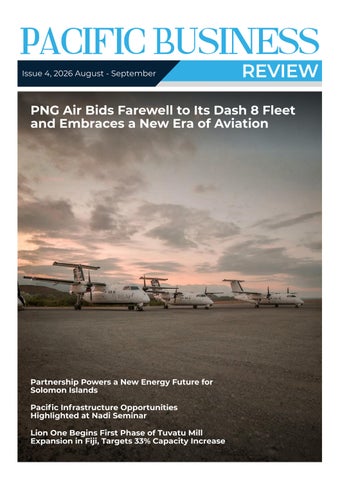
elcome to Issue 4, 2026 of Pacific Business Review. This edition looks at a Pacific region in motion — modernising infrastructure, strengthening energy security, expanding connectivity and creating new opportunities for investment and growth. Our cover story marks a new chapter for Papua New Guinea’s aviation sector as PNG Air completes its transition from the Dash 8 to an all-ATR fleet. After nearly four decades of connecting communities and businesses across challenging operating environments, the move to newer, more fuel-efficient aircraft reflects the changing demands of regional aviation. Energy security is another major theme. In Solomon Islands, Reeves Envico and CE Group have begun work on a 22-kilometre transmission line that will connect renewable power from the Tina River Hydropower Facility to Honiara. The project demonstrates how infrastructure investment can strengthen essential services while creating opportunities for local employment, skills development and long-term economic resilience. Across the region, infrastructure and resources investment remain central to the growth story. The Pacific Infrastructure Business Opportunities Seminar in Nadi highlighted a growing pipeline of projects across transport, energy, water, telecommunications and climate resilience. In Fiji, Lion One Metals has begun the first phase of its Tuvatu mill expansion, while TotalEnergies and Petronas are advancing offshore exploration in Papua New Guinea. This issue also examines developments across mining, oil and gas, finance, agriculture and tourism — from regional infrastructure planning and energy transition to efforts to strengthen investment, productivity and connectivity. Together, these stories reflect a Pacific seeking to turn partnerships and investment into practical outcomes: stronger economies, greater resilience and new opportunities for its people. As the region enters its next phase of development, the challenge will be to ensure that growth is inclusive, sustainable and capable of creating lasting value. Thank you for reading and for continuing to be part of the Pacific Business Review conversation.
James Konstantin Galvez Managing Editor
08 | Pacific Business Review
www.pacificbusinessreview.com
ISSUE 4, 2026
Strategic Global Sourcing AUSTRALIA | PAPUA NEW GUINEA | CHINA | EUROPE | UAE
EXPAC delivers structured global procurement and integrated logistics solutions to mining, construction, industrial, government and commercial operations across Papua New Guinea and the Pacific.
Global Procurement OEM & genuine parts sourcing Aftermarket & alternative strategies Construction & industrial materials Capital equipment acquisition
With offices in Australia, Paua New Guinea, China, Europe and UAE, we provide direct access to international manufacturers and trusted supplier networks worldwide — securing critical equipment and materials reliably and at speed. Our Chinese, European and UAE offices strengthens direct access to SE Asia, EU and UAE manufacturers and markets, enhancing global sourcing capability and reducing supply risk across multiple sectors.
Integrated Logistics International airfreight Sea freight Multi-origin coordination Structured shipment tracking Operational Strength 180+ years combined experience ISO-certified systems Multi-currency procurement capability Proven performance in remote environments Products Sourced - But Not Limited to Mining Equipment & spare parts Earthmoving Equipment & spare parts Agricultural Equipment & spare parts Electrical, plumbing & building supplies Lubricants, tools, catering & ppe
EXPAC AUSTRALIA
1 Magnesium Street, Narangba, QLD 4504 Tel: +61 7 3868 1591 Email: sales@expac.com.au
EXPAC PAPUA NEW GUINEA Expac Port Moresby PNG CR Compound, Baruni Bypass Road, POM 121 Tel: +675 7302 3422 Email: nenita@expac.com.au Expac/HX Services Lae 11 Mile, Okuk Highway, Lae Tel: 675 7915 1194 Email: sales@HXServices.co
EXPAC BOUGAINVILLE
Section 350C China Town Road, Buka Tel: +675 7395 7102 Email: evelyn@expac.com.au www.pacificbusinessreview.com
EXPAC CHINA
Suite 1130, Chuangzhan Tower, 928 Xikang Road, Shanghai Tel: +61 7 3868 1591 Email: sales@expac.com.au
th
EXPAC EUROPE/UAE
6 Floor, Meydan Road, Nad Al Sheba, Dubai Email: sales@expac.com.au
www.expacaustralia.com.au Pacific Business Review | 09
ISSUE 4, 2026
BUSINESS
BU IL DING THE PACI FI C’S INF R ASTRUCTUR E FU T U R E : H O W PR IF IS RE SHAPI NG R E GI O NA L DE V E LOP MENT From digital infrastructure pipelines to climate-resilient planning, the Pacific Region Infrastructure Facility is redefining how governments and development partners plan, finance, and deliver infrastructure across one of the world’s most geographically dispersed regions. The Pacific faces one of the world’s most complex infrastructure challenges. Small island economies spread across vast ocean distances must deliver transport, energy, water, telecommunications, and public infrastructure while contending with limited financial resources, high construction costs, vulnerability to climate change, and growing demands for sustainable development. Against this backdrop, the Pacific Region Infrastructure Facility (PRIF) has emerged as a key regional platform for coordinating infrastructure investment, improving project planning, and helping governments prioritize projects that deliver long-term economic and social value. According to the Pacific Region Infrastructure Facility Annual Report 2025, the organization significantly expanded its work during the year, introducing new digital planning tools, broadening technical assistance, and strengthening collaboration among governments and development partners across the Pacific.
A regional approach to infrastructure Established in 2008, PRIF serves as a multipartner coordination and technical assistance facility that helps Pacific governments improve infrastructure planning, investment coordination, and service delivery. The facility supports 13 Pacific island countries—the Cook Islands, Fiji, Kiribati, the
10 | Pacific Business Review
www.pacificbusinessreview.com
ISSUE 4, 2026
Republic of the Marshall Islands, the Federated States of Micronesia, Nauru, Niue, Palau, Samoa, Solomon Islands, Tonga, Tuvalu, and Vanuatu—while Papua New Guinea participates as an associate member. Development partners include the Asian Development Bank (ADB), the Australian Department of Foreign Affairs and Trade, the European Union, the European Investment Bank, the Japan International Cooperation Agency, New Zealand’s Ministry of Foreign Affairs and Trade, the United States Department of State, and the World Bank Group.
www.pacificbusinessreview.com
Rather than financing infrastructure directly, PRIF focuses on improving how projects are identified, prioritized, prepared, and coordinated, ensuring governments and funding agencies make better-informed investment decisions. Its current Phase V strategy, covering 2024 to 2027, places greater emphasis on climate resilience, disaster risk
to Page 12 →
Pacific Business Review | 11
ISSUE 4, 2026
BUSINESS
management, quality infrastructure, gender equality and social inclusion, and stronger regional cooperation.
Climate resilience moves to the forefront
Transforming infrastructure planning
Climate adaptation has infrastructure planning.
One of the most significant changes underway is PRIF’s shift from producing traditional infrastructure planning documents toward building institutional capacity within Pacific governments.
Recognizing that roads, ports, airports, water systems, and energy networks must withstand increasingly severe weather events, PRIF expanded technical assistance focused on integrating climate resilience into project design.
National Infrastructure Investment Plans (NIIPs), long regarded as the foundation of infrastructure planning across the region, are being redesigned to become living planning systems rather than static reports.
During 2025, the organization supported development of guidance on nature-based infrastructure solutions, introduced a Climate Co-Benefit Categorization Framework to improve climate reporting, and strengthened methods for incorporating climate and disaster risk assessments into national infrastructure planning.
The updated approach embeds infrastructure planning within government budgeting and public investment processes, allowing countries to identify priority projects more efficiently while reducing reliance on external consultants. During 2025, PRIF advanced work on the Solomon Islands National Infrastructure Investment Plan and the Vanuatu Infrastructure Strategic Investment Plan, while preparations were made for additional national planning updates across several Pacific countries in 2026. The revised methodology also places greater emphasis on climate resilience, environmental safeguards, economic analysis, and government ownership of investment decisions.
Creating a Pacific infrastructure marketplace Perhaps PRIF’s most transformative initiative during the year was the launch of the Pacific Infrastructure Pipeline, a digital platform designed to improve transparency across the region’s infrastructure market. The online database brings together more than 1,000 infrastructure projects and procurement packages, ranging from projects approaching tender to longer-term national investment priorities. The platform enables governments, contractors, consultants, suppliers, and investors to search opportunities by country, sector, project value, procurement method, funding agency, implementation status, and expected timelines. For Pacific businesses, early access to future procurement opportunities provides valuable time to develop technical capacity, form partnerships, and prepare competitive bids. The platform also includes a searchable directory of Pacific businesses, making it easier for international contractors to identify local partners and increasing opportunities for domestic participation in major infrastructure projects. PRIF expects the platform to become an increasingly important regional business development tool as additional governments and development partners continue uploading project information throughout 2026.
12 | Pacific Business Review
become
central
to
Pacific
Working groups also analyzed regional project pipelines to identify opportunities for coordinated investment and cofinancing that support the Pacific Strategy 2050 and broader climate adaptation objectives.
Technical expertise expands across sectors Demand for technical assistance continued to grow throughout the year. PRIF implemented 18 technical assistance projects covering transport, energy, digital connectivity, urban development, environmental safeguards, infrastructure planning, and institutional strengthening. Among the initiatives were development of the Pacific One Maritime Framework, regional digital readiness programs, electric vehicle standards, updated building codes, environmental and social safeguard frameworks, and water sector capacity-building initiatives. The projects are intended not only to address immediate infrastructure needs but also to strengthen institutional capacity across Pacific governments and improve long-term project delivery.
Strengthening regional collaboration Infrastructure development in the Pacific depends heavily on coordination among governments, multilateral institutions, and bilateral development partners. To improve alignment, PRIF convened 26 sector and thematic working group meetings during 2025, bringing together representatives from development agencies, regional organizations, and Pacific governments. These working groups focused on transport, energy, urban development, climate resilience, environmental safeguards, water and sanitation, digital infrastructure, and social
www.pacificbusinessreview.com
ISSUE 4, 2026
inclusion, helping reduce duplication of assistance while identifying opportunities for joint investment. The report notes that stronger collaboration is also improving the efficiency of infrastructure planning by encouraging governments and development partners to align investments with national priorities rather than pursuing isolated projects.
Investing in knowledge and capacity Alongside project planning, PRIF continued investing in knowledge sharing and professional development. During 2025, the facility launched a regional capacity development program, conducted six training sessions across the Pacific, organized five technical webinars, and hosted PRIF Week 2025 under the theme “Build Forward Better.” The event attracted 574 participants from 23 countries, bringing together policymakers, infrastructure agencies, financiers, development partners, consultants, academics, and private sector representatives to discuss emerging priorities and best practices for resilient infrastructure development.
www.pacificbusinessreview.com
Looking ahead Development partners have committed USD14.98 million to support PRIF’s current four-year phase, with USD5.55 million committed or contracted during 2025 and USD3.24 million disbursed over the year. As infrastructure demand accelerates across the Pacific, PRIF’s evolving role reflects a broader shift in regional development strategy. Beyond funding individual projects, the emphasis is increasingly on strengthening institutions, improving project readiness, enhancing regional coordination, and ensuring that infrastructure investments are resilient, inclusive, and economically sustainable. For Pacific governments—including Papua New Guinea— these initiatives offer more than technical support. They provide a shared framework for developing infrastructure that is better planned, better coordinated, and better positioned to attract both development financing and private investment, helping lay the foundations for more resilient and connected economies across the region. PBR
Pacific Business Review | 13
BUSINESS
FIJI, AUSTRALIA ELEVATE TIES WITH LANDMARK VUVALE UNION AND SECURITY TREATY
ISSUE 4, 2026
Fiji and Australia have significantly deepened their strategic partnership after signing two landmark treaty-level agreements that expand cooperation on defence, security, trade, investment and regional development, marking what Fiji described as a new chapter in bilateral relations. Fijian Prime Minister Sitiveni Rabuka and Australian Prime Minister Anthony Albanese signed the Ocean of Peace Alliance, also known as the Veitacini Treaty, and the Fiji-Australia Vuvale Union Treaty during a ceremony at the State House, witnessed by President Ratu Naiqama Lalabalavu. The agreements are the first treaty arrangements entered into by Fiji and formalise an expanded partnership aimed at strengthening sovereignty, regional security and economic cooperation while advancing the Blue Pacific agenda. President Lalabalavu described the signing as a milestone in Fiji’s nation-building journey, saying the agreements reflected decades of friendship founded on mutual respect, shared values and regional solidarity.
14 | Pacific Business Review
www.pacificbusinessreview.com
ISSUE 4, 2026
He said the treaties were built on the principles of partnership, integration and regionalism, while recognising the importance of national sovereignty. “The challenges before us, whether climate change, regional stability or economic resilience, require precisely the kind of partnership that Fiji and Australia have nurtured and signed into history today,” the President said. Under the Ocean of Peace Alliance, both countries committed to protecting their sovereignty, strengthening mutual defence and security interests and contributing to peace and stability across the Pacific. The Fiji-Australia Vuvale Union establishes a framework for closer cooperation across a broad range of sectors, including trade and investment, education, policing, border security, law enforcement and efforts to combat transnational organised crime. The agreement also seeks to operationalise the Blue Pacific Ocean of Peace Declaration while promoting democracy, stability and shared prosperity throughout the region.
Leaders reaffirm strategic partnership Following the signing ceremony, Rabuka and Albanese held bilateral talks, joined by Fiji’s Minister for Foreign Affairs and External Trade Sakiasi Ditoka, Minister for Defence and Veteran Affairs Pio Tikoduadua, Australian Foreign Minister Penny Wong, Australian High Commissioner to Fiji Peter Roberts and senior officials from both governments. The discussions focused on strengthening the longstanding Vuvale Partnership amid an increasingly complex geopolitical environment and growing regional challenges. Rabuka welcomed Australia’s continued support for Fiji’s development priorities and described Australia as one of Fiji’s closest and most trusted partners. The leaders also acknowledged the contribution of approximately 5,200 Fijians employed across Australia under the Pacific Australia Labour Mobility (PALM) Scheme and discussed preparations for the upcoming Pacific Islands Forum Leaders Meeting in Palau, including regional climate resilience initiatives. Both governments reaffirmed their commitment to promoting regional solidarity and ensuring the Pacific remains a region characterised by peace, resilience, security and shared prosperity.
Albanese receives Fiji’s highest honour During the visit, President Lalabalavu conferred the Companion of the Order of Fiji (General Division) on Albanese, the country’s highest national honour. The award recognises eminent achievement and outstanding service to Fiji or humanity. The President said the relationship between Fiji and Australia extends beyond diplomatic ties, highlighting the deep people-to-people connections forged through migration,
www.pacificbusinessreview.com
education, employment and family relationships. He also recognised Albanese’s contribution to strengthening cooperation across diplomacy, trade, investment, education, health, aviation, defence, environmental protection and sport. Senior members of both governments, including Cabinet ministers, members of the diplomatic corps and Australian officials, attended the investiture ceremony.
Skills hub to support workforce development The visit also saw the official opening of the Pacific Australia Skills Hub in Suva, a refurbished vocational training facility established under the Fiji-Australia Vuvale Partnership. Opened by Albanese and Fiji’s Minister for Public Works, Meteorological Services and Transport, Ro Filipe Tuisawau, the hub aims to expand technical and trade training to address skills shortages in Fiji’s infrastructure and public works sectors. The facility will provide training in areas supporting the construction and maintenance of roads, bridges, government buildings, water and sanitation infrastructure and transport networks, while also strengthening the capacity of local trainers. Tuisawau said the hub comes at a critical time as the government seeks to attract and retain skilled workers to meet growing infrastructure demands. He said the initiative would create more opportunities for Fijians to access vocational training while supporting economic growth and improving public service delivery. The opening coincided with the signing of the Fiji-Australia Vuvale Union Treaty, reinforcing cooperation between the two countries on workforce development, skills mobility and long-term economic development.
Visit concludes with stronger regional agenda Albanese concluded his official visit to Fiji on Monday, departing from Nausori International Airport after a military farewell ceremony hosted by Deputy Prime Minister and Minister for Tourism and Civil Aviation Viliame Gavoka. Fiji said the visit reinforced the strategic importance of its relationship with Australia and established a new framework for deeper collaboration across security, economic development and regional governance. The new agreements are expected to strengthen bilateral cooperation in areas including trade and investment, education, border management, policing and national security while enhancing both countries’ ability to address transnational crime and broader Pacific security challenges. For Fiji, the signing of its first treaty arrangements represents a significant step in institutionalising one of its most important regional partnerships as both countries seek closer integration in response to evolving geopolitical, economic and climate-related challenges across the Pacific. PBR
Pacific Business Review | 15
BUSINESS
ISSUE 4, 2026
FIJI DEVELOP S LO W-CA R B O N R OADMAP FOR M A R I T I M E T R A NS PORT
Fiji is developing its first Low-Carbon Maritime Transport Roadmap as part of efforts to modernize the country’s shipping sector, reduce greenhouse gas emissions and support regional decarbonization goals.
He also reaffirmed Fiji’s support for an ambitious and equitable global transition through the International Maritime Organization (IMO), while emphasizing the need for financial support, technology transfer and capacity building to help Small Island Developing States meet decarbonization goals.
The roadmap will provide a framework for transitioning Fiji’s maritime industry toward lower-carbon operations while improving maritime data systems and supporting the Pacific Blue Shipping Partnership’s 2030 and 2050 decarbonization targets.
The one-day stakeholder workshop brought together government agencies, industry representatives and development partners to provide technical and policy input into the roadmap, strengthen maritime monitoring, reporting and verification (MRV) systems, and improve maritime data collection.
Fiji’s Minister for Public Works, Meteorological Services and Transport, Ro Filipe Tuisawau, announced the initiative during the opening of a stakeholder workshop on decarbonizing the maritime sector in Suva on July 10. “For Fiji, maritime transport is not simply another sector, it is our lifeline,” Tuisawau said.
Tuisawau said the roadmap is expected to strengthen connectivity between Fiji’s islands, improve the resilience of the country’s transport network and encourage innovation and investment in cleaner shipping technologies.
He noted that shipping is essential for connecting Fiji’s more than 300 islands, supporting trade, tourism and fisheries, Qcommunities across the archipelago.
The consultation was organized by Fiji’s Ministry of Public Works, Meteorological Services and Transport and the Global Green Growth Institute (GGGI), in partnership with the Republic of Korea’s Ministry of Oceans and Fisheries.
The minister said the roadmap will help prepare Fiji’s maritime sector for a low-carbon future while aligning with the country’s development priorities and international climate commitments.
The initiative forms part of broader regional efforts to decarbonize maritime transport, a critical sector for Pacific island economies that depend heavily on shipping for trade, mobility and economic development. PBR
16 | Pacific Business Review
www.pacificbusinessreview.com
ISSUE 4, 2026
FIJI, KIRIBATI S T R E NGT HE N C OOPERATION O N I NFR AS T R U CT U R E , SU S TAINABLE D E VE LO PM E NT Fiji and Kiribati have reaffirmed their commitment to deepen cooperation on infrastructure development, renewable energy and climate resilience as the two Pacific island nations seek to address common development challenges. Fiji’s Minister for Public Works, Meteorological Services and Transport, Ro Filipe Tuisawau, met with Kiribati’s Minister for Infrastructure and Sustainable Energy, Tekeeua Tarati, at the Ministry’s headquarters in Suva to discuss opportunities for closer collaboration. The ministers exchanged views on infrastructure development, renewable energy, water security, maritime transport and sustainable development, with a focus on practical solutions for Small Island Developing States facing the impacts of climate change. The discussions also highlighted Fiji’s progress in expanding renewable energy, promoting electric vehicles, adopting sustainable construction practices and modernizing the maritime sector to reduce greenhouse gas emissions.
www.pacificbusinessreview.com
Tuisawau said Fiji remains committed to sharing its knowledge and experience with Pacific neighbors to help strengthen regional resilience and support sustainable development. Both ministers agreed to pursue closer cooperation in developing climate-resilient infrastructure, enhancing energy security, improving water systems and strengthening maritime connectivity between Pacific island nations. The meeting reflects ongoing regional efforts to improve essential infrastructure and services while advancing lowcarbon development strategies that address the unique vulnerabilities of island economies to climate change and rising sea levels. Fiji and Kiribati are among Pacific nations working to expand regional partnerships as they seek to improve infrastructure resilience, accelerate the transition to clean energy and strengthen sustainable economic development across the region. PBR
Pacific Business Review | 17
ISSUE 4, 2026
BUSINESS
NE W CALEDONIA S HO WCAS E D I NN OVATION EC O SYS T E M AT V IVATECH 2026 New Caledonia showcased its growing innovation and technology sector during its fourth participation in Viva Technology 2026, Europe’s largest startup and innovation event, held in Paris from June 17 to 20. The New Caledonian delegation brought together eight startups and 16 institutional and private-sector partners under the New Caledonia Pavilion, which was designed to promote the territory’s technological capabilities, investment potential and entrepreneurial ecosystem to a global audience. Organizers expanded the pavilion’s footprint from 50 square metres to 70.5 square metres for the 2026 edition, allowing the creation of dedicated spaces for startups and businesses, as well as a new area focused on promoting New Caledonia’s attractiveness to investors, partners and international stakeholders. The 2026 delegation also broadened participation criteria to include seed-stage and acceleration startups alongside established companies developing innovative technology products through intrapreneurship initiatives. Officials said the participation aimed to strengthen New Caledonia’s international profile, support emerging industries, create business opportunities and foster partnerships with investors and innovation ecosystems worldwide. The startup delegation featured Firetracking, a software platform designed to detect wildfire outbreaks; Testeum, a participatory testing platform; Watom, a developer of digital serious games; Ops Insight, an artificial intelligence-based aerospace compliance platform; Spirit, a payment solution for French Pacific territories; Santeo, a health education and prevention platform; So’Bloo, an AI-powered business management solution; and Digibar, a digital management platform for bar associations.
Testeum delivered pitches at the booth of TotalEnergies, highlighting their innovations in safety, environmental monitoring and technology testing. On June 18, delegation members joined the “French Tech Connect Overseas & Indian Ocean” side event, which brought together startups, investors, corporations and innovation partners from French overseas territories and the Indian Ocean region. The event provided opportunities to strengthen partnerships, expand networks and explore funding prospects. The delegation also took part in the VivaTech 2026 international pitch competition on June 20 and participated in a session promoting New Caledonia’s investment and business opportunities at the stand of Business France. Officials said the territory’s participation reflected ongoing efforts to develop New Caledonia’s technology ecosystem, attract international investment and position the Pacific territory as an emerging innovation hub. PBR
The delegation was supported by 16 partners from the public and private sectors, including government agencies, business organizations, financial institutions and tourism promotion bodies. Several New Caledonian startups participated in presentations and networking activities during the event. Prior to the official opening of VivaTech, Firetracking and
18 | Pacific Business Review
www.pacificbusinessreview.com
ISSUE 4, 2026
Powering Pacific resilience from diesel dependence to renewable, island-ready energy solutions
7-8 October 2026 Pullman Hotel | Auckland, New Zealand
Dedicated Pacific programme stream: featuring regional leaders tackling island energy challenges. Attracting attendees from 20+ Pacific and Asia-Pacific countries.
Attendees will gain insights to: reduce reliance on imported diesel
learn scalable solutions for island grids
connect with regional utilities and governments
access funding and partnership opportunities
Sponsors and exhibitors
Platinum sponsor
Foundation partner
Media partners
Supporting organisations
Register now and secure the Pacific Island attendee rate oceaniapowersummit.com www.pacificbusinessreview.com
*Price is New Zealand dollars, per person, and excludes Goods and Services Tax (GST)
$1599* Pacific Business Review | 19
BUSINESS
NZ HOSTS PACIFIC FISHERIES MINISTERS TO CHART REGION’S FISHERIES FUTURE
ISSUE 4, 2026
Fisheries ministers from across the Pacific have gathered in New Zealand for the 25th Annual Forum Fisheries Committee (FFC) Ministerial Meeting, where leaders will discuss key policies aimed at strengthening fisheries management, boosting economic returns and enhancing regional cooperation. Hosted by the New Zealand government, the meeting opened with a traditional Māori pōwhiri at Te Papa Tongarewa in Wellington, welcoming ministers, senior officials, development partners and observers. Forum Fisheries Agency (FFA) Director-General Noan David Pakop said the ceremony reflected the shared commitment of Pacific nations to protecting the region’s ocean resources. “We are honoured by this expression of manaakitanga, which reminds us that our work is grounded in friendship, mutual respect and our shared commitment to the peoples of the Blue Pacific,” Pakop said. He also congratulated New Zealand’s Minister for Oceans and Fisheries, Shane Jones, on assuming the chairmanship
20 | Pacific Business Review
www.pacificbusinessreview.com
ISSUE 4, 2026
of the FFC Ministerial, saying the work of senior fisheries officials had laid the foundation for ministerial decisions.
organisation’s institutional capacity, financial sustainability and responsiveness to members’ priorities.
Among the major agenda items is the proposed South Pacific Albacore Allocation Arrangement, which seeks to provide long-term certainty for one of the region’s most valuable tuna fisheries while reinforcing the leadership of Pacific coastal states in managing the resource.
During the opening events, New Zealand reaffirmed its support for Pacific fisheries by announcing additional funding for the FFA to strengthen efforts against illegal, unreported and unregulated fishing, build fisheries capacity across member countries and support the long-term sustainability of regional fisheries.
Ministers will also discuss the East New Britain Initiative, which aims to increase domestic participation in the tuna industry, create jobs, strengthen local economies and improve food security across the Pacific. The future of the fisheries treaty with the United States is also expected to be reviewed during the meeting. The treaty has supported sustainable fisheries management and generated economic benefits for Pacific Island countries for more than three decades. Pakop said the region’s tuna resources remain among the healthiest and most valuable globally because of the collective stewardship of FFA members. “Our challenge is not only to sustain healthy fisheries, but to ensure they continue to create jobs, strengthen domestic industries, improve food security and deliver lasting prosperity for Pacific communities,” he said. Ministers are also considering a new FFA Strategic Plan and ongoing reforms aimed at strengthening the
The funding will also support the Pacific Islands Tuna Ventures Programme, which aims to help Pacific Island countries capture greater value from their tuna resources through innovation and product diversification. New Zealand Deputy Prime Minister and Foreign Affairs Minister Winston Peters said the Pacific supplies more than half of the world’s traded tuna but Pacific nations do not always receive a fair share of its economic value. He said the investment reflects New Zealand’s commitment to helping Pacific countries strengthen domestic fisheries industries, create jobs and increase returns for coastal communities. The annual Forum Fisheries Committee Ministerial Meeting is the Pacific’s highest-level fisheries forum, bringing together ministers from FFA member countries to provide strategic direction on the conservation, sustainable management and development of the region’s fisheries resources. PBR
PACIFIC ADOP TS NE W A I D -FO R TR AD E STRATEGY TO B O O S T RE G IO NAL GROW T H T HR O U GH 2 0 3 0 Pacific Islands Forum (PIF) members have adopted a new regional aid-for-trade strategy for 2026–2030, setting out a coordinated agenda to strengthen trade, digital commerce, connectivity and climate-resilient economic development across the Blue Pacific. The Pacific Aid for Trade Strategy (PAfTS) 2026–2030 builds on the previous five-year framework and aligns regional trade initiatives with the 2050 Strategy for the Blue Pacific Continent, positioning trade and investment as key drivers of sustainable economic growth and resilience. The strategy was endorsed by Pacific Islands Forum trade ministers in July 2025 and serves as the principal framework for coordinating regional aid-for-trade programs over the next five years. It emphasizes member-led implementation,
www.pacificbusinessreview.com
stronger coordination among development partners and targeted investments in areas that can deliver regional benefits. Under the new framework, the Pacific will continue prioritizing e-commerce, trade facilitation, services, quality infrastructure, connectivity, trade agreements and value chains such as kava and apiculture, while introducing trade and environment as a new strategic priority. The strategy recognizes that environmental challenges— including climate change, biodiversity loss and pollution— pose significant risks to Pacific economies but also present opportunities through greener trade policies, sustainable value chains and environmentally sound technologies.
to Page 22
→
Pacific Business Review | 21
BUSINESS
Rather than creating a standalone program, environmental priorities will be integrated across all regional trade initiatives. Digital trade also features prominently in the strategy, with the Pacific Islands Forum Secretariat aiming to expand the region’s e-commerce ecosystem to reduce geographic barriers, lower business costs and help diversify Pacific economies. The strategy notes that around 30% of recommendations under the Pacific Regional E-commerce Strategy had been implemented by the end of 2024, with work now shifting toward updating the strategy and accelerating implementation. Improving regional connectivity remains another central objective. The framework calls for stronger transport, aviation, digital, energy and people-to-people links to reduce the effects of geographic isolation and strengthen regional economic integration. Trade facilitation is also expected to receive greater attention after the strategy noted that Pacific Island developing economies recorded a trade facilitation implementation rate of 42% in 2023, well below the global average of 69%, underscoring the need for more efficient border procedures and streamlined trade systems. The strategy also places greater emphasis on strengthening the Pacific’s participation in global and regional trade agreements by providing technical assistance and policy support to member countries. It calls for continued engagement in World Trade Organization negotiations, implementation of regional trade agreements and exploration of new trade opportunities that benefit Pacific economies. The framework further promotes stronger
22 | Pacific Business Review
ISSUE 4, 2026
private sector participation, recognizing businesses as the primary drivers of trade-led growth and investment. It also encourages greater inclusion by integrating gender equality, disability and social inclusion considerations into regional trade initiatives where practical. Through these measures, the strategy aims to make Pacific trade more competitive, inclusive and resilient over the next five years. The strategy further seeks to expand opportunities in services trade, which accounted for 56.4% of regional GDP and 53% of total employment in 2023, while supporting emerging digitally enabled services alongside tourism. Continued support is also planned for regional kava and apiculture initiatives to strengthen export value chains, improve market access and promote rural livelihoods. Pacific Islands Forum Secretary General Baron Divavesi Waqa said the strategy provides a practical roadmap for collective regional action at a time of growing economic and geopolitical uncertainty. “The successful implementation of the PAfTS depends on the active and coordinated engagement of all stakeholders, including Forum Members, the Pacific Islands Forum Secretariat, development partners and implementing partners,” Waqa said in the strategy’s foreword. Implementation will be overseen through member-driven regional committees, with progress reported annually to Forum trade officials and biennially to Forum trade ministers. Monitoring frameworks will also incorporate gender equality, disability and social inclusion considerations where feasible, ensuring regional trade initiatives deliver broad-based economic benefits across Pacific communities. PBR
www.pacificbusinessreview.com
ISSUE 4, 2026
PACIFIC INFRAS T R U CT U R E OPPORTUNITIE S HI GH LI GHT E D AT NAD I SEMINAR Contractors, consultants, financiers and development partners gathered in Fiji last month for the Pacific Infrastructure Business Opportunities Seminar, highlighting a growing pipeline of infrastructure projects across the region and opportunities for businesses to participate in their delivery. The Pacific’s expanding infrastructure programme was the focus of the Pacific Infrastructure Business Opportunities Seminar, or PIBOS, 2026, hosted by the Asian Development Bank, the World Bank and the Fiji government. Held at the Crowne Plaza Fiji Nadi Bay Resort & Spa from May 25 to 27, the seminar brought together international, regional and local contractors, consultants, development financiers and government agencies interested in infrastructure projects across Pacific island countries. The event forms part of ADB’s engagement with the private sector and provides businesses with an opportunity to learn about upcoming infrastructure projects and procurement opportunities throughout the region. According to ADB, the programme covered infrastructure development activities across the Pacific, with opportunities spanning transport, energy, water, telecommunications, climate resilience and other essential services. A pre-seminar masterclass also addressed procurement requirements, environmental and social safeguards, and project delivery expectations. Discussions focused on forthcoming project opportunities, procurement pathways and practical considerations for businesses seeking to participate in development-funded infrastructure programmes. The seminar underscored the scale of infrastructure investment being directed towards the Pacific by multilateral development banks, bilateral development partners and Pacific governments. Infrastructure development remains a priority for many island nations seeking to improve economic growth, resilience and regional connectivity. Representatives from government agencies, development finance institutions and private sector organisations involved
www.pacificbusinessreview.com
in infrastructure delivery attended the event. A strong Australian and New Zealand business presence was evident, with members of the Australia Pacific Islands Business Council, Australia Fiji Business Council and Australia Papua New Guinea Business Council participating alongside representatives from engineering, construction, telecommunications, advisory and professional services firms. Pacific-based businesses were also represented, using the seminar to gain a better understanding of upcoming project opportunities and connect with project owners, financiers and delivery partners. ADB and its partners highlighted the importance of increasing local and regional private sector participation in infrastructure delivery. Discussions included initiatives aimed at improving access for Pacific small and medium-sized enterprises and strengthening local capacity to participate in development-funded projects. With Pacific governments continuing to pursue major investments in transport, energy, telecommunications, water and climate-resilient infrastructure, the seminar provided businesses with insights into the region’s evolving project pipeline and opportunities to establish relationships that may support future project delivery. PBR
Pacific Business Review | 23
BUSINESS
ISSUE 4, 2026
PN G AIR BIDS FA R E WE LL TO I T S DASH 8 FLEET A ND E M B R ACE S A N E W ER A O F AVIATIO N PNG Air has officially bid farewell to its iconic Dash 8 fleet, marking the end of an important chapter in the airline’s history and the completion of its transition to a modern, allATR fleet. For decades, the Dash 8 aircraft served Papua New Guinea with distinction, earning a reputation for reliability and versatility while connecting communities, supporting key industries, and operating into some of the country’s most challenging airstrips. As the fleet enters its next chapter, all three Dash 8 aircraft will continue their operational service with new operators overseas. One aircraft recently departed for Kenya, where it will join Renegade Air to support both domestic services and United Nations operations. PNG Air Chief Executive Officer Mr Brian Fraser said the farewell marked both a proud achievement and a significant milestone for the airline. “The Dash 8 has been an extraordinary aircraft for PNG Air and for the people of Papua New Guinea. These aircraft have connected communities and supported our nation’s growth
24 | Pacific Business Review
for many years. While we bid farewell to an important part of our history, we are excited about the future as we continue our transition to a modern ATR fleet,” Fraser said. The retirement of the Dash 8 fleet forms part of PNG Air’s broader fleet modernisation programme. As the airline transitions to the ATR 72-600 and ATR 42-600, it is investing in the future of regional aviation through modern technology, enhanced safety systems, greater passenger comfort, improved operational performance, and increased environmental sustainability. The ATR fleet offers industry-leading fuel efficiency and lower carbon emissions, supporting PNG Air’s commitment to providing safer, more reliable, and more sustainable air services. The aircraft are also well suited to Papua New Guinea’s unique operating environment, with the capability to serve regional and remote destinations efficiently. For nearly four decades, PNG Air has connected the people of Papua New Guinea through safe, reliable, and affordable air services. The airline currently operates more than 460 flights each week across 22 destinations, providing essential passenger and cargo services throughout the country. PBR
www.pacificbusinessreview.com
ISSUE 4, 2026
PAC IFI C E C O NO MI E S FAC E S LO W E R GROW T H AS E NE R GY C O S T S , W E A K E R TOU RI SM W E IG H O N O UT LO O K — A DB Pacific island economies are expected to experience slower economic growth in 2026 as higher fuel and food prices, weaker tourism and rising import costs continue to weigh on activity despite government measures to cushion the impact, according to the Asian Development Bank’s (ADB) latest economic outlook. The ADB lowered its growth forecast for the Pacific to 3.3% in 2026, down from the 3.4% projected in April and below the region’s estimated 4.2% expansion in 2025. Growth is expected to moderate further to 3.2% in 2027, while inflation is projected to remain elevated at 4.2% in 2026 before easing to 3.5% next year. The bank said Pacific economies remain among the most vulnerable to external shocks because they rely heavily on imported fuel, food and construction materials. Higher energy prices, rising freight costs and supply chain disruptions have increased the cost of living and placed additional pressure on businesses and governments across the region. “The Pacific’s growth outlook is lowered to 3.3% in 2026 as higher fuel, food and input costs stemming from the conflict dampen economic activity despite government mitigation measures,” the report said. ADB said forecasts for several Pacific economies were revised lower as visitor arrivals fell short of expectations while import costs continued to rise. The bank also warned that prolonged disruptions in global energy markets, driven by the Middle East conflict, are expected to unwind only gradually, keeping inflationary pressures elevated across the region. Among the region’s largest economies, Papua New Guinea is forecast to grow 3.4% in 2026, slightly below the 3.6% projected in April and down from an estimated 4.7% growth in 2025. Inflation is expected to remain at 4.6% this year before easing to 4% in 2027. Fiji’s economy is projected to expand 2.5% in 2026, lower than the 2.9% forecast in April, as softer tourism growth and higher import costs weigh on domestic activity. Inflation is expected to accelerate to 3.6% this year from deflation of 1.4% in 2025.
www.pacificbusinessreview.com
Elsewhere in the Pacific, Vanuatu is expected to post one of the region’s strongest growth rates at 3.9%, while Palau is forecast to expand 3.6%, supported by continued tourism recovery. Solomon Islands and Papua New Guinea are each projected to grow 3.4%, while Kiribati is expected to expand 2.6%, Cook Islands 2.7%, Samoa 2%, and Tonga 2.3%. Beyond slowing growth, the ADB warned that Pacific governments face mounting fiscal pressures as higher energy prices increase public spending while raising the cost of imports. Several small island economies are expected to record weaker primary fiscal balances this year as governments seek to shield households and businesses from rising living costs, even as higher borrowing costs and tighter global financial conditions constrain fiscal space. The bank also cautioned that higher fertilizer prices could threaten food security across the region, while renewed geopolitical tensions, volatile energy markets and tighter global financial conditions remain key risks for Pacific economies that are highly dependent on imports and external demand. Across developing Asia and the Pacific, ADB lowered its 2026 growth forecast to 4.9% from 5.1% projected in April, citing prolonged disruptions to global energy markets caused by the Middle East conflict. The bank raised its regional inflation forecast to 4.3% for 2026 from 3.6%, reflecting the impact of higher oil and gas prices, increased freight costs and supply chain disruptions. PBR
Pacific Business Review | 25
BUSINESS
ISSUE 4, 2026
PN G , SOLOMON I S L A ND S R E A FFI R M PU SH FOR STRONGE R E C O NO M I C TIE S
Papua New Guinea and Solomon Islands have reaffirmed their commitment to strengthening economic cooperation, with trade, investment, transport and resource development taking centre stage during talks between Prime Minister James Marape and Solomon Islands Prime Minister Jeremiah Manele. The discussions, held in Port Moresby in June, reviewed progress in bilateral trade, shipping and aviation connectivity, labour mobility, and opportunities to deepen collaboration in mining, fisheries and agriculture. While regional security and cooperation were also discussed, both leaders underscored the importance of expanding commercial links and improving the movement of goods, services and people between the two neighbouring Melanesian nations. The talks highlighted a broader push towards greater regional economic integration, with Papua New Guinea regarded as Solomon Islands’ largest Melanesian economy and an increasingly important source of investment, technical expertise and commercial partnerships. The two governments said improved transport links and streamlined trade arrangements could reduce business costs, strengthen supply chains and create new opportunities for exporters, importers and tourism operators. Mining emerged as a key area for future collaboration. Marape said Papua New Guinea was prepared to share its expertise in developing a modern mining industry and welcomed
26 | Pacific Business Review
greater participation by PNG companies in future resource projects in Solomon Islands. Such cooperation could create opportunities for engineering firms, contractors, training providers and professional services companies with experience in the mining sector. The leaders also reaffirmed their commitment to strengthening cooperation in fisheries, recognising the industry’s importance to economic growth and food security across the Pacific. Closer collaboration in fisheries management and downstream processing is expected to support export growth, generate employment and add value to marine resources. Although trade between the two countries remains relatively modest, both governments expect commercial activity to increase as transport connectivity improves and businesses expand beyond their domestic markets. The leaders said stronger bilateral engagement would also complement wider regional initiatives under the Melanesian Spearhead Group and the Pacific Islands Forum, where economic resilience, trade and private sector development remain key priorities. For Papua New Guinea, stronger commercial ties with Solomon Islands reinforce its role as a leading economy in Melanesia while supporting greater regional investment and cross-border business partnerships. PBR
www.pacificbusinessreview.com
ISSUE 4, 2026
SOLOM O N ISL A N DS S I GN S A I R P O RT REHAB IL ITAT IO N C O N T R AC T TO R E S TOR E A IR LI NK TO O NTO N G JAVA ATO L L The Solomon Islands government has moved forward with plans to reopen Henguaiporo Airport in Ontong Java Atoll after signing contracts and agreements to begin a major rehabilitation project aimed at restoring essential air services to one of the country’s most remote communities. The Ministry of Communication and Aviation has awarded the rehabilitation contract to Trade Transformation Company (TTC) following a government tender process, while a separate agreement has been signed with Hi-tech Company to undertake a technical ground assessment of the airport site before construction begins.
“Henguaiporo Airport is more than just an airstrip. It is a lifeline for the people of Lord Howe Atoll,” Danitofea said.
The project forms part of the government’s broader programme to rehabilitate existing airports and develop new aviation infrastructure to improve connectivity across the archipelago.
Malaita Provincial Secretary Eric George welcomed the agreement, describing improved transport infrastructure as essential for delivering public services and stimulating local economic activity.
The rehabilitation will include upgrading and levelling the runway, strengthening runway surfaces, backfilling sections of the existing runway and its planned extension, clearing vegetation along runway corridors, and renovating the passenger terminal. The works are intended to bring the airport into compliance with international aviation safety standards and enable the safe operation of aircraft.
He said provincial officials have often faced logistical challenges in reaching Ontong Java because of the area’s dependence on sea transport, which can be affected by weather conditions and limited vessel availability.
Although the construction contract was signed in May, work has been delayed pending completion of the geotechnical assessment, approval from the Central Tender Board and the execution of a memorandum of understanding (MOU) between the national government, Malaita Provincial Government and the customary landowners. The MOU, signed in late June, clears the way for rehabilitation works to proceed and formalises cooperation between the Ministry of Communication and Aviation, the provincial government and representatives of the airport’s landowning tribal groups. Permanent Secretary Alwyn Danitofea described the agreement as a significant milestone, saying the project demonstrates the government’s commitment to ensuring rural and remote communities are included in national development. He said the airport would once again provide a vital transport link between Ontong Java Atoll and Honiara, improving access to government services while supporting economic opportunities for residents.
www.pacificbusinessreview.com
George said reopening the airport would improve access to outer island communities and enable more regular government engagement. Representing the customary landowners, Malaita Outer Islands Constituency Development Officer Philemon Kaola said the prolonged closure of the airport had created significant hardships for residents, who have relied almost exclusively on sea transport for travel and the movement of goods. He said restoring air services would reduce travel times, improve access to education and healthcare, and create new opportunities for trade, investment and economic participation. The Ministry of Communication and Aviation said the project reflects its ongoing commitment to strengthening aviation infrastructure throughout Solomon Islands to provide safer, more reliable and more accessible air transport services. Once completed, the rehabilitation of Henguaiporo Airport is expected to reconnect Ontong Java Atoll with the national aviation network, improving mobility, supporting economic development and enhancing access to essential services for one of Solomon Islands’ most isolated communities. PBR
Pacific Business Review | 27
BUSINESS
ISSUE 4, 2026
SOLOMON ISL ANDS, US DEEPEN TIE S WITH FOCUS ON BINA HARBOUR , INVE STMENT Solomon Islands Prime Minister Matthew Wale has held talks with United States Deputy Secretary of State Christopher Landau in Washington, D.C., reaffirming bilateral ties and advancing discussions on infrastructure, energy and investment cooperation. The meeting at the U.S. State Department focused on strengthening the long-standing partnership between the two countries, with the proposed Bina Harbour development emerging as a key priority.
States’ commitment to supporting Solomon Islands through DFC and MCC programs aimed at expanding development opportunities. He also encouraged Solomon Islands to engage more actively with the U.S. private sector to attract investment that would generate economic benefits for the country. The meeting marks another step in efforts by both governments to deepen bilateral cooperation and broaden collaboration in infrastructure, energy and economic devSOlopment. PBR
According to a statement from the Solomon Islands government, Landau highlighted Washington’s strong interest in supporting the Bina Harbour project, with both sides agreeing to continue discussions on potential U.S. involvement. Wale also outlined his government’s priorities for the next two years, identifying opportunities to expand cooperation in the energy sector and through financing and development initiatives under the U.S. Development Finance Corporation (DFC) and the Millennium Challenge Corporation (MCC). The prime minister reaffirmed his government’s commitment to strengthening relations with international partners while highlighting the historical ties between Solomon Islands and the United States. Landau welcomed the government’s renewed approach to international partnerships and reaffirmed the United
28 | Pacific Business Review
www.pacificbusinessreview.com
ISSUE 4, 2026
VANUATU STRENGTHENS DISASTER RECOVERY FRAMEWORK WITH NEW HOUSING, ENERGY GUIDELINES
Vanuatu is strengthening its disaster recovery governance through new sector-specific guidelines and a proposed disaster financing framework aimed at improving post-disaster coordination, accelerating recovery efforts and building long-term resilience to climate and natural hazards. Government agencies, development partners, technical experts, civil society organisations and financial institutions gathered in Port Vila for a national consultation workshop to review three key recovery instruments covering housing, energy and disaster recovery financing. The workshop was organised by the Department of Strategic Policy, Planning and Aid Coordination (DSPPAC), through the Disaster Recovery Coordination Unit, in partnership with the Department of Urban Affairs and Planning, the National Disaster Management Office and the Department of Energy.
to Page 30
www.pacificbusinessreview.com
→
Pacific Business Review | 29
BUSINESS
The initiative forms part of the Strengthening Recovery Capacities Vanuatu Project, supported under the African, Caribbean and Pacific (ACP)-European Union programme on strengthening disaster risk governance and recovery capacities and implemented by the United Nations Development Programme (UNDP). Participants reviewed the proposed Housing Sector Recovery Guideline, Energy Sector Recovery Guideline, and Disaster Financing Strategy and Recovery Financing Architecture, which are intended to strengthen institutional coordination and provide practical guidance for post-disaster recovery. The consultation comes as Vanuatu continues to face increasing climate and disaster risks. The government estimates that natural disasters cost the country about 6 per cent of gross domestic product annually, while recent events—including Tropical Cyclones Judy and Kevin and the 2024 Port Vila earthquake—have underscored the need for stronger recovery systems. Disaster Recovery Coordination Unit manager Peter Korisa, speaking on behalf of the Director of DSPPAC, said recovery efforts must go beyond rebuilding damaged infrastructure. “Recovery cannot simply mean rebuilding what was lost. Rather, recovery must strengthen resilience, reduce future risk and support long-term sustainable development,” Korisa said. He noted that while Vanuatu already has national policies, including the National Sustainable Development Plan, National Disaster Recovery Framework, National Energy Road Map, National Housing Policy and National Disaster Risk Financing Policy, translating those frameworks into practical operational guidance remains a key challenge. UNDP Vanuatu Area Coordinator Sherryl Mahina said strengthening nationally led recovery systems is becoming increasingly important as climate-related disasters become more frequent and severe. “Small Island Developing States such as Vanuatu remain at the frontline of climate and disaster-related challenges,” Mahina said. “Recovery is not only about restoring infrastructure and services. It is about strengthening governance systems, restoring livelihoods, reducing future risks, protecting the most vulnerable and ensuring communities emerge stronger after disasters.” She said the consultation aimed to bridge the gap between policy and implementation by developing practical guidance for housing, energy and disaster financing.
30 | Pacific Business Review
ISSUE 4, 2026
The proposed housing recovery guideline focuses on resilient building standards, improved data collection, insurance mechanisms and technical support for community-led reconstruction. Meanwhile, the energy guideline outlines measures to strengthen recovery planning, resilience standards and coordination mechanisms for restoring electricity infrastructure after disasters. Department of Energy Director Matthew Tassale said reliable electricity is essential to national recovery efforts. “After disasters, the energy system is one of the priorities for recovery,” Tassale said. “Electricity is essential for healthcare services, communications, water supply, education, livelihoods and emergency coordination. Strengthening energy recovery planning helps ensure communities can recover faster and more safely while reducing future risks.” He said resilient energy planning is particularly important for remote and outer island communities, where prolonged power disruptions can have significant social and economic consequences. Participants also reviewed Vanuatu’s proposed disaster financing strategy, including options for financing instruments, resource mobilisation, institutional arrangements and disaster reserve funding mechanisms to improve the country’s ability to finance future recovery efforts. The workshop concluded with a series of technical recommendations and governance reforms that will be incorporated into the final versions of the guidelines and financing strategy before they are submitted for government endorsement. Once adopted, the new frameworks are expected to provide government agencies and development partners with clearer procedures, institutional responsibilities and financing mechanisms to support faster recovery, restore essential services and livelihoods more effectively, and strengthen resilience against future disasters. The Strengthening Recovery Capacities Vanuatu Project supports Vanuatu’s broader efforts to enhance disaster preparedness and recovery in line with the Sendai Framework for Disaster Risk Reduction, the Paris Agreement and the United Nations Sustainable Development Goals. PBR
www.pacificbusinessreview.com
ISSUE 4, 2026
SERVICE & MAINTENANCE
PROJECTS
RETAIL BUILDING MANAGEMENT SYSTEMS
Our Services
SpaceLogic RP-V
SpaceLogic CIO Module SpaceLogic AS-P-3
SpaceLogic CIO Module SpaceLogic AS-P-3
SpaceLogic MP-C
SpaceLogic MP-C
SpaceLogic RP-V
EcoStruxure Building Operation WorkStation
SpaceLogic AS-B
Blg 2 Floor 2
EcoStruxure Building Operation Enterprise Server
Blg 2 Floor 1
Edge Control
SpaceLogic AS-B
SpaceLogic MP-C
Building 2
EcoStruxure Building Operation Enterprise Server
Blg 1 Floor 1
+675 3253555 - Port Moresby +675 4722044 - Lae cs_pom@daikinpng.com.pg cs_lae@daikinpng.com.pg
EcoStruxure Building Operation WorkStation
Blg 1 Floor 2
Contact Us
Building 1
Connected Products
MANUFACTURING
EcoStruxure Building Operation Enterprise Central
SpaceLogic MP-C
SpaceLogic RP-V
SpaceLogic RP-V
Precision-Crafted HVAC Solutions Tailored Installation for Projects Proactive Maintenance & Rapid Response Ductwork Manufacturing End-to-End HVAC Contracting Services Retail Division
Papua New Guinea’s Trusted Experts in Climate Control Since 1972 Port Moresby Branch Sect 60, Lot 6~9, Gabaka Street, Gordons, NCD Lae Branch Sect 14, Lot 9 Abel Tasman Street, Morobe Province www.pacificbusinessreview.com
www.daikinpng.com.pg
Port Moresby
Lae
Pacific Business Review | 31
Follow us on
MINING
ISSUE 4, 2026
S OLOMON ISL AND S S T R E NGT HE NS ANT I-C ORRUP TI O N D R I VE A HE A D OF M IN ING E XPANS I O N
The Solomon Islands government is strengthening efforts to combat corruption, illicit financial flows and revenue leakages in the mining sector as it prepares for increased mineral development and works toward rejoining the Extractive Industries Transparency Initiative (EITI). More than 30 representatives from government ministries, oversight bodies, law enforcement agencies, financial intelligence institutions, accountability organisations, civil society groups and mining companies gathered in Honiara for a national workshop on strengthening coordination to address corruption risks and improve governance in the extractive sector. The workshop, titled “Building a Coordinated National Response to Corruption, Illicit Financial Flows and Revenue Leakage in the Mining Sector in Solomon Islands,” was organised by the United Nations Development Programme (UNDP) in partnership with the Solomon Islands EITI National Secretariat under a United Kingdom-funded project supporting the country’s re-engagement with EITI. Participants examined corruption and governance risks within the mining industry while identifying practical measures to strengthen cooperation, information sharing and coordinated responses among institutions responsible for mining regulation, revenue administration, financial intelligence, investigations and prosecution.
32 | Pacific Business Review
Opening the workshop on behalf of the government, Acting Permanent Secretary for Finance and Treasury Coswal Nelson said protecting public revenue generated from natural resources is critical to achieving the country’s development goals. “The extractive industries sector has the potential to make an important contribution to our economy. If managed responsibly, it can generate revenue, create opportunities and support our broader national development priorities,” Nelson said. “But when governance arrangements are weak, opportunities for corruption, illicit financial flows and revenue leakage emerge, reducing the benefits that should reach our people.” Nelson said no single institution could effectively tackle the challenges posed by corruption and financial crimes in the extractive sector. “Each institution represented here holds an important part of the picture. Stronger coordination allows us to identify risks earlier, share information more effectively and respond more quickly,” he said. “Coordination is not optional — it is essential if we are to safeguard public revenues and strengthen confidence in our institutions.” Representing the United Kingdom, Deputy British High Commissioner Cameron Millar reaffirmed Britain’s support for transparent and accountable management of natural
www.pacificbusinessreview.com
ISSUE 4, 2026
resources through its partnership with Solomon Islands and UNDP. “Natural resources offer tremendous opportunities for economic development, but international experience demonstrates that without strong governance systems they can also become vulnerable to corruption, opaque ownership structures and significant revenue losses,” Millar said. He said strengthening transparency, accountability and institutional cooperation would help ensure the country’s mineral wealth benefits all citizens. Millar added that lasting reforms must be driven by national institutions. “The strongest reforms are those designed and led by national institutions. Our role is to support Solomon Islands in building stronger systems that protect public resources, strengthen public trust and contribute to inclusive and sustainable development,” he said. UNDP Programme Specialist for Inclusive Governance and Economic Growth Solomon Kalu said strengthening integrity in the extractive sector extends beyond preventing corruption and is fundamental to ensuring that mineral resources contribute to long-term national development.
M I NIN G
“The extractive sector is expected to become increasingly important to the future of Solomon Islands. If governed well, it can create jobs, generate revenues and improve the lives of people across the country,” Kalu said. “But achieving these outcomes requires institutions that work together effectively to prevent corruption, detect illicit financial flows and protect public revenues.” Kalu said the workshop focused on building stronger partnerships among institutions, improving information sharing and identifying practical actions to strengthen transparency and accountability across the mining sector. The initiative forms part of UNDP’s broader support for Solomon Islands’ efforts to rejoin EITI through technical assistance, institutional capacity building, policy support and multi-stakeholder engagement. The government has identified stronger governance of the mining sector as a key priority as it seeks to attract investment while ensuring that future resource development delivers sustainable economic benefits, strengthens public confidence and safeguards revenues for current and future generations. PBR
LAE CHAMBER OF COMMERCE INC LAE... PNG’s Central hub of: ●
Industry ● Commerce ● Manufacturing ● Transport ● Shipping
Tel: +675 472 2340 Fax +675 472 6038 Email:admin@Icci.org.pg www.Icci.org.pg
www.pacificbusinessreview.com
Pacific Business Review | 33
MINING
ISSUE 4, 2026
FIJI LEADS NEGOTIATIONS ON DEEP-SEA MINING CLOSURE RULE S AT ISA MEETING Fiji is leading negotiations on international rules governing the closure of deep-sea mining operations during the ThirtyFirst Session of the International Seabed Authority (ISA) in Kingston, Jamaica, while continuing to push for stronger environmental safeguards and a precautionary approach to seabed mineral exploitation.
delegation, most ISA Council members supported merging key provisions, marking progress toward resolving outstanding issues in the Mining Code.
The ISA’s 31st Session, which includes meetings of the Council from July 13 to 24 and the Assembly from July 27 to 31, is advancing negotiations on the Mining Code, the international regulatory framework that will govern commercial deep-sea mining.
Fiji is also contributing to all 13 thematic informal working groups covering issues such as environmental management, benefit-sharing, inspection and compliance, regional environmental management plans, underwater cultural heritage, test mining, and coastal state interests.
Fiji is leading discussions on draft regulations covering Closure Plans, which establish requirements for ending mining activities, including the decommissioning of infrastructure, rehabilitation of affected marine ecosystems, long-term environmental monitoring, and financial guarantees to ensure contractors meet their obligations. The Fijian delegation is headed by Permanent Secretary for Lands and Mineral Resources Paula Cirikiyasawa and includes Director for Multilateral Affairs at the Ministry of Foreign Affairs and External Trade Anare Leweniqila and Policy Research Officer Samisoni Maravu of the Ministry of Lands and Mineral Resources. Working with Norway, Fiji proposed amendments to draft regulations on Environmental Management and Monitoring and Closure Plans. According to the
34 | Pacific Business Review
Beyond Closure Plans, Fiji is participating in negotiations on Effective Control, which addresses how sponsoring states oversee and regulate deepsea mining contractors. The issue is considered particularly significant for Small Island Developing States.
The Pacific nation continues to advocate for a precautionary pause on deep-sea mining until sufficient scientific evidence is available, a comprehensive and enforceable regulatory framework is in place, and robust measures governing environmental protection, liability, and benefitsharing have been established. Fiji said its participation aims to ensure Pacific priorities remain central to international decisions on the governance of deep-sea mineral resources. The ISA Assembly is scheduled to conclude on July 31, with members expected to adopt key Council decisions, including a roadmap for completing negotiations on the Mining Code and an indicative work program for the authority’s 32nd Session in 2027. PBR
www.pacificbusinessreview.com
ISSUE 4, 2026
M I NIN G
KALO GOLD C ON FI R M S HI GH -GR A D E GOLD MINERALI SAT I O N AT FI JI P R OJECT, ADVA NCE S GE O PH YS I CA L SU RV EYS Canadian explorer Kalo Gold Corp. has confirmed widespread gold mineralisation at its 100%-owned Vatu Aurum Project in Fiji, with laboratory fire assays returning grades of up to 8.78 grams per tonne (g/t) gold, reinforcing the company’s geological model ahead of a new phase of exploration. The assay results from the Wainikoro prospect confirmed that surface gold occurrences are sourced from mineralised bedrock, strengthening the company’s interpretation of a structurally controlled low-sulphidation epithermal gold system. Kalo said the certified fire assays validated its previously reported detectORE field screening results, with laboratory analyses generally matching or exceeding field estimates. Surface sampling returned assays of 8.78 g/t Au, 4.78 g/t Au, 4.44 g/t Au, 3.41 g/t Au and 2.03 g/t Au, while trench sampling produced selective point assays of up to 2.93 g/t Au. Continuous channel sampling averaged 0.28 g/t Au over 14 metres, confirming continuity of mineralisation beneath surface exposures. Company President and Chief Executive Officer Terry Tucker said the latest results significantly increased confidence in the geological model being developed at Wainikoro. “These certified fire assay results provide independent confirmation of the gold identified through our detectORE field screening and, importantly, demonstrate that mineralisation extends into bedrock beneath the surface occurrences we have been mapping,” Tucker said. “Each phase of exploration is building on the last, allowing us to progressively reduce geological uncertainty before advancing to the next phase of work,” he added. The company said the results confirmed multiple styles of gold mineralisation, including chalcedonic quartz veins, silicified volcanic rocks and hydrothermal breccias developed along the Nubu Graben structural corridor. Eleven surface samples returned grades above 0.5 g/t gold, indicating mineralisation is distributed across the target area rather than confined to isolated occurrences. Kalo has engaged Fender Geophysics Pty Ltd to undertake controlled-source audio-frequency magnetotellurics
www.pacificbusinessreview.com
(CSAMT), induced polarisation and gravity surveys at Wainikoro. The surveys are expected to define the subsurface geometry of the mineralised system and support target prioritisation for future exploration. The company said the geophysical programme would integrate geological mapping, geochemistry, trenching and structural interpretation into a single exploration model aimed at refining future drilling targets. Kalo Gold is advancing the 367-square-kilometre Vatu Aurum Project on Vanua Levu, where exploration has identified multiple low-sulphidation epithermal gold targets across a northeast-trending mineralised corridor. PBR
Pacific Business Review | 35
MINING
ISSUE 4, 2026
LION ONE BEGINS FI R S T PHAS E O F TU VATU MILL E X PA NS I O N I N FI JI , TAR G ETS 33% CA PACI T Y I NCR E AS E Canadian gold producer Lion One Metals Ltd. has begun the first phase of a multi-stage expansion of its Tuvatu Gold Mine processing plant in Fiji, a project expected to increase mill capacity by one-third and lift annual gold production by about 2,100 ounces. The first phase, known as the Filtered Tailings Expansion Project, will increase nominal plant capacity from 300 tonnes per day (tpd) to 400 tpd by doubling filtration capacity through the installation of two additional filter presses and associated infrastructure.
“We’re very excited to start Phase 1 of our mill expansion project,” Lion One President and Chief Executive Officer Ian Berzins said. “The filter press expansion is a key component of the expansion to 700 TPD and it will have an immediate impact on our production capacity once complete. The economics of the project are very strong with only a three-month payback period.” Berzins said capital projects with such short payback periods and significant production gains were uncommon and would deliver lasting operational benefits.
The project forms part of Lion One’s broader plan to expand the Tuvatu processing plant to 700 tpd in phases, with a total estimated capital cost of C$13.5 million.
The company said no additional mining fleet or processing equipment would be required to support the increase to 400 tpd.
Phase 1 carries a capital cost of C$1.9 million and is expected to be completed by the end of the first quarter of 2027.
Lion One owns 100% of the Tuvatu Gold Mine, located on Fiji’s main island of Viti Levu. Commercial production commenced in late 2023.
Lion One said the filtration circuit had been identified as the primary bottleneck in processing operations. The expansion includes two new filter presses, a filter feed tank, two filter feed pumps, structural and piping modifications, and an additional tailings truck.
Beyond the initial expansion, the company plans to progressively lift processing capacity to 700 tpd as part of its long-term growth strategy.
Once operational, the upgrade is expected to increase annual gold production by about 2,100 ounces, based on an incremental gold grade of 3 grams per tonne.
Separately, Lion One appointed Shayla Forster as corporate secretary. The company said Forster has extensive experience in corporate governance, compliance and securities disclosure for publicly listed companies in Canada.
At a gold price of US$4,000 per ounce, the additional production is projected to generate about C$11.8 million in annual revenue, with the company estimating the investment will be recovered within three months of commissioning.
Lion One is headquartered in North Vancouver, British Columbia, and also holds exploration licences covering the Navilawa Caldera, a highly prospective alkaline gold district surrounding the Tuvatu project. PBR
36 | Pacific Business Review
www.pacificbusinessreview.com
ISSUE 4, 2026
M I NIN G
Beyond Borders. Progress Through Partnership. APEC House, Port Moresby, Papua New Guinea
Naha Birthing and Urban Health Centre
CE Group is helping deliver some of the Pacific’s most significant projects —from the landmark APEC Haus in Papua New Guinea to the Tina River Hydropower Development Project in Solomon Islands.
Tina River Hydropower Transmission System
Across the Pacific, CE Group brings together engineering, construction, switchboards, smart solutions and asset management to deliver in complex and remote environments. Solomon Islands National University
We combine regional capability with national teams, local suppliers and local knowledge— creating employment, strengthening skills and building capability that remains within communities. In difficult terrain and demanding conditions, we deliver with integrity, technical discipline and respect for place. Trusted partnerships. Proven delivery. Lasting local impact. CE Group — A Trusted Electrical Infrastructure Partner across the Pacific.
SECTORS
CAPABILITY
Energy & Renewables
Engineering & Design
Utilities & Water
Major Project Delivery
Resources
Electrical & Instrumentation
Industrial Infrastructure
Smart Solutions & Asset Management
Government & Defence
CONTACT www.pacificbusinessreview.com www.ce.group info@ce.group
LOCATIONS PAPUA NEW GUINEA | SOLOMON ISLANDS | FIJI | AUSTRALIA Pacific Business Review | 37|
ISSUE 4, 2026
MINING
SOLOM O N ISL AN DS L AUN C H E S C ONSULTAT IO NS O N M I N I N G R E F O R MS TO SPU R INV E STME N T The Solomon Islands Government has begun consulting mining companies, customary landowners and other stakeholders on proposed reforms to its mining legislation aimed at attracting investment while strengthening environmental safeguards and community participation. The consultations form part of the Solomon Islands Sustainable Mining Development Project, supported by the World Bank, which seeks to modernise the country’s legal and institutional framework for the mining sector. The proposed reforms are designed to provide greater regulatory certainty for investors while ensuring that mining projects generate more equitable benefits for customary landowners and local communities. Despite holding significant deposits of gold, nickel, bauxite and other minerals, the Solomon Islands’ mining industry has remained largely underdeveloped because of regulatory uncertainty, complex land tenure arrangements and environmental concerns. Government officials said the proposed changes would cover licensing procedures, environmental approvals, royalty
distribution, institutional responsibilities and mechanisms to ensure landowners are engaged throughout the life of mining projects. The reforms are also intended to establish a clearer and more transparent regulatory framework, improve coordination among government agencies overseeing mining, environmental management and revenue collection, and strengthen the capacity of regulatory institutions. Business groups have welcomed efforts to modernise the country’s mining laws, saying predictable regulation is essential to attracting long-term investment. Community representatives, meanwhile, have stressed that customary landowners must remain central to decision-making and receive a fair share of the economic benefits from future mining developments. If enacted, the reforms are expected to encourage renewed mineral exploration and support the development of new mining projects, providing additional export revenue and employment opportunities as the Solomon Islands seeks to diversify its economy beyond its traditional reliance on logging. PBR
PANG UNA L AND O WNE R S B ACK NE W FRAMEW OR K FO R M I NE R ED E VELOP MENT Panguna landowners have expressed strong support for a new legislative framework aimed at advancing the redevelopment of the Panguna mine, following stakeholder consultations led by the Autonomous Bougainville Government (ABG). The consultations focused on the Bougainville Mining (Amendment) Act 2026 and the recent grant of Large-Scale Mining Lease No. 01 (LSML-01), which forms part of the
38 | Pacific Business Review
government’s strategy to revive one of the Pacific’s most significant mining projects. The engagement sessions were led by Bougainville President and Minister for Mining and Petroleum Ishmael Toroama and attended by members of the Central Parliamentary Committee, officials from the Department of Mining and Petroleum, representatives of the Panguna Landowner Interim Council, landowners from the area’s five clans, veterans and representatives of Lloyds Metals and Energy Limited (LMEL), the ABG’s preferred development partner.
www.pacificbusinessreview.com
ISSUE 4, 2026
M I NIN G
During the consultations, stakeholders received briefings on the amended mining legislation, the special redevelopment pathway established for previously operating large-scale mines, the grant of LSML-01 to Bougainville Minerals Limited (BML), and the next steps under the new framework.
“The message from landowners and communities was clear. They support the new redevelopment framework, they support stronger landowner participation and they want to see responsible redevelopment move forward in a practical and timely manner,” he said.
According to the ABG, participants unanimously endorsed the amendments and the redevelopment pathway, describing the legislation as a practical mechanism for progressing the redevelopment of Panguna in an orderly, responsible and accelerated manner.
The ABG reaffirmed its commitment to ensuring that future redevelopment activities are carried out in accordance with the law and deliver long-term economic and social benefits for landowners, local communities and the people of Bougainville.
Stakeholders said the legislation preserves key safeguards relating to compensation, royalties, environmental approvals, community consultation and benefit-sharing arrangements. They also welcomed provisions designed to strengthen landowner participation through increased non-dilutable equity ownership at no cost.
The Panguna mine, once among the world’s largest copper and gold operations, remains central to Bougainville’s economic development plans, with the government viewing its redevelopment as a key driver of future growth and revenue generation. PBR
Landowners noted that the amendments not only preserve existing rights and protections but also strengthen safeguards for communities expected to be affected by future mining operations. The consultations also revealed broad support for the Bougainville Executive Council’s decision to grant LSML01 to Bougainville Minerals Limited and for the company’s partnership with LMEL, which has been identified as the preferred development partner for the project. A recurring theme during the discussions was the desire among landowners, veterans and community representatives to move beyond years of dialogue and begin implementation of the redevelopment programme. Participants said redevelopment of the Panguna mine had been discussed for many years and expressed support for faster progress under the new legislative framework. Toroama welcomed the response from stakeholders and thanked landowners, veterans, community leaders and members of the Panguna Landowner Interim Council for their participation.
www.pacificbusinessreview.com
Pacific Business Review | 39
MINING
ISSUE 4, 2026
SOLOMON ISL ANDS ORDERS IMMEDIATE 15% E XPORT DUT Y ON ALLUVIAL GOLD, C ONCENTRATE S Solomon Islands Finance and Treasury Minister Gordon Darcy Lilo has directed the Customs and Excise Division to immediately impose a 15% export duty on alluvial gold and gold concentrates, while ordering authorities to recover unpaid duties retrospectively from the date the Harmonised System (HS) 2022 tariff schedule came into effect. In a ministerial directive issued to the Comptroller of Customs and Excise, Lilo instructed the division to strictly apply the HS2022 tariff rates in accordance with international classification standards and the Customs and Excise Act.
He said Customs officers must apply the updated tariff schedule consistently across all import and export transactions to safeguard government revenue, improve transparency and ensure compliance with international trade standards established by the World Customs Organization. The Ministry of Finance and Treasury said it will work closely with the Customs and Excise Division to ensure full implementation of the directive and compliance with the revised tariff regime. PBR
“I write to direct your office to comply with and strictly apply the Harmonised System (HS) 2022 tariff rates in accordance with international classification standards and the Customs and Excise Act and its associated regulations,” Lilo said. The directive confirms that exports of alluvial gold and gold concentrates are subject to a 15% export duty under the HS2022 tariff schedule with immediate effect, superseding any previous ministerial directives covering those exports. Lilo also instructed Customs and Excise to retrospectively recover duties on alluvial gold and gold concentrate exports made after the HS2022 tariff schedule was gazetted, saying those exports should already have been subject to the revised rates.
40 | Pacific Business Review
www.pacificbusinessreview.com
ISSUE 4, 2026
M I NIN G
SOLOM O N ISL A N DS S E E KS TO R E J O I N GLOBA L E X T RACT I V E S T R A N S PA R E N CY I N ITIAT IV E The Solomon Islands has applied to rejoin the Extractive Industries Transparency Initiative (EITI), marking a renewed commitment to transparency and accountability as the country seeks to develop its mineral resources sector and strengthen governance in the mining industry. The EITI announced on June 19 that it had received an application from the Solomon Islands government to become an implementing country under the global transparency standard for the extractive industries. The application will be reviewed by the EITI Board’s Outreach and Candidature Committee before being considered by the full EITI Board. “We warmly welcome Solomon Islands’ application to rejoin the EITI,” EITI Executive Director Mark Robinson said. “As the country seeks to develop its mineral resources, transparency and multi-stakeholder dialogue can help ensure that the sector is managed in a way that benefits citizens and supports sustainable development. We look forward to working with the government, companies and civil society as the application progresses through the EITI’s candidature process.” The Solomon Islands is endowed with significant deposits of gold, nickel, bauxite, copper and zinc. While mining currently plays a relatively modest role in the economy, the government has identified the sector as a strategic driver of future economic growth and public revenue generation. The latest application builds on a decision by the Government for National Unity and Transformation (GNUT) in May 2025 to formally re-engage with the EITI as part of broader reforms aimed at improving transparency and accountability in the extractive sector. Under the initiative, the Ministry of Finance and Treasury and the Ministry of Mines, Energy and Rural Electrification were tasked with re-establishing the Solomon Islands Extractive Industries Transparency Initiative (SI-EITI), including a national secretariat and a multi-stakeholder group
www.pacificbusinessreview.com
comprising representatives from government, industry and civil society. The government said EITI implementation would help improve revenue collection, strengthen governance and ensure that both the state and resource owners are fully informed about the value generated from the country’s mineral resources. Mining activity in the Solomon Islands has increased significantly in recent years. According to government figures, mineral export duty collections rose from SI$13.9 million in 2023 to SI$22.8 million in 2024, highlighting the sector’s growing contribution to the economy. Officials said the re-established SI-EITI office would independently reconcile payments made by mining companies to the national government, provincial governments and landowners, with annual reports to be made available to policymakers, stakeholders and the public. The Solomon Islands previously implemented the EITI from 2012 to 2018 before withdrawing amid limited extractive sector activity and a shift in focus toward mining governance reforms and the development of new mining legislation. The government said the completion of the mining legislation review, which includes commitments to international reporting standards, paved the way for the country’s return to the EITI framework.
to Page 42
→
Pacific Business Review | 41
MINING
According to the EITI, the Solomon Islands’ renewed candidature has been supported by international partners, including the United Kingdom and the United Nations Development Programme, which have worked with government agencies and civil society organizations to strengthen preparedness for implementation and promote inclusive participation.
ISSUE 4, 2026
implement the EITI Standard and the 56th country worldwide to participate in the initiative. The EITI is a global standard that promotes the open and accountable management of oil, gas and mineral resources by requiring participating countries to disclose information across the extractive sector value chain, from licensing and contracts to revenue collection and distribution. PBR
As part of the application process, the Solomon Islands has undertaken measures required under the EITI Standard, including securing a government commitment to implementation, establishing a multi-stakeholder group, appointing senior officials to lead implementation efforts and developing a work plan to guide future activities. The government said the next steps will include appointing a national coordinator, establishing the SI-EITI national secretariat and formally convening the multi-stakeholder group. If approved by the EITI Board, the Solomon Islands would become the sixth country in the Asia-Pacific region to
42 | Pacific Business Review
www.pacificbusinessreview.com
ISSUE 4, 2026
M I NIN G
SOLOMON ISL AND S , PNG D E E PE N C OOPERATION O N M I NI NG S E CTO R RE F ORMS
Solomon Islands and Papua New Guinea have agreed to strengthen cooperation on mining sector governance, with officials from Papua New Guinea expected to visit Solomon Islands as the two countries pursue reforms aimed at maximising the benefits of their mineral resources.
retain more value within our economy,” Wale said.
The agreement followed a roundtable in Port Moresby between Solomon Islands Prime Minister Matthew Wale, Papua New Guinea Prime Minister James Marape, Kumul Minerals Holdings Ltd. and the Mineral Resources Authority.
Marape said Papua New Guinea has faced significant challenges in developing its mining sector but remains committed to ensuring greater benefits flow to its people.
Wale said the meeting provided an opportunity for Solomon Islands to learn from Papua New Guinea’s experience in managing its mining industry, as his government advances reforms to improve governance of the country’s mineral resources. He said reforming the mining sector, particularly the alluvial gold industry, remains a priority for his administration. According to Wale, the government is pursuing reforms to bring greater structure, transparency and national benefit to the sector, including plans to establish a dedicated gold export unit and, over the longer term, a national gold refinery. “This will allow us to refine our own gold, control pricing and
www.pacificbusinessreview.com
He also stressed the importance of building trusted partnerships across the mining value chain, from extraction and processing to export. “We want a model where all parties benefit fairly and value is retained within our economy to support national development,” he said.
He said landowners should remain at the centre of resource policy and that fiscal arrangements governing mining projects must be transparent and clearly defined. “There is often confusion between taxes, royalties and equity. Investors must know upfront what they will pay and what benefits will flow to landowners and the State,” Marape said. Both leaders agreed that strong governance, clear legislation and effective regulatory oversight are essential to ensure the fair and sustainable management of mineral resources. The meeting concluded with an agreement for Papua New Guinea’s mining authorities to visit Solomon Islands in the near future to support the country’s ongoing mining sector reforms. PBR
Pacific Business Review | 43
ISSUE 4, 2026
O IL & GAS
C EPA A P P ROV E S A ME N DM E N T S TO PAPUA L NG E NV I R O N M E N TA L P E R M I T S The upstream and downstream operators of the Papua LNG Project have been issued amended environmental permits by the Conservation and Environment Protection Authority (CEPA), following more than seven months of consultation between the regulator and project operators. The amended permits were presented on May 29, 2026, following extensive discussions involving CEPA, upstream operator TotalEnergies EP PNG Limited and downstream operator ExxonMobil PNG Antelope Limited. According to CEPA, the amendments reflect changes to both the upstream and downstream project designs and are expected to reduce potential environmental and community impacts associated with the development. Michael Wau, executive director of CEPA’s Non-Renewable Resources Environmental Protection Wing, said environmental permits are living documents that must be reviewed and updated to strengthen environmental protection, water resource management and biodiversity conservation. “That is exactly what TotalEnergies EP PNG Limited and ExxonMobil PNG Antelope Limited have done by reviewing the project and requesting amendments to the environmental permits,” Wau said. The original environmental permits, EP-L3 (1008) and EP-L3 (1030), were issued in March and September 2025. They covered a range of planned activities, including the construction and operation of a Catenary Anchor Leg Mooring (CALM) buoy system and associated marine infrastructure. Since the permits were issued, revisions to the project design have eliminated the need for several originally planned components, including the CALM buoy system, marine exclusion zones and related infrastructure. Wau said the changes would significantly environmental impacts, particularly in Caution Bay.
reduce
“There will be minimal environmental impact as the condensate pipeline, which was initially permitted to traverse Caution Bay, will instead connect with the Santos-owned Kumul Marine Terminal floating storage and offloading facility,” he said. According to CEPA, the amendments will deliver several environmental and community benefits, including: •
Avoiding extended travel times for local communities caused by marine exclusion zones;
44 | Pacific Business Review
L-R – TotalEnergies Claire Viaud, CEPA’s Michael Wau and ExxonMobil PNG Antelope’s Mark Finkelshteyn after the presentation of the amended Environment Permits for the Papua LNG Project.
• •
Preventing disruptions to artisanal and subsistence fishing activities; and Protecting sensitive marine and coastal habitats, including mangroves, intertidal zones and benthic environments.
“This is a great win for the environment and the people,” Wau said. TotalEnergies EP PNG Limited said it looks forward to continuing its collaboration with CEPA and other government agencies to ensure the Papua LNG Project is delivered in a sustainable, responsible and efficient manner. “We are committed to delivering Papua LNG to the highest environmental standards in close partnership with CEPA,” the company said. ExxonMobil PNG Antelope Limited Chairman and Managing Director Dinesh Sivasamboo thanked CEPA for its review and approval of the amendments. “We greatly value this collaboration and the constructive engagement throughout the process to ensure that the Papua LNG Downstream Project is delivered responsibly and in full compliance with the amended environmental permit,” Sivasamboo said. The amended permits are expected to support the continued development of the Papua LNG Project while reducing environmental impacts and preserving access to marine resources for surrounding communities. PBR
www.pacificbusinessreview.com
ISSUE 4, 2026
OI L & GAS
C OOK ISL ANDS L AU NCHE S E NE R GY DASHBOARD AS GOVE R NM E NT STR E NGTHENS R E S PO NS E TO GLO B A L FU E L P RE SSURE S The Cook Islands Government has launched a new online energy dashboard to provide households, businesses and communities with up-to-date information on the country’s fuel position as authorities respond to ongoing global fuel supply pressures. The dashboard forms part of the Government’s broader response under the National Energy Response Framework, a Cabinet-approved plan that sets out how the country will respond to different stages of the global fuel crisis. Developed by the Energy Response Technical Working Group (TWG), the framework uses a five-stage traffic-light system comprising Green (Monitor), Amber (Prepare), Red (Escalate), Black (Respond) and Recovery (Transition). The Cook Islands is currently operating under the Amber phase, reflecting rising pressure on global fuel supplies and prices while domestic fuel services continue to operate normally. The dashboard is intended to strengthen fuel supply monitoring and improve transparency by providing regular updates on fuel stocks, shipment schedules, estimated days of supply remaining and the status of key fuel infrastructure. According to the Government, monitoring fuel availability is a critical component of the Amber phase, helping ensure the country remains prepared and able to respond quickly to changing global conditions. The dashboard tracks fuel availability across the Cook Islands, including stock levels on individual islands, fuel consumption rates and the timing of future fuel shipments. Officials said the information will support coordinated decision-making across government agencies and industry stakeholders while helping the public stay informed. The TWG has established a set of core indicators that serve as an early warning system for potential supply disruptions. The indicators are designed to provide a clear and consistent picture of the country’s fuel position and support timely intervention where required.
Island Governments, shipping operators and suppliers. Prime Minister Mark Brown said the National Energy Response Framework provides a structured approach to managing the challenges posed by the global fuel situation. “We are facing an external shock that we must respond to with discipline and care,” Brown said. “This framework gives our community certainty about how Government will act at each stage, and what we are asking of every household and business. It also ensures that the Pa Enua are a priority in everything we do.” “The most important step we can all take right now is to use fuel wisely. Every litre we save today is a litre that goes towards keeping our hospital running, our schools open, our airport moving, and our families supported,” he said. Financial Secretary Garth Henderson said reliable information remains central to the Government’s fuel security strategy. “Our approach is to stay ahead of the situation by having clear, reliable information on our fuel position across the country,” Henderson said. “We are tracking supply, usage, and incoming shipments closely, and sharing that information to support coordinated decision-making across Government.” He said the framework brings together ongoing work across government into a single structure that allows both policymakers and the public to understand how decisions are made. “What this framework does is take the work the Energy Response Technical Working Group has been doing — monitoring fuel supply, coordinating across agencies,
to Page 46 →
Current data show that Rarotonga has adequate supplies of all fuel types, with shipments continuing to arrive as scheduled. Across the Pa Enua, the Government said it is working closely with island administrations and fuel suppliers to maintain fuel security through planned deliveries and ongoing monitoring. Authorities noted that transport and storage constraints in the outer islands require continued coordination between
www.pacificbusinessreview.com
Pacific Business Review | 45
O IL & GAS
ISSUE 4, 2026
supporting the Pa Enua, communicating with the public — and gives it shape and predictability,” Henderson said.
and operating hours, and targeted support for low-income workers.
“Cabinet decisions to move between phases will be guided by clear criteria, and the community will know what phase we are in, what measures are in place, and what is being asked of them at each stage.”
If conditions reach the Black phase, a National State of Emergency could be declared, with measures including temporary electricity rationing and restrictions on nonessential domestic travel.
Henderson emphasized that the country’s fuel position remains stable despite global pressures.
The Government said all measures under the framework would be targeted, time-limited and assessed based on their effectiveness, economic impact and fiscal cost.
“Importantly, our current supply position is stable, and shipments are continuing to arrive. We are in the Amber phase of the National Energy Response Framework, which means we have fuel and the most effective step every household and business can take is to use fuel wisely. Every litre saved helps extend our reserves and protect essential services,” he said. Under the current Amber phase, several measures have already been implemented, including energy conservation directives for public sector agencies, restrictions on government vehicle use, the introduction of free bus services and additional public transport routes for three months, and extended income support for welfare beneficiaries. Public awareness campaigns are also encouraging households, businesses and tourism operators to adopt energy conservation measures and avoid panic buying or fuel stockpiling. The framework outlines additional measures that could be introduced if conditions deteriorate. Under the Red phase, the Government could implement spending limits on petrol and diesel purchases, restrictions on government travel
The framework also places the Pa Enua at the center of planning and response efforts, recognizing that outer islands face longer resupply times and more limited fuel storage capacity. Additional work is underway to strengthen fuel storage, improve supply coordination and build community resilience across the islands. Officials said the dashboard will be updated weekly to ensure the public has access to the latest information on fuel availability and shipment schedules. The Government added that the current fuel supply challenge reinforces, rather than delays, the Cook Islands’ renewable energy ambitions. The country currently generates just over 30 percent of its electricity from renewable sources and is targeting 60 percent renewable electricity generation by 2030. Authorities said they will continue working closely with suppliers, island administrations and regional partners to maintain fuel security while navigating ongoing global fuel market pressures. PBR
PN G WELC OME S O FFS H O R E E X PLO RATION AS TOTA LE NE R GI E S , PE T R ONAS BEGI N D R I LLI NG CAM PAIGN Papua New Guinea has welcomed the start of a major offshore oil and gas exploration campaign near Kupiano in Central Province, with Prime Minister James Marape saying the investment underscores international confidence in the country’s energy sector. The exploration programme, led by TotalEnergies and its partner Petronas, involves the drilling vessel Viking and is expected to attract between US$100 million and US$200 million in investment. Petroleum Minister Jimmy Maladina represented the
46 | Pacific Business Review
government aboard the Viking as project partners and stakeholders marked the commencement of drilling operations. Marape said the campaign demonstrated Papua New Guinea’s continued appeal as a destination for global energy investment and highlighted the importance of exploration in sustaining the country’s petroleum industry. “The presence of the Viking offshore near Kupiano is a strong signal of confidence in Papua New Guinea’s resource potential,” he said.
www.pacificbusinessreview.com
ISSUE 4, 2026
OI L & GAS
He said investment in offshore exploration also reflected the need for a stable and competitive investment environment capable of attracting capital for high-risk projects. “Deep-water exploration requires substantial investment, advanced technology and confidence in the future of our country,” Marape said. The Prime Minister said the government would continue working with industry partners to promote responsible resource development while encouraging further exploration and investment across Papua New Guinea. The consultations focused on the Bougainville Mining (Amendment) Act 2026 and the recent grant of Large-Scale Mining Lease No. 01 (LSML-01), which forms part of the government’s strategy to revive one of the Pacific’s most significant mining projects. He said exploration remains the foundation of the country’s resource sector, creating opportunities for future discoveries, new projects, employment and government revenue. Marape added that while major developments such as Papua LNG and the P’nyang Gas Project remain priorities, continued exploration is necessary to support the long-term growth of the petroleum industry.
The engagement sessions were led by Bougainville President and Minister for Mining and Petroleum Ishmael Toroama and attended by members of the Central Parliamentary Committee, officials from the Department of Mining and Petroleum, representatives of the Panguna Landowner Interim Council, landowners from the area’s five clans, veterans and representatives of Lloyds Metals and Energy Limited (LMEL), the ABG’s preferred development partner. PBR
Your business partner in our Nation’s Capital since 1923
T: 675 72 000 000
www.pacificbusinessreview.com
W: www.pomcci.org.pg
E:frontdesk@pomcci.org.pg
Pacific Business Review | 47
ISSUE 4, 2026
O IL & GAS
PAPUA LNG FID E XPECTED BY YEAR-END AS PNG ADVANCE S PETROLEUM REFORMS Papua New Guinea expects the US$14.5 billion (approximately K58 billion) Papua LNG Project to reach a final investment decision (FID) before the end of 2026, as the government accelerates petroleum sector reforms aimed at attracting investment and expanding production. Petroleum Minister Jimmy Maladina announced the update during the PNG CORE National Content Conference, held as part of PNG Resources Week 2026 at APEC Haus in Port Moresby on Thursday. Addressing industry leaders, investors, development partners, provincial governments and landowner representatives, he said PNG’s petroleum industry is entering a critical phase as global demand for secure and reliable energy supplies continues to grow. Maladina said geopolitical instability, particularly the conflict in the Middle East, has heightened global concerns over energy security, placing Papua New Guinea in a favourable position to supply international markets. Despite global uncertainty, he said PNG remains an attractive destination for petroleum investment because of its proven resource base, competitive fiscal regime, experienced workforce and commitment to responsible resource development.
Major projects progressing Reviewing progress over the past year, Maladina said the government is working with developers to advance the Papua LNG and Pasca Gas projects towards final investment decisions, while the proposed Western Energy Project is undergoing detailed due diligence. He said the Papua LNG Project Development Forum, launched on 10 July, is progressing well, with negotiations expected to conclude through the signing of a Development Agreement within the next month.
construction while creating opportunities for local businesses and workers. He said the government expects project developers, joint venture partners and contractors to prioritise local employment, skills development and business partnerships throughout the construction phase and during the project’s operational life.
Exploration remains active
The agreement is a key prerequisite before the government can issue a Petroleum Development Licence, enabling the project developer and its joint venture partners to proceed with a final investment decision.
Maladina said exploration activity remains strong across Papua New Guinea, highlighting the ongoing drilling of the Mailu-1 deepwater exploration well through a partnership between TotalEnergies and PETRONAS.
Once approved, construction is expected to continue over the next five years.
He said drilling is progressing towards the targeted reservoir, with the government hopeful the coming weeks will deliver encouraging exploration results. The minister also announced that offshore petroleum blocks in the Gulf of Papua have been reserved for future auction
Maladina said the Papua LNG project will inject substantial investment into Papua New Guinea’s economy during
48 | Pacific Business Review
www.pacificbusinessreview.com
ISSUE 4, 2026
OI L & GAS
PNG Petroleum Minister Jimmy Maladina delivered the update on Thursday 16 July: PNG Resources & Energy Sector – PNG Petroleum Sector Update.
once the government completes its petroleum fiscal reforms, with the country’s first offshore licensing round expected to be launched next year.
modernising Papua New Guinea’s petroleum governance framework while maintaining an attractive investment environment.
He also identified further exploration opportunities across existing Petroleum Prospecting Licences in the Papuan Basin, Gulf of Papua and New Ireland Basin.
A key initiative is the proposed Production Sharing Contract (PSC) Framework, which aims to provide greater regulatory certainty, improve transparency and enhance the country’s international competitiveness while ensuring the State receives an equitable share of value generated from its petroleum resources.
Maladina urged Petroleum Prospecting Licence holders to fulfil their approved work programmes by undertaking genuine exploration activities while giving priority to Papua New Guinean workers, businesses and service providers before sourcing expertise overseas. He warned that the government would strictly enforce National Content requirements across all petroleum exploration and development activities.
Production Sharing Contract reforms Maladina said the government remains committed to
Consultations on the PSC Reform Policy began in October 2025 and concluded in March 2026, with submissions from PNG CORE and industry stakeholders in Papua New Guinea and overseas. Maladina thanked PNG CORE for supporting the consultation process, saying the reforms are intended to deliver better outcomes for both the State and industry. Legislation to implement the new PSC framework is expected to be introduced before the end of the year.
to Page 50
www.pacificbusinessreview.com
→
Pacific Business Review | 49
ISSUE 4, 2026
O IL & GAS
Coordinated gas development The government is also pursuing coordinated development of stranded and marginal gas resources in Western and Gulf provinces through shared infrastructure and integrated project planning. Maladina said many gas discoveries have remained undeveloped for years and Petroleum Retention Licence holders are now expected to advance their projects toward commercial production. He warned that licence warehousing would no longer be tolerated, confirming that his policy directive under the Oil and Gas Act requiring coordinated gas development is already in effect. Failure to comply with lawful statutory directions, he said, could result in the forfeiture of petroleum licences.
Downstream petroleum opportunities Maladina also announced that the National Petroleum Authority (NPA) is preparing a comprehensive Downstream Petroleum Policy and Regulatory Framework to support the expansion of the country’s downstream petroleum industry. Once endorsed by the National Executive Council, the policy will be released for public consultation. He said downstream development offers significant opportunities to expand domestic processing, strengthen Papua New Guinea’s energy security, stimulate industrial growth, create employment and business opportunities, and attract additional investment.
Strengthening landowner benefit sharing The National Petroleum Authority is also developing a strengthened Beneficiary Management and Social Licensing Policy to address long-standing issues involving social mapping, landowner identification and benefit distribution. Maladina said the reforms are intended to improve transparency and governance while ensuring legitimate resource owners receive their benefits without delaying project implementation. He noted that although the State owns Papua New Guinea’s petroleum resources, customary landowners retain ownership of the land where those resources are located. The government and project developers, he said, must continue recognising customary land rights through proper consultation, land access agreements, compensation, local content participation and equitable benefit-sharing arrangements.
National Petroleum Authority takes shape Maladina said 2026 will mark the full establishment of the National Petroleum Authority, with implementation scheduled during the third and fourth quarters of the year. He described the authority as a major institutional reform that will strengthen petroleum regulation, technical expertise, policy development, petroleum data management and stewardship of the country’s petroleum resources. The NPA Board has approved the authority’s organisational structure, which will be submitted to the Department of Personnel Management for review and endorsement.
50 | Pacific Business Review
Recruitment for new positions is expected to begin after August, once statutory approvals have been secured. Maladina said the authority has been designed to operate in line with international regulatory standards. Its expanded mandate will include a dedicated National Content Division to oversee implementation of the government’s Petroleum Sector National Content Policy, support future legislation and strengthen compliance across the industry.
National Content remains a priority Maladina reaffirmed the government’s commitment to increasing Papua New Guinean participation across the petroleum value chain by creating more opportunities for local businesses, employment, training, skills development and technology transfer. He urged licence holders, petroleum operators and contractors to fully comply with the government’s local and national content requirements, warning that companies failing to support these objectives would not be regarded as operating in good standing in Papua New Guinea. Maladina also encouraged operators to invest in local workforce development and supplier capability, saying a stronger national skills base and business sector would enhance the industry’s long-term competitiveness and deliver broader economic benefits.
Promoting investment Looking ahead, Maladina announced that the Ministry for Petroleum and the National Petroleum Authority, in partnership with PNG CORE, will host a dedicated petroleum investment session during the APEC Economic Leaders’ Meeting 2026 in Shenzhen, Guangdong Province, China, in November. The event will showcase investment opportunities across Papua New Guinea’s upstream, midstream and downstream petroleum sectors, as well as specialist service industries, while providing a platform to engage directly with global energy companies and investors. Maladina said the government intends to use the forum to reinforce Papua New Guinea’s position as a competitive destination for petroleum investment amid growing global demand for secure and reliable energy supplies.
Building a competitive petroleum sector Maladina acknowledged the leadership of Prime Minister James Marape and the Marape-Rosso Government in advancing major petroleum projects, implementing sector reforms and strengthening institutions responsible for regulating the industry. He said the government remains committed to building a modern, competitive and sustainable petroleum sector capable of attracting long-term investment, increasing national participation and delivering lasting economic benefits for Papua New Guinea. “Together, we have an opportunity to transform Papua New Guinea into a globally competitive petroleum producer that delivers sustainable growth, creates opportunities for our people and secures lasting prosperity for future generations,” he said. PBR
www.pacificbusinessreview.com
ISSUE 4, 2026
OI L & GAS
The Ultimate Solution for Residential Applications Energy Efficient
Capacity Ranging from 6,000 - 55,000 Btu/H Advanced Inverter Technology
Climate Control
... ..... ..
..
R32/R410A Refrigerant Spare Parts
Expert Service & Support Affordable & Easily Accessible to Residential Market 3 metre Copper Pipe Install Kit Automatic Cleaning
Advanced High Density Filter Wi-Fi Servicing Reliable Golden Coating for Longevity
Contact Us Port Moresby +675 3253555 - cs_pom@daikinpng.com.pg Laewww.pacificbusinessreview.com +675 4722044 - cs_lae@daikinpng.com.pg
www.chigo.com.pg Pacific Business Review | 51
ISSUE 4, 2026
E N E R GY
Partnership Po we r s a Ne w En e r gy Future fo r S o lo m o n I s l ands
CE Group Managing Director Ryan Johnson, left, and Reeves Envico Managing Director Simon Gorman, right, as the companies begin work on a 22-kilometer transmission line connecting renewable energy from the Tina River to homes, businesses and essential services in Honiara.
Reeves Envico and CE Group have commenced work on the 22-kilometre transmission line that will connect renewable energy from Tina River with the homes, businesses and essential services of Honiara. Against the rolling hills and demanding terrain of Guadalcanal, work is beginning on a connection that will carry more than electricity. The new transmission line will extend 22 kilometres from the Tina River Hydropower Facility to Lungga Power Station and the Honiara national electricity grid. Once complete, it will carry up to 15 megawatts of renewable power to the capital, helping reduce reliance on imported diesel and supporting cleaner, more reliable and more affordable energy for Solomon Islanders. The commencement of construction was marked at a signing ceremony in Honiara attended by representatives of
52 | Pacific Business Review
the Solomon Islands Government, Solomon Power, Australia, Reeves Envico and CE Group. The ceremony recognised a significant step forward for the Tina River Hydropower Development Project-the largest renewable energy initiative undertaken in Solomon Islands. Reeves Envico is delivering the transmission line works as principal contractor, with CE Group engaged as the Electrical Infrastructure Partner. The relationship brings together Reeves Envico’s longstanding connection with Solomon Islands and CE Group’s experience delivering complex electrical works in remote and operationally challenging environments. The scale of the undertaking is significant. The route crosses rolling hills, changing elevations and areas where weather, access and terrain will influence the movement of workers, equipment and materials. Delivering the line will require disciplined planning, technical capability
www.pacificbusinessreview.com
ISSUE 4, 2026
E NE RGY
Those opportunities extend beyond the physical delivery of the transmission line. More than 190 Solomon Islanders are currently employed across the broader Tina River Hydropower Development Project, with further opportunities expected as construction progresses. Behind that number are workers developing experience, families supported by employment and national capability that will remain beyond the construction period. The wider project also includes education and training initiatives and measures supporting safe employment opportunities for women and girls. and close coordination with Solomon Power, national workers, communities and the broader project team. It is a demanding scope, but its purpose is deeply human. Reliable electricity supports hospitals, classrooms, communications, refrigeration, government services and local businesses. Its value is felt when essential equipment continues operating, when a student can study and when a business can remain productive. For Reeves Envico and CE Group, those everyday outcomes give the partnership its meaning. Reeves Envico Managing Director Simon Gorman said the signing marked a deeply significant return to the country where the company’s story began. “Reeves’ connection with Solomon Islands began in 1988, with our very first project. To return today and sign this contract is more than an important milestone-it is a privilege,” Gorman said. That history brings both experience and responsibility. The partnership between Reeves Envico and CE Group is grounded in trust, integrity and a shared commitment to deliver work that supports Solomon Islands’ national priorities.
Australia is contributing approximately SBD$180 million to the transmission line project through the Australian Infrastructure Financing Facility for the Pacific, combining concessional financing and grant funding. The project is expected to be completed in early 2028. Its magnitude can be measured in kilometres, megawatts and the difficulty of the landscape. Its true legacy, however, will be measured by what it enables: stronger energy security, more dependable essential services, national employment and new possibilities for Solomon Islands communities. For Reeves Envico and CE Group, the intention is clear: to honour the trust placed in the partnership, deliver with integrity and remain focused on the people the work is ultimately intended to serve. The signing ceremony marked the beginning of that responsibility-not its conclusion. The lasting measure of the partnership will be found in the work delivered, the relationships strengthened and the benefits carried forward for Solomon Islands. Beyond borders, progress is built through partnership. PBR
For CE Group, the project is its largest contract to date and an opportunity to apply its electrical engineering and construction capability to work of lasting national value. CE Group Managing Director Ryan Johnson said the signing reflected the strength of the relationships that continue to connect Solomon Islands and Australia. “Today’s signing honours that enduring partnership and opens the door to new opportunities for the people of both our nations,” Johnson said.
www.pacificbusinessreview.com
Pacific Business Review | 53
E N E R GY
54 | Pacific Business Review
ISSUE 4, 2026
www.pacificbusinessreview.com
ISSUE 4, 2026
www.pacificbusinessreview.com
E NE RGY
Pacific Business Review | 55
fin an c e
ISSUE 4, 2026
ADB A P P ROVE S $ 1 0 M FACI LI T Y TO S U PPORT VANUAT U R E S I LI E NCE A N D G R OW TH The Asian Development Bank (ADB) has approved a $10 million grant facility aimed at strengthening project delivery, boosting resilience to environmental and disaster risks, supporting private sector development and accelerating sustainable economic growth in Vanuatu. The financing will establish the Vanuatu Sustainable Economic Transformation Facility, ADB’s first Small Expenditure Financing Facility in the Pacific, providing flexible, multi-sector funding to help the government respond more effectively to emerging development challenges.
linked to its geographic isolation, limited institutional capacity and the high cost of delivering services across its dispersed island population. The financing is intended to help address these constraints while creating new opportunities in key government priority areas, including public-private partnerships, digital transformation, agricultural development and water security. An initial allocation of $2.5 million will be used to strengthen the capacity of the Vanuatu Project Management Unit and the Ministry of Finance and Economic Management. The funding will support project and financial management, procurement, safeguards and monitoring systems to improve implementation of development projects.
ADB said the facility would enhance the effectiveness and sustainability of its investments in Vanuatu while supporting the country’s long-term development priorities.
The facility will also provide flexible financing to address project delivery challenges, improve the maintenance of critical infrastructure and services, and support rapid recovery efforts following natural disasters.
“Vanuatu’s development priorities are evolving rapidly in an increasingly uncertain environment,” said Jyotsana Varma, regional director of ADB’s Pacific Liaison and Coordination Office.
The initiative will be funded through the Asian Development Fund, which provides grant financing to the poorest and most vulnerable countries in Asia and the Pacific.
“This facility gives the government the flexibility and capacity to respond to emerging challenges, strengthen project delivery, and invest in long-term resilience. By supporting institutional strengthening, private sector development, and critical services, it is an important step towards a more resilient and prosperous future for the people of Vanuatu.” ADB noted that Vanuatu remains one of the world’s most disaster-prone countries and continues to face challenges
56 | Pacific Business Review
ADB said the facility would help build stronger institutions, improve service delivery and support sustainable economic transformation as Vanuatu continues to navigate increasing climate and development pressures. The bank, established in 1966, is owned by 69 member countries and supports sustainable, inclusive and resilient growth across Asia and the Pacific through financing, technical assistance and strategic partnerships. PBR
www.pacificbusinessreview.com
ISSUE 4, 2026
F I NAN CE
FIJI L AUNCHE S $24.3 MILLION BEGREEN PROGRAM TO BOOST RURAL LIVELIHOODS The Fijian government, together with the International Fund for Agricultural Development (IFAD) and the Global Environment Facility (GEF), has launched the Fiji Blue Economy and Green Community Development Programme (BE-GREEN), a $24.26 million initiative aimed at transforming rural livelihoods while restoring ecosystems on Vanua Levu.
and cooperatives investing in eco-tourism, agricultural processing and value-added products. The program will also pilot a partnership with the Reserve Bank of Fiji to encourage households to channel overseas remittances into productive rural savings and investments. The first phase is expected to directly benefit about 6,550 households, or approximately 39,300 people, with a focus on women, youth and iTaukei communities.
The multi-phased investment program will help rural communities transition from subsistence farming to market-oriented enterprises, including agroforestry, seaweed farming and eco-tourism. It also seeks to restore degraded forests, mangroves and abandoned sugarcane fields while strengthening value chains for cocoa, root crops, beekeeping, seaweed and sea grapes.
IFAD Associate Vice President Donal Brown said the program demonstrates how restoring forests, freshwater systems and coastal ecosystems can improve rural incomes while protecting natural resources that support Fiji’s agriculture and tourism sectors.
Speaking at the launch on July 24, Prime Minister Sitiveni Rabuka said the initiative supports Fiji’s National Development Plan 2025–2029 and Vision 2050, which aim to promote inclusive economic growth, environmental protection and development in rural and island communities.
BE-GREEN aligns with IFAD’s Pacific Islands Regional Strategic Opportunities Programme (RESOP), which guides the organization’s investments across 13 Pacific Island countries through 2033 to address rural poverty, food insecurity, climate change and geographic isolation.
Implemented by the Ministry of Agriculture, Waterways and Sugar Industry, in partnership with the Ministry of Environment and Climate Change, BE-GREEN will support community-led business and environmental plans through matching grants for rural entrepreneurs
IFAD has supported development programs in the Pacific for more than four decades, mobilizing $557 million in investments, including $194 million from its own loans and grants, benefiting around 1 million people across the region. PBR
www.pacificbusinessreview.com
Pacific Business Review | 57
fin an c e
ISSUE 4, 2026
FIJI DEFENDS INFR AS T R U CT U R E BOR ROWING AS GOVE R NM E NT P R IORITISE S LONG-T E R M GR O W T H The Fiji government has defended its borrowing programme, arguing that public debt is being used primarily to finance long-term infrastructure projects that will strengthen economic growth and improve productivity rather than fund day-to-day government expenditure. Responding to public debate over the country’s fiscal position following the release of the 2026-27 National Budget, the Ministry of Finance said much of the government’s recent borrowing has been directed towards roads, bridges, water infrastructure, public buildings, border facilities and digital government
58 | Pacific Business Review
systems that are expected to deliver economic benefits for decades. The ministry said these investments should be viewed as capital expenditure rather than recurrent spending, noting that modern infrastructure is essential to attracting private investment, supporting tourism, improving logistics and creating economic opportunities throughout Fiji. Officials said better transport networks, more reliable utilities and upgraded public infrastructure would reduce business costs, improve connectivity and raise productivity across key sectors of the economy.
www.pacificbusinessreview.com
ISSUE 4, 2026
F I NAN CE
The government acknowledged that Fiji, like many countries, experienced a sharp rise in public borrowing during and immediately after the Covid-19 pandemic as authorities sought to protect employment, support businesses and maintain essential public services during the economic downturn. Since then, restoring fiscal sustainability while continuing to invest in infrastructure has become one of the government’s principal economic objectives. The ministry said improving revenue collection, maintaining responsible expenditure management and supporting stronger economic growth will remain central to its fiscal strategy as it works to gradually reduce the budget deficit while sustaining investment.
concerns over the continued migration of experienced workers overseas and the need to strengthen domestic skills. The most debated measure in the budget is the introduction of a five per cent Tourism Services Tax on larger tourism operators. The government said the levy will help finance aviation and tourism infrastructure needed to support the industry’s long-term growth. However, the Fiji Hotel and Tourism Association has warned that the additional tax comes at a time when operators are already facing rising labour costs, higher insurance premiums and increased prices for imported
The government’s position comes as Fiji’s 2026-27 National Budget adopts what officials describe as a strategy of fiscal consolidation rather than sweeping reform, reflecting an economy where tourism has largely recovered, construction activity remains robust and private investment continues to improve.
goods.
One of the budget’s most notable features is the decision to leave major tax settings largely unchanged.
Economists generally distinguish between borrowing for
Corporate income tax, personal income tax and valueadded tax remain broadly intact, providing businesses with greater policy certainty and allowing investors to plan long-term projects with increased confidence, particularly in sectors such as tourism, manufacturing and construction. Infrastructure remains the centrepiece government’s economic strategy.
of
the
Funding has been allocated to transport infrastructure, water systems, public services, border facilities and digital government initiatives, including measures to streamline building approvals through digital platforms to improve the ease of doing business. The government said these investments are intended not only to support employment during construction but also to improve long-term productivity and lower operating costs for businesses. The budget also places increased emphasis on workforce development as Fiji continues to address shortages of skilled labour. Measures include revisions to the National Training and Productivity Centre levy and enhanced tax deductions for employer-funded training programmes, reflecting
www.pacificbusinessreview.com
While
the
tourism
sector
remains
internationally
competitive, industry representatives have cautioned that additional costs could affect pricing as Pacific destinations compete for visitors.
productive investment and borrowing to finance ongoing operating expenses, noting that infrastructure spending can strengthen future economic performance provided projects are carefully selected, efficiently implemented and generate measurable returns. Business organisations have broadly welcomed the government’s emphasis on infrastructure investment, policy stability and skills development, while continuing to call for prudent debt management and disciplined project execution to preserve investor confidence. The ministry said balancing infrastructure investment with debt sustainability will remain one of the country’s key economic policy challenges. It added that maintaining access to development finance, strengthening public finances and delivering projects efficiently will be critical to sustaining confidence among international lenders, development partners, businesses and private investors. Rather than pursuing dramatic fiscal changes, the government said the 2026-27 Budget seeks to build on Fiji’s post-pandemic recovery through careful fiscal management, continued infrastructure investment and measures designed to support long-term economic growth. PBR
Pacific Business Review | 59
ISSUE 4, 2026
fin an c e
SOLOMON ISL ANDS SIGNS JICA LOAN TO SUPPORT FISCAL , EC ONOMIC REFORMS Solomon Islands has strengthened its partnership with Japan after signing a Development Policy Loan agreement with the Japan International Cooperation Agency (JICA) aimed at supporting fiscal stability, governance reforms and longterm economic resilience. The agreement was signed in Tokyo by Minister for Foreign Affairs and External Trade Rick Houenipwela, who described the financing as an important step in advancing the government’s reform agenda. “This initiative supports our commitment to strengthening governance, advancing sound fiscal reforms and building a more resilient and inclusive economy,” Houenipwela said. He said the partnership supports the government’s four national priorities: strengthening institutions, building a productive economy, responsibly managing natural resources and investing in people.
infrastructure, natural resource management and public investment systems. “Japan remains a trusted partner supporting the government’s reform efforts and development aspirations,” he said. Houenipwela welcomed Japan’s continued assistance, describing the country as a reliable development partner that has supported Solomon Islands through both challenges and opportunities. He said the agreement would further strengthen bilateral relations while contributing to sustainable economic growth and improved public sector governance. Both sides expressed confidence that the partnership would help build a more resilient, inclusive and prosperous future for Solomon Islands. PBR
JICA President Akihiko Tanaka said Japan remains committed to supporting Solomon Islands’ development agenda, describing the government’s priorities as “a clear and forward-looking vision.” “We believe this project will strengthen the institutional and fiscal foundations needed to advance these priorities and support sustainable development,” Tanaka said. He noted that JICA has partnered with Solomon Islands for nearly five decades, supporting projects in
60 | Pacific Business Review
www.pacificbusinessreview.com
ISSUE 4, 2026
AG RI CULTURE
FIJI A LLOCATE S REC ORD FJ$221M TO AGRICULTURE IN 2026/27 BUDGET He said the performance supports the ministry’s target of reaching FJ$1 billion in fresh and frozen non-sugar agricultural exports by 2030. For the 2026/2027 financial year, the ministry will focus on improving food and nutrition security, raising farm incomes, promoting climate-smart agriculture, expanding commercial agriculture and export development, and modernising services through digital transformation.
Fiji has earmarked a record FJ$221 million for the Ministry of Agriculture, Waterways and Sugar Industry in the 2026/2027 National Budget, with the government aiming to strengthen food security, improve farmers’ livelihoods and accelerate the sector’s contribution to economic growth. Speaking in Parliament on 15 July, Agriculture, Waterways and Sugar Industry Minister Tomasi Tunabuna said the allocation underscored the government’s commitment to agriculture as a key pillar of the economy and a driver of employment, exports and rural development.
Major allocations under the budget include FJ$39.2 million for commercial agriculture covering priority commodities such as yaqona, dalo, ginger, rice, cocoa, coffee, coconut, dairy, fruits and vegetables; FJ$31.6 million for sustainable resource management and climate-smart agriculture; FJ$15.6 million to modernise ministry operations; FJ$10.7 million for livestock development and dairy production; and FJ$12.2 million to strengthen agricultural marketing and export value chains. Funding for fertiliser assistance in the non-sugar sector was also increased from FJ$1 million to FJ$3 million to help reduce production costs for farmers. The government also allocated FJ$96.3 million to support the sugar industry during its transition, including FJ$41.6 million for the Sugar Stabilisation Fund to provide continued support for cane growers.
“This budget is not just about numbers. It is a commitment to every farmer, every rural community and every Fijian family,” Tunabuna said.
Tunabuna said the budget reflects the government’s vision of building a resilient, productive and commercially driven agriculture sector while ensuring government services reach farming communities across the country.
The non-sugar agriculture sector received its largest-ever allocation of FJ$124.7 million, up 8.2 per cent from the previous financial year.
He also acknowledged ministry staff for their work in delivering programmes and services to farmers nationwide. PBR
Tunabuna said government investments during the 2025/2026 financial year had produced tangible results, including the distribution of more than 2.1 million planting materials, support for 950 livestock farmers through improved breeding stock, the upgrading of 61.5 kilometres of farm access roads, and the completion of 149 drainage and irrigation projects. He added that coastal and flood protection works had benefited 14 communities. The minister also announced that Fiji recorded a historic FJ$187.2 million in fresh and frozen crop and livestock exports in 2025, a 17.1 per cent increase from the previous year and the highest export value achieved in the past decade.
www.pacificbusinessreview.com
Pacific Business Review | 61
AGR I C U LTU R E
ISSUE 4, 2026
PNG AGRICULTURE REPORT IDENTIFIE S REFORMS TO LIF T PRODUCTIVIT Y, AT TRACT INVE STMENT Papua New Guinea can significantly expand agricultural incomes, employment and private investment over the next decade by improving farm productivity, strengthening priority value chains and creating a more attractive investment environment, according to a new World Bank report launched on 30 June.
The report identified three priorities that, if pursued simultaneously, could substantially expand income and employment across Papua New Guinea’s agrifood system within a decade.
The report, Agri-Food System Transformation in Papua New Guinea, was launched in Lae by Agriculture Minister John Boito and World Bank Division Director for Papua New Guinea, Solomon Islands and Vanuatu Han Fraeters.
The report also identified stronger value chains in five priority commodities — coffee, cocoa, vanilla, horticulture and poultry — as a key opportunity to generate midstream jobs, particularly for landless young people, while helping reduce poverty.
The launch formed part of the National Agricultural Research Systems (NARS) Policy Forum at the Lae International Hotel, where representatives from commodity boards, universities and the National Agricultural Research Institute met to review a National Agricultural Research Systems Policy Framework.
A third recommendation called for institutional reforms, clearer regulations and corridor-based infrastructure investment to create conditions capable of attracting around PGK500 million in private co-investment that would not be achievable through public funding alone.
Higher Education, Research, Science and Technology Minister Kinoka Hotune Feo attended the event virtually. Fraeters said the report showed agriculture was already helping stabilise Papua New Guinea’s economy, with higher cocoa, coffee and copra prices supporting growth in the non-resource sector in 2024.
Boito thanked the World Bank for its continued support to Papua New Guinea’s agriculture sector, particularly through the PNG Agriculture Commercialisation and Diversification Project and the Agri-Connect initiative, which support implem
However, the report noted that the country remains heavily reliant on a narrow resource base that generates limited economy-wide benefits, underscoring the need to broaden growth through agriculture and agribusiness.
62 | Pacific Business Review
It said reforming and adequately funding agricultural research and extension services could lift agricultural productivity by about 25% over the next 10 years.
entation of the National Agriculture Sector Plan. The World Bank said the report draws on lessons from its engagement in Papua New Guinea’s agriculture sector and is intended to help guide policies that strengthen agricultural productivity, improve market access and encourage greater private sector participation. PBR
www.pacificbusinessreview.com
ISSUE 4, 2026
www.pacificbusinessreview.com
AG RI CULTURE
Pacific Business Review | 63
AGR I C U LTU R E
ISSUE 4, 2026
S OLOMON ISL AND S AWA R D S S B D 1. 34 MILLION I N GR A NT S TO B O O ST I ND IGENOUS AGR I B U S I NE S S E S
The Solomon Islands Ministry of Agriculture and Livestock Development (MALD) has awarded SBD 1.34 million in grants to four indigenous agribusinesses under the Commercial Agriculture Development Project (CADP), supporting the government’s push to expand value-added agriculture, strengthen market access and improve rural livelihoods. The funding will support downstream processing, postharvest development and farmer-to-market linkages in line with the GREAT Government’s agriculture policy, which aims to increase domestic production, create jobs and raise rural incomes. The largest grant of SBD 724,000 was awarded to Cathliro Commodities Development Ltd. to complete a chocolate processing factory in Honiara. SOLKAVA Exporter received SBD 313,940 to upgrade its processing facilities, meet international quality standards and procure kava from provincial farmers. Goshen Enterprise was allocated SBD 200,000 to purchase taro, improve transportation and provide post-harvest training for farmers in Malaita Province, while MNEM Investment received SBD 106,000 to procure, process and package kava for domestic and export markets. Agriculture and Livestock Development Minister Franklyn Derek Wasi said the grants reflect the government’s
64 | Pacific Business Review
commitment to strengthening indigenous enterprises and promoting partnerships that generate employment and expand economic opportunities in rural communities. He urged recipients to use the grants responsibly, noting that the funds are public resources intended to support sustainable agricultural development and improve livelihoods across the Solomon Islands. Recipients said the funding would enable them to expand processing capacity, improve product quality, increase exports and create more reliable markets for local farmers. Several also highlighted the potential to generate employment and strengthen participation by women and young people in agricultural value chains. The grant agreements require recipients to use the funding only for approved activities, submit regular financial and progress reports, and comply with government monitoring and auditing requirements. The grants form part of the Commercial Agriculture Development Project, which supports the Solomon Islands government’s efforts to modernize agriculture through greater private-sector participation, value-added processing and stronger market linkages. Agriculture remains one of the country’s largest sources of employment and income, particularly in rural areas, where most Solomon Islanders depend on farming for their livelihoods. PBR
www.pacificbusinessreview.com
ISSUE 4, 2026
www.pacificbusinessreview.com
AG RI CULTURE
Pacific Business Review | 65
ISSUE 4, 2026
TO U R I S M
PACIFIC TOURISM E XCHANGE DELIVERS STRONG C OMMERCIAL RE SULTS AND R EGIONAL GROW TH in Business Showcase, highlighting women-led tourism enterprises from six Pacific Island countries. Media engagement exceeded expectations, with 10 media representatives from New Zealand, Australia, Fiji, and Italy generating more than 200 pieces of digital content before, during, and after the event. SPTO Chief Executive Officer Christopher Cocker said the strong outcomes demonstrated the Pacific tourism industry’s growing unity and readiness to compete in international markets. “SPTE 2026 demonstrated that the Pacific’s unified approach to tourism is delivering real commercial value for our members,” Cocker said.
The Pacific Tourism Organisation (SPTO) has released its official Post-Event Report for the South Pacific Tourism Exchange (SPTE) 2026, highlighting record-breaking participation, stronger regional collaboration, and significant progress toward sustainable tourism development across the Pacific. Held from March 24–26 at the Crowne Plaza Fiji Nadi Bay Resort and Spa, SPTE 2026 attracted more than 225 tradefloor participants, including 82 sellers representing 17 countries and territories, 60 international buyers from 16 countries, and eight ancillary providers. The report revealed that the event achieved an 84 percent seller conversion rate, an increase of 16 percentage points from 2025, while facilitating a record 2,809 business-tobusiness meetings at an 80 percent booking rate — the highest figures recorded in the history of the exchange. A notable highlight was the increased participation from Papua New Guinea, which expanded its presence from one seller in 2025 to seven sellers in 2026. The event also welcomed the Federated States of Micronesia for the first time, further broadening Pacific representation.
“The strong participation, high-quality meetings, and positive stakeholder feedback show that the region is moving forward with confidence, collaboration, and a clear commitment to sustainable, inclusive growth.” Cocker acknowledged the contributions of industry stakeholders, member countries, tourism operators, and development partners who helped make the event a success. He also extended special appreciation to Fiji Airways, the event’s Platinum Partner, for its significant in-kind support, which enabled the hosted buyer programme and strengthened international participation across key source markets. The SPTO Chief Executive further recognised the support of numerous sponsors and partners, including New Zealand Māori Tourism, UnionPay International, the Fiji Ministry of Tourism and Civil Aviation, South Sea Cruises, Vanuatu Tourism Office, Tahiti Tourisme, SPREP, Samoa Tourism Authority, Tourism Solomons, Tourism Fiji, Pacific Trade Invest Australia, South Pacific Pocket Guide, and several other industry supporters. According to the report, stakeholder feedback indicated high satisfaction levels among participants and strong intentions to return for SPTE 2027.
Development partner support enabled 11 tourism operators from Smaller Island States and Territories (SISTs) to participate, reinforcing SPTO’s commitment to inclusive regional development and ensuring that emerging destinations could access international tourism markets.
Fiji has secured hosting rights for next year’s event, reaffirming its position as one of the Pacific region’s leading tourism hubs and reflecting confidence in the country’s capacity to deliver one of the region’s premier tourism business events. The report recommends continued efforts to expand market reach, improve event operations, and strengthen support for Smaller Island States and Territories and emerging tourism operators.
Several new initiatives were introduced during SPTE 2026, including the inaugural Industry Day, which attracted 93 participants and featured expert-led discussions on tourism trends and opportunities. The event also hosted a Women
SPTO said the results of SPTE 2026 demonstrate the growing strength and resilience of Pacific tourism and reinforce the value of regional collaboration in driving sustainable economic growth throughout the region. PBR
66 | Pacific Business Review
www.pacificbusinessreview.com
ISSUE 4, 2026
CREATIVE MARKETING AGENCY
TOU RISM
P NG & P A CIF IC
E N T E R P R I S E S
WHY WALK WHEN YOU CAN
JUMP! •
BRAND DEVELOPMENT • MEDIA MANAGEMENT • AD CAMPAIGNS • EVENTS & CONFERENCES • MERCHANDISE PROCUREMENT • RESEARCH & SURVEYS • COMMUNITY BENEFIT PROGRAMS • CRISIS COMMUNICATIONS • CORPORATE STRATEGIES
JUMP ON A CALL WITH US
+675 7400 5867
www.pacificbusinessreview.com
Pacific Business Review | 67
ISSUE 4, 2026
TO U R I S M
VAN UATU TOURI S M GE NE R AT E D E ST IMATED $13 6 M E C O NO M I C I M PACT IN 202 5 , S U RVE Y S H O WS Vanuatu’s tourism sector generated an estimated economic impact of USD 136 million in 2025, underpinned by strong visitor spending, high satisfaction levels and growing interest in sustainable travel, according to the latest International Visitor Survey.
representing a 22 percent response rate and about 1 percent
The January-December 2025 International Visitor Survey
travel and visits to friends and relatives.
was released by the Pacific Tourism Organisation (SPTO) in collaboration with the Vanuatu Tourism Office (VTO) under the Pacific Tourism Data Initiative, which is funded by the New Zealand government.
of Vanuatu’s total international visitor arrivals during 2025. The findings showed that Vanuatu remained a popular destination among international travelers, with 54 percent of respondents visiting the country for the first time. Holiday travel was the primary reason for visiting, followed by business
Visitor satisfaction remained strong, with 93 percent of respondents saying they would recommend Vanuatu to others and 80 percent indicating they would return in the future.
The survey analyzed 647 valid responses from 2,993 invitations,
to Page 70
68 | Pacific Business Review
→
www.pacificbusinessreview.com
ISSUE 4, 2026
www.pacificbusinessreview.com
TOU RISM
Pacific Business Review | 69
ISSUE 4, 2026
fin an c e
The friendliness and hospitality of the Ni-Vanuatu people
The report also highlighted growing local capacity in
ranked among the most valued aspects of the visitor
tourism research and destination intelligence, with the
experience, alongside the country’s cultural attractions,
Vanuatu Tourism Office contributing 70 percent of the
natural landscapes and adventure tourism offerings.
analytical content under the Pacific Tourism Data Initiative’s collaborative reporting framework.
The survey also highlighted tourism’s significant economic contribution. Visitors recorded average prepaid expenditure
The International Visitor Survey forms part of SPTO’s
of USD 994 per trip, with an estimated USD 621, or 62.5
broader efforts to strengthen tourism data systems and
percent, flowing directly into the local economy. Average in-
evidence-based tourism management across Pacific Island
country spending reached USD 789 per visitor, supported by
destinations. PBR
an average stay of nine nights. Sustainability emerged as an increasingly important factor in travel decisions. Eighty-seven percent of respondents said sustainable and responsible tourism practices were important to them, while 62 percent said sustainability
ADVERTISERS INDE X
influenced their choice of accommodation providers and tour operators. Visitors also reported observing eco-friendly initiatives and responsible tourism practices during their stay, reinforcing opportunities for Vanuatu to strengthen its position as a sustainable tourism destination in the Pacific. Despite strong overall satisfaction levels, the survey identified several areas requiring further improvement, including airport processes, road infrastructure, pricing transparency and domestic transport connectivity. SPTO Chief Executive Officer Christopher Cocker said the survey demonstrated the value of tourism data in supporting sustainable growth and informed decision-making. “The International Visitor Survey provides more than just numbers — it tells the story of the visitor experience and gives destinations the evidence needed to make smarter tourism decisions,” Cocker said. He said the findings highlighted both Vanuatu’s strengths and areas where continued investment would be required to enhance competitiveness and resilience. Cocker added that sustainability was becoming a central consideration for travelers and would play an increasingly important role in the long-term success of Pacific tourism destinations. VTO Chief Executive Officer Adela Issachar Aru said the results confirmed Vanuatu’s ability to deliver meaningful visitor experiences through its people, culture and natural environment. She said the survey would help inform future tourism planning
Argo
Alliance Energy Businesses for Health Argo CE Group Ark Pacific Chigo Businesses for Health Crossroads Chigo Crossroads Crown Hotel Crown Hotel Ctrl Print Ctrl Print Daikin Daikin Expac Expac ExpressFreight Freight Management Express ManageHornibrook ment Hornibrook JJ Ship Equip JJ Jump Ship Equip Media Jump Media Kenmore Properties Kenmore Properties Lae CCI Lae CCI Oceania Renewable Power Oceania Renewable Power Summit Summit Pacific Review PacificBusiness Business Review Pacific Towing PNG Air PNG Air PNG Business News PNG Business News POMCCI POMCCI Project Yumi QED Recycle QED It Remington Remington Vodafone
63 42 37 51 7 54-55 4 31 9 5 1 13 67 3 33 19
IBC 65 OFC 47 71 IFC 2
and investment priorities, particularly in infrastructure, connectivity, sustainability and service delivery.
70 | Pacific Business Review
www.pacificbusinessreview.com
ISSUE 4, 2026
www.pacificbusinessreview.com
F I NAN CE
Pacific Business Review | 71
ISSUE 4, 2026
72 | Pacific Business Review
www.pacificbusinessreview.com