
Poems of the Decade
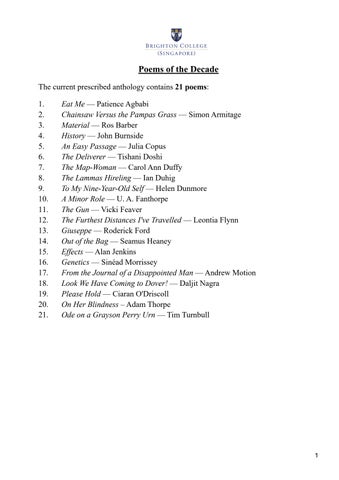
The current prescribed anthology contains 21 poems:
1. Eat Me Patience Agbabi
2. Chainsaw Versus the Pampas Grass Simon Armitage
3. Material Ros Barber
4. History John Burnside
5. An Easy Passage Julia Copus
6. The Deliverer Tishani Doshi
7. The Map-Woman Carol Ann Duffy
8. The Lammas Hireling Ian Duhig
9. To My Nine-Year-Old Self Helen Dunmore
10. A Minor Role U. A. Fanthorpe
11. The Gun Vicki Feaver
12. The Furthest Distances I've Travelled Leontia Flynn
13. Giuseppe Roderick Ford
14. Out of the Bag Seamus Heaney
15. Effects Alan Jenkins
16. Genetics Sinéad Morrissey
17. From the Journal of a Disappointed Man Andrew Motion
18. Look We Have Coming to Dover! Daljit Nagra
19. Please Hold Ciaran O'Driscoll
20. On Her Blindness – Adam Thorpe
21. Ode on a Grayson Perry Urn Tim Turnbull
Patience Agbabi, ‘Eat Me’
When I hit thirty, he brought me a cake, three layers of icing, home-made, a candle for each stone in weight. The icing was white but the letters were pink, they said, EAT ME. And I ate, did what I was told. Didn’t even taste it. Then he asked me to get up and walk round the bed so he could watch my broad belly wobble, hips judder like a juggernaut. The bigger the better, he’d say, I like big girls, soft girls, girls I can burrow inside with multiple chins, masses of cellulite. I was his Jacuzzi. But he was my cook, my only pleasure the rush of fast food, his pleasure, to watch me swell like forbidden fruit. His breadfruit. His desert island after shipwreck. Or a beached whale on a king-sized bed craving a wave. I was a tidal wave of flesh. too fat to leave, too fat to buy a pint of full-fat milk, too fat to use fat as an emotional shield, too fat to be called chubby, cuddly, big-built.
The day I hit thirty-nine, I allowed him to stroke my globe of a cheek. His flesh, my flesh flowed. He said, Open wide, poured olive oil down my throat. Soon you’ll be forty… he whispered, and how could I not roll over on top. I rolled and he drowned in my flesh. I drowned his dying sentence out. I left him there for six hours that felt like a week. His mouth slightly open, his eyes bulging with greed. There was nothing else left in the house to eat.
Simon Armitage, ‘Chainsaw Versus the Pampas Grass’
It seemed an unlikely match. All winter unplugged, grinding its teeth in a plastic sleeve, the chainsaw swung nose-down from a hook in the darkroom under the hatch in the floor. When offered the can it knocked back a quarter-pint of engine oil and juices ran from its joints and threads, oozed across the guide-bar and the maker’s name, into the dry links.
From the summerhouse, still holding one last gulp of last year’s heat behind its double doors, and hung with the weightless wreckage of wasps and flies, moth-balled in spider’s wool… from there, I trailed the day-glo orange power-line the length of the lawn and the garden path, fed it out like powder from a keg, then walked back to the socket and flicked the switch, then walked again and coupled the saw to the flex – clipped them together. Then dropped the safety catch and gunned the trigger.
No gearing up or getting to speeds, just an instant rage, the rush of metal lashing out at air, connected to the main. The chainsaw with its perfect disregard, its mood to tangle with cloth, or jewellery, or hair. The chainsaw with its bloody desire, its sweet tooth for the flesh of the face and the bones underneath, its grand plan to kick back against nail or knot and rear up into the brain.
I let it flare, lifted it into the sun and felt the hundred beats per second drumming in its heart, and felt the drive-wheel gargle in its throat.
The pampas grass with its ludicrous feathers and plumes. The pampas grass, taking the warmth and light from cuttings and bulbs, sunning itself, stealing the show with its footstools, cushions and tufts and its twelve-foot spears.
This was the sledgehammer taken to crack the nut. Probably all that was needed here was a good pull or shove or a pitchfork to lever it out at its base. Overkill. I touched the blur of the blade against the nearmost tip of a reed – it didn’t exist. I dabbed at a stalk that swooned, docked a couple of heads, dismissed the top third of its canes with a sideways sweep at shoulder height – this was a game.
I lifted the fringe of undergrowth, carved at the trunk –plant-juice spat from the pipes and tubes and dust flew out as I ripped into pockets of dark, secret warmth.
To clear a space to work I raked whatever was severed or felled or torn towards the dead zone under the outhouse wall, to be fired. Then cut and raked, cut and raked, till what was left was a flat stump the size of a manhole cover or barrel lid that wouldn’t be dug with a spade or prized from the earth. Wanting to finish things off I took up the saw and drove it vertically downwards into the upper roots, but the blade became choked with soil or fouled with weeds, or what was sliced or split somehow closed and mended behind, like cutting at water or air with a knife. I poured barbecue fluid into the patch and threw in a match – it flamed for a minute, smoked for a minute more, and went out. I left it at that.
In the weeks that came new shoots like asparagus tips sprang up from its nest and by June it was riding high in its saddle, wearing a new crown. Corn in Egypt. I looked on from the upstairs window like the midday moon.
Back below stairs on its hook, the chainsaw seethed. I left it a year, to work back through its man-made dreams, to try to forget. The seamless urge to persist was as far as it got.
Ros Barber, ‘Material’
My mother was a hanky queen when hanky meant a thing of cloth, not paper tissues bought in packs from late-night garages and shops, but things for waving out of trains and mopping the corners of your grief: when hankies were material she’d have one, always, up her sleeve.
Tucked in the wrists of every cardi, a mum’s embarrassment of lace embroidered with a V for Viv, spittled and scrubbed against my face. And sometimes more than one fell out as is she had a farm up there where dried-up hankies fell in love and mated, raising little squares.
She bought her own; I never did. Hankies were presents from distant aunts in boxed sets, with transparent covers and script initials spelling ponce, the naffest Christmas gift you’d get –my brothers too, more often than not, got male ones: serious, and grey, and larger, like they had more snot.
It was hankie that closed department stores, with headscarves, girdles, knitting wool and trouser presses; homely props you’d never find today in malls. Hankies, which demanded irons, and boiling to be purified shuttered the doors of family stores when those who used to buy them died.
And somehow, with the hanky’s loss, greengrocer George with his dodgy foot delivering veg from a Comma van is history, and the friendly butcher who’d slip and extra sausage in, the fishmonger whose marble slab of haddock smoked the colour of yolks and parcelled rows of local crab
lay opposite the dancing school where Mrs White, with painted talons, taught us When You’re Smiling from a stumbling, out of tune piano: step-together, step-together, step-together, point! The Annual Talent Show
when every mother, fencing tears, would whip a hanky from their sleeve and smudge the rouge from little dears.
Nostalgia only makes me old. The innocence I want my brood to cling on to like ten-bob notes was killed in TV’s lassitude. And it was me that turned it on and eat bought biscuits I would bake if I’d commit to being home.
There’s never a hanky up my sleeve. I raised neglected-looking kids, the kind whose noses strangers clean. What awkwardness in me forbids me to keep tissues in my bag when handy packs are 50p?
I miss material handkerchiefs, their soft and hidden history.
But it isn’t mine. I’ll let it go. My mother too, eventually, who died not leaving handkerchiefs but tissues and uncertainty: and she would say, should I complain of the scratchy and disposable, that this is your material to do with, daughter, what you will.
John Burnside, ‘History’
St Andrews: West Sands; September 2001
Today as we flew the kites
- the sand spinning off in ribbons along the beach and that gasoline smell from Leuchars gusting across the golf links; The tide far out and quail-grey in the distance; people jogging, or stopping to watch as the war planes cambered and turned in the morning light –today
- with the news in my mind, and the muffled dread of what may come – I knelt down in the sand with Lucas gathering shells and pebbles finding evidence of life in all this driftwork: snail shells; shreds of razorfish; smudges of weed and flesh on tideworn stone.
At times I think what makes us who we are is neither kinship nor our given states but something lost between the world we own and what we dream about behind the names on days like this our lines raised in the wind our bodies fixed and anchored to the shore and though we are confined by property what tether us to gravity and light has most to do with distance and the shapes we find in water reading from the book of silt and tides the rose or petrol blue of jellyfish and sea anemone combining with a child’s first nakedness.
Sometimes I am dizzy with the fear of losing everything – the sea, the sky, all living creatures, forests, estuaries: we trade so much to know the virtual we scarcely register the drift and tug of other bodies scarcely apprehend the moment as it happens: shifts of light and weather and the quiet, local forms of history: the fish lodged in the tide beyond the sands; the long insomnia of ornamental carp in public parks captive and hung in their own slow-burning transitive gold jamjars of spawn and sticklebacks or goldfish carried home from fairgrounds to the hum of radio but this is the problem: how to be alive
in all this gazed-upon and cherished world and do no harm a toddler on a beach sifting wood and dried weed from the sand and puzzled by the pattern on a shell his parents on the dune slacks with a kite plugged into the sky all nerve and line patient; be afraid; but still, through everything attentive to the irredeemable.
Julia Copus, ‘An Easy Passage’
Once she is halfway up there, crouched in her bikini on the porch roof of her family’s house, trembling, she knows that the one thing she must not do is to think of the narrow windowsill, the sharp drop off the stairwell; she must keep her mind on the friend with whom she is half in love and who is waiting for her on the blond gravel somewhere beneath her, keep her mind on her and on the fact of the open window, the flimsy, hole-punched, aluminium lever towards which in a moment she will reach with the length of her whole body, leaning in to the warm flank of the house. But first she steadies herself, still crouching, the grains of the asphalt hot beneath her toes and fingertips, a square of petrified beach. Her tiny breast rest lightly on her thighs. – What can she know of the way the world admits us less and less the more we grow? For now both girls seem lit, as if from within, their hair and the gold stud earrings in the first one’s ears; for now the house exists only for them, set back as it is from the long, grey eye of the street, and far away from the mother who does not trust her daughter with a key, the workers about their business in the drab electroplating factory over the road, far too, most far, from the flush-faced secretary who, with her head full of the evening class she plans to take, or the trip of a lifetime, looks up now from the stirring omens of the astrology column at a girl – thirteen if she’s a day – standing in next to nothing in the driveway opposite, one hand flat against her stomach, one shielding her eyes to gaze up at a pale calf, a silver anklet and the five neat shimmeringoyster-painted toenails of an outstretched foot which catch the sunlight briefly like the flash of armaments before dropping gracefully into the shade of the house.
Tishani Doshi, ‘The Deliverer’
Our lady of the light convent, Kerala
The sister here is telling my mother How she came to collect children Because they were crippled or dark or girls.
Found naked in the streets, Covered in garbage, stuffed in bags, Abandoned at their doorstep.
One of them was dug up by a dog, Thinking the head barely poking above the ground Was bone or wood, something to chew.
This is the one my mother will bring.
* Milwaukee Airport, USA
The parents wait at the gates. They are American so they know about ceremony And tradition, about doing things right.
They haven’t seen or toughed her yet. Don’t know of her fetish for plucking hair off hands, Or how her mother tried to bury her.
But they are crying. We couldn’t stop crying, my mother said, Feeling the strangeness of her empty arms.
*
This girl grows up on video tapes, Sees how she’s passed from women To women. She returns to twilight corners.
To the day of her birth, How it happens in some desolate hut Outside village boundaries
Where mothers go to squeeze out life, Watch body slither out of body,
Feel for penis or no penis, Toss the baby to the heap of others,
Trudge home to lie down for their men again.
Carol Ann Duffy, ‘The Map Woman’
A woman's skin was a map of the town where she'd grown from a child. When she went out, she covered it up with a dress, with a shawl, with a hat, with mitts or a muff, with leggings, trousers or jeans, with a an ankle-length cloak, hooded and fingertip-sleeved. But - birthmark, tattoothe A-Z street-map grew, a precise second skin, broad if she binged, thin when she slimmed, a précis of where to end or go back or begin.
Over her breast was the heart of the town, from the Market Square to the Picture House by way of St Mary's Church, a triangle of alleys and streets and walks, her veins like shadows below the lines of the map, the river an artery snaking north to her neck. She knew if you crossed the bridge at her nipple, took a left and a right, you would come to the graves, the grey-haired teachers of English and History, the soldier boys, the Mayors and Councillors,
the beloved mothers and wives, the nuns and priests, their bodies fading into the earth like old print on a page. You could sit on a wooden bench as a wedding pair ran, ringed, from the church, confetti skittering over the marble stones, the big bell hammering hail from the sky, and wonder who you would marry and how and where and when you would die: or find yourself in the coffee house nearby, waiting for time to start, your tiny face trapped in the window's bottle-thick glass like a fly.
And who might you see, short-cutting through the Grove to the Square - that line there, the edge of a fingernail pressed on her flesh - in the rain, leaving your empty cup, to hurry on after calling their name? When she showered, the map gleamed on her skin, blue-black ink from a nib. She knew you could scoot down Greengate Street, huddling close to the High House, the sensible shops, the Swan Hotel, till you came to the Picture House, sat in the musty dark watching the Beatles
run for a train or Dustin Hoffman screaming Elaine! Elaine! Elaine! or the spacemen in 2001 floating to Strauss. She sponged, soaped, scrubbed; the prison and hospital stamped on her back,
the park neat on her belly, her navel marking the spot where the empty bandstand stood, the river again, heading south, clear as an operation scar, the war memorial facing the railway station where trains sighed on the platforms, pining for Glasgow, London, Liverpool. She knew you could stand on the railway bridge, waving goodbye to strangers who stared as you vanished into the belching steam, tasting future time on the tip of your tongue. She knew you could run the back way home - there it was on her thightaking the southern road then cutting off to the left, the big houses anchored behind their calm green lawns, the jewels of conkers falling down at your feet, then duck and dive down Nelson and Churchill and Kipling and Milton Way until you were home.
She didn't live there now. She lived down south, abroad, en route, up north, on a plane or train or boat, on the road, in hotels, in the back of cabs, on the phone; but the map was under her stockings, under her gloves, under the soft silk scarf at her throat, under her chiffon veil, a delicate braille. Her left knee marked the grid of her own estate. When she knelt she felt her father's house pressing into the bone, heard in her head the looped soundtrack of thena tennis ball repeatedly thumping a wall,
an ice-cream van crying and hurrying on, a snarl of children's shrieks from the overgrown land where the houses ran out. The motorway groaned just out of sight. She knew you could hitch from Junction 13 and knew of a girl who had not been seen since she did; had heard of a kid who'd run across all six lanes for a dare before he was tossed by a lorry into the air like a doll. But the motorway was flowing away, was a roaring river of metal and light, cheerio, au revoir, auf wiedersehen, ciao.
She stared in the mirror as she got dressed, both arms raised over her head, the roads for east and west running from shoulder to wrist, the fuzz of woodland or countryside under each arm. Only her face was clear, her fingers smoothing in cream, her baby-blue eyes unsure as they looked at themselves. But her body was certain, an inch to the mile, knew every nook and cranny, cul-de-sac, stile, back road, high road, low road, one-way street of her past. There it all was, back
to front in the glass. She piled on linen, satin, silk, leather, wool, perfume and mousse and went out.
She got in a limousine. The map perspired under her clothes. She took a plane. The map seethed on her flesh. She spoke in a foreign tongue. The map translated everything back to herself. She turned out the light and a lover's hands caressed the map in the dark from north to south, lost tourists wandering here and there, all fingers and thumbs, as their map flapped in the breeze.
So one day, wondering where to go next, she went back, drove a car for a night and a day, till the town appeared on her left, the stale cake of the castle crumbled up on the hill; and she hired a room with a view and soaked in the bath. When it grew dark, she went out, thinking she knew the place like the back of her hand, but something was wrong. She got lost in arcades, in streets with new names, in precincts and walkways, and found that what was familiar was only facade. Back in her hotel room, she stripped and lay on the bed. As she slept, her skin sloughed like a snake's, the skin of her legs like stockings, silvery, sheer, like the long gloves of the skin of her arms, the papery camisole from her chest a perfect match for the tissuey socks of the skin of her feet. Her sleep peeled her, lifted a honeymoon thong from her groin, a delicate bra of skin from her breasts, and all of it patterned A to Z; a small cross where her parents' skulls grinned at the dark. Her new skin showed barely a mark.
She woke and spread out the map on the floor. What was she looking for? Her skin was her own small ghost, a shroud to be dead in, a newspaper for old news to be read in, gift-wrapping, litter, a suicide letter. She left it there, dressed, checked out, got in the car. As she drove, the town in the morning sun glittered behind her. She ate up the miles. Her skin itched, like a rash, like a slow burn, felt stretched, as though it belonged to somebody else. Deep in the bone old streets tunnelled and burrowed, hunting for home.
Ian Duhig, ‘The Lammas Hireling’
After the fair, I’d still a light heart And a heavy purse, he struck so cheap. And cattle doted on him: in his time Mine only dropped heifers, fat as cream. Yields doubled. I grew fond of company That knew when to shut up. Then one night,
Disturbed from dreams of my dear late wife, I hunted down her torn voice to his pale form. Stock-still in the light from the dark lantern, Stark-naked but for the fox trap biting his ankle, I knew him a warlock, a cow with leather horns. To go into the hare gets you muckle sorrow,
The wisdom runs, muckle care. I levelled And blew the small hour through his heart. The moon came out. By its yellow witness I saw him fur over like a stone mossing. His lovely head thinned. His top lip gathered. His eyes raised like bread. I carried him
In a sack that grew lighter at every step And dropped him from a bridge. Here was no Splash. Now my head’s elf-shot. I don’t dream But spend my nights casting ball from half-crowns And my days here. Bless me, Father, have sinned. It has been an hour since my last confession.
Helen Dunmore, ‘To My Nine-Year-Old Self’
You must forgive me. Don't look so surprised, perplexed, and eager to be gone, balancing on your hands or on the tightrope. You would rather run than walk, rather climb than run rather leap from a height than anything.
I have spoiled this body we once shared. Look at the scars, and watch the way I move, careful of a bad back or a bruised foot. Do you remember how, three minutes after waking we'd jump straight out of the ground floor window into the summer morning?
That dream we had, no doubt it's as fresh in your mind as the white paper to write it on. We made a start, but something else came up –a baby vole, or a bag of sherbet lemons –and besides, that summer of ambition created an ice-lolly factory, a wasp trap and a den by the cesspit.
I'd like to say that we could be friends but the truth is we have nothing in common beyond a few shared years. I won't keep you then. Time to pick rosehips for tuppence a pound, time to hide down scared lanes from men in cars after girl-children,
or to lunge out over the water on a rope that swings from that tree long buried in housing –but no, I shan't cloud your morning. God knows I have fears enough for us bothI leave you in an ecstasy of concentration slowly peeling a ripe scab from your knee to taste it on your tongue
UA Fanthorpe, ‘A Minor Role’
I’m best observed on stage, Propping a spear, or making endless Exits and entrances with my servant’s patter, Yes, sir. O no, sir. If I get These midget moments wrong, the monstrous fabric Shrinks to unwanted sniggers.
But my heart’s in the unobtrusive, The waiting-room roles: driving to hospitals, Parking at hospitals. Holding hands under Veteran magazines; making sense Of consultants’ monologues; asking pointed Questions politely; checking dosages, Dates; getting on terms with receptionists; Sustaining the background music of civility.
At home in the street you may see me Walking fast in case anyone stops: O, getting on, getting better my formula For well-meant intrusiveness. At home, Thinking ahead: Bed? A good idea! (Bed solves a lot); answer the phone, Be wary what I say to it, but grateful always; Contrive meals for hunger-striker; track down Whimsical soft-centred happy-all-the-way-through novels; Find the cat (mysteriously reassuring); Cancel things; pretend all’s well, Admit it’s not.
Learn to conjugate all the genres of misery: Tears, torpor, boredom, lassitude, yearnings For a simpler illness, like a broken leg. Enduring ceremonial delays. Being referred Somewhere else. Consultant’s holiday. Saying Thank you For anything to everyone
Not the star part.
And who would want it? I jettison the spear, The servant’s try, the terrible drone of Chorus: Yet to my thinking this act was ill advised It would have been better to die*. No it wouldn’t!
I am here to make you believe in life.
*Chorus: from Oedipus Rex, trans. EF Watling
Vicki Feaver, ‘The Gun’
Bringing a gun into the house changes it.
You lay it on the kitchen table, stretched out like something dead itself: the grainy polished wood stock jutting over the edge, the long metal barrel casting a grey shadow on the green-checked cloth.
At first it’s just practice: performing tins dangling an orange string from trees in the garden. Then a rabbit shot clean through the head.
Soon the fridge fills with creatures that have run and flown. Your hands reek of gun oil. And entrails. You trample fur and feathers. There’s a spring in your step; your eyes gleam like when sex was fresh.
A gun brings a house alive. I join in the cooking: jointing and slicing, stirring and tasting –excited as if the King of Death had arrived to feast, stalking out of winters woods, his black mouth sprouting golden crocuses.
Leontia Flynn, ‘The Furthest Distances I’ve Travelled’
Like many folk, when first I saddled a rucksack, feeling its weight on my back –the way my spine curved under it like a meridian –
I thought: Yes. This is how to live. On the beaten track, the Sherpa pass, between Krakow and Zagreb, or the Siberian white cells of scattered airports,
it came clear as over a tannoy that in restlessness, in anonymity: was some kind of destiny.
So whether it was the scare stories about Larium – the threats of delirium and baldness – that lead me, not to a Western Union wiring money with six words of Lithuanian,
but to this post office with a handful of bills or a giro; and why, if I’m stuffing smalls hastily into a holdall, I am less likely to be catching a greyhound from Madison to Milwaukee than to be doing some overdue laundry is really beyond me.
However, when, during routine evictions, I discover alien pants, cinema stubs, the throwaway comment – on a Post–It – or a tiny stowaway pressed flower amid bottom drawers, I know these are my souvenirs
and, from these crushed valentines, this unravelled sports sock, that the furthest distances I’ve travelled have been those between people. And what survives of holidaying briefly in their lives.
Roderick Ford, ‘Giuseppe’
My uncle Giuseppe told me that in Sicily in World War Two, In the courtyard behind the aquarium, where the bougainvillea grows so well, the only captive mermaid in the world was butchered on the dry and dusty ground by a doctor, a fishmonger, and certain others.
She, it, had never learned to speak because she was so simple, or so they’d said. But they priest who held one of her hands while her throat was cut, said she was only a fish and can’t speak. But she screamed like a woman in terrible fear.
And when they took a ripe golden roe from her side, the doctor said this was proof she was just a fish and anyway an egg is not a child, but refused when some was offered to him.
Then they put her head and her hands in a box for burial and someone tried to take her wedding ring, but the others stopped him, and the ring stayed put.
The rest they cooked and fed to the troops. They said a large fish had been found on the beach.
Starvation forgives men many things, my uncle, the aquarium keeper, said, but couldn’t look me in the eye, for which I thank God.
Seamus Heaney, ‘Out of the Bag’
All of us came in Doctor Kerlin’s bag. He’d arrive with it, disappear to the room And by the time he’d reappear to wash
Those nosy, rosy, big soft hands of his In the scullery basin, its lined insides (The colour of a spaniel’s inside lug)
Were empty for all to see, the trap-sprung mouth Unsnibbed and gaping wide. Then like a hypnotist Unwinding us, he’d wind the instruments
Back into their lining, tie the cloth Like an apron round itself, Darken the door and leave
With the bag in his hand, a plump ark by the keel... Until the next time came and in he’d come In his fur-lined leather collar which was also spaniel coloured
And go stooping up to the room again, a whiff Of disinfectant, a Dutch interior gleam Of waistcoat satin and highlights on the forceps.
Getting the water ready, that was nextNot plumping hot, and not lukewarm, but soft, Sud-luscious, saved for him from the rain-butt
And savoured by him afterwards, all thanks Denied as he towelled hard and fast, Then held his arms out suddenly behind him
To be squired and silk-lined into the camel coat. At which point once he turned his eyes upon me, Hyperborean, beyond-the-north wind blue,
Two peepholes to the locked room I saw into Every time his name was mentioned, skimmed Milk and ice, swabbed porcelain, the white
And chill of tiles, steel hooks, chrome surgery tools And blood dreeps in the sawdust where it thickened At the foot of each cold wall. And overhead
The little, pendent, teat-hued infant parts Strung neatly from a line up near the ceiling –A toe, a foot and shin, an arm, a cock
A bit like the rosebud in his buttonhole.
2
Poeta doctus Peter Levi says Sanctuaries of Asclepius (called asclepions) Wee the equivalent of hospitals
In ancient Greece. Or of shrines like Lourdes, Says Poeta doctus Graves. Or of the cure By poetry that cannot be coerced,
Say I, who realised at Epidaurus That the whole place was a sanatorium With theatre and baths,
A site of incubation, where “incubation” Was technical and ritual, meaning sleep When epiphany occurred and you met the god.
Hatless, groggy, shadowing myself
As the thurifer I was in an open-air procession In Lourdes in ‘56
When I nearly fainted from the heat and fumes, Again I nearly fainted as I bent To pull a bunch of grass and hallucinated
Doctor Kerlin at the steamed-up glass Of the scullery window, starting in to draw With his large pink index finger dot-faced men
With button-spots in a straight line down their fronts And women with dot breasts, giving them all A set of droopy sausage-arms and legs
That soon began to run. And then as he dipped and laved In the generous suds again, miraculum: The baby bits all came together swimming
Into his soapy big hygienic hands
And I myself came to, blinded with sweat, Blinking and shaky in the windless light.
3
Bits of the glass I pulled I posted off To one going in to chemotherapy And one who had come through. I didn’t want
To leave the place or link up with the others. It was midday, mid-May, pre-tourist sunlight In the precincts of the god,
The very site of the temple of Asclepius. I wanted nothing more than to lie down
Under hogweed, under seeded grass
And to be visited in the very eye of the day By Hygeia, his daughter, her name still clarifying The haven of light she was, the undarkening door.
4
The room I came from and the rest of us all came from Stays pure reality where I stand alone, Standing the passage of time, and she’s asleep
In sheets put on for the doctor, wedding presents That showed up again and again, bridal And usual and useful at births and at deaths.
Me at the bedside, incubating for real, Peering, appearing to her as she closes And opens her eyes, then lapses back
Into a faraway smile whose precinct of vision I would enter every time, to assist and be asked In that hoarsened whisper of triumph,
'And what do you think Of the new wee baby the doctor brought for us all When I was asleep?'
Alan Jenkins, ‘Effects’
I held her hand, that was always scarred From chopping, slicing, from the knives that lay in wait In bowls of washing-up, that was raw, The knuckles reddened, rough from scrubbing hard At saucepan, frying pan, cup and plate And giving love the only way she knew, In each cheap cut of meat, in roast and stew, Old-fashioned food she cooked and we ate; And I saw that they had taken off her rings, The rings she kept once in her dressing-table drawer With faded snapshots, long-forgotten things (scent-sprays, tortoise-shell combs, a snap or two From the time we took a holiday “abroad”) But lately had never been without, as if She wanted everyone to know she was his wife Only now that he was dead. And her watch? –Classic ladies’ model, gold strap – it was gone, And I’d never known her not have that on, Not in all the years they sat together Watching soaps and game shows I’d disdain And not when my turn came to cook for her, Chops or chicken portions, English, bland, Familiar flavours she said she preferred To whatever “funny foreign stuff”
Young people seemed to eat these days, she’d heard; Not all the weeks I didn’t come, when she sat Night after night and stared unseeing at The television, at her inner weather, Heaved herself upright, blinked and poured Drink after drink, and gulped and stared – the scotch That, when he was alive, she wouldn’t touch, That was her way to be with him again; Not later in the psychiatric ward, Where she blinked unseeing at the wall, the nurses (Who would steal anything, she said), and dreamt Of when she was a girl, of the time before I was born, or grew up and learned contempt, While the TV in the corner blared To drown some “poor soul’s” moans and curses, And she took her pills and blinked and stared 86As the others shuffled around, and drooled, and swore… But now she lay here, a thick rubber band With her name on it in smudged black ink was all she wore On the hand I held, a blotched and crinkled hand Whose fingers couldn’t clasp at mine any more Or falteringly wave, or fumble at my sleeve –The last words she had said were Please don’t leave
But of course I left; now I was back, though she Could not know that, or turn her face to see A nurse bring the little bag of her effects to me
Sinéad Morrissey, ‘Genetics’
My father’s in my fingers, but my mother’s in my palms. I lift them up and look at them with pleasure –I know my parents made me by my hands.
They may have been repelled to separate lands, to separate hemispheres, may sleep with other lovers, but in me they touch where fingers link to palms.
With nothing left of their togetherness but friends who quarry for their image by a river, at least I know their marriage by my hands.
I shape a chapel where a steeple stands. And when I turn it over, my father’s by my fingers, my mother’s by my palms demure before a priest reciting psalms. My body is their marriage register. I re-enact their wedding with my hands.
So take me with you, take up the skin’s demands for mirroring in bodies of the future.
I’ll bequeath my fingers, if you bequeath your palms. We know our parents make us by our hands.
Andrew Motion, ‘From the Journal of a Disappointed Man’
I discovered these men driving a new pile into the pier. There was all the paraphernalia of chains, pulleys, cranes, ropes and, as I said, a wooden pile, a massive affair, swinging
over the water on a long wire hawser. Everything else was in the massive style as well, even the men; very powerful men; very ruminative and silent men ignoring me.
Speech was not something to interest them, and if they talked at all it was like this –“Let go”, or “Hold tight”: all monosyllables. Nevertheless, by paying close attention
to the obscure movements of one working on a ladder by the water’s edge, I could tell that for all their strength and experience these men were up against a great difficulty.
I cannot say what. Every one of the monsters was silent on the subject – baffled I thought at first, but then I realised indifferent and tired of the whole business.
The man nearest to me, still saying nothing but crossing his strong arms over his chest, showed me that for all he cared the pile could go on swinging until the crack of Doom.
I should say I watched them at least an hour and, to do the men justice, their slow efforts to overcome the secret problem did continue –then gradually slackened and finally ceased.
One massive man after another abandoned his position and leaned on the iron rail to gaze down like a mystic into the water. No one spoke; no one said what they saw; though one fellow did spit, and with round eyes followed the trajectory of his brown bolus (he had been chewing tobacco) on its slow descent into the same depths.
The foreman, and the most original thinker, smoked a cigarette to relieve the tension. Afterwards, and with a heavy kind of majesty, he turned on his heels and walked away.
With this eclipse of interest, the incident was suddenly closed. First in ones and twos, then altogether, the men followed. That left the pile still in mid-air, and me of course.
Daljit Nagra, ‘Look We Have Coming to Dover!’
‘So various, so beautiful, so new…’ Matthew Arnold, ‘Dover Beach’
Stowed in the sea to invade the lash alfresco of a diesel-breeze ratcheting speed into the tide, brunt with gobfuls of surf phlegmed by cushy come-and-go tourists prow’d on the cruisers, lording the ministered waves.
Seagull and shoal life
Vexing their blarnies upon our huddled camouflage past the vast crumble of scummed cliffs, scramming on mulch as thunder unbladders yobbish rain and wind on our escape hutched in a Bedford van.
Seasons or years we reap inland, unclocked by the national eye or stab in the back, teemed for breathing sweeps of grass through the whistling asthma of parks, burdened, ennobled - poling sparks across pylon and pylon.
Swarms of us, grafting in the black within shot of the moon’s spotlight, banking on the miracle of sunspan its rainbow, passport us to life. Only then can it be human to hoick ourselves, bare-faced for the clear.
Imagine my love and I, our sundry others, Blair’d in the cash of our beeswax’d cars, our crash clothes, free, we raise our charged glasses over unparasol’d tables East, babbling our lingoes, flecked by the chalk of Britannia!
Ciaran O’Driscoll, ‘Please Hold’
This is the future, my wife says. We are already there, and it’s the same as the present. Your future, here, she says. And I’m talking to a robot on the phone. The robot is giving me countless options, none of which answer to my needs. Wonderful, says the robot when I give him my telephone number And Great, says the robot when I give him my account number. and a great, but I can find nothing to meet my needs on the telephone, and into my account (which is really the robot’s account) goes money, my money, to pay for nothing. This call is free of charge, says the robot. Yes but I’m paying for it, I shout, out of my wonderful account into my great telephone bill. Wonderful, says the robot. And my wife says, This is the future. I’m sorry, I don’t understand, says the robot. Please sat Yes or No. Or you can say Repeat of Menu. You can say Yes, No, Repeat or Menu, or you can say Agent if you’d like to talk to someone real, who is just as robotic. I scream Agent! and am cut off, and my wife says, This is the future. We are already there and it’s the same as the present. Your future, here, she says. And I’m talking to a robot on the phone, and he is giving me no options in the guise of countless alternatives. We appreciate your patience. Please hold. Eine Kleine Nachtmusik. Please hold. Eine Kleine Nachtmusik. Please hold. Eine fucking Kleine Nachtmusik. And the robot transfers me to himself. Your call is important to us, he says. And my translator says, This means your call is not important to them. And my wife says, This is the future. And my translator says, Please hold means that, for all your accomplishments, the only way you can now meet your needs is by looting. Wonderful, says the robot.
Please hold. Please grow old. Please grow cold. Please do what you’re told. Grow old. Grow cold. This is the future. Please hold.
Adam Thorpe, ‘On Her Blindness’
My mother could not bear being blind, to be honest. One shouldn’t say it.
One should hide the fact that catastrophic handicaps are hell; one tends to hear,
publicly from those who bear it like a Roman, or somehow find joy in the fight. She turned to me, once, in a Paris restaurant, still not finding the food on the plate with her fork, or not so that it stayed on(try it in a pitch-black room) and whispered, “It’s living hell, to be honest Adam.
If I gave up hope of a cure, I’d bump myself off.” I don’t recall what I replied, but it must have been the usual sop, inadequate: the locked-in son.
She kept her dignity, though, even when bumping into walls like a dodgem; her sense of direction did not improve, when cast inward. “No built-in compass,” as my father joked. Instead, she pretended to ignore the void, or laughed it off.
Or saw things she couldn’t see and smiled, as when the kids would offer the latest drawing, or show her their new toy –so we’d forget, at times, that the long, slow slide had finished in a vision as black as stone. For instance, she’d continued to drive the old Lanchester long after it was safe down the Berkshire lanes. She’d visit exhibitions, admire films, sink into television
while looking the wrong way. Her last week alive (a fortnight back)
was golden weather, of course, the autumn trees around the hospital
ablaze with colour, the ground royal with leaf-fall. I told her this, forgetting, as she sat too weak to move, staring at nothing. “Oh yes, I know,” she said, “it’s lovely out there.” Dying has made her no more sightless, but now she can’t pretend. Her eyelids were closed in the coffin; it was up to us to believe she was watching, somewhere, in the end.
Tim Turnbull, ‘Ode on a Grayson Perry Urn’
Hello! What's all this here? A kitschy vase some Shirley Temple manqué has knocked out delineating tales of kids in cars on crap estates, the Burberry clad louts who flail their motors through the smoky night from Manchester to Motherwell or Slough, creating bedlam on the Queen's highway. Your gaudy evocation can, somehow, conjure the scene without inducing fright, as would a Daily Express exposé,
can bring to mind the throaty turbo roar of hatchbacks tuned almost to breaking point, the joyful throb of UK garage or of house imported from the continent and yet educe a sense of peace, of calmthe screech of tyres and the nervous squeals of girls, too young to quite appreciate the peril they are in, are heard, but these wheels will not lose traction, skid and flip, no harm befall these children. They will stay out late
forever, pumped on youth and ecstasy, on alloy, bass and arrogance, and speed the back lanes, the urban gyratory, the wide motorways, never having need to race back home, for work next day, to bed. Each girl is buff, each geezer toned and strong, charged with pulsing juice which, even yet, fills every pair of Calvin’s and each thong, never to be deflated, given head in crude games of chlamydia roulette.
Now see who comes to line the sparse grass verge, to toast them in Buckfast and Diamond White: rat-boys and corn-rowed cheerleaders who urge them on to pull more burn-outs or to write their donut Os, as signature, upon the bleached tarmac of dead suburban streets. There dogs set up a row and curtains twitch as pensioners and parents telephone the cops to plead for quiet, sue for peacetranquillity, though, is for the rich.
And so, millennia hence, you garish crock, when all context is lost, galleries razed to level dust and we're long in the box, will future poets look on you amazed,
speculate how children might have lived when you were fired, lives so free and bountiful and there, beneath a sun a little colder, declare How happy were those creatures then, who knew the truth was all negotiable and beauty in the gift of the beholder.