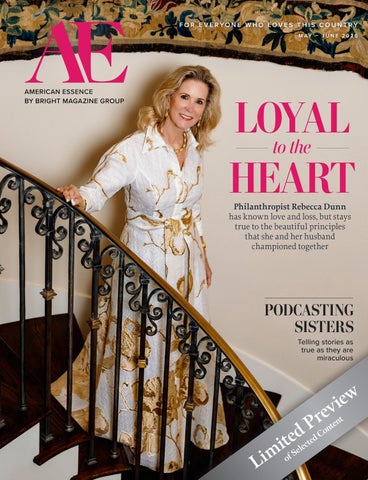
Philanthropist Rebecca Dunn has known love and loss, but stays true to the beautiful principles that she and her husband championed together
Telling stories as true as they are miraculous
Calcite Springs View Area in Yellowstone National Park, Wyoming.
It is better to be faithful than famous. “
Theodore Roosevelt
16 12
First Look
8 | Social Calendar
Our picks for exciting events worth attending across the country.
10 | Culture Shortlist
What to watch and read for some pastime inspiration.
12 | Relaxing in Nature
The best farms and ranches for both adventure and relaxation.
14 | Friendship Rules
An etiquette expert offers tips on how to maintain lasting friendships.
Features
16 | Love, Loss, and Loyalty
Philanthropist Rebecca Dunn reveals where her strong and caring ethics originate from and the extraordinary man who encouraged them.
24 | Nurturing Little Ones
There’s no cure for anxiety or depression, but the mother–child bond may prevent it, according to author and psychoanalyst Erica Komisar.
28 | ‘Sisters of Suspense’
A podcast co-hosted by two sisters provides a gripping alternative for true crime enthusiasts—stories of miracles and inspiration.
32 | Safer Shores
An orphan from war-torn Liberia feels blessed to have a loving family in the American South.
36 | A Companionship to Remember
Tragedy inadvertently led Linda Zelik to start training service dogs, ultimately giving her a newfound purpose.
The Resort at Paws Up in Montana is a working cattle ranch and ranks among the world’s top 10 resorts.
Lifestyle
38 | The Gold Standard
Chefs from around the country share the ingredients they believe reflect the best of the best.
44 | Sowing the Seeds of Self-Reliance
How to easily grow food in your own backyard, according to founders of an heirloom seed company in Texas.
50 | What Inspires a BBQ Hall of Famer Melissa Cookston shares stories and recipes from her latest culinary adventures.
History
58 | Love in Life and Death Titanic victims Ida and Isidor Straus’s love story demonstrates grace and loyalty.
62 | Artist and Inventor
An engraving of “The Upper Yellowstone Falls” by S.V. Hunt, after a painting by Thomas Moran, is featured in the 1872 “Picturesque America,” Vol. 1.
Culture
62
Although Samuel F.B. Morse’s paintings were critically acclaimed, today he’s known for improving long-distance communication.
66 | Celebrating American Allegiance
Loyalty Day began as an effort to unify Americans from many lands and cultures.
71 | Unwavering Determination
Where others saw failure, Charles Goodyear saw opportunity and devoted his life to vulcanizing rubber.
74 | The ‘Conway Cabal’
With dignity and patience, George Washington outlasted the schemers who sought his command.
90
78 | ‘America’s Tenor’ Christopher Macchio discusses his reluctant start to becoming the president’s go-to singer.
82 | Why I Love America
An outdoors photojournalist reflects on how this country has allowed him to turn his passion for hunting into a career he loves.
84 | Family Roots
Why this writer is grateful for what her grandmother’s immigrant journey taught her.
86 | Remington’s Rugged Cowboys
With famous sculptures like “Off the Range,” Frederic Remington chronicled the disappearing frontier life of the American West.
90 | An Ode to America
With its rich prose and beautiful artwork, “Picturesque America,” Vol. 1. was the first publication to celebrate the continental nation.
98 | Rx for Life
Relationship expert Laura Doyle offers guidance on how to keep showing up for our spouses no matter the circumstances.
A detail from the portrait of James Monroe by Samuel F.B. Morse, circa 1819.
SOCIAL CALENDAR
America’s Highway ROUTE 66 100TH ANNIVERSARY FESTIVAL
Various Events Along Route 66 | Yearlong
To celebrate the 100th anniversary of the establishment of Route 66, a series of events is being planned, including special itineraries for motorists, a car show in Detroit, and a special ride for Harley-Davidson bike owners. Route66Centennial.org
A Tasty Celebration
KODIAK CRAB FESTIVAL
Kodiak, Alaska | May 21–25
The island of Kodiak, Alaska, is known for bountiful natural delights, from the scenery to the seafood. Its crab season is celebrated with a five-daylong annual extravaganza, featuring a festive parade, rides and attractions for all ages, and of course, vendors offering a wide variety of crab-based delicacies.
KodiakCrabFest.com
The Heartbeat of a Nation COLONIAL WILLIAMSBURG DRUMMER’S CALL
Williamsburg, Va. | May 29–31
During the Revolutionary War, drums and the fife were used to communicate messages to soldiers. Each company’s drummer and fifer performed “duty calls” to relay orders, wake soldiers, alert them to meal time, and signal the end of the day. Colonial Williamsburg’s reenactments provide visitors the exact experience from days long past.
A Patriotic Musical Celebration AMERICA 250: A MUSICAL JOURNEY
Chicago, Ill . | June 2–27
Using music as the medium, the Chicago Symphony Orchestra will celebrate America’s 250th birthday with a monthlong jubilee of music by American composers such as Ira Gershwin and Charles Ives. Notable guest artists such as film composer John Williams will be featured.
The Ultimate Independence Day WASHINGTON, D.C., FOURTH OF JULY CELEBRATION
Washington | July 4
As the nation’s capital, it is fitting that Washington will host a marvelous multitude of fetes on the 250th Independence Day. The festivities include a concert on the West Lawn of the Capitol Building, family-friendly events at the Jefferson Memorial and the Sylvan Theater, and a spectacular, dazzling fireworks display on the National Mall.
Add Chicago to the list of places to get great barbecue. For five days, the city will host a massive, barbecue-flavored music fest. In addition to a wide array of vendors offering every conceivable form of barbecue, a slate of performers including Hootie & The Blowfish, Lanie Wilson, Blake Shelton, and more will perform live on stage. WindyCitySmokeout.com
WATCH
‘Mutiny’
CULTURE SHORTLIST
This classic naval drama explores the War of 1812 through loyalty, duty, and command under pressure. Confined at sea, officers and crew face moral tests as discipline strains and allegiance is questioned. Though modest in scale, the film treats a rarely shown conflict with seriousness and conviction.
DIRECTOR
Edward Dmytryk
STARS
Mark Stevens, Patric Knowles, Angela Lansbury
RELEASED 1952
STREAMING
Internet Archive
WATCH
‘Hachi: A Dog’s Tale’
After adopting an American professor, the stray Japanese Akita “Hachi” remains loyal to his master all his life, faithfully awaiting his return at the train station every night—for a full nine years after his owner’s death. Inspired by the historical Hachiko, this G-rated film re-imagines the story in small-town New England.
DIRECTOR
Lasse Hallstrom
STARS
Richard Gere, Joan Allen, Cary-Hiroyuki Togawa, Jason Alexander, Erick Avari
These pages are in the preview.
RELEASED 2009
STREAMING
Tubi, Roku Channel
READ READ
‘Abraham Lincoln: A History’
What better documenters of the 16th president’s political, professional, and personal actions, words, gestures, and jokes than his two faithful private secretaries, John G. Nicolay and John Hay? Volume 1 of “Abraham Lincoln: A History,” originally published in 1890, is the launch point for a 10-volume, thorough history that conveys not only Nicolay and Hay’s up-close-andpersonal observations, as well as their admiration for Lincoln, but also eldest son Robert Lincoln’s involvement in pulling together important primary and secondary sources.
Cosimo Inc., 2009 Paperback, 456 pages
‘Faithful Shep: The Story of a Hero Dog & the Nine Texas Rangers Who Saved Him’
Two Coloradans returning home from Texas have their horses stolen by Mescalero Apaches while deep in the Big Bend. Forced to walk to safety, they have to leave their dog, Shep, behind with food and instructions to guard their belongings. Once safe, they return to rescue their dog, despite the dangerous Apaches. Nine Texas Rangers decide to come with them. Don Denevi’s tale of reciprocated loyalty.
Texas Review Press, 2017 Paperback, 144 pages
are not included preview.
A HEART TO GIVE & LET GO
Rebecca Dunn knows deep love, and profound loss, but keeps giving to others in the hope of changing the world for the better
By Jared Pearman
Philanthropist Rebecca Dunn lives a full and active life on the Gulf Coast of Florida. Her son and his family live only steps away. Dunn loves being with people and introducing newcomers, and she takes pride in hosting intimate dinners with meaningful conversations.
As a highly visible trustee of the Dunn Foundation, founded by her late husband Bill Dunn, Rebecca spends her time supporting people and organizations across the country through projects focused on freedom, education, and classical liberal values. It’s an endeavor led by her heart, which remains forever loyal to her faith, family, and the nation that made her incredible life possible.
I would dream, and I would also pray. … I felt optimistic about the future and what lay ahead, like that endless ocean before me. “
Rebecca Dunn, philanthropist and board member of various organizations for over 40 years
Dunn’s story began in a humble motel run by her family on an island off the coast of North Carolina. She lived there until she was 7, her whole family sharing a tiny, one-bedroom home connected to the motel office. She remembers sweeping sand off the long sidewalks in front of the motel rooms by the age of 5. She laughed when she said that her skills as a hostess today were probably honed at that early age, when she would greet motel guests while her parents were out of the office.
When her father sold the motel, the family moved to an undeveloped part of the island. There, Dunn would hike over a large sand dune after school, walk the empty shoreline, and gaze at the endless ocean.
“I would dream of faraway places and look out at this endless distance. I would dream, and I would also pray. Both of those were habits that, I have to say, were woven into the tapestry of my life. I felt optimistic about the future and what lay ahead, like that endless ocean before me.”
Finding Love
After attending a Baptist girls’ college in Raleigh for two years, then transferring to Florida State University, Dunn met her first husband, Bob, a Yale graduate. They had a son together and moved to the Tampa Bay area. Though the marriage
Rebecca married pioneering financial trader William A. “Bill” Dunn in a sweet, swift ceremony in Montana in 2002. They had a grand reception later that year, and they vacationed annually in St. Barths (below). She stayed by his side until his death in 2025.
These pages are in the preview.
ended after 25 years, they maintained a warm friendship. Dunn said her father advised her, “Even if you have to walk away from everything, keep a good relationship with your husband because there will always be weddings, graduations, funerals, birthdays.”
“Basically, we chose to love our son more than dislike each other. It was a wise and rewarding decision,” Dunn recalled.
“One of the things I have learned in life is that holding onto negative thoughts is a huge burden. Forgiveness and a positive mindset help us to move forward in life with the joy our Creator wants us to experience.”
Rebecca later became friends with Bill Dunn through mutual philanthropic involvement in public policy organizations. He was a brilliant Marine veteran, futures trader, and fierce advocate for liberty. Initially, she thought there was no way they’d ever be involved romantically.
“I would have bet every penny I owned that we would never be in a serious relationship,” she said.
Then one day he asked her, “Do you think a cowboy like me and a lady like you could ever have any kind of future together?” From that day forward, he was her cowboy, and she was his lady.
They married in a spontaneous ceremony in Big Sky, Montana, during a blizzard in March 2002. Rebecca had just 30 minutes in town to buy a wedding dress while Bill replaced the tires on his truck. She found a long, brown velvet dress and wore it with her boots and cowboy hat.
“ are not included
preview.
The Cowboy and the Lady Bill influenced Rebecca’s passion for freedom and good character, she said. He lived by the ideas described in “Cowboy Ethics: What Wall Street Can Learn From the Code of the West” by James P. Owen. The book outlines 10 principles that Owen published in 2005 and that have since been adopted by the state of Wyoming: “Live each day with courage; take pride in your work; always finish what you start; do what has to be done; be tough but fair; ride for the brand; talk less and say more; remember some things aren’t for sale; and know where to draw the line.”
Bill exemplified loyalty and integrity. He supported emerging leaders, seeing potential where others did not. He preferred supporting individuals and organizations over politicians, but he didn’t shy away from donating to politicians he felt were important to the conversation.
Dunn remembers seeing him write a substantial check for a political candidate who no longer seemed to have a chance of winning. When she asked him why he wanted to invest in a lost cause, he told her:
“He’s a good person with tremendous character. He elevates the conversation. The longer I can keep him at the table with my support, the more positive influence he will have on the other candidates, and our country will benefit.”
Live each day with courage; take pride in your work; always finish what you start; do what has to be done; be tough but fair; ride for the brand; talk less and say more; remember some things aren’t for sale; and know where to draw the line.
Rebecca and Bill Dunn pictured with Rebecca’s grandsons. Rebecca remains a trustee of The Dunn Foundation, and she has over 40 years of experience advocating for public policy, arts, health, education, individual rights, and liberty.
The “Code of the West” from one of Bill Dunn’s favorite books, “Cowboy Ethics” by James P. Owen.
Parents teach children that they can feel safe and secure through something called attachment security.
Erica Komisar
behavior.
Bonding With Baby
Why a mother’s nurturing is critical to a child’s development and future relationships, according to psychoanalyst Erica Komisar
By Jeff Minick | Photographed by Adhiraj Chakrabarti
Over the last decade, studies, data, media commentary, and personal experience have made many Americans aware of the ever-growing mental and emotional health challenges faced by young people, from preschoolers to college students. Research has attributed this rise in the rates of anxiety, depression, and general unhappiness to a wide range of factors, from academic pressures to the negativity of our daily news to the damages inflicted by widespread addiction to screens.
Psychoanalyst, social worker, and writer Erica Komisar is shining a light on another, often overlooked cause for this decline in mental and emotional health among children, teens, and 20-somethings. “Parents teach children that they can feel safe and secure through something called attachment security,” she told American Essence, “which is being physically and emotionally present for a neurologically, emotionally, and physically fragile infant. It’s those first three years that lay the groundwork to feel safe.”
The First Three Years of Life
Komisar, 61, began her professional life as a young social worker counseling children in Brooklyn before she trained and began practicing as a psychoanalyst. She explained: “I was noticing that children were being diagnosed and medicated with mental disorders … as young as 2, 3 years of age. They were having labels put on them, behavioral issues or attentional issues, and they were medicating children very, very young.”
Erica Komisar has spent decades researching and studying parenting and children’s
Coinciding with her early observations was an uptick in neuroscience research during the 1990s, which Komisar called “the decade of the brain.” She encountered new studies on the right hemisphere of the brain, which processes negative and positive emotions and plays a vital role in personal growth and maturity.
This surging tide of knowledge and information demonstrated that the first three years of life “are what we call the first critical period of development. … And that is the origin of one’s personality. We knew that as psychoanalysts, but now we could actually see it.”
Komisar concluded that this was why mothers should remain close to their babies during the first three years of life. “We’ve sort of got it all wrong today, because we project onto children that they are born resilient, that they’re born with the capacity to handle stress,” she said. “But their brains are completely vulnerable to stress, and it’s only through the physical and emotional contact you have with them from moment to moment in those first three years that [a child] builds trust and that feeling of safety.” This security, this bond, acts as a sort of launch pad toward the child’s future happiness and emotional well-being.
Failure to establish attachment security results in various attachment disorders, which can affect people for the rest of their lives. Though this affliction is as old as human history—literature alone provides numerous examples of mothers and children failing to bond—our modern world has made it more common. In today’s society, people are encouraged to adopt a “me first” attitude. Women who become mothers thus choose to devote their time and energy to their careers, turning the care of their toddlers over to daycare facilities or to unfamiliar caregivers.
But when mother and child lack the healthy attachments so necessary for trust and bonding, Komisar said, “some children will use avoidance strategies where they’ll just disconnect, dissociate, turn away, and those children often correlate later with depression or difficulty forming trusting relationships.”
Children were being diagnosed and medicated with mental disorders … as young as two, three years of age. “ Erica Komisar
A Mother’s Presence
Komisar argues that a full-time, stay-at-home mom who can deliver “sensitive, empathic nurturing” is the ideal caregiver for a child. Studies on hormone production in men and women have revealed why a mother is biologically attuned to providing sensitive nurturing to a child. Levels of oxytocin, known as the “love hormone” that helps to develop positive feelings and trust, differ between a mother and a father when they interact with their children, and change the way they bond with the child.
A mother helps “to process [her] child’s feelings, helping them digest the experiences and the stress they’re exposed to, buffering them from stress in the beginning,” Komisar explained. But she understands that in today’s world, many families must have both parents work to provide the basics of food and housing. In these cases, she offered some recommendations that serve the best interests of the child. If Mom and Dad must both be gone at the same time, a nurturing caregiver, such as a close family member like a grandmother or a good friend of the family, is the next best alternative. “You never leave your children in a gym [membership] daycare. … You never leave them with babysitters they don’t know very, very, very well,” she said.
These pages are in the preview.
If the mother has to return to work, she should ideally do it part-time, in an occupation that allows her to leave work at the door. “When they come home, they belong to their baby,” she said. She suggested to moms: “Pick a kind of work that … you can regulate or titrate down so you can do it on your own terms and in a way so that you have control and flexibility.”
Komisar lived by this advice when raising her own three children, all of whom are now young adults. In those early years, her husband provided for the family, while she decided to work less and put her young children first. In her 2017 book “Being There: Why Prioritizing Motherhood in the First Three Years Matters,” she began by explaining how at times, she delayed writing her book and juggled her schedule to meet the needs of her
Komisar advocates for mothers to be present as much as possible during a child’s first three years of life.
are not included preview.
children. Consequently, she understands parents who feel constantly stressed or at a breaking point, but she reminds them that their long-term and most crucial objective is to instill love, security, and healthy attachment in their children for life.
Looking Ahead
Komisar joked that she wrote “Being There” because “I would go to cocktail parties and dinner parties, and be the most annoying guest, because I couldn’t stop talking about what I was seeing, and was so bothered that the narcissism of our time had driven us to neglect children to the extent that they were suffering. It was sort of like the story of the ‘Emperor’s New Clothes.’ No one else was talking about it.”
Today, Komisar delivers her message to audiences large and small. She advocates for greater societal support so mothers can remain home and care for their children, such as through paid maternity leave, government stipends for caregiving, and tax credits to businesses that provide flexible work schedules for parents. She also encourages women not to fear putting their careers on hold to care for their young children; she explained that they can return to their careers after their children’s formative years.
For now, their children need them in the first three years of their lives. Komisar has noticed that social attitudes are slowly warming to this idea. “There’s a shift happening, even if it’s subtle. Let’s say it’s good to have a little optimism here.”
Miracles and
Holly Worthington, left, and Emily Jones, co-hosts of “The Miracle Files” podcast.
Some thrilling stories leave you filled with joy instead of dread, as these sisters-turned-co-hosts found out
Microphones
By Randy Tatano
True crime podcasts are incredibly popular. And almost all of them have one thing missing.
A happy ending.
Sure, depending on your point of view there’s often justice or closure. But what about those crimes that fall into a different category—because of what might be perceived as divine intervention?
‘The Miracle Files’
Sisters Holly Worthington and Emily Jones noticed this. Big fans of true crime podcasts, they realized that listening to those tales was beginning to feel dark and depressing. So they set out to find suspenseful, action-packed stories from real people with positive endings. Emily recalled the day they got the idea to do something different. “I called Holly, and she said she wasn’t listening to them anymore.”
Holly said, “I felt like I needed to find some entertainment that was more uplifting.” They both searched for podcasts with a more positive tone, but they couldn’t find anything that fit their needs.
And like the old saying goes, when you need something done right, you do it yourself. So they set out to fill a void in the world of podcasting, but with a twist.
Emily wanted to add another element— gripping accounts that offered the possibility that a miracle was involved, that God somehow intervened in a crime or serious accident to make things right. The result is “The Miracle Files,” a regular podcast produced and hosted by the siblings since November 2023. Holly calls them “stories that end in a miracle instead of a murder.”
One recent podcast recounted the day San Francisco 49ers rookie wide receiver Ricky Pearsall was shot three times in a broad daylight mugging. The player escaped death and made a miraculous recovery. A guardian angel was nearby in the form of a police sergeant who held the bleeding football player in her arms, put pressure on the wound, and told him, “It’s not your time. God is with us right now.”
The bullets missed every vital organ and
the spinal cord, which Pearsall’s doctor said was “a one in a million shot to miss all those.”
Unseen Hands
So what “qualifies” as a miracle? Emily says, “It’s something that maybe shouldn’t have happened, and it’s clear that God intervened to change the outcome to His will. Extraordinary events that you can’t explain with science and you can’t explain with logic. That there’s a higher power at work.”
A young man fell 230 feet off a cliff in Australia’s outback, laid unconscious overnight, and survived with relatively minor injuries. Emily and Holly described each twist and turn of his events expertly; from a rescue call where cell service should not exist, to weather that seemed heaven-sent to preserve the boy’s brain from swelling, nearly everything about this episode seemed miraculous.
Holly thinks, “There are these amazing experiences that people have which show that God is real and they can’t deny it. There is some kind of divine intervention.”
It’s not like we hear of miracles every day. So how do the sisters find these inspirational stories? Holly says the stories find them. “Well, first off, we have an amazing audience who send us incredible stories. And of course, these are God’s stories. There are so many stories that never get reported in the news.”
All in the Family
Despite their 12-year age difference, the sisters have always been close. Holly is the oldest of five children while Emily is the youngest. Growing up in Idaho Falls, Idaho (which Holly calls “the frozen tundra”), Holly would do Emily’s hair when she was little. The bond continued when Holly went off to college. The sisters wrote letters to each other, and Emily would come and stay with Holly in her dorm.
While they had no experience producing podcasts, they did possess the necessary skills. Holly is a writer who has written for magazines while Emily was a wedding videographer who had a great deal of experience editing. Basically, they had the skill set of a television news crew.
Stories that end in a miracle instead of a murder.
“ Holly Worthington, co-host of
“The Miracle Files” podcast
These pages are in the preview.
So far, they’ve done more than 60 podcasts as it has turned into a full time job for both. Emily feels they’re very different from what you’d normally find online. “It’s not a typical podcast where you interview people. We produce it. We call it a movie in your ear. A theater for your mind.” The use of suspenseful storytelling, sound effects, and music heightens the telling.
When putting the podcast together, Holly writes the script, then gets it approved by the people who experienced the miracle. Emily then edits the story while adding music and sound effects. They strive for a really powerful but also an entertaining experience. For the shorter Miracle in the News stories, they sort through the day’s news. Holly says if you want to see a miracle, you don’t have to go far. “They really are everywhere if we have eyes to see.”
Growing Faith
They’ve made it a point to not get into politics or specific religions because they want the podcast to appeal to everyone. Holly said, “No one religion has a monopoly on God’s mira-
cles. People have told us our podcast feels like a safe place where they can come and hear about God.” Emily agreed. “Anybody who wants to come and see the goodness of God and celebrate His miracles, we want [them] to feel welcome.”
The response has been huge, as the podcasts get about 100,000 downloads per month and are often in the top 100 podcasts in the religion and spirituality charts. Globally, “The Miracle Files” ranks in the top 1 percent of podcasts with about 400,000 followers, with about a 30 percent growth each month.
Beyond the numbers, the sisters feel the podcast is making a difference. Holly feels loyalty is a key factor. “We see how people who are loyal to God are willing to be used as instruments of his hand in helping other people.” One of her favorite responses came from a viewer who told her, “I go back and forth about whether there is a God. But your podcast makes me want to believe there is a God. It brings me one step closer.”
Emily said, “If it can help people feel closer to God, that’s what our podcast is for.”
EPISODES 40 & 41
Flood of Miracles
A flash flood in Hawaii suddenly pulled Dr. Rich Greenburg and his toddler daughter into deadly whitewater rapids.
Excerpt:
“At that very moment, Marla was slipping free. With the impact of the rock, her body had almost entirely come out of the backpack. Only her tiny feet remained caught as the rapids tugged on the rest of her body. Her mother, Carrie, watched in terror. … “Rich felt like crying when he reached dry ground. Rich’s first thought was Marla. ‘I didn’t even know if she was alive or still in the backpack. I ripped off the backpack [because] I want to look at her.’ Rich heaved a giant sigh of relief. Miraculously, Marla was still in the backpack. But it wasn’t until he saw her eyes stare back into his that the true weight lifted from his chest.”
The Miracle Files is on Youtube, Spotify, Apple Podcasts, Facebook, Instagram, and TikTok. TheMiracleFiles.com
Worthington and Jones are sisters who have always felt close to one another.
AmericanGrown Greatness
Across different regions of the country, chefs highlight the local ingredients that inspire them the most
By Andria Pressel
Great ingredients make great dishes. But some ingredients are more powerful than others. They carry history, amazing flavor, and incredible versatility. American Essence asked top chefs which ingredients they consider their gold standards—the ones they return to again and again, which represent the unique terroir of where they’re sourced.
Their answers are as diverse as the geography of America: nutty mesquite beans, smoked lake trout that whispers of campfires, and crisp apples that immediately conjure fall memories.
Some of these ingredients are humble. Some may be unfamiliar to many Americans. But all of them, according to the chefs who champion them, are worthy of celebration.
These responses have been edited for clarity and brevity.
Mesquite bean cake served at Steve McHugh’s restaurant, Cured.
Mesquite Beans
STEVE M c HUGH Cured
San Antonio, Texas
Gold standard ingredient and what makes it shine:
When I moved from New Orleans to San Antonio more than a decade ago, I began to explore the history of the food in the city and surrounding region. I started down this path of trying to learn what people ate before the Spanish arrived. This included cactus, rabbits, snakes, small pigs, and the occasional buffalo—but those aren’t things people can survive on. I came to discover that the nomadic tribes really survived on mesquite beans. As Spanish and westward-expanding American settlers arrived and brought their own crops with them, the beans were largely forgotten, and it’s been exciting to be a part of their renaissance.
To make mesquite flour, the pods first need to be gathered. The beans need to be rinsed and cleaned, and toasted in the oven. Then, the pods should be snapped into small segments and pulverized into a powder with a food processor. The powder then needs to be filtered. Continue to grind and sift until the pods have been milled into a powder. It can be jarred and stored in a cool place. It’s such a versatile ingredient. It has endless savory and sweet applications. It is also a great natural sweetener—mix a couple of tablespoons into chili, smoothies, or even your morning coffee.
Ingredient backstory:
Mesquite is Texas’s native food source and has such a rich history in the state, dating back to the indigenous peoples. Historically, it has also provided nutrition and sustenance to cattle and wildlife during seasons of drought. And while mesquite trees are native to Texas, they are also considered by some to be a troublesome, weed-like species that requires careful regulation because of their resistance to removal methods, which also makes the culinary resurgence in popularity even more important as it helps to control its growth. There is something incredibly unique about the flavor. I have spent a lot of time trying different ingredients and experimenting in the kitchen, and I always find it particularly exciting when you try something unlike anything else! We have this idea of mesquite being this bitter, smoky barbecue thing. But it can be really sweet. It’s chocolatey, it’s coconutty, it’s caramelly, almost graham crackerish.
My rendition:
Mesquite can be used as a substitute for a portion of the flour in most recipes for baked goods—brown butter chocolate chip mesquite cookies are a favorite of mine.
Shoutout to:
Cappadona Ranch in Linn, Texas, is an excellent source of mesquite. The Cappadona family harvests mesquite beans on this 2,500-acre ranch. The Cappadona Ranch has really been at the forefront reintroducing this bit of our Texas history. They produce everything from mesquite jellies to mesquite teas.
Shrimp and grits, the latter produced at George Washington’s Gristmill.
Grits and Cornmeal From George Washington’s Gristmill
DAVID GUAS
Bayou Bakery, Coffee Bar & Eatery and Neutral Ground Bar + Kitchen McLean, Va.
Gold standard ingredients and what makes them shine:
I feel very lucky to have the exclusive use of the grits and cornmeal produced from George Washington’s Gristmill in Mount Vernon, Virginia—the same machine used by Washington himself in 1771.
The historic gristmill is an innovation. It not only increased the production of grain and flour but also eliminated the need for manual labor.
Ingredient backstory:
The gristmill is operated by a water mill beneath the building as opposed to the horsepower and physical labor that its predecessors had used. The gristmill at Mount Vernon is the only milling system in America that still operates on this design. I work really closely with the master miller and am
These pages are in the preview.
able to request that grits and cornmeal are a custom grind, achieving a specific texture and weight. It’s a nice, coarse texture from being ground with stones that are over 1,500 pounds each. There’s something very unique about wood and leather versus metal machinery.
The distillery and the mill are on 7 acres just 3 miles away from the main estate in Mount Vernon. I discovered it when touring the property over a decade ago. Since then, I have made the trip to Mount Vernon every other week to pick up my order in person.
My rendition:
We utilize the grits and cornmeal in items like our classic cornbread, lemon chess pie, grits, and cornmeal sable cookies.
Small-Farm Peaches and Honeycrisp Apples
HUGH MANGUM
Rise Doughnuts
Wilton, Conn.
Gold standard ingredients and what makes them shine:
not included preview.
Peaches from Manoff Farms in Bucks County, Pennsylvania, and honeycrisp apples and cider from Solebury Orchards in Bucks County. There is nostalgia to both farms. My wife Laura and I raised our kids in the Bucks County/Hunterdon County area for 12 years prior to moving to Connecticut, and every single year, we looked forward to those two ingredients like kids in a candy store. Nothing spoke more to the wonder of fall than a glass of Solebury Orchards apple cider, and their honeycrisp apples were, without a doubt, the best I have ever tasted. That being said, nothing spoke to perfect sunny summer days like peaches from Manoff’s. These peaches—so juicy that when bitten, the juices would run down your arm—and fresh, sweet jersey corn were the epitome of summer. I miss that place and summer and fall there.
Smoked Lake Trout, Wild Rice, and Bourbon Barrel Maple Syrup
ABRA BERENS
Granor Farm
Three Oaks, Mich.
Gold standard ingredients and what makes them shine:
Smoked lake trout: Smoked fish has an outsized role in Great Lakes cuisine. The process speaks to the Finnish immigrants who moved to this region for mining jobs in Michigan’s Upper Peninsula and the north woods of Wisconsin and Minnesota. It is most ubiquitously used in smoked fish dip, mixed with cream cheese, sour cream, and chives. I flake it into salads or serve it on a slice of hearty rye bread with a scattering of pickles and dill.
Truly wild rice: Minnesota is the wild rice epicenter, but it is a part of a broader Great Lakes cuisine. Wild rice foraging is still a mainstay of many indigenous tribes and a significant source of income for their communities. The best wild rice is hand-harvested. The forager goes into the paddocks in canoes and knocks the rice into the canoe, after which it is parched over a fire, lending a slightly smoky, tealike flavor. A shopper should be looking for rice that is mottled in color and not shiny onyx black. It is a flavor like no other!
Bourbon barrel maple syrup: Maple syrup is a huge part of the Great Lakes cuisine and beyond. A couple of folks are aging their maple syrup in recently drained bourbon barrels, adding significant depth of flavor to the syrup. I like the syrup coming from Iron Fish Distillery in Thompsonville, Michigan, and Blis in Grand Rapids, Michigan.
Pitmaster Reigns
From learning barbecue through trial and error to incorporating global flavors into her latest creations, barbecue champion Melissa Cookston is charting her own path
The Melissa Cookston won her first barbecue contest with no prior barbecue experience. She’s since won seven world championship contests.
By Kevin Revolinski
elissa Cookston is known as the “Winningest Woman in Barbecue.” The Mississippi native is the ultimate pitmaster, having won numerous competitions, including seven world barbecue championships (so far). She is a successful restaurateur, the first woman to be inducted into the Barbecue Hall of Fame, and the author of three barbecue cookbooks. Yet she still feels she has more to learn.
“I came from small-town Mississippi, just a wide spot in the road really,” Cookston said. There were no traffic lights in town. When she was a kid, her mother would drive her to Memphis, Tennessee, which was hours away, just to eat ribs. Cookston and her grandfather were also “big buddies,” she said. When she was a kid, he would take her along to meet friends at a coffee shop, “where all the old men gathered to swap farming stories and fish lies.” The java joint also doubled as the local barbecue joint, and, as often as not, they’d finish up with barbecue sandwiches. Cookston added that her grandfather was “the one that taught me my core values, … how to be a good loser, but even more importantly, how to be a good winner.”
Becoming a Master
In her adult life, her interest in barbecue was sparked by an early date with her now-husband. In 1996, he took her to a barbecue contest in Memphis. She was intrigued by the whole scene. So she signed up to compete at the next contest in Greenwood, Mississippi, cooking whole pork shoulders. “I really didn’t have a clue as to what I was doing, but it was a huge competition and I came in fifth, so I was very pleased with that.”
“The guys were going to the butcher shop and buying a barbecue rub and adding a little something to it and calling it their grandmother’s recipe!” She persisted, and in 2010, she won her first world championship. More soon followed.
In 2011, she opened Memphis BBQ Company, just south of Memphis in Horn Lake, Mississippi, specializing in ribs, pulled pork, and brisket. She had to open it in the culturally rich Delta region, she said. “I really wanted my food, not just barbecue, but all my food, to imitate the bluesy music, the colorful artwork, the rich land, and bring that all together,” said Cookston. “I’ve never forgotten where I came from.”
In 2017, when she got the call that she was being inducted into the Hall of Fame, she was driving. “I had to pull over to the side of the road,” she said. “This has got to be a joke that somebody’s playing on me,” she initially thought. Having found success in the world of competitive barbecue, in 2021, she founded the World Junior BBQ League to inspire teens from all walks of life to start learning barbecue and all the leadership and teamwork skills that come with it. It’s an effort to “give back to barbecue what barbecue gave to me,” instill enthusiasm and respect for the craft in the next generation, and introduce them to a healthy hobby, she said. The kids take pride in what they make and what they accomplish. Many of them go on to write about the experience in their college application essays.
Her competitive nature, coupled with a passion for the food, drove her on, but she found she had to teach herself. “I don’t come from a family of good cooks. I just don’t,” she said. “My grandfather was the skinniest man I ever knew, and I think that’s because my grandmother just couldn’t cook.” To learn how to barbecue, she couldn’t simply search the internet for answers, so she spent a lot of time doing trial and error with recipes. She started at the local grocery store pulling spices off the shelf. She was surprised to find her competitors hadn’t gone the same route.
Cookston won the 2012 Memphis in May World Championship Barbecue Cooking Contest by cooking a whole hog.
Cookston manning the smoker at her restaurant, Memphis Barbecue Company.
Global Influences
With her latest cookbook, “Fanning the Flames: Recipes and Tall Tales from BBQ Hall of Famer Melissa Cookston,” she shares the results of traveling the world and incorporating ingredients from different cuisines into her dishes—some she’s never used or heard of prior to visiting that country. Those cultural experiences have shaped her learning as a chef. “It’s a love letter to my travels and the things that I picked up from so many of the nice people that I met along the way,” she said.
In Hungary, she discovered the coveted smoked Hungarian paprika, which she calls a “game changer” that can instantly add smoky flavor to rubs and spice blends. On another trip, she and her daughter Lauren visited the Italian Culinary Institute in Calabria, in the deep south of Italy. “We’d go to the market and find things like bomba, which is a condiment there.” Central to this spicy paste—often used on anything from pasta and pizza to fried eggs—are Calabrian chilies, an ingredient she’s since added to her own pantry and has included in her recipe for collard greens with smoke-braised pork cheeks. “I bring ingredients home, and then I put my Southern spin on whatever I’m cooking.” A trip to North Africa introduced her to chermoula, a chimichurri-like marinade and sauce with warmer spices such as cumin and coriander, which she now uses with her grilled
The chef mentors young cooks at a World Junior BBQ League event in the Grand Cayman in 2023; her latest book, “Fanning the Flames,” features recipes inspired by Cookston’s travels.
quail recipe. In Peru, she picked up smoked tomato powder, which she uses in tomato-spiced beans and rice. “[In Guatemala], they have a corn pie that is a dessert that is to die for,” she added. The discovery inspired her and her daughter to create a version of creamed corn studded with poblano peppers. She also includes her rendition of the traditional corn pie in the cookbook.
These pages are in the preview.
She hopes to instill that same kind of curiosity in the young cooks in the junior barbecue league and students in her cooking classes. “Everything about food is evolving,” she often tells them. “Because just when you think you figured it out, it’s gonna change.”
Somebody once called her the Yoda of competition barbecue, but in her cookbook’s introduction, she writes: “But there is no real BBQ Yoda somewhere waiting to impart the secrets of life to you through an amazing pulled pork recipe.” This isn’t Yoda revealing a secret; Cookston is instead acting as an expert guide preparing you for your journey—because it is your journey, not an invitation to simply imitate, she said. If there’s ever any doubt, trust yourself. “You have to just listen to the whispers of your self-worth saying, ‘You know what? That’s good enough.’”
MISO TERIYAKI SHORT RIBS WITH PICKLED WATERMELON RADISH
I will say it: I love short ribs more than I like brisket. Each bite brings an explosion of unctuous beef goodness to the palate. Short ribs are an excellent dish to braise, and they seem to meld effortlessly with rich, beefy flavors, or Asian-influenced flavors. The quick-pickled watermelon radishes help cut the richness of the dish and provide a nice flavor counterpoint.
Serves 4
MARINADE
1/4 cup miso (white preferred)
1 cup beef stock
1/2 cup soy sauce
1/3 cup dark brown sugar
1 clove garlic, minced
1 teaspoon minced fresh ginger
1 tablespoon honey
2 teaspoons sesame oil
3 tablespoons mirin
SHORT RIBS
are not included preview.
2 pounds English-cut beef short ribs
1/2 tablespoon Melissa Cookston Grillin’ Shake
WATERMELON RADISH
6 to 8 watermelon radishes, peeled and very thinly sliced
3/4 cup rice vinegar
3/4 cup sugar
3/4 cup water
1/2 teaspoon kosher salt
3 cloves garlic, peeled and smashed
1/2 teaspoon red pepper flakes
GLAZE
1 tablespoon cornstarch
1/4 cup cold water
Cooked rice, for serving
1 tablespoon white sesame seeds, for garnish
1 tablespoon chopped green onion, for garnish
To make the marinade, place all the ingredients in a small saucepan and whisk together over medium heat. Bring to a boil, then decrease the heat and simmer for 3 to 4 minutes. Remove from the heat, let cool, and reserve half the marinade.
Place the short ribs in a resealable bag with the remaining cooled marinade. Refrigerate for at least 4 hours or up to overnight.
To make the watermelon radish, place the radishes in a mason jar and pack them down. In a small saucepan over medium heat, whisk together the remaining ingredients until the sugar fully dissolves. Remove from the heat and let cool. Pour the vinegar mixture into the jar, ensuring the liquid covers the radishes. Place the lid on the jar and let sit for 30 minutes before serving, or store in the fridge for up to 2 weeks.
To finish the short ribs, prepare a smoker to cook at 275°F. Remove the short ribs from the marinade and save the marinade. Using paper towels, pat the short ribs dry, then season them with the shake. Place the short ribs in the smoker and cook for 2 hours. Then place the short ribs in a small aluminum pan, add the marinade they were in, and turn them over a few times to coat. Cover the pan with aluminum foil and cook in the smoker for 2 hours, or until very tender.
While the short ribs are finishing, make the glaze. Place the reserved marinade in a small saucepan. Mix the cornstarch and water, whisk, and add to the marinade. Continue whisking and bring to a boil. Remove from the heat when it reaches a glaze-like consistency.
Remove the pan from the smoker, transfer the short ribs to a plate, brush with the glaze, and serve over rice. Garnish with the sesame seeds, green onions, and watermelon radishes.
SAUCY ADOBO WINGS WITH HERBY BUTTERMILK DRESSING
I love a good saucy wing. This version takes some inspiration from south of the border and uses my adobo seasoning blend on the chicken wings. I don’t care for burn-your-mouth hot sauces, so I use a relatively mild one for this recipe, but feel free to use your favorite. You can also add more spice if desired.
Ranch dressing is America’s favorite salad dressing. People use it for salads, dips, and heck, even pizza. I don’t go that far, but I do love a good buttermilk dressing now and then. I am not taking sides on the “mayo wars” here. Duke’s, Hellman’s, or Blue Plate will all produce a fine dressing. However, if you want to have restaurant-quality dressing, get some “heavy-duty mayo.”
Serves 4
ADOBO SEASONING
1 tablespoon kosher salt
1 tablespoon smoked paprika
2 teaspoons coarsely ground black pepper
2 teaspoons ancho chili powder
1 teaspoon granulated garlic
1 teaspoon onion powder
1 teaspoon dried Mexican oregano
1 teaspoon ground cumin
CHICKEN WINGS
1 pound whole chicken wings
1/4 cup neutral oil, such as peanut oil
SAUCE
1 1/2 cups mild hot sauce, such as cholula
1 cup salted butter, melted
Juice of 1 lime
1/2 tablespoon granulated garlic
1 teaspoon ground cumin
1 teaspoon chipotle powder
1 teaspoon coarsely ground black pepper
2 tablespoons chopped cilantro leaves
1 teaspoon cayenne pepper (optional)
1 to 2 tablespoons avocado oil
HERBY BUTTERMILK DRESSING
1 cup Bulgarian-style buttermilk
1 cup mayonnaise
2 tablespoons minced fresh tarragon leaves
2 tablespoons minced red onion
1 tablespoon minced fresh Italian parsley leaves
1 tablespoon minced fresh dill or
1/2 tablespoon dried dill
1 teaspoon Smoke-Roasted Garlic
1 teaspoon coarsely ground black pepper
1 teaspoon kosher salt
1 teaspoon hot sauce, such as Louisiana brand Finely grated zest of 1 lemon
To make the marinade, place all the ingredients in a small saucepan and whisk together over medium heat. Bring to a boil, then decrease the heat and simmer for 3 to 4 minutes. Remove from the heat, let cool, and reserve half the marinade.
To prepare the seasoning, mix all the ingredients together in a bowl. To make the chicken, prepare a smoker to cook at 275°F. Pat the wings dry with a paper towel, then toss with the oil and season thoroughly with the adobo seasoning. Place the wings in the smoker and cook, turning once, for 1 1/2 hours, or until the internal temperature registers 185°F.
While the wings are cooking, to make the sauce, place all the ingredients in a large bowl and whisk to incorporate.
For the dressing, in a mixing bowl, whisk together all the ingredients to incorporate. Taste and adjust the salt and pepper as needed. The dressing will keep for 5 days in the fridge.
Remove the wings from the smoker, toss in the wing sauce, and serve with Herby Buttermilk Dressing.
SMOKE-ROASTED GARLIC
Prepare a smoker to cook at 275°F to 300°F. Trim about 1/4 inch from the top end of the garlic. Wrap aluminum foil around the bottom and sides, leaving the top exposed. Drizzle with olive oil and place in the smoker for 45 minutes to 1 hour, or until softened. Let cool, then squeeze out that garlic goodness.
Recipes excerpted from “Fanning the Flames: Recipes and Tall Tales From BBQ Hall of Famer Melissa Cookston” copyright 2026 by Melissa Cookston. Photography copyright 2026 by Ken Goodman. Reproduced by permission of Andrews McMeel Publishing. All rights reserved.
WHAT IS WORTH REMEMBERING
Gracious to the End
Loving couple Isidor and Ida Straus went down with the Titanic—hand in hand. 58
A 1960s portrait of President Dwight Eisenhower, who enacted the first official observance of Loyalty Day on May 1, 1959. Story on Page 66.
The Americanization Movement
When the mix of many cultures and ideas threatened America’s unity, an energizing patriotism emerged. 66
The devoted couple Isidor and Ida Straus, pictured before 1912.
By Jeff Minick
AA Story of Loyalty and Love From the Titanic
American millionaires Isidor and Ida Straus shared their birthdays, their lives, and their deaths
fter Isidor and Ida Straus’s deaths, Isidor’s cousin Mrs. Samuel Bessinger said: “Theirs was the love of husband and wife so beautiful among old couples who have weathered life’s storms together. Two more devoted lovers could scarcely be found.”
Around 11:40 on the night of April 14, 1912, the RMS Titanic struck an iceberg and began sinking. As the ship went down in the early morning hours of April 15, a number of passengers aboard the lifeboats that allowed an escape from certain death observed 67-year-old Isidor Straus and his 63-year-old wife, Ida, together on the ship’s deck. After interviewing many of the survivors, the New York Tribune published this account of their final moments:
When 1st class passengers Albert and Vera Dick got into Boat No. 3, they remembered seeing the Strauses near the boat and said: “As our boat, the last boat of all to go, moved away from the ship we could plainly see Mr. and Mrs. Straus standing near the rail with their arms around each other. The lights of the Titanic were all burning and the band was playing. To me the most affecting episode of the whole disaster was that final glimpse of this elderly couple, hand in hand, awaiting the end together.”
Given their ages and their wealth, we might ask: Why did Ida and Isidore die holding each other that night when so many other passengers, mostly women, boarded the boats and survived this tragic accident?
The answer to that question lies in a code of manliness, a deep sense of loyalty, and a love whose strength electrified the memories of those who witnessed it and still touches our hearts today.
“
Like her husband, Ida refused to get into a lifeboat.
Building a Life Together
Born in 1845 in Bavaria, Isidor Straus was 9 years old when his family immigrated to the United States, where his father soon opened a dry goods store in the small town of Talbotton, Georgia. During the Civil War, Isidor worked for a time for the Confederacy, procuring supply ships to run the Northern blockade. During his travels, he met another German migrant, Nathan Blun, from New York.
After the war, Isidor and other members of his family moved to New York, where they met with financial success, first as owners of a store selling china and crockery. This led them into a lucrative partnership with Macy’s. Isidore also reconnected with Nathan Blun and fell in love with his daughter, Rosalie Ida. The two shared the same birthday, February 6, and after they married on July 12, 1871, they shared a lifelong love affair that roused the admiration of those who knew them. Isidor managed the business side of their lives, providing for his family; Ida managed
“The Steamship Titanic” by Harry J. Jansen, 1913.
the household; and together they had seven children. Active in both local and national politics, Isidor became a friend and confidant of President Grover Cleveland and, later, a friend of Theodore Roosevelt.
Meanwhile, by 1896, he and Blun had become the controlling owners of Macy’s. By the time he and Ida boarded the Titanic, Isidor was a multimillionaire.
Generosity and Grace
In January 1912, Isidore and Ida traveled to the Holy Land, where in Jerusalem Ida visited the Jewish ghetto and found widespread hunger and privation. She spoke with her husband, who immediately authorized a three-year annual grant of $10,000 to establish a soup kitchen for the hungry. Afterward, they traveled to parts of Europe and finally ended their continental tour in London. Isidore was accompanied by his valet, John Farthing, and Ida engaged Ellen Bird as her maid. On April 10, the four of them boarded the Titanic.
These pages are in the preview.
“
Isidor’s chivalric code, however, roused in Ida another code, perhaps even older: loyalty and love.
Known for having survived both the sinking of the Titanic and that of the Britannic in 1916, stewardess Violet Jessop welcomed them aboard. Later, she paid tribute to Ida and Isidore in her memoir:
Next appeared a delightful old couple—old in years and young in character—whom we were always happy to see join us; Mr. and Mrs. Straus had grown old so gracefully and so together. They were, as usual, charmed to see us and with all the arrangements made for their comfort. They gave each of us an individual word of greeting as they made their way to the deck above to wave farewell to friends.
The Straus Memorial was dedicated on April 15, 1915, the third anniversary of the death of Isidor and Ida Straus.
According to other accounts, this same charm and grace marked the couple once the Titanic struck the iceberg.
Love and Honor Hand in Hand
Like the other passengers that night, Isidor and Ida left their cabin and, accompanied by John Farthing and Ellen Bird, made their way to the deck. The passengers they met who survived that terrible night all later remarked on the couple’s calm and courageous demeanor.
Repeatedly offered a place in the boat along with his wife because of his age, Isidor refused, according to a fellow passenger who recounted that he would share his fate with the other men. When someone insisted there was room for him, saying, “You are an old man, Mr. Straus,” he answered, “I am not too old to sacrifice myself for a woman.” He dismissed every offer to board the lifeboats, “Not until all the women are in the boats will I put my foot in a lifeboat.”
Isidor’s chivalric code, however, roused in Ida another code, perhaps even older: loyalty and love.
Like her husband, Ida refused to get into a lifeboat. After making certain that her maid, Ellen Bird, had secured a seat, she rejected all offers to do the same. According to different eyewitnesses, Isidor and others pleaded with her to go. One passenger remembered that she even resisted the attempts of her husband to guide her to a lifeboat: “The struggle which ensued when Mr. Straus tried to force his wife into the boat is a picture which I shall never forget. It was more than pitiful. Mrs. Straus won it, and went down with her husband when the Titanic sank.”
Mrs. Straus, an account from Bird noted, had said: “Where you are, papa, I shall be.”
Testaments to Love Isidor Straus’s body was recovered, and he was buried in The Bronx’s Woodlawn Cemetery. Because their mother’s body was never found, her children obtained an urn of seawater from the place where the Titanic had gone down and buried the urn beside Isidor, with the inscription, “Many waters cannot quench love—neither can the floods drown it”
(Song of Solomon 8:7).
On April 15, 1915, three years to the day after the sinking, Straus Memorial Park in New York was dedicated, honoring the love of Ida and Isidor. On the back of the memorial statue is another Old Testament verse, this time taken from the Second Book of Samuel: “Lovely and pleasant were they in their lives / And in their death they were not divided.”
One more passage from Scripture, this one from the Book of Ruth, surely applies as well to this couple’s love and Ida’s act of devotion: “Entreat me not to leave you or to return from following you; for where you go I will go; … where you die I will die, and there will I be buried.”
ABOVE
LEFT
Isidor and Ida Straus on the sheet music cover for “The Titanic’s Disaster,” 1912, by Solomon Small and Henry A. Russotto.
Wedding photo of Isidor Straus and Rosalie Ida Blun, 1871.
Pursuing My American Dream
In America, everyone has the freedom to pursue whatever passion he or she wants, and that is what makes this country beautiful
By Jay S. Warburton
Iam living my American Dream: I hunt. It all started when I was seven years old hunting ducks with my father. On this particular day, the wind was blowing very hard and hunting on the main body of water was out of the question, so Dad set us up in some cattails on a small pond just to the east of the lake. Dad had taken a large piece of cardboard and placed it down by the edge of the pond, and that’s what we stood on. It was really slippery, but it worked. I was able to bring along my single shot Daisy BB gun. Suddenly, all I can remember was Dad saying, “Get down! Here comes a couple of canvasbacks.” They were flying like crazy right at us, and not very high either. Dad told me to take the one on the right and he would take the duck on the left. They flew right over the top of us, about 20 yards high. The big birds split just as they flew above, and dad’s Winchester Model 12 barked one time and the big drake on the left folded and the right one veered off. I swung my Daisy and squeezed the trigger. The bird fell near my feet. I think I gave one of those wide-mouthed silent screams of joy! Dad said, “Holy smokes son, you got him!”
I can remember that day just like it was yesterday, even though I am 80 years old and my father has long since passed. That day set me on a path that inspired me to follow my American Dream of
A hunting illustration from an early-20th-century handbook on North American game birds by Dwight Williams Huntington.
Not all of us will achieve our goals, but every one of us shares the gift of opportunity that this country gives us to try and make our dreams come true. “
being a hunter. Since that day, I have come to realize that each person’s American Dream is different, but each of us is blessed enough to live in this grand country and have the opportunity to follow our own American Dream. I think of Neil Diamond, the singer, who wrote a song that he says is one of his favorites, titled, “Beautiful Noise.” He is singing about the symphony of sounds coming up from the streets of New York City. I’ll bet if you asked Mr. Diamond what his American Dream was, it would be writing songs like that so he could sing it to people like you and me, and make us see and hear his dream in song.
I didn’t follow the American Dream of writing songs. I followed my American Dream of hunting and fishing and experiencing the outdoors, where I eventually made my living for most of my adult life. I wanted to be an outdoor photojournalist ever since I was 16 and wrote my very first hunting story on how to hunt pigeons. My best friend was a kid named Doug Harbour, and his father was the field editor for Sports Afield magazine. The editor said if I wrote a story, he would help me submit it for publication, so I did. I remember I gave my story to him to edit, and he gave it back to me a week or so later, covered in red ink with arrows going everywhere. I rewrote the story, packaged it up with photos, and sent it back. About four weeks later, I got an acceptance letter from Sports Afield. My career was off to a fantastic start—although I have to admit that once I was on my own, it took me nearly 10 years to get another article accepted at Sports Afield. Then, my articles appeared in Field & Stream, Outdoor Life, and 51 other national publications. My American Dream was coming true. I was able to hunt and fish for a living.
Throughout my professional life, I have been blessed with the companionship and friendship of fantastic people. Growing up,
we were all told the American Dream was a house with a two-car garage, and that’s fine for some people. However, I think that true American Dreams are what any of us thinks we can do and then decide to pursue. Some of us want to be teachers, and others want to be firemen, and some of us want to build a window washing business or become a mechanic because of our love for cars. We live in a country that gives each of us the opportunity to pursue our own American Dream. Not all of us will achieve our goals, but every one of us shares the gift of opportunity that this country gives us to try and make our dreams come true.
I live close to Rocky Mountain National Park in Colorado. My wife and I enjoy visiting with folks while we’re there, and almost everybody we talk to tells us how beautiful the park is. Once in a while, we meet folks from other countries, and they are amazed that we live in a country where we are so blessed and free: We can go from state to state without any form of passport; I am able to make my living hunting and can carry a gun with me almost anywhere I want to go; and we have millions of acres of public land that are open for all of us to enjoy. In addition, there are private land owners that will let you hunt on their property. We have endless opportunities to enjoy the outdoors. They will say something that usually makes me smile, like, “I hope you realize how lucky you are.” And with that same smile, I look them in the eye and say, “I realize that every day. You see, I am living and have lived my American Dream. I hunt.”
Why do you love America?
What makes it worth celebrating? What moves you about the people and places that make up our country? Tell us in a personal essay of about 600 to 800 words. We welcome you to send your submission to:
Editor@AmericanEssenceMag.com
My Family Roots
Teaching Me to Love ‘The Greatest Country Ever’
My grandmother, who was unabashedly proud of her adopted country, showed me why America was worth cherishing
By Deena Bouknight
In the final days of her life, my maternal grandmother, Madeleine Weishoff Van de Walker, often could not recall what she had for breakfast, but she could randomly unearth in vivid detail such memories as waving goodbye to her mother and multiple siblings in Luxembourg and boarding a ship to the United States. For a moment, that minute speck of time in the vast space of her long life was as familiar to her as the cold tile floor in the rest home where she had lived out her remaining days.
With her guttural r’s and intense v’s—even after 70 years as an American citizen—she told the stories of her early years in America and her love of her adopted country to whomever would listen.
And I listened. As I look at what was one of her, and now is one of my, prized possessions hanging on my library wall, her 1936 certificate of citizenship, I realize that she ignited in me a passion for all things historical. Not only did I want to learn about her history because she was one small fiber in the weave of American history, but I desired to glean as much about this country’s past as possible. She also loved to travel and instilled in me an insatiable wanderlust. And the more history I can absorb during the journey, the better.
These pages are in the preview.
She was sometimes my travel companion. In fact, when I was 16, she took me on my first European tour, most especially to visit her beloved country. We traipsed through snow in Switzerland, rode a bus to Paris, and meandered over the Chemin de la Corniche promenade in Luxembourg City. I realized quickly how venerated she was by the family members she had left behind; every time we had a meal, they asked her to sit at the head of the table.
Mimi, as I called her, was more than just a grandmother to me. She was a second mother and my education benefactor, providing the funding for not just my undergraduate degree, but also to send me to Cambridge University in England for a semester.
She was my friend and a confidant. And, she was my greatest inspiration to achieve, since I admired how far she had come from her poor childhood (washing clothes in a river and sleeping several to a bed), to becoming a celebrated hairdresser with an affluent clientele in Palm Beach, Florida.
She learned cosmetology skills partly in Luxembourg City and partly in Chicago, where she immigrated originally to join the only sibling out of 12 who immigrated before her. Upon arriving in December 1929 during the
She was independent in her thinking and her lifestyle, and she was greatly adored for her uniqueness. “
Great Depression, to what she often referred to as “the greatest country ever,” she said, “The streets were lined with gold compared to where I’d come from. I’m not sure why everyone called it a ‘depression.’”
Immediately, she enrolled in a Berlitz English course, determined to become proficient in her new country’s language. She landed a job at a hair stylist shop, met my grandfather, Charles Van de Walker, and worked hard to not only send money back to her family in Luxembourg, but also to one day become an American citizen.
Even though her Palm Beach clients had last names like Kennedy, Gable (as in Clark), and O’Keefe (Georgia), she unfalteringly maintained frugality, never leaving food on her plate and reusing storage bags and containers. Plus, she was fiscally conservative and joyously generous at the same time.
She was a wonder to my four siblings and me, often bringing us European treats from her visits to Luxembourg. She never allowed her hair to gray, always insisting on a flaming, Lucille Ball-esque red tint and bright polish on her carefully manicured nails. She dressed herself not in grandmotherly polyester pants and orthopedic shoes, but in striking sweaters over tight leggings with matching tennis shoes. She was independent in her thinking and her lifestyle, and she was greatly adored for her uniqueness.
While she was still alive, I honored her by having her name etched on the Ellis Island Wall of Honor. She honored me with her example and her presence. I never take for granted that I live in “the greatest country ever,” and I attribute that to my grandmother, Madeleine Weishoff Van de Walker.
Is there a family member who has positively impacted your life?
American Essence invites you to share about your family roots and the lessons passed down from generation to generation. We welcome you to send your submission to: Editor@AmericanEssenceMag.com
The author’s grandmother, Madeleine Weishoff Van de Walker.
A Travelogue Through 19th-Century America
The two-volume set of books celebrates America by visually touring its national treasures and natural wonders
By Michelle Plastrik
“
Picturesque America” was a literary and artistic project compiled and published in the 1870s during the postCivil War years. Ambitiously encompassing the entire country, it endeavored to foster national unity and pride by celebrating both America’s natural and man-made landscapes. Composed of 65 descriptive essays and 900 wood and 50 steel engravings by assorted authors and artists, it appealed to a broad audience and was hugely popular.
The tome was published beginning in the fall of 1870 as a magazine series in Appletons’ Journal, then as a subscription book, in parts, from mid-1872 to mid-1874. Most sets were later bound into two volumes totaling over 1,100 pages. It is estimated that a million copies may have been printed by 1880.
The editor of this ode to the country’s variety of vistas and resources was the renowned 19th-century poet and journalist William Cullen Bryant (1794–1878). He was a close friend of and inspiration to Hudson River School artists, some of whom contributed images.
Tourism and Preservation
Fully titled “Picturesque America: Or, The Land We Live In. A Delineation by Pen and Pencil of The Mountains, Rivers, Lakes, Forest, Water-Falls, Shores, Cañons, Valleys, Cities, and Other Picturesque Features of Our Country,” it inspired tourism as well as the historic preservation movement in America. The book’s scenic images are presented in romanticized, picturesque views. Art
For the reader, it evoked awe in and pride of American heritage, art, books, magazines, and place. “
The cover and title page of “Picturesque America,” Vol. 1, 1872, by William Cullen Bryant.
ABOVE
“View From the Cliff (Noon on the Seashore)” by John Frederick Kensett, 1863.
1866.
showcasing atmospheric geography was a popular aesthetic in the period.
The compendium features engravings that range geographically from north to south and east to west, including mountain ranges, lakes, rivers, valleys, coastlines, frontiers, towns, suburbs, and cities with national monuments and important architecture. This compilation visually introduced many readers of the day to these places. Indeed, the representation of Cleveland, Ohio, was one of the first images of the city to be publicized. Leading artists whose original works were turned into illustrations include John Frederick Kensett, Thomas Moran, Worthington Whittredge, Thomas Cole, and Harry Fenn.
The English-born Fenn (1837–1911), the most prominent landscape illustrator in the United States at the time, was one of two primary contributors.
RIGHT
Luminist landscape painter John Frederick Kensett in his studio, circa
It was Fenn’s oil painting “West Point and the Highlands,” engraved by S.V. Hunt in an 1869 art supplement of Appletons’ Journal, that led to the magazine’s subsequent selection of Fenn for “Picturesque America.” In the artwork, whose engraving is included in the book, Fenn shows an ideal river view of a Revolutionary War site. This combination of history and nature resonated with public interest.
Illustrated Falls
Nearly 100 waterfalls appear in “Picturesque America,” and many are still tourist attractions today, with Niagara Falls being the most famous. Fenn had a particular affinity for waterfalls, and his “Niagara,” engraved by Hunt, is also in the book.
Many of the illustrated falls are located in the West. In contrast to the rapid industrialization visible in depictions of cities, another significant theme of the volumes is westward expansion. Engravings such as “Emigrants Crossing the Plains” highlight pioneers while “The Upper Yellowstone Falls,” after a work by eminent landscapist Thomas Moran, exalts the natural wonders that await explorers. Moran’s extensive paintings of the area were key in garnering public support for the creation of Yellowstone National Park in 1872.
Inspired Paintings
In 2023, two paintings that were used as engravings for “Picturesque America” came to auction at Sotheby’s. “Indians Crossing the Platte River” was painted in 1867 by Worthington Whittredge (1820–1910) and was published as “The Rocky Mountains” in Volume 2. Best known for his landscapes, particularly of his Western travels, Whittredge was a close friend of Bryant; both were associated with New York’s National Academy of Design.
The Byrant poem “A Walk at Sunset” and this glowing painting evoke a nostalgic and peaceful vision of the Native American experience on the frontier. The artist visited Nebraska, Colorado, and New Mexico territories on a tour with Gen. John Pope in 1865, which was the first of three artistic excursions to the West undertaken by Whittredge. Pope’s focus was Native American settlements post-Civil War, while Whittredge studied the terrain and its peoples.
Sotheby’s writes, “When Whittredge and General Pope completed their expedition across the plains, they experienced a great deal of civil unrest and poor living conditions within the Native settlements. Whittredge, however, elects to depict the subjects of the present composition in a harmonious and
These pages are in the preview.
The frontispiece of “Picturesque America,” Vol. 1, 1872, by William Cullen Bryant features an engraving of Niagara Falls by S.V. Hunt after Harry Fenn. It inspired tourism as well as the historic preservation movement in America. “
are not included preview.
ABOVE
“West Point and the Highlands” engraved by Samuel Valentine Hunt after a painting by Harry Fenn, 1869.
FAR ABOVE
“Indians Crossing the Platte River” by Worthington Whittredge, 1867.
idyllic manner.” Thus, this rendition of a twilight landscape was an ideal model for a “Picturesque America” illustration.
John Frederick Kensett’s poetic 1863 oil
“View from the Cliff (Noon on the Seashore)” was included in Volume 2 as the engraving “Beverly Coast, Massachusetts.” Kensett (1816–1872), one of the founders of the Metropolitan Museum of Art, captured the divinity of the natural world in his land-
scapes. His paintings reflect a masterful skill in creating subtle tonality.
“View from the Cliff (Noon on the Seashore)” portrays the beach, crags, and soft waves of Beverly, which is near Boston. This summer resort town featured in at least 24 paintings by Kensett. The auction house notes, “In the present landscape, the omission of the lands on the horizon emphasizes the drama of unbridled America unfolding before the viewer and the miniscule sailors adrift.” Like Whittredge, Kensett took artistic license to create a particular aesthetic environment.
In the second half of the 19th century, an increasingly literate public clamored for uplifting, self-educating works. This coincided with an “illustration mania” that, in a time before photography, functioned as a travelogue. With its rich prose and beautiful artworks of diverse American vignettes, “Picturesque America” encapsulated this zeitgeist. For the reader, it evoked awe in and pride of American heritage, art, books, magazines, and place.
This masterpiece collection is of great historical, cultural, and artistic value, serving as a poignant reminder of the country’s development, the people and lands lost in that process, and what has been patriotically preserved.
Made to Be Kept
Beautiful stories of America’s heritage, faith, and craftsmanship. Worthy of your table. Worth revisiting.
Rediscover the heart and soul of our nation with American Essence, a bimonthly magazine celebrating America’s rich tapestry of cultures and landscapes. You’ll find inspiring tales of courage, fascinating episodes from history, expert tips for healthier living, and more. Meticulously curated and full of hopeful stories, each issue is a celebration of the American spirit.