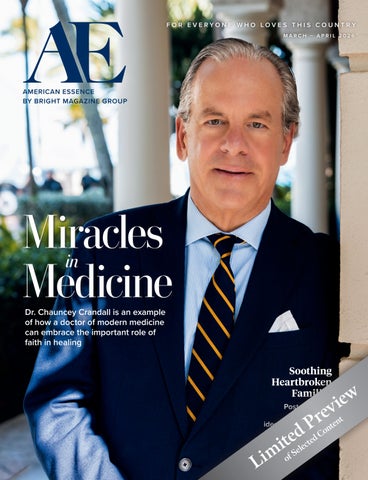
AE Vol. 6 Issue 2-Preview

Page 1


AMERICAN ESSENCE

BY BRIGHT MAGAZINE GROUP

Miracles Medicine in

Dr. Chauncey Crandall is an example of how a doctor of modern medicine can embrace the important role of faith in healing

Soothing Heartbroken Families

Post-Civil War, Clara Barton identified thousands of missing soldiers

The power in which we must have faith if we would be well, is the creative and curative power which exists in every living thing.
John Harvey Kellogg
The Thomas Jefferson Memorial with nearby cherry blossoms in bloom, in Washington.

First Look

12 | Where to Go for R&R

The best destinations for healing in nature.

14 | Well Wishes

How to be there for someone who is ill, according to an etiquette expert.

Features

16 | A Real Breakthrough

A renowned cardiologist explains how belief in a higher power can literally save lives, from the emergency room to disaster zones.

24 | A Digital Detox Experiment

A social media personality learns how to live screen-free by staying with Benedictine monks and the Amish.

28 | The Wisdom of the Body Clock

How to age well: longevity advice from a doctor of Traditional Chinese Medicine.

34 | Teaching Mental Resilience

How to guide children toward mental strength as their brains develop.

40 | Letting Teen Girls Thrive

A ranch in Maryland combines equine therapy and outdoor camping to help troubled teens find their way.

Lifestyle

44 | Ranching Solo in Big Sky Country

Emmie Sperandeo traded her corporate job in the big city for homesteading amid the mountains of Montana, and she has not looked back since. 12

48 | The Land of Big Trees

A journey through the redwood forests of California is restorative for the soul.

54 | An Antidote for Aging

Nutrient-packed recipes featuring ingredients that slow down aging, courtesy of best-selling author and physician Dr. Michael Greger.

58 | Brain Matters

An integrative health expert shares simple tips for healthy living, from the inside out.

History

62 | Historic World War II Reporting

Armed with a portable typewriter and a thirst for adventure, Virginia Irwin was one of the first war correspondents in Berlin.

66 | Champion of Animal Welfare

Henry Bergh founded one of the largest animal welfare organizations in the world.

70 | Heroine of Emergency Aid

Clara Barton tirelessly consoled wounded Civil War soldiers, established the Missing Soldiers Office, and founded the American Red Cross.

73 | Visionary of Wellness

Sylvester Graham left a legacy of radical rethinking of how Americans should live, eat, and behave.

76 | Father of American Psychiatry

Founding Father and physician Benjamin Rush instituted more humane treatment for the mentally ill.

Arts & Letters

80 | Addictions of All Kinds

Addiction expert Dr. Anna Lembke discusses the “drugification” of modern life and what we can do about it.

84 | Virginia’s Healing Waters

Tucked in the Allegheny Mountains, the Homestead’s warm springs have attracted noteworthy guests for over 250 years—including Thomas Jefferson.

88 | Coloring History With Music

“The Chambermaid” brings to life the riveting story of the Huguenots’ dedication, faith, and music during their colonization of Fort Caroline, Florida.

90 | Why I Love America

A reader originally from the UK shares how she has embraced America and all that she stands for.

92 | Family Roots

Remembering a great-uncle who imparted history lessons by sharing the family’s connections to important historical events.

94 | ‘Sunburst Upon a Tranquil Silence’

This year’s winner of the AE: American Essence Magazine Award illustrates a story of America’s frontier.

98 | Rx for Life

A clinical psychologist specializing in therapeutic humor offers de-stressing tips (with a few jokes thrown in).

AMERICAN ESSENCE BY BRIGHT MAGAZINE

GROUP

FOR EVERYONE WHO LOVES THIS COUNTRY

MARCH – APRIL 2026 | VOLUME 6 | ISSUE 2

PUBLISHER

Dana Cheng, PhD

EDITORIAL

Editor-In-Chief

Lifestyle Editor

Arts & Letters Editor

Editor-At-Large

Sharon Kilarski

Annie Wu

Jennifer Schneider

Tynan Beatty

CREATIVE

Lead Designer Designer

Photographers

Jane Russo

Karen Tang

Samira Bouaou

Adhiraj Chakrabarti

Production Manager Astrid Wang

SALES

Sales Director

Sales Assistant Ellen Wang Onon Otgonbayar

CONTRIBUTORS

Sandy Lindsey, Tim Johnson, Bill Lindsey, Conan Milner, Susan D. Harris, Channaly Philipp, Kay Rubacek, Krista Thomas, Ryan Cashman, David Coulson, Andria Pressel, Dustin Bass, Brian D’Ambrosio, Andrew Benson Brown, Jeff Minick, Deena Bouknight, Rebecca Day, Nicola Moloney, Barbara Danza

American Essence (USPS 24810) is published bimonthly by Bright Magazine Group at 129 W 29th St. FL. 8, New York, NY 10001.

Periodicals postage is paid at New York, NY.

Postmaster: Send address changes to American Essence, 129 W 29th St. FL. 8, New York, NY 10001.

General Inquiries: AmericanEssence.net/help

Advertisement Inquiries: ad@americanessencemag.com

Submissions: editor@americanessencemag.com www.AmericanEssence.com

EDITOR’S NOTE

Dear Readers,

As spring approaches, while we anticipate warmth and new growth, we may rightfully cling to New Year hopes for healthier living. I invite you to meet those who’ve brought wellness into their lives or into the lives of others.

There’s Dr. Chauncey Crandall, who broadened his approach to healthcare. It began when the cardiologist declared a flatlined patient dead and then heard a heavenly command to try again; he witnessed the first of many miracles. He now uses prayer to augment his practice (page 16).

You’ll meet Emmie Sperandeo, who healed her heart by leaving a big-city tech job for Montana ranching (page 44); social media influencer Carlos Whittaker, who improved his cognition after a digital detox, confirmed by brain scans (page 24); and 19th-century minister Sylvester Graham, who concocted a wholesome cracker you might be familiar with (page 73). Parents can learn about brain development to help their children grow more mindful and grounded (page 34).

A last note: In taking over from the loving hands of former Editor-In-Chief Channaly Philipp, I hope to bring the same attentiveness to AE: American Essence that readers have come to trust.

Here’s to your health!

Editor-In-Chief Editor@AmericanEssenceMag.com

are not included preview.

SOCIAL CALENDAR

America’s Finest Art CELEBRATING AMERICAN ART

Washington | Ongoing from March 20

Consisting of both paintings and sculptures, the National Gallery’s newest exhibit will showcase iconic works from celebrated artists in reimagined galleries, telling the American story from the Colonial period to the 20th century. A few examples include late-19th-century sculptor Bessie Potter Vonnoh’s exemplary work “Day Dreams” and Gilbert Stuart’s captivating portrait of George Washington.

NGA.gov/Exhibitions/CelebratingAmerican-Art

Step Back in Time

50TH KALAMAZOO LIVING HISTORY SHOW

Kalamazoo, Mich. | March 21–22

For reenactors and history buffs, this market for living history supplies and crafts is the perfect opportunity to buy, sell, and trade goods from the Revolutionary War to the Civil War era. For the general public, the event is a fun history lesson with vendors dressed in 1890s period garb demonstrating how to make hand-crafted goods. KalamazooShow.com

The Quest for the

MASTERS GOLF TOURNAMENT (AUGUSTA NATIONAL)

Augusta, Ga. | April 6–12

Founded in 1934 by Bobby Jones, who was one of the world’s best amateur golfers, the Masters has evolved into an annual invitational event with the world’s top pros, all vying for the prized “Augusta Green” jacket. Past winners include Rory McIlroy, Arnold Palmer, Tiger Woods, and Jack Nicklaus. This is a must-attend for all golf aficionados. Masters.com

A Taste of Texas POTEET STRAWBERRY FESTIVAL

Poteet, Texas | April 10–12

Every year, thousands visit the tiny town of Poteet to sample the region’s bountiful crop of strawberries in myriad forms. There’s entertainment in the form of a parade; the crowning of the Strawberry King and Queen; performances by musicians like David Lee Garza, Tracy Byrd, and Los Invasores; and of course—because this is Texas—a rodeo.

PoteetStrawberryFestival.com

Sweet Treats in Paradise

BIG ISLAND CHOCOLATE FESTIVAL

Island of Hawaii (The Big Island), Hawaii | April 23–25

What’s better than a trip to Hawaii? How about a three-day festival about all things chocolate, accented by native art and dance performances? Presented by the Kona Cacao Association to support the Big Island’s cacao industry, the event brings together chocolate lovers and chefs, whose culinary delicacies double as artistic creations almost too beautiful to eat.

BigIslandChocolateFestival.com

Shop Til You Drop BRIMFIELD ANTIQUE WEEK

Brimfield, Mass. | May 12–17

Hundreds of vendors will offer an unrivaled collection of thousands of antiques, collectibles, and flea market treasures. Visitors can shop for folk art, vintage textiles, furniture, and one-ofa-kind items spread across a 150-acre site in rural New England. This 65-yearold event is the largest outdoor antiques market in the country. BrimfieldAntiqueWeek.com

Green Jacket

CULTURE SHORTLIST

Celebrating 250 Years of American Handicraft

The Handwork 2026 initiative is Craft in America’s nationwide semiquincentennial collaboration to showcase the importance of things made by hand. Museums and arts centers across the country will celebrate crafts that define America, with exhibitions and events all year long. Participants include the Corning Museum of Glass in Corning, New York; the South Shore Stitchers in Marmora, New Jersey; the Institute of American Indian Arts in Santa Fe, New Mexico; The Clay Studio in Philadelphia; the Robert C. Williams Museum of Papermaking in Atlanta; and the Puʻuhonua Society in Honolulu, in addition to many, many others. Find out more at Handwork2026.org

DIRECTOR

Angus Benfield, Kendall Bryant Jr.

STARS

Angus Benfield, Haley Babula, Nicholas Asad

‘Raising

RELEASED 2024

STREAMING

Prime Video, Tubi, Roku Channel

Anti-Doomers: How to Bring Up Resilient Kids Through Climate Change and Tumultuous Times’

Anxiety among children and teens is at record highs. Prophecies of doom abound, even in classrooms. So how do you help your child live without existential angst about impending doom? Ariella Cook-Shonkoff’s book can help. The licensed psychotherapist and registered art therapist believes that doomerism is fear and despair run amok. She offers techniques to raise your children to avoid the trap of pessimism.

Balance, 2025 Hardcover, 352 pages

WATCH

‘The Keeper’

Inspired by the protagonist’s true story, this veteran-produced drama follows Sgt. George Eshleman as he hikes the Appalachian Trail, raising awareness of the alarmingly high suicide rate among former servicemen. The fellow vets he encounters during his journey ultimately give him the strength and encouragement to finally start healing himself.

These pages are in the preview.

Best known for championing national parks and as co-founder of the Sierra Club, naturalist, explorer, and conservationist John Muir was also a prolific writer with a passion for poetic prose. This is clear in this nonfiction book, originally published in 1912. When few writers today wax poetic about a particular place, his resplendent study of California’s Yosemite Valley in the spring of 1868 is like a refreshing drink of water for a parched traveler.

Digireads.com Publishing, 2020 Paperback, 130 pages

‘Yosemite’

are not included preview.

Making Room for Faith in Medicine

Having witnessed many miraculous recoveries after praying for his patients, Dr. Chauncey Crandall is a true believer in how faith and healing go hand in hand

One October morning in 2006, renowned cardiologist Dr. Chauncey Crandall made an unexpected decision that would ultimately save a patient’s life. It wasn’t his Yale medical training or experience that guided Crandall, but faith.

The patient was a heavy-set, 53-year-old man named Jeff (last name omitted to protect his privacy) who was admitted to a Palm Beach Hospital emergency room after he suffered a massive heart attack. Crandall was the senior cardiologist on duty. Medical staff had been working on Jeff for nearly 40 minutes and had shocked his chest with a defibrillator six times by the time Crandall responded to the Code Blue call. Despite several attempts to start his heart, Jeff had flatlined, and his fingers and toes were turning black due to the lack of oxygen. Crandall officially declared him dead at 8:05 a.m.

A nurse began taking out the tubes and IVs from Jeff’s body when Crandall said he suddenly received a command from God to shock him one last time. Staff questioned Crandall’s judgment, but he pleaded with them to try again. With one final shock (and prayers from Crandall for Jeff’s soul), Jeff’s heart soon beat a

Dr. Chauncey Crandall is the director of preventive medicine and cardiology at The Palm Beach Clinic in Florida.

strong and regular rhythm. Within days, he was sitting up in bed and talking.

Prayer in Medicine

While the modern medical institution is one firmly rooted in science and solid evidence, Crandall makes room in his practice for divine intervention. He said God has spoken to him while working with patients many times over the course of his 40 years practicing medicine, and he has witnessed numerous miracles.

“When I started praying with people in the medical clinics and in the operating rooms, I started seeing positive results: that people were coming back to life, that there was new hope, that anxiety and fear were disappearing,” he said.

While Crandall’s perspective may sound unusual for a leading modern cardiologist, doctors of the past often cultivated a connection with the divine. In many cultures, prayer and healing have had an ancient relationship that still persists today.

Crandall didn’t always observe this relationship, though. Before he was talking with God in the operating room, he had a pretty conventional medical career. He received his medical degree and a post-doctorate in cardiac research at the Yale University School of Medicine. Later, he continued studies at Harvard University.

These pages are in the preview.

After graduating, he landed a job at the Medical College of Virginia, where he ran a heart transplant program. It was here that Crandall discovered that there were healing forces far beyond what he had learned in medical school.

A patient in the critical care unit was doing so poorly for so long that staff anticipated pulling the plug on him. Crandall was sitting at the nurse’s station when he saw someone enter this patient’s room and say a prayer. “I was at a distance, but I could hear their prayers, and there was a sweetness and power about it. I felt the Holy Spirit in that room, and two days later, that man who was considered brain-dead woke up, and eventually he left the hospital alive. I believe it was because of the prayers,” Crandall said.

Later, Crandall came across another seemingly hopeless case: A patient who had been waiting for a new heart for months was at the end of his

Crandall treating and praying for a young boy in Haiti. He fully recovered from a parasitic illness.
Crandall with Jeff, who was declared dead after suffering a cardiac arrest but was revived after Crandall prayed for his soul.
The thing is, every doctor has seen a miracle. They don’t know how to explain it. They don’t know how to even talk about it.
“ Dr. Chauncey Crandall

are not included preview.

rope. “He was so weak he couldn’t lift his head off the pillow,” Crandall recalled. “I walked into his room, and he said, ‘I want to die. Take me off the medicines.’” Thinking about the prayer that appeared to revive a brain-dead patient earlier that year, Crandall offered to give this patient a prayer of his own.

“I didn’t know what to pray. I just used the name of Jesus,” Crandall said. “But within just a short few days, that man was able to sit up in bed. And a week or two later, he was able to get out of bed and walk. Not before too long, that man was able to walk down the hallways, and he left that hospital not needing a heart transplant.”

Over time, Crandall added more prayer to his practice, and he later aimed to pray for each patient he saw. Eventually, this required hiring a couple of ministers to make it through the busy day. But Crandall said it has all been well worth the effort.

Crandall in Haiti giving medical care to a patient who was crushed by a fallen structure during the major earthquake in 2010.
Serene Feng holds a tray of medicinal herbs (p. 30) at her office in Midtown Manhattan.

Harmony

Nature With In

What’s the optimal time to wake up, eat, sleep, work, exercise, and socialize?

Follow nature’s lead for better health, according to Serene Feng, a doctor of traditional Chinese medicine

Traditional Chinese Medicine gives a whole new meaning to the idea that there’s a time for everything under the sun. According to its principles, there is a proper time to conduct daily activities, from waking up in the morning to going to sleep at night.

In her own practice, Serene Feng, a New Yorkbased doctor of Traditional Chinese Medicine (TCM), treats night owls. Their energy kicks into high gear later in the day and they don’t fall asleep till 3 a.m. or 4 a.m.

“The reason I’ve met all those people is because they’re sick and they come to see me,” she said. “They have fatty liver, glaucoma. Some have high blood pressure at a young age—in their 20s or 30s— and they don’t know why. I tell them, ‘Because you didn’t follow nature. Every organ has its time.’”

The Principles: Following Nature

Ancient Chinese healers closely watched the ebb and flow of nature season by season, the succession of day and night, and how these rhythms were interconnected with the human body.

“If as human beings, we follow what nature tells us—a regular routine—then you’re a part of

nature. When you’re part of nature, you breathe with nature, and you can achieve longevity more easily,” she explained.

Through meticulous observation, these healers found that “qi,” which can be understood as life force or energy, cycles through the body through pathways (also known as meridians), peaking in each of 12 major organs at two-hour intervals. This “body clock” concept goes back millennia. By aligning with it, we tap into nature’s rejuvenating energy. As we age, it’s important to align with natural rhythms and make the most of our limited energy reserves.

Each organ is also said to correspond to a specific element (wood, fire, earth, metal, and water) and emotion (for example, lungs with water and grief, respectively).

The Body Clock in Action

Below is a breakdown of a schedule detailing the intervals, corresponding organs, and activities most suitable during those times. “Respect the organ, and you make it happy. Then your whole body will be happy,” Feng explained. “It makes a huge difference to follow that routine: You’ll feel how refreshed your body is.”

Rhizoma

Chuangxiong (L)

Chuang Xiong

Good for blood circulation.

Rhizome Gastrodiae (R)

Tian Ma, Gastrodia elata

Expels wind.

Lotus Seeds (L)

Lian Zi

Good for blood circulation.

Lotus Plumules (R)

Lian Zi Xin

A combination that calms the spirit; cools down heat for better sleep.

Perilla Leaves

Zi Su

Good for digestion; expels wind and warms the body.

Goji Berries (L)

Gou Qi Zi

Warming properties; strengthens kidney and liver function; beneficial for the eyes.

Chinaberry Fruit (R)

Chuan Lian Zi

Soothes the liver. Calming; used for irritability, anger.

Angelica Sinensis (L)

Dang Gui

Blood tonic; used in women post-period or postpartum.

Rehmannia Glutinosa (R)

Shu Di Huang

Kidney and liver tonic.

5 A.M.–7 A.M.

Large Intestine Releasing and Cleaning

Morning sets the foundation for the whole day to come. Just as in springtime you might plant seeds for the year, in the morning you set in motion the plans for the entire day.

“Follow the sun: Wake up, eat a nice breakfast, you’re full of energy, get everything ready, and go to work,” Feng said. For students, “learn everything you can because you have the best memory then.”

This is the best time, in Feng’s words, to “make the large intestine happy.” She said, “If you can, try to wake up during that time, drink some water, and do a little exercise, you will feel you have the urge to go.” Add a little honey or salt to your water, or drink it pure.

Older people, she explained, have less energy; their bodies have “less fluids, and the large intestine becomes drier.” That can cause slow digestion and constipation. But in her experience, if they drink enough water during the day, go to sleep early, wake up during this time window, and partake in light exercise, 60 to 70 percent of constipation cases will resolve naturally.

7 A.M.–9 A.M.

Stomach Nourishing Your Body

This is an important time for the stomach. “What makes the stomach happy? Breakfast,” Feng said. “It’s the most important meal of the whole day.” All too often, many people tend to skip it in the rush to get to work or school. Choose nutrient-rich foods with good proteins to fuel your day with energy.

9 A.M.–11 A.M.

Spleen Transforming and Absorbing

Another reason it’s critical to not skip breakfast: During this time interval, the spleen swings into action, digesting and transforming nutrients.

“We say it transports and transforms food into energy and blood,” explained Feng. “If you don’t give the spleen anything, it has nothing to work with. So then people become tired and lack energy.” In other words: Don’t skip breakfast!

“7 a.m. to 11 a.m. is the golden time of the whole day. Four hours for eating and then absorbing the [nutrients] from food, and transforming them.”

For anyone doing intermittent fasting, she recommends they don’t skip eating during this time interval.

These pages are in the preview.

are not included preview.

In terms of daily activities, the spleen is also linked to processing thoughts, and to the emotion of worry. This is prime time to focus on work and do some deep thinking.

11 A.M.–1 P.M. Heart Peak Vitality and Joy

At midday, the heart becomes energized. Known as “the emperor of organs,” it governs circulation in our body as well as our spirit. “It’s like summertime,” the hottest part of the day: Eat lunch, connect socially (it nourishes the emotion of joy), and rest a little. If your heart is weak, take a halfhour nap to strengthen it, Feng advised.

1 P.M.–3 P.M.

Morning sets the foundation for the whole day to come. “

Serene Feng

Wooden drawers hold Chinese herbs, the uses for which have been documented throughout the centuries.

Small Intestine Discernment and Assimilation Digestion time. The small intestine filters and sorts nutrients. This is a good time to get organized and work on sorting-related tasks.

3 P.M.–5 P.M.

Bladder Fluid Balance and Flow

With the afternoon comes a transition, just as summer gives way to autumn. Finish your most intense work by 3 p.m., or 5 p.m. at the latest, Feng advised.

If your urine is yellow during this time, Feng said, it means you didn’t drink enough water earlier in the day, so it’s a good time to hydrate.

5 P.M.–7 P.M.

Kidneys Root Essence and Willpower

As we shift to the evening, wind down gently. The focus is on the kidneys and storing energy. Finish your work, go home, and have a light meal. Feng said, “Don’t have dinner too late. [It’s] better to finish by 6 p.m.”

Home Is Where The Heart Is

Feeling disconnected after years of living in the big city, Emmie Sperandeo finally found peace and belonging as a rancher amid the mountains of Montana

Aherd of cattle roaming under the wide expanse of a Montana sky is a far cry from throngs of cars honking their way through rush hour traffic in Portland, Oregon. But that was where Emmie Sperandeo once found herself, commuting to and from work twice a day from Monday to Friday. As the symphony of frustrated horns reached a crescendo,

Sperandeo had an epiphany.

“This is not what I want to be doing with my life,” she thought.

It felt strange to her to be dissatisfied. She’d graduated college in 2018. Shortly after, she moved from her childhood home in Florida to pursue a tech job in Portland.

“I was convinced that as soon as I got a 9-to-5, salaried job, I would feel like I’d made it,” Sperandeo said.

Emmie Sperandeo photographed while working on a bison and Angus ranch on the Flathead Indian Reservation in Montana, 2022.
This is the feeling I’ve been looking for in a place— somewhere where I feel like there’s no weight on my chest. “
Emmie Sperandeo

Instead of feeling fulfilled and successful, she longed for something different. The only part of her week she enjoyed was the few hours she spent at her side job working at horse barns. She’d grown up riding horses, and she always dreamed of one day working on a ranch. But that was a silly dream, or so she told herself.

Henry David Thoreau once quipped that most people lead “lives of quiet desperation.” We dream of other places or other careers. For most, those dreams remain mere imaginings. For others, they become reality.

As traffic gave way, Sperandeo began to reassess her life. By the time she got to her apartment, she’d made up her mind. She was going to become a rancher.

“I found a place in Montana where I could work part-time in exchange for housing and learning how to do ranch work. Once I got out there, I realized it was exactly where I wanted to be,” Sperandeo said.

For a time, she worked remotely in Montana for her tech job. But the longer she spent ranching in Montana, the less she wanted to return to Portland. The arrival of the COVID-19 pandemic gave her the perfect escape. She quit her 9-to-5 and dove headfirst into life as a solo female ranch hand. It didn’t take long for Montana to work its charms on Sperandeo. On her first day in Big Sky Country, she awoke to a quiet morning. Fresh snow was on the ground, and a herd of elk wandered through a field in the distance. “I remember thinking, ‘This is the first time I’ve felt like I’m actually living.’ I don’t know how long it had been since I felt that,” Sperandeo recalled.

Sperandeo purchased a camper trailer and started traveling to any ranch that would take her. She learned how to rope cattle and horses, irrigate hay fields, handle firearms, move cattle herds, rotate pastures, and brand livestock. “My thinking was, how do I gain as much experience as possible so I can be valuable to the next place I work? So, I tried to say yes to almost every opportunity that came my way,” Sperandeo said.

She attributes many of those opportunities to the fact that she started sharing her life on TikTok and Instagram. She began making short videos sharing the good and the bad of her new life as

a traveling rancher. Frozen waterers, unruly animals, and bad roping attempts were all par for the course. “I would get completely roasted [in the comments], but the other half were people being like, ‘Oh, I’ve always wanted to learn how to rope. Thanks for giving me the inspiration.’ That inspired me to keep sharing. Because either way, it helps other people gain a little bit of confidence to possibly do it themselves,” Sperandeo said. Her efforts have garnered 1.8 million followers on TikTok, nearly 750,000 on Instagram, and hundreds of millions of video views.

Challenges of the Solo Life

As open as she was sharing her ranching lifestyle online, only Sperandeo truly understood the rewards and challenges of solo ranch life. “I loved what I was experiencing when I was living on the road. But it was also incredibly hard, especially

Sperandeo rides on her mare, Raven, while on the ranch with a visiting friend.

While traveling, she had steadily collected a small cadre of creatures—three horses she would rotate among for ranch work, and a bison to keep them company. All four lived alongside her in the horse trailer she’d swapped out her camper for. The logistics of bringing these animals across state lines was extremely complicated. Making sure she had the correct paperwork, then finding places where she and her animals could stay for an extended period, was immensely stressful.

There were also other challenges to traveling solo. “Sometimes where I was supposed to stay for the night would fall through. I had to figure things out on the fly and sleep at a trailhead parking lot. Safety-wise, too, as a woman traveling alone, there were times when I would be somewhere and I’d set up camp and I’d end up leaving in the middle of the night because I didn’t feel safe,” Sperandeo recalled.

Undeterred, she continued to travel to and learn from as many places as she could. But something else began to eat at her. “It got really hard not to have a consistent community around me. And it wore on me after a while. I wanted to have stability and roots,” she said.

These challenges came to a head in May 2023. Sperandeo was on a ranch in Arizona. It was a cloudless, sunny day. The ranch team was assembling a group of calves to be branded—a simple routine. Suddenly, Sperandeo’s horse reared, lost his balance, and fell to the ground with a heavy thud. Sperandeo, whose leg got caught in the stirrup, was underneath. She hit the ground hard and was knocked unconscious. On the medevac flight to the nearest hospital, Sperandeo suffered a stroke and a seizure. The fall had fractured her skull in two places, and her brain was bleeding. Her recovery was long and lonesome. Though she had visitors and received plenty of supportive messages from her online followers, the months of occupational therapy and nights alone in the hospital had greatly affected her. When Sperandeo was released from the hospital, she was returning to her life with a traumatic brain injury (TBI) that greatly restricted her ability to work, walk, and drive.

The time had come for her to find a place to settle for good. Though she didn’t know if she had enough money to purchase a property, Sperandeo traveling with animals,” Sperandeo said.

That was a problem, because there was still a

These pages are in the preview.

trailer to move and animals to take care of. The ranchers who had helped save Sperandeo’s life fostered her animals while she was recuperating in the hospital. Now, however, she was on her own again. “I was living in my horse trailer at an abandoned chicken farm with a fractured skull and TBI. I could hardly take care of myself, let alone my animals,” Sperandeo said. “The injury made me want my own place so much more. It reinforced the fact that it was a huge priority for me to have my own space.”

Sperandeo cared for a herd of bison while working on the Flathead Reservation ranch in Montana.

are not included preview.

began to search. There was no question that she wanted to put down roots in Montana. Sperandeo found a tiny cabin that called to her. The property was smaller than she had wanted, and it would need renovations to accommodate her animals, but it gave her the feeling that this was where she needed to be. “This is the feeling I’ve been looking for in a place—somewhere where I feel like there’s no weight on my chest,” she said. She moved in during August 2024. Over the next year, through the income she received from her social media presence, she fixed up the cabin, established housing and pastures for her animals, and set up a tack room for her saddles and other equipment. It wasn’t easy, but once again her online followers encouraged her to carry on.

Paying It Forward

Sperandeo has allowed new dreams and ideas to take hold. She plans to expand her acreage, increase her herd, and grow the majority of her own food. Her ultimate goal is to transform her property into a place where she can welcome in young newbie ranchers and teach them the ropes of an agricultural life in a safe, engaging place. She explained: “I would love to do that because I was shown so much kindness, patience, and hospitality through my years of traveling. I’d love to be able to give some of that back to other people and younger generations, especially younger women, who want to find their confidence before they dive into a more hectic ranch environment full of men.” She has plans to establish an infrastructure that will help her achieve this goal. For now, though, Sperandeo is just happy that she can gaze out over the freshly fenced pastures, where her horses and new herds of cows and goats nibble on the grasses. She can see the mountains rise up in a distant ridge. She can walk into her small greenhouse and garden and find them teeming with vegetables. She can count on neighbors to swing by to help trim hoofs, brand young cattle, or invite her to a fair in town. And she is content to continue making her simple home under the open skies of Montana.

“It’s hard to pinpoint, but I just always felt this is the place where I can be like, ‘Oh, I’m home.’ And I haven’t felt that anywhere else.”

Sperandeo, one year after her traumatic brain injury.
Working on a ranch in Arizona and riding her colt, Goose.

REDWOOD HIGHWAY Travels Along the

Five redwood parks on a breathtaking corridor are considered not only the best places to see the colossi in California but also in the world

The Avenue of the Giants winds through the heart of Humboldt Redwoods State Park in California.

At the western edge of the continent, a swath of soaring redwoods scrapes the sky on untamed terrain that plunges toward the sea. Mist steals through the trees. The wind smells of salt spray and carries the cries of gulls.

Raindrops trickle from the dark green forest canopy, and tendrils of steam drift up from the rough, almost furry, red-hued bark. In the rays of the sun after the storm, the redwood forest sparkles as if sprinkled with Tinker Bell’s fairy dust in nature’s magical kingdom.

The northern spotted owl seeks refuge in high branches, while the banana slug slithers through the thick flora on the soft forest floor. In the sheltered golden meadows, deer and elk graze on the dew-bathed and sun-dried grasses.

Renowned Redwoods

Redwood forests are so numerous in California that nearly 50 state parks and quite a few regional ones contain “redwood” in their names. But a national and four state parks on the northern redwood corridor are considered not only the best places to see them in California but also in the world.

Just north of San Francisco, Highway 101 is known as the Redwood Highway and a well-suited starting point for a family vacation or romantic getaway. After motoring little more than three hours, the rolling hills and vineyards are gradually overtaken by forestland that encompasses the cozy enclave and historic lumber camp of Leggett.

The most dramatic scenery on the Redwood Highway is the 174-mile stretch weaving its way north between Leggett and Crescent City near the Oregon border. Sections of the route have been modernized for heavier traffic and higher speeds with town bypasses, multiple-lane freeways, and long bridges over deep ravines.

Where and When

Accommodations on this less-developed northern segment of the Redwood Highway are somewhat limited. My wife, Maria, and I spent two weeks in our small motor home with our Yorkie pup, Tahoe, at a well-maintained state park campgrounds convenient for hiking and sightseeing. Eureka, Klamath, and Crescent City offer lodging options ranging from RV parks and motels to bed-and-breakfasts and vacation rentals.

Temperatures are seasonal and range from the low 40s to the mid-80s in the inland Humboldt redwood region. They register from the mid-40s to the low 60s year-round

along the redwood coastline, where it is foggiest during peak season June to August. Spring and fall are preferred times to plan your trip weather-wise and to avoid crowds.

Founders Grove and Statue of Liberty

About an hour drive from Leggett, you arrive at the Avenue of the Giants. The 31-mile departure on old Highway 101 follows the free-flowing Eel River through the heart of Humboldt Redwoods State Park. There are pullouts and picnic areas to fully appreciate the majesty of the coast redwood, which can live for two millennia and is the tallest living thing on the planet. It can grow as high as a 38-story building, exceeding the height of the 305-foot Statue of Liberty by 75 feet.

The Founders Grove is home to some of the largest and oldest trees in the park. Children crane their necks to try to see the tops of the colossi you cannot capture in a single photograph. They pretend to wrap their arms around massive trunks as much as 17 feet wide and scurry inside scorched survivors hollowed out at their base by centuries-old fires.

In 1921, a single grove of protected redwoods became Humboldt Redwoods State Park. Today, the park is almost twice the size of San Francisco, with more than 100 miles of hiking trails and more than 250 campsites. About one-third of its 53,000 acres cloister virgin coast redwoods, making it the most extensive expanse of old-growth redwood forest on Earth.

More impressive than the facts and figures relating to redwoods is the grandeur and tranquility that pervades the forest and the reverence it inspires. As if at the foot of an altar, the forest floor is carpeted with sprays of delicate redwood sorrel with pink flowers and purple stems and salal with leathery green leaves and purple-black berries. An array of azaleas and rhododendrons is naturally arranged among abundant feathery ferns.

Queen Anne and Sue-Meg

The Redwood Highway runs through Eureka, the largest coastal city between San Francisco and Portland, Oregon. Hugging the shore of Humboldt Bay with its 25,000 residents, it’s known for its bustling waterfront and Victorian district. The ornate Carson Mansion, built in 1884, stands as a testament to Queen Anne architecture with its intricate woodwork, turrets, and gables.

Driving north, it’s a little more than a half hour

These pages are in the preview.

from Eureka to Sue-meg State Park (formerly Patrick’s Point), perched on an often wind-socked or fog-shrouded headland jutting abruptly from the craggy shoreline. But on crystal-clear days with gentle ocean breezes, the park becomes comforting and offers commanding views from lofty overlooks and rocky outcrops of a sweeping seascape settled by raucous seals and sea lions.

A dense forest of spruce, hemlock, and red alder covers a portion of the park’s 640 acres. In the spring, the wildflower-festooned meadows bloom with fairy bells, trillium, and Douglas iris. On areas of the Rim Trail, flourishing plants and shrubs shelter and isolate hikers.

The coast redwoods’ towering presence is both aweinspiring and humbling. “

Redwood National Park is one of four parks known collectively as Redwood National and State Parks. The three state parks—Prairie Creek, Del Norte, and Jedediah Smith—taken together with the national park, protect nearly half of California’s remaining old-growth coast redwoods in a designated World Heritage Site and International Biosphere Reserve. are not included preview.

A 2-mile crescent strip of sand reached by a short,

steep trail, Agate Beach is conducive to leisurely beachcombing for the semi-precious, polished stones. Palmer’s Point possesses rich tide pools of such colorful creatures as purple shore crabs, orange cup coral, wine plum dorids, and northern red anemones.

Park Quartet and Lady Bird

LEFT Short, steep trails ascend the 80-foot Wedding Rock in Sue-meg State Park.
BELOW LEFT
The 1884 Queen Anne architecture of Carson Mansion in Eureka, Calif.

The Mind-Body Connection

Leading neuroscience researcher Dr. Daniel Monti gives advice on how to set yourself up for all-around wellness

From brain scans to genetic screenings to a cutting-edge mind-body therapy known as Neuro Emotional Technique (NET, treating emotional trauma and stress by addressing the body’s physical reactions), innovative medical treatments have consistently been part of Dr. Daniel Monti’s work. He is the founding director of

the Marcus Institute of Integrative Health at Thomas Jefferson University, and he has spent over 20 years pioneering integrative medicine in the field of neuroscience and brain health. People struggling with cognitive problems and head injuries have made stunning recoveries as a result of Dr. Monti’s approach incorporating lifestyle changes,

Every thought we have and emotion we feel is expressed in some way in the body, and not just in the nervous system. “
Dr. Daniel Monti

anti-aging medicine, personalized therapy, and more.

In addition to authoring several books on integrative health, he also hosts a YouTube channel where he and other experts offer science-based tips for a healthier lifestyle. American Essence asked Dr. Monti to share his own daily habits for optimal physical and mental health.

This interview has been edited for clarity and brevity.

American Essence: What’s the very first thing you do when you wake up? What’s your morning routine?

Dr. Daniel Monti: I drink something warm, usually coffee or green tea, and then I take a warm shower.

I like to not be rushed in the morning, so I can think about the day ahead and, importantly, identify something to be joyful about that I will be doing. Too often, people start the day with dread, and I was guilty of that sometimes through the years of medical training, being on call, etc. With my older eyes looking back, I realize some of the missed opportunities to approach the incredible things I was learning with excitement and joy. Responsibilities are part of life, but when we can approach them with some curiosity and gratitude, the day goes better. Life goes better.

I know how important it is to start the morning without spiking blood sugar. I always aim for some good protein and low carb. There are three basic breakfasts that I rotate between, and I let the whim of the morning decide: a plant-based, protein smoothie; omelet with whatever veggies I happen to have; or chia seed pudding that I make very simply by soaking chia seeds overnight in almond milk.

AE: Many people struggle to be consistent with healthy habits in their lives. What’s one tip to make it easier to do so?

Dr. Monti: There are parts of the brain that unwittingly work against us in some ways. We are hardwired to avoid pain—it is sur-

vivalistic. Also, many people find comfort in routine. So when we want to make changes to what has been comfortable and familiar, it requires an override of that system, and that only works when there is commitment to it. Even then, it can feel like pushing a boulder uphill. I tell people to be both disciplined and gentle with themselves. It is a delicate tightrope, and often people are good at one and not the other. But long-term success requires both. Think about how you would motivate the person you care most about in the world by providing consistent reinforcement and from a place of love. A lot of folks are great at taking care of others but have difficulty doing so with themselves.

AE: How do you manage stress? What are good practices you rely on?

Dr. Monti: Stress is part of life. There is a quote attributed to the late great Lena Horne that goes something like, “It’s not the load that breaks you down but the way you carry it.” It’s brilliant really. Stress is a built-in nervous system response to a perceived threat to our well-being. Think back to a time when we roamed the wilderness and caught a glimpse of something dangerous like a lion. The immediate nervous system response is to go into fight-or-flight mode, which is an activation of the entire body. Muscles tense, digestion shuts down, we become hyper-focused, and so on. This is meant to be shortlived. You climb a tree, the lion passes, and the nervous system goes back to its more relaxed state. But the problem with modern-day life is that the lions of today are a continuous rash of things that are perceived to be a threat to our well-being: a deadline at school, a boss expressing disapproval (and you really need that job), a toxic relationship that has you defending yourself all the time, a sick family member, and the list goes on. For many people, the nervous system reset never occurs, and they are in fight-or-flight mode the majority of their days. This has health consequences. Those symptoms of fightor-flight—activation of the brain (hence,

10 MINUTES A DAY TO IMPROVE YOUR HEALTH

4 MIN

3 MIN

Light, mindful stretching in morning or whenever convenient

2 MIN One of my easy-toprepare breakfast options

4-7-8 breathing during the work day

Inhale through your nose for 4 counts, hold your breath for 7 counts, and exhale through your mouth for 8 counts

1 MIN

Send a one sentence text telling someone you love them and why

insomnia), digestive slowing (difficulty processing food), and muscle tension (aches and pains)—end up being part of a person’s daily physiology. This gets compounded by the release of inflammatory chemicals that fuel every illness there is, along with immune dysregulation and vulnerability to sickness, and the whole thing becomes a vicious cycle.

If anyone reading this is thinking, “Hey, that’s me,” don’t despair. There are simple things we can all do that make a huge difference. Back to Lena, how can you carry the load differently? It often is a matter of creating space in your brain between your sense of self and the things that are stressing you—basically, how to have more mindfulness, being present in the moment, non-judgmentally. Observing without reacting. I also personally do a qigong practice that made a big difference in my life. We made a video of me in our brain scanner at rest, listening to the stressful news of the day, and then listening to my qigong music. It was amazing to see how my brain completely changed when I was meditating—which means my entire body changed!

AE: When you experience self-doubt or fatigue, what does your internal conversation look like?

Dr. Monti: Self-doubt I welcome. To assume I am always right or always understand every facet of what is going on with someone would be a disservice to everyone I encounter.

When I notice fatigue, I approach it the same way I do with a patient: as a symptom that reflects an imbalance, and I need to figure out the source— physical, emotional, or spiritual.

For many people, the nervous system reset never occurs, and they are in fightor-flight mode the majority of their days. “
Dr. Daniel Monti

brain. I make a committed effort to do these important things and not just turn on my laptop and disconnect.

AE: In your book “Brain Weaver,” you talk about shaping cognitive performance through lifestyle. What is the most underrated factor in maintaining brain resilience as we age?

Dr. Monti: Maintaining a sense of purpose and keeping your brain actively engaged in it. If you decide to retire, then have a plan in place. It is critical that we feel productive and purposeful, and sometimes we need to redefine ourselves at different junctures, particularly later in life. I know one retired lawyer who has become a master pastry chef and has a list of people she makes treats for throughout the month. My own father is almost 80 and spends several hours a day working on the farm alongside other family members, and I know doing so keeps him young.

These pages are in the preview.

AE: At the end of a long day, what is the decompression ritual that resets your nervous system?

Dr. Monti: Connection with family and friends. Fun dinners, phone calls, laughing, planning the next vacation: these things disconnect me from work and recharge my

AE: You have decades of experience in neuroscience and integrative medicine. What is one thing we now understand about the mind-body connection that you wish everyone learned in medical school?

Dr. Monti: I’m not sure that even now many medical students truly grasp that the mind and the body aren’t just connected; they are one and the same. It is increasingly appreciated that high levels of stress negatively affect health outcomes of every disease. But that just scratches the surface. Every thought we have and emotion we feel is expressed in some way in the body, and not just in the nervous system. There are peptides, hormones, and other substances that flood the cells of the body in response to feeling states. Conversely, our physiology and biochemistry affect our mood and cognition. That’s why what we put in our bodies affects how well we think and how good we feel. For example, there are far-reaching effects of inflammatory foods, because the inflammatory chemicals they ignite go all the way from the gut to the brain.

soldiers celebrate
Reichstag

The Angel of Missing Soldiers

Clara Barton devoted her life to taking care of injured and missing Civil War soldiers and disaster victims

American Civil War nurse Clara Barton photographed by Mathew Benjamin Brady, circa 1860 to 1865.

The office was quiet except for the scratch of a pen and the shuffle of paper. On Washington’s 7th Street, the Civil War was long over, but Clara Barton still lived in its shadow.

The North recorded about 360,000 deaths during the war, but only 315,000 burials. Of these, just 172,000 names were identified.

In early 1865, Barton wrote President Lincoln seeking permission to “act temporarily as general correspondent” in searching for missing soldiers. He agreed, and she opened the “Office of Correspondence with the Friends of the Missing Men of the United States Army”—or the Missing Soldiers Office, for short. For nearly four years, Barton and her staff answered more than 63,000 letters from families desperate for word of a father, son, brother, or husband lost in the chaos of war.

Barton compiled rosters, matched scraps of information, and discovered the identities of more than 22,000 fallen soldiers. Though her office usually delivered bad news, she provided answers where there had been none.

Her tireless sympathy exacted a price. In late 1868, when Barton rose to address a crowd in Portland, Maine, she found she couldn’t speak. Suffering from “nervous prostration”—what we would call a stress-induced breakdown—she lay incapacitated through the winter and was instructed to rest.

Angel of the Battlefield

Barton’s letter to President Lincoln seeking permission to “act temporarily as general correspondent” to families searching for missing soldiers, February 1865.

tions began: Where were the missing? Who lay in those nameless graves?

Desperate Letters

During the Civil War, Barton worked through gunfire and mud to bind wounds, bring water, and comfort the dying. At Antietam, while kneeling to give a soldier a drink, a bullet pierced her sleeve and killed him.

After the Battle of Cedar Mountain in August 1862, Barton arrived at an overcrowded field hospital with a wagonload of supplies just as bandages and food were about to run out. One Army surgeon, overwhelmed by the relief her arrival brought, later recalled: “I thought that night, if heaven ever sent out a holy angel, she must be one—her assistance was so timely.”

This was how Barton earned her nickname: “The Angel of the Battlefield.”

When the guns fell silent, though, the ques -

“My darling boy, my only son, was reported killed in the Battle of the Wilderness. … His body was not found,” wrote Mrs. T.B. Hurlbut to Barton in September 1865. After giving his history and physical description, she added that if the resting place “of my darling one” were found, “you would confer such a favor as none less desolate than myself can appreciate.”

Though the fate of Wilbur Hurlbut was never discovered, other families were more fortunate. Frances Sherwood had been searching for news about her husband, Jones Ebenezer Sherwood, ever since receiving hearsay from a friend in December 1864 of his likely death. A year and a half later, she received a letter from Barton providing details of his final resting place: “J.E. Sherwood Co ‘G’ 76 N.Y. died August 4, 1864 of diarrhea chronic at Andersonville GA, the no

Graham’s Cracker

The 19th-century minister Sylvester Graham promoted a wholesome diet as part of a more spiritual life

ABOVE

An 1880 engraving of clergyman and health reformer

Sylvester Graham. RIGHT Graham developed the graham cracker in 1829 using unsifted, coarsely ground whole wheat (graham) flour, without fat or refined sugar.

In an era defined by indulgence and excess, Sylvester Graham stood apart as a champion of moderation, purity, and health reform. A Presbyterian minister turned social critic, Graham became one of the most controversial figures of 19th-century America.

He was celebrated by some as a visionary of well ness and mocked by others as a zealot. Though today his name is most often associated with the sweet, crunchy graham cracker, the man behind it was anything but sugary. His legacy lies not in confections, but in a radical rethinking of how Americans should live, eat, and behave.

He promoted coarse, unrefined flour at a time when white bread was fashionable.

Graham’s ideas led to health reform institutions, such as Dr. John Harvey Kellogg’s worldrenowned Battle Creek Sanitarium in Michigan.

Sylvester Graham was born in 1794 in Suffield, Connecticut, the son of a clergyman who died shortly after Sylvester’s birth. Raised in an unstable household, he experienced recurring illness as a child, which left him acutely aware of health and fragility.

After working briefly as a farmhand and store clerk, Graham studied at Amherst College and was ordained as a Presbyterian minister in 1826.

The early 19th century was an era of health fads and moral revivalism in America. Temperance societies flourished and vegetarian experiments gained footholds in reformist circles.

Graham’s entry into this milieu coincided with outbreaks of cholera sweeping the nation. He attributed this disease not to contagion but to the corrupted lifestyles of Americans, who indulged in meat, alcohol, coffee, and refined flour.

Diet Reform

perance, and sexual restraint. His lectures drew massive crowds across New England. Graham argued that physical indulgence led to spiritual decay.

Preaching that physical and moral health were intertwined, he developed what became known as “Grahamism.” This was a regimen of simple living that prioritized whole-grain foods, fresh air, tem-

1837.

Central to Graham’s philosophy was the belief that diet shaped not only health but also moral character. He promoted coarse, unrefined flour at a time when white bread was fashionable, claiming that milling stripped grains of essential nutrients. He encouraged the consumption of “Graham bread,” made from whole-wheat flour baked at a low temperature to preserve the bran and germ.

The modern graham cracker evolved later and only loosely connects to Graham’s original ideals. While it bears his name, Graham himself did not create the sweetened version we know today. His followers popularized crackers made from his preferred flour as part of a plain diet. However, by the late 19th and early 20th centuries, commercial bakers had transformed them into sweet, honeyed snacks that bore little resemblance to Graham’s original austere recipe.

Still, the association endured. To millions, “Graham” came to signify wholesome simplicity,

Frontispiece for Sylvester Graham’s “A Treatise on Bread, and BreadMaking,”

even as his austere diet gave way to the modern graham cracker used in s’mores and pie crusts.

Vegetarian Principles

Graham is often labeled a strict vegetarian, but his dietary stance was more nuanced. He strongly discouraged meat consumption, believing it inflamed passions and encouraged moral weakness. But he didn’t always demand total abstinence.

He promoted a largely plant-based diet focused on moderation rather than strict prohibition. He emphasized vegetables, fruits, and whole grains, while condemning gluttony, excess spices, and processed foods.

Graham’s concerns about diet were deeply moral and physiological. He believed that the stomach was the seat of the soul and that improper eating corrupted both body and mind.

This view linked him to a larger 19th-century reform movement that saw personal health as a gateway to societal purity and self-control. Many of his followers joined “Grahamite boardinghouses” or societies. They adopted his austere principles and helped spread his message through cookbooks and magazines.

Hygiene Focus

Although modern readers might think of Graham as an early advocate of “exercise,” his writings reveal a different emphasis. He placed far more importance on hygiene, fresh air, good ventilation, cold baths, and regular sleep than on formal physical training or athletic routines.

For Graham, the goal was not muscular strength but balance. He felt it was important to maintain

harmony between the body’s natural functions and moral discipline.

Graham promoted daily walks and outdoor work as extensions of a simple life close to nature. He regarded elaborate exercise regimens with suspicion, seeing them as artificial and potentially excessive. His advice reflects the transitional state of health issues in his time, between old notions of temperate living and the rise of modern physical culture.

Graham’s Legacy

Despite his moral strictness, many of Graham’s ideas anticipated trends that reemerged a century later. His insistence on whole grains prefigured modern nutrition’s embrace of fiber-rich foods. His warnings against processed flour, alcohol, and stimulants foreshadowed later concerns about industrialized diets and substance abuse. His focus on clean air and ventilation now reads as an early recognition of environmental health.

These pages are in the preview.

By the 1840s, Graham’s popularity began to wane. His lectures sparked protests among bakers and butchers. Some followers also grew disillusioned with his strict demands. He withdrew from public life and died in 1851 at age 57; he died from complications that arose after doctors prescribed him opium enemas.

Yet his influence endured with the rise of health reform institutions. The Battle Creek Sanitarium opened by Seventh-Day Adventists, the vegetarian movements of the late 19th century, and the natural food revival of the 20th century all trace intellectual roots back to Graham’s reformist zeal. Even today, his ideas about diet, hygiene, and self-control continue to influence discussions of food and wellness.

The sweet graham cracker in grocery aisles would have horrified its namesake, but it stands as an unintentional tribute to his legacy. It’s a symbol of how one man’s crusade for purity and simplicity transformed American attitudes toward eating.

Though a moral absolutist, Graham’s quest for balance and restraint offers a lasting reminder that how we live and what we eat shape who we are.

A postcard featuring breathing exercises at the Battle Creek Sanitarium, in Battle Creek, Mich., circa 1911.
Battle Creek Sanitarium published an advertisement in 1894 featuring the graham cracker as one of the food choices for “‘good living’ to avoid disease.”

America’s First Psychiatrist

Dr.

Benjamin Rush required respectful treatment of the mentally ill

n 1751, Benjamin Franklin and Dr. Thomas Bond founded Pennsylvania Hospital, the first such institution in the Colonies. Among the patients admitted to the hospital were the mentally ill. A 2013 article describes their treatment:

For the people of Philadelphia, it was considered a pastime to come to the hospital and peer into the rooms of the insane to witness their episodes. The patients were douched alternatively with warm and cold water, their scalps shaved and blistered; they were bled to the point of syncope (transient loss of consciousness due to inadequate blood supply to the brain), purged until the alimentary canal failed to yield anything but mucus, and, in the intervals, were kept chained. The keepers were given whips and they were allowed to use them on patients that were not passive. These methods were not meant to be cruel to the patients; they were what were deemed necessary to help them in their recovery.

are not included preview.

Then Dr. Benjamin Rush (1745–1813) arrived.

A Founding Father

Like Franklin, Jefferson, and others of his time, Rush was a man of many interests and talents. An early supporter of the American Revolution and a signer of the Declaration of Independence, he was a national figure and a prolific writer, an outspoken advocate for public schools, educational opportunities for women, and the abolition of slavery.

For 45 years, Rush also practiced medicine. Trained in America and then in Scotland and England, in 1769 he both taught medicine and opened a practice in Philadelphia, tending the poor along with the well-to-do.

Believing that the circulatory system was the cause and carrier for most human diseases, Rush made free with the lancet, bleeding patients with such vigor, especially during the city’s 1793 yellow fever epidemic, that some of his fellow physicians considered him more an assassin than a healer. As we know today, his critics were correct, yet

Rush’s inability to brook criticism fortified his obstinance.

Most importantly, though, he also instituted more humane treatment for the mentally ill.

A Trailblazer

In 1783, Rush joined the staff of Pennsylvania Hospital. Having already taken an interest in the mentally ill, he began treating some of the hospital’s inmates. In addition, he delivered lectures to the medical staff, linking illnesses like depression and mania to both the body and the brain.

Portrait of Benjamin Rush by Charles Willson Peale, 1783–1786. Oil on canvas.

Nestled in the Allegheny Mountains, the now Omni

Resort in Hot Springs, Va., has been rebuilt and expanded over its 250 years.

America’s Oldest Healing Retreat

The Homestead in Virginia’s Allegheny Mountains opened a decade before the Revolutionary War

Homestead

Healing waters have always been a draw for people. At least half of the United States has geothermal resources—more commonly referred to as natural warm and hot springs. Depending on conditions deep in the Earth’s crust, magma or molten rock can heat groundwater in some areas. A circulation process generated through rock faults can also generate heat that warms water. Water that rises up and out of the ground can be odorless and clear or sulfur-smelling and -tasting. It can even be naturally bubbly. Typically, where there are hot springs, there are accommodations for the people who flock to them.

For generations, Native Americans have enjoyed the alleged medicinal properties of the mineral water that sprang from the ground in almost a dozen locations in Virginia’s Shenandoah Valley. But it was an 18th-century militia company, ensconcing itself on 300 acres of land, that brought attention to the area that would eventually be named Hot Springs.

A Resort Hotel for the Ages

First, in 1761, an octagonal stone basin was built for soaking in the spring water. This was followed by an 18-room rustic wood hotel, called the Homestead. The hotel was constructed by the militia and operated by Capt. Thomas Bullett, until his death in the Revolutionary War.

The Bullett family continued to manage the original Homestead hotel for several years. Thomas Jefferson was a guest in 1818. In fact, he wrote to his daughter, Martha, about how the water soothed his rheumatism. “I believe in fact that that spring with the Hot & Warm, are those of the first merit,” he wrote. His endorsement spread by word of mouth, prompting the Homestead to become a vacation destination.

In 1820, the men’s octagonal basin was enclosed and turned into a full bathhouse. It’s believed to be the oldest surviving building of its kind in the United States. As more people learned about the secluded getaway featuring luxuriating waters, a second bathhouse, this one specifically for women, was constructed over one of the springs. This unique and intricately constructed

Illustration of the Homestead before construction of the 10-and-a-half-story clock tower, circa 1890 to 1910.

polygonal building has been preserved over two centuries.

In the mid-1800s, the area’s prestige as a resort destination received a noteworthy supporter in financier John P. Morgan. In the early 1900s, Morgan and other affluent entrepreneurs invested capital to begin planning and building an extraordinary structure to replace the first simple hotel. Since then, the site has attracted countless foreign dignitaries, recognizable film stars, 24 presidents, and the general public—all of whom have relished the resort’s comfort and opulence.

In 2013, the Homestead became part of Omni Hotels & Resorts and garnered its current name: the Omni Homestead Resort and Spa.

Georgian Revival Architecture

While the water’s high mineral content and consistent temperature of 98 to 99 degrees Fahrenheit is the obvious draw to Hot Springs, Virginia, the stunning and spacious architecture of the Homestead captivates visitors.

The resort was built in stages. The Great Hall was the first space constructed. Cincinnati architects Alfred Elzner and George Anderson designed Homestead’s Great Hall, which serves as the resort’s main building and lobby. Constructed in 1902, its architectural style leans heavily on

The site has attracted countless foreign dignitaries, recognizable film stars, and 24 presidents.

Georgian Revival, which focuses on symmetry and is evident in the dominant portico supported by six Ionic-order columns at its front and back.

Inside the Great Hall is a colonnade of 16 twostory Corinthian columns that rise to meet a coffered ceiling. A series of French doors with arched fan-light transoms enables natural light to flood the expansive space. Down the center of the hall is an enormous, custom-designed rug featuring designs depicting the flora and fauna of the surrounding Allegheny Mountains.

Further indicative of Georgian Revival is the prominent pediment over the portico, brick construction, and modillion (ornate horizontal adornment) across the exterior roofline and outlining the pediment.

Incorporating Colonial Revival Style

Later additions to the Homestead, including the east and west wings, incorporated the Colonial Revival style, which is a blend of Georgian and Federal architectural styles. It includes elements such as hipped roofs and broken pediments.

In the 1920s, the Ingalls family installed a series of luxurious facilities including the opulent Empire, Crystal, and Garden rooms, as well as the Theatre.

These pages are in the preview.

The most prominent Colonial Revival feature visible from outside the Homestead is called the Tower. The 10-and-a-half-story edifice, located between the Great Hall and the West Wing, features a large clock tower, a cupola, and a hipped standing-seam copper roof. Completed by 1929, the Tower primarily offers a variety of guest rooms. In its first seven stories are recessed porches set off by Doric columns, and on one side is a pavilion housing the Tower’s lounge space.

The Garden Wing was added in 1973. Then, in 2001, a 13,485-square-foot Grand Ballroom was built, adding another formal event space to the Homestead’s existing 10,368-square-foot Regency Ballroom.

All in all, the Omni Homestead Resort and Spa is immense. It features 483 guest rooms, 58 suites, and 28 meeting rooms. Amenities include a 60,000-square-foot spa, where various spring water soaks and spa services are accessible, and two championship golf courses.

There are eight places on the campus to dine and enjoy libations. Two are named for the Homestead’s earliest noteworthy guest, Thomas

Featuring 16 two-story Corinthian columns, the Georgian Revival Great Hall was the hotel’s first constructed space.

are not included preview.

Jefferson: Jefferson’s Restaurant and Jefferson’s Taproom.

From its original state as a small wooden hotel, the resort has grown tremendously.

A National Landmark

To maintain and preserve its historic integrity, while keeping up with modernity, the Homestead has undergone a series of renovations. Its most recent was in 2023, when the hotel received a total of $170 million to update its façade, guest rooms, and warm springs pools. The Homestead upheld its Georgian and Colonial Revival influences throughout, while antiquated features such as weights and pulleys in the windows were removed to make way for historically complementary designs that were more current and practical.

Other than the notable people who have passed through its doors, the resort property has served as

a significant historical site. According to Stanley Turkel’s book “Built to Last: 100+ Year-Old Hotels East of the Mississippi”:

From December 1941 until June 1942, following the United States’s entry into World War II, The Homestead served as a high-end internment camp for 785 Japanese diplomats and their families until they could be exchanged through neutral channels for their American counterparts. The diplomats were later transferred to the Greenbrier Hotel in West Virginia.

Because of its important history, the Homestead was chosen for National Register of Historic Places status in 1984, and it became a National Historic Landmark in 1991.

Year-round, guests can take in the views of the Allegheny Mountains from the Omni Homestead Resort and Spa’s 2,300-acre setting, savor the naturally soothing spring water, and admire the grandeur of America’s oldest resorts.

Originally the Ladies’ Pool House, the 22-sided structure was built in the mid-1870s and features a faceted roof with a central oculus.

Why i Love America

Americans, a Courageous People

How I went from harboring disdain for Americans to being proud to become one myself

There I sat in the corner of the room, green-eyed. Here was this bronzed goddess, with perfect teeth, long golden hair, and a tan to die for. She was full of confidence. She came from California.

I sat pallid, covered in makeup, attitude, disdain, and insecurity secretly stashed away in my heart, exacerbated by her perfection as she smiled along with all my other friends who grew up in London. I could not stand Americans.

I landed in San Francisco by default. I was traveling from Canada to Australia on a quest to work around the world. Australia said, “No return ticket, no visa.” San Francisco said, “Sure, here’s a six-month visitor’s visa.”

It was not an easy transition. It was not helped by the numerous times people asked me which country I thought was better. It took me many years to understand that comparing countries was a futile exercise, as the history and

“Emigrants Crossing the Plains” by Albert Bierstadt, 1867.

topography are so different.

Still, year after year, I began to experience the American culture, and allowed my ignorance and bias to be chipped away. It took me another 26 years to embrace America as my own.

My transformation started as I was driving through the Nevada desert to Las Vegas. I was in a fairly new car, but was terrified it would break down and then what! My thoughts turned to the many immigrants who once traveled across this desert in wagons—immigrant families, facing the hardships and terrors of the unknown.

entrepreneurial camaraderie, and an unspoken understanding among the hard-working people of every nation. It was full of energy. It was America.

Freedom is true diversity, for all people to think and debate and choose for themselves. “

I had a sudden epiphany. Americans come from a lineage of people who are full of adventure and courage, have faith in themselves, and harbor hope, even in the unknown. The American Forefathers and Foremothers had blazed a path for us all. This land is big and this land has promise in its dust. This was a turning point for me, and my heart fell in love with these boisterous and courageous people, a people who dare to dream.

My son took part in Little League baseball, and his coaches were Native American. We all stood for the national anthem at his first game. The sun was low in the sky. I noticed a halo around one coach’s long dark hair and broad shoulders. For the first time, with my hand on my heart, I falteringly sang the words of the national anthem. A tear ran down my face.

It was a profound moment to be with the native people of America, these people who welcomed me and taught my treasured son how to play baseball. We were loved.

When my children became teenagers, I decided I needed a college degree. It took me seven years to complete my degrees. As an older student going through an American education, I discovered that American pedagogy built up my confidence. It encouraged me to explore and confront ideas. I was shown that my voice was valid. It was an empowering experience.

When I graduated, I decided to take myself on a celebration trip to New York. New York was magical! There was a pulse, innovation, an

Books and ideas have always been important to me. On my wanderings in the city, my eyes alighted on the history of the New York Public Library. In 1906, the people of New York noticed that immigrants had no access to books written in their own languages. Concerned about this, the forefathers of the library system imported books written in other languages from all over the world. They didn’t censor these books; they wanted the people to read. They believed in the people, and their freedom to think.

My heart rose up. I would fight for this country. Freedom is true diversity, for all people to think and debate and choose for themselves. I suddenly knew in my heart, I am an American.

I took my place to stand among 1,107 faces, as diverse as the 101 nations we represented. The ceremony for the naturalization of new citizens bestowed on us great honor. America opened her arms to us to call us her own.

After the ceremony, we signed up for our American passports and registered to vote, and then we new citizens poured out of the doors of the Oakland Theater. We tightly held our naturalization papers, and looked boldly at each other. We all shared a deep and common joy; we were one. We celebrated the miracle of being accepted into this country, a country made up of people from many nations, ruled by a Constitution that grants liberty, freedom, and a chance to succeed. We knew we would always be proud to be Americans.

Why do you love America?

What makes it worth celebrating? What moves you about the people and places that make up our country? Tell us in a personal essay of about 600 to 800 words. We welcome you to send your submission to:

Editor@AmericanEssenceMag.com

My Family Roots

Lessons From My Picnic Table Professor

How my great-uncle inspired in me a curiosity and love for the past

Bring up the Civil War, and sooner or later in that conversation, I’ll be time-traveling back to my adolescence, between the ages of 10 and 12, turning the pages for the umpteenth time of my family’s two-volume set of the “American Heritage Civil War.” I’d be charging through the fields and woods around our home with friends, pretending to be a Billy Yank or a Johnny Reb, or setting up several hundred blue and gray plastic toy soldiers with my brother in our basement playroom.

Nearly every summer, Mom and Dad would pack us kids into a station wagon and drive from our home in Piedmont, North Carolina, to New Castle, Pennsylvania, to visit grandparents and other relatives. Route 11 ran straight up the Shenandoah Valley—there was no interstate route then—and here was more magic as we traveled through battlefields and historic towns. Lexington, Staunton, New Market, Strasburg were all imbued with Civil War history. I’d look at the old houses and wonder whether Confederate troops had once marched past those front porches, or we’d stop at some country store selling Civil War memorabilia and even authentic bayonets and Minie balls (cylindrical bullets used in rifles during the Civil War). For a kid like me, this trip through history was the equivalent of a gargantuan hot fudge sundae crowned with heaps of whipped cream.

And best of all, topping off that sundae was the cherry: my visits with my great-uncle John.

Every year, Uncle John and some of his family

would arrive at my paternal grandparents’ house from nearby Ohio and spend a day with our family. He and the other adults would sit in the living room chattering away, playing cards, drinking a beer or two, and grossing out the kids by eating Limburger cheese and onions on rye.

These pages are in the preview.

But as the day thickened into that lovely green Pennsylvania twilight, Uncle John and I would take an electric lantern and head to the backyard picnic table, where for an enchanted hour or so, he’d share our family’s history, telling me stories about the Civil War and the veterans he’d personally known, and reading from letters he owned that were written during the war by our ancestors.

He was that rare sort who recognized that all people of a certain age are history books with a heartbeat. “

How these annual seminars started I have no idea, though I suspect my dad told him of my love for the past. But I well remember how Uncle John looked as he sat opposite me, a man in his 60s who appeared ancient to my adolescent self. He was bespectacled, hair clipped short around his large ears, and had a sparkling enthusiasm in his eyes and voice.

From him, I learned so much. For example, our Minick ancestors and kinfolk with names

like Bland and McNichol were staunch abo litionists involved in the local Underground Railroad. Two Bland brothers married Minick girls before trooping off with the Union Army to fight Lee in Virginia. One of them was severely wounded at Fredericksburg.

Uncle John also shared his memories of events that he himself had witnessed, such as when a Pennsylvania National Guard unit marched off to a train bound for the Mexican border where they would join efforts to battle Pancho Villa, or an ugly incident during World War I, when the Ku Klux Klan burned a barn owned by a German-American.

And those letters—I still remember him chuckling as he commented on how every piece of that correspondence commenced with, “I am sitting myself down to write you this letter.” I was astounded by one letter in which a young woman, who had gone to Washington to care for her wounded brother, reported that she’d seen Abraham Lincoln walking along the street that day.

Over the next three decades, Uncle John and I lost track of each other. When Dad told me he had died, memories of our picnic table classroom returned to me, and I regretted not keeping in touch.

Uncle John remembered those evenings, too. Shortly after his death, a package arrived in the mail. He had asked his sons to send me the Civil War letters. His thoughtfulness and generosity stunned me, and I was determined to use his gift for the good of others, as he had for me. Several years later, when the homeschoolers in my American history class studied the Civil War, I divided the class into teams and had each team transcribe one of the letters, which by then were almost 150 years old. If nothing else, those antiques allowed them to “feel” history through their fingertips.

More important than the letters, though, was how Uncle John helped fuel the fire burning inside of me with his respect, zeal, and love for

the past. He was that rare sort who recognized that all people of a certain age are history books with a heartbeat, runners capable of passing a torch from one generation to the next. He’d known men like my distant uncle Marion McNichol, for instance, who had served in the Union Army, and they in turn had known elderly people who were youngsters during the time of the American Revolution.

Uncle John’s understanding of the past as a living thing was his greatest gift to me. This was the true legacy he bestowed onto that kid some 60 years ago, a picnic table inheritance for which I have been forever grateful.

Is there a family member who has positively impacted your life?

American Essence invites you to share about your family roots and the lessons passed down from generation to generation.

We welcome you to send your submission to: Editor@AmericanEssenceMag.com

Diaries written by a young woman who lived during the Civil War, 1863.

Stories That Make You PROUD TO BE AN AMERICAN

Rediscover the heart and soul of our nation with American Essence, a bimonthly magazine celebrating America’s rich tapestry of cultures and landscapes. You’ll find inspiring tales of courage, fascinating tidbits from history, expert tips for healthier living, and more.

Meticulously curated and full of hopeful stories, each issue is a celebration of the American spirit.

“I was uplifted; I was filled with hope… The world is a better place because of Shen Yun.”

—Richard Swett, former U.S. Congressman

“Magnificent… very enlightening! I highly recommend it to anyone.”

—Tony Robbins, motivational speaker

I love Shen Yun. A story of incredible hope and spirit! Everyone around the world should see it.”

—Rita Cosby, Emmy Award-winning journalist “

“There is a massive power in this that can embrace the world. It brings great hope... It is truly a touch of heaven.”

—Daniel Herman, former Minister of Culture of the Czech Republic

“I encourage everyone to see and all of us to learn from.”

—Donna Karan, founder of DKNY

Experience 5,000 Years of Civilization

Turn static files into dynamic content formats.

Create a flipbook