
BriggsFreeman_Spring2026_SP_LR

Page 1


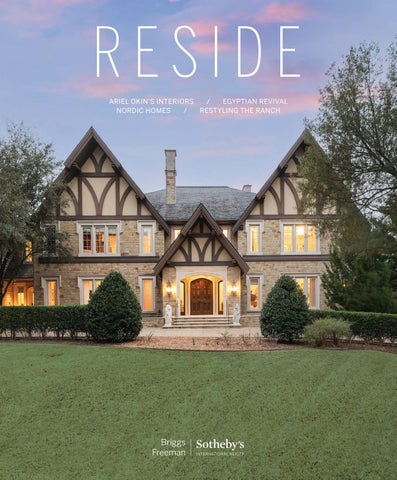
ARIEL OKIN’S INTERIORS / EGYPTIAN REVIVAL

NORDIC HOMES / RESTYLING THE RANCH

» Individually platted lots

» Standalone three-story residences

» Gated enclave

» Thoughtfully designed wood and stone interiors

» Hand-cut stone exteriors

» Private courtyards

» Covered outdoor terraces with built-in kitchens and fireplaces

» Custom elevators

» Detailed custom cabinetry

» Marble-clad fireplaces

» Professional-grade appliances

» Plush primary suites

» Generously sized walk-in closets

» Smart-home and surround-sound ready

Limited edition. Unlimited luxury.

Knox Villas brings a new level of design excellence to the Knox District, the walkable, wonderful neighborhood where shopping, dining, wellness and culture converge. A mere block off Knox Street, these 12 limited-edition villas are a special collaboration between two of Dallas’ most acclaimed design firms — the award-winning SHM Architects and the internationally celebrated Studio Thomas James — delivering a highly crafted living experience that meshes architectural elegance with expressive interiors. Consider the bar resolutely raised.

On Everdell Place off of 4423 Cole Avenue

Preconstruction pricing from the mid-$4 millions.

Reservations and sales are currently underway. Represented exclusively by Kyle Richards, Cindi Caudle and Alli Caudle Bush of Briggs Freeman Sotheby’s International Realty. Information and reservations: sales@knoxvillas.com, 214-263-4065, briggsfreeman.com, knoxvillas.com

Welcome TO THE TOP

We didn’t earn our reputation by following trends or the wind. We earned it by trust. And advice. And instinct. And information. For 66 years and counting, the agents of Briggs Freeman Sotheby’s International Realty have guided the people of North Texas to great success — not just nancial, but emotional, too. A place you can’t wait to get home to. A neighborhood you absolutely love. The sheer excellence of a Briggs Freeman Sotheby’s International Realty advisor cannot be overstated. It’s what they’re famous for, across North Texas. Combine these elite agents with a legacy of leadership and, well, you can understand why we’re a little smug. When the real estate industry evolves — and does it ever — our company’s managers and directors forge, not fumble. They plot courses. They devise strategies. That kind of con dence mixed with our advisors’ brilliance has been the secret sauce of our enduring success. Yes, every advisor at Briggs Freeman Sotheby’s International Realty is a pro — smart, sharp, proven, respected. They are the local leaders backed by a global network, which

bene ts their buyers and sellers in all kinds of ways. A wide net. The rst call. Priority access. Our advisors can connect the best clients in the world to the best properties on the planet, from North Texas to Norway to New Zealand.

Clients, agents, everybody: Ours will always be the brokerage where the best want to be.

Briggs Freeman Sotheby’s International Realty

This modern Mediterranean — featuring seven bedrooms, nine and a half baths, a wine room, a home theater, multiple outdoor living areas and a resort-style pool, all on a half-acre corner lot — is listed by Pogir for $19,998,000.

Features

12 A Fresh Take

Ariel Okin started out designing for friends. With Gwyneth Paltrow and Lena Dunham now among her clients, she talks interiors in an internet age.

18 Seoul Searching

Any trip to South Korea’s capital demands a detour along the River Han to Seongsu-dong, the city’s revitalised center for culture, luxury and pop-up retail.

26 Fit for a Pharoah

The new Egyptian design revival is here, as interiors specialists once again take their cue from the ancients for furniture and decor.

Up Front

6 Architecture

Scandinavian homes o er a restful sense of retreat, even in the wildest landscapes, as a new book shows.

8 Interiors

The American West nds a fresh, elevated design aesthetic that remains in touch with its roots.

10 Luxury

Demand is rising around the globe for high-end homes that bring generations of one family together.

Photos:

Three issues of Reside magazine are published every year by Sotheby’s International Realty, with two runs per issue.

Sotheby’s International Realty

Publisher Kristin Rowe

Cultureshock

Editor Nancy Groves

Assistant Editor Caroline Thorpe

Editorial Assistant

Katie Armstrong

Head of Editorial Rachel Potts

Head of Creative Tess Savina

Designers Deniz Nazim-Englund, Ieva Misiukonytė

Chief Sub-Editor Mark Grassick

Sub-Editors Hannah Jones, Ro Elfberg, Sean McGeady

© Sotheby’s International Realty. 2026. Information here within is correct at the time of printing.

The nest agents and properties in North Texas

Exquisite craftsmanship and timeless elegance de ne this iconic residence in Highland Park, a magni cent English-style home with four levels, multiple living and dining areas, a twin-island gourmet kitchen, basementlevel catering kitchen, guest apartment, spacious bedroom suites and spectacular twostory great room with 24-foot ceiling and hand-carved walnut paneling. It is listed by Ralph Randall of Briggs Freeman Sotheby’s International Realty for $29,900,000.

Gallery
Clockwise from top left: An Ariel Okin-designed interior in Park Slope, Brooklyn (page 12); 9769 Audubon Place, a 3.3-acre estate in Dallas’ esteemed Old Preston Hollow neighborhood, represented by Ann Shaw of Briggs Freeman Sotheby’s International Realty (page 47); A lodge by Snøhetta studio overlooks the Norwegian ords (page 6)

ARCHITECTURE

Nordic by Nature

A new survey of Scandinavian architecture showcases bold innovation and a deep commitment to rest and retreat

The standout homes in “The Iconic Nordic House: Modern Masterworks Since 1900” —the latest in a series of compendiums of residential architecture—are designed to protect from wild and rugged landscapes. They o er spectacular views of nature from a safe and warm place. At the Fleinvær Refugium (2017), northern Norway, for example, resident artists can oat above the ords in an elevated meditation room. Even in urban examples, there’s a sense of interior space as a retreat from the outer world.

That domestic coziness has found itself at the heart of a number of popular lifestyle trends, notably the Danish concept of hygge Yet as this new survey shows, there is much more to the Nordic sensibility. Binding these extraordinary homes from the past 125 years is the luxury of tranquility and a deep philosophy of quality, craft and care.

“There’s real sensitivity to the landscape that you see in both contemporary Nordic architecture and the past,” says author Dominic Bradbury, whose research took him to far- ung islands and archipelagos as well as the Scandinavian mainland. “There’s use of organic material and natural textures, even if the forms and composition are very modern.”

The timber-paneled ceiling and forestlike columns of Alvar Aalto’s Villa Mairea (1939) in Ahlström Noormarkku, Finland, exemplify a softer, more layered type of modernism. The house’s design cleverly adapts the usual language of pristine white forms with local materials and reverence for the Finnish landscape.

Although mid-century style has become associated with the Nordics, the book shows regional variations in constant play with multiple ideas and aesthetics. “I think that

Above: The oating meditation room at Fleinvaer Refugium is also a sleeping space
Opposite: A double-height living room in an otherwise compact cabin outside Oslo provides calm amid the pine forests

there is a real spirit of innovation in Nordic architecture,” says Bradbury. “These architects were at the vanguard of a lot of di erent styles and movements.”

The experimental prefab plastic Futuro House (1968) by architect-designer Matti Suuronen is a stark departure from the typically spare Nordic look. The cli side creative atelier of the Nurmesniemi house (1975), on the island of Kulosaari, is another Finnish outlier. Its generous double-height spaces and exposed steel structure make it more akin to the famously inventive Eames Case Study House in California.

Homes built more recently manifest a quest for innovation in their mastery of sustainable technologies.

Blending with the birches on the Danish island of Møn is Birkedal (2016) by Copenhagen-based architect Jan Henrik Jansen. A cluster of cylindrical volumes clad in rough tree trunks makes the lustrous brass kitchen island inside all the more surprising. For the cubist Villa Sagalid (2023) on the Stockholm archipelago, architects Sandellsandberg chose bespoke ceramic cladding to withstand water and rain, but also to catch the light, so the building shimmers.

The sheer number of sea cabins, coastal escapes, mountain retreats and treehouses shows how architecture integrates with a commitment to leisure and family time.

In Norway, PAN Tretopphytter (2018), a trio of A-frames on stilts by Espen Surnevik, immerses guests in the trees of a farm in Gjesåsen, while Snorre Stinessen’s timberlined Manshausen Tower Cabins (2023), built on a private island in the Steigen archipelago, feel gloriously isolated in the dramatic ords.

Although some are too remote or compact to be permanent homes, these treasured holiday spots are sometimes kept in families for generations and returned to year after year. “The craft and quality is often quite extraordinary,” says Bradbury. “I think there’s a luxurious element to the way these buildings are designed and then put together.”

Time, space and immersion in nature unite this most enviable collection of Nordic architecture. Wherever in the world we live, there are plenty of lessons to take home on the art of living well.

Riya Patel is a London-based writer and lecturer on architecture and design

“The Iconic Nordic House: Modern Masterworks Since 1900” is published by Thames & Hudson

Light touch

Overlooking the Gulf of Finland around 10km west of central Helsinki, Espoo’s Westend district provides the ideal canvas for Nordic design. Its shoreline and abundant foliage lend themselves to the natural sensitivity that marks the style. No surprise that celebrated Finnish architect Pekka Helin chose it as the site of this light- lled retreat, which pairs its calming surroundings with bold architectural choices—receiving a World Architecture Festival award nomination for his trouble. Built in 2010 from cast-in-place concrete and steel pillar supports, oor-to-ceiling windows ood its open spaces with brightness, highlighting softer materials, such as solid oak and pale limestone oors. Larch decking opens up views of the archipelago beyond the surrounding treeline, where sunlight glances o the water. A spa area with sauna and sculptural bathtub o ers sanctuary on less clement days. Westend, Espoo, Finland

US$5,700,000

Property ID: 9743M3

Snellman Sotheby’s International Realty

INTERIORS

Ranch Reinvented

Combining clean lines with rustic touches, today’s luxury ranch is as timeless as the mountains

Ranch style is undergoing a subtle transition: the old tropes of taxidermy, rough-hewn cabins and cowboy cliches are giving way to a re ned Western aesthetic, one as enduring and textured as the land itself.

Nowhere was this more evident than many thousands of miles away from the U.S. at Milan Design Week 2025. It was here that Ralph Lauren Home launched Canyon Road, a ranch-inspired collection showcasing a collaboration with seventh-generation Diné (Navajo) weavers Naiomi and Tyler

Glasses, the brand’s current artists-inresidence. Items ranged from stamped pewter tableware to a luxurious bed blanket, both featuring the four-directional cross that carries great signi cance in Navajo tradition, referencing the Earth’s four directions.

“In my experience, having lived, worked and designed ranches in the American West, this style tends to be deeply in uenced by the past and the vast landscape,” says Emily Janak, principal designer of Emily Janak Interiors, based in Jackson Hole, Wyoming, and Bozeman, Montana.

“It re ects the histories and traditions of the region, from Indigenous craftsmanship and patterns that have long de ned the land to the utilitarian simplicity of early ranchers and settlers,” Janak adds. “European antiques brought by homesteaders also nd their place. Design palettes range from the muted tones of sagebrush and snow to the vibrant hues of the red earth.”

Luxury ranches listed by Sotheby’s International Realty include the crisp, contemporary take of a 70-acre property in Montana’s White sh—all clean lines, glass-and-timber volumes and sweeping meadow-mountain transitions—to a more traditional estate in Wilson, Wyoming. Spanning similar acreage and surrounded by expansive timber decking, it has three guest lodges, a play barn and direct views of the Teton mountain range. This is ranch life elevated—not a retreat from nature, but an invitation to live within it, in full comfort.

“The ranch look that seems to appeal the most is what’s known as ‘mountain modern,’” says Scott Bayens, global real estate advisor with Aspen Snowmass Sotheby’s International Realty in Colorado. “Clean lines and contemporary touches are certainly appealing, but when coupled with glass, stone, rustic wood and other thoughtful touches, the home becomes truly timeless.”

A luxury Aspen “ranchette” is a case in point, combining an original 1976 stone house—carefully restored and decorated by its designer owner in 2017—with a stylish, new-build “barndominium,” all on working equestrian land, with panoramas that bring the alpine fantasy into the now.

Further south, in New Mexico, the ranch aesthetic is more multifaceted still. Rooted in their region, southwestern ranches integrate an artfully utilitarian approach where “function informs form,” according to Maida Branch, the Santa Fe-born founder of the Maida goods brand and co-founder of the Siempre design network.

“What is vernacular to this place are expressions that are authentic to the environment,” says Branch. “Adobe walls and mud plaster sourced from nearby clay, vigas made from fallen ponderosas, kiva replaces, wool rugs, clay pots, tapias or stone walls, horno ovens and southfacing homes. An active pantry, where the memory of summer is preserved in dried herbs, corn and beans… a place

Opposite: Emily Janak’s design schemes, mixing old and new, typify the elevated ranch aesthetic

Left: Ranch homeware is taking its cues from Indigenous design and motifs, as seen in another Janak interior

Below: A bowl and candlesticks by New Mexico artist Camilla Trujillo, who works with locally foraged clay

that stays cooler in the summer and warmer in the winter.”

Ultimately, what today’s ranch owner desires is a coherence between the land, architecture, decor and the story at large. “Just because you happen to run cattle doesn’t mean your interiors have to declare it in every corner,” says Janak. “The most successful ranches, to me, are those that weave authenticity with restraint—where the landscape, the history and the owner’s own sensibility come together naturally. It’s about living with a sense of place, not performing it. Though I will say, I’d never own a ranch without a proper dinner bell.”

Lindsey Rae Gjording is a writer, photographer and editor based in Taos, New Mexico

Home sweet homestead

Ranches are evolving, but the landscape that tethers it is not. The peaks and plains surrounding Jackson, Wyoming, are no exception. The Teton Range, part of the Rocky Mountains, rose from a vast fault block in the Earth’s crust some six million years ago, exceeding 12,000 feet in parts to tower over the valley below. A brand-new ranch less than 15 minutes’ drive from Jackson speaks to these ancient surroundings while embracing the contemporary aesthetic. Encompassing almost 7,000 square feet, its generous spaces blend the modern—expansive use of glass, state-of-the-art security, ample garage provision—with what’s gone before. Built beside a pond and positioned for the stunning mountain views, the home’s reclaimed wood beams and walls hewn in Montana moss rock connect deeply with a past that lives on.

Jackson, Wyoming

US$31,750,000

Property ID: 2PDW25

Jackson Hole Sotheby’s International Realty

LUXURY

Under One Roof

Multigenerational living is on the rise again, stoking demand for exceptional homes for the whole family

“It’s where the family heartbeat is,” says Rodd Macklin, co-founder and managing director of Pennington Partners & Co, of the return of multigenerational living, where grandparents, children and grandchildren share a home. This setup is emerging as a signi cant trend in luxury real estate, strengthening emotional connections, spreading caregiving duties and forging family legacies.

“A home can often be the anchor where families come together, making it a natural place for conversations about prosperity,” continues Macklin. “At the same time, it’s a major asset that must be structured thoughtfully if it’s going to last across generations.”

And generational considerations matter. According to Macklin, baby boomers (born 1946-64) often downsize their daily living

arrangements but keep a home for family gatherings, while gen X (1965-80) increasingly house elderly parents and adult children. For millennials (1981-96) and gen Z (1997-2012), exible living spaces beat large houses. “What’s the same across all generations is that their homes give a sense of belonging. It’s not just real estate,” Macklin says.

Indeed, the pull of multigenerational living is being felt globally, especially in countries with a culture of honoring and valuing older family members. “In Japan, the idea of a family living together has profound roots,” says Kantaro Aoki of List Sotheby’s International Realty, Japan. “Historically, it was common for the grandparents, parents and children to live together in the same household,

especially in rural areas. Although the nuclear family became more common in the postwar years, the trend toward multigenerational homes is re-emerging.”

Suitable properties are shaped by location, purpose, architecture, land availability and cultural norms. “Thoughtful planning by an architect of how people want to live is the di erence between successful intergenerational living and a big house,” says Bob Zuber, a partner at Morgante Wilson Architects in Chicago, Illinois. “Think rec rooms, sitting rooms, separate entry points if necessary, reading nooks and playrooms. Not everyone wants or needs to be surrounded by family members at all times.”

For Sandra Wendland of Legacy Sotheby’s International Realty in Portland, Maine, multigenerational housing comes in many forms. “Sometimes it’s a lakefront property, sometimes oceanfront or even island compounds, because it goes back to the family seeking meaningful time together.”

One of Wendland’s recent transactions—a lakefront property near the base of a ski resort—included the buyer’s mother, who had grown up skiing there. “She was elated to be able to enjoy the mountain and lake with her grandchildren,” says Wendland.

Just as space to come together is important, often so is real estate with space to be apart. “From the cultural aspect, I think the luxury end is really about unplugging,” says Margaret “Meg” Smith of Daniel Gale Sotheby’s International Realty in Bay Shore, New York.

Smith recently sold a multigenerational property on Fire Island, New York. It comprised three separate houses: one on the bay, one ocean-facing, and the third centered between them as an entertainment space. Two brothers thought it was perfect because each one could have their own home and they could bring their families together in the middle, Smith says.

For a uent families, these purchases represent more than a lifestyle choice—they are strategic investments that address multiple nancial objectives while creating space for the family to thrive across

generations. Whether used for vacations with extended family or year-round living, multigenerational homes o er the chance to deepen family connections and create a lasting real-estate legacy. As Macklin concludes, it’s about having “somewhere that ties everyone together.”

This is an edited extract from Sotheby’s International Realty 2026 Luxury Outlook™ report. Read and download the full report at luxuryoutlook.com

Above:

Opposite: This contemporary mansion in Pescadero, California, combines coastal living with access to nearby Silicon Valley
Top: Families can enjoy both proximity and space in this waterfront villa with guest cottage on Lake Austin, Texas
A focus on family is deep-rooted in Japanese culture, which favors communal spaces, as seen in this Tokyo home

A Fresh TAKE

With Gwyneth Paltrow and Lena Dunham on her roster, Ariel Okin talks interiors and the internet with Hannah Marriott

Ariel Okin is swaddled in one of her husband’s sweaters as she works remotely from their home in Westchester, New York, while recovering from a gnarly bug. “I have two children under six, so we’ve got the lovely Petri dish,” she says over video, laughing. it’s a scenario familiar to many of her clients. Okin understands the intricacies of life for young families, who comprise a core part of her interior design business. She got married, had two children and moved to the suburbs from Manhattan’s Upper West Side, all in the past eight years. “You know, for my clients who have young children, I understand what they’re talking about; I’m in the same life phase.”

At just 34, Okin has been in business for a decade. Having studied journalism, she ran her interiors work for three years alongside a day job in communications. Design was a personal passion—“something I did to relax,” she says. An early project—a friend of a friend’s apartment in Tribeca— featured in Elle Decor. e clients were Broadway producers and the inclusion in the magazine, says Okin, “brought a lot of new eyeballs to our work.”

Since then, she has attracted high-pro le projects, including the Manhattan headquarters of Gwyneth Paltrow’s Goop empire, where she focused on highlighting the building’s art deco bones. “It had these great arched windows and creaky oors,” she says. Okin knew that Paltrow “loves a sort of English sensibility, so we tried to weave that in.” e walls were Farrow & Ball’s Pink Ground, the kitchenette cabinets Sti key Blue, and de Gournay wallpaper lined the bathrooms. Okin has also worked with writer-director-actor Lena Dunham on two New York City apartments, the second of

Opposite: A light and cheery breakfast nook in Greenwich, Connecticut, designed by Ariel Okin

Left: Okin is known for her warm, personable spaces, often designed with young families in mind

“ THE IDEA IS TO TAKE A LIFE STORY AND MANIFEST IT INTO A SPACE ”

which is underway in Chelsea. e rst, in the West Village, was a riot of pastel-coloured walls, bright, printed retro fabrics and whimsical objects, from an Ettore Sottsass LED mirror to a lampshade covered in dancing legs and an octopus light. Dunham has a “very strong sense of who she is,” says Okin, who often uses a client’s art collection as inspiration for the project’s palette. In Dunham’s case, “she had some really beautiful art, and I leaned into the pinks and the purples and the teals.”

One of pop culture’s best-known millennials—“the voice of my generation… or at least a voice of a generation” as her character in HBO series “Girls” quips—Dunham is now a friend, and recently wrote the introduction to Okin’s debut book, “ e Happy Home.” e designer’s rsthand knowledge of this demographic—born between 1981 and 1996—is valuable. In 2025, millennials were the second fastest-growing buyer group of luxury real estate, according to the Sotheby’s International Realty agent survey.

Because they are also, notoriously, very online, cliches abound about millennial design tastes; assumptions that younger buyers prefer a bland, cut-and-paste style in their homes flood the media. Okin is familiar with the tropes: rooms that are “devoid of personality. White, gray and beige; stock art that you could find in a million different places; books that don’t say anything about the person’s actual interests and are just there for decor.” But Okin insists she doesn’t get those requests at all. In “The Happy Home,” Dunham agrees, describing Okin’s work as “the opposite of everything we’ve come to expect from the interiors of the internet.” She credits Okin with “an almost maternal coziness, with the inventive specificity that only an artist can bring.”

For her part, Okin says she doesn’t have “a look per se,” but likes to prioritize a cozy feel, mixing traditional silhouettes with contemporary elements.” That “mix of different eras and shapes is what makes the space interesting and layered,” she says. Beyond that, her focus is personalization. “We spend hours digging deep into how a client lives, what they want their life to look like, how they want the space to function,” as well as “who they are, what they love, where they have lived and traveled.” The idea is to “take their life story and manifest it into a physical space.”

Above: The Okin-designed New York o ces of Gwyneth Paltrow’s Goop Opposite: Splashes of color contrast with subtle backgrounds throughout this 1901 Brooklyn townhouse

“ SOCIAL MEDIA CAN CAUSE TOTAL ‘DECISION PARALYSIS’ ”

Greenwich, Connecticut, property Opposite: Backgammon in one corner, a reading nook in another and a large custommade sofa for a family of six in the same Greenwich home

Her book is full of examples, such as the Park Slope townhouse she injected with jewel tones: deep plum furnishings, egg-yolk yellow cabinetry and a huge rust-colored sofa paired with navy wallpaper in the living room. Okin preserved and highlighted the home’s original millwork in her design; period stained-glass windows inspired paint colors. A playroomturned-guest room with large-scale polka dots on the walls gave the kids a fun place to hang out without looking obviously child-focused.

In another project, a 9,000-square-foot house in Greenwich, Connecticut, for a couple with four children and a dog, Okin anchored the sitting room around the family’s beloved vintage case piece, papered the dining-room walls with a mural of Brazil by Iksel, and used the clients’ existing artwork to inspire the living room palette of cream and yellow.

Okin says both her aesthetic and career were shaped by the home her parents built from the ground up, when she was 12, in the Pennsylvania suburbs. It was “based on those old Pennsylvania stone eld houses. It was very traditional. Very timeless.” Entrepreneurship is, she thinks, “kind of in my blood.” Her greatgrandparents were in the garment industry, her father ran his own business, and her mother was fashion director at Macy’s until Ariel was two. Her parents worked with interior designer Judy Kling on their home. Okin attended meetings and got to pick everything in her own room. “ at really in uenced my personal taste,” she says. “Traditional interiors that feel fresh, not dated, and not pinpointed to any particular moment in time; that’s what I gravitate toward.”

She doesn’t think celebrities necessarily in uence even her youngest clients: “I think it’s more whatever their algorithm is feeding them.” But reliance on social media can come with pitfalls, she says, especially for rst-time renovators. “Some clients say: ‘We love your portfolio, we trust you; here are the colors we like.’ And then we have clients that are super in-the-weeds: they read every magazine, they’re on Pinterest, Instagram constantly, screenshotting 100 things. ey typically have a harder time deciding and we often have to say: ‘You are cut o from social media!’” Otherwise, it’s too easy to fall into “total decision paralysis.”

For those clients, Okin says, the spaces she renovates are more likely to be first than second homes. “But other than that, I’d say everybody wants the same thing: to come home to a place that makes them feel really seen and cozy, and which is their favorite place to be.” 0

Hannah Marriott is a Brooklyn-based journalist for the Guardian, Financial Times and more. Ariel Okin’s “ e Happy Home” is published by Rizzoli.

Left: A Brazilian landscape mural by Iksel in the dining room is a reminder of home for the owner of this

SEOUL Searching

Experiential shopping, a makgeolli brewery and culture on every corner—Seongsu-dong has become a hub for urban luxury, writes Soo Kim

The view over Seoul’s Seongsu Bridge, which connects the city’s Gangnam and Seongdong districts

Springtime in Seoul. An explosion of pinks as the cherry blossom hits its stride. And likely an influx of visitors too, as art enthusiasts descend on the South Korean capital for the opening of the Centre Pompidou Hanwha in May. Trace the curving river Han upstream from this keenly awaited Parisian outpost, though, and those seeking a lowkey but lively atmosphere will also be rewarded. Here, just across the water from Seoul’s affluent Gangnam district, is Seongsudong—a neighborhood in eastern Seoul that pulses with its own cultural beat.

Nicknamed the “Brooklyn” of the city, Seongsu-dong is known for blending its industrial past with modern creative spaces. “I believe Seongsu-dong is the neighborhood that most vividly represents Seoul today,” says Mun Hyeon-cheol, director of CDA, a local gallery that opened in 2018. The area’s reputation for constant transformation, with concepts and spaces regularly appearing and disappearing, mirrors its unfixed identity— and, according to Mun, has earned it another moniker: “the pop-up store mecca.”

“Back then, there was absolutely nothing here, so there was a strange sense of freedom, a sense that I could do whatever I wanted,” he says. “And interestingly, it’s not much different now. The entire neighborhood feels like a creative laboratory.”

Designated a semi-industrial zone in the 1960s, Seongsu-dong’s streets were once lled with factories, car repair shops and warehouses, including the red-brick buildings that still de ne the area’s architectural landscape. As more businesses moved into the district in the 2010s, Seongsu-dong was reborn as a vibrant cultural hub. Rather than large redevelopment projects, the transformation has been driven by a series of “careful, understated adjustments that respect the existing scale and rhythm of the neighborhood,” says architect Sim Hee-Jun, co-founder of Seoul-based design rm ArchiWorkshop.

Below: A

Sim describes Seongsu-dong as “urban yet unhurried, industrial yet warm, creative yet free from any need for spectacle.” He attributes this feeling to the modesty and resourcefulness of the local community. “Within this context, authenticity has come to represent a new form of urban luxury. It is subtle, textural and quietly integrated into daily life.”

One notable change is the emergence of multipurpose spaces that bring brands and culture together, such as the Musinsa Standard and Dior Seongsu clothing stores, as well as D Museum, which has exhibited work by British designer Thomas Heatherwick and the fashion photographer Nick Knight. Haus Nowhere Seoul, a concept store on Ttukseom-ro, opened in September 2025. With its brutalist-inspired facade, it’s the latest instalment from II Combined, the parent company of Gentle Monster, a Korean luxury

Left: Retail space Haus Nowhere Seoul, which opened in 2021, blurs the lines between shopping and art
Below left: Seongsu-dong’s branch of Korean fashion brand Musinsa Standard, in one of the area’s signature red-brick warehouses
recent exhibition by German-born, Seoul-based artist Ingo Baumgarten at CDA Gallery

eyewear brand known for its museum-like displays that offer immersive and experiential shopping.

A few streets away from Haus Nowhere Seoul is a more understated artistic reimagination of retail. LCDC Seoul, which opened in 2021 on Yeonmujang 17-gil, is a former auto repair shop and shoe factory that is now a multilevel retail and dining complex with a “story within a story” concept. The third level, known as “Doors,” is a hallway of seven doors, each opening to a different shop experience.

Such projects showcase the area’s experimental flair, but not all developments rely on size or statement design. “A more accurate reflection of Seongsu-dong’s architectural identity is found in the numerous adaptive reuse projects scattered through former factories and workshops,” says ArchiWorkshop’s Sim. Brick, concrete and exposed steel are often reinterpreted with “warmer proportions, flexible living layouts and a more intimate sense of scale that corresponds to the district’s atmosphere,” he adds.

Lowkey design is also on view at Hotel Poco. Located just two minutes from Seongsu Station, the area’s main transport hub, it has a quiet, chic aesthetic, with simple white and wooden furnishings. H Avenue Hotel Kondae on Dongil-ro, meanwhile, plays to the area’s quirkier streak, featuring vivid interiors inspired by Wes Anderson’s film “The Grand Budapest Hotel.”

For dining, Yeonmujang-gil is a central gathering spot that “best represents the present identity of Seongsu,” says Jeon Myeong-ho, CEO of Le Freak, a gourmet chicken-burger joint that opened on the street in 2019. “Seongsu is quick to embrace new flavors,” he adds. “If a restaurant has lasted more than

Top: Surf culture meets contemporary art in D Museum’s current exhibition, “Taste House 2: Art in Life, Life in Art 2”
Above: Matcha tiramisu at the Magpie & Tiger tea house. In Korean folklore, the two creatures symbolize good fortune and protection
Coor, short for “common origins,” is a Seoul-based label built around simplicity, balance and quiet elegance

SEONGSU-DONG PULSES WITH

ITS

OWN CULTURAL BEAT ”

Left: Hangang Brewery cofounders Koh Sung-yong and Lee Sang-woo focus on producing additive-free, home-style “makgeolli” (carbonated rice wine)

Opposite: The independent Movie Land theater screens o beat art lms and cult classics

Below: Hangang’s signature spirit is brewed from Seoul-grown rice

five years here, it is almost always a choice you won’t regret.”

Passing this test is Flavourtown in Seoul Forest, a popular park in Seongsu-dong. Owner and chef TK calls the area’s mix of old-world industry, high-rise luxury real estate and creativity “perfectly suited to our pursuit of new interpretations of Asian cuisine.” Chefs from high-end restaurants, previously concentrated in other affluent Seoul neighborhoods such as Cheongdam and Apgujeong, have begun to take an interest in Seongsu as a place to experiment, he adds.

Buzzy and lively by day, with cafe culture aplenty, the neighborhood’s energy dials down after dark. “Seongsu-dong offers a quiet and cozy nightlife experience, quite different from areas like Hongdae, Apgujeong and Itaewon,” says Koh Sung-yong, co-founder of Hangang Brewery on Dulle 15-gil. Kompakt Record Bar, Sound Planet whiskey bar, and the indie film theater Movie Land share the same relaxed vibes. And when it comes to ordering, make it a “makgeolli”: a carbonated rice wine with a tangy, slightly sweet taste.

First brewed more than 2,000 years ago, Korea’s oldest alcoholic drink has seen a resurgence in Seongsu-dong as part of the country’s “Newtro” movement, a modern interpretation of a retro trend.Makgeolli is Hangang Brewery’s raison d’etre. Founded in 2018 to introduce “the diverse Korean liquor culture of the past to modern lifestyles and ensure it remains a sustainable legacy for the future,” Koh says, it is the only brewery in Seoul that makes makgeolli using Gyeongbokgung rice, grown locally in the capital.

As old traditions take on new forms, Seongsu-dong is slated for another phase of transformation, which is aimed at attracting a more affluent type of resident. Redevelopment plans include a 79-story mixed-use complex with office, residential and commercial space on a former factory site in Seoul Forest. Construction is set to begin in 2026 and, once completed, it will join other luxury apartment developments, such as Galleria Forêt, Acro Seoul Forest and Trimage, where several Korean celebrities, including members of global K-pop group BTS and international soccer star Son Heung-min, are said to have purchased homes.

Observing the area’s continued evolution, Mun Hyeon-cheol reflects on his part in shaping it. “I didn’t choose Seongsu-dong, it was Seongsu-dong that chose me,” he says of the decision to locate his gallery here. “The neighborhood’s flow and energy fit perfectly with the gallery, and I still feel that way.” 0 Soo Kim is a travel, design and entertainment journalist, author of “How to Live Korean” and co-author of “Hello, South Korea: Meet the Country Behind Hallyu”

Omar Chakil used alabaster, a material revered by the pharaohs, for this sculptural furniture range
e opulent designs of ancient Egypt continue to in uence high-end interiors, writes Kate Youde

FIT FOR A Pharaoh W

hen the Egyptian-Lebanese designer Omar ‘Chakil’ El Wakil moved from France to Egypt in 2019, it was not his intention to “resuscitate ancient Egypt,” but to create striking contemporary furniture that showcased local crafts and materials. It was French gallerist Victor Gastou who ultimately convinced him to embrace ancient references in his work. In 2025, the designer—under the name Omar Chakil—launched a collection of 17 pieces in collaboration with Galerie Gastou at PAD Paris design fair. United by the theme of transcendence, these works in alabaster reinterpret Egyptian animal deities and symbols.

“I see how much [the culture] resonates with people,” says El Wakil, who was raised in France, of his recent work. The alabaster itself also drew him in, he adds. “The transparency of the stone is one of the reasons why ancient Egyptians used to create all these artifacts, thinking that it would take them into the afterlife,” he says. “And as a matter of fact, I have a feeling that it did because we still remember them many thousands of years later.”

Our enduring fascination with this ancient civilization is evident in its continued cultural cachet across the world. Following the recent “Divine Egypt”

Previous page: French artist Louis Barthélemy’s tiles for Balineum combine in uences from ancient and contemporary Egypt

Right: “Striding Thoth”, circa 332-30 B.C., made from faience, a glazed pottery, in The Met’s “Divine Egypt” exhibition

Below: Yasmina Makram’s Nû chair references both pharaonic temples and Mediterranean beachfronts

exhibition at The Metropolitan Museum of Art in New York, which explored connections between ritual, religion and imagery, “Made in Ancient Egypt,” at the Fitzwilliam Museum in Cambridge, U.K., until April, focuses on the craft behind a range of staggering artifacts produced between about 3100-30 B.C. Meanwhile, Hong Kong Palace Museum is showing 250 loans from Egypt’s museums in “Ancient Egypt Unveiled,” until the end of August.

“Egypt: Influencing British Design 1775-2025,” which ran until early 2026 at Sir John Soane’s Museum in London, highlighted the culture’s particular impact on architecture and interiors. On the back of Napoleon’s Egyptian military campaign (1798-1801), designers and architects were able to see Egyptian objects for the first time, explains Erin McKellar, the museum’s assistant curator of exhibitions. This led decorative elements, including winged sun discs, obelisks, sphinxes, cavetto cornices and the pylon forms seen at temple entrances, to make their way into European homes.

“The Egyptian style was used from a relatively early date in the home to cultivate an intellectual atmosphere,” explains McKellar. The Soane show included a Wedgwood teapot from 1810 with a Nile crocodile on the lid, and a desk set, dated 1798, with an inkwell in the form of a canopic jar— the vessel that held the internal organs of a body during the mummification process.

British interest in ancient Egypt flourished throughout the 19th century, McKellar says, boosted by the Great Exhibition of 1851 and the erection of Cleopatra’s Needle, an Egyptian obelisk, in 1878, both in London. But it was the 1922 discovery of Tutankhamun’s tomb in Egypt’s Valley of the Kings that sparked the second global wave of Egyptomania.

Subsequent art deco design drew heavily on ancient Egyptian influences. The Singer Sphinx sewing machine, popular in the 1920s and 1930s, and khayamiya —a textile appliqué used for tents—both featured in the Soane show. “We know these were marketed widely,” says McKellar of the latter. “They would have been used in all sorts of forms, from fabric hangings to cushion covers, essentially to bring that little bit of Egypt into the home.”

In contemporary interiors, ancient Egypt is typically represented through this art deco lens, says Alex Kravetz, creative director at Alex Kravetz Design in London. Ancient references should be kept subtle, he says. “The danger is to take the interior a little bit too far, and I don’t think anybody wants to be in that style, strictly speaking, today.” The vaulted bar Kravetz’s studio designed for Denham Place, a restored Grade I-listed country

“ EGYPTIAN STYLE WAS USED FROM A RELATIVELY EARLY DATE IN THE HOME

estate in Buckinghamshire, U.K., includes a console inspired by the Egyptian revival style popular in early 19th-century decor. The table is supported by a gilt sphinx, says Kravetz, while the apron has “pseudo-hieroglyphic” panels and “lotus/papyrusstyle” repeating borders. Cavetto-type moldings and a black marble base with gilding echo the stone and gold of temples.

Cairo-based studio Yasmina Makram also draws subtly on Egypt’s history for its luxury interiors, says founder and creative director Yasmina Makram Ebeid, with a “small nod” to ancient Egypt, but also more recent design periods. The entrance to the Nile Jewel apartment that the studio completed in the Egyptian capital in 2024, for example, draws on the “opulence” of Egypt in the 1950s and 1960s, she says. But it also features black-and-white marble flooring inspired by the lotus flower, a prominent symbol in ancient Egypt.

The studio’s homeware range, meanwhile, include the pharaonic templeinspired Nû chair, which Makram Ebeid says draws on proportions and forms of furniture in Cairo’s museums, and the Hotep series of ceramic statues inspired by canopic jars and ancient Egyptian gods.

Designers continue to use ancient Egypt as a reference point because the civilization and its makers “were so ahead of their day,” says Makram Ebeid— in terms of architecture, materials, even lighting. Think of the pyramids, she notes: it remains a mystery to this day how they were built. “When you look at the forms they’ve left behind, it’s so contemporary.” 0

Kate Youde is a London-based design and luxury writer

Left: The marble oor in Yasmina Makram’s Nile Jewel apartment is a subtle nod to the lotus ower
Below: Omar Chakil took inspiration from ancient Egyptian funerary jars for these colorful vases

GALLERY

The finest agents and properties in North Texas

Rarefied ranches, everywhere

As places to escape — and as very wise investments — ranches are more popular than ever. Briggs Freeman Sotheby’s International Realty boasts a specialized division of teams and individuals who represent everything from weekend getaways to working spreads, in Texas and far beyond. Pictured: Spanning more than 350 acres in the North Texas Hill Country, Long Creek Ranch offers a sprawling main home, guesthouse, cabin, ponds, lakes, creek frontage and trails.

Learn more at briggsfreeman.com/ranch.

The future of luxury

Knowledge, they say, is power. May we suggest scrolling the 2026 Luxury Outlook from Sotheby’s International Realty®? This annual report is a must-read for everyone who loves luxury real estate. It provides insights into trends that affect the global luxury real estate market — which can affect our beloved North Texas. In the new edition, you’ll learn about the rising influence of cryptocurrency in real estate, how today’s priorities of safety and privacy are shaping home design and why we’re seeing a big shift toward multigenerational living. Uncover all the trends — and some valuable insight — at luxuryoutlook.com

Our turn for new homes

We may need to order more ribbons to cut. North Texas’ legendary luxury brokerage has opened two new o ces: a change of location for our outpost in leafy Lakewood and a brand-new o ce in the elegant Park Cities. Both are in popular shopping and dining spots, in the heart of neighborhoods where the agents of Briggs Freeman Sotheby’s International Realty are known as the best in the business. Come say hello — and perhaps nd a new home for you, too. Lakewood: 6130 La Vista Drive, Suite 150, 214-351-7100. Park Cities (in Snider Plaza): 6801 Snider Plaza, Suite 200, 214-350-0400.

Some pow for your place

Sotheby’s spirited Important Design sales are becoming the nexuses for lovers of all things home. Each is a chance at the most intriguing furniture, accessories and art in the world — “rare pieces with powerful stories,” says Florent Jeanniard, the chairman and co-worldwide head of Design at Sotheby’s Paris. Next up? A live sale in that very city, Thursday, May 28. Preview it all at sothebys.com.

Detail of a work by Jean Dupas, representative of high-style design always for sale at Sotheby’s

WHY THEY GO WITH GARCIA

D Magazine’s D Best and Top Producer honors / Top 50 by Volume, Companywide / Largest Residential Deal, Representing Seller, 2025

‘The

sale to beat.’

—The

Jason Garcia of the Vancleve Garcia Group sells some of the most important homes in the Park Cities and across North Texas. The latest? The incomparable 4000 Euclid Avenue in Highland Park, listed for $32,500,000 and sold in December 2025. Jason strategically promoted the epic estate as he does with every listing — with a custom marketing plan, his distinct local connections and the unrivaled Sotheby’s International Realty® network. Relationships. Results. Jason Garcia uniquely delivers the service, integrity and respect clients deserve from a real estate advisor.

Jason Garcia

Global Real Estate Advisor

Vancleve | Garcia Group 254-368-0829 jgarcia@briggsfreeman.com

The Vancleve Garcia Group

Just announced: The #1 residential team at Briggs Freeman Sotheby’s International Realty

254-368-0829,

From left: Blake Lamb 713-208-4833, Jason Garcia
Grant Vancleve 469-939-1696, Alex Lazcano 469-386-5499

The luxury expert you know and love. The global brand you know and trust.

Clarke’s signature service and top sales rankings are now backed by the world’s most powerful real estate network.

Strategic. Focused. Friends.

The award-winning Jobst Randall Group continues to raise the bar on its reputation for erce intuition, honest insight and unmatched knowledge. Founders Madeline Jobst and Ralph Randall and their dynamic, diversely talented group represent Dallas’ most signi cant and storied homes, for buyers and sellers in town and around the world. Friendship, leadership, real estate connoisseurship: No group puts it all together like this one.

From left: Michael Wong, Catherine Kurzner, Madeline Jobst, Ralph Randall, Hector Meza

It didn’t just raise the bar.

It is the bar.

On legendary Strait Lane, Casa Magnolia has changed everything. It is Preston Hollow’s most modern estate — an escape every day to a uniquely personal resort. Behind dual entry gates, it is a sequestered world crafted with travertine and limestone walls, monumental custom windows, white oak millwork and custom cabinetry. Life unfolds amidst multiple living spaces…

…a sunlit living room with a bar

…a formal dining room

…a glorious chef’s kitchen

… a private o ce with built-ins

…rooms for wine, media and games. The exquisite rst- oor primary suite is its own world, too, with a spa-inspired bath and an expansive custom closet with a dressing island. Outside? Think covered loggia, outdoor kitchen, pool and repit — all surrounded by contemporary landscaping contrasted with mature trees. This is it. Timeless materials. Intentional design. And an entirely new way of living along one of Dallas’ most storied streets.

Casa Magnolia / 10920 Strait Lane / $11,999,000 Preston Hollow area / Dallas

and

This time, it’s the most elegant Tudor Revival in town — a home that moved one real estate journalist to say, “It has that classic European style, passed down from generation to generation.” Special homes. Fascinating histories. Sought-after neighborhoods. LeeLee Gioia and Anne Goyer are the experts in selling the extraordinary — in all its gorgeous guises.

The man who understands.

Matt Wilkerson’s growing reputation as the go-to agent for high-design homes has something to back it up. Results. Matt knows fine homes — like this spectacular beauty in University Park, bought by his happy client. But Matt knows more than good architecture and great neighborhoods. He understands markets and motivations, whether his clients are buying or selling. Connected, professional, passionate: Matt understands more than just special homes. He understands the people who love them.

MEET MATT Matt Wilkerson spent more than a decade as an executive leader for a prestigious, design-centric national furniture brand. He is also a lifelong architecture enthusiast who has visited some of the best examples of modern homes in the United States and met many of the most notable architects, interior designers and furniture designers of the 20th century. Detailed, organized and strategic: Matt is a resourceful advisor and problem solver who has built a network of industry experts to support his clients through their buying and selling transitions. Community-minded and deeply connected to his beloved North Texas, he volunteers and helps raise money for a diverse group of charitable organizations.

Caruth Hills / University Park SOLD / O -market sale / Represented buyer

That perfect townhome on Travis? The newest condo on Cole? That o -market on McKinney? She already knows. (And about the latest happenings, from restaurant openings to pop-up shops to Katy Trail events.) She’s the go-to source when it comes to Dallas’ Knox Street area. Why? Melissa Frantz Ellerman doesn’t just know the neighborhood — she lives there, too.

Crested Butte, Colorado

Brush Creek Village

Located only minutes from Crested Butte in Buckhorn Ranch, this brand-new, luxury townhome community is where architectural sophistication meets mountain majesty. Every home o ers exposed steel accents, vaulted ceilings, dual private balconies, quartz counters, and designer kitchens with European appointments. Indulgent amenities include radiant heating, steam showers, and heated two-car garages. Enjoy e ortless access to world-class skiing at Crested Butte Mountain Resort, a private airstrip, famed hiking and biking trail access, and championship golf.

BrushCreekVillage.com

Starting at $1,700,000

LIV Sotheby’s International Realty

Cassie Gates & Martin Spencer 970.596.5516 | 970.452.9700

cassie.gates@sothebysrealty.com

martin.spencer@sothebysrealty.com

Breckenridge, Colorado

127 Marks Lane

Located along the Jack Nicklaus–designed Breckenridge Golf Course, this 6-bedroom, 8-bath estate spans 8,085 sq. ft. of re ned living space on a 0.55-acre lot with breathtaking mountain views.

Santa Fe, New Mexico

Elegant Las Campanas Golf Course Retreat

Overlooking the 5th hole of the Sunrise Course, this Pumice-Crete home blends Pueblo style with re ned craftsmanship. Walls of windows frame sweeping mountain views, complemented by a serene primary suite, exible guest spaces, and a full guesthouse. A generous portal enhances enchanting outdoor living.

sothebysrealty.com/id/E33C69

$4,100,000

LIV Sotheby’s International Realty Je Scroggins & Paige Johnson 970.333.8342 jscroggins@livsir.com

Breckenridge, Colorado

67 Mary’s Ridge Lane

Breckenridge luxury in this fractional opportunity: a 5-bed, 5.5-bath mountain modern retreat with 4,588 sq. ft. on a private 2-acre lot. Unobstructed Ten Mile Range and Ski Area views, turn-key and furnished, with indoor-outdoor living. Own a ½ deeded share.

sothebysrealty.com/id/8JTRK5

$3,350,000

LIV Sotheby’s International Realty Je Scroggins & Paige Johnson 970.333.8342 jscroggins@livsir.com

3EGoldenEagle.com

$3,490,000

Santa Fe

Sotheby’s International Realty

Melissa Pippin-Carson & Roger Carson

505.699.3112 | 505.699.8759

melissa.pippincarson@sothebys.realty roger.carson@sothebys.realty

Santa Fe, New Mexico

The Rocky Mountains reach their nal form in the Santa Fe foothills. 2022 Foothills Road captures this setting with a 2-bedroom main house, 2-bedroom casita, and studio casita on 1.6 acres with gorgeous mountain views and an incredible garden.

2022FoothillsRoad.com

Santa Fe, New Mexico

9 Old Coach Road is a 3-bedroom, 5 bath residence on 1.45 verdant acres in Tesuque Valley. The 5,447 sq. ft. home showcases classic Northern New Mexican design, private bedroom suites, generous outdoor living, just minutes from downtown Santa Fe.

$3,350,000 9OldCoachRoad.com

$3,300,000

Santa Fe, New Mexico

Hilltop luxury in this newly constructed home with four ensuite bedrooms, o ce, and exible gym or studio space. Chef’s kitchen with double islands, radiant heat and air conditioning, and grand Sangre de Cristo views in the gated golf community, Las Campanas.

31ChocolateFlowerCircle.com

$2,615,000

Santa Fe, New Mexico

In the coveted Las Terrazas enclave of Las Campanas, this re ned residence o ers about 3,900 sq. ft. plus a detached casita. Open living, gourmet kitchen, and seamless indoor outdoor spaces frame sweeping Sangre de Cristo and Jemez Mountain views.

76PaseoLasTerrazas.com

$1,735,000

Santa Fe, New Mexico

Welcome to 26 Estates Drive, an extraordinary 8,356 sq. ft. adobe estate nestled within the exclusive Las Campanas community of Santa Fe. Blending classic Southwest character with modern luxury, the property includes a stunning main house and a private casita. Handcrafted vigas, smooth plaster walls, wood-beamed ceilings, and moss rock accents create timeless warmth. The gourmet kitchen features a 2024 Viking stove, steam oven, Quartzite countertops, custom cabinetry, and a 288-bottle wine room. With four spacious bedrooms and six bathrooms, the home provides exceptional accommodations. The serene primary suite includes a cozy replace and a spa inspired en suite bath, o ering a peaceful retreat. The outdoor living spaces are equally impressive. A wrap-around portal with multiple seating

areas invites you to enjoy Santa Fe’s stunning sunsets. A built-in heated spa for eight and a fully equipped outdoor kitchen and dining area make this home perfect for year-round entertaining. Native landscaping and stone walkways enhance the natural beauty of the property, creating a tranquil, private oasis. Beyond its charm, the estate is equipped with modern conveniences, including radiant heating and cooling, solar panels, a foam roof installed in 2022, and fresh stucco completed in 2024 for long-lasting durability. Located in Las Campanas, with access to world class amenities and golf, this estate o ers an unparalleled lifestyle just minutes from everything Santa Fe has to o er. Experience the beauty of 26 Estates Drive today.

What you should never do.

For 66 years and counting, the agents of Briggs Freeman Sotheby’s International Realty have connected you, your friends and your families to your neighborhoods’ greatest homes. And to ranches, farms and land. And high-rises. And town houses. All the houses. Those passionate, professional advisors are regarded as the best in the business, even by their competitors. They have the awards to prove it. And the track records. And the love letters. What gives? A Briggs Freeman Sotheby’s International Realty advisor knows more, handles more, sees more and understands more. It’s what they’re famous for — accurate information, informed guidance, honest feedback, valuable tips, even moral support. (Emotions can run amok during a purchase or sale, you know.) They are the top of the top. But, wait, there’s more. Every one of them is a member of the superb Sotheby’s International Realty ® network. That means more than 26,000 colleagues in more than 80 countries and territories, all helping each other to help you. Yes, every single day since 1960, our advisors have guided the people of North Texas to great success — not just financial, but emotional, too. A place you can’t wait to get home to. A neighborhood you absolutely love. An investment in your legacy. That is a magical, masterful process — one that takes experience, education and brilliance. Don’t ever entrust it to less than the best.

Turn static files into dynamic content formats.
Create a flipbook
BriggsFreeman_Spring2026_SP_LR by Briggs Freeman Sotheby's International Realty - Issuu