The Journal of the London Planning & Development Forum
Issue 137 April-June 2026
www.planninginlondon.com
Regulars
LEADERS page 5
MALLETT page 7
FINCH page 8
¡PILLO! page 27
PLANNING PERFORMANCE p28
ROGERS page 49
LP&DF page 32
Annual Planning Update
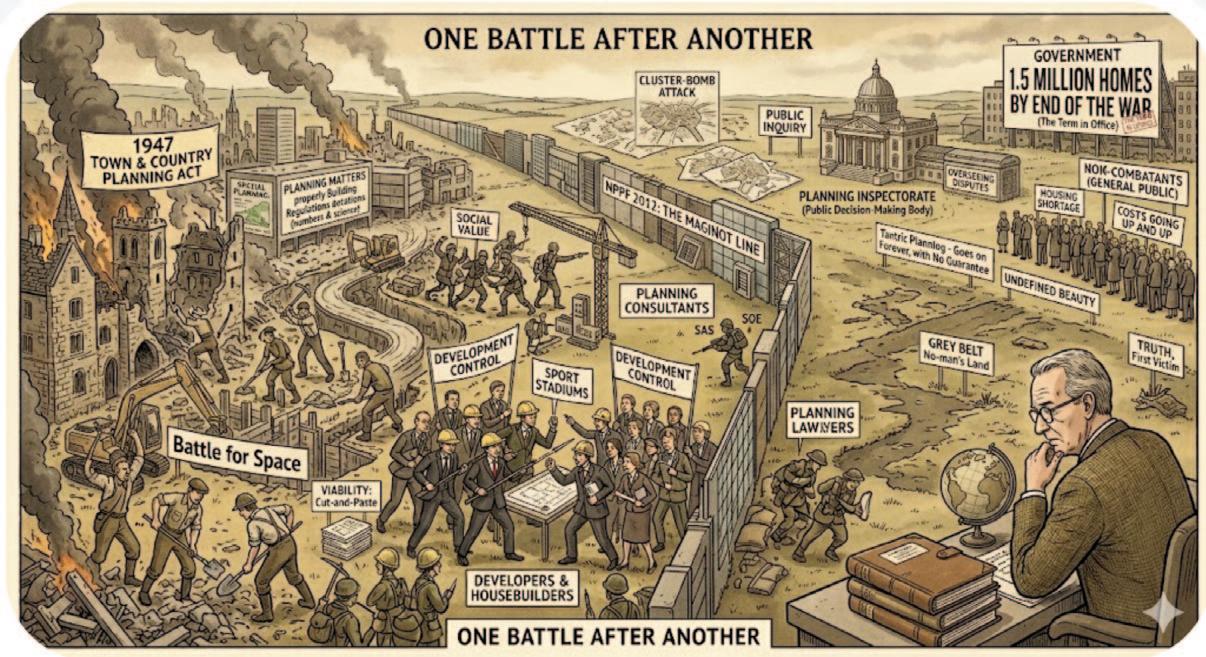
Paul Finch: One battle after another page 8
Lee Mallett reports the Planning Update conference page 7
Keynote: Steve Quartermain page 35; The new NPPF: James Harris (Lichfields) page 36; Will revised NPPF & DM guidance speed things up? Sam Bensted (BPF) page 41; London emergency housing measures: Tim Craine (Molior) and Nick Cuff (Urban Sketch): page 44; Office sector and planning for growth: Nick Brindley (Newmark) page 47 and In praise of squeaky PiPs: Andy Rogers page 49
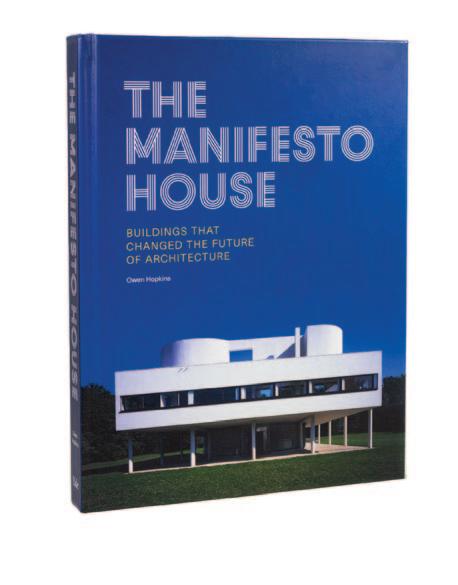
‘This beautifully illustrated survey brings fresh perspectives and insights to some of the world’s most celebrated and debated houses, with a special focus on the Modern Movement and what has come after. Few people will get the chance to visit all of these dwellings, but Owen Hopkin’s lively and engaging survey is the next best thing.’
Simon Bradley
Retrofit or Ruin: planning for the future of heritage
Francis Maude page 50
PAGE:
5 LEADER
Averting an extinction event
7 LEE MALLETT
Lee Mallett reports on the Planning Update conference
8 PAUL FINCH
One battle after another
OPINIONS
10 Embedding resilience | Rayman Bains
11 Build-to-Rent single family housing | Elisabeth Pywell
13 Support local councils | Riette Oosthuizen
15 OPINION: Death of the Golden Goose | Hugo Owen
16 Don’t be an April Fool | Simon Ricketts
18 Gateway 3 Approval | Vijay Bange
19 Housing as infrastructure | Jordan Davies
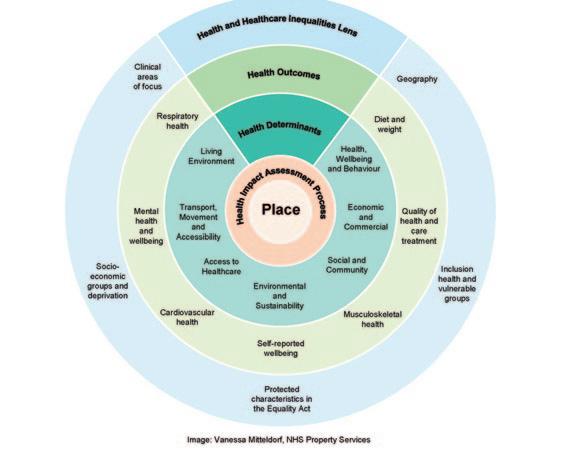
Health considerations in planning
James Beackon and Michael Chang page 54
The next meeting of the London Planning & Development Forum
is at London Councils
12 Arthur Street EC4R 9AB
2pm on Tuesday 9th June 2026
Please email editor@planninginlondon.com if you would like to join in.
For the agenda nearer the date please also look at planninginlondon.com >LP&DF
20 Long term funding for new towns | Francis Truss
21 Revised guidance on viability | Andrew Golland
22 Exploring the barriers to density | Chris Hemmings
BRIEFING
23 The London co-living sector | Lichfields
25 CLIPBOARD: Councils rely on ‘sticking plaster’ extensions to meet planning targets, says the FT; The City has approved the Barbican Renewal Programme; Great West Road masterplan for 14,000 new homes; Former GSK Brentford HQ to be transformed; Secondstaircase rule is blocking 18,000 homes a year, report claims
27 ¡PILLO!
Berkeley puts the brakes on; Roy Pinnock on LinkedIn; City unveils how skyline could look in early 2030s; Albert before Hammersmith; Edwardiana no model for new towns, says Ben Derbyshire; Pimlico café
28 PLANNING PERFORMANCE
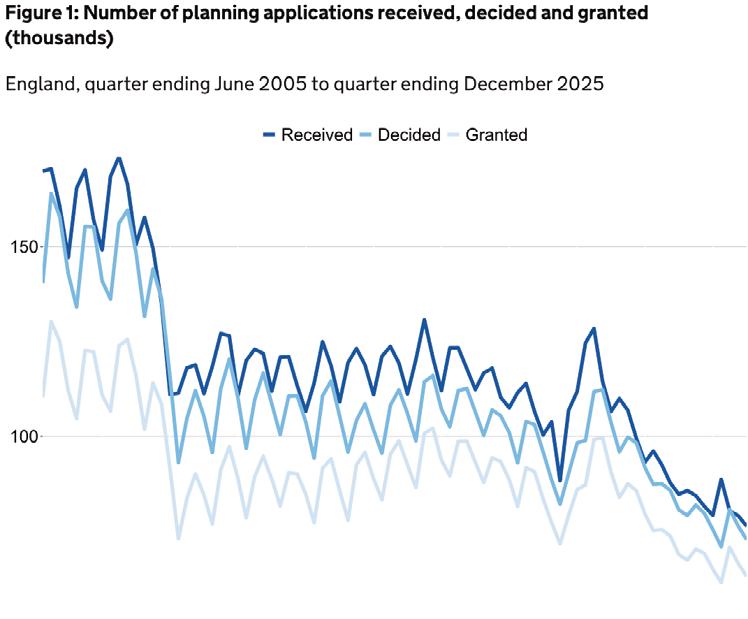
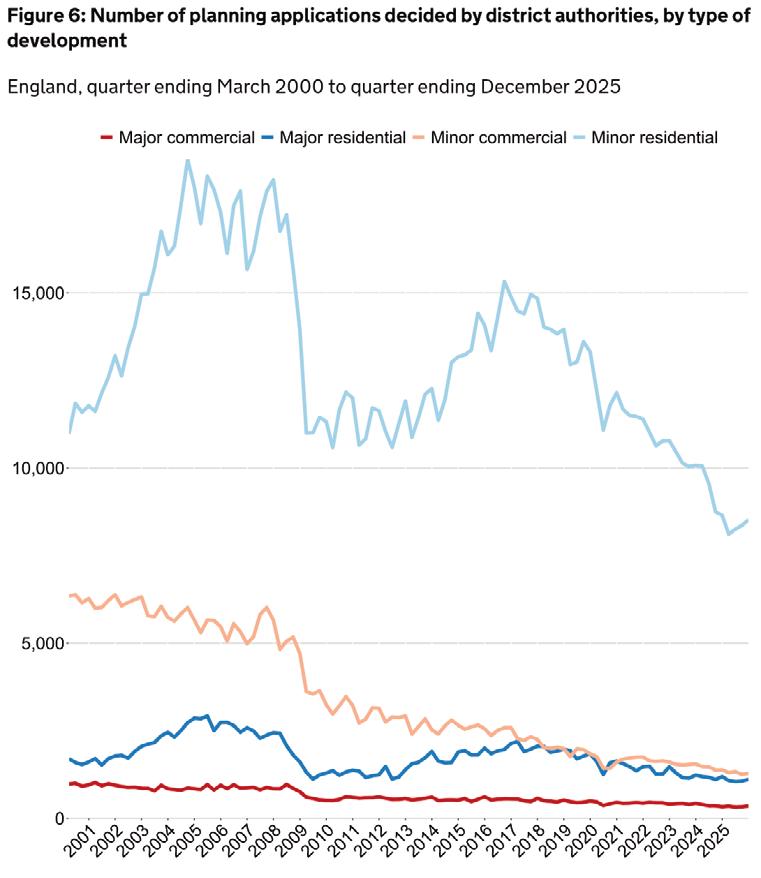
The number of applications made and decided down 3-4 per cent from the same quarter last year
32 LONDON PLANNING & DEVELOPMENT FORUM
Annual Planning Update with CULS and the ACA, hosted by Dentons
Overview of upcoming changes; the new NPPF; densifying the suburbs; speeding things up; London emergency housing measures; planning for growth
33 Meeting AI summary
35 Welcome and Keynote: Steve Quartermain CBE (Former Government Chief Planning Officer)
36 The new NPPF: James Harris (Lichfields)
38 Panel Discussion NPPF in Practice: Chair: Lee Mallett Panel: Riette Oosthuizen, HTA Design; Colin Wilson, LB Southwark; Hugo Owen, Pocket living
39 Densifying the suburbs with homesteading: Neil Deely (Metropolitan Workshop)
41 Will revised NPPF & DM guidance speed things up? Sam Bensted (BPF), Assistant Director (Planning and Development) with responses by Mike Kiely chair POS; John Walker CT Group, formerly City of Westminster
44 London emergency housing measures: Tim Craine (Molior) and Nick Cuff (Urban Sketch)
47 Office sector planning reforms and planning for growth: Nick Brindley of Newmark Paul Finch’s ‘Wind Up’ is on page 8
49 ANDREW ROGERS
In praise of squeaky PiPs
FEATURES
50 Francis Maude | Retrofit or Ruin: planning for the future of heritage
54 James Beackon and Michael Chang | Health considerations in planning
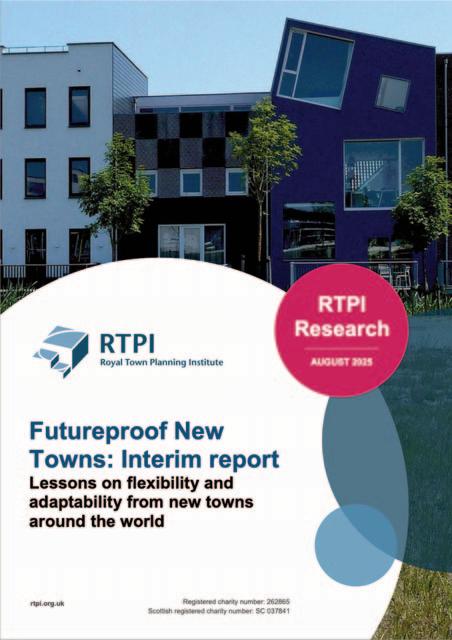
57 Susan Parham and Ellie Pritchard | Future proofing new towns
61 BOOKS
At Home in the City by Alan Power, reviewed by Félicie Krikler
63 Lost London From Crystal Palace to Heston Airport, a history in 25 Missing Buildings by Paul Knox
67 PLANNING AND ENVIRONMENT REFERENCE GUIDE
70 SUBSCRIPTION ORDER FORM
71 Shaping the World: Investment locations for new homes | Mark Willingale
75 ADVICE
ISSN 1366-9672 (PRINT)
ISSN 2053-4124 (DIGITAL)
ISSUE 137 APRIL-JUNE 2026
www.planninginlondon.com
The London Planning and Development Forum (LP&DF)
The LP&DF was formed in 1980 following an all-party inquiry into the development control system.
It selects topics to debate at its quarterly meetings and these views are reported to constituent bodies and published in Planning in London.
It is a sounding board for the development of planning policy in the capital, used by both the public and private sectors.
Agendas and minutes are at www.planninginlondon.com
To attend please email EDITOR@PLANNINGINLONDON.COM
Publishing Editors: Brian Waters, Paul Finch and Lee Mallett editor@planninginlondon.com, planninginlondon@mac.com
Editorial, subscriptions and advertising: Tel: 07957871477
Chairman: Brian Waters MA DipArch (Cantab)DipTP RIBA MRTPI ACArch ppACA FRSA Principal: The Boisot Waters Cohen Partnership – brian@bwcp.co.uk
Vice-Chairmen: Riette Oosthuizen HTA Design: riette.oosthuizen@hta.co.uk and Brian Whiteley Brian.Whiteley@planningaid.rtpi.org.uk
Member bodies
Association of Consultant Architects Planning Officers’ Society/Association of London Borough Planning Officers London Councils British Property Federation Design Council CABE City o London Law Society
Future proofing new towns
Susan Parham and Ellie Pritchard page 57
At Home in the City by Alan Power, reviewed by Félicie Krikler page 61
Available only on subscription: £99 pa
Provides a licence for five copies by email See subscription form or buy online at www.planninginlondon.com.
Planning in London is published quarterly in association with The London Planning & Development Forum by Land Research Unit Ltd, Studio Petersham, Gorshott, 181 Petersham Road TW10 7AW
Confederation for British Industry DLUHC Design for London/ Urban Design London
Historic England
Environment Agency
Greater London Authority
Home Builders Federation
Landscape Architecture SE
London Chambers of Commerce & Industry
London Forum of Amenity Societies
London Housing Federation
National Planning Forum ICE, RIBA, RICS, RTPI, UDAL, TCPA Transport for London
London University (The Bartlett, UCL) University of Westminster
Contributors write in a personal capacity. Their views are not necessarily those of The London Development & Planning Forum or of their organisations.
Correspondence and contributions are invited for consideration. The editors reserve the right to edit material and letters supplied.
Made on a Mac
members: Planning Aid for London London Metropolitan University
Affiliated
THE LP&DF IS ASSOCIATED WITH THE LONDON SOCIETY
The dial on spending on housing delivery, social or private, at a national and local level must be shifted further
Averting an extinction event
As if on cue, shortly after the Cambridge University Land Society’s annual Planning Update conference we report in this issue, Berkeley Homes announced it was halting land acquisitions, citing costs and regulations. The viability of developing homes in London has all but been extinguished and diminishes with every Trumpian outburst.
If lack of viability is the issue, what are the answers? It’s important to acknowledge the planning system is not guilty, which might be mistakenly inferred. It balances desirable social and environmental ends, implementation of decisions are governed by rule of law and it enables, by statute, democratic engagement to influence policy and individual application outcomes. These remain desirable fundamentals in a liberal democracy - unless you are an ardent supporter of the Chinese Communist Party attempting to secure a new embassy next door to the Tower of London.
What’s the problem? We aren’t getting the outcomes we need now. Time to contemplate policy solutions across the battlefield, to continue topical military analogies. Starting small, it has always been destructive of the market’s ability to deliver – for delivery is all – that policy should insist smaller schemes of as low as 10 homes accommodate affordable units. That threshold needs to be raised to something like 50 units immediately.
We need to revive small builders, developers and investors’ interest in delivering homes. Every borough needs a small sites SPD like Croydon’s – something one council got right but alas took on the task of delivery without managing risk appropriately, which is the developer’s primary skill. Fear of the consequences of failure being a spur to success. It is much safer to invest elsewhere than the development roller coaster. Swathes of smaller developers, investors, financiers have done just that figuring development isn’t worth the risk. Planning policy appears unconcerned about this despite making noises about supporting the sector. It should be more concerned.
Planning in London has been published and edited by Brian Waters, Lee Mallett and Paul Finch since 1992
Now even larger fauna in the developer eco-system are finding it tough to feed themselves. Policy is supposed to be evidence-based. Berkeley Homes’ announcement is hard evidence it is having the opposite effect of that intended. The dial on spending on housing delivery, social or private, at a national and local level must be shifted further and vehicles established to deliver specifically social, or affordable housing.
Jumping to the bigger end of the carrot and stick regime, local authorities’ residential property portfolio holdings in London, across 33 boroughs, and the even larger portfolios of the G15 housing associations account for a million homes in London. These contain many hidden or unacknowledged development opportunities. The GLA should ask these bodies to audit and make publicly available the good, the bad and the ugly. And find something sensible to say about its own hopelessly unrealistic targets. n
MALLETT MALLETT
Planning regime and ‘armchair generals’ to blame for plummeting housing delivery
The recent Planning Update conference (see our LP&DF report) offered a stinging critique of the ‘armchair generals’ shaping planning policy and Sadiq Khan’s misguided assumption that housebuilders will deliver London’s social housing programme
Planning policy was blamed for causing London’s housing delivery to plummet at the Annual Planning Update of the Cambridge University Land Society. The event, organised with Planning in London magazine, the ACA and lawyers Dentons, was chiefly about the Government’s changes to planning and its new draft National Planning Policy Framework (NPPF), designed to speed the process up while encouraging growth.
These were largely welcomed but not seen as sufficient to reverse the collapse in delivery in the timely fashion London’s crisis requires. Speakers repeatedly cited the complexity, cost and viability-destroying ‘value capture’ required by planning policy as the underlying cause of tanked delivery figures, likely to worsen as war looms.
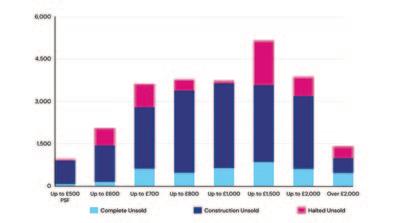
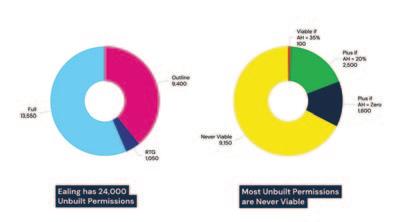
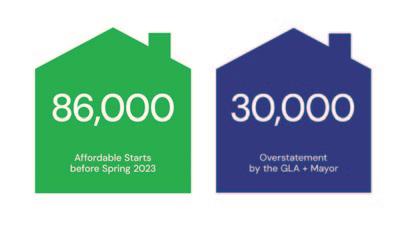
fired an Exocet at London Mayor Sir Sadiq Khan for overstating affordable housing delivery since Spring 2023 by 30,000 homes. Only 86,000 had been built not the 110,000 claimed, said Craine and he showed a 1970s block ‘in which people are still living’ misleadingly included in GLA figures. More damaging was his take on viability and its impact on supply causing young Londoners in particular much grief –and architectural practices. There are 290,000 permitted unbuilt homes in London, said Craine. All of those would have be under construction now to hit the Mayor’s target of 88,000 new homes a year within at least three years. The current total of new homes being built annually is only 5,000, less than 6% of that.
Viability has evaporated from most of the capital.
Lee Mallett is a founder Editor/publisher of PiL, an urban regeneration consultant and a committee member of the City Architecture Forum
than development costs in most of outer London. They are marginal in inner London and only in central London is there tangible viability. “And if anyone tells you overseas buyers are a problem you can tell them there were just 290 sales to overseas purchasers in Q4 2025,” said Craine. Also, if anyone thinks the struggling Build to Rent sector might help, planned completions of private rented homes “look like falling to zero by 2029”.
Nick Cuff, former local politician and MD of developer Urban Sketch, said there was “huge distress out there” – a lot of unbuilt schemes with high debt and the need to amend consents to fix viability, for which there was “little hope of relief”.
“The market is static, the game has changed, and we must protect the resilience of London’s housing supply,” he said. The thresholds at which affordable housing is required must be raised and there was “nothing for SME developers” in the proposed changes to policy.
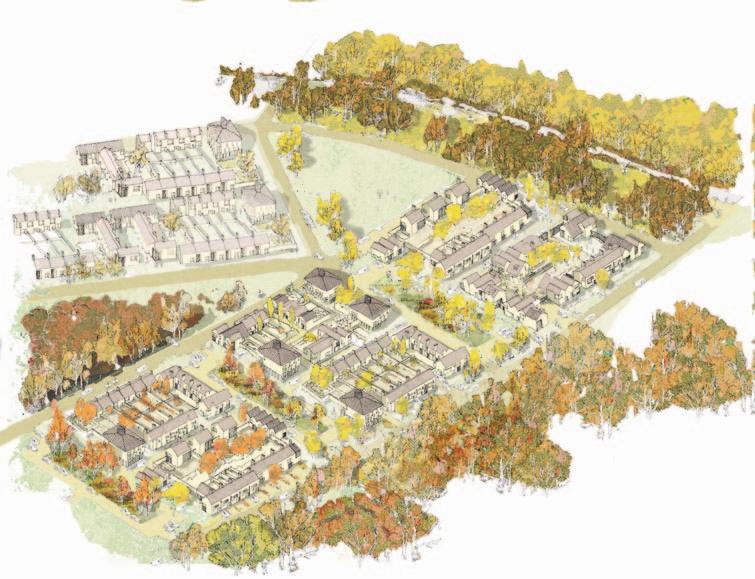
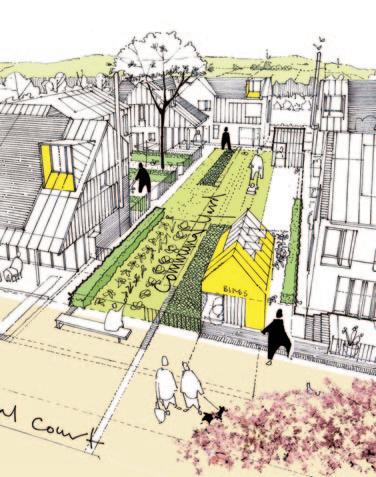
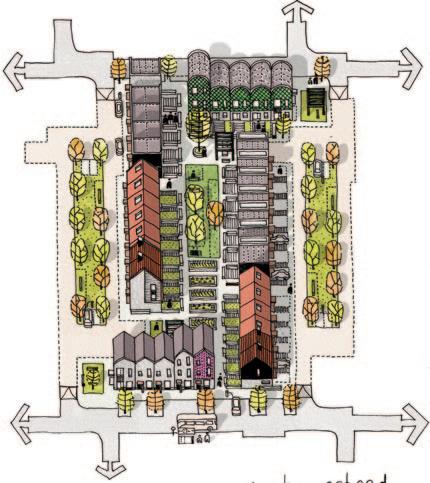
Metropolitan Workshop's Homestead concept applied to Mayfields, West Sussex, a 10,000home walkable neighbourhood with the charm and character of a village, but the jobs and culture of a thriving market town.
Steve Quartermain, former Government Chief Planning Officer, characterised the latest round of reform as “a group of people on a bus to Utopia, full of people who haven’t decided what Utopia is, or how to get there.” He felt Government needed to make its messaging much stronger around good growth that could also deliver environmental goals. But resourcing remained a serious weakness.
James Harris of planning consultant Lichfields, summarising the NPPF, said applicants must demon-
strate the most effective use of land or face refusal, such as the required minimum densities around stations. He questioned whether the idea to test site viability at the Local Plan stage, rather than after an application was made, was realistic. All should be aware the NPPF clarifies the new “not-well-designed” grounds for refusal, he said, with eight expanded themes; context, liveability, climate, nature, movement, built form, public space and identity.
A brighter spot amid policy gloom was a design session looking at the densification of suburbia, required in the NPPF. Neil Deely of Metropolitan Workshop presented the practice’s investigations into ‘A New Kind of Suburbia’. Metwork has developed the ‘Homestead’ concept, a flexible unit of development. This enhances density and communal amenity by reducing private gardens and vehicular infrastructure, enabling home types to be flexed within the Homestead to suit local needs. He showed built examples, designed for Nationwide Building Society in Swindon and handsome infill schemes in London and Dublin.
The event was wound up by former CABE chair and WAF director Paul Finch who’d “been thinking about war… because planning is one battle after another”. (See Paul’s column on page 10). He told of Berkeley Homes’ recent shock at having completed several hundred homes on a site, only to find itself outbid on an adjacent site by a self-storage company – hard evidence alternative uses are beating residential to the draw.
“Why is planning loaded with all this stuff that could be in Building Regs?” Finch asked. And why is spatial planning “loaded with things [S106 requirements] that are really about numbers?” His answer was “armchair generals”, the “political caste” that appear oblivious to the real battles on the ground. And could planning deliver anything anyway? He thought not. “Planning is the neutral ground on which battles are fought.” The system has been “overloaded and cannot take it”, nor is it designed to deliver anything. “The Mayor is in denial and under the mistaken impression the house-building sector can deliver a social housing programme. We now
have the evidence of several decades. It cannot do it. Yet we do have models that show how London managed to do this up until say 1982. We did it with the Olympic Village.”
The conference was produced by the Cambridge University Land Society with the Association of Consultant Architects, London Planning & Development Forum and Planning in London magazine, supported by law firm Dentons. View details of forthcoming LP&DF meetings and subscriptions.
This article first appeared in Architecture Today. n BELOW:
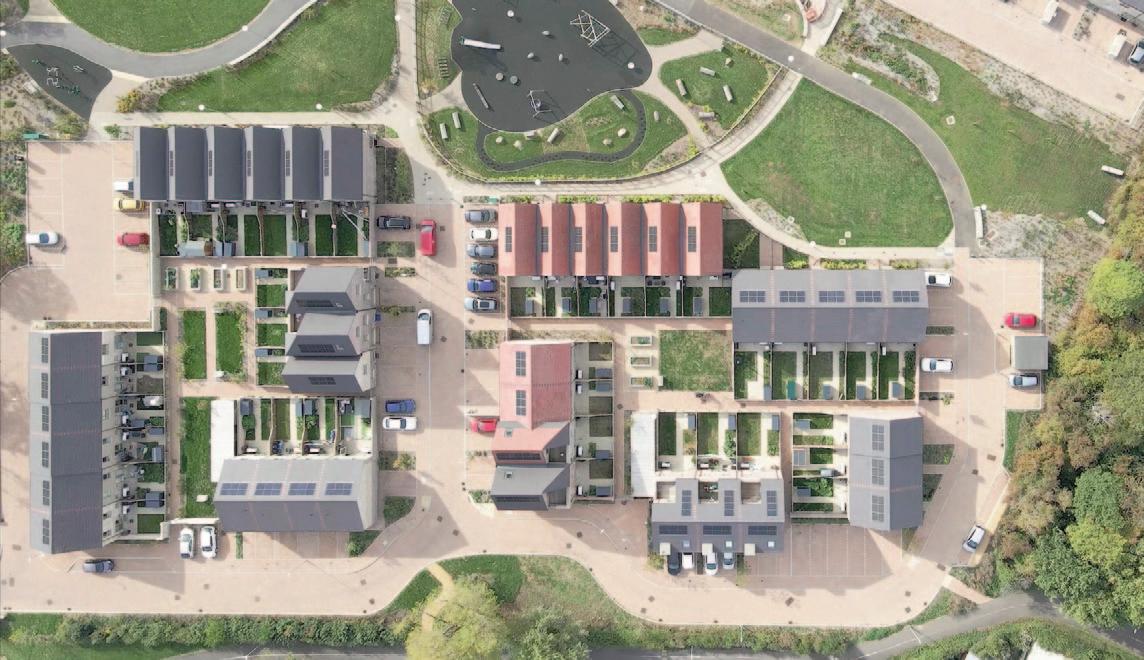
Neil Deely’s presentation of Metropolitan Workshop’s work to densify the suburbs provided a bright spot during the conference. Its housing scheme at Oakfield, Swindon, for Nationwide Building Society, developed by igloo Regeneration, is composed of ‘Homesteads’, informal, semi-permeable clusters of homes, delivered at 48 dph , that are arranged around communal garden spaces providing opportunities for bike storage, vegetable growing and play.
One battle after another FINCH FINCH
Any account of the UK planning system and its endless changes, dictated by politics, the economy or fashion, make it sound rather like a war, thinks Paul Finch
The analogies come thick and fast: the planning system is the battlefield in which operations are conducted. One side wants to build stuff and make money, or fulfil some social purpose like providing sports stadiums. The other, at least since the 1947 Town & Country Planning Act, wishes to control these aspirations, substituting the profit motive with a notion of social value deriving from a command economy model.
Rival ideologies resulted in the wrecking of towns and cities across post-1945 UK, as shopping centre developers and planning regimes fought out one battle after another, sometimes joining forces to impose a fatally flawed notion of modernity on fuddy-duddy medieval town centres.
Planning had become almost a dirty word by 1969, when the famous doctrine of ‘Non-Plan’ hit the headlines in the pages of New Society, where planning radical Peter Hall, iconic architect Cedric Price, critic Reyner Banham, and the magazine’s Paul Barker suggested that, given what had happened since 1947, it might be time to try something else – like organic growth, rather than development control.
‘Architecture’ became an even dirtier word following the attack on by the then Prince of Wales in his 1984 speech at Hampton Court, attacking modernists and all their works. ‘Community architecture’, and indeed ‘community planning’ became all the rage; endless consultations would inevitably, or so it was said, produce improved environments and greater social cohesion.
Unfortunately, these aspirations were undermined by the abandonment of planned public housing, and a rapid rise in uncontrolled immigration, making housing shortages even worse than they might have been. Various riots, huge increases in house prices as starts and completions declined, and a growing sense that social cohesions had ended at about the same time as the planning system had been introduced, resulted in a ‘something must be done’ response from politicians oblivious to their own role in creating scepticism about the ‘planning system’.
Indeed, and quite unfairly, the system became the object of attack. It was not politicians scrapping public housing (while in denial about population increase) who were to blame for the housing shortage but planning system. But how to fix it?
The answer came in the 2012 National Planning Policy Treaty (sorry Framework) – produced to hold the line between development desire and rational planning for the 21st century. It was simultaneously a top-down imposition of principles and processes, to which all other plans would need to conform, and an all-embracing defensive wall, holding together the disparate elements of the planning system in a way which would simultaneously satisfy development, heritage, community etc etc.
Alas, the NPPF should now be seen as the Maginot Line of the planning world: no sooner had it been built than people were finding ways round it, in particular the niche new breed of planning consultants who became the SAS, or possibly SOE, in the great planning battles that have amused or infuriated us in recent decades.
Those 1947 ideas about local authority responsibility had been by-passed almost Day 1 by policies which assumed that localism wasn’t up to doing anything positive at a big scale: hence the introduction of new town corporations, and later various development corporations which assumed growth would be blocked or slowed by that 1947 system.
Later, in the spirit of Non-Plan, enterprise zones and freeports became the preferred method of bypassing planning, even as regionalists like John Prescott promoted the idea that the wider the area, the better the planning – whether the public liked it or not. The referendum on regional assemblies knocked all this on the head, but the idea of everwidening zones of planning influence never went away, and indeed in the minds of EU strategy planners, included the elimination of national states in favour of new map-lines devised by themselves. The UK would be part of the Atlantic Seaboard along with Portugal (as these entities would cease to be known).
Paul
Finch CBE is programme director of the World Festival of Architecture and joint publishing editor of Planning in London
In the meantime, back on the local battlefield, it started to become apparent that far from being the answer to all problems, the NPPF was itself a problem. Hence endless revisions, tinkering and modifying, providing endless complications for planning barristers to feast on at public inquiries, where undefined concepts such as ‘beauty’ or ‘grey belt’ –the no-man’s land of the system – helped bring the entire planning process into further disrepute.
Mad inquiries, conducted at vast expense to little public benefit, have become the order of the day. The War Ministry (sorry, Ministry for Housing, Community & Local Government), sends out new instructions on a frequent if irregular basis. Often these appear to be aimed at stopping housebuilding altogether. What was once regarded as a social good is now treated as a social evil. So in order to build you may have to pay for planning advice (a recent invention), CiL (a recent invention), Section 106 benefits, 35 per cent of a development as ‘affordable’ (ha ha) housing, and undertake the arduous process of actually obtaining a planning permission, with stupid demands for cycling facilities (for example) which bear no relation to need or demand.
Meanwhile SMEs in the housing sector have gone to the wall, not helped by planning rules which seem to benefit the diminishing number of big boy housebuilders who can afford planning consultants and planning lawyers, not to mention the finance costs of log public inquiries which drive small companies out of the market.
The planning inspectorate has become a form of war crimes tribunal, overseeing the completing
claims of development and planning irrespective of why the crimes took place in the first place, or what the outcome will be of decisions one way or the other. Spatial planning is now required to include matters properly the province of Building Regulations because they involve numbers and science, for example carbon analysis or biodiversity. Obscurantist arguments about ‘viability’ bring more misery to the system – in reality cut-andpaste lies told by consultants (another new niche) acting for either side in what should be a mutually agreed technical exercise. It is all about war.
The first victim, as in any war, is truth. Sadiq Khan’s lies about housing starts in London, a strategy initiated by former Camden councillor James Murray who, despite no credentials for the job, is
now Chief Secretary to the Treasury. This does nothing for the reputation of a planning system where officers are frightened to express a professional opinion if it will jeopardise the relationship with their political masters.
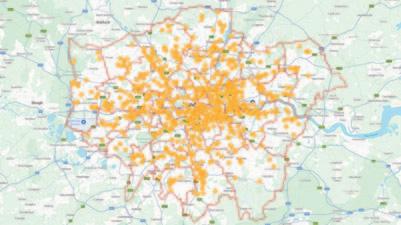
Maps of London, showing housing developments with permission which cannot be started for various planning and financial reasons, look like the ones who see after a cluster-bomb attack. Yet according to the Starmer government, all is in hand to complete 1.5 million homes by the end of the war (sorry, first term in government!). The phrase ‘new towns’, which used to mean something significant, now means urban extensions. They won’t produce significant numbers this decade.
For governments with no experience of how planning actually works, there is a profound reluctance to create a planning system based on certainty (‘If you do this you will get that’). Everything is a negotiation. The armies of applicants and their architects, planning consultants, ecologies, landscape architects, lawyers, viability specialist and Uncle Tom Cobley commit themselves against the planning system’s own battalions, many mirroring the opposition’s. It all takes ages – Tantric planning that seems to go on forever, but with no guarantee of a happy ending.
The non-combatants, the general public, look on in amazement as the costs go up and up. The trouble is, in a war, nobody much likes the implications of . . . collaboration! n
Embedding resilience
Ramboll says we must act now to embed resilience into the future of our cities
The impact of climate change is no longer a future threat. It’s here. And it’s having an impact on our everyday lives. From extreme heat affecting transport networks to flooding placing pressure on utilities and urban infrastructure, the UK has already entered a new era where resilience is no longer a buzz word or superficial policy or corporate ambition, but a core requirement for economic security, national resilience and community wellbeing.
The question facing planners, policymakers and infrastructure leaders is not whether we must adapt but how quickly and sustainably we can embed resilience into the systems that shape our towns and cities.
At Ramboll’s recent Resilient Societies event in London, delivered in partnership with the Resilient Cities Network, leaders from government, infrastructure, finance, transport and energy came together to discuss precisely that challenge. What became clear is that building resilience is not simply an engineering problem. It is fundamentally a governance and collaboration challenge.
And that means the planning system sits at the centre of the solution.
Planning Reform a critical opportunity
The UK is currently undergoing the most significant planning reform in over a decade. Through the Planning and Infrastructure Act and revisions to the National Planning Policy Framework (NPPF), the government is seeking to accelerate the delivery of housing and critical infrastructure as part of its ambition to deliver around 1.5 million homes and major infrastructure projects during this Parliament.
These reforms are designed to address a system that has often struggled to deliver the scale and pace of development required. Alongside the UK’s ambitious Industrial and Infrastructure strategy, these reforms present a critical opportunity. If implemented effectively, this new planning framework could allow resilience to be embedded much earlier in the development process – at the point where decisions about infrastructure, housing and urban growth are made.
Embedding Resilience into Planning
Over the past two decades working across national infrastructure policy and major public sector programmes, and through my own experience
serving as a local councillor in Slough on the planning committee, I have seen first-hand how planning decisions shape the long-term resilience of our communities.
Planning is where housing growth meets energy infrastructure, where transport networks connect communities, and where environmental risks must be balanced against economic development.
Every planning decision today is, in effect, a resilience decision. If resilience and whole system thinking is not embedded at the planning stage, the cost of retrofitting our infrastructure later will be significantly higher. The current wave of planning reform therefore creates a critical moment to rethink how resilience is integrated into national policy, local plans and development frameworks.
Collaboration is essential
One of the strongest messages emerging from Ramboll’s resilience discussions was that no single institution can deliver resilience alone.
The systems that underpin modern society energy networks, water infrastructure, transport systems, digital connectivity and the built environment are deeply interconnected. That means decisions taken by one sector inevitably affect another.
Resilience therefore depends on stronger collaboration between local authorities, central government, infrastructure operators, investors and insurers and, more importantly, communities who are impacted by climate change on the ground
Lord Toby Harris, who has long championed the UK’s resilience agenda, highlighted during our event that many of the risks facing society remain insufficiently understood or communicated. Building resilience requires far greater transparency about these risks and stronger coordination between institutions responsible for managing them. In other words, resilience requires whole system thinking.
Cities as Critical Infrastructure
Cities themselves should be viewed as critical infrastructure. Urban areas concentrate economic activity, population and infrastructure — but they also concentrate risk.
At the Ramboll event, Cassie Sutherland from C40 Cities highlighted how cities across the world are already deploying solutions that reduce climate risk and strengthen resilience. These include green corridors to reduce urban heat, redesigned streets to
Rayman Bains, Ramboll UK and Ireland
manage stormwater, and integrated planning approaches that connect transport, housing and energy systems.
Many of these solutions already exist.
The challenge now is scaling them through policy, planning frameworks and investment models. Cities that succeed in doing this will not only reduce climate risk but will also become more competitive and attractive places to live and invest.
Resilience requires Long-Term Thinking
Perhaps the greatest challenge in embedding resilience into planning is the tension between long-term infrastructure decisions and short-term political cycles.
Resilience requires decisions that look decades ahead – well beyond electoral terms or annual funding settlements. Yet the cost of failing to act is growing. Extreme weather, energy system pressures and infrastructure disruption will increasingly affect productivity, insurance markets and the viability of development.
Forward-thinking governments and cities must therefore treat resilience not simply as an environmental issue but as a core economic and national infrastructure priority.
From Policy to Delivery
The UK now has a significant opportunity.
Planning reform, infrastructure investment and the national drive to accelerate development can together create a planning system that delivers not only growth, but resilient growth.
But this will only happen if resilience becomes embedded across policy, planning frameworks and infrastructure delivery. It requires collaboration across government, industry and communities. And above all it requires long-term thinking. Because ultimately resilience is not just about surviving future shocks. It is about designing cities and infrastructure systems that allow society to thrive despite them. n
Build-to-Rent single family housing
Build-to-Rent single family housing is a growing UK trend which London struggles to deliver, says Elisabeth Pywell
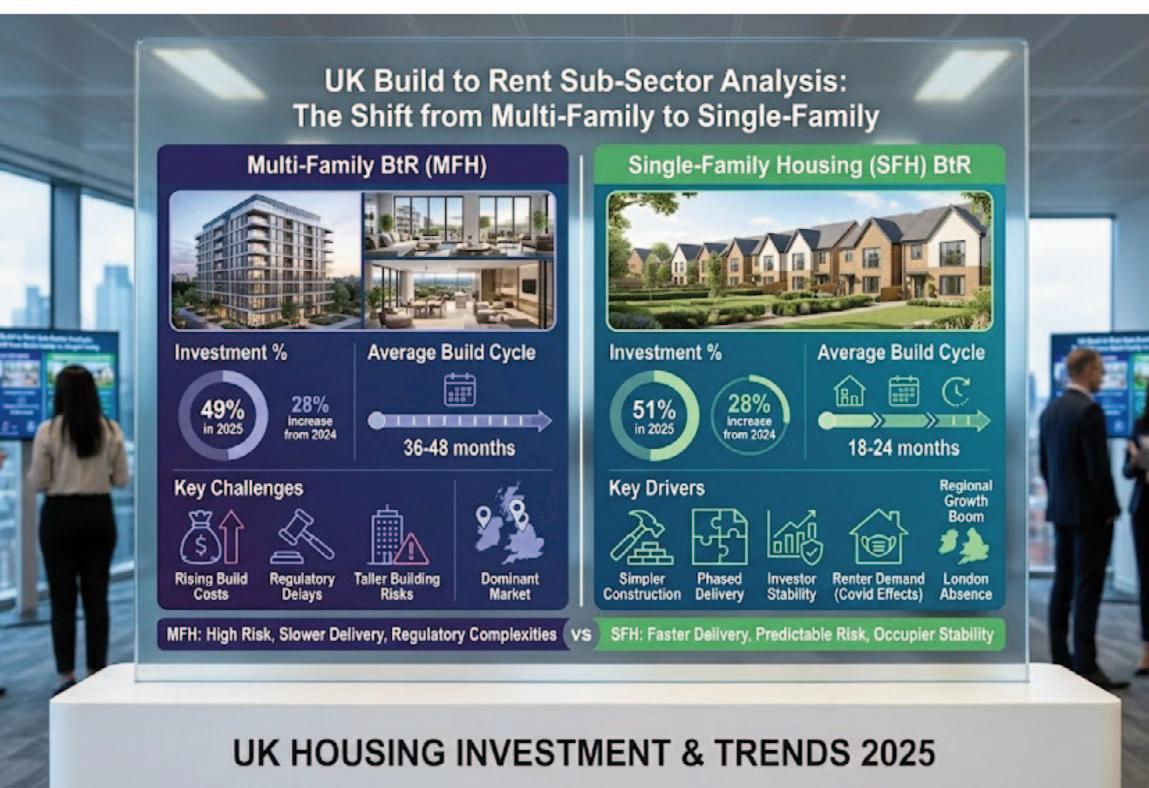
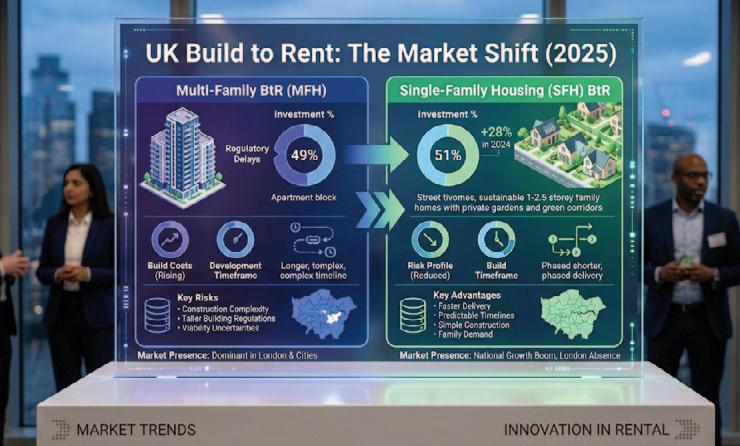
Build to Rent (BtR) Single Family Housing (SFH), defined as homes developed for long term rent rather than sale, continues to rise as a significant sub-sector within the UK housing market. According to Savills, SFH accounted for 51% of total investment into BtR in 2025; a 28% increase from 2024. This signals a shift away from multifamily BtR (MFH) - purpose-built apartment blocks developed for long-term rental.
Several market forces underpin this change. MFH has been hit by rising build costs, and ongoing regulatory delays, factors that have extended development timeframes and introduced additional uncertainty. In contrast, SFH schemes, typically comprising one to 2.5 -storey homes with simpler construction processes and capable of being delivered in phases often
present more predictable build timelines and risk profiles. Consequently, they have become increasingly attractive to investors seeking stability, quicker delivery, and reduced exposure to the regulatory complexities affecting taller buildings.
Space, stability and flexibility:
Changing renter priorities
The rise of SFH can’t just be attributed to investor behaviour and market conditions. SFH and MFH serve different stages of the occupier lifecycle and there has been a shift in occupier demand and requirements. Many reports attribute these shifts to the residual effects of the Covid-19 pandemic, which recalibrated how people valued the space, privacy and functionality of their homes.
Elisabeth
Pywell is
an Associate Director at Nexus Planning
SFH BtR developments offer a greater sense of autonomy, security, and long-term stability. Many operators offer longer lease options, reflecting the desire of families and long-term renters to establish roots in their communities. The sense of space, privacy, and independence provided by SFH has the potential to resonate with occupiers who are seeking
>>> suburban living.
Beyond lifestyle factors, broader social and economic trends are shaping demand. Affordability pressures remain a defining feature of the housing market, with high house prices relative to incomes preventing many households from accessing home ownership. This is particularly acute in London, where affordability ratios significantly exceed national averages. Later household formation, coupled with hybrid working patterns, has created a demographic whose housing needs are evolving toward more space, flexibility, and stability, yet who are increasingly unable to buy a property of their own. SFH BtR fills a structural gap, enabling households to access family-sized homes and the benefits of suburban living, without the financial barriers of purchasing.
A national boom, but a London absence
The British Property Federation reported that BtR was increasingly present in the development pipelines of 213 Local Authorities in Q3 of 2025, with SFH considered largely responsible for driving this increase because of an increasing number of suburban schemes coming forward.
Growth patterns are far from uniform across the country, and London is a stark outlier. While the regions benefit from increased SFH delivery, the capital sees almost none. A review of the websites of major SFH BtR developers and operators, including: Simple Life, Leaf Living, Grainger PLC, and Lloyds Living, reveals no clear examples of SFH schemes in London itself. This absence is unsurprising given the structural conditions which shape the capital’s housing market. A fundamental tension exists between London’s planning and land-use policies, the economic realities of land values and construction costs, and the rising national demand for SFH.
Currently, planning policy (both adopted and emerging) prioritises high density development in urban areas. This aligns with London’s overarching strategic planning policy objectives which seek to maximise land efficiency, increase housing delivery and support sustainable urban development. Yet inherently SFH delivers lower densities, making land use less efficient in planning terms and often rendered unviable by high land values. The issue of via-
bility is compounded by the fact that SFH schemes are subject to the same affordable housing requirements as other residential developments. For suburban or regional SFH schemes, viability can often absorb these contributions. In London, however, where both land and build costs are notoriously higher, imposing conventional affordable housing obligations can undermine the financial feasibility of SFH.
Can planning policy make room for family-sized rental homes?
These conflicts raise important questions about the role SFH could or should play within London’s housing mix. If London is to accommodate SFH BtR policy may need to evolve. One option could involve allowing flexible densities in specific areas where there is demonstrable demand and land capacity.
Another possibility is reviewing whether SFH should be subject to different affordable housing requirements, recognising that SFH as an asset class provides access to family homes for households who cannot afford to buy.
This could be formalised through the creation of a bespoke planning use class for BtR (or SFH specifically), with tailored planning and viability frameworks that reflect its unique market function and social value.
Alternatively, schemes could capitulate on those elements which make SFH successful, e.g. flexible internal space and increased private amenity space, but deliver these features within lower rise apartment blocks, creating a hybrid model that balances the strengths of both SFH and MFH. This is already seen in some examples of SFH in regional urban areas such as CASA by Moda’s Vista Park, which is located 15-minutes from Glasgow City Centre and includes 156 new family homes across 1-2-bed apartments and 2-4-bedroom houses.
There is a clear momentum behind SFH BtR signalling an ongoing change in how households want to live and how investors are choosing to deploy capital. As demand continues to shift towards increased space, privacy and flexibility, SFH is increasingly positioned to become a defining component of the UK’s rental landscape. Yet, London’s absence from this growth highlights how planning constraints, land values and policy frameworks can restrict the delivery of alternative housing products. A hybrid lower-rise model may offer a compromise, but its success will be dependent on robust viability and a more flexible planning approach - one that recognises SFH as an essential asset class capable of providing family homes at a time when ownership is increasingly out of reach. n
Elisabeth Pywell is an Associate Director at Nexus Planning, independent town planning advisors to the public and private sector.
Support local councils for growth
Changes to the planning system are welcome but under-resourced local authorities may struggle to comply,
Inefficiency in the planning system has become a popular scapegoat for the current standstill in housing development. The cost of land, the economic downturn, sky-high construction costs and limited absorption rates for new homes have also contributed, resulting in an 84 per cent drop in construction starts over the past decade, as Melior reported last month.
Will changes to the planning system address some of this gloomy picture, even if only in part? A system that fosters uncertainty is never helpful, nor is one that is weighed down by technical requirements unrelated to encouraging good-quality growth in the most appropriate places.
In its purest form, the planning system exists to protect land and environmental assets as finite resources and to safeguard the public interest. Originating in Victorian public health concerns, it has evolved into a complex legal framework that balances economic growth, social equity and environmental protection through a discretionary, plan-led system.
In recent years, however, the visibility of these core principles has become somewhat lost in the frenzy of what is considered 'viable', leading to outcomes based on what can be built rather than what should be built to meet need.
The latest National Planning Policy Framework (NPPF) consultation introduces some of the most direct changes in years, representing a fundamental overhaul of previous versions. It incorporates the National Development Management Policies from the Planning and Infrastructure Act 2025, assuming their inclusion in the NPPF gives them clearer weight.
New regional development strategies will set a defined spatial framework for investment and housing growth, and both these strategies and local plans are expected to avoid duplicating national decisionmaking principles.
I would like to focus on one particular implication: how local plans can be shaped using these national principles while still applying a distinct, sitespecific spatial emphasis.
Local plans will need to show how they will encourage housing and economic growth, prioritising transport nodes where densities – depending on
says Riette Oosthuizen
the size of the hub – should be at a minimum of 40 to 50 dwellings per hectare. Growth across the local authority area should be divided into large site allocations (including town centres and the grey belt), a new category of medium-sized sites (10 to 49 homes and up to 2.5ha) and small sites.
Small sites now include 'infill within residential curtilages', implying that back gardens and green belt may be considered suitable for development. The medium-sized category has been introduced specifically to support small and medium-sized builders, with proposed measures around biodiversity net gain exemptions and offsite cash contributions for affordable housing.
Under-resourced local authorities
Local development orders (LDOs), masterplans and design codes should be used proactively by local authorities to guide and encourage housing and economic growth. This implies a much more spatially driven approach, with local authorities needing to set out early where growth should happen and what it should look like.
But how prepared are local authorities to take on this proactive growth support role? Many are already severely under-resourced, yet the expectations placed on them continue to grow. Proactively identifying growth areas, producing robust design codes and preparing LOs all require creativity, technical expertise and time - none of which come
Riette Oosthuizen is partner, planning at HTA Design
cheaply. Although new bespoke planning fees now allow authorities to determine fees for applications and pre-application engagement, early signs suggest this may be the main way to fund the new system, which could have alarming effects.
Delivering this new spatial agenda will also depend on strong, collaborative partnerships with the private sector.
Given current funding and staffing pressures, it is difficult to see how local authorities can meet expectations without such support.
The prospect of a more positive, proactive planning system is exciting. But if it is to succeed – and if it is truly to drive housing development – local authorities must be given the resources to lead with confidence. Without meaningful investment, the ambition risks outpacing the capacity needed to deliver it. n
First published in Property Week
Housebuilding: the goose that lays the golden egg is dead
Politics is always a matter of trade offs. For 30 years this one has been quietly avoided. It cannot be avoided any longer, says Hugo Owen
Let’s start with a short analogy. Picture a small manufacturer beginning the week. They make a respectable product, price it with care and hope that, if the stars align, next year might allow a new machine or two.
Now imagine informing this same firm that, from tomorrow, anywhere between 35 and 50% of its output must be handed over at cost or less. Its designs will no longer follow customer demand but the preferences of a committee with no intention of ever buying the product.
A slice of its revenue will be siphoned into public good initiatives entirely unrelated to the business. And if, despite all of that, it still turns a profit while carrying every ounce of risk, a clawback will be on hand to sweep up whatever margin remains.
No credible observer would expect this arrangement to survive in any other sector. Yet this is the framework in which we expect homes to be built and, more strikingly, it enjoys near universal political approval.
To understand how we arrived here, you have to go back to 1991. Before then, the state still accepted that infrastructure and affordable housing were public responsibilities, funded through taxation and delivered accordingly.
What had previously been financed collectively through the state was now attached to individual planning consents
The Planning Compensation Act 1991 changed that foundation completely. By creating the modern section 106 regime, it redefined the relationship between development and public goods.
What had previously been financed collectively through the state was now attached to individual planning consents. It wasn’t just a tweak. It was a transformation in the economic model of an entire industry.
Once that shift had occurred, everything else followed its logic. Contributions originally conceived as limited and site specific hardened into expectations that every scheme would part-fund the social infrastructure once paid for by government or councils. And, because this was now the foundation, subsequent legislation simply added more weight to the same mechanism.
The 2008 Planning Act and the community infrastructure levy did exactly that. Rather than replace section 106, it sat on top of it. Two systems now pursued the same pot of value and the commercial space for delivery narrowed again.
By 2013, the Growth and Infrastructure Act introduced viability testing, an implicit admission that the cumulative burden had begun to undermine the very schemes meant to carry it. Yet instead of rethinking the model, the state kept adding to it.
The question now is not whether another public obligation will be attached to development but
which one
The 2021 Environment Act and the 2023 Levelling Up and Regeneration Act brought biodiversity costs, net zero-aligned requirements and the proposed infrastructure levy. None of the earlier obligations were retired. The camel was not only handed another straw. It was expected to walk faster.
And, because each layer has normalised the next, the question now is not whether another public obligation will be attached to development but which one. Support for the triple lock perhaps? A cushion for frozen council tax? Or whatever fiscal gap emerges in the red book this autumn – said with tongue firmly in cheek, yes, but it illustrates a serious point: The logic of the system has expanded far beyond anything its architects ever intended.
Apply any of this to a normal manufacturer and the business would collapse before the model reached the boardroom. Yet housebuilding is expected to carry these demands indefinitely and still produce the homes the country insists it needs.
The contradiction is now visible in stalled sites, shrinking output and an industry that looks less like a golden goose and more like a bird that has been plucked past the point of survival.
If the government is serious about reversing that decline, it must start by recognising the scale of the shift that took place in 1991 and everything that has been piled on since.
Politics is always a matter of trade offs. For 30 years, this one has been quietly avoided. It cannot be avoided any longer. n
Hugo Owen is policy lead at Pocket Living, a London affordable housing developer. He is also a writer and commentator on housing matters.
First featured in Prop Views
Hugo Owen is policy lead at Pocket Living
A Pocket Living development: West Green Place in Haringey
Don’t be an April Fool: written reps planning appeals have got faster but also riskier
Expanding the expedited written representations appeal procedure to a broader range of appeals, larger developments will also benefit quicker decisions, says Simon Ricketts
You need to know how the rules changed on the first of April 2026 for 94.7% of planning appeals: those that proceed by way of written representations. There are traps for the unwary: whether for appellant, local planning authority or third party.
The changes have been on the cards since last June – see my 28 June 2025 blog post How Do You Solve A Problem Like…Speeding Up Planning Appeals Without Being Unfair Or Counter Productive?
On 12 February 2026 the Planning Inspectorate published Planning appeals: procedural guide. For appeals relating to applications dated on or after 1 April 2026 alongside the Town and Country Planning (Appeals) (Written Representations Procedure) (England) (Amendment and Saving Provision) Regulations 2026 which were laid before Parliament that day.
The main difference is that the “expedited” or “part 1” written representations procedure, which currently applies in relation to householder and minor commercial appeals, will be extended to most appeals to be determined by way of written representations.
Under the procedure, the appellant is not able to submit evidence at appeal not previously considered by the LPA when they determined the application, leaving the appeal to be determined by the inspector solely by reference to:
• the application that the LPA determined (including all supporting evidence, plans and interested party comments)
• the LPA’s decision notice (including their reasons for refusal where applicable)
• The LPA’s committee minutes and planning officer report
• The appeal form
• The LPA’s appeal questionnaire
Third parties are not able to make further representations at the appeal stage so will have to rely on
the inspector taking into account any representations that were made during the course of the application.
As is already the case with all written representations appeals (part 1 or part 2), if a section 106 agreement or unilateral undertaking is required, the completed (i.e. executed and dated) version needs to be submitted at the time the appeal is submitted. This part 1 procedure will apply to the following types of appeal:
• Appeals against a refusal of planning permission
• Appeals against a grant of planning permission subject to conditions that the applicant objects to
• Appeals against a refusal of prior approval
• Appeals against a refusal of advertisement consent
• Appeals against the refusal of an application to approve a reserved matter
• Appeals against the LPA’s refusal of an application to modify or remove a condition under section 73 of the Town and Country Planning Act 1990
• Appeals against the LPA’s refusal of an application for planning permission for development already carried out under section 73A of the Town and Country Planning Act 1990
• Appeals against permission in principle or refusal of technical details consent
It is open to the Planning Inspectorate to decide that that an appeal which is eligible to follow the part 1 procedure should instead follow a different procedure. For example the guidance says that “appeals against an LPA’s refusal of a biodiversity gain plan, whilst eligible to proceed under part 1, will usually follow the part 2 procedure”.
This leaves only the following types of written representations appeal as still following the existing part 2 procedure:
• Appeals against the LPA’s failure to determine an application within their time limit for doing so
Simon
Ricketts is a partner at boutique planning law firm Town Legal LLP
(‘non-determination’ cases)
• Appeals in relation to an application for Listed Building Consent
• Appeals in relation to a discontinuance notice Why the changes? The most useful, detailed, justification for the changes is set out in the explanatory memorandum to the Regulations. It states that as at March 2025, appeals following the part 2 procedure took an average of 29 weeks whereas appeals following the part 1 procedure took an average of 18 weeks. (In fact the Planning Inspectorate’s December 2025 figures show improvements on these timescales, the averages now being 21 and 14 weeks respectively – with hearings taking an average of 25 weeks and inquiries an average of 38 weeks).
The memorandum says this:
“The number of appeals decided through both written representations procedures will remain the same. Expanding the expedited procedure will allow more appeals to be decided more quickly. It will reduce pressure on local planning authorities by removing the need for them to submit a full statement of case, although they will need to ensure that the decision notice or officer’s report is sufficiently detailed.
Additionally, with no further opportunity to comment, it removes the need to process and publish representations from interested parties. It will reduce the burden on appellants by reducing the amount of documentation needed when submitting
an appeal. It will reduce the burden on all parties by removing the opportunity for any comments at the appeal stage. By expanding the expedited written representations appeal procedure to a broader range of appeals, larger developments will also benefit from the streamlined process and quicker decisions, helping to unlock economic growth and accelerate the delivery of homes.”
Taking this at face value, obviously quicker decision times are in everyone’s interests.
However, certainly there are concerns:
• Whilst it is said that the number of appeals decided by way of written representations will remain the same, is this the slippery slope and will we see over time a greater overall proportion of appeals going by this route, including a greater proportion where the complexity of issues and level of potential third party interest makes the process appear like an inappropriately summary form of justice?
• What happens in the frequent case where the appellant requests a hearing or inquiry route but is pushed down the written representations route by the Planning Inspectorate (given that the criteria for which appeals are appropriate for written representations, hearings and inquiries are not objective but rely on the application of judgment in
each particular case)? The procedural switch is already problematic but will get more difficult.
• What about where members refuse an application against officers’ advice? Perhaps helpfully for appellants, in practice the basis for the members’ decision will have to rest on the minutes of the committee meeting. In practice will this mean a greater number of deferrals so that credible potential reasons for refusal can be prepared?
• Do the changes favour well-advised potential appellants? The strategy is now clear: the applicant needs to make sure that their application package is robust and appeal-ready, that they have responded to issues raised by third parties and they have resolved or narrowed down any potential difference in relation to any necessary section 106 agreement or undertaking – and to have made good progress on a draft.
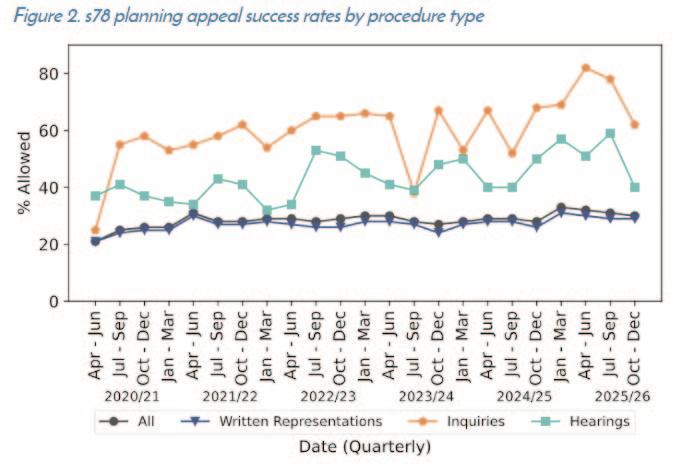
Lastly, perhaps a few words on the statistics as to which procedure is most likely to result in an appeal being allowed. Appeal Finder have done some good statistical analysis.
Whilst this shows that by comparison of appeal route, inquiries are most likely to succeed, followed by hearings – and with the written representations procedure being least fruitful for appellants, I am always cautious as to the conclusions to be drawn. It
is tempting to think that the obvious strategy is to seek an inquiry and, failing that, a hearing – and lawyers like me will usually trot out the benefits of cross-examination and formal exchange of evidence (inquiries), the greater likelihood of a senior inspector being appointed and at the very least the opportunity to tell from the inspector’s body language and line of questioning whether he or she has understood the particular issues.
Much of this is true. But to what extent are the statistical differences simply correlation rather than causation?
Surely the larger the scheme the better professional advice the applicant is likely to have had and the less likely the applicant is to contemplate taking to appeal a proposal that is doomed to fail?
I wonder if there is any housebuilder that has collected statistics on their own projects as to whether there is a material difference in outcomes for projects with an equivalent project team involved?
In the meantime, if you have a potential appeal on the stocks which may go by way of the written representations route, don’t get caught out now April is here!
From Simon’s Simonicity blog which represents his personal views only. n
Gateway 3: the beginning of the end – or the end of the beginning?
There is no silver bullet. As experience builds, the process should improve. For now, the best defence is early planning, clear risk allocation and relentless documentation, says Vijay Bange
Imagine the scenario. You’re a developer delivering high rise homes into a market crying out for them. You’ve navigated planning, balanced stakeholder concerns with viability, secured funding, and paid heavily to satisfy the Building Safety Regulator (BSR) so you can clear Gateway 2 and draw down funds. You’ve agreed a contract sum—painful but necessary. Then Gateway 3 arrives, approvals stall, and the finish line becomes another starting gun.
The vignette is simplified, but the tension is real. Projects that should be moving into occupation are stuck because Gateway 3 is slower and less predictable than intended. That is not a mere inconvenience; it threatens delivery, cash flow, and confidence in a regime that promised clarity after the tragedies that shaped it. While attention has focused on Gateway 2 delays, the more immediate reality is that the bottleneck is shifting downstream.
Gateway 3’s statutory review period is eight weeks. Yet our recent FOI request shows that of 158 applications submitted last year, more than a third took over three months to determine, with dozens still undecided beyond that point and one case extending well over a year. For schemes with debt service, committed sales, phased handovers or tight longstop dates, that uncertainty is corrosive. It undermines programming, invites claims, and forces decisions at the least forgiving point in a project’s lifecycle.
So how is that risk mitigated? Much of the BSR’s commentary on Gateway 2 delays has focused on submissions lacking detail. At the same time, it has
not always been clear what “good” looks like. A defining feature of the new regime is that the burden sits with applicants to demonstrate compliance; the regulator will not do the job for them. That ambiguity extends into Gateway 3, where guidance on contractual risk allocation remains limited.
Those expecting the JCT 2024 suite to offer a ready made solution for higher risk buildings will be disappointed. The position is explicit: parties must agree their own approach. NEC is similarly pragmatic - deal with the risk in the Scope. Clarity cannot be outsourced; it must be drafted.
On paper, Gateway 3 is straightforward: evidence that the works comply with building regulations, supported by declarations from the principal contractor and principal designer. The submission should include as built drawings, a complete change record since Gateway 2, and a coherent golden thread enabling the accountable person to manage safety risks over the building’s life.
In reality, Gateway 3 is not a bundle assembled at the end. It is the culmination of hundreds of coordinated, validated decisions made and recorded throughout delivery.
Timing is the critical trap. If Gateway 3 has not been planned for before works commence, teams are already on the back foot. Poor change control and late notification of material design changes almost always surface at the worst possible moment, triggering BSR queries and prolonging determination.
Data discipline is equally important. You cannot conjure a golden thread at practical completion; it
What does good practice look like?
• Plan for Gateway 3 at RIBA Stages 3–4, with a mapped evidential pack and programme float.
• Run a mock Gateway 3 ahead of submission to test completeness and traceability.
• Appoint an information manager with authority to enforce standards.
• Codify change control so material changes automatically update the golden thread.
• Draft contracts for the risk you actually have, not the one you hope for.
• Engage early with the BSR on material issues.
• Ensure the principal designer and contractor are properly resourced for declarations.
Vijay Bange is Head of Construction and partner at Irwin Mitchell
must be built from day one. Responsibilities, formats and validation rules need to be agreed early and enforced across the supply chain. A common data environment, revision control and an auditable link between changes, instructions and the record model are now essential.
Contractual mechanics must also be addressed explicitly. Unlike Gateway 2, Gateway 3 risk sits within live contracts. Under JCT, whether BSR driven delay is neutral or gives rise to limited cost recovery is a matter for negotiation. Employers must also recognise their own statutory duties; creating impediments can quickly open the door to claims. Under NEC, precision in the Scope is critical, with Gateway artefacts, information ownership and response times clearly defined and aligned with compensation events.
There is no silver bullet. As experience builds, the process should improve. For now, the best defence is early planning, clear risk allocation and relentless documentation.
Gateway 3 is the decisive checkpoint where projects must prove, not merely claim, compliance with building regulations. Success depends on contemporaneous evidence gathered throughout construction, not retrospective reconstruction at handover. The golden thread must be maintained in real time, with controlled change, clear accountability and collaboration with the Registered Building Inspector. Ultimately,
Gateway 3 is about defensible reality: if you can’t evidence it, it didn’t happen. Gateway 3 is meant to be the moment confidence replaces uncertainty. Today, it remains a hurdle many are clearing more slowly than expected. Whether it marks the beginning of the end—or merely the end of the beginning—will depend on how quickly these disciplines become business as usual. n
Housing as infrastructure
Affordable housing has to be part of the core investment that allows the capital’s economy to function well, now and in the decades ahead, says Jordan Davies
London residents and professionals are victims of a housing crisis more intense than in any other city in the UK. Rents consume salaries, overcrowding is normalised, and many families live in insecure accommodation. More than 100,000 children are now in temporary accommodation, a number that is shocking in a national context, let alone in a single city.
This is both a social and an economic emergency: a city cannot function well when much of its workforce, including key workers, live in insecure or unsuitable accommodation. If London is to sustain its role as the UK’s economic engine, good quality affordable housing needs to be regarded as core infrastructure, alongside transport, schools and utilities.
Why ‘Genuinely Affordable homes’ are different
Not all affordable homes provide strong and secure foundations for a stable economy. Genuinely affordable homes let at Social Rent or London Affordable Rent levels are more beneficial than other forms of subsidised housing as they are explicitly tied to local incomes, rather than set at a discount of market values. As such, they are designed to be genuinely affordable for people on low and modest wages.
These homes also provide security of tenure and therefore stability. It allows families to put down roots, plan their lives and invest in their local area. That stability supports steady employment and reduces the churn that undermines educations, GP practices and local businesses. By contrast, the current system relies heavily on subsidising private rents through benefits, incurring significant costs without providing secure family homes. Housing security and affordability go hand in hand, otherwise the cost to the taxpayer increases in line with private rents without bringing the social and economic benefits of secure accommodation. This is however what genuinely affordable housing offers, underpinning its value.
Genuinely affordable housing also reduces reliance on the most volatile parts of the private rented sector. When households are able to move from precarious, expensive rented accommodation into well managed and secure social homes, they gain both disposable income and peace of mind. The money that is no longer swallowed by rent is spent in
local shops, on transport and on services an indirect boost to London’s local economies. At the same time, the overall cost to the taxpayer is reduced, since fewer households require subsidies to cover high, and ever increasing, private rents.
Public services need stable homes
The link between housing and public health is now well documented. Overcrowded, damp or insecure homes contribute to physical and mental ill health. That feeds through into higher costs for the NHS and social care, as well as higher levels of sickness absence for employers.
Conversely, access to good quality, secure affordable housing supports healthier lives. It reduces stress, improves educational outcomes and allows older residents to remain independent for longer. From an economic perspective this means fewer avoidable hospital admissions, better school attendance and attainment and a more productive workforce. When we look at housing in this way, it becomes clear that good quality secure affordable homes are part of the city’s social infrastructure in the same way that public transport, GP surgeries and schools are. The difference is that affordable housing is not funded or planned with that status in mind.
Housing as infrastructure, not a revenue cost
Recent research for Shelter and the National Housing Federation estimated that building 90,000 social homes a year would deliver a net benefit to the Treasury over 30 years. The research demonstrates that investment in social housing more than pays for itself when savings in housing benefit, health and temporary accommodation are taken into account, alongside higher tax receipts from a more secure, productive workforce.
Hence the growing call for housing to be treated as infrastructure within government spending frameworks. Energy, transport, water and waste projects are already recognised as nationally significant infrastructure, eligible for long term funding settlements and bespoke delivery mechanisms. Housing, by contrast, is still largely confined to shorter cycles and fragmented grant regimes. Investors and lenders increasingly view affordable housing as a long term, stable asset class. For them, reclassification would not be a radical shift so much as an alignment of
Jordan Davies, Boyer (part of LRG)
public policy with market reality. It would enable more predictable pipelines of council and housing association schemes and give councils greater confidence to plan for the long term.
Putting the solution into practice
London already has an ambitious programme to increase the supply of genuinely affordable homes, supported by the Mayor and many boroughs. That progress is welcome, but the scale of the challenge suggests that delivery needs to move beyond indvidual funding rounds and one-off initiatives.
If we accept that genuinely affordable housing is essential to London’s economic resilience, we should treat it in the same way as we treat investment in new rail lines or strategic energy projects. That means long term programmes, not sporadic grants; planning policies that give weight to genuinely affordable, secure homes in locations where they support labour markets and public transport, and better alignment between housing, health and employment strategies.
For practitioners in planning and development, there is an opportunity to make the economic case for social and council housing more clearly through local plans, infrastructure delivery strategies and individual schemes. It also challenges us to design and affordable homes that are well integrated with the wider city, so that they support mixed communities and strong local economies.
For London to remain a place where people on ordinary incomes can live, work and build a future, affordable housing cannot sit at the edge of the infrastructure conversation. It has to be part of the core investment that allows the capital’s economy to function well, now and in the decades ahead. If this model is adopted, the benefits will extend far beyond individual households in London, but it will lift economic output across London and the UK. n
Long term funding for new towns
Last year’s budget missed an opportunity to unlock long term funding for new towns, says Francis Truss
In ignoring new towns in the Budget last November, the government has risked delaying or stymying their delivery. The government has nailed its colours to the mast with a pledge to deliver 1.5 million homes this Parliament and the Secretary of State for Housing, Steve Reed, has gone further by tying his reputation to that target. Yet only a fraction of those 1.5 million homes, if any, will be in a designated new town unless action starts now. New towns are, by definition, long term. But the Budget is not about what happens in the 2040s. It is about what happens this parliamentary term: it should have allocated initial funding and in doing so, instilled confidence and enabled the New Towns Taskforce to move from a shortlist of sites to real programmes that investors, landowners and local authorities can back.
Why upfront funding matters more than big numbers
The headline numbers are daunting. Analysis suggests that each new town will cost between £3.5 and £4 billion to deliver, or around £400,000 per home – far above the UK’s average house price of £272,000 (UK House Price Index). And that’s before we even factor in that 40 per cent of the new town homes are to be allocated as affordable housing.
The cost per home is due to the fact that infrastructure must arrive years ahead of receipts from homes and business rates. CIL funds will not cover the cost. Nor will house builders shoulder this funding risk, as their model is geared towards phased outlets and cyclical demand, not multi-decade infrastructure programmes. That is why the New Towns Taskforce has been explicit in calling for significant upfront government funding, including long term loans to development corporations and a clear priority for new town infrastructure across departmental spending. Without that early commitment, delivery stalls.
Learning from Milton Keynes
Post-war new towns were delivered because the state borrowed, assembled land at agricultural value and recycled the uplift to pay down the debt. In Milton Keynes, the development corpora-
tion’s costs were eventually reimbursed to the Treasury through development receipts. It worked, but it took three decades, until 1997.
Recreating that model would mean this Parliament’s new towns not being paid for until the 2060s. But today’s fiscal politics are very different. The Chancellor’s investment rule is that net financial debt should fall as a share of the economy by 2029/30. So the question is not whether the government writes a blank cheque for new towns –because it will not – but whether the Chancellor can allocate early investment credibly: loans, guarantees and tax-backed instruments tied to tangible assets and predictable revenue, rather than as simple grant.
Four decisions that cannot wait
First, the government should set out a specific loan and guarantee offer for new towns, routed through the National Housing Bank and Homes England. The Taskforce has pointed towards long term loans to development corporations. The Chancellor needs to confirm that principle, put an order of magnitude on the facility and state clearly that core new town infrastructure will be eligible. This does not need to cover the full cost of the twelve new towns at approximately £4 billion per town, but it must be large enough to signal intent – say £0.5 billion per town.
Second, we need clarity on whether land value will be captured and recycled. Post-war corporations bought low and sold high. That’s unrealistic today given modern land values and case law. The Budget should’ve signalled a preferred mechanisms, whether that is a standardised multiplier to existing use values, CPO reforms or other approaches.
Third, the Chancellor should make a political commitment to delivery. The House of Lords Built Environment Committee has been clear that delivery requires a senior minister with cross-departmental responsibilities. The government has already promised a New Towns Unit. The Treasury must confirm its remit, its relationship with Homes England and whether development corporations will be the default delivery vehicle. Investors will take a different view of schemes that sit under a statutory corporation with clear powers and a long horizon.
Fourth, there must be a realistic line on affordable housing expectations. A 40% minimum, with half for social rent, seems idealistic. The recent publication of the government’s Homes for London policy paper demonstrates that sometimes it is necessary to be flexible with such requirements if development is to proceed at all. The Chancellor should acknowledge the viability challenge and tie funding to flexible, evidence-based trajectories.
Making space for private capital
It goes without saying that the point of upfront public funding is to unlock far larger flows of private capital, not to replace them. Institutional investors like long duration assets, where income is stable inflation-linked assets. Crucially, investors need confidence that a primary school, a rail station or a spine road will arrive on time, that land assembly powers exist and that policy will not suddenly shift. The same applies to master developers. A long term master developer, backed by public partners, can offer serviced plots to house builders, taking on the early, expensive pieces of the jigsaw. But that model only works if those pieces have committed funding. So the Budget should have sent a signal that the government is prepared to share risk at the front end so that private capital can shoulder it thereafter.
A test of seriousness
The missed opportunity is the government showing how it can use its balance sheet for long-term housing delivery. The sums required now are modest compared with the long-term investment they unlock, whereas inaction means delayed new towns, mounting pressure on local authorities, higher housing benefit costs and lost growth. n
Francis Truss, Partner, Carter Jonas
Revised guidance on viability
Government’s ability to influence delivery through viability policy is limited unless accompanied by more flexible, market-responsive planning and a stronger focus on land supply, argues Andrew Golland
The Government published draft guidance on viability in December. This appears in both the NPPF and the National Planning Practice Guidance (NPPG).
These key policies and practices are proposed:
• A reduction in unnecessary site-specific viability assessments (NPPF, DM5 ‘Development Viability’). Assessments will need to demonstrate clearly where site circumstances differ from the typologies tested at the Local Plan Examination in Public stage. In other words, stronger justification will be required to explain why a site or scheme is materially different and why Local Plan targets or policy objectives should not apply.
• This objective, linking viability back to the Plan, is reinforced through an additional paragraph (009) in the revised NPPG.
• Greater use of review mechanisms to “seek policy compliance” (DM5). The NPPG (010) makes clear that these mechanisms are intended to support local authorities, not to allow developers to avoid compliance.
• Annex B of the revised NPPF proposes moving the section on “Standardised Inputs to Viability Assessment” (currently in the NPPG) into the Framework, with the aim of reducing negotiation at the decision-making stage.
• More intensive scrutiny of the use of Section 106A and Section 73 provisions, which currently allow schemes to be reviewed in light of changing market conditions (DM5). The draft NPPF signals that local planning authorities should be more cautious about revisiting viability, while also noting that viability will be reviewed at a higher policy level.
• A limited extension of the principle of non-assessment on Green Belt sites where the Plan already contains evidenced policy (NPPG, 030).
What’s New? In most respects, the direction of travel remains the same. Government wants Local Plan evidence to predominate and site-specific negotiations to be minimised. The logic is straightforward: if plans are more robust, development should proceed more quickly. However, making local plans sufficiently robust is a much greater challenge. First, the resources required to prepare an evidence base capable of addressing most development
scenarios simply do not exist. Instead of a typical £30,000 viability study, a genuinely comprehensive study might cost ten times that amount.
Second, even with a larger budget, evidence can be diluted or undermined in the political process. Members may resist Affordable Housing targets, debate competing priorities for planning obligations, or even abandon or reverse Community Infrastructure Levy programmes because they dislike pooled or cross-district payments.
Third, increasing the detail of Local Plan evidence is arguably misguided. On larger sites especially, applicants will still fight hard for marginal reductions in obligations because even small changes significantly affect scheme profitability.
Fourth, this may be the wrong moment to tighten policy. The development industry faces flat gross development values alongside rising costs. Logically, this calls for greater flexibility and more reliance on localised, up-to-date data rather than rigid headline assumptions.
The approach to changing market conditions is also inconsistent. Review mechanisms are encouraged to unlock schemes, yet applications to vary agreements in response to market changes are discouraged. In reality, these tools are interlinked. Too often, Section 106 agreements are signed without review mechanisms and quickly followed by applications to vary once viability pressures emerge. The draft guidance does not fully recognise this relationship.
Finally, relocating the Standard Inputs from guidance into the Framework feels cosmetic — rather like rearranging deckchairs on the Titanic. It does little to improve the viability process. Moving a list of wellknown variables from guidance to policy seems unnecessary and risks blurring the distinction between process and policy. It also raises the question of what might be moved next.
Opportunities Missed In many respects, the revised NPPF and NPPG read as though drafted in isolation from the real causes of delivery problems. The main constraint on delivery is not planning policy but the market. Government has limited influence over the fundamental relationship between values and costs. Gross development values are largely determined by the second-hand market, while costs are shaped by
Dr Andrew Golland specialises in the field of housing, planning and regeneration
macro-economic factors such as materials prices and labour availability. These are structural forces beyond the reach of planning.
Where planning can make a difference is land supply. Increasing supply lowers land values and improves the potential to secure Section 106 contributions. Yet there is little evidence that the planning system is being used decisively to achieve this. Even major initiatives, such as proposals for new towns, now appear at risk of failing to deliver promised community benefits because of viability concerns.
What is needed instead is a more flexible planning system. Policy should respond quickly to changing market conditions. Small movements in values or costs can have large impacts on what can be delivered through Section 106. These changes can be modelled without relying on cumbersome review mechanisms. A small number of authorities have adopted more responsive approaches, but they remain the exception. There is also no reconsideration of the fundamental definition of viability, which still fails to balance appropriately developer and landowner returns. This imbalance varies significantly between housing types and can hold schemes back.
The guidance on Benchmark Land Value remains confused. The choice between Existing Use Value and Alternative Use Value is unclear, and there is still no firm guidance on what constitutes an appropriate “plus” element. Viability cannot be separated from landowner expectations, which in turn should be linked more directly to land supply in each district or borough. Ultimately, this represents a missed opportunity. Government’s ability to influence delivery through viability policy is limited unless accompanied by more flexible, market-responsive planning and a stronger focus on land supply. Without that, ambitions for higher levels of development will remain difficult to achieve. n
Exploring the barriers to density
The Building Safety Act is not the only barrier to building upwards. What needs to change to unlock delivery, asks Chris Hemmings
The word ‘density’ is increasingly used in the context of planning and development. In places with the greatest need for new homes, land is scarce, boundaries are tight and opportunities to expand outwards are limited. In those circumstances, building more homes almost inevitably means building more densely.
Unpacking the density gap
And yet the UK is failing to do so. Centre for Cities’ report Flat Britain: The urban density gap and how to close it shows that if British cities were built at the density of their French or Japanese peers, they would contain at least 2.3 million additional homes across their urban cores. Furthermore, if the density of London’s urban core (Zones 1 – 3) matched that of Paris, the capital would have at least 500,000 more homes. The problem is not limited to London: the report also states that the density gap is greatest in Britain’s big cities outside of London – these 12 alone comprise over half of the total gap.
Recent data from the Greater London Authority shows that the number of flats and houses being built has declined in each of the past three years, from 38,987 in 2021-22 to 28,756 in 2024-25. In the first half of 2025 , fewer than 2,200 homes began construction in London, according to data from Molior, compared with 8,500 in the first six months of 2022 and more than 13,500 in the first half of 2018.
Additionally, GLA data shows that London’s housebuilding has fallen to its lowest level in more thana decade and cites the difficulty in getting official approval to build flats from the building safety regulator after the cladding crisis. That logic for higher density is well understood by planners and policymakers: it is acknowledged that higher-density development supports sustainable transport, makes better use of existing infrastructure and helps to underpin town centres and local services. In theory, it is an efficient response to constrained urban conditions. In practice, delivering density has become increasingly difficult, due to market and regulatory factors.
Now more than ever, there is a substantial gap between the political ambition for density (which
will be fundamental to housing targets being met) and delivery on the ground. This is most evident in London, though the issues are increasingly apparent across other urban areas too.
New bottlenecks emerge
The Building Safety Act 2022 was introduced with the important objective of tightening the regime and restoring confidence in higher-risk buildings following the Grenfell Tower fire. Few in the industry would dispute the need for a stronger safety regime and more effective oversight. However, its implementation has brought with it approval bottlenecks with knock-on effects for how and where developers are prepared to build.
The requirement for Building Safety Regulator sign-off at Gateway 2, before works can begin on higher risk buildings, has introduced a new layer of uncertainty into development programmes. Target timescales are frequently exceeded, and in the absence of settled precedent, developers are often unable to predict how long approvals will take. For schemes that rely on height to achieve viability, this uncertainty quickly becomes a material risk.
Cost pressures mount
The problem is compounded by cost pressures. The requirement for second staircases in buildings over 18 metres reduces net internal area and efficiency. Furthermore, compliance costs add up across design, procurement and construction and taken together, these factors have encouraged a shift away from taller buildings towards mid-rise.
The forthcoming Building Safety Levy (proposed for October 2026) adds another layer to an already complex viability picture. Although the levy is modest when viewed in isolation, it does not operate in isolation – sitting alongside high affordable housing requirements, biodiversity net gain, energy performance standards and Community Infrastructure Levy (CIL) charges, all at a time when the Government’s Help to Buy scheme was phased out and Registered Providers focused investment on their existing stock.
On marginal urban sites, where density is often the only route to making schemes stack up, these cumulative burdens matter. The levy is payable early in a scheme’s life and in full, which has implications
Chris
Hemmings is a Partner with Carter Jonas
for cashflow as well as headline viability. For larger developers this may be absorbed, albeit reluctantly. For SME developers who lack the same economies of scale, the impact is proportionally greater.
Policy responses
Due to the rapid slowdown in completions in London as a result of recent regulatory changes and general market conditions, the GLA is consulting on changes to its affordable housing policies for a temporary short period to help stimulate the development market, most notably a reduction in the fast-track affordable housing planning route threshold from 35% to 20% on privately owned sites.
The Government is also consulting on providing CIL relief for residential schemes in London, also for a short-term period. Whether the short period of time for implementation makes a real difference to market activity, remains to be seen.
Moreover, these changes may call into question the introduction of the Building Safety Levy , or provide justification for greater relief for residential schemes where viability is already problematic.
Alongside safety and cost, potential leasehold reform adds another layer of uncertainty. The Government has stated its ambition to move towards commonhold for new flats and is currently consulting on a Draft Commonhold and Leasehold Reform Bill. However, the timing and practical transition could significantly impact development output. Commonhold remains largely untested at scale in England and Wales. The majority of developers are cautious about being early adopters, lenders remain unconvinced about risk and security and buyers are wary of a step into the unknown.
The outlook
From my perspective, a balanced approach is
essential. Reforming leasehold to address its shortcomings while building confidence in commonhold over time would allow the market to adjust. Moving too quickly risks undermining the apartment market on which higher-density delivery depends.
There are ways to reconcile density with safety and deliverability. Mid-rise buildings, typically between six and ten storeys, can achieve high densities without triggering the most onerous aspects of the higher-risk regime (although any residential scheme of 7 storeys or at least 18 metres high requires approval from the Building Safety Regulator). Mansion blocks and perimeter blocks deliver efficient layouts and good amenity while sitting comfortably within established urban fabric.
Construction methods also matter. Robust structural systems, simple geometries and repeatable design solutions are easier to verify and less prone to delay. Early engagement with the Regulator, particularly where modern methods of construction are proposed, can reduce risk later in the process.
Crucially, the regulatory system itself could evolve. A more proportionate approach for simpler or mid-rise schemes, clearer guidance on Gateway submissions and better integration between planning and building control would all improve predictability without compromising safety.
The need for density is not going away. If anything, it will intensify as housing targets remain under pressure and urban land becomes scarcer. The question is whether the current framework allows that density to be delivered at scale. Safety must remain paramount. But safety delivered through uncertainty, delay and cumulative cost risks suppressing supply. A more calibrated approach, one that recognises different levels of risk, supports viable schemes and manages reform carefully, would help to close the growing gap between ambition and delivery.
If we want more homes in the places people need them most, we need to make building upwards possible again, not just in policy terms, but in practice. n
London co-living sector shows signs of maturity as applications accelerate
The London co-living sector has entered a more established phase, with a sharp increase in planning applications and greater consistency in how schemes are being brought forward, according to new analysis by Lichfields
The analysis, by national planning and development consultancy Lichfields, follows its November 2024 research and examines all major co-living planning applications submitted in London since mid-2024. It finds that 26 schemes, totalling more than 10,000 co-living homes, have been submitted, representing more than 40% of all co-living applications in the capital since 2018.
More than 75% of London boroughs have now seen at least one co-living application, up from around half in mid-2024. Average scheme size has increased from 295 units to 385, reflecting the submission of several large developments. Co-living is also being incorporated into major regeneration masterplans including Barking Riverside, Edgware Town Centre and Earl’s Court.
Commenting on the analysis, Adam Donovan, Planning Director at Lichfields, said: “Over the past 18 months there has been a marked increase in the number of co-living applications, alongside greater consistency in how schemes are designed and assessed. Early schemes often raised fundamental questions about policy fit and acceptability. Now there is a greater understanding of the sector and more consistency in applications in terms of the form of development and approach to addressing policy.
This has reduced uncertainty and allowed decisionmaking to focus on quality, management and longterm operation.”
Recent schemes also show greater alignment with London Plan Guidance. Average internal communal space per unit has reduced slightly, reflecting the adoption of the London Plan Guidance’s tiered approach and a move away from rigid quantitative requirements towards qualitative design assessment. Approaches to affordable housing vary across London. Of the schemes submitted since mid-2024 there is an even split between those providing on-site affordable housing in the form of conventional C3 homes or discount market rent and those providing a payment in lieu, although viability remains a key constraint.
Donovan said the inclusion of co-living within large regeneration masterplans was a further indicator of growing confidence in the sector. He added: “The fact that co-living is now being incorporated into major London masterplans alongside conventional housing points to a clearer understanding of the role it can play within mixed and balanced communities. While it remains a relatively small part of overall housing supply, it has established a more predictable footing within the planning system. n
Councils rely on ‘sticking plaster’ extensions to meet planning targets, says the FT Local authorities in England increasingly push back deadlines on decisions as system becomes more complex
Almost every local authority in England would fail to meet government targets on planning decisions without the use of “sticking plaster” time extensions, underlining the challenge Labour faces in speeding up approvals of housing and infrastructure to boost growth.
Councils have made formal agreements with developers to push back deadlines on three-quarters of large-scale planning decisions in the year to June 2025, a Financial Times analysis of official data has found.
Without such deals, 98 per cent of councils would have failed government planning performance targets as the share of applications decided by the original deadline plunges.
If a time extension — known as a “performance agreement” — has been struck between the council and the developer, they are still counted as “on time” in official statistics.
Applicants for large-scale housing now wait two years on average for a decision, according to a report commissioned by the Land, Planning and Development Federation, far beyond the 13-week target. Despite this, 90 per cent are reported as “on time” in official performance measures.
“They are the sticking plaster on the system that keeps it working,” said Mark Dobson, a lecturer in planning at the University of Reading.
Originally intended to allow authorities more time to assess the most complex developments, the use of performance agreements has soared since they were allowed to count towards timeline targets in 2015.
In the first six months of 2025, 75 per cent of “major” applications in England — which includes projects involving 10 or more homes or big commercial buildings — had their deadline extended, up from 45 per cent in 2015. The share decided in the statutory time limit of 13 weeks halved over the same period to one in five.
The use of performance agreements for “minor” applications also surged from 16 to 53 per cent, with only two in five now approved within the eight-week deadline.
The City has approved the Barbican Renewal Programme
Officers worked closely with the Barbican Renewal Team and the design team led by Allies and Morrison to review a sensitive and conservation-led, yet future facing scheme to renew the architectural icon, with the approach being welcomed by national heritage bodies. The approved scheme focuses on access, sustainability and more dynamic use of space for arts and bringing people together, without adding a single square metre. The Barbican’s distinctive Brutalist foyers and lakeside terrace will also be developed through a sustainable, retrofit approach which will protect the heritage of the Grade II-listed building while significantly reducing long-term environmental impact. Materials such as Conservatory glass and pavers will be reused, reflecting a commitment to sustainable conservation.
The Renewal represents a one-in-a-generation opportunity to secure the Barbican’s architectural, artistic and civic future for the next 50 years. The design team delivering the programme are led by Allies & Morrison working with Asif Khan Studio and engineers Buro Happold.
The City Corporation has committed £191 million towards the £231 million needed to complete Phase 1 of the Barbican Renewal programme. Additional philanthropic and partnership support will be sought to ensure the full artistic and civic ambition of the programme can be realised.
The use of performance agreements has become “normalised”, said Paul Smith, managing director of Strategic Land Group, a land developer.
Planning officers can request the most common type, an “Extension of Time” (EoT), at any stage of the application process. There are no limits on their length — which is not reported — or how many times they are extended.
Applicants did not have to agree to one but many feared they would otherwise be refused so the council could hit its targets, Smith added.
Local authorities that fail to decide 60 per cent of major applications within 13 weeks, or 70 per cent of minor ones in eight weeks, can be stripped of their decision-making power.
Only four of the 311 planning authorities in England would have achieved both targets in the 12 months to June 2025 if performance agreements were not included. Yet just one, Bristol city council, is under sanctions for the speed of its decision-making.
Planners say the agreements are a pragmatic way for resource-starved councils to meet escalating demands, many of which are not under their control.
“[They] can be a very useful tool . . . [but] the expanded use of EoTs is symptomatic of a system that is barely managing to cope due to years of disinvest-
ment,” said Robbie Calvert, head of policy and public affairs at the RTPI.
Spending on planning has been cut almost 17 per cent since 2010, while the system itself has become significantly more complex, he added.
Simple extensions are free but councils can charge applicants for Planning Performance Agreements that guarantee dedicated resources and timescales for very large developments. These can run to six figures — for example Hackney Council charges up to £110,000.
The Conservative government sought to tighten the rules around EoTs in 2023, but those plans were dropped when Labour came to power.
Fixing delays in the planning system is central to the government’s plan for growth, with Prime Minister Sir Keir Starmer branding it “a blockage in our economy that is so big it obscures an entire future”.
The Ministry of Housing, Communities and Local Government said it would keep the use of EoTs “under review” and take action when councils were not performing. The government announced £48mn to hire hundreds more planning officers in November’s Budget.
But experts are sceptical this will be enough. “Truth be told, 13 weeks just isn’t long enough to deal with a planning application anymore,” said Smith. – FT
Image: Kim Creatives
CLIPBOARD CLIPBOARD
Great West Road masterplan for 14,000 new homes
Hounslow council has unveiled a £7.5bn masterplan to build up to 14,000 homes along a stretch of the Great West Road in west London.
Set to be built over the next 15 years, the Golden Mile London plan is aiming to position this part of the capital as a leading creative and tech innovation district.
It is being maste rplanned by East, the architecture and urban design practice which is working with Hawkins Brown on Mayor Sadiq Khan’s plans to pedestrianise Oxford Street.
Former GSK Brentford HQ to be transformed
The Golden Mile is a 4km stretch of the Great West Road which was nicknamed for its concentration of large Art Deco industrial buildings constructed in the 1920s and 30s. (SEE our Books section)
Listed buildings on the road include the Coty Cosmetics factory, the Gillette Factory and the Pyrene Building, all of which are protected at grade II.
Hounslow council has committed £1.15m to the programme for early priority works to kickstart delivery including a new innovation hub, greener streets and road improvements.
Hounslow council leader Shantanu Rajawat said the masterplan was “one of the most significant regeneration opportunities in London.” He said: “This is about shaping the future of Hounslow, West London and London itself. Delivering thousands of new homes and jobs while creating greener, healthier neighbourhoods for our residents.”
Rob Tincknell, Chair of the Golden Mile Business and Developers Forum and chief executive of Areli added: “Golden Mile London is a story that hasn’t really been told - until now! The vision is underpinned by seven principles to make it happen, gives a clear sense of our ambition. Investors, businesses and Hounslow Council are collectively aligned to make this unique place absolutely extraordinary in the years ahead.”
The launch of the programme follows Hounslow council’s approval of Hadley Property Group’s redevelopment of the former GSK headquarters at 980 Great West Road, a 2,300-home scheme which is being designed by Howarth Tompkins, dRMM, Studio Egret West and Metropolitan Workshop. – Building Design
(SEE picture story above)
One of the UK’s most ambitious reuse-led developments’ transforming the former GSK HQ into a new neighbourhood, rooted in sustainability, circular economy principles and genuine long-term social value for Brentford has been approved by Hounslow. The approval paves the way for upwards of 2,300 new homes and more than 300,000 sq ft of commercial, community and educational space on London’s Great West Road in Hounslow.
A pioneering approach to retrofit and reuse will save more than 34,500 tonnes of embodied carbon. The project’s pioneering low-carbon strategy retains the basement and substructure, significantly shaping the masterplan — heavily influencing the proposed building heights and locations, while also freeing up the ground floor for active uses. Two key buildings from the original campus, including the high-rise tower, will be retained and adapted, with their reuse being integral to the overall low-carbon approach. Studio Egret West is leading the design of the retained tower, which will contain generously proportioned homes with oversized balconies, large communal areas, shared amenity spaces and a large rooftop conservatory.
Spanning 13 acres, the approved scheme by developer Hadley Property Group will deliver 2,324 new homes, including 227 social rent, 90 intermediate, 506 Purpose-Built Student Accommodation and 296 coliving units, alongside 24,000 sqm of commercial space. The development provides 22% affordable housing with a 70/30 split of Social Rent and Intermediate housing and will generate 1,980 permanent jobs.
More than 330,000 sq ft of flexible commercial, retail and community uses will be provided across the wider masterplan supporting a diverse local economy and providing a platform for education providers, social enterprises, independent businesses and charitable organisations. A collaborative process with the London Borough of Hounslow and the University of West London will see a 200 sqm innovation hub delivered to drive innovation within the emerging Golden Mile district.
The new neighbourhood is grounded in a reuse-first strategy — a bold approach that retains embodied carbon, preserves significant existing sub and superstructure, and champions material reuse. It will deliver 61% publicly accessible open space and a 10% biodiversity net gain.
Over the past 18 months, an extensive co-design process led by Hadley’s in-house team and Haworth Tompkins, supported by Metropolitan Workshop and Neighbourly Lab has engaged hundreds of local residents, community groups and stakeholders, ensuring the proposals reflect local priorities and aspirations.
Second-staircase rule is blocking 18,000 homes a year, report claims
Property adviser Place Base has urged the government to raise the height threshold for buildings that require second staircases from 18m to 50m, as it claims the policy halts the development of around 17,960 homes a year. Their report estimates the number of homes developed in planned buildings over 18m will fall by 25% due to extra costs resulting from the second staircase rule.
Over a five-year period, the report says this will
equate to the loss of around 90,000 homes that would otherwise have been built, equivalent to a city the size of Milton Keynes.
The policy requiring all buildings above 18m to have a second staircase was introduced in 2023 under former housing secretary Michael Gove. Enforcement does not formally begin until September 2026, but investors and lenders have already begun insisting that new schemes comply. Base Place urges the government to raise the building height threshold for mandatory second staircases.
– Property Week
¡¡ PILLO! PILLO!
Berkeley puts the brakes on
Housebuilder Berkeley says it is putting the brakes on buying new land and will instead concentrate on its existing 50,000 homes landbank. The firm pinpointed regulatory burdens and costs, as well as reduced confidence in a near-term market recovery for issuing a rethink on strategy.
Its announcement to investors said: “Recent years have seen an unprecedented increase in cost and regulation, at a time of increasing interest rates and faltering consumer confidence, amidst prolonged geopolitical and macro-economic volatility and uncertainty.”
It added: “In the first two months of 2026, we had begun to see signs of a modest recovery in sales volumes. However, we indicated in our trading update, that recent geopolitical events and the macroeconomic consequences, including reduced potential for further rate cuts, could reduce confidence in a near-term market recovery. This has now become a reality.
“We are today announcing decisive action to maximise long term shareholder value by prioritising value creation from our existing land holdings, tightly sequencing construction, flexing the pace of BTR investment and maintaining disci-
City unveils how skyline could look in early 2030s
The image shows what the City’s financial district will look like from above, once all of the buildings that have either been granted planning permission, or are already under construction, are completed. The City said it had a record year of planning approvals in 2025 and that its planning committee had seen its busiest January since 2019.
According to JLL, vacancy rates in the City core stood at just 4.4% in Q4 last year, while the new build vacancy was less than 1% with the Square Mile’s largest office building, 22 Bishopsgate, now fully occupied. The City said that more than 500,000sq m of space was granted planning last year with around half of this amount on site.
plined capital allocation while continuing shareholder returns.”
Berkeley also said the new gateway process was still not working effectively enough despite the regulator saying the system was improving. –Building Design
Albert before Hammersmith
Why is Albert bridge being repaired at a cost of £8.5 million before Hammersmith bridge? What’s happened to the traditional queuing system we so love in the uk – Next door
Edwardiana no model for new towns, says Ben Derbyshire
Pleased and relieved to read that Labour is to ditch period-style houses for ones that reflect modern life. This is exactly the plea some of us, including other past RIBA presidents, made in a letter to The Times before the election when images first appeared illustrating Edwardian style mansion blocks as a model for Britain’s new towns.
Pimlico café
It’s a favourite of taxi drivers, tourists and chefs, and has been open in one guise or another for eight decades. But the Regency Café faces a new enemy: Westminster council, which is demanding that the new owners install customer toilets for the first time at a cost of £50,000.
The council doesn’t look like it will back down but in a decades-old art deco greasy spoon, it’s not immediately obvious where these new loos will go. – The Times n
Seen on LinkedIn. LEFT Steve Quartermain and ABOVE Dentons planning partner Michele Vas
The number of applications made and decided down 3-4 per cent from the same quarter last year
Latest planning performance by English districts and London boroughs: planning applications in England during October to December 2025
OVERVIEW
Between October to December 2025, district level planning authorities in England:
• received 76,300 applications for planning permission, down 4% from the same quarter a year earlier;
• decided 72,700 applications for planning permission, down 4% from the same quarter a year earlier;
• granted 63,000 decisions, down 3% from the same quarter a year earlier; this is equivalent to 87% of decisions, up 1 percentage point from the same quarter a year earlier;
• decided 91% of major applications within 13 weeks or the agreed time, unchanged from the same quarter a year earlier; and decided 20% of major applications within the statutory period of 13 weeks, up 1 percentage point from the same quarter a year earlier;
• granted 7,300 residential applications, down 1% from the same quarter a year earlier;
• granted 1,500 applications for commercial developments, down 3% from the same quarter a year earlier; and
• decided 35,600 householder development applications, down 6% from the same quarter a year earlier. This accounted for 49% of all decisions, down from 50% a year earlier. In the year ending December 2025, district level planning authorities:
• granted 261,700 decisions, down 4% from the year ending December 2024; and
• granted 28,400 residential applications, down 6% from the year ending December 2024.
To view this data in more detail please see our interactive dashboard.
Planning applications received
During October to December 2025, authorities undertaking district level planning in England received 76,300 applications for planning permission, down 4% from the same quarter a year earlier. In the year ending December 2025, authorities received 324,300 planning applications, down 2% from the year ending December 2024 (Live Table P134, PS1 Dashboard).
Planning decisions
Authorities reported 72,700 decisions on planning applications in October to December 2025, down 4% from the same quarter a year earlier. In the year ending December 2025, authorities decided 300,600 planning applications, down 5% from the year ending December 2024 (Live Tables P120/P133/P134, PS1/PS2 Dashboard).
Applications granted
During October to December 2025, authorities granted 63,000 decisions, down 3% from the same quarter a year earlier. This represented 87% of all decisions, up 1 percentage point from the same quarter a year earlier. In the year ending December 2025, authorities granted 261,700 decisions, down 4% from the year ending December 2024. Authorities granted 87% of all decisions, up 1 percentage point from the year ending December 2024 (Live Tables P120/P133, PS2 Dashboard).
Applications on hand
Authorities reported that they had 106,400 applications on hand as at 1 October 2025, down 2% from the same quarter a year earlier. This is 46% above the number of decisions made during the quarter. The corresponding figure for the same quarter a year earlier was 44%. Taking account of numbers of applications received, decisions made and applications withdrawn during the quarter gives a total of 105,700 applications on hand as at the end of December 2025, down 1% from the same quarter a year earlier (Live Table P133, PS1 dashboard).
Historical context
Figure 1 shows that, since about 2009-10, the numbers of applications received, decisions made and applications granted have each followed a similar pattern. As well as the usual within-year pattern of peaks in the Summer (July to September quarter) and troughs in the Autumn and Winter (October to December and January to March quarters), there was a clear downward trend during the 2008 economic downturn, followed by a period of stability. There was a large dip in 2020 following the start of the pandemic and a subsequent recovery in early 2021, including a particular peak in applications received, but since the peak there has been a steep downward trend.
Regional breakdowns
Table 1 shows how numbers of applications received, decisions made and decisions granted varied by region. It also shows how the percentage of decisions granted varies widely by region, from 83% in London to 91% in National Parks (Live Table P133, PS1/PS2 Dashboard).
Decisions granted
Figure 2 summarises the distribution of the percentage of decisions granted across authorities for major, minor and other developments using box and whisker plots. The ends of the box are the upper and lower quartiles, meaning that 50% of local authorities fall within this range, with the horizontal line in the centre of the box representing the median. The whiskers are the two lines above and below the box that are 1.5 times the size of the box (the interquartile range) with the dots representing outliers. Figure 2 shows that the range between the whiskers for the percentage of applications granted is widest between authorities for major developments (50% to 100%), followed by minor developments (58% to 100%) and other developments (73% to 100%) (PS2 Dashboard).
Speed of decisions
In October to December 2025, 91% of major applications were decided within 13 weeks or within the agreed time, unchanged from the same quarter a year earlier. 20% of major applications
Planning decisions by development type, speed of decision and local planning authority.
All tables and figures can be found here:
https://tinyurl.com/mrxv6446
Source: DLUHC/ONS
were decided within the statutory time period of 13 weeks, up 1 percentage point from the same quarter a year earlier.
In the same quarter, 88% of minor applications were decided within 8 weeks or within the agreed time, unchanged from the same quarter a year earlier. 42% of minor applications were decided within the statutory time period of 8 weeks, unchanged from the same quarter a year earlier.
Also in the same quarter, 92% of other applications were decided within 8 weeks or within the agreed time, up 1 percentage point from the same quarter a year earlier. 61% of other applications were decided within the statutory time period of 8 weeks, down 1 percentage point from the same quarter a year earlier.
For more information on major, minor and other developments please see the PS1 and PS2 district planning matter guidance notes.
Figure 3 shows that range between the whiskers for the percentage of decisions made in time this quarter for major developments was 67% to 100%, for minor developments it was 69% to 100% and for other developments it was 79% to 100% (PS2 Dashboard).
Use of performance agreements
Performance agreement’ (PA) is an umbrella term used here to refer to Planning Performance Agreements, Extensions of Time and Environmental Impact Assessments (EIAs). The EIA process is undertaken to assess whether a project will have a substantial impact on the environment, with applications having an accompanying Environmental Statement[footnote 3] (see Technical Notes for further definitions of PAs). Between October to December 2025, 40% of all planning application decisions involved a performance agreement. Major developments were more likely to involve a performance agreement compared to minor and other developments with 76% of major decisions involving a planning agreement, compared with 51% of minor decisions and 34% of other decisions (Reference Table 2, PS2 Dashboard).
Figure 4 shows, from April 2010, the numbers of decisions on major, minor and other developments made involving a performance agreement, com-
pared with numbers without a performance agreement. Notwithstanding definition changes, there has been a marked increase in the use of agreements since early 2013 (see Technical Notes for more information). This longer upward trend has been driven by both the additional scope for recording them and their additional use (Live Table P120, PS2 Dashboard).
Performance of individual district level
local
planning authorities
The existing approach to measuring the performance of authorities was introduced by the Growth and Infrastructure Act 2013 and is based on assessing local planning authorities’ performance on the speed and quality of their decisions on applications for major and non-major development (minor, change of use and householder developments). Where an authority is formally designated by the Secretary of State as underperforming, applicants have had the option of submitting their applications for major and non-major development (and connected applications) directly to the Planning Inspectorate (who act on behalf of the Secretary of State) for determination. See Improving planning performance: criteria for designation for more information.
Speed of decisions
The designation thresholds, below which a local
planning authority is eligible for designation are:
For applications for major development: less than 60% of an authority’s decisions made within the statutory determination period or such extended period as has been agreed in writing with the applicant;
For applications for non-major development: less than 70% of an authority’s decisions made within the statutory determination period or such extended period as has been agreed in writing with the applicant.
See Live Tables P151/P153
Quality
of decisions
The threshold for designation on applications for both major and non-major development, above which a local planning authority is at risk of designation, is 10% of an authority’s total number of decisions on applications made during the assessment period being overturned at appeal.
Once the figures for the relevant period have been published in Live Table P152 or P154, which identify local planning authorities are at risk of designation by exceeding the threshold, they are invited to contact Departmental officials with any data corrections, and information on any exceptional circumstances applying to the authority that might be used as reasons why the Secretary of State should not designate them. The Secretary of State then takes this evidence into account
when making decisions on which authorities should be designated. See Live Tables P152/P154
Two local planning authorities are currently designated by the Secretary of State in relation to their planning performance. These are Lewes District Council (on 8th May 2024) in relation to quality of decision-making for major applications; and Bristol City Council (on 6th March 2024) in relation to speed of decision-making for non-major applications.
Residential decisions
In October to December 2025, 9,600 decisions were made on applications for residential developments[footnote 4], of which 7,300 (75%) were granted. The number of residential decisions made was down 2% from the same quarter a year earlier, with the number granted down 1% from the same quarter a year earlier. 900 major residential decisions were granted, down 5% from the same quarter a year earlier and 6,300 minor residential decisions were granted, down 1% from the same quarter a year earlier (Live Table P120A, PS2 Dashboard).
In the year ending December 2025, 37,600 decisions were made on applications for residential developments, of which 28,400 (76%) were granted. The number of residential decisions made was down 10% from the previous year, with the number granted down 6% from the year ending December 2024. 3,600 major residential decisions were granted, down 4% from the previous year and 24,800 minor residential decisions were granted, down 6% from the previous year.
Residential units
The figures collected by the Department are the numbers of decisions on planning applications submitted to local planning authorities, rather than the number of units included in each application, such as the number of homes in the case of housing developments. The Department supplements this information by obtaining statistics on housing permissions from a contractor, Glenigan[footnote 5].
The latest figures on the number of residential units permitted provided by Glenigan have been removed from this publication while MHCLG and Glenigan undertake further quality assurance. We will publish the estimate as soon as possible, once data quality has been further assured
Commercial decisions
In October to December 2025, 1,600 decisions were made on applications for commercial developments[footnote 6], of which 1,500 (90%) were granted. The number of commercial decisions made was down 4% from the same quarter a year earlier, with the number granted down 3% from the same quarter a year earlier. 300 major com-
mercial decisions were granted, up 7% from the same quarter a year earlier and 1,100 minor commercial decisions were granted, down 5% from the same quarter a year earlier (Live Table P120B, PS2 Dashboard).
In the year ending December 2025, 6,500 decisions were made on applications for commercial developments, of which 5,800 (89%) were granted. The number of commercial decisions made was down 9% from the previous year, with the number granted down 7% from the year ending December 2024. 1,300 major commercial decisions were granted, down 6% from the previous year and 4,600 minor commercial decisions were granted, down 8% from the previous year.
Trends in the percentage of residential and commercial decisions granted SEE Fig 7 BELOW
Householder developments
Householder developments are those developments to a residence which require planning permission such as extensions, loft conversions and
conservatories (see Definitions section of the Technical Notes).
The number of decisions made on householder developments was 35,600 in the quarter ending December 2025, accounting for 49% of all decisions, down from 50% of all decisions made in the quarter ending December 2024. Authorities granted 90% of these applications and decided 93% within eight weeks or the agreed time (Reference Table 2, PS2 Dashboard).
In the year ending December 2025, 154,500 decisions were made on applications for householder developments, accounting for 51% of all decisions, no change from the 51% of all decisions made in the year ending December 2024. Authorities granted 90% of these applications and decided 93% within eight weeks or the agreed time.
Major public service infrastructure development decision
Since August 2021, major public service infrastructure developments broadly defined as major developments for schools, hospitals and criminal
London
justice accommodation have been subject to an accelerated decision-making timetable.
Separate figures on major public service infrastructure development decisions have been collected on the quarterly PS2 return with effect from October 2021. During October to December 2025 there were 19 decisions, of which all 19 were granted and 17 were decided in time (Live Table MJPSI, PS2 Dashboard). Please note that figures are not collected on the CPS1/2 return and so don’t include education developments by county councils.
Permission in Principle/Technical
Details consent decisions
Since April 2017, local planning authorities have had the ability to grant permission in principle (PiP) to sites which have been entered on their brownfield land registers. Where sites have a grant of permission in principle, applicants have been able to submit an application for Technical Details Consent (TDC) for development on these sites. In addition, since June 2018, it has also been possible to make an application for PiP for minor housingled development as a separate application, independently of the brownfield register. Where a site has been granted PiP following an application, it is possible to apply for a TDC.
Figures on PiP/TDC decisions have been collected on the quarterly PS2 return from January 2020. During October to December 2025, local planning authorities reported 425 PiP (minor housing-led developments) decisions, 25 TDC (minor housingled developments) decisions and 5 TDC (major developments) decisions. The number of PIP decisions has increased notably since 2020, when there were about 60 decisions per quarter. The figure of 425 in October to December 2025 is 171% greater than the 157 reported in October to December 2024. (Live Table PiP/TDC1, PS2 dashboard).
Permitted development rights
Planning permission for some types of development has been granted nationally through legislation, and the resulting rights are known as ‘permitted development rights’ (PDRs). For certain permitted development rights, if the legislation is complied with, developments can go ahead without the requirement to notify the local planning authority. Hence no way of capturing this data exists and these are not accounted for in this report. In other cases, the permitted development right legislation requires an application to the local planning authority to determine whether or not prior approval is required and to determine as appropriate (see the Definitions section of the Technical Notes).
Between October to December 2025, 5,600
applications were reported, of which prior approval was not required for 2,900, permission was granted for 1,600, and 1,100 were refused. This resulted in an overall acceptance rate[footnote 7] of 80%.
Large householder extension accounted for 53% of all PDR applications reported, with 30% relating to All others, 8% relating to Agricultural to residential, Commercial, Business and service to residential, and 8% relating to Commercial Business and service to residential (Live Tables PDR1/PDR2).
In the quarter to December 2025, 900 permitted development right applications were made for changes to residential use, of which 700 (69%) were given the go-ahead without having to go through the full planning process.
Overall during the 47 quarters from April 2014 to December 2025, district planning authorities reported 375,100 applications for prior approvals for permitted developments. For 207,200 of them prior approval was not required, 90,200 were
granted and 77,700 were refused (Live Table PDR2).
Delegated decisions
Of the 72,700 decisions made during the quarter, 69,900 (96%) were delegated to officers. This percentage has been stable since 2014, having previously increased from around 75% in 2000 (Live Table P133).
Enforcement activity
During the quarter, authorities issued 1,005 enforcement notices and served 1,437 planning contravention notices, 159 breach of condition notices, 35 stop notices and 68 temporary stop notices, while 17 enforcement injunctions were granted by the High/County Court and no injunctive applications were refused. In recent years, this level of activity has remained broadly proportionate to the number of planning decisions made (Live Table P127). n
Overview of upcoming changes; the new NPPF; densifying the suburbs; speeding things up; London emergency housing measures; planning for growth
Account of the London Planning and Development Forum joint meeting with Cambridge University Land Society and the Association of Consultant Architects on Tuesday 24 March 2026, hosted by Dentons
Report by Riette Oousthuizen and Michaela Oberhuber of HTA Design, also at www.planninginlondon.com >LPDF
Planning Up-Date 1.30 for 2pm Tuesday 24th March 2026 At Dentons, One Fleet Place EC4M 7RA provisional programme v.12/3/26
2.00 WELCOME
Brian Waters introduces Michele Vas, partner, Dentons
2.10 KEYNOTE OVERVIEW OF UPCOMING CHANGES
Steve Quartermain, former Gov’t Chief Planning Officer Q&A
2.30 THE NEW NPPF – James Harris, Lichfields Q&A
2.55 PANEL DISCUSSION moderated by Lee Mallett Riette Oosthuizen, HTA Design; Colin Wilson, LB Southwark; Hugo Owen, Pocket living
3.15 ••••••••••••••TEA•••••••••••• Lee Mallett introduces 3.35 DENSIFYING THE SUBURBS WITH HOMESTEADING Neil Deely, Metropolitan Workshop
4.00 WILL REVISED NPPF and DEVELOPMENT MANAGEMENT GUIDANCE SPEED THINGS UP?
Sam Bensted, Assistant Director (Planning and Development) BPF;
4.15 Responses by Mike Kiely chair POS; John Walker CT Group, formerly City of Westminster Q&A
4.30 LONDON EMERGENCY HOUSING MEASURES Tim Craine, Molior; Nick Cuff, Urban Sketch Q&A
4.55 THE POLITICS AND ECONOMICS OF PLANNING FOR GROWTH Nick Brindley, Newmark; Tony Travers LSE
5.15 THE WIND-UP Paul Finch
5.30 NETWORKING & DRINKS courtesy of Dentons
Meeting AI summary
Quick recap
This meeting was a planning update event with the Cambridge University Land Society focused on discussing recent planning reforms and housing delivery approaches. The session covered the new draft National Planning Policy Framework(NPPF), with Steve Quartermain, former Government chief planning officer providing an overview of planning reforms and James Harris from Lichfields explaining key changes to the framework, including the distinction between plan-making and decision-making policies. The panel discussion featured Colin Wilson from London Borough of Southwark, Rietta Oosthuizen from HTA Design, and Hugo Owen from Pocket Living, who discussed implementation challenges and the need for cultural shifts in planning approaches. Neil Deeley from Metropolitan Workshop presented a designfocused approach to suburban development, introducing the concept of "homesteading" as a model for achieving higher densities (40-50 dwellings per hectare) while maintaining quality and community cohesion. The discussion highlighted ongoing challenges with viability assessments, the role of infrastructure funding, and the potential for design-led approaches to influence policy and delivery at scale.
Summary Planning System Reform Updates
The meeting focused on changes in the planning system, with a shift from policy development to delivery of housing and development at scale. The government is implementing various measures to speed up decision-making, including the National Housing Bank, development corporations in major towns, and streamlined consenting processes like SDOs. The discussion emphasized the need to balance certainty with flexibility to ensure policy ambitions don't prevent delivery, with particular attention to viability and speed in development processes.
Planning Reforms Overview
Steve Quartermain provided an overview of current planning reforms, describing them as a "firework display" of government activity following 22 years of attempts to reshape the planning system. Key reforms discussed included updates to the National Planning Policy Framework, new town
development plans, and changes to the strategic development corporations process, though the speaker expressed disappointment that development management policies in the NPPF are more focused on influencing decision-making rather than clear policy indicators. The discussion highlighted challenges around government intervention in local planning decisions, particularly regarding housing numbers and applications over 150 units, while also touching on the role of digital planning and concerns about environmental protection versus housing development needs.
NPPF Planning Framework Discussion
The meeting discussed the new NPPF (National Planning Policy Framework) and its implications for planning. Steve explained that while the framework isn't particularly radical, it shows enthusiasm for progress in making the planning system central to economic growth. He noted that the government aimed to balance a rulesbased approach with local discretion, using the term "reasonable" to allow flexibility at the local level. The discussion also covered greenbelt policy, with Steve defending the government's approach to reviewing greenbelt boundaries, though some participants expressed concerns about the changes to greenbelt definitions. James Harris from Lichfields then presented an overview of the key changes in the new framework, emphasizing its more rules-based approach and spatial focus, while noting that local plans will need to align with the new framework when it's adopted this summer.
MHCLG Planning White Paper Discussion
The meeting focused on the draft MHCLG Planning White Paper, with James presenting key points and answering questions. The discussion covered how the new framework emphasizes making effective use of land, particularly through redeveloping brownfield sites, and introduces updated policies on design and development management. James explained that the framework strengthens the presumption in favor of sustainable development while maintaining important safeguards, including specific tripwire policies that would result in refusal. The conversation ended with questions about potential risks of standardization and how the document might impact the London Plan, with James noting that
while the framework provides helpful strategic direction, local plans will still need to address specific constraints and opportunities.
London Housing Delivery Solutions
The panelists discussed the challenges and potential solutions for housing delivery in London, focusing on the role of the planning system and funding. Hugo Owen emphasized the need to rethink the approach to housing delivery, suggesting a shift back towards greater state involvement rather than relying solely on the private sector. Colin Wilson highlighted the importance of funding for affordable housing and noted that density policies alone would not significantly increase housing delivery without adequate funding. Rietta Oosthuizen discussed the cultural shift needed in planning to encourage growth and address issues of viability and design. The discussion concluded with a debate on whether more funding or rebuilding state capacity would be the most effective approach to addressing the housing crisis.
Viability Testing in Development Planning
The meeting focused on planning and viability testing in the development process. Participants discussed the challenges of conducting viability assessments, noting that current assessments are outdated and predicting future changes is difficult due to uncertainty in factors like costs and market conditions. There was agreement on the need for a different approach to housing delivery, moving away from "plotting to place-making," and the importance of proper spatial planning, particularly around stations. The group also touched on the limitations of current planning systems and the need for local authorities to have resources to implement changes effectively.
Sustainable Suburban Development Homesteads Model
Neil Deely from Metropolitan Workshop presented a design approach called "homesteading" as a solution for sustainable suburban development. He argued that the current market is polarised between high-density city centres and inefficient traditional suburbs, and proposed compact suburbs at around 50 dwellings per hectare as the optimal solution. The homestead model features homes arranged around secure communal gar-
ATTENDANCE Meeting on 24 March 2026 hosted by Dentons
dens, which can achieve 50-55 dwellings per hectare while improving livability, social cohesion, and reducing infrastructure costs. Deeley shared examples of built projects implementing this approach, including a scheme in Swindon that achieved 48 dwellings per hectare with zero local objections due to successful community engagement.
Homestead Development Concept discussion
The meeting focused on discussing the homestead development concept presented by Neil, which can be implemented in both greenfield and brownfield sites. Neil explained that the concept allows for flexible construction methods, including traditional and modern methods, and emphasized the importance of landscape and public realm design. The discussion touched on challenges with volume house builders adopting the concept, with Neil suggesting that housing associations may be more likely to embrace it due to their designfocused approach.
BPF NPPF Consultation Response
Sam Bensted from the British Property Federation provided an update on their members' views on the NPPF, noting overall positive feedback about the separation between plan-making and decisiontaking in the latest draft. The meeting focused on BPF members' response to new spatial development strategies and planning policy changes.
Key points included welcoming the more positive language in the NPPF regarding freight and logistics in planning policies, concerns about front-loading viability discussions to the plan-making stage, and the importance of consistent approaches across local authorities for employment land planning. The discussion highlighted potential tensions between logistics development needs and sustainable transport policies, and referenced a recent BPF report on industrial and logistics sectors.
Planning System Reform Discussion
The meeting focused on discussing planning system reforms and reducing unnecessary documentation requirements. John Walker and Mike Kiely expressed concerns about the new NPPF removing requirements for construction management plans while being cautious about internal building layouts, and they advocated for streamlining planning documents to focus on essential questions about design and impact.
They criticized the duplication of controls between planning and other regulatory regimes, suggesting that building regulations could handle many current planning requirements. The discussion also covered the upcoming national scheme of delegation proposals, with concerns raised about potential pressure on decision-makers and the need for proper pro-
tection against lobbying.
London Housing Market Challenges
Tim Craine presented data on London's housing market, highlighting a significant drop in construction starts and completions due to various factors including rising interest rates, the end of help-to-buy schemes, and complex building safety regulations. He noted that only 5,600 homes are currently under construction in London, far short of the 88,000 homes needed annually to meet government targets.
Nick Cuff discussed the upcoming emergency measures, including a 20% affordable housing requirement, simplified review procedures, and planning application validation changes, while expressing concerns about the lack of support for build-to-rent developments and SMEs in the current proposals. Both speakers agreed that while the government's response to housing challenges is welcome, more fundamental reforms are needed to address the underlying issues in London's housing market.
Office Sector Planning Reforms Discussion
Nick Brindley of Newmark presented on the office sector and planning reforms, highlighting how the NPPF consultation supports economic development through substantial weight given to economic benefits of commercial proposals. He discussed challenges in central London, including declining productivity growth, high real estate costs, and a 54% fall in major office planning applications over the past decade.
Paul Finch ended the conference by reflecting on the planning system's challenges, suggesting it's under excessive pressure and noting that while planning as a process is necessary, the current system may be overly burdened with requirements that could be handled elsewhere. n
Welcome and Keynote: Overview of upcoming changes
Brian Waters (CULS APEC Forum and LP&DF) and Michele Vas (Dentons)
The event opened by situating the discussion within a period of significant transition in planning policy and practice. While previous years have been dominated by attempts to reform the planning system itself, the emphasis is now clearly shifting toward delivery, implementation, and measurable outcomes.
Michele Vas framed this shift as part of a broader repositioning of planning within government policy. Planning is no longer being treated as a standalone regulatory system, but rather as a central lever of economic growth, closely tied to housing delivery, infrastructure provision, and national productivity.
She noted that successive governments have focused on refining policy frameworks, often through consultation and structural reform, but the current agenda reflects a more interventionist approach. There is now a clear emphasis on accelerating housing delivery at scale, improving the speed of decision-making, and reducing friction within the system. n
Steve Quartermain CBE (Former Government Chief Planning Officer)
Steve Quartermain opened the keynote by placing current reforms within a longer historical context, noting that the planning system has been subject to continuous reform since at least 2004. Despite multiple rounds of change, the system has consistently struggled to deliver housing at the scale required.
The critical shift today is that government attention has moved away from reforming the structure of the system itself and toward ensuring that it delivers tangible outputs. Planning is
increasingly expected to function as a mechanism for achieving housing delivery and economic growth.
He described the current reform programme as a “firework display” of initiatives. This characterisation was reinforced by the breadth of changes underway, which extend beyond policy reform to include devolution, financial support mechanisms, changes to decision-making structures, digitalisation (including AI), and environmental policy. The reforms represent what was described as an “enthusiasm for progress”, signalling incremental but widespread change across the system.
A key theme was the increasing willingness of government to intervene directly in planning outcomes. This includes intervention in local plans where housing targets are not being met, the call-in of major housing schemes, and the reinstatement of sites where necessary to achieve delivery targets. This reflects a move toward a more actively managed and interventionist system.
Quartermain also highlighted a number of structural challenges that persist despite reform. Viability remains a central issue, particularly as testing is increasingly moved to the plan-making stage, raising concerns about how well assumptions will hold over time. Digital planning is no longer an emerging concept but an embedded reality, already shaping how applications are processed and decisions are made. At the same time, there remains a lack of clarity in how government intends to balance environmental objectives with the need for growth, contributing to increasing opposition to development.
A firework display of thinking
Perhaps most significantly, he noted that developers are not building because of weak demand rather than a lack of permissions.
In discussion, it was suggested that the NPPF attempts to combine a rules-based approach with a degree of local discretion, often reflected in deliberately ambiguous wording such as “reasonable”. The Green Belt was characterised as fundamentally a spatial policy rather than an environmental one, with Grey Belt intended to expand the supply of developable land. Overall, while the reforms were not seen as revolutionary, they were understood to signal a focus on housing delivery. n
•
The new NPPF
James Harris (Lichfields)
James Harris described the draft NPPF as the most coherent expression of national planning policy in decades, reflecting a clear attempt to simplify and rationalise the framework while strengthening its focus on growth and delivery.
• D)Focus:Efficient Use of
• E)Viability
• A) The New Presumption
• B) Development Management Themes
• C) Green Belt Changes
• D) All Aboard: Growth at Railway Stations
• 04 Conclusions
A key structural change is the separation between plan-making and decision-making policies, which introduces greater clarity and reduces duplication across the system. This is accompanied by a noticeable shift in tone, with policy wording becoming more explicitly approval-focused. Rather than framing decisions in terms of whether development should be refused, the emphasis is now on when it should be approved, reinforcing a more pro-development stance.
The plan-making system itself is undergoing significant reform. The introduction of Spatial Development Strategies (SDS) creates a more strategic layer of planning, with local plans becoming shorter, more focused, and expected to be delivered within a 30-month timeframe. There is a clear move away from overly detailed or duplicative policies, with greater emphasis placed on spatial strategy, site allocation, and efficient land use.
Importantly, the new framework is intended to have immediate practical effect. Once adopted, it will override local plan policies that are inconsistent with it, although those policies must still be taken into account as a matter of law. This has significant implications for decision-making in the transition period.
In development management, the presumption in favour of sustainable development is strengthened, and the framework introduces more explicit “tripwire” policies which define clear grounds for refusal. These
More focused Local Plans
A real drive to simplify local plans -making them easier to prepare and examine
• Delayering -No need to duplicate NDMPs in local plans
• No quantitative standards other than for infrastructure, affordable housing, parking, design and placemaking
• No matters in Building Regs (including energy) apart from accessibility standards (M4(2)/(3)) and water efficiency*
Key Focus: Housing (Ho) & Economic Growth (E)
Housing
Ho3: Identify supply of sites to meet housing requirement
Ho4 Identify locations for large scale development e.g. urban extension and new settlements
Ho6: Planning for a diverse mix of sites -10% of homes on site less than 1ha -10% of homes between 1 and 2ha
H05: Meeting needs of different groups, inclrequirements for AH on major sites (with a higher requirement for GB sites)
*
Key Focus: Effective Use of Land (L1)
• as much as possible on PDL
• minimum residential density standards
• Using design codes and design guides
• re-use of service yards, car parks and transport infrastructure, under-utilised retail sites
• estate regeneration schemes
• mixed use allocations
[Development proposals] … should be approved unless the benefits of doing so would be substantially outweighed by any adverse effects, when assessed against the national decision-making policies in this Framework….
Economic Growth
E1.a. Set out an Economic Vision and Strategy that responds to the Industrial Strategy
E1.a. identify places for investment including Industrial Strategy Zones and AI Growth Zones
E1. c Allocate to meet existing and anticipated needs including:data driven clusters and storage and distribution
EC1.2 not be overly prescriptive about types of uses
Granting permission unless … any adverse impacts of doing so would significantly and demonstrably outweigh the benefits, when assessed against the policies in this Framework taken as a whole, having particular regardto key policies for directing development to sustainable locations, making effective use of land, securing well-designed places and providing affordable homes, individually or in combination
(2) “The existing character of an area should be taken into account…. but not preclude development which makes the most of an area's potential.”
(3) Introduces new minimum density requirements (minimum 40dph around train stations and minimum 50dph around ‘well-connected’ stations)
(4) “Development proposals that do not make efficient use of land in accordance with this policy should be refused.”
Paragraph 129d) “…support development that makes efficient use of land, taking into account: the desirability of maintaining an area’s prevailing character and setting, or of regenerationpromoting and change
Paragraph 130b)
“the use of minimum density standards should also be considered”
Paragraph 130c)
“local planning authorities should refuse applications which they consider fail to make efficient use of land”
include inefficient use of land, poor design, harm to biodiversity, and unacceptable flood risk. While this increases clarity and consistency, it also reinforces the rules-based nature of the system.
There is also a more directive approach to density, particularly in accessible locations. Minimum density expectations of around 40 dwellings per hectare near stations and 50 dwellings per hectare in well-
Design and Placemaking Planning Practice Guidance (DPPPG) consultation document
Updates and consolidates existing design guidance:
Part 1: 7 features of well-designed places
Part 2: Design quality in the planning process
• Part 3: Setting effective design codes
• But also: “Where the scale, nature or density of new development is very different to the existing place, creating a new identity may be more appropriate…Innovative and exceptional development may also justify departure from existing character…”.
connected areas represent a significant shift toward enforced intensification.
Changes to Green Belt policy and the introduction of Grey Belt further support this direction, particularly through a stronger emphasis on development around transport nodes.
In discussion, concerns were raised about the extent to which infrastructure provision aligns with
these ambitions, particularly in relation to rail capacity. There was also debate about whether increased standardisation could lead to overly rigid or context-insensitive outcomes. For London, the reforms were seen as likely to reinforce a more strategic and spatially driven approach to planning. n
All aboard: growth at rail stations
Train Stations
• Those with potential if criteria relaxed or train services enhanced
• Final version of minimum density requirement will be key to number of sites that come forward.
Requirements of the policy
Panel Discussion NPPF in Practice
Chair: Lee Mallett
Panel: Riette Oosthuizen, HTA Design; Colin Wilson, LB Southwark; Hugo Owen, Pocket living
The panel discussion focused on the practical implications of the NPPF and broader planning reforms, with a strong emphasis on the structural constraints affecting delivery.
A consistent theme was that planning reform alone cannot resolve the housing crisis without addressing underlying issues of funding and delivery capacity.
Panel members highlighted the long-term shift
from state-led housing delivery to reliance on the private sector, noting that this transition has significantly reduced the system’s ability to deliver housing at scale. This was identified as a key structural cause of current delivery challenges.
There was also discussion of the culture of planning practice, with concerns that the system has become increasingly focused on policy compliance rather than problem-solving. While London was
noted as having relatively strong leadership and a more proactive approach, there remains a broader need for greater collaboration between planners and developers.
Viability emerged as the central issue across all schemes. While moving viability testing to the planmaking stage may improve consistency, there are significant concerns about how quickly assumptions can become outdated in a volatile market.
The discussion also touched on density and design, with the NPPF encouraging a shift toward transformation and intensification rather than preservation of existing character. However, tensions remain in how these objectives are interpreted and applied in practice.
In the Q&A, concerns were raised about the realism of plan-making assumptions, particularly in relation to long-term market stability. The importance of increased funding, greater flexibility, and a more integrated approach to design and density was emphasised. n
Densifying the suburbs with homesteading
Neil Deely (Metropolitan Workshop)
Neil Deely’s presentation focused on the potential of suburban areas to contribute more significantly to housing delivery. While suburbs house the majority of the population, they are characterised by low density, inefficient land use, and car dependency.
The proposed “homesteading” model seeks to address this through mid-density development, typically in the range of 50-55 dwellings per hectare, combined with improved public realm, integrated green infrastructure, and more flexible housing typologies.
Suburban development patterns are based on outdated demographic assumptions. Changing household structures and tenure patterns require new forms of housing that better reflect contemporary needs.
Higher-density suburban models were presented not only as more efficient, but also as capable of delivering improved affordability, stronger community cohesion, and more sustainable patterns of development.
In discussion, it was suggested that such approaches could be applied across both greenfield and brownfield contexts, with relatively limited resistance to moderate increases in density. Housing associations were identified as the most likely delivery agents, given current market conditions. n
%/0%$1,.."(%2+$"3')%$ including greenfeld and ("4$-,'25$)'%")
The meeting focused on discussing DM reforms and whether they would actually speed things up. John Walker and Mike Kiely discussed what needs to be submitted with a planning application and whether NDMP DM2 would make a difference. They were not hopeful and advocated for streamlining planning documents to focus on essential questions about design and impact. They also looked at the proposed National Scheme of
Will revised NPPF & DM guidance speed things up?
Sam Bensted (BPF), Assistant Director (Planning and Development)
Responses by Mike Kiely chair
POS; John Walker CT Group, formerly City of Westminster
The session focused on discussing DM reforms and whether they would actually speed things up.
Following Sam Bensted’s presentation ( SEE next page) John Walker and Mike Kiely discussed
what needs to be submitted with a planning application and whether NDMP DM2 would make a difference.
They were not hopeful and advocated for streamlining planning documents to focus on essential questions about design and impact.
They also looked at the proposed National Scheme of Delegation and the prospect of only large strategic applications going to planning committees.
They were concerned about potential pressure on decision-makers and the need for proper protection against lobbying.
Decision making - DM3: Determining development proposals
John Walker’s
notes
The draft says LPAs must "Work with the applicant in a positive and proactive manner, where necessary seeking solutions to problems arising from initial proposals, to enable a timely decision”
• few councils operate in this manner - they take the PPA money which seems to be a must rather than a choice for applicants. So...
• It's time PPAs were looked at again - too many councils take the money and applicants still get the same poor service. Applicants feel they have no choice but to enter into a PPA even though they know they will not get a service for it.
• If officers consider a proposal is likely to be recommended for refusal they should inform the applicant and only enter into a PPA if the applicant still wants to continue.
• PPAs did speed up large schemes but not any more.
Another change is
• Officers cannot delay decisions waiting for statutory consultees to respond!yes, it may speed up decision making but how can this work in practice - how can you proceed to grant consent for a scheme without the input of National Highways or Natural England? I see quickfire refusals or JRs if granted without their input.
• On to enforcement and the NPPF says councils must give “substantial weight” if a breach of planning was intentional - How do you define intentional? If a development is acceptable in planning terms it is acceptable.
The National Scheme of Delegation brings in a two – tier delegation system in order to speed up decision making
Tier A: Routine matters such as minor developments or technical approvals, which must always be delegated to officers.
• Whilst welcome in principle and this should speed up decisions but bear in mind officers will still write long reports justifying the decision whether it goes to committee or not.
Tier B: More complex cases, which may go to committee if the Chief Planner
Their final focus was on whether the new NPPF would make a difference and ensure that we do not duplicate other regulatory regimes.
Whilst the NDMP DM7 says just that, the NPPF goes on in at least 6 DM policies to do just the opposite.
In many of these cases the NPPF requirements could be handled by the building regulations, highways and environmental legislation. n
Sam Bensted’s slides on next page >>>
and Committee Chair both agree they meet a "gateway test.”
• This is going to put a lot of pressure on the Chief Planner and committee chair from locals and ward callers.
• With neighbours at war over householder extensions, it can be very useful for these to go committee for officers and ward callers.
Mandatory training - is very welcome and will hopefully save time with officers telling members what a material planning consideration is - reducing committee sizes will have some benefit - more than half of LPAs have less than 10 members anyway.
DM6: Use of planning conditions and obligations & DM7: Relationship with other regulatory regimes
I still consider there is too much duplication of other consent regimes. Councils are obsessed with sustainability issues and too much time is wasted on these elements when most of it should be covered by Building Control. The duplication of licensing powers over planning on entertainment uses such as bars and restaurants could be reviewed – planning conditions limit the hours of use and so does licensing.
Finally
Back to the exam question - WILL THE REVISED NPPF and DEVELOPMENT MANAGEMENT GUIDANCE SPEED THINGS UP?
To a degree yes but this is still a lost opportunity. n
This session provided a detailed, data-driven assessment of London’s housing crisis, reframing it as a problem of delivery rather than planning permissions. The issue was characterised as a “wicked problem”, involving complex and interrelated constraints across viability, demand, funding, and policy.
The data presented showed a dramatic collapse in housing delivery. Private housing starts have fallen by 84%, driven primarily by a sharp decline in sales rates. Only three Build-to-Rent schemes commenced construction in 2026, and completions are expected to fall significantly by 2028-2029.
There is a critical imbalance in the development pipeline. While approximately 56,700 homes are currently under construction, around 250,000 would be required to sustain delivery at the levels needed to meet policy targets. Most current schemes will complete by 2028, creating a significant risk of a future supply cliff-edge.
The session also highlighted the risk to the development industry itself. Without new starts, a substantial proportion of developers may exit the market, and many sites could become inactive. This represents not only a reduction in output, but a loss of delivery capacity. Weak demand was identified as a central issue, with only 8,436 homes sold in 2025. Developers are increasingly holding unsold stock or converting units to rental, reflecting what was described as a “buyer strike”.
Pricing dynamics further compound the problem. In outer London, sales values are often below development costs, while in inner London higher values are offset by weak demand. At the same time, second-hand housing is significantly cheaper than new-build, making it difficult for new developments to compete.
The widely cited figure of 290,000 unbuilt permissions was critically reassessed. Many of these permissions are not deliverable due to viability constraints or the need for further approvals, challenging the narrative that developers are simply withholding supply.
Proposed emergency measures include a temporary reduction in affordable housing requirements, greater reliance on viability-tested routes, and increased flexibility in contributions and review
support for certain sectors such as Build-to-Rent and SME developers.
The session concluded that planning reform alone cannot address London’s housing crisis without broader intervention in funding, delivery models, and market conditions. n
!"#$%&'(("%)'*+$&,"-./01&2,%$.,"+)3!"#$%&'()*+!,!$*-.&%,%/!%&($*!,00&12#3!+)4*-*+!$&!)&-*!5&%1,%'!12$4!,%&(#'!678! ,55&%',90*!4&(+2#3!:2#+$*,'!&5!$4*!(+(,0!;<8=>!$&!4*0.!(#0&)?!+$,00*'!+2$*+@!!!A%,#$!,B,20,90*!&#!4,05!&5!$4*+*!4&-*+@ 4.$&"(&5/'*/+/2672$.2$)&%"-2$3!C)4*-*+!1&(0'!.%&)**'!B2,!$4*!$8/.2/01&5/'*/+/2672$.2$)&9+'00/01&9'2,#'6D!%*E(2%2#3! B2,9202$/!*B2'*#)*!9($!,B&2'2#3!)%*,$2&#!&5!,!#*1!.0,##2#3!.%&)*++@ :/;$7+/;/2$)&#/0)"#3!F02329202$/!$2*'!$&!+(9-2$$2#3!,!B,02'!.0,##2#3!,..02),$2&#!9/!,!+*$!'*,'02#*!<0"#&$89$=2$)&'%"-0)& >'%=,&?@?ABD!32B2#3!,!'*52#*'!.*%2&'!$&!9%2#3!+)4*-*+!5&%1,%'@! C+$8/*/+/26&"0&="02%/*-2/"0.3!G&$*#$2,0!-*,+(%*+!,%&(#'!H"I!%*02*5!&%!'*5*%%*'!.,/-*#$+D!$4&(34!02?*0/!+$200!+(9J*)$!$&! B2,9202$/!%,$4*%!$4,#!90,#?*$!%*'()$2&#+!'(*!$&!A&B@!0*3,0!,'B2)*@ D/;9+/(/$)&%$5/$#&;$=,'0/.;.3!I2?*0/!%$)-=2/"0&"%&%$;"5'+&"(&+'2$7.2'1$&%$5/$#.!,#'!-&%*!50*K290*!-20*+$&#*!$%233*%+! :*@3@!+0,9!0*B*0>D!$&!2-.%&B*!)*%$,2#$/!,#'!),+450&1!5&%!'*B*0&.*%+@! !"#$%&'()(*#'+$,-&./0$)"#$1,-2(/'$'&1#$'3"#1#'$4(55$3&1#$6&-4,-0$ !"#$%&'()*%+)#%,-''!"#$#%&'()"!)!*&'*(+,",(-%",&'#*.#/&''0(*1!".2((31#*(#*(1,')4-'2 ./#0)#$'1"&'211"&023+%'4"/,)#$-''",/!$%#.#!%(.1&.()"#5&.,(/&)#.&'(%,,6*(&66#.#!%&'(4-%6#%$(*-))!".(.!(*-*.&#% &44!"6&7',(1!-*#%$(6,'#5,"#%$(&.(&%0(8,&%#%$4-'(*/&',2((98)1&*#*(!%(*!/#&'(",%.(/1&'',%$#%$(.1!-$12 56!'&%0/7()"#,:((%!.(*#$%#4#/&%.(#%(.1,(*.&/;(7-.(",6-/#%$(.1,(7-"6,%(#*(1,')4-'2( 800)()"#2+'0%,)$#'&%9/)&%*%#(,-''.1,*,($,%,"&.,6(*!8,(#%,44#/#,%/0(&%6(-%%,/,**&"0(/!*.2 !2(%',(2$%'&%:)%;,-''.1,",(#*(%!+(*#$%#4#/&%.(*),/-'&.#!%(.1,0(+#''(7,(",8!5,6(&'.!$,.1,"(4"!8(.1,()'&%%#%$( system. Positive but many schemes can’t get into delivery for more fundamental reasons.
Office sector planning reforms and planning for growth
Nick Brindley of Newmark
Nick Brindley presented on the office sector and planning reforms, highlighting how the MPPF consultation supports economic development through substantial weight given to economic benefits of commercial proposals. He discussed challenges in central London, including declining productivity growth, high real estate costs, and a 54% fall in major office planning applications over the past decade.
Paul Finch ended the conference by reflecting on the planning system's challenges, suggesting it's under excessive pressure and noting that while planning as a process is necessary, the current system may be overly burdened with requirements that could be handled elsewhere. His ‘Wind Up’ is reported fully in his regular column on page 8. n
Cambridge University Land Society
The Politics and Economics of Planning for Growth
Nick Brindley, Newmark
NPPF - Dec 2025 – Consultation Headlines
Application of ‘weight’
Oxford St (SoS) (December 2024)
“…in the light of the significant employment and regeneration benefits offered by the M&S proposal… and the evidence of strengthening of demand for the type of high-quality office space… the Secretary of State considers that the collective weight attaching to the design, public realm, employment and regeneration benefits has increased since the previous decision, and that these benefits now carry substantial weight.”
Savile Row
Liverpool Street
Take Up Along the Elizabeth Line
ROGERS ROGERS
In praise of squeaky PiPs
PiPs are in effect a simplified version of outline planning permission, explains Andy Rogers
The Germans … are going to be squeezed as a lemon is squeezeduntil the pips squeak. – Sir Eric Geddes, December 1918
Today we’re not considering lemon pips, or Personal Investment Plans, but rather the application procedure known as Planning in Principle (PiP). Planning Practice Guidance advises that this is a way of obtaining permission for housing-led development and has two stages: the first (PiP) establishes whether a site is suitable for housing and the second Technical Details Consent (TDC) stage assesses the details of a development proposal.
It is in effect a simplified version of outline planning permission, which has become overcomplex because planning authorities require ever-increasing amounts of data as part of the application. With PiP all that is needed for an application to be valid is the site’s location, the land use proposed and the amount of development. This information is normally provided by an indicative block plan illustrating how the number of homes proposed could fit onto the site, and often a brief statement addressing any planning policy matters such as sustainability.
So the requirements for a PiP vary from the five ‘reserved matters’ as defined in the legislation relating to outline planning applications. These are Scale, Layout, Access, Appearance, and Landscaping - which of course local planning authorities can (and these days usually do) claim require a great deal of detail and technical input to enable a determination. This makes it more sensible to ignore the outline application route and go straight to a full planning application. Hence the introduction of the PiP procedure.
The PiP procedure has been rarely used in England since its introduction in 2017 except in the county of Cornwall, where there have been more than 100 such applications (while in the Isle of Wight for example there have been none). I don’t know why it is not used more often. Normally you should get a decision within five weeks. It can be appealed if the local authority is asking for too much information. The most useful
advantage is to establish whether a site (for example in Green/Grey Belt) can be taken forward, without needing to commission or include numerous detailed reports or additional data to justify the proposal.
I have some 14 (mostly successful) PiP appeals on file. These include one where the local authority considered the application was not validly made, because the red line indicating the boundary of the appeal site on the location plan did not show access to the highway. The appeal Inspector determined: “The principle of access to the site is not a matter that it is necessary to address as part of these [PiP] considerations and the extent of any land required for access is not known at this stage. Consequently, I am satisfied that the location plan, as originally submitted adequately identifies the land to which the application relates and therefore the application was validly made. ”
Another successful appeal decision included a detailed report in which an Inspector discussed at some length the pros and cons of a proposal, determining in his summary that possible adverse impacts, most of which he had in the report suggested would be capable of mitigation when detailed plans were prepared, “would fail to significantly and demonstrably outweigh the benefits [of additional housing], when assessed against the policies of the Framework taken as a whole”. And usefully he added that, while the Council had suggested conditions relating to time limits and approval of details, “the government’s Planning Practice Guidance makes it clear that it is not possible for conditions to be attached to a grant of permission in principle, whose terms may only
Andy Rogers is a planning consultant and former director in architects
The Manser Practice
include the site location, the type and amount of development. ”
Finally, permission in principle for up to four houses on a site located within 15km of The Cotswold Beechwoods Special Area of Conservation (SAC) was granted on appeal, following the local authority’s refusal due to the impact development might have on the SAC. The appellant submitted, as part of the application, a Unilateral Undertaking to ensure a financial contribution towards mitigation. The Inspector determined this would become part of the Technical Details Consent that followed the PiP approval, although it could not be part of that approval. This shows that the provision of additional details or technical reports, etc, can usefully be part of a PiP application, so that the suitability of a site for housing can be more readily agreed. n
A condition of complete simplicity (Costing not less than everything) And all shall be well and All manner of things shall be well… – Four Quartets, T S Eliot (after Julian of Norwich)
Retrofit or Ruin is a welcome next step in the development of policy towards an achievable sustainable future for our historic buildings, says
Francis Maude
Retrofit or Ruin: planning for the future of heritage
Grosvenor have recently issued this report, which follows earlier reports they have prepared. It forms part of their five-year long commitment to the preparation of strategy documents to address their own, and our, needs to fast-track the UK towards a zero-carbon future.
This report, prepared by Matthew O’Connell, focuses on heritage retrofit, and how the current system of planning and listed building consents should be improved to deliver greater certainty and faster results. It particularly considers houses, and businesses which occupy former residential properties.
The launch at Parliament on 23rd February has already been widely applauded in the press.
At my architectural and heritage consultancy practice, Donald Insall Associates, we work with the maxim: “Living Buildings” as it is only if buildings can remain viable that we are motivated to look after them. The ability to evolve to meet the challenges of today is an essential part of building and estate management. So, this report, which proposes changes to the legislative environment to encourage retrofit measures to historic buildings, is both welcome and necessary. These changes are informed by Grosvenor’s research and apply to both listed buildings and those in conservation areas alike.
First, some statistics:
• c. 2.8m homes are in conservation areas.
• 350,000 listed dwellings in England alone.
• 87% of historic building owners see the UK’s planning system as a major barrier to decarbonizing their property.
• only 16% of local authority staff feel confident about making decisions about retrofit.
• 93% of listed building consent applications are successful, but only a third of these are determined within the required 8-week timeframe.
• £35bn: retrofitting the UK’s historic buildings could generate £35bn in economic output per year.
• 30%: Fabric improvements to listed buildings and properties in conservation areas could generate carbon savings equivalent to 30% of the UK’s Sixth Carbon Budget per annum.
• 30,000 hours could be saved by streamlining listed building consent applications, as well as £1m per year.
Grosvenor have five recommendations which together will address these issues, by simplifying the consents regime as it relates to sustainability retrofit.
1 National Listed Building Consent Orders (NLBCO) will be put in place to establish a baseline of consent for low-risk highbenefit energy efficiency measures.
2 Local Development Orders (LDO) will follow a model introduced by government which will draw directly on the NLBDO, setting out clear technical standards and design parameters for energy efficiency improvements in historic and traditional buildings, while allowing for local adaptations to reflect local character.
3 Planning Policy: government should take forward its proposed reforms, to frame climate adaptations as a public benefit
Francis Maude is Practice Director at Donald Insall Associates
and a necessary component in the long-term conservation of heritage buildings. (It is understood that this is already reflected in the current draft National Planning Policy Framework to be introduced later in 2026).
4 Enabling Local Planning Authorities: government should introduce a Heritage Capacity and Skills training programme to provide the necessary skilled and confident planning and conservation officers in Local Planning Authorities.
5 Legislation: Revisions to primary and secondary legislation are necessary to unlock the potential offered by NLBCOs and LDOs.
The report and the proposals have been informed by earlier documents prepared by other bodies, including Historic England’s reports “Heritage and the Pathway to Net Zero” and “Adapting Historic Buildings for Energy and Carbon Efficiency”, and Government’s own “Adapting Historic Homes for Energy Efficiency: A Review of the Barriers”. This should ensure that there will be little resistance to these proposed changes to the system.
A corollary of this is that the recommendations made in Retrofit or Ruin can be fitted into the existing policy framework as far as possible. It is advantageous to use the existing framework and previous reports as they are known quantities. The hope is to maintain momentum in a consistent direction of travel to maximise confidence in the system from both statutory authority and client/advisor standpoints. It is noted that, in theo-
ry if not in practice, the existing Historic England guidance already goes beyond what policy allows. In any event, these proposals will give practitioners and planners wider opportunities to share perspectives.
The retrofit measures which it is proposed to remove from the listed building consent regime, at least for Grade II listed buildings (and those in conservation areas) are those which presently cause most frustration for owners of historic buildings.
These include:
• Draught proofing of windows and doors (this is one of the most necessary areas for improvement – research by Max Fordham and others shows that heat loss through draughts is a major cause of wasted energy).
• Installation of secondary glazing to windows.
• Installation of slim profile or vacuum double glazing within historic frames.
• Replacement of poor quality non-original windows with appropriately detailed double-glazed windows.
• Loft insulation
• Insulation between or under floors
• Changing boilers, heating and hot water systems to low energy alternatives such as heat pumps.
• Installation of Photovoltaic and solar thermal panels to concealed or less prominent roof slopes.
• Installation of solar slates.
ABOVE: Grosvenor Thermal Image Commerical and residential properties
Credit - Grey Hutton >>>
There would be conditions attached to each of these proposed measures, which sensibly address retention of historic fabric and the need for reversibility. Also noted is the need for careful design of insulation to minimise cold bridges and to avoid condensation. These measures are geared towards maintaining a warm air temperature as this is the preferred measure of comfort.
There might also, in future, be scope to consider some further sustainability retrofit measures. That they are not included now is not to diminish what Grosvenor have sought to achieve here, which is exemplary, but a reflection of the current incomplete knowledge of how some measures can affect personal comfort, the risk of condensation within historic structures, or that they will have a visible effect on the external appearance of buildings. Such further measures, some of which might better be termed “dressing the building” rather than as building alterations, would also give considerable improvements to the comfort of the occupants. Many are traditional practice, and thus, if suitably designed, ought not to be contentious:
• External solar shading, blinds or shutters to reduce heat gain in summer.
• Internal shutters, likewise, also reducing heat loss after sunset, and improving security.
• Internal wall hangings and linings (traditionally panelling or tapestries).
• Re-pointing and re-rendering masonry walls in lime mortars, and removal of modern alkyd resin paint finishes, to allow them to breathe. This will reduce their moisture content, improve their insulation capacity and reduce heat loss.
• Draught control should be considered on internal doors as
well as external doors and windows to manage air-flows to improve cooling in summer as well as retention of warmth in winter.
Retrofit or Ruin carries within it the implication that standardised details, for which there could, in future, be Permitted Development rights, would be the next step. They might cover roofs and external walls (insulation), windows and doors (draught stripping and double/secondary glazing) for regularly occurring historic construction and design details. These would combine the retrofit measures proposed for removal from the listed building consent regime, with the associated conditions. They could address any relevant building control regulations at the same time, to cover concerns about condensation, adequate ventilation and the like.
Notwithstanding these suggestions, Retrofit or Ruin should not be reviewed as though it were a stand-alone document. Mention has already been made of the skills gap in local authority planning offices. Equal or greater skills gaps are present in trade skills to implement the sustainability retrofit improvements which have been identified. These have also been the subject of another Grosvenor report, “Heritage and Carbon”.
Overall, Retrofit or Ruin is a welcome next step in the development of policy towards an achievable sustainable future for our historic buildings. The removal of off-putting friction in the planning and listed building consent process will do much to encourage historic building owners to implement straightforward, reversible measures. That it sits within a suite of documents already prepared by Grosvenor over the past five years, has been launched at Parliament (on 23rd February 2026), and is sponsored by Lord Best at the House of Lords, as well as by Ian Morrison, Historic England’s Head of Policy, bodes well for the future implementation of these proposals.
We look forward to seeing what will come next. n
Health impact assessments:
James Beackon and Michael Chang outline a strategic response to development challenges serving health and NHS infrastructure
Health considerations in planning
Converging national, regional and local planning and health policies, including the Government’s 10 Year Health Plan, Neighbourhood Health Framework and the London Plan, continue to reinforce a shared message that places should actively support healthier living and address health inequalities in our communities. Against this backdrop, health impact assessments (HIAs), as well as health components of environmental and integrated impact assessments, are increasingly recognised as important tools for understanding how development should positively influence population wellbeing and help meet demand for health services1
Legislative expectations have also strengthened. Local authorities have population health improvement duties under the Health and Social Care Act 2012, and strategic authorities will inherit similar responsibilities through the English Devolution and Community Empowerment Bill. Health and care partners meanwhile must assess the effects of their decisions and address inequalities under the Health and Care Act 2022. The Planning Practice Guidance empowers local planning authorities (LPAs) to require HIAs where significant health impacts are expected.
James Beackon and Michael Chang are town planners working under the Healthy Planning workstream in NHS Property Services
As a result, most LPAs across London now have HIA policies requiring HIAs for major residential schemes and healthcare developments. This represents significant progress. However, it also unfolds alongside competing challenges: delivering high housing numbers, managing complex estate regeneration, responding to affordability pressures, and addressing growing strain on NHS infrastructure. The National Planning Policy Framework reinforces the need for “minimum necessary information” for decision making, and if HIAs are to be part of that minimum, they must deliver meaningful influence, not serve as a tickbox exercise.
Yet today’s practice does not consistently meet the standard necessary to shape healthier neighbourhoods or to secure the infrastructure required by expanding populations. Research by HIA and planning specialists has highlighted variations in HIA trigger points across local plans2 and an inconsistent approach to assessing healthcare need3. Existing methodologies often overlook or underestimate the service implications of population growth, leading to missed opportunities to secure appropriate provision. This inconsistency risks weakening the ability of planning to support local health outcomes, especially as new neighbourhood based health models aim to bring services closer to communities.
What is the state of current HIA practice
At its core, HIA is a structured process using a combination of procedures, tools and analytical methods to evaluate the potential health effects of proposed plans or development schemes. HIAs should draw on multiple data sources, apply
appropriate analytical methods, with meaningful health sector engagement to identify health impacts and agree appropriate mitigation measures. A robust HIA considers the full spectrum of health determinants, from specific outcomes such as mental wellbeing, respiratory health and diet to broader influences including the quality of the living environment, access to healthcare, and social and community connections4. Treating these factors as an integrated system helps frame development impacts through a health inequalities lens (see Figure 1).
However, our review of recent HIAs submitted with planning applications finds that current practice often falls short. Many assessments default to rapid HIA methodologies, which, although useful for meeting tight planning deadlines, rely heavily on checklists and highlevel criteria. This approach risks oversimplifying complex health interactions, particularly those relating to healthcare infrastructure.
LPAs frequently adapt national or industry guidance, such as the Office for Health Improvement and Disparities’ HIA guidance, to tailor local requirements5. Yet most existing guidance provides limited instruction for assessing healthcare need. As a result, many HIAs conclude that developments will have a negligible impact on local services, even in areas where evidence clearly indicates pressure on provision.
This issue is especially important for both large and small scale developments. While individual schemes may create modest impacts, their cumulative effect can be significant, particularly in boroughs experiencing rapid growth. Rapid HIA checklists rarely provide mechanisms to quantify healthcare demand, meaning assessments often overlook the need for contributions toward local health infrastructure.
Examples from London illustrate this challenge. In one East London borough, an HIA acknowledged that local primary care capacity was already strained but made no substantive recommendations for addressing this through planning obligations or alternative funding routes. In another borough, an HIA for a major residential scheme highlighted a flexible Class E space as a health mitigation measure; however, this was a preexisting design feature rather than a response shaped by HIA findings.
These patterns highlight a wider concern: too many HIAs are completed too late in the process to influence scheme design and health provision. Without early input, HIAs risk becoming justification tools rather than mechanisms to improve health outcomes. The cumulative effect is a practice landscape that is inconsistent, overly reliant on rapid approaches and limited training opportunities6 which can result in insufficient or lacking health system engagement. At a time when London faces sustained housing growth, prevalence of inequalities and mounting healthcare pressures, this gap in consistent methodology and sector specific guidance undermines the potential of HIAs to
Clinical areas of focus
Respiratory health
Mental health and wellbeing
Socioeconomic groups and deprivation
Access to Healthcare Transport, Movement and Accessibility
Place
Social and Community Living Environment
Environmental and Sustainability
Cardiovascular health
support better development.
Geography
Diet and weight
Health, Wellbeing and Behaviour
Economic and Commercial
Quality of health and care treatment
Inclusion health and vulnerable groups
Musculoskeletal health
Self-reported wellbeing
Protected characteristics in the Equality Act
Opportunities for securing better health in HIA practice
Several opportunities could significantly strengthen how health is assessed through planning and ensure that development positively supports both healthier places and the necessary and appropriately designed health infrastructure in the community (Figure 2).
Action 1: Early-stage advice and support for applicants
Many of the limitations seen in current HIAs stem from being undertaken too late in the planning process, often without health input, when key decisions are already fixed. More struc-
tured support for developers and HIA consultants, particularly during the pre-application stage, would allow HIAs to proactivity shape proposals rather than merely validate them. While planning capacity is constrained, a coordinated advisory offer involving planners, public health and NHS specialists could ensure assessments are completed at the right time to influence design and mitigation7.
Action 2: Consistent method for assessing healthcare need within HIA guidance
There remains a major gap in current HIA tools and guidance for assessing healthcare infrastructure needs, with most relying on simplistic measures like GP to patient ratios that do not
LEFT:
Figure 1: Framework for making the most of HIAs to secure health in planning (Image: Vanessa Mitteldorf, NHS Property Services)
BELOW:
align with NHS planning realities. Embedding a clear, scaleable and evidence based methodology, particularly the approach developed by NHS Property Services8, would provide a far more accurate basis for identifying healthcare demand. Incorporating this methodology into consistent HIA guidance would standardise practice, strengthen recommendations for developer contributions, and ensure that health impacts are properly mitigated and aligned with local health system needs.
Action 3: HIA guidance tailored to healthcare and non-residential developments
Most existing HIA guidance focuses on residential development, rather than non-residential and healthcare projects, despite the fact that many of these schemes trigger HIA requirements. Developing sector-specific HIA guidance for healthcare developments would allow certain assessments to better reflect the specific health determinants, design principles and operational requirements of clinical facilities. With strong evidence on the benefits of well-designed healthcare buildings, and tools such as the Building for Health Framework9, there is an immediate opportunity to ensure such considerations are fully embedded within HIA processes.
Time for action
Ensuring that London’s growth delivers healthier, more equi-
table outcomes requires treating health as a core component of good development rather than an optional consideration. The scale of health inequalities across urban environments10, alongside intensifying pressures on NHS infrastructure and neighbourhood health approach, means the planning system can no longer afford fragmented or inconsistent approaches to assessing health impacts.
This reinforces that HIAs, in whatever format or type, are fundamentally an anticipatory process for securing early and meaningful health input so that development can better and proactively support wellbeing and the capacity of local health systems. Achieving this requires a consistent methodology and access to advice that reflects the realities of healthcare demand and places health considerations on equal footing with transport, design, environment and viability. It also requires practical guidance that sets transparent expectations for developers, consultants and planning authorities.
NHS Property Services, working as part of the broader NHS family and steward of significant health estate, stands ready to support the NHS, strategic and local authorities in embedding robust, healthcare focused HIA practice. With London navigating sustained housing demand, ongoing planning reform and a shift to neighbourhood health models, the responsibility is clear: embed health early, apply HIAs consistently and ensure that development contributes meaningfully to population health and healthcare provision. n
Figure 2: Chiswick Health Centre in West London alongside key worker homes
The Futureproof New Towns report offers practice-based evidence from international experience that focuses attention on what has worked well and what may be adaptable to our circumstances say Susan Parham and Ellie Pritchard
Associate Professor Susan Parham (ABOVE) and PhD
Candidate Ellie Pritchard at the University of Hertfordshire
Future proofing new towns: Lessons for London
Debates about new towns and large-scale settlement building have returned to planning discussion in Britain. The current Labour government has proposed a new generation of towns as part of its housing strategy, with an aim to build 1.5 million homes over this parliament. The decision to revive the term “new towns” is notable. In Britain the phrase carries a long legacy: the post-war new towns programme was one of the most ambitious and visionary moments in British planning history, and it proved to be influential internationally. British new towns, particularly the earliest waves from 1946, demonstrate both the ambitions and limitations of post-war planning.
Our Futureproof New Towns report, commissioned by the Royal Town Planning Institute, examines a range of international examples in order to draw lessons for producing successful and adaptable new towns today, including Almere (Netherlands), Parisregion (France), Curitiba (Brazil), Freiburg (Germany), Daybreak (USA) and Chandigarh (India). New towns have had a long relationship with London. The post-war towns built around the capital, including Stevenage (1946), Harlow (1947), Hemel Hempstead (1947), Hatfield (1948), and Basildon (1949), became home to many Londoners. They are widely understood as part of the response to pressures on the city following the war, but wartime damage was not the only driving force. The desire to develop New Towns also expressed changing perspectives on how to shape cities at lower densities, with more land use separation and focus on movement by car, following modernist principles of planning and urban design.
More broadly, London continues to shape discussions about regional growth and settlement patterns across the South East, something that can be seen in strategic planning for places and transport in documents such as the London Plan. Large scale regeneration projects like the London Olympics site at Stratford, more recently at Old Oak Common, and through large scale transport infrastructure projects like the Elizabeth Line and HS2 demonstrate the scale of change and are having profound spatial and economic impacts in and beyond London.
In the Futureproof New Towns report it is recognised that places can evolve in ways planners and other place decision makers cannot always predict. Places are not static - and in a time of significant social, economic and technological change it is important that new developments are designed to be as adaptable as possible. By contrast, Mark One new towns were largely designed as complete settlements around the needs of post-war households, particularly young working families relocating from London during the period of reconstruction and population growth. This has left these towns especially vulnerable to cultural, technological and political shifts. Their often low density placemaking of largely monofunctional neighbourhood units with radical housing models using ‘modern’ materials, indeterminate green spaces, town centres largely severed from surrounding areas, and movement systems that favoured car travel, as well as more recent shifts in their economic base, population structure, and persistent areas of disadvantage, have posed a variety of social, environmental and economic as well as place sustainability challenges.
challenges are not unique to new towns, however, and similar patterns can be seen across the country today, with town centre decline becoming increasingly common as consumer habits respond to more car-based place structuring and online opportunities, ongoing issues with housing quality, availability, affordability and renewal, as well as a rise in the need for nature based solutions to improve resilience relating to food, water, soils, air quality and dealing with heat island effects among others. London shares these challenges but also presents an additional set of contextual factors that increase the complexity of developing new towns in its region.
London’s layered and diverse urbanism means that redevelopment or regeneration can be disruptive to existing cultural and economic systems as well as transforming places in more positive ways as has been shown recently through the impact of the Elizabeth Line. The importance of exploring how new settlement should be shaped is also reflected in the current London Assembly investigation into New Towns with a particular focus on two of the twelve ‘priority’ new town sites identified by the New Towns Taskforce which are located in the London region - an extension to Thamesmead in Greenwich and a new development at Crews Hill/Chase Park in Enfield.
For developments around London - including the proposed new town sites - it is important that these places can respond to >>>
IMAGE CAPTIONS
Image 1. Cergy-Pontoise New Town modernist designed central area and park space. Image Source: Susan Parham/Ellie Pritchard
Image 2. Monumental public housing at Saint Quentin New Town, Paris region. Image Source: Susan Parham/Ellie Pritchard
Image 3. Ricardo Bofill designed monumental public housing at Cergy Pontoise New Town, Paris region celebrating grandeur over liveability. Image Source: Susan Parham/Ellie Pritchard
Image 4. Chandigarh public art in landscaped public space. Image Source: John Sturzaker
Image 5. Almere new town typical neighbourhood medium density, low rise housing and landscape provides a liveable, green environment. Image Source: Susan Parham/Ellie Pritchard
changes that we can anticipate such as the continuation of hybrid working, ongoing housing pressures, an older population, shifts in transport towards more active travel, introduction of more green infrastructure to manage urban heat islands, and localised food and energy production - while also remaining adaptable to changes that cannot yet be predicted. Approaches such as regionally and locally linked public transport services, people-friendly streets, mixed-use buildings, flexible ground-floor spaces and adaptable layouts can help developments evolve over time. As Create Streets new report Towns and Trams (March 2026) shows, in France new tram networks are enabling new towns to be created which produce substantial rates of new housing.
The Futureproof New Towns report’s international examples of new towns illustrate the contrast: overly deterministic developments such as Chandigarh in India have often struggled to adapt, whereas places like Almere in the Netherlands where neighbourhood development and renewal over time has incorporated more participatory approaches to planning, and in the Paris region where there has been learning from urbanism principles including public transport connectivity. The renewal of some Paris region new town areas like Le Plessis Robinson and Clamart using traditional placemaking design and public transport and active travel approaches, and the building anew along similar lines in Daybreak, Utah, demonstrate that the use of long-term principles of urbanism is both popular and viable. The increasing understanding of the critical importance of green infrastructure is particularly evident in Freiburg districts like Vauban where SUDS and other green features are interwoven with green archi-
tecture and tram systems using nature-based solutions to respond to new town placemaking issues.
Our Futureproof New Towns report concludes with five highlevel recommendations for policymakers. None of these are perhaps unexpected but rather tend to reinforce points that we may intuitively conclude make sense. However, what gives them more force is that they draw on well evidenced lessons from practice from the international case studies. The research highlights several principles that we propose should underpin any new generation of settlements:
1 Ensure that planning policy is consistent over time. Successful new towns benefit from long-term policy stability, even as design approaches evolve. We suggest Development Corporations may be best placed to provide this consistency.
2 Harness the path shaping powers of planning but avoid path dependency or rigidity. Masterplans should provide a clear vision but allow for flexibility as places grow and change to deal with as yet unforeseen challenges.
3 Go beyond the plan – the cases demonstrate the importance of urban management and setting up partnerships for delivery to be effective. We suggest Spatial Development Strategies may be an ideal vehicle for such integration, and we note in our report how “important it is to bring residents of new towns along on the planning journey.”
4 Transport and land use planning must be integrated. Walkable neighbourhoods, strong public transport and regional connectivity are central to sustainable settlement patterns. There must be a focus on active travel and public transport integrated at different levels to make this work.
5 Mixed land uses and tenures lead to better outcomes, and supporting community-led models of development can build support. Diverse housing types, land uses and community-led and self-build development models help create resilient and socially sustainable places.
Together, these lessons point to the importance of flexibility, diversity and long-term institutional commitment in delivering new towns that can adapt to changing social, economic and environmental conditions.
As noted above, debates about new settlements continue to play out in the London region. Crews Hill, on the northern edge of Enfield would as a new town potentially be providing up to 21,000 homes in the London Green Belt which was established to prevent urban sprawl and protect open land surrounding the capital. Its proposed location in the Green Belt inevitably means the development is subject to contention. Extending Thamesmead meanwhile would build on its developing renewal, in turn underpinned by Woolwich and Abbey Wood Stations’ location on the Crossrail system (and the proposed extension of the Docklands Light Railway from Gallions Reach to Thamesmead) although issues with potentially flood prone space will need careful planning and some have suggested the site may be needed for water
management infrastructure. Yet, as housing demand continues to rise, some argue that carefully planned and selective development may be necessary to help address London’s housing shortage with holistically designed places drawing on effective placemaking principles.
The Futureproof New Towns report should make a positive contribution to such debates. It offers practice-based evidence from international experience that focuses attention on what has worked well, what may be adaptable to our circumstances, and where challenges remain in designing, developing, managing and renewing new towns effectively as liveable places. The full Futureproof New Towns report, commissioned by the Royal Town Planning Institute, is available on the RTPI website. n
Image 6. Almere’s successful melding of new town blue-green neighbourhood space offers town wide nature based solutions. Image Source: Susan Parham/Ellie Pritchard
Image 7. Older pedestrian walking in Almere new town pedestrian focused neighbourhood. Image Source: Susan Parham/Ellie Pritchard
Image 8. Almere new town Oosterwold self-build and food production small holdings on the edge of Almere offer innovative planning for food growing space. Image Source: Susan Parham/Ellie Pritchard
Image 9. Freiburg has integrated tram-based movement systems with green infrastructure into its town design and placemaking. Image Source: John Sturzaker
Image 10. Green infrastructure, human scaled streets and energy efficient housing are interwoven through the Vauban district of Freiburg. Image Source: John Sturzaker
Image 5
Image 3
Image 4
Associate Professor Susan Parham is an urbanism and planning researcher and teacher who runs the University of Hertfordshire Urbanism Unit
Ellie Pritchard is a PhD candidate looking at how planned settlements and new towns evolve over time and how they can be designed to remain adaptable in the future.
Image 6
Image 7
Image 9
Image 10
Image 8
At Home in the City by Alan Power
At Home in the City: Domestic Architecture for Challenging Urban Sites
Reviewed by Félicie Krikler
RIBA Publishing
£45.00
This book reframes the housing crisis not simply as a matter of numbers but as a question of how and where we build within already dense urban environments, Félicie Krikler writes
Before turning to the excellent new book by Alan Power, At Home in the City: Domestic Architecture for Challenging Urban Sites, it is worth recalling a short-lived planning experiment in south London.
In 2019, Croydon council introduced its Suburban Design Guide (SDG), a set of rules intended to guide homeowners, developers and architects building on and densifying small suburban plots. The initiative did not last long. Following political change and local backlash, the guidance was revoked in 2022.
Yet a recent report by the think-tank Centre for Cities suggests the experiment was far from a failure. Around 2,000 homes were delivered under the guidelines and the organisation estimates that, if similar policies were applied across London, they could enable nearly 6,000 additional homes each year.
In other words, almost 10 per cent of the capital’s annual housing target could be met through modest developments of six to 10 homes on sites that currently contribute very little to overall supply. This context makes At Home in the City feel particularly timely.
Alan Power’s book reframes the housing crisis not simply as a matter of numbers but as a question of how and where we build within already dense urban environments. In the introduction, the author argues that small, difficult sites can “offer a genuine contribution to the housing crisis that is prevalent everywhere”.
The point resonates strongly in the UK, where debates around
housing delivery are increasingly entangled with issues of land scarcity, environmental protection, viability and the limits of suburban expansion.
The book focuses on infill plots, backland development, narrow or awkward sites and the reuse of previously developed land. These overlooked fragments of the city are often dismissed as too complicated to develop.
However, through inventive design responses their specific constraints become opportunities that define homes (via this person called “architect”) which are spatially inventive, characterful and culturally rooted in their context.
Power illustrates this through 25 detailed international case studies organised across six thematic chapters. The first, The Threshold, explores how domestic architecture negotiates the transition between street and home. Pushing the Boundaries looks at projects inserted into particularly challenging urban conditions such as tight corners, shared walls and complex relationships with neighbours.
The third chapter, Leftover Spaces, feels especially relevant in the current debate around space standards. Here, the projects demonstrate how careful planning and inventive layouts can make every square metre work harder. The result is often homes that feel richer and more engaging than conventional layouts. Constraints in these examples produce not compromise but delight.
In Finding Nature, the focus shifts to windows, views and the delicate balance between urban life and its connection to nature; a relationship that often defines the very nature and character of the home. Retrofit then highlights projects where buildings once
Félicie Krikle is head of residential at Barr Gazetas
RIGHT: Common Ground: Duikklok Apartments, Tilburg, The Netherlands
Source: Tim van de Velde
BELOW:
Finding Nature: VH House, Hanoi, Vietnam
Source: Hoang Le
considered obsolete or condemned have been transformed into exemplary homes through adaptation and reuse.
The final chapter, Common Ground, broadens the scope to small-scale, multi-dwelling developments, showing how infill projects can achieve meaningful density while still supporting privacy, individuality and neighbourly interaction.
Beyond its policy relevance, At Home in the City is also simply a compelling architectural read. The projects, which might be described as “urban one-home wonders”, come from around the world and demonstrate an impressive range of spatial ingenuity.
Which brings us back to Croydon’s abandoned small sites policy and the wider debate about incremental urban densification. If these kinds of projects can produce thoughtful, contextual and often beautiful homes: what exactly are we afraid of?
Why are opportunities for homeowners, architects and smallscale developers to build on modest plots not seen as good enough, and therefore not encouraged as a priority? And why do we assume that meaningful housing delivery must always come from large developers and large sites?
My view is that political laziness is massively hindering progress, with the result that thousands of context-friendly, characterful homes are simply not being delivered.
Perhaps, as Alan Power’s book suggests, the path to better cities lies partly in the opposite direction, by empowering smaller interventions that stitch communities together one project at a time. The case studies in At Home in the City show clearly that, when these small interventions are done well, they can be truly brilliant. n
First published in Building Design, with kind consent
ABOVE:
Pushing Boundaries: Sky Catcher House, Atsugi-Shi, Japan
Source: Hiroshi Ueda
BELOW
Thresholds: 10 Redmans Road, London E1
Source: Hufton + Crow
Paul Knox traces the history of London from the Great Fire to the present day through some extraordinary buildings. He explores surprising and unusual locations in the city
YALE UNIVERSITY PRESS
Hardcover £20.00
Lost London From Crystal Palace to Heston Airport, a history in 25 Missing Buildings
London has been rebuilt and reshaped perhaps more than any other city over its two-millennia history. From the construction of the Underground to slum clearance and the Blitz, buildings have long been damaged or demolished to pave way for the new. Today, demolition is big business, and around 3500 buildings are destroyed each year, most of which are social housing.
Paul Knox traces the history of London from the Great Fire to the present day through twenty-five lost buildings. Knox explores surprising and unusual locations in the city’s history, like the Necropolis Station in Waterloo used by funeral parties traveling to a burial ground in Surrey. We see historic landmarks, like Christ Church Greyfriars and the Crystal Palace, as well as everyday places like the White Horse pub in Poplar and a housing estate in Hackney. This is a fascinating study of London’s restless landscape, showing how conservation has changed over 400 years.
Preface by the author
One of my earliest childhood memories (from the early 1950s) is of the fenced-off bomb sites in our neighbourhood that were strictly out of bounds for us as kids. Covered with fireweed (rosebay willowherb) in the summer, the ruins were authentications of adults' stories about the Blitz. Within fifteen years or so, most of the sites had been cleaned up or redeveloped, occasionally leaving ghostly outlines of lost buildings on the gable-end of undamaged, next-door properties. Most of the sites had been filled in, sometimes sympathetic in character to surviving neighbours, sometimes intrusive or jarring. But buildings are lost and replaced for all sorts of reasons, all the time. As someone with an academic interest in urban development, I have learnt to see buildings - old, new or lost - in context of successive phases of growth and change.
All are products of the prevailing political economy, and all
become living histories. Together, their stories add up to a history of an entire city. This book is an attempt to bring such a perspective to a broad readership.
PAUL KNOX is an expert in the social and architectural history of London.
Originally from the UK, he is now University
Distinguished Professor at Virginia Tech. He is the author of numerous books, including London: A History of 300 Years in 25 Buildings, Metroburbia and Cities and Design.
My approach has been informed not only by archival and field work but also by my involvement with design professionals, builders, developers, amenity groups and community groups. Office visits, site visits and informal conversations have helped enormously. I am especially indebted to Christine Wagg, the Historian at the Peabody Trust, for assistance with archival material. I am also indebted to jo Godfrey, at Yale University Press, for helping to distil the idea into a history told through the lenses of a few selected buildings, though the responsibility for the selections is mine. It was a challenging but fascinating task, given the history of London's development. In the end, there was no room for sore of London's most widely lamented lost buildings, such as the General Post Office, St Martin's Le Grand; aristocratic mansions like Devonshire House, Piccadilly, and Dorchester House, on Park Lane; the Foundling Hospital, Bloomsbury; the Royal Bethlem Hospital, Southwark; the Coal Exchange, John Soane's Bank of England building, Brewers' Hall, the Clothworkers' Hall and the Haberdashers' Hall in the City. (extract). >>>
Some descriptions of featured buildings
Millbank Penitentiary, Westminster 1821-92
The prison that once stood on the left bank of the Thames between today's Vauxhall and Lambeth Bridges represented a new regime of law and order. Amid the unsettling transition to a rapidly industrialising and urbanising society it was a decisive response to demands for a greater degree of social control. At the same time, it was an expression of reformist ideals about proportionality in sentencing and punishment.
Resolving these very different impulses drew, in turn, on two very different philosophies: the metaphysics of evangelical Christianity and the calculated rationality of Utilitarianism, 'fused together as the joint justification for a new institution of pain and suffering: the penitentiary! Millbank Penitentiary was the first of its kind, a place where pain and suffering were intended not only as punishment but also as context for the personal transformation of the incar-cerated. Its ominous, fortress-like appearance was fearsome, and its internal regime did not disappoint. Built at great cost, surrounded by controversy and dogged by difficulties, Millbank nevertheless showed what might work (and what would definitely not) in terms of prison design and administration.
Columbia Market, Bethnal Green 1869-1958
Victorian market halls provided clean, regulated spaces for traders and a reliable, predictable environment for customers.
Yet in London a strong tradition of street trading and street markets meant that new, purpose-built retail markets were slow to make an appearance. Columbia Market was intended to redress this deficiency: a landmark philanthropic project designed to establish a frontier of urban modernity in the heart of the East End, providing local households with an efficient, clean and orderly setting in which to compare prices and produce, make purchases
and enjoy a regular round of sociability, free from any of the disreputable characters that tended to hang around informal street markets. An enormous Gothic structure that architectural critics compared in scale and spectacle to Westminster Abbey, it was paired with a housing project, Columbia Square, that was designed to provide affordable, sanitary housing for even the poorest inhabitants of Bethnal Green, conceived with the best of paternalistic intentions.
Kensington Town Hall, Kensington High Street 1880-1982
Kensington Town Hall stood on Kensington High Street for 102 years. Its history reflected London's changing social geography and the development of West London, and of northern Kensington in particular. It also reflected the evolution of London's administrative framework and the energy of London's maturing political economy after the Reform Act of 1832 (which basically gave the vote to middle-class adult males, shifting the balance of local power away from middle-to-upper-class Anglican Conservatives towards middle-class Nonconformist Liberals).
It was all part of the Victorian metanarrative of civic progress, carried forward through a variety of public institutions whose civic buildings were tacitly understood by Victorians as symbols of progressive change and icons of local identity. Like schools, libraries and galleries, town halls served as municipal flagships, their symbolism 'comprehensible to both the ratepaying public and the public which daily used the buildings'.
Firestone
Factory, Brentford 1928-80
The Firestone factory is best known as a landmark case in the history of Britain's conservation movement. The façade of its administration block was a prominent feature of the 'Golden Mile' of the Great West Road in Brentford. Less has been written about the rest of the factory complex, which was an important example of the Garden Factory movement of the interwar period, and a significant instance of the 'daylight factories and new production methods that underpinned the transformation of London's industrial structure and its metropolitan economic geography. More generally, the Firestone factory was symbolic of the introduction of the mass automobility that transformed interwar London, and of the beginning of American corporate influence in British industry.
The interwar period saw a new phase of industrialisation ‘based on light' (that is, electrically powered) manufacturing: what the Barlow Report later characterised as a 'new economic era’. The relative economic prosperity of the London region supported the consumption of a new range of mass consumer products. n
‘This beautifully illustrated survey brings fresh perspectives and insights to some of the world’s most celebrated and debated houses, with a special focus on the Modern Movement and what has come after. Few people will get the chance to visit all of these dwellings, but Owen Hopkin’s lively and engaging survey is the next best thing.’
Simon Bradley
Planning and Environment Reference Guide
Please notify any changes immediately by e-mail to planninginlondon@mac.com with the subject ‘planning in london directory’.
London Borough of Barking and Dagenham Barking Town Hall Barking IG11 7LU 020 8215 3000
Sarah Allan, head of design designquality@levellingup.gov.uk
Simon Gallagher, director, planning Magazine of the Year (non-weekly) WINNER 2007 & finalist 2006 – 2012 & 2016 & 2018 International Building Press
Keep taking your PiL
Please complete and mail the form below with cheque for £99.00 or click SUBSCRIBE at www.planninginlondon.com and pay with PayPal or credit card
China National Publications, Deloitte, Womble Bond Dickinson, Avalon Planning, L B Barnet, Gilmartinley, Harvard College Library, London Wharf PLC, L B Islington, L B Greenwich, Sport England, Entec UK, Berkeley Group, Workspace Group, LB Bexley, RBK&C, RTPI, LB Bromley, PRP Architects, Durrants, L B Islington, CBE, GL Hearn, Holistic Group, White Young Green, Dentons, i-Document Solutions, Trowers & Hamlins, Montagu Evans, Hayes Davidson, Precise Media, NLP, L B Merton, Cluttons Planning, Speechly Bircham, TP Bennett, The London Society, Ebsco, Brockton Capital, Turley Associates, Munkenbeck & Partners, Terence O'Rourke, Assael Architecture, Metropolitan Workshop, PRP, Urban Research, AMEC, GLA, LCR Stations and Property, Terence O'Rourke, Rolfe Judd Planning, Southbank University, Lurot Brand, Alliance Planning, Cluttons, DPP, Savills, Henley Business School, Grosvenor, Sainsbury's, Hamptons International, Barratt Homes, National Grid, Network Rail, Foster + Partners, Gorkana Group, London & Continental Railways, London Communications Agency, Cardiff University, L B Ealing, MHCLG, Transport for London, LSE Library, Deloitte Real Estate, London Councils, Circle 33 Housing Trust, P&O Estates Ltd, Greenwich University, Steer Davies Gleave, City of Westminster, British Architectural Library, CBRE, Delancy, PDP London, Bellway Homes, Jestico & Whiles, London & Quadrant, Ecology Consultancy Ltd, Tesco Plc, Ramboll, Dominion Properties, BWCP Architects, WSP Indigo, Slaughter and May, LSE library, British Land Company, Dentons, HTA Design, Howard Kennedy, ...
... Just some of the firms and organisations who have taken their Planning in London subscription. ONE YEAR FOR JUST £99
To subscribe: click on www.planninginlondon.com or please return this form. Bank transfer: HSBC 40-07-13 a/c 91551655 'Planning in London'. A subscription is a licence for 5 copies emailed in PDF format. Please supply up to 5 email addresses to planninginlondon@mac.com
I would like to subscribe from: last issue 136 January 2026 this issue 137 April 2026 next issue 138 July 2026
Go to planninginlondon.com > Subscribe and pay online with
I enclose a cheque for £99.00 (no VAT, payable to Planning in London) I am interested in advertising in the Advice directory (£300 for one year)
Please debit my card £106 (£99+£6.00 for credit card administration, no VAT payable)
Card type: VISA MASTERCARD
Card number:
Expiry date: security no:
Signature:
Name on card:
Firm:
Card billing address:
Delivery address if different:
Tel: Up to 5 Email addresses:
Post cheque to: Planning in London, Studio Petersham, Gorshott, 181 Petersham Road TW10 7AW for the attention of Melanie Hern
Inward investment will be attracted due to the international familiarity and confidence in the Thames Estuary Region close to London, argues Mark Willingale
Where best for attracting investment in support of new homes in the UK?
We need housing where most infrastructure is already in place, housing is in demand and there's plenty of grey-belt land that can be developed sustainably for place-making, while providing improved flood defence, transport, renewables and data management. Fortunately, there is an area of the Home Counties close to London with a population of 1.75m, younger and faster-growing than the UK average, where there is plenty of grey belt land that would benefit from place-making and most of the infrastructure is already in place, including good road and rail connections to Central London. There is high demand and great potential for accommodating over 100,000 new homes here, where they will already be served by over 55 railway stations and accompanied by productive new employment. The area is divided by a band of flood-risk land that has great amenity and historic value. However, with separate populations on each side and just one road connection between them the full economic potential of the area cannot be realised.
This area is the Lower Thames Estuary beyond the M25 (see maps overleaf), where the eastern limbs of the Elizabeth Line can be connected by just 12.5km of new twin track to form the 132km Thames Orbital and the 108km Essex-Kent Orbital uniting the urban areas of South Essex and North Kent to form a single, integrated economy with resilient connections to Central London.
Five years since my article ‘Thames Estuary needs green growth and integrated infrastructure’ was published in Planning in London 117 April-June 2021, the case for integrating flood defence with housing, transport, renewables and data management to form a green growth economy keeps getting stronger.
Each of the issues underlines the strength of the case for the Lower Thames Estuary to meet the required Strategic
Environmental Assessment for new housing while also providing sovereign digital and renewable energy infrastructure, two aspects not on the New Towns SEA list but recently brought into sharp focus by the Iran War.
The current Local Government Reorganisation will create fewer Unitary Authorities for closer co-ordination of the green growth integrated infrastructure across the Lower Thames Estuary region, with just three authorities on the north side (South West, South East and Mid Essex) and one emerging for the south side of the estuary (North Kent Assembly), all linked by the Thames Orbital, Essex-Kent Orbital and Central London Estuary Express rail services.
The new Unitary Authorities will have the scale for funding and supporting the development of over 100,000 new homes. At present the Government faces the challenge of providing separate, substantial funds in support of flood defence, housing, transport, renewables and data management. The costs of resilient flood defence can be offset by integration with the housing, transport, renewables and data management agendas. Instead of a Lower Thames Barrier at Long Reach that provides only flood defence we can have one at Sea Reach that provides transport connectivity, generates renewable energy, cools data storage and protects a larger area of vulnerable habitats.
Together the new Unitary Authorities will have the assets to issue Municipal Bonds backed by the green-growth’ integratedinfrastructure proposals. These bonds will attract inward investment due to the international familiarity and confidence in the Thames Estuary Region close to London and the higher capital gains that can be generated from the lower infrastructure investment per dwelling over a shorter period than from New Town development. n
The case for a green growth economy here keeps getting stronger
Climate: global warming accelerating the rise in sea levels
Flood defence: works brought forward by decades as sea levels rise
Transport: Rail: Overground Lines and Elizabeth Line open and successful
Transport: Road: Lower Thames Crossing underway
EV demand: postponed and will not reduce demand for public transport
WFH: redistribution of the week-day population across the outer region
Commuting: orbital rail provides resilient counter-cyclical commuting capacity
Housing: current annual production falling further behind demand
Land: grey belt areas around existing settlements a prime opportunity
Renewables: emphasis on sovereign UK renewable power generation
Nuclear: revival in demand with Bradwell nearby for new modular generation
National Grid: pylons from Bradwell already in place
Solar power: lower cost of panels
Floating solar: shading of tideway protects habitats from global warming
Data: AI demand for datacentres with tidal cooling and Tier 4 renewables
Wayleaves: rail orbital provides wayleaves for FTTH data connectivity
DCO+NSIP: Development Control Orders
enable the scale of infrastructure
NPPF: the NPPF reforms enable the proposals to meet the programme
RSPB: protection of habitats also provides new community amenities
Tourism: Sea Reach flood defences become a new visitor attraction.