Reimagining HPHA Series
Public Housing Authorities and the Affordable Housing Crisis PRINCIPAL INVESTIGATORS:
Philip Garboden, Ph.D. Sara Doermann, MURP Project Report, 2020
CONTACT INFORMATION
Philip Garboden, Ph.D. HCRC Professor in Affordable Housing Economics, Policy, and Planning Department of Urban and Regional Planning University of Hawai‘i Economic Research Organization University of Hawai‘i at Mānoa 2424 Maile Way, Honolulu, HI 96822 215-880-7715, pgarbod@hawaii.edu CITATION
Garboden, P., Doermann S. 2023. Public Housing Authorities and the Affordable Housing Crisis. Honolulu, HI: University of Hawai‘i. BACKGROUND
This report documents the Future of Hawai‘i’s Housing: Exploring Housing for All (2019–2022), a series of research and design initiatives developed through a Memorandum of Agreement between the Hawai‘i Public Housing Authority (HPHA) and the University of Hawai‘i (UH), through the University of Hawai‘i at Mānoa School of Architecture, and to support the nonprofit activities of its UH Community Design Center (UHCDC). COVER IMAGE
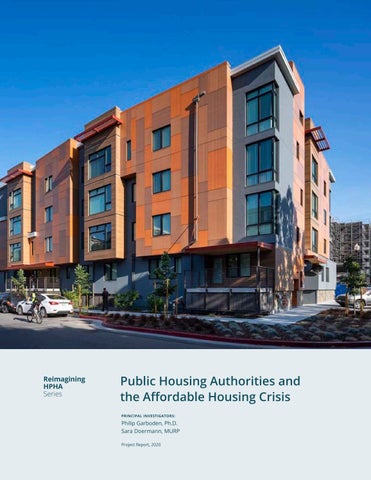
Laurel Grove Apartments in San Jose California. Source: Gelfand Partners Architects, https://www.gelfand-partners.com/projects/laurel-park/ IMAGE CREDITS
The authors have attempted to acknowledge all sources of images in this report and apologize for any errors or omissions. GRAPHIC DESIGN CONSULTANT
Jill Misawa COPYRIGHT
© 2020 Garboden, P., Doermann S. This work is licensed under a Creative Commons Attribution-NoDerivatives 4.0 International License (CC BY-ND 4.0), unless otherwise noted. To view a copy of this license, visit the Creative Commons website.
Reimagining HPHA Series
Public Housing Authorities and the Affordable Housing Crisis PROJECT REPORT
University of Hawai‘i Community Design Center for the Hawai‘i Public Housing Authority PREPARED BY:
Philip Garboden, Ph.D. HCRC Professor in Affordable Housing Economics, Policy, and Planning Department of Urban and Regional Planning University of Hawai‘i Economic Research Organization Sara Doermann, MURP Department of Urban and Regional Planning
The Re-Imagining HPHA Series is an interdepartmental and multidisciplinary initiative led by a group of Principal Investigators at the University of Hawai‘i at Mānoa to rethink public housing programs and facilities in support of the Hawai‘i Public Housing Authority’s mission and long-term goals.
Contents
Executive Summary Introduction
7
8
Data and Methods
10
Public Housing Authorities and Affordable Housing
12
Case Study 1: North Hill, Fairfax County Redevelopment and Housing Authority
15
Case Study 2: Park and Market, San Diego Housing Commission 17 Case Study 3: Centre Meadows, Housing Authority of Lexington, KY
19
Case Study 4: Laurel Grove Apartments, Housing Authority of the County of Santa Clara The Tools of Redevelopment and Densification The Low Income Housing Tax Credit
22
22
Project Based Vouchers and Project Based Rental Assistance Mortgage Revenue Bonds
24
Local Gap Financing Programs
24
Community Development Block Grant Program and Home New Markets Tax Credits
23
24
25
The Rental Assistance Demonstration
25
Opportunities: The Value of PHA Engagement in Affordable Housing The Power of Land Assets
27
Regulatory Authority and Public Sector Coordination Moving to Work
28
Tenant Protections Targeting Appendix
29
28
28
27
20
This page intentionally left blank.
6
University of Hawai‘i Community Design Center for the Hawai‘i Public Housing Authority
Executive Summary Formerly reserved for the poor, the affordable housing crisis has increasingly become a middle class phenomenon. Thirty years ago, moderate income families in Hawaii could expect to find housing of reasonable quality priced at or below 30 percent of their incomes. This is no longer the case. As the affordable housing crisis has expanded to higher income families, it has garnered increasing attention from academics, the media, policymakers, and politicians. But this attention has been selective, focusing disproportionately on demographics for whom housing burdens are a new phenomenon and ignoring those who have been priced out of the private market for decades. This, in turn, has resulted in a remarkable exclusion of Public Housing Authorities (PHAs) from conventional narratives related to the affordable housing crisis. This exclusion is shocking not only because PHAs are directly responsible for the majority of affordable housing in the nation, but because PHAs are positioned to impact the housing crisis above and beyond their administration of HUD programs. Their fiscal and regulatory authority, not to mention their existing assets, allows them to be key partners with city and state agencies as well as private and nonprofit developers. In this report we use data collected on a random sample of 40 PHAs to explore the role that Public Housing Authorities can play (and are playing) in solving the affordable housing crisis. We find that the majority of PHAs are already engaged in affordable housing development and preservation above and beyond the standard HUD programs. This is particularly true for larger PHAs whose growing expertise with mixed-finance redevelopment has allowed them to undertake major developments in their jurisdictions, directly and through collaboration. Our data show that at least 58 percent of PHAs (and 80 percent of large PHAs) have partnered in some form mixed-finance redevelopment. Of our 40 sampled PHAs, this activity has produced over 7,000 units of subsidized housing. The most productive PHAs were those that were best able to leverage their land assets in collaboration with other branches of state and local government. This situation is due to accelerate as HUD expands its Rental Assistance Demonstration (RAD) program, which allows PHAs to convert dilapidated public housing into Project Based Section 8 developments, thus allowing them access to additional financing sources. While some RAD conversions simply renovate existing structures, others demolish and rebuild new housing, adding density and increasing the supply of affordable housing. Unlike previous programs, RAD redevelopments are required to maintain a 1-for-1 hard unit replacement of all public housing units.
Public Housing Authorities and the Affordable Housing Crisis | by Philip Garboden, Ph.D. and Sara Doermann, MURP
7
Introduction
Public Housing is perhaps the most straightforward housing policy. Using funding from the Federal Government, local Public Housing Authorities own and manage units which they rent to eligible families. Because the units are almost wholly protected from the volatility of local housing markets, they remain affordable to the poorest families in perpetuity. This approach has been very successful in general, but a catastrophic failure in some highly publicized instances. Cities in which the development of Public Housing was explicitly used to segregate poor minority families into large high-rise developments on the urban periphery saw their investments quickly deteriorate into areas of stigma, violence, and joblessness (Austen 2018; Popkin et al. 2000). In these areas, the concentration of disadvantaged populations into high-rises simply amplified other forms of structural violence leading to intolerable living conditions and large scale, highly publicized demolitions. But while these failures have gotten most of the public attention, they represented less than 10 percent of the public housing stock. For roughly one million families today, public housing provides a viable option for affordable housing when market rate housing has moved beyond their reach. And yet despite the important role that public housing plays within the subsidized housing landscape, the Federal government has continued a bi-partisan trend away from PHA’s ownership and management of housing and towards leveraging the private market to supply and develop affordable housing (Hackworth 2007). Not only are PHA’s legally prohibited from using federal fund to construct new public housing (McCarty 2014), but there has been a significant decline in public housing operating funding relative to costs, gradually increasing the backlog of repairs and maintenance in HUD’s portfolio. Of greatest concern is the decline in funding to the Public Housing Capital Fund which has decreased by roughly 35 percent since 20001 (Bell & Rice 2018). 1. This decline is despite a meaningful increase in 2018.
8
This trend has, of course, lead to the increase in the proportion of families subsidized with housing vouchers (specifically Housing Choice Vouchers, formerly Section 8). But it has also created an estimated $26 billion backlog in capital repair needs. This
University of Hawai‘i Community Design Center for the Hawai‘i Public Housing Authority
backlog means that Public Housing Authorities are required to think beyond the traditional programs simply to preserve their existing housing stock, not to mention increase the stock of affordable housing to keep pace with increasing demand (Kleit and Page 2008; Kleit and Page 2015; Kleit, Airgood-Obrycki, Yerena 2019). This report explores how PHAs have responded to these challenges; it is divided into three sections: First, we articulate the role that public housing authorities play in addressing the affordable housing crisis. For many poor families, the Federal programs administered by local PHAs represent the only option for securing stable housing at a price they can afford. In addition, PHAs are increasingly branching beyond the standard slate of Federal programs, utilizing the land and regulatory assets to undertake affordable housing development directly. Second, we describe several case studies of mixed finance development projects undertaken by Public Housing Authorities including information on their development process and capital stack. Third, we summarize the tools that Public Housing Authorities have used to increase the supply of affordable rental housing. Specifically, we focus on how PHAs have leveraged the Low Income Housing Tax Credit (LIHTC) and, more recently, the Rental Assistance Demonstration (RAD) program to promote the preservation and development of affordable housing. To address these questions, we use data collected from a random sample of 40 Public Housing Authorities. Specifically, we use online databases, document analyses, and personal interviews to develop a picture of how PHAs are promoting the development of affordable housing. At the end, we synthesize these findings to describe the opportunities that PHAs have to drive local affordable housing development projects. Throughout, we look at lessons learned from earlier redevelopment projects, such as HOPE VI, that often failed to meet their intended goals, and discuss how PHAs can establish guardrails in their work to ensure that the public good is maximized in an environment of resource shortages.
Public Housing Authorities and the Affordable Housing Crisis | by Philip Garboden, Ph.D. and Sara Doermann, MURP
9
Data and Methods
The primary methodology for this report is an analysis of the development activities of a random sample of 40 Public Housing Authorities. Using public data provided by the Department of Urban Development’s Policy Development and Research Division, we constructed three strata of PHAs based on the number of subsidized units under their authority (a commonly used proxy for agency size). We selected 10 PHAs with between 500 and 3500 units (“small”), 20 with between 3501 and 6500 units (“medium”), and 10 with more than 6501 (“large”). We excluded PHAs with fewer than 500 units because those agencies generally lack the staffing capacity to work beyond traditional housing programs. Our oversample of medium PHAs was designed to collect data most relevant to the Hawai‘i case. As shown on the map below, our sampling procedure produced a wide geographical spread, meaning that our findings cover a wide range of local policy contexts and housing markets. The full list of PHAs in our sample is shown in Appendix A.
Red = Small Blue = Medium Green = Large
10
University of Hawai‘i Community Design Center for the Hawai‘i Public Housing Authority
Once we selected our sample, we carefully analyzed each PHA in terms of its activities developing affordable housing either directly or with local partners. We collected online information related to each PHA, identified properties in each jurisdiction from the National Housing Preservation Database, and conducted a series of phone interviews to help understand processes in more depth. While we endeavored to identify the full census of development work undertaken by each PHA, it is important to note that it’s is far more likely that a PHA would have undertaken a project on which we could find no information than we could have information on an erroneous property. Thus estimates throughout represent lower bounds to the development activity undertaken by PHAs and point estimates may be lower than reality. This is similarly true in our attempt to identify all funding sources that went into development of particular properties.
Public Housing Authorities and the Affordable Housing Crisis | by Philip Garboden, Ph.D. and Sara Doermann, MURP
11
Public Housing Authorities and Affordable Housing
The bulk of this report will focus on the ways that Public Housing Authorities are expanding beyond their primary role as administers of HUD programs to increase housing supply. But before doing so, it is important to reinforce the critical role that these programs play in protecting vulnerable populations. THE BREAD AND BUTTER: PUBLIC HOUSING, VOUCHERS, AND PROJECT BASED SECTION 8
PHAs directly administer dozens of Federal programs, but the bulk of their portfolios include three major subsidy programs: 1) Public Housing, where a government entity owns the housing directly; 2) Housing Choice Vouchers (formerly Section 8), where families are given a voucher to live in modestly priced privately owned housing; and 3) Project Based Section 8, which subsidizes the units in privately owned housing. All three of these programs are targeted at the bottom of the income spectrum; families pay 30% of their income in rent, with HUD making up the rest (either directly in the case of Public Housing or in payments to a private landlord).
Table 1: Households Served by Traditional HUD Programs *
PUBLIC HOUSING
National Hawaii * Source: HUD Picture of Subsidized Households, 2018
12
HOUSING CHOICE VOUCHERS
TOTAL
1,015,505
2,527,803
4,848,769
5,053
13,475
21,788
5,053
Hawaii PHAs HPHA
3,785
8,838
City & County of Honolulu
4,983
5,023
County of Hawaii
2,058
2,058
County of Kauai
1,160
1,160
County of Maui
1,489
1,489
University of Hawai‘i Community Design Center for the Hawai‘i Public Housing Authority
The scale of these programs dwarfs all other housing subsidies (except for the Low Income Housing Tax Credit, described below, and the Mortgage Interest Tax Deduction which subsidizes homeownership). In 2018, there were just over 1 million units of Public Housing available nationally, combined with 2.5 million Housing Choice Vouchers (HCV) and 1.3 million units of Project Based Section 8 (PBS8). All three of these programs exist in Hawaii with HPHA managing all of the State’s Public Housing (HCV and PBS8 being distributed between HPHA and the county housing offices). Together these programs support roughly 22,000 households in the state. In other words, roughly 1 in 20 families live in HUD subsidized housing in Hawaii. Beyond the numbers, these programs are essential because they serve a population for which no market-based housing solution exists. While dramatically increasing unsubsidized supply will help alleviate affordability pressure on middle-income families, the poor households served by Public Housing, HCV, and PBS8 have incomes too low to participate in housing markets at any price point (short of slums and self-help housing). Consider a single-earner family making the Hawaii minimum wage of $10.10 and working half time (1000 hours per year). Given the 30 percent threshold that HUD considers a reasonable percentage of income to pay for housing, this family could only “afford” an apartment renting below $253 per month including utilities. This is not a price point that a landlord (for profit or non-profit) could provide and hope to maintain the unit at a legally permissible quality standard. For families like the one above, the only options are homelessness, doubling up with family or friends, constant cycles of eviction, or the PHA’s subsidy programs.
LEVERAGING ASSETS: MIXED FINANCE AND PHA CATALYZED DEVELOPMENT
But beyond these essential services, PHAs have increasingly begun to assist in the development of affordable housing above and beyond HUD’s programs. For the most part, this is done through “mixed finance,” a broad term that reflects the reality that almost no affordable housing gets built without multiple finance streams including traditional lending, private equity, and a slew of Federal, state, and local programs that provide either direct capital or below-market loans to projects that agree to charge below a specified rent. As shown in Tables 2 and 3 (see Appendix), the use of mixed finance was extremely common across our sample, with significant projects to be found at small, medium, and large Public Housing Authorities. Of the 40 PHAs randomly sampled, we could identify some level of mixed finance development for 58 percent of the sample. The volume of participation varied by PHA size, ranging from 50 percent of small and medium PHAs to 80 percent of larger ones. In total, we could identify 7,524 housing units in which our 40 PHAs were development partners.
Public Housing Authorities and the Affordable Housing Crisis | by Philip Garboden, Ph.D. and Sara Doermann, MURP
13
In our conversations, many Housing Authorities noted that they first started building capacity for more complex projects during the 1990s when HUD’s HOPE VI project began. At the risk of oversimplification, HOPE VI was a program that funded the demolition of distressed Public Housing projects and their replacement with mixed income communities. PHAs were given significant latitude in terms of what would be built within the demolished Public Housing footprint, generally combining Public Housing, market rate housing, and other affordable units (generally offered to low income families earning above the threshold that would qualify them for public housing). All told, HOPE VI demolished 96,226 units (about 1/10th of the stock) and built 111,059. However only 55% of the new units served populations equivalent to those who were displaced (Schwartz 2015).2 HOPE VI was responsible for the removal of some of the worst housing conditions in the United States — conditions that the evidence suggests were harmful to tenants’ health and potential for economic mobility — but it has been rightly criticized for how it did so (Goetz 2003). Specifically, many families living in HOPE VI housing were given housing vouchers to be used in the private market with little consideration for how these families might navigate the complexities of such a transition (Popkin 2016). For some of these families, the opportunity to move was likely a welcome one, but what little tracking there was of displaced residents shows that many encountered real challenges with using the voucher, particularly elderly households and those with disabilities (Popkin 2016). On average, families living in buildings demolished via HOPE VI do seem to being doing better than those in similarly dilapidated housing that was not renovated – at least in term of their lifetime earnings (Pollakowski et al. 2019). Those that stayed within the footprint of the demolished housing (roughly 25% of the original families (Schwartz 2015)) were more stably housed, but do not seem to have benefited much from the new income mix, perhaps because of limitations to the design of the new housing (Chaskin and Joseph 2015). As our data shows, HOPE VI was not limited just to the massive PHAs of cities like Chicago, Baltimore, and Atlanta. Larger cities certainly made up the bulk of the units redeveloped through the program, but HUD funded HOPE VI grants across the country, helping to build competence and confidence among smaller PHAs that would catalyze both development and redevelopment. 2. Although it is important to note that roughly 1/3 of the public housing demolished through HOPE VI was vacant (Kingsley 2009).
After HOPE VI ended in the late 2000s, our data suggest that PHAs took one of two paths. Either they simply continued to manage their housing units in the traditional manner or they became increasingly active in the development of affordable housing through the Low Income Housing Tax Credit (LIHTC). This program, described in detail below, provides almost-as-good-as-cash tax credits to developers who agree to develop housing for low to moderate income families – generally earning more than families who qualify for Public Housing, or Housing Choice Vouchers. As is clear in Table 3, the vast majority of mixed finance housing uses LIHTC credits to some degree. The program was designed to encourage affordable housing development in the private and non-profit sectors, but PHAs are also able to take advantage of the program (and many do).
14
University of Hawai‘i Community Design Center for the Hawai‘i Public Housing Authority
In recent years, a relatively new program has been created (and recently expanded): the Rental Assistance Demonstration (RAD). This program allows PHAs to convert their Public Housing stock to Project Based Section 8, which in turn allows them to either pass the property to private ownership and/or access financing that is otherwise unavailable for Public Housing. In a couple of instances, PHAs in our sample simply made the conversion to PBS8, but in the vast majority of cases this transition was accompanied by substantial renovations or demolition and redevelopment. Unlike HOPE VI, RAD essentially guarantees 1-for-1 replacement of all public housing units with PBS8 (which has similar eligibility requirements), but does allow families that wish to convert their housing to vouchers to do so (see below for more on RAD). If they are not already, nearly all PHAs are actively pursuing RAD funds and HUD has stated its intention to expand the program. While RAD and/or LIHTC were used in the vast majority of mixed finance developments in our sample, dozens of smaller programs were also in evidence. Some Housing Authorities, particularly those in California, have the additional benefit of floating bonds to finance the development of affordable housing. As government entities, these authorities are allowed to collaborate with state bond agencies to offer tax-exempt bonds, the proceeds of which can be used to fund housing. Other revolving funds were also found in our data as well as investment of Community Development Block Grant (CDBG) funds and HOME funds. Finally, several of the PHAs were able to use their land assets (or those available to them from the state or city) to catalyze the development of housing. In the sections that follow, we present several case studies that illustrate the novel ways that PHAs have been able to get into the mixed-finance game.
CASE STUDY 1: NORTH HILL, FAIRFAX COUNTY REDEVELOPMENT AND HOUSING AUTHORITY
Way back in 1981, the Fairfax County Redevelopment and Housing Authority (FCRHA) purchased a 48 acre piece of land using funds from the Community Development Block Grant (CDBG) program. Ten years later, a portion of the property was developed into a mobile home park, while the rest was left to sit vacant for decades due to a combination of political inertia and marine clay, which needed to be removed prior to building due to its proclivity to swell and collapse foundations. Over those ten years, however, the housing market in Fairfax County, Virginia, was changing rapidly. Once a largely rural area, the county’s proximity to Washington, DC (and recently the proposed Amazon Q2 site) meant that housing prices were rising steadily presenting challenges to a county that wanted to be more than a commuter suburb. As noted in the Community Wide Housing Strategic Plan, “a lack of housing options is putting the County’s well-being and future prosperity at risk” (2018, p. 2).
Public Housing Authorities and the Affordable Housing Crisis | by Philip Garboden, Ph.D. and Sara Doermann, MURP
15
Rendering of Proposed Affordable Units, North Hill3
While Fairfax’s growth presented challenges, it also meant that the lot purchased nearly forty years early had gone from a worthless piece of salty dirt to a valuable asset held by the FCRHA. Moreover, because FCRHA is a part of Fairfax County government, it was able to rezone the land to residential uses, further increasing its value. FCRHA was able to capitalize on this appreciation by selling one third of the land for roughly 12 million dollars to a market rate townhouse developer. The PHA then combined these proceeds with 3 million dollars in local funding and tax credits from the Low Income Housing Tax Credit Program to build 279 affordable units on the second third of the property. Sixty-eight of those units had a guaranteed revenue stream through the Project Based Voucher Program, while the others were developed to house families earning below 60 percent of AMI. As shown in the proposed site plan, the remaining third is being preserved as a park, satisfying not only CDBG’s area-wide benefit requirements, but also offering a valuable amenity to both the market rate owners and the affordable tenants on the site.
3. Source: www.fairfaxcounty. gov/housing/sites/housing/ files/assets/documents/ north%20hill/residences%20 at%20north%20h ill%20 elevations.pdf
16
Some aspects of this case are clearly idiosyncratic to the site. It is a rare administrator who would purchase land so that 40 years in the future is could catalyze affordable housing development. Moreover, unlike many PHAs, FCRHA is a part of county government rather than an independent agency, meaning that it has historically been able to coordinate more smoothly with planning and land use agencies. Nevertheless, this example is informative for the way the FCRHA was able to leverage an asset — in this case a vacant site — to expand the supply of affordable housing in its jurisdiction. This was not a linear process; the affordable housing developer’s need for gap financing combined with a number of requirements related to the CDBG funds pushed the PHA into its “a third-a third-a third” strategy. By selling one third of the now desirable land, the development could proceed with a minimum of local funds – just three million dollars. And the third reserved for park land provided an amenity (and thus benefits) to the surrounding community, while allowing for CDBG funds to be expended.
University of Hawai‘i Community Design Center for the Hawai‘i Public Housing Authority
Proposed Site Plan for North Hill4
FCRHA’s position within county government greatly facilitated the project. The reason why the PHA was able to gain $12 million via the sale of just a third of its land, was the willingness of the county to rezone on their behalf, essentially increasing their value of their asset with minimal up-front costs to local residents. And third, the usage of PBVP ensures that a substantial segment of units will remain affordable to very low income families for the foreseeable future, creating a bankable revenue model which the affordable housing developer can use to maintain the property.
CASE STUDY 2: PARK AND MARKET, SAN DIEGO HOUSING COMMISSION
The San Diego Housing Commission (SDHC) works as both the city’s PHA but also administers most of the City of San Diego’s affordable housing programs such as the local Inclusionary Zoning (IZ) ordinance. More significantly, SDHC may authorize the issuance of Multifamily Mortgage Revenue Bonds for affordable housing development (subject, of course, to the approval of the California Debt Limit Allocation Committee).
4. Source: www.fairfaxcounty. gov/housing/sites/housing/ files/assets/documents/ north%20hill/northhillfactsheetrevised_final_010517.pdf
The Multifamily Mortgage Revenue Bond program6 allows SDHC to issue tax exempt bonds to investors which it then uses to offer below market mortgages to finance projects in the City. In order for a project to be eligible it must offer on-site affordable housing. Either 20% of units must be set aside for households earning less than 50% AMI or 40% of units must be set aside for families earning less than 60% AMI.
Public Housing Authorities and the Affordable Housing Crisis | by Philip Garboden, Ph.D. and Sara Doermann, MURP
17
Artist’s Rendering of Park and Market Development5
In the case of Park and Market the builders are using MMRB financing (a 40 year loan of $216.5 million at 3.515% interest) to cover the majority of the developments costs associated with residential portions of the structure (with additional developer equity and 4% Low Income Housing Tax Credits). Once completed, Park and Market will consist of 426 apartments, 340 market rate and 85 affordable. The affordable housing will be available to households earning less and 50% AMI for 55 years. The commercial portion of the development will be owned and operated by the University of California San Diego and a small historic home on the site will be preserved (and possibly converted into a restaurant). For this reason many local officials are assuming that the affordable units will be attractive to graduate students from UC San Diego who would likely qualify in terms of income.
5. https://www.sdhc.org/ housing-opportunities/ affordable-rentals/ sdhc-partnership-development/
6. This is similar to Hawaii’s Hula Mae Multi-Family (HMMF) bond program administered by HHFDC.
18
The Park and Market project has several important implications. First the power of MMRB issuance (an authority not typically held by Public Housing Authorities). Investors in the bond receive a low-return, low-risk, tax-free investment vehicle with which to balance more aggressive investments. The PHA receives a source of revenue that they can use to finance development. Because their support is in the form of a low-interest loan (rather than a grant), they sacrifice only the opportunity costs associated with lending the money at a higher rate (which would not be permissible for tax-exempt bonds). In exchange, they are able to catalyze the development of 85 new affordable units in the heart of the city. Of course, the likelihood that many of these apartments will go to graduate students will strike some people amiss. Individuals actively engaged in building human capital are generally seen as lower priority for government subsidization because of their anticipation of increased earning power. But, of course, the affordable housing crisis is a multifaceted problem and supporting the educational aspirations of mostly local students has value for the regional economy more broadly. It is important to agencies to strike a balance between supporting projects that address a range of housing burdened households and those in the direst circumstances. University of Hawai‘i Community Design Center for the Hawai‘i Public Housing Authority
CASE STUDY 3: CENTRE MEADOWS, HOUSING AUTHORITY OF LEXINGTON, KY
In the early 2010s, Pimlico Apartments in Lexington, Kentucky was in rough shape. Consisting of 206 town home units, the complex had suffered from years of disrepair and neglect. Having been constructed in 1977, the apartments had deteriorated rapidly with cracks emerging in mortar joists at the corners of the brick structures. This had prompted the Housing Authority to install wooden support pillars to minimize the chance of collapse. Image of Pimlico before Renovation7
Lacking adequate capital funds to maintain the complex, the HAL was considering demolition, and thus a dramatic loss of subsidized housing in the community. Instead the Housing Authority of Lexington Kentucky utilized HUD’s Rental Assistance Demonstration to apply for tax credits that it could use to rehabilitate the units, converting them from public housing to Project Based Section 8. Unlike some RAD conversions, the Housing Authority retained ownership of the newly renamed Centre Meadows, thus retaining public control of the unit. Despite HAL’s success in preserving a rapidly deteriorating portion of its portfolio, the tenant communication and relocation process seems to have fallen short of best practice. As reported by local media, the families who were living in the complex were given two options – either they could receive a Housing Choice Voucher or they could relocate to another Public Housing complex. If they choose the latter, they were given first priority to return to the complex after the two years it took to renovate. The primary controversy appears to emerge from the timeline — tenants were given just one or two weeks to decide which option they preferred and then the standard 60 days to move. While the Housing Authority emphatically noted that they weren’t going to push anyone out simply because they could not find a place, the lack of resident engagement around the process combined with a sense of fear among the tenants added to the general confusion (Spears 2013).
7. https://www.kentucky.com/ news/local/counties/ fayette-county/article44415096.html
This case thus suggests two things. First, RAD can be a powerful tool to preserve affordable housing when other sources of funds are inadequate. But it also speaks to the reality that despite the 1-for-1 hard unit replaced that RAD generally requires, there can still be disruption for families. It appears that roughly 140 of the 165 families selected vouchers rather than relocation to Public Housing, thus jeopardizing their rights to return to the newly renovated units. Public Housing Authorities and the Affordable Housing Crisis | by Philip Garboden, Ph.D. and Sara Doermann, MURP
19
Image of Renovated Centre Meadows8
A number of solutions to these issues exist. First and foremost, a robust communication process with tenants is necessary, well before any relocations are initiated. This often means more than simply hosting a few public meetings, as only a select group of tenants attend such things. Instead it means a proactive process of communication with each and every resident to ensure that their needs at met during a time of disruption. Second, project phasing can be implemented to reduce disruption. This means building affordable housing first or renovating already vacant units, allowing families to relocate within the development footprint. This is, of course, not always possible and almost always adds to the overall expense of the redevelopment, but often times it is worth it to respect residents’ attachment to place.
CASE STUDY 4: LAUREL GROVE APARTMENTS, HOUSING AUTHORITY OF THE COUNTY OF SANTA CLARA
8. https://www.scbarchitects. com/projects/centre-meadows/
20
On its face, the 82 unit Laurel Grove Apartments seems like a fairly standard PHA lead mixed finance development in California, using $18 million in Low Income Housing Tax Credits and a $42 million tax-exempt construction bonds. But it is the smaller sources of funding that make the project interesting: $8 million from the State of California Department of Housing & Community Development (HCD) from monies devoted to support Transit Oriented Development and the Affordable Housing & Sustainable Communities (AHSC) program, funded through the state’s cap-and-trade program.
University of Hawai‘i Community Design Center for the Hawai‘i Public Housing Authority
Laurel Grove Apartments in San Jose9
The Laurel Grove Apartments are located in downtown San Jose near the Diridon Transit Center allowing residents to access to the area’s rail and bus networks. Not only does this potentially benefit the residents, it also helps the Laurel Grove Apartments serve a sort of double bottom line — providing affordable housing but doing so in a way that could potentially reduce greenhouse gas emission by reducing automotive miles. It was thus eligible for funding via AHSC which requires applicants quantify their emissions reduction to receive funds (more information is available here: http://sgc.ca.gov/programs/ahsc/) While the causal impact of such construction on emission reduction is certainly up for debate, the linking of densification, transit oriented development, and environmental sustainability can clearly help local Housing Authorities build a broader coalition in support of affordable housing while also opening up new funding sources not singularly focused on housing affordability.
Public Housing Authorities and the Affordable Housing Crisis | by Philip Garboden, Ph.D. and Sara Doermann, MURP
9. https://fpisccha.com/ property/laurel-grove/
21
The Tools of Redevelopment and Densification
In this section, we describe in detail the tools used by our sample PHAs to preserve, develop, and densify affordable housing. In any description of this length many of the details will necessary be left out.10 THE LOW INCOME HOUSING TAX CREDIT
The Low Income Housing Tax Credit (LIHTC) is the largest housing production subsidy program in the United States. Between 1987 and 2006, it accounted for 30% of all multifamily housing starts, affordable or otherwise (Khadduri, Climaco, and Burnett 2012), and currently serves over twice the number of households as public housing (Schwartz 2015). At a superficial level, the program is quite simple. Builders who agree to make their rents affordable to low-income families (roughly 60% of Area Median Income, although complexities certainly apply) can earn tax credits equal to a portion of the eligible development costs for 10 years. Generally developers receive either the 9% credit (and thus receive roughly 9% of their development costs each year for 10 years) or a 4% credit (and thus receive roughly 4% each year).
10. We encourage readers interested in these topics to contact us; we are always happy to discuss the complexities.
Unlike Public Housing and Vouchers, the developer agrees only to set rent at a level affordable to a particular income bracket and to rent to families who fall in that range. After leaseup, families are required to pay the full amount of the rent each month regardless of how their income fluctuates. Of course, good management practice requires that tenants are screened for their ability to pay, making most LIHTC developments available only to a band of incomes that fall below the mandated eligibility level and above what a property manager thinks reasonable to avoid operating shortages. Tax credits are not unlimited (particularly the more valuable 9% credits) and are granted to each state on a per capita basis. Stage agencies such as Hawai‘i Housing Finance & Development Corporation allocate these credits based on a ranking system available in their Qualified Allocation Plans (QAP) that scores proposed developments based on their feasibility, their developer expertise, and whether or not the projects location and target population aligns with identified areas of need.
22
University of Hawai‘i Community Design Center for the Hawai‘i Public Housing Authority
The complexity arises based on two issues. First, many affordable housing developers are nonprofit organizations who have no use for tax credits. Second, even if the developer is a for profit company, the funds for development are needed within the first year of the project, not spread out over ten years. To resolve this issue, affordable housing developers essentially sell a portion of their development to a limited partner, who front the money and receive the tax credits over 10 years as repayment (along with some other benefits such as a depreciation allowance). Because of the complexities of this relationship, the amount that the limited partner is willing to pay for $1 in tax credits varies over time. In the early 1990s, when the program was new and thus appeared risky, tax credit investors paid only $.50 on the dollar for tax credits. This amount steadily increased until it peaked at over $1 for a dollar in credit (Schwartz 2015; Novogradac 2019). In 2019, a dollar in LIHTC credits was worth roughly $.94 cents to investors (Novogradac 2019). Two related questions remain to be answered. First, why would an investor ever pay more than $1 for $1 in tax credits when there is risk involved in the transaction? And second, who buys tax credits? The answer to the second answers the first: banks. Banks are the largest investors in Low Income Housing Tax Credits (with insurance companies coming in second). The reason why tax credits are appealing to banks is because they help fulfill the bank’s obligation to the Community Reinvestment Act which requires banks to affirmatively invest in minority communities as remediation for discriminatory practices. Tax credits represent an efficient way to meet these obligations.
PROJECT BASED VOUCHERS AND PROJECT BASED RENTAL ASSISTANCE
The Project Based Voucher program (also known as Project Based Section 8) and its kissing cousin Project Based Rental Assistance, represent a hybrid between standard vouchers (which follow a particular household that is privately owned) and Public Housing (in which the housing is owned by the PHA). For PBV, the PHA agrees to subsidize a certain number of units in a privately owned development. Generally speaking, PHAs can allocate between 20 and 30 percent of their housing vouchers to PBV. These vouchers are allocated on a competitive basis and are generally used to support new construction or rehabilitation of affordable housing. Project Based Vouchers largely have the same eligibility requirements as Housing Choice Vouchers but do not follow the family if they choose to leave the unit. Instead they stay attached to a particular unit and are used to subsidize the next eligible family who wishes to occupy the unit. The tradeoff for the lack of residential flexibility is that the owners of the PBV development can be assured of a steady cash flow month after month regardless of the vicissitudes of the labor market (as with most HUD programs, families pay 30% of their income in rent and the voucher makes up the difference).
Public Housing Authorities and the Affordable Housing Crisis | by Philip Garboden, Ph.D. and Sara Doermann, MURP
23
MORTGAGE REVENUE BONDS
Each year state housing agencies are permitted to issue tax-exempt bonds, the proceeds from which they can use to fund affordable housing for low-income families. While often used to provide below-market mortgages to low-income homebuyers, multifamily housing bonds can be used to finance developments in which 40 percent of the units are affordable to families earning less than 60 percent of the area median income (or 20 percent for those earning less than 50% AMI). The bonds are tax exempt, meaning that the proceeds to bond investors are not subject to federal taxes, but this means that the number of bonds is limited. The current formula for each state is $105 dollars per person in the state with a state minimum of just over $320 million dollars (NCSHA 2020). Myriad other bond financing options exist beyond this federal program. California, for example, issues its own general obligation bonds to support fair housing development as do some local municipalities. In Hawai`i the Hula Mae Multi-Family (HMMF) bond program administered by HHFDC serves this function.
LOCAL GAP FINANCING PROGRAMS
Despite all of these federal programs, many affordable housing developments require some form of local financing to pencil, particular those that target families earning below 50% of AMI. By design, these programs differed from place to place, allowing local officials to target their funding according to locally identified needs.
CDBG AND HOME
Both the Community Development Block Grant Program (CDBG) and the HOME Investment Partnerships Program (HOME) are block grants administered by HUD. Block grants are designed to give local municipalities (both states and smaller jurisdictions) more authority to customize their expenditures to local needs. For example, HOME funds can be used for a range of purposes related to affordable housing or homeownership, such as “tenant-based rental assistance; housing rehabilitation; assistance to homebuyers; and new construction of housing. HOME funding may also be used for site acquisition, site improvements, demolition, relocation, and other necessary and reasonable activities related to the development of non-luxury housing” although they cannot be used for public housing (HUD 2020). CDBG funds have even more latitude as they are not limited to housing related uses and can be used for a plethora of activities supporting poor and low-income populations. As noted above, as the housing crisis has worsened increasing number of jurisdictions have allocated these flexible funds to catalyze the development of affordable housing.
24
University of Hawai‘i Community Design Center for the Hawai‘i Public Housing Authority
NEW MARKETS TAX CREDITS
Most of the affordable housing developments identified in our sample were exclusively residential, but some of the larger, more urban, developments contained some form of on-site retail making them eligible for New Market Tax Credits. While the future of the program is uncertain, the NMTC currently operates much like the LIHTC except that the credits are allocated to commercial or industrial development in low-income census tracts. The ability to access these tax credits, plus the opportunity presented by commercial revenue, can make mixed-use development a powerful tool.
THE RENTAL ASSISTANCE DEMONSTRATION
The impetus for the RAD program is to resolve the “backlog of unfunded capital needs” that exists for public housing (for a complete summary see Stout et al. 2019). As noted in the introduction, the federal government has, for years, failed to adequately fund capital improvements in Public Housing. In layman’s terms, there is generally sufficient resources for day-to-day management of public housing, but large scale repairs (a new AC systems, new elevators) have consistently been neglected. This puts a large share of the nation’s public housing stock at risk of being uninhabitable. Clearly the easiest solution to this issue would be to adequately fund capital repairs, but this does not appear to be politically viable. RAD was designed to be budget neutral, meaning that it attempts to ensure the long-term physical viability of the public housing stock without adding the HUD’s budget. It does so, to drastically over simplify, by transitioning public housing units into Project Based Vouchers units. In order to make the transition cost neutral, the amount of funding for the PBS8 is limited to the amount that was being provided to the public housing program (although this is generally sufficient). The reason that this conversion helps solve the capital repairs issues is that it allows PHAs and their partners access to sources of financing that they are prohibited to access through the Public Housing Program. For every dollar of PHA funds invested in the RAD conversion, the most recent evaluation suggests that PHAs are able to leverage $7.47 in other financing sources. The bulk of this money comes from other public funding sources. Even when considering the contributions of all public entities combined, these investments still leverage $1.59 for every $1 spent (Stout et al. 2019). In other words, the conversion of a property from public housing to PBS8 results in a large multiplier effect in terms of the development’s ability to leverage other dollars. PHAs and their partners are given wide latitude in what the conversion looks like. In instances where the property is in good repair and lacks significant capital needs, the development can essentially be a change in subsidy type without any additional
Public Housing Authorities and the Affordable Housing Crisis | by Philip Garboden, Ph.D. and Sara Doermann, MURP
25
changes. In other cases, a RAD conversion can result in the renovation of a public housing structure but otherwise not change the building footprint. At the more intensive end, a conversion can result in the demolition of existing structures and the subsequent construction of new structures. In such cases, the PHAs are required to ensure that deeply affordable units are rebuilt, although many of these major redevelopments will add additional units either targeted to low income families (via LIHTC) or market rate housing. Tenants living in public housing undergoing a RAD conversion are protected in a number of ways representing a vast improvement over HOPE VI. All tenants have a right to return to their units after rehabilitation or a similar (or larger) unit in the new development. They cannot be re-screened and retain the rights available to them as public housing residents. The programs require a certain level of community engagement, and that families be relocated not unduly prematurely and can return within a reasonable timeline. Families that wish to do so can also opt in to the “Choice Mobility” option which provides them with a Housing Choice Voucher which they can use to move elsewhere. Such decisions do not obviate the requirement for the replacement of all public housing units with PBS8 units in the post-RAD development.
26
University of Hawai‘i Community Design Center for the Hawai‘i Public Housing Authority
Opportunities: The Value of PHA Engagement in Affordable Housing
First and foremost, our findings suggest that Public Housing Authorities are uniquely positioned to help address the affordable housing crisis. Not only do their core services provide essential support for the poorest families, but the majority of housing authorities are actively involved in the construction and preservation of affordable housing throughout their county. The Rental Assistance Demonstration, while both delicate and complex, will inevitably transform PHAs’ work and presents significant opportunities to grow the stock of affordable housing. Past redevelopment programs have reduced the number of deeply affordable units, replacing public housing with communities that were not focused on the needs of poor families. HUD seems to have designed the RAD program with these past failures in mind, insisting on a 1-for-1 replaced of all converted public housing units. Entrepreneurial PHAs have the opportunity to take this to the next level by adding additional LIHTC subsidizes to the new public housing units (perhaps with retail and market rate units as well). Done carefully, with deep resident engagement, these new communities have significant potential to improve the lives of poor and low-income households. More broadly, PHAs across the country have different tools at their disposal, but the following themes came up throughout the data, representing the opportunities PHAs have to drive affordable housing development:
THE POWER OF LAND ASSETS
In many urban areas the cost of land represents a prohibitive barrier to affordable housing development. As one California PHA official we spoke with put it “we simply can’t make it work if we need to pay for the land.” Fortunately, there are a number of ways that PHAs have solved this problem. Some simply used land already under their control, generally within the footprint of a public housing development. Others were able to coordinate with other state and county agencies to collaborate on site assemblage.
Public Housing Authorities and the Affordable Housing Crisis | by Philip Garboden, Ph.D. and Sara Doermann, MURP
27
REGULATORY AUTHORITY AND PUBLIC SECTOR COORDINATION
PHAs are more or less integrated into county governments depending on a variety of factors and the closeness of that integration seems to make a difference for PHAs’ ability to build affordable housing. Agencies who are wholly or partially able to issue municipal bonds, for example, are uniquely able to address gap financing needs. Similarly the targeting of CDBG and HOME dollars must be done strategically and in coordination with other agencies to ensure maximum benefits.
MOVING TO WORK
The inappropriately named Moving to Work program allows eligible high-performing Public Housing Authorities more discretion in how they utilize Federal funds. In theory at least, MTW permits PHAs to experiment with innovations at the local level, disseminating best practices across the country. While the program has been criticized for a lack of evaluation and coordination, many of the PHAs we spoke to said that the flexibility it gave their agency (in terms of regulatory processes and budget allocation) was essential for their role in affordable housing development.
TENANT PROTECTIONS AND TARGETING
For RAD in particular, but for redevelopment more generally, tenants often experience a great deal of fear at the prospect of losing their housing. In its least disruptive form, a RAD conversion will result in new management which can make once tolerated activities no longer permitted. It is essential to bring tenant groups into the process early and often, engaging them authentically about what is and isn’t possible, and making sure they understand the risks and benefits. Not only is this the right thing to do, but having tenants as allies in the redevelopment and/or rehabilitation of their units can be a powerful way to push for more resources and design new housing that avoid past mistakes.
28
University of Hawai‘i Community Design Center for the Hawai‘i Public Housing Authority
Appendix
SAMPLED PUBLIC HOUSING AUTHORITIES
Small (500-3500 units)
Des Moines Municipal Housing Agency, IA
Housing Authority of the City of Little Rock, AR
Mississippi Regional Housing Authority No. VI, MS
Pontiac Housing Commission, MI
Youngstown Metropolitan Housing Authority, OH
Housing Authority of the Borough of Lodi, NJ
New Hampshire Housing Finance Agency, NH
Frederick Housing Authority, MD
City of Hartford Housing Authority, CT
Housing Authority of the City of Burbank, CA Housing Authority of the City of Lakeland, FL
Large (+6500 units)
Mississippi Regional Housing Authority no. V, MS
Housing Authority of the County of Contra Costa, CA
Neptune Housing Authority, NJ
Metropolitan Council, MN
Fayetteville Metropolitan Housing Authority, NC
Housing Authority of the County of San Diego, CA
Housing Authority County of Lawrence, PA
Omaha Housing Authority, NE
Medium (3500-6500 units)
Santa Clara County Housing, CA St. Louis Housing Authority, MO
Housing Authority of Jefferson Parish, LA
Akron Metropolitan Housing Authority, OH
New Bedford Housing Authority, MA
Richmond Redevelopment and Housing Authority, VA
City of Reno Housing Authority, NV
Allegheny County Housing Authority, PA
Montana Department of Commerce, MT
Housing Authority of the County of Alameda, CA
Dallas County Housing Assistance Program, TX West Palm Beach Housing Authority, FL Housing Authority of the City of Columbia, SC Tulare County Housing Authority, CA Housing Authority of Lexington, KY Housing and Community Development Tuscon, AZ Housing Authority of the City of Augusta, GA Housing Authority of the City of Miami Beach, FL Fairfax County Redevelopment and Housing Authority, VA Syracuse Housing Authority, NY Albany Housing Authority, NY
Public Housing Authorities and the Affordable Housing Crisis | by Philip Garboden, Ph.D. and Sara Doermann, MURP
29
TABLE 2: SUMMARY OF FIXED FINANCE PROJECTS BY HOUSING AUTHORITY
PUBLIC HOUSING
HOUSING CHOICE VOUCHERS
MIXED FINANCE & SIMILAR
Small (500-3500 units) Housing Authority of the City of Little Rock, AR
248
2302
507
Pontiac Housing Commission, MI
441
770
–
Housing Authority of the Borough of Lodi, NJ
220
477
–
Frederick Housing Authority, MD
304
805
133
Housing Authority of the City of Burbank, CA
0
1019
3
Housing Authority of the City of Lakeland, FL
307
1559
483
Mississippi Regional Housing Authority no. V, MS
570
1747
–
Neptune Housing Authority, NJ
345
318
–
Fayetteville Metropolitan Housing Authority, NC
90
98
914
Housing Authority County of Lawrence, PA
838
393
–
Total (Small)
3363
9488
2040
Housing Authority of Jefferson Parish, LA
200
4835
–
New Bedford Housing Authority, MA
1744
1911
–
City of Reno Housing Authority, NV
Medium (3500–6500 units)
751
2822
1471
Montana Department of Commerce, MT
0
4269
–
Dallas County Housing Assistance Program, TX
0
4480
–
West Palm Beach Housing Authority, FL
157
3438
426
Housing Authority of the City of Columbia, SC
1879
4077
–
Tulare County Housing Authority, CA
710
2958
893
Housing Authority of Lexington, KY
1097
3040
887
Housing and Community Development Tuscon, AZ
1505
4798
578
Housing Authority of the City of Augusta, GA
1935
4095
894
Housing Authority of the City of Miami Beach, FL
200
3412
–
0
4193
1270
Syracuse Housing Authority, NY
2313
4130
157
Albany Housing Authority, NY
1792
3204
1153
Des Moines Municipal Housing Agency, IA
424
3568
–
Mississippi Regional Housing Authority No. VI, MS
136
5021
–
Youngstown Metropolitan Housing Authority, OH
1237
2280
–
New Hampshire Housing Finance Agency, NH
0
3642
–
City of Hartford Housing Authority, CT
0
4967
1047
22806
94116
12856
Fairfax County Redevelopment & Housing Authority, VA
Total (Medium)
30
University of Hawai‘i Community Design Center for the Hawai‘i Public Housing Authority
PUBLIC HOUSING
HOUSING CHOICE VOUCHERS
MIXED FINANCE & SIMILAR
1102
6956
539
0
6616
–
Housing Authority of the County of San Diego, CA
121
11714
1902
Omaha Housing Authority, NE
2703
4745
–
Santa Clara County Housing, CA
4
11665
2308
St. Louis Housing Authority, MO
2788
7080
358
Akron Metropolitan Housing Authority, OH
Large (+6500 units) Housing Authority of the County of Contra Costa, CA Metropolitan Council, MN
4309
4989
777
Richmond Redevelopment and Housing Authority, VA 3832
3502
1254
Allegheny County Housing Authority, PA
3060
5853
314
0
6548
72
17919
69668
7524
Housing Authority of the County of Alameda, CA Total (Large)
Public Housing Authorities and the Affordable Housing Crisis | by Philip Garboden, Ph.D. and Sara Doermann, MURP
31
TABLE 3: DEVELOPMENT DETAILS Units counts are approximate based on multiple data sources (market rate units may not be included).
Housing Authority of the City of Little Rock, AK Total Public Housing Units
248
Total Housing Choice Vouchers
2,302
MIXED FINANCE / PHA CATALYZED DEVELOPMENTS
Metropolitan Village*
Public Housing, LIHTC, HOME
60 (17 PH)
Cumberland Manor*
Public Housing, LIHTC, HOME
60 (17 PH)
Senior Homes at Granite Mountain*
Public Housing, LIHTC
40 (24 PH)
Homes at Granite Mountain*
Public Housing, LIHTC
Madison Heights Apartments (I-III)*
Public Housing, LIHTC, HOME
60 (40 PH) 387 (117 PH)
* RAD Pending
Pontiac Housing Commission, MI Total Public Housing Units
441
Total Housing Choice Vouchers
770
MIXED FINANCE / PHA CATALYZED DEVELOPMENTS
none found
Housing Authority of the Borough of Lodi, NJ Total Public Housing Units
220
Total Housing Choice Vouchers
477
MIXED FINANCE / PHA CATALYZED DEVELOPMENTS
none found
32
University of Hawai‘i Community Design Center for the Hawai‘i Public Housing Authority
Housing Authority of the Borough of Lodi, NJ Total Public Housing Units
304
Total Housing Choice Vouchers
805
MIXED FINANCE / PHA CATALYZED DEVELOPMENTS
Vermont Court
HOPE VI
could not determine
North Pointe
HOPE VI
97
South Carroll
HOPE VI
36
Housing Authority of the City of Burbank, CA Total Public Housing Units
0
Total Housing Choice Vouchers
1,019
MIXED FINANCE / PHA CATALYZED DEVELOPMENTS
Ontario Street Triplex
HOME, Low-Moderate
3
Income Housing Asset Funds
Housing Authority of the City of Lakeland, FL Total Public Housing Units
307
Total Housing Choice Vouchers
1,159
MIXED FINANCE / PHA CATALYZED DEVELOPMENTS
Carrington Place Apartments
LIHTC, Public Housing
40
Colton Meadow Apartments
LIHTC, HOME, Florida State Subsidy
72
Renaissance at Washington Ridge
LIHTC
196
Villas at Lake Bonnet Apartments
LIHTC, HOME
75
The Manor at West Bartow
LIHTC, Florida State Subsidy
100
Public Housing Authorities and the Affordable Housing Crisis | by Philip Garboden, Ph.D. and Sara Doermann, MURP
33
Mississippi Regional Housing Authority No. V, MS Total Public Housing Units
570
Total Housing Choice Vouchers
1,747
MIXED FINANCE / PHA CATALYZED DEVELOPMENTS
none found
Neptune Housing Authority, NJ Total Public Housing Units
345
Total Housing Choice Vouchers
318
MIXED FINANCE / PHA CATALYZED DEVELOPMENTS
none found
Fayetteville Metropolitan Housing Authority, NC Total Public Housing Units
90
Total Housing Choice Vouchers
98
MIXED FINANCE / PHA CATALYZED DEVELOPMENTS
Old Wilmington Road
HOPE VI
642
Cross Creek Pointe Apartments
LIHTC, HUD Loan, Local Financing
272
Housing Authority County of Lawrence, PA Total Public Housing Units
838
Total Housing Choice Vouchers
393
MIXED FINANCE / PHA CATALYZED DEVELOPMENTS
no data found
34
University of Hawai‘i Community Design Center for the Hawai‘i Public Housing Authority
This page intentionally left blank.
Public Housing Authorities and the Affordable Housing Crisis | by Philip Garboden, Ph.D. and Sara Doermann, MURP
35
Reimagining HPHA Series
Public Housing in Hawai‘i Assessing the Needs of Public Housing Residents University of Hawai‘i Community Design Center for the Hawai‘i Public Housing Authority PRINCIPAL INVESTIGATORS:
Jennifer Darrah-Okike, Ph.D. Philip Garboden, Ph.D.
Reimagining HPHA Series
Reimagining HPHA Series
Future of Hawai‘i’s Housing Exploring Housing for All
This report is part of the Re-Imagining HPHA Series, an inter-departmental and multidisciplinary initiative conducted by a group of Principal Investigators at the University of Hawai‘i at Mānoa through the University of Hawai‘i Community Design Center aimed at re-thinking public housing programs and facilities in an effort to support the Hawai‘i Public Housing Authority’s mission and long term goals.
University of Hawai‘i Community Design Center for the Hawai‘i Public Housing Authority PRINCIPAL INVESTIGATORS:
Karla Sierralta, AIA Brian Strawn, AIA
36
For more information on related projects please visit hawaiihousinglab.org.
University of Hawai‘i Community Design Center for the Hawai‘i Public Housing Authority
This page intentionally left blank.
Public Housing Authorities and the Affordable Housing Crisis | by Philip Garboden, Ph.D. and Sara Doermann, MURP
37
Made possible by: