
edited by sabine lenk and natalija majsova Faith in a Beam of Light Magic Lantern and Belief in Western Europe, 1860–1940 Techne Knowledge, Technique, and Material Culture MEDI A PERFO R MANCE HIS T ORIE S

The series media performance histories is part of the techne collection directed by Dániel Margócsy and Koen Vermeir: tecHne
Media PerforMance Histories
Paola Bertucci, Yale University
Knowledge, tecHnique, and Material culture 7 Editorial Board
Bing Zhao, CNRS
Lino Camprubí, Universidad de Sevilla
Viktoria Tkaczyk, Humboldt-Universität zu Berlin
Anne Gerritsen, University of Warwick
Ludovic Coupaye, UCL London
Stéphane Lembré, Université Lille Nord de France
Simona Valeriani, Victoria and Albert Museum
Sven Dupré, Utrecht University
Ariane Fennetaux, Université de Paris
Annabel Vallard, CNRS
Liliane Hilaire-Pérez, Université de Paris – EHESS
Pamela H. Smith, Columbia University
Series Editors Frank KurtSabineKesslerLenkVanhoutteNeleWynants
Faith in a Beam of Light Lantern and Belief in Western Europe,
Magic
1860–1940 F
Edited by Sabine NatalijaLenkMajsova
Printed in the EU on acid-free paper.
This book is part of a series of publications within the framework of ‘B-magic. The Magic Lantern and its Cultural Impact as Visual Mass Medium in Belgium (1830-1940)’, a project funded by Fonds Wetenschappelijk Onderzoek, Vlaanderen – FWO and Fonds de la Recherche Scientifique – FNRS under the Excellence of Science (EOS) project number 30802346.
eISBN 978-2-503-59900-0ISBN 978-2-503-59908-3D/2022/0095/58organization.
This is an open access publication made available under a cc by-nc 4.0 International License: https://creativecommons.org/licenses/ by-nc/4.0/. No part of this publication may be reproduced, stored in a retrieval system, or transmitted, in any form or by any means, for commercial purposes, without the prior permission of the publisher, or as expressly permitted by law, by licence or under terms agreed with the appropriate reprographics rights
© 2022, Brepols Publishers n. v., Turnhout, Belgium.
DOI 10.1484/M. TECHNE-EB.5.128877ISSN 2736-7452eISSN 2736-7460


Section 1
Mission Projections: Glass Positives in the Archives of the Religious Institutes in KADOC 69 Greet de Neef
Introduction 9 Sabine Lenk and Natalija Majsova
Le Fascinateur and Maison de la Bonne Presse: Catholic Media for Francophone Audiences 39 † Pierre Véronneau
Making Pupils See: The Use of Optical Lantern Slides in Geography Teaching in Belgian Catholic Schools 83 Wouter Egelmeers
An Overview of the Archives
Section 2 Catholic Projections in a Modern Light
Shine a Light: Catholic Media Use, Transformations in the Public Sphere, and the Voice of the Urban Masses (Antwerp and Brussels, c. 1880 – c. 1920) 101 Margo Buelens-Terryn, Iason Jongepier , and Ilja Van Damme
New Light on Maison de la Bonne Presse and its Service des Projections 57 Bart G. Moens
Contents
A Gospel by Lantern Slides: Christian Pedagogy and the Magic Lantern 19 Isabelle Saint-Martin
Teaching Faith with the Lantern: Audio-Visual Lantern Performances by the Clergy in France and Belgium Around 1900 123 Frank Kessler and Sabine Lenk
Films Fixes, the Forgotten Medium of the Catholic Battle Against Secularization in Interwar Belgium 209 Nelleke Teughels
Deep Time Through the Lens of the Magic Lantern: Genesis and Geology 187 Kurt Vanhoutte
The Editorial Strategy of the Bijou Collection: When Media Diversification Reinforces an Edifying Ambition 141 Adeline Werry and Sébastien Fevry
Neue evangelische Garnisonskirche. ‘Lichtbilderpredigt über das Leben Jesu, I. Teil’, printed by Ernst Schimkönig, Berlin 1909 (facsimile) 267
The Edifying Structures of the Bijou Imaginary: An Investigation into Images, Rhetoric, Memory, and Politics 169 Natalija Majsova and Philippe Marion
Section 3 Projecting Aspirations, Challenges, and Fears
The Bijou Collection: A Multimedia Constellation for Multimodal Experiences 139 Natalija Majsova
Religious Temperance Propaganda and Multimodal Aesthetics of Emotion: The Lantern Slide Set ‘Un poison mortel’ and Early Film Adaptations of Émile Zola’s L’Assommoir 155 Dominique Nasta and Bart G. Moens
‘Hidden Lanterns’ in fin-de-siècle France and Belgium: (Dis)Belief in Spiritualist Apparitions at the Fairground, Music Hall, and Artistic Cabaret 225 Evelien Jonckheere
Masonic Slide Cultures: Teaching, Meditation, Optimization 241 Sabine Lenk
Historical Articles on Slide Performances by the Church
Bou. ‘La Rédemption’, Journal de Roubaix, 30 December 1908, quoted in Anonymous. ‘Causerie du mois’, Le Rayon 1 (January 1909): 2–4 (facsimile) 261
Section 4
contents6
contents 7 Index 273 The Authors 281 Abstracts 285
n ew Light on m aison de L a b onne Presse and its Service de S Projection S 63
25 From his appointment as director of the projection service, Le Sablais was much less actively involved in the creation of slides and films. From the 1920s, it was mainly Father Joseph Danion (1880–1948) and Father Eugène Edmond Loutil (1863–1959), a writer under the pseudonym of Pierre L’Ermite, who directed and wrote for the film productions of Maison de la Bonne Presse; cf. Yves Poncelet. ‘Pierre L’Ermite (1863–1959). Un Apôtre du
23 Anonymous. ‘Ve congrès général des œuvres de Conférences et de Projections (11–14 Octobre 1909)’, Le Fascinateur 84 (1909): 392–93; cf. also Anonymous. ‘Honoré (Auguste) Brochet – 1870–1948’, Augustinians of the Assumption, Paris, n.d. (https://www.assomption.org/fr/mediatheque/necrologies/honore-augustebrochet-1870-1948, [accessed 30 August 2020]).
24 As director and coordinator of the Bon Théâtre, a theatre company with a theatre hall for almost fifteen hundred people at the 32, Quai de Passy, today Avenue du Président Kennedy in the sixteenth arrondissement in Paris, Le Sablais devoted himself to Christian theatre; cf. Anonymous. ‘Au bon théâtre. Les représentations de la Passion’, Le Fascinateur 168 (1922): 67.
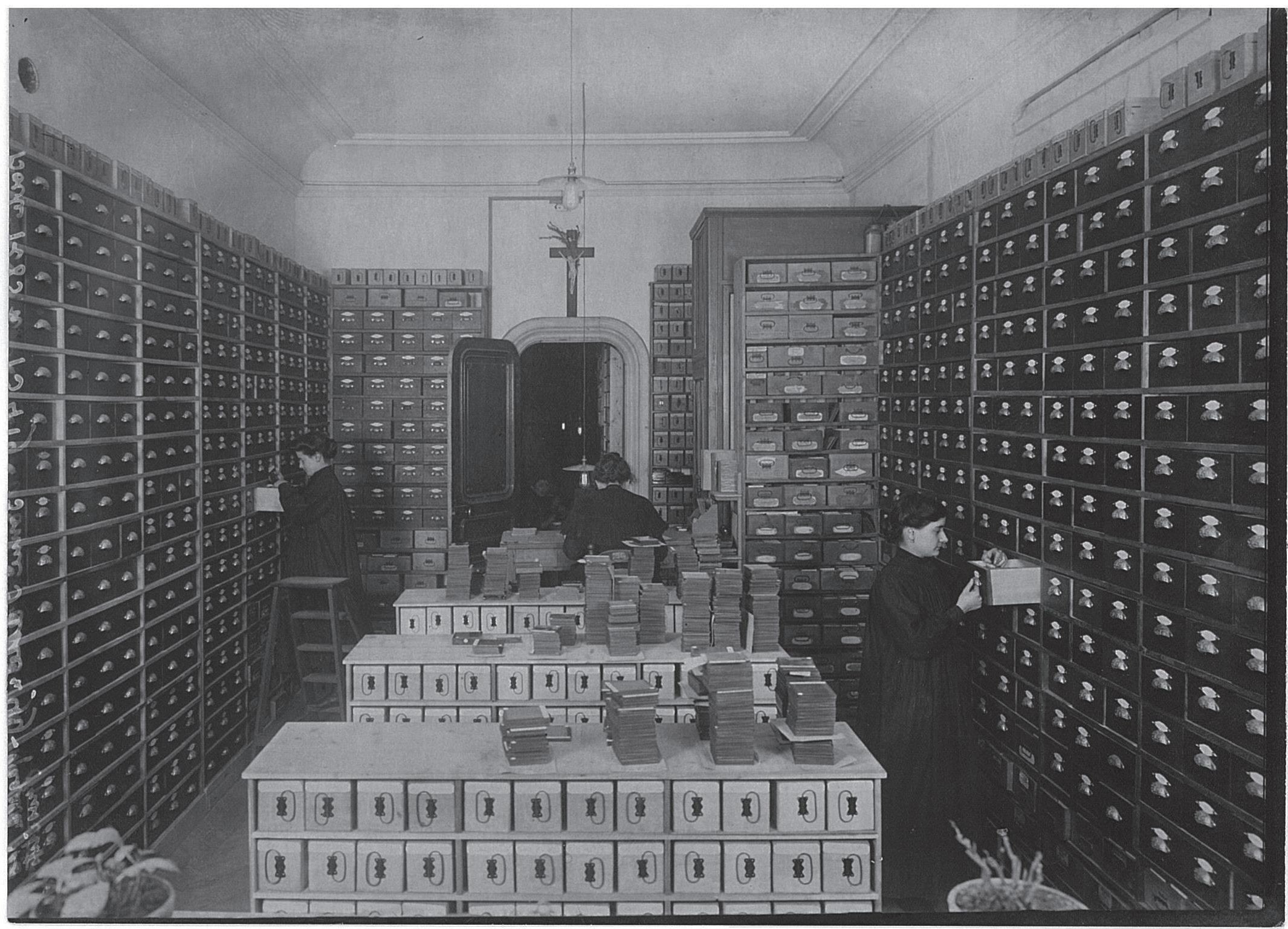
Fig. 3. Storage room for the diapositives at Maison de la Bonne Presse around 1910. (Source: Collection of the Archive of the Augustinians of the Assumption, Paris).
Honoré Brochet (1870–1948), were located on the ground floor of this building. Brochet, who used the pseudonym Honoré Le Sablais – referring to his home region in the Vendée – for his artistic activities, started working for Maison de la Bonne Presse in 1906 and was a creative jack-of-all-trades, as we can read in Le Fascinateur of 1909: ‘[…] who devoted his whole life to Christian theatre, to tableaux vivants, in a word to religious art in all its expressions. […] Father Honoré dreams of Christian cinema and theater’.23 Le Sablais was what we would today call a creative director and not only designed and directed life model slides (cf. Fig. 4) and films for Maison de la Bonne Presse – some of them produced simultaneously –, he was also a theatre director at Le Bon Théâtre,24 a painter, a writer of poems and scenarios, and a musician.25 Both Coissac and Le Sablais strongly believed in,
bart g. moens64
Fig. 4. ‘La prière de la petite aveugle’ (‘The little blind girl’s prayer’). Slide 7 of ‘Noël de la petite aveugle’ (‘The little blind girl’s Christmas’), Maison de la Bonne Presse, series of 19 slides, c. 1914. (Courtesy: Mundaneum collection, Mons).

Cinéma à l’âge du Muet’, Vingtième Siècle. Revue d’histoire 93.1 (2007): 165–66.
26 Cf. Paul Bresdin. ‘P. Honoré Brochet’, Lettre à la Famille 252 (1958), 78.
and advocated for the use of the lantern and film for the apostolic purpose.26 From 1912 on, they developed a lending service for motion pictures from the United States, Germany, and France. The films were carefully selected and censored when thought necessary.27
As was the case for the publishing of Le Fascinateur, the war also interrupted the other activities of the Service des projections for five years. Mainly focusing on the early years of Le Fascinateur, the studies of Véronneau, Saint-Martin, and Jacques and Marie André largely omit the further development of the journal, although it existed for almost another nineteen years. When the department was relaunched, Le Sablais succeeded Coissac – who became the co-director of Guilbert & Coissac – in October 1919 as the director of the projection service and the editor of Le Fascinateur. During that time, Le Sablais also installed the Bon Cinéma at 10, rue François Ier and created the Consortium des bons cinémas. But even in the 1920s, his main goal was to support the use of the optical lantern. When indeed the success of the cinema was well installed at the expense of the optical lantern, he praised the medium explicitly in 1921 in Le Fascinateur: ‘Lantern projection [projection fixe] will always have our preference, because we believe it is the most serious, most effective way to educate and do good. The still and well-explained images capture the attention and leave something in the mind. There is something pleasant, calm and restful in it,
27 Cf. Monsch. ‘La Bonne Presse et l’Audiovisuel’, n.p.
16 Beeldarchief Minderbroeders (OFM). Vlaamse Provincie Sint-Jozef. Glaspositieven van de fotoreportages van Piatus Wantz. Serie B: Het gewone volk. (BE/942855/1612/2045_105); text taken from slides 101 to 104.
greet de neef78
Slide no. 105 ‘Curetage des oreilles’ (‘Ear cleaning’): ‘A trade which is widespread in the cities is that of the barber. […] Many barbers prefer to wait for their customers, patiently sitting on their bench at a crossing. In the past, all the Chinese wore a braid; since the revolution of 1911 they have their head shaved completely bald with a razor, or “in the European way” […] When the hair reaches its desired length, the small hairs around are shaved away with a razor; even the forehead, eyebrows, and the back of the nose are shaved. Then, if you wish, the ears are cleaned: first, the guy pulls your ear back, scrapes the inside with a little bone and then cleans it with a little bit of cotton on a pair of pliers. But […] he uses the same little bone for everyone and I don’t recommend that you let this operation be done to you, you might regret it’.16

wouter egelmeers88
Although it is difficult to assess what proportion of educators implemented the optical lantern in their practice, discussions in educational journals suggest that, from the 1920s onwards, most Catholic educators fully accepted the optical lantern as a teaching aid for subjects like history and geography and further integrated it in their teaching. This was the case even in the face of contemporary controversy surrounding the assumed ‘corruptive’
Fig. 1. Projection of an image of a tsetse fly in an illuminated room by Joseph Gorlia in Nova et Vetera 1.4 (1912): 483. (All reproductions made by the author).

In a 1912 article, the physics teacher Joseph Gorlia introduced his colleagues to a number of self-designed solutions to the problem that most projectors posed in requiring darkened classrooms, which could result in unwanted behaviour amongst pupils. By means of two mirrors and a projection screen, Gorlia had found an ingenious way to project an image bright enough to be seen in an illuminated room, which he used with great satisfaction (cf. Fig. 1).29 Since the availability of commercially made educational lantern slides was limited, Gorlia advised his colleagues to widen the repertoire of projectable images substantially by making their own slides by photographing images from handbooks, or by adjusting their projection lantern to function as an episcope to project opaque objects such as postcards or handbook illustrations.30
29 J. G. [Joseph Gorlia]. ‘Projections Lumineuses’, Nova et Vetera 1.4 (1912): 477–93.
30 Ibid.
a debate in Catholic secondary school journal Nova et Vetera (New and Old, 1912-present).
The importance of the melodramatic mode of expression in early cinema has been widely demonstrated; in this study we have also attempted to identify and analyse the overwhelming
33 Ibid. In Film and Attraction: From Kinematography to Cinema, Gaudreault states that this particular scene is one of the most innovating ones in terms of the transition from an attraction-based cinema system to a narration-based one.
34 Gunning, D. W. Griffith and the Origins of American Narrative Film, 169–70.
again a dramatization of Zola’s L’Assommoir, entitled Drink. Film scholar Tom Gunning argues that ‘“The play within a play” format allowed Griffith to create the most extended twenty-shot-sequence of psychological editing in his career’.32 The powerfully emotional portrayal rests on intercutting spectator and stage play and forms in Gunning’s acceptation ‘a proto-point-of-view/reaction shot pattern’.33 As the curtain comes down on the play, the father is a changed man, going homeward with a firm determination that he will drink no more, which he promises his wife. The role of the theatre here creates a self-reflexive structure, the theatre becoming a moral and didactic medium, and an explicitly religious vehicle for ‘the most powerful temperance lesson’. Sermons in film became almost clichés in much of Griffith’s Biograph filmic output. The dramatic methods proper to the motion picture were commended by the Board of Censors. They had a priest preach the best sermon and bring a great temperance lecturer and instruct him ‘to make his best effort’.34 The lecture would be followed by two reels of film at the theatre, and if the public did not vote one of them a greater temperance sermon than the one the speaker had delivered, and the other a greater religious appeal than the sermon by Sunday, he would donate the money to a local hospital. One of the films referred for showing was The Drunkard’s Reformation (cf. Fig. 3).

Conclusion: The Melodramatic Mode of Expression as a Multimodal Aesthetic of Emotions
r eligious t emperance p ropaganda and m ultimodal a esthetics of e motion 165
32 Gunning. D. W. Griffith and the Origins of American Narrative Film, 165.
Fig. 3. Religious connotations in the booklet of the slide series ‘Un poison mortel’ (Collection Adeline Werry, left), on slide number 5 of ‘Un poison mortel’ (Courtesy: KADOC-KU Leuven, middle), and in a frame enlargement of D. W. Griffith’s film The Drunkard’s Reformation (screenshot from YouTube, right).


30 Cf. Guy Gauthier. Initiation à la sémiologie de l’image (Paris: Cahiers de l’audiovisuel, Ligue française de l’enseignement et de l’éducation permanente, 1984); Philippe Marion. ‘Les images racontent-elles? Variations conclusives sur la narrativité iconique’, Recherches en communication 8 (1998). Accessible at: https://sites. uclouvain.be/rec/index.php/rec/article/view/1631.
Fig. 2. The alcoholic’s rage. Slides 19 and 20 of ‘Un poison mortel’, Bijou Collection. (Courtesy: KADOC-KU Leuven. Collection: Archief Eucharistisch Catechistenwerk Ghent).


If we reconsider the same story from the perspective of monstration, a very different dynamic emerges. In ‘Un poison mortel’ in particular and in the Bijou stories generally, images which were autonomous in both visual and narrative terms alternated with images that required a necessary complementarity (or integration) with the textual anchor which stabilized the meaning. A good example of this necessary alternation of certain images is the scene where the artisan-turned-alcoholic messes up his job. This scene is legible without textual support, following the principle of integration with the preceding narrative. Images constructed following the principle of autonomy, on the other hand, show us actions that we can easily recognize, such as the anger of the alcoholic that goes on to destroy everything around him despite the frightened faces of his wife and children.
The images that follow the principles of autonomy or integration (complementarity with the narrative) do not necessarily correspond to the principles of intradetermination (self-sufficient monstration that does not require other images) or extradetermination (dynamically incomplete images that, monstrating clearly unfinished action or motion, call for new images).30 ‘Un poison mortel’ shows us that images can be extradetermined while, paradoxically, obeying the principle of autonomy. An example of this type of imagery is one of the scenes of the alcoholic’s violence, captured and distributed by many successive images, which express a consciously sought-after effect – dramatic acceleration of the tempo. A coherent succession of several poses describes the drunk’s violence (cf. Fig. 2). Each image is autonomous because they each reveal a significant aspect of alcoholism. They are simultaneously part of a narrative series of united images, as each scene calls for the next one (extradetermination).
t he e difying s tructures of the Bijou i maginary 179
Apart from this strictly narratological reading, the story should be viewed from the perspective of a cultural series of representations of alcoholism and inebriation, which
13 The well-researched catalogue of the exhibition about Hoffmann at the Historisches Museum Frankfurt in 1981 offers a detailed comparison between Kuwasseg and Hoffmann next to context about the shows; for the geology shows, cf. especially Detlef Hoffmann. ‘Malerische Wissenschaft’, in Laterna Magica – Vergnügen, Belehrung, Unterhaltung. Der Projektionskünstler Paul Hoffmann, edited by Historisches Museum Frankfurt (Frankfurt am Main: Dezernat für Kultur und Freizeit, 1981), 63–77. Cf. also the massive book by Detlev Hoffmann, and Almut Junker. Laterna Magica. Lichtbilder aus Menschenwelt und Götterwelt (Berlin: Frölich & Kaufmann, 1982) to get a picture of the collection of Paul Hoffmann’s lantern slides.
international fame through the magic lantern performances by Paul Hoffmann, who in 1858 started his geological program and toured the capitals of central Europe thereafter.13
According to Martin Rudwick, Édouard Riou ‘established the genre of scenes from deep time throughout the Western world’, continuing their influence even during the twentieth century.14 This is worth contemplating: whenever we see a dinosaur today, we are somehow looking at Riou’s 1863 etchings. His representations implied a human perspective on a world in which there never was a human to record the scene, nor would there be in the future. There was (and is) simply no other way to show and tell about deep time. It is in this regard telling that, around the same time, Riou’s marine reptiles also appeared in Jules Gabriel Verne’s soon to be legendary Voyage au centre de la Terre (Journey to the Centre of the Earth, 1864), where they figured in far more fantastic scenes. The ubiquity of the scenes proves their popularity and the decisive grip they held on the imaginary. Riou’s depictions of deep time indeed sat very comfortably in the middle of the continuum between fact and fiction, science and sensation. It should not come as a surprise that, as will be demonstrated below, lanternists and showmen eagerly responded to the magnetic and performative attraction of the series.

14 Rudwick. Scenes From Deep Time, 219.
kurt vanhoutte192
Fig. 3. ‘Vue d’une forêt et d’un marécage pendant la période houillère’ (‘View of a forest and a swamp during the Carboniferous period’), E. Riou. (Courtesy: IES Bárbara de Braganza Institute).
The ideal views activated formats, modes, and ideas from the realm of aesthetics, as the scientist at least partially gave over control to a professional artist. Nevertheless, Figuier did not proceed without care when he approached the artist. In fact, the main motivation to write La Terre avant le déluge was the author’s reluctance towards books

Fig. 4. ‘Apparition de l’homme’ (‘The appearance of man’), E. Riou. (Courtesy: IES Bárbara de Braganza Institute).
that wandered too far from the actual domain of science into the realms of the imaginary. The young generation was tainted by ‘the love of wonder’ and the ‘faculty of imagination’ urgently needed to be brought back into scientific service to promote ‘the naked truth’.15 Yet, as one of the greatest pioneers of his time, Figuier was also conscious that science popularization operated through an appeal to the senses and generated consent through visual imagery. He found Riou’s creations important enough in the marketing of the book to highlight the name of the artist in its subtitle. Riou’s drawings were not only meant to sharpen the appetite of the contemporary for new knowledge. The skills of the artist were above all directed at persuading the audience of the rightness of the argument. As such, the illustrations did not merely illustrate the text, it was rather the other way around with Figuier detailing prehistory on account of his describing what the reader saw when they looked at the pictures. The ideal views were in other words constitutive of the scientific argument.16 The portrayal of the first humans is a case in point. In what follows, we propose
deep time through the lens of the magic lantern: genesis and geology 193


15 Louis Figuier. La Terre avant le déluge, second ed. (Paris: Hachette et Cie, 1867), iv–vi. All the more surprising is Figuier’s introduction to his book, a fiery tirade against the culture of spectacle and popular entertainment. ‘Youngsters visit the theatre only in search of the féerie, the diablerie, the phantasmagoria and the allegory’ (iv). Figuier grumbles, detailing the catalogue of damned spectacles: ‘Puppet shows’, ‘the unchanging annual procession of revues-féeries’, ‘Chinese shadow shows’, ‘escamotages’ (especially Robert Houdin), ‘table-turnings and spirits’ (iii–v) – they spoil the youth and definitely expose them to ‘the invasion of an alternatively ignorant fanaticism or a menacing socialism’ (v). Figuier’s attack on ‘the love of wonder’ may easily be interpreted as a general aversion to the appeal of the sensuous. This is not the case, as Figuier wanted instead to divert the reader’s attention from the supernatural to nature itself, while preserving ‘the faculty of imagination’ (vi). This, however, required a new genre. With his scientific edition Figuier explicitly aims to move away from the fictional dialogues between scholars and the theatrical mise-en-scène of science, that ‘obsolete form’, that ‘genre vieilli’ (ix–x). He searched for and found that new genre in the ideal views drawn by Riou. Ironically, towards the end of his life Figuier would try his hand at writing plays for the theatre with legendary scientists as protagonists: cf. Fabienne Cardot. ‘Le théâtre scientifique de Louis Figuier’, Romantisme 65 (1989): 59–68.
16 Richard Somerset has analysed Figuier’s narrative strategies and the place of Riou’s images in it; cf. Richard Somerset. ‘Textual Evolution: The Translation of Louis Figuier’s La Terre avant le déluge’, The Translator 17.2 (2011): 255–74.
From its first appearance in the early nineteen-twenties, Catholic school teachers, priests, and Catholic youth organizations were quick to embrace the opportunities offered by film fixe (also known as diafilm, stopfilm, or filmstrip) (cf. Fig. 1). A film fixe is a spooled roll of 35 mm (sometimes also 30 mm) positive film about one metre long on which between twenty and fifty images are reproduced back-to-back in sequential order. These images are projected one by one, with the lecturer providing the necessary commentary. Closely
nelleke teughels210
all of these authors recognized the opportunities and ways to exploit the didactic and pedagogical possibilities offered by images.
4 Cf., for example, H. Derckx. ‘De kinema-plaag’, Het Katholiek Onderwijs 33 (1911): 542–47; V. R. ‘Het kinemagevaar’, Het Katholiek Onderwijs 35 (1914): 332–36; Les Choncq Clotiers, ‘À propos de Cinéma’, JOC 20 (17 May 1930): 306; Pius XI’s encyclical Divini illius Magistri of 31 December 1929; Pius XI’s encyclical Vigilanti Cura of 29 June 1936; Daniël Biltereyst. ‘The Roman Catholic Church and Film Exhibition in Belgium, 1926–1940’, Historical Journal of Film 27.2 (2007): 193–214.
Fig. 1. Various containers for and spools of films fixes (stopfilms) from the private collection of Hans Luyten. From left to right: films fixes by La Photoscopie, Centrale voor Projektie-Onderwijs, and La Cinéscopie. (Photograph by the author, reproduced with the permission of Hans Luyten).
This ambiguous attitude towards the visual would remain a constant in Belgian Catholic writing and practice throughout the nineteenth and early twentieth centuries, leading to a number of explorations of and experiments with modern media that all served the same goal: to gain and maintain ‘moral’ and educational control over image consumption and thereby to strengthen the influence of the Catholic Church over children and adolescents. During the interwar years, the Church was confronted with the relentlessly increasing popularity of film, which it considered to be one of the great modern dangers to children’s and adolescents’ morality and even their physical well-being.4 It struggled to decide on the most effective measures to take. Aside from various initiatives to adapt the themes and storylines of commercially produced films to Catholic standards of morality, this struggle also served as an incentive to explore other modern media that allowed for greater control over narratives and world views than film, but were equally enthralling to children and youngsters.

The Crusade Against Immoral Images
23 Cf., from 1935 onwards, the lists of films fixes published in La Société Anonyme La Cinéscopie. Les Films Cinéscope. Bulletin périodique pour la diffusion des méthodes nouvelles d’enseignement et de propagande (Brussels).
21 Cf. the lists of ‘films-stop’, as they were called by the company, published regularly in Le Fascinateur from 1926 onwards.
24 Frank Kessler, and Sabine Lenk. ‘Fighting the Enemy with the Lantern: How French and Belgian Catholic Priests Lectured Against their Common Laic Enemies Before 1914’, Early Popular Visual Culture 17.1 (2019): 89–111; Nelleke Teughels. ‘Expectation Versus Reality: How Visual Media Use in Belgian Catholic Secondary Schools was Envisioned, Encouraged and Put into Practice (c. 1900–1940)’, Paedagogica Historica (2021) (DOI: 10.1080/00309230.2020.1856153).
nelleke teughels214
22 According to the Brussels business guides, until 1928 the S. A. La Photoscopie was registered on Rue aux Laines 29 in Brussels, with engineer André Van Remoortel as its owner. In 1929, the firm had moved to Rue Berckmans 121. From then on, the S. A. La Cinéscopie was registered in Rue aux Laines 29, again with Van Remoortel as owner.
Presse for example offered mainly films fixes on religious (Roman-Catholic) themes.21 Likewise, the film spools produced by La Cinéscopie, apparently a Belgian spin-off of La Photoscopie,22 often drew inspiration from the Bible and the lives of saints and martyrs, although the company also offered series on geography, history, including history of art, and science.23
Fig. 2. A film microphote by La Photoscopie about Bruges (series 2), from the private collection of Hans Luyten. Suggested lecture notes were reproduced on the film before the opening image. (Photograph by the author, reproduced with the permission of Hans Luyten).
Ever since the end of the nineteenth century, the Catholic Church had felt it was under increasing attack from an ever-growing number of secular organizations (socialists, Freemasons, liberals, among others), spreading their ‘corrupting’ messages by means of illustrated lectures and motion pictures. Despite their enduring suspicion of images, the success of their enemies’ initiatives prompted Catholic educators and priests to fight them with their own weapons.24 However, this is not to say that the Church adopted an ‘if you can’t beat them, join them’ attitude: not every visual medium was met with the same enthusiasm. Ever since its emergence at the end of the nineteenth century, commercial cinema had been viewed with distrust by the Catholics. As the medium’s popularity increased, this distrust intensified: commercial films came to be regarded as sinful and highly dangerous by the Church, because of the presumed nefarious influence they could

evelien jonckheere226
below the stage as it projected light from the wings onto both glass and objects.5 A similar popular fin-de-siècle attraction was the serpentine dance. Here, too, several projectors were positioned in the wings and sometimes below the stage too, from where the light was projected onto the dress of the dancer on the stage.6 As with the projection of ghosts by Philidor, Robertson, and Pepper, hidden lanterns were still popular in fin-de-siècle attrac tions. They stimulated a magical or supernatural dimension, perfect to raise discussions on popular spiritual themes.7

6 For technical details concerning light projection in serpentine danses, cf. Hopkins. Magic: Stage Illusions and Scientific Diversions, II and 342–44. In Alber’s Grand Manuel de projection, serpentine dance is very briefly mentioned: Alber, Le Grand Manuel de projection, 214.
7 For more information on the characteristics of reflecting and transparent screens, cf. Hyacinthe P. Fourtier, La pratique des projections. Étude méthodique des appareils. Les accessoires. Usages et applications diverses des projections. Conduit des séances (Paris: Gauthier-Villars et fils, 1893), 1–11.
Fig. 1. Pepper’s Ghost stage set up in Brignogan, La Sorcellerie Amusante (Paris: Librairie Louis Chaux, 1898), 11.
5 For more information on details of the technology of the metempsychosis and the difference with the Pepper’s Ghost, cf. following publications that are the first to treat the illusion of the metempsychosis: Evelien Jonckheere, and Kurt Vanhoutte. ‘Métempsycose as attraction on the fairground: the migration of a ghost’, Early Popular Visual Culture 17.3 4 (2019): 261–78; Evelien Jonckheere, and Kurt Vanhoutte. ‘Spirits in the Fairgrounds: Métempsycose and its After Images’, in The Magic Lantern at Work: Witnessing, Persuading, Experiencing and Connecting, edited by Martyn Jolly, and Elisa DeCourcy (New York, London: Routledge, 2020).
Yet these fin-de-siècle ‘hidden lantern attractions’ are much less documented than those of the pioneers mentioned above. Nevertheless, the extraordinary Belgian Vliegende
‘ h idden l anterns’ in fin-de-siècle France and Belgium 227
Fig. 2. Fairground leaflet ‘Théâtre des Mystères et Merveilles’. (Courtesy: Ghent University, Vliegende Bladen – Collection, BIB.VLBL.HFI.F.032.05).

28 One of the driving forces was the Belgian Ligue de l’enseignement, founded at the end of 1864 in Brussels by Freemasons related to the free thinking circle La Libre Pensée with the active support of the future mayor of Brussels, Charles Buls, who in 1863 had studied the educational efforts of the Dutch association ‘Maatschappij tot nut van ’t algemeen’ in Amsterdam (cf. http://flandre.novopress.info/?p=663m, [accessed 29 August 2019]). The French Ligue de l’enseignement, founded by school director Jean Macé in 1866 in Beblenheim (Alsace), influenced
patented unique projection system: a ring of ten round glass plates fixed on a revolving disc resembling the erect tail of a peacock, allowing the lecture to be prepared beforehand, slides to be changed instantly and preventing errors in the viewing sequence of the slides (cf. Fig. 4). The full name of the supplier – The Pettibone Mfg. Co. Military & Society Goods – betrays the relation to the Civil War, with the supply of military goods being replaced by entertainment and instructional material. These companies were specialized in supplying lodges and associations as well as schools.
Teaching Rituals with Slides in the Temple
masonic slide cultures: teaching, meditation, optimization 247
As the slides found in European collections do not refer to where, when and by whom they were projected, it is difficult to say how many lodges on the ‘old continent’ used the lantern. But as Freemasons in France and Belgium were among those who pushed the use of projection in school, and as the anti-masonic movement in both countries is known to have organized lantern shows directed against their ‘enemies’,28 it is more than probable that slides played a certain role, not only in fraternal societies, but also in masonic lodges. In England, Freemasons were already using slides in the 1870s, initially for entertainment
Fig. 4. The ‘Challenge’ by the Pettibone Co. in the Robert Vrielynck collection at MuHKA with pictures from the ‘Damon and Pythias’-series, copyrighted in 1893 by W. L. Smith, member of the National Society of Lanternists. (Photograph by the author).

Edited by Frank Kessler, Sabine Lenk, Kurt Vanhoutte, and Nele Wynants
MediaTechnePerformance Histories
This series focuses on the intersections between media developments and performative culture since the early nineteenth century. The modern era witnessed a proliferation of media performances and exhibitions, encouraged by the burgeoning rise of science and technology, and supported by changes in transportation, communication, education, and social mobility. These popular events were part of nascent culture industries that took root in learning environments and lecture halls but also in theatre and opera houses, spilling out into public space, the boulevards, and the fairgrounds. Academics and science enthusiasts but also illusionists, artists, and amateur savants, all shared a knack for understanding what would entice different audiences, coupled with a delicate balance between scientific demonstration and sensational entertainment. While relying on international networks, media performances contributed to the circulation of knowledge, technologies, and visual culture between European cities and across the Atlantic.
Media Performance Histories explores the ways in which cultural change, new forms of knowledge, science, and technology were turned into modern spectacles that addressed different audiences and produced different modes of reception. It provides readers with a unique guide to how transnational performance created a culturally shared repertoire of signs and shaped modern Western culture. The books in this series offer accounts that cut across disciplinary and geographical boundaries, while being sensitive to how specific historical contexts and institutional circumstances constituted media and performance cultures. By also considering the interplay between present-day media performances and the archaeological traces that they carry, the series moreover aims to unearth previously overlooked but resurgent prehistories of so-called “new” media.
The series is situated at the intersection of performance studies, media studies, and the history of science. It welcomes edited collections and monographs on issues including (but not limited to) the interaction between media (archaeology) and performance; the role of theatre and performance in the circulation of knowledge; the way (early) media and technologies are staged; the agency of human observers as part of intermedial interactions or as part of viewing strategies.
natalija majsova is an assistant professor of cultural studies at the University of Ljubljana. She was a postdoctoral researcher in the B-magic consortium (Uni versité catholique de Louvain) between 2018 and 2020. Her research interests range from theories of culture and aesthetics, and memory studies to science fiction studies and (post-)Soviet film studies. 9 782503599083
Faith in a Beam of Light
sabine lenk (Universiteit van Antwerpen and Université libre de Bruxelles) is a film and media scholar. She has worked for film archives in Belgium, France, Germany, Luxembourg, UK, and the Netherlands. As one of the co-authors of the eos-research project B-magic, she conducts research on the educative role of the lantern in religious communities and spiritual circles. Together with Frank Kessler and Martin Loiperdinger she is a co-founder and co-editor of kintop, kintop Schriften, and kintop – Studies in Early Cinema.
Cover ‘Pastoraleillustration:deNoël’ (Maison de la Bonne Presse, 30 slides, 1911). (Courtesy: Collection Bart G. Moens).
An early visual mass medium, the magic lantern was omnipresent in most West ern societies between 1880 and 1930. The Christian Church, especially the Catho lics, spiritual associations such as the Freemasons, political interest groups, and teaching institutions, all made use of lectures enriched by projected images to disseminate information, convictions, and doctrines. Moreover, the lantern often featured as a concealed aid in stage spectacles. Eighteen authors analyse the effects of 'the beam of light in the dark' in the context of religion, faith, and belief. Attention is paid to the wide spectrum of locations where projections took place, as well as to the lantern’s impressive versatility. The lavishly illustrated chapters collected in this volume range from analyses of religious propaganda to fund raising lectures for missionary work in China, from the fight against alcoholism to the secularisation of society, and from the lantern’s application in spiritualist sessions to its use in science and teaching.
Magic Lantern and Belief in Western Europe, 1860–1940