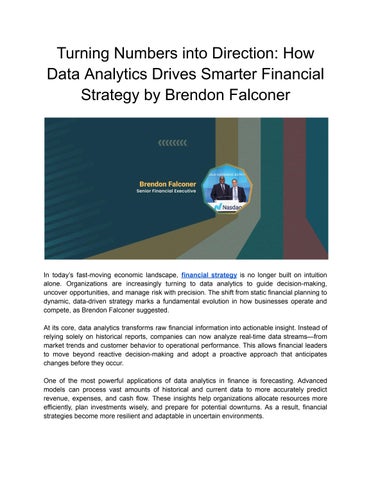
Turning Numbers into Direction: How Data Analytics Drives Smarter Financial Strategy by Brendon Falconer
In today’s fast-moving economic landscape, financial strategy is no longer built on intuition alone. Organizations are increasingly turning to data analytics to guide decision-making, uncover opportunities, and manage risk with precision. The shift from static financial planning to dynamic, data-driven strategy marks a fundamental evolution in how businesses operate and compete, as Brendon Falconer suggested. At its core, data analytics transforms raw financial information into actionable insight. Instead of relying solely on historical reports, companies can now analyze real-time data streams—from market trends and customer behavior to operational performance. This allows financial leaders to move beyond reactive decision-making and adopt a proactive approach that anticipates changes before they occur. One of the most powerful applications of data analytics in finance is forecasting. Advanced models can process vast amounts of historical and current data to more accurately predict revenue, expenses, and cash flow. These insights help organizations allocate resources more efficiently, plan investments wisely, and prepare for potential downturns. As a result, financial strategies become more resilient and adaptable in uncertain environments.