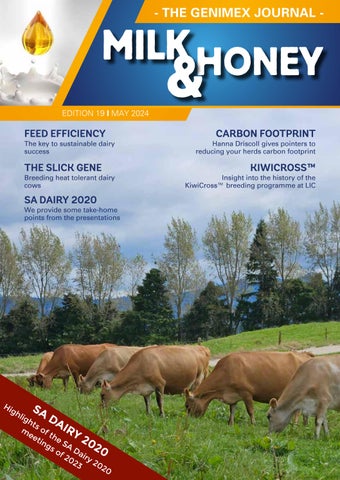
- THE GENIMEX JOURNAL -
EDITION 19 I MAY 2024
FEED EFFICIENCY
The key to sustainable dairy success
THE SLICK GENE
Breeding heat tolerant dairy cows
CARBON FOOTPRINT
Hanna Driscoll gives pointers to reducing your herds carbon footprint
KIWICROSS™
Insight into the history of the KiwiCross™ breeding programme at LIC
SA DAIRY 2020
We provide some take-home points from the presentations
Hi
gh
SA
D ht s o AI RY m ee f th 20 tin e S gs A of Da 20 20 iry 202024 23 | MAY GENIMEX | Milk & Honey 20
lig
1
Contents 4
Dr Jane Kay’s presentations at the Dairy 2020 meetings. Summarised.
6
Reproduction Management by Pete Wichman of the Armer group.
8
Feed Efficiency: The key to sustainable dairy success
10
Focus on: David Chin - LIC CEO
11
David Chin’s presentations at the Dairy 2020 meetings. Summarised.
12
Is mating twice a day better than once a day?
14
Deense Jersey Genetika Staan Sterk Wêreld Wyd
16
Reduce the Carbon Footprint of your Herd
17
Nuwedam Jerseys Wen Overberg Jerseyklub se Kuddekompetisie 2024
18
Focus on: Louise Helmer - VikingGenetics CEO
EASTERN CAPE | Hendrik Bezuidenhout Cell: 083 458 1709 | Email: hbez@telkomsa.net
19
VIKING JERSEY - The Jersey that fits future demands.
SOUTH & EASTERN CAPE | Johan Müller Cell: 082 807 1548 | Email: muller@capegs.co.za
20
The SLICK GENE Breeding heat tolerant Dairy Cows.
22
Take home points from the presentations of the Dairy 2020 meetings.
24
History of the KiwiCross™ Breeding Programme at LIC
26
The visit by Genimex to New Zealand, a few key photographs.
Genimex agents visit LIC
- MANAGEMENT GENIMEX OFFICE Tel: 081 818 5352 | Email: info@genimex.co.za | www.genimex.co.za Chris Cloete Tel: 081 818 5352 | Cell: 082 807 1433 | Email: chris@genimex.co.za
- SALES REPRESENTATIVES -
GAUTENG, SOUTHERN MPUMALANGA & NORTHERN KZN Ferdi Myburgh Cell: 060 858 2122 | Email: ferdi.myburgh.11@gmail.com SOUTHERN CAPE | Willem van Lingen Cell: 082 375 1252 | Email: willemvanlingen@telkomsa.net EAST SOUTHERN CAPE | Shawn Buckley Cell: 082 828 8481 | Email: ebuckley@telkomsa.net KZN MIDLANDS | Britt Stanton Cell: 082 575 9387 | Email: britt@genimex.co.za MPUMALANGA, GAUTENG & EXPORTS Simon Alderson-Smith Cell: 083 379 4656 | Email: simon@genimex.co.za EAST LONDON | Dave Swift Cell: 083 440 7291 | Email: swiftfamily@discoverymail.co.za EASTERN CAPE | Elizna Erasmus Cell: 071 605 9317 | Email: elizna@genimex.co.za
2
No portion of this newsletter may be reproduced in any form without the written permission of the publisher. Views and opinions expressed in Milk & Honey are those of management and any relevant information seemed fit to project Genimex views and interests in the dairy industry. They can accept no liability of whatsoever nature arising out of or in connection with the contents of the publication. Many of the articles placed have been edited. Complete article are available from the editor.
GENIMEX | Milk & Honey | MAY 2024
Foreword BY CHRIS CLOETE
Louise has not been to SA yet but she is scheduled to visit us in June this year. I, together with the rest of the Genimex staff, really look forward to welcoming her and showing her some herds that have so successfully used the genetics from VikingGenetics. This edition of M&H is filled with the “Positives” of breeding great dairy cattle.
It is indeed a pleasure and a privilege to be involved in a part of an industry that bases its daily discussions and actions on the positives. In the livestock breeding industry we are continually talking about better, profit, improvement, efficiency, success, and a better future. We at Genimex, together with our two suppliers, stand for BREED IMPROVEMENT. We go about our daily lives trying to make things better for our clients, we want our clients to have better cows, that are more profitable, fertile and efficient. We celebrate with a client when they use less semen to get cows in calf. One negative in the dairy livestock breeding industry, which I have written about so many times, is the dairy farmer that believes it is OK to buy on price alone. The semen agent ties him/her down to taking whatever bulls he has in his flask that day, regardless of their genetic value or if they fit a breeding plan, or not. These clients generally do not have a plan and it is all about “getting cows in calf” as the bull does not matter. I have news for them, the bull does matter and there would not be a multimillion-dollar industry involved in Genetic improvement if breeding better and more efficient cows was not possible. There are of course consultants that advocate using cheap semen to “just get the cows in calf” in order to look good on the short term budget. They conveniently forget about the long term damage to the profitability of the herd. To continue on my thoughts of the livestock breeding industry being such a positive space, I have, in this the 19th edition of M&H, featured the persons in charge of our two suppliers. Louise Helmer of VIKINGGENETICS and David Chin of LIVESTOCK IMPROVEMENT CORPORATION NZ. From their articles you will note it is all positive and about making a better future, for people, livestock and the environment. David was a key speaker at the Dairy 2020 workshops we hosted last year and I have included summaries of his presentations in this edition of M&H.
GENIMEX | Milk & Honey | MAY 2024
Hanna Driscoll of VikingGenetics writes about matters that are very much on their radar, efficiency and carbon. Then, there is a really exciting development around breeding heat tolerant dairy cows. LIC determined the position of the SLICK gene on the genome and is now taking it the next step. See the article by Gemma Worth of LIC. What would an edition of M&H be without the assistance of Dr Joyce Voogt of LIC who is always so willing to help source and edit articles to publish. Once again, our very own Johan Müller writes about a visit by Peter Larson of VikingGenetics and the success stories in the Cape. Thank you, Johan. “Tempus Fugit” Yes, we are all under pressure to have time to do what needs to be down. I however felt that time needs to be made to take the Genimex sales staff to visit our suppliers. It was time to talk face to face and see first hand what is going on in New Zealand. A very big thank you to all at LIC that made the visit a resounding success. The trip to LIC took place in March 2024 and I have included some photos of the trip in this edition of M&H. The trip to VikingGenetics is scheduled for October 2024 which is certainly worth the wait and we are all looking forward to it. As I have said, it is all about positives and progress. Use the right sires, use them widely and you will make small but cumulative improvements year after year. We have just been through a period where getting semen into the country has been a challenge due to delays in the issuing of import permits. Genimex has come through rather well with not only having enough semen available for this Autumn season, but also having the right semen available. We are already lining up our shipments for Spring. We thank our clients that work with us in getting their orders in on good time, it just helps us plan. It is our unwritten brief to supply the right sires at the right time in the numbers that are required to enable our clients to breed better cows. LIVESTOCK IMPROVEMENT. I hope and trust that you enjoy this the 19th edition of the Milk & Honey and you find value in it for your business. Chris Cloete
3
SA DAIRY 2020 SUMMARISED
Jan de Jong
SA DAIRY 2020 MEETINGS 2023
Dr Jane Kay is a Principle Scientist for DairyNZ, and as such, it is obvious from her presentations that this position covers a broad range of subjects, all benefitting the NZ dairy farmers. While some subjects may at this stage seem theoretical, most can easily and quickly become of importance due to the way in which politics is moving.
Interesting that South Africa has, as far as I can remember in the days of the Dairy Board, never had a scientific researcher (but there was an Agricultural Economist) which means that there was no farmer funded applicable and direct industry research for South African dairy farmers. The government and commercial companies did research on behalf of the industry. How practical this was can be questioned. Researchers did it to try to get papers published, and companies did it to sell dairy meal. There is at least one excellent researcher still doing pasture research in the South Western Cape. How many others we have in this country is unknown.
Research in NZ shows that the increased margin of NZ$300.00 per ha of the top 25% of dairy farmers is due to better utilisation of pasture – how much more forage was utilised compared to other farmers. Increased utilisation is a factor of planned date of calving (having forage available when required), when cattle dry off (not having excess forage after that date), early removal of cull cows, stocking rate and how excess forage is stored (no wastage). In other words, control of quality, supply and demand of forage, coupled with tight cost control were also seen as factors of profitability. It was shown that tight cost control trumped production for profit. This was proven by the fact that for every $1.00 spent on “imported feed” (in SA we refer to purchased feed) expenses were between $1.53 and 1.68 higher. This means that return on imported feed has to be over $2.53 to $2.68 more than no supplementary feeding to be financially feasible.
Dr Jane Kay, Principle Scientist at Dairy NZ
We are thankful that, with a small degree of tweaking, many of the points raised by Jane could be applied here today in SA. In an agricultural scenario the efficient production of a commodity is impractical without sustainability, combined with acceptable production techniques. A major part of sustainability is profitability and the ability to try to be more efficient than the chap next door in order to hopefully buy his farm to increase the size of your operation, thereby increasing your scale of production (economies of scale) and building a more resilient business. Linked to the competitivity and resilience which one needs for success is being able to accommodate change. Profitability measures depend on the production system that you use - for example, in a Total Mixed Ration (TMR) scenario efficiency measures may be production per kg ration fed, margin over feed costs or suchlike, whereas in a pasture based system efficiency measure is kilogram milk solids/ha (kg/MS/ha).
4
Further research showed that additional feeding could increase marginal costs by up to $5.36/kg MS and $6.66/ kg MS for Palm Kernel supplement and other supplements respectively for MS/ha production increases of 22.9% and 30.3%. Work by Ma et al. (2017) also showed that moving from a lower input system to a higher input system significantly increases milk solids and revenue, but this movement had no significant impact on operating profit. All the New Zealand dairy success could not have occurred without an adapted production unit. Cross breeding research started in 1972 at Ruakura, possibly the beginning of the KiwiCross™ breed? The project showed that the suitable cow for the NZ system was different from that of other countries – it must be mobile, able to graze pasture, and get into calf within 80 days of calving. Further requirements have emerged over time: the animal had to be an efficient producer of high solids milk, fertile and be long lived. Longevity will only be achieved if the animal is able to fit into the production system. It is a complement to the original researchers that the cow that has emerged today had at least two of the original characteristics: mobility and fertility. GENIMEX | Milk & Honey | MAY 2024
SA DAIRY 2020 SUMMARISED
Jan de Jong
implementation when the US, Russia and China seem indifferent to the problem is baffling. On top of this, NZ is in the process of levying Green House Gas taxes on farmers (these are being abetted by large international dairy companies like Nestlé) in addition to the misguided sale of carbon credits – this is chiefly in the form of purchasing currently productive dairy farms and planting pine Labour problems have long beset the New trees. End result of this strategy are large belts Zealand industry, as with many dairy producing of sterile homogenous forests with no degree enterprises worldwide. There is probably no of differing ecosystems (homogeneous The other agriculturally related enterprise with forests replacing multi species pasture, newest such anti-social hours, and the inability to natural grazing and scrubland), and research is more attract young entrants. simultaneously decreasing food security, flexible milking Efficiency at farm level is a combination work opportunities and financial wellbeing hours - less of different factors, of which leadership, in local towns and villages. milkings. actual on the job experience (and mastery of It is these government policies that are driving the task), autonomy and reliability are some. the industry to conduct CH4 related research on This is a place where the ability of management heritability of CH4 production, variability between at all levels in New Zealand dairy farming operations high and low methane producing bulls and low methane has proven positive, and structured training systems are producing cows. in place at farm level. Leadership and actual knowledge of mundane tasks enables management to teach new South Africa’s current problem are the envisaged changes recruits, while also being able to add value in case of to the Water Act: the purpose of the amendments is to mistakes. The New Zealand system of share milking effect “reforms in relation to equitable allocation of water is a method of attracting and keeping highly motivated use, as well as to amend the procedural requirements entrants in the industry, something that is lacking in related to applications of new water use licenses South Africa. With the difference in persona milking on including reviewing of timeframes and fees linked to most South African farms and our poor levels of training license application”. I foresee that this can only mean it is hardly surprising that knowledge, motivation and access to water rights will be skewed towards those reliability are considered problematic. Part of the problem who have access to officials and cadres. Investment in could probably be laid at the feet of some South African water infrastructure will decrease, finance from financial dairy managers, how many have actually been in the pit institutions will be more difficult to obtain, and food for an extended period of time? security may ultimately suffer. With changes we see occurring worldwide today, further pressure to adapt will be equired, along with the ability to decrease methane (CH4) production as a way of satisfying those zealots riding the Green House Gasses (GHG) and global warming scenarios. Further discussion regarding the NZ approach will be briefly covered later.
Due to the shortfall of 4,000 dairy workers in NZ (and this figure is only on farm milkers, not tractor drivers, fencers etc.), there is ongoing research being conducted to find more sociable work hours (and decrease work hours), make the job easier and safer through the use of technology. The aim is to attract and` keep skilled people in the industry. Automated milking systems (robots), automated cluster removal and teat spraying and automated gates have no doubt decreased labour required, but time at work is still a factor. Systems being tested are once a day (OAD), 3 in 2 (3 milkings in 2 days) and 10 in 7 (10 milkings in 7 days). Effects of this timing on yield (20% decrease, 5% decrease and 29% decrease respectively) are offset by better body condition scores (BCS), overall better animal health, reduced lameness, and better staff wellbeing due to flexible hours and reduced working hours. Cows also settle quickly into a new routine, which may be introduced at any part of the lactation. Further points discussed were the Environmental Footprint and wearables, or data transponders. While environmental research is not big in South Africa, applied research in other countries means it is possible for us leverage off applied research as most research is scalable. Why exactly New Zealand, Ireland and the United Kingdom are at the forefront of Carbon Footprint GENIMEX | Milk & Honey | MAY 2024
The New Zealand government has become one of the most progressive (and I use the word advisably) in terms of GHG and its way of dealing with Methane (Ch4) from livestock emissions, but this is largely at the expense of agriculture, as agriculture is traditionally a “soft touch”. Technology has allowed easier data capture methods to monitor cow activity (for oestrus), rumination, grazing time and heat stress by the attaching of “wearables” (collars, on legs, ear tags or boluses). The downside is how a farmer uses this plethora of data, and the question of value adding occurs. This investment could often be more profitably applied by investing in infrastructure to alleviate the negative results of the data. For example, if heat stress is a factor, additional access to water resources may be a cheaper option. A positive cost / benefit outcome must be established. Jane Kay’s talks were wide ranging and covered advances in New Zealand thinking. This is not to say that these matters will not affect South African farmers at some time. It only takes a person (or more likely, a group of people) to think of a populist matter and a small but vociferous “green” or “woke” group can really make a farmer’s life a misery relatively quickly. It means that Agriculture will need to develop methods to understand how to deal with unenlightened, impractical, vociferous and illogical persons who believe that their ways alone can feed the world. 5
SA DAIRY 2020
Pete Wichman
REPRODUCTION MANAGEMENT Pete Wichman presents at the SA Dairy 2020 meetings 2023 THE PLAN
Set Up
Pregnancy Checking
Dry Off
7 Step Plan Calving
Bull Management
Artificial Breeding
The Set Up
Dry Off
Targets by 1 June
• Cows are dried off due to grass growth rates (not to cow condition)
Grass Target covers 2,300 kgDM/ha Cow Condition 4.2 (~2.8 in SA) Body Condition Score
6
Heifer Management
• First 7 days - dry cows are given 7kg DM/cow to shut the udder down • From then cows are given 13kg DM/cow for 70 days (to start of calving) • Cows should go from 4.2 to 5 BSC during this time.
GENIMEX | Milk & Honey | MAY 2024
SA DAIRY 2020
Calving • 10 days before calving, dry mobs are broken into springer mobs • Springer mobs given 10kg DM/cow until they calve • 10kg DM/cow are given in the colostrum mob • 15kg DM/cow is the start of the spring rotation planner for milkers • Feed is increased to 18kg DM/cow when grass growth hits 50kg DM/ha and NOT before (~10 Sept)
Artificial Breeding • No CIDRs • No Metricheck • No intervention
Pete Wichman
Heifer Management Whole herd is milked TAD until 20th September 20th Sept they are split into 2 herds: 1) Heifer mob and young cows 2) Older cows • Heifer mob are milked OAD from 21st of September (3 weeks before the planned start of mating) and milked OAD for the rest of the season.
Bull Management Bulls are put out with the cows after AB 17 bulls per 500 cows Bulls come out of the herd on 21st of December
Tail paint applied 1 day before AB starts (12th of October) Blue = non mated cows Red
= mated cows
Heat detection training is done on the first day of mating • Done behind the backing gate AB goes for 4 weeks 5 days
Pregnancy Checking All cows that are mated up to 1 December are PD on 12 January (42 days), • We expect to have 84% of PD cows in calf • 16% rechecks (can’t determine if cow is in calf or not) NOTE: the 16% rechecks can be culled depending on grass growth (22% 2yr old heifers coming into the herd to replace them) 28 days later, rechecks are PD. We expect 6% of this group to be incalf, 10% not in calf. Culls leave the farm 1 day after rechecks to fit into the works schedule (1,500 cows)
OVERVIEW
Pete Wichman (Contract Milker at the Armer Group) and AB Technician for LIC inseminating 4000 cows in the AB season, during his presentation at the SA Dairy 2020 meeting.
GENIMEX | Milk & Honey | MAY 2024
• 4 weeks + 5 days AB
• 17 bulls per 500 cows
• 5 weeks with the bull
• No rotation of bulls
7.5% - 10% empty rate
7
FEED EFFICIENCY
Hanna Driscoll, Product Manager, VikingGenetics
FEED EFFICIENCY:
the key to sustainable dairy success The world has put dairy farmers and their cows under a magnifying glass. Public scrutiny of food production’s environmental footprint has never been more intense. Finding ways to maximise farm returns while reducing emissions is more important than ever. Identifying your most efficient feed-converting cows plays a vital role in sustainability by reducing farm waste and ensuring maximum farm returns. Using the Saved Feed Index, you can breed more feedefficient and climate-friendly cows, all while achieving high production and maintaining good health and reproductive performance. The Saved Feed Index is based on data collected by the Cattle Feed Intake System (CFIT). This advanced AI-based system uses recycled 3D cameras and deep learning to monitor and measure feed intake in a cow’s natural environment during lactation. With highly reliable feed-efficiency data, you can make well-informed decisions that enhance feed efficiency, reduce costs, lower emissions, and simplify your daily tasks on a farm.
#
Feed, kg Kg ECM Kg Methane Kg Methane DMI milk / cow / cow / per kg ECM / year year* milk / cow / year
IDENTIFY THE TOP PERFORMERS IN YOUR HERD The data reveals a significant difference in the level of profitability among the individual cows in the herd. The best-performing cows have a 3-4 times higher contribution margin (CM) than the worst-performing cows within the same herd. Data from 11 CFIT herds in Denmark shows that, on average, the difference between low and high-efficiency cows is 18,400 € per year. Caeli Richardson PhD, Plant and Animal Geneticist at AbacusBio, also vouches for the system’s benefits after seeing it in action during a visit to Denmark. “Having individual feed and weight measurements on commercial cows allows our industry to enter a new level of precision farming,” she says, highlighting the advancements enabled by the CFIT system. “Looking at the results from just those 11 herds really shows us that we are missing out on profit if we ignore selection for feed efficiency,” she adds. Average Contribution margin (CM) / cow / year, €
Lowest CM / cow / year, €
Highest CM / cow / year, €
Best- vs. worstperforming cow – times difference
€ 1,044
€ 3,263
3.1
1
7,794
11,776
155
0.0132
€ 2,307
2
7,979
10,674
159
0.0149
€ 1,913
€ 862
€ 3,317
3.8
3
7,391
10,699
147
0.0137
€ 2,036
€ 1,046
€ 3,555
3.4
4
7,571
11,004
151
0.0137
€ 2,100
€ 919
€ 3,195
3.5
5
7,518
11,017
150
0.0136
€ 2,114
€ 831
€ 3,565
4.3
6
8,214
10,665
163
0.0153
€ 1,864
€ 809
€ 3,272
4.0
7
7,543
9,543
150
0.0157
€ 1,631
€ 830
€ 2,639
3.2
8
7,807
12,240
155
0.0127
€ 2,456
€ 1,102
€ 3,515
3.2
9
8,420
13,189
167
0.0127
€ 2,645
€ 1,141
€ 3,634
3.2
10
8,257
12,062
164
0.0136
€ 2,310
€ 953
€ 3,347
3.5
11
8,374
13,437
167
0.0124
€ 2,734
€ 1,119
€ 3,655
3.3
8
GENIMEX | Milk & Honey | MAY 2024
FEED EFFICIENCY
Hanna Driscoll, Product Manager, VikingGenetics
BENEFITS FOR THE ENVIRONMENT Research into greenhouse gases indicates that, on average, 6% of the energy that a cow eats is spent on producing methane. However, this varies from 2-12% depending on how feed-efficient the cow is. Data from the 11 herds also show a significant difference in methane emissions. The best-performing herd has 26% lower emissions per kg ECM milk produced than the worst-performing herd.
from mid-lactation would lead to a situation where feed efficiency is compromised rather than improved,” he adds. To create a reliable Saved Feed Index, it is essential to have data available throughout the entire lactation. The data obtained from CFIT farms provide valuable information spanning the full length of each lactation. BREED FOR MORE FEED-EFFICIENT AND CLIMATEFRIENDLY COWS
Methane production (calculated based on the model used for reporting climate impact to the United Nations’ Climate Panel) ranges from 147 to 167 kg of methane per cow annually across the herds.
With the Saved feed index, you can breed for more feed-efficient and climate-friendly cows – without compromising on the production, health and reproduction performance of your cows.
DATA THROUGHOUT THE FULL LACTATION
For the Saved feed index, the daughters of two bulls with a difference of 20 index units will have a difference in dry matter intake (DMI) of 70-100 kg per lactation.
A cow’s physiology changes dramatically through lactation. In the early stage of lactation, cows transition from not producing milk to a potentially high milk yield. This phase is particularly unstable for the cow.
EBV 120 means reduction in feed consumption – kg DMI per year.
It is especially important to have extended data for cows’ weight and feed intake for early lactation, as cows are more susceptible to diseases during this period. CFIT data provide insights into the weight change during the first seven weeks of lactation. The table shows the breed averages for weight loss by parity for Holstein, Jersey, and Red Dairy Cattle. Weight change during the first seven weeks of lactation Breed
1st lact.
2nd lact.
3rd lact.
Holstein
-12 kg
-12 kg
-15 kg
Jersey
-13 kg
-12 kg
-17 kg
Red Dairy Cattle
-11 kg
-17 kg
-24 kg
Ensuring adequate energy in the feed ration prevents excessive weight loss and promotes improvements in production levels and the overall health of cows. As lactation progresses into the mid and late stages, the cow becomes accustomed to high milk production and the corresponding feed intake. “Previous studies indicate that feed intake differs between early, mid, and late lactation,” says Jan Lassen, Project Manager at VikingGenetics. “Merely having data GENIMEX | Milk & Honey | MAY 2024
Viking Holstein
VikingRed
Viking Jersey
100 cows
16,400
19,600
13,400
200 cows
32,800
39,200
26,800
500 cows
82,000
98,000
67,000
1,000 cows
164,000
196,000
134,000
MORE DATA, MORE FEED-EFFICIENT COWS Currently, the CFIT system is installed across 25 commercial herds, which collects data from over 14,000 cows, including VikingHolstein, VikingJersey, and VikingRed. The amount of feed intake data is consistently growing. The goal is to have feed intake data for 30,000 cows by 2025 for the three major dairy breeds – Holstein, Jersey, and Red Dairy Cattle. VikingGenetics leads the way with a Saved Feed Index as the only company in the world to offer a feed efficiency index for Jersey cows and Red Dairy Cattle. Dairy farmers across the Nordic countries and over 50 markets where VikingGenetics operates are already reaping the benefits of breeding for improved feed efficiency. 9
FOCUS ON...
David Chin, CEO of LIC
DAVID CHIN CEO
Livestock Improvement Corporation (LIC) In the realm of agricultural innovation, one name stands out: Livestock Improvement Corporation (LIC) of New Zealand. At the helm of LIC is David Chin who took on the role of CEO in 2022 and brings with him a wealth of industry knowledge - as can be seen from the roles that he has fulfilled during his time at LIC. With his strong communication skills and experience, he is well suited to lead LIC into the future to provide solutions for the challenges facing the dairy industry. THE CHIEF EXECUTIVE OFFICER: 2022 – PRESENT PIONEERING BIOSECURITY EXCELLENCE: GENERAL MANAGER, OPERATIONS AND SERVICE (2018 - 2022) During his tenure as General Manager, Operations and Service, David led LIC’s response to the biosecurity challenge of a M.bovis outbreak in New Zealand. This led to the successful implementation of LIC’s M.bovis biosecurity programme, which not only safeguarded the livestock industry, but also earned LIC the prestigious Biosecurity NZ Industry Award in 2019. This award underscored LIC’s unwavering commitment to protecting the health and wellbeing of New Zealand’s dairy sector. DRIVING CULTURAL TRANSFORMATION: CHIEF TRANSFORMATION OFFICER (2016 - 2018) As Chief Transformation Officer, David orchestrated a shift within LIC, delivering $45 million of incremental cash within the first 12 months. More than just financial gains - David catalysed a cultural transformation resulting in a significant improvement in LIC’s Organizational Health Index score putting LIC in the top quartile of businesses worldwide. INNOVATING SALES STRATEGIES: TERRITORY MANAGER (2014 – 2016) In his role as Territory Manager, David implemented a Solutions Selling framework. He was recognised with the well-respected CEO Award for excellence in genetics extension and data presentation. ELEVATING STRATEGIC PARTNERSHIPS: LEAD KEY ACCOUNTS MANAGER (2010 - 2014) David led strategic initiatives that significantly bolstered LIC’s revenue and market presence within the corporate farming segment. He also implemented a successful Rapid Prototyping programme and developed LIC’s Iwi Strategy. 10
REVOLUTIONISING MARKETING: CORPORATE MARKETING MANAGER (2008 - 2010) As Corporate Marketing Manager, David was responsible for the commercial launch of genomically selected sires in 2008. The campaign resulted in over 600,000 straw sales in the first year and he was recognised with a CEO Award for his focus on improving the understanding of the Breeding Worth index. EMBRACING INNOVATION: PRODUCT MANAGER (2006 – 2008) In his role as Product Manager, David launched innovations such as single sample Herd Testing and BVD Antigen ELISA testing. WHAT DOES THE FUTURE HOLD? At the core of LIC’s purpose is a commitment to ensuring the profitability of their farmers, achieved through continual advancements in herd improvement. A focal point of this effort is optimising cow efficiency - which is all about getting more milk solids for every unit of feed consumed. For LIC’s global farmers, the commitment remains the same - to provide superior grazing genetics characterised by high milk solids and a robust fertile cow that will last in herds. Domestically, LIC is collaborating closely with Fonterra to reduce scope 3 emissions by 2030 through genetic gain, improved reproductive performance, and enhanced animal health. This year also marks an exciting milestone as LIC launches a new genomic testing service to New Zealand farmers and advances their research on breeding low methane-emitting cows. Looking further ahead, LIC should also have high genetic merit heat-tolerant bulls available by 2030 as a result of advancements in LIC’s heat tolerance programme. All of this means that LIC’s farmers are well set up to be profitable now and into the future. GENIMEX | Milk & Honey | MAY 2024
SA DAIRY 2020 SUMMARISED
Jan de Jong
DAVID CHIN
Presents at the SA Dairy 2020 meetings 2023
and budgets. These would be controlled and managed by The way the product is produced varies greatly, NZ has senior team members, in conjunction with unit managers. a low input, virtually unmechanised, simple system with Semi - permanent or long - term strategic planning would very little labour component but with increasing political fall within the ambit of the farm owner or enterprise involvement. South Africa has (in general) a system with manager. These are items such as dairy unit planning, strong machinery involvement, a relatively high labour irrigation planning, physical planning and even component, rations that may have many additives additional land purchases. In other words, available and low government involvement, permanent farm investment. to the extent that veterinary controls do At not operate, even OBP (Onderstepoort The ultimate objective of this planning, face value Biological Products) cannot make or briefly described, is how finite resources the only similarity deliver vaccines at present. are allocated: who does what, when. between what a South No slacking and dodging responsibility New Zealand relies on a pasture forage African dairyman is possible. The job is defined to a system, if supplements are fed, they and a New Zealand person or team. are bought in and fed at low levels dairy operator do is to predominantly extend lactations. Jan Bonsma, the developer of the produce the same Our systems rely largely on purchased Bonsmara cattle breed had the adage: commodity. concentrates and home - produced inputs “Man must measure”, basically the same to increase production levels. as Peter Drucker, a business guru of the 1960’s, who wrote: ‘’What gets measured gets Seasonal production and low inputs have managed”. Applying this, most large businesses have generated a system that has enabled New Zealand report backs or monthly reports, which can be painful to be a world leader in dairy product production despite processes depending on the format used. Physical data its unfavourable geographical position. South Africa can at unit level should be easily collated, presented monthly leverage off these advantages and other practices of with actual versus budgeted in a single page report successful producers in certain respects to our advantage. mostly in graphic and tabular format with very little writing Management in a low - cost production system entails no and verbiage. With good systems these reports should be rocket science, just basic good planning and control. painless to prepare, be accurate, objective and of benefit South Africa has any number of units that have grown over to the operation. the last three years, to the extent that the average farmer In South African Afrikaans the term “voorman” denotes is milking 1000 cows or more, and units can rightfully be a foreman, a person who dutifully reported to somebody classed as corporate structures. The question thus arises, above him. This was a person who could never develop are we correctly managing these units as such. Cigarette – that person was not empowered to make decisions, box calculations will not cut it now, nor will shoddy manage or improve skills. At today’s levels, and with planning. At least not if a sustainable large scale, multiple the salary that Dairy managers are paid, one would not dairy site operation is the aim. want a foreman, but a person who could operate with Until now, most planning has been at central level, the energy and precision in his environment, taking decisions farm owner or his accountant (with input very often and uplifting those below him. With a large operation from the Agricultural banker). Problem is that all planning mundane decision making is correctly taken out of the is often considered as an annual event, which it is not. hands of the top echelons of the business. Some planning is annual (production orientated – health How the business operates and the success with plans, heifer rearing plans, mating decisions and dairy which it works depends on how problems are dealt consumables) and should theoretically be planned by with at production level by staff. The speed at which the person involved – the dairy or unit manager. These these unforeseen problems (these are not challenges, costs, financial requirements and husbandry policies are challenges are just polite political speak for a snafu) are “uploaded” to those at higher level. handled and solved is an indication of how the staff are Longer term planning would relate to forage, fodder appreciated, empowered and trained. planning and genetic strategy, multi - year enterprises GENIMEX | Milk & Honey | MAY 2024
11
MATING ONCE OR TWICE A DAY?
David Hale, LIC national AB manager
ARE 2 AB TECH VISITS BETTER THAN 1?
In Spring of 2020, LIC undertook what’s believed to be New Zealand’s first robust trial to determine whether a twice-daily AB tech service would improve conception rate, getting more cows in-calf.
Scientific results showed there is no case for increasing daily visits by LIC AB Technicians. In other words, there was statistically no significant difference between the twice-a-day (TAD) and once-a-day (OAD) groups in conception rate, either within, or across herds (see table 1, below). The 8000-cow trial took place across four separate farms on Rakaia Island in Canterbury.
Cows were split into two groups: • Cows with even-numbered tags were visited by an AB technician twice-a-day (AM and PM) • Cows with odd-numbered tags were visited by an AB technician once-a-day (AM only) All inseminations followed oestrus that was initially picked up using collar technology as the heat detection device. More than 9100 inseminations were completed during the six-week trial. Although both groups of cows were inseminated oncea-day, the cows that were serviced by an AB technician in a twice daily visit were inseminated within a 12 hour window of oestrus alert (which some industry players believe may improve conception rate). Once-A-Day
The research was headed by ZhenZhong Xu, LIC scientist and research leader (reproduction), who was supported in the field by Dave Hale, LIC national artificial breeding manager, and Garth Stearn, LIC’s upper South Island territory manager. Dave Hale said the outcome of the controlled trial has reaffirmed the value that a once-a-day AB tech service delivers. “We’re committed to getting our farmers cows in-calf. If there was a genuine benefit in providing a twice-a-day AB tech service, we’d look closely at providing it, however this research has shown there’s no value when it comes to conception rate.” “From the data we can see that cows have the best chance of getting in-calf when they’re inseminated within the optimal breeding window (4 – 19 hours), which a once-a-day AB tech service achieves.” The frequency distribution in the time of insemination relative to oestrus alert is shown in Figure 2 for cows in the two trial groups. The large peak for OAD cows at 4 hours reflected the fact that a high proportion of cows had oestrus alerts between 2 and 6 AM and most morning inseminations were carried out between 6 and 10 AM.
Herd Name
Twice-A-Day
Total
Insems
Pregnant
C.R.,%
Insems
Pregnant
C.R.,%
Insems
Pregnant
C.R.,%
Harakeke
818
411
50.2
862
416
48.3
1680
827
49.2
Tussock
1499
794
53.0
1502
836
55.7
3001
1630
54.3
WestEnd
1556
828
53.2
1528
828
54.2
3084
1656
53.7
Willow
709
393
55.4
713
390
54.7
1422
783
55.1
Total
4582
2426
52.9
4605
4605
53.6
9187
4896
53.3
12
GENIMEX | Milk & Honey | MAY 2024
MATING ONCE OR TWICE A DAY? Figure 2 shows there was a clear shift in time of insemination to the right for cows in the TAD group; inseminations between 0 and 4 hours were reduced, and inseminations between 8 and 16 hours were increased. There were no obvious differences between trial groups in distribution of inseminations after 16 hours. The conception rate of inseminations at different times after oestrus alert is shown in Figure 3. Inseminations in both trial groups are combined to increase insemination number at each time point. The graph shows there was a wide time period, between 4 and 19 hours, when a high conception rate (around 55%) was achieved. Inseminations between 0 and 3 also achieved a conception rate above 50%. Conception rates decreased rapidly after 25 hours.
David Hale, LIC national AB manager
Results in Figure 2 and Figure 3 help explain why twicedaily AB tech visits did not improve conception rates. Results in Figure 2 show that having two opportunities in a day to inseminate cows shifted most inseminations from the period between 0 and 4 hours to between 8 and 14 hours, when conception rate did not differ greatly. However, twice-daily AB tech visits did not reduce the proportion of inseminations carried out after 20 hours, when conception rate was reduced. Based on results in this trial, twice-a-day visits by the AB technician did not significantly improve conception rates for lactating dairy cows grazing on pasture. The current practice of submitting cows for insemination at the first opportunity after oestrus detection applies to all animals on heat, whether alerted by a collar system, a heat detection aid, or farmer observation.
Figure 2. Frequency distribution in time of insemination relative to oestrus alert for cows in once-a-day (OAD) and twice-a-day (TAD) groups. 600
500 Number of Inseminations
OAD
TAD
400
300
200
0
<=-3 -2 -1 0 1 2 3 4 5 6 7 8 9 10 11 12 13 14 15 16 17 18 19 20 21 22 23 24 25 26 27 28 29 30 31 32
100
Interval between oestrus alert and insemination, Hours
Figure 3. Conception rate of insemination at different times after oestrus alert. 75 70 65 60
Conception rate, %
55 50 45 40 35 30 25 20 15 10 5 0 -3 -2 -1 0 1 2 3 4 5 6 7 8 9 10 11 12 13 14 15 16 17 18 19 20 21 22 23 24 25 26 27 28 29 30 31 32 33
Interval between oestrus alert and insemination, Hours GENIMEX | Milk & Honey | MAY 2024
13
VIKINGGENETICS BESOEK SA
Johan Müller, Genimex
Etienne Zeeman verwelkom almal op sy plaas naby Swellendam
DEENSE JERSEY GENETIKA STAAN STERK WÊRELD WYD Peter Larson van VikingGenetics besoek Suid Afrika Peter Larson, Jersey Rasdirekteur van VikingGenetics, het in Oktober 2023 Suid Afrika besoek. Die besigtiging van dogtergroepe by vier Jerseytelers asook die twee aanbiedings oor die nuutste strategië aangaande die verdere ontwikkeling van die Jerseyras, was die kern van sy besoek. Hy het ook besoek afgelê by die Naude’s van Oudewagendrift in die Worcester omgewing. Peini Naude, sy seun Heinrich en broer Johan melk tans 1500 koeie. Ongeveer 750 hiervan is Jerseys en die res Holsteins. ‘n Moderne behuisingstelsel is onlangs voltooi waar koeie gevoer word. Hulle handhaaf tans ‘n produksie gemiddelde van ongeveer 28 liter per koei per dag, met ‘n indrukwekkende 4,7% bottervet en 3.6% proteien. Om inteling te beperk maak hulle gebruik van die “VIKMATE” paringstelsel en tans gebruik hulle die bulle VJ Jabra, VJ Happens en VJ Danka. By die Holsteins word VH Faruk, VH Nader en VH Crown gebruik.
Heinrich du Preez – kudde bestuurder, Peter Larson en Rob Visser
Die eerste plaas waar dogtergroepe besigtig is was by John Walker van Ouplaas naby Greyton. John melk ongeveer 1600 Jerseys. Hierdie is een van die grootste volgeregistreerde Jersey kuddes in die land met uitstekende produksies. (Sien elders in artikel.) John maak gebruik van die Stamboek teelprogram en gebruik tans VJ Jojo, VJ Sorlyck, VJ Danka, VJ Splash, VJ Jabra en VJ Jumbo. Ons het groepe dogters van VJ Garant, VJ Lando, VJ Jocko, VJ Husky, VJ Quintana en VJ Hitman gesien. Uitstekende bouvorm en uiers was die kenmerk. Peter het die groepe bespreek en was veral beïndruk met die hoë standaard van uiers en hoewe. Die VJ Garant dogters het beïndruk met besonderse suiweleienskappe en lengte. Die VJ Huskys was reeds in hul 3de en 4de laktasies en het ontwikkel in groot sterk koeie.
Peter Larson, Chris Cloete en Peini Naude tydens hul besoek aan Oudewagendrift
Ook is besoek afgelê by Rob Visser van Dalewood Cheese naby Stellenbosch. Rob melk ongeveer 150 Jerseys. Hy het reeds verskeie internasionaal toekennings verwerf met sy kaas wat insluit ‘n wêreldkampioen kaas. Rob gebruik tans die bulle VJ Jabra en VJ Danka. VJ Garant dogters by John Walker
14
GENIMEX | Milk & Honey | MAY 2024
VIKINGGENETICS BESOEK SA Die tweede plaas was Spes Bona van die Van Niekerk broers en neefs. Willie, sy seun Wimpie en Jaco Conradie, die kuddebestuurder, melk ongeveer 550 Jerseys. Hulle gebruik Viking bulle vir meer as 20 jaar en handhaaf uitstekende vastestof produksies. Hul bottervet en proteïen van meer as 5,35% en 4.04% onderskeidelik, is van die hoogste in SA en word op ‘n jaarlikse gemiddelde behaal. Dogters van onder andere VJ Jocko, VJ Hays, VJ Gislev en VJ Garant is besigtig en veral die VJ Jocko en VJ Hays dogters was besonder indrukwekkend.
Die VJ Hays dogters by Van Niekerk boerdery
Johan Müller, Genimex
By Etienne Zeeman, wat slegs van weidings af melk produseer, is VJ Husky, VJ Garant, VJ Lirsk, VJ Hilario, VJ Quintana, VJ Dandi en VJ Gutz dogters gewys. Opvallend was die uitstekende kapasiteit van die koeie met veral die ouer VJ Lirsk koeie wat besonders was. Etienne was 4 keer in die laaste 6 jaar die kudde met beste somatiese seltelling op LNR se melkaantekening data rekords. Sy gemiddelde bottervet van 5.25%, proteïen van 4.14%, en somatiese seltelling van 128551 vir die jaar van 2022, is van de beste in die land. Etienne skryf dit toe aan sy jarelange beleid van om die beste Deense Jerseybulle, geselekteer vir die eienskappe, intensief te gebruik. Om sy stelsel te vereenvoudig gebruik hy tot 1000 dosisse per bul.
VJ Hilario dogters by Etienne Zeeman
Peter Larson, wat hoofsaaklik aan die Universiteit van Kopenhagen gestudeer het en sy MSc graad in veeteelt verwerf het, is vir die afgelope 25 jaar baie nou betrokke by die ontwikkeling van die Jerseyras in Denemarke. Sy verantwoordelikhede behels onder andere die daarstel van ‘n teeldoelwit vir die ras. Hy is dus in beheer van die program wat dit ten doel het om hierdie doelwitte te bereik tot voordeel van alle Jerseytelers plaaslik en internasionaal. In sy aanbiedings het hy veral klem gelê op die belangrikheid van die akkuraatheid van data. Meer as 90% van alle Jerseykuddes in die Vikinggroep neem deel aan hierdie data versameling. Willie en Wimpie van Niekerk hier saam met Peter Larson by die VJ Gislev dogters
Op die 2 de dag is besoek afgelê by Henk van Zyl en Etienne Zeeman in die Swellendam omgewing. Henk melk 600 koeie op volvoer en 300 koeie op weidings. Sy gemiddelde produksie op die hoë produksie groep is 32 liter per dag en die op weidings is ongeveer 16 liter per dag. Sy gemiddelde vastestowwe vir September 2023 was 5.35% bottervet en 4% proteïen. Pragtige groepe dogers van VJ Hihl, VJ Quintana, VJ Hilario, VJ Garant, VJ Gutz, VJ Gislev, VJ Jocko en VJ Hays is vertoon. Weereens het koeie beïndruk met besonderse uiers en bouvorm.
Peter Larson bespreek ‘n groep VJ Gislev dogters by Henk van Zyl
GENIMEX | Milk & Honey | MAY 2024
Hy skryf die sukses en leiding wat die Deense Jersey as ras wêreldwyd handhaaf met, vrugbaarheid, uiergesondheid en die produksie van volume vastestowwe, toe aan die volgehoue meting en seleksiedruk in die verband, (Reeds sedert die vroeë tagtige jare.) Viking is tans besig om ‘n teelwaarde vir voerinname effektiwiteit te ontwikkel. Die gewig en voerinname van koeie word deur middel van kameras wat bokant die koeie geïnstalleer word, gemonitor. Vroeë studies het reeds groot verskille in die inname van voer uitgewys wat baie duidelik bewys dat kleiner koeie soms minder voer inneem en selfs meer produseer as sommige swaarder koeie. Hierdie indeks sal verder bydra om bulle beskikbaar te stel wat meer effektiewe nageslag sal teel wat verder sal bydra tot ekonomiese volhoubare suiwelboerderye. Dit was ‘n uiters suksesvolle paar dae en was uitstekend ondersteun deur boere uit die Suid, Oos en Weskaap. Dankie aan almal wat die moeite gedoen het om saam te ry. Baie dankie aan John Walker, Willie van Niekerk, Henk van Zyl, Etienne Zeeman en hul bestuursspanne. Dit was ‘n plesier om vir kliënte jul plase en koeie te wys. Jul bestuurs- vernuf en passie was vir almal ‘n aangename ondervinding. 15
CARBON FOOTPRINT
Hanna Driscoll, Product Manager, VikingGenetics
Reduce the Carbon Footprint of your Herd With the rising cost of feed and a growing need to reduce the carbon footprint, it’s important to find ways to improve the efficiency and productivity of your herd. When you focus on breeding for improved feed efficiency, you not only reduce production costs and optimise overall farm returns. You also reduce the CO2 footprint and contribute to more climate-friendly dairy production.
HOW CAN BREEDING HELP ACHIEVE THE DESIRED METHANE EMISSIONS FASTER?
Over the past decade, the scientific community has investigated paths to reduce methane emissions, through different scientific disciplines, such as animal nutrition, physiology, management and genetics.
• Scenario 0 – only selecting for Energy corrected milk (ECM)
Some of the approaches include: • feed additives to reduce emissions (nutrition) • identifying lower emitting animals at the same level of production (genetics) • improving animal health, replacement of animals • manure management • reducing consumption of animal products Nevertheless, the advantage of genetics is that the reductions in CH4 are cumulative through generations and permanent. With the heritability of methane traits at around 0.20, genetics is an important tool for reducing the carbon footprint of the dairy industry. RESEARCH INTO METHANE EMISSIONS IN DENMARK The 7-year-long research into methane emissions in Denmark has collected over 26,000 CH4 breath records from 647 Holstein cows. Data has confirmed that there is a substantial variation in the population. Methane intensity (methane per kg of milk produced) ranges from 1.9 to 29.5 g CH4 per kg of ECM milk produced, with the average at 9.2. Also for the methane yield (methane per amount of feed consumed), there is a great variation between the animals, ranging from 3.7 to 35.8 g CH4 per kg of DMI with the average at 15.4.
16
The Danish study has evaluated three different scenarios for developing the selection index:
• Scenario 1 – include residual feed intake • Scenario 2 – include residual feed intake and methane The selection index, which includes both residual feed intake and methane, would allow a significant reduction in residual feed intake and residual methane production to be achieved without a major loss in Energy corrected milk production. According to the study, including methane in the breeding goal could help achieve the desired methane emission reductions in dairy cattle faster. The study has confirmed that there is a strong positive correlation between feed efficiency and methane production traits (the genetic correlation between the trait for methane emissions ‘Residual methane production on ECM (energy corrected milk) and MBW (metabolic body weight)’ and the trait for feed efficiency ‘Residual feed intake on ECM and MBW’ is equal to 0.48). The study has also investigated the impact that cutting methane emissions would have on the bottom line. Including methane in the selection index gives a reduction in residual methane production of 1.11 kg of methane per cow per year. With the total number of dairy cows in Denmark standing at 550,000, this results in 698 tonnes CH4 or 51.4K tonnes CO2 equivalents (CO2e). Including methane in the breeding goal could lead to savings of €11 million in one year for the dairy industry, just in Denmark alone. GENIMEX | Milk & Honey | MAY 2024
CARBON FOOTPRINT
Hanna Driscoll, Product Manager, VikingGenetics
Scenario 0 Only selecting for ECM
Scenario 1 Including residual feed intake
Scenario 2 Including residual feed intake and methane
ECM
4.67
4.65
4.58
Residual feed intake
0.30
0.28
0.23
Residual methane production
2.71
2.27
-0.88
1 tonne of CH4 = 84 tonnes CO2 equivalents (CO2e) for a 20-year global warming potential period Economic impact: €200 per tonne CO2e Source: Coralia I.V. Manzanilla-Pech, Rasmus B. Stephansen, Gareth F. Difford, Peter Løvendahl, Jan Lassen ‘Selecting for feed efficient cows will help to reduce methane gas emissions’. Published: Frontiers in Genetics, 26th May 2022
LONG-LASTING COWS BENEFIT THE CLIMATE Healthy and fertile cows that live long in the herd help to reduce the herd’s climate footprint. Long-lasting cows are not only good for securing profitability and improving animal welfare, they also help reduce the milk’s climate footprint. This is because the climate impact that comes from rearing cows can be distributed over a higher lifetime production. With better longevity, you can also reduce replacement costs. This greatly helps achieve more climate-friendly milk production, as the herd’s total methane production is reduced, with fewer animals needed to sustain milk production, as well as lower feed costs. The genetic improvement that you achieve is a permanent and desired improvement accumulated through generations and it will increase your profit margins.
NUWEDAM JERSEYS WEN OVERBERG JERSEYKLUB SE KUDDEKOMPETISIE 2024 Johan Müller, Genimex
Herman van Dyk, kuddebestuurder by Nuwedam, en sy assistent James Gwampi
Hadré Pratt, eienaar van Nuwedam Jerseys en Herman van Dyk, kuddebestuurder.
Die Nuwedam kudde van Hadré Pratt het vanjaar uitstekend gevaar op die Overbergse Jerseyklub se jaarlikse kuddekompetisie. Wat hierdie prestasie nog meer uitsonderlik maak is die feit dat die kudde minder as 10 jaar oud is. Die suiwelvertakking bestaan uit twee plase, Nuwedam en Nuwepos. Beide het 60 punt “rotary” stalle waar altesaam ongeveer 1500 Jerseys gemelk word. Hulle het ‘n uitstekende totale punt behaal wat hulle die wenners posisie gegee het. In die kategorie – Vaar se dogtergroep, het hulle met ‘n groep VJ Garant dogters ‘n 2de plek behaal. Dit nieteenstaande die feit dat Herman meer as 25 dogters van hom ingeskryf het nie. VJ Garant teel dogters met baie goeie produksie en veral dogter vrugbaarheid. Groot sterk dogters met besonderse uiers rond sy ontleding af. Baie geluk Hadré en jou span! Herman gebruik tans die bulle VJ Danka en VJ Jabra.
GENIMEX | Milk & Honey | MAY 2024
17
NORDIC GENETICS
Louise Helmer, CEO VikingGenetics
NORDIC GENETICS =
STRONGER BOTTOM LINE
The history of farming is the history of the world. In Denmark, up until one generation ago, approximately half of the population had a direct relation to agriculture in one way or another. Some were farmers, some worked on farms and lived in peripheral villages, and others were suppliers and lived close by.
As food providers, farmers shaped the fabric of society as we know it. Building on the forward-thinking Nordic cattle breeding model is our way of honouring this.
the carbon footprint from the dairy production without compromising on all the other important traits we have bred for, for decades.
Genetics is the base for the growth and development of dairy businesses. At VikingGenetics, we aim to bring superior value to farmers and continue providing innovative genetics that make herds more profitable and life more manageable.
By investing in these tools, we create more value, boost our breeding, and collect more of the data that makes us so reliable.
VikingGenetics was founded in the spirit of Nordic cooperation. With our owners, VikingDanmark, Växa, and Faba, we are paving the way to better genetic development and supporting the future production of high-quality food. Breeding and research and development are the guiding stars of this philosophy, or “Breeding ++”, as we call it. In this marriage, collaboration is the name of the game, and it is critical for innovation. At the core of Breeding++ lies a triangle of collaboration between dairy farmers, researchers, and breeding organisations – all parts of a value chain. The future Nordic breeding goal is NTM. Years of patience and collaboration have been rewarded with excellent results and genetic progress. Tools such as the Saved Feed Index are designed to help farmers adjust to shifting political demands while still being able to run profitable businesses. We are realising this by investing in value-creation projects, such as the CFIT and ONIMIT systems. The main purpose of CFIT (Cattle Feed Intake Systems) is to help the farmer reduce the cost of feed, by getting more feed-efficient cows, whereas the ONIMIT (On-farm monitoring of Methane emissions from dairy cows) project is a project for making it possible to have a Methane index in near future, which will make it possible to reduce
18
Rising feed prices, taxes, and political constraints put stress on your bottom line and lifestyle. A future-friendly model that balances this is what our genetics are working towards. Sustainability is the future, but for businesses to be sustainable, they must be allowed to stay afloat in the first place. Like NTM, future-friendly farming means a stronger bottom line and a better life for farmers. To us, future-friendly farming is supported by four pillars: profitable businesses, healthy animals, efficient herds, and satisfied farmers. Genetics are 50% of the solution; an efficient herd will give you more time to manage your business and enjoy an easier life. Genetics have the power to steer the sustainability agenda in a direction that supports farmers’ bottom lines, global food supply, and securing a better future. FROM THE NORDICS TO THE WORLD The contract between farmers and society that I described at the beginning is also present globally. When we innovate at home, we give back to the world with our tradition of forward-thinking food production. Our international partnerships in South Africa, Australia, Germany, the UK, and 50 other export markets show our commitment to improving cattle genetics and spreading the prosperity of Nordic breeding worldwide. GENIMEX | Milk & Honey | MAY 2024
VIKING JERSEY
Elizna Erasmus, Genimex
VIKING JERSEY
The Jersey fitting future demands During the 2nd week in October, we had a visit from the VikingJersey breeding manager Peter Larson. Johan Müller and Willem van Lingen arranged farm visits and two very successful farmers days were held in the Southern Cape.
THE SCENCE BEHIND THE EFFICIENCY OF THE JERSEY COW
During the four herd visits we clearly saw the impact that VikingJerseys can have in a jersey herd, irrespective of the system they are used in. Across the board we saw strong, capacious cows with good feet & legs and excellent udder traits. Viewing the daughter groups together made it apparent that the VikingJersey breeds uniformity. VikingJerseys are efficient, medium-sized cows that (cows weighing 444kgs in their second lactation) produce high volumes of milk with the highest levels of fat and protein percentages. They are international breed leaders in fertility and health and that ensures longevity in the herd.
If a jersey cow would be enlarged proportionally to the size of a Holstein, this would be the result. • She would have a bigger head and wider muzzle for grazing efficiency • She would be more capacious, increasing space available for the rumen • She would have a wider chest that allows for more space for heart and lungs, increasing efficiency when walking When comparing production efficiency of Jerseys and Holsteins the following has been noted; • The jersey cow will have a 5%-20% increased DM intake/kg Liveweight
Two DJ Lix daughters in Ettiene Zeeman’s herd, both in their 10th lactation
In his presentation, Peter Larson also discussed with us the importance of the jersey cow for the future of the dairy industry. Pressure is applied on the industry to be more efficient and to lower environmental impact. This can only be achieved by having more efficient cows, meaning cows that produce more with a lower feed intake. With a national database of 72 300 fully recorded purebred jerseys, reliable data can be assessed to better understand the role of the jersey cow in the future. With this, VikingGenetics can focus their breeding programs to breed for improved efficiency.
GENIMEX | Milk & Honey | MAY 2024
• The jersey cow will have 9%-34% higher production of milk solids/kg Liveweight • The jersey cow will have an 8%-19% lower energy demand for equal solid production • The Jersey cow will have a 18%-20% lower Carbon Footprint • The jersey cow will spend the same time eating, but will have a lower feed intake -
Jerseys spend more time on consuming and ruminating one unit of feed
-
Jerseys will spread the feed intake moments equally across the day.
VikingJersey gives you the highest lifetime production and daily profit per cow, making your dairy business profitable, long-lasting, and enjoyable. 19
SLICK GENE
Gemma Worth, LIC scientist (quantitative genetics)
BREEDING HEAT TOLERANT DAIRY COWS
Increasing global temperature is a major challenge to the sustainability of livestock production and is driving a need to improve the heat tolerance of our dairy population.
Sustained hot temperatures (>22°C) have significant welfare implications for dairy animals through increased body temperature and respiration. Animal performance is also compromised through reduced feed intake, milk production, fertility, and calf birthweights. Dairy cows are especially susceptible to heat stress due to their high metabolic heat load associated with the demands of lactation. In pastoral grazing systems, dairy cattle are exposed to heat load from solar radiation in addition to the impact of ambient temperature and the metabolic load of grazing and walking to and from the milking parlour.
SLICK cows at LIC’s Innovation Farm
20
Heat tolerance is a heritable trait in dairy cattle, the most heat tolerant are the less productive, smaller Zebu-type (Bos indicus) cattle found mostly in tropical climates. A popular breeding strategy to reduce heat stress has been to introduce Holstein genetics into local Zebu breeds to improve lactation performance while maintaining heat tolerance traits. However, this strategy presents difficulties to maintain all desired characteristics in subsequent generations. Nevertheless, development of composite (Bos indicus/Bos taurus) breeds such as the Girolando (dairy) and Bonsmara (beef) breeds has been successful in Brazil and South Africa respectively. Another approach to mitigating heat stress is to use genetic selection to increase thermotolerance of established Bos taurus dairy breeds. An approach adopted by LIC is to introduce the ‘SLICK’ gene into dairy breeds. Existence of the SLICK gene was initially identified by scientists at the University of Florida in Senepol cattle (Bos taurus), a heat tolerant beef breed from the Caribbean. LIC scientists characterised the causative genetic variant in the Senepol breed and developed a diagnostic test. Senepol were known for their high heat tolerance and sleek coat and subsequently other genetic variants of the same causative gene has been identified in beef and dual-purpose breeds from the same region. The obvious characteristic of all these heat tolerant breeds (including Bonsmara) is the short-hair coat. Because the SLICK trait is produced by a single mutation (easy diagnosis) and is dominant (one gene copy only is needed) introduction of the trait into other breeds is facilitated. GENIMEX | Milk & Honey | MAY 2024
SLICK GENE
Gemma Worth, LIC scientist (quantitative genetics)
A slick coat vs a non-slick coat
After several generations, sires carrying the SLICK gene have been produced with a BW that is approaching that of the best dairy sires on offer in the New Zealand industry, with only 1/32 average content of Senepol genes. In 2023, we selected a group of New Zealand farms to enhance our breeding scheme by custom mating the herds with SLICK genetics, with the aim to increase the rate of genetic improvement and diversity within the breeding programme.
GENIMEX | Milk & Honey | MAY 2024
30
41
40
20
39,5 15 39 38,5
10
38
Ambient temperature (°C)
25 40,5
5 37,5 0
37
0
:0 :00
00
0
:0 :30
02
0
:0 :00
05
0
:0 :30
07
0
:0 :00
10
0
:0 :30
12
0
:0 :00
15
0
:0 :30
17
0
:0 :00
20
0
:0 :30
22
Time
Figure 1: Mean rumen temperatures in summer for SLICK (n=9) and non-SLICK (n=9) cattle, ambient temperature indicated by dashed line. 39,8
14
39,6
12
39,4
10
39,2 39
8
38,8
6
38,6
4
38,4
2
38,2
0
38
-2
37,8
0
:0 :00
00
Ambient temperature (°C)
Work at LIC has focused on maximising genetic merit through utilizing the Breeding Worth (BW) in SLICK carrier offspring while also gathering data relating to lactation performance, liveweight, coat characteristics, and heat (and cold) tolerance on the emerging SLICK animals. Our research has been undertaken at LIC’s Innovation Farm in Waikato, New Zealand and in collaboration with Massey and Lincoln University.
41,5
Rumen temperature (°C)
Our research has shown that cattle carrying the SLICK gene demonstrate a lower rectal and rumen temperature (0.5 to 1.0°C) compared to their non-SLICK counterparts when managed under normal farm conditions (grazing) in summer (Figure 1). Furthermore, no significant differences in rumen temperatures have been observed between the two groups during the New Zealand winter months (Figure 2). Research at the University of Florida and in Puerto Rico has demonstrated that SLICK carriers have higher milk production during the summer months where ambient temperatures can often reach 35°C.
The trial work remains ongoing to ensure LIC has a robust understanding of the performance of the SLICK gene and its potential to improve the welfare of our dairy cows in the future. If progress continues as expected, in 2029 farmers will be able to breed from high genetic merit SLICK KiwiCross™ sires with the resulting offspring having a significant improvement in animal welfare and milk production during heat stress events.
Rumen temperature (°C)
In 2014, LIC began crossing Senepol sires with New Zealand dairy genetics to start the introgression of SLICK into a dairy genetic background. The resulting animals have a sleek, short hair coat and an improved ability to regulate body temperature under heat load.
0
02
:0 :30
0
05
:0 :00
0
07
:0 :30
0
10
:0 :00
0
:0 :30
12
0
15
:0 :00
0
:0 :30
17
0
:0 :00
20
0
22
:0 :30
Time Control
SLICK
Temperature
Figure 2: Mean rumen temperatures in winter for SLICK (n=12) and non-SLICK (n=12) cattle, ambient temperature indicated by dashed line.
21
SA DAIRY 2020 POINTS
Jan de Jong
TAKE-HOME POINTS
FROM DAIRY 2020 PRESENTATIONS
David Chin, CEO LIC 1. Good operators plan, strategize and prepare at different levels for different purposes and over different timeframes. 2. Ongoing monitoring of operation to achieve maximum efficiency of production.
Pete Wichman, Contract Milker Armer Group 1. Keep it simple. 2. Train staff properly in a structured system. 3. Have a strata – who does what.
3. Collect usable data that adds value to operation.
4. Cull all open cows.
4. Staff upliftment imperative, allow them to make decisions.
5. Score Body Condition Score (BCS) during various stages of lactation.
5. Success: Depends on how confounding circumstances are handled.
6. Leadership requires knowledge, know how to do the job yourself. Management must teach staff what they used to do.
6. Know your worst cow. 7. Strive for most efficient producing cows: Production, Reproduction and Longevity. 8. Cow of future will be more efficient producer with lower Methane (Ch4) emissions.
7. Know your staff. Treat them the way they want to be treated. 8. Staff must know the farm strategy and buy in.
9. Efficient breeding is a numbers game. 10. Don’t sacrifice genetic gain in pursuit of hybrid vigour.
22
GENIMEX | Milk & Honey | MAY 2024
SA DAIRY 2020 POINTS
Llewellyn Collett, Director ACS 360 1. Plan and operate within limitations of present situation: Power / Roads / Water / Market conditions / Port inefficiencies (delaying imports).
Jan de Jong
Dr Jane Kay, Principle Scientist Dairy NZ 1. Aim is a profitable and sustainable operation, a factor of competitive and resilient actions, efficient cows, an effective team of people and decreased environmental footprint.
2. Demand for top SA talent by world – transfer skills to staff.
2. Difference between top 25% and lower 75% is percentage of pasture harvested. Difference between usage and residual (not used).
3. 2% change in production results in either surplus or shortage.
3. Usage is a factor of planning – planned calving date, dry off date, culls off, stocking rate and storage.
4. Technology moving fast, be selective in taking on new technology.
4. Cost control is of greater importance than production (yield).
5. SA price below world market price (world price decreased over last 5 years) - therefore no dumping /imports. Our market has shrunk.
5. Expenses – waste and non-feed costs. With increased production have increased supplement cost, increased labour cost, transport, wastage.
6. Local operations have increased in size by 25% over last 3 years due to efficiency. Inefficient / marginal players out of industry (re-absorbed).
6. Be proactive in terms of: Production system, greenhouse gas emissions, water quality and quantity, climate and environmental pressure.
7. Invest in alternative energy (solar), water infrastructure. 8. Social Responsibility, welfare and consumerism requirements can change rapidly. 9. Keep production simple, local dairy is in a better place than many other agricultural products currently eg. Macadamias.
GENIMEX | Milk & Honey | MAY 2024
7. Least cost nutrient adequate diet with meat and milk costs US$1.98 /day, or US$3.61/day without meat or milk. 8. Research to decrease CH4 production/cow ongoing. 9. All technology has to be scalable, meet regulatory compliance demands, decrease unsociable hours worked, improve safety considerations and increase reproductive health. 10. Alternative milking schedules need investigation.
23
KIWICROSS™
Author: Casey Inverarity, International Product Specialist, LIC, Hamilton, NZ
HISTORY OF THE KIWICROSS™ BREEDING PROGRAMME AT LIC KiwiCross™ bulls are a mainstream breeding option in New Zealand these days but their story began over 20 years ago. LIC started progeny testing KiwiCross™ bulls in the year 2000, they had a clear vision for the breeding programme. There were three main reasons for introducing KiwiCross™ bulls to the LIC SPS programme, all driven by the needs of New Zealand farmers. Firstly, crossbreeding practices and the crossbred cow were rapidly gaining in popularity. At the time, the percentage of crossbred cows in NZ had already organically grown to 20% of the cow population and the indicators for future growth were strong. Farmers were keen to take advantage of profitability gains from hybrid vigour and to create a ‘medium’ sized cow that many felt was ideally suited to their farming system. The complementary traits of the parent breeds produced desirable intermediate phenotypes in the offspring for traits such as stature and liveweight, which is important for production efficiency on pasture. Elite genes in other desirable traits were brought together by utilising the genetic strengths of the parent breeds, e.g., protein and yield from the Holstein Friesian, and fertility and fat percentage from Jersey. Secondly, simplified mating management options were in demand from farmers with first-cross cows in their herds. They sought another option to create some uniformity within the herd, instead of being restricted to the two parent breeds. More nuanced approaches to breed split were also enabled. The lack of a strict breed percentage definition allowed farmers to customise their herd for optimal efficiency in their own farm situation; some could lean more towards the Jersey and others more toward the Friesian end of the spectrum. Genetic gain was a third and very important consideration. LIC aims to drive genetic gain for a profitable and sustainable dairy sector. The ability to tap into the emerging pool of genetically elite crossbred cows was very appealing. Selection intensity, and thereby genetic gain, could be increased using a wider range of elite cows and bulls as bull-parents. Because NZ had an acrossbreed evaluation system in Breeding Worth (BW), LIC geneticists could readily compare crossbred bulls and cows against purebreds, ranking them in the national merit index, Breeding Worth (BW). It was simply a matter of requesting and registering a crossbred sire for genetic evaluation.
WHAT HAS HAPPENED SINCE? The national trend toward crossbred cows has steadily continued. By 2022/23, 60% of the NZ dairy cow population was crossbred, with many genetically elite crossbred dams among them. (See Figure 1.) Elite KiwiCross™ males provided the ability to use three genetically elite breeds as sire of sons and their use is well-established in the LIC breeding programme, (see Figure 3). In its first year in market in 2005, the KiwiCross™ bull team accounted for 14% of LIC inseminations. Sire Proving Scheme (SPS) farmers had already reported very positively about the lively and robust calves that reared easily and milked just like the other crossbred cows. The increase in popularity has continued. By 2022 crossbreed sire usage in NZ reached within 5% of that of Holstein Friesian (HF) sires. Today the majority (78%) of HFxJ crossbreed semen is used over crossbreed cows, with many farmers settling into a steady KiwiCross™ breeding programme. Crossbreed bulls are used over the parent breeds as well, accounting for almost 15% of crossbreed inseminations in 2022. By 2020-2022, crossbreed bulls sired around 40% of crossbred cows, the remainder being sired by purebreds; HF 40% and Jersey <20%.
Figure 1. NZ cow population make up by breed Source: NZ Dairy Statistics, 2022/2023 New Zealand 0.4% 7.6% 7.7%
Holstein-Fresian / Jersey crossbreed Holstein-Fresian
24.4%
Jersey 59.9%
Ayrshire Other
24
GENIMEX | Milk & Honey | MAY 2024
KIWICROSS™
Author: Casey Inverarity, International Product Specialist, LIC, Hamilton, NZ
emerging in the crossbred population are being utilised to accelerate genetic gain in the LIC KiwiCross™ breeding programme. The average BW of dams of the KiwiCross™ bulls is more than 20 BW points higher than dams of either of the parent breeds, (see Figure 2). Much of this is due to the selection intensity that can be applied, with crossbreds making up 60% of the cow population.
The LIC KiwiCross™ bull breeding programme now matches that of the HF in size, driven by market demand. In recent years LIC’s SPS bulls number about 70 HF, 70 KiwiCross™ and 44 Jerseys. The crossbred programme can utilise bull sires across breeds without being as restricted by inbreeding or breed percentages as the purebred breeding programmes. Superior genetics
Figure 2. Average BW of bull dams in 2018-2022, and number of bulls progeny tested by breed. Source: LIC, 2023
80
460 450 440 430 420 410 400 390 380 370 360
70 60 50 40 30 20 10 0 Friesian
Jersey
Average BW of bull dam
Crossbred
Average dam breeding worth ($BW)
Number of bulls progeny tested
Average number of bulls progeny tested, by breed, in 2018-2022, and average BW of their dams. (Source LIC, 2023)
Average number of bulls progeny tested
On the bull-father side, crossbred sire usage in the breeding programme has increased over time with the emergence of genetically superior crossbred sires, (Figure 3).
Figure 3. Breed of sires of KiwiCross™ progeny-tested bulls, trend over time. Source LIC, 2023
% of all sires
Changes over time in the breed category of sires of sons used in the LIC KiwiCross™ bull breeding programme 100 90 80 70 60 50 40 30 20 10 0
2017
2018
2019
2020
2021
2022
2023
Progeny test year Jersey Sire
Holstein Friesian Sire
Crossbred Sire
The initial vision for the KiwiCross™ breeding scheme has proven correct, and farmers globally can now enjoy an elite bull offering, sourced from this expanding crossbred population. The future looks exciting for KiwiCross™ bulls! GENIMEX | Milk & Honey | MAY 2024
25
GENIMEX VISITS NEW ZEALAND
The Jerseys seen in the photo is cows from a herd in the Taupo region a month away from dry of the north island of Ne off and sitting at an ave w Zealand. This herd is rage milk solid produc grazing) farm the Arm currently tion of 300kg per cow er Farms Group focus . As a true System 1 (ze is on profit per hectare that can walk the hills ro input 100% . The Jersey cow suits of the farms with ease, their system as they are while keeping condition a smaller cow, and maintaining produc tion.
Genimex group in front of the LIC’s Hall of Fame. It was great going through the years and seeing how many Hall of Famers have been used in Sout h Africa. Left to right: Elizna Erasmus, Hendrik Bezuidenhout, Simon Alderson-Smith, Shawn Buckley, Britt Stanton, Chris Cloete and Johan Mülle r.
Zihan Mac Donald, a young trainee from South Africa milking on a farm that Simon Lavery is in partnership with near Christchurch on the South Island. One would have to go a long way in order to find a young man as enthusiastic and motivated as Zihan about life and dairy farming. Zihan’s father, Johan, is a dairy manager on one of Simon Lavery’s dairy operations here in South Africa.
“Milking from the inside rotary” at Rakaia Island Dairies
26
GENIMEX | Milk & Honey | MAY 2024
Cow carrying the “Slick Gene” at the LIC Innovation Farm.
and The Genimex group at the barn where research is being undertaken to measure feed intake Simon, Britt, Shawn, (LIC), Allison Barry (LIC), Voogt Joyce Dr Johan, emission. methane Hendrik, Lorna McNaughton (Senior Scientist, LIC), Elizna and Chris.
LIC Innovation Farm. The group discusses the progeny of KiwiCross™ sires that carry the “Slick Gene” at the Hendrik Bezuidenhout, From left to right: Joel Riwhi, (Manager at the Innovation Farm), Chris Cloete, Shawn Buckley, mith. Alderson-S Simon and Erasmus Elizna (LIC), Britt Stanton, Kapy Macown
Much was said and there is considera ble interest in the “Slick Genetics “. This is a very exciting development and can economic importance to dairy farmers be of huge in the near future. Bull semen of bulls with this specific gene, that will bread significantly higher heat resistance, will cows with be available soon. Cattle carrying the Slick Gene have very short hair and are Bulls carrying the “Slick Gene” are plann polled. ed to be released in 2029.
Shawn Buckley, Johan Müller, David Peden (Contract Milker for the Armer Group), Colin Armer and Ken Bartlett discussing the Sprin g Rotational planner and deferred grazing.
GENIMEX | Milk & Honey | MAY 2024
Scott Armer, CEO of the Armer Grou
p discusses changes implemented on
staff safety
27
2024 CATALOGUES NOW AVAILABLE
Speak to your agent or visit our website at www.genimex.co.za