María Elena González


María Elena González RIVEN Hirschl & Adler Modern The Fuller Building 41 East 57th Street New York, New York 10022 212.535.8810 www.HirschlAndAdler.com H&A May 5 – June 16, 2023


In the summer of 2020, as COVID tightened its grip on what felt like a world coming apart, María Elena González, tenured Chair of the Sculpture Department at the San Francisco Art Institute, sat alone in the school’s deserted studios trying to process an announcement that the venerable institution would soon close its doors forever. Surrounded by abandoned workspaces filled with objects discarded by students forced to vacate the premises as the pandemic hit, González did what any true maker would do to assuage her mounting fear. With scant few materials at hand, she began making. Grabbing a tube of black epoxy, she sifted through the remnants of scrap wood, unfinished ceramic projects and shards of everyday objects—thrown out in haste and anger—and slowly began to repair them. At an anxious time, and her future in doubt, the simple act of gluing broken things back together made sense. The pieces born in that uncertainty, a tumultuous period now seared in our collective memory, form the basis of Riven , the artist’s second solo exhibition at Hirschl & Adler Modern.
María Elena González has always made art that responded to the moment, her surroundings and her inner emotions. No two bodies of work by her are the same because each is inspired by different circumstances and evolve in unforeseen directions. The three series featured in Riven , called Repairs , Tepco , and Prints , are externalizations of the deep turmoil initially experienced by the artist and the steady regaining of control as she literally picked up the pieces around her. They were conceived in distress, but not in panic. Rather, each recycled object is an expression of González’s considerable resilience and her unique power of invention; a gutsy attempt to bring order to chaos, and the purest illustration of a determined artist’s grace under fire.
We wish to thank scholar Chon Noriega for his insightful essay on these latest works by María Elena González.
shelley farmer thomas b. parke r Directors , Hirschl & Adler Modern“I make maquettes and I make tests.” In describing her artwork, María Elena González is immediate, declarative, and utterly matter of fact. What she says is simply how she works. But she is not pointing to the usual touchstones for a proper appreciation of an artistic body of work—that is, its concept, material, form, and objectness. Instead, she grounds her work in the things that get thrown away: the small-scale models and the various trial runs that inform the making and exhibiting of an artwork. She opens a door to the contingency and the experimentation that factor into the creative process, a door that leads to the landfill. With the Riven exhibition, she offers an artistic reckoning with this split between the art object and the material conditions and ecological consequences of its creation. She sets out to repair….

The immediate impetus for this new direction in her work started with the COVID-19 pandemic and the abrupt shift to living, working, and creating remotely: “It seemed that everything around me was broken.” As the faculty trustee for the San Francisco Art Institute, González not only had responsibilities for the transition to remote education in the studio arts, she became heavily involved in efforts to repair the institution’s finances, while also developing a plan to upcycle and recycle 95% of the materials used in art making at the institute. As one of three people working on the desolate campus—the other two were a security guard and a facilities manager—González was unnerved by everything left behind as if people had just vanished: student work in progress, uneaten food, and piledup garbage. It was as if she were in a dystopian and post-apocalyptic movie.
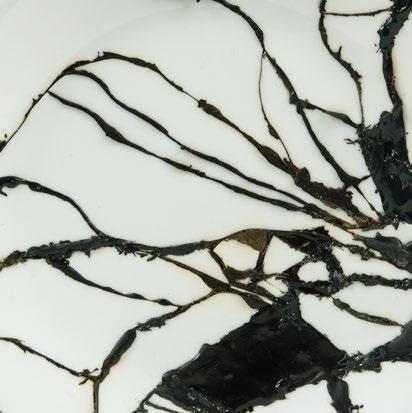
González’s response was to start repairing students’ works in white clay that had been fired and cracked, or that had subsequently broken. She used the only thing she had at hand: black epoxy.
Soon she was repairing a white Chinese ceramic stool thrown out by a neighbor, her bathroom hand mirror that had accidentally broken, and her own test firings for an eventual porcelain work. The repairs did not restore functionality, but the unfinished and broken porcelain pieces became beautiful objects that suggested abstract painting and sculpture.
In contrast, the practical objects, the Chinese stool and coffee mugs, evoked the idea of partially restored archaeological finds, with too much missing to claim complete restoration of the object. Something has been lost that cannot be restored. Ironically, both objects are readily available at hardware stores, so one can easily buy a replacement at minimal cost. So, what has been lost? And what do we gain in repairing these objects in the way that González has done? There is no simple answer, except that her repairs move us, and they do so within a recent moment in which humans shared a sense of their precarious relation to the world, and to each other. In this regard, it is useful to note an underlying fact about the object of archaeological study. As Gavin Lucas explains in The Archaeology of Time (2005), “all archaeological remains are rubbish” and “archaeological remains are effectively mementoes without the memory—objects with amnesia.” The landfill or trash heap is hardly a new phenomenon; instead, it has been and remains the archive of human history before and separate from the archive of written documents. The loss signaled by González’s work is in the belief that archaeology is the source of collective memory.

While not intended or planned, González’s repair work quickly resonated with the Japanese ancient art of kintsugi —repairing ceramics with lacquer and gold—and with the concurrent Black Lives Matter protests taking place across the country, including near González’s home in Oakland. González saw these two resonances as “metaphorically meaningful” in hindsight, but they also make visible a larger historical and societal field of “repair” within which her individual and isolated actions can be understood. As González herself noted, the repairs were not an intention in the first instance, but rather a consequence of the fact that “I didn’t know what else to do.” In preparing the repaired artworks as artworks for display, González extended her process to upcycle discarded wood and metal in the art studio to serve as display stands or interior structures holding a work together. In 2022, as pandemic restrictions lessened, González started a second phase in her ceramic repairs, venturing out to TEPCO Beach to gather and repair the ceramic shards along the shore of Point Isabel about eight miles north of Oakland. The beach is named after the Technical Porcelain and Chinaware Company, which operated in nearby El Cerrito from 1918 to 1968, supplying restaurants across California with heavy-set plates and mugs with designs and themes that appear to be kitschy today. During World War II, TEPCO also supplied the U.S. Army and Navy. TEPCO was founded by John Battista Pagliero, an Italian immigrant who started the company out of his backyard before building a factory near the Santa Fe Railroad in the late 1920s. Upon his death in 1968, the company was shut down and the building was destroyed to make room for a state


office building. In its heyday, TEPCO could produce up to 30,000 pieces a day, with broken plates and mugs dumped along the nearby beach. Today, the beach is an unofficial local attraction for those combing a dump site for fragments of a now forgotten Americana. González’s new work draws its material from this shard-covered beach but continues working within the same notion of “repair” that she applied to the unfinished, broken, and discarded objects at the San Francisco Art Institute. In addition, both phases are based on objects at a human scale. Yet González also pivots from the fine art of the art school studio to the mass production of dinnerware, and from the present to the first part of the previous century. If the first phase of her repairs evoked contending forces of aesthetic abstraction and archaeological artifact, the second phase’s repairs combine random fragments from multiple pieces into a Frankenstein-like wholeness. These works
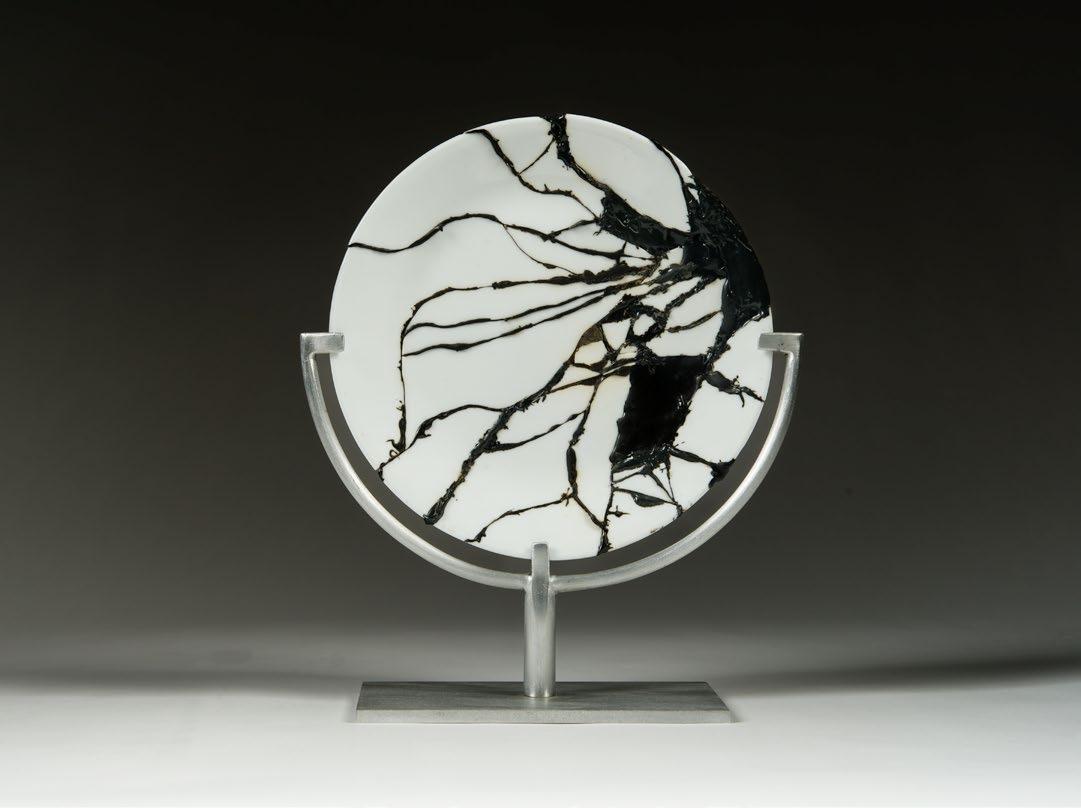


Fragment 1, 2021
Porcelain, epoxy, wood, latex paint
13 1 ⁄ 4 x 111⁄ 2 x 3 1⁄ 2 in.
OPPOSITE
Tepco II , 2022
Ceramic with glaze, epoxy, wood, latex paint

7 1⁄ 2 x 17 1⁄ 4 x 13 1⁄ 2 in.
Brutal Remnant , 2022
Ceramic, epoxy, Duracal
16 x 18 x 3 1⁄ 2 in.
are more inclined toward the surreal, and horror, turning the seriality of mass production into an assemblage that is unique, useless, and uncanny.
González explores this aspect of these works further by scanning several repaired mugsw—literally placing the objects on a flatbed scanner—and printing the scans as 8.5 x 11-inch photographs. In using the dimensions for letter paper, González ties the tactility of handling mugs to that of handling the most common type of paper used for printing in the United States. Formally, González equates these mediums (ceramics and paper) as ones that are defined by repeated touch, not the visual. At the same time, in daily life the art object cannot be touched (“you break it, you buy it”), and the scanned image of a three-dimensional object results in a very limited depth of field that González describes as “very mysterious looking.” In both instances, we are left wanting something we can neither use nor see as whole.
González’s concern for repair is by no means a new one. In fact, while in graduate school, she worked in a restoration shop in San Francisco, acquiring technical skills that would inform her work as an artist. Given the architectural and participatory nature of her earlier public art works, such as Magic Carpet/Home (1999), González placed an emphasis on non-art spaces and community use. In this sense, the notion of “repair” can be seen in the larger arc of her conceptually driven explorations of form and material in relation to identity, memory, history, place, and diaspora. Her work seeks a difficult balance between conceptualism and minimalism, on the one hand, and a deep commitment to the intricate details of craft, art history, and the political, on the other hand. While she is known as a sculptor, her artistic practice draws upon photography, video, architecture, graphic art, drawing, music, musical notation, and ceramics. María Elena has an expansive body of work that continues to evolve, most recently in her Tree Talk series, which uses musical notation as a method for decoding the “talk” of birch trees. In the process, she translated the tree’s bark across various mediums from drawing to imprinting to video to music. The Tree Talk series itself helped give rise to her current work (and this exhibition) on the repair of ceramics as an ethical and ecological orientation toward global climate change. The connection is thematic, but it is also practical, as the artist continues to rethink her artistic practice in relation to climate change.
María Elena’s ceramics do not offer the aesthetic redemption of kintsugi —namely, that the past can be preserved and even valued more highly for its fragility. Instead, they provide us with a riven object that is both the product of our waste and the gesture of our effort to repair, not the world, but the things within our reach. This new series offers something on the order of a memento polluere, a memory not about one’s future and inevitable death, but about the past that defines our collective future: “remember you have polluted.”
 chon a. noriega
Distinguished Professor, University of California, Los Angeles
NOTE
Quotations fr om Marí a Elena González are from an interview with the author on April 8, 202 3.

Vitrine I , 2023
Mixed media
22 x 14 x 14 in.
Vitrine II , 2023

Mixed media
22 x 14 x 14 in.
design
Elizabeth Finger
photography
All photographs by Eric W. Baumgartner
cover
Fragment 2 , 2021
Porcelain, epoxy, wood, latex paint
13 3 ⁄ 4 x 10 1⁄ 4 x 3 1⁄ 2 in.
frontis
Braced/Calder, 2022
Ceramic, epoxy, wood, latex varnish, aluminum, fishing line, wire
15 1⁄ 4 x 18 1⁄ 4 x 8 in.
inside front / back covers
Installation views
María Elena González: Riven
May 5 – June 16, 2023
Hirschl & Adler Modern, NY
© 2023 Hirschl & Adler Modern
Link to Artist’s CV

H&A