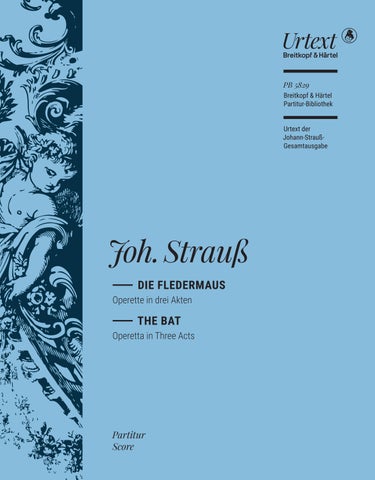
Joh. Strauß
– DIE FLEDERMAUS
Operette in drei Akten
– THE BAT
Operetta in Three Acts
PB 5829
Breitkopf & Härtel
Partitur-Bibliothek
Urtext der Johann-StraußGesamtausgabe Partitur Score
JOHANN STRAUSS
1825–1899
– DIE FLEDERMAUS
Operette in drei Akten
– THE BAT
Operetta in Three Acts
PB 5829
Breitkopf & Härtel
Partitur-Bibliothek
Urtext der Johann-StraußGesamtausgabe Partitur Score
1825–1899
Operette in drei Akten
Operetta in Three Acts
Libretto von | Words by Richard Genée
herausgegeben von | edited by Johann-Strauß-Gesellschaft Wien
unter der wissenschaftlichen Leitung von | under the scholarly direction of Fritz Racek
Urtext der Johann-Strauß-Gesamtausgabe
Urtext from the Johann Strauß Complete Edition
Partitur-Bibliothek 5829
Printed in Germany
Erster Akt
Nr. 1a Introduktion. ALFRED „Täubchen, das entflattert ist“, ADELE
Nr. 1b Duettino. ADELE „Ach, ich darf nicht hin zu dir“, ROSALINDE
Nr. 2 Terzett. EISENSTEIN „Nein, mit solchen Advokaten“, ROSALINDE, BLIND
Nr. 3 Duett. FALKE „Komm mit mir zum Souper“, EISENSTEIN
Nr. 4 Terzett. ROSALINDE „So muß allein ich bleiben“, EISENSTEIN, ADELE
Nr. 5 Finale I. ALFRED „Trinke, Liebchen, trinke schnell!“, ROSALINDE
ROSALINDE „Mein Herr, was dächten Sie von mir“, ALFRED, FRANK 148 FRANK „Nein, nein, ich zweifle gar nicht mehr“, ROSALINDE, ALFRED 154
Zweiter Akt
Nr. 6 Chor und Ensemble. CHOR „Ein Souper heut’ uns winkt“
Nr. 7 Couplet. ORLOFSKY „Ich lade gern mir Gäste ein”
Nr. 8 Ensemble und Couplet. ORLOFSKY „Ach, meine Herrn und Damen“, Ensemble, Chor
ADELE „Mein Herr Marquis”, Ensemble, Chor mit Soli
Nr. 9 Duett. EISENSTEIN „Dieser Anstand, so manierlich”, ROSALINDE
Nr. 10 Csárdás. ROSALINDE „Klänge der Heimat, ihr weckt mir das Sehnen“
Nr. 11a Finale II: Ensemble mit Chor. ORLOFSKY „Im Feuerstrom der Reben”
FALKE „Brüderlein, Brüderlein und Schwesterlein“, Ensemble mit Chor
Nr. 11b Finale II: Ballett
„Russisch“
„Böhmisch“. CHOR „Marianka, komm und tanz’ me hier!“
„Ungarisch“
Nr. 11c Finale II: Ensemble mit Chor. ORLOFSKY „Genug damit, genug! Diese Tänzer mögen ruh’n“
Dritter Akt
Nr. 12 Entreact
Nr. 13 Melodram. FRANK „Olga, komm her, Ida auch“
Nr. 14 Couplet. ADELE „Spiel’ ich die Unschuld vom Lande“, IDA, FRANK
Nr. 15 Terzett. ROSALINDE „Ich stehe voll Zagen“, ALFRED „Um Rat ihn zu fragen“, EISENSTEIN
Nr. 16 Finale III. CHOR „O Fledermaus, o Fledermaus, laß endlich jetzt dein Opfer aus!“, Ensemble mit Chor
Anhang. Neuer Csárdás. ROSALINDE „Klänge meiner Heimat, ihr rufet“
Revisionsbericht der Johann-Strauß-Gesamtausgabe
Programmzettel der Uraufführung (Stadtbibliothek Wien)
Program notes of the première (Stadtbibliothek, Vienna)
Am 25. März 1874, eineinhalb Wochen vor der Uraufführung von Johann Strauß’ Meisteroperette Die Fledermaus, informierte das Wiener Neue Fremden-Blatt seine Leser über einen von Paul Lindau in Posen gehaltenen Vortrag zum Thema „Das moderne deutsche Theater“, der insbesondere die „unerschöpfliche Erfindungsgabe wahrhaft komischer Situationen“ des vor einem halben Jahr verstorbenen „Altmeisters des deutschen Lustspiels“, Roderich Bendix, gerühmt und dessen besten Bühnenwerken, obenan dem Lustspiel Das Gefängnis, bleibenden Wert attestiert hatte. Wer konnte damals ahnen, auf welchen Umwegen diese Prognose Erfüllung finden sollte? Benedix’ 1851 in Berlin uraufgeführtes vieraktiges Lustspiel ist längst der Vergessenheit anheim gefallen; indes, seine konfliktbeschwörende Grundidee von dem ungebetenen Gast Baron Wallbeck, der sich, in der Wohnung des abwesenden Privatgelehrten Dr. Hagen durch den Gerichtsdiener überrascht, anstelle des Hausherrn arretieren läßt, um dessen von ihm begehrte Gattin Mathilde nicht zu kompromittieren, schien den Offenbach-Librettisten Henry Meilhac und Ludovic Halévy verwertbar und inspirierte sie zu der im Übrigen auf ganz anderen Bahnen wandelnden dreiaktigen Komödie Le Réveillon, die seit dem 10. September 1872 die entzückten Pariser scharenweise ins Théâtre du Palais Royal lockte. Direktor Maximilian Steiner, stets auf der Suche nach Kassenschlagern für sein Theater an der Wien, beeilte sich, um für teures Geld die Aufführungsrechte zu erwerben, doch erwies sich das Resultat der von dem Wiener Theaterdichter Karl Haffner (recte Karl Wilhelm Schlachter, 1804–1876) auftragsgemäß vorgenommenen deutschen Einrichtung als enttäuschend. Der Wiener Verleger und Theateragent Gustav Levy wusste Rat: Er sicherte sich die Hilfe des als Komponist und Autor gleicherweise bewährten Kapellmeisters des Theaters an der Wien, Richard Genée (1823–1895), und regte an, die Komödie zu einem Operettenbuch für den mit ihm befreundeten Johann Strauß umzuarbeiten. Genée reagierte prompt, als er Haffners Manuskript erhielt: „Ich las, fand es unmöglich, erbat mir am andern Morgen das französische Original und schrieb hiernach das Libretto der Fledermaus. Von der Haffnerschen Posse, die ich zurückgab, benutzte ich nur die Namen der Personen. Auch von dem Original mußte ich in Szenenbau und Charakteren weit abweichen. Die Direktion zahlte mir damals, wie es für Bearbeitungen kontraktlich stipuliert war, per Akt hundert Gulden und stellte das Libretto dem Komponisten zur freien Verfügung. Um den altbewährten Schriftsteller Haffner nicht zu kränken, wurde er auf dem Theaterzettel mit meiner Zustimmung als Kollaborateur genannt. Ich selbst habe Haffner nie gesehen.“2
Genées Abweichen vom französischen Original „in Szenenbau und Charakteren“ betrifft allerdings noch nicht den I. Akt. Zwar wurde aus dem lebenslustigen Grundbesitzer Gaillardin und seiner hübschen Gattin Fanny der wesensverwandte Rentier Gabriel von Eisenstein mit Ehefrau Rosalinde, aus dem ziemlich farblosen Kammermädchen Pernette die ungleich attraktivere Adele, aus Alfred, dem geigenden Kapellmeister des Prinzen Yermontoff der gleichnamige Gesangslehrer des Prinzen Orlofsky, aus dem Advokaten Bidard der stotternde Dr. Blind und aus den vom Amtsdiener Leopold begleiteten Gefängisdirektor Tourillon dessen jovialer Amtskollege Frank; doch was sich an jenem Abend im Hause Gaillardin beziehungsweise Eisenstein als Auftakt der von Freund Duparquet alias Dr. Falke eingefädelten Intrige abspielt, ist, sieht man von den Bedingnissen der Musik ab, in Situation, Ablauf der Handlung und sogar in Details der Dialoge weitgehend identisch. Ähnliches gilt mit Einschränkungen auch für einen großen Teil des im Gefängnis spielenden III. Aktes. Die entscheidenden dramaturgischen Verbesserungen aber gelangen im II. Akt: Bei Meilhac und Halévy treten sowohl Fanny als auch ihre Kammerjungfer Pernette nach dem I. Akt nicht mehr in Erscheinung; der als Marquis de Valangoujar heftig flirtende Gaillardin verliert auf dem Fest des Prinzen Herz und Taschenuhr an die hübsche Schauspielerin Métella, die sich ihm erst später als einstige Partnerin eines galanten Ballabenteuers zu erkennen gibt. Genée jedoch läßt an Métellas Stelle sowohl Rosalinde als auch Adele an dem rauschenden Ballfest teilnehmen, lässt den Charmeur Eisenstein mit gleichem Effekt um die Gunst seiner eigenen, als ungarische Gräfin maskierten Gattin werben und verleiht damit der späten „Rache der Fledermaus“ erst die entscheidende Pointe, welche bis zum aufklärenden Finale des III. Aktes für Spannung und Humor sorgt.
Johann Strauß dürfte das zunächst „Doktor Fledermaus“ betitelte Libretto etwa im Oktober 1873 zur Ansicht erhalten haben. Am 25. desselben Monats leitete er im Großen Musikvereinssaal ein von ihm veranstaltetes Wohltätigkeitskonzert, in dessen Programmfolge Marie Geistinger, Primadonna und Direktrice des Theaters an der Wien, einen von Strauß komponierten und von Richard Genée textierten „Csárdás mit Gesang“ kreierte (vergleiche Seite 503, Vorlage L). Fünf Tage später brachte die Wiener „Presse“ die erste Meldung, daß der Walzerkönig die Arbeit an einer neuen Operette begonnen habe. Den letzten Anstoß zu diesem Entschluss mag wohl der große Erfolg jenes Csárdás gegeben haben, welcher nun in das im Entstehen begriffene Bühnenstück an zentraler Stelle eingebaut und somit dessen älteste Nummer darstellt. Das Sujet scheint Strauß’ schöpferische Phantasie sehr beflügelt zu haben, denn in glückhaftem Schaffensrausch gewann der größte Teil des neuen Werkes um die Jahreswende 1873/74 musikalische Gestalt, glaubhafter Überlieferung zufolge „in 42 Tagen und Nächten“. Während dieser Zeit kamen auch die Boten, die zwischen der Strauß-Villa in Hietzing (damals Hetzendorfstraße Nr. 18, jetzt Maxingstraße Nr. 18) und Genées Wohnung im Hause Gumpendorferstraße Nr. 47 hin und her eilten, kaum zur Ruhe. Die Beschaffenheit der autographen Partitur (Vorlage A, Seite 499) gestattet es, sich den Arbeitsprozeß etwa so vorzustellen, daß Strauß Genée zunächst die Skizze einer Nummer oder eines Teilstückes zukommen ließ, dieser danach ein Partiturgerüst verfertigte, darin das von Strauß Empfangene mit nötigenfalls neuem Gesangstext und gelegentlichen Änderungsvorschlägen eintrug und die Blätter dann zur Instrumentationsergänzung und Endredaktion an den Komponisten zurücksandte. Dabei konnte es auch vorkommen, daß Strauß die Ausgestaltung potpourriähnlicher Wiederholungen – wie zum Beispiel Entreact und Melodram – ganz seinem Mitarbeiter überließ. Jeder abgeschlossene Partiturteil wurde sodann durch Genée sofort an die Kopisten weitergereicht
Am 18. Jänner 1874 konnten die Wiener in der Beilage des Neuen Fremden-Blattes lesen, daß die neue Operette zum größten Teil vollendet sei und der Rest bis Monatsende nachgeliefert werde. Ebenda vernahm die Öffentlichkeit auch am 24. Februar, daß die Proben am Theater an der Wien tags zuvor begonnen hatten, daß am 27. Februar nur noch die Instrumentation zweier Nummern des III. Aktes ausständig war und daß im II. Akt unter der Devise „Ein großer Maskenball“ eine hervorragende Dekoration vorbereitet werde. Als vielversprechende Kostprobe hatten schon am 10. Februar die Besucher des Concordia-Balls die „Fledermaus-Polka“ vorgesetzt bekommen. Nach und nach erfuhr man auch die Besetzung der Hauptpartien durch Marie Geistinger, Jani Szika, Karl Adolf Friese und andere Mitglieder des ständigen Ensembles; als einziger Gast von auswärts traf Mitte März Esther Charles-Hirsch in Wien ein, um die Soubrettenrolle der Adele zu übernehmen. Zur gleichen Zeit bescheinigte die k. k. Polizei-Direktion, daß das am 3. März zur Zensur eingereichte Textbuch „vollinhaltlich zur Aufführung zulässig erachtet“ werde, nachdem zunächst ein Zensor an einer Textstelle3 und an einer Coupletstrophe4 Anstoß genommen hatte.
Die Dekorations- und Kostümprobe fand am 1., die Generalprobe vor geladenen Journalisten und Schauspielern am 4. April statt. Tags darauf, am Ostersonntag, dem 5. April 1874, erzielte das überfüllte Theater an der Wien ein Reinerträgnis von 1550 Gulden zugunsten der Kaiser-FranzJoseph-Stiftung zur Förderung des Kleingewerbes. „Mit einem Beifallstosen, das das Haus erzittern machte“, bestätigte das enthusiasmierte Premierenpublikum dem Komponisten und seinen Interpreten einen „Sieg auf allen Linien“ (Sonn- und Montagszeitung). „Fast jede Nummer setzte die Hände des Auditoriums in Bewegung, und nach den Aktschlüssen konnte der schweißgebadete Strauß nicht rasch genug sein Dirigentenpult verlassen, um der freundlichen Zuhörerschaft von der Bühne aus für ihr Wohlwollen zu danken. An Wiederholungen einzelner Stücke gab es bei solcher Stimmung natürlich keinen Mangel“ (Konstitutionelle Vorstadt-Zeitung). „Es läßt sich schwerlich sagen, welche Piece der reichen Partitur den Preis verdiene; sie sind alle von ebenbürtiger Schönheit“ (Morgenpost). Neben solchen Bescheinigungen des „eminenten Erfolgs, welchen Strauß’ unerschöpflicher Erfindungsquell und die brillante Aufführung errangen“ (Illustriertes Wiener Extrablatt), fehlte es jedoch nicht an
2. Horn; Hr. = alle Hörner). In ähnlicher Weise trifft eine Revisionsbemerkung ohne beigefügte Quellenchiffre (A, B, C ...) auf alle zur betreffenden Stelle vorhandenen Vorlagen gemeinsam zu. Unkommentierte Zutaten des Herausgebers werden in der Partitur durch runde Klammern hervorgehoben. Nicht gesondert kenntlich gemacht sind jedoch Ergänzungen einzelner dynamischer Vorschriften oder Vortragszeichen, wenn sie, bloß in manchen Stimmen der Vorlage fehlend, durch andere Parallelstimmen desselben Taktes unzweifelhaft gefordert werden. Dasselbe gilt von der Ergänzung angedeuteter Staccatopunkte und von der Vereinheitlichung der manchmal unterschiedslos vermischten Akzente > und ^ Alle sonstigen Abweichungen von den Vorlagen werden in den Revisionsbemerkungen (Seite 503–542) mit vorangestellter Taktzählung einzeln behandelt. Der herzliche Dank der Johann-Strauß-Gesellschaft Wien gilt der Generaldirektion und dem Aufsichtsrat der Creditanstalt-Bankverein, Wien, durch deren Munifizenz Stich und Drucklegung des Gesamtausgabenbandes ermöglicht wurden, sowie allen zu Häupten der jeweiligen Quellenbeschreibung implizite angesprochenen Instituten und Persönlichkeiten, welche bereitwilligst die Benützung ihrer Bestände gestatteten. Für wertvolle Unterstützung bei der Datenermittlung und der Zubereitung der Stichvorlagen dankt der Herausgeber seinem stets hilfsbereiten Kollegen in der Musiksammlung der Wiener Stadtbibliothek, Herrn Dr. Ernst Hilmar, sowie
für Daten zur Entstehung und dann doch unterbliebenen Aufführung des „Neuen Csárdás“ Herrn Franz Mailer, Wien.
Wien, 1974 Fritz Racek
1 Der hier als Vorwort verwendete Text des Herausgebers steht im Band der Johann-Strauß-Gesamtausgabe im Anhang und leitet dort den Revisionsbericht ein.
2 Zitiert nach: Bernard Grun, Kulturgeschichte der Operette, München: Langen G. Müller 1961, S. 191.
3 Orlofsky in Akt II, 12. Szene: „In meiner Villa hat jede Dame das Recht, sich zu verhüllen oder zu enthüllen, so weit es ihr beliebt.“
4 Adele in Akt III, Nr. 14, Takte 90–128: „Spiel’ ich ’ne Dame von Paris, ach, ach, / die Gattin eines Herrn Marquis, ach, ach, / da kommt ein junger Graf ins Haus, ach, ach, / der geht auf meine Tugend aus, ach! / Zwei Akt’ hindurch geb’ ich nicht nach, / doch ach, im dritten werd’ ich schwach; / da öffnet plötzlich sich die Tür; o weh, mein Mann! Was wird aus mir! Ach! / ,Verzeihung!‘, flöt’ ich, er verzeiht, ach, ach! / Zum Schlußtableau, da weinen d’Leut’, ach, ach ja!“
5 Die Wiener Operette, Wien: Bellaria 1947.
6 Johann Strauß an seinen Bruder Eduard, in: Johann Strauß schreibt Briefe, Berlin: Verlag für Kulturpolitik 1926, S. 132.
On March 25, 1874, a week and a half before the world première of Johann Strauß’s master operetta Die Fledermaus, the Vienna Neues FremdenBlatt told its readers about a lecture on “The Modern German Theater” given in Poznan by Paul Lindau. In his lecture, Lindau had unstinting praise for what he called “the inexhaustible gift for creating comic situations” of Roderich Benedix, “the grand master of German comedy,” who had died half a year before. Benedix’s stage works, said Lindau, would be of lasting importance, in particular the comedy Das Gefängnis (The Prison). No one could have known at the time the roundabout way in which Lindau’s prediction would come true. Benedix’s four-act comedy, first performed in Berlin in 1851, has long since fallen into oblivion – except for its conflict-loaden basic situation: Baron Wallbeck, an uninvited guest, is caught by the bailiff in the home of the scholar Dr. Hagen, who is out of town; so as not to compromise Hagen’s wife Mathilde who is the object of his desire, Wallbeck pretends to be her husband and is arrested in his place. This looked like a promising theme to Jacques Offenbach’s librettists Henry Meilhac and Ludovic Halévy, who used it for their three-act comedy Le Réveillon, which otherwise followed a completely different path and attracted delighted Parisians in droves to the Théâtre du Palais Royal in Paris as of September 10, 1872. Maximilian Steiner, the director of Vienna’s “Theater an der Wien,” was always on the lookout for box-office hits, and he lost little time in acquiring, at considerable expense, the performing rights. The Viennese veteran playwright Karl Haffner (real name Karl Wilhelm Schlachter, 1804–1876) was hired to provide the German version, but the results of his labors were disappointing. Gustav Lewy, the Viennese publisher and theatrical agent, came up with his answer: he persuaded Richard Genée (1823–1895), who in addition to conducting at the Theater an der Wien was well known as a composer and writer, to rework the play into an operetta book for his friend Johann Strauss. Genée’s reaction on getting Haffner’s manuscript was not long in coming: “I read it through, realized that it was unusable, asked for the French original the next morning, and used it to write the Fledermaus libretto. From Haffner’s farce, which I handed back, I kept only the names of the characters. I also had to depart drastically from the structure and the characters of the original. The management paid me the stipulated fee for adaptations, 100 Gulden for each act, and gave the libretto to the composer to do with as he saw fit. So that Haffner would not be hurt, I agreed to have his name on the play-bill as co-author. I myself never met him.”1 However, Genée’s departures from the structure and the characters of the original are not to be noticed in the first act. The pleasure-loving land-owner Gaillardin and his pretty wife Fanny become the privately wealthy but otherwise similar Gabriel von Eisenstein and his wife Rosa-
linde; the colorless chambermaid Pernette is transformed into the much more attractive Adele; Alfred keeps his name but turns from Prince Yermontoff’s violin-playing conductor into Prince Orlovsky’s voice teacher; the lawyer Bidard becomes the stuttering Dr. Blind; and Tourillon, the prison director with bailiff Léopold in tow, gives way to his jovial counterpart Frank. But what takes place at the Gaillardin’s (Eisenstein’s) house at the beginning of the intrigue engineered by his friend Duparquet (Falke) is mostly identical in situation, plot and even details of the dialogue, apart from the circumstances of the music. With certain reservations, the same is true of much of the third act, which takes place in jail. The decisive dramaturgical improvements, however, occur in the second act. In Meilhac and Halévy’s play, Fanny and her chambermaid Pernette no longer appear after the first act; at the Prince’s ball Gaillardin, flirting violently as the Marquis de Valangoujar, loses his heart and his pocket watch to the pretty actress Métella, who only later reveals herself to him as his former partner in a gallant ball adventure. Genée , however, has Rosalinde and Adele come to the lavish ball instead of Métella, lets the charmer Eisenstein to the same effect woo the favor of his own wife, who is disguised as an Hungarian countess, and thus gives “the bat’s” revenge its decisive point, which keeps the plot and the humor going until everything is resolved in the finale of the third act.
Johann Strauß probably got the libretto of “Doktor Fledermaus”, as it was first called, for review in about October 1873. On October 25, he conducted a charity concert he had organized in the Golden Hall of the Musikverein building. One of the numbers on the program was a „vocal Csárdás“ with words by Genée and music by Strauß; it was sung by Marie Geistinger, leading lady and directress of the Theater an der Wien (cf. page 503, Source L). Five days later, the Vienna “Die Presse” reported that the Waltz King had begun work on a new operetta. The final push may well have been the great success of the Csárdás, which came to have a central place in the work in progress and is thus the operetta’s oldest number. The plot seems to have fired Strauß’s imagination, for most of the work took on musical form in a burst of creativity at the turn of 1873 to 1874, “in 42 days and nights” according to reliable information. During this period, the messengers who rushed back and forth between Strauss’s villa in Hietzing (then Hetzendorferstraße No. 18, now Maxingstraße No. 18) and Genées apartment in Gumpendorferstraße No. 18 hardly had a moment’s rest. Judging from the autograph score (page 499, Source A), the procedure must have been something like this: Strauss would send Genée the sketch of a number or a section; Genée laid out the score, wrote in what he had received from Strauss, adding new words if necessary and occasional suggestions for alterations, and sent the whole thing back to Strauss for instrumentation
and final editing. It sometimes happened that Strauss left the composition of potpourri-like repetitions – such as Entract and Melodrama – entirely to his collaborator. When a section of the score was finished, Genée sent it straight off to the copyists.
On January 18, 1874, the Viennese read in a supplement to the Neues Fremden-Blatt that most of the new operetta was finished and that the rest would be ready by the end of the month. The same newspaper informed the public on February 24 that rehearsals at the Theater an der Wien had begun the day before; on the 27th, readers learned that only two numbers in Act 3 remained to be orchestrated, and that a sumptuous decor was being prepared for Act 2 under the motto “A Grand Masked Ball.” On February 10, visitors at the Concordia Ball were treated to a promising taste of the “Fledermaus Polka.” Little by little the cast became known: the principal roles were to be taken by Marie Geistinger, Jani Szika, Karl Adolf Friese and other members of the Theater an der Wien company; the only guest artist, Esther Charles-Hirsch, arrived in Vienna in mid-March to take over the soubrette part of Adele. At the same time, the Imperial-Royal Police Directorate certified that the libretto, which had been submitted for censorship on March 3, was “fully admissable for performance,” after a censor had initially objected to one passage2 and one couplet verse3
The decoration and costume rehearsal took place on April 1; the dress rehearsal was held on April 4 before an invited audience of journalists and actors. The next day, Easter Sunday, the 5th of April 1874, the packed Theater an der Wien achieved a net profit of 1550 Gulden for the benefit of the Emperor Franz Joseph Foundation for the Promotion of Small Industry. “With thunderous applause that shook the theatre,” the enthusiastic firstnight audience acknowledged that the composer and the cast had “won out all along the line” (Sonn- und Montagszeitung). “Almost every number set the audience’s hands in motion, and at the end of each act, Strauß, dripping with sweat, could hardly leave the conductor’s podium fast enough to thank the audience from the stage for their favor. Given that kind of atmosphere, there was of course no lack of da capos” (Konstitutionelle Vorstadt-Zeitung). “It is hard to say which number of the rich score deserves the palm; they are all equally beautiful” (Morgenpost). Along with these attestations of an “outstanding success scored by Strauß’s inexhaustible inspiration and a brilliant performance” (Illustriertes Wiener Extrablatt), a number of more critical voices were raised. “It is not really the boundless success the theatre expected from this novelty,” wrote Ludwig Speidel in the Fremdenblatt. He found fault with the “woeful state” of the libretto, an opinion that was shared by Eduard Hanslick in the Neue Freie Presse: “How music can be found for words like that remains an insoluble puzzle; how is it that musical ideas in the composer’s mind do not simply fade away rather than become attached to such platitudes?” The critic of Ziehrer’s Deutsche Musikzeitung was still less satisfied: “Again the libretto is not worth much ... The music has charm, but no real sweep ... The operetta is too long; it abounds with superfluous numbers, and it abounds with superfluous characters.”
The passage about the “superfluous characters” is the cue for an excursus that disrupts the chronological presentation but is necessary to complete the following revision notes. For example, the premiere program shown here mentions Lord Middleton, Baron Oskar, Bertha, Lori and Paula as additional roles, to which no spoken or sung words are assigned in the available sources A–L (see pages 499–503), although some of them appear by name in the list of characters in the libretto (Sources H and J). On the other hand, the premiere program does not mention the ladies Hermine and Nathalie, who also have small solos in the score and piano reduction. The name Sylvia is missing in the autograph score (Source A) and in the censorship textbook (Source H), which instead name an Aurelie and a Xandi. In the programs of the Theater an der Wien of the following years, a steady increase in the number of female roles can be observed with the appearance of new names – Isidore, Marietta, Alphonsine, Antoinette, Henriette, Zerline, Ottilie. Then again, the programs of the first Fledermaus performances at the Vienna Court Opera, for example with Sir Medlon, Francillon, Julian Goré, Baron Fernaud, Conte Caroni, Gaston, René, von Triton, Ruland, Robert Golf, show a veritable inflation of male roles. It can be assumed that the musical substance remained untouched by this constant appearance of new names and the occasional disappearance of old ones, and this is confirmed by a comparison of all sources in this regard. In the few cases where individual models differ in the assignment of an
otherwise unchanged vocal part to certain roles, the editor has taken the Genée piano score (Source E) as the final authority.
Strauß assigned the publishing rights to his new stage work as well as to the dance pieces opp. 362, 363 and 365, which were composed or were to be composed based on its motifs, to his former Viennese publisher Friedrich Schreiber, while Gustav Lewy was responsible for securing the stage rights and thus also for the production and distribution of the necessary performance material. Lewy took on this task with successful speed. A collection of royalty statements (Sig. Ja 121876), kept in the Vienna City Library, some signed by Strauß himself and some by his first wife Jetty (Henriette Trefz, née Chalupetzky, 1818–1878), proves that the first “tendering fee for Die Fledermaus” was received even before the première. There is a persistent legend that the world première in the Theater an der Wien was followed by only 15 performances. The unclear wording of Strauß’s first biographer, Ludwig Eisenberg, was responsible for this myth which was invalidated by Franz Hadamowsky a quarter century ago.4 What really happened was that several guest performances by an Italian opera troupe starring Adelina Patti and occasional casting difficulties forced short interruptions in the performances of Die Fledermaus, which, as on the fourth evening at the benefit concert for Kapellmeister Genée, were also enjoyed to rave reviews on all other evenings in front of a sold-out house. The composer took the conductor’s podium several more times, for example on April 22 “for the benefit of Mr. Szika,” on April 28 for his own benefit and on May 5 for the benefit of Mrs. Charles Hirsch, who ended her guest appearance on May 21, handing over the role to Henriette Wieser. Not until after the 49th performance on June 6 – Strauß had just returned from a successful concert tour of Italy with the Langenbach Band – did the run have to be discontinued due to the illness of Miss Nittinger, who played Orlofsky.
In the meantime, preparations for the Berlin première had already begun at the Friedrich-Wilhelmstädtisches Theater, which was a sensational success on July 8, 1874. The Carl Schultz Theater in Hamburg, the German Theatre in Budapest (where Strauß conducted the 20th performance on December 22), and other leading theatres followed in quick succession, and within a few years Die Fledermaus became common property of the German-language area. The first non-German theatre to stage the operetta was the Théâtre de la Renaissance in Paris, for which Strauß – in collaboration with the authors A. Delacour and V. Wilder – wrote a completely new version called “La Tzigane” (see also page 501, Source Cx). Opening night was October 30, 1877.
Given the further spread of the operetta Die Fledermaus beyond Europe to America and Australia, it was only a matter of time before the world’s leading opera houses opened their doors to it. One of the first conductors who took the step was Gustav Mahler in 1894 at the Hamburg Stadttheater. And on the afternoon of October, 28, 1894, the Vienna Court Opera also opened its doors to the masterpiece, dispelling its creator’s concerns that “the ponderous delivery of opera singers will not be easy to get rid of.” Always easily discouraged, the composer added, “Die Fledermaus is nothing at all for an opera house, but Jahn insists on having it in the repertoire ... If it is really a success at the Opera, I will polish it up and have it played only in opera houses.”5 In the end, Strauß must have realized that such a “refining” was unnecessary; for when Wilhelm Jahn was replaced as director of the Vienna Opera by Gustav Mahler in 1897, who took over the popular Fledermaus into the evening program, nothing more was said about it. Strauß had already written a “New Csárdás” for the new Rosalinde, the popular Marie Renard, who found the range of the original Csárdás too strenuous, at the end of 1896, but the parts of this work ended up unused in the opera archives because the singer preferred to use an aria from Eva, which she had created in Strauss’s opera Ritter Pasman in 1892. Shortened and arranged for orchestra, the new Csárdás became part of Strauß’s posthumous ballet Cinderella; the original vocal version appears in the Appendix to this volume on pp. 480–498 (cf. also page 503, sources M–P). It should be added that Strauss’s master operetta had been well known at the Vienna Court Opera since 1885, when the Fledermaus Waltz could be heard in the third scene of the much-performed ballet Wiener Walzer
The present volume contains the score of the operetta Die Fledermaus in what may be considered the definitive original version of the Vienna world première, as established by critical comparison of the sources described
in the Editor’s Report. In making our revision the following general principles were observed:
In the musical text the old orthography has been brought up to date without comment. Stage directions appear in square brackets. In the interest of the uniformity of the score and to keep the Editor’s Report within reasonable proportions, the various time-related notational pecularities of the sources (insofar as they are unequivocal) have been made to conform to the engravers’ roules valid today without comment. This includes the resolution of unambiguous abbreviations with which the sources abound, and correcting the enharmonically wrong notation which was used at the time, especially for the transposing brass instruments. In our score, the brasses have a general signature for a given key, whereas in the contemporaneous sources, they are written in C major throughout, with accidentals – often quite a few – as needed. The original tuning of the transposing instruments, however, is retained throughout. Characters and instruments are listed in full at the beginning of every number. Apart from the abbreviations of names of instruments and roles (these are easily recognized by comparing the first page of a number with the pages following), the abbreviations “Nr.” (Nummer = number), “S.” (Seite = page) and “T.” (Takt = measure) are used. Numbers preceding the detailed commentary of the Editor’s Report always refer to measure numbers. Note letter names are used to relieve the revision text of music examples and indicate the respective notated pitch and not – in the case of transposing instruments – the actual pitches. Abbreviations are identical for the singular and plural of the same word and, in the absence of differentiations, apply to all members of the same instrumental genre, e.g. 1., 2. Hr. = 1st and 2nd horn, while Hr. = all horns. Similarly, when a comment mentions no specific source (A, B, C ...) it applies to all the sources bearing on the passage concerned. Editorial additions not mentioned in detail appear in the score in round brackets. However, additions to individual dynamic markings or performance instructions are not indicated separately if they are missing in some parts of the original but are undoubtedly required by other parallel parts in the same measure. The same applies to the addition of implied staccato dots
and the standardization of the accent markings > and ^, which are often mixed indiscriminately. All other devitations from the original scores are dealt with individually in the revision notes (pages 503–542), preceded by the measure number.
The Johann Strauss Society of Vienna wishes to thank the management and board of directors of the Creditanstalt Bankverein, Vienna, whose great generosity made the engraving and printing of the volume of the Complete Edition possible. The Society’s thanks also go to the institutions and persons mentioned at the start of each source description, who kindly permitted the material in their possession to be used. The editor wishes to thank his ever-helpful colleague at the Music Collection of the Vienna Stadtbibliothek, Dr. Ernst Hilmar, for his valuable assistance in preparing the engraver’s copy, and Mr. Franz Mailer, Vienna, for information on the creation and subsequent cancellation of the performance of the “New Csárdás”.
Vienna, 1974
Fritz Racek
(Translation: Eugene Hartzell, Petra Kamlot)
1 The editor’s text used here as a preface is the introduction to the revision report in the appendix of the Johann Strauss Complete Edition.
2 Quoted from: Bernard Grun, Kulturgeschichte der Operette, Munich: Langen G. Müller, 1961, p. 161.
3 Orlofsky in Act II, Scene 12: “In meiner Villa hat jede Dame das Recht, sich zu verhüllen oder zu enthüllen, so weit es ihr beliebt.”
4 Adele in Act III, No. 14, bars 90–128: “Spiel’ ich ’ne Dame von Paris, ach, ach, / die Gattin eines Herrn Marquis, ach, ach, / da kommt ein junger Graf ins Haus, ach, ach, / der geht auf meine Tugend aus, ach! / Zwei Akt’ hindurch geb’ ich nicht nach, / doch ach, im dritten werd’ ich schwach; / da öffnet plötzlich sich die Tür; o weh, mein Mann! Was wird aus mir! Ach! / „Verzeihung!“, flöt’ ich, er verzeiht, ach, ach! / Zum Schlußtableau, da weinen d’Leut’, ach, ach ja!”
5 Die Wiener Operette, Wien: Bellaria, 1947.
6 Johann Strauß to his brother Eduard, in: Johann Strauß schreibt Briefe, Berlin: Verlag für Kulturpolitik 1926, p. 132.
GABRIEL VON EISENSTEIN, Rentier | rentier
Tenor ROSALINDE, seine Frau | his wife
Sopran | Soprano FRANK, Gefängnisdirektor | prison director
Mezzosopran | Mezzo Soprano
Bariton | Baritone Prinz ORLOFSKY | Prince ORLOFSKY
ALFRED, sein Gesangslehrer | his voice teacher Tenor Dr. FALKE, Notar | notary
Bariton | Baritone Dr. BLIND, Advokat | lawyer Tenor
ADELE, Stubenmädchen Rosalindes | Rosalinde’s chamber maid Sopran | Soprano IDA, ihre Schwester | her sister Sopran | Soprano FROSCH, Gerichtsdiener | bailiff
Sprechrolle | Speaking role IWAN, Kammerdiener des Prinzen | the Prince’s valet
Sprechrolle | Speaking role Vier DIENER des Prinzen Orlofsky | four SERVANTS of Prince Orlofsky
Gäste des Prinzen Orlofsky | guests of Prince Orlofsky MELANIE, FAUSTINE, FELICITA, SIDI, MINNI
4 Tenöre | 4 Tenors
Sopran | Soprano HERMINE, NATALIE, SABINE, SYLVIA Alt | Alto ALI-BEY, ein vornehmer Ägypter | a distinguished Egyptian Tenor RAMUSIN, japanischer Gesandtschafts-Attaché | Japanese diplomatic attaché Tenor MURRAY, reicher Amerikaner | a rich American Bass CARICONI, spanischer Spieler | a Spanish gambler Bass
CHOR: Gäste des Prinzen Orlofsky | guests of Prince Orlofsky
Sopran, Alt, Tenor I/II, Bass | Soprano, Alto, Tenor I/II, Bass
Die Handlung spielt in einem Badeort, in der Nähe einer großen Stadt. The action is set in a seaside resort near a large city.
2 Flöten (2. auch Piccolo)
2 Oboen
2 Klarinetten in A, B, C*
2 Fagotte
4 Hörner in F
2 Trompeten in F
3 Posaunen
Pauken
2 Flutes (2nd also Piccolo)
2 Oboes
2 Clarinets in A, Bj, C*
2 Bassoons
4 Horns in F
2 Trumpets in F
3 Trombones
Timpani
Schlagzeug (4 Spieler): Glocke, Glockenspiel, Glöckchen, Sporen, Percussion (4 players): Bell, Glockenspiel, Little Bells, Spurs, Tamburin, Triangel, Kleine Trommel, Große Trommel, Becken
Tambourine, Triangle, Small Drum, Bass Drum, Cymbals
Harfe Harp
Streicher
etwa 150 Minuten
Klavierauszug EB 9509 käuflich lieferbar
Strings
approx. 150 minutes
Piano vocal score EB 9509 available for sale Orchestermaterial mietweise Orchestral material on hire
* Im Orchestermaterial gibt es zusätzlich eine Klarinettenstimme,
* The orchestral material contains an additional clarinet part, where in der die „in C“-Stellen „in B“ notiert sind. the passages “in C” are notated “in Bj”.
Ouverture
Dies ist eine Leseprobe.
Nicht alle Seiten werden angezeigt.
This is an excerpt.
Not all pages are displayed.
Zimmer mit Mittel- und Seitentüren. Rechts ein Kanapee, links ein Tisch. Rechts ein Fenster, ein Büffet im Hintergrund links. Ein buntfarbiger Schlafrock und eine griechische Mütze liegen auf dem Kanapee. Auf dem Tisch eine Glocke.
1. Szene ALFRED, dann ADELE.
Nr. 1a. Introduktion
[ (Nachdem Alfreds Gesang vollständig verklungen ist, tritt Adele gedankenvoll mit einem Briefe in der Hand durch die Mitte ein, geht zu dem geöffneten Fenster, lehnt sich daran und singt parodistisch schwärmerisch hinaus.) ]
[
ADELE: Da behauptet dieser Schiller: „Der Mensch ist frei, und wär’ er in Kassel – nein, in Ketten geboren!“ Der unsterbliche Dichter muß offenbar keine Kammerjungfer gekannt haben. Und doch, „auch mir hat die Natur an meiner Wiege Freude zugeschworen!“ Darum will und muß ich ein Mittel finden, mich der Tyrannei der Gnädigen zu entziehen! ]
ALFRED (singend von außen): Täubchen, das entflattert ist …
ADELE (spricht dazwischen): Was ist denn das für ein Gewinsel? Ob man wohl eine Minute ruhig nachdenken kann?
ALFRED (fortfahrend): Täubchen, das ich oft geküßt …
ADELE (eine Münze in ein Papier wickelnd): Ich muß ihm nur ein Sechserl spendieren, sonst hört der Hofsänger nicht auf! (wirft das Geld aus dem Fenster) [ Da haben S’! Gehen S’ weiter um ein Haus, hier sind keine Tauben zu fangen. (vom Fenster weggehend, für sich) Jetzt weiß ich schon, was ich mach’, um fort zu kommen. Eine Waffe hat die Natur auch der Kammerjungfer gegeben – das ist das Lügen. Ich muß meiner gnädigen Frau eine rührende Geschichte erzählen; der Himmel wird mir schon etwas Passendes eingeben. ]
ALFRED (singt):
Täubchen, holdes Täubchen mein, Komm, o komm geschwinde! Sehnsuchtsvoll gedenk’ ich dein, Holde Rosalinde!
ADELE: Was? Rosalinde? Das ist kein Straßentenor, sondern ein Verehrer, und nicht einmal von mir, sondern von meiner Gnädigen! (ruft zum Fenster hinaus) Eine Adele ist hier und keine Rosalinde, wenigstens nicht für Sie! Verlassen Sie den Garten, sonst wird man einen ganz andern Tenor mit Ihnen singen! – Er verschwindet samt seinem Tenor. Der ist sicher irgendwo einem Männergesangsverein ausgekommen. Schade, ich hätt’ ihn mir doch näher ansehen sollen; vielleicht kann ich ihn noch erreichen! (läuft schnell durch die Mitte ab)
2. Szene
ROSALINDE, dann ADELE.
ROSALINDE (tritt heftig erregt von rechts auf): Er ist’s! Alfred, er, der mich vor vier Jahren anbetete, als ich noch frei war! Ich habe ihn gleich erkannt an seinem Tenor und an seiner Keckheit. Nur ein Tenor kann so keck sein, und nur ein kecker Mensch kann so Tenor singen! Er wagt es, hier vor dem Hause meines Gatten mich durch sein hohes A zu kompromittieren!
ADELE (eintretend, für sich): Keine Seele mehr zu erblicken. – Ach, da ist ja meine Gnädige! Jetzt heraus mit der Geschichte, sie ist kurz, aber rührend! (kläglich) Gnädige Frau, meine arme Tante ist so krank!
ROSALINDE (für sich): Sicher hält er mich für treulos, glaubt vielleicht, ich liebe einen anderen; und ich habe doch bloß geheiratet.
ADELE (kläglicher): Gnädige Frau, meine arme Tante ist krank!
ROSALINDE (für sich): Aber wie kommt er, der vor vier Jahren spurlos aus Wien verschwand, so plötzlich in diesen Badeort?
ADELE (schluchzend): Gnädige Frau, meine arme Tante ist krank!
ROSALINDE (heftig): Wer ist krank?
ADELE: Meine Tante!
ROSALINDE: Deine Tante?
ADELE: Ja, meine Tante!
ROSALINDE (ungeduldig): Aber kann ich sie denn gesund machen?
ADELE (schnell): Das verlange ich gar nicht, wenn Sie es auch könnten!
ROSALINDE: Na also!
ADELE (schluchzend): Aber es ist doch die Pflicht einer guten Nichte, ihre arme, kranke Tante zu besuchen und zu fragen: „Wie geht’s? Wie befinden Sie sich? Noch immer fidel und munter?“
ROSALINDE: Deine arme, kranke Tante?
ADELE: Darum bitte ich Sie, mir aus Rücksicht für meine nichtige Liebe freien Ausgang zu gewähren.
ROSALINDE (bestimmt): Unmöglich!
ADELE (bittend): Gnädige Frau!
ROSALINDE: Unmöglich, sage ich! Hast du denn vergessen, daß mein Gemahl heute seine fünftägige Arreststrafe antreten muß? Dreimal ist sie schon verschoben worden; aber heute muß er sich stellen, sonst wird er gestellt.
ADELE: Aber ich weiß noch immer nicht, warum der gnädige Herr eigentlich eingesperrt wird?
ROSALINDE: Weil er einem Amtsdiener ein paar Hiebe mit der Reitpeitsche gegeben und ihn einen Stockfisch genannt hat.
ADELE: Wegen so einem Bisserl?
ROSALINDE: Er hat schon an alle Instanzen appelliert, [ ja, er hat es sogar dahin gebracht, daß man seinen Prozeß revidiert und heute eine neue Verhandlung angeordnet hat; ] aber das wird ihm eher schaden als nützen.
ADELE: Wenn es ihm aber dennoch nützt?
ROSALINDE: So wird es dir nichts nützen, denn ich kann dich nicht eine Stunde entbehren.
ADELE: Nicht? O meine arme, arme Tante! So darf ich dich denn nicht mehr wiedersehen auf Erden? [ Du Tante aller Tanten, ] eine solche Tante wie diese Tante, [ eine so charmante Anverwandte noch niemand kannte, – ] noch keine Nichte Tante nannte!
Dies ist eine Leseprobe.
Nicht alle Seiten werden angezeigt.
Haben wir Ihr Interesse geweckt?
Bestellungen nehmen wir gern über den Musikalien- und Buchhandel oder unseren Webshop unter www.breitkopf.com entgegen.
This is an excerpt. Not all pages are displayed.
Have we sparked your interest?
We gladly accept orders via music and book stores or through our webshop at www.breitkopf.com.
info@breitkopf.com www.breitkopf.com