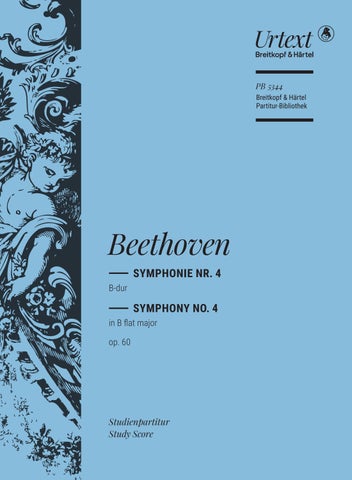
Partitur mit Kritischem Bericht PB 5234 Orchesterstimmen OB 5234
Scoring
Flute
2 Oboes
2 Clarinets
2 Bassoons
2 Horns
2 Trumpets
Timpani
Strings
Performing Time
approx. 35 minutes
Available for sale:
Score with “Kritischer Bericht” PB 5234 Orchestral parts OB 5234
Vorwort
Das Autograph zu Beethovens Vierter Symphonie trägt die Jahreszahl 1806. Gemäß einem Briefzeugnis1 war das Werk Anfang September im wesentlichen beendet, so daß seine Entstehung oder zumindest Fertigstellung auf den Spätsommer dieses Jahres anzusetzen ist. Beethoven weilte damals bis zum Herbst als Gast des Fürsten Lichnowsky auf dessen Landsitz in Grätz bei Troppau in Schlesien. Der Fürst unternahm mit ihm eine Reise in das schlesische Oberglogau zum späteren Widmungsträger der Vierten Symphonie, dem Grafen Oppersdorff, der in seinem Schloß ein leistungsfähiges Orchester unterhielt. Er ließ seinen Besuchern Beethovens Zweite Symphonie vorspielen und bestellte zugleich ein weiteres, neues Werk, worauf Beethoven ihm seine BdurSymphonie zusprach. Diese galt daraufhin im älteren BeethovenSchrifttum als „Auftragswerk“, was noch für die Musik des 18. Jahrhunderts weithin üblichen Gepflogenheiten entsprach, für ein Werk Beethovens indessen mit einer gewissen – unausgesprochenen – Abwertung verbunden wurde. Sah man in der Abwicklung des Auftrages doch auch eine der Ursachen für die längere Unterbrechung der Arbeit an der Fünften Symphonie, die bereits zwei Jahre zuvor begonnen, aber erst 1808 vollendet wurde. Indessen steht heute fest, daß die Komposition der Vierten keineswegs durch den Auftrag des Grafen veranlaßt worden war, sondern daß sie zuvor wie seine anderen Symphonien aus freier künstlerischer Selbstbestimmung, also aus innerer Notwendigkeit entstand.2 Obwohl sich Graf Oppersdorff für ein halbes Jahr das Erstnutzungsrecht ausbedungen hatte, fand bereits im März 1807 die von Beethoven geleitete erste Wiener Aufführung im Palais des Fürsten Lobkowitz statt. Es muß indessen offenbleiben, ob dies die „Uraufführung“ der Vierten war oder ob die Symphonie nicht doch schon zuvor in Oberglogau ihre erste Aufführung erlebte.
Ist Beethovens Fünfte ein Konzentrat höchsten Willens und Energieaufwandes, als Voraussetzung für die machtvolle Entfaltung äußerster musikalischer Dramatik, so ist die vergleichsweise entspanntere Vierte gleichsam das Resultat einer „schöpferischen Pause“ im Prozeß jener Kraftanstrengung. Dem apodiktisch geballten „Schicksalsmotiv“ der Fünften steht in der Vierten der PianissimoBeginn einer AdagioEinleitung gegenüber, in der sich die Musik behutsam aus der Stille heraus entwickelt.3 Sie setzt im Unisono mit dem oktavierend ausgebreiteten BdurGrundton ein, füllt diesen Klangraum danach aber mit einer esmollMelodielinie aus, in deren absteigenden Terzen ein traumhaft versonnener „Reflex“ auf das Kopfmotiv der Fünften erkennbar ist. Diese einzigartige Verschleierung der Haupttonart durch die Mollsubdominante ist zugleich die Ankündigung einer für die ganze Symphonie kennzeichnenden „dramaturgischen Grundtendenz“: lastendem Absinken in die tieferen Sphären subdominantischer bTonarten muß immer erneut zwecks Gewährleistung des harmonischen Gleichgewichtes aktiv entgegengesteuert werden. – Mit Staccato leicht angetupfte, in den Streichern oft im Pizzicato ausgeführte Tonfolgen geben dem weiteren Klanggeschehen der Vierten zugleich immer wieder auch eine gewisse federnde Leichtigkeit, was dann besonders das aus den Schlußtakten der Einleitung – im endlich gewonnen Bdur – hervorspringende AllegroHauptthema kennzeichnet. Die Takt 107 einsetzende Gruppierung des zweiten Themas beginnt zunächst in modulierender Instabilität, um nach spannungsvollem CrescendoAnstieg erst in den Takten 132–141 die Dominanttonart im Forte und Tutti kadenzierend zu bestätigen. Triumphale Motivik sowie die klangfreudige Einbeziehung des Subdominantquintsextakkordes erheben diese Episode –anknüpfend an entsprechende Beispiele in Orchesterwerken Mozarts – zum Zielpunkt der vorangegangenen Entwicklung, zur Expositionskulmination. Sozusagen definitiven Zielcharakter
erhalten diese Takte schließlich in der Reprise, wo ihnen – mit melodischer Verstärkung durch das „Glanzlicht“ der Flöte – das bestätigende Gewicht der Haupttonart zuteil wird.4 Im Unterschied zur Eroica und der Fünften, in denen Beethoven die Klanggewalt des Orchesters durch zusätzliche Blasinstrumente erweitert, reduziert er in der Vierten die Besetzung wieder auf das Maß Haydns und Mozarts, wobei er in seiner Partitur auch noch auf die zweite Flöte verzichtet.5 Daraus resultiert zusätzlich ein gewisser kammermusikalischer Charakter des Werkes: in den PianissimoEpisoden des Durchführungsteils erfolgt eine Auflichtung des Satzgefüges bis zur Zweistimmigkeit und gar – für vier Takte – zu allein erklingenden ersten Violinen. Aber gerade dieses auf jegliches Pathos verzichtende Klanggeschehen atmet „knisternde Spannung“: Auch die Vierte Symphonie ist, was ja bereits die Einleitung zu erkennen gibt, ein von dramatischen Prozessen durchdrungenes Werk, die sich sozusagen unterschwellig auf „innermusikalische“, vor allem harmonische Vorgänge konzentrieren.
Im zweiten Satz, dem wiederum subdominantischen Adagio, folgt dem eröffnenden, im Staccato repetierten Quartenmotiv der innige Gesang einer cantabileMelodie. Beide Aspekte bleiben in der Folge miteinander verwoben, wobei das Quartenmotiv in seinen TuttiEpisoden verschiedentlich versucht, sich im fUnisono bedrohlich zu verabsolutieren. In filigran ausziselierten Variationen des Melodiethemas erfolgt wiederum eine klangliche Reduktion bis zur Ein und Zweistimmigkeit.
Der dritte Satz, obwohl durchaus als Scherzo anzusehen, erhielt von Beethoven die herkömmliche Bezeichnung Menuetto. Während der Allegro vivaceHauptteil des in fünfteiliger Großform (A–B–A–B–A’) angelegten Satzes mit kraftvoll zupackendem Duktus, schroffen dynamischen Kontrasten und z. T. abruptem Wechsel der Tonarten (DesdurEinsatz ab T. 21!) typischen ScherzoCharakter zeigt, klingt im etwas langsameren Trioteil mit wiegender pianodolceMelodik erneut die Sphäre kantabler Verinnerlichung auf, sozusagen in Ergänzung zum zweiten Satz, vor allem aber in der Funktion, vor dem Einsatz des Finales noch einmal uneingeschränkt die BdurHaupttonart auszumusizieren. In dieser Art hat Beethoven später auch die dritten Sätze seiner Symphonien Nr. 6 und 7 angelegt. Mit dem abschließenden Allegro ma non troppo werden die Kontraste der vorausgehenden Sätze in einen Strom weithin ununterbrochener Sechzehntelfigurationen „eingeschmolzen“, wobei sich die Dynamik wechselweise von huschendem pp bis zum kraftvoll einherstürmenden ff steigert. Auch verhaltenere, sanglichere Episoden sind hierin einbezogen, wiewohl sie im rastlosen Geschehen des Satzes keine Ruhepole mehr bilden können. Entwicklungen, Steigerungen und Höhepunkte vollziehen sich hierbei vor allem wieder im klanglichharmonischen Bereich. Das Absinken und notwendige Wiederaufsteigen im Kreis der modulierend einbezogenen Tonarten führt zu erregenden „Zerreißproben“6, die bewußt werden lassen, wie sehr sich auch in diesem oft als „heiter“ und leichtgewichtig unterbewerteten Werk7 Dramatik und latente Tragik offenbaren.
Die in vorliegender quellenkritischpraxisorientierter Ausgabe8 erstmalig erfolgte Auswertung aller zum Werk erhaltenen Quellen brachte bemerkenswerte Lesartendifferenzen zutage, die im einzelnen im Kritischen Bericht der Dirigierpartitur PB 5234 erörtert werden. Als besonders wichtig erwiesen sich die in Prag und Wien erhaltenen handschriftlichen Stimmensätze, da beide – insbesondere aber die Wiener Quelle – eine Reihe von Änderungen und offensichtlichen Verbesserungen aufweisen, die sich weder im Autograph noch in den Erstausgaben des Werkes finden. Dies läßt darauf schließen, daß Beethoven über ein später verschollenes, nach dem Autograph kopiertes PartiturHandexemplar verfügt hat, das er im Zusammenhang der Probenarbeit für die frühen Aufführungen auf den letzten Stand der Detailarbeit am Werk brachte.
Die Artikulation und dynamische Bezeichnung der Neuausgabe folgt der Auswertung der Quellenbefunde und verzichtet dabei in Einzelfällen auf eine allzu strikte Angleichung von Parallelstellen: Gewisse diesbezügliche Divergenzen sind für Beethoven generell charakteristisch und möglicherweise von ihm im Sinne des bei ihm allerorten befolgten Variationsprinzips sogar beabsichtigt, zumal er selbst bei seinen Korrekturen derartiges nicht anzugleichen pflegte. Die Schreibweise der dynamischen Angaben und die Redaktion der Akzidenziensetzung erfolgen nach heutigen Gepflogenheiten.
Das Staccato wird von Beethoven in seinen Autographen in Form kürzerer oder längerer Striche notiert, ohne daß dabei – etwa in der Zuordnung längerer, nachdrücklicher Zeichen zu f und kurzer zu pDynamik – eine verläßliche Systematik erkennbar wäre. Die Neuausgabe vereinheitlicht die Zeichen zu mittellangen Strichen. Auf jeden Fall suggeriert Beethovens Notationsgepflogenheit, daß in seiner Musik eben jeder Ton, auch der kurz abgesetzte und leise zu spielende, als substantiell wichtig zu verstehen ist. Eindeutige Punkte schrieb Beethoven nur in Verbindung mit Bögen bei der PortatoNotierung.
Die Metronomangaben wurden von Beethoven erst zu einem späteren Zeitpunkt – zusammenfassend für die Symphonien 1–8 – festgelegt und der Allgemeinen Musikalischen Zeitung, Leipzig, übersandt. Hier wurden sie im Heft vom 17. Dezember 1817 veröffentlicht.
Für die Bereitstellung des Quellenmaterials sei den Direktoren und Mitarbeitern der Staatsbibliothek zu Berlin – Preußischer Kulturbesitz, des Archives der Gesellschaft der Musikfreunde, Wien, und der Roudnice Lobkowicz Musiksammlung, Prag, gedankt.
Leipzig, Herbst 1996 Peter Hauschild
Leseprobe Sample page
1 Briefliches Angebot Beethovens vom 3. September 1806 an Breitkopf & Härtel: „eine neue Sinfonie … sogleich zu haben“, zusammen mit dem Klavierkonzert Gdur op. 58, den Quartetten op. 59, dem Oratorium Christus am Ölberg op. 65 und der Oper Leonore. 2 So schrieb Beethoven am 18. November 1806 an Breitkopf & Härtel: „die versprochene Sinfonie kann ich ihnen noch nicht geben, weil ein vornehmer Herr sie von mir genommen, wo ich aber die Freiheit habe, sie in einem halben Jahre herauszugeben …“ Daraus ergibt sich, daß zum Zeitpunkt des ersten Angebotes vom 3. September die Symphonie im wesentlichen bereits fertig war und der Besuch beim Grafen bzw. dessen Auftragserteilung erst Wochen später erfolgte, zumal Beethoven den Erhalt des Honorars erst am 3. Februar 1807 bestätigte: „Die Quittung über 500 fl., welche ich vom Grafen Oppersdorf empfangen habe, für eine Sinfonie, welche ich für denselben geschrieben habe. Laut meiner eigenen Handschrift. Ludwig van Beethoven.“ In der BeethovenLiteratur gab es diesbezüglich Verwirrung, da Beethoven später auch die Fünfte Symphonie dem Grafen zeitweilig in Aussicht gestellt hatte. So wurde erstmals von Hans Reimann, Beethoven und Graf Oppersdorf: ein Beitrag zur Geschichte der c-moll-Symphonie, in: Musikalische Rückblicke, Bd. 1, Berlin 1900, S. 111–115, und später noch von KinskyHalm, Das Werk Beethovens, München 1955, die Auffassung vertreten, die Fünfte sei das urspünglich dem Grafen zugedachte Werk gewesen und die Vierte nur dessen späterer Ersatz. Dem widersprechen jedoch u. a. die zitierten beiden Briefe Beethovens an Breitkopf & Härtel, bei dem die Herausgabe des Werkes dann aber doch nicht zustande kam.
3 Der ppBeginn unterscheidet die Vierte von allen anderen Beethovenschen Symphonien. Auch zuvor, im Schaffen Haydns und Mozarts, pflegten Symphonien in der Regel mit kraftvollem TuttiVollklang des gesamten Orchesters einzusetzen, auch wenn danach leisere Töne folgten. Die bedeutende Ausnahme hiervon war Mozarts vorletzte Symphonie in gmoll KV 550.
4 Das Prinzip, das Beethoven bereits im Finale seiner Zweiten Symphonie, T. 84ff. und 268ff. aufgriff, findet sich u. a. in den entsprechenden klanglichen Höhepunkten in Mozarts Don-GiovanniOuvertüre, T. 99ff. und 260ff., sowie im Finale seiner JupiterSymphonie, T. 115ff. und 313ff. Vgl. hierzu Peter Hauschild, Thematik und Kulmination in Sinfoniesätzen Mozarts, Kongreßbericht zum VII. Internationalen Gewandhaus-Symposion 1991, Leipzig 1993.
5 Im Widerspruch hierzu scheint die Tatsache zu stehen, daß in den frühen Aufführungen mittels Solound TuttiAnweisungen bei den Blasinstrumenten und Pauken stellenweise deren Dublierung verlangt worden ist. Siehe hierzu Näheres im Kritischen Bericht der Dirigierpartitur PB 5234, S. 86.
6 So kulminiert die T. 278 einsetzende Schlußdurchführung in den Tuttitakten 311–315 des ffAkkordes e/g/b/des/f, mit g3/g2 im Diskant und F im Baß, die Hypertrophierung des Dominantsept und Dominantnonenakkordes zum Undezimenakkord, unter Weglassung des Grundtones c: zugleich eine „bitonale“ Kombination des von der Baßlinie exponierten bmollDreiklanges mit den DominantseptakkordTönen e/g/b. Die Weiterführung erfolgt mit T. 316 im Dominantnonenakkord f/a/c/es/ges, mit bildkräftigem Absturz des Flötendiskants g3 (Spitzenton des Satzes) zum a2, und Tiefalteration der Terz g2/e2 der Oboen und Klarinetten zum ominösen ges2/es2 des Introduktionsbeginns (Satz I, T. 2)!
7 In Besprechungen des Werkes tauchten immer wieder die Vokabeln „heiter“ und „humorvoll“ auf. George Grove, Beethoven’s Nine Symphonies, London 1906, spricht vom „Glück eines frohen Herzens“ und attestiert dem Finale „herzliche, und man könnte fast sagen, harmlose Fröhlichkeit“. Es ist merkwürdig, wie sehr das Bild des tragischheroischen Titanen Beethoven immer wieder mit einer Abwertung derjenigen Symphonien einhergeht, in denen sich die Musik sozusagen mehr auf sich selbst zurückzieht, und sich so der Befrachtung mit außermusikalischen Interpretationen verweigert.
8 Sie stellt eine Überarbeitung und Aktualisierung der 1989 im damaligen Musikverlag Edition Peters, Leipzig, erschienenen, ausführlich kommentierten Taschenpartiturausgabe des Herausgebers (EP 9604a) dar.
Preface
Leseprobe Sample page
The autograph of Beethoven’s Fourth Symphony bears the date 1806. Judging from a letter written by the composer1, the work was essentially completed at the beginning of September. Its composition, or at least its completion, can thus be attributed to the late summer of that year. At that time, Beethoven was the guest of Prince Lichnowsky at the prince’s country estate in Grätz near Troppau, in Silesia. He stayed there until the fall. The prince took Beethoven on a trip with him to Oberglogau in Silesia, to pay a visit to Count Oppersdorff, who was to become the dedicatee of the Fourth Symphony and who maintained a wellappointed orchestra in his palace. Oppersdorff had his orchestra play Beethoven’s Second Symphony to his guests, and ordered a new work at the same time, whereupon Beethoven promised him his B flat major Symphony. This work came to be viewed in earlier Beethoven literature as a “commission”. Though this still concurs with the musical practice prevalent in the 18th century, it gives rise to a certain unspoken disparagement when associated with a work by Beethoven. His labor on this project was also seen as one of the reasons for the lengthy interruption of his work on the Fifth Symphony, which he had commenced two years previously but did not complete until 1808. Now, however, we know that the composition of the Fourth Symphony had nothing whatsoever to do with the count’s commission. The Fourth Symphony was created before this, as a product of the composer ’s free artistic will and out of an inner need, like his other symphonies.2 Although Count Oppersdorff had negotiated the right of usufruct for half a year, the first Viennese performance took place in Prince Lobkowitz’s palace under Beethoven’s direction as early as March 1807. It remains a matter of speculation, however, whether this was the actual “premiere” of the Fourth or whether the piece hadn’t perhaps already been performed in Oberglogau. While Beethoven’s Fifth is the concentrated example of an instance of the supreme exercise of will power and energy as a precondition for the powerful depiction of extreme musical drama, the comparatively more relaxed Fourth Symphony is, so to speak, the result of a “creative pause” during the process of that exercise of power The apodictically compressed
“fate motif” of the Fifth is contrasted in the Fourth by the pianissimo opening of an Adagio introduction in which the music guardedly emerges from the silence.3 It begins on a unison with the B flat major keynote spreading out over several octaves before this space is filled in with an E flat minor melodic line in whose descending thirds we can glimpse a dream like, pensive “reflection” of the opening motif of the Fifth. This striking veiling of the main key through the subdominant minor is, at the same time, an anticipation of a basic dramaturgical tendency which characterizes the entire symphony: an oppressive descent towards the lower regions of subdominant flat keys must constantly and actively be counteracted in order to ensure a harmonic balance. The Fourth also takes on a certain springing lightness through sequences of notes gently tapped in staccato and through frequent string pizzicati. This is particularly true of the Allegro primary theme, which emerges from the closing bars of the introduction in B flat major, the main key, which has now finally been established and secured. The grouping of the secondary theme, which begins in bar 107, sets out in an unstable modulatory atmosphere before an exciting crescendo buildup leads to the cadential confirmation of the dominant key with forte and tutti in bars 132–141. Triumphal motifs and the jubilant use of the subdominant sixfive chord ennoble this episode – harking back to corresponding examples in Mozart’s orchestral works –and transform it into the goal of the preceding development, the culmination of the exposition. These bars assume a clearcut, definitive goal character in the recapitulation, where they are finally entrusted with the affirmative weight of the main key, and are melodically reinforced by the flute’s “ highlighting”.4
In contrast to the Eroica and the Fifth, in which Beethoven expands the orchestral resources through additional wind instruments, in the Fourth he reduces the scoring and brings it back to the level of Haydn and Mozart. In the score, he even does without the second flute.5 This helps enhance the chambermusic character of the work. In the pianissimo episodes of the development, he even thins out the fabric to such an extent that we have a twopart texture and, for four bars, the first violins alone. But precisely this particular sound, which eschews all pathetic, generates an “electrifying tension”. The Fourth Symphony, too, is permeated by dramatic processes – already hinted at in the introduction – which subliminally concentrate on “ innermusical” events, especially harmonic ones.
The second movement is an Adagio, also in the subdominant. The opening motif outlining a fourth, repeated in staccato, is followed by the heartfelt song of a cantabile melody. Both aspects continue to interact with each other, whereby the fourth motif repeatedly attempts to establish its sole authority with a threatening forte unison during the tutti episodes. In filigree, finely chiselled variants of the melodic theme, Beethoven once again reduces the sound to form a one and twopart texture.
Leseprobe Sample page
Beethoven gave the third movement the traditional designation “Menuetto”, even though it can be regarded as a fullfledged Scherzo. The movement is laid out in a largescale fivepart form (A–B –A–B–A’). While the main Allegro vivace section of the movement evidences a typical Scherzo character with its powerful, driving ductus, its brusque dynamic contrasts and the occasionally abrupt alternation of keys (D flat major entrance at bar 21!), the sphere of cantabile introspection is conjured up in the slower Trio section. This section boasts a rocking pianodolce melody which in a way complements the second movement, but functions above all as a means of allowing one final, full, boundless reveling in the main key of B flat major before the start of the finale. Beethoven also later designed the third movements of his Symphony Nos. 6 and 7 in this manner as well.
In the closing Allegro ma non troppo, the contrasts of the preceding movements are “fused” into a flowing current of chiefly uninterrupted 16thnote figurations, whereby the dynamics are
intensified alternatingly from a scurrying pianissimo to a blustery, raging fortissimo. There are, however, some restrained and songful episodes here as well, but they are unable to establish poles of tranquillity in the movement’s restless abundance of activity. Developments, buildups, climaxes – they are all carried out here primarily in the parameters of sound and harmony. As the piece rushes down and back up within its modulatory circle of keys, we are treated to a number of mesmerizing “endurance tests” 6 which remind us of the extent to which drama and latent tragedy bubble under the surface of this work7 too, which is so often undervalued as “cheerful” and lightweight.
This sourcecritical, practiceoriented edition8 is the first to have made full use of all extant sources of this work. This has brought up some remarkable differences in readings, which will be examined in detail in the “ Kritischer Bericht ” of the full size score PB 5234. The sets of manuscript parts preserved in Prague and Vienna have proven to be particularly significant, since they both (but especially the Viennese source) show up a number of alterations and unmistakable corrections which are found neither in the autograph nor in the first editions of the work. This suggests that Beethoven had a working copy of the score which had been transcribed from the autograph but was later lost, and in which he had entered changes which arose during the rehearsals for the early performances, thus bringing this score up to date in all details. The articulations and dynamic indications of this new edition follow the examination of the source findings, whereby we have eschewed an overly rigorous adjustment of parallel passages in specific cases. Certain divergences in this respect are quite typical of Beethoven in general and were possibly even intentional, reflecting his belief in the principle of variation which he implemented everywhere; one should also bear in mind that he was not in the habit of making such adaptations even when proof reading. We have followed presentday practice in the notation of the dynamic marks and in the setting of the accidentals. In his autographs, Beethoven notated the staccato signs in the form of shorter or longer dashes. The form of the dashes do not, however, betray any particular systematic approach; the longer, more emphatic signs are not, for example, assigned to forte dynamics and the shorter ones to piano dynamics. This edition standardizes the symbols into dashes of medium length. In any event, Beethoven’s notational habits suggest that every note of his music, even the softest and most briefly articulated one, is to be considered as essentially vital. Beethoven wrote unequivocal dots only in connection with slurs in portato notation.
Beethoven only laid down the metronomic indications at a later date and for all the symphonies 1 to 8 together. He sent these markings to the Allgemeine Musikalische Zeitung in Leipzig, which printed them in its issue of 17 December 1817.
Leseprobe Sample page
For putting the source material at our disposal we would like to extend our thanks to the directors and colleagues of the Staatsbibliothek zu Berlin – Preußischer Kulturbesitz, the Archiv der Gesellschaft der Musikfreunde, Vienna, and the Lobkowicz Music Collection, Prague.
Leipzig, Autumn 1996
Peter Hauschild
1 In a letter to Breitkopf & Härtel dated 3 September 1806, Beethoven offered the publisher “a new symphony…available immediately ” along with the Piano Concerto in G major Op. 58, the Quartets Op. 59, the oratorio Christ on the Mount of Olives Op. 65 and the opera Leonore
2 On 18 November 1806 Beethoven wrote to Breitkopf & Härtel: “I cannot yet give you the symphony I promised you, since a distinguished gentleman has taken it from me, but has given me the liberty to have it published in half a year…” This allows us to conclude that the symphony was essentially finished when Beethoven made his first offer on 3 September, and that the visit to the count along with the count’s
request for a work occurred weeks later. One should also take into account the fact that Beethoven did not confirm the receipt of his honorarium until 3 February 1807: “ The receipt of 500 fl. which I obtained from Count Oppersdorf for a symphony I wrote for him. Signed in my own hand. Ludwig van Beethoven.” This has caused a certain amount of confusion in Beethoven scholarship, since Beethoven had also promised the count the Fifth Symphony for a time. It was thus claimed that the Fifth was originally the work intended for the count and the Fourth its subsequent replacement. This view was first held by Hans Reimann, Beethoven und Graf Oppersdorf: ein Beitrag zur Geschichte der c-moll-Symphonie, in: Musikalische Rückblicke, vol. 1, Berlin 1900, pp. 111–115, and, later, by KinskyHalm in Das Werk Beethovens, Munich, 1955. This is contradicted, however, by Beethoven’s two aforementioned letters to Breitkopf & Härtel, which did not publish the work after all.
3 The pp beginning distinguishes the Fourth from all other Beethoven symphonies. Earlier symphonies, such as those of Haydn and Mozart, generally began with a powerful tutti entrance of the entire orchestra, even if the music continued in a softer vein thereafter The major exception to this rule was Mozart’s penultimate Symphony in G minor K. 550.
4 The principle applied by Beethoven in the finale of the Second Symphony, bars 84ff. and 268ff., is also found in, for example, analogous climaxes in Mozart’s Don Giovanni overture, bars 99ff. and 260ff., as well as in the finale of the Jupiter Symphony, bars 115ff. and 313ff. Also see Peter Hauschild, Thematik und Kulmination in Sinfoniesätzen Mozarts, Kongreßbericht zum VII. Internationalen GewandhausSymposion 1991, Leipzig 1993.
5 A contradiction seems to arise here through the fact that in the early performances, the doubling of the wind instruments and timpani was called for throughout certain passages by the means of solo and tutti indications. For more details see the “Kritischer Bericht” of the full size score PB 5234, p. 86.
6 Thus culminates the closing development – it began at bar 278 – in the tutti bars 311–315 of the ff chord e/g/b flat/d flat/f, with g 3/g 2 in the descant and F in the bass, the hypertrophic expansion of the dominant seventh and dominant ninth chords into an eleventh chord, whereby the root C is omitted: at the same time, a “bitonal” combination of the b flat minor chord with the dominantseventh chord notes e/g/b flat exposed in the bass line. It is continued in the dominant ninth chord f /a/c/e flat/g flat in bar 316 with a vivid plunge of the flute descant g 3 (the highest note of the movement) down to a 2, and a lowering of the g 2/e 2 third of the oboes and clarinets to the ominous g flat 2/e flat 2 of the beginning of the introduction (movement I, bar 2)!
7 The words “goodnatured” and “humorous” are constantly encountered in reviews of the work. George Grove, in Beethoven’s Nine Symphonies, London 1906, speaks of the “happiness of a cheerful heart” and sees in the finale a “ warmhearted, one might even say harmless merriness.” It is curious to what extent the image of the tragicheroic titan Beethoven is indissociable from the belittling of the symphonies in which the music withdraws, as it were, into itself and rejects an overloading of extramusical interpretations.
8 It is a revised and updated version of the editor ’s pocketscore edition with extensive commentaries, published by Edition Peters, Leipzig, in 1989 (EP 9604a).