Beethoven
PB 14618
Breitkopf & Härtel
Partitur-Bibliothek
Urtext der neuen BeethovenGesamtausgabe
LUDWIG VAN BEETHOVEN
1770–1827
SYMPHONIE NR. 8
F-dur
SYMPHONY NO. 8 in F major op. 93
herausgegeben von | edited by Ernst Herttrich
Urtext der neuen Beethoven-Gesamtausgabe
Urtext from the new Beethoven Complete Edition
Partitur-Bibliothek 14618
Printed in Germany
Vorwort
Ludwig van Beethovens (1770–1827) Symphonien Nr. 7 und 8 entstanden in direkter Aufeinanderfolge in den Jahren 1811–1813 und in sogar noch engerer zeitlicher Nähe als die beiden vorangegangenen Symphonien-Paare Nr. 3/4 und Nr. 5/6. Die Skizzen zu Nr. 7 und 8 nehmen den größten Teil des „Petter“-Skizzenbuchs ein, das Beethoven vom September 1811 bis Ende 1812 benutzte.1 Die erste Hälfte des 74 Blätter umfassenden Skizzenbuchs (vor allem Blätter 10 recto bis 35 recto) ist fast ausschließlich der 7. Symphonie A-dur op. 92 vorbehalten, die Skizzen zur 8. Symphonie F-dur op. 93 beginnen auf Blatt 35 recto; Angaben wie „tutti“ und „solo“ lassen vermuten, dass das musikalische Material ursprünglich für ein Klavierkonzert gedacht war. Auf den Blättern 42 recto bis 45 recto werden die Skizzen zur 8. Symphonie durch Einträge zu verschiedenen anderen Werken sowie zu einer weiteren, nicht ausgeführten Symphonie in d-moll unterbrochen. Im Anschluss kehrt Beethoven wieder ausschließlich zur Skizzierung seiner 8. Symphonie zurück, die bis Blatt 71 verso reicht. Die letzten drei Blätter des Skizzenbuchs (Bl. 72–74) enthalten Entwürfe zur Violinsonate op. 96 vom Dezember 1812. Hieraus lässt sich schließen, dass die meisten Aufzeichnungen zur 8. Symphonie im Sommer 1812 entstanden. Anfang Oktober brach Beethoven nach Linz zu seinem jüngsten Bruder Johann auf. Dort begann der Komponist mit der Niederschrift des heute in Berlin und Krakau aufbewahrten Partiturautographs seiner 8. Symphonie, was die eigenhändige Datierung „linz im | Monath october | 1812“ auf der Titelseite von Satz I bestätigt. Die Sätze II bis IV sind aller Wahrscheinlichkeit nach erst im Winter 1812/13 in Wien ausgearbeitet worden. Im Frühjahr 1813 verdichteten sich die Pläne zu ersten Aufführungen der Werke. Zuerst bot Beethoven beide Symphonien dem in Graz lebenden Joseph von Varena für ein Benefizkonzert zugunsten der Ursulinen an. Weil die durch die napoleonischen Kriege ausgelöste schwere Inflation seine finanzielle Lage stark beeinträchtigte, verwarf er diese Idee jedoch zugunsten einer Akademie zum eigenen Vorteil. Als dieser Plan sich schließlich zerschlug, wurden die Symphonien am 21. April 1813 auf Initiative von Erzherzog Rudolph zumindest in einer nicht öffentlichen Probe im Palais des Erzherzogs aufgeführt. Für diese Probeaufführung müssen Orchesterstimmen zu beiden Werken hergestellt worden sein, die jedoch nicht erhalten sind.
Eigenartig ist, dass beide Kompositionen trotz der gemeinsamen Probeaufführung nicht wie das Symphonien-Paar Nr. 5/6 gleichzeitig uraufgeführt wurden. Über die Gründe lässt sich nur spekulieren. Nr. 8 wurde jedenfalls erst zweieinhalb Monate nach der Premiere von Nr. 7 in einem von Beethoven selbst veranstalteten Konzert am 27. Februar 1814 im Großen Redoutensaal der Wiener Hofburg uraufgeführt; in diesem Konzert erklangen auch wiederum seine 7. Symphonie und Wellingtons Sieg op. 91. Das erscheint insofern merkwürdig, als Nr. 7 und Wellingtons Sieg nach den Darbietungen am 8. und 12. Dezember 1813 bereits am 2. Januar 1814 erneut zur Aufführung gelangt waren, das dritte Mal innerhalb noch nicht einmal eines Monats und wiederum ohne die 8. Symphonie. Es wird daher gelegentlich vermutet, Beet-
hoven habe Opus 93 im Herbst/Winter 1813 noch einmal überarbeitet. Das Autograph enthält zwar zahlreiche Korrekturen, sie gehen jedoch über das bei Beethoven übliche Maß nicht hinaus und unterstützen diese Vermutung insofern nicht. Interessant sind die Ausführungen des Rezensenten der Uraufführung in der Allgemeinen musikalischen Zeitung vom 23. März 1814: „Die grösste Aufmerksamkeit der Zuhörer schien auf dies neueste Product der B.schen [Beethoven’schen] Muse gerichtet zu seyn, und alles war in gespannter Erwartung: doch wurde diese, nach einmaligem Anhören, nicht hinlänglich befriedigt […]; kurz, sie machte – wie die Italiener sagen – kein Furore. Ref. [Referent] ist der Meynung, die Ursache liege keineswegs in einer schwächeren oder weniger kunstvollen Bearbeitung: […] sondern, theils in der nicht genug überlegten Berechnung, diese Symphonie der in A dur nachfolgen zu lassen, theils in der Uebersättigung von schon so vielem genossenen Schönen und Trefflichen, wodurch natürlich eine Abspannung die Folge seyn muss. Wird diese Symphonie in Zukunft allein gegeben, so zweifeln wir keinesweges an dem günstigsten Erfolge“.2
Die Veröffentlichung der Symphonie Nr. 8 verlief parallel zu der von Nr. 7. Beide Werke wurden in einem Vertrag vom 20. Mai 1815 zusammen mit elf anderen Werken an den Wiener Verleger Sigmund Anton Steiner verkauft, und von beiden fertigte Anton Diabelli in seiner Eigenschaft als Verlagsangestellter Steiners eine neue Partitur an, die als Vorlage für den Stich dienen sollte. Eine weitere Abschrift der 8. Symphonie stellte Beethovens Hauptkopist jener Zeit, Wenzel Rampl, her. Sie umfasst allerdings nur Satz III. Ob sie einmal vollständig war, ist zwar nicht mehr festzustellen, aber nicht auszuschließen. Im Gegensatz zu Nr. 7 las Beethoven im Zuge des Druckprozesses die 8. Symphonie sorgfältig Korrektur, sodass sowohl Stimmen als auch Partitur verhältnismäßig fehlerfrei erschienen – jedoch wahrscheinlich erst fast ein halbes Jahr nach dem Schwesterwerk, im April 1817.
Die vorliegende Dirigierpartitur übernimmt den Notentext aus dem Band der Neuen Beethoven-Gesamtausgabe;3 umfangreiche Anmerkungen zur Textgestaltung und Quellenlage finden sich im Kritischen Bericht dieses Bandes. Die wichtigsten Informationen zu Quellen und Lesarten sind in den Bemerkungen am Ende unserer Edition aufgeführt. Herausgeber und Verlag danken allen in den Bemerkungen genannten Bibliotheken und Archiven für das zur Verfügung gestellte Quellenmaterial.
Würzburg, Herbst 2019 Ernst Herttrich
1 Bonn, Beethoven-Haus, Signatur Sammlung H.C. Bodmer, HCB Mh 59
2 Allgemeine musikalische Zeitung 16, 1814, Sp. 201f.
3 Beethoven Werke, Abteilung I, Bd. 4, Symphonien IV, hrsg. von Ernst Herttrich, München (in Vorb.).
Preface
Ludwig van Beethoven’s (1770–1827) 7th and 8th Symphonies were composed in direct succession in 1811–13, in even closer proximity to each other than the two preceding symphonic pairs of nos. 3/4 and nos. 5/6. The sketches for nos. 7 and 8 occupy the major part of the “Petter” sketchbook which Beethoven used from September 1811 to the end of 1812.1 The first half of this sketchbook, comprising 74 leaves (particularly leaves 10 recto – 35 recto), is almost exclusively devoted to the 7th Symphony in A major op. 92. The sketches of the 8th Symphony in F major op. 93 begin on leaf 35 recto; markings such as “tutti” and “solo” suggest that the musical material was originally intended for a piano concerto. On leaves 42 recto to 45 recto, the sketches for the 8th Symphony are interrupted by entries for various other works, including for a further symphony in d minor not fully worked-out. Following this, Beethoven returned exclusively to sketching his 8th Symphony, which extends to leaf 71 verso. The last three leaves of the sketchbook (leaves 72–74) contain sketches for the Violin Sonata op. 96 from December 1812. From this it can be concluded that most of the sketches for the 8th Symphony were made in the summer of 1812. At the beginning of October Beethoven set off for Linz to visit his youngest brother Johann. There, the composer began work on the fair copy of the autograph score of his 8th Symphony, now preserved in Berlin and Krakow, confirmed by his own dating “linz im | Monath october | 1812” on the title page of movement I. Movements II to IV were in all probability only fully worked out in the winter of 1812/13 in Vienna.
In spring 1813, plans for the first performances of the works became firmer. Beethoven first offered both Symphonies to Joseph von Varena, who lived in Graz, for a charity concert in aid of the Ursulines. However, because the high inflation caused by the Napoleonic Wars had badly affected his financial position, he rejected this idea in favour of an “academy” for his own benefit. When this plan finally fell through, the symphonies were performed on 21 April 1813 on the initiative of Archduke Rudolph, albeit in a private rehearsal in the Archduke’s palace. Orchestral parts for both works must have been produced for this rehearsal-performance, but they have not survived.
It is strange that, despite both works being given their first private performance together, they were not given their public premières at the same time, as had been the case with Symphonies nos. 5 and 6. The reasons for this remain a matter of speculation. No. 8 was at any rate only premièred in public on 27 February 1814, two-and-a-half months after no. 7, in a concert organized by Beethoven himself in the Großer Redoutensaal of the Hofburg in Vienna. His 7th Symphony and Wellingtons Sieg op. 91 were also performed on this occasion. This seems odd, in so far as no. 7 and Wellingtons Sieg had also been performed on 8 and 12 December 1813 and again on 2 January 1814 – thus for three times within less than a month, in each case without the 8th Symphony. It has therefore occasionally been suggested that Beethoven might
have been reworking op. 93 once again in the autumn/winter of 1813. The autograph does indeed contain numerous corrections, but they do not exceed the number that was usual with Beethoven, which therefore does not support this theory. The reviewer for the Allgemeine musikalische Zeitung of 23 March 1814 made some noteworthy observations about this première: “The greatest attention from the listeners seemed to be directed towards this newest product of Beethoven’s muse, and everyone was in eager anticipation: but this, after a single listening, was not adequately satisfied [...]; in short, it made – as the Italians say – no furore. This reviewer is of the opinion that the reason in no way lies in any weaker or less artistic art of composition [...], but partly in the insufficiently considered calculation of having this symphony follow that in A major, partly in offering such a surfeit of so much beauty and excellence before it, which naturally results in a feeling of fatigue. If this symphony is performed alone in the future, we do not have any doubt that it will enjoy a most favourable success.”2
The Symphony no. 8 was published in parallel with no. 7. Both were sold along with eleven further works to the Viennese publisher Sigmund Anton Steiner in a contract dated 20 May 1815, and in his capacity as an employee of Steiner, Anton Diabelli prepared a new score of both which was to serve as the copy for the engraving. Wenzel Rampl, Beethoven’s main copyist at that time, produced a further copy of the 8th Symphony. However, this only contains movement III. Whether it was ever complete can no longer be established, but neither can it be ruled out. Beethoven carefully checked the proofs of the 8th Symphony in the course of the engraving process (which was not the case with Symphony no. 7), so both the parts and the score were comparatively free of errors – however, they were probably published only in April 1817, almost six months after the companion work.
The present full score adopts the musical text from the volume of the new Beethoven Complete Edition.3 Extensive notes concerning the musical text and the source situation are to be found in the Critical Report of that volume. The most important information concerning the sources and readings is given in the Comments at the end of our edition. The editor and the publishers would like to thank all the libraries and archives mentioned in the Comments for placing their source materials at our disposal.
Würzburg, autumn 2019
Ernst Herttrich
1 Bonn, Beethoven-Haus, shelfmark Sammlung H.C. Bodmer, HCB Mh 59
2 Allgemeine musikalische Zeitung 16, 1814, cols. 201f.
3 Beethoven Werke, section I, vol. 4, Symphonien IV, ed. by Ernst Herttrich, Munich (forthcoming).
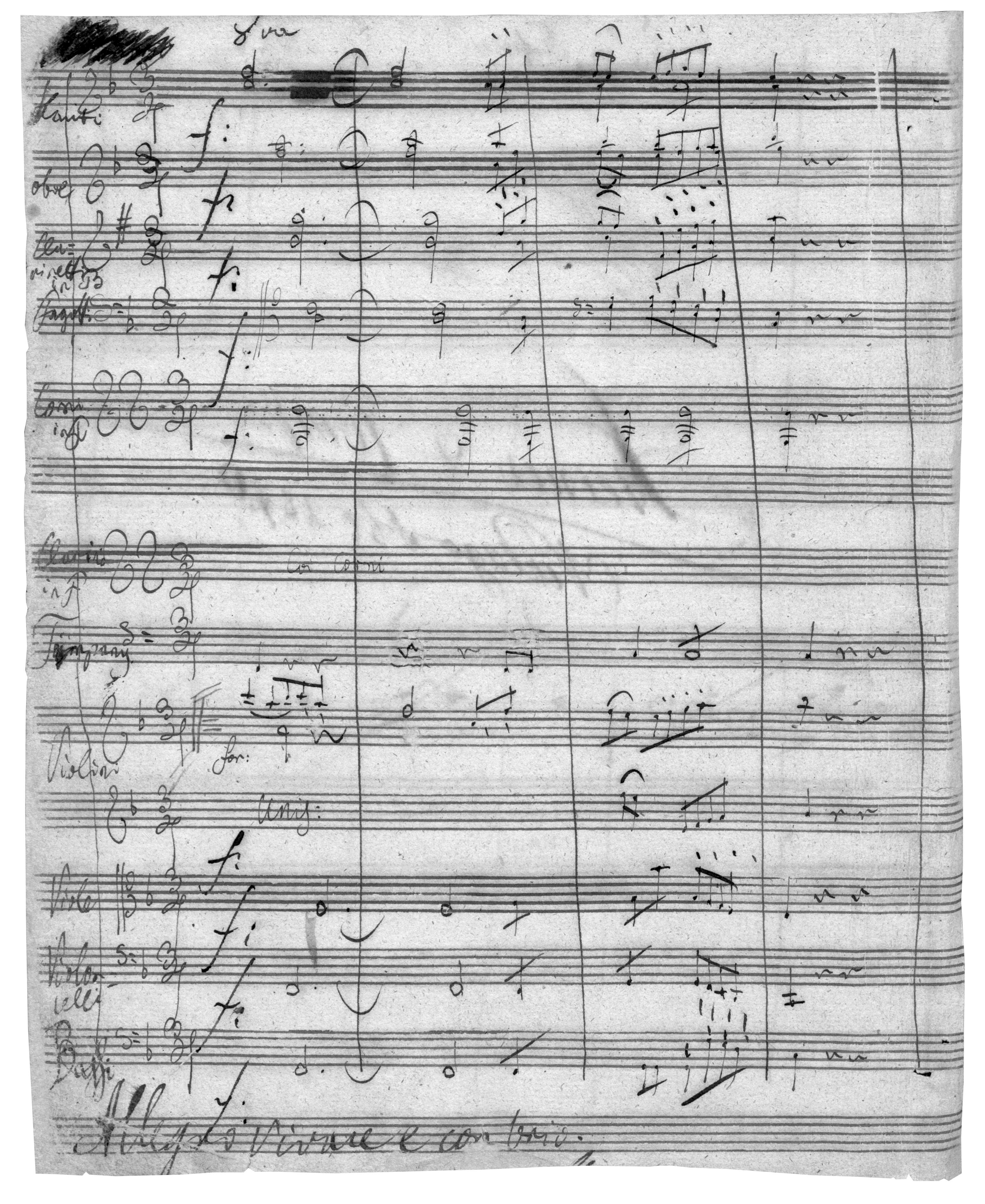
Autographe Partitur der Sinfonie F-dur op. 93 (Quelle A), Beginn des ersten Satzes
Staatsbibliothek zu Berlin • Preußischer Kulturbesitz, Signatur: Mus. Ms. autogr. Beethoven, L. v. 20 I
Digitalisat unter http://resolver.staatsbibliothek-berlin.de/SBB00003E9400000008
Spätestens im April 1813 beendete Niederschrift mit Tinte, zahlreiche Korrekturen und Eintragungen mit Tinte, Bleistift und Rötel.
Autograph score of the Symphony in F major op. 93 (source A), beginning of the first movement
Staatsbibliothek zu Berlin • Preußischer Kulturbesitz, shelfmark: Mus. Ms. autogr. Beethoven, L. v. 20 I
A digital copy can be found at
http://resolver.staatsbibliothek-berlin.de/SBB00003E9400000008
Manuscript in ink, containing numerous corrections and entries in ink, pencil and red crayon, completed in April 1813 at the latest.
Besetzung
2 Flöten
2 Oboen
2 Klarinetten
2 Fagotte
2 Hörner
2 Trompeten
Pauken
Streicher
Aufführungsdauer
etwa 27 Minuten
Dazu käuflich lieferbar:
Orchesterstimmen OB 14618
Studien-Edition HN 9818
Scoring
2 Flutes
2 Oboes
2 Clarinets
2 Bassoons
2 Horns
2 Trumpets
Timpani
Strings
Performing Time
approx. 27 minutes
Available for sale: Orchestral parts OB 14618 Study score HN 9818
Urtextausgabe der im G. Henle Verlag, München, erschienenen Gesamtausgabe Beethoven Werke, herausgegeben vom Beethoven-Archiv Bonn, Abteilung I, Band 4, Symphonien IV, herausgegeben von Ernst Herttrich.
Urtext edition from the complete edition Beethoven Werke, series I, volume 4, Symphonien IV, edited by Ernst Herttrich, issued by the Beethoven-Archiv, Bonn, and published by G. Henle Verlag, Munich.