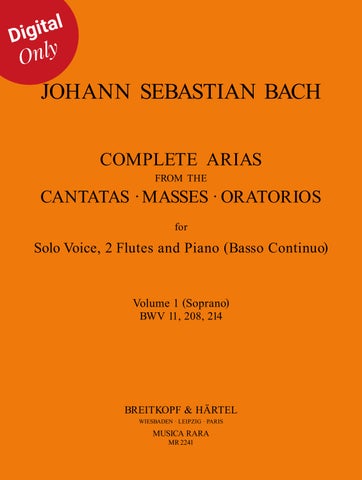
JOHANN SEBASTIAN BACH
SoloVoice, 2Flutes and Piano ( Basso Continuo)
Volume 1 (Soprano)
BWV 11, 208, 214
BREITKOPF & HÄRTEL
WIESBADEN · LEIPZIG · PARIS
MUSICA RARA MR2241
SoloVoice, 2Flutes and Piano ( Basso Continuo)
Volume 1 (Soprano)
BWV 11, 208, 214
BREITKOPF & HÄRTEL
WIESBADEN · LEIPZIG · PARIS
MUSICA RARA MR2241
(1685–1750)
from the Cantatas·Masses·Oratorios for Solo Voice, two Flutes and Piano (Basso Continuo)
Sämtliche Arien aus den Kantaten·Messen·Oratorien für Solostimme, zwei Flöten und Klavier (Basso continuo)
edited by/herausgegeben von Ann Knipschild
Volume 1 (Soprano) /Band 1 (Sopran)
BWV 11, 208, 214
WIESBADEN · LEIPZIG · PARIS
MUSICA RARA MR 2241
Printed in Germany
“Jesu, deine Gnadenblicke” is the second aria from Johann Sebastian Bach’s cantata Lobet Gott in seinen Reichen, BWV11, also known as Himmelfahrts-Oratorium or Ascension Oratorio. It was first performed on Ascension Day, May 19, 1735, in Leipzig. This aria, the eighth movement of the cantata in the Neue Bach-Ausgabe (movement 10 in the edition of the Bach-Gesellschaft), is written for two transverse flutes in unison, soprano, oboe and unison violin and viola. There is no continuo part. In this particular edition, the obbligato oboe line is placed in the right hand of the keyboard accompaniment, while the two unison string parts supply the bass line. In measure 124 of the flute parts, the trill on the second beat should be e2 to f 2 natural (not noted in the NBA).
Bach’s first secular cantata, Was mir behagt, BWV208, is also named the Jagd-Kantate or Hunting Cantata. It was written for the birthday of Duke Christian of Saxe-Weißenfels and probably dates from 1713 during Bach’s early Weimar years. “Schafe können sicher weiden” (“Sheep May Safely Graze”) is a very well known aria for two Flauto dolce (recorders), soprano and continuo. The original use of the recorder (vs. the transverse flute) helps reflect the pastoral nature of this aria.
Tönet ihr Pauken! Erschallet, Trompeten! , BWV214, a “dramma per musica,” was written for the birthday of Electress Maria Josepha and was first performed on December 8, 1733. Bach used much of this secular cantata later in his Christmas Oratorio. One aria not found in the oratorio is “Blast die wohlgegriffnen Flöten” for two transverse flutes, soprano and continuo. The original violone part bears the instruction ‘pizzicato’. In measure 43 of the first flute part, the d 2 in the fourth beat should be a d 2 sharp (not indicated in the NBA). This movement is quite energetic with much syncopation in the two obbligato flutes.
In this edition, basic continuo realizations are provided and may be supplemented by the keyboardist. Articulations, dynamics and ornaments may be added in the appropriate style of the baroque period as well.
Auburn, Spring 2004
Ann Knipschild
„Jesu, deine Gnadenblicke“ ist die zweite Arie aus Johann Sebastian Bachs Kantate Lobet Gott in seinen Reichen BWV11, auch bekannt als „Himmelfahrts-Oratorium“. Die Kantate wurde am 19. Mai 1735 zu Himmelfahrt in Leipzig zum ersten Mal aufgeführt. Diese Arie (Nr.8 in der Neuen Bach-Ausgabe, Nr.10 in der Ausgabe der Bach-Gesellschaft) ist für zwei Traversflöten unisono, Sopran, Oboe sowie Violine und Viola in unisono geschrieben. Es gibt keine Continuostimme. In der vorliegenden Edition ist die Oboe in die rechte Hand des Tasteninstruments gelegt, während die beiden Streicherstimmen den Bass bilden. In T. 124 der Flötenstimmen sollte auf dem zweiten Schlag der Triller zwischen e 2 und f 2 sein (abweichend von der NBA).
Bachs erste weltliche Kantate Was mir behagt BWV208 wird auch als „Jagd-Kantate“ bezeichnet. Sie wurde für den Geburtstag des Herzogs Christian von Sachsen-Weißenfels geschrieben und entstand vermutlich um 1713, also in Bachs frühen Weimarer Jahren. „Schafe können sicher weiden“ ist eine sehr bekannte Arie für zwei Blockflöten, Sopran und Basso continuo. Die originale Besetzung für Blockflöten (im Gegensatz zu Traversflöten) spiegelt den pastoralen Charakter dieser Arie wider.
Tönet, ihr Pauken! Erschallet, Trompeten! BWV214, ein „dramma per musica“, wurde für den Geburtstag der Kurfürstin Maria Josepha geschrieben und erstmals am 8. Dezember 1733 aufgeführt. Während Bach vieles aus dieser Kantate später im Weihnachts-Oratorium verwendet hat, verzichtete er auf die Arie „Blast die wohlgegriffnen Flöten“ für zwei Traversflöten, Sopran und Basso continuo. Die originale Violone-Stimme ist mit „pizzicato“ bezeichnet. In T. 43 vonFlöte I sollte das d 2 auf dem 4. Schlag ein dis2 sein (abweichend von der NBA). Der Satz ist sehr lebhaft mit vielen Synkopen in den zwei obligaten Flöten.
Die einfachen Continuo-Aussetzungen können vom Spieler erweitert werden. Ebenso lassen sich Artikulation, Dynamik und Ornamente im Stil des Barock ergänzen.
Auburn, Frühjahr 2004
Ann Knipschild
Jesu, deine Gnadenblicke BWV 11/10
Schafe können sicher weiden BWV 208/9
Blast die wohlgegriffnen Flöten BWV 214/3
for Solo Voice, two Flutes and Piano (Basso Continuo)
.3
.11
.16
Vol.1Arias for Soprano BWV 11,208,214 MR 2241
Vol.2Arias for Alto BWV 34, 161, 164
Vol.3Arias for Alto BWV 197a, 201, 243
Vol.4Arias for Tenor BWV 107, 110, 173
for Solo Voice, Flute and Piano (Basso Continuo)
Vol.1Arias for Soprano BWV 36b, 82a, 100
Vol.2Arias for Soprano BWV 204, 209, 210
Vol.3Arias for Soprano BWV 211, 212, 245, 249
Vol.4Arias for Alto BWV 30a, 36b, 45, 79
Vol.5Arias for Alto BWV 94, 103, 117
Vol.6Arias for Tenor BWV 55, 78, 96, 99, 102
Vol.7Arias for Tenor BWV 107, 113, 114, 130, 180
Vol.8Arias for Tenor/Bass BWV 8, 123, 232, 248
for Solo Voice, Oboe and Piano (Basso Continuo)
Vol.1Arias for Soprano BWV 21, 29, 31, 32, 72
Vol.2Arias for Soprano BWV 84, 89, 93, 98
Vol.3Arias for Soprano BWV 105, 127, 132, 187, 193
Vol.4Arias for Soprano BWV 202, 233, 246, 248
Vol.5Arias for Alto BWV 12, 22, 44, 48
Vol.6Arias for Alto BWV 79, 102, 114, 159
Vol.7Arias for Alto BWV 176, 185, 214, 235
Vol.8Arias for Tenor BWV 73, 75, 166, 188
Vol.9Arias for Tenor/Bass BWV 56, 78, 235, 236, 244
Vol.10Arias for Bass BWV 82, 85, 152, 159, 197
.MR 2242
.MR 2243
.MR 2244
.MR 2159
.MR 2160
.MR 2161
.MR 2162
.MR 2163
.MR 2164
.MR 2165
.MR 2166
.MR 1893
.MR 1894
.MR 1895
.MR 1896
.MR 1908
1909
1910
.MR 1929
.MR 1930
1931
This is an excerpt. Not all pages are displayed. Have we sparked your interest? We gladly accept orders via music and book stores or through our webshop at www.breitkopf.com. Dies ist eine Leseprobe.
Nicht alle Seiten werden angezeigt. Haben wir Ihr Interesse geweckt?
Bestellungen nehmen wir gern über den Musikalien- und Buchhandel oder unseren Webshop unter www.breitkopf.com entgegen.