Christian Mason
In the Midst of the Sonorous Islands
for Ensemble with Audience Participation
Partitur | Score
for Ensemble with Audience Participation
Partitur | Score
for Ensemble with Audience Participation
Partitur | Score
At any moment, wherever we are, we are hearing; but we are not always listening. Sounds unavoidably communicate all kinds of information about the world around us, but only when we treat sounds as music do we realise their inherent aesthetic value. This sense of the potential beauty of sound can be heightened, or at least brought to attention, by the act of making objects sound, whether or not they were intended as ‘instruments’. The central idea of this piece is the participation of the entire audience in the quasi-alchemical process of transforming raw sound into music: creating form out of matter. The five ‘audience instruments’ have been chosen for their ability to produce rich and strange global textures from relatively simple playing techniques. Sometimes these textu-
Instrumentation:
Audience:
(A) Aluminium Foil, Chains, Baoding Balls (at least 30 players of each)
(B) Glass Bottles (3x8 = 24 players), Harmonicas (3x8 = 24 players)
Soloists (off-stage):
Flute (I–III) doubling Alto Flute* (IV)
Clarinet in Bb (I–III) doubling Bass Clarinet* in Bb (IV)
Oboe (I–III) doubling Cor Anglais* (IV)
Horn
Trumpet (I–III) doubling Flugelhorn* (IV)
Trombone
Violin I
Violin II
Viola
res define the musical foreground, allowing every individual to focus-in on their own contribution to the aliveness of the moment; at other times they become a background for the activity of the ensemble soloists, inviting an experience of the inevitable tension that arises between listening-to and playing different things simultaneously. In one of the preparatory workshops for the piece a participant asked “what are we supposed to listen for?”. A pertinent question, but one to which there is no absolute answer, except maybe that we should all, at all times, be as attentive as possible to the relationship between our individual action and our surrounding environment: in music as in life. In this way, the aesthetic bleeds into the ethical.
Continuo (on-stage):
Bassoon
Tuba
Percussion: Thunder Sheet, Suspended Cymbal, Sizzle Cymbal, Tubular Bells, Vibraphone (with bow), 2 Chinese Opera Gongs, Water Gong, 2 Bongos, 2 Congas, Bass Drum
Harp
Piano
Cello
Double Bass
*The doubling instruments should be waiting ready at the on-stage playing positions for movement IV.
N.B. The ensemble order in the score for movements I–III reflects the division of the ensemble into on-stage and off-stage players (within each group standard orchestral order is maintained). Since the entire ensemble is on-stage for movement IV the score layout reverts to a standard format for this movement. The audience staves are always at the top of the score and serve as a reference for the conductor only: the audience participants do not require notated parts.
Duration: c.30 minutes
Score in C
Commissioned by the Art Mentor Foundation Lucerne For the project “CONNECT – the audience as artist”
World première: London Sinfonietta London, 22 October 2016
German première: Ensemble Modern Frankfurt, 30 October 2016
Dutch première: Asko | Schönberg
Den Bosch, 5 November 2016
Portuguese première: Remix Ensemble
Porto, 6 December 2016
Audience Instruments and Playing Techniques (A): Foil, Chains, Baoding Balls:
• Aluminium Foil:
- The foil should be thin (often this means cheap) and easily crinkled, in the UK ‘essential Waitrose aluminium foil’ is an example of a brand that works well. If using other brands it is necessary to test the sonic quality of the crinkled foil before purchasing large quantities since some foils do not sound well.
- The foil should be cut into strips with a width of 30cm (as it comes off the roll) and a depth of approximately 15cm. Each strip of foil then needs to be lightly crinkled, to look like this:

- Each foil player requires just one strip of foil which needs to remain intact for the entire concert.
- TECHNIQUE: When moved in slow waves between the hands the foil should create a gentle crackling sound, something like the embers of a fire.
20 mm
• Chains:
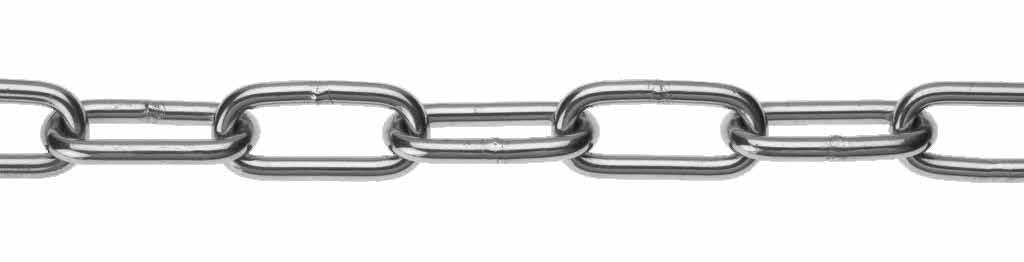
- Small chains (with links of c.20mm) made of steel and cut into lengths of c.50cm each:
50 cm
- TECHNIQUE: One end of the chain should be held by one hand and raised/lowered or raised/dropped into the palm of the other hand with varying speeds to create a global sound something like crickets chirping. Alternatively, chains can be shaken between the palms of cupped hands to create a rustling sound.
• Baoding Balls:
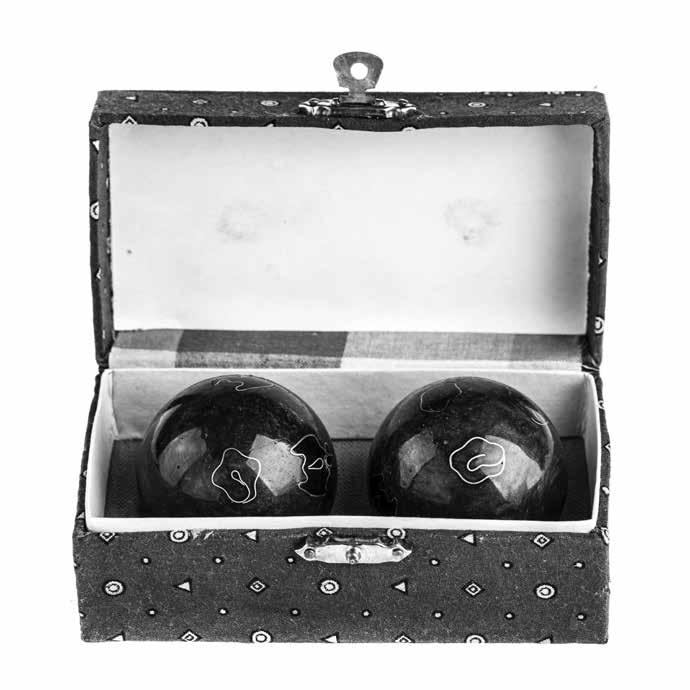
- These pairs of metal balls have bells inside such that they resonate when shaken.
- Players can be given either one ball or a pair.
- TECHNIQUE: Balls should be shaken intermittently, with silences of varied irregular lengths between shakes, to create a constantly changing global texture.
Audience Instruments and Playing Techniques (B): Bottles, Harmonicas:
• Glass Bottles:
- A wide variety of different sizes is needed to produce an unpredictable cluster of different pitches.
- Each player has one bottle.
- There are TWO PLAYING TECHNIQUES:
1. Low pitch-bend: blowing a gently focused air-stream across the top of the bottle (as with a flute) we hear its mellow fundamental tone. If the angle of the airstream is aimed downwards (and the base of the bottle tilted slightly upwards) during the breath it should effect a subtle downward pitch-bend.
2. Overblowing: with a strong diaphragm push causing sharp burst of air the bottles should produce a variety of overtones.
• Harmonicas:
- Three sets of eight 24-hole tremolo harmonicas* with the following bottom-notes and keys (N.B. the bottom note is the dominant of the key):
* The ’24-hole Inconceivable Professional Harmonica’ manufactured by Swan is ideal, see www.swanmusicstore.com for further details. These harmonicas can also be hired directly from the composer via www.christianmason.net
- Each instrument (note/key) is played by one person in each of the three groups, and the players should be seated in the order of the scale (also playing in this order, from top to bottom, adjacent notes overlapping).
- There are TWO PLAYING TECHNIQUES:
1. Low pitch bend: while playing the lowest note of the harmonica, if the angle of the airstream is aimed downwards while the speed of the airstream is increased it should effect a clear downward pitch bend of up to a semitone.
2. Glissando: rapidly slide up and/or down all the notes of the harmonica creating a very fast arpeggio. The global effect of many harmonicas in different keys doing this simultaneously should be something like the the crazier moments of Conlon Nancarrow’s studies for Player Piano.
Role and Preparation of Audience:
The entire audience is invited to participate, with each person being given one instrument/sound-source at the start of the concert. The instruments can either be handed out on entrance to the hall or pre-laid on the seats. There are two categories of participation:
(A) No advance preparation required: anyone who turns up on the night can play foil, chains or baoding balls.
(B) Advance workshop required: harmonica and bottle players will need a workshop of c.2 hours technical preparation and will benefit from having previous musical training.
Cues: Each instrument/sound is associated with a specific cue from the ensemble percussionist. At the start of the concert there must be an introductory explanation of the playing techniques and cues for the category (A) audience instruments. The introductory explanation of the playing techniques and cues for the category (B) audience instruments should be given at a workshop in advance of the concert day, category (B) should also be present for the dress rehearsal if possible.
Texture/Process: Individual audience sounds/actions should not be synchronised. The best global effect will be achieved when similar actions take place at multiple different speeds simultaneously. Individual audience members do not need to make sound constantly but should alternate between sound and silence such that the global effect is of the sound moving around the space. To achieve this each participant should choose two numbers (one for sound, one for silence) between 1 and 8 and use these as the basis of their individual improvisation, varying the durations freely to create more complex individual rhythms once the piece is underway.
Audience Cues and Role of Percussionist:
The percussionist provides the following cues for the starting and stopping of all audience activity:
AUDIENCE INSTRUMENT
Aluminium Foil
AUDIENCE ACTION/SOUND
Percussion: START CUE
Chains lift and lower (or shake) „chirping“ suspended cymbals and sizzle cymbal
Baoding Balls
Glass Bottles
Harmonicas
intermittend shakes „ringing“
tubular bells (hit normally or trem./trills)
1 low pitch bend bowed vibraphone
Percussion: STOP CUE
slow waves „crackling“ thunder sheet bass drum or bongos and congas
2 overblow chinese opera gongs
1 low pitch bend water gong
2 glissando
tubular bells (glissando)
On some occasions the drums (bass drum or bongos/congas) continue playing beyond their basic function as a ‘stop cue’. All other percussion entries have a functional role, cueing audience activity.
The primary relationship for the audience is with the percussionist, however when musically possible (or when specified in the score) the conductor should turn to the audience and use simple physical gestures (crescendo- or diminuendo-type gestures) to shape their textures. The intention is not to vary dynamics as such, but to vary the textural intensity (which implies variations of speed and density of activity, as much as dynamics). The relationship between the conductor and the audience should be established during the introduction to the concert and the nature of the gestures and interaction depends on the preferences of the conductor.
In each movement the nine ‘soloists’ have different off-stage playing positions and tempi. The ‘continuo’ players have fixed positions on-stage and maintain a fixed tempo of 40bpm through movements I–III, against which the soloists can judge their tempi. In movement IV the tempi vary and there is no fixed relationship to define. This table serves as a quick reference for the primary tempo relationships, however there are exceptions to the rule during the piece. All of the different tempi are notated as precise tuplets in relation to the basic pulse of 40bpm. The overall process across the piece is one of diminishing ‘tempo dissonance’.
POSITION
INSTRUMENT and PRINCIPAL TEMPO at each position
1 SOLOS Vln. I* Fl. Tbn.* Ob. Hn.* Vla. Cl. Tpt.* Vln. II 40bpm 60bpm 50bpm 90bpm 70bpm 110bpm 120bpm 100bpm 80bpm
2 DUOS [no duo] carry on solo… Fl. + Tbn. Ob. + Hn. Vla. + Cl. Vln. II + Tpt. 40bpm 50bpm 60bpm 70bpm
3 TRIOS WOODWIND TRIO: Fl. + Ob. + Cl. BRASS TRIO: Hn. + Tpt. + Tbn.
STRING TRIO: Vln I + Vln. II + Vla. 40bpm 50bpm 60bpm
*For these instruments positions 1 and 2 are the same. See layout overleaf:
(Flugelhorn) remains off-stage for the start of movement IV and has three different positions during the movement (listed as positions 4a, 4b, 4c). The below representation is approximate and precise positions should be adjusted according to venue.
Ensemble Layout:
Ensemble Layout:
of hall]
Ensemble Layout:
[back of hall]
Soloists are interspersed with audience during movements I - III. Trumpet (Flugelhorn) remains off-stage for the start of movement IV and has three different positions during the movement (listed as positions 4a, 4b, 4c). The below representation is approximate and precise positions should be adjusted according to venue.
I [1-2]
Ensemble Layout: Soloists are interspersed with audience during movements I - III. Trumpet (Flugelhorn) remains off-stage for the start of movement IV and has three different positions during the movement (listed as positions 4a, 4b, 4c). The below representation is approximate and precise positions should be adjusted according to venue. [back of hall]
Soloists are interspersed with audience during movements I - III. Trumpet (Flugelhorn) remains off-stage for the start of movement IV and has three different positions during the movement (listed as positions 4a, 4b, 4c). The below representation is approximate and precise positions should be adjusted according to venue.
Soloists are interspersed with audience during movements I - III. Trumpet (Flugelhorn) remains off-stage for the start of movement IV and has three different positions during the movement (listed as positions 4a, 4b, 4c). The below representation is approximate and precise positions should be adjusted according to venue.
[back of hall]
[back of hall]
[front of hall/stage]
[front of hall/stage]
[front of hall/stage]
[front of hall/stage]
[front of hall/stage]
Audience Layout:
The distribution of audience instruments depends upon the size of audience at a given performance, but should always follow a principle of ‘safety in numbers’ grouping participants into blocks of similar instruments. The following principles should be observed:
Category (A) Instruments:
• Foil: 5 or more spatially separated groups of at least 10 players
• Chains: 4 or more spatially separated groups of at least 10 players
• Baoding Balls: 3 or more spatially separated groups of at least 10 players
Category (B) Instruments:
• Glass Bottles: 3 spatially separated rows (front, middle, back) of 8 players, seated in order of bottle size.
• Harmonicas: 3 spatially separated rows (front, middle, back) of 8 players, seated in scalar order:
For both categories the juxtaposition of groups should be varied throughout the hall such that the spatial relationship between, for example, ‘Bottles 1’ and ‘Harmonicas 1’ is different from the spatial relationship between ‘Bottles 2’ and ‘Harmonicas 2’, which is in turn different from the spatial relationship between ‘Bottles 3’ and ‘Harmonicas 3’:
Bottles (back)
Harmonicas (back)
Bottles (middle)
Harmonicas (middle)
Bottles (front)
Harmonicas (front)
In a case where the audience is not large enough to achieve this the number of groups can be reduced for category (A) instruments, while the size of groups can be reduced for category (B) instruments (with 4 players per group being an absolute minimum). In cases where the number of harmonica players is reduced participants will be required to play two harmonicas each.
Nur das Mikrofon einschalten reicht nicht – Just turning on your microphone is not enough.
Haben Sie den Verlag schon eingeschaltet? Have you already turned to the publisher?
„Die Benutzung des Materials zu allen Arten von Audio-/audiovisuellen Produktionen, digitaler Speicherung (online/offline), Übermittlung, Wahr nehmbarmachung usw. ohne vorherige schriftliche Zustimmung des Verlages ist ausdrücklich untersagt.“
aus „Allgemeine Geschäftsbedingungen“, 5b
”The use of the material for all types of audio/audio-visual production, digital storage (on-line/off-line), transmission, creation of perceptible media, etc., is expressly prohibited without the prior written consent of the publisher.“
see ”General Trade Terms “ 5b
leih@breitkopf.de hire@breitkopf.com
CONDUCTOR:
N.B. audience dynamics indicate 'intensity of activity' rather than loudness. ey should be directed by the conductor (facing the audience)
Dies ist eine Leseprobe.
Nicht alle Seiten werden angezeigt. Haben wir Ihr Interesse geweckt?
Bestellungen nehmen wir gern über den Musikalien- und Buchhandel oder unseren Webshop unter www.breitkopf.com entgegen.
This is an excerpt. Not all pages are displayed. Have we sparked your interest? We gladly accept orders via music and book stores or through our webshop at www.breitkopf.com.
Breitkopf & Härtel KG
Walkmühlstraße 52 65195 Wiesbaden Germany
info@breitkopf.com www.breitkopf.com