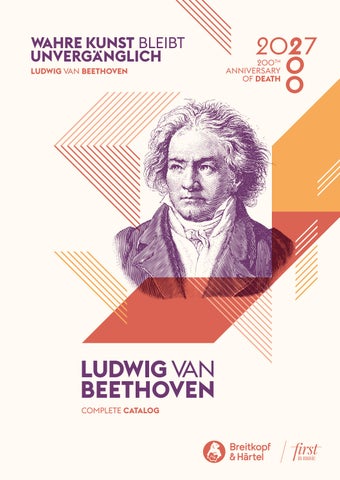
Ludwig van Beethoven | Complete Catalog

Page 1


WAHRE KUNST BLEIBT UNVERGA .. NGLICH

LUDWIG VAN BEETHOVEN

200 TH ANNIVERSARY OF DEATH

LUDWIG VAN BEETHOVEN

CHAMBER MUSIC

KEYBOARD INSTRUMENTS

BEE thov E n

Complete Piano Sonatas

Instructive edition, edited and supplied with fingerings by Frederic Lamond

EB 4341  Volume 1

EB 4342  Volume 2

Beethoven

Frederic Lamond (1868–1948) belonged to the world’s leading interpreters of Beethoven’s music. In his edition of the sonatas, he did not allow any intervention in the music text per se. His indications give instead interpretive approaches, additionally inspiring today’s musicians in the realization of the musical composition. When Lamond first published his edition of Beethoven’s 32 piano sonatas with Breitkopf & Härtel in 1923, he became the epitome of Beethoven interpretation.

The present “Instructive Edition” of Beethoven’s 32 Piano Sonatas is part of the “Breitkopf Originals” series on the occasion of Beethoven’s 250th Birthday in 2020. Apart from the established Urtext editions, this reissue opens up a fascinating view on the interpretation and performance practice of one of the most important Beethoven interpreters in the 19th and 20th century.

6 Ecossaises WoO 83 for Piano

EB 2550

Concertos for Piano and Orchestra Piano reductions by Eugen d’Albert and Friedrich Hermann printed in score form

EB 4331  No. 1 in C major op. 15

EB 4332  No. 2 in B flat major op. 19

EB 4333  No. 3 in C minor op. 37

EB 4334  No. 4 in G major op. 58

EB 4335  No. 5 in E flat major op. 73

8 Original Cadenzas for the Piano Concertos Nos. 1, 2, 3, and 4

EB 4055

Music for a Knightly Ballet WoO 1 for Piano arranged by Willy Hess

EB 6740

Beethoven wrote this work towards the end of his years in Bonn, in 1790/91. There is no surviving program and the only reference made to it is in H. Reichard’s “Theater Kalender auf das Jahr 1792”, where it is called a “characteristic ballet in old German costumes” which deals with “our ancestors’ main interests, to wit: war, hunt, love and drink.”

11 Viennese Dances (Moedling Dances) WoO 17

EB 2838  Edition for Piano

WIND INSTRUMENTS & STRINGS

Duet with two Obbligato Eyeglasses WoO 32 for Viola and Violoncello

EB 6739

3 Duets WoO 27 for Clarinet (Flute, Oboe, Violin) and Bassoon (Violoncello)

EB 8069  Score and parts

3 Equale WoO 30 for 4 Trombones

KM 1555  Original for 4 Trombones

KM 2169  Edition for 4 Horns

Piano Trio op. 1 for Violin, Violoncello and Piano

KM 1056  in E flat major op. 1 No. 1

KM 1057  in G major op. 1 No. 2

KM 1058  in C minor op. 1 No. 3

BEETHOVEN

Piano Trios op. 70 for Violin, Violoncello and Piano

KM 1059  in D major op. 70 No. 1

KM 1060  in E flat major op. 70 No. 2

Klaviersonaten
Klavierauszug Piano reduction

CHAMBER MUSIC

Piano Trio in B flat major op. 97 for Violin, Violoncello and Piano

KM 1061

Piano Trio in B flat major (Gassenhauer-Trio) op. 11 for Clarinet (Violin), Violoncello and Piano

KM 1066

Octet in E flat major op. 103 for 2 Oboes, 2 Clarinets, 2 Horns and 2 Bassoons

KM 1554  Set of Parts

Quintet in E flat major op. 16 for Oboe, Clarinet, Horn, Bassoon and Piano

MR 1040  Score and parts digitally available on nkoda

2 Romances for Violin and Piano

G major op. 40 & F major op. 50

EB 1172

Septet op. 20 for Violin, Viola, Violoncello, Double Bass, Horn, Clarinet and Bassoon

KM 4

Serenade in D major op. 25 for Flute, Violin and Viola

KM 1560

Sextet in E flat major op. 71 for Wind Sextet

KM 1551

Sonata in B flat major for Flute and Piano

EB 5879

Sonata in F major op. 17 for Horn and Piano Urtext edition

EB 7404 Edition for Horn and Piano

String Trio in G major op. 3 for Violin, Viola and Violoncello

KM 703

Trio in C major op. 9 No. 1 for Violin, Viola and Violoncello

KM 706

String Quartets from the series “Breitkopf Originals”

op. 18 No. 1–6

KM 254

op. 59, 74, 95

KM 266

op. 127, 130, 131 Originals

KM 277

op. 132, 133 (Grand Fugue), 135

KM 286

supplied with fingerings and bowing marks by Engelbert Röntgen

Trio in C major for Violin, Violoncello and Piano after the Triple Concerto op. 56 arranged by Carl Reinecke

EB 6607

Trio in C major op. 87

KM 1552 Original edition for 2 Oboes and Cor Anglais

KM 714 Edition for 2 Violins and Viola

MR 2156 Edition for Flute (Oboe), Clarinet and Bassoon

Trio in E flat major op. 38 for Clarinet, Bassoon (Violoncello) and Piano after the Septet op. 20 MR 1082

Trio in G major WoO 37 for Flute, Bassoon and Piano

EB 6604

B EEthovE n

Variationen über „Là ci darem la mano“ für Oboe und Klavier Variations on “Là ci darem la mano” for Oboe and Piano WoO 28

EB 6709

VOICE

An die Hoffnung (“Ob ein Gott sei”) op. 94 for Soprano and Orchestra arranged by Felix Mottl

Performance material available on hire

Die Ehre Gottes aus der Natur (“Die Himmel ruehmen des Ewigen Ehre”) op. 48 No. 4 for Soprano and Orchestra arranged by Felix Mottl

New Folk Songs Volume from “Lieder verschiedener Völker”

WoO 158 for Voice and Piano Trio

EB 6974  Score and parts

Scene and Aria “Ah! Perfido” / “Per pietà, non dirmi addio” op. 65 for Soprano and Orchestra

EB 1332 Edition for Soprano and Piano

Variations on “Là ci darem la mano” (“Give me thy hand, oh fairest”) WoO 28

from W. A. Mozart’s “Don Giovanni”

EB 3967 for 2 Oboes and Cor Anglais

EB 6709 Edition for Oboe and Piano

MR 1187  Edition for Flute (Oboe), Clarinet and Bassoon

Performance material available on hire

A combination of the version for choir by Bruno Dost (Choral score ChB 4723  ) with the orchestration by Felix Mottl is possible.

“Tremate, empi, tremate” op. 116

Terzet for Soprano, Tenor, Bass and Orchestra

Performance material available on hire

B EEthovE n

Sämtliche

Complete Songs for Voice and Piano

EB 34 High voice

EB 296 Low voice

Songs were an integral part of Beethoven’s oeuvre throughout his life, especially in the middle of his creative years – whether it be the cycles opp. 48, 52, 75 and 82, characteristic single works such as Adelaide op. 46 and An die ferne Geliebte op. 98 or the nearly 30 shorter pieces that Beethoven published without an opus number. The edition Beethoven – Collected Songs is also available for low voice.

CHOIR

“Benedictus” from the Missa solemnis op. 123 for Orchestra arranged by Ferruccio Busoni

Performance material available on hire

Bundeslied “In allen guten Stunden” op. 122 for 2 Sopranos, Women’s Choir and Orchestra

Performance material available on hire

Chor auf die verbündeten Fürsten (“Ihr weisen Gründer glücklicher Staaten”) WoO 95 for Choir and Orchestra

Piano vocal score by Carl Reinecke

Performance material available on hire

Die Ehre Gottes aus der Natur (“Die Himmel rühmen des Ewigen Ehre”) op. 48 No. 4 for Choir and Piano arranged by Bruno Dost

PB 4762 Score

ChB 4723 Choral score

A combination with the orchestrated version by Felix Mottl (Performance material available on hire) is possible.

“Es ist vollbracht” WoO 97

Finale to Georg Friedrich Treitschke’s Singspiel “Die Ehrenpforten” for Bass, Choir and Orchestra

Performance material available on hire

Choral Fantasia in C minor op. 80 for Piano, Choir and Orchestra edited by Clive Brown Urtext edition

PB 5230 Score

OB 5230 Orchestral parts / Solo piano

E B 43 4 8 Piano vocal score

PB 525 8 Study score

Beethoven

The history of the origins and sources of Beethoven’s Choral Fantasia poses considerable difficulties to today’s researchers. A definitive “final version” is not extant. Instead, there are contemporary printed editions which diverge from each other in many details.

Editor Clive Brown thus based his text-critical work on his comprehensive knowledge of the performance and notation practice of Beethoven’s time.

“Germania, wie stehst du jetzt im Glanze” WoO 94

Finale to Georg Friedrich Treitschke’s Singspiel “Die gute Nachricht” for Bass, Choir and Orchestra

Performance material available on hire

Cantata “Der glorreiche Augenblick” op. 136 for Soloists, Choir and Orchestra

Performance material available on hire

Cantata on the Death of Emperor Joseph II. WoO 87 for Soloists, Choir and Orchestra

EB 8014  Piano vocal score

Performance material available on hire

Kantate auf die Erhebung Leopolds II. zur Kaiserwürde WoO 88 for Soloists, Choir and Orchestra

Performance material available on hire

Opferlied (“Die Flamme lodert”) Version of 1822 op. 121b for Soloists, Choir and Orchestra

Performance material available on hire

Version of 1824 (final version) op. 121b for Soprano, Choir and Orchestra

Performance material available on hire

The Ruins of Athens op. 113

Music for a play by August von Kotzebue for Soloists, Choir and Orchestra

ChB 3572  Choral score

Performance material available on hire

ORCHESTRA

URTEXT EDITIONS FROM THE NEW BEETHOVEN COMPLETE EDITION (G. HENLE VERLAG) FROM PAGE 14

CONCERTOS

Concerto for Violin and Orchestra in D major op. 61 edited by Clive Brown Urtext edition

PB 53 53  Score

OB 5353  Orchestral parts

E B 865 6  Piano reduction

March and Chorus “Schmückt die Altäre” from “The Ruins of Athens” second version of 1822 op. 114 for Choir and Orchestra

Performance material available on hire

“Wo sich die Pulse jugendlich jagen” WoO 98

Chorus to the Festival Play “The Consecration of the House” for Choir and Orchestra (with soprano solo)

Performance material available on hire

PB 55 31  Study score

What with all the traditional editions available on the market, can we still expect new readings? This is what editor Clive Brown asked himself as he meticulously examined the often conflicting sources. The result: a wealth of new readings in the score as well as an extensively commented piano reduction. The historically informed setting of the solo part deserves special attention. The entries of fingerings and bow strokes go back to the premiere interpreter Franz Clement and the Viennese performance tradition of Beethoven’s time. The edition is thus a unique treasure trove for today’s performers, providing many inspiring ideas for one’s own interpretation.

Concert Movement in C major (Fragment) WoO 5 for Violin and Orchestra completed by Wilfried Fischer

EB 6623  Piano reduction

Performance material available on hire

OVERTURES

“Fidelio” Overture op. 72

edited by Christian Rudolf Riedel Urtext edition

PB 55 11  Score

OB 5511  Orchestral parts

PB 53 07  Study score

“König Stephan” op. 117

Overture to the play by August von Kotzebue

Performance material available on hire

“Leonore” Overture No. 1 op. 138

Performance material available on hire

“Leonore” Overture No. 2 op. 72

PB 5142  Score

OB 5142  Orchestral parts

The Overture Leonore, wrongly named No. 2, is the first of a total of four overtures that Beethoven wrote for his only opera, which was unsuccessful in 1805 and has therefore been revised several times. He was still composing between rehearsals for the premiere of the original version in 1805 at the Theater an der Wien. The music text is based on Volume 11 of the “Supplements to the Complete Edition”.

ORCHESTRA

URTEXT EDITIONS FROM THE NEW BEETHOVEN COMPLETE EDITION (G. HENLE VERLAG) FROM PAGE 14

“Leonore” Overture No. 3 op. 72

edited by Christian Rudolf Riedel Urtext edition

PB 5512  Score

OB 5512  Orchestral parts

PB 5306  Study score

“The Ruins of Athens” op. 113 Overture to the play by August von Kotzebue

Performance material available on hire

SYMPHONIES

Beethoven

Beethoven

Symphony No. 1 in C major op. 21

edited by Clive Brown Urtext edition

PB 5231  Score

OB 5231  Orchestral parts

PB 5341  Study score

Symphony No. 2 in D major op. 36

edited by Clive Brown Urtext edition

PB 5232  Score

OB 5232  Orchestral parts

PB 5342  Study score

Symphony No. 3 in E flat major (Eroica) op. 55

edited by Peter Hauschild Urtext edition

PB 5233  Score

OB 5233  Orchestral parts

PB 5343  Study score

Symphony No. 4 in B flat major op. 60

edited by Peter Hauschild Urtext edition

PB 5234  Score

OB 5234  Orchestral parts

PB 5344  Study score

Symphony No. 5 in C minor op. 67

edited by Clive Brown Urtext edition

PB 5235  Score

OB 5235  Orchestral parts

PB 5345  Study score

Symphony No. 6 in F major (Pastorale) op. 68

edited by Peter Hauschild Urtext edition

PB 5236  Score

OB 5236  Orchestral parts

PB 5346  Study score

Symphony No. 7 in A major op. 92

edited by Peter Hauschild Urtext edition

PB 5237  Score

OB 5237  Orchestral parts

PB 5347  Study score

Symphony No. 8 in F major op. 93

edited by Peter Hauschild Urtext edition

PB 5238  Score

OB 5238  Orchestral parts

PB 5348  Study score

Beethoven –

Symphony No. in 9 D minor op. 125

edited by Peter Hauschild Urtext edition

PB 5239 Score

OB 5239 Orchestral parts

ChB 5237 Choral score

E B 8633 Piano vocal score

PB 5349 Study score

OTHER ORCHESTRAL WORKS

Beethoven

Beethoven –

Congratulatory Minuet in E flat major WoO 3 for Orchestra

PB 4814  Score OB 4814  Orchestral parts

12 German Dances WoO 8 for Orchestra with Post-horn solo

PB 4799  Score OB 4799  Orchestral parts

Ecossaise in D major WoO 22 for Military Band

Performance material available on hire

Grand Fugue in B flat major op. 133 for Orchestra arranged by Manuel Hidalgo

Performance material available on hire

12 Contredanses WoO 14 for Orchestra

PB 4800  Score OB 4800  Orchestral parts

Military March in D major WoO 24 for Military Band

Performance material available on hire

Music for a Knightly Ballet WoO 1 for Orchestra

Performance material available on hire

Beethoven wrote this work towards the end of his years in Bonn, in 1790/91. There is no surviving program and the only reference made to it is in H. Reichard’s “Theater Kalender auf das Jahr 1792”, where it is called a “characteristic ballet in old German costumes” which deals with “our ancestors’ main interests, to wit: war, hunt, love and drink.”

Sonata in B flat major (Hammerklavier-Sonata) op. 106 for Orchestra arranged by Felix Weingartner

Performance material available on hire

Triumphal March in C major WoO 2a to Christoph Kuffner’s Tragic Drama “Tarpeja” for Orchestra

Performance material available on hire

Der Wachtelschlag (“Horch, wie schallt’s…”) WoO 129 for Orchestra arranged by Felix Mottl

Performance material available on hire

11 Viennese Dances (Moedling Dances) WoO 17 for Orchestra

PB 4787  Score

OB 4787  Orchestral parts

Tattoo No. 1 WoO 18 (“York‘scher Marsch”) for Military Band arranged by Johannes Schade

Performance material available on hire

Tattoo No. 2 WoO 20 for Military Band arranged by Johannes Schade

Performance material available on hire

Tattoo No. 2 WoO 19 for Military Band arranged by Johannes Schade

Performance material available on hire

LUDWIG VAN BEETHOVEN

AT BREITKOPF & HÄRTEL SINCE 1802

IT IS NOT POMPOUS WHEN I TELL YOU THAT I PREFER YOU OVER ALL OTHERS.

Contract (declaration of ownership and receipt) between BREITKOPF & HÄRTEL and LUDWIG VAN BEETHOVEN, dated 25 July 1810

* LUDWIG VAN BEETHOVEN, LETTER TO BREITKOPF & HÄRTEL IN LEIPZIG, BADEN, 21 AUGUST 1810

[…], WHEREAS THE GENTLEMEN BREITKOPF AND HÄRTEL, THE RIGHTFUL OWNERS OF THIS QUINTET, HAVE MADE EVERY EFFORT TO RENDER THE WORK AS BEAUTIFUL AS POSSIBLE.

LUDWIG VAN BEETHOVEN’S ADVERTISEMENT IN THE WIENER ZEITUNG OF 22 JANUARY 1803

First edition of the score of SYMPHONY NO. 5 IN C MINOR OP. 67
MASS IN C MAJOR OP. 86 original edition 1812
QUINTET OP. 29 original edition December 1802

URTEXT FROM THE NEW BEETHOVEN COMPLETE EDITION (G. HENLE VERLAG)

CHOIR

Christ on the Mount of Olives op. 85

for Soloists, Choir and Orchestra edited by Anja Mühlenweg

Performance material available on hire

EB 10582  Piano vocal score

Christus am Ölberge (Christ on the Mountain of Olives) is Beethoven’s only oratorio. The premiere took place on 5 April 1803 as part of an academy concert. Breitkopf & Härtel published the original edition of the score in 1811, however, against Beethoven’s will, with strong textual interventions in the opera-like libretto by Franz Xaver Huber. The new Urtext edition by Anja Mühlenweg represents a kind of historical reparation; it not only precisely reproduces the original text, but also presents the work as a whole in the form intended by Beethoven.

Elegischer Gesang (“Sanft wie du lebtest”) op. 118

for Choir and Strings edited by Armin Raab

PB 14675 Score

OB 14675 Orchestral parts

ChB 14675 Choral score

Choral Fantasia in C minor op. 80

for Piano, Choir and Orchestra edited by Armin Raab

PB 14660 Score

OB 14660 Orchestral parts

ChB 14660 Choral score

E B 10546 Piano reduction

Beethoven

Calm Sea and Prosperous Voyage op. 112

for Choir and Orchestra edited by Armin Raab

PB 14670 Score

OB 14670 Orchestral parts

ChB 14670 Choral score

E B 10580 Piano vocal score

In his op. 112, Beethoven brings Goethe’s poems Meeresstille (Calm Sea) and Glückliche Fahrt (Prosperous Voyage) together. A few sketches reveal that Beethoven had already begun exploring the poems by the end of 1814. He conducted the premiere at a charity concert in support of the Vienna Citizens’ Hospital Fund in 1815. Due to delays in printing, Goethe received a dedicatory copy of the score only in May 1822. Later, Beethoven inquired of him whether he thought that he had set the texts to music in an apt manner. He expressed his readiness for an “indoctrination that is to be seen as the truth,” as he loved the truth above all, saying: “To me, the following shall never apply: Veritas odium parit.”

Mass in C major op. 86 for Soloists, Choir and Orchestra edited by Jeremiah W. McGrann

PB 14676 Score

OB 14676 Orchestral parts / Organ

ChB 14676 Choral score

E B 10581 Piano vocal score

As is often the case with Beethoven’s orchestral works, various, often contradictory sources arising from both the material used at the first performance and the first edition, calling for the knowledgeable assessment of a specialist. Editor Jeremiah W. McGrann takes Breitkopf’s original edition as the main source, despite its shortcomings due to time constraints, placing particular emphasis on the aspect of the organ’s figured bass.

As it has been transmitted in two authentic readings, both are printed in the score. The newly revised orchestral material contains a new organ part, realized by Siegfried Petrenz, and fulfills every requirement for a stylistically authentic performance.

URTEXT FROM THE NEW BEETHOVEN COMPLETE EDITION (G. HENLE VERLAG)

Missa solemnis in D major op. 123 for Soloists, Choir and Orchestra edited by Norbert Gertsch

PB 14650 Score

OB 14650 Orchestral parts / Organ

ChB 14650 Choral score

E B 10544 Piano vocal score

Ludwig van Beethoven wrote his Missa solemnis, which he declared to be his most accomplished work in the last years of his life, between 1819 and 1822. The primary source for the present edition is the working copy of the score that Beethoven most likely commissioned immediately after completing the piece. It is the earliest copy of the work and the sole copy based on the now incomplete autograph. Since the work copy was repeatedly revised and corrected as further copies were made, it comes closest to a “definitive version” today.

CONCERTOS

Concerto for Piano and Orchestra No. 1 in C major op. 15 edited by Hans-Werner Küthen

PB 14550  Score

OB 14550  Orchestral parts

Concerto for Piano and Orchestra No. 2 in B flat major op.19 edited by Hans-Werner Küthen

PB 14560  Score

OB 14560  Orchestral parts

Concerto for Piano and Orchestra No. 3 in C minor op. 37 edited by Hans-Werner Küthen

PB 14570  Score

OB 14570  Orchestral parts

Concerto for Piano and Orchestra No. 4 in G major op. 58

edited by Hans-Werner Küthen

PB 14620  Score

OB 14620  Orchestral parts

Concerto for Piano and Orchestra No. 5 in E flat major op. 73 edited by Hans-Werner Küthen

PB 14630  Score

OB 14630  Orchestral parts

Concerto for Violin and Orchestra in D major op. 61

edited by Shin Augustinus Kojima

PB 14580  Score OB 14580  Orchestral parts

Beethoven

Concerto for Piano, Violin, Violoncello and Orchestra in C major (Triple Concerto) op. 56

edited by Bernard van der Linde

PB 14540  Score

OB 14540  Orchestral parts

Romances in G major op. 40 / in F major op. 50 for Violin and Orchestra edited by Shin Augustinus Kojima

PB 14590  Score

OB 14590  Orchestral parts

Rondo in B flat major WoO 6 for Piano and Orchestra

Original finale of the Piano Concerto No. 2 edited by Hans-Werner Küthen

PB 14679  Score

OB 14679  Orchestral parts

URTEXT FROM THE NEW BEETHOVEN COMPLETE EDITION (G. HENLE VERLAG)

SYMPHONIES

TWO PERSPECTIVES – ONE GOAL: BEETHOVEN SYMPHONIES AT BREITKOPF & HÄRTEL

1993 marked the start of the first text-critical edition of the Beethoven symphonies edited by two acknowledged specialists: Peter Hauschild, who had previously monitored Kurt Masur’s complete recording with the Gewandhaus Orchestra from a musicological point of view and Clive Brown, author of the standard work “Classical & Romantic Performance Practice” and as violinist one of the world’s authorities on historical performance practices. The systematic editing of the complex, sometimes contradictory sources was still far from complete when Breitkopf & Härtel began collaborating in 2003 with the Henle Verlag, publisher of the Beethoven complete edition. With this came the unique opportunity of assuming not only Henle’s hitherto existing Beethoven orchestral material (including all seven solo concertos, several concert overtures, and the Missa solemnis), but also of participating in future, highly specialized Beethoven research projects. In the case of the symphonies, Choral Fantasy, and the violin concerto, however, this involved a duplication as unusual as it is in need of explanation.

What could be regarded in the case of less important works by other composers as an expendable luxury, proved here to be a magnificent enrichment. It is not without reason that both performers and editors regard Beethoven as the ultimate challenge. The double edition impressively shows how to manage “the difficult balancing act between the requirements of practical usefulness and philological meticulousness” (Peter Gülke). Each approach offers different solutions from varying perspectives, especially in terms of presenting source facts. Both, however, combine the absolute penetration of the material, the seriousness and consistency of opening up Beethoven’s musical practice intentions.

Users now have the luxury of choice, but regardless of the option chosen, are richly rewarded: with text-critical editions of the highest quality and with Breitkopf’s practice-based orchestral parts.

Symphony No. 1 in C major op. 21

edited by Armin Raab

PB 14600  Score

OB 14600  Orchestral parts

Symphony No. 2 in D major op. 36

edited by Armin Raab

PB 14610  Score

OB 14610  Orchestral parts

Symphony No. 3 in E flat major (Eroica) op. 55

edited by Bathia Churgin

PB 14613  Score

OB 14613  Orchestral parts

Symphony No. 4 in B flat major op. 60

edited by Bathia Churgin

PB 14614  Score

OB 14614  Orchestral parts

Beethoven

Beethoven

Symphony No. 5 in C minor op. 67

edited by Jens Dufner

PB 14615  Score

OB 14615  Orchestral parts

Symphony No. 6 in F major (Pastral Symphony) op. 68

edited by Jens Dufner

PB 14616  Score OB 14616  Orchestral parts

Symphony No. 7 in A major op. 92 edited by Ernst Herttrich

PB 1461 7  Score

OB 1461 7  Orchestral parts

Symphony No. 8 in F major op. 93

edited by Ernst Herttrich

PB 1461 8  Score

OB 1461 8  Orchestral parts

Symphony No. 9 in D minor op. 125

edited by Beate Angelika Kraus

PB 14619 Score

OB 14619 Orchestral parts

ChB14677 Choral score

E B 9356 Piano vocal score

URTEXT FROM THE NEW BEETHOVEN COMPLETE EDITION (G. HENLE VERLAG)

THE SYMPHONIES COMPLETE SCORES IN SLIPCASE

The authoritative edition according to the new Beethoven Complete Edition. The study of all available sources, new discoveries and source evaluations lead to a text-critical authentic musical text, which sets new standards for musical practice.

The conducting scores of Symphonies Nos. 1–9 adopt the original text from the respective volume of the new Beethoven Complete Edition, published by G. Henle Verlag. The most important information on the genesis, sources and readings is given in the remarks of the conducting score of the respective symphony.

The Symphonies

PB 146 80 Complete scores in slipcase

INHALT

Symphony No. 1 in C major op. 21

PB 146 00 Score

Symphony No. 2 in D major op. 36

PB 1461 0 Score

Symphony No. 3 in E flat major op. 55 (Eroica)

PB 1461 3 Score

Symphony No. 4 in B flat major op. 60

PB 1461 4 Score

Symphony No. 5 in C minor op. 67

PB 1461 5 Score

Symphony No. 6 in F major op. 68 (Pastoral Symphony)

PB 1461 6 Score

Symphony No. 7 in A major op. 92

PB 1461 7 Score

Symphony No. 8 in F major op. 93

PB 1461 8 Score

Symphony No. 9 in D minor op. 125

PB 1461 9 Score

URTEXT FROM THE NEW BEETHOVEN COMPLETE EDITION (G. HENLE VERLAG)

OTHER ORCHESTRAL WORKS

Scene and Aria “Ah! Perfido” / “Per pietà, non dirmi addio” op. 65 for Soprano and Orchestra edited by Ernst Herttrich

PB 14678  Score

OB 14678  Orchestral parts

The autograph of the incidental music to Egmont is located at the Staatsbibliothek zu Berlin Preußischer Kulturbesitz. It is, however, lacking precisely the Overture, of which only three scribal copies corrected by Beethoven have survived as manuscript sources. Particularly important is the manuscript preserved in the collections of the BeethovenHaus in Bonn, since this is the one into which Beethoven entered all the corrections made with respect to the autograph, no doubt during the rehearsals for the first performances.

Overture “Zur Namensfeier” op. 115

edited by Hans-Werner Küthen

PB 14510  Score

OB 14510  Orchestral parts

“Coriolan” op. 62

Overture to Heinrich Joseph von Collin‘s Tragedy edited by Hans-Werner Küthen

PB 14500  Score

OB 14500  Orchestral parts

Beethoven –

“The Creatures of Prometheus” op. 43

Overture to the Ballet

edited by Klaus Kropfinger

PB 14677  Score

OB 14677  Orchestral parts

„Egmont“ op. 84

Overture to Johann Wolfgang v. Goethe‘s Tragedy edited by Helmut Hell

PB 14640  Score

OB 14640  Orchestral parts

Beethoven –

Overture “The Consecration of the House” op. 124

edited by Hans-Werner Küthen

PB 14520  Score

OB 14520  Orchestral parts

The source situation of the ballet music to The Creatures of Prometheus is typical of Beethoven’s work: No autograph, but various sources bearing corrections by the composer. For preparing the Urtext edition for practical performance of op. 43, Editor Klaus Kropfinger primarily used a copy of the score examined by the composer himself and located at the Austrian National Library in Vienna. It was complemented by proofs of the piano version corrected by the composer along with the original edition of the orchestral parts. Taking these sources into account, the present edition differs from the first Beethoven Complete Edition.

Wellington’s Victory or the Battle at Vittoria op. 91

edited by Hans-Werner Küthen

PB 14530  Score

OB 14530  Orchestral parts

DRAMATIC WORKS

Egmont op. 84

Incidental Music to Johann Wolfgang von Goethe’s Tragedy

Performance material available on hire

Fidelio op. 72

Opera in Two Acts

Performance material available on hire

“The whole matter concerning the opera is the most troublesome in the world. There is a very great difference between letting oneself be guided by reflection and giving oneself up to free inspiration. In short, I assure you, dear Treitschke, the opera is going to win me a martyr’s crown.” Beethoven had already revised the opera several times when he wrote these words to the then director and dramaturg at the Court Opera. Reworked partly at the urging of friends and partly of his own free will, the opera finally made its breakthrough in its final version.

The triumphal first performance of the third version of the work was held at Viennas Kärntnertortheater on 23 May 1814 with Beethoven conducting.

The Creatures of Prometheus op. 43

Ballet in Two Acts

Performance material available on hire

In the ballet Gli uomini di Prometeo, Beethoven interprets the Greek legend about the titan Prometheus. Prometheus resisted the will of the gods by standing up for the people he had created. He had formed two people from clay, woke them to life and was at the same time their teacher. When teaching them about the secrets of fire, he incurred Zeus’ wrath upon him. Prometheus’ support for the people was not to remain without consequences.

In the season after its premiere on 28 March 1801 in Vienna, the ballet was performed almost 30 times and was thus a great success for the time. Today, the music belongs to Beethoven’s less known works.

König Stephan op. 117

Incidental Music to August von Kotzebue’s Festival Play

Performance material available on hire

Leonore

Opera in Three Acts

Early Version of “Fidelio” from 1805

Performance material available on hire

When the original Leonore was performed at the Theater an der Wien in 1805, adverse circumstances prevented the hoped-for success. Beethoven had to revise his only opera several times until it finally succeeded in 1814 as Fidelio. It then comprised only two acts instead of three; apart from that, the dramaturgical focus was different. In 1953, Willy Hess succeeded in uncovering the editorial potential of Beethoven’s bold opera debut by means of a thorough comparison of the versions.

In the meantime, the performance material has been updated as well, taking into account the results of the Beethoven research. It has served interpreters such as Bertrand de Billy and René Jacobs as a reliable and inspiring basis.

Leonore Prohaska WoO 96

Music to Johann Friedrich Leopold Duncker’s Drama of the Same Name

Performance material available on hire

The Ruins of Athens op. 113

Incidental Music to August von Kotzebue’s Festival Play

Performance material available on hire

Individual numbers from the respective works on request.

DRAMATIC WORKS SELECTIONS

Go on a journey through the various stages of the Breitkopf & Härtel rental library!

www.breitkopf.com/catalogs

INSPIRED BY BEETHOVEN

MANUEL HIDALGO

(*1956)

Beethoven: Grand Fugue op. 133

Arrangement for Orchestra *

Introduction and Fugue

Arrangement of the last set of Beethoven‘s Sonata in B flat major op. 106 for Accordion and Orchestra *

HELMUT LACHENMANN

(*1935)

Staub

Compositional “comment” on Beethoven‘s Symphony No. 9 for Orchestra *

PB 5177 Study score

ISABEL MUNDRY

(*1963)

Orchestra Fragments to Beethoven *

JOHANNES MARIA STAUD

(*1974)

A propos 1. ... de Diabelli for Piano

EB 9370

HANS ZENDER

( 1936–2019)

33 Veränderungen über 33 Veränderungen New Version 2019 – A composed interpretation of Beethoven‘s Diabelli Variations for Ensemble *

* Performance material available on hire

ADVERTISING MATERIAL

We also offer equipment packages in different variants. Our sales team will be happy to give advice.

PROMO POSTER

DIN A3 (29,7 x 42 cm)

140g Offset matte paper

B+H 338

GLASSES CLEANING CLOTH

im PP case with Velcro fastener

P-9000® microfiber 18 x 15 cm

(80 % polyester, 20 % polyamide)

BM 437

NOTE BOOK

for Composing and Annotating 32 Pages saddle stitch

DIN A6 (10,5 x 14,8 cm)

PB 5888

POCKET UMBRELLA

with case & soft-touch handle elastic carrying cord

Double automatic function, Windproof PLUS system

Diameter when opened: 97 cm, 100 % Polyester

BM 438

SPRING 2026

Unisex in various sizes

100 % cotton

COTTON BAG

Bag and handles: 100 % cotton, canvas

Magnetic button & waterproof zipper

2 outside pockets, 1 inside pocket

36 x 40 x 7 cm

BM 436

T-SHIRT

Breitkopf & Härtel KG

Taunusstein

Obere Waldstraße 30 65232 Taunusstein

Germany

T +49 (0)611 45008-0

Customer Service

Irina Eppel +49 (0)611 45008-81 customerservice@breitkopf.com

Performance and Rental Affairs

Cordula Stamm +49 (0)611 45008-94 hire@breitkopf.com

LUDWIG VAN BEETHOVEN

Breitkopf & Härtel KG

Publishing House Wiesbaden

Walkmühlstraße 52 65195 Wiesbaden

Germany

T +49 (0)611 45008-0 info@breitkopf.com

Sales

Katarina Geenen T +49 (0)611 45008-75/-54 geenen@breitkopf.com

Marketing | Advertising Florian Kleidorfer T +49 (0)611 45008-56 kleidorfer@breitkopf.com

Press

Susanne Mahn T +49 (0)611 45008-55 mahn@breitkopf.com

Errors excepted. Valid as of 1 August 2025 B+H 123 obtainable from

Design RAUM ZWEI | Leipzig

Turn static files into dynamic content formats.

Create a flipbook
Issuu converts static files into: digital portfolios, online yearbooks, online catalogs, digital photo albums and more. Sign up and create your flipbook.