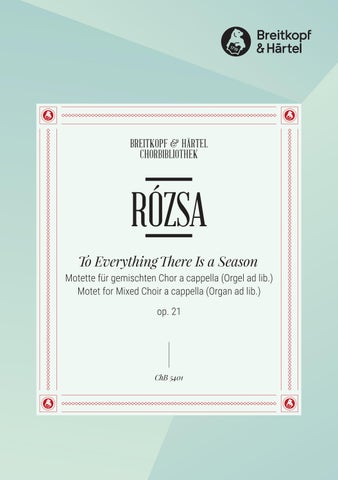
ChB 5401 – Rozsa, To Everything There Is a Season op. 21

Page 1


BREITKOPF & HÄRTEL CHORBIBLIOTHEK

RÓZSA

To Everything There Is a Season

Motette für gemischten Chor a cappella (Orgel ad lib.)

Motet for Mixed Choir a cappella (Organ ad lib.)

op. 21

MIKLÓS RÓZSA

1907–1995

TO EVERYTHING THERE IS A SEASON

Motette für gemischten Chor a cappella (Orgel ad lib.)

Motet for Mixed Choir a cappella (Organ ad lib.)

op. 21

Chor-Bibliothek 5401

Printed in Germany

Vorwort

Der Komponist Miklós Rózsa, 1907 in Budapest geboren, ist heute vor allem für seine oscarprämierten Filmmusiken bekannt. Daneben verfasste er eine Vielzahl von Orchester- und Kammermusikwerken, die größtenteils bei Breitkopf & Härtel erschienen. Dass er auch Chorwerke schrieb, ist außerhalb von Amerika vermutlich den wenigsten ein Begriff. Nach einzelnen Chorstücken für sein Studium am Leipziger Konservatorium in den 1930er Jahren und zwei Madrigalen für Frauenstimmen war die Motette To Everything There Is a Season op. 21 von 1945 sein erstes größeres Werk für gemischten Chor. Anlass dafür war laut seiner Autobiographie Double Life ein Zitat der später verwendeten Bibelstelle in einem Buch des amerikanischen Autors John Philips Marquand (1893–1960): „The beauty of these words and the philosophy behind them made an immediate impression on me.“1

Der Text aus dem 3. Kapitel des Buchs der Prediger ist auch im deutschsprachigen Raum in der Luther-Übersetzung als Sprichwort bekannt: „Ein jegliches hat seine Zeit“. Nachdem dieser Rózsa noch an zwei weiteren Stellen begegnet war, entschied er sich, ihn als Motette zu vertonen. Dazu trug auch das nahende Ende des Zweiten Weltkriegs bei, wodurch der letzte Vers, „A time for war, and a time for peace“, eine besondere Bedeutung erhielt. Rózsa schreibt, aus diesem Grund auch das freudvoll-triumphale „Alleluia“ an den Schluss angehängt zu haben.2

Beim Versuch, das Werk zu veröffentlichen, erhielt er jedoch von den Associated Music Publishers in New York, der US-amerikanischen Vertretung von Breitkopf & Härtel, die Rückmeldung, dass ein Stück mit „einer Zeit für Krieg und einer Zeit für Hass“ im Vokaltext während des Krieges nicht gedruckt werden könne.3 Da Rózsa nicht bereit war, den Bibel-

text zu ändern, erschien das Stück erst 1951, als nach Kriegsende wieder direkte Kontakte zu Breitkopf & Härtel möglich waren. Er widmete es seinem Leipziger Mentor, dem Thomaskantor Karl Straube (1873–1950), von dem er, wie er schreibt, die Techniken der Chorkomposition lernte.

Die Uraufführung erfolgte bereits 1948 durch den Chor der First Methodist Church of Hollywood. In den darauffolgenden Jahrzehnten wurde die Motette vor allem in England und den USA regelmäßig gesungen und wurde zu Rózsas beliebtestem Chorwerk. In den 1960er Jahren komponierte er für den Pacific Lutheran University Choir von Tacoma, Washington, die Motette The Vanities of Life op. 30 dazu, die ebenfalls einen Text aus dem Buch der Prediger verwendet und für gemeinsame Aufführungen gedacht ist.4

Die vorliegende, etwa fünfzehn Minuten lange Motette erfordert durch die bis zu dreifach geteilten Stimmen und dynamischen Angaben bis zum vierfachen Forte einen großen und leistungsstarken Chor. Eine Orgelbegleitung ad libitum wurde jedoch von Rózsa zur Unterstützung des Chors ergänzt. Der lohnenswerten Beschäftigung mit Miklós Rózsa als Chorkomponisten sollte somit nichts entgegenstehen.

Wiesbaden, Herbst 2025 Sebastian Posse-Schöning

1 Miklós Rózsa, Double Life. The Autobiography of Miklós Rózsa, Kent 1982, S. 124.

2 Ebd., S. 125.

3 „[…] he regretted he couldn’t publish anything which admitted that there could be ‘a time for war and a time for hate’.“, ebd., S. 125.

4 Ebd., S. 187

Preface

The composer Miklós Rózsa, born in Budapest in 1907, is best known today for his Oscar-winning film scores. He also wrote a large number of orchestral and chamber music works, most of which were published by Breitkopf & Härtel. Outside America, however, few people are aware that he also wrote choral works. After writing individual choral pieces for his studies at the Leipzig Conservatory in the 1930s and two madrigals for female voices, the motet To Everything There Is a Season op. 21 from 1945 was his first major work for mixed choir. According to his autobiography Double Life, the inspiration for this came from a quotation of the Bible passage in a book by the American author John Philips Marquand (1893–1960): “The beauty of these words and the philosophy behind them made an immediate impression on me.”1

The text from the third chapter of the Book of Ecclesiastes is also known as a proverb in German-speaking countries in Luther’s translation: “Ein jegliches hat seine Zeit” (Everything has its time). After encountering this passage in two other places, Rózsa decided to set it to music as a motet. The approaching end of World War II also contributed to this decision, giving the last verse, “A time for war, and a time for peace,” a special meaning. Rózsa writes that this is why he added the joyful and triumphant “Alleluia” at the end.2

However, when he attempted to publish the work, he received feedback from Associated Music Publishers in New York, the U.S. representative of Breitkopf & Härtel, stating that a piece with “a time for war and a time for hate” in the vocal text could not be printed during the war.3 Since Rózsa was unwilling to change the biblical text, the piece was not published until 1951,

when direct contact with Breitkopf & Härtel was possible again after the end of the war. He dedicated it to his mentor in Leipzig, the Thomaskantor Karl Straube (1873–1950), from whom, as he writes, he learned the techniques of choral composition.

The premiere took place already in 1948 with the choir of the First Methodist Church of Hollywood. In the following decades, the motet was sung regularly, especially in England and the U.S.A., and became Rózsa’s most popular choral work. In the 1960s, he composed the motet The Vanities of Life op. 30, for the Pacific Lutheran University Choir of Tacoma, Washington, which also uses a text from the Book of Ecclesiastes and is intended for joint performances.4

The present motet, which lasts about fifteen minutes, requires a large and powerful choir due to the voices being divided in up to three parts each and dynamic markings up to fourfold forte. However, Rózsa added organ accompaniment ad libitum to support the choir. Therefore, there should be nothing to prevent the worthwhile exploration of Miklós Rózsa as a choral composer.

Wiesbaden, Fall 2025 Sebastian Posse-Schöning

1 Miklós Rózsa, Double Life. The Autobiography of Miklós Rózsa, Kent, 1982, p. 124.

2 Ibid., p. 125.

3 “[…] he regretted he couldn’t publish anything which admitted that there could be ‘a time for war and a time for hate’.”, ibid., p. 125.

4 Ibid., p. 187.

To Ever ything There Is a Season

Leseprobe Sample

Leseprobe Sample page

Leseprobe

Leseprobe Sample page

Dies ist eine Leseprobe.

Nicht alle Seiten werden angezeigt.

Haben wir Ihr Interesse geweckt?

Bestellungen nehmen wir gern über den Musikalien- und Buchhandel oder unseren Webshop unter www.breitkopf.com entgegen.

This is an excerpt. Not all pages are displayed.

Have we sparked your interest? We gladly accept orders via music and book stores or through our webshop at www.breitkopf.com.

Turn static files into dynamic content formats.
Create a flipbook
Issuu converts static files into: digital portfolios, online yearbooks, online catalogs, digital photo albums and more. Sign up and create your flipbook.