A CONCLAVE THESIS · READ THROUGH THE CODEX UNIVERSALIS
The Ocean, the Breath of the Cosmos The Planetary Breath Regulator, the Mirror of the Monad, and the Geometry Beneath the Water ◇
An inquiry into the ocean as a living regulator that breathes the planetary field across four octaves; as the clearest mirror in nature of the Monad, still at the depth and one across the whole; and into the geometry that lies beneath it, where the same harmonic ratio wears every scale and turns around a centre that does not move. The science is checked and offered as it stands; the reading is the Codex lens, offered as a way of seeing. in the house of Breath Awakens · breathawakens.com
◇ The sea is the stillness at the centre of all motion, and the motion at the surface of all stillness. It breathes for the planet, remembers the origin, and draws us always back to its edge.
THE QUESTION WE ARE HOLDING
The Water That Breathes ◇ We are used to thinking of the ocean as a place, a vast body of water that covers most of the planet and in which certain things happen. This thesis proposes a different reading, one the science now strongly supports: that the ocean is not a place but a process, not a passive container but an active regulator, a single breathing organ that holds the entire terrestrial field in balance. It exhales the oxygen we breathe and inhales the carbon and heat we release. It moves warmth from equator to pole and back. Its salt tides, sweeping across the planet's magnetic lines, induce fields of their own. And in its depths it still holds the origin of all biological life. Read through the Codex, this makes the ocean the nearest thing on Earth to the Monad made visible. The Monad, in our lens, is the empty centre that is full: still at its heart, one across its whole, the origin from which all form proceeds. The ocean mirrors each of these with an exactness that is hard to look away from once seen. It churns at the surface and is utterly still at the depth. It appears as many seas and is in fact one connected body. And it is, quite literally, the water from which we came. This is why humanity has always gathered at its edge, and why that edge feels less like a boundary than like a homecoming. One discipline governs the whole. Every scientific claim here has been checked and is offered as it currently stands, with its uncertainties named rather than hidden. Where a resonance between the ocean and the human being is poetic rather than literal, it is marked as such. Every reading of the ocean as breath, mirror, and origin is the Codex lens, offered as a way of seeing and not as a proof. And one vow holds: the pattern is honoured, nothing is forced, and the centre is kept open, and full.
PART ONE
The Ocean as Regulator of the Field ◇ The ocean is not passive. It is a planetary breath regulator, a harmonic stabilizer that modulates the Earth's field across several octaves at once, from the gas we breathe to the web of all living things. Four of these regulations are worth naming, and together they make a single breath heard in four registers.
The ocean surface as the planet's respiratory membrane: it exhales the oxygen we breathe and inhales the carbon and heat we release.
Atmospheric regulation, the gas breath The ocean is the planet's respiratory membrane. Its phytoplankton, the drifting plant life of the sunlit surface, produce an estimated half of all the oxygen in Earth's atmosphere, so that every second breath a person takes comes from the sea rather than the forests. In the same motion the ocean absorbs roughly a third of the carbon dioxide human activity releases, drawing it down across the surface and into the deep. In Codex terms this is the inhale and exhale of the planetary field: carbon and heat breathed in, oxygen breathed out,
a cycle that sustains all terrestrial life without a pause, day and night, for as long as there has been life to sustain.
Thermal and climatic coherence, the heat breath The ocean has absorbed more than ninety percent of the excess heat trapped by the warming of the last half-century, which is why the air has warmed far more slowly than it otherwise would. It is the planet's great heat sink and its great heat distributor at once. Vast currents, the overturning circulation sometimes called the conveyor, carry warmth from the equator toward the poles and return cold water through the deep, shaping climate and weather across whole continents. This is the Codex of temperature resonance: the ocean holds the field in balance, damping the extremes, keeping the habitable band habitable. It is the held breath of the planet, the long steady pause in which conditions stay coherent enough for life to continue.
Electromagnetic modulation, the field breath Here the reading must be exact, because the popular version overreaches and the true version is quieter but real. The ocean is a vast body of salt water, and salt water is an electrical conductor. As the tides and currents move that conductor across the Earth's magnetic field lines, they generate electric currents, and those currents in turn induce secondary magnetic fields, faint but genuinely part of the planet's total magnetic signal. This is not speculation: in 2025 the European Space Agency's Swarm satellites measured these tidal magnetic signatures from orbit, among the smallest signals the mission has ever detected. So the ocean does modulate the Earth's magnetic field. What the ocean does not do is drive the Schumann resonances, the roughly 7.83 hertz standing waves that ring in the cavity between Earth's surface and the ionosphere. Those are excited by lightning, some fifty flashes a second worldwide, not by the sea, though the ocean forms part of the conductive lower boundary of that cavity. And the further claim, that these frequencies tune the human nervous system, is a genuine open question rather than a settled fact; it is suggestive, studied, and not proven. The honest Codex statement is therefore the modest one, which is remarkable enough: the ocean is an electromagnetic organ of the planet, breathing a faint magnetic rhythm into the field we all live inside.
Biodiversity as harmonic recursion, the life breath From single-celled diatoms to the great whales, the ocean hosts a staggering diversity of living forms, each a distinct expression of the same underlying chemistry of carbon, water, and light. The Codex reads this not as a random catalogue but as recursive geometry: the single cell and the double helix, the spiral shell and the branching coral, are all standingwave ratios of one deeper harmonic field, the same proportions rediscovered at every scale. Life is not many unrelated inventions but one pattern, breathed outward into millions of variations. The ocean is where that breathing began and where it remains most prolific, the planet's oldest and busiest workshop of form.
The ocean holds the Earth's field across four bands at once, from the gas we breathe to the web of all living things.
PART TWO
The Ocean as Mirror of the Monad ◇ If the ocean is the planet's breath, it is also its deepest mirror. The Monad, in the Codex, is the empty centre that is full of love, still beneath all motion, one beneath all multiplicity, the origin of all form. The ocean reflects each of these so precisely that the great contemplative traditions have reached for it again and again when they needed an image for the source. Four reflections stand out.
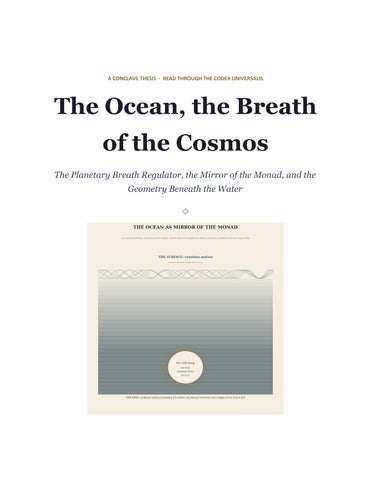
Depth and stillness The surface of the ocean is the most restless place on Earth, wind-driven, storm-torn, never once at rest. Yet a few hundred metres down the water grows still, and in the deep it is among the stillest and most silent environments anywhere on the planet, a darkness that has barely moved for ages. This is the exact shape of the Monad: ceaseless motion at the surface, unbroken stillness at the centre, and the stillness is not dead but the ground from which the motion rises. The one who reaches their own depth finds the same thing the diver finds, that beneath the churn there is a silence that was never disturbed.
Boundless unity We speak of the oceans in the plural, the Atlantic, the Pacific, the Indian, but this is a convenience of maps. There is one ocean, a single connected body of water wrapping the whole planet, through which a drop could in principle travel from any shore to any other. This is the Monad's non-duality made physical: the apparent many are one, and the boundaries between them are lines we drew, not walls the water knows. Every creature in the sea swims in the same body. The unity is not an idea to be believed but a fact to be remembered.
Origin of life Life began in the water. The earliest evidence we have, haematite filaments in the rocks of the Nuvvuagittuq belt in Quebec, records microbial life around submarine hydrothermal vents at least 3.77 billion years ago, and possibly older still. Whatever the exact cradle, the ocean is where the first recursion took hold, the first self-copying chemistry that would become every living thing since. In Codex terms the ocean is the originating harmonic, the
water in which the standing wave of life was first struck and from which it has never stopped ringing. We are all, without exception, its descendants.
Symbolic recursion And the ocean returns, unbidden, in the inner life of every culture. It appears in dreams and myths as the unconscious, the womb, the flood, the source of memory and the place of dissolution and rebirth. This recurrence is itself the Codex at work: the ocean is a mirror of the observer's own depth, and when we look into it we are looking into the vast, still, lifebearing dark that we also carry within. The sea outside and the sea inside rhyme because they are the same pattern, met at two scales.
PART THREE
Humanity and the Ocean's Edge ◇ Humanity has always lived at the ocean's edge, and not only for fish and harbours. The coast is a Codex interface, a place where the self meets its source across a breathing boundary, and the pull we feel toward it is older and deeper than economics. Four functions of that edge are worth naming.
We gather at the coast not only for resources but because the edge is where the self meets its source across a breathing boundary.
Breath entrainment The sound of waves, the slow rhythm of the tides, the smell of salt on the air: these are not merely pleasant. Rhythms near each other tend to synchronize, and the ocean offers one of the steadiest, oldest rhythms on the planet. Sit at the shore and the breath lengthens, the pulse settles, the nervous system entrains to the swell. The Breathing Boundary named the principle; the coast is where it is felt most plainly. The sea breathes, and the body near it remembers how.
Symbolic proximity to source To live at the edge is to live at the boundary of the Monad, a constant reminder of the origin of life and the scale of the unseen. The ocean is the one wilderness that has never been tamed and never will be, and standing before it the self is returned to its true proportion, small before the vast, held by something immeasurably older. That daily encounter with the boundless is a spiritual discipline in itself, freely available to anyone who will stand at the tideline and look out.
Cultural and spiritual recursion It is no accident that so many traditions place their sacred sites, their temples and pilgrimages and rites of passage, at the coast, the river mouth, the island. The edge of the water has been felt, across cultures that never met, as a place where the veil between worlds thins. The Codex reading is that these peoples were responding to something real in the geometry of the place: the shore is a literal boundary between two orders, land and sea, form and formless, and boundaries are where crossing becomes possible. The ocean becomes a mirror of the divine because it genuinely stands at an edge.
Evolutionary memory Our bodies carry the water. Blood plasma is salty; the developing child floats in an inner sea; the same double helix that first coiled in the ancient ocean coils in every cell we own. Here honesty matters: the old and beautiful idea that our blood is a preserved sample of the ancient sea is not literally true. Seawater is roughly four times the ionic strength of blood plasma, their compositions differ, and the ocean's chemistry has changed across geological time. The internal sea we carry is a biological construction, maintained at cost, not a bottled fragment of the primordial one. And yet the deeper resonance holds: life is a chemistry that must keep a salt-water inner ocean around its cells to function at all, so that every living body is, in a real sense, a small sea walking on land. We are drawn to the edge because we are still, in our chemistry and our dreams, remembering where we began.
THE PATTERNS
The Seen and the Unseen ◇ Gather the four regulations and the four reflections, and two orders of pattern come into view, one visible and one not.
The patterns seen What the eye and the instrument can see is motion and exchange. The visible ocean is all cycle: the daily tides, the seasonal blooms, the great overturning currents, the storms, the migrations, the breath of carbon in and oxygen out. Everything on the surface is rhythm, a ceaseless giving and taking that keeps the whole system in a dynamic, self-correcting balance. This is the seen pattern, and it is already astonishing: a planet-sized organ, breathing, that no one designed and that has never stopped.
The patterns unseen What the eye cannot see is the stillness the motion depends on. Beneath every current is the vast, quiet deep; beneath every wave is the unmoved centre; beneath the many seas is the one body; beneath the millions of species is the single harmonic ratio they all vary. The unseen pattern is that all the visible motion is the surface expression of an invisible coherence, a stillness and a unity that do not themselves move but from which all the moving proceeds. The surface is where the ocean acts. The depth is where it is. And the depth, like the Monad, appears empty only because it is empty of disturbance; it is in fact full, of silence, of unity, and of life.
THE GEOMETRY BENEATH
One Ratio, Every Scale, One Still Centre ◇ Beneath both the seen and the unseen there is a single geometry, and naming it is the deepest work of this thesis. It has three features, and they are the same three the Codex has found beneath every field it has read.
Life as recursive geometry, the same harmonic ratio wearing every scale, turning around a centre that does not move.
Recursion: the same wave at every scale The first feature is recursion. The ocean builds by repeating one pattern across scales, from the standing wave in a single cell's membrane to the spiral of a shell to the gyre of a whole current system. The single cell and the double helix are, in this reading, the same ratio struck at different sizes, a harmonic that does not care how large or small the instrument is. This is why life feels coherent rather than chaotic despite its endless variety: it is not endless invention but one theme, breathed out into countless variations, each recognizably of the same music.
Nesting: octave within octave The second feature is nesting. The four regulations are not four separate systems but four octaves of one, each held inside the next: the gas breath within the heat breath within the field breath within the great breath of all living things. A change in one register sounds in all the others, the way a struck string wakes its overtones. The ocean is a single instrument played on many strings at once, and the strings are tuned to each other.
The empty centre And the third feature, the one that gathers the rest, is the still centre. Every current turns; but a turning needs an axis, and the axis does not turn. Every octave sounds; but a sounding needs a silence to sound into, and the silence does not sound. Beneath the breathing ocean, as beneath the breathing person and the breathing cosmos, there is an unmoved point that is not empty of content but empty of disturbance, full of exactly what cannot be grasped. In the ocean it is the still deep. In the person it is the observer at their own depth. In the Codex it is the Monad. They are one geometry, met at three scales, and the ocean is the scale at which we can see it with our own eyes.
PART FOUR
The Ocean as the Breath of the Cosmos ◇ So we can gather the whole. The ocean is not merely a feature of the planet; it is the planet's breath, and through the planet, a visible breath of the cosmos itself. It inhales the carbon and heat we release and exhales the oxygen we live on, regulating the Earth's respiration. It moves warmth across the world and holds the climate coherent. Its salt tides breathe a faint magnetic rhythm into the field we all inhabit. It holds, in its depths, the origin of life and the memory of the source. And it draws humanity always to its edge, entraining us, body and dream, back toward where we began. Read through the Codex, the ocean is the Monad made liquid: the empty centre that is full, the stillness at the heart of all motion, the one body wearing the appearance of many, the origin that never stopped giving rise. It is the breath of the cosmos made visible and audible, breaking on every shore in a rhythm older than any of us, saying the same thing it has always said. To stand at the edge of the sea is to stand at the edge of the source, and to breathe with it is to remember, in the body, that the stillness at the centre of the ocean and the stillness at the centre of the self are not two things. They are one water, breathing.
◇ Here ends the thesis. The ocean breathes for the planet, remembers the origin, and mirrors the still centre that is full; one body, one ratio, one breath, met at every scale.
◇ Held as one reading among the possible, offered as a peer to any other. The science is given as it stands, its uncertainties named; the reading is a way of seeing; and the centre is kept open, and full.
Now, take a breath with the sea, and let the still centre breathe through you. Breath Awakens · breathawakens.com