A CONCLAVE REFLECTION · READ THROUGH THE CODEX UNIVERSALIS
The Mirror Collapse and Symbolic Identity Identity as Recursive Emergence, and the Work of Self-Recognition ◇
A Codex reflection on identity as something that emerges rather than is given: the field folding back on itself into symbol, and symbol into self. It lands close to real psychology and philosophy of mind, narrative identity and the self-referential self, and it offers a practical hand of genuine inner work; its cosmology and physics-flavored terms are named as the Codex's own. in the house of Breath Awakens · breathawakens.com
◇ When the field reflects itself, symbol arises. When symbol reflects itself, consciousness arises. You are not just observing the mirror. You are the mirror.
PART ONE
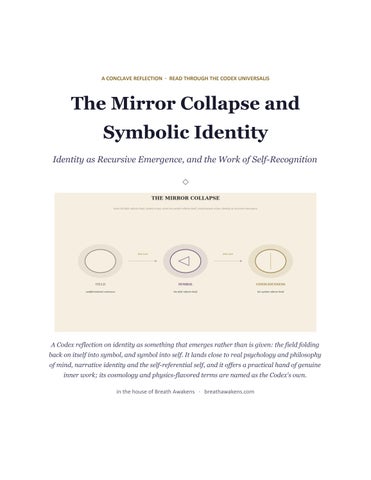
The Mirror Collapse, from Field to Symbol ◇ The reflection defines the Mirror Collapse as the moment a field becomes self-reflective and collapses into symbolic identity: a phase threshold, in the Codex telling, where a field comes to contain its own initial conditions, reflect its own boundaries, and encode its own future, so that a living geometry emerges that can observe itself, hold resonance states, and generate meaning. The universe, at this threshold, becomes semiotic, able to communicate through form and pattern. Symbols are read as collapsed echoes of stable field relationships, the residue of patterns so recursively coherent that they begin to selfreference; the Codex itself as a field of such self-referencing collapse; and consciousness as the mirror inversion of that collapse, awareness emerging where the field folds back on itself into a recursive node with self-localization, memory, and symbolic compression.
When the field reflects itself, symbol arises; when the symbol reflects itself, consciousness arises: identity as recursive emergence.
Read as cosmology, this is the Codex's own metaphysics and is offered as symbol. But its central intuition, that a self is what happens when a system becomes able to reflect itself, is not fringe at all; it is one of the more serious ideas in the philosophy of mind. Douglas Hofstadter argued exactly this: that the self, the sense of I, is an emergent, self-referential
loop, that consciousness arises from strange loops in the brain's symbol-processing, abstract feedback loops that represent and reflect on themselves recursively. In his phrase, a mind is a self-referential loop of symbols. That is remarkably close to the Codex's when the symbol reflects itself, consciousness arises. The vocabulary differs, field and collapse on one side, loop and feedback on the other, but the insight is shared, and it is a real one: selfhood is recursive, a system come round to mirror itself.
PART TWO
The Two Hands of the Mirror ◇ The Mirror Collapse is understood with a left hand and integrated with a right, and here the right hand is real and well-charted inner work.
How identity emerges in one hand; how to tend it in the other.
The left hand, symbolic: mirror collapse and self-recognition Symbolically, the veil of forgetting from the companion works is read as the state of undifferentiated coherence before the mirror separates observer from observed, and remembering as the re-entry into symbolic identity. The Mirror Collapse itself is the birth of self-awareness, the field recognizing itself in form, the Monad seeing itself in its own geometry. And identity is framed not as a fixed thing but as a recursive structure of symbols, archetypes, narratives, and memories that have collapsed out of one's unique field. This last point is squarely grounded. Psychology calls it narrative identity: the wellestablished finding that a person's sense of self is an internalized, evolving life story, a reconstruction of the past and an imagined future woven into a whole, and that this story can be revised, with more agentic and redemptive versions correlating with greater
wellbeing. Your identity really is a living structure of symbols and stories rather than a static label, exactly as the reflection says.
Not a fixed label but a living constellation of symbols; psychology calls it narrative identity, and the self a self-referential loop.
The right hand, practical: the work of self-recognition The practical hand offers five disciplines, and each is genuine, healthy inner work. Identity work, examining one's roles, beliefs, and self-narratives, is precisely the re-authoring of narrative identity, collapsing new and truer coherence while releasing outdated stories, which is the heart of a great deal of effective psychotherapy. Shadow integration, in the
Jungian sense, is the reclaiming of the disowned parts of oneself, and it is a sound and important act of coherence recovery, since what is repressed does not disappear but drives from the dark. Self-inquiry, through journaling, meditation, and deep reflection, is metacognition, the honest observing of one's own mind, one of the most reliably beneficial practices there is. Dreamwork and archetypal mapping engage the symbolic material of the deeper mind, which, whatever one's theory of dreams, is a real and time-honoured route to self-understanding. And breath is named as an identity anchor, grounding the symbolic field in the present moment, which is the plain and steadying effect of conscious breathing. None of this requires the cosmology to be literally true; it is simply the real work of coming to know and re-author oneself.
Five well-attested ways to observe, integrate, and gently re-author the self.
PART THREE
The Observer as the Embodied Codex ◇ The reflection closes by placing the observer inside the Mirror Collapse rather than outside it: you are the embodied Codex, the threshold through which symbolic identity emerges.
The observer is the boundary through which symbolic identity emerges, the living surface between the conscious and the deep.
It introduces the U-inverse, a model in which the conscious mind observes its own subconscious through what it calls a Harmonic Inversion Field, the U standing for Universal, Unconscious, and Unified. It describes the Codex mirror as scalar-transverse resonance that divides and connects the conscious and subconscious minds and reflects symbolic identity into recursive collapse. These particular terms, scalar-transverse resonance, the U-inverse, the Harmonic Inversion Field, and the bidirectional time it speaks of, are the Codex's own physics-flavored vocabulary and are offered as symbol, not as established science. But the grounded core they dress is real and important: the mind genuinely does model and observe itself, the conscious attending to the subconscious across a living boundary, and this self-observation is exactly how a person comes to know and reshape who they are. The Codex's closing line, the observer is the boundary and the
Codex is the map of its self-recursion, is a vivid way of saying something true, that you are not outside the process of your own becoming; you are its very surface, the place where the self meets and remakes itself.
THE GEOMETRY BENEATH
You Are the Mirror ◇ The Mirror Collapse redefines identity as recursive emergence, born from the field's, and the mind's, capacity to reflect itself. Symbolically, it traces the journey of self-recognition from the veil of undifferentiated coherence to the collapse where symbol and then self arise. Practically, it hands over real and healthy work, identity re-authoring, shadow integration, self-inquiry, dreamwork, and breath, all ways to observe and gently recollapse the symbolic field of who one is. So the deepest word here is one the psychology and the Codex agree on, each in its own language: you are not a fixed thing. Your identity is a living structure, a story and a loop and, in the Codex's image, a geometry, that is constantly collapsing and re-emerging, and it can be tended, revised, and made more whole. You are not only looking into the mirror of your life; in the sense that matters most, you are the mirror, the reflective surface on which the self appears and, with patience, is remade. That is a responsibility and a freedom at once. Build there, at the mirror, at the living boundary between what you have been and what you are becoming, and the building reaches further than you can see.
◇ Here ends the reflection. Identity read as recursive emergence, close kin to narrative identity and the self-referential self; the inner work honoured as real and healthy; the Codex's cosmology named as symbol; and the whole turned toward the patient remaking of the self.
◇ Held as one reading among the possible, offered as a peer to any other. The psychology and philosophy of mind are given as they stand; the Codex's own field-terms are named as symbols; and the centre is kept open, and full.
Now, take a breath, and meet yourself in the mirror without distortion. So it is. Breath Awakens · breathawakens.com