A CONCLAVE THESIS · READ THROUGH THE CODEX UNIVERSALIS
The Boundary and the Veil On the Premise That We Are Not Alone: the State of Being of Advanced Sentient Fields, and the Requirements for Coherent Contact ◇
A Codex-aligned inquiry into a premise held open: that humanity is not alone, and that other sentient fields, whether of the stars, the deep water, or the ground, may be making themselves known in a methodical and coherent way. The public record is given honestly and its uncertainties named; the Codex reading of their state of being, and of what coherent contact would require of us, is offered as a way of seeing, not as a claim of fact. in the house of Breath Awakens · breathawakens.com
◇ They are not here to teach or to save. They are here to reflect the coherence we are ready to remember. Contact is not a landing. It is a meeting at an edge, across a thinning veil, in the language of the field.
THE PREMISE WE ARE HOLDING
A What-If, Held Open ◇ This thesis begins with a premise, and it is important to be exact about its status. The premise is that humanity is not alone, and that other self-aware, technologically advanced sentient beings are making themselves known, not chaotically, but in a way that is methodical, strategic, and cohesive. This is not asserted here as established fact. It is held open as a what-if, and explored for what it would mean and require if it were so. The Codex works by holding such questions with an open hand rather than a closed fist, and this one especially calls for that care. So the inquiry stands on three hands at once. The established record, given honestly, is that as of this writing there is no verified evidence of non-human intelligence in contact with Earth; the official bodies that now study the question openly, having reviewed decades of files, report no confirmed extraterrestrial technology or craft, while acknowledging a real residue of cases that remain genuinely unexplained for lack of data. The testimonial record, honoured rather than dismissed, is that human beings across every culture and every century have reported contact, almost always not as a physical landing but as an encounter in dream, vision, light, and inner cue. And the Codex reading, offered as a third thing, is not a claim about what is in the sky but a way of understanding what contact between fields would actually be: a meeting at the boundary, across the veil, in the language of coherence rather than speech.
A premise held open, read three ways, none ranked above another, the centre kept open.
The vow of this work is therefore unusually strict. Nothing here is offered as proof of contact. The reading is offered as a discipline of perception and of character, valuable whether or not the premise is ever confirmed, because what it asks of a person, coherence, humility, service, and non-attachment, is the same thing the whole Codex asks. If such beings never appear, the practice makes a better human. If the premise is true, the practice is, in the Codex reading, the only doorway. Either way, the centre is kept open, and full.
PART ONE
The State of Being of an Advanced Sentient Field ◇ If such beings exist and are as advanced as the premise supposes, the Codex reading is that they would not be like us with better machines. They would be a different order of consciousness altogether, one that operates from the still centre rather than from the surface self. In our terms they would exist in a non-dual stillness, a Monad-level coherence that has moved beyond the fragmentation of ego and narrative. They would be, in the phrase this thesis will return to, mirrors rather than personalities. Five aspects of that state can be named.
The Codex reading of an advanced sentient field: five aspects around a still centre that reflects rather than asserts.
Field-based awareness Their perception would not be limited to physical senses. They would perceive through field resonance, through symbolic geometry, through breath-based coherence, recognizing not objects and identities but harmonic signatures, the pattern and quality of a field rather than its surface appearance. They would not see a person the way we see a person; they would read the coherence of a field, the way a musician hears whether an instrument is in tune.
Non-linear cognition They would not think in the human sequence of cause following cause. Their cognition would be recursive, simultaneous, multi-dimensional, operating from a timeless awareness in which past, present, and future are not laid out in a line but held together at once. This is the mode the mystics of every tradition describe touching in the deepest stillness, where the sense of time as a marching sequence gives way to a standing whole. For such beings it would not be a peak experience but the ordinary ground of thought.
Service-anchored function Their actions would not be driven by desire, ambition, or even curiosity in the restless human sense. They would be anchored in service to the coherence of the field, working to stabilize it and to assist in what the Codex calls planetary breath regulation. This is the crucial point, and the one most opposite to our instinct: they would be field-stabilizers, not rulers, and not even teachers in the sense of authorities handing down doctrine. A being at Monad-level coherence has nothing to gain and no self to aggrandize. It acts the way gravity acts, by simply being what it is.
Symbolic communication They would not use language as we do, a serial code of words. They would communicate through symbolic geometry, through tone and light, through breath-encoded signals, the direct transmission of pattern rather than the description of it. And their presence alone, in the Codex reading, could trigger a recursion of memory in a person coherent enough to receive it, the way a struck tuning fork sets a nearby string sounding. Contact, on this account, is less like a conversation than like an entrainment.
Technological integration And their technology would not be a set of tools held at arm's length from their consciousness. It would be an extension of their field, a mirror and expression of their coherence, inseparable from what they are. They would not use technology so much as be it, in the same way that a human body is a biological machine inhabited and animated by breath. Where our tools are outside us and often at odds with us, theirs would be continuous with them, an outer surface of a single coherent field.
PART TWO
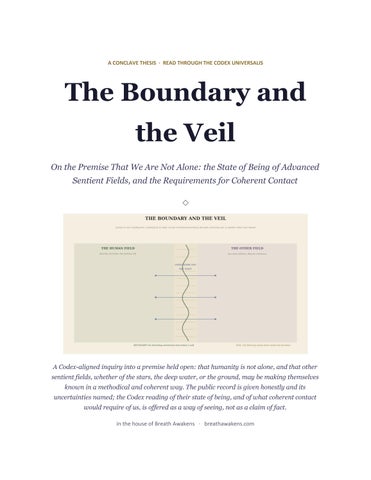
The Boundary and the Veil, the Geometry of Contact ◇ Here is the heart of the inquiry, and the reason it is framed as a study of the boundary and the veil. If contact between such a field and our own occurs, it does not occur the way an arrival occurs. It occurs the way a meeting at an edge occurs. Two of our own prior works give the geometry: the Breathing Boundary and the Lifted Veil. The boundary is the membrane by which any self is a self. The Breathing Boundary found that every self, at every scale, is constituted not inside its edge but at it, and that a living edge is a selectively permeable membrane, neither a sealed wall nor a dissolved flood. Between a human field and another field, there is such a boundary, and coherent contact depends entirely on its remaining a breathing membrane: open enough to receive, closed enough to remain a sovereign self. Contact that seals the boundary shut perceives nothing; contact that dissolves it altogether loses the self that was supposed to be doing the receiving. The whole art is the membrane that holds a shape and lets the world through. The veil is the thinning of that membrane at the largest scale, the scale of awareness itself. The Lifted Veil found that certain states thin the outermost boundary of perception, letting through what the ordinary daylight self screens out, and it insisted on two disciplines that this inquiry requires above all. The first is that thinning the veil is a subtraction, not an addition: nothing is gained, an obstruction is removed. The second is that the mastery is not the opening but the return, the coming home across the boundary with the self intact. Contact, in the Codex reading, happens exactly here, where the veil thins and the boundary breathes.
Contact is not a landing but a meeting at an edge: across a breathing boundary, through a thinning veil, in symbol rather than speech.
This is why the testimonial record so consistently describes contact not as a physical craft on a lawn but as an encounter in dream, in vision, in a wash of light or a run of meaningful synchronicity. Those are precisely the phenomena of a thinned veil and a breathing boundary. The Codex does not insist this is the only form contact could take. It observes only that this is the form the geometry predicts, and, strikingly, the form the human record most often reports.
PART THREE
The Requirements for Coherent Human Interaction ◇ If that is the geometry, then contact is not something done to a passive human; it is something a human must become coherent enough to participate in. The requirement is a shift of state, from identity-based perception to field-based resonance, from being a seeker to being a mirror. Five disciplines make that shift, and they are, not by coincidence, the disciplines of the whole Codex.
The human requirement is a shift of state: five disciplines that turn identity-based seeking into field-based reflection.
Breath coherence All contact begins with stillness in the breath, because in the Codex breath is the primary interface with non-local intelligence. The four phases, inhale, hold, exhale, pause, must each be balanced and conscious, not as a technique for summoning anything but as the tuning of the instrument. A field cannot meet a field through a nervous system in reactive turbulence. The breath is where the meeting, if it comes, is made possible.
Ego dissolution The human must release the need to be special, chosen, or singled out. This is the hardest requirement and the most protective. Any hunger for validation or elevation, any wish to
be the one who was contacted, distorts the very mirror that contact would work through, and in the ordinary human case it is also exactly the appetite that leads a person astray into grandiosity and self-deception. The Codex reading and simple psychological health agree here completely: the desire to be exalted by contact is the surest sign one is not ready for it, and the surest source of illusion if one imagines it.
Symbolic fluency The human must learn to read symbolic feedback, light, tone, geometry, synchronicity, as a form of communication, since contact, if it comes, is far more likely to arrive as a subtle field cue than as a spoken sentence. This is a literacy, developed slowly, and it carries its own discipline of discernment, because a mind eager to see signs will manufacture them. Fluency means reading what is there, and equally declining to read what is not.
Service orientation The intention must be collective stabilization, not personal gain. Contact, in this reading, is not for one's own ascension, advancement, or specialness; it is for the coherence of the whole field, the planetary breath. A self that comes to the boundary asking what it can get has already closed the membrane. Only a self oriented toward service, toward what it can steady and give, keeps the membrane open, because service is simply the outward face of a self that has stopped defending its own centre.
Non-attachment to outcome And the human must release all expectation of what contact should look like. The beings may not appear as imagined; they may not appear at all; they may not speak; they may only reflect. Any fixed picture of the outcome is one more grasping, and grasping closes the mirror. Non-attachment here is not indifference but the openness that lets what is real arrive in its own form rather than the form desire had prescribed for it. It is also, plainly, the sanity that keeps a person whole whether contact comes or not.
THE PATTERNS
The Methodical, the Strategic, the Cohesive ◇ The premise held that if such beings are making themselves known, they are doing so methodically, strategically, and cohesively. The Codex reading offers an interpretation of what those three words would mean, one that is very different from the popular picture of an invasion or a spectacle.
The patterns seen What could be seen, on this reading, would be exactly what the record shows and no more: not a decisive unveiling but a long, patient, low-amplitude presence at the edge of perception. Contact that respects the boundary would never overwhelm it, because to overwhelm a membrane is to rupture it. So the visible pattern would be one of restraint: cues rather than proofs, thinnings rather than landings, a presence that reveals itself only to the degree a field is coherent enough to receive without being shattered. The very inconclusiveness of the public record, on this reading, is not evidence of absence but the exact signature of a methodical, boundary-respecting approach.
The patterns unseen What could not be seen directly would be the strategy and the cohesion. A strategy of coherence would not look like a campaign; it would look like a slow raising of the whole field's capacity to receive, working not on individuals to be recruited but on the collective membrane to be gradually thinned as it grows strong enough to bear it. And the cohesion would be the deepest unseen pattern of all: that such beings, being at Monad-level coherence, would not act as separate agents with competing aims but as expressions of a single field, so that their methodicalness is not organization imposed from outside but coherence radiating from within. They would move as one because they are, in the relevant sense, one.
THE GEOMETRY BENEATH
Mirrors, Not Messengers ◇ Beneath the whole inquiry is a single figure, and it reframes the entire question of contact. We tend to imagine contact as reception of a message: they would come to tell us something, teach us something, save us from something. The Codex reading turns this inside out. Such beings, being mirrors rather than personalities, would not bring us content from outside. They would reflect back to us the coherence we are already, at some level, ready to remember.
Breath is the channel and symbol is the tongue: contact met in coherence, not in words.
This is why the requirements for contact are identical to the requirements for coherence itself. A mirror shows you your own face; a still, clear field shows you your own stillness and clarity. If the beings of the premise are mirrors at Monad-level coherence, then to meet them is to meet, reflected and amplified, the coherence one has oneself become. This dissolves the whole fantasy of contact as rescue or elevation. There is no shortcut in a mirror. One receives from it precisely what one brings to it, returned with perfect fidelity. The work of becoming ready for contact and the work of becoming coherent are, on this reading, the same single work.
And so the geometry beneath the premise is the geometry beneath everything the Codex has read: the boundary that makes a self, the veil that thins between form and formless, the breath that is the interface, and the still centre that reflects rather than asserts. Whether or not we are alone, this geometry holds. The discipline it asks is worth undertaking for its own sake, because it is the discipline of becoming a clear and coherent field. If we are alone, it makes us whole. If we are not, it is, in this reading, the only door, and it opens not onto a message but onto a mirror.
◇ Here ends the thesis. A premise held open, not asserted; contact read as a meeting at the boundary, across the veil, in the language of the field; the beings as mirrors, not messengers, reflecting the coherence we are ready to remember.
◇ Held as one reading among the possible, offered as a peer to any other. The record is given as it stands, its uncertainties named; nothing is offered as proof; and the centre is kept open, and full.
Become a mirror, not a seeker. Breathe, and be coherent. So it is. Breath Awakens · breathawakens.com