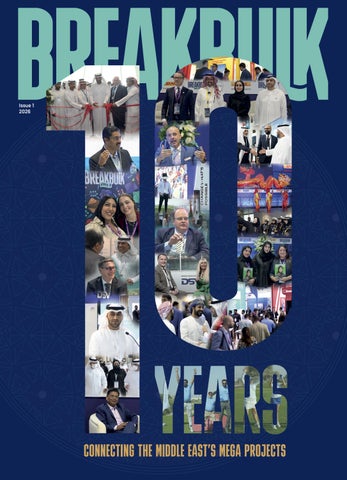
Breakbulk Magazine Issue 1 2026

Page 1


CONNECTING THE MIDDLE EAST’S MEGA PROJECTS

BUILT FOR THE MIDDLE EAST

Blue Water Shipping’s Humeira Aidarous Al Hashmi on Breaking Through Barriers to Lead in Project Logistics

THE MIDDLE EAST ISSUE

Breakbulk Middle East

The Making of a Project Cargo Powerhouse

42

Blue Water Shipping’s Humeira Aidarous Al Hashmi – Built for the Middle East

12 Movers and Shakers

Highlighting Recent Industry Hires, Promotions and Departures

14 Women in Breakbulk

How to Make AI Work at Scale in Logistics Operations

Q&A With Dataiku’s Umut Şatir Gürbüz

16 Women in Breakbulk

The Road Less Traveled Lessons in Resilience, Leadership and Transformation From Rita Al Semaani Jansen

17 The Logistics Lens by Hatch Chaos Versus Control Incoterms Strategy As A Risk-Control Lever, Not Just a Legal Clause

18 Waves of Cargo From Coast to Hinterland

Navigating One of India’s Most Complex Cargo Routes

20 News Bites

Quick Hits, Big Impact! A Roundup of Breakbulk Shippers and Exhibitors in the News

22 Anniversary Special 10 Years of Breakbulk Middle East

The Making of a Project Cargo Powerhouse

24 Anniversary Special 10-Year Timeline

Event Milestones, Expert Insight, World Events and the Projects That Shaped Each Year

36 Middle East A Golden Age for Middle East Rail? Investment Accelerates Shift From Long-Haul Trucking to Integrated Freight Rail

42 Middle East Built for the Middle East

Blue Water Shipping’s Humeira Aidarous Al Hashmi on Breaking Through Barriers to Lead in Project Logistics

47 Middle East From Import Hub to Export Machine

GCC Manufacturing Surge Drives New Outbound Project Cargo

52 Middle East Preparing for a Tech-Driven Future

Mohammad Jaber on Navigating Change in Project Logistics

Breakbulk Europe June 16-18

Rotterdam Ahoy Rotterdam, Netherlands

Breakbulk Americas

September 22-24

George R. Brown Convention Center Houston, USA

Breakbulk Asia November 18-19

Sands Expo and Convention Centre, Singapore

54 Africa

Egypt’s Mega Fertilizer Project Hits New Milestone Surge in Project Cargo Demand as NCIC’s Vast Complex Nears Completion

58 Global

The Basement Start-Up That Took Flight

Air Charter Service’s Global Growth Story — And What Comes Next

64 Global Thinking Inside the Box

Why Container Ships Are Carrying More Project Cargo Than Ever Before

70 Europe

Nuclear Power’s Second Act

Decommissioning Creates a New Pipeline of Opportunity

74 Americas Upgrade or Fade? Investments Critical to Sustain Panama Canal’s Market Position

78 Asia

Japan’s Atomic Turnaround New PM Moves Forward With Reactor Restarts, Endorses Next-Generation Nuclear

83 Asia

Megamove Powers India’s Energy Buildout Feat of Engineering as Prism Logistics Delivers 400-Tonne Coke Chambers Across India

90 Back Page The Last Look Great Photo, Innovative Project

Credit: Mammoet

RIGHT PLACE, RIGHT TIME

A new year brings a sense of momentum, and this one comes with a milestone we are excited to celebrate.

Welcome to the first issue of 2026, marking the 10th anniversary of Breakbulk Middle East. Back in 2015, Breakbulk placed a big bet on the GCC as the next location for a signature event. We arrived in the right place at the right time. The energy transition was just beginning, the region’s leadership moved quickly and the world came to the GCC to build projects. And we were there to bring everyone together.

Breakbulk Middle East became the fastest-growing event in Breakbulk history. Attendance has grown more than fivefold, from 2,000 participants at the inaugural edition to more than 10,500 today. But numbers only tell part of the story.

The real key to success was the support we received from government, industry, most importantly, Abu Dhabi Ports and DP World, and a small group of influential advocates. These women and men helped shape the event to fit the local culture, were among the first speakers and opened doors to their own contacts to widen the circle of project cargo professionals involved in Breakbulk Middle East. You will recognize many of these longtime contributors throughout our Anniversary Special.

Before the launch of Breakbulk Middle East, our editorial rarely covered the region, but today the GCC is an integral part of the global industry with many stories to tell. In

this issue, you will find an in-depth look into the region’s innovative rail initiative. You’ll gain an understanding of the region’s manufacturing drive to increase exports. You’ll meet Blue Water Shipping’s Humeira Aidarous Al Hashmi and see into the future of logistics with Combi Lift Project’s Mohammad Jaber.

In a recent survey of senior executives, many said they are more interested in what is happening in other parts of the world than in their home markets. With that in mind, this issue also looks at why Japan’s nuclear pivot could reshape the global energy race and how rising energy decommissioning activity points to a source of high-volume, long-lasting service contracts.

For a bit of lighter reading, turn to our company profile of Air Charter Service to meet Chris Leach, the character behind the wildly successful firm. He started the business in his basement, under pressure to meet the needs of his growing family – never underestimate the power of a man with many mouths to feed.

Don’t miss “The Logistics Lens,” a new column from Hatch. In this first installment, Rick Caporiccio reframes Incoterms as a practical risk-control tool. It’s a compelling read, and you may never think of Incoterms in the same way again.

Looking ahead, our next issue will focus on opportunities in Africa, particularly in the mining sector, and the challenges and opportunities around sustainability across the breakbulk sectors. Until then, best wishes for a productive and successful year, and thank you for being part of the Breakbulk community.

Best,

Editorial Director

Leslie Meredith Leslie.Meredith@breakbulk.com

Senior Reporter

Simon West simon.west@breakbulk.com

Designer Mark Clubb

Reporters

Don Horne

Luke King

Iain MacIntyre

Amy McLellan

Malcolm Ramsay Liesl Venter

Contributing Editor

Jonathan Cournoyer Hatch

Breakbulk Magazine Editorial Board

John Amos Amos Logistics

Tina Benjamin-Lea Eli Lilly and Company

Fayçal Boumerkhoufa Ascent Global Logistics

Dea Chincuanco Miura Projects Corp.

Elisabeth Cosmatos Cosmatos Group of Companies/ The Heavy Lift Group

Dennis Devlin DT Project America

Payne Fischer Kuehne+Nagel

Dharmendra Gangrade Larsen & Toubro

John Hark Bertling North America / Texas A&M University

Itoro Ibanga Air Liquide

Margaret Kidd San Jacinto College

Jake Swanson DHL Global Forwarding

Edward Talbot Trans Global Projects

Grant Wattman Jade Management Group, Inc.

Andrew Young Bechtel Corporation

Portfolio Director Jessica Dawnay Jessica.Dawnay@breakbulk.com

To advertise in Breakbulk Media products, visit: http://breakbulk.com/page/advertise

Subscriptions

To subscribe, go to https://breakbulk.com/page/ breakbulk-magazine

A publication of Hyve Group plc.

The Studios, 2 Kingdom Street Paddington, London W2 6JG, UK

Leslie Meredith

Exhibitors and Breakbulk Global Shipper Network members in this issue:

Movers & Shakers (p. 12)

AD Ports Group, Allelys, Aramex, Gebrüder Weiss, deugro, Africa Global Logistics, Maersk, DHL Global Forwarding, Ports of Indiana, TGP, UTC Overseas, Vallourec

From Coast to Hinterland: Navigating One of India’s Most Complex Cargo Routes (p.18)

The Heavy Lift Group (THLG)

A Golden Age for Middle East Rail? (p.36)

Saudi Port Authority, Red Sea Gateway Terminal, Saipem, Tecnimont, Siemens Mobility

Built for the Middle East (p.42)

Blue Water Shipping, Kanoo Shipping, CEVA Logistics, CMA CGM, KBR, Fluor

From Import Hub To Export Machine (p.47)

Al Faris, DHL Global Forwarding

Preparing for Tech-Driven Future (p.52) Combi Lift Projects

Egypt’s Mega Fertilizer Project Hits New Milestone (p.54)

DP World, Chipolbrok, KBR

The Basement Start-Up That Took Flight (p.58) Air Charter Service

Thinking Inside the Box (p.64)

MSC, Maersk Project Logistics, CMA CGM, Protranser, Fluor

Nuclear Power’s Second Act (p.70)

Mammoet, EDF Energy

Upgrade or Fade (p.74)

COSCO Shipping, DP World, MOL, PSA International, SSA Marine-Grupo Carrix, MSC, CMA CGM, Hapag-Lloyd, HMM, Maersk, OOCL, Port of Houston, The Heavy Lift Group, Global Project Logistics Network, Cross Ocean

Japan’s Atomic Turnaround (p.78)

JGC Corporation

Megamove Powers India’s Energy Buildout (p.83)

Prism Logistics, Goldhofer, JSI Alliance

Key: Exhibitor

Breakbulk Global Shipper Network Member

Movers & Shakers

Women in Breakbulk: Rita Al Semaani Jansen and Umut Şatir Gürbüz

The Logistics Lens: Hatch Waves of Cargo: Total Movements News Bites

10 Years of Breakbulk Middle East

deugro delivers
fabrication facility in Uruguay. Credit: deugro

MOVERS AND SHAKERS

Highlighting Recent Industry Hires, Promotions and Departures

AD Ports Group

Former DB Schenker chief Jochen Thewes has been named the new CEO of AD Ports Group’s logistics cluster. He was scheduled to start his new role on Dec 1. Thewes began his logistics career nearly three decades ago at Kuehne+Nagel, joining DB Schenker in 2010 where he later served as CEO for more than a decade.

Gebrüder Weiss

Gebrüder Weiss has appointed industry expert Justyna Marczyk as its new national import compliance manager in the U.S. Marczyk joins the transport and logistics company from DB Schenker where she served as customs and compliance manager. In her new role, Marczyk will support clients navigating supply chain shifts by offering strategic guidance on import compliance.

Africa Global Logistics

After nearly nine years at chemical producer Azelis, Salim Raiss is embarking on a fresh pursuit as Africa Global Logistics’ managing director for Morocco. The move is part of AGL’s strategy to build its regional presence ahead of an expected slew of major investment projects in Morocco.

Allelys

Allelys has reorganized its leadership structure, with Richard Beardmore promoted to CEO and former chief David Allely stepping into the role of group chairman. Former Royal Engineer Beardmore had been serving as commercial director at the UK transport specialist, which he joined in May 2021 after executive stints with Mammoet, deugro and ALE.

Aramex

Amadou Diallo is taking on a new challenge as group CEO of global logistics and transportation specialist Aramex. Set to begin his new role on May 1, 2026, Diallo joins Dubaiheadquartered Aramex after eight-anda-half years with DHL Global Forwarding, where he served as CEO for the Middle East and Africa. Nicolas Sibuet will continue as acting group CEO until Diallo formally assumes his new role.

Electric Hydrogen

Electric Hydrogen, a global manufacturer of industrial-scale electrolyzer facilities, is expanding into Latin America with the appointment of Maria Gabriela da Rocha Oliveira as general manager for the region. Based in Brazil, she will lead Electric Hydrogen’s commercial and partnership strategy across Latin America, where green hydrogen projects are advancing at “gigawatt” scale, the company said.

deugro

deugro has announced a shake-up of its leadership team in the Americas, with Jeff Smith stepping up to the position of vice president and country manager of deugro USA. Smith joined deugro in mid-2011, most recently serving as global head of supply chain. Meanwhile, Ryan Blewett, who joined the project forwarder in mid-2016, has taken on the new role of vice president of strategy and development for deugro in North America.

Jochen Thewes
Justyna Marczyk
Jeff Smith
Maria Gabriela da Rocha Oliveira
Amadou Diallo
Richard Beardmore
Salim Raiss

Maersk

Maersk has named Thomas Theeuwes as managing director for India, Bangladesh and Sri Lanka, succeeding Christopher Cook, who takes on the same role for Maersk in the UK and Ireland. Theeuwes joined Maersk in 2007 as a management trainee and has since held senior positions across Europe, China and Africa, most recently as managing director of the West Africa area.

Vallourec

Steel tubes maker Vallourec, a member of the Breakbulk Global Shipper Network, has chosen Nathalie Delbreuve as its new chief financial officer. Delbreuve takes over from Sascha Bibert, who is leaving the company to pursue other opportunities. Delbreuve was previously CFO of Verallia, the world’s third-largest producer of glass packaging for beverages and food products. She began her new role on Dec 1.

UTC Overseas

UTC Overseas has appointed Ralph Stierli as director of special projects in Houston, where he will help expand the company’s footprint in the energy, battery energy storage and data center industries across North America. Stierli brings more than 30 years of experience in global forwarding and project logistics, having held senior roles at Fracht, Solaris Global and chemical research firm Renewco2.

Peel Ports

Peel Ports Group, the UK’s second largest port operator, has named Jonathan Rayner as its new chief commercial officer. Rayner joins the company from London Luton Airport, where he served as CCO since 2020. “There is enormous opportunity ahead for the supply chain, and my focus will be on leading a strategy that shapes Peel Ports Group’s next chapter of growth, collaborating with colleagues and customers alike,” Rayner said.

DHL Global Forwarding

DHL Global Forwarding has gone with a familiar face after choosing Henk Venema as executive vice president of global airfreight. Venema joined DHL in mid-2016, during which time he has held various senior positions including CEO Western Europe and CEO Benelux. The executive has also enjoyed stints at GEODIS and UTi Worldwide.

Ports of Indiana

Ports of Indiana in the U.S. has hired Kent Ebbing to lead a foreign trade zone initiative supporting the growth of global trade in Indiana. Ebbing will be part of Ports of Indiana’s new foreign trade department, which backs Indiana firms involved in international trade through developing new FTZs and container shipping services. The statewide authority operates three ports on the Ohio River and Lake Michigan — Burns Harbor, Jeffersonville and Mount Vernon.

Trans Global Projects

Eddie Talbot has moved into a new role as senior vice president North America at Trans Global Projects. Talbot had been serving as U.S.-based managing director of Roll Group. His focus at TGP will be enhancing project delivery and developing new business, as the project logistics specialist seeks to expand its presence across North America.

Project Logistics Engineering Solutions

Project Logistics Engineering Solutions has appointed DuWayne Murdock as VP of strategy and innovation, a move aimed at bridging the gap between complex engineering and regulatory execution. A former director of Texas’ oversize/overweight permit section, Murdock brings decades of regulatory expertise to bear at the design phase, solving transport challenges before they reach the road.

To be considered for future editions of Movers & Shakers, email: simon.west@breakbulk.com

Thomas Theeuwes
Henk Venema
Kent Ebbing
Eddie Talbot
DuWayne Murdock
Nathalie Delbreuve
Ralph Stierli
Jonathan Rayner

Women in Breakbulk

HOW TO MAKE AI WORK AT SCALE IN LOGISTICS OPERATIONS

Q&A With Dataiku’s Umut Şatir Gürbüz presented by Breakbulk in collaboration with Logifem

1. How is AI currently transforming logistics operations, and which use cases are delivering the most immediate value?

AI is reshaping logistics by bringing intelligence into processes that were historically manual and fragmented. The fastest ROI today comes from use cases that combine data from multiple sources and automate decisions at scale.

Forecasting, inventory optimization, predictive maintenance and document automation are becoming mainstream because companies now have tools that allow operations teams, data experts and business users to work together on a single flow, from data preparation to model deployment.

More recently, multimodal GenAI has unlocked faster resolution in customer and technical support by analyzing text and images in one environment. When organizations can build, test and operationalize these solutions in a governed, repeatable way, the impact becomes both immediate and sustainable.

2. What are the biggest challenges logistics companies face when adopting AI solutions, and how can they overcome them?

Many organizations underestimate the importance of a strong foundation. AI requires clean, connected data and a collaborative environment where teams can explore, prototype, validate and deploy without friction.

The second challenge is operationalizing AI. Pilots often fail not because the model is weak, but because there is no structured path to deploy, monitor and maintain it. Companies that rely on manual handovers between teams face delays and inconsistencies.

To overcome this, logistics companies need an end-to-end framework that brings data, analytics and operations together. When governance, versioning, automation and monitoring are built into the workflow, AI adoption accelerates dramatically.

3. Many logistics organizations struggle to scale pilots into production. What separates successful AI-driven companies from the rest?

The most successful organizations don’t treat AI as isolated experiments, they build reusable components, shared data pipelines and standardized workflows that reduce the time from idea to production.

They empower business and domain experts to participate directly in the process through guided, self-service interfaces, while ensuring IT and data teams maintain control through built-in governance and oversight.

And importantly, they industrialize AI with strong MLOps practices: automated deployment, continuous monitoring, retraining and lifecycle management. When these elements are integrated, scaling becomes a natural progression rather than a reinvention for every use case.

4. With the rise of GenAI, how should logistics companies rethink customer experience, customer support and knowledge management?

GenAI represents a major shift toward intelligent, contextual, real-time assistance. Support teams can analyze customer queries, documents, images and historical interactions in a unified workspace, rather than juggling disconnected tools.

Knowledge management becomes dynamic rather than static: every resolved case, every operational insight and every document update can feed back into the system automatically. This creates a continuously improving knowledge fabric that AI can tap into.

Companies that centralize their knowledge flows, including data, documents, images and logs, and provide governed access to GenAI workflows, see dramatic improvements in first-response accuracy, case routing and resolution times. It transforms both customer experience and internal productivity.

Umut Şatir Gürbüz

5. What ethical considerations should logistics leaders keep in mind when deploying AI?

Ethics and responsibility must be embedded from the start. AI systems should be transparent, interpretable and continuously monitored, not only at launch, but throughout their lifecycle. A mature approach includes drift detection, alerting, traceability and documentation as built-in elements, not optional add-ons.

Data privacy is equally important. Logistics organizations deal with sensitive operational and customer data. Platforms that provide controlled access, clear lineage and well-governed collaboration protect both the company and the customer.

Finally, leaders should ensure employees are included in the journey through training, guided tooling and human-in-theloop processes. This ensures AI augments people rather than creating uncertainty around its role.

6. As a female leader in data and AI, how do you see women shaping the future of logistics, and what advice do you have for new talent entering the space?

Women bring a systems-thinking mindset that is incredibly valuable when working with AI. Successful AI initiatives require orchestration, connecting data, processes and people, and women often excel in roles that bridge technical and operational teams.

I see women leading transformation projects, driving innovation in analytics and advocating for responsible use of AI. They naturally bring structure, collaboration and empathy into cross-functional teams, which is essential when delivering solutions that must be adopted on the ground.

For new talent, my advice is to embrace platforms and tools that let you experiment safely, collaborate widely and learn continuously. The logistics industry is evolving fast, and those who understand how to turn ideas into operational solutions in a structured, governed way, will shape its future.

About the Author

Umut Şatir Gürbüz is a principal sales engineer at Dataiku, an enterprise-level AI integrator, specializing in machine learning, data analytics and agentic AI.

About Logifem Society Network, a Women in Breakbulk Partner

Logifem Society Network stands out as a pioneering force dedicated to empowering women in logistics and freight forwarding. Founded in Istanbul, Logifem has quickly grown into a vibrant international community, connecting more than 150 members across continents.

With expertise spanning air, land, and sea transport, the network provides a platform for collaboration, business and professional growth. Its mission is clear: to empower women’s voices, foster leadership and reshape the future of supply chain management.

Through annual networking events, business relations and global partnerships, Logifem is not just building connections, it is building a movement. By joining, members gain access to a supportive community that champions equality, innovation, and resilience in the logistics sector.

Logifem Society Network is more than a professional association; it is a symbol of progress, proving that when women lead, industries thrive.

For membership information, visit www.logifem.com.tr/

Women in Breakbulk

THE ROAD LESS TRAVELED

Lessons in resilience, leadership and transformation from a career in the maritime industry

I began my career at a time when fax machines were the primary mode of communication and days could pass before a response was received.

Little did I know then that my journey would start in the maritime industry. I did not know the difference between manned and unmanned vessels, yet this was where my shipping experience began.

In a male-dominated sector, I learned to find my place. Driven by curiosity and a desire to understand the technical aspects of the marine business, I boarded vessels, entered engine rooms and walked through dry docks and repair sheds.

Reflecting on my journey, I realize I took the road less traveled. It was not without challenges or pain. Being the only young and inexperienced woman sitting on a board of directors, the only woman in a conference room, and the only woman negotiating deals was not the easiest path. There were moments when being heard required more effort than expected. Working across complex sectors demanded not only technical understanding, but also consistency, resilience and sound judgment.

There were situations where assumptions were made before my contributions were recognized. Convincing counterparties who were unaccustomed to dealing with women in the industry required learning how to communicate value clearly and confidently.

What helped me navigate these challenges was a commitment to understanding the industry in depth. I focused on learning its commercial realities, building trusted professional relationships and delivering dependable outcomes. Over time, credibility followed. This, however, did not come without hard work, perseverance and dedication. I also learned the importance of making deliberate career choices, setting boundaries and accepting that meaningful

progress does not always come quickly, but it does come with focus and direction.

My ambition and passion have always driven me forward. The trust I earned from those I worked with and for was, and remains, my greatest reward.

As life presented its own challenges, I overcame most through perseverance. My greatest personal challenge, however, was balancing professional commitments with family responsibilities. Unfortunately, many women of my generation faced the same dilemma; this was often the price a career woman was expected to pay. Gender bias around family responsibilities was common. I recall a time when my two-year-old son was admitted to the hospital, and I was still asked by my managing partner to attend a client meeting. It is encouraging to see that, despite ongoing industry challenges, greater accommodation is now being made for parents.

Today, my focus is on contributing in a way that is practical, sustainable and aligned with long-term value. I am also conscious of the responsibility to support other women in the industry by being honest about the challenges and about the persistence required to overcome them.

Success, for me, is no longer defined solely by titles or milestones. It is reflected in credibility earned through consistency, the ability to create space for others to contribute and a willingness to continue learning and evolve. Barriers still exist, but they are not immovable. With patience, clarity and the right support, they can be navigated and, over time, reshaped.

Success evolves with change: Embrace it and thrive.

About the Author

Rita combines broad commercial capability with niche mastery of maritime and port-sector mandates. Clients rely on her for practical, high-impact advice on shipping operations, concession structures and regulatory frameworks across the GCC. Rita is a member of WISTA UAE, an official Women in Breakbulk partner.

Rita Al Semaani Jansen receiving the Lloyd’s List Lifetime Achievement Award, presented by Capt. Mohamed Al Ali, ADNOC Logistics & Services.

THOUGHT LEADER – The Logistics Lens

Through a strategic practitioner’s lens, Hatch Logistics’ global experts explore the forces shaping project and breakbulk logistics: from risk and execution to geopolitics, sustainability and decision-making in complex cargo environments.

CHAOS VERSUS CONTROL

Incoterms Strategy as a Risk-Control Lever, Not Just a Legal Clause

Over the years while working in the logistics field, I have attended many presentations on Incoterms, and afterwards someone often asks a simple question, “What Incoterm should I use?”

A valid question but one that misses the point. The correct Incoterm isn’t chosen in isolation; it should be selected to manage logistics risks in line with project realities. When you view Incoterms as a strategic risk control lever, you move from chaos to control.

Breaking down a supply chain into its components reveals that each part manages some form of risk that has been identified. Purchase orders are issued with terms and conditions that address the commercial and legal obligations. Vendor quality ensures packages meet technical specifications as agreed in the purchase order. Expediting focuses on keeping fabrication on schedule. However, when it comes to logistics, risk is often overlooked. Too often, I hear, “We shouldn’t take the risk, let the supplier manage the freight.” In a world that is constantly changing, projects should start with assessing risk, rather than asking “Which Incoterm should we use?”

So, what is risk? Risk is an uncertain event or condition that, should it occur, can affect the achievement of the project’s objectives — either negatively as a threat or positively as an opportunity. Defining risks increases the likelihood of meeting objectives while providing assurances that risks affecting the delivery of material have been properly identified, assessed, prioritized, treated and managed.

Wouldn’t a project be better served to first identify the risks associated with transporting materials to your project site, and then develop an Incoterm strategy that offers flexibility to mitigate those risks? Logistics risks come in many forms. Some can be identified prior to the start of a project through route studies, site visits, review of import/export compliance issues, etc. Other risks may not be identified until after the project begins such as changes in customs/tariffs practices, severe weather events, geopolitical conflicts, port strikes, etc. All projects are unique with different sets of risks. International

projects have different risks than domestic ones, so being able to adapt to risks on an ongoing basis would serve a project well.

Those risks may be as follows:

• Economic: transportation rates, insurance arrangements, detention/demurrage, storage limitations, warranty return logistics, site receiving constraints (e.g., maximum deliveries/ day) and site congestion.

• Technical: specialized vehicle selection, route engineering and bridge checks, carrier safety compliance, lashing/securing plans, and load certification.

• Environmental: severe weather, seasonal limitations (freeze/ thaw roads, hurricane season), tarping/packaging standards and sustainability obligations.

• Political: export/import compliance, tariffs, local content, geopolitical issues such as sanctions, embargoes, regional conflicts.

• Social: road closures for heavy haul, public safety, community notifications, infrastructure damage risks and repair obligations.

There is no single “correct Incoterm.” However, you can develop an Incoterm strategy that aligns responsibilities with risks. Your approach should provide authority and flexibility to adapt to changing conditions. Start with risk. An effective Incoterm strategy can be the difference between chaos and control.

About the Author

Rick Caporiccio is a traffic, logistics and materials manager at Hatch with more than 30 years of international EPCM experience. His expertise spans all phases of project logistics development for large-scale projects across domestic and international markets. Throughout his career, Rick has held progressively senior leadership roles, managing logistics teams responsible for the successful delivery of complex projects, including power generation facilities, potash and gold mining operations, electrical infrastructure such as transmission lines, and oil and gas facilities.

Rick Caporiccio
2026 Column Premiere

FROM COAST TO HINTERLAND:

NAVIGATING ONE OF INDIA’S MOST COMPLEX CARGO ROUTES

In the remote, unforgiving terrain of Assam in northeast India, where fragile road infrastructure constrains the movement of industrial cargo, Total Movements is pushing the limits of heavy-lift logistics. The company is currently executing the multimodal transport of more than 45,000 freight tons of cargo for the Numaligarh Refinery Expansion Project (NREP), one of India’s most ambitious refinery upgrades. Total Movements’ CEO Satish Kumar Singh shares insight into the scale and complexity of this remarkable operation.

Q: Can you walk us through the scope of this project?

SKS: The 45,000 freight tons for the NREP comprises some 25 super over-dimensional cargoes (ODCs), with components measuring up to 70 meters and

weighing up to 1,286 tons. With conventional road movement unfeasible due to terrain and infrastructure constraints, the team has developed a custom route involving road, coastal shipping and riverine barging via Bangladesh. The ongoing scope includes innovative solutions such as vessel conversion, barge reinforcements, jetty construction and a 1,550-ton-capacity bridge build.

Q: Can you describe the exact route the cargo is taking from origin to site?

SKS: In the first phase, handled entirely by Total Projects, the components are moved by SPMTs and barges from the supplier’s factory in western India to Mumbai Port. The units are then shipped from Mumbai to Kolkata Port, a distance of some 2,100 nautical miles. In the second phase, carried out with ABC India, the cargo is transferred to riverine barges and carried 900 nautical miles north through Bangladesh and back into India to a jetty near the project site, before completing the journey by road to the final destination.

Waves of Cargo
SPMTs are deployed to transport the colossal components in India.
Credit: Total Movements
Satish Kumar Singh

Q: What innovative approaches are you employing to ensure the success of the operation?

SKS: To transport the 1,286-ton Super ODC along the Indian coastline, we chartered the Jumbo Fairmaster, one of only two vessels globally with a lifting capacity of 3,000 tons. As Indian regulations mandate the use of Indian-flagged vessels for coastal shipping, we successfully facilitated the vessel’s conversion from a foreign to an Indian flag, enabling compliant movement from the West Coast to the East Coast. A second example was how we modified our barges. Prior to this project, riverine barges in the Kolkata region were designed to handle single pieces up to 500 tons. To accommodate Super ODCs exceeding this weight, we structurally modified the available barges to meet the required deck strength for safe river transport. Additional

innovations have included the design and construction of a jetty to reduce the impact of river currents on moored barges, dredging in the Brahmaputra River to overcome shallow waters and the installation of a bridge over the Kalyani River.

Q: What has been the most rewarding aspect of the project for you and your team?

SKS: Despite navigating through complex terrain, dynamic river conditions and intricate cross-border regulations, the project continues to progress safely, efficiently and on schedule. Every milestone achieved underscores the synergy of innovation, planning and technical excellence that defines Total Movements’ approach.

Total Movements is a member of The Heavy Lift Group (THLG).
The heavy units are offloaded via jetty to await final mile delivery. Credit: Total Movements
The Jumbo Fairmaster was chartered to transport a heavy unit along the Indian coastline. Credit: Total Movements
The cargo is transferred onto riverine barges for onward journey through Bangladesh. Credit: Total Movements

NEWS BITES FROM AROUND THE WORLD: QUICK HITS, BIG IMPACT!

SAUDI FIRMS SEAL FINANCING FOR

RENEWABLES PUSH

ACWA Power and partners Badeel and Saudi Aramco Power Company (SAPCO) have announced financial close on seven giga-scale renewable projects across Saudi Arabia. The projects comprise five solar PV facilities and two wind power plants boasting a combined capacity of 15 GW, said ACWA Power, the world’s largest privately-owned desalination company and a major player in green hydrogen. The total investment value of the projects is US$8.2 billion.

The solar projects include the 3-GW Bisha plant in Asir, the 3-GW

Humaij project in Madinah, the 2-GW Khulis plant in Makkah and two 2-GW facilities — Afif1 and Afif2 — in Riyadh Province. Wind power will come from the 2-GW Starah project and the 1-GW Shaqra site, both also located in Riyadh Province. The projects are slated to start operations in the second half of 2027 and the first half of 2028.

The Trump administration’s pledge of renewed access to Venezuela’s vast oil reserves for U.S. energy companies following the ousting of President Nicolas Maduro in early January could prove more trouble than it’s worth, experts believe.

Despite housing the world’s largest crude reserves — some 303 billion barrels — years of chronic mismanagement, underinvestment and sanctions have left Venezuela’s oil sector operating far below potential.

Oil producers will look to Chevron, the only U.S. company to remain after Venezuela nationalized its oil industry, as an indicator for their next move in the country.

“The oil industry is a longterm business,” said Jaime Brito, executive director of refining and oil products at Dow Jones Energy. “Any company that could potentially participate in Venezuela needs to see that there’s rule of law and certainty for their investments.”

GULFTAINER SEEKS DEAL WITH UGANDA ON FIRST DRY PORT

Gulftainer is in advanced talks with the Uganda government to develop the country’s first rail-connected dry port, a project aimed at easing cargo bottlenecks and cutting logistics costs in the landlocked East African nation. Gulftainer CEO Farid Belbouab met President Yoweri Museveni and senior cabinet members in Kampala to discuss plans for a logistics hub that would connect industrial zones to seaports and shift container traffic from road to rail. The facility would “enhance Uganda’s competitiveness as a gateway for East African trade,” Gulftainer said.

SAIPEM WINS MIDDLE EAST CONTRACTS

Saipem has been awarded two offshore contracts worth some US$600 million, part of an existing long-term agreement with Aramco. A first contract, lasting 32 months, is for the engineering, procurement, construction and installation (EPCI) of 34 km of pipeline and related works on topside infrastructure at the Berri and Abu Safah oilfields. A second, year-long deal includes subsea interventions at the Marjan field and the EPC of onshore pipelines and associated tie-ins. Alongside partner Offshore Oil Engineering, Saipem has also won an EPCI contract with QatarEnergy LNG for the COMP5 package of the North Field Production Sustainability Offshore Compression Complexes project. Saipem’s share is worth about US$3.1 billion. The five-year deal covers the delivery and offshore installation of two 68,000-ton compression complexes each comprising a compression platform, living quarters, flare platforms and interconnecting bridges.

GALVESTON OVERHAUL SET FOR 2026 FINISH

Galveston Wharves in Texas is investing more than US$100 million to overhaul its breakbulk-handling West Port Cargo Complex, with the project slated for completion in 2026. The investment, its largest in decades, aims to improve dilapidated waterfront infrastructure, add acreage for cargo handling and extend berthing space, allowing port tenants to move more cargo through the area and put more people to work on the waterfront.

The project, which began in 2024, includes the installation of a new 1,424-foot-long berth and the addition of 30 acres of waterfront cargo laydown area for breakbulk and other cargoes. Located at the entrance to Galveston Bay and the Houston Ship Channel, the Port of Galveston is one of the busiest ports in Texas.

CEVA AGREES DEAL FOR PROJECT LOGISTICS FIRM FAGIOLI

CEVA Logistics has agreed to acquire Italy-based transport specialist Fagioli Group, a move aimed at expanding its heavy-lift and project cargo capabilities. CEVA said the acquisition would add around 450 employees, including more than 40 engineers, and enable it to cover the entire project value chain from design phase to final delivery. Fagioli’s owned and leased fleet includes cranes,

modular transporters, barges and other heavy equipment used in complex project cargo operations.

The deal is expected to strengthen CEVA’s logistics push in the Middle East through its CEVA Almajdouie Logistics JV in Saudi Arabia, while supporting operations in East Africa thanks to its 2022 acquisition of Spedag Interfreight. Financial terms were not disclosed, and the deal is subject to regulatory approvals.

ABB TO BUILD WORLD’S LARGEST SHORE POWER SYSTEM AT PORT OF ROTTERDAM

ABB has signed contracts with Rotterdam Shore Power, a JV between the port of Rotterdam and Eneco, to design and build what is slated to be the world’s largest shore power system by total capacity, exceeding 100

megavolt-amperes, at Europe’s busiest port. Scheduled to begin operations in the second half of 2028, the custom-built installations will supply clean electricity across three major deep-sea container terminals, with 35 connection points capable of powering up to 32 container ships simultaneously during cargo operations.

The project will significantly cut port-side emissions and support compliance with the EU’s FuelEU Maritime Regulation, ABB said. Rotterdam Shore Power estimates that supplying shore power for at least 90 percent of vessels’ time at berth could cut annual CO2 emissions at the three deep-sea container terminals by around 96,000 metric tons from 2030.

ØRSTED FIGHTS US ORDER HALTING REVOLUTION WIND OFFSHORE PROJECT

Ørsted is challenging a U.S. order that halted its Revolution Wind Project off the coast of Rhode Island, saying the suspension is unlawful. Revolution Wind, a JV between Ørsted and Skyborn Renewables, has filed a court complaint in Washington and plans to seek an injunction against the Interior Department’s Bureau of Ocean Energy Management, which issued the lease suspension in late December.

Ørsted said the project received the

required permits in 2023 after years of review and is about 87% complete, with all offshore foundations and 58 of 65 turbines already installed. Export cable installation is complete, and both offshore substations have been installed. At the time of the lease suspension order, the project was expected to begin generating power as soon as January 2026. Experts warn the halt could raise power prices and weaken grid reliability.

The Making of a Project Cargo Powerhouse

When Breakbulk Middle East launched in 2015 in Abu Dhabi, the goal was simple: provide a dedicated meeting place for the region’s project cargo community, similar to the Breakbulk events we hosted in other parts of the world. The inaugural event attracted 2,000 attendees, a good start. We never imagined the phenomenal growth that was in store, especially in light of the dismal economic situation.

At the time, oil prices had reached lows of around US$26 a barrel for Brent crude, putting project budgets around the world under pressure. How bad was it? “I daresay the situation in

the oil and gas sector is worse than what it was in 2008 when there was a global meltdown,” said Mandar Apte, Technip project manager, one of the original advocates for the event.

Project owners, EPCs and logistics providers were being forced to reassess their expenses, reduce risk and tighten timelines. As were governments in the GCC. It was this belt tightening that led to the diversification from burning hydrocarbons to adding renewables and nuclear to the region’s energy mix, an insight that would be shared by MEED at the upcoming event, and in turn, open a major opportunity for project cargo specialists.

What the region lacked was a dedicated forum where project cargo specialists across transport, logistics, ports, heavy-lift and engineering could meet to work through those challenges together. Breakbulk Middle East entered the market at a moment when collaboration mattered more than ever.

Early conference sessions reflected the concerns of the time, with speakers addressing fiscal restraint, risk mitigation and the need for closer collaboration as the region adjusted to what many described as a “new normal” for oil prices. Still, optimism prevailed. As long-time supporter Cyril Varghese of Fluor said in his first interview with

Breakbulk’s Leslie Meredith, “There’s never a dull day in this industry.”

But by 2018, project prospects had improved, bringing a rosier outlook to the industry. “As an EPC contractor, we’re receiving many invitations to bid on projects from companies like ADNOC and Kuwait Oil Company. The oil price is now very stable. All this means more projects are on the track. We feel oil projects are very hot right now in the Middle East,” China Petroleum Engineering Co.’s Ding Wei said in an interview in Breakbulk Studios that year.

With the continued support of UAE Federal Transport Authority – Land & Maritime, which became the UAE Ministry of Energy and Infrastructure, Breakbulk earned its reputation as the industry connector. “It is a good chance for the decision-makers to meet with shippers, producers and suppliers all in one place,” H.E. Dr. Abdulla Salem Al Katheeri, director general of the UAE Federal Transport Authority – Land & Maritime, said following the 2018 opening ceremony. “The event will have positive benefits for everybody.”

In 2019, the event moved to Dubai where attendance increased by 83% to reach 3,408.

The profile of the event remained consistent even as it expanded. The same core sectors continued to anchor the exhibition and conference, but at a much larger scale. What changed was the level of investment. Over time, the show floor evolved from simple stands into a highly professional environment featuring double-decker exhibition spaces, large-scale LED displays and increasingly sophisticated technical demonstrations. The transformation reflected growing confidence in the region’s project outlook and in the value of the event itself.

By the early 2020s, conversations at Breakbulk Middle East had broadened to include energy transition technologies alongside conventional projects. Speakers discussed wind, solar, hydrogen, carbon capture and grid infrastructure, while acknowledging

that oil and gas continued to dominate regional investment. The common thread remained execution: early engagement, engineering-led logistics planning and collaboration across multiple stakeholders.

Today, Breakbulk Middle East remains the only event in the region dedicated exclusively to the transport and logistics of project cargo. More than 10,500 professionals attended the 2025 edition, tripling in size post-pandemic. More than 120 countries are represented, elevating the event to the international level, reflecting the growth of this resource-rich and resilient region.

The market continues to evolve. Project portfolios are expanding amidst a sea of geopolitical turmoil, and collaboration across the supply chain is only becoming more critical. Ten editions on, the purpose of Breakbulk Middle East is unchanged: to provide a place where the industry can come together to plan what comes next. If you want to be a part of the future of project cargo, it starts at Breakbulk Middle East.

Leslie Meredith is the product and editorial director for Breakbulk Events & Media. She is also the founder of the Women in Breakbulk program.

Event milestones, expert insight, world events and the projects that shaped each year as Breakbulk Middle East grew from a start-up to a powerhouse for networking.

Breakbulk Middle East launched in Abu Dhabi and attracted 2,000 attendees. Sessions focused on cost pressure, risk mitigation and coordination across EPCs, transport, ports and heavy-lift, proving a collaborative forum was just what the region needed as oil reached new lows. There was plenty to discuss, with two conference stages running simultaneously.

2015 | THE BIG LAUNCH

“In Saudi Arabia you are not given the opportunity to make mistakes more than once. They will hold up cargo for six months if need be. You will learn the rules very quickly.”

— Corey Henry, Group Logistics Manager, Fluor Corporation.

GCC PROJECTS:

Sub-US$50-per-barrel oil prices prompted what Höegh Autoliner analyst Teresa Lehovd described as a “paradigm shift” in the Middle East. “The current prices expose the risks of overdependence on one single commodity and emphasize the need to diversify,” she said. Infrastructure projects were expected to thrive, while refining and petrochemicals faced pressure.

WORLD EVENTS SHAPING THE MARKET:

The global oil price collapse put some projects on hold and shifted resources toward diversification. Saudi Arabia’s leadership change and the launch of Vision 2030 signaled a longer-term rethinking of project priorities.

2016 | PROJECT PROFESSIONALS EXERCISE PATIENCE

GCC PROJECTS:

Upper Zakum, the world’s second-largest offshore field, located on artificial islands off Abu Dhabi. Petrofac’s Matteo Pollara presented the logistics case study, which included transporting 194 modules manufactured in South Korea, Singapore, China and Italy for ADNOC.

WORLD EVENTS SHAPING THE MARKET:

The event returned to Abu Dhabi and recorded a 20% jump in attendance as word spread about the new industry gathering. Ongoing carrier bankruptcies brought a sobering tone and renewed focus on risk mitigation. Project timelines stretched, front-end engineering slowed final investment decisions and patience became a recurring theme across sessions.

“We’ve seen Hanjin file for bankruptcy over the last couple of months. We’ve seen Flinter declare bankruptcy. What kind of risks are we facing as cargo owners?” — Cyril Varghese, Global Logistics Director-Commercial & Strategy, Fluor Corporation.

Oil prices began to improve, but the downturn proved “much longer than we thought it could be, particularly given the long lead times between engineering, contract awards and construction,” Cyril Varghese said.

Credit: ADNOC

2018 | REGROUP, GEAR UP, GET MOVING

No event in 2017 as the event timeframe shifted from October to February

“When you look at a project in Iraq, pre-planning is most of the work, not the execution.”

With oil prices more stable, previously delayed projects began moving again. Programming shifted from surviving the downturn to preparing for projects returning to market. UAE government patronage was secured, bringing wider attention to the event and reinforcing its role as an industry meeting point. Conference sessions asked, “Is it time to invest in the GCC?” and addressed the special requirements for logistics personnel working in post-conflict environments such as Iraq, where timelines, security and access could not be taken for granted.

GCC PROJECTS:

Upstream projects underway: Barzan Gas Development in Qatar and Bul Hanine field redevelopment in Qatar, both representing US$10 billion in investment. These projects and more were discussed in “Capital Project Outlook for the GCC” byTerry Willis, regional director for the Energy Industries Council.

WORLD EVENTS SHAPING THE MARKET:

Oil prices began a gradual upward trend, projected to reach between $50 and $60 per barrel by 2020, easing approvals for new projects.

2019 | THE BIG MOVE

“Breakbulk Middle East represents a platform that brings significant value to the industry and can therefore be very effective in reinforcing collaboration between the UAE and Saudi Arabia upon shared goals for maritime advancement.” — Rayan Qutub, CEO, King Abdullah Port.

GCC PROJECTS:

Mohammad Jaber, then with Agility, highlighted the “huge expansion of the refining sector,” including Saudi Arabia’s Jazan Refinery and Terminal Project. Jaber is now CEO of Combi Lift Projects MEA and a founding member of Breakbulk’s Future Thinkers group.

Breakbulk Middle East moved to Dubai and attendance increased 83% to 3,408. While the sector mix stayed consistent, the event expanded and added new community programming, including the launch of Women in Breakbulk. The conference also featured its first dedicated spotlight on Saudi Arabia.

WORLD EVENTS SHAPING THE MARKET:

Vision 2030 continued shaping Saudi project pipelines, with emphasis on giga-projects, public–private partnerships and non-oil sectors.

Credit: Saudi Aramco

2020 | JUST IN TIME

“There are several key misconceptions about working on projects in Africa, and perhaps the most common one is the assumption of what basic infrastructure is present.” — Lars Greiner, Consultant, HPC Hamburg Port Consulting GmbH.

Breakbulk Middle East took place just before COVID-19 became a global pandemic. Sessions focused on sequencing, modularization and fixed delivery schedules, with logistics planning framed around immovable timelines. The official Breakbulk MEET app was introduced, and Education Day welcomed 122 students, including a surprise visit by H.E. Eng. Ahmed Al Khouri.

For the first time, the event actively encouraged participation from Africa, reflecting growing project and logistics ties between the regions. A practical session, “Preparing for Big Project Work in Africa,” delivered muchneeded advice.

GCC PROJECTS:

The Africa panel with representatives from JGC and ExxonMobil, discussed the proposed Rovuma LNG project in Mozambique, slated to become the world’s largest project of its kind. The project was subsequently delayed until recently due to an insurgency. ExxonMobil now targets FID in 2026, with first LNG production around 2030.

Credit: Lars Greiner

2022 | TOGETHER AGAIN

No event in 2021 due to the pandemic

Breakbulk Middle East returned to Dubai as projects restarted unevenly and the world struggled for normalcy. Discussions focused on rebuilding schedules, labor constraints and the acceleration of technology adoption, a silver lining to pandemic restrictions. Saudi Arabia remained a major topic of interest for project opportunities.

“The market is growing, Saudi Arabia is the land of opportunity, there is so much construction, there is so much investment – and it is fast-tracked.”

— Sue Donoghue, Arab Cluster CEO, (Bahrain, Kuwait, Saudi Arabia), DHL Global Forwarding; Vice Chair European Chamber of Commerce Kingdom of Saudi Arabia.

GCC PROJECTS:

Unit 4 at the Barakah Nuclear Power Plant in the UAE was under construction, due to start commercial operations in 2023. This marked the first nuclear power plant in the Arab world and an important piece energy diversification, discussed in the “Regional Outlook, Project Financing, and Investment” session.

WORLD EVENTS SHAPING THE MARKET:

Russia’s invasion of Ukraine boosted demand for Gulf oil and LNG as Europe reduced Russian imports, improving availability of funds for new energy and infrastructure projects.

Credit: ENEC

2023 | NEW NETWORKING DAY & NIGHT

“Breakbulk Middle East has been one of the best events we have attended.” —

Anfal Zahir Al Affani of Oman’s Ministry of Transportation, Communication and IT.

GCC PROJECTS:

Ruwais Derivatives Park in Abu Dhabi and the Ras Al Khair crude oil-to-chemicals project in eastern Saudi Arabia, each calling for investments of around US$20 billion. EIC’s Ryan McPherson discussed these and more in the standing-room-only session “MENA Project Review” and in Breakbulk Studios.

With the pandemic firmly in the rearview mirror and an active project landscape, interest surged. Attendance jumped 93% year over year to 6,496, while country representation rose from 55 to 98.

The first Breakbulk Golf Day and Welcome Reception at the Monkey Bar were held, both quickly becoming permanent fixtures on the Breakbulk Middle East agenda.

WORLD EVENTS

SHAPING THE MARKET:

Elevated energy prices continued to support project development across the GCC.

2024 | TORRENTIAL RAIN CAN’T STOP BREAKBULK

Attendance reached 7,197, while a 101% rebook rate signaled further growth ahead. Heavy rain delayed the opening and flooded parts of the exhibition hall, but staff cleared the water and dried the carpeting. Within hours, the doors opened and the networking began.

Participation by Chinese companies increased. Greatkun, a freight forwarder, delighted attendees with a traditional dragon dance that made its way throughout the exhibition hall, a first at Breakbulk Middle East.

Programming focused on what shippers need from suppliers and the path to decarbonization in the maritime sector, while Women in Breakbulk tackled how to become a more influential leader. Panelist Alia Janahi, vice president of HSE at DP World in the GCC and the first female Emirati to join the company’s HSE department, shared how early in her career she designed a new uniform after realizing her abaya was not suitable for climbing aboard vessels. Others followed her lead, a great example of influential leadership.

“In my experience, having ladies in the department makes a difference. And you should be really proud!” — Alia Janahi, vice president of HSE, DP World

GCC PROJECTS:

Ruwais LNG project in Abu Dhabi, the first facility in the MENA region to run on clean power. US$5.5 billion EPC contract awarded to a joint venture between Technip Energies, JGC and NMDC Energy, included in this year’s MENA project opportunities session.

WORLD EVENTS SHAPING THE MARKET:

Red Sea attacks forced vessels to reroute around southern Africa, increasing transit times and insurance costs. “Rerouting is adding an extra 20 days to the Middle East to Mediterranean routes. On supply chains that has a big impact and is effectively reducing the fleet,” AAL Shipping’s Christophe Grammare said during the session “The Balancing Act: Demand, Supply and Economy.”

2025 | A NEW MILESTONE

Attendance surpassed 10,500 from more than 120 countries. Five countries — the UAE, India, Saudi Arabia, Türkiye and China — accounted for around 80% of attendees. The event hosted 193 exhibitors, four times as many as in 2015, along with a record number of shippers. Programming included core topics: MENA projects, risk management, Africa opportunities and Saudi giga-projects, and introduced AI strategies and a new perspective on energy transition projects.

GCC PROJECTS:

“I believe that in the next 10 to 20 years, Saudi Arabia will become a leading exporter of cutting-edge decarbonization technologies to the world.” — Kohki Uemura, president and CEO, DENZAI

WORLD EVENTS SHAPING THE MARKET:

Red Sea security incidents persisted, keeping insurance premiums high, while other global disruptions had limited impact on the region.

Panelists pointed to a potential US$50 billion spend on energy transition projects by the end of the decade, including carbon capture, battery storage and energy systems. “These new technologies are actually changing the way projects used to happen and the way logistics service providers used to traditionally work,” said Fluor’s Vineet Bakshi.

A GOLDEN AGE FOR

Investment Accelerates Shift From Long-Haul Trucking to Integrated Freight Rail MIDDLE EAST RAIL?

Rail has long carried a sense of nostalgia, perhaps more so in the Gulf, where the desert lies in silence while new towns, ports and industrial zones rise around it. In this setting, the return of rail feels both familiar and new. Saudi Arabia and the UAE are leading the charge, expanding freight rail beyond bulk minerals and into a wider logistics role.

“This is the golden age of rail in the GCC (Gulf Cooperation Council),” says Edward James, head of content and research at MEED.

“Over the last 10 years there’s been a realization that expanding rail capacity, for both passengers and freight, is an important economic driver for each country.”

There are significant large-scale investments with long-term strategic intent, aimed at building economic competitiveness and strengthening regional connectivity. “The longterm objective for Saudi Arabia, for example, is to increase the contribution of the entire transport and logistics sector to 10% of non-

oil GDP by 2030, a key metric for its Vision 2030,” said Juwairiya Fatima, consulting analyst, supply chain and logistics practice at Frost & Sullivan.

Projects such as the US$7 billion Saudi Land Bridge, a major new railway line linking Jeddah Port with Riyadh, are more than infrastructure schemes; they are economic enablers designed to unlock new industrial zones and improve supply chain resilience. “The sheer volume of investment signals a calculated effort to secure a greater and more predictable share of global freight movement by offering a reliable land bridge alternative to sea routes, especially for traffic moving between Asia and Europe,” said Fatima. “This financial commitment underscores the nation’s resolve to diversify its economy and cement its role as a pivotal logistics hub.”

What began as separate national projects are now evolving into integrated corridors that connect ports, free zones and borders, creating a rail system with genuine potential to move oversized equipment,

energy-transition components and megaproject cargo at scale.

“The most obvious example is the Etihad Rail project in the UAE,” said James. “It was originally built to transport sulfur from an oilfield in Abu Dhabi to the coast, but has since been expanded and now links the Saudi border with Abu Dhabi, Dubai, Sharjah and Fujairah. A lot of that is about taking cargo off the roads and linking the UAE’s major ports, Fujairah, Jebel Ali and Khalifa, and creating a more reliable way for freight to move both coast-to-coast and cross-country.”

“The long-term intention is for these freight lines to connect with neighboring countries and move goods across the region,” he said. “This is now happening for the first time through the Hafeet Rail project, which will link the Etihad Rail freight network through Al Ain and into northern Oman, terminating at Sohar Port. It will be the first inter-country freight railway in the region.”

Etihad Rail has already proven its utility as a bulk-haul system and a port connector, with freight now moving on scheduled services across the country. The network was built in stages, with a first stage carried out simultaneously with the construction of the Shah gas plant and a ship-loading facility at Ruwais.

Feb. 5

10:30am - 11:15am

Edward James, MEED
Juwairiya Fatima, Frost & Sullivan

More than 4,000 workers and 30 subcontractors took less than three years to complete the 264-km line. The excavation of more than 90 million cubic meters of earth and the installation of civil works, tracks and systems were carried out by lead contractor Saipem alongside partners Tecnimont and UAE-based Dodsal.

“The railway from Shah, Habshan and Ruwais carries granulated sulfur for export, making the UAE the world’s largest exporter of this commodity after the line opened,” said Kevin Smith, editor-in-chief at the International Railway Journal. “While exact traffic volumes are not publicly disclosed, the wider 1,200-km network from the Saudi border to Fujairah is operational, and multiple commercial agreements are already in place.”

Meanwhile, construction of Hafeet Rail, a joint venture between Etihad Rail, Mubadala Investment Company and Oman’s Asyad Group, is more than 50% complete, with the 238-km crossborder line making “fast development progress,” Etihad Rail CEO Shadi Malak was quoted as saying by local sources.

Among the project’s contractors, Siemens Mobility was picked to work alongside Egypt’s Hassan Allam Construction (HAC) to deliver the design, build and integration of the network’s ETCS Level 2 signaling, telecom and power supply systems.

Rail investments across the region are not short-term experiments. They are capital-intensive, longhorizon programs backed by national industrial policy.

Building a Regional Network

According to Moayad Musalli, commercial director for Red Sea Gateway Terminal’s (RSGT) multipurpose business in Saudi Arabia, the current investments are measured in the billions and are strategic, rather than tactical.

“These networks are designed as long-term national assets that will reshape freight flows, diversify economic activity and unlock new inland industrial zones. They support national logistics strategies and are central to

energy transition and industrial diversification agendas,” he said.

“Construction of a wider GCC freight network that will eventually connect all six states is significant,” said Smith. “Different sections are at different stages of development. The UAE has completed its link to Saudi Arabia and is working with Oman on a cross-border freight line from Abu Dhabi to Sohar. Kuwait and Qatar recently confirmed plans to develop their respective sections. Bahrain is targeting a second causeway to Saudi Arabia that will carry

Etihad Rail takes delivery of its first advanced rolling stock fleet. Credit: Etihad Rail
Moayad Musalli, RSGT

a rail link. Saudi Arabia has promised to complete connections to the UAE border, but it is unclear whether these projects are proceeding.”

While activity across the GCC is significant and several sections are advancing, industry observers caution that a fully harmonized 2,117-km regional network remains a long-term ambition rather than an imminent milestone.

“There is no central organization set up for this GCC railway,” said James. “The GCC secretariat has tried to influence things and push progress along, but there is no dedicated body overseeing development, harmonization or regulatory alignment.”

Little Harmonization

With no supranational rail authority, each country is responsible for building its own section and then connecting at the borders. Over time, the GCC freight network will require harmonized customs procedures,

immigration controls, safety standards and operational protocols to ensure seamless cross-border movement.

“I wouldn’t say there is harmonization necessarily,” said James. “To illustrate this, Etihad Rail is now considering building a causeway from the far west of Abu Dhabi to offshore islands and then a ferry network to Qatar, bypassing Saudi Arabia completely. That shows the extent of the challenges in building a full GCC railway network.”

Rail development across the region also shows different levels of maturity. The UAE and Saudi Arabia are furthest ahead, with operational freight networks and active passenger expansion. Other states are in the nascent stages of their programs.

“Qatar, Bahrain and Kuwait do not have operational railways and until recently Oman did not either,” said James. “The UAE only built its first railway in the last 15 years. Saudi Arabia has expanded beyond its original Dammam–Riyadh route, but its newer

lines, such as mineral and fertilizer corridors, are still relatively recent.”

These differences do not indicate lack of commitment but rather reflect the varied size, geography and industrial priorities of each state. “Institutional integration and an uneven project velocity across GCC member states, does create scheduling risks for the unified 2030 network deadline,” said Fatima.

Cross-border rail freight also demands a more nuanced regulatory framework than standardized container flows. “Breakbulk and over-dimensional cargo require specialized handling, escorts, route surveys and bespoke permitting, which must be aligned to prevent stop-start delays at border crossings. While the GCC operates under a Common Customs Law, the practical application of the 12-digit Integrated Customs Tariff to complex rail consignments will need gradual harmonization to support predictable long-haul scheduling,” said Fatima.

A map of the Hafeet Rail network linking the UAE and Oman. Credit Hafeet Rail

Despite the complexity of multicountry regulation, stakeholders stress that coordination is progressing in phases rather than all at once. Bilateral agreements, shared infrastructure planning and gradual standards alignment are becoming more visible as freight volumes grow and commercial incentives strengthen.

“Bilateral cooperation between neighboring states, such as the UAE and Oman, is gaining momentum, and structured GCC-level committees are now emerging to guide long-haul freight connectivity,” said Musalli. “Public–private partnership models and private-sector-led corridor development are also gaining traction, particularly where large industrial flows guarantee demand.”

As regional rail corridors mature, project-cargo capability will evolve in structured phases, driven in no small part by private-sector capital and operational expertise.

“The current focus remains on developing the Land Bridge, with container and passenger volumes taking initial priority,” explained Musalli. “Non-containerized rail development is largely advancing through private

sector investment on corridor-specific legs. The first phase involves constructing heavy-lift capable terminals and rail sidings and reinforcing pavements and storage for oversize units.

“This will be followed by expanding rollon, roll-off (RoRo) -compatible rail sidings and open yards, integrating rail scheduling into port community systems, and developing dedicated project cargo services with guaranteed capacity.”

According to Fatima, the single most transformative development that will redefine freight dynamics across the Middle East is the full commissioning of the Saudi Land Bridge.

“This is no mere expansion of a rail network; it is the strategic reengineering of the global trade route across the Arabian Peninsula. It will make Saudi Arabia a true continental logistics hub by offering a dedicated, high-capacity, east-west freight corridor that crosses the kingdom,” she said.

The Land Bridge will connect Red Sea ports such as Jeddah and King Abdullah Port to Arabian Gulf gateways and Riyadh, establishing a land-based alternative to the costly and geopolitically complex maritime detours around the Strait of Hormuz and wider Peninsula.

“It enhances transshipment competitiveness with far faster and more predictable passage times, potentially shifting transit windows from days to hours,” Fatima continued. “This makes it a highly competitive alternative to long ocean hauls for Asia–Europe cargo. The shift is crucial for securing a predictable share of global freight movement.”

Looking Ahead

Amid intensifying geopolitical pressures, rail has re-emerged as a strategic freight asset across the region. But Fatima highlights one trend that is far less visible yet enormously consequential for heavy and project cargo: the rapid rollout of rail-linked logistics parks and dry ports.

These facilities are designed to resolve one of the sector’s structural bottlenecks: the complex and expensive last-mile movement of large, non-standard cargo. The Saudi Ports Authority (MAWANI) is currently supervising the development of 11 integrated logistics zones, including a US$347 million logistics park at King Abdulaziz Port in Dammam.

As these logistics parks and rail-linked inland zones move from construction toward operational maturity, private-sector participation becomes central to their success. According to Musalli, PPP models bring operational agility, customer-focused service design and flexible capital deployment, ensuring predictable throughput and faster network readiness.

Fatima adds that the technical conditioning achieved through heavyhaul mineral movements already provides a scalable engineering foundation for oversized modules, significantly reducing operational risk. “Once major EPC companies are aware of the full range of economic predictability, superior scale and reduced environmental impact that rail offers compared to longhaul road transport, the share will irrevocably shift,” said Fatima.

For the GCC’s heavy industry, that shift signals rail’s emergence as a core mode for project cargo rather than a peripheral alternative.

Liesl Venter is a transportation journalist based in South Africa.

*Breakbulk Exhibitor

*BGSN Member

BUILT FOR THE MIDDLE EAST

“I

t hasn’t been easy,” said Humeira Aidarous Al Hashmi, regional general manager for Blue Water Shipping she reflected on her two decades in the often male-dominated logistics industry.

“In fact, people would fall off the chair when I walked into the room. A woman? An Arab woman? Dressed like that!”

After months of email exchanges discussing solutions and pricing for complex project cargo shipments, clients would often arrive expecting to meet a man — only to be stunned when the woman in in traditional Emirati dress extended her hand.

Humeira Aidarous Al Hashmi on Breaking Through Barriers to Lead in Project Logistics

“My name doesn’t give it away, so a lot of them actually thought I was a man until we met face to face,” Al Hashmi said. “But once you get into the conversation, they immediately connect me with the person who sent the email, with the solution, with the price.”

That ability to win over clients has defined Humeira’s 23-year journey through the world of project logistics in the Middle East. Now heading Blue Water’s regional operations out of Dubai, the 40-something Emirati has built a reputation for delivering results while mentoring the next generation of logistics professionals.

Starting From the Bottom

Humeira’s introduction to project cargo came through TransOceanic, an American family-owned company where she cut her teeth on major projects for engineering, procurement and construction giants like KBR, Foster Wheeler and Fluor

“I started from the bottom up,” she said. “I went in as a secretary of the SVP, and within a month I was doing operations because we were just winning so much work, and we were short-handed.”

That 13-year tenure with TransOceanic in Dubai, later acquired by Agility, provided intensive training across the region. Al Hashmi moved between different roles and locations, soaking up knowledge from mentors who recognized her potential. But the high-pressure environment eventually took its toll. After leaving Agility, she joined Kanoo Shipping, where she helped transform the regional player from a pure shipping agent into a project forwarder working directly with EPCs. The experience of building a team from scratch and creating new business opportunities proved invaluable.

A subsequent move to CEVA Logistics brought new challenges, including navigating the company’s acquisition by CMA CGM and the chaos of COVID-19. “We were doing great in

CEVA, but I felt it was growing too big, too fast,” Al Hashmi said.

When Blue Water Shipping approached her, the opportunity felt like coming full circle. Like TransOceanic, the Danish family-owned company emphasized values over sheer scale — prioritizing people and long-term relationships over aggressive expansion.

“You’re recognized, you’re appreciated, and we love our people and that’s our biggest asset,” she said. The company’s Scandinavian culture, with its emphasis on work-life balance, also resonated. “I’ve realized that the only thing I need outside of work is family.”

Since joining Blue Water in 2023, Al Hashmi has focused on developing the company’s Middle East presence. One ace up her sleeve is Blue Water’s recently-opened warehouse facility in Jebel Ali, featuring 5,000 square meters of covered space and 11,000 square meters of compacted open yard suitable for heavy lift cargo.

“Our project clients tend to require space to stage their cargo if their site’s not ready or the ship’s not coming in for a while,” she explained. “Most of them want a one-stop shop solution.”

Breakbulk Middle East: AI in Action: From Pilot to Performance

Thursday, Feb. 5

Main Stage 2:00pm – 2:45pm

Navigating a Man’s World

Being a woman in project logistics has been “colorful,” Al Hashmi acknowledges. Beyond the initial shock of clients expecting a man, she’s faced subtle and not-so-subtle resistance throughout her career.

“I’ve had people literally put bets on how long I’m going to stay in a particular position in different organizations,” she said. The key, Al Hashmi believes, isn’t proving a point but simply being good at the job. “In this industry, you’re learning something new every single day from every single person in the organization — your customer side, your vendors. It’s a never-ending classroom session.”

Al Hashmi believes women bring particular strengths to project logistics. “I just think we’re a bit more organized, a bit more structured. My OCD is very well known in my company,” she joked.

Al Hashmi says Blue Water’s recently-opened warehouse facility in Jebel Ali is in high demand from project cargo clients. Credit: Blue Water Shipping

Today, women remain relatively scarce in senior logistics roles across the Middle East, though Al Hashmi sees progress. Foreign women increasingly hold critical positions, bringing diverse perspectives. Among Emirati women, customs and port authorities attract the most talent, but field operations and heavy cargo movements remain predominantly male domains.

“A lot of them think it’s a man’s world — getting down and dirty, crazy hours, no sleep, no work-life balance,” she said.

“But we need to change the mindset. The only way we can do it is to encourage more women to get involved in the hardcore, the heart of the operations. I’m telling you, their minds will be blown because this is something you cannot get out of once you’re in it.”

Shifting Market Dynamics

The Middle East project cargo landscape has transformed dramatically since Al Hashmi entered the industry. Two decades ago, American and European EPCs dominated. Today, Chinese, Korean, Indian and Spanish companies have joined the mix, while many traditional Western players have shifted toward project management consultancy and front-end engineering (FEED) work.

“I think having all of this diverse exposure is super important,” she said. “It’s great for trade between economies.”

The shift has brought both opportunities and challenges. More diverse EPCs mean more companies can secure work in a competitive market. But pricing pressures have intensified, squeezing margins for freight forwarders.

“Back in the day, you could count the number of project forwarders on one hand,” Humeira noted. “Now it doesn’t matter how many digits you’ve got, you’re going to run out.”

Geopolitical disruptions add another layer of complexity. The Red Sea crisis, tariff wars and trade restrictions force clients to shift procurement patterns, while shipping lines consolidate power through vertical integration, such as buying ports, aircraft and forwarding companies.

“The carriers are controlling the business,” she said. “There is a bit of a monopoly. The true essence of being a project forwarder is somehow being diluted when you see all of this.”

The Saudi Opportunity

Despite challenges, Humeira sees enormous potential, including in Saudi Arabia. “It’s my second home, literally,” she said. “There is

so much to do there. Anything you touch can be turned to gold.”

She believes Saudi Arabia’s vast geography, large population and ambitious development plans create project cargo opportunities that will last decades. “Saudi is thirsty for qualitybased solutions,” Al Hashmi said.

Blue Water is involved in Saudi Arabia’s renewable energy sector, particularly through its work at the Port of NEOM in Oxagon, the kingdom’s industrial city in the northwest. The forwarder was contracted to support cargo handling capabilities for wind turbine components, leveraging more than 30 years of experience managing wind turbine logistics for offshore projects globally.

Blue Water provided on-ground training to support the port’s talent development program, delivering a two-week training course for 24 staff that covered all aspects of wind logistics, including correct lifting, safety procedures, storage area coordination and layout optimization.

Al Hashmi sees further potential for wind-related work across the region. “The wind conditions are perfect along the west coast of Saudi Arabia, the Jeddah side where we already have NEOM. The hills and valleys mean the wind conditions are very good in Oman, too.”

Developing Local Talent

Back home in Dubai, an Emiratization drive aims to develop local talent while leveraging expatriate experience. Having grown up with limited educational options, Al Hashmi sees today’s abundance of international universities and training programs as transformative for young Emiratis considering private sector careers. “Here the UAE is pushing for more Emirati participation in the private sector.”

Al Hashmi’s management philosophy centers on creating opportunities for others. “Your growth is my legacy,” she tells her team. “I’m very passionate about training people. That will be the greatest legacy that I could ever leave behind.”

Credit Blue Water Shipping

Her door stays open regardless of time zones or circumstances. Having started at the bottom herself, she understands the importance of giving respect to newcomers and creating space for them to develop.

“It’s alright to make a mistake as long as you get up and move forward,” she said. “Every day could be different. If you can accept that, acceptance is a huge thing in this business.”

Looking ahead, Al Hashmi envisions an industry transformed by infrastructure development like the GCC rail network, which she says will reduce carbon footprints while simplifying cross-border movements. Artificial intelligence and digitization will increasingly reshape operations, from automated warehousing to emissions tracking.

For Blue Water, the focus remains on sustainable growth aligned with

company values. With new leadership — Thomas Bek as CEO and Ryan Foley as COO (energy, ports and projects) — the company continues its measured expansion while maintaining its family-business culture.

“We’re not expanding on the scale of some of our other forwarder friends,” Humeira said. “But we’re taking the right steps. We’re maintaining the Blue Water values, making sure our people are taken care of, making sure we take care of our clients.”

As the industry gathers for the 10th anniversary of Breakbulk Middle East in February 2026, Al Hashmi reflected on how the event has evolved over the last decade, and the importance of the region.

“Forget North, South, East, West — the Middle East is the hub. This is the middle of everything and we’re

seeing that either your clients are based here, your cargo’s coming out of here, or your cargo’s moving through here. There’s always some touch point having to do with the Middle East.

“Everybody’s growing, everybody’s having fun, and I think that’s how it should be,” she said. “I’m very excited to see where Breakbulk Middle East goes next.”

Meet Humeira Aidarous Al Hashmi at Breakbulk Middle East and watch her full interview with Voices of Breakbulk Middle East, a podcast produced with Project Cargo Professionals, on YouTube. https://www.youtube.com/ watch?v=BaghLTh7Ct4&t=941s

Involved in the project cargo industry since 2007, Luke King is a regular contributor to Breakbulk magazine.

*Breakbulk Exhibitor

*BGSN Member

FROM IMPORT HUB TO EXPORT MACHINE

GCC Manufacturing Surge Drives New Outbound Project Cargo

For decades, the Gulf’s role in global project logistics was defined by imports. Power plants, refineries, desalination facilities and industrial complexes were built on the back of heavy-lift cargo arriving from Europe, Asia and North America. That dynamic is now shifting.

Across the region, industrial diversification strategies and local content policies are transforming the region from a destination market into an emerging source of project cargo. What were once episodic, projectdriven demand spikes are giving way to a more structural, year-round requirement for heavy-lift, specialized transport and engineering capability.

“We’ve seen a clear shift from project spikes to more steady, structural demand,” said Gagan Shetty, general manager of sales and marketing at Al Faris Group. “As Gulf Cooperation Council countries push diversification and expand non-oil industries, there is a growing pipeline of steel mills, modular fabrication yards, process plants, data centers, renewables and logistics hubs.”

That shift is translating into outbound cargo flows. According to Peter Dudas, head of Industrial Projects MEA at DHL Global Forwarding, GCC-manufactured industrial goods are beginning to move from regional supply into export markets. “We are consistently seeing outbound project cargoes, including fabricated steel structures, process equipment and large, prefabricated modules,” he said.

Underpinning this transition is a deliberate push to attract foreign direct investment and embed manufacturing deeper into the region’s economic model. “Historically, the GCC’s small domestic market limited manufacturing investment,” explained Edward James, head of content and research at MEED. “But over the past two decades, enforced local content

Wednesday, Feb. 4

Main Stage 10:50am - 11:15am

rules and guaranteed project demand have encouraged global manufacturers to invest locally, supported by cheap energy, competitive utilities and strong export infrastructure.”

Dharmendra Gangrade, thought leader on global shipping and logistics and a member of the Breakbulk Advisory Board, said the Middle East is entering a “new phase of logistics demand.”

He added: “Sustained capital expenditure across oil and gas, infrastructure and renewables is driving consistent requirements for transporting heavy modules, compressors, reactors and other super-ODC cargo.”

Gangrade said that mega-projects linked to Saudi Vision 2030, alongside large-scale developments in the

Gagan Shetty, Al Faris
Peter Dudas, DHL Global Forwarding

UAE, are reshaping how oversized cargo is planned, handled and moved.

“Hydrogen and ammonia projects, in particular, are introducing new logistics challenges, from wind turbine blades and nacelles to oversized process equipment.

Facilities such as NEOM’s port are already demonstrating how the region is positioning itself to handle these complex cargoes at scale.”

Compared to a decade ago, operators are handling far more locally fabricated, high-value cargo, said Shetty. “Today we move a wide range of GCC-manufactured components, including large steel structures and modular building units, preassembled process skids, pipe racks and modules, storage tanks, silos, pressure vessels and reactors, as well as transformers, turbines, generators and major electrical equipment.”

He added that local production is increasing logistical complexity.

“Because these items are now being produced within the GCC, we are moving them multiple times across the value chain, from fabrication yards to coating yards, then to project sites and, increasingly, to ports for export.”

Experts agree the manufacturing and fabrication sector across the GCC is maturing at a pivotal moment of geopolitical and economic turbulence, as companies hedge risk, de-risk supply chains and nearshore production.

“Simply put, there is a notable shift of sourcing from China to the Middle East,” said Dudas. “With disruptions in key shipping corridors, the importance of having options grows significantly.”

Different Speeds, Different Strengths

According to Dudas, the UAE is currently leading the region, leveraging its infrastructure, free zones and a maturing manufacturing sector to support exports linked to petrochemicals and LNG projects.

“Oman is emerging as a strategic player for industrial fabrication and, more recently, solar components, thanks to its open-sea access and industrial zones,” he told Breakbulk

“At the same time, Saudi Arabia is pushing to establish itself as a manufacturing base for the wind industry, investing in joint ventures with leading global OEMs and building on its significant investments in wind farms over the next five years.”

Dharmendra Gangrade
DHL Global Forwarding oversees the loading of project cargo onto an Antonov aircraft. Credit: DHL Global Forwarding

He added that Saudi Arabia is also seeking to capitalize on its relatively lower cost base and dual maritime access to both the Red Sea and the Arabian Gulf. “This offers a hedge against disruptions affecting either of the region’s key maritime trade choke points,” he said.

Shetty agrees, noting that the industrial clusters around the Jebel Ali Port and Jebel Ali Free Zone (JAFZA) in the UAE now house more than 700 manufacturers operating across metals, machinery and engineered products. In Abu Dhabi, zones such as Khalifa Economic Zones Abu Dhabi (KEZAD) and Industrial City of Abu Dhabi (ICAD) support steel, construction materials, engineered components and energy-related fabrication.

“In Saudi Arabia, we are seeing significant development across the industrial cities of Jubail, Yanbu, Ras Al Khair and Jazan,” said Shetty. “At the same time, giga-project supply chains linked to NEOM and other Vision 2030 developments, including fabricated modules, wind components and major infrastructure elements, are moving at scale.”

In Oman, the Duqm Special Economic Zone and the Sohar Industrial Area are anchoring a growing base of exportoriented heavy manufacturing, including

green steel and energy projects.

“Oman, in particular, is attracting investment targeted at international markets,” said James. “Its large ports and free zones are well positioned geographically, allowing shipping lines to serve both East Asia and Europe without significant deviation. Combined with strong infrastructure and incentives such as competitive gas, feedstock and land costs, Oman is increasingly positioned as an export platform, not only for global markets, but for sub-Saharan Africa as well.”

Early Engagement

Accessing the GCC’s manufacturing and industrial buildout increasingly depends on getting involved early, often before cargo ever reaches a port. Shetty said EPCs, plant owners and manufacturers are bringing heavy-lift partners in at concept or FEED stage to validate modularization and local fabrication strategies and to confirm transport envelopes, route constraints and port capability before equipment dimensions are finalized allowing for the de-risking of projects upfront rather than firefighting once equipment has already arrived at the port.

Providers also need to understand the region’s emerging industrial corridors. In the UAE, the Jebel Ali–JAFZA industrial

corridor and the ICAD–KEZAD axis are becoming major arteries for inbound raw materials and outbound fabricated industrial products, while Saudi Arabia’s industrial cities and gigaproject supply chains are generating strong Red Sea–Gulf–inland flows. In Oman, Duqm and Sohar are evolving into heavy-industrial and export hubs tied to metals, energy projects and export-oriented manufacturing.

On execution, Shetty and Dudas emphasized that permitting, compliance and transparency are differentiators. Moves frequently involve multiple authorities: traffic, municipalities, industrial zone operators and ports, alongside technical constraints such as bridge limits and curfews. Dudas said project customers increasingly require strict regulatory compliance, mature HSE culture and near-real-time supply chain visibility through digital tools.

While the shift toward localized manufacturing and export-oriented project cargo is creating new opportunities, it is also introducing operational and structural challenges.

According to Dudas, port capacity and access remain key pressure points, particularly for oversized renewable energy components such as wind turbine blades, which require specialized vessels and dedicated handling infrastructure. “Geopolitical risks can also have a direct impact on shipping,” he said, pointing to disruptions in the Red Sea and Bab el-Mandeb and the potential threat of closure at the Strait of Hormuz. “This adds complexity and demands greater flexibility in vendor selection, routing decisions and proactive shipment management.”

He added that electrification of last-mile transport remains in its early stages across the GCC, largely due to the slow rollout of charging infrastructure, limiting progress toward lower-emission project logistics.

From an operational perspective, Shetty said last-mile access within industrial zones continued to be a

Al Faris handles massive project cargo in the UAE. Credit: Al Faris

persistent challenge. “Negotiating narrow internal roads, low pipe racks, overhead cables and existing utilities inside industrial estates is still difficult,” he said. “Many plants were not designed for 800-ton cranes or SPMTs, which means we must invest heavily in groundpressure studies and temporary civil works before moves can take place.”

Environmental conditions add complexity. Extreme heat, humidity and dust place additional strain on people and equipment, making detailed planning, redundancy and preventive maintenance essential.

Gangrade added that navigating the GCC’s project cargo environment requires robust risk management and strong partnerships. “Geopolitical instability, including vessel detentions, GPS interference and conflict-related disruptions threatens routing reliability,” he said. “Insurance volatility, particularly fluctuating war-risk premiums, is increasing costs and forcing more dynamic coverage strategies.”

He also highlighted infrastructure bottlenecks such as port congestion and inadequate last-mile connectivity, as well as regulatory fragmentation across the GCC. “Non-harmonized customs procedures and complex permit requirements still create unpredictable timelines.”

Looking Ahead

Looking ahead, industry players expect the GCC’s manufacturing push to translate into a sustained rise in outbound project cargo, underpinned by national strategies to expand non-oil exports.

“GCC strategies to lift non-oil exports toward US$1 trillion by 2030 rely heavily on industrial goods,” said Shetty. “We are already seeing increased outbound movements of steel products, pipes and structural components, fabricated modules and skids for power, water and industrial plants, cables, electrical equipment and packaged substations, as well as process equipment for petrochemical and mining projects.”

Dudas expects this trend to accelerate as manufacturing localization and renewable energy investment gathers pace. “We anticipate increased localization of manufacturing, continued renewable energy expansion and growing demand for specialized project logistics,” he said. “The Middle East, and the GCC in particular, is among the fastest-growing regions globally, driven by large-scale state investment, foreign direct investment and strategic infrastructure development.”

He added that local production of renewable energy components, such as wind turbine blades and nacelles, is already helping to ease pressure on ports and handling infrastructure. “Localization reduces dependency on overseas suppliers and mitigates some of the congestion and handling challenges associated with oversized imports, while supporting broader economic diversification initiatives such as Vision 2030.”

DHL has been closely involved in this transition across the region. “We are supporting major projects in Saudi Arabia, Qatar and the

UAE across traditional oil, gas and petrochemicals, as well as new energy developments,” he said.

For James, the longer-term significance lies in the value created through downstream industrialization.

“Industrial manufacturing allows the region to capture far more value from its energy resources,” he said. “Instead of exporting oil or gas in raw form, countries can convert these inputs into petrochemicals, plastics, metals and manufactured products and then build secondary industries around them.”

That clustering effect, he said, creates jobs, drives reinvestment and strengthens economic resilience.

“Downstream manufacturing generates multiple layers of economic activity. It diversifies the economy, creates employment and reduces exposure to commodity price cycles, an increasingly important consideration as the region plans for a long-term decline in fossil fuel demand.”

Liesl Venter is a transportation journalist based in South Africa.

Al Faris points to an expanding pipeline of steel mills, process plants, renewable facilities, data centers and logistics hubs in the GCC. Credit: Al Faris
*Breakbulk Exhibitor

Women in Shipping & Trading Association

United Arab Emirates

WISTA UAE supports and promotes women in the shipping & trading industry through networking opportunities, skill building opportunities and corporate visibility. WISTA UAE is a national WISTA association and a member of WISTA International.

On a global scale, WISTA members have access to an incredibly diverse network of executives in the shipping and trading field on whom they can call for referrals, connections, advice or business collaborations.

JOIN US

Become a member by emailing: membership@wistauae.com or submit your application on our website www.wistauae.com

PREPARING FOR A TECH-DRIVEN FUTURE

Mohammad Jaber on Navigating Change in Project Logistics

How might AI, robotics and emerging technologies shape your company’s future in the breakbulk sector?

Mohammad Jaber, CEO of Combi Lift Projects MEA, provides expert insight on what to look out for over the next two decades.

Q: How might breakthroughs in AI and computing power change the way global logistics works over the next 20 years?

MJ: Advances in artificial intelligence and computing power will fundamentally transform global logistics. The industry will evolve from a largely reactive system into a predictive and increasingly autonomous model of control. In project logistics in particular, the most significant change will occur in decisionmaking. AI will enable highly complex scenarios to be analyzed in real time, taking into account weather conditions, geopolitical factors and risks, port congestion, emissions requirements, cost developments and asset availability. Planning will increasingly move away from reliance on historical data and be replaced by dynamic, AI-driven optimization. Predictive

At Breakbulk Middle East: AI in Action: From Pilot to Performance

Thursday, Feb. 5

Main Stage 2:00pm – 2:45pm

analytics will help identify disruptions at an early stage and trigger countermeasures before delays or cost overruns occur. Digital twins of ports, terminals and entire project supply chains will make it possible to test different scenarios virtually before any physical transport begins.

In addition, AI will improve the utilization of fleets and equipment through predictive maintenance, intelligent asset management and automated compliance with regulatory and ESG requirements. Precision is particularly critical in a capital-intensive environment such as project logistics.

Nevertheless, human expertise will remain indispensable. The decisive

success factor will be the combination of advanced technology, operational experience and regional know-how. At Combi Lift, we do not see AI as a replacement for people, but as a tool that enables our experts to make faster and betterinformed decisions.

Q: What happens to project cargo if manufacturing shifts toward new materials, modular design and on-demand production such as 3D printing?

MJ: The shift towards new materials, modular construction and on-demand production will not displace project logistics but rather redefine it. Modularization means that fewer individual components are transported, while larger, pre-assembled units become more common. This increases the demands placed on heavy-lift expertise, precise handling and end-to-end project coordination. New materials are often lighter, but at the same time more sensitive or technologically complex. This requires adapted transport and lifting concepts, as well as stricter quality and safety standards throughout the supply chain. Even if on-demand

Mohammad Jaber, Combia Lift Projects

production and 3D printing shorten certain supply routes, major industrial, energy and infrastructure projects will continue to depend on the international transport of oversized modules and critical components. What will change most notably are time windows and predictability. Shorter production cycles leave less margin for delay. Logistics providers must therefore be involved at a very early stage of project planning, working alongside engineers and manufacturers to ensure that transportability, lifting points and installation sequences are considered from the outset.

For Combi Lift, this development clearly strengthens our role as a project partner. Engineering expertise, early involvement and the ability to manage complex multimodal transports will become even more critical in a faster and less forgiving project environment.

Q: As automation accelerates, how can the industry balance efficiency gains with the human impact on jobs and skills?

MJ: Automation is fundamentally changing logistics, but it does not replace people. Rather, it shifts the requirements for skills and qualifications. The central challenge lies less in job losses than in the transformation of roles and competencies. While repetitive tasks are automated, demand is growing for professionals who can manage systems, interpret data and oversee complex operations.

Achieving a balanced relationship between efficiency and the human factor requires targeted investment in training and upskilling. Automation must not be viewed solely as a cost-reduction tool. In project logistics, experience, judgement and situational awareness remain critical, particularly when dealing with unique cargoes, challenging environments and high-risk operations.

At Combi Lift, we see technology as a means of supporting our people. Automation enhances safety, reduces hazardous manual tasks and creates

capacity for higher-value activities in planning, engineering and client engagement. At the same time, we are making focused investments in digital skills, interdisciplinary thinking and operational excellence.

In the long term, the companies that succeed will be those that combine technological innovation with a clear people strategy. Sustainable efficiency can only be achieved where skilled and motivated teams understand technology and apply it effectively.

Q: How is Combi Lift Projects positioning itself for the future, particularly in terms of technology and innovation, and what concrete initiatives are already underway?

MJ: Combi Lift Projects is positioning itself decisively for the future by embedding technology and innovation firmly into its operational processes. Our approach is pragmatic: we invest in solutions that deliver measurable improvements in safety, efficiency, precision and reliability. Specifically, we are implementing digital platforms that provide realtime transparency across projects, assets and regions. Predictive maintenance systems increase fleet availability, while advanced planning

and simulation tools support complex lifting and transport concepts.

For us, innovation also means a new way of working with clients. We are increasingly involved at very early stages of projects and work closely with EPCs, manufacturers and project developers to optimize logistics concepts from the outset and minimize risk.

As part of the Harren Group, we additionally benefit from group-wide knowledge-sharing and best practices. Combined with continuous investment in our people, this enables us to scale innovation globally while adapting it to local market requirements. Our objective is to remain a reliable partner for the world’s most complex projects by combining engineering excellence, digital capability and deep regional understanding.

Mohammad Jaber is a founding member of Breakbulk Future Thinkers, a long-term initiative aimed at helping the project cargo community prepare for the opportunities and challenges most likely to occur between now and 2045.

Colombia-based Simon West is senior reporter for Breakbulk.

*Breakbulk Exhibitor
Combi Lift Projects is positioning itself for the future by embedding technology and innovation firmly into its operational processes. Credit: Combi Lift Projects

EGYPT’S MEGA FERTILIZER PROJECT HITS NEW MILESTONE

Surge in Project Cargo Demand as NCIC’s Vast Complex Nears Completion

Development of the El Nasr Company for Intermediate Chemicals (NCIC) fertilizer complex in Egypt has driven a wave of project cargo activity in recent months, as construction of new infrastructure approaches completion. Focused on reducing the country’s dependence on fertilizer imports, the NCIC complex in Ain Sokhna, on the Gulf of Suez, is projected to be the biggest fertilizer complex in North Africa once completed.

To achieve this ambitious goal, construction has required a series of significant breakbulk moves, with numerous outsized cargoes arriving on site for installation. Among the largest of these was the recent delivery

of a giant ammonia reactor, tipping the scales at over 500 tonnes. This colossal component was transported by road from the nearby DP World Sokhna Port, a journey overseen by Egyptian heavy-lift logistics specialist El Wafaa Transport and World Trans Group, a subsidiary of EWA Group.

“EWA secured this project thanks to our extensive experience and strong market presence in the oil and gas sector, particularly in complex project logistics,” Adham Ghoneim, business development manager at EWA, told Breakbulk, noting that “the client’s requirements went far beyond standard transport operations.

“They sought a partner capable

of providing end-to-end logistics solutions, coordinating with government authorities and the Ministry of Transport, and executing the transport operations with precision and compliance.”

The challenge posed by this comprehensive brief was magnified by the reactor’s enormous size and weight, coupled with the sensitive, high-tech nature of its internal components. Designed to sit at the heart of NCIC’s ammonia production facility, the reactor was manufactured in Japan and transferred to a port on the southern Japanese island of Kyushu.

“It was vital to develop a comprehensive HSE (Health, Safety, and Environment) plan to ensure

safe and efficient execution at every stage,” Ghoneim notes, emphasizing the extensive planning and route surveying from the outset in order to map out the entire journey.

“We had to ensure that the route could handle not just the weight, but the dynamic forces exerted by a moving load of this magnitude,” Ghoneim adds. “This included assessing bridge load limits, road geometry and even the impact of wind and weather on the convoy.”

The firm’s technical office used tools such as BricsCAD and AutoCAD to simulate the route digitally, allowing the team to identify obstacles well in advance and avoid scheduling issues. With this data in hand, they were able to begin planning civil works. As Ghoneim notes: “Our ability to combine strategic planning, regulatory coordination and operational excellence was key to successfully meeting the client’s expectations and securing the project.”

Headquartered in Bab Sharq, Alexandria, EWA provides heavy-lift logistics across Egypt and the broader MENA region. The company’s specialized fleet includes modular trailers, hydraulic axles and heavy-duty cranes, and the team has a range of experience handling breakbulk cargoes. This has included working on projects from construction of nuclear power plants and petrochemical complexes to deep bore tunnels and Olympic stadiums.

Discharge at Sokhna

At the port of Moji in Japan, the reactor was loaded aboard the Paderewski, a general cargo vessel operated by Chipolbrok featuring adjustable tweendecks and box-shaped holds, providing flexible cargo stowage options. These provide unobstructed deck space of 120 x 20 meters, helping accommodate outsized loads such as the reactor unit. The ship is also equipped with three heavy-lift cranes, each capable of lifting 45 tonnes at a 36-meter reach, allowing the crew to handle loads up to 700 tonnes at an 11-meter reach, when used in tandem.

“The giant ammonia reactor completed its 9,000-mile voyage from Japan aboard the Paderewski, marking a milestone in our collaboration with EWA Group,” said Mahmoud Atta, commercial manager for bulk cargo at DP World Sokhna. “From the moment it arrived at our port, our team worked hand-in-hand with EWA to execute a flawless discharge operation, ensuring the reactor’s safe and efficient transfer.”

At dock the reactor was loaded directly onto Faymonville self-propelled modular transporters (SPMTs) using the Paderewski on-deck cranes, ready for the onward journey by road. This discharge process took three hours and saw the unit transferred to SPMT with 24 axles in side-by-side configuration.

From the moment the unit arrived in Egypt, close communication between EWA, NCIC, DP World and the Egyptian authorities was vital. Atta explains: “There was 24/7 communication between all the partners from before the cargo arrived on shore. This ensured everything was fully coordinated, from the removal of obstacles in port to the completion of civil works inside the site.”

Bridge Building

With the reactor secured, EWA’s team then faced the next critical challenge: moving the 511-tonne colossus through the port and out through the neighboring streets. Thanks to their detailed route surveys, the project team had already identified several critical pressure points, particularly around bridges and narrow road sections, where the reactor’s 8.5-meter diameter posed significant challenges. To mitigate these risks, they developed a reinforcement plan, involving the construction of temporary bridge supports, road strengthening and obstacle removal.

One of the most daunting civil engineering feats was the creation of a bypass over an active railway. Ghoneim recalls: “We had to negotiate for a long time with the Ministry of Transport to halt train operations and even then we were only able to stop the trains for

At Breakbulk Middle East: Africa Spotlight: Critical Minerals, Cargo Flows and Gulf Partnerships

Wednesday, Feb. 4

Main Stage 1:30pm - 2:15pm

four hours. In that window, we had to fill the rail bed, create a solid, compact surface for the trailer to pass, then restore everything to its original state.”

This operation required military-level precision, as any delay or miscalculation could have disrupted national rail services and jeopardized the project’s timeline. Although the route to the plant was only around 20 kilometers, there was significant work required along the path to ensure that the load could pass safely. EWA’s civil works team reinforced road sections, removed overhead obstacles and constructed temporary bypasses to accommodate the reactor’s dimensions.

To complete these works efficiently, the team liaised closely with Egyptian authorities as well as engineering consultants from NOSCO Egypt to develop reinforcement strategies for these critical sections of the route. In many cases this meant ensuring that their adjustments or additions were completely reversible, so as to avoid leaving any lasting impact on public infrastructure or the environment.

EWA deployed prime movers from Mercedes-Benz and MAN, offering the torque and stability needed to move the NCIC reactor. The Mercedes-Benz Actros and MAN TGS models deployed both feature advanced drivetrain technology making them ideal for this sort of heavy-haul operation.

Equipped with a 12.8-liter inlinesix engine, the Actros delivered up to 625 horsepower and 3,000 Nm of torque. Complementing the Actros was a MAN TGS, featuring a 15.2-liter engine, producing up to 640 horsepower and 3,000 Nm of torque. Both vehicles were supplied by local logistics partner NOSCO.

Hydraulic Precision

Upon arrival at the NCIC complex, the reactor’s final placement was executed with meticulous care.

EWA’s team utilized hydraulic jacking and skidding systems, supported by stools and beams, to manually lower the reactor into position. This method ensured controlled, millimeter-perfect alignment, avoiding the need for cranes and minimizing the risk of damage to the reactor’s delicate internal components.

“The unloading process was conducted manually using hydraulic systems on stools and beams,” Ghoneim explained. “This approach allowed us to maintain complete control over the reactor’s movement,

ensuring it was positioned with the precision required for such a critical piece of industrial infrastructure.”

Following the successful transport and installation of the ammonia reactor, the NCIC fertilizer complex in Ain Sokhna is now nearing completion, with over 90% of the development already finished. The reactor, a cornerstone of the complex’s ammonia production, will support the site in producing 1,200 metric tonnes of ammonia per day, alongside 380,000 tonnes of urea and 300,000 tonnes of calcium ammonium nitrate (CAN) annually.

Remaining work is now focused on commissioning, testing and startup procedures. This includes finalizing the integration of KBR’s Purifier

ammonia technology, completing the urea melt and granulation plant and testing auxiliary systems, including the seawater desalination plant and storage facilities for calcareous-nitrate fertilizers.

Once fully operational, it is planned that the NCIC complex will dramatically reduce Egypt’s reliance on imported fertilizers, saving billions in foreign exchange and stabilizing agricultural supply chains, as well as helping to transform Egypt’s long-term economy. With an estimated US$33 billion in investments for green hydrogen and ammonia projects, the new facilities aim to provide a bedrock for the emerging green energy economy in the region.

“This project is more than a logistical triumph — it is a symbol of what Egypt can achieve when vision, expertise and collaboration converge,” Ghoneim concludes. “As it moves into the final phases of commissioning and startup, we are proud to have played a role in a project that will secure Egypt’s agricultural future and position the country as a leader in the global fertilizer market.”

Based in the UK, Malcolm Ramsay has a background in business analysis and technology writing, with an emphasis on transportation and ports.

*Breakbulk Exhibitor

*BGSN Member

The reactor will allow the site to produce 1,200 metric tonnes of ammonia per day. Credit: EWA
The 511-tonne ammonia reactor en route from DP World Sokhna to NCIC’s Ain Sokhna complex following extensive route preparation. Credit: EWA

THE BASEMENT START-UP THAT TOOK FLIGHT

Air Charter Service’s Global Growth Story — And What Comes Next

“Ireally didn’t have much choice at all,” said Chris Leach, reflecting on the humble beginnings of Air Charter Service, the now global business he launched with wife Tina in his London basement in 1990. “After all, I was broke and had three mouths to feed, plus a mortgage to pay.”

The then forty-something Brit, son of a pilot, had just returned from a stint in New York, where he’d been working in the U.S. charter aviation market. “We really enjoyed it, but we’re very family-oriented people and my wife was homesick. We also wanted another child, so we decided to come back to England. The next thing I knew, there was a recession and I was out of work. That was my motivation for starting ACS. I had to do something!”

After a failed attempt at operating a franchise for an American firm, the entrepreneurial Leach decided to go back to aviation. “I went down

to Gatwick airport and spent my time having coffees and lunches with old friends from the days in the charter business with the American airlines and reacquainting myself.”

Next, he armed himself with telex and fax machines and fired off “hundreds” of messages each night to freight forwarders around the world

from his home in Kingston. “I sent all these offers, it was a bit like cold calling,” Leach said. “Perhaps I was a bit arrogant, but I just told people: Look, if you need to find an aircraft, I’m an expert, I can find you an airplane.

“And I knew what I was talking about, because I’d loaded them, I’d worked in operations, I’d sold charters as an airline sales guy. Eventually I got a reply from somebody in Singapore, I made 3,000 quid and I could pay the mortgage that month. That’s where it all came from, freight was the start of it all.”

It would be a typically British understatement to say things have since gone well. Today, Air Charter Service operates from around 40 offices worldwide with 800 employees, generating over US$1 billion in annual revenue across cargo charters, private jet operations and commercial airline charters. On average, a flight

Chris Leach, Air Charter Service

arranged by ACS took off somewhere around the world every 14 and a half minutes every day in 2025.

Humanitarian Charters

In the early years, ACS’s growth was forged through hands-on, often urgent work, including humanitarian charters, which remain an important business line to this day.

“After Bob Geldof (of Live Aid fame), humanitarian response became almost automatic,” Leach said. When a disaster happened anywhere in the world, the developed economies suddenly had the capacity and the will to mobilize enormous resources for aid.

“I ended up in Khartoum bringing in aid for Sudan, organizing a hodgepodge of aircraft and a Belgian crew that were completely undisciplined. It was wonderful! I had about 11 aircraft on a bad day, 15 aircraft on a good day. Then, we got ships into Port Sudan and a railhead down to Khartoum.

“I set up a distribution network of aircraft flying all over Sudan, and we had a lot of fun, you know. I got these jobs because it was clear the clients had never done anything like it before in their lives, but I had.”

Later, ACS had a ringside seat to witness the boom in Dubai, where Leach cut his teeth in project cargo. He recalls flying alongside legendary oil-well firefighter Red Adair during

one of Dubai’s earliest offshore emergencies, using a modified Lockheed Electra to deliver the first 10 to 12 tons of firefighting equipment. What followed was a much larger operation involving five additional civilian Hercules aircraft — a six-plane airlift by the standards of the time.

When Boeing 747 freighters became available, the scale changed dramatically. “I went to Seattle and got trained by Boeing on how to load them,” Leach said. “That immediately knocked the Hercules out of projects, because you could now do 100 tonnes at a time.”

Not every project involved heavy equipment. One memorable assignment saw Leach spending Christmas in Warsaw during the Cold War, organizing the export of high-value pedigree horses. “The Communists were so good at bureaucracy, they kept all the bloodlines going,” he explained.

“So when Poland was a bit broke in the 1970s, they held an auction of the horses. The Indian cavalry bought about 200 or 300 brown ones, and rich Americans snapped up the stallions. I spent the entire Christmas holidays in Warsaw dispatching shipments to India for the cavalry, and the fancy ones to America. That’s a project!”

Asked about his closest brush with disaster, Leach recalls a moment in the mid-1990s when the company came close to missing payroll. With

five or six staff on the books, he was counting on a major project involving Antonov An-12 freighters, arranged with an old colleague from Gatwick and lined up out of Moscow.

Focused almost entirely on that deal, Leach admits he neglected other opportunities, leaving him exposed when the project collapsed. “I didn’t have enough money in the company to pay wages,” he said. The lesson, drilled home firmly by Tina, the firm’s finance director as well as his wife, was simple: cash flow.

Tina also put an end to Leach’s brief flirtation with operating his own aircraft in the 1990s. “I bought beaten-up old airplanes and lost money,” he admits. “Tina said, ‘You’re going to bankrupt Air Charter Service.’ So I sold them and never thought about it again.”

As for his proudest moment in business, Leach cites being able to move out of his basement and into rented offices for the first time. “I found three rooms above an old shop in Kingston for £50 a week. And although the floors weren’t level, I really started to feel like I had a proper company.”

Can-Do Attitude

Leach, who splits his time between his homes in London and the New Forest in southern England, says he’s made a conscious effort to pass on his can-do attitude to his employees.

The early days of ACS; Chris Leach’s basement (left) and an Antonov An-12 (right). Credit: Chris Leach

“We’ve got hundreds of young people working for us around the world, and I encourage them to be proactive. In sales, there are hunters and farmers, and we need both. But if there’s a secret to how we’ve grown, it’s probably that I trained as a teacher before any of this.

“Training has always been central. Not just telling someone what to do, but building clear methods, writing things down and properly teaching charter aviation, sales and compliance. As we grew, so did our systems, and we became known in the industry for developing people. ACS grows people.”

For Leach, that focus on people feeds directly into trust. He describes himself as straightforward — and expects the same from his teams. “We always pay. We don’t go broke,” he said. “People are trained not just in aviation and sales, but to be honest and direct. That builds trust, and trust builds a business.”

He bristles at the suggestion that ACS is merely a middleman. “We’re an intellectual value-added business, like accountants or lawyers. What’s in our heads is what matters. We’re not just taking a margin, we’re adding value to the supply chain.”

That value, he argues, comes from deep market knowledge. “There are hundreds of aircraft types, thousands of operators and huge differences in quality and reliability. We deal with all of it. We know this stuff.” Airlines, he adds, have increasingly come to recognize that expertise, something that wasn’t always the case.

Looking ahead, Leach plans yet more growth. ACS currently operates around 40 offices, but internal analysis suggests demand in as many as 70 to 80 cities worldwide. “We’ve got a lot of work to do.”

Project cargo, meanwhile, remains central to both the business and Leach himself. “Project cargo has been in my DNA from the start. The Sudan airlift was a project. The oil fire was a project. Building Dubai was a project. I love projects. I’d rather do this than work and the great thing is, I’ve never felt like I had to.”

Middle East Expansion

Having already traced the company’s origins with its founder, a visit to the UAE ahead of Breakbulk Middle East offered a timely opportunity to see how Leach’s blueprint is playing out in one of ACS’s most dynamic regions.

Walking into the company’s Dubai office, you immediately sense the energy of a business in expansion mode. Elie Hanna, who took over as CEO of the Middle East region in March 2024, is navigating what he calls “exciting times” as ACS shifts from its traditional single-office strategy to an aggressive regional growth plan.

“For the past, let’s say, 18 years or so, Air Charter Service was focused mainly on one office in the region, Dubai,” Hanna said. “But now the vision has changed. We realize that more offices, more people on ground, more local connections and more local knowledge is key to market success.”

The company opened its first Saudi Arabian office in Riyadh in August 2024, staffing it with four employees, including ACS’s first Saudi national. Qatar is next on the agenda, while the long-term plan calls for at least five Middle East offices within five years.

The Saudi expansion illustrates the thinking behind this new regional strategy. Having a physical presence doesn’t merely improve customer relationships, it fundamentally changes what business ACS can pursue.

“Before, we used to get business from third parties who won a tender and then went out looking for good suppliers to be able to provide the airplanes, and you might only get a small part of the contract,” Hanna said.

“Now we are focused on getting more exclusive business, building proper relationships and getting closer to our customers, whether it’s the private jet division, commercial charter or cargo charters.”

According to Hanna, Saudi Arabia’s transformation under Crown Prince Mohammed bin Salman has created new opportunities for companies willing to establish local operations. While relationships remain important in doing business, he said the process has become clearer and more structured. “The concept of winning business has changed,” he said. “It’s no longer based purely on who you know. It’s now driven by formal tenders published to the market, the quality of documentation and what you can offer.”

This more transparent procurement approach often requires companies to hold Saudi licenses and maintain a physical presence in the kingdom. One high-profile example is the Dakar Rally, an event requiring cargo aircraft, commercial air movements and helicopters, which ACS has supported for years through third parties but can now tender for directly.

Diverse Portfolio, Urgent Timelines

While private jets remain the Dubai office’s largest division, driven by the UAE’s emergence as a safe haven for high-net-worth individuals post-COVID, cargo operations are expanding rapidly and Hanna’s team has simultaneously expanded the customer base beyond traditional freight forwarders to include high-net-worth individuals and royal family members.

The operational reality in the Middle East differs sharply from Europe or the U.S. Short-notice requirements are the norm rather than the exception,

Elie Hanna, Air Charter Service

and every cross-border flight involves securing permits, even within the GCC, where open skies agreements remain elusive despite talk of integration.

“Pre-planning is not one of the region’s best attributes,” Hanna jokes. “The nature of our business is last-minute, short-notice, intense conversations. There are plenty of late evenings, issues with permits and flight approvals.”

He shares a running joke in the aviation industry about “Peter,” a 29-year-old man who looks 65 because of the business. But Hanna clearly thrives on the pressure. “It’s the joy of having the challenge and finding the solution,” he said.

Fortunately, the regional infrastructure supports the demands of the trade. Middle East airports are “well equipped to handle huge aircraft” with an abundant workforce, which is in stark contrast to Europe, where slot restrictions, noise limitations and labor shortages create bottlenecks. The persistent challenge is permits, rather than operational capacity.

Regional Hub Status

Dubai’s evolution into the business hub for aviation has been striking, according to Hanna, who has watched the transformation during his 15 years with the company.

“The more Dubai grows, the more operators like to come and create relationships here,” he observes. “Dubai has outgrown Geneva, which used to be the business hub of aviation in Europe. Now when you go to Geneva, you see fewer and fewer airplanes and fewer people.”

This shift has elevated the Dubai office to one of ACS’s top-performing operations globally in terms of flights, revenue and market exposure. It currently employs 40 people, including 28 brokers, with an additional four in the new Riyadh location.

The regional expansion strategy reflects broader ambitions. Egypt represents another growth opportunity, while Hanna sees long-term potential in

Syria and Lebanon once reconstruction efforts begin in earnest. “After a long-lasting war in the region, these markets will have a lot of development,” he said. “That will require a lot of cargo movement, a lot of support.”

Throughout our conversation, it’s clear that while day-to-day operations have been delegated to regional leaders, founder Chris Leach remains intimately involved in major strategic decisions. “For things like expansion, Chris has the final say,” Hanna confirms. “He’ll take the big decisions: expansion, assigning key employees in certain locations, which markets to focus on and to grow — he still enjoys that part of the business.”

For Hanna and his growing Middle East team, the challenge ahead is clear:

transform ACS’s presence from a single Dubai beachhead into a truly regional network while maintaining the service quality and supplier relationships that have built the company’s reputation over more than three decades in the market.

Back in London, Leach is characteristically bullish about the future. With ambitious targets to nearly double the office count and push revenue toward US$3 billion, the man who started out cold-calling from his basement shows no signs of slowing down. “We’re only half done,” he says.

Involved in the project cargo industry since 2007, Luke King is a regular contributor to Breakbulk Magazine.

*Breakbulk Exhibitor

A power generator being loaded onto a heavy-lift cargo aircraft, underscoring the role of air freight in time-critical energy and infrastructure projects.
Credit: Air Charter Service

Why Container Ships Are Carrying More Project Cargo Than Ever Before

INSIDE THE BOX THINKING

Container shipping is the backbone of global trade. Every year, around 250 million boxes move across the world’s oceans, carrying more than US$7 trillion worth of goods on over 2,000 regularly scheduled services, most of them weekly.

These highly optimized networks connect virtually every trading nation on earth, keeping commerce flowing despite mounting pressure from tariffs, trade disputes, geopolitical tensions, cyber risks and tightening environmental regulation.

In recent months, the sector has again been under close scrutiny. In December, the Drewry World

Container Index (WCI) rose 2% to US$1,957 per 40-foot container, supported by seasonal strength on Asia–Europe trade lanes ahead of the Lunar New Year in February 2026.

At the same time, industry watchers are monitoring political developments closely. A return to shipping through the Suez Canal could release an estimated 6–8% of global container capacity, around 2 million twenty-foot equivalent unit (TEU), currently absorbed by longer voyages around Africa to avoid the Red Sea conflict zone.

What moves inside these millions of containers is the fabric of modern life: consumer goods, electronics, automotive parts, machinery, chemicals and foodstuffs. But increasingly, container ships are also carrying something else — project cargo, including oversized, heavy and high-value components traditionally associated with breakbulk or heavy-lift vessels.

According to Rafael Vicens, head of Maersk Project Logistics IMEA, globally around 20% of project cargo is currently moved by container ship, and those volumes are trending up.

Ben Collins, project cargo director at MSC , agrees. “Every year we see new shippers exploring this option,” he said. “In our experience, customers are increasingly attracted to using container ships to move cargo safely, predictably and efficiently.”

Both agree that there’s a natural limit to what can be shipped via container ship. Vicens, for example, doesn’t expect it to reach 50% of the market, but says there’s plenty of scope to expand current volumes.

“For some projects, the really huge or the really heavy, there will always be a need for specialist breakbulk equipment and carriers,” Collins said. “But we’re accommodating ever larger, heavier pieces on our vessels, and the window for what can fit is constantly growing.” That view is echoed across the

At Breakbulk Middle East: Fleet Under Pressure: Capacity, Costs and the Crew Crisis

Wednesday, Feb. 4

Main Stage 2:40pm - 3:30pm

liner industry. A spokesperson for CMA CGM says there has been a strong and sustained market shift toward containerized solutions for out-of-gauge (OOG) and oversized equipment.

“A growing share of global project cargo is now transported in containers, particularly as more industries adopt modular and container-friendly designs,” the spokesperson said. “The OOG segment has experienced strong growth, with a compound annual growth rate of over 20% between 2020 and 2024.”

MSC uses a container vessel to transport a 390-tonne hydraulic hammer from Rotterdam to Singapore. Credit: MSC
Ben Collins, MSC
Rafael Vicens, Maersk Project Logistics

The Case for Container Shipping

According to Miroslav Jakab, Fluor fellow, logistics, at Fluor Corporation, container shipping offers a combination of advantages that are difficult to replicate with chartered breakbulk tonnage. These include fast transit times, reliable sailing schedules, high sailing frequency, economies of scale that lower transport costs, and extensive geographic coverage. Together, he says, they offer greater flexibility and reduced risk.

And at the destination, of course, there’s usually a slick and highly optimized process to unload containers. “There’s typically better inland connectivity when it comes to containers,” Vicens said.

One of the most important differences lies in scheduling. Instead of coordinating multiple suppliers and cargo flows to meet a single vessel’s laycan, shippers can distribute cargo across several liner sailings.

Collins of MSC explains: “Customers have the option to load all their required cargo on a specific sailing or spread it across multiple scheduled

sailings, so spreading the load rather than scheduling an individual breakbulk vessel and having to coordinate all the moving parts to a single deadline.”

For complex industrial projects, this flexibility supports phased construction schedules. CMA CGM recently demonstrated this approach on a project moving oversized modules, skids and highvalue components from Vietnam to Houston. The cargo moved on regular liner services using flat racks, open-top and standard containers.

“Our engineering teams developed detailed lifting, stowage and securing plans to ensure safe handling throughout the transport chain,” the CMA CGM spokesperson said. “Deliveries were intentionally phased across multiple sailings to align with construction milestones and site readiness, providing the flexibility and schedule reliability required for a project of this scale.”

Limiting Factors

Despite the momentum, containerized project cargo is not a universal solution. Infrastructure remains a critical limiting factor.

“Anything not shipped in containers on a container vessel is sensitive to transshipment,” Jakab said. “In some ports it’s technically impossible due to inadequate infrastructure that is targeting mainly containers.”

Risk exposure also differs. Unlike standard cargo normally shipped in containers, project cargo is often custom-built, with long lead times and limited replacement options, explains Jakab.

For certain routes or dimensions, geared breakbulk vessels or heavy-lift ships remain the best and sometimes the only option.

After all, many of these projects are highly complex, and companies may need to pick-and-mix to find the best solutions. A recent Protranser International Logistics project moving six transformer sets from China to West Africa split the cargo between modes, with four units shipped by a RoRo ship from Wuhan and two by container vessel from Shanghai.

“The challenge was height,” said Leo Liu, marketing manager at Protranser. “The cargo drawings were updated multiple times, and once loaded on MAFI trailers with dunnage,

CMA CGM transports luxury yachts from Brisbane to Miami for the Fort Lauderdale Boat Show. Credit: CMA CGM

Myth Busting: The Realities of Containerized Project Cargo

Myth 1: Not all containers are containers

Reality: Containers don’t just come in 20-foot and 40-foot cuboids. “There’s a huge variety of specifications,” said Rafael Vicens of Maersk. “Forty-five feet, a flat rack, open top, a high cube, a platform…there are many different types and sizes that are considered a container.”

Myth 2: It’s all about size

Reality: Size matters, but so does service. Engineering expertise, route knowledge and operational control often determine feasibility as much as pure dimensions. “Whether it’s navigating regulations, handling a totally bespoke item, or coordinating port operations, the combination of regular, reliable services and expert guidance gives shippers confidence that everything will run smoothly and their cargo is in safe hands,” said Ben Collins of MSC.

Myth 3: Containers are always cheaper

Reality: Cost depends on context. Supply and demand influence pricing, but the bigger driver is global project activity and vessel availability. Containers may not always be the lowest-cost option, but when schedule reliability, reduced risk and flexibility are factored in, the overall project economics can be compelling.

Myth 4: There’s no sustainability benefit

Reality: Containers can significantly reduce emissions

per tonne moved. Shippers can benefit from the largescale decarbonization initiatives undertaken by carriers, such as investments in LNG and dual-fuel vessels, energy-efficient upgrades and route optimization.

“Modern container vessels generally offer strong emissions performance per ton-mile,” CMA CGM said. “By 2031, we aim to operate around 200 dualfuel vessels, capable of running on low-carbon fuels, significantly enhancing the sustainability profile of containerized transport. By leveraging these optimized networks, customers benefit from greater emissions transparency and improved environmental performance compared with less standardized transport modes.”

Myth 5: Container lines only stick to fixed routes

Reality: Schedules are fixed, but not inflexible. Containerships generally follow fixed schedules, which is helpful for project cargo since customers know when their shipment will be moving, but that doesn’t mean things are set in stone. “When a project needs something different, we can usually find a way — whether that’s inducing a call or adjusting a sailing to suit the requirement,” Collins said. “This balance of reliability and flexibility is why more shippers who once relied mainly on breakbulk are trying container vessels. It often works better for their timelines, and once they’ve done it once, they tend to come back because they realize they have more options than they thought.”

Container lines can often provide reliability and flexibility. Credit: MSC

the height reached 4.98 meters. The RoRo vessel’s hold clearance was just five meters. Nearly impossible!”

Through close coordination, engineers were flown to the port to remove pressure gauges just days before loading, reducing the height enough to proceed safely.

“This kind of problem-solving shows why careful planning and flexibility matter more than the transport mode itself,” said Liu. “In short, we will always compare shipping schedules, transit time, cost and so on to find a suitable solution for our client.”

Carriers Keen to Diversify

From the carriers’ perspective, the appeal of project cargo is growing. With forecasts pointing to an overhang of container capacity, driven by newbuild deliveries and the eventual release of tonnage currently tied up on Cape of Good Hope diversions, lines are increasingly keen to diversify.

“It’s to be expected that container carriers will try to make themselves more competitive in a segment where there is plenty of cargo to acquire,” says Jakab.

Some lines are investing in new equipment, such as specialized flat racks for pipe spools and industrial components. But technology and hardware alone are not enough.

“The key differentiator is the human factor,” Jakab said. “It depends on the quality and authority of project departments and their ability to operate standard container logistics and project logistics on the same routes.”

Collins of MSC agrees. “Not all container carriers are the same, and that matters a lot in project cargo.”

Speed, frequency and predictability make a real difference, but so does hands-on expertise. “Our project cargo teams bring hands-on, local knowledge for every shipment, and work with our customers from planning to execution. So whether it’s navigating regulations, handling a totally bespoke item, or coordinating port operations, the combination of regular, reliable services and expert guidance gives shippers confidence that everything will run smoothly and their cargo is in safe hands.”

Reducing Risk

Looking ahead, artificial intelligence may further tilt the balance in favor of container carriers.

While container shipping is optimized for high-volume cargo with statistically acceptable loss rates, project cargo works differently, with a single component critical to the construction schedule. “When a project desk inside a liner company wants to treat a single unit as a criticalpath item, they are working against a system designed for averaging risk across millions of TEUs,” Jakab said.

AI offers a way to reconcile these two risk cultures. By tagging certain shipments as schedule-critical,

AI systems can simulate delay and damage scenarios, trigger enhanced monitoring, prioritize routing and escalate exceptions automatically.

“AI creates a second logic layer on top of the same ships and ports,” Jakab said. “It doesn’t change corporate risk appetite, but it gives project teams hard numbers and early warnings instead of gut feeling, making it easier to justify non-standard treatment for a handful of critical pieces on a 20,000-TEU vessel.”

And most importantly, AI enables immediate implementation of these measures, automatically. For EPC projects, AI-driven logistics can integrate real-time vessel positions, weather data, port congestion and strike alerts to generate risk-adjusted transport scenarios. The result is fewer delays, reduced liquidated damages (LDs) and greater schedule certainty, turning logistics from reactive firefighting into a strategic advantage. Containers will not replace breakbulk or heavy-lift shipping. Weight, size and port constraints will always dictate the optimal solution. As Liu notes, general containers typically suit cargo up to around 30 tonnes, while oversized or overweight units may still favor breakbulk or RoRo. What is changing is the mindset.

Increased modularization of industrial and energy projects is making more cargo container-friendly. At the same time, container carriers are investing in people, processes and technology to support complex moves. Rather than container ships being the workhorses of consumer trade, they are becoming a strategic logistics tool for a greater range of project cargo, offering predictability in an unpredictable world.

Award-winning freelance journalist Amy McLellan has been reporting on the highs and lows of the upstream oil and gas and maritime industries for 20 years.

*Breakbulk Exhibitor

*BGSN Member

CMA CGM ships Alstom metro trainsets for the Dominican Republic metro system.
Credit: CMA CGM

NUCLEAR POWER’S SECOND ACT

As momentum builds behind a new wave of nuclear investment, there is a parallel and pressing challenge: dealing with the legacy of the previous wave. While nuclear power delivers reliable, carbon-free electricity around

At Breakbulk Middle East: Powering the Gulf: Oil, Gas & Nuclear in the Age of Energy Transition

Thursday, Feb. 5

Main Stage 11:30am - 12:15pm

Decommissioning Creates a New Pipeline of Opportunity

the clock, it comes with a very long tail: nuclear waste.

The clean-up of 17 of the UK’s earliest nuclear sites illustrates the scale of the challenge. Some date back to the postwar nuclear industry of the 1940s, and their decommissioning is expected to last around 120 years. Dismantling, waste management, disposal and land remediation are likely to continue well into the 22nd century.

The Nuclear Decommissioning Authority (NDA) owns these 17 historic sites on behalf of the UK government and determines how they should be

decommissioned. The work itself is carried out by site license companies (SLCs), with annual costs currently running at around £3 billion.

A 2019 forecast put the total cost of the UK’s nuclear clean-up at approximately £124 billion over the next 120 years, slightly higher than the previous year’s estimate. Given the timescales involved, however, precise forecasting is impossible. Depending on technological advances, political decisions and global economic conditions, estimates range from £99 billion to £232 billion.

And the list of assets entering decommissioning continues to grow.

EDF Energy, for example, is preparing to transition its Advanced Gas-Cooled Reactor fleet into decommissioning, with the first site, Hunterston B, expected to enter the process in 2027.

Europe’s Decommissioning Wave

While the UK’s challenge is unique in scale and complexity due to its post-war nuclear experimentation and expansion, other countries face their own decommissioning burdens. A report by the Energy Industries Council (EIC) and Decom Mission finds that Europe’s nuclear decommissioning pipeline exceeds US$120 billion, with US$89 billion in projects already awarded and prospective contracts extending for decades.

This wave of nuclear decommissioning coincides with the retirement of ageing infrastructure across other energy sectors.

North Sea oil and gas platforms and first-generation offshore wind farms in Northern Europe are entering their end-of-life phases.

Coal plant closures are accelerating across Southern and Eastern Europe, including in Austria, the Czech Republic, Denmark and Poland, while refinery closures are gathering pace in the UK and other parts of Western Europe.

The result is intense competition across the supply chain for technically complex demolition work involving large, interconnected structures and contaminated materials, along with a limited pool of specialist contractors authorized to handle nuclear waste.

More than 130 nuclear reactors across Europe are undergoing, preparing for, or scheduled for decommissioning under multi-decade programs. The UK hosts the largest concentration of projects, led by Sellafield, Magnox and Dounreay, followed by Germany and France.

Strategic Choice

“End-of-life planning is now a strategic exercise,” said Stuart Broadley, CEO of the EIC. “The same supply chain that dismantles aging oil, gas and nuclear assets is also building the infrastructure of the energy transition. Securing vessel slots, skilled crews and waste-handling capacity early is becoming critical to controlling cost and schedule.”

“Decommissioning is a growth market in its own right,” added Sam Long, CEO of trade association Decom Mission. “As global energy systems evolve, the challenge is not only to retire assets safely, but to do so efficiently and sustainably. Delivery depends on the availability of heavy-lift vessels, specialized cranes, skilled workers, and disciplined project management.”

For project cargo specialists, this represents a substantial pipeline of opportunity, provided all parties plan ahead and collaborate.

“There needs to be collaboration,” said Thomas Bacon, market intelligence manager, OPEX & Decommissioning at the EIC. “There are transferable skills across the supply chain.”

Specialist Heavy-Lift Skills

Many in the project cargo space already have dedicated teams used to dealing with these complex jobs. Heavy-lift specialist Mammoet , which has a specialist team of nuclear experts from across Europe to execute high-profile nuclear projects all over the world, is among those benefiting from the decommissioning boom.

In December 2025, its nuclear team transported four steam generators from PreussenElektra’s decommissioned Unterweser nuclear power plant (KKU) in Germany. The self-propelled modular transporter (SPMT) move followed

earlier work at the site, where large components were removed in one piece from the reactor building on behalf of Framatome GmbH.

Known as “rip and ship,” the approach involves extracting major components intact so they can be transferred immediately offsite to specialist nuclear waste disposal facilities. Cutting components onsite carries the risk of radioactive contamination spreading within controlled areas and therefore must be performed in highly controlled environments, often requiring the construction of costly protective structures. At older nuclear power plants, usable space is frequently limited, as many facilities were not designed with decommissioning in mind.

The team of nuclear experts and engineers from Framatome and Mammoet jointly developed a process that enabled the steam generators to be removed from the reactor building in one piece, thereby helping to optimize the decommissioning process.

“Owners and operators always consider all planning dimensions for the decommissioning process,” said Andreas Franzke, senior sales manager and segment lead, power and nuclear, at Mammoet in Germany. “Process optimizations lead to cost savings, because every day of dismantling results in costs. One way

Andreas Franzke, Mammoet

Europe

to optimize the process is to remove the steam generators as a whole.”

Mammoet’s engineering solution to remove the 300-tonne steam generators from the reactor building without dismantling them involved using its self-developed DHS-500 system to maneuver the steam generator in any direction and around all obstacles inside the confined reactor building.

The DHS-500, which can be customized to the conditions of a building, comprises a top spreader beam that can be bolt-fastened to the hook of overhead cranes. The DHS-500 allowed each steam generator to be lifted, tilted from a vertical to horizontal position and easily maneuvered around obstacles blocking its route to the exit.

A skidding system was used to move the steam generators through the elevated lock of the reactor

building. They were skidded to a position just outside and then rigged to an overhead portal crane. The portal crane then lowered the steam generators 25 meters onto 16 axle lines of power steering trailers.

Pipeline of Opportunity

As nuclear power re-enters the global energy mix as a cornerstone of decarbonization and digital growth, the industry is being forced to confront the full lifecycle of its assets. The investment flowing into new reactors and advanced technologies is mirrored by an equally vast, long-term commitment to dismantle, transport and safely dispose of the infrastructure built during the last nuclear expansion.

For project cargo specialists, this convergence presents a rare dual opportunity. Decommissioning is a multi-decade, capital-

intensive market and the ability to handle oversized, contaminated and time-critical cargo — often within severely constrained sites — places heavy-lift and project logistics providers at the center of successful nuclear retirements. However, the scale of the challenge also raises the stakes. With nuclear decommissioning competing for vessels, equipment and skilled labor alongside offshore wind, oil and gas and industrial demolition, early engagement and collaboration across the supply chain will be essential to control costs, reduce risks and unlock value.

Award-winning freelance journalist Amy McLellan has been reporting on the highs and lows of the upstream oil and gas and maritime industries for 20 years.

*Breakbulk Exhibitor

*BGSN Member

Mammoet’s “rip and ship” approach extracts major components intact so they can be transferred to specialist nuclear waste disposal facilities.
Credit: Mammoet

UPGRADE OR FADE?

Investments Critical to Sustain Panama Canal’s Market Position

There are frequent headlines proposing alternatives to the Panama Canal for capturing Atlantic-to-Pacific global trade but, despite the noise, none offer the same combination: a fully integrated maritime, port, logistics and free zone ecosystem in one place.

When it first opened in 1914, the Panama Canal was a technological marvel that allowed U.S. battleships to pass from the Atlantic to the Pacific without having to take the long, perilous trip around the tip of South America.

Today, the canal is showing its age, and in need of an update to

accommodate the ever-increasing size of cargo carriers and tankers.

Panama Canal Authority (PCA) administrators know they must continue to invest and upgrade, or risk trade going elsewhere.

The plan is to pump US$8.5 billion into the canal to boost capacity and mitigate the effects of climate change. According to Panama Canal administrator Ricaurte Vásquez: “We are working hard to ensure that environmental and climate conditions do not disrupt operations.”

In a recent interview at the Houston International Maritime Conference, he added that a new

gas pipeline and the construction of two ports at either end of the canal are part of a broader effort to diversify operations and strengthen reliability. “We are guaranteeing that the Panama Canal remains committed to diversification with investments that provide operational assurance for the industry,” Vásquez said.

With liquefied petroleum gas (LPG) volumes projected to rise over the next decade, Vásquez warned that “almost everything that comes from the U.S. going to Asia goes through the Panama Canal.” If capacity is not expanded, he cautioned, “we’re going to lose that part of the market share.”

China in Play

The U.S. is not the only party watching the construction of the new ports at the canal. Chinese and other Asian operators, including COSCO Shipping Ports and CK Hutchison Holdings, are expected to show interest once Panama opens formal bidding.

President Donald Trump has claimed that Beijing already exerts influence over the waterway since Hong Kong–based CK Hutchison Holdings operates its two main terminals — Cristobal and Balboa. While the firm agreed earlier this year to transfer control of those terminals to a BlackRock-led consortium, the deal has not been finalized and has reportedly raised concerns in China.

The investment in the new proposed terminals aims to increase container transshipment capacity by five million TEUs (20-foot container units) per year, an expansion viewed as essential because the system is already operating near its limit. To advance the project, Panama has begun the initial consultation phase and preparatory work. As part of this process, a market and feasibility study will be conducted for both terminals, with representatives from APM Terminals, Cosco Shipping Ports, CMA Terminals, DP World, Hanseatic Global Terminals, MOL, PSA International, SSA Marine–Grupo

Carrix and Terminal Investment Limited (MSC) participating, as well as representatives from CMA CGM, ONE, Evergreen, Hapag-Lloyd, HMM, Maersk, OOCL, COSCO, Yang Ming, Port of Houston and ZIM.

Following this, a general project plan will be put into place along with a special process to select a concessionaire, which is expected to wrap up by the end of 2026. Construction work on the terminals is projected to generate approximately 8,100 jobs, and 9,000 jobs once operations commence.

Dropping Water Levels

A Northwestern University climate study warns that decreasing water levels and severe drought now pose a real threat to trade through the Panama Canal.

Ships that use the canal rely on a reservoir of fresh water that is high enough to allow them to pass through, but droughts can slow the rate of passage, and that is “absolutely” having an effect on bulk traffic, says Rosangela Díaz Malavé, co-owner and commercial director of Nakama Worldwide Solutions, a Panama-based forwarder and member of The Heavy Lift Group (THLG), Global Project Logistics Network (GPLN) and Cross Ocean networks.

“There have been clear difficulties in the flow of bulk traffic due to lower water levels in the Panama Canal,” says Malavé. “Public data from the PCA shows that drought conditions have led to draft restrictions, reduced daily transit slots and lower bulker throughput.”

These limitations force vessels to carry less cargo, increase costs and create delays, with some bulk trades even rerouting and facing significantly longer sailing distances.

From a logistics perspective, this directly affects operations by increasing price volatility, reducing schedule reliability and requiring more flexible planning for customers.

At Breakbulk Middle East: Geopolitics in Motion: Security Risks and Contingency Planning

Wednesday, Feb. 4

Main Stage 11:30am - 12:15pm

“For companies like us, the situation reinforces the need to anticipate disruptions, strengthen relationships with carriers and monitor the canal’s ongoing water-management investments,” says Malavé.

“In my opinion, lower water levels have had a material impact on bulk cargo flow, and while recovery efforts are underway, the risk remains,” Malavé said. “Building resilience and planning for future drought-related constraints are essential for maintaining service stability and protecting long-term competitiveness.”

Race Against Time

“The Panamanian government is working against time to open two new port facility tenders,” said Roland Alvarez Viera, president of Panamanian forwarder Up Cargo Logistics. “One for the construction of new ports at the Pacific side and the other at the Atlantic side of the canal, which will increase all multimodal services requested by international trade.”

Approximately 6% of all international trade passes through the canal, underscoring its role as one of the world’s most important maritime corridors. Panama’s President Mulino recently met with a number of major carriers at their offices in Europe to determine the best solutions for the users of the canal.

“We expect by the first half of the year, the government will have set all requirements for the tenders,” Viera said.

Panama has a cluster of five major international ports — Manzanillo, Cristobal, Colon Container Terminal,

Rosangela Díaz Malavé, Nakama Worldwide Solutions

Balboa and Rodman, forming one of the most capable maritime networks in the region. These facilities handle container, bulk, breakbulk and roll-on, roll-off (roro) cargo, serving as key transshipment hubs for trade moving between the Americas and global markets.

The option of having two more ports in this cluster will represent “faster transit time with less supply chain disruptions,” says Viera.

The PCA is also developing a project to draw additional water from the Río Indio basin to help maintain supply for more than 2.5 million Panamanians and support canal operations. Disruptions made by El Niño and La Niña in the past reduced the number of vessels through the canal, from 36 to 18 transits per day.

Today, Viera said, Panama functions as a major logistics hub, with the canal handling close to 15,000 transits per year and connecting 180 routes in 170 countries, and the country’s port terminals moving close to 9.57 million TEUs annually.

Upgrades Are Crucial

The upgrades to the ports and canal to maintain and increase bulk traffic are crucial, says Malavé, as the last major overhaul was in 2016 with the opening of the new locks, Agua Clara on the Atlantic and Cocolí on the Pacific.

“However, port infrastructure did not expand at the same pace,” Malavé said. “Speaking from experience in the logistics sector, and from what we observe daily in Panama and across the region, demand patterns have changed dramatically. Today, shippers and importers expect faster turnaround times, higher reliability and the ability to reroute cargo efficiently when global disruptions arise.”

It was only recently that President José Raúl Mulino launched a tender focused on increasing port capacity,

Nakama transports heavy cargo in Panama. Credit: Nakama Worldwide Solutions
Rosangela Díaz Malavé and her business partner Julio Gonzalez. Credit: Nakama Worldwide Solutions
Nakama handles an industrial component at a Central America port. Credit: Nakama Worldwide Solutions
“PANAMA’S STRENGTH GOES FAR BEYOND GEOGRAPHY. IT’S ABOUT EXPERIENCE, INFRASTRUCTURE, AND RELIABILITY.”
- ROSANGELA DÍAZ MALAVÉ

modernizing equipment, expanding dredging efforts and developing two new ports: one on the Pacific side (Corozal) and another on the Atlantic side (Margarita).

“These initiatives directly strengthen Panama’s value proposition as a regional logistics hub,” Malavé said. “Such upgrades lead to shorter vessel wait times, improved draft availability, and more efficient cargo handling, critical elements for bulk operations where time and volume have a direct impact on costs.”

For canal operations, maintaining and enhancing watermanagement systems and transit capacity remains essential.

“Carriers rely heavily on stable draft levels and predictable scheduling, and any restrictions immediately affect global supply chains,” she said. “Continued improvements, especially

in water sustainability and operational efficiency, are key to ensuring Panama remains a competitive, reliable, and strategic corridor for global trade.”

Keeping Trade Moving

From a logistics perspective, the Panama Canal is a critical link in global trade. “It’s the route that keeps a huge part of trade moving smoothly between the Atlantic and Pacific,” Malavé said. “For companies like ours, it really makes a difference as the canal gives us fast, cost-efficient connections, which is especially important for cargo where time, draft and cost per ton matter so much.”

She stresses that the canal is far more than an optional route — it is a core link in the global supply chain.

“It handles a meaningful share of world trade, cuts thousands of miles from shipping routes and supports a huge variety of cargo

types,” Malavé said. “When the canal works well, global logistics flows more efficiently; when it struggles, the impact is worldwide.”

And yes, there are frequent conversations about alternatives: the dry canal idea in Mexico, logistics corridors in Nicaragua and other regional projects. They might take on some specific segments or complement certain routes, but none of them offer what the Panama Canal provides: a real maritime shortcut.

“Panama’s strength goes far beyond geography,” Malavé said. “It’s about experience, infrastructure, and reliability.”

Don Horne is a freelance journalist and editor based in Canada, who writes on a range of topics from breakbulk transportation to port logistics and management.

*Breakbulk Exhibitor

Vessels laden with cargo enter the Panama Canal’s locks.
Credit: Panama Canal Authority

JAPAN’S ATOMIC TURNAROUND

New PM Moves Forward With Reactor Restarts, Endorses Next-Generation Nuclear

Newly elected Japanese

Prime Minister Sanae Takaichi has moved to carry forward her predecessor’s shift in nuclear energy policy, which is expected to include ongoing reactor restarts alongside plans for new plants.

Signaling a major opportunity for the breakbulk and project cargo sectors, the transition comes as Japan is again seeking greater domestic generation of its energy needs, with the government now targeting 20% of electricity generation from nuclear by 2040.

Henry Preston, external communication and media manager at the World Nuclear Association, said 14 of Japan’s 33 reactors have restarted since the Fukushima Daiichi accident in 2011, with the first two resuming operations in August and October 2015.

Since then, 12 additional reactors have returned to service, and 11 more operable units are progressing through the restart approval process. Two reactors still under construction, Ohma and Shimane 3, have also applied for permission to operate.

“In total, 18 reactors have passed

the regulator’s safety screenings,” Preston said. “The latest, Tomari Unit 3, now only requires approval from local governments before it can restart.”

Nuclear energy currently supplies about 7% of Japan’s electricity. Before Fukushima, the figure was nearly 30%, and government planning at the time envisioned increasing nuclear’s share to 41% by 2017 and 50% by 2030.

“The government has approved both the construction of new reactors and the life-extension of existing units from 40 to 60 years,” Preston said. “Japan is committed to continuing rigorous safety reviews to restart as many reactors as possible, and if they cannot restart enough, additional new reactors will be needed.”

Path Back to Nuclear

Japan is “definitely” examining how it can resume nuclear energy generation after being faced with the challenge of ensuring long-term, sovereign, baseload power for its needs, particularly given

the increasing demands of the technology industry, said James Walker, CEO of NANO Nuclear.

“It’s possible that several of those 19 reactors could return to operation but Japan’s post-Fukushima regulations are among the most stringent in the world and the local approval process can be slow and unpredictable,” he said.

“This could actually mean gravitation towards more advanced reactor systems which eliminate the possibility of accident scenarios like Fukushima, easing the regulatory pathway and approvals. We’ll see a selective revival rather than a blanket restart of the existing fleet of reactors, with timelines stretching across the rest of this decade. But, like the rest of the world, a transition to more modern reactors seems inevitable.”

Although noting the Takaichi administration’s priority for plant restarts, Koichi Kaizu, a logistics subject matter expert for module transportation at JGC Corporation, agrees that given “strict safety reviews and local consent” hurdles, a full restart is “unlikely.”

Still, Kaizu notes isolated signs of political momentum.

“Recently, the governor of Niigata prefecture announced his support for restarting Kashiwazaki-Kariwa, signaling that restarts are possible even under stringent postFukushima regulations,” he said.

Fission Over Fusion

Noting the advancement of nextgeneration commercialization of fusion reactors is not expected until at least into the 2040s, Kaizu also sees a mix of existing and new fission plants as being the “most realistic” option for long-term nuclear energy generation in Japan.

Walker describes fusion as “inspiring and worth pursuing long-term,” but says the technology “is still quite speculative” and not yet ready for commercial power generation.

“What’s more realistic in the near term are new builds of advanced fission technologies — small modular reactors (SMRs) and microreactors that are safer, faster to deploy, and better suited to Japan’s geography. Japan’s approach will likely blend restarts of proven plants with pilot projects for these next-generation systems, setting the stage for gradual expansion rather than a dramatic overnight shift.”

He notes that refurbishments and restarts can move relatively faster, typically within a few years, compared

with longer-term newbuilds. “But they still involve extensive safety work and local consultation.

“Even with modular construction and factory fabrication, you’re still looking at complex coordination across supply chains, ports and heavylift logistics. The difference is that once the first few modular units are licensed and standardized, deployment speed increases dramatically.”

Preston observes that extending the operational life of existing reactors is an “even quicker route to bolstering capacity,” given such plants are already operating to current standards. Although, he notes that Japan tends to better the average five-to-six years required to construct new reactors in Asia.

“For example, the Japanese reactors constructed in the ‘90s and ‘00s took between three and five years. The first next-generation reactors could require ten or more years due to design, regulatory approval and supply chain coordination.”

Logistics Gains Ahead

Regardless of such specifics, Japan’s reignited nuclear energy policy is expected to create significant opportunities for the specialized logistics sector, “including modular components and heavylift transport,” Preston said.

At Breakbulk Middle East: Powering the Gulf: Oil, Gas & Nuclear in the Age of Energy Transition

Thursday, Feb. 5

Main Stage 11:30am - 12:15pm

“Japan has a strong domestic supply chain, while China, South Korea, the U.S. and European countries are expected to play key roles in advanced technologies and modular construction logistics.”

Walker predicts Japan will source from its domestic heavy industry for civil nuclear components, South Korea and Japan for large-scale modules and the U.S. and UK for advanced reactor designs, controls and HALEU [High-Assay Low-Enriched Uranium] fuel technologies.

“European firms remain leaders in certain large components and engineering, while U.S. vendors are strong on SMR designs, digital controls and enriched-fuel supply chain elements as that capacity rebuilds.

“A modularization approach will be adopted for constructing new plants. Due to technology sensitivities and the need for strict confidentiality, only a limited number of countries, such as the U.S. and those in the European Union, will participate in the equipment supply chain, including module assembly,” Kaizu said.

Koichi Kaizu, JGC Corporation
Henry Preston, World Nuclear Association
James Walker, Nano Nuclear

Beyond the Mechanical: Dealing With Fukushima Trauma

Global momentum on nuclear energy generation is shifting as technologies and systems have advanced following the 2011 Fukushima Daiichi power plant disaster.

The incident not only slowed Japan’s nuclear ambitions, with all 33 of its nuclear reactors initially being shut down, but other nations either followed suit or indicated intention to do so.

However, while there may be some lingering hesitancy over nuclear energy generation, World Nuclear Association external communication and media manager Henry Preston notes that only Germany and Taiwan ultimately followed through with their phase-out plans.

“In both, reliance on coal, CO2 emissions and energy prices have risen due to these decisions and have had negative impacts on human health and industrial capabilities,” he says.

“Many European nations which originally had phase-out policies in the 2010s, in part due to Fukushima, have since reversed them. Belgium, Sweden and Switzerland are examples. Japan sees the value of nuclear power and is planning to build new plants.

“For companies involved, clear messaging on the role of nuclear in providing energy security, mitigating climate change and supporting socio-economic development is essential. And while many media outlets are quick to point out the

cost of new nuclear, more should be asking ‘what is the cost of not having nuclear energy?’”

NANO Nuclear chief executive James Walker concurs, noting “not many people know that no one was killed during Fukushima. The very worst nuclear accident is still an order of magnitude safer than fossil fuel accidents,” he says.

“It also needs to be communicated better that the new generation of nuclear reactors have eliminated the prospect of reactor meltdowns (such as in Fukushima and Three Mile Island) and so should be viewed and treated differently. Technologies and industries advance, and nuclear energy is now reaching a new period in its development that is fundamentally changing the way it will be operated, deployed and utilized.

“Projects that are visible and understandable to the public, such as university or municipal-scale reactors, go a long way toward changing perceptions. You can’t fight fear with marketing. You overcome it by proving, again and again, that modern nuclear systems are safe and essential.”

JGC’s Kaizu added: “Companies must prioritize transparency and compliance in new plant construction, including demonstrating responsible approaches to decommissioning and waste management to build public trust.”

Kaizu also sees scope for international joint ventures.

“Japan is strengthening its cooperation framework with the IAEA [International Atomic Energy Agency] and the U.S. While safety and quality remain prerequisites, I believe there is strong potential for joint ventures in next-generation reactors and nuclear fusion.”

Japan has “always been pragmatic” about partnerships when the technology and safety culture align, concurs Walker.

“If a foreign company brings proven capability, transparency and respect for Japan’s regulatory process, they’ll find willing collaborators. Joint ventures are the logical way forward here. They spread cost, accelerate innovation and bring credibility. What matters most to Japan is reliability and trust, not nationality.”

“Japan has a track record of successful international partnerships,” Preston said, pointing to the example of the work of GE Vernova Hitachi Nuclear Energy which blends U.S. and Japanese expertise across the energy sector. “While collaboration with overseas partners has been a stable part of decommissioning, there will likely be further opportunities on advanced reactors and supply chain development.”

Barriers to Overcome

Although describing Japan’s ports and transport networks as “highly developed,” Preston believes a “scale-up” will be required.

“Large modular components will require specialized contractors and coordination. This is an area where international expertise may complement domestic capabilities.”

Similarly, Walker observes that while Japan has “excellent ports and a world-class logistics industry,” nuclear modular programs will “stress” current capabilities, including in the areas of secure transport lanes and heavy-lift quayside infrastructure.

“Some upgrades and dedicated staging facilities will be needed, plus tighter coordination with local authorities for secure and timely moves. In short, the baseline capacity exists, but targeted investments and planning will be necessary to scale smoothly.”

Kaizu also sees regulatory approval and local consent as potential hurdles. “Apart from that, Japan has yet to finalize the detailed plan for high-level radioactive waste disposal, this would be another significant long-term challenge for us.”

Walker says “regulatory predictability” is another necessity.

“Because even strong safety standards need efficiency and clarity, otherwise projects stall. Then there’s the supply chain, particularly for HALEU fuel and advanced materials, which remains thin globally. Japan also faces unique seismic and geographic constraints, so site selection and engineering must be conservative.

“But none of these are insurmountable. They just require planning, partnership and steady policy support.”

Preston predicts that the nuclear

industry globally will face challenges in sourcing specialized equipment, materials and skills as it looks to expand rapidly. He adds that while there are ongoing efforts to streamline and harmonize regulation and supply chains, concerns about bottlenecks are not expected to impact current construction plans.

Managing Public Concerns

Emphasizing the “rigorous” safety reviews and reactor upgrades now required to meet new regulatory standards, Preston states that “transparent communication about this process is helping to regain trust.

“It should be noted that there were no fatalities due to radiation from Fukushima Daiichi. Studies have suggested the nuclear shut down has done more harm than good, as the country has experienced significant increases in fossil fuel imports and trade deficits when nuclear plants were offline.

and secure energy for Japan.”

Walker acknowledges that the memory of Fukushima “runs deep,” saying: “Public sentiment will always matter and rightly so. Any large-scale restart or newbuild will require trust, transparency and local involvement.

“The difference now is that newer reactor designs fundamentally eliminate the conditions that caused the Fukushima accident. They’re smaller, passively safe and can’t meltdown in the same way. Over time, that will help rebuild public confidence, especially if Japan communicates clearly and moves carefully.”

“Society remains highly sensitive to any incident, near miss or operational issue, which could easily influence government policy on nuclear energy,” Kaizu said. “I believe this social sensitivity is a major challenge to securing a longterm vision for nuclear power.”

“So, despite understandable concerns following the accident, there is also an understanding reflected by the recent government policy that nuclear is essential for providing clean, reliable, economical *BGSN Member

Iain MacIntyre is a New Zealand-based, award-winning journalist, with lengthy experience writing in the global shipping scene.

NANO Nuclear’s portable, low-pressure coolant advanced nuclear microreactor, dubbed “ODIN”, is compact enough to be transported by truck.
Credit: NANO Nuclear

MEGAMOVE POWERS INDIA’S ENERGY BUILDOUT

Feat of Engineering as Prism Logistics Delivers 400-Tonne Coke Chambers Across India

India’s race to expand its energy infrastructure is creating some of the most demanding logistics challenges anywhere in the world. Few projects exemplify this scale and complexity better than Prism Logistics’ recent transport of two colossal coke chambers across 2,000 kilometers of India’s most challenging terrain.

This move was a key part of the ambitious Barauni Refinery

expansion, and involved components weighing more than 400 tonnes each, showcasing not only the ingenuity of modern logistics but also the critical role of collaboration in delivering India’s energy future.

“Transporting two massive coke chambers was far more than a logistics exercise,” Dipasmit Ghosh, head of branding at Prism Logistics, told Breakbulk. “It was a test of engineering

precision, regulatory compliance and operational coordination.”

At Breakbulk Middle East: Powering the Gulf: Oil, Gas & Nuclear in the Age of Energy Transition

Thursday, Feb. 5

Main Stage 11:30am - 12:15pm

A central challenge for the firm was devising a route to take these huge chambers safely across the country, given that each unit measured over 36 meters in length and 10 meters in diameter.

Vital Expansion

Established in 1964 in collaboration with the Soviet Union, the Barauni Refinery has been a cornerstone of India’s energy infrastructure for decades. Located in Begusarai, Bihar, the refinery has undergone multiple expansions, increasing its crude processing capacity from an initial 1 million metric tonnes per annum (MMTPA) to the current 6 MMTPA. The latest expansion, approved in 2020, aims to further boost capacity to 9 MMTPA, making it one of the most significant refinery upgrades in India’s recent history.

Prism Logistics was contracted by owner Indian Oil Corporation Limited (IOCL) to transport the coke chambers for this latest expansion and the first challenge was to determine a safe route from the manufacturing hub at Kandla SEZ (Special Economic Zone) in Gujarat on India’s west coast.

Headquartered in Kolkata, West Bengal, Prism Logistics specializes in heavy-lift, bulk material handling, port handling, custom clearance and freight forwarding, and operates a portfolio of assets in India and the Gulf region.

“We began with a detailed engineering route survey using 3D laser scanning, drone-based mapping and AutoTURN simulations to assess bridge load limits, turning radii and gradient transitions,” Ghosh said. “Additionally, bathymetric (underwater depth) and geotechnical studies were conducted at river crossings and jetty locations. These tools helped us foresee and mitigate constraints like low clearances, soft soil zones and uneven approaches well before execution.”

With a clear understanding of the challenges involved, Prism was then able to map a multimodal route

combining coastal shipping, mid-sea transshipment, inland waterways and road transport. This included significant preparatory work to make the route ready, ranging from reinforcement of road infrastructure to temporary modification of culverts and bypass construction.

Load Out

With plans finalized, the first phase of this complex project was to load the coke chambers onto Goldhofer self-propelled modular transporters (SPMTs) at the manufacturing hub in Kandla SEZ. These were configured in a 20+20 axle line in order to provide the necessary load distribution and maneuverability for the initial inland stretch to Kandla Port.

The SPMTs were driven by 500 HP Scania and Volvo prime movers, equipped with high-torque engines and hydro-mechanical drive systems, ensuring controlled traction during critical gradients. These units not only provided the traction needed for push-pull operations, but also delivered fine control on some of the steepest gradients and delicate positioning phases.

“One of the most complex engineering tasks was the creation of a temporary inclined bypass — a 30-degree, 100+ meter-long connection between the riverbed and the transport path,” Ghosh said. “This structure allowed the safe roll-on and roll-off of the coke chambers without compromising stability.”

To ensure the load was secure at each moment, the SPMTs were each fitted with load-cell integrated platforms that continuously measured axle-wise pressure. These readings were then transmitted via wireless telemetry to the central control unit, where they were analyzed against pre-engineered thresholds. Additional tilt sensors and hydraulic pressure monitors also tracked any imbalance, ensuring immediate corrective action during movement or lifting.

Coastal Shipping

Upon reaching Kandla Port, the coke chambers were carefully loaded onto the heavy-lift ocean-going vessel, Jumbo Kinetic, operated by Jumbo, a member of the JSI Alliance. Fitted with 1,800-tonne main cranes and unrestricted deck strength of 15 metric tons per square meter, the Jumbo Kinetic is ideally suited for transporting oversized and asymmetrical cargo like the coke chambers.

The vessel’s dynamic ballast system and advanced motion compensation technology ensured stability during the voyage, even in challenging sea conditions, and its large, open deck space provided the flexibility needed for secure stowage and precise alignment of the chambers. The vessel’s route was also planned to avoid adverse weather and optimize fuel efficiency, with close tracking of environmental factors used to guide the journey.

“A real-time communication network allowed project managers to monitor every stage of the move and quickly respond to any contingency,” Ghosh said. “Load securing and stability calculations were revalidated at each transshipment point, ensuring the structural integrity of the cargo remained uncompromised.”

For most breakbulk shipments, the next phase would be unloading the cargo upon arrival at land but, for this project, Prism faced an additional challenge. Given the tidal conditions and geography at the unloading point, the team was forced to carry out a mid-sea transshipment instead, moving the giant coke chambers from the Jumbo Kinetic onto a waiting barge.

“It was one of the most challenging phases,” Ghosh said. “The operation took place during a calm weather window, maintaining sea state below 1.5 meters and we relied on real-time weather tracking and tidal forecasts to select the ideal timing.”

With only a short period of time to complete the transshipment, the team had no room for error and began the operation at dawn to take advantage of optimal visibility and low tidal movement.

“Coordination between the vessel, barge and crane teams was maintained through VHF communication and synchronized ballast adjustments, ensuring a smooth and safe transfer offshore,” Ghosh said.

Inland to Bihar

With the giant chambers safely transferred to a river-going barge via this complex mid-sea transshipment, the next phase involved navigating the Ganges River to Simariya Jetty in Bihar. The barge itself was equipped with draft monitoring equipment, and was specifically chosen by the team at Prism for its deck load capacity and ability to handle the chambers’ immense weight and dimensions.

“The barges used were IRS-classified, twin-screw, flat-top deck carriers with a deck load capacity of 15 MT/ m²,” Ghosh said. “They were equipped with GPS-based draft monitoring to maintain balance and clearance.”

The journey up the Ganges was not without its challenges and Prism Logistics had to work closely with local river pilots and hydrographic experts to time the barge’s movement with tidal windows, ensuring adequate under-keel clearance through shallow and narrow stretches.

barges equipped with GPS-based

“THIS PROJECT SHOWCASED HOW ENGINEERING-LED LOGISTICS CAN OVERCOME COMPLEX GEOGRAPHICAL AND INFRASTRUCTURAL
Goldhofer SPMTs and 500 HP prime movers handled precision transport across challenging gradients. Credit: Prism Logistics
IRS-classified
draft monitoring transported the chambers along the Ganges. Credit: Prism Logistics

Final Approach

Having traversed the Ganges, this precious cargo finally arrived at the Simariya river jetty, ready to be reloaded onto Goldhofer SPMTs for onward transport by road. In this phase, the large dimension of each unit presented further difficulties for the team as they not only had to contend with rural infrastructure, but also strict height restrictions on the route.

“The tightest vertical clearance came during the final road approach, where overhead obstacles offered less than 300 millimeters of space,” Ghosh said. “Horizontal clearances were sometimes as narrow as 500 millimeters on each side. To manage this, laser-guided profiling and pilot vehicle coordination ensured smooth and incident-free passage through each constricted zone.”

Using the detailed data from the preparatory route surveys, the team was able to anticipate issues well in advance and calculate the swept path to within millimeters. This proved particularly useful when unplanned changes to the terrain disrupted the journey. An

example of this was unexpected soil settlement near a culvert on route which threatened to derail delivery.

Armed with the necessary data, Prism’s team was able to detect the change well in advance and then redesign a bypass section on-site, ensuring a minimum of lost time.

“Adaptability was key to success,” Ghosh said. “Localized route adjustments were also made to bypass flooded areas. In coordination with district authorities, temporary powerline lifting and road strengthening were carried out to maintain schedule integrity without compromising safety.”

Looking Ahead

With the final approach complete, the coke chambers were finally ready for installation at the Barauni Refinery, marking a critical milestone in the expansion of the site’s Coker B unit. The unit is in the process of being upgraded from 500,000 tonnes per annum (tpa) to 662,000 tpa, and is vital for processing heavy residual oils into valuable products like petroleum coke, gasoline and diesel.

cornerstone of the refinery’s broader modernization efforts, and the upgraded Coker B unit, along with new units like the Once Through Hydrocracker Unit (OHCU) and Fuel Gas Treatment Unit (FGTU), will enable the refinery to produce BS-VI/Euro-VI compliant fuels and meet India’s environmental targets.

Highlighting the project as “a strategic investment in India’s energy future,” IOCL now anticipates the Barauni refinery expansion will come online by August 2026, with phased introduction of the new facilities beginning as early as this year.

“This project showcased how engineering-led logistics can overcome complex geographical and infrastructural challenges,” Ghosh said. “Delivering the coke chambers on schedule and without incident reinforced our belief that with the right planning and expertise, even the most demanding heavy-lift projects can be executed flawlessly.”

Based in the UK, Malcolm Ramsay has a background in business analysis and technology writing, with an emphasis on transportation and ports.

These high-value fuels are a *Breakbulk Exhibitor

Traffic is temporarily halted to allow the 400-tonne components to traverse rail lines. Credit: Prism Logistics

Martrade Group

Last year, Martrade transported two large shiploaders from Jebel Ali, UAE, to Jubail, Saudi Arabia, using an engineered heavy-lift methodology designed for ultra-large structures. Each shiploader measured 47.76 × 29.20 × 29.90 meters, totalling 83,000 CBM and 520 tons. The project integrated pre-inspection, sea-fastening engineering, material procurement, vessel chartering, tandem lifting, hot-work execution, SPMT mobilization, supervised discharge and cutting/un-welding.

martrade-group.com

Visit the team at Breakbulk Middle East, Stand M70

Turn static files into dynamic content formats.

Create a flipbook
Issuu converts static files into: digital portfolios, online yearbooks, online catalogs, digital photo albums and more. Sign up and create your flipbook.