
FROM THE DEAN
This fifth anniversary edition
of Vision magazine finds each of us facing a world that is changing. All of us have seen and experienced many of these changesin technology, international politics, business structure and product quality expectations. Changes which once seemed extreme are today part of the fabric of our lives.
In the midst of these shifts, those seeking to identify and understand change frequently look to something called "chaos theory." This title connotes the unsettling characteristic of change in 1994, its ability to occur so rapidly and unexpectedly.
Business schools throughout America are facing changes also. Enrollments have decined. Narrow specialties are no longer enough. Students are older and demanding more "real-world" experiences. In tl1e wake of educational moves, the popular press has frequently called into question the ability of the nation's business schools to deal with change and add value to the educational process.
But the College of Business Administration at OSU long ago realized the neccesity of staying abreast of change. Curriculums are being revised dramatically, and technological innovations are replacing chalk boards and transparencies in the classroom. As an example of another educational shift, Robert Reich, secretary of the U.S. Department of Labor says, "In the emerging economy of the 21st century, only one asset is growing more valuable as it is used: the problem solving skills of a nation's citizens." The College of Business Administration stresses these problem-solving and leadership skills as components of students' education so they are able to deal with future changes.
This edition of Vision magazine addresses some of the profound changes which are
occurring on tl1e American landscape and which affect all ofus. At the same time, it provides examples of tl1e commitment to instructional excellence and recognizes the accomplishments of a number of faculty of the College of Business Administration.
The interaction which occurs between energetic, able and committed instructors and equally energetic, able and committed students strikes me as one of our nation's most valuable resources. This interaction is the vehicle for the solution of problems, for anticipation and positive reaction to change, for the development ofleadership for tomorrow, for tl1e challenge to the inquiring mind and for the continued success of Ame1ican organizations in the future. With a continued commitment to instructional excellence, we hope to bring some order and understanding to tl1e erceived chaos of change.
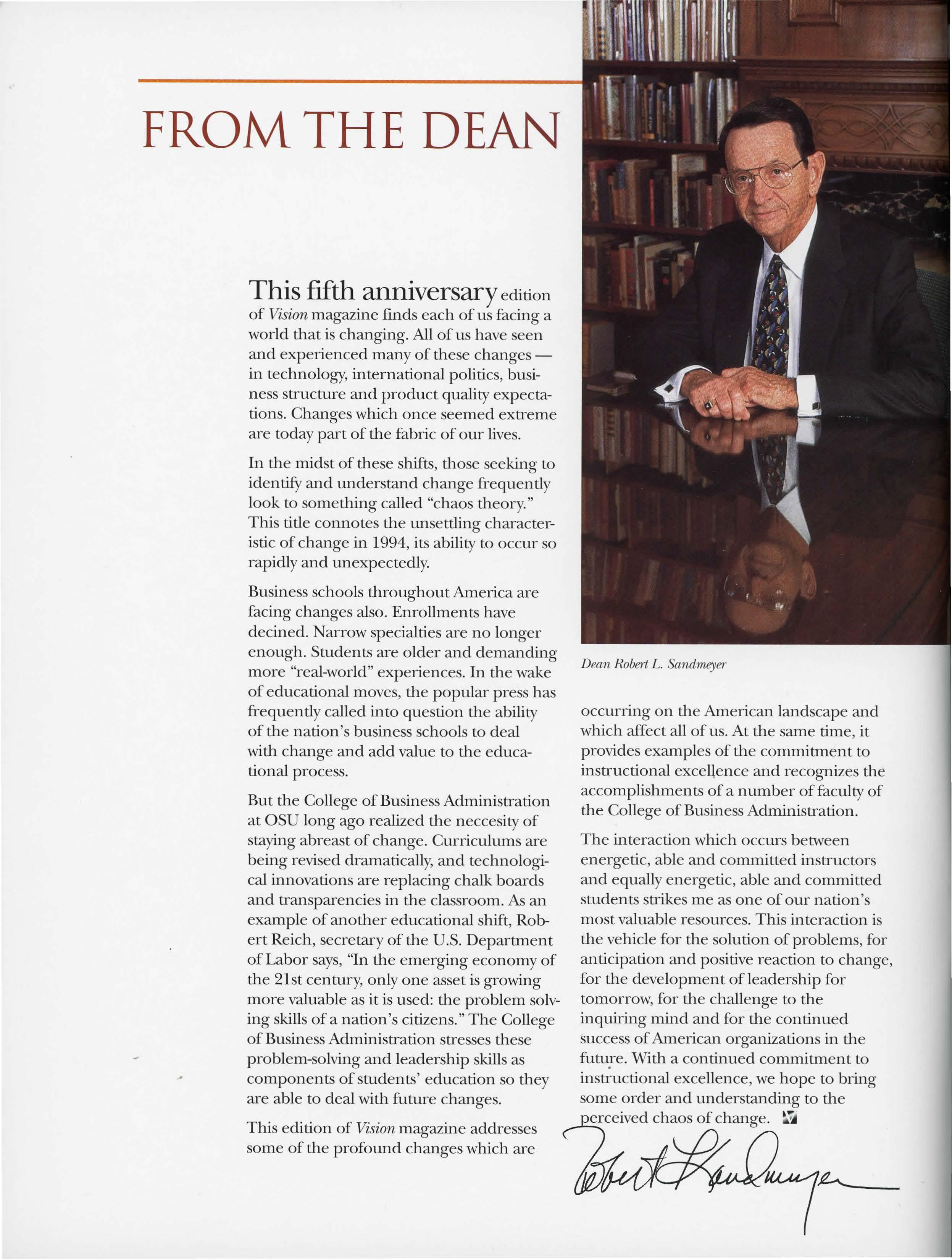
Dean RobertL. Scmdmeyer
6
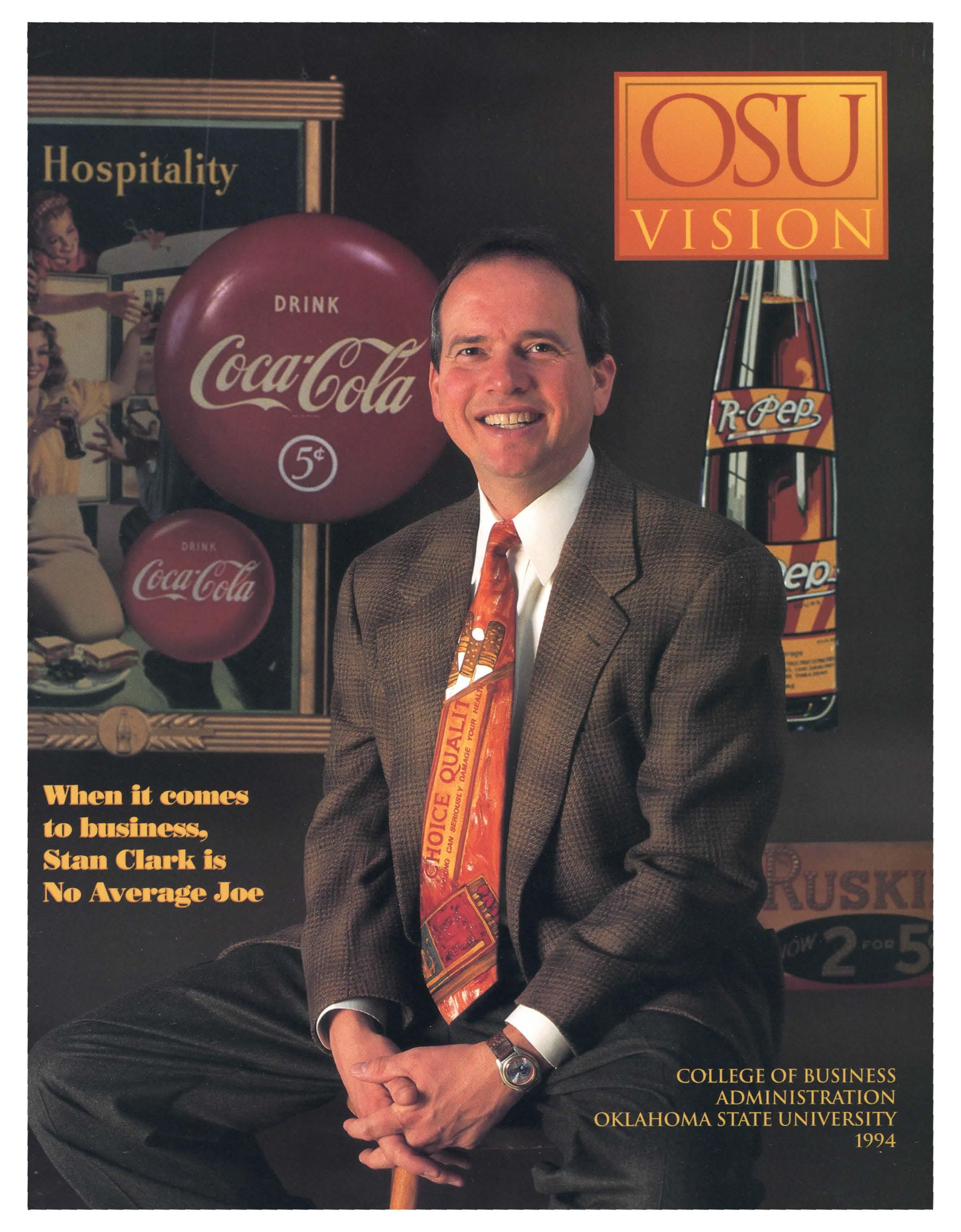
NO AVERAGE JOE
Stan Clark has turned a run-down bar into a series of thriving businesses. He explains his approach and his shortcomings in The Secretof Stan's Success.
12
IN WITH THE NEW
In the future, some say U"aditional education may not be enough. A new type of school is taking a unique approach to the cmriculum and finding support from local business leaders.
16
GOING GLOBAL
American business will have to anticipate fluctuations and emerging opportunities to keep its edge in the world market. An OSU international business expert gives his opinion on the ones to watch.
22
AN ACADEMIC ENDEAVOR
Tonka toys and travelogues are just some of the ways these professors are challenging today's students.
MOVING AHEAD
Wth educational funds on the decline, universities across the nation are streamlining, cutting administration and looking for new ways to compete. While some in academia resist the business comparison, the truth is they are applying management techniques to survive in the 21st century.
Much like corporate America, over the past year, OSU has re-evaluated its mission and refocused for the future. The first step came when the university developed six overarching priorities to guide its changes. Chairman of the Board of Regents at that time and a proponent of defining OSU's goals was Ed Keller. Keller says the increasing demand for resources with declining enrollment and diminishing funds was forcing OSU to make tough decisions about allocation.
"Universities, not unlike every other institution, must be efficient in their use of financial resourcesputting maximum effort behind those things where
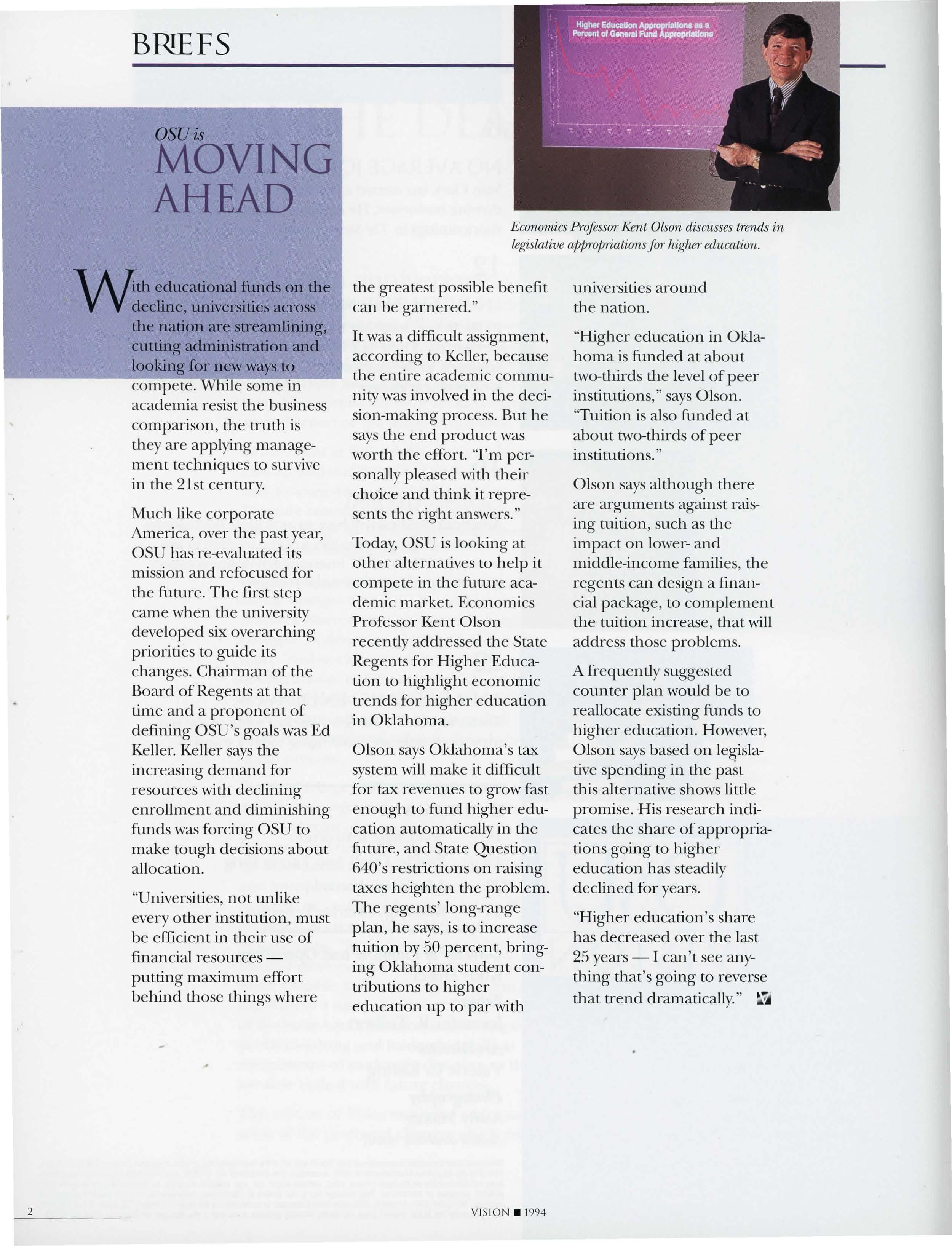
EconomicsProfessorKent Olson discussestrends in wgislativeappropriationsfor highereducation.
the greatest possible benefit can be garnered."
It was a difficult assignment, according to Keller, because the entire academic community was involved in the decision-making process. But he says the end product was worth the effort. 'Tm personally pleased with their choice and think it represents the right answers."
Today, OSU is looking at other alternatives to help it compete in the future academic market. Economics Professor Kent Olson recently addressed the State Regents for Higher Education to highlight economic trends for higher education in Oklahoma.
Olson says Oklahoma's tax system will make it difficult for tax revenues to grow fast enough to fund higher education automatically in tl1e future, and State Question 640's restrictions on raising taxes heighten the problem. The regents' long-range plan, he says, is to increase tuition by 50 percent, bringing Oklahoma student contributions to higher education up to par with
universities around the nation.
"Higher education in Oklahoma is funded at about two-thirds the level of peer institutions," says Olson. 'Tuition is also funded at about two-thirds of peer institutions."
Olson says although there are arguments against raising tuition, such as the impact on lower- and middle-income families, the regents can design a financial package, to complement the tuition increase, that will address those problems.
A frequently suggested counter plan would be to reallocate existing funds to higher education. However, Olson says based on legislative spending in the past this alternative shows little promise. His research indicates the share of appropriations going to higher education has steadily declined for years.
"Higher education's share has decreased over tl1e last 25 years - I can't see anything that's going to reverse that trend dramatically."
PRESIDENTIAL SEARCHUNDERWAY
ne of the most important moves OSU is now making to position itself for the future is its selection of a new president. The search, which officially began in January, is scheduled to end soon.
Bruce Benbrook, regent and member of the selection committee, says they are looking for a CEO with vision. The person eventually selected, he says, will have leadership, management and communications skills as well as an understanding of OSU's future role in the Oklahoma educational system. An ability to provide that leadership and understanding to all constituents of the university is also critical.
'The new president will require a vision of where OSU will go from the '90s into the next decade ... visionary management and leadership to take us through these years."
OSU OUTRANKS COMPETITION
Twoacademic economists
!recently ranked business schools based on how much eac 1 sc oo a e to e earning capacity of its graduates. According to their findings, OSU ranks No. 8 in the nation.
Economists Joseph Tracy of Columbia University and Joel Waldfogel of Yale University studied data on earning capacity of students in 1991. They look~d at what they called the "value added" aspects of each university.
More subjective rankings, such as those put ~ut by Business Week,have been challenged in the past.
The top eight in order are: Stanford, Harvard, University of Chicago, University 0£ 1rgm1a, mvers1ty ofPennsylvania, Northwestern, University of Michigan and Oklahoma State.
One of the stark contrasts in the data is the tuition comparison. According to Tracy and Waldfogel, students at Stanford will pay $16,575 a year, while students at OSU will only pay $5,065.
The SanFrancisco Chronic/,e quoted Tracy: 'The top schools are not surprising, but the middle schools would never show up in a Business Weekranking. They are missing the credit that is due to them."
Attend The Tulsa BusinessFarum and Executive Management Briefings
'"lhe Tulsa Business Forum land Executive Management Briefings are dedicated to bringing leading experts to Oklahoma to share their .._ ___ .,,age e t e :B.,.....,,e"""'c,.,,_ __ _. and philosophies with the business community.
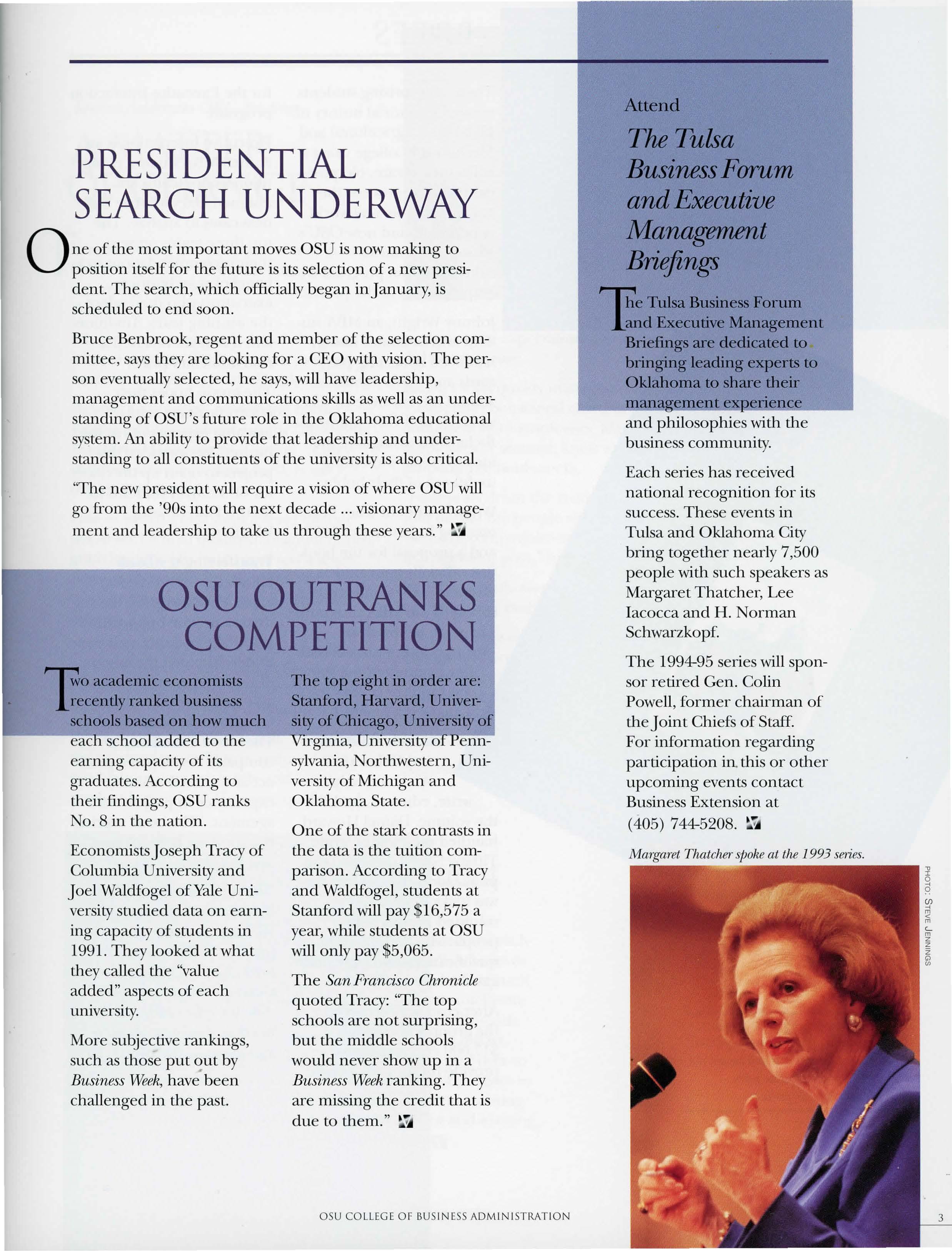
Each se1ies has received national recognition for its success. These even ts in Tulsa and Oklahoma City bring together nearly 7,500 people with such speakers as Margaret Thatcher, Lee Iacocca and H. Norman Schwarzkopf.
The 1994--95series will sponsor retired Gen. Colin Powell, former chairman of the Joint Chiefs of Staff. For information regarding participation in. this or other upcoming events contact Business Extension at (405) 744--5208. ·~
Margaret Thatcherspokeat the 1993 series.
Entrepreneurial
Sfarit F
ive MBA students recently developed an entrepreneurialspirit,and their project is paying off for both the students and the MBA program.
BR!EFS
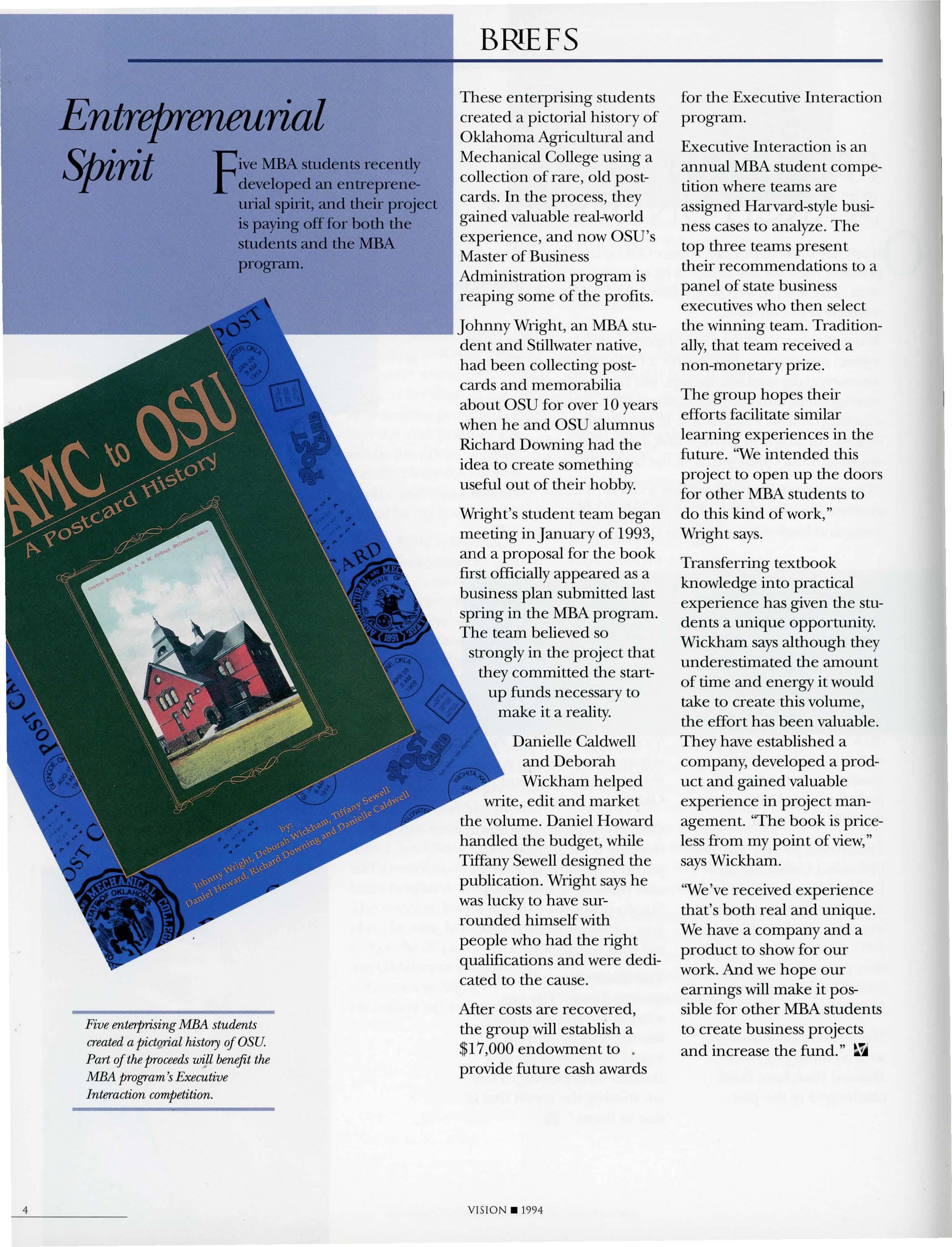
Five enterprisingMBA students createda pictgrialhistoryof OSU. Part of theproceedswi.Jlbenefitthe MBA program'sExecutive Interactioncompetition.
These enterprising students created a pictorial history of Oklahoma Agricultural and Mechanical College using a collection of rare, old postcards. In the process, they gained valuable real-world experience, and now OSU's Master of Business Administration program is reaping some of the profits.
Johnny Wright, an MBA stu-
dent and Stillwater native, had been collecting postcards and memorabilia about OSU for over 10 years when he and OSU alumnus Richard Downing had the idea to create something useful out of their hobby.
Wright's student team began meeting in January of 1993, and a proposal for the book first officially appeared as a business plan submitted last spring in the MBA program. The team believed so strongly in the project that they committed the startup funds necessary to make it a reality.
Danielle Caldwell and Deborah Wickham helped write, edit and market the volume. Daniel Howard handled the budget, while Tiffany Sewell designed the publication. Wright says he was lucky to have surrounded himself with people who had the right qualifications and were dedicated to the cause.
After costs are recovered, the group will establish a $17,000 endowment to . provide future cash awards
for the Executive Interaction program.
Executive Interaction is an annual MBA student competition where teams are assigned Harvard-style business cases to analyze. The top three teams present their recommendations to a panel of state business executives who then select the winning team. Traditionally, that team received a non-monetary prize.
The group hopes their efforts facilitate similar learning experiences in the future. 'We intended this project to open up the doors for other MBA students to do this kind of work," Wright says.
Transferring textbook knowledge into practical experience has given the students a unique opportunity. Wickham says although they underestimated the amount of time and energy it would take to create this volume, the effort has been valuable. They have established a company, developed a product and gained valuable experience in project management. 'The book is priceless from my point of view," says Wickham.
'We've received experience that's both real and unique. We have a company and a product to show for our work. And we hope our earnings will make it possible for other MBA students to create business projects and increase the fund."
A MATTER OF CHANGE
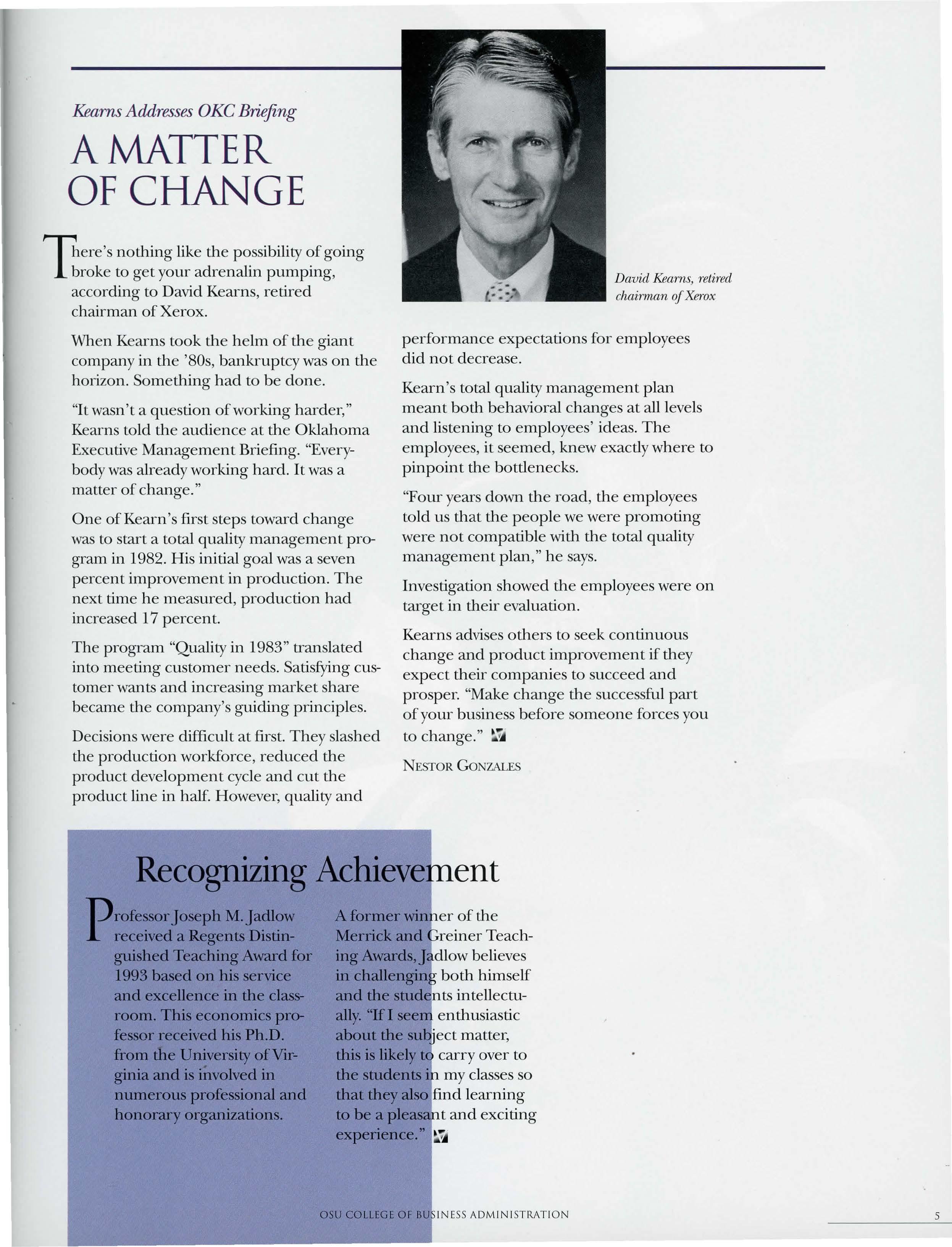
lhere's nothing like the possibility of going l broke to get your adrenalin pumping, according to David Kearns, retired chairman of Xerox.
When Kearns took the helm of the giant company in the '80s, bankruptcy was on the horizon. Something had to be done.
"It wasn't a question of working harder," Kearns told the audience at the Oklahoma Executive Management Briefing. "Everybody was already working hard. It was a matter of change."
One ofKearn's first steps toward change was to start a total quality management program in 1982. His initial goal was a seven percent improvement in production. The next time he measured, production had increased 17 percent.
The program "Quality in 1983" U"anslated into meeting customer needs. Satisfying customer wants and increasing market share became the company's guiding principles.
Decisions were difficult at first. They slashed the production workforce, reduced the product development cycle and cut the product line in half. However, quality and
performance expectations for employees did not decrease.
Kearn's total quality management plan meant both behavioral changes at all levels and listening to employees' ideas. The employees, it seemed, knew exactly where to pinpoint the bottlenecks.
''Four years down the road, the employees told us that the people we were promoting were not compatible witl1 the total quality management plan," he says.
Investigation showed the employees were on target in their evaluation.
Kearns advises others to seek continuous change and product improvement if tl1ey expect tl1eir companies to succeed and prosper. "Make change the successful part of your business before someone forces you to change." 1':J
NESTOR Go ZALES
RecognizingAchieve ent
Professor Joseph M.Jadlow received a Regents Distinguished Teaching Award for 1993 based on his service and excellence in the classroom. This economics professor received his Ph.D. from the University ofVirginia and is involved in numerous professional and honorary organizations.
Merrick and I reiner Teaching Awards,Jadlow believes in challenging both himself and the stud ts intellectually. "IfI seem enthusiastic about the sulf ect matter, this is likely to carry over to the students i my classes so that they also find learning to be a pie t and exciting experience."
David Keams, retired chairman of Xerox
The Secret of Stan's Success
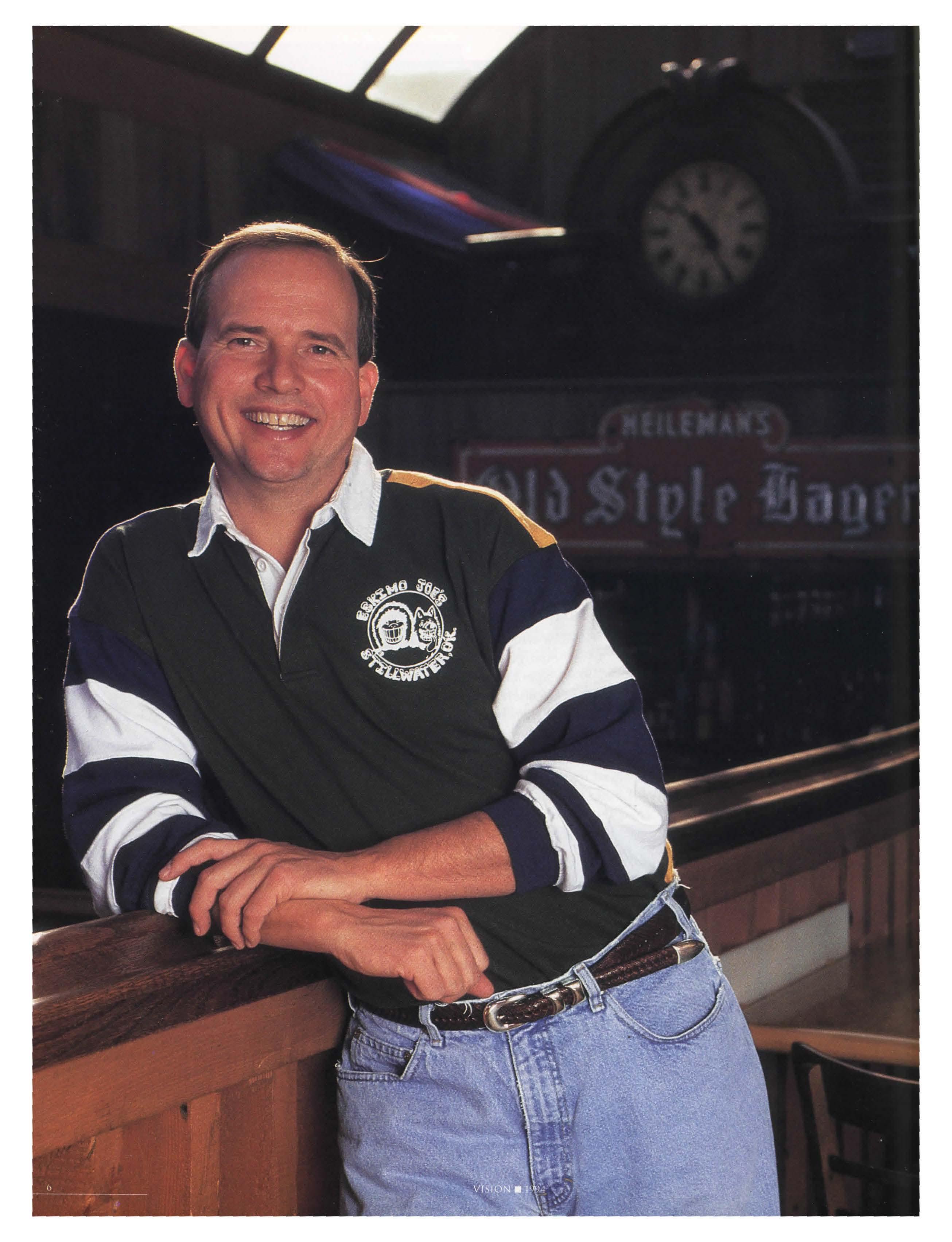
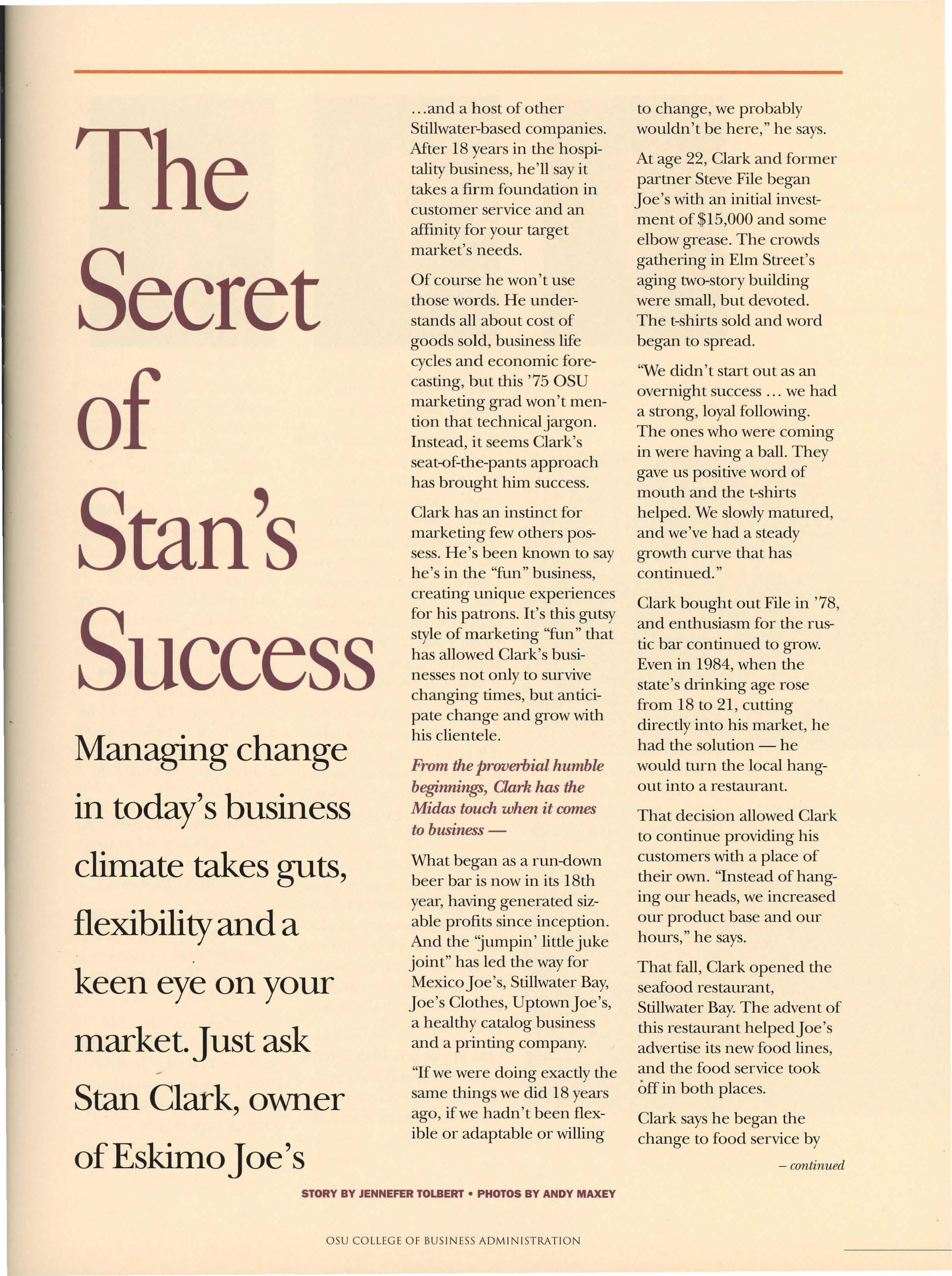
Managing change in today's business climate takes guts, flexibilityand a keen eye on your market.Just ask Stan Clark, owner of Eskimo Joe's
... and a host of other Stillwater-based companies. After 18 years in the hospitality business, he'll say it takes a firm foundation in customer service and an affinity for your target market's needs.
Of course he won't use those words. He understands all about cost of goods sold, business life cycles and economic forecasting, but this '75 OSU marketing grad won't mention that technical jargon. Instead, it seems Clark's seat-of-the-pants approach has brought him success.
Clark has an instinct for marketing few others possess. He's been known to say he's in the "fun" business, creating unique experiences for his patrons. It's this gutsy style of marketing "fun" that has allowed Clark's businesses not only to survive changing times, but anticipate change and grow with his clientele.
From the proverbial humhk beginnings,Clark has the Midas wuch when it comes to business-
What began as a run-down beer bar is now in its 18th year, having generated sizable profits since inception. And the 'Jumpin' little juke joint" has led the way for Mexico Joe's, Stillwater Bay, Joe's Clothes, Uptown Joe's, a healthy catalog business and a printing company.
"If we were doing exactly the same things we did 18 years ago, ifwe hadn't been flexible or adaptable or willing
to change, we probably wouldn't be here," he says.
At age 22, Clark and former partner Steve File began Joe's with an initial investment of $15,000 and some elbow grease. The crowds gathering in Elm Street's aging two-story building were small, but devoted. The t-shirts sold and word began to spread.
''We didn't start out as an overnight success we had a strong, loyal following. The ones who were coming in were having a ball. They gave us positive word of mouth and the t-shirts helped. We slowly matured, and we've had a steady growth curve that has continued."
Clark bought out File in '78, and enthusiasm for the rustic bar continued to grow. Even in 1984, when the state's drinking age rose from 18 to 21, cutting directly into his market, he had the solution - he would turn the local hangout into a restaurant.
That decision allowed Clark to continue providing his customers with a place of their own. "Instead of hanging our heads, we increased our product base and our hours," he says.
That fall, Clark opened the seafood restaurant, Stillwater Bay. The advent of this restaurant helped Joe's advertise its new food lines, and the food service took off in both places.
Clark says he began the change to food service by -continued
STORYBY JENNEFERTOLBERT
PHOTOSBY ANDY MAXEY
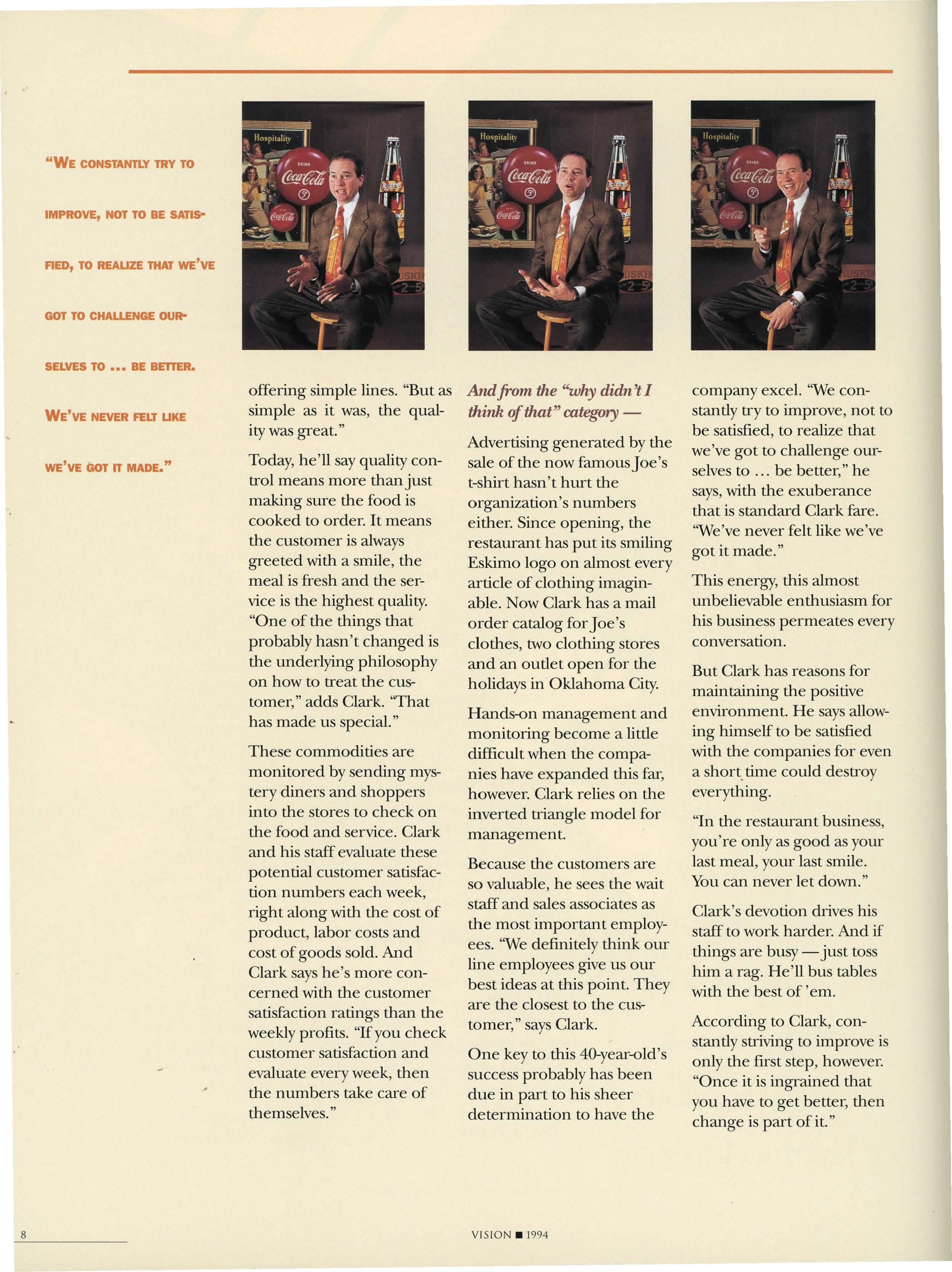
"WE CONSTANTLYTRY TO
IMPROVE, NOT TO BE SATIS,,
FlED, TO REALIZE THAT WE'VE GOT TO CHALLENGE OURSELVES TO ••• BE BETTER.
WE'VE NEVER FELT LIKE
WE'VE GOTn MADE."
offering simple lines. "But as simple as it was, the quality was great."
Today, he'll say quality control means more than just making sure the food is cooked to order. It means the customer is always greeted with a smile, the meal is fresh and the service is the highest quality. "One of the things that probably hasn't changed is the underlying philosophy on how to treat the customer," adds Clark. 'That has made us special."
These commodities are monitored by sending mystery diners and shoppers into the stores to check on the food and service. Clark and his staff evaluate these potential customer satisfaction numbers each week, right along with the cost of product, labor costs and cost of goods sold. And Clark says he's more concerned with the customer satisfaction ratings than the weekly profits. "If you check customer satisfaction and evaluate every week, then the numbers take care of themselves."
Andfram the "why duln 't I think of that" category -
Advertising generated by the sale of the nowfamousJoe's t-shirt hasn't hurt the organization's numbers either. Since opening, the restaurant has put its smiling Eskimo logo on almost every article of clothing imaginable. Now Clark has a mail order catalog for Joe's clothes, two clothing stores and an outlet open for the holidays in Oklahoma City.
Hands-on management and monitoring become a little difficult when the companies have expanded this far, however. Clark relies on the inverted triangle model for management.
Because the customers are so valuable, he sees the wait staff and sales associates as the most important employees. "We definitely think our line employees give us our best ideas at this point. They are the closest to the customer," says Clark.
One key to this 40-year-old's success probably has been due in part to his sheer determination to have the
company excel. 'We constantly try to improve, not to be satisfied, to realize that we've got to challenge ourselves to be better," he says, with the exuberance that is standard Clark fare. 'We've never felt like we've got it made."
This energy, this almost unbelievable enthusiasm for his business permeates every conversation.
But Clark has reasons for maintaining the positive environment. He says allowing himself to be satisfied with the companies for even a short_ time could destroy everytl1ing.
"In the restaurant business, you're only as good as your last meal, your last smile. You can never let down."
Clark's devotion drives his staff to work harder. And if things are busy - just toss him a rag. He'll bus tables with the best of' em.
According to Clark, constantly striving to improve is only the first step, however. "Once it is ingrained that you have to get better, then change is part of it."
Making lemonadeClark's companies have rarely faced a downturn in the market. But riding the wave of change inevitably means handling a crisis at some point. Perhaps that challenge came in 1992 when theJukeJoint's 17th anniversary street party became more than its host college town could handle. Even after another year of planning, an organized task force and a commitment from police statewide to help, the 18th anniversary party still attracted a violent element.
Clark's decision came swiftly. At 2 a.m. the Saturday of the 18th anniversary, he decided the end of the Eskimo Joe's street party had come. 'When you have 30,000 people gathered in the street, in the 1990s that's a catalyst for problems."
For Clark, however, this meant merely a shift in focus, not in goals. Because the party, which brought nearly $8. 7 million into the Stillwater economy, had alwaysbeen one for the family, changes would be made to ensure future festivities could be contained.
"I think you've always got to look at any challenge as an opportunity," says Clark, who now plans to go to a month-long event instead of a weekend bash. "I look at this as an opportunity to shift the focus.
'That's not to say that we can't approach it differently and create a festival-type atmosphere. My eternal
optimistic spirit tells me we can make it better."
Ladies and genflemen, the amazing entrepreneurWhat's amazing about Clark's style is tl1at he doesn't try to forecast market trends. He waits for the next opening to reveal itself.
With this approach, sometimes it is difficult to tell if Clark manages Joe's or if Joe's manages Clark. But he has turned this potential flaw into an asset.
Clark is able to react to market trends faster than average organizations because he is flexible. His lack of official long-range planning doesn't means he's not thinking ahead. The style is simply reminiscent of the adage 'The only constant is change." It is precisely his lack of rigid plans that in tl1e past has enabled him to react so quickly.
"I reacted to and tried to maximize opportunities as they showed themselves," he says. "I'm not very visionary, but I'm quick to react."
Clark admits another person might have done something else, even something more, with Eskimo Joe's. But it wouldn't have been the same. The juke joint and its counterparts are an integral part of the community and the campus.
"A different owner with a different philosophy probably would have franchised, but that's not our focus," he says. "We wanted to be different and special to Stillwater."
Stan Clark's marketing style may not be for the average entrepreneur. His approach to the restaurant business has created a monster, sometimes out of control. But it's a monster Clark has maneuvered to suit his market's changing needs.
And whether the crowds say they're coming in for cheese fries or reminiscing, rest assured, it's the fun tl1ey're really after. 1 ~
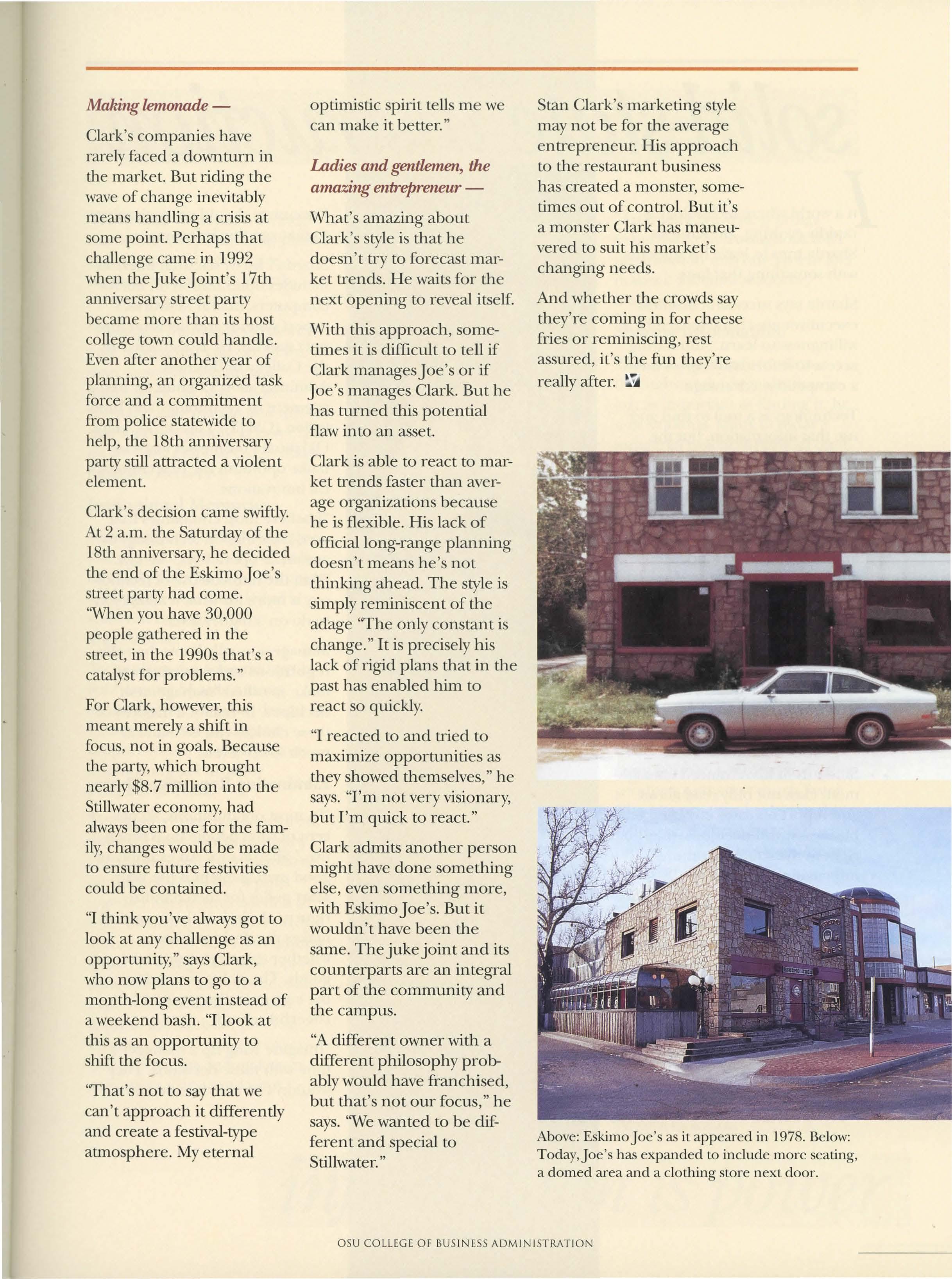
Above: Eskimo Joe's as it appeared in 1978. Below: Today,Joe's has expanded to include more seating, a domed area and a clothing store next door.
solid-stiiteinstruction
].. wodd where technology is rapidly evolving, Dr. Ramesh Sharda tries to leave his students with something that lasts.
Sharda says successful business executives are characterized by a willingness to learn. And having access to information gives them a competitive advantage.
Technology is a tool to find and use that information, but the ultimate goal is to get students to ask questions, says Sharda, professor of management science and information systems in the department of management and holder of the Conoco/ DuPont Chair of Technology Management.
"In my classes, I serve as a guide, and the students are the explorers," he says. "I teach them not so much what to explore, but to learn how to explore."
Teaching Curiosity
Students in his advanced management class not only read about and report on cases involving real 1 business-world decisions, they go right to the source for more information.
"I make them contact the authors directly to find more details," he says. "I t('.ach them how to ask the questions even more than how to answer them."
But an executive can always use more information to answer que§tions, he says. That's where the technqlogy comes in.
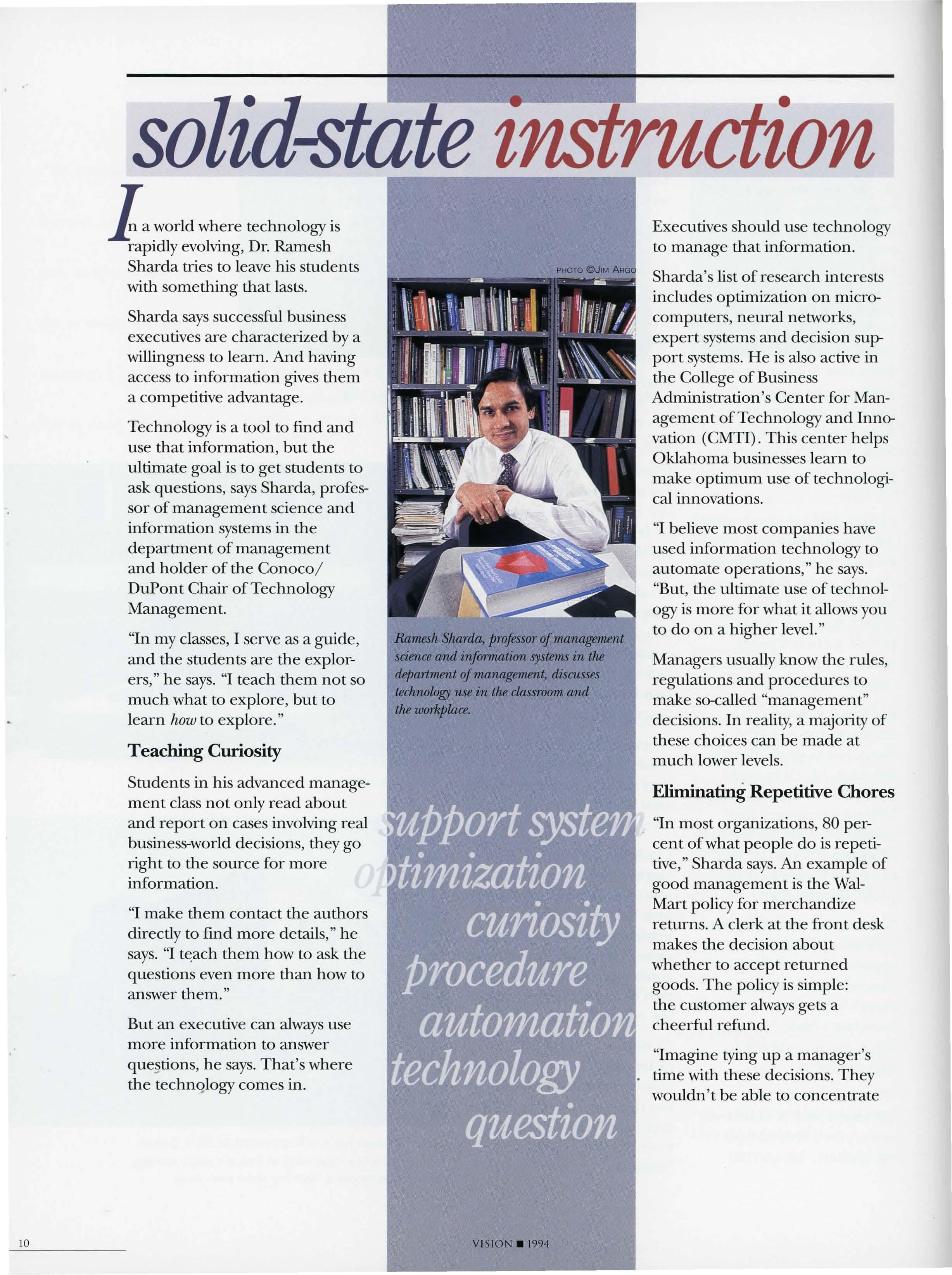
RameshSharda,frrofessur of managrmumt scienceand infmmationsystemsin the departmentof managrmumt,discusses technowgyuse in the dassroomand the wurltpfaa.
Executives should use technology to manage that information.
Sharda's list of research interests includes optimization on microcomputers, neural networks, expert systems and decision support systems. He is also active in the College of Business Administration's Center for Management of Technology and Innovation (CMTI). This center helps Oklahoma businesses learn to make optimum use of technological innovations.
"I believe most companies have used information technology to automate operations," he says. "But, the ultimate use of technology is more for what it allows you to do on a higher level."
Managers usually know the rules, regulations and procedures to make so-called "management" decisions. In reality, a majority of these choices can be made at much lower levels.
Eliminating Repetitive Chores
"In most organizations, 80 percent of what people do is repetitive," Sharda says. An example of good management is the WalMart policy for merchandize returns. A clerk at the front desk makes the decision about whether to accept returned goods. The policy is simple: the customer always gets a cheerful refund.
"Imagine tying up a manager's time with these decisions. They wouldn't be able to concentrate
PHOTO ©JIM ARG
on anything important. Strategic marketing and positioning plans and other more productive responsibilities would be submerged in minutiae.
"Managers should spend more time solving difficult problems than repeating solutions to minor ones," he says. ''With adequate information and decision support, people at lower levels are truly empowered to make repetitive decisions."
Institutional Memories
Now, imagine a complex corporate environment in which policies and procedures for decisions are in place, but knowledge is scattered throughout the organization.
Technology can solve that problem. Among Sharda's many accomplishments is the design of a state-of-the-art intelligent support system that helps decision making at Purolator Products of Tulsa.
The system links data bases from different areas of the company and delivers instant information on pricing scenarios. It pulls together alternatives needed to solve management problems and automatically applies a weighting system to reflect 'the same company strengths and priorities an experienced manager would apply to the decision process. Finally, it selects the best of several alternatives and makes an unbiased recomm,endation.
IYelcOme to flte c,.....,,,. oftfteF...,.
A majQriniti'atfveis underwayin the Collsge of Busi Admlnistra-
"An intelligent system brings expertise from throughout the organization into one system and makes it a shared resource," Sharda says.
Sharing Information
This sharing of information throughout the organization is just as important as finding it, he tells students. Many of today's industrial practices depend on it.
Concurrent engineering, for example, brings functional areas together so that the design is good and the product is marketable. In Oklahoma, for example, the Charles Machine Works Company (Ditch Witch) uses cross-functional teams to design for manufacturing.
'The old approach of 'let's design a product, try to build it, then sell it' still works in some cases," he says. "However, concurrent engineering has become a way for companies to compete and bring products to market much faster. The Japanese are leaders in this field, and their total cycle time is one to two years less than American manufacturers."
Sharda tells students information is still power. Harnessing technology to manage and share information helps focus that power.
Perhaps most importantly, he teaches one of the most powerful tools of all may be just some good old fashioned curiosity and the energy to outstudy the competition.
NESTOR GONZALES
KNOWLEDGE IS THE KEY
TO
THE FUTURE. THOSE WHO SEEK ITS PROMISES MUST BE PREPARED.
phecy sounds ominous, but the is here. Knowledge is the ual's most prized possession.
Peter Drucker's book, Post-CapitalistSoci,ety, delves into the socioeconomic shift that has made knowledge, a resource only the individual can provide, so vital.
Drucker, a widely published management analyst and Wall Streetjournal columnist, explains computers or books contain information, but knowledge is internal. People draw from their knowledge, mold and create it every day. And in a knowledge society, the individual becomes the axis on which society spins.
What does this shift mean for the individual? It means a new responsibility, a revised vision for the world and a focus on the future. It means a new definition of what it takes to be
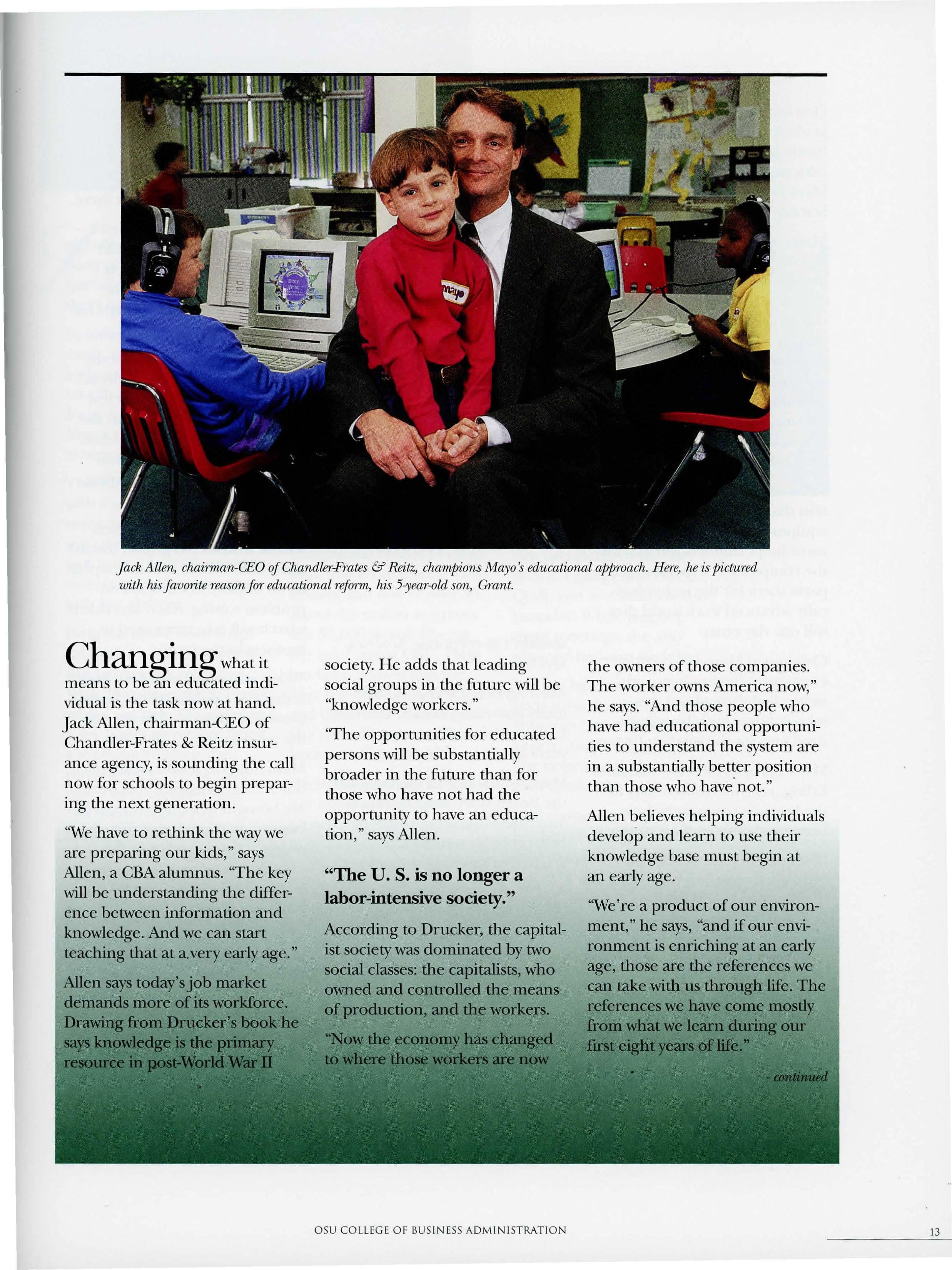
Jack AUen, chairman-CEOof Chand/,er-Frates& Reitz, champions Mayo's educational approach.Here, he is pictured with hisfavarite reasonfor educational refarm, his 5-year-oldson, Grant.
Changingwhat it means to be an educated individual is the task now at hand. Jack Allen, chairman-CEO of Chandler-Frates & Reitz insurance agency, is sounding the call now for schools to begin preparing the next generation.
'We have to rethink the way we are preparing our kids," says Allen, a CBA alumnus. 'The key will be understanding the difference between information and knowledge. And we can start teaching that at a.very early age."
Allen saystoday's job market demands more of its workforce.
D bookh
society. He adds that leading social groups in the future will be "knowledge workers."
'The opportunities for educated persons will be substantially broader in the future than for those who have not had the opportunity to have an education," says Allen.
"The U. S. is no longer a labor-intensive society."
According to Drucker, the capitalist society was dominated by two social classes: the capitalists, who owned and controlled the means of production, and the workers.
the owners of those companies. The worker owns America now," he says. "And those people who have had educational opportunities to understand the system are in a substantially better position than those who have· not."
Allen believes helping individuals develop and learn to use their knowledge base must begin at an early age.
'We're a product of our environment," he says, "and if our environment is enriching at an early age, those are the references we can take with us through life. The references we have come mostly
One way Allen and other busin professionals are helping prepare future generations to be better educated is by supporting Tulsa's Mayo Demonstration School of Science and Technology.
Mayo, as it is called, is a public school serving children from prekindergarten to fourth grade. One of its most w1ique features is that its student population mirrors area demographics. The student body, chosen from all levels of learning, is racially and ethnically diverse. It also includes physically and developmentally handicapped children to represent Tulsa's population.
Allen serves on a private foundation that raises funds for modern equipment for Mayo. The equipment helps students learn to use the computer as a tool and prepares them for the technologically advanced work world they will one day enter.
Children at Mayo use computers everyday at "technology pods" networked throughout the school. Some even have giantsized keys for the smallest fingers.
Mayo's project director, Margaret Erling, says Allen and others in the business community have been invaluable in their support.
''We need to partner with the business community to see that children have access to the technological equipment they will be expected to use in the real world,"she says.
''Wealso need help in spreading the word on the need for reform and not being comfortabledoing
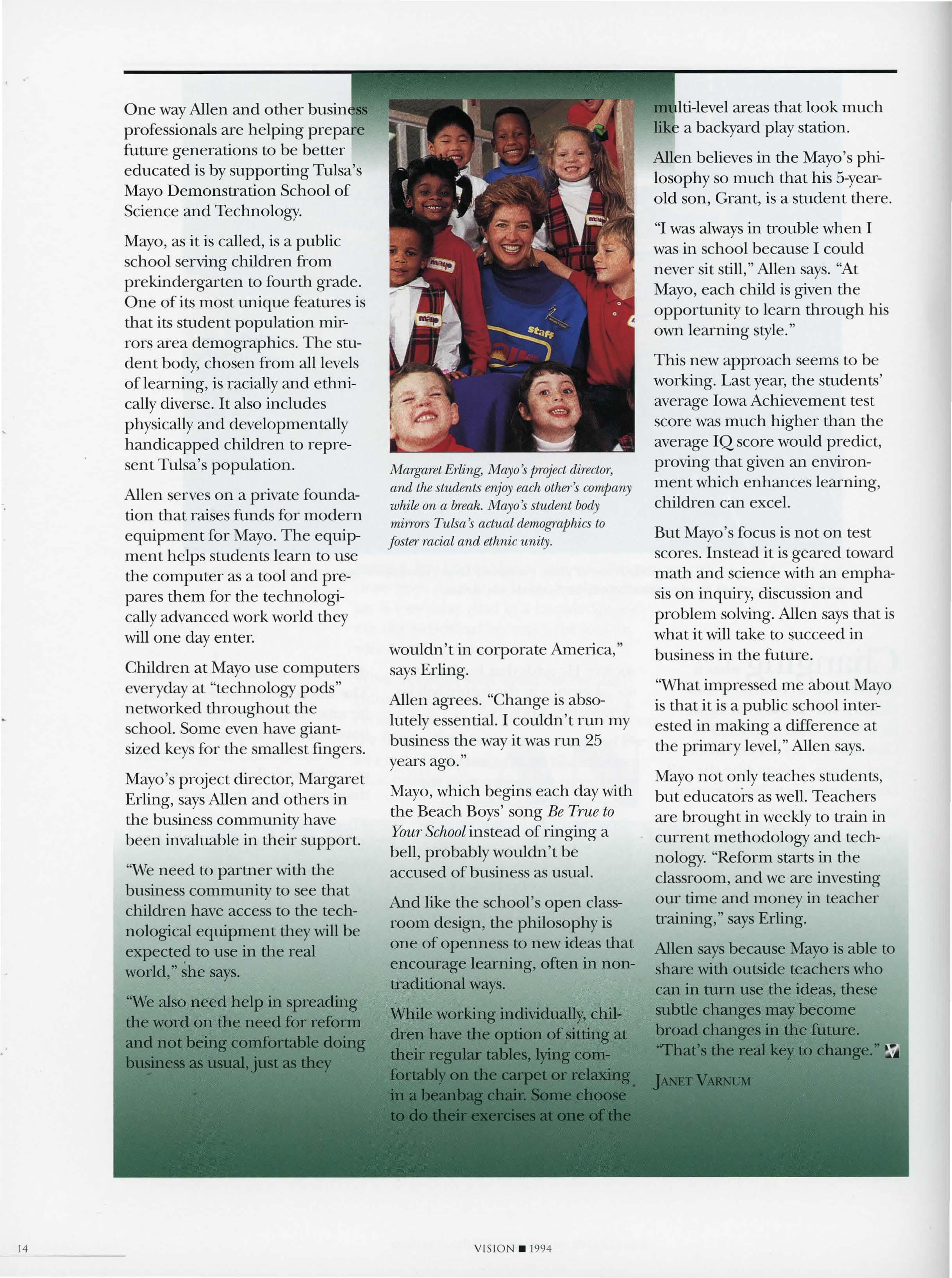
MargaretErling, Mayos f1rojectdirector, and the students enjoy each other'scompany whil,eon a /Jreak.Mayo's student body mirrorsTulsa s actual demographicsto foster racial and ethnic unity. wouldn't in corporate America," says Erling.
Allen agrees. "Change is absolutely essential. I couldn't run my business the way it was run 25 years ago."
Mayo, which begins each day with the Beach Boys' song Be True to Your Schoolinstead of ringing a bell, probably wouldn't be accused of business as usual.
And like the school's open classroom design, the philosophy is one of openness to new ideas that encourage learning, often in nontraditional ways.
While working individually,childre • • •
ti-level areas that look much a backyard play station.
Allen believes in the Mayo's philosophy so much that his 5-yearold son, Grant, is a student there.
"I was always in trouble when I was in school because I could never sit still," Allen says. "At Mayo, each child is given the opportunity to learn through his own learning style."
This new approach seems to be working. Last year, the students' average Iowa Achievement test score was much higher than the average IQ score would predict, proving that given an environment which enhances learning, children can excel.
But Mayo's focus is not on test scores. Instead it is geared toward math and science with an emphasis on inquiry, discussion and problem solving. Allen says that is what it will take to succeed in business in the future.
''What impressed me about Mayo is that it is a public school interested in making a difference at the primary level," Allen says.
Mayo not only teaches students, but educatoi·s as well. Teachers are brought in weekly to train in current methodology and technology. "Reform starts in the classroom, and we are investing our time and money in teacher training," says Erling.
Allen says because Mayo is able to share with outside teachers who can in turn use the ideas, these subtle changes may become broa •
wgh Ann TurveyIhrig
A BRIGHTFUTURE
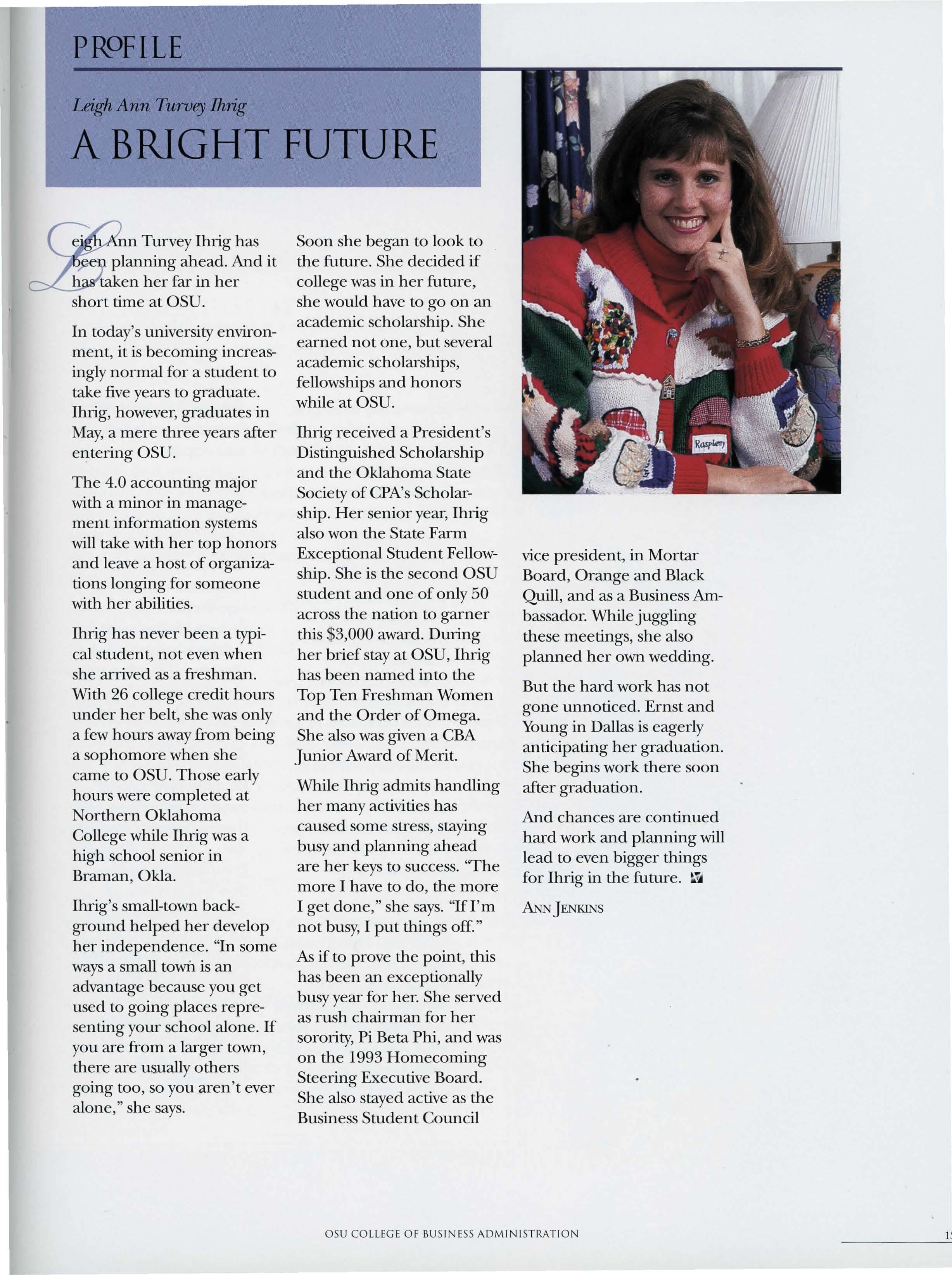
n Turvey Ihrig has anning ahead. And it en her far in her short time at OSU.
In today's university environment, it is becoming increasingly normal for a student to take five years to graduate. Ihrig, however, graduates in May, a mere three years after ef?-tering OSU.
The 4.0 accounting major with a minor in management information systems will take with her top honors and leave a host of organizations longing for someone with her abilities.
Ihrig has never been a typical student, not even when she arrived as a freshman. With 26 college credit hours under her belt, she was only a few hours away from being a sophomore when she came to OSU. Those early hours were completed at Northern Oklahoma College while Ihrig was a high school senior in Braman, Okla.
Ihrig's small-town background helped her develop her independence. "In some ways a small town is an advantage because you get used to going places representing your school alone. If you are from a larger town, there are usually others going too, so you aren't ever alone," she says.
Soon she began to look to the future. She decided if college was in her future, she would have to go on an academic scholarship. She earned not one, but several academic scholarships, fellowships and honors while at OSU.
Ihrig received a President's Distinguished Scholarship and the Oklahoma State Society of CPA's Scholarship. Her senior year, Ihrig also won the State Farm Exceptional Student Fellowship. She is the second OSU student and one of only 50 across the nation to garner this $3,000 award. During her brief stay at OSU, Ihrig has been named into the Top Ten Freshman Women and the Order of Omega. She also was given a CBA Junior Award of Merit.
While Ih1ig admits handling her many activities has caused some stress, staying busy and planning ahead are her keys to success. 'The more I have to do, the more I get done," she says. "Ifl'm not busy, I put things off."
As if to prove the point, this has been an exceptionally busy year for her. She served as rush chairman for her sorority, Pi Beta Phi, and was on the 1993 Homecoming Steering Executive Board. She also stayed active as the Business Student Council
vice president, in Mortar Board, Orange and Black Quill, and as a Business Ambassador. While juggling these meetings, she also planned her own wedding. But the hard work has not gone unnoticed. Ernst and Young in Dallas is eagerly anticipating her graduation. She begins work there soon after graduation.
And chances are continued hard work and planning will lead to even bigger things for Ihrig in the future.
ANNJENKINS
he gwbal market todayfaces a future unlike any previous era in the hist(lfy of worl,d,trade.
It is rapidly changing, debates, says an OSU and e,xperts are predict- international busiing that this unfolding ness expert. destiny in the intern.a- ''NAFTA is probably tional economy has the more important in opportunity to reshape how we deal with business customs in economies in Asia inconceivable patterns. than on the North In the vanguard, the American continent," United States stands as says Stephen Miller, the prominent economic power, ready to regents distinguished lead the world service professor and economy in its first true director of the Intern.ational Business Proera of global access. It gram in the College of is without question an Business Administra- inexorable event, this tion atOSU. world economy, but how far away is the new Because NAFTA will age, and how should have a ripple effect felt American business pre- throughout the Pacific pare for entering these Rim, OSU's College of ,new markets? Business Administra-
Undoubtedly, the tion has positioned itself to train students recently passed North on the customs and American Free Trade Agreement will have an practices of Asian busiimpa€t upo~ trade ness, specifically in Japan. In 1994 the expansion, bu p€rhaps CBA will conduct its not in ilie manner that second Summer in most Americans considered w en the)'. heard Japan course at the heated WAFTA OSU-Kyoto.
IT IS WITHOUT QlJESTION AN INEXORABLE EVENT,THIS WORLD ECONOMY, BUT HOW FAR AWAY IS THE NEW AGE AND HOW SHOULD AMERICAN BUSINESSPREPAREFOR ENTERINGTHESENEW MARKETS?
Last summer, 17 students attended the program that dealt with marketing in Japan, Korea, Malaysia and other Pacific Rim countries. The students also visited Japanese auto plants and electronics companies, where they met middle- and upperlevel managers.
"One of the interesting aspects of this program," says Miller, ''was the international students attracted to it.
'Ten of the 17 students were international and were there to study the Japanese economy. We feel that is a good indication this is a solid program if we are drawing international students for these reasons."
Miller says he expects by the year 2000, Pacific Rim countries will comprise 50 percent of worldwide trade. But to compete evenly in these markets, to prepare students·adequately for the rigors of international business, the United States needed to level the playing field. The passage ofNAFTAwas a start, sending the message to Asian countries that America is serious about eliminating trade barriers.
'There is no question that the walls are higher in Thailand, Indonesia and Korea for products going to those countries than those imported to the United States," says Miller.
"It (NAFTA) will serve as a bargaining chip."
This chip could force Asian economies to lower their trade barriers. NAFTA may force the hand of Pacific countries which previously had little to fear from competing economies that also had inexpensive labor and high tariffs. With Mexico ready to offer cheaper, more convenient labor without the baggage of trade barriers, Pacific countries must ease their protectionist stance or watch a high percentage of their manufacturing base head for higher ground.
These rapidly developing countries in the Pacific stand in contrast to the other foreign markets that OSU has studied with curiosity. The Eastern European nations shakily emerging from Communist rule are ready to venture into capitalism, but have asked for a guiding hand from American universities, including OSU.
ape
IN THE BULGARIAN LANGUAGE, NO SUITTRANSLATION FOR THE WORD MARKETING EXISTS.
Miller and other OSU professors have made several trips to Eastern Europe, spending most of their time with faculty at universities in Bulgaria. In the fall of 1993, Miller visited Varna University to offer advice on the growth of American-style higher education in Bulgaria. Miller and associates also were looking for joint venture opportunities in the country for Oklahoma firms, particularly in food processing. Selling consumer goods in Eastern Europe, however, could be several years away.
"It is a very difficult setting to think of selling directly into those countries," says Miller. "Most of what they really need, as in China, is infrastructure. But because of lack of financing, it is hard for their governments to acquire these necessities for doing business."
countries are looking for is longterm investments. Companies willing to invest in the infrastructure in Bulgaria could see rewards as the economy grows. No short-term profits, though. Only those interested in the long haul need apply.
"There are ample opportunities for investments in those countries," says Miller, "not to ship back to the states, but to enter as a joint venture with companies to sell back into Western Europe or the former Soviet Union."
Because Bulgaria holds a strong historical link with Russia (their languages share the same Cyrillic ancestor), future trade will increase as economies prosper. Bulgaria also should look southward to the growing Turkish market.
'To some extent, Bulgaria represents a much more stable location for manufacturing, food processing and the like for shipping into the former Soviet countries, says Miller.
"At one point, the Soviet Union represented 60 percent of the Bulgarian export market. The significance of that is there are many linkages that still exist into Russia, the Ukraine and other parts of the former Soviet Union," he says.
'They (the Bulgarians) were the closest ally to Russia of all of the Eastern European countries."
Miller notes that this loyalty to Russia has raised Western
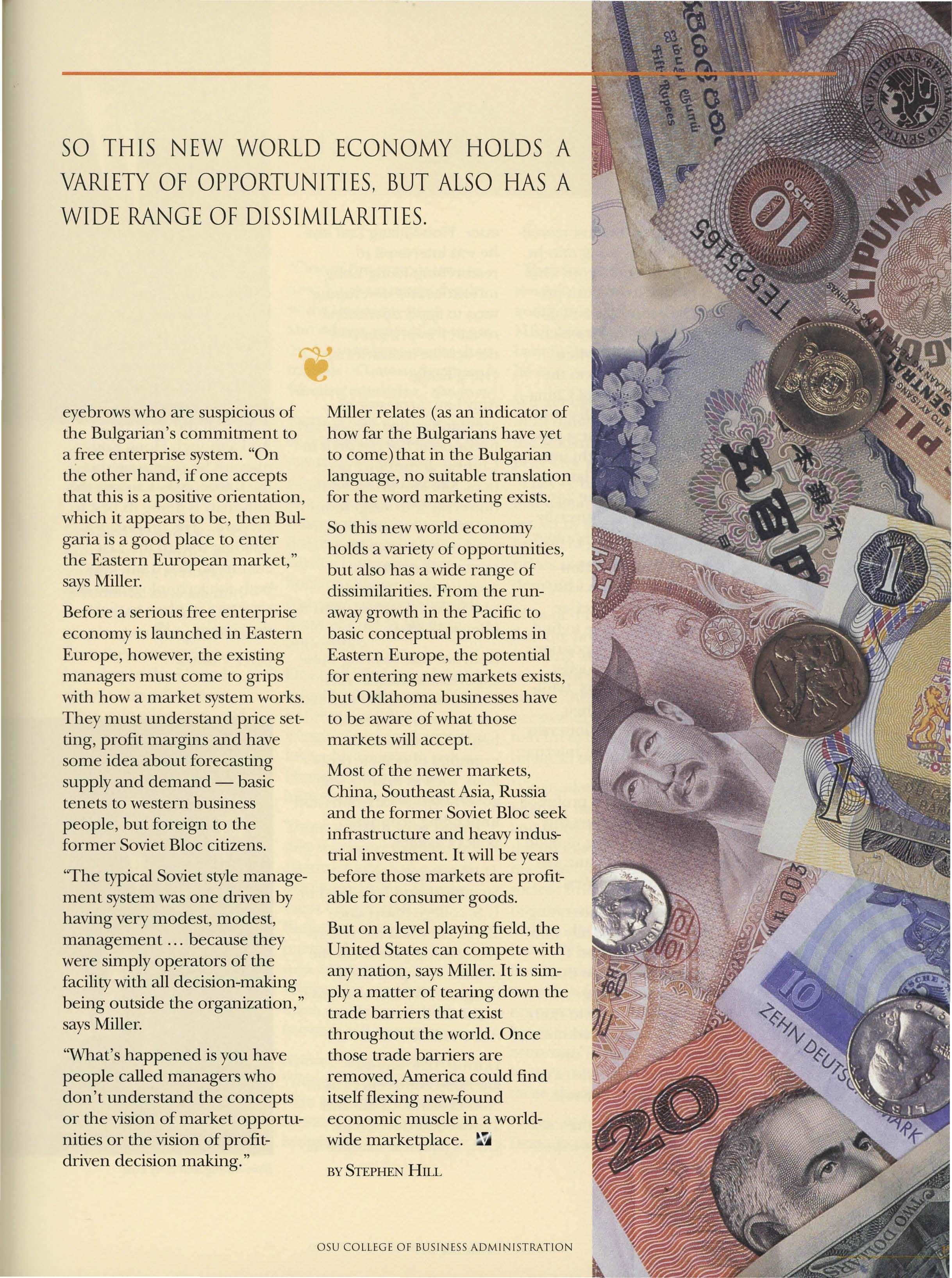
SO THIS NEW WORLD ECONOMY HOLDS A VARIETYOF OPPORTUNITIES,BUTALSOHAS A WIDE RANGEOF DISSIMILARITIES.
eyebrows who are suspicious of the Bulgarian's commitment to a free enterprise system. "On the other hand, if one accepts that this is a positive orientation, which it appears to be, then Bulgaria is a good place to enter the Eastern European market," says Miller.
Before a serious free enterprise economy is launched in Eastern Europe, however, the existing managers must come to grips with how a market system works. They must understand price setting, profit margins and have some idea about forecasting supply and demand - basic tenets to western business people, but foreign to the former Soviet Bloc citizens.
"The typical Soviet style management system was one driven by having very modest, modest, management because they were simply op,erators of the facility with all decision-making being outside the organization," says Miller.
"What's happened is you have people called managers who don't understand the concepts or the vision of market opportunities or the vision of profitdriven decision making."
Miller relates (as an indicator of how far the Bulgarians have yet to come)that in the Bulgarian language, no suitable translation for the word marketing exists.
So this new world economy holds a variety of opportunities, but also has a wide range of dissimilarities. From the runaway growth in the Pacific to basic conceptual problems in Eastern Europe, the potential for entering new markets exists, but Oklahoma businesses have to be aware of what those markets will accept.
Most of the newer markets, China, Southeast Asia, Russia and the former Soviet Bloc seek infrastructure and heavy indusu·ial investment. It will be years before those markets are profitable for consumer goods.
But on a level playing field, the United States can compete with any nation, says Miller. It is simply a matter of tearing down the trade barriers that exist throughout the world. Once those trade barriers are removed, America could find itself flexing new-found economic muscle in a worldwide marketplace.
BY STEPHEN HILL
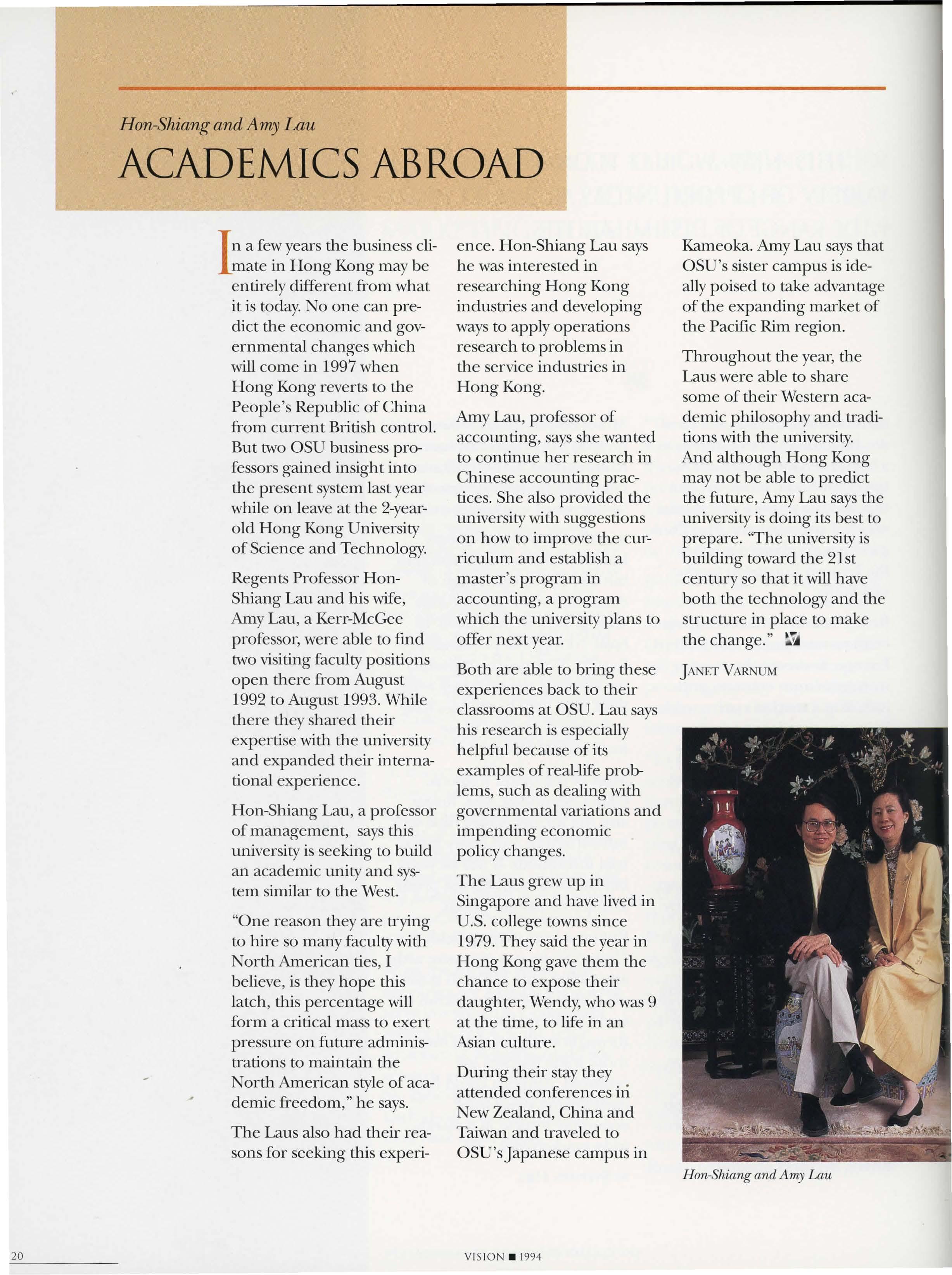
Hon-Shiang and Amy Lau
ACADEMICSABROAD
In a few years the business climate in Hong Kong may be entirely different from what it is today. No one can predict the economic and governmental changes which will come in 1997 when Hong Kong reverts to the People's Republic of China from current British control. But two OSU business professors gained insight into the present system last year while on leave at the 2-yearold Hong Kong University of Science and Technology.
Regents Professor HonShiang Lau and his wife, Amy Lau, a Kerr-McGee professor, were able to find two visiting faculty positions open there from August 1992 to August 1993. While there they shared their expertise with the university and expanded their international experience.
Hon-Shiang Lau, a professor of management, says this university is seeking to build an academic unity and system similar to the West.
"One reason they are trying to hire so many faculty with North American ties, I believe, is they hope this latch, this percentage will form a critical mass to exert pressure on future administ:rations to maintain the North American style of academic freedom," he says.
ence. Hon-Shiang Lau says he was interested in researching Hong Kong industries and developing ways to apply operations research to problems in the service industries in Hong Kong.
Amy Lau, professor of accounting, says she wanted to continue her research in Chinese accounting practices. She also provided the university with suggestions on how to improve the curriculum and establish a master's program in accounting, a program which the university plans to offer next year.
Both are able to bring these experiences back to their classrooms at OSU. Lau says his research is especially helpful because of its examples of real-life problems, such as dealing with governmental variations and impending economic policy changes.
The Laus grew up in Singapore and have lived in U.S. college towns since 1979. They said the year in Hong Kong gave them the chance to expose their daughter, Wendy, who was 9 at the time, to life in an Asian culture.
During their stay they attended conferences iri New Zealand, China and The Laus also had their rea- Taiwan and traveled to sons for seeking this experi- OSU'sjapanese campus in
Kameoka. Amy Lau says that OSU's sister campus is ideally poised to take advantage of the expanding market of the Pacific Rim region.
Throughout the year, the Laus were able to share some of their Western academic philosophy and t:raditions with the university. And although Hong Kong may not be able to predict the future, Amy Lau says the university is doing its best to prepare. 'The university is building toward the 21st century so that it will have both the technology and the structure in place to make the change."
JANET VARNUM
Hon-Shiang and Amy Lau
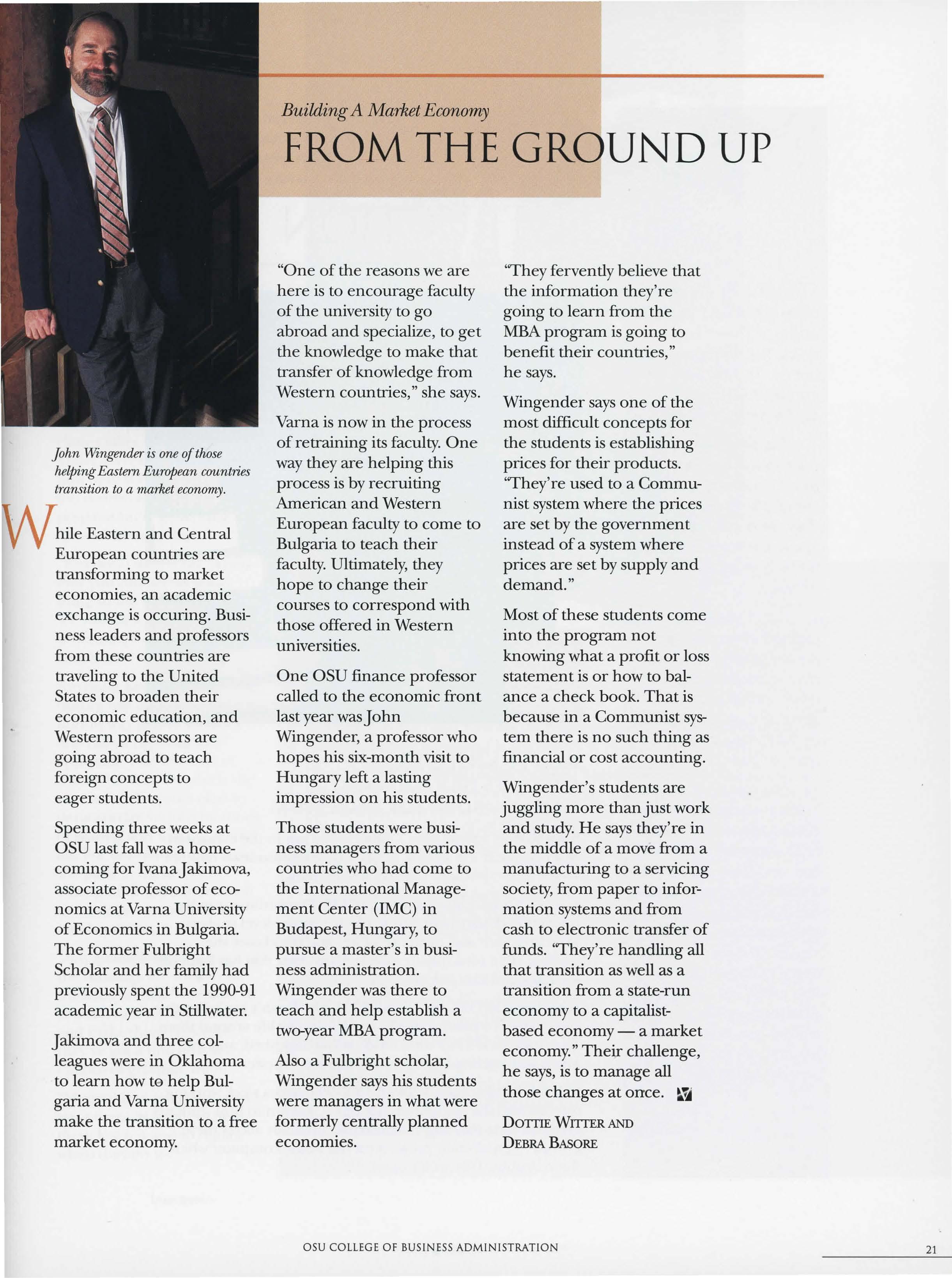
john Wingender is one of those helping Eastern Eurapean countries transition to a market economy.
hile Eastern and Central European countries are transforming to market economies, an academic exchange is occuring. Business leaders and professors from these countries are traveling to the United States to broaden their economiceducation,and Western professors are going abroad to teach foreign concepts to eager students.
Spending three weeks at OSU last fall was a homecoming for IvanaJakimova, associate professor of economics at Varna University of Economics in Bulgaria. The former Fulbright Scholar and her family had previously spent the 1990-91 academic year in Stillwater. Jakimova and three colleagues were in Oklahoma to learn how t0 help Bulgaria and Varna University make the transition to a free market economy.
Buikling A MarketEconomy FROMTHE GROUND UP
"One of the reasons we are here is to encourage faculty of the university to go abroad and specialize, to get the knowledge to make that transfer of knowledge from Western countries," she says.
Varna is now in the process of retraining its faculty. One way they are helping this process is by recruiting American and Western European faculty to come to Bulgaria to teach their faculty. Ultimately, they hope to change their courses to correspond with those offered in Western universities.
One OSU finance professor called to the economic front last year was John Wingender, a professor who hopes his six-month visit to Hungary left a lasting impression on his students.
Those students were business managers from various countries who had come to the International Management Center (IMC) in Budapest, Hungary, to pursue a master's in business administration. Wingender was there to teach and help establish a two-year MBA program.
Also a Fulbright scholar, Wingender says his students were managers in what were formerly centrally planned economies.
''They fervently believe that the information they're going to learn from the MBA program is going to benefit their countries," he says.
Wingender says one of the most difficult concepts for the students is establishing prices for their products. ''They're used to a Communist system where the prices are set by the government instead of a system where prices are set by supply and demand."
Most of these students come into the program not knowing what a profit or loss statement is or how to balance a check book. That is because in a Communist system there is no such thing as financial or cost accounting.
Wingender's students are juggling more than just work and study. He says they're in the middle of a move from a manufacturing to a servicing society, from paper to information systems and from cash to electronic transfer of funds. ''They're handling all that transition as well as a transition from a state-run economy to a capitalistbased economy- a market economy." Their challenge, he says, is to manage all those changes at once.
DOTTIE WITTER AND DEBRA BASORE
THE
KI
THE WHOLE ART OF TEACHING IS ONLY THE ART OF AWAKENING THE NATURAL CURIOS17Y OF YOUNG MINDS FOR THE PURPOSE OF SA11SFYING
IT AFTERWARDS. - ANATOLE FRANCE
OFINSTRUCTION
Teaching is art. It is often described as the ability to impart knowledge, but that in itself is untrue. The term art implies communication, an exchange of ideas.
These artists are constantly searching for new knowledge to add to the whole. In the process they enlighten, while simultaneously raising more questions than answers.
Good teaching is defined when the light of understanding washes over a student's face, or when former students achieve their goals aided by what they learned from an instructor.
The following pages contain portraits of three professors in the College of Business Administration who have this talent, a talent they have honed through self-examination and a passion for learning. Each represents the many excellent instructors within the college. And each exhibits unique qualities which _enrich both the university and the students.
RUTH KRIEGER
ASSOCLATEPROFESSOR.AND PH.D. COOR.DLNATOR, MARKETING
Ruth Krieger knows what's expected of her in the classroom. Not because it's in a book or because administration tells her - she knows because she asks her students.
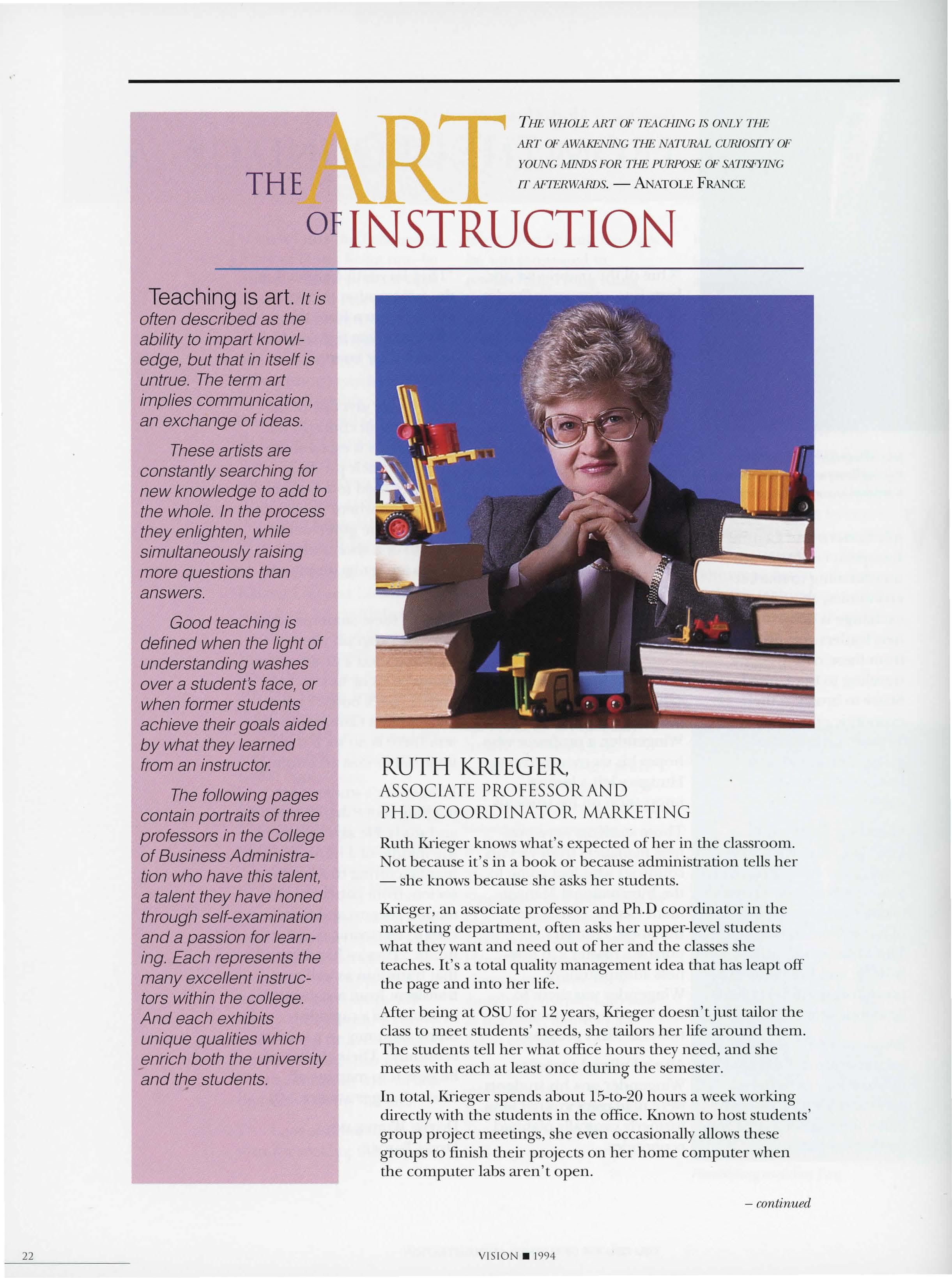
Krieger, an associate professor and Ph.D coordinator in the marketing department, often asks her upper-level students what they want and need out of her and the classes she teaches. It's a total quality management idea that has leapt off the page and into her life.
After being at OSU for 12 years, Krieger doesn't just tailor the class to meet students' needs, she tailors her life around them. The students tell her what office hours they need, and she meets with each at least once during the semester.
In total, Krieger spends about 15-to-20 hours a week working directly with the students in the office. Known to host students' group project meetings, she even occasionally allows these groups to finish their projects on her home computer when the computer labs aren't open.
- continued
Kriege,~continued
On days when she doesn't teach, Krieger dons jeans and heads for the library to research and develop class lectures or scurry paperwork through the office. When the work day is done, what isn't completed follows her home. This 1993 Greiner Teaching Award winner leads between two and three classes a semester, from Introduction to Marketing to Logistics. She also directs graduate students and often travels to the University Center at Tulsa to teach. Preparation for these classes takes about 10-to-30 hour:s a week depending on how long she's been teaching the course. But Krieger says preparation is something she does 24 hours a day.
''You don't turn it off. Whenever you run across something in the newspaper or on TV you click on and you're processing," she says. "That comes into your lectures."
Anything Krieger encounters during her off time is likely to find its way into her classes. She calls it her "bag lady" approach. She has a set of Tonka toy forklifts which she uses in her Logistics class to demonstrate various methods of storing and moving materials. For her marketing classes, she pulls in hundreds of examples of techniques such as catalogs, romance novels and beer cans.
"Any examples that are out of the ordinary will stick in the students' minds," she says. "If you can take abstract things and make them concrete, they've got a much better chance of gra:ping them.
"My goal is to tell them what I want them to learn, to help them learn it and to rejoice when they do so."
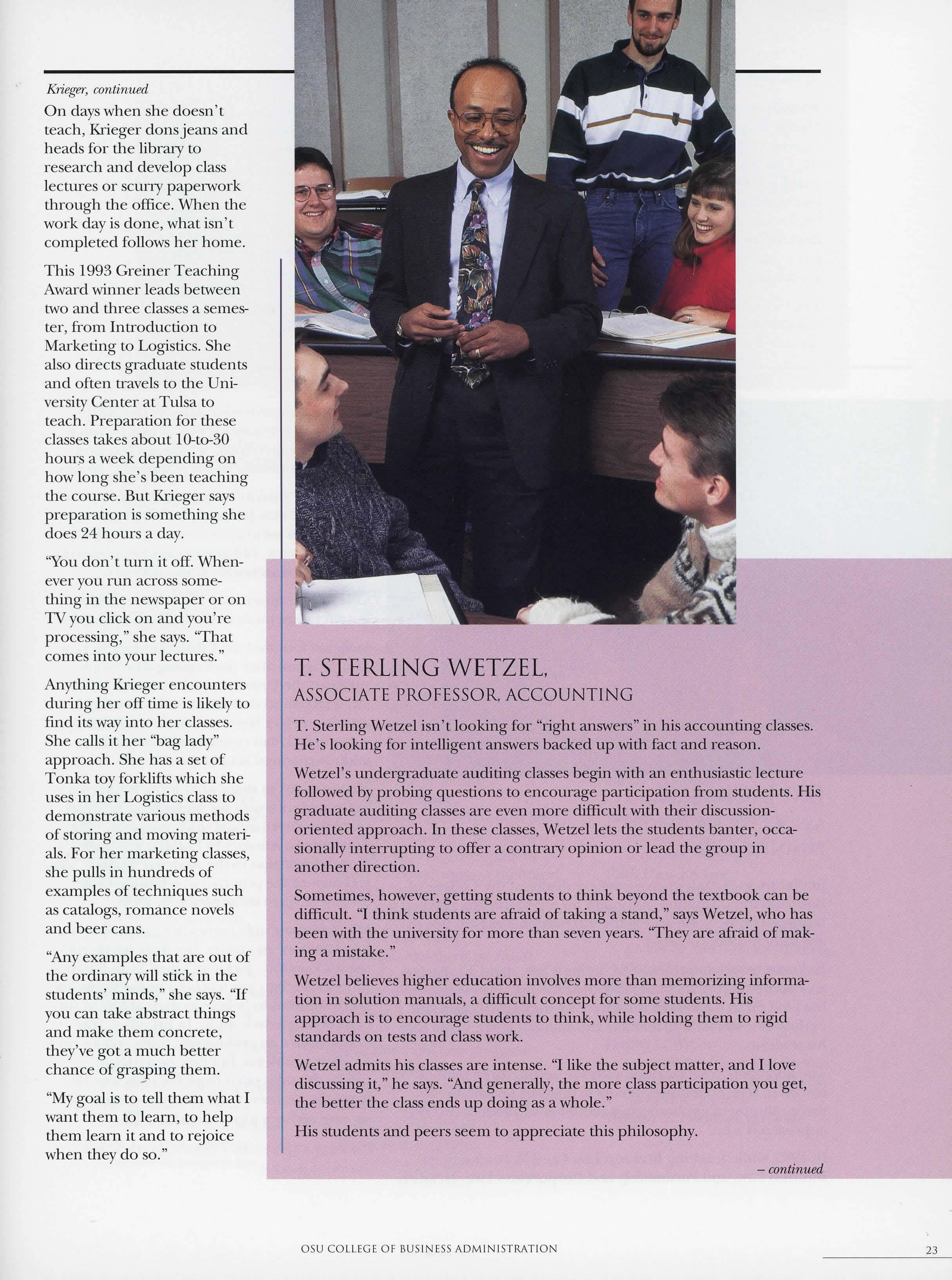
T. STERLINGWETZEL, ASSOCIATE PROFESSOR, ACCOUNTING
T. Sterling Wetzel isn't looking for "right answers" in his accounting classes. He's looking for intelligent answers backed up with fact and reason.
Wetzel's undergraduate auditing classes begin with an enthusiastic lecture followed by probing questions to encourage participation from students. His graduate auditing classes are even more difficult with their discussionoriented approach. In these classes, Wetzel lets the students banter, occasionally interrupting to offer a contrary opinion or lead the group in another direction.
Sometimes, however, getting students to think beyond the textbook can be difficult. "I think students are afraid of taking a stand," says Wetzel, who has been with the university for more than seven years. "They are afraid of making a mistake."
Wetzel believes higher education involves more than memorizing information in solution manuals, a difficult concept for some students. His approach is to encourage students to think, while holding them to rigid standards on tests and class work.
Wetzel admits his classes are intense. "I like the subject matter, and I love discussing it," he says. "And generally, the more <;lassparticipation you get, the better the class ends up doing as a whole."
His students and peers seem to appreciate this philosophy.
-continued
Wetzel,continued
Wetzel has twice received the Mortar Board Outstanding Teacher Award and in 1989 was a recipient of the Greiner Teaching Award. He also received the 1992 Outstanding Faculty Adviser Award for Beta Alpha Psi, one of only six given annually by the national accounting honorary.
The Greiner Award is especially meaningful, he says, because it is the result of a
cumulative recommendation from students, faculty and administration in the college. "You don't go into the teaching profession to become a millionaire. Your rewards are the good things that happen to you and the nice statements from students and colleagues."
He hopes his students leave OSU with the ability to think logically and with no trepida-
tion of unfamiliar situations. Although he knows not every student appreciates his tough style now, he believes they can benefit from it in the future.
"I hope when they leave OSU, my students have been prepared to enter the accounting profession, and that five years from now they can look back and say it was worthwhile being at OSU."
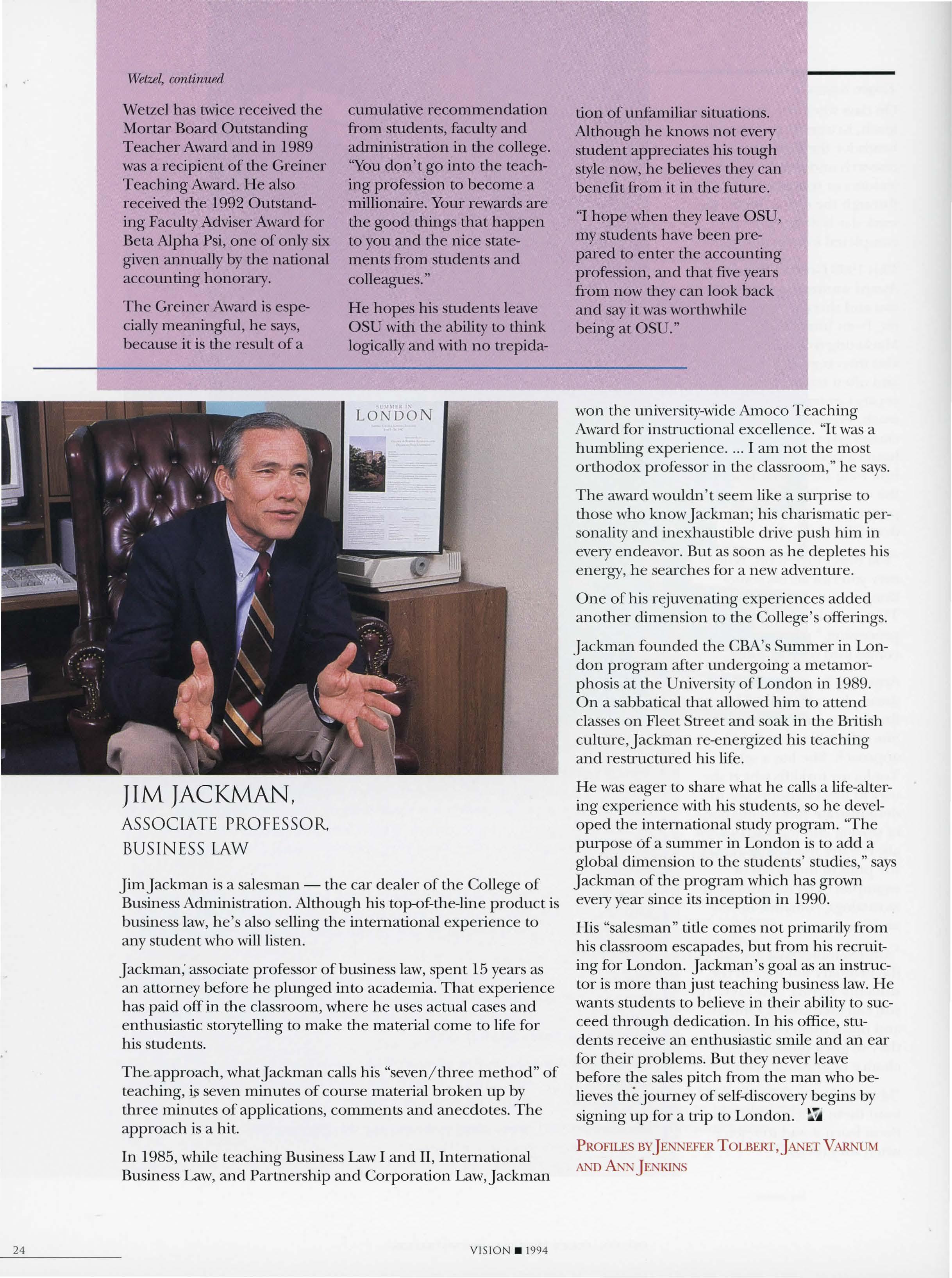
JIM JACKMAN, ASSOCIATE PROFESSOR, BUSINESS LAW
Jim Jackman is a salesman - the car dealer of the College of Business Administration. Although his top-of-the-line product is business law, he's also selling the international experience to any student who will listen.
Jackman; associate professor of business law, spent 15 years as an attorney before he plunged into academia. That experience has paid off in the classroom, where he uses actual cases and enthusiastic storytelling to make the material come to life for his students.
The.approach, what Jackman calls his "seven/three method" of teaching, i.Sseven minutes of course material broken up by three minutes of applications, comments and anecdotes. The approach is a hit.
In 1985, while teaching Business Law I and II, International Business Law, and Partnership and Corporation Law,Jackman
won the university-wide Amoco Teaching Award for instructional excellence. "It was a humbling experience .... I am not the most orthodox professor in the classroom," he says.
The award wouldn't seem like a surprise to those who know Jackman; his charismatic personality and inexhaustible drive push him in every endeavor. But as soon as he depletes his energy, he searches for a new adventure.
One of his rejuvenating experiences added another dimension to the College's offerings.
Jackman founded the CBA's Summer in London program after undergoing a metamorphosis at the University of London in 1989. On a sabbatical that allowed him to attend classes on Fleet Street and soak in the B,itish culture,Jackman re-energized his teaching and restructured his life.
He was eager to share what he calls a life-altering experience with his students, so he developed the international study program. 'The purpose of a summer in London is to add a global dimension to the students' studies," says Jackman of the program which has grown every year since its inception in 1990.
His "salesman" title comes not primarily from his classroom escapades, but from his recruiting for London. Jackman's goal as an instructor is more than just teaching business law. He wants students to believe in their ability to succeed through dedication. In his office, students receive an enthusiastic smile and an ear for their problems. But they never leave before the sales pitch from the man who believes the journey of self-discovery begins by signing up for a trip to London. ti.~
PROFILES BYJENNEFER TOL.BERT,jANET VARNUM AJ\l) ANNJENKINS
Lo ""bo
THE FACULTY
THE DEANS
Robert L. Sandmeyer, dean
Gregory C. Mosier, associate dean
ACCOUNTING
Lanny G. Chasteen, Arthur Andersen alumni centennial professor and head, school of accounting
Patrick B. Dorr, professor
Lawrence H. Hammer, professor
Don Hansen, professor
Carol Johnson, assistant professor
Janet I. Kimbrell, associate professor
M. E. "Bud" Lacy, associate professor and coordinator of graduate programs
Amy Hing-Ling Lau, Kerr-McGee professor of accounting
Gary K Meek, school of accounting alumni professor
Maryanne M. Mowen, associate professor
David S. Murphy, assistant professor
Kevin E. Murphy, associate professor
Dennis H. Patz, professor
Charles R. Ransom, associate professor
T. Sterling Wetzel, associate professor
John H. Wilguess, professor
Charlotte J. Wright, professor ADMINISTRATM SERVICES
Joe W. Fowler, professor of business law and head, department of administrative services
James M. Jackman, associate professor of business law
Tipton F. McCubbins, associate professor of business law
Dennis L. Mott, professor of business communications
Zane K Quible, professor of business communications
Jeanine N. Rhea, professor of business communications
Andrew L. Urich, associate professor of business law
ECONOMICS
Joseph M. Jadlow Jr., professor and head, department of economics
Lee C. Adkins, associate professor
Orley M. Amos Jr., professor
Michael]. Applegate, professor
Kevin M. Currier, associate professor
Michael R. Edgmand, professor
James R. Fain, associate professor
Mary Gade, associate professor
Gerald M. Lage, professor
Ronald L. Moomaw, professor
Kent W. Olson, professor
Edward 0. Price ill, associate professor
Andreas Savvides, associate professor
Frank G. Steindl, regents professor
Larkin B. Warner, regents professor
Keith D. Willett, professor
FINANCE
Janice W. Jadlow, associate professor and head, department of finance
James F.JacksonJr., associate professor
Timothy L. Krehbiel, assistant professor
Ronald L. Miller, associate professor
John A. Polonchek, associate professor
W. Gary Simpson, professor and Oklahoma Bankers Association chair of commercial bank management
Rory L. Terry, assistant professor
John R. Wingender, associate professor MANAGEMENT
Wayne A. Meinhart, professor and head, department of management
Richard A. Aukerman, professor
Steve H. Barr, associate professor
Raja Basu, assistant professor
James D. Bogert, assistant professor
Nikunj P. Dalal, assistant professor
Kenneth K Eastman, assistant professor
Vance H. Fried, associate professor
David C. Ho, professor
Timothy C. Ireland, professor
Marilyn G. Kletke, professor
Chalmer E. LabigJr., associate professor
Hon-Shiang Lau, regents professor
Debra L. Nelson, associate professor
G. Daryl Nord, professor
Jeretta Hom Nord, associate professor
Jayaram Ramanathan, assistant professor
Ramesh Sharda, professor and Conoco/Dupont chair of technology management
Faye L. Smith, assistant professor
Thomas H. Stone, professor
J. Scott Turner, professor
Margaret A. White, associate professor
Rick L. Wilson, assistant professor
MARKETING
L. Lee Manzer, professor and head, department of marketing
Terry Bristol, assistant professor
Goutam Chakraborty, assistant professor
Gary L. Frankwick, assistant professor
Richard Germain, assistant professo~
James G. Hromas, associate professor and director, university extension
Ruth Haas Kreiger, associate professor
Stephen]. Miller, regents distinguished service professor and director, international business programs
John C. Mowen ill, professor
Ajay S. Sukhdial, assistant professor
Joshua L. Wiener, associate professor and interim d_irector, office of business and economic research
William G. Zikmund, professor
s the third of four children, I was only able to begin school on time because of scholarships. I'm so grateful to the people who donated these funds. Because of their generosity, at OSU I've grown up a lot, become more outgoing and maintained my athletic involvement.
Recruiting has allowed me to meet many promising students. I see myself in them. And I know because of the CBA scholarships they will have the same opportunities I did to grow through the cowboy experience. For all of us, thank you.
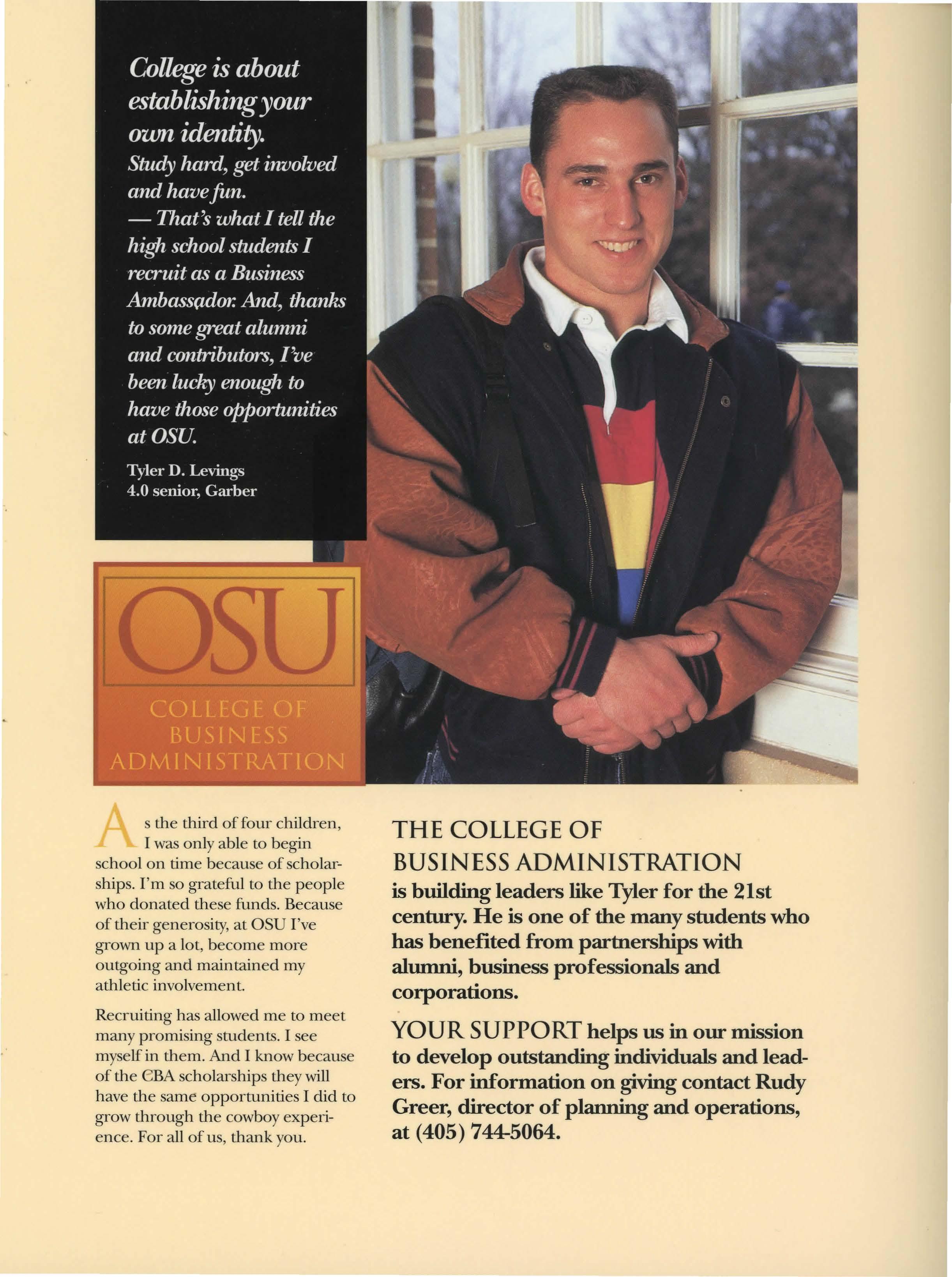
THE COLLEGE OF BUSINESS ADMINISTRATION is building leaders like Tyler for the 21st century. He is one of the many students who has benefited from partnerships with alumni, business professionals and corporations.
YOUR SUPPORT helps us in our mission to develop outstanding individuals and leaders. For information on giving contact Rudy Greer, director of planning and operations, at (405) 7 44-5064.