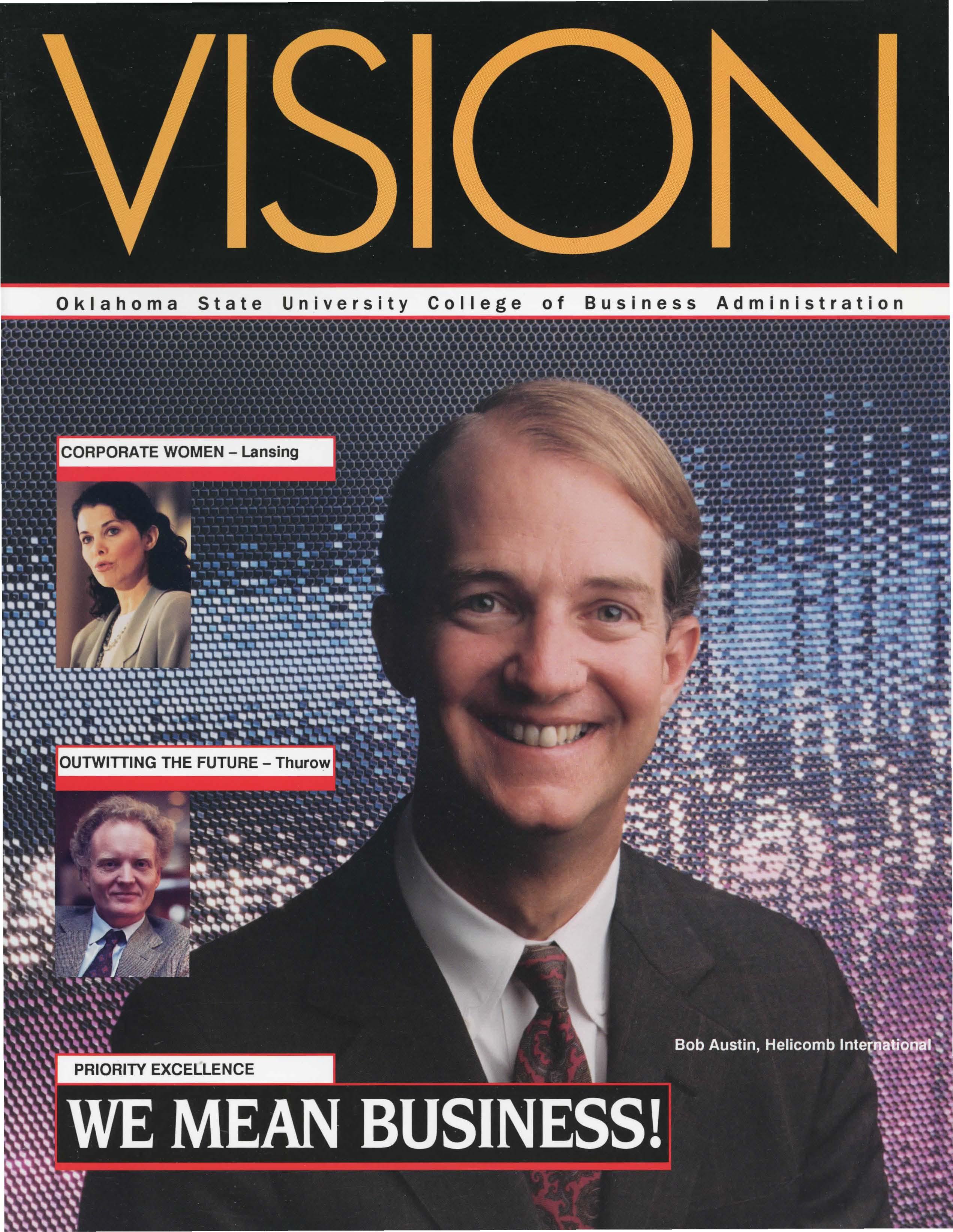
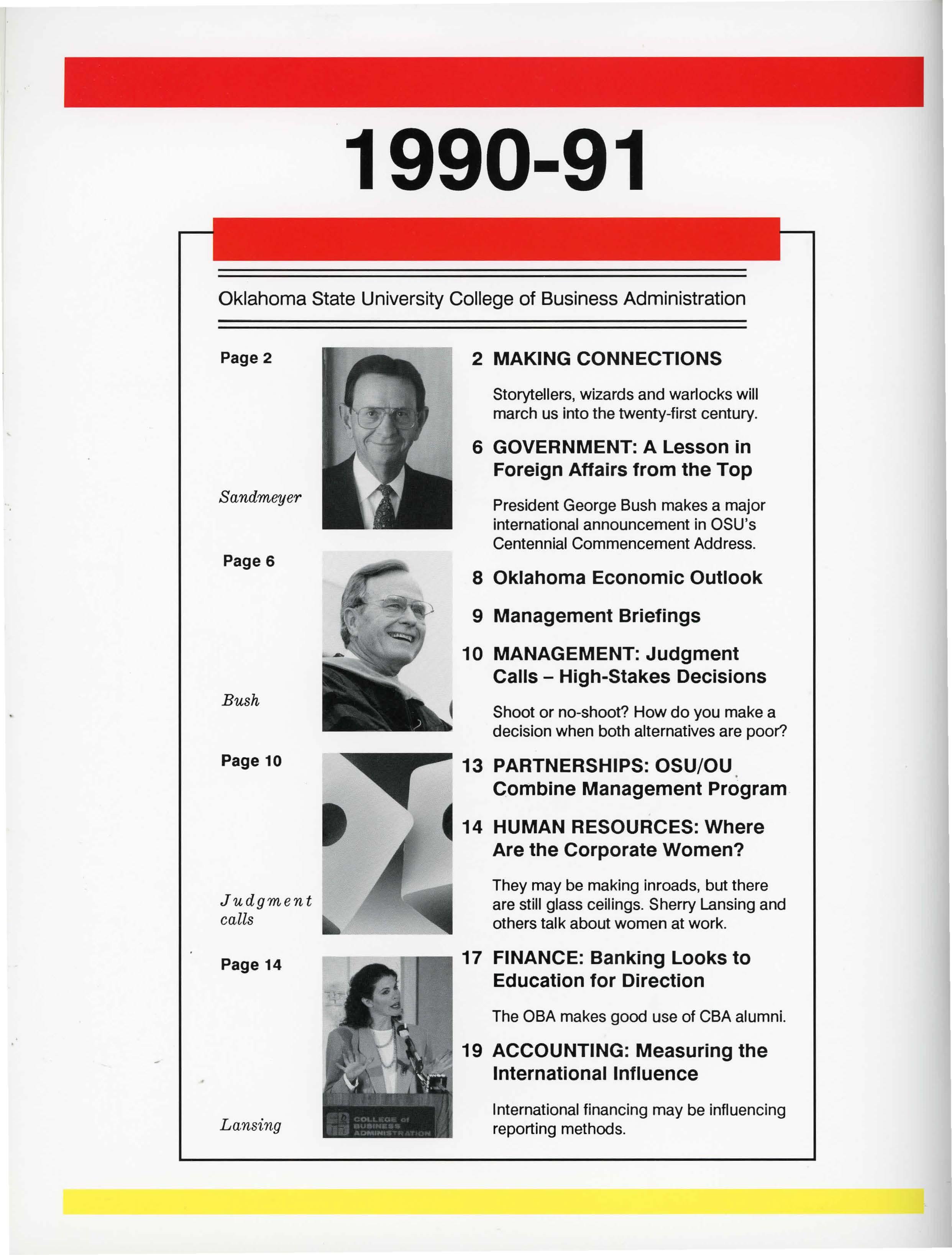
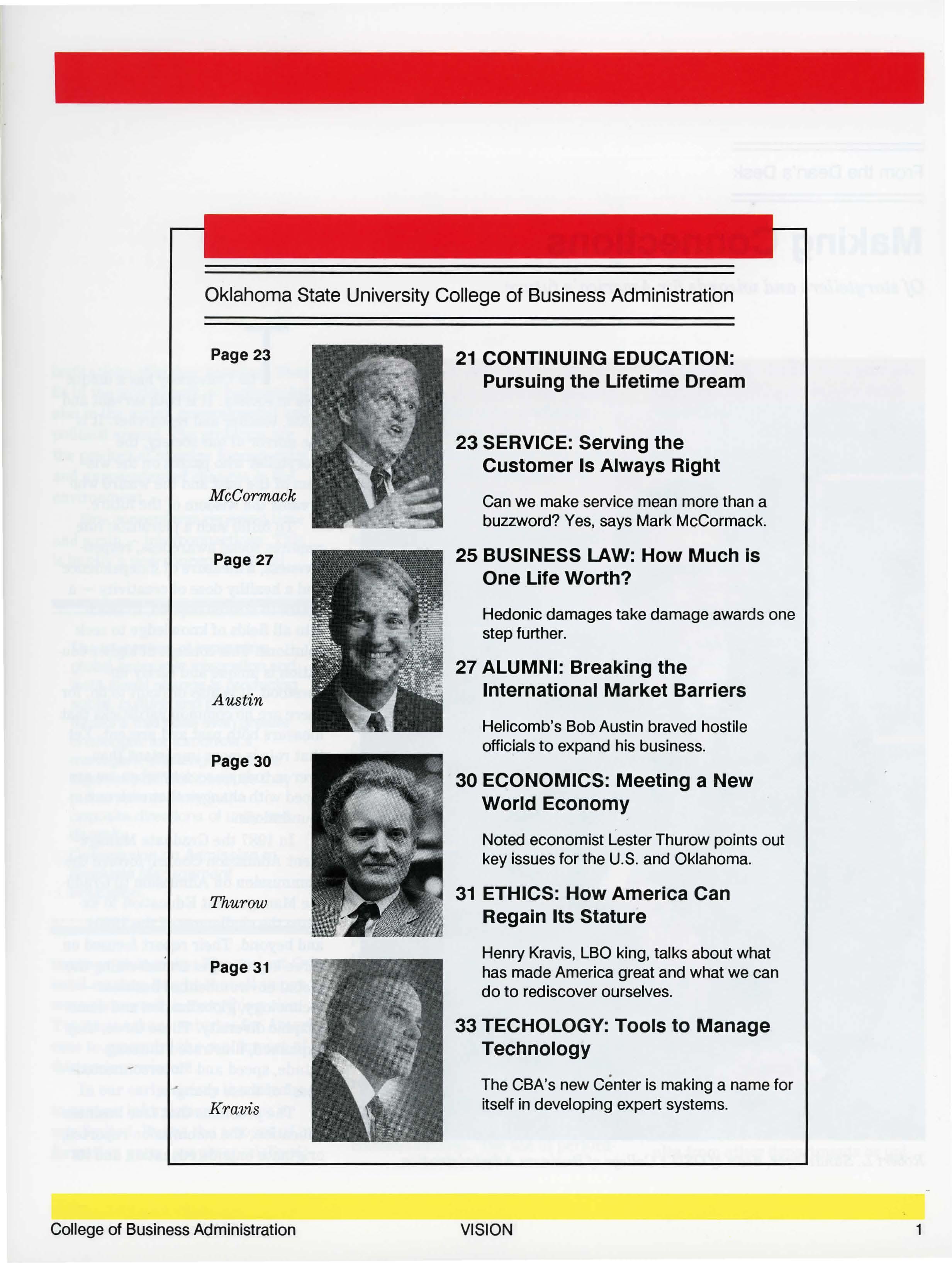
Oklahoma State University College of Business Administration
President
Can we make service mean more than a buzzword? Yes, says Mark McCormack.
Hedonic
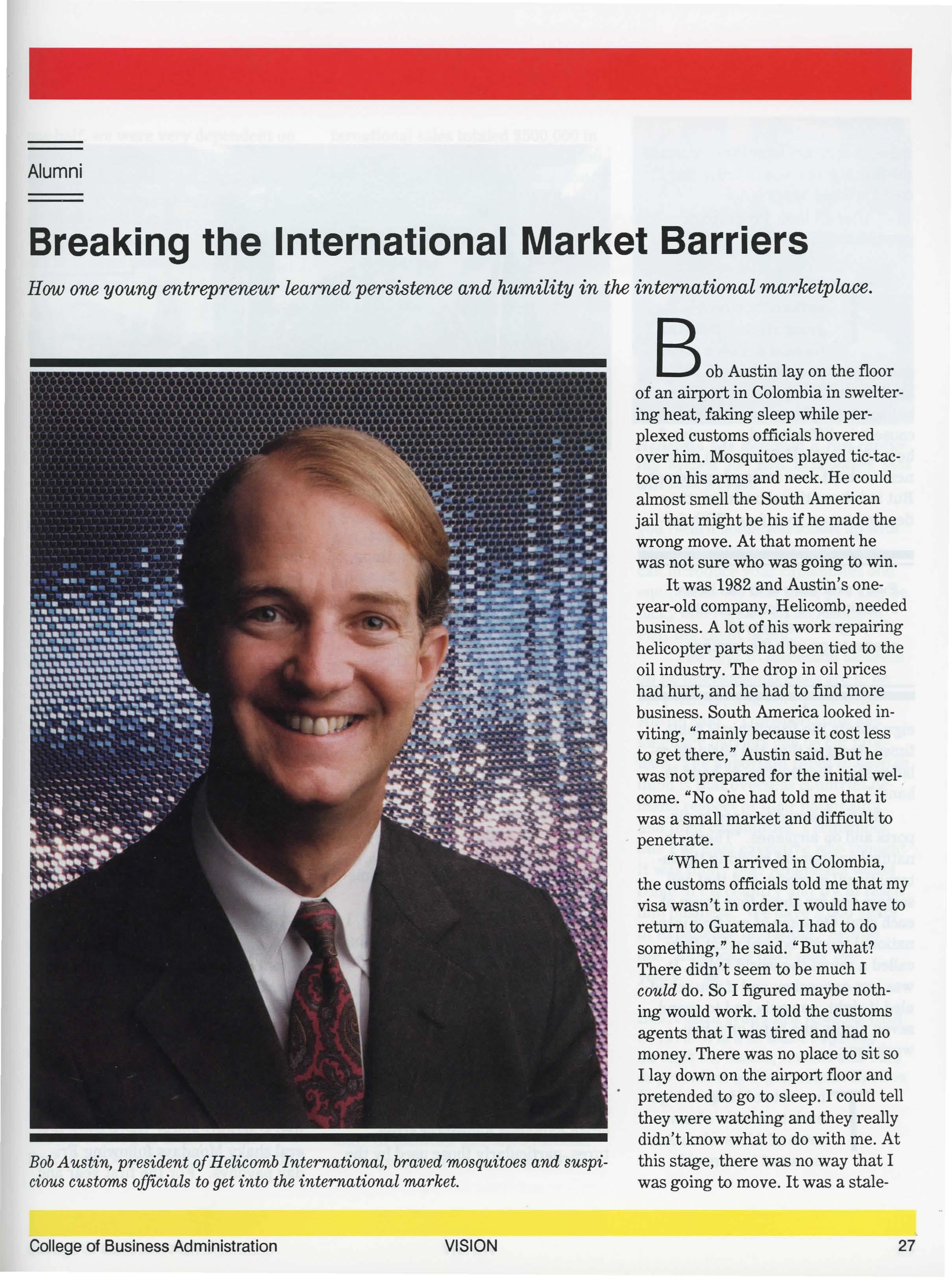
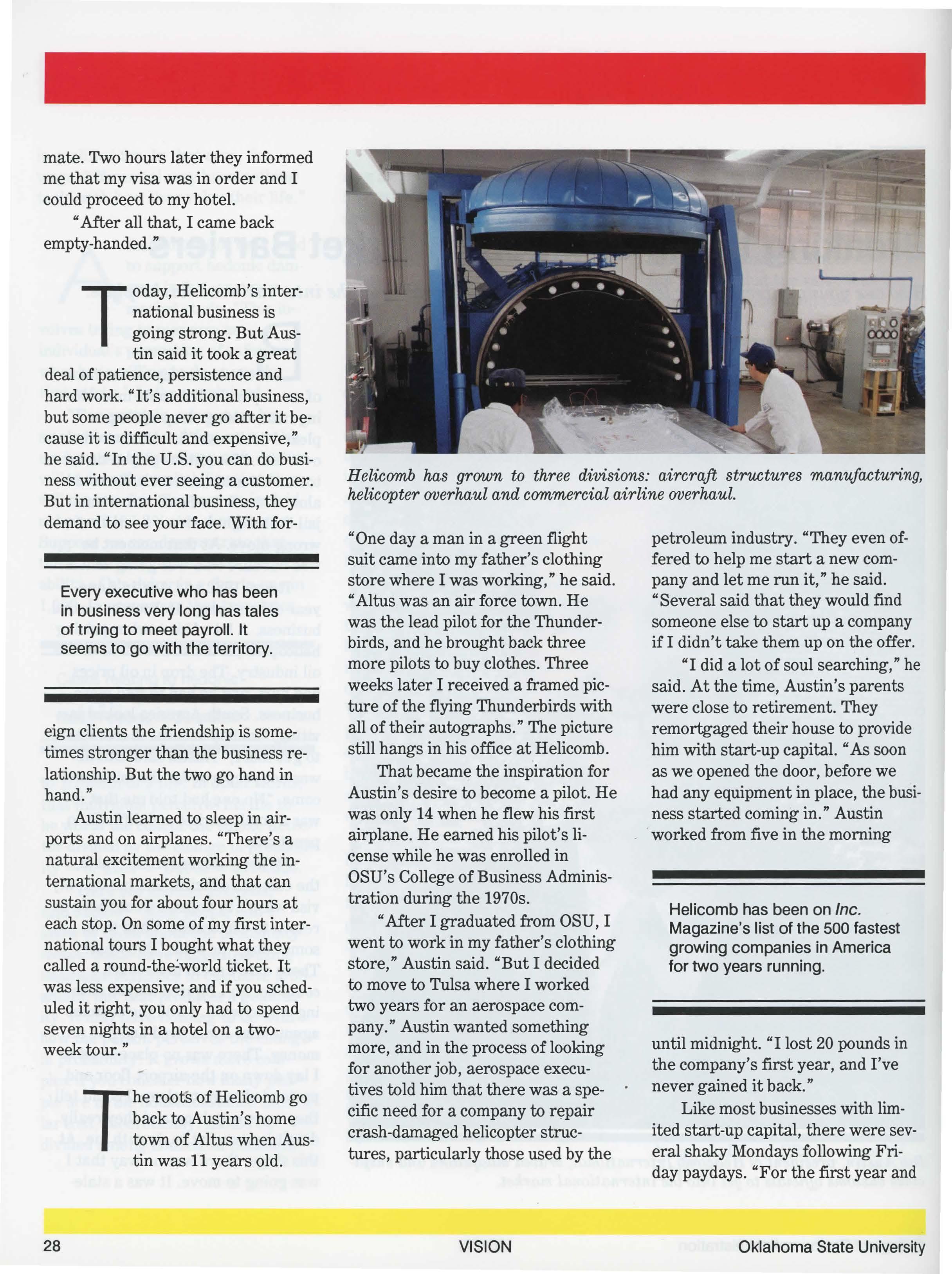
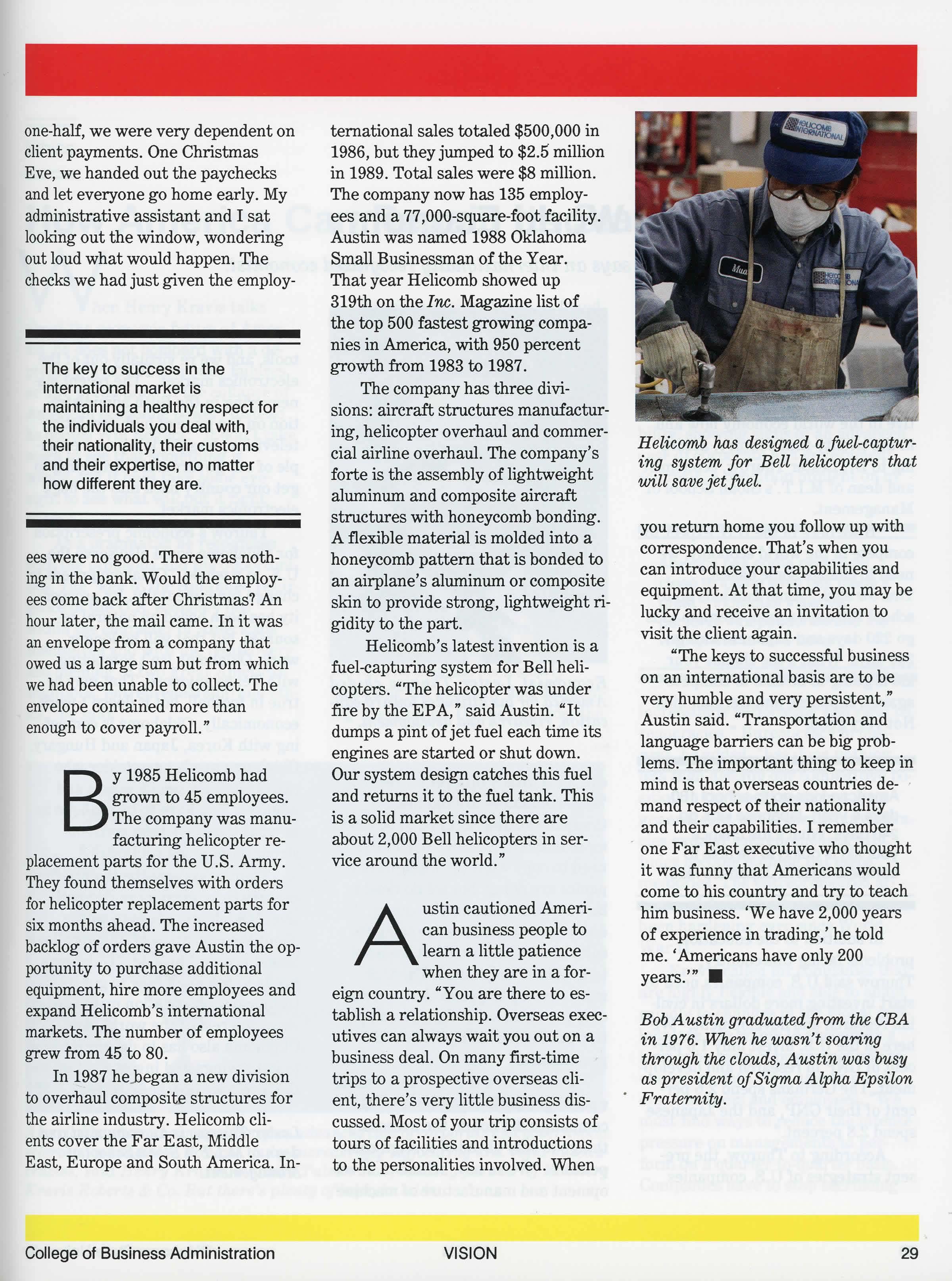
Helicomb's Bob Austin braved hostile officials to expand his business.
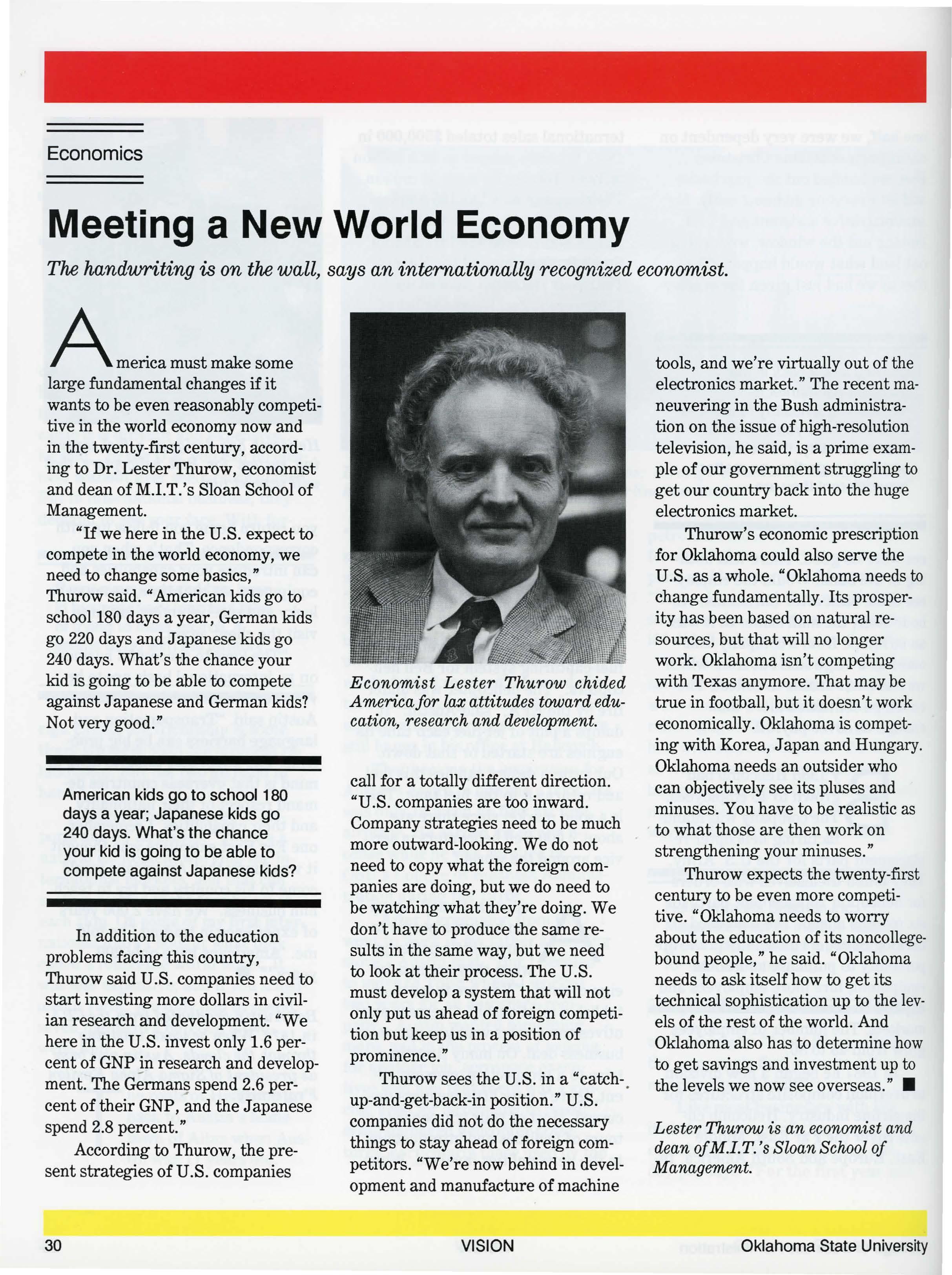
Noted economist Lester Thurow points out key issues for the U.S. and
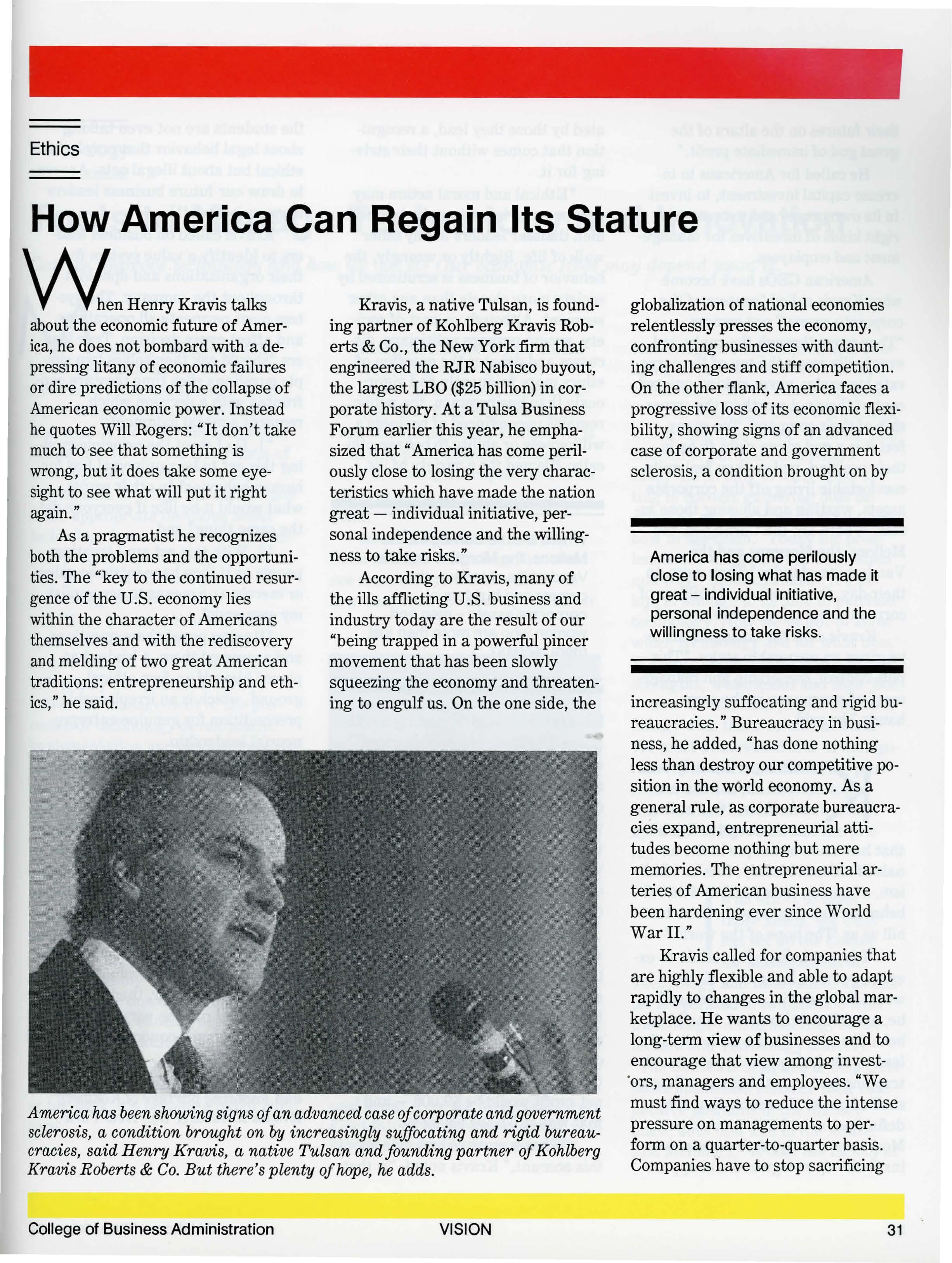
Henry Kravis, LBO king, talks about what has made America great and what we can do to rediscover ourselves.
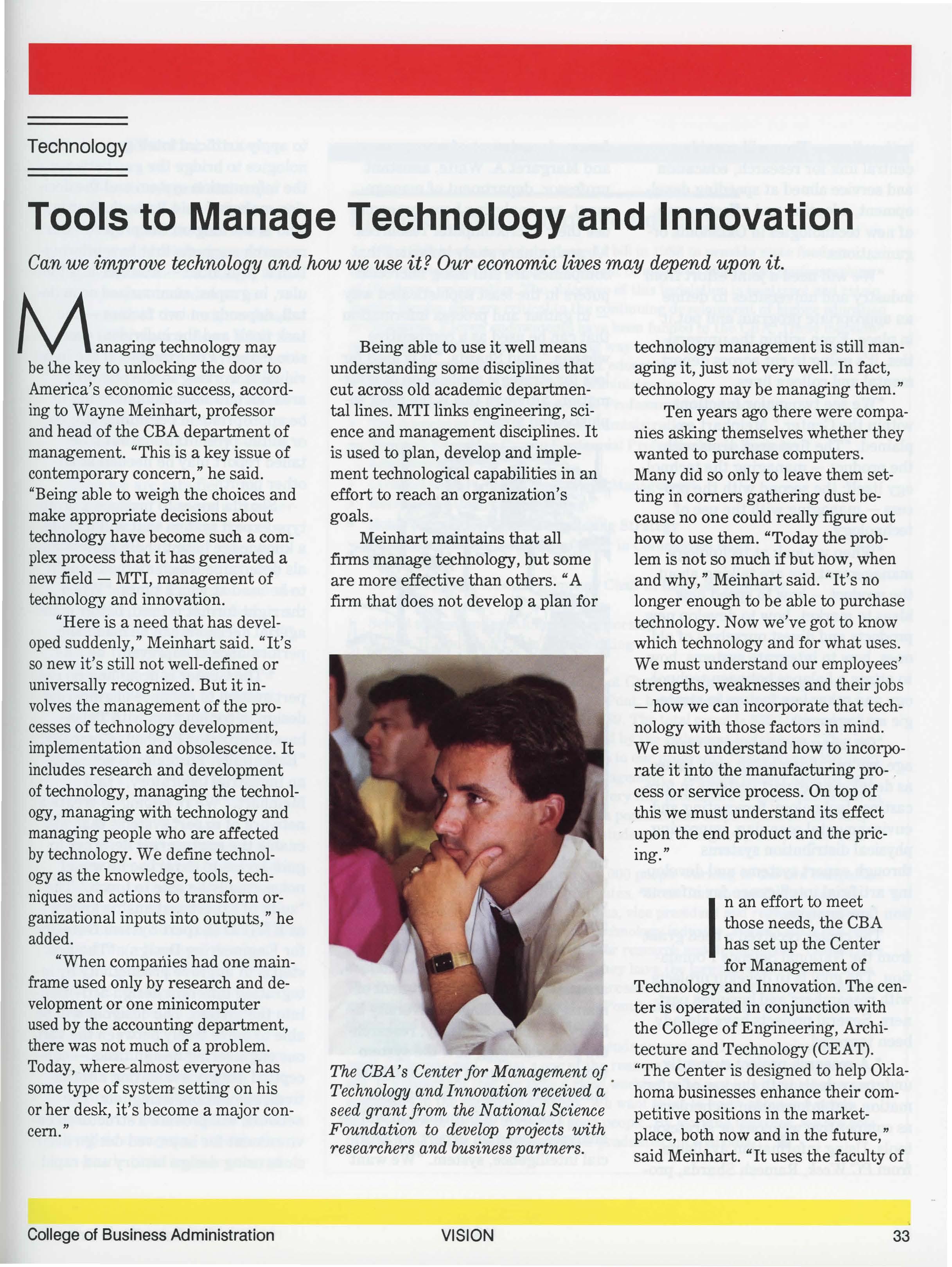
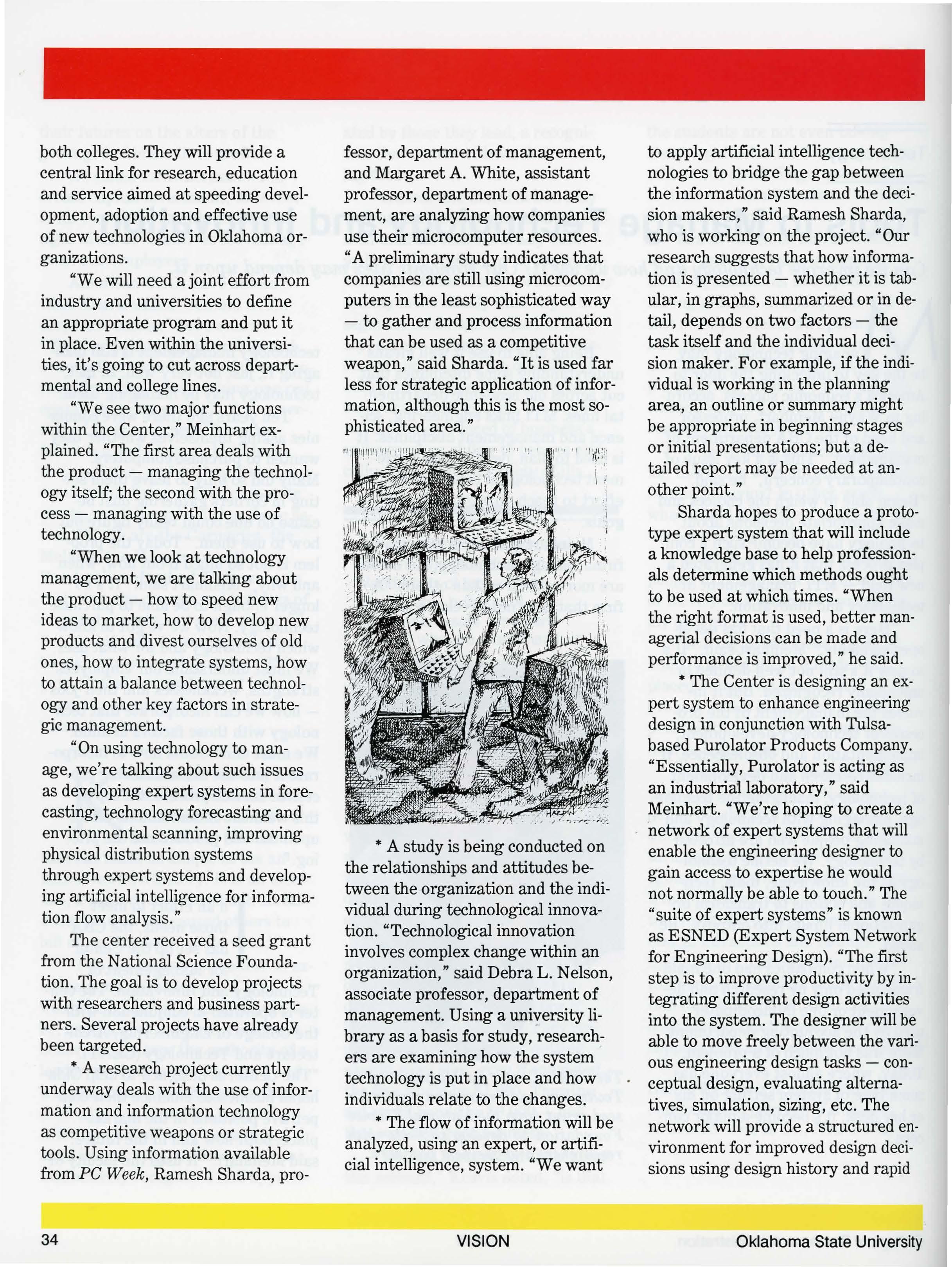
The CBA's new Center is making a name for itself in developing expert systems.
From the Dean's Desk
Making Connections
Of storytellers and wizards for America's future.
1e University has a unique role in society. It is both servant and critic, teacher and researcher. It is the mirror of our society, the storyteller who passes on the wisdom of the past and the wizard who dreams the wisdom of the future.
To fulfill such a pluralistic role requires social awareness, responsiveness, a measure of independence and a healthy dose of creativity - a desire to stretch beyond, to reach into all fields of knowledge to seek solutions. This concept of higher education is unique and rarely understood. It is also difficult to do, for there are no common yardsticks that measure both past and present. Yet that role is more important than ever in today's society when we are faced with changes that rock our foundations.
In 1987 the Graduate Management Admission Council formed the Commission on Admission to Graduate Management Education to explore the challenges of the 1990s and beyond. Their report focused on three key changes transforming the global environment of businesstechnology, globalization and demographic diversity. These three, they explained, illustrated the magnitude, speed and "interconnectedness" of these changes.
The problems that face business education, the commission reported, originate outside education and its
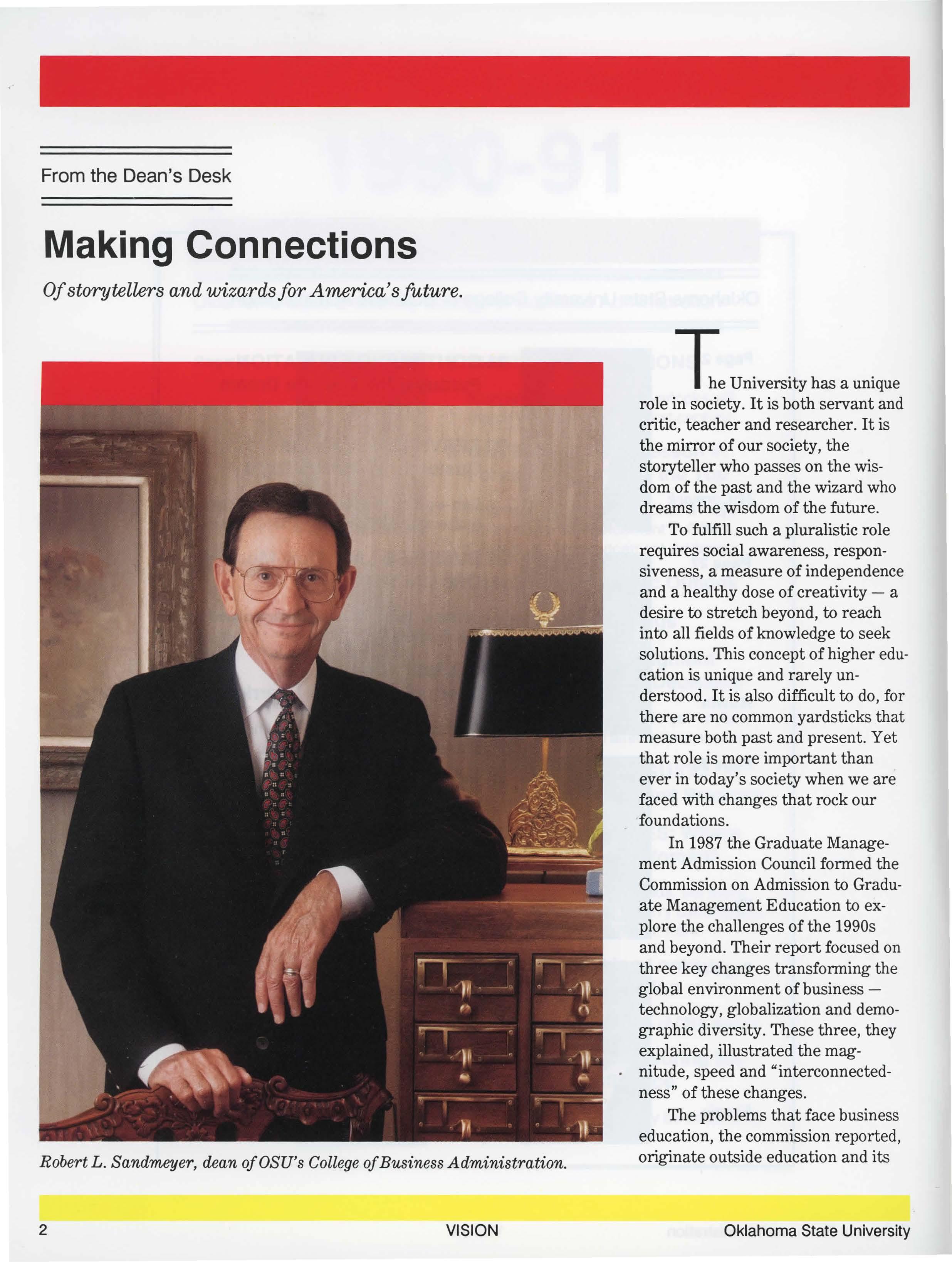
RobertL. Sandmeyer, dean ofOSU's Collegeof Business Administration.
institutions of higher learning. They lie in the world itself, in business but also in the social, governmental and political arenas. The problems are the product of massive fundamental and unprecedented changes in the environment.
One concept was repeated time and again - interconnections. This is hardly a new concept in global
The interaction of increasing global economic integration and institutional change is producing social, cultural and political tensions that pose even greater challenges for tomorrow's managers, challenges that are especially difficult because they pull simultaneously in the opposite directions of unity and diversity.
Commission on Admission to Graduate Management Education terms or philosophy: The ancient Oriental masters taught that all things were connected to everything else. Yet it has taken centuries for Americans to recognize the real impact of this ancient wisdom.
In our early history it was easy to pass on information because it was limited. But as the amount of information grew, people specialized.
They became doctors or weavers or swordmakers. An apprentice learned his skill under an older craftsman, developing a narrow body of knowledge that could serve him well all his years. He had little need to know much of anything else.
The early universities that first formed in Europe were designed to pass on the wisdom of the day in a more global fashion. They added to the specific knowledge the philosophy - the why of things - to create a more universal umbrella. Still, the early pattern of learning one craft, one discipline, persisted. It was far easier to find teachers who understood one discipline, one set of facts, than those who made random and causal connections from one field to another.
But those few who did understand random connections set in motion a path from which we could not turn back. The process was best explained by a public television series called "Connections." Its purpose was to show the relation of all things - how ideas from one place and time affected totally different societies and technologies. In other words, ideas rarely follow a logical sequence of events. Instead, change and its influence jump from one narrow field to another - from agriculture to specific industries, from manufacturing to engineering to communications. The use of perfora-
ted paper to automate the Lyons silk looms had nothing to do with developing calculators or data transmission - if you look at the pattern in a sense of one narrow field. And yet it
Innovation is one of our key needs and indeed is one of our key societal contributions as well as responsibilities.
Gilbert R. Whitaker Jr., 1990 Presidential Address, American Assembly of Collegiate Schools of Business
had everything to do with it. This is key: The f~tor that triggers change, development and technology is usually entirely unconnected with the situation about to undergo change.
What does this process of connections of unrelated technology have to do \vith education? There is an old adage that specialists are people who learn more and more about something until they know everything there is to know about nothing. For years, we have been teaching in narrow disciplines, almost as if we wore blinders. Faculty rarely talk to other faculty within departments and almost never talk to faculty from other departments or uni-
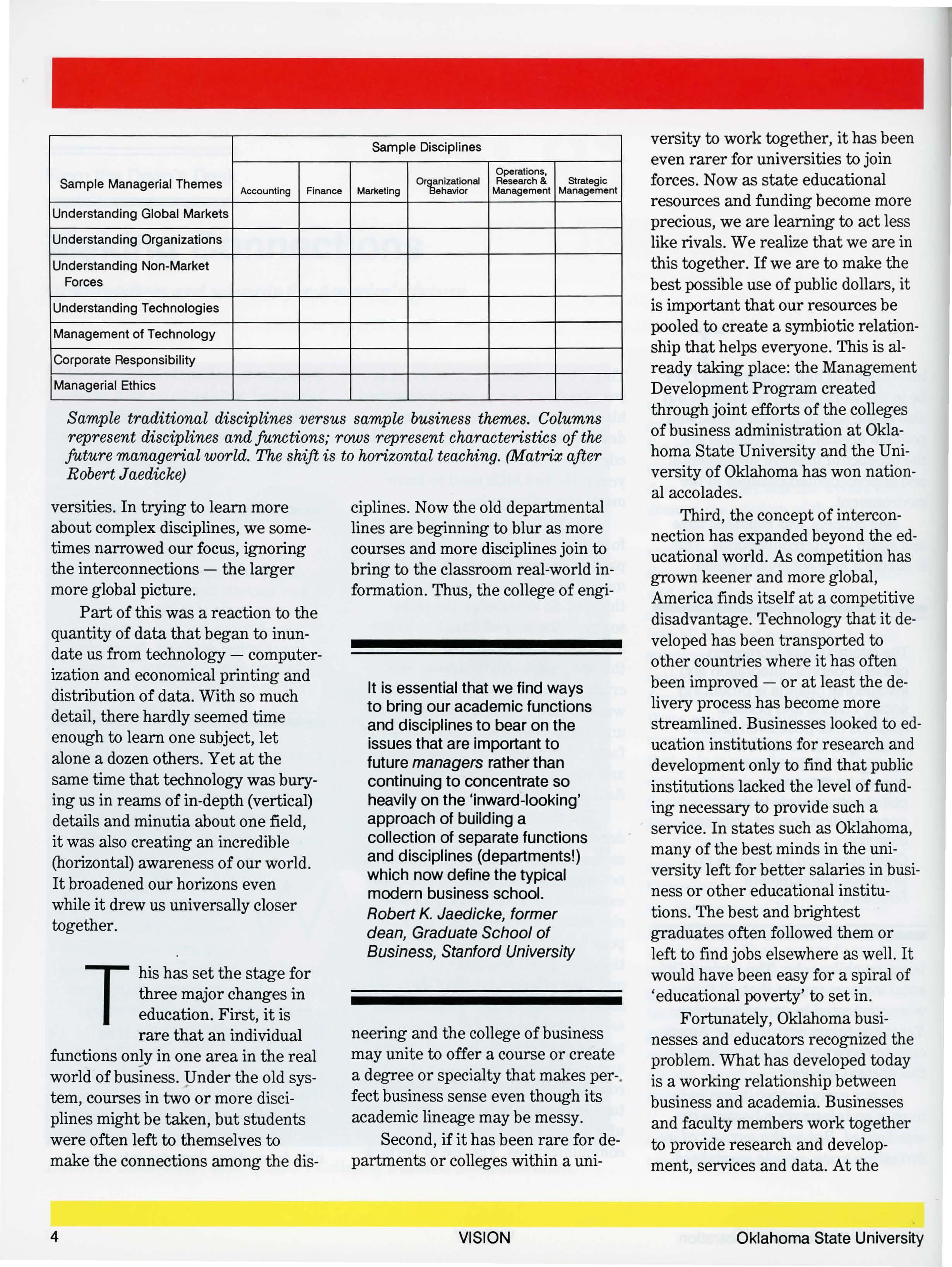
Sample Disciplines
Sample Managerial Themes
Understanding Global Markets
Understanding Organizations
Understanding Non-Market Forces
Understanding Technologies
Management of Technology
Corporate Responsibility
Managerial Ethics
Sample traditional disciplines versus sampl,e business themes. Columns represent disciplines and junctions; rows represent characteristics of the future managerial world. The shift is to horizontal teaching. (Matrix after Robert Jaedicke)
versities. In trying to learn more about complex disciplines, we sometimes narrowed our focus, ignoring the interconnections - the larger more global picture.
Part of this was a reaction to the quantity of data that began to inundate us from technology - computerization and economical printing and distribution of data. With so much detail, there hardly seemed time enough to learn one subject, let alone a dozen others. Yet at the same time that technology was burying us in reams of in-depth (vertical) details and minutia about one field, it was also creating an incredible (horizontal) awareness of our world. It broadened our horizons even while it drew us universally closer together.
This has set the stage for three major changes in education. First, it is rare that an individual functions only in one area in the real world of business. pnder the old system, courses in two or more disciplines might be taken, but students were often left to themselves to make the connections among the dis-
ciplines. Now the old departmental lines are beginning to blur as more courses and more disciplines join to bring to the classroom real-world information. Thus, the college of engi-
It is essential that we find ways to bring our academic functions and disciplines to bear on the issues that are important to future managers rather than continuing to concentrate so heavily on the 'inward-looking' approach of building a collection of separate functions and disciplines (departments!) which now define the typical modern business school.
Robert K. Jaedicke, former dean, Graduate School of Business, Stanford University
neering and the college of business may unite to offer a course or create a degree or specialty that makes per-. feet business sense even though its academic lineage may be messy.
Second, if it has been rare for departments or colleges within a uni-
versity to work together, it has been even rarer for universities to join forces. Now as state educational resources and funding become more precious, we are learning to act less like rivals. We realize that we are in this together. If we are to make the best possible use of public dollars, it is important that our resources be pooled to create a symbiotic relationship that helps everyone. This is already taking place: the Management Development Program created through joint efforts of the colleges of business administration at Oklahoma State University and the University of Oklahoma has won national accolades.
Third, the concept of interconnection has expanded beyond the educational world. As competition has grown keener and more global, America finds itself at a competitive disadvantage. Technology that it developed has been transported to other countries where it has often been improved - or at least the delivery process has become more streamlined. Businesses looked to education institutions for research and development only to find that public institutions lacked the level of funding necessary to provide such a service. In states such as Oklahoma, many of the best minds in the university left for better salaries in business or other educational institutions. The best and brightest graduates often followed them or left to find jobs elsewhere as well. It would have been easy for a spiral of 'educational poverty' to set in.
Fortunately, Oklahoma businesses and educators recognized the problem. What has developed today is a working relationship between business and academia. Businesses and faculty members work together to provide research and development, services and data. At the
same time, the interaction is helping academicsto become broader in their scope - and thus better teachers.
Effective organizations in this century's final decade, noted the Commission on Admission to Graduate Management Education, "willbe those that are agile exploiters of the latest technologies, global interconnections and cultural diversity, not those that are plodding reactors."
It is still relatively easy to take a particular aspect of history or science and walk through it, step by step. It is reasonably easy to pace ourselves through one discipline as if it were an ordered plot instead of
New demands may call for a new synthesis of knowledge and action as well as for new relationships between the traditional academic disciplines of the business school and those of the arts and sciences. Commission on Admission to Graduate Management Education a set of random events. And there will always be a place for the tribal historian and storyteller.
But what we h0pe is that the interconnectedness that is growing among disciplines and colleges, between universities, businesses and academia, will foster leaders - men and women who are keepers of the spirit and the dream For it is only people of the spirit, wizards and warlocks, who can march us, with courage and conviction, into the twentyfirst century.
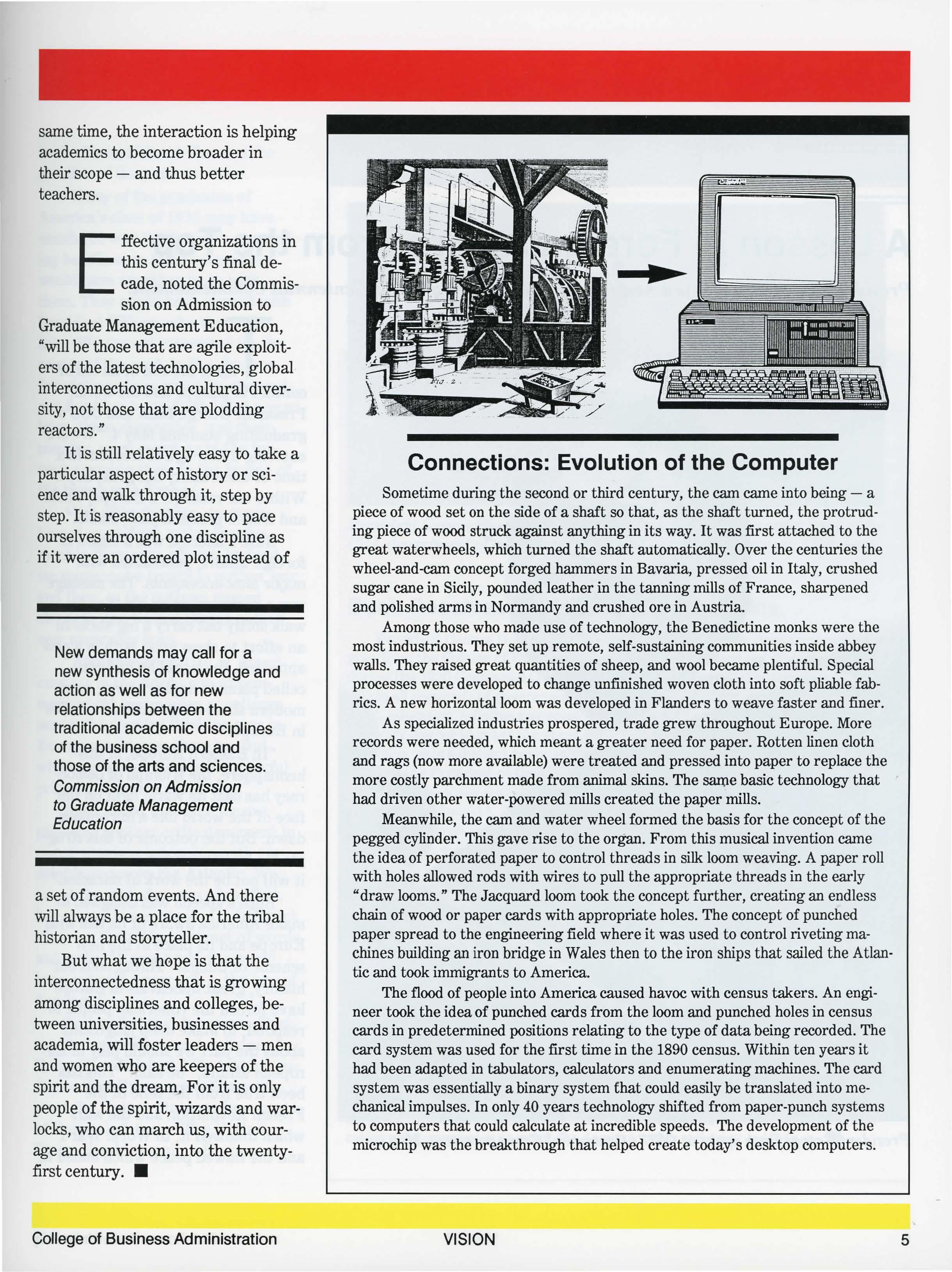
Connections: Evolution of the Computer
Sometime during the second or third century, the cam came into being - a piece of wood set on the side of a shaft so that, as the shaft turned, the protruding piece of wood struck against anything in its way. It was first attached to the great waterwheels, which turned the shaft automatically. Over the centuries the wheel-and-cam concept forged hammers in Bavaria, pressed oil in Italy, crushed sugar cane in Sicily, pounded leather in the tanning mills of France, sharpened and polished arms in Normandy and crushed ore in Austria.
Among those who made use of technology, the Benedictine monks were the most industrious. They set up remote, self-sustaining communities inside abbey walls. They raised great quantities of sheep, and wool became plentiful. Special processes were developed to change unfinished woven cloth into soft pliable fabrics. A new horizontal loom was developed in Flanders to weave faster and finer.
As specialized industries prospered, trade grew throughout Europe. More records were needed, which meant a greater need for paper. Rotten linen cloth and rags (now more available) were treated and pressed into paper to replace the more costly parchment made from animal skins. The saqie basic technology that had driven other water-powered mills created the paper mills.
Meanwhile, the cam and water wheel formed the basis for the concept of the pegged cylinder. This gave rise to the organ. From this musical invention came the idea of perforated paper to control threads in silk loom weaving. A paper roll with holes allowed rods with wires to pull the appropriate threads in the early "draw looms." The Jacquard loom took the concept further, creating an endless chain of wood or paper cards with appropriate holes. The concept of punched paper spread to the engineering field where it was used to control riveting machines building an iron bridge in Wales then to the iron ships that sailed the Atlantic and took immigrants to America.
The flood of people into America caused havoc with census takers. An engineer took the idea of punched cards from the loom and punched holes in census cards in predetermined positions relating to the type of data being recorded. The card system was used for the first time in the 1890 census. Within ten years it had been adapted in tabulators, calculators and enumerating machines. The card system was essentially a binary system that could easily be translated into mechanical impulses. In only 40 years technology shifted from paper-punch systems to computers that could calculate at incredible speeds. The development of the microchip was the breakthrough that helped create today's desktop computers.
A Lesson in Foreign Affairs From the Top
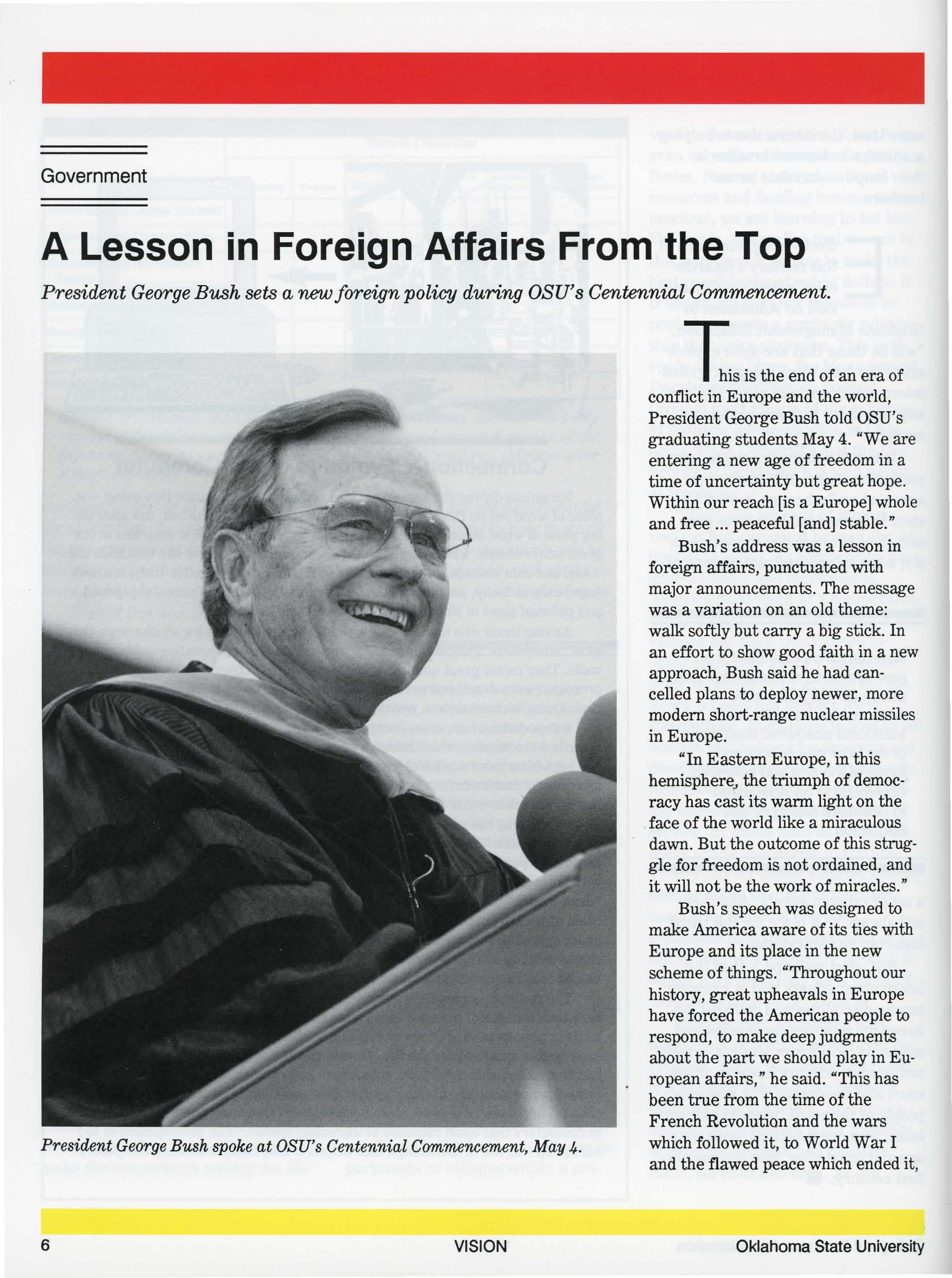
President GeorgeBush sets a new foreign policy during OSU's Centennial Commencement.
spoke at OSU's CentennialCommencement,May 4.
1is is the end of an era of conflict in Europe and the world, President George Bush told OSU's graduating students May 4. "We are entering a new age of freedom in a time of uncertainty but great hope. Within our reach [is a Europe] whole and free ... peaceful [and] stable."
Bush's address was a lesson in foreign affairs, punctuated with major announcements. The message was a variation on an old theme: walk softly but carry a big stick. In an effort to show good faith in a new approach, Bush said he had cancelled plans to deploy newer, more modern short-range nuclear missiles in Europe.
"In Eastern Europe, in this hemisphere~ the triumph of democracy has cast its warm light on the face of the world like a miraculous dawn. But the outcome of this struggle for freedom is not ordained, and it will not be the work of miracles."
Bush's speech was designed to make America aware of its ties with Europe and its place in the new scheme of things. "Throughout our history, great upheavals in Europe have forced the American people to respond, to make deep judgments about the part we should play in European affairs," he said. "This has been true from the time of the French Revolution and the wars which followed it, to World War I and the flawed peace which ended it,
President GeorgeBush
t.othe Second World War and the creation of the postwar order.
"Many of the graduates of America's class of 1916 may have wondered why the faraway war making headlines in their newspapers wouldhave anything to do with them. They might have agreed with President Wilson, who that year said, 'We are not interested [in the causes of the war], in the obscure foundations from which its stupendous flood has burst forth.' But a year later, those classmates, and their country, were swept up in the torrent, carrying them to the horror of the trenches in France.
"Yet after the war, we again turned away from active involvement in European affairs. Instead, we sponsored a treaty to outlaw war and then, as the outlaws gained strength, the United States passed new neutrality laws.
"Another generation of Americans sat in the bright sun of commencement ceremonies at colleges across the country thinking war in Europe would pass them by. But when war came, they paid an awful price for America's isolation."
Bush added that now we are poised at another critical moment in our strategic relationship with our neighbors across the Atlantic. We are at the end of an era of conflict, but we are in a contest of a different kind - a Cold War abstract of words and walls. "Europe and the world have entered a new era - the age of freedom."
Bush called the changes in Eastern Europe widespread and deep, "but still unfinished." He told his audience that European colleagues want the United States to be a part of Europe's future. "The United States should remain a European College of Business Administration
Bush Receives CBA Honorary Doctorate
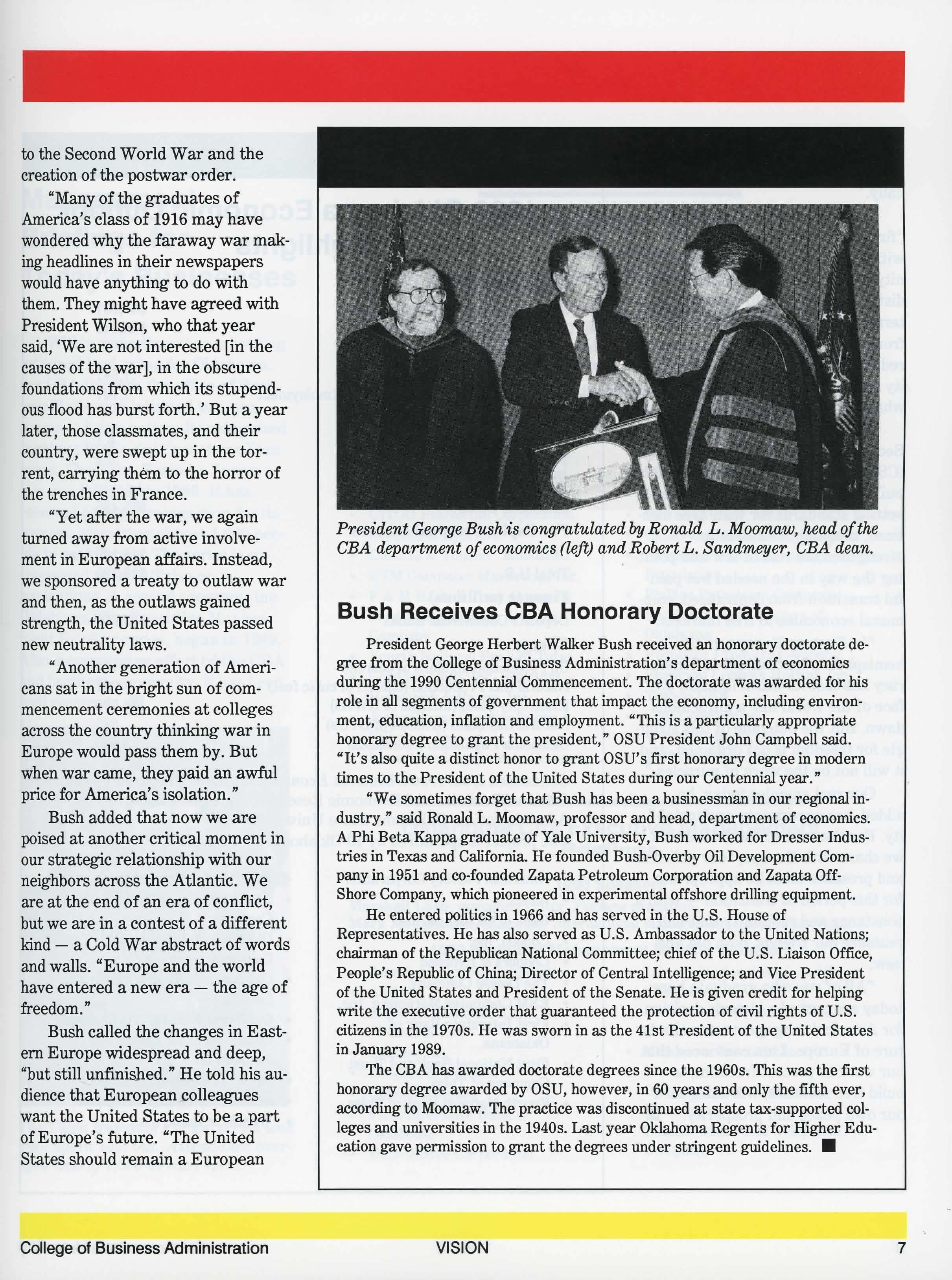
President George Herbert Walker Bush received an honorary doctorate degree from the College of Business Administration's department of economics during the 1990 Centennial Commencement. The doctorate was awarded for his role in all segments of government that impact the economy, including environment, education, inflation and employment. "This is a particularly appropriate honorary degree to grant the president," OSU President John Campbell said. "It's also quite a distinct honor to grant OSU's first honorary degree in modern times to the President of the United States during our Centennial year."
"We sometimes forget that Bush has been a businessman in our regional industry," said Ronald L. Moomaw, professor and head, department of economics. A Phi Beta Kappa graduate of Yale University, Bush worked for Dresser Industries in Texas and California. He founded Bush-Overby Oil Development Company in 1951 and co-founded Zapata Petroleum Corporation and Zapata OffShore Company, which pioneered in experimental offshore drilling equipment. He entered politics in 1966 and has served in the U.S. House of Representatives. He has also served as U.S. Ambassador to the United Nations; chairman of the Republican National Committee; chief of the U.S. Liaison Office, People's Republic of China; Director of Central Intelligence; and Vice President of the United States and President of the Senate. He is given credit for helping write the executive order that guaranteed the protection of civil rights of U.S. citizens in the 1970s. He was sworn in as the 41st President of the United States in January 1989.
The CBA has awarded doctorate degrees since the 1960s. This was the first honorary degree awarded by OSU, howeveF, in 60 years and only the fifth ever, according to Moomaw. The practice was discontinued at state tax-supported colleges and universities in the 1940s. Last year Oklahoma Regents for Higher Education gave permission to grant the degrees under stringent guidelines.
President GeorgeBush is congratulated by Ronald L. Moomaw, head of the CEA department of economics (left) and Robert L. Sandmeyer, CEA dean.
power in the broadest sensepolitically, militarily and economically."
He then called on NATO to "find ways to work more closely with a vigorous European Community that is rightly asserting its own distinct views" and to promote "longterm stability and prevent crises from escalating by relying on reduced forces that show our capability and our readiness to respond to whatever may arise."
He called for the Conference on Security and Cooperation in Europe (CSCE) to "offer new guidelines for building free societies - including setting standards for truly free elections, adopting measures to strengthen the rule of law and pointing the way in the needed but painful transition from centralized, communal economies to free markets.
"In Eastern Europe, in this hemisphere, the triumph of democracy has cast its warm light on the face of the world like a miraculous dawn. But the outcome of this struggle for freedom is not ordained, and it will not be the work of miracles."
Our real enemies today, he added, are uncertainty and instability. For the sake of the future that we share with Europe, "our policies and presence must be appropriate for this period of transition - with a constancy and reliability that will reassure our friends, both old and new.
"All of you who graduate here today are part of a historic decision for America's engagement in the future of Europe. I am convinced that our work to pr.otect freedom, to build free societies, will safeguard our own peace and prosperity."
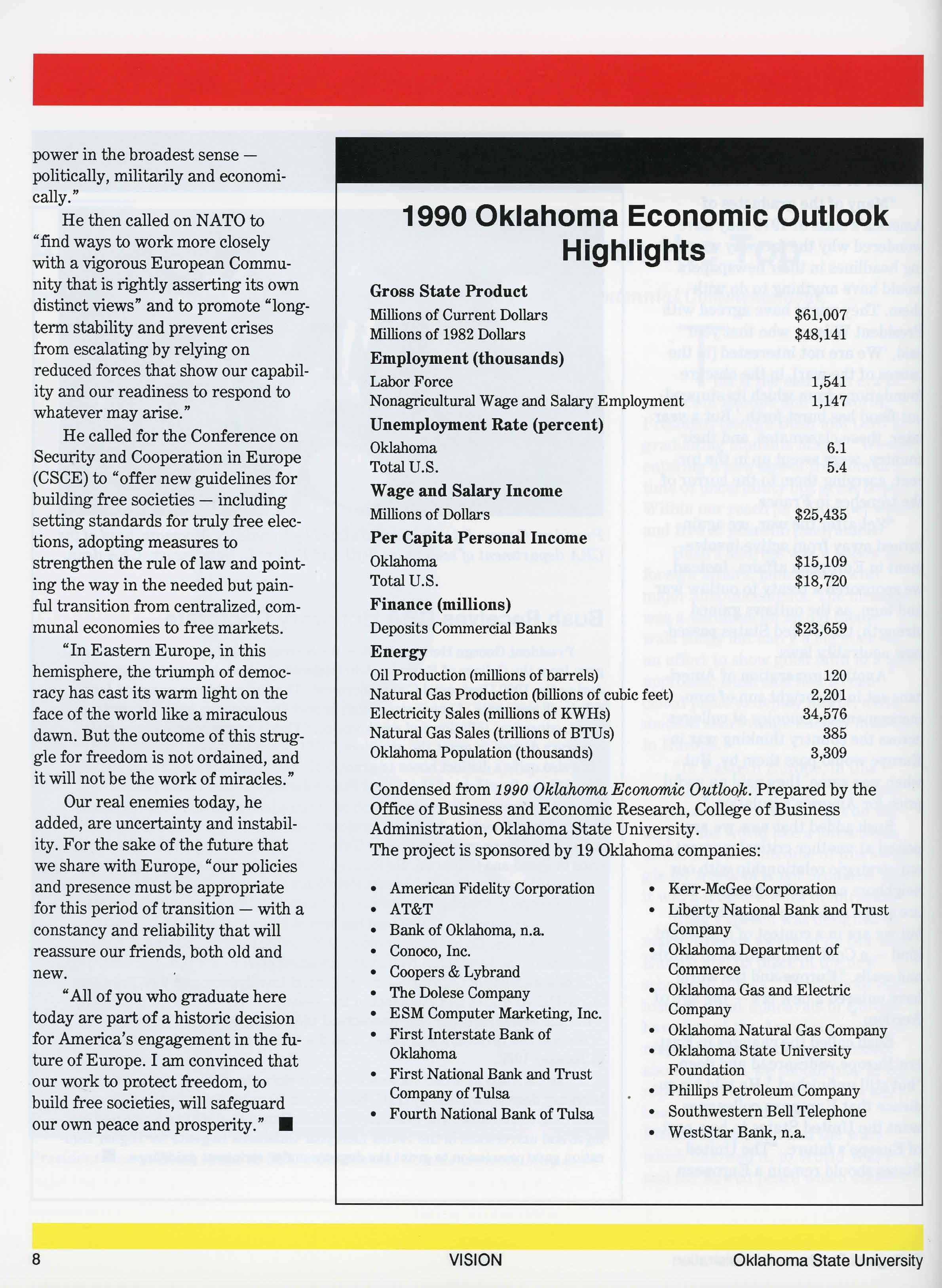
1990 Oklahoma Economic Outlook Highlights
Condensed from 1990 OklahomaEconomic Outloo.k.Prepared by the Office of Business and Economic Research, College of Business Administration, Oklahoma State University.
The project is sponsored by 19 Oklahoma companies:
• American Fidelity Corporation
• AT&T
• Bank of Oklahoma, n.a.
• Conoco, Inc.
• Coopers & Lybrand
• The Dolese Company
• ESM Computer Marlrnting, Inc.
• First Interstate Bank of Oklahoma
• First National Bank and Trust Company of Tulsa
• Fourth National Bank of Tulsa
• Kerr-McGee Corporation
• Liberty National Bank and Trust Company
• Oklahoma Department of Commerce
• Oklahoma Gas and Electric Company
• Oklahoma Natural Gas Company
• Oklahoma State University Foundation
• Phillips Petroleum Company
• Southwestern Bell Telephone
• W estStar Bank, n.a.
Management Briefingsfor Today's Businesses
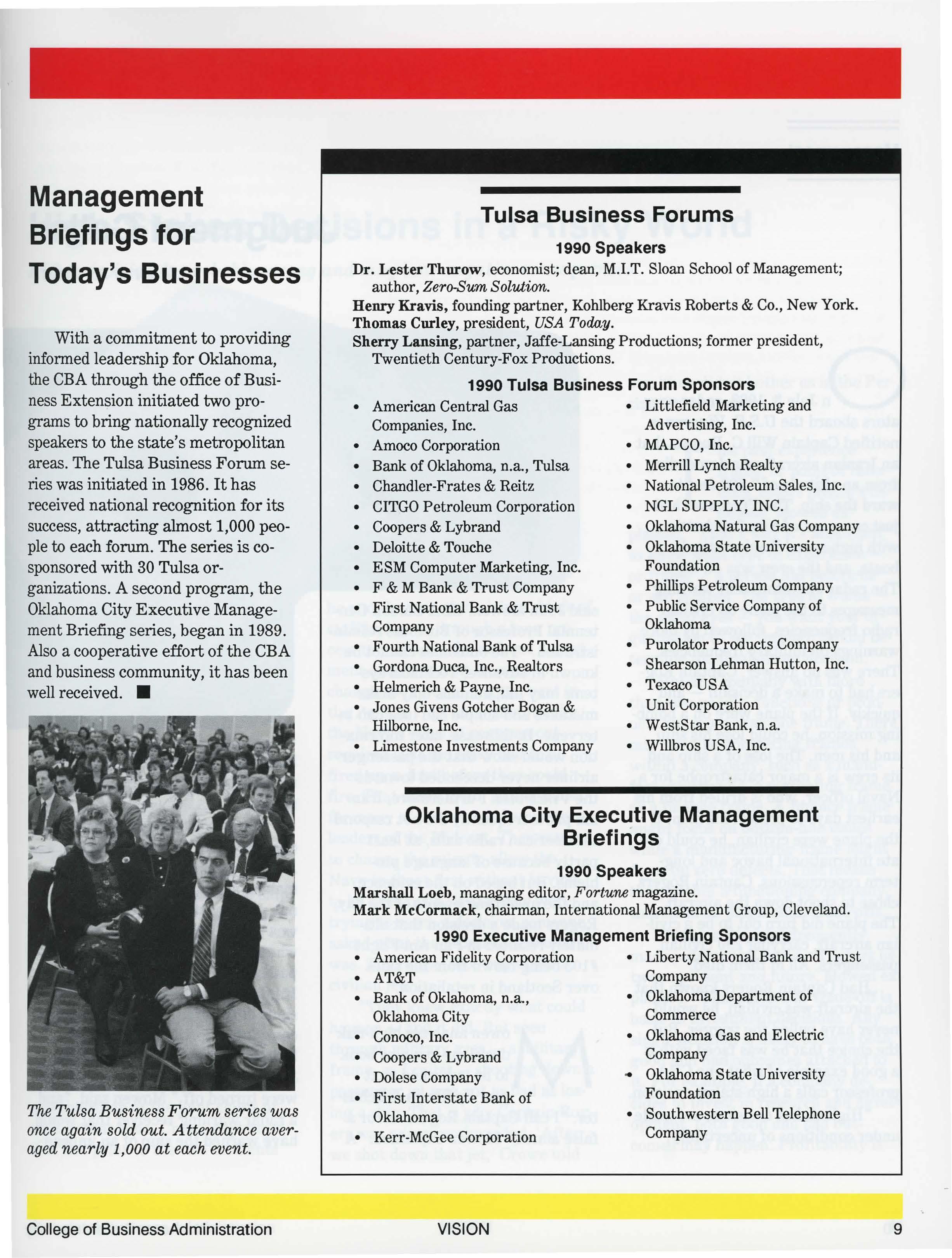
With a commitment to providing informed leadership for Oklahoma, the CBA through the office of Business Extension initiated two programs to bring nationally recognized speakers to the state's metropolitan areas. The Tulsa Business Forum series was initiated in 1986. It has received national recognition for its success, attracting almost 1,000 people to each forum. The series is cosponsored with 30 Tulsa organizations. A second program, the Oklahoma City Executive Management Briefing series, began in 1989. Also a cooperative effort of the CBA and business community, it has been well received.
TheTulsa Business Forum series was once again sold out. Attendance averaged nearly 1,000 at each event.
Tulsa Business Forums
1990 Speakers
Dr. Lester Thurow, economist; dean, M.I.T. Sloan School of Management; author, Zero-Sum Solution.
Henry Kravis, founding partner, Kohlberg Kravis Roberts & Co., New York.
Thomas Curley, president, USA Today.
Sherry Lansing, partner, Jaffe-Lansing Productions; former president, Twentieth Century-Fox Productions.
1990 Tulsa Business Forum Sponsors
• American Central Gas
• Littlefield Marketing and Companies, Inc. Advertising, Inc.
• Amoco Corporation
• Bank of Oklahoma, n.a., Tulsa
• Chandler-Frates & Reitz
• CITGO Petroleum Corporation
• Coopers & Lybrand
• Deloitte & Touche
• MAPCO, Inc.
• Merrill Lynch Realty
• National Petroleum Sales, Inc.
• NGL SUPPLY, INC.
• Oklahoma Natural Gas Company
• Oklahoma State University
• ESM Computer Marketing, Inc. Foundation
• F & M Bank & Trust Company
• First National Bank & Trust
• Phillips Petroleum Company
• Public Service Company of Company
• Fourth National Bank of Tulsa
• Gordona Duca, Inc., Realtors
• Helmerich & Payne, Inc.
• Jones Givens Gotcher Bogan & Hilborne, Inc.
• Limestone Investment~ Company Oklahoma
• Purolator Products Company
• Shearson Lehman Hutton, Inc.
• Texaco USA
• Unit Corporation
• WestStar Bank, n.a.
• Willbros USA, Inc.
Oklahoma City Executive Management Briefings
1990 Speakers
Marshall Loeb, managing editor, Fortune magazine.
Mark McCormack, chairman, International Management Group, Cleveland.
1990 Executive Management Briefing Sponsors
• American Fidelity Corporation
• Liberty National Bank and Trust
• AT&T Company
• Bank of Oklahoma, n.a.,
• Oklahoma Department of Oklahoma City Commerce
• Conoco, Inc.
• Oklahoma Gas and Electric
• Coopers & Lybrand Company
• Dolese Company Oklahoma State University
• First Interstate Bank of Foundation Oklahoma
• Southwestern Bell Telephone
• Kerr-McGee Corporation Company
Management
Judgment Calls:
Shoot or no-shoot?
onJuly 3, 1988, radar operators aboard the U.S.S. Vincennes notified Captain Will C. Rogers that an Iranian aircraft was descending from an altitude of 7,500 feet toward the ship. The Vincennes had just come out of a surface battle with high-speed Iranian attack boats, and the crew was on edge. The radar operators sent warning messages· to the plane on civilian radio frequencies, followed by more warnings on military frequencies. There was no answer. Captain Rogers had to make a decision - and quickly. If the plane were on a bombing mission, he could lose his ship and his men. The loss of a ship and its crew is a major catastrophe for a Naval officer, who is drilled from his earliest days to protect his men. If the plane were civilian, he could create international havoc and longterm repercussions. Captain Rogers chose to shoot down the aircraft. The plane did turn out to be a civilian aircraft, carryi,ng 290 civilian passengers. All of them died. Had Captain Rogers known that the aircraft was civilian, he would never have pulled the trigger. But the choice that he was faced with is a good example of what one CBA professor calls a high-stakes decision. "High-stakes decisions are made under conditions of uncertainty,"
said John Mowen, CEA Carson Centennial Professor of Business Administration. "The outcomes cannot be known in advance. Technical systems may fail, humans may make mistakes and simple bad luck can intervene. In this case, later information would show that the passenger airliner never descended towards the Vincennes. Furthermore, Iranian pilots frequently did not respond to American radio calls, at least partly because of language problems. But based on the evidence, and the unsettling events of the day, Rogers made a decision that ultimately resulted in Pan Am Flight #103 being blown from the skies over Scotland in retaliation."
Mowen analyzes high-risk decisions in a new book to be published next year by Simon & Schuster. "I call Captain Rogers' error a false alarm," Mowen explained. "A
false alarm occurs when decision makers 'shoot' when they should do nothing."
The opposite case - a no-shot, or miss - can be just as disastrous. A miss happens when decision makers should take action but do not. In May 1987, the U.S.S. Stark was patrolling the Persian Gulf when its radar picked up the flight paths of two Iraqi F-1 Mirage jets. Iraqi fighters frequently flew missions in the area, and they were not considered hostile to the United States. "At the time, some of the Stark's advanced defensive systems were turned off," Mowen said, "and a radar warning receiver that would have warned the ship of an impend-
High-Stakes Decisions in a Risky World
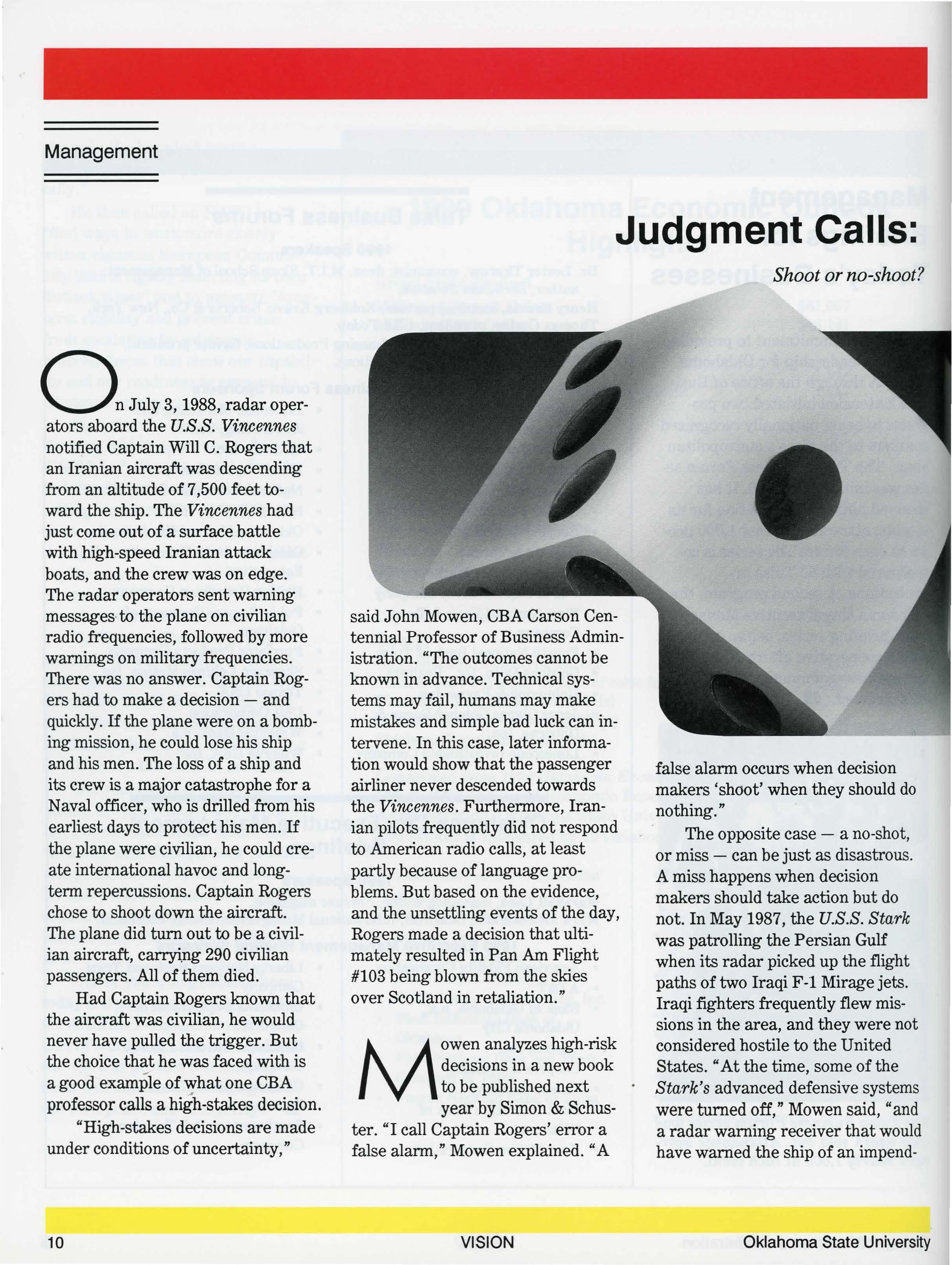
Either decision is probably wrong and may bear negative consequences.
ing attack by Exocet missiles was not functioning. An AW ACs plane detected the missile firing. But the message had to pass through the destroyer Coontz. This took several minutes. The first warning of the attack came when a lookout saw the first missile boring towards the ship. The Stark nearly sank, and there were numerous casualties."
It is easy to see military decisions as high-risk decisions; but Mowensees the same problem facing business people today.
"There is an interesting sidelight to these two stories," Mowen said. "Admiral Alexander Crowe was chairman of the joint chiefs of staff at that time. Crowe explained that just prior to the two incidents
he and the rest of the joints chiefs of staff had gone through a long process to persuade the defense department and President Reagan to change the rules of engagement in the Persian Gulf area. Historically, the Navy's rules of engagement required that the Navy had to be fired upon first before they could fire. That made them 'sitting ducks' for many of the more inflammatory leaders of the Mideast. They wanted to change the rules to allow the Navy to shoot first without having to be fired upon. While they were trying to reach a decision, someone asked what the 'worst-case scenario' was. The reply: 'shooting down a civilian jet.'
"They knew exactly what could happen - and it did. But seen through military eyes - a military frame, as I call it - shooting down a passenger jet was not as bad as losing a ship. That is why Captain Rogers was never reprimanded. 'After we shot down that jet,' Crowe told
me, 'they didn't bother us in the Persian Gulf any more.'"
This past experience frame, or point of reference, colors people's decisions, Mowen explained. "That's why it's important to know what type of experienceor frame - a person has before he or she is hired. The type of framethe set of eyes - you want your organization to see through should determine the final hiring decision."
But any company with more than two people, functions or products has more than one frame. There may even be competing frames within a company, such as a manu- . facturing frame, a marketing frame or a finance frame. A finance frame ·might focus on bottom-line issues while a manufacturing frame might focus on zero defects. That means that, within a functioning company, there will be judgmental trade-offs. Perhaps the most frequently made judgmental trade-off occurs between present and future, Mowen explained. "This particular trade-off is basic to investment decisions. Any single decision is likely to have both good and bad outcomes attached to • it. For example, if a company decides to invest in research and development, both good and bad outcomes may happen. Profitability is
Playing for High Stakes Off the Football Field
Don Cooper, team physician for OSU for many years, is internationally known in sports medicine and served as a member of the President's Physical Fitness Council. In the 1970s he served as the physician representative to the NCAA football committee. At that time, mouthpiece protectors for football players had not been adopted. Cooper was determined to persuade colleges to adopt them to prevent dental and mouth injuries. Coaches, including Darryl Royal, were against it; they thought a mouthpiece would make it more difficult to call signals and for players to understand each other. Cooper thought this was hogwash. Just before a national meeting of the committee, he had a dentist make him a clear mouthpiece. He put in the mouthpiece before he got up to give his speech. At the end of speech, he asked the audience, "Did everyone understand me?" It seemed a funny question, but they assured him they had. "But why do you ask?" someone in the audience called out. He pulled out the mouthpiece. "You can talk with a mouthpiece, and you ca,nbe understood," he said, holding it up. Royal only laughed. "Cooper could talk through a wood fence," he replied. But Cooper's point was made, and the mouthpieces were adopted.
decreased in the short term since current regulations require research and development costs to be expensed as they occur. The positive effects of the investment, however, will not be felt for years. For that reason, American business thinking has grown more and more short term. Ford's infamous E-coat affair is a good case in point," he said. In 1958 researchers in Ford's manufacturing section invented a technique for improving the paint jobs and rust resistance of its vehicles. The process involved placing the entire frame into a vat of paint and giving it an electrical charge. The charge attracted the paint to the metal and greatly improved rust resistance. It became an instant success - everywhere except at Ford USA. Ford of Europe quickly adopted it because of the highly competitive market there. General Motors paid Ford a royalty and also used the process. Even Japanese companies adopted it. But not Ford's North American operations. The situation was a classic case of a 'miss.'
Ford finally installed it in the plant that produced their prestigious Lincoln Continentals and Thunderbirds in 1961 - but not the other plants because the manufacturing people could not prove that the process would return the $4-5 million it cost to install it in each plant. Twelve years later, at a styling meeting, Lee Iacocca became enraged at the poor quality of Ford carsparticularly at the rust problems that were causing enormous warranty difficulties. Even though he was president of the corporation, he could not turn around the short-term thinking. It was not until 1983 - 25 years after its own invention - that the Ecoat process was placed in Ford's last two plants. The short-term thinking had won out; but Ford's market share had plummeted during that time span.
Sound judgment involves the ability of the decision maker to make the best trade-off between two opposing factors, Mowen ex-
plained. "Successful decision makers hone their skills in order to maximize decision accuracy. They must recognize the choices and the trade-offs. They ask themselves: Do you stay or quit? Which cause was responsible for the events? Do you emphasize the present or the future? Do you focus on means or ends? Do you select the individual good or the public good? Do you choose security or risk? Which decision perspective do you use? Which expert do you trust? "People can be entrapped in a losing course of action, yet they will stay with that particular procedure or approach- even when it's very clear that they should change," Mowen said. "My goal is to help people avoid the worst-case scenario coming true."
Mowen's work is the result of study in how people really make decisions. Most work in the area of decision-making has been done with mathematical models, according to Mowen, "but researchers forget to measure what people really do. We've investigated how people really make decisions compared to how they should make decisions. There's a big difference."
Mowen bristles when people talk about such work as 'academic.' "You hear people talking about something as 'only academic,' meaning that it really does not matter. My goal is to get them to realize that academic research is relevant."
John C. Mowen is CBA professor of marketing and Carson Centennial Professor of Business Administration. His bookJudgment Calls is scheduledto beprinted by Simon & Schuster in 1991.
0SU/OU Combine Management Program
Acooperative venture between the Colleges of Business Administration at Oklahoma State University and the University of Oklahomahas been named one of the twenty most successful programs in the country.
The Management Development Program was named in a national competition conducted by the University of North Florida last year. The joint program was begun in 1989to promote educated leadership among mid-level managers of the region's leading companies and public-sectororganizations.
Before OSU and OU instituted the program, most Oklahoma companies sent their mid-level managers to very expensive programs offered by other universities out-of-state. "It did not take most companies much convincingto evaluate the program," said Debra Nelson, associate professor of management. "It has been a sellout from the beginning."
Nelson attributes this at least partly to the expanded resources. "The presenting faculty represent the best faculty of both universities. In fact, an appointment to the faculty of the program has become a mark of excellence among faculty peers." Jim Hromas, associate professor of marketing and director of CBAbusines§ extension, stressed that "the expertise.of the two faculties complement each other nicely because they conduct work and research in different areas." Nelson stressed that this is not an ivory-
tower situation. "We have faculty with a substantial history of private industry experience.
"Participants may gain exposure to premier faculty members on the cutting edge of research and literature; but faculty members also benefit from exposure to recent developments in the industry." Enrollees in the 1989 program represented 27 companies, 13 cities and four states. The strategic alliance concept sends a positive message to the business community. It demonstrates to business and industry that cooperation can make the best use of resources at both universities and provide
a quality product in a non-competitive environment.
"We have the opportunity to demonstrate to the state that such cooperative ventures are not only feasible, they are very pragmatic," Nelson said.
From a business point of view, the program is expected to increase Oklahoma's ability to attract new businesses and keep existing businesses. "These alliances are the best way to build economic development," Hromas said.
"They send a clear signal to businesses that we are not only willing but able to create teams, consortiums and strategic alliances that allow us all to work together for the common good."
Covering All Bases
The Management Development Program is based on input from participating corporations, according to Debra Nelson, CBA associate professor of management. "Today's mid-level managers must know what's going on in business now, and they must be able to forecast what changes are coming in the future. The companies have told us what they feel their mid-level managers need to be successful for themselves and the companies they serve." The program covers three basic component areas:
Managing technology and innovation: "Managers cannot afford to be technically ignorant," Nelson said. "They need to keep up with rapid changes in technology and how to manage these changes and new technologies."
Globalization of the economy: "Mid-level managers need to globalize. In today's business environment, a manager cannot ignore the global perspective. This program encourages the manager to broaden his or her view."
Personal development and management of human resources: "Managers must perform under stress," Nelson said. "We offer the tools they need to manage their own careers as well as the tools to manage others. Today's mid-level managers must do more with less. They must learn to manage multiple priorities and to help their people be more productive."
Corporate Women: Where Are They?
wn Fortune magazine set out to find the top women in business in 1990, they surveyed the officer lists of the 1,000 largest U.S. industrial and service companies. Women had been making inroads into business for more than a decade; they wanted t.omeasure their progress. But of the 4,012 people listed as the highest-paid officers and directors of these companies, there were only 19 women - less than half of one percent.
Such an absence might have been explained a decade ago as a lack of women in the work force. But that argument no longer holds true. Sixty-six percent of the women ages 20 to 64 are in the work force. The U.S. Department of Labor estimates that women make up 40 percent of the "managers and administrators" in American business; (although that category includes a wide range from local Pizza Hut owners to President Bush). On the top rung of the ladder, they are woefully few and far between.
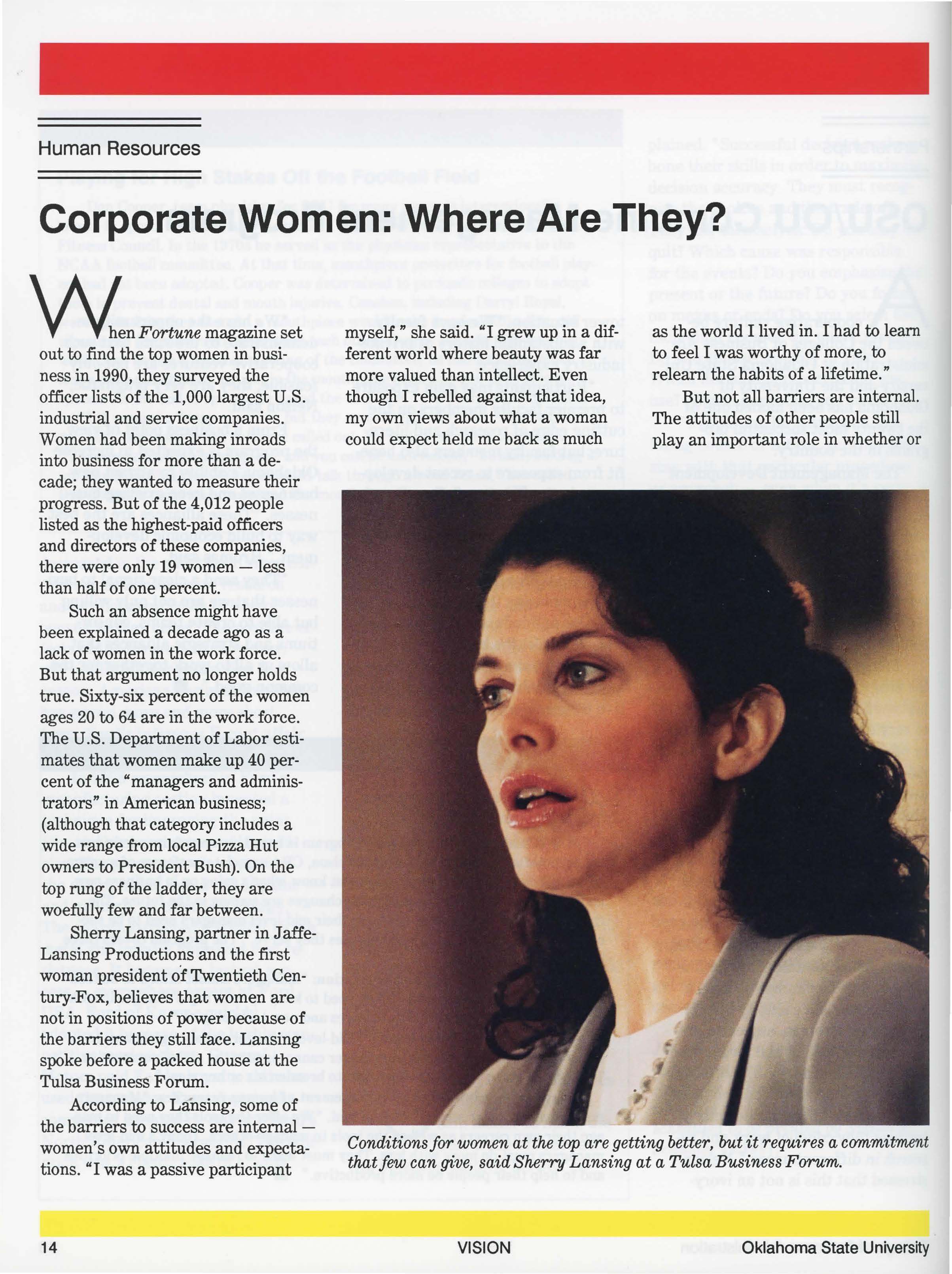
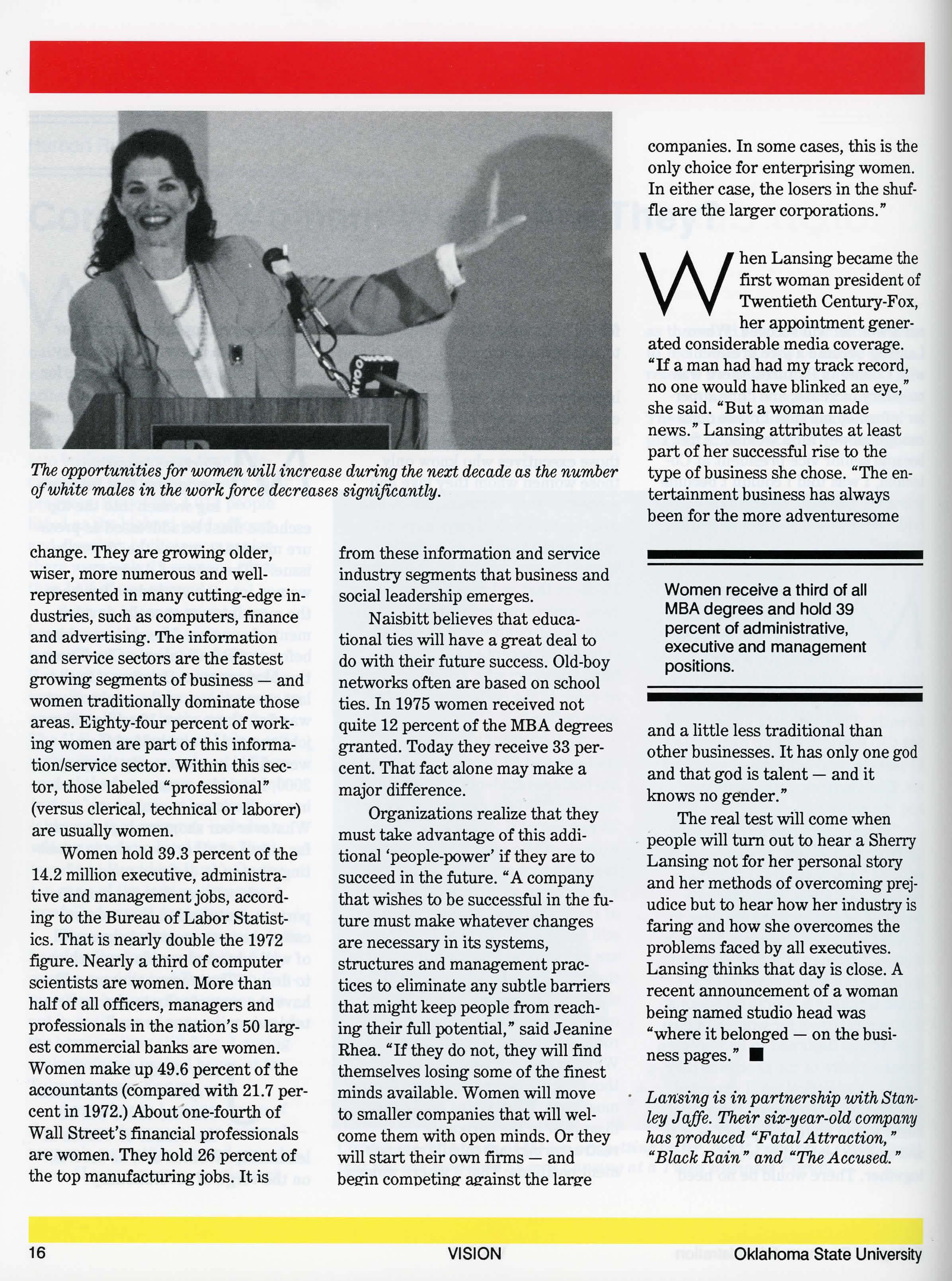
Sherry Lansing, partner in JaffeLansing Productions and the first woman president o°fTwentieth Century-Fox, believes that women are not in positions of power because of the barriers they still face. Lansing spoke before a packed house at the Tulsa Business Forum.
According to Lansing, some of the barriers to success are internalwomen's own attitudes and expectations. "I was a passive participant
myself," she said. "I grew up in a different world where beauty was far more valued than intellect. Even though I rebelled against that idea, my own views about what a woman could expect held me back as much
as the world I lived in. I had to learn to feel I was worthy of more, to relearn the habits of a lifetime."
But not all barriers are internal. The attitudes of other people still play an important role in whether or
Conditions for women at the tap are getting better, but it requires a commitment that few can give, said Sherry Lansing at a Tulsa Business Forum.
not a woman will succeed. When Lansing became a vice president with Columbia Pictures, there was no salary increase, and "one superior informed me that I made quite enough money for a woman. After I became senior vice president at Columbia, I was told I couldn't become president because, as one executive said, 'Who would you get to work for you?"'
Most business people dismiss those stories as rather quaint, from an unenlightened era. Catalyst, a group that does research on women in the workplace, sees it differently. They recently interviewed 241 CEOs and found an incredible 81 percent who acknowledged barriers. The barriers: preconceptions and stereotyping.
"Women still run into what we term 'glass ceilings,' invisible barriers that keep them from the top," said Jeanine Rhea, associate professor of administrative services in OSU's College of Business Administration. "Women still face discrimination in the workplace. In 1975 I began teaching a course on administrative strategies for women in business. It was designed to help women become aware of the problems they faced in the workplace. I expected that, within a few years, those problems would have dissipated as men and women learned to work together. There would be no need
for such a course. Yet I am still teaching the course.
"There are still misunderstandings about the role of women, their expectations, their abilities and about women in general. Perhaps those executives who know only those women whom they love and protect - their mothers, wives and daughters - will always have difficulty understanding or accepting women in any other role or lifestyle. I believe that as long as those executives control our boardrooms, women will continue to have difficulty being accepted as capable, bright workers who bring something of value to the corporate table besides coffee."
Today half of all college students and 37 percent of all graduate business students are female. By the year 2000 women will represent 73 percent of U.S. workers. More women will be returning to work as their children grow up. White males will make up as little as 15 percent of the work force. Jeanine Rhea is still skeptical. "We hear how there are going to be fewer white males in the work force by the year 2000," she said. "Everyone assumes that means there will be a great deal of room for women. I'm not so sure. White males will continue to hold those high-powered positions for the most part. What we're really seeing disappear in the corporate restructurings are middle management positions. That's where women
would be getting their training for the top. With fewer positions, they will still find themselves fighting for recognition."
Marshall Loeb, editor of Fortune magazine, recognizes that integrating women into the top eschelon must be addressed as pressure mounts to attack the 'diversity issue.' "The move of American women into the workplace has been the most important social development of our time," he said, speaking before a CBA Oklahoma City Executive Management Briefing. "In the last seven years, while employment was flat, there were 19 million new jobs created - and half of them were filled by women. By the year 2000, I look for women to be knocking on the doors to real power. Whatever our shortcomings, we are • far ahead of other countries in admitting women to decision-making."
Loeb believes that the most important contribution that women can make is to create a larger pool of well-educated people from which to draw. "That means that we will have the opportunity to choose better leaders in many areas."
John N aisbitt, in M egatrends 2000, claims that the 1990s will be the decade of women in leadership. Women are, he asserts, on the verge of revolutionary
The opportunities for women will increase during the next decade as the number of white males in the workforce decreases significantly.
change. They are growing older, wiser, more numerous and wellrepresented in many cutting-edge industries, such as computers, finance and advertising. The information and service sectors are the fastest growing segments of business - and women traditionally dominate those areas. Eighty-four percent of working women are part of this information/service sector. Within this sector, those labeled "professional" (versus clerical, technical or laborer) are usually women.
Women hold 39.3 percent of the 14.2 million executive, administrative and management jobs, according to the Bureau of Labor Statistics. That is nearly double the 1972 figure. Nearly a thi_rdof computer scientists are women. More than half of all officers, managers and professionals in the nation's 50 largest commercial banks are women.
Women make up 49.6 percent of the accountants (compared with 21.7 percent in 1972.) About~one-fourth of Wall Street's financial professionals are women. They hold 26 percent of the top manufacturing jobs. It is
from these information and service industry segments that business and social leadership emerges.
Naisbitt believes that educational ties will have a great deal to do with their future success. Old-boy networks often are based on school ties. In 1975 women received not quite 12 percent of the MBA degrees granted. Today they receive 33 percent. That fact alone may make a major difference.
Organizations realize that they must take advantage of this additional 'people-power' if they are to succeed in the future. "A company that wishes to be successful in the future must make whatever changes are necessary in its systems, structures and management practices to eliminate any subtle barriers that might keep people from reaching their full potential," said Jeanine Rhea. "If they do not, they will find themselves losing some of the finest minds available. Women will move to smaller companies that will welcome them with open minds. Or they will start their own firms - and belri.ncomoetin~ ~ainst the lar~e
companies. In some cases, this is the only choice for enterprising women. In either case, the losers in the shuffle are the larger corporations."
When Lansing became the first woman president of Twentieth Century-Fox, her appointment generated considerable media coverage. "If a man had had my track record, no one would have blinked an eye," she said. "But a woman made news." Lansing attributes at least part of her successful rise to the type of business she chose. "The entertainment business has always been for the more adventuresome
Women receive a third of all MBAdegrees and hold 39 percent of administrative, executive and management positions.
and a little less traditional than other businesses. It has only one god and that god is talent - and it knows no gender."
The real test will come when . people will turn out to hear a Sherry Lansing not for her personal story and her methods of overcoming prejudice but to hear how her industry is faring and how she overcomes the problems faced by all executives. Lansing thinks that day is close. A recent announcement of a woman being named studio head was "where it belonged - on the business pages."
Lansing is in partnership with Stanley Jaffe. Their six-year-old company has produced "Fatal Attraction," "Black Rain" and "The Accused."
Banking Looks to Education for Direction
Oklahoma bankers are gearing for tough times in the 1990s, but education may soften the blow.
Legislative and regulatory overkill are the biggest problems facing bankers in the 1990s, according to Larry Briggs, 1989-90 president of the Oklahoma Bankers Association (OBA).Bruce Benbrook, 199091 OBA president, adds a third: a lack of young people moving into the industry.
"Competition is going to be monumental among all financial institutions in the '90s," said Briggs. "From the regulatory side we're already hearing about regulatory over-
Overreaction to the savings and loan crisis is the biggest problem that Oklahoma bankers must face today.
kill. We are hoping that common sense will prevail in response to the S&Lcrisis."
Banks are facing skyrocketing costs as FDIC insurance continues to climb. They are also facing higher interest rates in order to attract new deposits. "The S&Ls have been raising their interest rates to attract deposits so that they can stay profitable. We have to compete with those interest rates:"
Briggs fears that overreaction to the S&L crisis on the part of legislators may slow the economy even more. "The primary thing for
the OBA is to have exceptionally good relationships with legislators on the state and national levels. We must make sure we communicate effectively so that they have a clear picture of the problems and reasonable solutions to those problems."
Aside from the legislative activities of the OBA, the one thing that makes it one of the country's premier associations is its emphasis on continuing education. In a typical year the OBA hosts 75 to 80 seminars and schools geared to very specific topics such as the Community Reinvestment Act or changes in the call-statement formats which regulators require. The OBA conducts five schools each year
on the OSU Stillwater campus. Each of these schools covers one area of banking extensively. "For example, the intermediate banking school is for entry-level banking personnel who have three to four years' experience," explained Benbrook. "It gives an overview of the banking areas of operations, lending and investments.
"We've also designed and hosted schools for agricultural lending and installment lending," Benbrook said. "The agricultural lending school teaches the bank personnel about FHA loans, commodities and other agricultural markets."
The association also helps reduce overhead costs for its 431 member banks. The Oklahoma Bankers Association Service Company (OBASCO) offers products and ser-
OBA Chair of Commercial Bank Management
"The fact that CBA graduates are continually being drawn into the OBA presidency is a clear indication of their leadership abilities," said W. Gary Simpson, professor of finance. Simpson also holds the Oklahoma Bankers Association Chair of Commercial Bank Management. Bruce Raines, CBA graduate, served as president in 1988-89. Larry Briggs, another CBA graduate, served as 1989-90 president. Bruce Benbrook, 1990-91 president, is the third consecutive CBA alumnus to be elected to the top office. Other CBA graduates who have served as OBA president are Ed Keller (1982-83), Gordon Greer (1983-84)and Don Doty (1984-85). "The young men and women that the CBA is educating are able to move directly into the real world of business and make a contribution. That says a lot for the quality of our program - and the young people of Oklahoma."
vices to member banks at reduced rates. "We can help a bank save money on computer software, fax machines, forms, books and video training tapes," Benbrook said. OBASCO even offers a catastrophe audit program which keeps a videotape of the furniture and equipment in case of disaster.
One of Benbrook's top priorities is to encourage more young people to enter - and stay in - the banking business. "We're like any other industry," he said. "We not only want to attract good young people to the banking industry, we want to keep them." The OBA recently formed the Young Executives Division of the OBA. A 21-member board consists of up-and-coming young bankers in the state. "Our goal is to
Education is the one way to ensure that Oklahoma bankers will be able to offer quality service to the public and the state.
help them develop leadership skills that they can use to benefit their bank, their community and the state as a whole," Benbrook said.
The OBA is supporting the OBA Chair of Commercial Bank Management as part of their effort to attract young people~ the industry. "We held a fund-raising drive to obtain the funds to sponsor the chair," he explained. "We feel that if we can encourage top students at an early age to select banking as a career, we will benefit as-an industry."
According to Benbrook, the OBA looks to Dr. Gary Simpson, who has been hired to fill the chair, to assist the OBA with advice and counsel. "We think he will help us
come up with new ideas and that he will be able to help us with suggestions for future curriculum for our seminars and schools," he added.
Benbrook said the emphasis on continuing education within the
OBA is long-term. "Education is the one way to ensure that today's and tomorrow's bankers in Oklahoma will offer up-to-date, quality service to the public and the state."
Good Times Coming or Are They Here Now?
The United States has the human resources to succeed in the global economy that is shaping up in the 1990s, but only if it pays more attention to education. That was the message driven home by futurist John Naisbitt, who spoke at Oklahoma State University in February. Naisbitt was sponsored by the CBA, in conjunction with the College of Home Economics and the College of Engineering, Architecture and Technology.
His latest book, Megatrends 2000, is filled with positive predictions of economic prosperity. "One of the reasons people have the idea that we are all going to hell in a handbasket is that only bad news makes it into the media," he said. "Good news is either ignored or presented in a way that's boring. Naturally, the media is doing its job by reporting bad news as it is. But our task is to report on the current trends and to explore the opportunities to which they point." Some trends that Naisbitt sees:
• A resurgence in the arts during the 1990s. "The arts are replacing sports as the dominant leisure activity of our society," he said.
• A decline of the welfare system and the emergence of free market socialism as seen in the Eastern European countries.
• The expansion of the global economy as never before. "Much of the talk of U.S. decline is in a context that sees the world economy as a zero-sum gmne," Naisbitt said. "If Japan gains, someone has to lose. Not true. All economies can grow. Everyone can win."
• A backlash against uniformity, to assert the uniqueness of one's culture and language. "Singapore has begun a 'Speak Mandarin' campaign in an effort to rekindle old values," Naisbitt said. "The Catalan language in northern Spain, which was forbidden during the dictatorship of Francisco Franco, has been reinstalled as the official language. The Soviet republics of Armenia, Azerbaijan, the Ukraine and Georgia as well as Latvia, Lithuania and Estonia have asserted their independence from the Kremlin. Islamic fundamentalists are asserting their cultural and religious identities in Egypt, Indonesia and Turkey."
• Human resources as the competitive edge for both companies and countries. Quality and innovativeness of human resources will spell the difference. "The United States has the richest mix of ethnic groups, racial groups and global experience," Naisbitt said, "and it is the richness of this mix that yields America's incredible creativity and innovation. It is not by chance that the United States has 188 Noble prizewinners and Japan has five. America's new immigrants are aggressive and entrepreneurial. They add immeasurably to America's talent pool. In the 1990s, the U.S. will have a younger population than either of its major competitors, Europe or Japan. They will be the competitive edge in the global market."
Measuring the International Influence
Trying to measure what international dollars cost involves new and experimental market models.
1ere are far more dollars to be had on the international market than in home markets. But getting those dollars may be costing companiesmore than they know, according to Gary Meek, CBA professor of accounting.
Meek received a research grant from KPMG Peat Marwick Foundation's Research Opportunities in International Business Information to study trends in financial reporting. He teamed with Sidney J. Gray, professor at the University of Glasgow,to research how the current market is changing the disclosure decisions that multinationals make.
"When companies begin to look toward the international dollars, they have to find ways to stand out," he said. "One way is to provide more information in their financial reports."
Theoretically, the more information that is provided, the more likely the company is to get funding at a reasonable rate. Just how much difference does this voluntary disclosure make? And what kinds of additional information does a company provide to get those dollars?
Accountants and businessmen suspect that iBcreased details and changes mean more-dollars spent to get - and keep - the international financing.
U.S. companies traditionally provide a wealth of information in their accounting reporting because of the Securities and Exchange Commission (SEC) and the Financial Accounting Standards Board (F ASB). Yet that is not true of companies in other countries.
"The extensive requirements for disclosure should help U.S. companies when they enter overseas markets," said Meek.
Forecasting information is one aspect that may be affected. "Talking about future plans is not part of most reporting practices," said Meek. "However, some companies provide such information voluntarily.
"Breaking down information by geographic segments could also be affected. For example, U.S. compa-
nies provide profitability and sales revenue for certain geographic segments, but there is a great deal of discretion in how they define those segments. A company can package all of Europe in one area. The multinational focus may mean that the broad category of Europe is not enough; it may need to be broken down country by country.
"All this costs more money. But if you don't provide it, you may find your company paying more for the money that you borrow."
The award was one of seven proposals funded by the KPMG Peat Marwick Foundation. Rocky Duckworth, managing partner, KPMG Peat Marwick, Oklahoma City, lauded OSU's accounting faculty for being on the cutting edge of
Why One Company Supports Education
KPMG Peat Marwick supports higher education research because that is the bastion of research in America. "It's a natural for us," said Rocky Duckworth, managing partner, KPMG Peat Marwick, Oklahoma City. "After all, colleges are where we get most of our professional staff. Teaming up to promote research just makes sense." Duckworth stressed that anyone who has not accepted the internationalization of business is going to be left behind. "Businessmen realize it, but it's imperative that we get students to understand also. We try to explain to young people that they will be competing in two arenas - in the business arena where they will be selling products and aervices and in the job arena. They are not competing for jobs against their friends or even against the kids in Texas. They will be competing against new graduates in Japan, Korea and Eastern Europe - and those young people are studying twice as much and twice as hard as our American students."
the field. "It is a prestigious award," said Duckworth. "Meek is very wellknown outside of Oklahoma for his work in international accounting.
"Last year, Dennis Patz, OSU professor of accounting, received a KPMG Peat Marwick award to study the impact of transnational information flows on security prices. It's not often that a school boasts more than one recipient."
KPMG Peat Marwick provides funds to help further efforts in globalization. "It's more important than ever that there be a better understanding of international business," he said. "The flow of information across borders has become imperative. We must find ways to convey true pictures of businesses."
Duckworth noted that "military might is not what's going to be needed to help us succeed in the future. Our ability to provide services and function in the global marketplace will be the most important way we have of succeeding as a world power."
Patz studied 108 multinational firms with foreign operations using information from a 19-year period. His study involved expanded versions of the commonly used analytical Market Model. The model isolates elements of the behavior of security prices that might be related to other events. A one-parameter model, such as Standard & Poor's, uses a U.S. composite share. A twoparameter model uses a U.S. composite and an industry index. "Our models includ~ foreign factors, such as composite foreigp market indices, as well as geographic factors and country-specific indices," Patz said. The purpose was to determine whether or not the expanded model
explained the behavior of security prices better than the nonexpanded model.
"All other things being equal, we would expect to see a growth in the explanatory power of these models," he said. "But we don't know yet if these models work better. If they do, then we want to know whether this additional information makes a difference over time. The model could then be used to isolate a firm-specific element of share prices which could then be used to assess the impact of accounting policy."
Patz was somewhat surprised by the results of the 19-year analysis. "We found that the models had only a modest additional explanatory power. It certainly wasn't as big as I'd hoped. The composite index models do not seem to explain any additional variance. The country-specific models explain more variance in the behavior of share prices. But they involve a large number of degrees of freedom. The more variables you add, the more freedom you lose. You lose explanatory power. Probably the best model is somewhere between the two types."
The work is not over. "The next logical step is to look at models in between the highly aggregated index models and country-specific models."
Part of the need to expand models comes from changes in accounting procedures. In the past, regulations did not require disclosure by country or location. Now Financial Accounting Standards Board Statement 14 calls for firms with material foreign information to disclose their investments by geographical segment.
The model includes a market index for foreign locations. For ex-
ample, if a company operates in Germany, the model would include a market index for Germany. But it would be even more specific. "For example, if 50 percent of a company's operations are in Nicaragua then that should be reported to stockholders and taken into consideration in the market models. Right now it might be reported as simply South America; it might be reported without percentages given. That's not good enough anymore.
"Our two main goals are to find out whether the n-parameter models better explain the variance in security prices; and second, to assess whether or not, over time, the explanatory power of these models is growing as more transnational information becomes available.
"The models are more powerful; but they don't show a trend in explanatory power. If these models are superior, then they should allow us to examine informational questions, such as the impact of accounting information, much more directly."
If these models really are more powerful, Patz added, then a lot of past researc]l may be misleading. "We want to know if accounting in.formation affects the cost of capital and security prices - if a change in accounting policy created information that shareholders used.
"We want to be able to tell if the extensive requirements for disclosure in the U.S. help our companies when they enter overseas markets and what the impact is of the different kinds of information."
Gary Meek and Dennis Patz are both CEA professors of accounting. Both have received grants from the KPMG PeatMarwickFoundation's Research Opportunities in International Business Information. Oklahoma State University
Continuing Education
Pursuing the Lifetime Dream
The Masters may mean golf to some; "butto others, it's a chance to broaden their minds.
w.n Tom Proctor, CPA, leaves his job as treasurer and comptroller of Deck Oil Co. in Tulsa, his day is only half over. He changes hats from CPA to student in the CBA's Master of Business Administration program.
For Proctor it's a personal thing. "My background is in public accounting where we had extensive continuing education," he said. "We had to keep up with what was going on. When I switched to the private sector, some of those opportunities for continuing education were just not there. I missed that. Enrolling in the MBA program was a way of keeping current with what's going on in the business world."
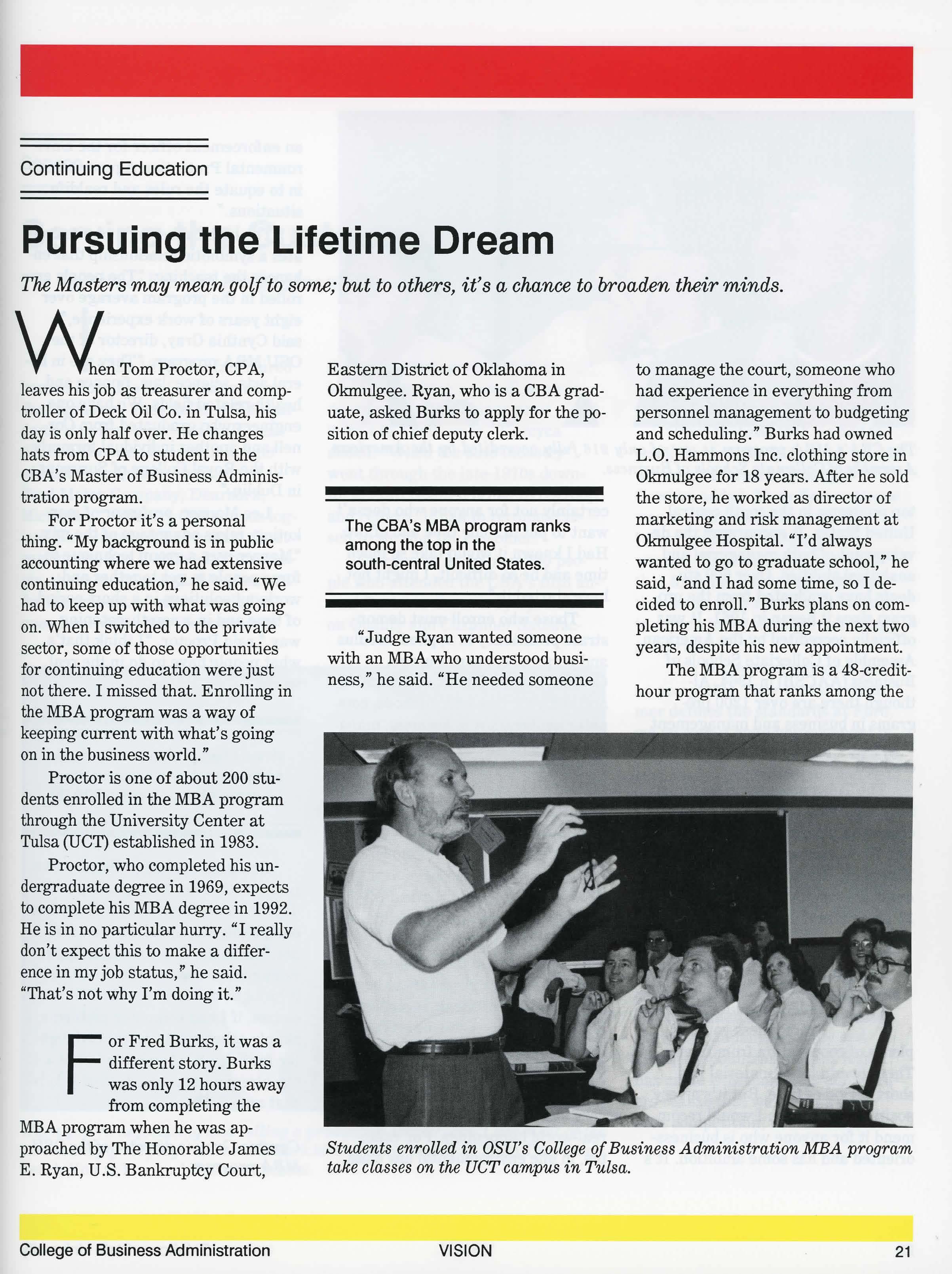
Proctor is one of about 200 students enrolled in the MBA program through the University Center at Tulsa (UCT) established in 1983.
Proctor, who completed his undergraduate degree in 1969, expects to complete his MBA degree in 1992. He is in no particular hurry. "I really don't expect this to make a difference in my job status, 11 he said. "That's not why I'm doing it."
For Fred Burks, it was a different story. Burks was only 12 hours away from completing the MBA program when he was approached by The Honorable James E. Ryan, U.S. Bankruptcy Court,
Eastern District of Oklahoma in Okmulgee. Ryan, who is a CBA graduate, asked Burks to apply for the position of chief deputy clerk.
The CBA's MBA program ranks among the top in the south-central United States.
"Judge Ryan wanted someone with an MBA who understood business," he said. "He needed someone
to manage the court, someone who had experience in everything from personnel management to budgeting and scheduling." Burks had owned L.O. Hammons Inc. clothing store in Okmulgee for 18 years. After he sold the store, he worked as director of marketing and risk management at Okmulgee Hospital. "I'd always wanted to go to graduate school," he said, "and I had some time, so I decided to enroll." Burks plans on completing his MBA during the next two years, despite his new appointment. The MBA program is a 48-credithour program that ranks among the
Students enrolled in OSU's College of Business Administration MBA program take classes on the UCT campus in Tulsa.
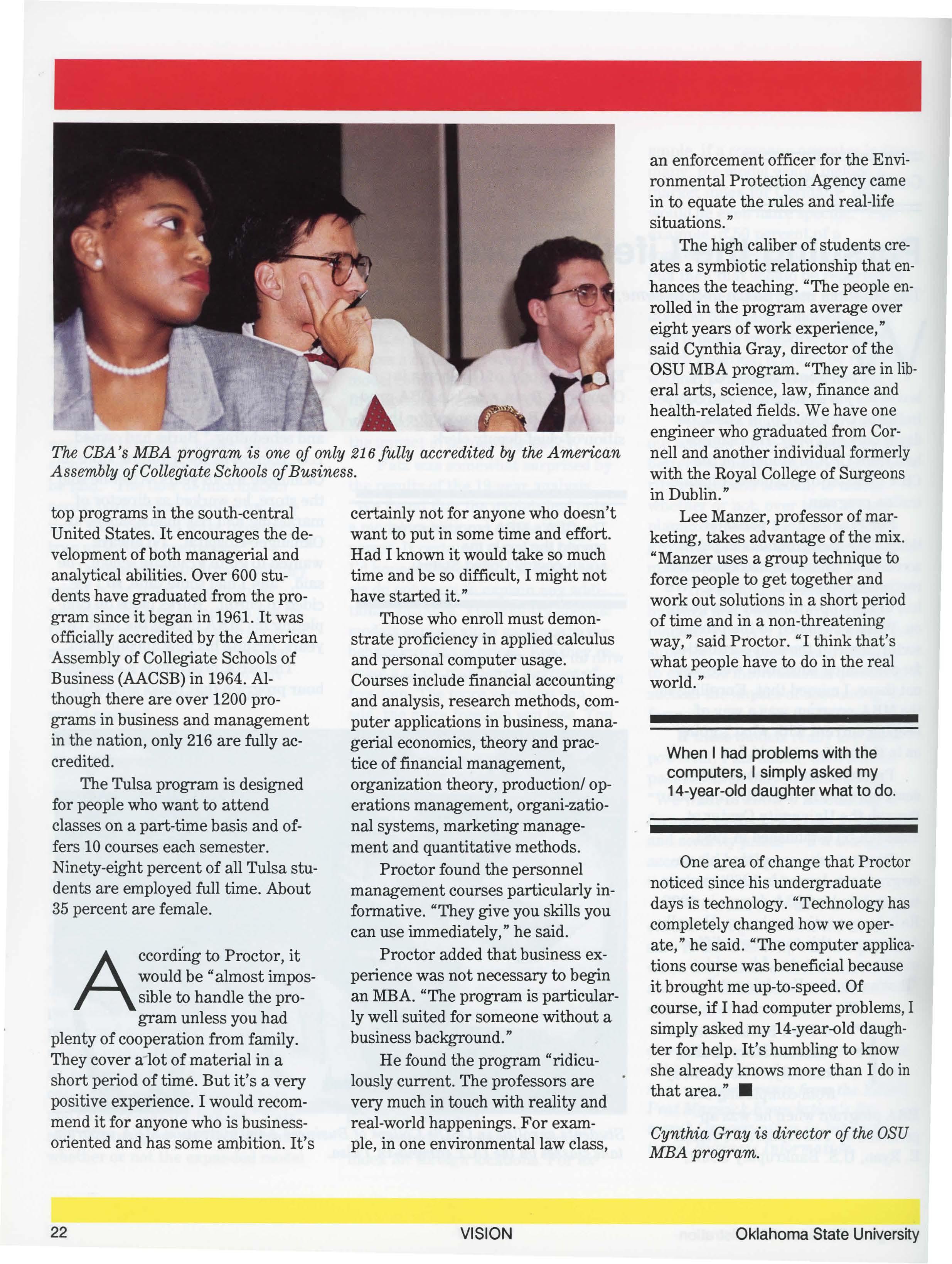
The CBA's MBA program is one of only 216 fully accredited by the American Assembly of Collegiate Schools of Business.
top programs in the south-central United States. It encourages the development of both managerial and analytical abilities. Over 600 students have graduated from the program since it began in 1961. It was officially accredited by the American Assembly of Collegiate Schools of Business (AACSB) in 1964. Although there are over 1200 programs in business and management in the nation, only 216 are fully accredited.
The Tulsa program is designed for people who want to attend classes on a part-time basis and offers 10 courses each semester.
Ninety-eight percent of all Tulsa students are employed full time. About 35 percent are female.
Accordfog to Proctor, it would be "almost impossible to handle the program unless you had plenty of cooperation from family. They cover a-lot of material in a short period of time. But it's a very positive experience. I would recommend it for anyone who is businessoriented and has some ambition. It's
certainly not for anyone who doesn't want to put in some time and effort. Had I known it would take so much time and be so difficult, I might not have started it."
Those who enroll must demonstrate proficiency in applied calculus and personal computer usage. Courses include :financial accounting and analysis, research methods, computer applications in business, managerial economics, theory and practice of financial management, organization theory, production/ operations management, organi-zational systems, marketing management and quantitative methods.
Proctor found the personnel management courses particularly informative. "They give you skills you can use immediately," he said.
Proctor added that business experience was not necessary to begin an MBA. "The program is particularly well suited for someone without a business background."
He found the program "ridiculously current. The professors are very much in touch with reality and real-world happenings. For example, in one environmental law class,
an enforcement officer for the Environmental Protection Agency came in to equate the rules and real-life situations."
The high caliber of students creates a symbiotic relationship that enhances the teaching. "The people enrolled in the program average over eight years of work experience," said Cynthia Gray, director of the OSU MBA program. "They are in liberal arts, science, law, finance and health-related fields. We have one engineer who graduated from Cornell and another individual formerly with the Royal College of Surgeons in Dublin."
Lee Manzer, professor of marketing, takes advantage of the mix. "Manzer uses a group technique to force people to get together and work out solutions in a short period of time and in a non-threatening way," said Proctor. "I think that's what people have to do in the real world."
When I had problems with the computers, I simply asked my 14-year-old daughter what to do.
One area of change that Proctor noticed since his undergraduate days is technology. "Technology has completely changed how we operate," he said. "The computer applications course was beneficial because it brought me up-to-speed. Of course, if I had computer problems, I simply asked my 14-year-old daughter for help. It's humbling to know she already knows more than I do in that area."
Cynthia Gray is director of the OSU MBA program.
Serving the Customer Is Always Right
The difference between things gone wrong and things gone right can be entire worlds apart.
In the 1970s the fair-hffired boys of Ford Motor Company were the engineers. They defined the standards by which a car was built, explained Thomas Gorcyca, manager of Customer Quality Research at Ford Motor Company, Dearborn, Michigan. "In theory that sounds logical. But engineers know little about consumers, and it showed. For example, they set the acceptable standard for the amount of effort needed to open a car door. But the consumer
did not always agree with their ideas. Something as small as a car door sounds like a minor point - but it isn't to a consumer," Gorcyca added. "When the auto industry went through the late-1970s downturn, Ford realized it had to regroup and refocus. It had to recommit itself to serving the customer."
Gorcyca spoke to over 200 people who attended the CBA's fifth annual Business Growth Symposium on Quality and Customer Satisfac-
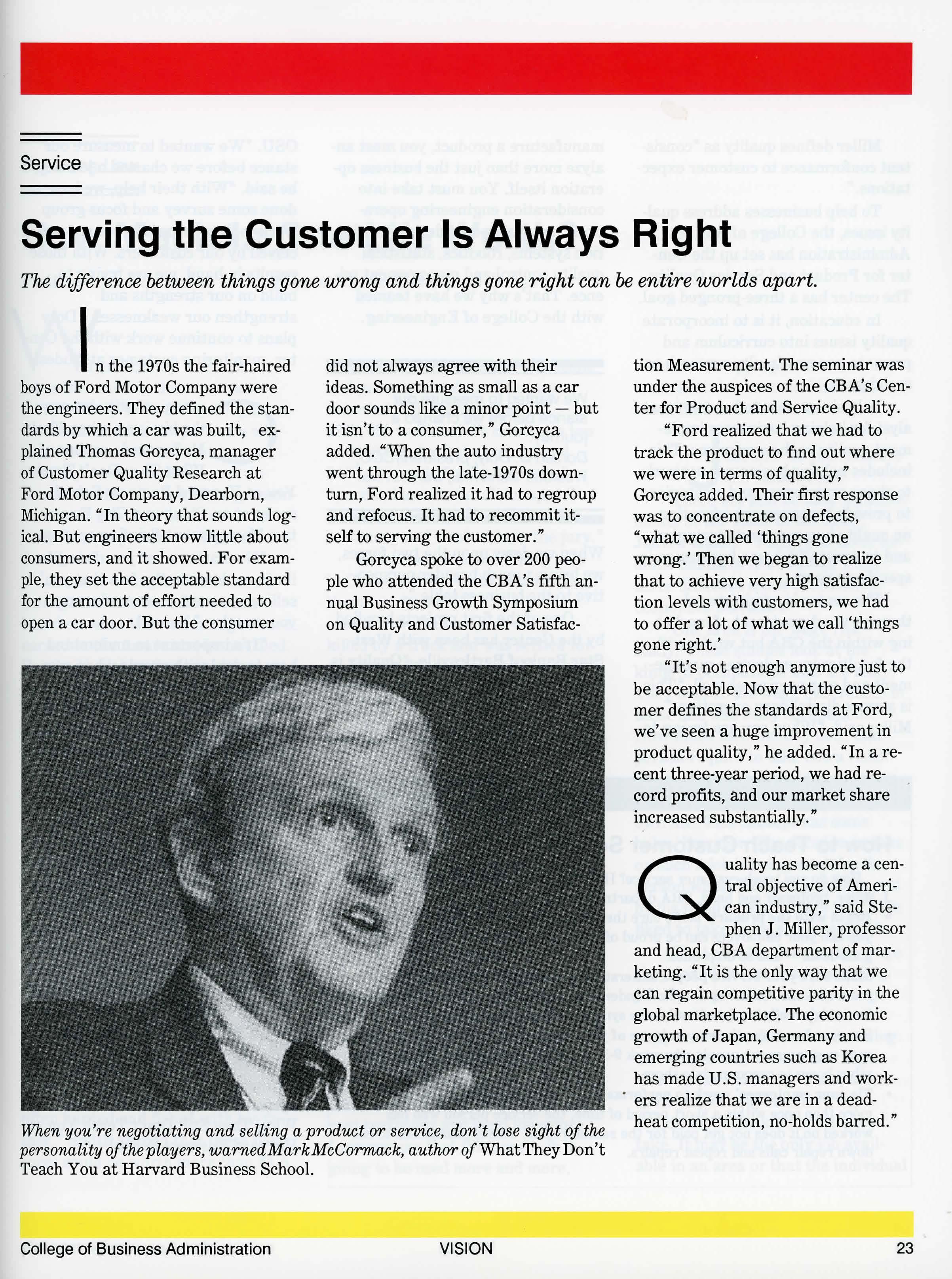
When you're negotiating and selling a product or service, don't lose sight of the personality of the players, warnedMarkMcCormack, author of What They Don't Teach You
tion Measurement. The seminar was under the auspices of the CBA's Center for Product and Service Quality.
"Ford realized that we had to track the product to find out where we were in terms of quality," Gorcyca added. Their first response was to concentrate on defects, "what we called 'things gone wrong.' Then we began to realize that to achieve very high satisfaction levels with customers, we had to offer a lot of what we call 'things gone right.'
"It's not enough anymore just to be acceptable. Now that the customer defines the standards at Ford, we've seen a huge improvement in product quality," he added. "In a recent three-year period, we had record profits, and our market share increased substantially."
Quality has become a central objective of American industry," said Stephen J. Miller, professor and head, CBA department of marketing. "It is the only way that we can regain competitive parity in the global marketplace. The economic growth of Japan, Germany and emerging countries such as Korea has made U.S. managers and work• ers realize that we are in a deadheat competition, no-holds barred."
at Harvard Business School.
Miller defines quality as "consistent conformance to customer expectations."
To help businesses address quality issues, the College of Business Administration has set up the Center for Product and Service Quality. The center has a three-pronged goal. In education, it is to incorporate quality issues into curriculum and promote general faculty research on such issues.
In business, it is to become a catalyst for helping businesses implement quality in the workplace. This includes helping businesses network to share experiences and strategies, to provide management education on quality improvement strategies and to assist Oklahoma businesses in specific projects.
The center is administered through the department of marketing within the CBA but works with the faculties in production management and engineering as well. "This is a cross-disciplinary operation," Miller said. "When you are trying to
manufacture a product, you must analyze more than just the business operation itself. You must take into consideration engineering operations such as product design, production systems, robotics, statistical quality control and management science. That's why we have teamed with the College of Engineering.
We wanted to measure our stance before we charted a journey.
Donald D. Doty, president/COO, WestStar Bank n.a., Bartlesville.
When we draw upon the two forces, we bring a much broader perspective to the business table."
One of the first projects handled by the Center has been with WestStar Bank of Bartlesville. "Quality is a major concern for us," said Donald D. Doty, president and COO ofWestStar. Doty is a 1950 graduate of
How to Teach Customer Service
How do you teach customer service?Here are four basic steps from Stephen J. Miller,professor and head, CEA department of marketing:
• Begin with the product.Make sure the product that you carry is one that you and your employeescan be proud of. If it keeps being returned, morale goes down - and so do profits.
• Makesureyour servicepeopleunderstandthe product.That means they must own one. That way they willunderstand the problems.They willbecome more technicallyexpert - and more sympathetic to the customer.
• Set yourhoursfor the convenienceof your customers,not yourselves.If your customers are people who work 9-5, make sure you're open weekends or other hotrrs to accommodatethem.
• Tie your employees'work to performance.When somethingis returned more than once within a short period of time, the service person who has worked on it does not get paid for the secondrepair. This is guaranteed to cut down repair calls and repeat repairs.
OSU. "We wanted to measure our stance before we charted a journey," he said. "With their help, we have done some survey and focus group work to determine how we are perceived by our customers. With those results in hand, we are trying to build on our strengths and strengthen our weaknesses." Doty plans to continue work with the Center, monitoring customer attitudes.
Customer attitudes were the big issue when Mark McCormack, author of What They Don't Teach You at Harvard Business School, spoke at an Oklahoma City Executive Management Briefing session.
"No matter what you do in life, it comes down to the fact that you're selling yourself, your product or your service," he said.
"It's important to understand how to deal with people when you conduct negotiations. But how you maintain your relationship after the contract is negotiated is equally important. That's where the real work begins. You have to understand what the dynamics of that relationship are.
"If you don't deal with the very tangible issue of personalities, you as a businessperson are going to have a very difficult time delivering your services."
Thomas Gorcyca is manager of Customer Quality Research at Ford Motor Company, Dearborn, Michigan. Stephen J. Miller is professor and head, CBA department of marketing. Mark McCormack is chairman of The International Management Group. His latest book is What They Still Don't Teach You at Harvard Business School.
Oklahoma State University
How Much Is One Life Worth?
Putting a dollar val'Ueon happiness is the latest "leapin law.
wen Stanley V. Smith takes the stand in the courtroom, there is likely to be a major legal battle. Smith is not a lawyer but a witness-for-hire. And he's out to see that jury awards increase, not decrease. Smith, who is a Chicago economist and a former investment adviser, is a proponent of "hedonic damages."
In most wrongful death cases, damages to survivors have been based on what the victim might have earned in the future had he not died. But Smith claims that people are worth more than what they earn. "Hedonic damages are payments based on the intrinsic value of life, not just a person's ability to earn a paycheck," said Joe Jadlow, CBA professor of economics.
"Smith has even suggested that the intrinsic value of life in general could be as high as $12 million," Jadlow added.
The hedonic damages theory gained momentum in 1985 in a federal civil rights suit in Illinois. "Smith did income calculations on a 19-year-old, Ronald Sherrod, who was killed by a Joliet policeman. Witnesses showed that he had a secure future in the family garage business, but he was also a 'kind, loving and companionable youth,' who often hunted and fished with his father." Smith argued that these pleasures could be worth more than $1.5
million, based on available academic and government data. The jury awarded hedonic damages of $850,000 to Sherrod's estate, on top of $300,000 for lost earnings and $450,000 to his family for loss of "parental association." An appealscourt panel complimented Smith's testimony as "invaluable to the jury."
Lawyers in a police killing suit in Ohio credited Smith with helping them win $3.5 million. A Florida case involved a two-year-old girl killed by a truck and was settled for a high six-figure amount after Smith's testimony.
The value of your life may be calculated in the future by how much you pay for a fire extinguisher or a smoke alarm.
"Smith's plea is not an emotional one," Jadlow explained. "Instead, it is based on economic analysis. He includes hypothetical values of human behavior as well as government research. That's where economics comes in."
The concept has been endorsed by the American Trial Lawyers Association and is being reviewed in current textbooks and legal literature. Lawyers say that this approach is going to be used more and more,
whether it's appropriate or not. At least 36 states have now had such cases filed in their courts.
Just how do you measure the value of life?
"There are still no easy measurements of the value of life itself," J adlow added. "Those who favor hedonic damages are drawing from three different kinds of studies in economics literature.
"One area is the wage risk study. These studies look at the kinds of occupations that are risky. They look at the wage differences in these and less risky occupations. How much more money does that person require to take extra risks? From this information they extrapolate a value that a person puts on his own life. This concept has some •holes, however. The decision to take on such a job is being made by the person whose life is in jeopardy, not by his family. That person may have liked to take risks; some people do.
"That greatly changes the wage they would demand to take a risky job. Some jobs have multiple negatives - that is, they may be both risky and dirty, such as coal mining. The wages may reflect two negatives rather than one. Then, too, some people may not have any choice about the kind of job they take. It may be the only job available in an area or that the individual
is qualified for. In that case the ' wage differential may have nothing to do with how they value their life."
second type of data used to support hedonic damages is the consumer market study. "This involves trying to measure an individual's perception of safetywhat he is willing to do or pay for that safety," Jadlow explained.
A"For example, consumers buy smoke detectors and fire extinguishers because they believe such devices will reduce the probability that they will die in a fire. Suppose an individual pays $100 for a smoke detector. Suppose we can demonstrate that the smoke detector reduces the probability of his dying in a fire to one in 1,000. In economics that translates
Cases relating to hedonic damages have already been filed in courts in 36 states.
to 111000thof a life. In other words that individual perceives his life to ' be worth the cost of the smoke detector divided by the change in probability - or $100 + 1/1000 = $100,000.
"Here lies another problem," said Jadlow. "Most people don't know or think about the probability factor. Some have.suggested using insurance statistics to calculate probability; but that produces a generality. It may have nothing to do with how the person perceives the change in probability. It grows more complex if you consider how many people are in the household since the dollar cost, theoretically, should be divided among household members.
"There are other factors that may also figure into the purchase. For example, advertising, peer pressure or reduced insurance ratesnot just safety - may have had some effect upon the purchase."
Athird area used to provide data is contingent valuation studies. "Researchers prepare a set of questions about hypothetical situations. The answers then could be used to determine probability factors. The advantage to such a study is that it can be controlled. The disadvantage is that they are hypothetical, and as such, the results can be questioned. After all, it's not a real life-threatening situation.
"About five years ago, a study was done in Britain and reported in the Econ<YmicJournal. The issue had to do with what people were willing to pay to reduce the probability of being involved in a road accident. What they discovered was that the people really did not understand the changes in the probabilities implied by the questions. That made the results questionable, at least in estimating the statistical value of a life."
Jadlow said that such studies have some value, particularly in public project analysis to determine how to allocate limited government budgets among alternative projects. Some studies have been conducted for that purpose, and the Environmental Protection Agency uses the contingent valuation studies as estimates. Economists at regulatory agencies use them in cost-benefit studies of safety regulations. The values can also be used to determine if there is negligence in product liability or medical malpractice litigation.
J adlow sees a bigger flaw in all of this. "These studies may measure how much an individual values his own life. But they do not measure how much the spouse, parent or child values that life. There's no reason to think that the value that the living person placed on the
Laws in most states provide no support for the hedonic damages concept.
decedent's life is the same as what it was to the decedent. There may not be any real correlation. About the only way you can get at a spouse's value is from a contingent valuation study."
The basic concept is taking heat from some economists, including Paul Rubin, former chief economist of the Consumer Product Safety Commission, and an economic consultant in Washington. Rubin claims first that there is no way to compensate the victim (who is dead). Therefore, any compensation will neither serve the same purpose as prevention nor will it benefit the same party.
Second, Rubin says, it is inappropriate to transfer wealth to families of victims. The laws in most states provide no support for the hedonic damages concept. Most wrongfuldeath statutes and relevant common law focus on the real money losses when they put a value on the person's life. "One thing forcertain," J adlow added, "this is just the beginning of the courtroom fight."
Joseph J adlcrwis CEA professor of econ<Ymics.
Breaking the International Market Barriers
Hw one young entrepreneur "learnedpersi,stence and humility in the international marketplace.
Bob Austinlay on the floor of an airport in Colombia in sweltering heat, faking sleep while perplexed customs officials hovered over him. Mosquitoes played tic-tactoe on his arms and neck. He could almost smell the South American jail that might be his if he made the wrong move. At that moment he was not sure who was going to win.
It was 1982 and Austin's oneyear-old company, Helicomb, needed business. A lot of his work repairing helicopter parts had been tied to the oil industry. The drop in oil prices had hurt, and he had to find more business. South America looked inviting, "mainly because it cost less to get there," Austin said. But he was not prepared for the initial welcome. "No ohe had told me that it was a small market and difficult to penetrate.
"When I arrived in Colombia, the customs officials told me that my visa wasn't in order. I would have to return to Guatemala. I had to do something," he said. "But what? There didn't seem to be much I could do. So I figured maybe nothing would work. I told the customs agents that I was tired and had no money. There was no place to sit so I lay down on the airport floor and pretended to go to sleep. I could tell they were watching and they really didn't know what to do with me. At this stage, there was no way that I was going to move. It was a stale-
BobAustin, president of Helicomb International, braved mosquitoes and suspicious customs officials to get into the international market.
mate. Two hours later they informed me that my visa was in order and I could proceed to my hotel.
"After all that, I came back empty-handed."
Today, Helicomb's international business is going strong. But Austin said it took a great deal of patience, persistence and hard work. "It's additional business, but some people never go after it because it is difficult and expensive," he said. "In the U.S. you can do business without ever seeing a customer. But in international business, they demand to see your face. With for-
Every executive who has been in business very long has tales of trying to meet payroll. It seems to go with the territory.
eign clients the friendship is sometimes stronger than the business relationship. But the two go hand in hand."
Austin learned to sleep in airports and on airplanes. "There's a natural excitement working the international markets, and that can sustain you for about four hours at each stop. On some of my first international tours I bought what they called a round-the:world ticket. It was less expensive; and if you scheduled it right, you only had to spend seven nights in a hotel on a twoweek tour."
The roots of Helicomb go back to Austin's home town of Altus when Austin was 11 years old.
Helicomb has grmvn to three divisions: aircraft structures manufacturing, helicopter overhaul and commercial airline overhaul.
"One day a man in a green flight suit came into my father's clothing store where I was working," he said. "Altus was an air force town. He was the lead pilot for the Thunderbirds, and he brought back three more pilots to buy clothes. Three weeks later I received a framed picture of the flying Thunderbirds with all of their autographs." The picture still hangs in his office at Helicomb. That became the inspiration for Austin's desire to become a pilot. He was only 14 when he flew his first airplane. He earned his pilot's license while he was enrolled in OSU's College of Business Administration during the 1970s.
"After I graduated from OSU, I went to work in my father's clothing store," Austin said. "But I decided to move to Tulsa where I worked two years for an aerospace company." Austin wanted something more, and in the process of looking for another job, aerospace executives told him that there was a specific need for a company to r~pair crash-damaged helicopter structures, particularly those used by the
petroleum industry. "They even offered to help me start a new company and let me run it," he said. "Several said that they would find someone else to start up a company if I didn't take them up on the offer. "I did a lot of soul searching," he said. At the time, Austin's parents were close to retirement. They remortgaged their house to provide him with start-up capital. "As soon as we opened the door, before we had any equipment in place, the business started coming in." Austin •worked from five in the morning
Helicomb has been on Inc. Magazine's list of the 500 fastest growing companies in America for two years running.
until midnight. "I lost 20 pounds in the company's first year, and I've never gained it back."
Like most businesses with limited start-up capital, there were several shaky Mondays following Friday paydays. "For the first year and
one-half,we were very dependent on client payments. One Christmas Eve, we handed out the paychecks and let everyone go home early. My administrative assistant and I sat looking out the window, wondering out loud what would happen. The checkswe had just given the employThe key to success in the international market is maintaining a healthy respect for the individuals you deal with, their nationality, their customs and their expertise, no matter how different they are.
ees were no good. There was nothing in the bank. Would the employees come back after Christmas? An hour later, the mail came. In it was an envelope from a company that owedus a large sum but from which we had been unable to collect. The envelope contained more than enough to cover payroll."
By 1985 Helicomb had grown to 45 employees. The company was manufacturing helicopter replacement parts for the U.S. Army. They found themselves with orders for helicopter replacement parts for six months ahead. The increased backlog of orders gave Austin the opportunity to purchase additional equipment, hire more employees and expand Helicomb's international markets. The number of employees grew from 45 to 80.
In 1987 he.began a new division to overhaul composite structures for the airline industry. Helicomb clients cover the Far East, Middle East, Europe and South America. In-
ternational sales totaled $500,000 in 1986, but they jumped to $2.5 million in 1989. Total sales were $8 million. The company now has 135 employees and a 77,000-square-foot facility. Austin was named 1988 Oklahoma Small Businessman of the Year. That year Helicomb showed up 319th on the Inc. Magazine list of the top 500 fastest growing companies in America, with 950 percent growth from 1983 to 1987.
The company has three divisions: aircraft structures manufacturing, helicopter overhaul and commercial airline overhaul. The company's forte is the assembly of lightweight aluminum and composite aircraft structures with honeycomb bonding. A flexible material is molded into a honeycomb pattern that is bonded to an airplane's aluminum or composite skin to provide strong, lightweight rigidity to the part.
Helicomb's latest invention is a fuel-capturing system for Bell helicopters. "The helicopter was under fire by the EPA," said Austin. "It dumps a pint of jet fuel each time its engines are started or shut down. Our system design catches this fuel and returns it to the fuel tank. This is a solid market since there are about 2,000 Bell helicopters in service around the world."
Austin cautioned American business people to learn a little patience when they are in a foreign country. "You are there to establish a relationship. Overseas executives can always wait you out on a business deal. On many first-time trips to a prospective overseas client, there's very little business discussed. Most of your trip consists of tours of facilities and introductions to the personalities involved. When
Helicomb has designed a fuel-capturing system for Bell helicopters that will save jet fuel.
you return home you follow up with correspondence. That's when you can introduce your capabilities and equipment. At that time, you may be lucky and receive an invitation to visit the client again. "The keys to successful business on an international basis are to be very humble and very persistent," Austin said. "Transportation and language barriers can be big problems. The important thing to keep in mind is that .overseas countries demand respect of their nationality and their capabilities. I remember • one Far East executive who thought it was funny that Americans would come to his country and try to teach him business. 'We have 2,000 years of experience in trading,' he told me. 'Americans have only 200 years.'"
Bob A us tin graduated from the CBA in 1976. When he wasn't soaring through the clouds, Austin was busy as president of Sigma Alpha Epsilon Fraternity.
Meeting a New World Economy
The handwriting i,son the wall, says an internationally recognizedeconomi,st.
America must make some large fundamental changes if it wants to be even reasonably competitive in the world economy now and in the twenty-first century, according to Dr. Lester Thurow, economist and dean ofM.I.T.'s Sloan School of Management.
"If we here in the U.S. expect to compete in the world economy, we need to change some basics," Thurow said. "American kids go to school 180 days a year, German kids go 220 days and Japanese kids go 240 days. What's the chance your kid is going to be able to compete against Japanese and German kids? Not very good."
American kids go to school 180 days a year; Japanese kids go 240 days. What's the chance your kid is going to be able to compete against Japanese kids?
In addition to the education problems facing this country, Thurow said U.S. companies need to start investing more dollars in civilian research and development. "We here in the U.S. invest only 1.6 percent of GNP Jn research and development. The German§ spend 2.6 percent of their GNP, and the Japanese spend 2.8 percent."
According to Thurow, the present strategies of U.S. companies
call for a totally different direction. "U.S. companies are too inward. Company strategies need to be much more outward-looking. We do not need to copy what the foreign companies are doing, but we do need to be watching what they're doing. We don't have to produce the same results in the same way, but we need to look at their process. The U.S. must develop a system that will not only put us ahead of foreign competition but keep us in a position of prominence."
Thurow sees the U.S. in a "catchup-and-get-back-in position." U.S. companies did not do the necessary things to stay ahead of foreign competitors. "We're now behind in development and manufacture of machine
tools, and we're virtually out of the electronics market." The recent maneuvering in the Bush administration on the issue of high-resolution television, he said, is a prime example of our government struggling to get our country back into the huge electronics market.
Thurow's economic prescription for Oklahoma could also serve the U.S. as a whole. "Oklahoma needs to change fundamentally. Its prosperity has been based on natural resources, but that will no longer work. Oklahoma isn't competing with Texas anymore. That may be true in football, but it doesn't work economically. Oklahoma is competing with Korea, Japan and Hungary. Oklahoma needs an outsider who can objectively see its pluses and minuses. You have to be realistic as • to what those are then work on strengthening your minuses."
Thurow expects the twenty-first century to be even more competitive. "Oklahoma needs to worry about the education of its noncollegebound people," he said. "Oklahoma needs to ask itself how to get its technical sophistication up to the levels of the rest of the world. And Oklahoma also has to determine how to get savings and investment up to the levels we now see overseas."
Lester Thurow is an economist and dean ofM.I.T.'s Sloan School of Management.
Economist Lester Thurow chided Americafor lax attitudes toward education, research and devel<Ypment.
How America Can Regain Its Stature
wn Henry Kravis talks about the economic future of America, he does not bombard with a depressing litany of economic failures or dire predictions of the collapse of American economic power. Instead he quotes Will Rogers: "It don't take much to ·see that something is wrong, but it does take some eyesight to see what will put it right again."
As a pragmatist he recognizes both the problems and the opportunities. The "key to the continued resurgence of the U.S. economy lies within the character of Americans themselves and with the rediscovery and melding of two great American traditions: entrepreneurship and ethics," he said.
Kravis, a native Tulsan, is founding partner of Kohlberg Kravis Roberts & Co., the New York firm that engineered the RJR Nabisco buyout, the largest LBO ($25 billion) in corporate history. At a Tulsa Business Forum earlier this year, he emphasized that "America has come perilously close to losing the very characteristics which have made the nation great - individual initiative, personal independence and the willingness to take risks."
According to Kravis, many of the ills afflicting U.S. business and industry today are the result of our "being trapped in a powerful pincer movement that has been slowly squeezing the economy and threatening to engulf us. On the one side, the
America has beenshowingsigns of an advancedcaseof corporateand government sclerosis,a condition brought on by increasingly suffocatingand rigid bureaucracies,said Henry K ravis, a native Tulsan and founding partner of Kohlberg Kravis Roberts & Co.But there's plenty of hope,he adds.
globalization of national economies relentlessly presses the economy, confronting businesses with daunting challenges and stiff competition. On the other flank, America faces a progressive loss of its economic flexibility, showing signs of an advanced case of corporate and government sclerosis, a condition brought on by
America has come perilously close to losing what has made it great - individual initiative, personal independence and the willingness to take risks.
increasingly suffocating and rigid bureaucracies." Bureaucracy in business, he added, "has done nothing less than destroy our competitive position in the world economy. As a general rule, as corporate bureaucracies expand, entrepreneurial attitudes become nothing but mere memories. The entrepreneurial arteries of American business have been hardening ever since World War II."
Kravis called for companies that are highly flexible and able to adapt rapidly to changes in the global marketplace. He wants to encourage a long-term view of businesses and to encourage that view among invest·ors, managers and employees. "We must find ways to reduce the intense pressure on managements to perform on a quarter-to-quarter basis. Companies have to stop sacrificing
their futures on the altars of the great god of immediate profit."
He called for Americans to increase capital investment, to invest in its own people and to create the right kinds of incentives for management and employees.
American CEOs have become what Kravis called "renters of the corporate assets," not owners. "They move through the ranks and eventually reach the top of the corporate hierarchy, never risking one red cent of their net worth in the ownership of their company. Too many feel it is a god-given right to be in their position, and so they feel quite comfortable living off the corporate assets, wasting and abusing those assets. Where are the Carnegies, the Mellons, the Morgans and the Vanderbilts of today? They were, in their day, the owners and builders of corporate assets, not mere renters."
Kravis calls for management to be given an ownership stake. "This puts control, ownership and management of a company in the same hands," he said.
Kravis is particularly concerned about business and ethics. "Our nation has a strong tradition that has made us unique in the annals of modern history. It is an idealism, a concern for ethical and moral behavior that has caused others to bill us as 'The hope of the world.'
"I do not believe it possible to exercise genuine leadership if the would-be leader is, or is perceived to be, unethical or immoral. Unethical behavior only saps the authority of a leader, rendering him impotent and trapping him in nothing more than a shell of power. Leaders, almost by definition, must be virtuous men. Most importantly, their virtues are instinctively recognized and appreci-
ated by those they lead, a recognition that comes without their striving for it.
"Ethical and moral action may well be more important for businessmen than for leaders in any other walk of life. Rightly or wrongly, the behavior of business is scrutinized by society more closely than any other segment. Although no part of society, except perhaps politicians, discusses and debates the question of ethics more frequently and vigorously than businessmen, the public remains unconvinced of business's willingness or ability to behave ethically. Blamed for a variety of ills,
Where are the Carnegies, the Mellons, the Morgans and the Vanderbilts of today - the owners and builders of corporate assets - men and women who are more than just mere renters?
business is viewed as putting profits above all else - above customers, employees, shareholders, the national interest and the environment. Because business is often regarded as without ethical underpinnings, businessmen have a difficult time convincing others that they possess one of the critical prerequisites for leadership: values or ethics."
In a study published in the Journal of Business Ethics in 1982, a business professor asked his students would they violate a law if they would gain $10,000. They reasoned yes; the chances of getting caught were slim; even if convicted, the fine would be $1,000. Thus the net profit would be $9,000 - and that was still good business.
"What is most remarkable about this account," Kravis noted, "is that
the students are not even talking about legal behavior that may be unethical but about illegal acts. Are we to draw our future business leaders from such a pool?"
Kravis called on business leaders to identify a value system for their organizations and uphold it throughout the company. The system must permeate all operations and affect every decision. True leaders "should ask themselves two simple questions each time they are confronted with a decision which requires a moral judgment:
"1. Do I want the principle guiding this act to be a universal law for human behavior? In other words, what would it be like if everyone did .the same thing? and
"2. With this act am I treating people as if they have intrinsic value or merely as a means to accomplish my own ends?
"Having posed these questions and answered them, a leader has placed himself on firm ethical ground, which is an irreplaceable precondition for genuine entrepreneurial leadership.
"Without a firm moral foundation, entrepreneurial activity is _ doomed to be short-lived. Rightthinking people will - and shouldturn away from narrow economic egoism. They will lose faith in a system that encourages individual initiative, at the price of winking at ethical infractions and failings. And if efforts to create an economic environment in which individual innovation flourishes falter, then the U.S. does indeed run the very real risk of slipping into an economic decline."
Henry Kravis is a native Tulsan and founding partner of Kohlberg Kravis Roberts & Co., New York.
Tools to Manage Technology and Innovation
Can we improve technology and how we use it? Our economic lives may depend upon it.
Managing technology may be 1..hekey to unlocking the door to America's economic success, according to Wayne Meinhart, professor and head of the CBA department of management. "This is a key issue of contemporary concern," he said. "Being able to weigh the choices and make appropriate decisions about technology have become such a complex process that it has generated a new field - MTI, management of technology and innovation.
"Here is a need that has developed suddenly," Meinhart said. "It's so new it's still not well-defined or universally recognized. But it involves the management of the processes of technology development, implementation and obsolescence. It includes research and development of technology, managing the technology, managing with technology and managing people who are affected by technology. We define technology as the knowledge, tools, techniques and actions to transform organizational inputs into outputs," he added.
"When companies had one mainframe used only by research and development or one minicomputer used by the accounting department, there was not much of a problem. Today, where-almost everyone has some type of system setting on his or her desk, it's become a major concern."
Being able to use it well means understanding some disciplines that cut across old academic departmental lines. MTI links engineering, science and management disciplines. It is used to plan, develop and implement technological capabilities in an effort to reach an organization's goals.
Meinhart maintains that all firms manage technology, but some are more effective than others. "A firm that does not develop a plan for
The CBA's Center for Management of. Technology and Innovation received a seed grant from the National Science Foundation to develap projects with researchers and business partners.
technology management is still managing it, just not very well. In fact, technology may be managing them."
Ten years ago there were companies asking themselves whether they wanted to purchase computers. Many did so only to leave them setting in corners gathering dust because no one could really figure out how to use them. "Today the problem is not so much if but how, when and why," Meinhart said. "It's no longer enough to be able to purchase technology. Now we've got to know which technology and for what uses. We must understand our employees' strengths, weaknesses and their jobs - how we can incorporate that technology with those factors in mind. We must understand how to incorporate it into the manufacturing process or service process. On top of this we must understand its effect upon the end product and the pricing."
In an effort to meet those needs, the CBA has set up the Center for Management of Technology and Innovation. The center is operated in conjunction with the College of Engineering, Architecture and Technology (CEAT). "The Center is designed to help Oklahoma businesses enhance their competitive positions in the marketplace, both now and in the future," said Meinhart. "It uses the faculty of
both colleges. They will provide a central link for research, education and service aimed at speeding development, adoption and effective use of new technologies in Oklahoma organizations.
"We will need a joint effort from industry and universities to define an appropriate program and put it in place. Even within the universities, it's going to cut across departmental and college lines.
"We see two major functions within the Center," Meinhart explained. "The first area deals with the product - managing the technology itself; the second with the process - managing with the use of technology.
"When we look at technology management, we are talking about the product - how to speed new ideas to market, how to develop new products and divest ourselves of old ones, how to integrate systems, how to attain a balance between technology and other key factors in strategic management.
"On using technology to manage, we're talking about such issues as developing expert systems in forecasting, technology forecasting and environmental scanning, improving physical distribution systems through expert systems and developing artificial intelligence for information flow analysis."
The center received a seed grant from the National Science Foundation. The goal is to develop projects with researchers and business partners. Several projects have already been targeted.
* A research project currently underway deals with the use of information and information technology as competitive weapons or strategic tools. Using information available from PC Week, Ramesh Sharda, pro-
fessor, department of management, and Margaret A. White, assistant professor, department of management, are analyzing how companies use their microcomputer resources. "A preliminary study indicates that companies are still using microcomputers in the least sophisticated way - to gather and process information that can be used as a competitive weapon," said Sharda. "It is used far less for strategic application of information, although this is the most sophisticated area."
* A study is being conducted on the relationships and attitudes between the organization and the individual during technological innovation. "Technological innovation involves complex change within an organization," said Debra L. Nelson, associate professor, department of management. Using a university library as a basis for study, researchers are examining how the system technology is put in place and how individuals relate to the changes.
* The flow of information will be analyzed, using an expert, or artificial intelligence, system. "We want
to apply artificial intelligence technologies to bridge the gap between the information system and the decision makers," said Ramesh Sharda, who is working on the project. "Our research suggests that how information is presented - whether it is tabular, in graphs, summarized or in detail, depends on two factors - the task itself and the individual decision maker. For example, if the individual is working in the planning area, an outline or summary might be appropriate in beginning stages or initial presentations; but a detailed report may be needed at another point."
Sharda hopes to produce a prototype expert system that will include a knowledge base to help professionals determine which methods ought to be used at which times. "When the right format is used, better managerial decisions can be made and performance is improved," he said.
* The Center is designing an expert system to enhance engineering design in conjuncticm with Tulsabased Purolator Products Company. "Essentially, Purolator is acting as an industriat laboratory," said Meinhart. "We're hoping to create a network of expert systems that will enable the engineering designer to gain access to expertise he would not normally be able to touch." The "suite of expert systems" is known as ESNED (Expert System Network for Engineering Design). "The first step is to improve productivity by integrating different design activities into the system. The designer will be able to move freely between the various engineering design tasks - conceptual design, evaluating alternatives, simulation, sizing, etc. The network will provide a structured environment for improved design decisions using design history and rapid
searching and checking of alternatives.
"It will also expand and expedite the flow of information throughout the firm," said Sharda. "This will shorten product design cycles and improve decision making." The two-year project includes an indepth analysis of the design-related strategic information flow. After that, a prototype expert system network will be created and installed and evaluated in a major engineering design project. The performance of ESNED will be carefully studied and refined.
"Once we are satisfied," explained Sharda, "then we will generalizethe structure so that it can be installed quickly at other manufacturing firms." The project is being sponsored both by Purolator and the Oklahoma Center for Advancement of Science and Technology (OCAST) Center for Integrated Design and Manufacturing, which provided a major cost-share grant to support the research. Sharda presented a paper on the project at the Oklahoma Symposium on Artificial Intelligence and at the 1990 International Neural Network Society meeting in Washington, D.C.
"We think this arrangement is the forerunner of the future," said Joe Cochran, manager of corporate technology management at Purolator. Cochran is also co-principal investigator on a N atiQnal Science Foundation grant under the Private Sector Partnerships to Improve Math and Science Education Program. The "Project TLC: Transformed Learning Center" is a fouryear pilot study-to investigate a restructured high school classroom environment where students proceed at their own pace, outside the time-in-grade time-in-class concept,
Endowed Chairs Improve Education
The Oklahoma legislature passed a bill in 1988 to provide state funds to match private gifts for the establishment of endowed chairs and professorships at Oklahoma universities. The objective of this legislation is to attract and retain quality faculty who are critical to the continuing development of higher education in Oklahoma. Eleven endowments have been funded in the CBA. These individuals and organizations have gone a long way in taking the first steps to help the state move toward its goal of excellent education:
• The Ardmore Chair in Business Administration
• Arthur Andersen & Co. Centennial Professorship in Accounting
• The Associates Chair in Business Administration
• Tom and Edna Mae Carson Centennial Professorship in Business Administration
• Conoco/DuPont Chair in Technology Management
• Kerr-McGee Chair in Accounting
• Noble Foundation Chair in Marketing Strategy
• Oklahoma Bankers Association Chair in Commercial Bank Management
• Oklahoma Gas & Electric Company Chair in Regional Economic Analysis
• School of Accounting Alumni Professorship
• Wilton T. Anderson Chair in Accounting
One such chair is the Conoco/DuPont Chair in Technology Management. Conoco Inc., Ponca City, a subsidiary of DuPont, began funding the Conoco/DuPont Chair of Technology Management in 1989. The total grant is $250,000 and will be matched by $250,000 in monies provided by the Oklahoma legislature. "This is a significant investment and show of faith in our programs," said Wayne Meinhart, professor and head, department of management. "Because.faculty salaries have traditionally been so low, we have lost very fine professors to other states and to business. The chair allows us to create a position that helps us attract and keep very fine people. That means that our students are taught by some of the best minds available."
Conoco and Du-Pont have nearly 4,000 people working in the two companies. Together, they employ 700 OSU graduates. "Both Conoco and DuPont are in high-tech businesses," said Gene Thomas, vice president and regional coordinator for Conoco. "The oil industry is a technology industry. Ponca City is the central research group and headquarters for research and development. Conoco is in the petroleum and refining business. They have the largest refinery in the state. The Ponca City operation is the largest research/development/computer/telecommunications operation in the world. DuPont has been in the forefront of synthetic fibers - nylon, dacron and teflon.
"The success of our companies depends on continued technological development," Thomas said. "That's one of the reasons we felt the chair was appropriate. It's important that we keep a close working relationship with the deans and professors in the various disciplines. We want them to know about our needs, and we want to be able to recruit good people. By working together, we are able to hire some of the best and brightest graduates in Oklahoma."
using state-of-the-art technology for instructional delivery. The project began in September 1989 at Jenks High School, Jenks, Oklahoma. It is still in its initial stages, but teachers and students are enthusiastic.
* The College of Business Administration and the College of Engineering, Architecture and Technology are working in tandem with Conoco representatives. One key factor to the program is the Conoco/ DuPont Chair of Technology Management, which will be filled in 1991.
There is a real "synergy" in the partnership concept, according to Meinhart. "The Center is extremely important because it links OSU colleges in joint projects with industrial partners. This is a model for a new generation of projects. We think it holds great promise."
Meinhart stressed that the projects are not just "traditional academic research. I would go so far as to say this is a prototype of a new family of arrangements that we hope to replicate elsewhere with other business partners."
Only when all these diverse aspects of technological development are managed effectively will the U.S. economy regain its position of international leadership in technology and its applications.
Wayne Meinhart is professor and head of the CEA department of management. Ramesh Sharda is professor, department of-management. Margaret A. White is assistant professor, department of management. Debra Nels on is associate professor in the CEA department of management.
Countries and governments are finding it impossible to stop the flCYWoffacts and news to the outside world, according to Thomas Curley, president, USA Today.
Media Still Evolving
If you think there's too much choice in media now, take a look at what's coming, said Thomas Curley, president, USA Today, at a CBA Tulsa Business Forum earlier this year. Curley said that the opportunities for choice for consumers of both print and broadcast media will increase during the next decade. Consumers will be able to select exactly what they want in print or electronic media. Times will be tougher, however, for traditional television networks. "People are willing to pay for cable choices to get around current programming," he said. Curley expects that this may also hold true for newspapers as more business and technical publications enter the market. "Look for companies to take the opportunity to combine both print and electronic media," he said. "And expect to find it harder to stop the flow of facts and news. It's not going to be as easy to manipulate or control news in a country as it once was," he said.
And an Order of Cheese Fries to Go, Please
Who could ask for a better advertising spokesman than the President of the United States? Not Stan Clark, who found his Stillwater business the center of presidential humor. At the OSU commencement, U.S. President Bush explained that he was sorry that Barbara Bush could not be with him, then he added that she told him to "go get a beer and cheese fries at Eskimo Joe's." She asked him to bring back Eskimo Joe's T-shirts for the grandchildren. Clark, a CBA graduate, has launched an international business with his man-and-dog logo. His T-shirts can be seen from Hong Kong to Philadelphia. He has his own mail-order catalog and operates two other restaurants in Stillwater.
America is well-fixed for human and natural resources, said Marshall Loeb, managing editor of Fortune magazine, at a CEA Oklahoma City Executive Management Briefing. But expect shortages of labor in Europe and Asia. Loeb also said that third-world debt will becomea major economic influencer during the 1990s.
Faculty with a Mission
Robert L Sandmeyer, Dean Jeanine N. Rhea, Associate
Anne Gleason, Assistant Margaret A. White, John T. Bale, Associate Professor Professor Assistant Professor Dean Andrew L. Urich, James F. Jackson, Jr., Charles R. Williams, Assistant Professor Associate Professor Assistant Professor Accounting Economics
Timothy L. Krehbiel, Rick L. Wilson, Assistant Lanny G. Chasteen, Ronald L. Moomaw, Assistant Professor Professor AlumniProfessor and
Ronald K. Miller, Marketing Head, School of Accounting Professor and Head, Dale E. Armstrong, Department of Economics Associate Professor
Stephen J. Miller, Associate Professor Lee C. Adkins, Assistant John A. Polonchek, Professor and Head, Patrick B. Dorr, Professor Professor Associate Professor Department of Marketing R. Dan Edwards, Assistant Orley M. Amos, Jr.,
W. Gary Simpson, Gary L. Frankwick, Professor Professor, OBA Chair of Assistant Professor Professor Commercial Bank
Richard Germain, Lawrence H. Hammer, Michael J. Applegate, Management Professor Assistant Professor Professor
John R. Wingender, Don Hansen, Professor Donald L. Bumpass, Associate Professor
James G. Hromas, Adjunct Associate Associate Professor and Janet I. Kimbrell, Professor and Director, Management Director, Business AssociateProfessor Center for Economic Wayne A. Meinhart, Extension Bud Lacy, Associate Education
Professor and Head, Ruth Haas Kreiger, Professor and Coordinator Kevin M. Currier, Department of Associate Professor of Graduate Programs in Associate Professor
Management L. Lee Manzer, Professor Accounting
Tabitha A. Doescher, Richard A. Aukerman, John C. Mowen, Professor
AmyHing-Ling Lau, Adjunct Associate Professor and Centennial Professor Professor Professor
Steve H. Barr, Associate of Business Administration GaryK. Meek, Professor Michael R. Edgmand, Professor Ajay S. Sukhdial, Visiting MaryanneM. Mowen, Professor
Nikunj P. Dalal, Assistant Assistant Professor AssociateProfessor
James R. Fain, Assistant Professor Joshua L. Wiener, DavidS. Murphy, Professor
Kenneth K. Eastman, Associate Professor Assistant Professor Mary Gade, Assistant Assistant Professor William G. Zikmund, KevinE. Murphy, Professor
Vance H. Fried, Assistant Professor AssociateProfessor
Joseph M. Jadlow, Jr. Professor
DennisH. Patz, Professor Professor
David C. Ho, Associate CharlesR. Ransom, Pauline W. K{eecky, Professor AssociateProfessor Associate Pro essor
Timothy C. Ireland, MichaelF. Thomas, Gerald M. Lage, Professor Associate Professor Assistant Professor
Kent W. Olson, Professor
Marilyn G. Kletke, T. Sterling Wetzel, Richard W. Poole, Regents Associate Professor
VISIONMagazine is a Assistant Professor Distinguished Service
Chalmer E. Labig, Jr., service of Oklahoma
John H. Wilguess, Professor Associate Professor State University's Professor
Edward 0. Price, III, Hon-Shiang Lau, Regents Collegeof Business Administration.It is Charlotte J. Wright, Associate Professor Professor designed to bring our AssociateProfessor
Andreas Savvides, Debra L. Nelson, Associate many constituents the Administrative Services Assistant Professor Professor latest informationin
Joe W. Fowler, Professor Joseph Shaanan, Professor G. Daryl Nord, Professor business and education. of Business Law and Head, Frank G. Steindl, Regents
Jeretta A. Nord, Associate Editor: Rudy I. Greer. Department of Professor Professor Publisher: The Blakey Administrative Services
Larkin B. Warner, Jay Aram Ramanathan, Group, Tulsa, OK.
James M. Jackman, Regents Professor Assistant Professor For information: Associate Professor
Keith D. Willett, Associate
Tipton F. McCubbins, Professor
Ramesh Sharda, Professor Collegeof Business
Faye L. Smith, Assistant Administration, Assistant Professor , Finance Professor OklahomaState
Gregory C. Mosier, Janice W. J adlow, Thomas H. Stone, University, Stillwater, Associate Professor OK 74078-0555
Dennis L. Mott, Professor Head, Department of J. Scott Turner, Professor Zane K. Quible, Professor Finance
Associate Professor and Professor 405/744-5064.
Join the Partnership
Oklahoma State University's College of Business Administration is seeking a few good men and women with outstanding vision who want to join with us as we move toward the twenty-first century.
Forward-thinking companies know that an investment in education is an investment in the future of the company and the community, for it is these graduates who will become tomorrow's business leaders.
Through a wise investment in the educational leaders of today, we can create the leaders of tomorrow. Yet it takes more than tax dollars to bring men and women with wisdom and experience into our classrooms. •
The College of Business Administration's Priority: Excellence Program helps attract quality professors who can teach and lead our young people and who provide a resource to the business community.
If you would like to make a difference today - and tomorrow - call The College of Business Administration (405) 744-5064.