




THE NEW GIRLS IN TOWN

ANDREA RILEY &
The Official Magazine of OSU Athletic s



It’s hard to believe spring is almost here. Our student-athletes have worked hard all winter and have represented Oklahoma State University well. The wrestling program continues to position itself among the elite teams across the country. The men and women’s basketball teams are nearing the end of their Big 12 seasons and looking toward Kansas City and the conference tournament. The equestrian team is competing at a high level and has several key victories this season.
The fi nal two POSSE magazines of the year will shift focus to our spring sports. Our baseball, softball, track, tennis and golf programs are poised and ready to represent OSU and make all of us proud. Believe it or not, spring football is right around the corner and will culminate with the spring game on April 12. I hope all of you reading this will attend OSU athletic events this spring and help influence the outcome in our favor. Arrive early. Wear Orange. Make some noise.








With “March Madness” right around the corner and our basketball teams battling for NCAA Tournament berths, I’d like to address an important topic: gambling.
Although gambling has become a common part of our culture, many of the activities in which you, your friends, and colleagues participate in would not be permissible for student-athletes under NCAA regulations. Placing a bet on any collegiate or professional sporting event is a violation of NCAA rules. However, are you aware that it is also impermissible for our student-athletes or athletic department staff members to simply provide information to someone who uses the information to gamble?
As “boosters” of Oklahoma State, you can support our studentathletes, our university, and the compliance staff by being aware of the rules surrounding gambling. Student-athletes encounter many day-to-day temptations that are outside the boundaries of NCAA rules. You can help alleviate some of these temptations by eliminating opportunities where our studentathletes may be enticed to engage in illegal gambling activities.
Simply put, here is what the NCAA rule precludes for studentathletes and athletics department staff:
• NO wagers on ANY professional or college sports event, even those that don’t involve OSU.
• NO sports “pools or brackets,” (that charge a fee to participate) even those run by friends.
• NO fantasy leagues.
• NO Internet gambling on sports events.
• NO sports wagering using “800” or “900” numbers.
• NO exchange of information about an OSU team with ANYONE who gambles. In other words, no information about injuries, new plays, team morale, discipline problems, or anything else.
POSSE DIRECTOR
Jason Penry EVENT COORDINATOR Brandon Armstrong
PUBLICATIONS COORDINATOR
Clay Billman
PREMIUM SERVICES
Karyl Henry
DIRECTOR of UNIVERSITY MARKETING Kyle Wray
DESIGNER
Paul Woodard
CONTRIBUTING WRITERS
Clay Billman,Travis Tindell, Matt Elliott, Kevin Klintworth, Tyler Moss, Wade McWhorter, Kyle Fisher
Stephanie Boese
EDITOR-IN-CHIEF
DIRECTOR OF PHOTOGRAPHY Phil Shockley
The Oklahoma State University Athletic Department would like to thank John Clerico for his vision and dedication to our athletic programs. His generosity has made POSSE magazine possible.
Fantasy leagues, March Madness brackets, and bookkeepers are all prevalent, but these seemingly innocent social activities may turn to higher bets and bigger risks. In addition, the Internet has made it extremely easy for anyone to place a wager on intercollegiate and professional sports. Gambling over the Internet is just as dangerous as traditional gambling. Student-athletes are often risk-takers as are gamblers, which is why some student-athletes are often attracted to gambling. Unfortunately, this commonality causes gamblers to view student-athletes as an “easy mark.”
The consequences of gambling are serious and not worth the loss of eligibility for our student-athletes. Heightened awareness of the dangers of all forms of gambling is the best defense. Educating our student-athletes and our boosters prepares both to make good decisions. Help student-athletes avoid these temptations. Be sure to seek help from the athletic department if you have questions or concerns, especially if you observe members of our community engaging in activities that may violate NCAA rules.
As always, we appreciate your support!
Ben Dyson Assistant Athletics Director
for Compliance
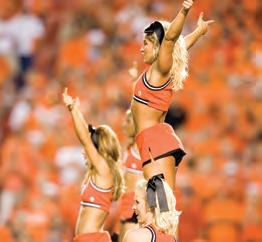
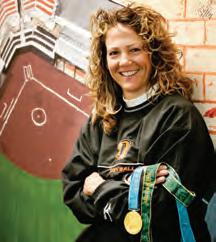
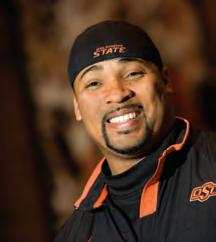
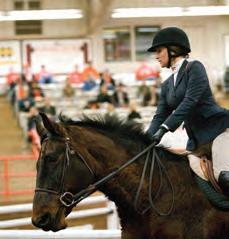
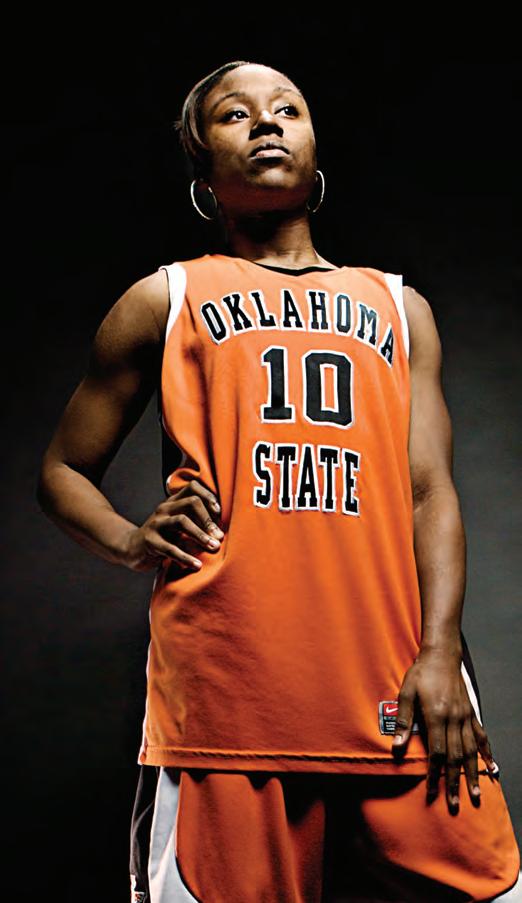
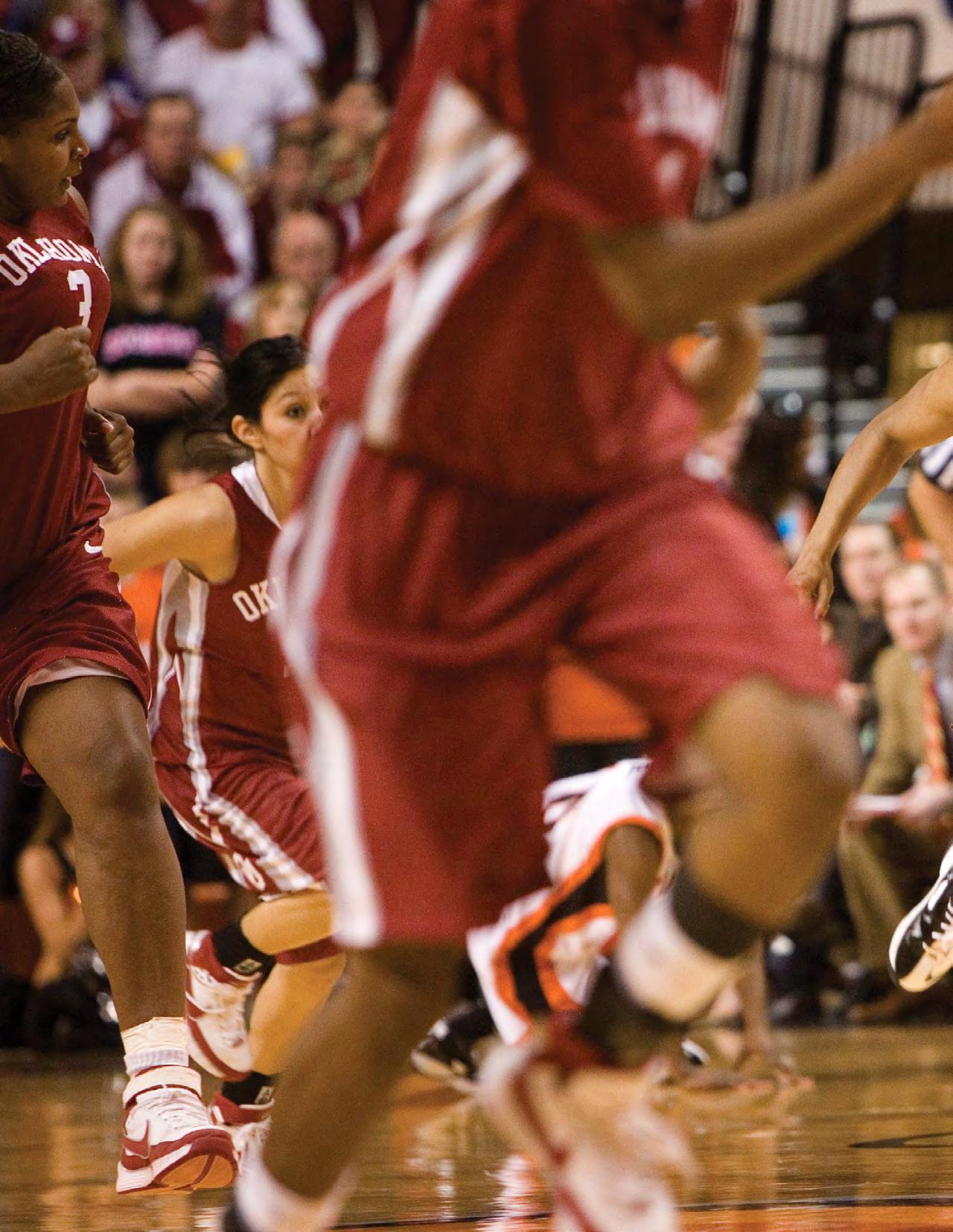
photo by GARY LAWSON

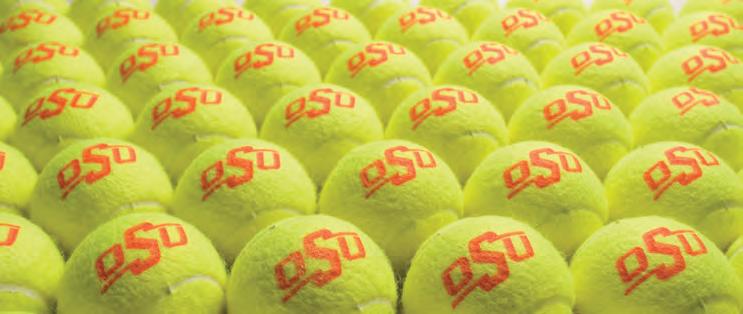
As Oklahoma State’s men’s tennis team approaches the 2008 season, the Cowboys are looking to build on the momentum established in 2007 – a year that head coach


James Wadley calls one of the most memorable in his time in Stillwater. That statement carries a lot of weight, considering the ‘07 season marked the coach’s 35th year at the helm of the program.


In 2007, the Pokes shot up the rankings, topping off at No. 7 in the polls as they garnered 19 wins on the season against only
school’s most storied programs.
One of the keys for the Pokes heading into the 2008 season, and one of the main reasons for their succe ss in ’07, is sophomore standout
five losses. The most impressive part of the Oleksandr Nedovyesov. The Alushta, Ukraine,
season was a seven-match win ni ng streak in which Wadley’s crew outscored its oppo-
native exploded onto the scene with arguably one of the best freshman seasons in NCAA his-
nents 40-4. The Pokes entered the NCAA tory. The 6-3, powerful right-hander stormed his
Tournament as a No. 8 seed and picked up a win over Sacramento State in the fi rst round before beating in-state rival Oklahoma to advance to the Sweet 16, where they were eliminated by top-ranked UCLA. Wadley was named the Central Region Coach of the Year, as he reached the 600-win milestone along the way.
Wadley’s 35-year stint has been packed with seasons much like the 2007 campaign. In his illustrious career, the legendary coach has been named the Central Region Coach of the Year four times, captured C onference Coach of the Year honors eight times, and has brought home 12 conference titles. Perhaps the most i mpressive acc omplishment in the coach’s historic tenure is that in his 35 seasons, Wadley has fi nished with a losing record only three times.
"The 2007 team has to rank as
way to a team-high 19 victories while starting every match at No. 1 singles for the Pokes.
Nedovyesov’s efforts didn’t go unnoticed as he was named the Central Region Rookie of the Year and the Central Region player to watch, as well as being named co-Big 12 champion at No. 1 singles and being a unanimous all-Big 12 selection in singles and doubles.
Wadley says for a player to have that kind of freshman season at this level is remarkable.
“We have had kids come in and do well, but for him to come in last January and do the job he did is an incredible compli ment to him, his abilities and his work ethic,” says Wadley. “I’ve
occupies the No. 3 singles spot and Wadley believes the sophomore is on the brink of joining Nedovyesov and Puchkarov in the ranks of the country’s best.
“Petrov is another sophomore who played well last year,” says Wadley. “We are hoping to see (he and Nedovyesov) jump up. Your second year is usually the year you make a big jump. If he does, he will be one of the elite players in the country.”
Nathan Byrnes, whose older brother, Daniel, played a major role for the Pokes in 2007, showed great signs last year and looks to contribute as a junior.
Another crucial piece of the program that may go overlooked at times is Wadley’s assis-
tam coach, Yevgen Bondarchuk. The Kiev,
Ukraine, native is now in his fourt h year a s a coach in Stillwater and has already been named the Centra l Region assistant coach of the year.
Before becoming a coach, Bondarchuk enjoyed a two-year career with the Pokes in which he helped lead the team to back-toback NCAA Tournaments, including a trip to the Sweet 16 in 2003. Wadley, along with his players, recogn izes how important his assistant coach is, particularly in the area of recruiting.
“Yevgen has been the region’s assistant coach of the year and he has done a great job
for me in recruiting," says Wadley. "The play-
ers like to have him on the court in the heat of battle. But his main strength is recruiting. He is arguably one of the best recruiters in the country as an assistant coach.”
“We had a lot of good things happen last year. It makes you excited about what could happen this season.”
one of the top two we have ever had,” says Wadley. “It may be the best, as far as rankings. We have had some awfully good teams that fi nished pretty high, but we have never had two players fi nish in the top 30. Win ning individual Big 12 titles at No. 1 and 2 singles is pretty i mpressive.”
“At one point, senior Ivan Puch ka rov was ranked No. 3, which is the highest we have had a player since Pavel Kudrnac. We had a lot of good things happen last year. It makes you excited about what could happen this season.”
Now, the Cowboys prepare to embark on the 36th year of the “Wadley era,” which ties him with legendary basketball coach Henry Iba for the longest tenure at OSU.
The team is looking to build on the momen-
tum stemming from last year’s suc ce ss and continue the wi nn ing ways of one of the
never seen a college freshman come in and do that, and we are very excited about the possibility of having him for three more years.”
Now a sophomore, Nedovyesov w il l be looked to as one of the proven leaders on a young but talented roster. He is by no means the lone bright spot heading into the season.
The Pokes return four letterwinners and three of
their top four singles players from a year ago. Ivan Puch ka rov, a Simfevopol, Ukraine, native and the Cowboys’ No. 2 player, is ranked in the preseason top 20 and appears poised for an outstanding senior season.
“Ivan showed last year what kind of player he is and he is coming off a solid fall season. We need him to continue to play at that level.”
Dmytro Petrov, a Kiev, Ukraine, native
Wadley’s squad as the year gets under way OSU brought in three new players this January. How quickly they can adjust and become assets will play a pivotal role in the Cowboys’ success in 2008
— Coach James Wadley
There is still a levelof uncertainty for "The problem is that when you bring
in three guys in January, it is almost like you are bringing in half of your team,” says Wadley. “You don’t know how the new guys will adjust and adapt.”
If they can get settled in and the proven players can mirror last season’s output, Wadley’s 36th season could be the most for getting the most out of his players as evidenced in 2003 when the Pokes climbed from 73rd to 19th nationally and advanced to the Sweet 16 of the NCAA Tournament.
memorable of them all. The coach has a knack
“Our season is kind of up in the air because three guys are new, but the four guys who retu rned have shown great promise. If the new guys w il l jump in and play
well, we will be a top-IO team. That is one of
our goals, along with competing for a Big 12 championship.”
Ty le r Moss
Richard Lindley
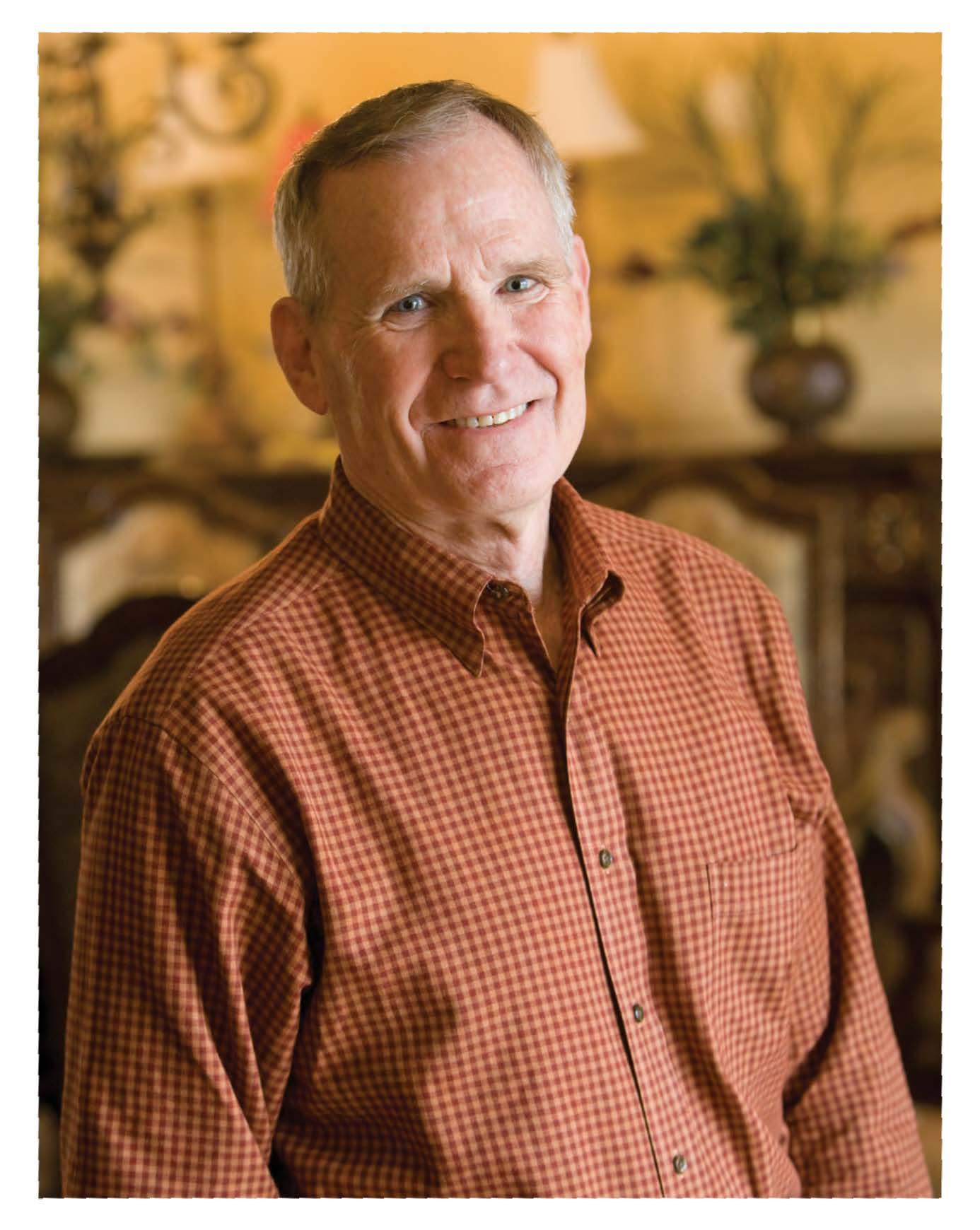
Though Richard Lindley had always been interested in science and math, it was ultimately a car that decided what he’d major in when he went to college.
He remembers a guy a few years ahead of him in high school in Savanna, Okla., who went away to college and then returned a few years later with an OSU engineering degree. He was driving a new red convertible.
"That kind of made an impression on
me,” says Lindley.
They'd spend their fall afternoons going to
OSU football games.
"The crowds weren't big," he says. "We
The sporting activities were always the event
didn’t win very many games, but we’d win some. We never beat OU while I was in school. here. It’s where all the students would go. It was a big deal.
"Gallagher-Iba? They call it rowdy now? I've
These days, OSU sports are what make guy just fell over on him and pinned him. The
an i mpression on Lindley, and he considers them his pastime.
“OSU sports are a hobby for me,” says Lindley. “I’ve always been a sports fanatic. My wife, Debbie, would say a sports nut. I’ve always enjoyed both watching and playing.”
As a young man growing up in Savanna, Okla., he played everything there was to play: football, baseball and basketball.
"They were the only sports we had at the
time,” says Lindley.
He rec eived a scholarship to play football – offensive guard – at Southeastern Oklahoma State in Durant.
“While there, I had all the intentions of coming to OSU and working on an engineering degree,” says Lindley. After a couple of losing seasons, he had had enough. “I decided it was time to get my education,” he says.
He packed up, went to Stillwater, and moved in with his brother.
“My brother was only a year ahead of me, so we were up here at the same time. We were both in engineering. Ted Davis, the e xtra point kicker for the football team at the time, was an engineering major with us.”
been in wrestling matches where the crowd was standing on the court around the mat. I was there when OU’s Dr. Death got beat. Our big place went wild.”
By 1963, Lindley graduated with a degree in industrial engineering and management and jumped straight into the oil and gas industry, landing his first job with Humble Oil and Refi ni ng Co. now Exxon.
Lindley worked in oil and gas for 36 years for five di fferent companies and lived in 13 different place s across the country. He moved his family back to St il lwater in 1999.
“We’ve always had an attachment to Stillwater,” says Lindley. “I’ve always been a fan of OSU sports and went to as many basketball, wrestling a nd football games as I could when I was here in college. When I wasn’t nearby, I’d always try to schedule a vacation so I could go to a couple of home games.”
When the Lindleys moved to St il lwater from Dallas, they bought a place la rge
enough for them to raise quarter horses. They
found out the man to call for advice is OSU equestrian head coach La rry Sanchez.
“He’s the quar ter horse expert around here,” says Lindley. Out of that, a friendship formed and through that friendship, a bond with the equestrian program.
"The program needs facilities," says Lindley. "They are currently in need of a barn. That's part of a special contribution we
made to the program. Larry has a plan. If he can get it done, we’ll have one of the nicest equestrian facilities in the country.
point averages. They are very impressive
“We already have the best programs. Coach Sanchez attracts quality young women to OSU. It blows my mind the number of young ladies on that team who have 3.5 grade young women.”
The Lindleys also have contributed to
the College of Engineering, Architecture and Tech nology and the music department, where Lindley’s son, Nick, is considering attending next year to obtain a music performance degree.
Since moving back, he and his wife bought season tickets to football, basketball and wresbasketball to the mix.
ding, of course. They have also added women's
“I’ll watch some of the baseball and softball games, too,” he says.
He and his wife, Debbie, also attend most of the equestrian matches and support the program with at tendance and donations.
by CORY CHENEY
“Being here, close enough to the university to see what’s going on is a draw to want to do something,” he says, “to be something other than a fan. Since moving to Stillwater, my wife and I have transformed from fans to suppor ters.
“We all have a little bit of pride in our school,” he says. “You want it to do well. It gains some notoriety through its sports prog rams. Not its essence, but it’s a means of recognition. I think OSU is headed in the right direction to be a top-quality university both academically and athletically.”
[Hometown] Monmouth Beach, N.J.
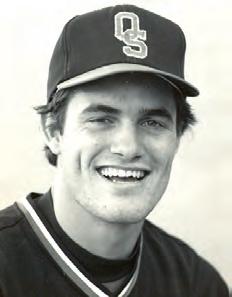
[Sport] Baseball (1981-84); four-year letterman as a pitcher; 20-6 career record; member of teams that won four Big 8 titles and four NCAA Regional titles; second round draft pick by the Cleveland Indians
[Degree] B.S. in Business Administration, 1996
[Current Residence] Westla ke, Ohio
[Family] Wife Susan (1983 OSU grad); sons Jeremy (21), Shane (18) a nd Luke (16).
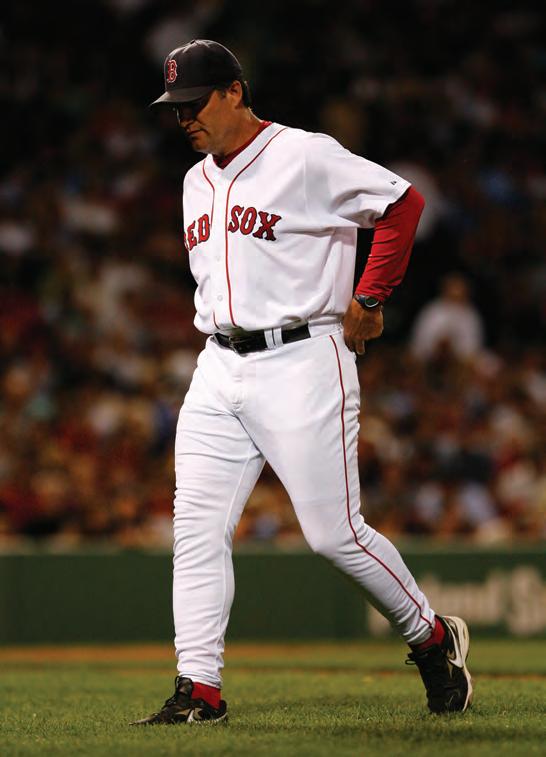
[Current Job] Pitching coach, Boston Red Sox (2007 World Series champions)
[Life after OSU] 13 years as professional baseball player (including ni ne years in the Major Leagues with Cleveland Indians, California Angels and Detroit Tigers); returned to OSU to fi nish degree in 1996; joined Cowboys coaching staff in 1997; named director of player development for Indians in 2001; became pitching coach for Boston Red Sox in 2007.
[Hobbies/ Interests] “Obviously, my family fi rst and foremost. All three of my sons play baseball, so my main hobby is keeping up with them. Baseball is not only a profession, it’s a passion.”
[Best OSU memory] trips to Omaha and the College World Series, also the relationships I “ ere’s not one single event – it’s making four bui lt with the many quality players and teammates who had so much success in their own right … not to mention marrying my wife. As a coach, if I had one day to point to, I would say w inni ng that doubleheader in Wichita to advance to the NCAA Super Regional in 1999.”
[What was your best game as a Cowboy?] “During my senior year (by far my best year at OSU), I was fortunate enough to throw a no-hitter against M issouri Southern, and had 15 strikeouts against Texas Wesleyan. I also threw a complete game shutout in the Regional against Texas A&M.”
[Do you keep in touch with former teammates?] “Yes, Mike Henneman and I talk regu la rly. Gary Green was my roommate in Iba Hall – he’s now managing in the Pirates organization … also Randy Whisler and Rob Walton.”
[T houghts about being an OSU student-athlete] “As I look at my career, I have to attribute a lot of my success to the impact OSU made on me, not only as a player but also as a person . and it st il l serves me today.”
[What did it feel like to win the World Series?] “It’s a dream come true . To realize that with people you respect and to have met those challenges, the feeling is something I’ll cherish forever.”
[What made you leave a promising front office job to put on the coaching uniform again?] “At the root of it, there’s st il l a competi-
tive fire. The feeling of being in the dugout is something that you
can’t replace. Even in my previous position, when I would walk through a dugout, it would always intrigue me. Terry Francona (Red Sox manager) and I were teammates in Cleveland in 1988, and even when he was with other teams we would work out in the off-season and forged a relationship.”
[What’s it like to coach such a talented and diverse group of pitchers like your Red Sox staff?] “It’s an eclectic group, with di fferent lev-
els of experience and accomplishments. The great thing is to work uation to be in. The underlying thread to all of it is building a
with such motivated and driven athletes. It is a very unique sittrusting relationship with each individual pitcher. Regardless of the status of an athlete, they all want direction and feedback on where they stand and how they can become better in what they do. You’ve got to have a message that is credible and one they can trust. You live with these guys for seven straight months, so they see your work ethic and trust the evaluation that’s given to them.”
[Do you currently follow OSU athletics?] “Absolutely – whenever either the basketball team is playing or the football team is on. I not only keep up with current teams, but for me, any time I watch an OSU game it brings back the years I spent as a player and coach and the memories of a time that had a great impact on my life.”
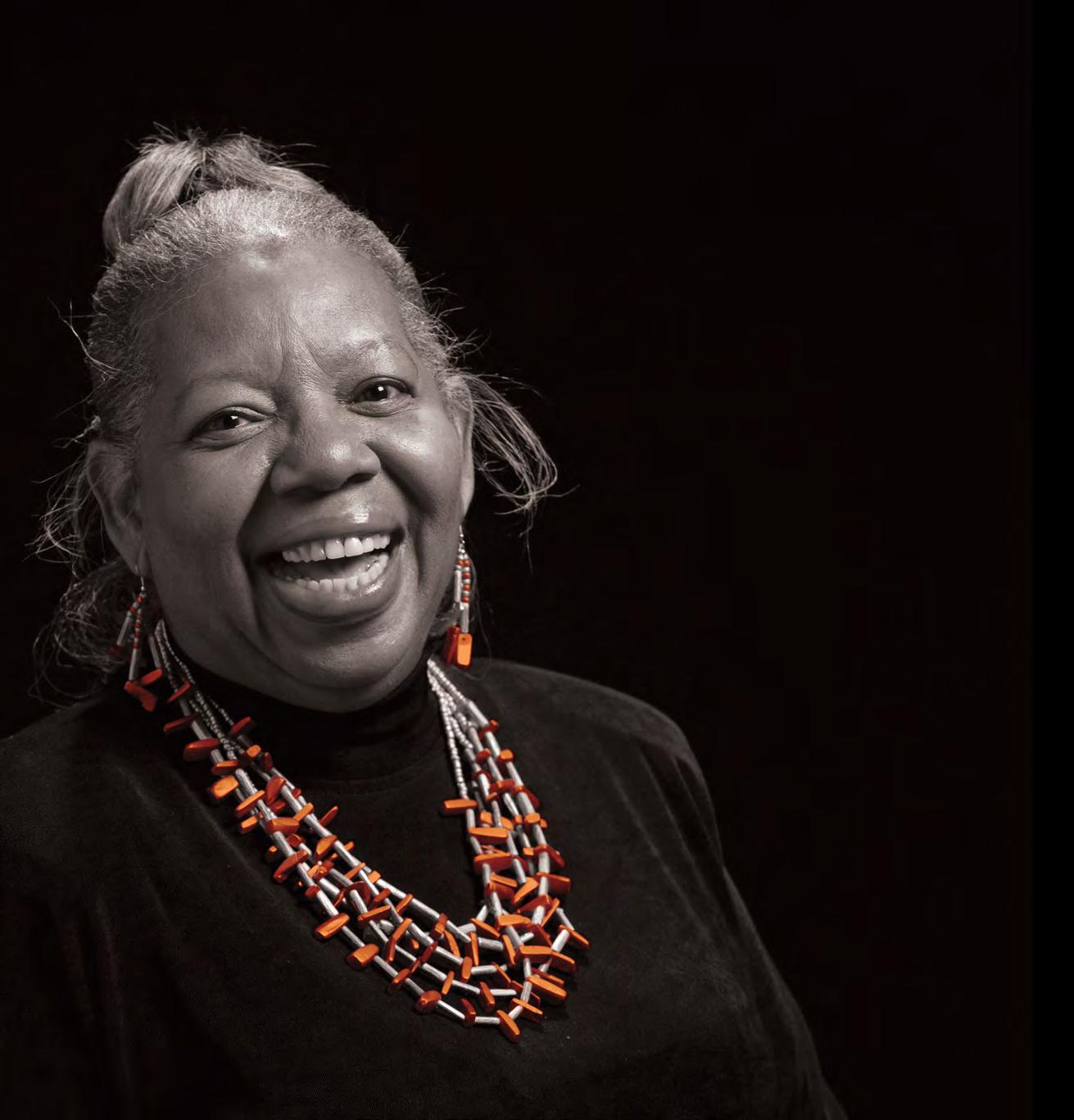
“My gift to the OSU Foundation is much more than giving to OSU the institution. It is a way for me to acknowledge the significant contributions colleagues/friends gave to OSU by helping prepare its students to be highly competent in their respective fields while at the same time bringing honor to the university and the college.”
• • • Dr. Katye Perry ’83 OSU Education Associate Professor

Philanthropists are changing our state and our students through their generosity. Read their inspiring stories of philanthropy, or submit your own, now at OSUgiving .com/whyigive.
What began in the fall of 2002 as the most ambitious fundraising initiative ever set for OSU Athletics emerged as the most successful single campaign ever executed by the university in terms of commitments made, dollars raised and achieved levels of unprecedented participation.
What many said could not be done was completed – and exceeded.
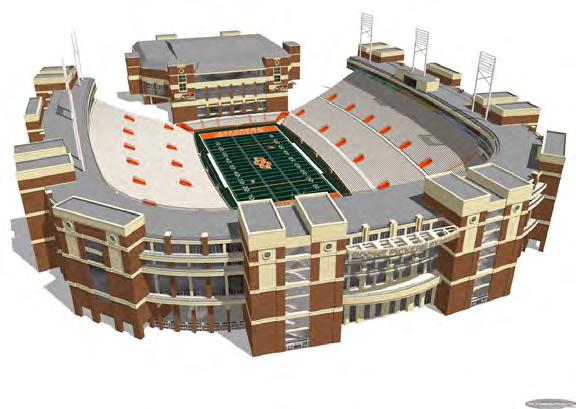
Five years after an $86 million challenge was extended, the collective efforts of Cowboy faithful confirmed enduring support for Boone Pickens Stadium, totaling more than $100 million dollars in gift, pledge, donor seating and student fee commitments. An unwavering demonstration of “Cowboy Confidence” is bringing OSU athletics to the Next Level.
More than 2507 donors made gifts and commitments of various sizes during the Next Level campaign, which ended in 2006. To date, 78 percent of those commitments have been paid; the balance of funds are on schedule (example: annual suite payments). Participation was as broad as it was deep, and the end result demonstrates fans have positioned OSU for even greater future success.
With a transformational $20 million pledge from alumnus Boone Pickens in 2003, the campaign began to gain momentum. Momentum that showed no signs of stopping. Momentum that reached a broadened pool of OSU donors who demonstrated steadfast support through donations ranging from $150 to multi-milliondollar gifts. Each dollar played a crucial role in
building one of the nation’s premier, state-of-theart collegiate facilities.
If you made a contribution to the stadium campaign, we genuinely thank you. You are part of the team converting an embarrassing 85-year-old stadium to a spectacular venue serving student-athletes, coaches and ticket holders. If you purchase season tickets, sit in donor seating or make annual contributions, we genuinely thank you. Your monies represent a large percentage of our $40 million annual athletic budget. We are working hard to make every dollar count in preparing our 18 teams to compete for conference and national championships.
Subsequent to starting the campaign with a generous lead gift, Boone’s record-breaking $165 million gift in December 2005 gave Athletics the funding to complete the west end zone and build top-rate sports facilities in a new Athletic Village. Boone Pickens Stadium, now totaling $284 million and scheduled for completion in 2009, will make every orange-blooded alumnus and Cowboy fan proud.
The Next Level Campaign was successful through the efforts of many individuals.
An impressive volunteer cadre helped shape the campaign, open doors, host parties and cultivate relationships.
Special thanks should be given to these individuals:
Burns Hargis Boone Pickens
Chuck Watson Ed K eller
James Halligan Jack Stuteville
Jon Wiese Rick Cooper
Nancy Payne Ellis Ross McKnight
Scott Verplank
Additionally, dedicated alumni and significant friends of the university bought into the vision and facilitated functions, meetings and parties in geographical areas. These important campaign leaders:
Tulsa: John and Lisa Schemmer, Steve and Diane Tuttle
OKC: Ha l and Kathy Brown, Carey and Carol Joullian
Stillwater: Calvin and Linda Anthony, Jonathon Drummond
Texas: Jerry and Rae Winchester, Derrick and Kim Bandelier, Roger and Kim Beecham/ Sha nnon Gracey Ratliff and Mi ller LLP
All involved parties including supporters, chairpersons, volunteer committee; geographic campaign chairs, administration and staff from Athletics, the Foundation and the President’s Office – should be congratulated on a focused approach and collaborative teaming during the campaign’s critical 5 year period.
With the groundswelling of support surrounding a first-rate football facility, quality coaches and Top 25 ranked recruiting classes, we are extremely excited about upcoming seasons.
The future is bright orange.
Craig Clemons
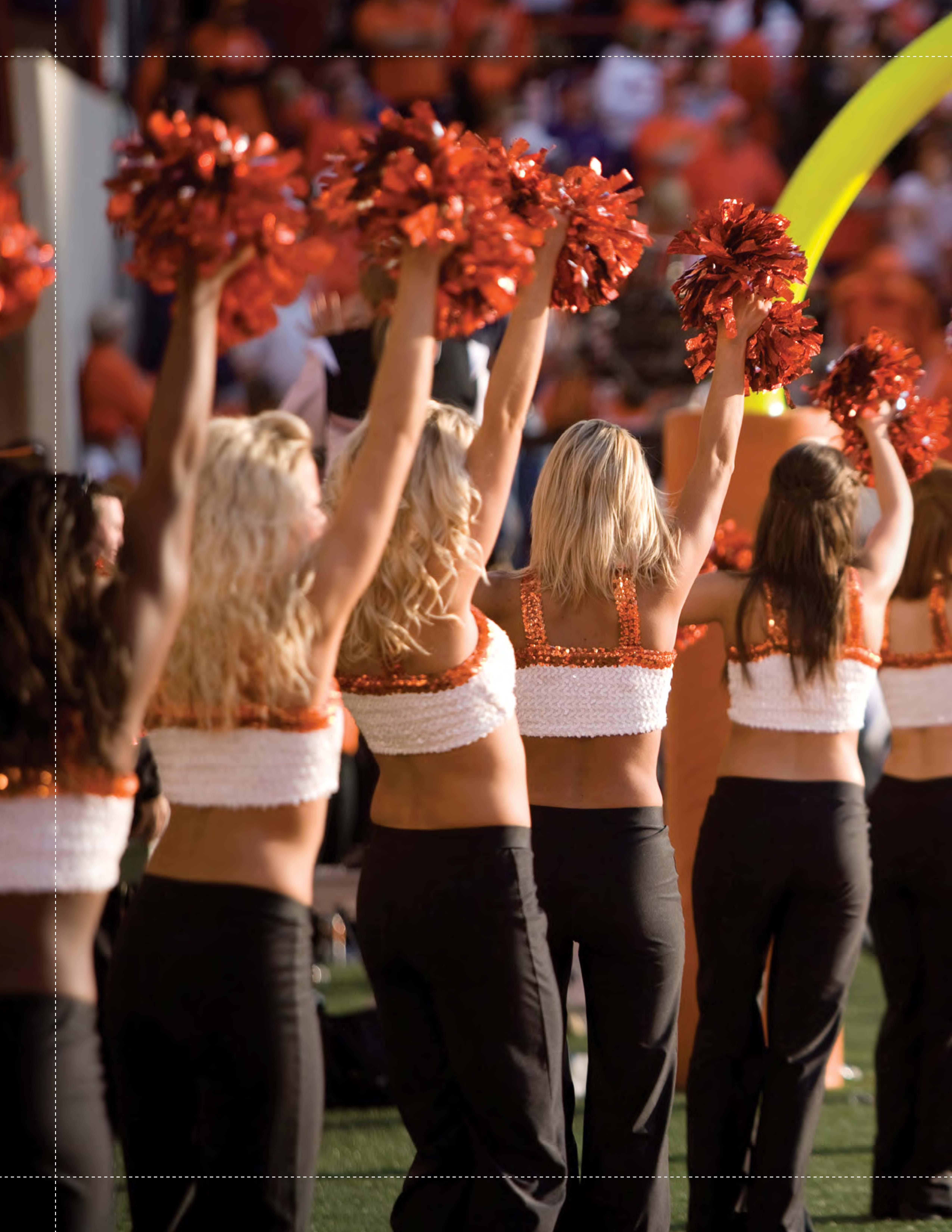
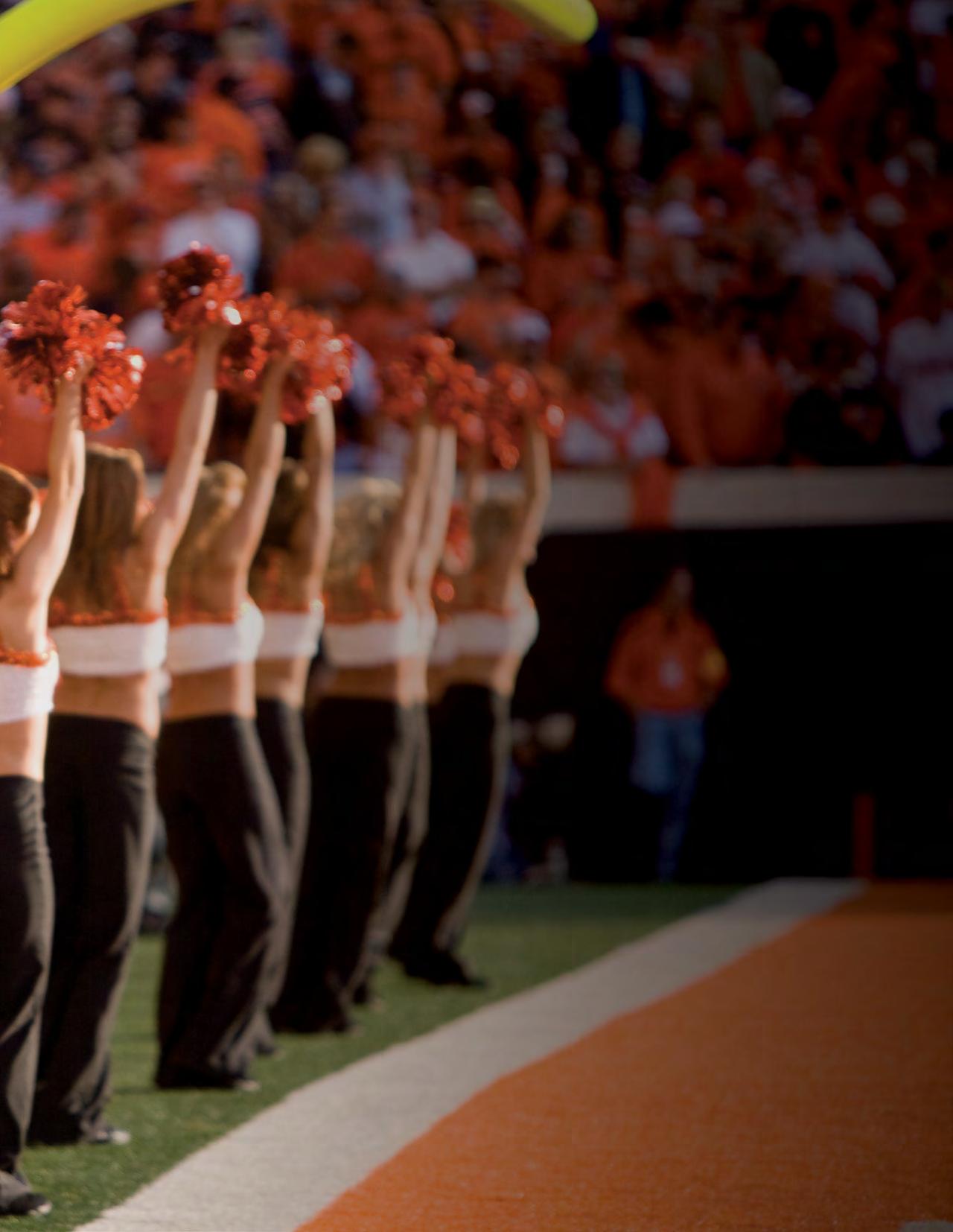
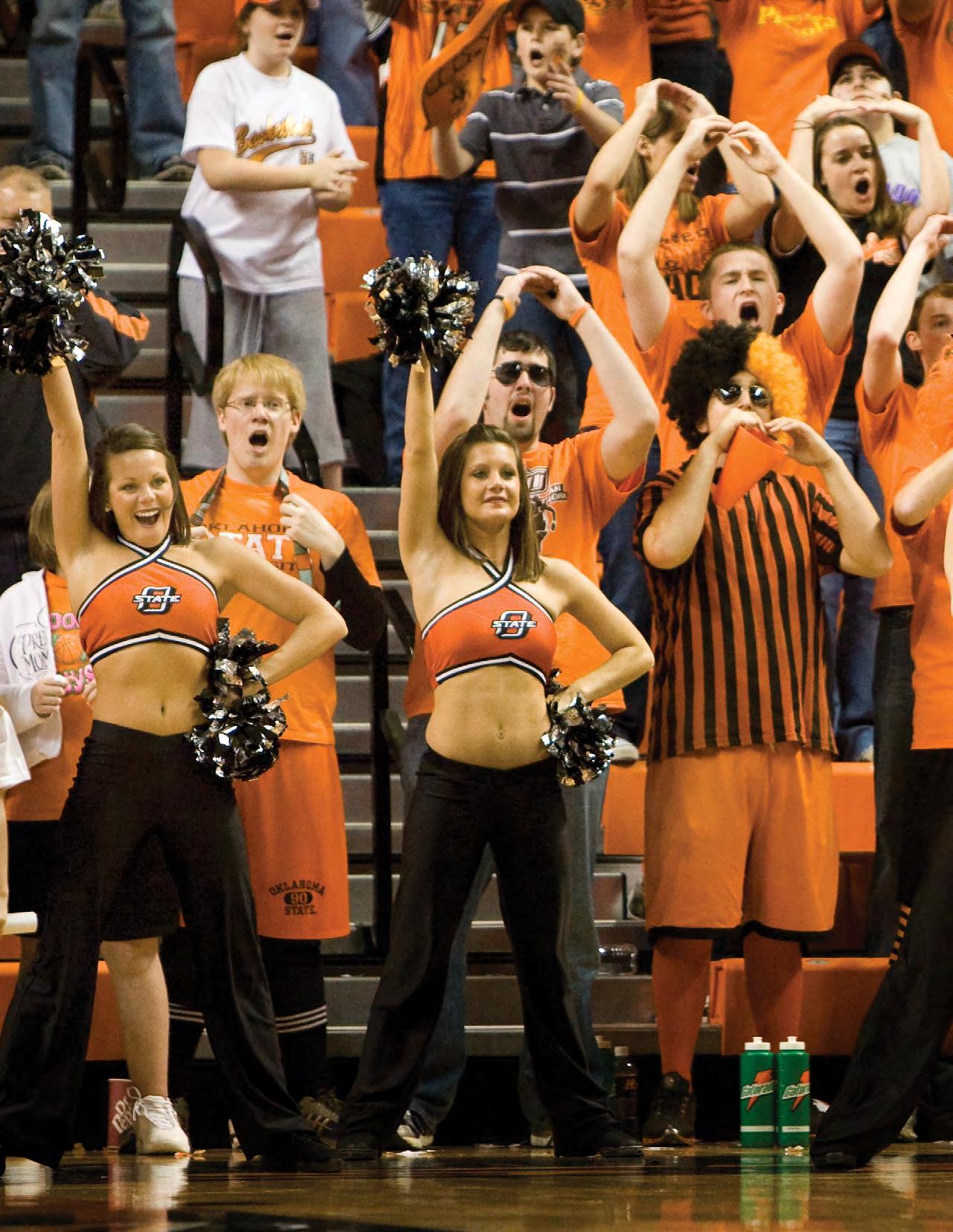
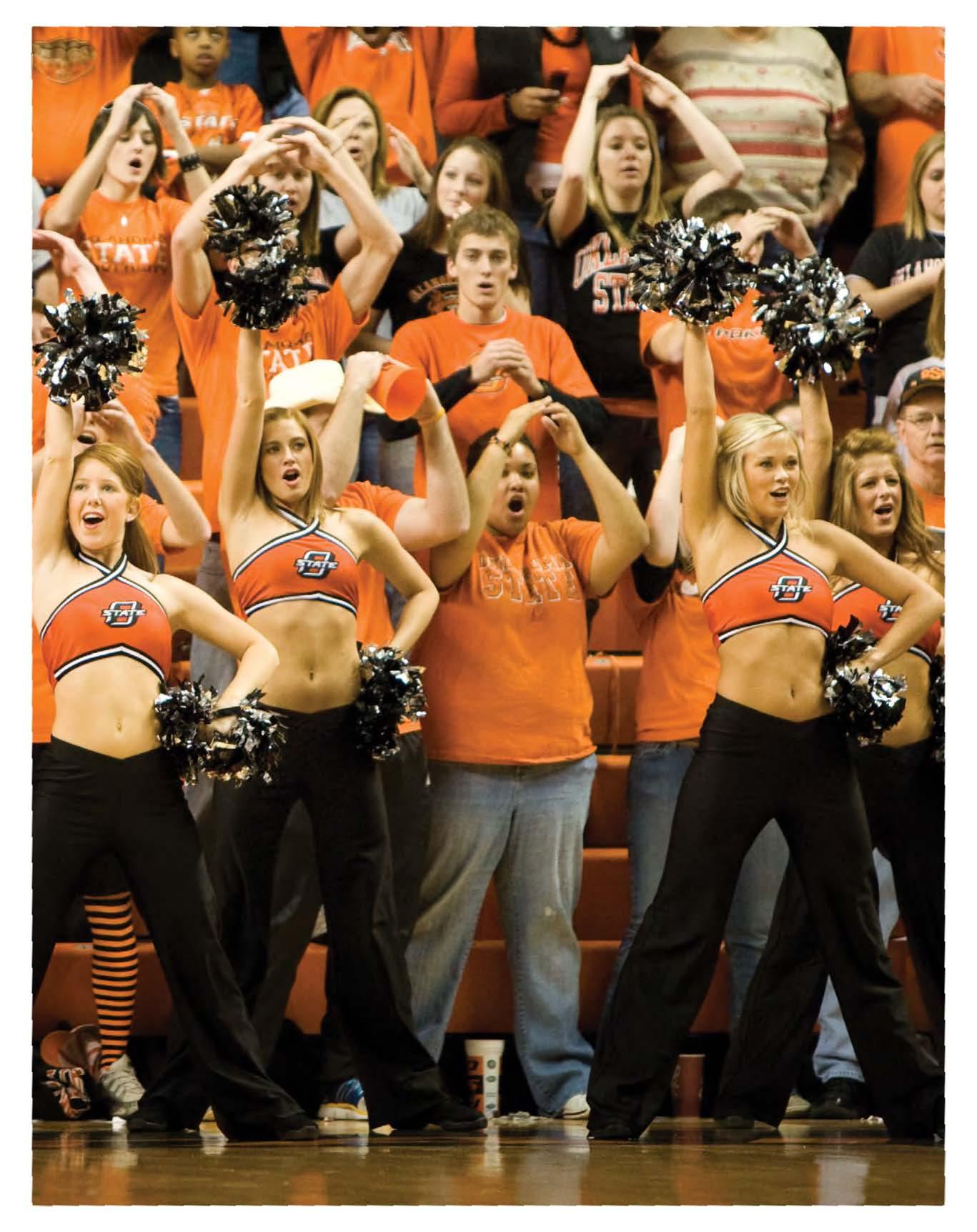
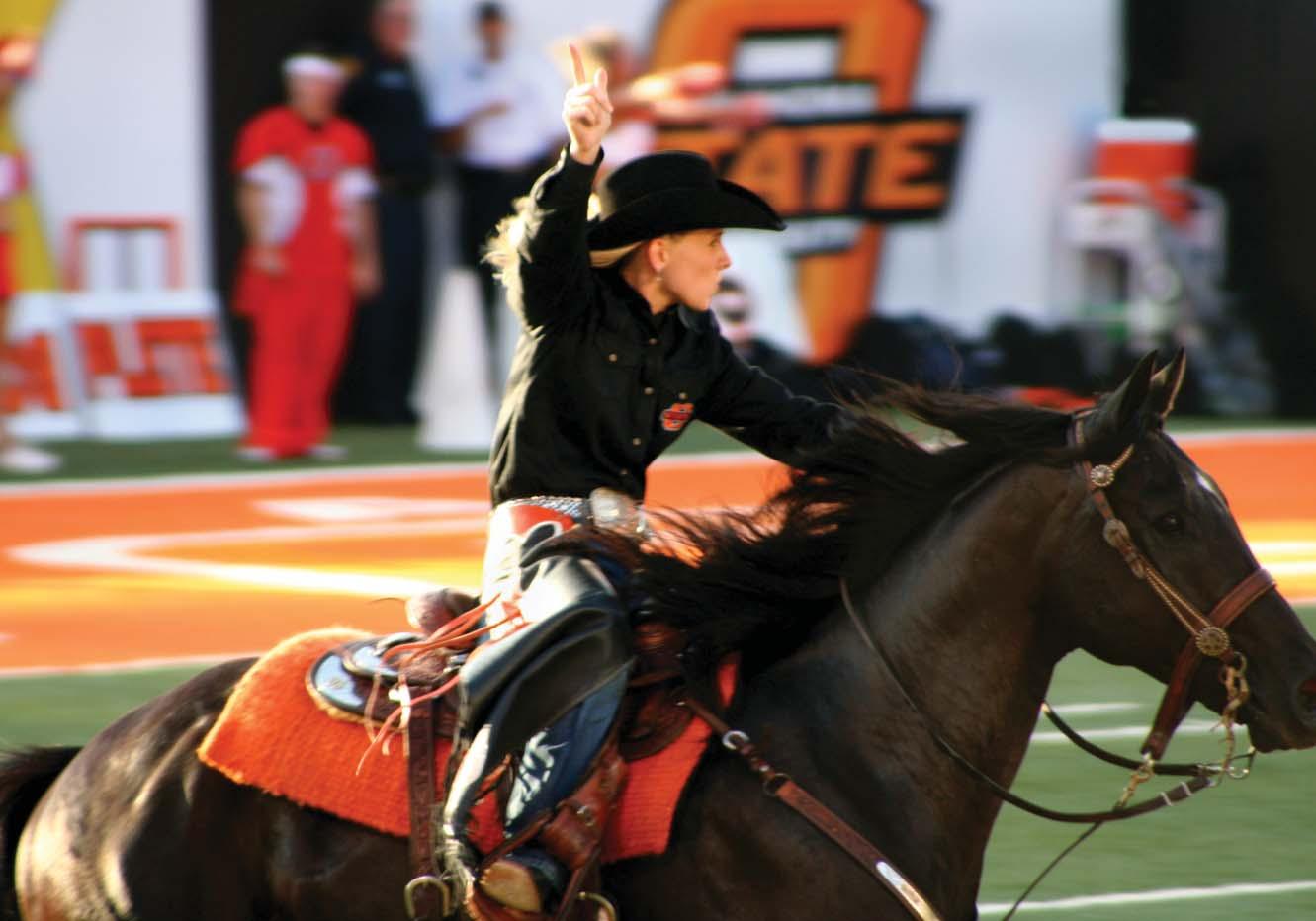
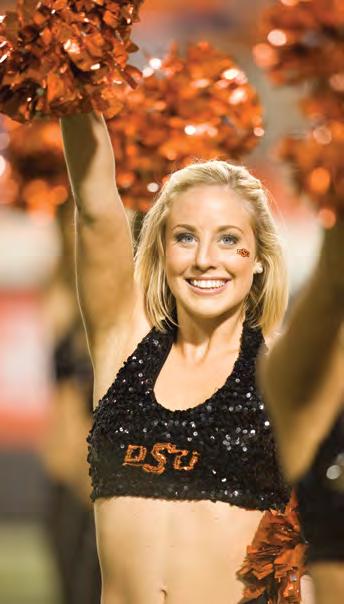
Technically, members of the OSU Spirit Group aren’t considered student-athletes.
Not in the sense that they’re on an NCAA-sanctioned collegiate athletics team or get an official OSU athletic scholarship.
Make no mistake, however, they are athletes. And they love sports, both their own and the ones they attend. And unlike most other sports, their “season” lasts all year.
Members of the cheer and pom squads practice three times a week for two to three hours a session. They have scheduled workouts four times a week – two weight training sessions and two cardio sessions –orchestrated by OSU strength and conditioning coaches.
Then there are the games. During football season, it’s an all-day affair. During basketball season, sometimes they’ll have three games to attend (men’s or women’s) in any given week, and there might even be a wrestling match or two thrown into the mix.
And they still have to go to class.
“We stress more than anything else that these students are students,” says Tracey Wittwer, OSU spirit coordinator. “We spend a great deal of our time making sure they succeed academically. They have access to the academic center. If they need or express a desire, they receive tutoring. They receive a facilitator, just like every other student-athlete.”
Wittwer says Spirit Group members must maintain a higher gradepoint average than the NCAA requires of other student athletes.
All this and they aren’t on scholarships. But they are taken care of by the athletic department because it’s understood the valuable role they play as ambassadors for OSU athletics. Dave Martin, senior associate athletic director takes an active role in seeing to the needs of the Spirit Group.
“Dave Martin has played adviser to the spirit group for about 25 years,” says Wittwer. “He is the voice of the cheerleaders, dancers and Pistol Pete. He’s our liaison in the athletic department. He understands the vital role that these students play in representing the university all yearlong. He makes sure we provide an outstanding program and meet the needs these students have.”
The OSU athletic department sponsors the spirit group – cheer, pom and Pistol Pete – in its entirety. Although members of the group don’t receive scholarships, the needs they have while participating at OSU are more than met.
“When you hear of other colleges offering cheer and dance scholarships, we’re usually talking $300-500 per semester,” says Wittwer. “Even though OSU does not per se give these kids that money, the university gives our kids so much more.”
photos by PHIL SHOCKLEY
OSU foots the bill for sending the spirit squad to summer camps. It also sends the cheer team to nationals every year to compete, and covers all the travel expenses of the squads during the school year, including bowl games and conference championships.
“Our students don’t pay one dime all year long for any expenses that might be incurred for travel, and we travel to every away football game. OSU pays for lodging and transportation and gives them a per diem,” says Wittwer.
The Spirit Group also offsets the lack of scholarships through the sale of calendars and by conducting fundraisers.
“Every year, we put together a spirit calendar,” says Wittwer. “It’s an opportunity for our kids to raise money for their tuition and books. The money they receive per calendar sale is theirs to keep. They have the potential to earn $1,000 or more per semester.”
The students have to give back the first $100 in sales from the calendars to cover printing costs, but after that they can keep the proceeds.
There are also two fundraisers that help the squad members meet their financial obligations.
The Fall Spirit Clinic caters to Oklahoma middle school, junior high and high school spirit squads. These students spend the day with the OSU spirit squad and receive one-on-one training in cheers, chants, dances and gymnastic skills. They take home a T-shirt and get a ticket to that day’s football game.
“Our other big fundraiser is what we call a ‘college prep clinic.’ We always have that in the spring. We invite high school and college students who are thinking about trying out at the college level. We put on a typical practice and teach them material. More than anything, we give them an opportunity to get to know our spirit group members and we make sure they are very informed about our program. We prepare them for the upcoming tryouts.
“The money we receive from these clinics helps pay for some of the expenses the spirit group incurs,” says Wittwer.
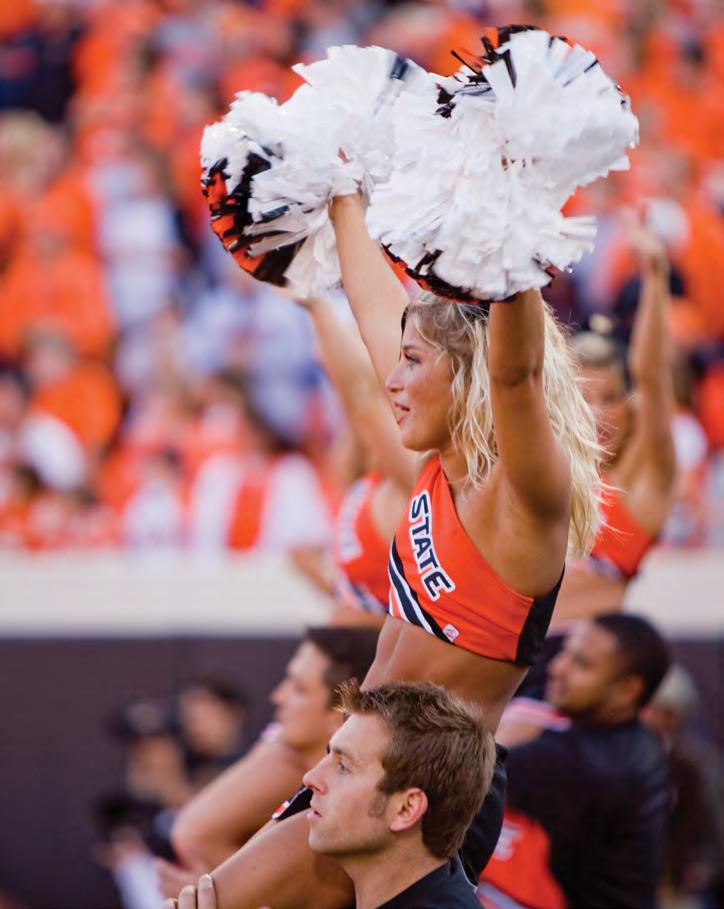
Every April, nearly 70 students try out for each team. Approximately 10 pairs are taken for the cheer squad – 10 guys and 10 girls – and 14 members are chosen for the pom squad. Those who make the team start practicing in June, and the participation level does nothing but increase from there.
“In addition to the athletic events, there are probably at least two events every month that OSU Spirit Group members are requested to attend,” says Wittwer, citing charity events and fundraisers, and even the upcoming POSSE auction. They help with the Special Olympics and the Harvest Carnival. They appear at all the POSSE Caravan stops.
“I’m proud of how they represent OSU in the classroom, at the games and in the community,” says Wittwer. “They really do share themselves in so many different capacities.”
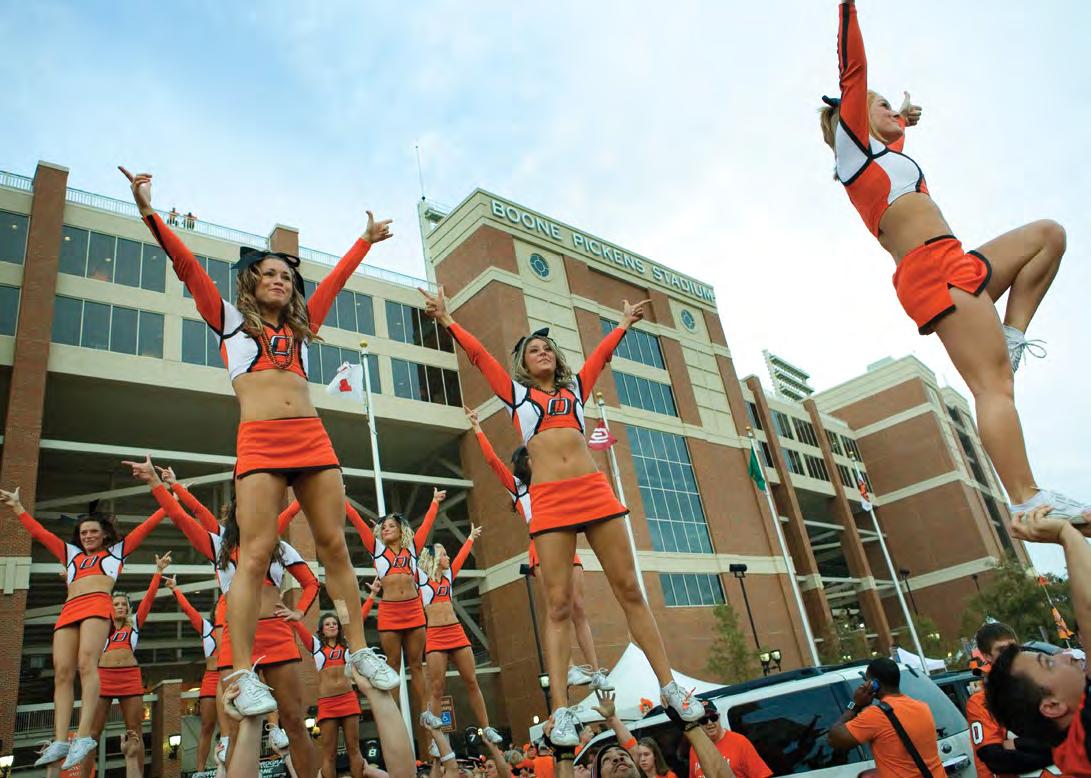
And then there’s this: the cheerleaders also compete. Each year, they attend the National Cheerleaders Association College National Championship. Prepping them for the contest comes under the purview of LeRoy McCullough, OSU cheerleading coach.
McCullough arrived at OSU with a rich cheerleading pedigree, having cheered and coached at Louisville, which is perpetually a national cheerleading championship contender.
“He’s such an athlete,” says Wittwer. “You look at him and think, ‘Surely you played college football.’ He loves sports. He’s right there in the middle of the game. He’s so knowledgeable about everything that encompasses college cheerleading. From the gameday environment to cheerleading skills, he knows everything there is about partner stunting, pyramid building, tumbling, gymnastics. And not only that, he’s a very good teacher.
“You can know how to do a certain skill yourself, but not everyone knows how to teach someone else. LeRoy does. And because he’s coached at the co-ed and all-girl levels, he understands how to teach everybody. Cheerleading can be such a dangerous sport if it’s not coached and taught properly. What the cheerleaders do is considered dangerous, but so many of the injuries that have been highly publicized have been due to poor coaching and poor supervision.”
It’s dangerous. It’s demanding. It’s not for everyone. So why do they do it?
“Typically, our cheerleaders have always been cheerleaders,” says Wittwer. “There are so many programs for young children wherever you are these days. We see those students who have done that pretty much all their
lives. Cheering or dancing at the college level is just an opportunity to carry on with that talent they have nurtured all their lives.”
Wittwer would be one of them. She’s been involved with cheerleading and dance most of her life. She cheered for the University of Arizona where she majored in dance, and she has worked for a national cheerleading organization where she directed and instructed cheerleading camps. She’s been in her current position at OSU since 2002. It’s something that’s just in her blood, and members of her squads express similar sentiments.
Mandy Wideman, one of the four captains of the cheer squad, has been a cheerleader since eighth grade. Being a cheerleader wasn’t something she’d considered. “I always thought cheerleaders were stupid,” says Wideman.
A backflip changed everything. One day, some of the cheerleaders at her school who knew about her gymnastic background asked if they could throw her and have her backflip in the air.
“That’s all it took,” says Wideman. “It was really fun.”
Her response is typical and even applies to the guys on the squad.
“When I think of our cheerleading guys, a lot of them as young kids excelled in gymnastics and tumbling and even athletics in high school,” says
Wittwer. “For whatever reason, they aren’t playing sports at the college level. Cheerleading is the one thing they can do that keeps them surrounded by the athletics they love.
“All of these students love sports. It’s a dream come true for them to be right in the middle of this exciting college athletic environment.”
Ashley Eaton, four-year member and captain of the pom squad, has been a cheerleader since she was 5. One of the reasons she’s a dancer is to get close to the action on the field.
“It’s the most amazing feeling to be on the football field during the games,” she says. She relishes the impact she and the squad have on OSU athletic events.
“I think we have a pretty large impact,” Eaton says. “We make sure the crowd stays loud and involved throughout the game. During down times, like time-outs, we provide entertainment to keep the energy level up.”
Eaton will graduate this May with her elementary education degree and hopes to coach cheerleading and dance for a middle school or high school. She’s going to miss her sport.
“As a senior, I’m very sad,” she says. “At the end of March, it’s all pretty much going to come to an end for me. I’m trying to think of ways to stay involved.”
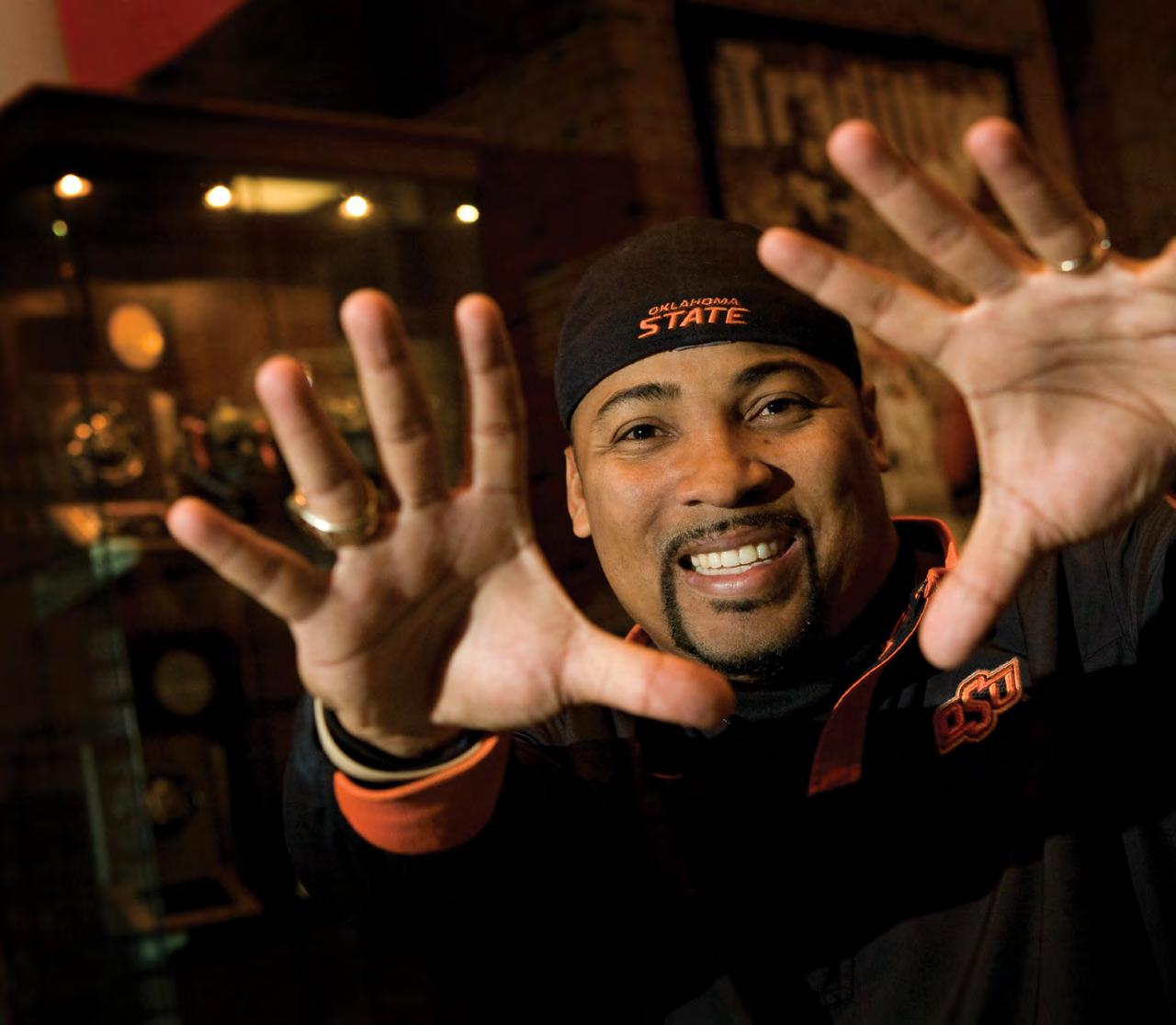
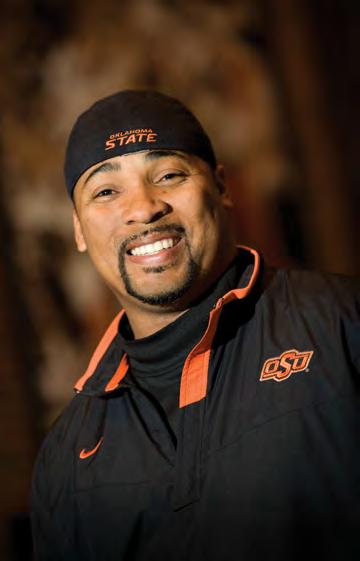
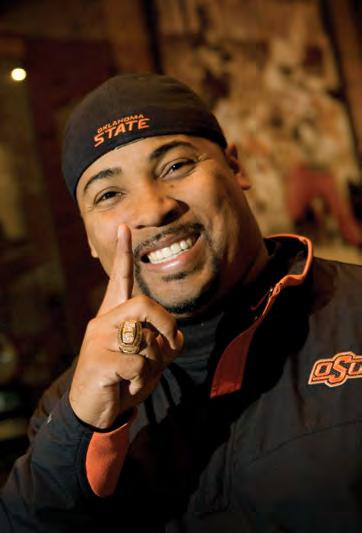
Trooper Taylor’s reputation precedes him.
“He’s crazy.”
“He’s got a lot of enthusiasm.” “He’s a fantastic recruiter.”
These were the kinds of comments we heard about Taylor piror to interviewing him for POSSE . Imagine, if you will, expecting to like someone before you’ve met them purely on word of mouth.
And then imagine that the person you’ve been hearing about, Mr. Personality, is pretty much everything you’ve been hearing. He’s got a firm handshake and an easy smile, and a way about him that makes you feel as though you’ve known him for a long time.
It’s not an act. It’s the way he is. Everyone he meets is potentially a new member of his family, from co-workers to recruits he doesn’t even get.
“It’s amazing how many cards I get from guys who got away,” says Taylor. “But then, I’ve gotten my share.”
Taylor joins a prolific, balanced offense and other than a few tweaks here and there, plans to maintain the momentum.
“Not a lot is going to change,” says Taylor. “They were well-balanced. I’ll add a few wrinkles that will help us get the ball to our playmakers. I call them ‘star packages.’ It’s really based on match-ups.
“I’m smart enough to know if it ain’t broke, don’t fix it. There’ll be enthusiasm and fun. I can promise fans that.”
Taylor grew up in Cuero, Texas, the 10th child of 16. Ends didn’t always meet, but you couldn’t tell by the kids. His mom instilled in the children a strong sense of family as a unified group.
“In my house, when something got bro-
ken, my mom made sure she got everybody,” says Taylor. “That way, she wouldn’t have to repeat it 15 times. It made us accountable to each other.”
She also gave them irrepressible positive attitudes.
“I really don’t have a bad day,” says Taylor. “When I was little, even though we didn’t have enough food, she’d tell us the Taylors were special because we had brunch. I didn’t know I was missing out on a meal. It helped me realize at a young age your attitude affects your altitude. If you’re not thankful for what you have, you can lose it.”
Taylor’s father died when he was 12. After that his coaches became the men in his life and ultimately determined the course of his career.
“I knew I wanted to coach at an early age,” Taylor says. “These were people in my life that became family. It taught me you don’t have to be born into a family. It’s about the integrity, character and moral values you share.”
After high school, Taylor toured several colleges in Texas. He ended up going to Baylor because coach Grant Teaff had a long conversation with Taylor’s mother about his education. Taylor’s father had always stressed the importance of education.
The way he tells the story, Taylor found out he was going to Baylor just after a visit to Texas A&M. He’d been excited about the trip. “Mom said, ‘Good, 'cause you’re going to Baylor.’”
Taylor played defensive back and returned punts and kicks, setting school records in kickoff returns and return yardage. He joined the Baylor coaching staff the season after graduating.
While at Baylor, he met his wife, Evelyn, or Evi. They were married on the football field, which is telling. She gets what he does.
“A coach’s wife has to be special,” says Taylor. “She has to be willing to share your time with other people’s kids. Evi understands. She was an athlete. Her brothers all played ball.”
They’ve been married 14 years and have two children, Blaise, 11, and Star, 9.
One of the many things that attracted Taylor to OSU was the fact that coach Mike Gundy has children.
“Coach Gundy is a friend of mine. I know what kind of person he is and what he stands for,” says Taylor. “He’s a family man. It’s special when the head coach has a son the same age as yours. That makes it better. When he has family, it’s important to him, so he understands that it’s important to you.
“My wife and my kids are the most important things to me.”
Of course, the Taylor family has grown some since his arrival in Stillwater. Say to the size of the entire OSU football organization. And it’s growing bigger still as Taylor has been on a nonstop recruiting frenzy since taking the job.
“I love recruiting. It just adds to my family,” says Taylor.
He has a sign on the whiteboard in his office. It says, “Recruiting is like shaving. If you don’t do it every day, it shows.”
“No one signs 15 alone,” Taylor says. “It’s a group deal. If they don’t like the head coach or the equipment manager, it can affect recruiting. Everyone has to pull his load. You may head it up because you have that area, but the bottom line is that it’s a group effort. Everyone has to be on the same page and selling the same thing and being positive.
“And, then, you have to outwork the other guys.”







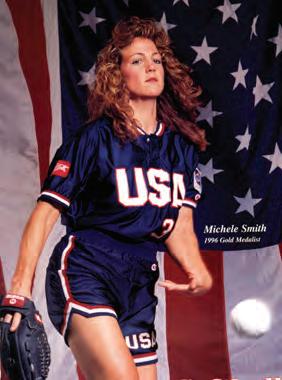
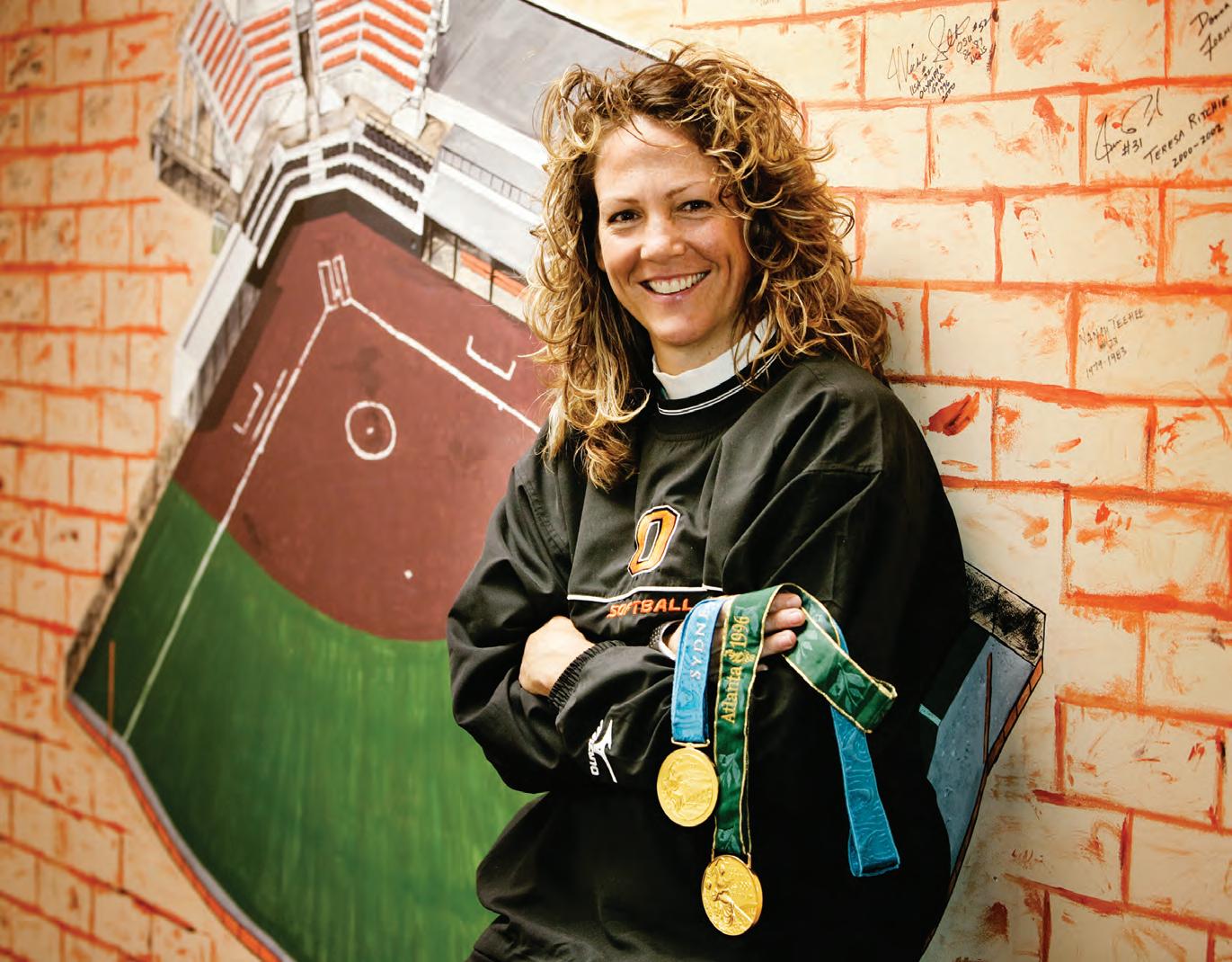
Michele Smith is a national softball legend. A two-time AllAmerican at OSU (1988-89), she went on to win Olympic gold twice with the U.S. national team (1996, Atlanta; 200 0, Sydney).
For the past 15 years, she’s played softball professionally in Japan. In that time, she’s pitched no-hitters, set records, won eight championships and eight league MVP awards She’s about to begin her 16th season, and she expects it to be her last.
In and around her professional softball career, she works with children and does color commentary for ESPN. To say she’s busy would be putting it mildly.
What’s it like working for ESPN?
I do the color commentary. I have a play-by-play partner. I’m the analyst. I work the USA team games. And that’s great, because I know all the girls. I’ve played on the U.S. team, and I know all the Japanese girls from playing against them. It’s great to be able to give a lot of international insight. I also do Little League softball. It’s pretty neat. And I will be doing the Olympic games for NBC this summer.
I just kind of slid into it. That was a big learning experience.
What’s interesting is that it’s a game around the game. If the cameras were just there and no one was talking, it’d be pretty boring. I guess that’s why they call it show business.
What does softball mean to you?
It means fun. It means life. It’s a job. It’s the ability to give back. Passion. Frustration. It means a lot of di fferent things to me. But more than anything, it’s a conduit for me to make a di fference to kids. I love to play the game, but off the field, I get to make a difference with kids.
What’s your favorite OS U sports memory?
When we won regionals my senior year to go to the College World Series. We should’ve won my junior year. I still believe that if we’d gone our junior year, we would’ve won our senior yea r instead of finishing third Playing wa s great We had a lot of experience. It was our first yea r there and we still managed to come in third. A lot of teams don’t
do that. They get to that level and get overwhelmed.
What athlete, living or dead, do you wish you could see play?
Probably Sandy Koufax. I would have liked to see him pitch. He was a lefty like me and dominated. I had a quote from him on my door when I first started pitching: “Pitching is the art of instilling fear.” I’d look at that every day.
What’s something that gets you riled up?
Bad officiating in any sport. I would never want to be an official. I think it’s the toughest job in the world. As elite athletes, we spend great amounts of time trying to be our best, and when the game is held back by poor officiating, we’re held back.
What’s your proudest accomplishment?
The two Olympic gold medals. Winning both of those was just phe
nomenal, but especially Atlanta. My entire family was there. It was at home. I’d overcome this career-threatening injury. When you win in front of your home country, there’s nothing like that.
Winni ng in Sydney was special, too, because we’d lost three in a row. We found a way to dig in our heels and came back through the loser’s bracket and still won the gold.
What are three things you would have to have with you if you were stranded on an island?
My Parlee bike. It’s a custom-made road bike. Might be hard to ride i n the sand, though. My bible. And a stocked fridge with lots of pasta and lots of meat. I love to eat.
Who do you admire (and why)?
I really admire Joe Crookham. He’s the president of Musco Lighting. He’s a great guy. I’ve learned so much for him. He helps sponsor and support a lot of softball programs. He’s taught me a lot about stuff off in life. I respect him tremendously.
the field. How to work with kids. Things that really make a difference
I’ve always respected Abraham Lincoln. He went through a lot in his presidency. I still think he’s one of the greatest leaders our country has ever had.
In the sports field, I really like Joe Torre. He’s a great guy. A great player’s manager. And Bobby Cox.
You have one wish. What is it?
To make people more aware of how impor t orga n donation is. One of the charities I suppor t is Athletes for Hearts. It was inspired by MacKenzie Overton, who a s a 17-day-old baby received a heart transplant It’s a miracle to see her She’s a softball player She loves to catch.
Athletes for Hearts is for children who have to have open-heart su rgeries. A lot of them die on waiting lists because there aren’t enough hearts. It’s sad in this day and age that people aren’t more aware of the importance of organ donation.
What’s your favorite type of music and where do you listen to it?
I really like classic rock. Aerosmith. But I also enjoy smooth jazz. Richard Elliot. If I’m going somewhere or trying to do something, then it’s classic rock If I’m in a mellow mood after practice, then jazz.
Who had the biggest effect on how you turned out the way you did?
My parents, for different reasons. My mom was always so kind. She was a nurse. Ver y caring, very giving. My dad, from a sports standpoint, made me mentally tough. He made me take responsibilit y for my actions. He taught me to look inward if you want things to change.
Crazy Jack. That's all I know him by. When I was a kid and first
learning to pitch, it wa s tough on me. I was playing in a women’s league against college players and adults I only started to pitch when I wa s 15.
He would sit in the stands and say the craziest things. One day af ter a game, he gave me an part of an envelope and it had one word written on it: Perseverance.
He said, “If you do this [persevere] for the rest of your life, you’re going to be great You’re going to do some special things.” I was stunned. I’d never hea rd him say anything serious in his life. I took that piece of but I knew what it said and what it stood for.
paper and I used to kept it in my spikes. The word eventually wore off,
How big of an OSU fan are you?
I’m a big fan. I try to c atch up as much as I can. I travel a lot, so it’s tough to keep up sometimes. I’m excited because I get to see the softball team coming up in March in OKC. I like to c atch the basketball team when they’re on TV.
I’m g lad to see Mr. Pickens donating that money and that the facilities are really going to come up to par. I think that’ll make a difference in recruiting and the future of the program.
by MATT ELLIOT
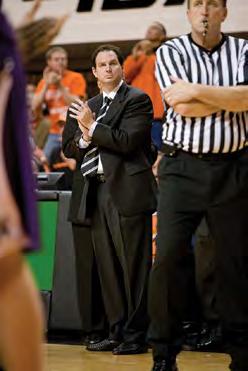
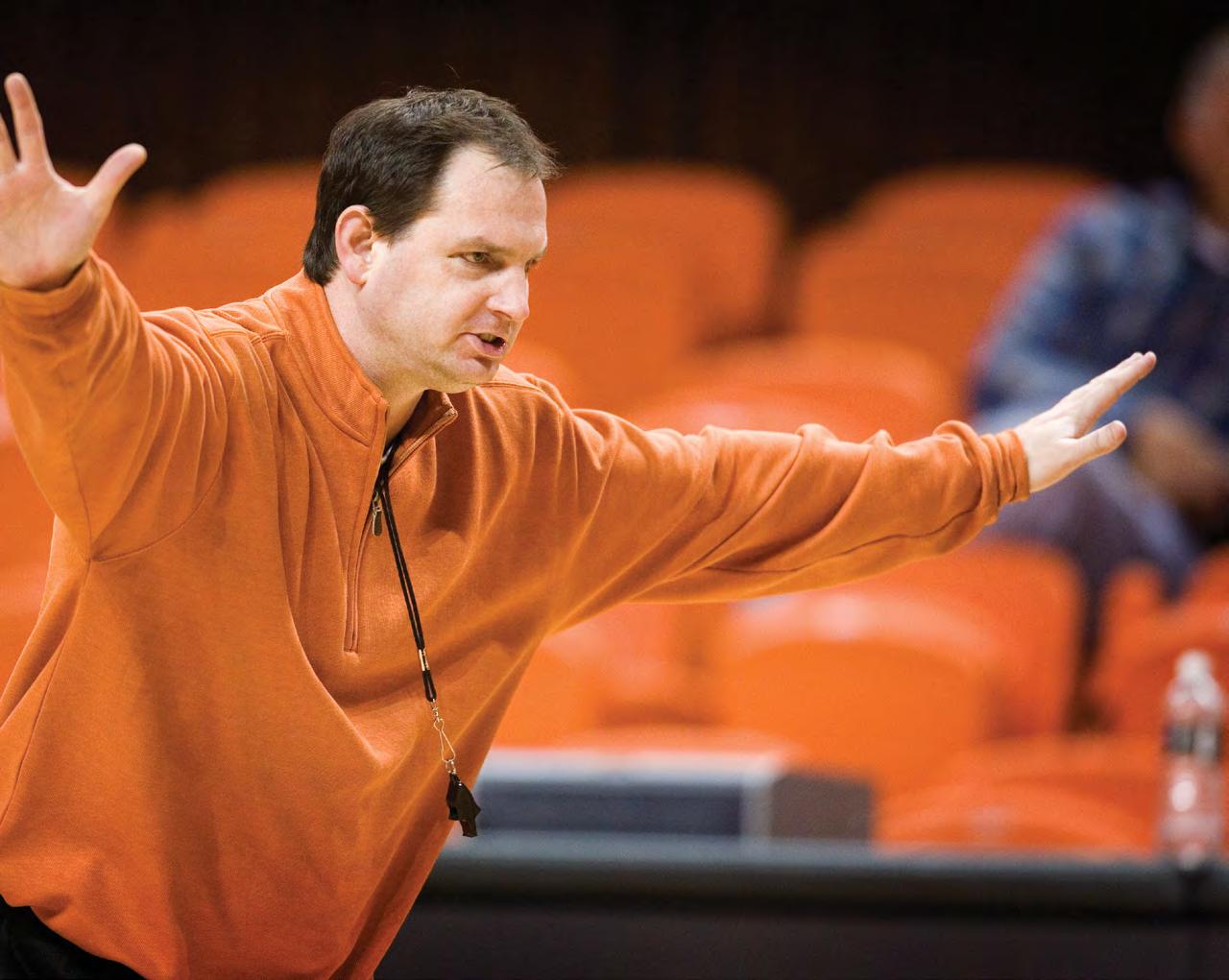
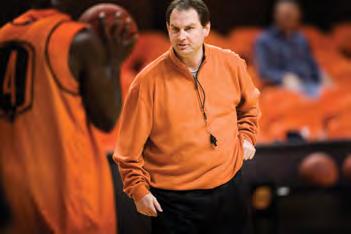
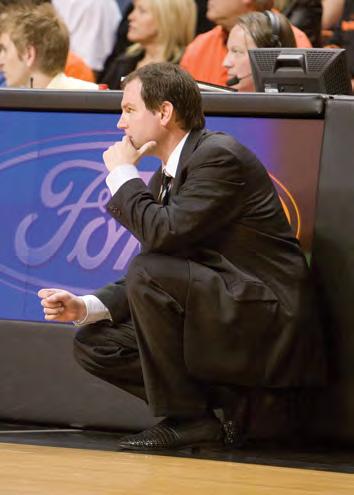
COACH SEAN SUTTON is reclined in a beige leather chair inside a Gallagher-Iba Arena office two days before the Cowboys’ 67-60 loss to Texas Tech in February. ESPN Sportscenter is on the flatscreen TV. A wipeboard has a play smudged on its white face.
Sutton’s voice is raspy due to a bout with walking pneumonia from which he is recovering. He probably needs to save his voice, but he says he wants Cowboy fans to know he is optimistic about his young, promising team and its future.
Also, Sutton wants the fans to know that when his team loses, it affects him, too. That’s because he loves OSU and he has thrown himself into willing this team to succeed, toiling through long nights, bleary-eyed from watching film and practices.
“This is a special place,” he says. “I loved going to school here. The two years (1990-1992) I spent here as a player were the happiest two years of my life. I got a chance to help rebuild the great tradition of this basketball program, and I started as a player.
“I have so much passion and love for the school that when we lose, it makes it even extra tough,” says Sutton, who at 39 is in his second year as head coach. Sutton follows his father, who helmed the Cowboys to 351 wins. “I understand how important basketball is to the students and to our fans.”
Eddie Sutton, during Final Four trips. He has spent 14 years in Stillwater.
That makes winning with his team that much sweeter. It makes losing that much harder.
The Texas Tech loss put the team at 10-11 and 1-6 in the Big 12 on a season that started, Sutton says, after the team lost its only proven post player in Kenny Cooper. Before Cooper, top-scorer JamesOn Curry left, too, pursuing a career in the NBA.
As a result, the post is manned by a cadre of freshmen and a junior college transfer. Freshman generally do not step into starting roles in the Big 12 and thrive. It takes time. Time to acclimate to the speed, to get stronger.
If he seems tired, it might be because Sutton doesn’t sleep much during a normal season. He also doesn’t see much of his three growing boys between practices, recruiting, film time and games.
He tries to get home early enough at night to see them before they go to bed. His only time off comes with a few days around Christmas.
“I’ve got three boys who are 15, 10 and 5,” he says. “So, when I have some free time, I spend as much time with them as I can doing what they want to do. Occasionally, I’ll watch a movie on TV. But that’s about it.”
Sutton met his wife, Trena, at OSU. He played in the Sweet 16 as a player and was an assistant coach under his dad, former coach
He admits he has gotten used to the demanding schedule.
In this way, he’s much like his father. And like Eddie, Sean carries on the OSU tradition of a hardnosed, hard-fought approach to basketball weighted in ball control and defense, a tradition that began with the elder Sutton’s coach, Henry Iba.
Sean Sutton is optimistic because he believes in his team that has played inspired defense lately, keeping them close in razor-thin losses.
“If our guys will keep their spirit and keep
fighting every day on the practice court and stay together and stay positive, then I think we’re going to start winning some of these games.”
Last season, the team got off to a hot start before widespread injuries took their toll, leaving Sutton at times with only seven active players. Still, the team finished the season at 22-13.
With the Kansas Jayhawks, the Texas Longhorns and the Oklahoma Sooners in the Big 12, OSU’s is a tough conference for road games. What used to be automatic road wins against Texas A&M, Baylor and Kansas State have become anything but as those programs have improved.
Road games are more difficult to win because the home team has “the fans behind them and they’re also comfortable with their surroundings,” Sutton says. He would know. Gallagher-Iba Arena in the Sutton era became
one of the most feared places for visiting teams to play.
“I think you have to be mentally tough to be able to block out the noise and really focus to win on the road,” he says.
Bright spots make OSU’s future promising. An athletic core of younger players has performed well and is getting valuable experience, Sutton says. Freshman guard James Anderson, a McDonald’s All-American, averages 14.8 points per game. Sutton also praises freshmen Ibrahima Thomas, Marshall Moses, Martavius Adams and guard Nick Sidorakis.
The Cowboys can still have a good season this year, he says, and he expects the team to be competitive next year.
“Next year, we’ll have a chance to compete for the Big 12 championship and should have our program back to where we’re competitive on a regular basis.”

Stillwater is growing and mu ch of that growth is going in a new di recti on.
In 20 06, Kray bill Homes, Inc. broke ground on THE CANYONS, Section I, located on North Perkins Ro ad one-half mile north of Richmond Road. Your acceptance and enthusiasm for THE CANYONS have been gratifying.
In 2008, Kraybill Homes, Inc. and Todd Kraybill Construction, Inc. will begin building new homes in THE CANYONS, Section 11.Prices begin in the $160,000s.
Come visit THE CANYONS, select the location for your next home, then contact Kay Burns, 405-747-1772 or Charlie Scott, 405-880-1040. Additional information is available at www.TheCanyons-Stillwater.com.
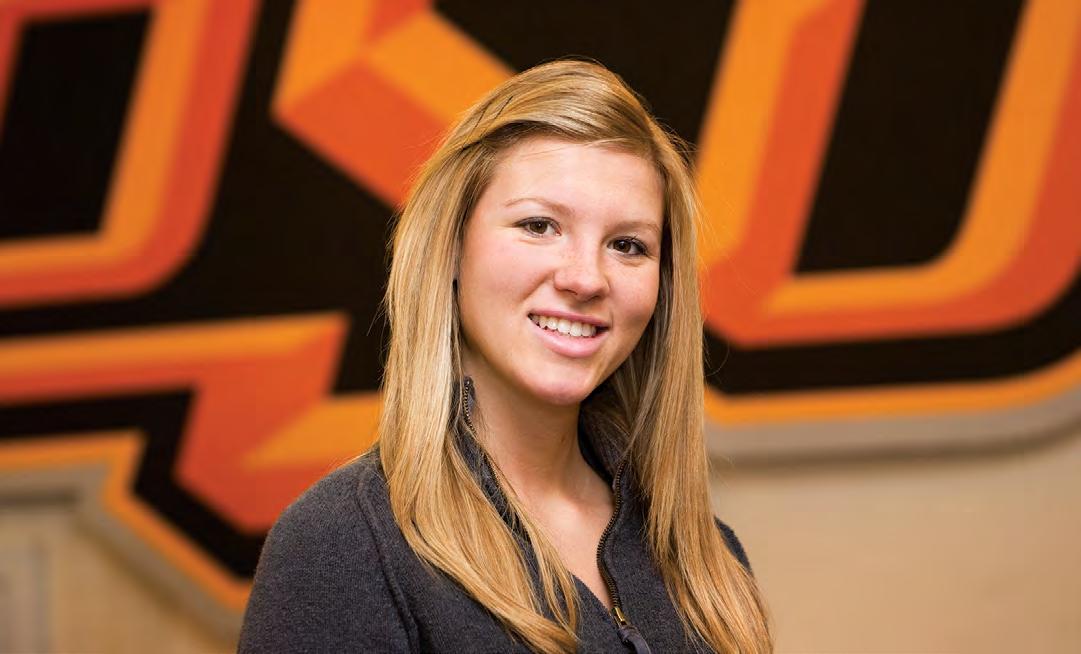
Oklahoma State Athletics launched the Athletics Center for Sales. The Center employs eight part-time students. On Monday – Thursday afternoons and evenings, calls concerning the POSSE and ticket offers are made to OSU fans. The Center allows students to gain realworld customer service experience and OSU to give a more personal touch to its valued and loyal fans.
Name: Adrienne McCormick
Age: 20
Class: 2010
Major: Psychology
Hometown: Coppell, Texas
[Reason for choosing OSU?] I went to a big high school, so I wanted to go to a big college. I love sports, so I wanted to go to a school in the Big 12. OSU is well-known and is getting better every year. My parents love Nebraska so they like to tease me about going to OSU; that is, until we beat them this season!
[What are your plans after graduation?] I want to go to graduate school and work with children and teens with reading and learning disabilities.
[What is the best part about your job?] I get paid for talking about sports. I love the conversations about football, basketball or wrestling with OSU fans. Sure beats asking, “Would you like fries with that?”
[What would you like all of your callers to know before you call them?] I’m just a student trying to help the Athletic Department. Sometimes we make educational calls as well, so don’t always think I’m trying to sell you something.
[How many people do you call in an average day?] Probably 50-60 in five hours. Often people aren’t home. We are supposed to make more calls, but I get into conversations with people because I’m so friendly.
[What was your favorite call?] I got into a conversation with a guy about how great our football team is going to be next season. He bet me we would win our first six games. We talked about the 2008 team for 15 minutes.
Another time I called someone during a Dallas Cowboys game. I just happen to be a huge fan and he gave me a play-by-play while we talked about Tony Romo. P.S. The Giants got lucky.
[What is the largest gift you received over the phone?] $1,000! I also love promoting club tickets. On game days I work up there, and it’s so fun! After someone buys them, I feel good because I know they’re going to love the club seat experience.
[How does it feel to be making an impact on the future of OSU Athletics?] Great! I’ve see how much potential we have and I want to help bring that out. I have friends who are athletes and every time I bring a new POSSE member on board or sell a ticket, I know I’m helping them.

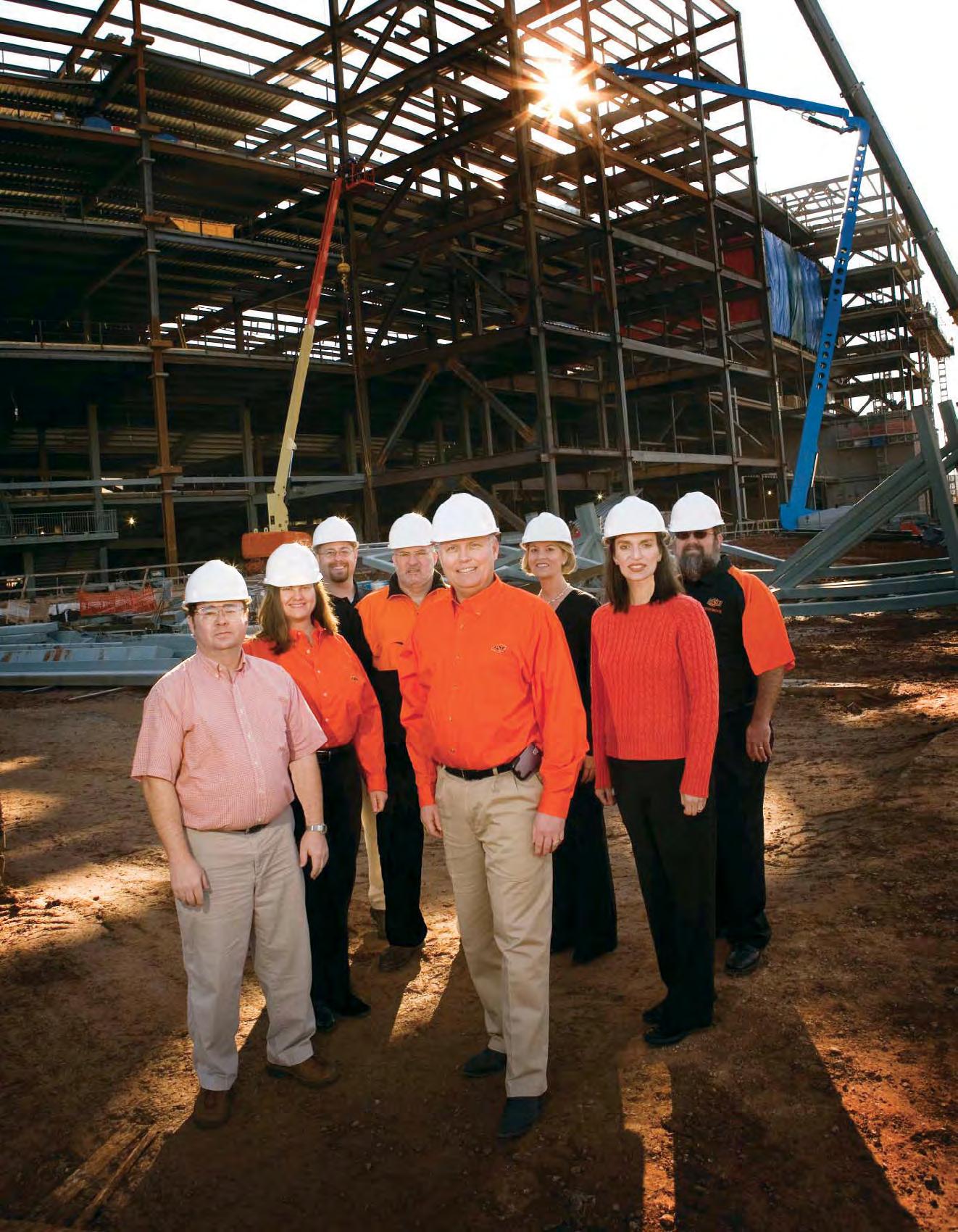
W&W Steel was founded in Oklahoma in 1945 and is now one of the largest steel fabricating companies in the United States. We provide complete turnkey design, fabrication and erection services covering a wide range of domestic and international construction projects.



Headquartered in Oklahoma City, W&W Steel and its subsidiary AFCO Steel, have 1000 dedicated employees serving our clients from 10 locations. We are extremely proud of our people and their contribution to the growth and success of our companies, and we are also very proud to be a supporter of Oklahoma State University Athletics.

Those “head-count” sports are football (85), men’s basketball (13), women’s basketball (15) and women’s tennis (8).
“That’s a total of 121 full-ride scholarships,” Williams says, “so two-thirds of our kids at OSU are participating in sports where coaches are dividing full scholarships.”
These split (or equivalency) scholarships require constant calculation by the coaching staff, along with the support of the Compliance Office, to make sure the numbers add up.
and board). Compared to just five years ago, today’s tuition costs are more than 30 percent higher.
The NCAA makes no distinction between in-state versus out-of-state tuition when it comes to equivalent percentages, so recruits from outside Oklahoma’s borders have more financial burden than in-state signees. For non-residents, that number soars to $23,680.
BY CLAY BILLMAN
Fans may have the impression that most Cowboys and Cowgirls have a full ride when it comes to paying for college. But for the majority of sports at Oklahoma State, NCAA scholarship limits require student-athletes to make significant financial sacrifices to wear the orange and black.
“For the 2007-08 academic year, 360 student-athletes are receiving some form of countable athletic aid at OSU,” says Scott Williams, Associate Athletic Director for Compliance. “However, out of our 18 Division I varsity programs, we only have four in which the entire team receives a full scholarship.”
“We actually have a financial aid coordinator on staff, and it is her primary responsibility to monitor all of our numbers to make sure we don’t commit a violation by over-awarding individual or team financial aid.”
The compliance staff also has to police certain scholarships awarded for more than just athletic ability.
“We have kids who qualify for academic scholarships that would normally be used to offset the cost of their education,” he adds. “But the tricky thing about academic scholarships is that the general NCAA rule states that if you’re on athletic aid and you’re receiving any institutional scholarship, the scholarship counts against the total sport equivalency. The application of the financial aid rules and interpretations is a complex area. The NCAA has a multitude of interpretations out there, and you have to be really careful how you’re calculating the equivalency for each sport.”
The amount of financial aid offered to a recruit is often a deciding factor in which school they choose to attend.
The cost of a college education has gone up considerably in recent years. This year the total cost for an in-state student’s scholarship is $14,890 (including tuition, fees, books, room
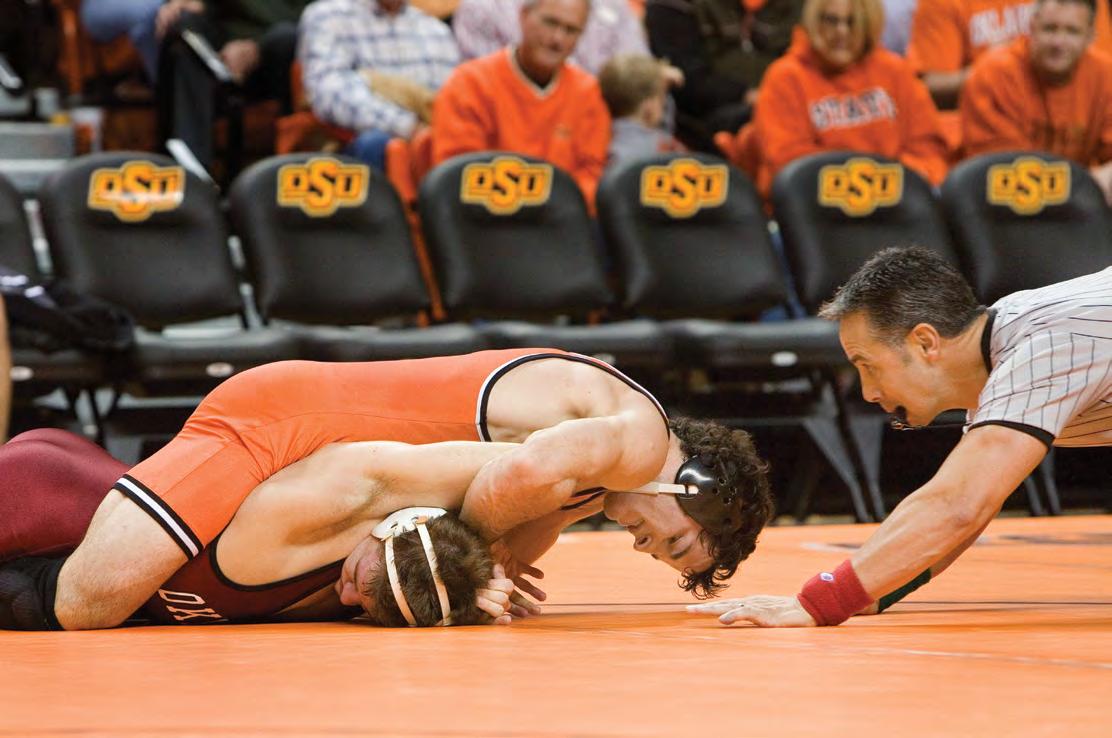
The wrestling program is allowed a total of 9.9 scholarships by the NCAA. According to Head Coach John Smith, who has close to 30 wrestlers on scholarship, that money doesn’t go nearly as far as it used to – especially for out-of-state recruits.
“With tuition and fees and the cost of college education going up, a half-scholarship is no longer a good scholarship if you’re not coming from a lot,” Smith says. “It still means that you owe $12,000 more. It’s a greater challenge. It’s not something you sit around and gripe about. You may not like it, but it hasn’t changed what we want to try to accomplish. It just means we may have to do it with a little bit less.”
Smith says another side effect is greater parity nationwide.
“One of my greatest challenges now, with the limitations, is that the percentage of the top athletes you get is going down. With 10 scholarships in the past, I could get 22 or 23 really good athletes. Today, it would only get me 14 or 15.”
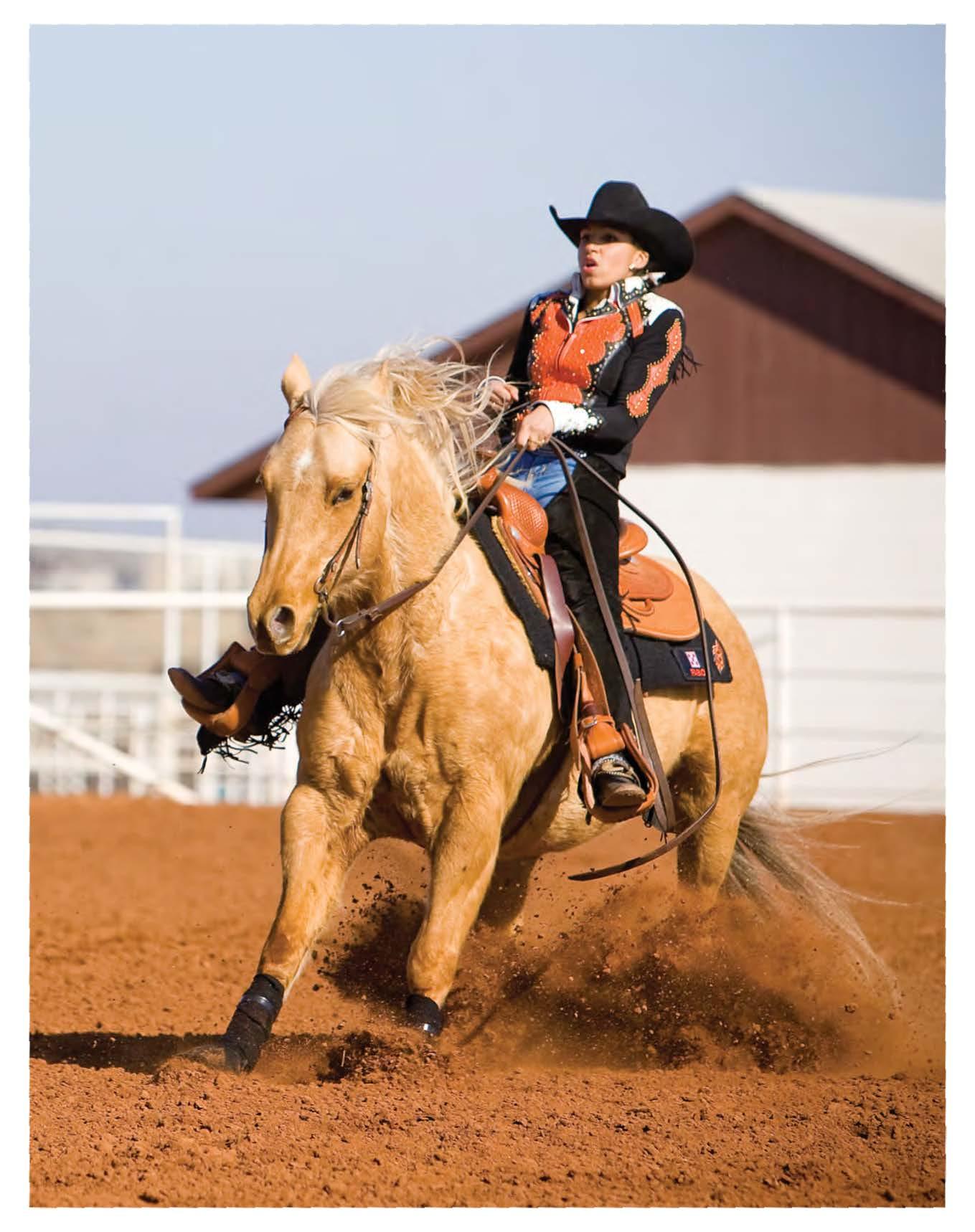
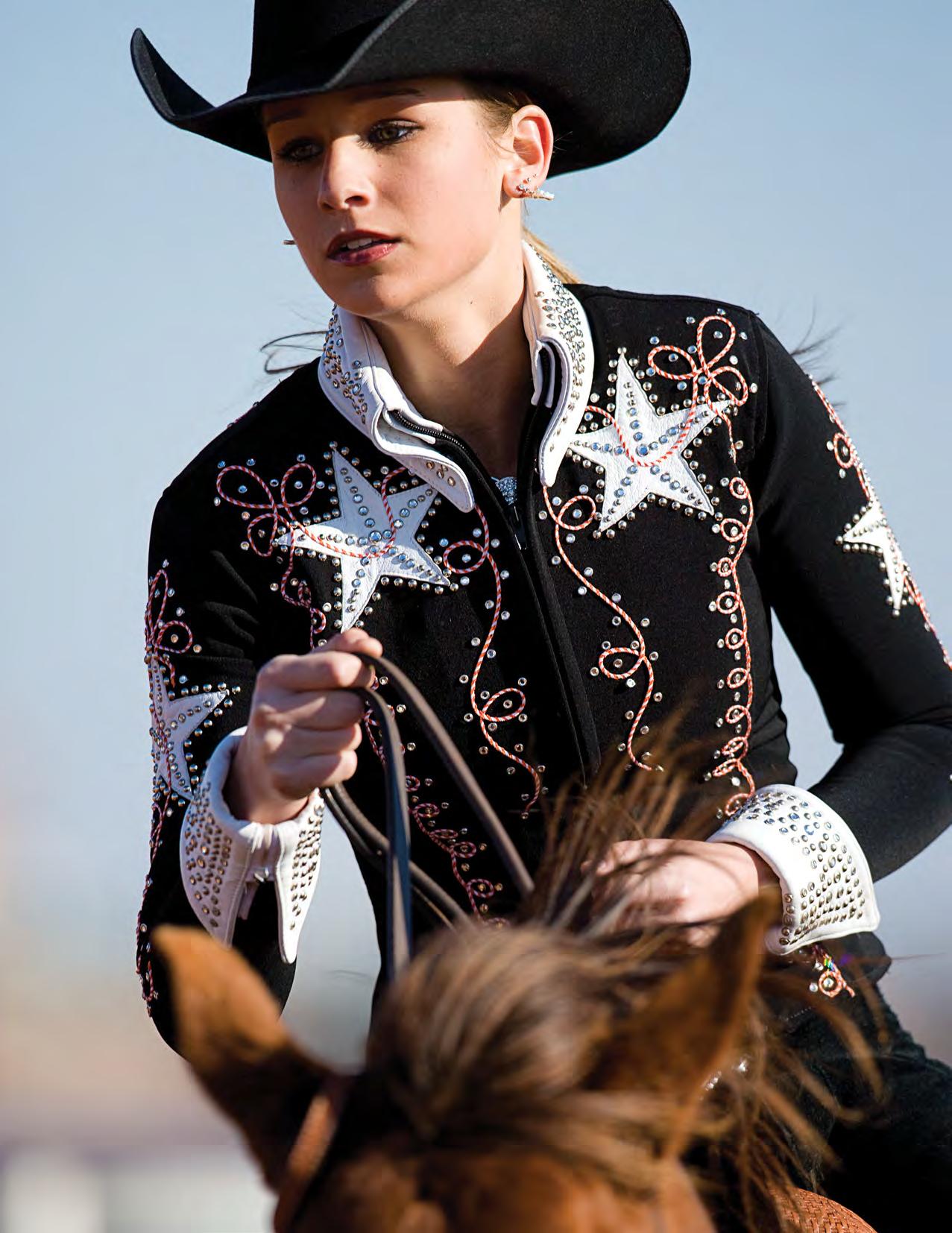
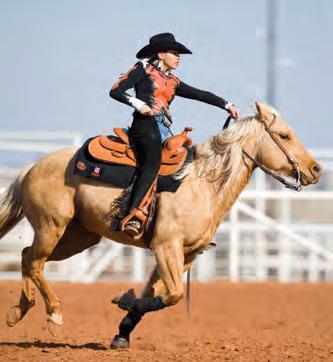
Larry Sanchez, OSU equestrian head coach, is in a similar situation, with 15 partial equivalency scholarships divided among more than 50 student-athletes.
“We need to recruit those kids who can compete on an elite level with the best in America,” he says. “There are a handful of Oklahoma kids who are able to compete at that level each year, but to meet the numbers we need, we have to go out of state to recruit to be competitive.”
But out-of-state tuition doesn’t always make OSU the more expensive option, Sanchez says.
“When recruits are looking at their college choices, we have to sell Oklahoma State as a really good college buy in comparison to other institutions,” he says. “In a number of cases, it’s less expensive for out-of-state kids to come to OSU over other schools that cost so much more. We play that card a lot in our recruiting. OSU is a good buy, even if they are having to pay out-of-state tuition, because my $5,000 may go just as far as $10,000 at another school.”
Sanchez says he doesn’t have any Cowgirls on a full-ride.
“We have to spread it pretty thin with the numbers we carry,” he says. “The highest percentage we’re giving is around 80.”
The coach says “immediate impact” is one way he measures a recruit’s worth in terms of athletic aid dollars.
“The girls we believe can come in and be immediately effective in our program are the ones we feel more comfortable about giving a little more aid,” he says. “However, we often will increase our athletic aid for current team members. For the girls who come in and prove themselves – not only in the arena, but also as teammates and encouragers of others on the team – I like to look at potentially upping their scholarship as it goes.”
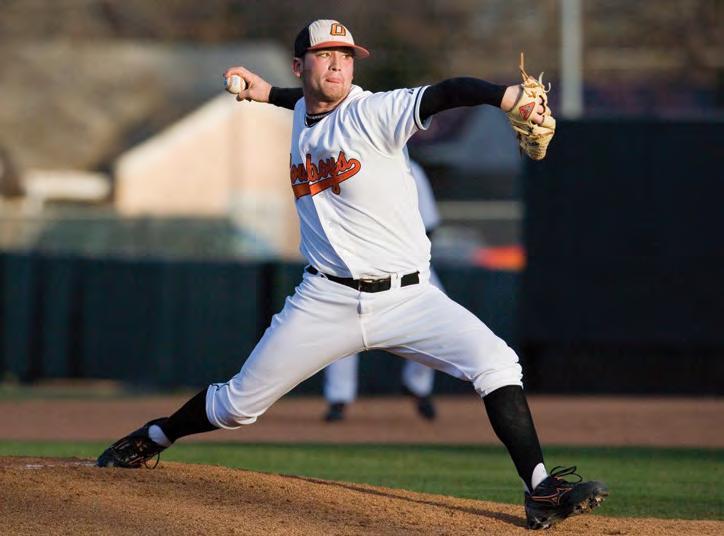
Head coach Frank Anderson is given 11.7 scholarships for 33 baseball players.
guy who’s probably allotted more scholarship. You don’t want to make somebody feel uneasy about your offer, but you’ve only got so much scholarship money to give – it’s basically a salary cap at the 11.7 limit, and you have to stay under that.”
“We have very few kids on the roster who even get their tuition paid,” Anderson says. “We don’t split it up evenly with everybody. You’ve got some guys who are on bigger scholarships, and you’ve got some kids who are on book scholarships. If you have a two-way player who can pitch and also field a position, that’s a high-profile
In 2009, new NCAA legislation affecting college baseball will require Anderson to reduce the number of players on athletic aid to 30. In addition, the sport will be the first to have a required minimum percentage of aid.
“The NCAA has really made it tough on us, because we will have to give at least a 25 percent scholarship next year,” he says. “We had two kids this past year on less than 10 percent scholarships – basically books – who were big-time players for us, kids who started every day and kids who had always wanted to come to OSU and play. Starting this fall there are going to be some kids who might not get that opportunity, just because of that minimum number we have to deal with.”
Apart from their athletic aid, a major-
ity of student-athletes seek student loans, Pell Grants or part-time jobs to supplement their cost of education. Anderson says the commitment required to combine academic and athletic pursuits at the college level requires a significant sacrifice.
“If you went and put a pencil to the number of hours student-athletes put in compared to the amount of their scholarship, it would be well-below minimum wage. You know they obviously want to play a sport, and they enjoy what they’re doing.”
“I haven’t given a full ride in a lot of years,” says coach Smith. “We pretty much give them the bare minimum to make it. They have to work in the summer, and they have to do things to raise money. Most of our national champions have had student loans.”
Smith believes that can be a positive for student-athletes.
“There’s not a lot of pampering,” he says. “It’s kind of a blessing that your student-athlete gets to appreciate the fact that there’s no entitlement to anything. Each one of them is making some sacrifice financially during their college career. Would I like to have more scholarships? Sure I would. But there’s a part of me, with this generation, that feels it’s important for them to learn that this isn’t free. There are lessons learned through this process.”




















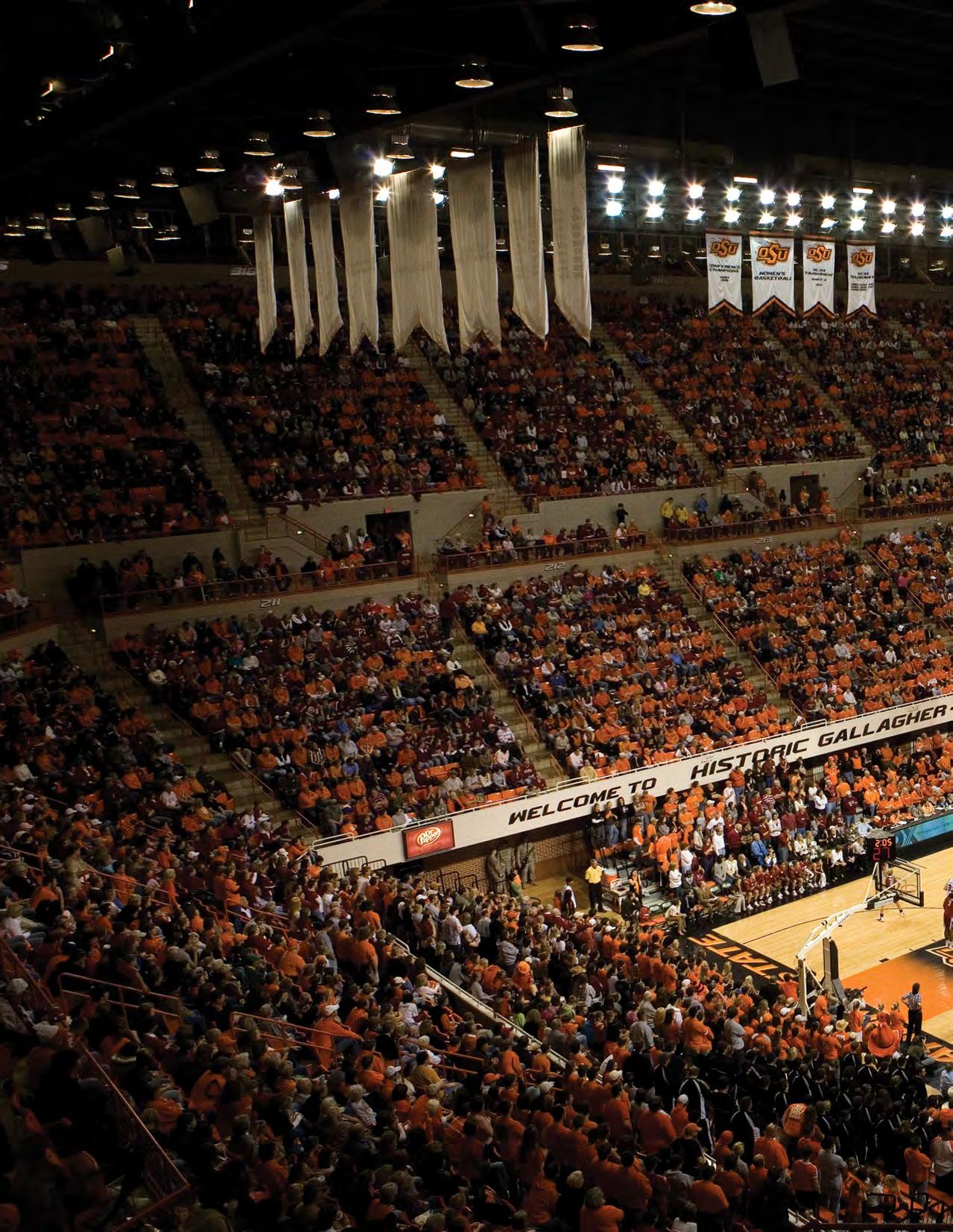
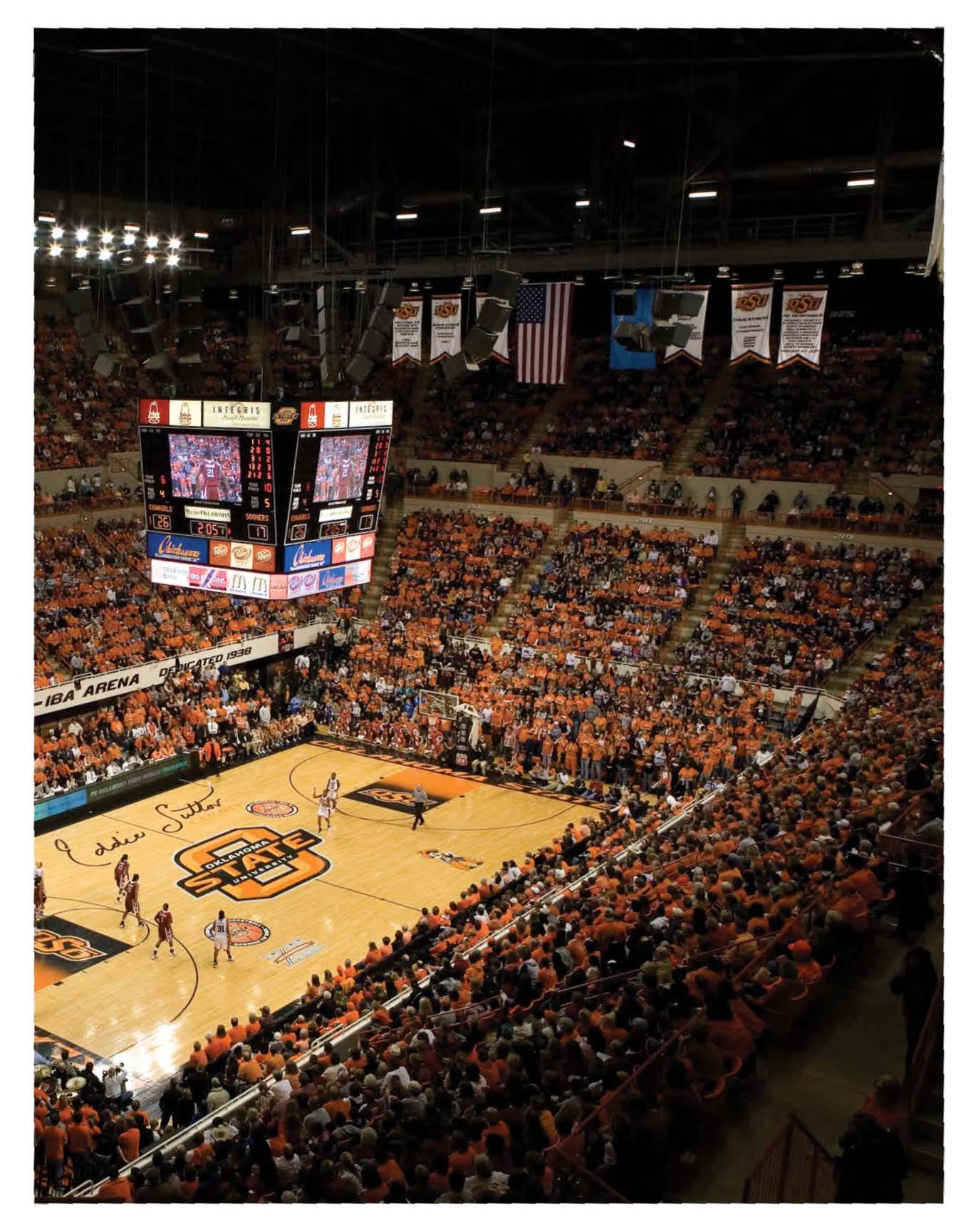
During the cold months in any of those years, along with most others, the thoughts of Oklahoma State fans turn to the occupants of Gallagher-Iba Arena, the home of a men’s basketball program considered one of the best of all time, and a wrestling program that clearly is the best of all time.
But since the 1973-74 academic year, Gallagher Hall turned Gallagher-Iba Arena has been the home of a third Oklahoma State program – women’s basketball.
Over the years, the program has enjoyed periodic success with 10 national tournament appearances (including the women’s NIT),
Imagine winter on the plains of Oklahoma. All right, that might not be so hard to do since it is winter on the plains of Oklahoma.
Imagine it is winter on the plains of Oklahoma three, five, eight, even 10 years ago.
an occasional victory or two in the NCAA Tournament, a Sweet 16 appearance in 1991, and a healthy lead in the Bedlam Series.
But late in the 1990s, OSU slipped just a bit into the .500 range as a program. That small descent coincided with the rise of the Big 12 Conference into a monster women’s basketball league. The result was that eventually OSU found itself at the bottom looking up in the Big 12 conference .
And while the rest of the nation began flocking to women’s basketball games, OSU’s program entered into a period of quiet existence with a small but loyal group of diehard fans.
But there were people outside of the OSU family who saw potential – lots and lots of potential. There was the head coach of a women’s basketball blueblood named Kurt Budke, who saw a school loaded in basketball tradition playing in a legendary arena. There was an in-state high school player who had watched one Big 12 program blossom and was infatuated by the process.
And there was a star-in-waiting in Texas who got hooked on the orange and black while watching the men’s team.
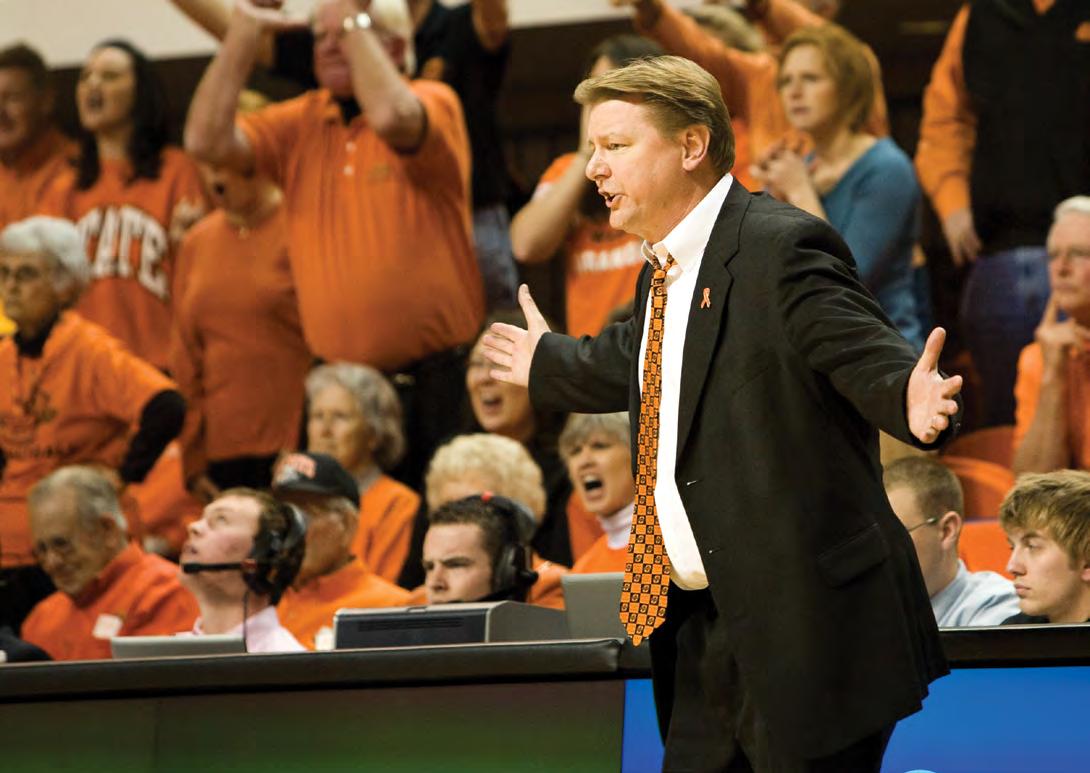
The result is that during this particular Oklahoma winter, a third-year Cowgirl head
coach is leading a renaissance that is grabbing headlines across the country. And the Big 12 conference, rated as the best women’s basketball league in the country, has yet another land mine to navigate for those trying to claim a league title.
The numbers are well documented.
Kurt Budke, after winning 80 games in three seasons at Louisiana Tech, returned to “Big Eight” territory to take up the challenge Cowgirl basketball had become.
“A lot of people thought when I got to Louisiana Tech that it was the last stop,” Budke says, “but I grew up in Kansas (Salina) and I wanted the chance to come back home. Home to me meant Big Eight country and being around the kind of people I grew up around.”
The Cowgirls struggled to a 6-22 record including an 0-16 run through the Big 12 conference during that academic year – the first for the new staff.
“We had great kids who would give you everything they had,” Budke says. “As a team, we just didn’t have the talent of the people we were playing.”
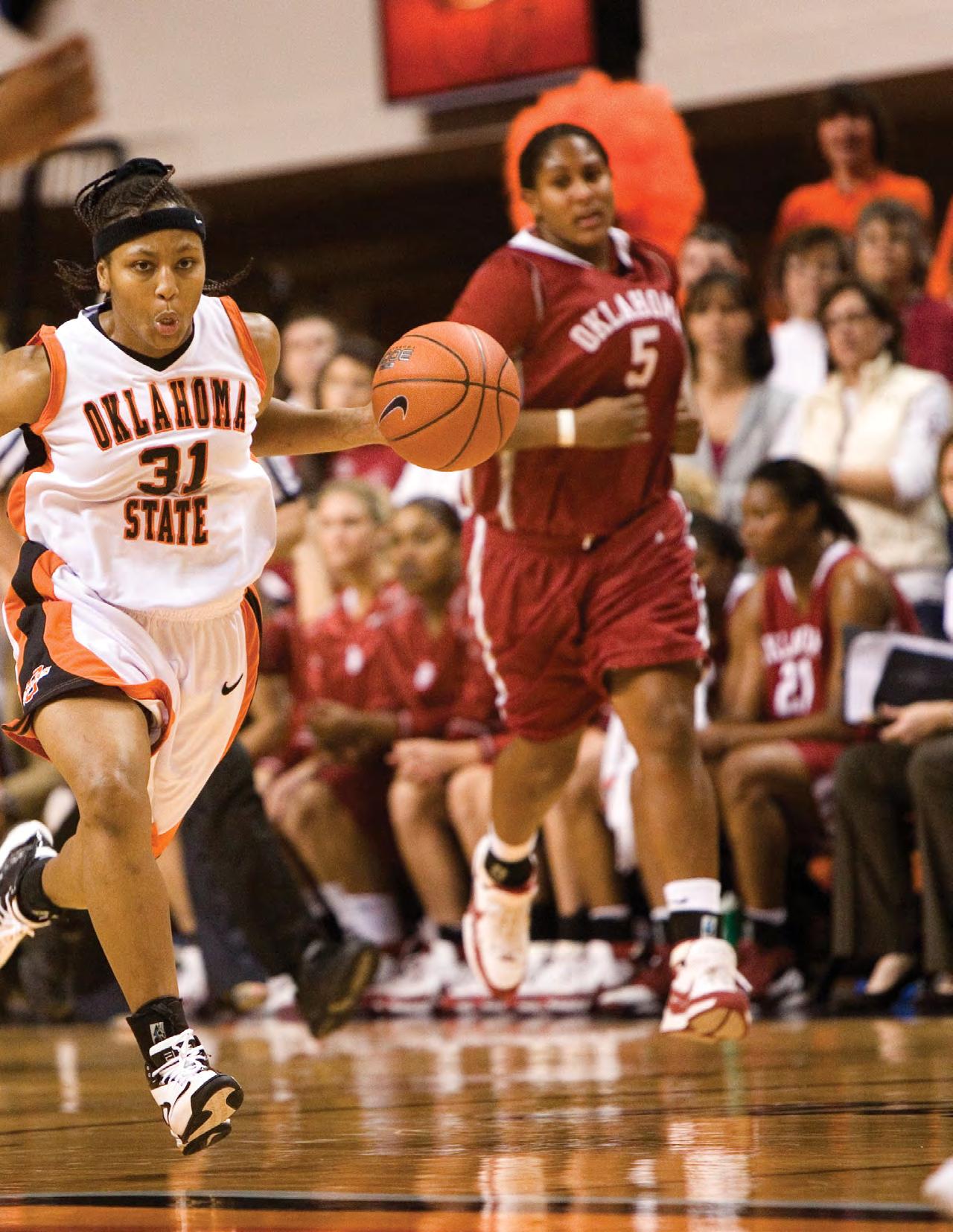
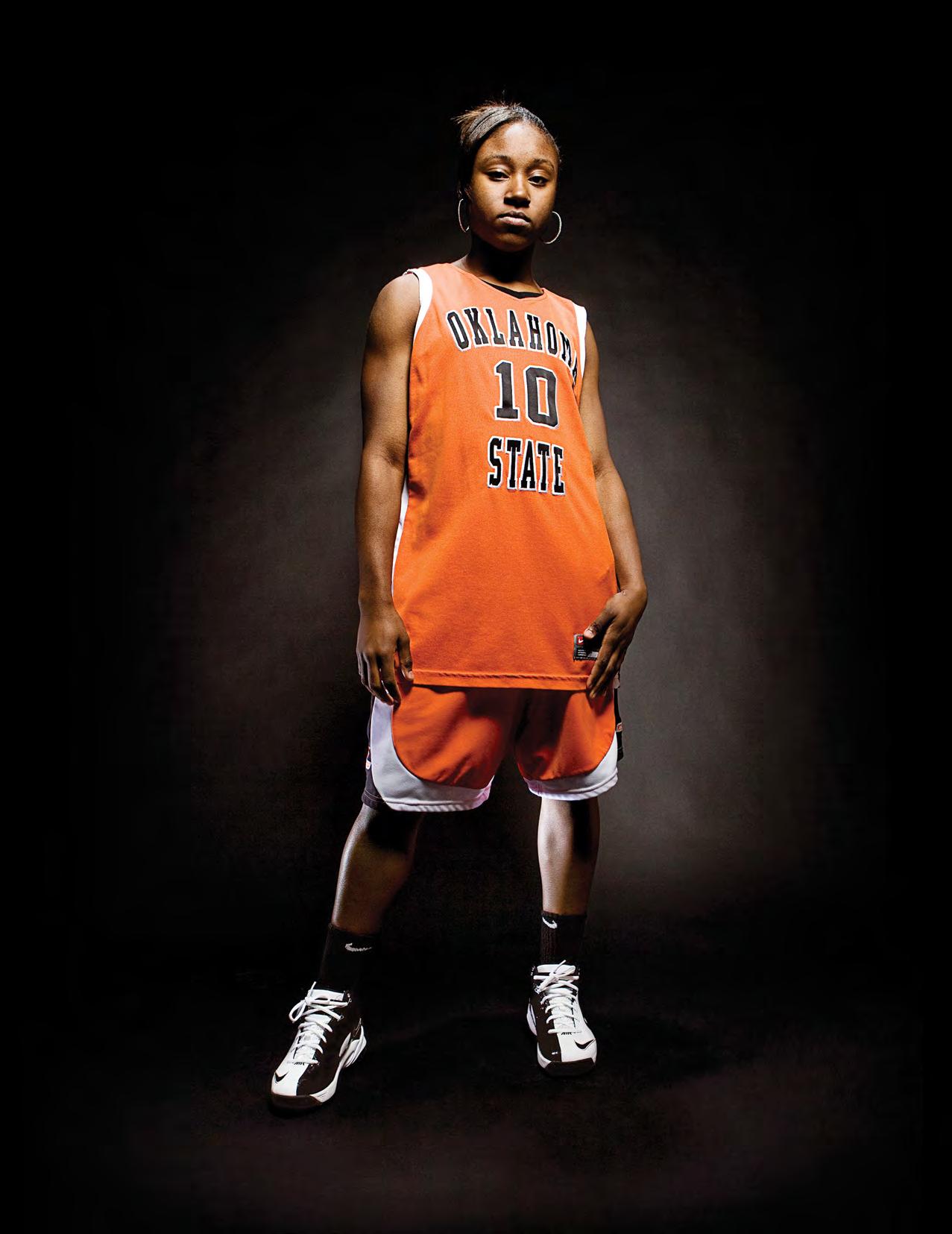
But rebuilding didn’t scare away potential recruits. In fact, for the kind of player Oklahoma State was in the market for, the hurdles of rebuilding may have actually been a selling point. At least they were for Taylor Hardeman and Andrea Riley, the duo best known as OSU’s starting backcourt.
“We want our girls walking into the gym every game with expectations to win.”
—Coach Kurt Budke
The arrival of Budke and his staff of Jim Littell, Kenya Larkin, Miranda Serna and Bruce Erickson (director of player development) came in time for the 2005-2006 season.
Hardeman is a player the squad could not do without. A native of Norman, she was nearby as her sister, Sunny, played a part in the turnaround of the women’s basketball program at the University of Oklahoma.
“She talked to me about what it meant to build a
program and to be a part of that,” Hardeman says. “I could see that happening at OSU.”
Hardeman arrived on campus just a few months after the new coaching staff. It was a staff that did not recruit her.
“The summer was crazy. Shaunte (Smith) and I were the only new players. Everyone else knew each other.”
Over the course of the season, a long season, the Cowgirls and their new staff had a chance to get very familiar.
“It wasn’t as bad as it might seem.”
Hardeman says. “We won some games at the beginning of the season and we had some chances to win in the Big 12, we just didn’t finish. It was frustrating but we never gave up. We were all just trying to find ourselves.”
Along the way Hardeman did find herself and the coaching staff found her. And now, as a junior, she is known as the Cowgirls’ best defensive player and a glaring threat behind the three-point line. She is a coach’s dream. Give her a task and get out of her way. No need for explanation, just directions.
“We played some people close that year
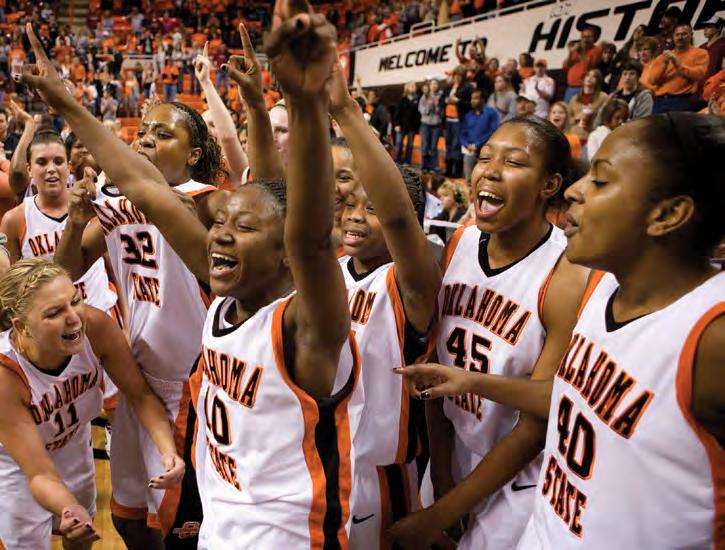
that we had no right to play close,” Budke says of his first journey through the Big 12. “We knew we could it. You take it one notch at a time. There are 11 teams in this league that could go to postseason this year. You just try to work hard and pick them off one at a time. Every single night is a challenge.”
“I knew they had struggled,” Budke adds of the Cowgirl program. “I didn’t realize how much until I got here. But I knew you could recruit players to the best conference in the country. My staff really doesn’t get enough credit for the recruiting they did off of 0-16. We had to sell on potential. There was a lot of negative recruiting because no one wanted us to get this thing started.
“We sat down as a staff and determined we were going to recruit players from winning programs – not only talented players but players that expected to win every night. We want our girls walking into the gym every game with expectations to win. We stuck with what we knew.”
Both were decided with less than one second on the game clock.
The Aggies, with five returning starters from their 2007 title team, were one of the first Big 12 teams to lose a home game to the Cowgirls in 2008.
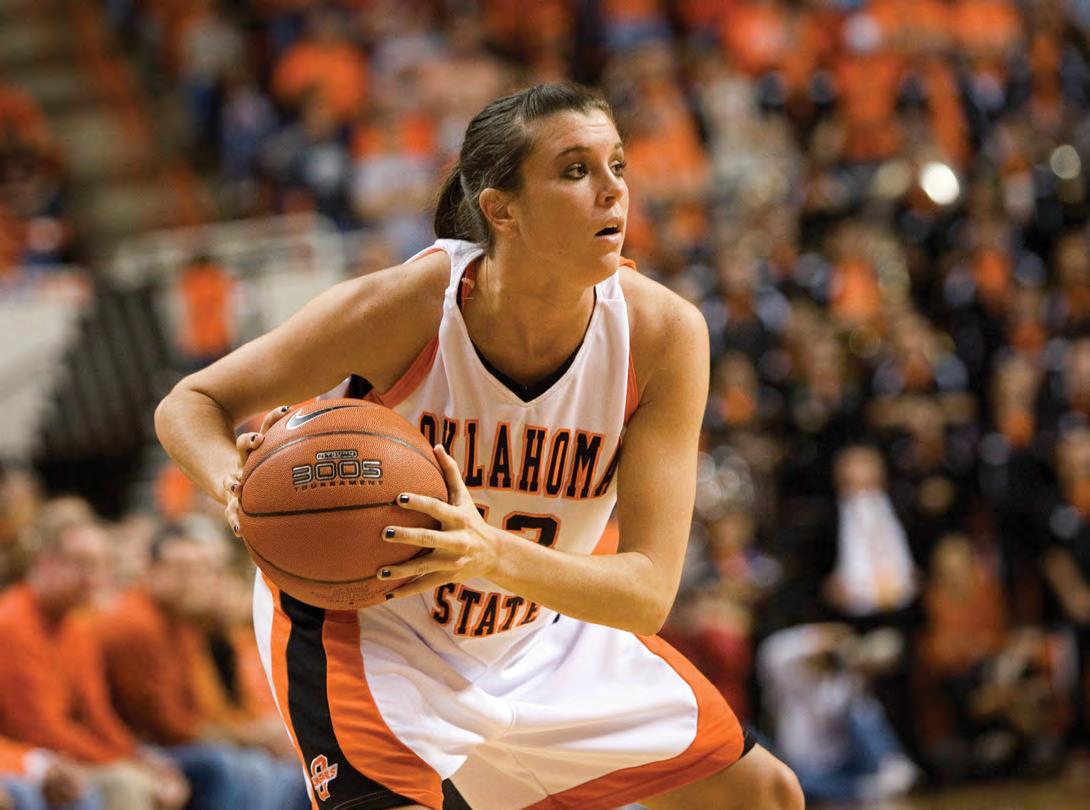
The Budke renaissance was fueled by an influx of talent led by point guard Andrea Riley of Dallas. An early commitment to Miami (Fla.) had not quelled the interest in Oklahoma State for the playmaking dynamo. One year ahead of her at Lincoln High School was Cowboy bas-
Oklahoma State during the November signing period.
Then came 0-16.
“Everyone at school was like ‘you’re going there, they’re sorry.’ But I wanted to be a part of building a program instead of one that was already good. I knew when Coach Budke got his players, we would improve.”
In year two of the Budke era on the heels of their surprising appearance in the NCAA Tournament and the completion of the biggest turnaround in the country last season, the Cowgirl head coach earned congratulatory phone calls from across the country.
But things change fast in athletics. The phone doesn’t ring as much any more. At press time, the Cowgirls were 20-3 overall, rising fast in all of the national polls and firmly established as a team that would help shape the 2008 Big 12 race. And even though Budke knows there are plenty of setbacks awaiting when the nation’s most challenging conference is on the docket for early March, clearly OSU has arrived at the party or at the very least is knocking on the door.
OSU was the warm and fuzzy story of the 2005-2006 season and friends and foes alike were happy to see the rebirth of the program. The congratulatory slaps on the back, however, might have been the equivalent of a rough-and-tumble puppy receiving a pat on the head and a quick dismissal.
During the 2007-2008 season, however, the opposition has a much different attitude. The OSU women’s basketball program has gone from a cute little puppy of a program to a full blown threat to the super powers. Andrea Riley has taken the nation by storm and you can’t help but feel that OSU and Budke are just getting started.
“...It was frustrating but we never gave up. We were all just trying to find ourselves.”
—Taylor Hardeman
The fact that the OSU women’s basketball has rebounded under Budke is not an eyebrow-raiser. Budke has had success at every stop. What has made waves is the speed at which OSU has climbed into the contender category.
One season after 0-16 and 6-22, the Cowgirls climbed to 8-8 in the Big 12 conference and punched its first NCAA Tournament ticket since 1994. Among the losses during a 20-11 season were two games with eventual Big 12 champ Texas A&M.
ketball signee (and now starting point guard) Byron Eaton. Behind her at Lincoln High School was future Cowboy football signee Richetti Jones, who redshirted in 2007 for Mike Gundy’s squad. Each played a role in the other eventually finding their way to Stillwater.
But the Cowboys already on campus played a role as well.
“I really liked the men’s program,” Riley said just after her mammoth performance against OU when her 45 points helped OSU deck the No. 6 Sooners by an 82-63 count in front of a state-record crowd of 13,611. “I liked how they played in the Final Four (2004). I wanted them to win so much.”
Riley was hooked and inked with
The puppy is growing teeth.
The coaching staff, however, is unchanged and generally unfazed by the rapid rise in the won-loss record, the publicity onslaught and the swelling crowds.
“This league is very challenging,” says Budke. Everyone is going to struggle at some point. We are just trying to keep doing what we do, doing what we know.”
What we know is that as a head coach, Kurt Budke has a winning percentage in excess of 82 percent. If the Cowgirls continue to do what he knows, the fun is just starting. And Gallagher-Iba Arena just got a little cozier during the winter months.
Kevin Klintworth
Associate Athletic Director









Not all donors chart the same course toward an appreciation of OSU Athletics. Sometimes, they don’t even have to attend OSU. Sometimes, it’s just in their blood.
After growing up in Texas, Bryan Brady II received a journalism scholarship to attend the University of Texas at Arlington. But he always had a special place in his heart for Oklahoma State, brought on no doubt by his late father, Bryan Brady Sr.
His father loved his alma mater. The 1929 Oklahoma A&M graduate played football, basketball and baseball, and was a founding member of the FarmHouse Fraternity in 1928. Brady fondly remembers discussing OSU sports with his father throughout his childhood.
“I am happy to have had a chance to connect with the school that had been very important to my dad,” Brady says. “Our support of OSU is one way to honor him. Our son, John, was born about eight months before Dad died and I know he’d be proud to know that John is a sophomore at OSU and we expect our other son, Travis, to be a Cowboy in two years.
“Three of my four sisters attended OSU in the 1950s. I still have the Willys Jeep they drove to school. I was a very late addition to the OSU family and graduated college in 1977,” Brady says. “I took a psychology class
at OSU to complete my master’s in 1992.”
Fifteen years ago, Bryan, his wife Becky, and their three children (Emily, John and Travis) moved 15 miles northwest of Stillwater. Since then, their bond to OSU Athletics has taken on a new dimension.
“We came into the fold by a different route than most POSSE members. Neither of us has more than a few hours of class credit at OSU, but we’ve been made to feel we are a welcome and important addition to the Cowboy family.”
The Bradys have indeed been a welcome addition, contributing as needs arise. For example, in 2007 the Athletic Department needed for a high-definition video camera. The Brady family stepped forward with a five-figure gift to purchase the camera. Now, the web and marketing staffs are able to create high-quality highlight videos and online coach and studentathlete interviews for OSU fans.
“I admire the generosity of Becky and Bryan Brady,” says Shane Crawford, director of major gifts for OSU Athletics. “They love OSU Athletics and are always eager to help our coaches and student-athletes.”
The Brady family’s passion for OSU Athletics solidified in late 1999. That year Becky and Bryan bought men’s basketball season tickets for their family. They wanted their children to experience life on an NCAA Division I campus. Although they had some of the highest seats in Gallagher-Iba Arena, they were thrilled to be part of something special.
“After that year we looked around and saw
that positive movement was being made in virtually all areas of OSU Athletics, and we decided it would be exciting to be a part of that growth,” Brady says. “We never dreamed those top row tickets in GIA would lead to seats in the lower bowl, floor seats for the women’s games and club seats in Boone Pickens Stadium. We have really been fortunate. We bring friends from Texas and Kansas who have never been to Stillwater, and when we go to the game, they are always surprised by the beauty of the campus and the forward thinking of the Athletic Department.”
Over the years, the Bradys have witnessed some exceptional moments in OSU sports, including the last Cowboy Basketball trip to the Final Four.
“The ’04 basketball team will always be special to us,” Bryan says. “We were with the team for two of the three wins over Texas that year, including the championship game at the Big 12 tournament in Dallas.
“Like thousands of Cowboys fans, in our minds we can still see John Lucas sink the trey that won the East Rutherford Regional as though it were yesterday. Great shot. Great kid. Great team and season.”
Becky says her greatest thrill was when she and Travis sat with Eddie Sutton last year at the triple-overtime win against Texas in GIA. “Coach Sutton is such a nice man. It was an honor to sit with him and hear his comments on the game,” she says. “Travis was introduced to the crowd at half-time by
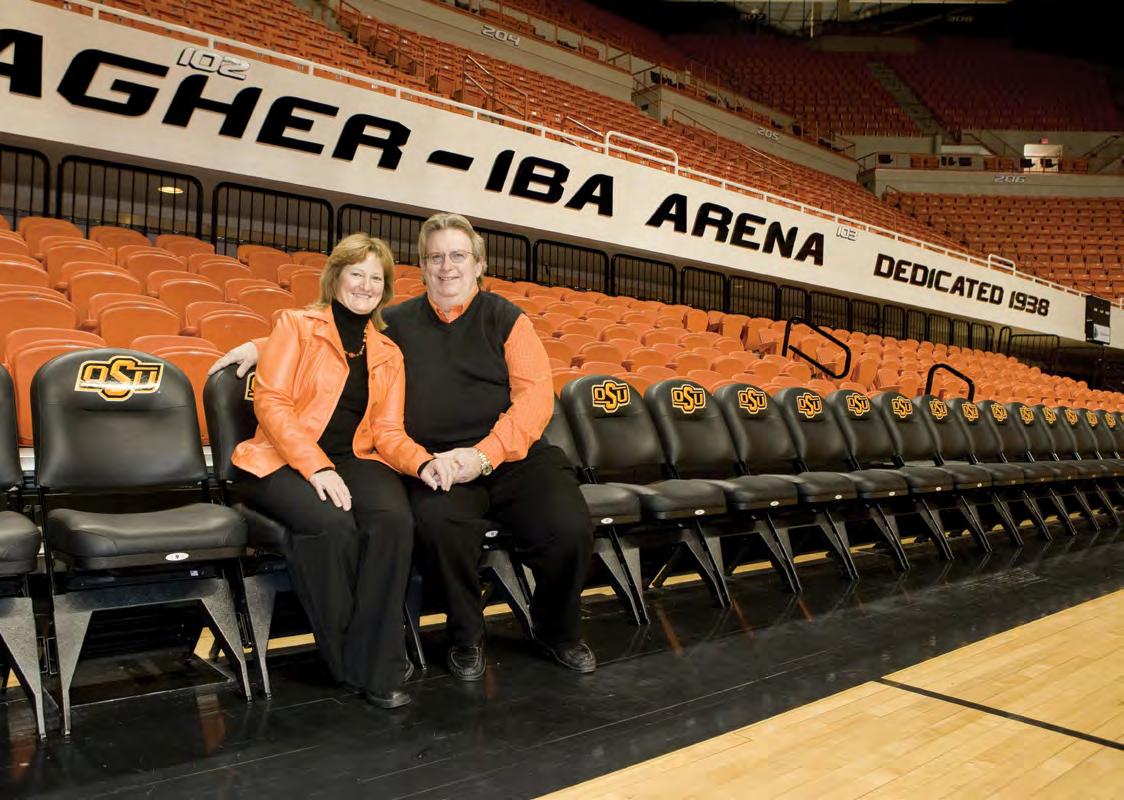
Coaches vs. Cancer as a five-year cancer survivor. We’ll never forget that night.”
Memorable moments have passed, but the Bradys anticipate even better times.
Brady, a self-proclaimed Cowgirl basketball fanatic, thinks this is the season the Cowgirls will break through to national success. “Those girls work so hard for coach Budke and his staff. They have a never-say-die attitude that is infectious,” says Brady. “We check off the box to claim Final Four tickets for the Cowgirls each season. They may not go this year, but they’re on their way and we’re going to go with them.”
The Bradys don’t consider themselves mere fans. They feel they’re part of the OSU family, and as family members, have a vested interest in OSU’s future.
“It really is wonderful to feel like we are a part of the new success at OSU. Watching the incredible improvements at Boone Pickens Stadium and the unfolding of plans for the Athletic Village is a dream-come-true. We can’t
all be as generous as Mr. Pickens – and we don’t have to be. If everyone with a connection to OSU joined the POSSE at the minimum donation, we could fund improvements we haven’t even imagined yet.
“One great aspect of donating to OSU is you can be assured your money is being stretched as far as possible. Boone Pickens is leading the charge in donations, but he’s also the key to growing our nest egg as fast as possible. Anytime I speak with Mike Holder, I’m always struck by his passion for all OSU sports and his drive to get the absolute biggest bang for every buck we spend.”
Brady believes the new facilities will play a major role in the rise of all sports because of their impact on recruiting.
“By committing to build the planned facilities at OSU, we are helping recruit the best athletes and thereby putting the school in position to win championships for years to come. For better or worse, today’s students and student-
athletes have a different perspective than kids just a couple of decades ago. They don’t want to play in dilapidated old facilities in front of a few quiet fans. Today’s young athletes have hundreds of choices when looking at colleges to attend. The top programs have offered great facilities and amenities for many, many years,” Brady says.
“For OSU to be the best, we have to show our potential athletes we care enough about them to provide the best facilities and the best fans. As you see the facilities on campus improve and the quality of our recruits rise, you realize OSU is on the right track.”
If Bryan Brady Sr. could see it now, he would be proud. OSU Athletics is going through a time of unprecedented growth thanks to the generosity of many, including his son.
by TRAVIS TINDELL
Losing eight seniors, revamping the coaching staff and restructuring the program might seem like the prelude to a rebuilding year for most softball teams. It is not the case for the Oklahoma State softball team and senior right fielder Kim Kaye.
“We had eight seniors last year who have left us. The only returners we have in the same position are our left fielder and one of our pitchers,” Kaye says. “We are a really young team, but we have these new coaches who are molding us into the kind of competitive team Oklahoma State needs to become. I think (OSU) had lost track of that.”
Stiff competition is nothing new for Kaye as she spent a couple years as part of the British National Team. The team competed in such events as the World Cup of Softball in Oklahoma City and the Softball World Championships in Beijing.
“They come in and recruit players for their national team,” says the San Diego product. “Softball isn’t as big over there, so they come in and recruit Americans. That probably
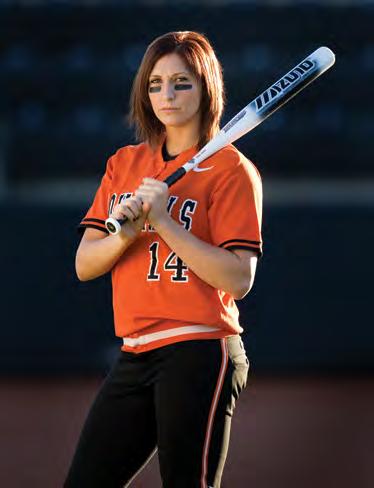
KIM KAYE
has a lot to do with why softball isn’t going to be in the Olympics anymore.”
Kaye, who has dual citizenship because her mother is British, spent a summer in London training and coaching youth teams. London was chosen as the host city for 2012 Olympics, and Kaye was thrilled for the opportunity to compete, but the Olympic Committee decided that 2008 would be the last year for softball. Unfortunately, the British team failed to qualify for Beijing.
“My favorite thing (internationally) was that first summer before I came to OSU, I went over there [London] for three and a half months. I trained, played and coached,” Kaye says. “The coaching was really good for me because it felt a little better to be giving back to the British softball community by helping the young kids. It was good to boost any kind of desire to play sports.”
The hard part was that while Kaye was working to encourage younger girls to get excited about softball, the Olympic committee removed the sport from its list of competitions. Suddenly, softball lost its allure and was no longer attractive to the young girls.
Kaye did not let the setback upset her. She continued to promote the sport and continued to compete with the best in the world. From her experience abroad, she encountered the strangely different style of play of other cultures.
“I gained a huge respect for the people who come to the game from all different aspects. There are so many different ways to approach softball and so many different techniques,” Kim says. “I think there is a completely different way that Europeans play softball. They are more relaxed with it and not as crazy and uptight as we are here. Sometimes the more relaxed you are, the better you play.”
The journey from San Diego to Oklahoma State has indeed been a crazy one. When Kaye was 17, she considered quitting softball and attending college simply as a student. However, something inside her told her that her softball days were not quite finished. Kaye’s friend, Krystle Sanchez, recommended Palomar Junior College, located just north of San Diego. Sanchez was already attending and playing shortstop for the softball team.
Kaye joined the team and a year later was recruited to play at Oklahoma State. She received a pleasant surprise when she learned that Sanchez would be recruited to play at Oklahoma State as well.
Kaye made the transition from a small, but good junior college softball program to the prestigious Big 12.
“It was a great jump from there to here,” Kaye says. “You go from being the big dog, where at Palomar I set records, to coming here where everyone dominates.”
Kaye believes her year at Palomar was instrumental in her development as a softball player.
“Junior college gives you a higher maturity level. It is like a stepping block. It was like that for me because I got a chance to see the difference [between high school and college] a little bit, so it wasn’t as big of a jump,” Kaye says. “The year at junior college helped me gain some confidence. The competition was higher [than that of high school] and here [at OSU] the competition is even higher.”
Kaye has thrived at Oklahoma State and become one of the leaders on an improving softball team. At the start of her senior season, she has made a drastic change. She moved from first base to right field — a
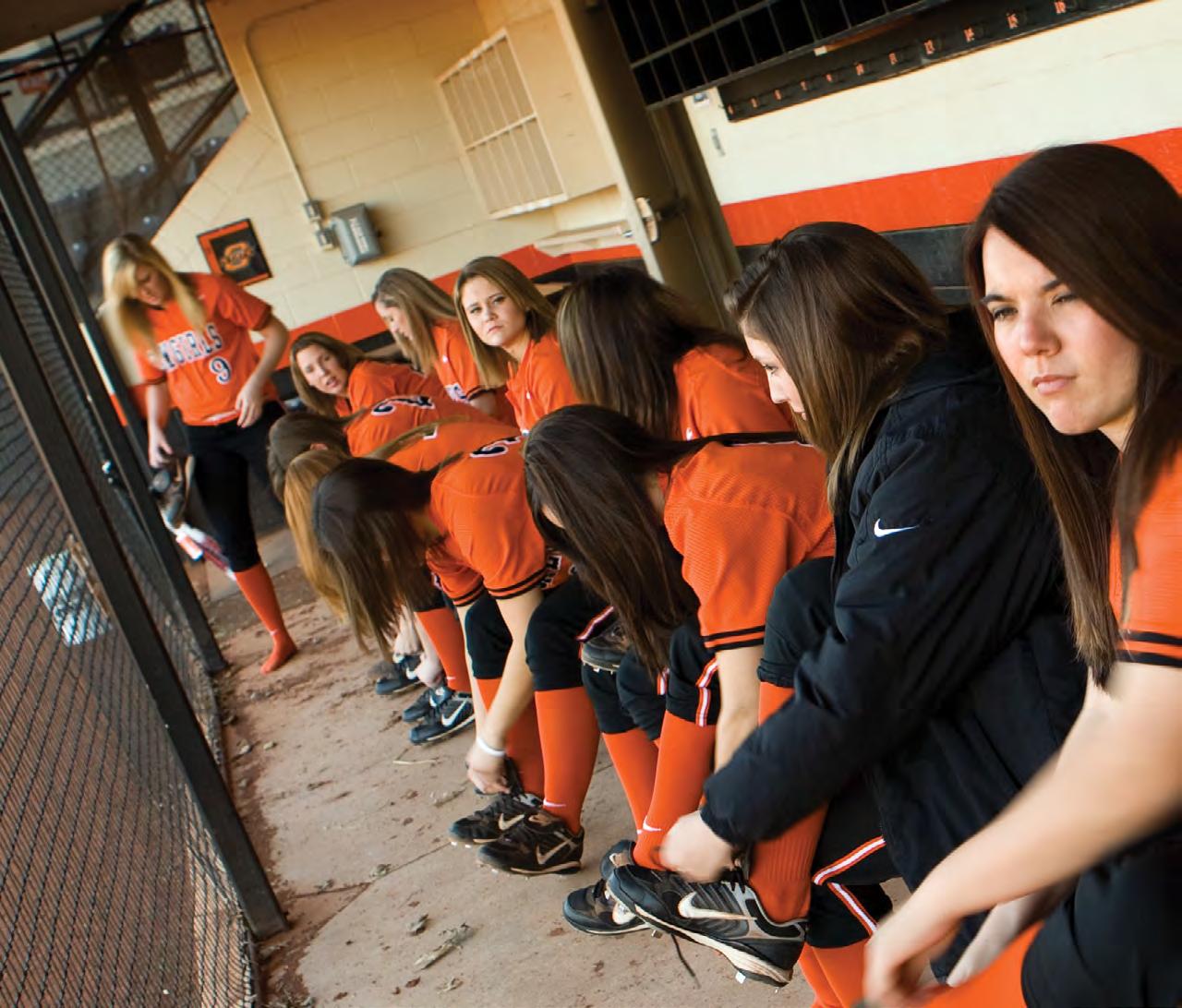
change encouraged by the coaches and welcomed by Kaye. The switch was meant to bring more stability to the lineup. Right field is nothing new for Kaye as she starred in the outfield in high school.
Coach Rich Wieligman has continued to encourage Kaye.
“Kim does a lot of things well,” he says. “She is a solid athlete with a great arm and she is a great hitter and a good all-around player. She just brings so much to the table. The thing that stands out most from her switch from first base to right field is it showcases her arm even more. She has a phenomenal arm.”
Having a strong arm and being a great hitter have given Kaye the opportunity to be the team leader. The other girls turn to her for
senior advice.
“In the fall she really stepped up to be the leader that she has to be as a senior and one of the few returners.,” Wieligman says. “She shows up early and stays late. She always gives 100 percent. I think a lot of people misconstrue leadership as something verbal. Kim leads by her actions.”
With a team that features six freshmen and six sophomores, Kaye looks for ways to build her younger teammates up in preparation for the stiff Big 12 competition. During training sessions, they work on mental aspects more than anything else.
“Mental endurance is so much more important than just physical endurance. This is something we emphasize with the younger girls. We put them through a lot of mental
toughness training,” Kaye says. “We do that because that is what you need in stiff competition. Personally, I think you have to break them [the younger girls] down a little bit. You have to get them in a spot where they are really tired and then you build them back up.”
Kaye wants to look back on her time spent at Oklahoma State and say she left a legacy. She wants to instill in the younger players an attitude of toughness. “I want look back and say, ‘From 2007 on, OSU is one of the toughest teams. They are one of the scrappiest, most confident teams out there.’ That is the kind of reputation I want this Cowgirl team to earn.”
Enter to win a autographed guitar
ALONG WITH OTHER BROOKS & DUNN PRIZES

Vicente Fox
president of Mexico, 2000 – 2006
» topic: “Bringing the New economy to latin America”
» ExECUTIvE MANAgEMENT BRIEFINg —
Oklahoma City
• Tuesday, February 5, 2008
• Oklahoma City Civic Center
• Presentation: 10:00 – 11:30 a.m.
Marcus Buckingham
» TULSA BUSINESS FORUM
• Tuesday, February 5, 2008
• Mabee Center, Tulsa
• Presentation: 4:00 – 5:30 p.m.
Author of three international bestsellers, including First, Break All the Rules and Go Put Your Strengths to Work
» topic: “Go put Your Strengths to Work”
» ExECUTIvE MANAgEMENT BRIEFINg —
Oklahoma City
• Tuesday, March 25, 2008
• National Cowboy & Western Heritage Museum
• Presentation & Book Signing: 9:00 – 11:30 a.m.
» TULSA BUSINESS FORUM
• Tuesday, March 25, 2008
• Renaissance Tulsa Hotel
• Presentation & Book Signing: 2:30 – 5:00 p.m.
SeleCted SpeAkerS: Pete Delaney, Chairman and Chief Executive
David S. Fleischaker, Secretary of Energy, State of Oklahoma, and President and
Raymond L. Huhnke, Professor of Biosystems and Agricultural Engineering, Oklahoma
Aubrey K. McClendon, Chairman and Chief Executive Officer, Chesapeake Energy Corporation
Larry Nichols, Chairman and Chief Executive Officer, Devon Energy Corporation
Tom L. Ward, Chairman and Chief Executive Officer, SandRidge Energy, Inc.
Sponsor opportunities are available.
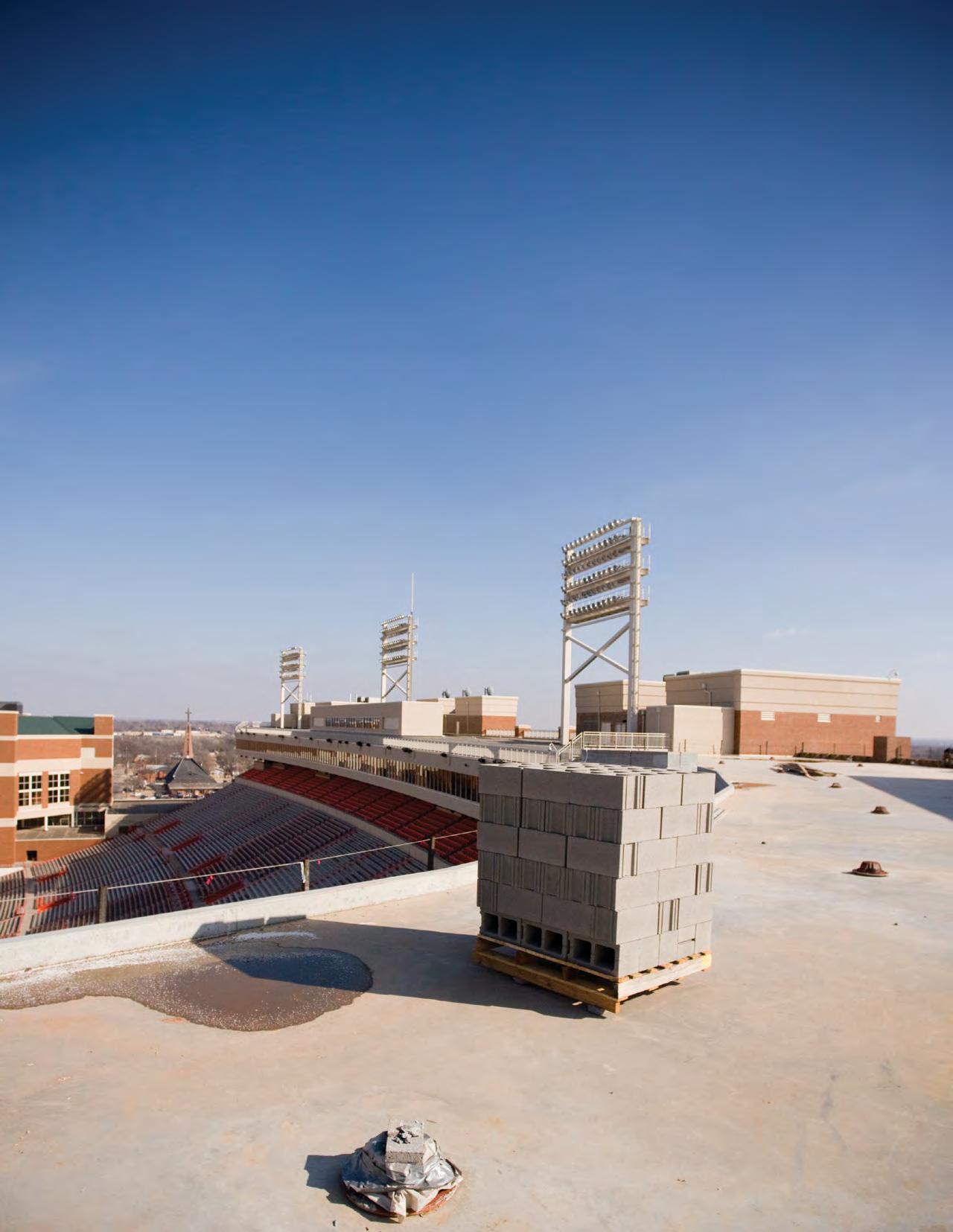
I !:11, I T /ii /(JI/ I -
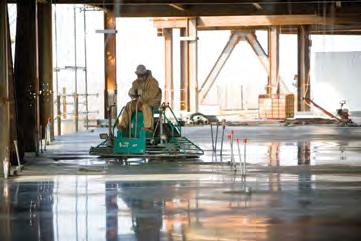

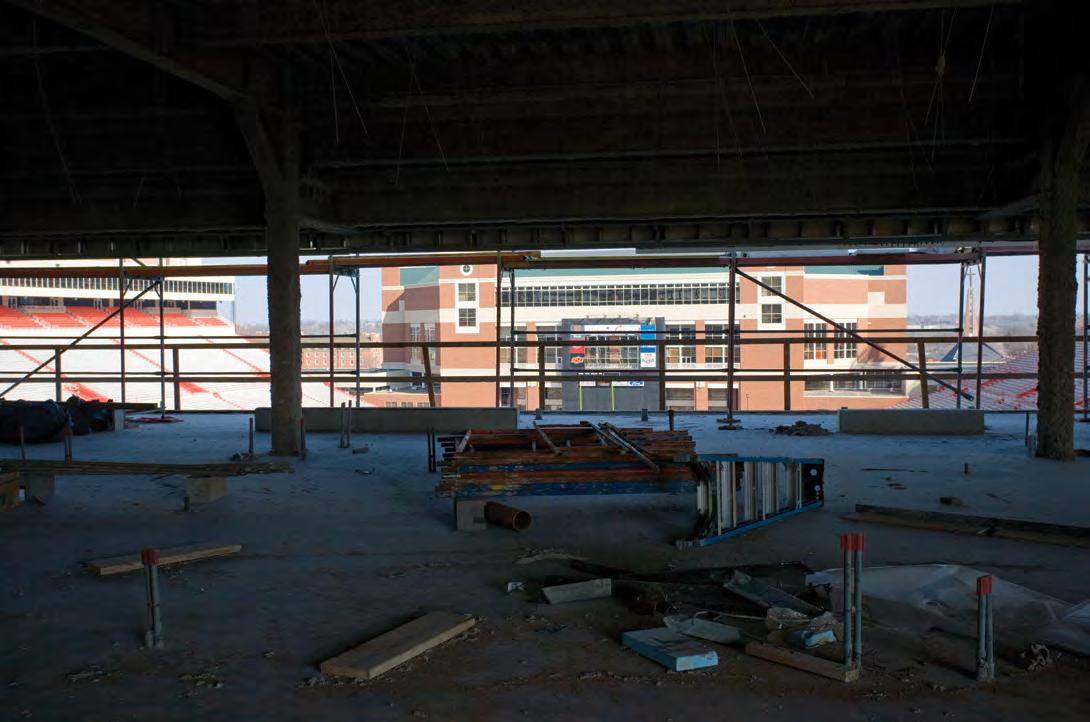

Lower Club Level:
With 58,330 square feet of air-conditioned space, the coaches’ offices function as an office space during the week and a private box with outdoor seating on game days.



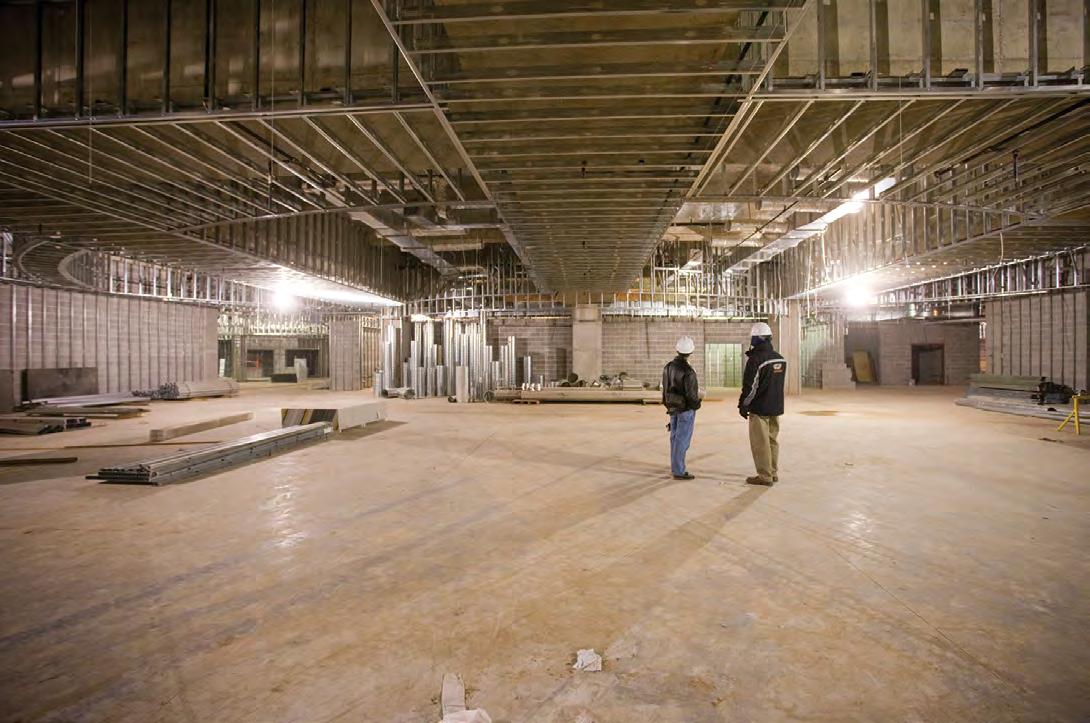
At 14,000 square feet, the locker room is designed to focus the team on game or practice day while also allowing areas for rest and reflection.

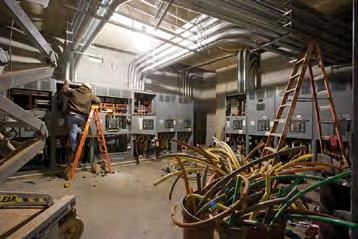

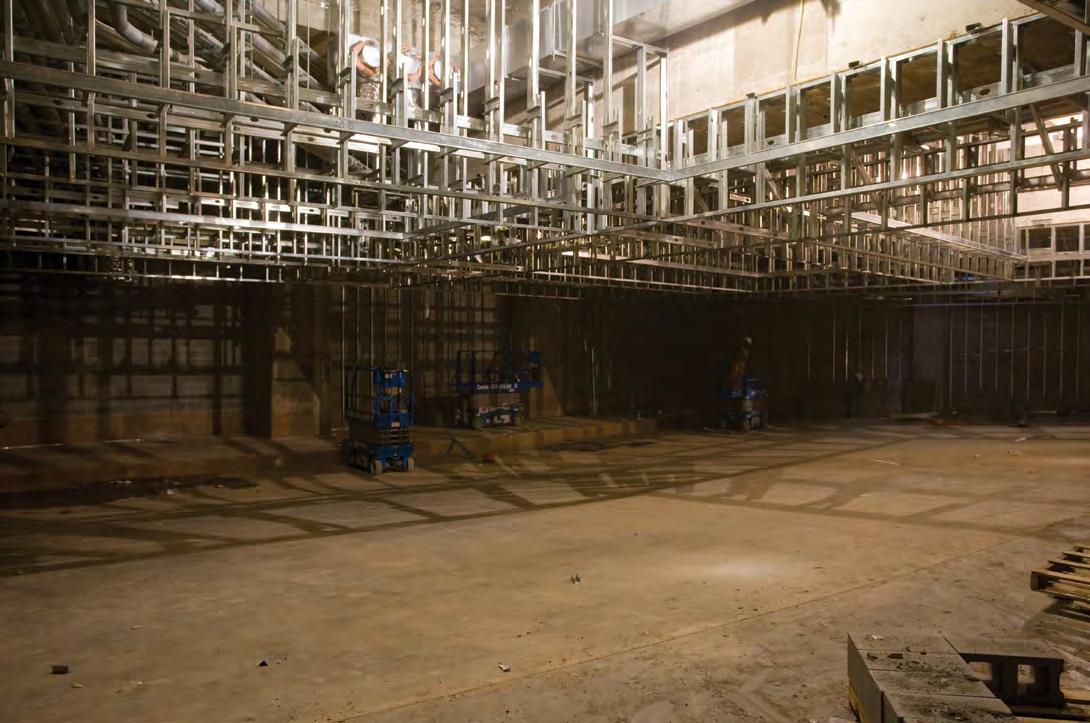
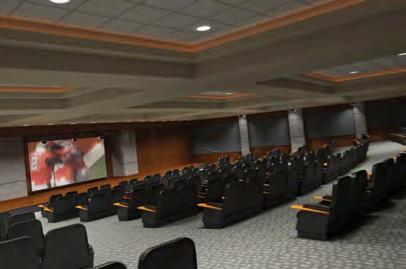
Accoring to OSU Athletics official John Houck, the west end-zone project is 90 days ahead of schedule. Lower bowl seating will be open for the 2008 season, and the entire project will be complete prior to 2009.
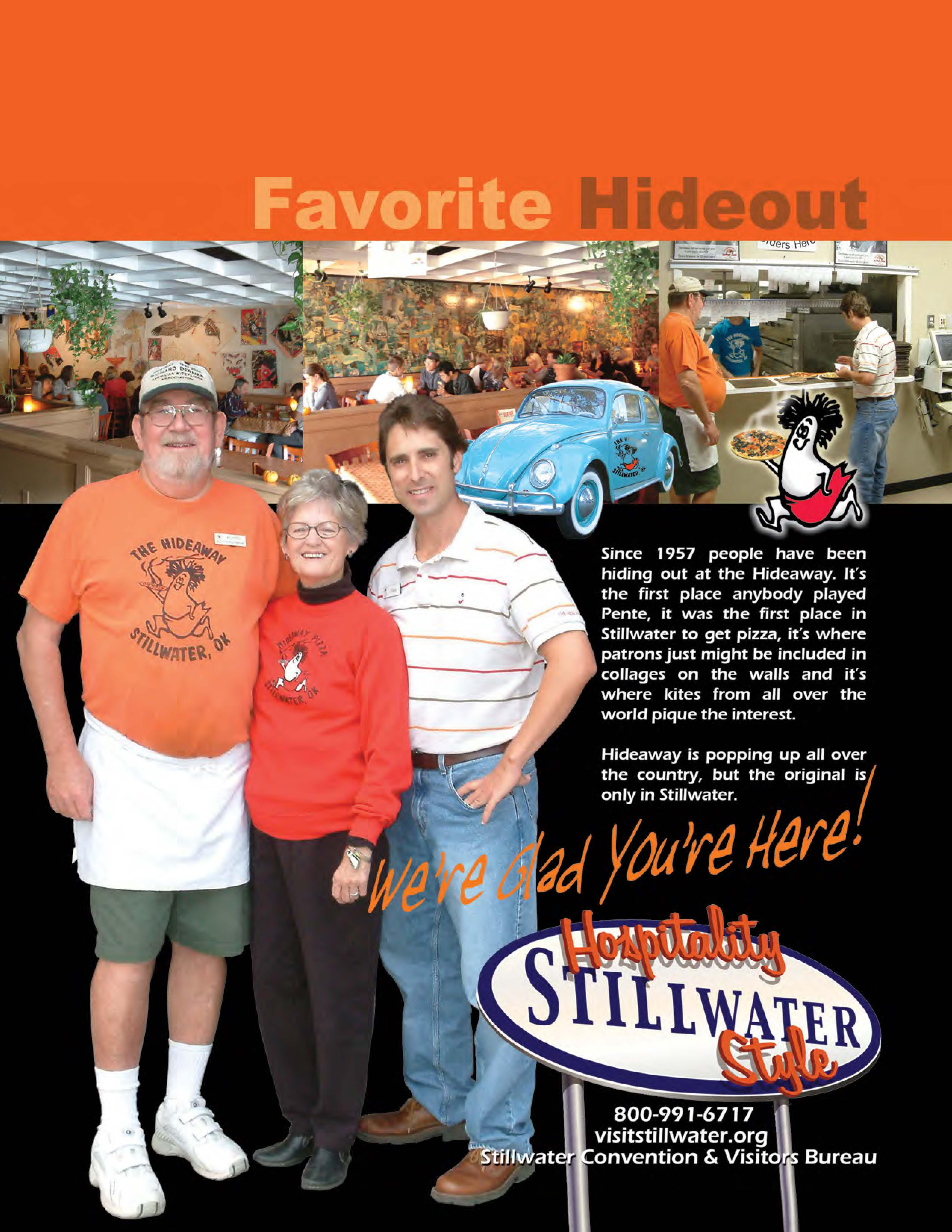
When you grow up in a town of less than 300 people, finding ways to pass the time isn’t always easy.
But all Jordy Mercer needed was a baseball and glove, maybe a bat — and there was always the dream.
That dream was following in the footsteps of guys like Brad and Bryan Gore, Monty Fariss and Matt Oakes — footsteps that led to Stillwater and the clubhouse at Allie P. Reynolds Stadium.
Mercer grew up in the tiny northwest Oklahoma town of Taloga, with a population of 250, give or take a few.
There might not be many people, but what there always has been is baseball. And some pretty good baseball at that. And for as long as he can remember, Mercer wanted to continue the tradition of smalltown ballplayers making good for Cowboy baseball.
“When I was little, I’d be in the dugout with those guys. I’d be the bat boy,” Mercer says. “I grew up with an OSU Cowboy influence.
“There’s nothing else to do but play ball — you just go to the field or go to the gym and practice and practice and practice. You want to be like those guys ahead of you who you’ve seen go on and play Division I. You want to be a part of that legacy, too.
“Our house is less than a mile to the field and gym so I just walked. My dad would throw to me a lot, or if the lights were on at night. I’d go up there and see who was
there and hit or throw.”
These days, Mercer is creating a legacy of his own. He’s been the Cowboys’ starting shortstop since the day he stepped on the OSU campus.
The fact that Mercer could make such a successful transition from Class B ball to life in the Big 12 conference may come as a shock to some, but OSU coach Frank Anderson isn’t the least bit surprised.
“We felt like he would come in and be our starting shortstop from the get go,” Anderson says. “But we basically had to talk him into
tus in 2006. In the summer of 2007, he was one of just 20 players for the USA Baseball club that won the silver medal at the Pan American Games.
“It’s way different, but you get used to it,” says Mercer of transitioning from the high school level to Division I. “My freshman year was tough. I struggled through a lot of growing pains, but it’s helped me out to where I am now.
“Playing in front of the fans has been crazy. Coming from a Class B school, when I first got here and saw all the fans, it was amazing and I was in awe and couldn’t even focus on the game.
“But you get used to that. The game is a little faster, a little quicker, but you start to know what to expect and you just go out there and play.”
There are not many in the Big 12 who play the game better than Mercer.
As a freshman, Mercer started 54 games at shortstop and hit .270 with six home runs and 24 RBIs. He also established himself as the Cowboys’ closer and was 5-0 with a team-best five saves in 12 appearances.
Mercer, who earned firstteam All-Big 12 accolades as a utility player as a frosh, welcomed the challenge of the dual role.
coming. He wasn’t quite sure he was good enough, and his parents weren’t sure he was quite ready. But physically, we felt like he was.
“He was fortunate to play on some summer teams that played all over the country and faced some good talent. That gave him some confidence coming in, and he’s been a good player ever since.”
Mercer enters his junior season having already earned All-Big 12 honors twice, not to mention garnering Freshman All-America sta-
“I’ve been doing that my whole life,” Mercer says. “Every time we needed a pitcher, I was there to pitch, and I’ve always been at shortstop. I didn’t expect it when I first came here. I thought I’d be one or the other, probably just a shortstop, but coach wanted me to do both.
“I had the mentality that I already knew how to do it so it wasn’t really an adjustment. It’s fun, and I like doing it.”
Anderson adds that having a luxury such as Mercer is a huge boost to his team.
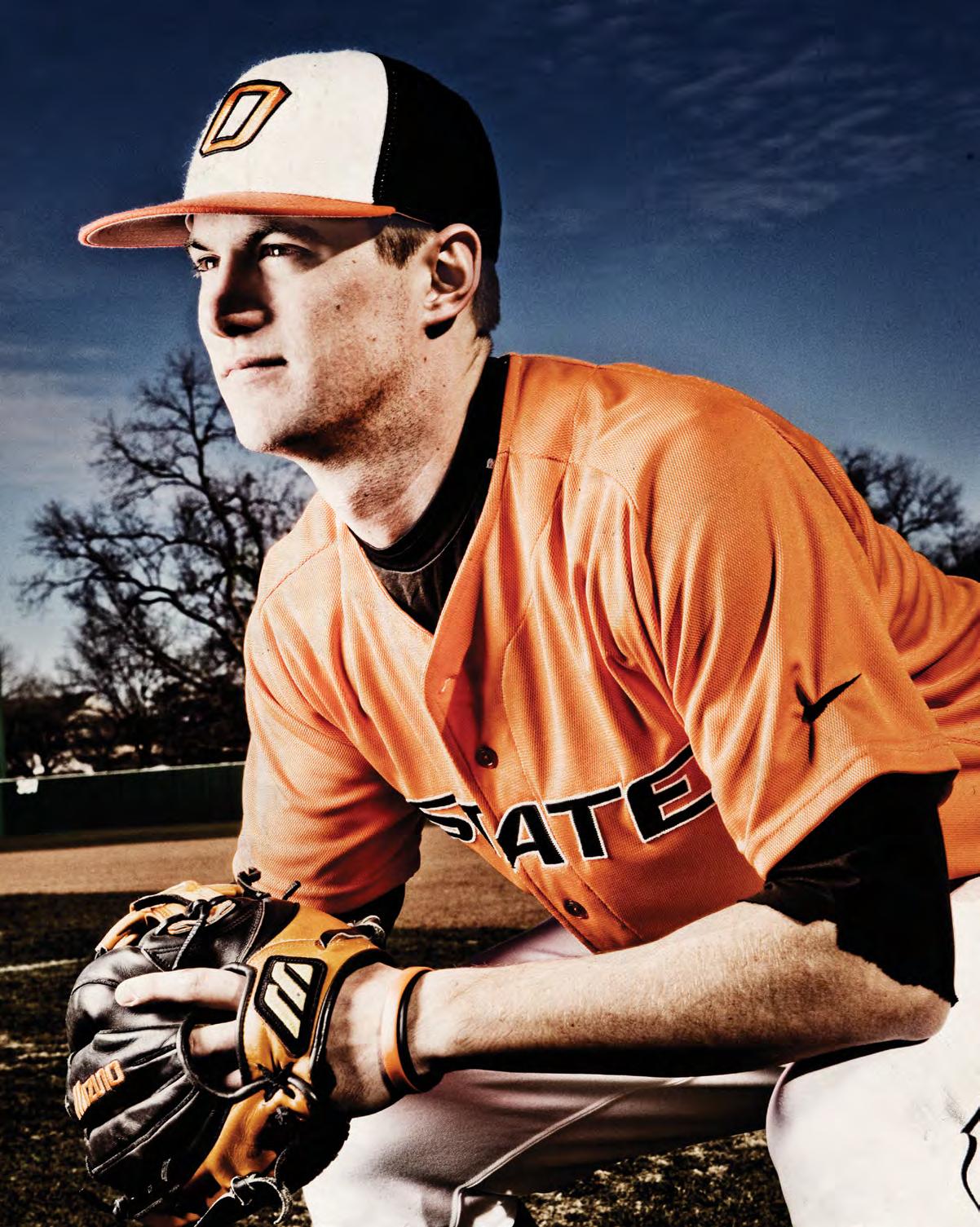
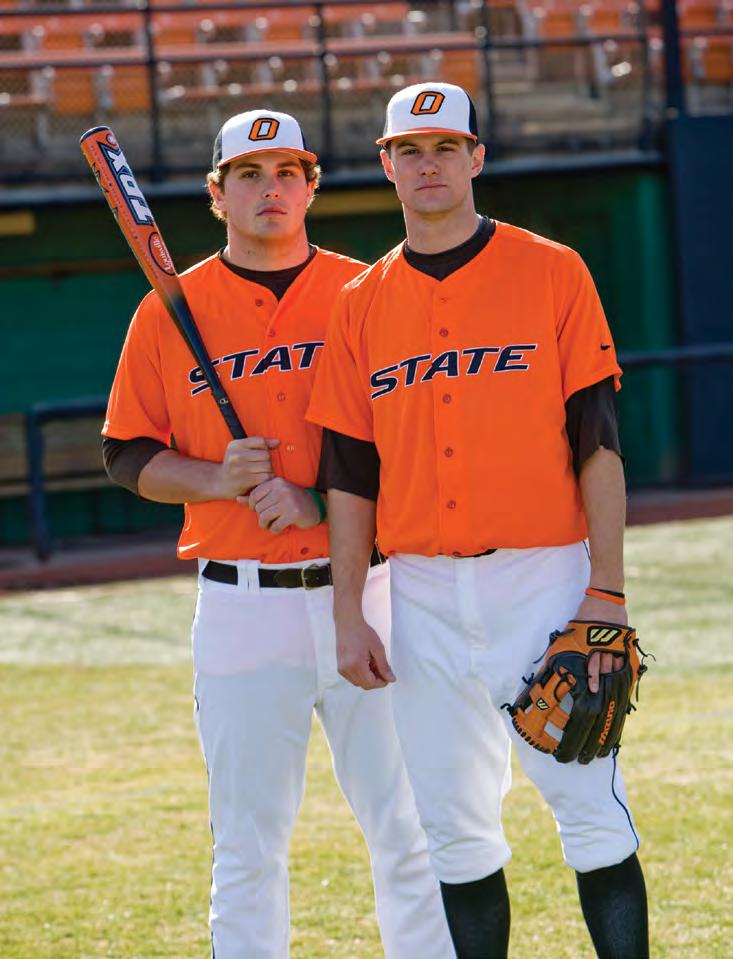
“He’s an outstanding shortstop,” Anderson says, “and he’s a good enough team guy that he’s not afraid to come in and do that (pitch). Some guys would shy away from it, but he doesn’t.
“He’s a triple threat because he’s outstanding defensively, has come a long ways offensively, and then he can step up there on the mound at the end of games and compete.”
The Cowboys missed Mercer’s abilities in the early part of 2007 as he spent OSU’s first 20 games recovering from knee surgery. But he returned and picked up right where he left off the year before, upping his batting average to .299, with five homers and 24 RBIs. On the mound, he racked up a 3-1 mark with three saves.
“Being hurt was one of the toughest things I’ve ever had to deal with,” says Mercer, who earned second-team All-Big 12 honors as a utility player as a sophomore. “I’d
never been hurt. I rolled my ankle once in basketball, but that’s it.
“It’s tough because you want to be out there helping your team. But it was a good growing experience because sometime you take it for granted, and it makes you more thankful you get to play with the teammates you have and play for Oklahoma State.”
Mercer and the Cowboys had a memorable run in 2007, winning the NCAA Fayetteville Regional and advancing to just the second Super Regional in OSU history. The Pokes fell one win short of making it to the College World Series, but that makes Mercer even hungrier for success entering the 2008 season.
“Knowing that you’re one game away from the ultimate goal of getting to Omaha was really cool,” Mercer says. “It’s something to take with you for the rest of your life.
“It sucks when you get that far and fall short, but you’ve just got to work that much
harder — hit that much extra and take more ground balls. You’ve got to do everything possible in the fall and the spring to be ready for the postseason.”
One thing is for sure — Jordy isn’t the only Mercer ready for Cowboy baseball in 2008.
To say the Mercers are a baseball family is an understatement. Jordy’s parents, Rick and Tammy, have not missed any of their son’s 99 collegiate games, and between aunts, uncles and grandparents, Jordy is likely to have a dozen family members in the stands at any given game.
“My family are my biggest fans, and I couldn’t ask for anything more,” Mercer says. “They want to be a part of it just as much as I do. They don’t want to miss a game or even a practice. My dad is always calling me wanting to come to practice to see how the team is gonna look, and my aunt is always asking how we look. He told me when I was little that he was gonna quit working and follow me around watching me play in college, and he kept his word. He enjoys baseball and enjoys watching me play, and he’s followed me everywhere there is to go.
“It’s exciting to know my family is always there backing me up everywhere I go and every game I’m in.”
Beyond his immediate family, Mercer feels a kinship to those small-town Oklahoma boys who now dream of becoming the next Jordy Mercer.
“It’s fun to go back (home to Taloga) — it’s how I was when I was little,” Mercer says. “The kids were asking me all these questions about what it was like, telling me it was so cool I was playing and that they saw me on TV, stuff like that.
“A bunch of the older folks always compliment me for what I’m doing and wish me the best.”
That type of influence could continue to have an effect on the Cowboy program for years to come, according to Anderson, who welcomes the continued influx of small-town players looking to make it big time for the Cowboys.
“Most of the small schools in the state of Oklahoma know Jordy and the kids know Jordy so that has an effect,” Anderson says. “We like those type of kids. They have a good work ethic, good background, good families.
“Jordy’s success has carried over and helped us get some other small-town kids. Oklahoma is a state where we want to win the recruiting battles. We’ve done a pretty good job of that, and Jordy is part of the group that started that.”
Wade McWhorter
Leave the electrical work to the pros.
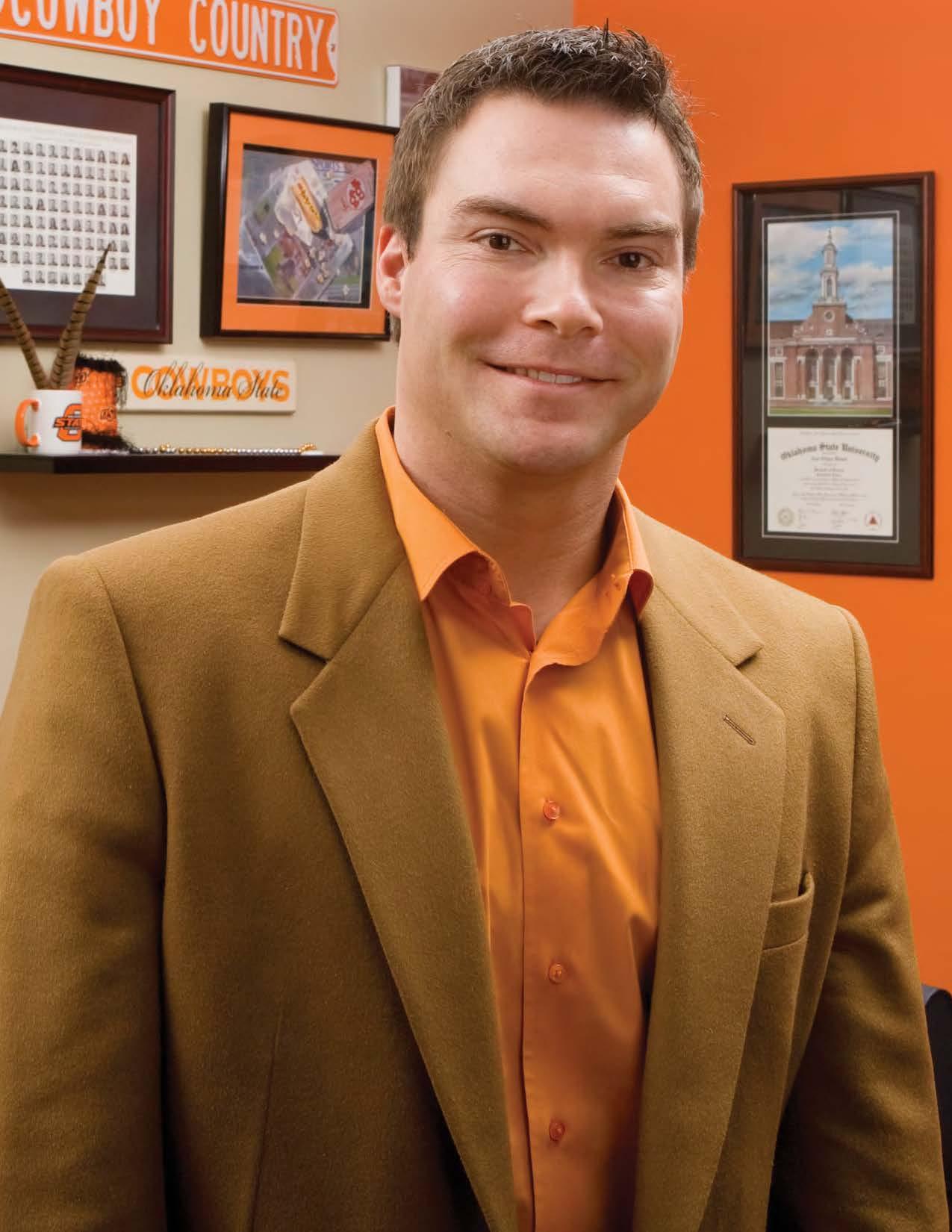
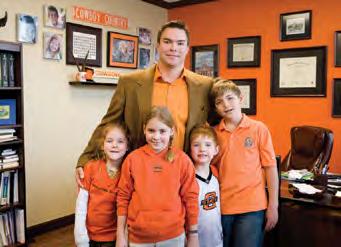
Zane Uhland likes to go fast. Cars, motorbikes, dune buggies. You name it.
He’s also an orthopedic surgeon who does a lot of sports medicine.
Imagine our surprise when we arrived to interview him for POSSE, and he was walking with a crutch.
“We were out driving dune buggies,” says Uhland. “No seatbelt. Going about 30 miles an hour. I wasn’t driving. It was a wide-open field, grass about three feet tall. You couldn’t see anything. I remember thinking, ‘Boy, this really isn’t the best thing.’ The kid who was driving had only driven it once beofre and had it wide open. I had just suggested we slow down and bam!
“As if to put on the brake, I put my foot down. The force traveled up my leg. Your hip is a ball-and-socket, and the ball just smashed into the socket and shattered it like an egg.”
That happened on a Sunday. The next Monday, Uhland was scheduled to perform six surgeries. He completed all of them.
“It’s actually not as painful as you might think. I can stand up and put weight on it and it really doesn’t hurt. Getting from A to B is what hurts.”
That he soldiered on and didn’t complain is typical behavior for him. He’s a positive attitude kind of guy who believes in fixing problems, not fixating on them.
“Whatever the situation is, that’s what it is. Let’s make it better,” says Uhland. “Attitude is paramount in whatever you do. I believe that.”
It’s an attitude that serves him and his patients well. He particularly enjoys working with athletes because they have the same motivation and attitude he has. They want to get better.
“It’s a strange dynamic,” says Uhland. “You can do a knee scope on an athlete and you’ll have to hold him back so he doesn’t come back too soon. You do the same operation on a worker’s comp guy who’s 55 and hates his job, and he won’t work for six months.”
Being a doctor is really all Uhland ever wanted to do.
“My father was a physician, so I kind of grew up around medicine,” Uhland says. “A friend of his was an orthopedist and I scrubbed in with him on some operations, when I was in high school. That kind of sealed the deal. I knew exactly what I wanted to be when I was 14.”
Uhland learned his trade at the OSU Center for Health Sciences after spending three years doing his undergraduate work in Stillwater (1992-95). It’s interesting that he ended up going Orange when he’d been a fan of the school to the south most of his life.
“My parents went to school out-of-state, so there was no allegiance there,” he says. “The media machine that is OU football kind of sucked me in. So people who knew me when I was little like to remind me of that. It was a complete 180.
“I wasn’t going to pick a school based on a football team. I’d been to Stillwater several times, had some friends there. That and the environment and atmosphere that is Oklahoma State told me this was the place to be.”
Uhland, like so many donors, appreciates everything OSU did for him. Because of that, he wants to make it better. “I think it’s important to support what you are passionate about,” he says.
by CORY CHENEY
Uhland chose to contribute to the Leave a Legacy scholarship endowment program. He thinks it was the basketball team but can’t remember exactly.
“I think we chose basketball, but it doesn’t really matter,” he says. “The fact is we need more of it. If every scholarship is endowed, it’s a bottom-line boost to our athletic budget.
“The OSU athletics department is amazing. Forty-eight national titles. Only three schools in the country can claim more than that and none outside the state of California. Not Texas. Not OU. Not Nebraska. All those schools spend so much more on athletics than we do. To be able to not only compete but exceed their production on half the budget is remarkable.”
He doesn’t think doing more with less is the way of the future for OSU, however.
“I think it’s really important that all of us ‘grab the rope,’ if you will,” Uhland says. “Obviously Mr. Pickens has blazed the trail with his incredible gift. But the misconception is that he’s doing it all, and that’s just not true. The idea that we can just sit back and ride his coattails is not correct.
“His amazing gift will give us the facilities to allow us to compete, but the operating budget is what’s so important. We have to be able to close the gap. If everyone who loves Oklahoma State would get involved, we could do great, great things.”
For the record, Uhland is selling his motorbikes and probably abstaining from any dune buggy rides in the near future. He is, however, restoring a 1960 Chevrolet Corvette. He’s told us the car’s basically going to be a rolling tribute to OSU. Look for it in an upcoming issue of POSSE.

POSSE members Alison Francis and Matt Waddell will be married in June. Alison graduated in 2006 with her B.S. in Business Administration. She is currently a program manager at Junior Achievement of Eastern Oklahoma, Inc. In 2004 Matt received his B.S. in Economics. He is employed as a treasury analyst by SEMGroup, L.P., a midstream energy company.
Because of their recent graduations, the couple is able to take advantage of the POSSE New Grad program, which offers complimentary and discounted POSSE memberships for the first five years upon graduation. Also offered in this five-year window are discounted football season tickets.
[What do you think of the POSSE new grad program?]
[Matt/Alison] We think that it is a great idea. It allows recent graduates to gain POSSE points and obtain other member benefits, even if they aren’t able to make significant donations for a few years.
[H ow did you become connected to OSU Athletics?]
[Matt] I grew up coming to football games and wrestling matches with my family ... it is also how I met Alison.
[Alison] I grew up in Stillwater and went to many OSU baseball games with my Dad. OSU Athletics was a way of life growing up and still is. Orange is prominent color in my wardrobe.
[What does OSU mean to you?]
[Matt] To me, OSU is where I earned my degree and met my future wife. It is also means tailgating with family and friends all day before a football game, going to basketball games and wrestling matches in Gallagher Iba. It is a part of my lifestyle. I wear orange as much as possible and cheering on every Cowboy and Cowgirl team, win or lose.
[Alison] Hard to compete with Matt’s answer, but I have to say OSU is home to me. There was no question where I was going to attend college, I knew Oklahoma State was the right fit for me. It means I always have a great network of alumni to connect with on any matter. And not to mention where I met my future husband.
[Why is investing in our student-athletes and coaches through POSSE membership so important to you?]
[Matt/Alison] It is our way to try and help make things better for all of the athletes and coaches...you always hear that we all need to do our part to be successful and we feel that even if it is a small pa rt, we are contributing to OSU’s success.
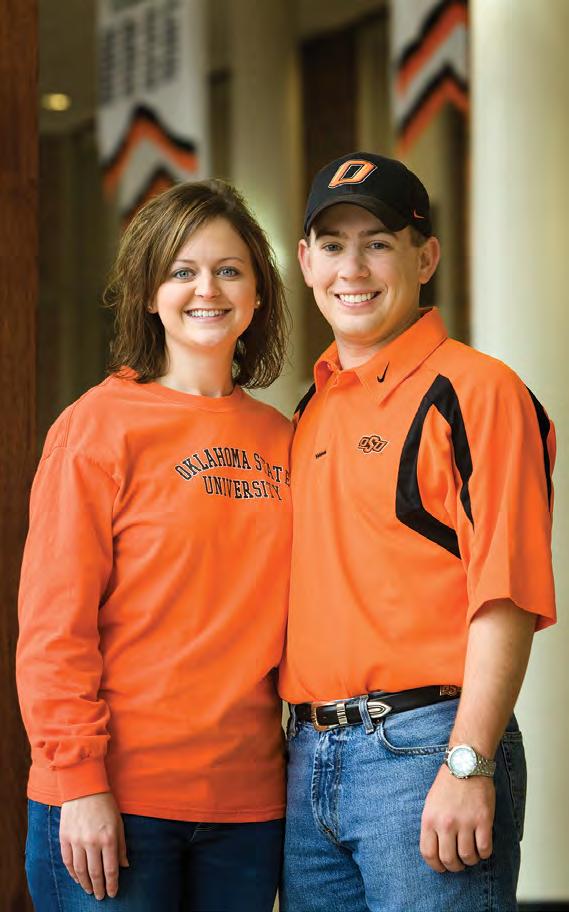
[With massive facility construction planned and ongoing, what do you think the future holds for OSU Athletics?]
[Matt/Alison] With all of the construction, things are only going to get better. What athlete wouldn’t want to be able to play and practice in the best facilities in the country. It also shows the commitment to make OSU the best athletic department in the country.
[What is your favorite memory of OSU Athletics?]
[Matt] The Bedlam football game in 2001, being in the stadium when we beat O.U. No one gave us a chance. I’ll never forget it.
[Alison] The 2003-2004 Basketball season. There wasn’t a game that year that I didn’t enjoy. My sister and I followed the team to Dallas for Big 12 Conference (tournament), Kansas City for the 1st and 2nd round of the NCAA tournament and San Antonio for Final Four. I was not only enjoying my Pokes, but spending quality time with my sister, too.

PrecedentPrecedentPrecedentPrecedent


For over four decades, Club Car has delivered specialty transportation solutions that set the standard in innovation, quality and performance. So it's no surprise that Karsten Creek is a loyal Club Car customer. Through our dedication to customer satisfaction, Club Car has developed the most extensive product line in the industry to meet a wide range of demands. So no matter what your needs, visit us today, and we'll help you find the Club Car vehicle that's right for you.
For over four decades, Club Car has delivered specialty transportation solutions that set the standard in innovation, quality and performance. So it’s no surprise that Karsten Creek is a loyal Club Car customer. Through our dedication to customer satisfaction, Club Car has developed the most extensive product line in the industry to meet a wide range of demands. So no matter what your needs, visit us today, and we’ll help you find the Club Car vehicle that’s right for you.
World-class performance. One portfolio at a time.
Bridgecreek’s primary focus is the client. We specialize in providing innovative, resourceful and bold investment solutions.
Our creative and highly effective portfolio construction utilizes a balanced, diversified approach to minimize overall portfolio risk.
Confidently embark on your journey to worldcla ss per formance, cu stomized se rvice and premium account management today.
Bridgecreek is ready.

twenty years from now you will be more disappointed by the things you didn’t do than by the ones you did do. so throw off the bowlines. catch the trade winds in your sails. explore. dream. discover.
— Mark Twain
There is much more to the Oklahoma State Equestrian team than what meets the eye.
To the casual fan, and even to the more dedicated ones, OSU is established as one of the best programs in the country. The Cowgirls, in their brief history, have always been competitive in the race for a national
championship. The 2008 edition has proven it will also be a contender after going undefeated in the first portion of the season.
What’s not easy to discern from afar is the effort the Oklahoma State coaching staff puts into growing the sport of equestrian as a whole. The work and effort that goes into building a following for a sport that the NCAA considers among its fasting growing is impressive.
As one of the cornerstone programs in the sport, Cowgirl head coach Larry Sanchez and his staff work diligently to place equestrian in the national spotlight.
Sanchez and assistants spend many weeks making trips and talking to athletic directors to try and show them why funding an equestrian team would be worthwhile.
Up until this year Sanchez held the position of chair of the Equestrian Steering Committee, the panel that directs and grows the sport.
In late January, the Cowgirls hosted Miami of Ohio and the match was classified as a scrim-
mage because Miami’s program is not yet a varsity sport. Although it may seem like a lot of extra work for the team and staff in the middle of the season, the exhibition illustrated how dedicated the team and coaches are to growing the program.
The main goal for varsity equestrian is to grow to 40 teams so they can become an NCAA sanctioned sport, and crown a national champion. Under Sanchez’s direction, the steering committee helped grow the sport to 22 programs in just three years.
“We put packets together to send to athletic directors to help them see if equestrian is the right sport to have at their university,” Sanzhez says. “For the past three years I have had two conference calls a week, lasting one to two hours, to discuss how we can further the sport.”
Although Sanchez has recently stepped down from the chair position, he has been asked, as one of the top equestrian promoters in the country, to stay on as an advisor.
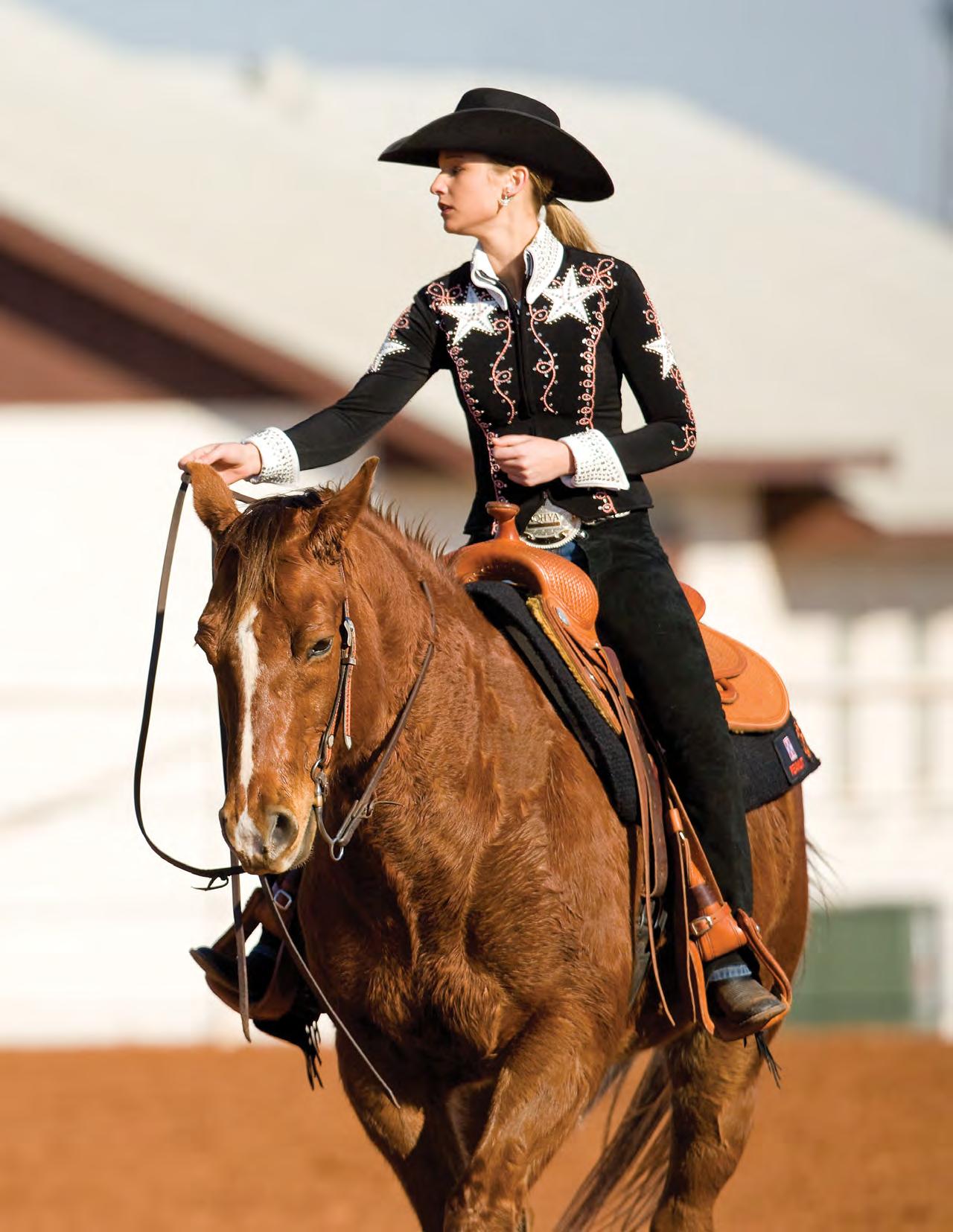
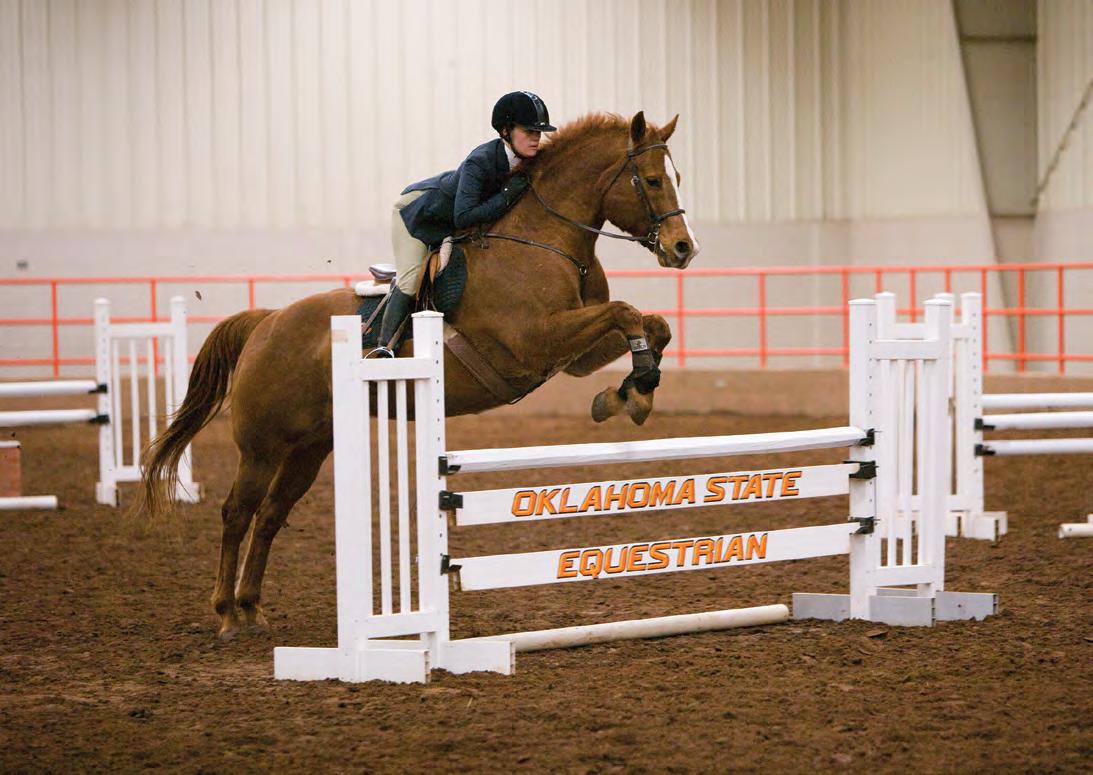
Growing the sport might be a good thing for OSU’s opponents.
So far this season the Cowgirls are close to flawless. The team has beaten some of the nation’s elite teams in the seven-show stretch to start the season. The Cowgirls upended defending national champion South Carolina by a score of 16-3. In the most intense show of the first section of the season, Oklahoma State knocked off its Big 12 rival, Texas A&M, by a margin of 16-9.
“I knew we had the talent all along,” Sanchez says of his latest squad. “What has surpassed my expectations is the team unity they have shown to this point. They are truly riding with their hearts and their minds, which makes good things happen.”
rules, the team is allowed just three coaches, so each coach’s time is spread thin.
Every Monday, Wednesday, and Friday, Sanchez works out with the girls during their conditioning time. He claims that not only do they work harder, but he wants to prove to them that he is as dedicated to this team as they are.
While Sanchez has plenty of praise for his girls, he and his staff deserve much of the credit. Sanchez and his staff have some of the most time consuming jobs in the Oklahoma State athletic department. For starters, the Cowgirl staff is in charge of 54 horses and 60 student-athletes. In accordance with NCAA
Both the hunter seat and western teams practice daily, and since the team is loaded with 60 girls, there are two or three hour-long practices for each section of the team.
Along with direct work with his team, Sanchez and his staff have to make recruiting calls, hire judges and oversee everything that happens in their barn. On top of their already busy work load the program is adding new facilities in the near future.
Associate head coach Suzanne Flaig has been on the staff nearly as long as Sanchez, as he hired her within a year of his arrival at Oklahoma State in 1999. She is the expert on the hunter side of the competitions. Flaig’s part of the team has contributed to the victories of the team equally as much as the western team.
Kayla Elmenhorst is the team’s assistant coach. She works with Sanchez on the western side of things. Sanchez says one of her greatest assets is the fact that she has lived the lives of the girls on the team. Elmenhorst rode for Sanchez as a Cowgirl for four years, and was successful. Before coming into her current position last August, she served as the team’s herd supervisor.
Mike Kavalier is the team’s director of operations. He handles much of the behindthe-scenes work for the team. With the many travel arrangements for both the team and recruiting trips for the coaches, Kavalier takes a huge part of the work load for the coaches. Before his current position, he served as the team’s athletic trainer.
The final member of the team’s staff is Josh Bible, the herd supervisor. Sanchez says Bible’s the best attribute is his love for the animals in his care. He takes a great deal of stress off of the rest of the staff because they know thehorses are being tended to properly. It all adds up to success for the newest sport at Oklahoma State.
Kyle Fisher


50
54
56 Mark & Lisa Snell 12,478 57 Ke nt & Margo Dunbar
58 Russ & Julie Teubner
59 Jim & Barbara Carreker Football
60 Scott & Kim Verplank
Me n’s Golf
61 Austin & Betsy Kenyon
62 Johnson’s of K ingfisher
63 Jim & Vicki Click, Jr. Football
64 Norman & Suzanne Myers
65 Russ Harrison & Natalie Shirley
66 Chandler USA, Inc
67 Bill & Claudean Harrison
68 Bank of Oklahoma
69 A nonymous
70 Brent & Mary Jane Wooten
Me n’s Track
71 De nnis & Bonnie Smith
Spir it Squad
72 John & Sue Taylor
73 Jack & Joyce Stuteville
74 Jay & Fayenelle Helm
75 Titleist & FootJoy Worldwide
76 A- Cross Ranch
77 Bob & Tammie Tway
Me n’s Golf
78 John & Jerry Marshall
Me n’s Golf
79 The Siegenthaler Family
80 Ike & Mary Beth Glass
81 American Fidelity
82 Greg & Kay Massey
Frits Properties, LLC
128 Robert C. & Martha Buford 129 Fletcher Family 130 Edd Bellatti 131 Steve Tuttle 132 Fred & Kellie Harlan
133 Steve & Judy Thurman 134 Randy & Patti Thurman 5,669
135 Tom & Cheryl Hamilton
136 Stan & Shannon Clark
137 Jim & Ann Berry
138 Danny & Jeannie Stith
139 Ba rry & Roxanne Pollard
140 Chris & Julie Bridges
141 Z- Equipment, LLC
142 Don Lippert
143 Roger & Laura Demaree
14 4 James Hays
145 Jack & Janet G riffith Wr estling
146 John & Delone Hessel
147 Dick & Carol Ann Powell
148 Joe Tippens
149 Frank & Ludmila Robson
150 John Melot 5,335
OSU Athletics Priority Point System
The Priority Point System provides a fair, consistent and transparent method of providing b enefits to d onors i n exchange fo r t heir fi nancial i nvestments i n O SU Athletics.
Donors gain points three ways:
• C ontributions: A ll c urrent a nd lifetime contributions (cash or stock) are worth 3 points per $100 donated. Planned (deferred) gifts in the new Leave a Legacy Endowment Campaign will receive 1 point per $100.
• C ommitment: D onors will e arn one point each year for each season ticket purchase and one point for each year of POSSE donations.
• C onnection with t he U niversity: Do nors (or their spouses) who are OSU Alumni receive a one-time 10 point bonus, as do OSU faculty/ staff and letterwinners.
Points never diminish and will carry over to subsequent years. Donors retain all previously earned Priority Points in their giving history.
For questions about the POSSE Priority Point System, e-mail posse@okstate.edu or call us at 405-744-7301.





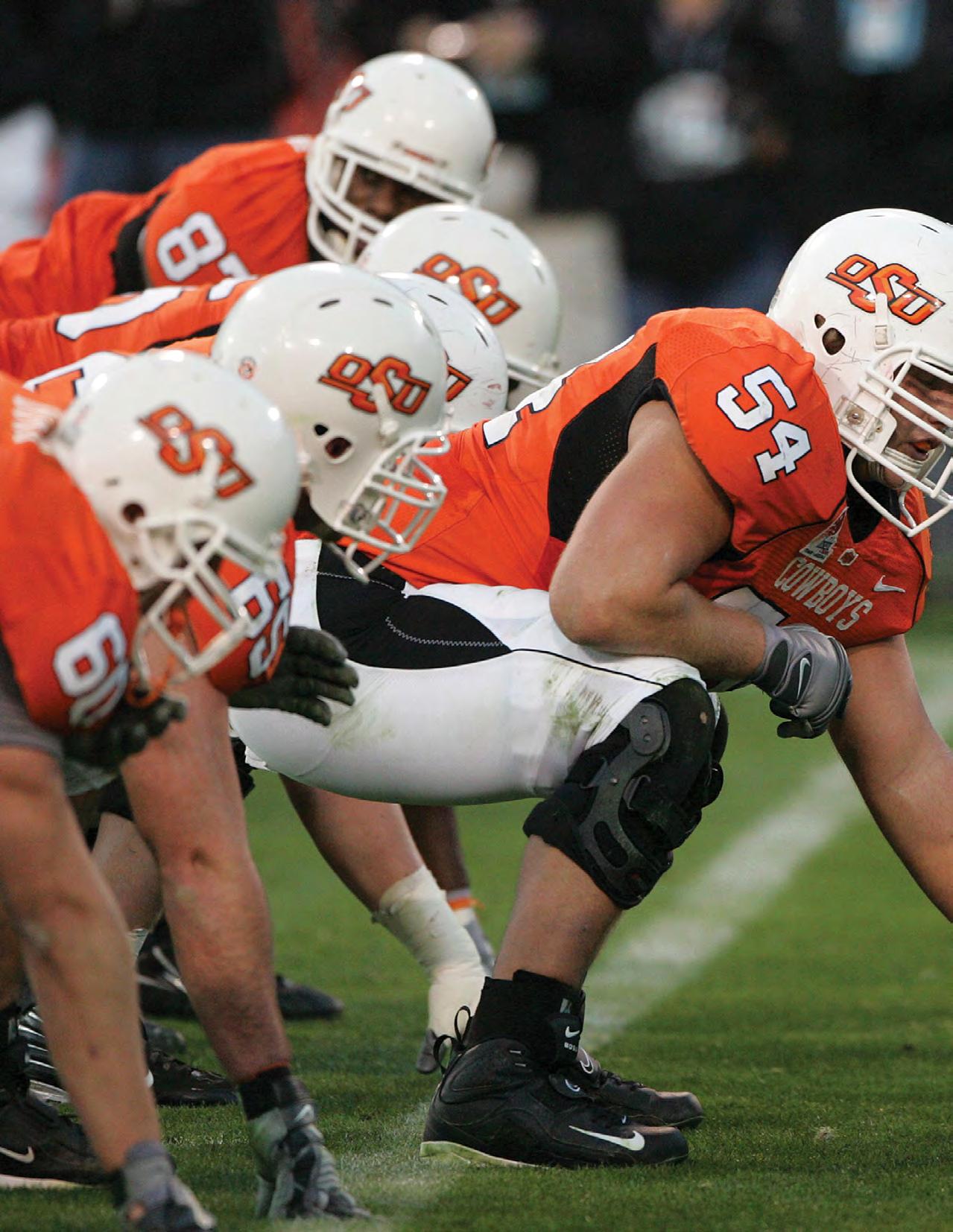
CONGRATULATIONS TO COACH GUNDY AND THE COWBOY FOOTBALL TEAM FOR THEIR 2007 INSIGHT BOWL VICTORY.
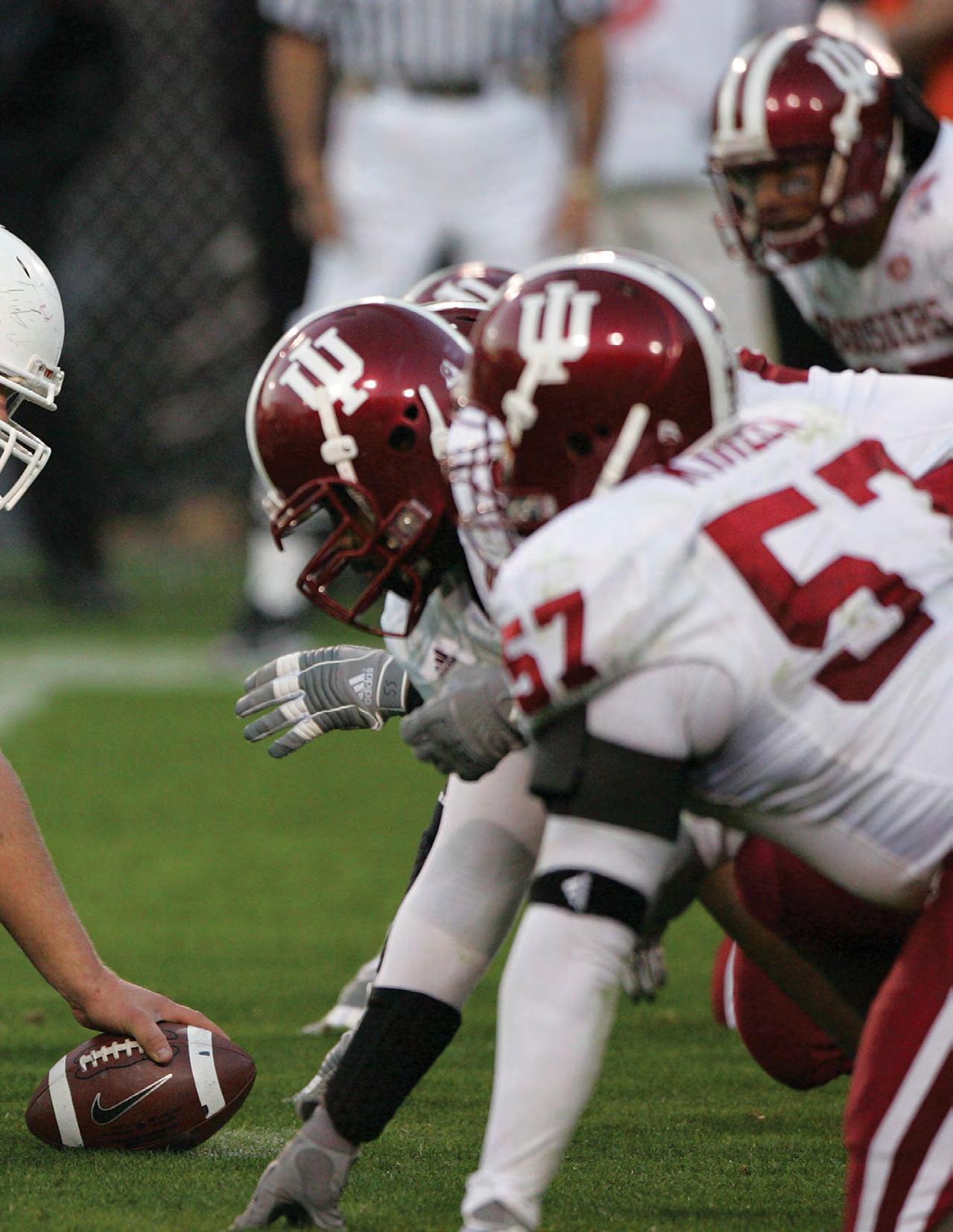
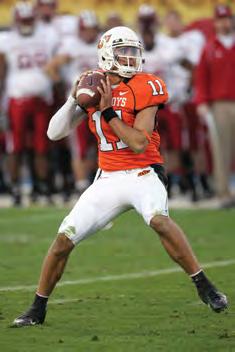
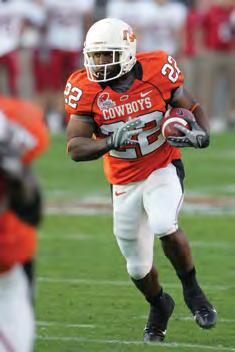
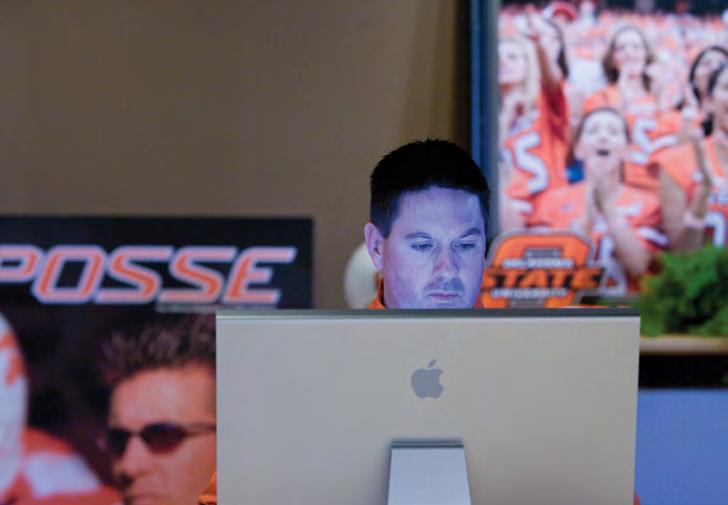
ORANGE is a great color.
It’s not a staple in the closets of many, although in recent years, Orange has become more popular on the fashion runways of Milan, Paris and, of course, Stillwater.
There are not many universities across the country with the privilege to don Orange. There are the standard blues, reds and even a few heliotropes. But Orange is rare.
I find it interesting that political analysts assign colors to states when they are describing loyalty to one party or another.
The buildup to Super Tuesday for Democrats was, well, colorful. While many were wondering if Clinton and Obama would trade microphones for boxing gloves,
they settled down to civility just in time for the Democratic debate. A nice shade of beige on the mood color wheel.
A new President in an Orange Armani! That’s something I would vote for. Super Tuesday took on a lovely shade of black for Edwards and Romney. Perhaps the VicePresident’s office could be painted a brighter shade if one of them lands there.
For the Republicans, a nice shade of gray, the default color representing John McCain. This is the color of his suits and his hair. Okay, every now and then he “walks on the wild side” and busts out a navy sport coat.
Come on, man. Get yourself some colorful shirts, ties… anything. You don’t have to ride the neutrality fence in fashion, too.
Blue, red. Donkeys, elephants. It can get confusing. There are blue states and red states. But, thanks to thousands of OSU alums and fans, Oklahoma is Orange!
Quick, someone call CNN and tell them. I would love to see that on a national map tonight!
Politics is big business. The only thing more strange and expensive than political television
advertisements are those for the Super Bowl. But that’s another column.
I watched the Republican debate a few weeks ago. As the four hopefuls on stage tried to place themselves squarely in the shadow of Ronald Regan, Anderson Cooper fired red-hot questions at them. With the Governator, Arnold Schwarzenegger, in the audience, a question eventually was asked about clean energy and clean air emission in California.
The cameras turned to the front row, and the Governor of California. Sitting next to Mr. Schwarzenegger was our own Mr. Boone Pickens and his wife, Madeleine.
I’ll give you one guess as to what color necktie Mr. Pickens was wearing.
Way to go Boone. Even in California you were representing Oklahoma State.
Party solidarity is a key in politics and in support of a university athletic program. This is not to say everyone on the Democratic or Republican side of the isle agrees on every issue.
Far from it. People usually get along fine when they are in a room by themselves. But as someone else enters, they are faced with considering other opinions, ideas and viewpoints. But when it comes down to critical issues, the discerning members get on the same page in a hurry because they realize party strength is at stake.
The same can be said for fans at Oklahoma State. You may have differing opinions on some issues, but in the end, your support is decidedly partisan.
Regardless of your political affiliation, the one consistent thread weaving us all together is dyed in the wool ... Orange.
Football season, basketball season, baseball, golf or election season, Orange is always in season.
Go Pokes.
Kyle Wray

“Give yourself a break: take five.”




You’ll be amazed how much you’ll save when you take these ve powerful steps to use energy wisely:

1. Replace lights with compact uorescent light bulbs. They give just as much light, but last much longer and use 75 percent less electricity.

2. Replace your old heating and cooling system with a new, high-e ciency system. Consider a geothermal system — they’re about 200 percent more energy e cient, and may qualify for lowinterest nancing.







3. Insulate, caulk and weatherstrip your home. Most people don’t realize that a third of their energy bill can come from air leakage alone.

4. Set your water heater thermostat at 120ºF. Adding a water heater blanket can cut water heating costs another 10 percent.
5. Shade your house. Plant trees that shed leaves to give shade in the summer and admit sunlight in the winter.












Saving energy and money is in our power