MIKE GUNDY
GUIDING THE POKES TO GREATER HEIGHTS

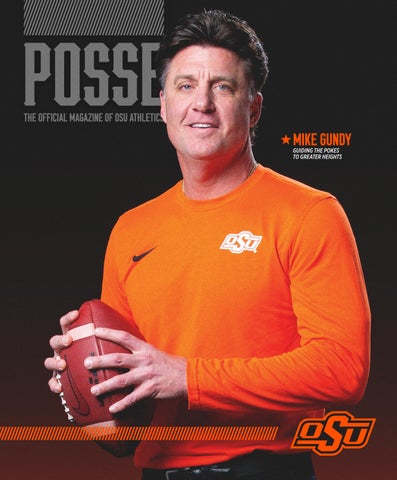
GUIDING THE POKES TO GREATER HEIGHTS
OKLAHOMA STATE UNIVERSITY
I was looking for a profound quote to start this column, searching high and low for great observations and insights uttered by heads of state, royalty, philosophers, religious leaders, educators, or maybe just someone who doesn’t eat meat. They always have an opinion, and it seems like they know something I don’t.
And I found one.
“Life moves pretty fast. If you don’t stop and look around once in a while, you could miss it.”
Thank you, Ferris Bueller Ferris wasn’t talking about OSU Football, but his perspective on life is applicable to the Cowboys. Elsewhere in this addition of POSSE Magazine, is a question-and-answer session with head football coach Mike Gundy, who stands on the cusp of his 18th season at the helm of the OSU program and his 150th career victory. Time has flown because life really does move pretty fast. During Gundy’s tenure, the world has changed. College football has changed. And the fortunes of Oklahoma State Football in particular, have changed. It seems like an appropriate time to stop and look around because while we weren’t paying attention, the Oklahoma State football team became a winner. A consistent winner. A national program.
If you are 20 years old and don’t know a world without the internet, your perception of OSU Football is one of a program that goes to bowls every year, produces All-Americans, wins somewhere between seven and 12 games every year, contends for conference championships annually and is one of the most consistent programs in the country.
OSU is, in fact, among the current national leaders in consecutive winning
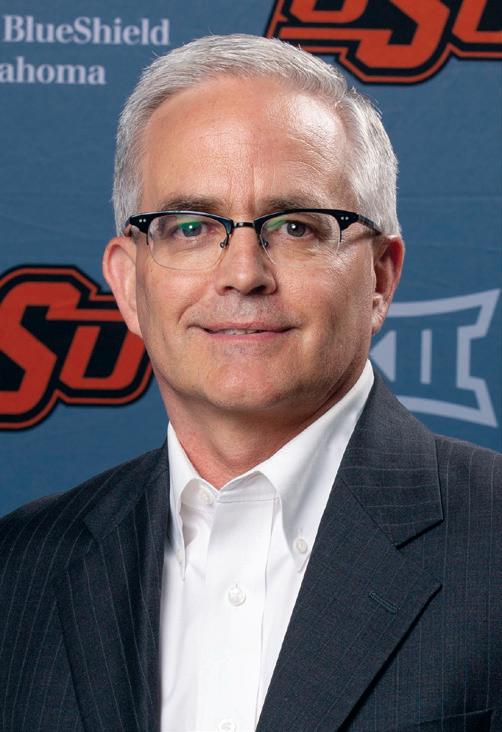
BY KEVIN KLINTWORTH Senior Asso ci ate Athleti c Director
seasons and bowl appearances, so your perception would be accurate.
But it hasn’t always been like that. In fact, it has never been like that — at least it has never included a prolonged period of success that has now spanned over two decades. We are in the middle of the greatest era in school history.
When Mike Gundy became the head coach, OSU football had lost more games than it had won, all-time. There had been a long-established pattern of successful periods, followed by years of rebuilding. There had been great individual players, but depth was seemingly always a problem with the possibility of an injury at the wrong position wrecking an entire season.
That was Oklahoma State for portions of the 1950s, or the 1960s, or the 1990s — good outweighing the bad, or the bad outweighing the good, but usually not by much in either direction when looking at decade-by-decade snapshots. Good, solid seasons followed by years of rebuilding. Oftentimes there was extenuating circumstances, with seasons turning on one key play or unlucky bounce, or sore ankle.
It is now 2022. Cars are trying to drive themselves. Civilians fly into orbit for vacation. Nebraska is not in a conference with Kansas State, but it is in a conference with Rutgers. And the Oklahoma State football program is among the very best in the country and has been for years.
Listen to Ferris. Stop and look around. Don’t miss it.
When Oklahoma State won 11 games in 2010 and 12 games the following year, it seemed like a magical two-year stretch, something that might happen once in a
generation, or three. That would actually be an understatement. OSU had never won 23 games in two seasons. That was 12 years ago. Since then — since that 2010 season when OSU was a co-champ of the old Big 12 South and won 11 games for the first time in school history — the Cowboys have won at least 10 games in a season SEVEN times, reached at least 11 wins three times and 12 wins twice. That stretch has included two trips to the Fiesta Bowl, two trips to the Cotton Bowl and a trip to the Sugar Bowl. And let’s give the Cowboys a little credit. In the COVID-disrupted 2020 season, OSU was unable to play scheduled home games vs. Oregon State and Western Illinois. OSU would have been lopsided favorites in both contests. The completion of the full 12-game regular season would have likely meant eight 10-wins seasons in 13 years. Since the beginning of the 2010 season, Oklahoma State has won 113 games, tied for 10th most in the country in that span. The tie is with 2022 PlayStation Fiesta Bowl victim Notre Dame. LSU is ninth with 114 wins. The current streak of 16 consecutive winning seasons is fourth best in the country. Alabama is fifth with 14, and Clemson is seventh with 11. The 16-straight bowl appearances represent the seventh longest active streak in America.
When the dust had settled after 2021, there were even more numbers to
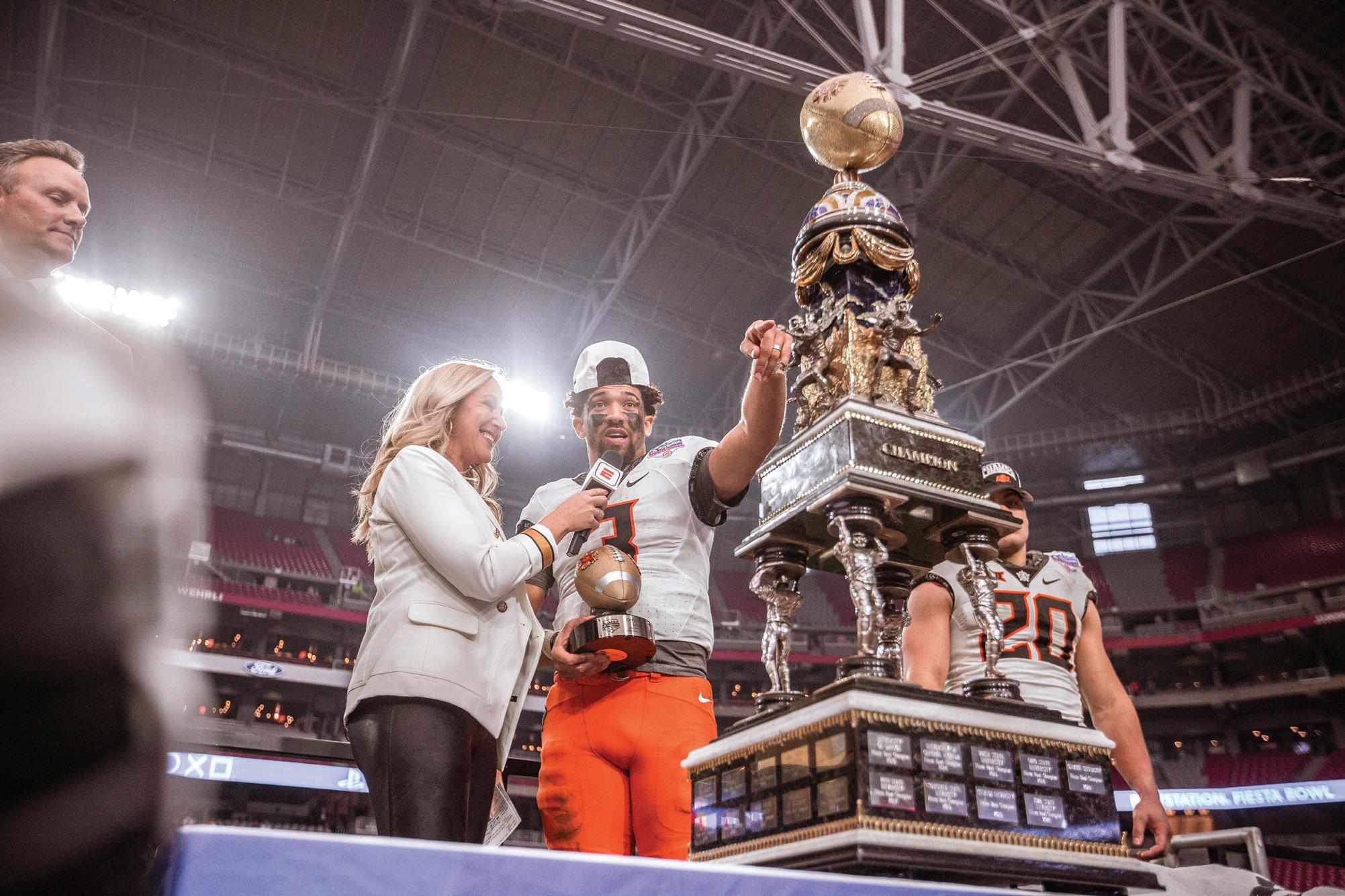
OSU beat three teams that would win 11 games. There were five wins against ranked opponents and two wins over top 10 teams. The Fighting Irish were ranked No. 5 when they fell victim to the largest comeback in Oklahoma State history. It’s not often a team beats Texas, Oklahoma and Notre Dame in the same season.
That brings us to the future and the new-look Big 12. It appears that Bedlam will go away, at least in the short term. Probably the same can be said for the Texas series, which is really too bad for the Cowboys. Oklahoma State has a better winning percentage in Austin than the Longhorns have in Austin over the last 10 years. College athletics has been in turmoil for a year, and the storm clouds won’t be clearing for some time yet.
Through the chaos of realignment, the transfer portal, and Name, Image and Likeness, Oklahoma State’s mantra has been that we are all-in, whatever “in” takes. OSU Athletics is dedicated to landing at the top of the heap, wherever that heap may be. And thanks to the past 20 years of Cowboy Football, anything seems possible. Everything is on the table.
It reminds me of something else Ferris Bueller once said that could apply to OSU Football and OSU Athletics in general.
“The question isn’t ‘what are we going to do’, the question is ‘what aren’t we going to do?’”
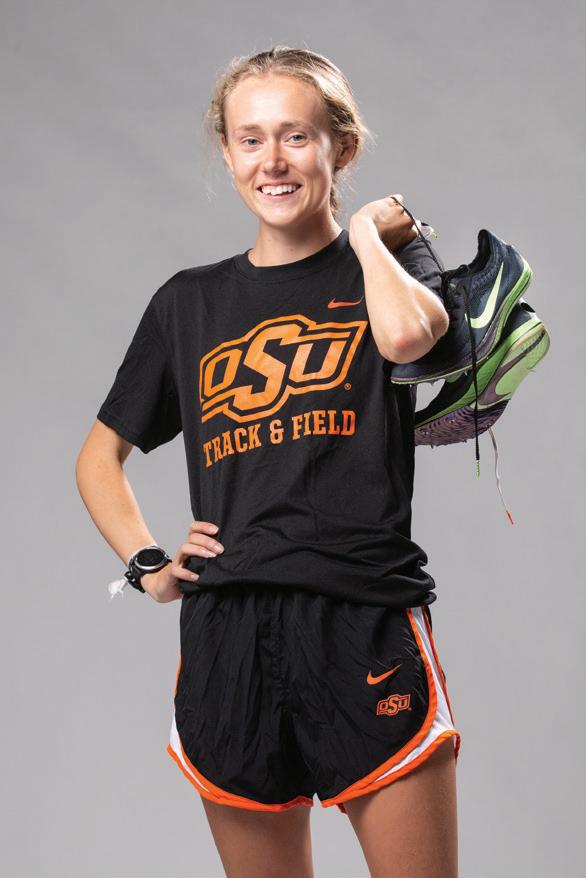
WALKING A MILE IN NATIONAL CHAMPION TAYLOR ROE’S SHOES
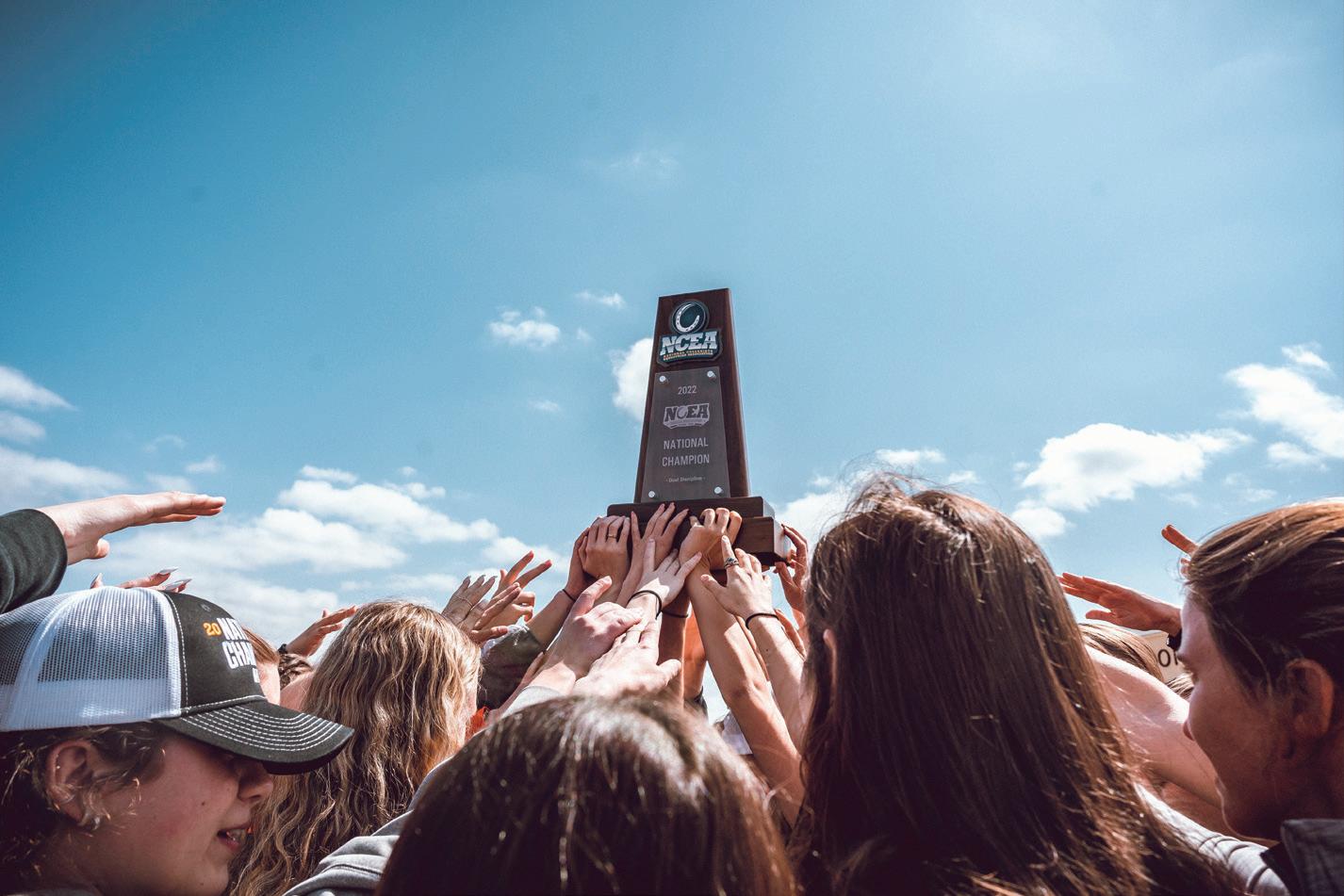
COWGIRL EQUESTRIAN WINS ITS FIRST TEAM NATIONAL TITLE 22
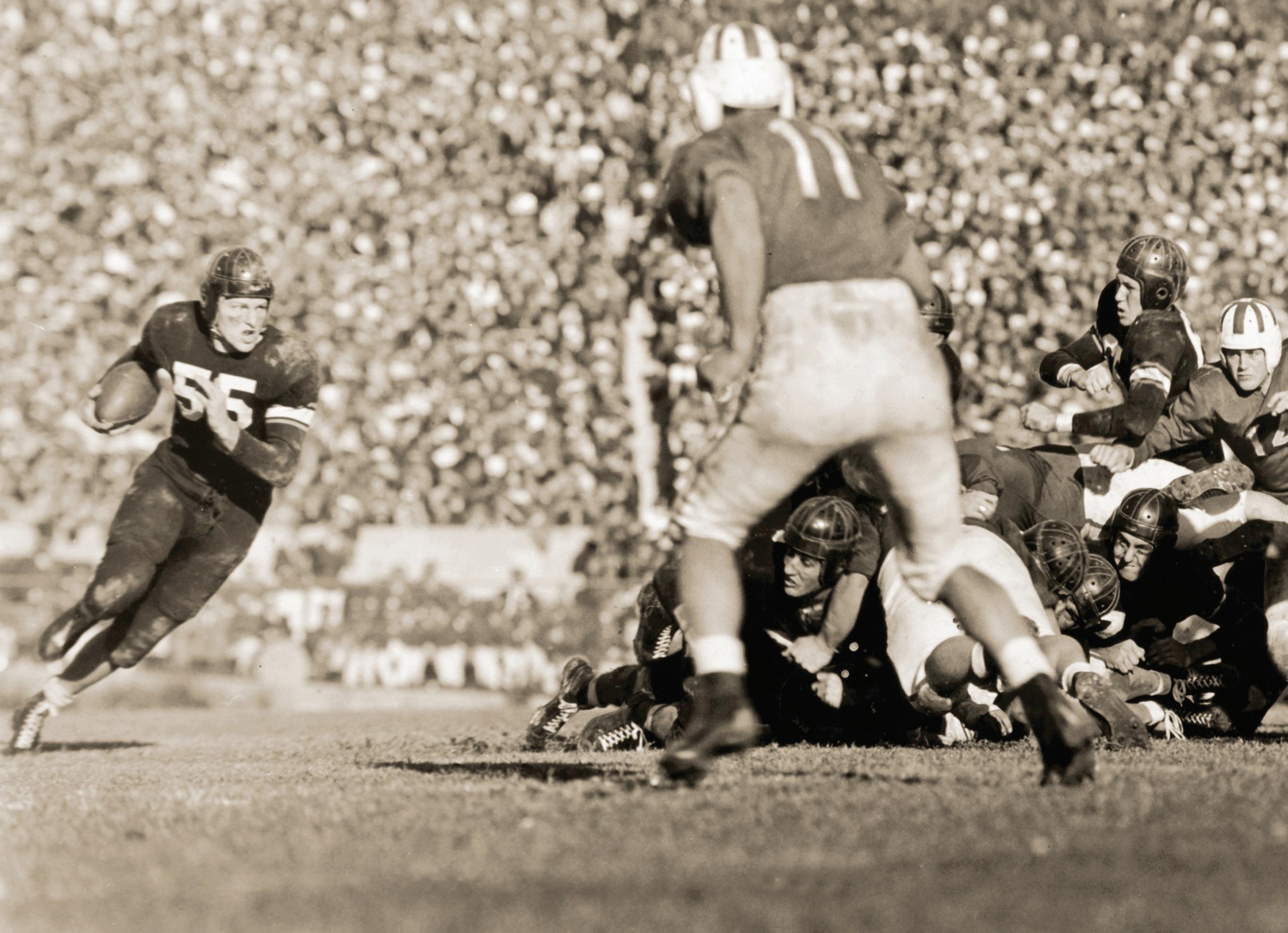
BOB FENIMORE’S JOURNEY TO BECOMING COWBOY FOOTBALL’S FIRST ALL-AMERICAN 32
Miked Up
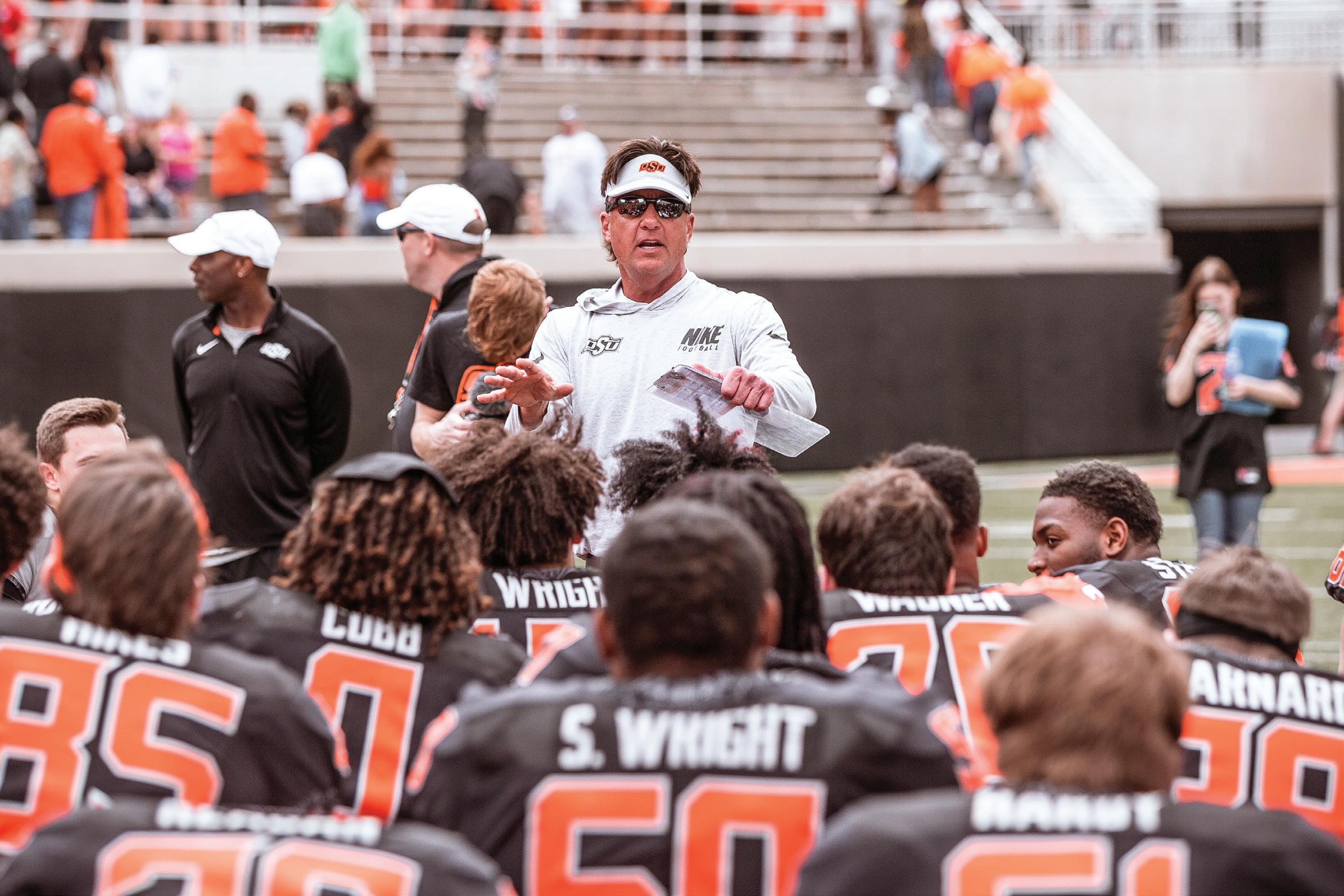
MIKE GUNDY REFLECTS ON WHERE THE COWBOYS HAVE BEEN AND WHAT’S NEXT
rPOSSE Magazine Sta
EDITOR-IN-CHIEF / SENIOR ASSOCIATE ATHLETIC DIRECTOR KEVIN KLINTWORTH
SENIOR ASSOCIATE ATHLETIC DIRECTOR JESSE MARTIN
ART DIRECTOR / DESIGNER JORDAN SMITH
PHOTOGRAPHER / PRODUCTION ASSISTANT BRUCE WATERFIELD
ASSISTANT EDITOR CLAY BILLMAN
CONTRIBUTING PHOTOGRAPHERS MARY ELIZABETH CORDIA, KIRBY LEE, MAX MOODY, HANNAH PETERS, PHIL SHOCKLEY, NOAH SOUTHARD, CAULEN SPENCER, CARTER STANTON
CONTRIBUTING WRITERS CLAY BILLMAN, BILL HAISTEN, HALLIE HART GAVIN LANG, WADE MCWHORTER, KEVIN KLINTWORTH
Development (POSSE) | 405.744.7301 P
ASSOCIATE AD/ANNUAL GIVING ELLEN AYRES
DIRECTOR ANNUAL GIVING BRAKSTON BROCK PUBLICATIONS COORDINATOR CLAY BILLMAN
ASSISTANT DIRECTOR OF ANNUAL GIVING STETSON DEHAAS
ASSOCIATE AD / DEVELOPMENT MATT GRANTHAM
ASSISTANT AD / DEVELOPMENT DANIEL HEFLIN
SENIOR ASSOCIATE AD / EXTERNAL AFFAIRS JESSE MARTIN
SENIOR ASSOCIATE AD / DEVELOPMENT LARRY REECE
ASSISTANT AD / DEVELOPMENT SHAWN TAYLOR
ASSISTANT DIRECTOR OF ANNUAL GIVING ADDISON UFKES
OSU POSSE
102 ATHLETICS CENTER STILLWATER, OK 74078-5070
405.744.7301 P 405.744.9084 F OKSTATE.COM/POSSE @OSUPOSSE POSSE@OKSTATE.EDU
ADVERTISING 405.744.7301
EDITORIAL 405.744.1706
At Oklahoma State University, compliance with NCAA, Big 12 and institutional rules is of the utmost importance. As a supporter of OSU, please remember that maintaining the integrity of the University and the Athletic Department is your fi rst responsibility. As a donor, and therefore booster of OSU, NCAA rules apply to you. If you have any questions, feel free to call the OSU O ce of Athletic Compliance at 405-744-7862 Additional information can also be found by clicking on the Compliance tab of the Athletic Department web-site at okstate.com
Remember to always “Ask Before You Act.”
Respectfully,
BEN DYSON ASSOCIATE
ATHLETIC DIRECTOR FOR COMPLIANCE
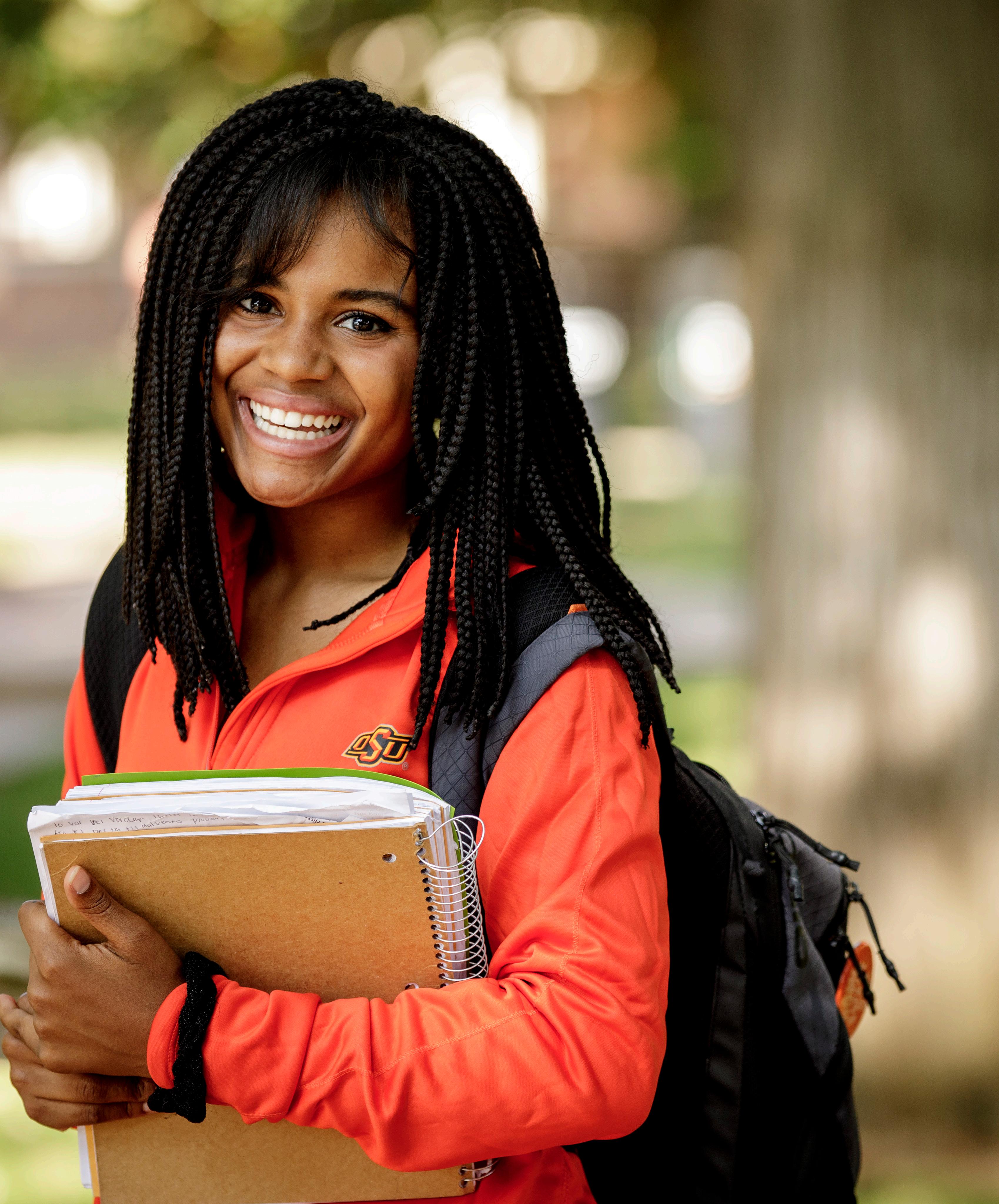
Cowgirls Lisa Marie Rioux and Ayumi Miyamoto earned Intercollegiate Tennis Association All-America honors for the second time. The doubles tandem finished the year with a 22-4 mark, including a run to the semifinal round of the NCAA Division I Women's Tennis Championship. Rioux was also tabbed as the region's Senior Player of the Year. The pair helped lead the OSU squad to a 20-6 mark with a Sweet 16 finish at the NCAA Tournament and a Top 10 final ITA ranking.
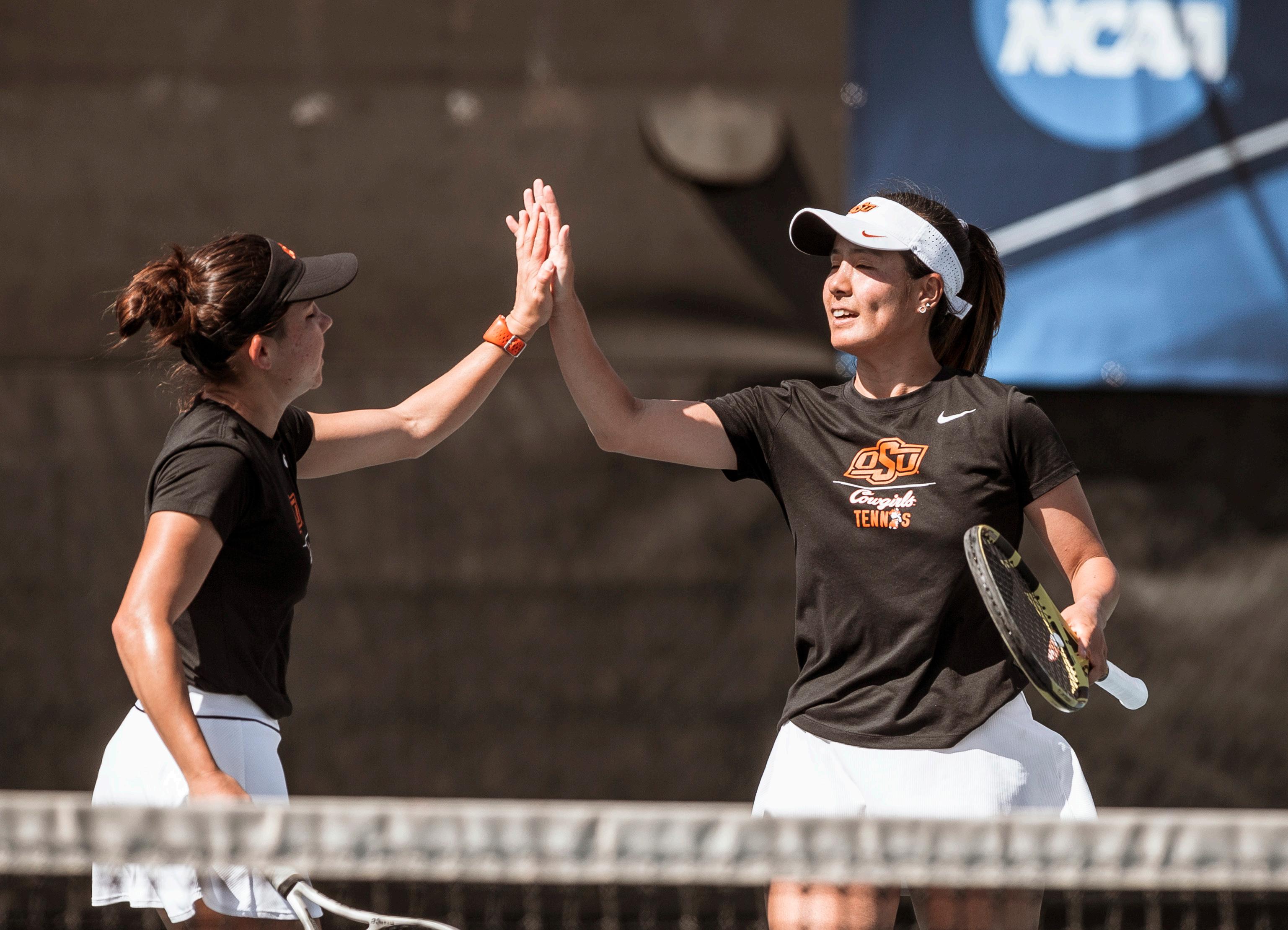
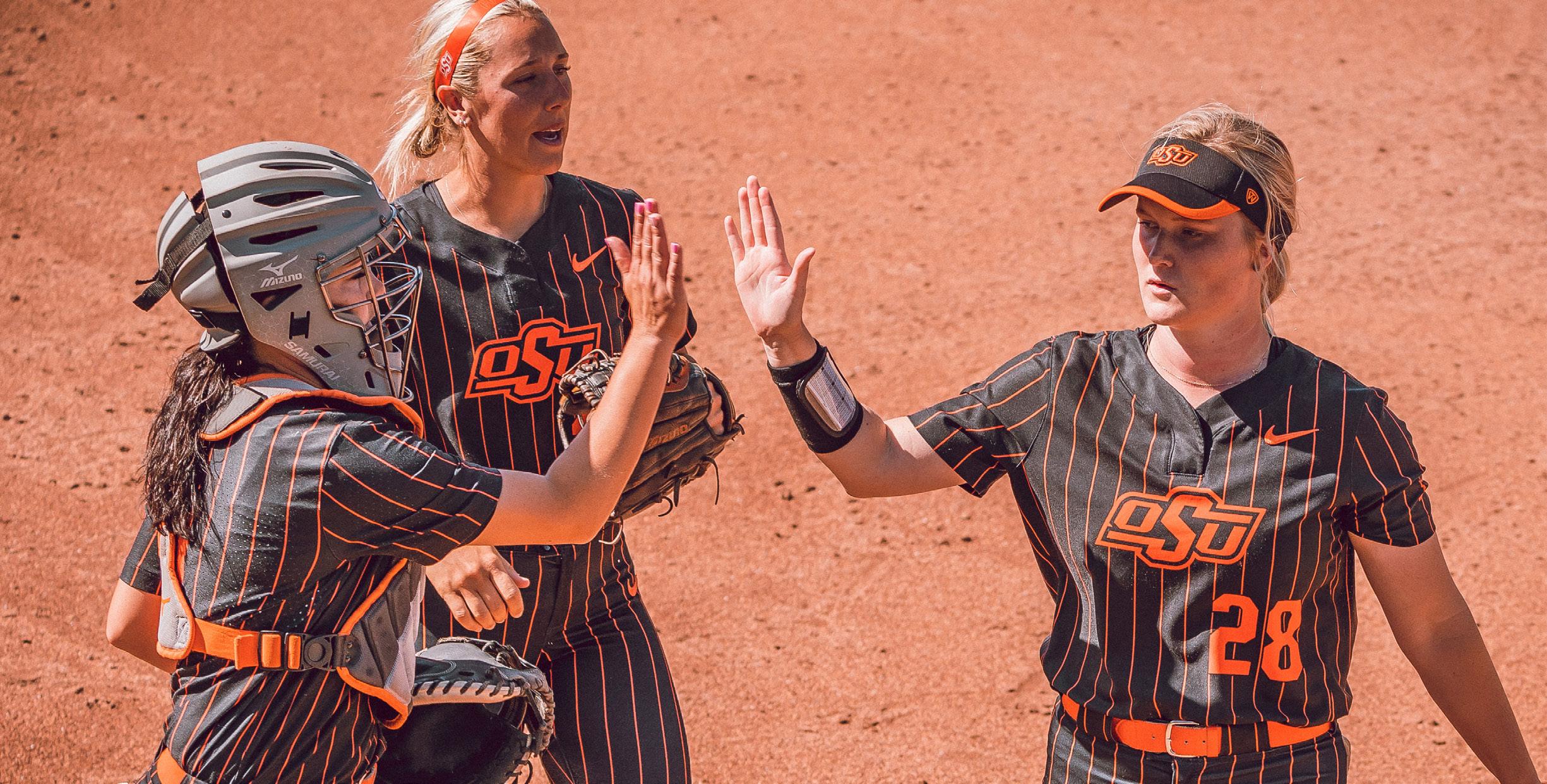
Cowgirls Chelsea Alexander and Kiley Naomi celebrate OSU's return to the Women's College World Series. Coach Kenny Gajewski's squad has advanced to Oklahoma City three years in a row (not counting the COVIDshortened season in 2020). The 2022 Big 12 champs earned a No. 7 national seed and hosted soldout NCAA Regional and Super Regionals in Stillwater.

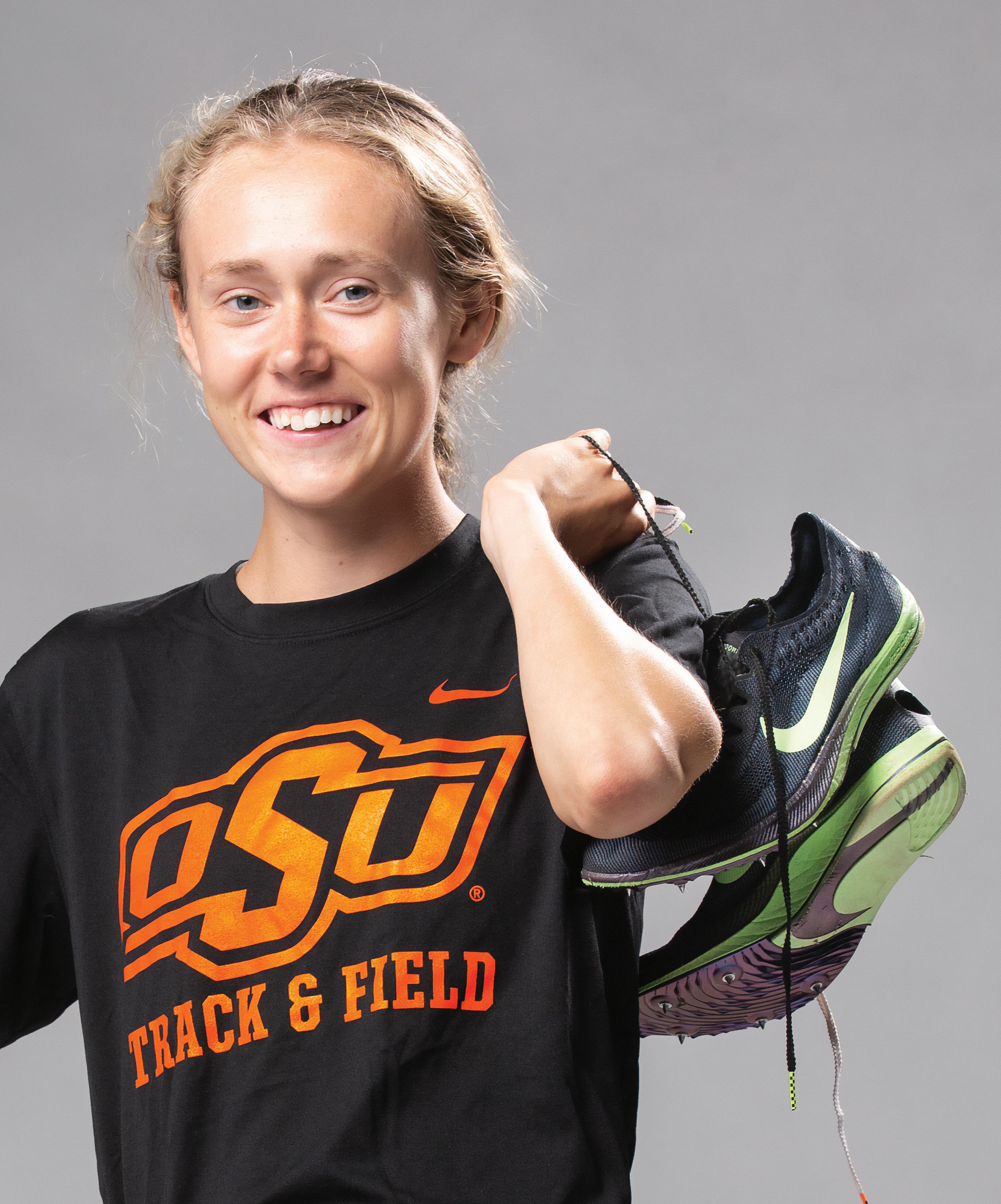
“Who wants to go run?”
It wasn’t an invitation. It was a challenge.
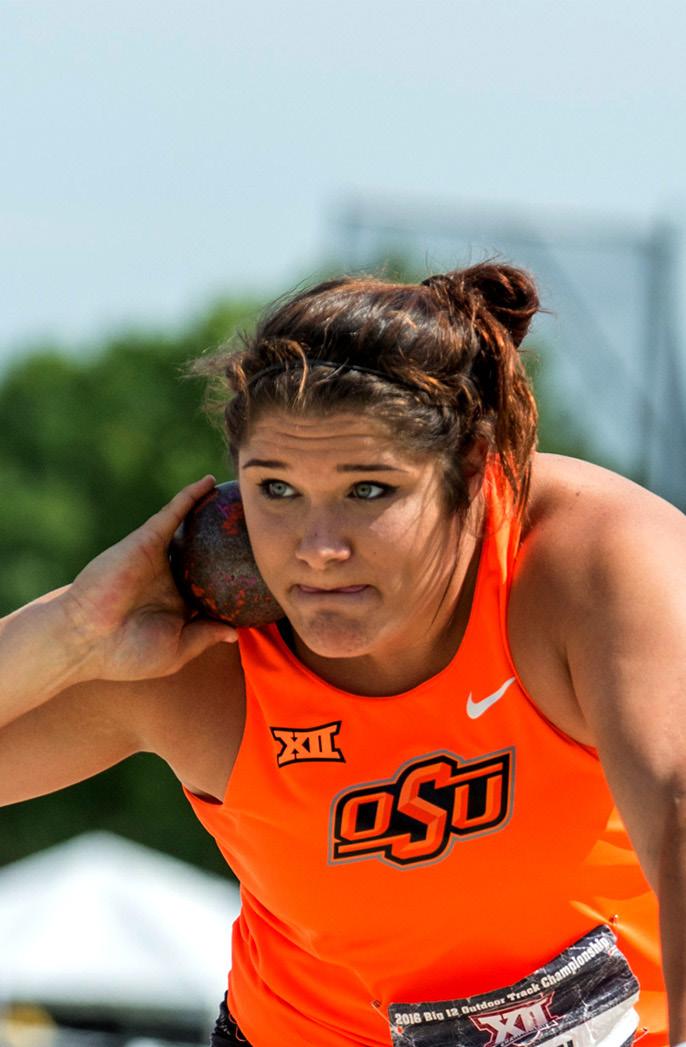
Three-fourths of the way through the 3,000 meters at the 2022 Indoor Track and Field National Championships, Taylor Roe threw down the gauntlet.
The unspoken ultimatum came with just under four laps to go on the 200-meter oval. Roe’s long stride began to turn over at a faster cadence as she surged from a crowded fifth place to all alone at the front of the pack. The Oklahoma State standout had opened up about a 7-meter lead at the bell.
“I didn’t expect it to unfold the way it did, to be quite honest,” Roe recalled. “I expected to have more people come with me, so when I opened up a gap, that was surprising.
“But at that point, you can’t turn back. You have to just keep going.”
Roe made a gutsy decision to take control of the race. But did she go too soon?
It’s a storyline that plays out often on the track. Runners that take o too early by themselves and try to hang on for the win rarely do. The advantage is to the pursuer.
Despite her All-America accolades, Roe was still considered an underdog in a strong field that included North Carolina State’s freshman phenom Katelyn Tuohy and 2021 NCAA runner-up Lauren Gregory of Arkansas. With half a lap to go, the pair began to reel in Roe, and it looked as if one of the pre-race favorites would prevail.
“Will Taylor Roe run out of gas?” broadcaster and former Olympian Dwight Stones wondered aloud.
Rounding the final turn, Roe’s eyes darted up to the video screen to see that the gap behind her was all but closed. At the start of the home stretch, the chasers had nearly pulled even. The nearly 2-mile race would come down to a 50-meter sprint.
“Can Roe hold them o ?” Stones asked, the tone betraying his doubt.
“I was definitely panicking at that point,” Roe recalls. “But when a national title is on the line, you find something inside.”
The Cowgirl’s countenance changed as she summoned the strength to hang on.
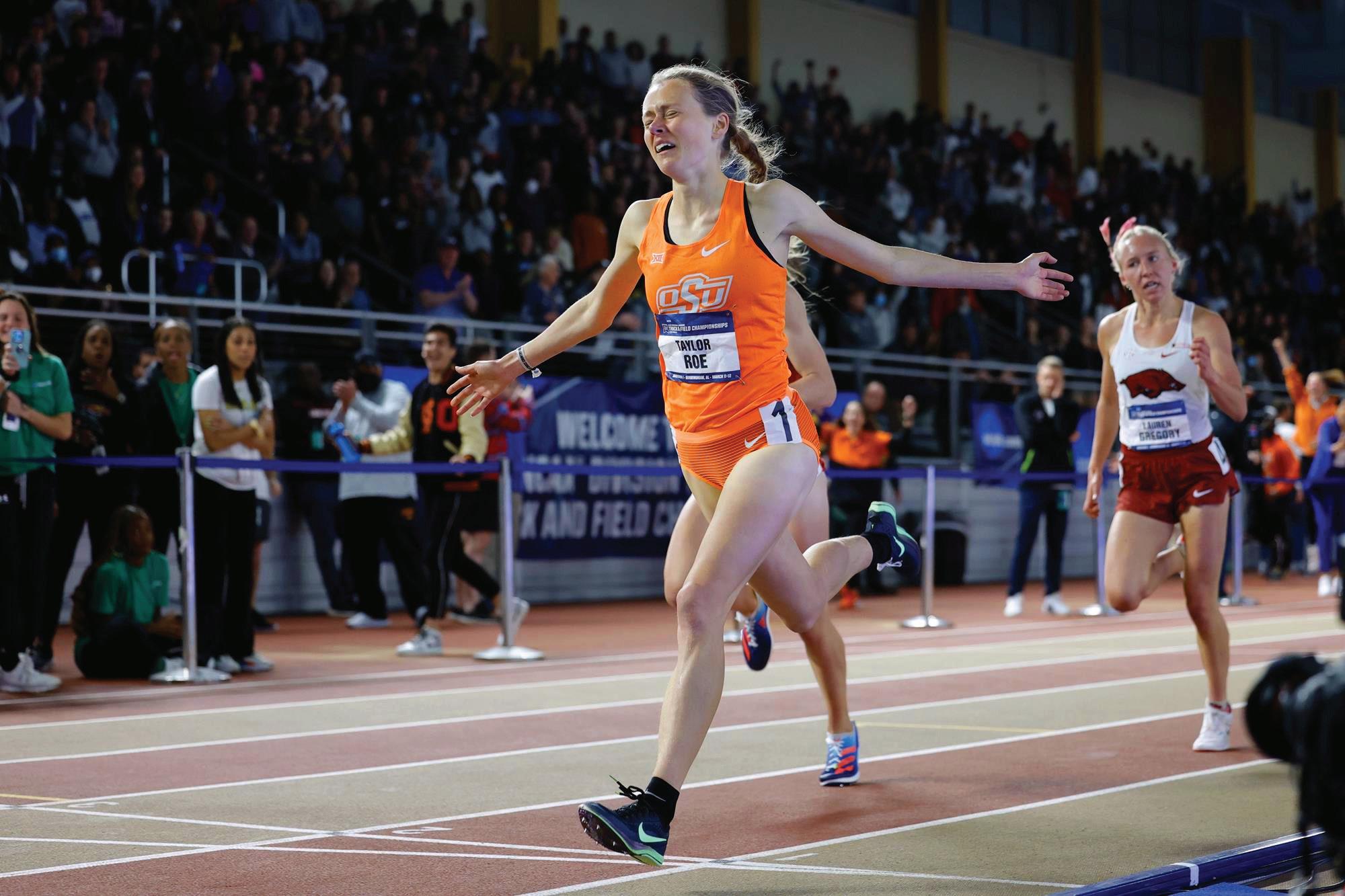
Arms flung wide in celebration—and relief— Roe crossed the line in 8:58.95, taking the coveted crown by two-tenths of a second.
National champion.
“I was in disbelief,” Roe recalls. “I think I just repeated to myself, ‘I did it. I actually did it.’
“It’s just a weird feeling to have your dreams and your goals actually work out in such a dramatic way.”
As Roe stood on the track trying to comprehend what had just transpired, she scanned the crowd for her coach (Director of Track and Field and Cross Country Dave Smith), who had been shouting encouragement and advice from outside the oval.
OSU Max cameras captured the scene as Roe ran to Smith for an emotional embrace.
“It was an incredibly special moment,” Smith says. “That was one of those moments in coaching that I will always remember, partly because it’s immortalized now with that 10-second video clip. I had goosebumps watching Taylor win it, and then watching her being interviewed by ESPN’s Anderson me and sprinting over to give me a hug.
“It’s one of those moments in coaching that you live for. That’s why you do it.”
Roe is Smith’s seventh individual NCAA champion at OSU, joining Chad Noelle Johnson
Going into the finals, Roe’s best 3K time was 12th among the field. But Smith never considered Roe an underdog. He knows she has the ability to be the best on any given day.
“Taylor’s not the fastest girl out there. She doesn’t have the greatest overall foot speed, but she’s not slow either.
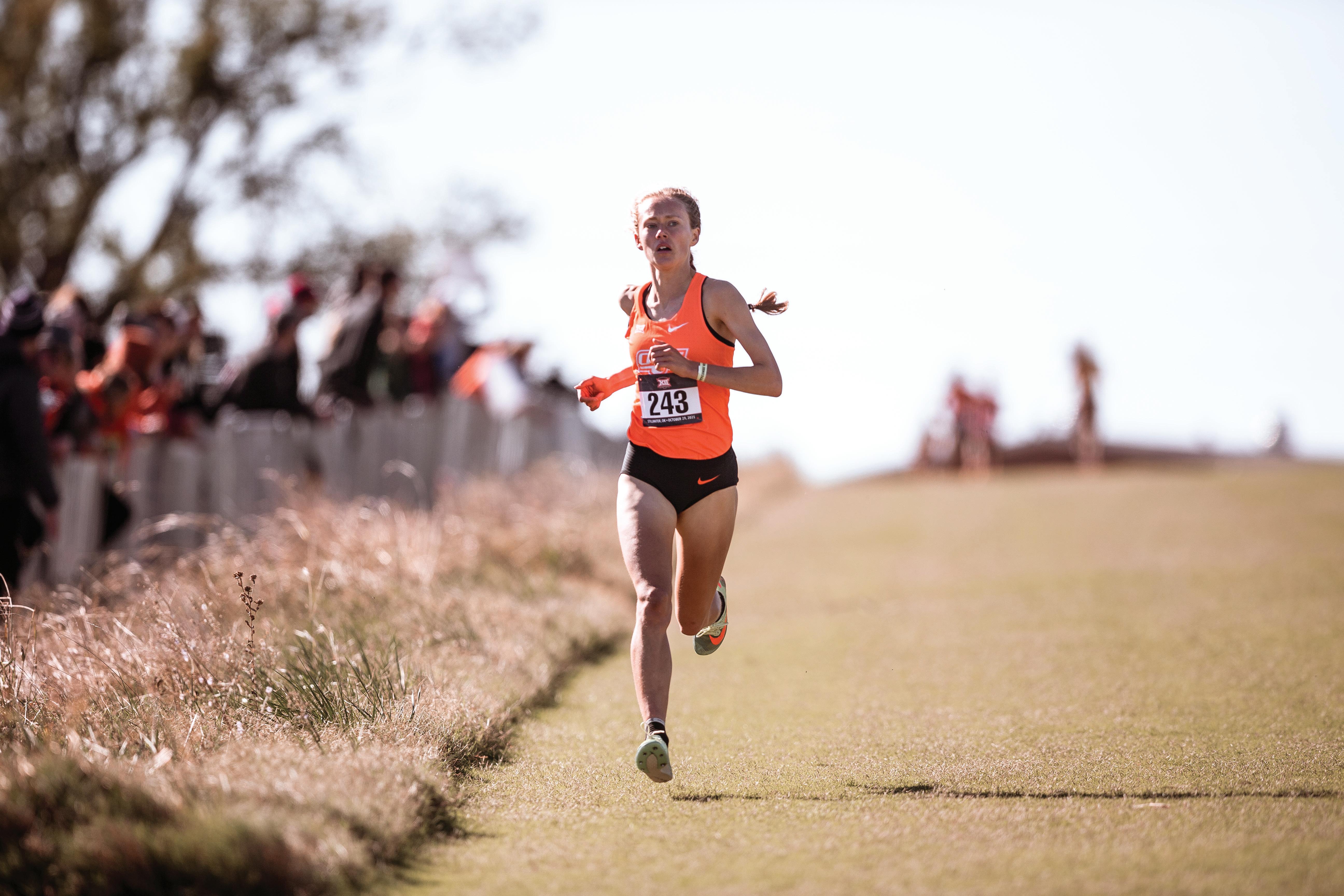
“The longer the race goes, the better she gets.” he adds. “She’s incredibly strong aerobically. She’s also very competitive. I’ve seen her win tactical, sit-and-kick races. I’ve seen her go out and overpower people. It doesn’t seem to matter how the race is run, she’s always going to be in contention.”
Smith thought the indoor final—like most high-stakes or championship races—would be tactical, where the favorites typically play it safe until the bell lap, relying on their speed to outrun competitors to the line.
“I told her she needed to stay out of trouble for the first half of the race and not be fighting for position or bumping elbows or trading shots with people … but with a thousand (meters) to go she had to be in the front. You don’t have to be leading, but you’ve got to be in the front, because somebody is going to make a big move. If nobody does, then you’ve got to do it.
Over the past year and a half, Roe’s bad days have been few and far between.
Last fall, she finished fifth overall at the NCAA Cross Country Championships in Tallahassee, Fla.
As a sophomore, Roe was the NCAA runner-up on her home course. Held on the newly renovated Greiner Family OSU Cross Country course, the 2020 national meet had been postponed until the spring of 2021 due to the pandemic, making Roe’s feat even more impressive. Just a few days earlier, she had anchored the Cowgirl Distnace Medley Relay (DMR) to a fifth-place All-America finish at the NCAA Indoor Track and Field championships.
“More often than not—especially on our course—it’s like, who slows down the least, who keeps the same pace for the entire race,” Roe says. “At that point you’re just kind of outlasting people. ‘All right, there’s only 10 of us now. Now there’s five of us’ … and you just hope that you’re not one of the ones going o the back.”
Roe was raised in a running family—her parents Lawrence and Jennifer met while competing for the University of Washington—but she never dreamed she’d be where she is today when Smith (also a Washington native) recruited the prep runner from the Seattle suburb of Lake Stevens.
“Oklahoma State had reached out to me a couple times, but there was one card that said, ‘I raced your dad in high school, say hi to him for me.’ I had no idea who Dave Smith was. I just saw that and told my dad, ‘This guy says that he knows you,’ so it was kind of funny. Then I read more and was like, ‘Oh my gosh, Oklahoma State is actually good at running. So that caught my attention. After one phone call, I pretty much knew that he was the coach I wanted to run for.”
Despite winning multiple state titles and being named Washington’s Gatorade Girls Track and Field Athlete of the Year, Roe was not immune from setbacks and self-doubt. Upon arriving in Stillwater, some of that baggage remained.
“Coming out of high school I was kind of struggling the last year or so,” she admits. “I still struggled my freshman year. I knew I wanted to contribute to the team, but I didn’t know what that meant. I enjoyed running, but I was kind of using it more as an opportunity to allow me to go to school and get an education.”
Smith says Roe’s experience isn’t unique among athletes, particularly young women.
“Often girls have kind of a biphasic career,” Smith explains. “They have a period of time when they’re good, they have a lot of success at a young age and often go through a phase where they struggle or it doesn’t come as easy. From 15 to 18, that’s a tough time for any kid. You go through a lot. Everything is changing, there’s social pressures and all kinds of stu that can get in the way.
“Some girls will give up on themselves at that point and think, ‘Well, I don’t have it anymore.’ The ones that stick with it often come back and do pretty well. Taylor was that way. The talent didn’t go away. If she’s willing to work through it, she’ll be great.”
Roe bought into Smith’s plan to reach the next level.
“I think I just needed to mature and wait it out,” she says. “When I got into college, I pretty much doubled my mileage and really started training. In high school I barely did anything. You run to 7-Eleven, you get a Slurpee, and you walk back. Now it’s putting in real training, and when you’re coached by Dave Smith, you know you’ll get better.”
Roe now runs between 50 and 60 miles per week, supplemented by cross-training. The goal, Smith says, is to gradually increase mileage while avoiding injury.
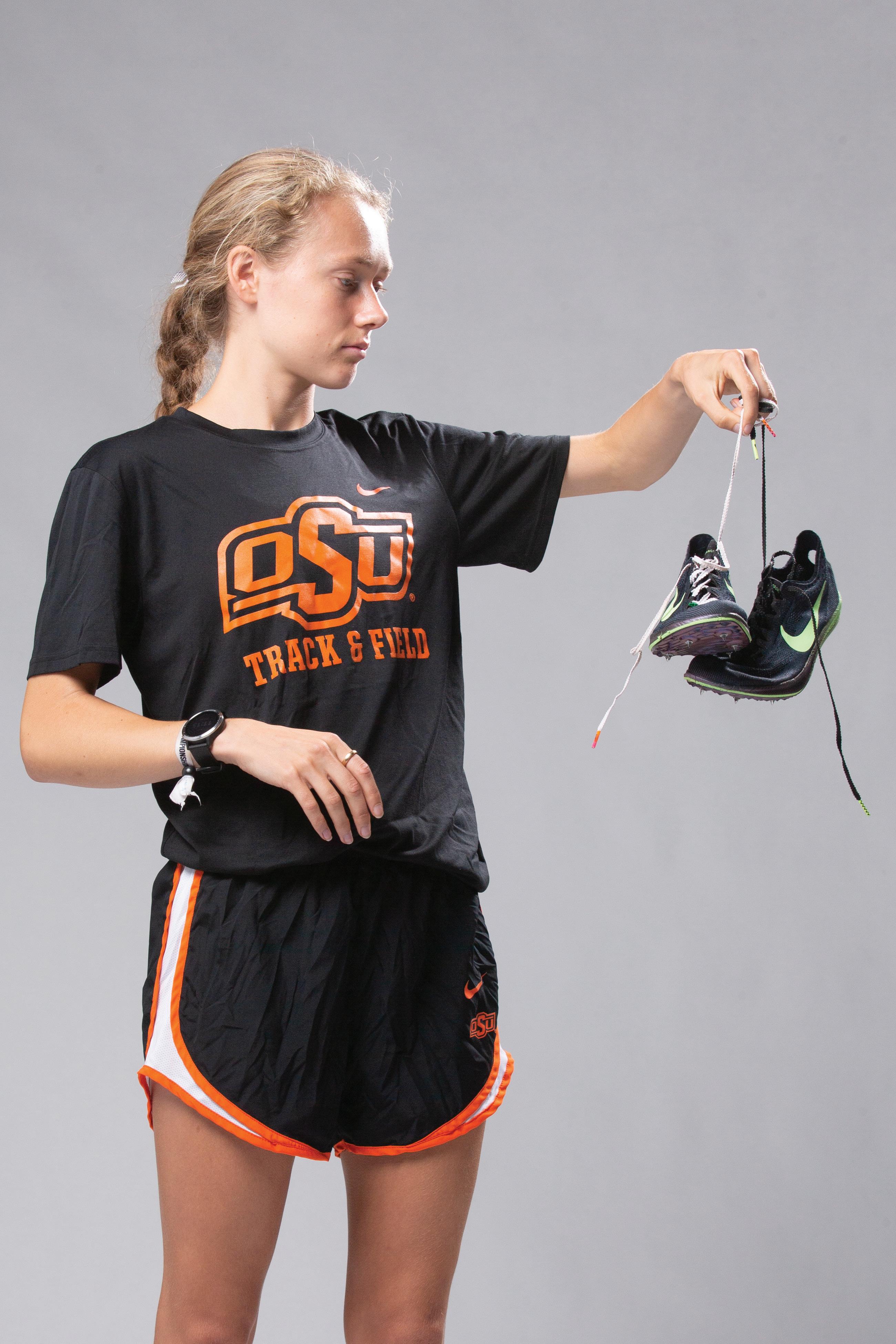
Just like on the body, running can also take its toll on shoes over time. Thankfully, a Nike-sponsored school like Oklahoma State has a ready supply of the latest and greatest performance footwear. When her ZoomX Dragonfly spikes start to wear out, for instance, all Roe has to do is go to the equipment room for a new pair.
(They’re still waiting for her to pick them up.)
As fast as she is around the oval, Roe is equally slow to change her shoes. She’s a notorious procrastinator, and it drives her coach nuts.
“That’s the thing,” Roe starts to explain. “It’s actually
funny. I did pick up another pair of spikes this year before my first indoor race, but I had not tried them on. I put the spikes in literally the day of the race. I put them on and realized these shoes are way too big, like a size-and-a-half too big! But what can I do? I have 20 minutes, and I’m about to race.”
Running in extra-roomy shoes, Roe ended up winning the 3,000-meter heat in a personal best time of 8:58.58. After the race, instead of swapping them for a smaller size, she simply went to her closet.
“I got out my old pair and was like, ‘Well, I guess I’m wearing these now.’ My coaches said, ‘You know you can go trade them in.’ And I’m like, ‘Yeah, I’ll go trade them in eventually’ …
Narrator’s voice: “She did not trade them in eventually.”
“That’s just Taylor,” Smith says. “She’s not real detail oriented on some of the things that you and I, and maybe her parents, might think are important. And she’s not too worried about it. ‘Yeah, these are shoes from last year, but they’re still working fine, so why am I in a hurry to go change them?’
Roe had another infamous racing shoe incident at the Big 12 Indoor Championships in February. Moments before the start of the mile final, the runner realized she had a knot in her shoelace. She worked feverishly to untie the string. Her coach even tried to gnaw the knot loose, to no avail.
Finally, they decided to cut the lace and replace it with one from a teammate’s shoe, only the white substitute shoelace didn’t match the black original, so Roe raced in mismatched laces. Predictably, she won. And also true to form, the white/black combo would remain through the outdoor season and is noticeable in photos from her NCAA championship race.
“She’s a little kooky, but I think all good distance runners are a little bit odd,” Smith says. “Taylor is extremely comfortable being Taylor.”
“I am kind of goofy,” Roe laughs. “I’m not superstitious, but I always joke that the worse the warmup feels, the better the race is. If I feel good during a warmup, it’s over. It’s not going to go well.
“And this will tell you how weird I get about things … We normally do a shakeout (run) about 5 hours before our race. Some people will do a couple miles, but I just run for 10 minutes. I have to stop my watch on exactly 10 minutes—if it’s 10:01, it’s a bad race. So I’m always worried about that. I just have little quirks.”
“There’s a lot of things that she does or ways she behaves that are not typical. And she’s OK with that. For someone who doesn’t have it together, she really has it together.
Case-in-point: The Distance Medley Relay at this year’s Big 12 Indoor Championships. Typically, Roe would anchor the Cowgirls in the relay, which consists of 1,200, 400, 800 and 1,600 meter legs. Before the race, Smith talked to Roe about starting out with the baton.
“I told her, ‘We’re going to let Kelsey (Ramirez) anchor, and you’re going to lead us o .’”
Roe relished the idea. She ran the opening leg in 3:21.19, giving the Cowgirls a commanding lead. Teammates Nicolette Dixon and Michaela Travers maintained the marginbefore handing o to Ramirez. The graduate school transfer brought home the victory with a determined 4:43.79 e ort.
“That moment for Kelsey, who came to OSU from a small school, is a moment she’ll remember the rest of her life,” Smith says.
“It was her senior year, and it was her last meet ever,” Roe recalls. “Kelsey got to anchor it home, so that was really cool to watch.”
As a follow-up to her indoor title, Roe is coming o an impressive third-place showing in the 5,000 meters (15:24.41) at the recent NCAA Outdoor Track and Field Championships in Eugene, Ore., earning her fifth All-America accolade.
“From indoor nationals up to now, I’ve put together the best training I’ve ever had, stringing together really good workouts,” she says. “I’m feeling really good, so I’m excited to see what that means.”
It will likely mean more All-America honors and conference crowns. Entering the fall semester, Roe has two years left in all three running seasons: cross country, indoor track and outdoor track. She has a chance to become one of OSU’s all-time greats by the time she’s exhausted her eligibility in orange.
“I’m really competitive with myself,” Roe says. “I really like to push my limits.”
Despite her success, Roe admits that she sometimes doubts her own abilities.
“Dave will give me a time to hit in practice, and in my head I’m like, ‘Oh my gosh, that’s way too fast. I can’t do that.’
And then she does it.
“I’m just trying to reframe it now,” Roe says. “I have progressed. This is what I should be doing. This is what I’m capable of. Trusting myself that I can do it.
“I’m honestly kind of an anxious person,” she admits. “I get pretty nervous. If that’s a lack of confidence, I don’t know, but I do my best when I just kind of relax and chill. Dave’s thing with me before a race is to try and make me laugh. He’s embarrassed himself doing dumb stu before races, but it makes the experience fun, and I’m not super stressed.”
Once the gun goes o , Roe’s anxiety evaporates, and a confident competitor reemerges.
“I guess that’s just who I am.”
That’s who she is … comfortable in her shoes.
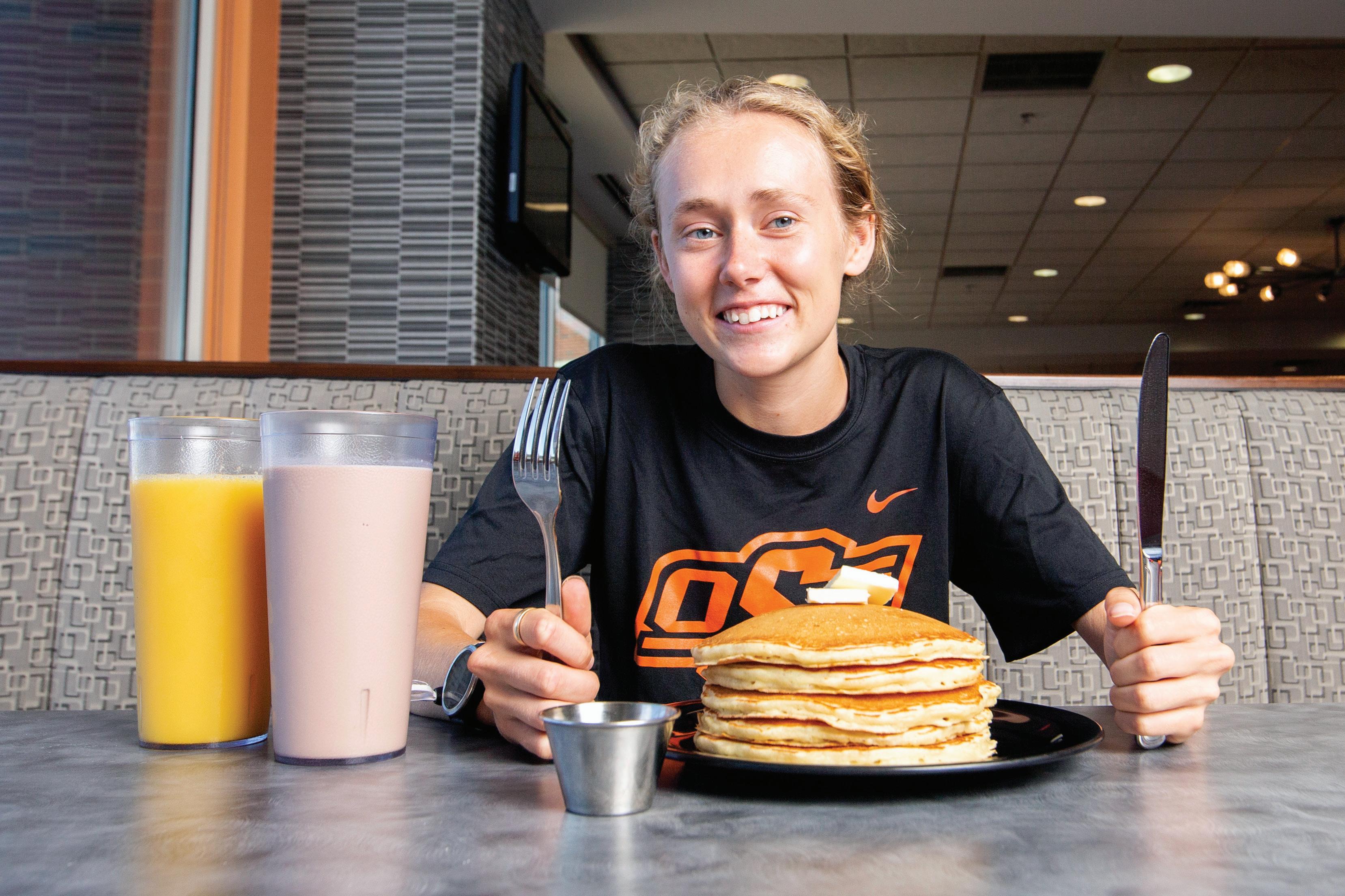
An elite runner’s regimen requires considerable calories, and Taylor Roe has found her favorite fuel to burn.
“I’m an athlete, so obviously there’s a lot that goes into my training, but when school is in session, I have to be a student, too,” says the junior statistics major. “That takes a lot of energy.”
Whether at the OSU Training Table, a local restaurant, or on the road—at any time of day—the Cowgirl’s pre-race meal will always consist of pancakes.
“Pancakes are the last meal I have before I race,” Roe says. “I am definitely fueled by pancakes. I’ll have pancakes for breakfast, lunch, dinner … and usually I have pancakes the night before a race, too.”
That’s pancakes, plural. Not just one. Not two. Not even a so-called “short stack” will su ce.
“Oh, we go full stack!”
Roe says she’s pretty traditional when it comes to her toppings. No fancy stu . No gimmicks.
“Buttermilk pancakes with butter and syrup,” she says. “I like the classic. I don’t mess with the fruit or chocolate chips.
“Honestly, it’s what sits best with me. And it works.”
The results speak for themselves.
The NCAA champ thinks her Name, Image and Likeness would make for an ideal marketing campaign for a breakfast chain—perhaps even one that’s international
“I can’t reach out to them myself. I have to hope that one day they notice me,” she says with a gleam in her eye.
“I’ll manifest it.”
(Pass the maple syrup.)
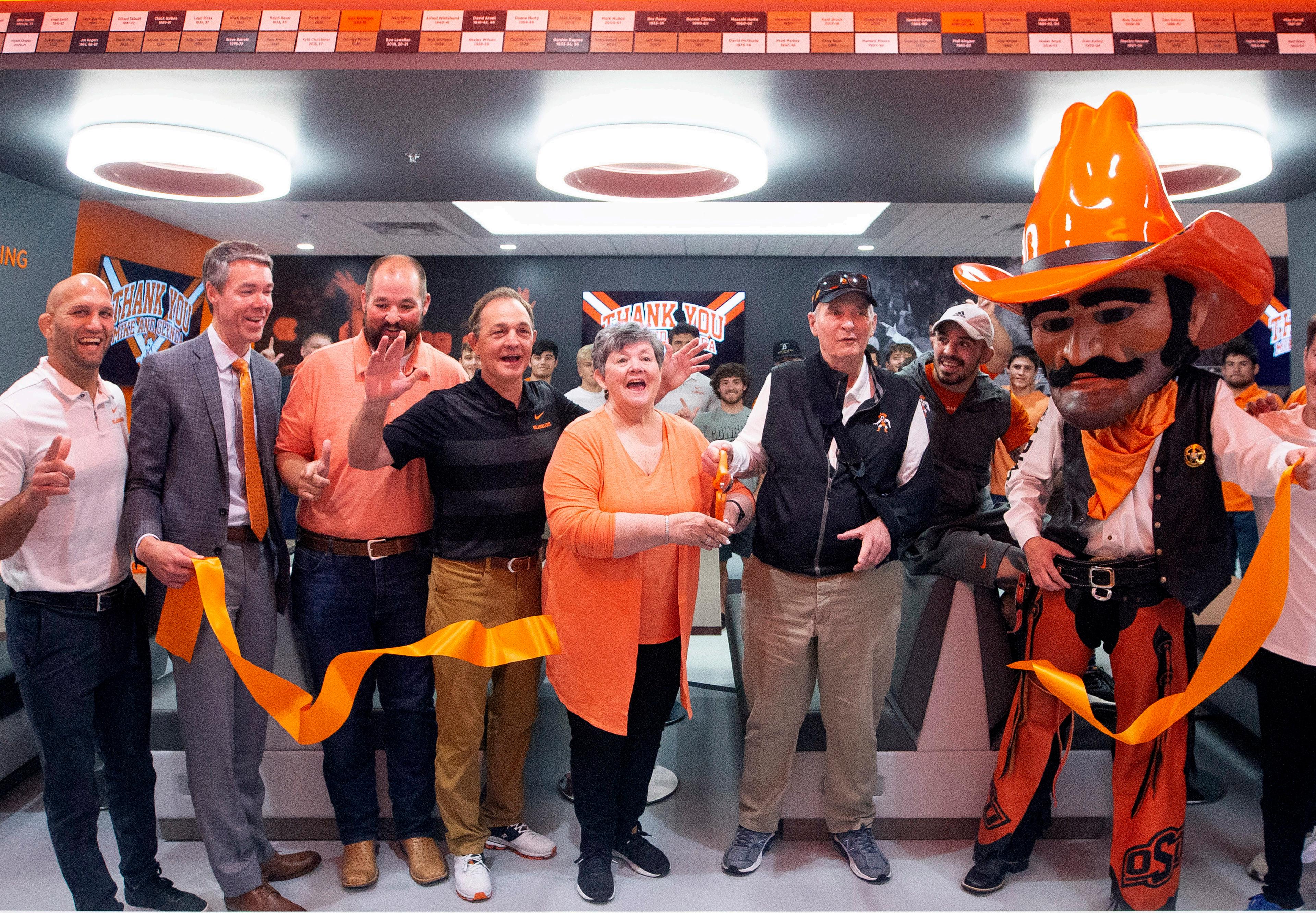
POSSE members Mike and Glynda Pollard helped cut the ribbon on Cowboy wrestling's new state-of-the-art locker room.
The Pollards' gift has given the nation's most decorated collegiate wrestling program a first-class facility. Located on the first floor of Gallagher-Iba Arena, the reimagined space is now a place where student-athletes can eat, study, play or relax while being immersed in OSU's rich wrestling history and tradition.
"I can literally say we have the best wrestling locker room in the world," head coach John Smith said at the dedication. "This is something OSU needed, and it will help us continue to attract some of the best wrestlers in the country."
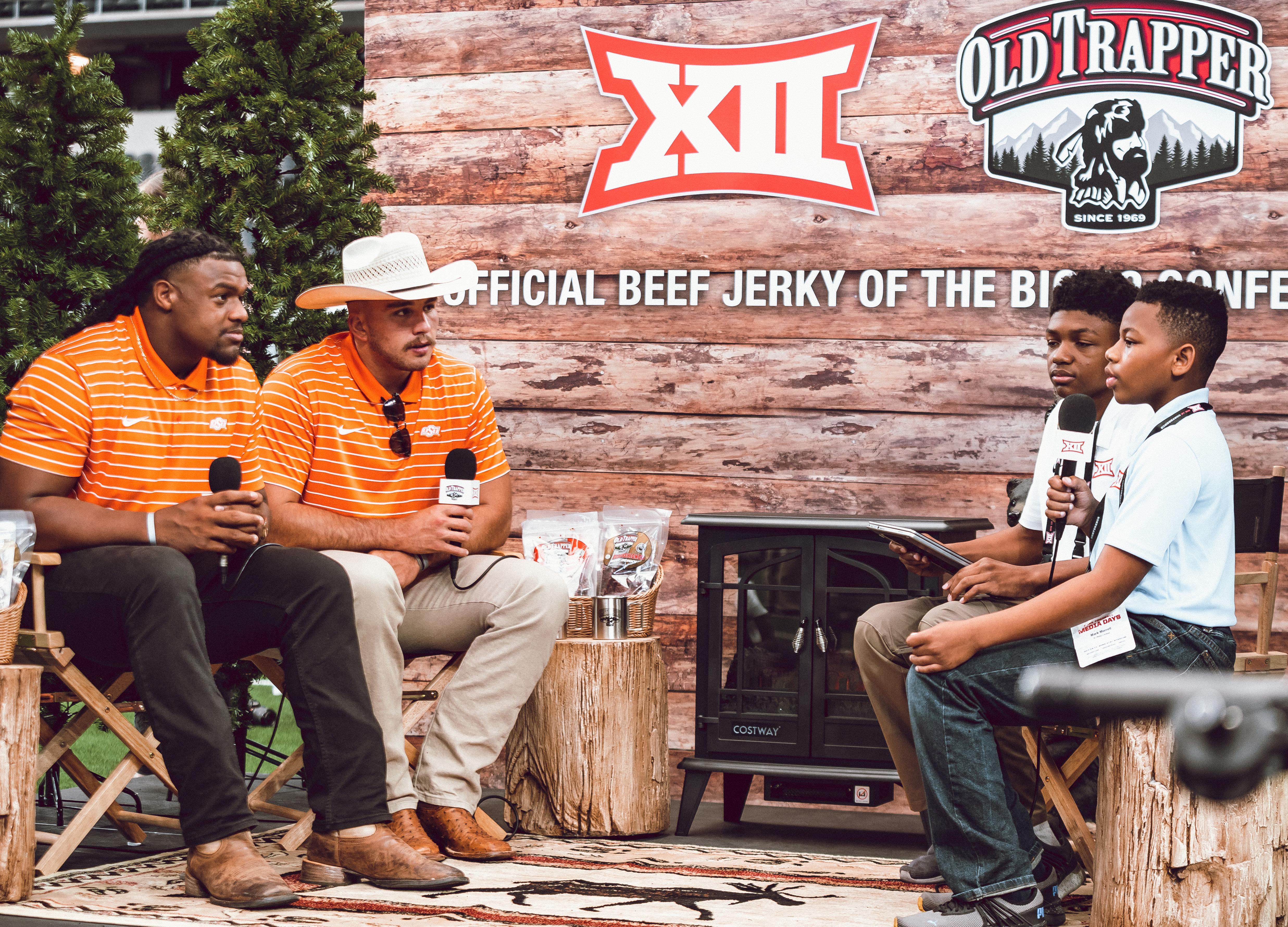
Cowboy seniors Tyler Lacy and Brock Martin were among OSU's representatives at the 2022 Big 12 Media Days in Arlington, Texas. The defensive duo took questions about the upcoming season from the press, as well as some budding reporters from the Dallas metroplex. The Big 12's "Kid Reporter" program provides local students an opportunity to gain practical experience in preparing, conducting and producing interviews with student-athletes and coaches.

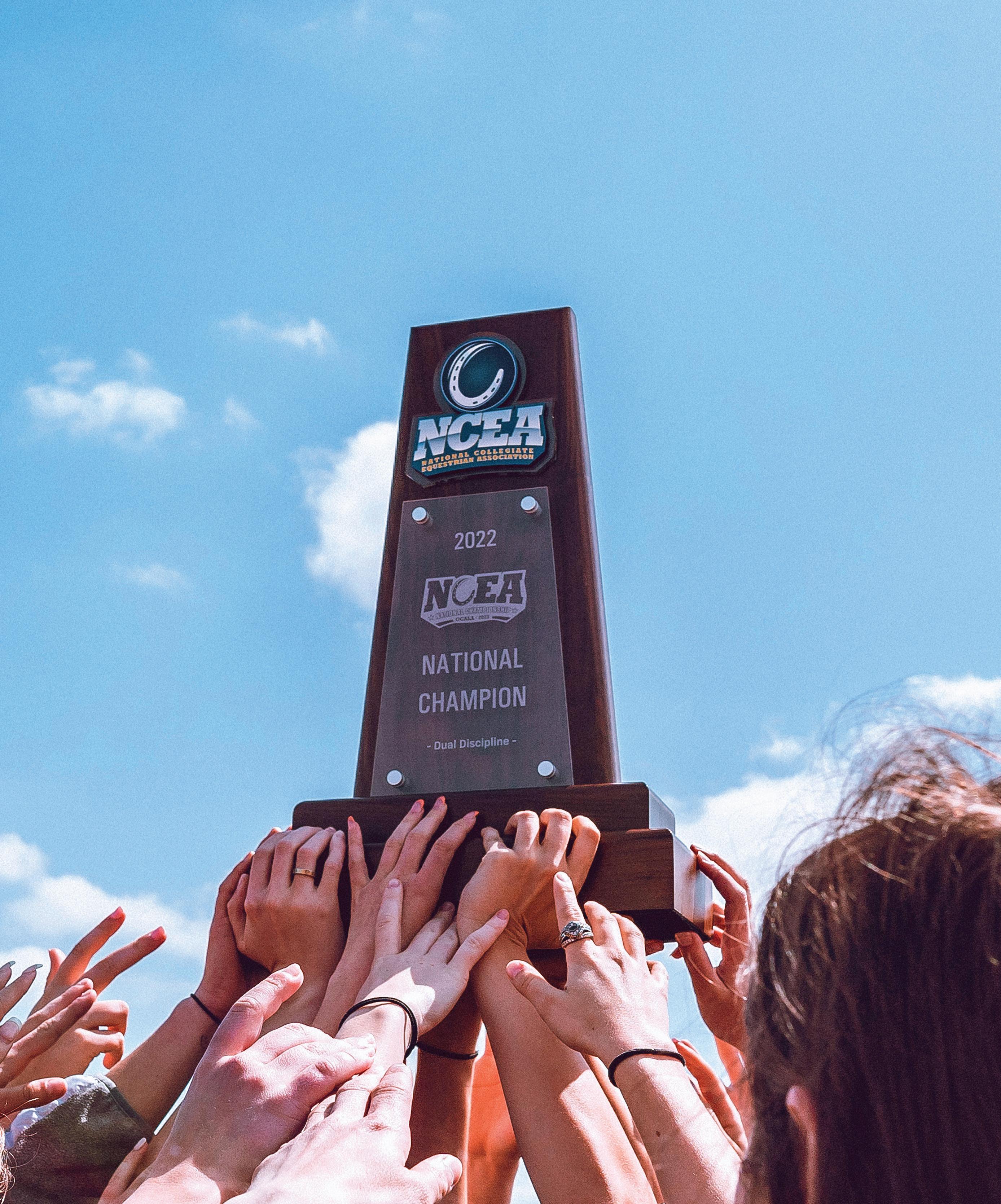
Sydnie Ziegler went to bed knowing.
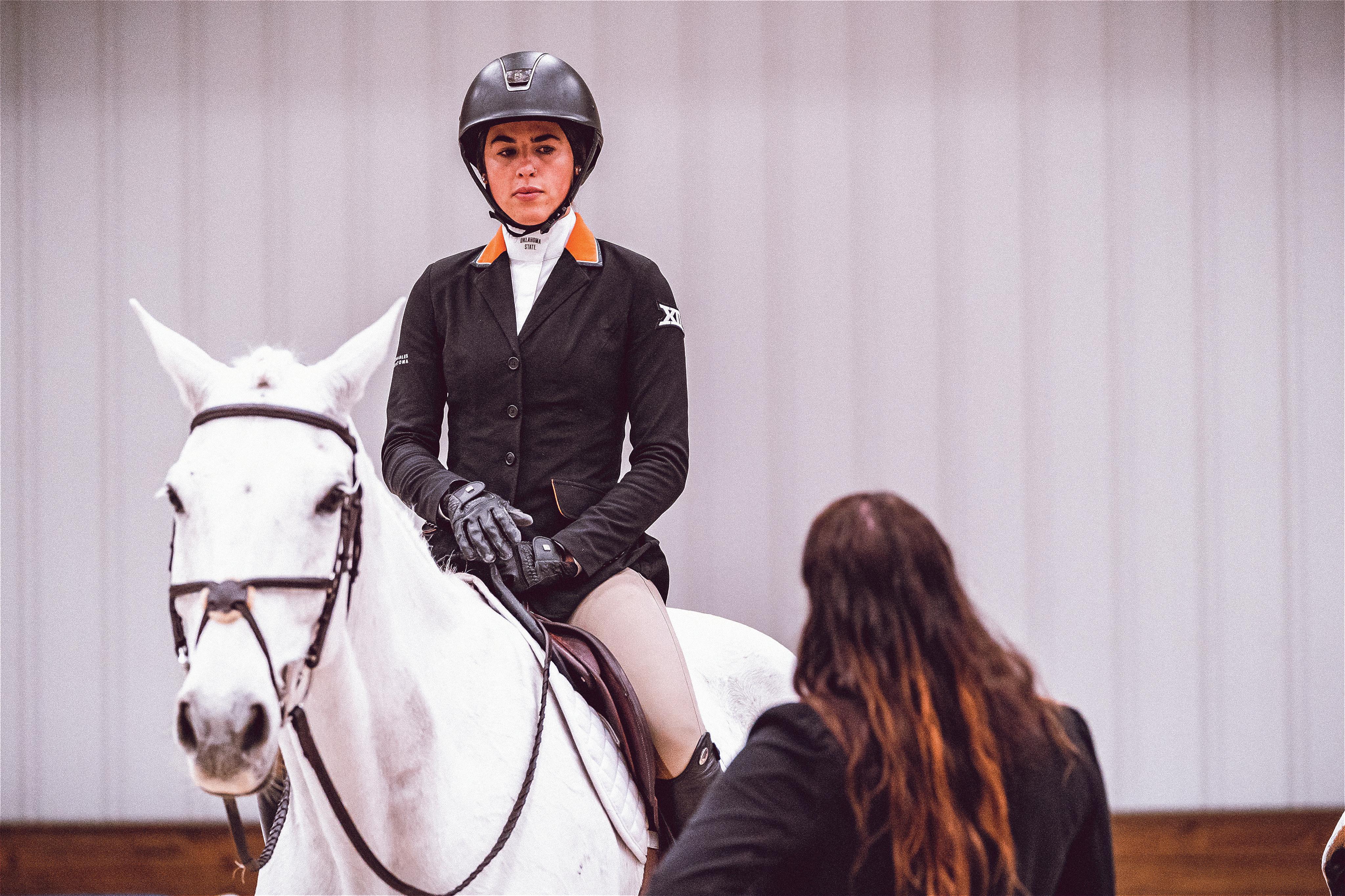
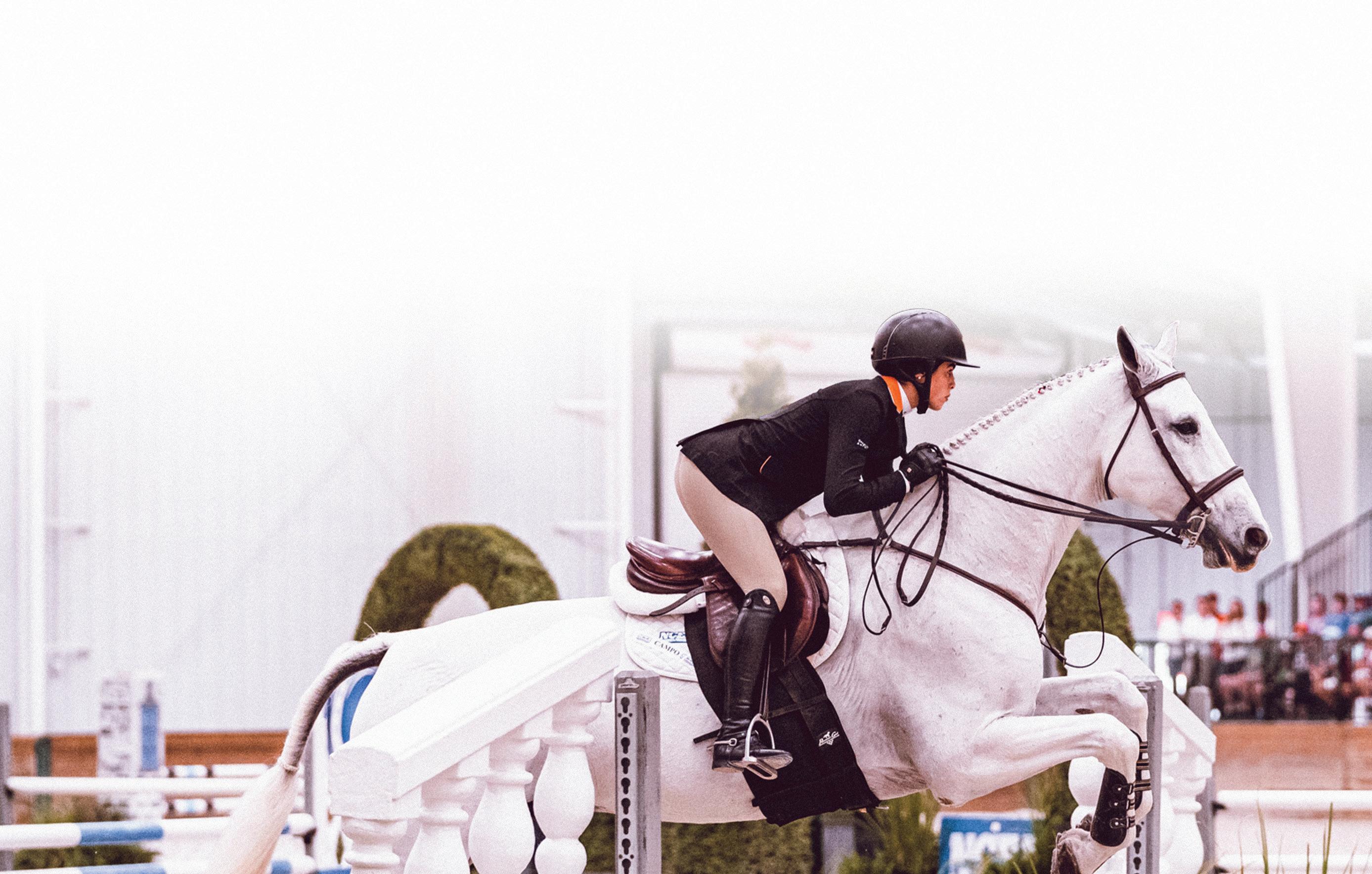
The next day, Ziegler would be Oklahoma State’s final rider in the National Women’s Equestrian Association National Championship finals.
Whether or not the Cowgirls hoisted the first national championship trophy in program history could all come down to her performance.
And that’s exactly what happened.
Larry Sanchez had done the math. With a national title on the line between his Oklahoma State squad and Texas A&M, the Cowgirls held a 10-9 advantage with only Ziegler’s Equitation on the Fences ride remaining.
The numbers didn’t lie—if the Aggies came out on top in the final ride, they would claim the crown.
“As coaches, you’re always trying to stay a step ahead so we started crunching the numbers and figuring out what it would be if we tied and there was a tiebreaker,” Sanchez said. “The tiebreaker is raw scores added together. And we would have lost if we would have tied.”
That takes us back to Ziegler, who had spent hours waiting and wondering.
“What if it all comes down to me?”
“I knew from the moment I went to sleep (the night before the finals) that it could be up to me, so I was preparing to be ready for it,” Ziegler said. “Throughout the day, I was having to go to the bathroom, look in the mirror and regroup and just breathe, tell myself ‘You got this—you’ve been there, you’ve done that!’
“I went into the ride and just zoned out everything. It was like, ‘This is it—just go do you, and you can win a national championship with your team.’
“I really wanted it and didn’t want to let anyone down. I stayed as calm as I could.”
Her coach remained calm as well, confident in one of the Cowgirls’ most clutch performers.
“Sydnie Ziegler has always been competitive, from her freshman year, and she really matured a lot in her four years here,” Sanchez said. “With her going in, there was a level of comfort as a coach that ‘I’m glad it’s her of any of them.’ I’ve got a couple of them that I know have the ability to handle that kind of pressure in that kind of situation, and she was one of them.”
“She was really good, but it wasn’t perfect—there was one fence that she was not perfect on. So when she came out of the arena, it was still unknown. It was up to the judges at that point to deal with that imperfect jump.”
The time between Ziegler’s ride and the posting of her score was only a few minutes, but it seemed like twice that.
Ziegler admits her round wasn’t quite how she wanted, and she wasn’t completely confident in how her score would come out. There was the moment she came in deep to a jump, which was worrisome even though everything else in the round had been good.
“I was nervous—I was biting on my nails through my gloves,” Ziegler said.
Finally, the scores were posted. Ziegler had defeated Texas A&M’s Kaitlyn Lovingfoss by a slim margin of 250.5 to 249.
The Cowgirls were national champions.
“After the championship, I watched a video of the girls waiting for the score and just the angst in their faces as they were waiting for that score to come in—you could write a book about the looks on those faces,” Sanchez said. “When they announced the score—and there are roughly 240 points in the round that would be considered—Syd ended up winning by a point and a half.
“The video captured it perfectly with just the look on the faces before the score came out, and then just the elation and emotion that came out after the score. It still gives me chills.”
Ziegler’s clutch performance may have clinched a championship, but if you know anything about the Cowgirl program, the emotions from claiming the title go much deeper than a trophy.
Family is a word that gets thrown around a lot when talking about athletic teams, but in the case of Cowgirl Equestrian, it’s entirely accurate.
It’s what made Abigail Brayman return to Stillwater for a fifth season of competition, taking advantage of an extra year due to the COVID-19 pandemic cutting short the 2019-20 season.
A senior captain and three-time NCEA All-American for the Cowgirls, Brayman returned to OSU last year with one goal in mind—winning a national championship with her family.
Celebrating that moment with hugs and tears of joy following the Cowgirls’ crowning moment was something she will never forget.
“All the emotions from the season, everything just rushed through at once,” Brayman said. “The hard times, the great times and just the love for everyone around me and winning with the people that I love.
“It was obviously special winning a championship. But looking back, that’s not even the part I remember most. It’s the memories that we made together and the family that we built. To say that winning the national championship was my favorite part of the season is partially true, but on the other hand, every moment that I got to spend with them, with my family, was really my favorite part.”
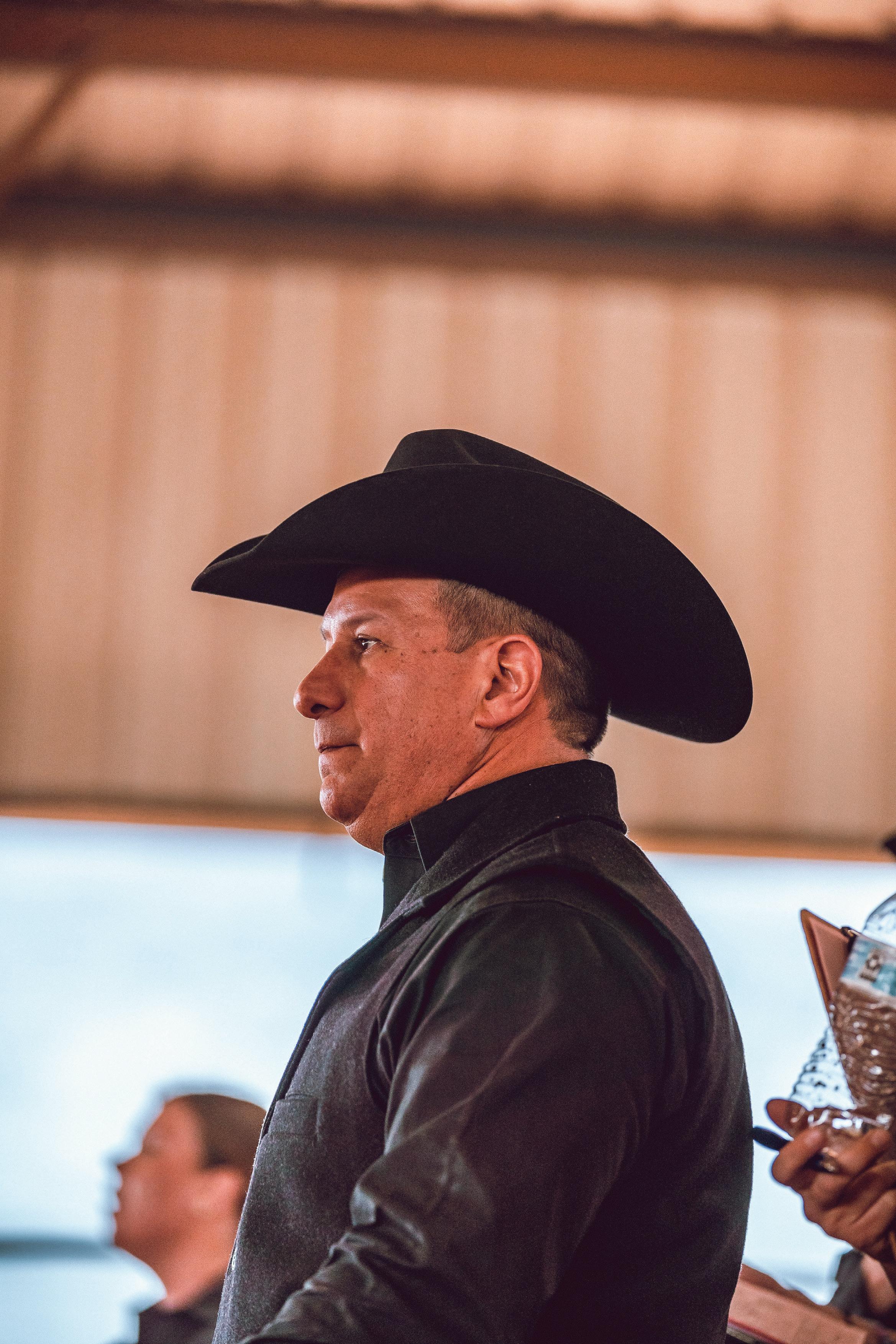
The family bond is something Sanchez has worked to instill in his teams since starting the OSU program over two decades ago.
Arriving in Stillwater in 1999, Sanchez has built the Cowgirl program into a perennial contender as one of the nation’s elite.
From humble beginnings with no herd of horses and meager facilities, OSU’s head coach has poured his heart and soul into molding the Cowgirls into consistent winners.
OSU has claimed eight Big 12 Conference championships under his guidance, and the program has five national titles in the Western discipline.
Nearly 70 All-Americans and over 20 individual national champions have competed for Sanchez, who has been named Big 12 Coach of the Year six times and was the Head Coach of the Year
That sustained success isn’t easy in such a unique sport, Sanchez says.
Equestrian athletes have spent their lives competing in the arena as individuals, and the transition to college competition and the team aspect is not always smooth.
“Each girl is just one point of the 20 that we need to win,” Sanchez said. “They have to transition and buy into the fact that ‘I’m just one part of this team’s success. It’s not all about me, it’s about the team. It’s not only what I can do to win my point in that head-to-head meet, but also what can I do for my teammates to help them win their point. And if for some reason I don’t win my point, how can I help them win theirs.’
“That’s what is truly special in a sport like ours in that you’re very much an individual and then you come into a team setting and have to understand the process of how a team sport works. It’s really an others-above-self mentality that you must develop.”
And that’s what made the Cowgirls in 2021-22 unique and able to achieve heights never seen in program history.
“This team completely bought in to the fact that this is a family, and we really care about each other as much if not more than the success of ourselves,” Sanchez said. “The girls believe that the coaches and their teammates truly care about them, not just them scoring points but them as people. Once they’re convinced of that, they’re willing to work to do whatever they need to do to achieve success.”
Much like every season, the 2021-22 OSU team had high expectations. They were coming o an appearance in the NCEA semifinals the previous year and were ranked No. 4 in the preseason national polls.
OSU’s opening meet of the season would be a precursor to just the type of team it had. The Cowgirls trailed at No. 8 Baylor at the halfway point but came back to win, 10-9, marking the first of four comeback victories they would have on the season.
Up next would be one of the most pivotal points of the season. Sanchez’ squad welcomed top-ranked Auburn to Stillwater, with the Tigers owning a six-match winning streak against the Cowgirls.
Added Ziegler, “When we took over that (No. 1 ranking), we didn’t get complacent. We knew anything could happen and midway through the year we did lose to SMU, and that gave us a little reality check that we needed to keep working hard. I don’t think it put pressure on us being number one, and we weren’t boastful or prideful. We just knew that we deserved it, and we wanted to keep building on it to maintain it.”
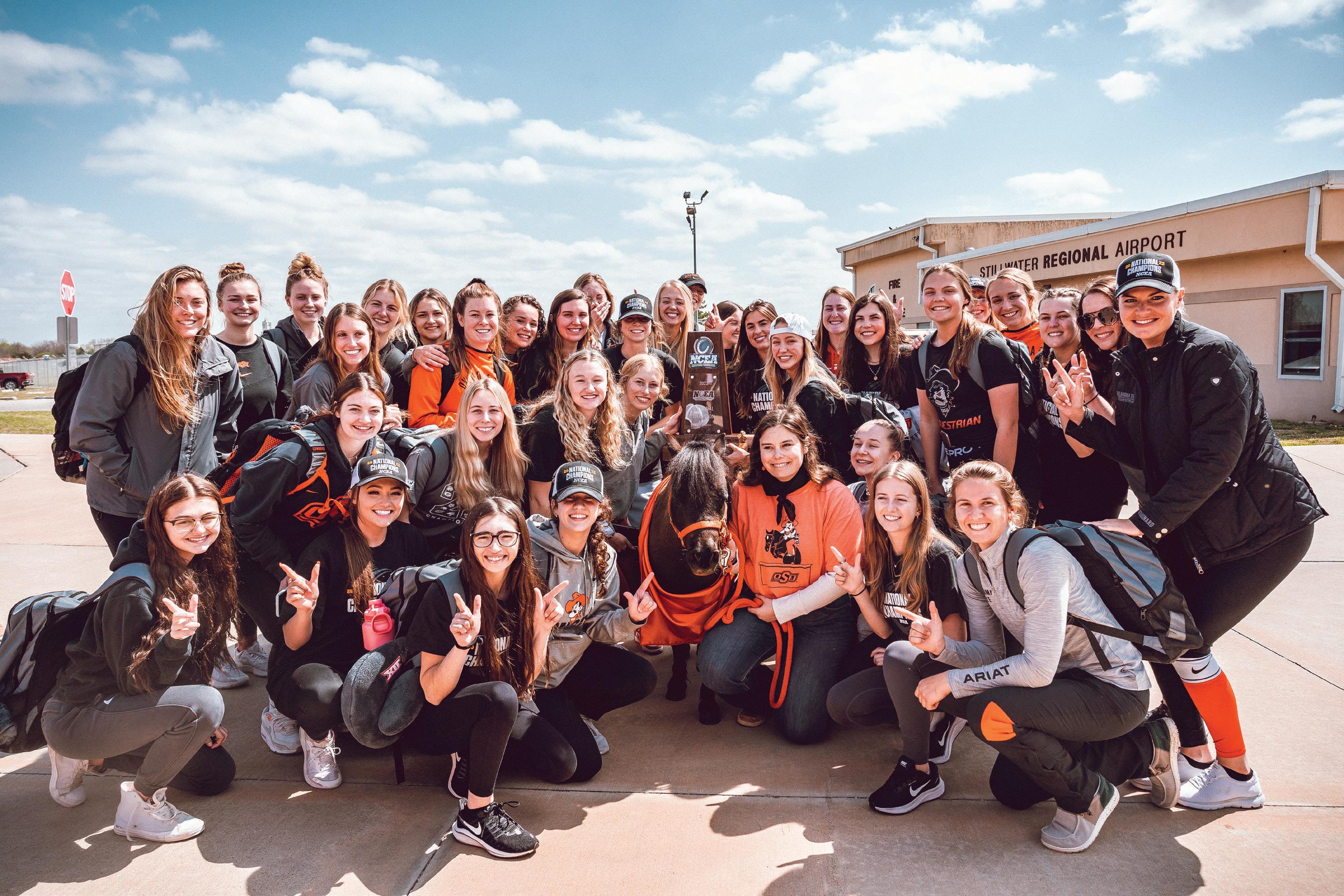
The team had a tremendous group of leaders, with captains and non-captains, starters and non-starters, embracing their roles for the greater good.
“I try to have the program at a point where it’s in contention for conference and national titles every year,” Sanchez said. “But every so often, a special team comes along that really provides an opportunity for those goals to become attainable.
“The girls bought in, and the more the year progressed, the more they bought in to the process of what we were trying to accomplish. About midseason, I started noticing that the leaders on the team really started taking on doing what needed to be done to attain that goal. At that point, the coaches were able to step back a little bit and let them take it.
“When the team starts taking the lead in the direction you want it to go in, that’s when teams can really accomplish goals that you set. And when you have starters and non-starters alike who are passionate and driven about team goals, the whole team seems to get on board with that.”
The second half of the season closely resembled the fall as OSU opened with four consecutive wins before another
And that finish was one for the history books. OSU closed out the regular season with a victory at top-ranked Texas A&M, then entered the Big 12 Championship and knocked o Baylor before exacting revenge in the finals against TCU to capture the conference crown.
The next step was Ocala, Fla., with seven teams and three wins at the NCEA National Championship standing in the way of glory.
And one shared mindset.
“I don’t think there was ever a doubt that we could win it, and I think that’s what set this year apart from others,” Brayman said. “In the past, there’s always been a couple of girls that were intimidated, or it seemed out of reach to them. But this year, we set that goal, and everyone believed that as long as we put our minds to it, we were going to achieve that goal and there really wasn’t another option.”
OSU opened the tourney with a 12-8 triumph over Fresno State, setting up a semifinal showdown against a familiar foe in TCU.
The result was a 13-6 victory that put OSU in the finals for the first time since 2013.
As expected, the matchup against TAMU would be a tight battle. At the halfway point, the score was tied 5-5. Following the Horsemanship event, the Cowgirls clung to an 8-7 lead.
The Aggies would tie things up, but two-straight points for the Cowgirls put them back in the lead before another TAMU win made the score 10-9.
That set the stage for Ziegler’s heroics.
“It was a huge relief that we got to ride last with (Ziegler) in the ring,” Brayman said. “Everyone had so much confidence in her—she is truly a rock. You know she’s gonna go out there and give it her all, and nine, pretty much 10 times out of 10, she’s going to win her point.
“It gave a lot of people confidence knowing that our last ride was going to be Syd, and she was going to bring it when it came down to it. There wasn’t any doubt from anyone that she was gonna deliver. And sure enough she did.”
While her ride may have set o the celebration, Ziegler shrugs o the performance with humility.
“I just did what everyone else did—I just happened to be last,” Ziegler said.
“We knew from the beginning we could do it. We were focused and together and determined to do something special as the family we are. That feeling when I realized after my round that we had done it, we had won, I just thanked God. It was a super special accomplishment to end an amazing year.”
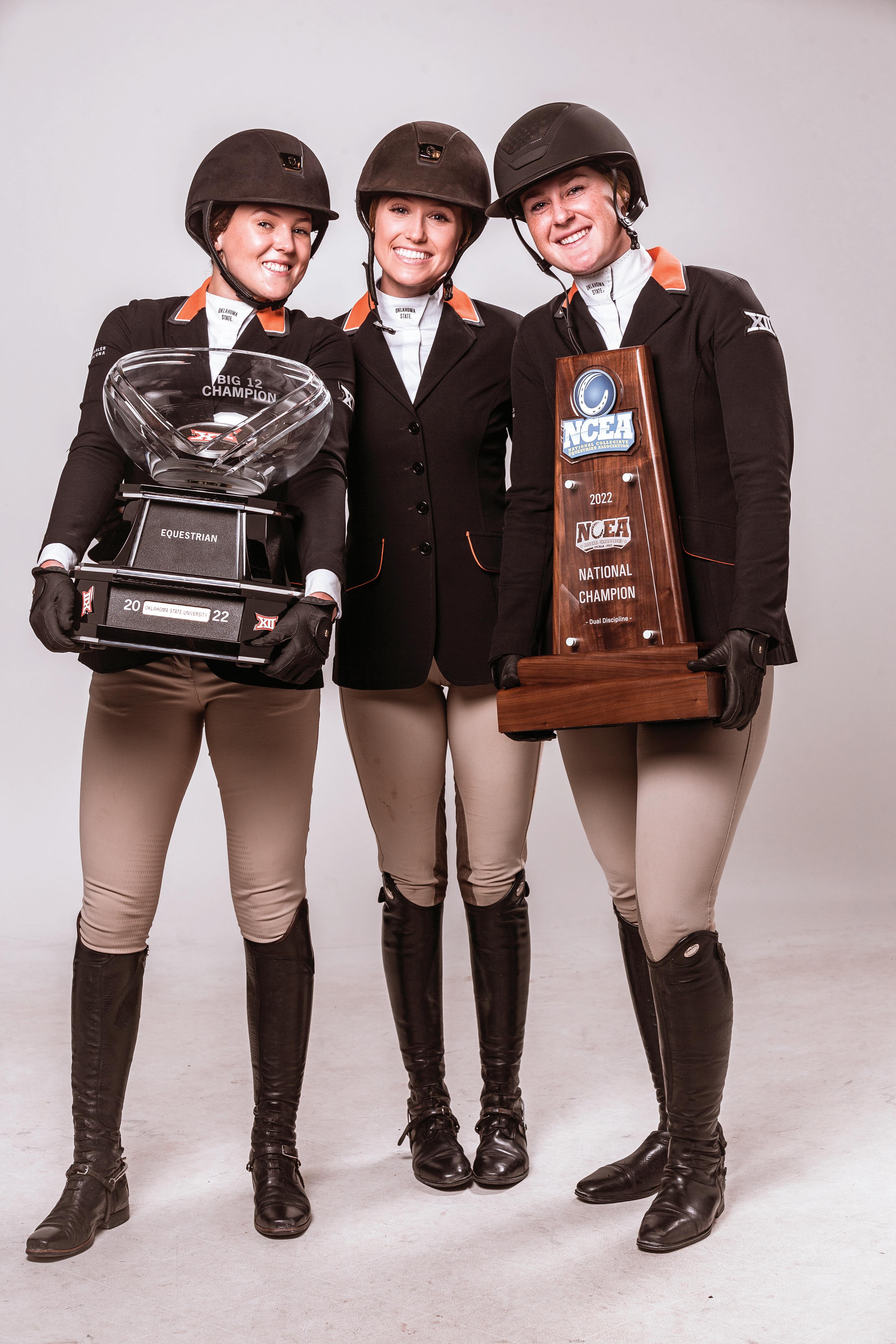
Just how monumental the Cowgirls’ accomplishments are cannot be understated. OSU finished 15-2, the most wins in program history, and captured conference and national titles.
Adding to the historical significance, Cowgirl Equestrian became the first female sport in OSU’s distinguished athletics history to win a national championship.
“When I found that out, I was like, ‘Wow, we just made history!’” Ziegler said. “It’s still a surreal feeling to know that we’ll go down in history as not only the first OSU equestrian team to win a national championship but the first OSU female team to win a national championship.”
“It just goes to show how much it takes a special group of people to do that,” Brayman said. “That’s clearly what we were, and I couldn’t be prouder of the girls that I did it with. It’s such an honor to be part of that, and something that we’ll always be remembered for.”
The magnitude of being a trailblazer for OSU Athletics isn’t lost on Sanchez, who is deeply rooted in the culture of winning in Stillwater.
“To be able to win a championship and be the best in your sport that year is a huge sense of pride. But also to bring a championship home for a school that I love so much is truly special,” Sanchez said. “I was rooting for tennis and softball and golf to win championships this year—I was hoping it wasn’t just equestrian. I was hoping we’d get three or four.
“We fell short of that, but we had an opportunity. That’s evident of what our future here at Oklahoma State across all sports is going to be.”
Having reached the top of the heap, what changes for Cowgirl Equestrian?
“I don’t think our process changes,” Sanchez said. “But the confidence that our team has now that it has been done goes a long way. The belief in success is as important as the work that you put in—you’ve got to believe you can do it and then back it up with the work it takes.
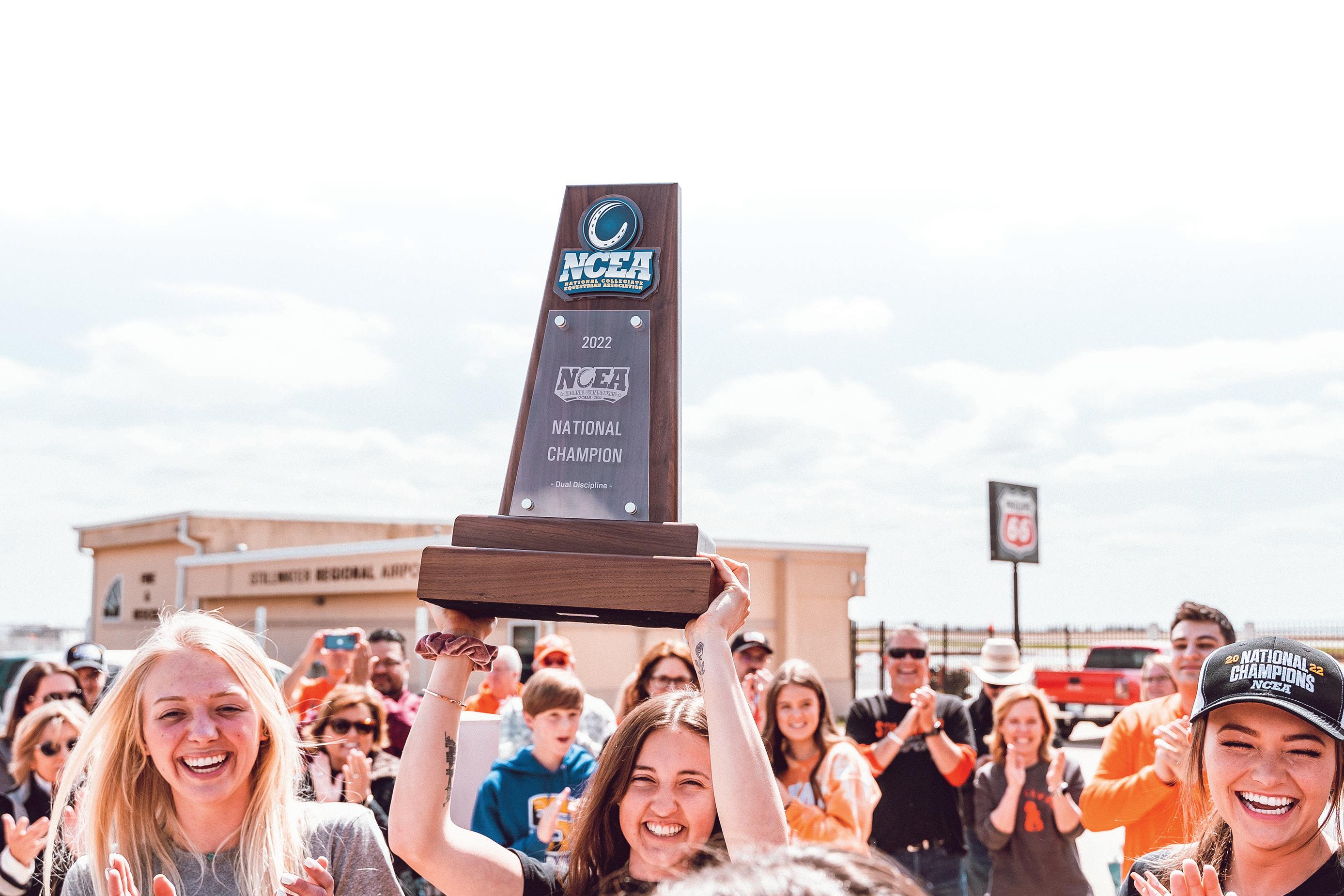
“The girls need to believe that it’s our standard to be in contention for a national championship. The coaches always believe it. But the girls need to understand it’s our standard of what we expect – it’s where our program needs to be.
“The bar has been set, and my thoughts are to raise that bar every single year.”
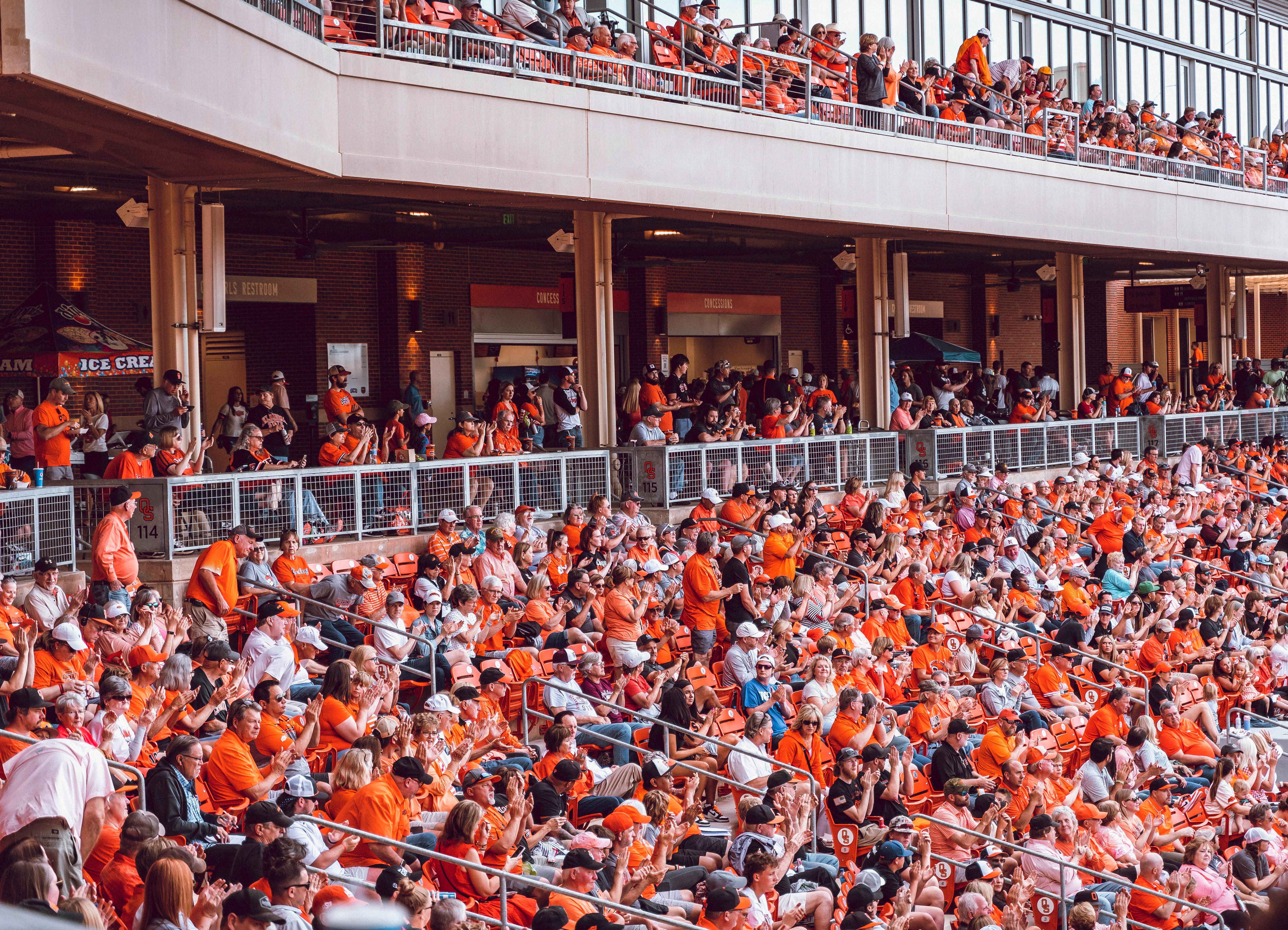
Cowboy Baseball fans set singlegame and season attendance records this past spring. Over the course of 33 home games, a total of 178,566 spectators passed through the O’Brate Stadium turnstiles in 2022.
At an average of 5,411 per game, the first-class facility ranked eighth in the country in attendance. (Oklahoma State and Texas were the only schools in NCAA’s top nine in attendance outside of the SEC.)
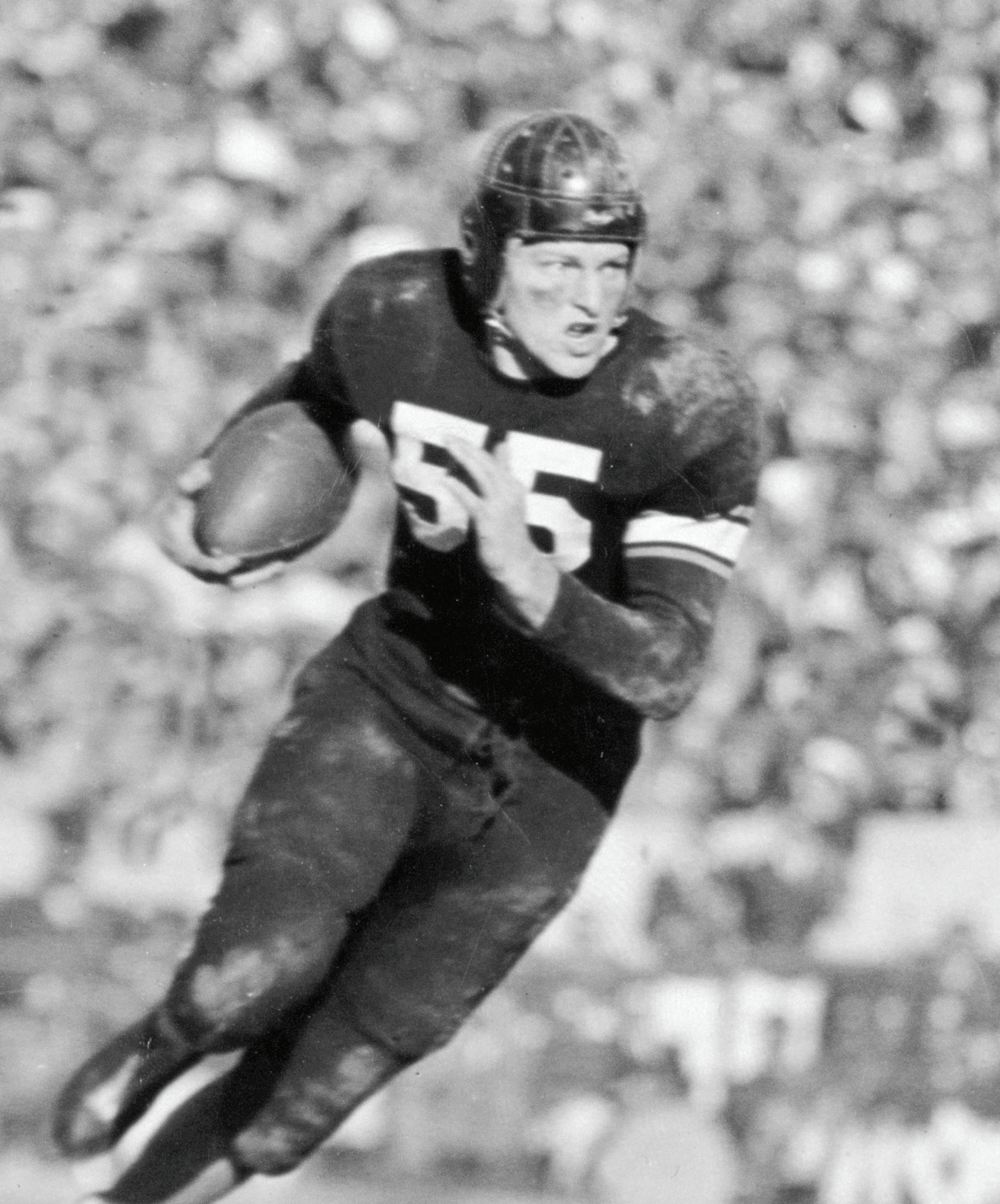


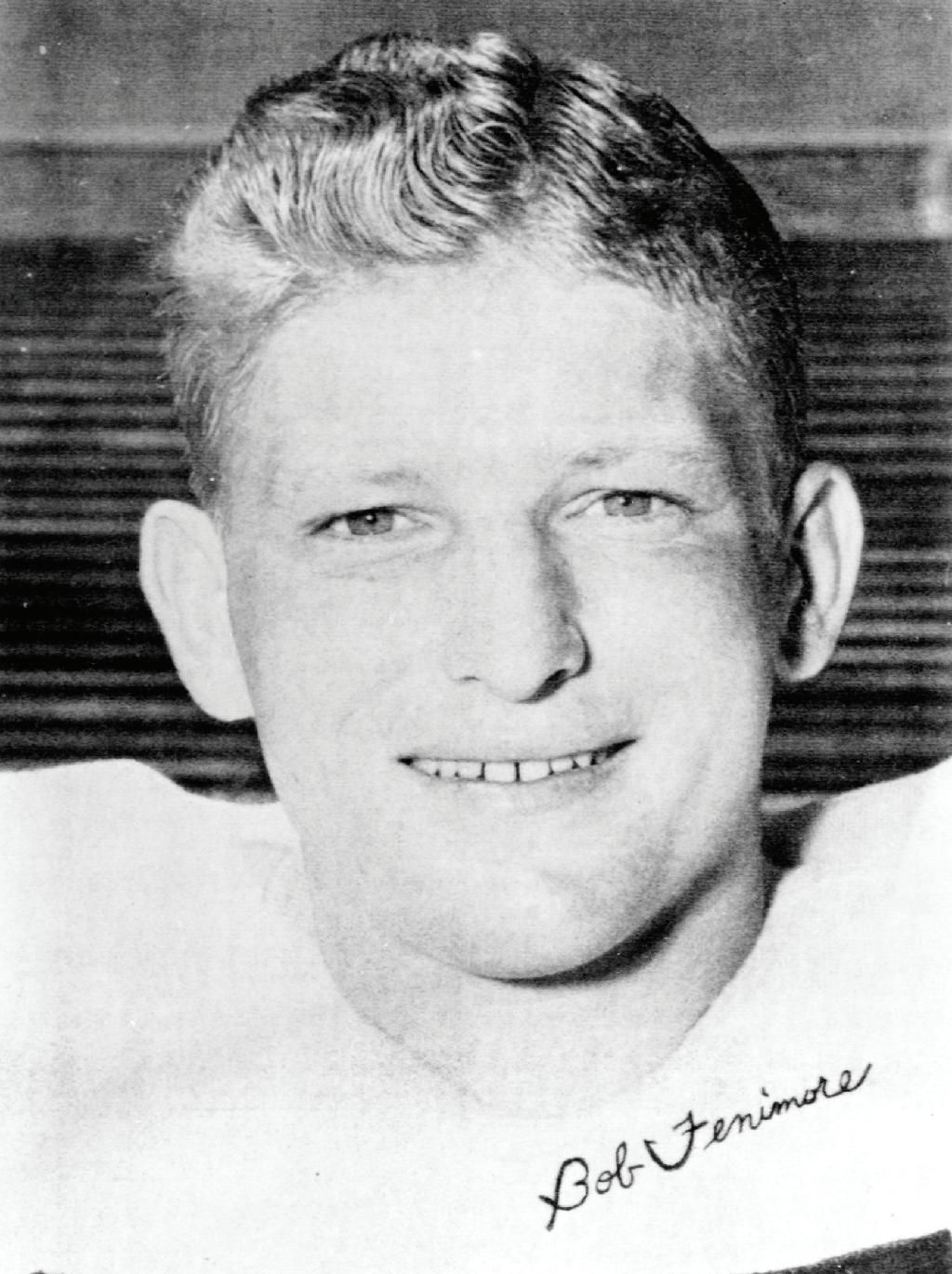
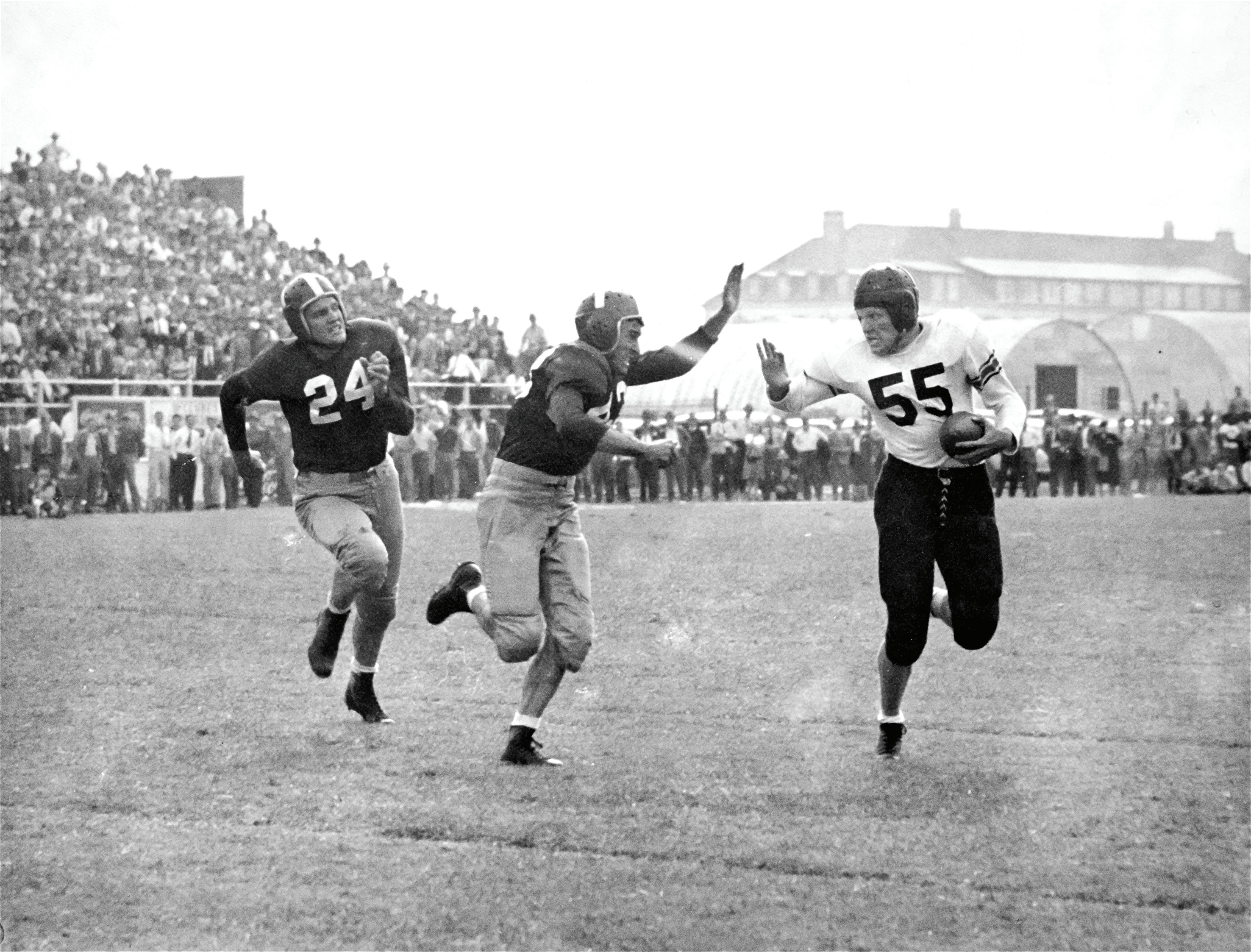
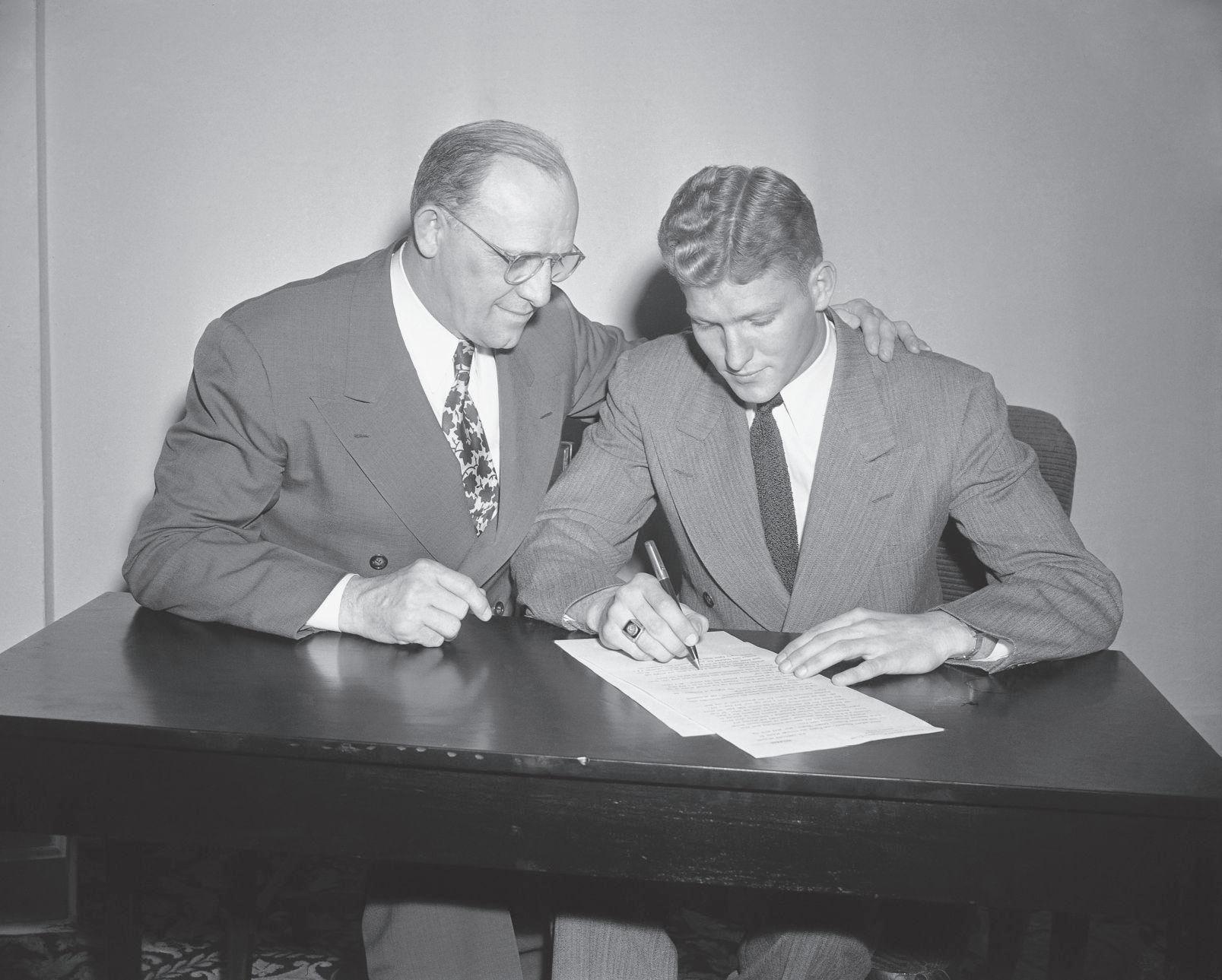
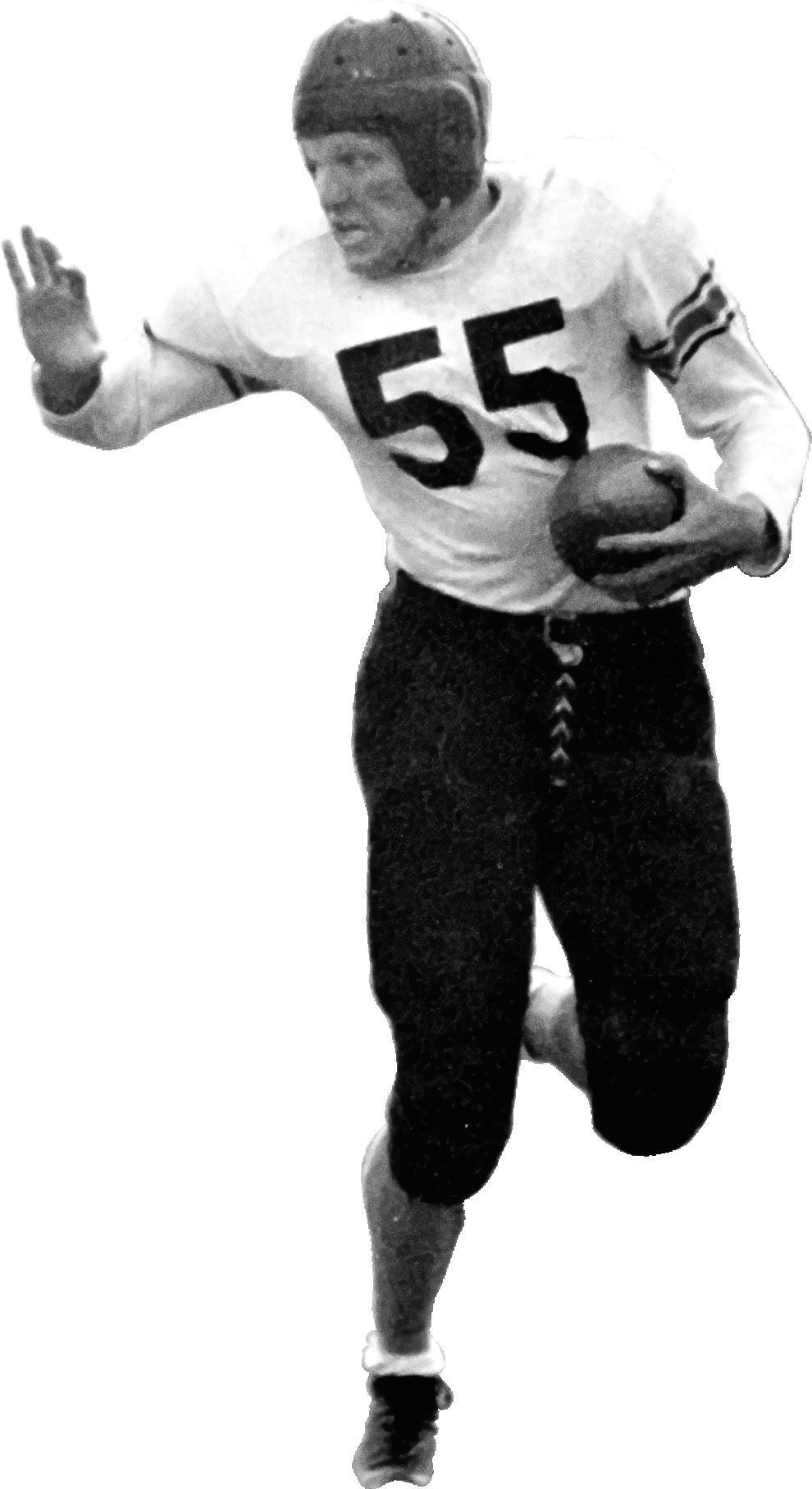
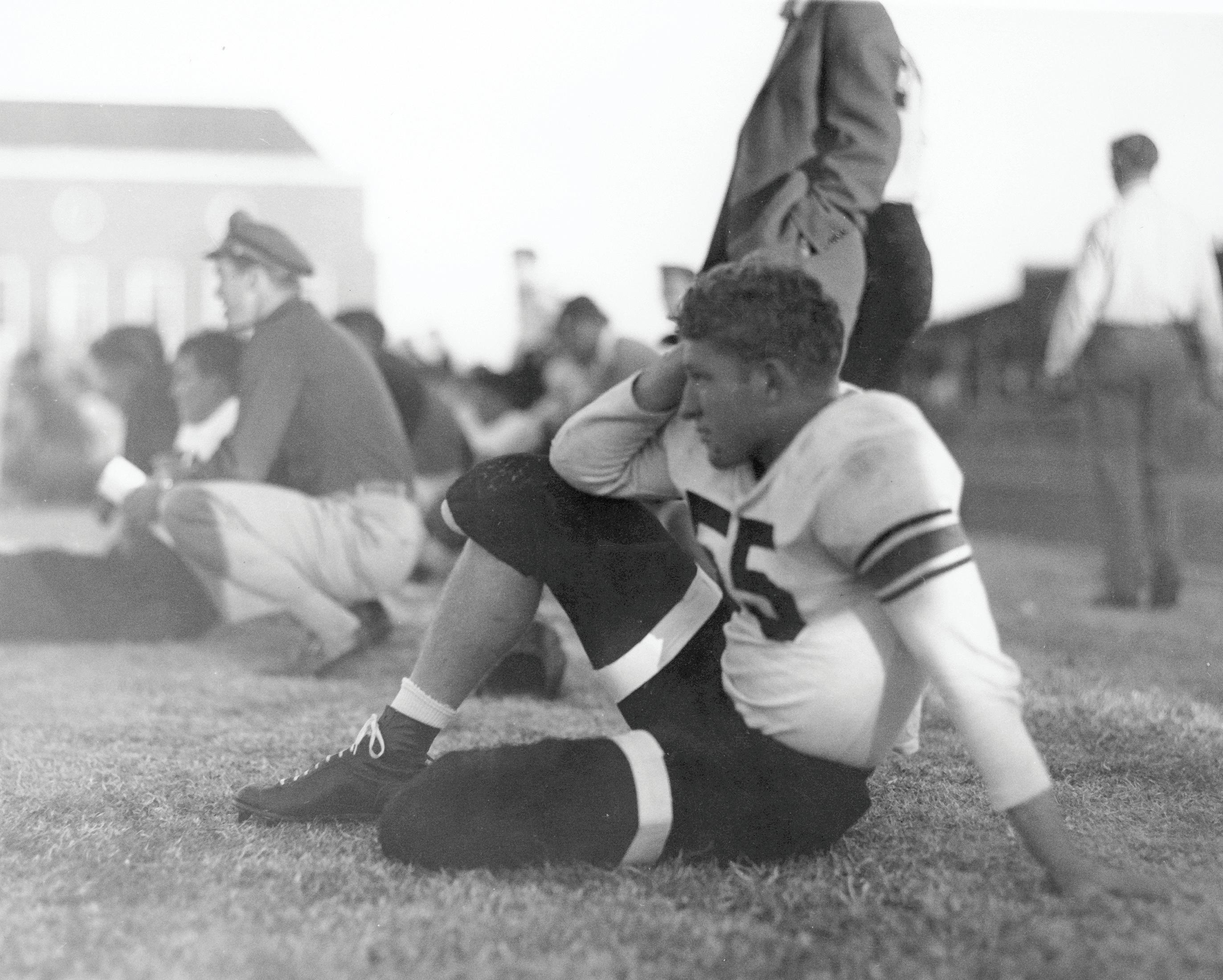
Bob Fenimore is a name most Oklahoma State football fans know and admire. But it might be a good time re-visit just exactly what the legendary athlete achieved in Stillwater for him to be held in such high esteem almost 80 years after his playing days.
Being fuzzy on the details is understandable. Fenimore hasn’t laced them up for Oklahoma A&M since his injury-marred 1946 senior season. He is 81 years older than Twitter and probably would have had no interest in being a social media influencer, even if it had been an option. He is part of the “The Greatest Generation” and carried that mindset with him throughout his life, according to those who knew him best.
At his alma mater, he is a man of firsts. He was the greatest player in OSU Football for at least the first 60 years the university fielded a team. He is the only Cowboy/Aggie to be drafted with the first overall pick into the National Football League. He was the school’s first All-American. He was the first OSU player to finish in the top 10 of the voting for the Heisman Trophy, a feat he accomplished twice. He was third in the Heisman balloting in 1945. And by the way, if you think there is an East Coast bias now, think what it must have been like in the 1940s.
He was part of the first class inducted into OSU’s Athletic Hall of Honor. He is also a member of the College Football Hall of Fame, and of course he was the first OSU player to earn that distinction. He is a member of the Cotton Bowl Hall of Fame, the Oklahoma Sports Hall of Fame and probably several more halls of fame we aren’t aware of.
In October, he will be inducted into the most exclusive of OSU clubs: the football Ring of Honor atop Boone Pickens Stadium, where he will join fellow all-everythings Thurman Thomas and Barry Sanders
The choice isn’t sentimental. It is more than deserved.
“The greatest one-man o ense in college football history,” Homer Cooke of the National Collegiate Athletic Bureau said of Fenimore in the 1940s.
In 1944, Fenimore led the nation in total o ense, and his average of 195 yards per game was the highest in college football history to that point. That same season he was third nationally in rushing, eighth in passing, ninth in scoring and 13th in punting. He led the Aggies to an 8-1 record and a Cotton Bowl win over TCU.
“I think that win opened the eyes for people all over the country about what kind of football team they had at Oklahoma A&M,” Fenimore said decades after the first bowl victory in school history. “We heard reports that we had even been considered for the Rose Bowl.”
There were only five bowl games that season: Cotton, Rose, Sugar, Orange and Sun. The Rose Bowl was the most prestigious and was already approaching its 50th year of existence during Fenimore’s playing career.
-ss-
In 1945, Fenimore led the nation in rushing with 1,048 yards, becoming the first player from the school to reach 1,000 yards and the only Aggie/Cowboy who would accomplish the feat from the program’s inception (o cially in 1899) until sophomore Terry Miller broke the 1,000-yard mark in 1975. Fenimore’s 1945 season also saw him lead the nation in total o ense, finish seventh in punting and 13th in scoring. He led the Aggies to a perfect 9-0 record and a retroactively-awarded national championship. Despite an injury riddled senior season, he left Stillwater as college football’s all-time leader in total o ense with 4,627 yards. That total topped the OSU charts until Mike Gundy came along roughly four decades and a plethora of o ensive schemes later.
“The one thing we had that a lot of the other teams didn’t have was speed,” Fenimore said of the 1944 and 1945 teams when reminiscing. “And I’m talking about at all positions. We had guards, they weren’t going to break a 10-flat in the 100, but they could run. We had tackles that weren’t very large, but they could run. Neill Armstrong was a high hurdler in track. He could really run. Speed was the biggest contributing factor, I think, to our success.”
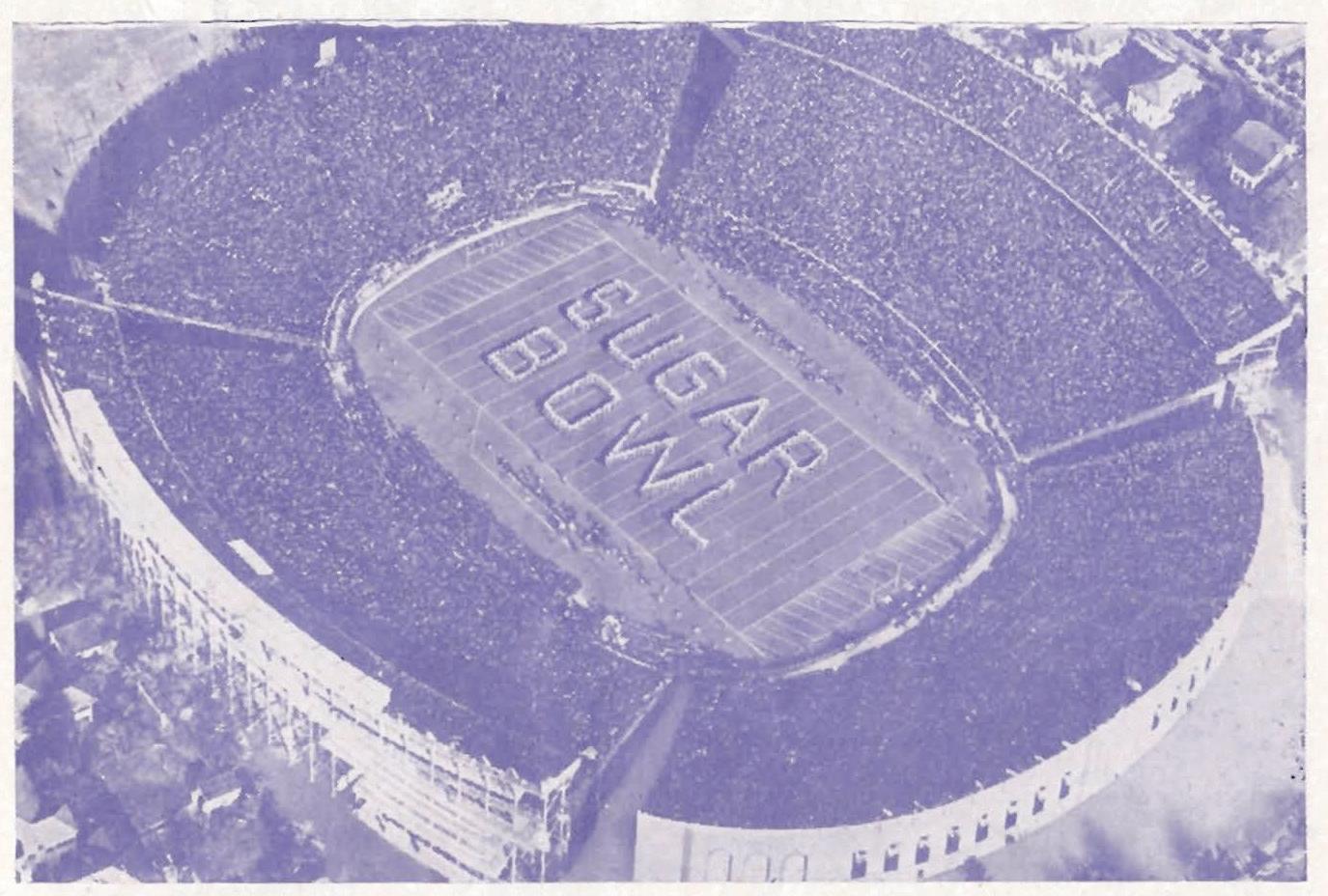
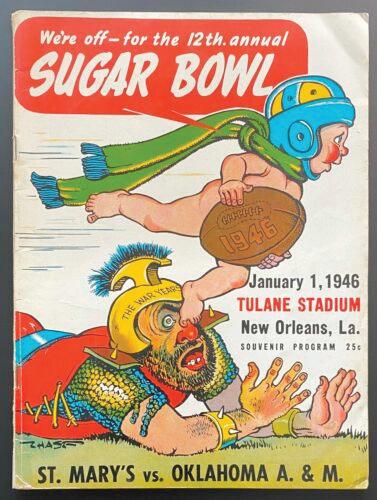

Fenimore was a two-time All-American, including a unanimous selection as an All-American after that headline-grabbing 1945 campaign. The final game of that season featured an iconic Sugar Bowl appearance as Fenimore led A&M to a 33-13 win over St. Mary’s on Jan. 1, 1946. It was a head-to-head battle of All-Americans: Fenimore vs. Herman Wedemeyer. Fenimore made it no contest with 125 rushing yards and 76 passing yards.
Incredibly, as a defender, Fenimore still holds OSU’s career record with 18 interceptions, despite playing in an era in which the forward pass was far from mainstream.
“If you didn’t know he was the ‘Blond Bomber’ you would just think he was the nicest person in the world,” said OSU senior associate athletic director Larry Reece, who was honored to be friends with Fenimore. “As legendary as his accomplishments were on the field, he was an even better person o the field.”
—Homer Cooke
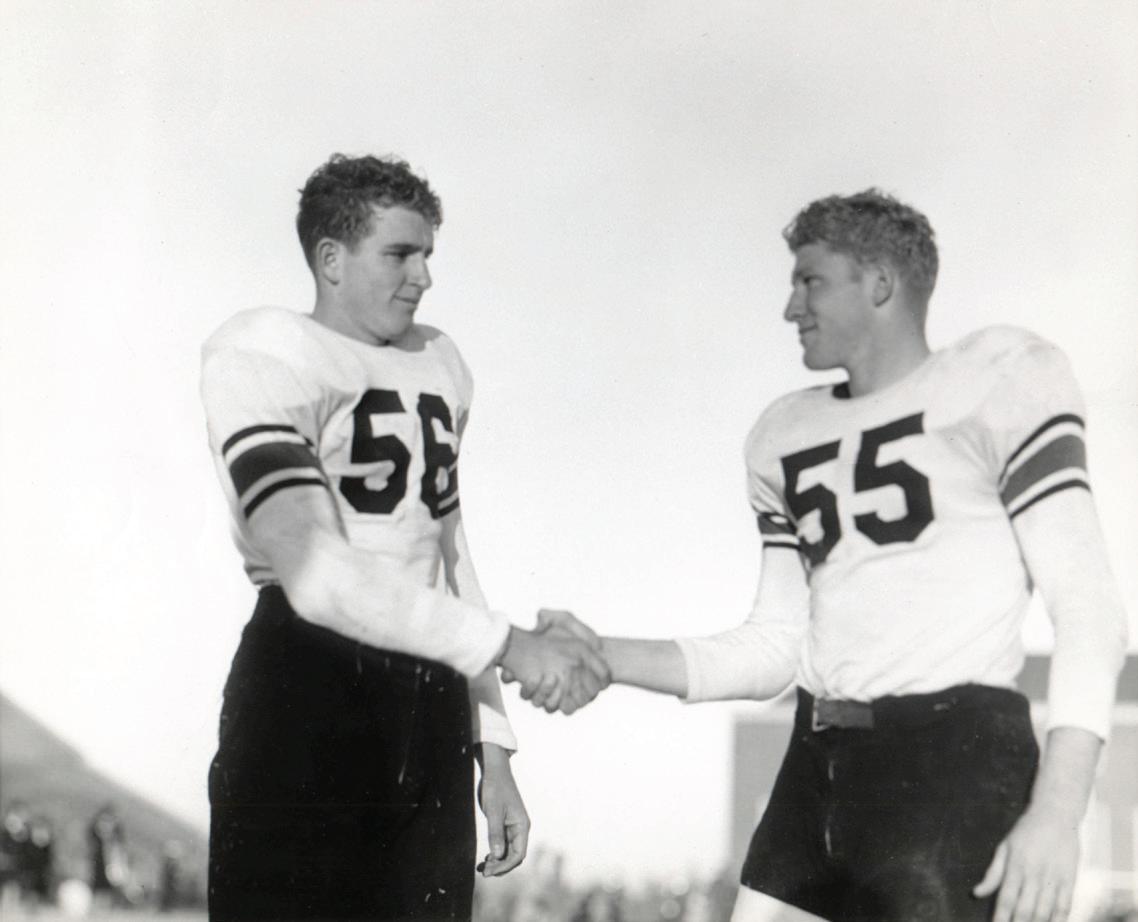



Oklahoma State has never o cially retired a number. But Fenimore’s number 55 is no longer assigned to an active player, joining the No. 21 of Sanders, the No. 34 of Thomas and the No. 43 of Miller. Each of those former players are members of the College Football Hall of Fame.
“I would sit in his living room and ask him about the glory days,” Reece said. “But he always wanted to talk about his teammates, and too many times to count he told me he was not the best athlete on his teams. He designated that title to Cecil Hankins, another member of OSU’s Hall of Honor.”
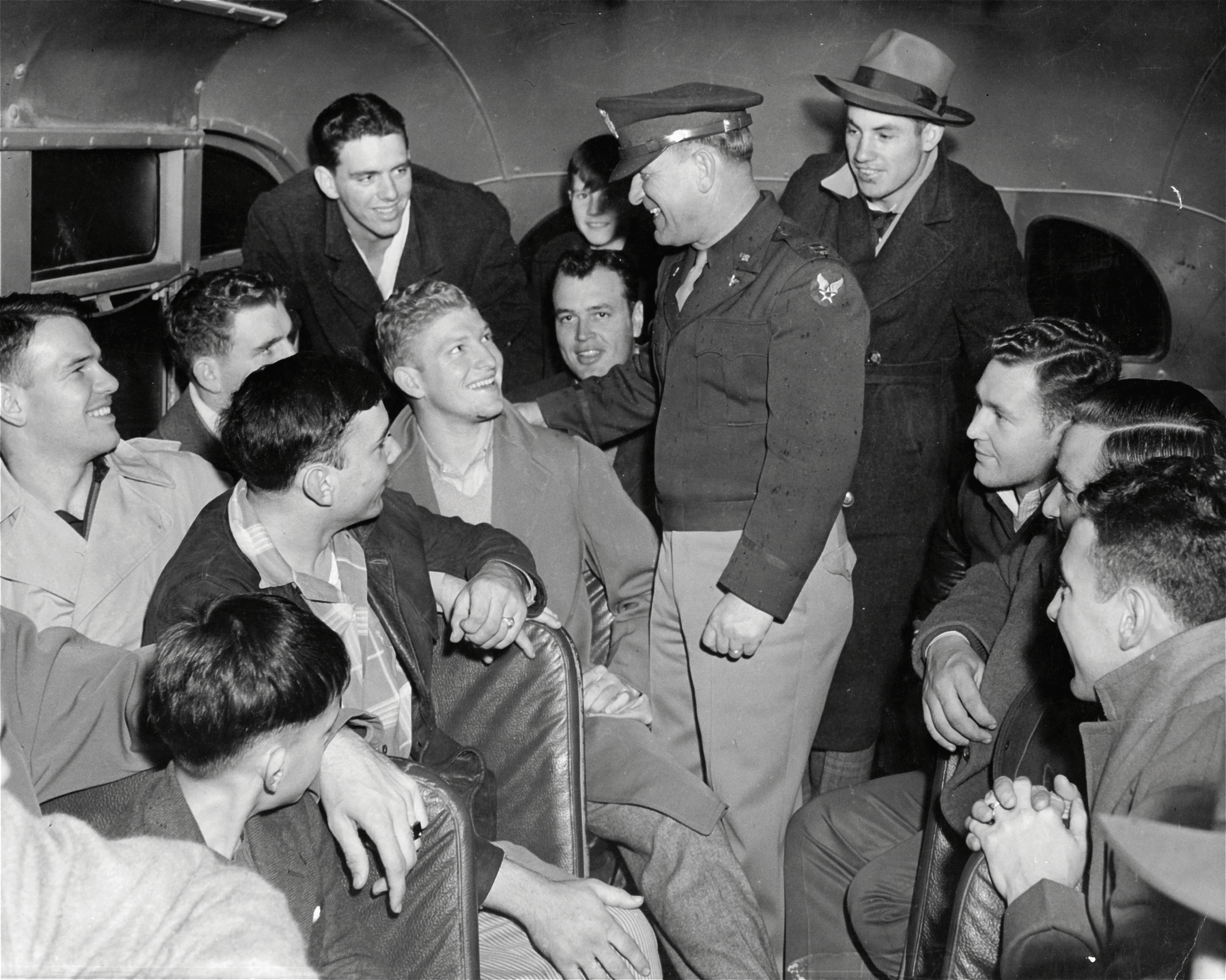
“My first year or so we would just travel in automobiles,” Fenimore once said in an interview of his days in orange and black. “We had enough people here in town that were interested in the football program that they would take four or five athletes.
“I remember going through Yale one time, stopping at a gas station, and there was Jim Thorpe pumping gas. That was the first time I had ever seen him.”
Another legendary teammate of Fenimore’s was the school’s second All-American, Armstrong, who would later become the head coach of the Chicago Bears, a sta er of the Dallas Cowboys and a mainstay in the professional game.
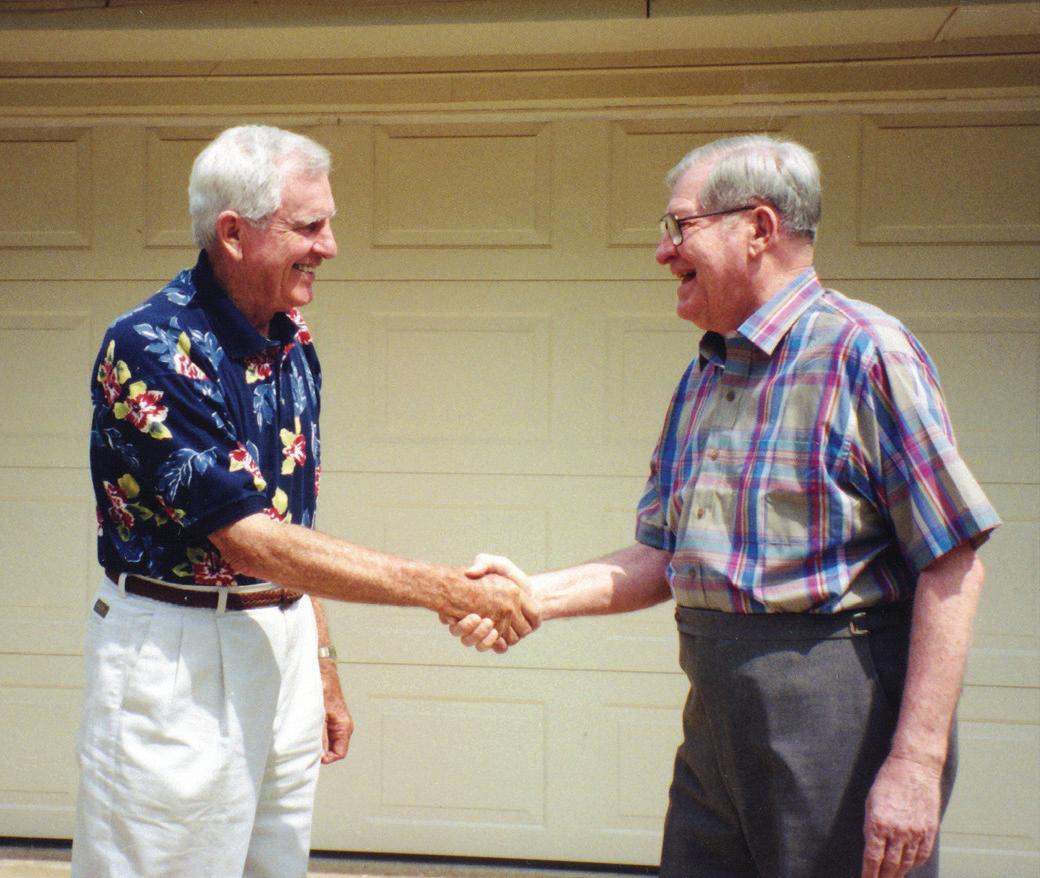
“Their friendship remained strong deep into their eighth decades,” Reece said. “Bob and Neill had a pregame ritual of shaking hands at midfield. We were able to make that happen again at Boone Pickens Stadium once and the crowd erupted.” “Well, he didn’t have a big ego,” Armstrong said of Fenimore back in a 2010 interview. “Everybody was always happy to see Bob get the accolades because he didn’t wear it on his sleeve, and everyone had a lot of respect for him.”
Armstrong passed away in 2016 at the age of 90.
Fenimore spent just one year in the NFL, despite being taken first in the draft by Chicago’s legendary owner, “Papa Bear” George Halas. Professional football wasn’t the cash cow it is today, and short playing stints were not uncommon. He returned to Stillwater, got into the insurance game and became a thriving member of the university community as well as the city of Stillwater until his death in 2010.
At a time in which the fastest runners in the world covered 100 yards in 9.4 seconds, Fenimore’s time was 9.7 seconds. At a time when running backs were 175 pounds, Fenimore was a physical 190-pound runner which was probably also unusual dimensions for a punter.
He was born and grew up in Woodward, Okla. His childhood sweetheart, Veta Jo Cullen, would become his wife, despite her days as a student at the University of Oklahoma.
“Veta Jo went to OU but became a diehard OSU fan,” Reece said. “I believe Bob would hitchhike to see her back in the day.
“One of my favorite memories was the day I got to tell Veta Jo and their two daughters that Bob, Neill and their teammates from 1945 were American Football Coaches Association national champions. I got to break the good news to four of their teammates, but I only wish I could’ve told Bob and Neill.”
It’s safe to say that even with diminishing attention spans, with technology creating diversions by the second, and with breakthroughs in training techniques making unforgettable achievements seem almost commonplace, the accomplishments of Bob Fenimore and his teammates from the 1944 and 1945 Aggie teams will not be forgotten by their alma mater.
The Ring of Honor will ensure that the memories endure.

6,116,025
Baab Legacy, LLC
KNABCO, Inc.
Steve & Diane Tuttle
Flintco, Inc
Ed & Kathy Raschen
120 Larry & Kayleen Ferguson
121 Jerry Marshall
122 Gri & Mindi Jones
123 Harvey D. Yost II
124 Chris & Julie Bridges
125 Bruce & Sheryl Benbrook
126 Philip B. Smith
127 Austin & Betsy Kenyon
128 Randy & Pati Thurman
129 JS Charter Investments, LLC
130 Bob & Mary Haiges
131 Thomas Naugle
132 Jay & Fayenelle Helm
133 Douglas & Nickie Burns
134 Blueknight Energy Partners, LP
135 Bill & Karen Anderson
136 AEI Corporation 137 Ronald McAfee
138 Wiley McCollum
139 Sandra Lee
140 Matt Holliday
141 Bryan Close
142 Brad & Leah Gungoll
143 Vionette & John Dunn
144 Terry & Martha Barker
145 Robert & Sharon Keating
146 Gary & Mary Ellen Bridwell
147 Harrison Investments
148 Drummond Investments
149 Cory & Lynn Bowker
150 Tommy Weder
The Priority Point System provides a fair, consistent and transparent method of providing benefits to donors in exchange for their financial investments in OSU athletics.
Donors gain points three ways:
All current and lifetime contributions (cash or stock) are worth three points per $100 donation. Planned (deferred) gifts in the new Leave a Legacy Endowment Campaign will receive one point per $100.
Donors will earn one point each year for purchasing season tickets (one point per sport annually), as well as one point for each year of POSSE donations.
Connection with the University Donors (or their spouses) who are OSU Alumni receive a one-time 10 point bonus, as do OSU faculty/sta and letterwinners.
HOW DO MY POINTS RANK? as of JULY 1, 2022
Points never diminish and will carry over to subsequent years. Donors retain all previously earned Priority Points in their giving history. For questions about the POSSE Priority Point System, email posse@ okstate.edu or call us at 405-744-7301. Points
BY KEVIN KLINTWORTH
PHOTOS BY BRUCE WATERFIELD, CAULEN SPENCER AND PHIL SHOCKLEY
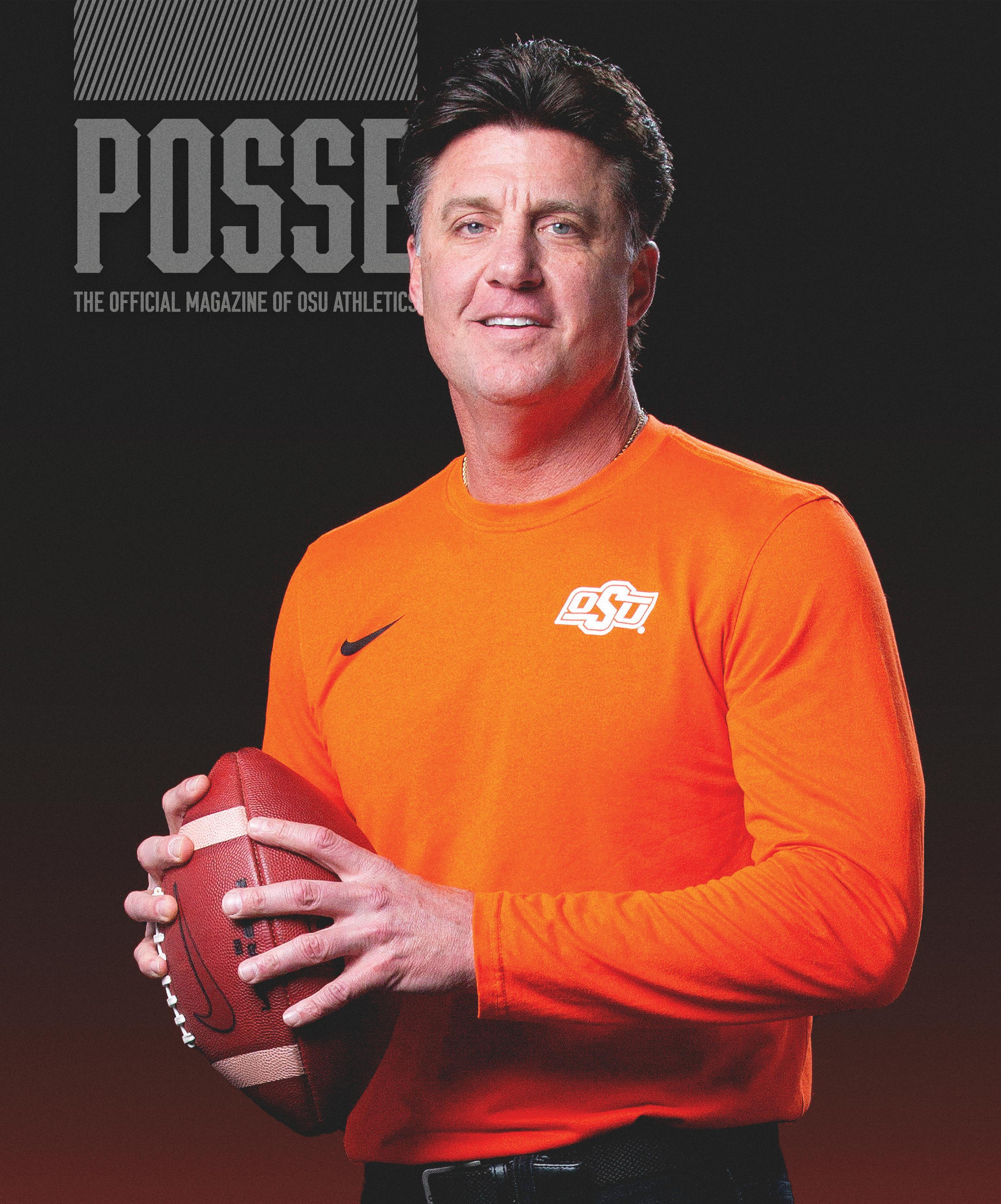
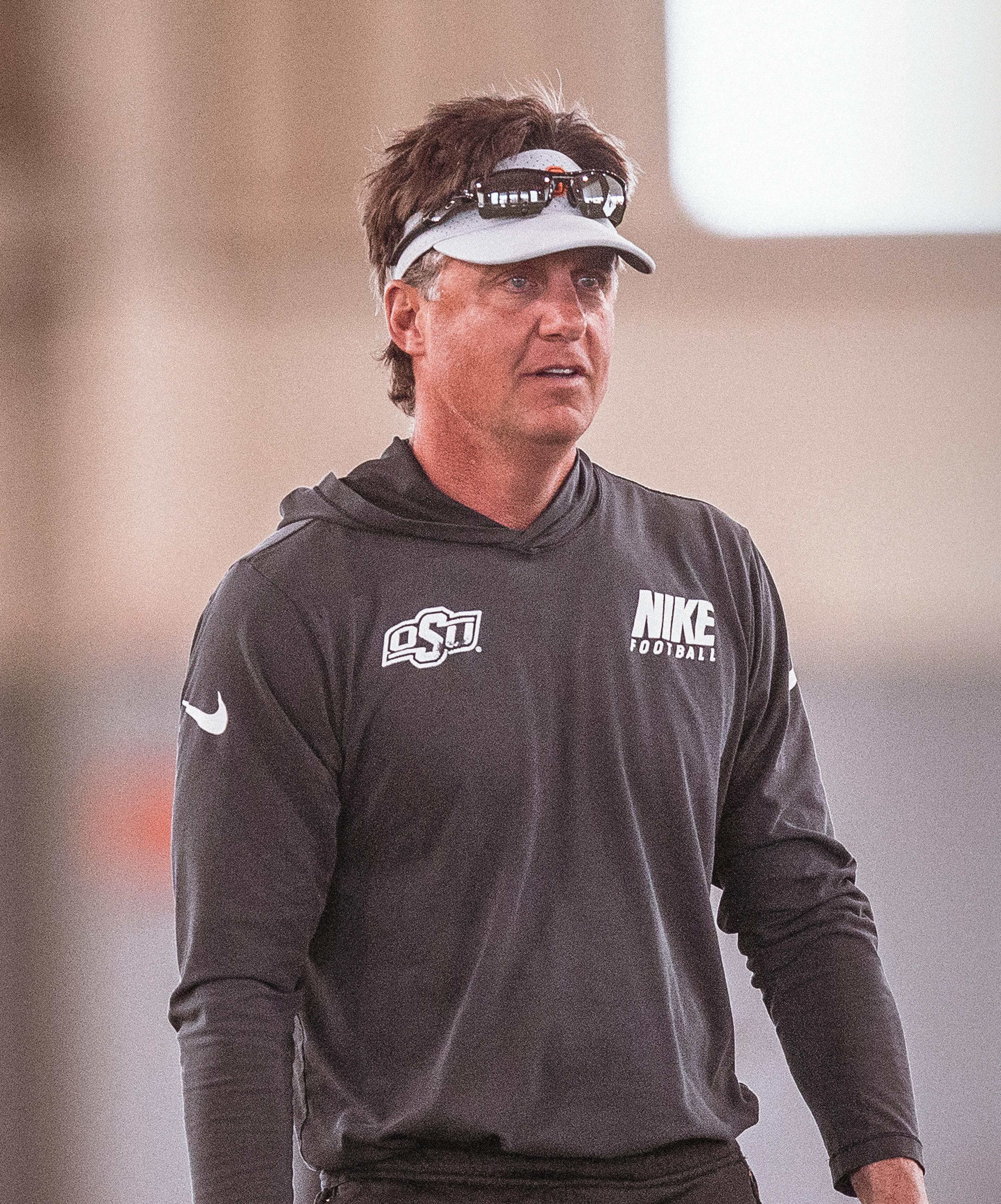
When Mike Gundy was named head football coach at Oklahoma State, the inevitable circle was complete. It was the former Oklahoma prep star turned star college quarterback taking over at his alma mater. It was preordained. And it happened fast, which stands to reason because Gundy always seemed to be in a hurry.
He became OSU’s starting quarterback as a true freshman. He became a full-time member of the coaching sta at 22. And he was one of America’s youngest head coaches when he took over the program at the age of 37 on Jan. 3, 2005.
Seventeen years later, the results clearly show that hiring Gundy was more than a sentimental move. It was astute. It launched the most prolonged period of football success in the history of the university. Gundy is now recognized nationally not just as a program builder, but maybe even more importantly, a program sustainer.
His next victory will mark another milestone. It will be his 150th at OSU. POSSE Magazine recently visited with the Cowboy head coach, who is on the brink of his 18th season in charge of the OSU program.
I didn’t know what I was doing as a head coach, compared to now.
—MIKE GUNDY ON HIS FIRST GAME AS OSU HEAD COACH
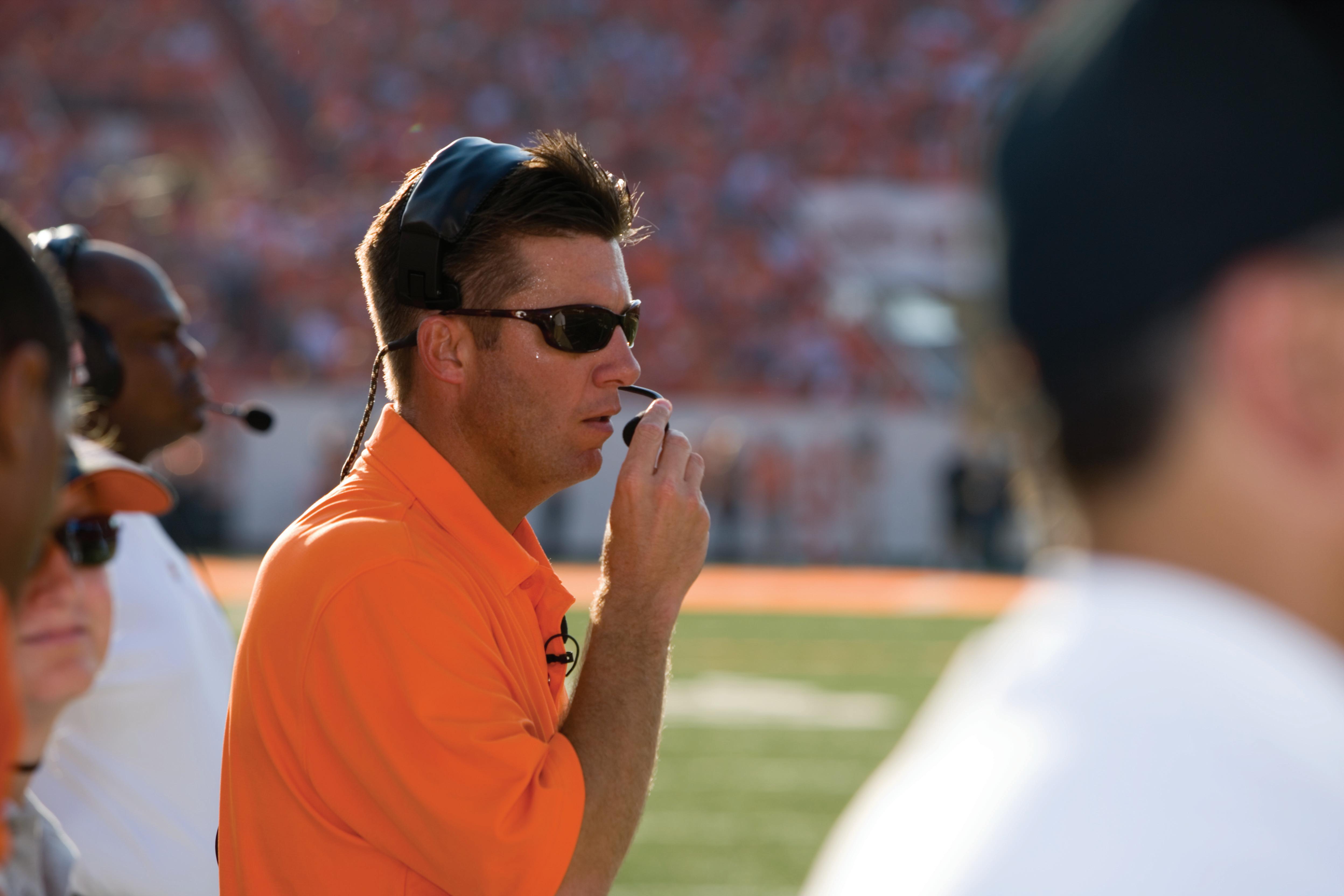
POSSE Magazine: Talk about the process in which you became Oklahoma State’s head coach.
Mike Gundy: Well, there wasn’t really a process. After we finished with the Alamo Bowl, the next night I was sitting in the house and Les and Kathy (former Cowboy head coach Les Miles and his wife) knocked on the door and said they were going to LSU, and Les said I would be the next head coach. We kind of thought that, but you never know. The next day Birdwell (former OSU AD Harry Birdwell) got in touch with me and wanted me to go to the president’s house and meet with some people. I visited with them. They didn’t tell me I had the job. They just talked to me a little bit. They talked to me kind of like it was my job, but they didn’t tell me I had the job. But I think behind the scenes Mike Holder and Boone Pickens pulled some strings and got it done. I don’t know that to be true. Somebody did it quickly.
POSSE Magazine: What do you remember about negotiations?
Mike Gundy: There was not even a contract discussed. There wasn’t a salary discussed. There wasn’t any of that. It’s funny. I didn’t even know what an agent was. I didn’t even know what my contract was or what my years were. I just know they paid me what Les was paid. I think it was $700,000, and they said you are the coach and we are going to have a press conference, and it was pretty quick. We had a press conference, and later on I signed a contract. There was no agreement on any years or money or salary or anything that I remember. That was it. I laugh about that sometimes. I never even asked about a contract. And I didn’t even know what they were paying me. Much di erent than it is today.
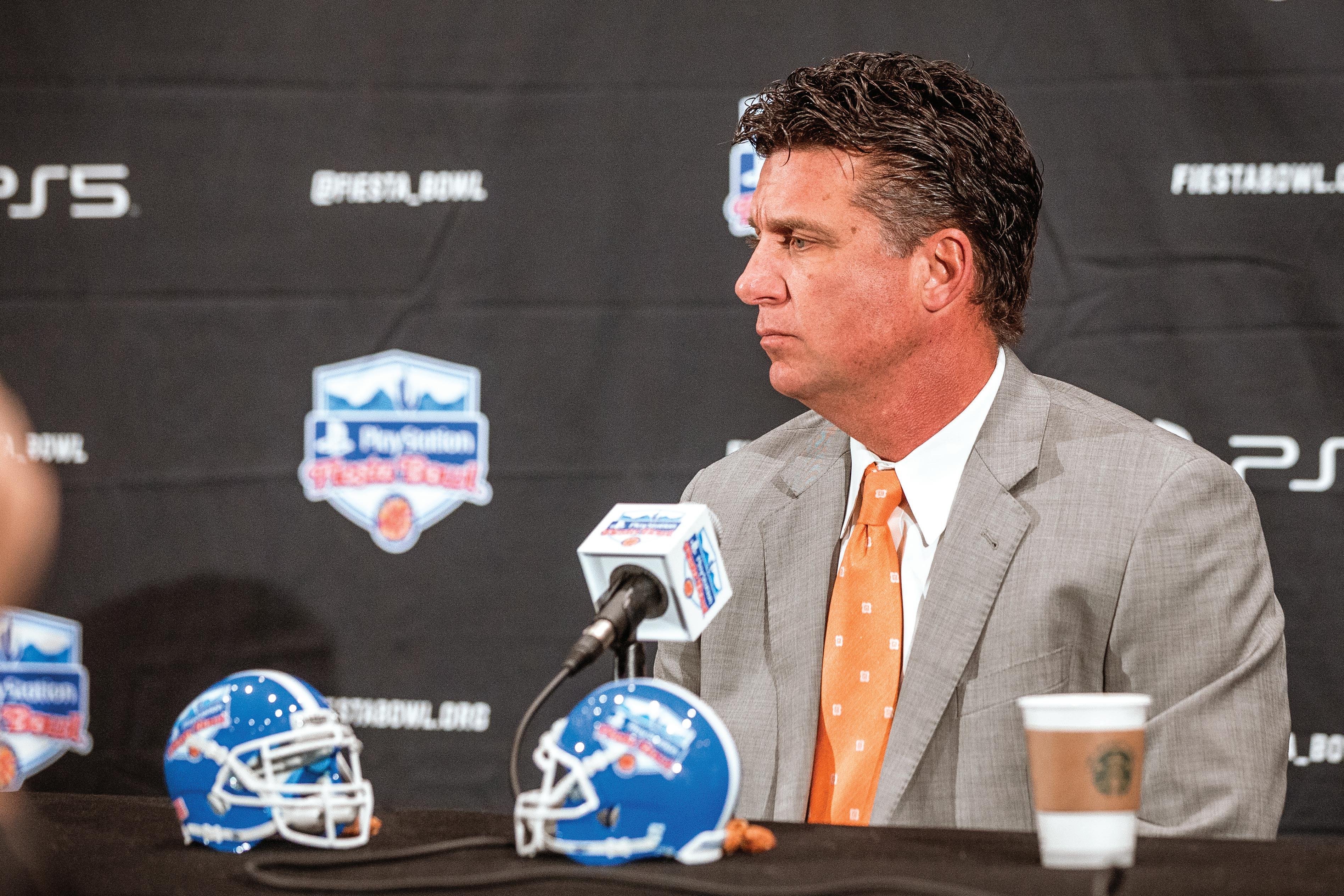
POSSE Magazine: You are announced as the new head coach. Then what happened?
Mike Gundy: After the news conference I went down to Les’s o ce, which was now my o ce. I sat down and I had no idea what to do. There was nobody there. I was still in my coat and tie and I just went in and sat down. Les had cleaned his things out, but there was still stu everywhere. I called Joe DeForest because he was the one person that said he might not go. I hadn’t talked to anyone else, but I knew just about everyone else was going to go (to LSU). It was too easy of a job to not go. So I called Joe and talked to him, and he wanted to talk to his wife. So I sat there with a legal pad and starting writing down things to do. And I didn’t have a clue.
POSSE Magazine: How did the sta come together?
Mike Gundy: The next day I met with Joe, and he said he would stay. So I made Joe the assistant head coach. Then he and I sat in a room and started teaming up on what to do. That
was a big part of my early process, having someone in there. I had nobody. He and I got together and the first thing we had to do was start re-recruiting the kids that were already in our class—hold on to as many as we could. And then I started contacting people about sta . And I was fortunate because Larry Fedora had been fired at Florida and I knew Larry. I knew he was a good coach. I knew he was reliable and I could trust him as the o ensive coordinator. Then he took care of that side of it. He brought (o ensive line coach Joe) Wickline, he brought (receivers coach) Gunter Brewer so he handled that side. Then I had to go find a defensive coordinator and ended up with Vance Bedford. That took a little longer. But Larry took care of one side, and Joe handled some of the interviewing for defense, and Joe did the special teams so that was o my plate. Then it was recruiting, bringing guys in, going out recruiting, holding the class together, recruiting weekends. It was a circus and then just holding our breath to get through signing day.
POSSE Magazine: What do you remember about the win in your first game vs. Montana State in 2005?
Mike Gundy: We scored and went for two and won 12-8 or something (15-10 actually). Afterwards I thought … this is not good. We just weren’t very good. We had good kids. We put new systems in, but we just couldn’t score. We couldn’t score. We were struggling to find some identity. We turned the ball over. Most games we beat ourselves. We didn’t even give ourselves a chance. I didn’t know what I was doing as a head coach, compared to now. Our sta will tell you, I tell them all the time, ‘Don’t beat yourself.’ In college athletics, everyone beats themselves. I don’t care what sport it is. It’s almost the Eddie Sutton theory. ‘I’m not going to turn it over, and I’m going to play good defense. You might beat me, but I am not going to beat myself.’ Believe it or not those are things we work on now. But back then I didn’t know. If I had played more conservatively, knowing that we were very average, we probably would have won two or three more games. But I didn’t know what I was doing.
POSSE Magazine: I know you look at 2006 as a very critical year.
Mike Gundy: What we needed to do was to get to a bowl to get the extra 14 practices. That’s an extra spring. At that point, as a head coach and sta , you are just trying to survive and keep from getting fired. That’s a fact. I’ve often said that the issue we all have as first-time head coaches is that if you don’t show promise, then in year three or four you are either going to win or you are going to get fired. That’s just the way it is. We went to the Independence Bowl and beat Alabama, and Alabama was going through the coaching change and hired Nick Saban during the bowl. He didn’t coach the game, but they were still better than us. I remember going on the field during pregame thinking, giants.’ They didn’t play very well but they were better than we were. We won at the end of the game. Came back and had a two-minute drive, kicked it and won it. It was a huge seventh win for us. It was every bit as big for us back then as winning a 12th game in 2011 or 2021.
POSSE Magazine
important road win at Kansas that provided a path to the postseason.
Mike Gundy there, and he was a good coach, and they were getting better and better. And then ( like 250 (219) receiving yards in the second half, and we started running all up tempo and playing fast like we did in the Notre Dame game, and they couldn’t catch us. That was huge. You lose that game and now you have lost to Kansas and Kansas State in the same year and you are 5-7 … not good.
It’s so close. So many coaches get on the wrong side of that and you never hear from them again.
POSSE Magazine: The Kansas State game was the week prior to the KU game, and the result was a very di cult road loss.
Mike Gundy: We played awful at Kansas State. Coach Holder came out publicly (the next week) and said this guy is our head coach. Quit talking about firing him. Still to this day I say that is what kept my head above water because social media, the public, I didn’t listen to a lot of it, but you couldn’t help but hear some of it. It was that you hired the ex-quarterback, the local guy and he’s not a good coach. But Coach made a stand and came out and said he is our head coach. You all can forget it. We are not firing him, and that gave me another year or two.
POSSE Magazine: Which allowed the momentum to build …
Mike Gundy: After the Independence Bowl, it was let’s see if we can get into a bigger bowl: the Insight. It was kind of an upgrade. We were in Arizona, and we beat Indiana bad and it ended up being good for us. We were better than them, but we were playing pretty well by then. When you look back on that team, there were about six pro players on our team. So we were just learning how good we were. And I think that year we lost three times right at the end of the game. And after that we upgraded to the Holiday Bowl. We lost to Oregon, which was
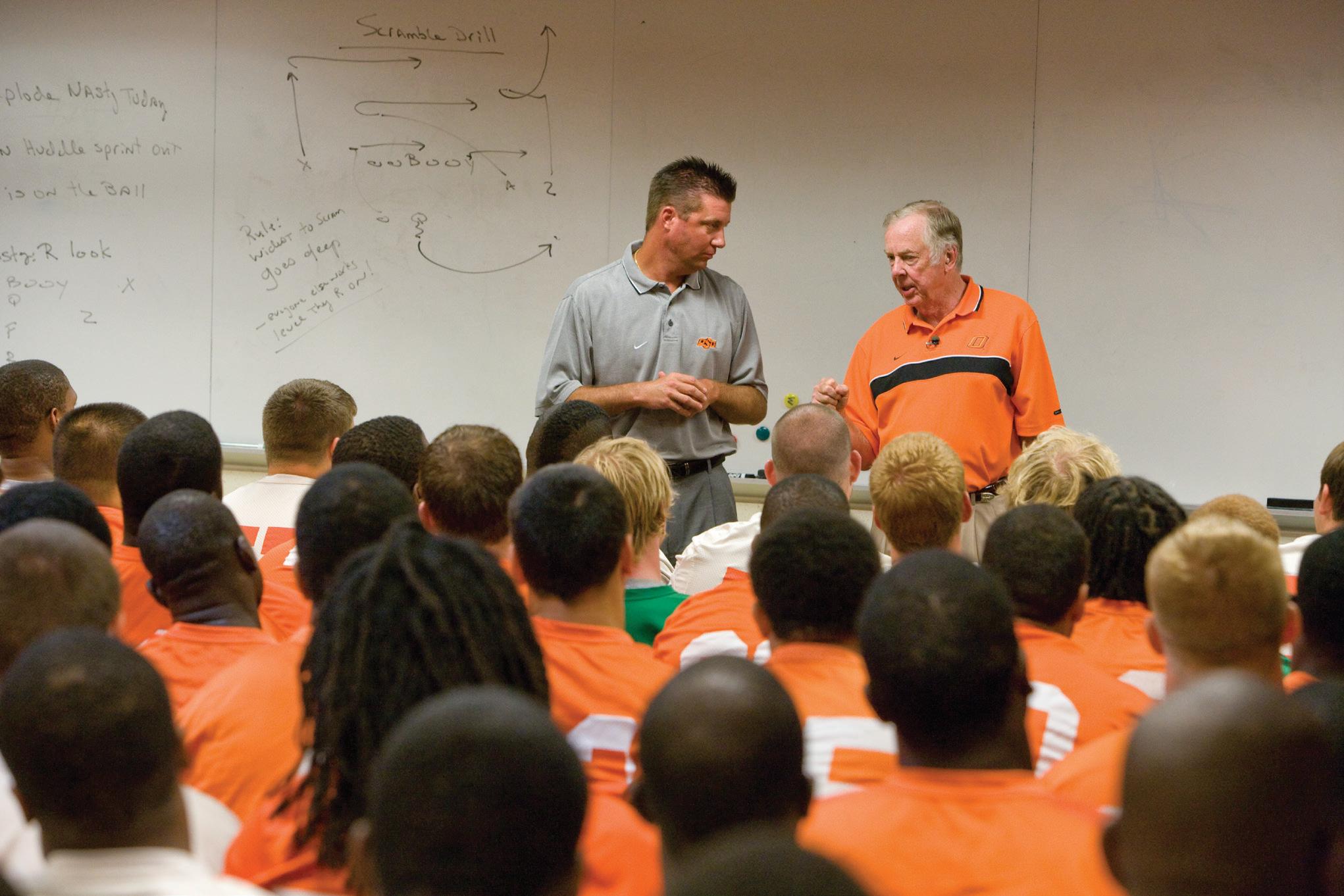
“You change and adjust and don’t take things personally, or you just get out of the business.”
—MIKE GUNDY
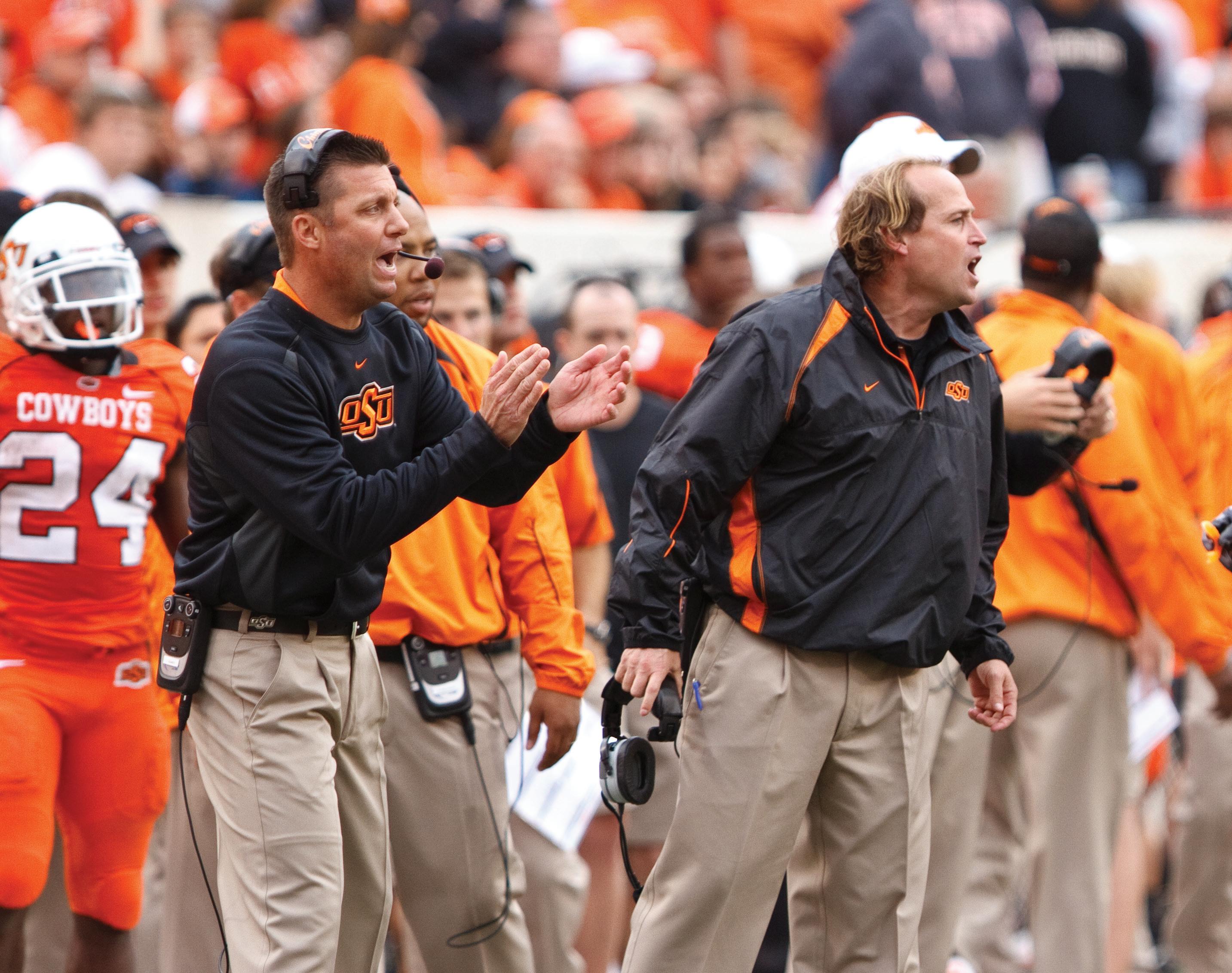
POSSE Magazine: The last 20 years have been the most consistently successful in the history of OSU Football. How did it happen?
Mike Gundy: The old timers that know the history of football here … you can call it like you want it, but we had never won here without getting on probation. The late 1970s they had a decent run here and they got slammed with probation. My years here we had great runs, we got slammed with probation. And the other years in between there, we didn’t win. So just the last 12 to 14 years really has been consistent winning without probation, and the reason is because we haven’t changed head coaches, there hasn’t been sta turnover, we haven’t had turnover with our strength coach Rob Glass
what it took. I started to learn what it took, and it was consistency with coaches, no changes. Oklahoma State was always going through changes. Jimmy (Johnson) did well here, and he argued with them over money and he just left.
Coach (Pat Jones) came in and we got hammered with probation. So really the sta consistency is what was the di erence in my opinion. I had the same AD and thesame president. I get a lot of calls now from young coaches, and they ask questions about things. ‘How do you do it, how do you keep it going?’ Well, if you don’t have an AD and a president that are somewhat on your side, or will get out of your way, you are in trouble. Like in the NFL people tell me don’t ever take an NFL job unless the general manager understands coaching—because most owners don’t. They are billionaires. They don’t get it. Holder understood that part of it.
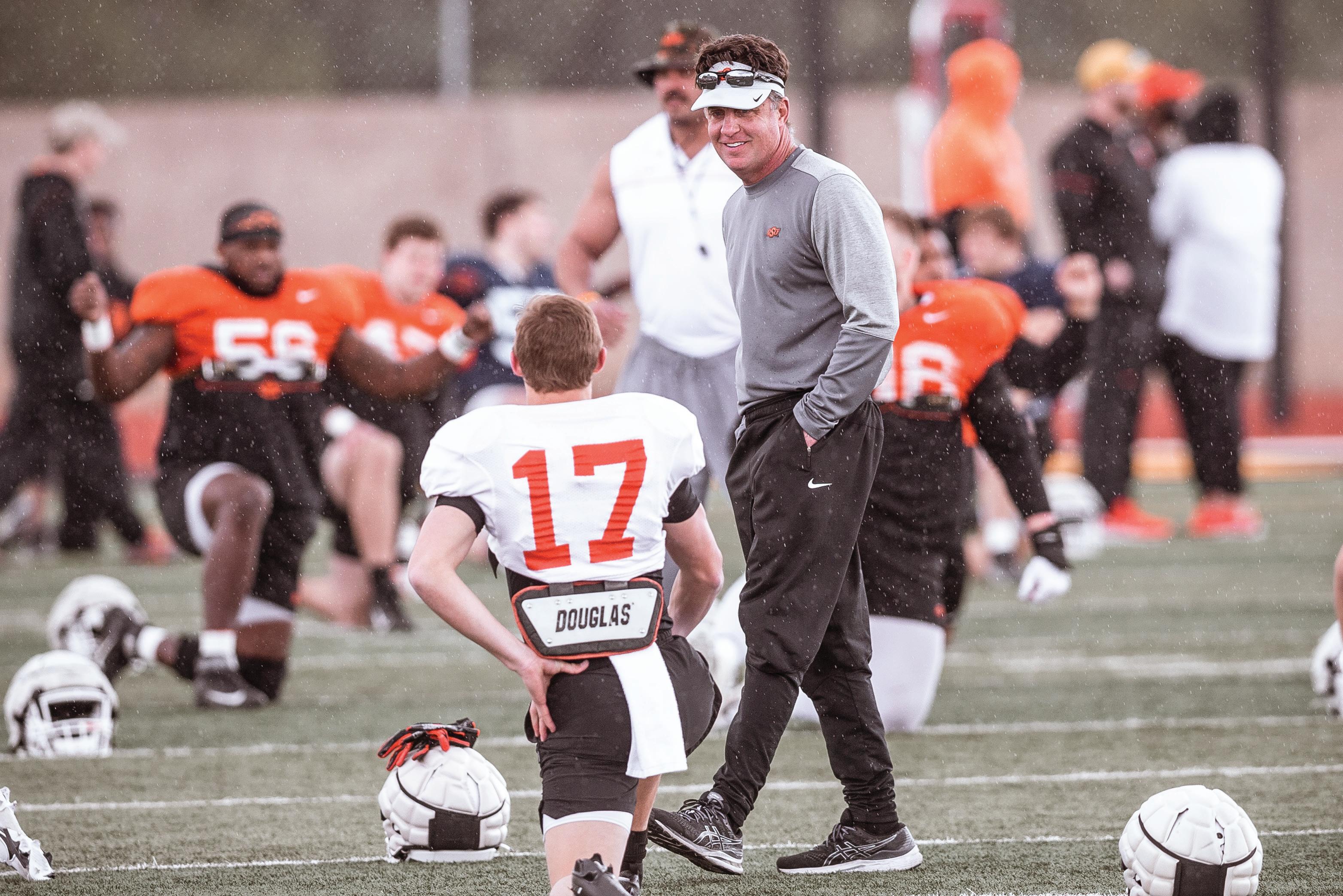
POSSE Magazine: What would 2022 Mike Gundy tell 2005 Mike Gundy at the beginning of his head coaching career?
Mike Gundy: Patience. I worked 10 years as a head coach and I don’t remember any of it because of the hours I do you any good. You just have to understand this generation and what’s going on and adjust with it and be patient. That is the thing I would tell myself. But I was too young to know that. If you lose a coach, go get another coach. If you lose a player, go get another player.
It’s really more important to me now that these kids look back and say they got a lot from this program and this culture and that they would do it again.
—MIKE GUNDY
POSSE Magazine: Where are you, personally and professionally, after 17 years as a head football coach?
Mike Gundy: I’m in my 18th year. I am in my mid-50s. People ask me all the time how much longer are you going to do it? The game is changing, and what do you want to do? Until people bring it up, I guess I don’t realize. I’ve been involved with more games at Oklahoma State than anybody, right? Probably double. I’m glad I didn’t take another job now. There were times I didn’t, and I regretted it. Now I’m glad I didn’t. There won’t be many coaches in the future that will associate themselves with 300 games at one school. John Smith will leave a legacy in wrestling. Eddie Sutton has left a legacy in basketball. Gary Ward left one in baseball. Mike Holder left one in golf. I am going to have a chance to do that in football more so for my kids and their kids, than me. I just like what I do. But I do think about the fact that the kids will be able to show their kids this is what my dad did here. What did he do? He took football to a national level. We took something from the ground up and built it into a team that teams don’t really want to play. I think it’s fair to say that people would see us as a top 20 program now, consistently over the last 10 years.
POSSE Magazine: After Montana State, could you have imagined being the head coach in 2022?
: How do you define success at this
: You know what’s funny, I want to win Big 12 championships. It’s funny how it’s worked. What is it, three or four times we have finished second and then we finish first (in the standings) and we get into the (conference championship) game, we lose. Those things are important to me because of the team. That’s our goal. There is so much work that goes into it. I want them to enjoy the fruits of their labors. But as I have progressed over the last six or eight years, I want the young men who play here to come back 10 years , and I say that because of my own kids. My oldest son didn’t play college sports, but I wanted him to be able to say he enjoyed his time in college. You get one chance to go to college and play sports, or just go to college. And I want them to enjoy this time, and so it’s really more important to me now that these kids look back and say they got a lot from this program and this culture and that they would do it again. To me that’s way more important. A lot of coaches just say that, but to me that is way more important than anything else. I’ve done this so long now, that the wins are fun for the players, but for me, I didn’t even know I was at 150. I don’t pay much attention to it anymore. Those things just are not important to me as the overall barometer of the program
Mike Gundy: No. It was so hard. I wasn’t smart enough to know how hard the job was. I don’t even know what I thought. I don’t remember even thinking that I might get fired. I just kept coming in 14 hours a day and we just kept doing things di erently and trying to be innovative. I wasn’t smart enough to know how hard the job was. That’s the truth. That kept me alive. If I had been smart enough to realize how hard it was, I probably would have been second guessing myself the whole time.
After a 10-year hiatus, Oklahoma State Athletics has announced the return of the Hall of Honor. The highest award the athletic department can bestow upon its former student-athletes, coaches and sta , the Hall of Honor will gain five new members this fall.
The newest honorees include long-time women’s softball coach Sandy Fischer, OSU soccer goalie and Olympian A.D. Franch, decorated men’s golfer Lindy Miller, women’s basketball All-American Andrea Riley and All-America wide receiver Rashaun Woods. The inductees topped the list after a process that included an internal screening committee and a voting committee that was comprised of former student-athletes, coaches and long-time OSU observers, none of whom who are employees of OSU Athletics.
The class will be inducted Sept. 16, 2022. OSU’s Hall of Honor has been inactive since the last class was inducted in the 2011. It was launched in 1996 when the first class was immortalized with a who’s who that included Barry Sanders, Bob Kurland, Ed Gallagher and Henry Iba There was annual ceremony from 1996 through 2002. The next classes came in 2006 and 2007, followed by the class in 2011.
As part of the renewed emphasis on the Hall of Honor, inductees will be further immortalized with a permanent display on the concourse level of Gallagher-Iba Arena, outside of the O-Club room on the arena’s west side.
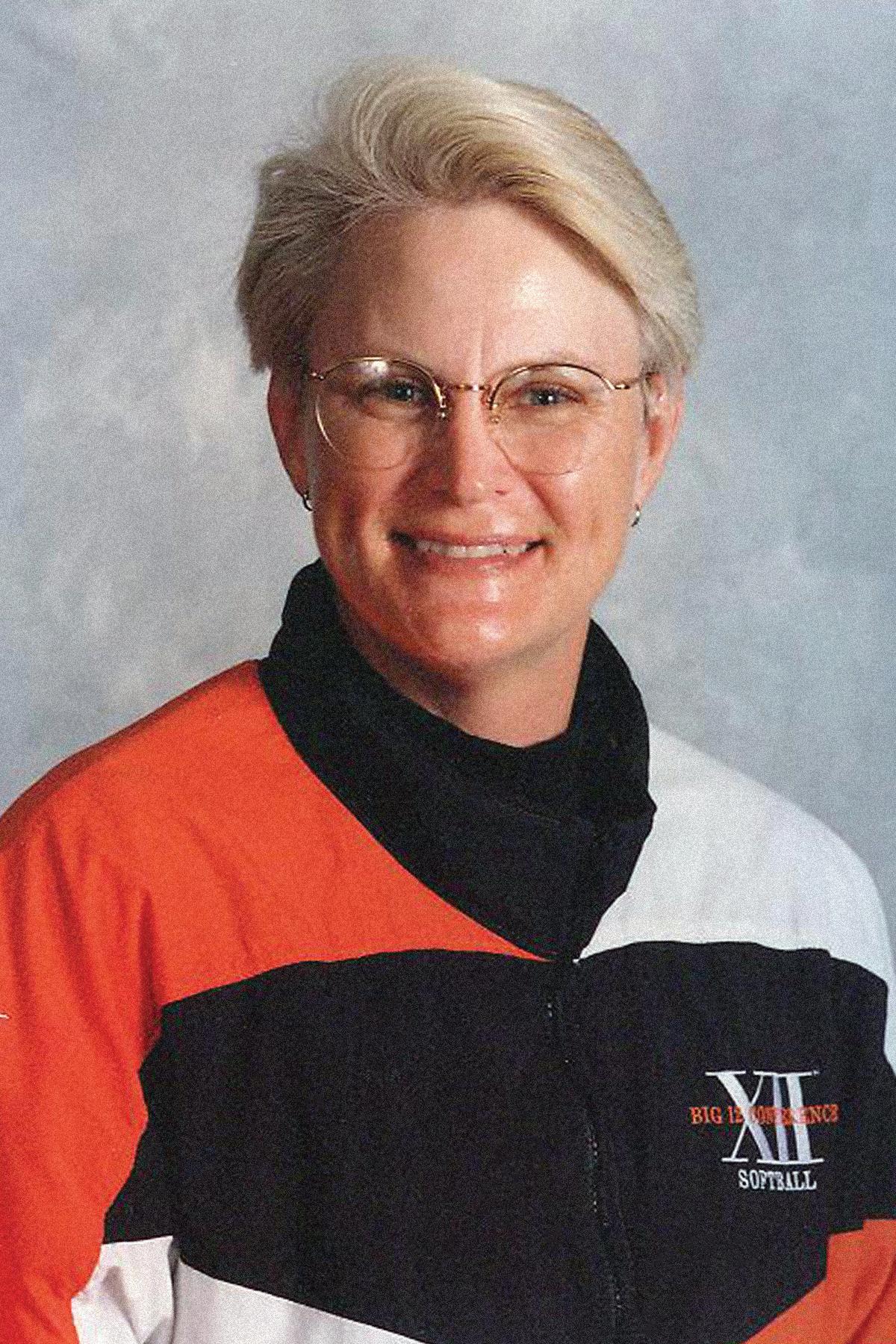
coach, 1979-2001
• 15-time Big Eight team champion coach (nine regular season, six conference tournament)
• Nine Women's College World Series appearances
• 901 wins at OSU
• Coached 28 All-Americans, 64 first-team all-conference players and 59 first-team academic all-conference student-athletes
soccer, 2009-12
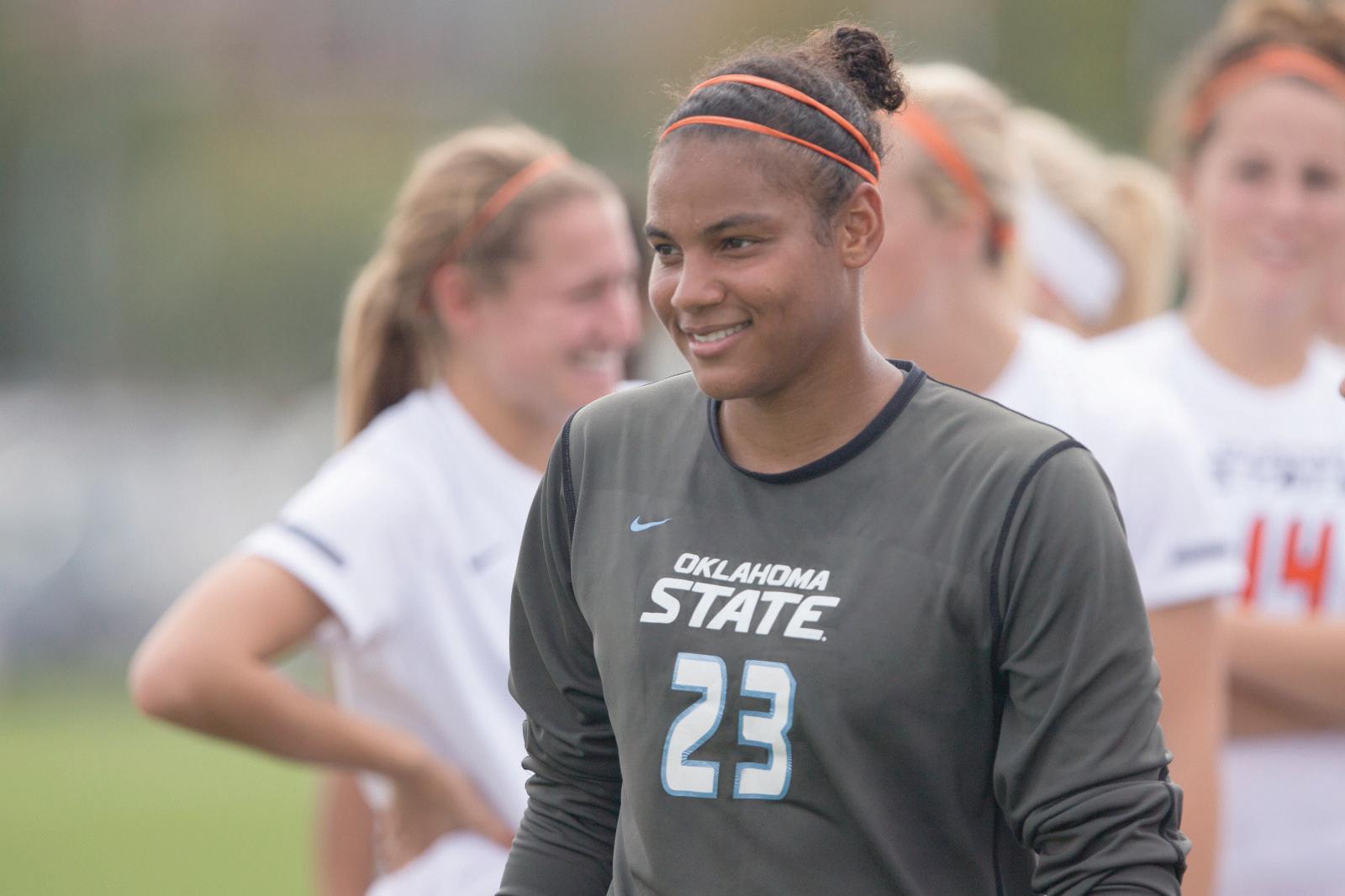
• Three-time first team All-American
• FIFA Women's World Cup Champion
• Olympian
• Two-time NWSL Goalkeeper of the Year
• NWSL champion
• 2013 NWSL Draft first round pick (No. 6 overall)
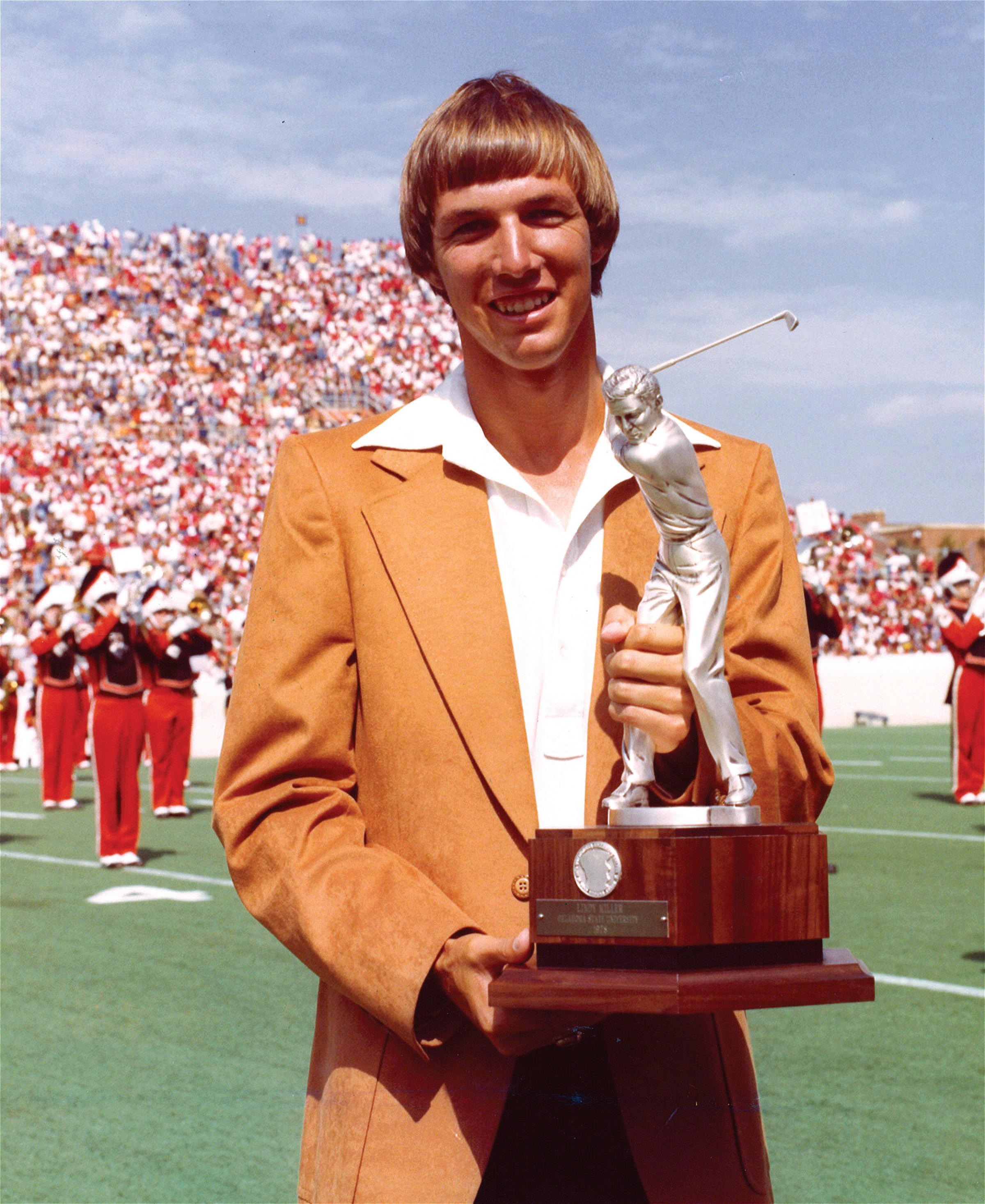
golf, 1975-78
• Four-time All-American
• Three-time first team All-American
• Two-time NCAA team champion
• 1978 Haskins Award
• Low amateur at the 1977 U.S. Open and the 1978 Masters
• 1977 Walker Cup
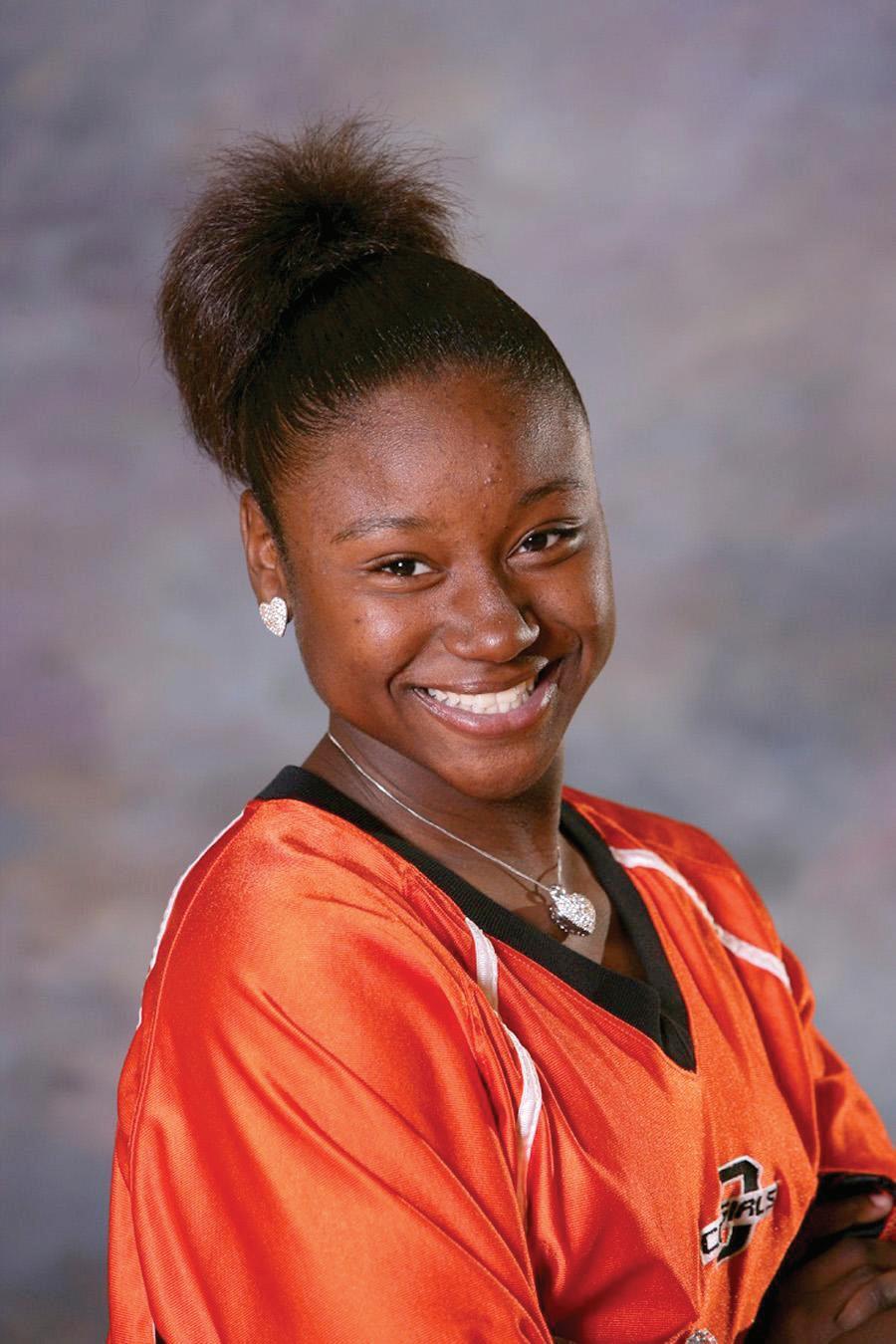
basketball, 2006-10
• Two-time All-American
• 2010 Nancy Lieberman Award winner as the nation's best point guard
• 2010 WNBA Draft first round pick (No. 8 overall)
• Finished her career with three of the top four scoring games in Big 12 history
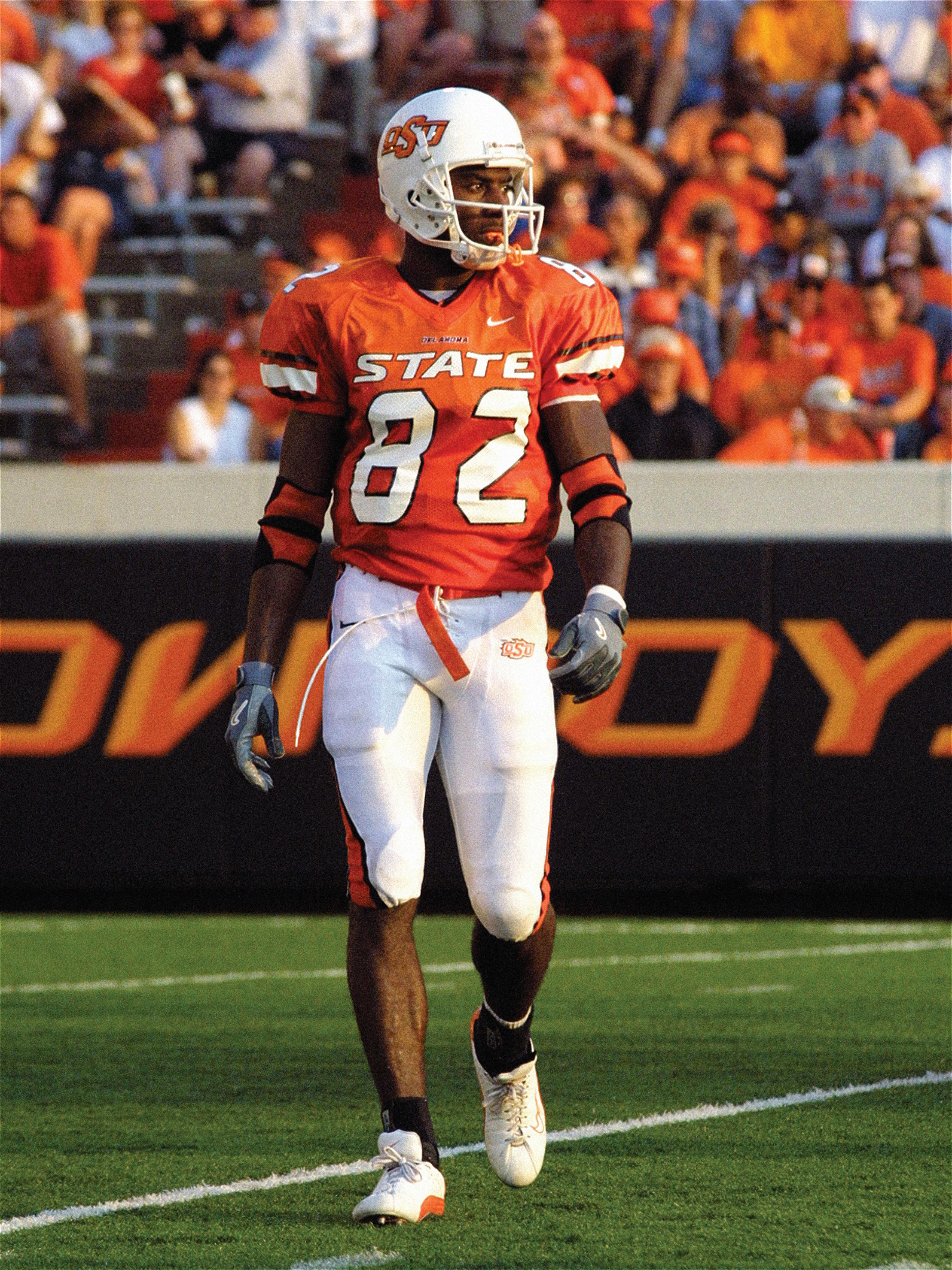
football, 2000-03
• Two-time first team All-American
• NCAA leader in touchdown receptions in 2002
• 2004 NFL Draft first round pick (No. 31 overall)
• First player in Big Eight or Big 12 history to reach the 4,000-yard receiving mark
When OSU announced its scholarship endowment initiative, the athletic program was last in the Big 12. Now, more than halfway through the 10-year program, OSU leads the conference.
OSU awards 229 full scholarships to student-athletes each year at a cost of $4.5 million. Each dollar freed up through endowed scholarships goes back into our programs. Better equipment. Better facilities. Better support. Each dollar has a direct impact on the lives of our student-athletes.
This is the list of all the generous supporters who have helped to provide a bright Orange future.
They are our Honor Roll.
Baseball 10.25
FULL SCHOLARSHIP
Dennis and Karen Wing (2) | Hal Tompkins
Sandy Lee | Jennifer and Steven Grigsby
Mike Bode and Preston Carrier (2)
David and Julie Ronck
HALF SCHOLARSHIP
Sally Graham Skaggs
QUARTER SCHOLARSHIP
Bryant and Carla Co man
David and Grace Helmer | Jill Rooker
Martha Seabolt | Dr. Scott Anthony
John and Beverly Williams
Richard and Lawana Kunze
Equestrian 1.25
FULL SCHOLARSHIP
Baloo and Maribeth Subramaniam
QUARTER SCHOLARSHIP
David and Gina Dabney
Football 33.0
FULL SCHOLARSHIP
Bob and Kay Norris
Bryant and Carla Co man /
The Merkel Foundation
David LeNorman | Dennis and Karen Wing (2)
Dr. Mark and Beth Brewer
Ike and Marybeth Glass
Jack and Carol Corgan
Jim Click | John and Gail Shaw
Ken and Jimi Davidson | Leslie Dunavant
Mike and Kristen Gundy
Mike and Robbie Holder
Ron Stewart | Ross and Billie McKnight
Sandy Lee | Tom and Sandra Wilson
Wray and Julie Valentine
James and Mary Barnes
HALF SCHOLARSHIP
Cindy Hughes | Donald Coplin
Doug Thompson | Ed and Helen Wallace
R. Kirk Whitman | Greg Casillas
Jim and Lynne Williams / John and Patti Brett
Mike and Judy Johnson | Sally Graham Skaggs
State Rangers | Tom Naugle | Nate Watson
QUARTER SCHOLARSHIP
Al and Martha Strecker
Arthur “Andy” Johnson, Jr.
Arthur Couch | Barry and Roxanne Pollard
Bill and Ruth Starr | Brad and Leah Gungoll
Brian K. Pauling
Bridgecreek Investment Management LLC
Bryan Close | David and Cindy Waits
David and Gina Dabney | Dr. Berno Ebbesson
Dr. Ron and Marilynn McAfee
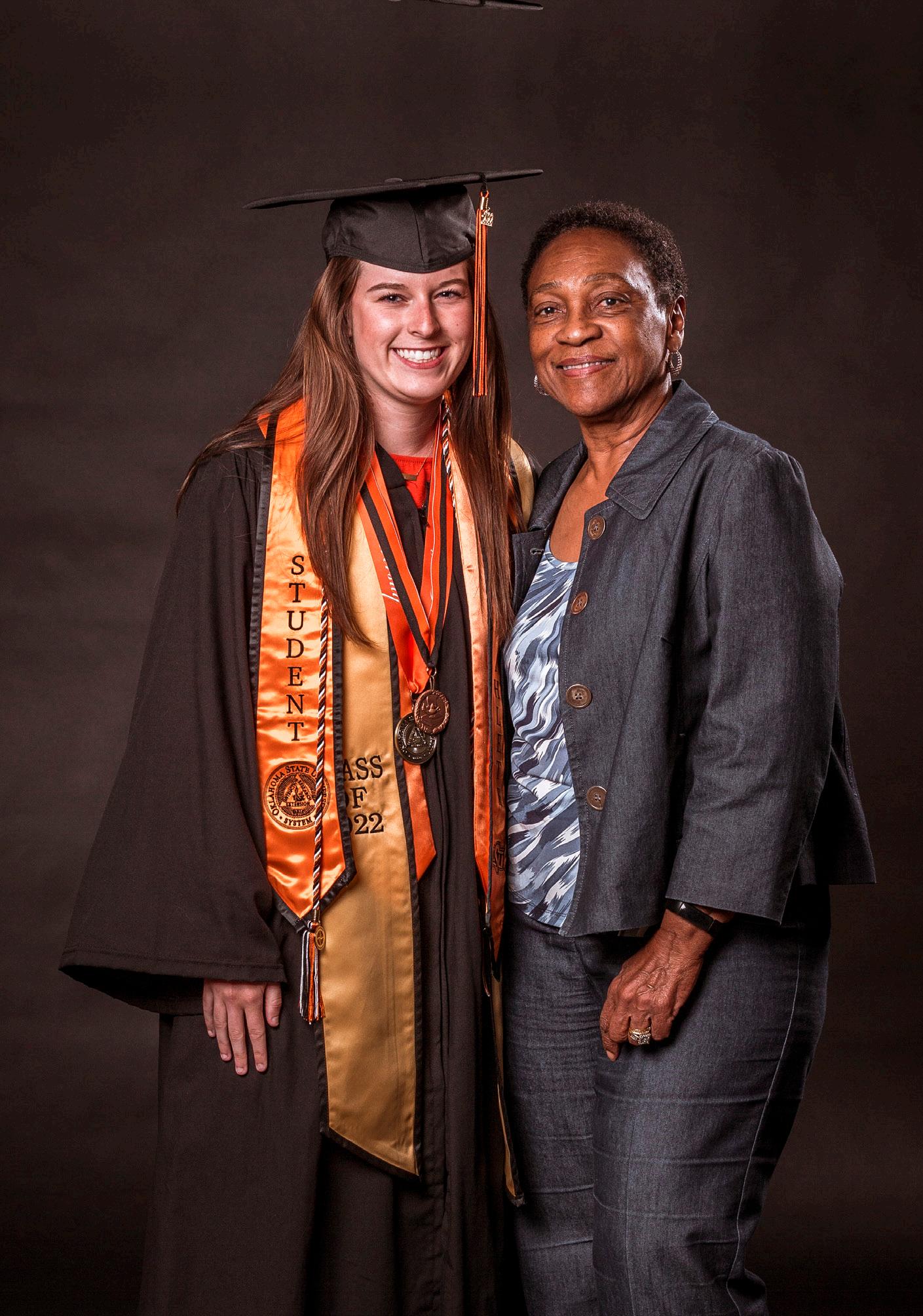
Lora Boggs (Tennis) and Agatha Adams (Assistant Director of Academic Services for Student-Athletes)
Eddy and Deniece Ditzler | Flintco
Fred and Janice Gibson | Fred and Karen Hall
Howard Thill | James and LaVerna Cobb
Jerry and Lynda Baker | John P. Melot
Jerry and Rae Winchester
John S. Clark | Ken and Leitner Greiner
Kent and Margo Dunbar | Paul and Mona Pitts
Randall and Carol White | Shelli Osborn
Roger and Laura Demaree
Steve and Diane Tuttle
Tony and Finetta Banfield
General 1.25
HALF SCHOLARSHIP
Terry and Martha Barker
QUARTER SCHOLARSHIP
David and Judy Powell
Kenneth and Susan Crouch
Sally Graham Skaggs
QUARTER SCHOLARSHIP
Bob and Joan Hert | Neal Seidle
Tom and Cheryl Hamilton
FULL SCHOLARSHIP
Baloo and Maribeth Subramaniam
A.J. and Susan Jacques
Bill and Marsha Barnes
Brett and Amy Jameson
Calvin and Linda Anthony
Chuck and Kim Watson
David and Julie Ronck (1.25)
Dennis and Karen Wing (2)
Douglas and Nickie Burns
Gri and Mindi Jones
James and Mary Barnes | Jim Vallion
Ken and Jimi Davidson
Kent and Margo Dunbar | KimRay Inc.
Sandy Lee | Mitch Jones Memorial
HALF SCHOLARSHIP
David and Julie Ronck
Dr. Mark and Susan Morrow
Jay and Connie Wiese | Sally Graham Skaggs
Stan Clark | Billy Wayne Travis
Holloman Family
QUARTER SCHOLARSHIP
Dr. Scott and Lynne Anthony
Gary and Sue Homsey
Michael and Heather Grismore
Rick and Suzanne Maxwell
Robert and Sharon Keating
Steve and Suzie Crowder
Terry and Donna Tippens
Men's Golf 6.25
FULL SCHOLARSHIP
David and Julie Ronck
Dennis and Karen Wing
Jack and Carol Corgan
Genevieve A. Robinson
Baloo and Maribeth Subramaniam
HALF SCHOLARSHIP
Simmons Bank
QUARTER SCHOLARSHIP
Bob and Elizabeth Nickles
Garland and Penny Cupp
Richard and Joan Welborn
QUARTER SCHOLARSHIP
Tom and Cheryl Hamilton
HALF SCHOLARSHIP
Jim McDowell Men's
Men's Track 0.75
QUARTER SCHOLARSHIP
Dr. Mark and Susan Morrow
Susan Anderson | Ken and Leitner Greiner
HALF SCHOLARSHIP
Mary Jane and Brent Wooten
FULL SCHOLARSHIP
James and Mary Barnes
QUARTER SCHOLARSHIP
Tom and Cheryl Hamilton
Richard Melot
Ann Dyer
FULL SCHOLARSHIP
Brad and Margie Schultz
Ken and Jimi Davidson
Mike Bode and Preston Carrier
HALF SCHOLARSHIP
Baloo and Maribeth Subramaniam
Don and Mary McCall
John and Caroline Linehan
Calvin and Linda Anthony
Mike Bode and Preston Carrier
QUARTER SCHOLARSHIP
Bill and Roberta Armstrong
Bill and Sally Cunningham
Donald Coplin | Jill Rooker
Richard and Linda Rodgers
Jo Hughes and Deborah J. Ernst
Richard Melot
Women’s Golf 3.0
FULL SCHOLARSHIP
Baloo and Maribeth Subramaniam
Genevieve A. Robinson
Louise Solheim
HALF SCHOLARSHIP
David and Julie Ronck | Dena Dills Nowotny
QUARTER SCHOLARSHIP
Amy Weeks | Kent and Margo Dunbar
Women’s Tennis 0.5
QUARTER SCHOLARSHIP
Jamie Maher
Richard Melot Wrestling 11.25
FULL SCHOLARSHIP
A.J. and Susan Jacques
Bruce and Nancy Smith
Chuck and Kim Watson
Lon and Jane Winton
OSU Wrestling – White Jacket Club / Gallagher Endowed Wrestling Scholarship
OSU Wrestling – White Jacket Club / Myron Roderick Endowed Wrestling Scholarship
OSU Wrestling – White Jacket Club / Ray Murphy Endowed Wrestling Scholarship
OSU Wrestling – White Jacket Club / Tommy Chesbro Endowed Wrestling Scholarship
The Cobb Family
HALF SCHOLARSHIP
Mike and Glynda Pollard
Mark and Lisa Snell
Bobby and Michelle Marandi
QUARTER SCHOLARSHIP
Danny and Dana Baze / Cory and Mindy Baze
Kyle and Debbie Hadwiger
John and Beverly Williams | R.K. Winters
To learn more about scholarship opportunities and how you may contribute, please contact:
Larry Reece (405-744-2824)
Matt Grantham (405-744-5938)
Daniel Hefl in (405-744-7301)
Shawn Taylor (405-744-3002)
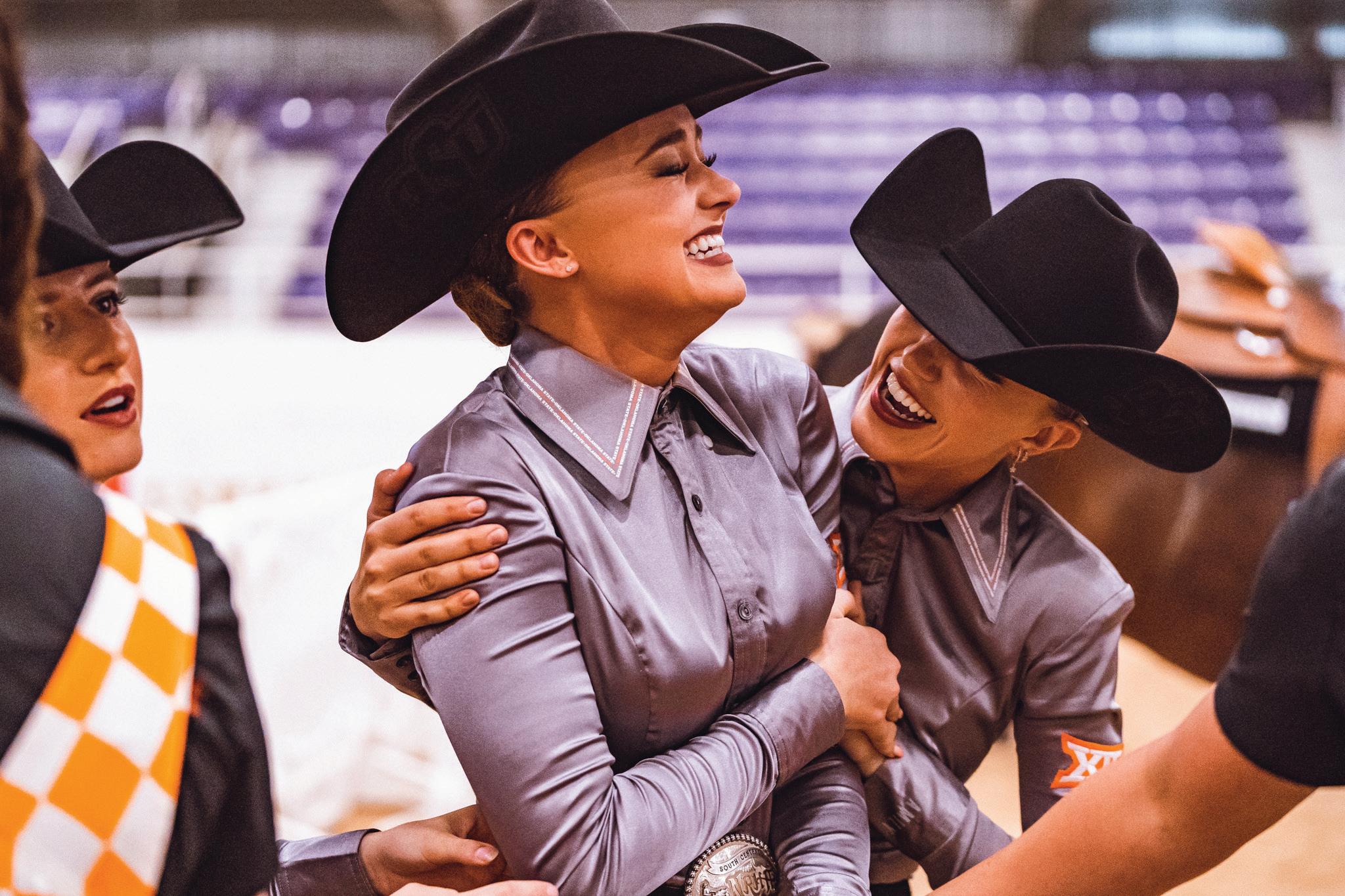
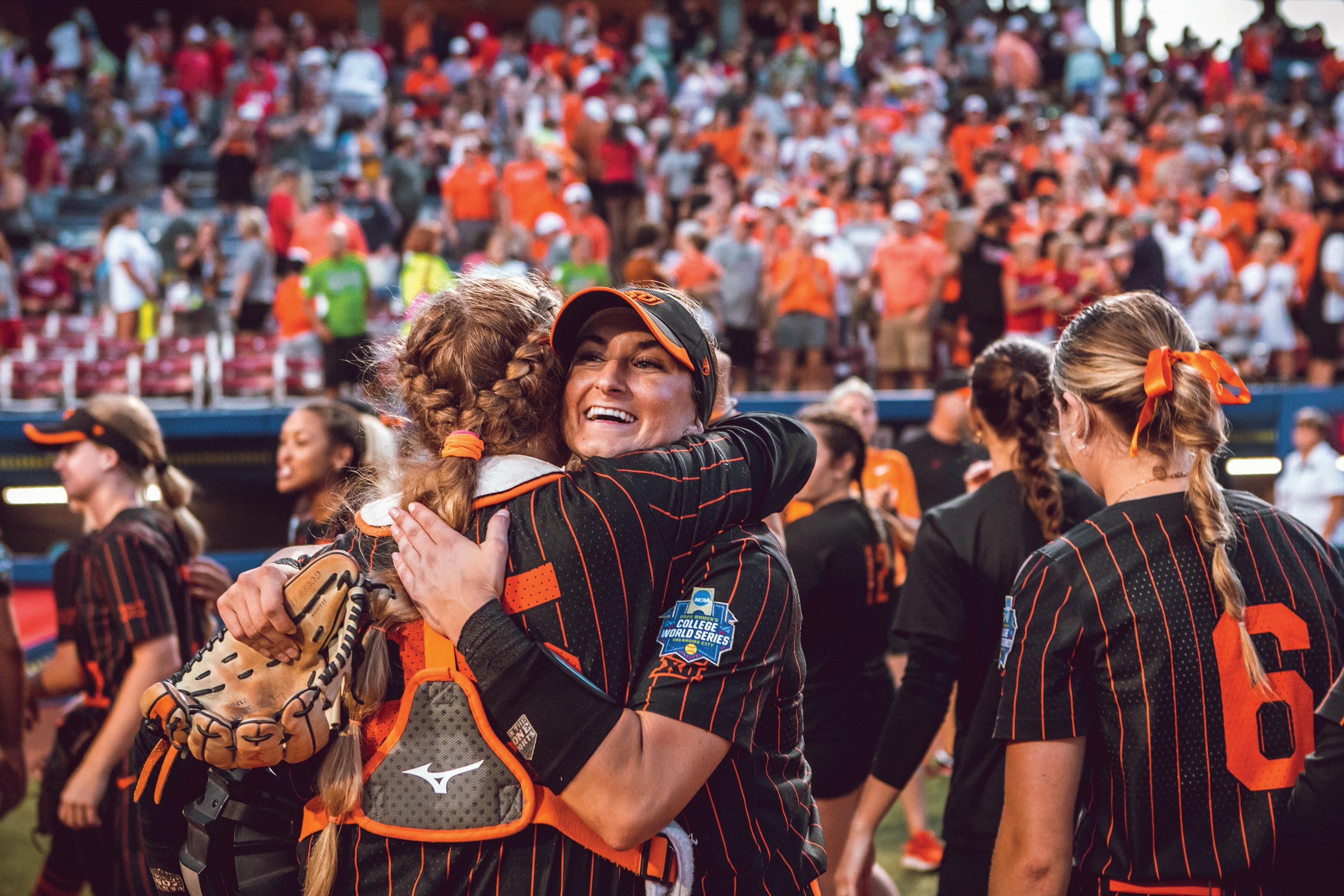
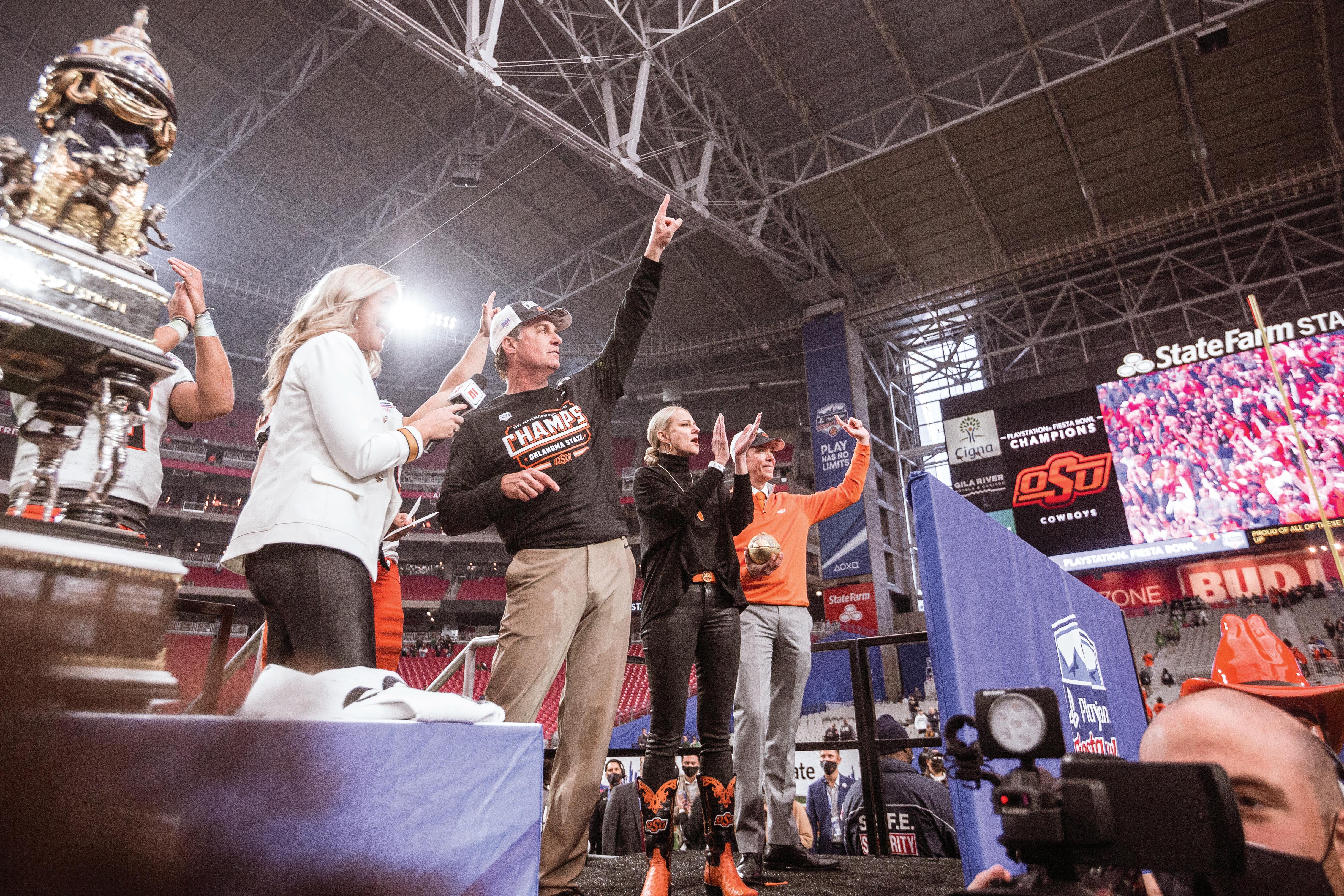
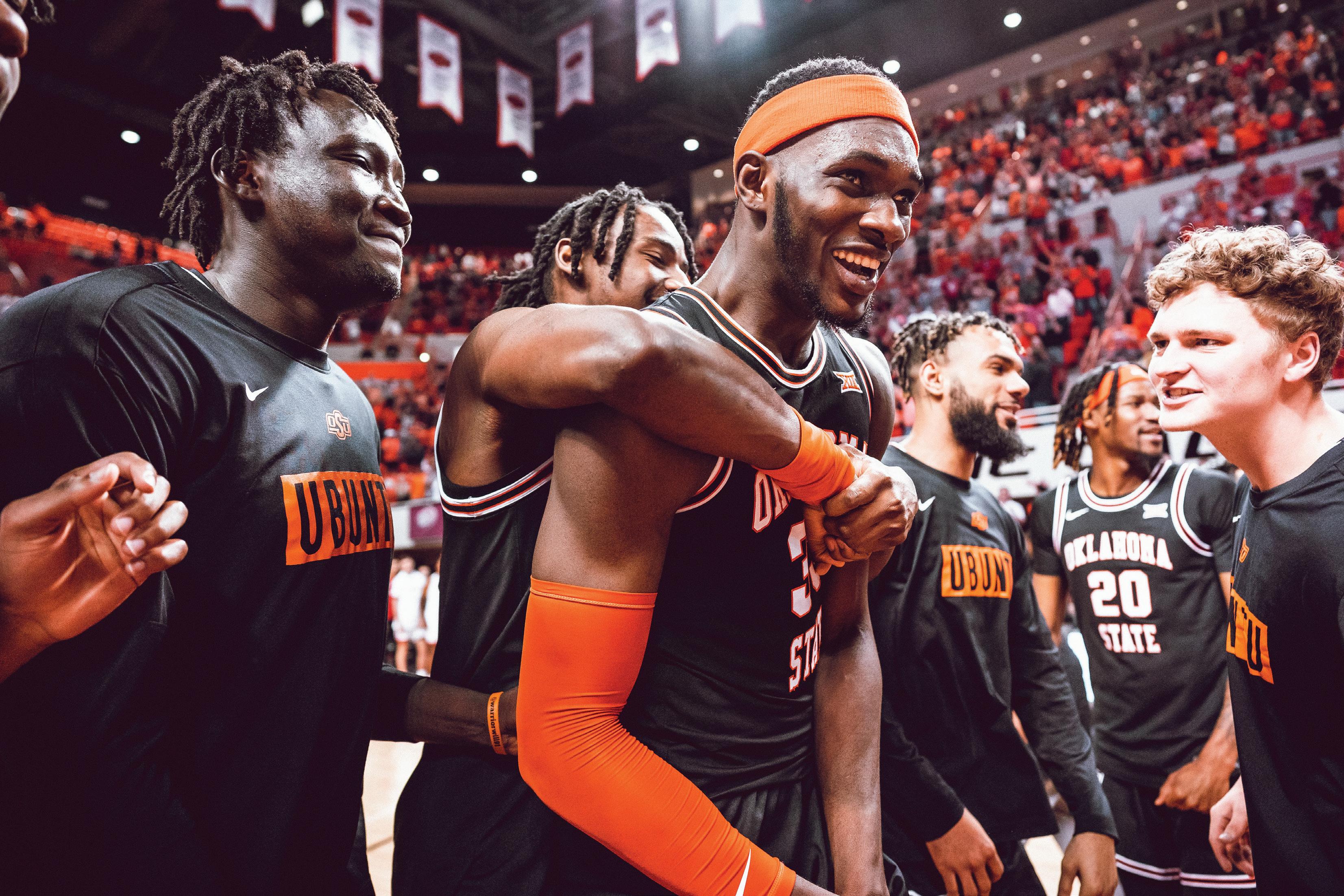

We saw history at Oklahoma State this year when the Cowgirl equestrian team won the school's first women's team national championship in a varsity sport.
The women's tennis program was national runner-up in 2016 and women's golf took second in 2021 — so it felt like it just a matter of when the championship would happen and who it would come from.
Led by a quartet of All-Americans in Hope King , Sydnie Ziegler, Molly Mitchell and Jojo Roberson, plus national coach of the year Larry Sanchez , the equestrian team of 2021-22 etched its name into the history books as the first.
While equestrian's title was historic, it was not the only headlining performance for OSU in 2021-22. Some additional highlights from the past academic year:
• The Cowboy football team played in its first Big 12 championship game after finishing the regular season atop the conference standings. OSU claimed wins over traditional powers Oklahoma and Texas, then toppled No. 5 Notre Dame in the Fiesta Bowl.
• The softball team won its first Big 12 championship by beating No. 1 Oklahoma in the conference title game, then won its regional and swept Clemson in the super regional to advance to its third consecutive Women's College World Series, finishing third.
BY GAVIN LANG Asso ci ate Athletic Director/Communications
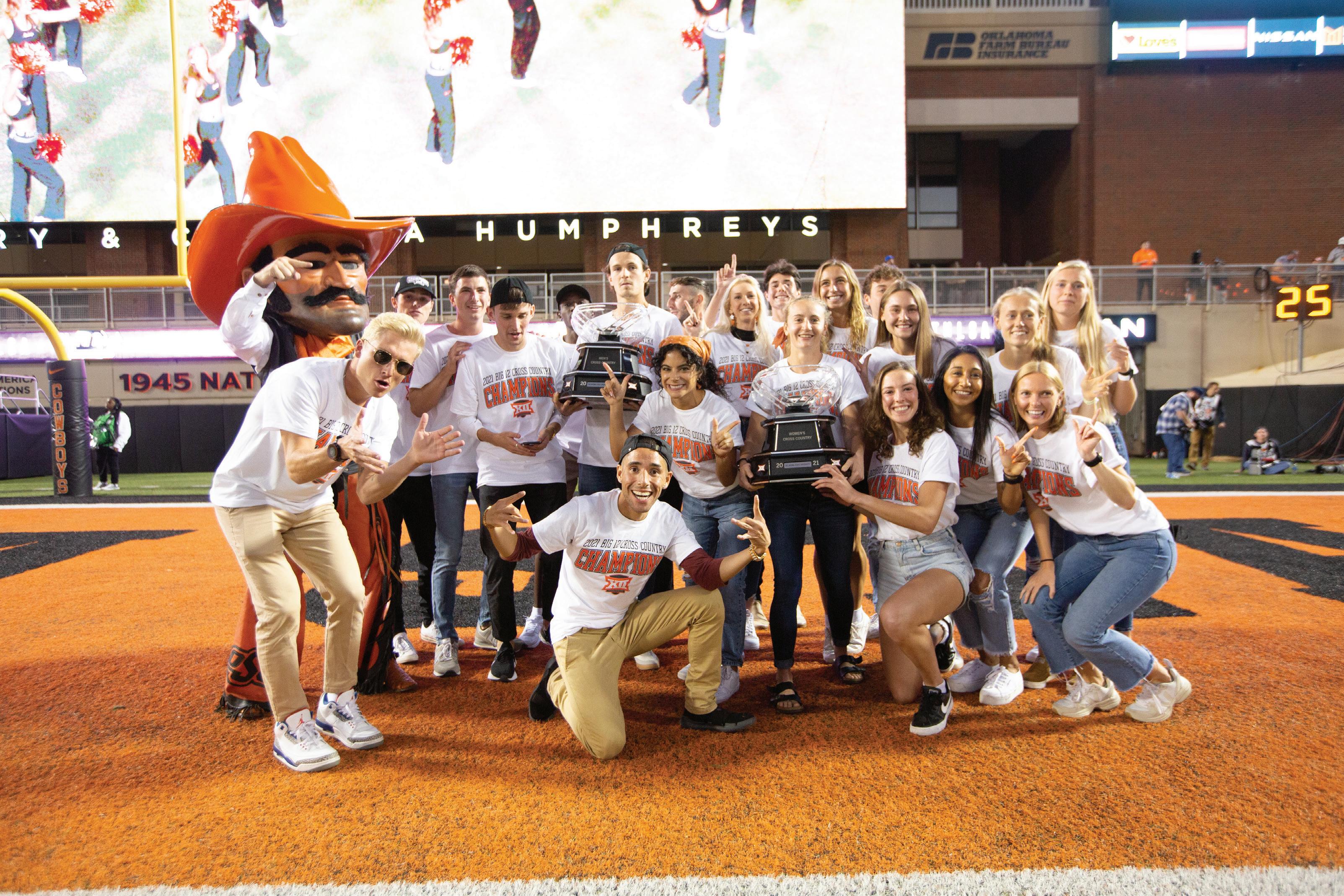
• The men's and women's cross country teams both won Big 12 team championships, with the men going on to place third at the NCAA Championships and the women taking 13th.
• The women's tennis team advanced to the Sweet 16 at the NCAA Championships for the fifth time in the last seven years.
• Taylor Roe won the 189th NCAA individual title in OSU history by winning the indoor 3,000 meters.
• With Big 12 team titles from men's and women's cross country, equestrian and softball, Oklahoma State now has 326 team conference championships all time and 87 in the Big 12 era.
• Of Oklahoma State's 18 varsity sports, 13 produced top-20 national finishes and six produced top-10 national finishes, using the Learfield Directors' Cup scoring system.
• For the eighth time in the last nine years, Oklahoma State won the all-sports Bedlam Series.
• Oklahoma State produced 40 All-Americans across 14 sports in 2021-22. OSU's all-time total of All-Americans now stands at 1,305.
• Five OSU student-athletes earned a Big 12 Player of the Year honor in their respective sport, with four of those five coming from women's sports.
OSU student-athletes and coaches enjoyed remarkable individual success in 2021-22 as well.
NCAA INDIVIDUAL CHAMPION
Taylor Roe, Indoor 3,000 meters
NATIONAL COACH OF THE YEAR
Larry Sanchez, Equestrian
BIG 12 COACH OF THE YEAR
Mike Gundy, Football
Dave Smith, Women’s Cross Country
BIG 12 PLAYER OF THE YEAR
Moussa Cisse
Men's Basketball (Defensive)
Taylor Roe
Women's Indoor Track and Field
Hope King
Equestrian (Equitation on the Flat)
Kelly Maxwell
Softball (Pitcher)
Maddison Hinson-Tolchard
Women's Golf
BIG 12 FRESHMAN OF THE YEAR
Collin Oliver, Football (Defensive)
Mhai Sawangkaew, Women's Tennis
BIG 12 NEWCOMER OF THE YEAR
Jaylen Warren , Football (O ensive)
Tyler Zink , Men's Tennis
ALL-AMERICANS
FOOTBALL
Malcolm Rodriguez
Kolby Harvell-Peel
Matt Hembrough
MEN’S CROSS COUNTRY
Isai Rodriguez
Shea Foster
Victor Shitsama
WOMEN’S CROSS COUNTRY
Taylor Roe
WRESTLING
Daton Fix, 133 pounds
Dustin Plott, 174 pounds
EQUESTRIAN
Sydnie Ziegler, Equitation over Fences
Hope King, Equitation on the Flat
Jojo Roberson, Horsemanship
Molly Mitchell, Reining
MEN’S INDOOR TRACK AND FIELD
Alex Maier, 5,000 meters
Fouad Messaoudi, DMR
DJ McArthur, DMR
Juan Diego Castro, DMR
Ryan Schoppe, DMR
WOMEN’S INDOOR TRACK AND FIELD
Ariadni Adamopoulou, Pole Vault
Gabija Galvydyte, 800 meters
Maddie Meiner, Pentathlon
Taylor Roe, 3,000 meters
WOMEN’S TENNIS
Ayumi Miyamoto, Doubles
Lisa Marie Rioux, Doubles
MEN’S GOLF
Eugenio Chacarra
Aman Gupta
Brian Stark
WOMEN’S GOLF
Maddison Hinson-Tolchard
BASEBALL
Justin Campbell
Jake Thompson
SOFTBALL
Kelly Maxwell
Miranda Elish
Sydney Pennington
Katelynn Carwile
MEN’S OUTDOOR TRACK AND FIELD
Ryan Schoppe, 1,500 meters
Alex Maier, 10,000 meters
Ryan Smeeton, Steeplechase
WOMEN’S OUTDOOR TRACK AND FIELD
Gabija Galvydyte, 800 meters
Taylor Roe, 5,000 meters
Gabby Hentemann, 10,000 meters
Bailey Golden, Heptathlon
BIG 12 INDIVIDUAL CHAMPIONS WRESTLING
Daton Fix, 133 pounds
Kaden Gfeller, 149 pounds
Dustin Plott, 174 pounds
MEN’S INDOOR TRACK AND FIELD
Alex Maier, 3,000 meters
Isaiah Priddey, DMR
Cash Merutka, DMR
Alex Stitt, DMR
Alex Maier, DMR
WOMEN’S INDOOR TRACK AND FIELD
Taylor Roe, Mile
Taylor Roe, 3,000 meters
Taylor Roe, DMR
Nicolette Dixon, DMR
Michaela Travers, DMR
Kelsey Ramirez, DMR
WOMEN’S GOLF
Lianna Bailey
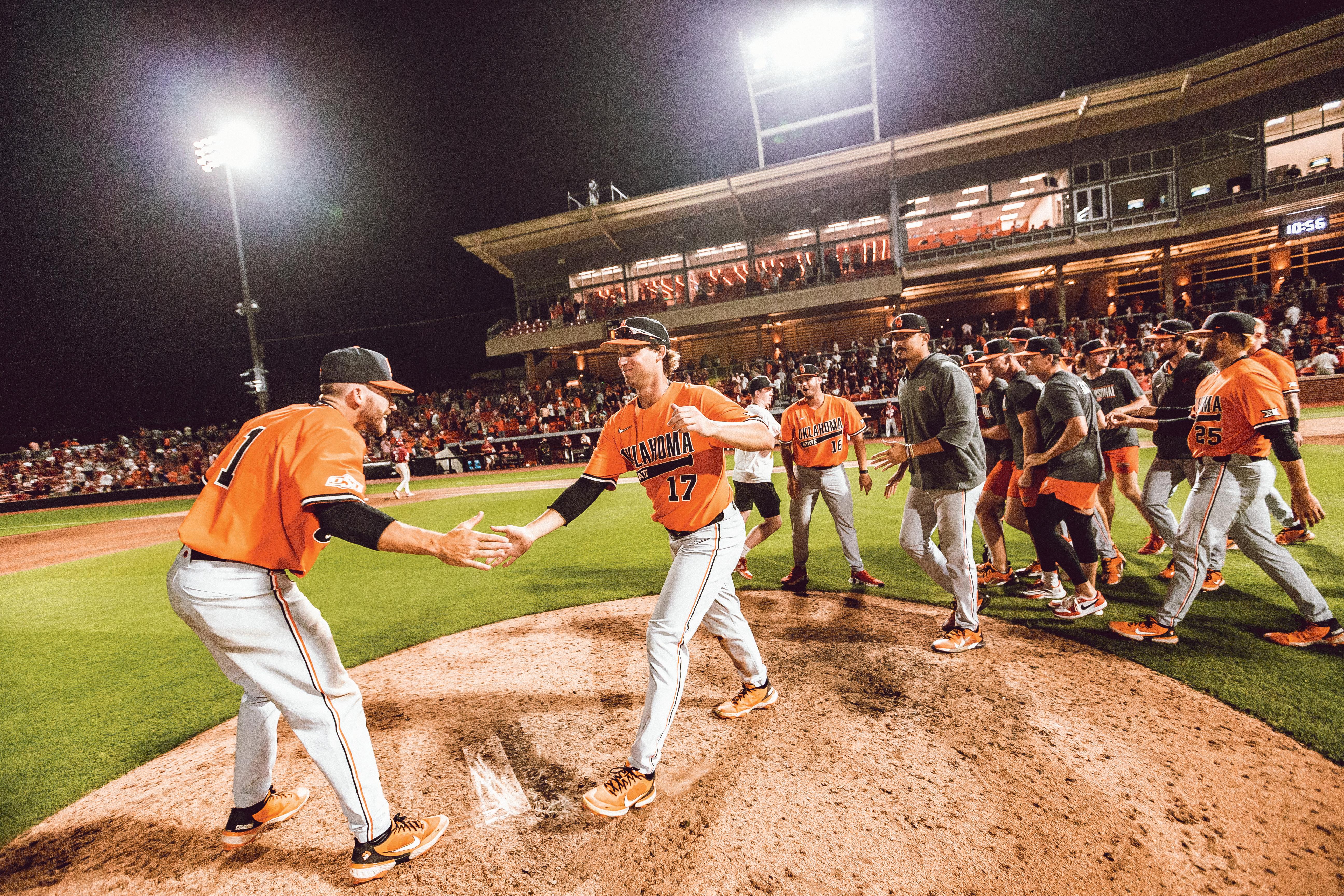
Chelsea Alexander, Softball
Kelly Maxwell, Softball
Brian Stark, Men's Golf
Marcus Brown, Baseball
Bryce Osmond, Baseball
Jake Thompson, Baseball
Caeden Trenkle, Baseball
Ryan Smeeton, Men's Cross Country/Track and Field
Abbie Winchester
EQUESTRIAN
Stephanie Helsen
Kinsey Jones
Sidney Perdue
JoJo Roberson
Amelia Jauregui
Megan Mann
Maddie Meiner
Michaela Travers
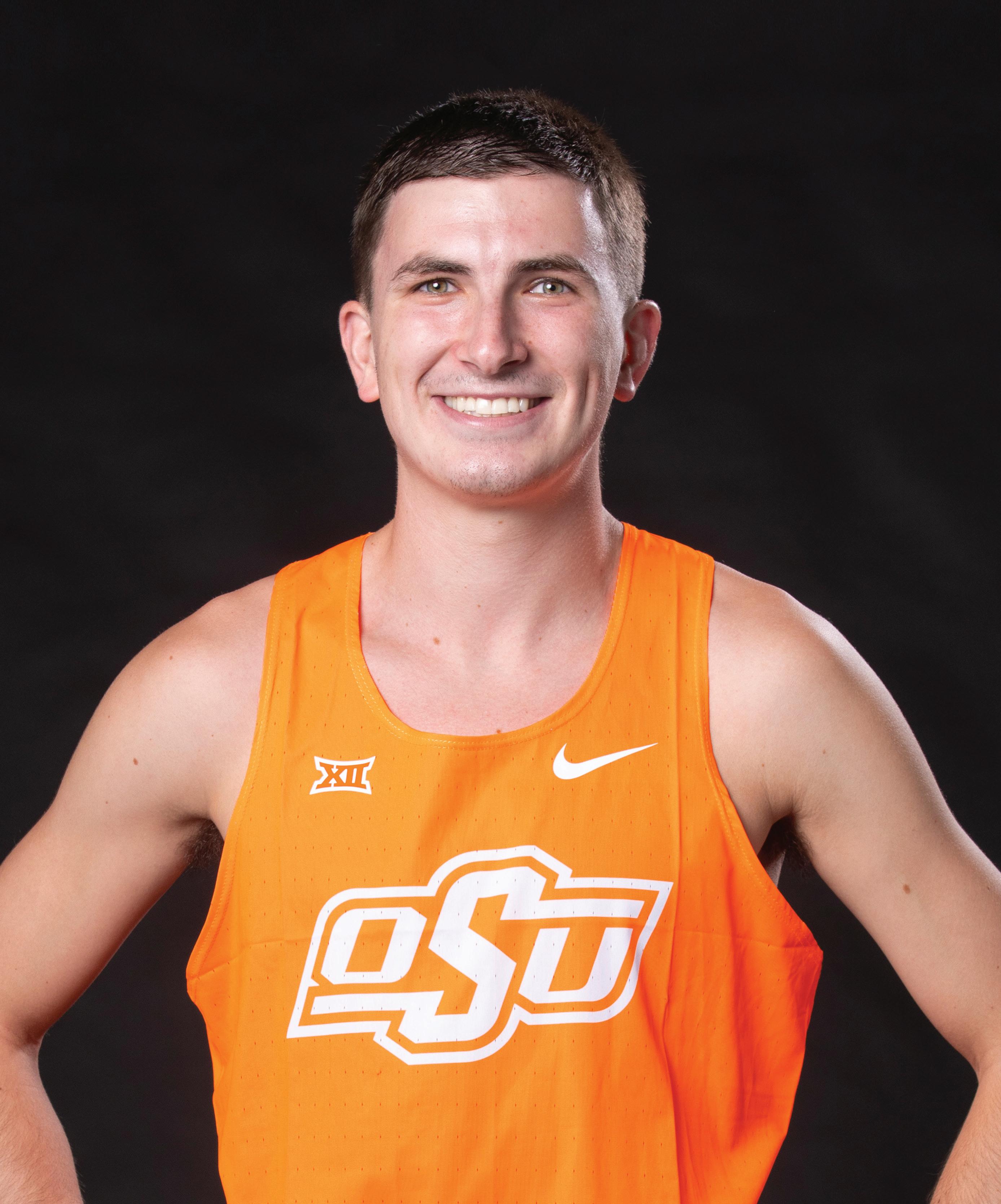
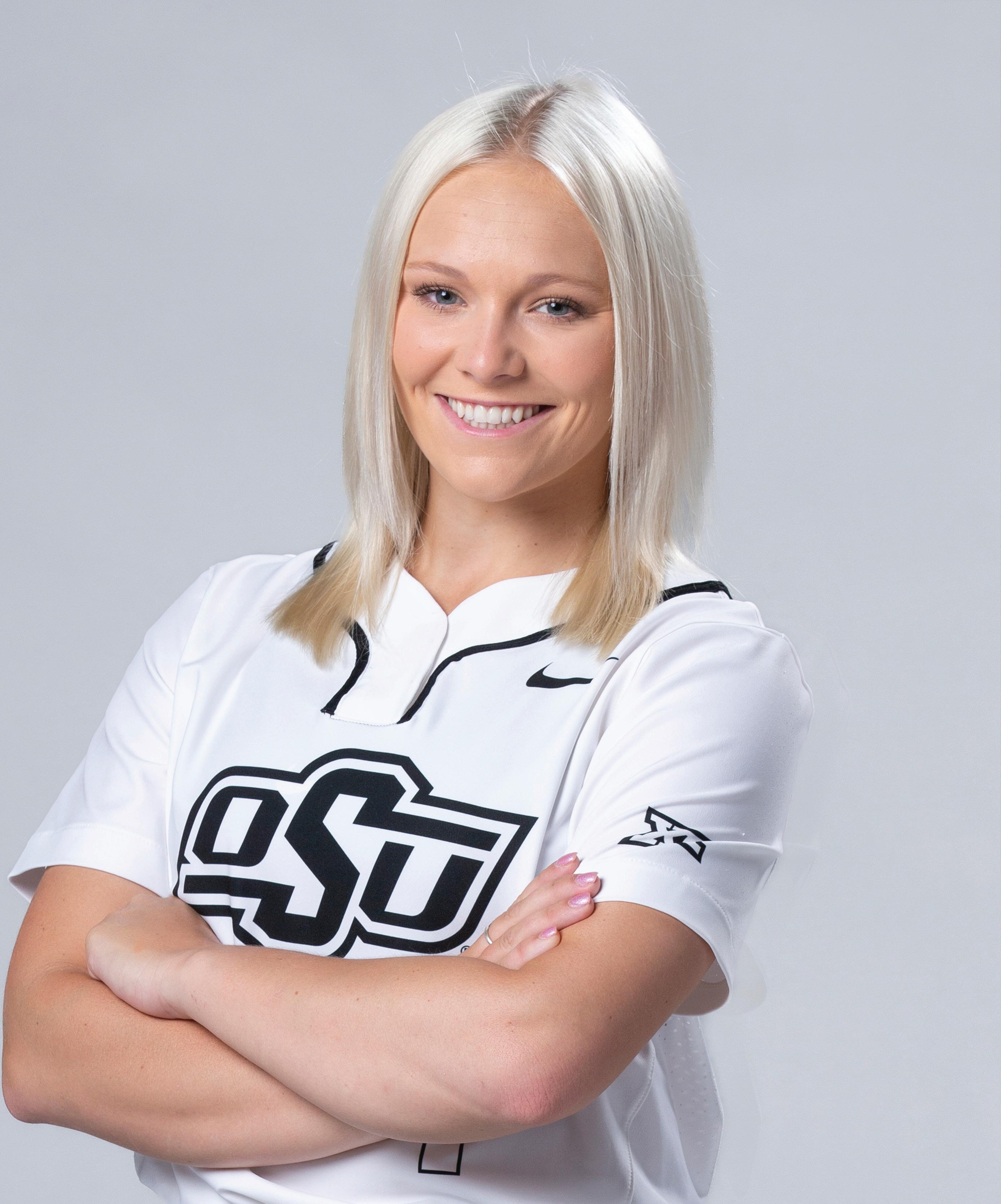
Beginning in the fall semester of 2022, eligible OSU student-athletes will receive $5,980 per year as part of the newly created POSSE STAR (STUDENT-ATHLETE ACADEMIC REWARD) FUND.
The STAR Fund incentivizes academic success as the means for eligible student-athletes to receive a financial reward stemming from the landmark Supreme Court decision in the Alston v. NCAA case. The Alston case has opened the door for student-athletes to receive additional monetary support toward the cost of their education, and the Athletic Department is committed to providing all scholarship student-athletes the chance to earn supplemental payments based on their academic performance while enrolled at Oklahoma State.
These additional funds could total up to $3 million in additional expense per year for the department. Gifts given directly to the STAR Fund will aid in these e orts. As a new budget line item, this will be an additional annual expense for Athletics.
For more information about how you can make a gamechanging gift to the STAR Fund, contact the OSU POSSE: 877-ALL-4-OSU or visit okstate.com/posse.
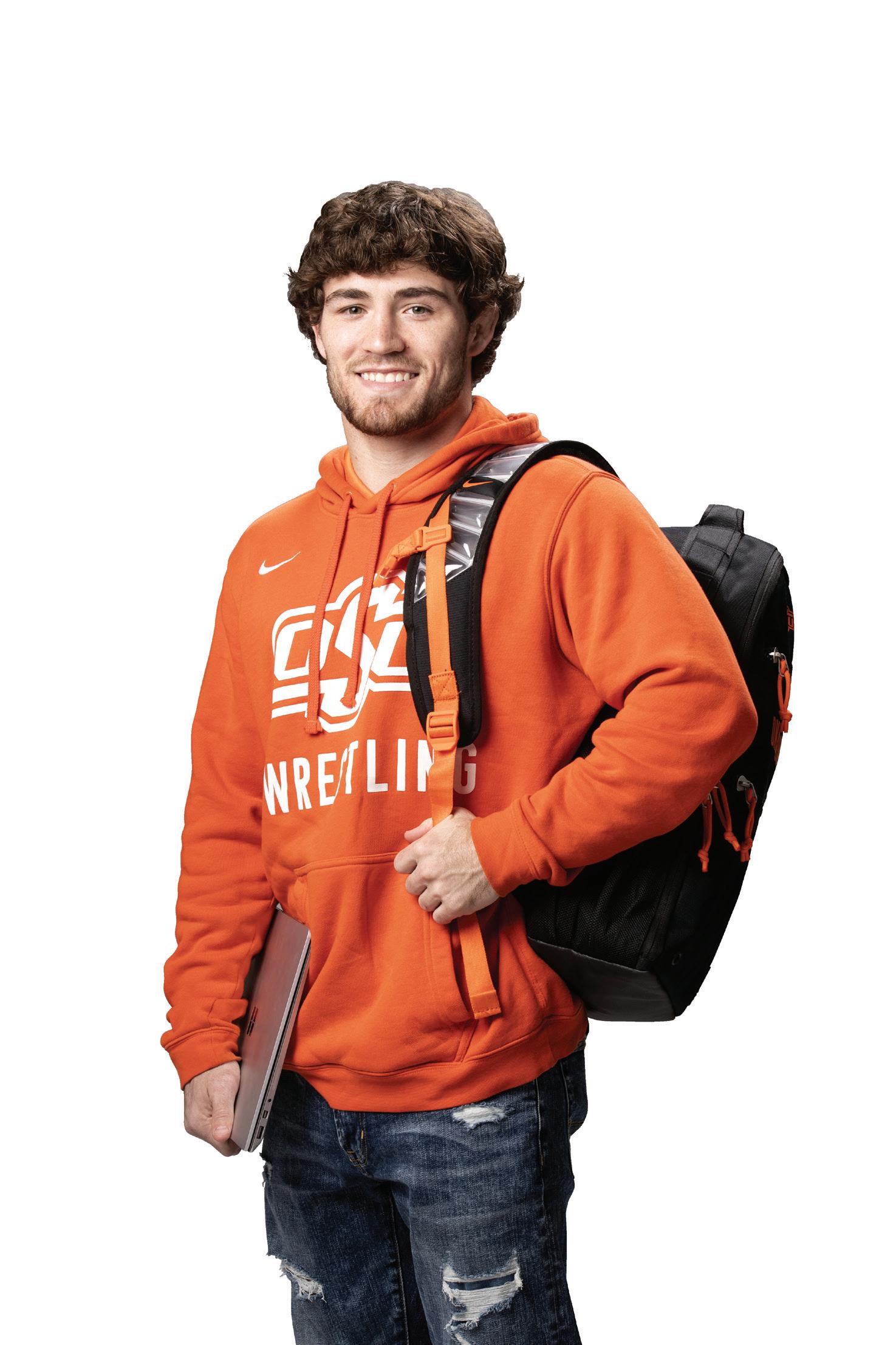
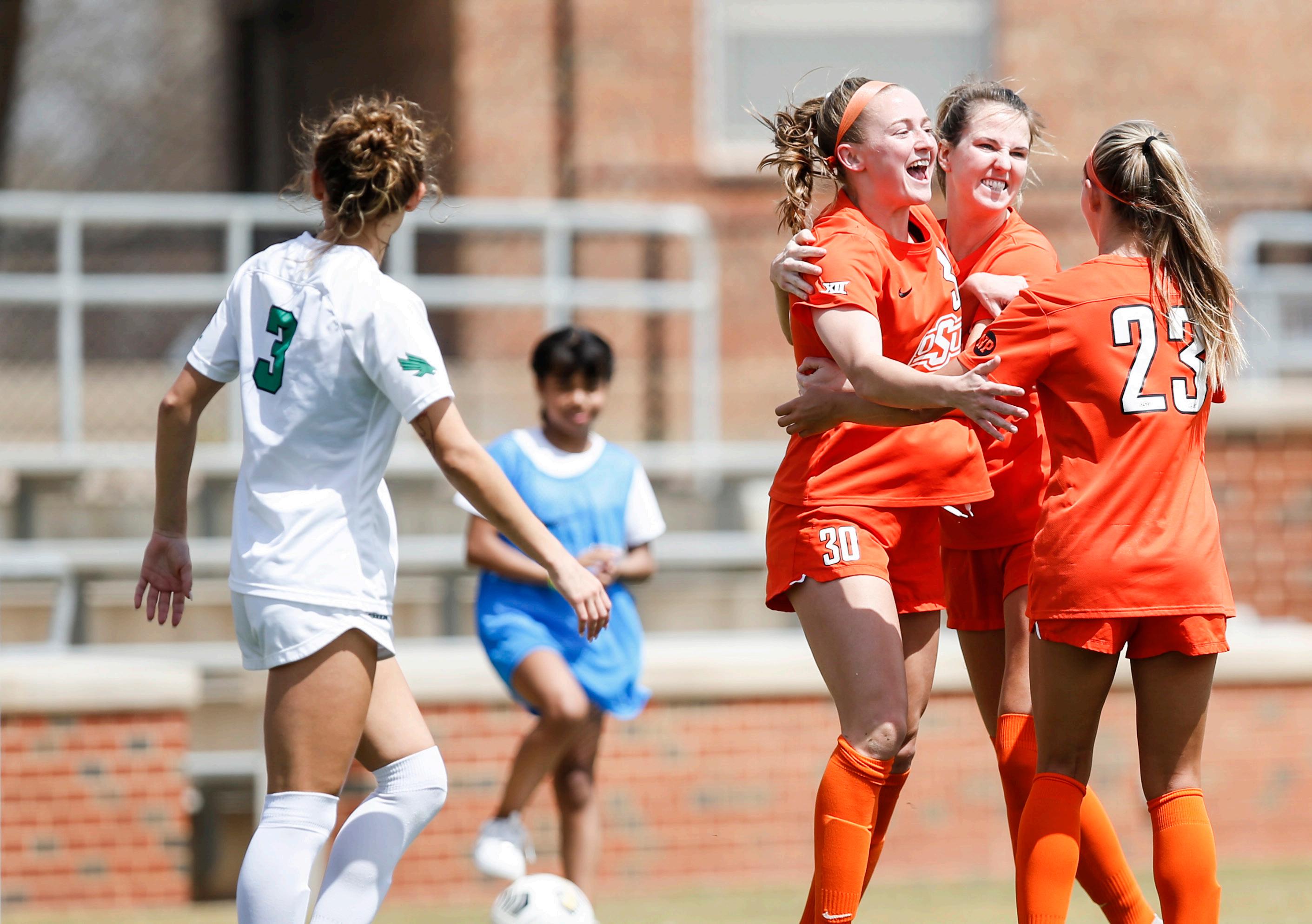
Seniors Grace Yochum (center) and Olyvia Dowell (left) have combined for 56 goals and 26 assists in their careers and return to lead Cowgirl Soccer in 2022. With 33 career goals, Yochum is just three shy of setting a new program record, while Dowell already ranks in the top 10 alltime in assists and is one goal shy of cracking the top 10 in that category. Catch the Cowgirls in action at Neal Patterson Stadium this fall. For ticket and schedule info, visit okstate.com.
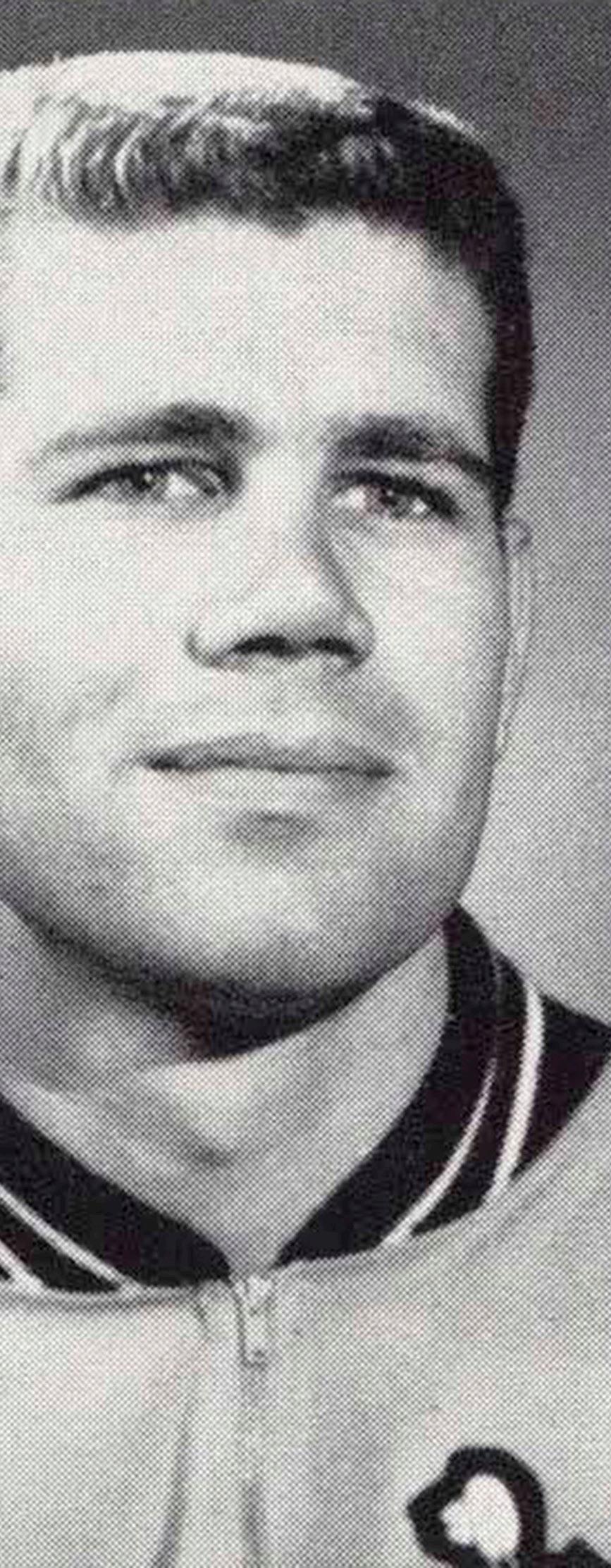
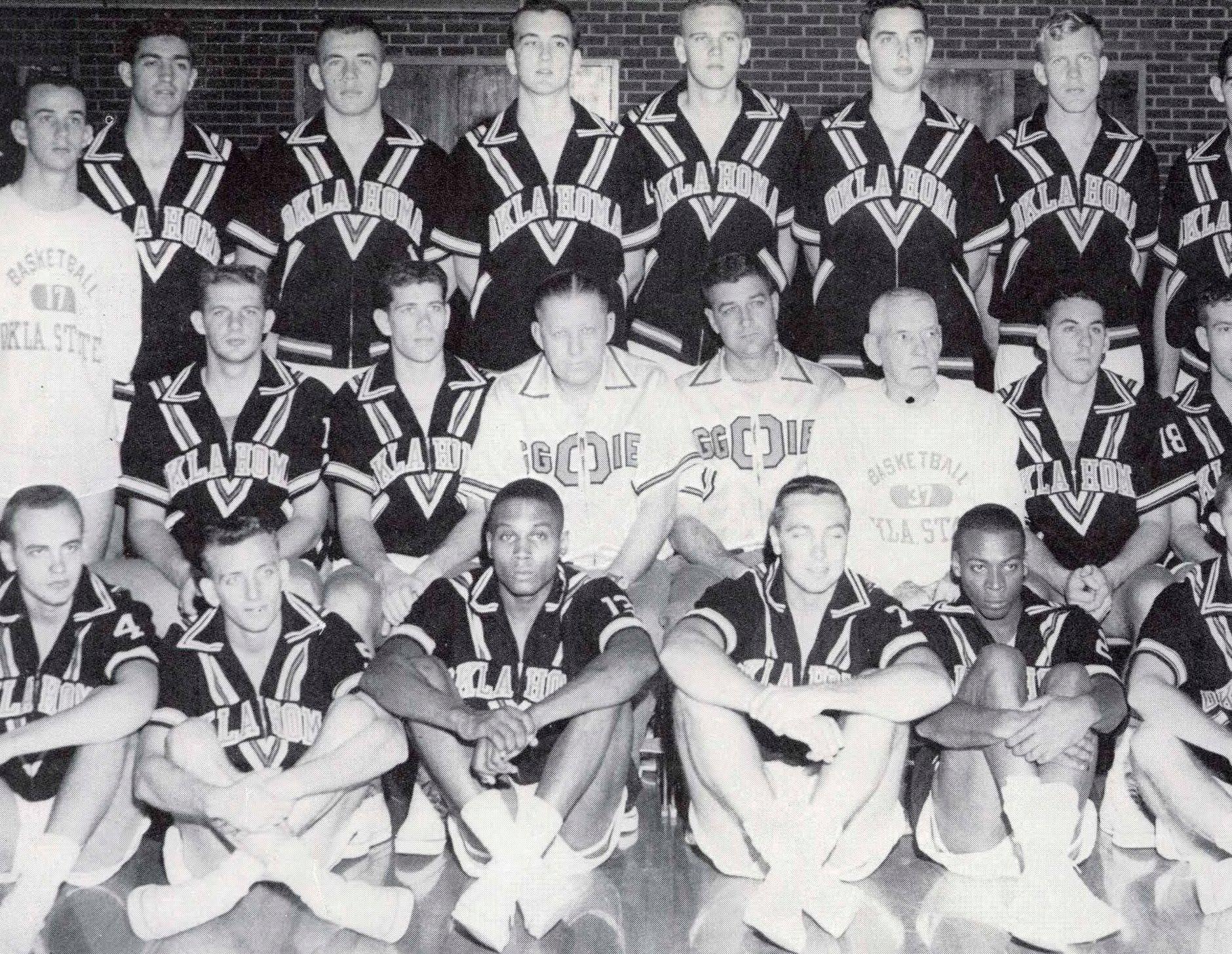
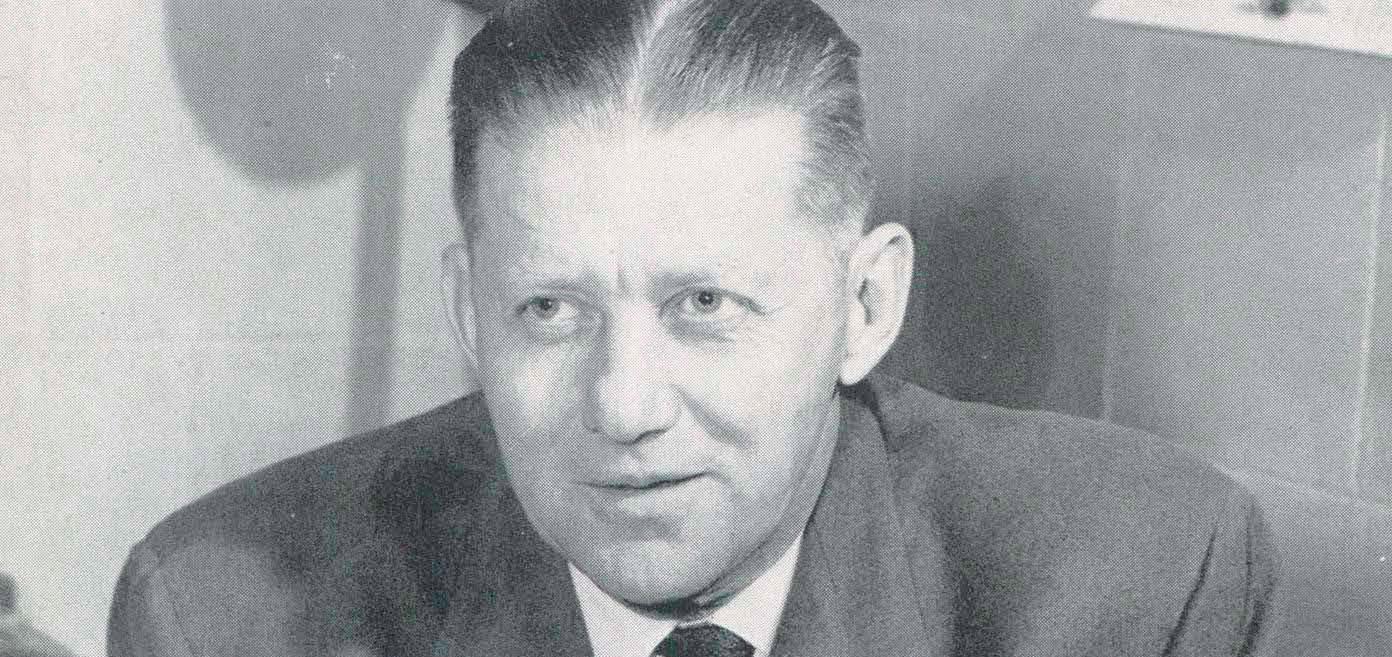
During his 36 years as head basketball coach for the Aggies and Cowboys, Hall of Fame coach Henry P. Iba led two teams to NCAA titles, made four trips to the Final Four, won 14 Missouri Valley championships plus a Big Eight crown. The celebrated Iba also coached three U.S. Olympic squads. At the time of his 1970 retirement, Iba had posted 757 victories on his resume, the third best total in the history at the time.
“I had never heard of basketball lectures until I played for Mr. Iba in the Olympics,” said former U.S. senator, past presidential candidate and NBA star Bill Bradley. “But his lectures were as much about life as they were basketball.”
What would it be like to be the son of this legendary coach? More unnerving perhaps, what would it be like to have your father as your legendary coach?
The year was 1939. Time magazine’s man of the year was Russian leader Joseph Stalin. Yankee Lou Gehrig’s streak of playing in 2,130 consecutive starts came to an end. The college craze was swallowing goldfish and Henry W. [Moe] Iba was born to Henry P. and Doyne Iba in Stillwater, Okla.
Shortly thereafter, an uncle hung the moniker Moe on the infant, after a popular comic strip baby that never grew. IT STUCK.
Eighty-year-old Moe Iba looks at least 15 years younger than his chronological age. He played for his dad, then went on to coach college basketball for 32 seasons.
Moe’s life-long friend since grade school, Stan Ward, told me, “Moe deserves a story. Cowboy fans need to know more about him. I hope you do a good job.”
SO HERE GOES.
I was a freshman basketball player at Oklahoma State during Moe’s senior year. I’d see him on the rare occasion when the varsity practiced with us underlings, and they would work us over pretty good.
Moe’s teammate, all-conference forward, Cecil Epperly, remembers those days.
“We were just trying to toughen you guys up.”
One 100-plus degree July evening in Gallagher Hall, several basketball players worked out. Sweat dripped off everyone. I shagged balls for Moe as he sank 113 consecutive free throws, then missed before drilling another 47.
AMAZING. I’VE NEVER SEEN SUCH A SOFT TOUCH.
Fast forward some 58 years, and I’d probably seen Moe twice — both times at basketball reunions — and we only spoke briefl y. This past September, Moe showed up at Mike Boynton’s annual reunion of former players, which makes all us old guys feel appreciated.
I saw Moe across the court from me. He looked dapper in a dark pullover sweater, tailored slacks and polished loafers. Possessing a full head of hair, which was mostly grey with specs of brown, his raspy voice reminded me of his dad’s.
Approaching him, he smiled as we shook hands and exchanged small talk. I found Moe to be an easy person to talk with. Before we parted, he gave me the okay to write a story on him. I looked forward to it as it provided me an opportunity to get to know him better and, hopefully, the same for Cowboy fans.
For Moe, growing up in Stillwater was the perfect place.
“Small college town, and I attended all the high school and college sporting events,” he said. “As a young teenage boy, I could leave in the morning with some of my friends, spend the day playing ball or whatever, then return in the evening and nobody worried about us.
“Dad was a normal dad. He taught me to hunt and fi sh. Of course, being a coach, he was gone a lot. Mom instructed me on how to play golf and was there with me all the time. They were both excellent parents and taught me to be the best person I could be. I had a very good upbringing. Mom was probably the best female golfer in Stillwater, winning several state championships. She loved to play, and it was excellent exercise for her. Her father had been a U.S. congressman from Missouri for 18 years.”
MOE’S INTEREST IN BASKETBALL CAME AT AN EARLY AGE.
“I can’t say exactly when,” he reflects, “because, at a young age, probably four or five, I would go to practices with Dad all the time. I played on my fi rst town team when I was about six-years-old, and then on the 12-14 age group. Our Stillwater team won a state championship. All I wanted to do was shoot baskets.
“I don’t think I was that good at baseball,” Moe added. “And during football season, all I wanted to do was shoot the basketball, so that’s what I did.”
Moe became an all-state player and a high school All-American, but broke his hand as the state playo s began. Ironically, on that same high school squad was Epperly, Don Linsenmeyer and Eddie Bunch , all of whom became stellar players for OSU.
LINSENMEYER WAS A FAN OF MOE IBA.
“He could shoot lights out with anyone,” he said of his former teammate. He was a terrific ball handler and passer, smart player and a great teammate.”
“HE
— Don Linsenmeyer
As a youngster, Moe knew there was something special about his dad.
“I don’t remember the national championship teams in 1945 and ’46, but in 1949, when I was 10 years old, I listened on the radio to the NCAA fi nals when Kentucky beat us. I knew Dad was very successful. I saw how other coaches respected him for his innovations, coaching abilities and because he was honest.”
Moe, on high school Stillwater’s Hall of Fame coach Martin “Red” Loper : “Red was great, I spent a lot of time talking basketball with him after I got out of high school. He was very knowledgeable.”
Following Moe’s senior year, TCU o ered him a full scholarship, and he accepted.
“I was in Gallagher Hall working out for the upcoming all-state game when trainer Doc Johnson walked onto the court and asked me what I thought about coming to OSU,” Moe said. “I told him, ‘Of course I wanted to come.’ That was the fi rst time anyone had asked me. Back then a letter of intent wasn’t binding, so I switched. Dad never said anything to me about it.”
Former Nebraska Player Terry Novak
“The older I get, the more I appreciate Moe, and what a super, genuine gentleman he was and is. I value his friendship. When he was coaching, he frequently yelled at me, but I knew it was to make me better.
“Today Moe remains one of my best friends. I’d do anything for that guy. A few of us get together two or three times a year for golfing and fishing outings and we’ll continue to do that as long as Moe wants to do it. We’ve already scheduled an Arizona event for next year.
“We don’t really go out in the evenings, but I believe he is impressed with our beer drinking abilities. Moe takes good care of himself, but when we’re all together, he seems to enjoy the rest of us acting like clowns. He frequently refers to Stillwater as God’s Country. I laugh and tell him that is a stretch.
“You probably have maybe four or five basketball coaches in your life from little league through college; I learned a lot about basketball from Moe. After Moe’s dad retired, he would come up for a week or so to watch us practice. Marvelous man, Mr. Iba. He would talk to anyone, whether you were the star or the last guy on the end of the bench. Moe has those same characteristics. I see where he gets them.”
MOE IBA WAS BORED BY HIS FRESHMAN SEASON.
“I felt it was a waste of time,” he said. “We couldn’t play on the varsity nor could we play any real games. Occasionally we got to scrimmage the varsity. Only thing besides practice that we could do was play intramural teams, which wasn’t a lot of fun.”
Beginning his sophomore year, disappointment engulfed Moe as he had knee surgery and had to redshirt. He didn’t play in a single game, which was a bitter pill for Moe to swallow.
Finally, following 12 months of rehab and preparation for a return to the court, Moe saw action. As a part-time starter he averaged just over five points a game, his high being 19 against Kansas State during a season he remembers as “losing a few more than we won.”
As a junior starter, Moe averaged 11 points per game, scoring 21 against both K-State and Iowa State.
“Looking back, that was my best year,” said Moe. “I stayed healthy, we won some games and fi nished third in the conference.”
Also, that season Moe connected on 92 percent of his free throws, including 11-for11 against Colorado. Moe’s season free throw percentage set a record that stood for 46 years — until 2017 when Phil Forte hit 95 percent of his attempts, breaking the OSU record and leading the NCAA in the process.
Readying themselves for Moe’s fi nal season, the Cowboys seemed poised for success. It appeared the Pokes would have four starters from Stillwater High. They called themselves the Four Amigos: Moe Iba; junior post player Eddie Bunch ; junior Epperly, an absolute demon on the boards who would lead the conference the following season in rebounding; and sophomore Linsenmeyer, who could do it all and might have been the best player of the bunch.
But it was not to be. Moe and Linsenmeyer both went down with knee injuries. Linsenmeyer was just coming into his own and averaged 19 points per game his last two pre-injury outings. Moe played in 15 games, averaging 12.5 points.
Toward the end of the season, Moe didn’t know if he could play, but after discussing it with Mr. Iba, decided to give it a try.
“There were about four games left: Kansas, Nebraska, K-State and OU,” Moe said with a smile, “and we won all four of them! I’m kind of proud of that fact.”
K-State was ranked third in the nation at that time. Beating them was a huge deal, and Moe played a major role in those victories. The Nebraska encounter was a nail-biter. OSU trailed by a point with six ticks left and a jump ball on the Husker free-throw line. Epperly, a terrific leaper, tipped the ball to Moe who had a head of steam up as he raced toward midcourt. He caught the ball in stride and released it two steps before he reached half-court.
As a witness to the event, the ball seemed to float in slow motion, and then suddenly, the ball went in! PANDEMONIUM BROKE OUT WITH FANS STORMING THE COURT TO EMBRACE THE VICTORS.
“Yes, I remember that game,” Moe says, with a grin.
“Thing is,” Moe reflected, “I really didn’t expect to play again. It’s one of those things I look back on, and I’m glad I did it. If Don and I don’t get hurt, we might have won a few more games.”
The Cowboys finished 14-11 (7-7 in conference for a fourth-place fi nish). After great expectations, it turned into a disappointing season. But Moe was ready to get on with his life.
FOR AS LONG AS HE COULD REMEMBER MOE IBA WANTED TO BE A COLLEGE BASKETBALL COACH, JUST LIKE HIS DAD.
“Only thing about being the son of the coach,” said Moe, “is that I wanted to be accepted by the coaches and the players, and I believe I was. What I got out of college basketball was a foundation to take with me into coaching. I learned so much from my dad — o ense and defense, really all parts of the game. If things were going bad for me, I tried to recall what he would do.
“That next year, 1962, along with my wife Cindy (a former OSU cheerleader) and young sons Bret and Greg, we moved to El Paso, where I took a job as an assistant to Don Haskins .”
The school is now known as UTEP — back then it was called Texas Western.
“The only reason I got the job was Don had played for Dad,” Moe said. “Being the only assistant coach, I coached the freshman team and assisted Don with the varsity, plus helped recruit. Don pretty much ran things as Dad did, except he applied more defensive pressure on their guards, so there wasn’t a lot for me to learn.
“Don had been a great shooter in college, had terrific eye-hand coordination, was a good golfer and would take your money on the pool table. I’m fortunate Don hired me. He was a great coach and a really, really good recruiter. He could charm the recruit, his mother and whoever else might be in the room. It’s remarkable how Don got all those kids down there. We had terrific players, players who could play today.
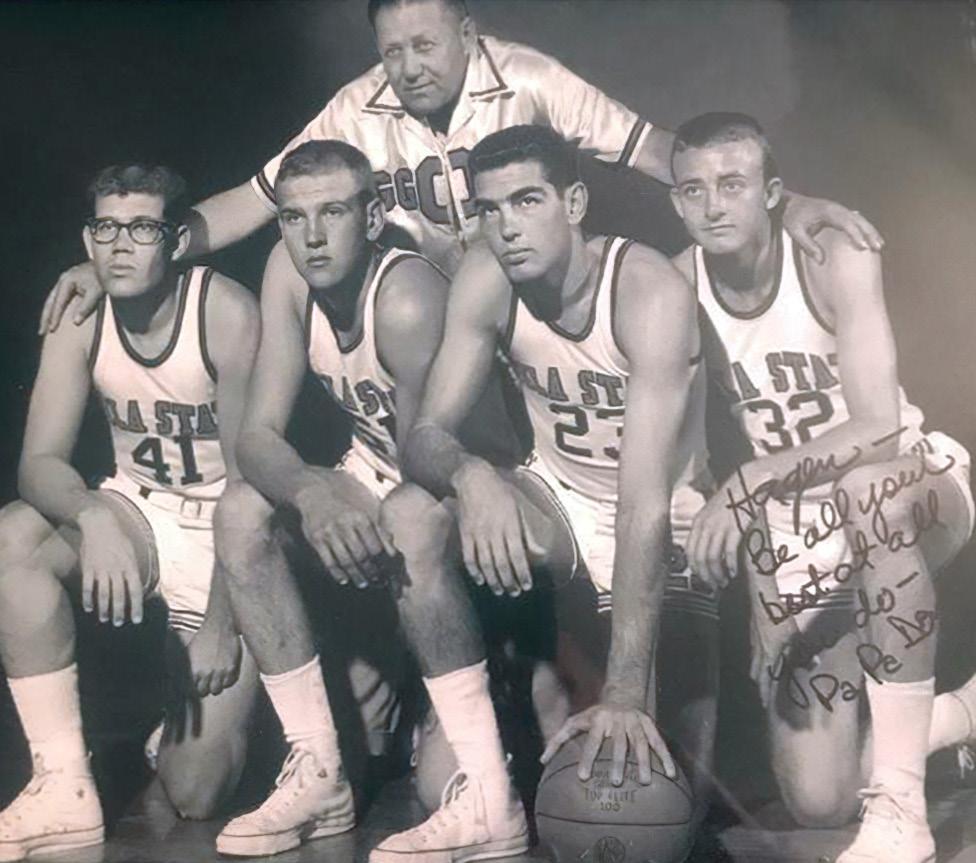
“ Bobby Joe Hill , one of the quickest players I ever saw, drove Don crazy by dribbling and passing behind his back, but he was good at it. Don was constantly on him, raising hell with him. I was having dinner with Don, and he’s complaining to me about Bobby Joe. Finally, I suggested to Don that he would either have to run Bobby Joe o or let him do what he was capable of doing. Don was quiet. Next practice he began to pull back some.”
Fast forward three years to the 1965-66 season: UTEP won the national championship, beating Kentucky in the fi nals. A Hollywood movie, Glory Road , was fi lmed, based on this event.
According to Moe, “Some UTEP fans felt our 1963 squad was better than our championship team. That team included Jim Barnes who
went on to be the number one pick in the 1963 NBA draft. Also, Glory Road compresses everything into one year, when it actually took three. But overall, I thought they did a good job with the movie.
“We really didn’t know what we had with that ’66 team; but then we played No. 4 Iowa on the road and beat them by 40,” he added. “We knew we were pretty special and began steamrolling. We only had two regular season games in which we had a chance of losing. Beating Adolph Rupp and Kentucky, was that a big deal? Not really. The movie had innuendos about racism since our team was black and Kentucky was white. We didn’t see it that way. We just wanted to win a championship. I do think that game helped open doors for black athletes in the southeast.”
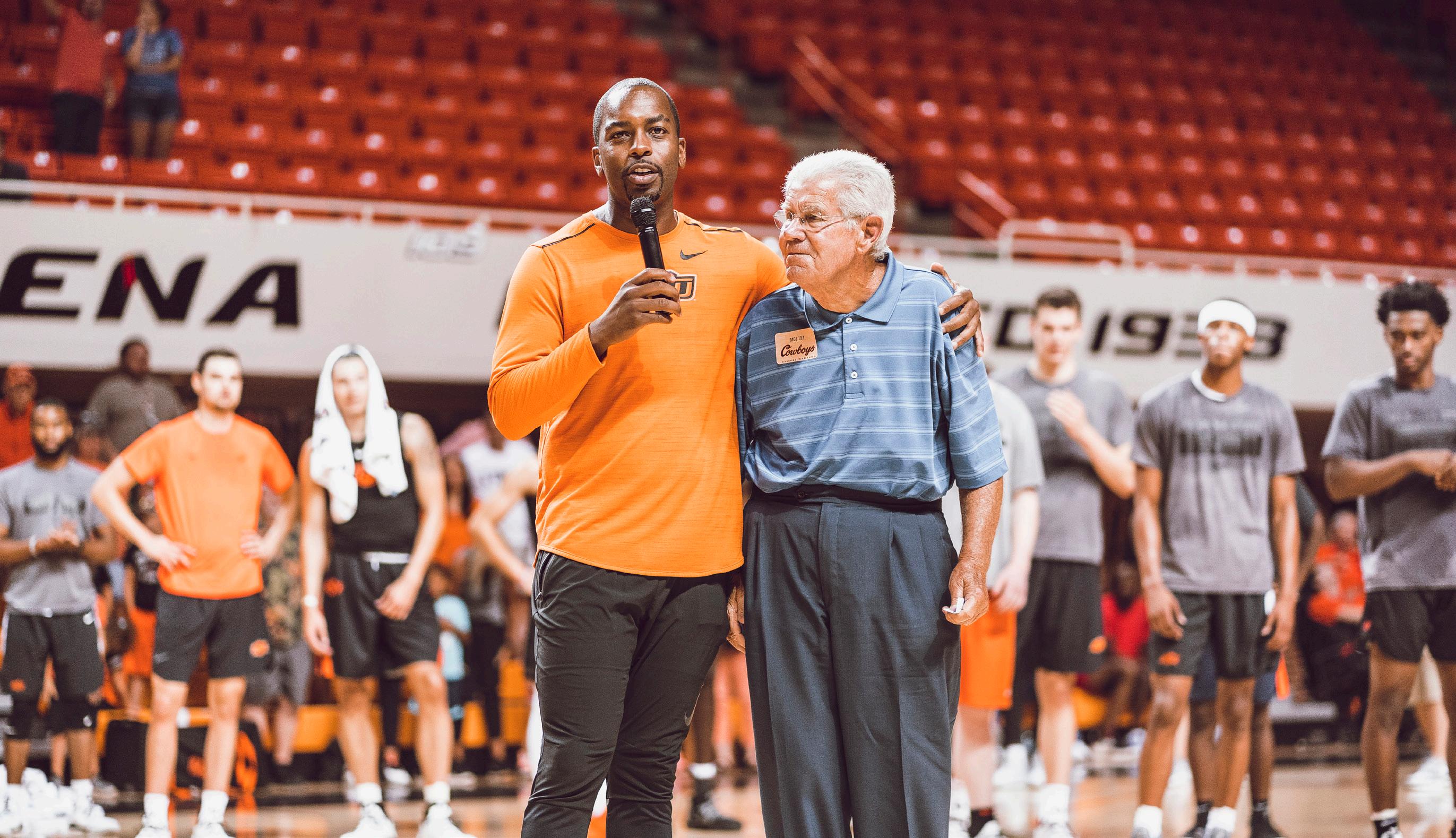
“I LEARNED SO MUCH FROM MY DAD.”
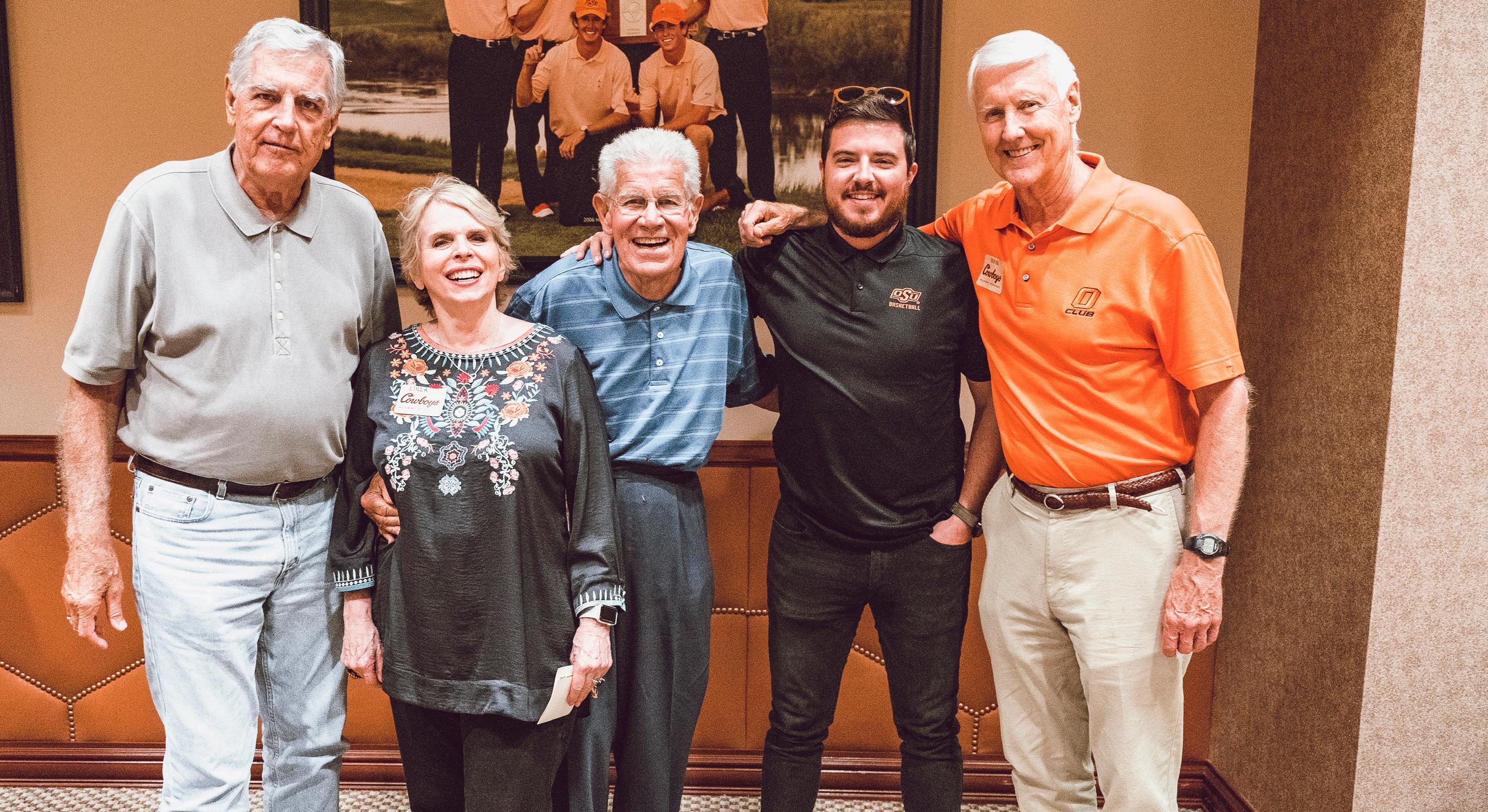
FOLLOWING THE 1966 SEASON, MOE IBA BECAME THE HEAD COACH AT MEMPHIS STATE.
“I thought I knew a lot, but found out I didn’t,” he said. “It was a mistake. I wasn’t ready. Memphis had never had a black player and freshmen couldn’t play. The fi rst year, as an independent, we won 17 games and went to the NIT. Then we joined the Missouri Valley Conference, and I was able to recruit a few players. My last year there I recruited two that would eventually lead Memphis to the NCAA fi nals, losing to UCLA. But I lost my job because we didn’t have good years in the conference.”
Moe went on to take the freshman job at Nebraska and then became an assistant to Joe Cipriano at the school. When Cipriano got cancer in 1980, Moe became the head coach.
“Nebraska was my favorite job,” Moe recalls, “We had good teams, went to three NITs back when only 32 teams got in the NCAAs, and my fi nal season, 1986, we went to the NCAA Tournament, a place where Nebraska had never been.
“Unfortunately, I had a problem with a regent so I resigned.”
Moe spent one year as an assistant coach at Drake University. Jim Killingsworth , a friend of Moe’s and a former OSU head coach, retired at TCU and was instrumental in getting Moe that job.
“That was a good job,” he said. “I enjoyed my time there, and we had four or five good teams. We played in the Southwest Conference, and if you didn’t win your conference, you couldn’t go to the NCAA, which we weren’t going to do any time soon, so I decided to retire from college coaching.”
“I think you know I lost my wife Cindy a while back,” Moe said. “We married during college. She was a wonderful mom and wife. She took care of the kids, enjoyed sports, supported me well while I was coaching and was always there for me. Her passing was a great loss.”
MOE RETIRED FROM BASKETBALL, BUT DIDN’T REALLY RETIRE FROM BASKETBALL.
“For seven years I was an NBA scout, working at di erent times for Detroit and Toronto,” he said. “It was something I enjoyed, but lots of travel. I’ve liked having free time, and it’s enabled me to get closer to my three sons (Bret, Greg and Blake), which has been good for me.
“My health enables me to play golf, take fi shing trips, travel and do whatever I want to do. Plus, I have a circle of great friends I enjoy.
“After I’d been out for several years, Haskins, also retired, asked me if I missed it. I told him no and didn’t see how some guys coach into their mid-70s and he agreed.
“Someone asked me if I ever shoot free throws anymore. I haven’t shot any in a long time with one exception. A few years ago, I was with a group on a fi shing trip in Alaska and we were staying at a lodge. Outside was a basketball goal and a ball. I went outside, picked up the ball and shot it. It came up about four feet short and I’ve never picked up another ball,” Moe laughed.
MOE STILL KEEPS AN EYE ON STILLWATER AND THE OKLAHOMA STATE BASKETBALL PROGRAM.
“I think (Mike) Boynton has the right stu and will do a wonderful job,” he said. “They hired the right guy!”
“Something else I’d like to add to your story,” he concluded. “I realize Dad accomplished a lot of good for OSU. He earned Oklahoma State a lot of respect, fame, glory and notoriety. At the same time the university has done a wonderful job recognizing and appreciating my father.
The lifelong relationship between Stan Ward and Moe began at Eugene Fields Elementary school in Stillwater.
“We played on the same little league teams. Moe was in my wedding. We always kept up with each other, and then one day we woke up and we are both 80! Neither one of us have a brother, but Moe is like a brother to me.
“Dedicated, at an early age, to becoming a great basketball player, Moe spent countless hours on the court shooting the ball. Moe also had excellent eye-hand coordination and could hit a baseball better than any of us.
“In high school, Moe would attend the OSU practice sessions, and on occasion, played ‘horse’ against varsity players. More often than not, he won. Too bad the three-point shot wasn’t in back in those days because that’s where Moe shot from.
“The only regret I have for Moe is that he never coached at OSU. He bled orange all the time he was here and had deep a ections for the program.”
“But I want the fans to know how much OSU meant to him. It was everything. He used to say, ‘Family comes fi rst, then OSU and last, basketball.’ He appreciated and loved everyone and everything about Oklahoma State. That was his whole life. Also, I loved OSU as well. Still do.”
So, Cowboy fans, here is your Moe Iba story: From OSU royalty, someone who bleeds orange, a basketball player extraordinaire, long-time coach. I found him to be sincere, humble, easy to communicate with, a quality individual and a family man — a delightful blast from the past!
OSU redshirt freshmen Gunnar Gundy and Luke McEndoo former teammates at Stillwater High School and sons of Cowboy coaches Mike Gundy and Jason McEndoo—flip a 415-pound tractor tire at the Sherman E. Smith Training Center as Cowboy teammates cheer them on. OSU Assistant Athletic Director for Speed, Strength and Conditioning Rob Glass hosts the friendly competition each o season as a way for football players to build camaraderie and conditioning.
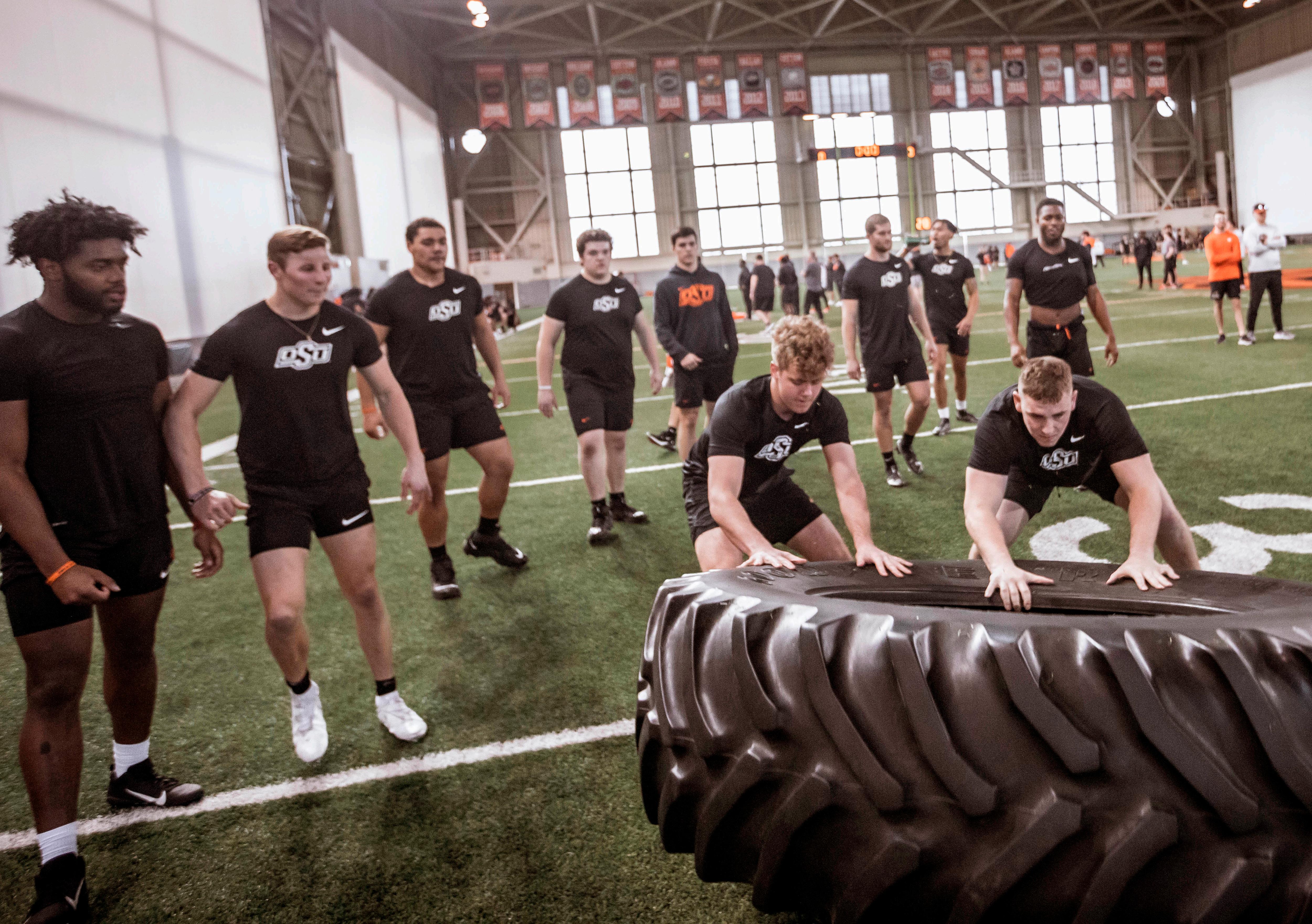
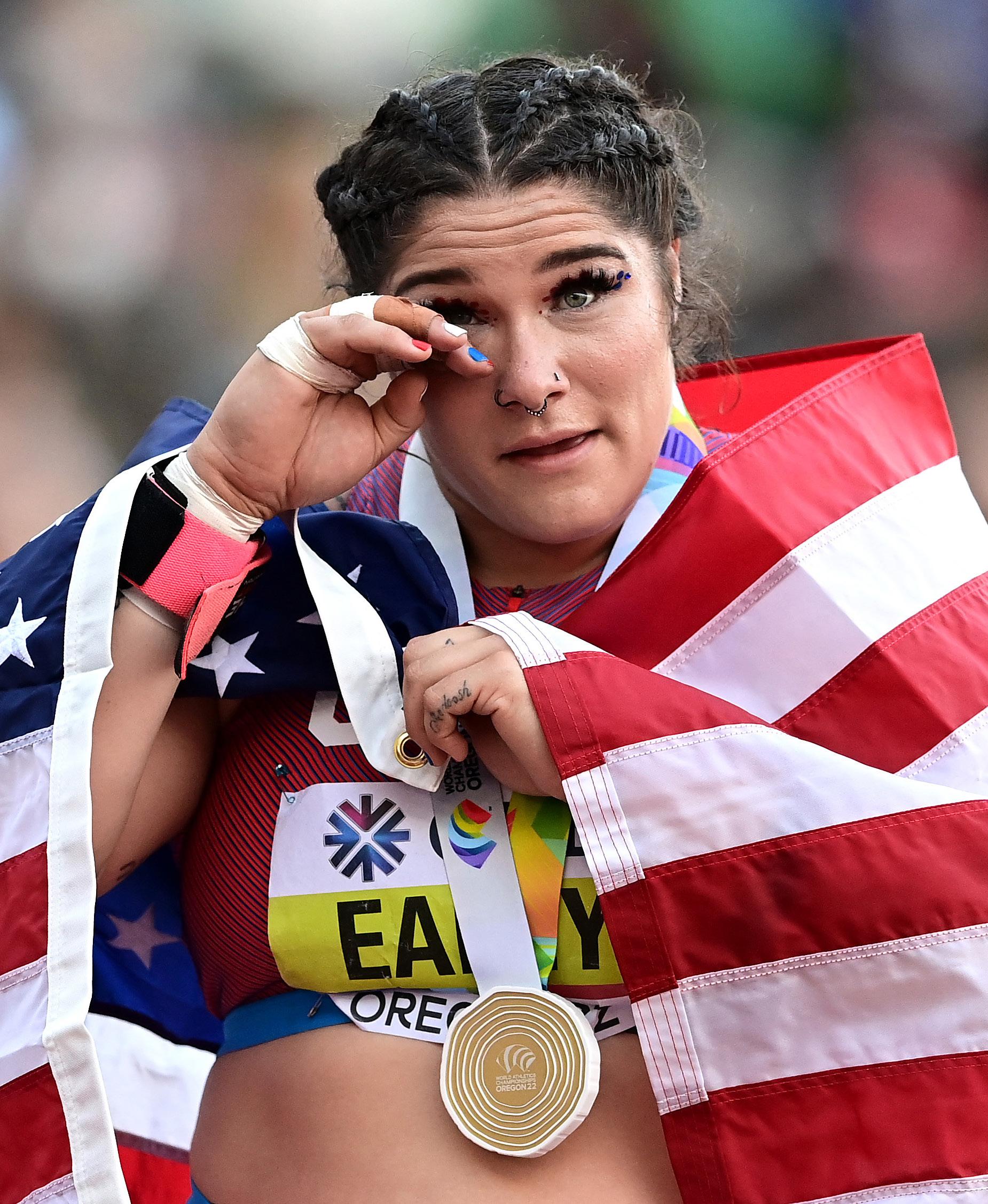
Former Oklahoma State thrower Chase Ealey put on a dominant display at the World Athletics Championships in Eugene, Ore., capturing the gold medal with a throw of 20.49 meters.
An All-American and NCAA runner-up for Cowgirl track