

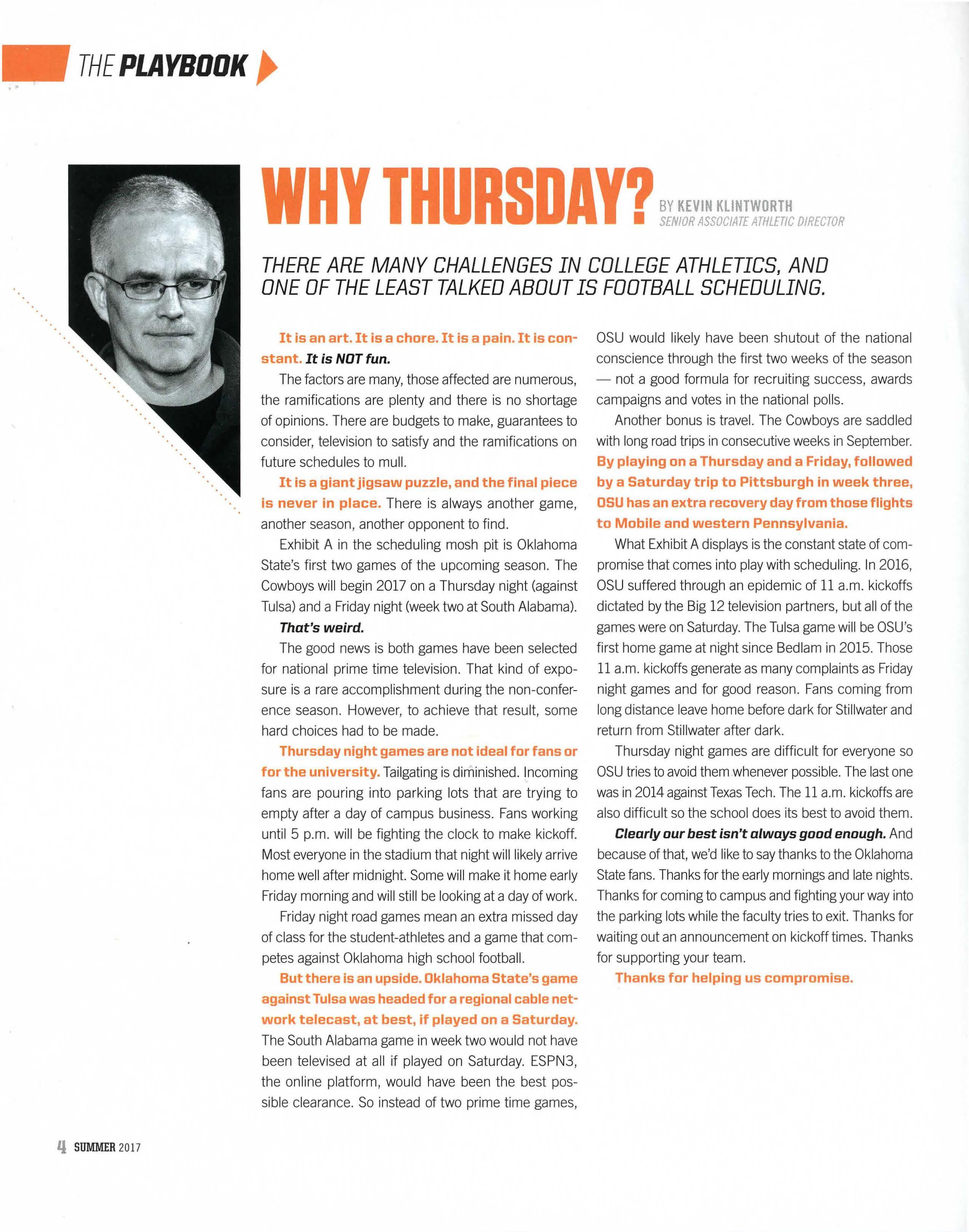
BYKEVINKLINTWORTH 1I I SENIORASSOCIATEATHLETICDIRECTOR
It is an art. It is a chore. It is a pain. It is constant. It is NDT fun.
The factorsare many,those affectedare numerous, the ramificationsare plenty and there is no shortage of opinions.There are budgetsto make,guaranteesto consider,televisionto satisfy and the ramificationson future schedulesto mull.
It is a giant jigsaw puzzle, and the final piece is never in place. There is always another game, another season,another opponentto find.
Exhibit A in the scheduling mosh pit is Oklahoma State'sfirst two games of the upcoming season.The Cowboyswill begin 2017 on a Thursdaynight (against Tulsa)and a Fridaynight (weektwo at SouthAlabama). That's weird.
The good news is both games have been selected for national prime time television.That kind of exposure is a rare accomplishmentduring the non-conference season. However,to achieve that result, some hard choices had to be made.
Thursday night games are not ideal for fans or for the university. Tailgatingis diminished.Incoming fans are pouring into parking lots that are trying to empty after a day of campus business. Fansworking until 5 p.m. will be fighting the clock to make kickoff. Mosteveryonein the stadiumthat nightwill likelyarrive homewell after midnight.Somewill makeit homeearly Fridaymorningand will still be lookingat a day of work.
Fridaynight road games mean an extra missedday of classfor the student-athletesand a game that competes againstOklahomahigh school football.
But there is an upside. Oklahoma State's game against Tulsa was headed for a regional cable network telecast, at best, if played on a Saturday. The South Alabamagame in week two would not have been televised at all if played on Saturday. ESPN3, the online platform, would have been the best possible clearance.So instead of two prime time games,
OSU would likely have been shutout of the national consciencethrough the first two weeks of the season - not a good formula for recruiting success, awards campaignsand votes in the national polls.
Another bonus is travel. The Cowboysare saddled with long roadtrips in consecutiveweeksin September. By playing on a Thursday and a Friday, followed by a Saturday trip to Pittsburgh in week three, OSU has an extra recovery day from those flights to Mobile and western Pennsylvania.
What ExhibitA displaysis the constantstateof compromisethat comes into playwith scheduling.In 2016, OSUsuffered through an epidemic of 11 a.m. kickoffs dictated by the Big 12 televisionpartners, but all of the gameswereon Saturday.The Tulsagamewill be OSU's first home game at night since Bedlam in 2015. Those 11 a.m. kickoffsgenerateas manycomplaintsas Friday night games and for good reason. Fanscoming from longdistanceleavehome beforedark for Stillwaterand return from Stillwaterafter dark.
Thursday night games are difficult for everyoneso OSUtriesto avoidthem wheneverpossible.The lastone wasin 2014againstTexasTech.The 11 a.m. kickoffsare also difficult so the school does its best to avoidthem.
Clearly our best isn't always good enough. And becauseof that, we'd liketo saythanksto the Oklahoma Statefans.Thanksfor the earlymorningsand latenights. Thanksfor comingto campusand fightingyourway into the parkinglotswhilethe faculty tries to exit.Thanksfor waitingout an announcementon kickoff times. Thanks for supportingyour team.
Thanks for helping us compromise.
POSSE Magazine Staff
VICEPRESIDENTOFENROLLMENTMANAGEMENT/MARKETING KYLEWMY
EDITOR-IN-CHIEF/SENIORASSOCIATEATHLETICDIRECTOR KEVIN KLINTWORTH
SENIORASSOCIATEATHLETICDIRECTOR/EXTERNALAFFAIRS JESSEMARTIN
ARTDIRECTOR/DESIGNER DAVEMALEC
PHOTOGRAPHER/PRODUCTIONASSISTANT JUIUCEWATEffFIELD
ASSISTANTEDITOR CLAYBILLMAN
CONTRIBUTINGPHOTOGRAPHERS
CONTRIBUTINGWRITERS
GARYLAWSON,PHIL SHOCKLEY
JOHNWILLIAMSON
RYAN CAMERON,JOHNHELSLEY
GENEJOHNSON,WADEMCWHORTER
RDOEll MOORE.CLAYBILLMAN
KEVIN KLINTWORTH,KYLEWRAY
ASSISTANTATHLETICDIRECTOR / POSSEDIRECTOR
PREMIUMSERVICESDIRECTOR
PUBLICATIONSCOORDINATOR
ASSISTANTDIRECTOR,ANNUALGIVING COORDINATOR,ANNUALGIVING
SENIORASSOCIATEATHLETICDIRECTOR/DEVELOPMENT
ASSISTANTATHLETICDIRECTOR,DEVELOPMENT
DIRECTOROFDEVELOPMENT/ ASSISTANTATHLETICDIRECTOR,DEVELOPMENT
102 ATHLETICSCENTER
QO5.7Cl'l7SO1P OKSTATEPOSSB.COM
POSSElalOKSTATB.BDO
ADVERTISING 405.744.7301
ELLENAYRES KARYLHEmlY CLAYBILLMAN
RYANSEVERSON
STEPHANIEDAVIS
LARRYREECE
MATTGRANTHAM
KEEGANDAVIS
SHAWNTAYLOR
STILLWATER,OK74078-5070
QOS.7Q~9O8" F OKSTATEPOSSE
DSUPANEX
EDITORIAL405.744.1706
At Oklahoma State University, compliance with NCAA, Big 12 and institutional rules is of the utmost importance. As a supporter of OSU, please remember that maintaining the integrity of the University and the Athletic Department is your first responsibility. As a donor, and therefore booster of OSU, NCAA rules apply to you. If you have any questions, feel free to call the OSU Office of Athletic Compliance at Additional information can also be found by clicking on the Compliance tab of the Athletic Department web-site at www.okstate.com, Remember to always "A11kBatara Yau Act.•
Respectfully,
BEN DYSON
ASSISTANTATHLETICDIRECTORFORCOMPLIANCE IIIS I
Donationsreceivedmay be transferredto CowboyAlhlelics, Inc. ln accordancewith the Joint ResolutionamongOklahoma Stale University,the OklahomaState UniversityFoundation,and CowboyAthletics,Inc. POSSEmagazineIs publishedfour times a year by OklahomaState UniversityAthletic Departmentand lhe POSSE,and ls malledto current membersol the POSSE.Magazinesubscriptionsavailableby membershipIn the POSSEonly.MembershipIs $150 annually.Postagepaid at Stillwater,OK,and additionalmalling offices. OklahomaStale University,In compliancew!th
Title VI and VIIof the Civfl RightsAct of 1964, ExecutiveOrder11246as amended,andTitle IX of the EducationAmendments of 1972(HigherEducationAct).the Americanswith DisabilitiesAct of 1990,and other federaland stale laws andregulations, does not discriminate on the basis of race, color, national origin, sex, age, sexual orientation, gender idenllly, religion, disability, or status as a veleran,in any of lts policies,practicesor procedures.This provisionincludes,but is not limited to admissions,employment,financialaid, and educationalservices.The followinghavebeendesignatedto handleinquiries regardingnon-discnminat1onpolicies:Directorof EqualOpportunity,408 Whitehurst,OSU,Stillwater,OK74078-1035,Phone 405-744-9154;email: eeo@okstate.edu. This pub!icatlon,issuedby OklahomaState Universityas authorizedby the SeniorAssociateAthletic Director,POSSE,was printedby RoyalePrintingCompanyat a cost of $1.115 per issue.8.175M/Oecember2016/116710. POSSEmagazineis publishedfour times a year by OklahomaState University,307 WhitehurstStillwater, OK74078. The magazineis producedby OSUAthleticsand UniversityMarketing,and is malledto currentmembersof the POSSEAssociation. Membershipstarts at $150/yearand includesbenellts suchas the POSSEMagazineand memberauto decals.POSSEannual funds contribute to s\udent-athlete scholarshipsand operating expenses,which are critical to helping our teams slay compelltive.Gills of all sizes Impactall areasof athletlcs.Poslagepaid at Stillwater,OK,and addlllonalmailingoflices.

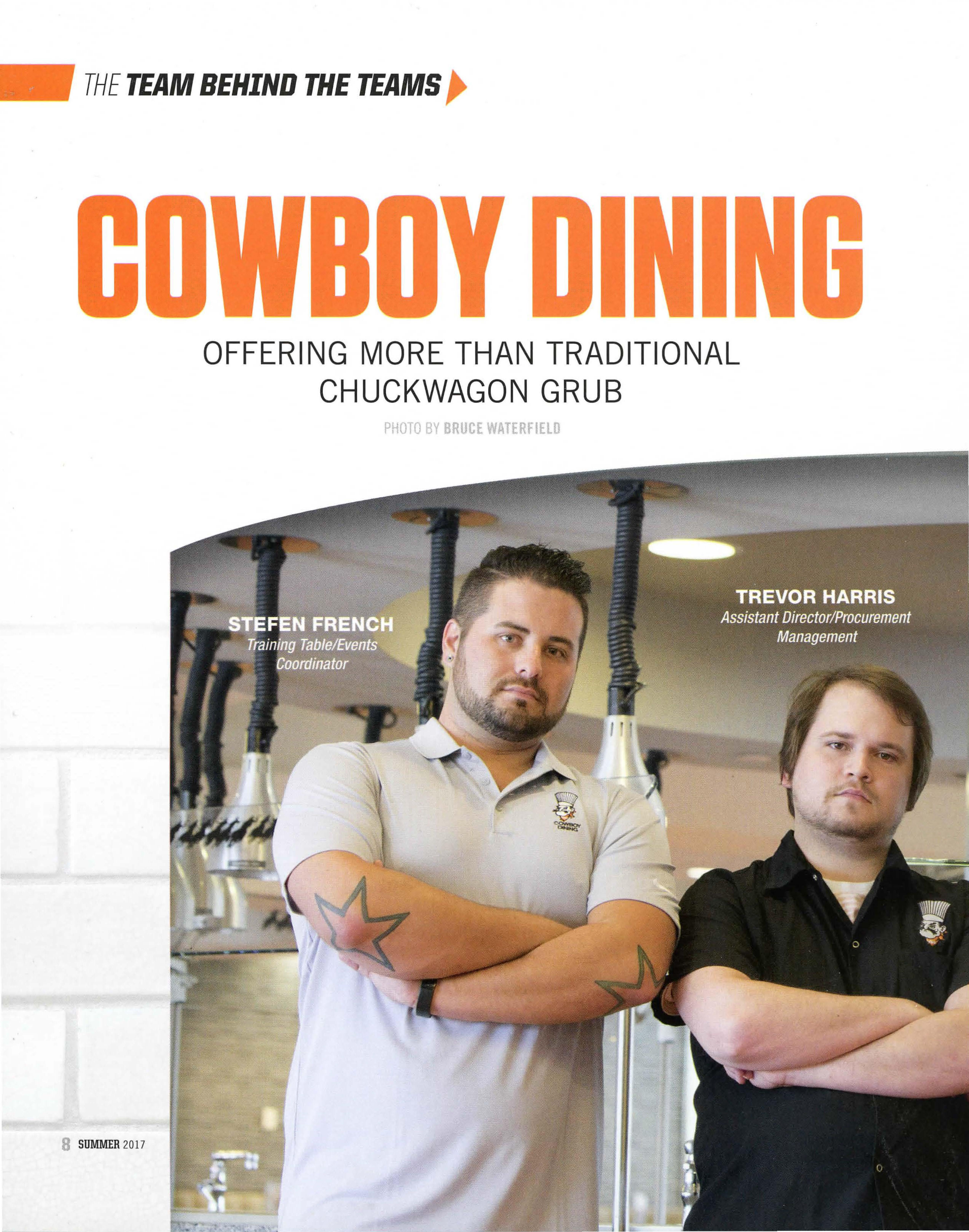
It just might be the one without a public entrance.
Cowboy Dining is headquartered in the west end zone of Boone Pickens Stadium. The staff, which swells dramatically on game days, is busy year-round providing "training table" meals for Oklahoma State's student athletes throughout the calendar year as well as fueling stations for various teams.
Along with training table meals, Cowboy Dining also provides pregame meals for various OSU teams, along with recruiting dinners when requested.
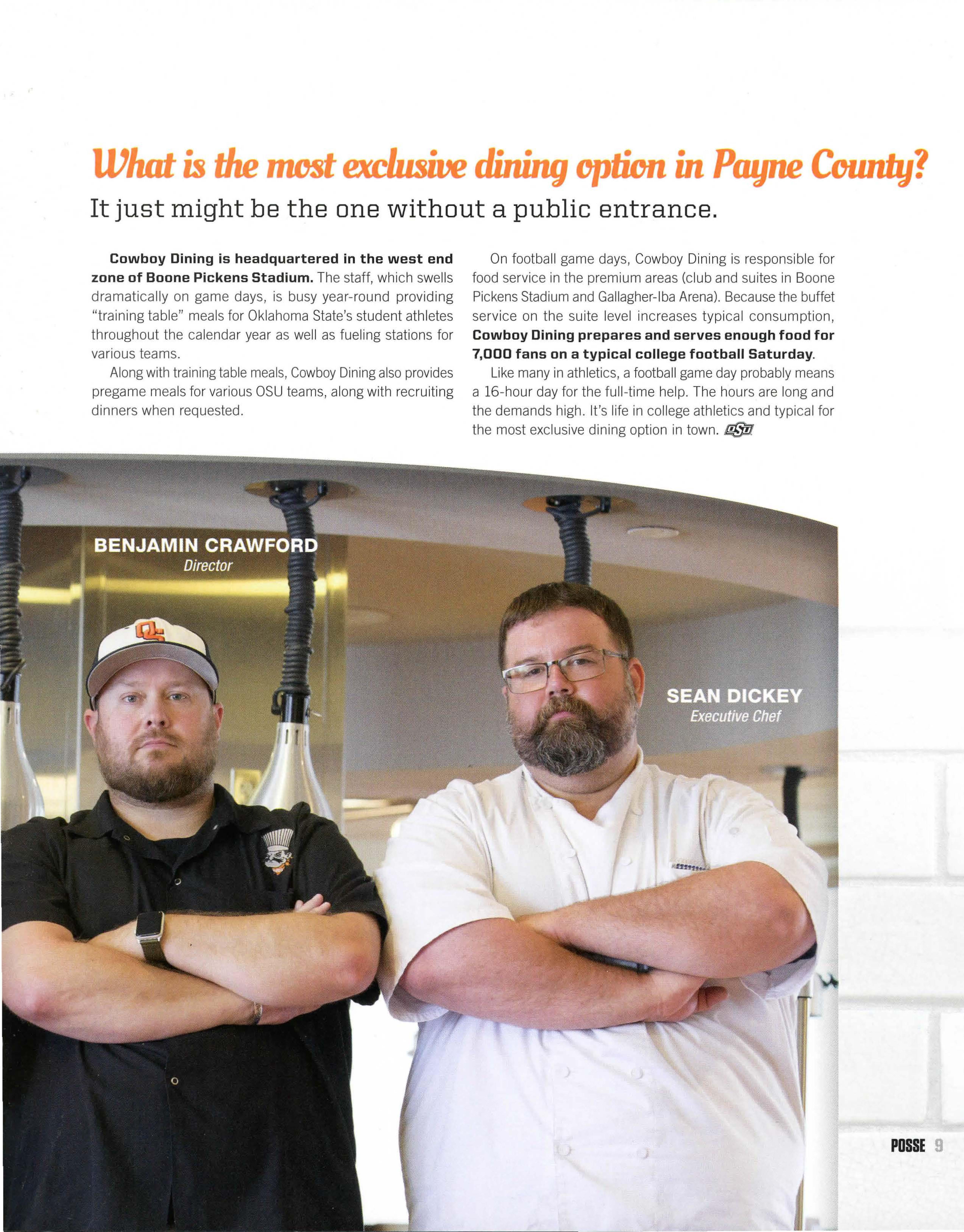
On football game days, Cowboy Dining is responsible for food service in the premium areas (club and suites in Boone Pickens Stadium and Gallagher-Iba Arena). Because the buffet service on the suite level increases typical consumption, Cowboy Dining prepares and serves enough food for 7,000 fans on a typical college football Saturday. Like many in athletics, a football game day probably means a 16-hour day for the full-time help. The hours are long and the demands high. It's life in college athletics and typical for the most exclusive dining option in town. JJ:§il
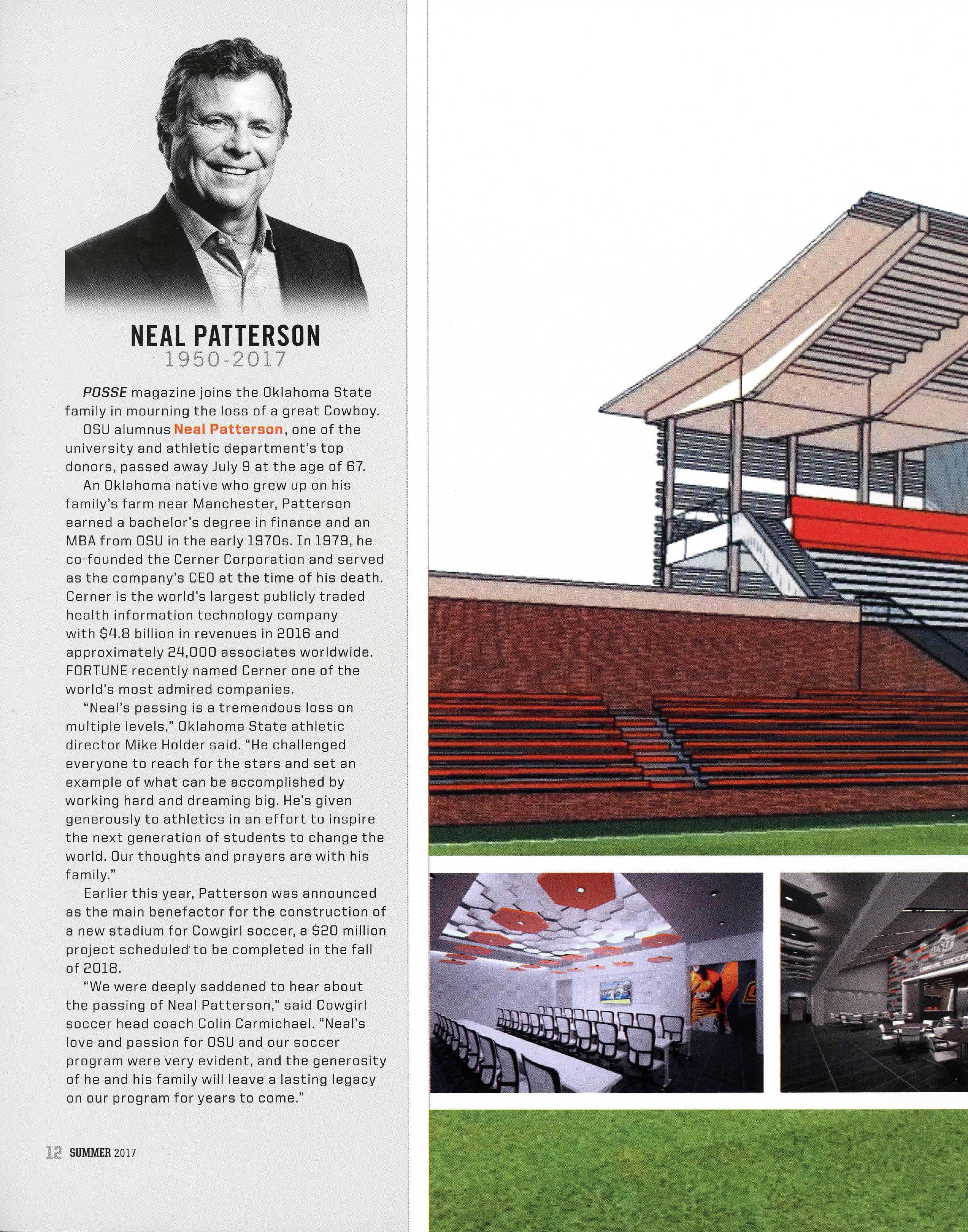
POSSE magazine joins the Oklahoma State family in mourning the loss of a great Cowboy. alumnus Neal Patterson, one of the university and athletic department's top donors, passed away July 9 at the age of 67.
An Oklahoma native who grew up on his family's farm near Manchester, Patterson earned a bachelor's degree in finance and an MBA from in the early 1970s. In 1979, he co-founded the Cerner Corporation and served as the company's CEO at the time of his death. Cerner is the world's largest publicly traded health information technology company with $4.8 billion in revenues in 2016 and approximately 24,000 associates worldwide.
FORTUNE recently named Cerner one of the world's most admired companies.
"Neal's passing is a tremendous loss on multiple levels," Oklahoma State athletic director Mike Holder said. "He challenged everyone to reach for the stars and set an example of what can be accomplished by working hard and dreaming big. He's given generously to athletics in an effort to inspire the next generation of students to change the world. Our thoughts and prayers are with his family."
Earlier this year, Patterson was announced as the main benefactor for the construction of a new stadium for Cowgirl soccer, a $20 million project scheduled·to be completed in the fall of 201B.
"We were deeply saddened to hear about the passing of Neal Patterson," said Cowgirl soccer head coach Colin Carmichael. "Neal's love and passion for and our soccer program were very evident, and the generosity of he and his family will leave a lasting legacy on our program for years to come."
The home of Cowgirl soccer is currently under construction. Set for completion in 2018, the 3,500 seat facility will feature club seats, plaza and upper bowl gathering areas and a north endzone terrace and seating specifically for students.
Team facilities include locker rooms, meeting areas, a kitchen, sports medicine and equipment rooms.


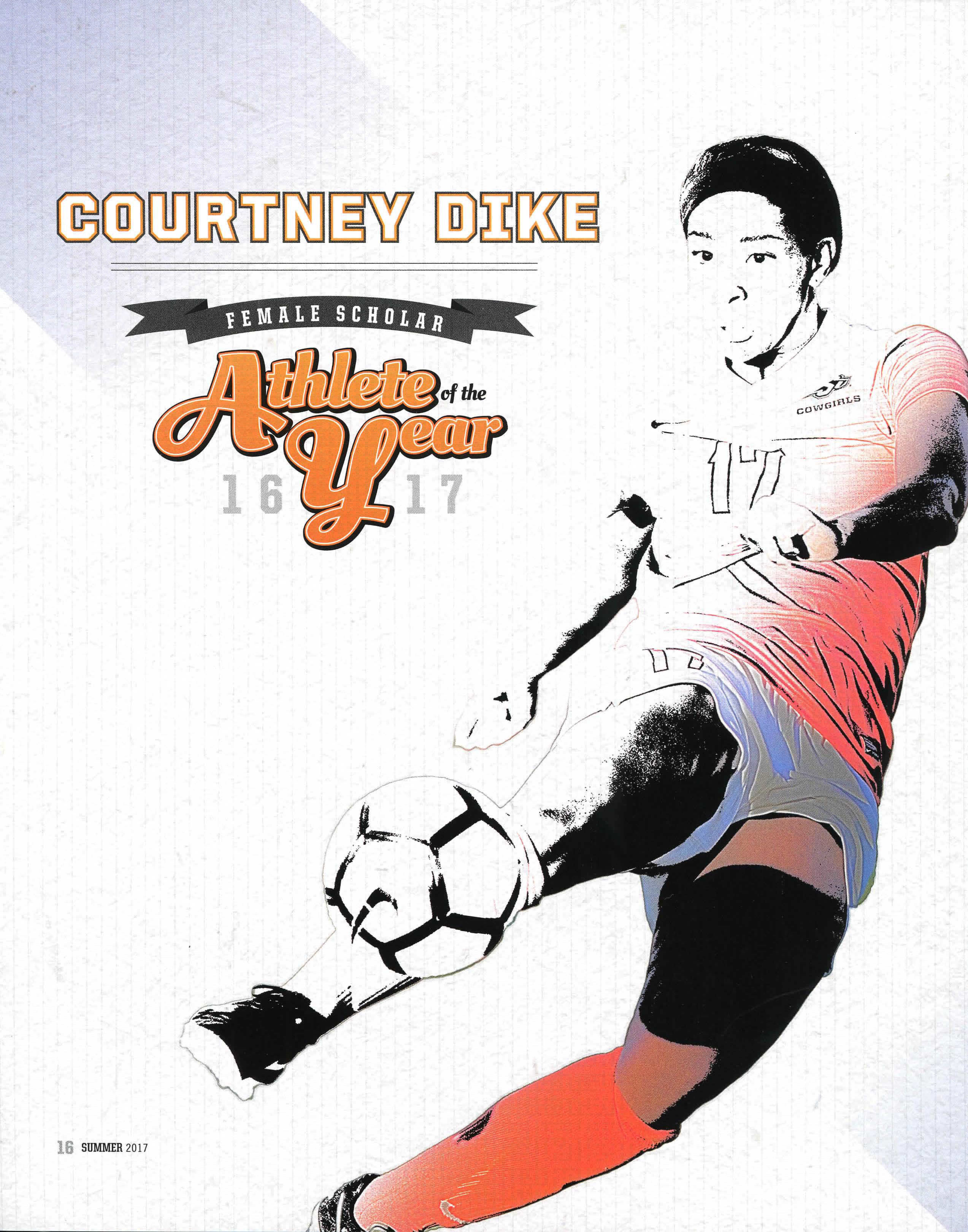
STORYBYWADEMCWHORTER
PHOTOSBYBRUCEWATERFIELD
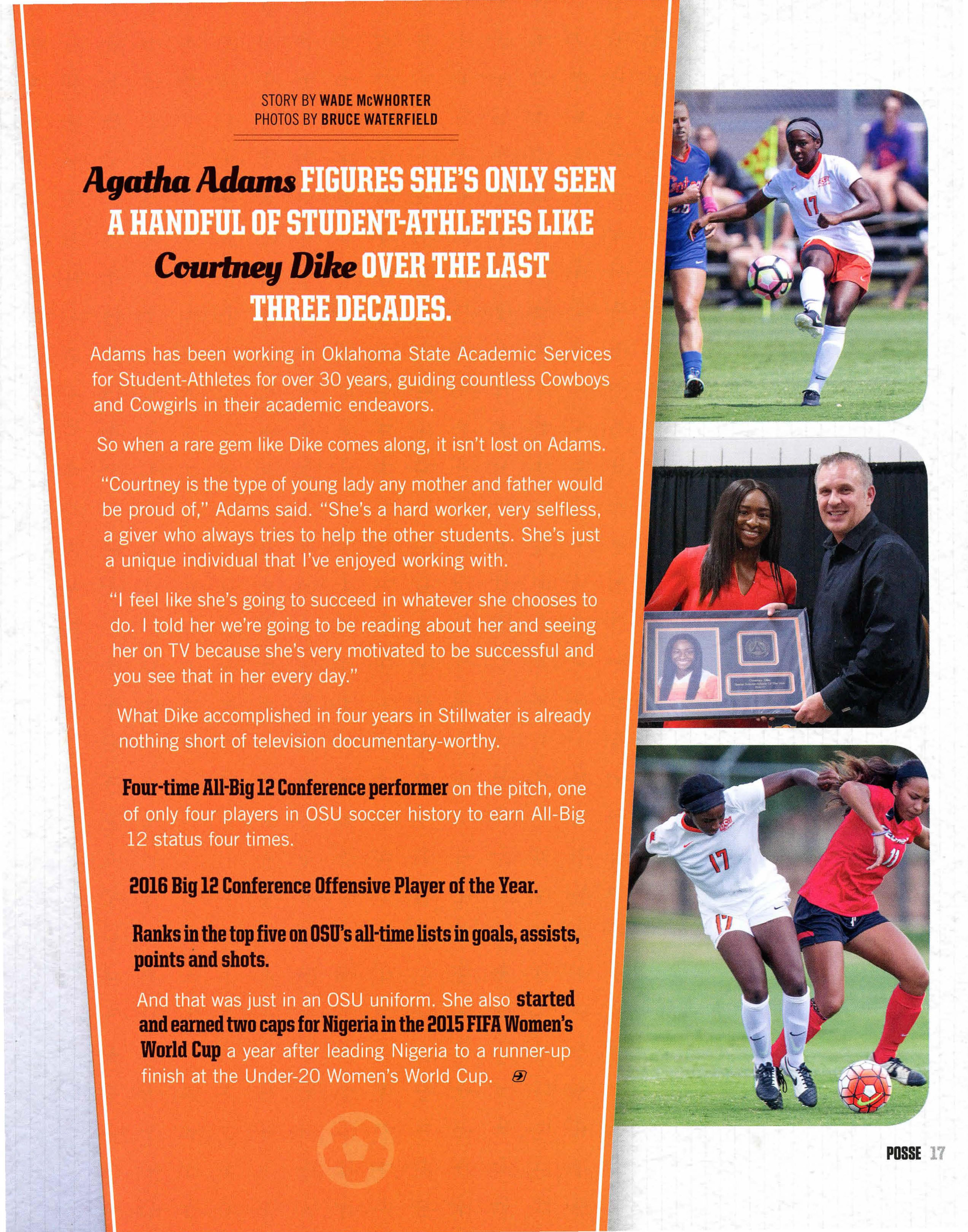
Four-timeAll-Big12Conferenceperformer •
2016Big12ConferenceOffensivePlayerof theYear.
RanksinthetopfiveonOSU'sall-timelistsin goals,assists, pointsandshots. - • • started andearnedtwocapsforNigeriainthe2015FIFAWomen's WorldCup. •
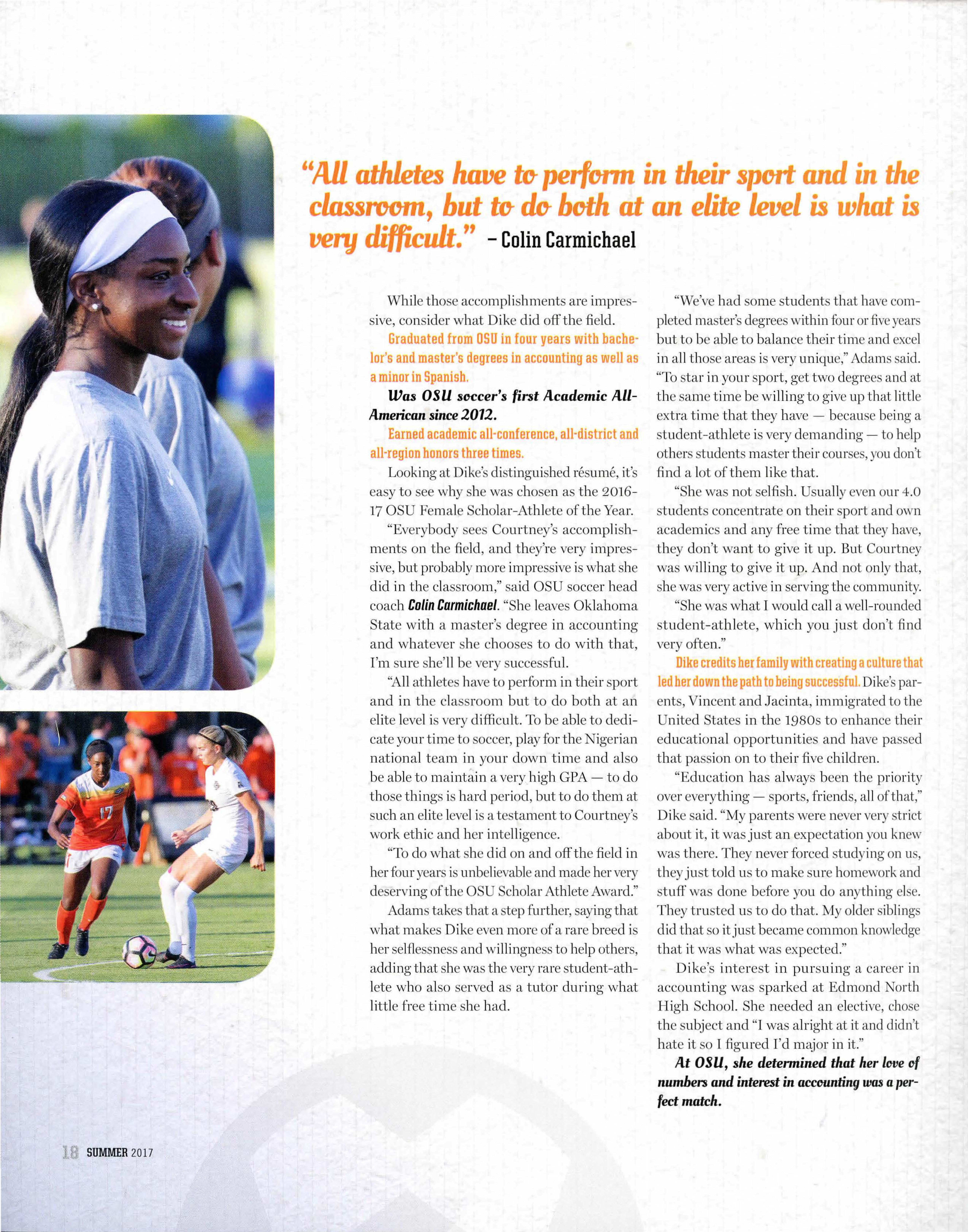
"AUathleteshaveto-performin theirsport andin the chwrocm,but to-de-bothat an elitelevelis whatis very difficult."- ColinCarmichael
While those accomplishments are impressive, consider what Dike did off the field.
GraduatedfromOSUInfouryearswithbache· !or'sandmaster'sdegreesInaccountingaswellas aminorinSpanish.
Was OSU soccer's first Academic AllAmerican since 2012.
Earnedacademicall·conference,all-districtand all-regionhonorsthreetimes.
Looking at Dike's distinguished resume, it's easy to see why she was chosen as the 201617 OSU Female Scholar-Athlete of the Year.
"Everybody sees Courtney's accomplishments on the field, and they're very impressive, but probably more impressive is what she did in the classroom," said OSU soccer head coach ColinCarmichael."She leaves Oklahoma State with a master's degree in accounting and whatever ·he choo es to do with that, I'm sure she'll be very successful.
"All athletes have to perform in their sport and in the classroom but to do both at an elite level is very difficult. To be able to dedicate your ti me to soccer, play for the Nigerian national team in your down time and also be able to maintain a very high GPA - to do those things is hard period, but to do them at such an elite level is a testament to Courtney's work ethic and her intelligence.
"To do what she did on and off the field in her four years is unbelievable and made her very deserving of the OSU Scholar Athlete Award."
Adams take that a tep further, saying that what makes Dike even more of a rare breed is her selflessness and willingness to help others, adding that she was the very rare student-athlete who also served as a tutor during what little free time she had.
"We've had some students that have completed master's degrees within four or fiveyears but to be able to balance their time and excel in all those areas is very unique," Adams said. "To star in your sport, get two degree· and at the same time be willing to give up that little extra time that they have - because being a student-athlete is very demanding - to help others students master their courses, you don't find a lot of them like that.
"She was not selfish. Usually even our 4.0 students concentrate on their sport and own academics and any free time that they have, they don't want to give it up. But Courtney was willing to give it up. And not only that, she was very active in serving the community.
"She was what I would call a well-rounded student-athlete, which you just don't find very often."
Dikecreditsherfamilywithcreating aculturethat ledherdownthepathtobeingsuccessful.Dike's parents, Vincent and Jacinta, immigrated to the United States in the 1980s to enhance their educational opportunities and have passed that passion on to their five children.
"Education has always been the priority over everything- sports, friend , all of that," Dike said. "My parents were never very strict about it, it was just an expectation you knew was there. They never forced studying on us, they just told us to make sure homework and tuff was done before you do anything el e. They tru ted us to do that. My older siblings did that so it just became common knowledge that it was what was expected."
Dike's interest in pursuing a career in accounting was sparked at Edmond North High School. She needed an elective, chose the subject and "I was alright at it and didn't hate it so I figured I'd major in it."
At OSU, she determined that her love of numbers and interest in accounting wasa perfect match.
"I've always enjoyed learning in general, learning new things and improving on things is something I've worked at," Dike said. "I've been interested in a lot of the things I've studied so part of it is being curious about certain things.
"Accounting is something that is probably the only thing I was interested in. I've always been a numbers person so math was my thing. Everyone else in my family has gone into medici11e,which I have zero interest for."
Dike credits one of those family members, her sister, Kim, as being heavily influential to her success in Stillwater.
"I had a plan from the beginning," Dike said. "(Kim) helped me - she literally helped me map out every semester of what classes I wanted to take. 1 had a plan of taking the CPA exam from the moment I got to campus so I wanted to make sure I did everything while I was playing and get as much out of it as I coukl.
"It was hard at first. College is different so managing time was difficult. But once I really got focused on it, it wasn't too hard for me. I made a lot of great friends with the same major who helped when I was struggling with certain things, great teachers as well who were willing to fill me in on certain things I missed when I was traveling a lot.
"l just had a goal, and I was set on it the whole time. I wanted to make sure I did well and make the best of the opportunity that was given to me. It was difficult at timesstaying up all night studying, then working out in the morning before taking a testjust not having time for anything. But at the end of the day, it was al I worth it. I got a great education and a great soccer experience out of it. I couldn't have imagined a better situation and a better experience, even though it was extremely difficult."
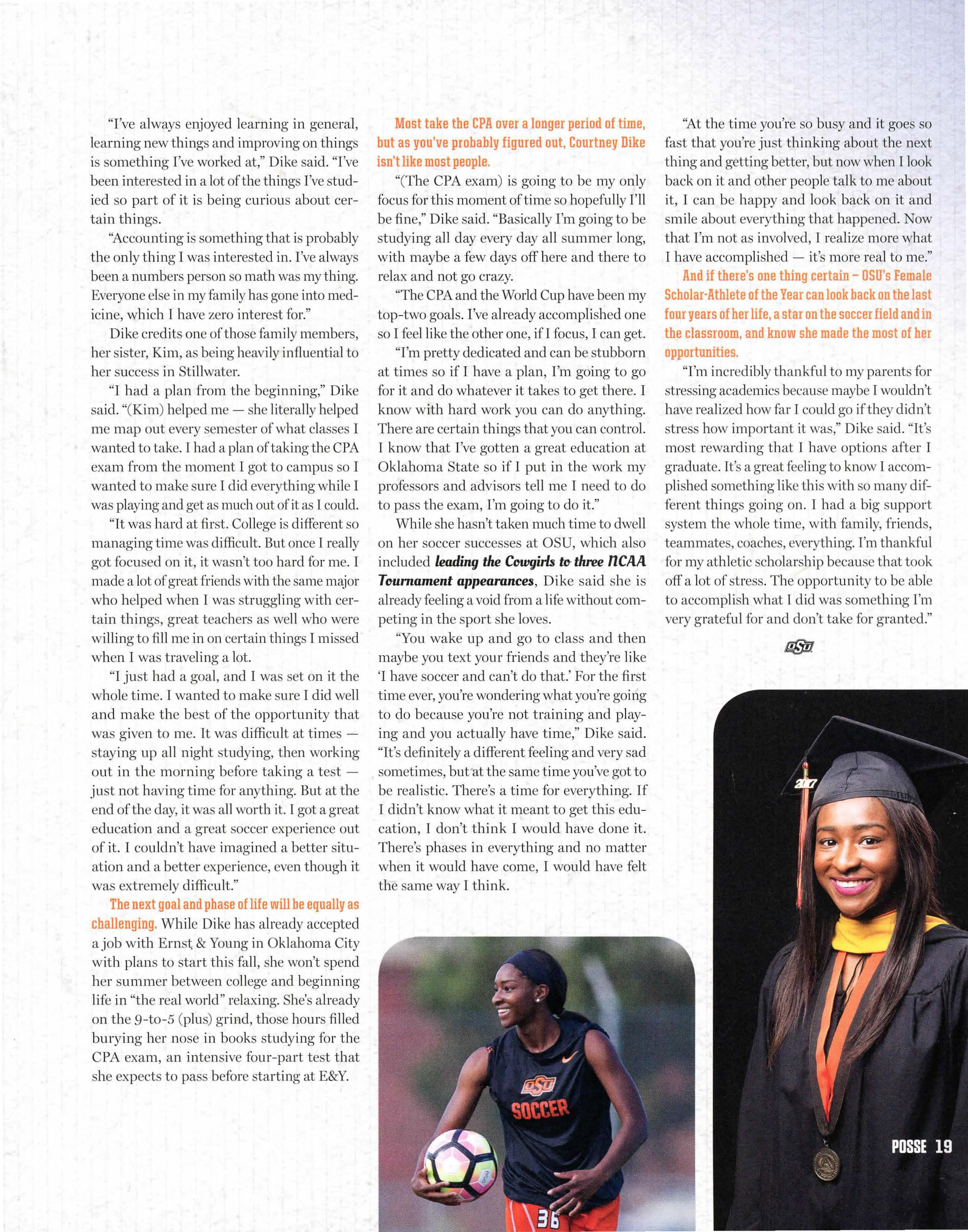
Thenextgoalandphaseoflifewillbeequallyas challenging.While Dike has already accepted a job with Erns~ & Young in Oklahoma City with plans to start this fall, she won't spend her summer between college and beginning life in "the real world" relaxing. She's already on the 9-to-5 (plus) grind, those hours filled burying her nose in books studying for the CPA exam, an intensive four-part test that she expects to pass before starting at E&Y.
MosttaketheCPAovera longerperiodoftime, butas you'veprobablyfiguredout,CourtneyDike isn'tlikemostpeople.
"(The CPA exam) is going to be my only focus for this moment of time so hopefully I'll be fine," Dike said. "Basically I'm going to be studying all day every day all summer long, with maybe a few days off here and there to relax and not go crazy.
"The CPAand the World Cup have been my top-two goals. I've already accomplished one so I feel Iike the other one, if I focus, I can get.
'Tm pretty dedicated and can be stubborn at times so if I have a plan, I'm going to go for it and do whatever it takes to get there. I know with hard work you can do anything. There are certain things that you can control.
I know that I've gotten a great education at Oklahoma State so if I put in the work my professors and advisors tell me I need to do to pass the exam, I'm going to do it."
While she hasn't taken much time to dwell on her soccer successes at OSU, which also included leading the Cowgirls to-threenCAA Tournament appearances, Dike said she is already feeling a void from a life without competing in the sport she loves.
"You wake up and go to class and then maybe you text your friends and they're like 'I have soccer and can't do that.' For the first time ever, you're wondering what you're going to do because you're not training and playing and you actually have time," Dike said. "It's definitely a different feeling and very sad sorneti mes, but'at the same ti me you've got to be realistic. There's a time for everything. If I didn't know what it meant to get this education, I don't think I would have done it. There's phases in everything and no matter when it would have come, I would have felt the same way I think.
"At the time you're so busy and it goes so fast that you're just thinking about the next thing and getting better, but now when I look back on it and other people talk to me about it, I can be happy and look back on it and smile about everything that happened. Now that I'm not as involved, I realize more what I have accomplished - it's more real to me."
Andif there'sonethingcertain - OSU'sFemale Scholar-AthleteoftheYearcanlookbackonthelast fouryearsofherlife,a staronthesoccerfieldandin theclassroom,andknowshemadethemostofher opportunities.
'Tm incredibly thankful to my parents for stressing academics because rnaybe [ wouldn't have realized how far I could go if they didn't stress how important it was," Dike said. "It's most rewarding that I have options after I graduate. It's a great feeling to know I accomplished something like this with so many different things going on. I had a big support system the whole time, with family, friends, teammates, coaches, everything. I'm thankful for my athletic scholarship because that took off a lot of stress. The opportunity to be able to accomplish what I did was something I'm very grateful for and don't take for granted."
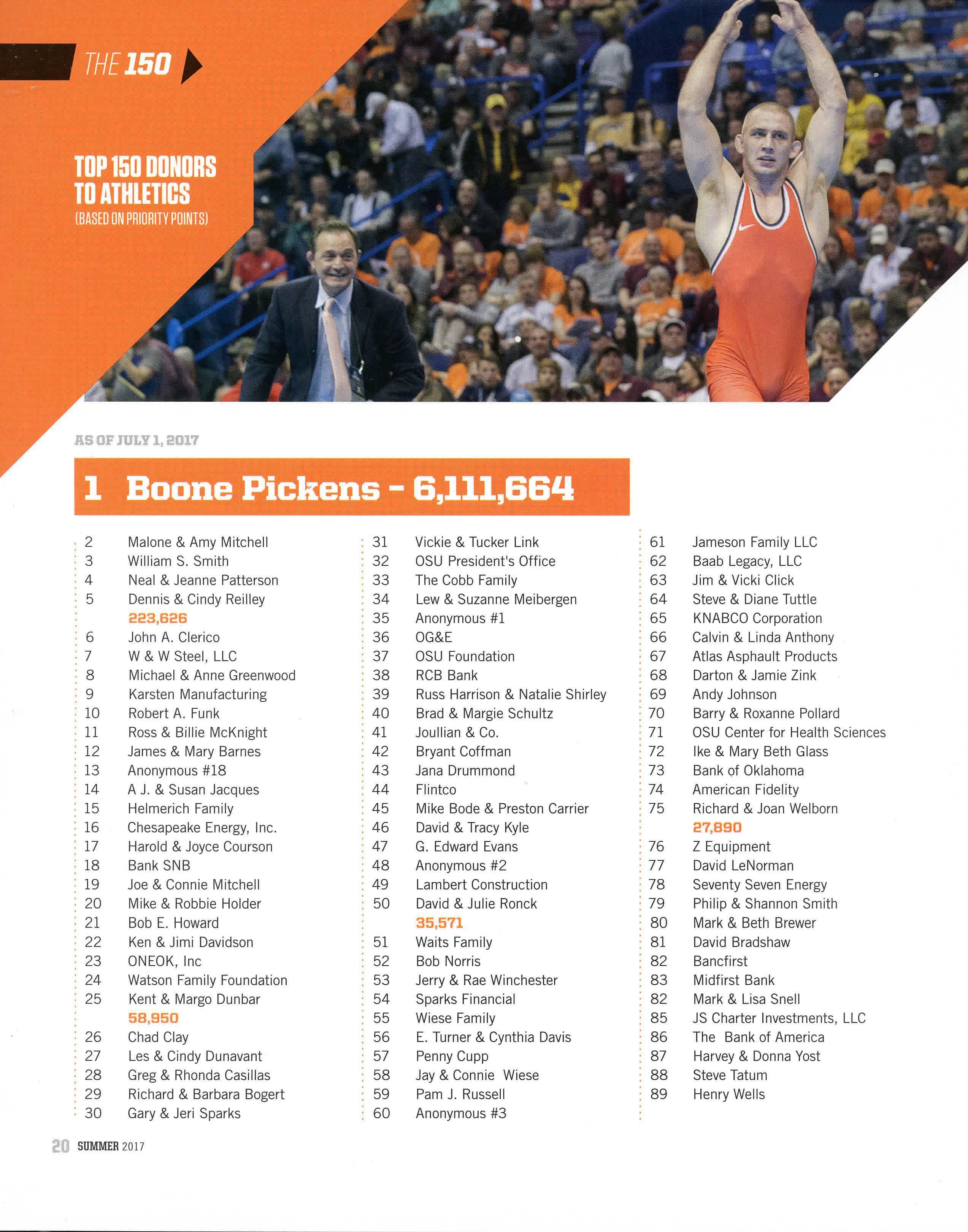
The Oklahoman A-Cross Ranch
Johnson's of Kingfisher
Bill & Claudean
Brent & Mary Jane
Scott & Kim
Barber-Dyson
Russ
Drummond
Terry &
Stan & Shannon
Ameristar
Bob & Mary Haiges
Shaw's Gulf
Vionette & John Dunn
AEI Corportation - Oklahoma
Mike & Judy Johnson
Larry Bump
Jack Bowker Ford - Lincoln
Bill & Marsha Barnes
John & Gail Shaw
Mustang Fuel
Chandler USA, Inc.
Karen Gallagher & Bob McCracken
Robert & Sharon Keating
Fred & Kellie Harlan
Bill & Karen Anderson
Jay & Fayenelle Helm
Anonymous #14
Crossland Construction
Jon H. Wilson
Brad & Leah Gungoll
16,500
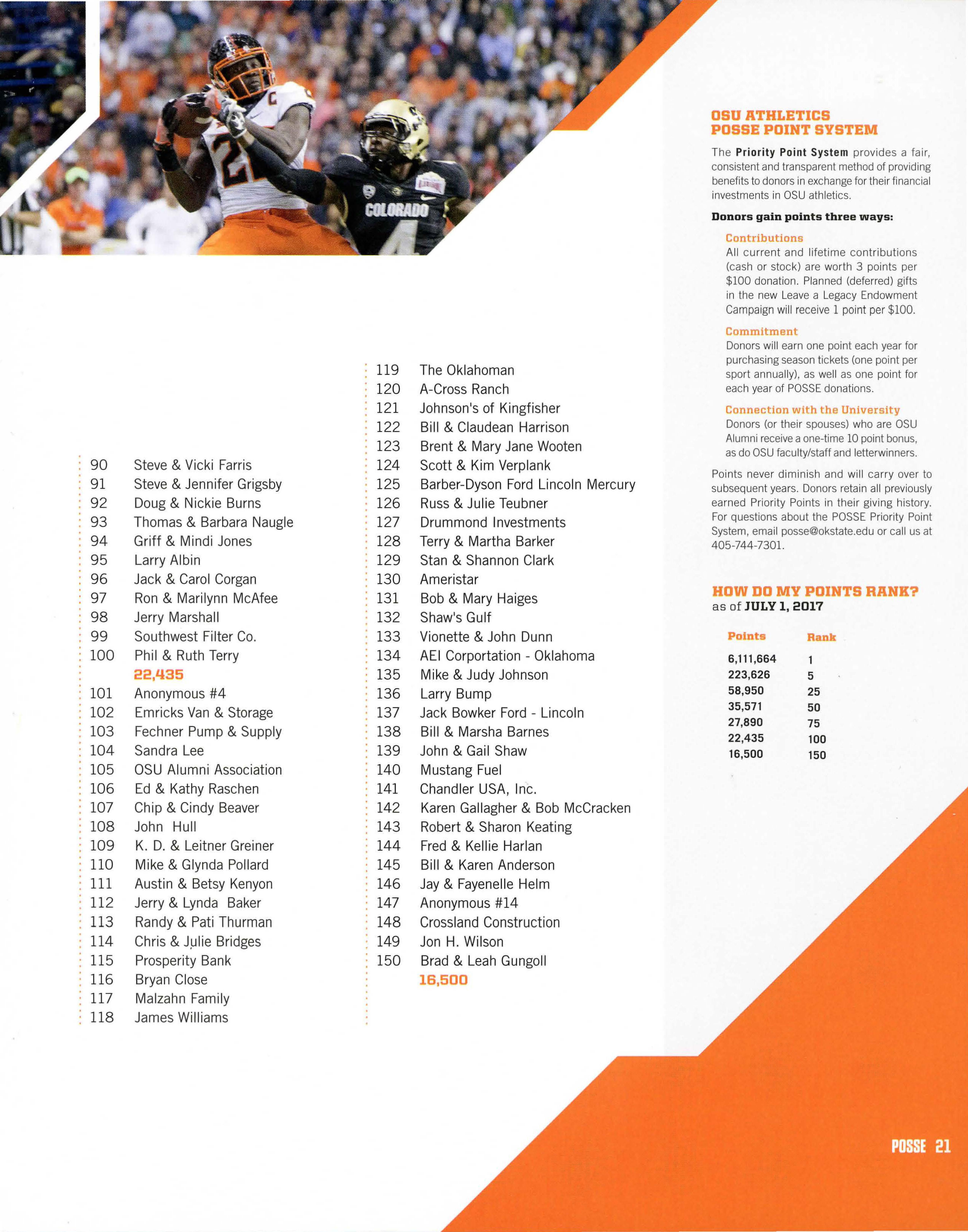
The Priority Point System provides a fair, consistent and transparent method of providing benefits to donors in exchange for their financial investments in OSU athletics.
Donors gain points three ways:
Contributions
All current and lifetime contributions (cash or stock) are worth 3 points per $100 donation. Planned (deferred) gifts in the new Leave a Legacy Endowment Campaign will receive 1 point per $100.
Donors will earn one point each year for purchasing season tickets (one point per sport annually), as well as one point for each year of POSSE donations.
Connection with the University Donors (or their spouses) who are OSU Alumni receive a one-time 10 point bonus, as do OSU faculty/staff and letterwinners.
Points never diminish and will carry over to subsequent years. Donors retain all previously earned Priority Points in their giving history. For questions about the POSSE Priority Point System, email posse@okstate.edu or call us at 405-744-7301.
HOW DD MY POINTS RANK? as of JULY 1, 2017
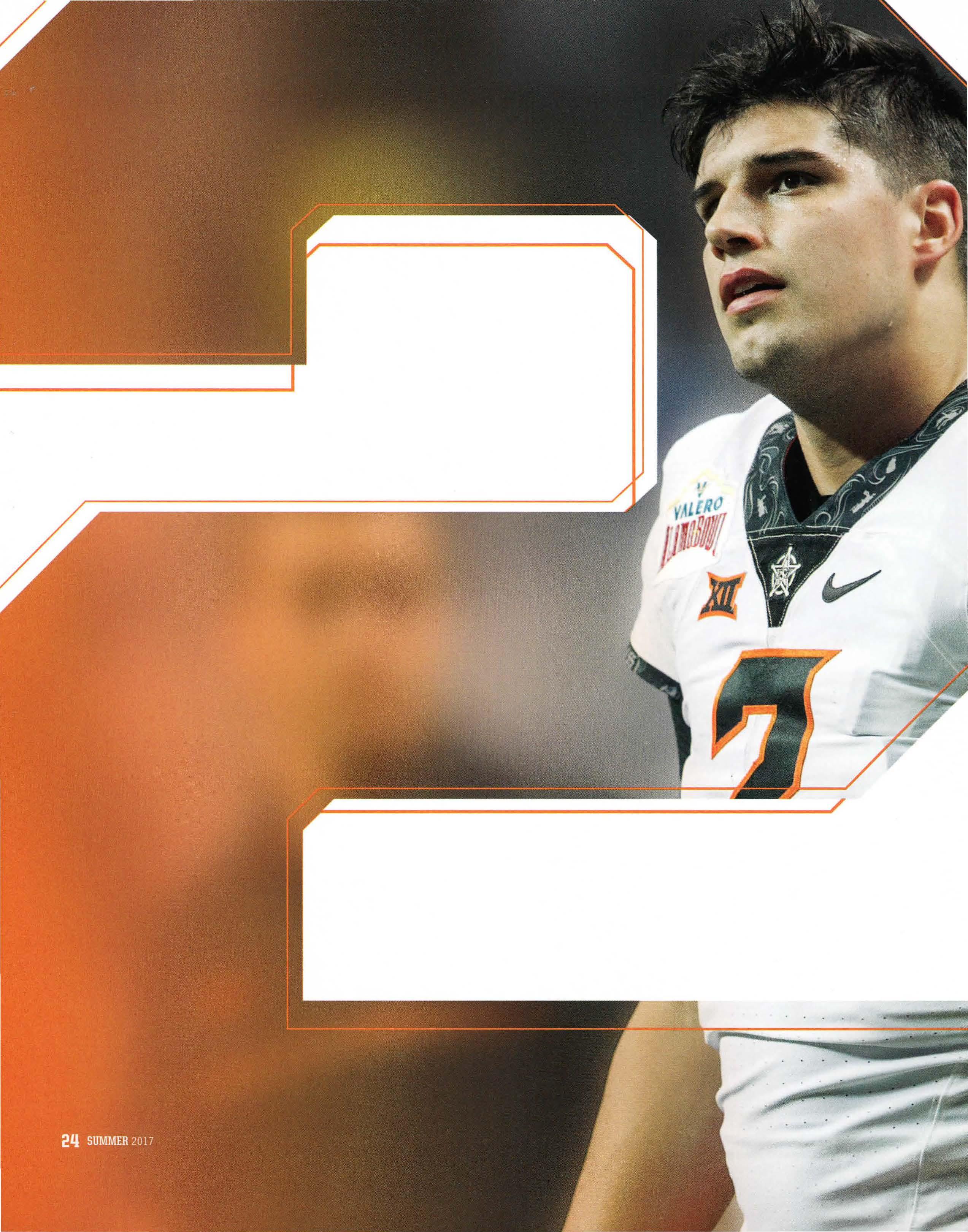
STORYBYJOHNHELSLEYPHOTOSBYBRUCEWATERFIELD
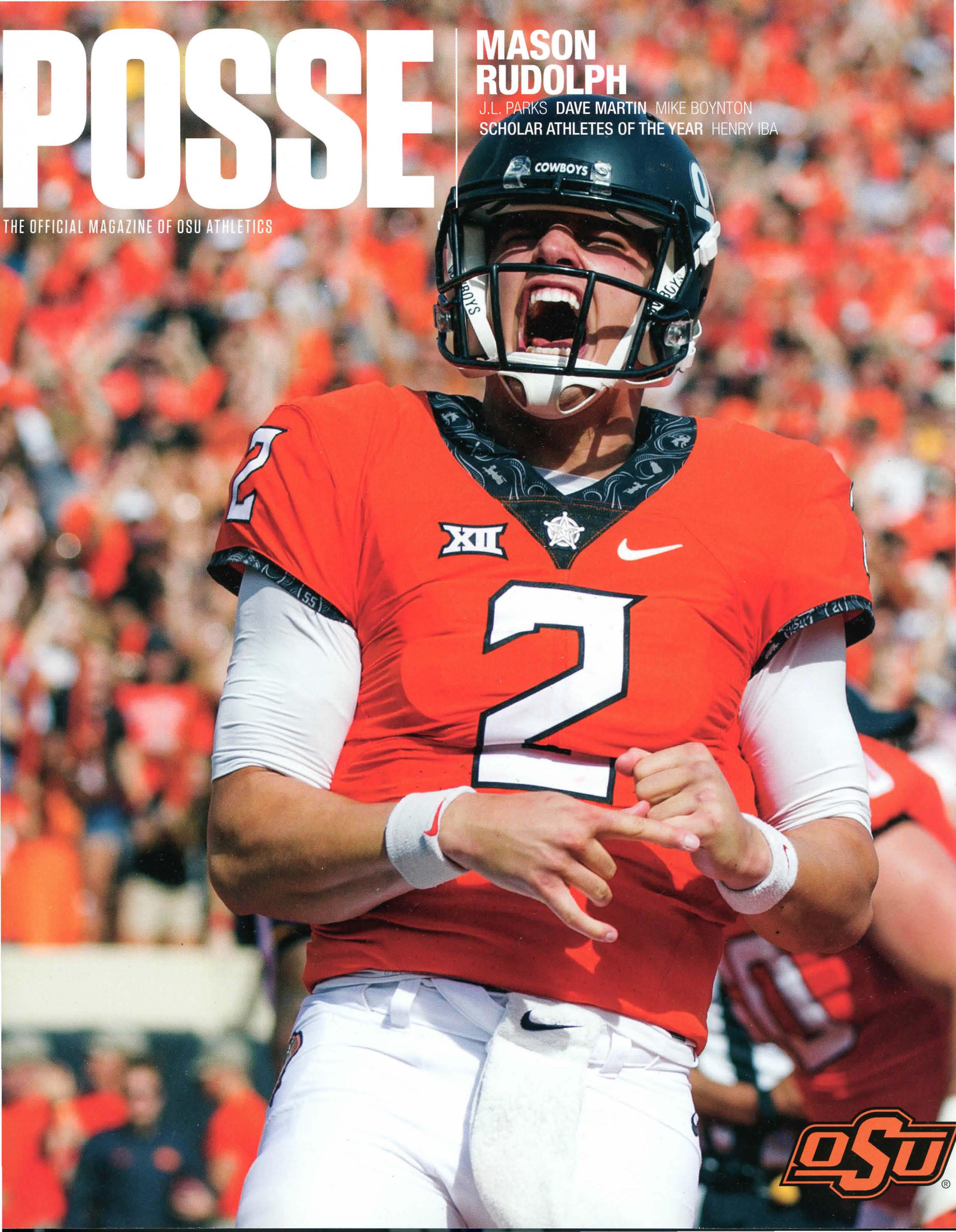
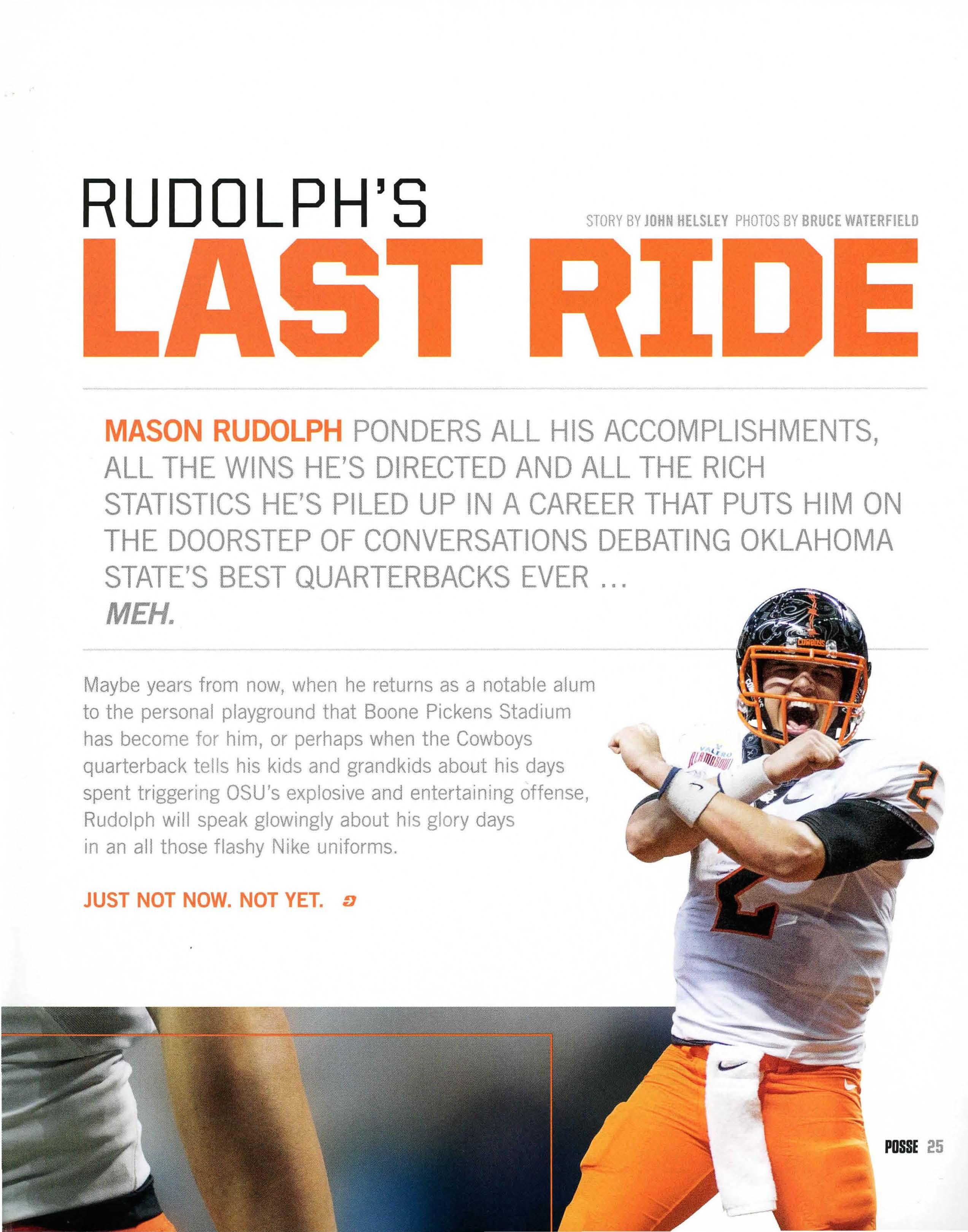
MASONRUDOLPHPONDERSALL HIS ACCOMPLISHMENTS, ALL THE WINS HE'S DIRECTEDAND ALL THE RICH STATISTICSHE'S PILEDUP IN A CAREERTHAT PUTS HIM ON THE DOORSTEPOF CONVERSATIONSDEBATINGOKLAHOMA STATE'SBESTQUARTERBACKSEVER... MEH.
Maybe years from now, when he returns as a notable alum to the personal playground that Boone Pickens Stadium has become for him, or perhaps when the Cowboys quarterback tells his kids and grandkids about his days spent triggering OSU's explosive and entertaining offense, Rudolph will speak glowingly about his glory days in an all those flashy Nike uniforms.
JUSTNOTNOW.NOTYET. :,
"So to leave a legacy and do all the things I want to do here, it's going to take a Big 12 title."
Mason Rudolph
That's not his takeaway, even if the resume looks really good to this point.
"We'vefallen short of the Big 12 championship the last two years, and that's what sticks out to me the most," Rudolph said in advance of his senior season. 'Tm not OK with losing. I want to be a champion. I've got all those competitive genes in me.
"So to leave a legacy and do al 1the things I want to do here, it's going to take a Big l 2 title."
NomoreMr.NiceGuy?
Not hardly. It's just that Rudolph can and does manage his alter ego masterfully.
"Mason's got an edge to him," said OSU offensive coordinator MikeYurcich."It's not like he's real nice on the football field. He's a true competitor and plays through pain, plays through injury, as we've seen. And yet, the biggest thing is he's just a really nice person."
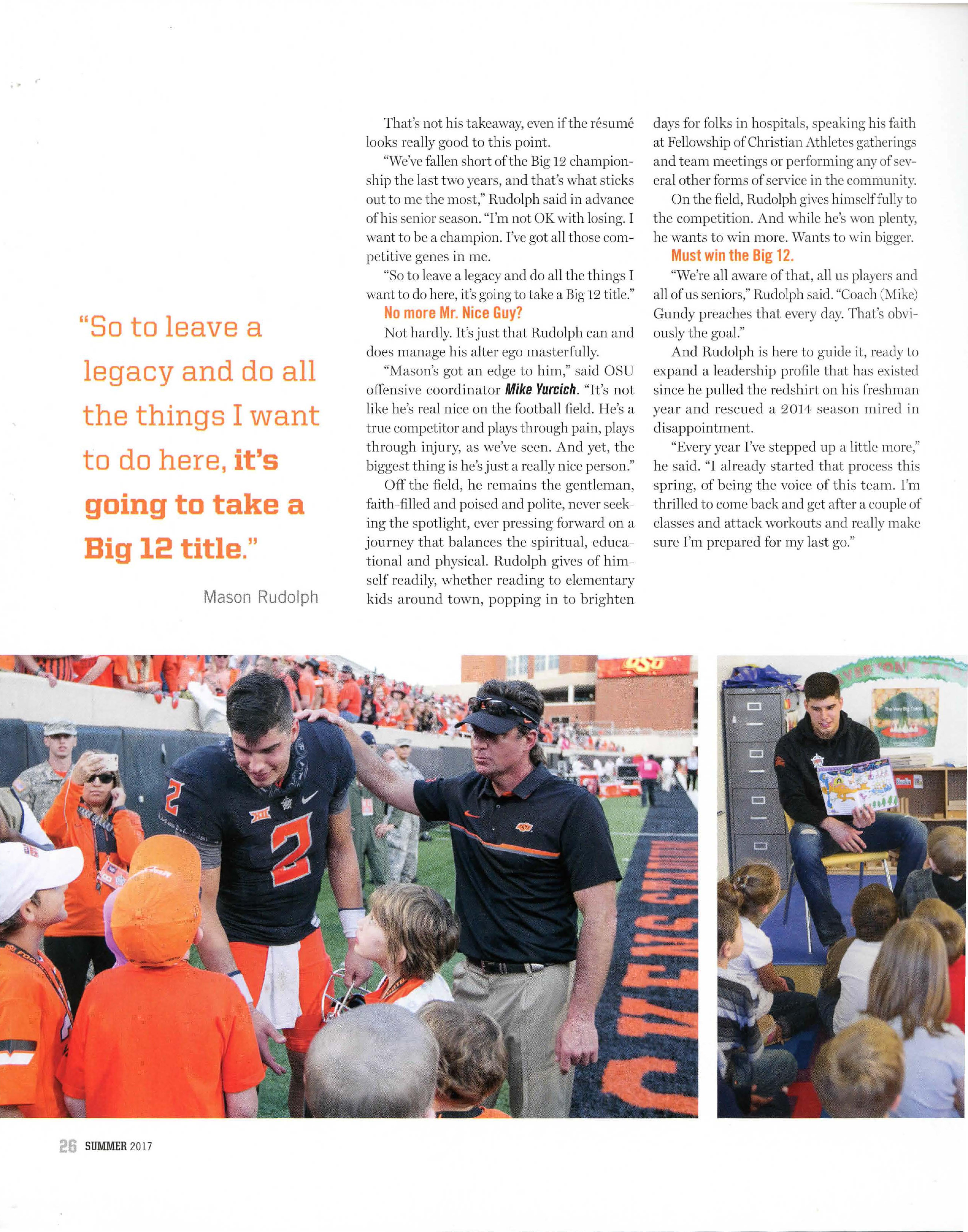
Off the field, he remains the gentleman, faith-filled and poised and polite, never seeking the spotlight, ever pressing forward on a journey that balances the spiritual, educational and physical. Rudolph gives of himself readily, whether reading to elementary kids around town, popping in to brighten
days for folks in hospitals, speaking his faith at Fellowship of Christian Athletes gatherings and team rneeti ngs or performing any of several other forms of service in the community.
On the field, Rudolph gives himself fully to the competition. And while he's won plenty, he wants to win more. Wants to win bigger.
MustwintheBig12.
"We're all aware of that, all us players and all of us seniors," Rudolph said. "Coach (Mike) Gundy preaches that every day. That's obviously the goal."
And Rudolph is here to guide it, ready to expand a leadership profile that has existed since he pulled the redshirt on his freshman year and rescued a 2014 season mired in disappointment.
"Every year I've stepped up a little more," he said. "I already started that process this spring, of being the voice of this team. I'm thrilled to come back and get after a couple of classes and attack workouts and really make sure I'm prepared for my last go."
So Rudolph won't linger long on his body of work up to now.
Wei I, for the rest of the college football world, it simply can't go ignored. ln fact, his impressive stack of numbers, along with a trong track record of winning, set Rudolph up as a legitimate Heisman Trophy candidate this fall.
OSU c:laims but one Heisman winner in a football history that elates back to 1901: BarrySanders.And while there have been other Cowboys occasionally in the discussion, including a runner-up finish for Terry Miller in 1977 (Earl Campbel I of Texas was the winner), perhaps none projected in the chase for the coveted award as strongly as Rudolph.
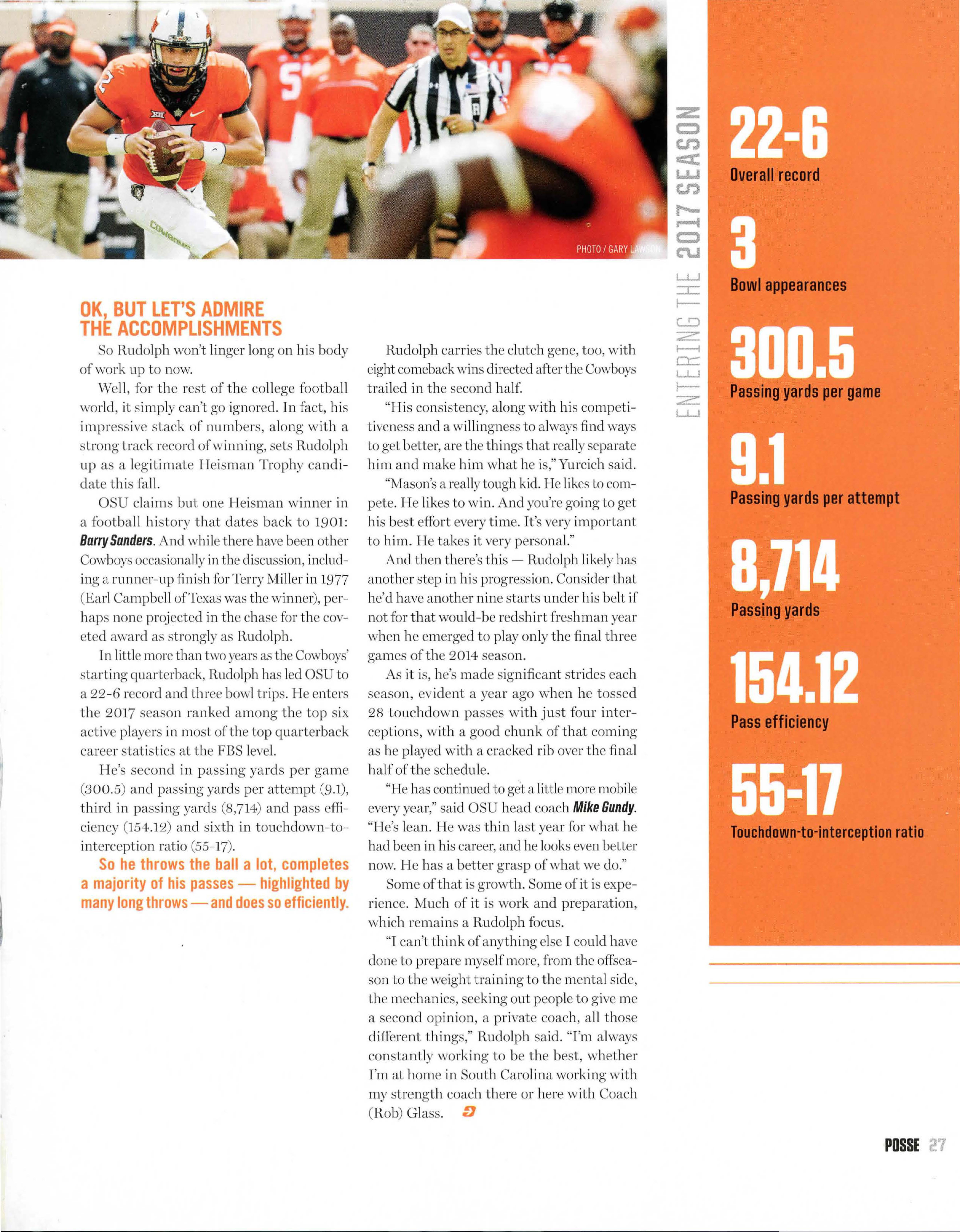
In Iittle more than two years as the Cowboys' tarting quarterback, Rudolph has led OSU to a 22-6 record and three bowl trips. He enters the 2017 season ran keel among the top six active players in most of the top quarterback career stati tics at the FBS level.
He's second in passing yards per game (300.5) and passing yards per attempt (9.1), third in passing yards (8,714) and pass efficiency (154.12) and sixth in touchclown-tointerception ratio (55-17).
Sohe throwsthe balla lot, completes a majorityof hispasses - highlightedby manylongthrows - anddoessoefficiently.
Rudolph carries the clutch gene, too, with eight comeback wins directed after the Cowboys trailed in the second half.
"His consistency, along with his competitiveness and a willingne. s to always find ways to get better, are the things that really separate him and make him what he is," Yurcich said.
" lason's a really tough kid. He likes to compete. He likes to win. And you're going to get his best effort every time. It's very important to him. I-le takes it very personal."
And then there' this - Rudolph likely has another step in his progression. Consider that he'd have another nine starts under hi belt if not for that would-be reclshirt freshman year when he emerged to play only the final three games of the 2014 eason.
As it is, he's made significant strides each season, evident a year ago when he tossed 28 touchdown passe with just four interceptions, with a good chunk of that coming as he played with a cracked rib over the final half of the schedule.
"He has continued to get a little more mobile every year," said OSU head coach MikeGundy. "He's lean. He was thin last year for what he had been in his career, and he looks even better now. He has a better grasp of what we do."
Some of that is growth. Some of it is experience. Much of it is work and preparation, which remains a Rudolph focus.
"I can't think of anything else I could have done to prepar myself more, from the offseason to the weight training to the mental side, the mechanics, seeking out people to give me a second opinion, a private coach, all those different things," Rudolph said. 'Tm always constantly working to be the best, whether I'm at home in South Carolina working with my strength coach there or here with Coach (Rob) Glass. D
"You always have that doubt of, 'Should I have done more?' I think I've neutralized that doubt because when 1 go into a game I think, 'I've studied my butt off this week on the opponent. I've watched the amount of fiIm I needed. I've worked with my wide receivers and offensive Iine, and I feel confident.'
"That's the way I am. I'm going to do it 100 percent or I'm not going to do it at all."
Yurcich keeps challenging Rudolph, too, regularly giving him more to do and see in an attempt to tap into any available potential.
"This past spring, I just kind of gave him the remote and told him a few ti mes to run the quarterback meeting,"Yurcich said. "I wanted to hear how be would coach the younger guys. Whatarethethingsgoingthrough his brain?
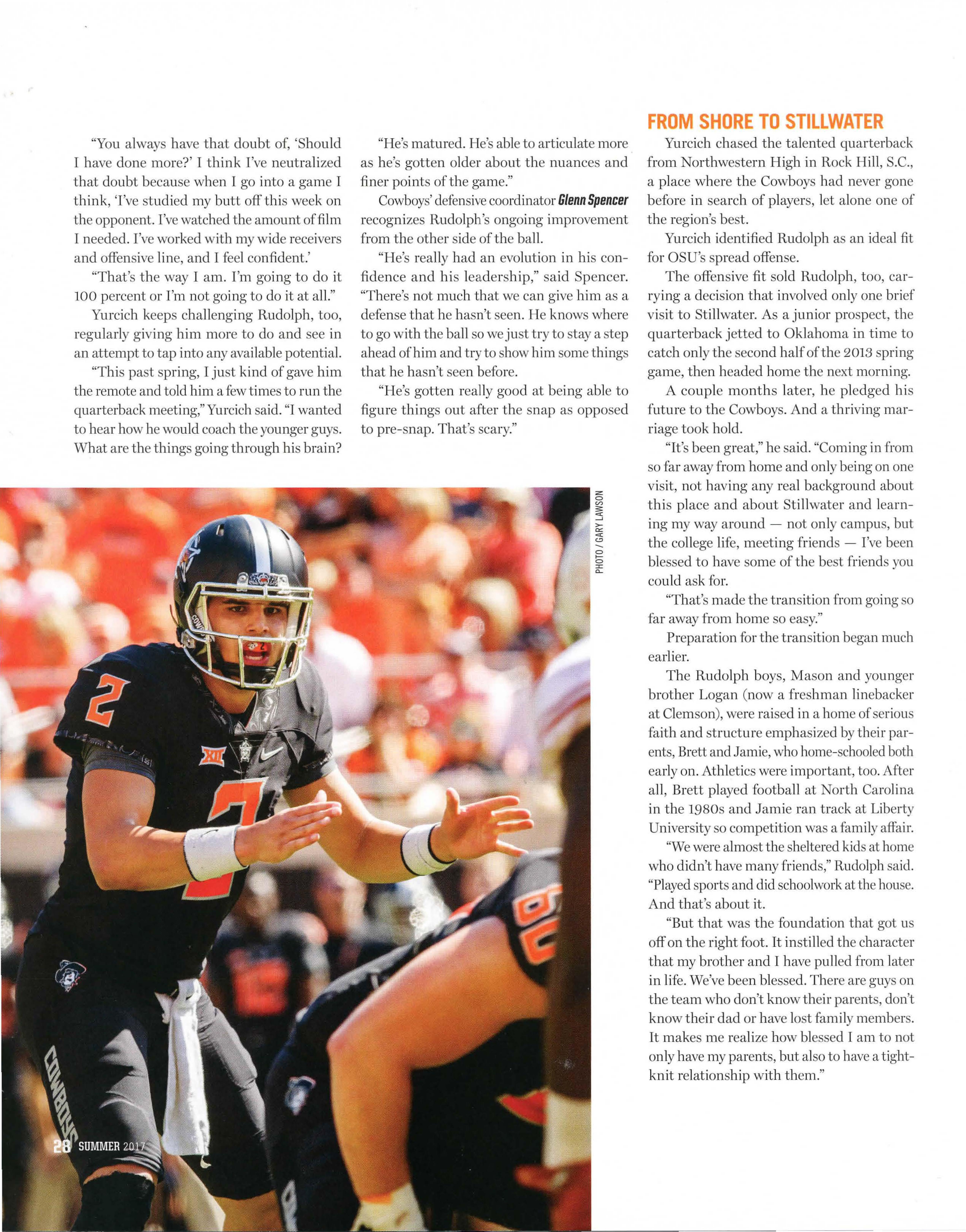
"He's matured. He's able to articulate more as he's gotten older about the nuances and finer points of the game."
Cowboys'defensivecoordinator GlennSpencer recognizes Rudolph's ongoing improvement from the other side of the ball.
"He's really had an evolution in his confidence and his leadership," said Spencer. "There's not much that we can give hirn as a defense that he hasn't seen. He knows where to go with the ball so we just try to stay a step ahead of him and try to show him somethings that he hasn't seen before.
"He's gotten really good at being able to figure things out after the snap as opposed to pre-snap. That's scary."
Yurcich chased the talented quarterback from Northwestern High in Rock Hill, S.C., a place where the Cowboys had never gone before in search of players, let alone one of the region's best.
Yurcich identified Rudolph as an ideal fit for OSU's spread offense.
The offensive fit sold Rudolph, too, carrying a decision that involved only one brief visit to Stillwater. As a junior prospect, the quarterback jetted to Oklahoma in time to catch only the second half of the 2013 spring game, then headed home the next morning.
A couple months later, he pledged his future to the Cowboys. And a thriving marriage took hold.
"It's been great," he said. "Coming in from so far away from home and only being on one visit, not having any real background about this place and about Stillwater and learning my way around - not only campus, but the college life, meeting friends - I've been blessed to have some of the best friends you could ask for.
"That's made the transition from going so far away from home so easy."
Preparation for the transition began much earlier.
The Rudolph boys, Mason and younger brother Logan (now a freshman linebacker at Clemson), were raised in a home of serious faith and structure emphasized by their parents, Brett and Jamie, who home-schooledboth early on. Athletics were important, too. After all, Brett played football at North Carolina in the 1980s and Jamie ran track at Liberty University so competition was a family affair.
"We were al most the sheltered kids at home who didn't have many friends," Rudolph said. "Playedsports and did schoolworkat the house. And that's about it.
"But that was the foundation that got us off on the right foot. It instilled the character that my brother and I have pulled from later in life. We've been blessed. There are guys on the team who don't know their parents, don't know their dad or have lost family members. It makes me realize how blessed l am to not only have my parents, but also to have a tightkn it relationship with them."
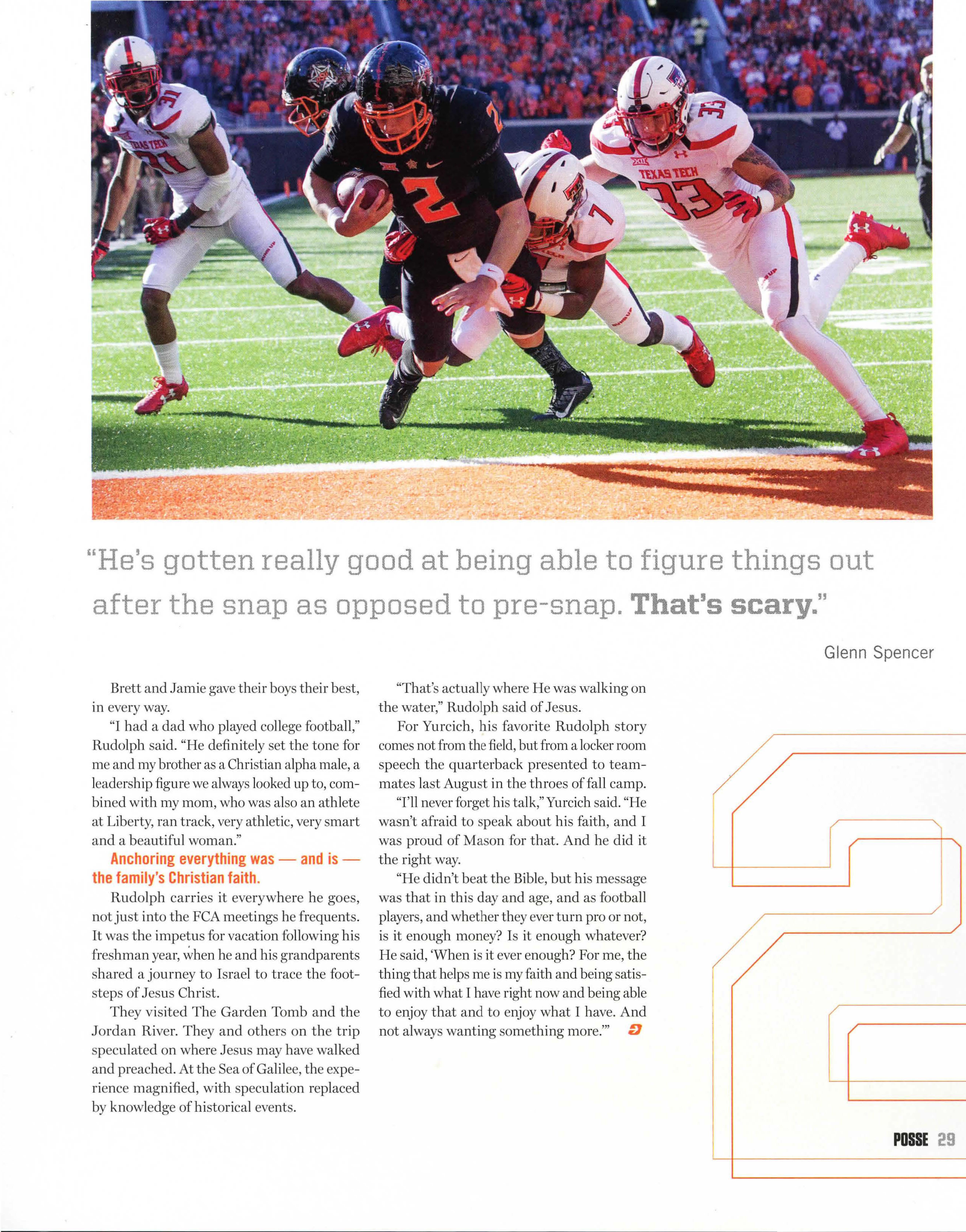
"He's gotten really good at being able to figure things out after the snap as opposed to pre-snap. That's scary."
Glenn Spencer
Brett and Jamie gave their boys their best, in every way.
"I had a dad who played college football," Rudolph said. "He definitely set the tone for me and my brother as a Christian alpha male, a leadership figure we always looked up to, combined with my morn, who was also an athlete at Liberty, ran track, very athletic, very smart and a beautiful woman."
Anchoringeverythingwas- andisthefamily'sChristianfaith.
Rudolph carries it everywhere he goes, not just into the FCA meetings he frequents. It was the impetus for vacation following his freshman year, ~hen he and his grandparents shared a journey to Israel to trace the footsteps of Jesus Christ.
They visited The Garden Tomb and the Jordan River. They and others on the trip speculated on where Jesus may have walked and preached. At the Sea of Galilee, the experience magnified, with speculation replaced by knowledge of historical events.
"That's actually where He was walking on the water," Rudolph said of Jesus.
For Yurcich, his favorite Rudolph story comes not from the field, but from a locker room speech the quarterback presented to teammates last August in the throes of fall camp.
''I'll never forget his talk," Yurcicb said. "He wasn't afraid to speak about his faith, and I was proud of Mason for that. And he did it the right way.
"He didn't beat the Bible, but his message was that in this day and age, and as football players, and whether they ever turn pro or not, is it enough money? Is it enough whatever? He said, 'When is it ever enough? For me, the thing that helps me is my faith and being satisfied with what I have right now and being able to enjoy that and to enjoy what I have. And not always wanting something more."' :J /
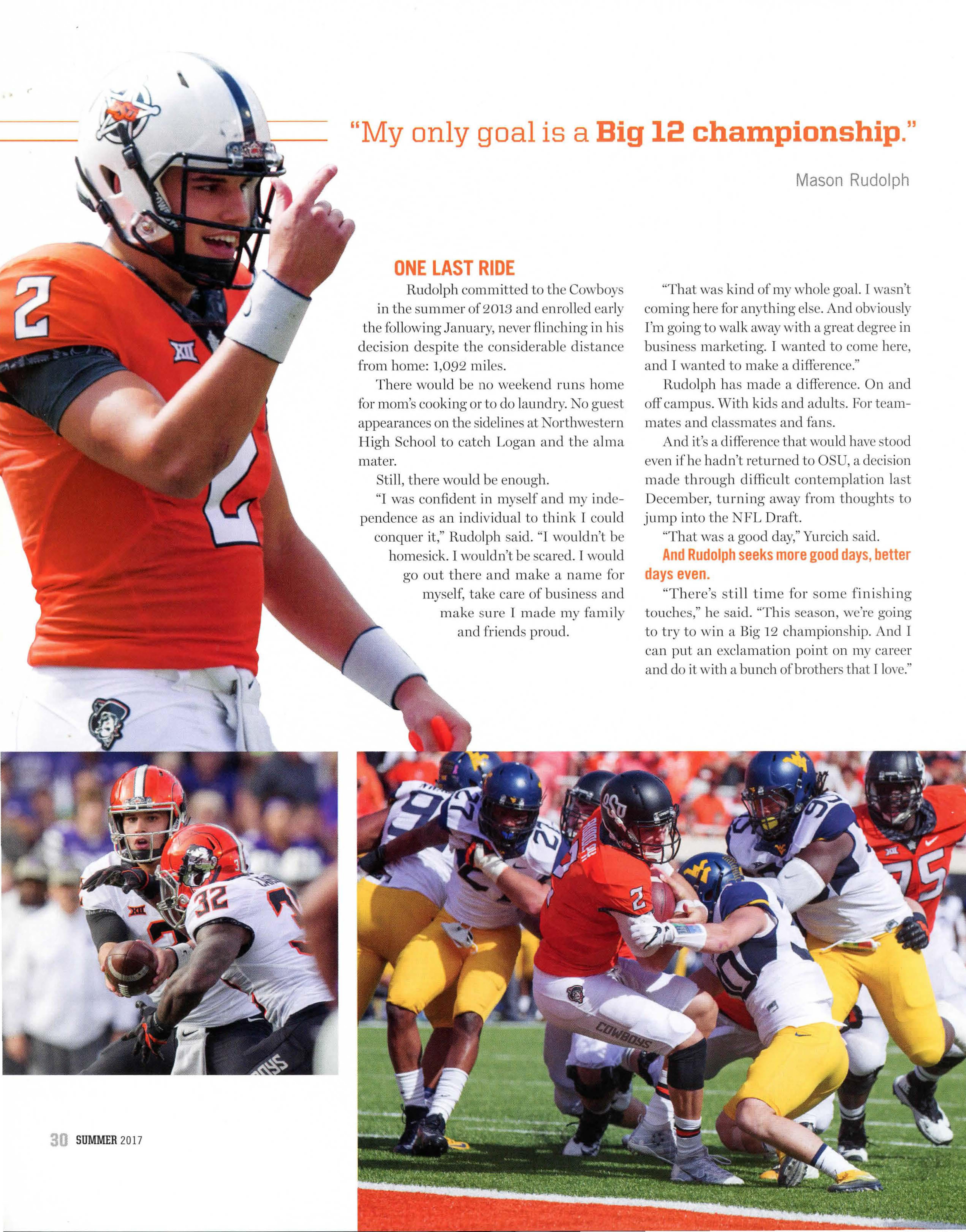
"My only goal is a Big 12 championship."
Mason Rudolph
Rudolph committed to the Cowboys in the su 111mer of 2013 and en rolled early the following January, never flinching in his decision despite the considerable distance from home: 1,092 miles.
There would be no weekend runs home for morn's cooking or to do laundry. No guest appearances on the side!ines at Northwestern High School to catch Logan and the alma mater.
Still, there would be enough.
"I was confident in myself and my independence as an individual to think I could conquer it," Rudolph said. "I wouldn't be homesick. I wouldn't be scared. I would go out there and make a name for myself; take care of business and make sure I made my family and friends proud.
"That was kind of my whole goal. I wasn't corning here for anything else. And obviously I'm going to walk away with a great degree in business marketing. I wanted to come here, and I wanted to make a difference."
Rudolph has made a difference. On and off l:am pus. With kids and adu Its. For tearnrnates and classmates and fans.
And it's ad ifference that would have stood even ifhe hadn't retu med to OSU, a decision made th rough d ifficuIt contemplation last December, turning away from thoughts to jump into the NFL Draft.
"That was a good day," Yurcicb said. AndRudolphseeksmoregooddays,better dayseven.
"There's sti 11ti me for some finishing touches," he said. "This season, we're going to try to win a Big 12 championship. And I can put an exclamation point on my career and do it with a bunch of brothers that I love."
Where does he rank among Cowboys' alltime quarterbacks? And where might he rank overall if he can carry the Heisman Trophy out of New York City in December?
"I could care less about individual awards, like I've said before," Rudolph said. "My only goal is a Big 12 championship. If that was a benefit or a product of that success, I'd be thrilled. But that doesn't cross my mind."
Already, Rudolph holds no fewer than 11 school records. More are easily within reach, including BrandonWeeden'scareer marks for pass attempts, completions, yards and touchdowns. And he's never had better weaponry, with five premium receivers, led by dynamic wideoutJamesWashington and a running back in JusticeHillcoming ofl'the best freshman season in school history.
"Mason is so good at finding us,"Washington said. "He's tough, too. He'll stand in there and be patient for us to get open, taking hits. That's what separates him from the rest."
Again, where does Rudolph rank? Weeden is generally regarded as No. 1, with Gundy and lac Robinsonand JoshFieldsin the mix.
ComeJanuary,it couldbe Rudolph.
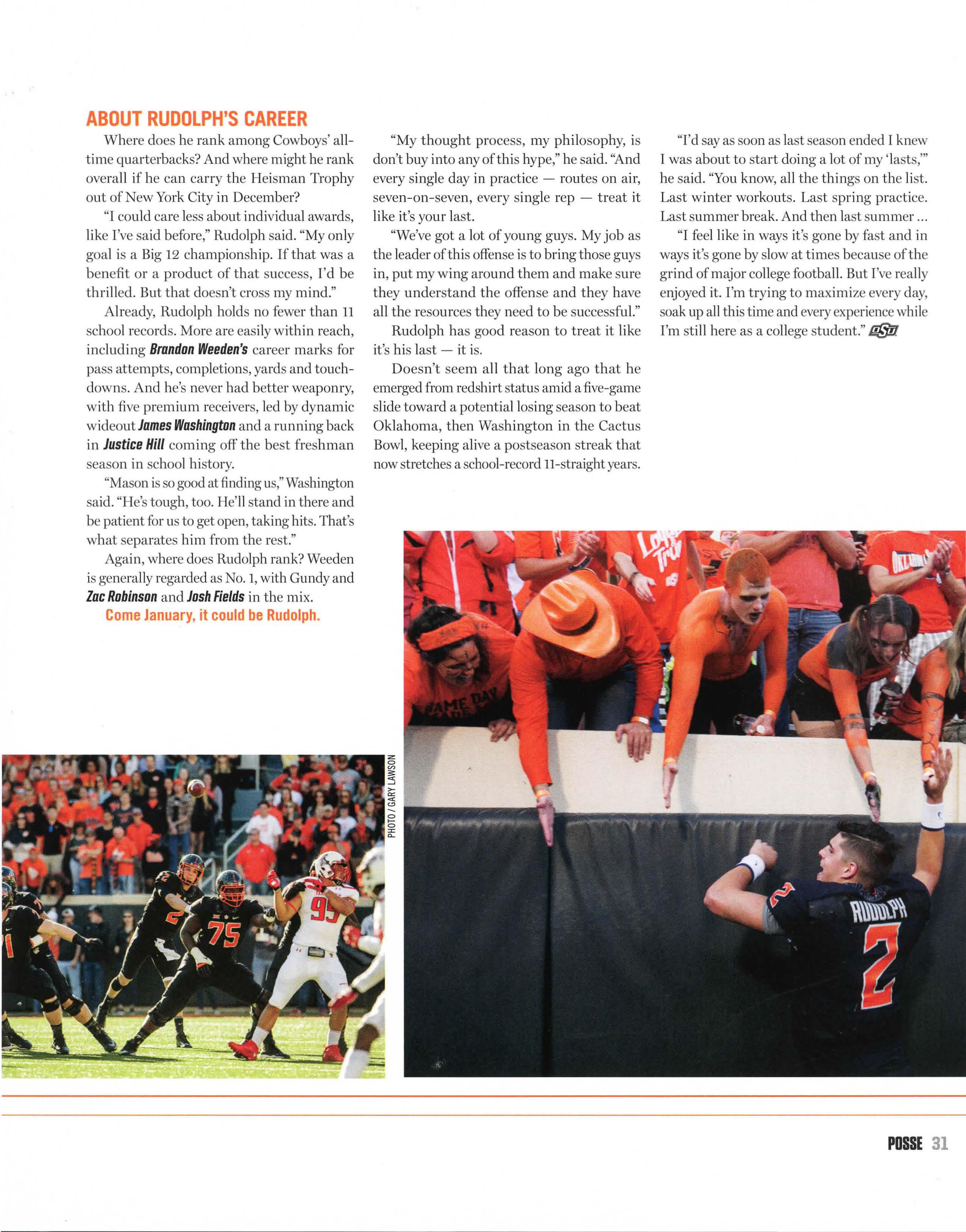
"My thought process, my philosophy, is don't buy into any of this hype," he said. "And every single day in practice - routes on air, seven-on-seven, every single rep - treat it like it's your last.
"We've got a lot of young guys. My job as the leader of this offense is to bring those guys in, put my wing around them and make sure they understand the offense and they have all the resources they need to be successful."
Rudolph has good reason to treat it like it's his last - it is.
Doesn't seem all that long ago that he emerged from redshirt status amid a five-game slide toward a potential losing season to beat Oklahoma, then Washington in the Cactus Bowl, keeping alive a postseason streak that now stretches a school-record 11-straightyears.
"I'd say as soon as last season ended I knew I was about to start doing a lot of my 'lasts,"' he said. "You know, all the things on the list. Last winter workouts. Last spring practice. Last summer break. And then last summer ...
"I feel like in ways it's gone by fast and in ways it's gone by slow at times because of the grind of major college football. But I've really enjoyed it. I'm trying to maximize every day, soak up all this time and every experience while I'm sti II here as a college student." lilfJil
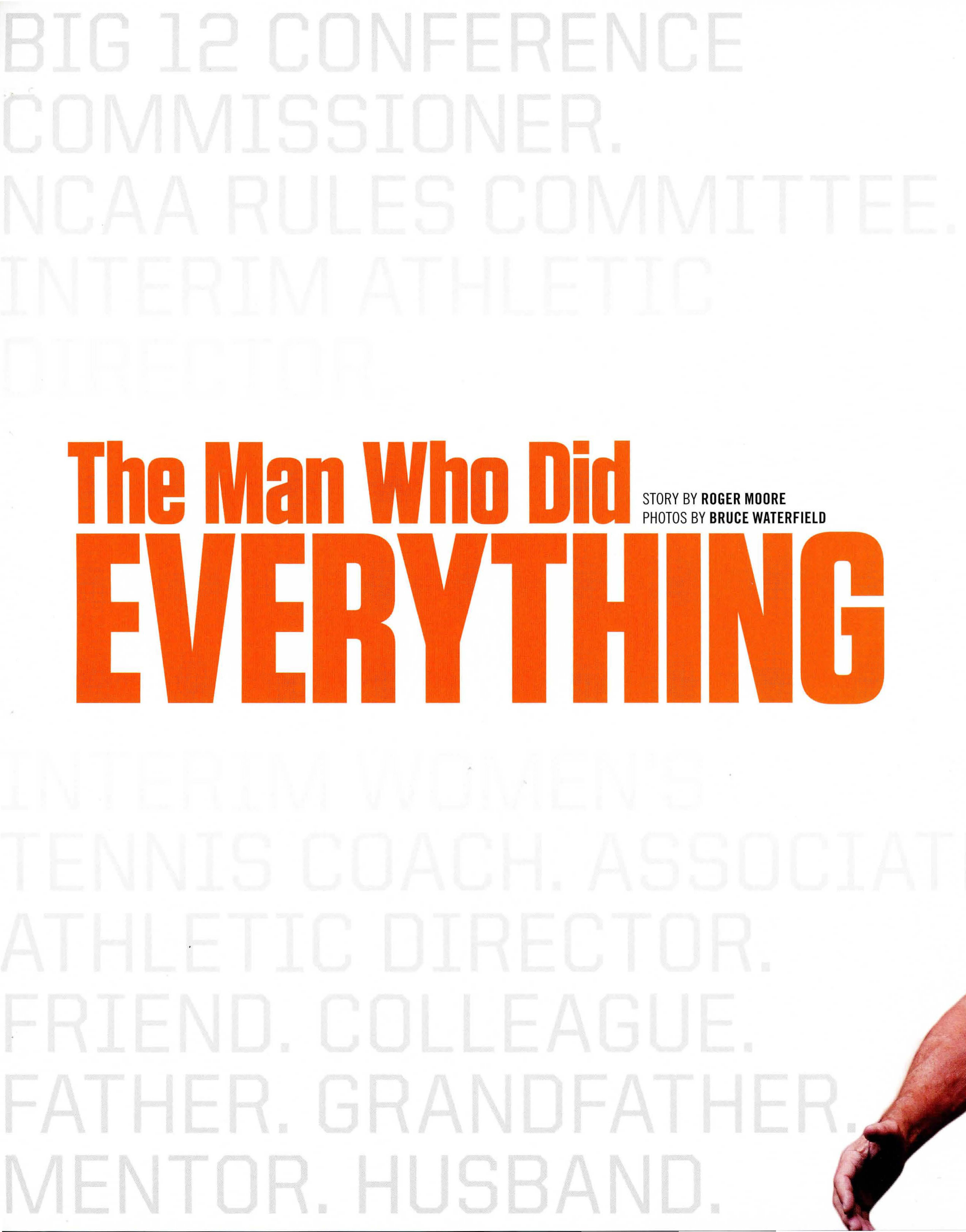
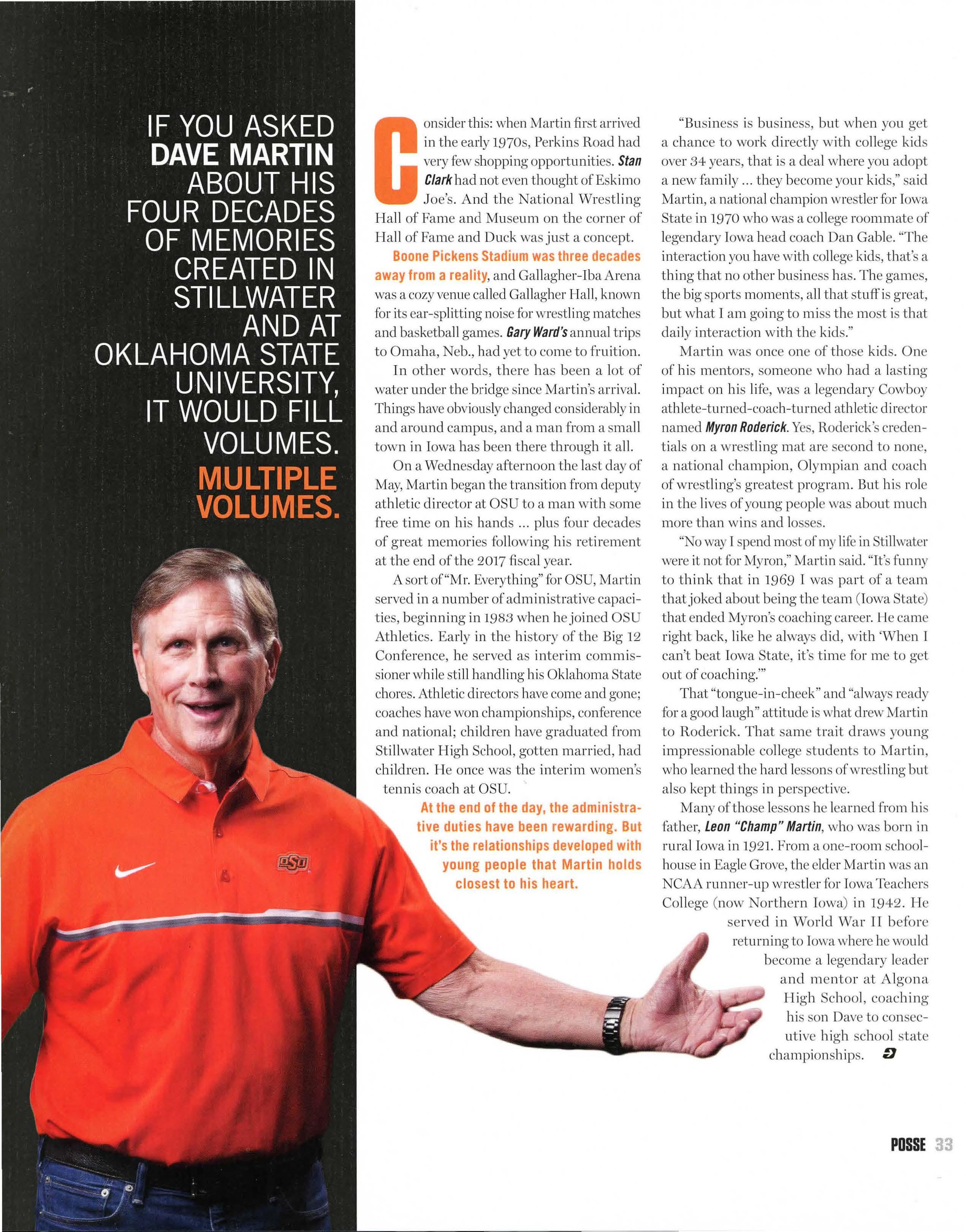
Consider this: when Martin first arrived in the early 1970s, Perkins Road had very few shopping opportunities. Stan Clarkhad not even thought of Eskimo Joe's. And the National Wrestling Hall of Fame and Museum on the corner of Hall of Fame and Duck was just a concept.
BoonePickensStadiumwasthreedecades awayfroma reality,and Gallagher-Iba Arena was a cozy venue called Gallagher Hall, known for its ear-splitting noise for wrest! ing matches and basketball games. GaryWard'sannual trips to Omaha, Neb., bad yet to come to fruition.
In other words, there ha been a lot of water under the bridge since Martin's arrival. Things have obviously changed considerably in and around campus, and a man from a small town in Iowa has been there through it all.
On a Wednesday afternoon the last day of May, Martin began the transition from deputy athletic di rector at OSU to a man with some free time on his hands plus four decade of great memories following his retirement at the encl of the 2017 fiscal year.
Asortof"Mr. Everything"forOSU, Martin served in a number of administrative capacities, beginning in 1983 when he joined OSU Athletics. Early in the history of the Big 12 Conference, he served as interim commissioner while still handling his Oklahoma State chores.Athletic directors have come and gone; coaches have won championships, conference and national; children have graduated from Stillwater High School, gotten married, had children. He once was the interim women's tennis coach at OSU.
Atthe endof the day,the administrative dutieshavebeenrewarding.But it'sthe relationshipsdevelopedwith youngpeoplethat Martin holds closestto his heart.
"Business is business, but when you get a chance to work directly with college kids over 34 years, that is a deal where you adopt a new family they become your kids," said Martin, a national champion wrestler for Iowa State in 1970 who was a college roommate of legendary Iowa head coach Dan Gable. "The interaction you have with college kids, that's a thing that no other bu iness ha . The game·, the big sport· moments, all that stuff is great, but what I am going to miss the most is that daily interaction with the kids."
Martin wa once one of those kids. One of his mentors, someone who had a lasting impact on his life, was a legendary Cowboy athlete-turned-coach-turned athletic director named MyronRoderick.Yes, Roderick's credentials on a wrestling mat are second to none, a national champion, Olympian and coach of wrestling's greatest program. But his role in the lives of young people was about much more than wins and losses.
"No way I spend most of my Iife in Stillwater were it not for Myron," Martin said. "It's funny to think that in 1969 l was part of a team that joked about being the team (Iowa State) that ended Myron's coaching career. He came right back, like he always did, with 'When I can't beat Iowa State, it's time for me to get out of coaching."'
That "tongue-in-cheek" and "always ready for a good laugh" attitude is what drew Martin to Roderick. That same trait draws young impressionable college students to Martin, who learned the hard lessons of wrestling but also kept things in perspective.
Many of those lessons he learned from his father, Leon"Champ"Martin,who was born in rural Iowa in 1921. From a one-room schoolhouse in Eagle Grove, the elder Martin was an NCAA runner-up wrestler for Iowa Teachers College (now Northern Iowa) in 1942. He served in World War II before returning to lowa where he would become a legendary leader and mentor at Algona High School, coaching his son Dave to consecutive high school state championships. :J
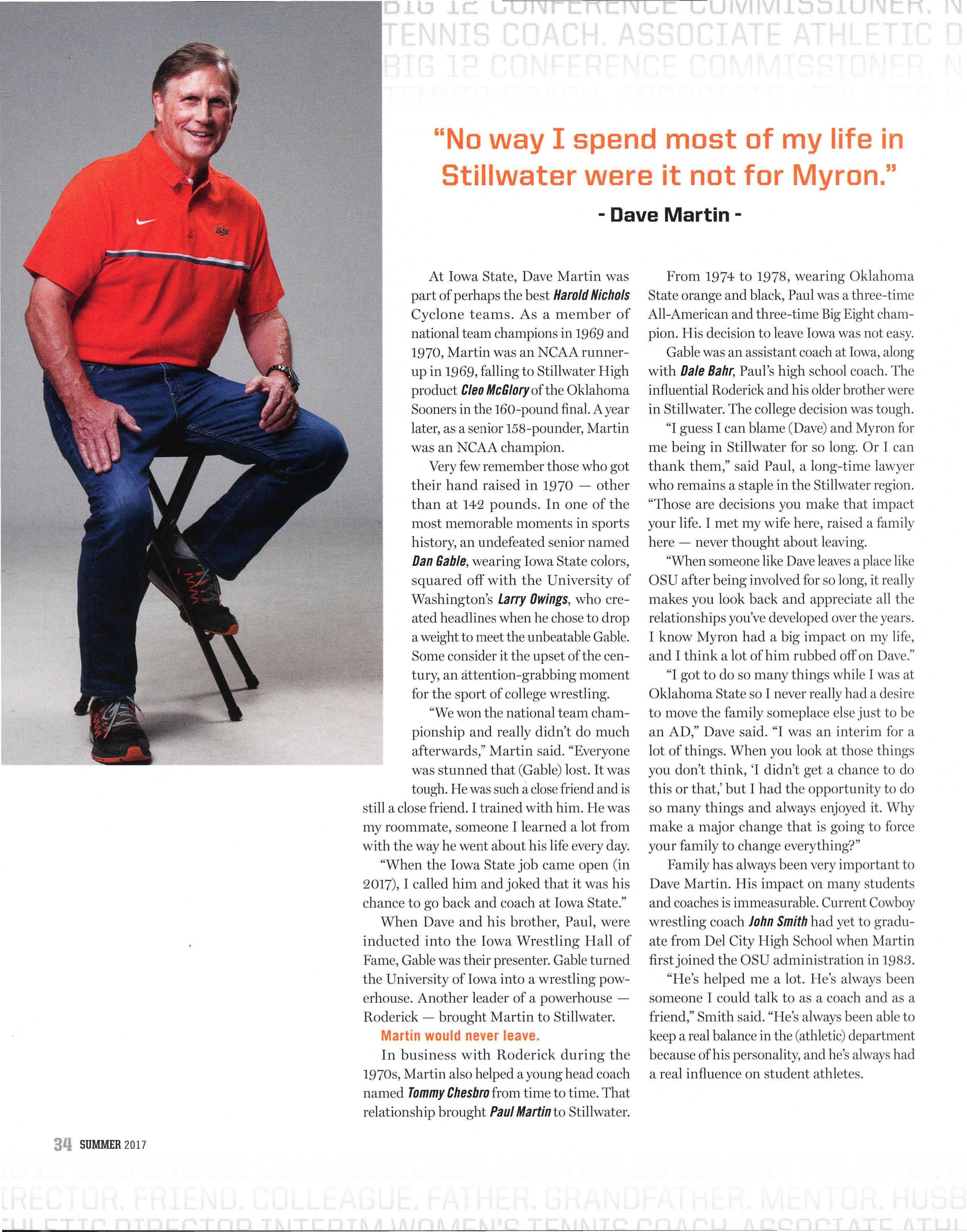
"No way I spend most of my life in Stillwater were it not for Myron."
- Dave Martin -
At Iowa State, Dave Martin was part of perhaps the best HaroldNichols Cyclone teams. As a member of national team champions in 1969 and 1970, Martin was an NCAA runnerup in 1969, falling to Stillwater High product CleoMcGloryoftheOklahoma Sooners in the 160-pound final. A year later, as a senior 158-pou nder, Martin was an NCAA champion.
Very few remember those who got their hand raised in 1970 - other than at 142 pounds. In one of the most memorable moments in sports history, an undefeated senior named DanGable,wearing Iowa State colors, squared off with the University of Washington's LarryOwings,who created headlines when he chose to drop a weight to meet the unbeatable Gable. Some consider it the upset of the century, an ,ittention-grabbing moment for the sport of college wrestling.
"We won the national team championship and really didn't do much afterwards," Martin said. "Everyone was stunned that (Gable) lost. It was tough. He was such a closefriend and is still a close friend. I trained with him. He was my roommate, someone I learned a lot from with the way he went about his life every day.
"When the Iowa State job came open (in 2017), I called him and joked that it was his chance to go back and coach at Iowa State."
When Dave and his brother, Paul, were inducted into the Iowa Wrestling Hall of Fame, Gable was their presenter. Gable turned the University of Iowa into a wrestling powerhouse. Another leader of a powerhouseRoderick - brought Martin to Stillwater.
Martin wouldnever leave.
In business with Roderick during the 1970s, Martin also helped a young head coach named TommyChesbrofrom ti me to ti me. That relationship brought PaulMartinto Stillwater.
From 1974 to 1978, wearing Oklahoma State orange and black, Paul was a three-time All-American and three-time Big Eight champion. His decision to leave Iowa was not easy.
Gable was an assistant coach at Iowa, along with DaleBahr,Paul's high school coach. The influential Roderick and his older brother were in Stillwater. The college decision was tough.
"I guess I can blame (Dave) and Myron for me being in Stillwater for so long. Or I can thank them," said Paul, a long-time lawyer who remains a staple in the Stillwater region. "Those are decisions you make that impact your life. I met my wife here, raised a family here - never thought about leaving.
"When someone like Dave leavesa place like OSU after being involved for so long, it really makes you look back and appreciate all the relationships you've developed over the years. I know Myron had a big impact on my life, and I think a lot of him rubbed off on Dave."
"I got to do so many things while I was at Oklahoma State so I never really had a desire to move the family someplace else just to be an AD," Dave said. "I was an interim for a lot of things. When you look at those things you don't th ink, 'I didn't get a chance to do this or that,' but I had the opportunity to do so many things and always enjoyed it. Why make a major change that is going to force your family to change everything?"
Family has always been very important to Dave Martin. His impact on many students and coaches is immeasurable. Current Cowboy wrestling coach JohnSmithhad yet to graduate from Del City High School when Martin first joined the OSU administration in 1983.
"He's helped me a lot. He's always been someone I could talk to as a coach and as a friend,'' Smith said. "He's always been able to keep a real balance in the (athletic) depa1tment because of his personality, and he's always had a real influence on student athletes.
"There have been a lot of student-athletes not necessarily on the right path and Dave helped put a lot of them on the right path, gave them some direction. He has always been a lot more tban an administrator for OSU. Having someone like Dave Martin in your athletic department is important, someone who under tands things at many different levels. '0le are dealing with young men and women, helping them develop in a lot more ways that just athletics. Dave has been a real benefit to this department."
AlongwithhiswifeToni,Davebegancounselingyoungpeopleat hishomeoverthe last decade.Tt has turned into mucb more than counseling. Engaged couples often want him to officiate their wedding ceremony.
"It's incredible to be a part of young peoples' lives, watching them develop," he said. "And when they ask you if you would read the vows, lead the ceremony, it really means a lot. [ had ome great mentors. I've been given the opportunity to mentor young people. That really means a lot to me. It always will."
An ability to adjustwas key to Martin's tenure.
"Myron wanted to move the mascots, the Pi tol Petes, the porn squads, over to the athletic department," said Martin of the young athletic clirector. "He said he was putting that under me, and Twas like, 'I don't know anything about that.'
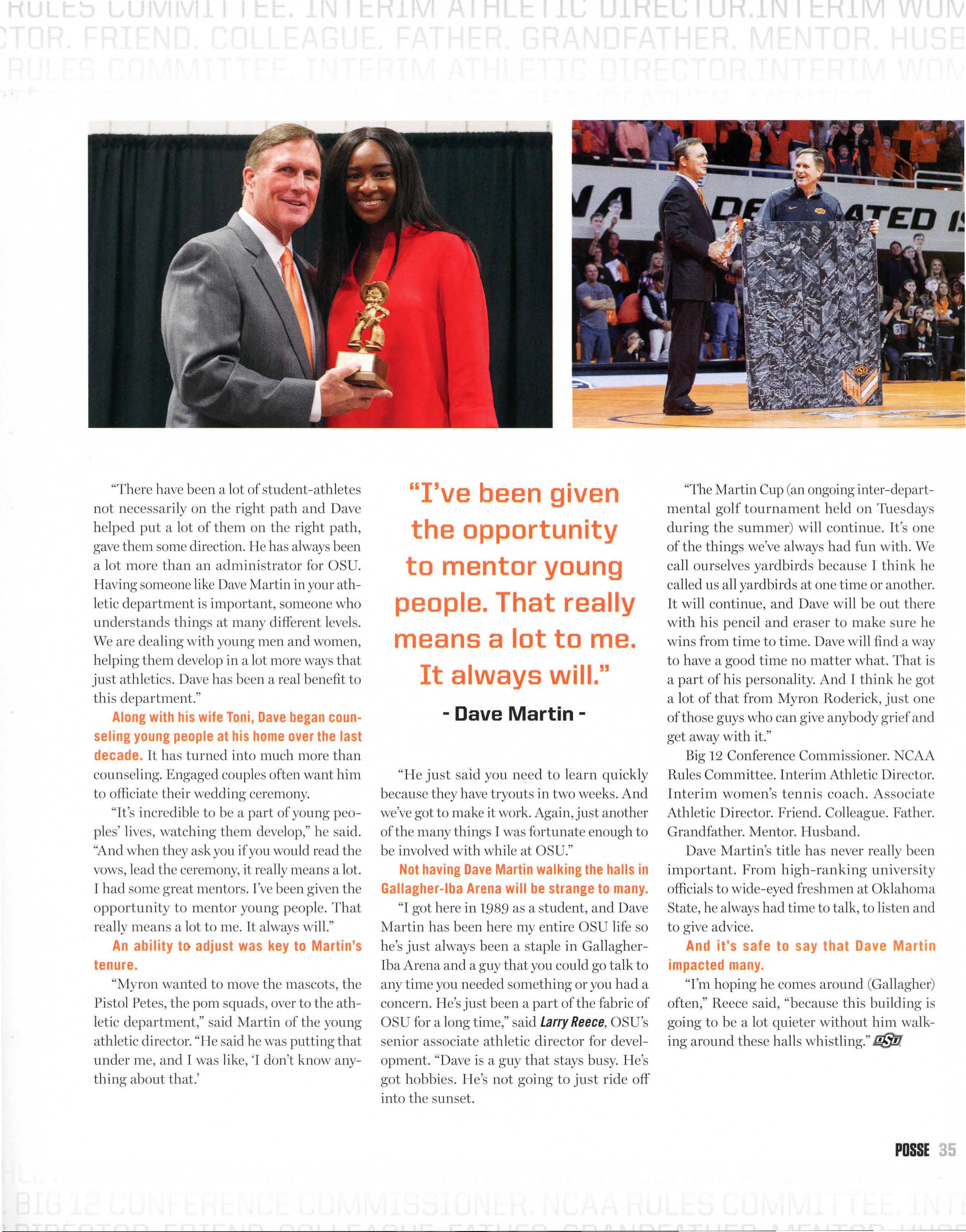
"I've been given the opportunity to mentor young people. That really means a lot to me. It always will."
- Martin -
"He just said you need to learn quickly because they have tryouts in two weeks. And we've got to make it work. Again,just another of the many things I wa fortunate enough to be involved with while at OSU."
NothavingDaveMartinwalkingthehallsin Gallagher-IbaArenawill be strangeto many.
"I got here in 1989 as a student, and Dave Martin has been here my entire OSU life so he's ju t always been a staple in Gallagherlba Arena and a guy that you could go talk to any ti me you needed something or you had a concern. He's just been a part of the fabric of OSU for a long time," said LarryReece,OSU's senior associate athletic director for development. "Dave is a guy that stays busy. He's got hobbies. I le's not going to just ride off into the unset.
"The Martin Cup (an ongoing inter-departmental golf tournament held on Tuesdays during the summer) will continue. It' one of the things we've always had fun with. We call ourselves yardbirds because I think he called us all yardbirds at one time or another. It will continue, and Dave will be out there with his pencil and eraser to make sure he wins from ti me to time. Dave will find a way to have a good time no matter what. That is a part of his personality. And I think he got a lot of that from Myron Roderick, just one of those guys who can give anybody grief and get away with it."
Big 12 Conference Commissioner. NCAA Rules Committee. Interim Athletic Director. Interim women's tennis coach. Associate Athletic Director. Friend. Colleague. Father. Grandfather. Mentor. Husband.
Dave Martin's title has never really been important. From high-ranking university officials to wide-eyed freshmen at Oklahoma State, he always had time to talk, to listen and to give advice.
And it's safe to say that Dave Martin impactedmany.
'Tm hoping he comes around (Gallagher) often," Reece said, "because th is bu iIding is going to be a lot quieter without him walking around these halls whistling."@

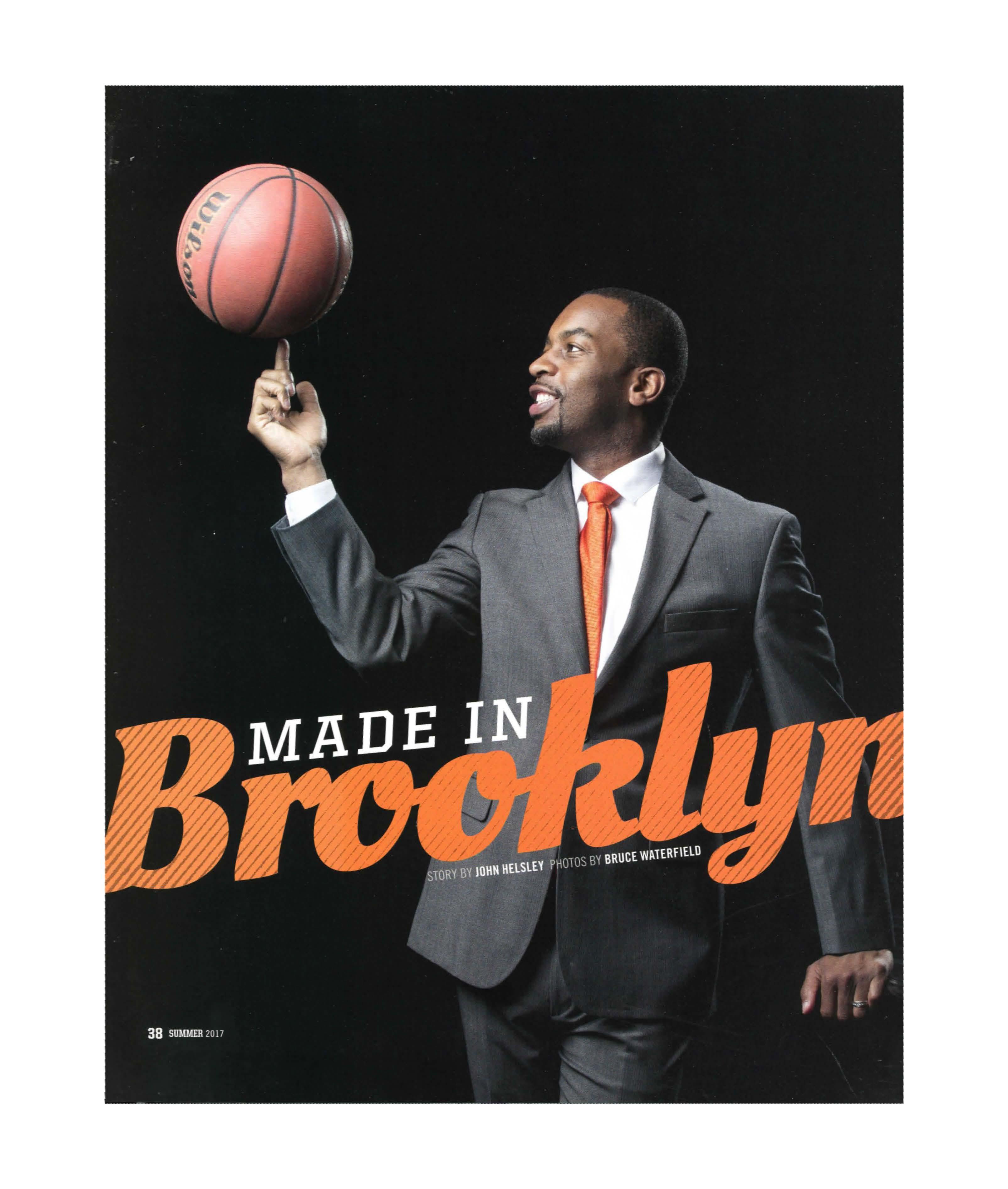
Mike
Boynton slipped into the seat of his car and, after a few awkward minutes, absorbed the most stressful question of that late-March afternoon.
"Well, do you have the job?" his wife Jenny
pressed.
And Boynton thought the tough stuff was over, having just taken his place in a rapid-fire interview process at Karsten Creek, where five men filed past a small committee charged with identifying Oklahoma State's basketball coach going forward.
Boynton tried to explain what was taking place, with the opening day of interviews seen as simply the starting point in the procedure, the prelims even, with more surely to come.
··1don't know," he told .Jenny, "but 1 think I was the first guy to interview."
She looked him square in the eyes and, with unwavering belief in her husband, offered baek:
"But I thought you would be good enough they wouldn't do any more interviews."
Well, turns out she was partly right.
The interviews went on as scheduled, with four more men making their case that day.
Yet Boynton was good enough. Beyond good enough.
And by the next day- March 24, 2017 - Boynton became OSU's 20th men's basketball coach. fiJ
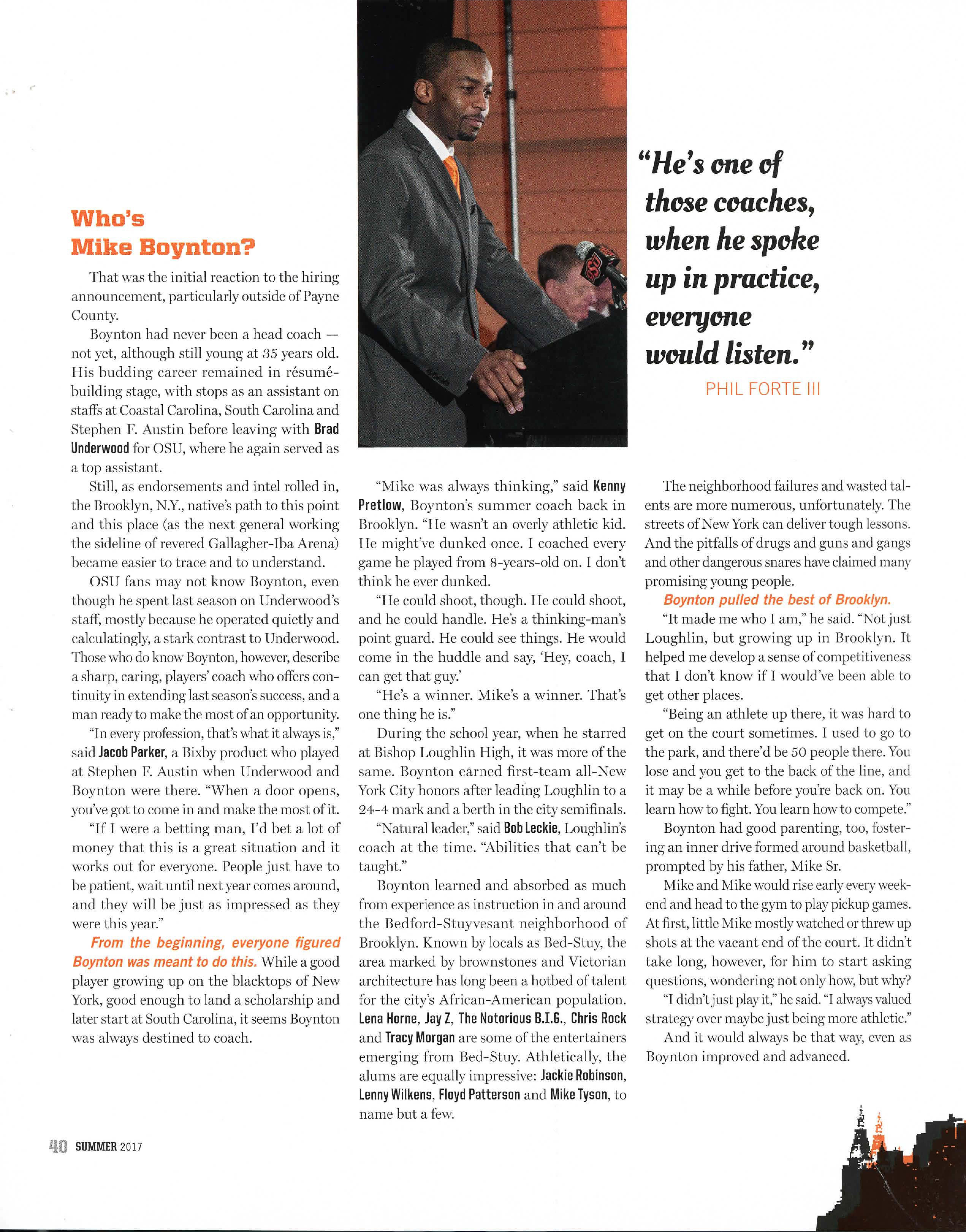
That was the initial reaction to the hiring announcement, particularly outside of Payne County.
Boynton had never been a head coachnot yet, although still young at 35 years old. His budding career remained in resumebuilding stage, with stops as an assistant on staffs at Coastal Carolina, South Carolina and Stephen F. Austin before leaving with Brad Underwood for OSU, where he again served as a top assistant.
Still, as endorsements and intel rolled in, the Brooklyn, N.Y.,native's path to this point and this place (as the next general working the sideline of revered Gallagher-Iba Arena) became easier to trace and to understand.
OSU fans may not know Boynton, even though he spent last season on Underwood's staff, mostly because he operated quietly and calculatingly, a stark contrast to Underwood. Those who do know Boynton,however,describe a sharp, caring, players' coach who offers continuity in extending last season's success, and a man ready to make the most of an opportunity.
"In every profession,that's what it alwaysis," said JacobParker, a Bixby product who played at Stephen F. Austin when Underwood and Boynton were there. "When a door opens, you've got to come in and make the most of it.
"If I were a betting man, I'd bet a lot of money that this is a great situation and it works out for everyone. People just have to be patient, wait until next year comes around, and they will be just as impressed as they were th is year."
From the begif.lning,everyone figured Boyntonwasmeant to do this. While a good player growing up on the blacktops of New York, good enough to land a scholarship and later start at South Carolina, it seems Boynton was always destined to coach.
"He'sone of those coaches, when he spoke up in practice, everyone would listen."
PHIL FORTEIll
"Mike was always thinking," said Kenny Pretlow,Boynton's summer coach back in Brooklyn. "He wasn't an overly athletic kid. He might've dunked once. I coached every game he played from 8-years-old on. I don't think he ever dunked.
"He could shoot, though. He could shoot, and he could handle. He's a thinking-man's point guard. He could see things. He would come in the huddle and say, 'Hey, coach, I can get that guy.'
"He's a winner. Mike's a winner. That's one thing he is."
During the school year, when he starred at Bishop Loughlin High, it was more of the same. Boynton earned first-team all-New York City honors after leading Loughlin to a 24-4 mark and a berth in the city semifinals.
"Natural leader," said BobLeckie,Lough Iin's coach at the time. "Abilities that can't be taught."
Boynton learned and absorbed as much from experience as instruction in and around the Bedford-Stuyvesant neighborhood of Brooklyn. Known by locals as Bed-Stuy, the area marked by brownstones and Victorian architecture has long been a hotbed of talent for the city's African-American population. LenaHorne,JayZ,TheNotoriousB.I.G.,ChrisRock and TracyMorganare some of the entertainers emerging from Bed-Stuy. Athletically, the alums are equally impressive: JackieRobinson, LennyWilkens,FloydPattersonand MikeTyson, to name but a few.
The neighborhood failures and wasted talents are more numerous, unfortunately. The stTeets of New York can deliver tough lessons. And the pitfalls of drugs and guns and gangs and other dangerous snares have claimed many promising young people.
Boyntonpulled the best of Brooklyn.
"lt made me who [ am," he said. "Not just Loughlin, but growing up in Brooklyn. It helped me develop a sense of competitiveness that I don't know if I would've been able to get other places.
"Being an athlete up there, it was bard to get on the court sometimes. I used to go to the park, and there'd be 50 people there. You lose and you get to the back of the line, and it may be a while before you're back on. You learn how to fight. You learn how to compete."
Boynton had good parenting, too, fostering an inner drive formed around basketball, prompted by his father, Mike Sr.
Mike and Mike would rise early everyweekend and head to the gym to play pickup games. At first, little Mike mostly watched or threw up shots at the vacant end of the court. It didn't take long, however, for him to start asking questions, wondering not only how, but why'?
"I didn't just play it,"he said. "l alwaysvalued strategy over maybe just being more athletic."
And it would always be that way, even as Boynton improved and advanced.
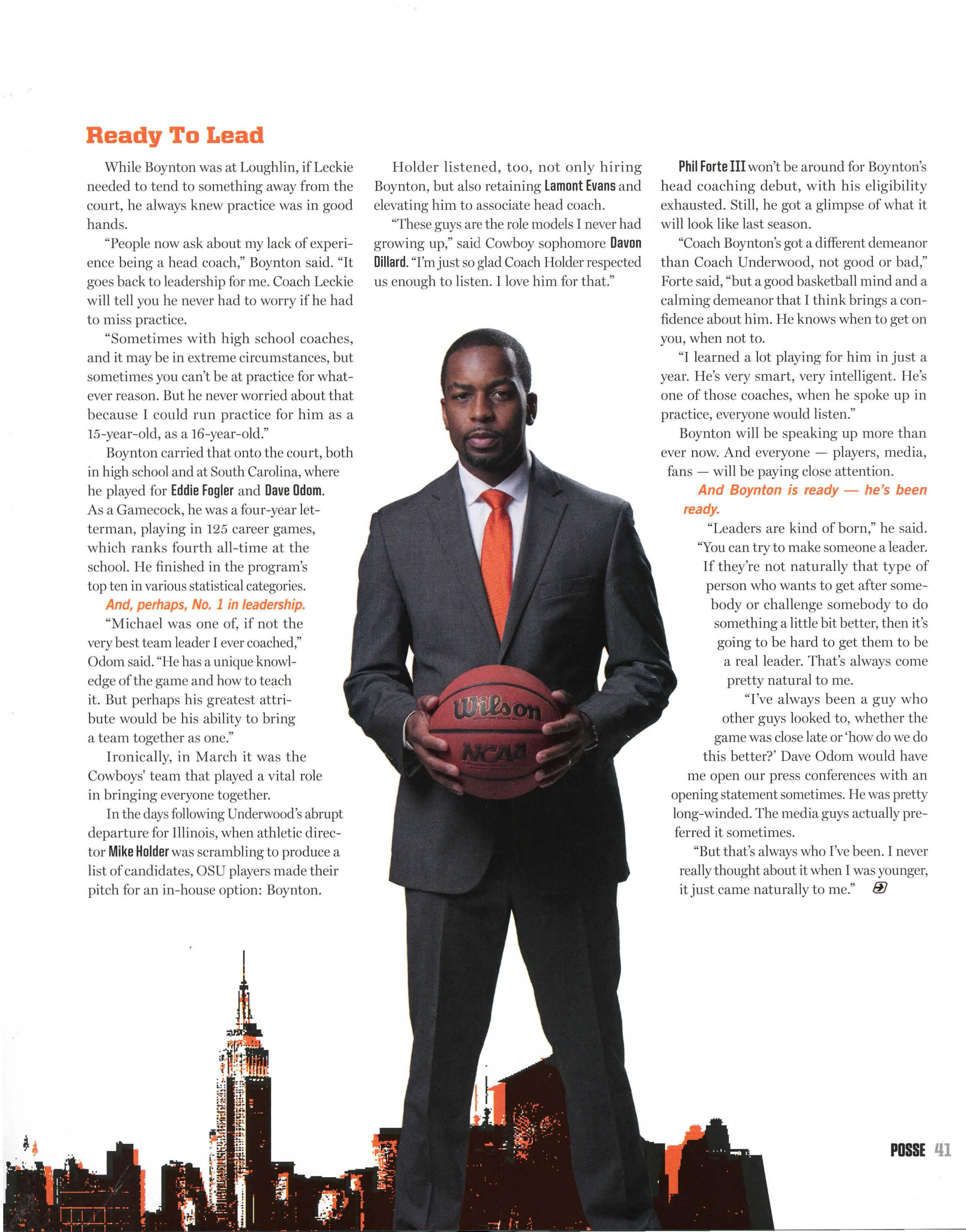
While Boynton was at Loughlin, if Leckie needed to tend to something away from the court, he always knew practice was in good hands.
"People now ask about my lack of experience being a head coach," Boynton said. "It goes back to leadership for me. Coach Leckie will tell you he never had to worry ifhe bad to miss practice.
"Sometimes with high school coaches, and it may be in extreme circumstances, but sometimes you can't be at practice for whatever reason. But he never worried about that because I could run practice for him as a 15-year-old, as a 16-year-old."
Boynton carried that onto the court, both in high school and at South Carolina, where he played for EddieFoglerand DaveDdom. As a Gamecock, he was a four-year letterman, playing in 125 career games, which ranks fourth all-time at the school. He finished in the program's top ten in various statistical categories.
And,perhaps,No. 1 in leadership.
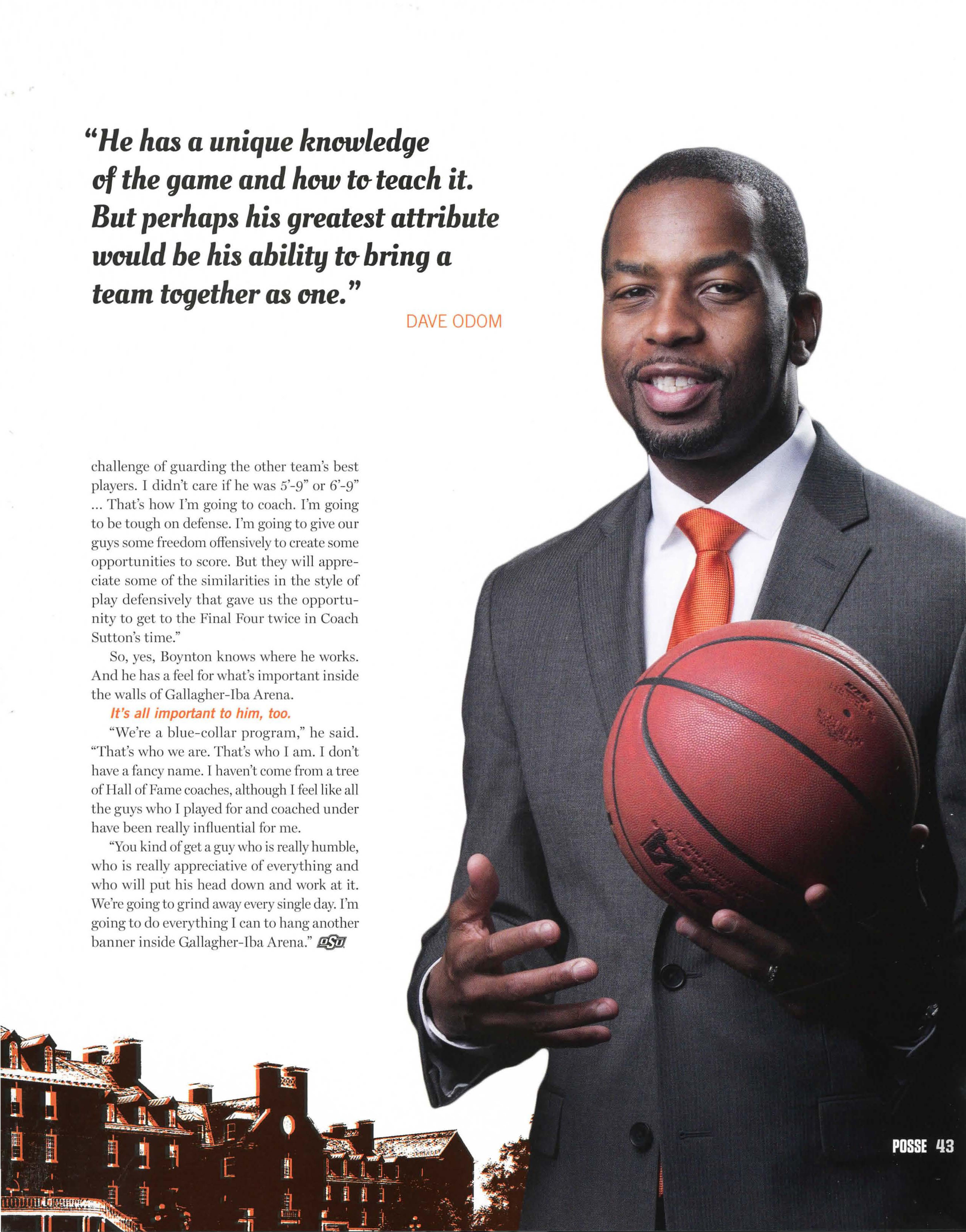
"Michael was one of, if not the very best team leader I ever coached," Odom said. "He has a unique knowledge of the game and how to teach it. But perhaps his greatest attribute would be his ability to bring a team together as one."
Ironically, in March it was the Cowboys' team that played a vital role in bringing everyone together.
In the days followingUnderwood'sabrupt departure for Illinois, when athletic director MikeHolderwas scrambling to produce a 1ist of candidates, OSU players made their pitch for an in-house option: Boynton.
Holder listened, too, not only hiring Boynton, but also retaining LamontEvansand elevating him to associate head coach.
"These guys are the role models I never had growing up," said Cowboy sophomore Davon Dillard.'Tm just so glad Coach Holder respected us enough to listen. I love him for that."
PhilForteIII won't be around for Boynton's head coaching debut, with his eligibility exhausted. Still, he got a glimpse of what it will look Eke last season.
"Coach Boynton's got a different demeanor than Coach Underwood, not good or bad," Forte said, "but a good basketball mind and a calming demeanor that l think brings a confidence about him. He knows when to get on you, when not to.
"I learned a lot playing for him in just a year. He's very smart, very intelligent. He's one of those coaches, when he spoke up in practice, everyone would listen."
Boynton will be speaking up more than ever now. And everyone - players, media, fans - will be paying close attention.
And Boynton is ready - he's been ready.
"Leaders are kind of born," he said. "Youcan try to make someone a leader. If they're not naturally that type of person who wants to get aner somebody or challenge somebody to do something a little bit better, then it's going to be hard to get them to be a real leader. That's always come pretty natural to me.
''I've always been a guy who other guys looked to, whether the game was close late or 'how do we do this better?' Dave Odom would have me open our press conferences with an opening statement sometimes. He was pretty long-winded. The media guys actually preferred it sometimes.
"But that's always who I've been. I never really thought about it when I was younger, it just came naturally to me."
The young man with the wide, appealing smile is still settling into being the head coach at Oklahoma State University.
Most of his time is no longer his own, as fol ks tug on him from every angle.
"The biggest challenge is just juggling all the responsibilities," Boynton said.
Still, Jenny and their two young children, Ace and Zoe, keep him grounded.
"l try to get up here pretty consistently at 6 a.m. so I can exercise," he said. "That's the only ti me no one bothers me. I usually try to get home and take my kids to school since I'm rarely there to pick them up in the afternoon. I'm here all day ai1d try to get home for dinner and the bedtime process.
''As different as my life has been, Ace and Zoe have no idea and don't care. They want to know, 'Dad, are you going to be home for dinner?' 'Are you giving me a bath tonight or reading me a bedtime story?'
"So that keeps me from getting too caught up with me being a head coach now or I have this big-time role. I go home every night, and Ace wants me to read him a bedtime story. I'm just dad at home."
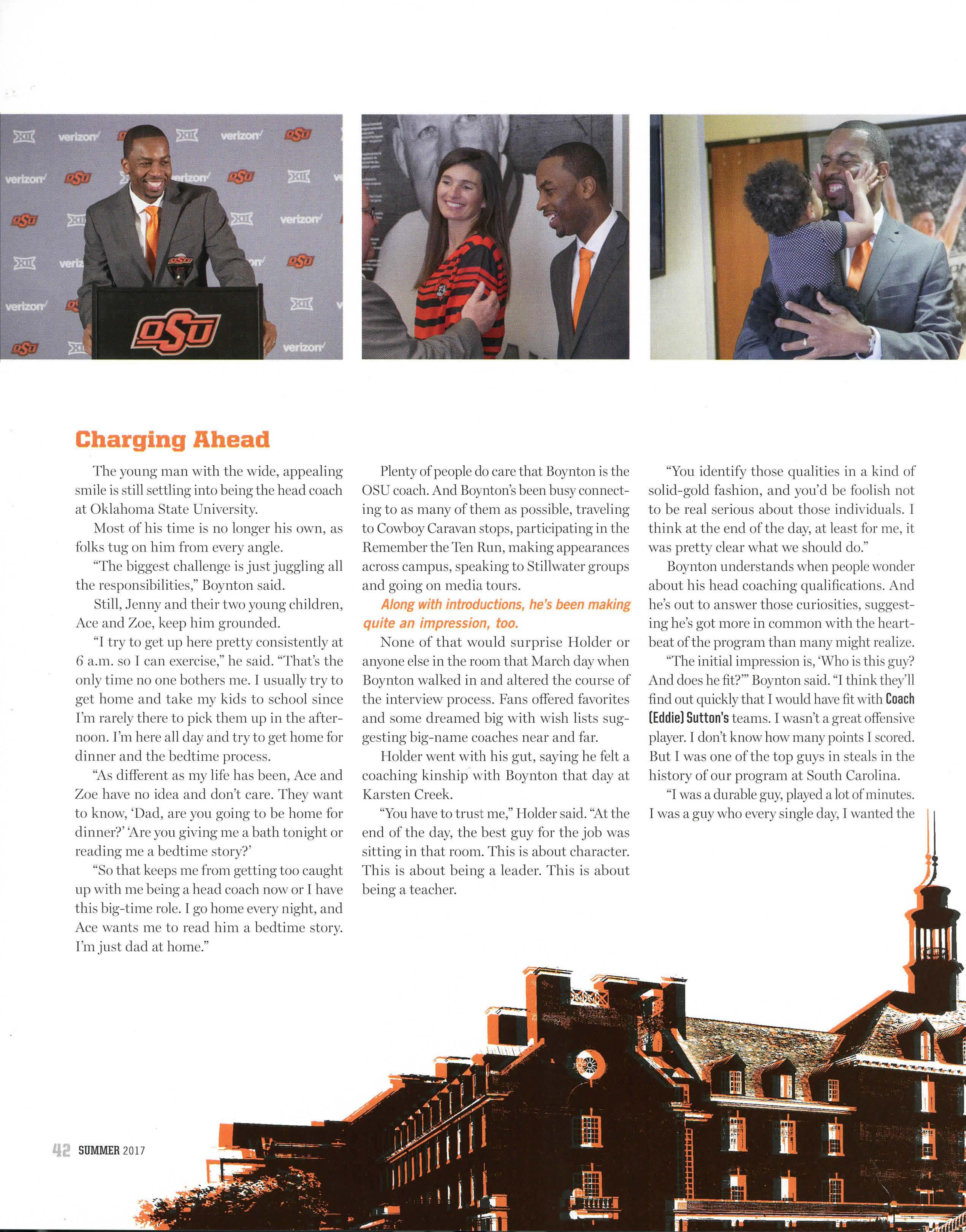
Plenty of people do care that Boynton is the OSU coach. And Boynton's been busy connecting to as many of them as possible, traveling to Cowboy Caravan stops, participating in the Remember the Ten Run, making appearances across campus, speaking to Stillwater groups and going on media tours.
Alongwithintroductions,he'sbeenmaking quite an impression,too.
None of that would surprise Holder or anyone else in the room that March day when Boynton walked in and altered the course of the interview process. Fans offered favorites and some dreamed big with wish lists suggesting big-name coaches near and far.
Holder went with his gut, saying he felt a coaching kinship with Boynton that day at Karsten Creek.
"Youhave to trust me," Holder said. ''At the end of the day, the best guy for the job was sitting in that room. This is about character. This is about being a leader. This is about being a teacher.
"You identify those qualities in a kind of solid-gold fashion, and you'd be foolish not to be real serious about those individuals. I think at the end of the day, at least for me, it was pretty clear what we should do."
Boynton understands when people wonder about his head coaching qualifications. And he's out to answer those curiosities, suggesting he's got more in common with the heartbeat of the program than many might realize.
"The initial impression is, 'Who is this guy? And does he fit?"' Boynton said. "I think they'll find out quickly that I would have fit with Coach (Eddie)Sutton'steams. I wasn't a great offensive player. I don't know how many points I scored. But I was one of the top guys in steals in the history of our program at South Carolina.
"I was a durable guy, played a lot of minutes. I was a guy who every single day, I wanted the
"He hm a uniqueknowledge of the game and how to-teach it. But perhaps his greatest attribute would be his ability to-bring a team togethercu one."
challenge of guarding the other team's best players. l didn't care if he was 5'-9" or 6'-9"
That's how I'm going to coach. I'm going to be tough on defense. I'm going to give our guys some freedom offensivelyto create some opportunities to core. But they will appreciate some of the similarities in the style of play defensively that gave us the opportunity to get to the Final Four twice in Coach Sutton's time."
So, yes, Boynton knows where he works. And he has a feel for what's important inside the walls of Gallagher-Iba Arena.
It's all important to him, too.
"We're a blue-collar program," he said. "That's who we are. That's who I am. I don't have a fancy name. I haven't come from a tree of Hall of Fame coaches, although I feel like all the guys who I played for and coached under have been really influential for me.
"You kind of get a guy who is really humble, who is really appreciative of everything and who will put his head clown and work at it. We're going to grind away every single clay.I'm going to do everything I can to hang another banner insicle Gallagher- Iba Arena."
ll§iJ

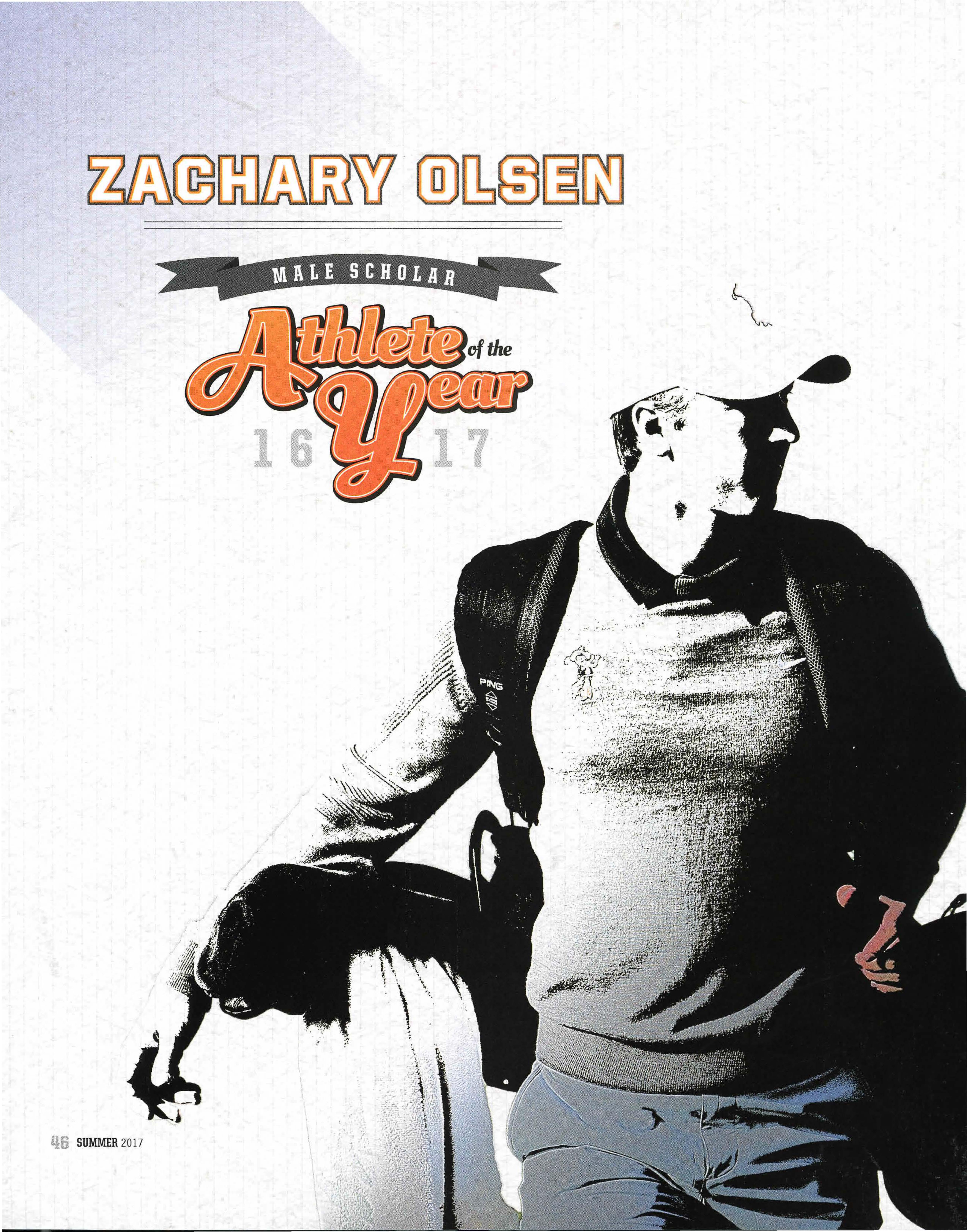
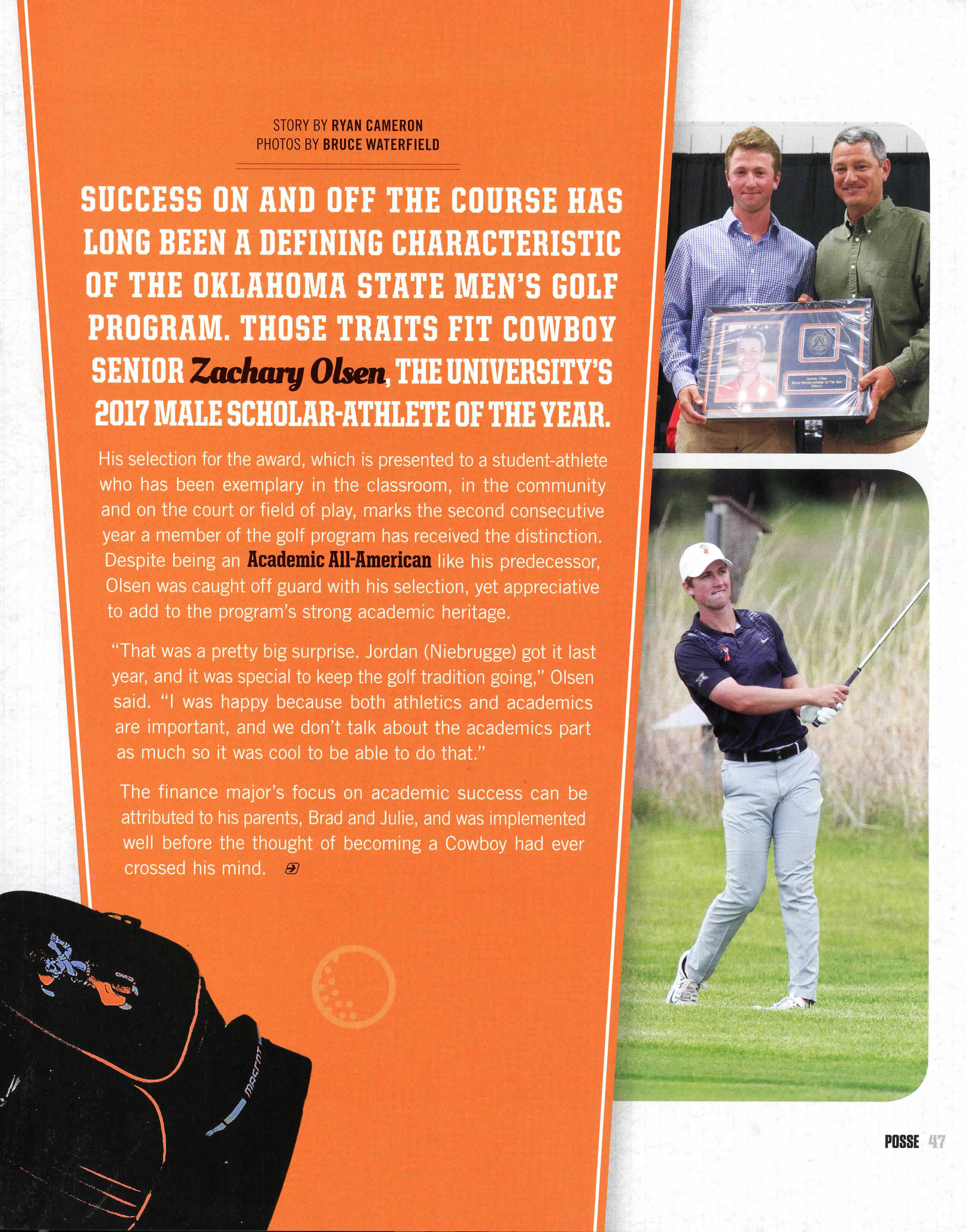
"My family, especially my mom, put a pretty big emphasis on academics. I went to a very good high school in Memphis (Memphis University School), and they put a big emphasis on academics. I think it is just something I have always taken pride in and just try to do my best in school," Olsen said.
Olsen'sworkethichasnotheenrestrictedtohis schoolworkaloneandhasspilledoverintoeveryfacet ofhislife.Because of the standards instilled in him by his family, be arrived on campus readymade to pursue success in both his athletic and academic endeavors.
"My dad and mom always worked hard at their jobs. It wasn't always nice having to wake up and go to work, but they always went about their business and never complained. They just worked bard. l try to carry that same mindset into what I do. It is not always easy and not always fun, but you just have to keep plugging along," Olsen said.
"I think that is important for all aspects of life."
The approach to give full effort at all times is planted firmly at the top of the list when Cowboy head coach AlanBrattonsummarizes the lone senior on his 2017 squad.
"Youcan't talk about Olsen without talking about his work ethic," Bratton said. "He has been a shining example of someone who wakes up thinking about golf and how to get better. He certainly maximizes his time out here.
"That is a great example for guys to see."
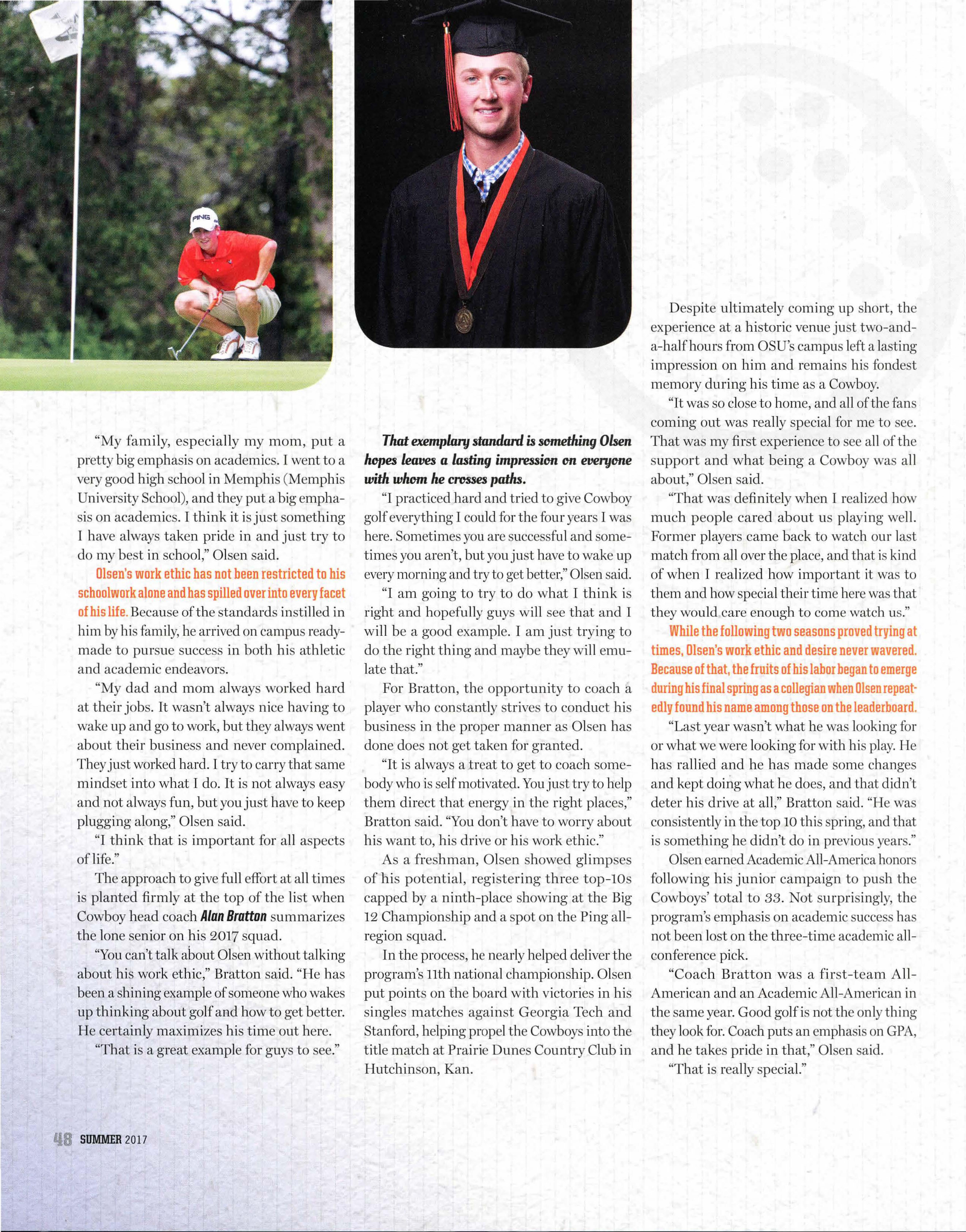
Thatexemplarystandardis somethingOlsen hopes leaves a lasting impressicnen everycne with whomhe crossespaths.
"I practiced hard and tried to give Cowboy golf everything I couId for the four years I was here. Sometimes you are successfu I and someti mes you aren't, but you just have to wake up every morning and try to get better," Olsen said.
"I am going to try to do what I think is right and hopefully guy will see that and 1 will be a good example. I am just trying to do the right thing and maybe they will emulate that."
For Bratton, the opportunity to coach a player who constantly strives to conduct his business in the proper manner as Olsen has done does not get taken for granted.
"It is always a ,treat to get to coach somebody who is self motivated. Youjust try to help them direct that energy in the right places," Bratton said. "You don't have to worry about his want to, his drive or his work ethic."
As a freshman, Olsen showed glimpses of liis potential, registering three top-lOs capped by a ninth-place showing at the Big 12 Championship and a spot on the Ping allregion squad.
In the proce s, he nearly helped deliver the program's 11th national championship. Olsen put points on the board with victories in his singles matches against Georgia Tech and Stanford, helping propel the Cowboys into the title match at Prairie Dunes Country Club in Hutchinson, Kan.
Despite ultimately corning up short, the experience at a historic venue just two-anda-halfhours from OSU's campus left a lasting impression on him and remains his fondest memory during his time as a Cowboy.
"It was ·o close to home, and al I of the fans coming out was really special for me to see. That was my first experience to see al I of the support and what being a Cowboy was all about," Olsen said.
"That was definitely when I realized how much people cared about us playing well. Former players came back to watch our last match from all over the place, and that is kind of when I realized how important it was to them and how special their ti me here was that they would care enough to come watch us."
Whilethefollowingtwoseasonsprovedtryingat times.Olsen'sworkethicanddesireneverwavered. Becauseofthat,thefruitsofhislaborbegantoemerge duringhisfinalspringasacollegianwhenOlsenrepeat· edlyfoundhisnameamongthoseontheleaderboard.
"La t year wasn't what he was looking for or what we were looking for with his play. He has rallied and he bas made some changes and kept doing what he does, and that didn't deter his drive at all," Bratton said. "He was consistently in the top 10 this spring, and that is something be didn't do in previous years."
Olsen earned Academic All-Americahonors following his junior campaign to push the Cowboys' total to 33. Not surprisingly, the program's emphasis on acadern ic success has not been lost on the three-time academic allconference pick.
"Coach Bratton was a first-team AllAmerican and an Academic All-American in the same year. Good golf i not the only thing they look for. Coach puts an empha is on GPA, and he takes pride in that," Olsen aid.
"That is really special."
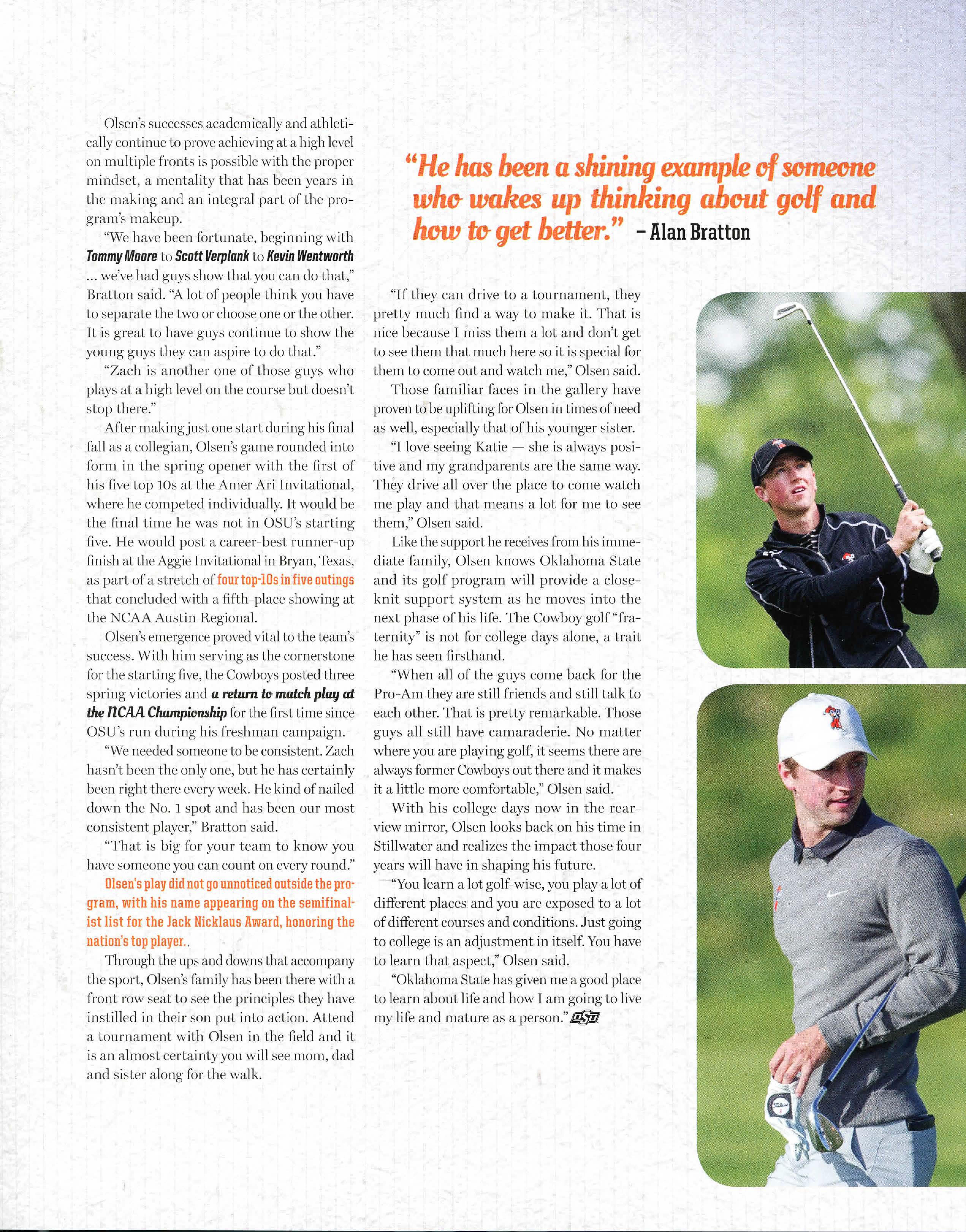
Olsen's successes academically and athletically continue to prove achieving at a high level on multiple fronts is possible with the proper mindset, a mentality that has been years in the making and an integral part of the program's makeup.
"We have been fortunate, beginning with TommyMooreto ScottVerplank to KevinWentworth we've had guys show that you can do that," Bratton said. "A lot of people think you have to separate the two or choose one or the other. It is great to have guys continue to show the young guys they can aspire to do that."
"Zach is another one of those guys who plays at a high level on the course but doesn't stop there."
After making just one start during bis final fall as a collegian, Olsen's game rounded into form in the spring opener with the first of his five top 10s at the Amer Ari Invitational, where be competed individually. It would be the final time he was not in OSU's starting five. He would post a career-best runner-up finish at the Aggie Invitational in Bryan, Texas, as part of a stretch of fourtop-lOsinfiveoutings that concluded with a fifth-place showing at the NCAA Austin Regional.
Olsen's emergence proved vital to the team's success. With him serving as the cornerstone for the starting five, the Cowboys posted three spring victories and a returnto-matchplay at the llCAA Championshipfor the first time since OSU's run during his freshman campaign.
"We needed someone to be consistent. Zach hasn't been the only one, but he has certainly been right there every week. He kind of nailed down the No. l spot and has been our most consistent player," Bratton said.
"That is big for your team to know you have someone you can count on every round."
Olsen'splaydidnotgounnoticedoutsidetheprogram,with his nameappearingonthe semifinalist list for the JackNicklausAward,honoringthe nation'stopplayer ..
Through the ups and downs that accompany the sport, Olsen's family has been there with a front row seat to see the principles they have instilled in their son put into action. Attend a tournament with Olsen in the field and it is an almost certainty you will see mom, dad and sister along for the walk.
"Hehmbeena shiningexampleofsomeone who-wakes up thinkingabout golf and hewto-getbetter." - AlanBratton
"If they can drive to a tournament, they pretty much find a way to make it. That is nice because I miss them a lot and don't get to see them that much here so it is special for them to come out and watch me," Olsen said.
Those familiar faces in the gallery have proven to be uplifting for Olsen in times of need as well, especially that of his younger sister.
"I love seeing Katie - she is always positive and my grandparents are the same way. They drive all over the place to come watch me play and that means a lot for me to see them," Olsen said.
Like the support he receivesfrom his immediate family, Olsen knows Oklahoma State and its golf program will provide a closekn it support system as he moves into the next phase ofhjs life. The Cowboy golf"fraternity" is not for college days alone, a trait he has seen firsthand.
"When all of the guys come back for the Pro-Am they are still friends and still talk to each other. That is pretty remarkable. Those guys all still have camaraderie. No matter where you are playing golf, it seems there are always former Cowboysout there and it makes it a little more comfortable," Olsen said.
With his college days now in the rearview mirror, Olsen looks back on his time in Stillwater and realizes the impact those four years will have in shaping his future.
"Youlearn a lot golf-wise, you play a lot of different places and you are exposed to a lot of different courses and conditions. Just going to college is an adjustment in itself. You have to learn that aspect," Olsen said.
"Oklahoma State has given me a good place to learn about l ifo and how I am going to 1ive my life and mature as a person." ll§iJ
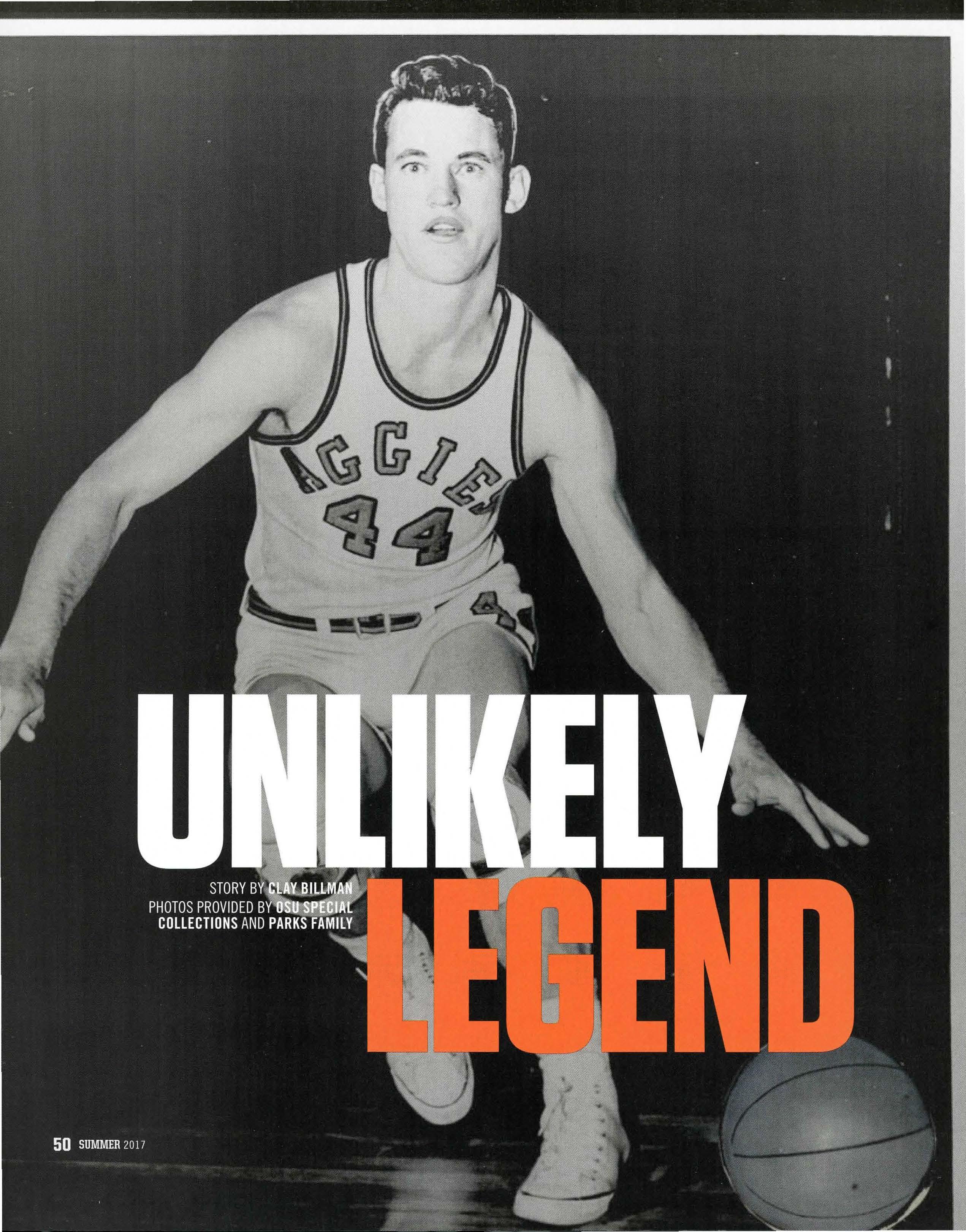
lt had to-be a lllUtahe.
The slender 17-year-old wasn't a football player. Had never played the game. His one-horse hometown didn't even field a team.
So what was John Leonard Parks doing on the gridiron with All-Everythings like Bob Fenimore, Neill Armstrong and Cecil Hankins?
"1 got a letter from Oklahoma A&M asking me to try out for football," recalls Parks, who goes by .J.L. "l Iived out in the country, and there were two fellas from Pauls Valley, BillWalkerand JaeThomas,who were football players. They said, 'I ley, we see you're on the list so let's go up (to Stillwater) together.' Sol went out for football.
"They had to help me put on my equipmenl. I didn't know how," he laughs."[ never played a down of football in my life, but my folks didn't have enough money to send me to school so 1 thought if' 1 got a scholarship it would be great.''
Parks' fledgling football career lasted all of"+S hours in the summer ofl9-H.
"l went out for football for two days, and it liked to have killed me."
Aggie football coach JimLookabaughlined up the six-foot Parks at wide receiver.
"l went out for a couple of' passes and man, Bob (Fenimore) threw that bal I so hard I thought it broke my hand!"
That was it for Parks.
"I decided that second clay, I can't do this. l was going to check my tuff in and go home.'·
Parks picked up his gear and headed over to Gallagher I Iall, where he saw a young man shooting baskets. On the sideline, an imposing figur loomed.
"Something made me go over there and ask ifthey were having any kind of a workout for basketball."
Henry P. Iba gave Parks the onceover.
"I had never met Mr. lba before. I le looked at me - looked down at me reallyand said, 'Son, wl)at's your name"?' 1·11never forget this. I told him, and he said, 'Check that stuff in. Be out here tomorrow at two o'clock."'
Parks did as the legendary coach instructed.
"He looked at me for about five minutes and said, Tm going to give you a scholarship." Unbeknownst to Parks, he had already been on Coach Iba's recruiting radar.
'·Mr. Iba told bis secretary to send me a letter to come up and try out for basketball," Parks says. "Well, she had been sending out football letter· and sent me a football letter by accident. I le didn't tell me what happened until I was a junior."
The son of a sharecropper turned roughneck, Parks was a basketbal I standout for the Paoli Pugs. Pronounced pay-o-luh by locals, the tiny town - pop. +23 in the 19+0 census - sits seven rni !es north of Pau Is Val Icy on State 1-1ighway 77.
"I had my first two years in a little old country school l:allecl Union Springs, and of course it's long gone. When they closed their high school we were put in the Paoli School District.
"We play·'d against Bethel and Crossroads and all those little country schools that clotted the farming area around Garvin County."
In Stillwater, Parks 1rnndered if he could compete at college basketball's highest level.
"There must have been a hundred people out for basketball," he says. "It was a bunch. I thought to myself; 'Herc I am, I come from Paoli, Cla ·s 13high school, 13 in my graduating class, and l'm up here with these all-state boys from Kansas and Oklahoma and everywhere T may be out of place.'''
Coach lba's scholarship offer was contingent on making the team - or rather, surviving training camp. ElJ
"I tel I ya, that first night of practice, I can sti II see it," Parks recalls. "Mr. Iba sat us down and gave us a talk. I remember him saying, 'Fellas, I won't cut any of you. I won't tell any of you to check in your stuff. If you can take what I give out, I'll teach you as much basketball as you're capable oflearning.'
"So he started practice, and we practiced and practiced and practiced ... seemed like it was getting close to 10:30-11:00 at night. Finally he blew his whistle, and I thought we were going in. He lined us up on one end of Gallagher Hall, and we did dashe from one end to the other, forward, backwards, I don't know how long. And then he'd blow his whistle, and we started circling the gym. He said, 'I'll let you know when to quit.' And we ran and ran and ran. I'll never forget that."
Parks says he found a friend in the midst of their suffering.
'' After the pmctices we
"BlakeWilliams,who tu med out to be a pretty good guard and a good buddy of mine, he was dragging. Blake said, 'I can't do this.' I said, 'Come on, we've got one more round and he'll stop.' I kept Blake going. Finally, when Mr. Iba said quit, Blake went out in the hall and threw up."
Williams wasn't the only one.
"Man, the next day I could hardly walk. I was so sore. At the end of that first night of practice, I don't know how many guys checked in their stuff must have been 30 or 40 of them."
The conditioning (and attrition) continued for several more days.
"When it got down to about 30 guys, Mr. Iba didn't do that anymore," Parks says. "We did do some exercises. He'd have us run up the stairs in the balcony, and occasionally he'd take us out to football field and we'd run up and down the bleachers out there. After about four or five days of that, he got serious about basketbal I."
Parks says there wasn't much ti me or energy left for a social Iife outside of the gym.
"We tried to rest. When school let out, we were doing three-a-days. Three practices - one in the morning, one in the afternoon and we'd scrimmage, probably equal to two games at night.
''I'll tell you what, we were in good shape. After a game I never felt 1ike we even worked out hardly. After the practices we did, to play a ballgame was a pleasure because you weren't even tired after the game."
lba's squad was anchored by return· ing All-American BobKurland,the gamechanging seven-footer from Missouri, and (Cecil) Hankins, a multi-sport star who helped A&M win Cotton and Sugar Bowl championships. Weldon Kerns, a junior tran fer from Cameron University in Lawton, was another proven scorer.
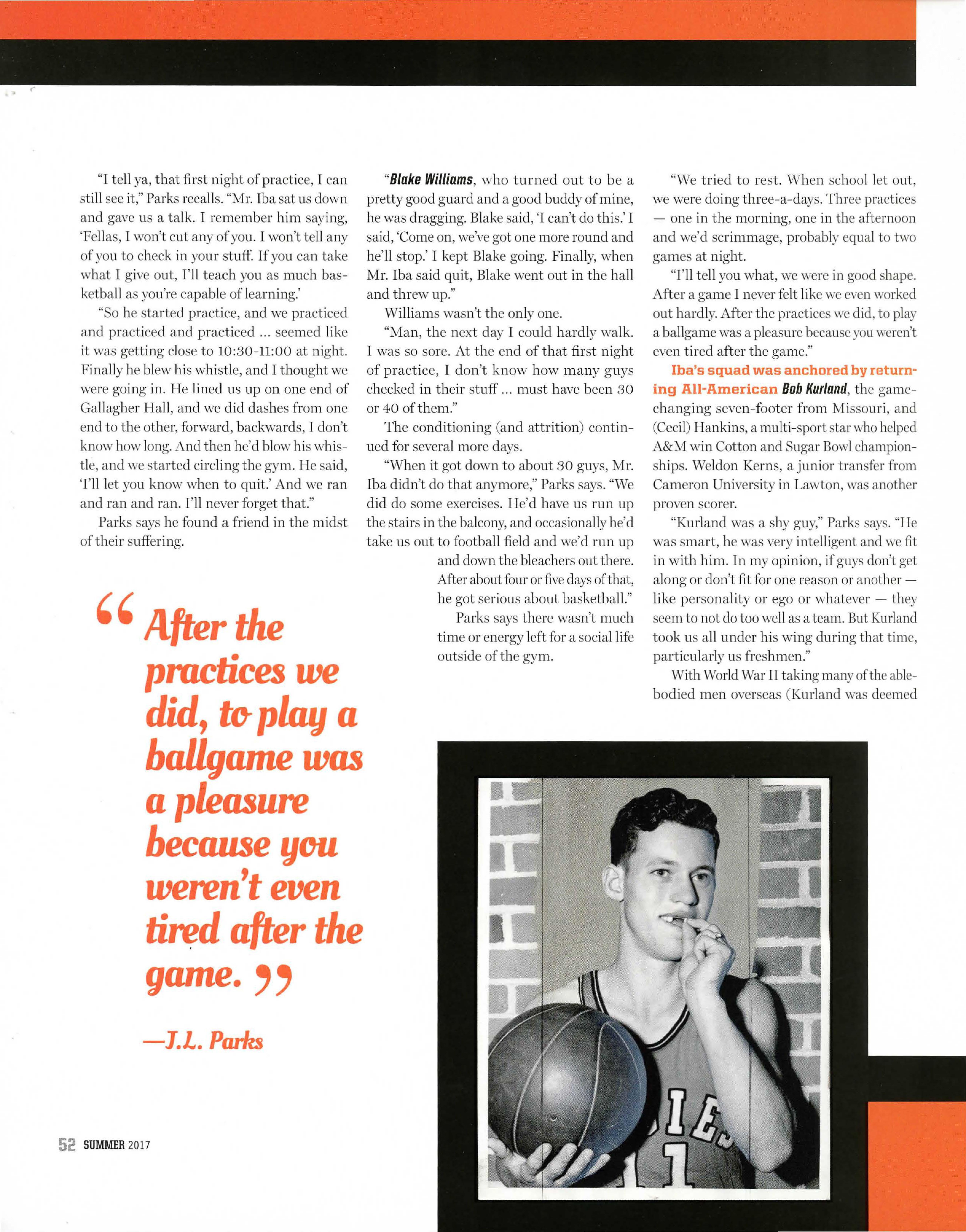
"Kurland was a shy guy," Parks says. "He was smart, he was very intelligent and we fit in with him. In my opinion, if guys don't get along or don't fit for one reason or anotherlike personality or ego or whatever - they seem to not do too well as a team. But Kurland took us all under his wing during that time, particularly us freshmen."
With World War II taking manyoftheablebodied men overseas (Kurland was deemed
too tall for military duty), college freshmen were eligible - and needed - to play on the varsity squad during the '40s. Even so, Parks thought he was destined to be a practice player.
"The old timers that had been there awhiJe told me that if Mr. Iba puts a red shirt on you, you're at the bottom of the list," Parks recalls. "When he started his first practice, I was the first one he called to put a red shirt on. And so I accepted that. Every night, before we ever played a ball game, I was in a red shirt."
Still, Parks says he tried to soak up everything Iba taught about the game of basketball.
"We didn't have much coaching in my little Class B school. In fact, my senior year, the superintendent had to coach just to have somebody on the sideline. We'd just run and shoot, that's about all we did. When I got up to Stillwater, I was lost. So when I was wearing that red shirt, I listened. I learned more basketbal Ijust Iisteniog while he was trying to teach the boys he thought might be starters."
The opener on the 1944-45 Oklahoma A&M schedule was a road game at Phillips University.
"We went over to En id, and Mr. Iba took everybody that was out for basketball. I was the last one he put in the game The next night we went out to practice, and he called my name to go out with the starting five. It was a complete shock. l don't know what he saw in me, but he saw something I guess."
Parks became a fixture on the now· sacred white maple floor of GallagherHall.
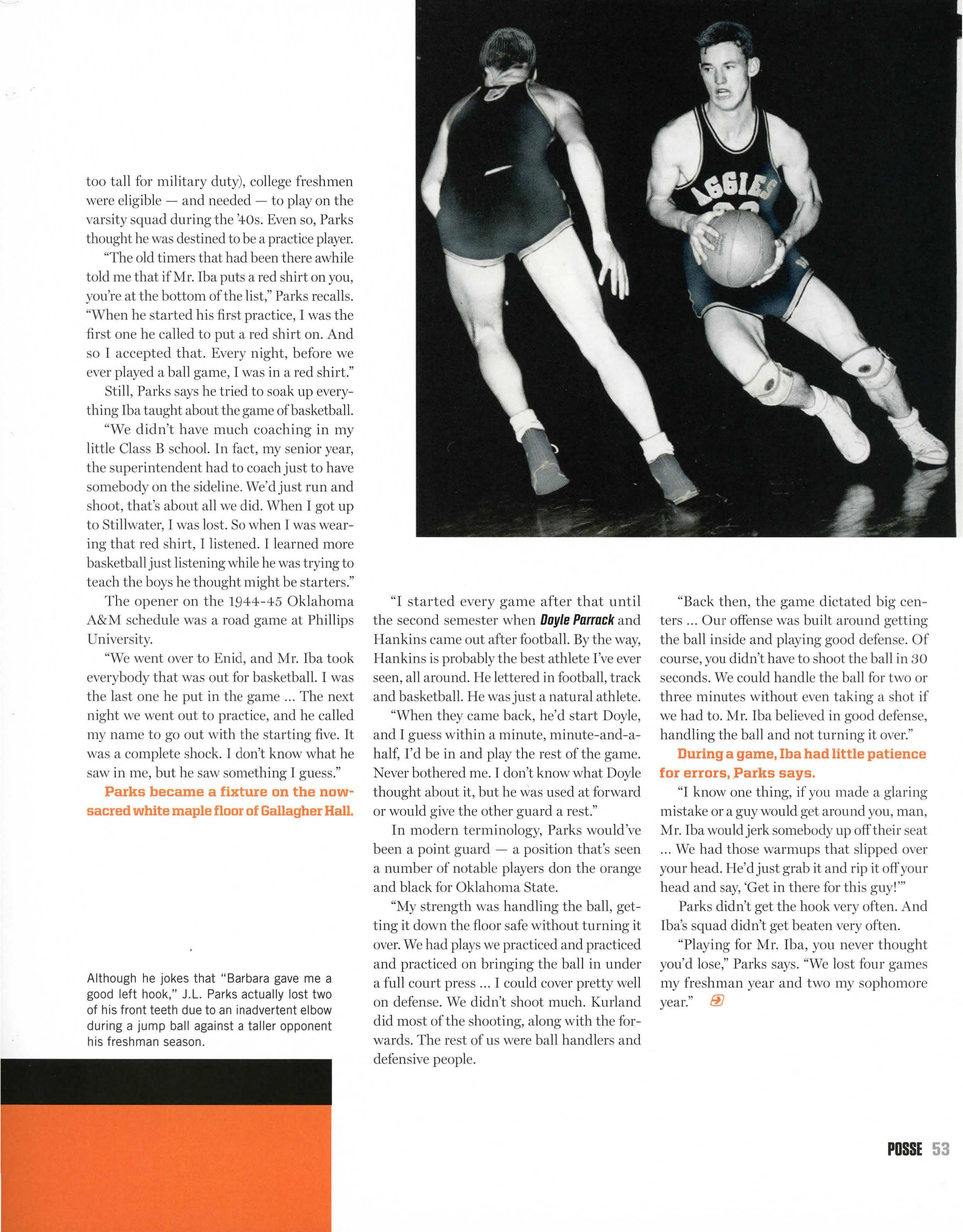
Although he jokes that "Barbara gave me a good left hook," J.L. Parks actually lost two of his front teeth due to an inadvertentelbow during a jump ball against a taller opponent his freshman season.
"I started every game after that until the second semester when DoyleParrackand Hankins came out after football. By the way, Hankins is probably the best athlete I've ever seen, all around. He lettered in football, track and basketball. He was ju ta natural athlete.
"When they came back, he'd start Doyle, and I guess within a minute, minute-and-ahalf; I' cl be in and play the rest of the game. Never bothered me. I don't know what Doyle thought about it, but he was used at forward or would give the other guard a rest."
In modern terminology, Parks would've been a point guard - a position that's seen a number of notable players don the orange and black for Oklahoma State.
"My strength was handling the ball, getting it clown the floor safe without turning it over. We had plays we practiced and practiced and practiced on bringing the ball in under a foll court press I could cover pretty well on defense. We didn't shoot much. Kurland did most of the shooting, along with the forwards. The rest of us were ball handlers and defensive people.
"Back then, the game dictated big centers ... Our offense was built around getting the ball inside and playing good defense. Of course, you didn't have to shoot the ball in 30 econds. We could hand! the ball for two or three minutes without even taking a shot if we had to. Mr. Iba believed in good defense, handling the ball and not turning it over."
During a game, Iba had little patience for errors, Parks says.
"I know one thing, if you made a glaring mi take or a guy would get around you, man, Mr. Iba would jerk somebody up off their seat
We had those warmups that slipped over your head. He'd just grab it and rip it off your head and say, 'Get in there for thi guy!"'
Parks didn't get the hook very often. And fba's squad didn't get beaten very often.
"Playing for Mr. Iba, you never thought you'd lose," Parks says. "We lost four games my freshman year and two my sophomore year." ffJ
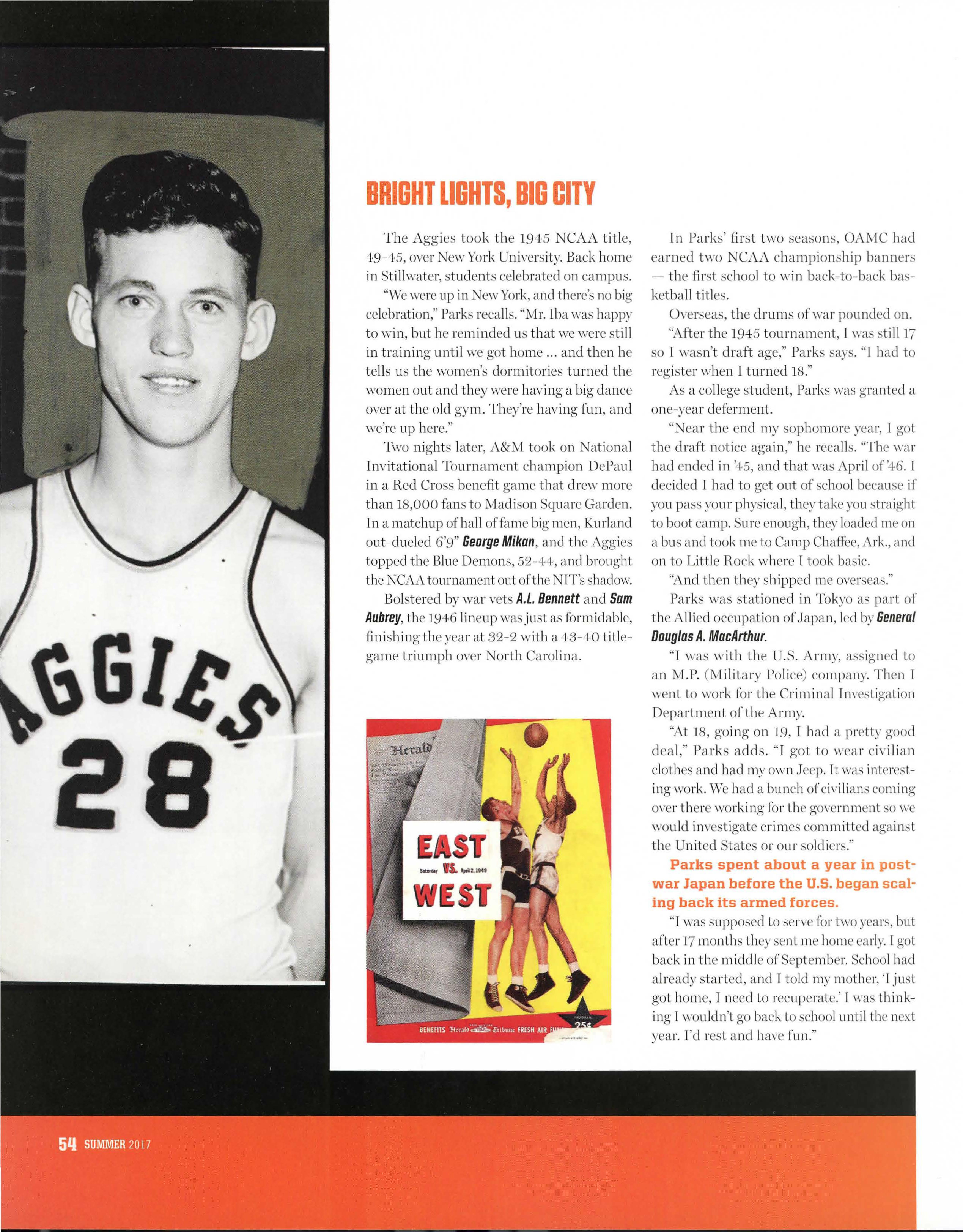
The Aggies took the 19+5 NCAA title, 49-+5, over New York University. Back home in Stillwater, students celebrated on campus.
"We were up in New York, and there's no big celebration," Parks recalls. "Mr. lba was happy to win, but he rem i ncled us that we were sti II in training until we got home and then he tells us the women's dormitories turned the women out and they w re having a big dance over at the old gym. They're having fun, and we're up here."
Two nights later, A&M took on National Invitational Tournament champion DePaul in a Reel Cross benefit game that drew more than 18,000 fans to Madison Square Garden. In a match up of hall offame big men, Kurland out-dueled 6'9" GeorgeMikan,and the Aggies topped the Blue Demon·, 52-++, and brought the NCAA tournament out of the N !T's shadow.
Bolstered by war vets A.L.Bennettand Sam Aubrey,the 19+6 lineup was just as formidable, finishing the year at 32-2 with a +3-+0 titlegame triumph over North Carolina.
In Parks' first two seasons, OAMC had earned two NCAA championship banners - the first school to win back-to-back basketball titles.
Overseas, the drums of war pounded on.
"After the 19+5 tournament, 1 was still 17 so I wasn't draft age," Park ay "I had to regi ter when l turned 18."
As a college student, Parks was granted a one-year deferment.
"Near the end my sophomore year, I got the draft notice again," he recalls. "The war had ended in '4.5, and that was April of'+6. I decided I had to get out of school because if you pass your physical, they take you straight to boot camp. Sure enough, they loaded me on a bus and took me to Camp Chaffee, Ark., and on to Little Rock where I took ba ic.
"And then they shipped me overseas."
Parks was stationed in Tokyo as part of the Allied occupation of.Japan, led by General DouglasA.MacArthur.
"] wa • with the U.S. Army, assigned to an M.P. (Military Police) company. Then I \1·ent to work for the Criminal Investigation Department of the Army.
"At 18, going on 19, I had a pretty good deal," Parks adds. "I got to wear civilian clothes and had my own Jeep. lt was interesting work. \Ve had a bunch of civilians coming over there working for the government so we would investigate crimes committed against the United States or our soldiers.'·
Parks spent about a year in postwar Japan before the U.S. began scaling back its armed forces.
"I was supposed to serve for two years, but after 17 months they sent me home early. I got back in the middle of September. School had al ready started, and I told my mother, 'I just got home, 1 need to recuperate.' I was thinking I wou lein't go back to school u nti I the next year. I' I rest and have fun."
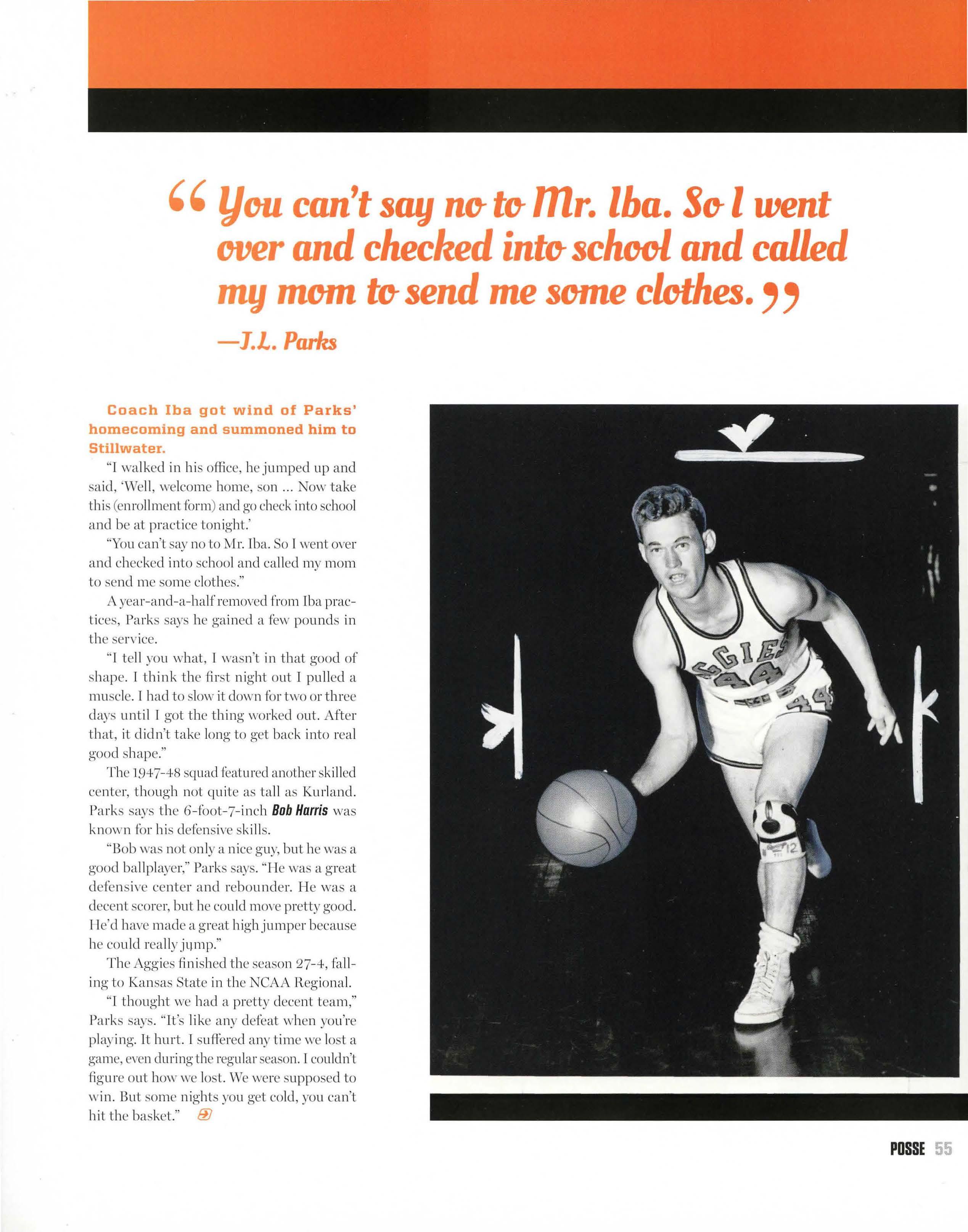
'' ljou can'tsay no-to-fflr. Iba. Sc-I went overand checkedinto-school.and called my mom to-send me some clothes., ,
-1.L. Parks
Coach Iba got wind of Parks' homecoming and summoned him to Stillwater.
"l walked in his office, he jumped up and said, 'Well, welcome home, son Now take this (enrollment form) and go check into school and be at practice tonight.'
"You can't say no to Mr. Iba. So I went over and checked into school and <:ailed my morn to send me some clothes."
A year-and-a-half removed from [ba practices, Parks ays he gained a few pounds in the service.
"I tell _vouwhat, 1 wasn't in that good of shape. I think the first night out I pulled a muscle. I had to slow it down for two or three days until I got the thing worked out. After that, it didn't take long to get back into real good shape."
The 19+7-+8 squad featured another skilled center, though not quite as tall as Kurland. Parks says the 6-foot-7-i nch BobHorriswas known for his defonsive skills.
"Bob was not only a nice guy, but he was a good ballplayer,'' Parks says. "I-le was a great defensive center and rebounder. He was a decent scorer, but he cou Id move pretty good. I le'd have made a great high jumper because he could really jqmp."
The Aggies finished the season 27-+, falling to Kansas State in the NCAA Regional.
"[ thought we had a pretty decent team," Parks says. ·'It's like any defeat when you're playing. lt hurt. I suA-ered any time we lost a game, even during the regular season. I couldn't figure out h(m· we lost. We were supposed to win. But some nights you get cold, you can't hit the basket." fil
At 90, Parks lives in Houston with his wife of 68 years, Barbara (Jones). The pair met as students at Oklahoma A&M, but Parks says he saw her first.
"Blake and r went to Varsity Review my junior year ... We were itting in the crowd like two idiots, and anyway, I told Blake, 'That's the gal I think l'll marry.' I had no idea I'd ever meet her."
In the fall of 1sqe, Parks and a few buddies attended the annual "Howdy Dance" at the OAMC Armory and Gymnasium.
"First of the chool year they always had a get acquainted dance at the old gym," Parks recalls. "Sol was over there standing around with a bunch of football players - BillLongwas one of them - and she was dancing with somebody I said, 'I think I'll go cut in on him.'
"Of course, the guys I knew before I went in the service didn't know I danced. I learned to dance while I was in Tokyo. They said, 'She's not going to dance::with you,' and I said, 'Oh yeah?' So we bet 10 dollars on it. T didn't even have 10 bucks on me. That was a lot of money."
Parks tapped Barbara's dance partner politely on the shoulder.
"So he steps aside. She didn't even know who I was when I introduced myself. Barbara wasn't a basketball fan at that time. She and
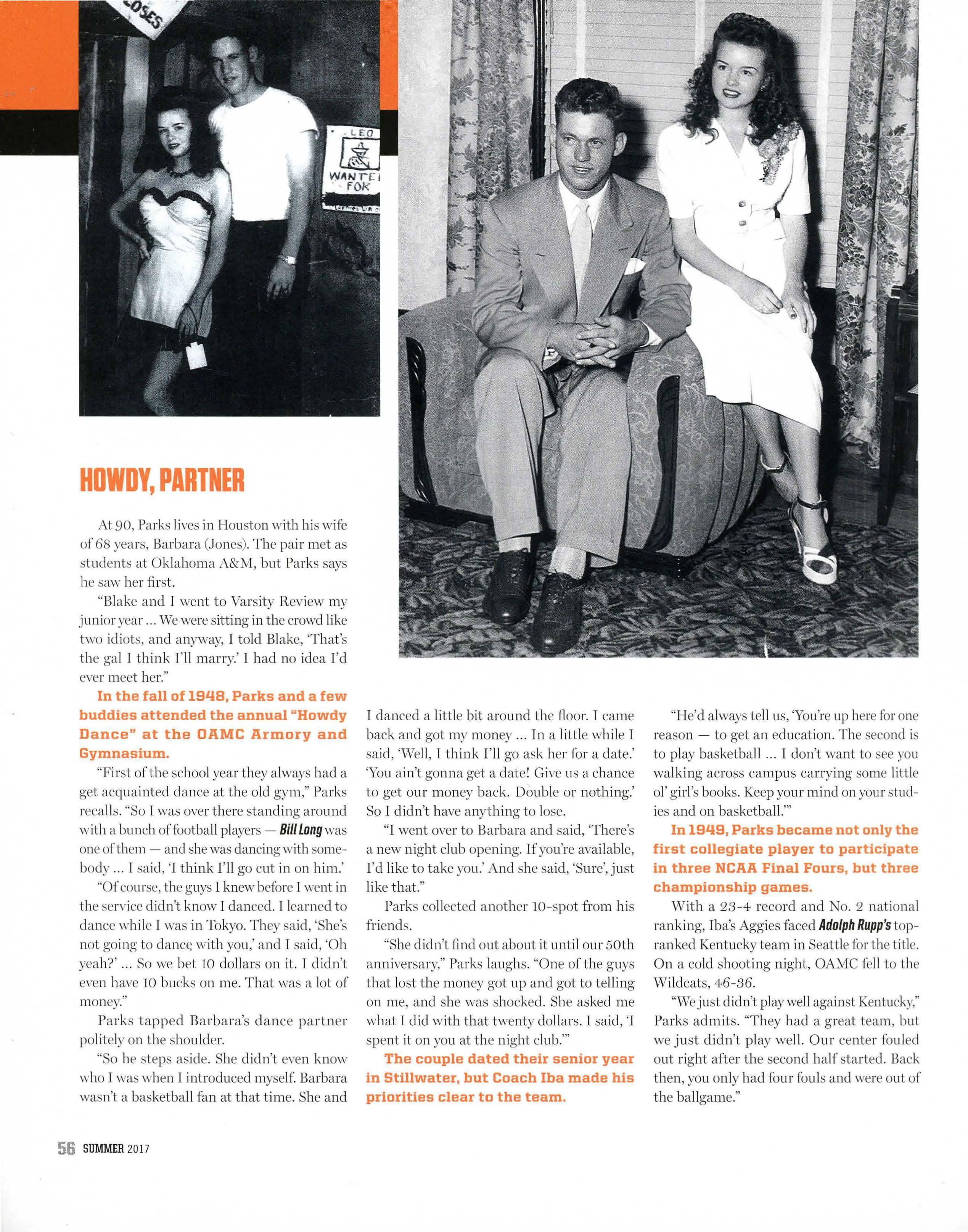
I danced a little bit around the floor. I came back and got my money In a little while I said, 'Well, l think ['II go ask her for a date.' 'You ain't gonna get a date! Give us a chance to get our money back. Double or nothing.' So I didn't have anything to lose.
"I went over to Barbara and said, 'There's a new night club opening. If you're available, I'd like to take you.' And she said, 'Sure', just like that."
Parks collected another IO-spot from his friends.
"She clid n't find out about it u nti 1our 50th anniversary," Parks laughs. "One of the guys that lost the money got up and got to telling on me, and she was shocked. She asked me what I did with that twenty dollars. I said, 'I spent it on you at the night club.'"
The couple dated their senior year in Stillwater, but Coach Iba made his priorities clear to the team.
"He'd always tell us, 'You're up here for one reason - to get an education. The second is to play basketball I don't want to see you walking across campus carrying some little ol' girl's books. Keep your mind on your studie and on basketball."'
In 19q9, Parks became not only the first collegiate player to participate in three NCAA Final Fours, but three championship games.
With a 23-4 record and No. 2 national ranking, Iba's Aggies faced AdolphRupp'stopran keel Kentucky team in Seattle for the title. On a cold shooting night, OAMC foll to the Wildcats, 46-36.
"Wejust didn't play well against Kentucky," Parks admits. "They had a great team, but we just didn't play well. Our center fouled out right after the second half started. Back then, you only had four fouls and were out of the ballgame."
lmmediatcly following the loss, Parks flew to the Big Apple to play in the New York Herald Tribune East vs. West All-Star game at The Garden. The victorious Wildcats happened to be on the same cross-country flight.
"The Kentucky team was pretty loud on that plane." he ays. ··1reca11that Rupp didn't mince words. He used some pretty foul language."
After the all-star game, Parks and the participants were invited to a reception at a downtown hotel. Some famous ladies were also on the guest list.
"They had invitcd the Rockettes over after their last show to come and mingle with us. I got acquainted with one of them She was getting ready to go and wa going to walkshe lived about a block from the hotel. I aid, ·would you like me to walk you home?' She said, 'Sure, if you don't mind.' So I walk d her home. I came on back to the hotel and thought I better call Barbara and report in."
Barbara wa • an Oklahoma City native whose family moved out west to Clinton, Okla., for health reasons during the Dust Bowl days. At OAMC, she lived on the second floor of Willard 1-Jall,a women's lormitory at the time. The residc11Lsshared one telephone per floor.
"You can imagine trying to get a hold of her with one phone and a bunch of women. Any time you'd call that floor it would be busy. You couldn't get in."
So Parks called his girlfriend ... at 2:30a.m.
"He hadn't even told me goodbye when he left," Barbara says. "I was kind of unhappy with him and then at 2:30 in the morning he called Willard Hall. The house mother answered the phone and got me to come clownstai rs and talk to my friend that was calling from New York City. And he was calling to tell me that he had just come back from a elate with a Rockette!"
Parks offers this frail defense:
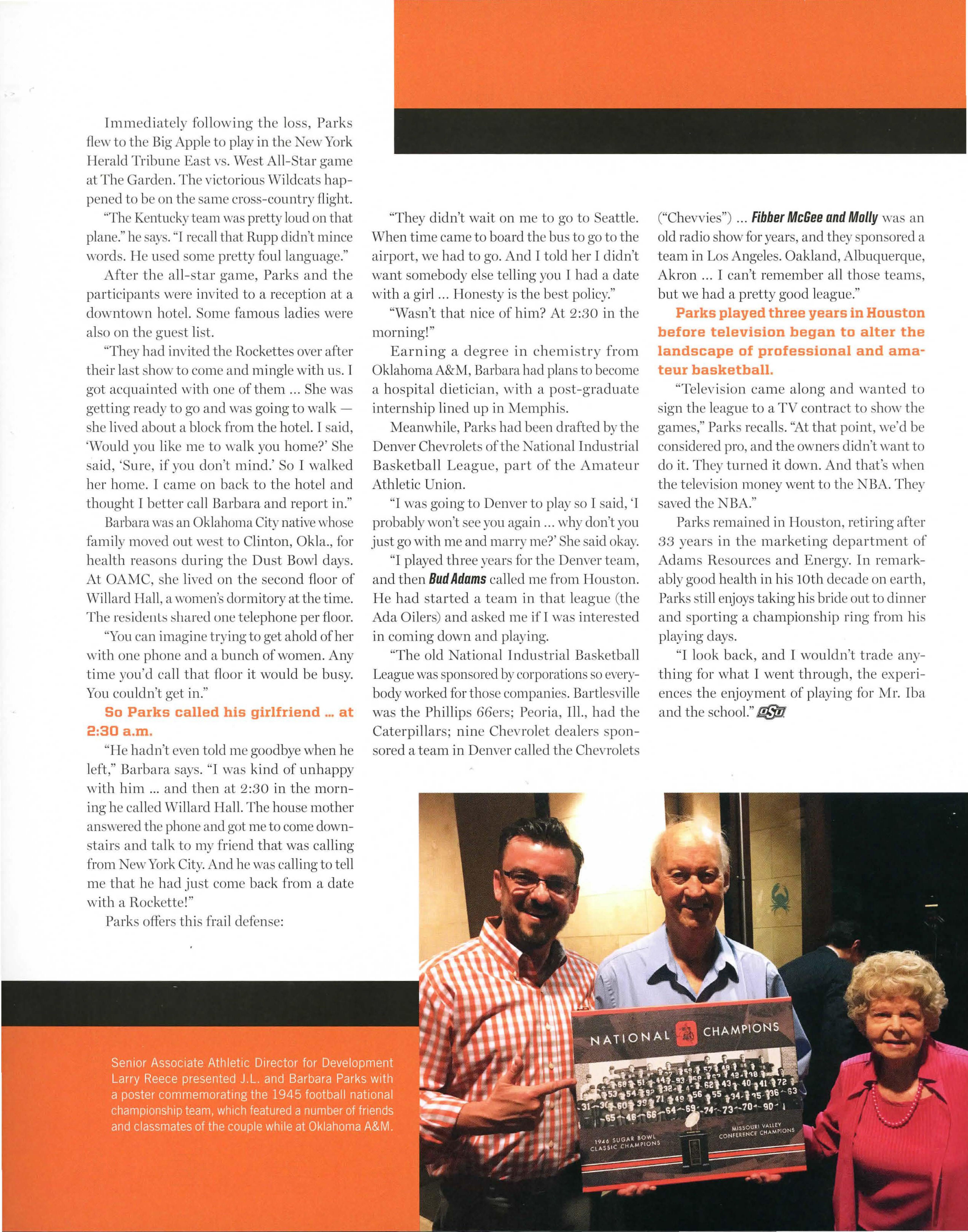
"They didn't wait on me to go to Seattle. When time came to board the bus to go to the airport, we had to go. And I told her I didn't want somebody else telling you I had a date with a girl Honesty is the best policy."
"Wasn't that nice of him? At 2:30 in the morning!"
Earning a degree in chemistry from OklahomaA&M, Barbara had plans to become a hospital dietician, with a post-graduate internship lined up in Memphis.
Mcanwh ile, Parks had been drafted by the Denver Chevrolets of the National Industrial Basketball League, part of the Amateur Athletic Union.
"I was going to Denver to play so I said, 'I probably won't see you again why don't you just go with me and marry me"?' he said okay.
"I played three years for the Denver team, and then BudAdamscalled me from Houston. He had started a team in that league (the Ada Oilers) and asked me if l wa • interested in coming clown and playing.
"The old National l nclustrial Basketball League was sponsored by corporations so everybody worked for those companies. Bartlesville was the Phillips 66ers; Peoria, Ill., had the Caterpillars; nine Chevrolet dealers sponsored a team in Denver called the Chevrolets
("Chevvies") ... FibberMcGeeandMollywas an old radio show for years, and they sponsored a team in Los Angeles. Oakland, Albuquerque, Akron I can't remember all those teams, but we had a pretty good league."
Parks played three years in Houston before television began to alter the landscape of professional and amateur basketball.
"Televi ion came along and wanted to sign the league to a TV contract tu show the games," Parks recalls. "At that point, we'd be considered pro, and the owners didn't want to do it. They turned it down. And that's when the television money went to the NBA. They saved the NBA."
Parks remained in Houston, retiring after 33 years in the marketing department of Adams Resources and Energy. In remarkably good health in his 10th decade on earth, Parks still enjoys taking his bride out to dinner and sporting a championship ring from his playing days.
"I look back, and I wouldn't trade anything for what I went through, the experiences the enjoyment of playing for Mr. Iba and the school." ll§o
All earthly endeavors eventually end.
Babe Ruth eventually stroked his 714th and final home run. General Dwight Eisenhower eventually left the front lines for the White House.
And Hall of Fame basketball coach Henry Payne Iba, after 36 campaigns in Stillwater, coached his last basketball game.
The following is an excerpt from the Oklahoma Heritage book, Mr. Iba, by John Bischoff:
Henry P. Iba's grandfathe1; Henry Beckley Iba, moved hisfamilyji·om the east to Easton, Misso-uri,following the Civil Ww; seeking better opportunities. There he worlced as a shoe cobbler and helpedfo-und a Protestant ch-urch.
Jvlr.Iba'sfathe1; Henry B-urkey Iba, was a traveling salesman, b-ut managed to spend most of his time in Easton. Henry P. Iba was the oldest ojfo-ur boys and hacl an older sister. Competitive sports, especially baseball, occ-upied a lot of the boy's time.
Following high school, Iba attended Westminster Collegein F-ulton,Misso-uri, where he q'Uiclclybecame afour-sport (baslcetball, baseball,.football and track) star athlete, especially in basketball
.'lim P'ixlee, lba's coach at Westminster, ''He became one hell of a basketball player. I have never seen a boy in any line who wanted to play as badly as he did nor any boy who wanted to win as badly. I have coached boys with more ab-ility, but none willing to pay the price in mental and physical energy to the same degree as Hank. He had those virtues in abundance." :J
Upon graduation from Westminster, Iba's fir t coaching opportunity came from Oklahoma City's brand new Classen High School, followed by brief stints at Northwest Missouri State Teacher's College and the University of Colorado.
In 193LI, Oklahoma ASM hired 29-year-old old Henry P. Iba as athletic director and head basketball coach.
Iba's teams steadily grew more successful, culminating with consecutive NCAA championships in 19.J.."5and 19.J.6. Iba and his Aggies climbed to the pinnacle of success.
In addition to two national titles, Iba's coaching resume included two national coach of the year awards, 14 Missouri Valley Cor1ferencetitles, an NCAA runner-finish, a Big Eight Conference title andfour Final Fours. He coached three U.S. Olympic teams (1964, 1968 and 1972). He won two gold medals and was the head coach during maybe the most famous Olympic basketball game ever, a controversial loss to the Russians at the '72 Munich games. Iba called it his biggest disappointment in athletics.
His college squads won 767 times. He won 71 percent of his games. He was 50-27 vs. Oklahoma.
Mr. Henry Iba was the most principled, modest, loyal, gracious, dignified and considerate man I ever met. It was no contest. Knowing him was the greatest privilege I have experienced in 40 years of reporting on the people who shaped the athletic landscape.
Mr. Iba was no saint. He was a salty man's man who liked scotch in moderation and had a wonderful wit that cracked up audiences of cronies on fishing trips, associates on plane trips or players during pregame talks.
He was a tough soul. They did not call him the Iron Duke for nothing. He was the quintessential taskmaster whose passion· for discipline had no limit. He could deliver the most searing of tongue lashings during four-hour practices and burn the ears of referees with whom he disagreed. His booming voice added to his intimidating presence.
Coach Iba, in my estimation, is the greatest coach in the history of basketball. He epitomized what a coach must do on and off the court, and in the manner in which it should be done.
Four or five coaches made great contributions to basketball, including Coach Iba. He did it before there was anyone to copy. He was the first to run the motion offense. He was the first to incorporate the 'help' principles of zone defenses with man-to-man defense. He opened up the game for the big man.
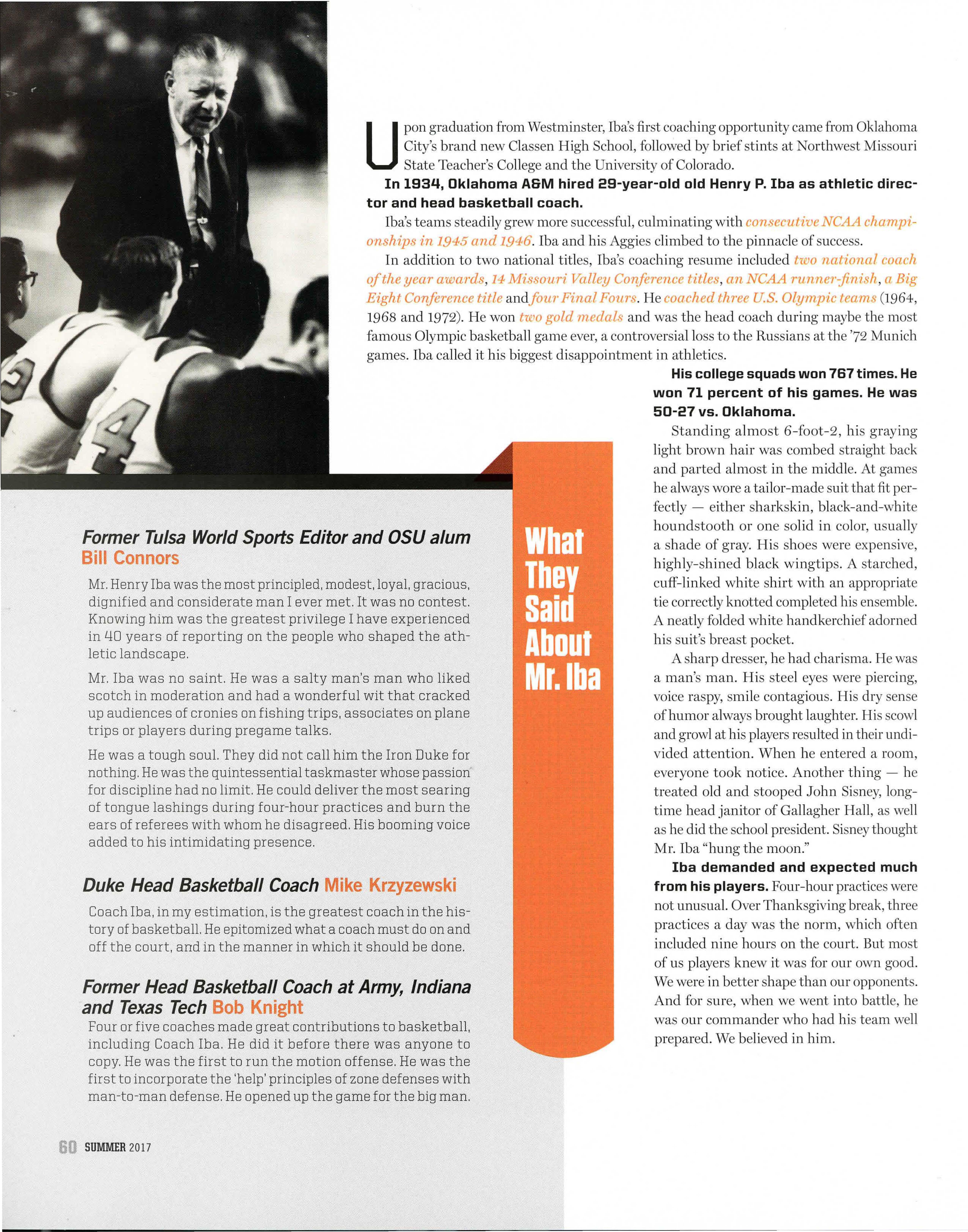
Standing almost 6-foot-2, his graying light brown hair was combed straight back and parted almost in the middle. At games he always wore a tailor-made suit that fit perfectly - either sharkskin, black-and-white houndstooth or one solid in color, u ually a shade of gray. His shoes were expensive, highly-shined black wingtips. A starched, cuff-linked white shirt with an appropriate tie correctly knotted completed his ensemble. A neatly folded white handkerchief adorned his suit's breast pocket.
A sharp dresser, he had charisma. He was a man's man. His steel eyes were piercing, voice raspy, smile contagious. His dry sense of humor always brought laughter. His scowl and growl at his players resulted in their undivided attention. When he entered a room, everyone took notice. Another thing - he treated old and stooped John Sisney, longti me head janitor of Gallagher Hall, as well as he did the school president. Sisneythought Mr. Iba "hung the moon."
Iba demanded and expected much from his players. Four-hour practices were not unusual. Over Thanksgiving break, three practices a day was the norm, which often included nine hours on the court. But most of us players knew it was for our own good. We were in better shape than our opponents. And for sure, when we went into battle, he was our commander who had his team well prepared. We believed in him.
0n March 7, 1970, Iba is 65. At the time, it is the mandatory retirement age in Oklahoma. That evening, the Pokes played host to the disliked Sooners in Iba's last game. The stage is set for a storybook conclusion - the end of a beloved, legendary coach's reign, an expected rowdy full house and an all-out battle on the hardwood. But, for a happy ending, Iba's boys must take care of business.
"In practice the day before the game I got a hip pointer and ended up in the hospital in severe pain," said Paul Mullen, a center on Iba's last team. "Doc Cooper (team physician Dr. Donald Cooper)told me to show up SO minutes earlier than normal for the game. I did, and he shot my hip full of Novocain. I didn't feel a thing and played almost the whole game.
"We were down two at the half and went upstairs to a classroom and sat in those old wooden desk chairs. Mr. Iba didn't have time to talk to us since they were honoring him with halnime festivities. So Sam (assistant coach Sam Aubry) gave us instructions. I thought it was funny that it was his last game, and he didn't have time to talk to us. He came back just as we were getting ready to leave and said, 'Forget about all this hullabaloo. Get down there and play ball!'
"Starting the second halt; Sparky(Grober) hit a long jumper. We hit about eight in a row, and they missed quite a few. The rout was on. Pandemonium breaks out!
"Byrd(head trainer ByronByrd)had already told us it was OK to carry Mr. Iba off the court, and that's what we did. He enjoyed it.
"Looking back, it was sad that it was his last game, but it was very important that we won that game for him."
"Wewere a little lucky,"senior guard Grober said. "OU's center had been suspended for that game. There might have been some bad blood between Mr. Iba and John McCloud,coach of the Sooners. Mc.Cloudhad turned in an OSU player the previous summer for playing in a benefit game."
According to Grober, the Cowboys were placed under strict orders from former Cowboys to send the head man out on a good note.
"Big buildup for a game back then. Lots of newspaper writers from all over were there. Gallagher was packed for the freshman game," Grober said.
"First half we were a little lethargic. Second half the Sooners came out in a zone. Being a shooter, I loved to play against a zone defense. On opening tip, I dribbled just across half-court, shot it, and it went in ... swish! We shot 13-of-18 that half."
The Cowboys eventually posted a 77-61 win over the NIT-bound Sooners. :J
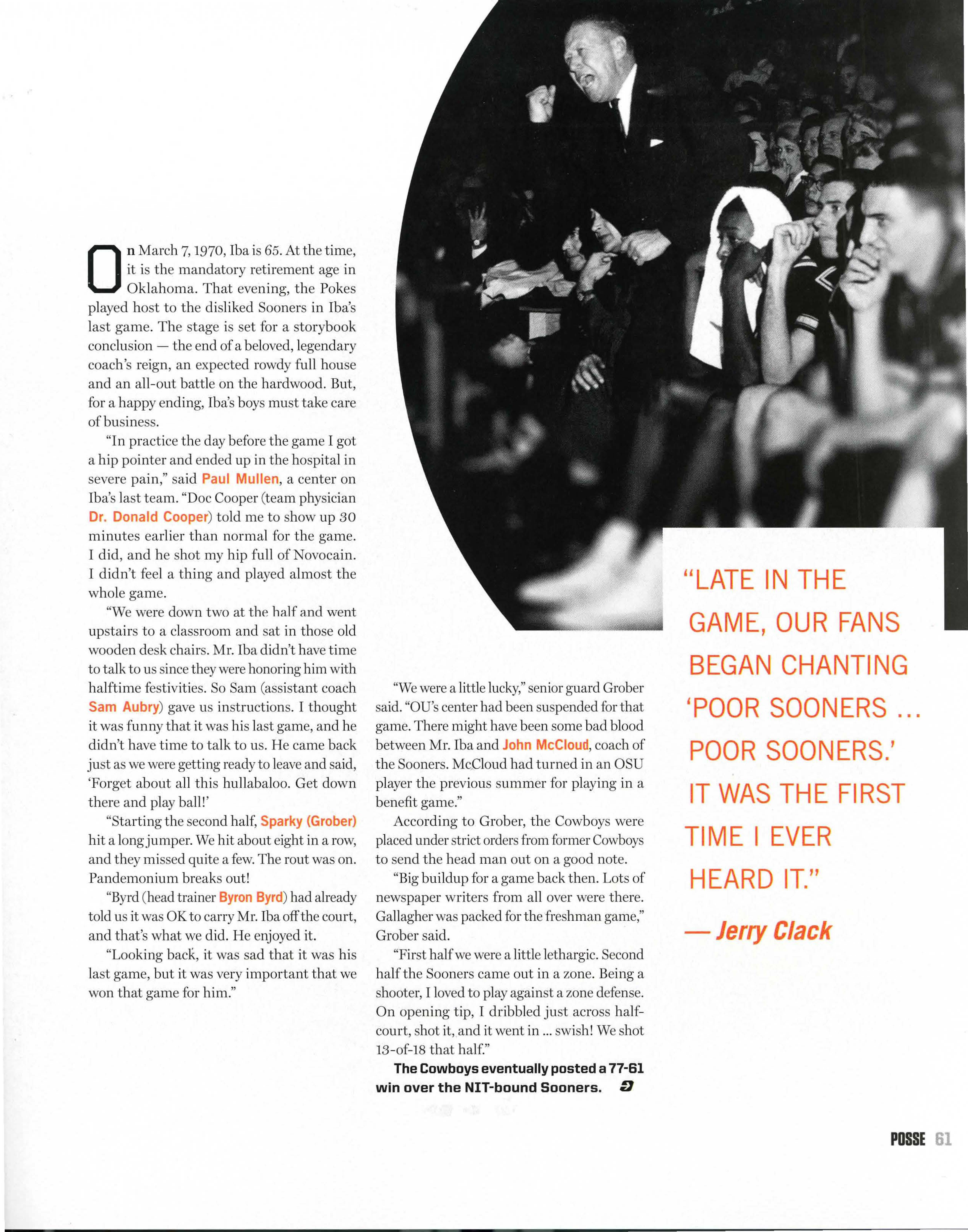
"LATEIN THE GAME,OUR FANS BEGANCHANTING 'POORSOONERS... POORSOONERS.' IT WASTHE FIRST TIME I EVER HEARDIT." - JerryClack
"We carried Mr. Iba off the floor," Grober said. "It was a textbook game for Mr. Iba. We playedgood help defense, made our free throws, shot the bal I well and didn't turn it over. Plus, we ran the delay game to perfection."
"Late in the game, with a minute or so to go and the outcome not in doubt, I missed a wide open layup. I couldn't believe it. Shot thousands upon thousands of shots in my Iifeti me, and my last one is a layup and I miss it. Mr. Iba takes me out of the game. I'm the last player he pulled because of a turnover!
"We were a gutty little group," Grober said of!vlr. lba's final team. "BobBuckcould score. lle and Mu Ilen w~re leapers. Rick Cooper could jump and score. John Robinsonwas hard to cover. Sophomores Jerry Clack and Scott Alfordoff the bench contributed valuable minutes. Mike Miller and Mike Jeffries were key re erves. That win made us 14-12, a winning season, 5-9 in conference.
"To win it for Mr. Iba wa great," he continued. "Walking off the court I realized my playing days were over, lots of years playing basketball. So thankful I played at OSU. Diehard Cowboy fan. Great experience. My son and wife graduated there. All-in-all, 1.3or 14 Grobers got their degrees in Stillwater.
"I was in awe of that last crowd. We'd had some decent crowd before, but nothing like that. Seeing that packed fieldhouse, I thought, 'Holy cow, we'd better win this one!"'
Sophomore Jerry Clack: "One thing that doesn't get written enough about Mr. Iba is his dry sen e of humor, which has been unappreciated. Also, he never called any of us players by our name. It was always 'boy' or 'laddie.'
"My freshman year, we scrimmaged the varsity for the first time," he said. "In high school I was used to scoring a lot of points. Toward the encl of a three-hour practice, I'd put up one shot and missed. The scrimmage was about over so I heaved another shot and missed. l was scoreless.
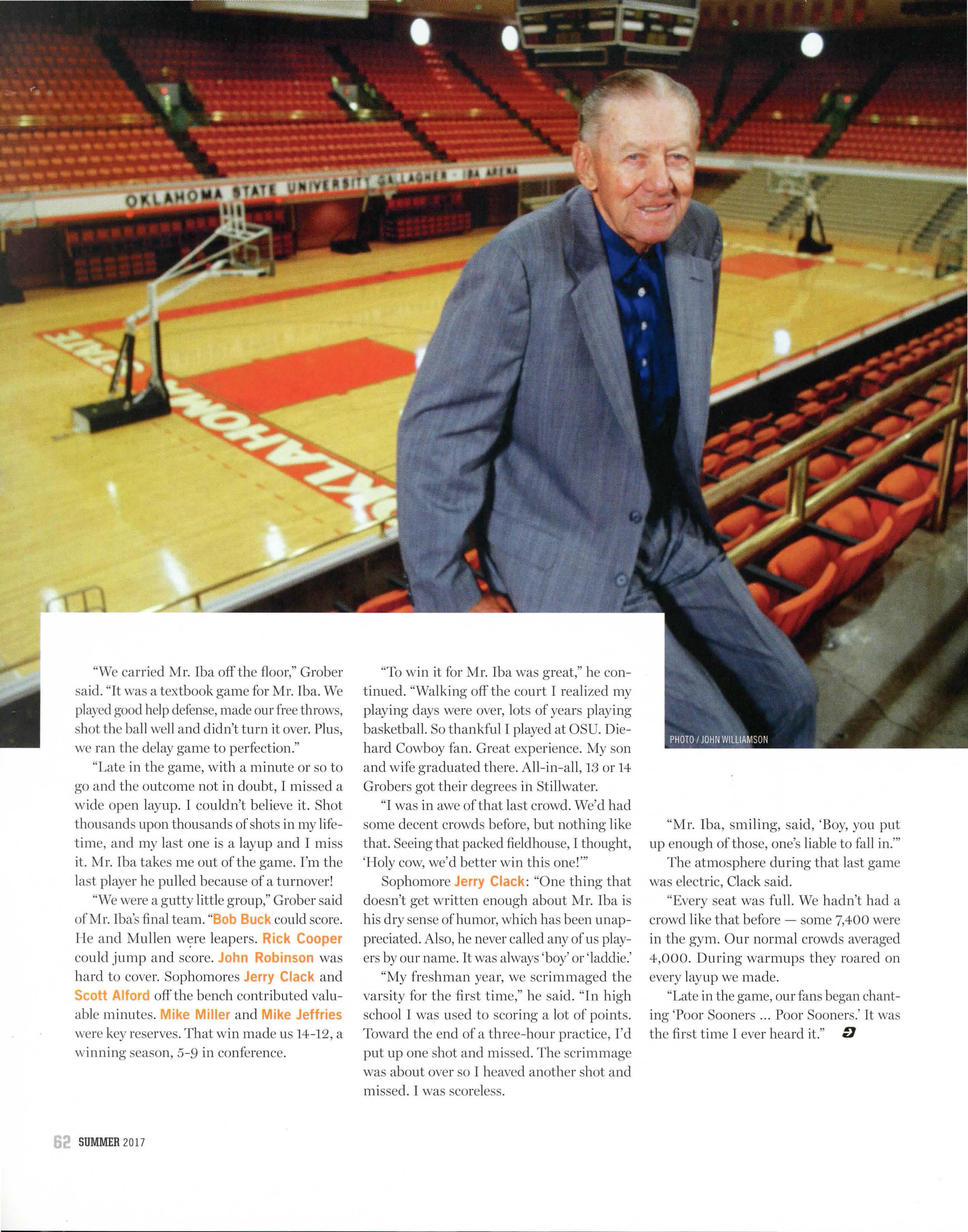
"Mr. Iba, sm i Iing, said, 'Boy, you put up enough of those, one's liable to fall in."'
The atmosphere during that last game wa electric, Clack said.
"Every seat was full. We hadn't had a crowd like that before - some 7,400 were in the gym. Our normal crowds averaged 4,000. During warmups they roared on every layup we made.
"Late in the game, our fans began chanting 'Poor Sooners Poor Sooners.' It was the first time I ever heard it." :J
A buzzer will go off in Gallagher Hall sometime between 8:30 and 10:00 p.m. Saturday.
It will signify the end of the basketball game between Oklahoma State and the University of Oklahoma.
Henry P.Iba's 36-year basketball coaching career will also end as that buzzer echoes in the field house.
Whether Iba wins or loses Saturday night is not important - one game will not erase the mark Iba has left on athletics here at and across the nation.
The basketball victories and honors Iba has brought to are only a part of the Iba legend at Iba brought honesty and integrity into the athletic department when he became athletic director in 1836 and these qualities have been here ever since.
Iba is a hard disciplinarian ask any of his players. But when they leave his players take with them a deep and long lasting respect for their "Mr. Iba".
His players were taught the Iba style of basketball but in addition they were given hints on how to live a more worthwhile life.
Iba is a firm believer in "his boys" getting a good education and he continually reminds them to do so.
Perhaps the best thing that might be said about Henry Iba is he is a warm and decent human being to everyone he comes into contact with Oklahoma State is very lucky to have had such a man.
Good luck! Mr. Iba.
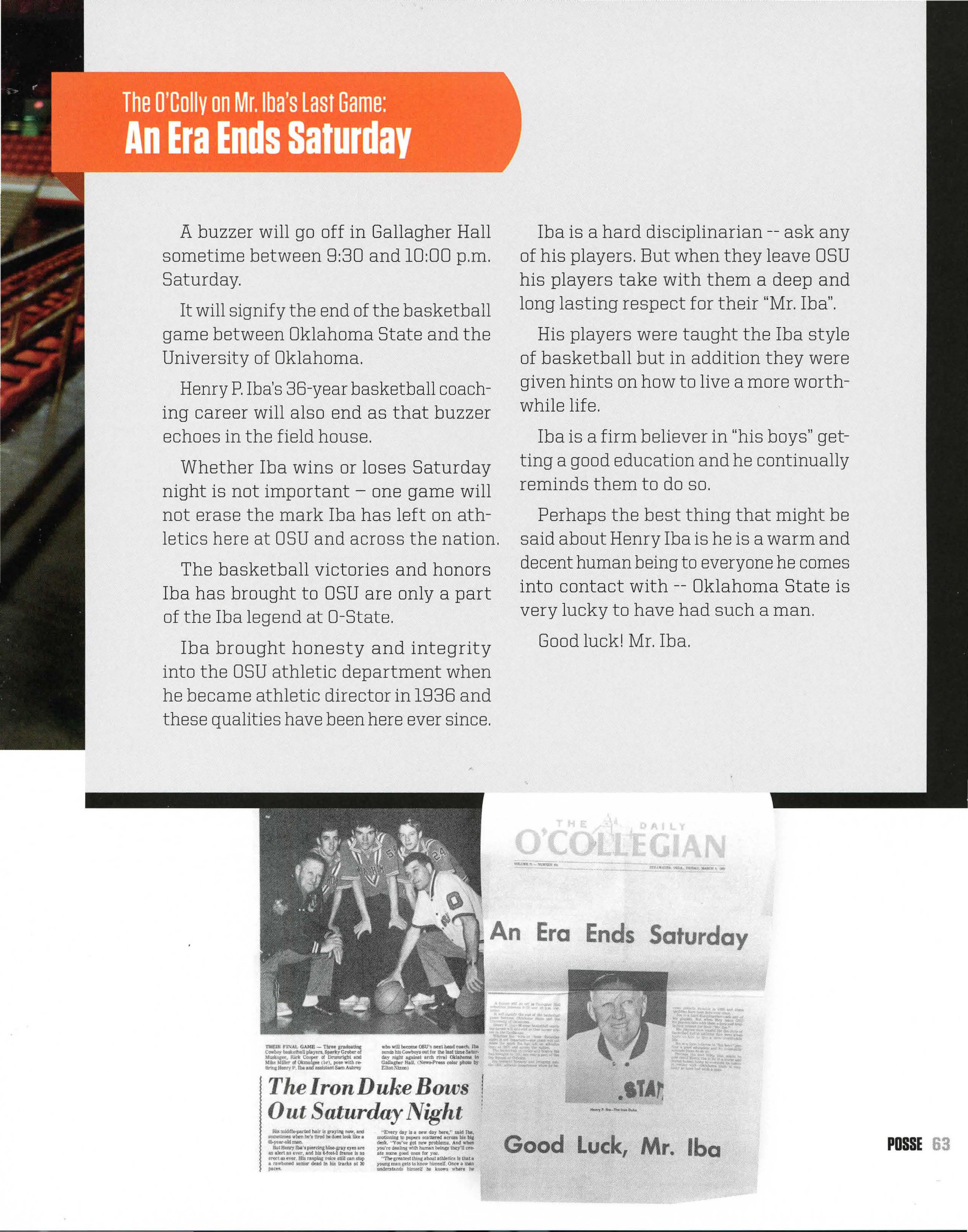
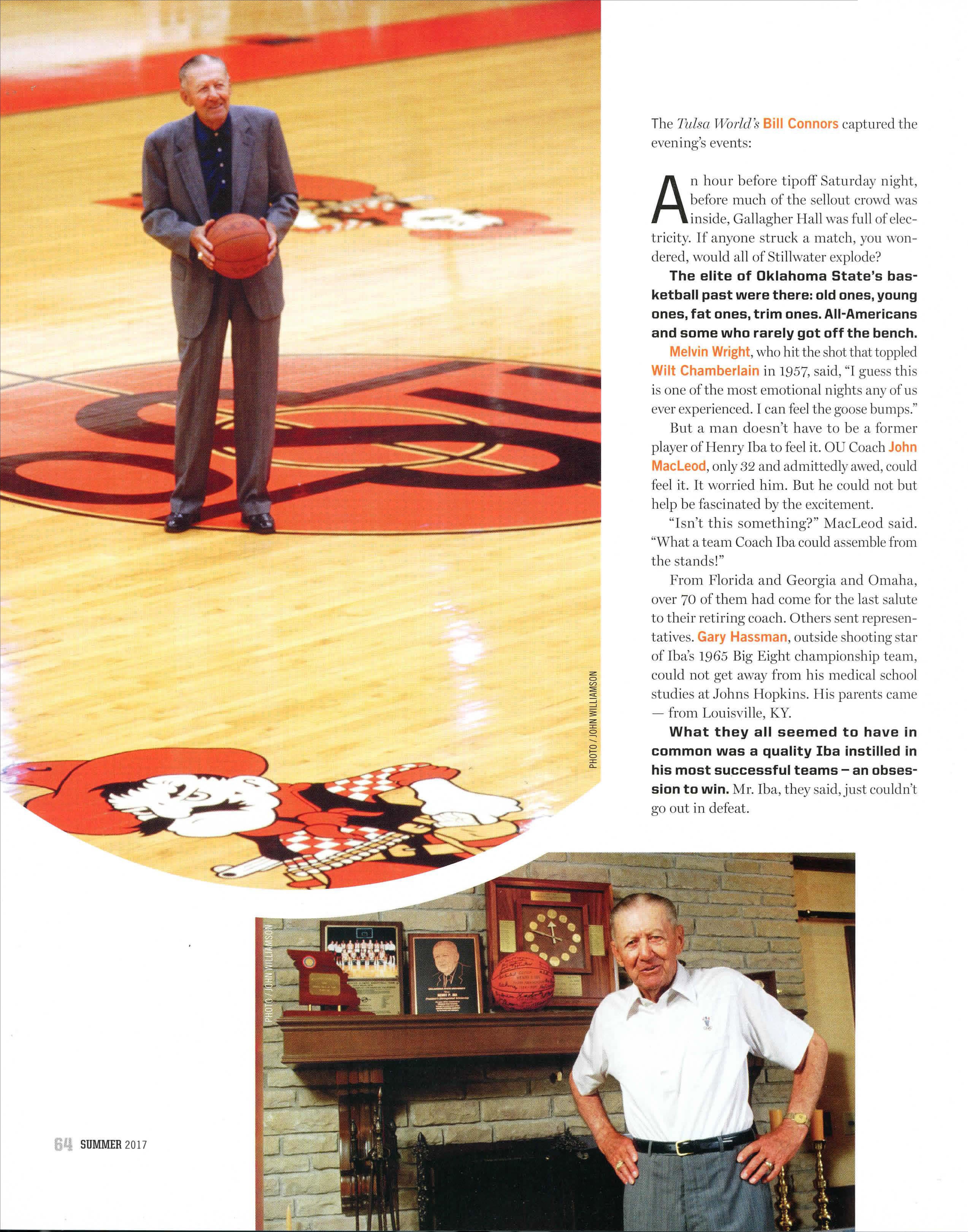
The Tulsa Worlds Bill Connorscaptured the evening's events:
An hour before tipoff Saturday night, before much of the sellout crowd was inside, Gallagher Hall was fu 11of electricity. If anyone struck a match, you wondered, would all of Stillwater explode?
The elite of Oklahoma State's basketball past were there: old ones, young ones, fat ones, trim ones. All-Americans and some who rarely got off the bench.
MelvinWright,who hittheshotthattoppled Wilt Chamberlainin 1957, said, "I guess this is one of the most emotional nights any of us ever experienced. I can feel the goose bumps."
But a man doesn't have to be a former player of Henry Iba to feel it. OU Coach John Macleod, only 32 and admittedly awed, could feel it. It worried him. But he could not but help be fascinated by the excitement.
"Isn't this something?" MacLeod said. "What a team Coach Iba could assemble from the stands!"
From Florida and Georgia and Omaha, over 70 of them had come for the last salute to their retiring coach. Others sent representatives. Gary Hassman,outside shooting star of Iba's 1965 Big Eight championship team, could not get away from his medical school studies at Johns Hopkins. His parents came - from Louisville, KY.
What they all seemed to have in common was a quality Iba instilled in his most successful teams - an obsession to win. Mr. Iba, they said, just couldn't go out in defeat.
They seemed to ignore the quality ofOU's hot finish, that the Sooners of late had been the Big Eight's best team and, with the National Invitation Tournament bid out of the way, figured to be free of pressure, and therefore a relaxed team with enough assets to defeat a mediocre but inspired team.
If the 1970 Cowboys were not ready, their predecessors could not understand why. Former greats Don Johnsonand Keith Smith wondered if they might need a pep talk.
The 1970 Cowboys, however, had no intention of going down in shame. At the pregarne meeting, Iba tried to put them at ease.
"Forget all th is hullabaloo," Iba said. "Forget everything except the ball game. Play it like we always do."
When they went to the training room to be taped, senior and leading scorer RickCooper said, "We agreed we would carry him off the floor when the game was over."
Someone a ked what they would do if they lost. "We are not going to lose," Cooper said.
Later, in the after game glow, Cooper said, "1 never considered the possibility we would lose. And T don't think any other starter did either. There wasn't anybody going to beat us tonight."
And so this little, not-so-talented team that began the season with less experience than any of Iba's 35 preceding teams went out and unloaded a maximum effort on OU. ln the first half, the Cowboys made enough conventional errors and judgment mistakes to keep themselves behind.
At intermission, while Iba and his wife were being honored, the Cowboys heard a routine talk by the man who will be their coach next year, Sam Aubrey."We did the same things at halftime that Mr. Iba always did," said Aubrey, who in 17 years as Iba's assistant has been in on approximately 440 halftime talks.
From then on, it wa as though the AllAmericans in the ;,tands had gone to the fountain of youth and suited up for the second half.
The Cowboys played a second half that was straight from the Iba Bible. They rallied, played defense, ran their delay game and played their guts out. By the time 0-State was 10 points ahead, the ooners may have wondered if they had been mistaken for the Red Chinese.
"I NEVERCONSIDEREDTHE POSSIBILITYWE WOULDLOSE.AND I DON'TTHINK ANY OTHERSTARTER DID EITHER.THEREWASN'TANYBODY GOINGTO BEATUS TONIGHT."
- Rick
Cooper
A the game ended, OSU's players rushed to the floor to shake Mr. Iba's hand. So did a few Sooners. Then, they persuaded him to let them carry him off the floor.
Iba never al lowed a team to carry him off the court until 1965, after the Big Eight title clinching game at Kansas.
He always maintained, "No coach ever won a big game. The players should get the glory."
But he could not refuse his '65 team, and he could not refu e his last team. So, off he went- out of Gallagher Hall for the lat time as coach - on the shoulders of Cooper, .John Robin on and Jerry Clack.
The former players were sm iIing, and raving. Normally inclined to be critical of modern players, these exes could not say cnougb for the 1970 Cowboys' final half.
"It was a great performance," said Cecil Hankins.
"They could have not possibly have played any better than that," said Eddie Sutton.
"It was a perfect ending," said Dr. Gale McArthur. "W11at a way for him to go out. This is what he deserved."
A.L. Bennettadded, "It wa a tough, contact game, and the boys sure put out everything for Mr. lba."
Bennett was unaware of just how much effort was extended. Center Paul Mullen suffered a hip injury in Friday's I ractice and spent 18 hours in the ho pita], but got out of bed and played a key role in the victory.
At a postgame meeting, Iba thanked his players and asked them to autograph the game ball for him. He singled out seniors Sparky Grober, Cooper and John Miller and said, "Keep in touch with me. If you ever need me for anything, anytime, anywhere, call me. 1'11 help you if l can. I'm always available."
The players quietly filed out of the dressing room. Cooper, his eye· seemingly bloodshot, said, "He's some kind of a man, isn't he"?"
Then lba and his wife were hosts at a reception (sandwiches, punch and cookies) for former players, their families and special guests.
After an hour they began going their separate ways.
Iba waited until every player had left. Then, Henry P. Iba, ex-coach, with the autographed basketball in one arm, and his wife in the other, said, "Doyne, let's go home." They walked across the darkened parking lot. It had been a 'night to remember.'
It was the end of an unforgettable era. 'The Man's' legacy wou Id now Iive on in each of 'his boys.' I am fortunate to be on of those!


When you purchase licensed products, a portion of your purchase price goes to support scholarships and other university programs.
(j Oklahoma State University: Live Orange Cl @OSUGear @OSUGear
Get information on new retailers, merchandise and promotions.
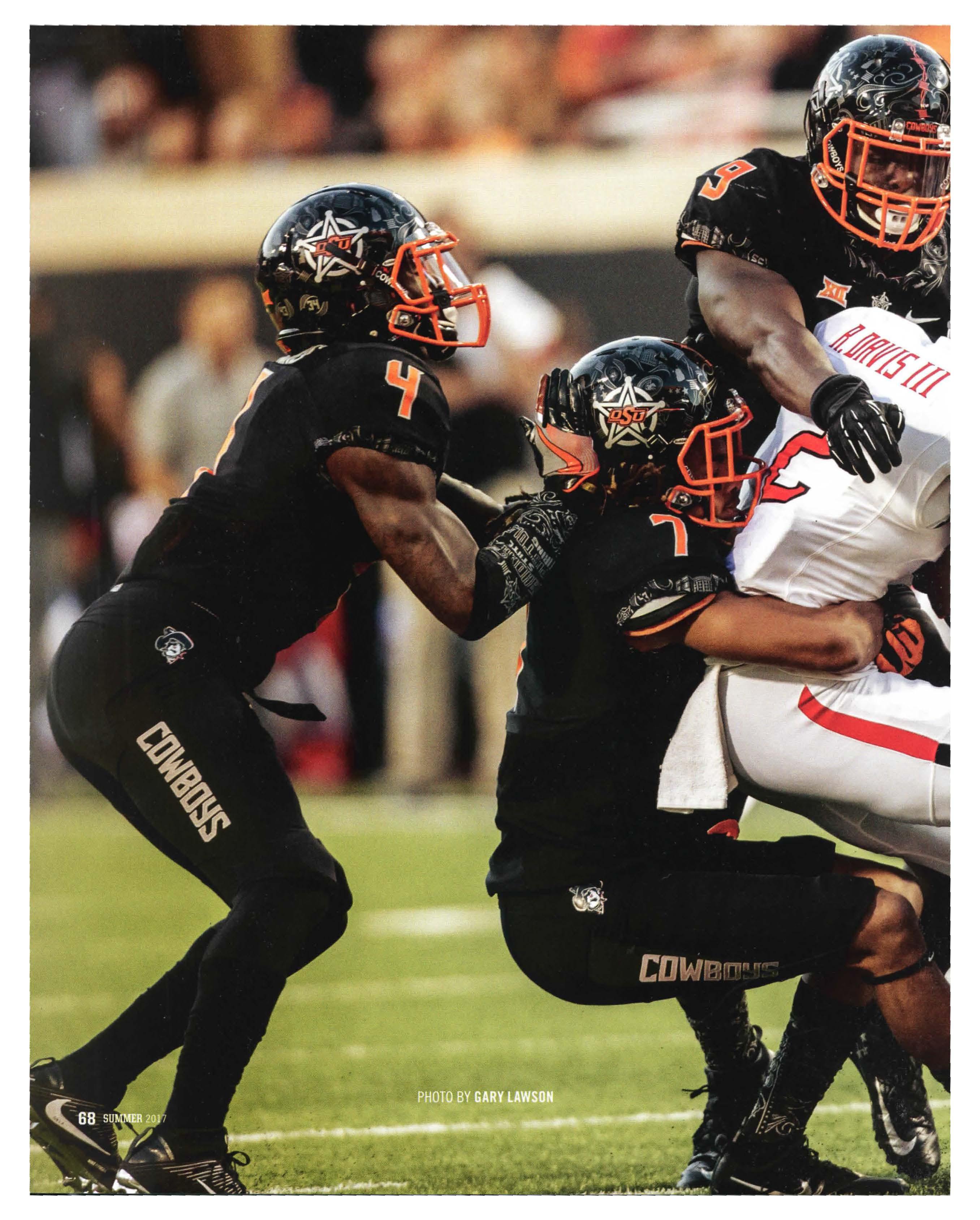
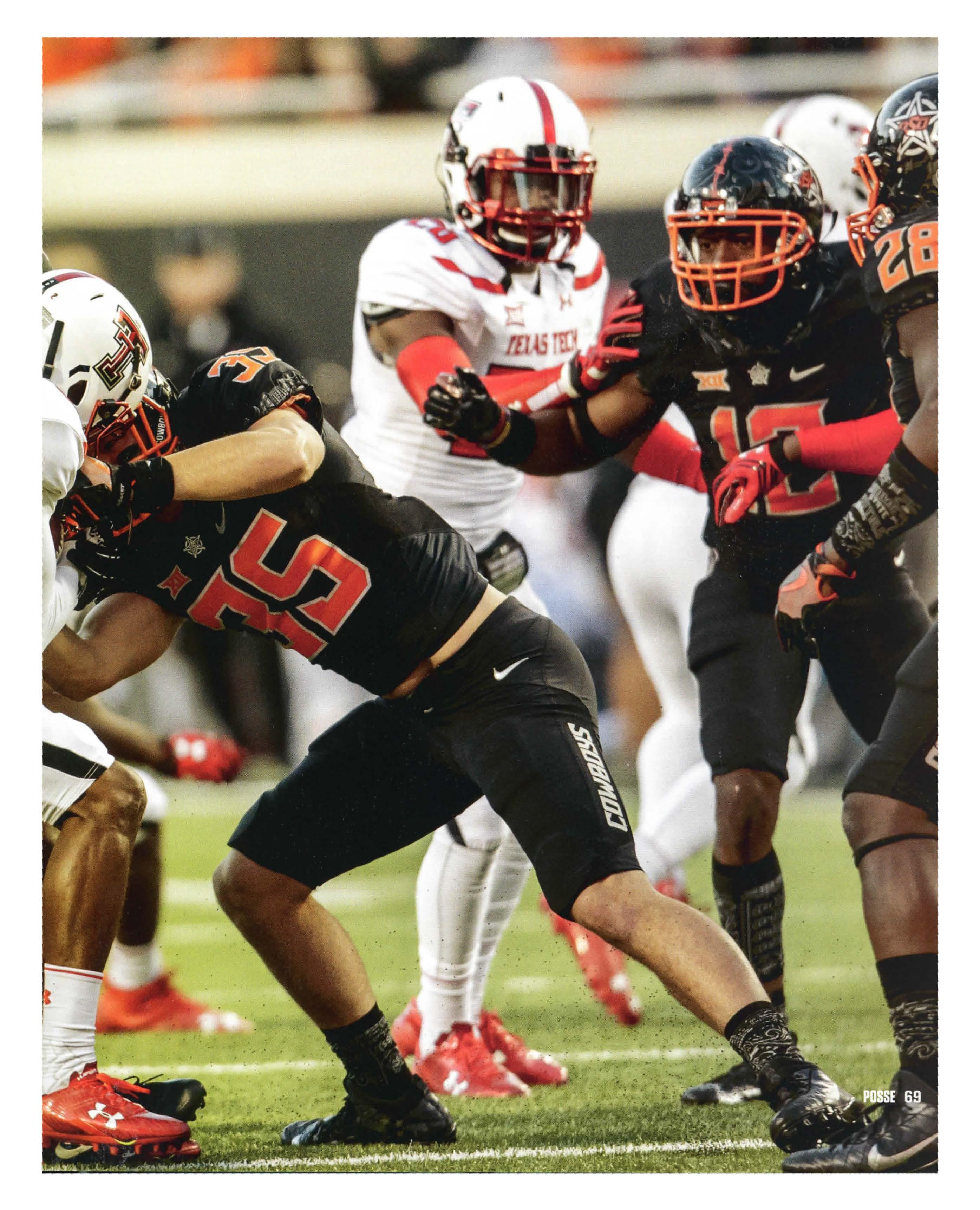
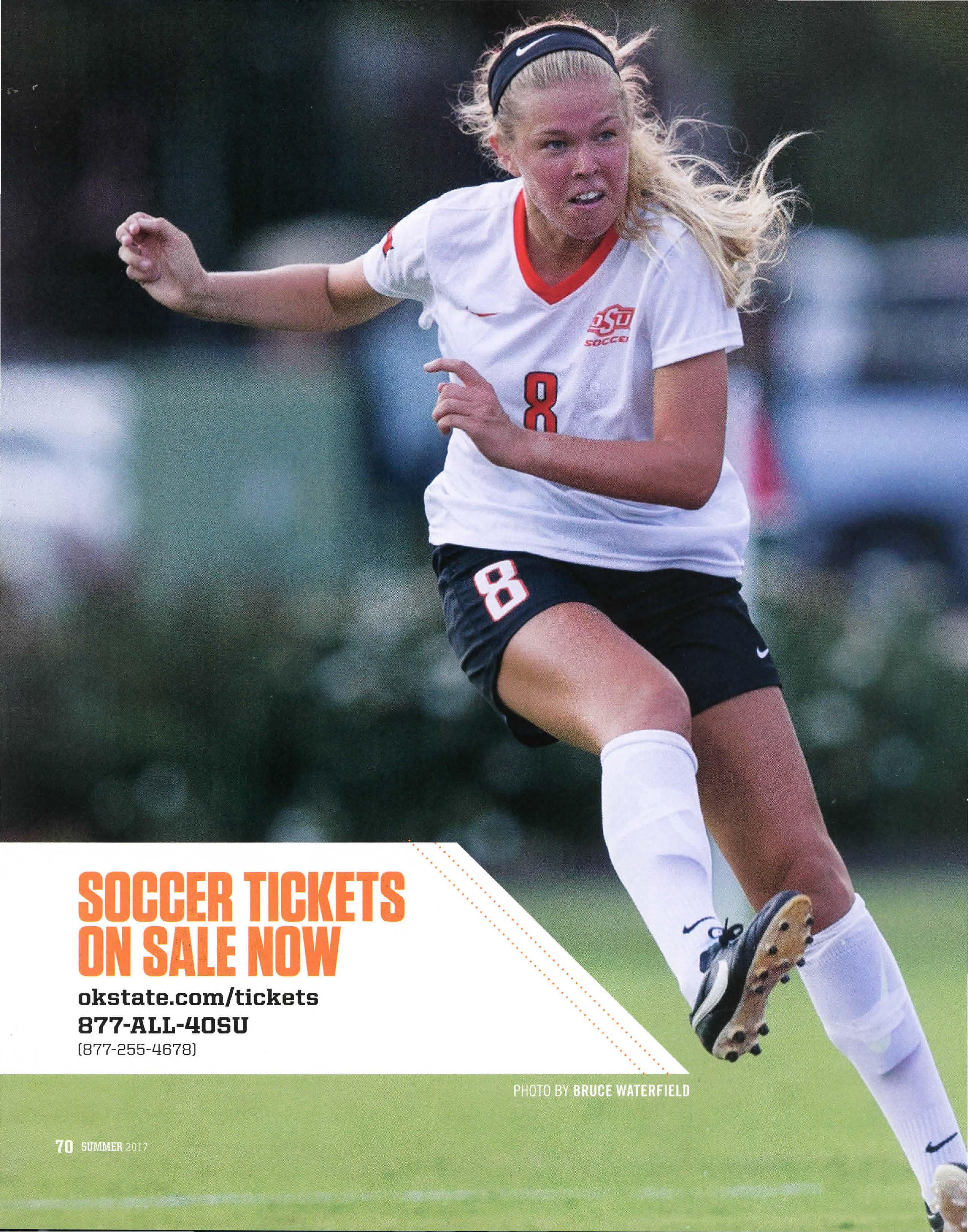
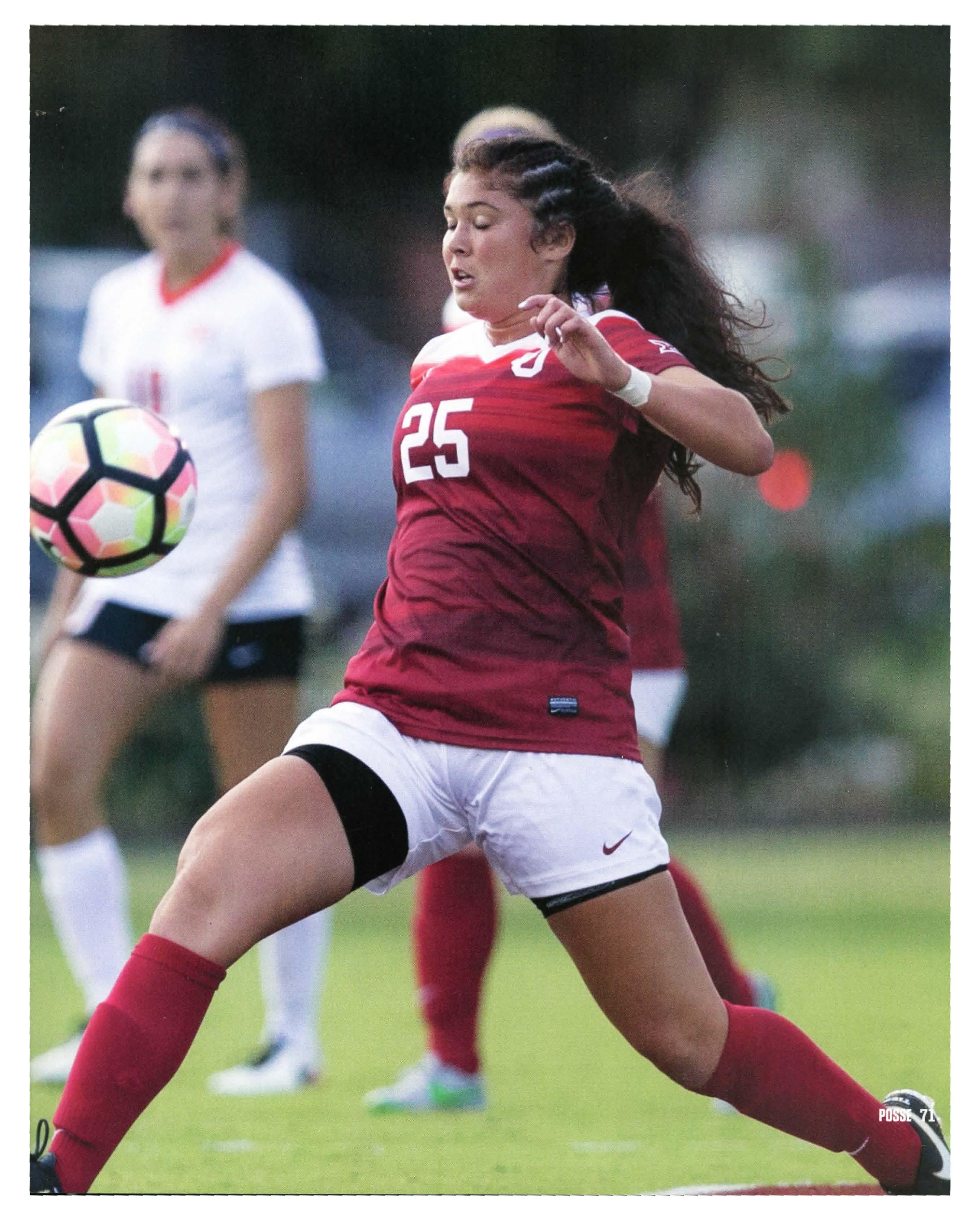
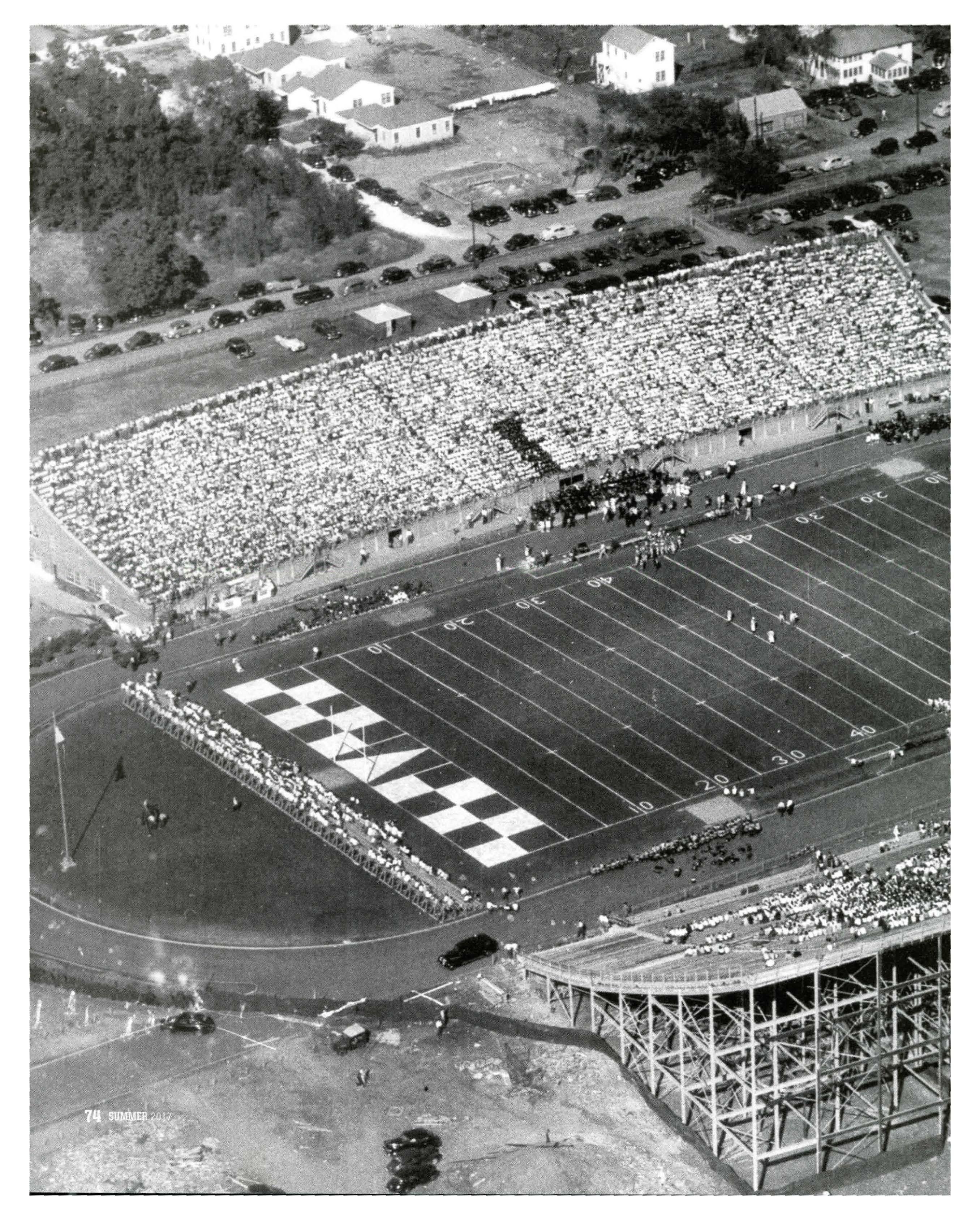
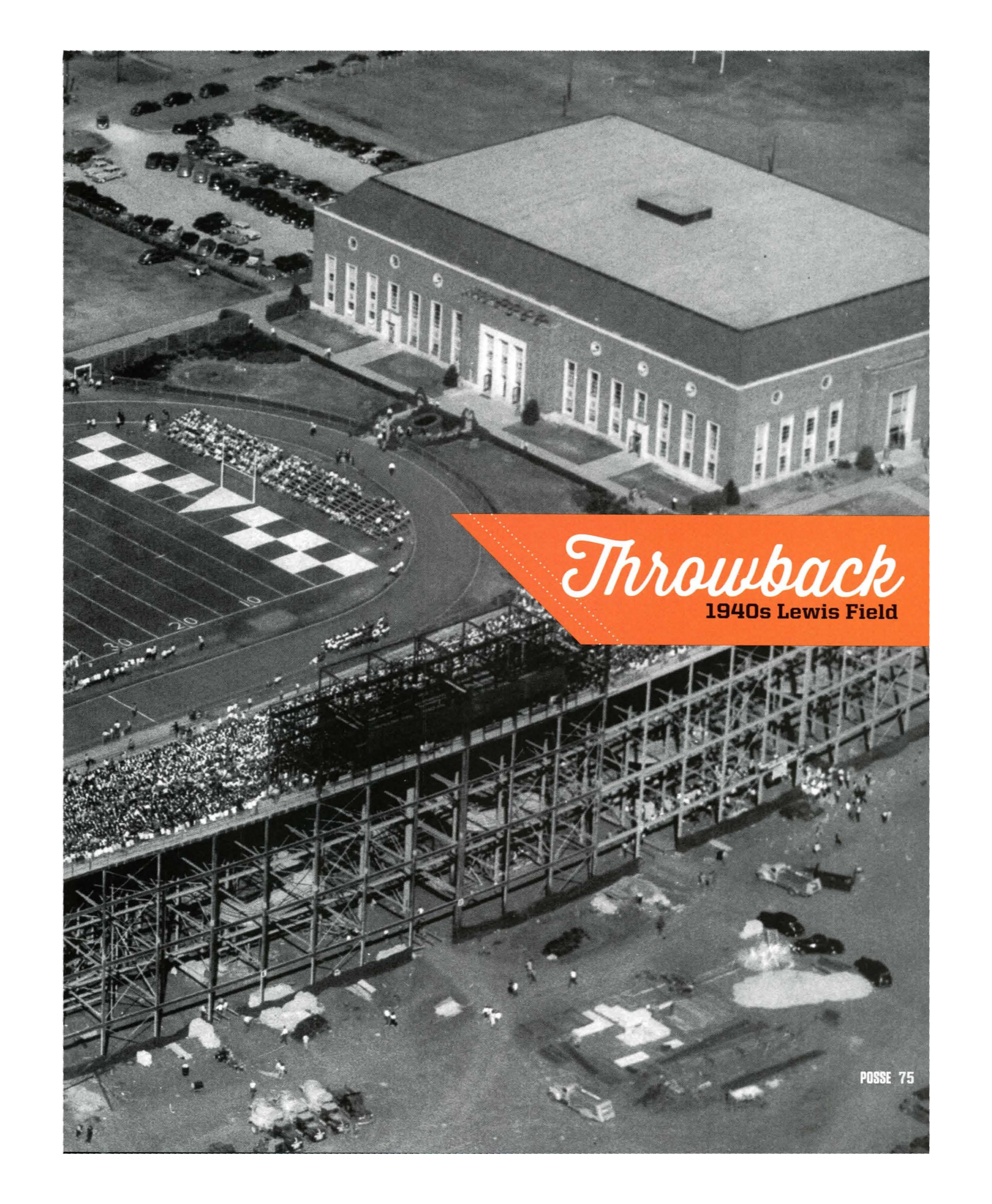
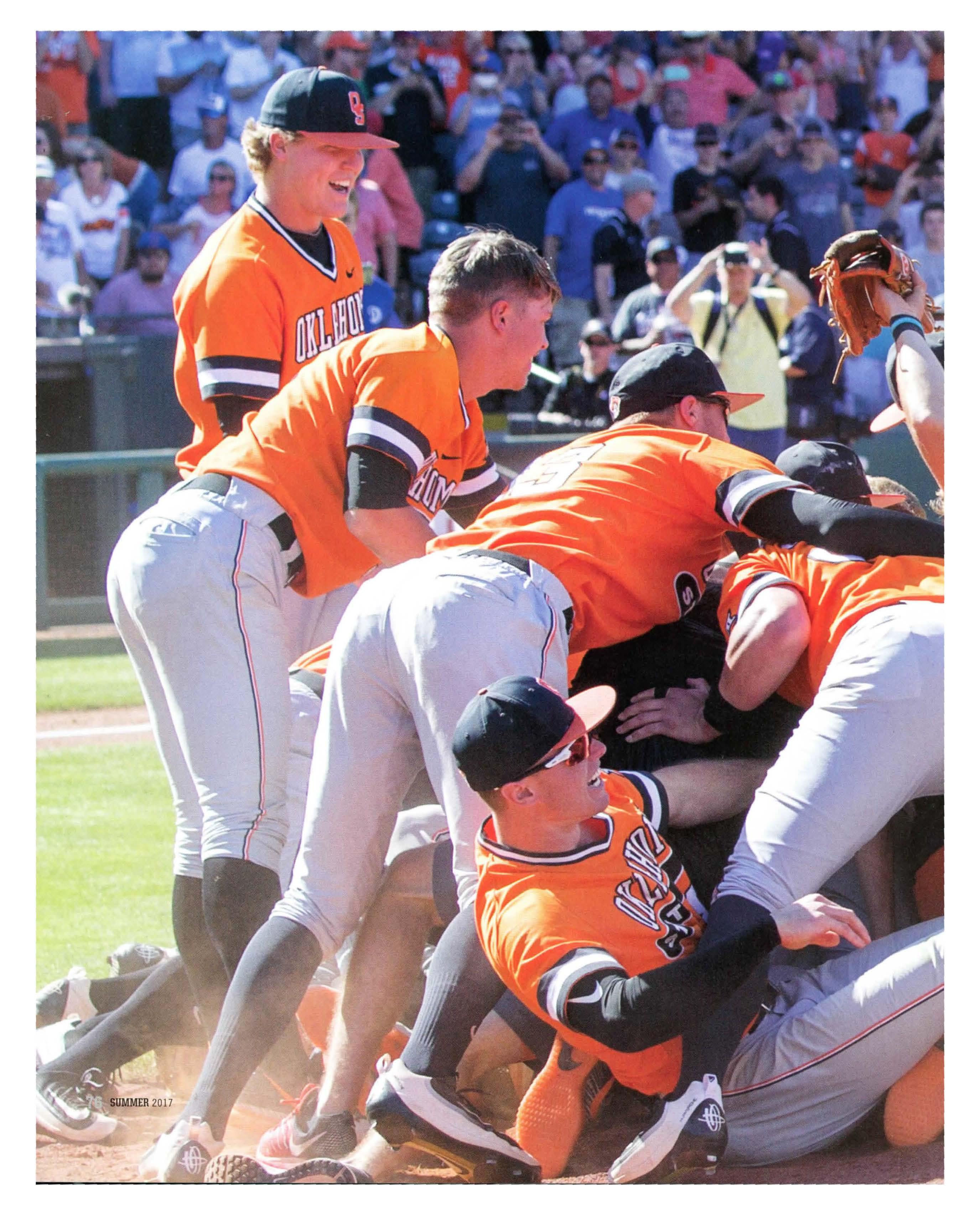
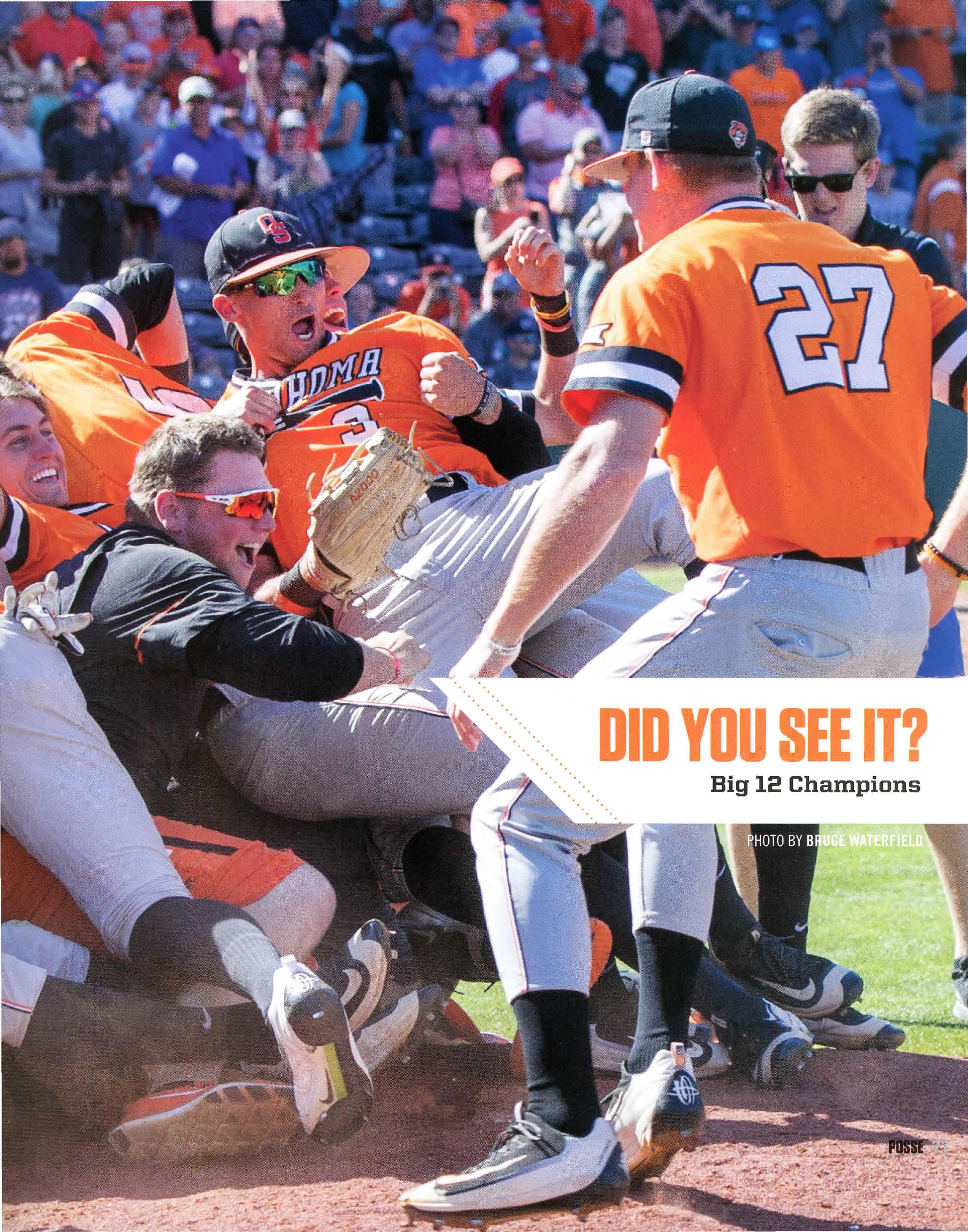
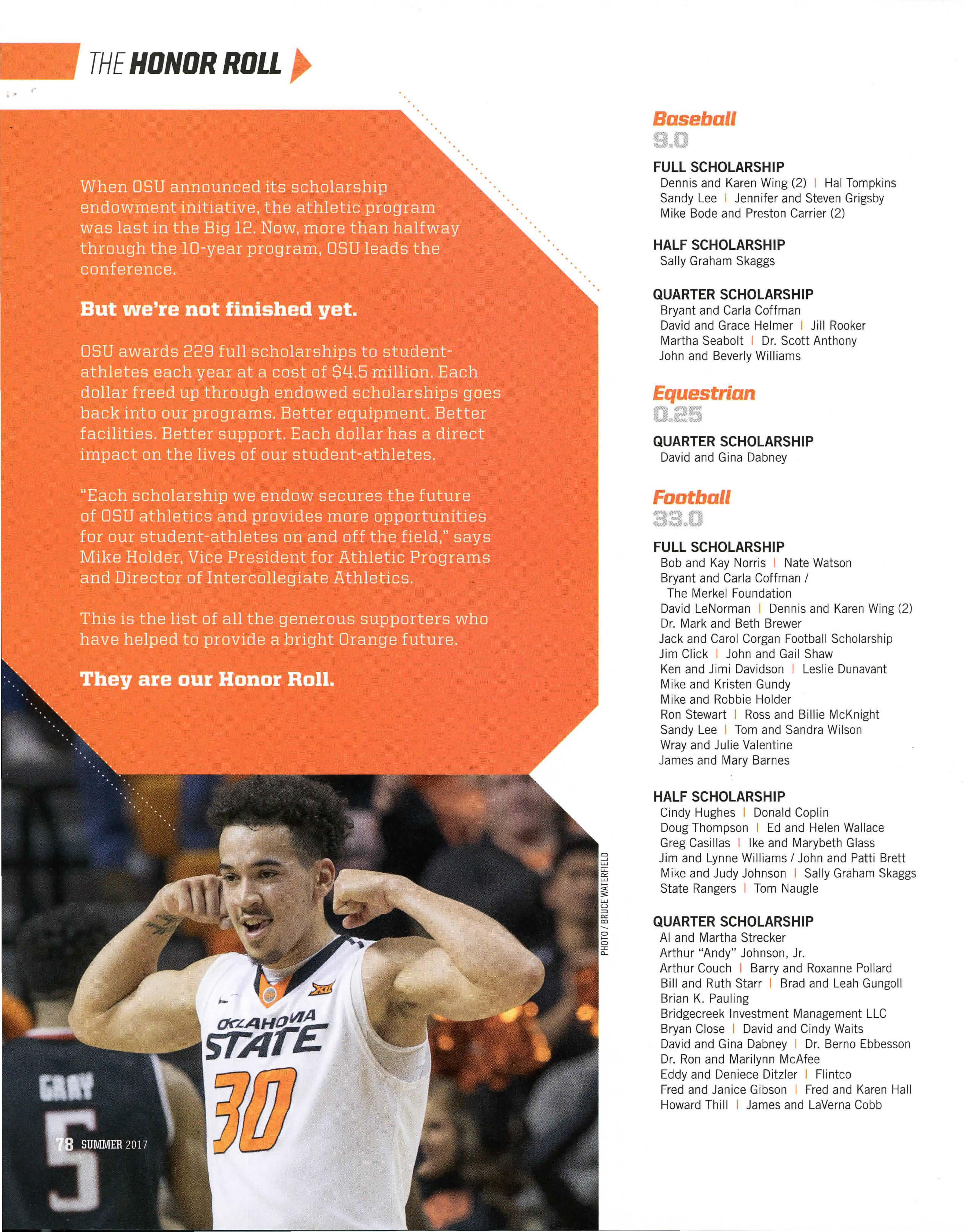
I endowment initiative, of Intercollegiate 'Atnletics.
FULL SCHOLARSHIP
Dennis and Karen Wing (2) I Hal Tompkins
Sandy Lee I Jennifer and Steven Grigsby
Mike Bode and Preston Carrier (2)
HALF SCHOLARSHIP
Sally Graham Skaggs
QUARTERSCHOLARSHIP
Bryant and Carla Coffman
David and Grace Helmer I Jill Rooker
Martha Seabolt I Dr. Scott Anthony
John and Beverly Williams
QUARTERSCHOLARSHIP
David and Gina Dabney
FULL SCHOLARSHIP
Bob and Kay Norris I Nate Watson
Bryant and Carla Coffman / The Merkel Foundation
David LeNorman I Dennis and Karen Wing (2)
Dr. Mark and Beth Brewer
Jack and Carol Corgan Football Scholarship
Jim Click I John and Gail Shaw
Ken and Jimi Davidson I Leslie Dunavant
Mike and Kristen Gundy
Mike and Robbie Holder
Ron Stewart I Ross and Billie McKnight
Sandy Lee I Tom and Sandra Wilson
Wray and Julie Valentine
James and Mary Barnes
HALF SCHOLARSHIP
Cindy Hughes I Donald Coplin
Doug Thompson I Ed and Helen Wallace
Greg Casillas I Ike and Marybeth Glass
Jim and Lynne Williams/ John and Patti Brett
Mike and Judy Johnson I Sally Graham Skaggs
State Rangers I Tom Naugle
QUARTERSCHOLARSHIP
Al and Martha Strecker
Arthur "Andy" Johnson, Jr.
Arthur Couch I Barry and Roxanne Pollard
Bill and Ruth Starr I Brad and Leah Gungoll
Brian K. Pauling
Bridgecreek Investment Management LLC
Bryan Close I David and Cindy Waits
David and Gina Dabney I Dr. Berno Ebbesson
Dr. Ron and Marilynn McAfee
Eddy and Deniece Ditzler I Flintco
Fred and Janice Gibson I Fred and Karen Hall
Howard Thill I James and Laverna Cobb
Jerry and Lynda Baker
Jerry and Rae Winchester I John P. Melot
John S. Clark I Ken and Leitner Greiner
Kent and Margo Dunbar I Paul and Mona Pitts
R. Kirk Whitman I Randal and Carol White
Roger and Laura Demaree I Shelli Osborn
Steve and Diane Tuttle
Tony and Finetta Banfield
General 1.25
HALF SCHOLARSHIP
Terry and Martha Barker
QUARTERSCHOLARSHIP
David and Judy Powell
Kenneth and Susan Crouch
Sally Graham Skaggs Graduate
QUARTERSCHOLARSHIP
Bob and Joan Hert I Neal Seidle
Tom and Cheryl Hamilton
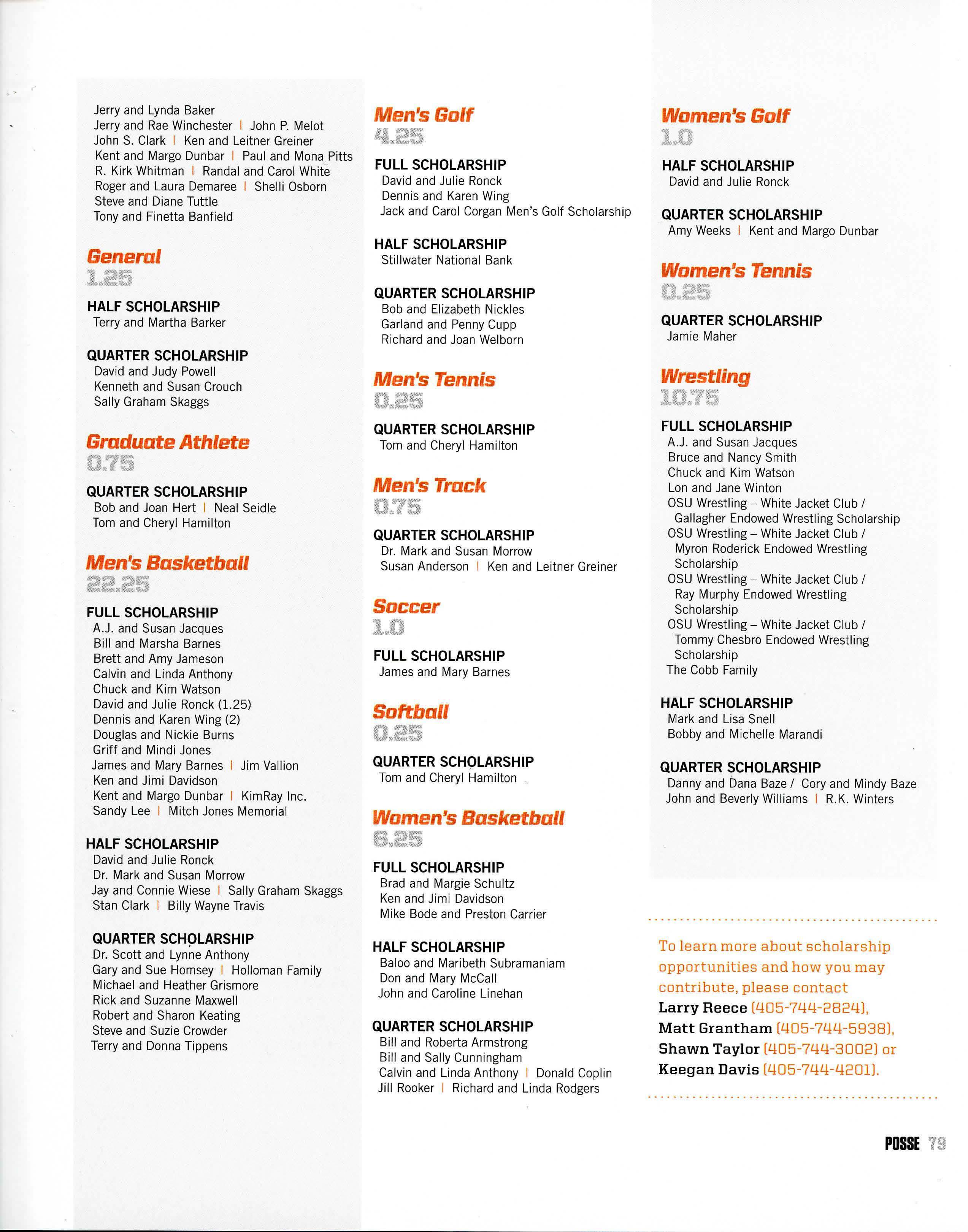
FULL SCHOLARSHIP
A.J. and Susan Jacques
Bill and Marsha Barnes
Brett and Amy Jameson
Calvin and Linda Anthony
Chuck and Kim Watson
David and Julie Ranck (1.25)
Dennis and Karen Wing (2)
Douglas and Nickie Burns
Griff and Mindi Jones
James and Mary Barnes I Jim Vallion
Ken and Jimi Davidson
Kent and Margo Dunbar I KimRay Inc.
Sandy Lee I Mitch Jones Memorial
HALF SCHOLARSHIP
David and Julie Ranck
Dr. Mark and Susan Morrow
Jay and Connie Wiese I Sally Graham Skaggs
Stan Clark I Billy Wayne Travis
QUARTERSCHPLARSHIP
Dr. Scott and Lynne Anthony
Gary and Sue Homsey I Holloman Family
Michael and Heather Grismore
Rick and Suzanne Maxwell
Robert and Sharon Keating
Steve and Suzie Crowder
Terry and Donna Tippens
FULL SCHOLARSHIP
David and Julie Ranck
Dennis and Karen Wing
Jack and Carol Corgan Men's Golf Scholarship
HALF SCHOLARSHIP
Stillwater National Bank
QUARTERSCHOLARSHIP
Bob and Elizabeth Nickles
Garland and Penny Cupp
Richard and Joan Welborn
QUARTERSCHOLARSHIP
Tom and Cheryl Hamilton
QUARTERSCHOLARSHIP
Dr. Mark and Susan Morrow
Susan Anderson I Ken and Leitner Greiner Soccer
FULL SCHOLARSHIP
James and Mary Barnes
QUARTERSCHOLARSHIP
Tom and Cheryl Hamilton
FULL SCHOLARSHIP
Brad and Margie Schultz
Ken and Jimi Davidson
Mike Bode and Preston Carrier
HALF SCHOLARSHIP
Baloo and Maribeth Subramaniam
Don and Mary McCall
John and Caroline Linehan
QUARTERSCHOLARSHIP
Bill and Roberta Armstrong
Bill and Sally Cunningham
Calvin and Linda Anthony I Donald Coplin
Jill Rooker I Richard and Linda Rodgers
HALF SCHOLARSHIP
David and Julie Ranck
QUARTERSCHOLARSHIP
Amy Weeks I Kent and Margo Dunbar Women's
QUARTERSCHOLARSHIP
Jamie Maher
FULL SCHOLARSHIP
A.J. and Susan Jacques
Bruce and Nancy Smith
Chuck and Kim Watson
Lon and Jane Winton
OSU Wrestling- White Jacket Club/ Gallagher Endowed Wrestling Scholarship
OSU Wrestling - White Jacket Club/ Myron Roderick Endowed Wrestling Scholarship
OSU Wrestling - White Jacket Club/ Ray Murphy Endowed Wrestling Scholarship
OSU Wrestling - White Jacket Club/ Tommy Chesbro Endowed Wrestling Scholarship
The Cobb Family
HALF SCHOLARSHIP
Mark and Lisa Snell
Bobby and Michelle Marandi
QUARTERSCHOLARSHIP
Danny and bana Baze/ Cory and Mindy Baze
John and Beverly Williams I R.K. Winters
To learn more about scholarship opportunities and how you may contribute, please contact Larry Reece (405-744-2824), Matt Grantham (405-744-5938), Shawn Taylor (405-744-3002) or Keegan Davis (405-744-4201).
Annual Membership for Kids arH Grade and Under ONLY $25 PER CHILD
Sign up today at okstate.com/kidsclub
Membership Includes:
• FREE ADMISSION to Home OSU Soccer, Basketball*, Wrestling, Baseball and Softball
*Men's Basketball chaperone pass ($99) required. Excludes men's KU and OU games.
• $25 Tickets to a Selected Home Football Game
• Invites to "Member Only" Parties with the Athletes
• Membership T-shirt
• Picture of Pistol Pete
• Birthday Card from Pistol Pete
• AND MU~H MORE FOR MORE INFORMATION VISIT OKSTATE.COM/KIDSCLUB
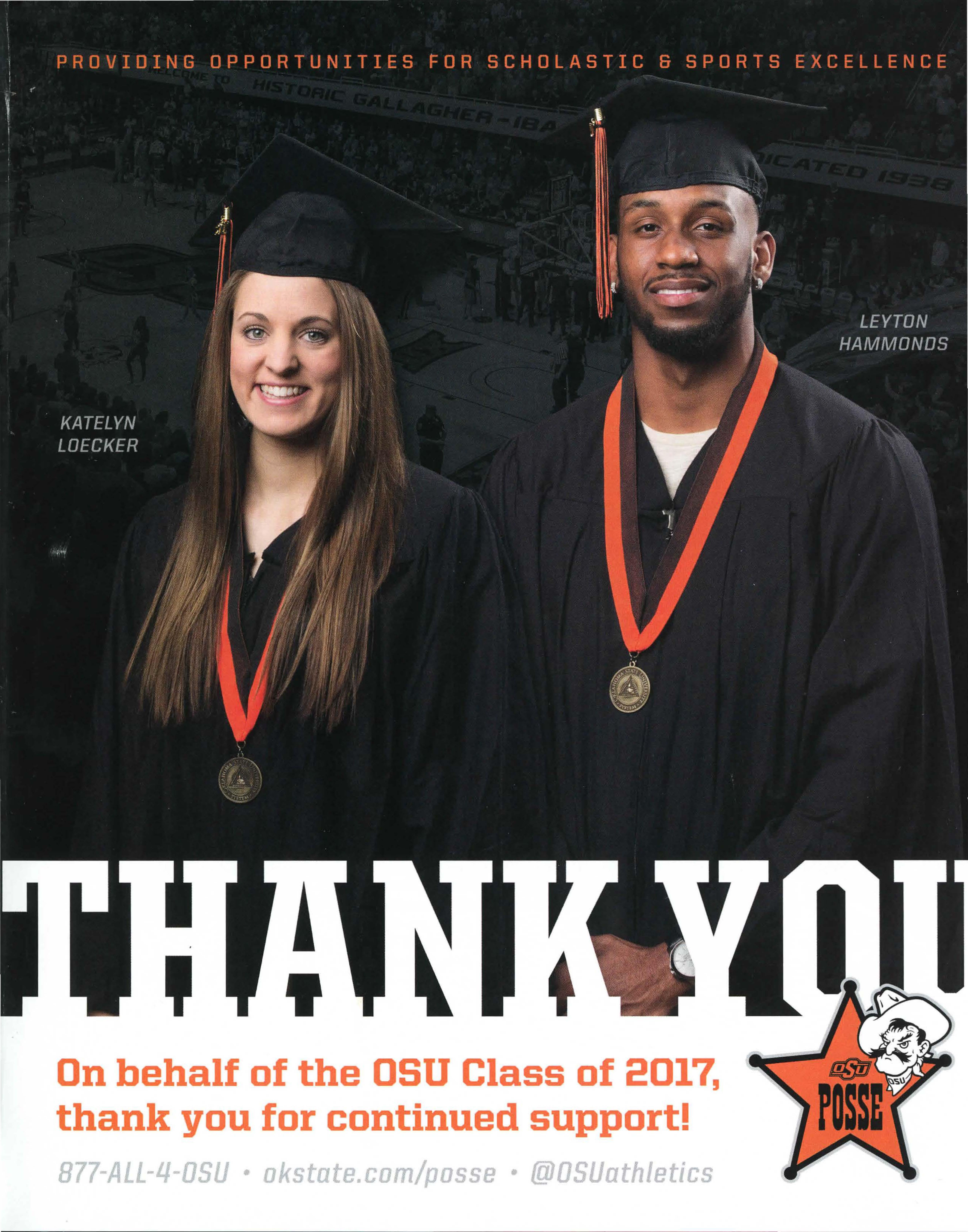
It seemstheperfectplatformforthis subjectmatterincontemporaryhistory hasbeenthemovies.Thesilverscreen.
Think about it. All of the superhero films: Wonder Woman, Batman, Superman, SpiderMan, all good versus evil. The Rocky movies, same thing. In fact, you might be hard-pressed to think of a movie that didn't intricately or subtly weave this theme throughout the narrative of the film. Others boldly splash it in our faces from the introductory scenes through to the closing credits. And, in many ways, this struggle - internal or externalis a philosophical question asked by people throughout their lives.
Perhaps THEidyllic genre for displaying the virtuous versus the unrighteous is in the definitive western movie. The villain is usually easy to spot: brash, conceited, outlandish behavior. This individual (or sometimes a group of people) is apparent to the audience immediately. As the story plays on, their aggression and poor conduct becomes more than the townspeople can bear. Finall~, the villains commit the two cardinal sins: disrespecting women and hurting dogs. They never have a kind word to say unless it's enveloped in deceit.
In contrast, you have the good guy, ever-vigilant toward helping women and loving dogs. The townspeople respect him because he's well mannered, kind and
Soon, very soon, our OSU Cowboys will mosey into the street to take on our old friends and foes in and out of the Big Twelve Conference. We have some of both. The showdowns we have with them are what makes each season colorful and memorable. It will be an exciting year, one filled with anticipation by all. We will clash with a number of tough customers along the way. Each game will provide an opportunity for our team to declare, "enough is enough," and signal to our fans that now is the time to close the deal.
The Cowboys need you to ride with them. Buy a season ticket and an OSU shirt orange. Before long it will be time to circle and whisper, "Say when."
KYLE WRAY Vice President Enrollment Management & Marketing
honest. Since the hero is oftentimes the target Ii Kyle Wray of meanness from the bad guy, spectators
CJ@KyleWrayOSU know, at some point there must be a showdown. When inequities become so great, someone must take a stand. This truism of Cowboy folklore is played out time and time again in the movie Tombstone. Ultimately, in the final scene, Doc Holliday matches up against Johnny Ringo. The two circle each other. As they stop and draw closer, Holliday taps his Colt .45 and whispers, "Say when." Soon after, justice is swiftly served. The tall talk stops.