IMPACT The official magazine of the College of Engineering, Architecture and Technology
FROM THE DEAN’S OFFICE Greetings, Welcome to this year’s edition of IMPACT. The accomplishments you’ll read about in these pages reflect more than another successful year for the College of Engineering, Architecture and Technology. They tell the story of a community that continues to grow, embrace new opportunities and make a lasting difference in Oklahoma and beyond. At CEAT, our momentum is driven by people. Our students, faculty, staff, alumni, donors and industry partners all share a commitment to discovery, education and service. Over the past three years, CEAT has continued to grow despite nationwide enrollment challenges, increasing enrollment by more than 17%. We’ve expanded opportunities through new, high-demand degree programs, including the Master of Science in Artificial Intelligence and the Bachelor of Science in Mechatronics and Robotics, ensuring graduates are prepared for the evolving workforce. Our research enterprise has also reached new heights, with expenditures increasing by more than 13% over the past three years. Faculty continue to make an impact in areas ranging from advanced manufacturing to national security while collaborating with leading institutions to strengthen our research and teaching mission. Our students continue to earn national recognition, including this year’s Truman Scholarship recipient. As Oklahoma’s land-grant engineering college, we remain committed to serving communities across all 77 counties through Engineering Extension and interdisciplinary partnerships that improve lives throughout our state. These achievements have contributed to CEAT’s continued rise in national rankings and position us to lead in the fields shaping tomorrow. Thank you for your continued confidence in CEAT. Your support makes these accomplishments possible, and together we will continue building a stronger college, workforce and future. Go Pokes!
HANCHEN HUANG Dean, College of Engineering, Architecture and Technology hanchen.huang@okstate.edu
DEAN, COLLEGE OF ENGINEERING, ARCHITECTURE AND TECHNOLOGY Dr. Hanchen Huang MARKETING AND COMMUNICATIONS MANAGER Kristi Wheeler
ON THE FRONT
MARKETING AND COMMUNICATIONS COORDINATOR Desa James
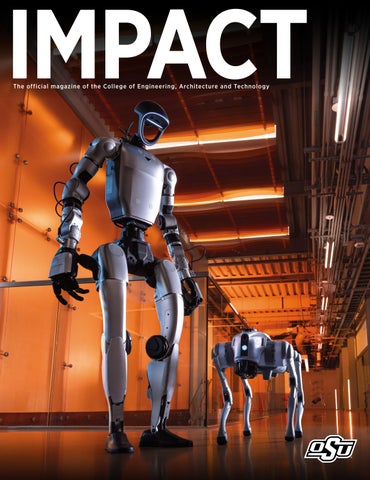
New Bots on the Block From classroom learning to community outreach, student-led robotics projects are bringing AI-driven engineering to life. Pages 6–7 (Cover photo: Eric Priddy)
FEATURES
2 Zink Big!
Student innovators launch startups, build race cars and pursue spaceflight through the Zink Center’s hands-on programs.
8
24
The Allen Legacy The W.W. Allen Scholars Program empowers future engineering leaders through scholarships, mentorship, global experiences and service.
Expanding Healthcare’s Reach A statewide OSU initiative is training community paramedics to deliver healthcare where it’s needed most.
38 From Sea to Shining Sea
From military research to aerospace innovation, CEAT is helping develop technologies and leaders that strengthen national defense.
46 Powering Oklahoma’s Future OSU research is strengthening energy resilience through smarter systems, efficient technologies and new materials.
52
Making the Invisible Visible Globally recognized research in terahertz science is expanding discovery while inspiring the next generation of innovators.
60 Meeting Workforce Demands CEAT combines flexible education, industry partnerships and real-world experiences to prepare tomorrow’s engineering leaders.
EDITOR Jordan Bishop ART DIRECTOR Dave Malec WRITERS Brandy DeVous Tanner Holubar Desa James Savannah McDaniel Erin Portman Kristi Wheeler DESIGN Annie Buford Alyssa Scattergood-White PHOTOGRAPHY Annie Buford Brandy DeVous Tanner Holubar Desa James Gary Lawson Ray Lucas Ellie Piper Eric Priddy Jack Sadler Kristi Wheeler
IMPACT is a publication of the Oklahoma State University College of Engineering, Architecture and Technology and is designed to provide information on college activities and accomplishments while fostering communication among the CEAT family and friends. CEAT.OKSTATE.EDU. The office of publication for IMPACT is 307 Whitehurst, Stillwater, OK 74078-1024 . ©2026 , IMPAC T. All rights reserved. Oklahoma State University, as an equal opportunity employer, complies with all applicable federal and state laws regarding nondiscrimination. Oklahoma State University is committed to a policy of equal opportunity for all individuals and does not discriminate based on race, religion, age, sex, color, national origin, marital status, disability, or veteran status with regard to employment, educational programs and activities, and/or admissions. For more information, the director of equal opportunity/Title IX coordinator is located at 201 General Academic Building and can be reached at 405-744-1156 or by visiting EEO.OKSTATE.EDU.
This publication, issued by Oklahoma State University as authorized by the College of Engineering, Architecture and Technology, was printed by Modern Litho, at a cost of $9,201/4.5M August 2026/#Impact2026.
C E AT. O K S TAT E . E D U
1
STUDENTS
ZINK BIG! Zink Center for Competitive Innovation helps students turn bold ideas into life-changing technologies, championship performances and even a shot at space STORY DESA JAMES | PHOTOS BRANDY DEVOUS, TANNER HOLUBAR, RAY LUCAS, ELLIE PIPER, JACK SADLER AND KRISTI WHEELER
T
he countdown cuts through the early morning air. “Three … two … one …” A roar follows as a studentbuilt rocket erupts skyward, climbing past 30,000 feet at speeds exceeding Mach 2, more than 1,500 miles per hour. For Oklahoma State University’s Cowboy Rocketworks, this is more than a successful test; it’s a step toward an audacious goal: reaching the edge of space. Moments like this aren’t rare at the College of Engineering, Architecture and Technology. They are the product of a deliberate ecosystem built to turn ideas into
BLAST OFF | The Cowboy Rocketworks team looks on as their rocket reached an altitude of nearly 34,000 feet and clocked a speed of Mach 2.5, the fastest and highest rocket ever launched by an OSU team.
2 IMPA C T | 2 0 26
action — anchored by the Zink Center for Competitive Innovation. Established in 2022 through a gift from the Zink Family Foundation, the center was designed to expand the engineering experience beyond the classroom. Its mission is simple but powerful: to create, promote and develop interdisciplinary innovation and competition teams that prepare students to succeed at the highest levels of technology, entrepreneurship and engineering practice. But what sets the Zink Center apart isn’t just what it teaches. It’s what students do. From robotics startups and national competitions to prototype development and product launches, students move seamlessly from concept to creation while gaining the technical skills and leadership experience needed to tackle realworld challenges.
ENGINEERING SOLUTIONS THAT MATTER For some students, innovation begins with a personal challenge. Trevor Fogleman and Joel Quarnstrom saw firsthand the risks diabetics face with routine foot care. Even a small mistake can lead to infection or amputation, a reality that affects millions of patients. Their response: Jotero, a robotic nail care system designed to perform procedures with medicalgrade precision while reducing risk. Supported by the Zink Center Innovation Hub, located within the CEAT ENDEAVOR Laboratory, and OSU’s entrepreneurship network, the team transformed its idea into a patent-pending prototype that can complete procedures in half the time, giving podiatrists the ability to focus on more complex care. Their work reflects the purpose at the heart of the Zink Center: applying engineering to solve meaningful human problems.
PROTOTYPE PRESENTED | Joel Quarnstrom presents Jotero at the Zink Innovation Hub presentations.
BATTER UP | Steven Azzaro, inventor of AZ-Tec SwingRight, demonstrates how his product improves an athlete’s swing.
FROM IDEA TO IMPACT Innovation at OSU moves beyond theoretical and becomes tangible for students. The Zink Center Innovation Hub brings together engineering and business students to take products from concept through prototyping, testing and market development. Students gain experience not only in design, but also in areas like manufacturing, supply chains, market analysis and startup strategy — skills critical for turning ideas into viable ventures. That full pipeline is evident in the work of Steven Azzaro, who turned a personal performance challenge into a company. His product, the Az-Tec SwingRight, is now a patentpending training device used to improve swing mechanics across multiple sports. With guidance from the Zink Center and CEAT’s development programs, Azzaro moved from concept sketches to a manufactured product, all within Oklahoma. “This is a place where an idea in your head can actually take shape,” Azzaro said. The Innovation Hub supports multiple teams each semester, creating a steady pipeline of student-driven startups and solutions.
C E AT. O K S TAT E . E D U
3
STUDENTS
COMPETITION AS A CATALYST For many students, innovation is tested under pressure. Through the Zink Center’s Competition Hub, students participate in nationally recognized events that demand both technical excellence and resilience under pressure. These competitions become immersive learning environments where students bring complex systems to life in real-world scenarios. Few teams embody this spirit more than Cowboy Rocketworks. Known as a dominant force at the Argonia Cup — with four consecutive championships — the team continues to push boundaries. This year, they placed second among 21 teams, achieving one of the highest-performing flights in the competition. But their ambitions extend far beyond trophies. Backed by the Zink Center and aerospace partners, the team is working toward a “space shot,” launching a student-designed rocket 100 kilometers to the Kármán Line — the boundary of outer space. The effort represents a moonshot in every sense, requiring advanced propulsion systems, multi-stage design and years of iterative testing. Their goal is a true reflection of the Zink Center’s vision: graduates who are ready to tackle the “impossible” with skill, creativity and grit.
ROCKET ROOM | Gavin Stearman in the assembly shop where Cowboy Rocketworks continues to improve their rocketry for the space shot mission.
4 IMPA C T | 2 0 26
BIG REVEAL | Both Cowboy Racing and Bullet Racing unveiled their latest competition vehicles this spring.
BUILT TO PERFORM Not all innovation happens in the sky. Inside CEAT’s shops, the sound of machining, welding and assembly fills the air as members of Bullet Racing and Cowboy Racing prepare vehicles for national competition. These student-led teams design and build high-performance racecars capable of withstanding extreme conditions, then take them headto-head against other universities. Supported by Zink Center mentorship, funding and makerspaces, students gain hands-on experience that mirrors professional engineering environments. They manage budgets, refine designs, analyze performance data and respond to real-time challenges. The results are measurable: improved horsepower, reduced weight, national competition placements and industry recognition. But the greater impact lies in preparation. Students develop skills in leadership, collaboration and problem-solving that directly translate into careers. Employers recognize the rigor of these experiences — and the work ethic they demand.
A CULTURE OF INNOVATION What connects a robotic healthcare startup, a sports performance device, a championship rocket team and competitive racing programs? At CEAT, the answer is a unified approach to experiential learning. The Zink Center brings together innovation, competition and design programs under a single framework, supported by mentorship networks, industry partnerships and advanced makerspaces. Students don’t follow a single path; they move between them. A student might prototype a startup in the Innovation Hub, compete on a design team or refine leadership skills all while gaining a holistic experience that blends theory and practice. This model emphasizes not only technical excellence, but the qualities needed to succeed in a rapidly evolving global landscape: teamwork, communication and resilience.
FULL THROTTLE | Bullet Racing provides students with real-world experience in engineering, project management and teamwork.
LOOKING AHEAD The trajectory is clear. The Zink Center is building more than projects — it’s building a pipeline of innovators equipped to shape industries, improve lives and drive economic growth. With goals to expand participation, increase interdisciplinary collaboration and further integrate entrepreneurship into engineering education, the center is accelerating the pathway from classroom learning to realworld impact. Back on the launch field, the rocket’s contrail fades into the sky, but the work continues. For OSU students, every test, every prototype and every competition is another step forward. Because at the Zink Center, innovation isn’t just encouraged. It’s expected.
STUDENT DEVELOPED | This trailer, designed by students for their senior design projects and funded by the Zink Center and sponsors, enables students to perform highpowered rocketry launches.
C E AT. O K S TAT E . E D U
5
STUDENTS
NEW BOTS ON THE BLOCK The Icons of MMME are turning heads and teaching students
“I see these robots allowing students to grasp robotic concepts at a much deeper level. Instead of learning about concepts in theory, students will have something to directly relate to learning.” -Dr. Yafeng Wang
STORY SAVANNAH MCDANIEL PHOTOS BRANDY DEVOUS AND ERIC PRIDDY
I
f you know Oklahoma State University, you have heard of icons such as Pistol Pete, Bullet and T. Boone Pickens. Get ready to meet some new ones, courtesy of the College of Engineering, Architecture and Technology. The School of Materials, Mechatronics and Manufacturing Engineering has welcomed icons of its own: a Unitree Go2 EDU quadruped robot dog named Pistol Pup and a yet-to-be-named humanoid robot. The Cowboy Mechatronics and Robotics Association, a student group open to all OSU undergraduate students who love robotics, obtained Pistol Pup in the fall 2025 semester. CMRA brings together students to learn and network. Since acquiring Pistol Pup, CMRA has been participating in community outreach, such as visiting K-12 schools, attending events and taking Pistol Pup on walks around the beautiful OSU campus. This has provided members with hands-on experience operating the robot while also giving individuals throughout the OSU and Stillwater communities the opportunity to learn about
6 IMPA C T | 2 0 26
SPARKING CURIOSITY | Pistol Pup, a Unitree Go2 EDU quadruped robot dog, helps students develop robotics skills while introducing emerging technologies to the OSU and Stillwater communities.
ENGINEERING SOLUTIONS | While the humanoid robot’s fingers are currently fixed, students hope to explore future research that would enable them to move.
robotics and see firsthand that these technologies are often less intimidating than they may seem. “It surprised me how willing people are to learn about them,” said Jillian Jones, president of CMRA and CEAT mechatronics and robotics senior. “When you take the robot out, people are getting up close to it and trying to figure out how it works.” Outside of the networking opportunities these robots have created for students, they are also helping prepare them for a career in industry. Unlike some of the immobile robots that were available to students in the past, these can go anywhere rather than being stationed in a lab. Pistol Pup and the humanoid robot don’t have to be altered or modified to use them as they would in an industry setting. These robots are teaching mechatronics and robotics students how daily operations work and important safety operating skills that will be critical in their careers. “There’s a ton of opportunities to learn on them now; the platforms
are just getting bigger, and I can only imagine what these robots are going to be capable of in a couple of years,” Jones said. “Just being able to see the robots grow with the program, I think that is really exciting.” In addition to the learning possibilities, Pistol Pup has created memories for the group. “We took the dog on a walk around campus this semester and handed out squishies and pens, and it was really fun,” Jones said. “The club members enjoyed going out and moving the dog, but they enjoyed having a reason to talk to people even more.” As for the future, CMRA is diving into learning all that the robotic systems are capable of, and the club is even planning to make their own unique modifications. The group plans to create a tail for Pistol Pup and perhaps shoes for the humanoid. And in true OSU Cowboy style, the group also hopes to make cowboy hats for both robots. They plan to see the vision through by partnering with the 3D printing lab available in the ENDEAVOR Undergraduate Laboratory. The addition of these robots invests not only in preparing students for careers in industry but also in innovation and emerging technologies of the future. Dr. Yafeng Wang, assistant professor in the School of MMME, is an advisor for CMRA. He believes that the addition of these robots speaks to the direction that CEAT is heading. “It shows that CEAT is moving toward more hands-on, interdisciplinary and AI-driven engineering education,” Wang said. “These robots can help connect classroom learning with real-world engineering challenges and make robotics more visible and accessible across CEAT.”
C E AT. O K S TAT E . E D U
7
STUDENTS
THE ALLEN LEGACY IN ACTION W.W. Allen Scholars shaping the future through engineering, leadership and service STORY KRISTI WHEELER | PHOTOS KRISTI WHEELER AND PROVIDED
T
ransformative opportunities can change the course of a student’s life, and the W.W. Allen Scholars Program at Oklahoma State University does exactly that. Through two distinctive scholarships, the program invests in exceptional engineering students who demonstrate leadership and academic excellence. From generous scholarships and professional development opportunities to global learning experiences, Allen Scholars gain access to resources that prepare them to lead in an increasingly interconnected world. Made possible through the vision and generosity of W. Wayne Allen, the program reflects his belief in the power of education, mentorship and personal growth to unlock potential and create future leaders in engineering and beyond.
TRAILBLAZER | W. Wayne Allen’s vision continues to inspire and empower generations of CEAT students.
8 IMPA C T | 2 0 26
MEET THE 2026 SCHOLARS
OKESlub Scholar T S H P L C RA oys & Girls B W. W. A llen
For Ralph Stokes, leadership and service have always gone hand in hand. A lifelong participant in the Boys & Girls Club, Stokes began his journey as a young athlete in the organization’s Mighty Mite sports programs before returning as a volunteer during his middle school years. Those experiences taught him the value of teamwork, sportsmanship and community — lessons that continue to shape his approach to leadership today. Now entering OSU as a mechanical engineering major, Stokes is eager to combine his passion for problem-solving with his desire to make a meaningful impact. His interest in engineering
stems from a fascination with understanding how things work and was further fueled by exposure to the possibilities of robotics and advanced technology. At OSU, Stokes plans to immerse himself in student organizations, including the National Society of Black Engineers, while continuing to develop as a leader and mentor. A respected student leader at Tulsa Central High School, he believes success is measured not only by personal achievement but also by helping others reach their potential. Looking ahead, Stokes envisions a career designing robotic and automated systems that improve
efficiency and reduce physical demands on workers. His longterm goal is to lead engineering teams, mentor future innovators and ultimately create opportunities for others through technological advancement.
C E AT. O K S TAT E . E D U
9
STUDENTS
GENERATIONS | The inaugural W. W. Allen Scholars reunion was hosted on April 24, 2026, in Stillwater. Present and past Allen scholars attended along with CEAT faculty and staff, donors, industry partners and Pistol Pete.
Inaugural W.W. Allen Scholars Reunion CEAT hosted its inaugural W.W. Allen Scholars Reunion on April 24, 2026, in Stillwater, Oklahoma, bringing together CEAT leadership, donors, current and past W.W. Allen Scholars and Pistol Pete to reconnect. The event provided an opportunity for former Allen Scholars to share how the program’s scholarships, leadership development opportunities, global experiences and studies at the University of Cambridge shaped their careers and perspectives. Current scholars gained valuable insight through conversations with alumni who once stood in their shoes, learning firsthand how the program’s impact extends far beyond graduation. The reunion also reflected the vision of W. Wayne Allen— to develop engineering leaders equipped to make a difference in their professions, communities and the world. As alumni shared stories of their experiences, and how the program has shaped their personal and professional lives, it became clear that the Allen Scholars Program is more than a scholarship; it is a lifelong network of changemakers carrying forward Allen’s legacy of excellence and opportunity.
10
IMPA C T | 2 0 26
RSON A C K I R E holar Sc W. W. A llen
Growing up in Wagoner, Oklahoma, Erik Carson spent countless hours helping his father repair old computers, fascinated by why problems occurred and how to solve them. That curiosity soon expanded beyond computers to the world around him, fueling a desire to improve the same world. During a campus visit at OSU, he met an electrical and computer engineering student and saw firsthand how artificial intelligence and machine learning were being applied in student projects. Carson found the path that matched his passion. Entering OSU as an electrical engineering major, Carson plans to immerse himself in opportunities both inside and outside the classroom. He hopes to develop as a leader through student organizations and inspire younger students to pursue STEM careers. Carson’s long-term goals center on advancing AI, cloud computing and cybersecurity technologies while ensuring they are developed
responsibly and used to improve lives. After completing his studies at OSU, he plans to pursue his master’s degree at the University of Cambridge as part of the W. W. Allen Scholarship Program. Ultimately, he plans to pursue a doctorate and eventually lead engineering teams in developing transformative technologies. Carson hopes his career will come full circle. His dream is to return to OSU as a professor, sharing his passion for engineering with future generations of Cowboys and helping others discover the same sense of possibility that first inspired him.
THE ALLEN LEGACY IN ACTION Growing up in a family of engineers, Eleanor Miller spent countless hours asking questions and exploring how things work. Whether discussing chemical engineering concepts with her father, learning about the human body or participating in STEM summer camps, she developed a passion for solving problems and improving lives through science and innovation. That passion eventually led her to a specific goal — applying engineering principles to medicine. As a chemical engineering and pre-med student at OSU, Miller hopes to become involved in research her first year on campus, focusing on biomedical applications and the complex chemical processes that affect human health. Her interest in endocrine research is deeply personal, witnessing firsthand the impact chronic disease can have on daily
ELEANOR W. W. A llen S
life. Inspired by the researchers whose discoveries make treatment possible today, she hopes to one day contribute breakthroughs that improve outcomes for future generations. Beyond academics, Miller is a dedicated vocalist who has spent years studying and performing music. She has learned the value of perseverance, collaboration and continuous improvement. Whether leading a team in a carbon-capture engineering competition or helping a fellow performer gain confidence on stage, she has discovered that leadership often means empowering others to succeed. As an Allen Scholar, Miller looks forward to expanding her global perspective, pursuing meaningful research and preparing for a future as a physician-scientist focused on pediatric endocrine care. Her goal is simple but profound — to use engineering and medicine together to help children live healthier lives.
BUILT FOR IMPACT While their interests span different areas of engineering, Carson, Miller and Stokes share a common drive: a desire to use their talents to improve the world around them. Through the opportunities provided by the W.W. Allen Scholars Program, these students will gain the education, experiences and global perspectives needed to become leaders in their fields. Their stories are a testament to the vision of W. Wayne Allen and the transformative power of investing in students whose drive, curiosity and character will shape the future of engineering and society.
MILLER
cholar
C E AT. O K S TAT E . E D U
11
STUDENTS
UP G N I H CATC
W IT H
E C A GR RIX D N E H
12
IMPA C T | 2 0 26
F
or many students, attending the University of Cambridge is a dream reserved for the world’s brightest scholars. For Grace Hendrix, it became an opportunity to broaden her perspective, deepen her technical expertise and discover how far mentorship, determination and community support can take someone. Growing up in a rural community, Hendrix never imagined she would one day study at one of the world’s most prestigious universities. Before becoming a W.W. Allen Scholar in 2021, she had never traveled outside the United States. The possibility of living abroad and pursuing graduate studies at Cambridge felt far beyond her reach. Hendrix recently completed a Master of Philosophy in DataIntensive Science at CU’s Pembroke College. The intensive 10-month program combines machine learning, statistics and research computing, equipping students to address complex challenges through advanced data analysis and emerging technologies. Her dissertation focused on federated learning for medical imaging, an area of AI that seeks to overcome one of healthcare’s most significant challenges — data privacy. While machine learning models typically rely on large, centralized datasets, healthcare organizations often cannot share patient information because of privacy concerns. Federated learning offers an alternative approach by allowing hospitals to train models locally and then combine the results into a single, more robust model. The project reflects Hendrix’s interest in using technology to solve meaningful problems while maintaining responsible data
THE ALLEN LEGACY IN ACTION
ROOTED AT OSU | Grace Hendrix stands in front of the Edmon Low Library. Hendrix graduated from OSU with a B.S. in industrial engineering and management in spring 2025.
practices. She is particularly excited about the potential for this work to help advance medical research and improve healthcare outcomes without compromising patient privacy. While the academic experience has been both rigorous and rewarding, Hendrix says the relationships have been the most meaningful part of her time at Cambridge. “The most rewarding part has been building friendships and connections with people from all over the world,” she said. “Many of us are navigating major life transitions together, whether that’s applying to doctoral programs, pursuing careers or exploring new opportunities.” Those friendships have created a strong sense of community among students who come from vastly different backgrounds but share similar ambitions. Through conversations, collaborations and everyday experiences, she has gained a deeper appreciation for the challenges and opportunities facing communities around the world.
Cambridge has offered a unique educational experience. Although its overall enrollment is comparable to OSU, the institution has a much larger proportion of postgraduate and international students. The university’s collegiate system further distinguishes it from the American higher education experience. Every student belongs to one of 31 colleges, which provide housing, dining and a close-knit social community. That environment has encouraged meaningful interactions with people from diverse cultures and academic disciplines. Working alongside classmates who approach problems differently has strengthened her ability to listen and consider perspectives she may not have otherwise encountered. One particularly impactful experience came during a discussion about the ethical use of AI and the importance of highquality data. A lecture examining how duplicate patient records and inconsistent databases limited machine learning efforts during the COVID-19 pandemic reinforced an important lesson — technological innovation alone is not enough. “Responsible data collection, management and use are essential if we want AI to create meaningful, positive impact,” she said. The experience has strengthened both her technical interests and her sense of responsibility as a future leader in technology. It has also reinforced her desire to develop solutions that create lasting benefits for people and communities. Hendrix credits much of her growth and confidence to the W.W. Allen Scholars Program. Through mentorship, leadership development opportunities and a supportive network of scholars
and alumni, the program helped prepare her for challenges she never imagined facing. Allen Scholar alumni shared their experiences, offered guidance throughout the application process and helped her understand what to expect from an international academic environment. Beyond the scholarship itself, she said OSU’s supportive culture played an important role in preparing her to succeed abroad. The relationships she built there and within the College of Engineering, Architecture and Technology gave her the confidence to step outside her comfort zone, advocate for herself and pursue ambitious goals. “The Allen Scholars Program changed my life by giving me the confidence, leadership experience and global perspective to pursue opportunities far beyond what I once thought possible, and for that I am beyond grateful,” she said. This past summer, she completed her studies at Cambridge and will begin a new chapter as a logistics engineer with J.B. Hunt Transport Services in Lowell, Arkansas. As she transitions from academia to industry, she carries with her advanced technical knowledge, a global network of friends and colleagues, and a renewed commitment to using technology to solve meaningful problems. Her path from rural Arkansas to Cambridge is a testament to the power of opportunity and perseverance. It is a reminder that with support and a willingness to embrace the unfamiliar, even the most ambitious goals can become reality.
C E AT. O K S TAT E . E D U
13
STUDENTS
DYNAMICALLY BALANCED | Zachary Eminger, an MAE graduate student, tests a micro-turbojet engine part on a dynamic balancer at OSU’s Richmond Hills Research Laboratory.
Full Throttle
MAE students’ prowess in micro-turbojet engines continues rapid ascension STORY TANNER HOLUBAR | PHOTOS KRISTI WHEELER
T
he micro-turbojet engines designed and produced by students in the College of Engineering, Architecture and Technology at Oklahoma State University may fly at high speeds, but the propulsion program powering them is climbing even faster. Dr. Kurt Rouser, associate professor in the School of Mechanical and Aerospace Engineering, has overseen the
14 IMPA C T | 2 0 26
program’s continued rise since 2016. What began as a small research effort with one of his first graduate students has evolved into a program that strengthens with each graduating class. That strength is evident in participation and achievement. When Rouser arrived, only one student had attended the American Institute of Aeronautics and Astronautics regional student paper conference. The program
now sends 15-20 papers to conferences each year, including AIAA and the Air Force’s Aerospace Propulsion Outreach Program, with 50-60 student authors represented. “The quality of work the students are doing is getting better, alongside our improved facilities,” Rouser said. “The equipment we use from year to year is increasing, as well as our resources. So, the whole program benefits.”
The work has improved to the point of the creation of Pistol Pete’s Propulsion Posse (P4) in fall 2025. This student-led organization brings together students from all majors. Students are split into two teams that work to solve the challenge that APOP proposes. The teams then work through the year on their solution, with the top option selected to represent OSU. P4 has transformed how students develop engineering skills. Previously, students did not work on multidisciplinary turbojet teams until their senior design projects. Now, they begin as freshmen and sophomores, building expertise in troubleshooting, time management, communication and collaboration with peers of varying experience levels to achieve common goals. For 2026, the teams were tasked with solving a compressor bleedair utilization challenge for a small turbine engine. Teams designed and tested a system that used hot bleed air from the engine’s compressor assembly while maintaining engine performance.
Bleed air is compressed, hot air that is crucial to running many aircraft systems. Teams consisted of students from every year of the program, from freshmen to seniors. This provided a balance of experienced leadership alongside younger students eager to contribute and will enhance continuity from year to year. “What was great is if you look at the diversity of the club in terms of gender, ethnicity, age and program interests,” Rouser said. “At the end of the day, everybody was able to contribute.” Zachary Eminger is a 2026 MAE graduate who was the recipient of the Sigma Gamma Tau Outstanding Undergraduate Award. He will continue with the program as a graduate student in the fall, and he enjoyed the pay-it-forward aspect of mentoring younger students in P4. “As a freshman, you know about engineers and what they do, but you don’t understand all the nuances of it, especially something like working with jet engines,”
MICRO-TURBOJET | Shown is a close-up of a part of a micro-turbojet engine crafted by students in Dr. Kurt Rouser’s propulsion program.
Eminger said. “It’s cool to be able to explain things to them and it’s great seeing their intrigue blossom and get them prepared to take over positions as upperclassmen with P4.” The 2025-26 school year was also the first year for senior MAE students to have their senior design project consist of designing, building and testing an entire micro-turbojet engine. This is thanks to improved facilities and equipment, such as a dynamic balancer to correct uneven weight distribution, allowing students to raise the bar for the program each year. As more students enter the pipeline and alumni find success in the aerospace industry, Rouser believes the program has reached a point where its growth is entirely self-reinforcing. “When we prepare our students better, they become more successful in the workforce, which in turn attracts more talent to the program,” Rouser said.
TESTING PARTS | The dynamic balancer acquired by Rouser has enhanced the capability of the program. Now, students can test their parts in the same lab they work in every day.
C E AT. O K S TAT E . E D U
15
STUDENTS
BIG DREAMS,
BIGGER IMPACT CEAT students are shaping the future through innovation, leadership and research
STORY TANNER HOLUBAR | PHOTOS TANNER HOLUBAR AND ELLIE PIPER
T
he College of Engineering, Architecture and Technology at Oklahoma State University has produced top-of-the-line graduates since its founding in 1902. CEAT students make a large impact on campus before receiving their degrees and serving their communities. They are leaders of campus organizations, contributors to research and showcase well against other college students through competition teams.
IMPACTING THROUGH ENGINEERING AND MENTORSHIP Abigail McCrary, a senior from Grove, Oklahoma, in the School of Electrical and Computer Engineering, has always had a passion for helping people in need. This led to her being named a 2026 recipient of the Harry S. Truman Scholarship, one of 55 honorees from 48 universities nationwide and the only recipient from OSU. The Truman Scholarship is given to students
16 IMPA C T | 2 0 26
in their junior year who have a minimum 3.5 GPA and have demonstrated academic excellence, extensive leadership experience and a record of public service. The award provides $30,000 to pursue a master’s degree. “It gives me a platform and credibility that can help amplify the work I care about,” McCrary said. “It opens doors to conversations and opportunities where I can make a broader impact.” Being a Truman Scholar comes with a community of support that provides mentorship and accountability from leaders with strong commitments to public service. “I experienced that firsthand when former CEAT graduate and 2008 Truman Scholar Dr. Cortney Cowley reached out,” McCrary said. “She immediately welcomed me into the Truman community and has been incredibly kind and supportive.”
The clubs and organizations McCrary has been part of offer opportunities to serve others, including Lou’s Locker, which she co-founded with fellow OSU students. Lou’s Locker improves accessibility and independent living for people with mobility challenges, such as those with ALS. The organization provides assistive devices, setup guides and a library of resources to make life easier and more independent for people with mobility challenges. “One of the most meaningful parts of my involvement has been the ability to directly see the impact the organization has on people’s lives,” McCrary said. McCrary has received several scholarships during her time at OSU, including the Freshman Research Scholarship, Horace and Norma Cleveland President’s Distinguished Scholarship, and the Oklahoma Engineering Initiative Scholarship. At the end of her freshman year, she earned a Science, Mathematics and Research for Transformation Scholarship, which led her to a research position with the Naval Surface Warfare Center, where her research involves studying the hazards of electromagnetic radiation on ordnance, discovering new ways to characterize electromagnetic effects on electrically charged devices. She will continue with her work at NSWC during her senior year. “It has been a great opportunity to work on research with direct real-world and defense applications,” McCrary said. She plans to earn a master’s degree in electrical engineering and eventually continue in technical work that serves the public. Heading into her final undergraduate year, McCrary
wants to stay involved with Engineers Without Borders, Lou’s Locker, CEAT Student Council and First Year Women in CEAT. “Receiving the Truman Scholarship is an honor, but more than anything, it has reinforced my commitment to using engineering and leadership in the service of others,” McCrary said.
“IT GIVES ME A PLATFORM AND CREDIBILITY THAT CAN HELP AMPLIFY THE WORK I CARE ABOUT. IT OPENS DOORS TO CONVERSATIONS AND OPPORTUNITIES WHERE I CAN MAKE A BROADER IMPACT.” ABIGAIL MCCRARY
C E AT. O K S TAT E . E D U
17
STUDENTS
BLENDING ENGINEERING, MEDICINE AND NEUROSCIENCE Ceyda Kara has always been interested in medicine, but discovered a passion for neurological engineering during an internship with the Oklahoma Medical Research Foundation. This led her to pursue a career path that combines engineering, medicine and neuroscience. Kara, a pre-med junior in the School of Chemical Engineering with a minor in neuroscience, was named a recipient of a 2026 Barry M. Goldwater Scholarship during her sophomore year. This award is given to students pursuing careers in natural science, math or engineering, providing $7,500 per year for a student’s personal use through graduation. OSU nominates only four students annually for this award.
18 IMPA C T | 2 0 26
“I WAS OVERWHELMED WITH JOY AND DISBELIEF. THE ODDS FELT STACKED AGAINST ME, WHICH MAKES THIS RECOGNITION MEAN THAT MUCH MORE.” CEYDA KARA
It is rare for a sophomore to receive this award, particularly a student on the M.D./Ph.D. track. “I was overwhelmed with joy and disbelief,” Kara said. “The odds felt stacked against me, which makes this recognition mean that much more.” Supported by a Sir Alexander Fleming Scholarship, Kara interned at OMRF, where she studied how methamphetamine affected behavior and brain activity
in mice by analyzing changes in individual neurons before and after addiction. At OSU, Kara works in the Computational Biofluidics and Biomechanics Laboratory with Dr. Yu Feng of CHE. Her work involves generating computer models of organs, then using computational fluid dynamics to simulate blood flow, airflow and particle motion. This enables the study of more effective drug delivery and the development of personalized care for patients with conditions such as COPD and cancer. “CBBL is a very special lab, and Dr. Feng really pushes his students to go beyond their self-imposed limits,” Kara said. “He provides so many opportunities, is an excellent teacher, and I genuinely do not believe I would be where I am without him and his lab. I thought as an undergraduate, I would be an assistant to clean up and do simple data selection, but instead, I was thrown so deep into technical and theoretical research. I am so glad and excited to be part of this amazing lab every day.” After completing her undergraduate degrees, she will pursue her master’s degree at Cambridge University through the W.W. Allen Scholars Program. She then plans to apply to M.D./Ph.D. programs. “I want a career where I get paid to explore the complexities of the topics that I find interesting,” Kara said.
PUSHING THE BOUNDARIES OF TERAHERTZ RESEARCH For Soren Petersen, research brings together ideas from multiple disciplines to solve complex problems. Petersen, a graduate student in ECE, was awarded a prestigious National Science Foundation Graduate Research Fellowship. Recipients receive an annual $37,000 stipend and $16,000 cost-of-education allowance for three funded years in recognition of outstanding potential in research. “I was honored and grateful to receive the fellowship,” Petersen said. “It is a tremendous opportunity that allows me to continue pursuing research that I am passionate about.” He works in the Ultrafast Terahertz Optoelectronic Laboratory with Dr. Weili Zhang, Regents Professor and director of the graduate school program in ECE. Their research focuses on routing and controlling terahertz surface waves. Using reconfigurable terahertz metamaterials, Petersen hopes to develop new approaches for guiding waves and help develop a near-field terahertz sensing platform. Petersen is intrigued by how his research combines material science, laser engineering, semiconductor fabrication, optics, electromagnetics, chemistry and electrical engineering. “I’m particularly fascinated when problems require multiple perspectives and approaches,” Petersen said. “This field is advanced when ideas are connected from various areas of science to realize a solution to a problem.”
Petersen has a passion to introduce fellow students to the possibilities of research. He enjoys giving lab tours and sharing the excitement of a burgeoning area of terahertz technology for possible applications in communications, sensing, imaging, medicine and materials science. “Whether this path leads me back to academia, a national laboratory or the private sector, I intend to continually strive to achieve my goals,” Petersen said. “Two overarching goals I hope to continuously pursue are providing mentorship in research and continuing to seek answers to questions that challenge me.”
“IT IS A TREMENDOUS OPPORTUNITY THAT ALLOWS ME TO CONTINUE PURSUING RESEARCH THAT I AM PASSIONATE ABOUT.” SOREN PETERSEN
C E AT. O K S TAT E . E D U
19
STUDENTS
ON THE H.O.R.I.Z.O.N. | Back row, from left: Dylan Ingram, Jacob Witthuhn, Elijah Nunoo, Drenzel Garrido Vieyra and Reagan Liles. Front row, from left: Gustavo Rivera Garcia, Jessi Varela, Abby Fonseca Rodriguez, Molly Dolan, Jaycie Jester, Liam Workman and Marilyn McNulty.
Engineering the Future OSU students bring space-ready innovation to NASA STORY DESA JAMES | PHOTOS DESA JAMES AND PROVIDED
I
nside NASA’s Neutral Buoyancy Laboratory in Houston, a diver tested an Oklahoma State University student-built device designed for one of the most unforgiving environments imaginable. Space. The diver attempted to dock and retrieve the tool blindly underwater, simulating the limited visibility astronauts often face during spacewalks. The device
20 IMPA C T | 2 0 26
locked successfully every time. For the student team behind H.O.R.I.Z.O.N. — Hardware for OneHanded Retention in Zero-Gravity Operation and Navigation — the moment represented far more than a successful test. It was proof that their ideas could hold up in the same environment used to prepare astronauts for real missions. The multidisciplinary team — comprised of students from the College of Engineering,
REFINING DESIGN | Gustavo Rivera Garcia and Cooper Hopkins make adjustments to their project during testing at NASA’s Neutral Buoyancy Laboratory in Houston.
MISSION SIMULATION | NASA’s Neutral Buoyancy Laboratory in Houston.
Architecture and Technology, Spears School of Business, and the College of Arts and Sciences — earned national recognition after being selected for NASA’s 2026 Microgravity Neutral Buoyancy Experiment Design Teams Challenge, known as Micro-g NExT. The program challenges undergraduate students to develop technology that could support astronaut training and future space exploration. The team’s project tackled a deceptively difficult problem: how astronauts safely manage tools during spacewalks while wearing bulky gloves in microgravity. Current systems often require two-handed operation and precise visibility. The OSU team designed a passive capture tool dock that allows astronauts to retrieve and stow equipment using one hand with a simple linear motion. “Our design makes one-handed operation possible,” said Jacob Witthuhn, a mechanical and aerospace engineering student. “During testing, the diver was able to dock the tool without looking on his first try.” The project evolved through months of prototyping, testing and redesign. Early failures and underwater evaluations shaped everything from latch mechanisms to rounded edges, improving safety and ergonomics.
“Concluding the test, we asked for a review of ergonomics, which the diver rated the device a 5/5,” said MAE student Elijah Nunoo. “The biggest takeaway was that when evaluating the design process, fresh eyes are always an important factor.” Under the guidance of Dr. Alyssa Avery, MAE teaching assistant professor, engineering, physics and business students worked in specialized teams focused on design, testing and outreach, mirroring the structure of real aerospace programs. For many students, the experience reshaped how they viewed both engineering and their own futures. Team member Gustavo Rivera Garcia said visiting NASA reignited a childhood dream of becoming an astronaut. “Now my plans after my bachelor’s and master’s degree are to join the Air Force as an officer and apply as a test pilot to eventually apply for an astronaut position,” Rivera Garcia said. Molly Dolan, the team lead, said working alongside NASA engineers revealed the level of ambition and
passion required in the aerospace industry. “The industry is hard, stressful and always changing,” Dolan said. “But it is never out of reach to do something you love if you work hard enough for it.” Beyond technical development, the team also brought STEM outreach into local schools, introducing younger students to hands-on engineering activities and conversations about future careers in science and technology. “We hope to inspire the next generation and show them that science, technology, engineering and math jobs can be exciting and achievable,” Spears student Jessi Varela said. Supported by OSU’s Zink Center for Competitive Innovation, the H.O.R.I.Z.O.N. team represents more than a successful student project. It reflects the kind of hands-on, high-stakes learning environment where students are trusted to solve real problems with real consequences. Long before graduation, they are already helping shape the future of space exploration.
COMMAND CENTER | Team lead Molly Dolan guides the diver during testing.
C E AT. O K S TAT E . E D U
21
STUDENTS
Orange Gown Recipients
Each fall and spring semester, the colleges of Oklahoma State University select students who lead with academic achievement, leadership and involvement as their Orange Gown recipients. Orange Gown recipients are distinguished amongst graduates by wearing an orange robe and carrying the college gonfalon during the graduation processional and recessional. Conner Schmitz and Lenna Abouzahr were CEAT’s fall 2025 and spring 2026 Orange Gown recipients, respectfully. Schmitz, from Edmond, Oklahoma, earned a bachelor’s degree in civil engineering with a minor in environmental engineering and an Honors College degree. During his time at OSU, he was a member of the Phi Delta Theta fraternity and honor societies Chi Epsilon, Tau Beta Pi and Order of the Omega, and he held numerous internships in both civil and environmental engineering. He is currently a structural engineering graduate student at Virginia Tech studying how structures perform in critical and demanding environments. Schmitz aims to work in the energy
or defense sectors where he can help strengthen critical infrastructure that supports national security and essential services. Abouzahr, from Stillwater, Oklahoma, earned two bachelor’s degrees in electrical engineering and computer engineering. While at OSU, Abouzahr was a CEAT Ambassador and a member of the 2025 OSU Homecoming Court. She served in leadership roles for the Society of Women Engineers, the OSU Arab Student Association and CEAT Student Council. She was also a W.W. Allen Scholar and Freshman Research Scholar. She held a 4.0 GPA all four years, was a member of the Etta Kappa Nu Electrical Engineering Honor Society, Tau Beta Pi Honor Society and a recipient of an Honors College degree. As part of her W.W. Allen Scholarship, Abouzahr continues her education at the University of Cambridge, pursuing a master’s degree in technology policy.
Conner Lenna
Abouzahr
22 IMPA C T | 2 0 26
Schmitz
A
B
Top
Honors C
D
E
A
Lenna Abouzahr
electrical and computer engineering Stillwater, Oklahoma* B
Adam Hartman
industrial engineering and management Paris, Texas C
Sophie Hawkins
mechanical engineering Arlington, Texas* D
Cameron Hill
construction engineering technology Bixby, Oklahoma E
F
G
Ava Jenkins
fire protection and safety engineering technology Tulsa, Oklahoma
H F
Tatumn Kennedy
biosystems engineering: environment and natural resources Meeker, Colorado* G
Erin Lowe
industrial engineering and management Edmond, Oklahoma H
Jai Simpson
architecture Tulsa, Oklahoma* *Outstanding Senior
Seniors of Significance
Outstanding Seniors
Eight College of Engineering, Architecture and Technology students were selected as Oklahoma State University Seniors of Significance for the 2025-26 academic year by the OSU Alumni Association. This award recognizes students who have excelled in scholarship, leadership and service to campus and community and have brought distinction to OSU.
Abouzahr, Hawkins, Kennedy and Simpson were also named 2025-26 Outstanding Seniors by the OSU Alumni Association. This award recognizes seniors who show excellence through academic achievement; campus and community involvement; academic, athletic, or extracurricular honors or awards; scholarships and work ethic during their time at OSU.
C E AT. O K S TAT E . E D U
23
EXTENSION
EXPANDING HEALTHCARE’S REACH
Community paramedics are extending the reach of healthcare across rural Oklahoma STORY TANNER HOLUBAR | PHOTOS BRANDY DEVOUS
24
IMPA C T | 2 0 26
I
magine someone knows something is wrong. They wait to see if the pain subsides, only to discover it isn’t going away, and they need medical attention. But what if the nearest hospital is hours away? What if they do not have a vehicle or know what resources are available to help them? In many rural areas of Oklahoma, residents live miles from the nearest hospital, resulting in long drives for both routine and emergency care, which can delay treatment when it is needed most. Thanks to a collaboration between the College of Engineering, Architecture and Technology at Oklahoma State University, OSU Fire Service Training, the OSU Center for Health Sciences and the Masonic Charity Foundation of Oklahoma, healthcare access is set to improve through a statewide mobile integrated healthcare initiative. A successful pilot of the Community Paramedicine Program in Delaware County graduated 15 paramedics trained in advanced community-based healthcare.
“THE MOST IMPACTFUL PART OF THE PROGRAM IS TAKING PREVENTATIVE HEALTHCARE TO RURAL OKLAHOMA.” DR. ED KIRTLEY, ASSOCIATE DEAN OF ENGINEERING EXTENSION Graduates are certified to provide in-home, non-emergency medical visits to patients with chronic conditions. Through a 200-hour certification program, community paramedics learn to provide follow-up care, monitor ongoing health conditions, reduce unnecessary emergency room visits and connect patients with additional healthcare resources. Supported by a $10 million grant through Oklahoma’s Rural Health Transformation Program, the initiative will expand to 30 counties over the next five years and train at least 400 EMS professionals as community paramedics. The expansion comes at a critical time for healthcare across
HANDS-ON EXPERIENCE | Through hands-on instruction, paramedics learn advanced assessment techniques to support preventative healthcare in underserved communities.
the state. Rural communities continue to face physician shortages, insurance challenges and hospital closures, creating “ambulance deserts” where residents may be at least 25 minutes from the nearest ambulance station.
A MODEL FOR RURAL HEALTHCARE Dr. Ed Kirtley, associate dean of Engineering Extension and a former fire chief, has seen firsthand the need for innovative approaches to healthcare delivery. He said the program emerged at the right time through the efforts of Dr. Denna Wheeler with OSUCHS and J.W. Snell of OSU FST. The model has already proven successful in other states, and Kirtley said federal support demonstrates recognition of the growing need for preventative healthcare services. “The most impactful part of the program is taking preventative healthcare to rural Oklahoma, where the need is greatest,” Kirtley said. “This provides healthcare that otherwise wouldn’t happen.” While rural communities are the initial focus, Kirtley said the benefits extend far beyond small towns. “We are certainly focused on rural Oklahoma, but there are communities in Oklahoma City or Tulsa with the same needs,” Kirtley said. “The ultimate goal is to make preventative healthcare available to all Oklahoma residents.”
C E AT. O K S TAT E . E D U
25
EXTENSION
MEETING A GROWING NEED Snell, EMS manager for OSU FST, helped oversee implementation of the pilot curriculum. He said the program addresses challenges EMS agencies have faced for years. Rural ambulance services nationwide continue to struggle with staffing shortages and limited funding. At the same time, hospitals face increasing patient volumes and longer waiting times. Community paramedicine helps close those gaps by focusing on preventative care and chronic disease management before a patient requires emergency treatment. Programs are tailored to the needs of individual communities, ranging from maternal health support to immunizations and chronic disease monitoring. Snell said one of the program’s long-term strengths is its ability to create sustainable partnerships among EMS agencies, healthcare providers and community organizations. “With any new program, it takes some time to see it fully grow,” Snell said. “The biggest success will be seeing those partnerships grow and seeing providers implementing mobile integrated healthcare.”
26 IMPA C T | 2 0 26
CLOSE EXAMINATION | Participants in OSU’s Community Paramedicine Program practice eye exams using an ophthalmoscope.
BUILDING CONNECTIONS For the paramedics who completed the pilot program, community paramedicine represents a fundamental shift in patient care. Wyatt Phipps, clinical coordinator for Mannford Ambulance Service and a lead instructor in the program, said the training encourages providers to move beyond emergency response and focus on long-term health outcomes. “The way I look at community paramedicine is that it’s not a onesize-fits-all approach,” Phipps said. “It’s great because we build it into the community, and overall, it’s going to benefit the patient because it’s designed for them and the
community they live in.” Instead of responding only during emergencies, community paramedics coordinate care among physicians, hospitals, home health agencies and social service organizations. They help patients obtain medical equipment, arrange transportation, monitor health conditions and navigate healthcare systems. Phipps said the training has already changed the way he approaches patient care, even before the program became fully operational in Mannford, a town of about 3,200 people between Stillwater and Tulsa. He mentioned one patient who was struggling to access services, but was able to receive assistance.
“Because I knew how the system works and how to manage resources due to what I learned in the program, I advocated for her and got her what she needed,” Phipps said. While community paramedicine has demonstrated strong patient outcomes, Phipps said funding remains the profession’s greatest challenge. “The question is not whether it works, because patient satisfaction is very high,” Phipps said. “The only issue is finding the funds to support it.”
SEEING THE DIFFERENCE Kaitlyn Wallace, a paramedic supervisor with Mannford Ambulance Service and a parttime paramedic with LifeNet EMS, enrolled after witnessing how often patients with chronic conditions fall through the cracks in the healthcare system. Many lack transportation, access to primary care or the resources necessary to manage chronic illnesses before those conditions become emergencies. “We have several patients who have a lot of chronic illnesses that they just don’t manage well,” Wallace said. She believes community paramedics can intervene earlier, helping patients connect with providers and manage their health before emergency services are needed.
The training has also changed her perspective on patient care. “I’m thinking more long-term than a typical paramedic,” Wallace said. Ashley Kellogg, a paramedic with LifeNet EMS and a flight medic with Air Evac Lifeteam, said community paramedicine allows providers to care for patients differently than in traditional emergency medicine. “Even in emergency care and critical care, it’s nice to be able to step away from that at times, and you can take care of people in a different capacity, a little slower capacity,” Kellogg said. Through clinical experiences and field training, Kellogg learned more about the network of resources available to patients, including transportation assistance, food programs and community support services. For Dakota Jennings, director of Jay EMS, the value of community paramedicine extends beyond physical healthcare in his small, northeastern Oklahoma town of about 2,400 people. Jennings said mental health support is a critical component of the program. During training, he worked alongside mental health advocates and crisis-response professionals, learning how community paramedics can help de-escalate situations and connect patients with appropriate services.
He said the training dramatically expanded his understanding of available resources and strengthened his ability to advocate for patients who might otherwise struggle to access care. “This is a huge impact for our community,” Jennings said. “Now, we have a toolbox full of resources that we’ve obtained through this community paramedic program that OSU has brought to these communities and the people who live there.” As the initiative expands across Oklahoma, program leaders and participants believe community paramedicine can transform healthcare access by bringing preventative care directly to patients, reducing strain on emergency services and helping rural residents receive the care they need before a crisis occurs.
ON-CALL | Shown is prototype equipment that eventually will be fielded to help paramedics on duty.
C E AT. O K S TAT E . E D U
27
28 IMPA C T | 2 0 26
C E AT. O K S TAT E . E D U
29
EXTENSION
TOMORROW’S ENGINEERS START TODAY CEAT leads statewide effort to inspire students to pursue STEM careers and close Oklahoma’s workforce gap STORY TANNER HOLUBAR | PHOTOS BRANDY DEVOUS, ELLIE PIPER AND KRISTI WHEELER
30
IMPA C T | 2 0 26
O
klahoma’s growing demand for engineers is outpacing the state’s ability to produce and retain them. This leaves thousands of unfilled science, technology, engineering and math positions each year. To help reverse that trend, Oklahoma State University’s College of Engineering, Architecture and Technology brought together leaders from education, industry and the state government to strengthen the state’s STEM pipeline in April 2026. Oklahoma faces a shortage of around 3,000 engineers per year through 2034, with more than 5,000 STEM positions open currently. That number is expected to rise. This leads to an estimated $1 billion in lost gross domestic product revenue each year. Approximately 1,500 engineers graduate per year in Oklahoma, with around half of those students leaving for job offers in other states. The panel was held on campus at the Wes Watkins Center for International Trade Development alongside and in coordination
INSPIRING CURIOSITY | Ed Stokes, CEAT Strategic Advisory Board chairman, discusses a presentation with a student during OSSEF.
with the 68th annual Oklahoma State Science and Engineering Fair, which annually brings together up to 250 of the brightest young minds in Oklahoma’s school systems. The panel discussion centered on the need to provide hands-on learning experiences for students in STEM, widening the pipeline to increase the volume of students going through it.
STATEWIDE COLLABORATION | Dan Hamlin, former Oklahoma Secretary of Education, attends OSSEF in April 2026.
C E AT. O K S TAT E . E D U
31
EXTENSION
STEM IMMERSION | Students participate in a STEM activity hosted by CEAT.
STEM’S IMPORTANCE IN OKLAHOMA
Oklahoma’s STEM workforce challenges reach beyond higher education, requiring collaboration from state agencies, K-12 schools, universities and industry to prepare the next generation of scientists. “The country needs more engineers and people with those types of technical skills,” said Dr. Jovette Dew, director of CEAT K-12 STEM programs. “As a whole, we do not graduate enough engineers to meet the demand.” To address the shortage, organizations statewide are investing in STEM education long before students reach college. The Oklahoma State Regents for Higher Education offers math and science camps in the summer, while OSU, OSU-Tulsa and others host STEM camps, all designed to spark students’ interest in engineering. “It really takes all of us working together with K-12 teachers to make this happen for our state,” Dew said. “We want the aerospace and STEM industries to grow in Oklahoma and help our economy grow. We need more STEM-focused young people to make that happen.” Strengthening the state’s pipeline would help fill current workforce gaps and introduce students to current and future opportunities.
32
IMPA C T | 2 0 26
“The two are obviously inextricably linked,” said former Oklahoma Secretary of Education Dan Hamlin. “We certainly want to create high-quality STEM learning opportunities for all of our students throughout the state, because those are some of the best jobs students are going to find now and into the future in Oklahoma.” Filling more high-demand jobs and expanding Oklahoma’s skilled workforce will attract new business investment by demonstrating the state can capably fill critical roles. Ed Stokes, CEAT Strategic Advisory Board chairman and 1975 alum, has a deeply personal mission to help increase STEM participation by students, STEM-based companies and organizations in his home state. He credits his engineering degree with launching a career that took him around the world and opened doors he never dreamed of. Stokes hopes to inspire the next generation to follow a path similar to the one that led him to success. “There are many great career opportunities today just waiting for K-12 students interested in STEM,” Stokes said. “My job is to help expose these opportunities and to facilitate the pathway that leads to them earning a degree.” Stokes believes in the power of introducing students to STEM early on, as it can better prepare them for the rigors of engineering education and strengthen the future workforce. “In my retirement, I now have the chance to give back and help CEAT attract more students and introduce as many of these young people to STEM as possible, so they will have the chance to have an exciting and rewarding career,” Stokes said.
SHAPING FUTURE ENGINEERS
Introducing young students to STEM provides them an opportunity to learn how engineers and architects contribute to the world around them. For Dew, her own experience at a summer science camp influenced her passion for STEM education. “I love engineering,” Dew said. “I went to a summer science day camp, and it really supported my interest in science. I had no idea what engineering or architecture was all about. Early exposure means that students will have a better idea of what their future could be before they reach high school.” Hamlin said many jobs are in flux right now with artificial intelligence and rapid technological change. The core skills of English, arts and mathematics are key, and once students have mastered these skills, it will be easier to tailor learning experiences to match individual interests and better prepare students for careers in an evolving economy.
“WE WANT THE AEROSPACE AND STEM INDUSTRIES TO GROW IN OKLAHOMA AND HELP OUR ECONOMY GROW. WE NEED MORE STEM-FOCUSED YOUNG PEOPLE TO MAKE THAT HAPPEN.” DR. JOVETTE DEW The strong academic foundation will remain valuable regardless of how AI and other burgeoning technologies reshape the workforce in the coming decades. Hamlin said the most crucial aspect for the future is altering Oklahoma’s preparation and mindset toward education. The state needs to be better about conveying the possibilities that are possible when students become proficient in STEM courses. “We need to be able to send a much stronger message to students that these are important pathways worth pursuing, and anyone can pursue them if they’re willing to put in the time and the effort, any kid in Oklahoma can be successful in pursuing these pathways,” Hamlin said.
LOOKING AHEAD
The Oklahoma STEM Pipeline Partnership is designed as an ongoing effort, with future panels building on the priorities established during the first panel. The first discussion focused on strengthening STEM participation, with future panels to address the demand side of the equation by emphasizing industry needs. This will help identify the types of engineering, architectural and technological expertise companies need most. Stokes said the long-term success of the partnership will be through measurable results. For example, CEAT’s enrollment rose by 10% over the past year, a true sign of promise and progress. But Stokes continued by stating that all state universities with STEM programs of all kinds must further increase enrollment to solve this skills gap in the state. “Ultimately, success from our efforts in CEAT will be reflected by more graduates entering Oklahoma’s workforce and choosing to stay in the state to build their engineering careers,” Stokes said. “Together, that would help close the existing major gap between employer demand and the supply of engineering talent that, if achieved, will continue to strengthen Oklahoma’s economy for years to come.”
LEARNING BY DOING | CEAT hosts a variety of summer camps each year, introducing students in K-12 to the wonders of engineering.
C E AT. O K S TAT E . E D U
33
1.Batteries 2.Robot display screen 3.Computer screen 4.Triangle ruler 5.Coffee cup 6. Calculator screen 7.Sticky note 8.Phone clock 9.Nut
8:46 UNIV 1111 sample 1
2:30 UNIV 1111 In(m)
In(a)=In(k)+
sample 1
Can you spot all nine differences?
Online Engineering Education College of Engineering, Architecture and Technology at Oklahoma State University?
Bachelor of Science (B.S.) • Fire Protection & Safety Engineering Technology • Mechanical Engineering Technology
Master of Engineering (M.E.) • Electrical Engineering
Master of Science (M.S.) • Artificial Intelligence-Computer Engineering • Electrical Engineering • Engineering & Technology Management • Engineering Technology-Fire Safety & Explosion Protection • Engineering Technology-Mechatronics & Robotics • Industrial Engineering & Management
Doctor of Philosophy (Ph.D.) • Fire & Emergency Management Administration
YES! Want to learn more? ceat.okstate.edu/osuonline ceatonline@okstate.edu 405-744-5146
RESEARCH
BRIDGING MINDS | Elahe Oveisi, an MAE Ph.D. student, works in the area of physiological computing for human-AI teaming.
Basic Instinct
OSU blends neuroscience and robotics to improve safety in high-risk environments STORY DESA JAMES | PHOTOS ANNIE BUFORD AND BRANDY DEVOUS
I
n the split second before disaster, the human brain often recognizes danger before the body can react. Inside Oklahoma State University’s iHuman Lab, researchers are working to make sure robots can recognize that moment too. The lab carries a steady rhythm. A GPU server hums in the background. Small drones lift
36 IMPA C T | 2 0 26
off during experiments. Students compare results while robots move through simulated tasks. At one workstation, Bennett Dogbey, a master’s student, wears an electroencephalogram, or EEG, cap that records tiny electrical signals produced by the brain. At the College of Engineering, Architecture and Technology, students and faculty are developing systems that allow
robots to respond directly to those signals in real time, work that could reshape how people and machines collaborate in some of the world’s most dangerous environments. Dr. Hemanth Manjunatha, assistant professor in the School of Mechanical and Aerospace Engineering, leads research focused on improving robotic teleoperation, the process of
TRAINING INTELLIGENCE | Dr. Hemanth Manjunatha is an MAE assistant professor.
humans remotely controlling machines in unpredictable settings. “In high-stakes environments, like decommissioning a nuclear site or performing deep-sea inspections, we can’t yet turn the keys over entirely to a robot,” Manjunatha said. “The world is too unpredictable.” While artificial intelligence continues to advance rapidly, robots still struggle with something humans do naturally: instinct. A machine may process enormous amounts of information, but it lacks the intuitive “something is wrong” reaction people have. Manjunatha’s team is working to bridge that gap using braincomputer interface technology. Using an EEG cap, researchers detect tiny electrical patterns in the brain known as error-related potentials, or ErrPs. These signals fire the moment a person realizes something is wrong, often before they can physically react. “The fascinating part is that your brain reacts to an error faster than you can move your hand to fix it,” Manjunatha said. “We’re capturing that instinctive ‘Oh no!’ moment.” For Manjunatha, one of the most exciting breakthroughs came when the research moved beyond
theory. Scientists have studied ErrPs for years, but his team is exploring whether those signals can be used as an immediate control mechanism while a robot is actively operating. When the system detects that signal, the robot can slow down, stop or return control to the operator within milliseconds. For Ph.D. student Elahe Oveisi, the research reveals just how complex the relationship between humans and intelligent systems can be. “It’s not only about building a smart system,” she said. “It’s also about understanding how people trust it, use it and respond to it during a task.” Future applications could improve safety in hazardous industrial environments, support surgical robotics or help develop prosthetics that respond more naturally to human intent. But the research is also preparing students for the future workforce, increasingly shaped by this collaboration. Using NVIDIA Isaac Lab and high-performance GPU systems, the research team simulates thousands of robot interactions while developing systems capable of processing brain signals in real time. The work combines
robotics, AI, neuroscience and safety engineering into a single interdisciplinary effort. “We want our students to graduate not just knowing how to build a robot but knowing how to build a robot that understands the human it’s working with,” Manjunatha said. Tomorrow’s engineers will need more than technical expertise. They will need to understand ethics, adaptability, humancentered design and how emerging technologies intersect with real human behavior. At CEAT, students are gaining that experience now, long before many of these technologies become mainstream. Manjunatha believes one of the biggest misconceptions about AI is that machines already understand the world the way humans do. In reality, he notes, human judgment remains essential. “The future is not about replacing people, but combining human understanding with machine precision,” he said. For Manjunatha, the goal is ultimately about trust. “Safety is the cornerstone of this project,” he said. “By combining human intent with mathematical guarantees, we create a system users can trust.”
SHARING DISCOVERY | Bennett Dogbey, an MAE master’s student, shows the robot’s abilities to future engineers.
C E AT. O K S TAT E . E D U
37
RESEARCH
FROM SEA TO SHINING SEA Innovation born in Stillwater helping safeguard America on land, at sea and in the air STORY TANNER HOLUBAR | PHOTOS TANNER HOLUBAR, KRISTI WHEELER, AND COURTESY OF DR. KURSAT KARA AND THE U.S. DEPARTMENT OF DEFENSE
38
IMPA C T | 2 0 26
T
he Morrill Act of 1862 ushered in the era of land-grant universities in the United States, expanding access to higher education. The legislation also mandated that landgrant universities teach military tactics, linking these new institutions to workforce development and national defense. Although the original requirements have changed, land-grant universities like Oklahoma State University have played a crucial role in defending our nation’s shores. National defense extends beyond military bases and government facilities, with innovation fostered in university laboratories and research initiatives. The College of Engineering, Architecture and Technology’s contribution is measured not only by graduates entering the workforce but also by engineering innovation that helps solve some of the military’s most complex challenges.
C E AT. O K S TAT E . E D U
39
RESEARCH
“THE WORLD IS COMPLEX, AND THE NATION DESPERATELY NEEDS THE GROUNDED, HARD-WORKING PROBLEM SOLVERS THAT OSU PRODUCES.” GEN. MIKE GUETLEIN
GOLDEN DOME COWBOY Cowboys have historically protected their home ranges with grit and determination, eyes set on the horizon. Today, one Cowboy alumnus is part of a massive team effort working to protect the entire nation from threats beyond that horizon. Gen. Mike Guetlein, a four-star general in the U.S. Space Force, a 1991 mechanical and aerospace engineering graduate and an OSU Air Force ROTC alumnus, serves as director of the Golden Dome for America. Reporting to the deputy secretary of war, Guetlein oversees a $185 billion initiative to build a comprehensive defense system against ballistic, hypersonic and advanced cruise missiles. But for Guetlein, this mission is fundamentally about people, not just technology. His path to this role didn’t begin in the Pentagon; it began as a young high school graduate from Owasso, Oklahoma. “I came to Stillwater as a kid from a small town — introverted, highly patriotic, but lacking the personal and technical acumen
40 IMPA C T | 2 0 26
that life would require,” Guetlein said. “I didn’t really understand the world or the complex challenges our nation was about to face. OSU and Air Force ROTC Detachment 670 completely transformed me from that young kid into who I am today.” That transformation proved critical for the decades ahead. When Guetlein was commissioned in 1991, the Cold War was ending. However, the threat landscape shifted rapidly. His military tenure saw the nation pivot from focusing on Soviet nuclear weapons to combating terrorism, marked by tragedies that hit painfully close to home, like the 1995 Oklahoma City bombing, and national turning points like the 9/11 attacks on the World Trade Center. Through those global shifts, the engineering foundation he built as a CEAT student kept him grounded. When the Air Force eliminated the aircraft navigator training pipeline he had spent five years preparing for just days before his commissioning, Guetlein relied on his engineering mindset to pivot to Air Force research and
development. It taught him to drop his ego, adapt and focus on being useful wherever the mission needed him most. Looking back, Guetlein credits the university with instilling the values that have carried him through a career of highconsequence command. “I care deeply about this country, our citizens and our children’s children,” Guetlein said. “OSU wrote the first chapter of my life that set the foundation for a novel of service before self, devotion to family, a belief in our people and our way of life, and a strong propensity to defend our great nation.” He hopes current students realize the value of the quiet, hard work they are putting in today. “Don’t just admire a problem from afar; get in there and do the work to solve it,” Guetlein said. “The world is complex, and the nation desperately needs the grounded, hard-working problem solvers that OSU produces. Be an owner, leave things better than you found them, and above all — Go Pokes!”
COWBOY TO 4-STAR GENERAL | Gen. Mike Guetlein, a four-star general in the U.S. Space Force, is a 1991 MAE graduate.
A LEGACY OF ROTC Graduates from OSU’s ROTC program have served with honor since the first cohort was commissioned as officers in 1917. The program is one of the original 17 charter ROTC programs in the country, and CEAT graduates have earned their commissions alongside their engineering degrees for more than a century. Four spring 2026 graduates were commissioned as lieutenants in the U.S. Army: Gabriel Caudillo (university studies), Dorian Gutierrez-Steele (construction engineering technology), Austin Lynch (chemical engineering) and Yao Nayo (MAE). “These graduates represent the very best of Oklahoma State University and CEAT and have demonstrated exceptional dedication, discipline and leadership throughout their time in college,” said Dr. Hanchen Huang, dean of CEAT. Lynch said balancing the rigor of engineering with ROTC taught him to prioritize his time, as he and other ROTC students feel they have more on the line than the average college student. “Military training and engineering coursework is like a full-time job, sometimes more than that with multiple-day field and extended summer trainings with the Army,” Lynch said. “Most days start early with 6 a.m. physical training and studying well into the evening.” Nayo said ROTC taught him the skills necessary to find his confidence and grow as a person and a student. “As both a cadet and an engineering student, balancing ROTC commitments with a demanding academic workload has taught me discipline, resilience and time management,” Nayo said.
CEAT ROTC | Associate Dean Ed Kirtley, Associate Dean John Veenstra, 2nd Lt. Gabriel Caudillo, 2nd Lt. Yao Nayo, 2nd Lt. Austin Lynch, 2nd Lt. Dorian Gutierrez-Steele, Dean Hanchen Huang and Jenn Lane, president of the Veterans Faculty and Staff Association, attend the OSU Army ROTC Commissioning Ceremony on May 8, 2026.
Graduates took part in the tradition of selecting someone to pin their lieutenant insignia on their uniforms and to be the first person saluted after being commissioned. Gutierrez-Steele chose to salute his brother, Kylen, who served as an enlisted soldier and is now following a similar path. “We continuously push and compete with one another, which always brings excellence,” Gutierrez-Steele said. “He is now a
cadet and student at OSU, pursuing the same major and path towards becoming an Army officer.” Claudio also chose to honor his brother who served in the Marine Corps and was a constant source of inspiration. “Watching the way he served in the Marine Corps and later continued serving as a police officer in Oklahoma showed me what discipline, leadership and commitment to others looked like,” Claudillo said.
“THESE GRADUATES REPRESENT THE VERY BEST OF OKLAHOMA STATE UNIVERSITY AND CEAT.” DR. HANCHEN HUANG
C E AT. O K S TAT E . E D U
41
RESEARCH
SIMULATOR | Dylan Mantooth, a master’s student in MAE, and Ainsley Kyle, a Ph.D. student in IEM, showcase one of the simulators that soldiers use.
MEETING SOLDIERS’ NEEDS The most advanced military technology is only as effective as the soldiers who utilize it. This means looking at ways to design technology with the warfighter in mind, helping soldiers make splitsecond decisions in combat. Led by Dr. Katie Jurewicz, associate professor in the School of Industrial Engineering and Management, and Dr. Ryan Paul, associate professor in MAE, a collaboration in Lawton, Oklahoma, has produced research with major impact: examining how soldiers respond physically and cognitively while operating advanced military systems. The partnership lives at the Soldier Touchpoint Research Center in the Fires Innovation Science and Technology Accelerator, bridging the gap between private industry, academia and the military. The
proximity of Fort Sill allows the research team to study cognitive overload/underload in active-duty soldiers using highly advanced simulators that replicate the equipment soldiers would use in the field. Using physiological measurements, eye tracking, brain activity and other human factors engineering data, the team evaluates the cognitive workload and decision-making in realistic environments. The team’s research is headed into new territory, including AI-teaming, more complex operational simulations and the development of a testbed that allows soldiers to take part in both defensive and offensive tactical simulations, a capability not yet fielded by the Army. “We have already demonstrated that we can understand and model the physiological and neurological responses of a single soldier,” Jurewicz said. “The next step is to scale that capability up to complex teams, which include not only multiple people but also automated agents, some of which may be artificially intelligent.” Fort Sill soldiers have provided valuable, direct feedback on system usability, cognitive workload and stress levels during decision-making scenarios. “What they value most is that we are actually listening to their voice,” Jurewicz said. “We come to them and ask how we can best develop future capabilities, rather
VELOCITY MAGNITUDE | This rendering shows simulated velocities of airflow surrounding a naval carrier.
42 IMPA C T | 2 0 26
than handing them a finished technology. “This is research that could only happen here. You need the end users, the engineering capability and the human performance expertise all in one place.” Jurewicz said this work would not be possible without the highcaliber innovation of students involved. “They are graduating with a wealth of experience, and I really wish more students knew about the caliber of work they can do right here in Stillwater,” Jurewicz said. “My job is made easy not just by the students on our team, but by the great people at Torch Technologies.” TRAINING FOR TURBULENT CONDITIONS The Artificial Intelligence for Real-Time Wake Interference in Ship Environments (AIRWISE) project developed by Drs. Paul and Kursat Kara in MAE is looking to incorporate more than just fast computer simulations to gather more definitive data. Combining high-fidelity computational fluid dynamics with physics-informed AI, AIRWISE rapidly predicts turbulent airflow surrounding Navy ships during aircraft launch and recovery. It improves pilot training, expands opportunities for using autonomous aircraft and prepares students for careers that support national defense. Kara said this project improves the Navy’s readiness by allowing engineers to evaluate more
wind-over-deck conditions before expensive flight testing. Instead of simplified airflow models, AIRWISE produces realistic, time-varying airwake fields that improve flight simulators and identify higher-risk operating conditions earlier in the design process. “Accurate airwake prediction is critical because the most challenging aspects of shipboard aviation often occur near the ship, where the flow is highly turbulent and rapidly changing,” Kara said. “The airwake can affect aircraft loads, control response, trajectory and safety margins during launch, hover, approach and landing.” STRENGTHENING DEFENSE WORKFORCE Secure manufacturing systems could soon be as important to defense as military hardware. To align with this future possibility, CEAT launched the Research Experiences for Undergraduates in advanced manufacturing and cybersecurity. The program, led by Drs. Sri Ramesh, assistant professor in IEM and Ranji Vaidyanathan, Varnadow Professor in the School of Materials, Mechatronics and Manufacturing Engineering, will bring 10 undergraduate students to OSU each summer from 2026-28 for a 10-week research experience focused on advanced manufacturing and cybersecurity, two fields increasingly related to national defense. The program is designed to give students experience in research while exploring how modern manufacturing technologies are transforming industries, from aerospace and energy to biomedical engineering, transportation and national security. “This program prepares students for federal agency and national-lab careers by exposing
them to the kinds of technical problems that exist: reliable manufacturing, secure digital systems, material performance, qualification of parts and aerospace-relevant production,” Ramesh said. “Our goal is to provide students with an authentic research experience that extends well beyond the classroom.” Manufacturing systems are becoming increasingly connected and data-driven, meaning engineers can’t think of manufacturing and cybersecurity as separate disciplines. “Modern manufacturing systems are digital, connected, automated and data-driven,” Ramesh said. “If an aircraft component or replacement part is additively manufactured, it is not enough to just print it successfully. We need to verify its geometry, microstructure, defects, residual stress and mechanical performance.” Students are working alongside faculty on research in advanced manufacturing, materials engineering, AI and cybersecurity. The first group of students in summer 2026 visited the REACT Laboratory at Tinker Air Force Base to see how advanced manufacturing supports aircraft sustainment and modernization. They also toured the Sooner Advanced Manufacturing Laboratory at the University of Oklahoma, learning about complementary research and emerging manufacturing technologies.
“Research is only one part of becoming an engineer or scientist,” Ramesh said. “We also want students to understand how graduate school works, how research translates into realworld technologies and how interdisciplinary teams solve problems that no single discipline can address on its own.” From research laboratories in Stillwater to military installations around the globe, CEAT’s impact on defense is widespread. Through research, education and collaborations with armed forces and the defense industry, CEAT is producing both the innovations and engineers helping secure America’s future.
MONITOR BAY | Brock Rouser, an MAE graduate student, IEM alum Dr. Matthew Nare and Robert Paddock, an MAE graduate student, sit at a bay of computers used to study real-time analysis of soldiers from Fort Sill in Lawton.
C E AT. O K S TAT E . E D U
43
CAREER
BEFORE DISASTER | Dr. Maha Kenawy reviews her research code that helps communities anticipate how rare events could affect infrastructure.
Engineering Resilience
Kenawy is helping communities prepare for and recover from extreme events STORY DESA JAMES | PHOTO ERIC PRIDDY
W
hen an earthquake strikes, ground shaking is not the only cause of structural damage. Aftershocks and triggered landslides can cause additional damage to infrastructure and lead to power outages and disruption of transportation systems. Understanding those cascading effects is at the heart of Dr. Maha Kenawy’s research. The Oklahoma State University assistant professor of civil and environmental engineering recently received the National Science Foundation’s Faculty Early Career Development (CAREER) Award, one of the nation’s highest honors for early career faculty. The award supports her work to improve how engineers predict the impacts of rare and extreme natural hazard events and help communities recover more quickly.
44 IMPA C T | 2 0 26
“Our goal is to enable engineers and planners to better understand the consequences of extreme events to infrastructure systems,” Kenawy said. “The uncertainty associated with such events makes it difficult to reliably assess the risk of infrastructure damage, and how long it could take for the community to recover.” Conventional hazard models often focus on a single event, but Kenawy’s research captures the uncertainty surrounding extreme events by combining probabilistic models with detailed physicsbased simulations. Her approach also accounts for compound or cascading hazards, such as aftershocks following earthquakes or triggered landslides, providing a more complete picture of how extreme events unfold.
RECOVERY IS EQUALLY IMPORTANT “It’s not just about whether a building is damaged,” Kenawy said. “It’s also about whether utilities are available and roads are accessible.” By developing modeling techniques that capture the interdependencies between multiple systems, her research aims to help engineers and emergency planners identify the most critical scenarios so they can prepare for more resilient infrastructure and make informed response and recovery decisions.
HUMAN INSIGHT | Dr. John Hu reviews printed circuit boards for dynamic bias comparator test chips designed in a 65-nanometer CMOS process.
Rising Innovator
Hu is advancing the future of semiconductor engineering STORY DESA JAMES | PHOTO ERIC PRIDDY
A
t Oklahoma State University’s College of Engineering, Architecture and Technology, innovation is more than a goal; it’s a daily reality. Dr. John Hu, assistant professor for the School of Electrical and Computer Engineering, is quickly emerging as a leader in his field, recently earning one of the highest honors for early career faculty — the National Science Foundation’s prestigious CAREER Award. The award recognizes not only Hu’s groundbreaking research but also his commitment to education and leadership. His work targets a critical bottleneck in the semiconductor industry: debugging analog circuits after fabrication, when even minor errors can delay product releases and cost companies millions.
Hu’s approach introduces a transformative idea: an AI-powered “virtual expert” that collaborates with engineers, helping them identify issues faster while preserving hard-earned human expertise. “Expert knowledge often exists only in engineers’ heads,” Hu said. “Our goal is to capture and share that knowledge so more people can contribute to solving complex problems.” By blending artificial intelligence with human insight, Hu’s research could significantly reduce development timelines, expand the engineering workforce and lower barriers for new professionals entering the field. His work also addresses critical concerns like data privacy, ensuring sensitive industry
information remains secure while leveraging advanced AI tools. Beyond the lab, Hu is equally dedicated to shaping the next generation. His project integrates hands-on student involvement and extends into K-12 education, equipping learners with realworld problem-solving skills in an increasingly AI-driven work landscape. Hu’s success reflects the innovation taking place at CEAT, where faculty are not only advancing technology but also redefining how engineers are trained and inspired. With his CAREER project now underway, Hu is pushing the boundaries of how knowledge, technology and human insight come together.
C E AT. O K S TAT E . E D U
45
RESEARCH
POWERING OKLAHOMA’S FUTURE OSU researchers advance energy solutions for a changing world STORY BRANDY DEVOUS | PHOTOS ANNIE BUFORD, TANNER HOLUBAR, ELLIE PIPER AND PROVIDED
46
IMPA C T | 2 0 26
W
hat do electric school buses, artificial intelligence, advanced ceramics and data centers have in common? Each could play a role in strengthening Oklahoma’s energy future. As Oklahoma faces growing energy demands, increasingly severe weather and the rapid expansion of AI and digital technologies, Oklahoma State University researchers are focused on a common challenge: building reliable energy systems that can support communities today while preparing for the future. Within the College of Engineering, Architecture and Technology, faculty members are leading research projects aimed at strengthening the electrical grid, improving energy resilience and formulating technology that can withstand the harsh conditions future energy systems may face. Focusing on research surrounding power, efficiency and decision-making, the work is helping position Oklahoma at the forefront of future energy development. At the heart of many of these efforts is the evolving electric grid.
ZHANG’S TEAM | Front row, from left: Yuanshuo Zhang, Ziying Wang, Ying Zhang and Sungjoo Chung. Back row, from left: Zaid Mahmood, Joel Nnaji, Luke Cardiel, Lei Wang and Jiahao Chen.
TRUSTWORTHY AI As renewable energy sources, electric vehicles and smart technologies become more common, power systems are becoming more decentralized and complex. To meet those challenges, Dr. Ying Zhang, assistant professor in the School of Electrical and Computer Engineering and Jack H. Graham Endowed Fellow of Engineering, is leading a threeyear project through the Hamm Institute for American Energy to develop trustworthy AI systems capable of helping future energy networks operate more securely.
The project, titled “Trustworthy AI for Distributed Energy System Operation toward Grid Security and Edge Intelligence,” seeks to move decision-making closer to the devices that generate and consume electricity. Rather than relying entirely on centralized control centers, edge devices such as solar panels, smart meters and electric vehicles could use AI to make local decisions in real time. “I want to design a grid that thinks and reacts instantly, right where the action is — at the edge,” Zhang said. “Because in the real world, seconds can make the difference between a smooth
Composite image designed by Alyssa Scattergood-White with additional photos provided by Adobe Stock and Tanner Holubar.
C E AT. O K S TAT E . E D U
47
RESEARCH
recovery and a blackout, and the latter starts from sudden voltage collapses.” By combining graph theory, machine learning and optimization, Zhang’s team is building smarter, more resilient power grids. The research reflects a broader effort to ensure energy infrastructure remains dependable as the nation transitions to more distributed forms of power generation. “The energy grid is the beating heart of modern life,” Zhang said. “If we make it smarter, safer and stronger, we protect not just technology — but people’s lives.” ELECTRIC SCHOOL BUSES In a statewide collaboration between OSU and the University of Oklahoma, CEAT researchers are exploring how electric school buses could become an important energy resource during emergencies. This project brings together researchers, utilities, school districts and community partners to examine how existing public
RESEARCH RECOVERY | Dr. Praveen Meduri conducts laboratory research focused on developing more sustainable processes for resource recovery and energy-related applications.
48
IMPA C T | 2 0 26
assets can help communities withstand power disruptions. Dr. Hamid Nazaripouya of ECE and Dr. Ardeshir Moftakhari of the School of Mechanical and Aerospace Engineering are part of the multidisciplinary team studying vehicle-to-grid technology. This approach would allow electric school buses to not only draw electricity from the grid but also send power back when needed. “Electric school buses are already public assets that spend long periods parked,” Nazaripouya said. “That makes them uniquely positioned to support the power grid when it matters most.” The idea gained urgency after a 2023 tornado caused power outages in the Shawnee school district, revealing vulnerabilities in the community’s infrastructure. Researchers are developing predictive energy management systems that would determine when buses should charge or discharge power based on weather conditions, grid demands and transportation schedules. If successful, the project could provide Oklahoma communities with a cost-effective way to improve persistence without major infrastructure investments. This case also demonstrates how transportation and energy systems could become increasingly integrated in the future. DATA CENTER COOLING As energy systems evolve, researchers are also working to solve challenges created by the rapid growth of AI and digital services. Data centers have become essential infrastructure, powering everything from cloud computing and health care systems to national security operations. Yet keeping these facilities cool requires
elements, it has been found that they do not behave like conventional metals or ceramics,” Sachan said. “Their properties have so heavily transformed that they can potentially have more resistance to high temperatures, radiation or they can withstand some higher level of corrosion. So, there are multiple applications that you can use these high-entropy materials to achieve.” STABLE CERAMICS | Dr. Ritesh Sachan handles a material sample for examination during research into high-entropy ceramics, a class of materials being studied for their durability under demanding conditions.
substantial amounts of energy, with cooling systems accounting for nearly half of a data center’s energy consumption. Moftakhari is leading OSU’s role in a National Science Foundationsupported project focused on improving the reliability and efficiency of data center cooling systems. Working alongside Drs. Romulo Meira-Goes and Wangda Zuo of Pennsylvania State University — as well as Lawrence Berkley National Laboratory, Schneider Electric and HVAC manufacturers — the team is developing advanced cooling technologies and intelligent faultdetection systems designed to identify problems before they become major failures. “Our approach is different,” Moftakhari said. “Instead of just reacting when something looks ‘off,’ it’s designed to understand how the whole cooling system works, how one problem can trigger others and how to adjust the system in real time to compensate for the disturbance. That means it can stay calm during disruptions, adapt on the fly, stop problems from snowballing and keep them running when it matters most.” The researchers are also developing a digital twin, a virtual
representation of a data center, that will allow them to test how facilities respond to challenges. The goal is to keep the system operating safely while reducing energy waste and improving reliability. NEW MATERIALS The future of energy also depends on materials capable of performing in extreme environments. Dr. Ritesh Sachan, assistant professor in MAE, is leading a U.S. Department of Energy-funded project investigating high-entropy oxides, a recently discovered class of advanced ceramic materials that may offer exceptional resistance to radiation, heat and corrosion. Studying and understanding how these materials behave under the stress of intense radiation could support future nuclear energy technology and other applications where conventional materials typically struggle to perform. Using advanced manufacturing techniques, Sachan’s team can rapidly test dozens of material compositions, enhancing discovery and helping other researchers better understand how radiation alters atomic structures. “When you have this type of random arrangement of these
NEW IDEAS FOR OKLAHOMA ENERGY While some projects have begun research, new ideas continue to evolve, bringing more solutions designed to support the state’s growing energy needs. Recent grants from the Hamm Institute are supporting new research to address the growing demands of AI and creating more sustainable energy operations. Dr. Yu Feng, professor in the School of Chemical Engineering, is leading research that combines computational fluid dynamics, AI and digital twin technology to improve the efficiency of data center cooling systems. Meanwhile, Dr. Praveen Meduri, assistant professor for CHE, is working alongside fellow CHE professors Prem Bikkina and Clint Aichele to explore ways of recovering bromine from produced water generated in oil and gas operations. While each project addresses a different challenge, together they represent a broader vision for Oklahoma’s energy future: smarter grids, efficient systems, stronger infrastructure and technology built to withstand disruption. Their work reflects more than technological advancement. It serves as a commitment to helping communities remain secure, connected and resilient in a complex energy world.
C E AT. O K S TAT E . E D U
49
RESEARCH
SEEING WITHIN | Professor Yu Feng (right) and postdoctoral researcher Hang Yi discuss using a physiologically realistic, computational fluid particle dynamics-based respiratory digital twin to optimize targeted pulmonary drug delivery.
Helping Medicine Find Its Way CEAT researchers collaborate to improve inhalers’ effectiveness STORY DESA JAMES | PHOTOS ELLIE PIPER
F
or millions of people living with chronic lung disease, every breath matters. So does every dose of medication. Yet, even when patients use their inhalers correctly, much of the medicine may never reach the small airways where diseases such as chronic obstructive pulmonary disease often begin and progress. Instead, medication particles can settle in the wrong places or
50 IMPA C T | 2 0 26
deposit unevenly throughout the lungs, limiting their effectiveness. A team of Oklahoma State University engineers is working to change that. By combining advanced engineering, artificial intelligence, data science and detailed computer simulations, researchers in the College of Engineering, Architecture and Technology are developing a computational framework that could help inhaled
medications reach their intended destination with greater accuracy. The work brings together expertise from multiple disciplines. From the School of Industrial Engineering and Management, Ph.D. candidate Ziyang Zhang and Dr. Chenang Liu, associate professor, are collaborating with Dr. Hang Yi, postdoctoral researcher, and Dr. Yu Feng, professor, from the School of Chemical Engineering to tackle a
challenge that affects millions of people worldwide. Their goal is ambitious: transform inhalers from one-sizefits-all devices into intelligent tools capable of adapting to individual patients. “An easy way to think about this research is like GPS navigation for drug aerosol particles that travel inside the complex road maps in the lung airways,” Feng said. Today, most inhalers release medication broadly into the respiratory system. Some particles reach the diseased regions they are intended to treat; others settle too early or miss their target entirely. To see where those microscopic deliveries succeed — and where they go off course — the CEAT team uses computational fluid particle dynamics to create highly detailed virtual models of the human respiratory system. Inside these digital lungs, researchers can simulate how millions of microscopic particles move through airway passages under different conditions. They can study how factors such as breathing patterns, particle size and release location influence where medication ultimately lands.
The simulations provide a level of detail that would be difficult, and sometimes impossible, to capture through traditional laboratory studies alone. But gathering data is only part of the challenge. That is where AI and data science enter the picture. Using information generated through CFPD simulations and data-driven approaches, machine learning models are leveraged and tailored to identify patterns and rapidly predict inhaler settings that could improve medication delivery for individual patients. Together, the technologies function much like a virtual lab paired with an intelligent guide who helps researchers discover optimized pathways for inhalable medicines. The results have been promising. Testing showed the approach improved the uniformity of drug delivery throughout the lungs while reducing medication loss in the mouth, throat and upper airways. More efficient delivery could mean better treatment outcomes, fewer side effects and less wasted medication.
TRACKING TREATMENT | From left: Dr. Chenang Liu, Dr. Hang Yi, Ziyang Zhang and Dr. Yu Feng. The interdisciplinary team is developing AI-assisted approaches to improve drug delivery to diseased regions of the lungs.
COLLECTIVE INSIGHT | Ph.D. candidate Ziyang Zhang (left) and associate professor Chenang Liu.
For the research team, however, the project represents something larger than improving a medical device. Every equation, simulation and prediction ultimately points to the same outcome: helping someone take their next breath. It also reflects the increasingly collaborative nature of modern engineering, where breakthroughs often emerge at the intersections of multiple disciplines rather than within a single field. “Interdisciplinary collaboration inspires novel research ideas, expands new fundamental knowledge space and broadens the impact of research,” Liu said. At OSU, those collaborations are helping push the boundaries of what personalized healthcare could look like. While future smart inhalers may one day adjust medication delivery based on an individual’s breathing patterns and treatment needs, the broader impact extends beyond a single device. The research offers a glimpse of a future where engineering and medicine work more closely together, helping treatments reach the people who need them. Sometimes improving lives begins with something as simple — or as complex — as helping medicine find its way.
C E AT. O K S TAT E . E D U
51
RESEARCH
MAKING THE INVISIBLE VISIBLE ZHANG’S GROUNDBREAKING WORK ON TERAHERTZ SCIENCE HAS POSITIVE IMPACT ON OK’S FUTURE STORY DESA JAMES | PHOTOS ANNIE BUFORD AND KRISTI WHEELER
52
IMPA C T | 2 0 26
M
ost people move through life without ever thinking about the invisible waves constantly surrounding them. Some carry wireless signals across cities. Others help detect hidden materials, transmit data or reveal details the human eye cannot see. Somewhere between microwaves and infrared light exists an elusive region of the electromagnetic spectrum known as the terahertz gap: an edge of discovery that scientists have spent decades trying to better understand and control. Dr. Weili Zhang has spent much of his career doing exactly that. Inside the College of Engineering, Architecture and Technology, Zhang has helped establish Oklahoma State University as a global leader in terahertz science and photonics research, advancing technologies that could influence everything from medical diagnostics and highspeed communications to security sensing and semiconductor development. Zhang’s influence in the field is reflected in his prolific publication record and global recognition. With more than 400 peer-reviewed journal articles and over 20,000 citations, he has been named a Clarivate Highly Cited Researcher in Physics for five consecutive years (2019–2023), an honor reserved for the top 1% of researchers worldwide. But for Zhang, a Regents Professor in the School of Electrical and Computer Engineering, the work has never been solely about the technology itself. It’s also about the people who will shape what comes next. For more than two decades, Zhang’s research has explored how terahertz waves interact with materials at microscopic
scales. His work in metamaterials, plasmonics and ultrafast photonics has helped researchers generate and manipulate electromagnetic waves once considered extraordinarily difficult to control. The field sits at the intersection of physics, engineering and materials science, requiring researchers to push beyond traditional disciplinary boundaries. “It is not just about guiding others through challenges, but empowering them to think creatively and pursue their own paths,” Zhang said. That mentorship philosophy has helped build a research environment at CEAT where advanced discovery and workforce preparation increasingly go hand in hand. One of Zhang’s latest breakthroughs, supported by the National Science Foundation, aims to establish an entirely new field: terahertz chirality sensing. Many molecules exist in mirrored forms, similar to left and right hands. While they may
contain the same atoms arranged in nearly identical ways, their orientations are reversed, and the human body can react to those subtle differences in dramatically different ways. One form of a pharmaceutical compound may heal while another may prove ineffective or even harmful. Detecting those subtle differences has long challenged scientists. Zhang’s team is developing new methods that use terahertz waves and plasmonic surface waves to detect molecular “handedness” with far greater sensitivity than current technologies allow. The implications could reach far beyond the laboratory, shaping future advances in medicine and the technologies used to study the world at microscopic scales. In simple terms, researchers are learning to observe invisible molecular behavior with unprecedented precision.
SEEING BEYOND | Drs. Weili Zhang and John Hu examine photonic microchips.
C E AT. O K S TAT E . E D U
53
RESEARCH
IMPACT BEYOND THE LAB As semiconductor manufacturing and photonics industries rapidly expand nationwide, the demand for workers with expertise in microelectronics, sensing technologies and advanced fabrication continues to grow. At the same time, many students and educators have limited exposure to these emerging fields. Zhang and Dr. John Hu, assistant professor for ECE, are working to change that. Together, they lead a new Research Experiences for Teachers site that immerses Oklahoma educators in photonic microchip fabrication and terahertz technologies through hands-on research experiences at OSU’s Advanced Technology Research Center cleanroom. The six-week program trains high school and community college educators in photolithography, plasma etching, microchip fabrication and terahertz spectroscopy — highly specialized skills increasingly central to national semiconductor and technology initiatives. But the broader goal is multiplication.
TEACHING TOMORROW | Brandon Childress, a teacher from Union High School in Tulsa, presents his chip to the cohort.
54 IMPA C T | 2 0 26
GROWING IMPACT | The 2026 RET cohort. Front row, from left: Fazlur Rahman, Mia Caputo, Stacey Halsey, Delwar Hossain and Weili Zhang. Back row, from left: John Hu, Aaron Bushong, Nicholas Casorio and Brandon Childress.
“When a teacher learns something new, hundreds of students benefit,” Hu said. By equipping educators with direct experience in advanced semiconductor and photonics technologies, the program creates pathways for students across Oklahoma to encounter STEM fields that may have previously felt distant or inaccessible. Dr. A.K. Fazlur Rahman from the Oklahoma School of Science and Mathematics, an educator who participated in the program, noted that opportunities like this are important because Oklahoma ranks 50th in the nation for STEM education. “This NSF RET project is a critical component to lift the standard for STEM education to higher levels,” Rahman said. Participants return to their classrooms with curriculum modules, research experience and a deeper understanding of industries shaping the future economy. “By experiencing terahertz photonics as an emerging field firsthand, teachers can show students that they can also be part of groundbreaking research and industries shaping the future,” Zhang said.
ENGINEERING THE NEXT GENERATION OSU students are gaining hands-on experience in cleanroom fabrication and optical sensing while engaging in advanced photonics research alongside faculty recognized internationally for their contributions to the field. Industry partnerships and federal initiatives, such as the CHIPS and Science Act, continue to accelerate the importance of semiconductor and microelectronics expertise nationwide. At OSU, researchers are ensuring Oklahoma is not simply observing those changes from the sidelines. They are helping shape them. For Zhang, whose work has earned global recognition, the most significant impact may ultimately extend beyond publications or awards. It may be the growing number of students, researchers and educators now entering a field once hidden in the margins of science and discovering that the future of technology is no longer invisible.
HIDDEN WORLDS | Aaron Bushong, a teacher from Shawnee, Oklahoma, examines an 8-inch wafer which contains a 4 MB DRAM memory chip per rectangle.
C E AT. O K S TAT E . E D U
55
A R O U N D C E AT
SOLVING REAL PROBLEMS FOR REAL PEOPLE There are institutions that teach. And then there are institutions that transform. STORY DESA JAMES | PHOTOS OSU ARCHIVES
I
n 1924, industrial engineering was still a new idea. Only a handful of universities offered programs in the emerging discipline when Oklahoma A&M (later renamed Oklahoma State University in 1957) introduced its own curriculum. While engineering education of the era focused largely on machines and technical expertise, faculty in Stillwater recognized something equally important: the future would demand engineers who could understand not only how things worked, but how people, processes and organizations worked together. One hundred years later, as the School of Industrial Engineering and Management prepares to celebrate its centennial in October, that vision remains at the heart of the school’s identity.
SKILLED HANDS | Professor DeWitt Hunt, fourth from the left, instructs a woodworking class in the late 1910s. Engineering students were required to take many shop courses.
This centennial will honor a school with the world’s third-oldest industrial engineering program. A school that didn’t simply emerge but was built, deliberately and boldly, from the spark of an idea into a force that reshaped industries and defined what it means to lead in a complex world.
The program’s earliest foundations were rooted in shop practices such as blacksmithing and manual training. But even then, visionaries saw more. They recognized that industry was evolving, and with it, the demands placed on engineers.
OG ENGINEERING | The first engineering building, constructed in 1902, was located just to the northwest of Old Central, directly south of the present Gundersen Hall. The shops building and boiler house at the rear was built in 1898 and accommodated some of the first engineering classes.
56
IMPA C T | 2 0 26
SHAPING FUTURES | Professor DeWitt Hunt and two men working with airplane models in the Industrial Arts Building, circa 1950.
ENGINEERING HISTORY | In July 1935, the world’s first parking meter was unveiled in Oklahoma City. Developed by Gerald A. Hale and Holger G. Thuesen (pictured), the invention was the most publicized work attributed to the college’s engineers at that time.
Early school heads, such as Dr. DeWitt Talmadge Hunt in 1915 and later H.G. Thuesen in 1925 helped shape the program for nearly four decades. Under their leadership, the curriculum evolved rapidly. Courses in shop practice gradually expanded to include engineering economy, production systems, management and decision-making. A SHIFT IN THINKING At a time when industrial engineering was often misunderstood, even dismissed, OSU chose the harder path: a path that required conviction and courage. The university decided to expand the discipline, making it
more intellectually demanding, a clear demonstration of the Cowboy way. By 1929, calculus had been added to the curriculum, placing industrial engineering alongside the most rigorous engineering disciplines of the era. The questions students explored nearly a century ago remain surprisingly familiar today. How can work be organized more effectively? How can resources be used more efficiently?
How can people and technology achieve better outcomes together? Those questions guided some of the program’s earliest contributions. Faculty pioneered the application of motion and time studies within Oklahoma’s petroleum industry, helping companies improve productivity and operations. The school contributed to the development of the parking meter industry and produced the Directory of Oklahoma Manufacturers, strengthening connections between engineering and economic development. These efforts were not just academic exercises but reflected a philosophy that would define IEM for generations: engineering should solve real problems for real people. The Great Depression and World War II tested the young department’s resolve. Resources dwindled, classrooms thinned and enrollment dropped dramatically. Yet IEM endured. When veterans returned to campus after the war, they fueled a new era of growth that transformed the school for decades to come.
ANSWERING THE CALL | Although the United States did not enter World War Il until December 1941, the country had not waited to implement various defense programs. The Division of Engineering — especially the areas of technical training, industrial arts, and trade and industrial education — provided instruction in numerous courses such as this one in aircraft inspection.
C E AT. O K S TAT E . E D U
57
A R O U N D C E AT
THEY BUILT MORE THAN A SCHOOL. THEY BUILT A CULTURE OF CURIOSITY, RIGOR AND IMPACT.
LOOKING FORWARD | Dr. Kenneth Case of industrial engineering and management explains a robot to Shelly Cape.
A NEW ERA The post-war years transformed IEM into a national leader. Graduate education expanded rapidly, with the first M.S. degrees awarded in 1949. The school introduced executive development programs, industry conferences and professional training institutes. Faculty helped define the field by publishing influential research and widely adopted textbooks, including Thuesen’s “Engineering Economy” and “Introduction to Industrial and Systems Engineering” by Drs. Wayne C. Turner, Joe H. Mize and Kenneth E. Case. By the 1970s, more than half of the faculty’s effort was devoted to advanced study, research and industry collaboration. This was no longer a regional program. It was a national force and increasingly, an international one.
PEOPLE WHO BUILT THE POSSIBLE IEM was built by people who believed in something bigger than themselves. Thuesen, whose 38-year tenure defined the program’s intellectual foundation and global reach. M.R. Lohmann, who expanded industry engagement and later led the College of Engineering. Wilson J. Bentley, whose leadership elevated the program nationally and internationally, including service as president of the American Institute of Industrial Engineers. Mize, who successfully led the program for several years and hired many faculty members who became giants in the field, including Case, who helped define modern IEM, from pioneering one of the nation’s first fully online engineering management programs to mentoring generations of students. Mize and Case both became members of the United States National Academy of Engineering, making it one of a few departments with even one, let alone two, NAE
LASTING LEGACY | Dr. Joe Mize helped elevate the industrial engineering program to national prominence, founding new research centers, launching the Master of Manufacturing Systems Engineering program and leading the school to a top-10 national ranking in 1976.
members. Both also served as national presidents of the Institute of Industrial Engineers. And Turner, an emeritus regents professor, renowned for founding the OSU Industrial Assessment Center and writing literature that remains a standard in the industry. The trio of Mize, Case and Turner heralded an era of growth and prominence for IEM. Together they, along with numerous influential faculty members, built more than a school. They built a culture of curiosity, rigor and impact.
KNOWLEDGE SHARED | Dr. Wayne C. Turner (center), IEM professor, instructs engineering graduate students on the proper usage of an infrared thermometer that can spot-check temperature readings from up to 30 feet away.
58 IMPA C T | 2 0 26
THE COWBOY CODE CALLS US TO
DREAM BIG WORK HARD SERVE OTHERS The College of Engineering, Architecture and Technology answers that call every day. It’s answered by students who turn curiosity into solutions. By researchers pursuing discoveries that will improve our future. By faculty who invest in future generations of innovators. And by alumni who are solving some of society’s greatest challenges. Together, they are advancing engineering, architecture and technology while strengthening Oklahoma’s workforce and economy, and creating a better world. The challenges ahead are significant. The opportunities are even greater.
WHEN THE CODE CALLS,
CEAT ANSWERS C E AT. O K S TAT E . E D U
59
A R O U N D C E AT
MEETING WORKFORCE DEMANDS INNOVATING THROUGH ENGINEERING EDUCATION STORY ERIN PORTMAN | PHOTOS ANNIE BUFORD, GARY LAWSON, KRISTI WHEELER AND PROVIDED
60
IMPA C T | 2 0 26
T
echnology is transforming the workforce at an unprecedented pace, creating careers that didn’t exist just a few years ago. To prepare students for today’s opportunities and tomorrow’s challenges, Oklahoma State University’s College of Engineering, Architecture and Technology continues to expand innovative learning experiences that combine flexibility, interdisciplinary education and hands-on application. From new degree programs and industry-driven credentials to experiential learning in emerging fields, CEAT is preparing the next generation of engineers, construction managers and technology professionals while helping meet Oklahoma’s evolving workforce needs.
NEW DEGREE PROGRAMS To address the growing demand for a highly skilled artificial intelligence workforce, CEAT partnered with the computer science program in OSU’s College of Arts and Sciences to launch the Master of Science in Artificial Intelligence – Computer Engineering. “The MS in AI – Computer Engineering track is designed to prepare students to develop and integrate AI methodologies into computer engineering systems and applications,” said Dr. Guoliang Fan, head of the School of Electrical and Computer Engineering.
ALWAYS LEARNING | Throughout their time in CEAT, students build workforceready skills spanning robotics, AI, effective communication and so much more.
IN AND OUT | Logan Shimmer teaches his AI course in person and online, allowing community members to take the course from anywhere.
“The curriculum combines rigorous AI foundations with hands-on engineering experiences, emphasizing intelligent system design, smart technologies and autonomous decision-making through advanced topics such as machine learning, robotics, computer vision, deep learning, embedded systems and AI applications in next-generation electrical and computer systems. By integrating theory with project-based learning, the program equips graduates with the technical expertise and practical skills needed to develop innovative AI-enabled solutions for Oklahoma’s key industries and beyond.” The School of Fire, Construction and Emergency Management is gearing up to offer a new, fully online bachelor’s degree in construction management, allowing students to take classes on their own schedules from anywhere. The program will focus on safety and leadership. By using existing safety courses from the Fire Protection and Safety Engineering Technology program and leadership courses from the Fire and Emergency Management Administration program, FCEM
leverages current departmental resources in the new major. This degree will be an option for professionals, including current or former military personnel, to further their education as it is focused on leadership and risk.
PROFESSIONAL EDUCATION AND CREDENTIALS In addition to new degrees, CEAT Extension units are offering more micro-credentials, certifications and digital badges, including the recently launched, self-paced, online course: AI Literacy and Application for Technical Professionals through CEAT Professional Development. Developed with input from industry stakeholders, the course examines core AI concepts through practical applications across Oklahoma industries. Learners who participate in the course will also evaluate how AI tools can support productivity, decisionmaking and operational efficiency. The course emphasizes responsible implementation, governance and ethical considerations of AI in professional environments. “AI is moving from a research curiosity to a daily tool on the job site, in the lab and at the operator console,” said subject matter expert Logan Shimmer, CEAT
C E AT. O K S TAT E . E D U
61
A R O U N D C E AT
PLAN IT OUT | Associate Professor Rachel Mosier discusses construction designs with students in the construction engineering technology program.
graduate and founder of Shimmer Labs. “This course is built for the engineers and technicians who need to use it well, not just talk about it.” In partnership with FCEM and its industry advisory board, CEAT Professional Development also offers a 12-hour, microcredential with a digital badge in Fundamentals of Construction Project Management, a credential recognized by the Oklahoma State Regents for Higher Education. The credential was created based on the needs of existing construction workers transitioning from the field to office or from an architect/engineering role to the field in construction management roles. Learners complete course modules in construction materials and methods, printreading, estimating, scheduling, communication and project management.
62 IMPA C T | 2 0 26
“Since the initial badge went live, we have added content on stormwater, construction equipment and a more advanced materials course in soils and concrete,” said Dr. Rachel Mosier, associate professor in FCEM. “This year, we are creating a new micro-credential for scheduling, estimating and project management. We intend to keep increasing the library as an option for professional learning at any time.” CEAT’s reputation for workforce development also led SafeLand USA to partner with OSU Fire Service Training for course delivery. FST offers SafeLand’s basic orientation, a course required by most oil and gas operators before workers can access well sites, refineries or pipeline projects. Workers can also take the H2S training where they learn to
recognize the dangers of hydrogen sulfide, how to react when exposed, methods of detection, monitoring and protection, as well as rescue techniques, post-exposure evaluation and life support systems.
HANDS-ON OPPORTUNITIES Rather than waiting until their senior year, students participating in CEAT’s Industrial Training and Assessment Center are conducting energy assessments in commercial buildings early in their education through the U.S. Department of Energy’s Commercial Building Efficiency Workforce Development Pilot Project. Alongside ITAC faculty and staff, ITAC students perform on-site energy assessments for Oklahoma companies. After the assessments, students help deliver energy and cost savings that will reduce greenhouse gas emissions through practical efficiency measures that
will also improve productivity and comfort for building users. “Most students don’t get this kind of real-world exposure until late in their degree, but through the ITAC workforce pilot — working with community colleges and technical schools — students who might not otherwise have access to advanced opportunities can step into real facilities early, using real utility bills and real building systems to identify real energy savings,” said Dr. Hitesh Vora, ITAC director. “That early, hands-on experience builds confidence and practical skills that translate directly into Oklahoma’s energyefficiency workforce.” CEAT’s expertise in unmanned systems, advanced air mobility, applied engineering research, industry partnerships and workforce development helped make Oklahoma competitive for one of the nation’s largest innovation investments: Build Back Better Regional Challenge Award. Through this award, the Tulsa Regional Advanced Mobility Corridor, a multi-entity collaborative, was built around aerospace, autonomy, advanced manufacturing, robotics, data analytics and engineering workforce development.
“EARLY, HANDS-ON EXPERIENCE BUILDS CONFIDENCE AND PRACTICAL SKILLS THAT TRANSLATE DIRECTLY INTO OKLAHOMA’S ENERGY-EFFICIENCY WORKFORCE.” DR. HITESH VORA, ITAC DIRECTOR Dr. Jamey Jacob, CEAT mechanical and aerospace engineering professor and Oklahoma Aerospace Institute for Research and Education executive director, oversees two technical centers of the BBBRC: the Skyway Range beyond-visual-line-of-sight flight corridor, in partnership with the Osage Nation, and the LaunchPad Center for Advanced Air Mobility at the Helmerich Research Center at OSU-Tulsa. Both Skyway Range and the LaunchPad are in partnership with Tulsa Innovation Labs. LaunchPad has multiple avenues that provide an innovative ecosystem that allows students and companies to develop and test autonomous systems while building Oklahoma’s aerospace workforce, including LaunchPad Ignite in partnership with the George Kaiser Family Foundation and LaunchPad SPARC. Through these programs, students conduct
research and development to help transform big ideas into real ventures. OAIRE also partnered with the Oklahoma Department of Aerospace and Aeronautics for the Search and Rescue State Championship for high school students. OAIRE designed and implemented real-world rescue scenarios for students to experience. These impactful partnerships and programs feature immersive, hands-on drone training for our future workforce. Together, these centers and CEAT facilities, including the ENDEAVOR Lab and the Advanced Technology Research Center, strengthen the college’s engineering talent pipeline by giving students hands-on experience with technologies shaping high-growth industries. Whether through new courses, degrees or professional certifications, CEAT is preparing students and professionals for careers in rapidly evolving industries. By combining flexible learning opportunities with industry partnerships and hands-on experience, the college continues to fulfill its land-grant mission while strengthening Oklahoma’s workforce and helping shape the engineers and innovators of tomorrow.
CHECK IT OUT | Through ITAC, students conduct energy assessments for companies, providing cost-saving solutions and real-world experiences alike. C E AT. O K S TAT E . E D U
63
A R O U N D C E AT
MORE THAN A TITLE The people powering innovation at CEAT
STORY DESA JAMES | PHOTOS DESA JAMES AND PROVIDED
A
professor’s title tells you where they teach. An endowed chair or professorship tells you something more. In higher education, endowed faculty positions are among the highest honors a university can bestow. Created through philanthropic gifts, these appointments provide long-term support that allows distinguished faculty members to pursue ambitious research, mentor students and advance their fields. They also help universities recruit and retain exceptional scholars whose work has a lasting impact. While every faculty member contributes to the university’s mission, endowed chairs and professorships recognize those whose accomplishments have demonstrated extraordinary leadership in research, education and service. The resources associated with these positions often provide flexibility to explore new ideas, invest in emerging technologies, support graduate students and build collaborations that might not otherwise be possible. For students, the impact is immediate. They learn from faculty members who are leading discoveries, influencing industry and helping solve complex challenges. For the college,
64 IMPA C T | 2 0 26
endowed positions strengthen research programs and attract competitive funding all while reinforcing a culture of academic excellence. The College of Engineering, Architecture and Technology is home to an exceptional number of endowed faculty positions across its schools and disciplines. Together, these scholars represent expertise that spans energy, infrastructure, manufacturing, aerospace, agriculture, computing, health and more. Their work not only advances knowledge but also prepares the next generation of engineers, architects and technology leaders. Endowed chairs and professorships recognize past achievement, but their greatest value lies in what comes next. By mentoring future engineers and providing support for them to pursue bold ideas, they attract leaders whose work will influence the college’s impact for years to come. Dr. Ramesh Goel is the latest example of that investment in action.
“Like a river that remains clean through constant movement, a fulfilling academic career thrives on curiosity, collaboration and continuous growth.” DR. RAMESH GOEL
MEET DR. RAMESH GOEL After nearly two decades at the University of Utah, Goel begins his next chapter at Oklahoma State University as the John Hendrix Chair in Engineering and professor in the School of Civil and Environmental Engineering. He brings with him an established research program focused on water quality, ecosystem resilience and climate-driven environmental processes, along with a career spent mentoring the next generation of engineers and scientists. At Utah, Goel secured more than $12 million in competitive research funding and published more than 100 peer-reviewed journal articles. He also mentored more than 40 funded graduate students, along with numerous master’s, undergraduate and high school researchers. His research has explored water reclamation and reuse, waste-toresource conversion, emerging contaminants such as PFAS and the microbial processes that shape resilient water systems. For Goel, however, the opportunity at CEAT is about more
RAMESH GOEL | John Hendrix Chair in Engineering and CIVE professor.
than continuing his research. The John Hendrix Chair provides an opportunity to pursue ambitious research while building new collaborations and supporting students. He sees Oklahoma’s environmental and agricultural landscape as an opportunity to translate research into solutions that can benefit communities beyond campus. “Working with students has always been the most rewarding part of my academic career,” Goel said. “Research discoveries are exciting, but seeing students grow
into confident engineers, scientists, educators and leaders is the most enduring impact we can have as faculty.” As he begins this new chapter, Goel hopes to help CEAT become a destination for environmental engineering research while giving students opportunities to participate in meaningful work from the beginning of their careers. Like the river in his metaphor, his work continues forward, shaped by new connections and the possibilities ahead.
CEAT ENDOWED CHAIRS & PROFESSORSHIPS COLLEGE Chuck Bunting Henry & Shirley Bellmon Chair in Optoelectronic Systems
Hanchen Huang Donald & Cathey Humphreys’ Chair in the College of Engineering, Architecture & Technology
Raman Singh The Helmerich Chair
John Veenstra Van Weathers Endowed Chair in Competitive Leadership
Carisa Ramming Halliburton Professorship in Engineering
C E AT. O K S TAT E . E D U
65
A R O U N D C E AT
ARCHITECTURE
BIOSYSTEMS & AGRICULTURAL ENGINEERING Nathan Richardson Centennial Professorship in Architecture & Architectural Engineering
Mari S. Chinn AT&T Professorship in Engineering
Clint Aichele Lew & Myra Ward Chair in Petroleum Engineering
Prem Bikkina Harold Courson Chair in Petroleum Engineering
Heather Fahlenkamp Bartlett Chair in Chemical Engineering
Yu Feng Dean’s Professorship
Hunjoo Lee Jim & Lynne Williams Professorship in Energy Technologies
Mileva Radonjic Samson Chair in Petroleum Engineering
Joshua Ramsey Robert N. Maddox Professorship in Chemical Engineering
Jindal Shah Anadarko Petroleum Corporation Chair in Chemical Engineering
Jeffery White BP Chair in Chemical Engineering
Mark Krzmarzick M.R. Lohmann Professorship
Tyler Ley Gorman Gilbert, Bert Cooper & W&W Steel Chair in Civil & Environmental Engineering
John Phillips Dean’s Professorship
CHEMICAL ENGINEERING
CIVIL & ENVIRONMENTAL ENGINEERING Ramesh Goel John Hendrix Chair in Engineering
ELECTRICAL & COMPUTER ENGINEERING
66 IMPA C T | 2 0 26
Joshua Q. Li Williams Foundation Professorship in Civil Engineering
Mohamed Soliman Decker Dawson Endowed Chair in Civil Engineering
Guoliang Fan OSU Research Foundation Chair in Engineering
John O’Hara PSO/Albrecht Naeter Professorship in Electrical Engineering
Weihua Sheng Earl & Carolyn Glimp Professorship for Electrical & Computer Engineering
Weili Zhang Edward Joullian Chair in Engineering
FIRE, CONSTRUCTION & EMERGENCY MANAGEMENT Virginia Charter Dale F. Janes Professorship in Fire Protection & Safety
Rachel Mosier L.F. Rooney Jr. Endowed Chair
Heather Yates Construction Management Advisory Board Chair
Austin Buchanan Dean’s Professorship
Sunderesh Heragu Ken & Lynn Case Endowed Chair in Industrial Engineering & Management
INDUSTRIAL ENGINEERING & MANAGEMENT Linkan Bian Donald & Cathey Humphreys’ Chair in Industrial Engineering & Management
MATERIALS, MECHATRONICS & MANUFACTURING ENGINEERING James Smay C.F. Colcord Chair
Teiming Liu Wilson Bentley Professorship in Industrial Engineering & Management
Raj Singh Centennial Professorship in Engineering & Architecture
Ranji Vaidyanathan The Varnadow Chair
Hitesh Vora Dean’s Professorship
Andrew Arena The Samuel Roberts Noble Foundation Endowed Chair in Engineering
Brian Elbing Tom J. Cunningham Chair in Mechanical Engineering
Imraan Faruque Ray & Linda Booker Professorship in Aerospace Engineering
Rasim Guldiken John Brammer Endowed Professorship in Mechanical & Aerospace Engineering
Sandip Harimkar Albert H. Nelson, Jr. Endowed Chair in Engineering
Jamey Jacob Williams Chair in Information Technology
Ritesh Sachan Carroll M. Leonard Professorship in Mechanical Engineering
MECHANICAL & AEROSPACE ENGINEERING
Jeffrey Spitler OG&E Energy Technology Chair
C E AT. O K S TAT E . E D U
67
ALUMNI
A legacy of safety, service and Cowboy spirit
As Dale Janes nears his 100th birthday, he reflects on a 75-year connection STORY KRISTI WHEELER | PHOTOS PROVIDED
POMP AND CIRCUMSTANCE | Dale Janes graduated from Oklahoma A&M College in 1950.
68
IMPA C T | 2 0 26
EDITOR’S NOTE: Dale Janes passed away just after this edition of IMPACT magazine was sent for publication. This story appears as originally written .
W
hen Dale Janes arrived on the Oklahoma A&M campus in the fall of 1946, he was part of a generation shaped by war, resilience and opportunity. Fresh from service in the U.S. Navy during World War II, the young man from De Queen, Arkansas, had recently returned home after a journey that included hitchhiking from the Texas Gulf Coast following his honorable discharge. Like thousands of veterans across the country, Janes was eager to pursue higher education and knew he wanted to be an engineer. While many universities had capped enrollment after the war, OAMC opened its doors and welcomed him. This would change the course of Janes’ life. Janes earned his bachelor’s degree in industrial engineering and management in 1950 and immediately began a career that spanned multiple industries and left a lasting impact on workplace safety. That same year, he married his hometown sweetheart, Betty Jo, whose encouragement and support remained a constant throughout his professional journey.
Three years later, they welcomed their only child, Nolen. Early in his career, Janes discovered a passion for safety and risk management. For more than two decades, he served as a safety engineer and director, building expertise in a field that was becoming increasingly important across American industry. Then, in 1971, an unexpected opportunity brought him back to Stillwater. “After graduating, my father would get alumni updates and news from the college,” Nolen said. “One of the mailings included a questionnaire asking if he would ever consider changing employment, and he checked ‘yes’ just to see what would happen.” In the wake of the Occupational Safety and Health Act, Oklahoma State University recognized the growing need for professionals trained in workplace safety, industrial hygiene and industrial security and hired Janes to lead the Fire Protection Technology department. He immediately began developing upper-level coursework to prepare students for careers in this emerging field. Under his leadership, the department expanded beyond its existing associate degree program and launched a bachelor’s degree curriculum. In 1974, the department celebrated its first graduates from the newly established baccalaureate program, helping lay the foundation for what is now one of the nation’s premier fire protection and safety engineering technology programs. As Janes helped build the future of safety education at OSU, another chapter of the family’s Cowboy story was beginning. Nolen enrolled at OSU in 1971 and followed in his father’s footsteps, earning his IEM degree in 1975.
After a decade leading the department, Janes returned to the industry as director of safety for a Koch oil refinery before retiring in 1989 and returning to De Queen. Yet, his connection to OSU never faded. In 2008, the university established a professorship bearing his name within FPSET, which was supported by 528 individual contributors — a testament to the impact he made on students, colleagues and the profession. “My father made a lasting impact on many students during his time at OSU,” Nolen said. “Over the years, and even up until recently, he has had students visit him or contact him to talk.” Today, three generations of Janes’ family share a connection to OSU. His great-grandson, Ronnie Snouffer, graduated in spring 2026 from the Spears School of Business, while another greatgrandson, Jaxon Janes, is already developing his own appreciation for Cowboy traditions. In November 2025, Dale received a certificate commemorating the 75th anniversary of his CEAT graduation. The recognition came the same year that Nolen celebrated his 50th alumni anniversary, highlighting a family legacy that spans generations of Cowboys. Together, the milestones celebrated not only remarkable alumni anniversaries but also a lifetime of service to their professions, their university and future generations of students. Dale, who now lives in Texas to be closer to Nolen, will celebrate
LOYAL AND TRUE | In fall 2025, Dale Janes celebrated his 75th CEAT alumni anniversary. An award, a 50-year pin, a 25-year pin and an OSU hat were presented to him at his home in Texas.
his 100th birthday in January 2027 and continues to follow the accomplishments of OSU’s FPSET program with pride. More than seven decades after first arriving in Stillwater, his influence remains woven into the fabric of the university he helped shape.
HONORING JANES’ LEGACY | In 2008, President Burns Hargis honors Dale Janes for the FPSET professorship in his name.
C E AT. O K S TAT E . E D U
69
H A L L O F FA M E
Dr. Delores M. Etter enrolled at Oklahoma State University in 1965, a decision that shaped her early path and helped build a career defined by excellence in engineering, national service and education.
D
r. Delores M. Etter enrolled at Oklahoma State University in 1965, a decision that shaped her early path and helped build a career defined by excellence in engineering, national service and education. Although Etter completed her education elsewhere due to her husband’s military service, she often credited OSU with establishing the foundation of her professional identity. Etter earned both her bachelor’s and master’s degrees in mathematics from Wright State University in Ohio and a Ph.D. in electrical engineering from the University of New Mexico. Etter served on faculty for several higher education institutions. Over the years, she pioneered research in signal processing, biometrics and engineering education, authoring 18 textbooks that have been used in classrooms worldwide. Her leadership reached the national stage when she served as U.S. deputy under secretary of defense for science and technology and later as assistant secretary of the Navy for research, development and
70 IMPA C T | 2 0 26
Etter’s legacy endures through her belief that education is the pathway to independence and opportunity; a principle she advanced through teaching, mentorship, leadership and philanthropy.
acquisition, guiding R&D efforts and overseeing the Joint Strike Fighter program. Her engineering contributions earned her election to the National Academy of Engineering and recognition as a Fellow of IEEE, the American Society for Engineering Education and the American Association for the Advancement of Science. She also became the first woman to lead the IEEE Signal Processing Society and received numerous honors, including the IEEE James H. Mulligan Jr. Education Medal, the Department of Defense Medal for Distinguished Public Service and the Federal Women in Science and Engineering Lifetime Achievement Award. She and her husband, Jerry, established the Etter Scholarship at OSU, funded scholarships for every graduating senior in her hometown of Shidler, Oklahoma, and funded the renovation of Shidler Elementary School. Etter passed away in 2026 at the age of 78. Etter’s legacy endures through her belief that education is the pathway to independence and
opportunity; a principle she advanced through teaching, mentorship, leadership and philanthropy.
“By being inducted into the CEAT Hall of Fame and to be awarded the Lohmann Medal is indeed more than I could have imagined.” DR. DELORES M. ETTER
2025 CEAT HALL OF FAME INDUCTEE WITH LOHMANN MEDAL RECIPIENT SCAN HERE
To view previous CEAT Lohmann Medal recipients.
William S. (Steve) Bowers earned his Bachelor of Science in mechanical engineering from Oklahoma State University in 1975 before completing a master’s degree at Michigan State University. He is also a graduate of the University
W
illiam S. (Steve) Bowers earned his Bachelor of Science in mechanical engineering from Oklahoma State University in 1975 before completing a master’s degree at Michigan State University. He is also a graduate of the University of Michigan’s Executive Program. His distinguished career reflects more than 38 years of leadership across the global automotive and manufacturing sectors, marked by technical expertise, strategic vision and international influence. Bowers began his career with General Motors and later held key leadership roles at Delphi Corporation, including serving as the Asia Pacific regional executive director. In this role, he led the functions of engineering, purchasing, operations, manufacturing, sales and customer service across major markets including Australia, China, India, Japan, South Korea and Southeast Asia. He subsequently served as a corporate officer and senior vice
president of sales and marketing at Federal Mogul Corporation and later as a partner at Visionary Automotive Group. In 2021, he was appointed CEO of Slow Pass Bourbon Company, expanding his leadership into the spirits industry. Throughout his career, Bowers led product design and engineering programs globally, introducing industry first products to market and established engineering centers in Europe, South America and Tokyo. He developed joint ventures and wholly owned operations that strengthened market position and enhanced customer service. His work earned him multiple United States and European patents and recognition as a forward thinking, results oriented executive. Bowers’ commitment to OSU is longstanding. He frequently returns to campus to mentor students, share insights from his global career and support hands-on engineering education. He funds opportunities for OSU
Formula SAE students to attend the Indianapolis 500 and sponsors scholarships and innovation initiatives within CEAT. His legacy is defined by leadership, global impact and a deep commitment to giving back, proving the lessons and leadership skills gained by CEAT students to make a lasting difference.
“I’m very excited about this opportunity, but I’m even more excited when I think about the impact that it will have on a young person’s life.” WILLIAM S. (STEVE) BOWERS
2025 CEAT HALL OF FAME INDUCTEE
C E AT. O K S TAT E . E D U
71
H A L L O F FA M E
His community service extended globally through mission work, including drilling freshwater wells, building homes and improving living conditions in underserved communities. He also mentored aspiring engineers through the Society
J
aime Lyle McAlpine, a 1979 graduate of Oklahoma State University with a Bachelor of Science in petroleum engineering technology, built a remarkable career spanning more than four decades in both traditional and renewable energy. His OSU education provided the technical foundation for a professional life marked by innovation, entrepreneurship and a deep commitment to service. In 1982, McAlpine founded Chermac Energy Corporation, a company that began as a drilling and recompletion consultant while operating oil and gas wells. Throughout his career, he oversaw more than $300 million in drilling, recompletion and pipeline projects and managed production on more than 500 wells. His entrepreneurial drive led to the creation of Chermac Services Corporation, a technical measurement company that expanded into six states before transitioning to employee ownership in 2010.
72 IMPA C T | 2 0 26
Jaime Lyle McAlpine, a 1979 graduate of Oklahoma State University with a Bachelor of Science in petroleum engineering technology, built a remarkable career spanning more than four decades in both traditional and renewable energy. His OSU education
By 1999, McAlpine expanded into renewable energy development through Chermac’s Renewables Group. He developed projects that totaled more than 2,800 megawatts of wind power, initiated Texas’ first commercial solar project and advanced more than $3.9 billion in renewable energy projects. Later in his career, he began laying out the groundwork for geothermal energy development, demonstrating a forward looking commitment to sustainable energy solutions. In 2024, McAlpine passed away at the age of 67. As a member of the College of Engineering, Architecture and Technology Strategic Advisory Board, he provided insight for renewable energy curriculum and advocated for increased STEM funding in public schools. He supported hands-on learning through the McAlpine Energy Systems Platform in the CEAT ENDEAVOR Lab and was a loyal supporter of OSU academics and athletics.
His community service extended globally through mission work, including drilling freshwater wells, building homes and improving living conditions in underserved communities. He also mentored aspiring engineers through the Society of Petroleum Engineers, leaving behind a legacy of innovation, service and enduring support for education.
"OSU meant a lot to Jaime. He always said, the education and friends that he met there were part of the foundation for his business career." CHERYL MCALPINE
WIFE OF JAIME LYLE MCALPINE 2025 CEAT HALL OF FAME INDUCTEE
Eric Rock, a 1990 graduate of Oklahoma State University with a dual Bachelor of Science in electrical engineering and computer engineering, has built a career defined by innovation, entrepreneurship and steadfast dedication to
E
ric Rock, a 1990 graduate of Oklahoma State University with a dual Bachelor of Science in electrical engineering and computer engineering, has built a career defined by innovation, entrepreneurship and steadfast dedication to advancing the engineering profession. His OSU education provided the technical rigor and problem-solving mindset that would guide his future ventures and leadership. Rock demonstrated his entrepreneurial spirit early in life. At 15, he developed inventory management software for his father’s company and negotiated a recurring contract that funded his first car. He soon created a restaurant management program that evolved into the front end of OpenTable.com through acquisition, an early indicator of his ability to anticipate industry needs and design transformative solutions. Over the next three decades, Rock founded four software companies, each emerging as a leader within its respective market.
Rock’s professional and personal philosophy centers on empowering others to believe in themselves and achieve their full potential, creating a ripple effect of opportunity and personal growth.
His companies earned recognition for innovation, rapid growth and industry impact. His work has been featured in prominent business and technology publications. He also holds multiple technology patents, underscoring a career grounded in technical excellence and creative problem solving. Rock’s commitment to community is reflected by his service as a Boy Scout leader and youth sports coach. He has also served as a mentor to early stage technological entrepreneurs, helping many find their own success. Rock is a proud donor to OSU and an active member of the School of Electrical and Computer Engineering Industry Advisory Board, where he contributes insight into emerging technologies and industry needs. Rock’s professional and personal philosophy centers on empowering others to believe in themselves and achieve their full potential, creating a ripple effect of opportunity and personal growth.
"I hope I'm living proof that Oklahoma State is an incredible school to give you an amazing education and provide a great culture." ERIC ROCK
2025 CEAT HALL OF FAME INDUCTEE
SCAN HERE
To view previous CEAT Hall of Fame inductees. C E AT. O K S TAT E . E D U
73
ALUMNI
QUIET IMPACT | Doug Nickols’ nonprofit, Bed Start, provides thousands of people with furniture and beds, all free of charge.
A Lifetime of Service CEAT alumni solve problems across various fields STORY DESA JAMES | PHOTOS PROVIDED
A
cross Oklahoma and beyond, alumni from Oklahoma State University’s College of Engineering, Architecture and Technology are using their education in ways that extend far beyond their professions. Some are improving environmental health. Others are helping families secure stable housing or supporting students as they build their futures. What connects them is not simply a career in engineering, but
74 IMPA C T | 2 0 26
a shared sense of responsibility. A belief that the skills they developed at CEAT can be used to improve the lives of others. DOUG NICKOLS For Doug Nickols, that responsibility begins with something most people take for granted: a place to rest their head. After graduating from the School of Mechanical and Aerospace Engineering in 1983, Nickols built a successful career
while carrying with him lessons formed long before graduation. Growing up in Stillwater and working his way through college at a local restaurant exposed him to families struggling to make ends meet, an experience that stayed with him long after leaving OSU. Today, as executive director of Bed Start, Nickols leads a volunteer-driven nonprofit that provides beds and furniture at no cost to families in need. “What we’re doing is basic, but it
changes everything,” Nickols said. Under his leadership, Bed Start has grown significantly, delivering more than 2,100 beds in 2025 alone. Powered entirely by volunteers, the organization brings together people from all backgrounds with a shared goal of helping others create stability and dignity at home. Nickols said the collaborative culture he experienced at OSU shaped the way he approaches both leadership and service. “It provided a well-rounded experience where I learned to value the fact that everyone brings something to the table, regardless of their background,” he said. ALI FAZEL While Nickols focuses on immediate human needs, Dr. Ali Fazel approaches service through the systems that shape long-term community health.
“IF YOU’RE LUCKY ENOUGH TO LIVE A LIFE BETTER THAN YOU IMAGINED, YOU SHOULD GIVE BACK TO THOSE WHO HAVEN’T BEEN AS FORTUNATE.” KENT POWERS
“Access to essential resources like healthcare and nutrition can dramatically improve quality of life,” Fazel said. He sees a direct connection between environmental engineering and community service, believing both are rooted in protecting long-term well-being. “At the core, both involve nurturing and preserving something valuable,” Fazel said. “They’re interconnected and essential for a thriving, sustainable future.” KENT POWERS For Kent Powers, impact is measured not only in projects completed, but in the lives shaped over time. The 1976 School of Industrial Engineering and Management graduate spent more than three decades in the oil industry before turning much of his focus toward volunteer work and mentorship. Alongside his wife,
Sheryl, Powers established an endowed scholarship supporting engineering students while volunteering with Habitat for Humanity and Tulsa’s Eden Village, a community serving chronically homeless individuals. “You can tell they’re in a whole better world,” Powers said. He also makes a point to personally meet scholarship recipients, encouraging students to embrace challenges, pursue meaningful work and give back in their own communities. Together, the stories of Nickols, Fazel and Powers reflect a broader truth about CEAT alumni: their education prepared them not only to solve problems, but to recognize them. Across industries and communities, they continue carrying that responsibility forward. One bed, one opportunity and one life at a time.
HEALTH ADVOCATE | Dr. Ali Fazel (left) with former dean Paul Tikalsky at the 2018 CEAT Hall of Fame.
A 1983 doctoral graduate of the School of Civil and Environmental Engineering, Fazel has spent more than three decades improving air and water quality through his company, Accurate Environmental LLC. But over time, his work expanded beyond environmental systems and into direct community care. In North Tulsa, where affordable access to medication remains a challenge for many residents, Fazel helped fund the creation of a low-income pharmacy.
BUILDING HOPE | The Tuesday Morning Miracle Workers including Kent Powers (far top right) have helped to build and renovate more than 100 homes over the years and counting.
C E AT. O K S TAT E . E D U
75
SUPPORT
LOYAL &TRUE 2025
DONORS OF CEAT
› Greg & Diann Adams ENGR TECH › Debbie & Charlie Adams CHE › Amanda & Craig Aker CHE, ECEN › Judy & Gary Allen ENGR TECH › Walter & Jo Allen MAE › Laurie & John Allen › Megan Altendorf ARCH › Rebecca & Joe Alvarez CIVE, BAE › Arvind & Hema Amin MAE › Syam & Elsa Antony IEM › Robyn Baca › Kevin Bailey ENGR TECH › Richard & Cynthia Ball › David & Sherrlyn Bardwell › Ken & Maureen Barrett MAE › David Bartek ENGR TECH › Mike & Carolyn Bartlett IEM › Caleb & Whitney Bates ENGR TECH › Barry & Linda Bayless CIVE › Otto Behunin IEM › Sabrina & Quinn Bierman ENGR TECH › Kristi & Tim Blackford ENGR TECH › Derek Blackshare MAE, IEM › Bob Blair CHE › Steven Blair ARCH › Larry Blake & Kathy Cowan CHE › Leland Blank & Sallie Sheppard IEM › Michael Boerger ARCH › Ed & Lauren Bond › Dave & Lorraine Bouchard ENGR TECH › Mary Lou & Bruce Boyer ENGR TECH › Johnnie Boyle MAE › Gregg & Kelly Bradshaw ENGR TECH › Suzanne & Dallas Branch ARCH, ARCH › Tom & Linda Brandt ENGR TECH › Shay & Donna Braun IEM › Arthur & Shirley Breipohl › Tom & Debbie Britton MAE, IEM › Nita & Mike Brooks ENGR TECH › Judy Brown › Gene Brown & Kari Govier-Brown ARCH › Linda Bryant › Neal & Lora Buck IEM › Mallory & Price Buckley ARCH, MAE › Blaine & Laura Bunch ECEN › Kristie & Tony Buratti MAE, MAE › Darren & Heidi Burns CIVE › Richard Bush IEM › Keith Butler ENGR TECH › Anthony Byers MAE › Paul & Mabel Caldwell MAE › Lisa Calvert › Ed Cannon & Vickie Glaney Cannon ECEN
76 IMPA C T | 2 0 26
› Bob Caputo › Arlene Carnes › Billie & Frank Chambers › Hong-Ju & Pei Chang CHE › Bryan Close › Chaz & Sarah Cointment › Sam & Rita Combs IEM › Jerry & Renee Conduff ARCH, ARCH › Ashley & Ardist Conner CHE › Steven & Tamara Constien ECEN › Bill Cook ECEN › Paulette Coons › Janell Cooper › Lerri & Rick Cooper › Terri Cooper › Fred & Kim Cornell CIVE › Otis & Joyce Courtright CIVE › Patty & Michael Cowan IEM › Beverly & Jeff Cowan CIVE › Cara Cowan Watts & Doug Watts MAE, BAE
› Jim Cox MAE › Victor & Almeda Crook IEM, MAE › Michael Crowley › Amy & Robert Crump › Matthew & Cynthia Cullum MAE › Cecil Culver CHE › Richard & Kyle Cutsinger CIVE › Billie & Ali Dadgar CHE, CHE › Sharon & Mike Damore ARCH › Tom & Joan Davidson ECEN › Susan & Joe Davis CIVE, CIVE › Deborah & Roy Dean ARCH › Cary & B.J. DeHart ENGR TECH › Weston & Julie DeHart ENGR TECH › John Deming IEM › Hans & Kelly Demmel IEM, IEM › Chris & Erin DeMoss ENGR TECH › Beth & David Denker MAE, MAE › JoAnn DeVries › Camille DeYong IEM › Aubree Diebolt ARCH › Scott & Angie Dorsett › Mike & Anita Dossey CHE › Blaine & Lindi Douglas ENGR TECH › Richard Downing ENGR TECH › Franklin & Karen Eckhart MAE › Kevin Eckhart › Brian Eckhart › Scot Eckhart › John & Elizabeth English IEM › David & Laura Eudey MAE › Susan & Dan Evans › Vicki & Garen Ewbank IEM
› Allison & Steven Fate IEM, ENGR TECH › Katie Faulkner ARCH, CIVE › Ali & Jeni Fazel CIVE › Kent Fee ARCH › Gerard & Ming Fehrenbach › Joe Fehring CIVE › Sue Fender › Regina Fenderson › Kevin & Chere Fergerson › Jeffery & Amy Ferguson MAE › Sheila & Daniel Forbes CHE › Tony Formby CHE › Jacque Fowler › Kieu Frisby › Sandy & Darrel Fry MAE › Wuzi & Liwei Gao CHE › Janet & Brad Gaskins › Ronald & Linda Gass ENGR TECH › Barney Ghiglieri CHE › Ian Giese IEM › Paul & Tina Gilliland MAE › David & Anne Glasco ENGR TECH › Patrick & Briar Glenn ARCH, ARCH › Jack & Susan Goertz IEM › Ronald & Kay Goforth MAE, MAE › Stephanie Gonzalez › David & Sandi Gore ENGR TECH › J.O. Graham ARCH › Bill & April Graif ENGR TECH › Scott & Karen Greer ARCH › Al & Kim Griggs MAE › Chad & Michelle Grinsteiner CIVE › Frank & Leticia Groenteman IEM › Steve & Betty Guest ECEN › Gordy & Charlotte Guest › Julie & Steve Guy › Tamara & Anthony Haas CIVE › Renee Hale & Cody Pinkerman CHE, MAE › Vickie & Joe Hall CIVE › Rick & Elizabeth Halley › Jeff & Jenny Hamlett MAE › Margaret Hamlett Shinn › Fred & Marla Hampton CHE › Michael Hara › Pat Harris › Carolyn Harris › John & Stacy Hart › Ginger & Jim Hart ARCH › David & Carol Hartmann IEM › Belinda & Jim Hasenbeck ARCH › Tricia & Matthew Hatley CIVE › Kerry Havner CIVE › Myron & Judith Hayden CIVE, CIVE › Thomas & Jordan Hays MAE › Gary & Sally Heidebrecht CHE › Kambiz Hekmat › Charlie Heller CIVE › John & Terry Hendricks MAE › Jack Hensley ENGR TECH › David & Nancy Herdman ENGR TECH › Jason Hickey ENGR TECH › Glen & Diane Hicks MAE › David Hieronymus CHE › Steve Hill › Fred Hill & Tammy Madden-Hill ENGR TECH, ENGR TECH
› Theresa Hill › Ken & Dena Hirshey
› Stephen & Jennifer Hoak › Edward Hodges › Steve & Sherryl Hofener CIVE › Max & Lee Holley ECEN › Teena Hollingshead › Larry & Lisa Holmes MAE › Pei & Sherry Hsieh MAE › Dwayne & Denay Huddleston ENGR TECH, IEM
› Glenna Hughes › Chris & Dianne Humes MAE › Don & Cathey Humphreys IEM › Dennis & Mary Hussey CHE › Wayne & Lisa Jacques ARCH › Carrie & JB Jarboe › Bill & Barbara Johnson ENGR TECH › William & Camille Johnston › Gary Jones IEM › Dale & Yvonne Keairns CHE › Stuart Keeton IEM › Mark & Sharon Kelley MAE › Barbara Kelton › William Kerber › David & Sandra Kerr ENGR TECH › Roger & Joyce Kirk ENGR TECH › Geoff Koch MAE, IEM › William & Yvonne Kolarik IEM › Marty Kollmeyer CHE › Valda & Randy Kreie ARCH › Charlie & Barbara Kridler ARCH › Antone & Dianne Kusmanoff ECEN › Gary Kutz CIVE › Jay & Jeryn Laengrich › Dave Lambert ENGR TECH › Cindy & Tim Lang › John & Sharon Larson ECEN › John & Carolyn Lawrence CHE › Russell & Sherry Lawson ECEN › Bruce Lee & Leslie Spilman IEM › David & Amanda Lee ECEN › Callie Lee-Petricek › Cheryl & Jim Lefler ENGR TECH › Lavern & Carol Lenaburg ENGR TECH, IEM › Kristi & Ran Leonard › Renee & Stan Lingo ARCH › Bruce & Linda Litchfield › Logen & Jayanthi Logendran IEM › Nancy Long › Jill Long CHE › Jenny Love Meyer › Deanna & Tim Lovett ARCH › Dick & Anne Lowery MAE › Thomas Lowry MAE › Bill & Patti Lundeen ARCH › Shane Lupi ENGR TECH › Patrick & Muriel Madden ENGR TECH › Ko Makabe & Hui Min Liaw ARCH, ARCH › Mark Marston CHE › Fred & Ginger Martin ECEN › Gary & Karen Martin MAE › Melissa & Donald Martin ENGR TECH, ECEN › Jamie & James Matlock IEM › Phil & Linda McCurdy ARCH › Susie McKenzie MAE › Brent & LaRena Meadows ENGR TECH › Kurt & Bernadine Metzinger MAE › John Middleton CHE › Gale & Robin Mills
THANK YOU TO ALL OF OUR GENEROUS DONORS › Cassie Mitchell CHE › Keith Montgomery & Charlotte MunizMontgomery CHE › Gregory & Martha Mooney CIVE › Jeff & Laryn Moore IEM › Alejandro & Maria Moronta IEM › Bruce Morton ECEN › Angie & Mark Mote › Polly & Ken Mote › Mitch & Christy Myers IEM › Nidamaluri Nagesh CIVE › Jeff & Marsha Napoliello ARCH › Huan Nguyen ECEN › Johnny & Lindsey Nguyen › Bob & Elizabeth Nickles ENGR TECH › Betty & David Nittler › Jana & Gary Oberlender CIVE › Kevin & Colette O’Brien MAE › Steve & Phyllis O’Hara ARCH › Stella & Tad Olaleye › Steven & Kathleen Oltmanns ECEN › Ronnie & Diana Orr IEM › Brian & Melanie Orr CIVE › Aaron & Megan Owen ENGR TECH › Kirsten & Jeff Paoletti ENGR TECH, ENGR TECH › Shirley Pappe › Randy & Anna Parks ARCH › Michael Pastusek › Stephen & Cheryl Pearson ENGR TECH › Jim Penn CIVE › Bill Phelps MAE › Susie & Bill Phelps MAE › Mike Pinkston MAE › Karen & Joe Plummer CHE › Larry & Linda Pond MAE › Gary & Joan Pope CHE › Dave & Kerri Powell ARCH › Kent & Sheryl Powers IEM › Tim Pramik ENGR TECH › Austin & Tonya Prather ENGR TECH › Megan & Frederic Presbrey › Brian & Brenda Price CHE › Irma Quade › Phil & Jeanne Queen CHE › Alberto Ramirez CIVE › Randy Randall ECEN › Dan & Kathleen Rao IEM › Bette & Evans Rector › Jason & Ly Reed ENGR TECH › Charles & Isabella Reimer ECEN › Hedi & Don Reynolds IEM › Tom & Rita Rhodes CHE › John Roads ENGR TECH › Don & Sharon Robinson CHE, CHE › Eston Rogers ENGR TECH › Steve Rogers › Francis & Kathleen Rooney › Paul & Valerie Rose ARCH › Craig Rose ENGR TECH › Warren & Teresa Ross › Neil & Katherine Ryan ENGR TECH › Dwight Rychel & Cynthia Roberts MAE, IEM
› Christopher & Stacy Sadler › Tony & Janet Sam ENGR TECH › Jeff & Tricia Sanders ENGR TECH › Roland & Nancy Schell › Ted Schupbach
› Charles Schwarz CIVE › Nancy & Michael Scialdone › Lanny Seals ARCH › Terry Seltzer ENGR TECH › Mary Shafer-Malicki & Patrick Malicki CHE › Kyle & Jennifer Sharon CHE › Erin & Michael Shipp IEM › Brenda & Casey Shumate IEM › Mark Shutt ECEN › Scott & Beatrice Sink › Sandra Skinner › Glenn Smallwood IEM › David & Connie Smith MAE › Stuart & Linda Smith MAE › C. C. & Laura Smith ENGR TECH › Mullet & Lucinda Smola ECEN › Barbara Snoddy › Katie & Jason Speakes IEM › Pat St. Clair & Marvin Woody › Sandra & Peter Stangeby IEM › Shane Sterett › Ed & Claudia Stokes CIVE › Al & Nancy Strecker ECEN › Craig & Susan Stunkel ECEN › Lee Sudan ECEN › Mike & Nancy Tate CIVE › Walter Taylor › Dannie Thiessen ECEN › Sally Thomas CHE › Matthew & Paula Thomas ENGR TECH › Siby Thomas IEM › Pat Thomas-Aistrup & Dave Aistrup ENGR TECH
› Bob Thompson CIVE › Mark & Susanne Thompson ARCH › Robert & Vicki Thompson › Brad Thurman & Misty DiemerThurman ARCH › Judy Thurman › Bryan Timberlake › Cindy & Carl Tipton IEM › Charles & Carolyn Tobin IEM, IEM › Barbara Todd CHE › Denise Tower › Rae & Alan Tree › Miguel Troncoso ENGR TECH › James Turner ARCH › Wesley Turybury CHE › Marcia Tuttle › Scott & Shelly Tyler ENGR TECH › Rodney Venn › David & Kari Verner › Jody & Jillian Vivion ENGR TECH › Leesha & Eric Vogt ARCH › Joe & Cindy Wade › Amy Walker › Kai Wang & Dave Fang MAE › Debbie & Cary Watson ECEN › Steve & Judy Wear ECEN › Van Weathers IEM › Richard Weidner & Mee Mong Lee ECEN, ECEN
› Troy & Janet Weiss CHE, CHE › Doug & Barbara White IEM › Carol White › Lawrence & Heidi Whitman ENGR TECH, IEM › Jane Wiegand › Neal Willison
› Gary & Kerri Wilson CHE › Barbara & Richard Wollmershauser › Nathan Woody MAE › Mary & Brent Wooten CIVE › Stacie & Derek Wrobbel IEM, ECEN › Keith & Katherine Yancey ARCH, ARCH › Zoanne & Bob Zapata › Darton & Jamie Zink › 757 Collab › Abbott Labs › AC Owen Construction › Accentz Inc › Ad Astra Foundation › AGC of Oklahoma Education Foundation › AIA Oklahoma › AISC Education Foundation › Albemarle Corporation › Alpha Consulting Engineers Inc › American Society of Professional Estimators/Landrun Chapter 80 › Apple Inc › ASCC Education, Research & Development Foundation › Austin Industries › Big D Metalworks › Bob Moore Auto Group › Boeing Company › Brooksie A. Peyton Foundation › Burrows Agency › Byrne Construction Services › Caddell Construction › CAF America › Cantera Concrete Company › Carter USA › Caterpillar Foundation › CEC › Centennial Contractors Enterprises Inc › Charles B. Goddard Foundation › Chevron Corporation › Chevron Phillips Chemical Company LP › Chickasaw Nation › Concrete Industry Board › ConocoPhillips › CORD Construction › Coreslab Structures Inc › Crossland Construction Company Inc › CSG Consultants › DANKO Concrete Construction › Dell Inc › Devon Energy Corporation › Duit Holdings › Enel Green Power North America Inc › Flatiron Corporation › Flintco LLC › Frankfurt Short Bruza & Associates PC › Freese and Nichols Inc › Garver LLC › Georgia-Pacific Corporation › GH2 Architects › Goldman Sachs & Company › Google › Halliburton Foundation Inc › Harrington Group Inc › Helmerich & Payne Inc › Honeywell International
› IBM Corporation › Ingevity › Inman & Associates Inc › Inspection Reports Online › International Chemical Company › Interstates › James Hardie › JE Dunn Construction Company › Jensen Hughes › Joan Hwang Charitable Foundation › Kinco Constructors LLC › Knight Fire Specialists LLC › Leidos › Lockheed Martin Employees’ Political Action Committee › Lumen Technologies › MacArthur › Manhattan Road & Bridge › Martin Family Foundation › McMahon Foundation › Nabholz Construction Corporation › National Fire Protection Association › New York Life Insurance › Nike Inc › Northrop Grumman › OERB › OG&E › OKC Community Foundation › Oklahoma Structural Engineers Association › ONE Gas › ONEOK Foundation › OXY USA Inc › PACCAR Foundation › PepsiCo › Performance Based Fire Protection Engineering PLLC › Phillips 66 › Potter Electric Signal › Pratt & Whitney › PricewaterhouseCoopers › R.E.M Risk Consultants › Redbud Partners LLC › RJN Foundation › Shell Oil Company Foundation › Sherwood Construction Company Inc › Siemens Industry Inc › Society of American Military Engineers/OKC Post › Southern Company Services Inc › Southern Oklahoma Memorial Foundation › SpawGlass Contractors Inc › Telgian Engineering and Consulting › Texas Instruments › Timberlake Construction Inc › Tulsa Pier Drilling LLC › Tyson Foods PAC Match Program › Tyson Foundation Inc › Valero Services Inc › Wallace Design Collective PC › Walsh Construction › Walvoil Fluid Power Corporation › Williams › Wiss, Janney, Elstner Associates Inc › Womble Company
C E AT. O K S TAT E . E D U
77
SUPPORT
CEAT STRATEGIC Ed Stokes
Jill Blake
Gregg Bradshaw
Shay Braun
SAB Chairman | Oklahoma STEM Pipeline Partnership President, Stokes International Consultancy, LLC
Sr. Director of Development, OSU-Foundation
Oklahoma A&M System STEM Partnership Construction Manager, Joe D. Hall General Contractors, LLC
Industry Sponsorship of Senior Design Projects President, Select Milk Producers
Cara Cowan Watts
Hanchen Huang
Denay Huddleston
Jeff Hume
Advisor, Resource & Facilitator to all Task Forces in their geographical areas as well as to CEAT in Stillwater CEO & Managing Member, Tulsa Pier Drilling, LLC
Dean, College of Engineering, Architecture and Technology, OSU
Industry Sponsorship of Senior Design Projects Sr. Manager, Digital Products, Phillips 66
Oklahoma STEM Pipeline Partnership Vice Chairman of Strategic Growth Initiatives, Continental Resources, Inc.
Chris Humes
Cherie Humphries
Carrie Johnson
Mohammad S. Khan
University-IndustryGovernment Partnership in Transforming the Oklahoma Economy Sr. Project Manager, City of Stillwater
Oklahoma A&M System STEM Partnership Board of Advisors, StreamLynk Partner; Board of Directors, First National Bank & Trust – Broken Arrow; Retired, Williams
Oklahoma STEM Pipeline Partnership Chair of the Board & Principal, Wallace Design Collective
Industry Sponsorship of Senior Design Projects Executive Vice President, High Performance Technologies, Inc.
78 IMPA C T | 2 0 26
ADVISORY BOARD Mitch Myers
Michael Rogers
Mike Sanders
Mary Shafer-Malicki
University-IndustryGovernment Partnership in Transforming the Oklahoma Economy Owner & President, Thermal Specialties
Oklahoma A&M System STEM Partnership CEO, Arrowhead Winch, Inc.
Oklahoma STEM Pipeline Partnership Regional Vice President, The Blackfin Group – Tulsa
Oklahoma STEM Pipeline Partnership Board of Directors, Gulfport Energy
Ning So
Patricia Vega
Doug White
Stacie Wrobbel
Industry Sponsorship of Senior Design Projects Managing Partner, Wentworth Capital, LLC.
Industry Sponsorship of Senior Design Projects CEO & Founding Partner, Quantum New Energy
University-IndustryGovernment Partnership in Transforming the Oklahoma Economy Oil & Gas Executive/Manager, Oil & Gas Drilling Completions
Oklahoma STEM Pipeline Partnership Vice President, Pathfinder, LLC
THANK YOU FOR YOUR SUPPORT CEAT’s Strategic Advisory Board is composed of distinguished industry leaders, alumni and community partners who provide strategic guidance to help shape the college’s future. Through their expertise and perspective, board members advise college leadership on strategic priorities, curriculum development, resource opportunities, quality improvement and community engagement. Their collaboration strengthens relationships, identifies new opportunities and helps ensure CEAT continues to prepare graduates for success while advancing innovation, research and service for years to come.
C E AT. O K S TAT E . E D U
79
80
IMPA C T | 2 0 26
C E AT. O K S TAT E . E D U
81
Oklahoma State University College of Engineering, Architecture and Technology 201 Advanced Technology Research Center Stillwater, Oklahoma 74078
JOIN OUR DEAN’S CLUB
Dean Hanchen Huang invites you to become a member of the Dean’s Club! You can join at the Beginners Level, College Level, Patron Level or Benefactor Level. These are distinguished groups whose gifts benefit the Designated Endowment Program Fund, supporting our college’s top priorities and ensuring a bright future for our CEAT students! Please consider making your gift today by scanning the QR code below or visiting ceat.okstate.edu/giving/ceat-deans-club.html On behalf of our OSU community, you have our deepest appreciation for all you do for OSU and CEAT! SCAN HERE
See more on making your gift today