IMPACT
IMPACT
THE OFFICIAL MAGAZINE OF THE OKLAHOMA STATE UNIVERSITY COLLEGE OF ENGINEERING, ARCHITECTURE AND TECHNOLOGY
STEPPING STEPPING UPUP TEAMS TEAMS THROUGHOUT THROUGHOUT THE THE COLLEGE COLLEGE TACKLE TACKLE PANDEMIC PANDEMIC CHALLENGES CHALLENGES
2020
2020 2020
ONLINE ENGINEERING ENGINEERING EDUCATION
Flexible FlexibleSetting Setting··Accessible Accessible··Affordable Affordable ·· Quality Quality Instruction Instruction 100% 100%Online OnlineGraduate GraduatePrograms Programs •• Electrical ElectricalEngineering Engineering(M.S.) (M.S.) •• Electrical ElectricalEngineering Engineering(M.E.) (M.E.) •• Engineering Engineeringand andTechnology TechnologyManagement Management(M.S.) (M.S.) •• Engineering EngineeringTechnology-Fire Technology-FireSafety Safetyand and Explosion ExplosionProtection Protection(M.S.) (M.S.) •• Fire Fireand andEmergency EmergencyManagement Management Administration Administration(M.S. (M.S.and andPh.D.) Ph.D.) •• Industrial IndustrialEngineering Engineeringand andManagement Management(M.S.) (M.S.)
Also AlsoOffering OfferingUndergraduate Undergraduateand and Graduate GraduateOnline OnlineCourses Courses •• Architecture Architecture •• Construction ConstructionManagement ManagementTechnology Technology •• Electrical Electricaland andComputer ComputerEngineering Engineering •• Electrical ElectricalEngineering EngineeringTechnology Technology •• Engineering EngineeringSciences Sciences •• Fire Fireand andEmergency EmergencyManagement Management •• Fire FireProtection Protectionand andSafety SafetyTechnology Technology •• General GeneralEngineering Engineering •• Industrial IndustrialEngineering Engineeringand andManagement Management •• Material MaterialSciences Sciencesand andEngineering Engineering •• Mechanical MechanicalEngineering EngineeringTechnology Technology
Be a Cowboy wherever you are Advance Advanceyour youreducation educationtoday today 405-744-5146 405-744-5146 ceatonline.okstate.edu ceatonline.okstate.edu
ONLINE ONLINE LEARNING LEARNING
College Collegeof ofEngineering, Engineering,Architecture Architectureand andTechnology Technology
IN THIS ISSUE
20
6
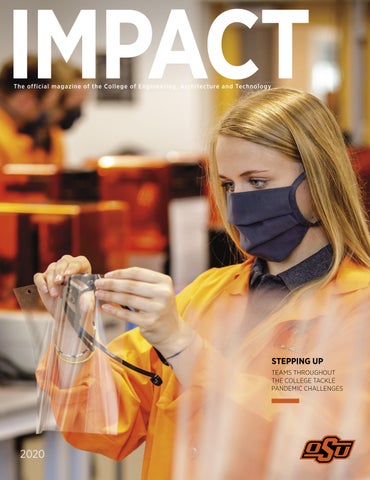
On The Cover Teams throughout OSU’s College of Engineering, Architecture and Technology are contributing to the fight against COVID-19. We share their stories in this special section. (Photo by Gary Lawson)
18
Covering all Fields A new device from an assistant OSU baseball coach and the New Product Development Center could help batters perfect their swings.
64
College Leadership
66
Donors
70
Hall of Fame
72
Top Honors
MARKETING MANAGER
LEAD WRITER
Jeff Hopper
54 48
UNIVERSITY EDITOR
Dorothy L. Pugh ART DIRECTOR
Paul V. Fleming PHOTOGRAPHY
CEAT is continually researching, developing and implementing new strategies to recruit and engage marginalized and underrepresented groups.
Phil Shockley, Gary Lawson, CEAT Staff
48
IMPACT is a publication of the Oklahoma State University College
of Engineering, Architecture and Technology and is designed to provide information on college activities and accomplishments while fostering communication among the CEAT family and friends. WWW.CEAT.OKSTATE.EDU
Bringing Dreams to Life
An OSU alumna — and the mother of CNN’s Dr. Sanjay Gupta — recounts the twists and turns of her life.
CEAT Bytes
Kristi Wheeler
Belonging in CEAT
A Series of Firsts
34
Paul Tikalsky, Ph.D., P.E., F.ASCE, F.ACI, EACR
Baker Hughes has donated its Energy Innovation Center to OSU's CEAT.
62
Dean’s Letter
DEAN, COLLEGE OF ENGINEERING, ARCHITECTURE AND TECHNOLOGY
An Innovative Future
A group of OSU architecture students helped the Pawnee Nation Come up with a design for a new cultural center and museum.
3
38 20
40
44
Plus …
74 56
The office of publication for IMPACT is 307 Whitehurst, Stillwater, OK 74078-1024. © 2020, IMPACT. All rights reserved. Oklahoma State University, in compliance with Title VI and VII of the Civil Rights Act of 1964, Executive Order 11246 as amended, and Title IX of the Education Amendments of 1972 (Higher Education Act), the Americans with Disabilities Act of 1990, and other federal and state laws and regulations, does not discriminate on the basis of race, color, national origin, genetic information, sex, age, sexual orientation, gender identity, religion, disability, or status as a veteran, in any of its policies, practices or procedures. This provision includes, but is not limited to admissions, employment, financial aid, and educational services. The Director of Equal Opportunity, 408 Whitehurst, OSU, Stillwater, OK 74078-1035; Phone 405-744-5371; email: eeo@okstate.edu has been designated to handle inquiries regarding non-discrimination policies. Any person (student, faculty, or staff) who believes that discriminatory practices have been engaged in based on gender may discuss his or her concerns and file informal or formal complaints of possible violations of Title IX with OSU’s Title IX Coordinator 405-744-9154. This publication, issued by Oklahoma State University as authorized by the College of Engineering, Architecture and Technology, was printed by Royle Printing, at a cost of $6,388/4M/Oct 2020/job #8425.
O S U C E AT 1
Take your membership tothenext level. We are excited to introduce our new membership model emphasizing life membership and recognizing past support through annual dues!
Learn more, join or upgrade at
ORANGECONNECTION.org/join.
ALUMNI A S S O C I AT I O N
2 I M PAC T 2 0 2 0
PHOTO PHIL SHOCKLEY
-
From the Dean
D
ear Friends and Alumni, The College of Engineering, Architecture and Technology is continuing its transformation as a leading innovator in education, research and extension services. This year has been a trying time for our nation and OSU. However, our college remained committed to our core land-grant mission. Our halls were empty, but our labs continued our research. Students were at home learning through a virtual network. Our faculty had to learn how to deliver content and engage students in the new paradigm. Our students were resilient and continued to learn, lead and achieve. In this edition of IMPACT, you will see how our students, researchers, faculty and staff tackled COVID-19 problems, and continued to educate the next generation. CEAT played a key role in OSU’s COVID-19 Incident Management Team and the opening of the Oklahoma Diagnostic Lab for COVID-19 testing. A group of students, faculty and staff produced personal protective equipment including face masks, face shields and ventilator valves, as well as special test-tube racks and nasal swabs in ENDEAVOR’s 3D Printing Lab. CEAT partnered with the College of Human Sciences to create cloth face masks to distribute throughout Stillwater. CEAT researchers published a fluid dynamics model to quantify social distancing and the importance of face coverings. A team of mechanical and aerospace engineering alumni and faculty and a Stillwater-based company (Plasma Bionics LLC) is working to use sterilization technology in the fight against COVID-19. This is an unprecedented time for OSU, the state and the nation, and I am proud to say that CEAT faculty, students and alumni rose to the challenge. We are engaged in a fall semester of on-campus, in-class instruction, although socially distanced and in face coverings. We are constantly adapting, creating solutions and advancing new opportunities. Our newest gift from Baker Hughes is also our newest opportunity. CEAT and OSU take on a prominent role in Oklahoma City’s MAPS 4 Innovation District with the OSU DISCOVERY building, partnering with energy, aerospace and defense to advance all of Oklahoma. We continue to need the help of alumni and friends to invest in the next generation. Consider a $1,000 donation to the CEAT Scholarship fund, and it will be matched by the OSU Foundation for Engineering or the ONEOK Scholarship for Equity to give OSU students the best chance to change the world. You might also consider joining the CEAT Dean’s Club, which recognizes distinguished supporters who have given $2,500 or more annually to the CEAT Designated Endowment Program Fund or CEAT Scholars Program Fund. I hope you enjoy the IMPACT of OSU. The college is at the forefront of innovation with the accomplishments of faculty, students and alumni, and investments of alumni, friends and industry partners like you. GO POKES!
Paul Tikalsky Dean College of Engineering, Architecture and Technology
O S U C E AT 3
-
To Play Among the Stars
NASA Space Grant program aids in development of STEM education
A
group of 52 consortia from the United States and Puerto Rico are tasked with developing a foundation of STEM students and educators to continue NASA’s goal of exploring the stars. The National Space Grant College and Fellowship Project, also known as the Space Grant program, was established by Congress in 1988 following the success of similar programs such as the Land Grant and
4 I M PAC T 2 0 2 0
Sea Grant programs. A year later, the program was given to NASA. This network of over 850 colleges, universities, industry partners, museums, science centers, and state and local agencies are working to expand the opportunities Americans have to understand and participate in NASA’s projects by supporting and enhancing science and engineering education, research and public outreach efforts.
Oklahoma State University leads 15 affiliates in the Oklahoma Space Grant consortium. The College of Engineering, Architecture and Technology’s own Dr. Andy Arena, a professor in the School of Mechanical and Aerospace Engineering, is the director. He recognizes the opportunities afforded by the Space Grant program, “for many states that do not have a NASA Center, like Oklahoma, the Space Grant program is one of the best ways
STORY AND PHOTO JEFF HOPPER | POSTER KELLY KERR AND ABBEY SHELLEY
“Opportunities like STELLAR are so important because they give educators … the confidence and empowerment to see themselves as participatory stakeholders in the future of STEM, which will in turn inspire the next generation of STEM thinkers and doers.”
(
for our students and faculty to work with NASA,” Arena said. The Oklahoma program offers several opportunities for students, teachers and researchers to engage in NASA-related programs, including the Oklahoma NASA Established Program to Stimulate Competitive Research (EPSCoR), which provides seed funding to enable Oklahoma researchers to develop research projects geared toward long-term, self-sustaining, nationally competitive capabilities in aerospace and aerospace-related research. EPSCoR provides this funding through four different avenues: Travel grants for faculty members to visit with NASA researchers at a NASA center. Research initiation grants and fellowships to create collaborative research efforts with researchers at NASA centers. Research implementation grants that fund research initiatives that address NASA’s desired areas of research interest and meet several levels of criteria. International Space Station flight grants for researchers wishing to integrate their research theories and instrumentation into flight experiments conducted on the ISS. All of these opportunities allow researchers to focus on areas that have a direct impact on the work NASA conducts. It also provides an introduction to NASA for some researchers who may never have thought their research could be applicable to any of NASA’s areas of interest.
)
DORINDA RISENHOOVER
The Oklahoma Space Grant program also offers a STEM engagement program that Arena calls vital for the future success of science and engineering related fields. Oklahoma’s education outreach program is headed by Dorinda Risenhoover, who has been with the program for over 20 years. Risenhoover coordinates several STEM engagement activities. She conducts professional development for educators across the state and activities for students from kindergarten through 12th grade and their families. These programs focus on several different aspects of aerospace and aerospace related topics such as rocketry, aircraft construction and flight and astronautcentric activities. Educators from around the state can use the program’s STEM Engagement Center on the OSU campus to experience different ways to engage students in STEM activities as well as acquire supplies or supply lists for those activities. Also, the STEM engagement program includes the STEM Teachers Experience Linking Learners to Aerospace Research (STELLAR) mentorship program. STELLAR uses NASA funding to allow 16 pre-service educators to engage in a yearlong program that includes a 10-day immersive training experience in areas such as model rocketry and aviation. They can also earn a trip to NASA’s Johnson Space Center for the Space Exploration Educators Conference. This program affords these future educators the opportunity to learn methods and tools that can enrich their STEM teaching experiences.
“Opportunities like STELLAR are so important because they give educators who are hesitant to teach science, sometimes due to their own views of their level of STEM abilities and possible lack of exposure to hands-on STEM as a K-12 student, the confidence and empowerment to see themselves as participatory stakeholders in the future of STEM, which will in turn inspire the next generation of STEM thinkers and doers,” Risenhoover said. CEAT’s hands-on approach coupled with the Space Grant program has contributed to the success of OSU’s renowned unmanned systems research, a program that started as a means of hands-on experience in designing and building aircraft for future aerospace engineers. OSU’s Speedfest was also made possible by NASA Space Grant funding. Collegiate teams from across the country compete in unmanned systems competitions in Stillwater. Additionally, Speedfest offers a competition for Oklahoma high school teams. Arena knows this competition has had profound impacts on young students that had never entertained the idea of going to college. “Not only are these students now going to college,” Arena said, “but they are majoring in aerospace engineering, because of their experiences with Speedfest.” The Oklahoma Space Grant program creates opportunities for STEM education and research at all levels. For the United States and specifically Oklahoma, the NASA Space Grant program allows future generations to dream of playing among the stars.
O S U C E AT 5
■
-
Building Better Buildings
Center for Integrated Building Systems aims to improve temperature-control equipment and its design
O
klahoma State University will soon welcome another research center into its 40-plus centers and institutes for research. The School of Mechanical and Aerospace Engineering in the College of Engineering, Architecture and Technology will kick off the Center for Integrated Building Systems in t he coming months. “The idea for CIBS was born from the need for a collective long-term strategy for research relating to the comfort systems in buildings,” said Dr. Craig Bradshaw, CIBS director. “This research includes influence from faculty, industry and government stakeholders.” Comfort systems in buildings fall into one of two common building creation silos, Bradshaw said. The comfort systems, designed to help control temperature, air movement and humidity, are designed, tested and regulated in one silo. In another, the building itself is created by a combination of engineers and architects. “A lot of the temperature-controlling equipment is being redesigned, and the working fluids inside them are being changed,” Bradshaw said. “And now there is a shift in the way that buildings need to be designed to accommodate some of the changes in the comfort equipment. When you put all these things together, you realize pretty fast that you need to tear down these silos.” The mission of CIBS is to bring together researchers and stakeholders from the heating, ventilation, air conditioning and refrigeration manufacturing industries, as well as architects and engineers to address common issues to hopefully stop any integration issues before they occur. “Ultimately, we want to research ways to make better comfort equipment and support the next generation of that equipment,” Bradshaw said. “But we also want to improve the building design process as well.” Planning for the creation of CIBS began more than two years ago and has involved many phases. “The first year involved generating broad ideas for a center and soliciting support from our industry partners so that we could submit a planning grant to the National Science Foundation Industry-University Cooperative Research Center program,” Bradshaw said. “We received over 20 letters of support and successfully won a planning grant from NSF, which allowed us to start the formal planning process.”
6 I M PAC T 2 0 2 0
CIBS research will be conducted in CEAT labs at OSU’s Advanced Technology Research Center and at the North Campus Labs.
The formal planning process included three phases of its own. In the first, the customer and member discovery phase: “We traveled around the country and spoke to about 80 people from 35 different companies to learn about how they work, what they are struggling with and how they view the future,” Bradshaw said. “What we found was that there was some collective desire to address some of these common issues, and that desire is what we used to generate the broad mission and vision of CIBS.” The plan for CIBS is to focus on five major research topics related to common industry issues over the next five years. The second phase was gathering researchers to support the five research topics. “We solicited 20 proposals from 13 faculty across CEAT to support these research topics,” Bradshaw said. He told the faculty members that they could not submit a research proposal to CIBS until they had talked to at least one, if not multiple, individuals in industry.
STORY AND PHOTOS DAKOTA KEITH
“Our research needs to address somebody’s specific need, and preferably more than one person’s,” Bradshaw said. “If it doesn’t, then it isn’t really relevant to CIBS’s mission.” Once research proposals were in, a planning meeting was hosted in Stillwater, with about 70 people from 20 different companies reviewing the proposals and offering feedback. “There are a ton of logistical challenges when it comes to hosting a planning meeting — from food to name placards,” Bradshaw said. “But the biggest challenge that our team faced was getting a bunch of different, and sometimes competing, entities to collaborate. We also needed to get faculty on board who may or may not have had any interest in working on buildings. Then we had to figure out how to bring it all together.” Bradshaw had to become a salesman of sorts because “someone who is good at sales is really good at understanding where people are coming from,” he said. “If I don’t try to understand what a company needs to help themselves be more successful, and then make an effort to support that, the companies won’t find value in what we are doing,” Bradshaw added. “Then we have to figure out how to help the faculty understand what the industry is trying to do and what is needed. Then we align those things and create programs to meet industry needs.” CIBS is aligning the groups with a broadening participation program. The program requires the principal investigators on projects to integrate undergraduates into their research projects, network with industry and support broader professional communities such as the American Society of Heating, Refrigerating and Air-Conditioning Engineers. “I wanted to help reinforce to our faculty and our members that there are tangible things that we want to deliver from this center that are really good for the community,” Bradshaw said. “We wanted to give back to the community at large and do more than just support faculty with research projects. We also wanted to engage our students to network with industry. We were able to accomplish both with this mechanism.” Mohsin Tanveer is a graduate student in MAE and is excited about being involved in CIBS as an academic researcher.
“Working at CIBS provides me the opportunity to work on practical projects and resolve real-life issues with heating, ventilation, air conditioning and refrigeration systems,” Tanveer said. “Through CIBS, I will be working closely with industry and learning from both industrial and academic leaders. It will bridge the gap between academia and industry and the skill set that I develop will be aligned to industrial needs.” Another MAE graduate student, Kalen Gabel, said he is most excited about working in CIBS to research how to lessen the energy consumption of thermal systems, those that involve the storage and transfer of heat. “Under Dr. Bradshaw, the study of thermal system machines becomes a reality, based on his expertise, our area of focus and industry involvement through CIBS. I think CIBS helps bring together industry and research to collaborate on common global and societal goals,” Gabel said. Industry membership in CIBS is continuing to grow. “I would like to acknowledge how grateful I am for the support of all of the companies who have joined us so far, and the 13 faculty who submitted proposals to support our research topics, including CIBS Associate Director Dr. Dan Fisher, and those who served on our faculty advisory committee, Dr. Christian Bach and Dr. Jeffrey Spitler,” Bradshaw said. “These individuals were very helpful in supporting the high-level planning process. It took a lot of people to support this effort and I’m grateful for all of the support to get this going.” While CIBS membership is growing, Bradshaw said he is always happy to welcome more. An annual membership gets an industry member a seat on the CIBS Industrial Advisory Board, giving them a voice in the overall strategy of the center and a direct influence on projects. Members are encouraged to interact with students and faculty on projects to ensure the projects will suit their company’s needs. “CIBS can provide the very targeted research effort that most companies could use support with. Like a glue for industry, we can provide relevant models, datasets, and test methods to support the ever-changing building equipment sector,” Bradshaw said. “We have a desire to be a national hub for building science research.” ■
FOR MORE information on becoming involved with CIBS, visit cibs. okstate.edu.
CIBS meeting group.
O S U C E AT 7
-
Dr. Mohamed Soliman sits atop a large-scale test specimen used to simulate a ship’s hull, which is subjected to numerous load cycles of stress and pressure.
Under Pressure Mohamed Soliman’s research could change the way aquatic structures are built
D
r. Mohamed Soliman’s work for Oklahoma State University’s College of Engineering, Architecture and Technology is seemingly under constant stress and pressure — and he wouldn’t have it any other way. While he knew from an early age that he would be an engineer, Soliman began narrowing his focus to structural engineering while pursuing his undergraduate degree at Alexandria University in Egypt. He chose the design of metallic structures as his main focus of research, as he wanted to design megabridges and high-rise structures. At Alexandria, he became an assistant lecturer and fell in love with teaching, which prompted him to pursue his doctorate at Lehigh University in Bethlehem, Pennsylvania. After completing his doctorate, Soliman sought to intersect teaching and research opportunities by working in academia. In researching engineering
8 I M PAC T 2 0 2 0
departments, he sought a department that encouraged research diversity and possessed good experimental infrastructure. He visited OSU and was enthralled with the Bert Cooper Engineering Lab and its ability to offer the large-scale experimental research he wanted to pursue. Structural engineering has a litany of realworld applications, from the traditional bridge and building design to areas such as the design of laptop frames, vehicle chassis, airplanes, oil-storage tanks, ships and much more. During his doctoral studies, Soliman was a member of a project aimed at developing optimized maintenance strategies for civil and marine structures under fatigue deterioration, which continues to be a key area of focus for him. Soliman is studying the fatigue and fracture of ships sailing the rough seas of the North Atlantic. The research started out as a computational
STORY AND PHOTOS JEFF HOPPER
examination of the fatigue endured by a ship’s steel hull while traveling through the North Atlantic. The digital ships went through numerous simulations of changing conditions to replicate the cycles of stress experienced in years of sailing those waters. Once those tests were conducted, a predictive model was created. Soliman and his team then created small-scale sample specimens for easier experimental testing. Those samples were put through load cycles, waves of stress and pressure, to simulate the rough seas in normal shipping lanes in the Atlantic. Once the small-scale tests were completed and data compiled that supported the teams’ predictive models, they created large-scale test specimens. “The increasing size of a test specimen significantly increases the complexity of the testing task,” Soliman said. His team recently constructed a steel box beam approximately 20 feet long with a cross section four feet wide by three feet tall. A specimen that size significantly complicates the research and requires creative forms of design, preparation and instrumentation to conduct experiments. Simply put, the building and testing of both the test specimen and the testing apparatus itself is a unique endeavor. The team recently finished construction of their test apparatus and are beginning tests, however the COVID-19 pandemic has caused delays. Soliman hopes that his teams’ research will lead to a better understanding of the behavior of structures under cyclical marine stress and pressure. A better understanding of the environment these structures operate in and how they interact with their surroundings will allow for the development of better construction techniques and construction materials as well as refined models that can accurately predict the behavior of these structures. This will reduce damage risks, lower maintenance costs and increase longevity for steel bridges, ships, offshore platforms and more. Soliman plans to continue his research in this area, citing possible improvements to current test setups, as well as extrapolation of their testing methods to other industries, such as the aerospace industry with different materials and load patterns. Soliman hopes that through his research and teaching he can reach the structural engineers of tomorrow. “I want students to know that the sky is not the limit in structural engineering,” Soliman said. “Instead, think of space, the moon and other planets as the limit. They can design anything from a cellphone frame to a moon buggy and everything in between.” ■
Soliman and his team developed a testing apparatus that would rigorously load test a large-scale test specimen.
O S U C E AT 9
-
Dr. Baski Balasundaram received the Phoenix Award for Graduate Faculty at OSU’s 2019 Convocation.
A Lifelong Progression
Baski Balasundaram’s focus has always been to optimize every opportunity
G
rowing up in the Indian coastal city of Chennai in a middle-class family, Baski Balasundaram always focused on possible careers that would maximize his potential. Little did the future Oklahoma State University professor know that pursuing those goals would let him optimize every opportunity he was presented.
10 I M PAC T 2 0 2 0
Balasundaram’s family focused on social mobility (the idea of progressing above one’s current social class). From an early age, he wanted to pursue an education that would allow him that opportunity. “Social mobility for us meant you became an engineer, computer scientist or doctor,” Balasundaram said. “At least that’s the impression we got as kids.”
His mother encouraged him to apply to the prestigious Indian Institute of Technology. After years of preparation, he passed the entrance exam and was admitted to IIT Madras (IITM), where he chose to focus on mechanical engineering. While he found the curriculum to be as he expected, he felt his skills and interests in mathematics were
STORY JEFF HOPPER | PHOTOS GARY LAWSON AND BASKI BALASUNDARAM
under-nurtured in most of his required courses. Once he was introduced to the field of operations research, though, he found his true calling. “Operations research is a beautiful intersection of engineering/business problem-solving skills, mathematical modeling techniques and computing,” Balasundaram said. “I was smitten.” He knew he wanted to pursue a graduate degree in the United States. “Higher education in the U.S. was a dream for many students graduating from IITM at the time,” Balasundaram said. “Some of the best institutions for pursuing graduate degrees in industrial engineering and operations research are in the U.S.” He chose to pursue his doctorate in industrial engineering at Texas A&M University, earning it in 2007. While presenting his research during his second year there, Balasundaram fell in love with teaching. He was applying for faculty positions across the country when an acquaintance of his, an optimization expert in the School of Industrial Engineering and Management, decided to go into industry, opening his position at OSU. Since joining OSU, Balasundaram has contributed to the body of knowledge in operations research, primarily through his work in network
optimization. Balasundaram splits his time between basic research (theoretical studies aimed at expanding our scientific knowledge base) and applied research (developing tools for more specific and immediate problems, possibly with commercial interests), with a greater emphasis on the former. “My basic research agenda is to develop a toolkit of effective algorithms to find certain types of patterns in different networks,” Balasundaram said. Network models can be used to solve a wide range of problems, such as detecting tightly knit clusters in a network (community detection), designing networks with desirable properties (fast transportation or communication, survivable node/link failure), finding patterns that are fault tolerant, etc. These models and more can be associated with an even wider range of application domains such as transportation, systems biology, social network analysis, money laundering detection, stock market analysis and internet analytics. His applied research calls for more targeted approaches that apply optimization techniques to industrydriven problems such as those that arise in transportation logistics, productioninventory planning, scheduling, routing and other classical areas of operations research.
Over his career, Balasundaram has resisted the temptation to stray too far from his core research focus and continues to make strides toward adapting his research to expand into other areas of interest. This has led to recent ventures into areas such as stochastic network optimization (when elements of the network are assumed to have probabilistic failures), risk modeling in networks (incorporating a financial risk measure in modeling losses in network properties) and most recently, network interdiction (an attacker/defender scenario on network structure and integrity). “All of these new areas of interest have been explored with the help of collaborators both within and outside of OSU,” Balasundaram said. “I find experts in the topic and learn from them.” Starting in early childhood through his years of education, research and teaching, Balasundaram has always strived to optimize the opportunities presented to him. He hopes that he can continue to do so. “I try to share my own passion and excitement for the things I teach in the hopes of kindling the same in my students.” ■
Dr. Baski Balasundaram (second from right) with his Ph.D.advisor, his Ph.D. students and the Ph.D. students of his first Ph.D. student.
O S U C E AT 11
RESEARCHING IONIC LIQUIDS Dr. Jindal Shah reflects on two decades worth of award-winning research
Dr. Jindal Shah, an assistant professor in the School of Chemical Engineering at Oklahoma State University, has been at the forefront of research on ionic liquids for nearly 20 years. Shah earned his bachelor’s degree in chemical engineering from the Indian Institute of Technology Bombay, in Mumbai, India , before pursuing graduate school in the United States. “I did my master’s at the University of Cincinnati,” Shah said. “But it was when I went on to pursue my Ph.D. at Notre Dame that I was exposed to ionic liquids research.” When Shah was beginning his doctoral research in 2000, the field of studying ionic liquids was very new; only a handful of chemical engineers were aware of and studying them. However, ionic liquids themselves have been around for more than a century.
12 I M PAC T 2 0 2 0
An ionic liquid, in the form of a simple explanation, is a salt in a liquid state. Shah cites table salt in explaining this concept. “Most of us eat table salt,” he said. “Table salt is an ionic compound made up of a positively charged sodium cation and a negatively charged chloride anion. Because the cation and anion are spherical in nature, the electrostatic attraction between the two ions is very strong.” Because of this strong attraction, the ionic makeup of common table salt results in a crystalline solid structure at room temperature. In the case of ionic liquids, at least one of the ions is not spherical, which weakens the attraction between the ions, making it difficult for them to form a crystalline order. The result is a liquid.
STORY DAKOTA KEITH | PHOTOS PHIL SHOCKLEY, ILLUSTRATIONS DR. JINDAL SHAH
“The beauty of ionic liquids is that many of them don’t vaporize,” Shah said. “Because of this property, ionic liquids are less likely to cause air pollution and can nearly eliminate the inhalation of harmful vapors from currently used chemicals. This makes ionic liquids an attractive solvent in the chemical industry.” In 2002 while working toward his doctorate, Shah performed the very first Monte Carlo simulation of a roomtemperature ionic liquid at the atomic level. “We showed with molecular simulations that you can predict how properties of ionic liquids respond to things like temperature and pressure,” Shah said. “We also showed what an ionic liquid looked like on a molecular level, which had not been observed experimentally.” Since the molecular simulation research study was published, the study of ionic liquids and their potential uses in industry has taken off. “When I started my research, there were roughly 50 articles per year coming out that focused on ionic liquid research,” Shah said. “Now the research has grown exponentially and I receive alerts of about 150 to 200 articles being published on ionic liquids per week.”
His research group is interested in customizing ionic liquids, which are considered designer solvents because of their ability to be created and developed, for specialty applications such as gas separations, liquid-toliquid separations and electrolytes in batteries. “Our calculations suggest that one can design trillions of ionic liquids by mixing pure ionic liquids together, and that is on the lower side,” Shah said. To narrow down the number of ionic liquids that his lab can realistically study, Shah’s lab focuses on a particular class of ionic liquid. “There are actually many different classes of ionic liquids,” Shah said. “Our team mainly focuses on the study of the cation class 1-alkyl-3-methylimidazolium.” That class is a written description of a common base structure for a type of ionic liquid, in which an imidazolium ion serves as the core of the structure and chemical groups such as alkyl and methyl serve as substituents that are bonded to nitrogen atoms in the imidazolium cation.
While the core of 1-alkyl-3methylimidazolium remains the same, Shah’s team manipulates the alkyl chain lengths and its variation with different functional groups to create new forms of ionic liquids to study. “We think about this as a molecular Lego,” Shah explained. “You connect all the different pieces to satisfy chemical bonding rules in order to create new molecules.” Dr. Shah, his team and their collaborators focus on several research areas. “Dr. Shah’s research is currently investigating topics related to the separation of CO2 from natural gas, improving the performance of rechargeable batteries, and improving the biodegradability of ionic liquids,” said Dr. Geir Hareland, head of the School of Chemical Engineering. One research area is focused on how to use ionic liquids to improve the performance of lithium ion batteries. “I am focusing on how ionic liquids and ionic liquid mixtures enhance ionic conductivity so that when used in lithium ion batteries, they will operate more efficiently and we can increase their capacity,” Shah said.
Dr. Jindal Shah, left, and graduate student Atiya Banerjee look over some results involving ionic liquids research.
O S U C E AT 13
“The beauty of ionic liquids is that many of them don’t vaporize. Because of this property, ionic liquids are less likely to cause air pollution and can nearly eliminate the inhalation of harmful vapors from currently used chemicals.” JINDAL SHAH
Examples of different forms of cation ionic liquid structures.
14 I M PAC T 2 0 2 0
In this study, Shah is teaming up with fellow assistant chemical engineering professor Ömer Özgür Çapraz, who has a background in lithium ion, sodium ion and potassium ion batteries. Çapraz said that one of the biggest challenges faced when using the solvents typically used in batteries is irreversible chemical reactions that cause their capacity to fade rapidly. “We want to see if ionic liquids can outperform the solvents currently being used in these various types of batteries,” Shah explained. Another area the lab studies is ionic liquid biodegradation. A few oil and natural gas companies are using ionic liquids to separate various components of oil products during the oil extraction and refining process. “When you are using ionic liquids on an industrial scale, there is potentially going to be aquatic pollution,” Shah said. “While ionic liquids are environmentally safe in terms of air exposure, they can be toxic to aquatic organisms.”
Industrial Engineering and Chemistry Research featured Dr. Shah and graduate student Utkarsh Kapoor’s research on the cover in 2017.
Shah and chemical engineering graduate student Atiya Banerjee began looking into how ionic liquids could be biodegraded in an environment. “We are looking at the potential of ionic liquids to undergo natural breakdown into smaller, environmentally benign chemical fragments that do not cause a significant environmental footprint,” Banerjee said. “We have been able to achieve some key molecular and electronic level insight into a reduced model of these ionic liquids in complexation with a potential biodegrading agent, cytochrome P-450.” Cytochrome P-450 is a protein that can oxidize steroids, fatty acids, and xenobiotics which are chemical substances that are found within an organism that is not naturally produced or expected to be there. “We plan to use these inferences at the ab initio level to aid experimentalists in designing ionic liquids for industrial application,” Banerjee said. Due to the research in ionic liquid biodegradation, Dr. Shah won a National Science Foundation Faculty Early Career Development Program (CAREER) award.
l&EC research
While Shah has performed noteworthy research about ionic liquids here on Earth, that isn’t the only place that he has found ionic liquids to be helpful. He is also conducting research for NASA. “We are trying to use particular ionic liquids and ionic liquid mixtures to figure out how we can remove a key contaminant from water aboard the International Space Station,” he said. The International Space Station uses a water filtration system that takes astronaut urine and converts it to consumable drinking water. “There is one contaminant that they would like to remove so that the filtration system functions more efficiently,” Shah said. “With experimental collaborators from the University of Texas at Austin, we are exploring ways in which we can use ionic liquids to achieve that objective.” Shah added that the reason NASA is interested in using ionic liquids because ionic liquids don’t vaporize. “When you take them all the way up in space, you don’t have to worry about them disappearing by vaporizing,” he said.
The Journal of Chemical and Engineering Data recognized OSU’s Jindal Shah as among the top 25 emerging investigators in chemical thermodynamics.
Due to his extensive research experience, Shah is a highly soughtafter advisor and mentor for both undergraduate and graduate students, having mentored 27 students since becoming a professor. “Being mentored by Dr. Shah has been an incredible experience,” said Wyatt Gassaway, a chemical engineering student and undergraduate researcher. “I learned how to do computational chemistry, data analysis and coding, all of which will be extremely beneficial to my career.” Shah credits his colleagues and students for the numerous awards that he has won, including being named one of the top 25 emerging investigators in chemical thermodynamics by the Journal of Chemical and Engineering Data. “It’s not just all me, it is the people around me who also contribute in whatever way they can,” Shah said. “I know we always highlight an individual but this research doesn’t get done in a vacuum. I have been able to do great research because of the resources and research environment that the university has provided us with and there are a lot of people who play a role in making that research possible.” ■
O S U C E AT 15
-
A Blazing Success IFSAC celebrates 30 Years of fire service accreditation
T
he International Fire Service Accreditation Congress (IFSAC) is celebrating 30 years. Housed in the College of Engineering, Architecture and Technology at Oklahoma State University, IFSAC is a non-profit, self-governing system of fire-service-certifying entities and higher education fire-related degree programs. The IFSAC Certificate Assembly accredits entities that certify the competency of and issue certificates to individuals who pass examinations based on National Fire Protection Association (NFPA) fire service professional qualifications and other standards approved by the assembly. The accreditation is made at the state, provincial, federal or territorial level for firefighter certification programs. The IFSAC Degree Assembly accredits fire science and related academic programs at colleges and universities, including two-year associate degrees and four-year bachelor’s degrees. The IFSAC Degree Assembly is recognized by the Council on Higher Education Accreditation as an
16 I M PAC T 2 0 2 0
accreditor of fire and emergency related degree programs. Before accreditation is granted, the institution must do an integral self-study followed by an on-site review by a panel consisting of peer representatives from other member institutions. IFSAC has come a long way since its inception in 1990. Prior to 1990, there was only one accrediting body for certifying entities, and it was disorganized and running poorly, leaving many in the fire world fearful that it would go away completely. A two-day conference in St. Louis in August 1990 set the path for the inception of IFSAC. The “Fire Training and Certification Program Accreditation Conference” addressed the issues relating to certification, qualification and accreditation in fire service training systems and drew many state officials who had concerns about the future of professional recognition for their certification programs.
STORY KRISTI WHEELER | IMAGES CEAT MARKETING
Attending the conference was John Wolfe, a Kansas fire chief who ultimately laid the groundwork for much of IFSAC’s definitions and policies. In his presentation, he spoke of the confusion that existed between terms such as certification, qualification, standards and accreditation, and he said a national system of certification was needed. Also presenting at the conference was Harold Mace, the then director of Fire Protection Publications and Fire Service Training at OSU. He spoke about his vision of a new peer-driven system of accreditation that would include an accreditation congress, a board of governors and an administrative section. In his vision, the accreditation congress would consist of one representative from each state or entity participating and would be the policymaking group of the organization. The board of governors would be elected from and by the accreditation congress members to carry out the
After his presentation, the state representatives there were interested and on board with the idea of a peer-driven concept that Mace presented. Having OSU house the program made sense. Westhoff was appointed IFSAC’s first manager, and things started unfolding. In November 1990, Westhoff made a presentation on the new International Fire Service Accreditation System, making this an international organization, which would be a first for fire accreditation. At the time, Westhoff was on the staff at Fire Protection Publications and had been a state fire training director in Missouri. He also held the title of fire chief and had a degree in fire protection and two degrees in education. “Once IFSAC was off the ground, we progressed along to where we were selecting site teams to go to various states and provinces, and we found that there was a need from degree programs that were popping up in various places,” Westhoff said. “After a couple of meetings, it was decided to split
“Of all the various things I’ve done in my fire service career, my involvement with IFSAC had more of an impact than anything. I’m more proud of that than a lot of other things I’ve done.”
(
BILL WESTHOFF directives of the congress. The administrative section would be housed at OSU to take care of dayto-day operations. He also described the process he envisioned for how entities would become accredited, proposing to call this new congress the Fire Service Accreditation Congress (FSAC) and laying out a well-run operation. Additionally, he said it could be implemented immediately because OSU was willing to make a long-term commitment to the system, providing additional credibility. “Harold Mace was really the godfather of this whole operation,” said Bill Westhoff, IFSAC’s first manager. He served on a number of National Fire Protection Association committees as the standards for firefighters were being developed. These standards specified capabilities of skills, of knowledge, of information that the national group decided it needed to have to be at various levels, such as firefighter I, firefighter II, Investigator, etc. In order to ensure those were being properly examined and utilized at the various cities, states and countries, Mace had the idea that there should be a peer-driven accreditation congress that evaluated the testing procedures at each of these entities consistently across the board.”
)
the accreditation congress into the degree side and the accreditation side for states and provinces. We developed a system that would ensure that if you were trained to a firefighter II level in the state of Washington or the state of California or Missouri, it was the same in Oklahoma and any other state involved in the accreditation congress. “It was a very close-knit group who all had the same objectives in mind, and that was to improve training the fire department personnel,” Westhoff added. “Of all the various things I’ve done in my fire service career, my involvement with IFSAC had more of an impact than anything. I’m more proud of that than a lot of other things I’ve done.” Westhoff has five generations of fire chiefs in his family. His grandson just finished his tenure in the Air Force Fire Protection system, earning about 20 fire service certifications from the accreditation program, allowing him the opportunity to go anywhere. Westhoff retired from IFSAC in 1996, leaving the congress in a position where more and more states were eager to join. Today, the organization includes 114 member entities including 41 states, 10 Canadian provinces, South Africa, Egypt, Germany, Iraq, Saudi Arabia, Qatar, Kuwait, Oman, the United Kingdom, the Canadian Armed Forces and the U.S. Department of Defense. ■
O S U C E AT 17
OSU assistant baseball coach Rob Walton with the team.
Covering All Fields
New Product Development Center helps baseball players improve their swings
M
any of the skills needed in baseball — immense situational intelligence, razor-sharp focus, unyielding determination and finely tuned athletic ability — can be honed to a keen edge with hard work and practice. However, thanks to Oklahoma State University assistant baseball coach Rob Walton and a team of engineers from the College of Engineering, Architecture and Technology’s New Product Development Center, a new tool could be at the disposal of any player of America’s national pastime. Walton has been a part of baseball for more than 30 years. He played at OSU, pitched for the Baltimore Orioles organization, was a head coach at Oral Roberts University and is now an assistant coach at his alma mater. Drawing from all of these experiences (and then some), Walton created the Swing Plane Trainer, a tool that could revolutionize how hitting is taught and practiced.
18 I M PAC T 2 0 2 0
THE IDEA Differing opinions exist about where and when the idea for the Swing Plane Trainer originated. The earliest account comes from Donovan “Donnie” Walton, Rob’s son and a middle infielder for the Seattle Mariners: “When I was younger, he (Rob) used to watch a lot of film on hitters. He noticed that most of the better hitters swung on a flat plane, so he started making me take practice swings over the back of the couch to make sure my swing stayed on plane.” The importance of a level, on-plane swing is critical to being a consistently productive hitter. Statistics dictate that the more flyballs produced, the more potential for positive results. However, according to Walton, how that ball flight is achieved makes all the difference.
STORY JEFF HOPPER | PHOTOS NEW PRODUCT DEVELOPMENT CENTER AND BRUCE WATERFIELD
-
Walton believes that a swing that is on plane with the ball, no matter the location, will produce more consistent results. The idea of hitting the ball off a tee has been around for a long time and is still used around the world. However, a traditional tee, while adjustable for height and location, has no way of indicating whether a hitter’s swing is on plane. Thus, the idea to create an instant-feedback swing plane hitting trainer was born. THE DESIGN Walton began studying other sports to determine the best way to design and build this equipment. He noticed that golf was similar to baseball in that participants in the sport were constantly inventing new ways to train themselves to keep their swings on plane. The common thread amongst these devices was a way to provide instant feedback. Rob Walton devised that an adjustable table of sorts would provide the instant feedback desired. He affixed a piece of plywood onto a laptop table for more durability when hit with a baseball bat. He drilled a hole in the table to attach a standard baseball tee and cut a slot the width of the table for left and right adjustment to mimic inside and outside pitches. But he needed help to further develop the device into a marketable product. THE DEVELOPMENT He contacted Daniel Will, executive director of Cowboy Technologies, a company owned by the OSU Research Foundation that provides a wide range of services, including market research, business model development and investment and capital fundraising. Cowboy Technologies decided it would fully fund the Swing Plane Trainer through the development stage, something that doesn’t happen often due to cost. Will engaged NPDC Director Dr. Robert Taylor to develop a market-ready prototype of the Swing Plane Trainer.
NPDC design engineers Jennifer Vinyard and Jodi Prouty took the lead on the project. Assisted by several undergraduate engineering interns, the team developed a wish list of attributes from Walton and determined how to incorporate those features. The team developed several prototypes with varying material types and movement mechanisms until they arrived at the current iteration — a flat plastic table with a home plate etched into it, a crank system for height adjustment, tilt points and a track that provides movement of the table left and right. “The crank system was the biggest obstacle we faced,” Taylor said. “Finding a system that was durable enough and easy to use, while not encroaching on other systems of the device, was a challenge.” THE FUTURE The Swing Plane Trainer is already in use at Oklahoma State and has helped several players sharpen their hitting. Colin Simpson, now with the Colorado Rockies organization, witnessed a huge change in his hitting approach after using the device. “I used to have an uphill swing which caused some issues when hitting,” he said. “After I used the swing plane trainer, it flattened out my swing and developed a weakness of mine into a strength.” A couple of Major League Baseball teams have a Swing Plane Trainer, with interest from several others. Several colleges around the country have also expressed interest in the device. The device is adaptable to all levels of baseball, from Little League to the majors. ■
The Swing Plane Trainer, developed by Rob Walton and the New Product Development Center.
O S U C E AT 19
Teams throughout CEAT pick up the gauntlets laid down by the pandemic
The College of Engineering, Architecture and Technology is filled with many talented members of the Cowboy family who are constantly researching ways to solve the grand challenges that face our world. And 2020 has been throwing those challenges at us in ways never before seen. As the grand challenge of COVID-19 started hitting home, our students, faculty and staff got to work. From researching the best social distancing practices to creating (and continually improving) new sanitation methods, from halting all other lab projects to prototype and mass-produce face shields and filtration masks to joining a coalition to discover why SARS-CoV-2 affects some patients more than others — CEAT teams tackled the novel coronavirus in their own novel ways. These Cowboys, true to the Cowboy Code, gave COVID-19 everything they had, and they are still working tirelessly to mitigate the effects of COVID-19 on our campus, our state and our nation. We hope you enjoy their stories.
20 I M PAC T 2 0 2 0
INSIDE THIS PACKAGE 22
Playing a key role
26
Stepping up
29
A technological boost
30
Measuring the distance
32
Devising solutions COVID IMAGES FREEPIK.COM
O S U C E AT 21
PLAYING a KEY ROLE
Incident management team and CEAT officials were critical to COVID-19 lab’s success Oklahoma State University is playing a key role in the state’s fight against COVID-19 thanks to a partnership between campuses and the number of OSU faculty, staff and students willing to take part. Volunteers came from across campus to support the cause, and the College of Engineering, Architecture and Technology played a key role, particularly with the incident management team that was created to support the lab. 22 I M PAC T 2 0 2 0
STORY SHANNON G. RIGSBY | PHOTO PHIL SHOCKLEY
~ Leading Together
O S U C E AT 23
In March, university leaders considered how to best use OSU resources to serve the state. FDAapproved machines to run the test analysis for COVID-19 were identified at the OSU Diagnostic Laboratory, part of the Oklahoma Animal Disease Diagnostic Laboratory on the Stillwater campus. Leaders at the Stillwater campus and OSU Medicine in Tulsa formed a partnership that enabled the lab to earn the certification to test human samples in record time. The effort required for the lab to continue its traditional role serving the state in animal diagnostics while doubling Oklahoma’s COVID19 testing capacity nearly overnight was massive. Testing human samples also requires managing sensitive and private health information. The sheer volume of human specimens flowing through the lab was enormous. Additional personnel, training, control and information technologies for COVID19 testing were needed in place in a matter of days. Dr. Kenneth Sewell, OSU’s vice president for research, knew additional personnel would be a necessity to meet the testing demand. The talents and skills were available on campus; it was just a matter of coordination. He enlisted the help of Ed Kirtley, assistant dean of engineering extension, on March 24. “(Sewell) asked if I would manage the logistics of getting people hired and getting things set up to support the lab,” Kirtley said. “The only way I knew how to do it was to set up an incident management team.” Kirtley has a military background, 24 years in the fire service and experience with the National Incident Management System. While an IMT is typically used for responding to disasters such as floods or tornadoes, Kirtley adapted the structure and protocol to support the lab. Personnel were put
into place for logistics, planning, operations, public information, safety and more. The IMT set up the processes and structures necessary for the lab to reach a sustainable operation long-term, including provisions for the possibility of maximum testing capacity with 24-hour operation. More people joined as new needs were identified, with 27 serving the IMT directly. CEAT personnel handled roles including finance and administration, logistics, public information, some human resources functions, virus tracking and more. CEAT students in Fire and Emergency Management filled in other roles, creating plans, including an escalation plan should the virus transmission increase in the fall. “It was a group of dedicated people who all had special skills who were in the right place at the right time,” Kirtley said. “They’re the ones who made it work. Also, the support of the university administration was vital. They gave the team the authority and scope to get things done.” When the number of samples being transported to the OSU Diagnostic Laboratory each day became too great for local commercial couriers, Tom Joyce, an academic advisor in the College of Education and Human Sciences, and Rodney Eksteen, a graduate student on the path to a doctorate in CEAT’s Fire and Emergency Management Program, joined the IMT. They started planning on Friday evening, April 3. By 8 a.m. the following Monday morning, they launched a custom courier service using OSU transit drivers and the motor pool. Eksteen grew up in Cape Town, South Africa, and retired from the Johannesburg Fire and Emergency Services. He and Kirtley were well acquainted, thanks to OSU’s influence in fire and emergency services worldwide.
“For this moment in time, Oklahoma State University acted as one team across the board. Because of that, the right people with the right skills came together — people who believed in the mission. There wasn’t one thing we were asked to do that we did not accomplish well.” ED KIRTLEY
24 I M PAC T 2 0 2 0
Gwl,o,p Leading Together “It’s amazing to see that this university in this small town has global reach. It’s phenomenal actually,” Eksteen said. “I couldn’t believe all of that was happening from little old Stillwater. The impact and reach are far beyond what anyone actually realizes. I can tell you we would be in the dark ages in the fire service in South Africa without OSU.” Eksteen was familiar with the concept of an IMT before he was asked to serve. For many who stepped up to help, it was their first experience. Eksteen said the IMT is about creating an entire organization and accelerating to full productivity almost immediately. The volunteers may work for OSU, but many served in the IMT in different capacities than their usual job duties and had to quickly adapt. “Looking at what needed to happen in the time required, the IMT was such a critical success factor, in my opinion,” Eksteen said. “That’s what an IMT does. It’s there to get something set up in the shortest space of time, ultimately with the benefit of the public in mind.” In addition to faculty and students, staff members played a critical role in the success of the IMT and ultimately the lab. Patrick Wheeler knew his way around the Stillwater campus as well as anyone. He worked for a decade in facilities management. Since 2017, he has served as the facility manager for CEAT, running support for the engineering labs from equipment installation to safety compliance. Two weeks into the creation of the IMT, Kirtley called Wheeler. “I knew Pat was the person for logistics,” Kirtley said. “He knows everybody and in his job in the college, he knows how to get things done.” “He asked me to provide logistical support to the acting planning section chief,” Wheeler said. “Because I came from FM, I knew all the operations, all the shops, who to contact if I needed electrical, or plumbing. Over the course of my career, I’ve been in every building and am familiar with how the campus operates.” Wheeler organized the movement of surplus items to create the space needed to respond to the pandemic. As the facility manager for CEAT, he also knew where to find a computer lab in a building slated for remodeling in 2021. He provided the computers and the IT personnel to equip the lab for use as a data entry hub for COVID-19 testing. When personal protective equipment was in short supply, Wheeler went through the CEAT labs, procuring extra PPE for the COVID-19 lab staff.
When it was time to rotate personnel, Wheeler took over as section chief. Working with the IMT reminded him of his time in the U.S. Army. “I’ve been in some military exercises to accomplish an objective with several platoons. That’s what it reminded me of,” he said. “Everyone pulled their weight and everyone did their job. Everyone supported each other.” Craig Hannan, director of Fire Protection Publications since 2009, agrees. He was contacted by Kirtley in mid-March to fill in for the finance section chief for a scheduled rest. Although familiar with roles in the National Incident Management System, he had never worked on an IMT of this scale. “Everyone involved focused on their tasks, in a short time frame, to meet the assigned objectives,” Hannan said. “Most had not worked with or even known each other prior to the event. The group quickly became a functioning team.” The IMT accomplished every goal of the mission, helping the lab reach a sustainable performance level in 31 days. It was demobilized on April 24, exactly one month from the day Kirtley was first contacted. “The IMT has been the coordinator,” Sewell said. “This group was planning and putting together processes. They understood what we were trying to accomplish. We couldn’t have had the statewide impact we’re having now without them.” Kirtley gives credit to the quality and professionalism of the people serving the IMT and their level of commitment to the mission. To him, the role of the IMT was a natural extension of the university’s land-grant mission, to serve Oklahoma. “I believe the IMT excelled at its mission,” Kirtley said. “We work in an environment in higher education that tends to be siloed. For this moment in time, Oklahoma State University acted as one team across the board. Because of that, the right people with the right skills came together — people who believed in the mission. There wasn’t one thing we were asked to do that we did not accomplish well.” Since the OSU Diagnostic Laboratory opened, it has processed more than 125,000 tests — for families who need that critical health information, thanks to the Cowboy spirit that overcame every obstacle. That’s 60,000 families who will have critical health information, thanks to the Cowboy spirit that overcame every obstacle.
O S U C E AT 25
Killian Bussey works in the ENDEAVOR lab to make protective masks and face shields for first responders and those in the medical field. PHOTO PHIL SHOCKLEY
26 I M PAC T 2 0 2 0
Gwl,o,p
STEPPING OSU engineers tackle protective UP
Leading Together
mask shortage to help health professionals and first responders
A team of faculty, staff and students from the College of Engineering, Architecture and Technology’s ENDEAVOR lab is working to prototype and manufacture protective masks and face shields.
Killian Bussey, a senior in electrical engineering technology saw a Twitter post where individuals from Italy were making protective masks for medical professionals and first responders. He talked to his supervisors at ENDEAVOR and fellow electrical engineering technology student Jordan Fogg about the idea. I believed making the masks could have a fantastic impact on the community,” Bussey said. “The entire team here really cares about what we are doing and wanted to help as many people as possible.” The team at ENDEAVOR used 20 3D printers around the clock to create printed filtration masks and face shields. The ENDEAVOR lab had a demand for about 120 face shields per day and asked Edmon Low Creative Studios and the OSU College of Education and Human Sciences to assist with the project. To create the prototypes, the team explored different mask designs and printed the most promising ones. The designs were then further modified to improve performance and protection. “We threw out different ideas to each other and then we printed the mask or face shield, tried it on and altered what we thought should be altered in the [printing format] files to improve things like air flow and the head pieces that hold the face shields,” Bussey said. During prototyping, the team studied different material to ensure user comfort. They factored in the products reusability and addressed supply chain issues, and provided alternatives for filter materials and face shield attachments.
“We tried out different materials on the masks to see what worked better, like thermoplastic polyurethane versus polylactic acid material,” Bussey said. “We made some 20 filtration type mask prototypes so that individuals could wear and test them and determine which type would best serve them in their work environment,” said Dr. Brad Rowland, manager of operations at ENDEAVOR. “Once we knew which prototype was preferred, we mass printed them.” Rowland said that the prototypes used N90or N95-rated filter material or High Efficiency Particulate Air (HEPA) filters. N90 or N95 masks are commonly used by health care professionals and filter out 90 or 95 percent of suspended particles in the air respectively. HEPA filters can filter out 99.97 percent of airborne particles. These masks can aid in keeping viruses away from the nose and mouth, protecting individuals caring for patients. “You could cut one N95 mask or HEPA filter into several small squares and place these into the air filtration portion of our mask. By doing this you could get several uses out of one mask or HEPA filter,” Rowland said. The ENDEAVOR team also worked on creating head bands that connected to face shields for medical professionals and first responders. “We printed small things that could turn everyday items into protection,” Bussey said. The team also worked on a 3D printed mounting device that clips on to repurposed transparent sheets, turning it into a face shield.
STORY DAKOTA KEITH | PHOTOS PHIL SHOCKLEY AND DAKOTA KEITH
A prototype of a face shield that was made by a team of ENDEAVOR faculty, staff and students.
PHOTO ENDEAVOR
O S U C E AT 27
“Now that we are done prototyping, we will release our files to other colleges, technology centers and individuals with 3-D printing capabilities so that they can help out with the shortage of face shields as well.” KILLIAN BUSSEY
Former First Cowgirl and Elite Repeat cashier, Ann Halligan and Elite Repeat manager Marge Overholt help a customer while wearing equipment from the ENDEAVOR lab.
“There was a shortage of elastic bands for face masks so we have developed a solution that uses household rubber bands and a small 3-D printed piece to help secure the filtration mask to your face,” Bussey said. After the team created the prototypes, they sent the designs to CEAT Dean Dr. Paul Tikalsky, who sent them on to industry professionals at Stillwater Medical Center and the OSU Center for Health Sciences for their design feedback. We worked with the Stillwater Medical Center infection control team to improve our designs,” Tikalsky said. “For example, they suggested that our face shield bands have a covered top for extra protection, and we made that adjustment and went into production with the adjusted design.”
PHOTO DAKOTA KEITH
28 I M PAC T 2 0 2 0
“Dr. Brad Rowland and Dr. Hitesh Vora [assistant professor in the Division of Engineering Technology] have trained extraordinary engineering and engineering technology students to create open source solutions that can be rapidly adapted to meet the needs of the pandemic,” Tikalsky said. “I am proud that CEAT can contribute to the safety of those on the front lines.” Tikalsky added that OSU and ENDEAVOR are part of a national group of universities designing solutions to pandemic challenges. The face shields went to Stillwater Medical Center and AllianceHealth Durant. Stillwater Medical Center serves patients in north central Oklahoma, and AllianceHealth Durant serves Bryan, Choctaw, Atoka, Johnston and Marshall counties in Oklahoma. Both facilities offer a wide range of medical procedures and services, including providing care for patients suffering from coronavirus, if needed. Face shields also arrived at Elite Repeat, where proceeds raised from the volunteer-based shop provide funding for Wings of Hope domestic violence services, Our Daily Bread Food and Resource Center and the Mission of Hope Homeless Shelter and other social agencies in the Stillwater community. Bussey believes that the use of ENDEAVOR to provide these masks shows the lab’s 3D printing capabilities and demonstrates the mission of OSU. “Now that we are done prototyping, we will release our files to other colleges, technology centers and individuals with 3D printing capabilities so that they can help out with the shortage of face shields as well,” Bussey said. The health situation and the necessary response was not lost on Rowland, who said: “This is an extraordinary time, so we tried to do extraordinary things.” ■
-
Gwl,o,p Leading Together
A Technological Boost
OSU grads’ company seeks to add new sterilization equipment to the fight against COVID-19
A
Stillwater company is aiming to join the fight against COVID-19. Plasma Bionics LLC, co-founded by two Oklahoma State University alumni, has developed a sterilization technology that could be used with medical instrumentation and personal protective equipment for front-line responders and test facility personnel. Kedar Pai, who holds a doctorate in mechanical and aerospace engineering, and Chris Timmons, who holds a doctorate in plant pathology, formed the company in 2012 and have been refining their cold plasma sterilization technology for primary use in the veterinary industry. The technology originated in a project that Dr. Jamey Jacob, a professor of mechanical and aerospace engineering in OSU’s College of Engineering, Architecture and Technology, was working on with the U.S. Air Force using plasma, an electrically charged gas, to promote airflow over an airplane wing’s surface at high speeds. Pai found that creating plasma for the project also produced byproducts of ozone and nitrogen dioxide, both sterilizing agents. He pursued the technology and recruited Timmons, who provided feedback on its efficacy. After years of testing and development, the team created a self-contained device that converts ordinary air into a plasma within itself, uses those gases to sterilize sensitive surgical equipment, then passes the sterilizing agents back through a catalyst to convert them back into ordinary air.
Kedar Pai
Chris Timmons
The cold plasma device is proving to be more efficient than some other sterilization methods. A chemical sterilization process that uses ethylene oxide can cost upwards of $18 per sterilization cycle, but the Plasma Bionics device costs less than $3 per cycle. The cold plasma device uses a quarter of the energy of an autoclave, a high-temperature sterilization device. Also, the cold plasma device can clean temperature-sensitive equipment without leaving any potentially harmful residue. While the cold plasma device is currently being marketed to the veterinary industry, Pai and Timmons are pursuing emergency authorization from the U.S. Food and Drug Administration to use the technology to help sterilize instruments and PPE during the battle against COVID-19.
Jamey Jacob
“We definitely want to help our community,” Pai said. “We would ultimately like to have places like Stillwater Medical Center and OU Medical Center use our device to help sterilize their personnel’s equipment during our fight against the COVID-19 pandemic.” Plasma Bionics is currently testing the device on N95 masks. “Early tests show that the masks are holding up well and are showing the desired level of sterilization,” Pai said. ■
Plasma Bionics LLC sterilization cabinet.
STORY JEFF HOPPER | PHOTOS PLASMA BIONICS LLC
O S U C E AT 29
-
Measuring the Distance
An OSU team of chemical engineers study just how far apart we really need to be
Cough Jet Waveform
Sta tic Air vWin. d=O mis
Cough Droplets
~
~
~
~
~
~
~
Til'M(1]
~
Cough Droplet Size Distribution
... ...
, ,
,.. ~·-1-.,-,-.-l-J,.,-_, ........ ~ ..................... ,.,..~ DropletOlameter (m]
Wind and RH Effect on Deposition •
RH-40% RH-99.5%
4
5
Droplet Diameter [m] 0.00E+00
2.63E-05
5.26E-05
7.89E-05
0
8
Wnd V•locny (mis)
Dr. Yu Feng, an assistant professor in chemical engineering and his team uses simulations to determine if the standard six feet of social distancing is enough during different environments.
30 I M PAC T 2 0 2 0
STORY KRISTI WHEELER | PHOTOS COURTESY DR. YU FENG
Gwl,o,p Leading Together
T
he Centers for Disease Control has recommended from the start that people should maintain six feet of separation to lessen the spread of COVID-19. But is six feet enough? According to Oklahoma State University researchers, it may depend on the environment. A team of chemical engineers has been receiving a lot of recognition for their research on the effects of social distancing in different situational and environmental conditions as well as why masks are so important to minimize the spread of the virus. The study aims to provide more details on how COVID-19 aerosol transmission occurs and to educate people on how to protect themselves more effectively. Dr. Yu Feng is an assistant professor in chemical engineering who specializes in computational lung aerosol dynamics. He and his lab colleagues — Jianan Zhao, Hamideh Hayati, Hang Yi and Ted Sperry — are collaborating with global health care industry director Dr. Thierry Marchal and Vishal Ganore, an academic strategic partnership manager, both with engineering simulation and 3D design software company Ansys. Feng and his lab members have simulated different environmental conditions, such as calm air, light air and a light breeze blowing from different directions, to see if six feet of distance is sufficient. They are also simulating how individuals cough and how cough droplets can affect another person, whether they are running or talking to someone who is potentially infected. Research indicates the six-foot social distancing policy is sufficient in static ambient air. However, even in a light wind (around 2 mph), droplets from a cough can carry farther than six feet.
The team also analyzed the exposure risk for people who run together. With runners in single file, two meters apart (roughly six feet), a trailing runner would be exposed to droplets if they were running at a 10 minute-mile pace or faster. Feng’s lab is researching more simulations using computational fluid-particle dynamics (CFPD) to investigate how ambient air humidity influences airborne transmission of COVID-19. OSU researchers are also working to develop a pulmonary targeted delivery method to deliver antiviral therapeutic aerosols to small airways to treat COVID-19. Feng hopes to help people understand why the stay-at-home initiatives, social distancing and protective equipment are so important in slowing the spread of the disease. “My sister is a doctor in China who volunteered and supported the battle against COVID-19 in Hubei,” Feng said. “I know how serious COVID19 is and how everybody needs to be responsible and do what they can to help fight this battle. This is important to doctors, nurses and those who are working on the front lines — and of course the more susceptible populations.” His paper on the research has been selected for the cover story in volume 147 of the Journal of Aerosol Science. Feng’s fight against COVID-19 extends beyond the lab. He is a member of the OSU Chinese Faculty and Staff Association, which recently partnered with the Stillwater Chinese Baptist Church to import medical supplies from China, including 7,200 medical masks for the Stillwater Medical Foundation and 2,400 masks for the Stillwater Police Department. They expect more to arrive from China in the weeks to come. “This is a pandemic, so as members of our community, my students and I will continue to work on research related to COVID-19,” Feng said. “This is my home, so I want to do something to use our lab’s expertise to help Stillwater, Oklahoma, and the United States. We are together in this war.” ■
The Computational Biofludics and Biomechanics Laboratory team. From left: Yu Feng, Jianan Zhao, Hamideh Hayati, Hang Yi, and Ted Sperry.
O S U C E AT 31
“These test-tube racks have been extremely helpful to people. The in-processing individuals at the lab have been so happy with them because the way they are designed makes everyone’s lives easier. It might look like a simple thing, but it has drastically improved the workflow here.” AKHILESH RAMACHANDRAN
A test-tube rack fresh off the laser cutting machine.
32 I M PAC T 2 0 2 0
STORY DAKOTA KEITH | PHOTOS HITESH VORA
-
Gwl,o,p Leading Together
Devising Solutions CEAT experts come to lab’s rescue with a new way to store more COVID-19 samples
H
andling the testing was one thing for OSU’s Diagnostic Lab — but storage was another matter altogether. In March, Oklahoma State University organized a COVID-19 testing lab with the ability to process up to 2,000 tests per day. But there was a problem — no space to store the thousands of test tubes being received. “The issue that we were facing when the testing started was the number of samples we were receiving,” said Dr. Akhilesh Ramachandran, associate professor in microbiology and molecular diagnostics at the Oklahoma Animal Disease Diagnostic Laboratory. “Our lab doesn’t usually get this many test tubes, and according to regulations, we are not allowed to throw out tubes immediately after testing.” Ramachandran said OADDL’s testtube racks were designed to hold 70 tubes at one time, but the lab was testing 90 at a time. The lab ended up having to use two test-tube rack holders for one COVID-19 testing because one rack couldn’t hold all of the samples. Ramachandran had talked with Dr. Hitesh Vora, assistant professor in the Division of Engineering Technology and director of the Smart Manufacturing Advanced Research and Technology lab, previously about other projects and knew the lab had 3-D printing capability. “I called Hitesh, and he came over to the testing lab to see what was going on,” Ramachandran said. “He was at the lab for nearly an hour to get all the measurements for what we told him we needed.” Initially, the team planned to 3-D print the test-tube holding racks, but Vora had another idea.
“Realistically, 3-D printing is too time-consuming to print the amount of test-tube racks they were needing,” Vora said. “So I talked with Dr. Conner about laser-cutting the test-tube racks instead.” Dr. Joseph Conner is the director of the School of Mechanical and Aerospace Engineering’s North Campus Labs, which houses the College of Engineering, Architecture and Technology’s laser-cutting machines. “The plan to laser-cut the test-tube racks out of metal ended up being a better plan because the design material had to have some chemical resistance due to the cleaning and disinfecting that is being done to the racks between each use,” Vora said. “Plastic doesn’t have this resistance, so Dr. Conner helped me to order a special chemical-resistant material so that we could create a prototype.” After Ramachandran and his team approved the prototype, the NCL crew
began manufacturing the storage racks for the lab, creating 50 racks in less than two weeks. The new racks could hold 96 test tubes, allowing the lab to use only one storage rack per test set. “These new test-tube rack units were also stackable, where the former testtube racks were not,” Conner said. “This allowed the OADDL team to maximize their freezer space while minimizing any risk of cross-contamination.” Since March, OSU’s Diagnostic Lab has processed more than 91,000 tests, and that number continues to grow. Ramachandran and his team are extremely pleased with the racks. “It was amazing,” Ramachandran said. “These test-tube racks have been extremely helpful to people. The in-processing individuals at the lab have been so happy with them because the way they are designed makes everyone’s lives easier. It might look like a simple thing, but it has drastically improved the workflow here.” ■
Due to COVID-19, test tubes could no longer be stored like these at OSU’s diagnostic lab.
O S U C E AT 33
CEAT BY TES
PHOTO GARY LAWSON
Lt. Gen. Donald “Gene” Kirkland, OSU President Burns Hargis and Brig. Gen. Jeffrey R. King signed an educational partnership agreement between the Oklahoma City Air Logistics Complex at Tinker Air Force Base and Oklahoma State University.
OSU enters educational partnership with the Air Force The United States Air Force and Oklahoma State University have agreed to the terms of an educational partnership over the next five years. The parties have agreed to a joint educational effort in which the Air Force, by way of the Oklahoma City Air Logistics Complex (OC-ALC) at Tinker Air Force Base, and OSU, through several colleges including the College of Engineering, Architecture and Technology (CEAT), will identify and develop research projects in areas such as radar and related sensing and communications systems, computer engineering, flight dynamics, aero propulsion and power and more. These projects will provide opportunities for OSU faculty, staff and students to work with members of the Air Force on developing solutions to real-world problems.
34 I M PAC T 2 0 2 0
“This partnership means a wonderful opportunity for both [the Air Force and OSU] to work toward a mutual goal,” said OSU President Burns Hargis. The partnership will allow for the use of and access to information that both parties wouldn’t have under normal circumstances, including access to expert faculty in differing areas of study and the use of state-of-the art equipment and facilities, such as the new Discovery building in Oklahoma City, where both entities will work on a multitude of projects. “This is a transformational partnership for the Oklahoma City Air Logistics Complex and OSU to work together toward a common goal,” said Brig. Gen. Jeffrey King. “We hope it ignites a spark of companionship that will allow both entities to benefit from
the intellectual and physical capital each other possess.” The partnership hopes to guide the direction of engineering curriculum and enhance local engineering education, provide a formal vehicle of information exchange on key technological issues and enhance the development and transfer of dual-use technologies. Also, both parties see this as an opportunity to encourage service members and veterans to pursue further education at OSU in hopes of furthering their careers. “The partnership is a huge jump forward for the synergistic nature of our state,” said Paul Tikalsky, CEAT dean. “This is a great way for our faculty, staff and students to be able to see how they get to serve our communities and our country in the future.”
CEAT members take new positions within ASEE
PHOTO PHIL SHOCKLEY
NASA has awarded Oklahoma State University a $1.1 million grant to develop next generation space-based communication systems with a team from Oklahoma’s three largest research universities. Titled “Robust and High-Data-Rate Hybrid RF/Optical Communications for Lunar Missions,” the research effort tackles problems with current radio frequency (RF) communication systems, namely low data rate and reliability, by utilizing a hybrid approach that incorporates both RF and optical communication elements within a smart networking framework. The theoretical and experimental project will integrate the systems with an encompassing network that leverages this combination for Earth orbiting satellites (such as SpaceX Starlink) as well as NASA’s next generation activities, such as the Artemis lunar platforms as part of NASA’s return to the moon. The Hybrid Lunar Communication (LunarCom) Architecture project is led by Oklahoma State University and includes investigators from the University of Oklahoma and the University of Tulsa. Professor Sabit Ekin of OSU’s School of Electrical and Computer Engineering and professor Andrew Arena, director of the Oklahoma Space Grant Consortium and NASA EPSCoR as well as OSU professors John O’Hara, Ickhyun Song, Wooyeol Choi and Jamey Jacob are all involved. Co-investigators from partner universities include Dr. Ali Imran from University of Oklahoma and Dr. Peter LoPresti from the University of Tulsa. NASA collaborators are from the Goddard Space Flight Center. The primary thrust of this project will be conducted by ECE’s TWISTER (Transformative Wireless Innovative Science and Technology and Engineering Research) Laboratory. TWISTER has core expertise in areas of electromagnetic waves, communication theory and devices and signal processing. There are only nine states, including Oklahoma, that lack a CubeSat initiative. This interdisciplinary research team plans to initiate the first CubeSat/ SmallSat program in Oklahoma to generate STEM interest and participation. “The interdisciplinary nature of this project leverages USRI’s expertise in autonomy, avionics, and communications and will support the researchers across the partner universities,” Jacob said. “It also provides unique opportunities for STEM engagement across various engineering disciplines for those students interested in NASA- and space-related careers, where communication will play an ever-increasing role.”
PHOTO PHIL SHOCKLEY
OSU wins $1.1 million grant from NASA
Dr. Paul Tikalsky, dean of CEAT, has been named vice chair for the ASEE Public Policy Committee.
Dr. Charles Bunting, associate dean of research in CEAT, was named chair of the ASEE Research Council.
PHOTO GARY LAWSON
The American Society for Engineering Education is an organization that advances innovation, excellence, and access at all levels of education for the engineering profession. Three members of OSU’s College of Engineering, Architecture and Technology are serving in new positions in the organization:
Dr. Carissa Ramming, an associate professor in the School of Architecture, was named chair of the ASEE Midwest section.
O S U C E AT 35
CEAT BY TES
PHOTO PHIL SHOCKLEY
OSU senior named Gates Cambridge Scholar
Cole Replogle
For the first time in 15 years, an Oklahoma State University student has been named a Gates Cambridge Scholar. Cole Replogle, an Honors College senior from Broken Arrow, Oklahoma, majoring in mechanical and aerospace engineering, is one of just 25 U.S. students selected for the scholarship. He plans to pursue a master’s degree in research in future propulsion and power at the University of Cambridge in the United Kingdom. Replogle’s research focus at OSU has been on hybrid gas-electric aircraft propulsion and developing systems that are less taxing on the environment. The Gates Cambridge Scholarship program was established in 2000 with a $210 million donation from the Gates Foundation to the University of Cambridge. Scholarships are awarded on the basis of applicants’ intellectual ability, leadership capacity, and motivation to use their knowledge and talents to improve the lives of others. At OSU, Replogle has served as a leader of organizations such as Engineers Without Borders, CEAT Solvers (which he founded to encourage other undergraduates to become involved in research) and CEAT Mentorship. He also has participated in a cooperative education experience at L3 Aerospace Systems in Greenville, Texas, and performed combustion research at Purdue University. He attended the Writers’ Workshop at OSU’s Doel Reed Center for the Arts and was named a Goldwater Scholar in 2019. He returned to the Writers’ Workshop in 2020, serving as a mentor for the 2020 institutional nominees for the Goldwater, Udall, and Truman scholarships.
Two CEAT faculty members win NSF CAREER Awards
36 I M PAC T 2 0 2 0
Dr. Yousefian has also been an assistant professor in IEM at OSU since August 2015. He received the award for his proposal “Advancing Mathematical Models and Algorithms for Decentralized Optimization in Complex MultiAgent Networks.” Yousefian and his research group aim to advance state-ofthe-art distributed optimization by developing new models, mathematical tools and computational methods to address emerging complex multi-agent applications. This award will also support increasing awareness and interest among high school students in Stillwater, formal and informal educators, and college students in STEM fields through several fully integrated educational and outreach activities.
PHOTOS GARY LAWSON AND CEAT
Austin Buchanan
Two College of Engineering, Architecture and Technology faculty members have won the National Science Foundation Faculty Early Career Development Program award (CAREER). Austin Buchanan and Farzad Yousefian are both assistant professors in the School of Industrial Engineering and Management. Dr. Buchanan joined OSU as an assistant professor in August 2015. His five-year research project funded by the NSF entitled “CAREER: Parsimonious Models for Redistricting” began in June. His research team will develop new integer programming models and methods for designing political redistricting plans.
Farzad Yousefian
PHOTO COURTESY GABE BRASELTON
Sports Business Journal recognizes OSU architecture alumnus Oklahoma State University and architecture alumnus Gabe Braselton was recently named to the Sports Business Journal’s “Forty Under 40” 2020 class. Braselton is a senior architect and principal at Populous, a global architecture firm. He has brought in more than $3 billion for Populous with his work on Milwaukee’s Fiserv Forum, Las Vegas’ T-Mobile Arena and Quebec’s Videotron Centre. His designs feature open-concept bowls that accommodate a variety of entertainment. Braselton has provided architectural and design services at Populous on a variety of projects. Over the last 15 years, the majority of his work has been focused on large-scale arena projects including NBA and NHL facilities and other multi-purpose venues. Braselton has led projects in all aspects of facility design from conceptual development to completion. He possesses deep technical knowledge in designing sporting venues, resulting in design awards as well as LEED certification for his projects.
(
“When I graduated, I did not see myself specializing in a certain type of architecture,” Braselton said. “Getting involved in sports architecture really opened my eyes. I think because of the breadth of projects and the different types of work that goes into the larger projects that we do, Populous is a great fit for me because we’re not doing the same thing. It ended up being much better than I ever anticipated. Having the opportunity to design projects with such great impacts on their surrounding urban landscape and communities as a whole has been a phenomenal experience in my professional life.” For the past three decades, SBJ has annually recognized and honored 40 executives under the age of 40 who are excelling in their field of sports business. From teams and leagues to agencies and brands to player representation, media, facility design and development, these executives represent innovative approaches across all sectors of the industry.
“Having the opportunity to design projects with such great impacts on their surrounding urban landscape & communities as a whole has been a phenomenal experience in my professional life.”
)
GABE BRASELTON
O S U C E AT 37
CEAT BY TES
Huan Nguyen was promoted to rear admiral at a ceremony with Vice Admiral Tom Moore Oct. 10 at the Navy Memorial in Washington, D.C.
CEAT alumnus makes history in U.S. Navy An Oklahoma State University alumnus has become the first Vietnamese American rear admiral in the United States Navy.. Huan Nguyen, who earned a bachelor’s degree in electrical engineering from the College of Engineering, Architecture and Technology in 1981, received his official promotion at a ceremony on Oct. 10 at the Navy Memorial in Washington, D.C. Nguyen, 60, will serve as the deputy commander for cyber engineering at the Naval Sea Systems Command at the Washington Navy Yard. Naval Sea Systems Commander Vice Adm. Tom Moore served as the presiding officer at the promotion ceremony. “It is a great honor to attain the rank of admiral,” Nguyen told the audience at the ceremony. “I am tremendously humbled to become the first Vietnamese American to wear the flag rank in the U.S. Navy. “The honor actually belongs to the Vietnamese American community, which instilled in us a sense of patriotism, duty,
38 I M PAC T 2 0 2 0
honor, courage and commitment to our adopted country, the United States of America,” he added. Nguyen was born in Hue, Vietnam, to an armor officer in the Vietnamese army. In 1968, during the Tet Offensive, his parents, five brothers and sister were killed by Viet Cong Communist
guerillas in their home outside Saigon. Nguyen was shot in the arm, thigh and skull. Amazingly, the 9-year-old survived and was taken in by his uncle, a colonel in the Vietnamese air force. In 1975, they immigrated to the United States after the fall of Saigon.
Huan Nguyen and his family celebrate after his promotion to rear admiral.
PHOTOS LAURA LAKEWAY
Pistol Pete participated in the research — no, he’s not pregnant, but his scan gives people an easy way to understand the process.
Assistant professor aims to help pregnant women lower their chance of falling An assistant professor in the College of Engineering, Architecture and Technology is using 3D modeling technology and other experimental methods to investigate ways to mitigate the fall risks that pregnant women face. Dr. Aurelie Azoug and her all-female undergraduate team are studying the factors associated with increased fall risks in pregnant women as part of a pilot grant from the National Institute of Occupation Safety and Health. The grant specifically looks at fall risk in the workplace, but Azoug and her team are using it as a starting point for their research. They aim to find a simple intervention to mitigate the risk of a pregnant woman experiencing a fall anywhere. Research shows that 25 percent of pregnant women fall, which quadruples the risk of going into early labor and doubles the risk of fetal fatality. The team started by observing women who were standing still and moved on to gait analysis to determine specific contributing factors. The problem is measuring pregnant women wouldn’t create a uniform group to
PHOTOS CEAT
measure, as the changes women go through during pregnancy are not uniform and affect each individual differently. The team recruited volunteers to fit with “empathy bellies” and other weights that simulated pregnancy weight. Each volunteer was observed and data recorded as to how they adapted to the increase in mass and the effects that had on their posture, stance, etc. The team is also using 3D modeling technology to create computer models of subjects. This allows the team to put a subject through a wide range of motions to determine if any of them make a person more susceptible to falls. The technology attaches to a tablet and allows the researchers to make scans of a person in approximately five minutes. The team invited Pistol Pete to test the modeling software. The team wanted to use Pistol Pete because of his high recognition. When explaining 3D modeling, most people have a basic understanding of what it should look like; however, scanning Pistol Pete gives people a recognizable frame of reference.
Dr. Azoug’s students used 3D modeling technology to scan OSU’s favorite cowboy.
O S U C E AT 39
The Future of Innovation Baker Hughes’ center donation opens doors to brighter days for OSU engineering programs “The center will provide the brightest minds of tomorrow limitless possibilities to prosper and thrive, while providing current industry leaders the ability to pursue the greatest challenges facing their respective disciplines.” DR. PAUL TIKALSKY
40 I M PAC T 2 0 2 0
STORY JEFF HOPPER | PHOTOS GARY LAWSON AND BAKER HUGHES
O S U C E AT 41
42 I M PAC T 2 0 2 0
Oklahoma State University’s mechanical, industrial and aerospace engineering programs gained a new outlet in July when Baker Hughes donated its Energy Innovation Center building in Oklahoma City to the College of Engineering, Architecture and Technology.
will retain management of the building’s two lab spaces on the first floor as well as the auxiliary lab. The company will also lease the fifth-floor offices and retain space for its 50-some employees who are currently working on energy- and industryrelated projects. OSU and Baker Hughes will share the third-floor conference rooms, as well as the auditorium and showroom spaces on the first floor. The collaborative effort will also provide both entities additional resources for recruitment efforts. OSU and Baker Hughes will work to develop diversity and inclusion programs that will aim
In the center, which is now being called OSU DISCOVERY, Baker Hughes and OSU are planning to develop an experiential learning environment to benefit both students and industry experts. The center will house learning opportunities in mechanical, aerospace, electrical, chemical and petroleum engineering so that students can tackle current real-world problems. Officials hope the center will house classes for CEAT’s master’s degree in petroleum engineering as well. “This is an unprecedented opportunity for OSU, CEAT and our faculty and students to directly affect the technologies of tomorrow through coursework and hands-on experiences conducted in a state-of-the-art facility,” said Dr. Paul Tikalsky, dean of CEAT and professor in structural engineering. “The center will provide the brightest minds of tomorrow limitless possibilities to prosper and thrive, while providing current industry leaders the ability to pursue the greatest challenges facing their respective disciplines.” CEAT will take operational control of the building and occupy the building’s fourth-floor office and meeting room spaces. Baker Hughes
to build a deeper pipeline of STEM (science, technology, engineering and math) talent for the next generation of technology by creating more learning opportunities for students and community members. For example, Baker Hughes will continue to build on its efforts of bringing in local high schools and student groups from Oklahoma City Public Schools to connect them with technologists and demonstrate new technology they can pursue in their personal academic journey into higher education and then back into the private sector. CEAT and Dr. Tikalsky’s mission is to recruit, develop and retain well-educated, well-trained individuals with backgrounds in these emerging technologies in order to help bolster the Oklahoma economy. With this mission, the college hopes to produce more engineers to help fulfill corporate demand. In an OSU release announcing the news in late July, Taylor Shinn, vice president for Baker Hughes Digital Solutions, said, “The center’s location in Oklahoma City’s Innovation District gives this relationship a strategic advantage, as we unite higher education, research, energy, aerospace and
advanced manufacturing into one ecosystem. Baker Hughes will also continue to invest in Oklahoma City’s diverse talent, supporting technology and inclusion programs in local schools and connecting academia with industry.” The move drew praise from the state’s top elected official. “I commend Oklahoma State University and Baker Hughes for thinking outside the box to create an alliance of this magnitude,” Oklahoma Gov. Kevin Stitt said in the release. “OSU students will benefit tremendously from the innovative resources available at the Energy Innovation
The opportunities presented by the donation are limitless. It will give OSU and CEAT the ability to adapt curriculum to cater to a co-op education, split between university coursework and hands-on training with leading technologists from several industries. Also, it will increase the exposure CEAT and OSU have to the people of central Oklahoma. “This is an extraordinary opportunity for Oklahoma State University to secure a world-class research and innovation center and establish a collaborative relationship with a leading technology company like Baker Hughes,” OSU President Burns
Center, including global industry experts and access to world-class research labs. Ultimately, this remarkable collaboration located in the heart of the state will benefit Oklahoma as we continue to develop and retain tomorrow’s workforce and attract top talent from around the world.” “Baker Hughes has a long history of forming strong relationships with universities,” Shinn added. “This alliance further advances our capabilities as an energy technology company and provides a unique opportunity to tap into OSU’s diverse academic population as we work together to drive innovation globally. The donation and collaborative agreement were approved by the OSU A&M Board of Regents on June 19. “Access to the center’s research facilities and ability to collaborate with global entities will allow our students the ability to gain real world experience,” said OSU/A&M Board of Regents past Chairman Tucker Link. “On behalf of OSU and the Board of Regents, I want to thank Baker Hughes for their vision to make this once-in-a-lifetime opportunity for Oklahoma State a reality.”
Hargis said in the release. “Baker Hughes is a global company that has set the bar high in technology and innovation, and OSU is excited and honored to increase its collaboration with its industry experts to grow our already strong mechanical, industrial and aerospace engineering programs. This collaboration, combined with the opportunity to add the worldclass Energy Innovation Center and its facilities to OSU’s engineering and research offerings, will enable OSU to graduate engineers with meaningful experience on significant real-world projects.” While details remain to be worked out with many paths lying before the collective, one thing is certain: The Innovation Center will provide CEAT, OSU Baker Hughes and the state of Oklahoma with countless opportunities to have a meaningful, longlasting impact on the industries and technologies of tomorrow. ■
OSU CEAT Dean Dr. Paul Tikalsky and others toured the Energy Innovation Center in Oklahoma City after the donation by Baker Hughes was announced.
O S U C E AT 43
-
Belonging in CEAT College strives to create an inclusive culture with many opportunities for underrepresented students
A
decade ago the fields of engineering, architecture and technology were often seen as being dominated by white men. That’s why Oklahoma State University’s College of Engineering, Architecture and Technology is continually researching, developing and implementing new strategies to recruit and engage first-generation and underrepresented groups. Having a wide variety of backgrounds and perspectives for knowledge and ideas is the best practice anywhere, including academia. CEAT offers a wide variety of scholarships, organizations and engagement opportunities to welcome minority students and ensure they have ample resources. “My goal is to increase inclusion awareness and to make sure our students feel as though they have a place in CEAT and that their voices matter,” said Yokolanda Speight, CEAT diversity and inclusion coordinator. The CEAT Diversity and Inclusion Advisory Board was created two years ago to serve as a crucial tool for students, faculty and staff to further help and bridge the gap between students and CEAT administration. “Organizations like SASE (Society of Asian Scientists and Engineers) allow students to meet others from similar ethnic backgrounds and gather different perspectives on similar situations faced by CEAT students,” said Wanying Zheng, a civil engineering junior. PARTNERSHIPS CEAT also benefits from numerous partnerships that help develop a more diverse and inclusive science, technology, engineering and mathematics (STEM) student body at OSU. Industry partners such as OneOK, Exxon Mobil, Phillips 66 and ConocoPhillips donate time and resources to fund scholarships, improve attendance at national and regional conventions and competitions and provide networking opportunities with industry leaders.
(
CEAT students work together on a lab project in the ENDEAVOR building.
CEAT’s partnership with the National Action Council for Minorities in Engineering (NACME) is credited with the newest assistance CEAT provides underrepresented engineering students. NACME aims to serve as a catalyst in increasing the minorities in engineering education, inspiring and encouraging excellence and career development toward a diverse, and dynamic workforce. “The NACME grant is a great opportunity to recruit more diverse students and to support the diversity we already have in the college,” Speight said.
“Diversity is having a seat at the table, inclusion is having a voice, and belonging is having that voice be heard.”
)
LIZ FOSSLIEN AND MOLLIE WEST DUFFY
44 I M PAC T 2 0 2 0
STORY JEFF HOPPER | PHOTOS KRISTI WHEELER
Similar programs include the Oklahoma Louis Stokes Alliance for Minority Participation (OK-LSAMP), a consortium of colleges and universities working together to develop programs aimed at increasing minority students in STEM disciplines. CEAT also participates in the TRiO programs, which are several programs administered, funded and implemented by the U.S. Department of Education. These programs serve lowincome, first-generation and disabled students from middle school through college. CHALLENGES Speight said she believes one of the biggest challenges underrepresented groups face is access to information from an early age. She believes that more outreach programs are needed to expose younger students to STEM activities and careers and allow them to realize that they, too, can pursue these careers. “I try to help them realize that while engineering is challenging, they can accomplish hard things and be successful,” Speight said. While Speight acknowledged the progress that’s been made by CEAT, she sees more work that can be done. “I want to engage and highlight people of all different backgrounds and make sure they know they all have a place here and belong in CEAT.” ■
CEAT ORGANIZATIONS
These organizations aim to make underrepresented students feel at home: ■ American Indian Science and Engineering Society (AISES) is for American Indians, Alaska Natives, Native Hawaiians, Pacific Islanders, First Nations and other indigenous people of North America in science, technology, engineering and math studies and careers. ■ Alpha Omega Epsilon (AOE) is a professional and social sorority for women in engineering and technical science majors. ■ National Society of Black Engineers (NSBE) ■ Out in Science, Technology, Engineering and Mathematics (oSTEM) for lesbian, gay, bisexual, transgender and queer individuals in STEM. ■ Society of Asian Scientists and Engineers (SASE) ■ Society of Hispanic Professional Engineers (SHPE) ■ Society of Women Engineers
A group of CEAT students team up to discuss and evaluate coursework.
O S U C E AT 45
-
Road to Success
Innovative programs give incoming CEAT students a hand up
T
he College of Engineering, Architecture and Technology at Oklahoma State University has paved a road for success for incoming students. The Summer Bridge Program and the Parker Hall Living Learning Program provide invaluable tools to help students succeed at OSU and in CEAT. SUMMER BRIDGE The Summer Bridge program started in 2007 to help underrepresented, multicultural CEAT freshmen prepare for college life. Its first year drew 16 students. Summer Bridge has since expanded to help all incoming CEAT students, and saw 141 students complete the program this year. Summer Bridge starts three weeks before the fall semester. The program immerses incoming freshmen who are split into groups of similar majors and mentored by two current CEAT students. The program offers meet-and-greet interactions with faculty and staff, networking opportunities with fellow students and CEAT administration, as well as academic introductions to math, physics and technical writing courses. Engineering design projects also introduce faculty and encourage excitement in majors.
46 I M PAC T 2 0 2 0
“The sooner we can make a student feel engaged and connected,” said Jordan Blackburn, coordinator for CEAT Student Retention Services, “the higher the likelihood that the student will continue on in their CEAT career and be successful.” Summer Bridge students also create and develop relationships with other students. “Three of my best friends I met through Summer Bridge,” said Britney Dunlap, a mechanical and aerospace engineering sophomore. “The program helped me with the academic side, but it also allowed me to build relationships that I cherish.” PARKER HALL LLP The Parker Hall Living Learning Program (LLP) was created in the fall of 2016 with the Department of Housing and Residential life to connect students with like-minded peers and upper-class mentors (known as PEATEs) to create and develop further resources for academic success. The Parker LLP was one of the first of its kind on the OSUStillwater campus and provides resources for students outside the classroom in its inclusive environment where students can seek academic and social advice from peers and PEATEs.
STORY JEFF HOPPER | PHOTOS JEFF HOPPER AND GARY LAWSON
Parker Hall is also home to the CEAT In-Residence program, also a first of its kind at OSU. Rodney Eksteen, a CEAT employee with Engineering Extension, and his family were chosen to live among over 200 CEAT freshmen in the Parker Hall LLP as an extension of both CEAT’s academic unit and as a liaison to resources in CEAT. Eksteen and his family provide an experienced point of view to problems CEAT freshmen may face, as well as help bolster a family atmosphere in the residence hall by coordinating social activities such as group meals and game nights. “We view the CEAT in-residence program as a unique opportunity for us to help, serve and develop the future engineering generation, which will have long-term positive impacts on society,” Eksteen said. “It is a privilege to be involved in the development of young adults and foster the many friendships that will benefit the students, the university and ourselves for years to come.” The living-learning program encourages interaction among students, mentors and CEAT staff. “We’re loud,” Dunlap said. “I’ve visited other residence halls, and they are all quiet compared to Parker Hall.” The program teaches students to be willing to reach out to others with problems, whether academic or social, and be willing to help one another. Students in these programs are excelling within CEAT — obtaining jobs within the college, participating in undergraduate research, holding organizational leadership positions and being recognized with the college’s Outstanding Senior Awards. The programs create a bond among students that they want future CEAT students to experience for themselves. “The Summer Bridge counselors and PEATEs were always there to help us with any homework or any general advice questions we had,” said Kaleb Runte, an electrical and computer engineering junior. “The experience I had makes me want to pay it forward to the new students coming to CEAT.”
“We view the CEAT in-residence program as a unique opportunity for us to help, serve and develop the future engineering generation.” RODNEY EKSTEEN
These programs’ positive cultures perpetuate success in subsequent years, and facilitate further success for new students and CEAT. “These programs are successful, in large part, because they accomplish their purpose, which is to engage students with CEAT and OSU early,” Blackburn said. “This helps ensure they are well equipped to continue into their sophomore year and beyond.” ■
O S U C E AT 47
The fourth-year architecture students, after submitting their final design projects to the jury for review.
“We believe that every Indian nation needs to have its own cultural center and museum to have control over its own heritage.” Walter Echo-Hawk 48 I M PAC T 2 0 2 0
STORY DAKOTA KEITH | PHOTOS AND IMAGES SCHOOL OF ARCHITECTURE
Bringing DREAMS to LIFE
Architecture students work with the Pawnee Nation to design a museum and cultural center The Association of Tribal, Archives, Libraries and Museums (ATALM) has a dream. “At ATALM, we believe that every Indian nation needs to have its own cultural center and museum to have control over its own heritage. That is the dream of the organization,” said Walter Echo-Hawk, who serves as chair of the board of governors for the ATALM organization, was a member of the Pawnee Nation Museum Design Advisory Committee and is a member of the Pawnee Nation Museum Planning Committee. ATALM is an international nonprofit organization that maintains a network of support for indigenous programs, provides culturally relevant programming and services, encourages collaboration among tribal and nontribal cultural institutions and articulates contemporary issues related to developing and sustaining the cultural sovereignty of Native American nations. A 2018 ATALM survey showed that out of 474 Indian nations and tribal communities across the country, only 195 had viable museums or cultural centers. The survey also indicated that a vast majority wanted their own cultural institutions.
A roadside view of how Addison Hellier, winner of the cultural center design contest, envisions the cultural center will look.
O S U C E AT 49
The Pawnee Nation has long dreamed of a cultural center and museum. The Museum of the Pawnee Nation is currently housed in a storefront building in downtown Pawnee, Oklahoma. The building is a shared space and has no storage space for the tribe’s collections. “We must rely on larger museums for stewardship of our past and culturally significant objects,” said Meghan Cunningham, vice chair of the museum’s board of directors and co-chair of the Pawnee Nation Museum Planning Committee. The Pawnee Business Council, the governing body for the Pawnee Nation, recently approved a 25-acre site to house the future cultural center and museum, and the Pawnee Nation was recently selected to receive assistance from ATALM on how to establish a museum and cultural center as well as how to find funding for its construction. “The organization had been trying to figure out how best to help the smaller tribes design their museums,” Echo-Hawk said. ATALM President Susan Feller met Dee Rendon, an Oklahoma State University alumna, at the group’s annual conference in Minnesota in 2018. “Rendon suggested approaching advanced architectural students to assist in the design of the cultural center,” Echo-Hawk said. Rendon graduated from OSU’s School of Architecture in 1986 and has
known Suzanne Bilbeisi, head of the School of Architecture, for a long time. Rendon contacted Bilbeisi and put her in touch with Feller. As the relationship progressed, Bilbeisi proposed the idea to her colleagues. “I posed the idea to the faculty about, not only the plans to assist the Pawnee Nation in developing their cultural center and museum, but also the plan to help develop a new avenue for other nations to follow in the future,” Bilbeisi said. The collaboration between OSU, ATALM and the Pawnee Nation served as a pilot program to create a national project to assist other nations in planning and designing cultural centers. In November, ATALM was awarded $250,000 from the Institute of Museum and Library Services and $160,000 from the National Museum of the American Indian with funding from the Margaret A. Cargill Foundation to expand the program. The Pawnee Nation is one of nine tribes throughout the nation getting ATALM assistance in 2020. Professors Awilda Rodríguez Carríon and Keith Peiffer were eager to get the entire fourth-year architecture class involved. “In my experience, students learn better when they take control of and responsibility for their learning experience,” Rodríguez Carríon said. “These types of partnerships with the community allow us to create
scenarios where we can give those responsibilities and challenges to students to solve real-world problems. Students feel that their work matters, and the experience allows them to see their role in the big picture.” The students began the design process by visiting Pawnee and meeting with Pawnee community members who presented important cultural information about the tribe. On a subsequent visit to Pawnee, the tribe allowed the students to participate in Pâri tribal dancing. Pâri means Pawnee in the tribal language. “There are Pâri cultural elements such as Father Sky, Mother Corn, Father Buffalo, music, cooking, eating, how meetings are conducted, geographical elements of the indigenous homeland and other artifacts that we wanted to incorporate into the design of the museum,” Echo-Hawk said. Fourth-year architectural student Allison Hutton said her design ideas for the project came entirely from conversations with members of the tribe. “My questions pertained to not only the makeup of the building, but who they were as a people and what they were hoping to convey in their cultural center,” she said. As the semester continued, tribal members visited OSU for breakout sessions with the students and critiques of their designs. “One of my favorite critique sessions was with Matt Reed [current
From left to right: Professor Keith Peiffer, Allison Hutton, third place; Mason Wiese, second place; Addison Hellier, first place; Gage Strom, honorable mention; William Crawford, honorable mention; and Professor Awilda Rodriguez Carrion.
50 I M PAC T 2 0 2 0
chairman of the museum’s board and former Pawnee Nation Museum Advisory Committee member],” said William Crawford, another fourth-year architecture student. “Matt talked to me about how a museum functions on a very practical level. It really got me thinking about the practicality behind how a museum needs to be laid out so that it flows correctly for the visitors.” It is not uncommon in architecture programs for students to have an internal design competition at the completion of a semester. However, in collaboration with the Pawnee Nation, ATALM was able to present five students with a surprise monetary award. “Award winners were chosen based on how well their designs depicted cultural concepts,” said Gwen Shunatona, a member of the museum’s board and former co-chair of the Pawnee Nation Museum Design Advisory Committee. “We also looked to professor Rodríguez Carríon to ensure the designs met the School of Architecture’s criteria on functionality and certain other architectural elements.” In February, students Addison Hellier (first), Mason Wiese (second), Allison Hutton (third), Gage Strom and William Crawford (both honorable mentions) were recognized in a ceremony at the School of Architecture. The students won $1,000 for first place, $750 for second place, $500 for third place and $250 each for
two honorable mentions. Dr. Jason F. Kirksey, vice president for institutional diversity and chief diversity officer at OSU, announced his office would match the awards provided by ATALM to thank the students for the effort and commitment shown to grow and strengthen the relationship between OSU and the Pawnee Nation. “I thank the Pawnee Nation for allowing our students to work with them and for giving them an opportunity to learn and grow,” Kirksey said. “That is the idea of the OSU diversity program.” Peiffer added that it was an honor to have the educational experience for the students. “The students gained a more accurate understanding of the state and nation’s history, learned to listen well to understand the values of another culture and were able to engage with a real-world client about their values, concerns and needs,” he said. “There are aspects of Addison’s design that rose to the top in addressing Pâri cultural concepts,” Shunatona said. “We will use Addison’s design as a significant guide in finalizing the vision of the new museum and fortunately, we have access to all of the student’s creative designs which will allow us to incorporate select elements into the final design for a new museum.” Rodríguez Carríon and Peiffer will continue working on the project as outside consultants for the tribe.
Peiffer said that their hope is that the collaboration between the Pawnee Nation and the School of Architecture allowed for a better understanding of their needs for the cultural center and the expressive potential of its architecture, which will provide a strong foundation to engage a firm to execute the project. “The new museum will renew pride and culture in our tribal community,” Cunningham said. She added that the museum will permit the tribe to bring parts of their culture home allowing for Pawnee tribal members, relatives and the public to learn and see the Nation’s history and culture for themselves. “I am incredibly grateful to our new friends from Pawnee for this experience,” Hellier said. “And for being such helpful, hopeful partners that were so willing to share their culture and dreams with us.”
“These types of partnerships with the community allow us to create scenarios where we can give those responsibilities and challenges to students to solve realworld problems.” Awilda Rodríguez Carríon
O S U C E AT 51
-
Sustainability Ahead
Engineering firm Freese and Nichols teaming up with OSU to enhance curriculum
Tricia Hatley, vice president and division manager for Freese and Nichols, speaks with a group of CEAT students about calculating sustainability into their projects.
T
he College of Engineering, Architecture and Technology at Oklahoma State University is continuing to develop a partnership with Fort Worth, Texas-based engineering firm Freese and Nichols that will build a sustainable future for clients, industry professionals and students alike. The nationwide firm has a longstanding relationship with the college through donations to activities, participation in career fairs and involvement in other industryrelated events on campus. Recently, professionals from the firm also have been included in devising the curriculum for senior design students of the School of Civil and Environmental Engineering (CIVE). Tricia Hatley, vice president and division manager for Freese and
52 I M PAC T 2 0 2 0
Nichols’ offices in Oklahoma City and Tulsa, sat down with Civil and Environmental Engineering head Dr. Norb Delatte to discuss how practicing engineers could help incorporate a sustainability component into the senior design class. This partnership would serve as both part of the school’s required sustainability instruction for its accreditation and as another point of interaction between professionals and students. “We had donated money and participated in career fairs,” Hatley said. “However, this gave us an opportunity to get in the classroom and develop a deeper relationship with the students before they enter the workforce.” Hatley and Delatte decided that engineers from Freese and Nichols would become “guest instructors” and teach the basics of the Envision Rating
System provided by the Institute for Sustainable Infrastructure. This tool, used by anyone from design engineers to community groups to environmental organizations, evaluates an infrastructure project’s sustainability from multiple perspectives. It ensures that a project meets sustainability goals, helps communities and project teams collaborate and decide if they are doing the right project and if that project is being done correctly, helps make decisions about investing scarce resources and includes community priorities in civil infrastructure projects. The system’s criteria cover five categories: quality of life, leadership, resource allocation, natural world and climate and risk. These sustainability checks are offered free online and can be used for any number of projects.
STORY JEFF HOPPER | PHOTOS FREESE AND NICHOLS
However, to receive a certified verification for a project, it must be evaluated by an Envision Rating Systems Specialist (ENVSP). This credential is obtained by completing the official ENVSP training course and passing an exam. The training course can be taken online or in person and culminates with an online exam. A student’s exposure to this system while in school benefits both the student and an engineering firm like Freese and Nichols. “A student’s exposure to the system while in school gives them a head start,” said Kayla Burd, a 2018 CIVE graduate and current engineer for Freese and Nichols. “Taking the specialist training as a student is more affordable, and the credential is a great résumé builder that sets you apart from other qualified applicants.”
Tricia Hatley
(
Hatley echoed the sentiment, saying it’s more cost-effective for an employer to have a new engineer already credentialed. It also shows a potential employer that a student is active and invested in their future as a civil engineer. Burd has already put her knowledge of the system to use in her career as a member of a project for the city of Edmond, Oklahoma. Her team was asked to create a low-impact design for handling stormwater runoff as part of a streetscape project. The team devised a specialized, multilayered planter box drainage system that would collect storm water, pass it through mulch, plant roots and soil materials to filter out contaminants and debris before the water reached area streams and lakes.
Kayla Burd
Having working professionals introduce students to practical tools for their profession better prepares them for the workforce. The Freese and Nichols engineers provide the added perspective of being national leaders in their profession. For instance, Hatley became the 2020-21 president of the 26,000-member National Society of Professional Engineers this summer. Also, senior transportation engineer Paul Green, a member of Civil and Environmental Engineering’s advisory board, is the 2019-20 president of the Oklahoma Society of Professional Engineers. The partnership has paid dividends for both OSU and Freese and Nichols while creating a more sustainable future for students, civil engineering and the world. ■
Paul Green
“This [partnership] gave us an opportunity to get in the classroom and develop a deeper relationship with the students before they enter the workforce.”
)
TRICIA HATLEY, VICE PRESIDENT AND DIVISION MANAGER, FREESE AND NICHOLS
O S U C E AT 53
CEAT by the Numbers 23.6M in R&D funding expenditures
$3.2M
in scholarships were available for the 2020-2021 academic year
50%
of all CEAT students graduate with zero student loan debt 54 I M PAC T 2 0 2 0
56%
Financial needs based scholarships
257
CEAT Scholars
1,583 Scholarships awarded
7
Extension units serving communities around the world.
17
Ranked in the nation by U.S. News and World Report for Best Online Engineering Graduate Degree Programs
22% 4,122 & 31% Student enrollments
increase in female faculty
increase in minority faculty
1,009
Degrees Granted
O S U C E AT 55
The S of Succ 9VDC
e---c--e
'
OUT '
SHIMMER
'IN'
z 0
iii V) w
a: Q.
X
w ...J ~
z
a: w I-
x
UJ
A senior capstone project from an Oklahoma State University team may end up on a production line in the future. The PokeU Guitar Effects Pedal Team, an interdisciplinary group, has designed a unique guitar pedal. The student group includes two mechanical engineers, an electrical engineer and a life product design exchange student from Taiwan. Their name stems from their work with an OSU company called PokeU.
56 I M PAC T 2 0 2 0
The team was developed through the College of Engineering, Architecture and Technology’s interdisciplinary senior design course, which addresses real-world challenges through collaborative solutions. These collaborations mirror real-world experiences, especially as the course now includes a variety of CEAT majors along with students from other colleges and even from around the world. “I started PokeU to raise money for the music industry program as well as to give my students a real-world
PHOTO NIANYU ‘NADIA’ CHANG
CEAT seniors take their interdisciplinary design project to a whole new level
experience on how to run a company,” said Dr. Mark Perry, director of the music industry program at OSU’s Greenwood School of Music and founder of the PokeU company. One of PokeU’s projects was a guitar effects pedal. “When I first got to Oklahoma, I did a year or two of research on what the music industry was like in the state,” Perry said. “One thing I realized is that there was a concentration of guitar pedal manufacturers. So, I tried to make a guitar effects pedal prototype on my
STORY DAKOTA KEITH | PHOTOS DAKOTA KEITH AND KEELEY ELECTRONICS
Sounds cess own with the idea that the guitar effects pedal that we created could be sold through PokeU with profits benefiting the music industry program. But my soldering and electrical engineering skills were just not that good.” Perry went to OSU’s Riata Center for Entrepreneurship for help. “The director of the Riata Center, Marc Tower, put me in touch with Jim [Beckstrom], who also has an interest in music, so that he and his students could help,” Perry said. Professor Jim Beckstrom is director of the CEAT interdisciplinary design program and included creating a market-ready guitar effects pedal as one of the senior design team projects. “This is the project that I wanted to attend to the most,” said Fuyao “Phil” Li, a mechanical engineering senior student. “I like playing musical instruments, so I thought it would be fun to combine my hobby and my major using my engineering skills to build a guitar effects pedal.” With mechanical engineering students Li and Kyler Kidney and electrical engineering student Matt Walz on board, only one thing was missing. “In the guitar pedal business, graphic arts are really important,” Perry said. Nianyu “Nadia” Chang, a senior studying life product design, joined the PokeU Guitar Effects Pedal Team. “I interviewed professor Beckstrom to discuss this project and learned I was going to get to design an innovative and effective product,” Chang said. “I love the performances of independent
Keeley Electronics employee Wesley Sikes assembles a Caverns Delay + Reverb guitar effects pedal. PHOTO KEELEY ELECTRONICS
music and orchestras, so I was very excited about this project.” “We were very lucky to have Nadia, who did the graphic arts for the pedal as well as the packaging material, on board,” Perry said. The team began formulating a guitar effects pedal called the Bali Shimmer, named because the signal modification on the pedal creates sound effects emulating those produced in Balinese Gamelan instruments.
“When we chose the special Bali Shimmer sound effect, I used the style of the sound to design the pedal’s main appearance,” Chang said. The students’ pedal prototype offered a unique sound, look and sensor system. “The team developed a sensor system that has not been used in guitar effects pedals before,” Beckstrom said. “The sensor enables a very compact and durable sound expression pedal system.”
O S U C E AT 57
“The team developed a sensor system that has not been used in guitar effects pedals before.” Jim Beckstrom
The system uses an infrared sensor under a modified spring-loaded foot switch that fluctuates the voltage output, adjusting the amount of sound effect, Kidney said. “The guitar pedals on the market today have knobs that can be used to adjust the details of the sounds they make,” Li added. “However, there is usually only one button used to turn the pedal on and off. We wanted to add more functions, so we added an expression button that will edit the level of sound as a user’s foot presses down on the button.” Dr. Charles Bunting, CEAT’s associate dean of research and the electrical engineering project advisor, said the team also worked on the pedal’s durability. “We worked to develop a mechanical testing system that would provide us with information on how much weight and impact the pedal could withstand,” he said. The team next needed someone willing to produce their project, so Perry met with electrical engineer Robert Keeley, who owns and operates
Keeley Electronics in Edmond, Oklahoma, a top seller of guitar effects pedals. Keeley said Perry’s project piqued his interest. “It immediately caught my attention as it was a high-level project that involved several disciplines besides just electrical engineering,” Keeley said. “With graphic arts and mechanical engineering involved, it really seemed like a great way to educate students about real-world endeavors. In my world of manufacturing, we integrate several areas of expertise into musical products. Mark had the vision to see this as a viable product that would sell, and I couldn’t agree more.” “Robert gave us a lot of advice and pointed us in the right direction from our first meeting,” Li said. Working with Keeley, the students created mock-ups and packaging before they left for spring break. “I was impressed with the fact that the students ended up with an effects pedal that provided a useful musical effect,” Keeley said. “In fact, one that could be capitalized on and sold.” The team was a week away from having a fully functional prototype
when OSU moved classes online due to COVID-19. “We had to rescope due to COVID19, which has affected our project a lot,” Kidney said. “The changes were unfortunate, as we had just assembled and began testing the first physical prototypes. We no longer have to create a physical prototype, but we must virtually show our overall design, simulate the action of the sensor and dive into the aspects of the pedal industry.” Li said that even if the team cannot make the final physical product, they needed to have all the details laid out to make sure everything was applicable. “While the next steps are still being officially decided, the current plan is for a team of senior design students to finish this team’s pedal next semester and prepare it for production at Keeley Electronics,” Perry said. “While it is unfortunate that this team wasn’t able to fully complete their project, they worked hard and did what they said they were going to do and more,” Beckstrom said. “… It has been an almost unprecedented collaboration between industry and senior design.” ■
PHOTO DAKOTA KEITH
The PokeU Guitar Effects Pedal team (from left): Jim Beckstrom, director of the CEAT Interdisciplinary Design program; Dr. Mark Perry, project mentor and director of the music industry program at the Greenwood School of Music; Dr. Charles Bunting, project mentor and CEAT’s associate dean of research; Kyler Kidney, mechanical engineering senior; Nianyu “Nadia” Chang, graphic design senior; Fuyao “Phil” Li, mechanical engineering senior; and Matt Walz, electrical engineering senior.
58 I M PAC T 2 0 2 0
The Best and the Brightest
CEAT names new W.W. Allen Scholars and W.W. Allen Boys and Girls Club Scholarship winner W.W. Allen Scholarship
Kaylee Rolph and Rae-Anne Williamson are the 2020 W.W. Allen Scholars. The W.W. Allen Scholars Program in Oklahoma State University’s College of Engineering, Architecture and Technology awards more than $135,000 annually in scholarships, enrichment activities, professional development and travel, followed by full tuition and housing for a master’s degree at the University of Cambridge in the United Kingdom. Up to two new awards are made each year.
•
,.,•'
“My education is one of my most valuable assets and … will grant me numerous opportunities.” KAYLEE ROLPH
STORY KRISTI WHEELER | PHOTOS COURTESY
KAYLEE ROLPH, an incoming freshman, grew up on a farm and ranch in Dewey, Oklahoma. While she was involved with the National FFA Organization in high school, she gravitated more toward her STEM-based classes. At OSU, she is majoring in biosystems engineering, a combination of agriculture and engineering that she feels is a natural fit. Rolph attended Tri County Tech’s pre-engineering program, receiving hands-on experience with computer-aided drafting systems, 3D printing and design principles. She also had an internship with ConocoPhillips in the facilities engineering group that gave her work experience and a foundation for an engineering degree. She was president of both her FFA chapter and her county’s 4H Teen Leaders, which gave her opportunities for participating in community service and building leadership skills. Rolph plans to be active in student government as well as engineering and other clubs at OSU. “It is important to me that I continue to grow as a leader by being involved in service-focused organizations,” she said. “I will seek opportunities to network with students and professionals from across the country.” “In a material world, education is a gift that once received can never be taken away,” Rolph said. “I believe that my education is one of my most valuable assets and making the most of my studies will grant me numerous opportunities after graduating.” Rolph plans to travel for international research and study, collaborate with professionals and identify solutions for today’s global societal problems. After completing her education, Rolph plans to pursue a leadership position in a corporation and eventually own her own business focused on creating new ways to reduce wasted and unused food. “Combining studies in agriculture and engineering will provide a solid foundation for capitalizing on emerging technologies to address the unfortunate fact that there are many people in our country who do not have the proper nourishment,” Rolph said.
O S U C E AT 59
“I became passionate and fell in love with … all of the elements found within chemical engineering.” RAE-ANNE WILLIAMSON
60 I M PAC T 2 0 2 0
RAE-ANNE WILLIAMSON grew up in Fort Sumner, N.M., a rural farming and ranching community. Having opportunities to help her community and to travel around the United States and neighboring countries, Williamson saw how many people weren’t as fortunate as she was and how many need help. From early on, her parents instilled in her that she could do anything she set her mind to. “Like most little kids, I had no true idea of what I wanted to be, but I had ambition,” Williamson said. “From being a world-renowned chef to a paleontologist who discovers the newest dinosaur or a lawyer known for never losing a case, to becoming the president of the United States, my future ‘careers’ were as endless as my imagination.” She may not have known how, but she always wanted to help people. “With the encouragement of two math- and science-minded female teachers during my freshman year of high school, I really started to hone in on engineering. But, I still had no idea what type of engineering I was going to pursue,” Williamson said. “Then in the summer between my sophomore and junior years, I had the opportunity to go to the National Student Leadership Conference for Engineering in Washington, D.C.” At the conference, she participated in many different projects that required her to build, create or draw up different products to solve problems. One such task was to solve a major world issue, such as world hunger. She and her team designed and presented their solutions to a panel of judges. “I automatically took a chemical and biological approach to the issue. It was natural to think about the world around me in a series of biological and chemical components,” Williamson said. “From then on, I became passionate and fell in love with the process, the critical thinking involved and all of the elements found within chemical engineering.” She will major in chemical engineering with a pre-med option while also studying humanities at OSU. “Although it may seem to contradict the principles and requirements of a chemical engineering degree, studying humanities, specifically world religion, world history and world languages and cultures is something that I am very passionate about, and I find it holds great value toward my future career,” Williamson said. Through humanities, Williamson hopes to become more proficient in communicating with people about chemical engineering and the medical field. Williamson hopes to eventually lead a group of interdisciplinary researchers to discover better treatments, medicines and potential cures for various conditions including addiction.
W.W. Allen Boys and Girls Club Scholarship
The W.W. Allen Boys and Girls Club Scholarship is awarded to an incoming freshman who was a member of a Boys and Girls Club in high school. The scholar receives more than $65,000 toward a bachelor’s degree in engineering, which includes a four-year cash scholarship, enrichment activities, national and/or international travel and peer and faculty mentorship.
“Oklahoma State provides the opportunities to not only pursue my educational goals, but also to equip me with the tools to change the world.” JAMES BOUDREAU
Award winner JAMES BOUDREAU grew up in Bartlesville, Oklahoma, and spent time in the Boys and Girls Club there as a child. This past year, he returned to work with students from his childhood elementary school with the Academic Therapeutic Learning Alternative School (ATLAS) program. The kids in this program, some as young as kindergarteners, have been identified as having experienced trauma that affects them in such a way that they are not always able to function correctly within a traditional classroom setting. As a volunteer, Boudreau exemplified positive boundaries and acted as a positive role model. “In my time at the Boys and Girls Club throughout college by being involved with youth in the community,” Boudreau said. “They have also taught me a lot about what that means in my own life moving forward into college and beyond. Each of the children have taught me important lessons on what real leadership looks like.” Boudreau hopes to apply the lessons he learned at the Boys and Girls Club throughout college by being involved with youth in the community and acting as a strong male role model for those who may not have one. “I am a firm believer that the greatest way to impact the world and the community around me is to lead strong youth with an example of humble strength,” Boudreau said. While the Boys and Girls Club developed his leadership skills, it wasn’t until Boudreau attended the Intel International Science and Engineering Fair in Pittsburgh, Pennsylvania, that he really gained an interest in electrical engineering. At the conference, he was assigned a project about building and optimizing a wireless power transmission unit. “I soon found that every person I interacted with was just as passionate about tackling big problems in the global energy crisis,” Boudreau said. “In being able to see all the possibilities in this field and what it could provide for me to make large and impactful changes in areas that I am passionate about, I decided right there that I was called to become an electrical engineer.” Starting this fall, Boudreau plans to be an active member of the Cowboy family, taking advantage of potential leadership skills through various campus clubs and student organizations as well as participating in service opportunities. “Oklahoma State provides the opportunities to not only pursue my educational goals, but also to equip me with the tools to change the world,” Boudreau said. “The classes I take will help to refine my education. The relationships formed here and the internship possibilities will be invaluable as I look to become the best version of me that I can be.” ■
O S U C E AT 61
-
Damyanti ‘Rani’ Gupta on the porch of Henry Ford’s home in Fort Myers, Florida.
A Series of Firsts Damyanti ‘Rani’ Gupta recalls how she made it from British India to OSU and beyond
A
survivor of India’s independence from Great Britain. Inspired by the prime minister of India. First woman at her engineering college in India. First woman to earn her master’s in mechanical engineering at Oklahoma State University. First female engineer with an advanced degree at Ford Motor Co.
62 I M PAC T 2 0 2 0
Mother of Dr. Sanjay Gupta, a neurosurgeon and CNN’s chief medical correspondent, and Suneel Gupta, a tech entrepreneur, author, lawyer and educator at Harvard University. The life of Damyanti “Rani” Gupta has taken a number of twists since her birth in 1942 in the village of Sindh, British India. At the age of 5, she and her family fled their village amid the violence resulting from British India splitting into India and Pakistan. They
eventually ended up in the small town of Baroda, Gujrat, where Gupta attended a refugee school. She was 13 when Prime Minister Jawaharlal Nehru visited their city and spoke at the city’s polo grounds. She woke up very early so she could arrive first and sit in the front row. She wanted to hear every word he said. “India has no industry and needs engineers and I’m not only talking to you, little boys; I’m talking to you, little girls,” he said. That afternoon, she decided she would become an engineer.
STORY KRISTI WHEELER | PHOTOS COURTESY OF DAMYANTI GUPTA
(
“I was not trying to be the first [female engineer], but I was not scared to be the first either. I was the first female engineer in India, and I was the only female engineer working in Germany.”
)
DAMYANTI ‘RANI’ GUPTA
Gupta completed high school with honors and was accepted into college in India. She was the first female to get into the engineering college, which presented some challenges. “If being the only girl in the college wasn’t difficult enough, there wasn’t even a women’s restroom, which meant I had to bike 1 1/2 miles just to use the restroom,” Gupta said. “When the college’s dean realized that I was there to stay, they built a beautiful ladies’ room just for me.” Despite the challenges, Gupta graduated with her bachelor’s degree in mechanical engineering and set her sights on a master’s — in the United States. “My parents lost everything in 1947; everything was wiped out,” Gupta said. “Sending their daughter to study in the United States was an incredibly big decision for them. This would cost them their life savings, and they still had three younger children at home.” Gupta traveled to Germany to work for a year and save money. While there, she researched U.S. universities and chose Washington University. “I actually had been admitted to Washington University,” Gupta said. “But my friend told me that OSU was $1,000 cheaper. And $1,000 was a lot of money for my parents. I decided I would stop at OSU for one day, and if I could get admitted on the spot I would stay.” When she arrived, the head of the School of Mechanical and Aerospace Engineering interviewed her and welcomed her. A little over 10 months later, Gupta graduated with her master’s in mechanical engineering. Degree in hand, she headed off to Detroit. “I went to Michigan in subzero temperatures, no boots, no car, but I had my dream, and that’s all that mattered,” Gupta said.
She was going to Ford Motor Co., her dream company since reading a biography of Henry Ford at age 19. “I had my résumé ready, and I had my transcripts and reports ready,” Gupta said. “I walked into Ford Motor Co. and told them I wanted to work for them. This was very hard, because at the time there were no women working in engineering, not for Ford, not for General Motors, not for American Motors. None had women engineers. “I was not trying to be the first [female engineer], but I was not scared
“I figure if they are making me change my name, they might as well call me queen.” Gupta ended up working for Ford for 34 years. During that time, she and her husband, Subhash, had two sons, Sanjay and Suneel. She also sponsored her family in their move to the United States. “My grandmother used to tell me to accept the things that you don’t have control over, but work as hard as you can where you can make a difference,” Gupta said. “She also used to tell me
Damyanti with Bill and Hillary Clinton.
to be the first either,” Gupta said. “I was the first female engineer in India, and I was the only female engineer working in Germany. I was the first woman to graduate from OSU with a master’s degree in mechanical engineering. It was very scary, especially coming from a different country — my skin color is different, my accent is different.” Ford eventually hired her but the manager couldn’t pronounce her name and asked her to come up with a nickname. “I thought about it and decided to use ‘Rani.’ which means queen,” Gupta said.
that everything in life happens for a good reason. I couldn’t see what she was talking about when I was young, because we lost everything. Why would she say that everything happens for a good reason? If that (partition) had not happened, we probably would have stayed in the same village and if I was lucky, I would have finished high school. I would have never had a chance to dream my dream. I would have never come here to the United States to be Ford Motor Company’s first female engineer. So, when I got my job at Ford, I said everything happens for a good reason.” ■
O S U C E AT 63
COLLEGE LEADERSHIP Paul J. Tikalsky College Dean
Suzanne Bilbeisi, AIA
Centennial Professor Head, School of Architecture
Dr. Young Chang, P.E. CFPS Professor and Head, Engineering Technology
Randy Seitsinger Associate Dean, Academic Affairs
Dr. Norb Delatte, P.E., F.ACI, F.ASCE
M.R. Lohmann Endowed Professor Head, Civil and Environmental Engineering
Dr. Dan Fisher
Chuck Bunting Associate Dean, Research
Professor and Albert H. Nelson Jr. Chair Head, Mechanical and Aerospace Engineering
Dr. Geir Hareland
Professor and Continental Resources Chair Head, Petroleum Engineering
Ed Kirtley
Assistant Dean, Engineering Extension
Dr. Sundaresh Heragu
Regents Professor and Donald and Cathey Humphreys Chair Head, Industrial Engineering and Management
Dr. John Veenstra, P.E., BCEE
Raman Singh
Professor and Decker Dawson Chair Head, Biosystems and Agricultural Engineering
Associate Dean of Engineering, OSU Tulsa Dr. Jeffrey L. Young, P.E., F.IEEE Professor and OSURF Endowed Chair of Engineering Head, Electrical and Computer Engineering
FROM THE FOUNDATION
SUPPORTING CEAT Tylerr Ropp
Senior Director of Development & Team Lead, CEAT 405-385-5664 tropp@osugiving.com Throughout the year, members of the OSU development team travel to various regions of the U.S. connecting with alums who are doing amazing things with their OSU-CEAT degree. Whether we’re in Washington, Connecticut, California, D.C., Texas or Oklahoma, we are extremely proud when we learn about your experiences.
Jill Johnson
Senior Director of Development, CEAT 405-385-0733 jjohnson@osugiving.com
During our visits, it becomes evident that Cowboys take their CEAT experiences with them and become problem-solving, change agents who improve their professions, their communities and society as a whole.
Bryce Killingsworth
OSU CEAT continues its mission of launching more change agents into the world. The promising students, extraordinary faculty, world-class research, innovative hands-on learning opportunities, and a deep sense of camaraderie join together to create a college environment like none other. It is our hope that you’ll join us and be a part of enriching this environment.
Jill Blake
As you embody the Cowboy spirit and look to share your experiences and resources with OSU CEAT, our hope is that you’ll reach out to us, or accept our visit. Giving back is a process, and wherever you’re at in that process, we’re here to help.
Associate Director of Development, CEAT 405-385-5623 bkillingsworth@osugiving.com
Development Associate 405-385-5156 jblake@osugiving.com
LaRonna Wilbourn
Senior Development Coordinator 405-385-5618 lwilbourn@osugiving.com
Bekah Dollar
Development Coordinator 405-385-0976 bekah.dollar@osugiving.com
O S U C E AT 65
THANK YOU TO OUR DONORS! $23.5k $2.32m
$8.8k
$1k
$50.3k $1k
$3.5k $18.5k $5k $128k
$8.3k $3k
$7.7k
66 I M PAC T 2 0 2 0
$1.81m
$8.5k
$30.1k
$2k $6k
$11.7k
$80.5k $3k
$1k
$1k
$39k
$1k
$7k $10k $3.9k $5.5k $66k
$8.1k $51.9k
$1k
$50k
$1.6k
At Oklahoma State University, student success would not be possible without the generous donations from friends and alumni of the College of Engineering, Architecture and Technology.
$10.9k
$121.8k
The gifts given for scholarships, facilities, faculty support, research endeavors and all other program needs provide OSU students with a premier education. We are thankful to each and every donor who aids in creating an unmatched O S U C E AT 67 education for our students.
COLLEGE OF ENGINEERING, ARCHITECTURE AND TECHOLOGY
2019 DONORS $500,000+ Darton Zink & Jamie Zink
$100,000-$499,999 Wayne Allen, IEM ’69 & Judith Allen Mark Brewer, ECEN ’88 & Beth Brewer Duit Holdings ExxonMobil Fractionation Research Inc. John F Schwarz Estate Jaime McAlpine, ENGR TECH ‘79 & Cheryl McAlphine Maurice McNeely, MAE ‘59 ONEOK Foundation Phillips 66 Marlene Ross XTO Energy
$50,000-$99,999 Deborah Adams, CHE ‘83 & Charles Adams AQSACOM North America Leland Blank, IEM ‘69 & Sallie Blank Jasper Cho Cecil Culver, CHE ‘54 William Johnson, ENGR TECH ‘76 & Barbara Johnson Martin Family Foundation Billy Travis, MAE ‘59 & Jane Travis Williams Doyle Young
$25,000-$49,999 AISC Education Foundation Avery Dennison Corp. Caleb Bates, ENGR TECH ‘07 & Whitney Bates John Brown, CIVE ‘68 & Judy Brown Mallory Buckley, ARCH ‘17 & Dyne Buckley, MAE ‘17 Charles B Goddard Foundation ConocoPhillips Mark Dickerson, CHE ‘76 & Lee Ann Dickerson El DuPont de Nemours & Co. Ali Fazel, CIVE ‘83 & Jeni Fazel Fazel Family Foundation Inc. Garver LLC Myron Hayden, CIVE ‘78 & Judith Hayden, Cive ‘77 Charlie King, CIVE ‘50 John Klopp, CHE ‘65 Raymond Pappe, MAE ‘58 & Shirley Pappe James Penn, CIVE ‘79 Jeffrey Powers, IEM ‘76 & Sheryl Powers Procter & Gamble Co. Jerry Ragland & Brenda Ragland
Thomas Ragland, MAE ‘64 Arthur Rigg, ECEN ‘49 Gene Smith Susan Suggs UPM Rafarlatac Gary Wilson, CHE ‘89 & Kerri Wilson
$10,000-$24,999 John Awezec, CIVE ‘85 & Tara Awezec Ken Barrett, MAE ‘65 & Loretta Barrett Larry Blake, CHE ‘71 & Kathy Cowan Clifford Braun, IEM ‘90 & Donna Braun CEC Chevron Phillips Chemical Co. LP Leslie Courson & Krista Courson Michael Damore, ARCH ‘73 & Sharon Damore Laura Easley, IEM ‘87 & Jeff Easley Scott Edwards, MAE ‘88 & LouAnn Edwards Delores Etter & Jerry Etter, MAE ‘67 Halliburton Foundation Inc. Kerry Havner, CIVE ‘59 Steven Hofener, CIVE ‘75 & Sherryl Hofener Steven Huckaby, MAE ‘81 & Dawn Huckaby Johnson & Johnson Randy Kreie, ARCH ‘78 & Valda Kreie Laurette Lahey, MAE ‘86 & Timothy Lahey John Lawrence, CHE ‘82 & Carolyn Lawrence Toni Melton Matthew Naeher, MAE ‘02 & Katherine Naeher National Fire Protection Association OG&E Energy Corp. Ann Oglesby, CHE ‘87 & Bill Oglesby Donald Pruitt, MAE ‘62 & Mary Pruitt Dhananjaya Rao, IEM ‘73 & Kathleen Rao K. Kamalakar Rao, MAE ‘61 Neil Ryan, ENGR TECH ‘80 & Katherine Ryan Michael Sigmon, ECEN ‘66 & Jane Sigmon Mervin Snowden, ARCH ‘55 & Naomi Snowden Bradley Stover, CHE ‘84 & Trina Stover Charles Tompkins, CIVE ‘78 & Lisa Tompkins UtopiaCompression Corp. Alyssa Warner, CHE ‘02 & Jeffery Warner Richard Webb, IEM ‘84 & Sandra Webb Gordon White, CHE ‘63 & Carol White James Williams, MAE ‘80 & Jeri Williams Norman Wooten, CIVE ‘74 & Mary Wooten Derek Wrobbel, ECEN ‘91 & Stacie Wrobbel, IEM ‘91
$5,000-$9,999 851 Manhattan LLC 925 Manhattan LLC AEP/Public Service Company of Oklahoma, Tulsa James Barnette, ECEN ‘91 Linda Bedell Thomas Britton, IEM ‘68 & Deborah Britton Paul Caldwell, MAE ‘70 & Mabel Caldwell Cessna Aircraft Co. Kenneth Corbin, ARCH ‘67 & Katherine Corbin Crossland Construction Company Inc. Jo Ann DeVries Brian Engelman, MAE ‘02 & Alexia Engelman Jacque Fowler GESTRA Engineering Inc. Jack Goertz, IEM ‘74 & Susan Goertz Vanessa Green & Jared Green, IEM ‘05 John Groh, MAE ‘60 & Nancy Groh Lee Henderson, MAE ‘82 & Marta Henderson, IEM ‘83 Sunderesh Heragu & Rita Heragu Home Builders Association of Greater Tulsa Phillis June Koch Industries Inc. Bill Kurtz, MAE ‘71 & Bonnie Kurtz James Lefler, ENGR TECH ‘81 & Cheryl Lefler Donald Lehman, CHE ‘69 & Laura Lehman Megan Lipscomb, CHE ‘08 & Joseph Lipscomb Richard Lowery, MAE ‘57 & Anne Lowery Robert Merkle, ECEN ‘77 & Susan Merkle Olsson Associates Inc. Karen Plummer & Joe Plummer, CHE ‘66 Brian Price, CHE ‘73 & Brenda Price Ashley Price, CHE ‘04 Thomas Ratzki, CIVE ‘79 & Amy Ratzki Spirit Aerosystems Inc. Edward Stokes, CIVE ‘75 & Claudia Stokes Al Strecker, ECEN 71 Texas Instruments Inc. TEXO Education and Research Foundation Textron Inc. David Timberlake, ARCH ‘65 & Sarah Timberlake James Waggoner, MAE ‘57 Waylink Systems Corp. Steven Wear, ECEN ‘85 & Judy Wear Sandra Yeigh, IEM ‘88 & Bjong Yeigh
$1,000-$4,999 Acme Brick Co.,Fort Worth Gregory Adams, ENGR TECH ‘80 & Leah Adams AGC Education Foundation AGC of Oklahoma AGCO Corp. AIA Oklahoma Gary Allen, ENGR TECH ‘82 & Judy Allen Allen Contracting Inc. American Airlines Inc. American Institute of Steel Construction Anadarko Petroleum Corp. APAC Central Inc. Association of Oklahoma General Contractors Inc. Austin Commercial LP Austin Lee LLC Charles Bacher, IEM ‘71 & Linda Bacher Kevin Bailey, CEAT ‘95 David Bardwell & Sharon Bardwell Alec Barker, MAE ‘17 Michael Bartlett, IEM ‘72 & Carolyn Bartlett Terrence Beaumariage, IEM ‘90 & Julia Beaumariage Otto Behunin, IEM ‘64 & Kathryn Behunin Kenneth Bell & Karen Bell Frank Berry, ENGR TECH ‘62 Mohammed Bilbeisi, ARCH ‘89 & Suzanne Bilbeisi, ARCH ‘90 Lowell Black, ENGR TECH ‘79 & Jodie Black Danny Blakely, ENGR TECH ‘82 & Melanie Blakely Robert Bogan, MAE ‘99 Boldt Co. Edward Bond & Lauren Bond Johnnie Boyle, MAE ‘72 Suzanne Branch, ARCH ‘93 & Dallas Branch, ARCH ‘94 Thomas Brandt, ENGR TECH ‘80 & Linda Brandt Pat Brock, IEM ‘83 & Barbara Brock Kristi Bumpas, CIVE ‘12 Richard Bush, IEM ‘63 Byrne Construction Services C R Crawford Construction Caminos Fire LLC Thomas Campbell, ARCH ‘90 & Leslie Campbell Kenneth Case, IEM ‘69 & Frances Case Kristin Case Chesapeake Energy Subodh Chitre, IEM ‘93 Choctaw Nation of Oklahoma Choctaw Nation Health Services Kalli Clark-Egan, IEM ‘08 & Sean Egan
Clifford Clottey, CIVE ‘77 Brad Clowe, ECEN ‘94 & Rhonda Clowe CLSE/Thomas S. Waller Scholarship Fund Carl Cochrane, CEAT ‘54 & Marie Cochrane Steven Constien, ECEN ‘02 Construction Services Inc. Kenneth Cooper, MAE ‘76 & Janell Cooper Teresa Cooper Jack Corgan, ARCH ‘67 & Carol Corgan Jimmy Cox, MAE ‘63 CR Crawford Construction Stephanie Criner, IEM ‘04 & Matthew Criner Matthew Cullum, MAE ‘96 & Cynthia Cullum Cyntergy AEC LLC Cary DeHart, ENGR TECH ‘74 & Bobbie DeHart Weston DeHart, ENGR TECH ‘06 & Julie DeHart Norbert Delatte Christopher DeMoss, ENGR TECH ‘02 & Erin DeMoss Design Build Institute of America Design-Build Institute of America/ Southwest Region Dolese Bros Co. Scott Doornbos, CIVE ‘92 & Sheryl Doornbos Thomas Dossey, CHE ‘65 & Anita Dossey Blaine Douglas, ENGR TECH ‘93 & Lindi Douglas Dow Chemical Foundation Ray Earley, ECEN ‘81 & Sharon Earley Billy Eddleman, IEM ‘66 & Angeline Eddleman Austin Edgar, ENGR TECH ‘13 Enterprise Products Partners LP David Eudey, MAE ‘04 & Laura Eudey Susan Evans & Robert Evans Gerard Fehrenbach & Ming Fehrenbach Joseph Fehring, CEAT ‘72 Flintco LLC Laura Ford, CHE ‘93 & Gregory Ford Paul Fortin, ECEN ‘65 & Jane Fortin Michael Foss Linda Foster Sandra Fry & Darrel Fry, MAE ‘67 Funds for Learning LLC Garney Construction GE Johnson Construction Co. Kevin Gerfen & Priscilla Gerfen Barney Ghiglieri, CHE ‘72 Michael Gilbert, CHE ‘78 & Verna Gilbert Hulbert Glimp, ECEN ‘66 & Carolyn Glimp David Gore, ENGR TECH ‘76 & Sandra Gore Robert Graalman & Diane Graalman Beverly Gradisar, ECEN ‘04 & Garrett Gradisar THomas Graham, CIVE ‘97 & Kimberly Graham Richard Gray, ECEN ‘61 & Rosemary Gray Frank Gregory, IEM ‘71 & Nora Gregory
William Gregory, ENGR TECH ‘74 & Jeanne Gregory Chad Grinsteiner, CIVE ‘97 & Michelle Grinsteiner Frank Groenteman, IEM ‘75 & Leticia Groenteman Tamara Haas, CIVE ‘83 & Anthony Haas Joe Hall, CIVE ‘83 & Vickie Hall James Halligan & Ann Halligan John Harder, MAE ‘67 & Mildred Harder Michael Harris, MAE ‘66 & Patricia Harris Roger Harrod, ENGR TECH ‘93 David Hartmann, IEM ‘04 & Carol Hartmann James Hasenbeck, ARCH ‘82 & Belinda Hasenbeck Charles Heller, CIVE ‘60 & Susan Heller David Heller, ENGR TECH ‘81 & Paula Heller William Henry, ECEN ‘79& Cindy Schultz David Herdman, ENGR TECH ‘87 & Nancy Herdman David Hieronymus, CHE ‘77 Fred Hill, ENGR TECH ‘81 & Tammy Madden-Hill, ENGR TECH ‘85 Stephen Hoak & Jennifer Hoak Judy Holderread & Jerry Holderread, ENGR TECH ‘66 HollyFrontier Corp. Larry Holmes, ECEN ‘75 & Lisa Holmes Deborah Houlette & Gary Houlette, CIVE ‘82 Chris Humes, MAE ‘90 & Diane Humes Donald Humphreys, IEM 71 & Cathey Humphreys Dennis Hussey, CHE ‘00 IBM Corp. Interstates Construction Services Inc. Dale Janes, IEM ‘50 JB Industries JES LLC William Johnston & Camille Johnston Lucien Jones & Barbara Jones Jeffrey Jones, ENGR TECH ‘82 & Patricia Jones James Jones, MAE ‘87 Geoffrey Josefy, ENGR Tech ‘00 Nicholas Kalina, ENGR TECH ‘01 & Emily Kalina, MAE ‘01 Min Kang, CHE “14 Mark Kelley, MAE ‘87 & Sharon Kelley Robert Kersten, CIVE ‘56 Larry Kester, ARCH ‘68 & Linda Kester Jordan Kidd, CHE ‘07 & Kristeen Kidd Kiewit Corp. Roger Kirk, ENGR TECH ‘73 & Joyce Kirk Martin Kollmeyer, CHE ‘77 Rebecca Lane, CHE ‘19 John Larson, ECEN ‘78 & Sharon Larson Samir Lawrence, CIVE ‘63 & Lucille Lawrence Stan Lingo, ARCH ‘89 & Renee Lingo Thomas Lippert, ENGR TECH ‘84 & Mary Lippert Lithko Contracting Inc. Duoying Liu, ECEN ‘88 & Yuan Yue Liu Lockheed Martin R. Logen Logendran, IEM ‘84 & Jayanthi Logendran
Jill Long, CHE ‘03 Floyd Luinstra, ENGR TECH ‘82 Shane Lupi, ENGR TECH “14 MA+ Architecture LLC Jonathan Mach, MAE ‘04 & Mary Mach, BAE ‘06 Sidney Macklin, CHE ‘10 & Stacia Macklin Mark Marston, CHE ‘75 Thomas Martinez, ARCH ‘84 Matrix Service Co. Maurice McClain, ENGR TECH ‘79 & Rita McClain Steve McKnight & Kimberly McKnight Rixio Medina, ENGR TECH ‘78 & Alejandra Medina Kurt Metzinger, MAE ‘90 & Bernadine Metzinger John Middleton, CHE ‘78 Alvie Mitchell, ARCH ‘74 & Connie Mitchell Ray Morales, ENGR TECH ‘95 & Erika Mulsow Museum of the Bible Inc. Nidamaluri Nagesh, CIVE ‘82 National Association of Pipe Fabricators North American Society for Trenchless Technology Kevin O’Brien, MAE ‘77 & Judith O’Brien Diane Offutt & John Offutt, ENGR TECH ‘82 Steven O’Hara, ARCH ‘82 & Phyllis O’Hara Oklahoma Municipal Power Authority Oklahoma Structural Engineers Association Oklahoma City Community Foundation Oklahoma City Section Oklahoma State Firefighters Association Steven Oltmanns, ECEN ‘71 & Billie Oltmanns Ronald Orr, IEM ‘79 & Diana Orr Emma Orth, CHE ‘16 OSU Alumni Association Richard Pehrson, ENGR TECH ‘90 & Katherine Pehrson Phu Phan, ECEN ‘99 & Gayla Phan William Phelps, MAE ‘60 & Dorotha Phelps Jenna Pisarski, CHE ‘16 Poe & Associates Inc Gilbert Randall, ECEN ‘73 Lee Raney, IEM ‘52 & Grace Raney William Remy, IEM ‘84 & Sandy Remy John Richardson, CIVE ‘61 & Jean Richardson Rick Scott Construction Inc. RJN Foundation John Roads, ENGR TECH “82 Eston Rogers, ENGR TECH ‘08 Laurence Rooney & Kathleen Rooney Brandon Russell, ENGR TECH ‘13 Salem Lutheran Church Eric Schiess, ENGR TECH “98 Robert Schroeder, ENGR TECH ‘78 & Mary Walters James Scott, CHE ‘58 & Jean Scott Sherwood Construction Company Inc. Brenda Shumate, IEM ‘91 & Casey Shumate Mark Shutt, ECEN ‘99
William Simpson Richard Simunek Michael Sjulin, ECEN ‘83 & Janet Sjulin, ECEN ‘83 Richard Skinner, CHE ‘67 & Sandra Skinner Jack Snoddy, ECEN ‘63 & Barbara Snoddy Bart Snyder & Cheryl Snyder Society of American Military Engineers/Oklahoma City Post Southern Company Services Inc. Katie Speakes, IEM ‘02 & Jason Speakes Brian Storts, CHE ‘99 & Ruth Storts Sunderland Foundation Jeffrey Szcinski, ECEN ‘14 Yash Tamhankar, CHE ‘15 Sally Thomas, CHE ‘77 Robert Thompson, CIVE ‘65 & Lynda Thompson Paul Tikalsky & Julie Tikalsky TPG Plastics Richard Trueheart, ENGR TECH “78 & Kristy Trueheart Jim Turner, ARCH ‘87 & Cherrie Turner Marcia Tuttle John Tye, IEM ‘68 Ajay Vonkarey, CIVE ‘93 Stephen Waken, ECEN ‘80 Terry Waldron, CHE ‘72 & Lynette Waldron Kai Wang & Xiangming Fang, MAE ‘99 Waterstone/Dr. Paul & Jane Fortin Foundation Jack Watts, IEM ‘70 & Teresa Watts Van Weathers, GEN ENG ‘65 Webco Industries Inc. Richard Weidner, ECEN ‘81 & Mee Mong Lee, ECEN ‘81 Douglas White, IEM ‘74 & Barbara White Charles Williams, ECEN ‘81 & Yvonne Williams Jonathan Womack, IEM ‘99 & Simran Gambhir Nathaniel Woody, MAE ‘13 Zebing Wu Patrick Wyers, MAE ‘61 & Joyce Wyers Keith Yancey, ARCH ‘84 & Katherine Yancey, ARCH ‘85 Younger-Holmes Electrical Contractors Inc. Robert Zapata & Zoanne Zapata ZF Properties LLC
Planned Giving Donors who included CEAT with their estate plans in 2019 J. Stephen Ford, ARCH ‘70 & Jane Ford David Hanser Marlene Ross John F. Schwarz Estate Charles Schwarz, CIVE ‘65
Thank you to all of our generous donors!
2019
COLLEGE OF ENGINEERING, ARCHITECTURE AND TECHNOLOGY
HALL OF FAME AWARDS James H. Hasenbeck graduated from OSU with a bachelor’s degree in architectural studies in 1980 and a master’s degree in architecture in 1985. Early in his career, he was named the director of design and principal at FSB, an architectural and engineering firm, where he managed a $267 million program that included nine public projects to stimulate economic development and enhance the quality of life for the citizens of Oklahoma City. As one of the founding partners of Studio Architecture in 2001, Hasenbeck has served as principal-in-charge and project manager on many award-winning projects. Under his leadership, Studio Architecture has been recognized with a number of awards, citations and honors through the years. The American Institute of Architects Central Oklahoma Chapter honored Studio Architecture as its Firm of the Year just a short time after the firm’s inception. Hasenbeck and Studio Architecture have contributed to a long list of successful, top-tier projects shaping OSU’s architectural environment. Some of these projects include the Donald W. Reynolds School of Architecture Building, the Sherman E. Smith Training Center, the entirety of the OSU Athletic Village master plan, the OSU Foundation renovation, the O’Brate Baseball Stadium, and the Edmon Low Library study and master plan, as well as countless other projects. Hasenbeck strives to keep the architectural integrity of Oklahoma State University at the center of his work. The impact of his work extends not only to current students, but also to alumni and donors. Hasenbeck attributes his success and love for architecture to the education he received at OSU.
Rick Muncrief has been on an upward course since earning his degree in petroleum engineering technology at OSU in 1980. He established a career immediately, holding many technical and leadership positions over a space of 40 years with various companies, including El Paso Exploration Co., Continental Resources, ConocoPhillips, Burlington Resources and their predecessors. Muncrief joined WPX Energy as president and chief executive officer in May 2014. Since joining WPX Energy, he has led an $8 billion portfolio transformation, shifting WPX Energy’s emphasis from natural gas to oil and focusing on two core areas: the Permian and Williston basins. A Wall Street analyst who follows WPX stated that Muncrief had accomplished more in transforming WPX over the course of a year than many management teams would in their entire career. Active in the oil and gas industry, Muncrief was vocal in the fight to lift the crude oil export ban and testified before the Senate Banking Committee in 2015. He serves on the board of the American Petroleum Institute and is the current chairman of the American Exploration and Production Council. Muncrief is held in high regard in the oil and energy business and he was named 2017 Executive of the Year by Oil and Gas Investor magazine for completely retooling the portfolio and cost structure of WPX to become one of the leading performers in its class. Muncrief is the third generation in his family to work in the oil and gas industry and says he is really in the people business. Employees of WPX admire this about Muncrief, noting that he is an approachable and genuine leader.
PREVIOUS HALL OF FAME RECIPIENTS 1954 Laurence L. Dresser 1955 Gerald W. McCullough 1956 Richard K. Lane 1957 Thomas M. Lumly Jr. 1958 Guy H. James 1959 Francis J. Wilson 1960 Morrison B. Cunningham 1961 Lloyd E. Elkins 1962 Don McBride 1963 B. Harris Bateman 1964 William W. Caudill 1965 Myron A. Wright 1966 Edwin G. Malzahn 1967 Eugene L. Miller 1968 David G. Murray 1969 Melvin A. Ellsworth
70 I M PAC T 2 0 2 0
1970 Veldo H. Brewer 1971 Ralph M. Ball 1972 Richard O. Newman 1973 David B. Benham 1974 Carl G. Herrington 1975 James J. Kelly 1975 Gus L. Maciula 1976 Donald E. Adams 1976 James C. Phelps 1976 Fred H. Ramseur Jr. 1977 John S. Zink 1978 Sidney E. Scisson 1979 John L. Hatheway 1979 Eason H. Leonard 1979 Nicholas B. Mavris 1980 John B. Jones Jr.
1981 William J. Collins Jr. 1982 Floyd M. Bartlett 1982 Holmes H. McClure 1983 Bill N. Lacy 1983 George H. Lawrence 1984 Edward C. Joullian III 1984 Glenn E. Penisten 1985 Frank A. McPherson 1986 James E. Barnes 1986 Martin E. Fate Jr. 1987 Raymond A. Porter 1987 James D. Cobb 1988 Choong-Shik Cho 1988 Robert M. Penn 1989 Wilfred P. Schmoe 1989 Neal A. McCaleb
1991 Jim E. Shamas 1991 J. Tinsley Oden 1991 David J. Tippeconnic 1992 W. Wayne Allen 1992 Robert M. Lawrence 1992 Wolter J. Fabrycky 1993 Jack P. Holman 1993 Keith E. Bailey 1993 Kenneth J. Richards 1994 Kerry S. Havner 1994 Donald R. Lehman 1995 Ted E. Davis 1995 D. Ray Booker 1995 Charles L. Hardt 1996 R. Gerald Bennett 1996 Marvin M. Johnson
1996 Jerry D. Homes 1997 H. E. Cobb Jr. 1997 J.N. Reddy 1997 Donald L. Wickens 1998 Ronald D. Wickens 1998 John E. Hershey 1999 Ronald L. Calsing 1999 John C. Mihm 1999 Heinz W. Schmitt 2000 Jim W. Bruza 2000 Sherman E. Smith 2000 Thomas W. Wallace 2000 Charles O. Heller 2001 B.N. Murali 2001 Duane Wilson 2001 Robert Braswell
Charles M. Reimer graduated from OSU with a bachelor’s degree in electrical engineering in 1967. He was hired by Exxon upon graduation and worked his way up to assistant district manager of the South Texas King Ranch operation, then to the division engineering manager for Louisiana onshore and offshore activities, and finally to assistant to the executive vice president before leaving Exxon in 1978 to seek new challenges. From 1978 to 1982, Reimer worked with smaller companies. He was Texas International’s Senior Vice President of Operations from 1982 to 1985. In 1985, he relocated to Cairo, Egypt, where Texas International exploration was having strong success. He was named president of Phoenix Resources of Egypt and a member of the joint venture that included Texas International, Conoco Egypt and the Egyptian National Oil Co. In 1987, while in Egypt, Reimer was recruited to become president of Huffco Indonesia. As president, he led over 2,000 employees, overseeing the production of over 2 billion cubic feet of gas per day, a multinumbered drilling and workover rig program and provided liquified natural gas plant technical expertise. Reimer was also a member of the Indonesian Petroleum Association and was elected president of the organization for two years. Reimer returned to the United States in 1995, and later joined British Borneo. Meanwhile, Reimer also served as a board member for Cheniere, a small oil and gas exploration company. He accepted the position of president of Cheniere in 2000 and led the exploration efforts and development of LNG receiving terminals on the Gulf Coast. In late 2002, Cheniere sold to Freeport LNG, where he was hired as the first employee and named president. Prior to his retirement from Freeport LNG in 2014, Reimer was part of a team that made plans to develop an LNG production and export facilities, market the facilities production and finance the $15 billion construction project. The construction portion of the project is near completion and the commissioning and startup phase is in progress. Reimer remains an active board member and executive advisor to Freeport LNG.
2002 Donald W. Vanlandingham 2002 Frank W. Chitwood 2002 H. Edward Roberts 2003 Jim B. Surjaatmadja 2003 James R. Holland Jr. 2003 Kent E. Patterson 2004 J.D. “Denny” Carreker Jr. 2004 Steven D. Hofener 2004 David Kyle 2004 Eddie M. Jones 2004 Neal E. Jones 2005 James Brooks Cummins 2005 Gordon E. Eubanks Jr. 2005 Behrokh Khoshnevis 2006 Sanjiv Sidhu 2006 James L. Vining
2006 Jack B. ReVelle 2006 Gary A. Pope 2007 Rand Elliott 2007 Michael Damore 2007 Leslie Priebe 2008 Ronald L. Hoffman 2008 Donald D. Humphreys 2008 Samir A. Lawrence 2008 Ronnie Morgan 2009 Charles Kridler 2009 Meemong Lee 2009 A. Joe Mitchell Jr. 2009 Sridhar Mitta 2009 Richard Weidner 2010 Ray O. Johnson 2010 Jerry Banks
Lyndon Taylor graduated from Oklahoma State University with a bachelor’s degree in industrial engineering and management in 1981. He earned his law degree with honors from the University of Oklahoma in 1984. Taylor was associated for 20 years with the international law firm of Skadden, Arps, Slate, Meagher and Flom LLP. He served as managing partner of the firm’s Houston office for 13 years. Combining his industria l engineering skills with his legal training, Taylor concentrated his legal practice in international project finance, with emphasis on developing and financing complex energy infrastructure projects, such as refineries, petrochemical plants, liquefied natural gas plants, electric generation power plants, and oil, gas and natural gas pipelines. He led teams in developing and financing energy projects in over 40 countries. In 2005, Taylor joined Devon Energy Corp. as deputy general counsel, and in 2007 became executive vice president and general counsel. In 2019, he was promoted to executive vice president and chief legal and administrative officer. Today, he leads Devon’s legal department. Throughout his career at Devon, Taylor’s industrial engineering background and skills have allowed him to take on a broader management role and to lead teams focused on innovation and process improvement. Taylor is a lifetime member of the OSU Alumni Association and was honored in 2013 with the OSU Distinguished Alumni Award. The School of Industrial Engineering and Management faculty recognized him with its Outstanding Alumni Award in 2014 and inducted him into the inaugural class of the Cowboy Academy of Industrial Engineering and Management in 2016 for his contributions to industry related to his industrial engineering education.
2010 Juan Carlos Calderon 2011 Jeffrey Fisher 2011 Lakshmaiah Ponnala 2011 Enos Stover 2011 Paul Liao 2012 Wilson Shoffner 2012 Calvin Vogt 2012 Jerry Winchester 2012 Cassie Mitchell 2013 Kenneth E. Case 2013 Harvey B. Manbeck 2013 Rixio Medina 2013 Robert Schaefer 2013 Rick Webb 2014 Debbie Adams 2014 Alan Brunacini
2014 Harold Courson 2014 Decker Dawson 2014 Johann Demmel 2014 Jeff Hume 2014 David Timberlake 2014 Janet Weiss 2015 Jack Corgan 2015 Shrikant Joshi 2015 Ed Stokes 2015 Rao Surampalli 2016 Mark Brewer 2016 Ann Oglesby 2017 Legand Burge Jr. 2017 Jack Goertz 2017 John Klopp 2017 Gary Ridley
2017 Eric Woodroof 2018 Ali Fazel 2018 Brian C. Price 2018 Edward L. Shreve 2019 James Hasenbeck 2019 Rick Muncrief 2019 Charles Reimer 2019 Lyndon Taylor
O S U C E AT 71
TOP HONORS CEAT seniors recognized with awards Eleven CEAT seniors were named Oklahoma State University Seniors of Significance by the OSU Alumni Association. The award recognizes students who have excelled in scholarship, leadership and service to campus and the community, and have brought distinction to OSU. Four of them – Caleb Eyster, Chapman Howard, Gentry Meyer and Cole Replogle – were also named 2020 Outstanding Seniors by the OSU Alumni Association. The award recognizes seniors who excel through academic achievement; campus and community activities; academic, athletic or extracurricular honors or awards; scholarships and work ethic during their time at OSU.
Rebecca Dempewolf Architectural Engineering and Spanish Ardmore, Oklahoma
Caleb Eyster Aerospace Engineering and Mechanical Engineering Ponca City, Oklahoma
Chapman Howard Mechanical Engineering and Mathematics Tulsa, Oklahoma
Cameron Jump Electrical Engineering Edmond, Oklahoma
Abdalrahman Mansy Aerospace Engineering and Mechanical Engineering Stillwater, Oklahoma
Cara Meyer Chemical Engineering Edmond, Oklahoma
Gentry Meyer Chemical Engineering Leedey, Oklahoma
Cole Replogle Aerospace Engineering and Mechanical Engineering Broken Arrow, Oklahoma
Victorya Sizemore Architecture Cleveland, Oklahoma
Gerardo Toth Mechanical Engineering Houston, Texas
Malorie Travis Aerospace Engineering and Mechanical Engineering Edmond, Oklahoma
Congratulations to our Top Honors Seniors!
CEAT STRATEGIC ADVISORY COUNCIL Debbie Adams Retired Sr. Vice President of HSE, Projects & Procurement Phillips 66
Jeff Hume Vice Chairman of Strategic Growth Inititatives Continental Resources Inc.
Gregg Bradshaw Joe D. Hall General Contractors LLC
Mitch Johnson Federal Services Practice Lead Curtis Process Consulting LLC
Shay Braun Chief Operating Officer Treehouse Foods
Neal Jones President Jones Studio Architects
Larry Bryce COO Construction CNH Industrial
Jaime McAlpine President Chermac Energy Corp.
C. Michael Carolina Executive Director OCAST
Bob Milam Retired Chief Executive Officer EagleClaw Midstream
Heath DePriest General Manager, Corporate Strategy Phillips 66
Bill Remy Chairman and CEO TBM Consulting Group
Garen Ewbank President Ewbank Geo Testing
Ty Ropp Assistant Vice President of Philanthropy OSU Foundation
Jeff Fisher Chief Executive Officer Ascent Resources
Ed Stokes President Stokes International Consultancy LLC
Jim Hasenbeck Principal Architect Studio Architecture
Paul Tikalsky Dean, College of Engineering, Architecture and Technology Oklahoma State University
Steve Huckaby Chairman and Chief Executive Officer Meritage Midstream
Rick Webb Director Grit Studios
NON-PROFIT NON-PROFIT
COLLEGE COLLEGE OF ENGINEERING, OF ENGINEERING, ARCHITECTURE ARCHITECTURE ANDAND TECHNOLOGY TECHNOLOGY
ORGANIZATION ORGANIZATION
Oklahoma Oklahoma StateState University University
U.S. U.S. POSTAGE POSTAGE
IMPACT
Office Office of the of Dean the Dean
PAIDPAID
201 Advanced 201 Advanced Technology Technology Research Research Center Center
MADISON, MADISON, WI WI
Stillwater, Stillwater, Oklahoma Oklahoma 74078-5013 74078-5013
PERMIT PERMIT NO. NO. 22232223
Dean Dean Paul Paul Tikalsky Tikalsky invites invites youyou to become to become a member a member of the of the Dean’s Dean’s Club Club at either at either thethe College College Club Club level, level, thethe Patron Patron level, level, or the or the Benefactor Benefactor level. level. These These areare distinguished distinguished groups groups whose whose gifts gifts benefit benefit thethe Designated Designated Endowment Endowment Program Program Fund Fund or the or the CEAT CEAT Scholars Scholars Program Program Fund, Fund, supporting supporting ourour college’s college’s toptop priorities priorities andand ensuring ensuring a a bright bright future future for for CEAT CEAT students. students.
- --- ---
---~
\t-
\---
Please Please consider consider making making your your giftgift today today by returning by returning thethe enclosed enclosed pledge pledge form form or or visiting visiting osugiving.com/ceatdeansclub. osugiving.com/ceatdeansclub. OnOn behalf behalf of our of our OSU OSU community, community, \ all you youyou have have ourour deepest deepest appreciation appreciation for for all you do do for for OSU OSU andand thethe College College of of Engineering, Engineering, Architecture Architecture andand Technology. Technology.
-
-
-,_:____~ ~
\..---
COLLEGE OF
ENGINEERING,ARCHITECTURE AND TECHNO~OGY
ceat.okstate.edu ceat.okstate.edu
2020
Go GoPokes! Pokes!
THE OFFICIAL MAGAZINE OF THE OKLAHOMA STATE UNIVERSITY COLLEGE OF ENGINEERING, ARCHITECTURE AND TECHNOLOGY
JOIN JOIN THE THE CEAT CEAT DEAN’S DEAN’S CLUB CLUB
\